MC 376
AC MOTORS
1
Detailed Course Outline
AC Motors
a) In terms of
i. Principle of operation
ii. Speed
iii. Current
b) Single-Phase AC Motors
i. Induction motors
ii. Commutator motors
iii. Synchronous motors
2
Course Outline Cont’d
c) Three-Phase AC Motors
i. 3-phase synchronous motors
ii. 3-phase induction motors
iii. 3-phase commutator motors (e.g., surcharge motors)
d) Synchronous Machine
i. Synchronous generator
ii. Synchronous motor
iii. Synchronous compensator (or phase modifier)
3
Course Outline Cont’d
e) Three phase Induction Motors
i. Production of rotating magnetic field in 3-phase
motors
ii. 3-phase squirrel cage induction motor
1. Stator and rotor of squirrel cage
2. Characteristics of squirrel cage
iii. Wound Rotor
4
AC Motors
 In terms of Principle of operation:
 Synchronous
 Asynchronous
 i. Induction motors
 ii. Commutator motors
 In terms of speed
 Constant speed
 Variable speed
 Adjustable speed
5
In terms of speed
 Where speeds may be selected from several
different pre-set ranges, usually the drive is said to
be adjustable speed.
 If the output speed can be changed without steps
over a range, the drive is usually referred to as
variable speed.
6
 In terms of Current
 Single-phase
 Three-phase
 The voltage induced by a single coil when rotated in a
uniform magnetic field is known as a single-phase voltage.
 Most consumers are fed by means of a single-phase ac supply.
Two wires are used, one called the live conductor (usually
coloured red) and the other is called the neutral conductor
(usually coloured black).
 The neutral is usually connected via protective gear to earth,
the earth wire being coloured green. The standard voltage for
a single-phase ac supply is 230 V.
7
Single Phase AC MOTORS
 The majority of single-phase supplies are obtained by
connection to a three-phase supply.
 Single phase ac motors may be divided in three general
classes, namely
 i. Induction motors
 ii. Commutator motors
 iii. Synchronous motors
 Examples of Single-phase Types
 Single-phase universal
 Single-phase synchronous
 Single-phase repulsion induction
 Single-phase capacitor-start induction motor
 Single-phase split-phase motor etc.
8
Three-Phase Alternating Current (AC)
 Generation, transmission and utilisation of large quantities
of electric power involve polyphase (two or three phase)
circuits.
 Thus in Ghana, generation (VRA), transmission (GRIDCo)
and distribution (ECG) of electricity via the National Grid
system is accomplished by three-phase alternating currents.
 3-phase systems are very common because they possess
definite economic advantages and are easy to operate.
 A three-phase supply is generated when three coils are
placed 120° apart and the whole rotated in a uniform
magnetic field as shown in Figure 1. The result is three
independent supplies of equal voltages which are each
displaced by 120° from each other.
9
3-Phase AC
 The convention adopted to identify each of the phase
voltages is:
 R-red, Y-yellow, and B-blue, as shown in Figure 1.
10
Figure 1: 3-Phase Alternating Current
 A three-phase ac supply is carried by three conductors,
called ‘lines’ which are coloured red, yellow and blue.
 The currents in these conductors are known as line
currents (𝐼𝐿) and the p.d.’s between them are known as
line voltages (𝑉𝐿).
 A fourth conductor, called the neutral (coloured black,
and connected through protective devices to earth) is
often used with a three-phase supply.
11
12
Red
Yellow
Blue
Black
Figure 2: 3-Phase AC Lines
Three-Phase Alternating Current (AC)
Motors
 Where its supply is available, 3-phase motors are preferable.
 The motors are more efficient, have higher power factor, and
better starting properties, and relatively cheaper than single-
phase motors.
 Groups of motors
 3-phase induction motors
 3-phase synchronous motors: Its speed remains constant
irrespective of magnitude of load.
 3-phase commutator motors such as surcharge motors.
13
Synchronous Machine
 A synchronous machine is an ac machine in which the
rotor moves at a speed which bears a constant
14
Figure 3: 3-Phase Synchronous
Machine
relationship to the
frequency of currents in
the armature winding.
They are generally
constructed in larger sizes
Classified into three (3)
according to their
applications.
Synchronous Machines Cont’d
A. Synchronous Generator
 It is a synchronous machine which receives mechanical
energy from a prime mover (steam turbine, hydraulic
turbine or diesel engine) to which it is mechanically coupled
and delivers electrical energy.
 It is one of the important types of electric machines; in fact
all generating machines at power stations are of
synchronous kind and are known as synchronous generators
or alternators.
 Thus, large ac networks operating at constant frequency of
50 Hz (e.g. in Ghana) rely almost exclusively on
synchronous generators for the supply of electrical energy.
15
Synchronous Machines Cont’d
 Private, standby, and peak-load plants with diesel
or gas turbine prime movers also have synchronous
generators.
 The modern trend is to build alternators of very
large sizes capable of generating 500 MVA or even
more.
16
Synchronous Machines Cont’d
 Synchronous Motor
 It is a synchronous machine which receives
electrical energy from ac supply main and drives
mechanical load.
 It provides constant speed industrial drives with the
possibility of power factor correction.
 The synchronous motors are rarely built in small
sizes owing to superior performance characteristics
and economical construction of induction motors.
17
Synchronous Machines Cont’d
 Synchronous Compensator (or Phase Modifier)
 It is a synchronous machine designed to operate on
no-load with its shaft not connected to either a prime
mover or to a mechanical load and is used to control
reactive supply networks.
 They are designed for ratings up to 100 MVar and
speeds up to 3000 rpm
18
Synchronous Machines Cont’d
 The synchronous machines may be single, two or 3-
phase types.
 For the single phase type, the armature has all the coils
connected for addition of individual voltages.
 This provides a pair of output terminals and a single ac
output.
 For two-phase type, the armature has two sets of
windings placed so that two outputs from three
terminals (one common) are 900 out of phase
19
 For the three-phase type, the armature has three sets
of windings placed so that three outputs with a
mutual phase difference of 1200 are available.
 The three windings may be connected either in star or
delta.
 Large ac machines are invariably 3-phase type
20
Synchronous Machines Cont’d
 A Synchronous machine consists essentially of two
parts:
a) Stator (or armature)
b) Rotor (the field magnet system)
 Thus, it must have at least 2 components:
 Stator Windings or Armature Windings (windings
where the main voltage is induced)
 Rotor Windings or Field Windings (windings that
produce the main magnetic field in a machine)
21
 For synchronous machines, the field windings are
on the rotor, so the terms “rotor windings” and
“field windings” are used interchangeably.
22
Synchronous Machine Cont’d
 Stator
 It is an iron ring, made of laminations of special magnetic
iron or steel alloy (silicon steel)
 It has slots on its inner periphery to accommodate
conductors
 The whole structure is held in a frame which may be of cast
iron or welded steel plates
 The field rotates in between the stator, so that flux of the
rotating field cuts the core of the stator continuously
23
 Rotor
 The rotor of a synchronous generator is a large
electromagnet and the magnetic poles on the rotor can
essentially lead to two types of constructions:
 (a) cylindrical-rotor type (non-salient)
 (b) salient-pole type
 Non-salient pole rotors are normally used for
rotors with 2 or 4 poles rotor, while salient pole
rotors are used for 4 or more poles rotor.
24
Synchronous Machines cont’d
 (a) Cylindrical-rotor (non-salient) machine has its rotor in
cylindrical form with dc field windings embedded in the
rotor slots.
 It has uniform air-gap, so that the permeance offered to
the mmf acting on the magnetic circuit is independent of
the angle between the axis of the mmf and that of the
rotor poles.
25
Figure 4: Non-salient Rotor for Synchronous Machine
Synchronous Machines Cont’d
 The construction provides greater mechanical strength and
permits more accurate dynamic balancing.
26
 It is particularly adopted for
use in high-speed turbo
generators wherein a
relatively long but small
diameter.
 Two or at most 4-pole
machines use this type of
construction.
 (b) Salient-pole type has its rotor poles projecting out from
the rotor core.
 It is used for low-speed hydroelectric generators and the
large number of poles necessary are accommodated in
projecting form on a rotor of large diameter but small in
length.
27
Salient pole rotors are used
for 4 or more poles rotor.
The construction is almost
universally adopted for
synchronous motors.
Figure 4: Salient Rotor for Synchronous Machine
Principle of Operation
 A dc current must be supplied to the field circuit on
the rotor. Since the rotor is rotating, a special
arrangement is required to get the dc power to its field
windings.
 The common ways are:
i. supply the dc power from an external dc source to
the rotor by means of slip rings and brushes.
ii. supply the dc power from a special dc power source
mounted directly on the shaft of the synchronous
generator.
28
 NB:
 Slip rings are metal rings completely encircling the
shaft of a machine but insulated from it.
 One end of the dc rotor winding is tied to each of the 2
slip rings on the shaft of the synchronous machine,
and a stationary brush rides on each slip ring.
29
Principle of Operation Cont’d

 A brush is a block of graphite-like carbon compound that
conducts electricity freely but has very low friction, hence
it does not wear down the slip ring.
 If the positive end of a dc voltage source is connected to
one brush and the negative end is connected to the other,
then the same dc voltage will be applied to the field
winding at all times regardless of the angular position or
speed of the rotor.
30
Principle of Operation Cont’d
 Some problems with slip rings and brushes:
i. They increase the amount of maintenance required on
the machine, since the brushes must be checked for
wear regularly.
ii. Brush voltage drop can be the cause of significant
power losses on machines with larger field currents.

 Small synchronous machines – use slip rings and
brushes.
 Larger machines – brushless exciters are used to supply
the dc field current.
31
The Speed of Rotation
 Synchronous generators are by definition synchronous,
meaning that the electrical frequency produced is locked
in or synchronized with the mechanical rate of rotation
of the generator.
 A synchronous generator’s rotor consists of an
electromagnet to which direct current is supplied. The
rotor’s magnetic field points in the direction the rotor is
turned.
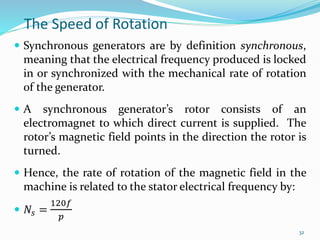
 Hence, the rate of rotation of the magnetic field in the
machine is related to the stator electrical frequency by:
 𝑁𝑠 =
120𝑓
𝑝
32
Synchronous Motor
 The synchronous motor has the same relationship to an
alternator as a dc motor has to a dc generator. That is, if an
alternator is supplied with ac power it is capable of rotating as a
motor and doing mechanical work.
 If the mechanical power supplied to a rotating alternator is
removed while the dc field remains energised, and an ac supply
is then connected across the armature terminals, torque will be
developed and the alternator will continue to rotate at a speed
determined by the ac supply frequency and number of poles on
the synchronous machine.
 Changes in mechanical load within the machine’s rating will
not cause a change in speed.
33
Synchronous Motor Cont’d
 For a synchronous motor, unlike that of a dc motor,
the field structure is energised by direct current, as in
the case of an alternator, whereas the armature
winding is connected to a 3-phase ac supply mains.
 It thus requires two sources of supply:
i. an ac source to supply power for driving the
armature and
ii. a dc source to excite the field
34
Explanation
 In a 3-phase synchronous motor, armature
winding is supplied power from a 3-phase supply
mains while field winding is excited from a dc
source.
35
 For production of torque, it is essential that the
relative velocity between the fields developed by
armature and field windings is zero.
 Now, at starting instant of a 3-phase synchronous
motor, the field developed by field winding is
stationary while the field developed by armature
winding is a rotating magnetic field, rotating at a
synchronous speed of 𝑁𝑠 (given by 120𝑓 𝑝).
 Hence synchronous motors have no starting torque of
their own.
36
Power factor
 A Synchronous motor can operate at lagging,
leading and unity power factor.
 The power factor of the motor will improve with
the increase in the excitation current of
synchronous motor.
 An over excited synchronous motor draws current
at leading power factor whilst if the field is under
excited the power factor will be lagging.
37
Synchronous motor
 It is a useful industrial machine on account of the
following reasons:
i. It improves the power factor of the complete
installation
ii. Its speed is constant at all loads, provided mains
frequency remains constant
iii. It can always be adjusted to operate at unity power
factor for optimum efficiency and economy.
iv. It has no starting torque.
38
Rotating Magnetic Field
Balanced three phase windings,
i.e. mechanically displaced 120
degrees form each other, fed by
balanced three phase source
A rotating magnetic field with
constant magnitude is
produced, rotating with a speed
𝑁𝑠 =
120𝑓
𝑝
Where,
f is the supply frequency,
P is the no. of poles and
𝑁𝑠 is synchronous speed in rpm
(revolutions per minute) 39
40
41
Synchronous Speed
P 50 Hz 60 Hz
2 3000 3600
4 1500 1800
6 1000 1200
8 750 900
10 600 720
12 500 600
42
Induction Motor
 An induction motor derives its name from the fact that the
current in the rotor conductors is induced by the motion of rotor
conductors relative to the magnetic field developed by the stator
currents.
 Conversion of electrical to mechanical power takes place in the
rotating part of the motor.
 In DC motors, electric power is conducted directly to the rotating
part (armature) through brushes and commutator.
 DC motors are thus termed as conduction motors
 In AC motors, the rotor receives electric power by induction (same
way as that of the secondary winding of a transformer).
 It finds wide applicability in industry and in its single-phase form,
in several domestic applications.
43
Induction Motor
 Polyphase induction motor is, by a very considerable margin, the
most widely used ac motor.
 About 90 percent of the mechanical power used in industry is
provided by 3-phase induction motors
 Reasons are:
 (i) its low cost
 (ii) Simple and rugged construction
 (iii) Absence of commutator
 (iv) Good operating characteristic (reasonably good power factor,
sufficiently high efficiency and good speed regulation)
44
Induction Motor cont’d
 A medium size induction motor may have an efficiency
as high as 90% and a power factor of 0.89.
 It is almost a constant speed motor with a shunt
characteristic.
 A few percent speed drop from no-load to full-load
 Also called asynchronous motor as it runs at a speed
other than the synchronous speed of the rotating field
developed by the stator currents. This is because the
rotor does not turn in synchronism with the rotating
field developed by the stator currents.
 Relatively small physically, compared with other types
of motors for a given output rating.
45
Three Phase Induction Motor
 In a three-phase induction motor, the magnetic field rotates and this has
the advantage that no external electrical connections to the rotor need
be made.
 Its name is derived from the fact that the current in the rotor is induced
by the magnetic field instead of being supplied through electrical
connections to the supply.
 When the 3-phase stator windings, are fed by a 3-phase supply, then a
magnetic flux of constant magnitude, but rotating at synchronous
speed, is set up.
 It is termed as a rotating magnetic field.
 resultant flux, ∅𝑟 =
3
2
∅𝑚
 Where ∅𝑚 = maximum value of flux due to any of the three phases.
46
New Info – Single Phase
 A single-phase AC motor has a stator winding and
utilises single-phase ac power. It is not self-starting
thus, requires an external means to get the rotor in
motion. In most cases, an auxiliary stator winding
provides the external help.
 It is termed as the start winding, and is usually
connected to a power source by a centrifugal switch, or
a capacitor.
 Once the rotor begins turning, the centrifugal switch
opens and de-energizes the start winding. Single-phase
induction motors are employed in pumps, small fans,
toys, and high-speed vacuum cleaners.
47
New Info – Three Phase
 While single-phase induction motors are employed in
some applications, most industrial processes require
three-phase induction motors. They have three main
stator windings and operate on three-phase ac power.
Three-phase inductions motors are self-starting and
are noted for their large initial torque (Anon., 2018).
They are often employed in; elevators, cranes, hoists,
crushers, and driving lathe machines.
48
Operation of 3-Phase IMs Cont’d
 Unlike a dc motor, where power is delivered to the rotor, an
ac motor has its power coupled to electromagnets in the
stator to induce the field. The following steps sum up the
working principle of an induction motor operates.
i. When a three-phase is applied to the stator of the
induction motor, a rotating magnetic field is setup in the
coil (Ns).
ii. The rotating field cuts across the rotor conductors and
induces an emf in them.
iii. The induced voltage causes a large opposite current flow
in the conductors or rotor bars.
49
Operation of 3-Phase IMs
iv. The current in the rotor coils produces a force under the
rotating magnetic field, which makes the motor rotate.
v. In an induction motor, the rotor only tries to catchup
with the rotating flux. This introduces the concept of
slip (thus Ns>Nr).
vi. A three phase Induction Motor is Self-Starting,
meaning it requires no external means to cause
rotation.
50
Advantages of 3-Phase IMs
 Induction motors have the following advantages:
i. Their construction is simple.
ii. They are robust, thus, mechanically strong in nature.
iii. A squirrel cage induction motor has no brushes, slip
rings and commutators; due to this reason, maintenance
cost is comparably lower.
iv. Unlike synchronous motors, a three-phase induction
motor has a high starting torque, good speed regulation,
and reasonable overload capacity.
51
Disadvantages
 However, they have the following short comings:
i. They have lesser torque as compared to dc motors;
ii. A narrow useful speed range;
iii. With an increase in load, their speed decreases; and
iv. They are noted for high inrush current at start.
52
New Info
 Three-phase asynchronous motors are widely preferred
over other motors for motor-driven purposes due to the
robust construction of its rotor alongside its ease of
control.
 They are employed in lift hoists, conveyors, compressors,
and pumps.
53
New Info
 A three-phase induction motor is self-starting, meaning
it requires no external means to cause rotation.
 90% of motors used in industries are induction motors.
 When a 3-phase is applied to the stator of the induction
motor, a rotating magnetic field is setup. The rotating
field cuts across the rotor conductors and induces a
voltage in them. The induced voltage initiate flow of
current in the conductors. This generates a torque in the
rotor, causing relative motion between the stator and the
rotor.
54
 At starting time, the motor slip is unity, thus starting
current is very large.
 Starters like the autotransformer starter can be
employed to limit the start current in order to avoid
damage to the motor.
 Starters only ensure an overload protection for the
motor, thus cannot fully protect the motor from
burning out during its operation.
55
Three Phase Induction Motor cont’d
 That is, when 3-phase windings displaced in space by
1200, are fed by 3-phase currents, displaced in time by
1200, they produce a resultant magnetic flux which
rotates in space as if actual magnetic poles were being
rotated mechanically.
 The flux passes through the air-gap, sweeps past the
rotor surface and so cuts the conductors which as yet
are stationary
56
Induction Motor Cont’d - Construction
 Very simple in construction compared to a dc motor or a
synchronous motor.
 It consists essentially of two main parts:
 i. Stator ii. Rotor
 Features:
1. Laminated stator core carrying polyphase winding
2. Laminated rotor core carrying either a cage or
polyphase winding (with shaft-mounted slip-rings)
3. A stiff shaft to preserve the very short air-gap
4. A frame to form the stator housing which is used to
hold the armature stampings in position. The frame is
often made of closed grained cast iron. 57
Induction Motor Cont’d
Stator
 It carries 3-phase winding, fed from 3-phase source
 wound for a definite number of poles
 Number of poles determined by speed
 Stator windings produce a magnetic flux which is of
constant magnitude but rotates at synchronous speed,
given by
 𝑁𝑠 =
120𝑓
𝑝
𝑓 = 𝑠𝑢𝑝𝑝𝑙𝑦 𝑓𝑟𝑒𝑞𝑢𝑒𝑛𝑐𝑦
𝑝 = 𝑛𝑜. 𝑜𝑓 𝑝𝑜𝑙𝑒𝑠
58
Stator Construction
 .
59
• Squirrel cage and
wound-rotor have
similar stator
construction and work
on the same principle.
• Figure 10 shows the
stator part of a three-
phase Induction motor.
• The outermost part of
the motor is the Frame,
which gives the entire
support to the motor
assembly.
Figure 10: 3-Phase Induction Motor
- Stator
• In small motors, the frame is made in a single piece
of cast iron.
• In large sized motors, the frame is fabricated by
sections of steel and then joined together to get the
cylindrical shape.
60
Induction Motor cont’d
 Types of Rotor (Motor)
 i. Squirrel-cage rotor
 ii. Phase-wound/slip-ring rotor
 The motor is named after the rotor e.g. Squirrel-cage
induction motor.
 The rotor of a 3-phase wound rotor induction motor is
provided with three phase winding.
 The rotor runs at a speed which is always less than the
speed of the stator field. The difference in speeds
depends upon the load on the motor.
61
Slip
 The ratio of the difference between the synchronous
speed 𝑁𝑠 and the actual speed N of the rotor is known
as the slip.
 Slip is indicative of the rotor ‘slipping back’ from
synchronism.
 It is given by
% 𝑠𝑙𝑖𝑝, 𝑠 =
𝑁𝑠−𝑁
𝑁𝑠
 It is usually expressed as a percentage of the
synchronous speed but it could also be expressed in
rev/s
62
Slip Cont’d
 𝑁𝑠 − 𝑁 is called slip speed
 From above, rotor (motor) speed N is given by
𝑁 = 𝑁𝑠(1 − 𝑠)
 NB:
 Revolving flux is rotating synchronously, relative
to the stator (i.e. stationary space) but at slip speed
relative to the rotor.
63
Example
 In the case of a 3-phase induction motor having
Ns = 1500 rpm and running with s = 0.04.
 Determine:
a) revolving speed of the stator flux in space.
b) rotor speed.
c) Speed of rotor flux relative to the rotor.
d) Speed of the rotor flux with respect to the
stator.
64
Solution 1
a) Ns = 1500
b) 𝑁 = 𝑁𝑠(1 − 𝑆) = 1500(1 − 0.04) = 1440 𝑟𝑝𝑚
c) Either 𝑁𝑠– 𝑁 = 1500– 1440 = 60 𝑟𝑝𝑚
 or 𝑆 × 𝑁𝑠 0.04 × 1500 = 60𝑟𝑝𝑚
d) Speed of rotor flux = 1500 rpm
 Speed of stator = 0
 Thus speed of flux w.r.t. the stator = 1500 − 0
 =1500 rpm
65
Frequency of rotor current
 When rotor is stationary, the frequency of rotor current is
the same as the supply frequency.
 When rotor starts revolving, its frequency depends on
relative speed or slip speed
 If 𝑓′
= frequency of rotor current at any slip-speed,
 then 𝑁𝑠 − 𝑁 =
120𝑓′
𝑝
(from 𝑁𝑠 =
120𝑓
𝑝
)
 dividing 𝑁𝑠 − 𝑁 by 𝑁𝑠
 Then
𝑁𝑠−𝑁
𝑁𝑠
=
120𝑓′
𝑝
120𝑓
𝑝
=
𝑓′
𝑓
= 𝑠
 thus 𝑓′
= 𝑠𝑓
66
Example 2
A 4-pole, 3-phase induction motor operates from a supply
whose frequency is 50 Hz. Calculate:
a) The speed at which the magnetic field of the stator is
rotating
b) The speed of the rotor when the slip is 0.04
c) The frequency of the rotor currents when the slip is 0.03
d) The frequency of the rotor currents at standstill.
67
Solution 2
4-pole, 3-phase, f = 50 Hz
a) 𝑁𝑠 =
120𝑓
𝑝
=
120×50
4
= 1500 rpm
b) speed of rotor (motor) when slip is 0.04
𝑁 = 𝑁𝑠(1 − 𝑠) = 1500(1 − 0.04 = 1440 𝑟𝑝𝑚
c) frequency of rotor currents, when slip is 0.03
𝑓′
= 𝑠𝑓 = 0.03 × 50
= 1.5 𝑟𝑝𝑠 𝑜𝑟 90 𝑟𝑝𝑚
d) frequency of the rotor currents at standstill
 S = 1, 𝑓′ = 𝑠𝑓 = 1 × 50
 = 50 Hz 68
Example 3
A 3-phase induction motor is wound for 6 poles and is
supplied from 50 Hz system. Calculate:
i. The synchronous speed
ii. The rotor speed, when slip is 5%
iii. The frequency of the rotor currents at standstill
iv. Rotor frequency when rotor runs at 960 rpm.
69
Solution 3
 P = 6 poles, f = 50 Hz
 (i) 𝑁𝑠 =
120𝑓
𝑝
=
120×50
6
= 1000 rpm
 (ii) when slip is 5%
 rotor speed, 𝑁 = 𝑁𝑠 1 − 𝑠
 = 1000(1 − 0.05)
 = 950 𝑟𝑝𝑚
 (iii) At standstill, s = 1
 𝑓′ = 𝑠𝑓 = 1 × 50
70
Solution 3 Cont’d
 (iv) When rotor speed is 960 rpm, slip is
 𝑠 =
𝑁𝑠−𝑁
𝑁𝑠
=
1000−960
1000
= 0.04
 𝑓′ = 𝑠𝑓 = 0.04 × 50
 = 2 𝐻𝑧
 Alternatively,
 𝑁𝑠 − 𝑁 =
120𝑓′
𝑝
 𝑓′
=
𝑝(𝑁𝑠−𝑁)
120
=
6(1000−960)
120
 = 2 𝐻𝑧
71
Example 4
 A 3-phase induction motor is wound for 6 poles and is
supplied from 60 Hz system. Calculate:
 (a) the synchronous speed
 (b) rotor speed, when slip is 5% and
 (c) rotor frequency when rotor runs at 600 rpm
 Solution 4
 (a) 1200 rpm
 (b) 1140 rpm
 (c) 30 Hz
72
Example 5
 A 3-phase induction motor runs at a speed of 1485 rpm at no-
load and at 1350 rpm at full-load when supplied from a 50 Hz,
3-phase line:
 (a) How many poles does the motor have?
 (b) What is the slip at no-load and at full-load?
 (c) What is the frequency of rotor voltages at no-load and at
full-load?
 (d) What is the speed at both no-load and full-load of,
 i. the rotor field with respect to rotor conductors,
 ii. the rotor field with respect to the stator
 iii. the rotor field with respect to the stator field
73
Solution 5
 𝑁𝑛𝑜 = 1485 𝑟𝑝𝑚; 𝑁𝑓𝑢𝑙𝑙 = 1350 𝑟𝑝𝑚; 𝑓 = 50 𝐻𝑧
a) 𝑁 ≈
120𝑓
𝑝
⟹ 𝑝 =
120𝑓
𝑁
=
120×50
1485
= 4.04 ≃ 4
No. of poles = 4
Thus 𝑁𝑠 =
120𝑓
𝑝
=
120×50
4
= 1500 𝑟𝑝𝑚
b) 𝑠 =
𝑁𝑠−𝑁
𝑁𝑠
𝑠𝑛𝑜 =
1500−1485
1500
= 0.01
𝑠𝑓𝑢𝑙𝑙 =
1500−1350
1500
= 0.1
74
Solution 5 Cont’d
c) 𝑓′
𝑛𝑜
= 𝑠𝑛𝑜𝑓 = 0.01 × 50 = 0.5 𝐻𝑧
 𝑓′
𝑓𝑢𝑙𝑙
= 𝑠𝑓𝑢𝑙𝑙𝑓 = 0.1 × 50 = 5 𝐻𝑧
d) Speed of rotor field, 𝑁𝑠 = 1500 𝑟𝑝𝑚
Speed of stator field, 𝑁𝑠 = 1500 𝑟𝑝𝑚
Speed of Stator = 0
Speed of rotor at no-load, 𝑁𝑛𝑜= 1485 𝑟𝑝𝑚
Speed of rotor at full-load, 𝑁𝑓𝑢𝑙𝑙= 1350 𝑟𝑝𝑚
75
Solution 5 Cont’d
i. Rotor field w.r.t. rotor at no-load = 1500 − 1485
= 15 𝑟𝑝𝑚
Rotor field w.r.t. rotor at full-load = 1500 − 1350
= 150 𝑟𝑝𝑚
ii. Rotor field w.r.t. stator = 1500 − 0 = 1500 𝑟𝑝𝑚
iii. Rotor field w.r.t. stator field = 1500 − 1500 = 0
76
Example 6
 If the stator of a three phase 4-pole slip-ring induction
motor is fed from 50 Hz source and its rotor from a 30
Hz source, at what speed will the motor run?
 Solution 6
 The total frequency been fed to the motor
= 30 + 50 = 80 𝐻𝑧
Thus motor will run at
𝑁 =
120𝑓
𝑝
=
120×80
4
= 2400 𝑟𝑝𝑚
77
Example 7
 A centre-zero ammeter connected in the rotor circuit
of a 4-pole, 50 Hz induction motor makes 90
oscillations in one minute, what is the rotor speed?
 Solution 7
 𝑁𝑠 =
120𝑓
𝑝
=
120×50
4
= 1500 𝑟𝑝𝑚
 Now, 𝑓′
=
90 𝑜𝑠𝑐𝑖𝑙𝑙𝑎𝑡𝑖𝑜𝑛𝑠
60
= 1.5 𝐻𝑧
 But 𝑁𝑠 − 𝑁 =
120𝑓′
𝑝
 ⟹ 1500 − 𝑁 =
120×1.5
4
 Hence, 𝑁 = 1455 𝑟𝑝𝑚
78
More Examples
 Q1.
 A 4-pole alternator runs at 1500 rpm. It supplies power to an 8-pole
induction motor which has a full-load slip of 4%. Determine the full-
load speed of the motor.
 Q2.
 A 6 – pole induction motor runs at 1140 rpm. Find the rotor frequency
if the supply frequency is 60 Hz.
 Q3.
 A 10 – pole 3-phase alternator is coupled to an engine running at 600
rpm. This alternator supplies an induction motor running at a speed
of 985 rpm. Find:
 (i) the number of poles of the induction motor
 (ii) the slip speed
 (iii) slip
 (iv) the rotor frequency
79
Solution 3
 𝑁𝑠𝑎𝑙𝑡 = 600 𝑟𝑝𝑚; 𝑃𝑎𝑙𝑡 = 10; 𝑁𝑖𝑚 = 985 𝑟𝑝𝑚
i. For alternator,
 𝑁𝑠𝑎𝑙𝑡 =
120𝑓
𝑝𝑎𝑙𝑡
 ⟹ 𝑓 =
𝑃𝑎𝑙𝑡×𝑁𝑠𝑎𝑙𝑡
120
=
10×600
120
= 50 𝐻𝑧
 Thus for the induction motor,
 𝑁𝑠𝑖𝑚 =
120𝑓
𝑝𝑖𝑚
 ⟹ 𝑃𝑖𝑚 =
120×50
985
= 6.09 ≃ 6
80
Solution 3 Cont’d
ii. 𝑁𝑠𝐼𝑚 =
120×50
6
= 1000 𝑟𝑝𝑚
Thus slip speed = 1000 − 985 = 15 𝑟𝑝𝑚
iii. Slip, 𝑠 =
𝑁𝑠−𝑁
𝑁𝑠
=
1000−985
1000
= 0.015 or 1.5%
iv. 𝑓′ = 𝑠𝑓 = 0.015 × 50 = 0.75 𝐻𝑧
81
Question 4
A motor-generator set used for providing variable
frequency ac supply consists of a 3-phase, 10 pole
synchronous motor and a 24-pole, 3-phase synchronous
generator. The motor- generator set is fed from a 25 Hz, 3-
phase ac supply. A 6-pole, 3-phase induction motor is
electrically connected to the terminals of the synchronous
generator and runs at a slip of 5%.
Determine:
i. the synchronous speed of the motor-generator;
ii. the frequency of the generated voltage of the
synchronous generator;
iii. the synchronous speed of the induction motor; and
iv. the speed at which the induction motor is running.
82
Solution 4
i. Speed of motor-generator set,
 𝑁𝑠 =
120×𝑠𝑢𝑝𝑝𝑙𝑦 𝑓𝑟𝑒𝑞𝑢𝑒𝑛𝑐𝑦,𝑓𝑚𝑔
𝑁𝑜.𝑜𝑓 𝑝𝑜𝑙𝑒𝑠 𝑜𝑓 𝑚𝑜𝑡𝑜𝑟
=
120×25
10
= 300 𝑟𝑝𝑚
ii. Frequency of generated voltage,
 𝑓 =
𝑠𝑝𝑒𝑒𝑑 𝑜𝑓 𝑚𝑜𝑡𝑜𝑟−𝑔𝑒𝑛𝑒𝑟𝑎𝑡𝑒𝑑 𝑠𝑒𝑡×𝑛𝑜.𝑜𝑓 𝑝𝑜𝑙𝑒𝑠 𝑜𝑛 𝑠𝑦𝑛𝑐ℎ 𝑔𝑒𝑛𝑒𝑟𝑎𝑡𝑜𝑟
120
 =
300×24
120
= 60 𝐻𝑧
iii. Synchronous speed of IM, 𝑁𝑠 =
120×𝑓
𝑃𝑖𝑚
=
120×60
6
= 1200 𝑟𝑝𝑚
iv. Speed of motor, 𝑁𝑚 = 𝑁𝑠 1 − 𝑠
 = 1200 1 − 0.05 = 1140 𝑟𝑝𝑚
83
Squirrel-Cage Motor
 A cage motor is more rugged in construction and
needs no slip rings, brushes etc., therefore, its
maintenance cost is low.
84
Wound Rotor
 The number of slip-rings on a 3-phase wound rotor
induction motor is three.
85
Single-Phase Motors
 Two basic reasons for the use of single-phase rather
than 3-phase motors:
a) For reasons of economy, most houses, offices and
also rural areas are supplied with single phase ac, as
power requirements of individual load items are
rather small.
b) Economics of the motor and its branch circuit.
 Fixed loads requiring not more than 0.5 kW can
generally be served most economically with single
phase power.
 For the same rating, the size of a single phase induction
motor is about 1.5 times that of the corresponding 3-
phase induction motor.
86
Single Phase Motors Cont’d
 Single phase motors are simple in construction,
reliable, easy to repair and comparatively cheaper in
cost.
 They find wide use in fans, refrigerators, vacuum
cleaners, washing machines, other kitchen equipment,
tools, blowers, centrifugal pumps, small farming
appliances etc.
 Single phase induction motor requires starting winding
because it has no starting torque.
87
Note
1. Speed of the stator field of an Induction motor is
Synchronous speed
2. Difference in speed between stator field and rotor is Slip
3. Frequency of current in rotor is Slip Frequency
4. Machine with negative slip is Induction Generator
5. When rotor is at standstill, Slip is one
6. When the motor runs at synchronous speed slip is Zero
7. Lenz’s law can be used to explain why the rotor of a 3-
phase induction motor rotates in the same direction as
that of stator rotating field
88
8. The direction of rotor current produced in an
induction motor can be determined by Fleming’s
right hand rule
9. An Induction motor is analogous to a transformer
10. An induction motor works with ac only
11. The stator core of a 3-phase induction motor is
laminated in order to reduce the Eddy current
12. A squirrel-cage induction motor has low starting
torque.
13. If stator field is rotating in clockwise direction, rotor
also rotates in clockwise direction.
89
 14. Speed of rotor field in space is Ns.
 15. Types of AC Motors: 3-phase induction motors, 3-
phase synchronous motors and 3-phase commutator
motors.
 16. In a synchronous machine, the stator frame is made
of cast iron or welded steel plates.
 17. In a synchronous motor, the factors that determine
the number of poles are supply frequency and speed.
90
 At what speed will the Induction Motor (IM) run?
 Can the IM run at the synchronous speed, why?
 If rotor runs at the synchronous speed, which is the same
speed of the rotating magnetic field, then the rotor will
appear stationary to the rotating magnetic field and the
rotating magnetic field will not cut the rotor. So, no
induced current will flow in the rotor and no rotor
magnetic flux will be produced so no torque is generated
and the rotor speed will fall below the synchronous
speed
 When the speed falls, the rotating magnetic field will cut
the rotor windings and a torque is produced 91
1. The process of connecting an alternator in parallel
with another alternator or with common bus-bars is
called synchronising.
2. When two alternators are operating in proper
synchronism, the synchronising power will be zero.
3. At normal load the slip of induction motor is usually
4%.
4. The speed characteristic of an induction motor is
somewhat similar to that of a dc shunt motor.
92
1. The efficiency of a synchronous motor is more than
that of an induction motor of same size and output
rating.
2. An induction motor is less expensive in comparison
to that of a synchronous motor of same size and
output rating.
93

AC Motors.pptx

  • 1.
  • 2.
    Detailed Course Outline ACMotors a) In terms of i. Principle of operation ii. Speed iii. Current b) Single-Phase AC Motors i. Induction motors ii. Commutator motors iii. Synchronous motors 2
  • 3.
    Course Outline Cont’d c)Three-Phase AC Motors i. 3-phase synchronous motors ii. 3-phase induction motors iii. 3-phase commutator motors (e.g., surcharge motors) d) Synchronous Machine i. Synchronous generator ii. Synchronous motor iii. Synchronous compensator (or phase modifier) 3
  • 4.
    Course Outline Cont’d e)Three phase Induction Motors i. Production of rotating magnetic field in 3-phase motors ii. 3-phase squirrel cage induction motor 1. Stator and rotor of squirrel cage 2. Characteristics of squirrel cage iii. Wound Rotor 4
  • 5.
    AC Motors  Interms of Principle of operation:  Synchronous  Asynchronous  i. Induction motors  ii. Commutator motors  In terms of speed  Constant speed  Variable speed  Adjustable speed 5
  • 6.
    In terms ofspeed  Where speeds may be selected from several different pre-set ranges, usually the drive is said to be adjustable speed.  If the output speed can be changed without steps over a range, the drive is usually referred to as variable speed. 6
  • 7.
     In termsof Current  Single-phase  Three-phase  The voltage induced by a single coil when rotated in a uniform magnetic field is known as a single-phase voltage.  Most consumers are fed by means of a single-phase ac supply. Two wires are used, one called the live conductor (usually coloured red) and the other is called the neutral conductor (usually coloured black).  The neutral is usually connected via protective gear to earth, the earth wire being coloured green. The standard voltage for a single-phase ac supply is 230 V. 7
  • 8.
    Single Phase ACMOTORS  The majority of single-phase supplies are obtained by connection to a three-phase supply.  Single phase ac motors may be divided in three general classes, namely  i. Induction motors  ii. Commutator motors  iii. Synchronous motors  Examples of Single-phase Types  Single-phase universal  Single-phase synchronous  Single-phase repulsion induction  Single-phase capacitor-start induction motor  Single-phase split-phase motor etc. 8
  • 9.
    Three-Phase Alternating Current(AC)  Generation, transmission and utilisation of large quantities of electric power involve polyphase (two or three phase) circuits.  Thus in Ghana, generation (VRA), transmission (GRIDCo) and distribution (ECG) of electricity via the National Grid system is accomplished by three-phase alternating currents.  3-phase systems are very common because they possess definite economic advantages and are easy to operate.  A three-phase supply is generated when three coils are placed 120° apart and the whole rotated in a uniform magnetic field as shown in Figure 1. The result is three independent supplies of equal voltages which are each displaced by 120° from each other. 9
  • 10.
    3-Phase AC  Theconvention adopted to identify each of the phase voltages is:  R-red, Y-yellow, and B-blue, as shown in Figure 1. 10 Figure 1: 3-Phase Alternating Current
  • 11.
     A three-phaseac supply is carried by three conductors, called ‘lines’ which are coloured red, yellow and blue.  The currents in these conductors are known as line currents (𝐼𝐿) and the p.d.’s between them are known as line voltages (𝑉𝐿).  A fourth conductor, called the neutral (coloured black, and connected through protective devices to earth) is often used with a three-phase supply. 11
  • 12.
  • 13.
    Three-Phase Alternating Current(AC) Motors  Where its supply is available, 3-phase motors are preferable.  The motors are more efficient, have higher power factor, and better starting properties, and relatively cheaper than single- phase motors.  Groups of motors  3-phase induction motors  3-phase synchronous motors: Its speed remains constant irrespective of magnitude of load.  3-phase commutator motors such as surcharge motors. 13
  • 14.
    Synchronous Machine  Asynchronous machine is an ac machine in which the rotor moves at a speed which bears a constant 14 Figure 3: 3-Phase Synchronous Machine relationship to the frequency of currents in the armature winding. They are generally constructed in larger sizes Classified into three (3) according to their applications.
  • 15.
    Synchronous Machines Cont’d A.Synchronous Generator  It is a synchronous machine which receives mechanical energy from a prime mover (steam turbine, hydraulic turbine or diesel engine) to which it is mechanically coupled and delivers electrical energy.  It is one of the important types of electric machines; in fact all generating machines at power stations are of synchronous kind and are known as synchronous generators or alternators.  Thus, large ac networks operating at constant frequency of 50 Hz (e.g. in Ghana) rely almost exclusively on synchronous generators for the supply of electrical energy. 15
  • 16.
    Synchronous Machines Cont’d Private, standby, and peak-load plants with diesel or gas turbine prime movers also have synchronous generators.  The modern trend is to build alternators of very large sizes capable of generating 500 MVA or even more. 16
  • 17.
    Synchronous Machines Cont’d Synchronous Motor  It is a synchronous machine which receives electrical energy from ac supply main and drives mechanical load.  It provides constant speed industrial drives with the possibility of power factor correction.  The synchronous motors are rarely built in small sizes owing to superior performance characteristics and economical construction of induction motors. 17
  • 18.
    Synchronous Machines Cont’d Synchronous Compensator (or Phase Modifier)  It is a synchronous machine designed to operate on no-load with its shaft not connected to either a prime mover or to a mechanical load and is used to control reactive supply networks.  They are designed for ratings up to 100 MVar and speeds up to 3000 rpm 18
  • 19.
    Synchronous Machines Cont’d The synchronous machines may be single, two or 3- phase types.  For the single phase type, the armature has all the coils connected for addition of individual voltages.  This provides a pair of output terminals and a single ac output.  For two-phase type, the armature has two sets of windings placed so that two outputs from three terminals (one common) are 900 out of phase 19
  • 20.
     For thethree-phase type, the armature has three sets of windings placed so that three outputs with a mutual phase difference of 1200 are available.  The three windings may be connected either in star or delta.  Large ac machines are invariably 3-phase type 20
  • 21.
    Synchronous Machines Cont’d A Synchronous machine consists essentially of two parts: a) Stator (or armature) b) Rotor (the field magnet system)  Thus, it must have at least 2 components:  Stator Windings or Armature Windings (windings where the main voltage is induced)  Rotor Windings or Field Windings (windings that produce the main magnetic field in a machine) 21
  • 22.
     For synchronousmachines, the field windings are on the rotor, so the terms “rotor windings” and “field windings” are used interchangeably. 22
  • 23.
    Synchronous Machine Cont’d Stator  It is an iron ring, made of laminations of special magnetic iron or steel alloy (silicon steel)  It has slots on its inner periphery to accommodate conductors  The whole structure is held in a frame which may be of cast iron or welded steel plates  The field rotates in between the stator, so that flux of the rotating field cuts the core of the stator continuously 23
  • 24.
     Rotor  Therotor of a synchronous generator is a large electromagnet and the magnetic poles on the rotor can essentially lead to two types of constructions:  (a) cylindrical-rotor type (non-salient)  (b) salient-pole type  Non-salient pole rotors are normally used for rotors with 2 or 4 poles rotor, while salient pole rotors are used for 4 or more poles rotor. 24
  • 25.
    Synchronous Machines cont’d (a) Cylindrical-rotor (non-salient) machine has its rotor in cylindrical form with dc field windings embedded in the rotor slots.  It has uniform air-gap, so that the permeance offered to the mmf acting on the magnetic circuit is independent of the angle between the axis of the mmf and that of the rotor poles. 25 Figure 4: Non-salient Rotor for Synchronous Machine
  • 26.
    Synchronous Machines Cont’d The construction provides greater mechanical strength and permits more accurate dynamic balancing. 26  It is particularly adopted for use in high-speed turbo generators wherein a relatively long but small diameter.  Two or at most 4-pole machines use this type of construction.
  • 27.
     (b) Salient-poletype has its rotor poles projecting out from the rotor core.  It is used for low-speed hydroelectric generators and the large number of poles necessary are accommodated in projecting form on a rotor of large diameter but small in length. 27 Salient pole rotors are used for 4 or more poles rotor. The construction is almost universally adopted for synchronous motors. Figure 4: Salient Rotor for Synchronous Machine
  • 28.
    Principle of Operation A dc current must be supplied to the field circuit on the rotor. Since the rotor is rotating, a special arrangement is required to get the dc power to its field windings.  The common ways are: i. supply the dc power from an external dc source to the rotor by means of slip rings and brushes. ii. supply the dc power from a special dc power source mounted directly on the shaft of the synchronous generator. 28
  • 29.
     NB:  Sliprings are metal rings completely encircling the shaft of a machine but insulated from it.  One end of the dc rotor winding is tied to each of the 2 slip rings on the shaft of the synchronous machine, and a stationary brush rides on each slip ring. 29
  • 30.
    Principle of OperationCont’d   A brush is a block of graphite-like carbon compound that conducts electricity freely but has very low friction, hence it does not wear down the slip ring.  If the positive end of a dc voltage source is connected to one brush and the negative end is connected to the other, then the same dc voltage will be applied to the field winding at all times regardless of the angular position or speed of the rotor. 30
  • 31.
    Principle of OperationCont’d  Some problems with slip rings and brushes: i. They increase the amount of maintenance required on the machine, since the brushes must be checked for wear regularly. ii. Brush voltage drop can be the cause of significant power losses on machines with larger field currents.   Small synchronous machines – use slip rings and brushes.  Larger machines – brushless exciters are used to supply the dc field current. 31
  • 32.
    The Speed ofRotation  Synchronous generators are by definition synchronous, meaning that the electrical frequency produced is locked in or synchronized with the mechanical rate of rotation of the generator.  A synchronous generator’s rotor consists of an electromagnet to which direct current is supplied. The rotor’s magnetic field points in the direction the rotor is turned.  Hence, the rate of rotation of the magnetic field in the machine is related to the stator electrical frequency by:  𝑁𝑠 = 120𝑓 𝑝 32
  • 33.
    Synchronous Motor  Thesynchronous motor has the same relationship to an alternator as a dc motor has to a dc generator. That is, if an alternator is supplied with ac power it is capable of rotating as a motor and doing mechanical work.  If the mechanical power supplied to a rotating alternator is removed while the dc field remains energised, and an ac supply is then connected across the armature terminals, torque will be developed and the alternator will continue to rotate at a speed determined by the ac supply frequency and number of poles on the synchronous machine.  Changes in mechanical load within the machine’s rating will not cause a change in speed. 33
  • 34.
    Synchronous Motor Cont’d For a synchronous motor, unlike that of a dc motor, the field structure is energised by direct current, as in the case of an alternator, whereas the armature winding is connected to a 3-phase ac supply mains.  It thus requires two sources of supply: i. an ac source to supply power for driving the armature and ii. a dc source to excite the field 34
  • 35.
    Explanation  In a3-phase synchronous motor, armature winding is supplied power from a 3-phase supply mains while field winding is excited from a dc source. 35
  • 36.
     For productionof torque, it is essential that the relative velocity between the fields developed by armature and field windings is zero.  Now, at starting instant of a 3-phase synchronous motor, the field developed by field winding is stationary while the field developed by armature winding is a rotating magnetic field, rotating at a synchronous speed of 𝑁𝑠 (given by 120𝑓 𝑝).  Hence synchronous motors have no starting torque of their own. 36
  • 37.
    Power factor  ASynchronous motor can operate at lagging, leading and unity power factor.  The power factor of the motor will improve with the increase in the excitation current of synchronous motor.  An over excited synchronous motor draws current at leading power factor whilst if the field is under excited the power factor will be lagging. 37
  • 38.
    Synchronous motor  Itis a useful industrial machine on account of the following reasons: i. It improves the power factor of the complete installation ii. Its speed is constant at all loads, provided mains frequency remains constant iii. It can always be adjusted to operate at unity power factor for optimum efficiency and economy. iv. It has no starting torque. 38
  • 39.
    Rotating Magnetic Field Balancedthree phase windings, i.e. mechanically displaced 120 degrees form each other, fed by balanced three phase source A rotating magnetic field with constant magnitude is produced, rotating with a speed 𝑁𝑠 = 120𝑓 𝑝 Where, f is the supply frequency, P is the no. of poles and 𝑁𝑠 is synchronous speed in rpm (revolutions per minute) 39
  • 40.
  • 41.
  • 42.
    Synchronous Speed P 50Hz 60 Hz 2 3000 3600 4 1500 1800 6 1000 1200 8 750 900 10 600 720 12 500 600 42
  • 43.
    Induction Motor  Aninduction motor derives its name from the fact that the current in the rotor conductors is induced by the motion of rotor conductors relative to the magnetic field developed by the stator currents.  Conversion of electrical to mechanical power takes place in the rotating part of the motor.  In DC motors, electric power is conducted directly to the rotating part (armature) through brushes and commutator.  DC motors are thus termed as conduction motors  In AC motors, the rotor receives electric power by induction (same way as that of the secondary winding of a transformer).  It finds wide applicability in industry and in its single-phase form, in several domestic applications. 43
  • 44.
    Induction Motor  Polyphaseinduction motor is, by a very considerable margin, the most widely used ac motor.  About 90 percent of the mechanical power used in industry is provided by 3-phase induction motors  Reasons are:  (i) its low cost  (ii) Simple and rugged construction  (iii) Absence of commutator  (iv) Good operating characteristic (reasonably good power factor, sufficiently high efficiency and good speed regulation) 44
  • 45.
    Induction Motor cont’d A medium size induction motor may have an efficiency as high as 90% and a power factor of 0.89.  It is almost a constant speed motor with a shunt characteristic.  A few percent speed drop from no-load to full-load  Also called asynchronous motor as it runs at a speed other than the synchronous speed of the rotating field developed by the stator currents. This is because the rotor does not turn in synchronism with the rotating field developed by the stator currents.  Relatively small physically, compared with other types of motors for a given output rating. 45
  • 46.
    Three Phase InductionMotor  In a three-phase induction motor, the magnetic field rotates and this has the advantage that no external electrical connections to the rotor need be made.  Its name is derived from the fact that the current in the rotor is induced by the magnetic field instead of being supplied through electrical connections to the supply.  When the 3-phase stator windings, are fed by a 3-phase supply, then a magnetic flux of constant magnitude, but rotating at synchronous speed, is set up.  It is termed as a rotating magnetic field.  resultant flux, ∅𝑟 = 3 2 ∅𝑚  Where ∅𝑚 = maximum value of flux due to any of the three phases. 46
  • 47.
    New Info –Single Phase  A single-phase AC motor has a stator winding and utilises single-phase ac power. It is not self-starting thus, requires an external means to get the rotor in motion. In most cases, an auxiliary stator winding provides the external help.  It is termed as the start winding, and is usually connected to a power source by a centrifugal switch, or a capacitor.  Once the rotor begins turning, the centrifugal switch opens and de-energizes the start winding. Single-phase induction motors are employed in pumps, small fans, toys, and high-speed vacuum cleaners. 47
  • 48.
    New Info –Three Phase  While single-phase induction motors are employed in some applications, most industrial processes require three-phase induction motors. They have three main stator windings and operate on three-phase ac power. Three-phase inductions motors are self-starting and are noted for their large initial torque (Anon., 2018). They are often employed in; elevators, cranes, hoists, crushers, and driving lathe machines. 48
  • 49.
    Operation of 3-PhaseIMs Cont’d  Unlike a dc motor, where power is delivered to the rotor, an ac motor has its power coupled to electromagnets in the stator to induce the field. The following steps sum up the working principle of an induction motor operates. i. When a three-phase is applied to the stator of the induction motor, a rotating magnetic field is setup in the coil (Ns). ii. The rotating field cuts across the rotor conductors and induces an emf in them. iii. The induced voltage causes a large opposite current flow in the conductors or rotor bars. 49
  • 50.
    Operation of 3-PhaseIMs iv. The current in the rotor coils produces a force under the rotating magnetic field, which makes the motor rotate. v. In an induction motor, the rotor only tries to catchup with the rotating flux. This introduces the concept of slip (thus Ns>Nr). vi. A three phase Induction Motor is Self-Starting, meaning it requires no external means to cause rotation. 50
  • 51.
    Advantages of 3-PhaseIMs  Induction motors have the following advantages: i. Their construction is simple. ii. They are robust, thus, mechanically strong in nature. iii. A squirrel cage induction motor has no brushes, slip rings and commutators; due to this reason, maintenance cost is comparably lower. iv. Unlike synchronous motors, a three-phase induction motor has a high starting torque, good speed regulation, and reasonable overload capacity. 51
  • 52.
    Disadvantages  However, theyhave the following short comings: i. They have lesser torque as compared to dc motors; ii. A narrow useful speed range; iii. With an increase in load, their speed decreases; and iv. They are noted for high inrush current at start. 52
  • 53.
    New Info  Three-phaseasynchronous motors are widely preferred over other motors for motor-driven purposes due to the robust construction of its rotor alongside its ease of control.  They are employed in lift hoists, conveyors, compressors, and pumps. 53
  • 54.
    New Info  Athree-phase induction motor is self-starting, meaning it requires no external means to cause rotation.  90% of motors used in industries are induction motors.  When a 3-phase is applied to the stator of the induction motor, a rotating magnetic field is setup. The rotating field cuts across the rotor conductors and induces a voltage in them. The induced voltage initiate flow of current in the conductors. This generates a torque in the rotor, causing relative motion between the stator and the rotor. 54
  • 55.
     At startingtime, the motor slip is unity, thus starting current is very large.  Starters like the autotransformer starter can be employed to limit the start current in order to avoid damage to the motor.  Starters only ensure an overload protection for the motor, thus cannot fully protect the motor from burning out during its operation. 55
  • 56.
    Three Phase InductionMotor cont’d  That is, when 3-phase windings displaced in space by 1200, are fed by 3-phase currents, displaced in time by 1200, they produce a resultant magnetic flux which rotates in space as if actual magnetic poles were being rotated mechanically.  The flux passes through the air-gap, sweeps past the rotor surface and so cuts the conductors which as yet are stationary 56
  • 57.
    Induction Motor Cont’d- Construction  Very simple in construction compared to a dc motor or a synchronous motor.  It consists essentially of two main parts:  i. Stator ii. Rotor  Features: 1. Laminated stator core carrying polyphase winding 2. Laminated rotor core carrying either a cage or polyphase winding (with shaft-mounted slip-rings) 3. A stiff shaft to preserve the very short air-gap 4. A frame to form the stator housing which is used to hold the armature stampings in position. The frame is often made of closed grained cast iron. 57
  • 58.
    Induction Motor Cont’d Stator It carries 3-phase winding, fed from 3-phase source  wound for a definite number of poles  Number of poles determined by speed  Stator windings produce a magnetic flux which is of constant magnitude but rotates at synchronous speed, given by  𝑁𝑠 = 120𝑓 𝑝 𝑓 = 𝑠𝑢𝑝𝑝𝑙𝑦 𝑓𝑟𝑒𝑞𝑢𝑒𝑛𝑐𝑦 𝑝 = 𝑛𝑜. 𝑜𝑓 𝑝𝑜𝑙𝑒𝑠 58
  • 59.
    Stator Construction  . 59 •Squirrel cage and wound-rotor have similar stator construction and work on the same principle. • Figure 10 shows the stator part of a three- phase Induction motor. • The outermost part of the motor is the Frame, which gives the entire support to the motor assembly. Figure 10: 3-Phase Induction Motor - Stator
  • 60.
    • In smallmotors, the frame is made in a single piece of cast iron. • In large sized motors, the frame is fabricated by sections of steel and then joined together to get the cylindrical shape. 60
  • 61.
    Induction Motor cont’d Types of Rotor (Motor)  i. Squirrel-cage rotor  ii. Phase-wound/slip-ring rotor  The motor is named after the rotor e.g. Squirrel-cage induction motor.  The rotor of a 3-phase wound rotor induction motor is provided with three phase winding.  The rotor runs at a speed which is always less than the speed of the stator field. The difference in speeds depends upon the load on the motor. 61
  • 62.
    Slip  The ratioof the difference between the synchronous speed 𝑁𝑠 and the actual speed N of the rotor is known as the slip.  Slip is indicative of the rotor ‘slipping back’ from synchronism.  It is given by % 𝑠𝑙𝑖𝑝, 𝑠 = 𝑁𝑠−𝑁 𝑁𝑠  It is usually expressed as a percentage of the synchronous speed but it could also be expressed in rev/s 62
  • 63.
    Slip Cont’d  𝑁𝑠− 𝑁 is called slip speed  From above, rotor (motor) speed N is given by 𝑁 = 𝑁𝑠(1 − 𝑠)  NB:  Revolving flux is rotating synchronously, relative to the stator (i.e. stationary space) but at slip speed relative to the rotor. 63
  • 64.
    Example  In thecase of a 3-phase induction motor having Ns = 1500 rpm and running with s = 0.04.  Determine: a) revolving speed of the stator flux in space. b) rotor speed. c) Speed of rotor flux relative to the rotor. d) Speed of the rotor flux with respect to the stator. 64
  • 65.
    Solution 1 a) Ns= 1500 b) 𝑁 = 𝑁𝑠(1 − 𝑆) = 1500(1 − 0.04) = 1440 𝑟𝑝𝑚 c) Either 𝑁𝑠– 𝑁 = 1500– 1440 = 60 𝑟𝑝𝑚  or 𝑆 × 𝑁𝑠 0.04 × 1500 = 60𝑟𝑝𝑚 d) Speed of rotor flux = 1500 rpm  Speed of stator = 0  Thus speed of flux w.r.t. the stator = 1500 − 0  =1500 rpm 65
  • 66.
    Frequency of rotorcurrent  When rotor is stationary, the frequency of rotor current is the same as the supply frequency.  When rotor starts revolving, its frequency depends on relative speed or slip speed  If 𝑓′ = frequency of rotor current at any slip-speed,  then 𝑁𝑠 − 𝑁 = 120𝑓′ 𝑝 (from 𝑁𝑠 = 120𝑓 𝑝 )  dividing 𝑁𝑠 − 𝑁 by 𝑁𝑠  Then 𝑁𝑠−𝑁 𝑁𝑠 = 120𝑓′ 𝑝 120𝑓 𝑝 = 𝑓′ 𝑓 = 𝑠  thus 𝑓′ = 𝑠𝑓 66
  • 67.
    Example 2 A 4-pole,3-phase induction motor operates from a supply whose frequency is 50 Hz. Calculate: a) The speed at which the magnetic field of the stator is rotating b) The speed of the rotor when the slip is 0.04 c) The frequency of the rotor currents when the slip is 0.03 d) The frequency of the rotor currents at standstill. 67
  • 68.
    Solution 2 4-pole, 3-phase,f = 50 Hz a) 𝑁𝑠 = 120𝑓 𝑝 = 120×50 4 = 1500 rpm b) speed of rotor (motor) when slip is 0.04 𝑁 = 𝑁𝑠(1 − 𝑠) = 1500(1 − 0.04 = 1440 𝑟𝑝𝑚 c) frequency of rotor currents, when slip is 0.03 𝑓′ = 𝑠𝑓 = 0.03 × 50 = 1.5 𝑟𝑝𝑠 𝑜𝑟 90 𝑟𝑝𝑚 d) frequency of the rotor currents at standstill  S = 1, 𝑓′ = 𝑠𝑓 = 1 × 50  = 50 Hz 68
  • 69.
    Example 3 A 3-phaseinduction motor is wound for 6 poles and is supplied from 50 Hz system. Calculate: i. The synchronous speed ii. The rotor speed, when slip is 5% iii. The frequency of the rotor currents at standstill iv. Rotor frequency when rotor runs at 960 rpm. 69
  • 70.
    Solution 3  P= 6 poles, f = 50 Hz  (i) 𝑁𝑠 = 120𝑓 𝑝 = 120×50 6 = 1000 rpm  (ii) when slip is 5%  rotor speed, 𝑁 = 𝑁𝑠 1 − 𝑠  = 1000(1 − 0.05)  = 950 𝑟𝑝𝑚  (iii) At standstill, s = 1  𝑓′ = 𝑠𝑓 = 1 × 50 70
  • 71.
    Solution 3 Cont’d (iv) When rotor speed is 960 rpm, slip is  𝑠 = 𝑁𝑠−𝑁 𝑁𝑠 = 1000−960 1000 = 0.04  𝑓′ = 𝑠𝑓 = 0.04 × 50  = 2 𝐻𝑧  Alternatively,  𝑁𝑠 − 𝑁 = 120𝑓′ 𝑝  𝑓′ = 𝑝(𝑁𝑠−𝑁) 120 = 6(1000−960) 120  = 2 𝐻𝑧 71
  • 72.
    Example 4  A3-phase induction motor is wound for 6 poles and is supplied from 60 Hz system. Calculate:  (a) the synchronous speed  (b) rotor speed, when slip is 5% and  (c) rotor frequency when rotor runs at 600 rpm  Solution 4  (a) 1200 rpm  (b) 1140 rpm  (c) 30 Hz 72
  • 73.
    Example 5  A3-phase induction motor runs at a speed of 1485 rpm at no- load and at 1350 rpm at full-load when supplied from a 50 Hz, 3-phase line:  (a) How many poles does the motor have?  (b) What is the slip at no-load and at full-load?  (c) What is the frequency of rotor voltages at no-load and at full-load?  (d) What is the speed at both no-load and full-load of,  i. the rotor field with respect to rotor conductors,  ii. the rotor field with respect to the stator  iii. the rotor field with respect to the stator field 73
  • 74.
    Solution 5  𝑁𝑛𝑜= 1485 𝑟𝑝𝑚; 𝑁𝑓𝑢𝑙𝑙 = 1350 𝑟𝑝𝑚; 𝑓 = 50 𝐻𝑧 a) 𝑁 ≈ 120𝑓 𝑝 ⟹ 𝑝 = 120𝑓 𝑁 = 120×50 1485 = 4.04 ≃ 4 No. of poles = 4 Thus 𝑁𝑠 = 120𝑓 𝑝 = 120×50 4 = 1500 𝑟𝑝𝑚 b) 𝑠 = 𝑁𝑠−𝑁 𝑁𝑠 𝑠𝑛𝑜 = 1500−1485 1500 = 0.01 𝑠𝑓𝑢𝑙𝑙 = 1500−1350 1500 = 0.1 74
  • 75.
    Solution 5 Cont’d c)𝑓′ 𝑛𝑜 = 𝑠𝑛𝑜𝑓 = 0.01 × 50 = 0.5 𝐻𝑧  𝑓′ 𝑓𝑢𝑙𝑙 = 𝑠𝑓𝑢𝑙𝑙𝑓 = 0.1 × 50 = 5 𝐻𝑧 d) Speed of rotor field, 𝑁𝑠 = 1500 𝑟𝑝𝑚 Speed of stator field, 𝑁𝑠 = 1500 𝑟𝑝𝑚 Speed of Stator = 0 Speed of rotor at no-load, 𝑁𝑛𝑜= 1485 𝑟𝑝𝑚 Speed of rotor at full-load, 𝑁𝑓𝑢𝑙𝑙= 1350 𝑟𝑝𝑚 75
  • 76.
    Solution 5 Cont’d i.Rotor field w.r.t. rotor at no-load = 1500 − 1485 = 15 𝑟𝑝𝑚 Rotor field w.r.t. rotor at full-load = 1500 − 1350 = 150 𝑟𝑝𝑚 ii. Rotor field w.r.t. stator = 1500 − 0 = 1500 𝑟𝑝𝑚 iii. Rotor field w.r.t. stator field = 1500 − 1500 = 0 76
  • 77.
    Example 6  Ifthe stator of a three phase 4-pole slip-ring induction motor is fed from 50 Hz source and its rotor from a 30 Hz source, at what speed will the motor run?  Solution 6  The total frequency been fed to the motor = 30 + 50 = 80 𝐻𝑧 Thus motor will run at 𝑁 = 120𝑓 𝑝 = 120×80 4 = 2400 𝑟𝑝𝑚 77
  • 78.
    Example 7  Acentre-zero ammeter connected in the rotor circuit of a 4-pole, 50 Hz induction motor makes 90 oscillations in one minute, what is the rotor speed?  Solution 7  𝑁𝑠 = 120𝑓 𝑝 = 120×50 4 = 1500 𝑟𝑝𝑚  Now, 𝑓′ = 90 𝑜𝑠𝑐𝑖𝑙𝑙𝑎𝑡𝑖𝑜𝑛𝑠 60 = 1.5 𝐻𝑧  But 𝑁𝑠 − 𝑁 = 120𝑓′ 𝑝  ⟹ 1500 − 𝑁 = 120×1.5 4  Hence, 𝑁 = 1455 𝑟𝑝𝑚 78
  • 79.
    More Examples  Q1. A 4-pole alternator runs at 1500 rpm. It supplies power to an 8-pole induction motor which has a full-load slip of 4%. Determine the full- load speed of the motor.  Q2.  A 6 – pole induction motor runs at 1140 rpm. Find the rotor frequency if the supply frequency is 60 Hz.  Q3.  A 10 – pole 3-phase alternator is coupled to an engine running at 600 rpm. This alternator supplies an induction motor running at a speed of 985 rpm. Find:  (i) the number of poles of the induction motor  (ii) the slip speed  (iii) slip  (iv) the rotor frequency 79
  • 80.
    Solution 3  𝑁𝑠𝑎𝑙𝑡= 600 𝑟𝑝𝑚; 𝑃𝑎𝑙𝑡 = 10; 𝑁𝑖𝑚 = 985 𝑟𝑝𝑚 i. For alternator,  𝑁𝑠𝑎𝑙𝑡 = 120𝑓 𝑝𝑎𝑙𝑡  ⟹ 𝑓 = 𝑃𝑎𝑙𝑡×𝑁𝑠𝑎𝑙𝑡 120 = 10×600 120 = 50 𝐻𝑧  Thus for the induction motor,  𝑁𝑠𝑖𝑚 = 120𝑓 𝑝𝑖𝑚  ⟹ 𝑃𝑖𝑚 = 120×50 985 = 6.09 ≃ 6 80
  • 81.
    Solution 3 Cont’d ii.𝑁𝑠𝐼𝑚 = 120×50 6 = 1000 𝑟𝑝𝑚 Thus slip speed = 1000 − 985 = 15 𝑟𝑝𝑚 iii. Slip, 𝑠 = 𝑁𝑠−𝑁 𝑁𝑠 = 1000−985 1000 = 0.015 or 1.5% iv. 𝑓′ = 𝑠𝑓 = 0.015 × 50 = 0.75 𝐻𝑧 81
  • 82.
    Question 4 A motor-generatorset used for providing variable frequency ac supply consists of a 3-phase, 10 pole synchronous motor and a 24-pole, 3-phase synchronous generator. The motor- generator set is fed from a 25 Hz, 3- phase ac supply. A 6-pole, 3-phase induction motor is electrically connected to the terminals of the synchronous generator and runs at a slip of 5%. Determine: i. the synchronous speed of the motor-generator; ii. the frequency of the generated voltage of the synchronous generator; iii. the synchronous speed of the induction motor; and iv. the speed at which the induction motor is running. 82
  • 83.
    Solution 4 i. Speedof motor-generator set,  𝑁𝑠 = 120×𝑠𝑢𝑝𝑝𝑙𝑦 𝑓𝑟𝑒𝑞𝑢𝑒𝑛𝑐𝑦,𝑓𝑚𝑔 𝑁𝑜.𝑜𝑓 𝑝𝑜𝑙𝑒𝑠 𝑜𝑓 𝑚𝑜𝑡𝑜𝑟 = 120×25 10 = 300 𝑟𝑝𝑚 ii. Frequency of generated voltage,  𝑓 = 𝑠𝑝𝑒𝑒𝑑 𝑜𝑓 𝑚𝑜𝑡𝑜𝑟−𝑔𝑒𝑛𝑒𝑟𝑎𝑡𝑒𝑑 𝑠𝑒𝑡×𝑛𝑜.𝑜𝑓 𝑝𝑜𝑙𝑒𝑠 𝑜𝑛 𝑠𝑦𝑛𝑐ℎ 𝑔𝑒𝑛𝑒𝑟𝑎𝑡𝑜𝑟 120  = 300×24 120 = 60 𝐻𝑧 iii. Synchronous speed of IM, 𝑁𝑠 = 120×𝑓 𝑃𝑖𝑚 = 120×60 6 = 1200 𝑟𝑝𝑚 iv. Speed of motor, 𝑁𝑚 = 𝑁𝑠 1 − 𝑠  = 1200 1 − 0.05 = 1140 𝑟𝑝𝑚 83
  • 84.
    Squirrel-Cage Motor  Acage motor is more rugged in construction and needs no slip rings, brushes etc., therefore, its maintenance cost is low. 84
  • 85.
    Wound Rotor  Thenumber of slip-rings on a 3-phase wound rotor induction motor is three. 85
  • 86.
    Single-Phase Motors  Twobasic reasons for the use of single-phase rather than 3-phase motors: a) For reasons of economy, most houses, offices and also rural areas are supplied with single phase ac, as power requirements of individual load items are rather small. b) Economics of the motor and its branch circuit.  Fixed loads requiring not more than 0.5 kW can generally be served most economically with single phase power.  For the same rating, the size of a single phase induction motor is about 1.5 times that of the corresponding 3- phase induction motor. 86
  • 87.
    Single Phase MotorsCont’d  Single phase motors are simple in construction, reliable, easy to repair and comparatively cheaper in cost.  They find wide use in fans, refrigerators, vacuum cleaners, washing machines, other kitchen equipment, tools, blowers, centrifugal pumps, small farming appliances etc.  Single phase induction motor requires starting winding because it has no starting torque. 87
  • 88.
    Note 1. Speed ofthe stator field of an Induction motor is Synchronous speed 2. Difference in speed between stator field and rotor is Slip 3. Frequency of current in rotor is Slip Frequency 4. Machine with negative slip is Induction Generator 5. When rotor is at standstill, Slip is one 6. When the motor runs at synchronous speed slip is Zero 7. Lenz’s law can be used to explain why the rotor of a 3- phase induction motor rotates in the same direction as that of stator rotating field 88
  • 89.
    8. The directionof rotor current produced in an induction motor can be determined by Fleming’s right hand rule 9. An Induction motor is analogous to a transformer 10. An induction motor works with ac only 11. The stator core of a 3-phase induction motor is laminated in order to reduce the Eddy current 12. A squirrel-cage induction motor has low starting torque. 13. If stator field is rotating in clockwise direction, rotor also rotates in clockwise direction. 89
  • 90.
     14. Speedof rotor field in space is Ns.  15. Types of AC Motors: 3-phase induction motors, 3- phase synchronous motors and 3-phase commutator motors.  16. In a synchronous machine, the stator frame is made of cast iron or welded steel plates.  17. In a synchronous motor, the factors that determine the number of poles are supply frequency and speed. 90
  • 91.
     At whatspeed will the Induction Motor (IM) run?  Can the IM run at the synchronous speed, why?  If rotor runs at the synchronous speed, which is the same speed of the rotating magnetic field, then the rotor will appear stationary to the rotating magnetic field and the rotating magnetic field will not cut the rotor. So, no induced current will flow in the rotor and no rotor magnetic flux will be produced so no torque is generated and the rotor speed will fall below the synchronous speed  When the speed falls, the rotating magnetic field will cut the rotor windings and a torque is produced 91
  • 92.
    1. The processof connecting an alternator in parallel with another alternator or with common bus-bars is called synchronising. 2. When two alternators are operating in proper synchronism, the synchronising power will be zero. 3. At normal load the slip of induction motor is usually 4%. 4. The speed characteristic of an induction motor is somewhat similar to that of a dc shunt motor. 92
  • 93.
    1. The efficiencyof a synchronous motor is more than that of an induction motor of same size and output rating. 2. An induction motor is less expensive in comparison to that of a synchronous motor of same size and output rating. 93