SWOT Analysis on Student-Centered
Learning Approach in KRG
Nawroz University
(Centre of Pedagogy 2020 – 2021)
Presenters: Mohammad Faisal
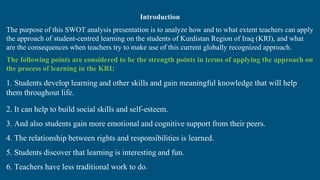
Introduction
The purpose of this SWOT analysis presentation is to analyze how and to what extent teachers can apply
the approach of student-centred learning on the students of Kurdistan Region of Iraq (KRI), and what
are the consequences when teachers try to make use of this current globally recognized approach.
The following points are considered to be the strength points in terms of applying the approach on
the process of learning in the KRI:
1. Students develop learning and other skills and gain meaningful knowledge that will help
them throughout life.
2. It can help to build social skills and self-esteem.
3. And also students gain more emotional and cognitive support from their peers.
4. The relationship between rights and responsibilities is learned.
5. Students discover that learning is interesting and fun.
6. Teachers have less traditional work to do.
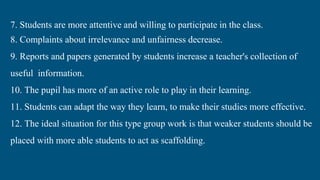
7. Students are more attentive and willing to participate in the class.
8. Complaints about irrelevance and unfairness decrease.
9. Reports and papers generated by students increase a teacher's collection of
useful information.
10. The pupil has more of an active role to play in their learning.
11. Students can adapt the way they learn, to make their studies more effective.
12. The ideal situation for this type group work is that weaker students should be
placed with more able students to act as scaffolding.
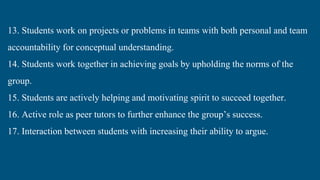
13. Students work on projects or problems in teams with both personal and team
accountability for conceptual understanding.
14. Students work together in achieving goals by upholding the norms of the
group.
15. Students are actively helping and motivating spirit to succeed together.
16. Active role as peer tutors to further enhance the group’s success.
17. Interaction between students with increasing their ability to argue.
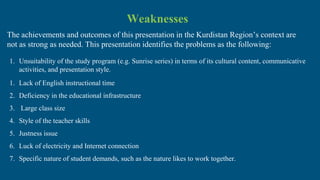
Weaknesses
The achievements and outcomes of this presentation in the Kurdistan Region’s context are
not as strong as needed. This presentation identifies the problems as the following:
1. Unsuitability of the study program (e.g. Sunrise series) in terms of its cultural content, communicative
activities, and presentation style.
1. Lack of English instructional time
2. Deficiency in the educational infrastructure
3. Large class size
4. Style of the teacher skills
5. Justness issue
6. Luck of electricity and Internet connection
7. Specific nature of student demands, such as the nature likes to work together.
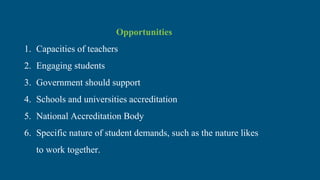
Opportunities
1. Capacities of teachers
2. Engaging students
3. Government should support
4. Schools and universities accreditation
5. National Accreditation Body
6. Specific nature of student demands, such as the nature likes
to work together.
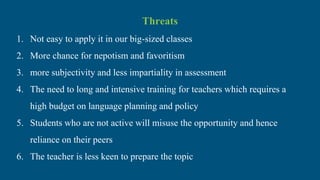
Threats
1. Not easy to apply it in our big-sized classes
2. More chance for nepotism and favoritism
3. more subjectivity and less impartiality in assessment
4. The need to long and intensive training for teachers which requires a
high budget on language planning and policy
5. Students who are not active will misuse the opportunity and hence
reliance on their peers
6. The teacher is less keen to prepare the topic
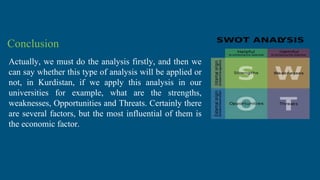
Actually, we must do the analysis firstly, and then we
can say whether this type of analysis will be applied or
not, in Kurdistan, if we apply this analysis in our
universities for example, what are the strengths,
weaknesses, Opportunities and Threats. Certainly there
are several factors, but the most influential of them is
the economic factor.
Conclusion
The End

SWOT analysis on student centered learning in KRG

  • 1.
    SWOT Analysis onStudent-Centered Learning Approach in KRG Nawroz University (Centre of Pedagogy 2020 – 2021) Presenters: Mohammad Faisal
  • 2.
    Introduction The purpose ofthis SWOT analysis presentation is to analyze how and to what extent teachers can apply the approach of student-centred learning on the students of Kurdistan Region of Iraq (KRI), and what are the consequences when teachers try to make use of this current globally recognized approach. The following points are considered to be the strength points in terms of applying the approach on the process of learning in the KRI: 1. Students develop learning and other skills and gain meaningful knowledge that will help them throughout life. 2. It can help to build social skills and self-esteem. 3. And also students gain more emotional and cognitive support from their peers. 4. The relationship between rights and responsibilities is learned. 5. Students discover that learning is interesting and fun. 6. Teachers have less traditional work to do.
  • 3.
    7. Students aremore attentive and willing to participate in the class. 8. Complaints about irrelevance and unfairness decrease. 9. Reports and papers generated by students increase a teacher's collection of useful information. 10. The pupil has more of an active role to play in their learning. 11. Students can adapt the way they learn, to make their studies more effective. 12. The ideal situation for this type group work is that weaker students should be placed with more able students to act as scaffolding.
  • 4.
    13. Students workon projects or problems in teams with both personal and team accountability for conceptual understanding. 14. Students work together in achieving goals by upholding the norms of the group. 15. Students are actively helping and motivating spirit to succeed together. 16. Active role as peer tutors to further enhance the group’s success. 17. Interaction between students with increasing their ability to argue.
  • 5.
    Weaknesses The achievements andoutcomes of this presentation in the Kurdistan Region’s context are not as strong as needed. This presentation identifies the problems as the following: 1. Unsuitability of the study program (e.g. Sunrise series) in terms of its cultural content, communicative activities, and presentation style. 1. Lack of English instructional time 2. Deficiency in the educational infrastructure 3. Large class size 4. Style of the teacher skills 5. Justness issue 6. Luck of electricity and Internet connection 7. Specific nature of student demands, such as the nature likes to work together.
  • 6.
    Opportunities 1. Capacities ofteachers 2. Engaging students 3. Government should support 4. Schools and universities accreditation 5. National Accreditation Body 6. Specific nature of student demands, such as the nature likes to work together.
  • 7.
    Threats 1. Not easyto apply it in our big-sized classes 2. More chance for nepotism and favoritism 3. more subjectivity and less impartiality in assessment 4. The need to long and intensive training for teachers which requires a high budget on language planning and policy 5. Students who are not active will misuse the opportunity and hence reliance on their peers 6. The teacher is less keen to prepare the topic
  • 8.
    Actually, we mustdo the analysis firstly, and then we can say whether this type of analysis will be applied or not, in Kurdistan, if we apply this analysis in our universities for example, what are the strengths, weaknesses, Opportunities and Threats. Certainly there are several factors, but the most influential of them is the economic factor. Conclusion
  • 9.