
SEO for Web 2.0 Enterprise Search Summit West September 2008
Agenda Search 0.0 Search 1.0 Web 2.0 Search 2.0 Data the next “Intel inside” Harnessing the Collective Intelligence Rich User Experience Software Above the Device SEO for Search 2.0
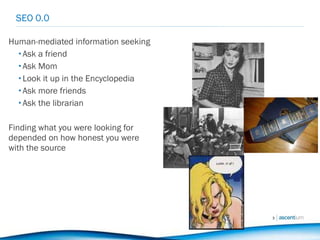
SEO 0.0 Human-mediated information seeking Ask a friend Ask Mom Look it up in the Encyclopedia Ask more friends Ask the librarian Finding what you were looking for depended on how honest you were with the source
Search 1.0:  The Birth of Relevance Yahoo starts with a human-mediated directory of online resources personally reviewed by librarians Technology mediated information finding follows Excite Altavista Northern Lights Search engines for search engines come online [meta search engines] Dogpile Clusty Google Beta Launch 1997 Stripped down interface compared to competitors User interaction limited to query and # of results viewed “ Did you mean? – spell check, synonyms
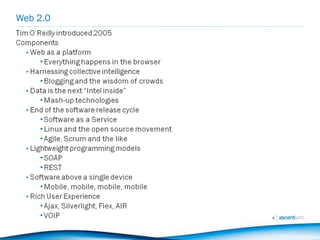
Web 2.0
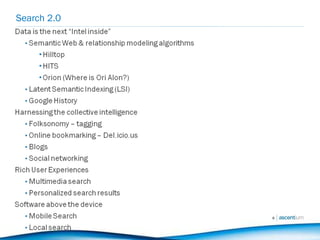
Search 2.0
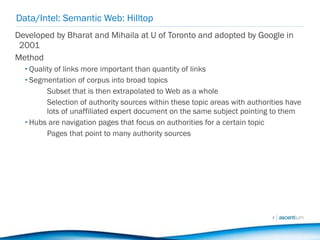
Data/Intel: Semantic Web: Hilltop Developed by Bharat and Mihaila at U of Toronto and adopted by Google in 2001 Method Quality of links more important than quantity of links Segmentation of corpus into broad topics Subset that is then extrapolated to Web as a whole  Selection of authority sources within these topic areas with authorities have  lots of unaffiliated expert document on the same subject pointing to them Hubs are navigation pages that focus on authorities for a certain topic Pages that point to many authority sources
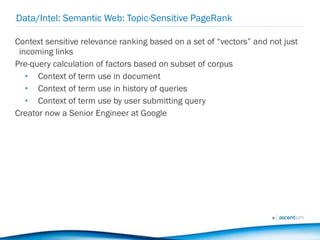
Data/Intel: Semantic Web: Topic-Sensitive PageRank Context sensitive relevance ranking based on a set of “vectors” and not just incoming links Pre-query calculation of factors based on subset of corpus Context of term use in document Context of term use in history of queries Context of term use by user submitting query Creator now a Senior Engineer at Google
Search 2.0
Search 2.0: Automatic Query Expansion with LSI Latent Semantic Indexing [LSI] is a weighting not retrieval algorithm Documents with keywords in common are perceived as semantically related Pattern recognition, not sentience Recognizes terms that often appear together  Co-occurrence Search engine learns through repeated indexing of the document corpus
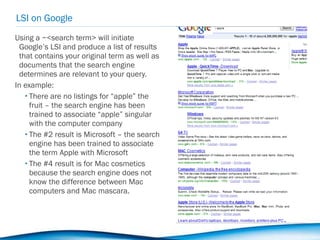
LSI on Google Using a ~<search term> will initiate Google’s LSI and produce a list of results that contains your original term as well as documents that the search engine determines are relevant to your query. In example: There are no listings for “apple” the fruit – the search engine has been trained to associate “apple” singular with the computer company The #2 result is Microsoft – the search engine has been trained to associate the term Apple with Microsoft  The #4 result is for Mac cosmetics because the search engine does not know the difference between Mac computers and Mac mascara.
Search 2.0: Orion Algorithm Automatic Query Expansion Purchased by Google in April 2006 for A LOT of money Developed by Ori Alon, an Israeli computer science doctoral fellow who has not been heard from since going to Goolge-opolis  Results include expanded text extracts from the websites Integrates results from related concepts into  query results Rumored to be part of the 2006 Big Daddy Update Relational Content Modeling
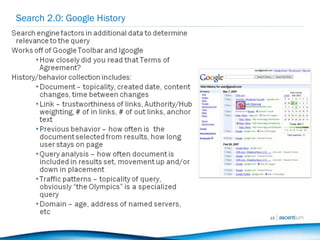
Search 2.0: Google History
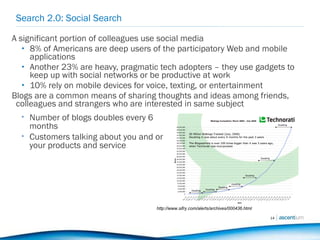
Search 2.0: Social Search A significant portion of colleagues use social media 8% of Americans are deep users of the participatory Web and mobile applications Another 23% are heavy, pragmatic tech adopters – they use gadgets to keep up with social networks or be productive at work 10% rely on mobile devices for voice, texting, or entertainment Blogs are a common means of sharing thoughts and ideas among friends, colleagues and strangers who are interested in same subject http://www.sifry.com/alerts/archives/000436.html Number of blogs doubles every 6 months Customers talking about you and or your products and service
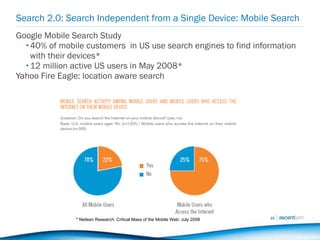
Search 2.0: Search Independent from a Single Device: Mobile Search Google Mobile Search Study 40% of mobile customers  in US use search engines to find information with their devices*  12 million active US users in May 2008* Yahoo Fire Eagle: location aware search * Neilsen Research: Critical Mass of the Mobile Web: July 2008
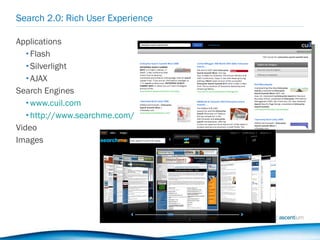
Search 2.0: Rich User Experience Applications Flash  Silverlight AJAX Search Engines www.cuil.com http://www.searchme.com/ Video Images
SEO 2.0
SEO 2.0: Data is the next “Intel inside” Customers don’t know what they don’t know Facets to narrow results set Allow searcher to be part of relevance ranking Know your customer Search logs Web analytics Personas  Federated search Search engines like content More content = more representation in index = more opportunity to appear in search results Deep  subject-specific content is what makes Authority resources Newspaper model Know how search engines “see your website” Titles Descriptions Keywords
SEO 2.0: Harnessing the Collective Intelligence
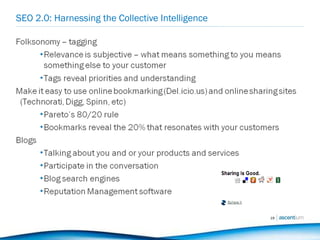
SEO 2.0: Social Networking Know what your customers are saying Visit social networking site and use your product or service as search term Facebook Linked in Technorati Visit online bookmarking sites (Del.icio.us) and use your domain as a search term. See what customers are bookmarking and what user tags are associated with it Visit online bookmarking sites (del.icio.us) and use terms that you believe best describe your product/services and see what sites users have bookmarked
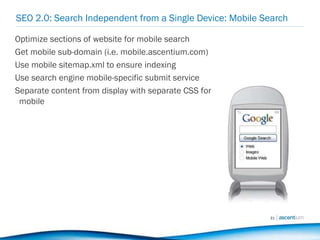
SEO 2.0: Search Independent from a Single Device: Mobile Search Optimize sections of website for mobile search Get mobile sub-domain (i.e. mobile.ascentium.com) Use mobile sitemap.xml to ensure indexing Use search engine mobile-specific submit service Separate content from display with separate CSS for mobile
SEO 2.0: Search Independent from a Single Device: Local Search Put locations on page as well as in footer and on Contact Us List in local directories Yellow pages Seattle 24/7 Fill out your Google Local Business Center profile Get links from local resources Allow user generated content as they often mention “location-specific” terms/phrases
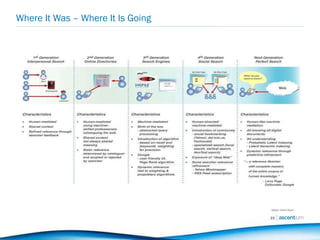
Where It Was – Where It Is Going

Sweeny Seo30 Web20 Finalversion

  • 1.
    SEO for Web2.0 Enterprise Search Summit West September 2008
  • 2.
    Agenda Search 0.0Search 1.0 Web 2.0 Search 2.0 Data the next “Intel inside” Harnessing the Collective Intelligence Rich User Experience Software Above the Device SEO for Search 2.0
  • 3.
    SEO 0.0 Human-mediatedinformation seeking Ask a friend Ask Mom Look it up in the Encyclopedia Ask more friends Ask the librarian Finding what you were looking for depended on how honest you were with the source
  • 4.
    Search 1.0: The Birth of Relevance Yahoo starts with a human-mediated directory of online resources personally reviewed by librarians Technology mediated information finding follows Excite Altavista Northern Lights Search engines for search engines come online [meta search engines] Dogpile Clusty Google Beta Launch 1997 Stripped down interface compared to competitors User interaction limited to query and # of results viewed “ Did you mean? – spell check, synonyms
  • 5.
  • 6.
  • 7.
    Data/Intel: Semantic Web:Hilltop Developed by Bharat and Mihaila at U of Toronto and adopted by Google in 2001 Method Quality of links more important than quantity of links Segmentation of corpus into broad topics Subset that is then extrapolated to Web as a whole Selection of authority sources within these topic areas with authorities have lots of unaffiliated expert document on the same subject pointing to them Hubs are navigation pages that focus on authorities for a certain topic Pages that point to many authority sources
  • 8.
    Data/Intel: Semantic Web:Topic-Sensitive PageRank Context sensitive relevance ranking based on a set of “vectors” and not just incoming links Pre-query calculation of factors based on subset of corpus Context of term use in document Context of term use in history of queries Context of term use by user submitting query Creator now a Senior Engineer at Google
  • 9.
  • 10.
    Search 2.0: AutomaticQuery Expansion with LSI Latent Semantic Indexing [LSI] is a weighting not retrieval algorithm Documents with keywords in common are perceived as semantically related Pattern recognition, not sentience Recognizes terms that often appear together Co-occurrence Search engine learns through repeated indexing of the document corpus
  • 11.
    LSI on GoogleUsing a ~<search term> will initiate Google’s LSI and produce a list of results that contains your original term as well as documents that the search engine determines are relevant to your query. In example: There are no listings for “apple” the fruit – the search engine has been trained to associate “apple” singular with the computer company The #2 result is Microsoft – the search engine has been trained to associate the term Apple with Microsoft The #4 result is for Mac cosmetics because the search engine does not know the difference between Mac computers and Mac mascara.
  • 12.
    Search 2.0: OrionAlgorithm Automatic Query Expansion Purchased by Google in April 2006 for A LOT of money Developed by Ori Alon, an Israeli computer science doctoral fellow who has not been heard from since going to Goolge-opolis Results include expanded text extracts from the websites Integrates results from related concepts into query results Rumored to be part of the 2006 Big Daddy Update Relational Content Modeling
  • 13.
  • 14.
    Search 2.0: SocialSearch A significant portion of colleagues use social media 8% of Americans are deep users of the participatory Web and mobile applications Another 23% are heavy, pragmatic tech adopters – they use gadgets to keep up with social networks or be productive at work 10% rely on mobile devices for voice, texting, or entertainment Blogs are a common means of sharing thoughts and ideas among friends, colleagues and strangers who are interested in same subject http://www.sifry.com/alerts/archives/000436.html Number of blogs doubles every 6 months Customers talking about you and or your products and service
  • 15.
    Search 2.0: SearchIndependent from a Single Device: Mobile Search Google Mobile Search Study 40% of mobile customers in US use search engines to find information with their devices* 12 million active US users in May 2008* Yahoo Fire Eagle: location aware search * Neilsen Research: Critical Mass of the Mobile Web: July 2008
  • 16.
    Search 2.0: RichUser Experience Applications Flash Silverlight AJAX Search Engines www.cuil.com http://www.searchme.com/ Video Images
  • 17.
  • 18.
    SEO 2.0: Datais the next “Intel inside” Customers don’t know what they don’t know Facets to narrow results set Allow searcher to be part of relevance ranking Know your customer Search logs Web analytics Personas Federated search Search engines like content More content = more representation in index = more opportunity to appear in search results Deep subject-specific content is what makes Authority resources Newspaper model Know how search engines “see your website” Titles Descriptions Keywords
  • 19.
    SEO 2.0: Harnessingthe Collective Intelligence
  • 20.
    SEO 2.0: SocialNetworking Know what your customers are saying Visit social networking site and use your product or service as search term Facebook Linked in Technorati Visit online bookmarking sites (Del.icio.us) and use your domain as a search term. See what customers are bookmarking and what user tags are associated with it Visit online bookmarking sites (del.icio.us) and use terms that you believe best describe your product/services and see what sites users have bookmarked
  • 21.
    SEO 2.0: SearchIndependent from a Single Device: Mobile Search Optimize sections of website for mobile search Get mobile sub-domain (i.e. mobile.ascentium.com) Use mobile sitemap.xml to ensure indexing Use search engine mobile-specific submit service Separate content from display with separate CSS for mobile
  • 22.
    SEO 2.0: SearchIndependent from a Single Device: Local Search Put locations on page as well as in footer and on Contact Us List in local directories Yellow pages Seattle 24/7 Fill out your Google Local Business Center profile Get links from local resources Allow user generated content as they often mention “location-specific” terms/phrases
  • 23.
    Where It Was– Where It Is Going

Editor's Notes