Review of the key results from the
Swedish Obese Subjects
(SOS) trial – a prospective controlled
intervention study of
bariatric surgery
Lars Sjöström
The University of Gothenburg,Gothenburg,
Sweden
Dr Christopher Kahuho
Definitions
What is “Body mass index (BMI)”?
• The BMI is defined as the body mass (kilograms) divided by the square of
the body height (metres), and is universally expressed in units of kg/m2
• The BMI is an attempt to quantify the amount of tissue mass (muscle, fat,
and bone) in an individual, and then categorize that person as
underweight, normal weight, overweight, or obese based on that value
• Assess how much an individual's body weight departs from what is normal
or desirable for a person's height
• Commonly accepted BMI ranges are
 underweight: under 18.5
 normal weight: 18.5 to 25
 overweight: 25 to 30
 obese: over 30
What is bariatic surgery?
• Bariatric surgery (weight loss surgery) includes a variety of
procedures performed on selected people who have obesity
• Weight loss is achieved by reducing the size of the stomach with
a gastric band or through removal of a portion of the stomach or
by resecting and re-routing the small intestine to a small stomach
pouch
Background
• Obesity is a risk factor for diabetes, cardiovascular disease events, cancer and
overall mortality.
• Weight loss may protect against these conditions, but evidence for this was
lacking.
• The Swedish Obese Subjects (SOS) study was the first long-term, prospective,
controlled trial to provide information on the effects of bariatric surgery on the
incidence of these health outcomes
 The primary aim of the SOS study was to examine whether bariatric
surgery and weight loss induced by bariatric surgery are associated with
lower mortality compared with the death rates during conventional
treatment in obese subjects.
 Secondary aims included the effects of bariatric surgery and weight loss
on
 cardiovascular disease (myocardial infarction, stroke, angina pectoris,
hypertension)
 Diabetes
 Biliary disease
 Health-related quality of life and
 Cost efficiency
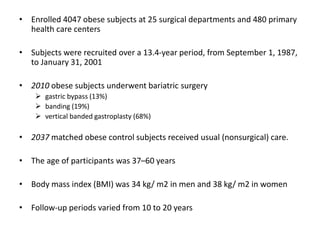
• Enrolled 4047 obese subjects at 25 surgical departments and 480 primary
health care centers
• Subjects were recruited over a 13.4-year period, from September 1, 1987,
to January 31, 2001
• 2010 obese subjects underwent bariatric surgery
 gastric bypass (13%)
 banding (19%)
 vertical banded gastroplasty (68%)
• 2037 matched obese control subjects received usual (nonsurgical) care.
• The age of participants was 37–60 years
• Body mass index (BMI) was 34 kg/ m2 in men and 38 kg/ m2 in women
• Follow-up periods varied from 10 to 20 years
• 1471 who underwent bariatric surgery and 1444 who received
conventional treatment also consented to participate in
follow-up examinations at 15 and 20 years
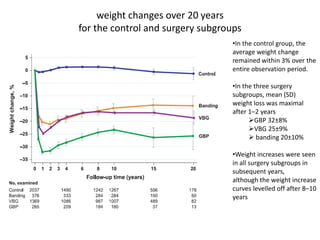
weight changes over 20 years
for the control and surgery subgroups
•In the control group, the
average weight change
remained within 3% over the
entire observation period.
•In the three surgery
subgroups, mean (SD)
weight loss was maximal
after 1–2 years
GBP 32±8%
VBG 25±9%
 banding 20±10%
•Weight increases were seen
in all surgery subgroups in
subsequent years,
although the weight increase
curves levelled off after 8–10
years
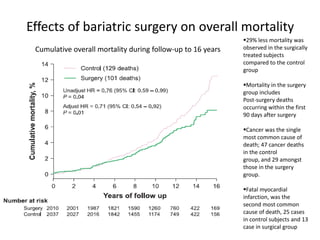
Effects of bariatric surgery on overall mortality
Cumulative overall mortality during follow-up to 16 years
29% less mortality was
observed in the surgically
treated subjects
compared to the control
group
Mortality in the surgery
group includes
Post-surgery deaths
occurring within the first
90 days after surgery
Cancer was the single
most common cause of
death; 47 cancer deaths
in the control
group, and 29 amongst
those in the surgery
group.
Fatal myocardial
infarction, was the
second most common
cause of death, 25 cases
in control subjects and 13
case in surgical group
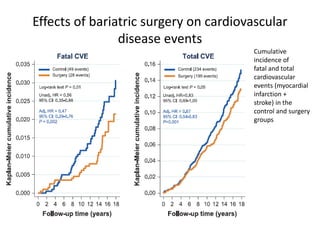
Effects of bariatric surgery on cardiovascular
disease events
Cumulative
incidence of
fatal and total
cardiovascular
events (myocardial
infarction +
stroke) in the
control and surgery
groups
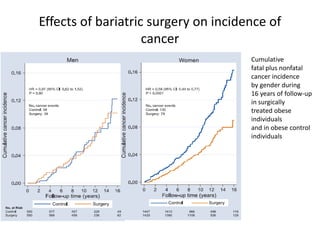
Effects of bariatric surgery on incidence of
cancer
Cumulative
fatal plus nonfatal
cancer incidence
by gender during
16 years of follow-up
in surgically
treated obese
individuals
and in obese control
individuals
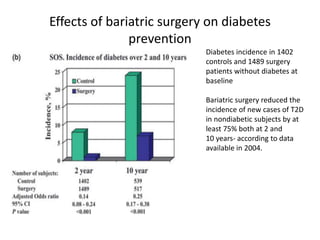
Effects of bariatric surgery on diabetes
prevention
Diabetes incidence in 1402
controls and 1489 surgery
patients without diabetes at
baseline
Bariatric surgery reduced the
incidence of new cases of T2D
in nondiabetic subjects by at
least 75% both at 2 and
10 years- according to data
available in 2004.
• In a recent update including data from all SOS subjects
without diabetes at baseline (1771 controls and 1658 in the
surgery group), bariatric surgery (as compared with usual
care) reduced the risk of developing T2D by 96%, 84% and
78% after 2, 10 and 15 years respectively
Effects of bariatric surgery on remission of
diabetes
After 2 years of follow-up, 72% of
SOS patients with T2D at baseline
were in
remission in the surgery group
It is noteworthy, however,
amongst patients who underwent
surgery with remission of diabetes
at 2 years, 50% had relapsed after
10 years
Knowledge Gaps
• Are the favourable effects of bariatric surgery mediated by weight loss?
 not been able to demonstrate that the favourable effects of bariatric
surgery on cardiovascular disease events, cancer incidence and overall
mortality are mediated by weight loss
 need to further explore weight loss-independent effects of bariatric
surgery.
• BMI did not predict the effects of surgical treatment on outcome
 current guidelines for bariatric surgery in obese individuals are based
on BMI alone or in combination with other criteria
 controlled studies of GBP in nonobese diabetic subjects are ongoing
Important considerations
• prevalence of obesity is high and is increasing
• nonpharmacological obesity treatment at primary health care centres
generally not associated with significant loss in the short or long term
• most obese patients worldwide do not have access to specialized obesity
treatment
• currently available antiobesity drugs typically result in 7%–10% weight
reduction over 2 to 4 yrs compared to 4%–6% in placebo groups or those
treated with lifestyle modification
• results from the SOS study have demonstrated that maintained effects on risk
factors over 10 years require 10%–30% maintained weight loss
Important considerations
• obesity not only causes diabetes but obesity is also a complication of diabetes
treatment with some medications; this circle must be broken
• surgery is the only treatment for obesity resulting in an average of more than
15% documented weight loss over 10 years
• until more efficient antiobesity drugs are available, surgical treatment of
obesity must be more universally accessible
Thank You

Swedish obesity study.christofer kahuho

  • 1.
    Review of thekey results from the Swedish Obese Subjects (SOS) trial – a prospective controlled intervention study of bariatric surgery Lars Sjöström The University of Gothenburg,Gothenburg, Sweden Dr Christopher Kahuho
  • 3.
  • 4.
    What is “Bodymass index (BMI)”? • The BMI is defined as the body mass (kilograms) divided by the square of the body height (metres), and is universally expressed in units of kg/m2 • The BMI is an attempt to quantify the amount of tissue mass (muscle, fat, and bone) in an individual, and then categorize that person as underweight, normal weight, overweight, or obese based on that value • Assess how much an individual's body weight departs from what is normal or desirable for a person's height • Commonly accepted BMI ranges are  underweight: under 18.5  normal weight: 18.5 to 25  overweight: 25 to 30  obese: over 30
  • 5.
    What is bariaticsurgery? • Bariatric surgery (weight loss surgery) includes a variety of procedures performed on selected people who have obesity • Weight loss is achieved by reducing the size of the stomach with a gastric band or through removal of a portion of the stomach or by resecting and re-routing the small intestine to a small stomach pouch
  • 6.
    Background • Obesity isa risk factor for diabetes, cardiovascular disease events, cancer and overall mortality. • Weight loss may protect against these conditions, but evidence for this was lacking. • The Swedish Obese Subjects (SOS) study was the first long-term, prospective, controlled trial to provide information on the effects of bariatric surgery on the incidence of these health outcomes
  • 7.
     The primaryaim of the SOS study was to examine whether bariatric surgery and weight loss induced by bariatric surgery are associated with lower mortality compared with the death rates during conventional treatment in obese subjects.  Secondary aims included the effects of bariatric surgery and weight loss on  cardiovascular disease (myocardial infarction, stroke, angina pectoris, hypertension)  Diabetes  Biliary disease  Health-related quality of life and  Cost efficiency
  • 8.
    • Enrolled 4047obese subjects at 25 surgical departments and 480 primary health care centers • Subjects were recruited over a 13.4-year period, from September 1, 1987, to January 31, 2001 • 2010 obese subjects underwent bariatric surgery  gastric bypass (13%)  banding (19%)  vertical banded gastroplasty (68%) • 2037 matched obese control subjects received usual (nonsurgical) care. • The age of participants was 37–60 years • Body mass index (BMI) was 34 kg/ m2 in men and 38 kg/ m2 in women • Follow-up periods varied from 10 to 20 years
  • 9.
    • 1471 whounderwent bariatric surgery and 1444 who received conventional treatment also consented to participate in follow-up examinations at 15 and 20 years
  • 10.
    weight changes over20 years for the control and surgery subgroups •In the control group, the average weight change remained within 3% over the entire observation period. •In the three surgery subgroups, mean (SD) weight loss was maximal after 1–2 years GBP 32±8% VBG 25±9%  banding 20±10% •Weight increases were seen in all surgery subgroups in subsequent years, although the weight increase curves levelled off after 8–10 years
  • 11.
    Effects of bariatricsurgery on overall mortality Cumulative overall mortality during follow-up to 16 years 29% less mortality was observed in the surgically treated subjects compared to the control group Mortality in the surgery group includes Post-surgery deaths occurring within the first 90 days after surgery Cancer was the single most common cause of death; 47 cancer deaths in the control group, and 29 amongst those in the surgery group. Fatal myocardial infarction, was the second most common cause of death, 25 cases in control subjects and 13 case in surgical group
  • 12.
    Effects of bariatricsurgery on cardiovascular disease events Cumulative incidence of fatal and total cardiovascular events (myocardial infarction + stroke) in the control and surgery groups
  • 13.
    Effects of bariatricsurgery on incidence of cancer Cumulative fatal plus nonfatal cancer incidence by gender during 16 years of follow-up in surgically treated obese individuals and in obese control individuals
  • 14.
    Effects of bariatricsurgery on diabetes prevention Diabetes incidence in 1402 controls and 1489 surgery patients without diabetes at baseline Bariatric surgery reduced the incidence of new cases of T2D in nondiabetic subjects by at least 75% both at 2 and 10 years- according to data available in 2004.
  • 15.
    • In arecent update including data from all SOS subjects without diabetes at baseline (1771 controls and 1658 in the surgery group), bariatric surgery (as compared with usual care) reduced the risk of developing T2D by 96%, 84% and 78% after 2, 10 and 15 years respectively
  • 16.
    Effects of bariatricsurgery on remission of diabetes After 2 years of follow-up, 72% of SOS patients with T2D at baseline were in remission in the surgery group It is noteworthy, however, amongst patients who underwent surgery with remission of diabetes at 2 years, 50% had relapsed after 10 years
  • 17.
    Knowledge Gaps • Arethe favourable effects of bariatric surgery mediated by weight loss?  not been able to demonstrate that the favourable effects of bariatric surgery on cardiovascular disease events, cancer incidence and overall mortality are mediated by weight loss  need to further explore weight loss-independent effects of bariatric surgery. • BMI did not predict the effects of surgical treatment on outcome  current guidelines for bariatric surgery in obese individuals are based on BMI alone or in combination with other criteria  controlled studies of GBP in nonobese diabetic subjects are ongoing
  • 18.
    Important considerations • prevalenceof obesity is high and is increasing • nonpharmacological obesity treatment at primary health care centres generally not associated with significant loss in the short or long term • most obese patients worldwide do not have access to specialized obesity treatment • currently available antiobesity drugs typically result in 7%–10% weight reduction over 2 to 4 yrs compared to 4%–6% in placebo groups or those treated with lifestyle modification • results from the SOS study have demonstrated that maintained effects on risk factors over 10 years require 10%–30% maintained weight loss
  • 19.
    Important considerations • obesitynot only causes diabetes but obesity is also a complication of diabetes treatment with some medications; this circle must be broken • surgery is the only treatment for obesity resulting in an average of more than 15% documented weight loss over 10 years • until more efficient antiobesity drugs are available, surgical treatment of obesity must be more universally accessible
  • 20.