SWEBOK: the software engineering body of knowledge (SC25 Workshop Research Software Engineers in HPC)
1.
SWEBOK: the softwareengineering body
of knowledge
SC 2025 Workshop Research Software Engineers in HPC
November 16th, St. Louis
Hironori Washizaki, Waseda University
(IEEE Computer Society 2025 President)
2.
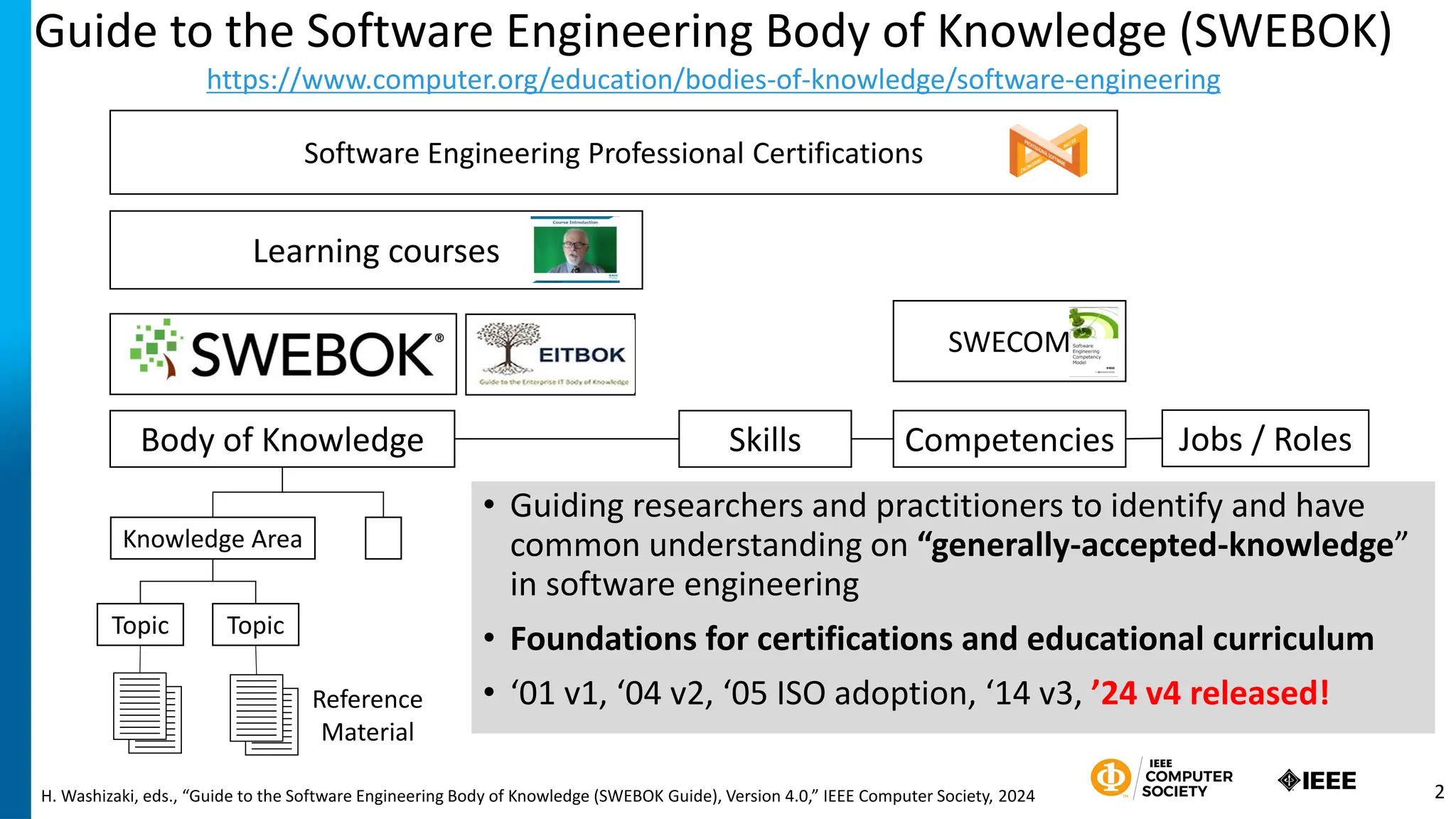
Knowledge Area
Topic Topic
Reference
Material
Bodyof Knowledge Skills Competencies Jobs / Roles
SWEBOK
Software Engineering Professional Certifications
SWECOM
EITBOK
Learning courses
2
Guide to the Software Engineering Body of Knowledge (SWEBOK)
https://www.computer.org/education/bodies-of-knowledge/software-engineering
• Guiding researchers and practitioners to identify and have
common understanding on “generally-accepted-knowledge”
in software engineering
• Foundations for certifications and educational curriculum
• ‘01 v1, ‘04 v2, ‘05 ISO adoption, ‘14 v3, ’24 v4 released!
H. Washizaki, eds., “Guide to the Software Engineering Body of Knowledge (SWEBOK Guide), Version 4.0,” IEEE Computer Society, 2024 2
3.
Mainframe
70’s –
Early 80’s
Late80’s -
Early 90’s
Late 90’s -
Early 00’s
Late 00’s -
Early 10’s
PC,
Client &
server
Internet
Ubiquitous
computing
Late 10’s -
Early 20’s
IoT,
Big data,
AI
GenAI,
Autonomous,
Quantum,
Continuum
Late 20’s – 30’s
Structured
programming
Waterfall
Formalization
Design
Program
generation
Maturity
Management
Object-oriented
Req. eng.
Modeling
Verification
Reuse
Model-driven
Product-line
Global & open
Value-based
Systems eng.
Agile
Iterative &
incremental
DevOps
Empirical
Data-driven
Continuous
SE and IoT
SE and AI
SE plus
+ GenAI,
+ Quantum,
+ Sustainability
+ Autonomous
+ Continuum
AI-assisted
DevOps/OpsDev
SWEBOK V1
SWEBOK V2
SWEBOK V3
SWEBOK V4
Partially adopted from “The Trailer of the ACM 2030 Roadmap for Software Engineering” 3
4.
SWEBOK Guide evolutionfrom V3 to V4
• Modern engineering, practice update, BOK grows and recently developed areas
Requirements
Design
Construction
Testing
Maintenance
Configuration Management
Engineering Management
Process
Models and Methods
Quality
Professional Practice
Economics
Computing Foundations
Mathematical Foundations
Engineering Foundations
Requirements
Architecture
Design
Construction
Testing
Operations
Maintenance
Configuration Management
Engineering Management
Process
Models and Methods
Quality
Security
Professional Practice
Economics
Computing Foundations
Mathematical Foundations
Engineering Foundations
V3 V4
Agile,
DevOps
AI for
SE, SE
for AI
H. Washizaki, eds., “Guide to the Software Engineering Body of Knowledge (SWEBOK Guide), Version 4.0,” IEEE Computer Society, 2024 4
Development
Management
and quality
Foundations
Topic example: “Installation”& “Optimization analysis”
Function Merging for Code Size Reduction [TACO’25]
Yuta Saito, Kazunori Sakamoto, Hironori Washizaki, Yoshiaki Fukazawa, “Multiple Function Merging for Code Size
Reduction,” ACM Transactions on Architecture and Code Optimization, Vol. 22, No. 1, pp. 1-26, 2025.
find_tail2 find_tail3 find_tail4
• Merging an arbitrary number of static single assignment (SSA)-form functions at once
• Implementation as an LLVM plugin
6
7.
Topic example: “Installation”& “Optimization analysis” (cont.)
Function Merging for Code Size Reduction [TACO’25]
Yuta Saito, Kazunori Sakamoto, Hironori Washizaki, Yoshiaki Fukazawa, “Multiple Function Merging for Code Size
Reduction,” ACM Transactions on Architecture and Code Optimization, Vol. 22, No. 1, pp. 1-26, 2025. 7
8.
SWEBOK: Operations knowledgearea
Potential future work:
• Further release engineering and management
• Trade-off between the code size reduction rate,
the compilation time, and memory usage
• … 8
9.
Quantum Software Engineering
QS
Requirements
QS
Architecture
QS
Design
QS
Construction
QS
Testing
QS
Operations
QS
Maintenance
•Quantum
specific
requirements
• Hybrid system
requirements
• Dynamic
requirements
updates and
interdisciplinary
collaboration
• …
• Standardized
architectural
practices,
patterns, and
methodologies
• Formalization
• …
• Quantum programming
languages
• Dynamic programming for
quantum circuit design
• Compiler efficiency
• Quantum (-inspired) and
hybrid algorithm
• Quantum-resistant
algorithm
• Frameworks, tools, and
platforms
• Quantum-classical
integration
• …
• DevOps for QS
• Automated
tools
• Availability,
scalability and
stability of
hardware (and
software)
• …
• Tools for
validation and
verification
• Automated testing
• Continuous
experimental
verification
• Quantum error
correction
techniques
• Approximation
and error-resilient
schemes
• …
Ref: S. Sepúlveda, et al. “Systematic Review on Requirements Engineering in Quantum Computing: Insights and Future Directions,” Electronics 2024, 13(15)
Development
9
10.
IEEE SWEBOK Summit@ ICSE
• A premier industry-focused event, bringing together practitioners, researchers,
and educators to collaborate, share experiences and challenges
• To provide future research directions on the SWEBOK Guide, skills, and competencies
required for current and future SE professionals, as well as related professional training
and certifications
• To encourage using the latest SWEBOK Guide V4 to address SE-specific challenges.
• 1st SWEBOK Summit (Co-located with ICSE 2025, April 29, Ottawa)
• Around 50 participations, 90+% positive survey ratio
• 2nd SWEBOK Summit (Co-located with ICSE 2026, April 18, Rio de Janeiro)
• Extended abstract: Limited to 5 pages (closed)
• Talk summary: Limited to 1 page, NOT included in the proceedings (due: Jan 5th)
10


![Topic example: “Installation” & “Optimization analysis”
Function Merging for Code Size Reduction [TACO’25]
Yuta Saito, Kazunori Sakamoto, Hironori Washizaki, Yoshiaki Fukazawa, “Multiple Function Merging for Code Size
Reduction,” ACM Transactions on Architecture and Code Optimization, Vol. 22, No. 1, pp. 1-26, 2025.
find_tail2 find_tail3 find_tail4
• Merging an arbitrary number of static single assignment (SSA)-form functions at once
• Implementation as an LLVM plugin
6](https://image.slidesharecdn.com/sc-washizaki-20251116-251119004908-5f0ac857/75/SWEBOK-the-software-engineering-body-of-knowledge-SC25-Workshop-Research-Software-Engineers-in-HPC-6-2048.jpg)
![Topic example: “Installation” & “Optimization analysis” (cont.)
Function Merging for Code Size Reduction [TACO’25]
Yuta Saito, Kazunori Sakamoto, Hironori Washizaki, Yoshiaki Fukazawa, “Multiple Function Merging for Code Size
Reduction,” ACM Transactions on Architecture and Code Optimization, Vol. 22, No. 1, pp. 1-26, 2025. 7](https://image.slidesharecdn.com/sc-washizaki-20251116-251119004908-5f0ac857/75/SWEBOK-the-software-engineering-body-of-knowledge-SC25-Workshop-Research-Software-Engineers-in-HPC-7-2048.jpg)


