AI Software Engineering based on
Multi-view Modeling and Engineering
Patterns
QRS 2025 July 17th, Hangzhou and online
Hironori Washizaki, IEEE Computer Society President (Waseda University)
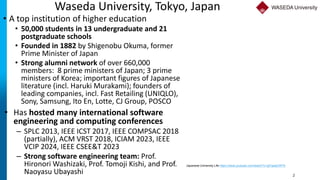
Waseda University, Tokyo, Japan
• A top institution of higher education
• 50,000 students in 13 undergraduate and 21
postgraduate schools
• Founded in 1882 by Shigenobu Okuma, former
Prime Minister of Japan
• Strong alumni network of over 660,000
members: 8 prime ministers of Japan; 3 prime
ministers of Korea; important figures of Japanese
literature (incl. Haruki Murakami); founders of
leading companies, incl. Fast Retailing (UNIQLO),
Sony, Samsung, Ito En, Lotte, CJ Group, POSCO
2
Japanese University Life https://www.youtube.com/watch?v=qjTqeejCWY0
• Has hosted many international software
engineering and computing conferences
– SPLC 2013, IEEE ICST 2017, IEEE COMPSAC 2018
(partially), ACM VRST 2018, ICIAM 2023, IEEE
VCIP 2024, IEEE CSEE&T 2023
– Strong software engineering team: Prof.
Hironori Washizaki, Prof. Tomoji Kishi, and Prof.
Naoyasu Ubayashi
Agenda
• IEEE CS: SWEBOK Guide evolution
• AI and software engineering: AI for SE and SE for AI
• Multi-view Modeling
• AI Engineering Patterns and Engineering
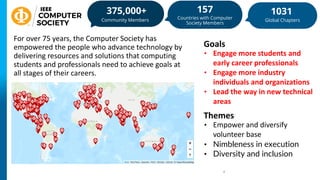
375,000+
Community Members
1031
Global Chapters
157
Countries with Computer
Society Members
For over 75 years, the Computer Society has
empowered the people who advance technology by
delivering resources and solutions that computing
students and professionals need to achieve goals at
all stages of their careers.
4
• Engage more students and
early career professionals
• Engage more industry
individuals and organizations
• Lead the way in new technical
areas
Goals
• Empower and diversify
volunteer base
• Nimbleness in execution
• Diversity and inclusion
Themes
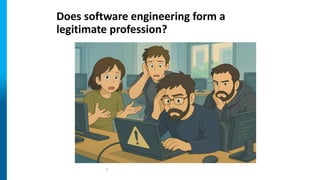
Does software engineering form a
legitimate profession?
5
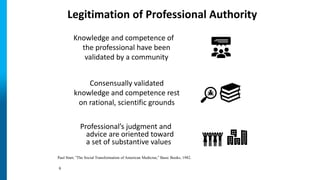
Legitimation of Professional Authority
Professional’s judgment and
advice are oriented toward
a set of substantive values
6
Paul Starr, “The Social Transformation of American Medicine,” Basic Books, 1982.
Knowledge and competence of
the professional have been
validated by a community
Consensually validated
knowledge and competence rest
on rational, scientific grounds
6
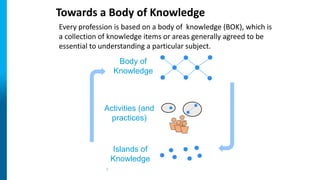
Towards a Body of Knowledge
Activities (and
practices)
Body of
Knowledge
Islands of
Knowledge
7
Every profession is based on a body of knowledge (BOK), which is
a collection of knowledge items or areas generally agreed to be
essential to understanding a particular subject.
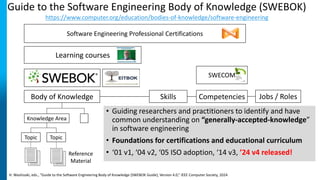
Knowledge Area
Topic Topic
Reference
Material
Body of Knowledge Skills Competencies Jobs / Roles
SWEBOK
Software Engineering Professional Certifications
SWECOM
EITBOK
Learning courses
8
Guide to the Software Engineering Body of Knowledge (SWEBOK)
https://www.computer.org/education/bodies-of-knowledge/software-engineering
• Guiding researchers and practitioners to identify and have
common understanding on “generally-accepted-knowledge”
in software engineering
• Foundations for certifications and educational curriculum
• ‘01 v1, ‘04 v2, ‘05 ISO adoption, ‘14 v3, ’24 v4 released!
H. Washizaki, eds., “Guide to the Software Engineering Body of Knowledge (SWEBOK Guide), Version 4.0,” IEEE Computer Society, 2024
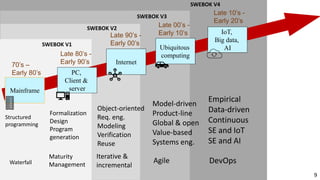
Mainframe
70’s –
Early 80’s
Late 80’s -
Early 90’s
Late 90’s -
Early 00’s
Late 00’s -
Early 10’s
PC,
Client &
server
Internet
Ubiquitous
computing
Late 10’s -
Early 20’s
IoT,
Big data,
AI
Structured
programming
Waterfall
Formalization
Design
Program
generation
Maturity
Management
Object-oriented
Req. eng.
Modeling
Verification
Reuse
Model-driven
Product-line
Global & open
Value-based
Systems eng.
Agile
Iterative &
incremental
DevOps
Empirical
Data-driven
Continuous
SE and IoT
SE and AI
SWEBOK V1
SWEBOK V2
SWEBOK V3
SWEBOK V4
9
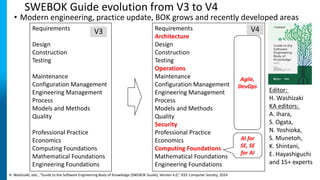
SWEBOK Guide evolution from V3 to V4
• Modern engineering, practice update, BOK grows and recently developed areas
Requirements
Design
Construction
Testing
Maintenance
Configuration Management
Engineering Management
Process
Models and Methods
Quality
Professional Practice
Economics
Computing Foundations
Mathematical Foundations
Engineering Foundations
Requirements
Architecture
Design
Construction
Testing
Operations
Maintenance
Configuration Management
Engineering Management
Process
Models and Methods
Quality
Security
Professional Practice
Economics
Computing Foundations
Mathematical Foundations
Engineering Foundations
V3 V4
Agile,
DevOps
AI for
SE, SE
for AI
H. Washizaki, eds., “Guide to the Software Engineering Body of Knowledge (SWEBOK Guide), Version 4.0,” IEEE Computer Society, 2024
Editor:
H. Washizaki
KA editors:
A. Ihara,
S. Ogata,
N. Yoshioka,
S. Munetoh,
K. Shintani,
E. Hayashiguchi
and 15+ experts
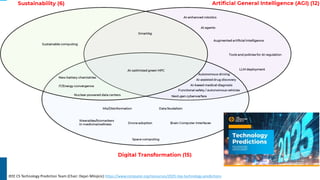
IEEE CS Technology Prediction Team (Chair: Dejan Milojicic) https://www.computer.org/resources/2025-top-technology-predictions
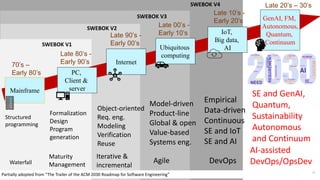
Mainframe
70’s –
Early 80’s
Late 80’s -
Early 90’s
Late 90’s -
Early 00’s
Late 00’s -
Early 10’s
PC,
Client &
server
Internet
Ubiquitous
computing
Late 10’s -
Early 20’s
IoT,
Big data,
AI
GenAI, FM,
Autonomous,
Quantum,
Continuum
Late 20’s – 30’s
Structured
programming
Waterfall
Formalization
Design
Program
generation
Maturity
Management
Object-oriented
Req. eng.
Modeling
Verification
Reuse
Model-driven
Product-line
Global & open
Value-based
Systems eng.
Agile
Iterative &
incremental
DevOps
Empirical
Data-driven
Continuous
SE and IoT
SE and AI
SE and GenAI,
Quantum,
Sustainability
Autonomous
and Continuum
AI-assisted
DevOps/OpsDev
SWEBOK V1
SWEBOK V2
SWEBOK V3
SWEBOK V4
12
Partially adopted from “The Trailer of the ACM 2030 Roadmap for Software Engineering”
Agenda
• IEEE CS: SWEBOK Guide evolution
• AI and software engineering: AI for SE and SE for AI
• Multi-view Modeling
• AI Engineering Patterns and Engineering
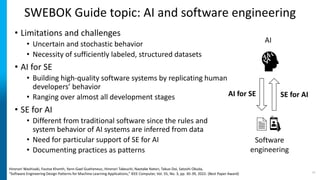
SWEBOK Guide topic: AI and software engineering
• Limitations and challenges
• Uncertain and stochastic behavior
• Necessity of sufficiently labeled, structured datasets
• AI for SE
• Building high-quality software systems by replicating human
developers’ behavior
• Ranging over almost all development stages
• SE for AI
• Different from traditional software since the rules and
system behavior of AI systems are inferred from data
• Need for particular support of SE for AI
• Documenting practices as patterns
14
Software
engineering
AI
AI for SE SE for AI
Hironori Washizaki, Foutse Khomh, Yann-Gael Gueheneuc, Hironori Takeuchi, Naotake Natori, Takuo Doi, Satoshi Okuda,
“Software Engineering Design Patterns for Machine Learning Applications,” IEEE Computer, Vol. 55, No. 3, pp. 30-39, 2022. (Best Paper Award)
AI for SE: From AI-assisted dev to Human/AI co-creation(ref: AI-SEAL) [Feldt18]
15
Ref: Robert Feldt, et al., Ways of Applying Artificial Intelligence in Software Engineering, RAISE 2018, CoRR abs/1802.02033
Agentic
action
Process Automation
level
Target
Product
Runtime
Low risk
High risk
Middle risk
Completion Chat and
exploration
Human-
centered AI-assisted
Human/AI co-
creation
Developers Customers
End users
AI agents
Reasoning and
implementation
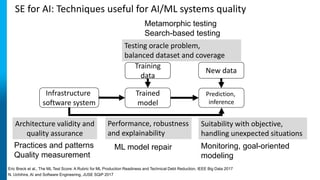
SE for AI: Techniques useful for AI/ML systems quality
Training
data
Trained
model
Prediction,
inference
Infrastructure
software system
New data
ML model repair Monitoring, goal-oriented
modeling
Testing oracle problem,
balanced dataset and coverage
Performance, robustness
and explainability
Architecture validity and
quality assurance
Suitability with objective,
handling unexpected situations
N. Uchihira, AI and Software Engineering, JUSE SQiP 2017
Eric Breck et al., The ML Test Score: A Rubric for ML Production Readiness and Technical Debt Reduction, IEEE Big Data 2017
Metamorphic testing
Search-based testing
Practices and patterns
Quality measurement
Agenda
• IEEE CS: SWEBOK Guide evolution
• AI and software engineering: AI for SE and SE for AI
• Multi-view Modeling
• AI Engineering Patterns and Engineering
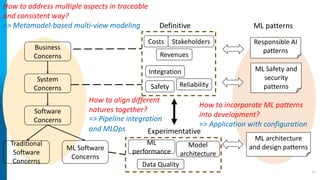
Business
Concerns
System
Concerns
Software
Concerns
Traditional
Software
Concerns
ML Software
Concerns
Costs
Revenues
Stakeholders
Integration
Safety
ML
performance
Data Quality
Model
architecture
Reliability
Experimentative
Definitive
18
How to address multiple aspects in traceable
and consistent way?
=> Metamodel-based multi-view modeling
How to align different
natures together?
=> Pipeline integration
and MLOps
Responsible AI
patterns
ML patterns
ML Safety and
security
patterns
ML architecture
and design patterns
How to incorporate ML patterns
into development?
=> Application with configuration
Multi-view modeling for ML systems
[SQJ’24] [ICEBE’23][FGCS’24]
ML Canvas
AI Project Canvas Safety Case
Architectural Diagram (SysML) KAOS Goal Model
STAMP/STPA
Value
MLOps Architecture Goals
Safety
Argumentation
20
Hironori Takeuchi, Jati H. Husen, Hnin Thandar Tun, Hironori Washizaki and Nobukazu Yoshioka, “Enterprise Architecture-based Metamodel for a Holistic Business – IT
Alignment View on Machine Learning Projects,” IEEE International Conference on E-Business Engineering (ICEBE 2023), Best Paper Award
Hironori Takeuchi, Jati H. Husenb, Hnin Thandar Tun, Hironori Washizaki, Nobukazu Yoshioka, “Enterprise Architecture-based Metamodel for Machine Learning Projects and
its Management,” Future Generation Computer Systems, Elsevier, Vol. 161, pp. 135-145, 2024.
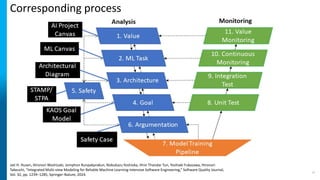
Corresponding process
21
Jati H. Husen, Hironori Washizaki, Jomphon Runpakprakun, Nobukazu Yoshioka, Hnin Thandar Tun, Yoshiaki Fukazawa, Hironori
Takeuchi, “Integrated Multi-view Modeling for Reliable Machine Learning-Intensive Software Engineering,” Software Quality Journal,
Vol. 32, pp. 1239–1285, Springer-Nature, 2024.
Metamodel for consistency and traceability [ICEBE’23][FGCS’24]
ML Canvas
AI Project Canvas
Safety Case
KAOS Goal Model
STAMP/STPA
Architecture (SysML)
ML workflow
pipeline
22
Hironori Takeuchi, Jati H. Husen, Hnin Thandar Tun, Hironori Washizaki and Nobukazu Yoshioka, “Enterprise Architecture-based Metamodel for a Holistic Business – IT
Alignment View on Machine Learning Projects,” IEEE International Conference on E-Business Engineering (ICEBE 2023), Best Paper Award
Hironori Takeuchi, Jati H. Husenb, Hnin Thandar Tun, Hironori Washizaki, Nobukazu Yoshioka, “Enterprise Architecture-based Metamodel for Machine Learning Projects and
its Management,” Future Generation Computer Systems, Elsevier, Vol. 161, pp. 135-145, 2024.
Metamodel extension
23
Hiroshi Tanaka, Ide Masaru, Kazuki Munakata, Hironori Washizaki, and
Nobukazu Yoshioka, “Activity-based modeling strategy for reliable
machine learning system analysis targeting GUI-based applications,”
10th International Conference on Dependable Systems and Their
Applications (DSA 2023)
Metamodel for ML systems
Extension for
activity-based
reliability analysis
[DSA’23]
Business-ML alignment model ML canvas AI canvas
Extension for
ML-system
business
alignment
[FGCS’24]
Hironori Takeuchi, Jati H. Husenb, Hnin Thandar Tun, Hironori
Washizaki, Nobukazu Yoshioka, “Enterprise Architecture-based
Metamodel for Machine Learning Projects and its Management,”
Future Generation Computer Systems, Vol. 32, 2024
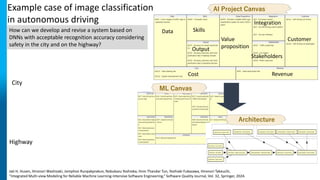
Example case of image classification
in autonomous driving
City
Highway
AI Project Canvas
ML Canvas
Architecture
Data Skills
Output
Value
proposition
Integration
Stakeholders
Customer
Cost Revenue
How can we develop and revise a system based on
DNNs with acceptable recognition accuracy considering
safety in the city and on the highway?
Jati H. Husen, Hironori Washizaki, Jomphon Runpakprakun, Nobukazu Yoshioka, Hnin Thandar Tun, Yoshiaki Fukazawa, Hironori Takeuchi,
“Integrated Multi-view Modeling for Reliable Machine Learning-Intensive Software Engineering,” Software Quality Journal, Vol. 32, Springer, 2024.
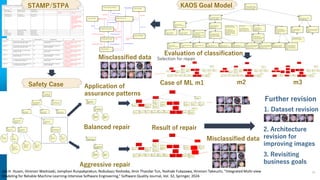
Case of ML m1 m2 m3
Evaluation of classification
Safety Case
Misclassified data Selection for repair
Balanced repair Result of repair
Aggressive repair
Further revision
1. Dataset revision
2. Architecture
revision for
improving images
3. Revisiting
business goals
Misclassified data
STAMP/STPA KAOS Goal Model
25
Jati H. Husen, Hironori Washizaki, Jomphon Runpakprakun, Nobukazu Yoshioka, Hnin Thandar Tun, Yoshiaki Fukazawa, Hironori Takeuchi, “Integrated Multi-view
Modeling for Reliable Machine Learning-Intensive Software Engineering,” Software Quality Journal, Vol. 32, Springer, 2024.
Application of
assurance patterns
Metamodel
ML
evaluation
Visualizing issues
ML
evaluation
Visualizing resolution
OK
OK OK
Failed Failed
OK OK
OK
OK
OK OK OK
[ML.VP1🡨
AI.VP1]
Providereliable
real-timeobject
detectionsystem
fordriving
decisionmakingin
highway(incl.
trafficsign
detectionand
lane/vehicle
detection)
• [ML.DS1]Procured
datasets
• [ML.DS2]Internal
databasefrom
collectionduring
operation
• [ML.DC1]Openand
commercialdatasets
• [ML.DC2]Data
collectedduring
operation(imageand
identificationresult)
•[ML.F1🡨
AI.D1/AI.D3]
Boundingbox
forobject(incl.
othervehicles
orsigns)
•[ML.F2🡨
AI.D2]Ridge
detectionfor
lanedetection
[ML.BM1]
Modelswillbe
developed,
tested,and
deployedtocars
monthly
• [ML.PT1]Input:
imagefromsensors
• [ML.PT2←AI.D]
Output:trafficsigns,
lanemarking,
vehicles,and
pedestrians.
[ML.De1]Use
predictionresults
fordecision-
makinginself-
drivingsystem
[ML.IS1]
Usingtestdata,
achieveveryhigh
recallandhigh
precisionin
followingcondition:
night,rainy,and
generalcondition
Datasetsissplitinto
80:20ratio
[ML.MP1]
Predictionshould
bemadein
batchesreal
time.
[ML.M1]Inputdatamonitoring
[ML.VP1🡨
AI.VP1]
Providereliable
real-timeobject
detectionsystem
fordriving
decisionmakingin
highway(incl.
trafficsign
detectionand
lane/vehicle
detection)
• [ML.DS1]Procured
datasets
• [ML.DS2]Internal
databasefrom
collectionduring
operation
• [ML.DC1]Openand
commercialdatasets
• [ML.DC2]Data
collectedduring
operation(imageand
identificationresult)
•[ML.F1🡨
AI.D1/AI.D3]
Boundingbox
forobject(incl.
othervehicles
orsigns)
•[ML.F2🡨
AI.D2]Ridge
detectionfor
lanedetection
[ML.BM1]
Modelswillbe
developed,
tested,and
deployedtocars
monthly
• [ML.PT1]Input:
imagefromsensors
• [ML.PT2←AI.D]
Output:trafficsigns,
lanemarking,
vehicles,and
pedestrians.
[ML.De1]Use
predictionresults
fordecision-
makinginself-
drivingsystem
[ML.IS1]
Usingtestdata,
achieveveryhigh
recallandhigh
precisionin
followingcondition:
night,rainy,and
generalcondition
Datasetsissplitinto
80:20ratio
[ML.MP1]
Predictionshould
bemadein
batchesreal
time.
[ML.M1]Inputdatamonitoring
[ML.VP1🡨
AI.VP1]
Providereliable
real-timeobject
detectionsystem
fordriving
decisionmakingin
highway(incl.
trafficsign
detectionand
lane/vehicle
detection)
•[ML.DS1]Procured
datasets
•[ML.DS2]Internal
databasefrom
collectionduring
operation
•[ML.DC1]Openand
commercialdatasets
•[ML.DC2]Data
collectedduring
operation(imageand
identificationresult)
•[ML.F1🡨
AI.D1/AI.D3]
Boundingbox
forobject(incl.
othervehicles
orsigns)
•[ML.F2🡨
AI.D2]Ridge
detectionfor
lanedetection
[ML.BM1]
Modelswillbe
developed,
tested,and
deployedtocars
monthly
•[ML.PT1]Input:
imagefromsensors
•[ML.PT2←AI.D]
Output:trafficsigns,
lanemarking,
vehicles,and
pedestrians.
[ML.De1]Use
predictionresults
fordecision-
makinginself-
drivingsystem
[ML.IS1]
Usingtestdata,
achieveveryhigh
recallandhigh
precisionin
followingcondition:
night,rainy,and
generalcondition
Datasetsissplitinto
80:20ratio
[ML.MP1]
Predictionshould
bemadein
batchesreal
time.
[ML.M1]Inputdatamonitoring
Adding repair-strategy
ML training
ML repair
System modeling and MLOps integration [ICEBE’23][FGCS’24][SQJ’24]
26
“Integrated Multi-view Modeling for Reliable Machine Learning-Intensive Software Engineering,” Software Quality Journal, Vol. 32, Springer, 2024.
“Enterprise Architecture-based Metamodel for a Holistic Business – IT Alignment View on Machine Learning Projects,” IEEE ICEBE 2023, Best Paper Award
“Enterprise Architecture-based Metamodel for Machine Learning Projects and its Management,” Future Generation Computer Systems, 161, 2024
Requirements
Construction
Design
Test
Architecture
Operations
Economics
Models and Methods
Quality
Requirements
analysis and design
Agenda
• IEEE CS: SWEBOK Guide evolution
• AI and software engineering: AI for SE and SE for AI
• Multi-view Modeling
• AI Engineering Patterns and Engineering
Machine learning design patterns [Lakshmanan+ 20]
• We wish to identify the type of
instrument for the sound picked up by
the phone and achieve recording and
response according to the type.
• However, the memory and
performance of the phone is limited,
and a large deep learning model is
unlikely to be loaded.
How can we do this?
28
Pretrained
model
• Let's use Two-stage predictions where a
small model on the phone determines if a
sound is a musical instrument, and a large
model on the cloud classifies the type of
sound only if it is a musical instrument.
• For the large model, we will adopt Transfer
Learning to achieve precise classification.
Machine Learning Design Patterns (V. Lakshmanan, et al. 2020)
Two-stage predictions
Problem: There is a need to maintain the
performance of models that are large and
complex in nature, even when deployed
to edge or distributed devices.
Solution: The utilization flow is divided
into two phases, with only the simple
phase performed on the edge.
AI/ML software engineering patterns
• Architecture and design patterns
– Software Engineering Patterns for ML
applications [SEP4MLA]
– Machine Learning Design Patterns
[MLDP]
• Safety and security patterns
– Safety Case Pattern for ML systems
[Safety]
– Security Argument Patterns for DNN
[Security]
• Responsible AI patterns
– Responsible AI System Design Patterns
[Responsible]
• Development and management
practices
– Lifecycle phase practices [Practice1]
– Issues and development practices
[Practice2]
• Prompt engineering patterns
– Prompt Pattern Catalog
[Prompt][Prompt2]
29
[MLDP] V. Lakshmanan, et al., “Machine Learning Design Patterns,” O’Reilly, 2020
[SEP4MLA] H. Washizaki, et al. “Software Engineering Design Patterns for Machine Learning Applications,” IEEE Computer 55(3) 2022, Best Paper Award
[Safety] E. Wozniak, et al., “A Safety Case Pattern for Systems with Machine Learning Components,” SAFECOMP 2020 Workshop
[Security] M. Zeroual, et al., “Security Argument patterns for Deep Neural Network Development,” PLoP 2023
[Responsible] Q. Lu, et al., “Responsible-AI-by-Design: a Pattern Collection for Designing Responsible AI Systems,” IEEE Software, 2023
[Practice1] M. S. Rahman, et al., “Machine Learning Application Development: Practitioners’ Insights,” Software Quality Journal, 31, 2023.
[Practice2] Y. Watanabe, et al., “Preliminary Literature Review of Machine Learning System Development Practices,” COMPSAC 2021 Fast Abstract
[Prompt1] J, White, et al., “A Prompt Pattern Catalog to Enhance Prompt Engineering with ChatGPT,” arXiv 2302.11382, 2023
[Prompt2] Y. Sasaki, H. Washizaki, Jialong Li, Nobukazu Yoshioka, Naoyasu Ubayashi, Yoshiaki Fukazawa, “Landscape and Taxonomy of Prompt
Engineering Patterns in Software Engineering,” IEEE IT Professional (IT Pro), Vol. 27, pp. 41-49, 2025.
SE Patterns for ML applications [Computer’22]
• 15 patterns extracted from around 40 scholarly and gray documents
• Classified into three types: Topology, Programming, and Model Operation
30
Hironori Washizaki, Foutse Khomh, Yann-Gael Gueheneuc, Hironori Takeuchi, Naotake Natori, Takuo Doi, Satoshi Okuda,
“Software Engineering Design Patterns for Machine Learning Applications,” IEEE Computer, Vol. 55, No. 3, pp. 30-39, 2022. (Best Paper Award)
Encapsulate ML Models within Rule-based
Safeguards
• Problem: ML models are known to be
unstable and vulnerable to adversarial
attacks, noise, and data drift.
• Solution: Encapsulate functionality provided
by ML models and deal with the inherent
uncertainty in the containing system using
deterministic and verifiable rules.
Business
Logic API
Rule-based
Safeguard
Inference
(Prediction)
Encapsulated
ML model
Input
Output
Rule
Explainable Proxy Model
• Problem: A surrogate ML model
must be built to provide
explainability.
• Solution: Run the explainable
inference pipeline in parallel with
the primary inference pipeline to
monitor prediction differences.
Input
Decoy model Data lake
Proxy model
(E.g., Decision
tree) Monitoring
and
comparison
Reproduce
and
retraining
Production
model
(E.g., DNN)
Argument-based assurance case
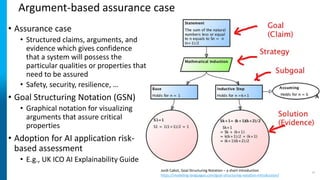
• Assurance case
• Structured claims, arguments, and
evidence which gives confidence
that a system will possess the
particular qualities or properties that
need to be assured
• Safety, security, resilience, …
• Goal Structuring Notation (GSN)
• Graphical notation for visualizing
arguments that assure critical
properties
• Adoption for AI application risk-
based assessment
• E.g., UK ICO AI Explainability Guide
31
Jordi Cabot, Goal Structuring Notation – a short introduction
https://modeling-languages.com/goal-structuring-notation-introduction/
ML security argument
patterns [Zeroual+23]
32
DNN Secure
development argument
• Problem: Compliance is
required in the secure
development processes
for the given DNN.
• Solution: Claim
decomposition to argue
satisfaction of security
requirements.
• E.g., “The specified
robustness guarantees
adversarial perturbations
will be recognizable by
humans.”
M. Zeroual, et al., “Security Argument patterns for Deep Neural Network Development,” PLoP 2023
Goal (Claim)
Solution (Evidence)
Context
Strategy
33
ML assurance argument patterns
(e.g., “DNN Robustness Case Verification”)
[AsianPLoP’24]
Goal (Claim)
Solution
(Evidence)
Strategy
M. Mutsche, et al. “Robustness-based Security Case Verification for Deep Neural Networks,” AsianPLoP 2024
Yuya Sasaki, Hironori Washizaki, Jialong Li, Nobukazu Yoshioka, Naoyasu Ubayashi, Yoshiaki Fukazawa,
“Landscape and Taxonomy of Prompt Engineering Patterns in Software Engineering,” IT Pro, 27, 2025.
User-Model Collaboration Refinement
• Problem: Balancing between accuracy and confidence is
challenging, especially when users need guidance to achieve goals.
• Solution: Interactive prompts that assign LLM to simulate role,
instead of user-driven only prompting.
Prompt Engineering Patterns [Sasaki+25]
34
Persona Game
Question
From LLM
Simulation
Interactive Prompt Templates
This is a conversation with Socrates, an eager and helpful, but humble
expert automatic AI...
I would like you to ask me questions to achieve X. You should ask
questions until this condition is met or to achieve this goal...
• Problem: …
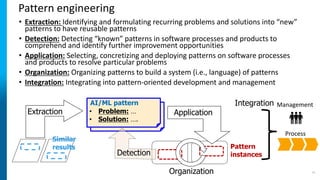
Pattern engineering
• Extraction: Identifying and formulating recurring problems and solutions into “new”
patterns to have reusable patterns
• Detection: Detecting “known” patterns in software processes and products to
comprehend and identify further improvement opportunities
• Application: Selecting, concretizing and deploying patterns on software processes
and products to resolve particular problems
• Organization: Organizing patterns to build a system (i.e., language) of patterns
• Integration: Integrating into pattern-oriented development and management
35
• Problem: …
• Solution: ….
AI/ML pattern
Extraction Application
Similar
results
Detection
Pattern
instances
Organization
Process
Management
Integration
Pytorch vs. Keras
ML pattern detection: Example of pattern instances [APSEC’23]
36
Weitao Pan, Hironori Washizaki, Nobukazu Yoshioka, Yoshiaki Fukazawa, Foutse Khomh, Yann-Gaël Guéhéneuc, “A Machine
Learning Based Approach to Detect Machine Learning Design Patterns,” APSEC 2023 ERA
Embeddings
• Problem: High-cardinality features
where closeness relationships are
important to preserve.
• Solution: Learn to map high-
cardinality data into a lower
dimensional space in such a way
that the information relevant to
the learning problem is preserved.
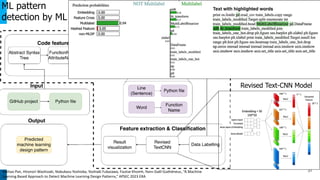
ML pattern
detection by ML
37
Revised Text-CNN Model
Weitao Pan, Hironori Washizaki, Nobukazu Yoshioka, Yoshiaki Fukazawa, Foutse Khomh, Yann-Gaël Guéhéneuc, “A Machine
Learning Based Approach to Detect Machine Learning Design Patterns,” APSEC 2023 ERA
ML pattern application: Deployment of assurance argument patterns
[AsianPLoP’24]
38
1. Identifying and
showing pattern
candidates: OCL
constraints-based
and LLM-based
2. Showing potential
impact and result
before
deployment
3. Deploying a
selected pattern
T. Ayukawa, et al., “Machine Learning Design Pattern Application Support,” AsianPLoP 2024
Design
patterns
IoT design
patterns
Security and
safety patterns
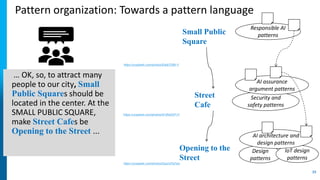
Pattern organization: Towards a pattern language
… OK, so, to attract many
people to our city, Small
Public Squares should be
located in the center. At the
SMALL PUBLIC SQUARE,
make Street Cafes be
Opening to the Street ...
39
Small Public
Square
Street
Cafe
Opening to the
Street
https://unsplash.com/photos/EdpbTj3Br-Y
https://unsplash.com/photos/GqurqYbj7aU
https://unsplash.com/photos/zFoRwZirFvY
Responsible AI
patterns
AI assurance
argument patterns
AI architecture and
design patterns
SWEBOK Guide evolution from V3 to V4
• Modern engineering, practice update, BOK grows and recently developed areas
Requirements
Design
Construction
Testing
Maintenance
Configuration Management
Engineering Management
Process
Models and Methods
Quality
Professional Practice
Economics
Computing Foundations
Mathematical Foundations
Engineering Foundations
Requirements
Architecture
Design
Construction
Testing
Operations
Maintenance
Configuration Management
Engineering Management
Process
Models and Methods
Quality
Security
Professional Practice
Economics
Computing Foundations
Mathematical Foundations
Engineering Foundations
V3 V4
Agile,
DevOps
AI for
SE, SE
for AI
H. Washizaki, eds., “Guide to the Software Engineering Body of Knowledge (SWEBOK Guide), Version 4.0,” IEEE Computer Society, 2024
Editor:
H. Washizaki
KA editors:
A. Ihara,
S. Ogata,
N. Yoshioka,
S. Munetoh,
K. Shintani,
E. Hayashiguchi
and 15+ experts
Metamodel
ML
evaluation
Visualizing issues
ML
evaluation
Visualizing resolution
OK
OK OK
Failed Failed
OK OK
OK
OK
OK OK OK
[ML.VP1🡨
AI.VP1]
Providereliable
real-timeobject
detectionsystem
fordriving
decisionmakingin
highway(incl.
trafficsign
detectionand
lane/vehicle
detection)
• [ML.DS1]Procured
datasets
• [ML.DS2]Internal
databasefrom
collectionduring
operation
• [ML.DC1]Openand
commercialdatasets
• [ML.DC2]Data
collectedduring
operation(imageand
identificationresult)
•[ML.F1🡨
AI.D1/AI.D3]
Boundingbox
forobject(incl.
othervehicles
orsigns)
•[ML.F2🡨
AI.D2]Ridge
detectionfor
lanedetection
[ML.BM1]
Modelswillbe
developed,
tested,and
deployedtocars
monthly
• [ML.PT1]Input:
imagefromsensors
• [ML.PT2←AI.D]
Output:trafficsigns,
lanemarking,
vehicles,and
pedestrians.
[ML.De1]Use
predictionresults
fordecision-
makinginself-
drivingsystem
[ML.IS1]
Usingtestdata,
achieveveryhigh
recallandhigh
precisionin
followingcondition:
night,rainy,and
generalcondition
Datasetsissplitinto
80:20ratio
[ML.MP1]
Predictionshould
bemadein
batchesreal
time.
[ML.M1]Inputdatamonitoring
[ML.VP1🡨
AI.VP1]
Providereliable
real-timeobject
detectionsystem
fordriving
decisionmakingin
highway(incl.
trafficsign
detectionand
lane/vehicle
detection)
• [ML.DS1]Procured
datasets
• [ML.DS2]Internal
databasefrom
collectionduring
operation
• [ML.DC1]Openand
commercialdatasets
• [ML.DC2]Data
collectedduring
operation(imageand
identificationresult)
•[ML.F1🡨
AI.D1/AI.D3]
Boundingbox
forobject(incl.
othervehicles
orsigns)
•[ML.F2🡨
AI.D2]Ridge
detectionfor
lanedetection
[ML.BM1]
Modelswillbe
developed,
tested,and
deployedtocars
monthly
• [ML.PT1]Input:
imagefromsensors
• [ML.PT2←AI.D]
Output:trafficsigns,
lanemarking,
vehicles,and
pedestrians.
[ML.De1]Use
predictionresults
fordecision-
makinginself-
drivingsystem
[ML.IS1]
Usingtestdata,
achieveveryhigh
recallandhigh
precisionin
followingcondition:
night,rainy,and
generalcondition
Datasetsissplitinto
80:20ratio
[ML.MP1]
Predictionshould
bemadein
batchesreal
time.
[ML.M1]Inputdatamonitoring
[ML.VP1🡨
AI.VP1]
Providereliable
real-timeobject
detectionsystem
fordriving
decisionmakingin
highway(incl.
trafficsign
detectionand
lane/vehicle
detection)
•[ML.DS1]Procured
datasets
•[ML.DS2]Internal
databasefrom
collectionduring
operation
•[ML.DC1]Openand
commercialdatasets
•[ML.DC2]Data
collectedduring
operation(imageand
identificationresult)
•[ML.F1🡨
AI.D1/AI.D3]
Boundingbox
forobject(incl.
othervehicles
orsigns)
•[ML.F2🡨
AI.D2]Ridge
detectionfor
lanedetection
[ML.BM1]
Modelswillbe
developed,
tested,and
deployedtocars
monthly
•[ML.PT1]Input:
imagefromsensors
•[ML.PT2←AI.D]
Output:trafficsigns,
lanemarking,
vehicles,and
pedestrians.
[ML.De1]Use
predictionresults
fordecision-
makinginself-
drivingsystem
[ML.IS1]
Usingtestdata,
achieveveryhigh
recallandhigh
precisionin
followingcondition:
night,rainy,and
generalcondition
Datasetsissplitinto
80:20ratio
[ML.MP1]
Predictionshould
bemadein
batchesreal
time.
[ML.M1]Inputdatamonitoring
Adding repair-strategy
ML training
ML repair
System modeling and MLOps integration [ICEBE’23][FGCS’24][SQJ’24]
26
“Integrated Multi-view Modeling for Reliable Machine Learning-Intensive Software Engineering,” Software Quality Journal, Vol. 32, Springer, 2024.
“Enterprise Architecture-based Metamodel for a Holistic Business – IT Alignment View on Machine Learning Projects,” IEEE ICEBE 2023, Best Paper Award
“Enterprise Architecture-based Metamodel for Machine Learning Projects and its Management,” Future Generation Computer Systems, 161, 2024
Requirements
Construction
Design
Test
Architecture
Operations
Economics
Models and Methods
Quality
Requirements
analysis and design
• Problem: …
Pattern engineering
• Extraction: Identifying and formulating recurring problems and solutions into “new”
patterns to have reusable patterns
• Detection: Detecting “known” patterns in software processes and products to
comprehend and identify further improvement opportunities
• Application: Selecting, concretizing and deploying patterns on software processes
and products to resolve particular problems
• Organization: Organizing patterns to build a system (i.e., language) of patterns
• Integration: Integrating into pattern-oriented development and management
35
• Problem: …
• Solution: ….
AI/ML pattern
Extraction Application
Similar
results
Detection
Pattern
instances
Organization
Process
Management
Integration
SE for AI: Techniques useful for AI/ML systems quality
Training
data
Trained
model
Prediction,
inference
Infrastructure
software system
New data
ML model repair Monitoring, goal-oriented
modeling
Testing oracle problem,
balanced dataset and coverage
Performance, robustness
and explainability
Architecture validity and
quality assurance
Suitability with objective,
handling unexpected situations
N. Uchihira, AI and Software Engineering, JUSE SQiP 2017
Eric Breck et al., The ML Test Score: A Rubric for ML Production Readiness and Technical Debt Reduction, IEEE Big Data 2017
Metamorphic testing
Search-based testing
Practices and patterns
Quality measurement

AI Software Engineering based on Multi-view Modeling and Engineering Patterns

  • 1.
    AI Software Engineeringbased on Multi-view Modeling and Engineering Patterns QRS 2025 July 17th, Hangzhou and online Hironori Washizaki, IEEE Computer Society President (Waseda University)
  • 2.
    Waseda University, Tokyo,Japan • A top institution of higher education • 50,000 students in 13 undergraduate and 21 postgraduate schools • Founded in 1882 by Shigenobu Okuma, former Prime Minister of Japan • Strong alumni network of over 660,000 members: 8 prime ministers of Japan; 3 prime ministers of Korea; important figures of Japanese literature (incl. Haruki Murakami); founders of leading companies, incl. Fast Retailing (UNIQLO), Sony, Samsung, Ito En, Lotte, CJ Group, POSCO 2 Japanese University Life https://www.youtube.com/watch?v=qjTqeejCWY0 • Has hosted many international software engineering and computing conferences – SPLC 2013, IEEE ICST 2017, IEEE COMPSAC 2018 (partially), ACM VRST 2018, ICIAM 2023, IEEE VCIP 2024, IEEE CSEE&T 2023 – Strong software engineering team: Prof. Hironori Washizaki, Prof. Tomoji Kishi, and Prof. Naoyasu Ubayashi
  • 3.
    Agenda • IEEE CS:SWEBOK Guide evolution • AI and software engineering: AI for SE and SE for AI • Multi-view Modeling • AI Engineering Patterns and Engineering
  • 4.
    375,000+ Community Members 1031 Global Chapters 157 Countrieswith Computer Society Members For over 75 years, the Computer Society has empowered the people who advance technology by delivering resources and solutions that computing students and professionals need to achieve goals at all stages of their careers. 4 • Engage more students and early career professionals • Engage more industry individuals and organizations • Lead the way in new technical areas Goals • Empower and diversify volunteer base • Nimbleness in execution • Diversity and inclusion Themes
  • 5.
    Does software engineeringform a legitimate profession? 5
  • 6.
    Legitimation of ProfessionalAuthority Professional’s judgment and advice are oriented toward a set of substantive values 6 Paul Starr, “The Social Transformation of American Medicine,” Basic Books, 1982. Knowledge and competence of the professional have been validated by a community Consensually validated knowledge and competence rest on rational, scientific grounds 6
  • 7.
    Towards a Bodyof Knowledge Activities (and practices) Body of Knowledge Islands of Knowledge 7 Every profession is based on a body of knowledge (BOK), which is a collection of knowledge items or areas generally agreed to be essential to understanding a particular subject.
  • 8.
    Knowledge Area Topic Topic Reference Material Bodyof Knowledge Skills Competencies Jobs / Roles SWEBOK Software Engineering Professional Certifications SWECOM EITBOK Learning courses 8 Guide to the Software Engineering Body of Knowledge (SWEBOK) https://www.computer.org/education/bodies-of-knowledge/software-engineering • Guiding researchers and practitioners to identify and have common understanding on “generally-accepted-knowledge” in software engineering • Foundations for certifications and educational curriculum • ‘01 v1, ‘04 v2, ‘05 ISO adoption, ‘14 v3, ’24 v4 released! H. Washizaki, eds., “Guide to the Software Engineering Body of Knowledge (SWEBOK Guide), Version 4.0,” IEEE Computer Society, 2024
  • 9.
    Mainframe 70’s – Early 80’s Late80’s - Early 90’s Late 90’s - Early 00’s Late 00’s - Early 10’s PC, Client & server Internet Ubiquitous computing Late 10’s - Early 20’s IoT, Big data, AI Structured programming Waterfall Formalization Design Program generation Maturity Management Object-oriented Req. eng. Modeling Verification Reuse Model-driven Product-line Global & open Value-based Systems eng. Agile Iterative & incremental DevOps Empirical Data-driven Continuous SE and IoT SE and AI SWEBOK V1 SWEBOK V2 SWEBOK V3 SWEBOK V4 9
  • 10.
    SWEBOK Guide evolutionfrom V3 to V4 • Modern engineering, practice update, BOK grows and recently developed areas Requirements Design Construction Testing Maintenance Configuration Management Engineering Management Process Models and Methods Quality Professional Practice Economics Computing Foundations Mathematical Foundations Engineering Foundations Requirements Architecture Design Construction Testing Operations Maintenance Configuration Management Engineering Management Process Models and Methods Quality Security Professional Practice Economics Computing Foundations Mathematical Foundations Engineering Foundations V3 V4 Agile, DevOps AI for SE, SE for AI H. Washizaki, eds., “Guide to the Software Engineering Body of Knowledge (SWEBOK Guide), Version 4.0,” IEEE Computer Society, 2024 Editor: H. Washizaki KA editors: A. Ihara, S. Ogata, N. Yoshioka, S. Munetoh, K. Shintani, E. Hayashiguchi and 15+ experts
  • 11.
    IEEE CS TechnologyPrediction Team (Chair: Dejan Milojicic) https://www.computer.org/resources/2025-top-technology-predictions
  • 12.
    Mainframe 70’s – Early 80’s Late80’s - Early 90’s Late 90’s - Early 00’s Late 00’s - Early 10’s PC, Client & server Internet Ubiquitous computing Late 10’s - Early 20’s IoT, Big data, AI GenAI, FM, Autonomous, Quantum, Continuum Late 20’s – 30’s Structured programming Waterfall Formalization Design Program generation Maturity Management Object-oriented Req. eng. Modeling Verification Reuse Model-driven Product-line Global & open Value-based Systems eng. Agile Iterative & incremental DevOps Empirical Data-driven Continuous SE and IoT SE and AI SE and GenAI, Quantum, Sustainability Autonomous and Continuum AI-assisted DevOps/OpsDev SWEBOK V1 SWEBOK V2 SWEBOK V3 SWEBOK V4 12 Partially adopted from “The Trailer of the ACM 2030 Roadmap for Software Engineering”
  • 13.
    Agenda • IEEE CS:SWEBOK Guide evolution • AI and software engineering: AI for SE and SE for AI • Multi-view Modeling • AI Engineering Patterns and Engineering
  • 14.
    SWEBOK Guide topic:AI and software engineering • Limitations and challenges • Uncertain and stochastic behavior • Necessity of sufficiently labeled, structured datasets • AI for SE • Building high-quality software systems by replicating human developers’ behavior • Ranging over almost all development stages • SE for AI • Different from traditional software since the rules and system behavior of AI systems are inferred from data • Need for particular support of SE for AI • Documenting practices as patterns 14 Software engineering AI AI for SE SE for AI Hironori Washizaki, Foutse Khomh, Yann-Gael Gueheneuc, Hironori Takeuchi, Naotake Natori, Takuo Doi, Satoshi Okuda, “Software Engineering Design Patterns for Machine Learning Applications,” IEEE Computer, Vol. 55, No. 3, pp. 30-39, 2022. (Best Paper Award)
  • 15.
    AI for SE:From AI-assisted dev to Human/AI co-creation(ref: AI-SEAL) [Feldt18] 15 Ref: Robert Feldt, et al., Ways of Applying Artificial Intelligence in Software Engineering, RAISE 2018, CoRR abs/1802.02033 Agentic action Process Automation level Target Product Runtime Low risk High risk Middle risk Completion Chat and exploration Human- centered AI-assisted Human/AI co- creation Developers Customers End users AI agents Reasoning and implementation
  • 16.
    SE for AI:Techniques useful for AI/ML systems quality Training data Trained model Prediction, inference Infrastructure software system New data ML model repair Monitoring, goal-oriented modeling Testing oracle problem, balanced dataset and coverage Performance, robustness and explainability Architecture validity and quality assurance Suitability with objective, handling unexpected situations N. Uchihira, AI and Software Engineering, JUSE SQiP 2017 Eric Breck et al., The ML Test Score: A Rubric for ML Production Readiness and Technical Debt Reduction, IEEE Big Data 2017 Metamorphic testing Search-based testing Practices and patterns Quality measurement
  • 17.
    Agenda • IEEE CS:SWEBOK Guide evolution • AI and software engineering: AI for SE and SE for AI • Multi-view Modeling • AI Engineering Patterns and Engineering
  • 18.
    Business Concerns System Concerns Software Concerns Traditional Software Concerns ML Software Concerns Costs Revenues Stakeholders Integration Safety ML performance Data Quality Model architecture Reliability Experimentative Definitive 18 Howto address multiple aspects in traceable and consistent way? => Metamodel-based multi-view modeling How to align different natures together? => Pipeline integration and MLOps Responsible AI patterns ML patterns ML Safety and security patterns ML architecture and design patterns How to incorporate ML patterns into development? => Application with configuration
  • 20.
    Multi-view modeling forML systems [SQJ’24] [ICEBE’23][FGCS’24] ML Canvas AI Project Canvas Safety Case Architectural Diagram (SysML) KAOS Goal Model STAMP/STPA Value MLOps Architecture Goals Safety Argumentation 20 Hironori Takeuchi, Jati H. Husen, Hnin Thandar Tun, Hironori Washizaki and Nobukazu Yoshioka, “Enterprise Architecture-based Metamodel for a Holistic Business – IT Alignment View on Machine Learning Projects,” IEEE International Conference on E-Business Engineering (ICEBE 2023), Best Paper Award Hironori Takeuchi, Jati H. Husenb, Hnin Thandar Tun, Hironori Washizaki, Nobukazu Yoshioka, “Enterprise Architecture-based Metamodel for Machine Learning Projects and its Management,” Future Generation Computer Systems, Elsevier, Vol. 161, pp. 135-145, 2024.
  • 21.
    Corresponding process 21 Jati H.Husen, Hironori Washizaki, Jomphon Runpakprakun, Nobukazu Yoshioka, Hnin Thandar Tun, Yoshiaki Fukazawa, Hironori Takeuchi, “Integrated Multi-view Modeling for Reliable Machine Learning-Intensive Software Engineering,” Software Quality Journal, Vol. 32, pp. 1239–1285, Springer-Nature, 2024.
  • 22.
    Metamodel for consistencyand traceability [ICEBE’23][FGCS’24] ML Canvas AI Project Canvas Safety Case KAOS Goal Model STAMP/STPA Architecture (SysML) ML workflow pipeline 22 Hironori Takeuchi, Jati H. Husen, Hnin Thandar Tun, Hironori Washizaki and Nobukazu Yoshioka, “Enterprise Architecture-based Metamodel for a Holistic Business – IT Alignment View on Machine Learning Projects,” IEEE International Conference on E-Business Engineering (ICEBE 2023), Best Paper Award Hironori Takeuchi, Jati H. Husenb, Hnin Thandar Tun, Hironori Washizaki, Nobukazu Yoshioka, “Enterprise Architecture-based Metamodel for Machine Learning Projects and its Management,” Future Generation Computer Systems, Elsevier, Vol. 161, pp. 135-145, 2024.
  • 23.
    Metamodel extension 23 Hiroshi Tanaka,Ide Masaru, Kazuki Munakata, Hironori Washizaki, and Nobukazu Yoshioka, “Activity-based modeling strategy for reliable machine learning system analysis targeting GUI-based applications,” 10th International Conference on Dependable Systems and Their Applications (DSA 2023) Metamodel for ML systems Extension for activity-based reliability analysis [DSA’23] Business-ML alignment model ML canvas AI canvas Extension for ML-system business alignment [FGCS’24] Hironori Takeuchi, Jati H. Husenb, Hnin Thandar Tun, Hironori Washizaki, Nobukazu Yoshioka, “Enterprise Architecture-based Metamodel for Machine Learning Projects and its Management,” Future Generation Computer Systems, Vol. 32, 2024
  • 24.
    Example case ofimage classification in autonomous driving City Highway AI Project Canvas ML Canvas Architecture Data Skills Output Value proposition Integration Stakeholders Customer Cost Revenue How can we develop and revise a system based on DNNs with acceptable recognition accuracy considering safety in the city and on the highway? Jati H. Husen, Hironori Washizaki, Jomphon Runpakprakun, Nobukazu Yoshioka, Hnin Thandar Tun, Yoshiaki Fukazawa, Hironori Takeuchi, “Integrated Multi-view Modeling for Reliable Machine Learning-Intensive Software Engineering,” Software Quality Journal, Vol. 32, Springer, 2024.
  • 25.
    Case of MLm1 m2 m3 Evaluation of classification Safety Case Misclassified data Selection for repair Balanced repair Result of repair Aggressive repair Further revision 1. Dataset revision 2. Architecture revision for improving images 3. Revisiting business goals Misclassified data STAMP/STPA KAOS Goal Model 25 Jati H. Husen, Hironori Washizaki, Jomphon Runpakprakun, Nobukazu Yoshioka, Hnin Thandar Tun, Yoshiaki Fukazawa, Hironori Takeuchi, “Integrated Multi-view Modeling for Reliable Machine Learning-Intensive Software Engineering,” Software Quality Journal, Vol. 32, Springer, 2024. Application of assurance patterns
  • 26.
    Metamodel ML evaluation Visualizing issues ML evaluation Visualizing resolution OK OKOK Failed Failed OK OK OK OK OK OK OK [ML.VP1🡨 AI.VP1] Providereliable real-timeobject detectionsystem fordriving decisionmakingin highway(incl. trafficsign detectionand lane/vehicle detection) • [ML.DS1]Procured datasets • [ML.DS2]Internal databasefrom collectionduring operation • [ML.DC1]Openand commercialdatasets • [ML.DC2]Data collectedduring operation(imageand identificationresult) •[ML.F1🡨 AI.D1/AI.D3] Boundingbox forobject(incl. othervehicles orsigns) •[ML.F2🡨 AI.D2]Ridge detectionfor lanedetection [ML.BM1] Modelswillbe developed, tested,and deployedtocars monthly • [ML.PT1]Input: imagefromsensors • [ML.PT2←AI.D] Output:trafficsigns, lanemarking, vehicles,and pedestrians. [ML.De1]Use predictionresults fordecision- makinginself- drivingsystem [ML.IS1] Usingtestdata, achieveveryhigh recallandhigh precisionin followingcondition: night,rainy,and generalcondition Datasetsissplitinto 80:20ratio [ML.MP1] Predictionshould bemadein batchesreal time. [ML.M1]Inputdatamonitoring [ML.VP1🡨 AI.VP1] Providereliable real-timeobject detectionsystem fordriving decisionmakingin highway(incl. trafficsign detectionand lane/vehicle detection) • [ML.DS1]Procured datasets • [ML.DS2]Internal databasefrom collectionduring operation • [ML.DC1]Openand commercialdatasets • [ML.DC2]Data collectedduring operation(imageand identificationresult) •[ML.F1🡨 AI.D1/AI.D3] Boundingbox forobject(incl. othervehicles orsigns) •[ML.F2🡨 AI.D2]Ridge detectionfor lanedetection [ML.BM1] Modelswillbe developed, tested,and deployedtocars monthly • [ML.PT1]Input: imagefromsensors • [ML.PT2←AI.D] Output:trafficsigns, lanemarking, vehicles,and pedestrians. [ML.De1]Use predictionresults fordecision- makinginself- drivingsystem [ML.IS1] Usingtestdata, achieveveryhigh recallandhigh precisionin followingcondition: night,rainy,and generalcondition Datasetsissplitinto 80:20ratio [ML.MP1] Predictionshould bemadein batchesreal time. [ML.M1]Inputdatamonitoring [ML.VP1🡨 AI.VP1] Providereliable real-timeobject detectionsystem fordriving decisionmakingin highway(incl. trafficsign detectionand lane/vehicle detection) •[ML.DS1]Procured datasets •[ML.DS2]Internal databasefrom collectionduring operation •[ML.DC1]Openand commercialdatasets •[ML.DC2]Data collectedduring operation(imageand identificationresult) •[ML.F1🡨 AI.D1/AI.D3] Boundingbox forobject(incl. othervehicles orsigns) •[ML.F2🡨 AI.D2]Ridge detectionfor lanedetection [ML.BM1] Modelswillbe developed, tested,and deployedtocars monthly •[ML.PT1]Input: imagefromsensors •[ML.PT2←AI.D] Output:trafficsigns, lanemarking, vehicles,and pedestrians. [ML.De1]Use predictionresults fordecision- makinginself- drivingsystem [ML.IS1] Usingtestdata, achieveveryhigh recallandhigh precisionin followingcondition: night,rainy,and generalcondition Datasetsissplitinto 80:20ratio [ML.MP1] Predictionshould bemadein batchesreal time. [ML.M1]Inputdatamonitoring Adding repair-strategy ML training ML repair System modeling and MLOps integration [ICEBE’23][FGCS’24][SQJ’24] 26 “Integrated Multi-view Modeling for Reliable Machine Learning-Intensive Software Engineering,” Software Quality Journal, Vol. 32, Springer, 2024. “Enterprise Architecture-based Metamodel for a Holistic Business – IT Alignment View on Machine Learning Projects,” IEEE ICEBE 2023, Best Paper Award “Enterprise Architecture-based Metamodel for Machine Learning Projects and its Management,” Future Generation Computer Systems, 161, 2024 Requirements Construction Design Test Architecture Operations Economics Models and Methods Quality Requirements analysis and design
  • 27.
    Agenda • IEEE CS:SWEBOK Guide evolution • AI and software engineering: AI for SE and SE for AI • Multi-view Modeling • AI Engineering Patterns and Engineering
  • 28.
    Machine learning designpatterns [Lakshmanan+ 20] • We wish to identify the type of instrument for the sound picked up by the phone and achieve recording and response according to the type. • However, the memory and performance of the phone is limited, and a large deep learning model is unlikely to be loaded. How can we do this? 28 Pretrained model • Let's use Two-stage predictions where a small model on the phone determines if a sound is a musical instrument, and a large model on the cloud classifies the type of sound only if it is a musical instrument. • For the large model, we will adopt Transfer Learning to achieve precise classification. Machine Learning Design Patterns (V. Lakshmanan, et al. 2020) Two-stage predictions Problem: There is a need to maintain the performance of models that are large and complex in nature, even when deployed to edge or distributed devices. Solution: The utilization flow is divided into two phases, with only the simple phase performed on the edge.
  • 29.
    AI/ML software engineeringpatterns • Architecture and design patterns – Software Engineering Patterns for ML applications [SEP4MLA] – Machine Learning Design Patterns [MLDP] • Safety and security patterns – Safety Case Pattern for ML systems [Safety] – Security Argument Patterns for DNN [Security] • Responsible AI patterns – Responsible AI System Design Patterns [Responsible] • Development and management practices – Lifecycle phase practices [Practice1] – Issues and development practices [Practice2] • Prompt engineering patterns – Prompt Pattern Catalog [Prompt][Prompt2] 29 [MLDP] V. Lakshmanan, et al., “Machine Learning Design Patterns,” O’Reilly, 2020 [SEP4MLA] H. Washizaki, et al. “Software Engineering Design Patterns for Machine Learning Applications,” IEEE Computer 55(3) 2022, Best Paper Award [Safety] E. Wozniak, et al., “A Safety Case Pattern for Systems with Machine Learning Components,” SAFECOMP 2020 Workshop [Security] M. Zeroual, et al., “Security Argument patterns for Deep Neural Network Development,” PLoP 2023 [Responsible] Q. Lu, et al., “Responsible-AI-by-Design: a Pattern Collection for Designing Responsible AI Systems,” IEEE Software, 2023 [Practice1] M. S. Rahman, et al., “Machine Learning Application Development: Practitioners’ Insights,” Software Quality Journal, 31, 2023. [Practice2] Y. Watanabe, et al., “Preliminary Literature Review of Machine Learning System Development Practices,” COMPSAC 2021 Fast Abstract [Prompt1] J, White, et al., “A Prompt Pattern Catalog to Enhance Prompt Engineering with ChatGPT,” arXiv 2302.11382, 2023 [Prompt2] Y. Sasaki, H. Washizaki, Jialong Li, Nobukazu Yoshioka, Naoyasu Ubayashi, Yoshiaki Fukazawa, “Landscape and Taxonomy of Prompt Engineering Patterns in Software Engineering,” IEEE IT Professional (IT Pro), Vol. 27, pp. 41-49, 2025.
  • 30.
    SE Patterns forML applications [Computer’22] • 15 patterns extracted from around 40 scholarly and gray documents • Classified into three types: Topology, Programming, and Model Operation 30 Hironori Washizaki, Foutse Khomh, Yann-Gael Gueheneuc, Hironori Takeuchi, Naotake Natori, Takuo Doi, Satoshi Okuda, “Software Engineering Design Patterns for Machine Learning Applications,” IEEE Computer, Vol. 55, No. 3, pp. 30-39, 2022. (Best Paper Award) Encapsulate ML Models within Rule-based Safeguards • Problem: ML models are known to be unstable and vulnerable to adversarial attacks, noise, and data drift. • Solution: Encapsulate functionality provided by ML models and deal with the inherent uncertainty in the containing system using deterministic and verifiable rules. Business Logic API Rule-based Safeguard Inference (Prediction) Encapsulated ML model Input Output Rule Explainable Proxy Model • Problem: A surrogate ML model must be built to provide explainability. • Solution: Run the explainable inference pipeline in parallel with the primary inference pipeline to monitor prediction differences. Input Decoy model Data lake Proxy model (E.g., Decision tree) Monitoring and comparison Reproduce and retraining Production model (E.g., DNN)
  • 31.
    Argument-based assurance case •Assurance case • Structured claims, arguments, and evidence which gives confidence that a system will possess the particular qualities or properties that need to be assured • Safety, security, resilience, … • Goal Structuring Notation (GSN) • Graphical notation for visualizing arguments that assure critical properties • Adoption for AI application risk- based assessment • E.g., UK ICO AI Explainability Guide 31 Jordi Cabot, Goal Structuring Notation – a short introduction https://modeling-languages.com/goal-structuring-notation-introduction/
  • 32.
    ML security argument patterns[Zeroual+23] 32 DNN Secure development argument • Problem: Compliance is required in the secure development processes for the given DNN. • Solution: Claim decomposition to argue satisfaction of security requirements. • E.g., “The specified robustness guarantees adversarial perturbations will be recognizable by humans.” M. Zeroual, et al., “Security Argument patterns for Deep Neural Network Development,” PLoP 2023 Goal (Claim) Solution (Evidence) Context Strategy
  • 33.
    33 ML assurance argumentpatterns (e.g., “DNN Robustness Case Verification”) [AsianPLoP’24] Goal (Claim) Solution (Evidence) Strategy M. Mutsche, et al. “Robustness-based Security Case Verification for Deep Neural Networks,” AsianPLoP 2024
  • 34.
    Yuya Sasaki, HironoriWashizaki, Jialong Li, Nobukazu Yoshioka, Naoyasu Ubayashi, Yoshiaki Fukazawa, “Landscape and Taxonomy of Prompt Engineering Patterns in Software Engineering,” IT Pro, 27, 2025. User-Model Collaboration Refinement • Problem: Balancing between accuracy and confidence is challenging, especially when users need guidance to achieve goals. • Solution: Interactive prompts that assign LLM to simulate role, instead of user-driven only prompting. Prompt Engineering Patterns [Sasaki+25] 34 Persona Game Question From LLM Simulation Interactive Prompt Templates This is a conversation with Socrates, an eager and helpful, but humble expert automatic AI... I would like you to ask me questions to achieve X. You should ask questions until this condition is met or to achieve this goal...
  • 35.
    • Problem: … Patternengineering • Extraction: Identifying and formulating recurring problems and solutions into “new” patterns to have reusable patterns • Detection: Detecting “known” patterns in software processes and products to comprehend and identify further improvement opportunities • Application: Selecting, concretizing and deploying patterns on software processes and products to resolve particular problems • Organization: Organizing patterns to build a system (i.e., language) of patterns • Integration: Integrating into pattern-oriented development and management 35 • Problem: … • Solution: …. AI/ML pattern Extraction Application Similar results Detection Pattern instances Organization Process Management Integration
  • 36.
    Pytorch vs. Keras MLpattern detection: Example of pattern instances [APSEC’23] 36 Weitao Pan, Hironori Washizaki, Nobukazu Yoshioka, Yoshiaki Fukazawa, Foutse Khomh, Yann-Gaël Guéhéneuc, “A Machine Learning Based Approach to Detect Machine Learning Design Patterns,” APSEC 2023 ERA Embeddings • Problem: High-cardinality features where closeness relationships are important to preserve. • Solution: Learn to map high- cardinality data into a lower dimensional space in such a way that the information relevant to the learning problem is preserved.
  • 37.
    ML pattern detection byML 37 Revised Text-CNN Model Weitao Pan, Hironori Washizaki, Nobukazu Yoshioka, Yoshiaki Fukazawa, Foutse Khomh, Yann-Gaël Guéhéneuc, “A Machine Learning Based Approach to Detect Machine Learning Design Patterns,” APSEC 2023 ERA
  • 38.
    ML pattern application:Deployment of assurance argument patterns [AsianPLoP’24] 38 1. Identifying and showing pattern candidates: OCL constraints-based and LLM-based 2. Showing potential impact and result before deployment 3. Deploying a selected pattern T. Ayukawa, et al., “Machine Learning Design Pattern Application Support,” AsianPLoP 2024
  • 39.
    Design patterns IoT design patterns Security and safetypatterns Pattern organization: Towards a pattern language … OK, so, to attract many people to our city, Small Public Squares should be located in the center. At the SMALL PUBLIC SQUARE, make Street Cafes be Opening to the Street ... 39 Small Public Square Street Cafe Opening to the Street https://unsplash.com/photos/EdpbTj3Br-Y https://unsplash.com/photos/GqurqYbj7aU https://unsplash.com/photos/zFoRwZirFvY Responsible AI patterns AI assurance argument patterns AI architecture and design patterns
  • 40.
    SWEBOK Guide evolutionfrom V3 to V4 • Modern engineering, practice update, BOK grows and recently developed areas Requirements Design Construction Testing Maintenance Configuration Management Engineering Management Process Models and Methods Quality Professional Practice Economics Computing Foundations Mathematical Foundations Engineering Foundations Requirements Architecture Design Construction Testing Operations Maintenance Configuration Management Engineering Management Process Models and Methods Quality Security Professional Practice Economics Computing Foundations Mathematical Foundations Engineering Foundations V3 V4 Agile, DevOps AI for SE, SE for AI H. Washizaki, eds., “Guide to the Software Engineering Body of Knowledge (SWEBOK Guide), Version 4.0,” IEEE Computer Society, 2024 Editor: H. Washizaki KA editors: A. Ihara, S. Ogata, N. Yoshioka, S. Munetoh, K. Shintani, E. Hayashiguchi and 15+ experts Metamodel ML evaluation Visualizing issues ML evaluation Visualizing resolution OK OK OK Failed Failed OK OK OK OK OK OK OK [ML.VP1🡨 AI.VP1] Providereliable real-timeobject detectionsystem fordriving decisionmakingin highway(incl. trafficsign detectionand lane/vehicle detection) • [ML.DS1]Procured datasets • [ML.DS2]Internal databasefrom collectionduring operation • [ML.DC1]Openand commercialdatasets • [ML.DC2]Data collectedduring operation(imageand identificationresult) •[ML.F1🡨 AI.D1/AI.D3] Boundingbox forobject(incl. othervehicles orsigns) •[ML.F2🡨 AI.D2]Ridge detectionfor lanedetection [ML.BM1] Modelswillbe developed, tested,and deployedtocars monthly • [ML.PT1]Input: imagefromsensors • [ML.PT2←AI.D] Output:trafficsigns, lanemarking, vehicles,and pedestrians. [ML.De1]Use predictionresults fordecision- makinginself- drivingsystem [ML.IS1] Usingtestdata, achieveveryhigh recallandhigh precisionin followingcondition: night,rainy,and generalcondition Datasetsissplitinto 80:20ratio [ML.MP1] Predictionshould bemadein batchesreal time. [ML.M1]Inputdatamonitoring [ML.VP1🡨 AI.VP1] Providereliable real-timeobject detectionsystem fordriving decisionmakingin highway(incl. trafficsign detectionand lane/vehicle detection) • [ML.DS1]Procured datasets • [ML.DS2]Internal databasefrom collectionduring operation • [ML.DC1]Openand commercialdatasets • [ML.DC2]Data collectedduring operation(imageand identificationresult) •[ML.F1🡨 AI.D1/AI.D3] Boundingbox forobject(incl. othervehicles orsigns) •[ML.F2🡨 AI.D2]Ridge detectionfor lanedetection [ML.BM1] Modelswillbe developed, tested,and deployedtocars monthly • [ML.PT1]Input: imagefromsensors • [ML.PT2←AI.D] Output:trafficsigns, lanemarking, vehicles,and pedestrians. [ML.De1]Use predictionresults fordecision- makinginself- drivingsystem [ML.IS1] Usingtestdata, achieveveryhigh recallandhigh precisionin followingcondition: night,rainy,and generalcondition Datasetsissplitinto 80:20ratio [ML.MP1] Predictionshould bemadein batchesreal time. [ML.M1]Inputdatamonitoring [ML.VP1🡨 AI.VP1] Providereliable real-timeobject detectionsystem fordriving decisionmakingin highway(incl. trafficsign detectionand lane/vehicle detection) •[ML.DS1]Procured datasets •[ML.DS2]Internal databasefrom collectionduring operation •[ML.DC1]Openand commercialdatasets •[ML.DC2]Data collectedduring operation(imageand identificationresult) •[ML.F1🡨 AI.D1/AI.D3] Boundingbox forobject(incl. othervehicles orsigns) •[ML.F2🡨 AI.D2]Ridge detectionfor lanedetection [ML.BM1] Modelswillbe developed, tested,and deployedtocars monthly •[ML.PT1]Input: imagefromsensors •[ML.PT2←AI.D] Output:trafficsigns, lanemarking, vehicles,and pedestrians. [ML.De1]Use predictionresults fordecision- makinginself- drivingsystem [ML.IS1] Usingtestdata, achieveveryhigh recallandhigh precisionin followingcondition: night,rainy,and generalcondition Datasetsissplitinto 80:20ratio [ML.MP1] Predictionshould bemadein batchesreal time. [ML.M1]Inputdatamonitoring Adding repair-strategy ML training ML repair System modeling and MLOps integration [ICEBE’23][FGCS’24][SQJ’24] 26 “Integrated Multi-view Modeling for Reliable Machine Learning-Intensive Software Engineering,” Software Quality Journal, Vol. 32, Springer, 2024. “Enterprise Architecture-based Metamodel for a Holistic Business – IT Alignment View on Machine Learning Projects,” IEEE ICEBE 2023, Best Paper Award “Enterprise Architecture-based Metamodel for Machine Learning Projects and its Management,” Future Generation Computer Systems, 161, 2024 Requirements Construction Design Test Architecture Operations Economics Models and Methods Quality Requirements analysis and design • Problem: … Pattern engineering • Extraction: Identifying and formulating recurring problems and solutions into “new” patterns to have reusable patterns • Detection: Detecting “known” patterns in software processes and products to comprehend and identify further improvement opportunities • Application: Selecting, concretizing and deploying patterns on software processes and products to resolve particular problems • Organization: Organizing patterns to build a system (i.e., language) of patterns • Integration: Integrating into pattern-oriented development and management 35 • Problem: … • Solution: …. AI/ML pattern Extraction Application Similar results Detection Pattern instances Organization Process Management Integration SE for AI: Techniques useful for AI/ML systems quality Training data Trained model Prediction, inference Infrastructure software system New data ML model repair Monitoring, goal-oriented modeling Testing oracle problem, balanced dataset and coverage Performance, robustness and explainability Architecture validity and quality assurance Suitability with objective, handling unexpected situations N. Uchihira, AI and Software Engineering, JUSE SQiP 2017 Eric Breck et al., The ML Test Score: A Rubric for ML Production Readiness and Technical Debt Reduction, IEEE Big Data 2017 Metamorphic testing Search-based testing Practices and patterns Quality measurement