IEEE-CS Tech Predictions, SWEBOK and Quantum Software: Towards Q-SWEBOK
1.
IEEE-CS Tech Predictions,SWEBOK
and Quantum Software:
Towards Q-SWEBOK
QSE Tokyo 2025, August 1st, Tokyo
Hironori (Hiro) Washizaki
IEEE Computer Society, President
Waseda University), Professor
2.
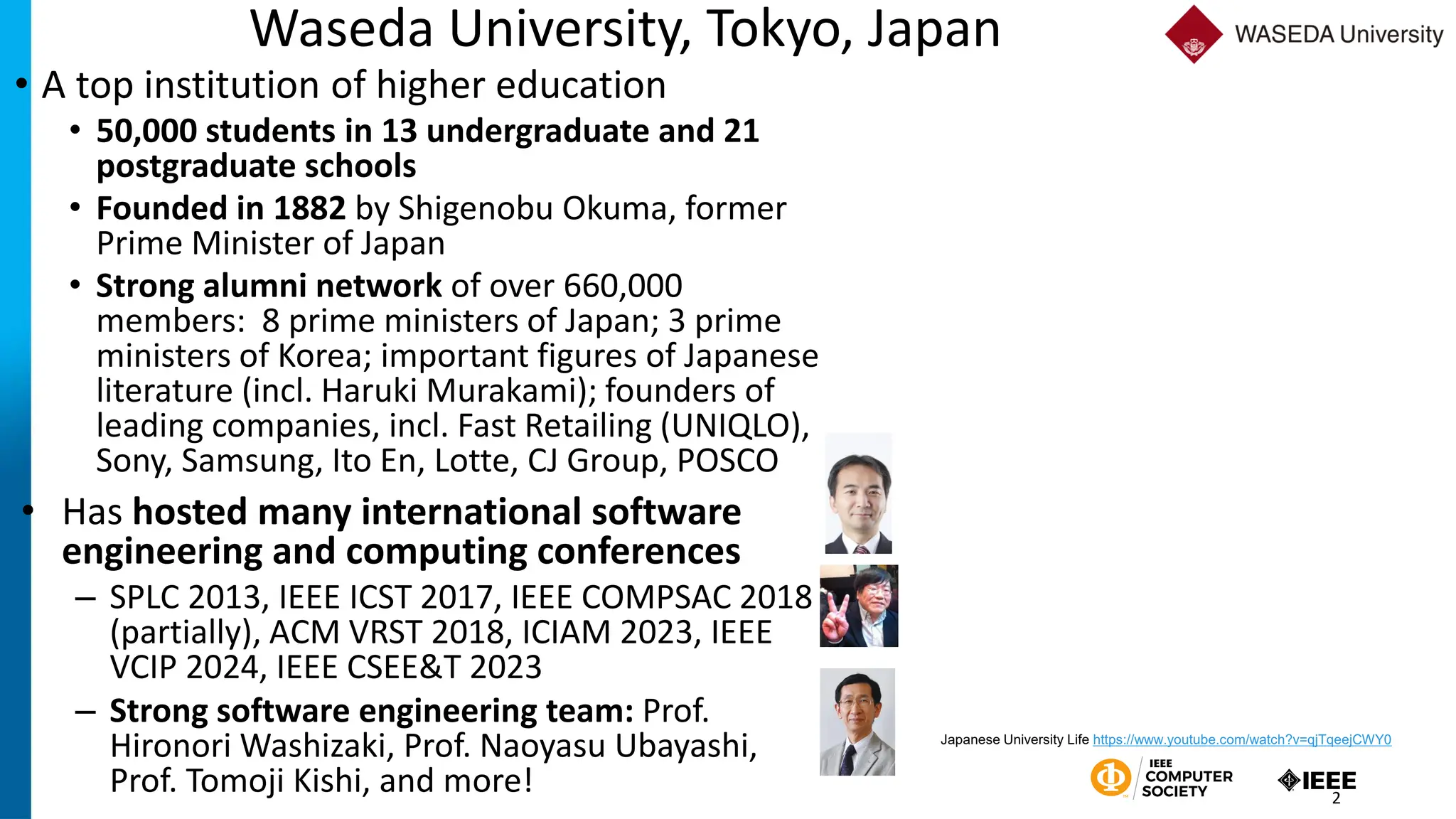
Waseda University, Tokyo,Japan
• A top institution of higher education
• 50,000 students in 13 undergraduate and 21
postgraduate schools
• Founded in 1882 by Shigenobu Okuma, former
Prime Minister of Japan
• Strong alumni network of over 660,000
members: 8 prime ministers of Japan; 3 prime
ministers of Korea; important figures of Japanese
literature (incl. Haruki Murakami); founders of
leading companies, incl. Fast Retailing (UNIQLO),
Sony, Samsung, Ito En, Lotte, CJ Group, POSCO
2
Japanese University Life https://www.youtube.com/watch?v=qjTqeejCWY0
• Has hosted many international software
engineering and computing conferences
– SPLC 2013, IEEE ICST 2017, IEEE COMPSAC 2018
(partially), ACM VRST 2018, ICIAM 2023, IEEE
VCIP 2024, IEEE CSEE&T 2023
– Strong software engineering team: Prof.
Hironori Washizaki, Prof. Naoyasu Ubayashi,
Prof. Tomoji Kishi, and more!
3.
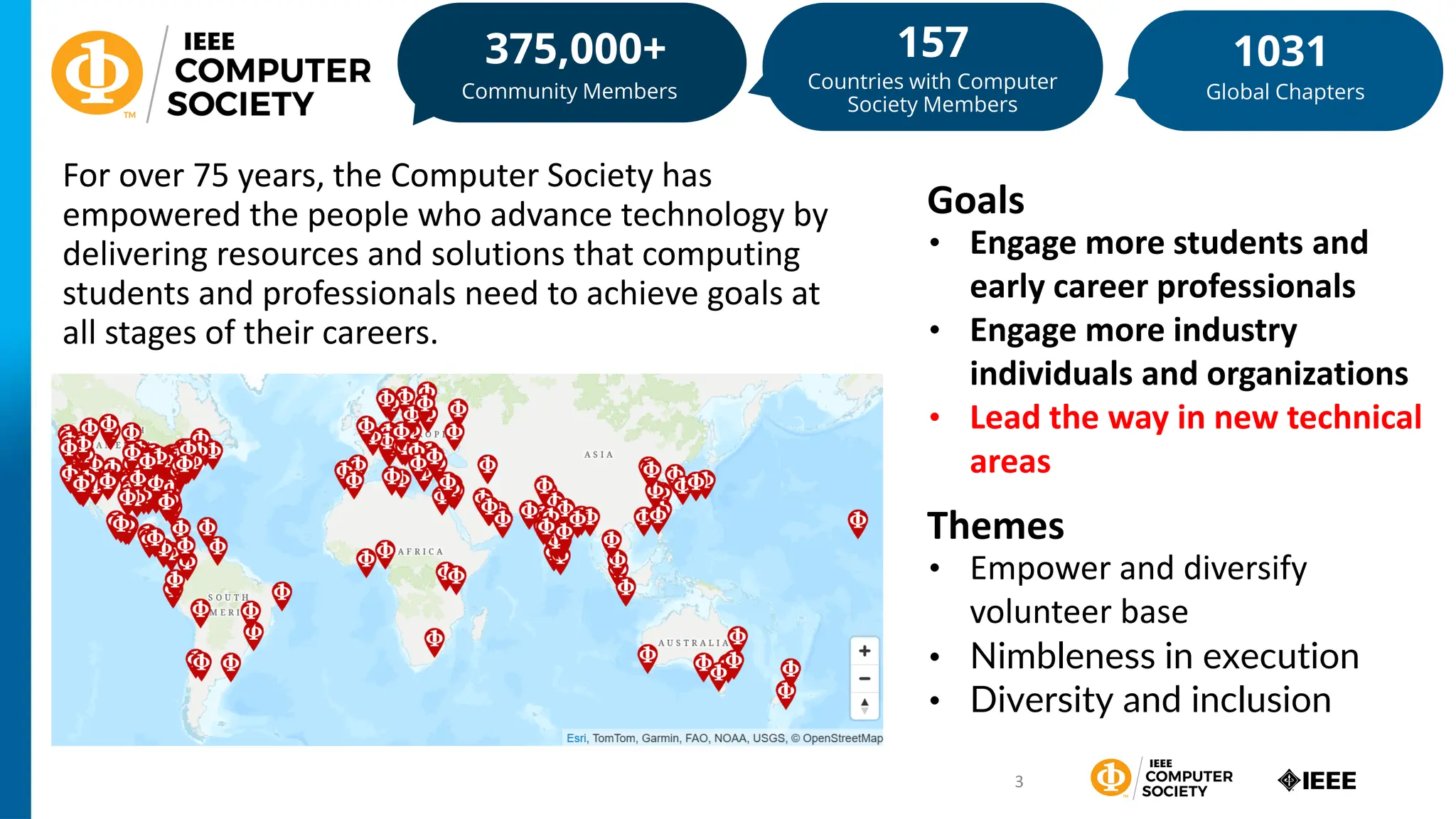
375,000+
Community Members
1031
Global Chapters
157
Countrieswith Computer
Society Members
For over 75 years, the Computer Society has
empowered the people who advance technology by
delivering resources and solutions that computing
students and professionals need to achieve goals at
all stages of their careers.
3
• Engage more students and
early career professionals
• Engage more industry
individuals and organizations
• Lead the way in new technical
areas
Goals
• Empower and diversify
volunteer base
• Nimbleness in execution
• Diversity and inclusion
Themes
4.
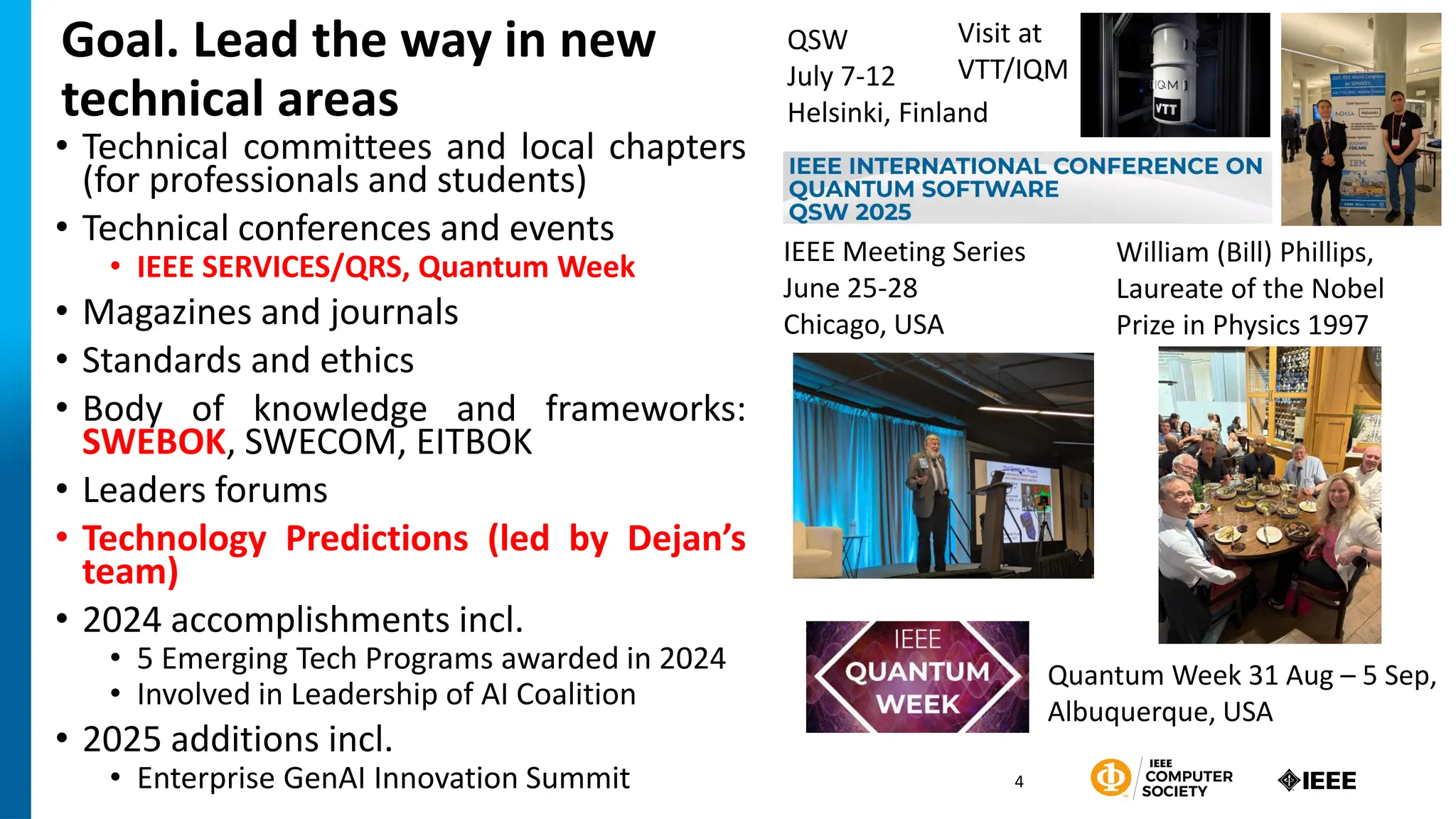
Goal. Lead theway in new
technical areas
• Technical committees and local chapters
(for professionals and students)
• Technical conferences and events
• IEEE SERVICES/QRS, Quantum Week
• Magazines and journals
• Standards and ethics
• Body of knowledge and frameworks:
SWEBOK, SWECOM, EITBOK
• Leaders forums
• Technology Predictions (led by Dejan’s
team)
• 2024 accomplishments incl.
• 5 Emerging Tech Programs awarded in 2024
• Involved in Leadership of AI Coalition
• 2025 additions incl.
• Enterprise GenAI Innovation Summit 4
Quantum Week 31 Aug – 5 Sep,
Albuquerque, USA
QSW
July 7-12
Helsinki, Finland
IEEE Meeting Series
June 25-28
Chicago, USA
William (Bill) Phillips,
Laureate of the Nobel
Prize in Physics 1997
Visit at
VTT/IQM
6
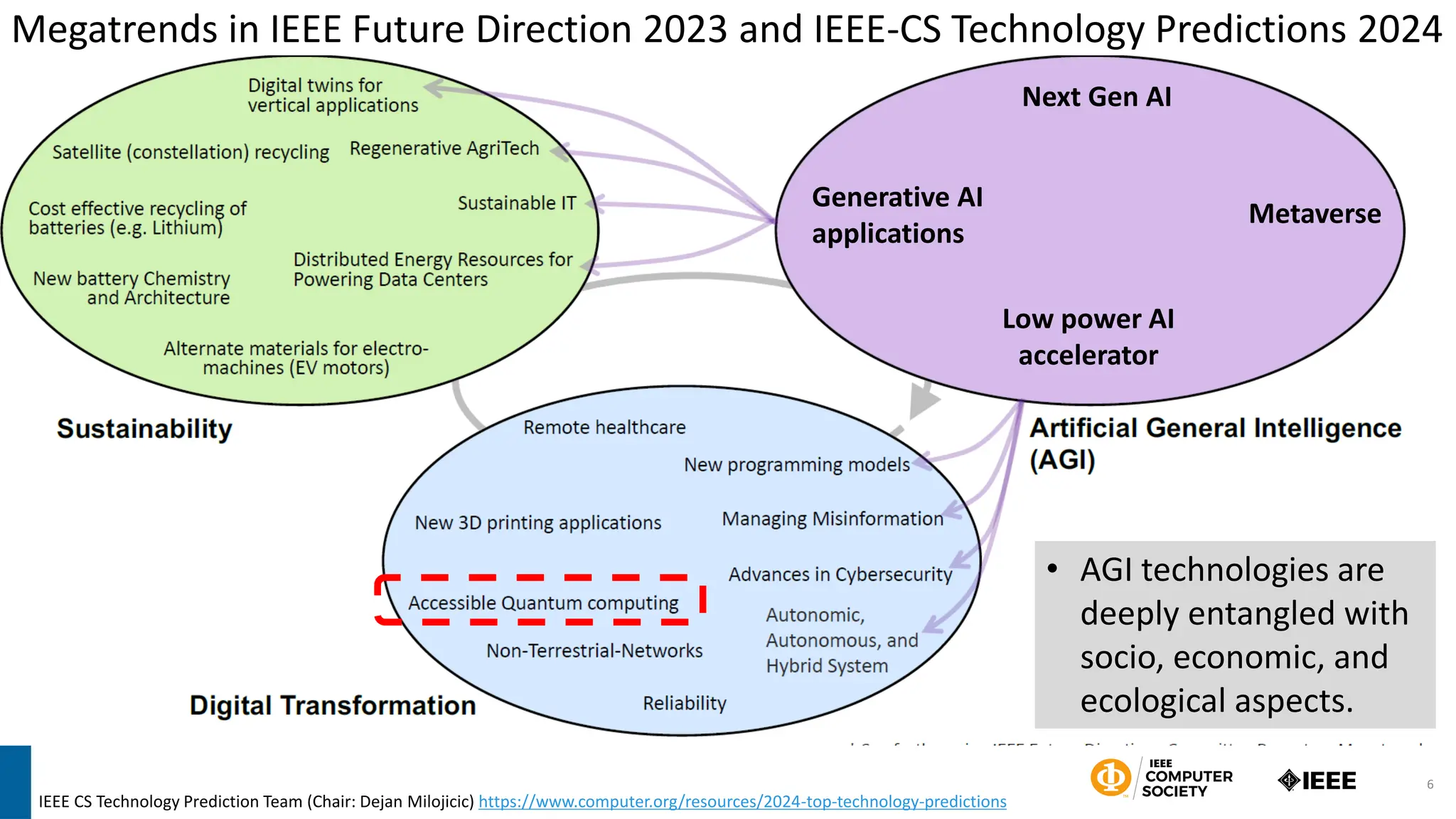
Megatrends in IEEEFuture Direction 2023 and IEEE-CS Technology Predictions 2024
IEEE CS Technology Prediction Team (Chair: Dejan Milojicic) https://www.computer.org/resources/2024-top-technology-predictions
• AGI technologies are
deeply entangled with
socio, economic, and
ecological aspects.
Next Gen AI
Generative AI
applications
Metaverse
Low power AI
accelerator
7.
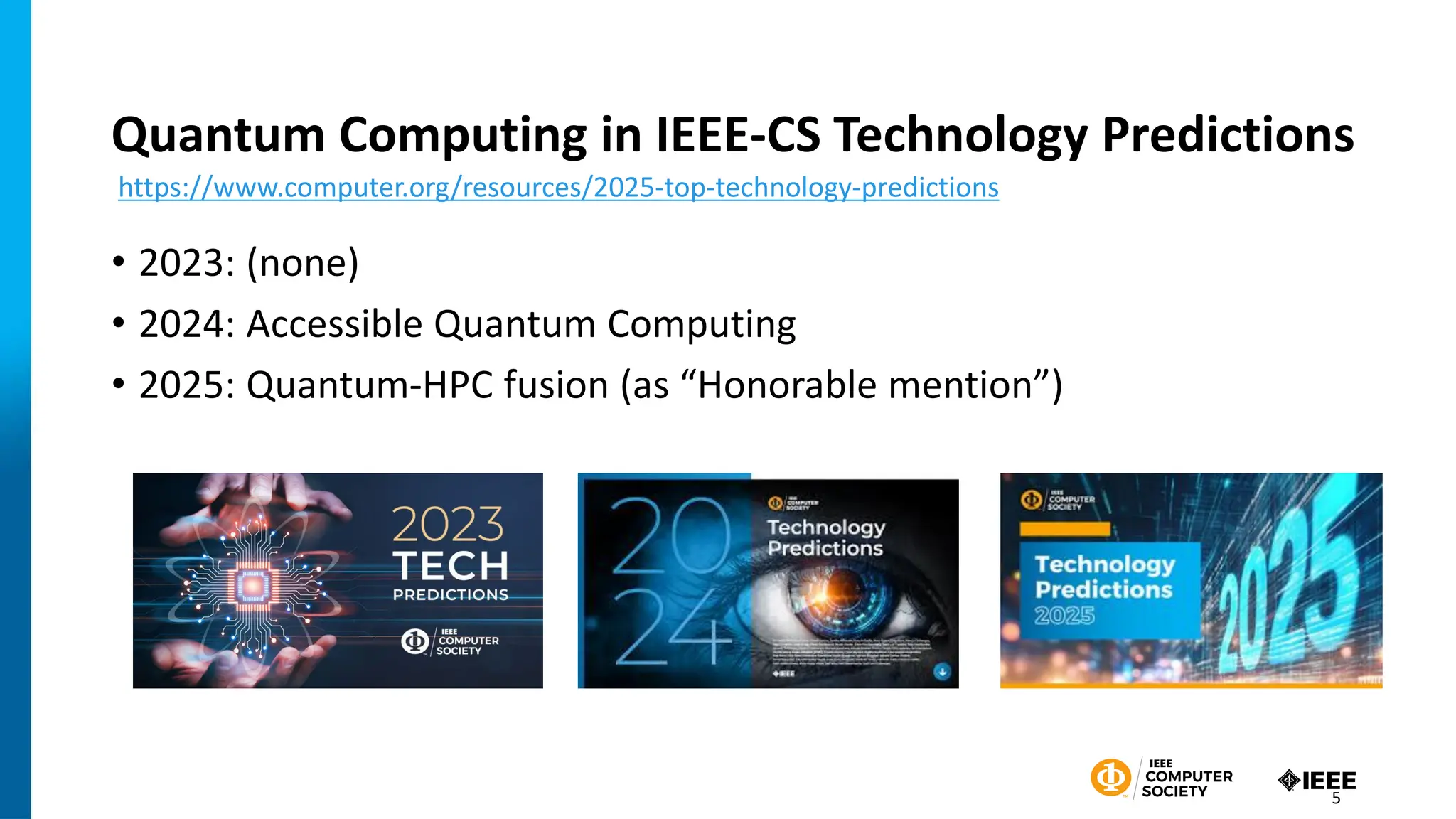
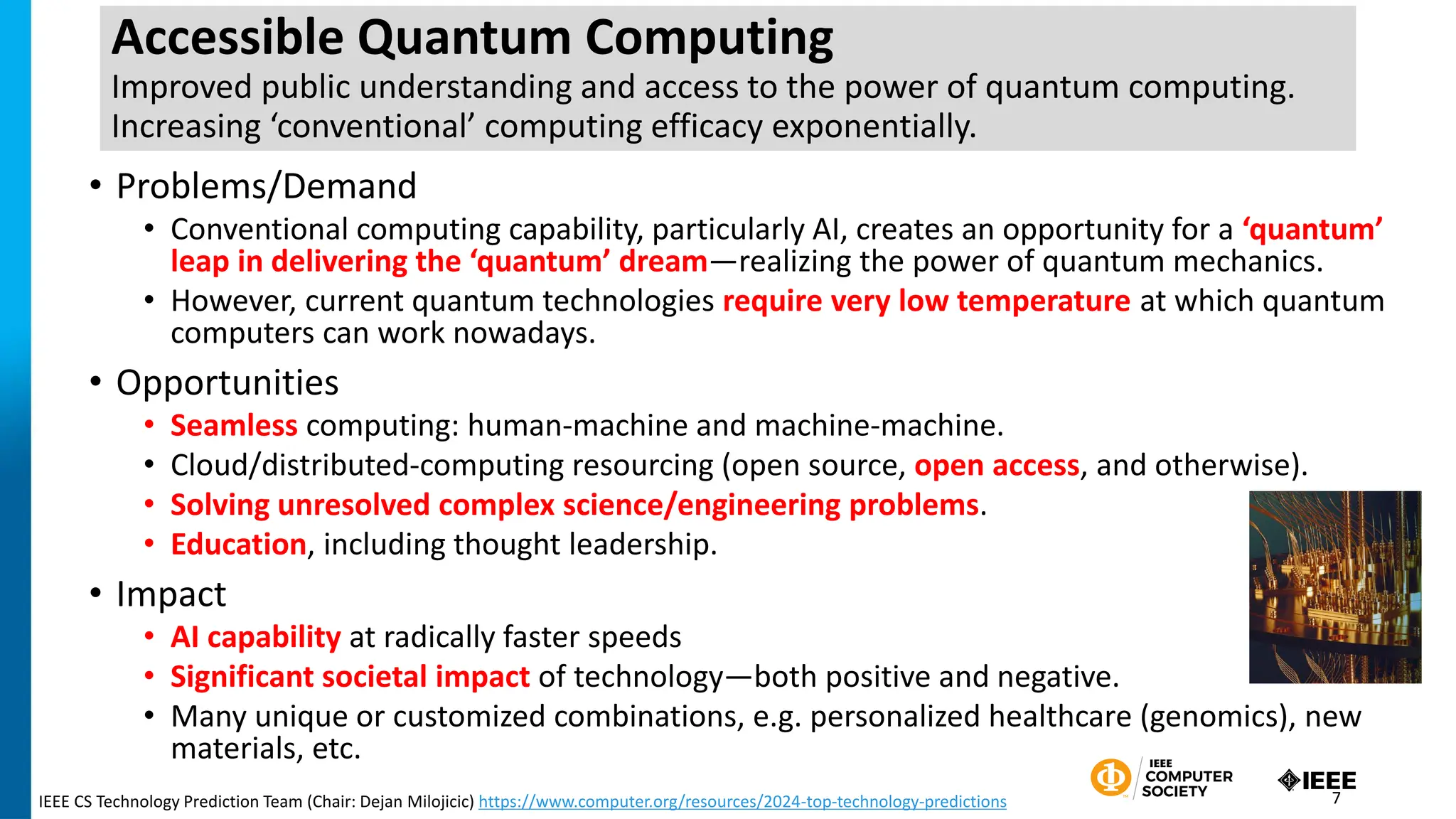
Accessible Quantum Computing
Improvedpublic understanding and access to the power of quantum computing.
Increasing ‘conventional’ computing efficacy exponentially.
• Problems/Demand
• Conventional computing capability, particularly AI, creates an opportunity for a ‘quantum’
leap in delivering the ‘quantum’ dream—realizing the power of quantum mechanics.
• However, current quantum technologies require very low temperature at which quantum
computers can work nowadays.
• Opportunities
• Seamless computing: human-machine and machine-machine.
• Cloud/distributed-computing resourcing (open source, open access, and otherwise).
• Solving unresolved complex science/engineering problems.
• Education, including thought leadership.
• Impact
• AI capability at radically faster speeds
• Significant societal impact of technology—both positive and negative.
• Many unique or customized combinations, e.g. personalized healthcare (genomics), new
materials, etc.
IEEE CS Technology Prediction Team (Chair: Dejan Milojicic) https://www.computer.org/resources/2024-top-technology-predictions 7
8.
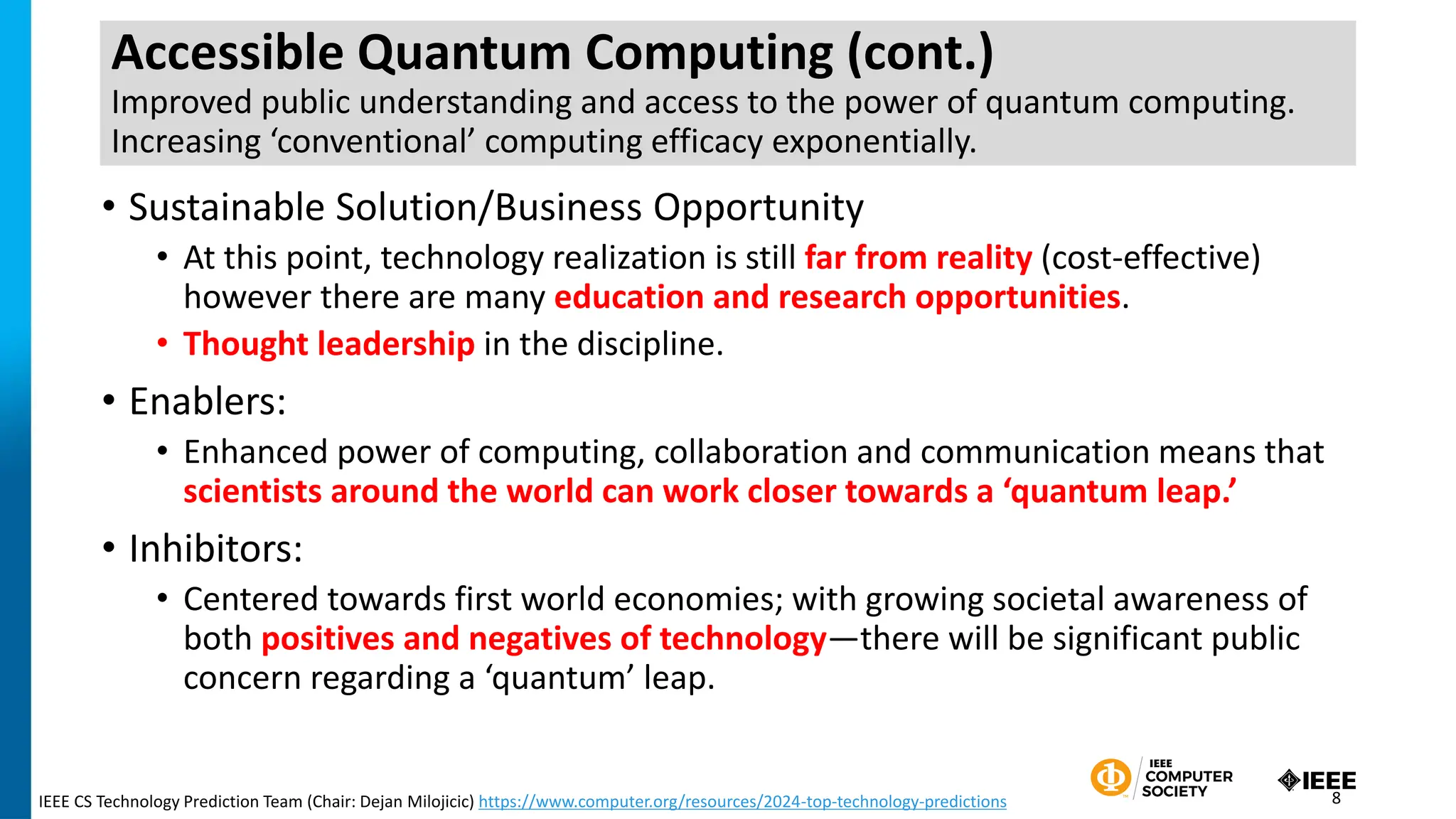
Accessible Quantum Computing(cont.)
Improved public understanding and access to the power of quantum computing.
Increasing ‘conventional’ computing efficacy exponentially.
• Sustainable Solution/Business Opportunity
• At this point, technology realization is still far from reality (cost-effective)
however there are many education and research opportunities.
• Thought leadership in the discipline.
• Enablers:
• Enhanced power of computing, collaboration and communication means that
scientists around the world can work closer towards a ‘quantum leap.’
• Inhibitors:
• Centered towards first world economies; with growing societal awareness of
both positives and negatives of technology—there will be significant public
concern regarding a ‘quantum’ leap.
IEEE CS Technology Prediction Team (Chair: Dejan Milojicic) https://www.computer.org/resources/2024-top-technology-predictions 8
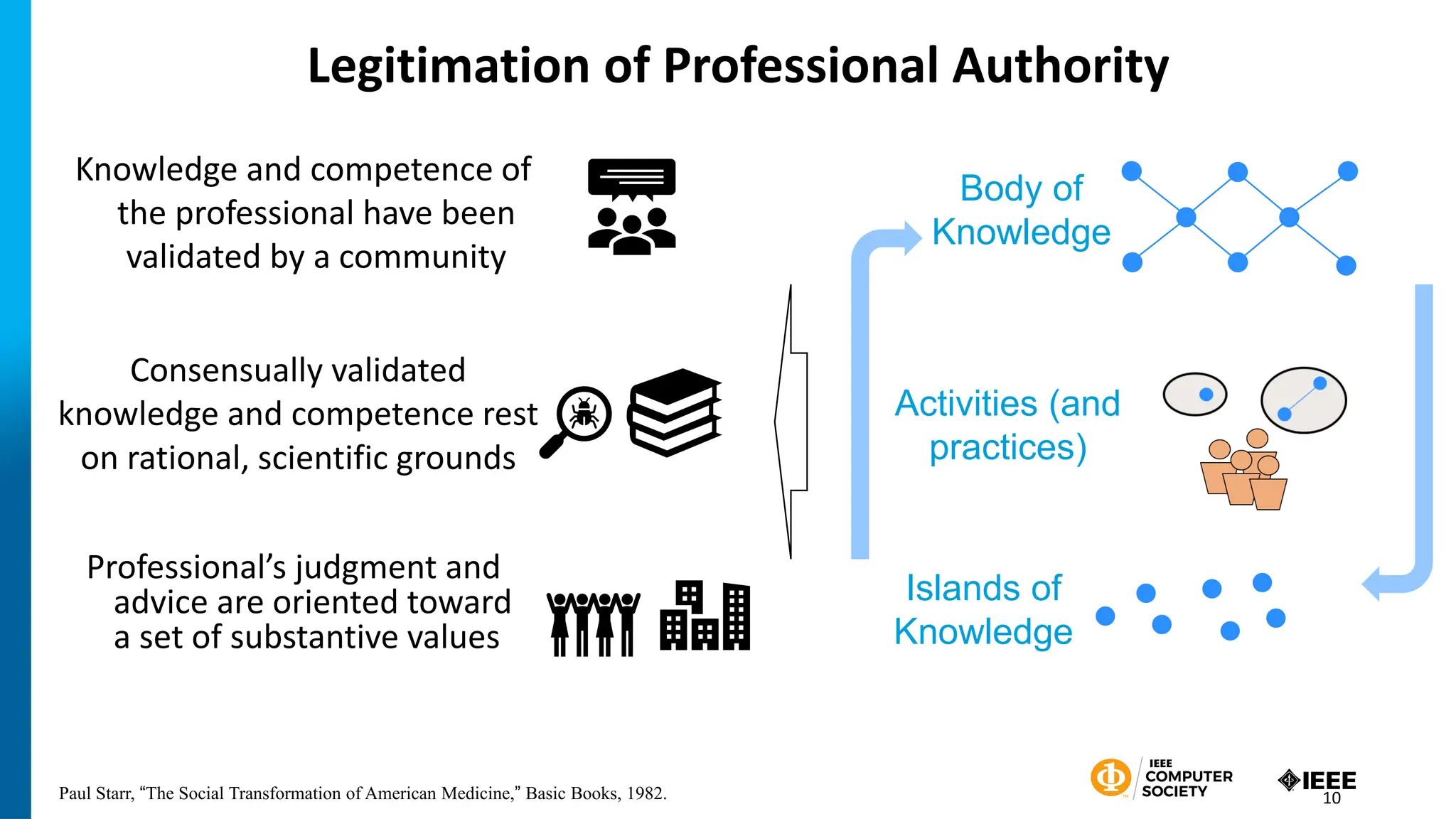
Legitimation of ProfessionalAuthority
Professional’s judgment and
advice are oriented toward
a set of substantive values
10
Paul Starr, “The Social Transformation of American Medicine,” Basic Books, 1982.
Knowledge and competence of
the professional have been
validated by a community
Consensually validated
knowledge and competence rest
on rational, scientific grounds
Activities (and
practices)
Body of
Knowledge
Islands of
Knowledge
10
11.
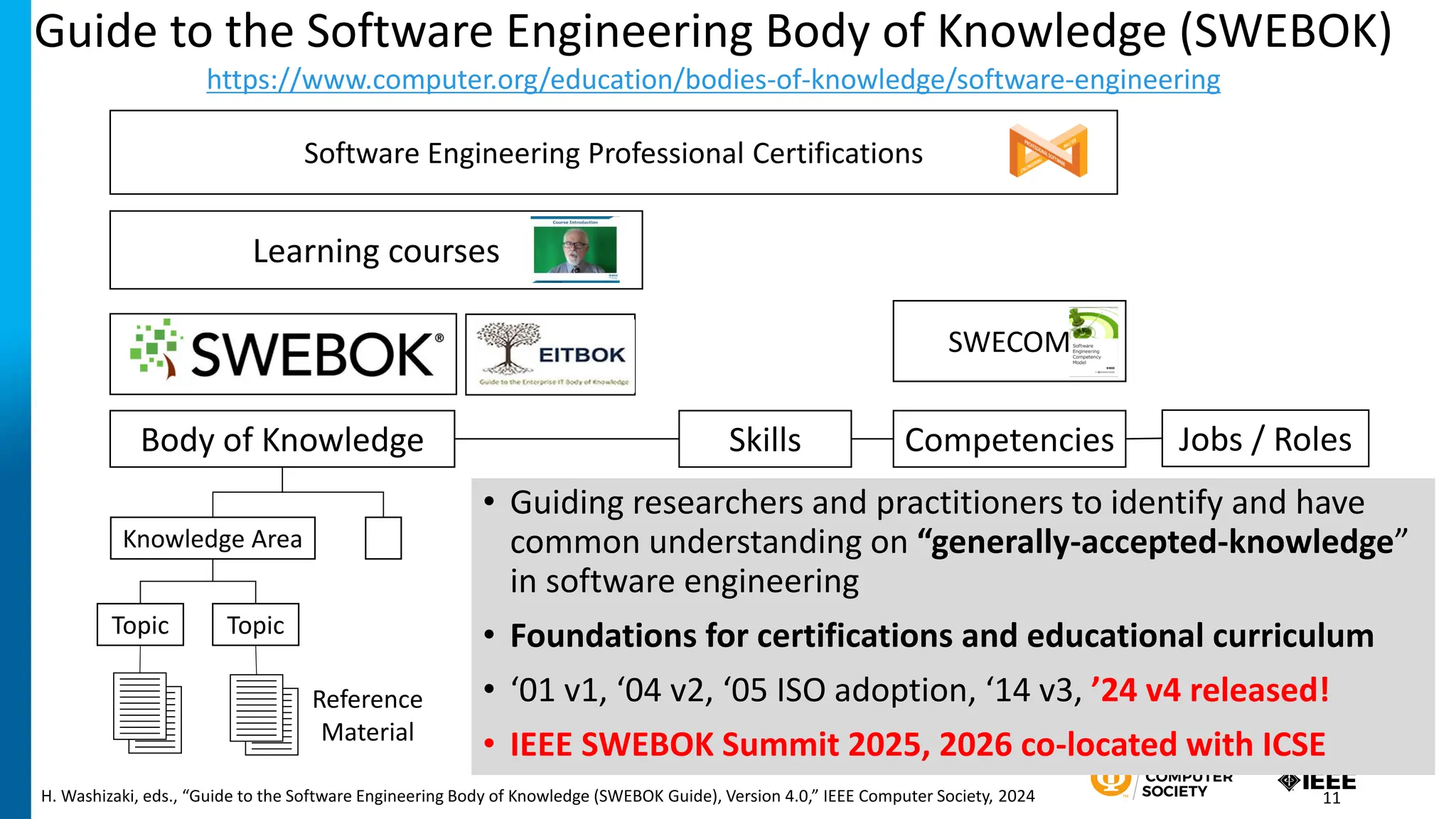
Knowledge Area
Topic Topic
Reference
Material
Bodyof Knowledge Skills Competencies Jobs / Roles
SWEBOK
Software Engineering Professional Certifications
SWECOM
EITBOK
Learning courses
11
Guide to the Software Engineering Body of Knowledge (SWEBOK)
https://www.computer.org/education/bodies-of-knowledge/software-engineering
• Guiding researchers and practitioners to identify and have
common understanding on “generally-accepted-knowledge”
in software engineering
• Foundations for certifications and educational curriculum
• ‘01 v1, ‘04 v2, ‘05 ISO adoption, ‘14 v3, ’24 v4 released!
• IEEE SWEBOK Summit 2025, 2026 co-located with ICSE
H. Washizaki, eds., “Guide to the Software Engineering Body of Knowledge (SWEBOK Guide), Version 4.0,” IEEE Computer Society, 2024 11
12.
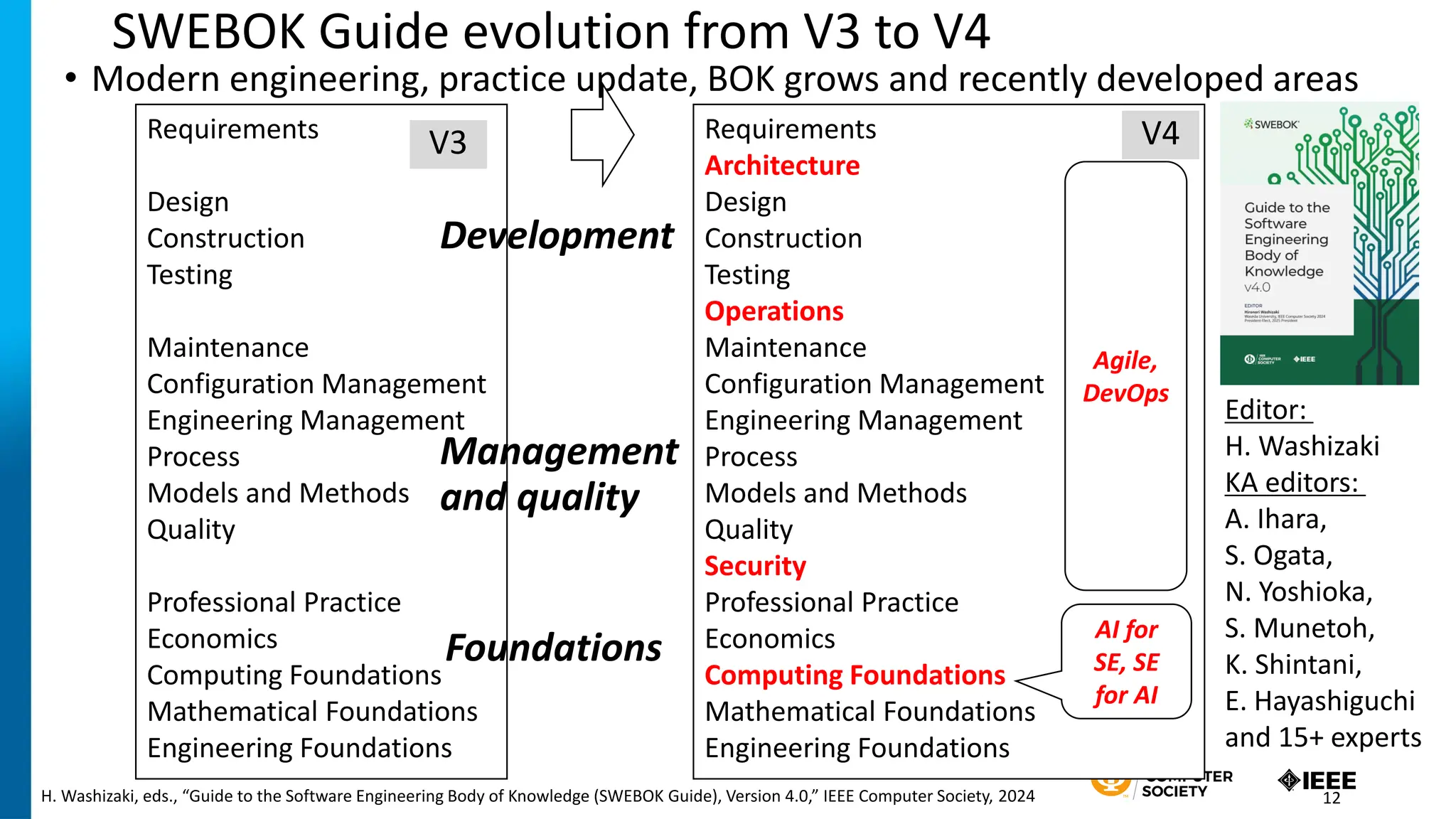
SWEBOK Guide evolutionfrom V3 to V4
• Modern engineering, practice update, BOK grows and recently developed areas
Requirements
Design
Construction
Testing
Maintenance
Configuration Management
Engineering Management
Process
Models and Methods
Quality
Professional Practice
Economics
Computing Foundations
Mathematical Foundations
Engineering Foundations
Requirements
Architecture
Design
Construction
Testing
Operations
Maintenance
Configuration Management
Engineering Management
Process
Models and Methods
Quality
Security
Professional Practice
Economics
Computing Foundations
Mathematical Foundations
Engineering Foundations
V3 V4
Agile,
DevOps
AI for
SE, SE
for AI
H. Washizaki, eds., “Guide to the Software Engineering Body of Knowledge (SWEBOK Guide), Version 4.0,” IEEE Computer Society, 2024
Editor:
H. Washizaki
KA editors:
A. Ihara,
S. Ogata,
N. Yoshioka,
S. Munetoh,
K. Shintani,
E. Hayashiguchi
and 15+ experts
Development
Management
and quality
Foundations
12
13.
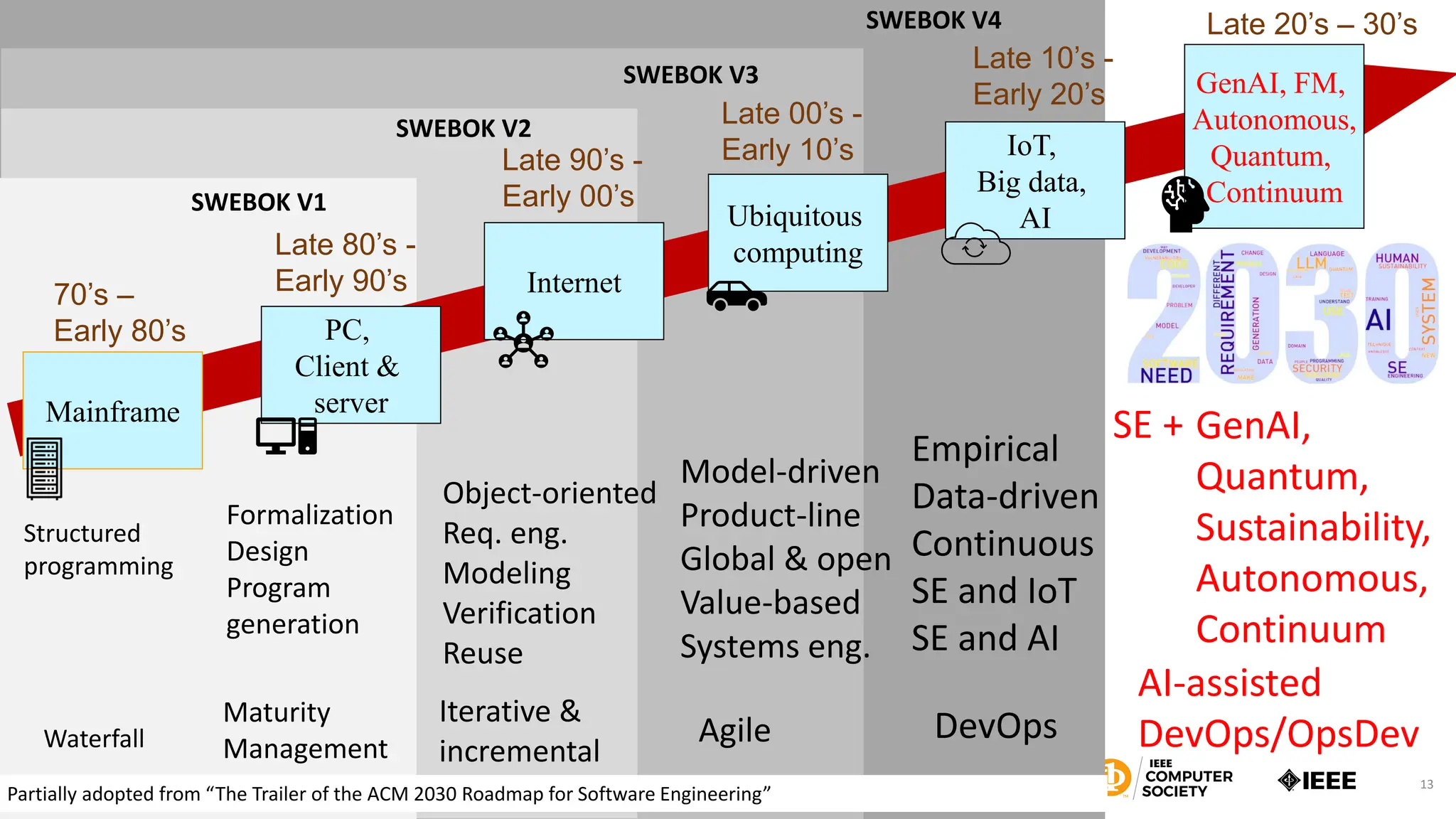
Mainframe
70’s –
Early 80’s
Late80’s -
Early 90’s
Late 90’s -
Early 00’s
Late 00’s -
Early 10’s
PC,
Client &
server
Internet
Ubiquitous
computing
Late 10’s -
Early 20’s
IoT,
Big data,
AI
GenAI, FM,
Autonomous,
Quantum,
Continuum
Late 20’s – 30’s
Structured
programming
Waterfall
Formalization
Design
Program
generation
Maturity
Management
Object-oriented
Req. eng.
Modeling
Verification
Reuse
Model-driven
Product-line
Global & open
Value-based
Systems eng.
Agile
Iterative &
incremental
DevOps
Empirical
Data-driven
Continuous
SE and IoT
SE and AI
GenAI,
Quantum,
Sustainability,
Autonomous,
Continuum
AI-assisted
DevOps/OpsDev
SWEBOK V1
SWEBOK V2
SWEBOK V3
SWEBOK V4
13
Partially adopted from “The Trailer of the ACM 2030 Roadmap for Software Engineering”
SE +
14.
Chinese Software EngineeringBody of Knowledge (C-SWEBOK)
[MoE19] China MoE, “University Teaching Steering Committee on Software Engineering. C-SWEBOK:
The Chinese Software Engineering Body of Knowledge,” Higher Education Press, 2019
14
15.
Towards Q-SWEBOK: e.g.,Requirements engineering [Sepulveda+24]
S. Sepúlveda, et al. “Systematic Review on Requirements Engineering in
Quantum Computing: Insights and Future Directions,” Electronics 2024, 13(15) 15
16.
Towards Q-SWEBOK: e.g.,Requirements engineering [Sepulveda+24]
S. Sepúlveda, et al. “Systematic Review on Requirements Engineering in
Quantum Computing: Insights and Future Directions,” Electronics 2024, 13(15) 16
17.
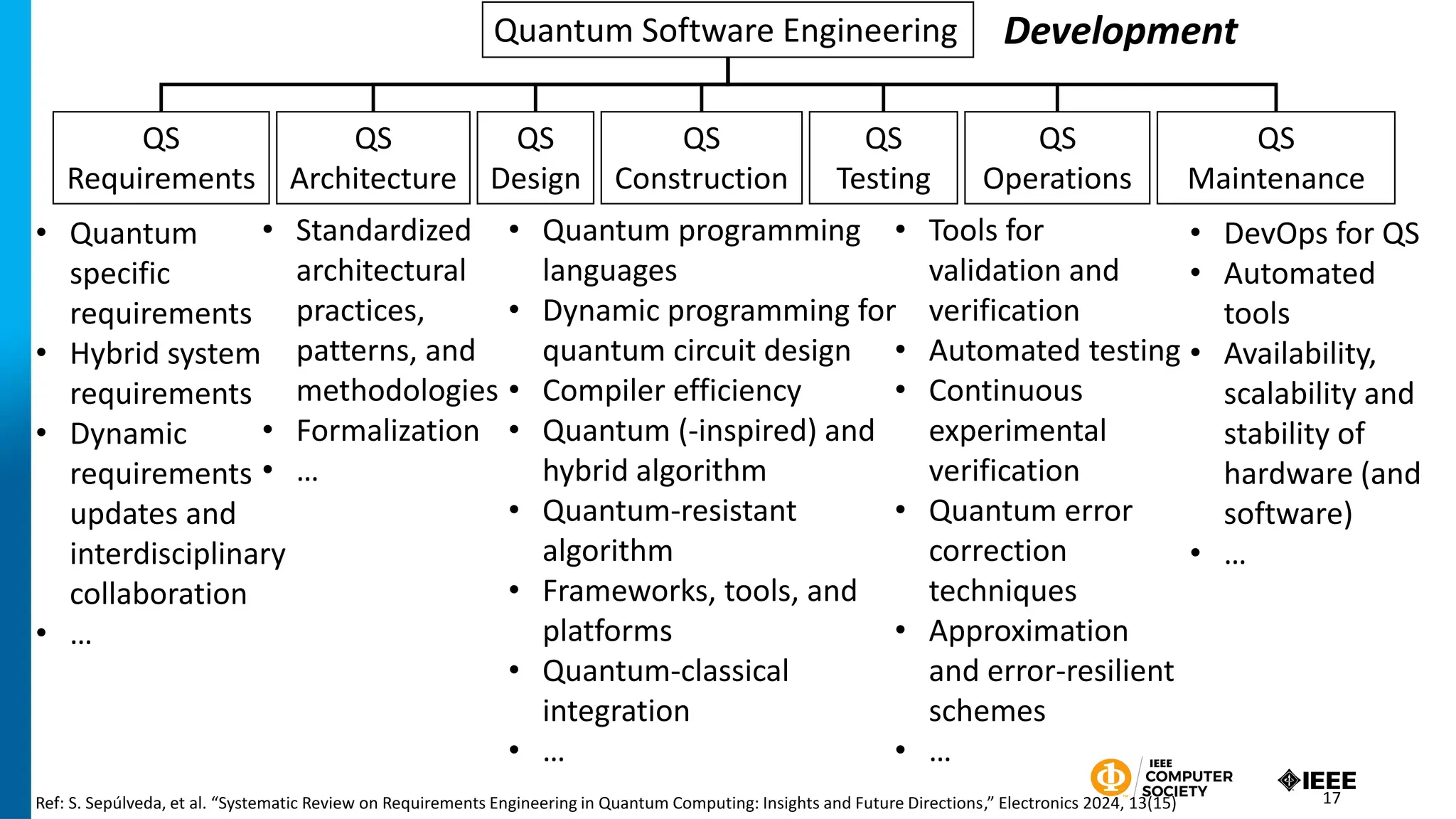
Quantum Software Engineering
QS
Requirements
QS
Architecture
QS
Design
QS
Construction
QS
Testing
QS
Operations
QS
Maintenance
•Quantum
specific
requirements
• Hybrid system
requirements
• Dynamic
requirements
updates and
interdisciplinary
collaboration
• …
• Standardized
architectural
practices,
patterns, and
methodologies
• Formalization
• …
• Quantum programming
languages
• Dynamic programming for
quantum circuit design
• Compiler efficiency
• Quantum (-inspired) and
hybrid algorithm
• Quantum-resistant
algorithm
• Frameworks, tools, and
platforms
• Quantum-classical
integration
• …
• DevOps for QS
• Automated
tools
• Availability,
scalability and
stability of
hardware (and
software)
• …
• Tools for
validation and
verification
• Automated testing
• Continuous
experimental
verification
• Quantum error
correction
techniques
• Approximation
and error-resilient
schemes
• …
Ref: S. Sepúlveda, et al. “Systematic Review on Requirements Engineering in Quantum Computing: Insights and Future Directions,” Electronics 2024, 13(15)
Development
17
18.
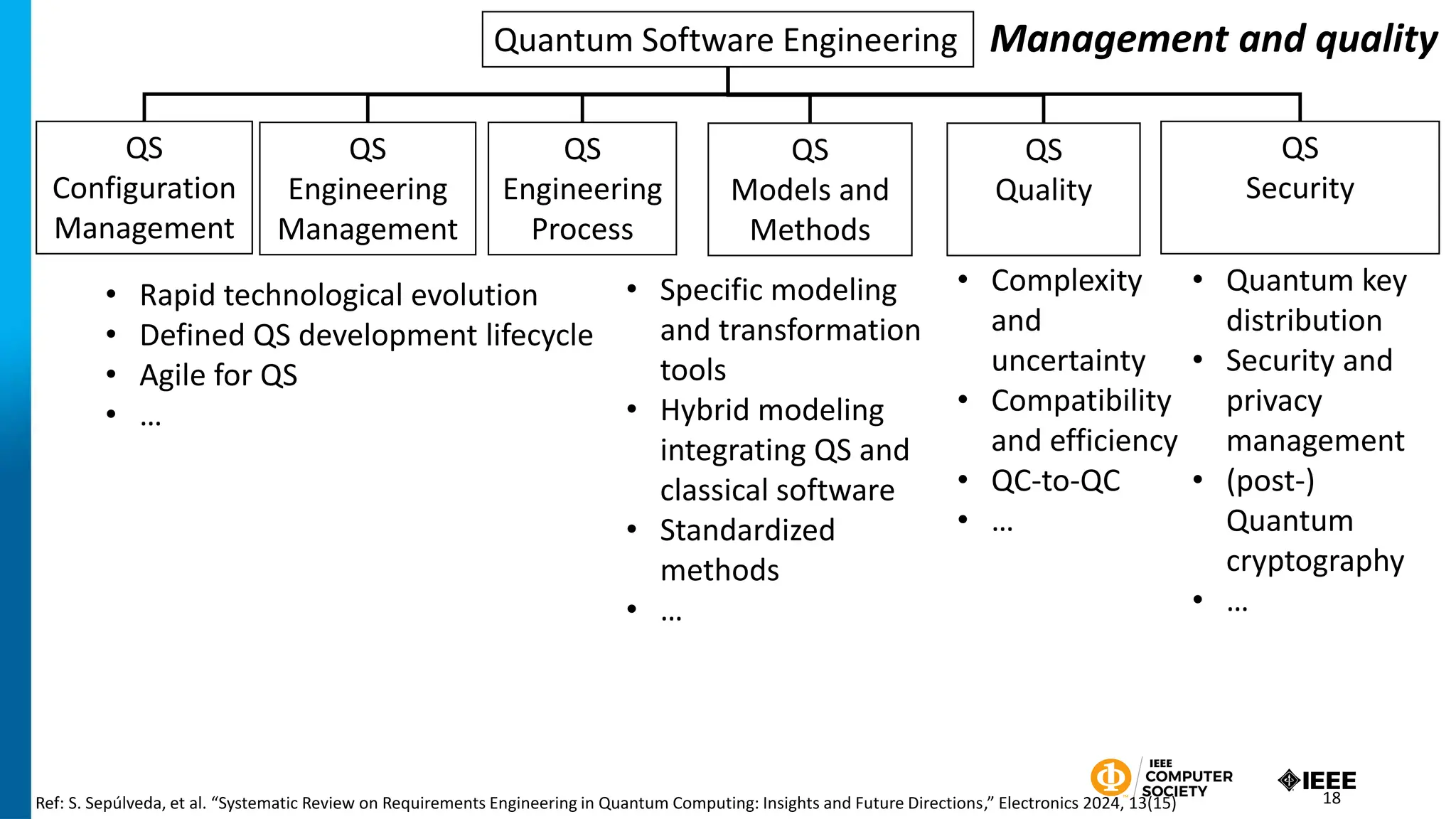
Quantum Software Engineering
QS
Configuration
Management
QS
Engineering
Management
QS
Engineering
Process
QS
Modelsand
Methods
QS
Quality
QS
Security
• Rapid technological evolution
• Defined QS development lifecycle
• Agile for QS
• …
• Specific modeling
and transformation
tools
• Hybrid modeling
integrating QS and
classical software
• Standardized
methods
• …
• Complexity
and
uncertainty
• Compatibility
and efficiency
• QC-to-QC
• …
• Quantum key
distribution
• Security and
privacy
management
• (post-)
Quantum
cryptography
• …
Ref: S. Sepúlveda, et al. “Systematic Review on Requirements Engineering in Quantum Computing: Insights and Future Directions,” Electronics 2024, 13(15)
Management and quality
18
19.
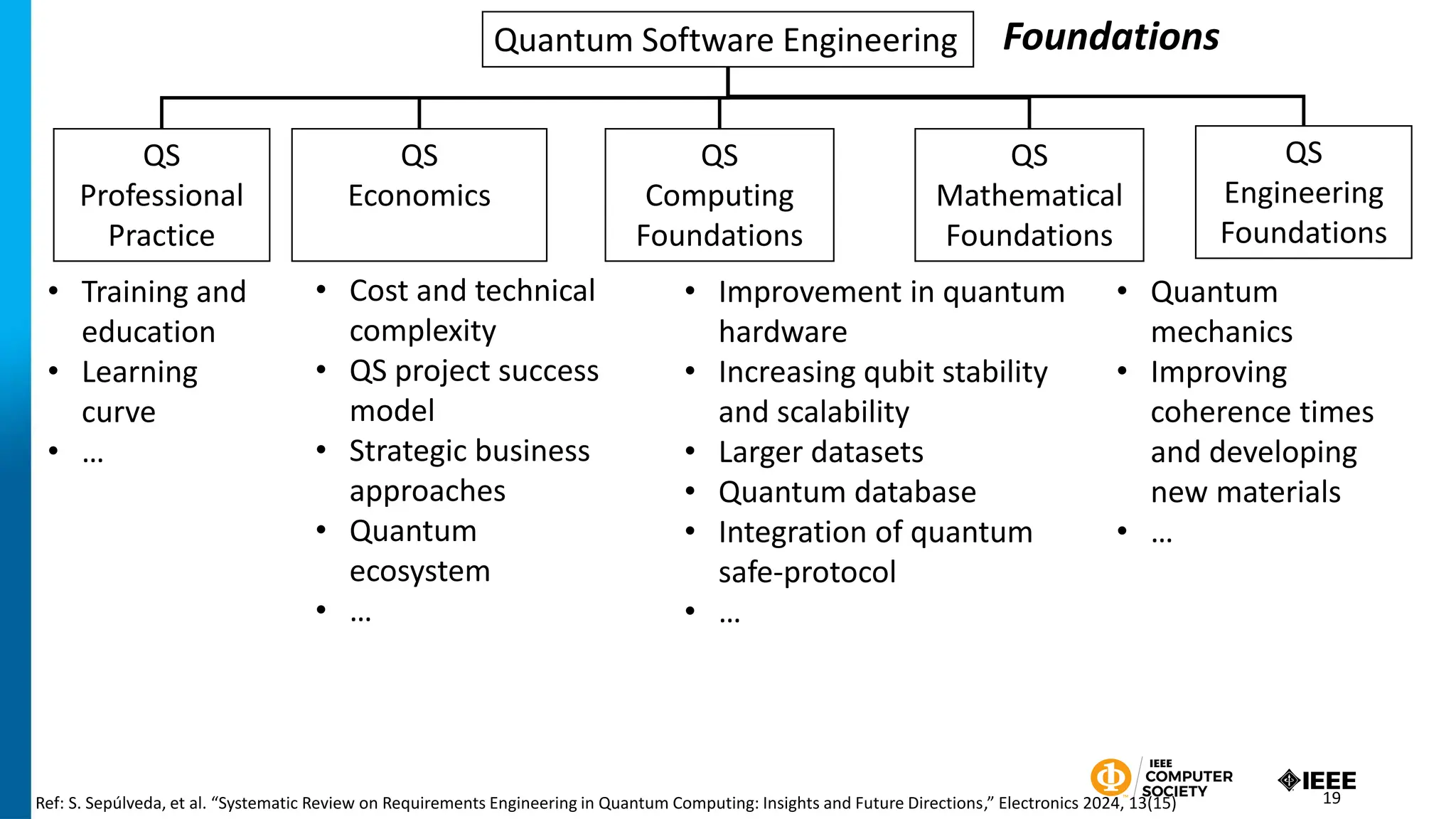
Quantum Software Engineering
QS
Professional
Practice
QS
Economics
QS
Computing
Foundations
QS
Mathematical
Foundations
QS
Engineering
Foundations
•Training and
education
• Learning
curve
• …
• Cost and technical
complexity
• QS project success
model
• Strategic business
approaches
• Quantum
ecosystem
• …
• Improvement in quantum
hardware
• Increasing qubit stability
and scalability
• Larger datasets
• Quantum database
• Integration of quantum
safe-protocol
• …
• Quantum
mechanics
• Improving
coherence times
and developing
new materials
• …
Ref: S. Sepúlveda, et al. “Systematic Review on Requirements Engineering in Quantum Computing: Insights and Future Directions,” Electronics 2024, 13(15)
Foundations
19
![Chinese Software Engineering Body of Knowledge (C-SWEBOK)
[MoE19] China MoE, “University Teaching Steering Committee on Software Engineering. C-SWEBOK:
The Chinese Software Engineering Body of Knowledge,” Higher Education Press, 2019
14](https://image.slidesharecdn.com/q-swebok-washizaki-20250801-250801071242-149e162e/75/IEEE-CS-Tech-Predictions-SWEBOK-and-Quantum-Software-Towards-Q-SWEBOK-14-2048.jpg)
![Towards Q-SWEBOK: e.g., Requirements engineering [Sepulveda+24]
S. Sepúlveda, et al. “Systematic Review on Requirements Engineering in
Quantum Computing: Insights and Future Directions,” Electronics 2024, 13(15) 15](https://image.slidesharecdn.com/q-swebok-washizaki-20250801-250801071242-149e162e/75/IEEE-CS-Tech-Predictions-SWEBOK-and-Quantum-Software-Towards-Q-SWEBOK-15-2048.jpg)
![Towards Q-SWEBOK: e.g., Requirements engineering [Sepulveda+24]
S. Sepúlveda, et al. “Systematic Review on Requirements Engineering in
Quantum Computing: Insights and Future Directions,” Electronics 2024, 13(15) 16](https://image.slidesharecdn.com/q-swebok-washizaki-20250801-250801071242-149e162e/75/IEEE-CS-Tech-Predictions-SWEBOK-and-Quantum-Software-Towards-Q-SWEBOK-16-2048.jpg)