Leave everything in
the pristine state or
return it to its
pristine state
By:
Mirza Muhammad Ahmed
22-MS-IWRM-11
Content
• INTRODUCTION
• SUSTAINABLE DEVELOPMENT
• CONSEQUENCES OF OVEREXPLOITATION
• THE NINE PLANETARY BOUNDARIES
• RETURN THINGS TO PRISTINE STATE
2 2/27/2023 22-MS-IWRM-11
INTRODUCTION
3 2/27/2023
• The concept of leaving things in the pristine state or
returning them to its pristine state is one of the many
definitions of sustainable development
• In the broadest sense this concept refers to ability to
preserve, maintain or even enhance natural
environment with all its resources
• Goal of this concept is that resources should be
conserved to maintain ecological balance and save
them for future generations.
22-MS-IWRM-11
DEFINITION OF SUSTAINABLE
DEVELOPMENT
“Sustainable development is development that meets
the needs of the present, without compromising the
ability of future generations to meet their own needs”
The Brundtland report (1987)
4 2/27/2023 22-MS-IWRM-11
Consequences of overexploitation
5 2/27/2023
• Unfortunately, humans have done more harm than good over the
past 50 years by exploiting natural resources. That primarily
includes food production and natural ecosystems.
• In 1798 Malthus argued that the tendency of population to grow
geometrically while food production would increase only
arithmetically.
• But Malthus overlooked technological advancement, which would
allow human beings to keep ahead of the population curve with
advances in seed breeding, chemical fertilizers, irrigation,
mechanization and more, the food supply can stay well ahead of the
population curve.
22-MS-IWRM-11
6 2/27/2023
• The earth’s population has almost doubled since the 70s,
with the consumption of natural resources increasing by 45%
per capita
• Degraded ecosystems take time to recover from
overexploitation, while some might never bounce back even
when exploitation stops
• That might impact the availability of resources like clean air,
food etc. ultimately threatening human existence
Consequences of overexploitation
22-MS-IWRM-11
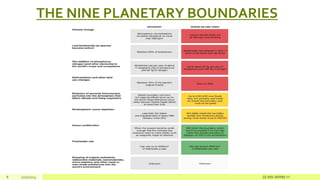
THE NINE PLANETARY
BOUNDARIES
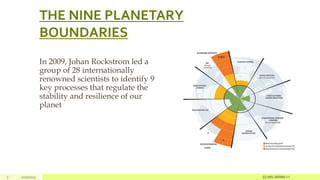
In 2009, Johan Rockstrom led a
group of 28 internationally
renowned scientists to identify 9
key processes that regulate the
stability and resilience of our
planet
7 2/27/2023 22-MS-IWRM-11
8 2/27/2023
THE NINE PLANETARY BOUNDARIES
22-MS-IWRM-11
Return things to pristine state
9 2/27/2023
• The earth’s population has almost doubled since the 70s,
with the consumption of natural resources increasing by 45%
per capita
• Degraded ecosystems take time to recover from
overexploitation, while some might never bounce back even
when exploitation stops
• That might impact the availability of resources like clean air,
food etc. ultimately threatening human existence
22-MS-IWRM-11
Return things to pristine state
10 2/27/2023
• Creating awareness makes it easy to encourage people to
restore and preserve the natural environment by
participating in conservation initiatives and efforts.
• Oil-rich countries, consumables regulatory bodies, and
World Bank should join hands and work towards the
common goal of reducing oil and mineral consumption
worldwide
• Coastal and wetland ecosystems are crucial in sustaining
the food chain . As wetlands are areas with lots of
groundwater that sustain vegetation cover. Also, coastal
ecosystems help to protect marine life from overfishing.
22-MS-IWRM-11
11 2/27/2023 22-MS-IWRM-11

Sustainable Development

  • 1.
    Leave everything in thepristine state or return it to its pristine state By: Mirza Muhammad Ahmed 22-MS-IWRM-11
  • 2.
    Content • INTRODUCTION • SUSTAINABLEDEVELOPMENT • CONSEQUENCES OF OVEREXPLOITATION • THE NINE PLANETARY BOUNDARIES • RETURN THINGS TO PRISTINE STATE 2 2/27/2023 22-MS-IWRM-11
  • 3.
    INTRODUCTION 3 2/27/2023 • Theconcept of leaving things in the pristine state or returning them to its pristine state is one of the many definitions of sustainable development • In the broadest sense this concept refers to ability to preserve, maintain or even enhance natural environment with all its resources • Goal of this concept is that resources should be conserved to maintain ecological balance and save them for future generations. 22-MS-IWRM-11
  • 4.
    DEFINITION OF SUSTAINABLE DEVELOPMENT “Sustainabledevelopment is development that meets the needs of the present, without compromising the ability of future generations to meet their own needs” The Brundtland report (1987) 4 2/27/2023 22-MS-IWRM-11
  • 5.
    Consequences of overexploitation 52/27/2023 • Unfortunately, humans have done more harm than good over the past 50 years by exploiting natural resources. That primarily includes food production and natural ecosystems. • In 1798 Malthus argued that the tendency of population to grow geometrically while food production would increase only arithmetically. • But Malthus overlooked technological advancement, which would allow human beings to keep ahead of the population curve with advances in seed breeding, chemical fertilizers, irrigation, mechanization and more, the food supply can stay well ahead of the population curve. 22-MS-IWRM-11
  • 6.
    6 2/27/2023 • Theearth’s population has almost doubled since the 70s, with the consumption of natural resources increasing by 45% per capita • Degraded ecosystems take time to recover from overexploitation, while some might never bounce back even when exploitation stops • That might impact the availability of resources like clean air, food etc. ultimately threatening human existence Consequences of overexploitation 22-MS-IWRM-11
  • 7.
    THE NINE PLANETARY BOUNDARIES In2009, Johan Rockstrom led a group of 28 internationally renowned scientists to identify 9 key processes that regulate the stability and resilience of our planet 7 2/27/2023 22-MS-IWRM-11
  • 8.
    8 2/27/2023 THE NINEPLANETARY BOUNDARIES 22-MS-IWRM-11
  • 9.
    Return things topristine state 9 2/27/2023 • The earth’s population has almost doubled since the 70s, with the consumption of natural resources increasing by 45% per capita • Degraded ecosystems take time to recover from overexploitation, while some might never bounce back even when exploitation stops • That might impact the availability of resources like clean air, food etc. ultimately threatening human existence 22-MS-IWRM-11
  • 10.
    Return things topristine state 10 2/27/2023 • Creating awareness makes it easy to encourage people to restore and preserve the natural environment by participating in conservation initiatives and efforts. • Oil-rich countries, consumables regulatory bodies, and World Bank should join hands and work towards the common goal of reducing oil and mineral consumption worldwide • Coastal and wetland ecosystems are crucial in sustaining the food chain . As wetlands are areas with lots of groundwater that sustain vegetation cover. Also, coastal ecosystems help to protect marine life from overfishing. 22-MS-IWRM-11
  • 11.