SUSTAINABILITY ASSIGNMENT
BARILLA SAUCE BUSINESS
• Michelle Escala
• Pedro Pereira
• Sepideh Jeyhooni
• Shivam Batra
• Wenjuan
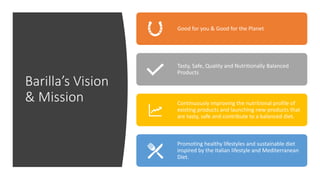
Barilla’s Vision
& Mission
Good for you & Good for the Planet
Tasty, Safe, Quality and Nutritionally Balanced
Products
Continuously improving the nutritional profile of
existing products and launching new products that
are tasty, safe and contribute to a balanced diet.
Promoting healthy lifestyles and sustainable diet
inspired by the Italian lifestyle and Mediterranean
Diet.
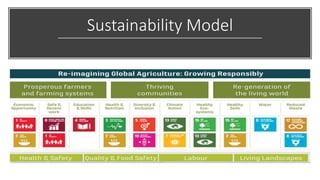
Sustainability Model
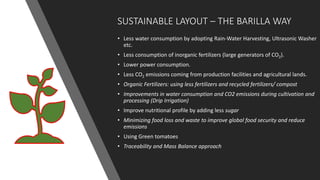
SUSTAINABLE LAYOUT – THE BARILLA WAY
• Less water consumption by adopting Rain-Water Harvesting, Ultrasonic Washer
etc.
• Less consumption of inorganic fertilizers (large generators of CO2).
• Lower power consumption.
• Less CO2 emissions coming from production facilities and agricultural lands.
• Organic Fertilizers: using less fertilizers and recycled fertilizers/ compost
• Improvements in water consumption and CO2 emissions during cultivation and
processing (Drip Irrigation)
• Improve nutritional profile by adding less sugar
• Minimizing food loss and waste to improve global food security and reduce
emissions
• Using Green tomatoes
• Traceability and Mass Balance approach
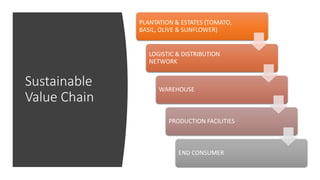
Sustainable
Value Chain
PLANTATION & ESTATES (TOMATO,
BASIL, OLIVE & SUNFLOWER)
LOGISTIC & DISTRIBUTION
NETWORK
WAREHOUSE
PRODUCTION FACILITIES
END CONSUMER
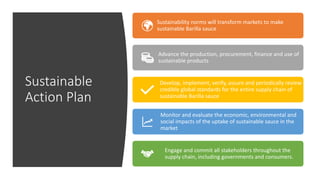
Sustainable
Action Plan
Sustainability norms will transform markets to make
sustainable Barilla sauce
Advance the production, procurement, finance and use of
sustainable products
Develop, implement, verify, assure and periodically review
credible global standards for the entire supply chain of
sustainable Barilla sauce
Monitor and evaluate the economic, environmental and
social impacts of the uptake of sustainable sauce in the
market
Engage and commit all stakeholders throughout the
supply chain, including governments and consumers.
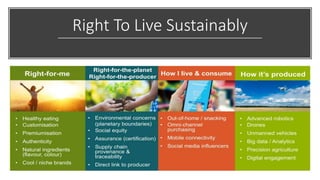
Right To Live Sustainably
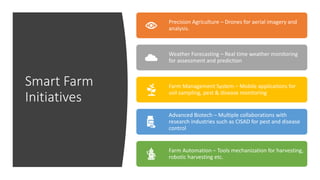
Smart Farm
Initiatives
Precision Agriculture – Drones for aerial imagery and
analysis.
Weather Forecasting – Real time weather monitoring
for assessment and prediction
Farm Management System – Mobile applications for
soil sampling, pest & disease monitoring
Advanced Biotech – Multiple collaborations with
research industries such as CISAD for pest and disease
control
Farm Automation – Tools mechanization for harvesting,
robotic harvesting etc.
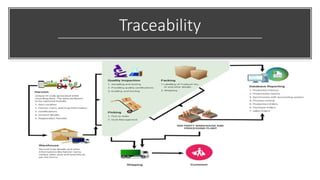
Traceability
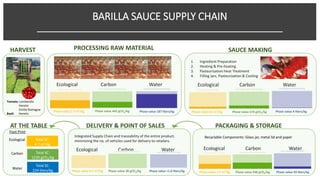
HARVEST SAUCE MAKING
1. Ingredient Preparation
2. Heating & Pre-heating
3. Pasteurization Heat Treatment
4. Filling Jars, Pasteurization & Cooling
PACKAGING & STORAGE
Ecological Carbon Water
Phase value 2.3 m2/kg Phase value 442 gCO2/kg Phase value 187 liters/kg Phase value 0.6 m2/kg Phase value 219 gCO2/kg Phase value 4 liters/kg
Ecological Carbon Water
DELIVERY & POINT OF SALESAT THE TABLE
Tomato: Lombardia
Veneto
Emilia Romagna
Basil: Veneto
Ecological Carbon WaterEcological Carbon Water
Phase value 1.7 m2/kg Phase value 548 gCO2/kg Phase value 33 liters/kg
Recyclable Components: Glass jar, metal lid and paperIntegrated Supply Chain and traceability of the entire product.
minimizing the no. of vehicles used for delivery to retailers.
Phase value 0.1 m2/kg Phase value 30 gCO2/kg Phase value <1.0 liters/kg
Ecological
Carbon
Water
Foot Print
Total SC:
4.7 m2/kg
Total SC:
1239 gCO2/kg
Total SC:
224 liters/kg
PROCESSING RAW MATERIAL
BARILLA SAUCE SUPPLY CHAIN
______________________________________________________
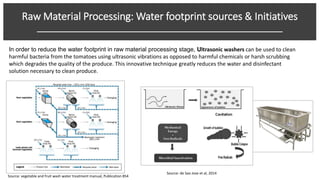
Raw Material Processing: Water footprint sources & Initiatives
______________________________________________________
In order to reduce the water footprint in raw material processing stage, Ultrasonic washers can be used to clean
harmful bacteria from the tomatoes using ultrasonic vibrations as opposed to harmful chemicals or harsh scrubbing
which degrades the quality of the produce. This innovative technique greatly reduces the water and disinfectant
solution necessary to clean produce.
Source: de Sao Jose et al, 2014
Source: vegetable and fruit wash water treatment manual, Publication 854
Packaging & Storage – Carbon Footprints Source & Initiatives
Food
Security –
From Farm
to Fork
• Barilla places special
importance in assuring Food
Security in their plants
worldwide.
• It is insured farmers and plant
workers are paid a more than
adequate salary alongside a
package of benefits.
• Every year, economic and
social conditions in the areas
surrounding the plants is
examined to assure the
compensation and security is
just.
• Production is where most loss
happens, but poor processing,
transportation and storage also
results in raw materials being
spoiled before getting to
consumers.
• The most effective actions for
addressing food loss and waste is
prevention or source reduction
strategies.
• Preventing food from being lost
or wasted in the first place avoids
the use of water, agricultural
chemicals, energy, and other
resources for food production,
processing, transportation,
packaging and disposal
Waste Management
& Re-Purposing
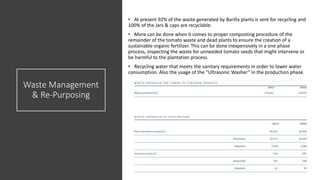
• At present 92% of the waste generated by Barilla plants is sent for recycling and
100% of the Jars & caps are recyclable.
• More can be done when it comes to proper composting procedure of the
remainder of the tomato waste and dead plants to ensure the creation of a
sustainable organic fertilizer. This can be done inexpensively in a one phase
process, inspecting the waste for unneeded tomato seeds that might intervene or
be harmful to the plantation process.
• Recycling water that meets the sanitary requirements in order to lower water
consumption. Also the usage of the “Ultrasonic Washer” in the production phase.
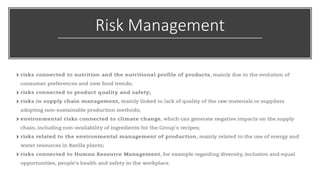
Risk Management
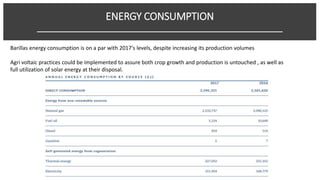
Barillas energy consumption is on a par with 2017's levels, despite increasing its production volumes
Agri voltaic practices could be implemented to assure both crop growth and production is untouched , as well as
full utilization of solar energy at their disposal.
ENERGY CONSUMPTION
______________________________________________________
Cost and
Revenue
Analysis -
Assumptions
Data given is for basic sauces
Fresh basil, conventional raw materials
Volume distribution
Tomato Sauce: 50.000ton/year
Pesto Sauce: 20.000ton/year
Proportional raw material distribution for each
product*
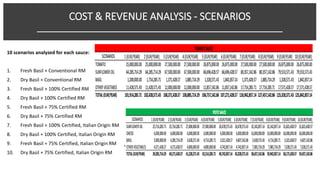
10 scenarios analyzed for each sauce:
1. Fresh Basil + Conventional RM
2. Dry Basil + Conventional RM
3. Fresh Basil + 100% Certified RM
4. Dry Basil + 100% Certified RM
5. Fresh Basil + 75% Certified RM
6. Dry Basil + 75% Certified RM
7. Fresh Basil + 100% Certified, Italian Origin RM
8. Dry Basil + 100% Certified, Italian Origin RM
9. Fresh Basil + 75% Certified, Italian Origin RM
10. Dry Basil + 75% Certified, Italian Origin RM
COST & REVENUE ANALYSIS - SCENARIOS
______________________________________________________
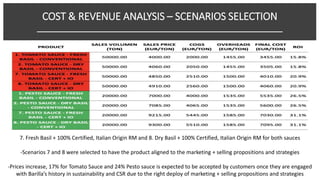
7. Fresh Basil + 100% Certified, Italian Origin RM and 8. Dry Basil + 100% Certified, Italian Origin RM for both sauces
-Scenarios 7 and 8 were selected to have the product aligned to the marketing + selling propositions and strategies
-Prices increase, 17% for Tomato Sauce and 24% Pesto sauce is expected to be accepted by customers once they are engaged
with Barilla’s history in sustainability and CSR due to the right deploy of marketing + selling propositions and strategies
COST & REVENUE ANALYSIS – SCENARIOS SELECTION
______________________________________________________
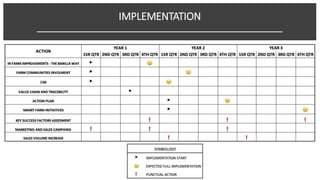
IMPLEMENTATION
______________________________________________________
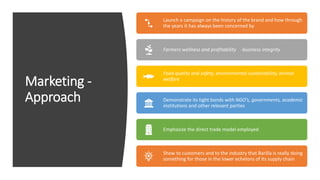
Marketing -
Approach
Launch a campaign on the history of the brand and how through
the years it has always been concerned by
Farmers wellness and profitability -business integrity
Food quality and safety, environmental sustainability, animal
welfare
Demonstrate its tight bonds with NGO’s, governments, academic
institutions and other relevant parties
Emphasize the direct trade model employed
Show to customers and to the industry that Barilla is really doing
something for those in the lower echelons of its supply chain
Marketing -
Approach
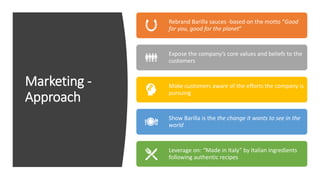
Rebrand Barilla sauces -based on the motto “Good
for you, good for the planet”
Expose the company’s core values and beliefs to the
customers
Make customers aware of the efforts the company is
pursuing
Show Barilla is the the change it wants to see in the
world
Leverage on: “Made in Italy” by Italian ingredients
following authentic recipes
Marketing -
Expectations
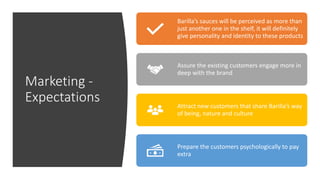
Barilla’s sauces will be perceived as more than
just another one in the shelf, it will definitely
give personality and identity to these products
Assure the existing customers engage more in
deep with the brand
Attract new customers that share Barilla’s way
of being, nature and culture
Prepare the customers psychologically to pay
extra
KEY SUCCESS
FACTORS
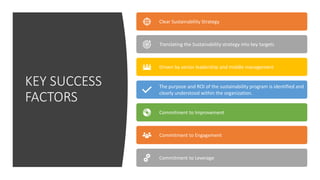
Clear Sustainability Strategy
Translating the Sustainability strategy into key targets
Driven by senior leadership and middle management
The purpose and ROI of the sustainability program is identified and
clearly understood within the organization.
Commitment to Improvement
Commitment to Engagement
Commitment to Leverage
Key Benefits
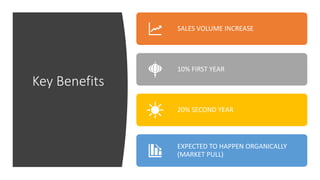
SALES VOLUME INCREASE
10% FIRST YEAR
20% SECOND YEAR
EXPECTED TO HAPPEN ORGANICALLY
(MARKET PULL)
THANK YOU

Sustainability assignment

  • 1.
    SUSTAINABILITY ASSIGNMENT BARILLA SAUCEBUSINESS • Michelle Escala • Pedro Pereira • Sepideh Jeyhooni • Shivam Batra • Wenjuan
  • 2.
    Barilla’s Vision & Mission Goodfor you & Good for the Planet Tasty, Safe, Quality and Nutritionally Balanced Products Continuously improving the nutritional profile of existing products and launching new products that are tasty, safe and contribute to a balanced diet. Promoting healthy lifestyles and sustainable diet inspired by the Italian lifestyle and Mediterranean Diet.
  • 3.
  • 4.
    SUSTAINABLE LAYOUT –THE BARILLA WAY • Less water consumption by adopting Rain-Water Harvesting, Ultrasonic Washer etc. • Less consumption of inorganic fertilizers (large generators of CO2). • Lower power consumption. • Less CO2 emissions coming from production facilities and agricultural lands. • Organic Fertilizers: using less fertilizers and recycled fertilizers/ compost • Improvements in water consumption and CO2 emissions during cultivation and processing (Drip Irrigation) • Improve nutritional profile by adding less sugar • Minimizing food loss and waste to improve global food security and reduce emissions • Using Green tomatoes • Traceability and Mass Balance approach
  • 5.
    Sustainable Value Chain PLANTATION &ESTATES (TOMATO, BASIL, OLIVE & SUNFLOWER) LOGISTIC & DISTRIBUTION NETWORK WAREHOUSE PRODUCTION FACILITIES END CONSUMER
  • 6.
    Sustainable Action Plan Sustainability normswill transform markets to make sustainable Barilla sauce Advance the production, procurement, finance and use of sustainable products Develop, implement, verify, assure and periodically review credible global standards for the entire supply chain of sustainable Barilla sauce Monitor and evaluate the economic, environmental and social impacts of the uptake of sustainable sauce in the market Engage and commit all stakeholders throughout the supply chain, including governments and consumers.
  • 7.
    Right To LiveSustainably
  • 8.
    Smart Farm Initiatives Precision Agriculture– Drones for aerial imagery and analysis. Weather Forecasting – Real time weather monitoring for assessment and prediction Farm Management System – Mobile applications for soil sampling, pest & disease monitoring Advanced Biotech – Multiple collaborations with research industries such as CISAD for pest and disease control Farm Automation – Tools mechanization for harvesting, robotic harvesting etc.
  • 9.
  • 10.
    HARVEST SAUCE MAKING 1.Ingredient Preparation 2. Heating & Pre-heating 3. Pasteurization Heat Treatment 4. Filling Jars, Pasteurization & Cooling PACKAGING & STORAGE Ecological Carbon Water Phase value 2.3 m2/kg Phase value 442 gCO2/kg Phase value 187 liters/kg Phase value 0.6 m2/kg Phase value 219 gCO2/kg Phase value 4 liters/kg Ecological Carbon Water DELIVERY & POINT OF SALESAT THE TABLE Tomato: Lombardia Veneto Emilia Romagna Basil: Veneto Ecological Carbon WaterEcological Carbon Water Phase value 1.7 m2/kg Phase value 548 gCO2/kg Phase value 33 liters/kg Recyclable Components: Glass jar, metal lid and paperIntegrated Supply Chain and traceability of the entire product. minimizing the no. of vehicles used for delivery to retailers. Phase value 0.1 m2/kg Phase value 30 gCO2/kg Phase value <1.0 liters/kg Ecological Carbon Water Foot Print Total SC: 4.7 m2/kg Total SC: 1239 gCO2/kg Total SC: 224 liters/kg PROCESSING RAW MATERIAL BARILLA SAUCE SUPPLY CHAIN ______________________________________________________
  • 11.
    Raw Material Processing:Water footprint sources & Initiatives ______________________________________________________ In order to reduce the water footprint in raw material processing stage, Ultrasonic washers can be used to clean harmful bacteria from the tomatoes using ultrasonic vibrations as opposed to harmful chemicals or harsh scrubbing which degrades the quality of the produce. This innovative technique greatly reduces the water and disinfectant solution necessary to clean produce. Source: de Sao Jose et al, 2014 Source: vegetable and fruit wash water treatment manual, Publication 854
  • 12.
    Packaging & Storage– Carbon Footprints Source & Initiatives
  • 13.
    Food Security – From Farm toFork • Barilla places special importance in assuring Food Security in their plants worldwide. • It is insured farmers and plant workers are paid a more than adequate salary alongside a package of benefits. • Every year, economic and social conditions in the areas surrounding the plants is examined to assure the compensation and security is just. • Production is where most loss happens, but poor processing, transportation and storage also results in raw materials being spoiled before getting to consumers. • The most effective actions for addressing food loss and waste is prevention or source reduction strategies. • Preventing food from being lost or wasted in the first place avoids the use of water, agricultural chemicals, energy, and other resources for food production, processing, transportation, packaging and disposal
  • 14.
    Waste Management & Re-Purposing •At present 92% of the waste generated by Barilla plants is sent for recycling and 100% of the Jars & caps are recyclable. • More can be done when it comes to proper composting procedure of the remainder of the tomato waste and dead plants to ensure the creation of a sustainable organic fertilizer. This can be done inexpensively in a one phase process, inspecting the waste for unneeded tomato seeds that might intervene or be harmful to the plantation process. • Recycling water that meets the sanitary requirements in order to lower water consumption. Also the usage of the “Ultrasonic Washer” in the production phase.
  • 15.
  • 16.
    Barillas energy consumptionis on a par with 2017's levels, despite increasing its production volumes Agri voltaic practices could be implemented to assure both crop growth and production is untouched , as well as full utilization of solar energy at their disposal. ENERGY CONSUMPTION ______________________________________________________
  • 17.
    Cost and Revenue Analysis - Assumptions Datagiven is for basic sauces Fresh basil, conventional raw materials Volume distribution Tomato Sauce: 50.000ton/year Pesto Sauce: 20.000ton/year Proportional raw material distribution for each product*
  • 18.
    10 scenarios analyzedfor each sauce: 1. Fresh Basil + Conventional RM 2. Dry Basil + Conventional RM 3. Fresh Basil + 100% Certified RM 4. Dry Basil + 100% Certified RM 5. Fresh Basil + 75% Certified RM 6. Dry Basil + 75% Certified RM 7. Fresh Basil + 100% Certified, Italian Origin RM 8. Dry Basil + 100% Certified, Italian Origin RM 9. Fresh Basil + 75% Certified, Italian Origin RM 10. Dry Basil + 75% Certified, Italian Origin RM COST & REVENUE ANALYSIS - SCENARIOS ______________________________________________________
  • 19.
    7. Fresh Basil+ 100% Certified, Italian Origin RM and 8. Dry Basil + 100% Certified, Italian Origin RM for both sauces -Scenarios 7 and 8 were selected to have the product aligned to the marketing + selling propositions and strategies -Prices increase, 17% for Tomato Sauce and 24% Pesto sauce is expected to be accepted by customers once they are engaged with Barilla’s history in sustainability and CSR due to the right deploy of marketing + selling propositions and strategies COST & REVENUE ANALYSIS – SCENARIOS SELECTION ______________________________________________________
  • 20.
  • 21.
    Marketing - Approach Launch acampaign on the history of the brand and how through the years it has always been concerned by Farmers wellness and profitability -business integrity Food quality and safety, environmental sustainability, animal welfare Demonstrate its tight bonds with NGO’s, governments, academic institutions and other relevant parties Emphasize the direct trade model employed Show to customers and to the industry that Barilla is really doing something for those in the lower echelons of its supply chain
  • 22.
    Marketing - Approach Rebrand Barillasauces -based on the motto “Good for you, good for the planet” Expose the company’s core values and beliefs to the customers Make customers aware of the efforts the company is pursuing Show Barilla is the the change it wants to see in the world Leverage on: “Made in Italy” by Italian ingredients following authentic recipes
  • 23.
    Marketing - Expectations Barilla’s sauceswill be perceived as more than just another one in the shelf, it will definitely give personality and identity to these products Assure the existing customers engage more in deep with the brand Attract new customers that share Barilla’s way of being, nature and culture Prepare the customers psychologically to pay extra
  • 24.
    KEY SUCCESS FACTORS Clear SustainabilityStrategy Translating the Sustainability strategy into key targets Driven by senior leadership and middle management The purpose and ROI of the sustainability program is identified and clearly understood within the organization. Commitment to Improvement Commitment to Engagement Commitment to Leverage
  • 25.
    Key Benefits SALES VOLUMEINCREASE 10% FIRST YEAR 20% SECOND YEAR EXPECTED TO HAPPEN ORGANICALLY (MARKET PULL)
  • 26.