

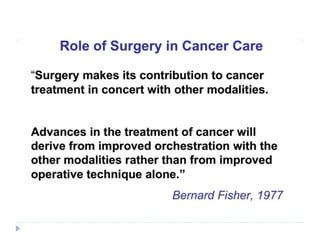
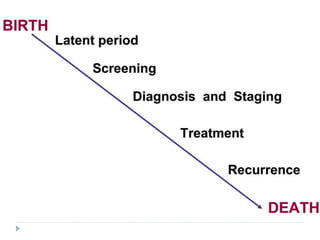

Surgical oncology
…past, present &
future
Dr Ravindra babu
Surgical oncologist
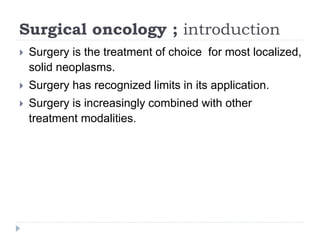
Surgical oncology ; introduction
 Surgery is the treatment of choice for most localized,
solid neoplasms.
 Surgery has recognized limits in its application.
 Surgery is increasingly combined with other
treatment modalities.
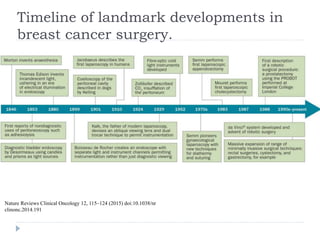
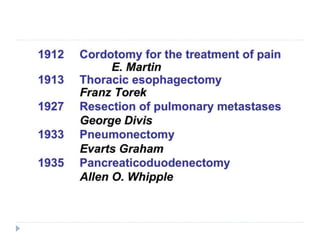
Timeline of landmark developments in
breast cancer surgery.
Nature Reviews Clinical Oncology 12, 115–124 (2015) doi:10.1038/nr
clinonc.2014.191
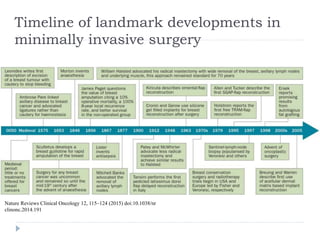
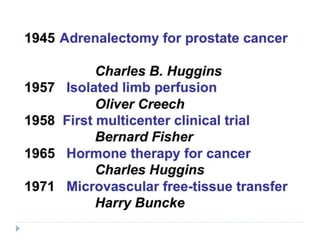
Timeline of landmark developments in
minimally invasive surgery
Nature Reviews Clinical Oncology 12, 115–124 (2015) doi:10.1038/nr
clinonc.2014.191
Role of the Surgical Oncologist
 Consultant
Special training or
skills
Tumor board
 Organizer and
Leader
Cancer programs
Cancer committee
Tumor registry
Oncology section
 Educator
Cancer conferences
Teaching programs
 Researcher
Clinical protocols
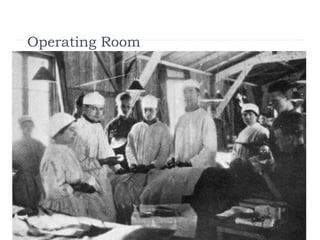
Operating Room
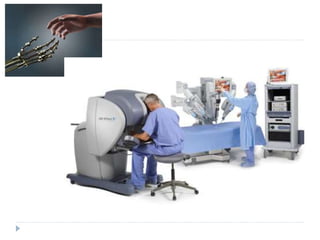
Robotic Sx
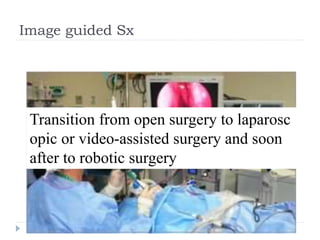
Image guided Sx
Transition from open surgery to laparosc
opic or video-assisted surgery and soon
after to robotic surgery
Intraoperative navigation
The Genomic Era: The Changing Roles of
the Surgeon
 More recently the new biomolecular targeted
treatments: Her 2 inhibitors for MBC, imatinib for
GIST, BRAF inhibitors for melanoma, EGFR TKIs for
NSCLC
 Neoadjuvant treatments are currently being used for
downstaging. (CT and RT, as well as HT) are shown
to decrease the extent of the solid tumors, rendering
operable, without excising the affected organ.
Early detection of cancer has
contributed significantly to the
advance of surgical oncology, as it was
shown to affect both the treatment
strategy toward minimal intervention
and organ saving techniques, and the
prognosis.
Roles of Surgeon in Management of
Cancer Patients
 Prevention
 Diagnosis
 Definitive treatment
 Palliation
 Rehabilitation
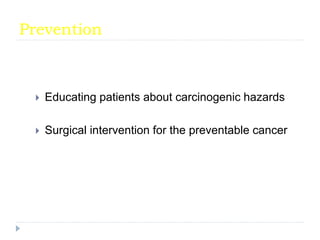
Prevention
 Educating patients about carcinogenic hazards
 Surgical intervention for the preventable cancer
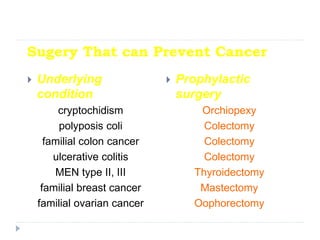
Sugery That can Prevent Cancer
 Underlying
condition
cryptochidism
polyposis coli
familial colon cancer
ulcerative colitis
MEN type II, III
familial breast cancer
familial ovarian cancer
 Prophylactic
surgery
Orchiopexy
Colectomy
Colectomy
Colectomy
Thyroidectomy
Mastectomy
Oophorectomy
Role of Surgeon in Management of
Cancer Patients
 Prevention
 Diagnosis
 Definitive treatment
 Palliation
 Rehabilitation
Diagnosis of Cancer
 Acquisition of tissue for histologic
diagnosis
 Staging of patients
Techniques for Obtaining Tissue
 Needle biopsy
 Incisional biopsy
 Excisional biopsy
Needle biopsy ; advantages
 Simplest method
 Inexpensive
 Causes minimal disturbance of the
surrounding tissue
Needle biopsy ; disadvantages
 Danger of implanting tumor cells in a needle
tract
 Not representative of the total tumor
 The needle misses the lesion
Needle biopsy ; types
 Fine needle aspiration biopsy
 Large bore needle biopsy ;
Vim Silverman needle
Tru cut needle
Principles of the performance of all
surgical biopsies
 Needle tract or scar should be removed as part of
subsquent definitive surgical procedure
Principles of the performance of all
surgical biopsies
 Do not contaminate new tissue plane
during the biopsy
Principles of the performance of all
surgical biopsies
 Choice of biopsy technique should be
selected carefully in order to obtain
an adequate tissue sample for the
needs of the pathologist
Diagnosis of Cancer
 Acquisition of tissue for histologic
diagnosis
 Staging of patients
TNM Classification System
Describes the anatomic extent of disease
based on assessment of three components
T Primary tumor size and extent
N Regional lymph node involvement
M Distant metastasis absent or present
TNM Classification System
 Primary tumor (T)
TX Primary tumor cannot be assessed
T0 No evidence of primary tumor
Tis Carcinoma in situ
T1,T2 Increasing size or local extension
T3,T4 Increasing extent of primary tumor
TNM Classification System
 Regional lymph nodes (N)
NX Regional lymph nodes cannot be
assessed
N0 No regional lymph node metastasis
N1,N2,N3 Increasing involvement of regional
lymph nodes
TNM Classification System
 Distant metastasis (M)
MX Presence of distant metastasis cannot be
assessed
M0 No distant metastasis
M1 Distant metastasis (may be further
specified
according to size of occurrence)
Role of Surgeon in Management of
Cancer Patients
 Prevention
 Diagnosis
 Treatment
 Palliation
 Rehabilitation
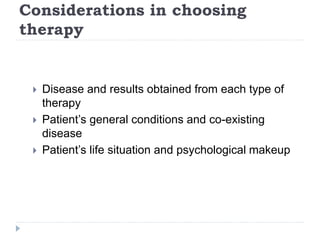
Considerations in choosing
therapy
 Disease and results obtained from each type of
therapy
 Patient’s general conditions and co-existing
disease
 Patient’s life situation and psychological makeup
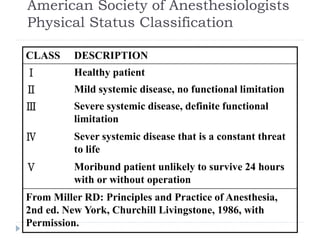
American Society of Anesthesiologists
Physical Status Classification
CLASS DESCRIPTION
Ⅰ Healthy patient
Ⅱ Mild systemic disease, no functional limitation
Ⅲ Severe systemic disease, definite functional
limitation
Ⅳ Sever systemic disease that is a constant threat
to life
Ⅴ Moribund patient unlikely to survive 24 hours
with or without operation
From Miller RD: Principles and Practice of Anesthesia,
2nd ed. New York, Churchill Livingstone, 1986, with
Permission.
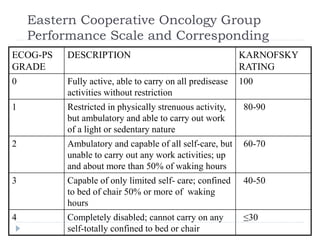
Eastern Cooperative Oncology Group
Performance Scale and Corresponding
ECOG-PS
GRADE
DESCRIPTION KARNOFSKY
RATING
0 Fully active, able to carry on all predisease
activities without restriction
100
1 Restricted in physically strenuous activity,
but ambulatory and able to carry out work
of a light or sedentary nature
80-90
2 Ambulatory and capable of all self-care, but
unable to carry out any work activities; up
and about more than 50% of waking hours
60-70
3 Capable of only limited self- care; confined
to bed of chair 50% or more of waking
hours
40-50
4 Completely disabled; cannot carry on any
self-totally confined to bed or chair
≤30
Major Challenges Confronting the
Surgical Oncologist I
 Accurate identification of patients who can be
cured by local treatment alone
Major Challenges Confronting the
Surgical Oncologist II
 Development and selection of local
treatments that provide the best balance between
local cure and the impact of treatment morbidity on the
quality of life
Major Challenges Confronting the
Surgical Oncologist III
 Development and application of
adjuvant treatments that can improve
the control of local and distant
invasive and metastatic disease
Cancer surgery ; principles
 Enucleation or incomplete excision of tumor mass is
never indicated as a therapeutic measure
 Prevention of tumor cell implantation during
surgery
 Prevention of vascular dissemination at
surgery
Types of cancer operations
 Local resection
 Radical local resection
 Radical resection with en bloc excision of
lymphatics
 Extensive surgical procedures
Adequate margin of Resection
• A complete margin of normal tissue around the
primary lesion
• Frozen sections used to evaluate tissue
margins in instances of doubt
• Complete removal of involved regional lymph
nodes
• Resection of involved adjacent organ
• En bloc resection of biopsy tracts and tumor
sinuses
Roles of Surgery in the Treatment of
Cancer
 Definitive surgical treatment for primary cancer
 Surgery for reduce the bulk of residual disease
 Surgical resection of metastatic disease with
curative intention
 Surgery for treatment of oncologic emergencies
Surgery for residual disease
 In selected cancers, surgical resection
of bulk disease may lead to
improvement in the ability to control
residual gross disease that has not been resected
Surgery for metastatic disease
 Resection of pulmonary metastasis in
patients with soft tissue and bony sarcomas
 Resection of pulmonary metastasis in
patients with colon cancer
 Resection of hepatic metastasis in patients with colorectal
cancer
Surgery for oncologic emergencies
 exsanguinating hemorrhage
 perforation
 drainage of abscess
 impending destruction of vital organs
Role of Surgeon in Management of
Cancer Patients
 Prevention
 Diagnosis
 Definitive treatment
 Palliation
 Rehabilitation
Surgery for Palliation
 To improve the quality of life
 Examples ; relief of intestinal obstruction,
removal of mass causing pain
Role of Surgeon in Management of
Cancer Patients
 Prevention
 Diagnosis
 Definitive treatment
 Palliation
 Rehabilitation
THE CANCER SURGEON
 AS A CARE PROVIDER
Brings surgical skill and compassionate care to
patients
Leads screening, prevention, and risk assessment
programs
Facilitates molecular characterization of tumor and
surrogate tissues
Coordinates mu1tidisciplinary clinical care teams
THE CANCER SURGEON
 AS A RESEARCHER
Facilitates laboratory research
Coordinates epidemiologic studies
Conducts clinical trials research
Develops novel approaches to education
THE CANCER SURGEON
 AS A TEACHER
Ensures excellence in surgical care
Leads a multidisciplinary team to implement
integrate oncology training
Surgical oncology
Surgical oncology
Surgical oncology

Surgical oncology

  • 1.
    Surgical oncology …past, present& future Dr Ravindra babu Surgical oncologist
  • 4.
    Surgical oncology ;introduction  Surgery is the treatment of choice for most localized, solid neoplasms.  Surgery has recognized limits in its application.  Surgery is increasingly combined with other treatment modalities.
  • 5.
    Timeline of landmarkdevelopments in breast cancer surgery. Nature Reviews Clinical Oncology 12, 115–124 (2015) doi:10.1038/nr clinonc.2014.191
  • 6.
    Timeline of landmarkdevelopments in minimally invasive surgery Nature Reviews Clinical Oncology 12, 115–124 (2015) doi:10.1038/nr clinonc.2014.191
  • 7.
    Role of theSurgical Oncologist  Consultant Special training or skills Tumor board  Organizer and Leader Cancer programs Cancer committee Tumor registry Oncology section  Educator Cancer conferences Teaching programs  Researcher Clinical protocols
  • 16.
  • 17.
  • 18.
    Image guided Sx Transitionfrom open surgery to laparosc opic or video-assisted surgery and soon after to robotic surgery
  • 19.
  • 20.
    The Genomic Era:The Changing Roles of the Surgeon  More recently the new biomolecular targeted treatments: Her 2 inhibitors for MBC, imatinib for GIST, BRAF inhibitors for melanoma, EGFR TKIs for NSCLC  Neoadjuvant treatments are currently being used for downstaging. (CT and RT, as well as HT) are shown to decrease the extent of the solid tumors, rendering operable, without excising the affected organ.
  • 21.
    Early detection ofcancer has contributed significantly to the advance of surgical oncology, as it was shown to affect both the treatment strategy toward minimal intervention and organ saving techniques, and the prognosis.
  • 23.
    Roles of Surgeonin Management of Cancer Patients  Prevention  Diagnosis  Definitive treatment  Palliation  Rehabilitation
  • 24.
    Prevention  Educating patientsabout carcinogenic hazards  Surgical intervention for the preventable cancer
  • 25.
    Sugery That canPrevent Cancer  Underlying condition cryptochidism polyposis coli familial colon cancer ulcerative colitis MEN type II, III familial breast cancer familial ovarian cancer  Prophylactic surgery Orchiopexy Colectomy Colectomy Colectomy Thyroidectomy Mastectomy Oophorectomy
  • 26.
    Role of Surgeonin Management of Cancer Patients  Prevention  Diagnosis  Definitive treatment  Palliation  Rehabilitation
  • 27.
    Diagnosis of Cancer Acquisition of tissue for histologic diagnosis  Staging of patients
  • 28.
    Techniques for ObtainingTissue  Needle biopsy  Incisional biopsy  Excisional biopsy
  • 29.
    Needle biopsy ;advantages  Simplest method  Inexpensive  Causes minimal disturbance of the surrounding tissue
  • 30.
    Needle biopsy ;disadvantages  Danger of implanting tumor cells in a needle tract  Not representative of the total tumor  The needle misses the lesion
  • 31.
    Needle biopsy ;types  Fine needle aspiration biopsy  Large bore needle biopsy ; Vim Silverman needle Tru cut needle
  • 32.
    Principles of theperformance of all surgical biopsies  Needle tract or scar should be removed as part of subsquent definitive surgical procedure
  • 33.
    Principles of theperformance of all surgical biopsies  Do not contaminate new tissue plane during the biopsy
  • 34.
    Principles of theperformance of all surgical biopsies  Choice of biopsy technique should be selected carefully in order to obtain an adequate tissue sample for the needs of the pathologist
  • 35.
    Diagnosis of Cancer Acquisition of tissue for histologic diagnosis  Staging of patients
  • 36.
    TNM Classification System Describesthe anatomic extent of disease based on assessment of three components T Primary tumor size and extent N Regional lymph node involvement M Distant metastasis absent or present
  • 37.
    TNM Classification System Primary tumor (T) TX Primary tumor cannot be assessed T0 No evidence of primary tumor Tis Carcinoma in situ T1,T2 Increasing size or local extension T3,T4 Increasing extent of primary tumor
  • 38.
    TNM Classification System Regional lymph nodes (N) NX Regional lymph nodes cannot be assessed N0 No regional lymph node metastasis N1,N2,N3 Increasing involvement of regional lymph nodes
  • 39.
    TNM Classification System Distant metastasis (M) MX Presence of distant metastasis cannot be assessed M0 No distant metastasis M1 Distant metastasis (may be further specified according to size of occurrence)
  • 40.
    Role of Surgeonin Management of Cancer Patients  Prevention  Diagnosis  Treatment  Palliation  Rehabilitation
  • 41.
    Considerations in choosing therapy Disease and results obtained from each type of therapy  Patient’s general conditions and co-existing disease  Patient’s life situation and psychological makeup
  • 42.
    American Society ofAnesthesiologists Physical Status Classification CLASS DESCRIPTION Ⅰ Healthy patient Ⅱ Mild systemic disease, no functional limitation Ⅲ Severe systemic disease, definite functional limitation Ⅳ Sever systemic disease that is a constant threat to life Ⅴ Moribund patient unlikely to survive 24 hours with or without operation From Miller RD: Principles and Practice of Anesthesia, 2nd ed. New York, Churchill Livingstone, 1986, with Permission.
  • 43.
    Eastern Cooperative OncologyGroup Performance Scale and Corresponding ECOG-PS GRADE DESCRIPTION KARNOFSKY RATING 0 Fully active, able to carry on all predisease activities without restriction 100 1 Restricted in physically strenuous activity, but ambulatory and able to carry out work of a light or sedentary nature 80-90 2 Ambulatory and capable of all self-care, but unable to carry out any work activities; up and about more than 50% of waking hours 60-70 3 Capable of only limited self- care; confined to bed of chair 50% or more of waking hours 40-50 4 Completely disabled; cannot carry on any self-totally confined to bed or chair ≤30
  • 44.
    Major Challenges Confrontingthe Surgical Oncologist I  Accurate identification of patients who can be cured by local treatment alone
  • 45.
    Major Challenges Confrontingthe Surgical Oncologist II  Development and selection of local treatments that provide the best balance between local cure and the impact of treatment morbidity on the quality of life
  • 46.
    Major Challenges Confrontingthe Surgical Oncologist III  Development and application of adjuvant treatments that can improve the control of local and distant invasive and metastatic disease
  • 47.
    Cancer surgery ;principles  Enucleation or incomplete excision of tumor mass is never indicated as a therapeutic measure  Prevention of tumor cell implantation during surgery  Prevention of vascular dissemination at surgery
  • 48.
    Types of canceroperations  Local resection  Radical local resection  Radical resection with en bloc excision of lymphatics  Extensive surgical procedures
  • 49.
    Adequate margin ofResection • A complete margin of normal tissue around the primary lesion • Frozen sections used to evaluate tissue margins in instances of doubt • Complete removal of involved regional lymph nodes • Resection of involved adjacent organ • En bloc resection of biopsy tracts and tumor sinuses
  • 50.
    Roles of Surgeryin the Treatment of Cancer  Definitive surgical treatment for primary cancer  Surgery for reduce the bulk of residual disease  Surgical resection of metastatic disease with curative intention  Surgery for treatment of oncologic emergencies
  • 51.
    Surgery for residualdisease  In selected cancers, surgical resection of bulk disease may lead to improvement in the ability to control residual gross disease that has not been resected
  • 52.
    Surgery for metastaticdisease  Resection of pulmonary metastasis in patients with soft tissue and bony sarcomas  Resection of pulmonary metastasis in patients with colon cancer  Resection of hepatic metastasis in patients with colorectal cancer
  • 53.
    Surgery for oncologicemergencies  exsanguinating hemorrhage  perforation  drainage of abscess  impending destruction of vital organs
  • 54.
    Role of Surgeonin Management of Cancer Patients  Prevention  Diagnosis  Definitive treatment  Palliation  Rehabilitation
  • 55.
    Surgery for Palliation To improve the quality of life  Examples ; relief of intestinal obstruction, removal of mass causing pain
  • 56.
    Role of Surgeonin Management of Cancer Patients  Prevention  Diagnosis  Definitive treatment  Palliation  Rehabilitation
  • 57.
    THE CANCER SURGEON AS A CARE PROVIDER Brings surgical skill and compassionate care to patients Leads screening, prevention, and risk assessment programs Facilitates molecular characterization of tumor and surrogate tissues Coordinates mu1tidisciplinary clinical care teams
  • 58.
    THE CANCER SURGEON AS A RESEARCHER Facilitates laboratory research Coordinates epidemiologic studies Conducts clinical trials research Develops novel approaches to education
  • 59.
    THE CANCER SURGEON AS A TEACHER Ensures excellence in surgical care Leads a multidisciplinary team to implement integrate oncology training