z
Basics of
Control
System
z
 Let’s divide the word into Control and System
so it’ll be easy to understand the meaning of it.
 Control: Meaning of control is to regulate,
direct or command to a system so
that the desired objective is obtained.
 System: System is arrangements of different
physical components that gives the proper
output for given input.
 Control System: Arrangement of different physical
components such that it may give
desired output from given input by
means of regulate or control either
by direct or indirect method.
A control system must have :
 Input
 Output
 Ways to obtain i/p and o/p objectives
 Control action
Any system can be characterised mathematically by
1. Transfer Function
2. State Model
Laplace transform of o/p
Transfer Function=
Laplace transform of i/p Initial
condition=0
L[c(t)]
L[r(t)]
=
C(s)
R(s)
z
Classification of Control
System
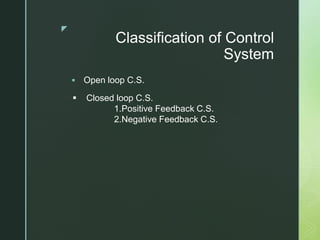
 Open loop C.S.
 Closed loop C.S.
1.Positive Feedback C.S.
2.Negative Feedback C.S.
z
Open Loop Control System
Reference
i/p
Controller Process Output
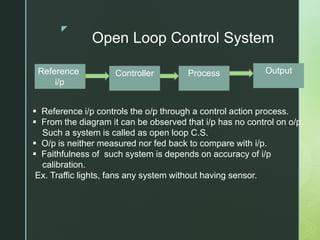
 Reference i/p controls the o/p through a control action process.
 From the diagram it can be observed that i/p has no control on o/p.
Such a system is called as open loop C.S.
 O/p is neither measured nor fed back to compare with i/p.
 Faithfulness of such system is depends on accuracy of i/p
calibration.
Ex. Traffic lights, fans any system without having sensor.
z
Advantages of Open Loop
C.S.
 Simple in construction and design.
 Economic
 Easy from maintenance point of view.
 Not much troubled with problems of stability.
 Convenient to use when o/p is difficult to
measure.
z
Disadvantages of Open Loop
C. S.
 Not accurate and reliable because is depends
on accuracy of calibration.
 Inaccurate results obtained with parameter
variation i.e. Internal disturbances.
 Recalibration is required time to time to
maintain quality and accuracy.
z
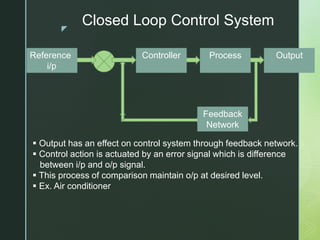
Closed Loop Control System
Reference
i/p
Controller Process Output
Feedback
Network
 Output has an effect on control system through feedback network.
 Control action is actuated by an error signal which is difference
between i/p and o/p signal.
 This process of comparison maintain o/p at desired level.
 Ex. Air conditioner
z
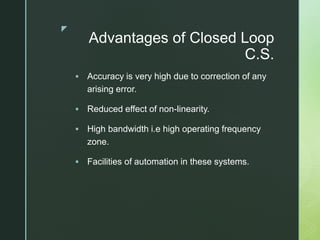
Advantages of Closed Loop
C.S.
 Accuracy is very high due to correction of any
arising error.
 Reduced effect of non-linearity.
 High bandwidth i.e high operating frequency
zone.
 Facilities of automation in these systems.
z
Disadvantages of Closed
Loop C. S.
 Complicated in design, hence costlier.
 May be unstable.

Basics of Control System

  • 1.
  • 2.
    z  Let’s dividethe word into Control and System so it’ll be easy to understand the meaning of it.  Control: Meaning of control is to regulate, direct or command to a system so that the desired objective is obtained.  System: System is arrangements of different physical components that gives the proper output for given input.  Control System: Arrangement of different physical components such that it may give desired output from given input by means of regulate or control either by direct or indirect method.
  • 3.
    A control systemmust have :  Input  Output  Ways to obtain i/p and o/p objectives  Control action Any system can be characterised mathematically by 1. Transfer Function 2. State Model Laplace transform of o/p Transfer Function= Laplace transform of i/p Initial condition=0 L[c(t)] L[r(t)] = C(s) R(s)
  • 4.
    z Classification of Control System Open loop C.S.  Closed loop C.S. 1.Positive Feedback C.S. 2.Negative Feedback C.S.
  • 5.
    z Open Loop ControlSystem Reference i/p Controller Process Output  Reference i/p controls the o/p through a control action process.  From the diagram it can be observed that i/p has no control on o/p. Such a system is called as open loop C.S.  O/p is neither measured nor fed back to compare with i/p.  Faithfulness of such system is depends on accuracy of i/p calibration. Ex. Traffic lights, fans any system without having sensor.
  • 6.
    z Advantages of OpenLoop C.S.  Simple in construction and design.  Economic  Easy from maintenance point of view.  Not much troubled with problems of stability.  Convenient to use when o/p is difficult to measure.
  • 7.
    z Disadvantages of OpenLoop C. S.  Not accurate and reliable because is depends on accuracy of calibration.  Inaccurate results obtained with parameter variation i.e. Internal disturbances.  Recalibration is required time to time to maintain quality and accuracy.
  • 8.
    z Closed Loop ControlSystem Reference i/p Controller Process Output Feedback Network  Output has an effect on control system through feedback network.  Control action is actuated by an error signal which is difference between i/p and o/p signal.  This process of comparison maintain o/p at desired level.  Ex. Air conditioner
  • 9.
    z Advantages of ClosedLoop C.S.  Accuracy is very high due to correction of any arising error.  Reduced effect of non-linearity.  High bandwidth i.e high operating frequency zone.  Facilities of automation in these systems.
  • 10.
    z Disadvantages of Closed LoopC. S.  Complicated in design, hence costlier.  May be unstable.