Sura Al Kahaf (The Cave):
A brief Introduction
Dr Manzur Ashraf
Al Ehsan, May 10, 2015
1
Sura Al Kahaf:
References of this talk
 Tafsir Al-Mizan, Vol 27, Allamah As-Sayyid At-Tabatabai
 Tasir Ibn Kathir by Imam Ibn Kathir
 Tafheemul Quraan by Syed Abul Ala
 Tafsir Mareful Quraan by Mufti Muhammad Shafi
2
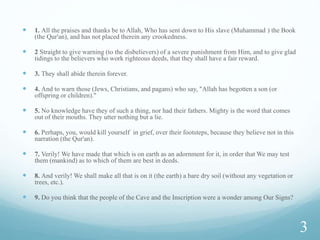
 1. All the praises and thanks be to Allah, Who has sent down to His slave (Muhammad ) the Book
(the Qur'an), and has not placed therein any crookedness.
 2 Straight to give warning (to the disbelievers) of a severe punishment from Him, and to give glad
tidings to the believers who work righteous deeds, that they shall have a fair reward.
 3. They shall abide therein forever.
 4. And to warn those (Jews, Christians, and pagans) who say, "Allah has begotten a son (or
offspring or children)."
 5. No knowledge have they of such a thing, nor had their fathers. Mighty is the word that comes
out of their mouths. They utter nothing but a lie.
 6. Perhaps, you, would kill yourself in grief, over their footsteps, because they believe not in this
narration (the Qur'an).
 7. Verily! We have made that which is on earth as an adornment for it, in order that We may test
them (mankind) as to which of them are best in deeds.
 8. And verily! We shall make all that is on it (the earth) a bare dry soil (without any vegetation or
trees, etc.).
 9. Do you think that the people of the Cave and the Inscription were a wonder among Our Signs?
3
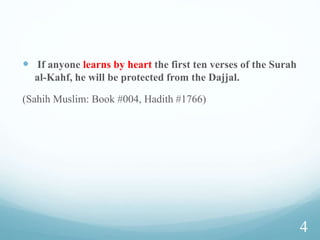
 If anyone learns by heart the first ten verses of the Surah
al-Kahf, he will be protected from the Dajjal.
(Sahih Muslim: Book #004, Hadith #1766)
4
Motivation of today’s lecture
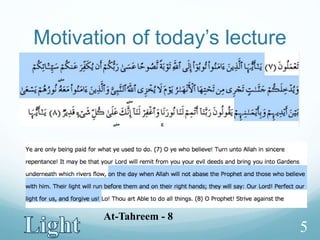
At-Tahreem - 8
5
Motivation of today’s lecture
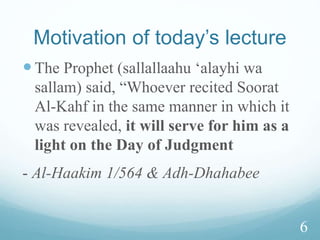
The Prophet (sallallaahu ‘alayhi wa
sallam) said, “Whoever recited Soorat
Al-Kahf in the same manner in which it
was revealed, it will serve for him as a
light on the Day of Judgment
- Al-Haakim 1/564 & Adh-Dhahabee
6
Background
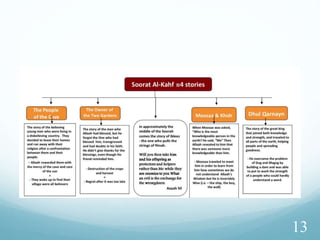
 Three amazing stories – not mentioned anywhere else in the
Quran: Companions of the cave, Moses and his servant,
Dhul-Qarnain.
 Jews advised the Quraysh to ask the Prophet (Sm) about
those THREE things (to test the Prophethood).
Meccan Surah
He didn’t know how to write. He was in Mecca; For business
visits  Syria for few days; No one claimed I saw him he was
learning from ‘XYZ’!! [So it was a TEST]
7
 ‫ا‬ ً۬‫م‬ِّ‫ي‬َ‫ق‬َ‫ر‬ِّ‫ذ‬‫ن‬ُ‫ي‬ِّ‫ل‬‫ا‬ً۬‫س‬ۡ‫أ‬‫ب‬‫ا‬ً۬‫يد‬ِّ‫د‬‫ش‬‫ن‬ِّ‫م‬َُ‫ه‬ۡ‫ُن‬‫د‬َّ‫ل‬َِّ‫ش‬‫ب‬ُ‫ي‬‫و‬َ‫ر‬َ‫ين‬ِّ‫ن‬ِّ‫م‬ ۡ‫ؤ‬ُ‫م‬ۡ‫ٱل‬َ‫ين‬ِّ‫ذ‬َّ‫ل‬‫ٱ‬َ‫ون‬ُ‫ل‬‫م‬ۡ‫ع‬‫ي‬ََّ‫ص‬‫ٱل‬َِّ‫ت‬ٰ‫ـ‬‫ح‬ِّ‫ل‬ٰ‫ـ‬ََّ‫ن‬‫أ‬َۡ‫م‬ُ‫ه‬‫ل‬
‫ا‬‫ر‬ ۡ‫ج‬‫أ‬‫ا‬ً۬‫ن‬‫س‬‫ح‬
Rightly directing, so that he may warn of a severe punishment from Him and give
glad tidings to the believers who do good deeds that they shall have a goodly reward,
staying it forever (2-3)
One interpretation of Al-qayyim here means that the Kitab is responsible all other
heavenly books confirming and preserving them.
(18:4) And warn those who say: God has taken a son.
(18:5) They have no knowledge of it, nor did their fathers; a grievous word it it is
that comes out of their mouths; they speak nothing but a lie.
8
 Idolaters say: Angels and perhaps the jinn and human
reformers are His sons and daughters.
 Like Christians (who say: Christ is the son of God), Jews
said: ‘Uzayr is God’s son’:
 (5:18) We are God’s children and His beloved – to indicate
their closeness to God.
 Allah refuted first saying “out of ignorance” and then “they
speak nothing but a lie” including their forefathers.
  Social custom / Rituals
9
Console the Prophet (Sm)
and encourage him
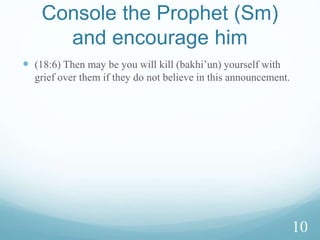
 (18:6) Then may be you will kill (bakhi’un) yourself with
grief over them if they do not believe in this announcement.
10
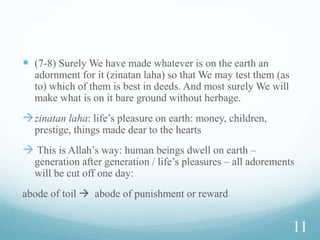
 (7-8) Surely We have made whatever is on the earth an
adornment for it (zinatan laha) so that We may test them (as
to) which of them is best in deeds. And most surely We will
make what is on it bare ground without herbage.
zinatan laha: life’s pleasure on earth: money, children,
prestige, things made dear to the hearts
 This is Allah’s way: human beings dwell on earth –
generation after generation / life’s pleasures – all adorements
will be cut off one day:
abode of toil  abode of punishment or reward
11
Console the Prophet (Sm)
 In sum, this verse is addressing to Prophet (Sm): Don’t be
distressed of feel sad for them because they turned their
backs on your call, which includes warning as well as glad
tidings and they kept themselves busy with the life’s
pleasures.
 One day they will know.
12
13
14
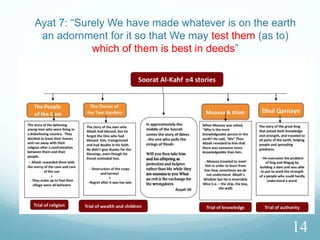
Ayat 7: “Surely We have made whatever is on the earth
an adornment for it so that We may test them (as to)
which of them is best in deeds”
Quality vs Quantity
 “Ahsanu Amala” means Work of best quality
 NOT “Aksaru Amala” (work with quantity)
 Example 1 of qualitative work: And We have pointed out to him
the two highways of good and evil. But he attempted not to ascent
bravely. And do you know what the ascent is? It is the freeing of a
slave. Or feeding in a day of hunger. An orphan near of kin, Or a
poor man lying in the dust. (Sura Balad)
 Example 2: [41:34] And who is better in speech than he who
invites men to Allah and does good works and says, ‘I am surely
among the Muslims?’
15
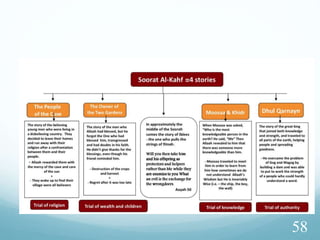
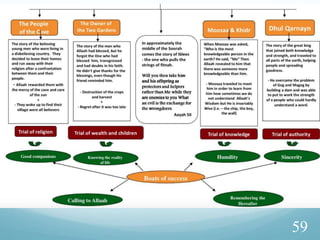
Story of the People of the
Cave
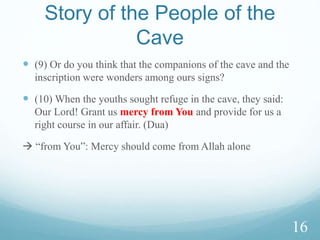
 (9) Or do you think that the companions of the cave and the
inscription were wonders among ours signs?
 (10) When the youths sought refuge in the cave, they said:
Our Lord! Grant us mercy from You and provide for us a
right course in our affair. (Dua)
 “from You”: Mercy should come from Allah alone
16
Mercy from You
َ‫ا‬‫َّن‬‫ب‬‫ا‬‫ن‬ِّ‫ت‬‫ا‬‫ء‬‫ى‬ِّ‫ف‬‫ا‬‫ي‬ۡ‫ُّن‬‫د‬‫ٱل‬ًَ۬‫ة‬‫ن‬‫س‬‫ح‬
(2:201) .. Our Lord! Grant us goodness in this world
‫ا‬‫َّن‬‫ب‬‫ر‬‫ا‬‫ن‬ِّ‫ت‬‫ا‬‫ء‬‫و‬‫ا‬‫م‬‫ا‬‫ن‬َّ‫ت‬‫د‬‫ع‬‫و‬َٰ‫ى‬‫ل‬‫ع‬َ‫ك‬ِّ‫ل‬ُ‫س‬ُ‫ر‬َ‫ل‬‫و‬‫ا‬‫ن‬ ِّ‫ز‬ ۡ‫خ‬ُ‫ت‬َ‫م‬ ۡ‫و‬‫ي‬َِّۗ‫ة‬‫م‬ٰ‫ـ‬‫ي‬ِّ‫ق‬ۡ‫ٱل‬َ‫ك‬َّ‫ن‬ِّ‫إ‬َ‫ل‬َُ‫ف‬ِّ‫ل‬ ۡ‫خ‬ُ‫ت‬َ‫اد‬‫يع‬ِّ‫م‬ۡ‫ٱل‬
(3:194) .. Our Lord! And Grant us what You have promised us by Your messengers
…
‫ا‬‫َّن‬‫ب‬‫ر‬َ‫ل‬َۡ‫غ‬ ِّ‫ز‬ُ‫ت‬‫ا‬‫ن‬‫وب‬ُ‫ل‬ُ‫ق‬َ‫د‬ۡ‫ع‬‫ب‬َۡ‫ذ‬ِّ‫إ‬‫ا‬‫ن‬‫ت‬ۡ‫ي‬‫د‬‫ه‬َۡ‫ب‬‫ه‬‫و‬‫ا‬‫ن‬‫ل‬‫ن‬ِّ‫م‬ََ‫ُنك‬‫د‬َّ‫ل‬َ‫ة‬‫م‬ ۡ‫ح‬‫ر‬ََۚ‫ك‬َّ‫ن‬ِّ‫إ‬َ‫نت‬‫أ‬َُ‫اب‬َّ‫ه‬‫و‬ۡ‫ٱل‬
(3:8) Our Lord! Cause not our hearts to stray after Thou hast guided us, and bestow
upon us mercy from You… 17
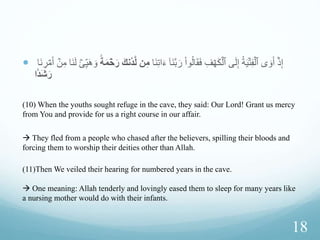
 َۡ‫ذ‬ِّ‫إ‬‫ى‬‫و‬‫أ‬َُ‫ة‬‫ي‬ۡ‫ت‬ِّ‫ف‬ۡ‫ٱل‬‫ى‬‫ل‬ِّ‫إ‬َِّ‫ف‬ ۡ‫ه‬‫ك‬ۡ‫ٱل‬َ‫وا‬ُ‫ل‬‫ا‬‫ق‬‫ف‬َ‫ا‬‫َّن‬‫ب‬‫ر‬َِّ‫ت‬‫ا‬‫ء‬‫ا‬‫ن‬‫ن‬ِّ‫م‬ََ‫ُنك‬‫د‬َّ‫ل‬َ
ً۬
‫ة‬َ‫م‬ ۡ‫ح‬َ‫ر‬َۡ‫ئ‬ِّ‫ي‬‫ه‬‫و‬‫ا‬‫ن‬‫ل‬َۡ‫ن‬ِّ‫م‬‫ا‬‫ن‬ ِّ‫ر‬ ۡ‫م‬‫أ‬
‫ا‬ً۬‫د‬َ‫ش‬َ‫ر‬
(10) When the youths sought refuge in the cave, they said: Our Lord! Grant us mercy
from You and provide for us a right course in our affair.
 They fled from a people who chased after the believers, spilling their bloods and
forcing them to worship their deities other than Allah.
(11)Then We veiled their hearing for numbered years in the cave.
 One meaning: Allah tenderly and lovingly eased them to sleep for many years like
a nursing mother would do with their infants.
18
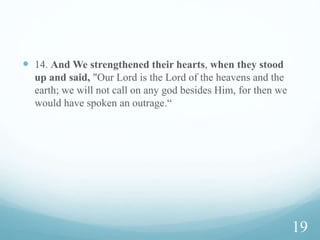
 14. And We strengthened their hearts, when they stood
up and said, "Our Lord is the Lord of the heavens and the
earth; we will not call on any god besides Him, for then we
would have spoken an outrage.“
19
when they stood up and
said,…
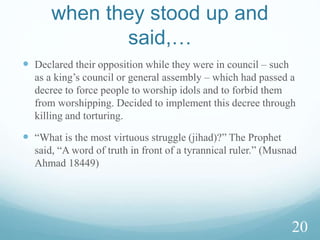
 Declared their opposition while they were in council – such
as a king’s council or general assembly – which had passed a
decree to force people to worship idols and to forbid them
from worshipping. Decided to implement this decree through
killing and torturing.
 “What is the most virtuous struggle (jihad)?” The Prophet
said, “A word of truth in front of a tyrannical ruler.” (Musnad
Ahmad 18449)
20
Gentleness & Tactics
 Ayat 19. Even so, We awakened them, so that they may ask one
another. A speaker among them said, "How long have you stayed?"
They said, "We have stayed a day, or part of a day." They said,
"Your Lord knows best how long you have stayed." "Send one of
you to the city, with this money of yours, and let him see which
food is most suitable, and let him bring you some provision
thereof. And let him be gentle, and let no one become aware of
you.”
 Zaka al taam: The goodness of the food: halal and pure / best food
 To avoid any quarrel or dispute
 Advising the person to behave with gentleness and an explanation in the
wisdom in doing so (in Ayat 20 – may stone to death, etc).
21
Day of resurrection is a reality.
 Just as We caused them to sleep and then roused them for
such-and-such reason, so likewise We shall make people
witness them at a time they are disputing among themselves
over the matter of resurrection. They then will know Allah’s
promise (about resurrection) is true and there is no doubt
about the Hour (Qiyamah)
 Their being awakened from the sleep proves that the raising
of the dead on the day of resurrection is a reality.
22
Beneficial Knowledge
 22. They will say, "Three, and their fourth being their dog."
And they will say, "Five, and their sixth being their dog,"
guessing at the unknown. And they will say, "Seven, and
their eighth being their dog." Say, "My Lord knows best their
number." None knows them except a few. So do not argue
concerning them except with an obvious argument, and do
not consult any of them about them.
How can you be benefitted by that information?
 Don’t argue on anything which is not beneficial.
23
A Miracle!
 Ayat 25. And they stayed in their cave for three hundred
years and they added (another) nine.
They remained in the cave for 300 solar years, which is
approximately equal to 309 Lunar years.
Gives an indication of rotational difference of Sun and moon.
24
Advice [Verses 27-31]
 Before the story: Rasulullah (Sm) was with grief and sorrow
because of those people who didn’t believe in the Book and
rejected the truth,
 He should not be distressed (because soon they will wake up
(like the people of cave) and know the ultimate truth –
everything will perish)
 Instead he should be patient along with the believers who are
poor and who never stop calling upon Allah.
25
Friendship
 28. And content yourself with those who pray to their Lord
morning and evening, desiring His Presence. And do not turn
your eyes away from them, desiring the glitter of this world.
And do not obey him whose heart We have made heedless of
Our remembrance-so he follows his own desires-and his
priorities are confused. [Unmindful to Our remembrance]
  Revealed about Umayyab. Khalf – cast out the poor and
favor the elite of Mecca. [Ibn Abbas]
26
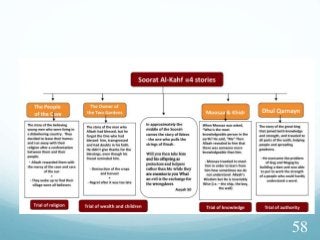
Story of the Owner of the
Gardens
 Reality of wealth & followers/children – adornments of this
deceptive worldly life which quickly vanishes.
 These adornments distract the people remembering their
lords – seduce people into thinking they will live forever
and can depend on those adornments.
27
 32: And cite for them the parable of two men. To one of them We gave
two gardens of vine, and We surrounded them with palm-trees, and We
placed between them crops.
 33. Both gardens produced their harvest in full, and suffered no loss. And
We made a river flow through them.
 34. And thus he had abundant fruits. He said to his friend, as he
conversed with him, "I am wealthier than you, and greater in manpower.”
 35. And he entered his garden, wronging himself. He said, "I do not think
this will ever perish.”
 36. "And I do not think the Hour is coming. And even if I am returned to
my Lord, I will find something better than this in return."
28
 Qarun also told in the same way:
(28:78) He (Qarun) said: I have only been given this on account
of the knowledge I have …
“I have greater wealth than you” reveals a claim to being
singled out for honor and personal entitlement. – thus
attributing to Allah by not being duly attentive and replying
on apparent causes (other than Allah).
FIRST: He is putting himself above Allah: his wealth & his
followers are INDEPENDENT by thinking his power &
strength are exempt from Allah’s control
29
Keep Calm! 
 37. His friend said to him, as he conversed with him, "Are you
being ungrateful to Him who created you from dust, then from a
sperm-drop, then evolved you into a man?
 While disputing with him, he didn’t loose his calm or sense of
inner peace
 Maintained etiquette throughout the dispute
 Spoke gently and avoided saying offensive words (although he
was belittled)
 Attention to origin: dust followed by small seed – which is
the basis of man. All the qualities (knowledge, life, ability,
power – which directs to the creational abilities to achieve
goals and desires) are gifts from Allah alone. The existence
of any life itself is a gift from Allah.
30
The evil consequence
 Associating partner (shirk) mentioned in the sense of
Step 1: Forgetting Allah & His absolute dominion
Step 2: Believing himself & full confidence on means
Step 3: Feeling autonomous
31
 42. And ruin closed in on his crops, and so he began wringing his
hands over what he had invested in it, as it lays fallen upon its
trellises. And he was saying, "I wish I never associated anyone
with my Lord."
 43. He had no faction to help him besides God, and he was
helpless.
 44. That is because authority (walaya) belongs to God, the True.
He is Best in rewarding, and Best in requiting.
 Walaya means assistance: Allah is man’s helper when calamity
surrounds him; when all means are cutoff and there is no helper
besides Him.
32
 46. Wealth and children are the adornments of the present
life. But the things that last, the good deeds (al-baqiat-al-
salihat), are better with your Lord for reward, and better for
hope.
  “al-baqiat-al-salihat” means any good works for
humanity in general (Alamah Tabatabai).
33
Wake up from sleep: Three
Reminders
 Ayat 47 …. : Coming of the hours
 Ayat 50 … : Iblis refused to prostrate Adam and his transgressing
the commandment of Allah – Still People take Iblis and his
offspring for friends rather than Allah
 Ayat 52: On the Day when He will say, "Call on My partners
whom you have claimed." They will call on them, but they will not
answer them. And We will place between them a barrier.
“On the day of resurrection, the unbeliever will be made to stand for 50 thousand
years. They will see hell and think that it is falling on them from a distance it would
take 40 years to travel.” [Ahmed, Al-Hakim]
34
Story of Musa & Khidr (As)
 A man from Israelites said to Musa (As), I do not think that
there is anyone who knows more about Allah than you do.
Musa (As) replied: I do not think so. Allah then revealed to
him: My servant Khidr does.
Ref: Tafsir Al Ayyashi
 There is an explanation of realities and incidents which
affect what worldly people desire. The explanation will
become clear when Allah allows them to wake up from the
sleep (of obliviousness) – raised on the day of resurrection
35
 Yusha (As), young boy, was his servant  after 40 years
 Khidr (As) was also a prophet:
“ We had granted mercy from Us and whom We had taught
knowledge from Ourselves”
36
 60. Recall when Moses said to his servant, "I will not give up until
I reach the junction of the two rivers, even if it takes me years."
 61. Then, when they reached the junction between them, they
forgot about their fish. It found its way into the river, slipping
away.
 62. When they went further, he said to his servant, "Bring us our
lunch; we were exposed in our travel to much fatigue.”
 63. He said, "Do you remember when we rested by the rock? I
forgot about the fish. It was only the devil who made me forget it.
And so it found its way to the river, amazingly."
37
 64. He said, "This is what we were seeking." And so they turned back retracing their
steps.
 65. Then they came upon a servant of Ours, whom We had blessed with mercy from
Us, and had taught him knowledge from Our Own.
 66. Moses said to him, "May I follow you, so that you may teach me some of the
guidance you were taught?"
 67. He said, "Surely You cannot have patience with me”.
 --To withstand the teaching method employed by Khidr and not that Musa (As) would
not be able to withstand the knowledge
 -- Musa (As) returned from the meeting place to the people and found they started
worshipping the calf. He was filled with rage, threw down the tablets and dragged his
brother toward him. Allah had told him about that while he was at the meeting place
but didn't do anything like what he later did. -- Sura Araf
38
Politeness of a learner (irrespective of
status)
 69. He said, "You will find me, God willing, patient; and I
will not disobey you in any order of yours.”
[1] He was polite – he requested as a question (not in the
imperative way)
[2] He deemed himself to be a learner.
[3] He praised him by saying “rushdaan” (right)
[4] Elevated Khidr (As)’s status by referring his guidance as an
order and considering a breach by him as a disobedience.
39
 71. So they set out. Until, when they had boarded the boat, he holed it. He said, "Did you
hole it, to drown its passengers? You have done something awful.
 72. He said, "Did I not tell you that you will not be able to endure with me?"
 74. Then they set out. Until, when they encountered a boy, he killed him. He said, "Did you
kill a pure soul, who killed no one? You have done something terrible."
 75. He said, "Did I not tell you that you will not be able to endure with me?"
 77. So they set out. Until, when they reached the people of a town, they asked them for
food, but they refused to offer them hospitality. There they found a wall about to collapse,
and he repaired it. He said, "If you wanted, you could have obtained a payment for it."
 78. He said, "This is the parting between you and me. I will tell you the interpretation of
what you were unable to endure.
40
Learning?
 79. As for the boat, it belonged to (some) poor men working at
sea. I wished to damage it because there was a king coming
after them seizing every boat by force.
 80. As for the boy, his parents were believers, and we feared he
would overwhelm them with oppression and disbelief.
 81. So we wanted their Lord to replace him with someone better
in purity, and more caring towards his kin
 82. And as for the wall, it belonged to two orphaned boys in the
town. Beneath it was a treasure that belonged to them. Their father
was a righteous man. Your Lord wanted them to reach their
maturity, and then extract their treasure-as a mercy from your Lord
41
 A person’s righteousness may cause his children to inherit a
nice legacy and might leave them happiness and goodness:
Similar to (4:9)
82: I did not do it of my own accord. This is the interpretation
of what you were unable to have patience.
42
Politeness of Khidr (As)
 When he was speaking – attributed those actions not free of
fault to himself. He also attributed to Allah that was
exclusive to Him (or good things).
 I wanted to damage it (boat)
 Your Lord wanted them to reach their maturity, and then
extract their treasure-as a mercy from your Lord. (treasure of
the orphans)
43
 “When Musa (A) met Khidr, a bird came along and dipped
its beak in the water. Khidr asked Musa (A): Do you know
what the bird says? He replied: What does it say? He said: It
says, your knowledge and Musa’s knowledge out of all
God’s knowledge is like what my beak takes from this
water.”
[Al hakim]
44
Reality
 “They had a little girl who went on to have a little boy who
went on to become a prophet.”
[from the authority of Uthman (R) ]
45
The treasure beneath the wall
 It was a gold tablet on which was inscribed:
 There is no God but Allah, Muhammad is the Messenger of Allah.
 It is amazing that anyone who remembers that death is true is joyful.
 It is amazing that anyone who remembers that hell is true laughs.
 It is amazing that anyone who remembers that ordainment is true, is
sorrowful.
 It is amazing that anyone who sees the world and its disposal of the
people in it, state after state, has confidence in it.
[ On the authority of Ali (R) – Bayhaqi ]
46
Who expects loyalty from you?
Are you not the false world?
Are you not the same earth?
That took away Muhammad Mustafa?
Ottoman Sufi Poet Aziz Mahmud (1338)
47
Story of Julkarnain
 84: Surely we established him in the land and granted him
means of access to everything (sabab)
intellect, knowledge, religion, strength, body, abundance of
money, soldiers, vastness of dominion, ability to administer
well, etc to achieve life goals.
 85: So he followed a course. (to help the humanity ?)
 94: They said: O Dhul Qarnain, surely Gog & Magog make
mischief in the land…… You should raise a barrier between
us and them.
48
 100. On that Day, We will present the disbelievers to Hell, all
displayed.
 101. Those whose eyes were screened to My message, and
were unable to hear.
49
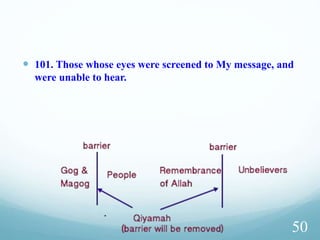
 101. Those whose eyes were screened to My message, and
were unable to hear.
50
Greatest losers
 103. Say, "Shall We inform you of the greatest losers in their
works?"
 104. "Those whose efforts in this world are misguided, while
they assume that they are doing well."
 105. It is they who rejected the communications of their
Lord, and the encounter with Him. So their works are in
vain. And on the Day of Resurrection, We will consider them
of no weight.
51
The Successful Ones
 107. As for those who believe and do righteous deeds, they
will have the Gardens of Paradise (Firdaus) for hospitality.
 If you ask Allah for anything, ask Him for firdaus, because it
is the middle of heaven and the highest part of heaven.
[On the authority of Abu Hurayra, Bukhari, Muslim]
52
Vastness of Allah’s words
 109: Say: If the sea were ink for the words of my Lord,
the sea would surely run dry before the words of my
Lord run dry, though We were to bring the like of that
(sea) to add.
There are divine realities – People are all asleep to [those
realities] but they will eventually wake up on Day of
Resurrection. Story of the cave is aligned to that.
Musa (A) witnessed Khidr (A) doing things but didn’t aware of
the significance until Khidr (A) explained it to him.
53
Vastness of words  ?
 Matters beneath which are realities and secrets and are in fact
words which reveal divine purposes and explanations which
inform of hidden things to which the “Wise remembrance”
[Quran] calls people.
 The verse informs of those matters, that is Allah’s words
inform of His endless purposes.
 Let us contend ourselves with what we have said.
  Will we be lost (not guided) by the vastness of words?
Can we get any central theme (out of the vastness of words)
not to be astray? Can the theme make us successful?
54
Last Ayat - 110: Say, "I am only a
human being like you, being
inspired that your God is One
God. Whoever hopes to meet his
Lord, let him work righteousness,
and never associate anyone with
the service of his Lord.”
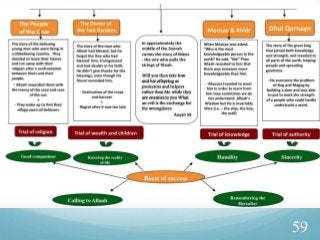
Conclusion: Theme/Code of
this Ayat?
55
Say, "I am only a human being like you, being inspired that
your god is One God. Whoever hopes to meet his Lord, let
him work righteousness, and never associate anyone with
the service of his Lord.”
 [1] Belief in one Allah [Tauheed] -- your god is One God
 [2] Prophethood [Risalat] -- I am only a human being like
you, being inspired that your god
 [3] Resurrection [Akhiraat] -- Whoever hopes to meet his
Lord ….
Pillars of success / Roots of
the religion
56
Hadith on the Last Ayat
At-Tabarani cite Abu Hakim as saying:
Allah’s Messenger (Sm) said, if nothing
but the end of Sura Al kahaf had been
revealed to my nation it would have
been enough for them.”
57
58
59

Sura kahaf-2015

  • 1.
    Sura Al Kahaf(The Cave): A brief Introduction Dr Manzur Ashraf Al Ehsan, May 10, 2015 1
  • 2.
    Sura Al Kahaf: Referencesof this talk  Tafsir Al-Mizan, Vol 27, Allamah As-Sayyid At-Tabatabai  Tasir Ibn Kathir by Imam Ibn Kathir  Tafheemul Quraan by Syed Abul Ala  Tafsir Mareful Quraan by Mufti Muhammad Shafi 2
  • 3.
     1. Allthe praises and thanks be to Allah, Who has sent down to His slave (Muhammad ) the Book (the Qur'an), and has not placed therein any crookedness.  2 Straight to give warning (to the disbelievers) of a severe punishment from Him, and to give glad tidings to the believers who work righteous deeds, that they shall have a fair reward.  3. They shall abide therein forever.  4. And to warn those (Jews, Christians, and pagans) who say, "Allah has begotten a son (or offspring or children)."  5. No knowledge have they of such a thing, nor had their fathers. Mighty is the word that comes out of their mouths. They utter nothing but a lie.  6. Perhaps, you, would kill yourself in grief, over their footsteps, because they believe not in this narration (the Qur'an).  7. Verily! We have made that which is on earth as an adornment for it, in order that We may test them (mankind) as to which of them are best in deeds.  8. And verily! We shall make all that is on it (the earth) a bare dry soil (without any vegetation or trees, etc.).  9. Do you think that the people of the Cave and the Inscription were a wonder among Our Signs? 3
  • 4.
     If anyonelearns by heart the first ten verses of the Surah al-Kahf, he will be protected from the Dajjal. (Sahih Muslim: Book #004, Hadith #1766) 4
  • 5.
    Motivation of today’slecture At-Tahreem - 8 5
  • 6.
    Motivation of today’slecture The Prophet (sallallaahu ‘alayhi wa sallam) said, “Whoever recited Soorat Al-Kahf in the same manner in which it was revealed, it will serve for him as a light on the Day of Judgment - Al-Haakim 1/564 & Adh-Dhahabee 6
  • 7.
    Background  Three amazingstories – not mentioned anywhere else in the Quran: Companions of the cave, Moses and his servant, Dhul-Qarnain.  Jews advised the Quraysh to ask the Prophet (Sm) about those THREE things (to test the Prophethood). Meccan Surah He didn’t know how to write. He was in Mecca; For business visits  Syria for few days; No one claimed I saw him he was learning from ‘XYZ’!! [So it was a TEST] 7
  • 8.
     ‫ا‬ ً۬‫م‬ِّ‫ي‬َ‫ق‬َ‫ر‬ِّ‫ذ‬‫ن‬ُ‫ي‬ِّ‫ل‬‫ا‬ً۬‫س‬ۡ‫أ‬‫ب‬‫ا‬ً۬‫يد‬ِّ‫د‬‫ش‬‫ن‬ِّ‫م‬َُ‫ه‬ۡ‫ُن‬‫د‬َّ‫ل‬َِّ‫ش‬‫ب‬ُ‫ي‬‫و‬َ‫ر‬َ‫ين‬ِّ‫ن‬ِّ‫م‬ۡ‫ؤ‬ُ‫م‬ۡ‫ٱل‬َ‫ين‬ِّ‫ذ‬َّ‫ل‬‫ٱ‬َ‫ون‬ُ‫ل‬‫م‬ۡ‫ع‬‫ي‬ََّ‫ص‬‫ٱل‬َِّ‫ت‬ٰ‫ـ‬‫ح‬ِّ‫ل‬ٰ‫ـ‬ََّ‫ن‬‫أ‬َۡ‫م‬ُ‫ه‬‫ل‬ ‫ا‬‫ر‬ ۡ‫ج‬‫أ‬‫ا‬ً۬‫ن‬‫س‬‫ح‬ Rightly directing, so that he may warn of a severe punishment from Him and give glad tidings to the believers who do good deeds that they shall have a goodly reward, staying it forever (2-3) One interpretation of Al-qayyim here means that the Kitab is responsible all other heavenly books confirming and preserving them. (18:4) And warn those who say: God has taken a son. (18:5) They have no knowledge of it, nor did their fathers; a grievous word it it is that comes out of their mouths; they speak nothing but a lie. 8
  • 9.
     Idolaters say:Angels and perhaps the jinn and human reformers are His sons and daughters.  Like Christians (who say: Christ is the son of God), Jews said: ‘Uzayr is God’s son’:  (5:18) We are God’s children and His beloved – to indicate their closeness to God.  Allah refuted first saying “out of ignorance” and then “they speak nothing but a lie” including their forefathers.   Social custom / Rituals 9
  • 10.
    Console the Prophet(Sm) and encourage him  (18:6) Then may be you will kill (bakhi’un) yourself with grief over them if they do not believe in this announcement. 10
  • 11.
     (7-8) SurelyWe have made whatever is on the earth an adornment for it (zinatan laha) so that We may test them (as to) which of them is best in deeds. And most surely We will make what is on it bare ground without herbage. zinatan laha: life’s pleasure on earth: money, children, prestige, things made dear to the hearts  This is Allah’s way: human beings dwell on earth – generation after generation / life’s pleasures – all adorements will be cut off one day: abode of toil  abode of punishment or reward 11
  • 12.
    Console the Prophet(Sm)  In sum, this verse is addressing to Prophet (Sm): Don’t be distressed of feel sad for them because they turned their backs on your call, which includes warning as well as glad tidings and they kept themselves busy with the life’s pleasures.  One day they will know. 12
  • 13.
  • 14.
    14 Ayat 7: “SurelyWe have made whatever is on the earth an adornment for it so that We may test them (as to) which of them is best in deeds”
  • 15.
    Quality vs Quantity “Ahsanu Amala” means Work of best quality  NOT “Aksaru Amala” (work with quantity)  Example 1 of qualitative work: And We have pointed out to him the two highways of good and evil. But he attempted not to ascent bravely. And do you know what the ascent is? It is the freeing of a slave. Or feeding in a day of hunger. An orphan near of kin, Or a poor man lying in the dust. (Sura Balad)  Example 2: [41:34] And who is better in speech than he who invites men to Allah and does good works and says, ‘I am surely among the Muslims?’ 15
  • 16.
    Story of thePeople of the Cave  (9) Or do you think that the companions of the cave and the inscription were wonders among ours signs?  (10) When the youths sought refuge in the cave, they said: Our Lord! Grant us mercy from You and provide for us a right course in our affair. (Dua)  “from You”: Mercy should come from Allah alone 16
  • 17.
    Mercy from You َ‫ا‬‫َّن‬‫ب‬‫ا‬‫ن‬ِّ‫ت‬‫ا‬‫ء‬‫ى‬ِّ‫ف‬‫ا‬‫ي‬ۡ‫ُّن‬‫د‬‫ٱل‬ًَ۬‫ة‬‫ن‬‫س‬‫ح‬ (2:201).. Our Lord! Grant us goodness in this world ‫ا‬‫َّن‬‫ب‬‫ر‬‫ا‬‫ن‬ِّ‫ت‬‫ا‬‫ء‬‫و‬‫ا‬‫م‬‫ا‬‫ن‬َّ‫ت‬‫د‬‫ع‬‫و‬َٰ‫ى‬‫ل‬‫ع‬َ‫ك‬ِّ‫ل‬ُ‫س‬ُ‫ر‬َ‫ل‬‫و‬‫ا‬‫ن‬ ِّ‫ز‬ ۡ‫خ‬ُ‫ت‬َ‫م‬ ۡ‫و‬‫ي‬َِّۗ‫ة‬‫م‬ٰ‫ـ‬‫ي‬ِّ‫ق‬ۡ‫ٱل‬َ‫ك‬َّ‫ن‬ِّ‫إ‬َ‫ل‬َُ‫ف‬ِّ‫ل‬ ۡ‫خ‬ُ‫ت‬َ‫اد‬‫يع‬ِّ‫م‬ۡ‫ٱل‬ (3:194) .. Our Lord! And Grant us what You have promised us by Your messengers … ‫ا‬‫َّن‬‫ب‬‫ر‬َ‫ل‬َۡ‫غ‬ ِّ‫ز‬ُ‫ت‬‫ا‬‫ن‬‫وب‬ُ‫ل‬ُ‫ق‬َ‫د‬ۡ‫ع‬‫ب‬َۡ‫ذ‬ِّ‫إ‬‫ا‬‫ن‬‫ت‬ۡ‫ي‬‫د‬‫ه‬َۡ‫ب‬‫ه‬‫و‬‫ا‬‫ن‬‫ل‬‫ن‬ِّ‫م‬ََ‫ُنك‬‫د‬َّ‫ل‬َ‫ة‬‫م‬ ۡ‫ح‬‫ر‬ََۚ‫ك‬َّ‫ن‬ِّ‫إ‬َ‫نت‬‫أ‬َُ‫اب‬َّ‫ه‬‫و‬ۡ‫ٱل‬ (3:8) Our Lord! Cause not our hearts to stray after Thou hast guided us, and bestow upon us mercy from You… 17
  • 18.
     َۡ‫ذ‬ِّ‫إ‬‫ى‬‫و‬‫أ‬َُ‫ة‬‫ي‬ۡ‫ت‬ِّ‫ف‬ۡ‫ٱل‬‫ى‬‫ل‬ِّ‫إ‬َِّ‫ف‬ ۡ‫ه‬‫ك‬ۡ‫ٱل‬َ‫وا‬ُ‫ل‬‫ا‬‫ق‬‫ف‬َ‫ا‬‫َّن‬‫ب‬‫ر‬َِّ‫ت‬‫ا‬‫ء‬‫ا‬‫ن‬‫ن‬ِّ‫م‬ََ‫ُنك‬‫د‬َّ‫ل‬َ ً۬ ‫ة‬َ‫م‬ۡ‫ح‬َ‫ر‬َۡ‫ئ‬ِّ‫ي‬‫ه‬‫و‬‫ا‬‫ن‬‫ل‬َۡ‫ن‬ِّ‫م‬‫ا‬‫ن‬ ِّ‫ر‬ ۡ‫م‬‫أ‬ ‫ا‬ً۬‫د‬َ‫ش‬َ‫ر‬ (10) When the youths sought refuge in the cave, they said: Our Lord! Grant us mercy from You and provide for us a right course in our affair.  They fled from a people who chased after the believers, spilling their bloods and forcing them to worship their deities other than Allah. (11)Then We veiled their hearing for numbered years in the cave.  One meaning: Allah tenderly and lovingly eased them to sleep for many years like a nursing mother would do with their infants. 18
  • 19.
     14. AndWe strengthened their hearts, when they stood up and said, "Our Lord is the Lord of the heavens and the earth; we will not call on any god besides Him, for then we would have spoken an outrage.“ 19
  • 20.
    when they stoodup and said,…  Declared their opposition while they were in council – such as a king’s council or general assembly – which had passed a decree to force people to worship idols and to forbid them from worshipping. Decided to implement this decree through killing and torturing.  “What is the most virtuous struggle (jihad)?” The Prophet said, “A word of truth in front of a tyrannical ruler.” (Musnad Ahmad 18449) 20
  • 21.
    Gentleness & Tactics Ayat 19. Even so, We awakened them, so that they may ask one another. A speaker among them said, "How long have you stayed?" They said, "We have stayed a day, or part of a day." They said, "Your Lord knows best how long you have stayed." "Send one of you to the city, with this money of yours, and let him see which food is most suitable, and let him bring you some provision thereof. And let him be gentle, and let no one become aware of you.”  Zaka al taam: The goodness of the food: halal and pure / best food  To avoid any quarrel or dispute  Advising the person to behave with gentleness and an explanation in the wisdom in doing so (in Ayat 20 – may stone to death, etc). 21
  • 22.
    Day of resurrectionis a reality.  Just as We caused them to sleep and then roused them for such-and-such reason, so likewise We shall make people witness them at a time they are disputing among themselves over the matter of resurrection. They then will know Allah’s promise (about resurrection) is true and there is no doubt about the Hour (Qiyamah)  Their being awakened from the sleep proves that the raising of the dead on the day of resurrection is a reality. 22
  • 23.
    Beneficial Knowledge  22.They will say, "Three, and their fourth being their dog." And they will say, "Five, and their sixth being their dog," guessing at the unknown. And they will say, "Seven, and their eighth being their dog." Say, "My Lord knows best their number." None knows them except a few. So do not argue concerning them except with an obvious argument, and do not consult any of them about them. How can you be benefitted by that information?  Don’t argue on anything which is not beneficial. 23
  • 24.
    A Miracle!  Ayat25. And they stayed in their cave for three hundred years and they added (another) nine. They remained in the cave for 300 solar years, which is approximately equal to 309 Lunar years. Gives an indication of rotational difference of Sun and moon. 24
  • 25.
    Advice [Verses 27-31] Before the story: Rasulullah (Sm) was with grief and sorrow because of those people who didn’t believe in the Book and rejected the truth,  He should not be distressed (because soon they will wake up (like the people of cave) and know the ultimate truth – everything will perish)  Instead he should be patient along with the believers who are poor and who never stop calling upon Allah. 25
  • 26.
    Friendship  28. Andcontent yourself with those who pray to their Lord morning and evening, desiring His Presence. And do not turn your eyes away from them, desiring the glitter of this world. And do not obey him whose heart We have made heedless of Our remembrance-so he follows his own desires-and his priorities are confused. [Unmindful to Our remembrance]   Revealed about Umayyab. Khalf – cast out the poor and favor the elite of Mecca. [Ibn Abbas] 26
  • 27.
    Story of theOwner of the Gardens  Reality of wealth & followers/children – adornments of this deceptive worldly life which quickly vanishes.  These adornments distract the people remembering their lords – seduce people into thinking they will live forever and can depend on those adornments. 27
  • 28.
     32: Andcite for them the parable of two men. To one of them We gave two gardens of vine, and We surrounded them with palm-trees, and We placed between them crops.  33. Both gardens produced their harvest in full, and suffered no loss. And We made a river flow through them.  34. And thus he had abundant fruits. He said to his friend, as he conversed with him, "I am wealthier than you, and greater in manpower.”  35. And he entered his garden, wronging himself. He said, "I do not think this will ever perish.”  36. "And I do not think the Hour is coming. And even if I am returned to my Lord, I will find something better than this in return." 28
  • 29.
     Qarun alsotold in the same way: (28:78) He (Qarun) said: I have only been given this on account of the knowledge I have … “I have greater wealth than you” reveals a claim to being singled out for honor and personal entitlement. – thus attributing to Allah by not being duly attentive and replying on apparent causes (other than Allah). FIRST: He is putting himself above Allah: his wealth & his followers are INDEPENDENT by thinking his power & strength are exempt from Allah’s control 29
  • 30.
    Keep Calm!  37. His friend said to him, as he conversed with him, "Are you being ungrateful to Him who created you from dust, then from a sperm-drop, then evolved you into a man?  While disputing with him, he didn’t loose his calm or sense of inner peace  Maintained etiquette throughout the dispute  Spoke gently and avoided saying offensive words (although he was belittled)  Attention to origin: dust followed by small seed – which is the basis of man. All the qualities (knowledge, life, ability, power – which directs to the creational abilities to achieve goals and desires) are gifts from Allah alone. The existence of any life itself is a gift from Allah. 30
  • 31.
    The evil consequence Associating partner (shirk) mentioned in the sense of Step 1: Forgetting Allah & His absolute dominion Step 2: Believing himself & full confidence on means Step 3: Feeling autonomous 31
  • 32.
     42. Andruin closed in on his crops, and so he began wringing his hands over what he had invested in it, as it lays fallen upon its trellises. And he was saying, "I wish I never associated anyone with my Lord."  43. He had no faction to help him besides God, and he was helpless.  44. That is because authority (walaya) belongs to God, the True. He is Best in rewarding, and Best in requiting.  Walaya means assistance: Allah is man’s helper when calamity surrounds him; when all means are cutoff and there is no helper besides Him. 32
  • 33.
     46. Wealthand children are the adornments of the present life. But the things that last, the good deeds (al-baqiat-al- salihat), are better with your Lord for reward, and better for hope.   “al-baqiat-al-salihat” means any good works for humanity in general (Alamah Tabatabai). 33
  • 34.
    Wake up fromsleep: Three Reminders  Ayat 47 …. : Coming of the hours  Ayat 50 … : Iblis refused to prostrate Adam and his transgressing the commandment of Allah – Still People take Iblis and his offspring for friends rather than Allah  Ayat 52: On the Day when He will say, "Call on My partners whom you have claimed." They will call on them, but they will not answer them. And We will place between them a barrier. “On the day of resurrection, the unbeliever will be made to stand for 50 thousand years. They will see hell and think that it is falling on them from a distance it would take 40 years to travel.” [Ahmed, Al-Hakim] 34
  • 35.
    Story of Musa& Khidr (As)  A man from Israelites said to Musa (As), I do not think that there is anyone who knows more about Allah than you do. Musa (As) replied: I do not think so. Allah then revealed to him: My servant Khidr does. Ref: Tafsir Al Ayyashi  There is an explanation of realities and incidents which affect what worldly people desire. The explanation will become clear when Allah allows them to wake up from the sleep (of obliviousness) – raised on the day of resurrection 35
  • 36.
     Yusha (As),young boy, was his servant  after 40 years  Khidr (As) was also a prophet: “ We had granted mercy from Us and whom We had taught knowledge from Ourselves” 36
  • 37.
     60. Recallwhen Moses said to his servant, "I will not give up until I reach the junction of the two rivers, even if it takes me years."  61. Then, when they reached the junction between them, they forgot about their fish. It found its way into the river, slipping away.  62. When they went further, he said to his servant, "Bring us our lunch; we were exposed in our travel to much fatigue.”  63. He said, "Do you remember when we rested by the rock? I forgot about the fish. It was only the devil who made me forget it. And so it found its way to the river, amazingly." 37
  • 38.
     64. Hesaid, "This is what we were seeking." And so they turned back retracing their steps.  65. Then they came upon a servant of Ours, whom We had blessed with mercy from Us, and had taught him knowledge from Our Own.  66. Moses said to him, "May I follow you, so that you may teach me some of the guidance you were taught?"  67. He said, "Surely You cannot have patience with me”.  --To withstand the teaching method employed by Khidr and not that Musa (As) would not be able to withstand the knowledge  -- Musa (As) returned from the meeting place to the people and found they started worshipping the calf. He was filled with rage, threw down the tablets and dragged his brother toward him. Allah had told him about that while he was at the meeting place but didn't do anything like what he later did. -- Sura Araf 38
  • 39.
    Politeness of alearner (irrespective of status)  69. He said, "You will find me, God willing, patient; and I will not disobey you in any order of yours.” [1] He was polite – he requested as a question (not in the imperative way) [2] He deemed himself to be a learner. [3] He praised him by saying “rushdaan” (right) [4] Elevated Khidr (As)’s status by referring his guidance as an order and considering a breach by him as a disobedience. 39
  • 40.
     71. Sothey set out. Until, when they had boarded the boat, he holed it. He said, "Did you hole it, to drown its passengers? You have done something awful.  72. He said, "Did I not tell you that you will not be able to endure with me?"  74. Then they set out. Until, when they encountered a boy, he killed him. He said, "Did you kill a pure soul, who killed no one? You have done something terrible."  75. He said, "Did I not tell you that you will not be able to endure with me?"  77. So they set out. Until, when they reached the people of a town, they asked them for food, but they refused to offer them hospitality. There they found a wall about to collapse, and he repaired it. He said, "If you wanted, you could have obtained a payment for it."  78. He said, "This is the parting between you and me. I will tell you the interpretation of what you were unable to endure. 40
  • 41.
    Learning?  79. Asfor the boat, it belonged to (some) poor men working at sea. I wished to damage it because there was a king coming after them seizing every boat by force.  80. As for the boy, his parents were believers, and we feared he would overwhelm them with oppression and disbelief.  81. So we wanted their Lord to replace him with someone better in purity, and more caring towards his kin  82. And as for the wall, it belonged to two orphaned boys in the town. Beneath it was a treasure that belonged to them. Their father was a righteous man. Your Lord wanted them to reach their maturity, and then extract their treasure-as a mercy from your Lord 41
  • 42.
     A person’srighteousness may cause his children to inherit a nice legacy and might leave them happiness and goodness: Similar to (4:9) 82: I did not do it of my own accord. This is the interpretation of what you were unable to have patience. 42
  • 43.
    Politeness of Khidr(As)  When he was speaking – attributed those actions not free of fault to himself. He also attributed to Allah that was exclusive to Him (or good things).  I wanted to damage it (boat)  Your Lord wanted them to reach their maturity, and then extract their treasure-as a mercy from your Lord. (treasure of the orphans) 43
  • 44.
     “When Musa(A) met Khidr, a bird came along and dipped its beak in the water. Khidr asked Musa (A): Do you know what the bird says? He replied: What does it say? He said: It says, your knowledge and Musa’s knowledge out of all God’s knowledge is like what my beak takes from this water.” [Al hakim] 44
  • 45.
    Reality  “They hada little girl who went on to have a little boy who went on to become a prophet.” [from the authority of Uthman (R) ] 45
  • 46.
    The treasure beneaththe wall  It was a gold tablet on which was inscribed:  There is no God but Allah, Muhammad is the Messenger of Allah.  It is amazing that anyone who remembers that death is true is joyful.  It is amazing that anyone who remembers that hell is true laughs.  It is amazing that anyone who remembers that ordainment is true, is sorrowful.  It is amazing that anyone who sees the world and its disposal of the people in it, state after state, has confidence in it. [ On the authority of Ali (R) – Bayhaqi ] 46
  • 47.
    Who expects loyaltyfrom you? Are you not the false world? Are you not the same earth? That took away Muhammad Mustafa? Ottoman Sufi Poet Aziz Mahmud (1338) 47
  • 48.
    Story of Julkarnain 84: Surely we established him in the land and granted him means of access to everything (sabab) intellect, knowledge, religion, strength, body, abundance of money, soldiers, vastness of dominion, ability to administer well, etc to achieve life goals.  85: So he followed a course. (to help the humanity ?)  94: They said: O Dhul Qarnain, surely Gog & Magog make mischief in the land…… You should raise a barrier between us and them. 48
  • 49.
     100. Onthat Day, We will present the disbelievers to Hell, all displayed.  101. Those whose eyes were screened to My message, and were unable to hear. 49
  • 50.
     101. Thosewhose eyes were screened to My message, and were unable to hear. 50
  • 51.
    Greatest losers  103.Say, "Shall We inform you of the greatest losers in their works?"  104. "Those whose efforts in this world are misguided, while they assume that they are doing well."  105. It is they who rejected the communications of their Lord, and the encounter with Him. So their works are in vain. And on the Day of Resurrection, We will consider them of no weight. 51
  • 52.
    The Successful Ones 107. As for those who believe and do righteous deeds, they will have the Gardens of Paradise (Firdaus) for hospitality.  If you ask Allah for anything, ask Him for firdaus, because it is the middle of heaven and the highest part of heaven. [On the authority of Abu Hurayra, Bukhari, Muslim] 52
  • 53.
    Vastness of Allah’swords  109: Say: If the sea were ink for the words of my Lord, the sea would surely run dry before the words of my Lord run dry, though We were to bring the like of that (sea) to add. There are divine realities – People are all asleep to [those realities] but they will eventually wake up on Day of Resurrection. Story of the cave is aligned to that. Musa (A) witnessed Khidr (A) doing things but didn’t aware of the significance until Khidr (A) explained it to him. 53
  • 54.
    Vastness of words ?  Matters beneath which are realities and secrets and are in fact words which reveal divine purposes and explanations which inform of hidden things to which the “Wise remembrance” [Quran] calls people.  The verse informs of those matters, that is Allah’s words inform of His endless purposes.  Let us contend ourselves with what we have said.   Will we be lost (not guided) by the vastness of words? Can we get any central theme (out of the vastness of words) not to be astray? Can the theme make us successful? 54
  • 55.
    Last Ayat -110: Say, "I am only a human being like you, being inspired that your God is One God. Whoever hopes to meet his Lord, let him work righteousness, and never associate anyone with the service of his Lord.” Conclusion: Theme/Code of this Ayat? 55
  • 56.
    Say, "I amonly a human being like you, being inspired that your god is One God. Whoever hopes to meet his Lord, let him work righteousness, and never associate anyone with the service of his Lord.”  [1] Belief in one Allah [Tauheed] -- your god is One God  [2] Prophethood [Risalat] -- I am only a human being like you, being inspired that your god  [3] Resurrection [Akhiraat] -- Whoever hopes to meet his Lord …. Pillars of success / Roots of the religion 56
  • 57.
    Hadith on theLast Ayat At-Tabarani cite Abu Hakim as saying: Allah’s Messenger (Sm) said, if nothing but the end of Sura Al kahaf had been revealed to my nation it would have been enough for them.” 57
  • 58.
  • 59.