Ideal IPDC Member’s Goal
Dr Manzur Ashraf
Who are we?
[Our Identity]
Who are we?
• Any benchmark? This scholar or that group or
that book or idea …
REFERENCE
• Ibn Al Qayyim [1292–1350 CE] “Madarij As
Salikin” [The Path of Those Who Follow the
Way]
• 4 types of acts of worships
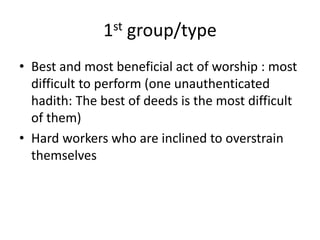
1st group/type
• Best and most beneficial act of worship : most
difficult to perform (one unauthenticated
hadith: The best of deeds is the most difficult
of them)
• Hard workers who are inclined to overstrain
themselves
2nd type
• Wholly devoted to Allah: less interest in worldly matters
• 2 subgroups:
(i) Asceticism (rigorous self-denial, particularly the rejection of
the pleasures of the world) is the ultimate goal – consider it
superior to knowledge & worship
(ii) Asceticism is the means – not the goal:
(ii-A) The committed & knowledgeable of them answer the
commands even if it scatters them and ends their gathering
(ii-B) Deviants:
[1] some of them abandon obligatory duties
[2] abandon other duties, learning useful knowledge
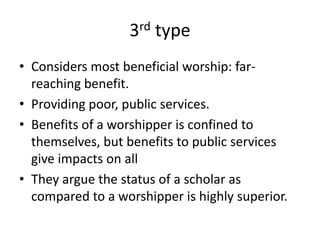
3rd type
• Considers most beneficial worship: far-
reaching benefit.
• Providing poor, public services.
• Benefits of a worshipper is confined to
themselves, but benefits to public services
give impacts on all
• They argue the status of a scholar as
compared to a worshipper is highly superior.
4th type
• Work for the pleasure of Allah according to the
prevalent circumstances
• Best worship in time of Jihad is to participate in
Jihad, even if it results in abandoning
supererogatory acts like Qiyam ul lail and
commendable fasting.
• When one has a guest, the best act is to receive
his with hospitality, leaving aside not-essential
worship that time. The same is true of the rights
of spouse and kins. [FIQH OF PRIORITIES]
• When a student seeks knowledge, then the best worship: to teach
them; when reciting Quraan: best is to concentrate and pondering
upon it fully
• People of unlimited worships
• Comprehensive view of worship
• The accompany scholars, worshippers, fighters in the Cause of
Allah, the Charitable people, the Ascetic people
• Sociable, friendly but feel an aversion to BAD
• Severe against those who are severe against Islam
• Don’t take much interest in joys of Duniya
• When they are in company of Allah  they forget people
• When they in company of People  they forget own desires
Self assessment
• Can U assess the psychology of a group /
believer based on the above 4 categories?
• In which group, you want to be with?
• Do U feel happy if Allah SWT permits U to be
the best group?
• Do U need to work hard to be the member of
that group?
• Will U be satisfied (not confused anymore) to
be with the best group?
How do we behave to others?
[Dealings with others]
REFERENCE
• Tafsir Sura Tauba by Yousuf Abdullah Azzam
• Born 1941 in the Palestinian
• mid-1950s, Azzam joined the Muslim
Brotherhood
• Recognizing Azzam's sharp mind, Shafiq Asad
gave Azzam a religious education and introduced
him to many of the Brotherhood's leaders in
Palestine
• In 1963, Azzam enrolled in the Faculty of Sharia
at the University of Damascus in Syria
Ref: Wiki
• In 1971, Azzam received a scholarship to return to Al-Azhar
University where he obtained his Ph.D. in the Principles of
Islamic Jurisprudence (Usool ul-Fiqh) in 1973.
• Azzam -- lecturer at King Abdul Aziz University in Jeddah,
Saudi Arabia, where he remained until 1979.
• When the Soviet Union invaded Afghanistan in 1979, Azzam
issued a fatwa, Defence of the Muslim Lands, the First
Obligation after Faith for all Muslims. The edict was supported
by Saudi Arabia's Grand Mufti, Abd al-Aziz Bin Baz.
• Afghan war till end of his life
• On 24 November 1989, assassinated by car bombs at Peshwar
(probably by CIA).
Yousuf Azzam’s view
• 30 years of Dawah compelled me to learn:
(1) Self-pride covers a Dayee after a while
 Becomes arrogant with the increasing
number of people
 If the Dayee is not suitable for this work, he
becomes problematic to organization  Hence
Self-Purification is essential frequently
• (2) If only engage in dawah but don’t purify
himself  it can’t be solely for pleasure of
Allah  They sleep at night and wake up in
the morning  no intension for /execution of
increased self-Ibadah
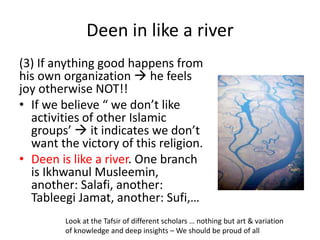
Deen in like a river
(3) If anything good happens from
his own organization  he feels
joy otherwise NOT!!
• If we believe “ we don’t like
activities of other Islamic
groups’  it indicates we don’t
want the victory of this religion.
• Deen is like a river. One branch
is Ikhwanul Musleemin,
another: Salafi, another:
Tableegi Jamat, another: Sufi,…
Look at the Tafsir of different scholars … nothing but art & variation
of knowledge and deep insights – We should be proud of all
• You want all the branches of that riven should dry up and
only your branch will flow! Can you make the river stronger
by this process?
• If a salaf brother writes a book  U should be happy (Do U
feel happy even any brother of own org does some good
achievements?)
• If someone ask you: what do U think about Tableeg e
Jamat? And U said: Don’t go to them. They forgot the
Baiyay of Jihad. [Logic]
• Tarbiyaat of workers are needed . Cooperation between
organizations. We’ll worship to Allah, not to a particular
organization.
• Majhabi strictness  Group strictness
Why did I select the reference of
Azzam (Rahimullah)?
Extreme compassion to Ummah
Self assessment
• Do U feel happy if Allah SWT permits U to be
in a group who acts to others as discussed
before?
• Do U need to work hard to be the member of
that group who behaves to other groups in
this manner?
To whom Allah SWT implants Hiqmah?
• From the authority of Abu Dhar Gifari (R), Prophet (Sm)
said: whoever lives in this life plain & simple (apply
'Juhd' - not inclined to the materialistic life truely),
Allah SWT implants a plant of 'Hiqmah' in his heart &
bestows word of 'Hiqmah' in his tongue. Allah SWT
gives him the sight to identify the faults/errors of
Dunya and at the same time bestow him with
Knowledge for the medicine & treatments of those
faults/errors. And Allah SWT takes him away from
Duniya with safety and put him into Jannah.
(Bayhaqi)

Cclc manzur

  • 1.
    Ideal IPDC Member’sGoal Dr Manzur Ashraf
  • 2.
  • 3.
    Who are we? •Any benchmark? This scholar or that group or that book or idea … REFERENCE • Ibn Al Qayyim [1292–1350 CE] “Madarij As Salikin” [The Path of Those Who Follow the Way] • 4 types of acts of worships
  • 4.
    1st group/type • Bestand most beneficial act of worship : most difficult to perform (one unauthenticated hadith: The best of deeds is the most difficult of them) • Hard workers who are inclined to overstrain themselves
  • 5.
    2nd type • Whollydevoted to Allah: less interest in worldly matters • 2 subgroups: (i) Asceticism (rigorous self-denial, particularly the rejection of the pleasures of the world) is the ultimate goal – consider it superior to knowledge & worship (ii) Asceticism is the means – not the goal: (ii-A) The committed & knowledgeable of them answer the commands even if it scatters them and ends their gathering (ii-B) Deviants: [1] some of them abandon obligatory duties [2] abandon other duties, learning useful knowledge
  • 6.
    3rd type • Considersmost beneficial worship: far- reaching benefit. • Providing poor, public services. • Benefits of a worshipper is confined to themselves, but benefits to public services give impacts on all • They argue the status of a scholar as compared to a worshipper is highly superior.
  • 7.
    4th type • Workfor the pleasure of Allah according to the prevalent circumstances • Best worship in time of Jihad is to participate in Jihad, even if it results in abandoning supererogatory acts like Qiyam ul lail and commendable fasting. • When one has a guest, the best act is to receive his with hospitality, leaving aside not-essential worship that time. The same is true of the rights of spouse and kins. [FIQH OF PRIORITIES]
  • 8.
    • When astudent seeks knowledge, then the best worship: to teach them; when reciting Quraan: best is to concentrate and pondering upon it fully • People of unlimited worships • Comprehensive view of worship • The accompany scholars, worshippers, fighters in the Cause of Allah, the Charitable people, the Ascetic people • Sociable, friendly but feel an aversion to BAD • Severe against those who are severe against Islam • Don’t take much interest in joys of Duniya • When they are in company of Allah  they forget people • When they in company of People  they forget own desires
  • 9.
    Self assessment • CanU assess the psychology of a group / believer based on the above 4 categories? • In which group, you want to be with? • Do U feel happy if Allah SWT permits U to be the best group? • Do U need to work hard to be the member of that group? • Will U be satisfied (not confused anymore) to be with the best group?
  • 10.
    How do webehave to others? [Dealings with others]
  • 11.
    REFERENCE • Tafsir SuraTauba by Yousuf Abdullah Azzam • Born 1941 in the Palestinian • mid-1950s, Azzam joined the Muslim Brotherhood • Recognizing Azzam's sharp mind, Shafiq Asad gave Azzam a religious education and introduced him to many of the Brotherhood's leaders in Palestine • In 1963, Azzam enrolled in the Faculty of Sharia at the University of Damascus in Syria Ref: Wiki
  • 12.
    • In 1971,Azzam received a scholarship to return to Al-Azhar University where he obtained his Ph.D. in the Principles of Islamic Jurisprudence (Usool ul-Fiqh) in 1973. • Azzam -- lecturer at King Abdul Aziz University in Jeddah, Saudi Arabia, where he remained until 1979. • When the Soviet Union invaded Afghanistan in 1979, Azzam issued a fatwa, Defence of the Muslim Lands, the First Obligation after Faith for all Muslims. The edict was supported by Saudi Arabia's Grand Mufti, Abd al-Aziz Bin Baz. • Afghan war till end of his life • On 24 November 1989, assassinated by car bombs at Peshwar (probably by CIA).
  • 13.
    Yousuf Azzam’s view •30 years of Dawah compelled me to learn: (1) Self-pride covers a Dayee after a while  Becomes arrogant with the increasing number of people  If the Dayee is not suitable for this work, he becomes problematic to organization  Hence Self-Purification is essential frequently
  • 14.
    • (2) Ifonly engage in dawah but don’t purify himself  it can’t be solely for pleasure of Allah  They sleep at night and wake up in the morning  no intension for /execution of increased self-Ibadah
  • 15.
    Deen in likea river (3) If anything good happens from his own organization  he feels joy otherwise NOT!! • If we believe “ we don’t like activities of other Islamic groups’  it indicates we don’t want the victory of this religion. • Deen is like a river. One branch is Ikhwanul Musleemin, another: Salafi, another: Tableegi Jamat, another: Sufi,… Look at the Tafsir of different scholars … nothing but art & variation of knowledge and deep insights – We should be proud of all
  • 16.
    • You wantall the branches of that riven should dry up and only your branch will flow! Can you make the river stronger by this process? • If a salaf brother writes a book  U should be happy (Do U feel happy even any brother of own org does some good achievements?) • If someone ask you: what do U think about Tableeg e Jamat? And U said: Don’t go to them. They forgot the Baiyay of Jihad. [Logic] • Tarbiyaat of workers are needed . Cooperation between organizations. We’ll worship to Allah, not to a particular organization. • Majhabi strictness  Group strictness
  • 17.
    Why did Iselect the reference of Azzam (Rahimullah)? Extreme compassion to Ummah
  • 18.
    Self assessment • DoU feel happy if Allah SWT permits U to be in a group who acts to others as discussed before? • Do U need to work hard to be the member of that group who behaves to other groups in this manner?
  • 19.
    To whom AllahSWT implants Hiqmah? • From the authority of Abu Dhar Gifari (R), Prophet (Sm) said: whoever lives in this life plain & simple (apply 'Juhd' - not inclined to the materialistic life truely), Allah SWT implants a plant of 'Hiqmah' in his heart & bestows word of 'Hiqmah' in his tongue. Allah SWT gives him the sight to identify the faults/errors of Dunya and at the same time bestow him with Knowledge for the medicine & treatments of those faults/errors. And Allah SWT takes him away from Duniya with safety and put him into Jannah. (Bayhaqi)