Introduction The environment ACDC Support Adaption to demand Adaption to failures Conclusions 
Supportive Consensus for Smart Grid Management 
Miguel Rebollo C. Carrascosa A. Palomares 
Univ. Politècnica de València (Spain) 
CITINET ’14 
Lucca, September 2014 
M. Rebollo et al. (UPV) CITINET’14 
Supportive Consensus for Smart Grid Management
Introduction The environment ACDC Support Adaption to demand Adaption to failures Conclusions 
Energy management problem 
Motivation 
Smart cities depend on a smart grid to ensure resilient delivery of 
energy to supply their functions 
intelligent components connected in some network structure 
large scale ! avoid information overload 
decentralized and distributed control mechanisms 
M. Rebollo et al. (UPV) CITINET’14 
Supportive Consensus for Smart Grid Management
Introduction The environment ACDC Support Adaption to demand Adaption to failures Conclusions 
Our proposal 
The challenge 
Create a self-adaptive system that adapts itself to the electrical 
demand using local information. 
What is done. . . 
combination of gossip protocols to spread information to 
direct neighbors 
supportive 
real-time adaption to changes in the demand 
failure tolerant 
M. Rebollo et al. (UPV) CITINET’14 
Supportive Consensus for Smart Grid Management
Introduction The environment ACDC Support Adaption to demand Adaption to failures Conclusions 
The city 
M. Rebollo et al. (UPV) CITINET’14 
Supportive Consensus for Smart Grid Management
Introduction The environment ACDC Support Adaption to demand Adaption to failures Conclusions 
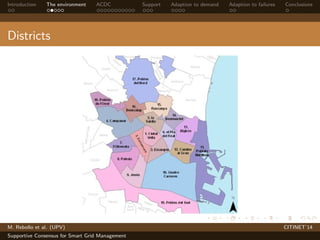
Districts 
M. Rebollo et al. (UPV) CITINET’14 
Supportive Consensus for Smart Grid Management
Introduction The environment ACDC Support Adaption to demand Adaption to failures Conclusions 
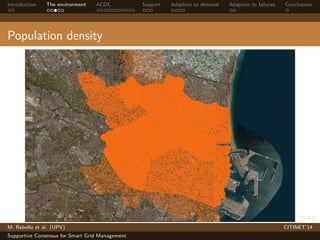
Population density 
M. Rebollo et al. (UPV) CITINET’14 
Supportive Consensus for Smart Grid Management
Introduction The environment ACDC Support Adaption to demand Adaption to failures Conclusions 
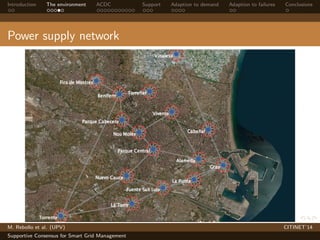
Power supply network 
M. Rebollo et al. (UPV) CITINET’14 
Supportive Consensus for Smart Grid Management
Introduction The environment ACDC Support Adaption to demand Adaption to failures Conclusions 
The model 
M. Rebollo et al. (UPV) CITINET’14 
Supportive Consensus for Smart Grid Management
Introduction The environment ACDC Support Adaption to demand Adaption to failures Conclusions 
Consensus 
what is it? 
M. Rebollo et al. (UPV) CITINET’14 
Supportive Consensus for Smart Grid Management
Introduction The environment ACDC Support Adaption to demand Adaption to failures Conclusions 
Consensus 
what is it used for? 
M. Rebollo et al. (UPV) CITINET’14 
Supportive Consensus for Smart Grid Management
Introduction The environment ACDC Support Adaption to demand Adaption to failures Conclusions 
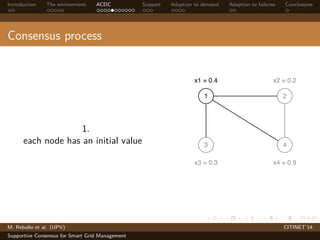
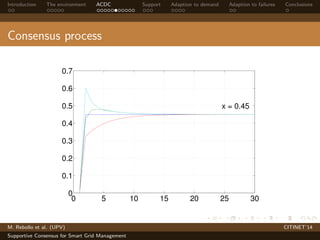
Consensus process 
1. 
each node has an initial value 
x1 = 0.4 x2 = 0.2 
1 2 
3 4 
x1 = 0.4 
x3 = 0.3 x4 = 0.9 
M. Rebollo et al. (UPV) CITINET’14 
Supportive Consensus for Smart Grid Management
Introduction The environment ACDC Support Adaption to demand Adaption to failures Conclusions 
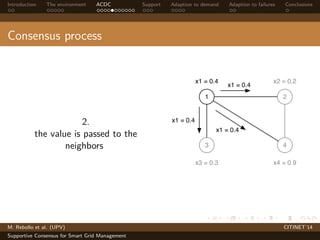
Consensus process 
2. 
the value is passed to the 
neighbors 
x1 = 0.4 x2 = 0.2 
x1 = 0.4 
1 2 
3 4 
x3 = 0.3 x4 = 0.9 
x1 = 0.4 
x1 = 0.4 
M. Rebollo et al. (UPV) CITINET’14 
Supportive Consensus for Smart Grid Management
Introduction The environment ACDC Support Adaption to demand Adaption to failures Conclusions 
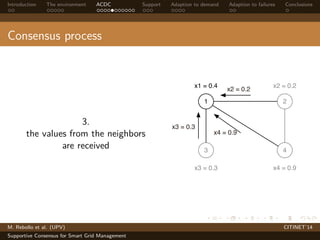
Consensus process 
3. 
the values from the neighbors 
are received 
x1 = 0.4 x2 = 0.2 
x2 = 0.2 
1 2 
x4 = 0.9 
3 4 
x3 = 0.3 
x3 = 0.3 x4 = 0.9 
M. Rebollo et al. (UPV) CITINET’14 
Supportive Consensus for Smart Grid Management
Introduction The environment ACDC Support Adaption to demand Adaption to failures Conclusions 
Consensus process 
4. 
the new value is calculated by 
x(t+1) = x(t)+" 
X 
j2Ni 
[xj (t) − xi (t)] 
where " < mini 
1 
di 
x1 = 0.45 x2 = 0.425 
1 2 
3 4 
x3 = 0.325 x4 = 0.6 
x1 = 0.4 
M. Rebollo et al. (UPV) CITINET’14 
Supportive Consensus for Smart Grid Management
Introduction The environment ACDC Support Adaption to demand Adaption to failures Conclusions 
Consensus process 
0.7 
0.6 
0.5 
0.4 
0.3 
0.2 
0.1 
0 
x = 0.45 
0 5 10 15 20 25 30 
M. Rebollo et al. (UPV) CITINET’14 
Supportive Consensus for Smart Grid Management
Introduction The environment ACDC Support Adaption to demand Adaption to failures Conclusions 
Data aggregation protocols 
consensus can not calculate aggregate values 
consensus belongs to a broader family of protocols 
network topology: unstructured 
routing scheme: gossip 
M. Rebollo et al. (UPV) CITINET’14 
Supportive Consensus for Smart Grid Management
Introduction The environment ACDC Support Adaption to demand Adaption to failures Conclusions 
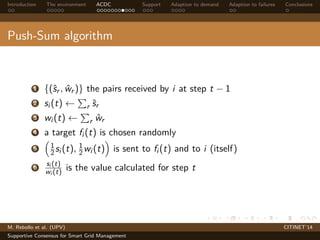
Push-Sum algorithm 
1 {(^sr , ^wr )} the pairs received by i at step t − 1 
2 si (t)   
P 
r ^sr 
3 wi (t)   
P 
r ^wr 
4 a target fi tis chosen randomly 
 
() 5 
12 
si (t), 1 
2wi (t) 
 
is sent to fi (t) and to i (itself) 
6 si (t) 
wi (t) is the value calculated for step t 
M. Rebollo et al. (UPV) CITINET’14 
Supportive Consensus for Smart Grid Management
Introduction The environment ACDC Support Adaption to demand Adaption to failures Conclusions 
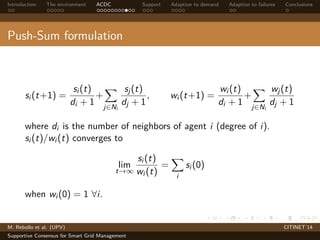
Push-Sum formulation 
si (t+1) = 
si (t) 
di + 1+ 
X 
j2Ni 
sj (t) 
dj + 1, wi (t+1) = 
wi (t) 
di + 1+ 
X 
j2Ni 
wj (t) 
dj + 1 
where di is the number of neighbors of agent i (degree of i). 
si (t)/wi (t) converges to 
lim t!1 
si (t) 
wi (t) 
= 
X 
i 
si (0) 
when wi (0) = 1 8i. 
M. Rebollo et al. (UPV) CITINET’14 
Supportive Consensus for Smart Grid Management
Introduction The environment ACDC Support Adaption to demand Adaption to failures Conclusions 
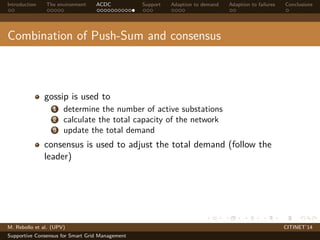
Combination of Push-Sum and consensus 
gossip is used to 
1 determine the number of active substations 
2 calculate the total capacity of the network 
3 update the total demand 
consensus is used to adjust the total demand (follow the 
leader) 
M. Rebollo et al. (UPV) CITINET’14 
Supportive Consensus for Smart Grid Management
Introduction The environment ACDC Support Adaption to demand Adaption to failures Conclusions 
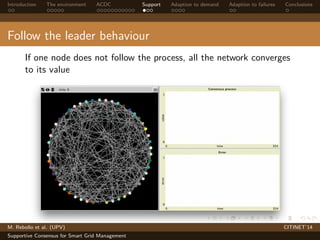
Follow the leader behaviour 
If one node does not follow the process, all the network converges 
to its value 
M. Rebollo et al. (UPV) CITINET’14 
Supportive Consensus for Smart Grid Management
Introduction The environment ACDC Support Adaption to demand Adaption to failures Conclusions 
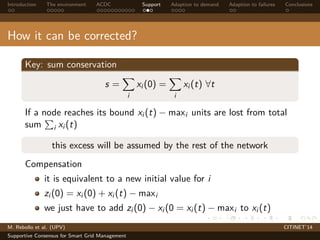
How it can be corrected? 
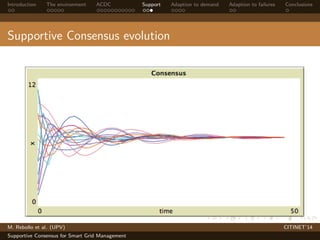
Key: sum conservation 
s = 
X 
i 
xi (0) = 
X 
i 
xi (t) 8t 
If a node reaches its bound xi (t) − maxi units are lost from total 
sum P 
i xi (t) 
this excess will be assumed by the rest of the network 
Compensation 
it is equivalent to a new initial value for i 
zi (0) = xi (0) + xi (t) − maxi 
we just have to add zi (0) − xi (0 = xi (t) − maxi to xi (t) 
M. Rebollo et al. (UPV) CITINET’14 
Supportive Consensus for Smart Grid Management
Introduction The environment ACDC Support Adaption to demand Adaption to failures Conclusions 
Supportive Consensus evolution 
M. Rebollo et al. (UPV) CITINET’14 
Supportive Consensus for Smart Grid Management
Introduction The environment ACDC Support Adaption to demand Adaption to failures Conclusions 
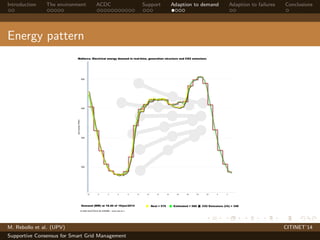
Energy pattern 
M. Rebollo et al. (UPV) CITINET’14 
Supportive Consensus for Smart Grid Management
Introduction The environment ACDC Support Adaption to demand Adaption to failures Conclusions 
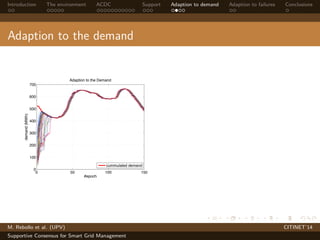
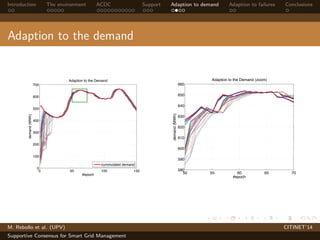
Adaption to the demand 
700 
600 
500 
400 
300 
200 
100 
0 
Adaption to the Demand 
0 50 100 150 
#epoch 
demand (MWh) 
cummulated demand 
M. Rebollo et al. (UPV) CITINET’14 
Supportive Consensus for Smart Grid Management
Introduction The environment ACDC Support Adaption to demand Adaption to failures Conclusions 
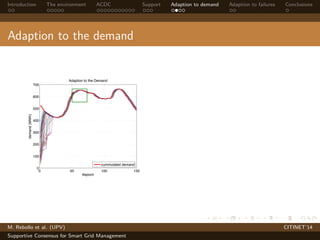
Adaption to the demand 
700 
600 
500 
400 
300 
200 
100 
0 
Adaption to the Demand 
0 50 100 150 
#epoch 
demand (MWh) 
cummulated demand 
M. Rebollo et al. (UPV) CITINET’14 
Supportive Consensus for Smart Grid Management
Introduction The environment ACDC Support Adaption to demand Adaption to failures Conclusions 
Adaption to the demand 
700 
600 
500 
400 
300 
200 
100 
0 
Adaption to the Demand 
0 50 100 150 
#epoch 
demand (MWh) 
cummulated demand 
660 
650 
640 
630 
620 
610 
600 
590 
580 
Adaption to the Demand (zoom) 
50 55 60 65 70 
#epoch 
demand (MWh) 
M. Rebollo et al. (UPV) CITINET’14 
Supportive Consensus for Smart Grid Management
Introduction The environment ACDC Support Adaption to demand Adaption to failures Conclusions 
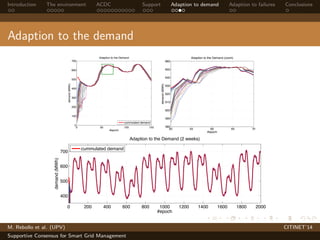
Adaption to the demand 
700 
600 
500 
400 
300 
200 
100 
0 
Adaption to the Demand 
0 50 100 150 
#epoch 
demand (MWh) 
cummulated demand 
660 
650 
640 
630 
620 
610 
600 
590 
580 
Adaption to the Demand (zoom) 
50 55 60 65 70 
#epoch 
demand (MWh) 
700 
600 
500 
400 
Adaption to the Demand (2 weeks) 
0 200 400 600 800 1000 1200 1400 1600 1800 2000 
#epoch 
demand (MWh) 
cummulated demand 
M. Rebollo et al. (UPV) CITINET’14 
Supportive Consensus for Smart Grid Management
Introduction The environment ACDC Support Adaption to demand Adaption to failures Conclusions 
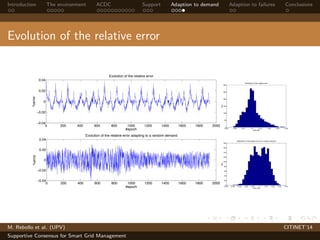
Evolution of the relative error 
0.04 
0.02 
0 
−0.02 
Evolution of the relative error 
0 200 400 600 800 1000 1200 1400 1600 1800 2000 −0.04 
%error 
#epoch 
300 
250 
200 
150 
100 
50 
0 
Distribution of the relative error 
−0.03 −0.02 −0.01 0 0.01 0.02 0.03 0.04 
error rate 
freq. 
0.04 
0.02 
0 
−0.02 
Evolution of the relative error adapting to a random demand 
0 200 400 600 800 1000 1200 1400 1600 1800 2000 −0.04 
#epoch 
%error 
180 
160 
140 
120 
100 
80 
60 
40 
20 
0 
−0.05 −0.04 −0.03 −0.02 −0.01 0 0.01 0.02 0.03 0.04 
error rate 
freq. 
Distribution of the relative error for a random demand 
M. Rebollo et al. (UPV) CITINET’14 
Supportive Consensus for Smart Grid Management
Introduction The environment ACDC Support Adaption to demand Adaption to failures Conclusions 
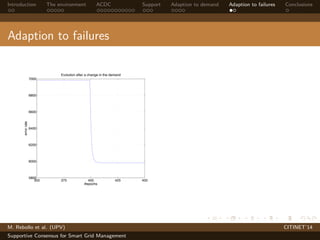
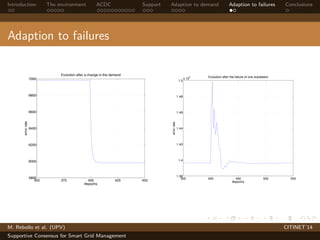
Adaption to failures 
7000 
6800 
6600 
6400 
6200 
6000 
5800 
350 375 400 425 450 
#epochs 
error rate 
Evolution after a change in the demand 
M. Rebollo et al. (UPV) CITINET’14 
Supportive Consensus for Smart Grid Management
Introduction The environment ACDC Support Adaption to demand Adaption to failures Conclusions 
Adaption to failures 
7000 
6800 
6600 
6400 
6200 
6000 
5800 
350 375 400 425 450 
#epochs 
error rate 
Evolution after a change in the demand 
1.5 
1.48 
1.46 
1.44 
1.42 
1.4 
1.38 
4 
x 10 
350 400 450 500 550 
#epochs 
error rate 
Evolution after the failure of one substation 
M. Rebollo et al. (UPV) CITINET’14 
Supportive Consensus for Smart Grid Management
Introduction The environment ACDC Support Adaption to demand Adaption to failures Conclusions 
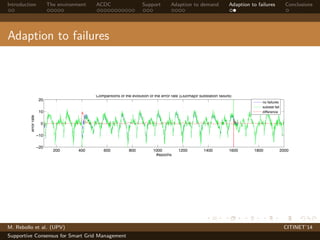
Adaption to failures 
200 400 600 800 1000 1200 1400 1600 1800 2000 
20 
10 
0 
−10 
−20 
#epochs 
error rate 
Comparitions of the evolution of the error rate (Llucmajor substation failure) 
no failures 
substat fail 
difference 
M. Rebollo et al. (UPV) CITINET’14 
Supportive Consensus for Smart Grid Management
Introduction The environment ACDC Support Adaption to demand Adaption to failures Conclusions 
Conclusions 
What we’ve done 
To apply a combination of gossip methods to create a supportive, 
failure tolerant, self-adaptive system for smart-grids 
information exchanged with direct neighbors only 
no global repository of data nor central control needed 
push-sum and consensus protocol combined 
supportive for nodes out of their bounds 
the network adapts itself to changes in the electrical demand 
failures are detected and assumed by the rest of active 
substations 
M. Rebollo et al. (UPV) CITINET’14 
Supportive Consensus for Smart Grid Management

Supportive consensus for smart grid management

  • 1.
    Introduction The environmentACDC Support Adaption to demand Adaption to failures Conclusions Supportive Consensus for Smart Grid Management Miguel Rebollo C. Carrascosa A. Palomares Univ. Politècnica de València (Spain) CITINET ’14 Lucca, September 2014 M. Rebollo et al. (UPV) CITINET’14 Supportive Consensus for Smart Grid Management
  • 2.
    Introduction The environmentACDC Support Adaption to demand Adaption to failures Conclusions Energy management problem Motivation Smart cities depend on a smart grid to ensure resilient delivery of energy to supply their functions intelligent components connected in some network structure large scale ! avoid information overload decentralized and distributed control mechanisms M. Rebollo et al. (UPV) CITINET’14 Supportive Consensus for Smart Grid Management
  • 3.
    Introduction The environmentACDC Support Adaption to demand Adaption to failures Conclusions Our proposal The challenge Create a self-adaptive system that adapts itself to the electrical demand using local information. What is done. . . combination of gossip protocols to spread information to direct neighbors supportive real-time adaption to changes in the demand failure tolerant M. Rebollo et al. (UPV) CITINET’14 Supportive Consensus for Smart Grid Management
  • 4.
    Introduction The environmentACDC Support Adaption to demand Adaption to failures Conclusions The city M. Rebollo et al. (UPV) CITINET’14 Supportive Consensus for Smart Grid Management
  • 5.
    Introduction The environmentACDC Support Adaption to demand Adaption to failures Conclusions Districts M. Rebollo et al. (UPV) CITINET’14 Supportive Consensus for Smart Grid Management
  • 6.
    Introduction The environmentACDC Support Adaption to demand Adaption to failures Conclusions Population density M. Rebollo et al. (UPV) CITINET’14 Supportive Consensus for Smart Grid Management
  • 7.
    Introduction The environmentACDC Support Adaption to demand Adaption to failures Conclusions Power supply network M. Rebollo et al. (UPV) CITINET’14 Supportive Consensus for Smart Grid Management
  • 8.
    Introduction The environmentACDC Support Adaption to demand Adaption to failures Conclusions The model M. Rebollo et al. (UPV) CITINET’14 Supportive Consensus for Smart Grid Management
  • 9.
    Introduction The environmentACDC Support Adaption to demand Adaption to failures Conclusions Consensus what is it? M. Rebollo et al. (UPV) CITINET’14 Supportive Consensus for Smart Grid Management
  • 14.
    Introduction The environmentACDC Support Adaption to demand Adaption to failures Conclusions Consensus what is it used for? M. Rebollo et al. (UPV) CITINET’14 Supportive Consensus for Smart Grid Management
  • 22.
    Introduction The environmentACDC Support Adaption to demand Adaption to failures Conclusions Consensus process 1. each node has an initial value x1 = 0.4 x2 = 0.2 1 2 3 4 x1 = 0.4 x3 = 0.3 x4 = 0.9 M. Rebollo et al. (UPV) CITINET’14 Supportive Consensus for Smart Grid Management
  • 23.
    Introduction The environmentACDC Support Adaption to demand Adaption to failures Conclusions Consensus process 2. the value is passed to the neighbors x1 = 0.4 x2 = 0.2 x1 = 0.4 1 2 3 4 x3 = 0.3 x4 = 0.9 x1 = 0.4 x1 = 0.4 M. Rebollo et al. (UPV) CITINET’14 Supportive Consensus for Smart Grid Management
  • 24.
    Introduction The environmentACDC Support Adaption to demand Adaption to failures Conclusions Consensus process 3. the values from the neighbors are received x1 = 0.4 x2 = 0.2 x2 = 0.2 1 2 x4 = 0.9 3 4 x3 = 0.3 x3 = 0.3 x4 = 0.9 M. Rebollo et al. (UPV) CITINET’14 Supportive Consensus for Smart Grid Management
  • 25.
    Introduction The environmentACDC Support Adaption to demand Adaption to failures Conclusions Consensus process 4. the new value is calculated by x(t+1) = x(t)+" X j2Ni [xj (t) − xi (t)] where " < mini 1 di x1 = 0.45 x2 = 0.425 1 2 3 4 x3 = 0.325 x4 = 0.6 x1 = 0.4 M. Rebollo et al. (UPV) CITINET’14 Supportive Consensus for Smart Grid Management
  • 26.
    Introduction The environmentACDC Support Adaption to demand Adaption to failures Conclusions Consensus process 0.7 0.6 0.5 0.4 0.3 0.2 0.1 0 x = 0.45 0 5 10 15 20 25 30 M. Rebollo et al. (UPV) CITINET’14 Supportive Consensus for Smart Grid Management
  • 27.
    Introduction The environmentACDC Support Adaption to demand Adaption to failures Conclusions Data aggregation protocols consensus can not calculate aggregate values consensus belongs to a broader family of protocols network topology: unstructured routing scheme: gossip M. Rebollo et al. (UPV) CITINET’14 Supportive Consensus for Smart Grid Management
  • 28.
    Introduction The environmentACDC Support Adaption to demand Adaption to failures Conclusions Push-Sum algorithm 1 {(^sr , ^wr )} the pairs received by i at step t − 1 2 si (t) P r ^sr 3 wi (t) P r ^wr 4 a target fi tis chosen randomly () 5 12 si (t), 1 2wi (t) is sent to fi (t) and to i (itself) 6 si (t) wi (t) is the value calculated for step t M. Rebollo et al. (UPV) CITINET’14 Supportive Consensus for Smart Grid Management
  • 29.
    Introduction The environmentACDC Support Adaption to demand Adaption to failures Conclusions Push-Sum formulation si (t+1) = si (t) di + 1+ X j2Ni sj (t) dj + 1, wi (t+1) = wi (t) di + 1+ X j2Ni wj (t) dj + 1 where di is the number of neighbors of agent i (degree of i). si (t)/wi (t) converges to lim t!1 si (t) wi (t) = X i si (0) when wi (0) = 1 8i. M. Rebollo et al. (UPV) CITINET’14 Supportive Consensus for Smart Grid Management
  • 31.
    Introduction The environmentACDC Support Adaption to demand Adaption to failures Conclusions Combination of Push-Sum and consensus gossip is used to 1 determine the number of active substations 2 calculate the total capacity of the network 3 update the total demand consensus is used to adjust the total demand (follow the leader) M. Rebollo et al. (UPV) CITINET’14 Supportive Consensus for Smart Grid Management
  • 32.
    Introduction The environmentACDC Support Adaption to demand Adaption to failures Conclusions Follow the leader behaviour If one node does not follow the process, all the network converges to its value M. Rebollo et al. (UPV) CITINET’14 Supportive Consensus for Smart Grid Management
  • 33.
    Introduction The environmentACDC Support Adaption to demand Adaption to failures Conclusions How it can be corrected? Key: sum conservation s = X i xi (0) = X i xi (t) 8t If a node reaches its bound xi (t) − maxi units are lost from total sum P i xi (t) this excess will be assumed by the rest of the network Compensation it is equivalent to a new initial value for i zi (0) = xi (0) + xi (t) − maxi we just have to add zi (0) − xi (0 = xi (t) − maxi to xi (t) M. Rebollo et al. (UPV) CITINET’14 Supportive Consensus for Smart Grid Management
  • 34.
    Introduction The environmentACDC Support Adaption to demand Adaption to failures Conclusions Supportive Consensus evolution M. Rebollo et al. (UPV) CITINET’14 Supportive Consensus for Smart Grid Management
  • 35.
    Introduction The environmentACDC Support Adaption to demand Adaption to failures Conclusions Energy pattern M. Rebollo et al. (UPV) CITINET’14 Supportive Consensus for Smart Grid Management
  • 36.
    Introduction The environmentACDC Support Adaption to demand Adaption to failures Conclusions Adaption to the demand 700 600 500 400 300 200 100 0 Adaption to the Demand 0 50 100 150 #epoch demand (MWh) cummulated demand M. Rebollo et al. (UPV) CITINET’14 Supportive Consensus for Smart Grid Management
  • 37.
    Introduction The environmentACDC Support Adaption to demand Adaption to failures Conclusions Adaption to the demand 700 600 500 400 300 200 100 0 Adaption to the Demand 0 50 100 150 #epoch demand (MWh) cummulated demand M. Rebollo et al. (UPV) CITINET’14 Supportive Consensus for Smart Grid Management
  • 38.
    Introduction The environmentACDC Support Adaption to demand Adaption to failures Conclusions Adaption to the demand 700 600 500 400 300 200 100 0 Adaption to the Demand 0 50 100 150 #epoch demand (MWh) cummulated demand 660 650 640 630 620 610 600 590 580 Adaption to the Demand (zoom) 50 55 60 65 70 #epoch demand (MWh) M. Rebollo et al. (UPV) CITINET’14 Supportive Consensus for Smart Grid Management
  • 39.
    Introduction The environmentACDC Support Adaption to demand Adaption to failures Conclusions Adaption to the demand 700 600 500 400 300 200 100 0 Adaption to the Demand 0 50 100 150 #epoch demand (MWh) cummulated demand 660 650 640 630 620 610 600 590 580 Adaption to the Demand (zoom) 50 55 60 65 70 #epoch demand (MWh) 700 600 500 400 Adaption to the Demand (2 weeks) 0 200 400 600 800 1000 1200 1400 1600 1800 2000 #epoch demand (MWh) cummulated demand M. Rebollo et al. (UPV) CITINET’14 Supportive Consensus for Smart Grid Management
  • 40.
    Introduction The environmentACDC Support Adaption to demand Adaption to failures Conclusions Evolution of the relative error 0.04 0.02 0 −0.02 Evolution of the relative error 0 200 400 600 800 1000 1200 1400 1600 1800 2000 −0.04 %error #epoch 300 250 200 150 100 50 0 Distribution of the relative error −0.03 −0.02 −0.01 0 0.01 0.02 0.03 0.04 error rate freq. 0.04 0.02 0 −0.02 Evolution of the relative error adapting to a random demand 0 200 400 600 800 1000 1200 1400 1600 1800 2000 −0.04 #epoch %error 180 160 140 120 100 80 60 40 20 0 −0.05 −0.04 −0.03 −0.02 −0.01 0 0.01 0.02 0.03 0.04 error rate freq. Distribution of the relative error for a random demand M. Rebollo et al. (UPV) CITINET’14 Supportive Consensus for Smart Grid Management
  • 41.
    Introduction The environmentACDC Support Adaption to demand Adaption to failures Conclusions Adaption to failures 7000 6800 6600 6400 6200 6000 5800 350 375 400 425 450 #epochs error rate Evolution after a change in the demand M. Rebollo et al. (UPV) CITINET’14 Supportive Consensus for Smart Grid Management
  • 42.
    Introduction The environmentACDC Support Adaption to demand Adaption to failures Conclusions Adaption to failures 7000 6800 6600 6400 6200 6000 5800 350 375 400 425 450 #epochs error rate Evolution after a change in the demand 1.5 1.48 1.46 1.44 1.42 1.4 1.38 4 x 10 350 400 450 500 550 #epochs error rate Evolution after the failure of one substation M. Rebollo et al. (UPV) CITINET’14 Supportive Consensus for Smart Grid Management
  • 43.
    Introduction The environmentACDC Support Adaption to demand Adaption to failures Conclusions Adaption to failures 200 400 600 800 1000 1200 1400 1600 1800 2000 20 10 0 −10 −20 #epochs error rate Comparitions of the evolution of the error rate (Llucmajor substation failure) no failures substat fail difference M. Rebollo et al. (UPV) CITINET’14 Supportive Consensus for Smart Grid Management
  • 44.
    Introduction The environmentACDC Support Adaption to demand Adaption to failures Conclusions Conclusions What we’ve done To apply a combination of gossip methods to create a supportive, failure tolerant, self-adaptive system for smart-grids information exchanged with direct neighbors only no global repository of data nor central control needed push-sum and consensus protocol combined supportive for nodes out of their bounds the network adapts itself to changes in the electrical demand failures are detected and assumed by the rest of active substations M. Rebollo et al. (UPV) CITINET’14 Supportive Consensus for Smart Grid Management