Outline Discovery Strategy Promotion Techniques Results Conclusions
Strategies for Cooperation Emergence
in Distributed Service Discovery
E. del Val M. Rebollo V. Botti
Univ. Politècnica de València (Spain)
COREDEMA ’13
Salamanca, May 2013
M. Rebollo et al. (UPV) COREDEMA’13
Strategies for Cooperation Emergence in Distributed Service Discovery
Outline Discovery Strategy Promotion Techniques Results Conclusions
Promoting Cooperation
Motivation
There are scenarios in decentralized systems in which cooperation
plays a central role
agents connected in networks
bounded rationality
heterogeneous, self-interested agents
M. Rebollo et al. (UPV) COREDEMA’13
Strategies for Cooperation Emergence in Distributed Service Discovery
Outline Discovery Strategy Promotion Techniques Results Conclusions
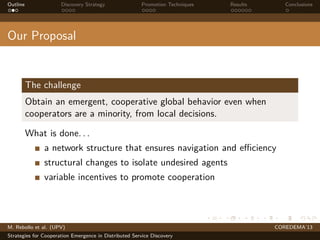
Our Proposal
The challenge
Obtain an emergent, cooperative global behavior even when
cooperators are a minority, from local decisions.
What is done. . .
a network structure that ensures navigation and efficiency
structural changes to isolate undesired agents
variable incentives to promote cooperation
M. Rebollo et al. (UPV) COREDEMA’13
Strategies for Cooperation Emergence in Distributed Service Discovery
Outline Discovery Strategy Promotion Techniques Results Conclusions
Outline
1 Outline
2 Discovery Strategy
3 Isolated Cooperation Promotion Techniques
4 Combined Cooperation Model
5 Results
6 Conclusions
M. Rebollo et al. (UPV) COREDEMA’13
Strategies for Cooperation Emergence in Distributed Service Discovery
Outline Discovery Strategy Promotion Techniques Results Conclusions
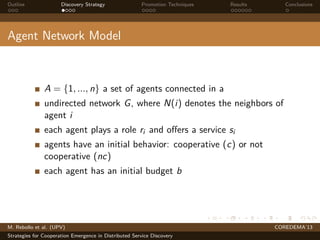
Agent Network Model
A = {1, ..., n} a set of agents connected in a
undirected network G, where N(i) denotes the neighbors of
agent i
each agent plays a role ri and offers a service si
agents have an initial behavior: cooperative (c) or not
cooperative (nc)
each agent has an initial budget b
M. Rebollo et al. (UPV) COREDEMA’13
Strategies for Cooperation Emergence in Distributed Service Discovery
Outline Discovery Strategy Promotion Techniques Results Conclusions
Service Discovery
Purpose
Locate in the network a similar enough service offer by a concrete
role
qt
i = {stg , rtg , TTL, ε, {}}
stg required semantic service description
rtg organizational role the target agent should play
TTL: time to live
ε similarity threshold in [0, 1]
{} participant list (initially empty)
M. Rebollo et al. (UPV) COREDEMA’13
Strategies for Cooperation Emergence in Distributed Service Discovery
Outline Discovery Strategy Promotion Techniques Results Conclusions
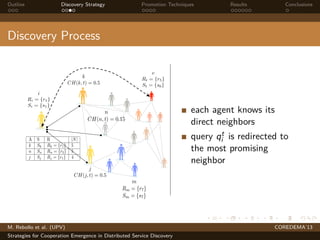
Discovery Process
i
Ri = {r1}
Si = {s1}
k
CH(k, t) = 0.5
j
CH(j, t) = 0.5
n
CH(n, t) = 0.15
A S R |N|
k Sk Rk = {r1} 5
n Sn Rn = {r2} 5
j Sj Rj = {r1} 4
v
Rt = {r5}
St = {s6}
m
Rm = {r7}
Sm = {s7}
each agent knows its
direct neighbors
query qt
i is redirected to
the most promising
neighbor
M. Rebollo et al. (UPV) COREDEMA’13
Strategies for Cooperation Emergence in Distributed Service Discovery
Outline Discovery Strategy Promotion Techniques Results Conclusions
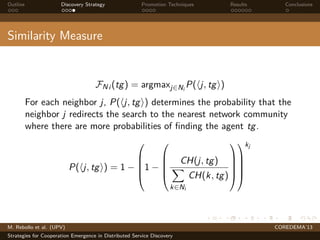
Similarity Measure
FNi (tg) = argmaxj∈Ni
P( j, tg )
For each neighbor j, P( j, tg ) determines the probability that the
neighbor j redirects the search to the nearest network community
where there are more probabilities of finding the agent tg.
P( j, tg ) = 1 −





1 −





CH(j, tg)
k∈Ni
CH(k, tg)










kj
M. Rebollo et al. (UPV) COREDEMA’13
Strategies for Cooperation Emergence in Distributed Service Discovery
Outline Discovery Strategy Promotion Techniques Results Conclusions
Social Plasticity
0
0.1
0.2
0.3
0.4
0.5
0.6
0.7
0.8
0.9
1
0 10 20 30 40 50 60
Probabilitytomaintainthelink
Number of queries that were forwarded to other links
n = 2
n = 4
n = 6
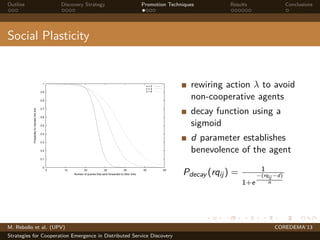
rewiring action λ to avoid
non-cooperative agents
decay function using a
sigmoid
d parameter establishes
benevolence of the agent
Pdecay (rqij) = 1
1+e
−(rqij −d)
n
M. Rebollo et al. (UPV) COREDEMA’13
Strategies for Cooperation Emergence in Distributed Service Discovery
Outline Discovery Strategy Promotion Techniques Results Conclusions
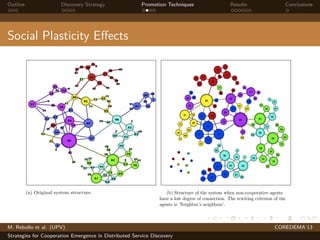
Social Plasticity Effects
M. Rebollo et al. (UPV) COREDEMA’13
Strategies for Cooperation Emergence in Distributed Service Discovery
Outline Discovery Strategy Promotion Techniques Results Conclusions
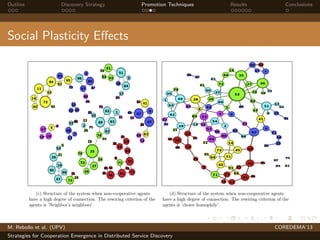
Social Plasticity Effects
M. Rebollo et al. (UPV) COREDEMA’13
Strategies for Cooperation Emergence in Distributed Service Discovery
Outline Discovery Strategy Promotion Techniques Results Conclusions
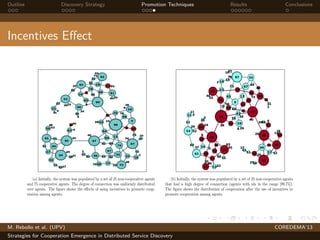
Incentives Effect
M. Rebollo et al. (UPV) COREDEMA’13
Strategies for Cooperation Emergence in Distributed Service Discovery
Outline Discovery Strategy Promotion Techniques Results Conclusions
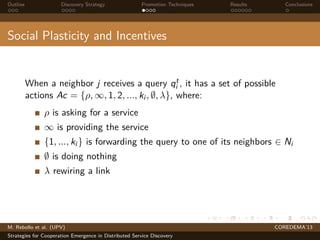
Social Plasticity and Incentives
When a neighbor j receives a query qt
i , it has a set of possible
actions Ac = {ρ, ∞, 1, 2, ..., ki , ∅, λ}, where:
ρ is asking for a service
∞ is providing the service
{1, ..., ki } is forwarding the query to one of its neighbors ∈ Ni
∅ is doing nothing
λ rewiring a link
M. Rebollo et al. (UPV) COREDEMA’13
Strategies for Cooperation Emergence in Distributed Service Discovery
Outline Discovery Strategy Promotion Techniques Results Conclusions
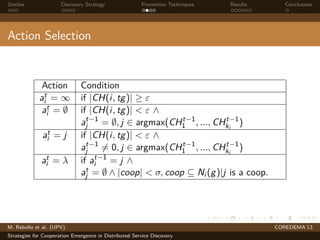
Action Selection
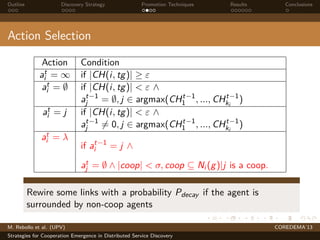
Action Condition
at
i = ∞ if |CH(i, tg)| ≥ ε
at
i = ∅ if |CH(i, tg)| < ε ∧
at−1
j = ∅, j ∈ argmax(CHt−1
1 , ..., CHt−1
ki
)
at
i = j if |CH(i, tg)| < ε ∧
at−1
j = 0, j ∈ argmax(CHt−1
1 , ..., CHt−1
ki
)
at
i = λ if at−1
i = j ∧
at
j = ∅ ∧ |coop| < σ, coop ⊆ Ni (g)|j is a coop.
M. Rebollo et al. (UPV) COREDEMA’13
Strategies for Cooperation Emergence in Distributed Service Discovery
Outline Discovery Strategy Promotion Techniques Results Conclusions
Action Selection
Action Condition
at
i = ∞
if |CH(i, tg)| ≥ ε
at
i = ∅ if |CH(i, tg)| < ε ∧
at−1
j = ∅, j ∈ argmax(CHt−1
1 , ..., CHt−1
ki
)
at
i = j if |CH(i, tg)| < ε ∧
at−1
j = 0, j ∈ argmax(CHt−1
1 , ..., CHt−1
ki
)
at
i = λ if at−1
i = j ∧
at
j = ∅ ∧ |coop| < σ, coop ⊆ Ni (g)|j is a coop.
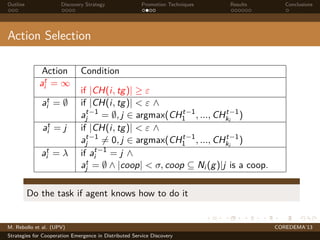
Do the task if agent knows how to do it
M. Rebollo et al. (UPV) COREDEMA’13
Strategies for Cooperation Emergence in Distributed Service Discovery
Outline Discovery Strategy Promotion Techniques Results Conclusions
Action Selection
Action Condition
at
i = ∞ if |CH(i, tg)| ≥ ε
at
i = ∅
if |CH(i, tg)| < ε ∧
at−1
j = ∅, j ∈ argmax(CHt−1
1 , ..., CHt−1
ki
)
at
i = j if |CH(i, tg)| < ε ∧
at−1
j = 0, j ∈ argmax(CHt−1
1 , ..., CHt−1
ki
)
at
i = λ if at−1
i = j ∧
at
j = ∅ ∧ |coop| < σ, coop ⊆ Ni (g)|j is a coop.
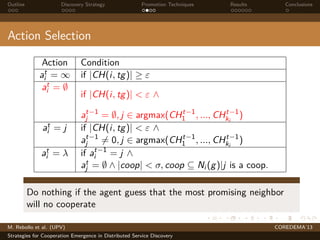
Do nothing if the agent guess that the most promising neighbor
will no cooperate
M. Rebollo et al. (UPV) COREDEMA’13
Strategies for Cooperation Emergence in Distributed Service Discovery
Outline Discovery Strategy Promotion Techniques Results Conclusions
Action Selection
Action Condition
at
i = ∞ if |CH(i, tg)| ≥ ε
at
i = ∅ if |CH(i, tg)| < ε ∧
at−1
j = ∅, j ∈ argmax(CHt−1
1 , ..., CHt−1
ki
)
at
i = j
if |CH(i, tg)| < ε ∧
at−1
j = 0, j ∈ argmax(CHt−1
1 , ..., CHt−1
ki
)
at
i = λ if at−1
i = j ∧
at
j = ∅ ∧ |coop| < σ, coop ⊆ Ni (g)|j is a coop.
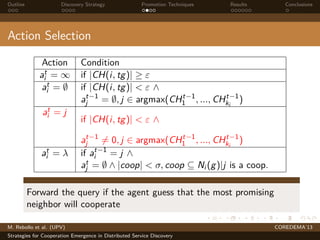
Forward the query if the agent guess that the most promising
neighbor will cooperate
M. Rebollo et al. (UPV) COREDEMA’13
Strategies for Cooperation Emergence in Distributed Service Discovery
Outline Discovery Strategy Promotion Techniques Results Conclusions
Action Selection
Action Condition
at
i = ∞ if |CH(i, tg)| ≥ ε
at
i = ∅ if |CH(i, tg)| < ε ∧
at−1
j = ∅, j ∈ argmax(CHt−1
1 , ..., CHt−1
ki
)
at
i = j if |CH(i, tg)| < ε ∧
at−1
j = 0, j ∈ argmax(CHt−1
1 , ..., CHt−1
ki
)
at
i = λ
if at−1
i = j ∧
at
j = ∅ ∧ |coop| < σ, coop ⊆ Ni (g)|j is a coop.
Rewire some links with a probability Pdecay if the agent is
surrounded by non-coop agents
M. Rebollo et al. (UPV) COREDEMA’13
Strategies for Cooperation Emergence in Distributed Service Discovery
Outline Discovery Strategy Promotion Techniques Results Conclusions
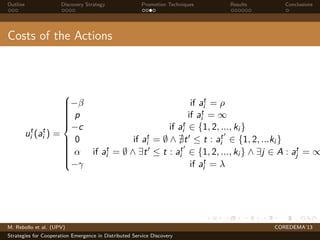
Costs of the Actions
ut
i (at
i ) =



−β if at
i = ρ
p if at
i = ∞
−c if at
i ∈ {1, 2, ..., ki }
0 if at
i = ∅ ∧ t ≤ t : at
i ∈ {1, 2, ...ki }
α if at
i = ∅ ∧ ∃t ≤ t : at
i ∈ {1, 2, ..., ki } ∧ ∃j ∈ A : at
j = ∞
−γ if at
i = λ
M. Rebollo et al. (UPV) COREDEMA’13
Strategies for Cooperation Emergence in Distributed Service Discovery
Outline Discovery Strategy Promotion Techniques Results Conclusions
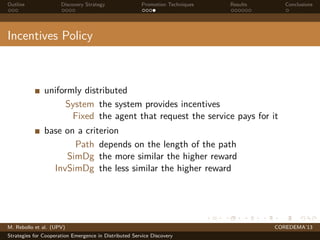
Incentives Policy
uniformly distributed
System the system provides incentives
Fixed the agent that request the service pays for it
base on a criterion
Path depends on the length of the path
SimDg the more similar the higher reward
InvSimDg the less similar the higher reward
M. Rebollo et al. (UPV) COREDEMA’13
Strategies for Cooperation Emergence in Distributed Service Discovery
Outline Discovery Strategy Promotion Techniques Results Conclusions
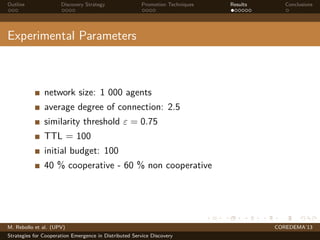
Experimental Parameters
network size: 1 000 agents
average degree of connection: 2.5
similarity threshold ε = 0.75
TTL = 100
initial budget: 100
40 % cooperative - 60 % non cooperative
M. Rebollo et al. (UPV) COREDEMA’13
Strategies for Cooperation Emergence in Distributed Service Discovery
Outline Discovery Strategy Promotion Techniques Results Conclusions
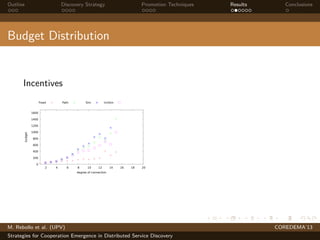
Budget Distribution
Incentives
0
200
400
600
800
1000
1200
1400
1600
2 4 6 8 10 12 14 16 18 20
budget
degree of connection
Fixed Path Sim InvSim
M. Rebollo et al. (UPV) COREDEMA’13
Strategies for Cooperation Emergence in Distributed Service Discovery
Outline Discovery Strategy Promotion Techniques Results Conclusions
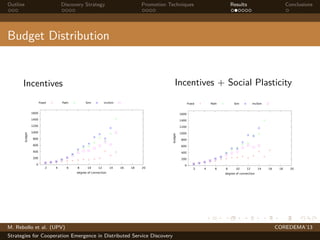
Budget Distribution
Incentives
0
200
400
600
800
1000
1200
1400
1600
2 4 6 8 10 12 14 16 18 20
budget
degree of connection
Fixed Path Sim InvSim
Incentives + Social Plasticity
0
200
400
600
800
1000
1200
1400
1600
2 4 6 8 10 12 14 16 18 20
budget degree of connection
Fixed Path Sim InvSim
M. Rebollo et al. (UPV) COREDEMA’13
Strategies for Cooperation Emergence in Distributed Service Discovery
Outline Discovery Strategy Promotion Techniques Results Conclusions
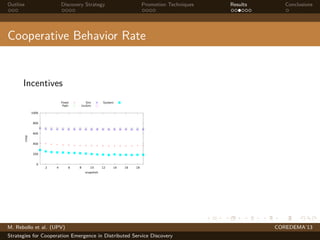
Cooperative Behavior Rate
Incentives
0
200
400
600
800
1000
2 4 6 8 10 12 14 16 18
coop
snapshot
Fixed
Path
Sim
InvSim
System
M. Rebollo et al. (UPV) COREDEMA’13
Strategies for Cooperation Emergence in Distributed Service Discovery
Outline Discovery Strategy Promotion Techniques Results Conclusions
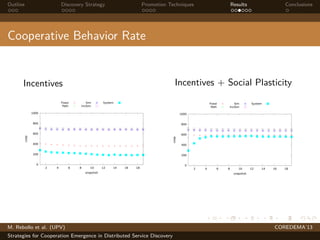
Cooperative Behavior Rate
Incentives
0
200
400
600
800
1000
2 4 6 8 10 12 14 16 18
coop
snapshot
Fixed
Path
Sim
InvSim
System
Incentives + Social Plasticity
0
200
400
600
800
1000
2 4 6 8 10 12 14 16 18
coop snapshot
Fixed
Path
Sim
InvSim
System
M. Rebollo et al. (UPV) COREDEMA’13
Strategies for Cooperation Emergence in Distributed Service Discovery
Outline Discovery Strategy Promotion Techniques Results Conclusions
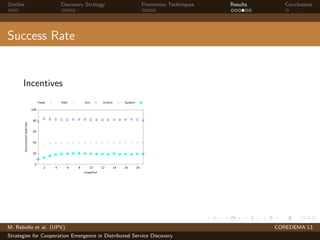
Success Rate
Incentives
0
20
40
60
80
100
2 4 6 8 10 12 14 16 18
%successfulsearches
snapshot
Fixed Path Sim InvSim System
M. Rebollo et al. (UPV) COREDEMA’13
Strategies for Cooperation Emergence in Distributed Service Discovery
Outline Discovery Strategy Promotion Techniques Results Conclusions
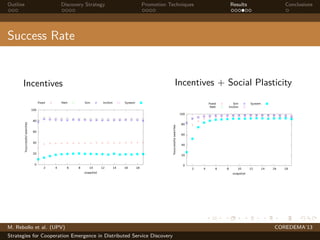
Success Rate
Incentives
0
20
40
60
80
100
2 4 6 8 10 12 14 16 18
%successfulsearches
snapshot
Fixed Path Sim InvSim System
Incentives + Social Plasticity
0
20
40
60
80
100
2 4 6 8 10 12 14 16 18
%successfulsearches snapshot
Fixed
Path
Sim
InvSim
System
M. Rebollo et al. (UPV) COREDEMA’13
Strategies for Cooperation Emergence in Distributed Service Discovery
Outline Discovery Strategy Promotion Techniques Results Conclusions
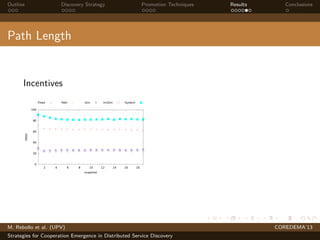
Path Length
Incentives
0
20
40
60
80
100
2 4 6 8 10 12 14 16 18
steps
snapshot
Fixed Path Sim InvSim System
M. Rebollo et al. (UPV) COREDEMA’13
Strategies for Cooperation Emergence in Distributed Service Discovery
Outline Discovery Strategy Promotion Techniques Results Conclusions
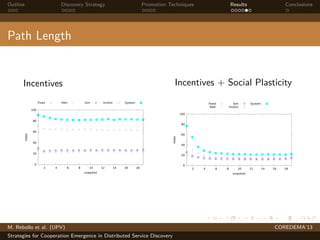
Path Length
Incentives
0
20
40
60
80
100
2 4 6 8 10 12 14 16 18
steps
snapshot
Fixed Path Sim InvSim System
Incentives + Social Plasticity
0
20
40
60
80
100
2 4 6 8 10 12 14 16 18
steps snapshot
Fixed
Path
Sim
InvSim
System
M. Rebollo et al. (UPV) COREDEMA’13
Strategies for Cooperation Emergence in Distributed Service Discovery
Outline Discovery Strategy Promotion Techniques Results Conclusions
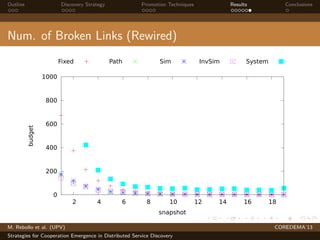
Num. of Broken Links (Rewired)
0
200
400
600
800
1000
2 4 6 8 10 12 14 16 18
budget
snapshot
Fixed Path Sim InvSim System
M. Rebollo et al. (UPV) COREDEMA’13
Strategies for Cooperation Emergence in Distributed Service Discovery
Outline Discovery Strategy Promotion Techniques Results Conclusions
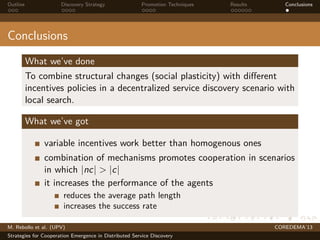
Conclusions
What we’ve done
To combine structural changes (social plasticity) with different
incentives policies in a decentralized service discovery scenario with
local search.
What we’ve got
variable incentives work better than homogenous ones
combination of mechanisms promotes cooperation in scenarios
in which |nc| > |c|
it increases the performance of the agents
reduces the average path length
increases the success rate
M. Rebollo et al. (UPV) COREDEMA’13
Strategies for Cooperation Emergence in Distributed Service Discovery

Strategies for Cooperation Emergence in Distributed Service Discovery

  • 1.
    Outline Discovery StrategyPromotion Techniques Results Conclusions Strategies for Cooperation Emergence in Distributed Service Discovery E. del Val M. Rebollo V. Botti Univ. Politècnica de València (Spain) COREDEMA ’13 Salamanca, May 2013 M. Rebollo et al. (UPV) COREDEMA’13 Strategies for Cooperation Emergence in Distributed Service Discovery
  • 2.
    Outline Discovery StrategyPromotion Techniques Results Conclusions Promoting Cooperation Motivation There are scenarios in decentralized systems in which cooperation plays a central role agents connected in networks bounded rationality heterogeneous, self-interested agents M. Rebollo et al. (UPV) COREDEMA’13 Strategies for Cooperation Emergence in Distributed Service Discovery
  • 3.
    Outline Discovery StrategyPromotion Techniques Results Conclusions Our Proposal The challenge Obtain an emergent, cooperative global behavior even when cooperators are a minority, from local decisions. What is done. . . a network structure that ensures navigation and efficiency structural changes to isolate undesired agents variable incentives to promote cooperation M. Rebollo et al. (UPV) COREDEMA’13 Strategies for Cooperation Emergence in Distributed Service Discovery
  • 4.
    Outline Discovery StrategyPromotion Techniques Results Conclusions Outline 1 Outline 2 Discovery Strategy 3 Isolated Cooperation Promotion Techniques 4 Combined Cooperation Model 5 Results 6 Conclusions M. Rebollo et al. (UPV) COREDEMA’13 Strategies for Cooperation Emergence in Distributed Service Discovery
  • 5.
    Outline Discovery StrategyPromotion Techniques Results Conclusions Agent Network Model A = {1, ..., n} a set of agents connected in a undirected network G, where N(i) denotes the neighbors of agent i each agent plays a role ri and offers a service si agents have an initial behavior: cooperative (c) or not cooperative (nc) each agent has an initial budget b M. Rebollo et al. (UPV) COREDEMA’13 Strategies for Cooperation Emergence in Distributed Service Discovery
  • 6.
    Outline Discovery StrategyPromotion Techniques Results Conclusions Service Discovery Purpose Locate in the network a similar enough service offer by a concrete role qt i = {stg , rtg , TTL, ε, {}} stg required semantic service description rtg organizational role the target agent should play TTL: time to live ε similarity threshold in [0, 1] {} participant list (initially empty) M. Rebollo et al. (UPV) COREDEMA’13 Strategies for Cooperation Emergence in Distributed Service Discovery
  • 7.
    Outline Discovery StrategyPromotion Techniques Results Conclusions Discovery Process i Ri = {r1} Si = {s1} k CH(k, t) = 0.5 j CH(j, t) = 0.5 n CH(n, t) = 0.15 A S R |N| k Sk Rk = {r1} 5 n Sn Rn = {r2} 5 j Sj Rj = {r1} 4 v Rt = {r5} St = {s6} m Rm = {r7} Sm = {s7} each agent knows its direct neighbors query qt i is redirected to the most promising neighbor M. Rebollo et al. (UPV) COREDEMA’13 Strategies for Cooperation Emergence in Distributed Service Discovery
  • 8.
    Outline Discovery StrategyPromotion Techniques Results Conclusions Similarity Measure FNi (tg) = argmaxj∈Ni P( j, tg ) For each neighbor j, P( j, tg ) determines the probability that the neighbor j redirects the search to the nearest network community where there are more probabilities of finding the agent tg. P( j, tg ) = 1 −      1 −      CH(j, tg) k∈Ni CH(k, tg)           kj M. Rebollo et al. (UPV) COREDEMA’13 Strategies for Cooperation Emergence in Distributed Service Discovery
  • 9.
    Outline Discovery StrategyPromotion Techniques Results Conclusions Social Plasticity 0 0.1 0.2 0.3 0.4 0.5 0.6 0.7 0.8 0.9 1 0 10 20 30 40 50 60 Probabilitytomaintainthelink Number of queries that were forwarded to other links n = 2 n = 4 n = 6 rewiring action λ to avoid non-cooperative agents decay function using a sigmoid d parameter establishes benevolence of the agent Pdecay (rqij) = 1 1+e −(rqij −d) n M. Rebollo et al. (UPV) COREDEMA’13 Strategies for Cooperation Emergence in Distributed Service Discovery
  • 10.
    Outline Discovery StrategyPromotion Techniques Results Conclusions Social Plasticity Effects M. Rebollo et al. (UPV) COREDEMA’13 Strategies for Cooperation Emergence in Distributed Service Discovery
  • 11.
    Outline Discovery StrategyPromotion Techniques Results Conclusions Social Plasticity Effects M. Rebollo et al. (UPV) COREDEMA’13 Strategies for Cooperation Emergence in Distributed Service Discovery
  • 12.
    Outline Discovery StrategyPromotion Techniques Results Conclusions Incentives Effect M. Rebollo et al. (UPV) COREDEMA’13 Strategies for Cooperation Emergence in Distributed Service Discovery
  • 13.
    Outline Discovery StrategyPromotion Techniques Results Conclusions Social Plasticity and Incentives When a neighbor j receives a query qt i , it has a set of possible actions Ac = {ρ, ∞, 1, 2, ..., ki , ∅, λ}, where: ρ is asking for a service ∞ is providing the service {1, ..., ki } is forwarding the query to one of its neighbors ∈ Ni ∅ is doing nothing λ rewiring a link M. Rebollo et al. (UPV) COREDEMA’13 Strategies for Cooperation Emergence in Distributed Service Discovery
  • 14.
    Outline Discovery StrategyPromotion Techniques Results Conclusions Action Selection Action Condition at i = ∞ if |CH(i, tg)| ≥ ε at i = ∅ if |CH(i, tg)| < ε ∧ at−1 j = ∅, j ∈ argmax(CHt−1 1 , ..., CHt−1 ki ) at i = j if |CH(i, tg)| < ε ∧ at−1 j = 0, j ∈ argmax(CHt−1 1 , ..., CHt−1 ki ) at i = λ if at−1 i = j ∧ at j = ∅ ∧ |coop| < σ, coop ⊆ Ni (g)|j is a coop. M. Rebollo et al. (UPV) COREDEMA’13 Strategies for Cooperation Emergence in Distributed Service Discovery
  • 15.
    Outline Discovery StrategyPromotion Techniques Results Conclusions Action Selection Action Condition at i = ∞ if |CH(i, tg)| ≥ ε at i = ∅ if |CH(i, tg)| < ε ∧ at−1 j = ∅, j ∈ argmax(CHt−1 1 , ..., CHt−1 ki ) at i = j if |CH(i, tg)| < ε ∧ at−1 j = 0, j ∈ argmax(CHt−1 1 , ..., CHt−1 ki ) at i = λ if at−1 i = j ∧ at j = ∅ ∧ |coop| < σ, coop ⊆ Ni (g)|j is a coop. Do the task if agent knows how to do it M. Rebollo et al. (UPV) COREDEMA’13 Strategies for Cooperation Emergence in Distributed Service Discovery
  • 16.
    Outline Discovery StrategyPromotion Techniques Results Conclusions Action Selection Action Condition at i = ∞ if |CH(i, tg)| ≥ ε at i = ∅ if |CH(i, tg)| < ε ∧ at−1 j = ∅, j ∈ argmax(CHt−1 1 , ..., CHt−1 ki ) at i = j if |CH(i, tg)| < ε ∧ at−1 j = 0, j ∈ argmax(CHt−1 1 , ..., CHt−1 ki ) at i = λ if at−1 i = j ∧ at j = ∅ ∧ |coop| < σ, coop ⊆ Ni (g)|j is a coop. Do nothing if the agent guess that the most promising neighbor will no cooperate M. Rebollo et al. (UPV) COREDEMA’13 Strategies for Cooperation Emergence in Distributed Service Discovery
  • 17.
    Outline Discovery StrategyPromotion Techniques Results Conclusions Action Selection Action Condition at i = ∞ if |CH(i, tg)| ≥ ε at i = ∅ if |CH(i, tg)| < ε ∧ at−1 j = ∅, j ∈ argmax(CHt−1 1 , ..., CHt−1 ki ) at i = j if |CH(i, tg)| < ε ∧ at−1 j = 0, j ∈ argmax(CHt−1 1 , ..., CHt−1 ki ) at i = λ if at−1 i = j ∧ at j = ∅ ∧ |coop| < σ, coop ⊆ Ni (g)|j is a coop. Forward the query if the agent guess that the most promising neighbor will cooperate M. Rebollo et al. (UPV) COREDEMA’13 Strategies for Cooperation Emergence in Distributed Service Discovery
  • 18.
    Outline Discovery StrategyPromotion Techniques Results Conclusions Action Selection Action Condition at i = ∞ if |CH(i, tg)| ≥ ε at i = ∅ if |CH(i, tg)| < ε ∧ at−1 j = ∅, j ∈ argmax(CHt−1 1 , ..., CHt−1 ki ) at i = j if |CH(i, tg)| < ε ∧ at−1 j = 0, j ∈ argmax(CHt−1 1 , ..., CHt−1 ki ) at i = λ if at−1 i = j ∧ at j = ∅ ∧ |coop| < σ, coop ⊆ Ni (g)|j is a coop. Rewire some links with a probability Pdecay if the agent is surrounded by non-coop agents M. Rebollo et al. (UPV) COREDEMA’13 Strategies for Cooperation Emergence in Distributed Service Discovery
  • 19.
    Outline Discovery StrategyPromotion Techniques Results Conclusions Costs of the Actions ut i (at i ) =    −β if at i = ρ p if at i = ∞ −c if at i ∈ {1, 2, ..., ki } 0 if at i = ∅ ∧ t ≤ t : at i ∈ {1, 2, ...ki } α if at i = ∅ ∧ ∃t ≤ t : at i ∈ {1, 2, ..., ki } ∧ ∃j ∈ A : at j = ∞ −γ if at i = λ M. Rebollo et al. (UPV) COREDEMA’13 Strategies for Cooperation Emergence in Distributed Service Discovery
  • 20.
    Outline Discovery StrategyPromotion Techniques Results Conclusions Incentives Policy uniformly distributed System the system provides incentives Fixed the agent that request the service pays for it base on a criterion Path depends on the length of the path SimDg the more similar the higher reward InvSimDg the less similar the higher reward M. Rebollo et al. (UPV) COREDEMA’13 Strategies for Cooperation Emergence in Distributed Service Discovery
  • 21.
    Outline Discovery StrategyPromotion Techniques Results Conclusions Experimental Parameters network size: 1 000 agents average degree of connection: 2.5 similarity threshold ε = 0.75 TTL = 100 initial budget: 100 40 % cooperative - 60 % non cooperative M. Rebollo et al. (UPV) COREDEMA’13 Strategies for Cooperation Emergence in Distributed Service Discovery
  • 22.
    Outline Discovery StrategyPromotion Techniques Results Conclusions Budget Distribution Incentives 0 200 400 600 800 1000 1200 1400 1600 2 4 6 8 10 12 14 16 18 20 budget degree of connection Fixed Path Sim InvSim M. Rebollo et al. (UPV) COREDEMA’13 Strategies for Cooperation Emergence in Distributed Service Discovery
  • 23.
    Outline Discovery StrategyPromotion Techniques Results Conclusions Budget Distribution Incentives 0 200 400 600 800 1000 1200 1400 1600 2 4 6 8 10 12 14 16 18 20 budget degree of connection Fixed Path Sim InvSim Incentives + Social Plasticity 0 200 400 600 800 1000 1200 1400 1600 2 4 6 8 10 12 14 16 18 20 budget degree of connection Fixed Path Sim InvSim M. Rebollo et al. (UPV) COREDEMA’13 Strategies for Cooperation Emergence in Distributed Service Discovery
  • 24.
    Outline Discovery StrategyPromotion Techniques Results Conclusions Cooperative Behavior Rate Incentives 0 200 400 600 800 1000 2 4 6 8 10 12 14 16 18 coop snapshot Fixed Path Sim InvSim System M. Rebollo et al. (UPV) COREDEMA’13 Strategies for Cooperation Emergence in Distributed Service Discovery
  • 25.
    Outline Discovery StrategyPromotion Techniques Results Conclusions Cooperative Behavior Rate Incentives 0 200 400 600 800 1000 2 4 6 8 10 12 14 16 18 coop snapshot Fixed Path Sim InvSim System Incentives + Social Plasticity 0 200 400 600 800 1000 2 4 6 8 10 12 14 16 18 coop snapshot Fixed Path Sim InvSim System M. Rebollo et al. (UPV) COREDEMA’13 Strategies for Cooperation Emergence in Distributed Service Discovery
  • 26.
    Outline Discovery StrategyPromotion Techniques Results Conclusions Success Rate Incentives 0 20 40 60 80 100 2 4 6 8 10 12 14 16 18 %successfulsearches snapshot Fixed Path Sim InvSim System M. Rebollo et al. (UPV) COREDEMA’13 Strategies for Cooperation Emergence in Distributed Service Discovery
  • 27.
    Outline Discovery StrategyPromotion Techniques Results Conclusions Success Rate Incentives 0 20 40 60 80 100 2 4 6 8 10 12 14 16 18 %successfulsearches snapshot Fixed Path Sim InvSim System Incentives + Social Plasticity 0 20 40 60 80 100 2 4 6 8 10 12 14 16 18 %successfulsearches snapshot Fixed Path Sim InvSim System M. Rebollo et al. (UPV) COREDEMA’13 Strategies for Cooperation Emergence in Distributed Service Discovery
  • 28.
    Outline Discovery StrategyPromotion Techniques Results Conclusions Path Length Incentives 0 20 40 60 80 100 2 4 6 8 10 12 14 16 18 steps snapshot Fixed Path Sim InvSim System M. Rebollo et al. (UPV) COREDEMA’13 Strategies for Cooperation Emergence in Distributed Service Discovery
  • 29.
    Outline Discovery StrategyPromotion Techniques Results Conclusions Path Length Incentives 0 20 40 60 80 100 2 4 6 8 10 12 14 16 18 steps snapshot Fixed Path Sim InvSim System Incentives + Social Plasticity 0 20 40 60 80 100 2 4 6 8 10 12 14 16 18 steps snapshot Fixed Path Sim InvSim System M. Rebollo et al. (UPV) COREDEMA’13 Strategies for Cooperation Emergence in Distributed Service Discovery
  • 30.
    Outline Discovery StrategyPromotion Techniques Results Conclusions Num. of Broken Links (Rewired) 0 200 400 600 800 1000 2 4 6 8 10 12 14 16 18 budget snapshot Fixed Path Sim InvSim System M. Rebollo et al. (UPV) COREDEMA’13 Strategies for Cooperation Emergence in Distributed Service Discovery
  • 31.
    Outline Discovery StrategyPromotion Techniques Results Conclusions Conclusions What we’ve done To combine structural changes (social plasticity) with different incentives policies in a decentralized service discovery scenario with local search. What we’ve got variable incentives work better than homogenous ones combination of mechanisms promotes cooperation in scenarios in which |nc| > |c| it increases the performance of the agents reduces the average path length increases the success rate M. Rebollo et al. (UPV) COREDEMA’13 Strategies for Cooperation Emergence in Distributed Service Discovery