More Related Content

PDF

PPT
Lecture one in course of E-supply chain management.ppt 
PPTX
Supply Chain Management chap 1 
PPT
Understanding the supply chain.ppt 
PPTX

PPTX
Supply Chain Management Chapter 1 
PPT
Understanding The Supply Chain Management SCM pptx 
PPT
Similar to Supply chain management introduction.ppt

PPT
Supply chain management Processessss.ppt 
PPT
scm second module ppt.ppt 
PPT
Introduction of SCM Introduction of SCM 
PPTX
Basics of Supply Chain Management 
PPT
Introduction to supply chain management 
PPTX
Food supply chain development and management chapter 
PPT
Chapter 1 understanding the supply chain 
PPT
supply chain competitive and SC strategy.ppt 
PPT
Introduction of supply chain management PPT 
PPT
Introduction of Supply Chain Management PPT 
PPT
Introduction of Supply Chain Management PPT 
PPT
Introduction of SCM and related basic concepts 
PPTX
Supply Chain Management.pptx 
PPT

PPT

PDF
Chapter 3 supply chain drivers and metrics (6e).pdf 
DOC

DOCX

PPTX
Dr. Liza Gernal - Effective Zero Waste Using Mastery of Supply Chain Management 
DOCX
More from profgufran

PPT
Supply chain management Coordination.ppt 
PPT
BullWhip effect in Supply Chain Management.ppt 
PPT
Confidentiality Integrity Availability PPT.ppt 
PPT
Cyber Security in computer forensics.ppt 
PPT
Reinforcement Learning Tools and Techniques.ppt 
PPT
Confidentialiy, Integrity, Availability.ppt 
PPTX
Planning ans Acting in nondeterminitics.pptx 
PPTX
Action Elements in artifical Intelligence.pptx 
PPT
Data Preprocessing in Data Analytics.ppt 
PPT
Introduction to Machine Learning Process.ppt 
PPT
Types of Threats in Local, shared, national.ppt 
PPT
Threats in cyber security Local, shared, national.ppt 
PPT
Data Reduction tools and techniquess.ppt 
PPT
Markov Learning Techniques and Tools.ppt 
PPT
Wavelet Transformation techniques and tools.ppt 
PPT
Introduction_to_AdvanceExcel_FA12 - Copy.ppt 
PPTX
New Computer Network Practical 02 SYBSCit.pptx 
PPTX
New Computer Network Practical 01 SYBSCit.pptx 
PPT
Coefficient and Correlation techniques.ppt 
DOCX
Project Cover Page Introduction SPM.docx Recently uploaded

PPTX
Mastering SQL Server Replication: Types, Setup & Troubleshooting 
PDF
apidays Australia 2025 | The Strategic Role of APIs in Digital Transformation 
PDF
MINDCTI Revenue Release Quarter 3 2025 - Financial Presentation 
PPTX
CRM for the Insurance Industry Lessons for Insurance CIOs and Digital Leaders... 
PDF
Getting the Best of TrueDEM – January News & Updates 
PDF
Why Are Cloud Migration Services Essential for Modern Business Growth? 
PPTX
AI and Digital Transformation Solutions. 
PPT
Database Management Systems: Basics, History, Data Models, etc. 
PPTX
Dell poweredge-customer-presentation.pptx 
PDF
Computer Science Conferences 2026 | Research by SAI Conference 
DOCX
Best Web to Learn About Buying Verified Skrill Accounts (Los Angeles).docx 
PPTX
AI in Marine Insurance Future of Smarter Risk, Faster Claims & Safer Shipping... 
PDF
How to Build a Crypto Wallet that Excels in 2026.pdf 
PDF
What ONIX can do: Leveraging metadata to support the discoverability of First... 
PDF
Router-DHCP-Printer-SharingRouter-DHCP-Printer-Sharing 
PDF
CISO_2027_Playbook: Sovereign AI Resilience & Quantum-Proof Identity 
PPTX
Understanding-Search-Algorithms_09-12-25.pptx 
PDF
LUXHUB: a detailed look at 2025...and fast forward to 2026 
PPTX
Single Cell Protein from Methane or Methanol - Process development research c... 
DOCX
Mathematical reviewer gor mmw in theofern Supply chain management introduction.ppt
- 1.
Copyright © 2012Pearson Education, Inc. Publishing as Prentice Hall
1
CHAPTER 11
SUPPLY CHAIN
MANAGEMENT
- 2.
Copyright © 2012Pearson Education, Inc. Publishing as Prentice Hall
2
Learning Objectives
• Learn about the supply chain network and management
drivers.
• Understand the complexity and importance of the
integration of supply chain.
• Learn about supply chain components, processes, and
flows.
• Know the different levels of supply chain integration.
• Examine the impact of the ERP on supply chain
management.
- 3.
Copyright © 2012Pearson Education, Inc. Publishing as Prentice Hall
3
Preview
• A good supply chain management (SCM) system can
act as a digital nerve center for the entire business and
save the company millions of dollars in costs in order
fulfillment and other back-end support processes.
• SCM gives companies access to all of the critical
information they need to plan their operations in an
efficient way whenever and wherever they need it.
• SCM improves efficiencies and reduces costs
substantially while also giving companies the
adaptability to modify their business processes.
- 4.
Copyright © 2012Pearson Education, Inc. Publishing as Prentice Hall
4
Supply Chain Management
• Supply chain is the network of services, material, and
information flow that link a firm’s customer relations,
order fulfillment, and supplier relations processes to
those of its suppliers and customers.
• Michael Potter
– A business value chain consists of a series of processes or
activities conducted by the company to add value to the existing
product or service and to provide a competitive advantage in the
market.
• Companies need to understand their supply chain and
build the strategy such that its competitive strategy and
supply chain strategy are aligned.
- 5.
Copyright © 2012Pearson Education, Inc. Publishing as Prentice Hall
5
Supply Chain Management (Cont’d)
• Corporations are striving to focus on core competencies
and become more flexible and reduced their ownership
of raw materials sources and distribution channels.
• All the functions of a company’s supply chain contribute
to its success or failure and they all need to work
together to ensure success.
• To achieve strategic fit, a company must ensure that its
supply chain capabilities support its ability to satisfy the
targeted customer segments.
- 6.
Copyright © 2012Pearson Education, Inc. Publishing as Prentice Hall
6
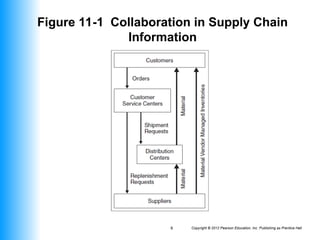
Figure 11-1 Collaboration in Supply Chain
Information
- 7.
Copyright © 2012Pearson Education, Inc. Publishing as Prentice Hall
7
SCM Drivers
Facilities
• Facilities are the places in the supply chain network
where product is manufactured, stored, or shipped.
• The two major types of facilities are production sites
(plants) and storage sites (warehouses).
• A company needs to decide how many suppliers,
manufacturing facilities, distribution centers, and
warehouses to have.
Information
• Information consists of data and analysis concerning
facilities, inventory, transportation, and customers
throughout the supply chain.
- 8.
Copyright © 2012Pearson Education, Inc. Publishing as Prentice Hall
8
SCM Drivers (Cont’d)
Inventory
• Inventory is the raw materials, work in process, and
finished goods that belong to the company.
• A successful inventory management policy is to achieve
that right balance of responsiveness and efficiency.
Transportation
• Transportation moves the product between different
stages in a supply chain.
• The type of transportation a company uses also affects
the inventory and facility locations in the supply chain.
- 9.
Copyright © 2012Pearson Education, Inc. Publishing as Prentice Hall
9
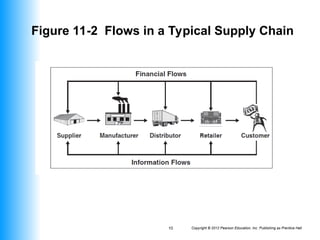
SCM Flows
Three Categories
• Product Flow - The product flow includes the movement
of goods from a supplier to a customer, as well as any
customer returns or service needs.
• Information Flow - The information flow involves
transmitting orders and updating the status of delivery.
• The finance Flow - The financial flow consists of credit
terms, payment schedules, and consignment and title
ownership arrangements.
- 10.
Figure 11-2 Flowsin a Typical Supply Chain
Copyright © 2012 Pearson Education, Inc. Publishing as Prentice Hall
10
- 11.
Copyright © 2012Pearson Education, Inc. Publishing as Prentice Hall
11
Software and Technology
• Increasing numbers of companies are using the Internet
and Web-based applications as part of their SCM
solution.
• There are two main types of SCM software.
– Planning Applications: Use advanced algorithms to determine
the best way to fill an order.
– Execution Applications: Track the physical status of goods,
the management of materials, and financial information involving
all parties.
• Extended Enterprise
– Some SCM applications are based on open data models that
support the sharing of data both inside and outside the
enterprise.