1
Correlation Analysis (NominalData)
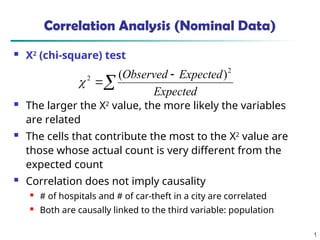
Χ2
(chi-square) test
The larger the Χ2
value, the more likely the variables
are related
The cells that contribute the most to the Χ2
value are
those whose actual count is very different from the
expected count
Correlation does not imply causality
# of hospitals and # of car-theft in a city are correlated
Both are causally linked to the third variable: population
Expected
Expected
Observed 2
2 )
(
2.
2
Chi-Square Calculation: AnExample
Χ2
(chi-square) calculation (numbers in parenthesis are
expected counts calculated based on the data
distribution in the two categories)
It shows that like_science_fiction and play_chess are
correlated in the group
93
.
507
840
)
840
1000
(
360
)
360
200
(
210
)
210
50
(
90
)
90
250
( 2
2
2
2
2
Play
chess
Not play chess Sum (row)
Like science fiction 250(90) 200(360) 450
Not like science
fiction
50(210) 1000(840) 1050
Sum(col.) 300 1200 1500
3.
3
Correlation Analysis (NumericData)
Correlation coefficient (also called Pearson’s product
moment coefficient)
where n is the number of tuples, and are the respective
means of A and B, σA and σB are the respective standard deviation
of A and B, and Σ(aibi) is the sum of the AB cross-product.
If rA,B > 0, A and B are positively correlated (A’s values
increase as B’s). The higher, the stronger correlation.
rA,B = 0: independent; rAB < 0: negatively correlated
B
A
n
i i
i
B
A
n
i i
i
B
A
n
B
A
n
b
a
n
B
b
A
a
r
)
1
(
)
(
)
1
(
)
)(
( 1
1
,
A B
5
Correlation (viewed aslinear relationship)
Correlation measures the linear relationship
between objects
To compute correlation, we standardize data
objects, A and B, and then take their dot
product
)
(
/
))
(
(
' A
std
A
mean
a
a k
k
)
(
/
))
(
(
' B
std
B
mean
b
b k
k
'
'
)
,
( B
A
B
A
n
correlatio
6.
6
Covariance (Numeric Data)
Covariance is similar to correlation
where n is the number of tuples, and are the respective mean or
expected values of A and B, σA and σB are the respective standard
deviation of A and B.
Positive covariance: If CovA,B > 0, then A and B both tend to be larger than
their expected values.
Negative covariance: If CovA,B < 0 then if A is larger than its expected value,
B is likely to be smaller than its expected value.
Independence: CovA,B = 0 but the converse is not true:
Some pairs of random variables may have a covariance of 0 but are not
independent. Only under some additional assumptions (e.g., the data follow
multivariate normal distributions) does a covariance of 0 imply independence
A B
Correlation coefficient:
7.
Co-Variance: An Example
It can be simplified in computation as
Suppose two stocks A and B have the following values in one week:
(2, 5), (3, 8), (5, 10), (4, 11), (6, 14).
Question: If the stocks are affected by the same industry trends,
will their prices rise or fall together?
E(A) = (2 + 3 + 5 + 4 + 6)/ 5 = 20/5 = 4
E(B) = (5 + 8 + 10 + 11 + 14) /5 = 48/5 = 9.6
Cov(A,B) = (2×5+3×8+5×10+4×11+6×14)/5 4 × 9.6 = 4
−
Thus, A and B rise together since Cov(A, B) > 0.
8.
8
Data Reduction Strategies
Data reduction: Obtain a reduced representation of the data set
that is much smaller in volume but yet produces the same (or
almost the same) analytical results
Why data reduction? — A database/data warehouse may store
terabytes of data. Complex data analysis may take a very long time
to run on the complete data set.
Data reduction strategies
Dimensionality reduction, e.g., remove unimportant attributes
Wavelet transforms
Principal Components Analysis (PCA)
Feature subset selection, feature creation
Numerosity reduction (some simply call it: Data Reduction)
Regression and Log-Linear Models
Histograms, clustering, sampling
Data cube aggregation
Data compression
9.
9
Data Reduction 1:Dimensionality Reduction
Curse of dimensionality
When dimensionality increases, data becomes increasingly sparse
Density and distance between points, which is critical to clustering,
outlier analysis, becomes less meaningful
The possible combinations of subspaces will grow exponentially
Dimensionality reduction
Avoid the curse of dimensionality
Help eliminate irrelevant features and reduce noise
Reduce time and space required in data mining
Allow easier visualization
Dimensionality reduction techniques
Wavelet transforms
Principal Component Analysis
Supervised and nonlinear techniques (e.g., feature selection)
10.
10
What Is WaveletTransform?
Decomposes a signal into
different frequency subbands
Applicable to n-dimensional
signals
Data are transformed to
preserve relative distance
between objects at different
levels of resolution
Allow natural clusters to
become more distinguishable
Used for image compression