2
Introduction to Security
Outline
1.Examples – Security in Practice
2. What is „Security?”
3. Pillars of Security:
Confidentiality, Integrity, Availability (CIA)
4. Vulnerabilities, Threats, and Controls
5. Attackers
6. How to React to an Exploit?
7. Methods of Defense
8. Principles of Computer Security
3.
3 [cf. CsillaFarkas, University of South Carolina]
Information hiding
Privacy
Security
Trust
Applications
Policy making
Formal models
Negotiation
Network security
Anonymity
Access control
Semantic web security
Encryption
Data mining
System monitoring
Computer epidemic
Data
provenance
Fraud
Biometrics
Integrity
Vulnerabilities
Threats
4.
4
1. Examples –Security in Practice
From CSI/FBI Report 2002
90% detected computer security breaches within the last year
80% acknowledged financial losses
44% were willing and/or able to quantify their financial losses.
These 223 respondents reported $455M in financial losses.
The most serious financial losses occurred through theft of proprietary information and
financial fraud:
26 respondents: $170M
25 respondents: $115M
For the fifth year in a row, more respondents (74%) cited their Internet connection as a
frequent point of attack than cited their internal systems as a frequent point of attack (33%).
34% reported the intrusions to law enforcement. (In 1996, only 16% acknowledged
reporting intrusions to law enforcement.)
Barbara Edicott-Popovsky and Deborah Frincke, CSSE592/492, U. Washington]
5.
5
More from CSI/FBI2002
40% detected external penetration
40% detected denial of service attacks.
78% detected employee abuse of Internet access privileges
85% percent detected computer viruses.
38% suffered unauthorized access or misuse on their Web sites
within the last twelve months. 21% didn’t know.
[includes insider attacks]
12% reported theft of transaction information.
6% percent reported financial fraud (only 3% in 2000).
[Barbara Edicott-Popovsky and Deborah Frincke, CSSE592/492, U. Washington]
6.
6
Critical Infrastructure Areas
Include:
Telecommunications
Electrical power systems
Water supply systems
Gas and oil pipelines
Transportation
Government services
Emergency services
Banking and finance
…
7.
7
2. What isa “Secure” Computer System?
To decide whether a computer system is “secure”, you
must first decide what “secure” means to you, then identify
the threats you care about.
You Will Never Own a Perfectly Secure System!
Threats - examples
Viruses, trojan horses, etc.
Denial of Service
Stolen Customer Data
Modified Databases
Identity Theft and other threats to personal privacy
Equipment Theft
Espionage in cyberspace
Hack-tivism
Cyberterrorism
…
8.
8
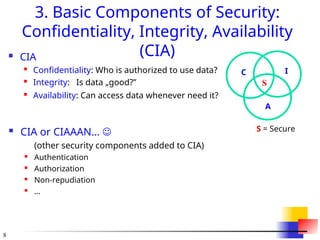
3. Basic Componentsof Security:
Confidentiality, Integrity, Availability
(CIA)
CIA
Confidentiality: Who is authorized to use data?
Integrity: Is data „good?”
Availability: Can access data whenever need it?
C I
A
S
S = Secure
CIA or CIAAAN…
(other security components added to CIA)
Authentication
Authorization
Non-repudiation
…
9.
9
Need to Balance
CIA
Example 1: C vs. I+A
Disconnect computer from Internet to increase
confidentiality
Availability suffers, integrity suffers due to lost updates
Example 2: I vs. C+A
Have extensive data checks by different people/systems
to increase integrity
Confidentiality suffers as more people see data,
availability suffers due to locks on data under verification)
Editor's Notes
#9
In addition to all the rules and regulations, policies and procedures and the related system specific documentation, there are some current computer security issues of which you as the Executive should be made aware.

![3 [cf. Csilla Farkas, University of South Carolina]
Information hiding
Privacy
Security
Trust
Applications
Policy making
Formal models
Negotiation
Network security
Anonymity
Access control
Semantic web security
Encryption
Data mining
System monitoring
Computer epidemic
Data
provenance
Fraud
Biometrics
Integrity
Vulnerabilities
Threats](https://image.slidesharecdn.com/cybersecurity-250829132109-b28be6de/85/Cyber-Security-in-computer-forensics-ppt-3-320.jpg)
![4
1. Examples – Security in Practice
From CSI/FBI Report 2002
90% detected computer security breaches within the last year
80% acknowledged financial losses
44% were willing and/or able to quantify their financial losses.
These 223 respondents reported $455M in financial losses.
The most serious financial losses occurred through theft of proprietary information and
financial fraud:
26 respondents: $170M
25 respondents: $115M
For the fifth year in a row, more respondents (74%) cited their Internet connection as a
frequent point of attack than cited their internal systems as a frequent point of attack (33%).
34% reported the intrusions to law enforcement. (In 1996, only 16% acknowledged
reporting intrusions to law enforcement.)
Barbara Edicott-Popovsky and Deborah Frincke, CSSE592/492, U. Washington]](https://image.slidesharecdn.com/cybersecurity-250829132109-b28be6de/85/Cyber-Security-in-computer-forensics-ppt-4-320.jpg)
![5
More from CSI/FBI 2002
40% detected external penetration
40% detected denial of service attacks.
78% detected employee abuse of Internet access privileges
85% percent detected computer viruses.
38% suffered unauthorized access or misuse on their Web sites
within the last twelve months. 21% didn’t know.
[includes insider attacks]
12% reported theft of transaction information.
6% percent reported financial fraud (only 3% in 2000).
[Barbara Edicott-Popovsky and Deborah Frincke, CSSE592/492, U. Washington]](https://image.slidesharecdn.com/cybersecurity-250829132109-b28be6de/85/Cyber-Security-in-computer-forensics-ppt-5-320.jpg)