1 
SuperGraph Visualization 
http://www.icmc.usp.br/~junio/PublishedPapers/RodriguesJr_et_al-ISM2006.pdf 
José F. Rodrigues Jr., Agma J. M. 
Traina, Caetano Traina Jr. 
University of São Paulo 
Computer Science Department 
ICMC-USP 
Brazil 
Christos Faloutsos 
Carnegie Mellon University 
Computer Science Department 
USA
2 
Outline 
Problem and Principle 
SuperGraphs and the Graph-Tree 
Connectivity 
Performance 
Conclusions
3 
Problem 
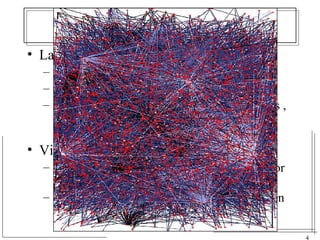
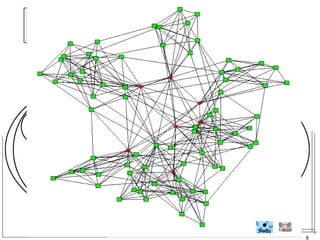
• Large graphs 
– Hundred-thousand nodes or more 
– Million edges magnitude 
– web graphs, computer communication graphs , 
recommendation systems, whotrusts-whom 
networks, bipartite graphs of web-logs 
• Visual exploration limits 
– Prohibitive processing power requirements for 
interactive visualization 
– Excessive number of graphical items in screen
4 
Problem 
• Large graphs 
– Hundred-thousand nodes or more 
– Million edges magnitude 
– web graphs, computer communication graphs , 
recommendation systems, whotrusts-whom 
networks, bipartite graphs of web-logs 
• Visual exploration limits 
– Prohibitive processing power requirements for 
interactive visualization 
– Excessive number of graphical items in screen
5 
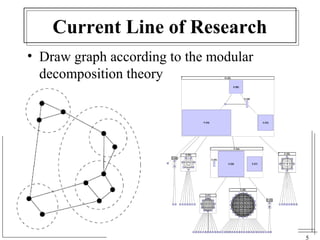
Current Line of Research 
• Draw graph according to the modular 
decomposition theory
6 
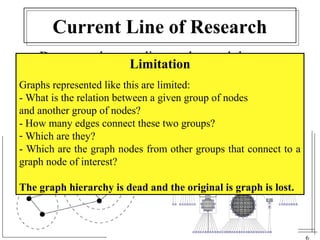
Current Line of Research 
• Draw graph according Limitation 
to the modular 
decomposition theory 
Graphs represented like this are limited: 
- What is the relation between a given group of nodes 
and another group of nodes? 
- How many edges connect these two groups? 
- Which are they? 
- Which are the graph nodes from other groups that connect to a 
graph node of interest? 
The graph hierarchy is dead and the original is graph is lost.
7 
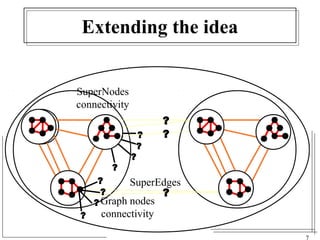
Extending the idea 
? 
? 
? 
SuperNodes 
connectivity 
? 
? 
? 
? 
? 
?? 
SuperEdges 
? 
Graph nodes 
connectivity
8 
Extending the idea 
? 
? 
? 
SuperNodes 
connectivity 
? 
? 
? 
? 
? 
?? 
SuperEdges 
? 
Graph nodes 
connectivity
9 
Principle 
• Utilize compartmented processing and 
presentation 
• Utilize a structured partitioned version of 
the graph to be analized 
• Add interaction for a richer experience
10 
Principle 
• Utilize compartmented Our proposal 
processing and 
presentation 
Introduce a theory and a data structure to allow the use of the 
hierarchical graph partition representation without loosing the 
original • Utilize graph information. 
a structured partitioned version of 
the graph to be analized 
Do this on the context of visualization, interaction and scalability 
• Add interaction for a richer experience
11 
Outline 
Problem and Principle 
SuperGraphs and the Graph-Tree 
Connectivity 
Performance 
Conclusions
12 
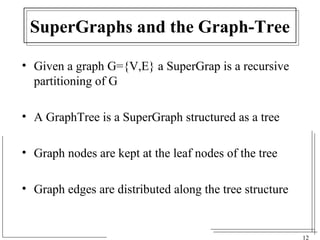
SuperGraphs and the Graph-Tree 
• Given a graph G={V,E} a SuperGrap is a recursive 
partitioning of G 
• A GraphTree is a SuperGraph structured as a tree 
• Graph nodes are kept at the leaf nodes of the tree 
• Graph edges are distributed along the tree structure
13 
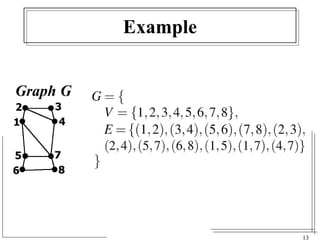
Example
14 
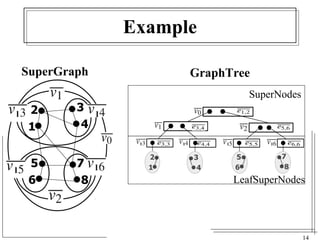
Example 
SuperGraph GraphTree 
SuperNodes 
LeafSuperNodes
15 
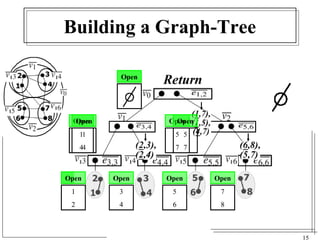
Building a Graph-Tree 
Open 
Open 
Open 
1 
2 
Open 
3 
4 
Open 
Open 
Open 
5 
6 
Open 
7 
8 
1 
4 
5 
7 
Open 
1 
4 
5 
7
16 
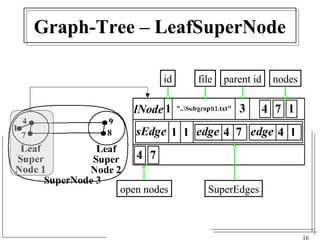
Graph-Tree – LeafSuperNode 
id file parent id nodes 
open nodes SuperEdges
17 
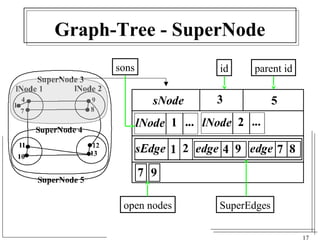
Graph-Tree - SuperNode 
id parent id 
sons 
open nodes SuperEdges
18 
Graph-Tree 
• A tree of graph partitions or a hierarchical 
partitioning of a graph 
• A new data structure for graphs 
• Benefits: novel graph storage + structured graph 
partitions 
• Provides: on demand processing/presentation + 
inter partitions edges information + spatial search 
tree (natural R-Tree properties)
19 
Outline 
Problem and Principle 
SuperGraphs and the Graph-Tree 
Connectivity 
Performance 
Conclusions
20 
Outline 
Problem and Principle 
SuperGraphs and the Graph-Tree 
Connectivity 
Performance 
Conclusions
21 
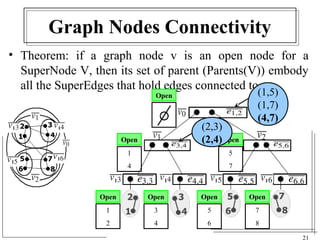
Graph Nodes Connectivity 
• Theorem: if a graph node v is an open node for a 
SuperNode V, then its set of parent (Parents(V)) embody 
all the SuperEdges that hold edges connected to v. 
Open 
1 
2 
Open 
3 
4 
Open 
5 
6 
Open 
7 
8 
Open 
1 
4 
Open 
5 
7 
Open 
(2,3) 
(2,4) 
(1,5) 
(1,7) 
(4,7)
22 
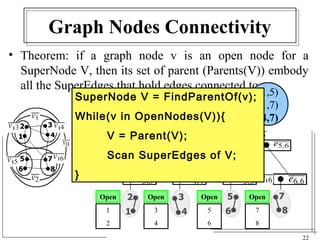
Graph Nodes Connectivity 
• Theorem: if a graph node v is an open node for a 
SuperNode V, then its set of parent (Parents(V)) embody 
all the SuperEdges that hold edges connected to v. 
Open 
1 
2 
Open 
3 
4 
Open 
5 
6 
Open 
7 
8 
Open 
1 
4 
Open 
5 
7 
Open 
(2,3) 
(2,4) 
(1,5) 
(1,7) 
(4,7) 
SuperNode V = FindParentOf(v); 
While(v in OpenNodes(V)){ 
V = Parent(V); 
Scan SuperEdges of V; 
}
23 
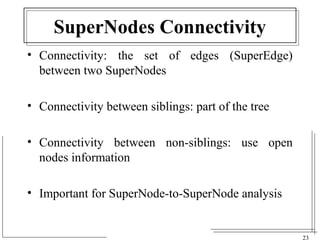
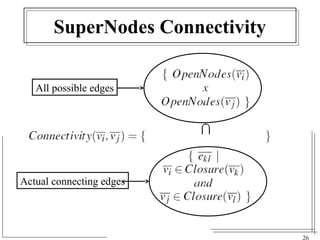
SuperNodes Connectivity 
• Connectivity: the set of edges (SuperEdge) 
between two SuperNodes 
• Connectivity between siblings: part of the tree 
• Connectivity between non-siblings: use open 
nodes information 
• Important for SuperNode-to-SuperNode analysis
24 
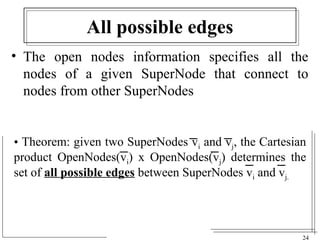
All possible edges 
• The open nodes information specifies all the 
nodes of a given SuperNode that connect to 
nodes from other SuperNodes 
• Theorem: given two SuperNodes vi and vj, the Cartesian 
product OpenNodes(vi) x OpenNodes(vj) determines the 
set of all possible edges between SuperNodes vi and vj.
25 
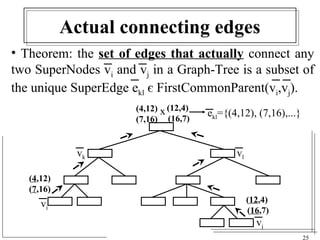
Actual connecting edges 
• Theorem: the set of edges that actually connect any 
two SuperNodes vi and vj in a Graph-Tree is a subset of 
the unique SuperEdge ekl є FirstCommonParent(vi,vj). 
vi 
ekl={(4,12), (7,16),...} 
(12,4) 
(16,7) 
vj 
(4,12) 
(7,16) 
(12,4) 
(16,7) 
(4,12) 
(7,16) 
x 
vk vl
26 
SuperNodes Connectivity 
All possible edges 
Actual connecting edges
27 
Outline 
Problem and Principle 
SuperGraphs and the Graph-Tree 
Connectivity 
Performance 
Conclusions
28 
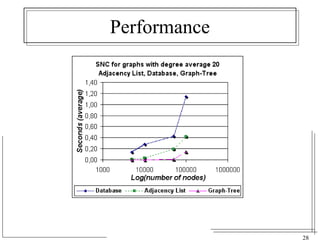
Performance
29 
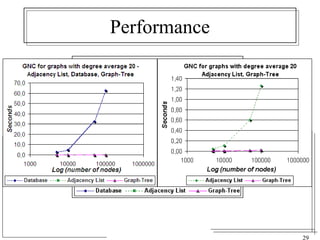
Performance
30 
Short Demonstration
31 
Outline 
Problem and Principle 
SuperGraphs and the Graph-Tree 
Connectivity 
Performance 
Conclusions
32 
Conclusion 
• A new data structure for graphs 
– hierarchical management of graph partitions 
(More SuperNodes) 
at http://www.cs.cmu.edu/~junio 
– the original graph information is not lost 
– relationship (SuperEdges) between groups of nodes 
instead of nodes only 
– scalability for visualization and interaction 
• GMine - A new graph visualization tool
33 
End

SuperGraph visualization

  • 1.
    1 SuperGraph Visualization http://www.icmc.usp.br/~junio/PublishedPapers/RodriguesJr_et_al-ISM2006.pdf José F. Rodrigues Jr., Agma J. M. Traina, Caetano Traina Jr. University of São Paulo Computer Science Department ICMC-USP Brazil Christos Faloutsos Carnegie Mellon University Computer Science Department USA
  • 2.
    2 Outline Problemand Principle SuperGraphs and the Graph-Tree Connectivity Performance Conclusions
  • 3.
    3 Problem •Large graphs – Hundred-thousand nodes or more – Million edges magnitude – web graphs, computer communication graphs , recommendation systems, whotrusts-whom networks, bipartite graphs of web-logs • Visual exploration limits – Prohibitive processing power requirements for interactive visualization – Excessive number of graphical items in screen
  • 4.
    4 Problem •Large graphs – Hundred-thousand nodes or more – Million edges magnitude – web graphs, computer communication graphs , recommendation systems, whotrusts-whom networks, bipartite graphs of web-logs • Visual exploration limits – Prohibitive processing power requirements for interactive visualization – Excessive number of graphical items in screen
  • 5.
    5 Current Lineof Research • Draw graph according to the modular decomposition theory
  • 6.
    6 Current Lineof Research • Draw graph according Limitation to the modular decomposition theory Graphs represented like this are limited: - What is the relation between a given group of nodes and another group of nodes? - How many edges connect these two groups? - Which are they? - Which are the graph nodes from other groups that connect to a graph node of interest? The graph hierarchy is dead and the original is graph is lost.
  • 7.
    7 Extending theidea ? ? ? SuperNodes connectivity ? ? ? ? ? ?? SuperEdges ? Graph nodes connectivity
  • 8.
    8 Extending theidea ? ? ? SuperNodes connectivity ? ? ? ? ? ?? SuperEdges ? Graph nodes connectivity
  • 9.
    9 Principle •Utilize compartmented processing and presentation • Utilize a structured partitioned version of the graph to be analized • Add interaction for a richer experience
  • 10.
    10 Principle •Utilize compartmented Our proposal processing and presentation Introduce a theory and a data structure to allow the use of the hierarchical graph partition representation without loosing the original • Utilize graph information. a structured partitioned version of the graph to be analized Do this on the context of visualization, interaction and scalability • Add interaction for a richer experience
  • 11.
    11 Outline Problemand Principle SuperGraphs and the Graph-Tree Connectivity Performance Conclusions
  • 12.
    12 SuperGraphs andthe Graph-Tree • Given a graph G={V,E} a SuperGrap is a recursive partitioning of G • A GraphTree is a SuperGraph structured as a tree • Graph nodes are kept at the leaf nodes of the tree • Graph edges are distributed along the tree structure
  • 13.
  • 14.
    14 Example SuperGraphGraphTree SuperNodes LeafSuperNodes
  • 15.
    15 Building aGraph-Tree Open Open Open 1 2 Open 3 4 Open Open Open 5 6 Open 7 8 1 4 5 7 Open 1 4 5 7
  • 16.
    16 Graph-Tree –LeafSuperNode id file parent id nodes open nodes SuperEdges
  • 17.
    17 Graph-Tree -SuperNode id parent id sons open nodes SuperEdges
  • 18.
    18 Graph-Tree •A tree of graph partitions or a hierarchical partitioning of a graph • A new data structure for graphs • Benefits: novel graph storage + structured graph partitions • Provides: on demand processing/presentation + inter partitions edges information + spatial search tree (natural R-Tree properties)
  • 19.
    19 Outline Problemand Principle SuperGraphs and the Graph-Tree Connectivity Performance Conclusions
  • 20.
    20 Outline Problemand Principle SuperGraphs and the Graph-Tree Connectivity Performance Conclusions
  • 21.
    21 Graph NodesConnectivity • Theorem: if a graph node v is an open node for a SuperNode V, then its set of parent (Parents(V)) embody all the SuperEdges that hold edges connected to v. Open 1 2 Open 3 4 Open 5 6 Open 7 8 Open 1 4 Open 5 7 Open (2,3) (2,4) (1,5) (1,7) (4,7)
  • 22.
    22 Graph NodesConnectivity • Theorem: if a graph node v is an open node for a SuperNode V, then its set of parent (Parents(V)) embody all the SuperEdges that hold edges connected to v. Open 1 2 Open 3 4 Open 5 6 Open 7 8 Open 1 4 Open 5 7 Open (2,3) (2,4) (1,5) (1,7) (4,7) SuperNode V = FindParentOf(v); While(v in OpenNodes(V)){ V = Parent(V); Scan SuperEdges of V; }
  • 23.
    23 SuperNodes Connectivity • Connectivity: the set of edges (SuperEdge) between two SuperNodes • Connectivity between siblings: part of the tree • Connectivity between non-siblings: use open nodes information • Important for SuperNode-to-SuperNode analysis
  • 24.
    24 All possibleedges • The open nodes information specifies all the nodes of a given SuperNode that connect to nodes from other SuperNodes • Theorem: given two SuperNodes vi and vj, the Cartesian product OpenNodes(vi) x OpenNodes(vj) determines the set of all possible edges between SuperNodes vi and vj.
  • 25.
    25 Actual connectingedges • Theorem: the set of edges that actually connect any two SuperNodes vi and vj in a Graph-Tree is a subset of the unique SuperEdge ekl є FirstCommonParent(vi,vj). vi ekl={(4,12), (7,16),...} (12,4) (16,7) vj (4,12) (7,16) (12,4) (16,7) (4,12) (7,16) x vk vl
  • 26.
    26 SuperNodes Connectivity All possible edges Actual connecting edges
  • 27.
    27 Outline Problemand Principle SuperGraphs and the Graph-Tree Connectivity Performance Conclusions
  • 28.
  • 29.
  • 30.
  • 31.
    31 Outline Problemand Principle SuperGraphs and the Graph-Tree Connectivity Performance Conclusions
  • 32.
    32 Conclusion •A new data structure for graphs – hierarchical management of graph partitions (More SuperNodes) at http://www.cs.cmu.edu/~junio – the original graph information is not lost – relationship (SuperEdges) between groups of nodes instead of nodes only – scalability for visualization and interaction • GMine - A new graph visualization tool
  • 33.