Technology & Strategy on


                                Presented by,
                                  Miguel Van den Bogaert
                                        Kannan Ramalingam

                   3/23/2011   Technology & Strategy        1
Evolution of the solar industry
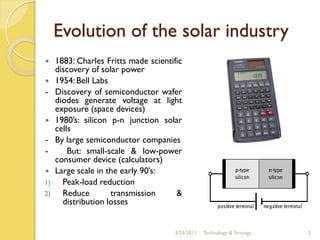
  1883: Charles Fritts made scientific
   discovery of solar power
 1954: Bell Labs
- Discovery of semiconductor wafer
   diodes generate voltage at light
   exposure (space devices)
 1980’s: silicon p-n junction solar
   cells
- By large semiconductor companies
-      But: small-scale & low-power
   consumer device (calculators)
 Large scale in the early 90’s:
1)   Peak-load reduction
2)   Reduce        transmission      &
     distribution losses


                                     3/23/2011   Technology & Strategy   2
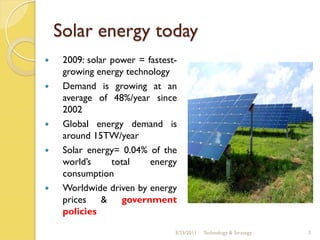
Solar energy today
    2009: solar power = fastest-
     growing energy technology
    Demand is growing at an
     average of 48%/year since
     2002
    Global energy demand is
     around 15TW/year
    Solar energy= 0.04% of the
     world’s     total    energy
     consumption
    Worldwide driven by energy
     prices & government
     policies

                                3/23/2011   Technology & Strategy   3
Brief company’s history
   Started as a glass company, created by Harold
    McMaster (physicist)

- 1948: founded Permaglass; shatters in small pieces
  when broken  automotive industry
- 1984: Solar industry  Glasstech Solar
    ( importance of cost competitiveness)
- 1990: Found Solar Cells (use of CdTe)
- very slow progress 1999: acquired by True North
  Partners and renamed First Solar (production
  capacity > 20MW)

                        3/23/2011   Technology & Strategy   4
First Solar: Today
 World’s leading manufacturer of
  solar panels (13% of the market-
  share)
- Annual production capacity of
  solar modules > 1 GW
 Convert sunlight into electricity at
  a lower cost (< $1 cost/W)
  than its competitors
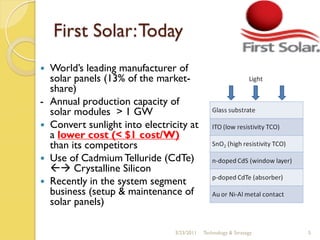
 Use of Cadmium Telluride (CdTe)
   Crystalline Silicon
 Recently in the system segment
  business (setup & maintenance of
  solar panels)

                                3/23/2011   Technology & Strategy   5
Brief company overview
   Type: Public (NASDAQ: FSLR) , share price: 150.75USD
   Founded in 1999 (as First Solar Holdings, LLC)
   Headquarters: Tempe, Arizona, U.S.
   Key people:
-   CEO :Robert J. Gillette
-   Chairman of Supervisory Board: Michael J. Ahearn
-   President Operations: Bruce Sohn
   Revenue: US$ 2.56 Billion (FY 2010)
   Operating income: US$ 748.9 Million (FY 2010)
   Net income: US$ 664.2 Million (FY 2010)
   Total assets: US$ 3,35 Billion (2009)
   Total equity: US$ 2,65 Billion (2009)
   Employees: 5,200 (2010)

                             3/23/2011   Technology & Strategy   6
Types and patterns of innovation
   Product innovation:
-   Industry still developing
   Competence-enhancing
    vs competence-
    destroying
-   Depending on a lot of
    factors (new technology
    disruption)
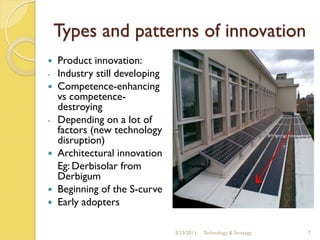
   Architectural innovation
    Eg: Derbisolar from
    Derbigum
   Beginning of the S-curve
   Early adopters

                                3/23/2011   Technology & Strategy   7
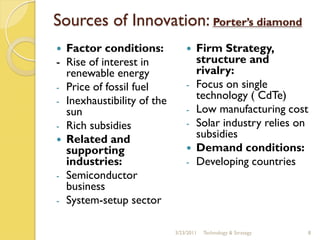
Sources of Innovation: Porter’s diamond
 Factor conditions:               Firm Strategy,
- Rise of interest in               structure and
  renewable energy                  rivalry:
- Price of fossil fuel          -   Focus on single
- Inexhaustibility of the
                                    technology ( CdTe)
  sun                           -   Low manufacturing cost
- Rich subsidies                -   Solar industry relies on
 Related and
                                    subsidies
  supporting                       Demand conditions:
  industries:                   -   Developing countries
- Semiconductor
  business
- System-setup sector


                            3/23/2011   Technology & Strategy   8
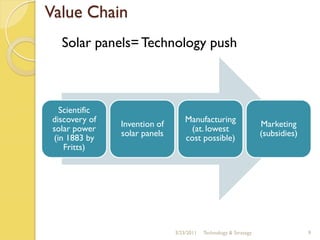
Value Chain
  Solar panels= Technology push


  Scientific
discovery of                      Manufacturing
               Invention of                                       Marketing
solar power                        (at. lowest
               solar panels                                       (subsidies)
(in 1883 by                       cost possible)
   Fritts)


                              3/23/2011   Technology & Strategy                 9
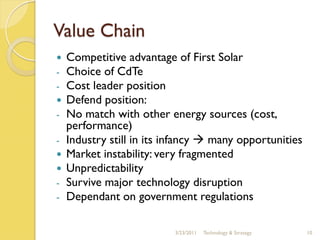
Value Chain
   Competitive advantage of First Solar
-   Choice of CdTe
-   Cost leader position
   Defend position:
-   No match with other energy sources (cost,
    performance)
-   Industry still in its infancy  many opportunities
   Market instability: very fragmented
   Unpredictability
-   Survive major technology disruption
-   Dependant on government regulations

                           3/23/2011   Technology & Strategy   10
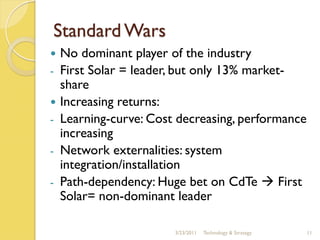
Standard Wars
 No dominant player of the industry
- First Solar = leader, but only 13% market-
  share
 Increasing returns:
- Learning-curve: Cost decreasing, performance
  increasing
- Network externalities: system
  integration/installation
- Path-dependency: Huge bet on CdTe  First
  Solar= non-dominant leader

                      3/23/2011   Technology & Strategy   11
Standard Wars
   Government regulation
-   Connection to grid, certified installer of
    solar power, allowance of installations
-   Grants, financial assistance
-   Targets: RPS: by 2020, 20% of electrical
    power is coming from renewable sources


                       3/23/2011   Technology & Strategy   12
Market forces of First solar
   Good Solar Resource to have High annual
    insulation

   Favorable High electricity prices as they
    reduced the cost hurdle for substitution by PV

   Large area needed in close proximity to
    maximize the amount of geneartion

   Access to development land to support the
    buliding of solar facilities
                           3/23/2011   Technology & Strategy   13
Buyers
 In 2009, 10-K: First Solar’s largest systems
  integration customers in Europe were
  responsible for more than 90 percent of
  its revenue
 System integrators in Germany & Spain
 In U.S. at the start, only Residential
  customers using net metering & ITCs
 By 2010, Sempra, PG&E and Southern
  California Edison became largest
  customers
                     3/23/2011   Technology & Strategy   14
FIRST SOLAR’s mission
“ To Create enduring value by enabling a world
  powered by clean, affordable solar
  electricity”

SUSTAINABLITY Remark

 “ The real thing to notice with renewable is
  not necessarily how they stack up against
  each other, but rather that they are all
  orders of magnitude better than the use of
  fossil fuels”

                      3/23/2011   Technology & Strategy   15
THREAT OF ENTRY & SUBSTITUTES
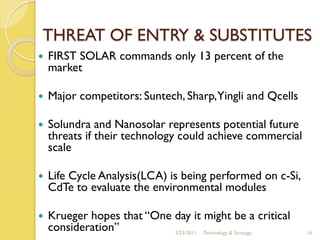
   FIRST SOLAR commands only 13 percent of the
    market

   Major competitors: Suntech, Sharp,Yingli and Qcells

   Solundra and Nanosolar represents potential future
    threats if their technology could achieve commercial
    scale

   Life Cycle Analysis(LCA) is being performed on c-Si,
    CdTe to evaluate the environmental modules

   Krueger hopes that “One day it might be a critical
    consideration”          3/23/2011 Technology & Strategy   16
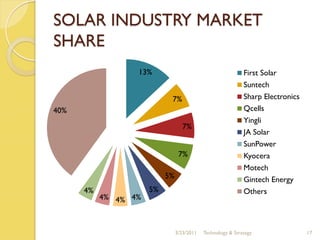
SOLAR INDUSTRY MARKET
SHARE
                  13%                                        First Solar
                                                             Suntech
                            7%                               Sharp Electronics
40%                                                          Qcells
                                                             Yingli
                                  7%
                                                             JA Solar
                                                             SunPower
                                 7%                          Kyocera
                                                             Motech
                           5%                                Gintech Energy
      4%              5%                                     Others
           4% 4% 4%


                                3/23/2011   Technology & Strategy                17
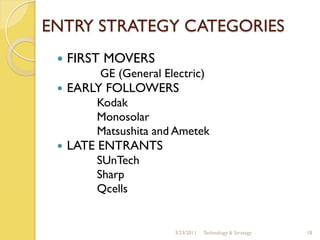
ENTRY STRATEGY CATEGORIES
    FIRST MOVERS
         GE (General Electric)
    EARLY FOLLOWERS
         Kodak
         Monosolar
         Matsushita and Ametek
    LATE ENTRANTS
         SUnTech
         Sharp
         Qcells


                        3/23/2011   Technology & Strategy   18
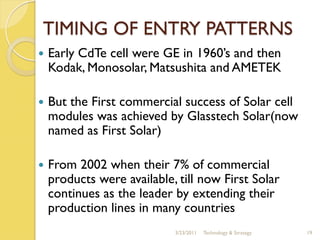
TIMING OF ENTRY PATTERNS
   Early CdTe cell were GE in 1960’s and then
    Kodak, Monosolar, Matsushita and AMETEK

   But the First commercial success of Solar cell
    modules was achieved by Glasstech Solar(now
    named as First Solar)

   From 2002 when their 7% of commercial
    products were available, till now First Solar
    continues as the leader by extending their
    production lines in many countries
                            3/23/2011   Technology & Strategy   19
FACTORS INFLUENCING FIRST
    SOLAR ENTRY
   In order to make CdTe a commercial product,
    McMaster raised his funds to additional of $15
    million during 1990.
   Despite many challenges, the company was
    able to produce a commercially viable process
    for producing thin cells with CdTe by 1993.
   By 1998, It had annual production of 20MW
    and in 1999, True North Partners acquired it
    and renamed as First Solar
                           3/23/2011   Technology & Strategy   20
TIMING OF ENTRY PATTERNS
   First Solar had a substantial lead over its
    competitors in terms of module cost/watt.

   But the entire industry was still in its infancy
    with many opportunities for competitors to
    usurp company’s lead

   The huge success of First Solar in 2002
    attracted not only the European market, but
    also companies like SUNTECH POWER,
    SHARP,YINGLI, QCELLS, JUWI SOLAR
                             3/23/2011   Technology & Strategy   21
CONCLUSION
 Out of world’s average rate of 15TW
  electricity produced yearly, only 0.04% is from
  solar resource
 Present crisis of Fossil Fuels can increase their
  price. So at one critical stage, there will be a
  need of renewable sources
 Solar industry not yet viable without
  Government financial support
 More Improved Infrastructure, More Isolated
  land resource, more grants from Government,
  expansion of market in Asian countries can
  ease a tremendous growth for First Solar in
  the Future
                          3/23/2011   Technology & Strategy   22
THANK YOU
  &
QUERIES???
Visit our blog on First Solar at:
http://innovtechnovision.blogspot.com/


                     3/23/2011   Technology & Strategy   23

First presentation

  • 1.
    Technology & Strategyon Presented by, Miguel Van den Bogaert Kannan Ramalingam 3/23/2011 Technology & Strategy 1
  • 2.
    Evolution of thesolar industry  1883: Charles Fritts made scientific discovery of solar power  1954: Bell Labs - Discovery of semiconductor wafer diodes generate voltage at light exposure (space devices)  1980’s: silicon p-n junction solar cells - By large semiconductor companies - But: small-scale & low-power consumer device (calculators)  Large scale in the early 90’s: 1) Peak-load reduction 2) Reduce transmission & distribution losses 3/23/2011 Technology & Strategy 2
  • 3.
    Solar energy today  2009: solar power = fastest- growing energy technology  Demand is growing at an average of 48%/year since 2002  Global energy demand is around 15TW/year  Solar energy= 0.04% of the world’s total energy consumption  Worldwide driven by energy prices & government policies 3/23/2011 Technology & Strategy 3
  • 4.
    Brief company’s history  Started as a glass company, created by Harold McMaster (physicist) - 1948: founded Permaglass; shatters in small pieces when broken  automotive industry - 1984: Solar industry  Glasstech Solar ( importance of cost competitiveness) - 1990: Found Solar Cells (use of CdTe) - very slow progress 1999: acquired by True North Partners and renamed First Solar (production capacity > 20MW) 3/23/2011 Technology & Strategy 4
  • 5.
    First Solar: Today World’s leading manufacturer of solar panels (13% of the market- share) - Annual production capacity of solar modules > 1 GW  Convert sunlight into electricity at a lower cost (< $1 cost/W) than its competitors  Use of Cadmium Telluride (CdTe)  Crystalline Silicon  Recently in the system segment business (setup & maintenance of solar panels) 3/23/2011 Technology & Strategy 5
  • 6.
    Brief company overview  Type: Public (NASDAQ: FSLR) , share price: 150.75USD  Founded in 1999 (as First Solar Holdings, LLC)  Headquarters: Tempe, Arizona, U.S.  Key people: - CEO :Robert J. Gillette - Chairman of Supervisory Board: Michael J. Ahearn - President Operations: Bruce Sohn  Revenue: US$ 2.56 Billion (FY 2010)  Operating income: US$ 748.9 Million (FY 2010)  Net income: US$ 664.2 Million (FY 2010)  Total assets: US$ 3,35 Billion (2009)  Total equity: US$ 2,65 Billion (2009)  Employees: 5,200 (2010) 3/23/2011 Technology & Strategy 6
  • 7.
    Types and patternsof innovation  Product innovation: - Industry still developing  Competence-enhancing vs competence- destroying - Depending on a lot of factors (new technology disruption)  Architectural innovation Eg: Derbisolar from Derbigum  Beginning of the S-curve  Early adopters 3/23/2011 Technology & Strategy 7
  • 8.
    Sources of Innovation:Porter’s diamond  Factor conditions:  Firm Strategy, - Rise of interest in structure and renewable energy rivalry: - Price of fossil fuel - Focus on single - Inexhaustibility of the technology ( CdTe) sun - Low manufacturing cost - Rich subsidies - Solar industry relies on  Related and subsidies supporting  Demand conditions: industries: - Developing countries - Semiconductor business - System-setup sector 3/23/2011 Technology & Strategy 8
  • 9.
    Value Chain Solar panels= Technology push Scientific discovery of Manufacturing Invention of Marketing solar power (at. lowest solar panels (subsidies) (in 1883 by cost possible) Fritts) 3/23/2011 Technology & Strategy 9
  • 10.
    Value Chain  Competitive advantage of First Solar - Choice of CdTe - Cost leader position  Defend position: - No match with other energy sources (cost, performance) - Industry still in its infancy  many opportunities  Market instability: very fragmented  Unpredictability - Survive major technology disruption - Dependant on government regulations 3/23/2011 Technology & Strategy 10
  • 11.
    Standard Wars  Nodominant player of the industry - First Solar = leader, but only 13% market- share  Increasing returns: - Learning-curve: Cost decreasing, performance increasing - Network externalities: system integration/installation - Path-dependency: Huge bet on CdTe  First Solar= non-dominant leader 3/23/2011 Technology & Strategy 11
  • 12.
    Standard Wars  Government regulation - Connection to grid, certified installer of solar power, allowance of installations - Grants, financial assistance - Targets: RPS: by 2020, 20% of electrical power is coming from renewable sources 3/23/2011 Technology & Strategy 12
  • 13.
    Market forces ofFirst solar  Good Solar Resource to have High annual insulation  Favorable High electricity prices as they reduced the cost hurdle for substitution by PV  Large area needed in close proximity to maximize the amount of geneartion  Access to development land to support the buliding of solar facilities 3/23/2011 Technology & Strategy 13
  • 14.
    Buyers  In 2009,10-K: First Solar’s largest systems integration customers in Europe were responsible for more than 90 percent of its revenue  System integrators in Germany & Spain  In U.S. at the start, only Residential customers using net metering & ITCs  By 2010, Sempra, PG&E and Southern California Edison became largest customers 3/23/2011 Technology & Strategy 14
  • 15.
    FIRST SOLAR’s mission “To Create enduring value by enabling a world powered by clean, affordable solar electricity” SUSTAINABLITY Remark “ The real thing to notice with renewable is not necessarily how they stack up against each other, but rather that they are all orders of magnitude better than the use of fossil fuels” 3/23/2011 Technology & Strategy 15
  • 16.
    THREAT OF ENTRY& SUBSTITUTES  FIRST SOLAR commands only 13 percent of the market  Major competitors: Suntech, Sharp,Yingli and Qcells  Solundra and Nanosolar represents potential future threats if their technology could achieve commercial scale  Life Cycle Analysis(LCA) is being performed on c-Si, CdTe to evaluate the environmental modules  Krueger hopes that “One day it might be a critical consideration” 3/23/2011 Technology & Strategy 16
  • 17.
    SOLAR INDUSTRY MARKET SHARE 13% First Solar Suntech 7% Sharp Electronics 40% Qcells Yingli 7% JA Solar SunPower 7% Kyocera Motech 5% Gintech Energy 4% 5% Others 4% 4% 4% 3/23/2011 Technology & Strategy 17
  • 18.
    ENTRY STRATEGY CATEGORIES  FIRST MOVERS GE (General Electric)  EARLY FOLLOWERS Kodak Monosolar Matsushita and Ametek  LATE ENTRANTS SUnTech Sharp Qcells 3/23/2011 Technology & Strategy 18
  • 19.
    TIMING OF ENTRYPATTERNS  Early CdTe cell were GE in 1960’s and then Kodak, Monosolar, Matsushita and AMETEK  But the First commercial success of Solar cell modules was achieved by Glasstech Solar(now named as First Solar)  From 2002 when their 7% of commercial products were available, till now First Solar continues as the leader by extending their production lines in many countries 3/23/2011 Technology & Strategy 19
  • 20.
    FACTORS INFLUENCING FIRST SOLAR ENTRY  In order to make CdTe a commercial product, McMaster raised his funds to additional of $15 million during 1990.  Despite many challenges, the company was able to produce a commercially viable process for producing thin cells with CdTe by 1993.  By 1998, It had annual production of 20MW and in 1999, True North Partners acquired it and renamed as First Solar 3/23/2011 Technology & Strategy 20
  • 21.
    TIMING OF ENTRYPATTERNS  First Solar had a substantial lead over its competitors in terms of module cost/watt.  But the entire industry was still in its infancy with many opportunities for competitors to usurp company’s lead  The huge success of First Solar in 2002 attracted not only the European market, but also companies like SUNTECH POWER, SHARP,YINGLI, QCELLS, JUWI SOLAR 3/23/2011 Technology & Strategy 21
  • 22.
    CONCLUSION  Out ofworld’s average rate of 15TW electricity produced yearly, only 0.04% is from solar resource  Present crisis of Fossil Fuels can increase their price. So at one critical stage, there will be a need of renewable sources  Solar industry not yet viable without Government financial support  More Improved Infrastructure, More Isolated land resource, more grants from Government, expansion of market in Asian countries can ease a tremendous growth for First Solar in the Future 3/23/2011 Technology & Strategy 22
  • 23.
    THANK YOU & QUERIES??? Visit our blog on First Solar at: http://innovtechnovision.blogspot.com/ 3/23/2011 Technology & Strategy 23