Abuse of Vulnerable
Populations in
Social Networks
Kristin J. McCowan
Rachel Finch
Michaela Much
Taylor Murrie-Robinson
Kimi Nolte
Small Activity
 We have handed out slips of paper to
everyone.
 Red dot: 6 classmates
 Silver dot: 21 classmates
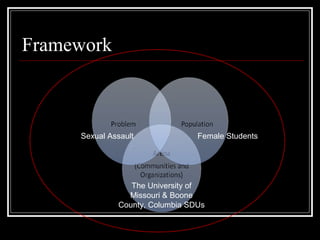
Framework
Sexual Assault Female Students
The University of
Missouri & Boone
County, Columbia SDUs
Target Population
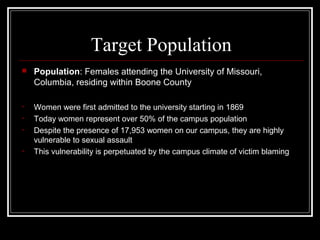
 Population: Females attending the University of Missouri,
Columbia, residing within Boone County
• Women were first admitted to the university starting in 1869
• Today women represent over 50% of the campus population
• Despite the presence of 17,953 women on our campus, they are highly
vulnerable to sexual assault
• This vulnerability is perpetuated by the campus climate of victim blaming
Target Population
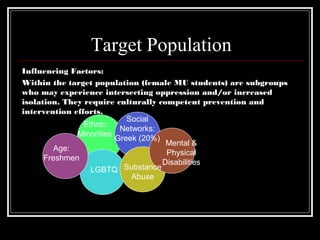
Influencing Factors:
Within the target population (female MU students) are subgroups
who may experience intersecting oppression and/or increased
isolation. They require culturally competent prevention and
intervention efforts.
Ethnic
Minorities
Social
Networks:
Greek (20%)
Substance
Abuse
Mental &
Physical
Disabilities
LGBTQ
Age:
Freshmen
Problem
Federal legislation requiring reporting of crime statistics and mandating certain campus
policies was a step forward, but a recent study found only 37% of campuses’ reports
were fully compliant with law. (Title IX)
Although awareness has increased, reporting remains low and service delivery lacks
successful coordination.
Students may be better prepared for stranger assault, but most instances involve
acquaintances.
Survivor Impacts:
Survivors of sexual assault often suffer academic difficulties and are more likely to
leave school.
40% of victims acquire a sexually transmitted disease as a result of rape.
80% of victims suffer chronic physical or mental health
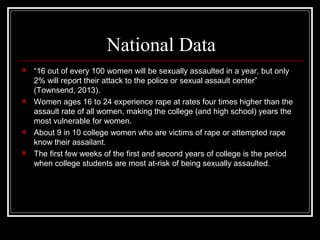
National Data
 “16 out of every 100 women will be sexually assaulted in a year, but only
2% will report their attack to the police or sexual assault center”
(Townsend, 2013).
 Women ages 16 to 24 experience rape at rates four times higher than the
assault rate of all women, making the college (and high school) years the
most vulnerable for women.
 About 9 in 10 college women who are victims of rape or attempted rape
know their assailant.
 The first few weeks of the first and second years of college is the period
when college students are most at-risk of being sexually assaulted.
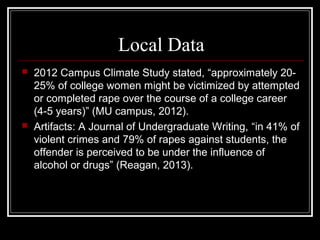
Local Data
 2012 Campus Climate Study stated, “approximately 20-
25% of college women might be victimized by attempted
or completed rape over the course of a college career
(4-5 years)” (MU campus, 2012).
 Artifacts: A Journal of Undergraduate Writing, “in 41% of
violent crimes and 79% of rapes against students, the
offender is perceived to be under the influence of
alcohol or drugs” (Reagan, 2013).
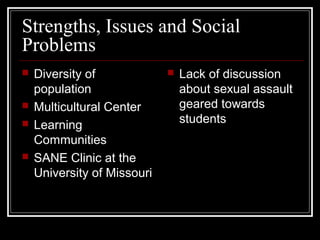
Strengths, Issues and Social
Problems
 Diversity of
population
 Multicultural Center
 Learning
Communities
 SANE Clinic at the
University of Missouri
 Lack of discussion
about sexual assault
geared towards
students
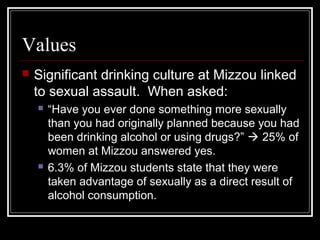
Values
 Significant drinking culture at Mizzou linked
to sexual assault. When asked:
 “Have you ever done something more sexually
than you had originally planned because you had
been drinking alcohol or using drugs?”  25% of
women at Mizzou answered yes.
 6.3% of Mizzou students state that they were
taken advantage of sexually as a direct result of
alcohol consumption.
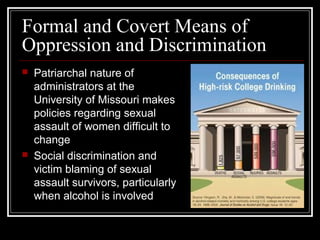
Formal and Covert Means of
Oppression and Discrimination
 Patriarchal nature of
administrators at the
University of Missouri makes
policies regarding sexual
assault of women difficult to
change
 Social discrimination and
victim blaming of sexual
assault survivors, particularly
when alcohol is involved
Community Differences
 Legal Terminology Medical Jargon College Culture
 Basic definitions and perceptions do not align.
 Student Center:
 Sexual assault is defined as any unwanted physical or sexual contact, including rape.
Consent is “enthusiastic participation” and must be freely given without the use of coercion,
manipulation or intoxication. We must go beyond stereotypical definitions of forcible rape
and more broadly consider the matter of consent.
 MO Statutes:
 "if a person has deviate sexual intercourse with another person of the same sex or he purposely subjects
another person to sexual contact or engages in conduct which would constitute sexual contact except that
touching occurs through the clothing without that person's consent" (Missouri Revised Statutes Sections
566.090-.095). Sexual contact "means any touching of another person with the genitals, or any touching of
the genitals or anus of another person or the breast of a female person for the purpose of arousing or
gratifying sexual desire of any person." (Missouri Revised Statutes 566.010).
Community Differences
 Campus acts as a Microcosm
 Women and their aspirations are marginalized, even under Title
IX protections.
 Faculty position by Gender 2004-2013
 “Chilly Climate”: subtle & overt behaviors on the part of faculty,
staff, and students that affect a woman’s academic performance
& preparation for entry into graduate school or career.
Differential Treatment & Prejudice
OVERT
 Focus on appearance, or personal
or family life vs. performance
 “Pimps and Ho’s” parties
 Counseling to lower academic
goals or encourage traditional
“feminine” career paths
SUBTLE
 Frequent interruptions, minimal
responses, ignoring, or preferring
to seek male comments and
suggestions
 Crediting ideas to males but not
females
 Expressing surprise or doubt at
career goals. “Take a few years
off”
Differential Treatment & Prejudice
OVERT
 “Party Girl”
 “Bar-Hopping”
 "It was important that they
suspend Dixon those first few
games because it wasn't in the
real season, and they needed him
to play during the actual games.”
SUBTLE
 Communication preferences
 Options for victims require more
effort and inconvenience than for
the accused perpetrators
 Think about personal examples that
you have experienced or witnessed
that might support the “chilly climate”
for women at-risk or at-need?
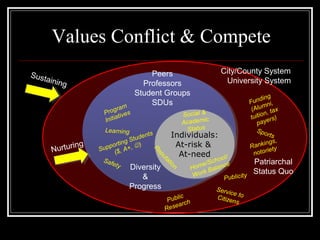
Values Conflict & Compete
Individuals:
At-risk &
At-need
Individuals:
At-risk &
At-need
Sustaining
Nurturing
Peers
Professors
Student Groups
SDUs
City/County System
University System
Learning
R
eputation
Supporting Students
($, A+, )
Program
Initiatives Social &
Academic
Status
Funding
(Alumni,
tuition, tax
payers)
Rankings,
notoriety
Sports
Safety
Publicity
Service toCitizensPublic
Research
Home/School/
Work Balance
Diversity
&
Progress
Patriarchal
Status Quo
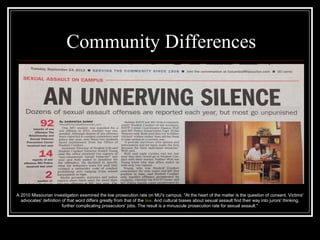
Community Differences
A 2010 Missourian investigation examined the low prosecution rate on MU's campus. "At the heart of the matter is the question of consent. Victims'
advocates' definition of that word differs greatly from that of the law. And cultural biases about sexual assault find their way into jurors' thinking,
further complicating prosecutors' jobs. The result is a minuscule prosecution rate for sexual assault."
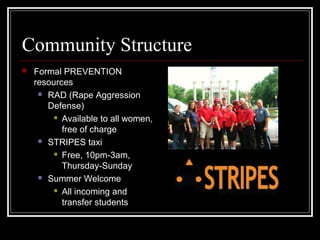
Community Structure
 Formal PREVENTION
resources
 RAD (Rape Aggression
Defense)
 Available to all women,
free of charge
 STRIPES taxi
 Free, 10pm-3am,
Thursday-Sunday
 Summer Welcome
 All incoming and
transfer students
Community Structure
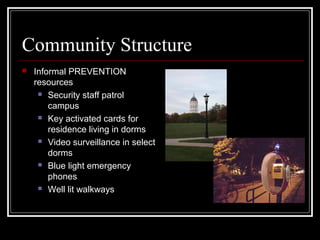
 Informal PREVENTION
resources
 Security staff patrol
campus
 Key activated cards for
residence living in dorms
 Video surveillance in select
dorms
 Blue light emergency
phones
 Well lit walkways
Community Structure
 Formal REACTIVE resources
 RSVP (Relationship &
Sexual Violence
Prevention) Center
 Women’s Center
 Counseling Center
 Student Health Center
 MUPD
 University hospital
 Office of Student Conduct
 Student legal Services
Community Structure
SWOT Assessment
 Strengths:
 Diversity of Student Body
 Majority-women
 Abundance of SDUs
 Weaknesses:
 Poor Linkages-communication barriers
 Insufficiencies within SDUs
 Summer Welcome message and tone
SWOT Assessment
 Opportunities:
 Establish relationship with MO Crisis Hotline
 Enhance Summer Welcome- prevention &
reporting
 Improve collaboration-SDU linkages & role clarity
 Threats/Barriers:
 Chilly climate
 Perceived need for change amongst SDUs and
campus community
Recommendations:
 Take advantage of all identified opportunities
 Enhance the ‘message’ at Summer Welcome
 Establish relationship with Missouri Crisis Hotline.
 Anonymous reporting component/virtual support
 Create several GA positions that serve as liaisons between
units and develop concrete roles between service delivery
units.
 Reevaluate and update the University of Missouri Sexual
Assault Protocol annually and require that it be disseminated
to the entire campus community.

Final slides sexualassault7740compatibleversion (1)

  • 1.
    Abuse of Vulnerable Populationsin Social Networks Kristin J. McCowan Rachel Finch Michaela Much Taylor Murrie-Robinson Kimi Nolte
  • 2.
    Small Activity  Wehave handed out slips of paper to everyone.  Red dot: 6 classmates  Silver dot: 21 classmates
  • 4.
    Framework Sexual Assault FemaleStudents The University of Missouri & Boone County, Columbia SDUs
  • 5.
    Target Population  Population:Females attending the University of Missouri, Columbia, residing within Boone County • Women were first admitted to the university starting in 1869 • Today women represent over 50% of the campus population • Despite the presence of 17,953 women on our campus, they are highly vulnerable to sexual assault • This vulnerability is perpetuated by the campus climate of victim blaming
  • 6.
    Target Population Influencing Factors: Withinthe target population (female MU students) are subgroups who may experience intersecting oppression and/or increased isolation. They require culturally competent prevention and intervention efforts. Ethnic Minorities Social Networks: Greek (20%) Substance Abuse Mental & Physical Disabilities LGBTQ Age: Freshmen
  • 7.
    Problem Federal legislation requiringreporting of crime statistics and mandating certain campus policies was a step forward, but a recent study found only 37% of campuses’ reports were fully compliant with law. (Title IX) Although awareness has increased, reporting remains low and service delivery lacks successful coordination. Students may be better prepared for stranger assault, but most instances involve acquaintances. Survivor Impacts: Survivors of sexual assault often suffer academic difficulties and are more likely to leave school. 40% of victims acquire a sexually transmitted disease as a result of rape. 80% of victims suffer chronic physical or mental health
  • 8.
    National Data  “16out of every 100 women will be sexually assaulted in a year, but only 2% will report their attack to the police or sexual assault center” (Townsend, 2013).  Women ages 16 to 24 experience rape at rates four times higher than the assault rate of all women, making the college (and high school) years the most vulnerable for women.  About 9 in 10 college women who are victims of rape or attempted rape know their assailant.  The first few weeks of the first and second years of college is the period when college students are most at-risk of being sexually assaulted.
  • 9.
    Local Data  2012Campus Climate Study stated, “approximately 20- 25% of college women might be victimized by attempted or completed rape over the course of a college career (4-5 years)” (MU campus, 2012).  Artifacts: A Journal of Undergraduate Writing, “in 41% of violent crimes and 79% of rapes against students, the offender is perceived to be under the influence of alcohol or drugs” (Reagan, 2013).
  • 10.
    Strengths, Issues andSocial Problems  Diversity of population  Multicultural Center  Learning Communities  SANE Clinic at the University of Missouri  Lack of discussion about sexual assault geared towards students
  • 11.
    Values  Significant drinkingculture at Mizzou linked to sexual assault. When asked:  “Have you ever done something more sexually than you had originally planned because you had been drinking alcohol or using drugs?”  25% of women at Mizzou answered yes.  6.3% of Mizzou students state that they were taken advantage of sexually as a direct result of alcohol consumption.
  • 12.
    Formal and CovertMeans of Oppression and Discrimination  Patriarchal nature of administrators at the University of Missouri makes policies regarding sexual assault of women difficult to change  Social discrimination and victim blaming of sexual assault survivors, particularly when alcohol is involved
  • 13.
    Community Differences  LegalTerminology Medical Jargon College Culture  Basic definitions and perceptions do not align.  Student Center:  Sexual assault is defined as any unwanted physical or sexual contact, including rape. Consent is “enthusiastic participation” and must be freely given without the use of coercion, manipulation or intoxication. We must go beyond stereotypical definitions of forcible rape and more broadly consider the matter of consent.  MO Statutes:  "if a person has deviate sexual intercourse with another person of the same sex or he purposely subjects another person to sexual contact or engages in conduct which would constitute sexual contact except that touching occurs through the clothing without that person's consent" (Missouri Revised Statutes Sections 566.090-.095). Sexual contact "means any touching of another person with the genitals, or any touching of the genitals or anus of another person or the breast of a female person for the purpose of arousing or gratifying sexual desire of any person." (Missouri Revised Statutes 566.010).
  • 14.
    Community Differences  Campusacts as a Microcosm  Women and their aspirations are marginalized, even under Title IX protections.  Faculty position by Gender 2004-2013  “Chilly Climate”: subtle & overt behaviors on the part of faculty, staff, and students that affect a woman’s academic performance & preparation for entry into graduate school or career.
  • 15.
    Differential Treatment &Prejudice OVERT  Focus on appearance, or personal or family life vs. performance  “Pimps and Ho’s” parties  Counseling to lower academic goals or encourage traditional “feminine” career paths SUBTLE  Frequent interruptions, minimal responses, ignoring, or preferring to seek male comments and suggestions  Crediting ideas to males but not females  Expressing surprise or doubt at career goals. “Take a few years off”
  • 16.
    Differential Treatment &Prejudice OVERT  “Party Girl”  “Bar-Hopping”  "It was important that they suspend Dixon those first few games because it wasn't in the real season, and they needed him to play during the actual games.” SUBTLE  Communication preferences  Options for victims require more effort and inconvenience than for the accused perpetrators  Think about personal examples that you have experienced or witnessed that might support the “chilly climate” for women at-risk or at-need?
  • 17.
    Values Conflict &Compete Individuals: At-risk & At-need Individuals: At-risk & At-need Sustaining Nurturing Peers Professors Student Groups SDUs City/County System University System Learning R eputation Supporting Students ($, A+, ) Program Initiatives Social & Academic Status Funding (Alumni, tuition, tax payers) Rankings, notoriety Sports Safety Publicity Service toCitizensPublic Research Home/School/ Work Balance Diversity & Progress Patriarchal Status Quo
  • 18.
    Community Differences A 2010Missourian investigation examined the low prosecution rate on MU's campus. "At the heart of the matter is the question of consent. Victims' advocates' definition of that word differs greatly from that of the law. And cultural biases about sexual assault find their way into jurors' thinking, further complicating prosecutors' jobs. The result is a minuscule prosecution rate for sexual assault."
  • 19.
    Community Structure  FormalPREVENTION resources  RAD (Rape Aggression Defense)  Available to all women, free of charge  STRIPES taxi  Free, 10pm-3am, Thursday-Sunday  Summer Welcome  All incoming and transfer students
  • 20.
    Community Structure  InformalPREVENTION resources  Security staff patrol campus  Key activated cards for residence living in dorms  Video surveillance in select dorms  Blue light emergency phones  Well lit walkways
  • 21.
    Community Structure  FormalREACTIVE resources  RSVP (Relationship & Sexual Violence Prevention) Center  Women’s Center  Counseling Center  Student Health Center  MUPD  University hospital  Office of Student Conduct  Student legal Services
  • 22.
  • 23.
    SWOT Assessment  Strengths: Diversity of Student Body  Majority-women  Abundance of SDUs  Weaknesses:  Poor Linkages-communication barriers  Insufficiencies within SDUs  Summer Welcome message and tone
  • 24.
    SWOT Assessment  Opportunities: Establish relationship with MO Crisis Hotline  Enhance Summer Welcome- prevention & reporting  Improve collaboration-SDU linkages & role clarity  Threats/Barriers:  Chilly climate  Perceived need for change amongst SDUs and campus community
  • 25.
    Recommendations:  Take advantageof all identified opportunities  Enhance the ‘message’ at Summer Welcome  Establish relationship with Missouri Crisis Hotline.  Anonymous reporting component/virtual support  Create several GA positions that serve as liaisons between units and develop concrete roles between service delivery units.  Reevaluate and update the University of Missouri Sexual Assault Protocol annually and require that it be disseminated to the entire campus community.

Editor's Notes

  • #3 We did a brief survey of 40 Mizzou students, we extrapolated the results of that study onto this class. If you received a slip of paper with a red dot on it, please stand up. These people represent students who will be victims of completed sexual assault. You may sit down. If you received a slip of paper with a silver dot on it, please stand up. These people represent students who know someone who is a victim of completed sexual assault at Mizzou. Not matter what it says on your paper, all 27 people in this class were touched by sexual assault.
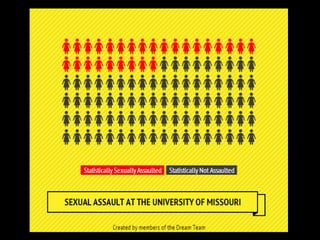
  • #4 To relate this national and local data back to our specific population, this infograph represents the number of women who, statically, will be sexually assaulted.