Car Driver Skills
Assessment using
Posture Recognition
Presented By: sumit kadyan
Authors
• Madalina –Ioana Toma (Transilvania
University of Brasov)
• Leon J.M. Rothkrantz (Delft University of
technology)
• Csaba Antonya (M.I.Toma)
Need For it
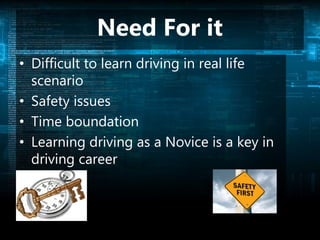
• Difficult to learn driving in real life
scenario
• Safety issues
• Time boundation
• Learning driving as a Novice is a key in
driving career
Introduction
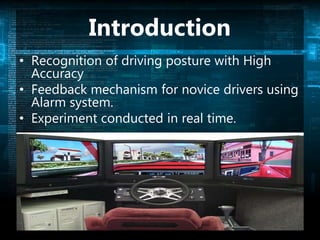
• Recognition of driving posture with High
Accuracy
• Feedback mechanism for novice drivers using
Alarm system.
• Experiment conducted in real time.
What Sets it apart?
• Recognition of complete body parts.
• Use of “Markerless” Sensors.
• Provides accurate measurement of joint
configuration and rapid movements of
hands.

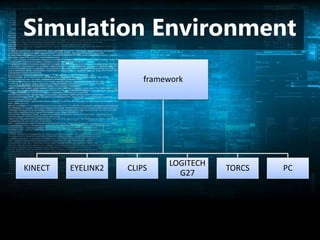
Simulation Environment
framework
KINECT EYELINK2 CLIPS
LOGITECH
G27
TORCS PC
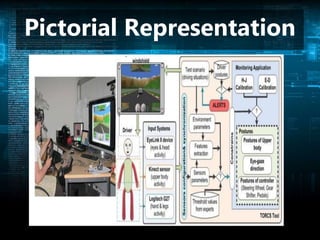
Pictorial Representation
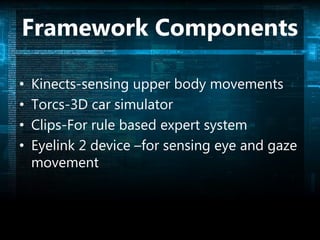
Framework Components
• Kinects-sensing upper body movements
• Torcs-3D car simulator
• Clips-For rule based expert system
• Eyelink 2 device –for sensing eye and gaze
movement
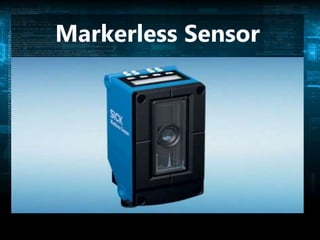
Markerless Sensor
Markerless Sensor
• Uses pattern recognition principle
• Monitor process quality via control panel
or via Ethernet
• Reproducibility of 0.6 mm
• Plug can be rotated 90°
• High scanning speed of 7 m/s
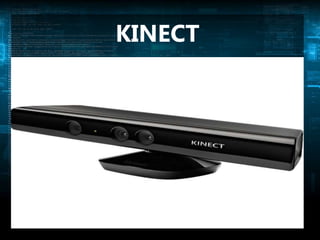
KINECT
KINECT Sensor
• RGB camera sensor
• Configuration is done using Sdk tool by
windows
• IR Emitter and IR depth Sensor
• Used for tracking upper body movements
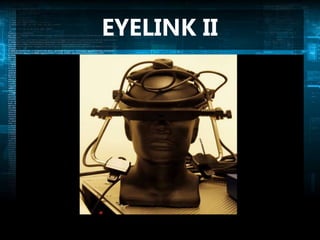
EYELINK II
Eye link 2
• High resolution and data rate
• Head mounted video-based eye tracker.
• Used for tracking eyes movement and
head orientation
• Two eye cameras allow binocular eye
tracking
CLIPS
• C Language Integrated Production System.
• CLIPS incorporates a complete object-
oriented language(COOL) for writing expert
systems.
• COOL combines the programming paradigms
of procedural, object oriented and logical
(theorem proving) languages.
• Provides High Portability.
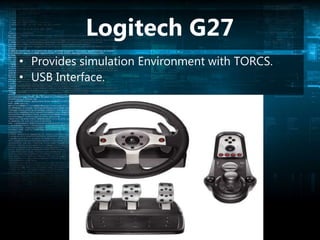
Logitech G27
• Provides simulation Environment with TORCS.
• USB Interface.
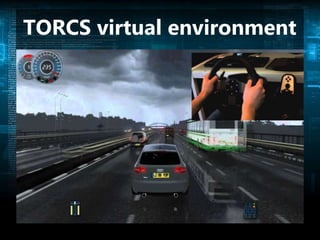
TORCS virtual environment
TORCS
• 3D car simulator supporting input devices(
steering wheels, joystick, game pads etc.)
• Provides connection, configuration and
synchronization.
• Written in C++ and open source avaliable
under GPL license
• Easy to add/create content
• Excellent performance and stability
Related Work
• Pose Estimation
• Gaze Detection
• Focused only on Expert Drivers.
• Analyses done using offline techniques like
silhouettes, bounding boxes.
How it Works?
• Takes real time parameters from sensors
and environment.
• Refers to an expert rule based system to
determine the driving postures and give
feedback ,also sound an alarm if the
novice driver posture is wrong.
• Uses the clips inference engine
• Matching takes place between current
state of fact list and list of instances
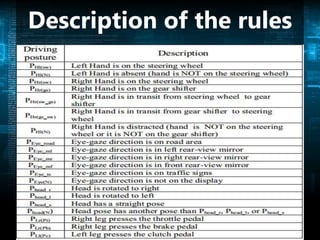
Description of the rules
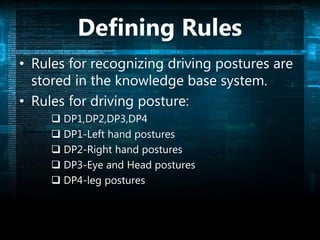
Defining Rules
• Rules for recognizing driving postures are
stored in the knowledge base system.
• Rules for driving posture:
 DP1,DP2,DP3,DP4
 DP1-Left hand postures
 DP2-Right hand postures
 DP3-Eye and Head postures
 DP4-leg postures
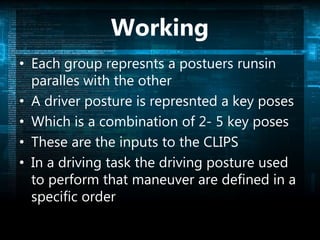
Working
• Each group represnts a postuers runsin
paralles with the other
• A driver posture is represnted a key poses
• Which is a combination of 2- 5 key poses
• These are the inputs to the CLIPS
• In a driving task the driving posture used
to perform that maneuver are defined in a
specific order
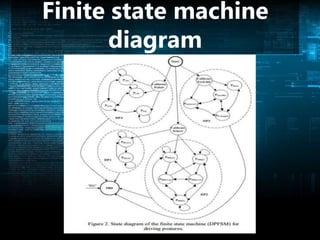
Finite state machine
diagram
DFSM
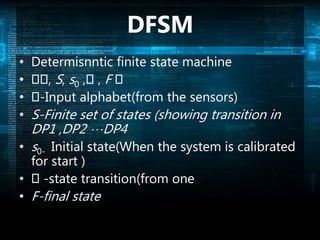
• Determisnntic finite state machine
• , S, s0 , , F
• -Input alphabet(from the sensors)
• S-Finite set of states (showing transition in
DP1 ,DP2 …DP4
• s0- Initial state(When the system is calibrated
for start )
• -state transition(from one
• F-final state
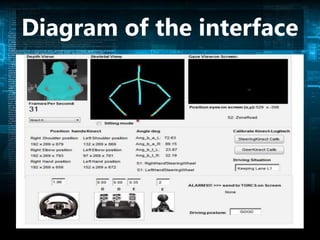
Diagram of the interface
Experiment
• Experiment was focused on developing a
assistive intelligent system for indoor training
of novice drivers
• Experiments conducted in laboratory with
proper lighting for sensors
• 2 kind of experiments
• One for robustness and performance of
posture recognition the novice driver without
traffic
• 2 in is the complete framework evaluation.
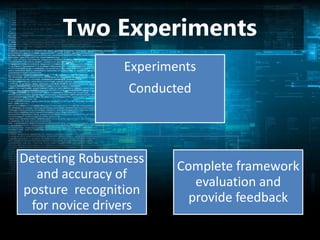
Two Experiments
Experiments
Conducted
Detecting Robustness
and accuracy of
posture recognition
for novice drivers
Complete framework
evaluation and
provide feedback
Participants
• 12 participants
• 8 males and 4 females
• All having driver license
• With little or no experience
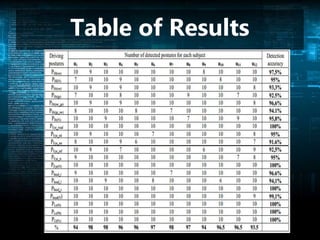
Results of Experiment 1
• Every subject performed the postures for
10 times
• Driving postures recognition rate achieves
96.4% accuracy
• Driving posture stability achieves 96.21%
accuracy
• GOOD” and “WORST” messages
Table of Results
Experiment 2 : Rules
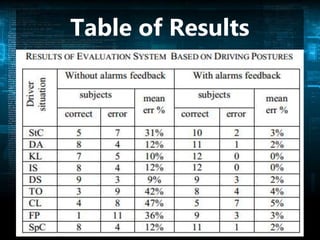
• driver needs to start the car (StC)
• driver wants to drive away (DA)
• driver keeps the lane (KL)
• driver increases the speed (IS) or decreases
the speed (DS) based on traffic signs
• driver wants to take over (TO) or change lane
(CL)
• driver wants to make a forward parking (FP)
driver wants to stop the car (SpC).
Results of Experiment 2
• In the StC situation we achieved 88%
correct postures detectioni
• In the IS and DS speed variation situations
we achieved an accuracy of 100%.
• A lower accuracy of less than 70% we
obtained in TO and FP
Results experiment 2
• In the StC situation we achieved 88%
correct postures detection.
• In the IS and DS speed variation situations
we achieved an accuracy of 100%.
• A lower accuracy of less than 70% we
obtained in TO and FP
Table of Results
Conclusion
• To improve the take over and forward
parking by combining probabilistic
methods reducing uncertainty of certain
driver postures.
References
• Toma, Madalina-Ioana; Rothkrantz, Leon J.M.; Antonya, Csaba, "Car driver
skills assessment based on driving postures recognition," Cognitive
Infocommunications (CogInfoCom), 2012 IEEE 3rd International Conference
on , vol., no., pp.439,446, 2-5 Dec. 2012
• I. Lefter, L.J.M. Rothkrantz, P. Bouchner, P. Wiggers: “A multimodal car driver
surveillance system in a military area”, Driver Car Interaction & Interface,
2010.
• Y.F. Lu, and Ch.Li: “Recognition of Driver Turn Behavior Based on Video
Analysis”, Journal of Advanced Materials Research Vol. 433-44, pp 6230-
6234, 2012.
• D.B. Kaber, Y. Liang, Y. Zhang, M. L. Rogers, and S. Gangakhedkar: “Driver
performance effects of simultaneous visual and cognitive distraction and
adaptation behavior”, Journal of Transportation Research Part F 15, pp. 491–
501, 2012.
Human Computer Intreaction

Human Computer Intreaction

  • 1.
    Car Driver Skills Assessmentusing Posture Recognition Presented By: sumit kadyan
  • 2.
    Authors • Madalina –IoanaToma (Transilvania University of Brasov) • Leon J.M. Rothkrantz (Delft University of technology) • Csaba Antonya (M.I.Toma)
  • 3.
    Need For it •Difficult to learn driving in real life scenario • Safety issues • Time boundation • Learning driving as a Novice is a key in driving career
  • 4.
    Introduction • Recognition ofdriving posture with High Accuracy • Feedback mechanism for novice drivers using Alarm system. • Experiment conducted in real time.
  • 5.
    What Sets itapart? • Recognition of complete body parts. • Use of “Markerless” Sensors. • Provides accurate measurement of joint configuration and rapid movements of hands.
  • 6.
  • 7.
  • 8.
    Framework Components • Kinects-sensingupper body movements • Torcs-3D car simulator • Clips-For rule based expert system • Eyelink 2 device –for sensing eye and gaze movement
  • 9.
  • 10.
    Markerless Sensor • Usespattern recognition principle • Monitor process quality via control panel or via Ethernet • Reproducibility of 0.6 mm • Plug can be rotated 90° • High scanning speed of 7 m/s
  • 11.
  • 12.
    KINECT Sensor • RGBcamera sensor • Configuration is done using Sdk tool by windows • IR Emitter and IR depth Sensor • Used for tracking upper body movements
  • 13.
  • 14.
    Eye link 2 •High resolution and data rate • Head mounted video-based eye tracker. • Used for tracking eyes movement and head orientation • Two eye cameras allow binocular eye tracking
  • 15.
    CLIPS • C LanguageIntegrated Production System. • CLIPS incorporates a complete object- oriented language(COOL) for writing expert systems. • COOL combines the programming paradigms of procedural, object oriented and logical (theorem proving) languages. • Provides High Portability.
  • 16.
    Logitech G27 • Providessimulation Environment with TORCS. • USB Interface.
  • 17.
  • 18.
    TORCS • 3D carsimulator supporting input devices( steering wheels, joystick, game pads etc.) • Provides connection, configuration and synchronization. • Written in C++ and open source avaliable under GPL license • Easy to add/create content • Excellent performance and stability
  • 19.
    Related Work • PoseEstimation • Gaze Detection • Focused only on Expert Drivers. • Analyses done using offline techniques like silhouettes, bounding boxes.
  • 20.
    How it Works? •Takes real time parameters from sensors and environment. • Refers to an expert rule based system to determine the driving postures and give feedback ,also sound an alarm if the novice driver posture is wrong. • Uses the clips inference engine • Matching takes place between current state of fact list and list of instances
  • 21.
  • 22.
    Defining Rules • Rulesfor recognizing driving postures are stored in the knowledge base system. • Rules for driving posture:  DP1,DP2,DP3,DP4  DP1-Left hand postures  DP2-Right hand postures  DP3-Eye and Head postures  DP4-leg postures
  • 23.
    Working • Each grouprepresnts a postuers runsin paralles with the other • A driver posture is represnted a key poses • Which is a combination of 2- 5 key poses • These are the inputs to the CLIPS • In a driving task the driving posture used to perform that maneuver are defined in a specific order
  • 24.
  • 25.
    DFSM • Determisnntic finitestate machine • , S, s0 , , F • -Input alphabet(from the sensors) • S-Finite set of states (showing transition in DP1 ,DP2 …DP4 • s0- Initial state(When the system is calibrated for start ) • -state transition(from one • F-final state
  • 26.
    Diagram of theinterface
  • 27.
    Experiment • Experiment wasfocused on developing a assistive intelligent system for indoor training of novice drivers • Experiments conducted in laboratory with proper lighting for sensors • 2 kind of experiments • One for robustness and performance of posture recognition the novice driver without traffic • 2 in is the complete framework evaluation.
  • 28.
    Two Experiments Experiments Conducted Detecting Robustness andaccuracy of posture recognition for novice drivers Complete framework evaluation and provide feedback
  • 29.
    Participants • 12 participants •8 males and 4 females • All having driver license • With little or no experience
  • 30.
    Results of Experiment1 • Every subject performed the postures for 10 times • Driving postures recognition rate achieves 96.4% accuracy • Driving posture stability achieves 96.21% accuracy • GOOD” and “WORST” messages
  • 31.
  • 32.
    Experiment 2 :Rules • driver needs to start the car (StC) • driver wants to drive away (DA) • driver keeps the lane (KL) • driver increases the speed (IS) or decreases the speed (DS) based on traffic signs • driver wants to take over (TO) or change lane (CL) • driver wants to make a forward parking (FP) driver wants to stop the car (SpC).
  • 33.
    Results of Experiment2 • In the StC situation we achieved 88% correct postures detectioni • In the IS and DS speed variation situations we achieved an accuracy of 100%. • A lower accuracy of less than 70% we obtained in TO and FP
  • 34.
    Results experiment 2 •In the StC situation we achieved 88% correct postures detection. • In the IS and DS speed variation situations we achieved an accuracy of 100%. • A lower accuracy of less than 70% we obtained in TO and FP
  • 35.
  • 36.
    Conclusion • To improvethe take over and forward parking by combining probabilistic methods reducing uncertainty of certain driver postures.
  • 37.
    References • Toma, Madalina-Ioana;Rothkrantz, Leon J.M.; Antonya, Csaba, "Car driver skills assessment based on driving postures recognition," Cognitive Infocommunications (CogInfoCom), 2012 IEEE 3rd International Conference on , vol., no., pp.439,446, 2-5 Dec. 2012 • I. Lefter, L.J.M. Rothkrantz, P. Bouchner, P. Wiggers: “A multimodal car driver surveillance system in a military area”, Driver Car Interaction & Interface, 2010. • Y.F. Lu, and Ch.Li: “Recognition of Driver Turn Behavior Based on Video Analysis”, Journal of Advanced Materials Research Vol. 433-44, pp 6230- 6234, 2012. • D.B. Kaber, Y. Liang, Y. Zhang, M. L. Rogers, and S. Gangakhedkar: “Driver performance effects of simultaneous visual and cognitive distraction and adaptation behavior”, Journal of Transportation Research Part F 15, pp. 491– 501, 2012.