•Oblique Triangles
•Sine Law
•Cosine Law
•Application of the Sine
and the Cosine Law
•Oblique Triangles
a. The Sum of the three angles is equal to 1800 .A
+ B + C = 1800;
b. The greater angles subtends the longer side, if
A> B > C, then a> b> c;
c. A triangle is determined or fixed in form and
in size if the following parts are given:
a. Two angles and the side opposite one of
them;
b. Two sides and the angle opposite one of
them;
c. Two sides and the included angle;
d. Two angles and the included side;
e. Three sides
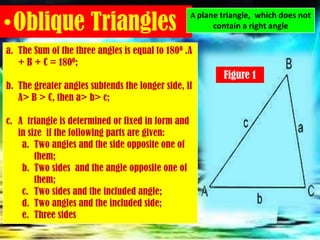
A plane triangle, which does not
contain a right angle
Figure 1
SINE LAW
Each side of a triangle
is directly proportional to
the sine of the opposite angle.
Use the Sine Law
when there is a
“pair” in the
given data.
“Pair” means a side
and its opposite
angle. For example,
angle A and side a
constitutes a pair.
TIP
COSINE LAW
The square of any side of a triangle is equal to the
sum of the squares of the other two sides minus twice
the product of these two sides times the cosine of the
angle between these two sides.
a2 = b2 + c2 – 2bc cos A
b2 = a2 + c2 – 2ac cos B
c2 = a2 + b2 – 2ab cos C
COSINE LAW
The square of any side of a triangle is equal to the
sum of the squares of the other two sides minus twice
the product of these two sides times the cosine of the
angle between these two sides.
a2 = b2 + c2 – 2bc cos A
b2 = a2 + c2 – 2ac cos B
c2 = a2 + b2 – 2ab cos C
Oblique triangles

Oblique triangles

  • 2.
    •Oblique Triangles •Sine Law •CosineLaw •Application of the Sine and the Cosine Law
  • 3.
    •Oblique Triangles a. TheSum of the three angles is equal to 1800 .A + B + C = 1800; b. The greater angles subtends the longer side, if A> B > C, then a> b> c; c. A triangle is determined or fixed in form and in size if the following parts are given: a. Two angles and the side opposite one of them; b. Two sides and the angle opposite one of them; c. Two sides and the included angle; d. Two angles and the included side; e. Three sides A plane triangle, which does not contain a right angle Figure 1
  • 4.
    SINE LAW Each sideof a triangle is directly proportional to the sine of the opposite angle.
  • 5.
    Use the SineLaw when there is a “pair” in the given data. “Pair” means a side and its opposite angle. For example, angle A and side a constitutes a pair. TIP
  • 6.
    COSINE LAW The squareof any side of a triangle is equal to the sum of the squares of the other two sides minus twice the product of these two sides times the cosine of the angle between these two sides. a2 = b2 + c2 – 2bc cos A b2 = a2 + c2 – 2ac cos B c2 = a2 + b2 – 2ab cos C
  • 7.
    COSINE LAW The squareof any side of a triangle is equal to the sum of the squares of the other two sides minus twice the product of these two sides times the cosine of the angle between these two sides. a2 = b2 + c2 – 2bc cos A b2 = a2 + c2 – 2ac cos B c2 = a2 + b2 – 2ab cos C