Sufism
Carl Ernst
Reli 180,
Introduction to Islamic
Civilization
Outline
Problems of definition
Modern European and fundamentalist
concepts of Sufism
Quick vocabulary check on Sunni/Shi`I
Ibn Khaldun on Sufism
Institutional development of Sufism, post
1200
2
1. Definition and the problem of
“essentially contested terms”
Examples: Liberal; justice; freedom (see
George Lakoff, Whose Freedom? The
Battle over America's Most Important Idea)
Different perspectives on Sufism: foreign &
non-Islamic, or the heart of Islam?
Where do definitions come from?
Summaries of analytical observation (Plato)
Historical record (Oxford English Dictionary)
Authority (political/religious figures)
3
Arabic definitions
The derivations of Sufi
suf, wool, garment of ascetic denial
safa’, “purity”
safwa, “the elite”
Ahl al-suffa, “the people of the bench” (early
Muslims who shared everything in common)
Tasawwuf, “becoming a Sufi” explained by
teaching definitions
How might that differ from “Sufism” as part of
the catalog of “isms”? 4
2. Rediscovery of the Sufi
tradition
Spirituality, experience, mysticism: loaded
terms from European/Christian history
Early Europeans like Sufi poetry (love and
wine), thought it couldn’t possibly be
Islamic – must be from somewhere else?
Recent colonial/postcolonial reformations
of Islamic identity (“fundamentalism”)
reject Sufi saints, intercession, Sufi lineages
and practices, as evil innovations
5
3. Who overlaps with whom?
A quick vocabulary check
6
Sunni Sufis, and Shi`i Sufis
7
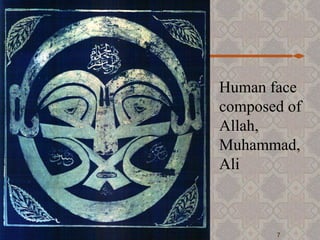
Human face
composed of
Allah,
Muhammad,
Ali
4. Ibn Khaldun on Sufism
Sufism “belongs to the sciences of the
religious law that originated in Islam”
Divine worship, devotion to God, aversion
from the world, abstinence from wealth,
retirement into solitude for worship – all
common among early Muslims
Special name “Sufi” developed a couple of
centuries later [compare special technical
terms of Islamic law and hadith]
8
Ibn Khaldun: characteristics of
Sufism
Asceticism
Intuitive perception of psychological states
and stations
Self-scrutiny and quest for knowledge and
unity with God
Special language for inner experience,
parallel to other fields of religious
knowledge
9
Ibn Khaldun explains Sufism
Philosophical psychology as an explanation
of Sufi experiences
“Removal of the veil” as a key metaphor for
perception that goes beyond the senses
Different views on God as separate or one
with creatures (p. 362); alleged similarity
with philosophical and Christian views
Disapproval of Sufis by legal scholars
(muftis, who give anti-Sufi fatwa decrees)
10
Ibn Khaldun criticizes Sufism
Theories of absolute oneness: only God
exists
Theory of God’s imagination as source of
the cosmos
-- Ibn Khaldun dismisses these views as
contrary to both reason and experience
11
More criticism of Sufism by I.K.
requires distinction of topics
1. “pious exertions” of meditation and
worship
2. Removal of the veil, perception of
supernatural realities
3. The operation of divine grace in the world
4. Ecstatic expressions that arouse suspicion
(“I am the truth” – Hallaj)  These are the
primary problem; they should be
disapproved or reinterpreted
12
Ibn Khaldun’s final verdict
Seeking inner experience is fine, but it’s
better not to discuss them publicly!
13
5. Institutional development of
Sufism, post 1200
“Saints” or living friends of God
Problems with using the term “saint”
Tombs as centers of pilgrimage: local forms
Masters (shaykh, pir) and disciples (murid)
“Chains” (silsila) of master and disciple,
going back to the Prophet [Sufi “orders”]
“Ways” (tariqa) taught by orders
Veneration of the Prophet
14
Tomb of Mu`in al-Din Chishti
(Ajmer, India, d. 1235)
15
Tomb of Ahmadu Bamba
(Touba, Senegal, d. 1910)
16
Scale of Sufi shrine pilgrimage
Ajmer receives 1.5 million pilgrims at the
annual festival
Touba receives over 2 million pilgrims
Neither pilgrimage center is aware of or
connected to the other
Both challenge the hajj to Mecca in size
To what extent should they be considered
marginal in modern Islam?
17
More institutional developments
Chanting the Arabic names of God as a
ritual of remembrance (dhikr)
Rituals of music, recitation of poetry
Sometimes arms-length from politics,
sometimes tightly involved
Abolition of Sufism in Turkey by secular
govt., in Saudi Arabia by fundamentalists
Modern phenomenon of Sufism for non-
Muslims
18
Conclusion
Problems of definition:
“Once Sufism was a reality without a name;
now it is a name without a reality”
-- Abu al-Hasan Fushanja (11th
century)
19

Sufi (1)

  • 1.
  • 2.
    Outline Problems of definition ModernEuropean and fundamentalist concepts of Sufism Quick vocabulary check on Sunni/Shi`I Ibn Khaldun on Sufism Institutional development of Sufism, post 1200 2
  • 3.
    1. Definition andthe problem of “essentially contested terms” Examples: Liberal; justice; freedom (see George Lakoff, Whose Freedom? The Battle over America's Most Important Idea) Different perspectives on Sufism: foreign & non-Islamic, or the heart of Islam? Where do definitions come from? Summaries of analytical observation (Plato) Historical record (Oxford English Dictionary) Authority (political/religious figures) 3
  • 4.
    Arabic definitions The derivationsof Sufi suf, wool, garment of ascetic denial safa’, “purity” safwa, “the elite” Ahl al-suffa, “the people of the bench” (early Muslims who shared everything in common) Tasawwuf, “becoming a Sufi” explained by teaching definitions How might that differ from “Sufism” as part of the catalog of “isms”? 4
  • 5.
    2. Rediscovery ofthe Sufi tradition Spirituality, experience, mysticism: loaded terms from European/Christian history Early Europeans like Sufi poetry (love and wine), thought it couldn’t possibly be Islamic – must be from somewhere else? Recent colonial/postcolonial reformations of Islamic identity (“fundamentalism”) reject Sufi saints, intercession, Sufi lineages and practices, as evil innovations 5
  • 6.
    3. Who overlapswith whom? A quick vocabulary check 6 Sunni Sufis, and Shi`i Sufis
  • 7.
  • 8.
    4. Ibn Khaldunon Sufism Sufism “belongs to the sciences of the religious law that originated in Islam” Divine worship, devotion to God, aversion from the world, abstinence from wealth, retirement into solitude for worship – all common among early Muslims Special name “Sufi” developed a couple of centuries later [compare special technical terms of Islamic law and hadith] 8
  • 9.
    Ibn Khaldun: characteristicsof Sufism Asceticism Intuitive perception of psychological states and stations Self-scrutiny and quest for knowledge and unity with God Special language for inner experience, parallel to other fields of religious knowledge 9
  • 10.
    Ibn Khaldun explainsSufism Philosophical psychology as an explanation of Sufi experiences “Removal of the veil” as a key metaphor for perception that goes beyond the senses Different views on God as separate or one with creatures (p. 362); alleged similarity with philosophical and Christian views Disapproval of Sufis by legal scholars (muftis, who give anti-Sufi fatwa decrees) 10
  • 11.
    Ibn Khaldun criticizesSufism Theories of absolute oneness: only God exists Theory of God’s imagination as source of the cosmos -- Ibn Khaldun dismisses these views as contrary to both reason and experience 11
  • 12.
    More criticism ofSufism by I.K. requires distinction of topics 1. “pious exertions” of meditation and worship 2. Removal of the veil, perception of supernatural realities 3. The operation of divine grace in the world 4. Ecstatic expressions that arouse suspicion (“I am the truth” – Hallaj)  These are the primary problem; they should be disapproved or reinterpreted 12
  • 13.
    Ibn Khaldun’s finalverdict Seeking inner experience is fine, but it’s better not to discuss them publicly! 13
  • 14.
    5. Institutional developmentof Sufism, post 1200 “Saints” or living friends of God Problems with using the term “saint” Tombs as centers of pilgrimage: local forms Masters (shaykh, pir) and disciples (murid) “Chains” (silsila) of master and disciple, going back to the Prophet [Sufi “orders”] “Ways” (tariqa) taught by orders Veneration of the Prophet 14
  • 15.
    Tomb of Mu`inal-Din Chishti (Ajmer, India, d. 1235) 15
  • 16.
    Tomb of AhmaduBamba (Touba, Senegal, d. 1910) 16
  • 17.
    Scale of Sufishrine pilgrimage Ajmer receives 1.5 million pilgrims at the annual festival Touba receives over 2 million pilgrims Neither pilgrimage center is aware of or connected to the other Both challenge the hajj to Mecca in size To what extent should they be considered marginal in modern Islam? 17
  • 18.
    More institutional developments Chantingthe Arabic names of God as a ritual of remembrance (dhikr) Rituals of music, recitation of poetry Sometimes arms-length from politics, sometimes tightly involved Abolition of Sufism in Turkey by secular govt., in Saudi Arabia by fundamentalists Modern phenomenon of Sufism for non- Muslims 18
  • 19.
    Conclusion Problems of definition: “OnceSufism was a reality without a name; now it is a name without a reality” -- Abu al-Hasan Fushanja (11th century) 19

Editor's Notes

  • #4 all parties assume that the contested terms refer to agreed-upon realities when, in fact, they serve only to mask deep cultural differences. William Gallie, 1956 article, “Essentially Contested Terms”