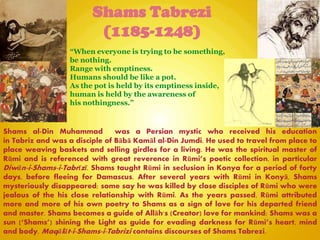
Sufism--Part 1
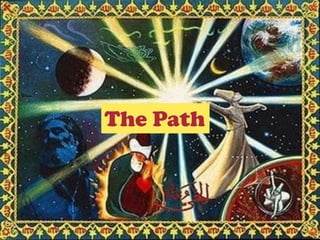
The Path
 Mysticism is the experience of mystical union or direct communion with ultimate reality,
and attainment of direct knowledge of God, spiritual Truth, or ultimate Reality through
subjective experience. Sufism or Tasawwuf is considered ‗Islamic Mysticism.‘ However, certain
Sufi practices are considered incompatible with Islam.
 The term Sufi is variously traced to Arabic word, Suf- wool, referring either to the simple
cloaks the early Muslim ascetics wore, or possibly to Sāf- purity. Thus ―The Sufi is the one
who wears wool on top of purity.‖ Wool cloaks were a designation of their initiation into the
Sufi order, worn perhaps as an imitation of Isā bin Maryam (Jesus). Yet others have linked
the term with Greek word ‗Sophia‘- wisdom.
 Under the Umayyad rule, when Muslim communities were rife with schisms, bloodshed
and fanaticism - a group of pious companions, such as „Ahle Suffā‟, who used to sit on the
benches (Suffā) and were known for their ascetic life, decided to move out of this politicised
atmosphere of the cities and go into rural areas to devote themselves to spirituality. They
learned higher spirituality from and gave their loyalty to a Sufi Shaikh or Peer. They were the
early Sufis. They were also the theoreticians of the Traditional Islām.
 Some of the more remarkable qualities of these people included loving and humanitarian
attitudes toward fellow human beings irrespective of race or religion, humility, living an ascetic
life -- and spending most of their time in prayer, Zikr or Dhikr (reciting Qur'ān, chanting the
names of Godand Murāqabā (contemplation).
 The great Sufi Master of the Naqshbandi Order, Hazrat Maulānā Shāh Fazl Ahmad Khān
(19th–20th cent.) has said that the occult science of Sufi Saints in fact belonged to the ancient
Hindu saints, which was lost in oblivion by them and is being now reintroduced amongst them.
Introduction
 SUFI is one, who has Submitted himself to the will of the god, who lives in Union with the
God and who has devoted himself to FInd the Truth. The essence of Sufism is ‗absolute non-
existence that needs no existence besides the Almighty‘s Existence.‘
 Sufis lay stress on the unity of inner teachings of all religions, rather than on their outer
form. They distinguish spirituality from religion. For them the Almighty is not concerned with
one‘s religion, but with love. The real objective being to grow beyond religion, to understand
the real meaning of the religion and to realize the Truth by one‘s own experience.
 Sufis yearn to be a true human being, free from all bondage and honest with the Almighty.
They believe in evolution of a man into a complete man by enlightenment through one‘s own
experience and understanding. They make a conscious effort to mind their conduct and
evolve as Insān Kāmil- a perfect man.
 Sufis want to be nothing. It is their ideal to lose all their identity i.e. the complete sacrifice of
the self, the ego. The Sufis live only in the present. They are different from others in that they
are inwardly absorbed all the time.
 The ‘Way of the Sufi’: The Religion of the Sufi is the cry of the heart; The Ideal of the
Sufi is spiritual consciousness; The Goal of the Sufi is self-realization; The God of the Sufi is
the Divine Presence within; The Path of the Sufi is brotherhood and sisterhood; The Manner
of the Sufi is inner nobility; The Art of the Sufi is personality; The Charm of the Sufi is humility;
The Moral of the Sufi is beneficence; The Attitude of the Sufi is forgiveness; The Beloved of
the Sufi is love itself.
The ‘Way of the Sufi’
Divine Love
“The essence of God is love and
The Sufi Path is path of love.
Love is to see what is good and
beautiful in everything.
It is to learn from everything, to
see the gifts of God and the
generosity of God in everything.
It is to be thankful for all God's
bounties.”
The Sufi Qalb- heart
“This is the first step on the road
to the love of God.
This is just a seed of love.
In time, the seed will grow
and become a tree and bear fruit.
Then, whoever tastes of that fruit
will know what real love is.
It will be differently for those
who have tasted to tell of it to
those who have not.”
The Qalb, though connected in some mysterious way with the physical heart, is not a
thing of flesh and blood. Whereas the intellect cannot gain real knowledge of God, the
Qalb is capable of knowing the essences of all things, and when illumined by faith and
knowledge reflects the whole content of the divine mind. Normally, the heart is
'veiled,' blackened by sin, tarnished by sensual impressions and images, pulled to and
fro between reason and passion: a battlefield on which the armies of God and the
Devil contend for victory. Through one gate, the heart receives immediate knowledge
of God; through another, it lets in the illusions of sense.
- Muzaffer Ashki al-Halveti al-Jerrahi (1916-1985)
As given by Abdul Khaliq al-Ghujdawani and Muhammad Baha’uddin Shah
Naqshband of the Naqshbandi Sufi Order. These were embraced and hailed
by all the forty tariqats (Sufi Orders) as the way of Truth and loyalty.
(i) Hosh dar Dam (Conscious Breathing)-The true seeker should always be alert that he does
not take any breath devoid of God‘s remembrance.
(ii) Nazar bar Kadam (Watch Your Step)- Each step moved forward should be taken
consciously i.e. one should not do anything which may drag him down or which may obstruct
his spiritual progress.
(iii) Safar dar Watan (Journey Homeward)- The seeker must move from the world of creation
to the world of Creator. The first part of the journey is external in which the seeker desires and
searches for the Master. Then the internal journey begins which leads to the purification of his
heart and makes him eligible to receive the Divine grace.
(iv) Khilawat dar Anjuman (Solitude in the Crowd)- Khilawat means seclusion, both external
and internal. External seclusion requires the seeker to be away from people, staying by
himself and spending his time in the remembrance of God.
(v) Yād Kard (Essential Remembrance)- To keep oneself continuously engaged in reciting
the ‗japa‟ (the internal practice as directed by the Master) and in such a manner that the
seeker starts feeling the presence of the Master or the Almighty in his heart is the Essential
Remembrance.
The Basic Principles of Sufism
(vi) Bāz Gāsht (Returning to the origin)– During internal practice the seeker may experience
sighting of light, activation of the mystique centers, acquisition of miraculous powers etc.
which may arouse the ego. The seeker should keep on praying the Almighty at intervals that
He alone is the objective of the seeker. One‘s heart should be protected from bad thoughts
and from worldly inclinations.
(vii) Nigāh Dāsht (Attentiveness)-The seeker should always keep an eye on his internal
condition so that no doubt or ill thought ever arises and he constantly keeps on remembering
the Almighty.
(viii) Yād Dāsht (Recollection)– It means continuous remembrance. When the seeker
through practice becomes so apt that the remembrance continues in the heart effortlessly on
its own, it is called Yād dāsht.
(ix) Wākoof Zamāni (Awareness of Time)–The seeker must watch that the time at his
command is spent in the remembrance of the Almighty and must make all efforts to make
spiritual progress. He must recount his actions and deeds and seek His forgiveness for the
wrong doings.
(x) Wākoof Adādi (Awareness of Numbers)– One should, while holding the breath, recite the
name of the God, feeling His Presence in the heart, in odd number i.e. 5,7,9,11,21 etc. The
real meaning appears to be that the Almighty is One and He likes Oneness. It perhaps also
means that one should remember the Almighty alone.
(xi) Wākoof Qalbi (Awareness of the Heart)–The seeker should always have an eye on his
heart (Qalb) so that his attention is always towards the Divine Presence and it may not be
diverted elsewhere.
…The Basic Principles of Sufism
 Sufis believe in practicing ‘perfection of worship’ (Ihsān). Sufism is primarily concerned
with direct personal experience. It is defined as the science of ‗Reperation of heart, purifying &
beautifying it, and turning it away from all else but God‘ & ‗Travelling into Divine presence‘.
 The central doctrine of Sufism called Unity (Wahdat’) is the understanding of ‗all pheno-
mena are manifestations of a single reality‘ (Tawhid), or being (Wujud). The essence of being/
Truth/God is devoid of every form and quality, and hence unmanifested, yet it is inseparable
from every form and phenomenon either material or spiritual. It implies that every pheno-
menon is an aspect of Truth, and attribution of existence to it is false. The chief aim of all Sufis
is to let go of all notions of duality and the individual self also, and realize the Divine unity.

 Sufis believe that Sufism cannot be learned through books. Sufism typically requires that
the disciple live with and serve the teacher for many, many years. The Sufi doctrine of the
‘Perfect Man’ (al-Insān al-Kāmil), states that there always exists upon earth a ‗Pole or Axis,
of the Universe‘ (Qutb)—who is the perfect channel of grace from God to man and in a state
of Wilaya (sanctity, being under the protection of God). The vow of obedience to the Qutb or
Shaikh which is taken by Sufis is considered incompatible with devotion to the Imam.
 In Sufi metaphor, the seeker is Āshiq- lover, Allah, the Māshuq- Beloved represented by the
Peer as the Sāqi- the (male) Cupbearer or Tippler, seen as a handsome youth, pouring
Divine Wine of nectar unto him. His features (specifically the eyes, forehead, hair and mole on
the cheek) and his demeanor are praised to high heaven. He hides behind a veil, which needs
to be lifted. In contrast, the Shaikh, Mullāh & Kāzi are treated by Sufis with contempt as being
charlatans (Pākhandis). Folk love tales (such as Laila-Manjun) were used as allegories of
spiritual love. In India, Amir Khusro, Qutuban, Malik Mohd. Jāyasi etc. enriched Sufi literature.
Sufi Beliefs
Sufi Orders
 The widening of Islam’s conquests, and the resulting absorption of a wide range of mystic
traditions from outside Arabia, fuelled its spread. Sufism became a more formalized movement
by the 12th cent., and during the 13th-16th cents. it produced the flourishing intellectual culture-
throughout the Muslim world, whose physical artifacts can be seen today. Sufi lodges
(Khānqāh, Zaouiā or Tekke) were established where Sufis and itinerant seekers gathered.
 As Sufism became a greater movement in Islam, individual Sufis began to group together.
These groups (also known as orders) were based on a common master, who then began
spiritual lineage, which is a connection between a Sufi order in which there is a common
spiritual heritage based on the master‘s teachings called Tariqā. A Sufi's Silsilā is his badge of
identity/source of legitimacy.
 Sufism had a long history already before institutionalization of Sufi teachings into Tariq’ā-
devotional orders of cultural wisdom reflecting the perspectives of different masters. In
Sufism, one can only receive instruction in spiritual practices (Tālqîn) from an authorized
teacher of the path or method (Tariqā), and only after pledging a vow of obedience (Bay‟ āh)
to this Shaikh. The Shaikh gives his disciples permission (Ijâzā) to practise the Tariqa: he may
also authorize one or more of them to teach it to others, i.e. appoint them as his khalîfas.
The Silsilās- genealogical chains of transmission from master to student concerned
themselves with subtle knowledge (gnosis), education of the heart to purify it of baser
instincts, the love of God, and approaching God through a well-described hierarchy of
Maqāmāt- spiritual stations and Ahwāl- the more transient spiritual states. Several extant Sufi
orders trace their Silsilās back to Prophet Muhammad thru his Companions: Ali abu Tālib (the
primary link between Sufi orders and the Prophet), Abu Bakr and Umar (3 of the 4 ‗Righteously
Guided Caliphs‘). Their lineage is called Silsilāt al-Dhahāb (Dhahāb: gold), the ‗Chain of Gold‘.
…Sufi Orders
 Yasāwi [founder: Khwāja Ahmed Yesevi] in modern Kazhākistan was one of the earliest
orders. Kubrāwiā [f: Najmedddin Kubrā] originated in C. Asia. The best known of silsilās in
S. Asia/India are: (1) Chishtiā (2) Naqshbandiā (3) Qādiriā and (4) Suhrāwardiā. One
particular order that is unique in claiming spiritual lineage through the Caliph Abu Bakr, who
was generally seen as more of a political leader than a spiritual leader, is the Naqshbandiā.
 The North African Abu'l-Hasan al-Shādhili (d 1258) was the founder of the Shadhiliā.
The Rifa`iā was definitely an order by 1320, when Ibn Battutā gave us his description of its
rituals. The Khalwatiā [f. Umar al-Khalwati, an Azerbaijani Sufi]. While its Indian Subcontinent
branches did not survive into modern times, it later spread into the Ottoman Empire and
became influential there during the 16th cent. It crystallized into a Tariqā between 1300 and
1450. The founder of the Shattariā was `Abdullāh al-Shattār (d. 1428). Currently, orders
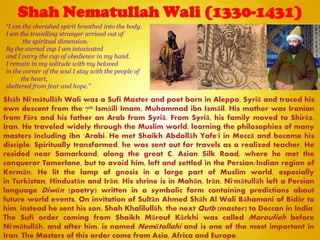
worldwide are: Bā ‗Alāwiyyā, Khalwati, Nimātullahi, Oveyssi, Qādiriā Boutshishiā, Tijāni,
Qalandariā, Sarwari Qādriā, Shadhliā, Ashrafiā, Jerrāhi, Bektāshi, Mevlevi, Alians etc.
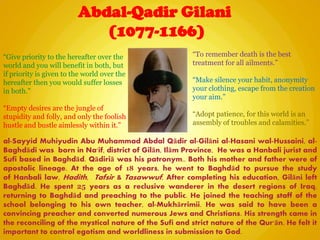
 Qadiriās [f: Abdul-Qādir Gilāni (1077-1166)] one of the oldest Sufi Tariqās. And the most
widespread Sufi order. They and their many offshoots, are found in the Arabic-speaking world,
Afghānistān, S. India, Banglādesh, Pākistān, Turkey, the Balkans, China, Indonesia, India,
Israel, and much of the E&W Africa, like Morocco. They strongly adhere to the fundamentals of
Islām. Their leadership is not centralized, and own interpretations and practices are permitted.
A rose of green and white cloth, with a six-pointed star in the middle, is traditionally worn in the
cap of Qādiri darveshes. Teachings emphasize the struggle against the desires of the ego. It is
described as "the greater struggle" (Jihād). Names of God are prescribed as Wazifās (chants)
for repetition by initiates (Zikr) in both loud and low voice. Though the Sunnā is the ultimate
source of religious guidance, Walis (saints) are God's chosen spiritual guides for the people.
…Sufi Orders
 The Chishtiās [founded in Chisht, near Herat about 930 by Abu Ishaq Shami] are known
for their emphasis on love, tolerance and openness and for the welcome extended to seekers
who belong to other religions. They flourish in S. Asia and Afghanistan and have attracted
many westerners. Their insistence on otherworldliness has differentiated them from Sufi
orders that maintained close ties to rulers and courts and deferred to aristocratic patrons.
 Chishtias follow five basic devotional practices. 1. Reciting the names of Allāh loudly,
sitting in the prescribed posture at prescribed times (Zikr-i Djahr) 2. Reciting the names of
Allāh silently (Zikr-i Khafī) 3. Regulating the breath (Pās-i Anfās) 4. Absorption in mystic
contemplation (Murāqāba) 5. 40 days of spiritual confinement in a lonely corner or cell for
prayer and contemplation (Chilla). Chishti practice is also notable for Samā'- evoking the
divine presence through song or listening to music or dancing with jingling anklets. The
Chishti, as well as some other Sufi orders, believe that music can help devotees forget self
in the love of Allāh. The music usually heard at Chishti shrines and festivals is Qawwāli,
invented by Amir Khusro, which is a representation of the inner sound.
 Early Chishti shaikhs adopted concepts and doctrines outlined in two influential Sufi texts:
the ʿAwārif al-Maʿārif of Shaikh Shihāb al-Dīn Suhrawardī and the Kashf al-Maḥdjūb of
Hujwīrī. These texts are still read and respected today. Chishti also read collections of the
sayings, speeches, poems, and letters of the shaikhs called Malfūẓāt.
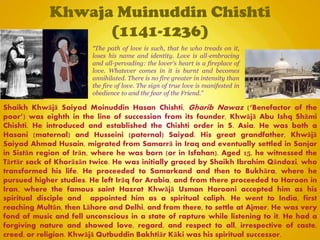
 The most famous of the Chishti saints is Mu'īnuddīn Chishtī of Ajmer, India, others being:
Qutab-ud-Din Bakhtyār Kāki, Farīduddīn Mas'ūd ("Baba Farid―), Nizamuddin Auliya, Alauddin
Sabir Kaliyāri, Muhammed Badeshā Qādri, Ashraf Jahāngir Semnāni, Hāji Imdadullāh Muhājir
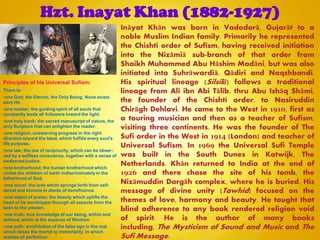
Makki and Shāh Niyāz Ahmad. Chishti master Hazrat Ināyat Khān was the first to bring the
Sufi path to the West.
…Sufi Orders
 Suhrawardiās [f: Diyā al-din Abu ‗n-Najib as-Suhrawardi (1097-1168)] live in extreme
poverty, spending time in Zikr- remembrance. It is a strictly Sunni order, guided by the Shafi`I
school of Islamic law (Madhab), and, traces its spiritual genealogy to Hazrat Ali ibn Abi
Tālib through Junayd Baghdādi and al-Ghazāli. It played an important role in the formation of
a conservative ‗new piety‘ and in the regulation of urban vocational and other groups, such as
trades-guilds and youth clubs, particularly in Baghdād. Shaikh Umar of Baghdad directed his
disciple Bahā-ud-din Zakariā to Multan and Saiyad Jalāluddin Surkh-Posh Bukhāri to Uch,
Sindh. Bukhāri was a puritan who strongly objected to Hindu influence on Muslim social and
religious practices. The order became popular in India owing to his and of his successor,
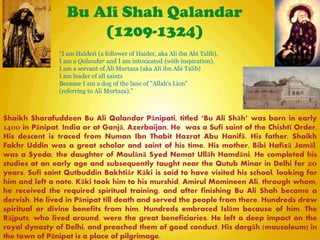
Bahā-ud-din Zakariā‘s work. The poet Fakhr-al-Din Irāqi and Pakistani saint Lal Shāhbāz
Qalandar (1177-1274) were connected to the order. The order declined in Multan but became
popular in other provinces like Uch, Gujarat, Punjab, Kashmir, Delhi, Bihar & Bengal.
 Naqshbandiās- ‗engravers‘ (of the heart) [f: Hazrat Shāh Bahā al-Din Naqshband (d.1389)]
use a coloured map of an internal stage for Tasawwar, recite the Kalmā in a low voice, follow
Shari‟ā and Habs-i-Dam (Prānāyām). They are most active in Indonesia, Malaysia, Sri Lanka,
Pakistan and Brunei and is prevalent in almost all of Europe incl. UK, Germany and France,
and in USA, Middle East, Africa, Syria, Palestine, India, China, Japan, Australia, New Zealand,
Latin America, Azerbeijan, Daghestan (Russia) etc. Bāqi Billāh Berang is credited for bringing
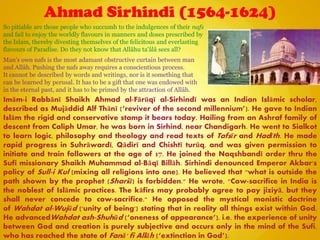
the order to India during the end of the 16th cent. Among his disciples were Shaikh Ahmad
Sirhindi (Mujāddad-i-Alf-i-Thāni) and Shaikh Abdul Haq of Dihli. Some of their other prominent
masters were: Hazrat Abu Bakr as-Siddiq, Hazrat Bāyāzid al-Bistāmi, Bāyāzid al-Bistāmi,
Saiyad Abdul Khāliq al-Ghujdāwani, Hazrat Shāh Naqshband, Saiyad Ubaidullāh al-Ahrār,
Saiyad Ahmad al-Faruqi, Shaikh Khālid al-Baghdādi, Saiyad Shaikh Ismāil Shirwāni.
 Important early contributions in writing are attributed to Uwais al-Qāmi, Hārrm bin Hiān,
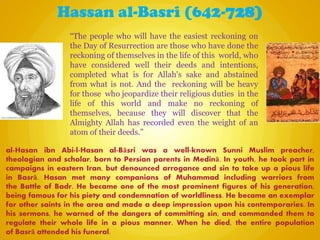
Hasan Bāsri and Saiyad ibn al-Mussib. Ruwaym & Junayd of Baghdad were influential early
figures. Sufi poets and philosophers such as Rūmi and Attār of Nishāpur greatly enhanced
the spread of Islamic culture in Anatolia, C. Asia & S. Asia. Sufism also played a role in
creating and propagating Ottoman culture , and in resisting European imperialism in N. Africa
and S. Asia.
 Towards the end of first mill. a number of manuals began to be written summarizing the
doctrines of Sufism and describing typical Sufi practices, two of these are: Kashf al-Mahjûb of
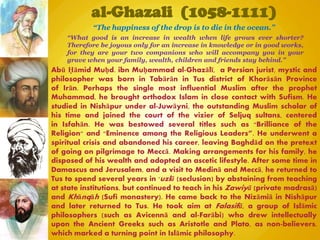
Hujwiri and Risâlā of Qushāyri. Abu Hamid al-Ghazāli‘s greatest treatises, ‗Revival of Religious
Sciences‘ & ‗Alchemy of Happiness‘, argued that Sufism originated from the Qur'ān and was
compatible with Islamic thought, and did not contradict Islamic Law—being instead necessary
to its complete fulfillment. This became the mainstream position among Islamic scholars for
centuries, challenged only recently on the basis of selective use of a limited body of texts.
 The works of Ibn al-`Arabi (d. 1240) deeply influenced almost all later Sufis. Sufis also
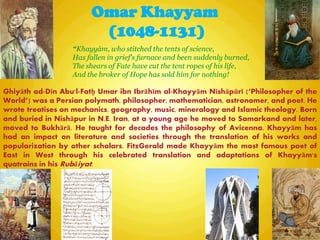
contributed richly to Persian literature e.g. ‗Rubāiyāt‘ of Omar Khayyām, ‗Conference of the
Birds‘ of Attār, ‗Masnavi‘ of Rūmi.
 The literature of Sufis comprised: 1. descriptive essays and critiques, interpreting Islam in
a new way, subtly incorporating the earlier Zoroastrian (Aryan in origin) devotion into the
Semitic Islām 2. Biographies of prominent Sufis such as Attār, Jāmi etc. & 3. Poetry: making
extensive use of parable, metaphor and allegory. Ghazal- a specific form of poetry and Rubāi-
a verse used mostly in humour have been used extensively. While the original Sufi tradition
was based on Arabic, it spread to Fārsi, Turkish & local Indian dialects: Hindvi & Deccani were
employed by the Sufis to put across their message, both to the Moslem and the Hindu.
Sufi Literature
Sufi Spirituality
 Sufi darveshes believe that Love is a universal projection of the essence of God to the
universe. God desires to recognize beauty by looking at Himself within the dynamics of nature.
 In the first approach in the practice of Sufism, the seeker begins by purifying the lower self
of every corrupting influence that stands in the way of recognizing all of creation as the work
of God. This is the way of Imam al-Ghazāli and of majority of Sufi orders. In the second
approach, the seeker experiences divine attraction (Jadhbā), and is able to enter the order
with a glimpse of its endpoint, of direct apprehension of the Divine Presence towards which all
spiritual striving is directed. This does not replace the striving to purify the heart, it simply
stems from a different point of entry into the path. This is the way primarily of the masters of
the Naqshbandi and Shādhili orders. A third approach, attributed to the late Ottoman scholar,
Saiyad Nursi entails strict adherence to ‗the way of Muhammad‘.
 The 4 stages of spiritual development are: 1. Shari’ā: rules for external mode of religious
life comprising rites and rituals such as: keeping fasts, going on pilgrimages, giving charity,
reciting scriptures praying in outer temples. 2. Tariqā: code for higher spiritual morality and
conduct, for which, a spiritual guide (Khalifā or Imām) is essential. Its practices include Zikr
(Sumiran) to achieve concentration of attention using a Varnātmak name and provide some
experience such as flashes of lightning, and lead to mystic rapture (Hāl). 3. M’ārifā: nearness
to and communion with the Lord, above Third Eye focus. Seeker is now known as Ārif- one
who knows the nature and being of God. 4. Haqiqā: merging in Truth (al-Haq) and full
realization of God (Fanā fi ‟l-Allāh). While most remain confined to the first stage, a few
concern themselves with the second. Sufi mystics delve into the last two stages dealing with
Parā Vidyā- inner realization and spiritual enlightenment, and are then no longer bound to the
rules of Shari‟ā.
Sufi Spirituality
 Prophet Muhammad was a Sufi in the state of Urooj while experiencing the divine and
in the state of Nuzul he was separated and gave out his teachings as enshrined in Hadith.
Tasawwuf comprised this and inputs of Greek/Gnostic Neo-Platonism and Indian Vedantic
thought. Buddhist thought, with its rebuttal of Ātman/Rooh and Godhead remained aloof.
 The leading ideas of Sufism- asceticism, purification, love, gnosis, saintship are developed
from the cardinal principle that spiritual success results when ego is annihilated to the will of
the spiritual mentor (Murshid). Sufi devotional practices vary widely. The Murshid may
prescribe specific practices depending upon his diagnosis of Mureed‟s spiritual maladies.
 Sufis are seekers (Murīdūn) and wayfarers (Sālikūn) on the path to God. For proper training
they put themselves under the guidance of a master (Murshid). The search for God (Irādā,
Talab) and the wayfaring (Sulūk) on the path (Tarīqā) involve a gradual inner and ethical
transformation through various ‗stages‘ by discipline and effort. It is only through constancy in
action for God (‗Aml li-Allāh), remembrance (Zikr Allāh), recitation from the Quran, prayers
that a mystic can hope to obtain his objective, which is perfect obedience to Allah (Ubudiā).
 In order to combat and train the lower-self, Sufis practise fasting (Sawm), food and drink
deprivation (Jū'), wakefulness at night for the recitation of Quranic passages (Qiyām al-Layl),
seclusion (Khalwat), roaming uninhabited places in states of poverty and deprivation, and
lengthy meditations (Murāqabā, Jam' al-Hamm). The effortful path of self-denial and trans-
formation thru‘ gradual Maqāmāt is interwoven with effortless mystical experiences (Aḥwāl).
 Initially the new seeker (Murīdūn) is taught Zikr- remembrance (Japa, Sumiran)- first, Zikr-
al-Lisāni (with the tongue) usually in congregation (Islamists use: “Lā Ilāh Illillāh”) and then,
Zikr-al-Qalbi (of the heart). In Zikr-i-Khaffi (used by Sufis) only mental repetition is done in
solitude, resulting in Fikr- contemplation (Dhyan) and then, gradually, in Murāqabā (Samadhi).
Esoteric Spiritual Practices (Mamulat)
 Spiritual Poverty or Renunciation is a cornerstone of Sufi practice, which begins when
the seeker joins the order and prepares for initiation. He passes through spiritual stations or
stages (Maqāmāt). Linked to these are states or emotions (Aḥwāl), such as fear & hope,
sorrow & joy, leading to a transient state of mystic rapture, ecstasy and elation. Company of
one‘s Master (Peer) and receiving his grace (Tawajjoh) are essential.
 Repentance (Towbāt) is described as the awakening of the soul from the slumber of
heedlessness, so that the sinner becomes aware of his evil ways and feels contrition for past
disobedience. He is not truly penitent, however, unless (1) he at once abandons the sin or
sins of which he is conscious, and (2) firmly resolves that he will never return to these sins
in the future. It he should fail to keep his vow, he must again turn to God, whose mercy is
infinite.
 Abstinence is to control one‘s mind and to restrain it from indulging in sensuous pleasures.
To do so often people adopt practices like observing fast, silence and solitude. Sufis, however,
lay stress on the evolution of the inner-self. The seeker starts feeling that the knots of sensual
pleasure hitherto tying his mind are loosening and their place is being taken over by the love
for the Master or God.
 Purity in the body, mind as well as the consciousness is implied in Sufism. Perfect purity is
attained through selective gardening of the mind, ego and intelligence. A Sufi is always on the
inner path (Saluk) to God, always eager to achieve purification of the ego (Tazkiyā-i-Nafs). To
achieve this, he undergoes various stages of evolutionary Kriyās under the guidance of a
Master (Murshid). In order to keep his mind clean and pure, a Sufi gives up worldly desires,
anger, lust & pride. He creates harmony, lives in harmony and offers harmony.
…Esoteric Spiritual Practices (Mamulat)
 Mortification of the Nafs is the work of devotion leading to contemplative life. Nafs should
be weaned from things to which it is accustomed, encouraged to resist its passions, and its
pride should be broken. Through suffering and tribulation it should recognize the vileness of
its original nature and impurity of its actions. While fasting, silence, solitude etc. are its outer
modes, it is a moral transmutation of the inner man as well. When the will is surrendered to
God and when the mind is concentrated on Him, the attributes- ignorance, pride, envy etc.-
are extinguished, and replaced by their opposites.
 Sufi who has eradicated self-will is said to have reached the stages of Acquiescence or
Satisfaction (Ridā) and Trust in God (Tawakkul). After this the wayfarer lives as He desires
(Razā). It does not befit a devotee to look towards anyone else except God. The seeker now
learns to be thankful to Almighty in whatever condition He keeps. Both sorrows and happiness
are considered to be His blessings. Fully content, seeker now sees His grace in everything.
Seclusion (Khalwat) (or Chillā-nashini): secluding oneself from all worldly things to practise
stilling the mind and withdrawal of senses, to speak silently to one‘s inner being, or going into
solitary retreat to speak to God secretly. The Mureed secludes himself in a dark and small
room (Khalwat Khāna) to spend his time in worship (Murāqabā) thru breath regulation
(Habs-i-Dam, Kumbhak Prānāyām), remembrance (Dhikr) and reflection (Tasawwur). He
emerges only to pray and to discuss dreams, visions and the like with the Murshid. Khalwat,
lasting 40 days is called ‗Arbain‘, while ‗Nısıf ‘lasts 20 days and ‗Urub‘ 10 days. The Chillā is
performed for spiritual as well as worldly attainments, psychic abilities (Siddhis), or complete
enlightenment depending on the desire of the practitioner who performs it. Chillā-i-Makoos is
an inverted Chillā which is undertaken hanging upside down. The body is suspended upside
down by means of a rope, often in a well, the darvesh remaining in this position all night.
…Esoteric Spiritual Practices (Mamulat)
 The doctrine of centers of subtle cognition (Latā‟if-i-Sittā), somewhat akin to Kabbalistic
Sephiroth and Yogic Chakra systems, addresses awakening of spiritual intuition, each with an
associated body region, colour and prophet. These Latā‟if designate various psychospiritual
‗organs‘ or, sometimes, faculties of sensory and supra-sensory perception. The Lata'if dormant
faculties to be sequentially awakened through purification of the psyche, meditation
(Murāqabā) and Zikr (remembrance of God). They are reckoned by various schools as being
6, 7 or 10 in number.
 The 10-fold Latā‟if: (a) Pertaining to the Divine World (Ālam-i-Amr): 1. Qalb (heart, below
left breast, lust, yellow, Adam), 2. Rooh (spirit, below right breast, anger, red, Nooh & Ibrahim),
3. Sirr (secret, besides left breast towards centre, greed, white, Musā), 4. Khafi (hidden,
besides right breast towards centre, jealousy, black, Isa) & 5. Akhfā (most hidden, between
breasts, pride, green, Muhammed).. (b) Pertaining to the Created World (Ālam-i-Khalq):
6. Nafs (self, below navel, passion), 7. Bād (air), 8. Nār (fire), 9. Mā‟ (water) & 10. Khāq (soil).
 The purification of elementary passionate nature (Tazkiā-i-Nafs), followed by cleansing of
the spiritual heart so that it may acquire a mirror-like purity of reflection (Tazkiā-i-Qalb) and
become the receptacle of God's love (Ishq), illumination of the spirit (Tajjali-i-Rooh), fortified by
emptying of egoic drives (Taqliā-i-Sirr) and remembrance of God's attributes (Dhikr), and
completion of journey with purification of the last two faculties, Khafi and Akhfā.
 Qalb & Nafs form „Rooh-i-Haiwāni‟ (Animal Soul), Sirr & Rooh form „Rooh-i-Insāni‟ (Human
soul), Akhfā & Khafā form ‟Rooh-i-Azam‟ (the great soul). The Latā'if interact in various ways,
producing the spiritual types of the tyrant (dominated by Nafs), the person of faith and
moderation (dominated by Qalb), and the person lost in love for God (dominated by Rooh).
Subtle Centres (Lata’if)
Remembrance (Zikr)
 Zikr is a preparatory, but essential exercise going upto Third Eye (Nuqtā-i-Swaidā, Mehrāb
or Qalāb-i-Munib) focus. It is invocation and remembrance of Divine names or some religious
formula, which are repeated, accompanying the intonation with intense concentration of every
faculty, to enjoy uninterrupted communion with God. The name gets itself established in their
tongues, heart and soul. This is the key to Mārifat or access to the Divine Mysteries.
 Zikr may be either spoken or silent, but tongue and mind should co-operate. Its first stage
is to forget self, and last stage is self-effacement. Recollection eventually becomes part and
parcel of his life. Due to concentration, certain Riddhi-Siddhis- supernatural powers are
invested. Sufis attach greater value to Zikr, than to five Namāzes at fixed hours of the day.
 Zikr can be: 1. Nasooti (of tongue): initially prescribed, as audible Zikr permeates the entire
body. 2. Malkooti (of heart): thru perfection in Habs-i-Dam (Pranayam). 3. Jabrooti (of spirit):
results in tranquility in the consciousness. It requires mastery in withdrawal of senses.
4. Lahooti (of mind): aspirant projects love (Muhabbat) for the All-Pervading Divine.
 Types of Zikrs:  Zikr-i-Qalāb (Shugal-i-Isā-i-Zāt): begins with Qalab-i-Sanobari at the
physical heart and rises upto Third Eye. [Qalāb-i-Salib is the ‗heart‘ at Trikuti].  ~Fahmidā:
done, keeping focus on tip or root of the nose.  Zikr-i-Pas-o-Anfās (Shwāsa Sohang):
done with rhythm of breath. ‗Allah‘ is mentally repeated while inhaling, ‗Hu‘ while exhaling.
 ~Ismā-i-Rabbāni: prescribed Divine names are repeated everyday.  ~Zarābi: thrusts are
applied on the heart in order to scan it.  ~Ārā: by visualizing Satan being bisected, while
striking the heart.  ~ Latifā: by concentrating on the Latifās and awakening them thru Zikr.
 ~ Sultan-ul-Azkār: the king of all Zikr. Latifās are activated by deep concentration, without
Habs-i-Dam, but with repetition of Divine names. Finally, focus is laid on the senses.  Other
Zikrs: such as: ~Aitā-ul-Karsi, ~Haddāvi, ~Karā Haidri, ~Makashfāh, ~Fanā-o-Baqā.
 Love, like gnosis, is in its essence considered a divine gift, not anything that can be
acquired. A Sufi sees God and recognizes God in beauty, in humanity and in all creation. A
believer in God conceives God as a separate being, while the Sufi does not think himself
apart from God. The God of Sufi is not in heaven above, but He is everywhere. The purpose
of human life is to achieve union with the Creator. It is possible to see God within by loving
Him and His creation.
 Most of the great medieval Sufis lived saintly lives, dreaming of God, intoxicated with God.
The devotional and mystical love of God soon developed into ecstasy and enthusiasm, which
finds in the sensuous imagery of human love, the most suggestive medium for its expression.
God is the eternal Beauty, and it lies in the nature of beauty to desire love. Mystic poets have
described self-manifestation of the One with a profusion of splendid imagery.
 Ecstatic Trance (Wajd) is involuntary, although certain conditions are recognized as being
especially favourable to its occurrence. It comes to a man through vision of the majesty of
God and through revelation of the divine omnipotence to his heart. Nature of ecstasy is
described as "a divine mystery which God communicates to true believers who behold Him
with the eye of certainty," or as "a flame which moves in the ground of the soul and is
produced by love-desire." Trances could sometimes last many weeks.
 Ecstasy affords the only means by which the soul can directly communicate and become
united with God. Sufis of the darvesh orders soon discovered that ecstasy might be induced
artificially, not only by concentration of thought, recollection (Dhikr), and other innocent
methods of autohypnosis, but also by music, singing, and dancing (included in the term
Samā„, which properly means nothing more than ‗audition‘), which became favourite means
of inducing the state of trance called 'passing-away' (Fanā).
Love (Mahabbat), Ecstasy (Wajd)
 Music is a harmonic sound and is liked due to its sweetness. When we hear music, it
creates different patterns on our heart. Godly music creates Godly pattern while ugly music
materializes into fearful demons. None can deny that every uttered sound has vibrations
and these affect mind, heart and soul. Our whole life, nay our cosmos is suffused in sound.
Divine music has been called: Kalmā, Kalām-i-Qadim, Kun & Amrā in the Qur'ān, and
Bāng-i-Āsmāni, Sultān-ul-Azkār & Saut-i-Sarmadi‟ by the Sufis.
 Sound and music occupy an important place in the life of many Sufis. It is a tool for the
believer to get closer to God. Sufi music means music that connects with the heart. It is the
music of submission and surrender that bonds humans to God. Music of the Sufis, known as
the Sufiānā, is to be sung very softly in a whisper like tone and rhythm; such a kind of music
is soothing and has harmonious effect on temper.
 Hundreds of years after being relegated to the background, the mystical Sufi music of the
14th cent. is staging a resounding comeback. A unique style of singing that transports listeners
into spiritual ecstasy, it is acquiring a steady fan following much like the rock genre of the
sixties. Credit for its spread must go to the energy-charged music that sends both the singer
and listeners into a spiritual trance.
 Sufi music is not about entertainment, but about spirituality. Amidst tension and turmoil of
today, its powerful lyrics speak about reaching the Divine by spreading love and harmony.
Contemporary singers like the late Ustād Nusrat Fateh Ali Khān & Abidā Parveen from
Pakistan, Indian Shubhā Mudgal, Muhammed El-Shaikh Jumā of Sudan, Rūmi of Iran,
Whirling Darveshes of Turkey, Baul singers from Bangladesh or even pop groups like
Junoon have all contributed in re-vitalizing this unique religious singing.
Music (Sufiana)
 Qawwāli is the devotional music of the Sufis of the Indian sub-continent. Originally
performed mainly at Sufi shrines, it is a vibrant and popular musical tradition. Its roots can be
traced back to 8th cent. Persia. However, in the form we know it today, it was created by Amir
Khusrau in the late 13th cent. by fusing Persian and S. Asian musical traditions. Qawwālis tend
to begin gently and build steadily to a very high energy level in order to induce hypnotic states.
 Very similar to Qawwāli, Samā‘, set to a form of music called Āyin, featuring classical
instruments such as Ney (a reed flute), is used in C. Asia & Turkey. During 11th cent., tradition
of Samā‟ migrated to Indian sub-continent, Turkey and Uzbekistan. Rūmi and his Mevlanā
order have been propagators of Samā‟ in C. Asia. The West African Gnawā is another form.
Sufis from Indonesia to Afghanistan to Morocco have made music central to their practices.
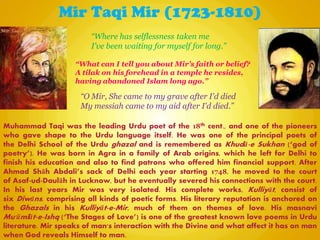
 Urdu poetry (Shāiri), coming from Arabic and Persian cultures, forms an important part of
Indian culture. It has two main types i.e. Ghazal & Nazm. ‗Mushāiras‘ are poetic expositions.
The major genres of poetry found in Urdu are: Ghazal, Nazm, Qasidā, Marsiā, Sehrā, Rubāi,
Nohā, Shehr Āshob, Qatā, Dohā, Soaz.
 The Ghazal (‗mortal cry of a ‗Kastoori‘ doe‘) is a poetic form consisting of couplets which
share a rhyme and a refrain. It consists of a seemingly infinitely adaptable combination of
essentially simple elements. Ghazal is always written from the point of view of the lover who is
unable to attain his beloved, because the beloved is just playing with the poet's feelings. The
lover is aware and resigned to this fate. It is not important to the lover that the beloved does
not echo the same feelings towards him. The beloved is often portrayed in exaggerated terms,
with extended metaphors about ‗arrows of her eyes‘ or referring to the beloved as an assassin.
 A Nazm is an Urdu poetic form that is normally written in rhymed verse.
Poetry (Shayari)
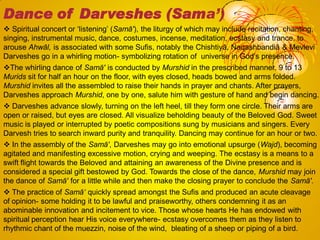
 Spiritual concert or ‗listening‘ (Samā'), the liturgy of which may include recitation, chanting,
singing, instrumental music, dance, costumes, incense, meditation, ecstasy and trance, to
arouse Ahwāl, is associated with some Sufis, notably the Chishtiyā, Naqashbandiā & Mevlevi
Darveshes go in a whirling motion- symbolizing rotation of universe in God‘s presence.
The whirling dance of Samā' is conducted by Murshid in the prescribed manner. 9 to 13
Murids sit for half an hour on the floor, with eyes closed, heads bowed and arms folded.
Murshid invites all the assembled to raise their hands in prayer and chants. After prayers,
Darveshes approach Murshid, one by one, salute him with gesture of hand and begin dancing.
 Darveshes advance slowly, turning on the left heel, till they form one circle. Their arms are
open or raised, but eyes are closed. All visualize beholding beauty of the Beloved God. Sweet
music is played or interrupted by poetic compositions sung by musicians and singers. Every
Darvesh tries to search inward purity and tranquility. Dancing may continue for an hour or two.
 In the assembly of the Samā', Darveshes may go into emotional upsurge (Wajd), becoming
agitated and manifesting excessive motion, crying and weeping. The ecstasy is a means to a
swift flight towards the Beloved and attaining an awareness of the Divine presence and is
considered a special gift bestowed by God. Towards the close of the dance, Murshid may join
the dance of Samā' for a little while and then make the closing prayer to conclude the Samā'.
 The practice of Samā„ quickly spread amongst the Sufis and produced an acute cleavage
of opinion- some holding it to be lawful and praiseworthy, others condemning it as an
abominable innovation and incitement to vice. Those whose hearts He has endowed with
spiritual perception hear His voice everywhere- ecstasy overcomes them as they listen to
rhythmic chant of the muezzin, noise of the wind, bleating of a sheep or piping of a bird.
Dance of Darveshes (Sama’)
 The Sufi, set out to seek God, is a 'traveller' (Sālik), who advances by slow stages or
stations (Maqāmāt) along a 'path' (Tariqā). A spiritual stage periodically marks the long path
followed by Sufis leading to the goal of union with Reality (Fanā fi ‟l-Haq). Maqāmāt can also
be perceived as the ascending rungs of the spiritual ladder. With continuous spiritual practices,
a seeker ascends on this ladder.
 Sufi's path is not finished until he has traversed all the stages, making himself perfect in
every one of them, before advancing to the next, and has also experienced whatever states it
pleases God to bestow upon him. Only then is the seeker permanently raised to the higher
planes of consciousness which Sufis call 'the gnosis' (Mā„rifā) and 'the Truth‘ (Haqiqā), where
the seeker (Tālib) becomes the 'knower' or gnostic („Arif), and realizes that knowledge,
knower, and known are One.
 A spiritual station is considered enduring, in contrast to a spiritual state (Hāl). It means a
spiritual awareness that is lasting and which continues until the Sufi is more fully purified,
more deeply surrendered to God's Will, and is led to another spiritual station. The Sufi
progresses by means of his own effort or self-mortification (Mujāhadah) and through the help
and guidance of the master (Murshid) and by God‘s grace. In each Maqām the Sufi strives to
purify himself from all worldly inclination and to prepare himself to attain an ever-higher
spiritual level.
 The ‗stages‘ (Maqāmāt) of self-awareness on the Sufi path, constitute Sufi‘s ascetic and
ethical discipline, and are distinct from the 'states' (Ahwāl, pl. of Hāl). While the 'stages' can
be acquired and mastered by continuous spiritual practices and sincere efforts, the 'states' are
spiritual feelings and dispositions over which a man has no control and depend on the Grace
of God.
Stages (Maqamat) & States (Ahwal)
 The majority of Sufis agree on 7 major stages (Maqāmāt): 1. Repentance (Tawbāh): does
not mean remembrance of sins and atonement for them, but rather forgetting them along with
everything that distracts from the love of God. 2. Fear of the Lord (Warāʿ): is not fear of
hellfire, but rather the dread of being veiled eternally from God. 3. Renunciation or Detach-
ment (Zuhd): means that the person is devoid of possessions and his heart is without acquisi-
tiveness. 4. Poverty (Faqr): in which he asserts his independence of worldly possessions and
his need of God alone. 5. Patience (Sabr): the art of steadfastness, 6. Trust or Surrender
(Tawakkul): in which the Sufi knows that he cannot be discouraged by hardships and pain, for
he is in total submission to God‘s will and finds joy even in his sorrows. 7. Satisfaction (Riḍā):
a state of quiet contentment and joy that comes from the anticipation of the long-sought union.
 The mystic states (Ahwāl), thru which the soul has to pass are: 1. Ābudiyā- doing Ibādat-
devotion (Tapas). 2. Ishq- love. 3. Jihād- overcoming obstacles. 4. Muārif- intuition. 5. Wajd-
an ecstatic state of rapture, normally experienced by Sufi mystics during reading poetry or
scripture. 6. Haqiqā- truth, and 7. Wasl- union. Ego then becomes Fanā- destroyed and
immortality and bliss of Baqā- presence of Deity is experienced. Another list: meditation,
nearness to God, love, fear, hope, longing, intimacy, tranquility, contemplation and certainty.
 Hāl occurs spontaneously as a spiritual gift. A soft cloud appears on the horizon, engulfs
the seeker while quenching his spiritual thirst, then moves on leaving him in a state of awe.
In this state, a seeker neither expects what comes to him from the unseen world, nor has the
slightest idea about the nature of experience. He is simply taken over by an overwhelming
compassionate power. A realm of ecstasy prevails due to unbearable display of beauty.
This state of Hāl comes and goes on its own. A seeker can never claim such a state due to
its extraordinariness and his ordinariness. It always happens as an act of Grace.
…Stages (Maqamat) & States (Ahwal)
 The Ashgāl (pl. of Shugal) are esoteric exercises of the soul, such as: Zikr, Fikr, Murāqabā,
Habs-i-Dam, Shugal, Samā, Khalwat etc. which prepare it for illumination. These are directed
towards three goals: 1. to activate the heart centre, the store house of love, to clear the path
towards Truth, 2. to subjugate the commanding self (Nafs-al-Ammārāh) to the contented self
(Nafs-Almutmaināh), 3. to render the heart subtle for awareness and illumination.
 Besides heart, which is the store house of Love and hub of life force, a Sufi has to activate
other centres of divine energy in his physical body through breathing and meditation. Each
practice is meant to unfold unconsciousness and remove blockades in the Chakras. At the
Mulādhāra Chakra, then the seeker is prone to temptations. Evolving to Nafsi (Swādhistana
Chakra), the urge to seek sensual gratification is pre-dominant. Those that evolve to Roohi
(Manipura Chakra), by contemplation on the Divine, master the finer aspects of metabolism.
When the aspirants evolve to Qalbi (Anhata Chakra), they attain mastery over languages of
human species and animal species and develop supernatural powers. The rare few who
activate the Khafi (Ajna Chakra) are blessed by the Unmanifest. The All-Pervading Divine
Light of God is manifest here. Those reaching Akhfā (Sahasrara Chakra) are said to attain
Wehdat (merger with the Divine).
 Ashgāl fall into 4 categories: 1. Dasti: with hands- telling beads, doing good deeds.
2. Lassani: with the tongue- reciting scriptures, repeating holy Names, uttering sweet speech,
preaching etc. 3. Samāi: with the ears- listening externally to Satsangs & hymns; also
listening to Anhad Shabd or inner music (Shugal-i-Nasirā, Shugal-i-Saut-i-Sarmadi, or Surat-
Shabd Yoga). 4. Bāsri (or Nāzri): with the eyes- gazing on an external object, leading
to awakening of Nirat (Shugal-i-Āftābi- focus on the sun, Shugal-i-Āina- focus on one‘s
reflection in a mirror, Shugal-i-Neem Khwābi- semi-consciousness during sleep).
Mystic Practices (Ashgal)
• Tasawwar (Dhyan): concentration on the mental conception of some internal stage.
• Shugal-i-Miyāt (Shugal-i-Mansoori, Shav-āsana): in this, one lies on the ground, face
upwards and repeats a name, while keeping one‘s attention on the Third Eye.
• Shugal-i-Roohi (Khechri Mudrā): involves sticking of tongue to close the mouth cavity and
repeating a name.
• Shugal-i-Sultān Samadi: Qalbi (Anahata Chakra) is activated thru sense-withdrawal & love.
• Shugal-i-Āinā: activates Sirr (Vishuddhi Chakra) through contemplation, aided by Zikr.
• Shugal-i-Sultan Mehmood: focuses on Khafi (Ajna Chakra) and is filled with Light.
• Shugal-i-Bisāt: in this, one concentrates on the inner sun, repeating a name and reaches
Akhfa (Sahasrara Chakra).
• Shugal-i-Muqaman (Trikuti Dhyan): involves Fikr (concentrating). The gaze is fixed on the
nose-tip with a name being repeated, and then taken inwards.
• Shugal-i-Sanobari: focuses on Fikr, as preparatory for Zikr (remembrance).
• Shugal-i-Barazkh-i-Kabir (Bhakti Yoga): enjoins concentration on the Perfect Man (Peer-o-
Murshid), both outwardly and inwardly, terminating in Fanā fi ‟l-Shaikh- merger in the Master.
• Shugal-i-Sultān Nasirā (Trātak Karma & Chāchri Mudrā): involves listening to Ghor Anahad-
undifferentiated sound comprising 10 types of sound.
• Shugal-i-Saut-i-Sarmadi or Sultān-ul-Azkār: (Surat-Shabd Yoga, Sahaj Yoga): begins by
Zikr at the Third Eye focus and coming into contact with Dhunyatmak Nām, Shabd or holy
Word (Kalām-i-Ilāhi- Word of God, Nidā-i-Āsmani- heavenly sound, Ism-i-Āzam- highest name)
thru meditation (Murāqabā) aided by contemplation & concentration (Fikr), and reaching Fanā
fi ‟l-Shaikh and Fanā fi ‟l-Allāh through focus on the inner Sound & Light.
• Fikr (contemplation) is of 2 kinds: one is the result of perfect faith, the other of rapturous love.
…Mystic Practices (Ashgal)
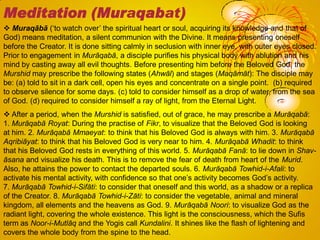
 Muraqābā (‗to watch over‘ the spiritual heart or soul, acquiring its knowledge and that of
God) means meditation, a silent communion with the Divine. It means presenting oneself
before the Creator. It is done sitting calmly in seclusion with inner eye, with outer eyes closed.
Prior to engagement in Murāqabā, a disciple purifies his physical body with ablution and his
mind by casting away all evil thoughts. Before presenting him before the Beloved God, the
Murshid may prescribe the following states (Ahwāl) and stages (Maqāmāt): The disciple may
be: (a) told to sit in a dark cell, open his eyes and concentrate on a single point. (b) required
to observe silence for some days. (c) told to consider himself as a drop of water, from the sea
of God. (d) required to consider himself a ray of light, from the Eternal Light.
 After a period, when the Murshid is satisfied, out of grace, he may prescribe a Murāqabā:
1. Murāqabā Royat: During the practise of Fikr, to visualize that the Beloved God is looking
at him. 2. Murāqabā Mmaeyat: to think that his Beloved God is always with him. 3. Murāqabā
Aqribiāyat: to think that his Beloved God is very near to him. 4. Murāqabā Whadit: to think
that his Beloved God rests in everything of this world. 5. Murāqabā Fanā: to lie down in Shav-
āsana and visualize his death. This is to remove the fear of death from heart of the Murid.
Also, he attains the power to contact the departed souls. 6. Murāqabā Towhid-i-Afali: to
activate his mental activity, with confidence so that one‘s activity becomes God‘s activity.
7. Murāqabā Towhid-i-Sifāti: to consider that oneself and this world, as a shadow or a replica
of the Creator. 8. Murāqabā Towhid-i-Zāti: to consider the vegetable, animal and mineral
kingdom, all elements and the heavens as God. 9. Murāqabā Noori: to visualize God as the
radiant light, covering the whole existence. This light is the consciousness, which the Sufis
term as Noor-i-Mutlāq and the Yogis call Kundalini. It shines like the flash of lightening and
covers the whole body from the spine to the head.
Meditation (Muraqabat)
 Various types of Murāqabā: Lower level: 1. Light of various colours. 2. Ihsan (perfection
of worship). 3. Noor (invisible Light). 4. Hātif-i-Ghabi (unhearable Sound of Cosmos).
5. Names & Attributes of God. 6. Allāh (proper name of God). Middle level: 1. Maot (death):
life after Death. 2. Qalb (heart): Spiritual Heart. 3. Wahdat (unity): Cosmic Unity. 4. La
(nothingness): material-lessness 5. Fanā (annihilation of self): alpha-omega of universe.
Higher level: 1. Tasawwur-i-Shaikh (focus on master). 2. Tasawwur-i-Rasool (focus on
prophet): transfer of Faiz (arcane spiritual knowledge) from prophet. 3. Tasawwur-i-Zāt-i-
Ilāhi (focus on God): experiencing Tajalli-i-Zāt of God. 4. Martabā-i-Ihsān (focus on perfection
of Faith): ‗offering Salāt as if you are watching Allah. If not, then as if Allah is watching you.‘
 Sufi journey of ascension: (a) Gnosis of self: 1. Somnolence (Ghanood): becomes semi-
consciousness over time. 2. Cognition (Adrāk): thru un-conscious mind during wakefulness
without seeing or hearing. 3. Experience (Warood): with awakening of flickering vision due to
increased mental concentration. (b) Gnosis of universe: 4. Unveiling of Arcane knowledge
(Kashaf‟/Ilhām): initially without control. 5. Evidence (Shahood): with practice, knowledge by
will- thru sight, hearing, smell or touch. 6. Victory (Fatah): Experiencing with open eyes, while
freed from fetters of time & space. (c) Gnosis of Creator: 7. Annihilation (Fanā): Gnosis of
God through a series of stages (Maqāmāt) and subjective experiences (Ahwāl), this process
of absorption develops until complete annihilation of the self takes place and one becomes
al-Insānul-Kamil (the ‗perfect man‘), also called Extinction with unity (Fanā fit-Tawheed) and
Extinction in reality (Fanā fi „l-Haq). 8. Journey towards God (Sair-Il-Allāh or Safr-i-Urooji).
9. Extinction of self in God (Fanā fi „l-Allāh): mystical experience, becoming extinct in God‘s
Will and being wrapped in contemplation of divine essence. 10. Return journey from God (Sair
min Allāh or Safr-i-Nuzooli): being lost to oneself and totally lost in God‘s magnificence. 11.
Eternal life in union with God (Baqā-bi-Allāh): when one lives in the world subsisting in God.
…Meditation (Muraqabat)
 Illumination (Tajalli) means ‗self-manifestation of God‘, but is understood in different ways
by the mystics. It is the stage of union with God resulting in total absorption. A seeker reaches
the stage of Yaqin, when he is blessed with the glance in this world. In the Beatific Vision, God
manifests to the elect in various forms corresponding to their mental conception. The Sufis
call it Tajalli-i-Dhāt, signifying manifestation of the Glory of God during Wajd (ecstasy).
 Every Sufi is blessed by God to have a natural ability to illuminate his soul with
‗Prophetic Blessings‘ (Noor-i-Nubuwāt). Whenever the light of faith touches his heart, his
soul is illuminated, as if a lamp is lighted. Such a person becomes source of illumination
for humanity. When such a person reaches the company of an accomplished Sufi master,
then this illumination of soul is increased manifold. This is an essence of Sufism.
 Saints and seers obtain ‗Divine Inspiration‘ (Ilhām-i-Rabbāni) from God. A mystic sees a
vision in inner space, not before his eyes. A Sufi, after his or her annihilation in the personality
of God, experiences a mystic union with God, which results in Tajalli. The Beatific Vision of
the Divine in glory is achieved when body, mind and soul are intoxicated with love of God.
 Discernment (Firāsat): The light gleaming in the heart of the illuminated mystic endows
him with this supernatural power. Its origin is in the Koranic verse in which God says that He
breathed His spirit into Adam. Orthodox Sufis, who strenuously combat the doctrine that the
human spirit is uncreated and eternal, affirm that Firāsat is the result of knowledge and insight,
metaphorically the 'light' or 'inspiration,' which God creates and bestows upon His favourites.
 Well-doing (Ihsān): From illumination of gradually increasing splendour, the mystic rises to
contemplation of the divine attributes, and ultimately, when his consciousness is wholly melted
away, he becomes transubstantiated (Tajāwharā) in the radiance of the divine essence. This
is the 'station' of well-doing.
Illumination, Discernment, Well-doing
 Fanā and Baqā are two major milestones on the path of spiritual progress. Fanā or
‗annihilation‘ is the state that precedes the state of ‗subsistence‘ (or Baqā). Sufis believe that
the purpose of human life is to attain the state of merger i.e. unity with the Almighty (‗Fanā-
fi ‟l-Allāh) and then to live in that state (Baqā). After reaching Wasl, ego becomes ‗Fanā-
destroyed and the immortality and bliss of Baqā- presence of the Deity is experienced.
 Unlike Nirvāna, which is merely the cessation of individuality, Fanā, the ‗passing-away‘ of
the Sufi from his phenomenal existence, involves Baqā, the ‗continuance‘ of his real existence.
He who dies to self lives in God, and Fanā, the consummation of this death, marks the
attainment of Baqā, or union with the divine life. When one approaches the stage of merger,
it is called Salokyata and Samipyata (the state of Nearness). From here one moves to
Sarupyata (Baqā) and complete Unity- Sayujyata (Baqā-dar-Baqā or Baqā-bil-Baqā).
 When the individual self is lost, the Universal Self is found. Fanā is: 1. a moral transfor-
mation of the soul through the extinction of all its passions and desires. 2. a mental abstraction
or passing-away of the mind from all objects of perception, thoughts, actions and feelings thru
its concentration upon the thought of God. Here thought of God signifies contemplation of the
divine attributes. 3. the cessation of all conscious thought.
 Among the Darvesh orders, music, singing and dancing are favourite means of inducing
Fanā‟.
 Often, though not invariably, Fanā is accompanied by loss of sensation. The gnostic
contemplates the attributes of God, not His essence, for even in gnosis a small trace of duality
remains: this disappears only in Fanā‟al-Fanā, the total passing-away in the undifferentiated
Godhead. It forms the prelude to Baqā, 'continuance' or 'abiding' in God. The mystic is now
rapt in contemplation of the Divine Essence.
Annihilation (Fana)/Subsistence (Baqa)
 Sufism is a spiritual path, on which one travels in order to recognize Allāh (Māri'fāt) and
attain ‗nearness‘ (Qurb) to Him. This path develops the spiritual faculties of man for realization
of Divine Reality. While the term, „Ilm denotes ordinary knowledge, Mā„rifāt is the mystic
knowledge peculiar to Sufis. Māri'fāt is a special guidance, which Allah inspires in the purified
heart of the Mu‟min. This is a knowledge that cannot be learned through books. It is a gift of
Allah, who bestows it to His chosen ones among the ‗Friends of Allāh‘ (Awliya Allāh), who
have reached a certain degree of nearness to Him. This knowledge has been transmitted
from the breast of the Spiritual Guide to his disciples and cannot be disclosed to others.
 Māri'fāt of the Sufis is the 'gnosis' of Hellenistic theosophy, i.e. direct knowledge of God
based on revelation or apocalyptic vision. It is not the result of any mental process, but
depends entirely on the will and favour of God, who bestows it as a gift from Himself upon
those whom He has created with the capacity for receiving it. It is a Light of Divine grace that
flashes into the heart and overwhelms every human faculty in its dazzling beams. "He who
knows God is dumb." It is said to be a light that illumines and clarifies, but its very brilliance
dazzles, blinds and ultimately extinguishes the one designated as a ‗knower‘ (al-Ārif) as well.
There are two kinds of Māri'fāt: 1. Istidlāli: the ability to reach Allah by intellectual deduction
o-n the basis of observation of the wonders created by Allah. Contemplation o3n His creation
leads to man‘s recognition of Allah. This is also acquired by such pure souls to whom certain
things of the unseen realm have been revealed, i.e. by way of Kashf (divine inspiration which
removes the veils which conceal reality). 2. Shuhood: Those who have been blessed with this
wealth attain Allah without any deductive process. They acquire His Recognition instantane-
ously by way of spiritual perception and recognition. They are not dependent on the external
realm or the physical world to understand the greatness and reality of Allāh.
Gnosis (Ma’rifat)
 Wahdat al-Wujud literally means the ‗Unity of Existence‘, while, Wahdat al-Shuhud (‗Unity of
Witness‘ or ‗Apparentism‘) holds that God and His creation are entirely separate. Some Islamic
reformers have claimed that the two philosophies differ only in semantics and that the entire
debate is merely a collection of "verbal controversies" which have come about because of
ambiguous language. However, the concept of the relationship between God and the universe
is still actively debated, both among Sufis and between Sufis and non-Sufi Muslims.
 The cardinal attribute of God is unity, and Divine unity is the first and last principle of gnosis.
The gnosis of unity constitutes a higher stage which is called 'the Truth' (Haqiqat). Unification
consists in making the heart single- that is, in purifying and divesting it of attachment to all
except God, both in respect of desire and will, and also as regards knowledge and gnosis.
The eternal and the phenomenal are two complementary aspects of the One. The creatures
are external manifestation of the Creator, and Man is God's consciousness (Sirr) as revealed
in creation. According to Ibn al-‗Arabi, since Man, owing to the limitations of his mind, cannot
think all objects of thought simultaneously, and therefore expresses only a part of the divine
consciousness, he is not entitled to say Ana ‟l-Haqq, "I am God." He is a reality, but not the
Reality. Other Sufis e.g. Hallāj, in their ecstatic moments, have ignored this subtle distinction.
 Man is essentially divine. God created Adam in His own image. He projected from Himself
that image of His eternal love, that He might behold Himself as in a mirror. Hence He bade the
angels worship Adam, in whom, He became incarnate. In the pantheistic theory, there is no
real existence apart from God. Man is an emanation or a reflexion or a mode of Absolute
Being. What he thinks of as ‗individuality‘ is in truth not-being; it cannot be separated or united,
for it does not exist. Man is God, yet with a difference. In realizing the non-entity of his
individual self, the Sufi realizes his essential oneness with God.
Unity & Truth (Haqiqat)
 As against Islamic deification or Hindu gods-goddesses and Avatārs, Kāmll Sufis and Sants
commended worship of God in the form of the perfect Master (Peer-o-Murshid or Satguru), the
true living Son of God or ‗Word-made-flesh‘, and taking the gift of spiritual initiation of Nām or
Kalmā from Him. Deity of the Kāmil Sufis and Sants is Sat (Haq) or Akāl- Timeless Being,
Positive Power (deity of the various religions being Kāl- being of Time, Negative Power).
 The Sufi Murshid-i-Kāmils and Sants not only lived harmoniously with Islam and Hinduism
respectively, but also readily employed their own metaphors to put across their teachings.
The Sufi Kāmils managed to give their message in the very metaphor of Islam. What better
example of this than the ‗Masnavi‘ of Maulānā Rūmi being dubbed as the ‗Persian Qur‘ān‘!
A parallel of the same may be found in Sant Tulsidas‘s ‗Rāmacharitmānas‘.
 The Kāmil Sufis and Sants taught attainment of Parā Vidyā- esoteric knowledge- the
individual worship within the human body-temple thru meditation, rather than Aparā Vidyā-
exoteric knowledge, collective congregative prayer of mosque for salvation of the soul. They
practised true Sultān-ul-Azkār- King of Remembrances, or ‗Surat-Shabd Yoga‘, not Prānayām.
 In Sant-Mat terms, Shari‟ā- outer path involves activities such as: attending Satsangs, doing
Nishkam Sewa-selfless service, Tariq‟ā- the path of discipline involves living an ethical life &
filling-in of Introspection Diary, and doing Sumiran or Zikr of the holy Names, which leads
ultimately to the ‗microcosmic seat of the soul‘ or ‗Third Eye‘. Mā‟rifā- the path of Grace
through the inner spiritual regions calls for daily meditation for at least 2.1/2 hrs., while
Haqiq‟a- first-hand experience of Truth or Godhead involves self-realization and merger in the
Master (Fanā fi „l-Shaikh) at the ‗microcosmic seat of the soul‘ (Sat Lok) at Sach Khand.
 Sufi Poetic works of Sant Darshan Singh Ji Maharaj mark the final comingling of the Kamil
Sufi and Sant-Mat traditions, separated only by language and culture.
Perspective of Sant-Mat (Kamil Sufis)
The Islamic
Jannats- Paradises
Stage in Hinduism Jannat- Paradise in Islam Maqam- Plane in Islam
Sahasrara {14} or {1000} Jannatu 'l-Firdaus
(Suratu 'l-Katif)-
The Garden of Paradise
Aalam-e-Hutal-hut-
Spaceless Empyrean
Satyam Loka {10} 'Illiyun (Suratu 't-Tatfif)-
The Exalted Garden
Aalam-e-Hahut-
Divine Essense
Tapah Loka Jannah 'n Na'im
(Suratu 'l-Ma'idah)-
The Garden of Delight
Aalam-e-Lahut-
Divine Nature
Janah Loka Jannatu'l-Mawa
(Suratu 'l-Sajdah)-
The Garden of Refuge
Aalam-e-Jabrut-
World beyond Form
Mahar Loka {8} Jannatu'l-Adn
(Suratu 's-Bara'dah)-
The Garden of Eden
Aalam-e-Malkut-
World of Imagination
Swah Loka {6} Daru 'l-Qarar
(Suratu 'l-Mu'min)-
The Dwelling which Abideth
Aalam-e-Mana-
World of Spiritual Perception
Bhuvah Loka {2} Daru 's- Salam
(Suratu 'l-Anam)-
The Dwelling of Peace
Aalam-e-Surat-
World of Forms
Bhu {10} Jannatu'l Khuld
(Suratu 'l-Furqan)-
The Garden of Eternity
Aalam-e-Tabiat-
World of Nature
Paatals -- Tahat-ul-Sara-
Nether World
STAGE DESCRIPTION PROPHET
1 that of helpers Adam
2 that of abstainers Idries (Enoch)
3 that of the devotees Moses
4 that of the patient ones Job
5 that of those resigned to the will of God Jesus
6 that of the contented ones Jacob
7 that of the defenders of the faith Jonah
8 that of the thinkers Joseph
9 that of the afflicted Shu’aib (Jethro)
10 that of the murshids Seth
11 that of the righteous ones Noah
12 that of the sincere ones David
13 that of the illuminated ones Khidr
14 that of the grateful ones Abraham
15 that of the lovers Mohammed
CHISHTIA SUFI DELINEATION OF
THE SPIRITUAL STAGES
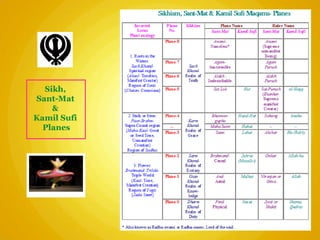
Sikh,
Sant-Mat
&
Kamil Sufi
Planes
PLANES : KAMIL SUFI & SANT MAT
Plane No. Sufi Plane Name Description Distance Purush Texts
10 Jahut Hut Sat Lok 10 AY+ Sat 10 L Sants
9 Ahut Sahaj Dweep {10} 2 AY+ darkness Sahaj
8 Rahut Ichha-Surati Dweep 3 AY+darkness Ankur
7 Sahut Mool Naam 5 AY+ dakness Iccha
6 Bahut Hutal-Hut Sohang 3 AY+ darkness Sohang
5 Hahut Achint Dweep {12} 1 Asankhya Y Achint
MahaSunn {8}
4 Lahut Sunn 11 Palang + Akshar Mohammed Koran
3 Jabrut Jhanjhri Dweep 18 cr Y +, 1 Palang+ Niranjan Jesus Bible
2 Malkut Pitri Lok 24k Y+ Chitragupt Moses Torah
1 Nasut false Mansarovar 36k Y from earth MahaMaya David Zohar
Sayujya Mukti Akshar
Saroopya Mukti Niranjan Jyotiswaroop
Sameepya Mukti Dharmarai
Salokya Mukti Mrityu Lok
Sufism--Part 2
History of Sufism
 Islamic mysticism had several stages of growth, including (1) the appearance of early
asceticism, (2) the development of a classical mysticism of divine love, and (3) the rise and
proliferation of fraternal orders of mystics. Despite these general stages, however, the history
of Islamic mysticism is largely a history of individual mystic experience.
 Asceticism: The first stage of Sufism appeared in pious circles as a reaction against the
worldliness of the early Umayyād period (661–749). From their practice of constantly
meditating on the words in the Qurʾān about Doomsday, the ascetics became known as
―those who always weep‖ and those who considered this world ―a hut of sorrows.‖ They were
distinguished by their scrupulous fulfillment of the injunctions of the Qurʾān and tradition, by
many acts of piety, and especially by a predilection for night prayers.
 Divine Love: The introduction of the element of love, which changed asceticism into
mysticism, is ascribed to Rābiʿah. In the later decades, mystical trends grew everywhere in the
Islamic world, partly through an exchange of ideas with Christian hermits. A number of mystics
in the early generations had concentrated their efforts upon ‗absolute trust in God‘ (Tawakkul),
which became a central concept of Sufism. An Iraqi school of mysticism was initiated by al-
Muḥāsibī, who believed that purging the soul in preparation for companionship with God was
the only value of asceticism. Its teachings of classical sobriety and wisdom were perfected by
Junayd of Baghdad, to whom all later chains of the transmission of doctrine and legitimacy go
back. In an Egyptian school of Sufism, the Nubian Dhū al-Nūn reputedly introduced the term,
‘interior knowledge‘ (Māri'fāt), as contrasted to learnedness. In the Iranian school, Abū Yazīd
al-Bisṭāmī is considered to have been representative of the important doctrine of annihilation
of the self (Fanā). At the same time the concept of divine love became more central, especially
among Iraqi Sufis. Its main representatives are Nūrī and Sumnūn ‗the Lover‘.
Sufism as Islamic Mysticism
 The first of the theosophical speculations based on mystical insights about human nature
and the essence of the Prophet Muhammad were produced by such Sufis as Sahl al-Tustarī,
who was the master of al-Ḥallāj, who has become famous for his phrase anā al-ḥaqq,
―I am the Creative Truth‖ (often rendered ―I am God‖), which was later interpreted in a
pantheistic sense but is, in fact, only a condensation of his theory of huwā huwā (―He he‖):
God loved himself in his essence, and created Adam ‘in his image.‘ His few poems are of
exquisite beauty; his prose, which contains an outspoken Muhammad-mysticism i.e.,
mysticism centred on the Prophet, is as beautiful as it is difficult.
 In these early centuries Sufi thought was transmitted in small circles. Some of the Shaikhs,
Sufi mystical leaders or guides of such circles, were also artisans. In the 10th cent., it was
deemed necessary to write handbooks about the tenets of Sufism in order to soothe the
growing suspicions of the orthodox; the compendiums composed in Arabic by Abū Ṭālib
Makkī, Sarrāj, and Kalābādhī in the late 10th cent., and by Qushāyrī and, in Persian, by
Hujwīrī in the 11th cent. reveal how these the mystics, belonging to all schools of Islamic law
and theology of the times, tried to defend Sufism and to prove its orthodox character.
 The last great figure in the line of classical Sufism is Abū Hamid al-Ghazālī, who wrote,
among numerous other works, the Iḥyāulūm al-dīn (‗The Revival of the Religious Sciences‘),
a comprehensive work that established moderate mysticism against the growing theosophical
trends, which tended to equate God and the world, and thus shaped the thought of millions of
Muslims. His younger brother, Aḥmad al-Ghazālī, wrote one of the subtlest treatises, Sawāniḥ
(‗Occurrences‘ [i.e., stray thoughts]) on mystical love, a subject that then became the main
subject of Persian poetry.
Sufism as Islamic Mysticism
 Fraternal Orders: Slightly later, mystical orders centring around the teachings of a leader-
founder began to crystallize. The 13th cent., though politically overshadowed by Mongol
invasion, into the Eastern lands of Islam and the end of ʿAbbāsid caliphate, was also ‗golden
age of Sufism‘: Spanish-born Ibn alʿArabī created a comprehensive theosophical system
concerning the relation of God and the world, the cornerstone for a theory of ‗Unity of Being,‘
according to which, all existence is one, a manifestation of the underlying divine reality. His
Egyptian contemporary, Ibn al-Fāriḍ wrote the finest mystical poems in Arabic. Two other
important mystics were a Persian poet, Farīd al-Dīn ʿAṭṭār and a C Asian master, Najmuddīn
Kubrā, who presented the psychological experiences thru which the mystic adept has to pass.
The great Persian mystical poet, Rūmī, was moved by mystical love to compose his lyrical
poetry that he attributed to his mystical beloved, Shams Tabriz, as a symbol of their union.
Rūmī‘s Mas
̄ navī is an encyclopaedia of mystical thought in which everyone can find his own
religious ideas. He inspired the organization of the Whirling Derveshes, who sought ecstasy
through an elaborate dancing ritual, accompanied by superb music. His younger contemporary
Yunus Emre inaugurated Turkish mystical poetry with his charming verses that were trans-
mitted by the Bektaşi order of Darveshes and are still admired in modern Turkey. In Egypt, the
Shādhilīyyah order was founded by al-Shādhilī; its main representative, Ibn ʿAṭāʾ Allāh of
Alexandria, wrote sober aphorisms (Hikām).
 In Arabia, only a few interesting mystical authors are found after 1500. They include al-
Shaʿrānī in Egypt and the prolific writer ʿAbd al-Ghanī al-Nābulusī in Syria. Turkey produced
some fine mystical poets in 17th and 18th cents. The influence of the mystical orders did not
recede; rather new orders came into existence, and most literature was still tinged with
mystical ideas and expressions.
Sufism as Islamic Mysticism
 Sufism was a mystical reaction against conventional Islam's strict outlook of the faith. It
believed that government should promote greater free thinking and equality for everyone, as
opposed to the traditional Islamic legalist government that followed the Qur'ān, which was a
rigid law that the believers were forced to follow. This led to the split of a relatively small band
of believers from the majority of Islam‘s followers around 675; Sufism, the new movement,
allowed for a less harsh and sterile form of Islam, which could accommodate mysticism.
 The Sufis were historical Islamic Empire‘s most influential missionaries due to their quest
to ―nurture their own and others' spiritual dimension.‖ Their tendency to migrate among other
ethnic groups allowed them to easily unify the diverse communities in both neighboring and
distant lands. They created close connections of culture, rather than dominance, between the
Muslim people and the people of surrounding regions such as S.E. Asia, Africa and esp. India.
 The Sufis were unique from the more military-driven Islamic forces because of their central
idea of universal love, which led them toward a generally more peaceful and friendly approach
to conversion. Although the Sufis' beliefs include specific social and religious beliefs and
customs, they have been willing to flex these customs in order to incorporate the potential
Islamic converts' traditions and rituals.
 The impact of Sufism is significant and lasting. The Sufis‘ absorption into foreign regions
and cultures produces great works of art, particularly poetry and hymns, in numerous
languages and dialects. As a result, they are some of the most important contributors to
Islamic literature. They opened mosques and schools as well as encouraged the development
of the civilizations they inhabited. The Sufis had a positive effect on the status of women, as
well as an even stronger emphasis on the equality of believers of Islam.
Early Development of Sufism
 Sufism originated in the ‗Golden Age of Islam‘ during 9th-10th cents. Since its very
beginnings, Sufism has been known in Transoxania and Khorasan which produced some of
the most renowned Sufis, saints such as 8th-9th cent. al-Fozail ibn Iyaz & Ibrahim ibn
Ādham and their successors, Shaqiq al-Bālkhi & al-Farābi. Bāyāzid Bastāmi dealt with Fanā
& Baqā- annihilating the self in Divine presence, and presented views on worldly phenomena.
 The earlier Sufis were ascetics rather than mystics, more of saints than seers. Sufism
developed as the internalization of Islam e.g. thru constant recitation and meditation of Qur'ān
or as strict emulation of the ‗way of Prophet Muhammad‘, thru which the heart's connection to
the Divine is strengthened. Esoteric teachings of Sufism were transmitted from Muhammad to
those who had the capacity to acquire direct experiential gnosis of God, which was passed on
from teacher-to-student thru the centuries, some of which came to be summarized in texts.
 Conquest of Persia, Syria & Egypt by Muhammed‘s successors brought Islam into contact
with ideas which profoundly modified their outlook on life and religion. Mysticism grew and
developed, not in the Arabian desert, but in Persia through Islam‘s cross fertilization. Asceti-
cism was now regarded as only the first stage of a long journey- the preliminary training for a
larger spiritual life. These ideas--Light, Knowledge & Love—formed keynotes of new Sufism.
 The evolution of Sufi thinking was greatly influenced by Murjites, who set faith above works
and emphasized the divine love and goodness; Qādarites who affirmed, and Jabarites who
denied that men are responsible for their actions; rationalist Mu‗tāzilites, who rejected the
qualities of Allah as incompatible with His unity, and predestinarianism as contrary to His
justice, Bātinis- an esoteric group, Bisheriyās- an antinomian group, the Ash‗arites- scholastic
theologians of Islam, who formulated rigid metaphysical and doctrinal system, Christological
sects like Gnostics and Manicheans and mystical groups like Hermetics and Neoplatonists.
…Early Development of Sufism
From its origin in Baghdad, Iraq, Sufism propagated to
Persia, India, N Africa, Muslim Spain and SE Asia.
 Islam came to be accepted in India in the 7th-8th cents. as a result of reverence towards
Sufis and darveshes for their Bhakti aspect. With the fall of Sindh in 712, Multan had become
a Sufi centre, but Sufism in India is to be found only by the 12th cent., and even so, for another
3-4 centuries, it continued to cross-fertilize with the Vedāntins, Nāth Yogis, Buddhists etc. and
spread, with Sindh, Multan, Punjab, Ajmer and Delhi as its main centres, and from thence to
South India as well. The Sufi Malingās were akin to the Siddhās, Yogis, Vairāgis in their dress
aspect. This devotional period lasted from 11th to 14th cents. producing likes of Moinuddin
Chishti in mid 1100‘s and Nizāmuddin Auliā in 1300‘s.
 The South Indians were familiar with the Sufis & Moslem Darveshes fairly early. Thane
came under Arabic rule during 640‘s, but Moslems kept attacking India for several centuries
without success. In 8th-9th cents. India was a strong country, but by the 11th-12th cents., its
rulers turned debauchers and began to make wage wars with one-another. North India was
divided into half-a-dozen kingdoms, and as a result, foreigners took advantage and began to
attack India. Somnath and Mathura fell in early 1000‘s.
 While Islam brought the sword, Sufism brought the sweet flute to India. Even before Islam‘s
advent, many prominent Sufis, fleeing from Mongol invasion, had settled in India. The militant
face of Islam emerged in the 11th cent. Late 1000‘s saw forcible conversions in Lahore during
Ghazni rule. In late 1100‘s Khiljis destroyed Buddhist Vihārās and universities such as
Nālandā. Until the 18th cent., virtually every sentient Moslem was a Sufi, and several Hindus
readily followed the Sufi path of love. Aurangzeb (1618-1707) dealt this composite ‗Ganga-
Jamni‘ tradition a mortal blow. Even until the 1857 Mutiny, the Sufi was neither a Hindu, nor a
Moslem. Politics of the times created a schism between them; Sufism has declined in its wake.
Sufism’s Advent to India
 Islam had entered India in 711 under the Arab commander, Muhammad ibn Qāsim, by
conquering the regions of Sindh and Multan, thus connecting S. Asia to the Muslim empire.
Arab Muslims were welcomed along the Hindustani (Indian) sea ports for trade and business
ventures. Sufi mystic traditions became more visible during the 10th & 11th cents. of the Delhi
Sultanate- a conglomeration of four chronologically separate dynasties consisted of rulers
from Turkic and Afghan lands.
 During the early 11th cent., the Ghaznāwids brought a wealth of scholars into India‘s
borders, establishing the first Persian-inspired Muslim culture succeeding prior Arab
influences. In 1151, another Central Asian group, called the Ghurids extended the previous
Ghazni territories into Delhi and Ajmer. By 1186, N. India was indistinguishable; a combination
of Baghdad‘s cosmopolitan culture mixed with Persian-Turkic traditions of the Ghaznāh court
accelerated Sufi intellectualism in India. Scholars, poets, and mystics from C. Asia and Iran
became integrated within India.
 An emphasis on translation of Arabic and Persian texts (Qurʾān, Hadith corpus, Sufi
literature) into vernacular languages helped the momentum of Islamization in India.
Particularly in rural areas, Sufis helped Islam spread generously into prior polytheistic
populations.
 The Persian influence flooded South Asia with Islam, Sufi thought, syncretic values,
literature, education, and entertainment that has created an enduring impact on the presence
of Islam in India today. Sufi teachings of divine spirituality, cosmic harmony, love, and
humanity resonated with the common people and still does so today. The following content will
take a thematic approach to discuss a myriad of influences that helped spread Sufism and a
mystical understanding of Islam, making India a contemporary epicenter for Sufi culture today.
…Sufism’s Advent to India
The Hindu Bhakti movement had mystical philosophies similar to those advocated by Sufi
saints leading to a syncretic mysticism. Sufism left a prevailing impact on religious, cultural,
and social life in S Asia. Sufism helped the assimilation of the Afghāni Delhi Sultanate rulers
within mainstream society. By building a culture tolerant and appreciative of non-Muslims, Sufi
saints contributed to a growth of stability, vernacular literature and devotional music in India.
 The introduction of the mystical form of Islam was done by Sufi saints. Besides preaching
in major cities and centers of intellectual thought, Sufis reached out to poor and marginalized
rural communities and preached in local dialects such as Urdu, Sindhi and Punjābi. Their
traditions of devotional practices and modest living attracted all people. Their teachings of
humanity, love for God and Prophet continue to be surrounded by mystical tales and folk
songs today. Sufis were firm in abstaining from religious and communal conflict and strived to
be peaceful elements of civil society. It is the attitude of accommodation, adaptation, piety
and charisma that continues to help Sufism remain as a pillar of mystical Islām in India.
 Among the earliest Sufis in India was Hazrat Dāta Ganj or Ali el-Hujwiri (d:~1089) of
Lahore. Many Indian Sufis, such as Amir Khusro, Sultān Bāhu, Bulleh Shāh, Wāris Shāh also
wrote in Hindi, Punjābi and Sindhi. In the 18th century, Shāh Walī Allāh of Delhi translated the
Qurʾān into Persian, the official language of Mughal India. Other Indian mystics of the 18th
cent., such as Mīr Dard, played a decisive role in forming the newly developing Urdu poetry.
 Khwājā Muinuddin Chishti introduced the Chishti Order in India. Shaikh Qutbuddin
Kāki acquired his name ‗Kaki‘ (a man of cakes) when he produced hot cakes by putting his
hands in a tank of water to feed them. Shaikh Fariduddin, Bābā Farid succeeded Shaikh
Qutbuddin Kāki.
…Sufism’s Advent to India
 Hazrat Nizamuddin Auliyā born in Badāun in 1236, was the chief successor of Bābā
Farid. He and his disciple Amir Khusro- a poet who used Hindvi to compose songs, riddles,
rhymes and enigmas in common man‘s language to reach their hearts, took Sufism to every
nook and corner of India. Shaikh Nasiruddin, more popularly known as ‘Chirāgh-i-Dilhi’,
succeeded Hazrat Nizāmuddin Auliyā. Muhammad Gesu Darāz, known as ‗Bandā Nawaz‘,
in turn, succeeded him. In 1398, he moved to Deccan, where Sultān Firoz Shāh Bāhmani
received him with great respect. He died in 1422 in Gulbargā.
 The saints of Qādiri Order also took India as their abode. Saiyad Muhammad Ghawth,
10th in the line of succession from Shaikh Abdul Qādir Gilani of Baghdad, the founder of the
Qādiri Order, settled in Uchh, Sindh, also an abode of Sufi saints of Suhrāwardi Order. The
fame of Shaikh Abdul Qādir Gilāni had already preceded him. He was, therefore, received
well and the then Ruler of Delhi, Sultān Sikandar Lodi.
 Shaikh Bahāuddin Zakariyā was the foremost of the saints of Suhrāwardi Order. He
was born in Multan in 1182 and was a grandson of Shaikh Abdul Qādir Gilāni, the founder of
the Qādri Order, through his mother. He was, however, initiated in the Suhrāwardi Order by
Shaikh Shihābuddin Suhrāwardi and later asked to go to India.
 The Naqshbandiā Order Sufis were the last to enter India. This Order was introduced in
India by Hazrat Muhammad al-Bāqi Billāh, 7th in the line of succession from Baha'ud-din
Shāh Naqshband, its founder. He was born in 1562 in Kabul, then a colony of the Sultanate of
India and came to India on personal business, but gave up worldly life in the quest of spiritual
knowledge. One day Muhd. Khwājā al-Amkanaki appeared in his dream and invited him to
visit him, and initiated him in the Naqshbandiā Order. He was authorized to go back to India,
and settled in Delhi. Through him the order spread swiftly throughout the Indian subcontinent.
Sufism in India
 Shaikh Ahmad al-Fāruqi was born in 1561 in Sarhind in India. At the age of 17 years,
he was authorized to train followers in three Tariqats: Suhrawardiā, Qādiriā and Chishtiā.
His spiritual progress brought him to the presence of Bāqi Billāh, from whom he took the
Naqshbandiā Order and the authorization to train his disciples. Shaikh Ahmad‘s son,
Muhammad al-Māsum, a born-saint, succeeded him in 1624. In turn, his son Shaikh
Saifuddin succeeded him. He was succeeded by Nur Muhammad al-Badāwani, a
descendant of Prophet Muhammad, with a bent back as a result of excessive contemplation.
His successor, Shamsuddin Habib Allāh (Mirzā Zanzānā) had a liberal attitude towards
various religions and was Master of Naqshbandiā, Qadiriā, Chishtiā & Suhrāwardiā Tariqats.
 Other Indian mystics of the 18th cent., such as Mīr Dard, played a decisive role in forming
the newly developing Urdu poetry. Such modern Islamic thinkers as the Indian philosopher,
Muḥammad Iqbāl have attacked traditional monist mysticism and have gone back to the
classical ideals or divine love as expressed by Ḥallāj and his contemporaries. The activities
of modern Muslim mystics in the cities are mostly restricted to spiritual education.
 Sant Darshan Singh Ji Maharaj (1921-1989) blended spirituality and mysticism into his
poetry. He was acclaimed as India's greatest Sufi mystic poet writing in the Urdu language.
His collections of poems, Manzil-i-Noor (‗Abode of Light‘) and Matā-i-Noor (‗Treasure-house
of Light‘) won for him the Urdu Academy Award for poetry. His English publications include
collections of spiritual talks: Secret of Secrets, Spiritual Awakening and Wonders of Inner
Space; and of poetry: Cry of the Soul, A Tear and a Star, and Love at Every Step: My Concept
of Poetry. He lived love and by his example taught his disciples and those who knew him how
to also live a life of love. His work for peace was recognized throughout the world by civic,
social, and spiritual leaders.
…Sufism in India
 Sufi orders like the Suhrawardiā, Kubrāwiā, Naqshbandiā and Qādriā, arrived in Kashmir
from Persia, C. Asia, and C. and N. India. Migration of many Saiyads of Turkistan along with
Saiyad Ali Hamādāni from 1372 seeking a refuge from persecution of Timur, accelerated
conversion of Kāshmiris to Islam. It also gave a mystical color to the new religion that the
populace embraced. Deeply imbued with the Sufism, these Saiyads simulated the tendency to
mysticism, for which Hindu asceticism and Buddhist renunciation had already paved the way.
 Islam made its way into the Kashmir valley not necessarily by forcible conquest but by
gradual conversion, for which the influx of mystics from the S. and C. Asia had prepared the
ground. Sharf-ud-Deen Saiyad Abdur Rahmān Turkistāni or Bulbul Shāh (d. 1327), a disciple
of Suhrawardiā Sufi, Shah Nimātullah Wali Fārsi was to succeed in spreading Islām in
Kāshmir.
The ascetic and unworldly life of the indigenous Kashmiri Muslim Rishi’s order of Sufis,
evolved in the beginning of the 15th cent., however, differs not only from the institutional and
fundamentalist Muslims, but also from other Sufi orders in its way of life, and bears a close
resemblance to the Hindu Rishis and Munis, as well as Buddhist and Jain monks.
 Islam had made its inroads long before the establishment of Muslim rule in Kashmir. But
the well-organized Sufi activities began only towards the end of the 14th cent. with Sufis like
Saiyad Ali Hamādāni, Mir Muhammad, Saiyad Jamāluddin Bukhâri and Saiyad Ismāil Shāmi.
 A Suhrāwardi saint, Saiyad Muhammad Isfahāni (or Rifāi) arrived in Kashmir in 2nd half of
15th cent. The other prominent Suhrāwardi Sufis of Kashmir are: Saiyad Ahmad Kirmāni and
Saiyad Jamāluddin Bukhâri, arriving in Kashmir in the first half of 16th cent., among whose
disciples was Shaikh Hamzā Makhdum or ‗Mahbubul Ālam‘ (Beloved of the World).
Sufism in Kashmir
 The Naqashbandiā order was introduced in Kashmir by Saiyad Hilal (d. 1457). Another
Naqashbandiā saint was Khawājā Khāwand Mahmud (d.1642). The impact of Shaikh Ahmad
Sirhindi was reflected on the Sufis of Kashmir also.
 Saiyad Nimātullah Shāh Qādri introduced the Qādiriā order in Kashmir in the second half
of the 16th cent. Another Qādri saint, who came to Kashmir from India, was Saiyad Ismail
Shami. His disciple was Mir Nāzuk Niyāzi. Mullā Shah Badakshani, stayed in Kashmir for
more than 22 years. He was among the disciples of Mian Mir Qādri.
 Saiyad Ali Hamādāni (1314-1384), who had interaction with Yogini Lalleshwari, a famous
saint and devotee of Lord Shiva, belonged to the Kubrāwiā order of Sufis .It is well known
that the Kubrāwi and Suhrāwardi saints made strenuous efforts to support the Sunni cause,
which the dominance of Shiās in politics in the second half of the 16th cent. had undermined.
 Lalleshwari (1320-1392) (also known as: Lāl Ded, Lallā) was a mystic of Kashmiri Shaivite
sect, Trikā and a disciple of Siddha Srikantha (Sed Bāyu). Her mystic verses, Lāl Vakhs are
an important part in history of Kashmiri literature. She inspired some of later Sufis of Kashmir.
 Whereas the Sufis were on the margins of society in other places, in Kashmir they were
the dominant influence. This is what makes the Kashmiri Muslim society different from other
Muslim societies. This made it possible for the Sufi in Kashmir to rebuke the preacher, rather
than being the target of abuse, as in other places.
 What keeps Kashmiri mystics firmly anchored in the Indian soil is their meditative technique.
By and large they use variations of ―watching the breath‘ (Pās-i-Anfās). This is similar to
various techniques of Prānāyām widely practised in India's Hatha Yoga traditions, which were
being practised by the Shaivaite yogis of Kashmir before the advent of Islam.
…Sufism in Kashmir
 Since the early Punjabi poetry was spiritual in nature. Guru Nanak, the first guru of the Sikh
religion, distilled the Sufi, Nāth and Bhakti traditions - three religious genres that influenced
Punjab's spiritual tradition - in his divine verses. The songs came to be identified as Kirtan.
 Of the many Sufi orders in India, 3 flourished in the Punjab and produced a crop of poets:
the Chistia Farid Shakarganj, the Qalandaria, Shah Husain of Lahore and the Qadiri, Bulleh
Shah, who was a contemporary of Guru Gobind Singh. Sultan Bahu was a scholar of Arabic
and Persian but he contributed to Punjabi Sufi poetry in the form of Siharfi. Ali Hayder (1690-
1758) made his contributions in the form of Siharfi, Kāfi and Guftgu. Hashim Shah (1735-
1843) was a Punjabi love-story writer, also a great Sufi poet on the basis of Dohre named,
Daryāe Haqiqat. The Kafis of Ghulam Farid Chachra (1845-1901) are full of God‘s love.
 The Sufis lived in villages and their vocabulary was refreshingly rustic. The day-to-day
activities of peasants, artisans and their women folk, the complicated emotional relationships
between the various members of joint families - a sister‘s love for her brother, the tension
between co-wives and the tyranny of a mother-in-law- gave them the similes and metaphors
they needed. The Sikh Gurus made use of these to convey their message.
 A notable contribution of Sufis was the popularization of certain forms of verse, which
became distinctive of Punjabi literature, e.g. the Kāfi, Bārā-māh, and the Siharfi. Kāfi was well-
known to Persian poets and is popular today in Urdu verse. The Bāra-māh, or the 12 months,
gave poets full liberty to describe the beauty of the seasons and with that convey their
message. The Siharfi or the acrostic, takes a letter of the alphabet as its cue. This was used
by the Sikh Gurus. Another notable contribution to Punjabi literature made by Sufi writers was
Kissās, love epics told in verse and sung in every hamlet. The most famous of these were:
Heer-Rānjhā, Sassi-Punnoo, Sohni-Mahiwāl and Mirzā-Sāhibān.
Sufism in Punjab
 In Sindh (now Pakistan), Qāzi Qadān (1463-1551), Shāh Karim (1536-1623), Shāh
‗Ināyatullah (c.1623-1712), Shāh Latif (1689-1752) and Sachal Sarmast (1739-1827) formed
part of the Bhakti movement, which had major impact through the spread of Guru Nanak‘s
(1469-1539) teachings and were great integrators of society.
 Sufism in Bangladesh is a silent and spontaneous movement. Islam entered the region in
many different ways, the Muslim traders, the Turkish conquest, support of the Sultans and the
missionary activities of the Muslim Sufis. The large scale conversion to Islam began in the 13th
cent. and continued for hundreds of years. Suhrawardiā Hazrat Shāh Jalāl was instrumental
in the spread of Islam throughout NE India including Assam. He reached India in 1300. Due
to him many thousands of Hindus and Buddhists converted to Islam. Chishtiā Sufi Tariqas
entered into E Bengal under Shaikh Fariduddin in 1296. Other Chishtiā active Sufis were:
Hazrat Abdullāh Kirmāni in W Bengal and Shaikh Akhi Sirājuddin Badāyuni, sent in 1357 to
Bengal by his spiritual guide, Nizamuddin Auliā. Orders like Qādiriā, Qāmisiā. Maizbhandāriā,
Naqshbandiā, Mujāddid, Ahmadiā, Muhammadiā, Suhrāwardiā & Rifai entered 17th cent. on.
 In South East Asia, expansion of trade with West Asia and India resulted in traders
bringing Islam. There existed a colony of foreign Muslims on the west coast of Sumatra by
674; other Muslim settlements began to appear after 878. In 12th cent. the Indian Chola navy
crossed the ocean and sacked the Hindu Srivijayā kingdom in Kadaram (Kedah). Later, the
King of Kedāh converted to Islam, with the Sultanate of Kedah being established in 1136. The
ruler of the region's most important port, Malacca Sultanate, embraced Islam in the 15th cent.,
heralding a period of accelerated conversion of Islam as the religion provided a unifying force
among the ruling and trading classes. Sufi missionaries played a significant role in spreading
the faith by syncretising Islamic ideas with existing local beliefs and religious notions.
Sufism in Sindh, Bangladesh & SE Asia
 S. India has a very rich tradition of religious pluralism and Hindu-Muslim interactions,
many Hindu rulers patronising Muslim saints. Trichy had become an active Sufi centre during
the mediaeval period. Its main dargāh is dedicated to Nāthar Wali. Martyr-saint Vāvar was a
Muslim disciple of the Keralite warrior-king Ayyappan, who is believed to have been an
incarnation of a Drāvidian deity.
 Māmā Jigni, a Hindu princess of the royal family of Trichy, became a disciple of the Qādiri
Sufi saint, Dādā Hayāth Mir Khalander, (Abdul Azeez Makki, 11th cent.) whose shrine is
located near Chikka Magalur in Karnātaka. Shri Krishnarāja Wodeyar III, the Hindu ruler of
Mysore was a prestigious patron of his lineage. Bābā Budan ( Jamāl Ahmed Maghribi, 17th
cent.) introduced coffee to India by bringing coffee beans from Yemen is believed to be
incarnation of Hindu deity, Dattātreya. The Bābābudangiri shrine represents a syncretic
culture synthesizing together Shaivite, Vaishnavite and Sufi cultures.
 Bijāpur is a very important Sufi centre in Karnataka, where thousands Sufis of different
orders of Silsilās like Chistiā, Qādiriā, Shuttariā, Haidariā, Naqshbandiā, Suhrāwardiā etc.
are buried. In Bangalore, there are a number of dargāhs of Sufi saints such as: Suhrāwardiā
Sufi saint Hazrat Tawakkal Mastān Bābā, Qādiriā Sufi saint Hazrat Mohiuddin Shāh Quādiri
(Hazrat Kambal Poshah), Chishtiā Sufi saint Hazrat Khwājā Mehboob Ali Shāh Chishti.
 Sufis of S. India have thrived unceasingly to bring about a unity between Hindus and
Muslims. Their teachings transcend the boundaries of caste and creed, preaching religious
harmony and human values. Sufism has done a lot to alleviate the antagonism that prevailed
between these two religions particularly among the lower strata of the society. Sufism has
had a positive effect on Kannada literature also. Folk forms such as Kalgi-tura ballads,
Rivaayath songs etc exhibit a blend of these religions in their thematic and formal concerns.
Sufism in S. India
 From its beginning, Islam has been a central feature in Africa, which was the first continent
into which it expanded. Sufism has many orders as well as followers in W Africa, Algeria and
Sudan. In Morocco and Senegal, Sufism is seen as a mystical expression of Islam,
accommodating local beliefs and customs, which tend toward the mystical. Most orders in W
Africa emphasize the role of a spiritual guide, Marābout or possessing supernatural power.
Sufi brotherhoods appeared in or south of the Sahara desert around 1800. In the 17th-18th
cents. individuals like al-Mukhtār al-Kunti and Uways al-Barāwi of Qadiriā, al-Hajj 'Umar Sa‘id
Tall of Tijāniā, Ibn Idris and Shaikh Mā'ruf of Shadhillā ‗set the directions‘ of their orders. In
Senegal & Gambia, Mouridism Sufis have several million adherents and venerate its founder,
Amadou Bambā Mbacké (d. 1927). Sufism has seen a growing revival in Morocco with
contemporary spiritual teachers such as Sidi Hamzā al Qādiri al Boutshishi. Notable are:
Algerian Emir Abd al-Qādir, Amadou Bambā, Shaikh Mansur Ushurmā & Imām Shāmil.
 Egypt: During the middle of the 19th cent. Egypt was inhabited and controlled by Naqsh-
bandis. A major Naqshbandiā Khānqāh was constructed in 1851 for Shaikh Ahmad Ashiq (of
Diyā'iā branch of the Khālidiā). During the last two decades of the 19th cent. two other versions
of Naqshbandiā spread in Egypt. One of these was introduced by Sudanese, al-Sharif Ismā'il
al-Sinnāri into Upper Egypt from 1870 from Sudan. The Judiā and the Khalidiā branches
spread in the last decades of the 19th cent. and are still active today.
 The Chishti Sābiri Jahāngiri Silsilā [named after Hzt. Makhdoom Alauddin Ali Ahmed Sābir
Kalyāri, a successor to Bābā Farid & Saiyad Muhammad Jahāngir Shāh Chishti Sābri of
Ajmer (d. 1924)] was brought to Durban, S. Africa by Jnb. Ebrahim Madāri Chishti Sābiri in
1944.
Sufism in Africa
 Syria and Palestine: Naqshbandiā (Muradiā) was introduced into Syria at the end of the
17th cent. by Murād Ali al-Bukhāri, who was initiated in India. Khalid Shahrazuri rose as
the prominent Naqshbandiā (Khalidiā) leader in Syria and Lebanon. Khānqāh al-Uzbakiā
in Jerusalem still survives. Farmadiā branch is still present in Lebanon. With Shaikh Abdullāh
Fa'izi ad-Dāghestani (d. 1973) Golden Chain of the Naqshbandiā Order which had gone from
Damāscus to India, Baghdād and Dāghestan, returned to Damascus. Today, Naqshbandiā
Haqqāni Sufi Order is lead by his successor, Nazim al-Haqqāni and is very active in Syria.
 Azerbaijan and Daghestan, Russia: Naqshbandi Silsilā beginning from Muhammad is
passed in chain till Ismail Kurdumeri. The chain from Muhammad Sālih Shirwāni is continuous
and goes all the way to Mahmud Afāndi, Hasan Hilmi Afāndi.
 China: Ma Laichi brought the Naqshbandiā order to China, creating the Khufiā Hua Si Sufi
menhuan. Ma Mingxin, also brought the Naqshbandiā order, creating the Jahriā menhuan.
These two menhuan were rivals, and fought against each other. Some of the Chinese Muslim
Generals of the Ma Clique belonged to Naqshbandiā Sufi menhuan. Today many disciples of
the Naqshbandiā Haqqāni Sufi Order exist in China.
 In al-Andalus (Spain-Portugal), Sufism was influenced by the mystical tradition of Ibn
Masarra (883- 931) and the Persian mystics such as al-Ghazāli (1058-1111) and al-Qushāiyri
of late 11th-mid 12th cents. It came to be more accepted and assimilated into Islam during 12th-
13th cents. After the expulsion of Muslims from Spain, Christian mystics of the 16th cent. such
as Teresa of Avila reflected Sufism‘s lasting influence in Spain.
..Syria, Azerbaijan, Russia, China, Spain
 Numerous non-traditional ‗Neo-Sufi‘ Sufi movements, who see Sufism as a Universal
philosophy, have grown in the West such as: Universal Sufism of Hz. Ināyat Khān, Mevlevi
order, Sufi Foundation of America of Adnān Sarhān, Sufism Reoriented of Meher Bābā,
Golden Sufi Center of Llewellyn Vaughan-Lee, Idries Shāh known for his humorous Mullā
Nasrudin stories, International Association of Sufism of Nahid Angha/Ali Kianfar, Oveyssi-
Shāhmāghsoudi order etc. Ivan Aguéli, René Guénon, Bawa Muhaiyaddeen, Nazim al-
Haqqāni, Javad Nurbakhsh, Bulent Rāuf, Muzaffer Ozāk were other influential Sufi teachers,
while spiritualists such as G.I.Gurdjieff may not have conformed with orthodox Sufi tenets. In
the West, currently active Sufi academics and publishers include: Nuh Ha Mim Keller, Hamzā
Yusuf, Abdullāh Nooruddeen Durkee, Waheed Ashraf, Omer Tarin and Abdal Hākim Murād,
who have been instrumental in spreading messages that conform with the tenets of Islam.
 Sufism has suffered many setbacks in the modern era, particularly at the hands of
European imperialists in colonized nations of Asia and Africa. Practices such as celebrating
events, visiting shrines, dance and music have been decried as being ‗un-Islamic‘ by the
orthodoxy. In recent years, many Sufi shrines and mosques have been damaged or destroyed,
and Sufis killed within the Muslim world. In Turkey, Sufis were banned in 1925 when they
opposed the new secular order. In Iran, Shiā Sufis are harassed for not supporting the
government doctrine that the political leader should be supreme jurist.
 Sufism is an antidote to militant Islam‘s ‗global jihād‘ today. Some have blamed this on
‗petro-Islam‘ based in narrow interpretation of Islam attributed to Muhammad- Wāhabism &
Salāfism, promoted by the royal family of Saudi Arabia. It advocates purging Islam of what it
considers ‗innovations‘- such as age-old practice of calling on pious figures and considers its
supporters to be permissible to kill, raid and enslave.
Contemporary Scenario in the West
Sufism & Islam
 Sufism, as a mystic path predates both Islam & Christianity. Within Islam, it sprang up
in reaction against the leaders of Islam, like Hārun al-Rashid, the 8th cent. 5th Abbasid Caliph,
whose focus on worldly power and wealth were antitheses of Muhammed‘s simple life,
instead, choosing the mystic path of Hindus and Buddhists, and of Christian monks.
 The Sufis had little choice but to work within the framework of Islamic Shari‟ā- else
they would have been dubbed Kāfirs- unbelievers. This resulted in a silent warfare between
individuality and institutionalization. Unlike Islam, Tasawwuf- Sufism is not a faith of ‗the
book‘, instead emphasizing direct experience through spiritual practice (meditation). Sufism
is transmitted heart to heart from the teacher to the student, not through texts.
 Islam believes ‗Allah is but one‘ and is to be realized through the fourfold exoteric practice
of: 1. Salāt- 5 times recitation of Namāz- prayer to Allah, individually or collectively, under an
Imam 2. Zakāt- charity 3. Sawm- self-discipline or keeping Rozā- fast for 40 days of Ramzan
and 4. Hajj- pilgrimage to Kābā. For the unfettered Sufis, in Salāt, the Imam or Shaikh was
replaced by the Peer-o-Murshid- Master. The postures of Namāz were replaced by postures
of Zikr- remembrance. Their Zakāt became poverty and renunciation (Sanyās), dependent
on Allah‘s mercy (a path of Nivritti, rather than the Islamic karmic Pravritti). Saum became
yearlong spiritual practices (Tapas). Hajj became seeking Allah in Qalb- heart, rather than in
Quiblā (Sange-Aswad or Linge-Ashweta)-the ‗sacred stone‘ at Kābā.
 Muslim scholars who focused their energies on understanding the normative guidelines
for their congregation came to be known as jurists. Those who held that the most important
task was to train the mind in achieving correct understanding, delved into three main schools
of thought: theology, philosophy, and Sufism. Those who devoted their major efforts to
developing the spiritual dimensions of the human person came to be known as Sufis.
Sufism & Islam
 Sufism was traditionally considered the systematisation of the spiritual component of Islam.
Many Islamic scholars hold Tasawwuf of Sufi doctrines and philosophies, to be the science of
the heart or gnosis (as distinct from other branches of Islamic knowledge which are exoteric
in nature). Even today, many of the traditional Islamic universities like al-Azhar endorse Sufism
as a part of the religion of Islam.
 Sufis do not define Sufism as a Madhhab- school of legal jurisprudence (Fiqh). What
distinguishes a person as a Sufi is practicing Sufism, usually in association with a Sufi order,
rather than mere belief. While Sufism deals with Tasawwuf- matters of the heart, classic Sufi
Tariqas insist on adherence to one of the four Madhhabs of Fiqh and one of the two orthodox
schools of Aqida- creed or matters of intellect as well.
 Sufism has been criticized for being non-Islamic in nature. Sufi masters have introduced
many special prayers and devotional acts into their schools, considered reprehensible, and at
best unnecessary, innovations. Sufis consider them progressive. Certain practices like singing
and dancing are considered inconsistent with the Shari‟ā while Sufis quote prophetic traditions
that condone certain forms of non-instrumental music. Also, some groups emerged that
considered themselves above Shari‟ā and treated Sufism as a method of bypassing the rules
of Islam in order to attain salvation directly.
 Sufi writers took recourse to allegory and often abstruse language since Sufi literature deals
with highly subjective matters, such as the subtle states of the heart, that resist direct
reference. This opens avenues for many misunderstandings. The concept of Divine unity
Wahdat-al-Wajud is considered by critics equivalent to pantheism and therefore incompatible
with Islam. Much Sufi poetry refers to ‗states of intoxication‘, expressly forbidden in Islam.
…Sufism & Islam
 The Sufis went beyond the Islamic Shari’a- path of law (Karma-kānd), which leads to
Mohabbat- love of Allah, during the process of which, Taubā- repentance, Jihād- overcoming
obstacles, Sabra- patience to overcome ego, Shukr- gratitude, Riza‟a- accepting Allah‘s will,
Khauf- fearing Allah, Tawakkul- not wandering hither and thither for physical sustenance,
Razā- remembering Allah in solitude and Fiqr- reflection are commended.
 The Momin- Allah‘s beloved, now becomes Sālik- seeker; through Jihad- struggle, he then
becomes Ā‟rif- knower, undergoing pangs of separation. This is Tariq’ ā- path of discipline
(Upāsanā-kānd). The Sufi may skip both Shari‟ā and Tariq‟ā, and enter the inner path or
Ma’rifā- path of Grace (Gyān-kānd), leading to Haqiq’ā- experience of Truth (Bhakti-kānd).
 To the Sufi, the root Islamic scripture, Hadith- oral Islamic tradition, Sunnā- ‗trodden path‘
or ‗the way and the manners of Muhammad‘, Ijma‟- the consensus of the Ummāh- the
community of Muslims, Qiyās- process of analogical reasoning, in which the teachings of the
Qur'ān are compared and contrasted with those of the Hadith etc., are mere intellectual
pursuits, which he veers away from, instead seeking Allah‘s Jamāl- loving aspect, rather than
his Jalāl- powerful aspect.
 The Sufis distinguish three organs of spiritual communication: the heart (Qalb), which
knows God; the spirit (Rooh), which loves Him; and the inmost ground of the soul (Sirr),
which contemplates Him. By ‗emptying‘ of Sirr- ‗the secret‘, located in the middle of the chest,
signifying negation and obliteration of ego-centred human propensities, evil can be overcome.
By going through the pangs of separation in its Qalb- heart (the repository of the four-fold
Antah-karan) the Rooh can overcome Nafs. Muārif- intuition (Praggyā), the opposite of Aql-
intellect (yet another obstacle), is considered an aid. Both Nafs and Aql work through Khudi-
ego, killing which, the Sufi wishes to become Khud-ā- God (that comes of His own!).
…Sufism & Islam
 Allāh: of Sufis is more akin to the Brahm of Vedāntins or the Nirvāna of Buddhists. For
Moslems, Allāh is the supreme deity (his form is Sagun), stating „Laa Ilaah Illillah‟- that there
is no God except Allāh. For the Sufis also, while his power is supreme, but rather than his
„Jalal‟, his ‗Rahim‘ (merciful) aspect is emphasized (Allāh as a Nirgun- transcendent being of
the heart) making him less Semitic, but more akin to the Upanishadic concept. It was as a
result of their perception of Allāh as a person that Islam tends to draw strong feelings.
 Rooh (Jiva) or soul: Qur'ān relates the relationship betwixt Allah (the One) & Muhammad
(his ultimate Rasul), making the devotee a servant of the served One. The Sufis, like the
Advaita Vedāntin, „Aham Brahmāsmi‟ said „Anal Haqq‟ i.e. that the human-being is created in
the God‘s own image, after the rest of the creation was made. The soul is but the mirror in
which the Oversoul sees his own form. The lover and the Beloved. However, in order to
achieve self-realization, the soul has to go through pangs of separation (Virah).
 Qāynat- Creation: was made in the form of the separation of the soul from Oversoul‘s own
essence. The various regions that came into being, are all but limbs of God‘s own form. God
is Truth, and the rest his reflection or shadow. The Sufi thus sees the beauty of God in nature.
The human is deluded since he attempts to see his own reflection in nature.
 Iblis- Devil: The Vedantins speak of Māyā, the power of Brahm, as being responsible for
the separation of the soul from the Oversoul. Devil is Nafs- sub-conscious mind (Chitta-vritti)
or desire, represented by the outer faculties. While Iblis of Islam refused to bow down before
Adam, Iblis of the Sufis is a devotee of God, who undertakes the damning task of passing his
essences through karmic fires, so as to eventually purify them. He is not despised since it is
on account of him that one ‗falls due to sin‘ and gets to be the image of God.
…Sufism & Islam
 Mainstream scholars of Islam perceive Sufism as Islamic mysticism or its esoteric or inner
dimension, its core essence that provides insights into God and His creation. However, it is
disputed that it is essential to be a Muslim in order to be a true Sufi. Besides, many believe
Sufism is a universal faith which predates both Islam and Christianity.
 Sufism as Islamic mysticism appears to be a contradiction in terms- the Sufis have never
been comfortable in Islam. Some Sufis under the Chishtiā order were not against absorbing
ideas from the Bhakti movement and even used Hindi for their devotional poetry. Indian
Sufism within the broad framework of Bhakti movement is one of the finest expressions of
Indian composite culture. However, the orthodox Ulamā, with royal support, insisted that the
Sufis go ‗back to Shari„a. Even though the Ulamā had certain differences with Sufis over
theological and mystic issues, yet, the Shari‟a remained a cementing force between them.
 Ibn Sabin & Ibn Arabi‘s „Wahdat al-Wajud‟ (Unity of Being) philosophy and „Tanazzluat‟
(stages of manifestation), rather than orthodox „Wahdat al-Shuhud‟ (Unity of Perception,
Apparentism) of `Ala al-Dawlāh Simnānī & Shaikh Ahmed Sirhindi or Abdul Qādir of Gilān‘s
Silsilā (who held the former, pantheistic view to be against Islam‘s tenets), was advocated
by most Sufis, and took roots in Indian soil naturally. With the rise of Bhakti movement, direct
appeal and devotional surrender to God, regardless of religious law, was highly favoured.
 The metaphor of husband-wife in describing the intimate relation between Peer-o-Murshid
and Mureed, again was never Islamic. In its subscribing to these, essentially un-Islamic
doctrines, Islamic mysticism, when introduced in India, became characteristically Indian in its
character and expression akin to the monistic Vedanta. For this, Sufis had to pay heavily-
some even with their lives.
…Sufism & Islam
Masters of
Indian Sub-continent
Ali Hujwiri (1009-1072)
Hazrat Saiyad Hāfiz Hāji Abu‖l Hasan Bin Usmān Bin Ali al-Jalābi al-Hujwiri, Dātā Ganj
Bakhsh was a great Persian Sufi scholar, writer and poet. He was born in Ghazni
during the reign of Mahmud of Ghazni. Hujwiri belonged to the Junaidia school of
Sufism, founded by Junaid Baghdādi, a major Sufi saint of Baghdad and was associated
with the most well-known Sufi orders in the subcontinent, such as the Qadiria,
Suhrāwardiā and Naqshbandiā. He was both a Hasani and Husseini Saiyad with direct
lineage to the Prophet thru his father, who was a descendant of Hzt. Imām Hasan, son
of Hazrat Ali. He was accepted as a murid by Hazrat Shaikh Abu‖l Fadl Muhammad bin
al-Hasan al-Khuttāli. After having completed his studies, he travelled to Syria, Iraq,
Persiā, Kohistān, Azerbāijān, Tabaristān, Kermān, Khorasān, Transoxiānā etc. to acquire
knowledge from well-known scholars and to pay homage to saints. He significantly
contributed to the spreading of Islām in S. Asia. After permanently settling in Lāhore, he
constructed a monastery and a mosque for himself. He was a prolific writer, perceptive
and discriminating in his choice of topics. Kashf-ul-Mahjoob (―Revelation of Mystery‖) is
the first important treatise on Sufism.
"Like the corn fields that yield before the
ferocious winds, the believers endure trials
with fortitude. The hypocrites like cypress trees
stand arrogantly until they are knocked down."
“Man is finite but love is infinite, and the
finite has no control over the infinite.”
Khwaja Muinuddin Chishti
(1141-1236)
Shaikh Khwājā Saiyad Moinuddin Hasan Chishti, Gharib Nawaz (―Benefactor of the
poor‖) was eighth in the line of succession from its founder, Khwājā Abu Ishq Shāmi
Chishti. He introduced and established the Chishti order in S. Asia. He was both a
Hasani (maternal) and Husseini (paternal) Saiyad. His great grandfather, Khwājā
Saiyad Ahmad Husain, migrated from Samarrā in Iraq and eventually settled in Sanjar
in Sistān region of Irān, where he was born (or in Isfahan). Aged 15, he witnessed the
Tārtār sack of Khorāsān twice. He was initially graced by Shaikh Ibrahim Qāndozi, who
transformed his life. He proceeded to Samarkand and then to Bukhāra, where he
pursued higher studies. He left Irāq for Arabia, and from there proceeded to Haroon in
Iran, where the famous saint Hazrat Khwājā Usman Harooni accepted him as his
spiritual disciple and appointed him as a spiritual caliph. He went to India, first
reaching Multān, then Lāhore and Delhi, and from there, to settle at Ajmer. He was very
fond of music and fell unconscious in a state of rapture while listening to it. He had a
forgiving nature and showed love, regard, and respect to all, irrespective of caste,
creed, or religion. Khwājā Qutbuddin Bakhtiār Kāki was his spiritual successor.
“The path of love is such, that he who treads on it,
loses his name and identity. Love is all-embracing
and all-pervading: the lover's heart is a fireplace of
love. Whatever comes in it is burnt and becomes
annihilated. There is no fire greater in intensity than
the fire of love. The sign of true love is manifested in
obedience to and the fear of the Friend.”
Baha-ud-din Zakariya (1170-1267)
al-Shaikh al-Kabir Shaikh-ul-Islām Bahā-ud-Din Abu Muhammad Zakariyā al-Qureshi,
Shaikh Bahā-ud-Din Zakariyā, ―Bahāwal Haq‖, a Sufi of Suhrawardiā order, was born at
Kot Kehror (Karor Lal Eason), Layyāh District, near Multān, Punjāb, Pākistān. His
grandfather Shāh Kamāluddin Ali Shāh Qureshi arrived in Multān from Meccā en route
to Khwārezm. Bahāuddin was born a wali. After his father's death he went to Khorāsan,
and there engaged in acquiring the outward knowledge and in attaining the inward
graces for 7 years. He then went to Bukhāra to complete his education. Having finished
with his course, he went to Meccā & Medinā for Hajj where he stayed for 5 years and
studied the hadith from a distinguished muhaddith Shaykh Kamaluddin Muhammad
Yamani, who awarded him Khilāfat only after 17 days of stay at
his Khānqāh in Baghdād. From Medinā, he went to Jerusalem, and from there to
Baghdād. He was one of the disciples of Shaikh ul-Shaiyukh Shahābuddin Suhrāwarthy
and was a contemporary of Hazrat Bābā Fariduddin Ganjshakar of Ajodhan and
Hazrat Khwājā Qutbuddin Bakhtiār Kāki of Delhi. After wandering for 15 years he
eventually came to Multān, known as "Baghdād of the East" and settled there.
“If a heart has no burning love for
God, it is merely a dead piece of
flesh, but if it possesses the Ishq
(love) of God, it is a mirror of Divine
presence and blessings.”
“It is the inward isolation from
everything which must be sought by
the true seeker of God.”
“If the repetition of the
remembrance of God is lacking,
then an individual cannot even
smell the love of God.”
“The safety of the body lies in
eating less; the safety of the soul
lies in sleeping less; and the
safety of religion lies in prayer.”
Qutbuddin Bakhtiar Kaki (1173-1235)
“Salik is he who remains
engrossed in love of God.
He is so absorbed that if
the entire expanse of Sky
and Earth get into his
chest, he would scarcely
feel the presence.”
“If
Hzt. Khwājā Syed Muhammad Qutbuddin Bakhtiār Kāki, Qutub ul Aqtāb was a
renowned Muslim Sufi mystic, saint and scholar of the Chishti Order from Delhi. He was
born in Aush in Fergānā Valley (S. Kyrgyz Republic), the son of Kamālu'ddin Musā. He
was a descendent of the Prophet Muhammad, descending through Hussain ibn Ali. His
mother arranged for his education by Shaikh Abu Hifs. When Moinuddin Chishti passed
through Aush during his travels, Bakhtiār took the oath of allegiance at his hands and
received Khilāfat and Khirqah from him. His influence on Sufism in India was immense.
He continued and developed the traditional ideas of universal brotherhood and charity
within the Chishti order. Qutub Minār, Delhi is dedicated to him. He came to Delhi
during the reign of Iltutmish. The name Kāki was attributed to him by virtue of
a miracle. Kāk (a kind of bread) miraculously appeared in that corner whenever his
wife required it. Like other Chishti saints, he did not formulate any formal doctrine.
Directed at the common masses, his discourses contained an emphasis on renunciation,
having complete trust in God, treating all human beings as equal and helping them as
much as possible. He continued and extended the musical tradition of Samā'. His shrine
has been the venue of the annual Phoolwālon-ki-sair (a festival of flower-sellers) in
autumn, now an important inter-faith festival of Delhi.
Shaikh Baba Farid (1173-1265)
Khwājā Farīduddīn Mas'ūd Ganjshakar, commonly known as Bābā Farīd, was a
Sufi saint of the Chishti Order. Farīd's lineage is traced back to the 2nd Caliph Umar ibn
Khattab. Bābā Farīd was born in the Punjāb town of Kothiwal. Shaikh Farīd was born at
a time when Punjāb was going through very tough times. Tamarlane, Halāku,
Mohammed Ghouri, Mahmud Ghazanvi etc. had or were ravaging Punjab when Farīd
was born. Although he received his formal education and knowledge from Shaikh
Bahāuddin Zakariā, he received his spiritual position from Khwājā Qutub-ul-din
Bakhtiyar Ushi (―Kaki‖) of Dihli, whose spiritual predecessors derive in an unbroken line
from Prophet Mohammed. He ultimately left Hānsi, Haryānā and thence proceeded to
Ajodhan, the present Pāk Pattan. Hazābrā, the Emperor Nasir-ud-Din Balban's daughter,
was married to Bābā Farīd, He lived a life of severe austerity and piety. Farid can be
truly called the founder of the Punjābi literary tradition, making Punjābi literature older
than that using Hindi, Urdu, etc.
“O Raven, you have searched my
skeleton, and eaten all my flesh.
But please do not touch these eyes
as I hope to behold my Beloved.”
“Do not utter even a single harsh
word; your True Lord and Master
abides in all. Do not break anyone's
heart; these are all priceless jewels.”
“Separated from God, my
body burns like an oven,
My bones burn like firewood.
To meet the Beloved I would
walk until my feet were tired,
I would walk on my head.”
“Not every heart is capable of
finding the secret of God’s love.
There are not pearls in every
sea; there is not gold in every
mine.”
Lal Shahbaz Qalandar
(1177-1274)
Saiyad Muhammad Uthmān or Shāh Hussain, Hazrat Lāl Shahbāz Qalandar, Jhule Laal,
a Saiyad Sufi saint, philosopher, poet and Qalandar. He was born in Marwānd, Iran
and belonged to the Suhrawardiā order of Sufis. He left for Baghdād where he met
Bābā Ibrahim Karbalāi and became his disciple. He preached religious tolerance among
Muslims and Hindus. His mysticism attracted people from all religions. His dedication to
the knowledge of various religious disciplines enabled him to eventually become a
profound scholar. He was fluent in many languages including Pashto, Persian, Turkish,
Arabic, Sindhi and Sanskrit. Lāl Shahbāz lived a celibate life. He traveled around
the Muslim world and settled in Sehwān in Sindh, Pākistān. He established
a Khānqāh there and taught in the Fuqhai Islām Madarsā; during this period he wrote
his treatises, Mizān-us-Surf, Kism-e-Doyum, Aqd and Zubdāh. In Multān, he met
Suhrwardiā Bahāuddin Zakariyā Multāni, Bābā Farid Ganjshakar and Makhdoom
Jalāluddin Surkh Bukhāri. Their friendship became legendary: they were known
as Chahār Yār (―the four friends‖). The saints of Sindh including Shāh Abdul Latif
Bhitāi, Makhdoom Bilāwal and Sachal Sarmast were his followers.
"Three things inevitably demand the attention of every believer
under all circumstances: A commandment to be obeyed, a
prohibition to be respected, and a Divine decree to be accepted
with good grace. In even the most trivial situation, at least one of
the three is bound to apply. The believer must therefore keep his
mind and feelings focused upon them, talk to himself about
them, and practice the physical self-discipline they require of
him at all times."
Bu Ali Shah Qalandar
(1209-1324)
Shaikh Sharafuddeen Bu Ali Qalandar Pānipati, titled ―Bu Ali Shāh‖ was born in early
1400 in Pānipat, India or at Ganjā, Azerbaijan. He was a Sufi saint of the Chishtī Order.
His descent is traced from Numan Ibn Thabit Hazrat Abu Hanifā. His father, Shaikh
Fakhr Uddin was a great scholar and saint of his time. His mother, Bibi Hafizā Jamāl,
was a Syeda; the daughter of Maulānā Syed Nemat Ullāh Hamdāni. He completed his
studies at an early age and subsequently taught near the Qutub Minar in Delhi for 20
years. Sufi saint Qutbuddin Bakhtiār Kāki is said to have visited his school, looking for
him and left a note. Kāki took him to his murshid, Amirul Momineen Ali, through whom,
he received the required spiritual training, and after finishing Bu Ali Shah became a
dervish. He lived in Pānipat till death and served the people from there. Hundreds drew
spiritual or divine benefits from him. Hundreds embraced Islām because of him. The
Rājputs, who lived around, were the great beneficiaries. He left a deep impact on the
royal dynasty of Delhi, and preached them of good conduct. His dargāh (mausoleum) in
the town of Pānipat is a place of pilgrimage.
“I am Haideri (a follower of Haider, aka Ali ibn Abi Talib),
I am a Qalandar and I am intoxicated (with inspiration).
I am a servant of Ali Murtaza (aka Ali ibn Abi Talib)
I am leader of all saints
Because I am a dog of the lane of "Allah's Lion"
(referring to Ali Murtaza).”
Nizamuddin Aulia (1238-1325)
Sultān-ul-Mashaikh, Mehboob-e-Ilahi, Hazrat Shaikh Khwājā Saiyad Muhammad
Nizāmuddin Auliyā, also known as Hazrat Nizāmuddin, was born in Badāyun, Uttar
Pradesh from a distinguished parentage, who traced their lineal heritage from the
family of Prophet Mohammad. At the age of five, after the death of his father, he came
to Delhi. Like his predecessors, he stressed love as a means of realizing God. For him,
his love of God implied a love of humanity. His vision of the world was marked by a
highly evolved sense of secularity and kindness. He became a disciple of Bābā Farid. He
did not take up residence in Ajodhan but continued with his theological studies in Delhi,
while simultaneously starting the Sufi devotional practices and the prescribed litanies.
He visited Ajodhan each year to spend the month of Ramādān in the presence of Bābā
Farid. It was on his third visit that Bābā Farid made him his successor. Shortly after that,
when Nizāmuddīn returned to Delhi, he received news that Bābā Farid had died. He
was the founder of the Chishti Nizāmi order and had hundreds of disciples (Khalifā)
who had Ijaza (Khilāfat) from him to spread the order. Many of the Sufis of the order
are recognized as great Sufis. Nasiruddin Chirāgh Dehlavi succeeded him.
Devotion to God is of two kinds- lazmi (intransitive)
and muta'addi (transitive). Lazmi devotion includes
prayers, fasting, pilgrimage, recitation of religious
formulae, turning over the beads of the rosary etc.
In lazmi devotion the benefit which accrues is confined
to the devotee alone. The muta'addi devotion, on the
contrary, brings advantage and comfort to others; it is
performed by spending money on others, showing
affection to people and by other means through which
a man strives to help his fellow human beings.
Amir Khusro (1253-1325)
Ab'ul Hasan Yamīn ud-Dīn Khusro or Amīr
Khusro Dehlawī was born in Patiāli near Etah
in N. India. He was a Sufi musician, great
poet and scholar, mystic and a spiritual
disciple of Nizāmuddin Auliā of Delhi. He
invented both the Sitar and the Tabla. He is
regarded as the ―father of Qawwāli‖. He
enriched Indian classical music by
introducing Persian, Arabic and Turkish
elements into it and was the originator of
the Khayāl and Tarānā styles of music. He
wrote poetry primarily in Persian, but also
in Hindavi. He was as prolific in tender lyrics
as in highly involved prose and could easily
emulate all styles of Persian poetry which
had developed in medieval Persia, from
Khāqānī's forceful Qasidās to Nizāmi‖s
Khamsā. The verse forms he has written in
include Ghazal, Masnavi, Qatā, Rubāi, Do-Beti
and Tarkibhand. His contribution to the
development of the G͟hazal in India, is
particularly significant. He called himself
―Tuti-e-Hind‖ (―parrot of India‖)
“Dye me in your hue, my love,
You are my man, oh beloved of Almighty;
Dye me in your hue.
My scarf, and the beloved's turban,
Both need to be dyed in the hue of spring;
Whatever be the price for dyeing, ask for it,
You can have my blossoming youth in
mortgage;
Dye me in your hue.
I have come and fallen at your door step,
For you to safeguard my pride, my dignity,
You are my man, Oh beloved of Almighty,
Dye me in your hue. ”
Shah Jalal (1271-1347)
Shaikh-ul Mashaek Mokhdum Shaikh Shāh Jalāl Mozorrodh Bin Muhammed or Shāh
Jalāl, ―al-Mujarrad‖ (for his lifelong celibacy), ―Shaikh-ul-Mashāykh‖ (Great Scholar) is
one of the most revered Islamic heroes of Bangladesh. He was born in a village,
Kaninah in Hadhramaut, Yemen to a Muslim cleric and was brought up in Mecca by his
saintly maternal uncle, Saiyad Ahmed Kabir. He excelled in studies and became a Hāfiz,
with proficiency in Islāmic theology (Aqidāh) and achieved spiritual perfection
(Kamāliyyāh) after 30 years of study, practice and meditation. His uncle gave him a
handful of earth and told him to travel to Hindustan, and to settle down and establish
Islam where earth of the same colour could be found. Reaching India, he met Khwājā
Moinuddin Chishti and Shaikh Nizām ud-din Auliā. His travelling party of 360 odd aulias
reached Sylhet, Bengal, where he found a match for the earth and remained there until
his death, converting thousands of Hindus and Buddhists to Islam. Ibn Battutā, the
famous traveller, journeyed from Chittāgong thru mountains of Kamāru near Sylhet to
meet him, noting that Shāh Jalāl was tall and lean, fair in complexion and lived by the
mosque in a cave, where his only item of value was a goat. Amir Khusro gives an
account of Shāh Jalāl's conquest of Sylhet in his book, Afdālul Hawāde.
Ashraf Jahangir Semnani
(1287-1386)
“While the kingly crown is on my head
by his kindness, this patched garment
will suit on my body.”
Hazrat Khawājā Syed Makhdoom Ashraf Jahāngir Semnāni Noor Bakhshi was a
legendary Sufi saint of Persian origin who was affiliated with 14 different Sufi orders.
He made a notable contribution to the advancement of the Chishti silsilā in particular.
He was born in Semnān, Iran where his father was the governer- a proficient scholar of
theology and inwardly inclined to Tasuwwuf (mysticism) and a direct descendent of the
Prophet Muhammad. By the age of 14, he had mastered all the subjects including
theology and philosophy, maturing into an extremely accomplished and proficient
scholar. At the age of 15, he was proclaimed the sultān of Semnān. He became a
disciple of the great Kubrawiā Sufi Hazrat Alā ad-Dawlā Semnāni and travelled to
Kashān to study under Shaikh Abdur-Razzāq Kashāni. Hazrat Khizr ordered Hazrat
Ashraf to abandon the throne and make way for India where his Pir (spiritual guide),
Hazrat Shaikh Alā ul-Haq Pāndwi, a famous Chishtiā saint was waiting for him. Along
with Hazrat Mir Sayyid Ali Hamādāni, he visited many prominent places within the
Islamic world. During his travels he met many illustrious personalities of his time before
settling in Kichhauchhā Sharif where his Khānqāh became the focal point for those on
the spiritual path. He was an ardent supporter of Hazrat Ibn Arabi's theory of Wahdat
al-Wujud (―Unity of Existence‖) and wrote many books on Sufism.
“Food is like a seed which takes
root in the land of Salik's stomach
and grows tree of actions (Aamal).
If the food is lawful, the tree of good
action grows; and if it is unlawful, the
tree of disobedience and sin grows;
if it is doubtful, the tree of vicious
ideas and negligence in prayer grows.”
Saiyad Ali Hamadani (1314-1384)
Mir Saiyad Ali bin Shahāb-ud-Din Hamādāni, ―Apostle of Kashmir‖ was a Persian Sūfī of
the Kubrāwī order, a poet and a Muslim scholar. He was born in Hamādān, died
in Kunār and was buried in Khatlān. He is a highly revered figure in Kāshmir, parts of
Pākistān and in Tājikistān. He was very influential in spreading Islam in Kāshmir and in
shaping Kāshmiri culture. He wrote several short works on spirituality and Sufism in
Arabic and Persian. He was born in a noble family. He traced his patrimony to Hazrat
Ali and his mother reached the Prophet. His uncle entrusted him to Shaikh Abul Bracket
for spiritual training, and then to Shaikh Mahmud Mizdiqāni, a renowned saint, who put
him to severe tests and inculcated in him humility. He became the spiritual heir of
Shaikh Abul Miāmin Najam-Uddin Muhammad-bin-Mohammad Azāni. Saiyad Ali
travelled far and wide throughout the Muslim World. To avoid persecution in his
homeland at the hands of Timur, he moved to Kāshmir with seven hundred followers. In
Kāshmir, Hamādan started to preach Islam in an organized manner and set up a large
number of mosques, visiting the valley on several occasions. Thanks to him, the
wonderful arts and crafts turned Kāshmir into a ―mini Irān‖. The skills and know-how he
brought to Kāshmir gave rise to the world famous industry of Cashmere shawls. He
introduced the C. Asian architecture in the valley and fused it with the Kāshmiri
architecture, giving rise to a new style.
Banda Nawaz (1321-1422)
Syed Muhammad Hussaini or Sheikh Abul-Fatah Sadr Uddin Muhammad Dehlavi or
Hazrat Khwāja Bandā Nawāz Gaisu Darāz was a Sufi saint from India of the Chishti
order, who advocated understanding, tolerance and harmony among various religious
groups. He was the descendant of Hazrat Ali. One of his forefathers came from Herāt
and settled down at Delhi, where Gaisu Darāz was born. His father was a holy figure
and devoted to Hazrat Nizām Uddin Auliā. Gaisu Darāz was a Murid of the noted Sufi
saint of Delhi, Hazrat Nasiruddin Chirāgh Dehlavi, after whose death of, he took on the
mantle of the successor (Khalifā). His parents migrated to to Daulatābad (Devgiri,
Mahārāshtra) when he was 4 years. At the age of 15, he returned to Delhi for his
education and training by Chirāgh Dehlavi. He was a student of Hazrat Kethli, Hazrat
Tājuddin Bahādur and Qāzi Abdul Muqtādir. Moving back to Daulatābad owing to
the attack of Timur on Delhi, he took the Chishti Order to South India. He settled down
in Gulbargā, Karnatakā at the invitation of Bahāmani Sultan, Tāj ud-Din Firuz Shāh. He
preached in Afghanistan and Balochistan and taught at various other places. He
authored about 195 books in Arabic, Persian and Urdu, his magnum opus being Tafseer
Multāqāt. He composed Mirāj-al Āshiqin in Dakhni, a South Indian branch of Urdu. He
wrote many treatises on the works on Ibn Arabi and Suhrāwardi.
“A sound heart
results in a sound
vision. This
vision becomes
such that it turns
dust into
alchemy.”
“The spiritual guide and teacher is
well-acquainted with the ups and
downs of the spiritual path.
Without his help and guidance the
way cannot be traversed. The goal
cannot be reached by mere rigours
and ascetic practices without the
help of the spiritual guide.”
Lalleshwari (1320-1392)
Lalleshwari, ―Lalā Arifā‖ or Lallā (translated as either ―seeker‖ or
―darling‖), also affectionately called Lalli, Lāl Ded, Lāl Diddi (―Granny
Lāl‖), a mystic of the Kāshmiri Shaivite sect was born near Srinagar
in Kāshmir. She was born in Pāndrethan (Purānadhisthāna) 4.1/2
miles to the S.E. of Srinagar in a Kāshmiri Pandit family. She married
at age twelve, but her marriage was unhappy and she left home at
24 to take Sanyās (renunciation) and become a disciple of the
Shaivite guru Siddha Srikantha (Sed Bāyu). She continued the mystic
tradition of Shaivism in Kāshmir, Trikā. Lallā began wandering
about, village to village, going naked or nearly naked, and singing
songs of enlightenment. She was a creator of the mystic poetry
called Vātsun or Vākhs, literally ―speech‖. Known as Lāl Vākhs, her
verses are the earliest compositions in the Kāshmiri language and
are an important part in history of Kāshmiri literature. Lāl Ded and
her mystic musings continue to have a deep impact on the psyche of
Kāshmiri common man. There is a saying that in Kāshmir only two
words have any meaning: ―Allāh‖ and ―Lallā‖. Lalla's songs are short,
using the simple, direct language of the common people, yet she
touches on complex yogic techniques and the elevated states of
awareness. The leading Kāshmiri Sufi, Shaikh Noor-ud-din Wali,
(Nooruddin Rishi, Nunda Rishi), was highly influenced by her. A
Kashmiri folk tale recounts that as a baby, Nunda Rishi was breast-
fed by Lāl Ded as he refused to be breast-fed by his mother.
“Whatever work
I did became
worship of the
Lord;
Whatever word
I uttered became
a prayer;
Whatever this
body of mine
experienced
became
the sadhana
of Saiva Tantra,
illumining my
path to
Paramshiva.”
Salim Chishti (1478-1572)
Saleemuddin Chishti or Salim Chishti was one of the most famous
Sufi saints of India. His father was a descendant of Fariduddin Ganj-i-
Shakar and a follower of Khwājā Moinuddin Chishti, whose firm
faith in Wahdat al-Wajud (Unity of Being) provided the basis to his
mystic mission to bring about emotional integration of the
people. He was greatly revered by Akbar, the Moghul emperor,
who went to the shrine of Ashraf Jahāngir Semnāni, but on his way,
felt inspired to go to Chishti's home, deep in the desert, seeking a
male heir to his throne. Khwājā Chishti‖s prayers blessed King Akbar
with a son, who named after him (Salim) and who succeeded the
throne of Delhi and ruled by the name of Jahangir. Akbar had a
great city Fatehpur Sikri built around Chishti‖s camp. His Mughal
court and courtiers were then relocated there. A shortage of water
was the main reason that the city was abandoned and it now serves
as a tourist attraction. After a mystical experience, Akbar assembled
groups of learned men of all faiths called Deen-i-Ilāhi to discuss,
debate and deliberate about scriptures of various religions and
philosophies of various traditions and let men worship as they
willed, lifting restrictions on non-Muslims, issuing (and enforcing)
edicts enjoining tolerance and faith-blind justice. This set of beliefs
was characterized by sulh-i kul or a fellow feeling.
Miyan Mir (c.1550-1635)
Mir Mohammed Muayyinul Islām or Sāin Miān Mir of Lāhore, the founder of the Miān
Khail branch of the Qādiri order, was born at Sevāstan (Sindh). A direct descendant of
Caliph Umar ibn al-Khāttab, his father, Qāzi Sā'in Dātā belonged to the Qadiriā order. His
mother, Bibi Fātimā, was the daughter of Qāzi Qadān. He severed his connections from
the world and left his home in search of the truth undergoing many hardships and
ascetic practices. He was accepted as a spiritual disciple by Hazrat Shaikh Khizr. He left
for Lahore for acquiring outward knowledge and learning at the feet of Mawlana
Sa'dullāh, one of the leading scholars of Islam of his time and passing some years in the
company of MawlanaāNe'matullāh. He left Lahore for Sirhind, where he fell seriously
ill. After recovering, he returned to Lāhore and began to preach and propagate the
doctrine of truth. Miān Mir accepted Emperor Jahāngir‖s request to honour him by his
visit to him. Emperor Shāh Jahān, like his father, also showed Hazrat Miān Mir great
respect. He was a spiritual instructor of Dārā Shikoh, the eldest son of Mughal
emperor Shāh Jahān, who was of a mystic turn of mind. Miān Mir holds a pivotal
legendary place in Sikhism and in Sikh history. Guru Arjan Dev invited Miān Mir to lay
the foundation stone of the Harmandir Sāhib.
“The thought of anyone
else besides God reduces
the degree of renunciation
and asceticism.”
“The self is reformed by
shariat, the heart is
reformed by tariqat and
the soul is reformed
by haqiqat.”
Baqi Billah (1563-1603)
Rāzi-ud-Din Muhammad Bāqi or Khwājā Bāqi Billāh was the
originator of the Naqshbandi order in the Indian sub-continent.
He was born in Kābul. His father was a famous scholar and
saint of Kabul. Bāqi Billāh was admitted to the school of Khwājā
Sād at 5 to learn the Qur'ān. He went to Maulānā Sādiq Hilvāhi,
a famous scholar at the age of 20. He went to Māvarā-un-Nāhr
and met numerous Sufis and Saints and gathered spiritual
knowledge from them. He received the spiritual training from
Hazrat Khwājā Muhammad Amkānāgi. During the period of
learning, while he was going through a book on Sufisim, he
saw that the place was illuminated with light and Khwājā Bahā-
ud-Din Naqshbandi standing before him and showering
spiritual favor upon him. He wandered from C. Asia to India,
travelling to Lahore and Multān on foot and settling down in
Delhi. Bāqi Billāh‖s contacts with the nobility of the Mughal
Empire proved useful for reformation of the Muslims of India.
He took bold steps to stop Deen-i-Ilāhi, considered heresy. He
stressed on Shariā and influenced the people by virtue of his
piety and his strict adherence to the Sunnāh. He preferred
Shariā to Tariqā (Sufism). His shrine is in Sadar Bazār, Delhi.
“Good may be compared to the sun, and evil to night. When the rays of the
sun are no longer visible, night emerges. The sun, of course, has not
disappeared. So, this is a temporary illusion. So it is with evil. That’s why men
think that their sins are of their own creation and are not caused by Allah.”
Ahmad Sirhindi (1564-1624)
Imām-i Rabbānī Shaikh Ahmad al-Fārūqī al-Sirhindī was an Indian Islāmic scholar,
described as Mujāddid Alf Thānī (―reviver of the second millennium‖). He gave to Indian
Islām the rigid and conservative stamp it bears today. Hailing from an Ashraf family of
descent from Caliph Umar, he was born in Sirhind, near Chandigarh. He went to Sialkot
to learn logic, philosophy and theology and read texts of Tafsīr and Hadīth. He made
rapid progress in Suhrāwardī, Qādirī and Chishtī turūq, and was given permission to
initiate and train followers at the age of 17. He joined the Naqshbandī order thru the
Sufi missionary Shaikh Muhammad al-Bāqī Billāh. Sirhindi denounced Emperor Akbar's
policy of Sull-i Kul (mixing all religions into one). He believed that "what is outside the
path shown by the prophet (Shariā) is forbidden." He wrote, "Cow-sacrifice in India is
the noblest of Islāmic practices. The kāfirs may probably agree to pay jiziyā, but they
shall never concede to cow-sacrifice." He opposed the mystical monistic doctrine
of Wahdat al-Wujūd ('unity of being') stating that in reality all things exist within God.
He advancedWahdat ash-Shuhūd (―oneness of appearance‖), i.e. the experience of unity
between God and creation is purely subjective and occurs only in the mind of the Sufi,
who has reached the state of Fanā' fi Allāh (―extinction in God‖).
So pitiable are those people who succumb to the indulgences of their nafs
and fail to enjoy the worldly flavours in manners and doses prescribed by
the Islam, thereby divesting themselves of the felicitous and everlasting
flavours of Paradise. Do they not know that Allâhu ta‟âlâ sees all?
Man‟s own nafs is the most adamant obstructive curtain between man
and Allâh. Pushing the nafs away requires a conscientious process.
It cannot be described by words and writings, nor is it something that
can be learned by perusal. It has to be a gift that one was endowed with
in the eternal past, and it has to be primed by the attraction of Allâh.
Sarmad Kashani (c.1590-1661)
Muhammad Sa'id or Sarmad Kashāni was a Persian mystic,
poet and saint who was born to a family of Jewish Persian-
speaking Azerbāijani merchants. Originally a Jew, he
renounced his religion to adopt Islam, while some say he
even converted once more to Hinduism. Sarmad produced a
translation of the Torāh in Persian. He traveled to the Mughal
Empire where he intended to sell his wares. In Thattā, he fell
in love with a boy named Abhai Chand, whom he instructed
in Hebrew, Persian and Jewish religion. During this time he
abandoned his wealth, let his hair grow, stopped clipping his
nails and began to wander the city streets and emperor's
courts a naked faqir. The reputation as a poet and mystic he
had acquired caused Mughal crown prince Dārā Shikoh to
invite Sarmad at his father's court. On this occasion, Sarmad
so deeply impressed the royal heir that he vowed to become
his disciple. After being victorious in the war of
succession with his brother Dārā Shikoh, Aurangzeb had
Sarmad arrested and trialed for heresy. Aurangzeb ordered
his mullahs to enquire from Sarmad why he repeated only
the first half of the Kalimā, "There is no God but God". To that
he replied that "I am still absorbed with the negative part.
Why should I tell a lie?" Sarmad was put to death by
beheading. His grave is located near the Jāmā
Masjid in Delhi.
“The Mullahs say Ahmed
went to heaven,
Sarmad says that heaven
came down to Ahmed.”
“ There was an uproar and
we opened our eyes from the
eternal sleep.
Saw that the night of
wickedness endured, so we
slept again. ”
“ My head was severed from
my body by that Flirt who
was my Companion.
Otherwise, the headache
would have been too severe.”
Dara Shikoh (1615-1659)
Dārā Shikoh was the eldest son and the heir-apparent of the 5th Mughal Emperor, Shāh
Jāhān. He was born near Ajmer to Shāh Jahān and his 3rd wife, Mumtāz Mahal. He was
an erudite champion of mystical religious speculation and a poetic diviner of syncretic
cultural interaction among people of all faiths. This made him a heretic in the eyes of his
orthodox brother and a suspect eccentric in the view of many of the worldly power
brokers swarming around the Mughal throne. He was favoured by his father, but was
defeated by his younger brother Prince Muhiuddin (Emperor Aurangzeb), himself a
follower of the Naqshbandiā-Mujāddidiā order and disciple of Khwājā Muhammad
Māsoom, in a bitter struggle for the imperial throne. Dārā is widely renowned as an
enlightened paragon of the harmonious co-existence of heterodox traditions in India.
Dārā Shikoh was a follower of the Persian mystic Sarmad
Kashāni, as well as Lahore's famous Qādiri Sufi saint Hazrat
Miān Mir. He developed a friendship with the 7th Sikh
Guru, Guru Har Rāi. Dārā devoted much effort towards finding
a common mystical language between Islam and Hinduism.
Towards this goal he completed the translation of
50 Upanishads from its original Sanskrit into Persian. His
translation is often called Sirr-e-Akbar („The Greatest
Mystery‟), where he states that the work referred to in
the Qur'ān as the Kitāb al-Maknun or the hidden book, is none
other than the Upanishads. His most famous work, Majmā-ul-
Bāhrain („The Confluence of the Two Seas‟), was also devoted
to a revelation of the mystical and pluralistic affinities between
Sufic and speculation. He was also a patron of fine arts, music
and dancing. The library established by Dārā Shikoh still exists
in Kāshmiri Gate, Delhi.
Sultan Bahu (1628-1691)
A most enduringly beloved Sufi scholar-poet, he belonged to the Qādiri Sufi order, and
later initiated his own offshoot, Sarwāri Qādiri. Sultān Bāhu was born in Angā, Soon
Valley, Sakesar in the Punjāb Province of Pākistān. He refers to Muhiyuddin Abdul Qādir
Gilāni as his spiritual Master in a number of his books and poetry, though Gilāni died
long before his own birth. Most of his books deal with specialized aspects of Islam and
Islāmic mysticism, but his eloquent and inspirational Punjabi poetry and prose constitute
a central pillar of the Sufi religious and literary tradition of northern India. His verses
are sung in many genres of Sufi music including Qawwāli and Kāfi.
“I knew God well when love flashed
before me.
It gives me strength by night and day,
and shows what lies ahead.
In me are flames, in me is fuel,
in me is smoke.
I only found my Beloved, Bahu,
when love made me aware.”
“He is playing the game of
love by Himself
He Himself is the sight
He Himself is the seer
He Himself is the seen
He Himself is Love
He Himself is the lover
He Himself is the beloved.”
Shah Inayat (1646-1728)
Shāh Ināyat was a Sufi saint of Qādiri Shattāri lineage,
who lived in Kasur, in Punjab, now Pākistān. He had a
mystic disposition and became a disciple of the famous
Sufi scholar, Muhammad Ali Razā Shattāri. He belonged
to Arāin tribe, earning a living through agriculture or
gardening. He also lived in Kasur for some time but,
due to the animosity of the ruler of Kasur, moved
to Lahore, where he established an institution of his
own for advanced learning in philosophy, Sufism and
other spiritual sciences of the time. He was a religious
scholar, spiritual leader and wrote considerably on
Sufism and its developments. He had a good
knowledge of Persian and Arabic; his writings were
mostly in Persian. In Dastur-al-Amal he describes
various methods Hindus employed for attainment of
salvation in ancient times. According to him, this
knowledge was acquired and carried by the Greeks
after Alexander's invasion of India, from where it was
borrowed by ancient Iranians and subsequently
adopted by the mystics of Islamic countries. Islāhul
Amal, Lataif-e-Ghaibyā and Ishārtul Talibān are his
other popular books. He was the spiritual guide of
Punjabi poets and saints Babā Bulleh Shāh and Wāris
Shāh. His tomb is situated on Queens Road, Lahore.
“Bullah has fallen in love
with the Lord.
He has given his life and
body as earnest.
His Lord and Master is
Shah Inayat who has
captivated his heart.”
Bulleh Shah (1680-1757)
Bulleh Shāh (real name: Abdullāh Shāh), is believed to have
been born in Uch, Bahāwalpur in Pākistān. His ancestors had
migrated from Bukhārā in modern Uzbekistān, in 1680. He
received his early schooling in Pandoke, and later moved to
Kasur for higher education. He was a Punjābi Sufi poet and
a humanist whose popularity stretches uniformly across
Hindus, Sikhs and Muslims. He studied Arabic, Persian and
the Qur'ān under his traditional teachers. Though Bulleh Shāh
was of the high Saiyad caste, yet, he accepted Shāh Ināyat a
Sufi of the Qādiri order, who was from the Arian cast and
grew vegetables to earn a living. as his spiritual master.
Much of Bulleh Shāh‖s verses about love are addressed
directly to Shāh Ināyat. The verse form he primarily
employed is called the Kāfi (Refrain). His poetry and
philosophy is audacious, almost egotistical critique of the
religious orthodoxy of his day, particularly Islamic. He
preaches an uncomplicated conception of humanity, as the
common connection through which persons of all faiths and
creeds can attain a superior and more pure existence,
eventually coming closer to God.
“Bullāh has fallen in love with the Lord.
He has given his life and body as earnest.
His Lord and Master is Shāh Ināyat
who has captivated his heart.”
“I have been pierced
by the arrow of love,
what shall I do ?
I can neither live, nor
can I die.
Listen ye to my
ceaseless outpourings,
I have peace neither
by night, nor by day.
I cannot do without
my Beloved
even for a moment.
I have been pierced by
the arrow of love,
what shall I do ? ”
Shah Abdul Latif Bhittai
(1689-1752)
Shāh Abdul Latif Bhittai is famous Sindhi Sufi scholar, mystic, saint, poet and musician,
considered to be one of the greatest poets of Sindhi language. His collected poems
assembled in the compilation, Shāh Jo Risālo has been compared frequently to Rūmī. His
lineage goes back to the Khwārizim Shāhs, others claim he was a descendant
of Mohammad. Shāh Abdul Karim Bulri, a mystic Sufi poet of considerable repute, was
his great, great grandfather. His father, Saiyad Habib Shāh, lived in Hālā Haveli, a small
village, about forty miles from Matiāri and not far from the village of Bhitshāh, where
he was born. Later he left this place and moved to Kotri, where he spent some part of
his adolescent life. Young Latif was raised during the golden age of Sindhi culture.
Mostly, he was self-educated, but was well-versed in Arabic and Persian. He had a
serious and thoughtful look about himself and spent much time in contemplation and
meditation, since he was concerned about his moral and spiritual evolution with the
sole purpose of seeking proximity of the Divine. Throughout his travels he went to hills,
valleys, riverbanks, fields and mountains where he met the ordinary people.
"Sleeping on the river's bank,
I heard of Mehar's glory,
Bells aroused my consciousness,
longing took its place,
By God! fragrance of Mehar's
love to me came,
Let me go and see Mehar face to
face."
“Beloved's separation kills me
friends,
At His door, many like me, their
knees bend.
From far and near is heard His
beauty's praise,
My Beloved's beauty is
perfection itself."
Khwaja Mir Dard (1721-1785)
Khwājā Mir Dard is one of the three major poets of the Delhi School— the other two
being Mir Taqi Mir and Saudā— who are considered the pillars of the classical Urdu
ghazal. Mir, the greatest of them all, is remembered as a poet of love and pathos. Dard
is first and foremost a mystic, who regards the phenomenal world as a veil of the
eternal Reality, and this life as a term of exile from our real home. Dard was first and
foremost a mystic, a prominent member of the Naqshbandi Mujāddidi order, and the
head of the Tariqā Muhammadiā in Delhi. He regarded the phenomenal world as a veil
of the eternal Reality, and this life as a term of exile from our real home. He developed
a deep love of music, possibly through his association with singers and qawwāls who
frequented his father's house. His poetry includes a collection of Urdu ghazals and a
diwān in Persian. Dard's Persian prose works are extensive, consisting of the Ilm ul
Kitāb, a metaphysical work on the philosophy of the Muhammadi path, and the Chahār
Risālat, collections of more than a thousand mystical aphorisms and sayings.
“Ah! Dard! Just see those people here
to whom once life was lent.
But can you tell me whence they came?
Do you know where they went?”
“My friend, we've seen enough fine sights,
through which we loved to roam.
You stay on to enjoy them;
we are ready to go home.”
Waris Shah (1722-1798)
Wāris Shāh was a Punjābi Sufi poet, renowned for his contribution to Punjābi literature,
best known for his seminal work Heer-Ranjha, considered one of the quintessential
works of classical Punjābi literature. He was born in Jandiālā Sher Khān, Punjāb
(Pākistān) into a reputed Saiyad family. Wāris's parents died when he was young, and
he probably received his education at the shrine of his preceptor. After completing his
education in Kasur, he moved to Malkā Hans, a village 12 kms from Pāk Pattan. Here
he resided in a small room, adjacent to a historic masjid, now called Masjid Wāris Shāh.
Wāris acknowledged himself as a disciple of Hāfiz Ghulām Murtazā of Kasur. He holds
the same position in Punjābi which Shakespeare has in English and Kālidas in Sanskrit.
He was a consummate artiste, deeply learned in Sufi and domestic cultural lore.
Encyclopaedic in its comprehension, it is yet above every religious, communal and
parochial barrier. His verse is a treasure-trove of Punjābi phrases, idioms and sayings.
It is poetry of the human heart, universal in its outlook and appeal, diffusing the sweet
fragrance of sympathy for human beings everywhere. His minute and realistic
depiction of each detail of Punjābi life and the political situation in the 10th cent.
remains unique. Wāris Shāh sublimated his own unrequited love for a girl (Bhāg Bhari)
in writing romance. Even his own teacher, hearing his enchanting poetry, remarked
that priceless pearls had been strung into a rosary by the miracle of Wāris Shāh.
“First remember that admirable God,
Who made Love the cause of this world..
Firstly it was God who fell in Love,
and the Prophet is the beloved..
Those who fall in love are like Holy Saints,
man is better as a slave of Love..
Gardens blossom in the hearts of those,
who have accepted the Love..”
Mir Taqi Mir (1723-1810)
Muhammad Taqi was the leading Urdu poet of the 18th cent., and one of the pioneers
who gave shape to the Urdu language itself. He was one of the principal poets of
the Delhi School of the Urdu ghazal and is remembered as Khudā-e Sukhan (―god of
poetry‖). He was born in Agra in a family of Arab origins, which he left for Delhi to
finish his education and also to find patrons who offered him financial support. After
Ahmad Shāh Abdali‖s sack of Delhi each year starting 1748, he moved to the court
of Asaf-ud-Daulāh in Lucknow, but he eventually severed his connections with the court.
In his last years Mir was very isolated. His complete works, Kulliyāt, consist of
six Diwāns, comprising all kinds of poetic forms. His literary reputation is anchored on
the Ghazals in his Kulliyāt-e-Mir, much of them on themes of love. His masnavi
Mu'āmlāt-e-Ishq (―The Stages of Love‖) is one of the greatest known love poems in Urdu
literature. Mir speaks of man's interaction with the Divine and what affect it has on man
when God reveals Himself to man.
“O Mir, She came to my grave after I'd died
My messiah came to my aid after I'd died.”
“What can I tell you about Mir’s faith or belief?
A tilak on his forehead in a temple he resides,
having abandoned Islam long ago.”
“Where has selflessness taken me
I've been waiting for myself for long.”
Abdur Razzaq Kashi (1724-1836)
The great Sufi, Syed Kamāluddin Abdur-Razzāq ibn Abi Ghanaim al-Kāshi al-
Samarqandi, lived in a tiny village, Bansā in Awadh. He was full of piety and devotion.
He brought back, from his forays into the neighbouring districts, the ―Little Traditions‖
into his worldview. Symbolizing the ecumenical traditions in the self-contained world
of the Sufis, he took part in Diwāli celebrations and watched Bakhtiyās perform the life
of Krishna. He visited the Māgh mela at Allāhabād, interacted with the Jogis
and Bairāgis, joined the theatrical performances featuring popular stories about
Krishna and the gopis, and often went into a state of ecstasy listening to Kabir‖s
verses. In this dimension, the Hindu gods were also his friends and thereby the well
wishers of all the disciples and followers among the Muslims as well. Of his well-
known disciples were Champat, the leader of the Bairāgis, Chaitrām and Parasrām. He
had visions of Rām and Lakshman; and Krishna would send his salām to him. Walking
through a dense forest in the Deccan, Shah Abdur Razzāq met Rām and Lakshman near
a pool (without knowing their identity). They treated him as their guests, offered
sweets to him, and left behind a lion and a bear for his protection. The next morning
the two, leading a herd of cows and buffaloes, showed up and directed the Shah to
the village. Later, when he returned to discover their identity, he found that they had
disappeared. Their disappearance confirmed his belief that they were, in fact, Ram and
Lakshman. A Tafsir, Tavilāt-i-Qurān and Astalahāt al Soofiyah are some his works.
“The Great Name (Ism-i-Azam) is the very essence and life of
all names and forms.
Its manifest form (Shabd) sustains creation;
It is the great ocean of which we are merely the waves,
He alone can comprehend this who has mastered our discipline.”
Sachal Sarmast (1739-1829)
Abdul Wāhab Fārouqi or Sachal Sarmast (―Ecstatic Saint of Truth‖) was a Sufi poet
from Sindh, Pākistān. He was born in Darāzā near Rānipur, Sindh. His father died when
he was a young child, and Abdul Wāhab was raised by his uncle, who also became his
spiritual master. He married, but the young woman died two years later. He never
remarried. Sarmast lived a humble, ascetic life, preferring solitude, simple meals of
daal and yogurt. It is said that he never left Darāzā, the village of his birth. Sarmast
was an ardent follower of Wahdat-al-Wujood (unity of existence) philosophy,
synonymous with Hamah Oost (all from One). He regarded love as the path to
spirituality and advocated self-realization as the path to liberation. He is regarded as
Shāir-e-Haft Zabān (―Poet of Seven Languages‖) due to his poetical works
in Arabic, Sindhi, Sarāiki, Punjābi, Urdu, Persian and Balochi to address the wider
audience in these languages. He spread the message of love for humanity through
poetry. His poetical works are sung by local singers in Sindhi and Sarāiki.
“'Tis not in religion I believe
'Tis love I live in.
When love comes to you.
Say Amen!
'Tis not with the infidel
that love resides
Nor with the faithful.”
"Neither did I roll rosary,
nor did I ponder and pray,
I went to no mosque or temple,
nor bow in adoration to any,
Sachal is lucky everyday,
love is all around him."
Shah Niyaz Ahmad (1742-1834)
Qutb-e-Alam Madār-e-Azam Niyāz be Niyāz Hazrat Qiblā Shāh Niyāz Ahmed Alvi
Barelvi or Shāh Niyāz Ahmad was born in Sirhind and came to Delhi with his father,
appointed the Chief Justice in Delhi. His mother was herself a spiritual lady. He got
higher education from Madarsā Faqriyā, Delhi which was equivalent to a college. He
completed his education including Qur'ān, Hadis, Fiqh, Tafseer at the age of 15. He later
became the principal of the madarsā. He was married with the daughter of Abdullāh
Baghdādi. Saiyad Faqruddin Muhammad Dehalvi ―Faqr-e-Pāk‖/‖Fakr-e-Jahān‖ made
Shāh Niyāz his spiritual disciple. He deputed Niyāz to Bareilly (Uttar Pradesh) to carry
out the work of the order. He was initiated in Qādiri order by Saiyad Abdullāh
Baghdādi and Mohi-ud-din Diyāsnāmi, in Chishti-Nizami order by Fakr-i-Jahān and Said-
ud-din, in Suhrāwardi order by ―Fakr-i-Jahān‖, and in Chishti-Sabri-Naqshbandi order
from Shāh Rahmat-ul-lāh. The Sufi order he established is known as the Niyāzi Silsilā.
“O my Lord! Teach us the
one word of your love. I do
not wish to waste my life in
reading stories about you.”
“I have sacrificed the austerities of this
world, my meditation, etc., at the Lotus
Feet of my God. My religion is love for
Him and to be intoxicated in that bliss. I
keep myself dyed in the colors of His
Love. Oh, you ascetic! Please listen to me
in the name of my God! You should
discontinue your austerities and rituals,
and instead should drink the cup of wine
of the Love of God. The intoxication from
that bliss is much more exhilarating than
any other intoxication. You cannot find
such bliss anywhere else.”
“Hear thou one continuous
and unending Music- a music
that is eternal and beyond the
confines of death.”
Mirza Ghalib (1797-1869)
Mirzā Asadullāh Baig Khān was a classical Urdu and Persian poet from the Mughal
Empire during British colonial rule. He was born in Agra into a family descended from
Aibak Turks and after his marriage, settled in Delhi. He was a chronicler of a turbulent
period during the Indian rebellion of 1857 and wrote that Delhi had become a desert.
He was the last great poet of the Mughal Era. Not only Urdu poetry, but the prose is
also indebted to him. He is today famous for his Urdu Ghazals. In 1850,
Emperor Bahadur Shāh Zafar II bestowed upon him the titles of ―Dābir-ul-Mulk‖, ―Najm-
ud-daulā‖ and 'Mirza Noshā ― and appointed him as the royal historian of Mughal Court.
“The object of my worship lies beyond perception's reach;
For men who see, the Ka'aba is a compass, nothing more."
“In paradise it is true that I shall drink at dawn the pure wine mentioned
in the Qu’ran,
but where in paradise are the long walks with intoxicated friends in the
night, or the drunken crowds shouting merrily?
Where shall I find there the intoxication of Monsoon clouds?
Where there is no autumn, how can spring exist?
If the beautiful houris are always there, where will be the sadness of
separation and the joy of union?
Where shall we find there a girl who flees away when we would kiss her?”
Ghālib was a very liberal mystic who believed that "the search for God within liberated the seeker
from the narrowly Orthodox Islām, encouraging the devotee to look beyond the letter of the law to
its narrow essence." Like many other Urdu poets, he was capable of writing profoundly religious
poetry, yet was skeptical about the literalist interpretation of the Islamic scriptures. In a verse
directed towards the Muslim maulvis (clerics), he criticized them for their ignorance and arrogant
certitude: "Look deeper, it is you alone who cannot hear the music of his secrets".
Mohammad Iqbal (1877-1938)
Sir Muhammad Iqbāl, or Allāmā Iqbāl was a philosopher, poet and politician in British
India, who inspired the Pākistān Movement. He was born in Siālkot in the Punjab
Province of British India. His grandparents were Kāshmiri Pandits, who converted
to Islam. He qualified for Bachelor of Arts in philosophy from Government College
Lāhore and was called to the bar as a barrister from Lincoln's Inn. Iqbāl earned Ph.D.
degree in Germany. He began intensely concentrating on the study of Islam, while
embracing Rūmi as ―his guide‖. His poetic works are written primarily in Persian rather
than Urdu. The poems emphasize the spirit and self from a religious, spiritual
perspective. He explains that an individual can never aspire to higher dimensions
unless he learns of the nature of spirituality. His books of Persian poetry include Asrār-i-
Khudi, Rumuz-i-Bekhudi, Payām-i-Mashriq and Zabur-i-Āzam, and his best known Urdu
works are Bāng-i-Dārā, Bāl-i-Jibril, Zarb-i-Kalim and a part of Ārmughān-i-Hijāz.
“Lend me the wings of Love and make me fly.
Turn my dust to fireflies that flit about.”
“Since love first made the breast an instrument of
fierce lamenting,
by its flame my heart was molten to a mirror,
like a rose I pluck my breast apart,
that I may hang this mirror in your sight.”
“Be not entangled in this world of days and nights;
Thou hast another time and space as well.”
Hzt. Inayat Khan (1882-1927)
Ināyat Khān was born in Vadodarā, Gujarāt to a
noble Muslim Indian family. Primarily he represented
the Chishti order of Sufism, having received initiation
into the Nizāmiā sub-branch of that order from
Shaikh Muhammed Abu Hāshim Madāni, but was also
initiated into Suhrāwardiā, Qādiri and Naqshbandi.
His spiritual lineage (Silsilā) follows a traditional
lineage from Ali ibn Abi Tālib, thru Abu Ishāq Shāmi,
the founder of the Chishti order, to Nasiruddin
Chirāgh Dehlavi. He came to the West in 1910, first as
a touring musician and then as a teacher of Sufism,
visiting three continents. He was the founder of The
Sufi order in the West in 1914 (London) and teacher of
Universal Sufism. In 1969 the Universal Sufi Temple
was built in the South Dunes in Katwijk, The
Netherlands. Khān returned to India at the end of
1926 and there chose the site of his tomb, the
Nizāmuddin Dargāh complex, where he is buried. His
message of divine unity (Tawhid) focused on the
themes of love, harmony and beauty. He taught that
blind adherence to any book rendered religion void
of spirit. He is the author of many books
including, The Mysticism of Sound and Music and The
Sufi Message.
Principles of his Universal Sufism:
There is-
•one God; the Eternal, the Only Being; None exists
save He.
•one master; the guiding spirit of all souls that
constantly leads all followers toward the light.
•one holy book; the sacred manuscript of nature, the
only Scripture that can enlighten the reader.
•one religion; unswerving progress in the right
direction toward the Ideal, which fulfills every soul's
life purpose.
•one law; the law of reciprocity, which can be obser-
ved by a selfless conscience, together with a sense of
awakened justice.
•one brotherhood; the human brotherhood which
unites the children of earth indiscriminately in the
fatherhood of God.
•one moral; the love which springs forth from self-
denial and blooms in deeds of beneficence.
•one object of praise; the beauty which uplifts the
heart of its worshipper through all aspects from the
seen to the unseen.
•one truth; true knowledge of our being, within and
without, which is the essence of Wisdom
•one path; annihilation of the false ego in the real,
which raises the mortal to immortality, in which
resides all perfection.
Sai Baba of Shirdi (c.1838-1918)
Sāi Bābā of Shirdi was an Indian guru, yogi, and fakir revered by both his Muslims and
Hindus. His parents, Brahmins of Patri near Manwath in Nizām's State, handed him over
to the care of a fakir, who brought him up. At the age of 5, he was put in the care of the
saintly desmukh Venkushā. He spent considerable periods with Muslim fakirs. He
arrived at Shirdi, Ahmednagar Dist. when he was aged about 16. He led an ascetic life,
sitting motionless under a neem tree and meditating while sitting in an asana. He then
left the village and met many saints and fakirs, and worked as a weaver and in the
army of Rāni Lakshmibāi of Jhansi during the Rebellion of 1857. He then returned to
Shirdi, treating the sick by application of ashes. Sāi Bābā stressed the importance of
surrender to the guidance of the true Sadguru or Murshid, who, having gone the path
to divine consciousness himself, will lead the disciple through the jungle of spirituality.
He insisted on the indispensability of remembrance of God's name (Dhikr, Japa), and
often expressed himself in a cryptic manner with parables, symbols and allegories. He
taught a moral code of love, forgiveness, helping others, charity, contentment, inner
peace and devotion to God and guru. He did not discriminate based on religion and
respected all forms of worship to God.
" One God governs all. "
"Trust in me and your prayer
shall be answered."
"Why do you fear when I am here?"
"He has no beginning... He has no
end."
Bawa Mohaiyaddeen (d. 1986)
Muhammad Raheem Bāwā Muhāiyaddeen was Tamil-speaking teacher and Sufi mystic
from Sri Lankā, who came to the US in 1971 and established a Fellowship in
Philadelphia with branches throughout the US, Canada, Australia and UK, besides
Jaffnā and Colombo, Sri Lankā. By 1973, a group of his followers formed the a
Fellowship, which hosted a meeting house that offered several public meetings a week.
Bāwā established vegetarianism as the norm for the community. He was an artist and
created paintings and drawings that symbolized the relationship between man and
God. Bāwā authored over 25 books. He is said to have emerged from the jungles of that
country in the early 1940’s and met pilgrims who were visiting shrines in the north.
Bāwā had spent time in 'Kataragama', a jungle shrine in the south of the island, and in
'Gailāni', a cliff shrine dedicated to 'Abd al-Qādir al-Gilāni of Baghdād. His association
with that Shaikh indicates his connection to the Qādiri order of Sufism. An āshram was
formed in Jaffnā, and a farm was started. Earlier in 1955, Bāwā had set the foundations
for a 'God's house‖ in Mankumban, on the N. coast as a result of a spiritual meeting
with Mary, mother of Jesus. Bāwā taught through the use of fables. These reflected the
listener‖s background and included Hindu, Christian, and Muslim religious traditions.
“Very few people will accept the medicine of wisdom. The mind refuses
wisdom. But if you do agree to accept it, you will receive the grace, and
when you receive that grace, you will have good qualities. When you acquire
good qualities, you will know true love, and when you accept love, you will
see the light. When you accept the light, you will see the resplendence, and
when you accept that resplendence, the wealth of the three worlds will be
complete within you. With this completeness, you will receive the kingdom
of God, and you will know your Father. When you see your Father, all your
connections to karma, hunger, disease, old age will leave you."
Shah Enayatpuri (1886-1952)
Shāh Sufi Hazrat Mawlānā Khwājā Yunus Ali, or Khwājā Enāyetpuri, was born at
Enāyetpur in Sirājganj dist., Banglādesh. His forefathers were originally from Baghdād,
and migrated to Delhi, then to Enāyetpur, Banglādesh. At the age of 18, he took
allegiance to the Sufi Tariqā of Shāh Sufi Syed Wāzed Ali in Kolkata, India. He spent
long 12 years in Kolkatā to undertake spiritual training from his pir with rigorous work
and became his chosen successor, and at his advice, he returned to Enayetpur and
established ―Enāyetpur Darbar Sharif‖. Khwājā Enāyetpuri Tariqā is one of the largest
Sufi Orders in Banglādesh, established by Khwāja Enāyetpuri. This Khānqāh located at
Enāyetpur represents mostly Mozāddediā Tariqā though influenced by other
Naqshbandiā, Qadiriā and Chishtiā Tariqās. Khwājā Enāyetpuri is the most successful
and celebrated Shaikh in Banglādesh and Assām in India. Not only did he teach
thousands of followers, but he also guided some successful spiritual leaders who have
set up different Khānqāhs in different places of the country. Some large ones are Biswa
Zaker Manzil (World Peace Centre) at Atrasi in Faridpur, Chandra Para Darbār
Sharif, Paradise Pārā Darbār Sharif, Shambhuganj Darbār Sharif, Murshidpur Darbār
Sharif etc. All classes of people from the highest rank to the day laborer visit them.
Sant Darshan Singh Ji was born 14th September, 1921 in Kountrilla, Rawalpindi to
Kirpal Singh Ji and Krishna-wanti Ji. Initiated by Huzur Baba Sawan Singh Ji in 1926.
Graduated from Govt. College, Lahore. Joined Indian Government service in 1942, to
retire 37 yrs. later as Deputy Secretary. Married Mata Harbahajan Kaur; sons Rajinder
Singh and Manmohan Singh born in 1946 and 1960. Helped Sant Kirpal Singh Ji in his
mission as member of the Managing Committee. Served in Executive Committee of the
‘World Fellowship of Religions’ and as Secretary, ‘First Unity of Man Conference’. He
began his spiritual ministry in 1974 on Sant Kirpal Singh Ji’s demise and established
‘Sawan Kirpal Ruhani Mission’ in 1976. ‘Kirpal Ashram’ was founded by him in 1977.
Was elected President, ‘6th Conference of World Religions’ and presided over sessions
of ’15th Human Unity Conference’. Broadcast poetry on radio in 1938, published Sufi
Urdu mystic poetry, ‘Talash-e-Noor’, ‘Manzil-e-Noor’, ‘Mataa-e-Noor’ and ‘Jadaa-e-
Noor’, for which he was proclaimed the greatest Mystic poet of our times; English
poetry, ‘Cry of the Soul’, ‘A Tear and A Star’; prose, ‘Secret of Secrets’, ‘Spiritual
Awakening’, ‘The Challenge of Inner Space’, ‘Soulergy’, ‘Ambassadors of Peace’ etc.
Received literary awards of Urdu Academies of Delhi, U.P. and Punjab states. He
undertook World Tours in 1978, 1983, 1986 and 1988 and prayed at the UN for World
Peace. Received Medals of UNO and of Congress of Colombia, Tributes of US House of
Representatives and Michigan Legislature, Honours/Keys to Cities of Detroit, St.
Petersberg and Cali. Served the victims of earthquake, volcanic eruption and famine.
Left for his Eternal Abode on 30th May, 1989.
Dayal Purush Sant Darshan Singh Ji
Maharaj (1921-1989)
Dayal Purush Sant Darshan Singh Ji
Maharaj (1921-1989) …contd.
“What does it matter if I am called a man?
In truth I am the very soul of love;
The entire earth is my home
And the universe my country.”
Dayal Purush Sant Darshan Singh Ji
Maharaj (1921-1989) …contd.
“From dawn to dawn,
let us speak of peace and listen to the message of love,
The shower-laden clouds of Sawan have enveloped
the tavern of time,
O Cupbearer, let the cup of love
go „round and „round and „round.”
“I have learned to cherish all creation
as my own,
Your message of love is
the very meaning of my life.”
“The music coming from the depths of my heart
affects the hearts of the listeners;
My instrument may be subtle, but your music
which passes through it is subtler still.”
“All places of worship are symbols
of the One Beloved.
Bow your head when you see a temple,
and salute when you see a mosque.”
“When the flowers of the church, mosque
and temple gather together,
Spring will blossom forth in Your garden, O Lord.”
“Hidden in my verses are a million heartbeats,
My soul gives voice to the sorrows of the world.”
“O tell the darkness of intellect
to seek the madness of love,
For this madness is a beam of Light,
and nothing but Light.”
“Why blame the tipplers
for their yearning eyes,
When the wine itself dances so
ravishingly in the cup?”
“Let this world become a temple of love and peace,
Let love and Truth illumine the world,
And the adversaries of peace awaken to its Light.
This sacred land of God has been trampled with
the burden of oppression.”
“He is hidden in every instrument, in every song
and melody.
All creation reflects His glory.
There exists not a sparkling wave nor a fiery star
that does not owe its radiance to His Light.”
“With every breath I must bow to my Friend,
For I owe my life to his grace.”
“Life is not a dagger stained with the blood
of hatred;
It is a branch filled with the flowers of love
and compassion.”
The Arabic-Persian
Masters
Hassan al-Basri (642-728)
al-Hasan ibn Abi-l-Hasan al-Bāsri was a well-known Sunni Muslim preacher,
theologian and scholar, born to Persian parents in Medinā. In youth, he took part in
campaigns in eastern Iran, but denounced arrogance and sin to take up a pious life
in Basrā. Hasan met many companions of Muhammad including warriors from
the Battle of Badr. He became one of the most prominent figures of his generation,
being famous for his piety and condemnation of worldliness. He became an exemplar
for other saints in the area and made a deep impression upon his contemporaries. In
his sermons, he warned of the dangers of committing sin, and commanded them to
regulate their whole life in a pious manner. When he died, the entire population
of Basrā attended his funeral.
“The people who will have the easiest reckoning on
the Day of Resurrection are those who have done the
reckoning of themselves in the life of this world, who
have considered well their deeds and intentions,
completed what is for Allah's sake and abstained
from what is not. And the reckoning will be heavy
for those who jeopardize their religious duties in the
life of this world and make no reckoning of
themselves, because they will discover that the
Almighty Allah has recorded even the weight of an
atom of their deeds.”
Ibrahim ibn Adham (d. c.718-782)
Abu Eshaq Ebrahim ibd Ādham is one of the most prominent of early ascetic Sufi saints.
His Sunni Hanāfi Muslim family was from Kufā, but he was born in Balkh as the king of
Balkh, but abandoned the throne to take up ascetic life in Syriā after he received a
warning from God through Khidr, who appeared to him twice. He lived in a semi-
nomadic lifestyle, often travelling as far south as Ghāzā. He abhorred begging and
worked for his livelihood, often grinding corn or tending orchards. His earliest spiritual
master was a Christian monk, Simeon. The most celebrated story of his conversion in
Sufi legend, echoes the legend of Buddha. Sufi tradition ascribes to Ibrāhim countless
acts of righteousness and humility, which contrasted with his early life as king
of Balkh (a center of Buddhism). Ibrāhim emphasized the importance of stillness
and meditation for asceticism.
“Three veils must be removed from the traveller's heart so that the door of happiness is opened to
him. First, should the dominion of both worlds be offered to him as an eternal gift, he should not
rejoice. The second veil is that if he possesses the dominion of both worlds, and should it be taken
from him, he should not feel sorry for his poverty. The third is that he should not be misguided by
any praise or favour, for one who is misguided like this, is a low person and the low person is veiled.
Rabi'a al-'Adawiyya
(d. 801)
Rabe‖ā bint Esma‖il al-―Adawiya lived in Basrā, Iraq in the 2nd half of the 8th cent., and
was sold into slavery. Her master worked her very hard, but at night after finishing her
chores, Rābiā would turn to meditation and prayers and praising the Lord. Poverty and
self-denial were unwavering and her constant companions. As her fame grew she had
many disciples. Her conception of prayer as a free and intimate supplication to God is
her great contribution to Sufism. Rābiā said that God should be loved for God's own
sake, not out of fear- as the earlier Sufis had done.
“I have loved Thee with two loves -
a selfish love and a love that is worthy of Thee.
As for the love which is selfish,
Therein I occupy myself with Thee,
to the exclusion of all others.
But in the love which is worthy of Thee,
Thou dost raise the veil that I may see Thee.
Yet is the praise not mine in this or that,
But the praise is to Thee in both that and this.”
"O God! If I worship You for fear of Hell, burn me in Hell,
and if I worship You in hope of Paradise, exclude me from Paradise.
But if I worship You for Your Own sake,
grudge me not Your everlasting Beauty.”
Maruf Karkhi (c.750-c.815)
Abu Mahfuz Māruf Ibn Firuz al-Kārkhi was a Sufi Saint who is a pivotal figure in Sufism.
He was born in the district of Wāsit or Kārkh in Baghdad and was of Persian origin. His
was originally a Christian and the story of his conversion to Islām at a young age at the
hands of Ali ibn Musā, after rejecting all forms of polytheism is one of the most famous
in Islamic lore. Tradition recounts that he immediately went and told his father and
mother, who rejoiced at his decision and became Muslims themselves. After accepting
Islam, Māruf became a student of Dāwud Tā'i, and underwent a severe trial of his
discipleship. Māruf, however, remained steadfast and proved himself so devout that his
righteousness became famous. As many as 14 Spiritual Orders branched out which
were known as the Mārufih Orders.
“A true servant of God is a God intoxicated saint who sees
nothing except his Beloved.”
“To persevere in the wake of affliction is the sign of sincere love
with God.”
“The saints of God are known by three signs: their thought are of
God, their dwelling is in God and their business is with God.”
“He who remains indifferent to worldly enticement will relish
Divine love. This love is based on Divine grace.”
“Love is a Divine favour bestowed by God on His real devotees.
It is not to be learnt from men; it is one of God's gifts and comes
as a grace.”
al-Muhasibi (781-857)
Abū ʿabd Allāh al-Harith Ibn Asad al-ʿAnazī Al-Muḥāsibī (meaning: self-inspection/audit) was
the founder of the Baghdād School of Islāmic philosophy, and a teacher of the Sufi
masters Junayd al-Baghdādi and Sāri al-Saqti. He was a founder of Sufi doctrine, and
influenced many subsequent theologians, such as al-Ghazāli. He was born in Basra. He was
renowned for his psychological refinement of pietistic devotion and his role as a precursor of
the doctrine of later Muslim orthodoxy. His main work was Ar-Ri ʿāyah li-ḥūqūq Allah, in
which he acknowledges asceticism to be valuable as an act of supererogation, but always to
be tempered by inner and outer duties toward God. al-Muḥāsibī was inspired to focus on the
purification of the heart and understanding the human psyche. He would question his
students about their thoughts and inclinations, try to understand them and how to cure those
that were mischievous, and then he would write books inspired only by spiritual intuitiveness
as opposed to what came in the form of scripture. He wrote many books about theology
and Tasawwuf (Sufism), among them Kitab al-Khalwā and Kitāb al-Ri`āyā li-huquā
Allāh (―Obeying God's Permits‖). His influence on posterity was immense although during his
lifetime, he was regarded with suspicion, and his last years were embittered by persecution.
He had joined a group of theologians who, led by ʿAbd Allāh ibn Kullāb, criticized the
doctrines of the rationalist Muʿtāzilī school dominant at that time. It is said that they also took
issue with al-Muhāsibī‖s statement that Allah speaks without words or sound.
“Excess in listening leading to heedlessness and forgetfulness .
Excess in sight leading to recklessness and confusion.
Excess in speech leading to unneeded articulacy and
unnecessary addition (bi'da).
Excess in food leading to gluttony and overindulgence.
Excess in clothes leading to pride and pompousness.
Excess in housing leading to wastefulness and conceit.
So remember that preserving your limbs is an obligation and
leaving off excess is a virtue.”
Junayd Baghdadi (d.910)
Abu al-Qāsim ibn Muhammad Junayd, al-Baghdādi was one of the most famous of the
early Persian Sufis. He taught in Baghdad throughout his spiritual lifetime and was an
important figure in the development of central Sufi doctrine. Junayd, like Hasan of
Basrā before him, was widely revered by his students and disciples as well as quoted
by other mystics. His basic ideas deal a progression that leads one to ―annihilate‖
oneself (Fana) so as to be in a closer union with the Divine. People need to ―relinquish
natural desires, to wipe out human attributes, to discard selfish motives, to cultivate
spiritual qualities, to devote oneself to true knowledge, to do what is best in the context
of eternity.‖ This starts with the practice of renunciation (Zuhd) and continues with
withdrawal from society, intensive concentration on devotion (Ibādat) & remembrance
(Dhikr) of God, sincerity (Ikhlās), and contemplation (Murāqaba) respectively;
contemplation produces Fanā. This type of ―semantic struggle‖ recreates the experience
of trial (Balā) that enables people to enter into the state of Fana. It is through the stage
of Baqā that one is able to find God – or rather, have God find him / her. Reaching Baqā
is not an easy thing to do though; getting through the three stages requires strict
discipline and patience. Junayd held the same view of primordial man as Plato- that he
had experienced a unitive being in God prior to his descent into terrestrial existence.
Among al-Junayd's other teachers, one of the most influential was Harith al-Muhāsibi.
"In this state of
absolute purity
(unification) he has
lost his personal attributes; by this
loss he is wholly present (in God).
By being wholly present in God, he is
wholly lost to himself. And thus he is
present before God while absent in
himself; absent and present at the
same time. He is where he is now,
and he is not where he is."
Dhul-Nun al-Misri (796-859)
Dhun-Nun (―of the whale‖- an epithet of Jonah) Abu Faid Thawban ibn
Ibrāhim al-Misri is one of most revered early formulators of Sufi
tradition. His teachings particularly emphasized that Gnosis is the heart
of the mystical path of Sufis. His father was a Nubian, possibly a slave.
A legendary alchemist and thaumaturge, he is said to have known the
secret of the Egyptian hieroglyphs. His sayings and poems, which are
extremely dense and rich in mystical imagery, emphasize knowledge
or gnosis (Marifā) more than fear (Makhafā) or love (Mahabbā), the
other two major paths of spiritual realization in Sufism. None of his
written works have survived, but a vast collection of poems, sayings,
and aphorisms attributed to him continues to live on in oral tradition.
He was imprisoned on charges of heresy in Baghdad, but the caliph
ordered him released, and he returned to Egypt. His tomb can be found
today in Cairo's necropolis.
“He who tasted the everlasting love
Shall be the sincere friend to all the slaves
He who tasted the everlasting love
Shall belittle himself to all the slaves
He who tasted the everlasting love
Shall be the solace on the paths of the slaves
He who tasted the everlasting love
Shall be intimate with the Lord of the slaves.”
"When the love of Allah settles
in the heart there is a level of
intimacy between the slave
and Allah;
due to the fact that Allah
means more to him than
anything else."
Bayazid Bastami (804-874)
Abu Yazid Bistāmi or Tayfur Abu Yāzid al-Bustāmi is considered to be
"of the six bright stars in the firmament of the Prophet". A
Naqshbandi, he is regarded as the first mystic to openly speak of the
annihilation (Fanā') of the base self in the Divine, whereby the mystic
becomes fully absorbed, becoming unaware of himself or the objects
around him. In one of these states, Bastāmi cried out: "Praise to Me, for
My greatest Glory!" His belief in the unity of all religions became
apparent when asked the question: "How does Islam view other
religions?" His reply was "All are vehicles and a path to God's Divine
Presence".
Some of Bayazid's famous sayings that caused
him to be labeled as an intoxicated Sufi:
"Glory be to me! How great is My majesty!"
"Thy obedience to me is greater than
my obedience to Thee"
"I am the throne and the footstool"
"By my life, my grasp is firmer than His"
"I saw the Kaaba walking round me"
"Moses desired to see God;
I do not desire to see God;
He desires to see me"
Mansur al-Hallaj (858-922)
Abu ―l-Moghith al-Hosain ibn Mansur al-Hallāj was born near al-Baiza‖ in Fārs province
of Persia to a Hallāj (cotton-carder). His grandfather was Zoroastrian. He traveled to
Tostār, Baghdād, then to Meccā, and afterwards to Khuzestān, Khorasān, Transoxiānā,
Sistan, India, China & Turkestan, gaining many followers. During his trances, he would
utter Anā l-Ḥaqq (―I am The Truth‖), which was taken to mean that he was claiming to
be God, since al-Ḥaqq "the Truth" is one of the 99 Names of Allāh. Statements like these
led to imprison- ment for 11 years in a Baghdad prison. He was publicly executed on
March 26, 922. He kept repeating, ―I am the Truth‖ as they kept cutting his arms, legs,
tongue and finally his head. He was smiling, even as they chopped off his head.
“I am my Beloved, my Beloved in me.
We are two spirits in one body.
If you see me, you see Him.
If you see Him, you see us both.”
“Kill me, my faithful friends,
For in my being killed is my life.
Love is that you remain standing
In front of your Beloved
When you are stripped of all your attributes;
Then His attributes become your qualities.
Between me and You, there is only me.
Take away the me, so only You remain.”
"Glory to Him who revealed in His humanity
(i.e. in Adam) the secret of His radiant divinity,
And then appeared to His creatures visibly in
the shape of one who ate and drank."
Abu-Sa’id Abi’l-Khayr
(967-1049)
“The sum total of
our life is a breath
spent in the
company of the
Beloved.”
“Love came and flew
as blood in my veins
Emptied me of
myself and filled me
with beloved.
Each part of my
being she conquered
Now a mere name is
left to me and the
rest is she.”
"Not until every
mosque beneath the
sun lies ruined, will
our holy work be
done;
And never will true
Musalman appear
Till faith and
infidelity are one."
Abusa'id Abolkhayr, Abū-Sa'īd Abul-Khayr or Shaikh Abusaeid was
a famous Persian Sufi and poet. He was born in the village
of Meyhāneh in Greater Khorāsān. He lived in Nishāpur, and
subsequently moved back to Meyhāneh. He traveled to and spent
time in small towns around the same province visiting other Sufis or
his teachers. His formal education included Islāmic
scholarship and Arabic literature that he continued until the age 23
when he left them for Sufism. He was the first Sufi writer to widely
use ordinary love poems as way to express and illuminate
mysticism. His picture as portrayed in various Sufi writings is a
particularly joyful one of continuous ecstasy. The main focus of his
teachings is liberation from “I”, which he considered the one and
only cause of separation from God and to which he attributed all
personal and social misfortunes. His mysticism is a typical example
of the Khorāsāni school of Sufism. He extracted the essence of the
teachings of the past Sufis of this school (and to some extent other
schools as well) and expressed them in a simpler, and in a sense
deeper, form without the use of philosophy. Abū-Sa'īd insists that his
teachings and Sufism as a whole are the true meaning of Islam.
Nevertheless his interpretations of Qur‖ān were different from the
mainstream Islāmic thought of the time.
Al-Farabi (c.872-950)
“We can achieve happi-
ness only then when we
have a beauty; and we
have a beauty thanks to
philosophy.”
“An art, which has an
aim to achieve the beauty,
is called a philosophy or
in the absolute sense it is
named wisdom.”
Abū Naṣr Muḥammad ibn Muḥammad Fārābī or Al-Fārābi, known in
the West as Alphārābius was a renowned scientist and philosopher of the Islāmic
Golden Age. He was also a cosmologist, logician, and musician. He was born either in
Fāryāb in Greater Khorasan (Afghanistan) or in Fārāb on Syr Daryā (Kazakhstan). He
made contributions to the fields of logic, mathematics, music, philosophy, psychology
and education. Thru his commentaries and treatises, he became well known among
medieval Muslim intellectuals as ―The Second Teacher‖, i.e. the successor to Aristotle.
Al-Fārābi was a founder of his own school of early Islāmic philosophy known as
―Fārābism‖ or ―Alfārābism‖. His Neoplatonic theology is also more than just
metaphysics as rhetoric. In his attempt to think through the nature of a First Cause,
Fārābi discovers the limits of human knowledge. He also wrote a commentary
on Aristotle's work, and one of his most notable works is Al-Madina al-Fadila, where
he theorized an ideal state as in Plato's The Republic. His cosmology is essentially
based upon 3 pillars: Aristotelian metaphysics of causation, highly
developed Plotinian emanational cosmology and the Ptolemaic astronomy. In his
model, the universe is viewed as a number of concentric circles; the outermost sphere
or ―first heaven‖, the sphere of fixed stars, Saturn, Jupiter, Mars, the Sun, Venus,
Mercury and finally, the Moon. At the centre of these concentric circles is the sub-
lunar realm which contains the material world.
Avicenna (980-1037)
“God, the supreme being,
is neither circumscribed
by space, nor touched by
time; he cannot be found
in a particular direction,
and his essence cannot
change.”
“It is established in the sciences
that no knowledge is acquired save
through the study of its causes and
beginnings, if it has had causes and
beginnings; nor completed except
by knowledge of its accidents and
accompanying essentials.”
Abū ʿAlī al-Ḥusayn ibn ʿAbd Allāh ibn Sīnā, Pūr Sinɑʼ, Ibn Sīnā (Latin: Avicennā), the
most famous and influential Persian polymath of the Islāmic Golden Age, was born in
Afšāna, near Bukhārā (Uzbekistan). He was either a follower of the ‖Brethren of
Purity‖ or a Sunni Hanāfi or a Twelver Shiā. He studied Fiqh (jurisprudence) under the
Hanāfi scholar Ismāil al-Zāhid. He could not understand Metaphysics of Aristotle until
he read al-Farābi‖s commentary on the work. He turned to medicine at 16, and not
only learned medical theory, but discovered new methods of treatment, becoming a
qualified physician at age 18. His corpus includes philosophy, astronomy, alchemy,
geology, psychology, Islāmic theology, logic, mathematics, physics and poetry and
covers almost 450 works. Philosophy, Fiqh and theology (Kalām) were further
developed by Avicennā and his opponents. In the medieval Islāmic world, due to
Avicennā's successful reconciliation between Aristotelianism and Neoplatonism along
with Kalām, Avicennism eventually became the leading school of Islāmic philosophy
and was influential in medieval Europe, particularly his doctrines on the nature of
the soul and his existence-essence distinction. Following al-Farābi's lead, Avicennā
initiated a full-fledged inquiry into the question of being, in which he distinguished
between essence (Mahiat) and existence (Wujud).
Shaikh Abdullah Ansari
(1006-1088)
“Life in my body
pulsates only for Thee,
My heart beats in
resignation to Thy will.
If on my dust a tuft of
grass were to grow,
Every blade would
tremble with my
devotion for Thee.”
“You are the life of the soul,
You are the rule (ayin) of
speech, (and)
You are Your own interpreter
(tarjaman).
For the sake of Your
obligation to Yourself,
do not enter us into the shade
of deception, (but)
make us reach union (wisal)
with You.”
Pir-i-Heart, Abu Ismāïl Abdullāh al-Herāwi al-Ansāri was a famous Persian Sufi poet and
was born and died in Herāt. He was known as Shaikul Mashayekh (―Pious of Heart‖) and
Shaikhul Islām (―Master of Masters‖). He was a direct descendant of Abu Ayyub al-Ansāri
and the disciple of Shaikh Abul Hassan Kharāqāni. His yearly Majlis-e-Wa'az was attended
by people from far and wide. He wrote several books on Islamic mysticism and philosophy
in Persian and Arabic. His most work Munājat Nāmāh ('Litanies or dialogues with God') is
considered a masterpiece of Persian literature.
Hakim Sana’i
(1044-1150)
Don't speak of your suffering--He is speaking.
Don't look for Him everywhere--He's looking for you.
An ant's foot touches a leaf, He senses it;
A pebble shifts in a streambed, He knows it.
If there's a worm hidden deep in a rock,
He'll know its body, tinier than an atom,
The sound of its praise, its secret ecstasy --
All this He knows by divine knowing.
He has given the tiniest worm its food;
He has opened to you the Way of the Holy Ones.
Abul Majd bin Majdud bin Ādam, Sanā‖i was born in the province of
Ghazni in southern Afghanistan. Sanā‖i was the court poet of Bahrām
Shāh and spent many years praising the king and his court, but later
became devoted to God and abruptly left the court. He is the first
writer to introduce Tasawwuf (mysticism) in poetry and also the first
to lay the foundation of ethical poetry. He presented mysticism as a
philosophy of life. Besides Kulliyāt containing 30,000 verses, he
wrote seven Mathnavis. His Diwān, besides being read in royal
courts was a popular textbook of study in the Sufi centers.
Knowledge is good, it leads towards God. A learned person is
considered God's chosen one; yet over-intellectualism is bad.
Omar Khayyam
(1048-1131)
“Khayyám, who stitched the tents of science,
Has fallen in grief's furnace and been suddenly burned,
The shears of Fate have cut the tent ropes of his life,
And the broker of Hope has sold him for nothing!
Ghiyāth ad-Dīn Abu'l-Fatḥ Umar ibn Ibrāhīm al-Khayyām Nīshāpūrī (―Philosopher of the
World‖) was a Persian polymath, philosopher, mathematician, astronomer, and poet. He
wrote treatises on mechanics, geography, music, mineralogy and Islamic theology. Born
and buried in Nishāpur in N.E. Iran, at a young age he moved to Samarkand and later,
moved to Bukhārā. He taught for decades the philosophy of Avicenna. Khayyām has
had an impact on literature and societies through the translation of his works and
popularization by other scholars. FitzGerald made Khayyām the most famous poet of
East in West through his celebrated translation and adaptations of Khayyām's
quatrains in his Rubāiyat.
al-Ghazali (1058-1111)
“What good is an increase in wealth when life grows ever shorter?
Therefore be joyous only for an increase in knowledge or in good works,
for they are your two companions who will accompany you in your
grave when your family, wealth, children and friends stay behind.”
Abū Ḥāmid Muḥd. ibn Muḥammad al-Ghazālī, a Persian jurist, mystic and
philosopher was born in Tabārān in Tus district of Khorāsān Province
of Irān. Perhaps the single most influential Muslim after the prophet
Muhammad, he brought orthodox Islam in close contact with Sufism. He
studied in Nishāpur under al-Juwāyni, the outstanding Muslim scholar of
his time and joined the court of the vizier of Seljuq sultans, centered
in Isfahān. He was bestowed several titles such as "Brilliance of the
Religion" and "Eminence among the Religious Leaders”. He underwent a
spiritual crisis and abandoned his career, leaving Baghdād on the pretext
of going on pilgrimage to Meccā. Making arrangements for his family, he
disposed of his wealth and adopted an ascetic lifestyle. After some time in
Damascus and Jerusalem, and a visit to Medinā and Meccā, he returned to
Tus to spend several years in 'uzlā (seclusion) by abstaining from teaching
at state institutions, but continued to teach in his Zawiyā (private madrasā)
and Khānqāh (Sufi monastery). He came back to the Nizāmiā in Nishāpur
and later returned to Tus. He took aim at Falasifā, a group of Islāmic
philosophers (such as Avicennā and al-Farābi) who drew intellectually
upon the Ancient Greeks such as Aristotle and Plato, as non-believers,
which marked a turning point in Islāmic philosophy.
“The happiness of the drop is to die in the ocean.”
Abdal-Qadir Gilani
(1077-1166)
“Give priority to the hereafter over the
world and you will benefit in both, but
if priority is given to the world over the
hereafter then you would suffer losses
in both.”
“Empty desires are the jungle of
stupidity and folly, and only the foolish
hustle and bustle aimlessly within it.”
al-Sayyid Muhiyudin Abu Muhammad Abdal Qādir al-Gilāni al-Hasani wal-Hussaini, al-
Baghdādi was born in Na'if, district of Gilān, Ilām Province, He was a Hanbali jurist and
Sufi based in Baghdād. Qādiriā was his patronym.. Both his mother and father were of
apostolic lineage. At the age of 18 years, he went to Baghdād to pursue the study
of Hanbali law, Hadith, Tafsir & Tasawwuf, After completing his education, Gilāni left
Baghdād. He spent 25 years as a reclusive wanderer in the desert regions of Iraq,
returning to Baghdād and preaching to the public. He joined the teaching staff of the
school belonging to his own teacher, al-Mukhārrimii. He was said to have been a
convincing preacher and converted numerous Jews and Christians. His strength came in
the reconciling of the mystical nature of the Sufi and strict nature of the Qur'ān. He felt it
important to control egotism and worldliness in submission to God.
“To remember death is the best
treatment for all ailments.”
“Make silence your habit, anonymity
your clothing, escape from the creation
your aim.”
“Adopt patience, for this world is an
assembly of troubles and calamities.”
Farid ud-Din Attar
(1119-1220)
About 30 works by Attar survive, but his masterpiece is the Mantic at-Tayr (‘Conference of the Birds’).
A group of birds (individual human souls) under the leadership of a hoopoe (spiritual master) who
determine to search for the legendary Simurgh bird (God). The birds must confront their own
individual limitations and fears while journeying through seven valleys, before they ultimately find
the Simurgh and complete their quest
“Now will I draw aside the veil from Love,
And in the temple of mine inmost soul
Behold the Friend, Incomparable Love.
He who would know the secret of both worlds
Will find that the secret of them both is Love.”
Abū Ḥamīd bin Abū Bakr Ibrāhīm or Farīd ud-Dīn Aṭṭār (―the perfumer‖),
was a Persian poet, theoretician of Sufism and hagiographer from
Nishāpur of Khorāsān, Irān. He was probably the son of a prosperous
chemist and received an excellent education. He abandoned his
pharmacy and traveled widely including to India, meeting with Sufis.
Majd ud-Din Baghdādia disciple of Najmuddin Kubrā, was likely his
teacher. Attār's works reflect the whole evolution of the Sufi movement.
The body-bound soul's awaited release and return to its source in the
other world can be experienced during the present life in mystic union
attainable through inward purification. His talent for perception of
deeper meanings behind outward appearances enables him to turn
details of everyday life into illustrations of his thoughts. He died a
violent death in the Mongol massacre.
Ibn al-‘Arabi (1165-1240)
'Abū 'Abdillāh Muḥammad ibn 'Alī ibn Muḥammad ibn `Arabī was born in Murcia, in
Moorish Spain. His family moved to Seville when he was 8 years old. During a
childhood illness, he had a vision that transformed his life. At age 27 he began to write
and continued for the rest of his life. It is estimated that he wrote some 300 works, of
which 75 to 100 exist today. At the age of 35, he left Spain. He lived near Mecca for
three years, where he began writing his Al-Futuhāt al-Makkiyyā (The Meccan
Illuminations). He left Mecca, traveled, then settled in Damascus for the remaining years
of his life. Ibn Arabi believed in the unity of all religions and taught that the different
prophets all came with the same essential truth.
“My heart is capable now of all forms.
It is a pasture for the gazelles.
A convent for the Christian monks.
A temple for idols.
The Kaaba of pilgrims.
The table of Mosaic Law.
The book of Quran.
I am for myself the religion of love.”
“When my Beloved appears,
With what eye do I see Him?
With His eye, not with mine,
For none sees Him except Himself.”
Shams Tabrezi
(1185-1248)
Shams al-Din Muhammad was a Persian mystic who received his education
in Tabriz and was a disciple of Bābā Kamāl al-Din Jumdi. He used to travel from place to
place weaving baskets and selling girdles for a living. He was the spiritual master of
Rūmi and is referenced with great reverence in Rūmi‖s poetic collection, in particular
Diwān-i-Shams-i-Tabrīzī. Shams taught Rūmi in seclusion in Konya for a period of forty
days, before fleeing for Damascus. After several years with Rūmi in Konyā, Shams
mysteriously disappeared; some say he was killed by close disciples of Rūmi who were
jealous of the his close relationship with Rūmi. As the years passed, Rūmi attributed
more and more of his own poetry to Shams as a sign of love for his departed friend
and master. Shams becomes a guide of Allāh's (Creator) love for mankind; Shams was a
sun (―Shams‖) shining the Light as guide for evading darkness for Rūmi‖s heart, mind
and body. Maqālāt-i-Shams-i-Tabrizi contains discourses of Shams Tabrezi.
“When everyone is trying to be something,
be nothing.
Range with emptiness.
Humans should be like a pot.
As the pot is held by its emptiness inside,
human is held by the awareness of
his nothingness.”
Maulana Rumi (1207-1273)
• Maulānā Jalāl ad-Dīn Muhammad Balkhī was born in Balkh and died
in Konyā. His doctrine advocates unlimited tolerance, positive
reasoning, goodness, charity and awareness through love. Rūmi's life
and transformation provide true testimony and proof that people of
all religions and backgrounds can live together in peace and
harmony. Rūmi‖s visions, words, and life teach us how to reach inner
peace and happiness so we can finally stop the continual stream of
hostility and hatred and achieve true global peace and harmony.
"The song of the spheres in their revolutions
Is what men sing with lute and voice.
As we all are members of Adam,
We have heard these melodies in Paradise.
Though earth and water have cast their veil upon us,
We retain faint reminiscences of these heavenly songs;
But while we are thus shrouded by gross earthly veils,
How can the tones of the dancing spheres reach us?”
“I died as a mineral and became a plant,
I died as plant and rose to animal,
I died as animal and I was Man.
Why should I fear? When was I less by dying?
Yet once more I shall die as Man, to soar
With angels bless'd; but even from angelhood
I must pass on: all except God doth perish.
When I have sacrificed my angel-soul,
I shall become what no mind e'er conceived.
Oh, let me not exist! for Non-existence
Proclaims in organ tones,
To Him we shall return.”
Shaikh Sa’di
(1210-1291-2)
Muslih-ud-Din Mushrif ibn-Abdullāh Shirāzi was a native of Shirāz in Irān. He
experienced a youth of poverty and hardship, and left his native town at a young
age for Baghdād to pursue a better education. He wandered for 30 years abroad to
Anatolia, Syria, Egypt, Iraq, Sindh and India. Of his works, Bostān (―The Orchard‖) is
entirely in verse and consists of stories aptly illustrating the virtues recommended to
Muslims as well as of reflections on the behaviour of Darveshes and their ecstatic
practices. Gulistān (―The Rose Garden‖) is mainly in prose and contains stories and
personal anecdotes. The fate of those who depend on the changeable moods of
kings is contrasted with the freedom of the Darveshes. His lyrics are found
in Ghazaliyāt (Lyrics) and his odes in Qasa'id (Odes).
“All Adam's race are members of one frame;
Since all, at first, from the same essence came.
When by hard fortune one limb is oppressed,
The other members lose their wonted rest:
If thou feel'st not for others' misery,
A son of Adam is no name for thee”
Poem is used to grace the entrance to the Hall of Nations of
UN building in New York with this call for breaking all barriers
Fakhr al-Din Iraqi
(1213-1289)
Fakhr al-dīn Ibrahīm ―Irāqī was a Persian Sufi commentator, poet, writer and artist,
born in Hamādān. He spent many years in Multān (Pākistān) as well as in Konyā and
Toqāt (Turkey). He also reached an exalted station of spiritual realization. ―Irāqi was
highly educated in both theology and literary disciplines. Meeting a group
of Qalandars, he traveled to Multān where he came to serve Shaikh Bahā-ud-din
Zakariya, head of Suhrawardia order for 17 years. He was betrothed to Shaikh's
daughter. After Shaikh's death, he left Multān and traveled to Meccā, Medinā and then
to Turkey. While in Konyā, he met Sadr al-Din al-Qunāwi, son-in-law of Sufi
philosopher Ibn 'Arabi and Jalaluddin Rūmi. Although 'Iraqi was the head (in exile) of a
large and respected Sufi order, he humbly became the disciple of Qunāwi, who inspired
'Iraqi to compose his own masterpiece of commentary and poetry, Lama'at (―Divine
Flashes‖). ―Irāqi moved to Toqāt, Turkey and then fled to Cairo, and settled down
in Damāscus. ―Iraqi was a Gnostic who often spoke in the language of love. For him, as
well as many other Sufis, love was realized knowledge. His writing, Lama‖at fits into a
genre, which expresses certain doctrines in the language of love.
“There is no god but Love.”
“For the Allah's
deprived,
Lust is their creed -
Virgins waiting in
paradise
And houris in dreams.”
“Love the phoenix cannot be trapped
nor in heaven or earth can it be named;
no one has yet discovered its address:
its desert holds not a single footprint.”
“Beloved, I sought you
here and there,
asked for news of you
from all I met;
then saw you through myself
and found we were identical.
Now I blush to think I ever
searched for signs of you!”
Khwaja Hafiz
(1325-1389)
Khwāja Shamsu d-Dīn Muhammad Hāfez-e Shīrāzī, a most beloved
poet of Persia, was born in Shirāz. Hafez was born in Shirāz, Irān. He
was supported by patronage from several successive local regimes:
Shāh Abu Ishāq, in his teens; Timur at the end of his life; and Mubāriz
Muzaffar. His work flourished most under the reign of Shāh Shujā, it
is claimed Hāfez briefly fell out of favor with him for mocking
inferior poets, forcing Hāfez to flee from Shirāz to Isfahān and Yāzd.
Themes of his ghazals are the beloved, faith, and exposing
hypocrisy. His influence in the lives of Iranians can be found in Fāl-e
Hāfez (―Hāfez readings‖‎
), frequent use of his poems in Persian
traditional music, visual art and Persian calligraphy. He has written
5,000 poems, of which 500 to 700 have survived. His Diwān
(―collected poems‖) is a classic in the literature of Sufism. The work
of Hāfiz became known to the West largely through Goethe, whose
enthusiasm rubbed off on Ralph Waldo Emerson, who translated
Hāfiz in the 19th cent. Hāfiz's poems were also admired by Nietzsche,
Pushkin, Turgenev, Carlyle, and Garcia Lorka; even Sherlock
Holmes. Though Hāfez‖s poetry is influenced by Islam, he is widely
respected by Hindus, Christians and others.
“If that Shirazi Turk would take my heart in hand, I would
remit Samarkand and Bukhārā for his black mole.”
Shah Nematullah Wali (1330-1431)
Shāh Ni'mātullāh Wali was a Sufi Master and poet born in Aleppo, Syriā and traced his
own descent from the 7th Ismāili Imam, Muhammad ibn Ismāil. His mother was Iranian
from Fārs and his father an Arab from Syriā. From Syriā, his family moved to Shirāz,
Iran. He traveled widely through the Muslim world, learning the philosophies of many
masters including ibn 'Arabi. He met Shaikh Abdollāh Yafe'i in Meccā and became his
disciple. Spiritually transformed, he was sent out for travels as a realized teacher. He
resided near Samarkand, along the great C. Asian Silk Road, where he met the
conqueror Tamerlane, but to avoid him, left and settled in the Persian/Indian region of
Kermān. He lit the lamp of gnosis in a large part of Muslim world, especially
in Turkistan, Hindustān and Irān. His shrine is in Mahān, Irān. Ni'mātullāh left a Persian
language Diwān (poetry) written in a symbolic form containing predictions about
future world events. On invitation of Sultān Ahmed Shāh Al Wali Bāhamani of Bidār to
him, instead he sent his son, Shah Khalilullāh, the next Qutb (master) to Deccan in India.
The Sufi order coming from Shaikh Mārouf Kārkhi was called Maroufieh before
Ni'mātullāh, and after him, is named Nemātollahi and is one of the most important in
Iran. The Masters of this order come from Asia, Africa and Europe.
“I am the cherished spirit breathed into the body.
I am the travelling stranger arrived out of
the spiritual dimension.
By the eternal cup I am intoxicated
and I carry the cup of obedience in my hand.
I remain in my solitude with my beloved
in the corner of the soul I stay with the people of
the heart,
sheltered from fear and hope.”
Hakim Jami (1414-1492)
Nur ad-Dīn Abd ar-Rahmān Jāmī, Mawlanā Nūr al-Dīn 'Abd al-Rahmān or Abd-al-
Rahmān Nur-al-Din Muhammad Dāshti was a scholar, mystic, writer, composer of
numerous lyrics and idylls, historian, and the greatest Persian and Tājik Sufi poets of
the 15th cent. He was born in Jām in Ghor Province, Afghānistan, but his family migrated
to the cultural city of Herat. Afterward he went to Samarkand and completed his
studies there. He was a famous Sufi, and a follower of the Naqshbandi Sufi order. Jami
was primarily an outstanding poet-theologian of the school of Ibn Arabi and a
prominent Khwājagānī Sũfī. Among his famous poetical works are: Haft Awrānā, Tuhfāt
al-Ahrār, Laylā wā-Majnun, Fatihāt al-Shabāb, Lawa'ih, al-Durrāh al-Fakhirāh. He
created a distinction between two types of Sufi's- the ―prophetic‖ and the ―mystic‖ spirit.
He is known for both his extreme piety and mysticism. He developed images of
earthly love and its employment to depict spiritual passion of the seeker of God. Jāmi
created an all-embracing unity emphasized in a unity with the lover, beloved, and the
love one, removing the belief that they are separated.
“All through eternity
God unveils
His exquisite form.
In the solitude of nothingness
He holds a mirror to
His own Face and beholds
His own beauty.
He is the knower and the
known, the seer and the seen;
No eye but His own has ever
looked upon this Universe.”
“If love manifests itself
within you, it has its origins
in beauty.
You are nothing but a
mirror in which beauty is
reflected.
Because beauty and its
reflection are both from
that one source,
it is both treasure and
treasure-house.”
Khalil Gibran (1883-1931)
Khalil Gibrān or Gibrān Khalil Gibrān was a Lebanese artist, poet, and writer. Born into
a Maronite Christian family in Bshārri N. Lebanon, as a young man he immigrated with
his family to the US, where he studied art and began his literary career, writing in both
English and Arabic. In the Arab world, Gibrān is regarded as a literary and political
rebel. His romantic style was at the heart of a renaissance in modern Arabic literature,
especially prose poetry, breaking away from the classical school. He is chiefly known in
the English-speaking world for his book, The Prophet, an early example of inspirational
fiction including a series of philosophical essays written in poetic English prose. He was
an accomplished artist, especially in drawing and watercolor, pursuing a symbolist and
romantic style over the then up-and-coming realism. Many of Gibrān's writings deal
with Christianity, especially on the topic of spiritual love. But his mysticism is a
convergence of several different influences: Christianity, Islām, Sufism, Judaism and
theosophy. Gibrān had a number of strong connections to the Bahá'í Faith.
"You are my brother and I love you.
I love you when you prostrate yourself in your mosque,
and kneel in your church and pray in your synagogue.
You and I are sons of one faith—the Spirit."
“Love possesses not,
nor will it be possessed,
for love is sufficient unto love.”
“Wisdom ceases to
be wisdom when it
becomes too proud
to weep, too grave
to laugh, and too
selfish to seek other
than itself.”
Sufism ppt

Sufism ppt

  • 3.
  • 4.
  • 5.
     Mysticism isthe experience of mystical union or direct communion with ultimate reality, and attainment of direct knowledge of God, spiritual Truth, or ultimate Reality through subjective experience. Sufism or Tasawwuf is considered ‗Islamic Mysticism.‘ However, certain Sufi practices are considered incompatible with Islam.  The term Sufi is variously traced to Arabic word, Suf- wool, referring either to the simple cloaks the early Muslim ascetics wore, or possibly to Sāf- purity. Thus ―The Sufi is the one who wears wool on top of purity.‖ Wool cloaks were a designation of their initiation into the Sufi order, worn perhaps as an imitation of Isā bin Maryam (Jesus). Yet others have linked the term with Greek word ‗Sophia‘- wisdom.  Under the Umayyad rule, when Muslim communities were rife with schisms, bloodshed and fanaticism - a group of pious companions, such as „Ahle Suffā‟, who used to sit on the benches (Suffā) and were known for their ascetic life, decided to move out of this politicised atmosphere of the cities and go into rural areas to devote themselves to spirituality. They learned higher spirituality from and gave their loyalty to a Sufi Shaikh or Peer. They were the early Sufis. They were also the theoreticians of the Traditional Islām.  Some of the more remarkable qualities of these people included loving and humanitarian attitudes toward fellow human beings irrespective of race or religion, humility, living an ascetic life -- and spending most of their time in prayer, Zikr or Dhikr (reciting Qur'ān, chanting the names of Godand Murāqabā (contemplation).  The great Sufi Master of the Naqshbandi Order, Hazrat Maulānā Shāh Fazl Ahmad Khān (19th–20th cent.) has said that the occult science of Sufi Saints in fact belonged to the ancient Hindu saints, which was lost in oblivion by them and is being now reintroduced amongst them. Introduction
  • 6.
     SUFI isone, who has Submitted himself to the will of the god, who lives in Union with the God and who has devoted himself to FInd the Truth. The essence of Sufism is ‗absolute non- existence that needs no existence besides the Almighty‘s Existence.‘  Sufis lay stress on the unity of inner teachings of all religions, rather than on their outer form. They distinguish spirituality from religion. For them the Almighty is not concerned with one‘s religion, but with love. The real objective being to grow beyond religion, to understand the real meaning of the religion and to realize the Truth by one‘s own experience.  Sufis yearn to be a true human being, free from all bondage and honest with the Almighty. They believe in evolution of a man into a complete man by enlightenment through one‘s own experience and understanding. They make a conscious effort to mind their conduct and evolve as Insān Kāmil- a perfect man.  Sufis want to be nothing. It is their ideal to lose all their identity i.e. the complete sacrifice of the self, the ego. The Sufis live only in the present. They are different from others in that they are inwardly absorbed all the time.  The ‘Way of the Sufi’: The Religion of the Sufi is the cry of the heart; The Ideal of the Sufi is spiritual consciousness; The Goal of the Sufi is self-realization; The God of the Sufi is the Divine Presence within; The Path of the Sufi is brotherhood and sisterhood; The Manner of the Sufi is inner nobility; The Art of the Sufi is personality; The Charm of the Sufi is humility; The Moral of the Sufi is beneficence; The Attitude of the Sufi is forgiveness; The Beloved of the Sufi is love itself. The ‘Way of the Sufi’
  • 7.
    Divine Love “The essenceof God is love and The Sufi Path is path of love. Love is to see what is good and beautiful in everything. It is to learn from everything, to see the gifts of God and the generosity of God in everything. It is to be thankful for all God's bounties.” The Sufi Qalb- heart “This is the first step on the road to the love of God. This is just a seed of love. In time, the seed will grow and become a tree and bear fruit. Then, whoever tastes of that fruit will know what real love is. It will be differently for those who have tasted to tell of it to those who have not.” The Qalb, though connected in some mysterious way with the physical heart, is not a thing of flesh and blood. Whereas the intellect cannot gain real knowledge of God, the Qalb is capable of knowing the essences of all things, and when illumined by faith and knowledge reflects the whole content of the divine mind. Normally, the heart is 'veiled,' blackened by sin, tarnished by sensual impressions and images, pulled to and fro between reason and passion: a battlefield on which the armies of God and the Devil contend for victory. Through one gate, the heart receives immediate knowledge of God; through another, it lets in the illusions of sense. - Muzaffer Ashki al-Halveti al-Jerrahi (1916-1985)
  • 8.
    As given byAbdul Khaliq al-Ghujdawani and Muhammad Baha’uddin Shah Naqshband of the Naqshbandi Sufi Order. These were embraced and hailed by all the forty tariqats (Sufi Orders) as the way of Truth and loyalty. (i) Hosh dar Dam (Conscious Breathing)-The true seeker should always be alert that he does not take any breath devoid of God‘s remembrance. (ii) Nazar bar Kadam (Watch Your Step)- Each step moved forward should be taken consciously i.e. one should not do anything which may drag him down or which may obstruct his spiritual progress. (iii) Safar dar Watan (Journey Homeward)- The seeker must move from the world of creation to the world of Creator. The first part of the journey is external in which the seeker desires and searches for the Master. Then the internal journey begins which leads to the purification of his heart and makes him eligible to receive the Divine grace. (iv) Khilawat dar Anjuman (Solitude in the Crowd)- Khilawat means seclusion, both external and internal. External seclusion requires the seeker to be away from people, staying by himself and spending his time in the remembrance of God. (v) Yād Kard (Essential Remembrance)- To keep oneself continuously engaged in reciting the ‗japa‟ (the internal practice as directed by the Master) and in such a manner that the seeker starts feeling the presence of the Master or the Almighty in his heart is the Essential Remembrance. The Basic Principles of Sufism
  • 9.
    (vi) Bāz Gāsht(Returning to the origin)– During internal practice the seeker may experience sighting of light, activation of the mystique centers, acquisition of miraculous powers etc. which may arouse the ego. The seeker should keep on praying the Almighty at intervals that He alone is the objective of the seeker. One‘s heart should be protected from bad thoughts and from worldly inclinations. (vii) Nigāh Dāsht (Attentiveness)-The seeker should always keep an eye on his internal condition so that no doubt or ill thought ever arises and he constantly keeps on remembering the Almighty. (viii) Yād Dāsht (Recollection)– It means continuous remembrance. When the seeker through practice becomes so apt that the remembrance continues in the heart effortlessly on its own, it is called Yād dāsht. (ix) Wākoof Zamāni (Awareness of Time)–The seeker must watch that the time at his command is spent in the remembrance of the Almighty and must make all efforts to make spiritual progress. He must recount his actions and deeds and seek His forgiveness for the wrong doings. (x) Wākoof Adādi (Awareness of Numbers)– One should, while holding the breath, recite the name of the God, feeling His Presence in the heart, in odd number i.e. 5,7,9,11,21 etc. The real meaning appears to be that the Almighty is One and He likes Oneness. It perhaps also means that one should remember the Almighty alone. (xi) Wākoof Qalbi (Awareness of the Heart)–The seeker should always have an eye on his heart (Qalb) so that his attention is always towards the Divine Presence and it may not be diverted elsewhere. …The Basic Principles of Sufism
  • 10.
     Sufis believein practicing ‘perfection of worship’ (Ihsān). Sufism is primarily concerned with direct personal experience. It is defined as the science of ‗Reperation of heart, purifying & beautifying it, and turning it away from all else but God‘ & ‗Travelling into Divine presence‘.  The central doctrine of Sufism called Unity (Wahdat’) is the understanding of ‗all pheno- mena are manifestations of a single reality‘ (Tawhid), or being (Wujud). The essence of being/ Truth/God is devoid of every form and quality, and hence unmanifested, yet it is inseparable from every form and phenomenon either material or spiritual. It implies that every pheno- menon is an aspect of Truth, and attribution of existence to it is false. The chief aim of all Sufis is to let go of all notions of duality and the individual self also, and realize the Divine unity.  Sufis believe that Sufism cannot be learned through books. Sufism typically requires that the disciple live with and serve the teacher for many, many years. The Sufi doctrine of the ‘Perfect Man’ (al-Insān al-Kāmil), states that there always exists upon earth a ‗Pole or Axis, of the Universe‘ (Qutb)—who is the perfect channel of grace from God to man and in a state of Wilaya (sanctity, being under the protection of God). The vow of obedience to the Qutb or Shaikh which is taken by Sufis is considered incompatible with devotion to the Imam.  In Sufi metaphor, the seeker is Āshiq- lover, Allah, the Māshuq- Beloved represented by the Peer as the Sāqi- the (male) Cupbearer or Tippler, seen as a handsome youth, pouring Divine Wine of nectar unto him. His features (specifically the eyes, forehead, hair and mole on the cheek) and his demeanor are praised to high heaven. He hides behind a veil, which needs to be lifted. In contrast, the Shaikh, Mullāh & Kāzi are treated by Sufis with contempt as being charlatans (Pākhandis). Folk love tales (such as Laila-Manjun) were used as allegories of spiritual love. In India, Amir Khusro, Qutuban, Malik Mohd. Jāyasi etc. enriched Sufi literature. Sufi Beliefs

  • 11.
    Sufi Orders  Thewidening of Islam’s conquests, and the resulting absorption of a wide range of mystic traditions from outside Arabia, fuelled its spread. Sufism became a more formalized movement by the 12th cent., and during the 13th-16th cents. it produced the flourishing intellectual culture- throughout the Muslim world, whose physical artifacts can be seen today. Sufi lodges (Khānqāh, Zaouiā or Tekke) were established where Sufis and itinerant seekers gathered.  As Sufism became a greater movement in Islam, individual Sufis began to group together. These groups (also known as orders) were based on a common master, who then began spiritual lineage, which is a connection between a Sufi order in which there is a common spiritual heritage based on the master‘s teachings called Tariqā. A Sufi's Silsilā is his badge of identity/source of legitimacy.  Sufism had a long history already before institutionalization of Sufi teachings into Tariq’ā- devotional orders of cultural wisdom reflecting the perspectives of different masters. In Sufism, one can only receive instruction in spiritual practices (Tālqîn) from an authorized teacher of the path or method (Tariqā), and only after pledging a vow of obedience (Bay‟ āh) to this Shaikh. The Shaikh gives his disciples permission (Ijâzā) to practise the Tariqa: he may also authorize one or more of them to teach it to others, i.e. appoint them as his khalîfas. The Silsilās- genealogical chains of transmission from master to student concerned themselves with subtle knowledge (gnosis), education of the heart to purify it of baser instincts, the love of God, and approaching God through a well-described hierarchy of Maqāmāt- spiritual stations and Ahwāl- the more transient spiritual states. Several extant Sufi orders trace their Silsilās back to Prophet Muhammad thru his Companions: Ali abu Tālib (the primary link between Sufi orders and the Prophet), Abu Bakr and Umar (3 of the 4 ‗Righteously Guided Caliphs‘). Their lineage is called Silsilāt al-Dhahāb (Dhahāb: gold), the ‗Chain of Gold‘.
  • 12.
    …Sufi Orders  Yasāwi[founder: Khwāja Ahmed Yesevi] in modern Kazhākistan was one of the earliest orders. Kubrāwiā [f: Najmedddin Kubrā] originated in C. Asia. The best known of silsilās in S. Asia/India are: (1) Chishtiā (2) Naqshbandiā (3) Qādiriā and (4) Suhrāwardiā. One particular order that is unique in claiming spiritual lineage through the Caliph Abu Bakr, who was generally seen as more of a political leader than a spiritual leader, is the Naqshbandiā.  The North African Abu'l-Hasan al-Shādhili (d 1258) was the founder of the Shadhiliā. The Rifa`iā was definitely an order by 1320, when Ibn Battutā gave us his description of its rituals. The Khalwatiā [f. Umar al-Khalwati, an Azerbaijani Sufi]. While its Indian Subcontinent branches did not survive into modern times, it later spread into the Ottoman Empire and became influential there during the 16th cent. It crystallized into a Tariqā between 1300 and 1450. The founder of the Shattariā was `Abdullāh al-Shattār (d. 1428). Currently, orders worldwide are: Bā ‗Alāwiyyā, Khalwati, Nimātullahi, Oveyssi, Qādiriā Boutshishiā, Tijāni, Qalandariā, Sarwari Qādriā, Shadhliā, Ashrafiā, Jerrāhi, Bektāshi, Mevlevi, Alians etc.  Qadiriās [f: Abdul-Qādir Gilāni (1077-1166)] one of the oldest Sufi Tariqās. And the most widespread Sufi order. They and their many offshoots, are found in the Arabic-speaking world, Afghānistān, S. India, Banglādesh, Pākistān, Turkey, the Balkans, China, Indonesia, India, Israel, and much of the E&W Africa, like Morocco. They strongly adhere to the fundamentals of Islām. Their leadership is not centralized, and own interpretations and practices are permitted. A rose of green and white cloth, with a six-pointed star in the middle, is traditionally worn in the cap of Qādiri darveshes. Teachings emphasize the struggle against the desires of the ego. It is described as "the greater struggle" (Jihād). Names of God are prescribed as Wazifās (chants) for repetition by initiates (Zikr) in both loud and low voice. Though the Sunnā is the ultimate source of religious guidance, Walis (saints) are God's chosen spiritual guides for the people.
  • 13.
    …Sufi Orders  TheChishtiās [founded in Chisht, near Herat about 930 by Abu Ishaq Shami] are known for their emphasis on love, tolerance and openness and for the welcome extended to seekers who belong to other religions. They flourish in S. Asia and Afghanistan and have attracted many westerners. Their insistence on otherworldliness has differentiated them from Sufi orders that maintained close ties to rulers and courts and deferred to aristocratic patrons.  Chishtias follow five basic devotional practices. 1. Reciting the names of Allāh loudly, sitting in the prescribed posture at prescribed times (Zikr-i Djahr) 2. Reciting the names of Allāh silently (Zikr-i Khafī) 3. Regulating the breath (Pās-i Anfās) 4. Absorption in mystic contemplation (Murāqāba) 5. 40 days of spiritual confinement in a lonely corner or cell for prayer and contemplation (Chilla). Chishti practice is also notable for Samā'- evoking the divine presence through song or listening to music or dancing with jingling anklets. The Chishti, as well as some other Sufi orders, believe that music can help devotees forget self in the love of Allāh. The music usually heard at Chishti shrines and festivals is Qawwāli, invented by Amir Khusro, which is a representation of the inner sound.  Early Chishti shaikhs adopted concepts and doctrines outlined in two influential Sufi texts: the ʿAwārif al-Maʿārif of Shaikh Shihāb al-Dīn Suhrawardī and the Kashf al-Maḥdjūb of Hujwīrī. These texts are still read and respected today. Chishti also read collections of the sayings, speeches, poems, and letters of the shaikhs called Malfūẓāt.  The most famous of the Chishti saints is Mu'īnuddīn Chishtī of Ajmer, India, others being: Qutab-ud-Din Bakhtyār Kāki, Farīduddīn Mas'ūd ("Baba Farid―), Nizamuddin Auliya, Alauddin Sabir Kaliyāri, Muhammed Badeshā Qādri, Ashraf Jahāngir Semnāni, Hāji Imdadullāh Muhājir Makki and Shāh Niyāz Ahmad. Chishti master Hazrat Ināyat Khān was the first to bring the Sufi path to the West.
  • 14.
    …Sufi Orders  Suhrawardiās[f: Diyā al-din Abu ‗n-Najib as-Suhrawardi (1097-1168)] live in extreme poverty, spending time in Zikr- remembrance. It is a strictly Sunni order, guided by the Shafi`I school of Islamic law (Madhab), and, traces its spiritual genealogy to Hazrat Ali ibn Abi Tālib through Junayd Baghdādi and al-Ghazāli. It played an important role in the formation of a conservative ‗new piety‘ and in the regulation of urban vocational and other groups, such as trades-guilds and youth clubs, particularly in Baghdād. Shaikh Umar of Baghdad directed his disciple Bahā-ud-din Zakariā to Multan and Saiyad Jalāluddin Surkh-Posh Bukhāri to Uch, Sindh. Bukhāri was a puritan who strongly objected to Hindu influence on Muslim social and religious practices. The order became popular in India owing to his and of his successor, Bahā-ud-din Zakariā‘s work. The poet Fakhr-al-Din Irāqi and Pakistani saint Lal Shāhbāz Qalandar (1177-1274) were connected to the order. The order declined in Multan but became popular in other provinces like Uch, Gujarat, Punjab, Kashmir, Delhi, Bihar & Bengal.  Naqshbandiās- ‗engravers‘ (of the heart) [f: Hazrat Shāh Bahā al-Din Naqshband (d.1389)] use a coloured map of an internal stage for Tasawwar, recite the Kalmā in a low voice, follow Shari‟ā and Habs-i-Dam (Prānāyām). They are most active in Indonesia, Malaysia, Sri Lanka, Pakistan and Brunei and is prevalent in almost all of Europe incl. UK, Germany and France, and in USA, Middle East, Africa, Syria, Palestine, India, China, Japan, Australia, New Zealand, Latin America, Azerbeijan, Daghestan (Russia) etc. Bāqi Billāh Berang is credited for bringing the order to India during the end of the 16th cent. Among his disciples were Shaikh Ahmad Sirhindi (Mujāddad-i-Alf-i-Thāni) and Shaikh Abdul Haq of Dihli. Some of their other prominent masters were: Hazrat Abu Bakr as-Siddiq, Hazrat Bāyāzid al-Bistāmi, Bāyāzid al-Bistāmi, Saiyad Abdul Khāliq al-Ghujdāwani, Hazrat Shāh Naqshband, Saiyad Ubaidullāh al-Ahrār, Saiyad Ahmad al-Faruqi, Shaikh Khālid al-Baghdādi, Saiyad Shaikh Ismāil Shirwāni.
  • 15.
     Important earlycontributions in writing are attributed to Uwais al-Qāmi, Hārrm bin Hiān, Hasan Bāsri and Saiyad ibn al-Mussib. Ruwaym & Junayd of Baghdad were influential early figures. Sufi poets and philosophers such as Rūmi and Attār of Nishāpur greatly enhanced the spread of Islamic culture in Anatolia, C. Asia & S. Asia. Sufism also played a role in creating and propagating Ottoman culture , and in resisting European imperialism in N. Africa and S. Asia.  Towards the end of first mill. a number of manuals began to be written summarizing the doctrines of Sufism and describing typical Sufi practices, two of these are: Kashf al-Mahjûb of Hujwiri and Risâlā of Qushāyri. Abu Hamid al-Ghazāli‘s greatest treatises, ‗Revival of Religious Sciences‘ & ‗Alchemy of Happiness‘, argued that Sufism originated from the Qur'ān and was compatible with Islamic thought, and did not contradict Islamic Law—being instead necessary to its complete fulfillment. This became the mainstream position among Islamic scholars for centuries, challenged only recently on the basis of selective use of a limited body of texts.  The works of Ibn al-`Arabi (d. 1240) deeply influenced almost all later Sufis. Sufis also contributed richly to Persian literature e.g. ‗Rubāiyāt‘ of Omar Khayyām, ‗Conference of the Birds‘ of Attār, ‗Masnavi‘ of Rūmi.  The literature of Sufis comprised: 1. descriptive essays and critiques, interpreting Islam in a new way, subtly incorporating the earlier Zoroastrian (Aryan in origin) devotion into the Semitic Islām 2. Biographies of prominent Sufis such as Attār, Jāmi etc. & 3. Poetry: making extensive use of parable, metaphor and allegory. Ghazal- a specific form of poetry and Rubāi- a verse used mostly in humour have been used extensively. While the original Sufi tradition was based on Arabic, it spread to Fārsi, Turkish & local Indian dialects: Hindvi & Deccani were employed by the Sufis to put across their message, both to the Moslem and the Hindu. Sufi Literature
  • 16.
  • 17.
     Sufi darveshesbelieve that Love is a universal projection of the essence of God to the universe. God desires to recognize beauty by looking at Himself within the dynamics of nature.  In the first approach in the practice of Sufism, the seeker begins by purifying the lower self of every corrupting influence that stands in the way of recognizing all of creation as the work of God. This is the way of Imam al-Ghazāli and of majority of Sufi orders. In the second approach, the seeker experiences divine attraction (Jadhbā), and is able to enter the order with a glimpse of its endpoint, of direct apprehension of the Divine Presence towards which all spiritual striving is directed. This does not replace the striving to purify the heart, it simply stems from a different point of entry into the path. This is the way primarily of the masters of the Naqshbandi and Shādhili orders. A third approach, attributed to the late Ottoman scholar, Saiyad Nursi entails strict adherence to ‗the way of Muhammad‘.  The 4 stages of spiritual development are: 1. Shari’ā: rules for external mode of religious life comprising rites and rituals such as: keeping fasts, going on pilgrimages, giving charity, reciting scriptures praying in outer temples. 2. Tariqā: code for higher spiritual morality and conduct, for which, a spiritual guide (Khalifā or Imām) is essential. Its practices include Zikr (Sumiran) to achieve concentration of attention using a Varnātmak name and provide some experience such as flashes of lightning, and lead to mystic rapture (Hāl). 3. M’ārifā: nearness to and communion with the Lord, above Third Eye focus. Seeker is now known as Ārif- one who knows the nature and being of God. 4. Haqiqā: merging in Truth (al-Haq) and full realization of God (Fanā fi ‟l-Allāh). While most remain confined to the first stage, a few concern themselves with the second. Sufi mystics delve into the last two stages dealing with Parā Vidyā- inner realization and spiritual enlightenment, and are then no longer bound to the rules of Shari‟ā. Sufi Spirituality
  • 18.
     Prophet Muhammadwas a Sufi in the state of Urooj while experiencing the divine and in the state of Nuzul he was separated and gave out his teachings as enshrined in Hadith. Tasawwuf comprised this and inputs of Greek/Gnostic Neo-Platonism and Indian Vedantic thought. Buddhist thought, with its rebuttal of Ātman/Rooh and Godhead remained aloof.  The leading ideas of Sufism- asceticism, purification, love, gnosis, saintship are developed from the cardinal principle that spiritual success results when ego is annihilated to the will of the spiritual mentor (Murshid). Sufi devotional practices vary widely. The Murshid may prescribe specific practices depending upon his diagnosis of Mureed‟s spiritual maladies.  Sufis are seekers (Murīdūn) and wayfarers (Sālikūn) on the path to God. For proper training they put themselves under the guidance of a master (Murshid). The search for God (Irādā, Talab) and the wayfaring (Sulūk) on the path (Tarīqā) involve a gradual inner and ethical transformation through various ‗stages‘ by discipline and effort. It is only through constancy in action for God (‗Aml li-Allāh), remembrance (Zikr Allāh), recitation from the Quran, prayers that a mystic can hope to obtain his objective, which is perfect obedience to Allah (Ubudiā).  In order to combat and train the lower-self, Sufis practise fasting (Sawm), food and drink deprivation (Jū'), wakefulness at night for the recitation of Quranic passages (Qiyām al-Layl), seclusion (Khalwat), roaming uninhabited places in states of poverty and deprivation, and lengthy meditations (Murāqabā, Jam' al-Hamm). The effortful path of self-denial and trans- formation thru‘ gradual Maqāmāt is interwoven with effortless mystical experiences (Aḥwāl).  Initially the new seeker (Murīdūn) is taught Zikr- remembrance (Japa, Sumiran)- first, Zikr- al-Lisāni (with the tongue) usually in congregation (Islamists use: “Lā Ilāh Illillāh”) and then, Zikr-al-Qalbi (of the heart). In Zikr-i-Khaffi (used by Sufis) only mental repetition is done in solitude, resulting in Fikr- contemplation (Dhyan) and then, gradually, in Murāqabā (Samadhi). Esoteric Spiritual Practices (Mamulat)
  • 19.
     Spiritual Povertyor Renunciation is a cornerstone of Sufi practice, which begins when the seeker joins the order and prepares for initiation. He passes through spiritual stations or stages (Maqāmāt). Linked to these are states or emotions (Aḥwāl), such as fear & hope, sorrow & joy, leading to a transient state of mystic rapture, ecstasy and elation. Company of one‘s Master (Peer) and receiving his grace (Tawajjoh) are essential.  Repentance (Towbāt) is described as the awakening of the soul from the slumber of heedlessness, so that the sinner becomes aware of his evil ways and feels contrition for past disobedience. He is not truly penitent, however, unless (1) he at once abandons the sin or sins of which he is conscious, and (2) firmly resolves that he will never return to these sins in the future. It he should fail to keep his vow, he must again turn to God, whose mercy is infinite.  Abstinence is to control one‘s mind and to restrain it from indulging in sensuous pleasures. To do so often people adopt practices like observing fast, silence and solitude. Sufis, however, lay stress on the evolution of the inner-self. The seeker starts feeling that the knots of sensual pleasure hitherto tying his mind are loosening and their place is being taken over by the love for the Master or God.  Purity in the body, mind as well as the consciousness is implied in Sufism. Perfect purity is attained through selective gardening of the mind, ego and intelligence. A Sufi is always on the inner path (Saluk) to God, always eager to achieve purification of the ego (Tazkiyā-i-Nafs). To achieve this, he undergoes various stages of evolutionary Kriyās under the guidance of a Master (Murshid). In order to keep his mind clean and pure, a Sufi gives up worldly desires, anger, lust & pride. He creates harmony, lives in harmony and offers harmony. …Esoteric Spiritual Practices (Mamulat)
  • 20.
     Mortification ofthe Nafs is the work of devotion leading to contemplative life. Nafs should be weaned from things to which it is accustomed, encouraged to resist its passions, and its pride should be broken. Through suffering and tribulation it should recognize the vileness of its original nature and impurity of its actions. While fasting, silence, solitude etc. are its outer modes, it is a moral transmutation of the inner man as well. When the will is surrendered to God and when the mind is concentrated on Him, the attributes- ignorance, pride, envy etc.- are extinguished, and replaced by their opposites.  Sufi who has eradicated self-will is said to have reached the stages of Acquiescence or Satisfaction (Ridā) and Trust in God (Tawakkul). After this the wayfarer lives as He desires (Razā). It does not befit a devotee to look towards anyone else except God. The seeker now learns to be thankful to Almighty in whatever condition He keeps. Both sorrows and happiness are considered to be His blessings. Fully content, seeker now sees His grace in everything. Seclusion (Khalwat) (or Chillā-nashini): secluding oneself from all worldly things to practise stilling the mind and withdrawal of senses, to speak silently to one‘s inner being, or going into solitary retreat to speak to God secretly. The Mureed secludes himself in a dark and small room (Khalwat Khāna) to spend his time in worship (Murāqabā) thru breath regulation (Habs-i-Dam, Kumbhak Prānāyām), remembrance (Dhikr) and reflection (Tasawwur). He emerges only to pray and to discuss dreams, visions and the like with the Murshid. Khalwat, lasting 40 days is called ‗Arbain‘, while ‗Nısıf ‘lasts 20 days and ‗Urub‘ 10 days. The Chillā is performed for spiritual as well as worldly attainments, psychic abilities (Siddhis), or complete enlightenment depending on the desire of the practitioner who performs it. Chillā-i-Makoos is an inverted Chillā which is undertaken hanging upside down. The body is suspended upside down by means of a rope, often in a well, the darvesh remaining in this position all night. …Esoteric Spiritual Practices (Mamulat)
  • 21.
     The doctrineof centers of subtle cognition (Latā‟if-i-Sittā), somewhat akin to Kabbalistic Sephiroth and Yogic Chakra systems, addresses awakening of spiritual intuition, each with an associated body region, colour and prophet. These Latā‟if designate various psychospiritual ‗organs‘ or, sometimes, faculties of sensory and supra-sensory perception. The Lata'if dormant faculties to be sequentially awakened through purification of the psyche, meditation (Murāqabā) and Zikr (remembrance of God). They are reckoned by various schools as being 6, 7 or 10 in number.  The 10-fold Latā‟if: (a) Pertaining to the Divine World (Ālam-i-Amr): 1. Qalb (heart, below left breast, lust, yellow, Adam), 2. Rooh (spirit, below right breast, anger, red, Nooh & Ibrahim), 3. Sirr (secret, besides left breast towards centre, greed, white, Musā), 4. Khafi (hidden, besides right breast towards centre, jealousy, black, Isa) & 5. Akhfā (most hidden, between breasts, pride, green, Muhammed).. (b) Pertaining to the Created World (Ālam-i-Khalq): 6. Nafs (self, below navel, passion), 7. Bād (air), 8. Nār (fire), 9. Mā‟ (water) & 10. Khāq (soil).  The purification of elementary passionate nature (Tazkiā-i-Nafs), followed by cleansing of the spiritual heart so that it may acquire a mirror-like purity of reflection (Tazkiā-i-Qalb) and become the receptacle of God's love (Ishq), illumination of the spirit (Tajjali-i-Rooh), fortified by emptying of egoic drives (Taqliā-i-Sirr) and remembrance of God's attributes (Dhikr), and completion of journey with purification of the last two faculties, Khafi and Akhfā.  Qalb & Nafs form „Rooh-i-Haiwāni‟ (Animal Soul), Sirr & Rooh form „Rooh-i-Insāni‟ (Human soul), Akhfā & Khafā form ‟Rooh-i-Azam‟ (the great soul). The Latā'if interact in various ways, producing the spiritual types of the tyrant (dominated by Nafs), the person of faith and moderation (dominated by Qalb), and the person lost in love for God (dominated by Rooh). Subtle Centres (Lata’if)
  • 22.
    Remembrance (Zikr)  Zikris a preparatory, but essential exercise going upto Third Eye (Nuqtā-i-Swaidā, Mehrāb or Qalāb-i-Munib) focus. It is invocation and remembrance of Divine names or some religious formula, which are repeated, accompanying the intonation with intense concentration of every faculty, to enjoy uninterrupted communion with God. The name gets itself established in their tongues, heart and soul. This is the key to Mārifat or access to the Divine Mysteries.  Zikr may be either spoken or silent, but tongue and mind should co-operate. Its first stage is to forget self, and last stage is self-effacement. Recollection eventually becomes part and parcel of his life. Due to concentration, certain Riddhi-Siddhis- supernatural powers are invested. Sufis attach greater value to Zikr, than to five Namāzes at fixed hours of the day.  Zikr can be: 1. Nasooti (of tongue): initially prescribed, as audible Zikr permeates the entire body. 2. Malkooti (of heart): thru perfection in Habs-i-Dam (Pranayam). 3. Jabrooti (of spirit): results in tranquility in the consciousness. It requires mastery in withdrawal of senses. 4. Lahooti (of mind): aspirant projects love (Muhabbat) for the All-Pervading Divine.  Types of Zikrs:  Zikr-i-Qalāb (Shugal-i-Isā-i-Zāt): begins with Qalab-i-Sanobari at the physical heart and rises upto Third Eye. [Qalāb-i-Salib is the ‗heart‘ at Trikuti].  ~Fahmidā: done, keeping focus on tip or root of the nose.  Zikr-i-Pas-o-Anfās (Shwāsa Sohang): done with rhythm of breath. ‗Allah‘ is mentally repeated while inhaling, ‗Hu‘ while exhaling.  ~Ismā-i-Rabbāni: prescribed Divine names are repeated everyday.  ~Zarābi: thrusts are applied on the heart in order to scan it.  ~Ārā: by visualizing Satan being bisected, while striking the heart.  ~ Latifā: by concentrating on the Latifās and awakening them thru Zikr.  ~ Sultan-ul-Azkār: the king of all Zikr. Latifās are activated by deep concentration, without Habs-i-Dam, but with repetition of Divine names. Finally, focus is laid on the senses.  Other Zikrs: such as: ~Aitā-ul-Karsi, ~Haddāvi, ~Karā Haidri, ~Makashfāh, ~Fanā-o-Baqā.
  • 23.
     Love, likegnosis, is in its essence considered a divine gift, not anything that can be acquired. A Sufi sees God and recognizes God in beauty, in humanity and in all creation. A believer in God conceives God as a separate being, while the Sufi does not think himself apart from God. The God of Sufi is not in heaven above, but He is everywhere. The purpose of human life is to achieve union with the Creator. It is possible to see God within by loving Him and His creation.  Most of the great medieval Sufis lived saintly lives, dreaming of God, intoxicated with God. The devotional and mystical love of God soon developed into ecstasy and enthusiasm, which finds in the sensuous imagery of human love, the most suggestive medium for its expression. God is the eternal Beauty, and it lies in the nature of beauty to desire love. Mystic poets have described self-manifestation of the One with a profusion of splendid imagery.  Ecstatic Trance (Wajd) is involuntary, although certain conditions are recognized as being especially favourable to its occurrence. It comes to a man through vision of the majesty of God and through revelation of the divine omnipotence to his heart. Nature of ecstasy is described as "a divine mystery which God communicates to true believers who behold Him with the eye of certainty," or as "a flame which moves in the ground of the soul and is produced by love-desire." Trances could sometimes last many weeks.  Ecstasy affords the only means by which the soul can directly communicate and become united with God. Sufis of the darvesh orders soon discovered that ecstasy might be induced artificially, not only by concentration of thought, recollection (Dhikr), and other innocent methods of autohypnosis, but also by music, singing, and dancing (included in the term Samā„, which properly means nothing more than ‗audition‘), which became favourite means of inducing the state of trance called 'passing-away' (Fanā). Love (Mahabbat), Ecstasy (Wajd)
  • 24.
     Music isa harmonic sound and is liked due to its sweetness. When we hear music, it creates different patterns on our heart. Godly music creates Godly pattern while ugly music materializes into fearful demons. None can deny that every uttered sound has vibrations and these affect mind, heart and soul. Our whole life, nay our cosmos is suffused in sound. Divine music has been called: Kalmā, Kalām-i-Qadim, Kun & Amrā in the Qur'ān, and Bāng-i-Āsmāni, Sultān-ul-Azkār & Saut-i-Sarmadi‟ by the Sufis.  Sound and music occupy an important place in the life of many Sufis. It is a tool for the believer to get closer to God. Sufi music means music that connects with the heart. It is the music of submission and surrender that bonds humans to God. Music of the Sufis, known as the Sufiānā, is to be sung very softly in a whisper like tone and rhythm; such a kind of music is soothing and has harmonious effect on temper.  Hundreds of years after being relegated to the background, the mystical Sufi music of the 14th cent. is staging a resounding comeback. A unique style of singing that transports listeners into spiritual ecstasy, it is acquiring a steady fan following much like the rock genre of the sixties. Credit for its spread must go to the energy-charged music that sends both the singer and listeners into a spiritual trance.  Sufi music is not about entertainment, but about spirituality. Amidst tension and turmoil of today, its powerful lyrics speak about reaching the Divine by spreading love and harmony. Contemporary singers like the late Ustād Nusrat Fateh Ali Khān & Abidā Parveen from Pakistan, Indian Shubhā Mudgal, Muhammed El-Shaikh Jumā of Sudan, Rūmi of Iran, Whirling Darveshes of Turkey, Baul singers from Bangladesh or even pop groups like Junoon have all contributed in re-vitalizing this unique religious singing. Music (Sufiana)
  • 26.
     Qawwāli isthe devotional music of the Sufis of the Indian sub-continent. Originally performed mainly at Sufi shrines, it is a vibrant and popular musical tradition. Its roots can be traced back to 8th cent. Persia. However, in the form we know it today, it was created by Amir Khusrau in the late 13th cent. by fusing Persian and S. Asian musical traditions. Qawwālis tend to begin gently and build steadily to a very high energy level in order to induce hypnotic states.  Very similar to Qawwāli, Samā‘, set to a form of music called Āyin, featuring classical instruments such as Ney (a reed flute), is used in C. Asia & Turkey. During 11th cent., tradition of Samā‟ migrated to Indian sub-continent, Turkey and Uzbekistan. Rūmi and his Mevlanā order have been propagators of Samā‟ in C. Asia. The West African Gnawā is another form. Sufis from Indonesia to Afghanistan to Morocco have made music central to their practices.  Urdu poetry (Shāiri), coming from Arabic and Persian cultures, forms an important part of Indian culture. It has two main types i.e. Ghazal & Nazm. ‗Mushāiras‘ are poetic expositions. The major genres of poetry found in Urdu are: Ghazal, Nazm, Qasidā, Marsiā, Sehrā, Rubāi, Nohā, Shehr Āshob, Qatā, Dohā, Soaz.  The Ghazal (‗mortal cry of a ‗Kastoori‘ doe‘) is a poetic form consisting of couplets which share a rhyme and a refrain. It consists of a seemingly infinitely adaptable combination of essentially simple elements. Ghazal is always written from the point of view of the lover who is unable to attain his beloved, because the beloved is just playing with the poet's feelings. The lover is aware and resigned to this fate. It is not important to the lover that the beloved does not echo the same feelings towards him. The beloved is often portrayed in exaggerated terms, with extended metaphors about ‗arrows of her eyes‘ or referring to the beloved as an assassin.  A Nazm is an Urdu poetic form that is normally written in rhymed verse. Poetry (Shayari)
  • 27.
     Spiritual concertor ‗listening‘ (Samā'), the liturgy of which may include recitation, chanting, singing, instrumental music, dance, costumes, incense, meditation, ecstasy and trance, to arouse Ahwāl, is associated with some Sufis, notably the Chishtiyā, Naqashbandiā & Mevlevi Darveshes go in a whirling motion- symbolizing rotation of universe in God‘s presence. The whirling dance of Samā' is conducted by Murshid in the prescribed manner. 9 to 13 Murids sit for half an hour on the floor, with eyes closed, heads bowed and arms folded. Murshid invites all the assembled to raise their hands in prayer and chants. After prayers, Darveshes approach Murshid, one by one, salute him with gesture of hand and begin dancing.  Darveshes advance slowly, turning on the left heel, till they form one circle. Their arms are open or raised, but eyes are closed. All visualize beholding beauty of the Beloved God. Sweet music is played or interrupted by poetic compositions sung by musicians and singers. Every Darvesh tries to search inward purity and tranquility. Dancing may continue for an hour or two.  In the assembly of the Samā', Darveshes may go into emotional upsurge (Wajd), becoming agitated and manifesting excessive motion, crying and weeping. The ecstasy is a means to a swift flight towards the Beloved and attaining an awareness of the Divine presence and is considered a special gift bestowed by God. Towards the close of the dance, Murshid may join the dance of Samā' for a little while and then make the closing prayer to conclude the Samā'.  The practice of Samā„ quickly spread amongst the Sufis and produced an acute cleavage of opinion- some holding it to be lawful and praiseworthy, others condemning it as an abominable innovation and incitement to vice. Those whose hearts He has endowed with spiritual perception hear His voice everywhere- ecstasy overcomes them as they listen to rhythmic chant of the muezzin, noise of the wind, bleating of a sheep or piping of a bird. Dance of Darveshes (Sama’)
  • 28.
     The Sufi,set out to seek God, is a 'traveller' (Sālik), who advances by slow stages or stations (Maqāmāt) along a 'path' (Tariqā). A spiritual stage periodically marks the long path followed by Sufis leading to the goal of union with Reality (Fanā fi ‟l-Haq). Maqāmāt can also be perceived as the ascending rungs of the spiritual ladder. With continuous spiritual practices, a seeker ascends on this ladder.  Sufi's path is not finished until he has traversed all the stages, making himself perfect in every one of them, before advancing to the next, and has also experienced whatever states it pleases God to bestow upon him. Only then is the seeker permanently raised to the higher planes of consciousness which Sufis call 'the gnosis' (Mā„rifā) and 'the Truth‘ (Haqiqā), where the seeker (Tālib) becomes the 'knower' or gnostic („Arif), and realizes that knowledge, knower, and known are One.  A spiritual station is considered enduring, in contrast to a spiritual state (Hāl). It means a spiritual awareness that is lasting and which continues until the Sufi is more fully purified, more deeply surrendered to God's Will, and is led to another spiritual station. The Sufi progresses by means of his own effort or self-mortification (Mujāhadah) and through the help and guidance of the master (Murshid) and by God‘s grace. In each Maqām the Sufi strives to purify himself from all worldly inclination and to prepare himself to attain an ever-higher spiritual level.  The ‗stages‘ (Maqāmāt) of self-awareness on the Sufi path, constitute Sufi‘s ascetic and ethical discipline, and are distinct from the 'states' (Ahwāl, pl. of Hāl). While the 'stages' can be acquired and mastered by continuous spiritual practices and sincere efforts, the 'states' are spiritual feelings and dispositions over which a man has no control and depend on the Grace of God. Stages (Maqamat) & States (Ahwal)
  • 29.
     The majorityof Sufis agree on 7 major stages (Maqāmāt): 1. Repentance (Tawbāh): does not mean remembrance of sins and atonement for them, but rather forgetting them along with everything that distracts from the love of God. 2. Fear of the Lord (Warāʿ): is not fear of hellfire, but rather the dread of being veiled eternally from God. 3. Renunciation or Detach- ment (Zuhd): means that the person is devoid of possessions and his heart is without acquisi- tiveness. 4. Poverty (Faqr): in which he asserts his independence of worldly possessions and his need of God alone. 5. Patience (Sabr): the art of steadfastness, 6. Trust or Surrender (Tawakkul): in which the Sufi knows that he cannot be discouraged by hardships and pain, for he is in total submission to God‘s will and finds joy even in his sorrows. 7. Satisfaction (Riḍā): a state of quiet contentment and joy that comes from the anticipation of the long-sought union.  The mystic states (Ahwāl), thru which the soul has to pass are: 1. Ābudiyā- doing Ibādat- devotion (Tapas). 2. Ishq- love. 3. Jihād- overcoming obstacles. 4. Muārif- intuition. 5. Wajd- an ecstatic state of rapture, normally experienced by Sufi mystics during reading poetry or scripture. 6. Haqiqā- truth, and 7. Wasl- union. Ego then becomes Fanā- destroyed and immortality and bliss of Baqā- presence of Deity is experienced. Another list: meditation, nearness to God, love, fear, hope, longing, intimacy, tranquility, contemplation and certainty.  Hāl occurs spontaneously as a spiritual gift. A soft cloud appears on the horizon, engulfs the seeker while quenching his spiritual thirst, then moves on leaving him in a state of awe. In this state, a seeker neither expects what comes to him from the unseen world, nor has the slightest idea about the nature of experience. He is simply taken over by an overwhelming compassionate power. A realm of ecstasy prevails due to unbearable display of beauty. This state of Hāl comes and goes on its own. A seeker can never claim such a state due to its extraordinariness and his ordinariness. It always happens as an act of Grace. …Stages (Maqamat) & States (Ahwal)
  • 30.
     The Ashgāl(pl. of Shugal) are esoteric exercises of the soul, such as: Zikr, Fikr, Murāqabā, Habs-i-Dam, Shugal, Samā, Khalwat etc. which prepare it for illumination. These are directed towards three goals: 1. to activate the heart centre, the store house of love, to clear the path towards Truth, 2. to subjugate the commanding self (Nafs-al-Ammārāh) to the contented self (Nafs-Almutmaināh), 3. to render the heart subtle for awareness and illumination.  Besides heart, which is the store house of Love and hub of life force, a Sufi has to activate other centres of divine energy in his physical body through breathing and meditation. Each practice is meant to unfold unconsciousness and remove blockades in the Chakras. At the Mulādhāra Chakra, then the seeker is prone to temptations. Evolving to Nafsi (Swādhistana Chakra), the urge to seek sensual gratification is pre-dominant. Those that evolve to Roohi (Manipura Chakra), by contemplation on the Divine, master the finer aspects of metabolism. When the aspirants evolve to Qalbi (Anhata Chakra), they attain mastery over languages of human species and animal species and develop supernatural powers. The rare few who activate the Khafi (Ajna Chakra) are blessed by the Unmanifest. The All-Pervading Divine Light of God is manifest here. Those reaching Akhfā (Sahasrara Chakra) are said to attain Wehdat (merger with the Divine).  Ashgāl fall into 4 categories: 1. Dasti: with hands- telling beads, doing good deeds. 2. Lassani: with the tongue- reciting scriptures, repeating holy Names, uttering sweet speech, preaching etc. 3. Samāi: with the ears- listening externally to Satsangs & hymns; also listening to Anhad Shabd or inner music (Shugal-i-Nasirā, Shugal-i-Saut-i-Sarmadi, or Surat- Shabd Yoga). 4. Bāsri (or Nāzri): with the eyes- gazing on an external object, leading to awakening of Nirat (Shugal-i-Āftābi- focus on the sun, Shugal-i-Āina- focus on one‘s reflection in a mirror, Shugal-i-Neem Khwābi- semi-consciousness during sleep). Mystic Practices (Ashgal)
  • 31.
    • Tasawwar (Dhyan):concentration on the mental conception of some internal stage. • Shugal-i-Miyāt (Shugal-i-Mansoori, Shav-āsana): in this, one lies on the ground, face upwards and repeats a name, while keeping one‘s attention on the Third Eye. • Shugal-i-Roohi (Khechri Mudrā): involves sticking of tongue to close the mouth cavity and repeating a name. • Shugal-i-Sultān Samadi: Qalbi (Anahata Chakra) is activated thru sense-withdrawal & love. • Shugal-i-Āinā: activates Sirr (Vishuddhi Chakra) through contemplation, aided by Zikr. • Shugal-i-Sultan Mehmood: focuses on Khafi (Ajna Chakra) and is filled with Light. • Shugal-i-Bisāt: in this, one concentrates on the inner sun, repeating a name and reaches Akhfa (Sahasrara Chakra). • Shugal-i-Muqaman (Trikuti Dhyan): involves Fikr (concentrating). The gaze is fixed on the nose-tip with a name being repeated, and then taken inwards. • Shugal-i-Sanobari: focuses on Fikr, as preparatory for Zikr (remembrance). • Shugal-i-Barazkh-i-Kabir (Bhakti Yoga): enjoins concentration on the Perfect Man (Peer-o- Murshid), both outwardly and inwardly, terminating in Fanā fi ‟l-Shaikh- merger in the Master. • Shugal-i-Sultān Nasirā (Trātak Karma & Chāchri Mudrā): involves listening to Ghor Anahad- undifferentiated sound comprising 10 types of sound. • Shugal-i-Saut-i-Sarmadi or Sultān-ul-Azkār: (Surat-Shabd Yoga, Sahaj Yoga): begins by Zikr at the Third Eye focus and coming into contact with Dhunyatmak Nām, Shabd or holy Word (Kalām-i-Ilāhi- Word of God, Nidā-i-Āsmani- heavenly sound, Ism-i-Āzam- highest name) thru meditation (Murāqabā) aided by contemplation & concentration (Fikr), and reaching Fanā fi ‟l-Shaikh and Fanā fi ‟l-Allāh through focus on the inner Sound & Light. • Fikr (contemplation) is of 2 kinds: one is the result of perfect faith, the other of rapturous love. …Mystic Practices (Ashgal)
  • 32.
     Muraqābā (‗towatch over‘ the spiritual heart or soul, acquiring its knowledge and that of God) means meditation, a silent communion with the Divine. It means presenting oneself before the Creator. It is done sitting calmly in seclusion with inner eye, with outer eyes closed. Prior to engagement in Murāqabā, a disciple purifies his physical body with ablution and his mind by casting away all evil thoughts. Before presenting him before the Beloved God, the Murshid may prescribe the following states (Ahwāl) and stages (Maqāmāt): The disciple may be: (a) told to sit in a dark cell, open his eyes and concentrate on a single point. (b) required to observe silence for some days. (c) told to consider himself as a drop of water, from the sea of God. (d) required to consider himself a ray of light, from the Eternal Light.  After a period, when the Murshid is satisfied, out of grace, he may prescribe a Murāqabā: 1. Murāqabā Royat: During the practise of Fikr, to visualize that the Beloved God is looking at him. 2. Murāqabā Mmaeyat: to think that his Beloved God is always with him. 3. Murāqabā Aqribiāyat: to think that his Beloved God is very near to him. 4. Murāqabā Whadit: to think that his Beloved God rests in everything of this world. 5. Murāqabā Fanā: to lie down in Shav- āsana and visualize his death. This is to remove the fear of death from heart of the Murid. Also, he attains the power to contact the departed souls. 6. Murāqabā Towhid-i-Afali: to activate his mental activity, with confidence so that one‘s activity becomes God‘s activity. 7. Murāqabā Towhid-i-Sifāti: to consider that oneself and this world, as a shadow or a replica of the Creator. 8. Murāqabā Towhid-i-Zāti: to consider the vegetable, animal and mineral kingdom, all elements and the heavens as God. 9. Murāqabā Noori: to visualize God as the radiant light, covering the whole existence. This light is the consciousness, which the Sufis term as Noor-i-Mutlāq and the Yogis call Kundalini. It shines like the flash of lightening and covers the whole body from the spine to the head. Meditation (Muraqabat)
  • 33.
     Various typesof Murāqabā: Lower level: 1. Light of various colours. 2. Ihsan (perfection of worship). 3. Noor (invisible Light). 4. Hātif-i-Ghabi (unhearable Sound of Cosmos). 5. Names & Attributes of God. 6. Allāh (proper name of God). Middle level: 1. Maot (death): life after Death. 2. Qalb (heart): Spiritual Heart. 3. Wahdat (unity): Cosmic Unity. 4. La (nothingness): material-lessness 5. Fanā (annihilation of self): alpha-omega of universe. Higher level: 1. Tasawwur-i-Shaikh (focus on master). 2. Tasawwur-i-Rasool (focus on prophet): transfer of Faiz (arcane spiritual knowledge) from prophet. 3. Tasawwur-i-Zāt-i- Ilāhi (focus on God): experiencing Tajalli-i-Zāt of God. 4. Martabā-i-Ihsān (focus on perfection of Faith): ‗offering Salāt as if you are watching Allah. If not, then as if Allah is watching you.‘  Sufi journey of ascension: (a) Gnosis of self: 1. Somnolence (Ghanood): becomes semi- consciousness over time. 2. Cognition (Adrāk): thru un-conscious mind during wakefulness without seeing or hearing. 3. Experience (Warood): with awakening of flickering vision due to increased mental concentration. (b) Gnosis of universe: 4. Unveiling of Arcane knowledge (Kashaf‟/Ilhām): initially without control. 5. Evidence (Shahood): with practice, knowledge by will- thru sight, hearing, smell or touch. 6. Victory (Fatah): Experiencing with open eyes, while freed from fetters of time & space. (c) Gnosis of Creator: 7. Annihilation (Fanā): Gnosis of God through a series of stages (Maqāmāt) and subjective experiences (Ahwāl), this process of absorption develops until complete annihilation of the self takes place and one becomes al-Insānul-Kamil (the ‗perfect man‘), also called Extinction with unity (Fanā fit-Tawheed) and Extinction in reality (Fanā fi „l-Haq). 8. Journey towards God (Sair-Il-Allāh or Safr-i-Urooji). 9. Extinction of self in God (Fanā fi „l-Allāh): mystical experience, becoming extinct in God‘s Will and being wrapped in contemplation of divine essence. 10. Return journey from God (Sair min Allāh or Safr-i-Nuzooli): being lost to oneself and totally lost in God‘s magnificence. 11. Eternal life in union with God (Baqā-bi-Allāh): when one lives in the world subsisting in God. …Meditation (Muraqabat)
  • 34.
     Illumination (Tajalli)means ‗self-manifestation of God‘, but is understood in different ways by the mystics. It is the stage of union with God resulting in total absorption. A seeker reaches the stage of Yaqin, when he is blessed with the glance in this world. In the Beatific Vision, God manifests to the elect in various forms corresponding to their mental conception. The Sufis call it Tajalli-i-Dhāt, signifying manifestation of the Glory of God during Wajd (ecstasy).  Every Sufi is blessed by God to have a natural ability to illuminate his soul with ‗Prophetic Blessings‘ (Noor-i-Nubuwāt). Whenever the light of faith touches his heart, his soul is illuminated, as if a lamp is lighted. Such a person becomes source of illumination for humanity. When such a person reaches the company of an accomplished Sufi master, then this illumination of soul is increased manifold. This is an essence of Sufism.  Saints and seers obtain ‗Divine Inspiration‘ (Ilhām-i-Rabbāni) from God. A mystic sees a vision in inner space, not before his eyes. A Sufi, after his or her annihilation in the personality of God, experiences a mystic union with God, which results in Tajalli. The Beatific Vision of the Divine in glory is achieved when body, mind and soul are intoxicated with love of God.  Discernment (Firāsat): The light gleaming in the heart of the illuminated mystic endows him with this supernatural power. Its origin is in the Koranic verse in which God says that He breathed His spirit into Adam. Orthodox Sufis, who strenuously combat the doctrine that the human spirit is uncreated and eternal, affirm that Firāsat is the result of knowledge and insight, metaphorically the 'light' or 'inspiration,' which God creates and bestows upon His favourites.  Well-doing (Ihsān): From illumination of gradually increasing splendour, the mystic rises to contemplation of the divine attributes, and ultimately, when his consciousness is wholly melted away, he becomes transubstantiated (Tajāwharā) in the radiance of the divine essence. This is the 'station' of well-doing. Illumination, Discernment, Well-doing
  • 35.
     Fanā andBaqā are two major milestones on the path of spiritual progress. Fanā or ‗annihilation‘ is the state that precedes the state of ‗subsistence‘ (or Baqā). Sufis believe that the purpose of human life is to attain the state of merger i.e. unity with the Almighty (‗Fanā- fi ‟l-Allāh) and then to live in that state (Baqā). After reaching Wasl, ego becomes ‗Fanā- destroyed and the immortality and bliss of Baqā- presence of the Deity is experienced.  Unlike Nirvāna, which is merely the cessation of individuality, Fanā, the ‗passing-away‘ of the Sufi from his phenomenal existence, involves Baqā, the ‗continuance‘ of his real existence. He who dies to self lives in God, and Fanā, the consummation of this death, marks the attainment of Baqā, or union with the divine life. When one approaches the stage of merger, it is called Salokyata and Samipyata (the state of Nearness). From here one moves to Sarupyata (Baqā) and complete Unity- Sayujyata (Baqā-dar-Baqā or Baqā-bil-Baqā).  When the individual self is lost, the Universal Self is found. Fanā is: 1. a moral transfor- mation of the soul through the extinction of all its passions and desires. 2. a mental abstraction or passing-away of the mind from all objects of perception, thoughts, actions and feelings thru its concentration upon the thought of God. Here thought of God signifies contemplation of the divine attributes. 3. the cessation of all conscious thought.  Among the Darvesh orders, music, singing and dancing are favourite means of inducing Fanā‟.  Often, though not invariably, Fanā is accompanied by loss of sensation. The gnostic contemplates the attributes of God, not His essence, for even in gnosis a small trace of duality remains: this disappears only in Fanā‟al-Fanā, the total passing-away in the undifferentiated Godhead. It forms the prelude to Baqā, 'continuance' or 'abiding' in God. The mystic is now rapt in contemplation of the Divine Essence. Annihilation (Fana)/Subsistence (Baqa)
  • 36.
     Sufism isa spiritual path, on which one travels in order to recognize Allāh (Māri'fāt) and attain ‗nearness‘ (Qurb) to Him. This path develops the spiritual faculties of man for realization of Divine Reality. While the term, „Ilm denotes ordinary knowledge, Mā„rifāt is the mystic knowledge peculiar to Sufis. Māri'fāt is a special guidance, which Allah inspires in the purified heart of the Mu‟min. This is a knowledge that cannot be learned through books. It is a gift of Allah, who bestows it to His chosen ones among the ‗Friends of Allāh‘ (Awliya Allāh), who have reached a certain degree of nearness to Him. This knowledge has been transmitted from the breast of the Spiritual Guide to his disciples and cannot be disclosed to others.  Māri'fāt of the Sufis is the 'gnosis' of Hellenistic theosophy, i.e. direct knowledge of God based on revelation or apocalyptic vision. It is not the result of any mental process, but depends entirely on the will and favour of God, who bestows it as a gift from Himself upon those whom He has created with the capacity for receiving it. It is a Light of Divine grace that flashes into the heart and overwhelms every human faculty in its dazzling beams. "He who knows God is dumb." It is said to be a light that illumines and clarifies, but its very brilliance dazzles, blinds and ultimately extinguishes the one designated as a ‗knower‘ (al-Ārif) as well. There are two kinds of Māri'fāt: 1. Istidlāli: the ability to reach Allah by intellectual deduction o-n the basis of observation of the wonders created by Allah. Contemplation o3n His creation leads to man‘s recognition of Allah. This is also acquired by such pure souls to whom certain things of the unseen realm have been revealed, i.e. by way of Kashf (divine inspiration which removes the veils which conceal reality). 2. Shuhood: Those who have been blessed with this wealth attain Allah without any deductive process. They acquire His Recognition instantane- ously by way of spiritual perception and recognition. They are not dependent on the external realm or the physical world to understand the greatness and reality of Allāh. Gnosis (Ma’rifat)
  • 37.
     Wahdat al-Wujudliterally means the ‗Unity of Existence‘, while, Wahdat al-Shuhud (‗Unity of Witness‘ or ‗Apparentism‘) holds that God and His creation are entirely separate. Some Islamic reformers have claimed that the two philosophies differ only in semantics and that the entire debate is merely a collection of "verbal controversies" which have come about because of ambiguous language. However, the concept of the relationship between God and the universe is still actively debated, both among Sufis and between Sufis and non-Sufi Muslims.  The cardinal attribute of God is unity, and Divine unity is the first and last principle of gnosis. The gnosis of unity constitutes a higher stage which is called 'the Truth' (Haqiqat). Unification consists in making the heart single- that is, in purifying and divesting it of attachment to all except God, both in respect of desire and will, and also as regards knowledge and gnosis. The eternal and the phenomenal are two complementary aspects of the One. The creatures are external manifestation of the Creator, and Man is God's consciousness (Sirr) as revealed in creation. According to Ibn al-‗Arabi, since Man, owing to the limitations of his mind, cannot think all objects of thought simultaneously, and therefore expresses only a part of the divine consciousness, he is not entitled to say Ana ‟l-Haqq, "I am God." He is a reality, but not the Reality. Other Sufis e.g. Hallāj, in their ecstatic moments, have ignored this subtle distinction.  Man is essentially divine. God created Adam in His own image. He projected from Himself that image of His eternal love, that He might behold Himself as in a mirror. Hence He bade the angels worship Adam, in whom, He became incarnate. In the pantheistic theory, there is no real existence apart from God. Man is an emanation or a reflexion or a mode of Absolute Being. What he thinks of as ‗individuality‘ is in truth not-being; it cannot be separated or united, for it does not exist. Man is God, yet with a difference. In realizing the non-entity of his individual self, the Sufi realizes his essential oneness with God. Unity & Truth (Haqiqat)
  • 38.
     As againstIslamic deification or Hindu gods-goddesses and Avatārs, Kāmll Sufis and Sants commended worship of God in the form of the perfect Master (Peer-o-Murshid or Satguru), the true living Son of God or ‗Word-made-flesh‘, and taking the gift of spiritual initiation of Nām or Kalmā from Him. Deity of the Kāmil Sufis and Sants is Sat (Haq) or Akāl- Timeless Being, Positive Power (deity of the various religions being Kāl- being of Time, Negative Power).  The Sufi Murshid-i-Kāmils and Sants not only lived harmoniously with Islam and Hinduism respectively, but also readily employed their own metaphors to put across their teachings. The Sufi Kāmils managed to give their message in the very metaphor of Islam. What better example of this than the ‗Masnavi‘ of Maulānā Rūmi being dubbed as the ‗Persian Qur‘ān‘! A parallel of the same may be found in Sant Tulsidas‘s ‗Rāmacharitmānas‘.  The Kāmil Sufis and Sants taught attainment of Parā Vidyā- esoteric knowledge- the individual worship within the human body-temple thru meditation, rather than Aparā Vidyā- exoteric knowledge, collective congregative prayer of mosque for salvation of the soul. They practised true Sultān-ul-Azkār- King of Remembrances, or ‗Surat-Shabd Yoga‘, not Prānayām.  In Sant-Mat terms, Shari‟ā- outer path involves activities such as: attending Satsangs, doing Nishkam Sewa-selfless service, Tariq‟ā- the path of discipline involves living an ethical life & filling-in of Introspection Diary, and doing Sumiran or Zikr of the holy Names, which leads ultimately to the ‗microcosmic seat of the soul‘ or ‗Third Eye‘. Mā‟rifā- the path of Grace through the inner spiritual regions calls for daily meditation for at least 2.1/2 hrs., while Haqiq‟a- first-hand experience of Truth or Godhead involves self-realization and merger in the Master (Fanā fi „l-Shaikh) at the ‗microcosmic seat of the soul‘ (Sat Lok) at Sach Khand.  Sufi Poetic works of Sant Darshan Singh Ji Maharaj mark the final comingling of the Kamil Sufi and Sant-Mat traditions, separated only by language and culture. Perspective of Sant-Mat (Kamil Sufis)
  • 39.
    The Islamic Jannats- Paradises Stagein Hinduism Jannat- Paradise in Islam Maqam- Plane in Islam Sahasrara {14} or {1000} Jannatu 'l-Firdaus (Suratu 'l-Katif)- The Garden of Paradise Aalam-e-Hutal-hut- Spaceless Empyrean Satyam Loka {10} 'Illiyun (Suratu 't-Tatfif)- The Exalted Garden Aalam-e-Hahut- Divine Essense Tapah Loka Jannah 'n Na'im (Suratu 'l-Ma'idah)- The Garden of Delight Aalam-e-Lahut- Divine Nature Janah Loka Jannatu'l-Mawa (Suratu 'l-Sajdah)- The Garden of Refuge Aalam-e-Jabrut- World beyond Form Mahar Loka {8} Jannatu'l-Adn (Suratu 's-Bara'dah)- The Garden of Eden Aalam-e-Malkut- World of Imagination Swah Loka {6} Daru 'l-Qarar (Suratu 'l-Mu'min)- The Dwelling which Abideth Aalam-e-Mana- World of Spiritual Perception Bhuvah Loka {2} Daru 's- Salam (Suratu 'l-Anam)- The Dwelling of Peace Aalam-e-Surat- World of Forms Bhu {10} Jannatu'l Khuld (Suratu 'l-Furqan)- The Garden of Eternity Aalam-e-Tabiat- World of Nature Paatals -- Tahat-ul-Sara- Nether World
  • 40.
    STAGE DESCRIPTION PROPHET 1that of helpers Adam 2 that of abstainers Idries (Enoch) 3 that of the devotees Moses 4 that of the patient ones Job 5 that of those resigned to the will of God Jesus 6 that of the contented ones Jacob 7 that of the defenders of the faith Jonah 8 that of the thinkers Joseph 9 that of the afflicted Shu’aib (Jethro) 10 that of the murshids Seth 11 that of the righteous ones Noah 12 that of the sincere ones David 13 that of the illuminated ones Khidr 14 that of the grateful ones Abraham 15 that of the lovers Mohammed CHISHTIA SUFI DELINEATION OF THE SPIRITUAL STAGES
  • 41.
  • 42.
    PLANES : KAMILSUFI & SANT MAT Plane No. Sufi Plane Name Description Distance Purush Texts 10 Jahut Hut Sat Lok 10 AY+ Sat 10 L Sants 9 Ahut Sahaj Dweep {10} 2 AY+ darkness Sahaj 8 Rahut Ichha-Surati Dweep 3 AY+darkness Ankur 7 Sahut Mool Naam 5 AY+ dakness Iccha 6 Bahut Hutal-Hut Sohang 3 AY+ darkness Sohang 5 Hahut Achint Dweep {12} 1 Asankhya Y Achint MahaSunn {8} 4 Lahut Sunn 11 Palang + Akshar Mohammed Koran 3 Jabrut Jhanjhri Dweep 18 cr Y +, 1 Palang+ Niranjan Jesus Bible 2 Malkut Pitri Lok 24k Y+ Chitragupt Moses Torah 1 Nasut false Mansarovar 36k Y from earth MahaMaya David Zohar Sayujya Mukti Akshar Saroopya Mukti Niranjan Jyotiswaroop Sameepya Mukti Dharmarai Salokya Mukti Mrityu Lok
  • 44.
  • 45.
  • 46.
     Islamic mysticismhad several stages of growth, including (1) the appearance of early asceticism, (2) the development of a classical mysticism of divine love, and (3) the rise and proliferation of fraternal orders of mystics. Despite these general stages, however, the history of Islamic mysticism is largely a history of individual mystic experience.  Asceticism: The first stage of Sufism appeared in pious circles as a reaction against the worldliness of the early Umayyād period (661–749). From their practice of constantly meditating on the words in the Qurʾān about Doomsday, the ascetics became known as ―those who always weep‖ and those who considered this world ―a hut of sorrows.‖ They were distinguished by their scrupulous fulfillment of the injunctions of the Qurʾān and tradition, by many acts of piety, and especially by a predilection for night prayers.  Divine Love: The introduction of the element of love, which changed asceticism into mysticism, is ascribed to Rābiʿah. In the later decades, mystical trends grew everywhere in the Islamic world, partly through an exchange of ideas with Christian hermits. A number of mystics in the early generations had concentrated their efforts upon ‗absolute trust in God‘ (Tawakkul), which became a central concept of Sufism. An Iraqi school of mysticism was initiated by al- Muḥāsibī, who believed that purging the soul in preparation for companionship with God was the only value of asceticism. Its teachings of classical sobriety and wisdom were perfected by Junayd of Baghdad, to whom all later chains of the transmission of doctrine and legitimacy go back. In an Egyptian school of Sufism, the Nubian Dhū al-Nūn reputedly introduced the term, ‘interior knowledge‘ (Māri'fāt), as contrasted to learnedness. In the Iranian school, Abū Yazīd al-Bisṭāmī is considered to have been representative of the important doctrine of annihilation of the self (Fanā). At the same time the concept of divine love became more central, especially among Iraqi Sufis. Its main representatives are Nūrī and Sumnūn ‗the Lover‘. Sufism as Islamic Mysticism
  • 47.
     The firstof the theosophical speculations based on mystical insights about human nature and the essence of the Prophet Muhammad were produced by such Sufis as Sahl al-Tustarī, who was the master of al-Ḥallāj, who has become famous for his phrase anā al-ḥaqq, ―I am the Creative Truth‖ (often rendered ―I am God‖), which was later interpreted in a pantheistic sense but is, in fact, only a condensation of his theory of huwā huwā (―He he‖): God loved himself in his essence, and created Adam ‘in his image.‘ His few poems are of exquisite beauty; his prose, which contains an outspoken Muhammad-mysticism i.e., mysticism centred on the Prophet, is as beautiful as it is difficult.  In these early centuries Sufi thought was transmitted in small circles. Some of the Shaikhs, Sufi mystical leaders or guides of such circles, were also artisans. In the 10th cent., it was deemed necessary to write handbooks about the tenets of Sufism in order to soothe the growing suspicions of the orthodox; the compendiums composed in Arabic by Abū Ṭālib Makkī, Sarrāj, and Kalābādhī in the late 10th cent., and by Qushāyrī and, in Persian, by Hujwīrī in the 11th cent. reveal how these the mystics, belonging to all schools of Islamic law and theology of the times, tried to defend Sufism and to prove its orthodox character.  The last great figure in the line of classical Sufism is Abū Hamid al-Ghazālī, who wrote, among numerous other works, the Iḥyāulūm al-dīn (‗The Revival of the Religious Sciences‘), a comprehensive work that established moderate mysticism against the growing theosophical trends, which tended to equate God and the world, and thus shaped the thought of millions of Muslims. His younger brother, Aḥmad al-Ghazālī, wrote one of the subtlest treatises, Sawāniḥ (‗Occurrences‘ [i.e., stray thoughts]) on mystical love, a subject that then became the main subject of Persian poetry. Sufism as Islamic Mysticism
  • 48.
     Fraternal Orders:Slightly later, mystical orders centring around the teachings of a leader- founder began to crystallize. The 13th cent., though politically overshadowed by Mongol invasion, into the Eastern lands of Islam and the end of ʿAbbāsid caliphate, was also ‗golden age of Sufism‘: Spanish-born Ibn alʿArabī created a comprehensive theosophical system concerning the relation of God and the world, the cornerstone for a theory of ‗Unity of Being,‘ according to which, all existence is one, a manifestation of the underlying divine reality. His Egyptian contemporary, Ibn al-Fāriḍ wrote the finest mystical poems in Arabic. Two other important mystics were a Persian poet, Farīd al-Dīn ʿAṭṭār and a C Asian master, Najmuddīn Kubrā, who presented the psychological experiences thru which the mystic adept has to pass. The great Persian mystical poet, Rūmī, was moved by mystical love to compose his lyrical poetry that he attributed to his mystical beloved, Shams Tabriz, as a symbol of their union. Rūmī‘s Mas ̄ navī is an encyclopaedia of mystical thought in which everyone can find his own religious ideas. He inspired the organization of the Whirling Derveshes, who sought ecstasy through an elaborate dancing ritual, accompanied by superb music. His younger contemporary Yunus Emre inaugurated Turkish mystical poetry with his charming verses that were trans- mitted by the Bektaşi order of Darveshes and are still admired in modern Turkey. In Egypt, the Shādhilīyyah order was founded by al-Shādhilī; its main representative, Ibn ʿAṭāʾ Allāh of Alexandria, wrote sober aphorisms (Hikām).  In Arabia, only a few interesting mystical authors are found after 1500. They include al- Shaʿrānī in Egypt and the prolific writer ʿAbd al-Ghanī al-Nābulusī in Syria. Turkey produced some fine mystical poets in 17th and 18th cents. The influence of the mystical orders did not recede; rather new orders came into existence, and most literature was still tinged with mystical ideas and expressions. Sufism as Islamic Mysticism
  • 49.
     Sufism wasa mystical reaction against conventional Islam's strict outlook of the faith. It believed that government should promote greater free thinking and equality for everyone, as opposed to the traditional Islamic legalist government that followed the Qur'ān, which was a rigid law that the believers were forced to follow. This led to the split of a relatively small band of believers from the majority of Islam‘s followers around 675; Sufism, the new movement, allowed for a less harsh and sterile form of Islam, which could accommodate mysticism.  The Sufis were historical Islamic Empire‘s most influential missionaries due to their quest to ―nurture their own and others' spiritual dimension.‖ Their tendency to migrate among other ethnic groups allowed them to easily unify the diverse communities in both neighboring and distant lands. They created close connections of culture, rather than dominance, between the Muslim people and the people of surrounding regions such as S.E. Asia, Africa and esp. India.  The Sufis were unique from the more military-driven Islamic forces because of their central idea of universal love, which led them toward a generally more peaceful and friendly approach to conversion. Although the Sufis' beliefs include specific social and religious beliefs and customs, they have been willing to flex these customs in order to incorporate the potential Islamic converts' traditions and rituals.  The impact of Sufism is significant and lasting. The Sufis‘ absorption into foreign regions and cultures produces great works of art, particularly poetry and hymns, in numerous languages and dialects. As a result, they are some of the most important contributors to Islamic literature. They opened mosques and schools as well as encouraged the development of the civilizations they inhabited. The Sufis had a positive effect on the status of women, as well as an even stronger emphasis on the equality of believers of Islam. Early Development of Sufism
  • 50.
     Sufism originatedin the ‗Golden Age of Islam‘ during 9th-10th cents. Since its very beginnings, Sufism has been known in Transoxania and Khorasan which produced some of the most renowned Sufis, saints such as 8th-9th cent. al-Fozail ibn Iyaz & Ibrahim ibn Ādham and their successors, Shaqiq al-Bālkhi & al-Farābi. Bāyāzid Bastāmi dealt with Fanā & Baqā- annihilating the self in Divine presence, and presented views on worldly phenomena.  The earlier Sufis were ascetics rather than mystics, more of saints than seers. Sufism developed as the internalization of Islam e.g. thru constant recitation and meditation of Qur'ān or as strict emulation of the ‗way of Prophet Muhammad‘, thru which the heart's connection to the Divine is strengthened. Esoteric teachings of Sufism were transmitted from Muhammad to those who had the capacity to acquire direct experiential gnosis of God, which was passed on from teacher-to-student thru the centuries, some of which came to be summarized in texts.  Conquest of Persia, Syria & Egypt by Muhammed‘s successors brought Islam into contact with ideas which profoundly modified their outlook on life and religion. Mysticism grew and developed, not in the Arabian desert, but in Persia through Islam‘s cross fertilization. Asceti- cism was now regarded as only the first stage of a long journey- the preliminary training for a larger spiritual life. These ideas--Light, Knowledge & Love—formed keynotes of new Sufism.  The evolution of Sufi thinking was greatly influenced by Murjites, who set faith above works and emphasized the divine love and goodness; Qādarites who affirmed, and Jabarites who denied that men are responsible for their actions; rationalist Mu‗tāzilites, who rejected the qualities of Allah as incompatible with His unity, and predestinarianism as contrary to His justice, Bātinis- an esoteric group, Bisheriyās- an antinomian group, the Ash‗arites- scholastic theologians of Islam, who formulated rigid metaphysical and doctrinal system, Christological sects like Gnostics and Manicheans and mystical groups like Hermetics and Neoplatonists. …Early Development of Sufism
  • 51.
    From its originin Baghdad, Iraq, Sufism propagated to Persia, India, N Africa, Muslim Spain and SE Asia.
  • 52.
     Islam cameto be accepted in India in the 7th-8th cents. as a result of reverence towards Sufis and darveshes for their Bhakti aspect. With the fall of Sindh in 712, Multan had become a Sufi centre, but Sufism in India is to be found only by the 12th cent., and even so, for another 3-4 centuries, it continued to cross-fertilize with the Vedāntins, Nāth Yogis, Buddhists etc. and spread, with Sindh, Multan, Punjab, Ajmer and Delhi as its main centres, and from thence to South India as well. The Sufi Malingās were akin to the Siddhās, Yogis, Vairāgis in their dress aspect. This devotional period lasted from 11th to 14th cents. producing likes of Moinuddin Chishti in mid 1100‘s and Nizāmuddin Auliā in 1300‘s.  The South Indians were familiar with the Sufis & Moslem Darveshes fairly early. Thane came under Arabic rule during 640‘s, but Moslems kept attacking India for several centuries without success. In 8th-9th cents. India was a strong country, but by the 11th-12th cents., its rulers turned debauchers and began to make wage wars with one-another. North India was divided into half-a-dozen kingdoms, and as a result, foreigners took advantage and began to attack India. Somnath and Mathura fell in early 1000‘s.  While Islam brought the sword, Sufism brought the sweet flute to India. Even before Islam‘s advent, many prominent Sufis, fleeing from Mongol invasion, had settled in India. The militant face of Islam emerged in the 11th cent. Late 1000‘s saw forcible conversions in Lahore during Ghazni rule. In late 1100‘s Khiljis destroyed Buddhist Vihārās and universities such as Nālandā. Until the 18th cent., virtually every sentient Moslem was a Sufi, and several Hindus readily followed the Sufi path of love. Aurangzeb (1618-1707) dealt this composite ‗Ganga- Jamni‘ tradition a mortal blow. Even until the 1857 Mutiny, the Sufi was neither a Hindu, nor a Moslem. Politics of the times created a schism between them; Sufism has declined in its wake. Sufism’s Advent to India
  • 53.
     Islam hadentered India in 711 under the Arab commander, Muhammad ibn Qāsim, by conquering the regions of Sindh and Multan, thus connecting S. Asia to the Muslim empire. Arab Muslims were welcomed along the Hindustani (Indian) sea ports for trade and business ventures. Sufi mystic traditions became more visible during the 10th & 11th cents. of the Delhi Sultanate- a conglomeration of four chronologically separate dynasties consisted of rulers from Turkic and Afghan lands.  During the early 11th cent., the Ghaznāwids brought a wealth of scholars into India‘s borders, establishing the first Persian-inspired Muslim culture succeeding prior Arab influences. In 1151, another Central Asian group, called the Ghurids extended the previous Ghazni territories into Delhi and Ajmer. By 1186, N. India was indistinguishable; a combination of Baghdad‘s cosmopolitan culture mixed with Persian-Turkic traditions of the Ghaznāh court accelerated Sufi intellectualism in India. Scholars, poets, and mystics from C. Asia and Iran became integrated within India.  An emphasis on translation of Arabic and Persian texts (Qurʾān, Hadith corpus, Sufi literature) into vernacular languages helped the momentum of Islamization in India. Particularly in rural areas, Sufis helped Islam spread generously into prior polytheistic populations.  The Persian influence flooded South Asia with Islam, Sufi thought, syncretic values, literature, education, and entertainment that has created an enduring impact on the presence of Islam in India today. Sufi teachings of divine spirituality, cosmic harmony, love, and humanity resonated with the common people and still does so today. The following content will take a thematic approach to discuss a myriad of influences that helped spread Sufism and a mystical understanding of Islam, making India a contemporary epicenter for Sufi culture today. …Sufism’s Advent to India
  • 54.
    The Hindu Bhaktimovement had mystical philosophies similar to those advocated by Sufi saints leading to a syncretic mysticism. Sufism left a prevailing impact on religious, cultural, and social life in S Asia. Sufism helped the assimilation of the Afghāni Delhi Sultanate rulers within mainstream society. By building a culture tolerant and appreciative of non-Muslims, Sufi saints contributed to a growth of stability, vernacular literature and devotional music in India.  The introduction of the mystical form of Islam was done by Sufi saints. Besides preaching in major cities and centers of intellectual thought, Sufis reached out to poor and marginalized rural communities and preached in local dialects such as Urdu, Sindhi and Punjābi. Their traditions of devotional practices and modest living attracted all people. Their teachings of humanity, love for God and Prophet continue to be surrounded by mystical tales and folk songs today. Sufis were firm in abstaining from religious and communal conflict and strived to be peaceful elements of civil society. It is the attitude of accommodation, adaptation, piety and charisma that continues to help Sufism remain as a pillar of mystical Islām in India.  Among the earliest Sufis in India was Hazrat Dāta Ganj or Ali el-Hujwiri (d:~1089) of Lahore. Many Indian Sufis, such as Amir Khusro, Sultān Bāhu, Bulleh Shāh, Wāris Shāh also wrote in Hindi, Punjābi and Sindhi. In the 18th century, Shāh Walī Allāh of Delhi translated the Qurʾān into Persian, the official language of Mughal India. Other Indian mystics of the 18th cent., such as Mīr Dard, played a decisive role in forming the newly developing Urdu poetry.  Khwājā Muinuddin Chishti introduced the Chishti Order in India. Shaikh Qutbuddin Kāki acquired his name ‗Kaki‘ (a man of cakes) when he produced hot cakes by putting his hands in a tank of water to feed them. Shaikh Fariduddin, Bābā Farid succeeded Shaikh Qutbuddin Kāki. …Sufism’s Advent to India
  • 55.
     Hazrat NizamuddinAuliyā born in Badāun in 1236, was the chief successor of Bābā Farid. He and his disciple Amir Khusro- a poet who used Hindvi to compose songs, riddles, rhymes and enigmas in common man‘s language to reach their hearts, took Sufism to every nook and corner of India. Shaikh Nasiruddin, more popularly known as ‘Chirāgh-i-Dilhi’, succeeded Hazrat Nizāmuddin Auliyā. Muhammad Gesu Darāz, known as ‗Bandā Nawaz‘, in turn, succeeded him. In 1398, he moved to Deccan, where Sultān Firoz Shāh Bāhmani received him with great respect. He died in 1422 in Gulbargā.  The saints of Qādiri Order also took India as their abode. Saiyad Muhammad Ghawth, 10th in the line of succession from Shaikh Abdul Qādir Gilani of Baghdad, the founder of the Qādiri Order, settled in Uchh, Sindh, also an abode of Sufi saints of Suhrāwardi Order. The fame of Shaikh Abdul Qādir Gilāni had already preceded him. He was, therefore, received well and the then Ruler of Delhi, Sultān Sikandar Lodi.  Shaikh Bahāuddin Zakariyā was the foremost of the saints of Suhrāwardi Order. He was born in Multan in 1182 and was a grandson of Shaikh Abdul Qādir Gilāni, the founder of the Qādri Order, through his mother. He was, however, initiated in the Suhrāwardi Order by Shaikh Shihābuddin Suhrāwardi and later asked to go to India.  The Naqshbandiā Order Sufis were the last to enter India. This Order was introduced in India by Hazrat Muhammad al-Bāqi Billāh, 7th in the line of succession from Baha'ud-din Shāh Naqshband, its founder. He was born in 1562 in Kabul, then a colony of the Sultanate of India and came to India on personal business, but gave up worldly life in the quest of spiritual knowledge. One day Muhd. Khwājā al-Amkanaki appeared in his dream and invited him to visit him, and initiated him in the Naqshbandiā Order. He was authorized to go back to India, and settled in Delhi. Through him the order spread swiftly throughout the Indian subcontinent. Sufism in India
  • 56.
     Shaikh Ahmadal-Fāruqi was born in 1561 in Sarhind in India. At the age of 17 years, he was authorized to train followers in three Tariqats: Suhrawardiā, Qādiriā and Chishtiā. His spiritual progress brought him to the presence of Bāqi Billāh, from whom he took the Naqshbandiā Order and the authorization to train his disciples. Shaikh Ahmad‘s son, Muhammad al-Māsum, a born-saint, succeeded him in 1624. In turn, his son Shaikh Saifuddin succeeded him. He was succeeded by Nur Muhammad al-Badāwani, a descendant of Prophet Muhammad, with a bent back as a result of excessive contemplation. His successor, Shamsuddin Habib Allāh (Mirzā Zanzānā) had a liberal attitude towards various religions and was Master of Naqshbandiā, Qadiriā, Chishtiā & Suhrāwardiā Tariqats.  Other Indian mystics of the 18th cent., such as Mīr Dard, played a decisive role in forming the newly developing Urdu poetry. Such modern Islamic thinkers as the Indian philosopher, Muḥammad Iqbāl have attacked traditional monist mysticism and have gone back to the classical ideals or divine love as expressed by Ḥallāj and his contemporaries. The activities of modern Muslim mystics in the cities are mostly restricted to spiritual education.  Sant Darshan Singh Ji Maharaj (1921-1989) blended spirituality and mysticism into his poetry. He was acclaimed as India's greatest Sufi mystic poet writing in the Urdu language. His collections of poems, Manzil-i-Noor (‗Abode of Light‘) and Matā-i-Noor (‗Treasure-house of Light‘) won for him the Urdu Academy Award for poetry. His English publications include collections of spiritual talks: Secret of Secrets, Spiritual Awakening and Wonders of Inner Space; and of poetry: Cry of the Soul, A Tear and a Star, and Love at Every Step: My Concept of Poetry. He lived love and by his example taught his disciples and those who knew him how to also live a life of love. His work for peace was recognized throughout the world by civic, social, and spiritual leaders. …Sufism in India
  • 57.
     Sufi orderslike the Suhrawardiā, Kubrāwiā, Naqshbandiā and Qādriā, arrived in Kashmir from Persia, C. Asia, and C. and N. India. Migration of many Saiyads of Turkistan along with Saiyad Ali Hamādāni from 1372 seeking a refuge from persecution of Timur, accelerated conversion of Kāshmiris to Islam. It also gave a mystical color to the new religion that the populace embraced. Deeply imbued with the Sufism, these Saiyads simulated the tendency to mysticism, for which Hindu asceticism and Buddhist renunciation had already paved the way.  Islam made its way into the Kashmir valley not necessarily by forcible conquest but by gradual conversion, for which the influx of mystics from the S. and C. Asia had prepared the ground. Sharf-ud-Deen Saiyad Abdur Rahmān Turkistāni or Bulbul Shāh (d. 1327), a disciple of Suhrawardiā Sufi, Shah Nimātullah Wali Fārsi was to succeed in spreading Islām in Kāshmir. The ascetic and unworldly life of the indigenous Kashmiri Muslim Rishi’s order of Sufis, evolved in the beginning of the 15th cent., however, differs not only from the institutional and fundamentalist Muslims, but also from other Sufi orders in its way of life, and bears a close resemblance to the Hindu Rishis and Munis, as well as Buddhist and Jain monks.  Islam had made its inroads long before the establishment of Muslim rule in Kashmir. But the well-organized Sufi activities began only towards the end of the 14th cent. with Sufis like Saiyad Ali Hamādāni, Mir Muhammad, Saiyad Jamāluddin Bukhâri and Saiyad Ismāil Shāmi.  A Suhrāwardi saint, Saiyad Muhammad Isfahāni (or Rifāi) arrived in Kashmir in 2nd half of 15th cent. The other prominent Suhrāwardi Sufis of Kashmir are: Saiyad Ahmad Kirmāni and Saiyad Jamāluddin Bukhâri, arriving in Kashmir in the first half of 16th cent., among whose disciples was Shaikh Hamzā Makhdum or ‗Mahbubul Ālam‘ (Beloved of the World). Sufism in Kashmir
  • 58.
     The Naqashbandiāorder was introduced in Kashmir by Saiyad Hilal (d. 1457). Another Naqashbandiā saint was Khawājā Khāwand Mahmud (d.1642). The impact of Shaikh Ahmad Sirhindi was reflected on the Sufis of Kashmir also.  Saiyad Nimātullah Shāh Qādri introduced the Qādiriā order in Kashmir in the second half of the 16th cent. Another Qādri saint, who came to Kashmir from India, was Saiyad Ismail Shami. His disciple was Mir Nāzuk Niyāzi. Mullā Shah Badakshani, stayed in Kashmir for more than 22 years. He was among the disciples of Mian Mir Qādri.  Saiyad Ali Hamādāni (1314-1384), who had interaction with Yogini Lalleshwari, a famous saint and devotee of Lord Shiva, belonged to the Kubrāwiā order of Sufis .It is well known that the Kubrāwi and Suhrāwardi saints made strenuous efforts to support the Sunni cause, which the dominance of Shiās in politics in the second half of the 16th cent. had undermined.  Lalleshwari (1320-1392) (also known as: Lāl Ded, Lallā) was a mystic of Kashmiri Shaivite sect, Trikā and a disciple of Siddha Srikantha (Sed Bāyu). Her mystic verses, Lāl Vakhs are an important part in history of Kashmiri literature. She inspired some of later Sufis of Kashmir.  Whereas the Sufis were on the margins of society in other places, in Kashmir they were the dominant influence. This is what makes the Kashmiri Muslim society different from other Muslim societies. This made it possible for the Sufi in Kashmir to rebuke the preacher, rather than being the target of abuse, as in other places.  What keeps Kashmiri mystics firmly anchored in the Indian soil is their meditative technique. By and large they use variations of ―watching the breath‘ (Pās-i-Anfās). This is similar to various techniques of Prānāyām widely practised in India's Hatha Yoga traditions, which were being practised by the Shaivaite yogis of Kashmir before the advent of Islam. …Sufism in Kashmir
  • 59.
     Since theearly Punjabi poetry was spiritual in nature. Guru Nanak, the first guru of the Sikh religion, distilled the Sufi, Nāth and Bhakti traditions - three religious genres that influenced Punjab's spiritual tradition - in his divine verses. The songs came to be identified as Kirtan.  Of the many Sufi orders in India, 3 flourished in the Punjab and produced a crop of poets: the Chistia Farid Shakarganj, the Qalandaria, Shah Husain of Lahore and the Qadiri, Bulleh Shah, who was a contemporary of Guru Gobind Singh. Sultan Bahu was a scholar of Arabic and Persian but he contributed to Punjabi Sufi poetry in the form of Siharfi. Ali Hayder (1690- 1758) made his contributions in the form of Siharfi, Kāfi and Guftgu. Hashim Shah (1735- 1843) was a Punjabi love-story writer, also a great Sufi poet on the basis of Dohre named, Daryāe Haqiqat. The Kafis of Ghulam Farid Chachra (1845-1901) are full of God‘s love.  The Sufis lived in villages and their vocabulary was refreshingly rustic. The day-to-day activities of peasants, artisans and their women folk, the complicated emotional relationships between the various members of joint families - a sister‘s love for her brother, the tension between co-wives and the tyranny of a mother-in-law- gave them the similes and metaphors they needed. The Sikh Gurus made use of these to convey their message.  A notable contribution of Sufis was the popularization of certain forms of verse, which became distinctive of Punjabi literature, e.g. the Kāfi, Bārā-māh, and the Siharfi. Kāfi was well- known to Persian poets and is popular today in Urdu verse. The Bāra-māh, or the 12 months, gave poets full liberty to describe the beauty of the seasons and with that convey their message. The Siharfi or the acrostic, takes a letter of the alphabet as its cue. This was used by the Sikh Gurus. Another notable contribution to Punjabi literature made by Sufi writers was Kissās, love epics told in verse and sung in every hamlet. The most famous of these were: Heer-Rānjhā, Sassi-Punnoo, Sohni-Mahiwāl and Mirzā-Sāhibān. Sufism in Punjab
  • 60.
     In Sindh(now Pakistan), Qāzi Qadān (1463-1551), Shāh Karim (1536-1623), Shāh ‗Ināyatullah (c.1623-1712), Shāh Latif (1689-1752) and Sachal Sarmast (1739-1827) formed part of the Bhakti movement, which had major impact through the spread of Guru Nanak‘s (1469-1539) teachings and were great integrators of society.  Sufism in Bangladesh is a silent and spontaneous movement. Islam entered the region in many different ways, the Muslim traders, the Turkish conquest, support of the Sultans and the missionary activities of the Muslim Sufis. The large scale conversion to Islam began in the 13th cent. and continued for hundreds of years. Suhrawardiā Hazrat Shāh Jalāl was instrumental in the spread of Islam throughout NE India including Assam. He reached India in 1300. Due to him many thousands of Hindus and Buddhists converted to Islam. Chishtiā Sufi Tariqas entered into E Bengal under Shaikh Fariduddin in 1296. Other Chishtiā active Sufis were: Hazrat Abdullāh Kirmāni in W Bengal and Shaikh Akhi Sirājuddin Badāyuni, sent in 1357 to Bengal by his spiritual guide, Nizamuddin Auliā. Orders like Qādiriā, Qāmisiā. Maizbhandāriā, Naqshbandiā, Mujāddid, Ahmadiā, Muhammadiā, Suhrāwardiā & Rifai entered 17th cent. on.  In South East Asia, expansion of trade with West Asia and India resulted in traders bringing Islam. There existed a colony of foreign Muslims on the west coast of Sumatra by 674; other Muslim settlements began to appear after 878. In 12th cent. the Indian Chola navy crossed the ocean and sacked the Hindu Srivijayā kingdom in Kadaram (Kedah). Later, the King of Kedāh converted to Islam, with the Sultanate of Kedah being established in 1136. The ruler of the region's most important port, Malacca Sultanate, embraced Islam in the 15th cent., heralding a period of accelerated conversion of Islam as the religion provided a unifying force among the ruling and trading classes. Sufi missionaries played a significant role in spreading the faith by syncretising Islamic ideas with existing local beliefs and religious notions. Sufism in Sindh, Bangladesh & SE Asia
  • 61.
     S. Indiahas a very rich tradition of religious pluralism and Hindu-Muslim interactions, many Hindu rulers patronising Muslim saints. Trichy had become an active Sufi centre during the mediaeval period. Its main dargāh is dedicated to Nāthar Wali. Martyr-saint Vāvar was a Muslim disciple of the Keralite warrior-king Ayyappan, who is believed to have been an incarnation of a Drāvidian deity.  Māmā Jigni, a Hindu princess of the royal family of Trichy, became a disciple of the Qādiri Sufi saint, Dādā Hayāth Mir Khalander, (Abdul Azeez Makki, 11th cent.) whose shrine is located near Chikka Magalur in Karnātaka. Shri Krishnarāja Wodeyar III, the Hindu ruler of Mysore was a prestigious patron of his lineage. Bābā Budan ( Jamāl Ahmed Maghribi, 17th cent.) introduced coffee to India by bringing coffee beans from Yemen is believed to be incarnation of Hindu deity, Dattātreya. The Bābābudangiri shrine represents a syncretic culture synthesizing together Shaivite, Vaishnavite and Sufi cultures.  Bijāpur is a very important Sufi centre in Karnataka, where thousands Sufis of different orders of Silsilās like Chistiā, Qādiriā, Shuttariā, Haidariā, Naqshbandiā, Suhrāwardiā etc. are buried. In Bangalore, there are a number of dargāhs of Sufi saints such as: Suhrāwardiā Sufi saint Hazrat Tawakkal Mastān Bābā, Qādiriā Sufi saint Hazrat Mohiuddin Shāh Quādiri (Hazrat Kambal Poshah), Chishtiā Sufi saint Hazrat Khwājā Mehboob Ali Shāh Chishti.  Sufis of S. India have thrived unceasingly to bring about a unity between Hindus and Muslims. Their teachings transcend the boundaries of caste and creed, preaching religious harmony and human values. Sufism has done a lot to alleviate the antagonism that prevailed between these two religions particularly among the lower strata of the society. Sufism has had a positive effect on Kannada literature also. Folk forms such as Kalgi-tura ballads, Rivaayath songs etc exhibit a blend of these religions in their thematic and formal concerns. Sufism in S. India
  • 62.
     From itsbeginning, Islam has been a central feature in Africa, which was the first continent into which it expanded. Sufism has many orders as well as followers in W Africa, Algeria and Sudan. In Morocco and Senegal, Sufism is seen as a mystical expression of Islam, accommodating local beliefs and customs, which tend toward the mystical. Most orders in W Africa emphasize the role of a spiritual guide, Marābout or possessing supernatural power. Sufi brotherhoods appeared in or south of the Sahara desert around 1800. In the 17th-18th cents. individuals like al-Mukhtār al-Kunti and Uways al-Barāwi of Qadiriā, al-Hajj 'Umar Sa‘id Tall of Tijāniā, Ibn Idris and Shaikh Mā'ruf of Shadhillā ‗set the directions‘ of their orders. In Senegal & Gambia, Mouridism Sufis have several million adherents and venerate its founder, Amadou Bambā Mbacké (d. 1927). Sufism has seen a growing revival in Morocco with contemporary spiritual teachers such as Sidi Hamzā al Qādiri al Boutshishi. Notable are: Algerian Emir Abd al-Qādir, Amadou Bambā, Shaikh Mansur Ushurmā & Imām Shāmil.  Egypt: During the middle of the 19th cent. Egypt was inhabited and controlled by Naqsh- bandis. A major Naqshbandiā Khānqāh was constructed in 1851 for Shaikh Ahmad Ashiq (of Diyā'iā branch of the Khālidiā). During the last two decades of the 19th cent. two other versions of Naqshbandiā spread in Egypt. One of these was introduced by Sudanese, al-Sharif Ismā'il al-Sinnāri into Upper Egypt from 1870 from Sudan. The Judiā and the Khalidiā branches spread in the last decades of the 19th cent. and are still active today.  The Chishti Sābiri Jahāngiri Silsilā [named after Hzt. Makhdoom Alauddin Ali Ahmed Sābir Kalyāri, a successor to Bābā Farid & Saiyad Muhammad Jahāngir Shāh Chishti Sābri of Ajmer (d. 1924)] was brought to Durban, S. Africa by Jnb. Ebrahim Madāri Chishti Sābiri in 1944. Sufism in Africa
  • 63.
     Syria andPalestine: Naqshbandiā (Muradiā) was introduced into Syria at the end of the 17th cent. by Murād Ali al-Bukhāri, who was initiated in India. Khalid Shahrazuri rose as the prominent Naqshbandiā (Khalidiā) leader in Syria and Lebanon. Khānqāh al-Uzbakiā in Jerusalem still survives. Farmadiā branch is still present in Lebanon. With Shaikh Abdullāh Fa'izi ad-Dāghestani (d. 1973) Golden Chain of the Naqshbandiā Order which had gone from Damāscus to India, Baghdād and Dāghestan, returned to Damascus. Today, Naqshbandiā Haqqāni Sufi Order is lead by his successor, Nazim al-Haqqāni and is very active in Syria.  Azerbaijan and Daghestan, Russia: Naqshbandi Silsilā beginning from Muhammad is passed in chain till Ismail Kurdumeri. The chain from Muhammad Sālih Shirwāni is continuous and goes all the way to Mahmud Afāndi, Hasan Hilmi Afāndi.  China: Ma Laichi brought the Naqshbandiā order to China, creating the Khufiā Hua Si Sufi menhuan. Ma Mingxin, also brought the Naqshbandiā order, creating the Jahriā menhuan. These two menhuan were rivals, and fought against each other. Some of the Chinese Muslim Generals of the Ma Clique belonged to Naqshbandiā Sufi menhuan. Today many disciples of the Naqshbandiā Haqqāni Sufi Order exist in China.  In al-Andalus (Spain-Portugal), Sufism was influenced by the mystical tradition of Ibn Masarra (883- 931) and the Persian mystics such as al-Ghazāli (1058-1111) and al-Qushāiyri of late 11th-mid 12th cents. It came to be more accepted and assimilated into Islam during 12th- 13th cents. After the expulsion of Muslims from Spain, Christian mystics of the 16th cent. such as Teresa of Avila reflected Sufism‘s lasting influence in Spain. ..Syria, Azerbaijan, Russia, China, Spain
  • 64.
     Numerous non-traditional‗Neo-Sufi‘ Sufi movements, who see Sufism as a Universal philosophy, have grown in the West such as: Universal Sufism of Hz. Ināyat Khān, Mevlevi order, Sufi Foundation of America of Adnān Sarhān, Sufism Reoriented of Meher Bābā, Golden Sufi Center of Llewellyn Vaughan-Lee, Idries Shāh known for his humorous Mullā Nasrudin stories, International Association of Sufism of Nahid Angha/Ali Kianfar, Oveyssi- Shāhmāghsoudi order etc. Ivan Aguéli, René Guénon, Bawa Muhaiyaddeen, Nazim al- Haqqāni, Javad Nurbakhsh, Bulent Rāuf, Muzaffer Ozāk were other influential Sufi teachers, while spiritualists such as G.I.Gurdjieff may not have conformed with orthodox Sufi tenets. In the West, currently active Sufi academics and publishers include: Nuh Ha Mim Keller, Hamzā Yusuf, Abdullāh Nooruddeen Durkee, Waheed Ashraf, Omer Tarin and Abdal Hākim Murād, who have been instrumental in spreading messages that conform with the tenets of Islam.  Sufism has suffered many setbacks in the modern era, particularly at the hands of European imperialists in colonized nations of Asia and Africa. Practices such as celebrating events, visiting shrines, dance and music have been decried as being ‗un-Islamic‘ by the orthodoxy. In recent years, many Sufi shrines and mosques have been damaged or destroyed, and Sufis killed within the Muslim world. In Turkey, Sufis were banned in 1925 when they opposed the new secular order. In Iran, Shiā Sufis are harassed for not supporting the government doctrine that the political leader should be supreme jurist.  Sufism is an antidote to militant Islam‘s ‗global jihād‘ today. Some have blamed this on ‗petro-Islam‘ based in narrow interpretation of Islam attributed to Muhammad- Wāhabism & Salāfism, promoted by the royal family of Saudi Arabia. It advocates purging Islam of what it considers ‗innovations‘- such as age-old practice of calling on pious figures and considers its supporters to be permissible to kill, raid and enslave. Contemporary Scenario in the West
  • 65.
  • 66.
     Sufism, asa mystic path predates both Islam & Christianity. Within Islam, it sprang up in reaction against the leaders of Islam, like Hārun al-Rashid, the 8th cent. 5th Abbasid Caliph, whose focus on worldly power and wealth were antitheses of Muhammed‘s simple life, instead, choosing the mystic path of Hindus and Buddhists, and of Christian monks.  The Sufis had little choice but to work within the framework of Islamic Shari‟ā- else they would have been dubbed Kāfirs- unbelievers. This resulted in a silent warfare between individuality and institutionalization. Unlike Islam, Tasawwuf- Sufism is not a faith of ‗the book‘, instead emphasizing direct experience through spiritual practice (meditation). Sufism is transmitted heart to heart from the teacher to the student, not through texts.  Islam believes ‗Allah is but one‘ and is to be realized through the fourfold exoteric practice of: 1. Salāt- 5 times recitation of Namāz- prayer to Allah, individually or collectively, under an Imam 2. Zakāt- charity 3. Sawm- self-discipline or keeping Rozā- fast for 40 days of Ramzan and 4. Hajj- pilgrimage to Kābā. For the unfettered Sufis, in Salāt, the Imam or Shaikh was replaced by the Peer-o-Murshid- Master. The postures of Namāz were replaced by postures of Zikr- remembrance. Their Zakāt became poverty and renunciation (Sanyās), dependent on Allah‘s mercy (a path of Nivritti, rather than the Islamic karmic Pravritti). Saum became yearlong spiritual practices (Tapas). Hajj became seeking Allah in Qalb- heart, rather than in Quiblā (Sange-Aswad or Linge-Ashweta)-the ‗sacred stone‘ at Kābā.  Muslim scholars who focused their energies on understanding the normative guidelines for their congregation came to be known as jurists. Those who held that the most important task was to train the mind in achieving correct understanding, delved into three main schools of thought: theology, philosophy, and Sufism. Those who devoted their major efforts to developing the spiritual dimensions of the human person came to be known as Sufis. Sufism & Islam
  • 67.
     Sufism wastraditionally considered the systematisation of the spiritual component of Islam. Many Islamic scholars hold Tasawwuf of Sufi doctrines and philosophies, to be the science of the heart or gnosis (as distinct from other branches of Islamic knowledge which are exoteric in nature). Even today, many of the traditional Islamic universities like al-Azhar endorse Sufism as a part of the religion of Islam.  Sufis do not define Sufism as a Madhhab- school of legal jurisprudence (Fiqh). What distinguishes a person as a Sufi is practicing Sufism, usually in association with a Sufi order, rather than mere belief. While Sufism deals with Tasawwuf- matters of the heart, classic Sufi Tariqas insist on adherence to one of the four Madhhabs of Fiqh and one of the two orthodox schools of Aqida- creed or matters of intellect as well.  Sufism has been criticized for being non-Islamic in nature. Sufi masters have introduced many special prayers and devotional acts into their schools, considered reprehensible, and at best unnecessary, innovations. Sufis consider them progressive. Certain practices like singing and dancing are considered inconsistent with the Shari‟ā while Sufis quote prophetic traditions that condone certain forms of non-instrumental music. Also, some groups emerged that considered themselves above Shari‟ā and treated Sufism as a method of bypassing the rules of Islam in order to attain salvation directly.  Sufi writers took recourse to allegory and often abstruse language since Sufi literature deals with highly subjective matters, such as the subtle states of the heart, that resist direct reference. This opens avenues for many misunderstandings. The concept of Divine unity Wahdat-al-Wajud is considered by critics equivalent to pantheism and therefore incompatible with Islam. Much Sufi poetry refers to ‗states of intoxication‘, expressly forbidden in Islam. …Sufism & Islam
  • 68.
     The Sufiswent beyond the Islamic Shari’a- path of law (Karma-kānd), which leads to Mohabbat- love of Allah, during the process of which, Taubā- repentance, Jihād- overcoming obstacles, Sabra- patience to overcome ego, Shukr- gratitude, Riza‟a- accepting Allah‘s will, Khauf- fearing Allah, Tawakkul- not wandering hither and thither for physical sustenance, Razā- remembering Allah in solitude and Fiqr- reflection are commended.  The Momin- Allah‘s beloved, now becomes Sālik- seeker; through Jihad- struggle, he then becomes Ā‟rif- knower, undergoing pangs of separation. This is Tariq’ ā- path of discipline (Upāsanā-kānd). The Sufi may skip both Shari‟ā and Tariq‟ā, and enter the inner path or Ma’rifā- path of Grace (Gyān-kānd), leading to Haqiq’ā- experience of Truth (Bhakti-kānd).  To the Sufi, the root Islamic scripture, Hadith- oral Islamic tradition, Sunnā- ‗trodden path‘ or ‗the way and the manners of Muhammad‘, Ijma‟- the consensus of the Ummāh- the community of Muslims, Qiyās- process of analogical reasoning, in which the teachings of the Qur'ān are compared and contrasted with those of the Hadith etc., are mere intellectual pursuits, which he veers away from, instead seeking Allah‘s Jamāl- loving aspect, rather than his Jalāl- powerful aspect.  The Sufis distinguish three organs of spiritual communication: the heart (Qalb), which knows God; the spirit (Rooh), which loves Him; and the inmost ground of the soul (Sirr), which contemplates Him. By ‗emptying‘ of Sirr- ‗the secret‘, located in the middle of the chest, signifying negation and obliteration of ego-centred human propensities, evil can be overcome. By going through the pangs of separation in its Qalb- heart (the repository of the four-fold Antah-karan) the Rooh can overcome Nafs. Muārif- intuition (Praggyā), the opposite of Aql- intellect (yet another obstacle), is considered an aid. Both Nafs and Aql work through Khudi- ego, killing which, the Sufi wishes to become Khud-ā- God (that comes of His own!). …Sufism & Islam
  • 69.
     Allāh: ofSufis is more akin to the Brahm of Vedāntins or the Nirvāna of Buddhists. For Moslems, Allāh is the supreme deity (his form is Sagun), stating „Laa Ilaah Illillah‟- that there is no God except Allāh. For the Sufis also, while his power is supreme, but rather than his „Jalal‟, his ‗Rahim‘ (merciful) aspect is emphasized (Allāh as a Nirgun- transcendent being of the heart) making him less Semitic, but more akin to the Upanishadic concept. It was as a result of their perception of Allāh as a person that Islam tends to draw strong feelings.  Rooh (Jiva) or soul: Qur'ān relates the relationship betwixt Allah (the One) & Muhammad (his ultimate Rasul), making the devotee a servant of the served One. The Sufis, like the Advaita Vedāntin, „Aham Brahmāsmi‟ said „Anal Haqq‟ i.e. that the human-being is created in the God‘s own image, after the rest of the creation was made. The soul is but the mirror in which the Oversoul sees his own form. The lover and the Beloved. However, in order to achieve self-realization, the soul has to go through pangs of separation (Virah).  Qāynat- Creation: was made in the form of the separation of the soul from Oversoul‘s own essence. The various regions that came into being, are all but limbs of God‘s own form. God is Truth, and the rest his reflection or shadow. The Sufi thus sees the beauty of God in nature. The human is deluded since he attempts to see his own reflection in nature.  Iblis- Devil: The Vedantins speak of Māyā, the power of Brahm, as being responsible for the separation of the soul from the Oversoul. Devil is Nafs- sub-conscious mind (Chitta-vritti) or desire, represented by the outer faculties. While Iblis of Islam refused to bow down before Adam, Iblis of the Sufis is a devotee of God, who undertakes the damning task of passing his essences through karmic fires, so as to eventually purify them. He is not despised since it is on account of him that one ‗falls due to sin‘ and gets to be the image of God. …Sufism & Islam
  • 70.
     Mainstream scholarsof Islam perceive Sufism as Islamic mysticism or its esoteric or inner dimension, its core essence that provides insights into God and His creation. However, it is disputed that it is essential to be a Muslim in order to be a true Sufi. Besides, many believe Sufism is a universal faith which predates both Islam and Christianity.  Sufism as Islamic mysticism appears to be a contradiction in terms- the Sufis have never been comfortable in Islam. Some Sufis under the Chishtiā order were not against absorbing ideas from the Bhakti movement and even used Hindi for their devotional poetry. Indian Sufism within the broad framework of Bhakti movement is one of the finest expressions of Indian composite culture. However, the orthodox Ulamā, with royal support, insisted that the Sufis go ‗back to Shari„a. Even though the Ulamā had certain differences with Sufis over theological and mystic issues, yet, the Shari‟a remained a cementing force between them.  Ibn Sabin & Ibn Arabi‘s „Wahdat al-Wajud‟ (Unity of Being) philosophy and „Tanazzluat‟ (stages of manifestation), rather than orthodox „Wahdat al-Shuhud‟ (Unity of Perception, Apparentism) of `Ala al-Dawlāh Simnānī & Shaikh Ahmed Sirhindi or Abdul Qādir of Gilān‘s Silsilā (who held the former, pantheistic view to be against Islam‘s tenets), was advocated by most Sufis, and took roots in Indian soil naturally. With the rise of Bhakti movement, direct appeal and devotional surrender to God, regardless of religious law, was highly favoured.  The metaphor of husband-wife in describing the intimate relation between Peer-o-Murshid and Mureed, again was never Islamic. In its subscribing to these, essentially un-Islamic doctrines, Islamic mysticism, when introduced in India, became characteristically Indian in its character and expression akin to the monistic Vedanta. For this, Sufis had to pay heavily- some even with their lives. …Sufism & Islam
  • 71.
  • 72.
    Ali Hujwiri (1009-1072) HazratSaiyad Hāfiz Hāji Abu‖l Hasan Bin Usmān Bin Ali al-Jalābi al-Hujwiri, Dātā Ganj Bakhsh was a great Persian Sufi scholar, writer and poet. He was born in Ghazni during the reign of Mahmud of Ghazni. Hujwiri belonged to the Junaidia school of Sufism, founded by Junaid Baghdādi, a major Sufi saint of Baghdad and was associated with the most well-known Sufi orders in the subcontinent, such as the Qadiria, Suhrāwardiā and Naqshbandiā. He was both a Hasani and Husseini Saiyad with direct lineage to the Prophet thru his father, who was a descendant of Hzt. Imām Hasan, son of Hazrat Ali. He was accepted as a murid by Hazrat Shaikh Abu‖l Fadl Muhammad bin al-Hasan al-Khuttāli. After having completed his studies, he travelled to Syria, Iraq, Persiā, Kohistān, Azerbāijān, Tabaristān, Kermān, Khorasān, Transoxiānā etc. to acquire knowledge from well-known scholars and to pay homage to saints. He significantly contributed to the spreading of Islām in S. Asia. After permanently settling in Lāhore, he constructed a monastery and a mosque for himself. He was a prolific writer, perceptive and discriminating in his choice of topics. Kashf-ul-Mahjoob (―Revelation of Mystery‖) is the first important treatise on Sufism. "Like the corn fields that yield before the ferocious winds, the believers endure trials with fortitude. The hypocrites like cypress trees stand arrogantly until they are knocked down." “Man is finite but love is infinite, and the finite has no control over the infinite.”
  • 73.
    Khwaja Muinuddin Chishti (1141-1236) ShaikhKhwājā Saiyad Moinuddin Hasan Chishti, Gharib Nawaz (―Benefactor of the poor‖) was eighth in the line of succession from its founder, Khwājā Abu Ishq Shāmi Chishti. He introduced and established the Chishti order in S. Asia. He was both a Hasani (maternal) and Husseini (paternal) Saiyad. His great grandfather, Khwājā Saiyad Ahmad Husain, migrated from Samarrā in Iraq and eventually settled in Sanjar in Sistān region of Irān, where he was born (or in Isfahan). Aged 15, he witnessed the Tārtār sack of Khorāsān twice. He was initially graced by Shaikh Ibrahim Qāndozi, who transformed his life. He proceeded to Samarkand and then to Bukhāra, where he pursued higher studies. He left Irāq for Arabia, and from there proceeded to Haroon in Iran, where the famous saint Hazrat Khwājā Usman Harooni accepted him as his spiritual disciple and appointed him as a spiritual caliph. He went to India, first reaching Multān, then Lāhore and Delhi, and from there, to settle at Ajmer. He was very fond of music and fell unconscious in a state of rapture while listening to it. He had a forgiving nature and showed love, regard, and respect to all, irrespective of caste, creed, or religion. Khwājā Qutbuddin Bakhtiār Kāki was his spiritual successor. “The path of love is such, that he who treads on it, loses his name and identity. Love is all-embracing and all-pervading: the lover's heart is a fireplace of love. Whatever comes in it is burnt and becomes annihilated. There is no fire greater in intensity than the fire of love. The sign of true love is manifested in obedience to and the fear of the Friend.”
  • 74.
    Baha-ud-din Zakariya (1170-1267) al-Shaikhal-Kabir Shaikh-ul-Islām Bahā-ud-Din Abu Muhammad Zakariyā al-Qureshi, Shaikh Bahā-ud-Din Zakariyā, ―Bahāwal Haq‖, a Sufi of Suhrawardiā order, was born at Kot Kehror (Karor Lal Eason), Layyāh District, near Multān, Punjāb, Pākistān. His grandfather Shāh Kamāluddin Ali Shāh Qureshi arrived in Multān from Meccā en route to Khwārezm. Bahāuddin was born a wali. After his father's death he went to Khorāsan, and there engaged in acquiring the outward knowledge and in attaining the inward graces for 7 years. He then went to Bukhāra to complete his education. Having finished with his course, he went to Meccā & Medinā for Hajj where he stayed for 5 years and studied the hadith from a distinguished muhaddith Shaykh Kamaluddin Muhammad Yamani, who awarded him Khilāfat only after 17 days of stay at his Khānqāh in Baghdād. From Medinā, he went to Jerusalem, and from there to Baghdād. He was one of the disciples of Shaikh ul-Shaiyukh Shahābuddin Suhrāwarthy and was a contemporary of Hazrat Bābā Fariduddin Ganjshakar of Ajodhan and Hazrat Khwājā Qutbuddin Bakhtiār Kāki of Delhi. After wandering for 15 years he eventually came to Multān, known as "Baghdād of the East" and settled there. “If a heart has no burning love for God, it is merely a dead piece of flesh, but if it possesses the Ishq (love) of God, it is a mirror of Divine presence and blessings.” “It is the inward isolation from everything which must be sought by the true seeker of God.” “If the repetition of the remembrance of God is lacking, then an individual cannot even smell the love of God.” “The safety of the body lies in eating less; the safety of the soul lies in sleeping less; and the safety of religion lies in prayer.”
  • 75.
    Qutbuddin Bakhtiar Kaki(1173-1235) “Salik is he who remains engrossed in love of God. He is so absorbed that if the entire expanse of Sky and Earth get into his chest, he would scarcely feel the presence.” “If Hzt. Khwājā Syed Muhammad Qutbuddin Bakhtiār Kāki, Qutub ul Aqtāb was a renowned Muslim Sufi mystic, saint and scholar of the Chishti Order from Delhi. He was born in Aush in Fergānā Valley (S. Kyrgyz Republic), the son of Kamālu'ddin Musā. He was a descendent of the Prophet Muhammad, descending through Hussain ibn Ali. His mother arranged for his education by Shaikh Abu Hifs. When Moinuddin Chishti passed through Aush during his travels, Bakhtiār took the oath of allegiance at his hands and received Khilāfat and Khirqah from him. His influence on Sufism in India was immense. He continued and developed the traditional ideas of universal brotherhood and charity within the Chishti order. Qutub Minār, Delhi is dedicated to him. He came to Delhi during the reign of Iltutmish. The name Kāki was attributed to him by virtue of a miracle. Kāk (a kind of bread) miraculously appeared in that corner whenever his wife required it. Like other Chishti saints, he did not formulate any formal doctrine. Directed at the common masses, his discourses contained an emphasis on renunciation, having complete trust in God, treating all human beings as equal and helping them as much as possible. He continued and extended the musical tradition of Samā'. His shrine has been the venue of the annual Phoolwālon-ki-sair (a festival of flower-sellers) in autumn, now an important inter-faith festival of Delhi.
  • 76.
    Shaikh Baba Farid(1173-1265) Khwājā Farīduddīn Mas'ūd Ganjshakar, commonly known as Bābā Farīd, was a Sufi saint of the Chishti Order. Farīd's lineage is traced back to the 2nd Caliph Umar ibn Khattab. Bābā Farīd was born in the Punjāb town of Kothiwal. Shaikh Farīd was born at a time when Punjāb was going through very tough times. Tamarlane, Halāku, Mohammed Ghouri, Mahmud Ghazanvi etc. had or were ravaging Punjab when Farīd was born. Although he received his formal education and knowledge from Shaikh Bahāuddin Zakariā, he received his spiritual position from Khwājā Qutub-ul-din Bakhtiyar Ushi (―Kaki‖) of Dihli, whose spiritual predecessors derive in an unbroken line from Prophet Mohammed. He ultimately left Hānsi, Haryānā and thence proceeded to Ajodhan, the present Pāk Pattan. Hazābrā, the Emperor Nasir-ud-Din Balban's daughter, was married to Bābā Farīd, He lived a life of severe austerity and piety. Farid can be truly called the founder of the Punjābi literary tradition, making Punjābi literature older than that using Hindi, Urdu, etc. “O Raven, you have searched my skeleton, and eaten all my flesh. But please do not touch these eyes as I hope to behold my Beloved.” “Do not utter even a single harsh word; your True Lord and Master abides in all. Do not break anyone's heart; these are all priceless jewels.” “Separated from God, my body burns like an oven, My bones burn like firewood. To meet the Beloved I would walk until my feet were tired, I would walk on my head.” “Not every heart is capable of finding the secret of God’s love. There are not pearls in every sea; there is not gold in every mine.”
  • 77.
    Lal Shahbaz Qalandar (1177-1274) SaiyadMuhammad Uthmān or Shāh Hussain, Hazrat Lāl Shahbāz Qalandar, Jhule Laal, a Saiyad Sufi saint, philosopher, poet and Qalandar. He was born in Marwānd, Iran and belonged to the Suhrawardiā order of Sufis. He left for Baghdād where he met Bābā Ibrahim Karbalāi and became his disciple. He preached religious tolerance among Muslims and Hindus. His mysticism attracted people from all religions. His dedication to the knowledge of various religious disciplines enabled him to eventually become a profound scholar. He was fluent in many languages including Pashto, Persian, Turkish, Arabic, Sindhi and Sanskrit. Lāl Shahbāz lived a celibate life. He traveled around the Muslim world and settled in Sehwān in Sindh, Pākistān. He established a Khānqāh there and taught in the Fuqhai Islām Madarsā; during this period he wrote his treatises, Mizān-us-Surf, Kism-e-Doyum, Aqd and Zubdāh. In Multān, he met Suhrwardiā Bahāuddin Zakariyā Multāni, Bābā Farid Ganjshakar and Makhdoom Jalāluddin Surkh Bukhāri. Their friendship became legendary: they were known as Chahār Yār (―the four friends‖). The saints of Sindh including Shāh Abdul Latif Bhitāi, Makhdoom Bilāwal and Sachal Sarmast were his followers. "Three things inevitably demand the attention of every believer under all circumstances: A commandment to be obeyed, a prohibition to be respected, and a Divine decree to be accepted with good grace. In even the most trivial situation, at least one of the three is bound to apply. The believer must therefore keep his mind and feelings focused upon them, talk to himself about them, and practice the physical self-discipline they require of him at all times."
  • 78.
    Bu Ali ShahQalandar (1209-1324) Shaikh Sharafuddeen Bu Ali Qalandar Pānipati, titled ―Bu Ali Shāh‖ was born in early 1400 in Pānipat, India or at Ganjā, Azerbaijan. He was a Sufi saint of the Chishtī Order. His descent is traced from Numan Ibn Thabit Hazrat Abu Hanifā. His father, Shaikh Fakhr Uddin was a great scholar and saint of his time. His mother, Bibi Hafizā Jamāl, was a Syeda; the daughter of Maulānā Syed Nemat Ullāh Hamdāni. He completed his studies at an early age and subsequently taught near the Qutub Minar in Delhi for 20 years. Sufi saint Qutbuddin Bakhtiār Kāki is said to have visited his school, looking for him and left a note. Kāki took him to his murshid, Amirul Momineen Ali, through whom, he received the required spiritual training, and after finishing Bu Ali Shah became a dervish. He lived in Pānipat till death and served the people from there. Hundreds drew spiritual or divine benefits from him. Hundreds embraced Islām because of him. The Rājputs, who lived around, were the great beneficiaries. He left a deep impact on the royal dynasty of Delhi, and preached them of good conduct. His dargāh (mausoleum) in the town of Pānipat is a place of pilgrimage. “I am Haideri (a follower of Haider, aka Ali ibn Abi Talib), I am a Qalandar and I am intoxicated (with inspiration). I am a servant of Ali Murtaza (aka Ali ibn Abi Talib) I am leader of all saints Because I am a dog of the lane of "Allah's Lion" (referring to Ali Murtaza).”
  • 79.
    Nizamuddin Aulia (1238-1325) Sultān-ul-Mashaikh,Mehboob-e-Ilahi, Hazrat Shaikh Khwājā Saiyad Muhammad Nizāmuddin Auliyā, also known as Hazrat Nizāmuddin, was born in Badāyun, Uttar Pradesh from a distinguished parentage, who traced their lineal heritage from the family of Prophet Mohammad. At the age of five, after the death of his father, he came to Delhi. Like his predecessors, he stressed love as a means of realizing God. For him, his love of God implied a love of humanity. His vision of the world was marked by a highly evolved sense of secularity and kindness. He became a disciple of Bābā Farid. He did not take up residence in Ajodhan but continued with his theological studies in Delhi, while simultaneously starting the Sufi devotional practices and the prescribed litanies. He visited Ajodhan each year to spend the month of Ramādān in the presence of Bābā Farid. It was on his third visit that Bābā Farid made him his successor. Shortly after that, when Nizāmuddīn returned to Delhi, he received news that Bābā Farid had died. He was the founder of the Chishti Nizāmi order and had hundreds of disciples (Khalifā) who had Ijaza (Khilāfat) from him to spread the order. Many of the Sufis of the order are recognized as great Sufis. Nasiruddin Chirāgh Dehlavi succeeded him. Devotion to God is of two kinds- lazmi (intransitive) and muta'addi (transitive). Lazmi devotion includes prayers, fasting, pilgrimage, recitation of religious formulae, turning over the beads of the rosary etc. In lazmi devotion the benefit which accrues is confined to the devotee alone. The muta'addi devotion, on the contrary, brings advantage and comfort to others; it is performed by spending money on others, showing affection to people and by other means through which a man strives to help his fellow human beings.
  • 80.
    Amir Khusro (1253-1325) Ab'ulHasan Yamīn ud-Dīn Khusro or Amīr Khusro Dehlawī was born in Patiāli near Etah in N. India. He was a Sufi musician, great poet and scholar, mystic and a spiritual disciple of Nizāmuddin Auliā of Delhi. He invented both the Sitar and the Tabla. He is regarded as the ―father of Qawwāli‖. He enriched Indian classical music by introducing Persian, Arabic and Turkish elements into it and was the originator of the Khayāl and Tarānā styles of music. He wrote poetry primarily in Persian, but also in Hindavi. He was as prolific in tender lyrics as in highly involved prose and could easily emulate all styles of Persian poetry which had developed in medieval Persia, from Khāqānī's forceful Qasidās to Nizāmi‖s Khamsā. The verse forms he has written in include Ghazal, Masnavi, Qatā, Rubāi, Do-Beti and Tarkibhand. His contribution to the development of the G͟hazal in India, is particularly significant. He called himself ―Tuti-e-Hind‖ (―parrot of India‖) “Dye me in your hue, my love, You are my man, oh beloved of Almighty; Dye me in your hue. My scarf, and the beloved's turban, Both need to be dyed in the hue of spring; Whatever be the price for dyeing, ask for it, You can have my blossoming youth in mortgage; Dye me in your hue. I have come and fallen at your door step, For you to safeguard my pride, my dignity, You are my man, Oh beloved of Almighty, Dye me in your hue. ”
  • 81.
    Shah Jalal (1271-1347) Shaikh-ulMashaek Mokhdum Shaikh Shāh Jalāl Mozorrodh Bin Muhammed or Shāh Jalāl, ―al-Mujarrad‖ (for his lifelong celibacy), ―Shaikh-ul-Mashāykh‖ (Great Scholar) is one of the most revered Islamic heroes of Bangladesh. He was born in a village, Kaninah in Hadhramaut, Yemen to a Muslim cleric and was brought up in Mecca by his saintly maternal uncle, Saiyad Ahmed Kabir. He excelled in studies and became a Hāfiz, with proficiency in Islāmic theology (Aqidāh) and achieved spiritual perfection (Kamāliyyāh) after 30 years of study, practice and meditation. His uncle gave him a handful of earth and told him to travel to Hindustan, and to settle down and establish Islam where earth of the same colour could be found. Reaching India, he met Khwājā Moinuddin Chishti and Shaikh Nizām ud-din Auliā. His travelling party of 360 odd aulias reached Sylhet, Bengal, where he found a match for the earth and remained there until his death, converting thousands of Hindus and Buddhists to Islam. Ibn Battutā, the famous traveller, journeyed from Chittāgong thru mountains of Kamāru near Sylhet to meet him, noting that Shāh Jalāl was tall and lean, fair in complexion and lived by the mosque in a cave, where his only item of value was a goat. Amir Khusro gives an account of Shāh Jalāl's conquest of Sylhet in his book, Afdālul Hawāde.
  • 82.
    Ashraf Jahangir Semnani (1287-1386) “Whilethe kingly crown is on my head by his kindness, this patched garment will suit on my body.” Hazrat Khawājā Syed Makhdoom Ashraf Jahāngir Semnāni Noor Bakhshi was a legendary Sufi saint of Persian origin who was affiliated with 14 different Sufi orders. He made a notable contribution to the advancement of the Chishti silsilā in particular. He was born in Semnān, Iran where his father was the governer- a proficient scholar of theology and inwardly inclined to Tasuwwuf (mysticism) and a direct descendent of the Prophet Muhammad. By the age of 14, he had mastered all the subjects including theology and philosophy, maturing into an extremely accomplished and proficient scholar. At the age of 15, he was proclaimed the sultān of Semnān. He became a disciple of the great Kubrawiā Sufi Hazrat Alā ad-Dawlā Semnāni and travelled to Kashān to study under Shaikh Abdur-Razzāq Kashāni. Hazrat Khizr ordered Hazrat Ashraf to abandon the throne and make way for India where his Pir (spiritual guide), Hazrat Shaikh Alā ul-Haq Pāndwi, a famous Chishtiā saint was waiting for him. Along with Hazrat Mir Sayyid Ali Hamādāni, he visited many prominent places within the Islamic world. During his travels he met many illustrious personalities of his time before settling in Kichhauchhā Sharif where his Khānqāh became the focal point for those on the spiritual path. He was an ardent supporter of Hazrat Ibn Arabi's theory of Wahdat al-Wujud (―Unity of Existence‖) and wrote many books on Sufism. “Food is like a seed which takes root in the land of Salik's stomach and grows tree of actions (Aamal). If the food is lawful, the tree of good action grows; and if it is unlawful, the tree of disobedience and sin grows; if it is doubtful, the tree of vicious ideas and negligence in prayer grows.”
  • 83.
    Saiyad Ali Hamadani(1314-1384) Mir Saiyad Ali bin Shahāb-ud-Din Hamādāni, ―Apostle of Kashmir‖ was a Persian Sūfī of the Kubrāwī order, a poet and a Muslim scholar. He was born in Hamādān, died in Kunār and was buried in Khatlān. He is a highly revered figure in Kāshmir, parts of Pākistān and in Tājikistān. He was very influential in spreading Islam in Kāshmir and in shaping Kāshmiri culture. He wrote several short works on spirituality and Sufism in Arabic and Persian. He was born in a noble family. He traced his patrimony to Hazrat Ali and his mother reached the Prophet. His uncle entrusted him to Shaikh Abul Bracket for spiritual training, and then to Shaikh Mahmud Mizdiqāni, a renowned saint, who put him to severe tests and inculcated in him humility. He became the spiritual heir of Shaikh Abul Miāmin Najam-Uddin Muhammad-bin-Mohammad Azāni. Saiyad Ali travelled far and wide throughout the Muslim World. To avoid persecution in his homeland at the hands of Timur, he moved to Kāshmir with seven hundred followers. In Kāshmir, Hamādan started to preach Islam in an organized manner and set up a large number of mosques, visiting the valley on several occasions. Thanks to him, the wonderful arts and crafts turned Kāshmir into a ―mini Irān‖. The skills and know-how he brought to Kāshmir gave rise to the world famous industry of Cashmere shawls. He introduced the C. Asian architecture in the valley and fused it with the Kāshmiri architecture, giving rise to a new style.
  • 84.
    Banda Nawaz (1321-1422) SyedMuhammad Hussaini or Sheikh Abul-Fatah Sadr Uddin Muhammad Dehlavi or Hazrat Khwāja Bandā Nawāz Gaisu Darāz was a Sufi saint from India of the Chishti order, who advocated understanding, tolerance and harmony among various religious groups. He was the descendant of Hazrat Ali. One of his forefathers came from Herāt and settled down at Delhi, where Gaisu Darāz was born. His father was a holy figure and devoted to Hazrat Nizām Uddin Auliā. Gaisu Darāz was a Murid of the noted Sufi saint of Delhi, Hazrat Nasiruddin Chirāgh Dehlavi, after whose death of, he took on the mantle of the successor (Khalifā). His parents migrated to to Daulatābad (Devgiri, Mahārāshtra) when he was 4 years. At the age of 15, he returned to Delhi for his education and training by Chirāgh Dehlavi. He was a student of Hazrat Kethli, Hazrat Tājuddin Bahādur and Qāzi Abdul Muqtādir. Moving back to Daulatābad owing to the attack of Timur on Delhi, he took the Chishti Order to South India. He settled down in Gulbargā, Karnatakā at the invitation of Bahāmani Sultan, Tāj ud-Din Firuz Shāh. He preached in Afghanistan and Balochistan and taught at various other places. He authored about 195 books in Arabic, Persian and Urdu, his magnum opus being Tafseer Multāqāt. He composed Mirāj-al Āshiqin in Dakhni, a South Indian branch of Urdu. He wrote many treatises on the works on Ibn Arabi and Suhrāwardi. “A sound heart results in a sound vision. This vision becomes such that it turns dust into alchemy.” “The spiritual guide and teacher is well-acquainted with the ups and downs of the spiritual path. Without his help and guidance the way cannot be traversed. The goal cannot be reached by mere rigours and ascetic practices without the help of the spiritual guide.”
  • 85.
    Lalleshwari (1320-1392) Lalleshwari, ―LalāArifā‖ or Lallā (translated as either ―seeker‖ or ―darling‖), also affectionately called Lalli, Lāl Ded, Lāl Diddi (―Granny Lāl‖), a mystic of the Kāshmiri Shaivite sect was born near Srinagar in Kāshmir. She was born in Pāndrethan (Purānadhisthāna) 4.1/2 miles to the S.E. of Srinagar in a Kāshmiri Pandit family. She married at age twelve, but her marriage was unhappy and she left home at 24 to take Sanyās (renunciation) and become a disciple of the Shaivite guru Siddha Srikantha (Sed Bāyu). She continued the mystic tradition of Shaivism in Kāshmir, Trikā. Lallā began wandering about, village to village, going naked or nearly naked, and singing songs of enlightenment. She was a creator of the mystic poetry called Vātsun or Vākhs, literally ―speech‖. Known as Lāl Vākhs, her verses are the earliest compositions in the Kāshmiri language and are an important part in history of Kāshmiri literature. Lāl Ded and her mystic musings continue to have a deep impact on the psyche of Kāshmiri common man. There is a saying that in Kāshmir only two words have any meaning: ―Allāh‖ and ―Lallā‖. Lalla's songs are short, using the simple, direct language of the common people, yet she touches on complex yogic techniques and the elevated states of awareness. The leading Kāshmiri Sufi, Shaikh Noor-ud-din Wali, (Nooruddin Rishi, Nunda Rishi), was highly influenced by her. A Kashmiri folk tale recounts that as a baby, Nunda Rishi was breast- fed by Lāl Ded as he refused to be breast-fed by his mother. “Whatever work I did became worship of the Lord; Whatever word I uttered became a prayer; Whatever this body of mine experienced became the sadhana of Saiva Tantra, illumining my path to Paramshiva.”
  • 86.
    Salim Chishti (1478-1572) SaleemuddinChishti or Salim Chishti was one of the most famous Sufi saints of India. His father was a descendant of Fariduddin Ganj-i- Shakar and a follower of Khwājā Moinuddin Chishti, whose firm faith in Wahdat al-Wajud (Unity of Being) provided the basis to his mystic mission to bring about emotional integration of the people. He was greatly revered by Akbar, the Moghul emperor, who went to the shrine of Ashraf Jahāngir Semnāni, but on his way, felt inspired to go to Chishti's home, deep in the desert, seeking a male heir to his throne. Khwājā Chishti‖s prayers blessed King Akbar with a son, who named after him (Salim) and who succeeded the throne of Delhi and ruled by the name of Jahangir. Akbar had a great city Fatehpur Sikri built around Chishti‖s camp. His Mughal court and courtiers were then relocated there. A shortage of water was the main reason that the city was abandoned and it now serves as a tourist attraction. After a mystical experience, Akbar assembled groups of learned men of all faiths called Deen-i-Ilāhi to discuss, debate and deliberate about scriptures of various religions and philosophies of various traditions and let men worship as they willed, lifting restrictions on non-Muslims, issuing (and enforcing) edicts enjoining tolerance and faith-blind justice. This set of beliefs was characterized by sulh-i kul or a fellow feeling.
  • 87.
    Miyan Mir (c.1550-1635) MirMohammed Muayyinul Islām or Sāin Miān Mir of Lāhore, the founder of the Miān Khail branch of the Qādiri order, was born at Sevāstan (Sindh). A direct descendant of Caliph Umar ibn al-Khāttab, his father, Qāzi Sā'in Dātā belonged to the Qadiriā order. His mother, Bibi Fātimā, was the daughter of Qāzi Qadān. He severed his connections from the world and left his home in search of the truth undergoing many hardships and ascetic practices. He was accepted as a spiritual disciple by Hazrat Shaikh Khizr. He left for Lahore for acquiring outward knowledge and learning at the feet of Mawlana Sa'dullāh, one of the leading scholars of Islam of his time and passing some years in the company of MawlanaāNe'matullāh. He left Lahore for Sirhind, where he fell seriously ill. After recovering, he returned to Lāhore and began to preach and propagate the doctrine of truth. Miān Mir accepted Emperor Jahāngir‖s request to honour him by his visit to him. Emperor Shāh Jahān, like his father, also showed Hazrat Miān Mir great respect. He was a spiritual instructor of Dārā Shikoh, the eldest son of Mughal emperor Shāh Jahān, who was of a mystic turn of mind. Miān Mir holds a pivotal legendary place in Sikhism and in Sikh history. Guru Arjan Dev invited Miān Mir to lay the foundation stone of the Harmandir Sāhib. “The thought of anyone else besides God reduces the degree of renunciation and asceticism.” “The self is reformed by shariat, the heart is reformed by tariqat and the soul is reformed by haqiqat.”
  • 88.
    Baqi Billah (1563-1603) Rāzi-ud-DinMuhammad Bāqi or Khwājā Bāqi Billāh was the originator of the Naqshbandi order in the Indian sub-continent. He was born in Kābul. His father was a famous scholar and saint of Kabul. Bāqi Billāh was admitted to the school of Khwājā Sād at 5 to learn the Qur'ān. He went to Maulānā Sādiq Hilvāhi, a famous scholar at the age of 20. He went to Māvarā-un-Nāhr and met numerous Sufis and Saints and gathered spiritual knowledge from them. He received the spiritual training from Hazrat Khwājā Muhammad Amkānāgi. During the period of learning, while he was going through a book on Sufisim, he saw that the place was illuminated with light and Khwājā Bahā- ud-Din Naqshbandi standing before him and showering spiritual favor upon him. He wandered from C. Asia to India, travelling to Lahore and Multān on foot and settling down in Delhi. Bāqi Billāh‖s contacts with the nobility of the Mughal Empire proved useful for reformation of the Muslims of India. He took bold steps to stop Deen-i-Ilāhi, considered heresy. He stressed on Shariā and influenced the people by virtue of his piety and his strict adherence to the Sunnāh. He preferred Shariā to Tariqā (Sufism). His shrine is in Sadar Bazār, Delhi. “Good may be compared to the sun, and evil to night. When the rays of the sun are no longer visible, night emerges. The sun, of course, has not disappeared. So, this is a temporary illusion. So it is with evil. That’s why men think that their sins are of their own creation and are not caused by Allah.”
  • 89.
    Ahmad Sirhindi (1564-1624) Imām-iRabbānī Shaikh Ahmad al-Fārūqī al-Sirhindī was an Indian Islāmic scholar, described as Mujāddid Alf Thānī (―reviver of the second millennium‖). He gave to Indian Islām the rigid and conservative stamp it bears today. Hailing from an Ashraf family of descent from Caliph Umar, he was born in Sirhind, near Chandigarh. He went to Sialkot to learn logic, philosophy and theology and read texts of Tafsīr and Hadīth. He made rapid progress in Suhrāwardī, Qādirī and Chishtī turūq, and was given permission to initiate and train followers at the age of 17. He joined the Naqshbandī order thru the Sufi missionary Shaikh Muhammad al-Bāqī Billāh. Sirhindi denounced Emperor Akbar's policy of Sull-i Kul (mixing all religions into one). He believed that "what is outside the path shown by the prophet (Shariā) is forbidden." He wrote, "Cow-sacrifice in India is the noblest of Islāmic practices. The kāfirs may probably agree to pay jiziyā, but they shall never concede to cow-sacrifice." He opposed the mystical monistic doctrine of Wahdat al-Wujūd ('unity of being') stating that in reality all things exist within God. He advancedWahdat ash-Shuhūd (―oneness of appearance‖), i.e. the experience of unity between God and creation is purely subjective and occurs only in the mind of the Sufi, who has reached the state of Fanā' fi Allāh (―extinction in God‖). So pitiable are those people who succumb to the indulgences of their nafs and fail to enjoy the worldly flavours in manners and doses prescribed by the Islam, thereby divesting themselves of the felicitous and everlasting flavours of Paradise. Do they not know that Allâhu ta‟âlâ sees all? Man‟s own nafs is the most adamant obstructive curtain between man and Allâh. Pushing the nafs away requires a conscientious process. It cannot be described by words and writings, nor is it something that can be learned by perusal. It has to be a gift that one was endowed with in the eternal past, and it has to be primed by the attraction of Allâh.
  • 90.
    Sarmad Kashani (c.1590-1661) MuhammadSa'id or Sarmad Kashāni was a Persian mystic, poet and saint who was born to a family of Jewish Persian- speaking Azerbāijani merchants. Originally a Jew, he renounced his religion to adopt Islam, while some say he even converted once more to Hinduism. Sarmad produced a translation of the Torāh in Persian. He traveled to the Mughal Empire where he intended to sell his wares. In Thattā, he fell in love with a boy named Abhai Chand, whom he instructed in Hebrew, Persian and Jewish religion. During this time he abandoned his wealth, let his hair grow, stopped clipping his nails and began to wander the city streets and emperor's courts a naked faqir. The reputation as a poet and mystic he had acquired caused Mughal crown prince Dārā Shikoh to invite Sarmad at his father's court. On this occasion, Sarmad so deeply impressed the royal heir that he vowed to become his disciple. After being victorious in the war of succession with his brother Dārā Shikoh, Aurangzeb had Sarmad arrested and trialed for heresy. Aurangzeb ordered his mullahs to enquire from Sarmad why he repeated only the first half of the Kalimā, "There is no God but God". To that he replied that "I am still absorbed with the negative part. Why should I tell a lie?" Sarmad was put to death by beheading. His grave is located near the Jāmā Masjid in Delhi. “The Mullahs say Ahmed went to heaven, Sarmad says that heaven came down to Ahmed.” “ There was an uproar and we opened our eyes from the eternal sleep. Saw that the night of wickedness endured, so we slept again. ” “ My head was severed from my body by that Flirt who was my Companion. Otherwise, the headache would have been too severe.”
  • 91.
    Dara Shikoh (1615-1659) DārāShikoh was the eldest son and the heir-apparent of the 5th Mughal Emperor, Shāh Jāhān. He was born near Ajmer to Shāh Jahān and his 3rd wife, Mumtāz Mahal. He was an erudite champion of mystical religious speculation and a poetic diviner of syncretic cultural interaction among people of all faiths. This made him a heretic in the eyes of his orthodox brother and a suspect eccentric in the view of many of the worldly power brokers swarming around the Mughal throne. He was favoured by his father, but was defeated by his younger brother Prince Muhiuddin (Emperor Aurangzeb), himself a follower of the Naqshbandiā-Mujāddidiā order and disciple of Khwājā Muhammad Māsoom, in a bitter struggle for the imperial throne. Dārā is widely renowned as an enlightened paragon of the harmonious co-existence of heterodox traditions in India. Dārā Shikoh was a follower of the Persian mystic Sarmad Kashāni, as well as Lahore's famous Qādiri Sufi saint Hazrat Miān Mir. He developed a friendship with the 7th Sikh Guru, Guru Har Rāi. Dārā devoted much effort towards finding a common mystical language between Islam and Hinduism. Towards this goal he completed the translation of 50 Upanishads from its original Sanskrit into Persian. His translation is often called Sirr-e-Akbar („The Greatest Mystery‟), where he states that the work referred to in the Qur'ān as the Kitāb al-Maknun or the hidden book, is none other than the Upanishads. His most famous work, Majmā-ul- Bāhrain („The Confluence of the Two Seas‟), was also devoted to a revelation of the mystical and pluralistic affinities between Sufic and speculation. He was also a patron of fine arts, music and dancing. The library established by Dārā Shikoh still exists in Kāshmiri Gate, Delhi.
  • 92.
    Sultan Bahu (1628-1691) Amost enduringly beloved Sufi scholar-poet, he belonged to the Qādiri Sufi order, and later initiated his own offshoot, Sarwāri Qādiri. Sultān Bāhu was born in Angā, Soon Valley, Sakesar in the Punjāb Province of Pākistān. He refers to Muhiyuddin Abdul Qādir Gilāni as his spiritual Master in a number of his books and poetry, though Gilāni died long before his own birth. Most of his books deal with specialized aspects of Islam and Islāmic mysticism, but his eloquent and inspirational Punjabi poetry and prose constitute a central pillar of the Sufi religious and literary tradition of northern India. His verses are sung in many genres of Sufi music including Qawwāli and Kāfi. “I knew God well when love flashed before me. It gives me strength by night and day, and shows what lies ahead. In me are flames, in me is fuel, in me is smoke. I only found my Beloved, Bahu, when love made me aware.” “He is playing the game of love by Himself He Himself is the sight He Himself is the seer He Himself is the seen He Himself is Love He Himself is the lover He Himself is the beloved.”
  • 93.
    Shah Inayat (1646-1728) ShāhInāyat was a Sufi saint of Qādiri Shattāri lineage, who lived in Kasur, in Punjab, now Pākistān. He had a mystic disposition and became a disciple of the famous Sufi scholar, Muhammad Ali Razā Shattāri. He belonged to Arāin tribe, earning a living through agriculture or gardening. He also lived in Kasur for some time but, due to the animosity of the ruler of Kasur, moved to Lahore, where he established an institution of his own for advanced learning in philosophy, Sufism and other spiritual sciences of the time. He was a religious scholar, spiritual leader and wrote considerably on Sufism and its developments. He had a good knowledge of Persian and Arabic; his writings were mostly in Persian. In Dastur-al-Amal he describes various methods Hindus employed for attainment of salvation in ancient times. According to him, this knowledge was acquired and carried by the Greeks after Alexander's invasion of India, from where it was borrowed by ancient Iranians and subsequently adopted by the mystics of Islamic countries. Islāhul Amal, Lataif-e-Ghaibyā and Ishārtul Talibān are his other popular books. He was the spiritual guide of Punjabi poets and saints Babā Bulleh Shāh and Wāris Shāh. His tomb is situated on Queens Road, Lahore. “Bullah has fallen in love with the Lord. He has given his life and body as earnest. His Lord and Master is Shah Inayat who has captivated his heart.”
  • 94.
    Bulleh Shah (1680-1757) BullehShāh (real name: Abdullāh Shāh), is believed to have been born in Uch, Bahāwalpur in Pākistān. His ancestors had migrated from Bukhārā in modern Uzbekistān, in 1680. He received his early schooling in Pandoke, and later moved to Kasur for higher education. He was a Punjābi Sufi poet and a humanist whose popularity stretches uniformly across Hindus, Sikhs and Muslims. He studied Arabic, Persian and the Qur'ān under his traditional teachers. Though Bulleh Shāh was of the high Saiyad caste, yet, he accepted Shāh Ināyat a Sufi of the Qādiri order, who was from the Arian cast and grew vegetables to earn a living. as his spiritual master. Much of Bulleh Shāh‖s verses about love are addressed directly to Shāh Ināyat. The verse form he primarily employed is called the Kāfi (Refrain). His poetry and philosophy is audacious, almost egotistical critique of the religious orthodoxy of his day, particularly Islamic. He preaches an uncomplicated conception of humanity, as the common connection through which persons of all faiths and creeds can attain a superior and more pure existence, eventually coming closer to God. “Bullāh has fallen in love with the Lord. He has given his life and body as earnest. His Lord and Master is Shāh Ināyat who has captivated his heart.” “I have been pierced by the arrow of love, what shall I do ? I can neither live, nor can I die. Listen ye to my ceaseless outpourings, I have peace neither by night, nor by day. I cannot do without my Beloved even for a moment. I have been pierced by the arrow of love, what shall I do ? ”
  • 95.
    Shah Abdul LatifBhittai (1689-1752) Shāh Abdul Latif Bhittai is famous Sindhi Sufi scholar, mystic, saint, poet and musician, considered to be one of the greatest poets of Sindhi language. His collected poems assembled in the compilation, Shāh Jo Risālo has been compared frequently to Rūmī. His lineage goes back to the Khwārizim Shāhs, others claim he was a descendant of Mohammad. Shāh Abdul Karim Bulri, a mystic Sufi poet of considerable repute, was his great, great grandfather. His father, Saiyad Habib Shāh, lived in Hālā Haveli, a small village, about forty miles from Matiāri and not far from the village of Bhitshāh, where he was born. Later he left this place and moved to Kotri, where he spent some part of his adolescent life. Young Latif was raised during the golden age of Sindhi culture. Mostly, he was self-educated, but was well-versed in Arabic and Persian. He had a serious and thoughtful look about himself and spent much time in contemplation and meditation, since he was concerned about his moral and spiritual evolution with the sole purpose of seeking proximity of the Divine. Throughout his travels he went to hills, valleys, riverbanks, fields and mountains where he met the ordinary people. "Sleeping on the river's bank, I heard of Mehar's glory, Bells aroused my consciousness, longing took its place, By God! fragrance of Mehar's love to me came, Let me go and see Mehar face to face." “Beloved's separation kills me friends, At His door, many like me, their knees bend. From far and near is heard His beauty's praise, My Beloved's beauty is perfection itself."
  • 96.
    Khwaja Mir Dard(1721-1785) Khwājā Mir Dard is one of the three major poets of the Delhi School— the other two being Mir Taqi Mir and Saudā— who are considered the pillars of the classical Urdu ghazal. Mir, the greatest of them all, is remembered as a poet of love and pathos. Dard is first and foremost a mystic, who regards the phenomenal world as a veil of the eternal Reality, and this life as a term of exile from our real home. Dard was first and foremost a mystic, a prominent member of the Naqshbandi Mujāddidi order, and the head of the Tariqā Muhammadiā in Delhi. He regarded the phenomenal world as a veil of the eternal Reality, and this life as a term of exile from our real home. He developed a deep love of music, possibly through his association with singers and qawwāls who frequented his father's house. His poetry includes a collection of Urdu ghazals and a diwān in Persian. Dard's Persian prose works are extensive, consisting of the Ilm ul Kitāb, a metaphysical work on the philosophy of the Muhammadi path, and the Chahār Risālat, collections of more than a thousand mystical aphorisms and sayings. “Ah! Dard! Just see those people here to whom once life was lent. But can you tell me whence they came? Do you know where they went?” “My friend, we've seen enough fine sights, through which we loved to roam. You stay on to enjoy them; we are ready to go home.”
  • 97.
    Waris Shah (1722-1798) WārisShāh was a Punjābi Sufi poet, renowned for his contribution to Punjābi literature, best known for his seminal work Heer-Ranjha, considered one of the quintessential works of classical Punjābi literature. He was born in Jandiālā Sher Khān, Punjāb (Pākistān) into a reputed Saiyad family. Wāris's parents died when he was young, and he probably received his education at the shrine of his preceptor. After completing his education in Kasur, he moved to Malkā Hans, a village 12 kms from Pāk Pattan. Here he resided in a small room, adjacent to a historic masjid, now called Masjid Wāris Shāh. Wāris acknowledged himself as a disciple of Hāfiz Ghulām Murtazā of Kasur. He holds the same position in Punjābi which Shakespeare has in English and Kālidas in Sanskrit. He was a consummate artiste, deeply learned in Sufi and domestic cultural lore. Encyclopaedic in its comprehension, it is yet above every religious, communal and parochial barrier. His verse is a treasure-trove of Punjābi phrases, idioms and sayings. It is poetry of the human heart, universal in its outlook and appeal, diffusing the sweet fragrance of sympathy for human beings everywhere. His minute and realistic depiction of each detail of Punjābi life and the political situation in the 10th cent. remains unique. Wāris Shāh sublimated his own unrequited love for a girl (Bhāg Bhari) in writing romance. Even his own teacher, hearing his enchanting poetry, remarked that priceless pearls had been strung into a rosary by the miracle of Wāris Shāh. “First remember that admirable God, Who made Love the cause of this world.. Firstly it was God who fell in Love, and the Prophet is the beloved.. Those who fall in love are like Holy Saints, man is better as a slave of Love.. Gardens blossom in the hearts of those, who have accepted the Love..”
  • 98.
    Mir Taqi Mir(1723-1810) Muhammad Taqi was the leading Urdu poet of the 18th cent., and one of the pioneers who gave shape to the Urdu language itself. He was one of the principal poets of the Delhi School of the Urdu ghazal and is remembered as Khudā-e Sukhan (―god of poetry‖). He was born in Agra in a family of Arab origins, which he left for Delhi to finish his education and also to find patrons who offered him financial support. After Ahmad Shāh Abdali‖s sack of Delhi each year starting 1748, he moved to the court of Asaf-ud-Daulāh in Lucknow, but he eventually severed his connections with the court. In his last years Mir was very isolated. His complete works, Kulliyāt, consist of six Diwāns, comprising all kinds of poetic forms. His literary reputation is anchored on the Ghazals in his Kulliyāt-e-Mir, much of them on themes of love. His masnavi Mu'āmlāt-e-Ishq (―The Stages of Love‖) is one of the greatest known love poems in Urdu literature. Mir speaks of man's interaction with the Divine and what affect it has on man when God reveals Himself to man. “O Mir, She came to my grave after I'd died My messiah came to my aid after I'd died.” “What can I tell you about Mir’s faith or belief? A tilak on his forehead in a temple he resides, having abandoned Islam long ago.” “Where has selflessness taken me I've been waiting for myself for long.”
  • 99.
    Abdur Razzaq Kashi(1724-1836) The great Sufi, Syed Kamāluddin Abdur-Razzāq ibn Abi Ghanaim al-Kāshi al- Samarqandi, lived in a tiny village, Bansā in Awadh. He was full of piety and devotion. He brought back, from his forays into the neighbouring districts, the ―Little Traditions‖ into his worldview. Symbolizing the ecumenical traditions in the self-contained world of the Sufis, he took part in Diwāli celebrations and watched Bakhtiyās perform the life of Krishna. He visited the Māgh mela at Allāhabād, interacted with the Jogis and Bairāgis, joined the theatrical performances featuring popular stories about Krishna and the gopis, and often went into a state of ecstasy listening to Kabir‖s verses. In this dimension, the Hindu gods were also his friends and thereby the well wishers of all the disciples and followers among the Muslims as well. Of his well- known disciples were Champat, the leader of the Bairāgis, Chaitrām and Parasrām. He had visions of Rām and Lakshman; and Krishna would send his salām to him. Walking through a dense forest in the Deccan, Shah Abdur Razzāq met Rām and Lakshman near a pool (without knowing their identity). They treated him as their guests, offered sweets to him, and left behind a lion and a bear for his protection. The next morning the two, leading a herd of cows and buffaloes, showed up and directed the Shah to the village. Later, when he returned to discover their identity, he found that they had disappeared. Their disappearance confirmed his belief that they were, in fact, Ram and Lakshman. A Tafsir, Tavilāt-i-Qurān and Astalahāt al Soofiyah are some his works. “The Great Name (Ism-i-Azam) is the very essence and life of all names and forms. Its manifest form (Shabd) sustains creation; It is the great ocean of which we are merely the waves, He alone can comprehend this who has mastered our discipline.”
  • 100.
    Sachal Sarmast (1739-1829) AbdulWāhab Fārouqi or Sachal Sarmast (―Ecstatic Saint of Truth‖) was a Sufi poet from Sindh, Pākistān. He was born in Darāzā near Rānipur, Sindh. His father died when he was a young child, and Abdul Wāhab was raised by his uncle, who also became his spiritual master. He married, but the young woman died two years later. He never remarried. Sarmast lived a humble, ascetic life, preferring solitude, simple meals of daal and yogurt. It is said that he never left Darāzā, the village of his birth. Sarmast was an ardent follower of Wahdat-al-Wujood (unity of existence) philosophy, synonymous with Hamah Oost (all from One). He regarded love as the path to spirituality and advocated self-realization as the path to liberation. He is regarded as Shāir-e-Haft Zabān (―Poet of Seven Languages‖) due to his poetical works in Arabic, Sindhi, Sarāiki, Punjābi, Urdu, Persian and Balochi to address the wider audience in these languages. He spread the message of love for humanity through poetry. His poetical works are sung by local singers in Sindhi and Sarāiki. “'Tis not in religion I believe 'Tis love I live in. When love comes to you. Say Amen! 'Tis not with the infidel that love resides Nor with the faithful.” "Neither did I roll rosary, nor did I ponder and pray, I went to no mosque or temple, nor bow in adoration to any, Sachal is lucky everyday, love is all around him."
  • 101.
    Shah Niyaz Ahmad(1742-1834) Qutb-e-Alam Madār-e-Azam Niyāz be Niyāz Hazrat Qiblā Shāh Niyāz Ahmed Alvi Barelvi or Shāh Niyāz Ahmad was born in Sirhind and came to Delhi with his father, appointed the Chief Justice in Delhi. His mother was herself a spiritual lady. He got higher education from Madarsā Faqriyā, Delhi which was equivalent to a college. He completed his education including Qur'ān, Hadis, Fiqh, Tafseer at the age of 15. He later became the principal of the madarsā. He was married with the daughter of Abdullāh Baghdādi. Saiyad Faqruddin Muhammad Dehalvi ―Faqr-e-Pāk‖/‖Fakr-e-Jahān‖ made Shāh Niyāz his spiritual disciple. He deputed Niyāz to Bareilly (Uttar Pradesh) to carry out the work of the order. He was initiated in Qādiri order by Saiyad Abdullāh Baghdādi and Mohi-ud-din Diyāsnāmi, in Chishti-Nizami order by Fakr-i-Jahān and Said- ud-din, in Suhrāwardi order by ―Fakr-i-Jahān‖, and in Chishti-Sabri-Naqshbandi order from Shāh Rahmat-ul-lāh. The Sufi order he established is known as the Niyāzi Silsilā. “O my Lord! Teach us the one word of your love. I do not wish to waste my life in reading stories about you.” “I have sacrificed the austerities of this world, my meditation, etc., at the Lotus Feet of my God. My religion is love for Him and to be intoxicated in that bliss. I keep myself dyed in the colors of His Love. Oh, you ascetic! Please listen to me in the name of my God! You should discontinue your austerities and rituals, and instead should drink the cup of wine of the Love of God. The intoxication from that bliss is much more exhilarating than any other intoxication. You cannot find such bliss anywhere else.” “Hear thou one continuous and unending Music- a music that is eternal and beyond the confines of death.”
  • 102.
    Mirza Ghalib (1797-1869) MirzāAsadullāh Baig Khān was a classical Urdu and Persian poet from the Mughal Empire during British colonial rule. He was born in Agra into a family descended from Aibak Turks and after his marriage, settled in Delhi. He was a chronicler of a turbulent period during the Indian rebellion of 1857 and wrote that Delhi had become a desert. He was the last great poet of the Mughal Era. Not only Urdu poetry, but the prose is also indebted to him. He is today famous for his Urdu Ghazals. In 1850, Emperor Bahadur Shāh Zafar II bestowed upon him the titles of ―Dābir-ul-Mulk‖, ―Najm- ud-daulā‖ and 'Mirza Noshā ― and appointed him as the royal historian of Mughal Court. “The object of my worship lies beyond perception's reach; For men who see, the Ka'aba is a compass, nothing more." “In paradise it is true that I shall drink at dawn the pure wine mentioned in the Qu’ran, but where in paradise are the long walks with intoxicated friends in the night, or the drunken crowds shouting merrily? Where shall I find there the intoxication of Monsoon clouds? Where there is no autumn, how can spring exist? If the beautiful houris are always there, where will be the sadness of separation and the joy of union? Where shall we find there a girl who flees away when we would kiss her?” Ghālib was a very liberal mystic who believed that "the search for God within liberated the seeker from the narrowly Orthodox Islām, encouraging the devotee to look beyond the letter of the law to its narrow essence." Like many other Urdu poets, he was capable of writing profoundly religious poetry, yet was skeptical about the literalist interpretation of the Islamic scriptures. In a verse directed towards the Muslim maulvis (clerics), he criticized them for their ignorance and arrogant certitude: "Look deeper, it is you alone who cannot hear the music of his secrets".
  • 103.
    Mohammad Iqbal (1877-1938) SirMuhammad Iqbāl, or Allāmā Iqbāl was a philosopher, poet and politician in British India, who inspired the Pākistān Movement. He was born in Siālkot in the Punjab Province of British India. His grandparents were Kāshmiri Pandits, who converted to Islam. He qualified for Bachelor of Arts in philosophy from Government College Lāhore and was called to the bar as a barrister from Lincoln's Inn. Iqbāl earned Ph.D. degree in Germany. He began intensely concentrating on the study of Islam, while embracing Rūmi as ―his guide‖. His poetic works are written primarily in Persian rather than Urdu. The poems emphasize the spirit and self from a religious, spiritual perspective. He explains that an individual can never aspire to higher dimensions unless he learns of the nature of spirituality. His books of Persian poetry include Asrār-i- Khudi, Rumuz-i-Bekhudi, Payām-i-Mashriq and Zabur-i-Āzam, and his best known Urdu works are Bāng-i-Dārā, Bāl-i-Jibril, Zarb-i-Kalim and a part of Ārmughān-i-Hijāz. “Lend me the wings of Love and make me fly. Turn my dust to fireflies that flit about.” “Since love first made the breast an instrument of fierce lamenting, by its flame my heart was molten to a mirror, like a rose I pluck my breast apart, that I may hang this mirror in your sight.” “Be not entangled in this world of days and nights; Thou hast another time and space as well.”
  • 104.
    Hzt. Inayat Khan(1882-1927) Ināyat Khān was born in Vadodarā, Gujarāt to a noble Muslim Indian family. Primarily he represented the Chishti order of Sufism, having received initiation into the Nizāmiā sub-branch of that order from Shaikh Muhammed Abu Hāshim Madāni, but was also initiated into Suhrāwardiā, Qādiri and Naqshbandi. His spiritual lineage (Silsilā) follows a traditional lineage from Ali ibn Abi Tālib, thru Abu Ishāq Shāmi, the founder of the Chishti order, to Nasiruddin Chirāgh Dehlavi. He came to the West in 1910, first as a touring musician and then as a teacher of Sufism, visiting three continents. He was the founder of The Sufi order in the West in 1914 (London) and teacher of Universal Sufism. In 1969 the Universal Sufi Temple was built in the South Dunes in Katwijk, The Netherlands. Khān returned to India at the end of 1926 and there chose the site of his tomb, the Nizāmuddin Dargāh complex, where he is buried. His message of divine unity (Tawhid) focused on the themes of love, harmony and beauty. He taught that blind adherence to any book rendered religion void of spirit. He is the author of many books including, The Mysticism of Sound and Music and The Sufi Message. Principles of his Universal Sufism: There is- •one God; the Eternal, the Only Being; None exists save He. •one master; the guiding spirit of all souls that constantly leads all followers toward the light. •one holy book; the sacred manuscript of nature, the only Scripture that can enlighten the reader. •one religion; unswerving progress in the right direction toward the Ideal, which fulfills every soul's life purpose. •one law; the law of reciprocity, which can be obser- ved by a selfless conscience, together with a sense of awakened justice. •one brotherhood; the human brotherhood which unites the children of earth indiscriminately in the fatherhood of God. •one moral; the love which springs forth from self- denial and blooms in deeds of beneficence. •one object of praise; the beauty which uplifts the heart of its worshipper through all aspects from the seen to the unseen. •one truth; true knowledge of our being, within and without, which is the essence of Wisdom •one path; annihilation of the false ego in the real, which raises the mortal to immortality, in which resides all perfection.
  • 105.
    Sai Baba ofShirdi (c.1838-1918) Sāi Bābā of Shirdi was an Indian guru, yogi, and fakir revered by both his Muslims and Hindus. His parents, Brahmins of Patri near Manwath in Nizām's State, handed him over to the care of a fakir, who brought him up. At the age of 5, he was put in the care of the saintly desmukh Venkushā. He spent considerable periods with Muslim fakirs. He arrived at Shirdi, Ahmednagar Dist. when he was aged about 16. He led an ascetic life, sitting motionless under a neem tree and meditating while sitting in an asana. He then left the village and met many saints and fakirs, and worked as a weaver and in the army of Rāni Lakshmibāi of Jhansi during the Rebellion of 1857. He then returned to Shirdi, treating the sick by application of ashes. Sāi Bābā stressed the importance of surrender to the guidance of the true Sadguru or Murshid, who, having gone the path to divine consciousness himself, will lead the disciple through the jungle of spirituality. He insisted on the indispensability of remembrance of God's name (Dhikr, Japa), and often expressed himself in a cryptic manner with parables, symbols and allegories. He taught a moral code of love, forgiveness, helping others, charity, contentment, inner peace and devotion to God and guru. He did not discriminate based on religion and respected all forms of worship to God. " One God governs all. " "Trust in me and your prayer shall be answered." "Why do you fear when I am here?" "He has no beginning... He has no end."
  • 106.
    Bawa Mohaiyaddeen (d.1986) Muhammad Raheem Bāwā Muhāiyaddeen was Tamil-speaking teacher and Sufi mystic from Sri Lankā, who came to the US in 1971 and established a Fellowship in Philadelphia with branches throughout the US, Canada, Australia and UK, besides Jaffnā and Colombo, Sri Lankā. By 1973, a group of his followers formed the a Fellowship, which hosted a meeting house that offered several public meetings a week. Bāwā established vegetarianism as the norm for the community. He was an artist and created paintings and drawings that symbolized the relationship between man and God. Bāwā authored over 25 books. He is said to have emerged from the jungles of that country in the early 1940’s and met pilgrims who were visiting shrines in the north. Bāwā had spent time in 'Kataragama', a jungle shrine in the south of the island, and in 'Gailāni', a cliff shrine dedicated to 'Abd al-Qādir al-Gilāni of Baghdād. His association with that Shaikh indicates his connection to the Qādiri order of Sufism. An āshram was formed in Jaffnā, and a farm was started. Earlier in 1955, Bāwā had set the foundations for a 'God's house‖ in Mankumban, on the N. coast as a result of a spiritual meeting with Mary, mother of Jesus. Bāwā taught through the use of fables. These reflected the listener‖s background and included Hindu, Christian, and Muslim religious traditions. “Very few people will accept the medicine of wisdom. The mind refuses wisdom. But if you do agree to accept it, you will receive the grace, and when you receive that grace, you will have good qualities. When you acquire good qualities, you will know true love, and when you accept love, you will see the light. When you accept the light, you will see the resplendence, and when you accept that resplendence, the wealth of the three worlds will be complete within you. With this completeness, you will receive the kingdom of God, and you will know your Father. When you see your Father, all your connections to karma, hunger, disease, old age will leave you."
  • 107.
    Shah Enayatpuri (1886-1952) ShāhSufi Hazrat Mawlānā Khwājā Yunus Ali, or Khwājā Enāyetpuri, was born at Enāyetpur in Sirājganj dist., Banglādesh. His forefathers were originally from Baghdād, and migrated to Delhi, then to Enāyetpur, Banglādesh. At the age of 18, he took allegiance to the Sufi Tariqā of Shāh Sufi Syed Wāzed Ali in Kolkata, India. He spent long 12 years in Kolkatā to undertake spiritual training from his pir with rigorous work and became his chosen successor, and at his advice, he returned to Enayetpur and established ―Enāyetpur Darbar Sharif‖. Khwājā Enāyetpuri Tariqā is one of the largest Sufi Orders in Banglādesh, established by Khwāja Enāyetpuri. This Khānqāh located at Enāyetpur represents mostly Mozāddediā Tariqā though influenced by other Naqshbandiā, Qadiriā and Chishtiā Tariqās. Khwājā Enāyetpuri is the most successful and celebrated Shaikh in Banglādesh and Assām in India. Not only did he teach thousands of followers, but he also guided some successful spiritual leaders who have set up different Khānqāhs in different places of the country. Some large ones are Biswa Zaker Manzil (World Peace Centre) at Atrasi in Faridpur, Chandra Para Darbār Sharif, Paradise Pārā Darbār Sharif, Shambhuganj Darbār Sharif, Murshidpur Darbār Sharif etc. All classes of people from the highest rank to the day laborer visit them.
  • 108.
    Sant Darshan SinghJi was born 14th September, 1921 in Kountrilla, Rawalpindi to Kirpal Singh Ji and Krishna-wanti Ji. Initiated by Huzur Baba Sawan Singh Ji in 1926. Graduated from Govt. College, Lahore. Joined Indian Government service in 1942, to retire 37 yrs. later as Deputy Secretary. Married Mata Harbahajan Kaur; sons Rajinder Singh and Manmohan Singh born in 1946 and 1960. Helped Sant Kirpal Singh Ji in his mission as member of the Managing Committee. Served in Executive Committee of the ‘World Fellowship of Religions’ and as Secretary, ‘First Unity of Man Conference’. He began his spiritual ministry in 1974 on Sant Kirpal Singh Ji’s demise and established ‘Sawan Kirpal Ruhani Mission’ in 1976. ‘Kirpal Ashram’ was founded by him in 1977. Was elected President, ‘6th Conference of World Religions’ and presided over sessions of ’15th Human Unity Conference’. Broadcast poetry on radio in 1938, published Sufi Urdu mystic poetry, ‘Talash-e-Noor’, ‘Manzil-e-Noor’, ‘Mataa-e-Noor’ and ‘Jadaa-e- Noor’, for which he was proclaimed the greatest Mystic poet of our times; English poetry, ‘Cry of the Soul’, ‘A Tear and A Star’; prose, ‘Secret of Secrets’, ‘Spiritual Awakening’, ‘The Challenge of Inner Space’, ‘Soulergy’, ‘Ambassadors of Peace’ etc. Received literary awards of Urdu Academies of Delhi, U.P. and Punjab states. He undertook World Tours in 1978, 1983, 1986 and 1988 and prayed at the UN for World Peace. Received Medals of UNO and of Congress of Colombia, Tributes of US House of Representatives and Michigan Legislature, Honours/Keys to Cities of Detroit, St. Petersberg and Cali. Served the victims of earthquake, volcanic eruption and famine. Left for his Eternal Abode on 30th May, 1989. Dayal Purush Sant Darshan Singh Ji Maharaj (1921-1989)
  • 109.
    Dayal Purush SantDarshan Singh Ji Maharaj (1921-1989) …contd. “What does it matter if I am called a man? In truth I am the very soul of love; The entire earth is my home And the universe my country.”
  • 110.
    Dayal Purush SantDarshan Singh Ji Maharaj (1921-1989) …contd. “From dawn to dawn, let us speak of peace and listen to the message of love, The shower-laden clouds of Sawan have enveloped the tavern of time, O Cupbearer, let the cup of love go „round and „round and „round.” “I have learned to cherish all creation as my own, Your message of love is the very meaning of my life.” “The music coming from the depths of my heart affects the hearts of the listeners; My instrument may be subtle, but your music which passes through it is subtler still.” “All places of worship are symbols of the One Beloved. Bow your head when you see a temple, and salute when you see a mosque.” “When the flowers of the church, mosque and temple gather together, Spring will blossom forth in Your garden, O Lord.” “Hidden in my verses are a million heartbeats, My soul gives voice to the sorrows of the world.” “O tell the darkness of intellect to seek the madness of love, For this madness is a beam of Light, and nothing but Light.” “Why blame the tipplers for their yearning eyes, When the wine itself dances so ravishingly in the cup?” “Let this world become a temple of love and peace, Let love and Truth illumine the world, And the adversaries of peace awaken to its Light. This sacred land of God has been trampled with the burden of oppression.” “He is hidden in every instrument, in every song and melody. All creation reflects His glory. There exists not a sparkling wave nor a fiery star that does not owe its radiance to His Light.” “With every breath I must bow to my Friend, For I owe my life to his grace.” “Life is not a dagger stained with the blood of hatred; It is a branch filled with the flowers of love and compassion.”
  • 111.
  • 112.
    Hassan al-Basri (642-728) al-Hasanibn Abi-l-Hasan al-Bāsri was a well-known Sunni Muslim preacher, theologian and scholar, born to Persian parents in Medinā. In youth, he took part in campaigns in eastern Iran, but denounced arrogance and sin to take up a pious life in Basrā. Hasan met many companions of Muhammad including warriors from the Battle of Badr. He became one of the most prominent figures of his generation, being famous for his piety and condemnation of worldliness. He became an exemplar for other saints in the area and made a deep impression upon his contemporaries. In his sermons, he warned of the dangers of committing sin, and commanded them to regulate their whole life in a pious manner. When he died, the entire population of Basrā attended his funeral. “The people who will have the easiest reckoning on the Day of Resurrection are those who have done the reckoning of themselves in the life of this world, who have considered well their deeds and intentions, completed what is for Allah's sake and abstained from what is not. And the reckoning will be heavy for those who jeopardize their religious duties in the life of this world and make no reckoning of themselves, because they will discover that the Almighty Allah has recorded even the weight of an atom of their deeds.”
  • 113.
    Ibrahim ibn Adham(d. c.718-782) Abu Eshaq Ebrahim ibd Ādham is one of the most prominent of early ascetic Sufi saints. His Sunni Hanāfi Muslim family was from Kufā, but he was born in Balkh as the king of Balkh, but abandoned the throne to take up ascetic life in Syriā after he received a warning from God through Khidr, who appeared to him twice. He lived in a semi- nomadic lifestyle, often travelling as far south as Ghāzā. He abhorred begging and worked for his livelihood, often grinding corn or tending orchards. His earliest spiritual master was a Christian monk, Simeon. The most celebrated story of his conversion in Sufi legend, echoes the legend of Buddha. Sufi tradition ascribes to Ibrāhim countless acts of righteousness and humility, which contrasted with his early life as king of Balkh (a center of Buddhism). Ibrāhim emphasized the importance of stillness and meditation for asceticism. “Three veils must be removed from the traveller's heart so that the door of happiness is opened to him. First, should the dominion of both worlds be offered to him as an eternal gift, he should not rejoice. The second veil is that if he possesses the dominion of both worlds, and should it be taken from him, he should not feel sorry for his poverty. The third is that he should not be misguided by any praise or favour, for one who is misguided like this, is a low person and the low person is veiled.
  • 114.
    Rabi'a al-'Adawiyya (d. 801) Rabe‖ābint Esma‖il al-―Adawiya lived in Basrā, Iraq in the 2nd half of the 8th cent., and was sold into slavery. Her master worked her very hard, but at night after finishing her chores, Rābiā would turn to meditation and prayers and praising the Lord. Poverty and self-denial were unwavering and her constant companions. As her fame grew she had many disciples. Her conception of prayer as a free and intimate supplication to God is her great contribution to Sufism. Rābiā said that God should be loved for God's own sake, not out of fear- as the earlier Sufis had done. “I have loved Thee with two loves - a selfish love and a love that is worthy of Thee. As for the love which is selfish, Therein I occupy myself with Thee, to the exclusion of all others. But in the love which is worthy of Thee, Thou dost raise the veil that I may see Thee. Yet is the praise not mine in this or that, But the praise is to Thee in both that and this.” "O God! If I worship You for fear of Hell, burn me in Hell, and if I worship You in hope of Paradise, exclude me from Paradise. But if I worship You for Your Own sake, grudge me not Your everlasting Beauty.”
  • 115.
    Maruf Karkhi (c.750-c.815) AbuMahfuz Māruf Ibn Firuz al-Kārkhi was a Sufi Saint who is a pivotal figure in Sufism. He was born in the district of Wāsit or Kārkh in Baghdad and was of Persian origin. His was originally a Christian and the story of his conversion to Islām at a young age at the hands of Ali ibn Musā, after rejecting all forms of polytheism is one of the most famous in Islamic lore. Tradition recounts that he immediately went and told his father and mother, who rejoiced at his decision and became Muslims themselves. After accepting Islam, Māruf became a student of Dāwud Tā'i, and underwent a severe trial of his discipleship. Māruf, however, remained steadfast and proved himself so devout that his righteousness became famous. As many as 14 Spiritual Orders branched out which were known as the Mārufih Orders. “A true servant of God is a God intoxicated saint who sees nothing except his Beloved.” “To persevere in the wake of affliction is the sign of sincere love with God.” “The saints of God are known by three signs: their thought are of God, their dwelling is in God and their business is with God.” “He who remains indifferent to worldly enticement will relish Divine love. This love is based on Divine grace.” “Love is a Divine favour bestowed by God on His real devotees. It is not to be learnt from men; it is one of God's gifts and comes as a grace.”
  • 116.
    al-Muhasibi (781-857) Abū ʿabdAllāh al-Harith Ibn Asad al-ʿAnazī Al-Muḥāsibī (meaning: self-inspection/audit) was the founder of the Baghdād School of Islāmic philosophy, and a teacher of the Sufi masters Junayd al-Baghdādi and Sāri al-Saqti. He was a founder of Sufi doctrine, and influenced many subsequent theologians, such as al-Ghazāli. He was born in Basra. He was renowned for his psychological refinement of pietistic devotion and his role as a precursor of the doctrine of later Muslim orthodoxy. His main work was Ar-Ri ʿāyah li-ḥūqūq Allah, in which he acknowledges asceticism to be valuable as an act of supererogation, but always to be tempered by inner and outer duties toward God. al-Muḥāsibī was inspired to focus on the purification of the heart and understanding the human psyche. He would question his students about their thoughts and inclinations, try to understand them and how to cure those that were mischievous, and then he would write books inspired only by spiritual intuitiveness as opposed to what came in the form of scripture. He wrote many books about theology and Tasawwuf (Sufism), among them Kitab al-Khalwā and Kitāb al-Ri`āyā li-huquā Allāh (―Obeying God's Permits‖). His influence on posterity was immense although during his lifetime, he was regarded with suspicion, and his last years were embittered by persecution. He had joined a group of theologians who, led by ʿAbd Allāh ibn Kullāb, criticized the doctrines of the rationalist Muʿtāzilī school dominant at that time. It is said that they also took issue with al-Muhāsibī‖s statement that Allah speaks without words or sound. “Excess in listening leading to heedlessness and forgetfulness . Excess in sight leading to recklessness and confusion. Excess in speech leading to unneeded articulacy and unnecessary addition (bi'da). Excess in food leading to gluttony and overindulgence. Excess in clothes leading to pride and pompousness. Excess in housing leading to wastefulness and conceit. So remember that preserving your limbs is an obligation and leaving off excess is a virtue.”
  • 117.
    Junayd Baghdadi (d.910) Abual-Qāsim ibn Muhammad Junayd, al-Baghdādi was one of the most famous of the early Persian Sufis. He taught in Baghdad throughout his spiritual lifetime and was an important figure in the development of central Sufi doctrine. Junayd, like Hasan of Basrā before him, was widely revered by his students and disciples as well as quoted by other mystics. His basic ideas deal a progression that leads one to ―annihilate‖ oneself (Fana) so as to be in a closer union with the Divine. People need to ―relinquish natural desires, to wipe out human attributes, to discard selfish motives, to cultivate spiritual qualities, to devote oneself to true knowledge, to do what is best in the context of eternity.‖ This starts with the practice of renunciation (Zuhd) and continues with withdrawal from society, intensive concentration on devotion (Ibādat) & remembrance (Dhikr) of God, sincerity (Ikhlās), and contemplation (Murāqaba) respectively; contemplation produces Fanā. This type of ―semantic struggle‖ recreates the experience of trial (Balā) that enables people to enter into the state of Fana. It is through the stage of Baqā that one is able to find God – or rather, have God find him / her. Reaching Baqā is not an easy thing to do though; getting through the three stages requires strict discipline and patience. Junayd held the same view of primordial man as Plato- that he had experienced a unitive being in God prior to his descent into terrestrial existence. Among al-Junayd's other teachers, one of the most influential was Harith al-Muhāsibi. "In this state of absolute purity (unification) he has lost his personal attributes; by this loss he is wholly present (in God). By being wholly present in God, he is wholly lost to himself. And thus he is present before God while absent in himself; absent and present at the same time. He is where he is now, and he is not where he is."
  • 118.
    Dhul-Nun al-Misri (796-859) Dhun-Nun(―of the whale‖- an epithet of Jonah) Abu Faid Thawban ibn Ibrāhim al-Misri is one of most revered early formulators of Sufi tradition. His teachings particularly emphasized that Gnosis is the heart of the mystical path of Sufis. His father was a Nubian, possibly a slave. A legendary alchemist and thaumaturge, he is said to have known the secret of the Egyptian hieroglyphs. His sayings and poems, which are extremely dense and rich in mystical imagery, emphasize knowledge or gnosis (Marifā) more than fear (Makhafā) or love (Mahabbā), the other two major paths of spiritual realization in Sufism. None of his written works have survived, but a vast collection of poems, sayings, and aphorisms attributed to him continues to live on in oral tradition. He was imprisoned on charges of heresy in Baghdad, but the caliph ordered him released, and he returned to Egypt. His tomb can be found today in Cairo's necropolis. “He who tasted the everlasting love Shall be the sincere friend to all the slaves He who tasted the everlasting love Shall belittle himself to all the slaves He who tasted the everlasting love Shall be the solace on the paths of the slaves He who tasted the everlasting love Shall be intimate with the Lord of the slaves.” "When the love of Allah settles in the heart there is a level of intimacy between the slave and Allah; due to the fact that Allah means more to him than anything else."
  • 119.
    Bayazid Bastami (804-874) AbuYazid Bistāmi or Tayfur Abu Yāzid al-Bustāmi is considered to be "of the six bright stars in the firmament of the Prophet". A Naqshbandi, he is regarded as the first mystic to openly speak of the annihilation (Fanā') of the base self in the Divine, whereby the mystic becomes fully absorbed, becoming unaware of himself or the objects around him. In one of these states, Bastāmi cried out: "Praise to Me, for My greatest Glory!" His belief in the unity of all religions became apparent when asked the question: "How does Islam view other religions?" His reply was "All are vehicles and a path to God's Divine Presence". Some of Bayazid's famous sayings that caused him to be labeled as an intoxicated Sufi: "Glory be to me! How great is My majesty!" "Thy obedience to me is greater than my obedience to Thee" "I am the throne and the footstool" "By my life, my grasp is firmer than His" "I saw the Kaaba walking round me" "Moses desired to see God; I do not desire to see God; He desires to see me"
  • 120.
    Mansur al-Hallaj (858-922) Abu―l-Moghith al-Hosain ibn Mansur al-Hallāj was born near al-Baiza‖ in Fārs province of Persia to a Hallāj (cotton-carder). His grandfather was Zoroastrian. He traveled to Tostār, Baghdād, then to Meccā, and afterwards to Khuzestān, Khorasān, Transoxiānā, Sistan, India, China & Turkestan, gaining many followers. During his trances, he would utter Anā l-Ḥaqq (―I am The Truth‖), which was taken to mean that he was claiming to be God, since al-Ḥaqq "the Truth" is one of the 99 Names of Allāh. Statements like these led to imprison- ment for 11 years in a Baghdad prison. He was publicly executed on March 26, 922. He kept repeating, ―I am the Truth‖ as they kept cutting his arms, legs, tongue and finally his head. He was smiling, even as they chopped off his head. “I am my Beloved, my Beloved in me. We are two spirits in one body. If you see me, you see Him. If you see Him, you see us both.” “Kill me, my faithful friends, For in my being killed is my life. Love is that you remain standing In front of your Beloved When you are stripped of all your attributes; Then His attributes become your qualities. Between me and You, there is only me. Take away the me, so only You remain.” "Glory to Him who revealed in His humanity (i.e. in Adam) the secret of His radiant divinity, And then appeared to His creatures visibly in the shape of one who ate and drank."
  • 121.
    Abu-Sa’id Abi’l-Khayr (967-1049) “The sumtotal of our life is a breath spent in the company of the Beloved.” “Love came and flew as blood in my veins Emptied me of myself and filled me with beloved. Each part of my being she conquered Now a mere name is left to me and the rest is she.” "Not until every mosque beneath the sun lies ruined, will our holy work be done; And never will true Musalman appear Till faith and infidelity are one." Abusa'id Abolkhayr, Abū-Sa'īd Abul-Khayr or Shaikh Abusaeid was a famous Persian Sufi and poet. He was born in the village of Meyhāneh in Greater Khorāsān. He lived in Nishāpur, and subsequently moved back to Meyhāneh. He traveled to and spent time in small towns around the same province visiting other Sufis or his teachers. His formal education included Islāmic scholarship and Arabic literature that he continued until the age 23 when he left them for Sufism. He was the first Sufi writer to widely use ordinary love poems as way to express and illuminate mysticism. His picture as portrayed in various Sufi writings is a particularly joyful one of continuous ecstasy. The main focus of his teachings is liberation from “I”, which he considered the one and only cause of separation from God and to which he attributed all personal and social misfortunes. His mysticism is a typical example of the Khorāsāni school of Sufism. He extracted the essence of the teachings of the past Sufis of this school (and to some extent other schools as well) and expressed them in a simpler, and in a sense deeper, form without the use of philosophy. Abū-Sa'īd insists that his teachings and Sufism as a whole are the true meaning of Islam. Nevertheless his interpretations of Qur‖ān were different from the mainstream Islāmic thought of the time.
  • 122.
    Al-Farabi (c.872-950) “We canachieve happi- ness only then when we have a beauty; and we have a beauty thanks to philosophy.” “An art, which has an aim to achieve the beauty, is called a philosophy or in the absolute sense it is named wisdom.” Abū Naṣr Muḥammad ibn Muḥammad Fārābī or Al-Fārābi, known in the West as Alphārābius was a renowned scientist and philosopher of the Islāmic Golden Age. He was also a cosmologist, logician, and musician. He was born either in Fāryāb in Greater Khorasan (Afghanistan) or in Fārāb on Syr Daryā (Kazakhstan). He made contributions to the fields of logic, mathematics, music, philosophy, psychology and education. Thru his commentaries and treatises, he became well known among medieval Muslim intellectuals as ―The Second Teacher‖, i.e. the successor to Aristotle. Al-Fārābi was a founder of his own school of early Islāmic philosophy known as ―Fārābism‖ or ―Alfārābism‖. His Neoplatonic theology is also more than just metaphysics as rhetoric. In his attempt to think through the nature of a First Cause, Fārābi discovers the limits of human knowledge. He also wrote a commentary on Aristotle's work, and one of his most notable works is Al-Madina al-Fadila, where he theorized an ideal state as in Plato's The Republic. His cosmology is essentially based upon 3 pillars: Aristotelian metaphysics of causation, highly developed Plotinian emanational cosmology and the Ptolemaic astronomy. In his model, the universe is viewed as a number of concentric circles; the outermost sphere or ―first heaven‖, the sphere of fixed stars, Saturn, Jupiter, Mars, the Sun, Venus, Mercury and finally, the Moon. At the centre of these concentric circles is the sub- lunar realm which contains the material world.
  • 123.
    Avicenna (980-1037) “God, thesupreme being, is neither circumscribed by space, nor touched by time; he cannot be found in a particular direction, and his essence cannot change.” “It is established in the sciences that no knowledge is acquired save through the study of its causes and beginnings, if it has had causes and beginnings; nor completed except by knowledge of its accidents and accompanying essentials.” Abū ʿAlī al-Ḥusayn ibn ʿAbd Allāh ibn Sīnā, Pūr Sinɑʼ, Ibn Sīnā (Latin: Avicennā), the most famous and influential Persian polymath of the Islāmic Golden Age, was born in Afšāna, near Bukhārā (Uzbekistan). He was either a follower of the ‖Brethren of Purity‖ or a Sunni Hanāfi or a Twelver Shiā. He studied Fiqh (jurisprudence) under the Hanāfi scholar Ismāil al-Zāhid. He could not understand Metaphysics of Aristotle until he read al-Farābi‖s commentary on the work. He turned to medicine at 16, and not only learned medical theory, but discovered new methods of treatment, becoming a qualified physician at age 18. His corpus includes philosophy, astronomy, alchemy, geology, psychology, Islāmic theology, logic, mathematics, physics and poetry and covers almost 450 works. Philosophy, Fiqh and theology (Kalām) were further developed by Avicennā and his opponents. In the medieval Islāmic world, due to Avicennā's successful reconciliation between Aristotelianism and Neoplatonism along with Kalām, Avicennism eventually became the leading school of Islāmic philosophy and was influential in medieval Europe, particularly his doctrines on the nature of the soul and his existence-essence distinction. Following al-Farābi's lead, Avicennā initiated a full-fledged inquiry into the question of being, in which he distinguished between essence (Mahiat) and existence (Wujud).
  • 124.
    Shaikh Abdullah Ansari (1006-1088) “Lifein my body pulsates only for Thee, My heart beats in resignation to Thy will. If on my dust a tuft of grass were to grow, Every blade would tremble with my devotion for Thee.” “You are the life of the soul, You are the rule (ayin) of speech, (and) You are Your own interpreter (tarjaman). For the sake of Your obligation to Yourself, do not enter us into the shade of deception, (but) make us reach union (wisal) with You.” Pir-i-Heart, Abu Ismāïl Abdullāh al-Herāwi al-Ansāri was a famous Persian Sufi poet and was born and died in Herāt. He was known as Shaikul Mashayekh (―Pious of Heart‖) and Shaikhul Islām (―Master of Masters‖). He was a direct descendant of Abu Ayyub al-Ansāri and the disciple of Shaikh Abul Hassan Kharāqāni. His yearly Majlis-e-Wa'az was attended by people from far and wide. He wrote several books on Islamic mysticism and philosophy in Persian and Arabic. His most work Munājat Nāmāh ('Litanies or dialogues with God') is considered a masterpiece of Persian literature.
  • 125.
    Hakim Sana’i (1044-1150) Don't speakof your suffering--He is speaking. Don't look for Him everywhere--He's looking for you. An ant's foot touches a leaf, He senses it; A pebble shifts in a streambed, He knows it. If there's a worm hidden deep in a rock, He'll know its body, tinier than an atom, The sound of its praise, its secret ecstasy -- All this He knows by divine knowing. He has given the tiniest worm its food; He has opened to you the Way of the Holy Ones. Abul Majd bin Majdud bin Ādam, Sanā‖i was born in the province of Ghazni in southern Afghanistan. Sanā‖i was the court poet of Bahrām Shāh and spent many years praising the king and his court, but later became devoted to God and abruptly left the court. He is the first writer to introduce Tasawwuf (mysticism) in poetry and also the first to lay the foundation of ethical poetry. He presented mysticism as a philosophy of life. Besides Kulliyāt containing 30,000 verses, he wrote seven Mathnavis. His Diwān, besides being read in royal courts was a popular textbook of study in the Sufi centers. Knowledge is good, it leads towards God. A learned person is considered God's chosen one; yet over-intellectualism is bad.
  • 126.
    Omar Khayyam (1048-1131) “Khayyám, whostitched the tents of science, Has fallen in grief's furnace and been suddenly burned, The shears of Fate have cut the tent ropes of his life, And the broker of Hope has sold him for nothing! Ghiyāth ad-Dīn Abu'l-Fatḥ Umar ibn Ibrāhīm al-Khayyām Nīshāpūrī (―Philosopher of the World‖) was a Persian polymath, philosopher, mathematician, astronomer, and poet. He wrote treatises on mechanics, geography, music, mineralogy and Islamic theology. Born and buried in Nishāpur in N.E. Iran, at a young age he moved to Samarkand and later, moved to Bukhārā. He taught for decades the philosophy of Avicenna. Khayyām has had an impact on literature and societies through the translation of his works and popularization by other scholars. FitzGerald made Khayyām the most famous poet of East in West through his celebrated translation and adaptations of Khayyām's quatrains in his Rubāiyat.
  • 127.
    al-Ghazali (1058-1111) “What goodis an increase in wealth when life grows ever shorter? Therefore be joyous only for an increase in knowledge or in good works, for they are your two companions who will accompany you in your grave when your family, wealth, children and friends stay behind.” Abū Ḥāmid Muḥd. ibn Muḥammad al-Ghazālī, a Persian jurist, mystic and philosopher was born in Tabārān in Tus district of Khorāsān Province of Irān. Perhaps the single most influential Muslim after the prophet Muhammad, he brought orthodox Islam in close contact with Sufism. He studied in Nishāpur under al-Juwāyni, the outstanding Muslim scholar of his time and joined the court of the vizier of Seljuq sultans, centered in Isfahān. He was bestowed several titles such as "Brilliance of the Religion" and "Eminence among the Religious Leaders”. He underwent a spiritual crisis and abandoned his career, leaving Baghdād on the pretext of going on pilgrimage to Meccā. Making arrangements for his family, he disposed of his wealth and adopted an ascetic lifestyle. After some time in Damascus and Jerusalem, and a visit to Medinā and Meccā, he returned to Tus to spend several years in 'uzlā (seclusion) by abstaining from teaching at state institutions, but continued to teach in his Zawiyā (private madrasā) and Khānqāh (Sufi monastery). He came back to the Nizāmiā in Nishāpur and later returned to Tus. He took aim at Falasifā, a group of Islāmic philosophers (such as Avicennā and al-Farābi) who drew intellectually upon the Ancient Greeks such as Aristotle and Plato, as non-believers, which marked a turning point in Islāmic philosophy. “The happiness of the drop is to die in the ocean.”
  • 128.
    Abdal-Qadir Gilani (1077-1166) “Give priorityto the hereafter over the world and you will benefit in both, but if priority is given to the world over the hereafter then you would suffer losses in both.” “Empty desires are the jungle of stupidity and folly, and only the foolish hustle and bustle aimlessly within it.” al-Sayyid Muhiyudin Abu Muhammad Abdal Qādir al-Gilāni al-Hasani wal-Hussaini, al- Baghdādi was born in Na'if, district of Gilān, Ilām Province, He was a Hanbali jurist and Sufi based in Baghdād. Qādiriā was his patronym.. Both his mother and father were of apostolic lineage. At the age of 18 years, he went to Baghdād to pursue the study of Hanbali law, Hadith, Tafsir & Tasawwuf, After completing his education, Gilāni left Baghdād. He spent 25 years as a reclusive wanderer in the desert regions of Iraq, returning to Baghdād and preaching to the public. He joined the teaching staff of the school belonging to his own teacher, al-Mukhārrimii. He was said to have been a convincing preacher and converted numerous Jews and Christians. His strength came in the reconciling of the mystical nature of the Sufi and strict nature of the Qur'ān. He felt it important to control egotism and worldliness in submission to God. “To remember death is the best treatment for all ailments.” “Make silence your habit, anonymity your clothing, escape from the creation your aim.” “Adopt patience, for this world is an assembly of troubles and calamities.”
  • 129.
    Farid ud-Din Attar (1119-1220) About30 works by Attar survive, but his masterpiece is the Mantic at-Tayr (‘Conference of the Birds’). A group of birds (individual human souls) under the leadership of a hoopoe (spiritual master) who determine to search for the legendary Simurgh bird (God). The birds must confront their own individual limitations and fears while journeying through seven valleys, before they ultimately find the Simurgh and complete their quest “Now will I draw aside the veil from Love, And in the temple of mine inmost soul Behold the Friend, Incomparable Love. He who would know the secret of both worlds Will find that the secret of them both is Love.” Abū Ḥamīd bin Abū Bakr Ibrāhīm or Farīd ud-Dīn Aṭṭār (―the perfumer‖), was a Persian poet, theoretician of Sufism and hagiographer from Nishāpur of Khorāsān, Irān. He was probably the son of a prosperous chemist and received an excellent education. He abandoned his pharmacy and traveled widely including to India, meeting with Sufis. Majd ud-Din Baghdādia disciple of Najmuddin Kubrā, was likely his teacher. Attār's works reflect the whole evolution of the Sufi movement. The body-bound soul's awaited release and return to its source in the other world can be experienced during the present life in mystic union attainable through inward purification. His talent for perception of deeper meanings behind outward appearances enables him to turn details of everyday life into illustrations of his thoughts. He died a violent death in the Mongol massacre.
  • 130.
    Ibn al-‘Arabi (1165-1240) 'Abū'Abdillāh Muḥammad ibn 'Alī ibn Muḥammad ibn `Arabī was born in Murcia, in Moorish Spain. His family moved to Seville when he was 8 years old. During a childhood illness, he had a vision that transformed his life. At age 27 he began to write and continued for the rest of his life. It is estimated that he wrote some 300 works, of which 75 to 100 exist today. At the age of 35, he left Spain. He lived near Mecca for three years, where he began writing his Al-Futuhāt al-Makkiyyā (The Meccan Illuminations). He left Mecca, traveled, then settled in Damascus for the remaining years of his life. Ibn Arabi believed in the unity of all religions and taught that the different prophets all came with the same essential truth. “My heart is capable now of all forms. It is a pasture for the gazelles. A convent for the Christian monks. A temple for idols. The Kaaba of pilgrims. The table of Mosaic Law. The book of Quran. I am for myself the religion of love.” “When my Beloved appears, With what eye do I see Him? With His eye, not with mine, For none sees Him except Himself.”
  • 131.
    Shams Tabrezi (1185-1248) Shams al-DinMuhammad was a Persian mystic who received his education in Tabriz and was a disciple of Bābā Kamāl al-Din Jumdi. He used to travel from place to place weaving baskets and selling girdles for a living. He was the spiritual master of Rūmi and is referenced with great reverence in Rūmi‖s poetic collection, in particular Diwān-i-Shams-i-Tabrīzī. Shams taught Rūmi in seclusion in Konya for a period of forty days, before fleeing for Damascus. After several years with Rūmi in Konyā, Shams mysteriously disappeared; some say he was killed by close disciples of Rūmi who were jealous of the his close relationship with Rūmi. As the years passed, Rūmi attributed more and more of his own poetry to Shams as a sign of love for his departed friend and master. Shams becomes a guide of Allāh's (Creator) love for mankind; Shams was a sun (―Shams‖) shining the Light as guide for evading darkness for Rūmi‖s heart, mind and body. Maqālāt-i-Shams-i-Tabrizi contains discourses of Shams Tabrezi. “When everyone is trying to be something, be nothing. Range with emptiness. Humans should be like a pot. As the pot is held by its emptiness inside, human is held by the awareness of his nothingness.”
  • 132.
    Maulana Rumi (1207-1273) •Maulānā Jalāl ad-Dīn Muhammad Balkhī was born in Balkh and died in Konyā. His doctrine advocates unlimited tolerance, positive reasoning, goodness, charity and awareness through love. Rūmi's life and transformation provide true testimony and proof that people of all religions and backgrounds can live together in peace and harmony. Rūmi‖s visions, words, and life teach us how to reach inner peace and happiness so we can finally stop the continual stream of hostility and hatred and achieve true global peace and harmony. "The song of the spheres in their revolutions Is what men sing with lute and voice. As we all are members of Adam, We have heard these melodies in Paradise. Though earth and water have cast their veil upon us, We retain faint reminiscences of these heavenly songs; But while we are thus shrouded by gross earthly veils, How can the tones of the dancing spheres reach us?” “I died as a mineral and became a plant, I died as plant and rose to animal, I died as animal and I was Man. Why should I fear? When was I less by dying? Yet once more I shall die as Man, to soar With angels bless'd; but even from angelhood I must pass on: all except God doth perish. When I have sacrificed my angel-soul, I shall become what no mind e'er conceived. Oh, let me not exist! for Non-existence Proclaims in organ tones, To Him we shall return.”
  • 133.
    Shaikh Sa’di (1210-1291-2) Muslih-ud-Din Mushrifibn-Abdullāh Shirāzi was a native of Shirāz in Irān. He experienced a youth of poverty and hardship, and left his native town at a young age for Baghdād to pursue a better education. He wandered for 30 years abroad to Anatolia, Syria, Egypt, Iraq, Sindh and India. Of his works, Bostān (―The Orchard‖) is entirely in verse and consists of stories aptly illustrating the virtues recommended to Muslims as well as of reflections on the behaviour of Darveshes and their ecstatic practices. Gulistān (―The Rose Garden‖) is mainly in prose and contains stories and personal anecdotes. The fate of those who depend on the changeable moods of kings is contrasted with the freedom of the Darveshes. His lyrics are found in Ghazaliyāt (Lyrics) and his odes in Qasa'id (Odes). “All Adam's race are members of one frame; Since all, at first, from the same essence came. When by hard fortune one limb is oppressed, The other members lose their wonted rest: If thou feel'st not for others' misery, A son of Adam is no name for thee” Poem is used to grace the entrance to the Hall of Nations of UN building in New York with this call for breaking all barriers
  • 134.
    Fakhr al-Din Iraqi (1213-1289) Fakhral-dīn Ibrahīm ―Irāqī was a Persian Sufi commentator, poet, writer and artist, born in Hamādān. He spent many years in Multān (Pākistān) as well as in Konyā and Toqāt (Turkey). He also reached an exalted station of spiritual realization. ―Irāqi was highly educated in both theology and literary disciplines. Meeting a group of Qalandars, he traveled to Multān where he came to serve Shaikh Bahā-ud-din Zakariya, head of Suhrawardia order for 17 years. He was betrothed to Shaikh's daughter. After Shaikh's death, he left Multān and traveled to Meccā, Medinā and then to Turkey. While in Konyā, he met Sadr al-Din al-Qunāwi, son-in-law of Sufi philosopher Ibn 'Arabi and Jalaluddin Rūmi. Although 'Iraqi was the head (in exile) of a large and respected Sufi order, he humbly became the disciple of Qunāwi, who inspired 'Iraqi to compose his own masterpiece of commentary and poetry, Lama'at (―Divine Flashes‖). ―Irāqi moved to Toqāt, Turkey and then fled to Cairo, and settled down in Damāscus. ―Iraqi was a Gnostic who often spoke in the language of love. For him, as well as many other Sufis, love was realized knowledge. His writing, Lama‖at fits into a genre, which expresses certain doctrines in the language of love. “There is no god but Love.” “For the Allah's deprived, Lust is their creed - Virgins waiting in paradise And houris in dreams.” “Love the phoenix cannot be trapped nor in heaven or earth can it be named; no one has yet discovered its address: its desert holds not a single footprint.” “Beloved, I sought you here and there, asked for news of you from all I met; then saw you through myself and found we were identical. Now I blush to think I ever searched for signs of you!”
  • 135.
    Khwaja Hafiz (1325-1389) Khwāja Shamsud-Dīn Muhammad Hāfez-e Shīrāzī, a most beloved poet of Persia, was born in Shirāz. Hafez was born in Shirāz, Irān. He was supported by patronage from several successive local regimes: Shāh Abu Ishāq, in his teens; Timur at the end of his life; and Mubāriz Muzaffar. His work flourished most under the reign of Shāh Shujā, it is claimed Hāfez briefly fell out of favor with him for mocking inferior poets, forcing Hāfez to flee from Shirāz to Isfahān and Yāzd. Themes of his ghazals are the beloved, faith, and exposing hypocrisy. His influence in the lives of Iranians can be found in Fāl-e Hāfez (―Hāfez readings‖‎ ), frequent use of his poems in Persian traditional music, visual art and Persian calligraphy. He has written 5,000 poems, of which 500 to 700 have survived. His Diwān (―collected poems‖) is a classic in the literature of Sufism. The work of Hāfiz became known to the West largely through Goethe, whose enthusiasm rubbed off on Ralph Waldo Emerson, who translated Hāfiz in the 19th cent. Hāfiz's poems were also admired by Nietzsche, Pushkin, Turgenev, Carlyle, and Garcia Lorka; even Sherlock Holmes. Though Hāfez‖s poetry is influenced by Islam, he is widely respected by Hindus, Christians and others. “If that Shirazi Turk would take my heart in hand, I would remit Samarkand and Bukhārā for his black mole.”
  • 136.
    Shah Nematullah Wali(1330-1431) Shāh Ni'mātullāh Wali was a Sufi Master and poet born in Aleppo, Syriā and traced his own descent from the 7th Ismāili Imam, Muhammad ibn Ismāil. His mother was Iranian from Fārs and his father an Arab from Syriā. From Syriā, his family moved to Shirāz, Iran. He traveled widely through the Muslim world, learning the philosophies of many masters including ibn 'Arabi. He met Shaikh Abdollāh Yafe'i in Meccā and became his disciple. Spiritually transformed, he was sent out for travels as a realized teacher. He resided near Samarkand, along the great C. Asian Silk Road, where he met the conqueror Tamerlane, but to avoid him, left and settled in the Persian/Indian region of Kermān. He lit the lamp of gnosis in a large part of Muslim world, especially in Turkistan, Hindustān and Irān. His shrine is in Mahān, Irān. Ni'mātullāh left a Persian language Diwān (poetry) written in a symbolic form containing predictions about future world events. On invitation of Sultān Ahmed Shāh Al Wali Bāhamani of Bidār to him, instead he sent his son, Shah Khalilullāh, the next Qutb (master) to Deccan in India. The Sufi order coming from Shaikh Mārouf Kārkhi was called Maroufieh before Ni'mātullāh, and after him, is named Nemātollahi and is one of the most important in Iran. The Masters of this order come from Asia, Africa and Europe. “I am the cherished spirit breathed into the body. I am the travelling stranger arrived out of the spiritual dimension. By the eternal cup I am intoxicated and I carry the cup of obedience in my hand. I remain in my solitude with my beloved in the corner of the soul I stay with the people of the heart, sheltered from fear and hope.”
  • 137.
    Hakim Jami (1414-1492) Nurad-Dīn Abd ar-Rahmān Jāmī, Mawlanā Nūr al-Dīn 'Abd al-Rahmān or Abd-al- Rahmān Nur-al-Din Muhammad Dāshti was a scholar, mystic, writer, composer of numerous lyrics and idylls, historian, and the greatest Persian and Tājik Sufi poets of the 15th cent. He was born in Jām in Ghor Province, Afghānistan, but his family migrated to the cultural city of Herat. Afterward he went to Samarkand and completed his studies there. He was a famous Sufi, and a follower of the Naqshbandi Sufi order. Jami was primarily an outstanding poet-theologian of the school of Ibn Arabi and a prominent Khwājagānī Sũfī. Among his famous poetical works are: Haft Awrānā, Tuhfāt al-Ahrār, Laylā wā-Majnun, Fatihāt al-Shabāb, Lawa'ih, al-Durrāh al-Fakhirāh. He created a distinction between two types of Sufi's- the ―prophetic‖ and the ―mystic‖ spirit. He is known for both his extreme piety and mysticism. He developed images of earthly love and its employment to depict spiritual passion of the seeker of God. Jāmi created an all-embracing unity emphasized in a unity with the lover, beloved, and the love one, removing the belief that they are separated. “All through eternity God unveils His exquisite form. In the solitude of nothingness He holds a mirror to His own Face and beholds His own beauty. He is the knower and the known, the seer and the seen; No eye but His own has ever looked upon this Universe.” “If love manifests itself within you, it has its origins in beauty. You are nothing but a mirror in which beauty is reflected. Because beauty and its reflection are both from that one source, it is both treasure and treasure-house.”
  • 138.
    Khalil Gibran (1883-1931) KhalilGibrān or Gibrān Khalil Gibrān was a Lebanese artist, poet, and writer. Born into a Maronite Christian family in Bshārri N. Lebanon, as a young man he immigrated with his family to the US, where he studied art and began his literary career, writing in both English and Arabic. In the Arab world, Gibrān is regarded as a literary and political rebel. His romantic style was at the heart of a renaissance in modern Arabic literature, especially prose poetry, breaking away from the classical school. He is chiefly known in the English-speaking world for his book, The Prophet, an early example of inspirational fiction including a series of philosophical essays written in poetic English prose. He was an accomplished artist, especially in drawing and watercolor, pursuing a symbolist and romantic style over the then up-and-coming realism. Many of Gibrān's writings deal with Christianity, especially on the topic of spiritual love. But his mysticism is a convergence of several different influences: Christianity, Islām, Sufism, Judaism and theosophy. Gibrān had a number of strong connections to the Bahá'í Faith. "You are my brother and I love you. I love you when you prostrate yourself in your mosque, and kneel in your church and pray in your synagogue. You and I are sons of one faith—the Spirit." “Love possesses not, nor will it be possessed, for love is sufficient unto love.” “Wisdom ceases to be wisdom when it becomes too proud to weep, too grave to laugh, and too selfish to seek other than itself.”