Sustainable  Drainage Systems:  Above ground attenuation Thomas Geoghegan
Agenda Background on Sustainable Drainage Systems (SUDS) Selecting the best SUDS option Above ground attenuation options Case Study Why choose above ground attenuation systems? Questions
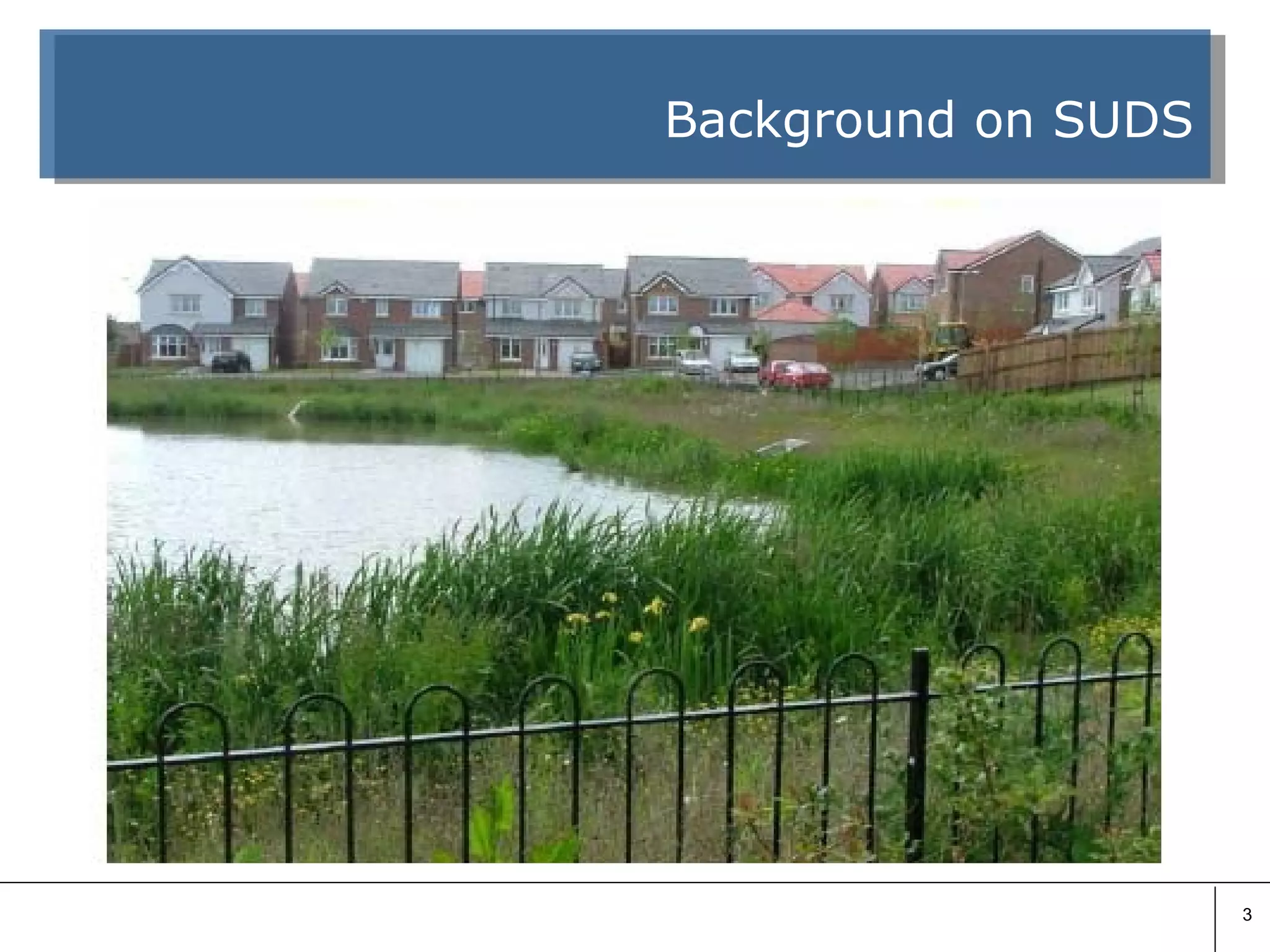
Background on SUDS
Background on SUDS Drainage Design in the past has been simply using a rational method size pipes to ensure water is removed as quickly as possible Sustainable Drainage Systems:    is a concept that includes long term environmental and social factors in decisions about drainage. In rural areas 80% of rivers are below ground status Most pollution comes from: - Underperforming small treatment plants - Overloaded communal septic tanks - Clusters of single unit septic tanks - Farmyard runoff Over the past decade Ireland & the UK have been developing a more  sustainable approach
Selecting the best SUDS option
Selecting the best SUDS option When selecting Sustainable drainage systems it important to consider Quality, Quantity Amenity Equally
Selecting the best SUDS option There is no correct way in choosing the best SUDS option but these factors must be adhered to: - Design techniques to meet design criteria - There is no single correct solution: selection could result from  external factors - The sustainable drainage system should be in accordance with  the original drainage system - Decision must be on a wider context and not purely technical
Above ground attenuation options  Basins and ponds Filter strips &  swales
Above ground attenuation options  Basins and ponds Basins are areas for storage of surface runoff & are free from water under dry  weather flow conditions. These include: - Flood plains - Detention basins  - Extended detention basins Ponds contain water in dry weather and are designed to hold more when it rains. They include: - Attenuation ponds - Flood storage reservoirs - Lagoons - Retention Ponds - Wetlands
Above ground attenuation options  Basins and ponds Basins and ponds store water at the ground surface as: - Temporary flooding - Flood plains - Permanent ponds
Above ground attenuation options  Basins and ponds Quantity They store floodwater and release it slowly once the risk of flooding is over Quality Treat: - Settlement of solids in still water - Conditions and promotes settlement - Adsorption by vegetation of soil Amenity Offer: - Sports and recreation - Wet ponds are great to store water for reuse
Above ground attenuation options  Filters strips & swales Filter strips and swales are vegetated surface features that drain water evenly off impermeable areas. Swales are long shallow channels whilst filter strips are gently sloping areas of ground.
Above ground attenuation options  Filter strips & swales They work by imitating natural drainage patterns by allowing rainwater through vegetation, slowing and filtering the flow.  Quantity Swales & filter drains are designed for: - Conveyance systems - Infiltrations - Reduce drained impermeable areas Quality Swales and filters remove polluting in the solids through filtration and sedimentation
Above ground attenuation options  Filter strips & swales Amenity Swales and filters trips are often interpreted into surrounding land use Examples are: - Public open space - Road verges - Grass and flowers can be planted for wildlife
Case Study Matchborough School
Case Study Location :  Redditch, Worcestershire, England Description : A school development was designed with conventional drainage that flowed to a pump station from where it was pumped to a sewer During construction one playground area could not be drained by gravity to the pumping station. Main suds used: Swales Detention basins
Case Study The suds scheme was implemented & removed the need for the station Now follows the contour of the site and drains downhill to a ipsley stream Initial proposal Sustainable drainage outline proposal
Case Study Swales collect overland flows from: - Adjacent site - Runoff from car park - Playgrounds - Hence providing source of control The retention basins drain the main driveway that is connected to a  constructed wetland (pond) which also takes runoff from the roof. Car park Inlet
Case Study Benefits The suds system has brought a valuable amenity and teaching resource for the school
Why choose above ground attenuation systems? Installed and maintained at a lower cost compared to more traditional  systems of drainage - Problems can be observed and dealt with as they arise(swales) - Can be incorporated into any terrain
Any Questions?

Subs above ground thomas geoghegan

  • 1.
    Sustainable DrainageSystems: Above ground attenuation Thomas Geoghegan
  • 2.
    Agenda Background onSustainable Drainage Systems (SUDS) Selecting the best SUDS option Above ground attenuation options Case Study Why choose above ground attenuation systems? Questions
  • 3.
  • 4.
    Background on SUDSDrainage Design in the past has been simply using a rational method size pipes to ensure water is removed as quickly as possible Sustainable Drainage Systems:   is a concept that includes long term environmental and social factors in decisions about drainage. In rural areas 80% of rivers are below ground status Most pollution comes from: - Underperforming small treatment plants - Overloaded communal septic tanks - Clusters of single unit septic tanks - Farmyard runoff Over the past decade Ireland & the UK have been developing a more sustainable approach
  • 5.
    Selecting the bestSUDS option
  • 6.
    Selecting the bestSUDS option When selecting Sustainable drainage systems it important to consider Quality, Quantity Amenity Equally
  • 7.
    Selecting the bestSUDS option There is no correct way in choosing the best SUDS option but these factors must be adhered to: - Design techniques to meet design criteria - There is no single correct solution: selection could result from external factors - The sustainable drainage system should be in accordance with the original drainage system - Decision must be on a wider context and not purely technical
  • 8.
    Above ground attenuationoptions Basins and ponds Filter strips & swales
  • 9.
    Above ground attenuationoptions Basins and ponds Basins are areas for storage of surface runoff & are free from water under dry weather flow conditions. These include: - Flood plains - Detention basins - Extended detention basins Ponds contain water in dry weather and are designed to hold more when it rains. They include: - Attenuation ponds - Flood storage reservoirs - Lagoons - Retention Ponds - Wetlands
  • 10.
    Above ground attenuationoptions Basins and ponds Basins and ponds store water at the ground surface as: - Temporary flooding - Flood plains - Permanent ponds
  • 11.
    Above ground attenuationoptions Basins and ponds Quantity They store floodwater and release it slowly once the risk of flooding is over Quality Treat: - Settlement of solids in still water - Conditions and promotes settlement - Adsorption by vegetation of soil Amenity Offer: - Sports and recreation - Wet ponds are great to store water for reuse
  • 12.
    Above ground attenuationoptions Filters strips & swales Filter strips and swales are vegetated surface features that drain water evenly off impermeable areas. Swales are long shallow channels whilst filter strips are gently sloping areas of ground.
  • 13.
    Above ground attenuationoptions Filter strips & swales They work by imitating natural drainage patterns by allowing rainwater through vegetation, slowing and filtering the flow. Quantity Swales & filter drains are designed for: - Conveyance systems - Infiltrations - Reduce drained impermeable areas Quality Swales and filters remove polluting in the solids through filtration and sedimentation
  • 14.
    Above ground attenuationoptions Filter strips & swales Amenity Swales and filters trips are often interpreted into surrounding land use Examples are: - Public open space - Road verges - Grass and flowers can be planted for wildlife
  • 15.
  • 16.
    Case Study Location: Redditch, Worcestershire, England Description : A school development was designed with conventional drainage that flowed to a pump station from where it was pumped to a sewer During construction one playground area could not be drained by gravity to the pumping station. Main suds used: Swales Detention basins
  • 17.
    Case Study Thesuds scheme was implemented & removed the need for the station Now follows the contour of the site and drains downhill to a ipsley stream Initial proposal Sustainable drainage outline proposal
  • 18.
    Case Study Swalescollect overland flows from: - Adjacent site - Runoff from car park - Playgrounds - Hence providing source of control The retention basins drain the main driveway that is connected to a constructed wetland (pond) which also takes runoff from the roof. Car park Inlet
  • 19.
    Case Study BenefitsThe suds system has brought a valuable amenity and teaching resource for the school
  • 20.
    Why choose aboveground attenuation systems? Installed and maintained at a lower cost compared to more traditional systems of drainage - Problems can be observed and dealt with as they arise(swales) - Can be incorporated into any terrain
  • 21.

Editor's Notes

  • #18 (Removing the annual charge from the sewer construction)