Subprograms and Memory
Modeling using VHDL
Dr. Shubhajit Roy Chowdhury,
School of Computing and Electrical Engineering,
Indian Institute of Technology Mandi, India
Email: src@iitmandi.ac.in
SCEE, IIT MANDI
Dr. Shubhajit Roy Chowdhury
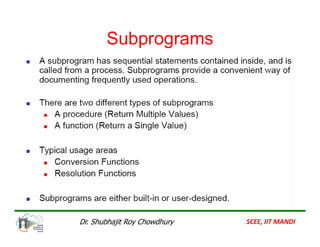
Subprograms
SCEE, IIT MANDI
Dr. Shubhajit Roy Chowdhury
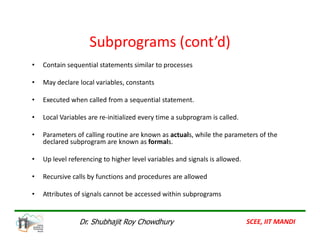
Subprograms (cont’d)
• Contain sequential statements similar to processes
• May declare local variables, constants
• Executed when called from a sequential statement.
• Local Variables are re-initialized every time a subprogram is called.
• Parameters of calling routine are known as actuals, while the parameters of the
declared subprogram are known as formals.
• Up level referencing to higher level variables and signals is allowed.
• Recursive calls by functions and procedures are allowed
• Attributes of signals cannot be accessed within subprograms
SCEE, IIT MANDI
Dr. Shubhajit Roy Chowdhury
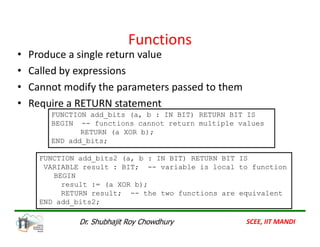
Functions
• Produce a single return value
• Called by expressions
• Cannot modify the parameters passed to them
• Require a RETURN statement
FUNCTION add_bits (a, b : IN BIT) RETURN BIT IS
BEGIN -- functions cannot return multiple values
FUNCTION add_bits2 (a, b : IN BIT) RETURN BIT IS
VARIABLE result : BIT; -- variable is local to function
BEGIN
result := (a XOR b);
RETURN result; -- the two functions are equivalent
END add_bits2;
BEGIN -- functions cannot return multiple values
RETURN (a XOR b);
END add_bits;
SCEE, IIT MANDI
Dr. Shubhajit Roy Chowdhury
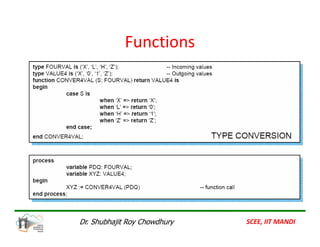
Functions
Functions
SCEE, IIT MANDI
Dr. Shubhajit Roy Chowdhury
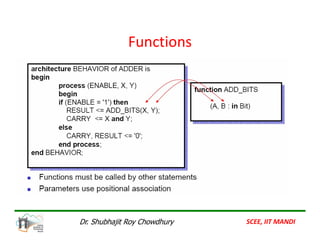
Functions
Functions
SCEE, IIT MANDI
Dr. Shubhajit Roy Chowdhury
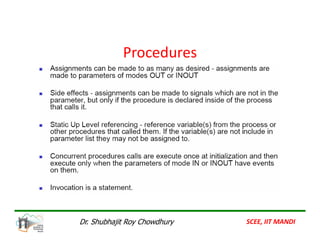
Procedures
SCEE, IIT MANDI
Dr. Shubhajit Roy Chowdhury
Procedures (cont’d)
SCEE, IIT MANDI
Dr. Shubhajit Roy Chowdhury
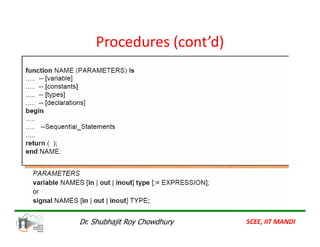
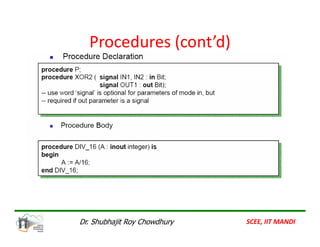
Procedures (cont’d)
Procedures (cont’d)
SCEE, IIT MANDI
Dr. Shubhajit Roy Chowdhury
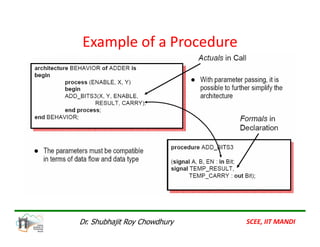
Example of a Procedure
SCEE, IIT MANDI
Dr. Shubhajit Roy Chowdhury
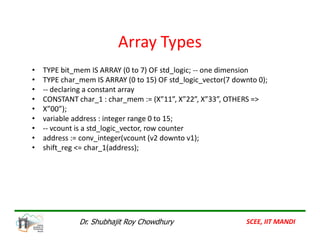
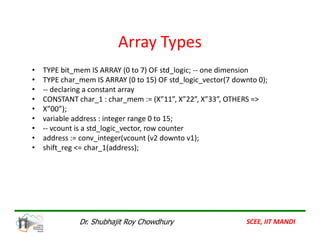
Array Types
• TYPE bit_mem IS ARRAY (0 to 7) OF std_logic; -- one dimension
• TYPE char_mem IS ARRAY (0 to 15) OF std_logic_vector(7 downto 0);
• -- declaring a constant array
• CONSTANT char_1 : char_mem := (X”11”, X”22”, X”33”, OTHERS =>
• X”00”);
• variable address : integer range 0 to 15;
-- vcount is a std_logic_vector, row counter
• -- vcount is a std_logic_vector, row counter
• address := conv_integer(vcount (v2 downto v1);
• shift_reg <= char_1(address);
SCEE, IIT MANDI
Dr. Shubhajit Roy Chowdhury
Array Types
• TYPE bit_mem IS ARRAY (0 to 7) OF std_logic; -- one dimension
• TYPE char_mem IS ARRAY (0 to 15) OF std_logic_vector(7 downto 0);
• -- declaring a constant array
• CONSTANT char_1 : char_mem := (X”11”, X”22”, X”33”, OTHERS =>
• X”00”);
• variable address : integer range 0 to 15;
-- vcount is a std_logic_vector, row counter
• -- vcount is a std_logic_vector, row counter
• address := conv_integer(vcount (v2 downto v1);
• shift_reg <= char_1(address);
SCEE, IIT MANDI
Dr. Shubhajit Roy Chowdhury
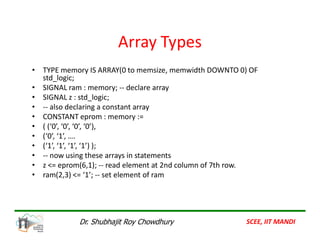
Array Types
• TYPE memory IS ARRAY(0 to memsize, memwidth DOWNTO 0) OF
std_logic;
• SIGNAL ram : memory; -- declare array
• SIGNAL z : std_logic;
• -- also declaring a constant array
• CONSTANT eprom : memory :=
• ( (‘0’, ‘0’, ‘0’, ‘0’),
• ( (‘0’, ‘0’, ‘0’, ‘0’),
• (‘0’, ‘1’, ….
• (‘1’, ‘1’, ‘1’, ‘1’) );
• -- now using these arrays in statements
• z <= eprom(6,1); -- read element at 2nd column of 7th row.
• ram(2,3) <= ‘1’; -- set element of ram
SCEE, IIT MANDI
Dr. Shubhajit Roy Chowdhury
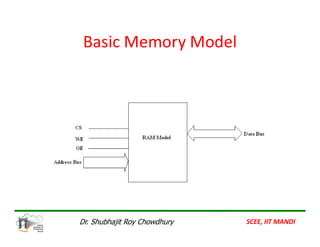
Basic Memory Model
SCEE, IIT MANDI
Dr. Shubhajit Roy Chowdhury
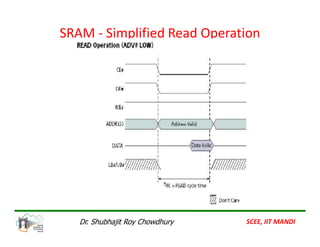
SRAM - Simplified Read Operation
SCEE, IIT MANDI
Dr. Shubhajit Roy Chowdhury
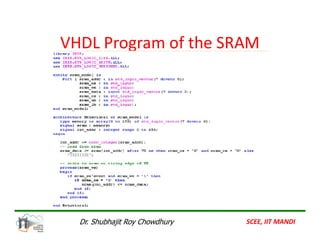
VHDL Program of the SRAM
SCEE, IIT MANDI
Dr. Shubhajit Roy Chowdhury
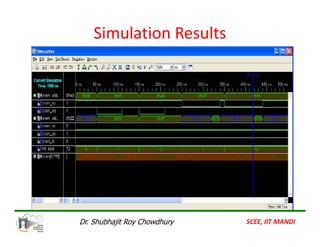
Simulation Results
SCEE, IIT MANDI
Dr. Shubhajit Roy Chowdhury
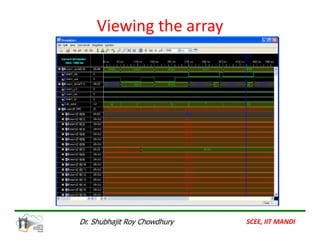
Viewing the array
SCEE, IIT MANDI
Dr. Shubhajit Roy Chowdhury
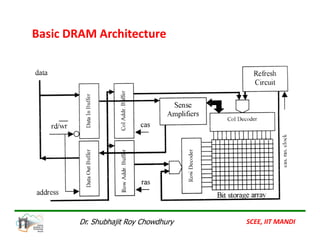
Basic DRAM Architecture
SCEE, IIT MANDI
Dr. Shubhajit Roy Chowdhury
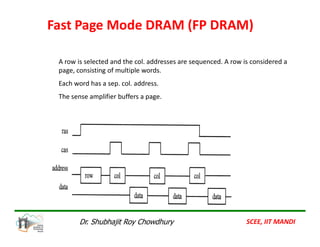
Fast Page Mode DRAM (FP DRAM)
A row is selected and the col. addresses are sequenced. A row is considered a
page, consisting of multiple words.
Each word has a sep. col. address.
The sense amplifier buffers a page.
SCEE, IIT MANDI
Dr. Shubhajit Roy Chowdhury
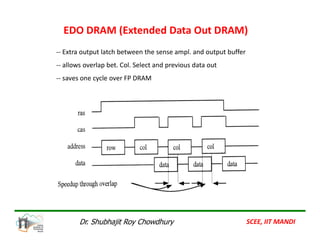
EDO DRAM (Extended Data Out DRAM)
-- Extra output latch between the sense ampl. and output buffer
-- allows overlap bet. Col. Select and previous data out
-- saves one cycle over FP DRAM
SCEE, IIT MANDI
Dr. Shubhajit Roy Chowdhury
•FPM and EDO RAM controlled asynchronously by the processor or the
memory controller.
•A synchronous DRAM interface will eliminate a small amount of time
(thus latency) that is needed by the DRAM to detect the ras/cas and
rd/wr signals. DRAM latches information to and from the controller on
the active edge of the clock signal
•In addition to a lower latency I/O, after a proper page and column
SDRAM
•In addition to a lower latency I/O, after a proper page and column
setup, an SDRAM may store the starting address internally and output
new data on each active edge of the clock signal, as long as the
requested data are consecutive memory locations. This is accomplished
by adding a column address counter to the base DRAM architecture.
This counter is seeded with a starting column address strobed in by the
processor (or memory controller) and is thereafter incremented
internally by the DRAM on each clock cycle.
SCEE, IIT MANDI
Dr. Shubhajit Roy Chowdhury
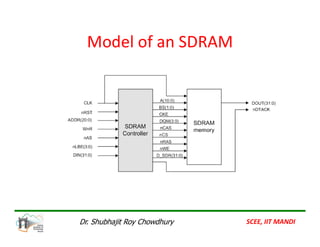
Model of an SDRAM
SCEE, IIT MANDI
Dr. Shubhajit Roy Chowdhury
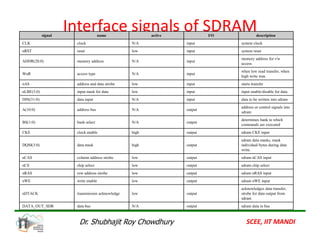
Interface signals of SDRAM
signal name active I/O description
CLK clock N/A input system clock
nRST reset low input system reset
ADDR(20:0) memory address N/A input
memory address for r/w
access
WnR access type N/A input
when low read transfer, when
high write tran.
nAS address and data strobe low input starts transfer
nLBE(3:0) input mask for data low input input enable/disable for data
DIN(31:0) data input N/A input data to be written into sdram
A(10:0) address bus N/A output
address or control signals into
sdram
BS(1:0) bank select N/A output
determines bank to which
commands are executed
BS(1:0) bank select N/A output
commands are executed
CKE clock enable high output sdram CKE input
DQM(3:0) data mask high output
sdram data masks, mask
individual bytes during data
write.
nCAS column address strobe low output sdram nCAS input
nCS chip select low output sdram chip select
nRAS row address strobe low output sdram nRAS input
nWE write enable low output sdram nWE input
nDTACK transmission acknowledge low output
acknowledges data transfer,
strobe for data output from
sdram
DATA_OUT_SDR data bus N/A output sdram data in bus
SCEE, IIT MANDI
Dr. Shubhajit Roy Chowdhury
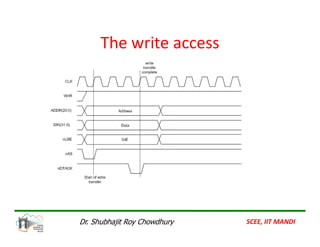
The write access
SCEE, IIT MANDI
Dr. Shubhajit Roy Chowdhury
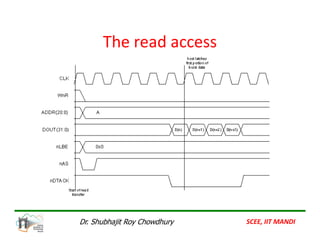
The read access
SCEE, IIT MANDI
Dr. Shubhajit Roy Chowdhury
Thank you
SCEE, IIT MANDI
Dr. Shubhajit Roy Chowdhury

Subprograms and Memory Modeling using VHDL

  • 1.
    Subprograms and Memory Modelingusing VHDL Dr. Shubhajit Roy Chowdhury, School of Computing and Electrical Engineering, Indian Institute of Technology Mandi, India Email: src@iitmandi.ac.in SCEE, IIT MANDI Dr. Shubhajit Roy Chowdhury
  • 2.
    Subprograms SCEE, IIT MANDI Dr.Shubhajit Roy Chowdhury
  • 3.
    Subprograms (cont’d) • Containsequential statements similar to processes • May declare local variables, constants • Executed when called from a sequential statement. • Local Variables are re-initialized every time a subprogram is called. • Parameters of calling routine are known as actuals, while the parameters of the declared subprogram are known as formals. • Up level referencing to higher level variables and signals is allowed. • Recursive calls by functions and procedures are allowed • Attributes of signals cannot be accessed within subprograms SCEE, IIT MANDI Dr. Shubhajit Roy Chowdhury
  • 4.
    Functions • Produce asingle return value • Called by expressions • Cannot modify the parameters passed to them • Require a RETURN statement FUNCTION add_bits (a, b : IN BIT) RETURN BIT IS BEGIN -- functions cannot return multiple values FUNCTION add_bits2 (a, b : IN BIT) RETURN BIT IS VARIABLE result : BIT; -- variable is local to function BEGIN result := (a XOR b); RETURN result; -- the two functions are equivalent END add_bits2; BEGIN -- functions cannot return multiple values RETURN (a XOR b); END add_bits; SCEE, IIT MANDI Dr. Shubhajit Roy Chowdhury
  • 5.
  • 6.
  • 7.
    Procedures SCEE, IIT MANDI Dr.Shubhajit Roy Chowdhury
  • 8.
    Procedures (cont’d) SCEE, IITMANDI Dr. Shubhajit Roy Chowdhury
  • 9.
    Procedures (cont’d) Procedures (cont’d) SCEE,IIT MANDI Dr. Shubhajit Roy Chowdhury
  • 10.
    Example of aProcedure SCEE, IIT MANDI Dr. Shubhajit Roy Chowdhury
  • 11.
    Array Types • TYPEbit_mem IS ARRAY (0 to 7) OF std_logic; -- one dimension • TYPE char_mem IS ARRAY (0 to 15) OF std_logic_vector(7 downto 0); • -- declaring a constant array • CONSTANT char_1 : char_mem := (X”11”, X”22”, X”33”, OTHERS => • X”00”); • variable address : integer range 0 to 15; -- vcount is a std_logic_vector, row counter • -- vcount is a std_logic_vector, row counter • address := conv_integer(vcount (v2 downto v1); • shift_reg <= char_1(address); SCEE, IIT MANDI Dr. Shubhajit Roy Chowdhury
  • 12.
    Array Types • TYPEbit_mem IS ARRAY (0 to 7) OF std_logic; -- one dimension • TYPE char_mem IS ARRAY (0 to 15) OF std_logic_vector(7 downto 0); • -- declaring a constant array • CONSTANT char_1 : char_mem := (X”11”, X”22”, X”33”, OTHERS => • X”00”); • variable address : integer range 0 to 15; -- vcount is a std_logic_vector, row counter • -- vcount is a std_logic_vector, row counter • address := conv_integer(vcount (v2 downto v1); • shift_reg <= char_1(address); SCEE, IIT MANDI Dr. Shubhajit Roy Chowdhury
  • 13.
    Array Types • TYPEmemory IS ARRAY(0 to memsize, memwidth DOWNTO 0) OF std_logic; • SIGNAL ram : memory; -- declare array • SIGNAL z : std_logic; • -- also declaring a constant array • CONSTANT eprom : memory := • ( (‘0’, ‘0’, ‘0’, ‘0’), • ( (‘0’, ‘0’, ‘0’, ‘0’), • (‘0’, ‘1’, …. • (‘1’, ‘1’, ‘1’, ‘1’) ); • -- now using these arrays in statements • z <= eprom(6,1); -- read element at 2nd column of 7th row. • ram(2,3) <= ‘1’; -- set element of ram SCEE, IIT MANDI Dr. Shubhajit Roy Chowdhury
  • 14.
    Basic Memory Model SCEE,IIT MANDI Dr. Shubhajit Roy Chowdhury
  • 15.
    SRAM - SimplifiedRead Operation SCEE, IIT MANDI Dr. Shubhajit Roy Chowdhury
  • 16.
    VHDL Program ofthe SRAM SCEE, IIT MANDI Dr. Shubhajit Roy Chowdhury
  • 17.
    Simulation Results SCEE, IITMANDI Dr. Shubhajit Roy Chowdhury
  • 18.
    Viewing the array SCEE,IIT MANDI Dr. Shubhajit Roy Chowdhury
  • 19.
    Basic DRAM Architecture SCEE,IIT MANDI Dr. Shubhajit Roy Chowdhury
  • 20.
    Fast Page ModeDRAM (FP DRAM) A row is selected and the col. addresses are sequenced. A row is considered a page, consisting of multiple words. Each word has a sep. col. address. The sense amplifier buffers a page. SCEE, IIT MANDI Dr. Shubhajit Roy Chowdhury
  • 21.
    EDO DRAM (ExtendedData Out DRAM) -- Extra output latch between the sense ampl. and output buffer -- allows overlap bet. Col. Select and previous data out -- saves one cycle over FP DRAM SCEE, IIT MANDI Dr. Shubhajit Roy Chowdhury
  • 22.
    •FPM and EDORAM controlled asynchronously by the processor or the memory controller. •A synchronous DRAM interface will eliminate a small amount of time (thus latency) that is needed by the DRAM to detect the ras/cas and rd/wr signals. DRAM latches information to and from the controller on the active edge of the clock signal •In addition to a lower latency I/O, after a proper page and column SDRAM •In addition to a lower latency I/O, after a proper page and column setup, an SDRAM may store the starting address internally and output new data on each active edge of the clock signal, as long as the requested data are consecutive memory locations. This is accomplished by adding a column address counter to the base DRAM architecture. This counter is seeded with a starting column address strobed in by the processor (or memory controller) and is thereafter incremented internally by the DRAM on each clock cycle. SCEE, IIT MANDI Dr. Shubhajit Roy Chowdhury
  • 23.
    Model of anSDRAM SCEE, IIT MANDI Dr. Shubhajit Roy Chowdhury
  • 24.
    Interface signals ofSDRAM signal name active I/O description CLK clock N/A input system clock nRST reset low input system reset ADDR(20:0) memory address N/A input memory address for r/w access WnR access type N/A input when low read transfer, when high write tran. nAS address and data strobe low input starts transfer nLBE(3:0) input mask for data low input input enable/disable for data DIN(31:0) data input N/A input data to be written into sdram A(10:0) address bus N/A output address or control signals into sdram BS(1:0) bank select N/A output determines bank to which commands are executed BS(1:0) bank select N/A output commands are executed CKE clock enable high output sdram CKE input DQM(3:0) data mask high output sdram data masks, mask individual bytes during data write. nCAS column address strobe low output sdram nCAS input nCS chip select low output sdram chip select nRAS row address strobe low output sdram nRAS input nWE write enable low output sdram nWE input nDTACK transmission acknowledge low output acknowledges data transfer, strobe for data output from sdram DATA_OUT_SDR data bus N/A output sdram data in bus SCEE, IIT MANDI Dr. Shubhajit Roy Chowdhury

  • 25.
    The write access SCEE,IIT MANDI Dr. Shubhajit Roy Chowdhury
  • 26.
    The read access SCEE,IIT MANDI Dr. Shubhajit Roy Chowdhury
  • 27.
    Thank you SCEE, IITMANDI Dr. Shubhajit Roy Chowdhury