Sublingual drug delivery system
Sublingual- Under the tounge.
Sublingual dosage form can be define as dosage form that is to be placed
beneath the tongue where it will dissolve and the drug will be absorbed directly
through the sublingual mucosa.
The dosage form not intended to be swallowed or chewed.
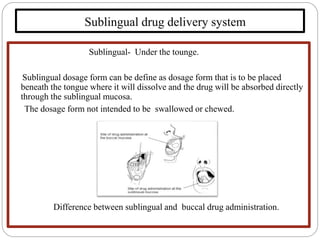
Difference between sublingual and buccal drug administration.
Advantages
 The oral route, and the formulation can be removed if therapy is required to be di
scontinued.
 Liver is bypassed and also drug is protected from degradation due to pH and dig
estive enzymes of the middle gastrointestinal tract.
 Improved patient compliance due to the elimination of associated pain with injec
tions; administration of drugs in unconscious or incapacitated patients; convenie
nce of administration as compared to injections or oral medications.
 Low dosage gives high efficacy as hepatic first pass metabolism is avoided and a
lso reduces the risk of side effects.
 The large contact surface of the oral cavity contributes to rapid and extensive dru
g absorption.
 Due to rapidity in action these sublingual dosage forms are widely used in emerg
ency conditions e.g. asthma.
 Rapid absorption and higher blood levels due to high vascularization of the regio
n and therefore particularly useful for administration of antianginal drugs.
 They also present the advantage of providing fast dissolution or disintegration.
Disadvantages
 drinking, and talking, this route is generally considered uns
uitable for prolonged administration.
 Although this site is not well suited to sustainedrug
delivery systems.
 Sublingual medication can not be used when a patient is un
cooperative or unconscious.
 The patient should not smoke while taking sublingual medi
cation
Criteria of drug selection
 Drug should not bitter in taste.
 Dose should be lower than 20 mg.
 Small to moderate molecular weight.
 Good stability in water and saliva.
 Drug should not ionize at the pH of oral cavities.
 Some drugs undergo extensive first pass metabolism, which
results in poor bioavailability in its oral dosage forms, that kind
of drug is suitable for sublingual dosage form.
 Parenterally unstable preparations of the drug are suitable for
sublingual dosage form.
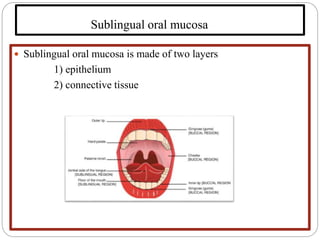
Sublingual oral mucosa
 Sublingual oral mucosa is made of two layers
1) epithelium
2) connective tissue
Why sublingual mucosa is more permeable than other
region of oral mucosa
 Sublingual mucosa is thinner than other oral region – sublingual
epithelial has 8-12 cell region whereas buccal epithelial about 40-
50 cell layer thick.
 Sublingual region is very rich in blood supply.
 Saliva tends to accumulate in sublingual region because two major
salivary duct open into this region.
 Organised keratins and lipids are absent in sublingual mucosa.
 Polar lipids are found in the intercellular space of sublingual
mucosa which increased permeation of hydrophilic compound.
Note – Membrane coating granules are the permeability barrier in
sublingual mucosa which are present in nonlamellar form.
Mechanism of drug permeation
Passive diffusion is the major mechanism of transport across the
sublingual mucosa barrier.
The 2 major transport pathway involved in drug absorption
1) Lipoid pathway – Transecllular transport
Intercellular transport
2) Aquose pathway – Paracellular transport
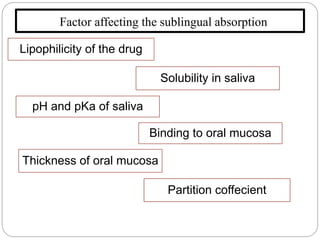
Factor affecting the sublingual absorption
Lipophilicity of the drug
Solubility in saliva
pH and pKa of saliva
Binding to oral mucosa
Thickness of oral mucosa
Partition coffecient
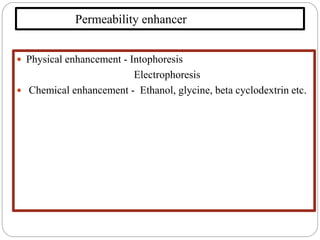
Permeability enhancer
 Physical enhancement - Intophoresis
Electrophoresis
 Chemical enhancement - Ethanol, glycine, beta cyclodextrin etc.
Method of preparation of sublingual formulations
 Sublingual Tablets: Direct compression is one of the techniques
which require the incorporation of a super disintegrant into the
formulation, or the use of highly water-soluble excipients to
achieve fast tablet disintegration.
Subutex Tablet, made by Reckitt Benckiser Pharmaceuticals Inc.
and contain buprenorphine for initiating treatment of opioid
dependence. Subutex is available as 2 mg sublingual tablets. The
tablet usually fully dissolves under the tongue within 5–10 min. It
contains monohydrated lactose, mannitol, maize starch, Povidone
K30, citric acid and sodium citrate as excipients
 Bioadhesive sublingual tablets: The new sublingual tablet concept
presented is based on interactive mixtures consisting of a water
soluble carrier covered with fine drug particles and a bioadhesive
component. With this approach it is possible to obtain a rapid
dissolution in combination with bioadhesive retention of the drug
in the oral cavity. Commonly used bioadhesive polymers are
chitson, carbopol, sodium CMC, HPMC etc.
Bredenberg et al. Produced bioadhesie sublingual tablet which is
coated with fine dry particle of fentanyl citrate. The tablet showed
quick dissolution and rapid absorption of drug.
 Films: Solvent casting is a process which comprises of casting a
dope from a casting die onto a casting support, drying the cast dope
on the casting support form film, stripping off the film from the
casting support, and dry. Solvent Evaporation technique can also
be used instead of solvent casting for the preparation of sublingual
films.
Mashru and collegue developed a sublingual film of salbutamol
sulphate. This film were prepared by a solent evaporation
technique using PVA as a polymer, glycerol as a plasticizer and
mannitol as a filler. This film take shorter time to reach maximum
plasma level and significantly higher plasma concentration to
conventional tablet.
 Sublingual spray: Sublingual sprays are the dosage forms in
which the drug is dissolved or dispersed in a vehicle and filled in
container with a metered valve. On actuation a desired dose of
the drug will be delivered through the valve.
Culter et al. Prepared a aerosol system of dihydroergotamine
using cyclodextrin, dextrans, sugar alcohol and their mixture.
This formulation is patented.
 Lipid matrix sublingual tablets: Lipid matrix sublingual tablets is
a bioavailable, quick, convenient and consistent dosage forms for
many specially nutraceuticals that are often taken orally. Lipid
matrix sublingual tablets is formulated using advances in
sublingual and liposomal technology to create a dosage form that
offers a faster and more complete absorption than traditional oral
routes of administration.
 Fast disintegrating sublingual tablets (FDT): Tablets that
disintegrate or dissolve rapidly in the patients mouth . In most of
the sublingual tablets-sodium starch glycolate has been to promote
rapid disintegration and dissolution of solid dosage form.
 Semi solid dosage form may not be a good choice for sublingual
drug delivery system because they may not adhere well to the
sublingual mucosa and could be washed away by saliva.
Evaluation test
 Disintegration time -
Each individual tablet was dropped into 10‐mL glass test tube (1.
5‐cm diameter) containing 2 mL distilled water, and the time requi
red for complete tablet disintegration was observed visually and re
corded using a stopwatch.
Disintegration time - 3 min
 Wetting time-
Although a wetting test is not a USP standard test, it is useful for
quality control and provides supportive evaluation of these subling
ual tablets.The tablet was placed at the center of 2 layers of absorb
ent paper fitted into a rectangular plastic dish (11 cm × 7.5 cm). Af
ter the paper was thoroughly wetted with distilled water, excess w
ater was completely drained out of the dish. The time required for
the water to diffuse from the wetted absorbent paper.
 Dissolution test apparatus -
Paddle type dissolution apparatus is used.
 Pharmacokinetic data analysis and bioavailability evaluation -
Rabbits have been described as one of the few laboratory animals
that do not have keratinized mucosa, thus closely resembling hu
man sublingual mucosal .
 In vitro permeation studies -
Modified franz diffusion cell and porcine oral mucosa is used .
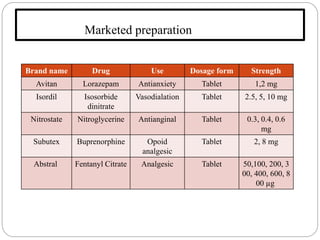
Marketed preparation
Brand name Drug Use Dosage form Strength
Avitan Lorazepam Antianxiety Tablet 1,2 mg
Isordil Isosorbide
dinitrate
Vasodialation Tablet 2.5, 5, 10 mg
Nitrostate Nitroglycerine Antianginal Tablet 0.3, 0.4, 0.6
mg
Subutex Buprenorphine Opoid
analgesic
Tablet 2, 8 mg
Abstral Fentanyl Citrate Analgesic Tablet 50,100, 200, 3
00, 400, 600, 8
00 µg
19

Sublingual drug deliery system

  • 2.
    Sublingual drug deliverysystem Sublingual- Under the tounge. Sublingual dosage form can be define as dosage form that is to be placed beneath the tongue where it will dissolve and the drug will be absorbed directly through the sublingual mucosa. The dosage form not intended to be swallowed or chewed. Difference between sublingual and buccal drug administration.
  • 3.
    Advantages  The oralroute, and the formulation can be removed if therapy is required to be di scontinued.  Liver is bypassed and also drug is protected from degradation due to pH and dig estive enzymes of the middle gastrointestinal tract.  Improved patient compliance due to the elimination of associated pain with injec tions; administration of drugs in unconscious or incapacitated patients; convenie nce of administration as compared to injections or oral medications.  Low dosage gives high efficacy as hepatic first pass metabolism is avoided and a lso reduces the risk of side effects.  The large contact surface of the oral cavity contributes to rapid and extensive dru g absorption.  Due to rapidity in action these sublingual dosage forms are widely used in emerg ency conditions e.g. asthma.  Rapid absorption and higher blood levels due to high vascularization of the regio n and therefore particularly useful for administration of antianginal drugs.  They also present the advantage of providing fast dissolution or disintegration.
  • 4.
    Disadvantages  drinking, andtalking, this route is generally considered uns uitable for prolonged administration.  Although this site is not well suited to sustainedrug delivery systems.  Sublingual medication can not be used when a patient is un cooperative or unconscious.  The patient should not smoke while taking sublingual medi cation
  • 5.
    Criteria of drugselection  Drug should not bitter in taste.  Dose should be lower than 20 mg.  Small to moderate molecular weight.  Good stability in water and saliva.  Drug should not ionize at the pH of oral cavities.  Some drugs undergo extensive first pass metabolism, which results in poor bioavailability in its oral dosage forms, that kind of drug is suitable for sublingual dosage form.  Parenterally unstable preparations of the drug are suitable for sublingual dosage form.
  • 6.
    Sublingual oral mucosa Sublingual oral mucosa is made of two layers 1) epithelium 2) connective tissue
  • 7.
    Why sublingual mucosais more permeable than other region of oral mucosa  Sublingual mucosa is thinner than other oral region – sublingual epithelial has 8-12 cell region whereas buccal epithelial about 40- 50 cell layer thick.  Sublingual region is very rich in blood supply.  Saliva tends to accumulate in sublingual region because two major salivary duct open into this region.  Organised keratins and lipids are absent in sublingual mucosa.  Polar lipids are found in the intercellular space of sublingual mucosa which increased permeation of hydrophilic compound. Note – Membrane coating granules are the permeability barrier in sublingual mucosa which are present in nonlamellar form.
  • 8.
    Mechanism of drugpermeation Passive diffusion is the major mechanism of transport across the sublingual mucosa barrier. The 2 major transport pathway involved in drug absorption 1) Lipoid pathway – Transecllular transport Intercellular transport 2) Aquose pathway – Paracellular transport
  • 9.
    Factor affecting thesublingual absorption Lipophilicity of the drug Solubility in saliva pH and pKa of saliva Binding to oral mucosa Thickness of oral mucosa Partition coffecient
  • 10.
    Permeability enhancer  Physicalenhancement - Intophoresis Electrophoresis  Chemical enhancement - Ethanol, glycine, beta cyclodextrin etc.
  • 11.
    Method of preparationof sublingual formulations  Sublingual Tablets: Direct compression is one of the techniques which require the incorporation of a super disintegrant into the formulation, or the use of highly water-soluble excipients to achieve fast tablet disintegration. Subutex Tablet, made by Reckitt Benckiser Pharmaceuticals Inc. and contain buprenorphine for initiating treatment of opioid dependence. Subutex is available as 2 mg sublingual tablets. The tablet usually fully dissolves under the tongue within 5–10 min. It contains monohydrated lactose, mannitol, maize starch, Povidone K30, citric acid and sodium citrate as excipients
  • 12.
     Bioadhesive sublingualtablets: The new sublingual tablet concept presented is based on interactive mixtures consisting of a water soluble carrier covered with fine drug particles and a bioadhesive component. With this approach it is possible to obtain a rapid dissolution in combination with bioadhesive retention of the drug in the oral cavity. Commonly used bioadhesive polymers are chitson, carbopol, sodium CMC, HPMC etc. Bredenberg et al. Produced bioadhesie sublingual tablet which is coated with fine dry particle of fentanyl citrate. The tablet showed quick dissolution and rapid absorption of drug.
  • 13.
     Films: Solventcasting is a process which comprises of casting a dope from a casting die onto a casting support, drying the cast dope on the casting support form film, stripping off the film from the casting support, and dry. Solvent Evaporation technique can also be used instead of solvent casting for the preparation of sublingual films. Mashru and collegue developed a sublingual film of salbutamol sulphate. This film were prepared by a solent evaporation technique using PVA as a polymer, glycerol as a plasticizer and mannitol as a filler. This film take shorter time to reach maximum plasma level and significantly higher plasma concentration to conventional tablet.
  • 14.
     Sublingual spray:Sublingual sprays are the dosage forms in which the drug is dissolved or dispersed in a vehicle and filled in container with a metered valve. On actuation a desired dose of the drug will be delivered through the valve. Culter et al. Prepared a aerosol system of dihydroergotamine using cyclodextrin, dextrans, sugar alcohol and their mixture. This formulation is patented.  Lipid matrix sublingual tablets: Lipid matrix sublingual tablets is a bioavailable, quick, convenient and consistent dosage forms for many specially nutraceuticals that are often taken orally. Lipid matrix sublingual tablets is formulated using advances in sublingual and liposomal technology to create a dosage form that offers a faster and more complete absorption than traditional oral routes of administration.
  • 15.
     Fast disintegratingsublingual tablets (FDT): Tablets that disintegrate or dissolve rapidly in the patients mouth . In most of the sublingual tablets-sodium starch glycolate has been to promote rapid disintegration and dissolution of solid dosage form.  Semi solid dosage form may not be a good choice for sublingual drug delivery system because they may not adhere well to the sublingual mucosa and could be washed away by saliva.
  • 16.
    Evaluation test  Disintegrationtime - Each individual tablet was dropped into 10‐mL glass test tube (1. 5‐cm diameter) containing 2 mL distilled water, and the time requi red for complete tablet disintegration was observed visually and re corded using a stopwatch. Disintegration time - 3 min  Wetting time- Although a wetting test is not a USP standard test, it is useful for quality control and provides supportive evaluation of these subling ual tablets.The tablet was placed at the center of 2 layers of absorb ent paper fitted into a rectangular plastic dish (11 cm × 7.5 cm). Af ter the paper was thoroughly wetted with distilled water, excess w ater was completely drained out of the dish. The time required for the water to diffuse from the wetted absorbent paper.
  • 17.
     Dissolution testapparatus - Paddle type dissolution apparatus is used.  Pharmacokinetic data analysis and bioavailability evaluation - Rabbits have been described as one of the few laboratory animals that do not have keratinized mucosa, thus closely resembling hu man sublingual mucosal .  In vitro permeation studies - Modified franz diffusion cell and porcine oral mucosa is used .
  • 18.
    Marketed preparation Brand nameDrug Use Dosage form Strength Avitan Lorazepam Antianxiety Tablet 1,2 mg Isordil Isosorbide dinitrate Vasodialation Tablet 2.5, 5, 10 mg Nitrostate Nitroglycerine Antianginal Tablet 0.3, 0.4, 0.6 mg Subutex Buprenorphine Opoid analgesic Tablet 2, 8 mg Abstral Fentanyl Citrate Analgesic Tablet 50,100, 200, 3 00, 400, 600, 8 00 µg
  • 19.