Subject-verb Agreement
A Review of the Rules
with
with
Practice Exercises
Practice Exercises
1. The verb agrees with the
subject, not with intervening
words.
words.
 Toby
Toby, along with his girlfriend,
, along with his girlfriend, plays
plays
paintball nearly every weekend.
 One
One of the students
of the students has
has left his or her
left his or her
cell phone in the classroom.
 A
A harness
harness with bells
with bells is
is for sale on eBay.
for sale on eBay.
Let’s practice!
Let’s practice!
 Click on the sentence in which the verb is used
Click on the sentence in which the verb is used
correctly.
correctly.
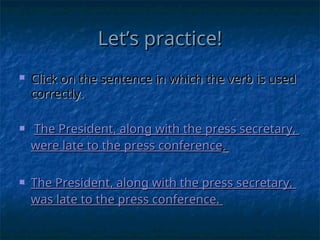
 The President, along with the press secretary,
The President, along with the press secretary,
were
were late to the press conference
late to the press conference.
.
 The President, along with the press secretary,
The President, along with the press secretary,
was
was late to the press conference.
late to the press conference.
Not quite!
Not quite!
 Click here to try again
Click here to try again.
.
Right!
Right!
 Click here for the next question.
Click here for the next question.
Click on the sentence in which
the verb is used correctly.
 The cost of repairing all those computer
The cost of repairing all those computer
s
s
is
is quite prohibitive
quite prohibitive.
.
 The cost of repairing all those computer
The cost of repairing all those computer
s
s
are
are quite prohibitive
quite prohibitive.
.
Oops!
Oops!
 Click here to try again.
Click here to try again.
You’ve got it!
You’ve got it!
 Click here for the next sentence.
Click here for the next sentence.
Click on the sentence in which
the verb is used correctly.
 A driver’s license, as well as another for
A driver’s license, as well as another for
m of ID, is required
.
.
 A driver’s license, as well as another for
A driver’s license, as well as another for
m of ID, are required
.
.
Not quite!
Not quite!
 Click here to try again.
Click here to try again.
Yes!
Yes!
 Let’s move on to the next rule.
Let’s move on to the next rule.
Rule 2
Rule 2
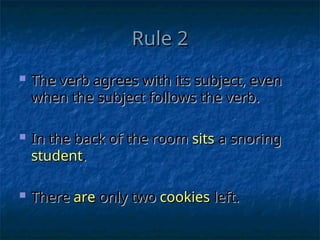
 The verb agrees with its subject, even
The verb agrees with its subject, even
when the subject follows the verb.
 In the back of the room
In the back of the room sits
sits a snoring
a snoring
student
student.
.
 There
There are
are only two
only two cookies
cookies left.
left.
More Examples
More Examples
 Notice the highlighted subject in these
Notice the highlighted subject in these
sentences.
sentences.
 Here
Here is
is the
the report
report you were looking for.
you were looking for.
 Here
Here are
are the
the keys
keys you were looking for.
you were looking for.
 On the wall
On the wall hangs
hangs a
a portrait
portrait of his
of his
father.
father.
Let’s practice!
Let’s practice!
 Click on the correct sentence:
Click on the correct sentence:
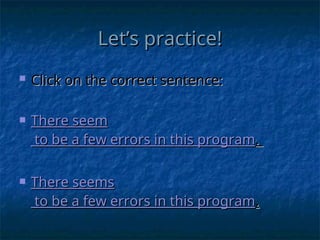
 There
There seem
seem
to be a few errors in this program
to be a few errors in this program.
.
 There
There seems
seems
to be a few errors in this program
to be a few errors in this program.
.
Not quite!
Not quite!
 Be sure that you can identify the
Be sure that you can identify the
subject of the sentence.
 Click here to try again.
Click here to try again.
Good!
Good!
 Click here for the next sentence.
Click here for the next sentence.
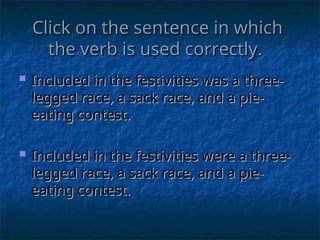
Click on the sentence in which
the verb is used correctly.
 Included in the festivities was a three-
Included in the festivities was a three-
legged race, a sack race, and a pie-
eating contest.
eating contest.
 Included in the festivities were a three-
Included in the festivities were a three-
legged race, a sack race, and a pie-
eating contest.
eating contest.
Not quite!
Not quite!
 Click here to try again.
Click here to try again.
Right!
Right!
 Let’s move on to the next rule.
Let’s move on to the next rule.
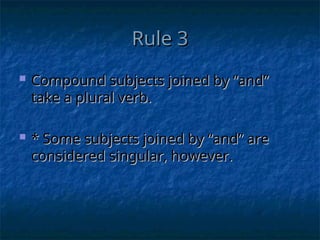
Rule 3
Rule 3
 Compound subjects joined by “and”
Compound subjects joined by “and”
take a plural verb.
take a plural verb.
 * Some subjects joined by “and” are
* Some subjects joined by “and” are
considered singular, however.
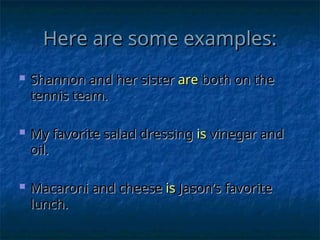
Here are some examples:
 Shannon and her sister
Shannon and her sister are
are both on the
both on the
tennis team.
tennis team.
 My favorite salad dressing
My favorite salad dressing is
is vinegar and
vinegar and
oil.
oil.
 Macaroni and cheese
Macaroni and cheese is
is Jason’s favorite
Jason’s favorite
lunch.
lunch.
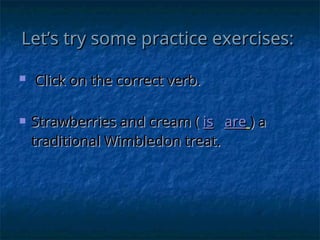
Let’s try some practice exercises:
 Click on the correct verb.
Click on the correct verb.
 Strawberries and cream (
Strawberries and cream ( is
is are
are ) a
) a
traditional Wimbledon treat.
Not quite!
Not quite!
 Remember, some compound nouns act
Remember, some compound nouns act
as one unit and are considered singular.
 Click here to return to the question
Click here to return to the question.
.
Yes!
Yes!
 Let’s try another. Click on the correct
Let’s try another. Click on the correct
verb:
verb:
 Charlotte and her mother (
Charlotte and her mother ( live
live lives
lives ) in
) in
Las Vegas.
Las Vegas.
Not quite!
Not quite!
 Click here to try again.
Click here to try again.
You’ve got it!
You’ve got it!
 Let’s move on to Rule 4:
Let’s move on to Rule 4:
 When subjects are joined by “or” or “nor,”
When subjects are joined by “or” or “nor,”
the verb agrees with the nearest subject.
 This is a tricky rule, which doesn’t always
This is a tricky rule, which doesn’t always
sound “right” to the ear, so let’s look at
some examples.
some examples.
Examples:
Examples:
 Either David or his
Either David or his cousin owns
cousin owns that
that
property across the river.
 Neither Sylvia nor her
Neither Sylvia nor her mother
mother likes
likes going to
going to
rodeos.
rodeos.
 Neither the students nor the
Neither the students nor the instructor
instructor
knows
knows if classes will be held on Columbus
if classes will be held on Columbus
Day.
Day.
Let’s practice this tricky rule.
 Click on the correct verb.
Click on the correct verb.
 Either a check or a money order (
Either a check or a money order ( is
is are
are
)
)
acceptable.
acceptable.
Oops!
Oops!
 Remember, the verb agrees with the
Remember, the verb agrees with the
nearest
nearest subject.
subject.
 Click here to try again.
Click here to try again.
Yes!
Yes!
 Let’s try another. Click on the correct
Let’s try another. Click on the correct
verb.
verb.
(
( Was
Was Were
Were ) Mr. Phelps or his son put on
) Mr. Phelps or his son put on
the committee?
the committee?
Not exactly.
Not exactly.
 Look for the nearest subject.
Look for the nearest subject.
 Click here to try again.
Click here to try again.
Right! Here’s another.
 Click on the correct verb.
Click on the correct verb.
 Either the employees or the manager
Either the employees or the manager
(
( is
is are
are ) confused about the policy.
) confused about the policy.
Oops!
Oops!
 Click here to try again
Click here to try again.
.
Right!
Right!
 Let’s move on to Rule #5:
Let’s move on to Rule #5:
 Amounts and distance, when used as
Amounts and distance, when used as
singular units of measurements, are
considered singular.
For example:
For example:
 A million dollars just
A million dollars just is
is not enough to
not enough to
retire on these days.
 Thirty miles
Thirty miles seems
seems like a long walk to
like a long walk to
me.
me.
Rule #6
Rule #6
 Most collective nouns, nouns that stand
Most collective nouns, nouns that stand
for groups of people or things, are
generally treated as singular:
 The
The team is
team is practicing at 6:00 a.m.
practicing at 6:00 a.m.
 Our
Our class has
class has been cancelled tonight.
been cancelled tonight.
 The
The jury is
jury is still deliberating.
still deliberating.
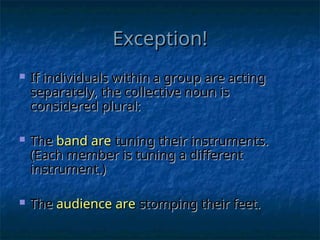
Exception!
Exception!
 If individuals within a group are acting
If individuals within a group are acting
separately, the collective noun is
considered plural:
considered plural:
 The
The band
band are
are tuning their instruments.
tuning their instruments.
(Each member is tuning a different
instrument.)
instrument.)
 The
The audience are
audience are stomping their feet.
stomping their feet.
Let’s try a few.
Let’s try a few.
 Click on the correct pronoun in
Click on the correct pronoun in
parentheses.
parentheses.
 The committee ( has have )
The committee ( has have )
recommended a further review.
That’s not right.
That’s not right.
 It’s one committee, singular, not two
It’s one committee, singular, not two
committees.
committees.
 Click here to try again.
Click here to try again.
Right!
Right!
 Let’s try another. Click on the correct
Let’s try another. Click on the correct
pronoun.
pronoun.
 The team ( is are ) loading their
The team ( is are ) loading their
suitcases onto the bus.
Not quite.
Not quite.
 Click here to try again.
Click here to try again.
You’ve got it!
You’ve got it!
 Let’s move on to the next rule.
Let’s move on to the next rule.
Most indefinite pronouns
are singular
are singular
 What’s an indefinite pronoun?
What’s an indefinite pronoun?
 An indefinite pronoun takes the place of many
An indefinite pronoun takes the place of many
unspecified persons or things:
 Examples:
Examples:
 Any, anybody, anyone, each, every, everyone,
Any, anybody, anyone, each, every, everyone,
nobody, nothing, something, no one, one
Some indefinite pronouns
are plural.
are plural.
 Plural indefinite pronouns:
Plural indefinite pronouns:
 Both, several, few, many
Both, several, few, many
Some indefinite pronouns
can be either singular or plural.
 Pay close attention to the following
Pay close attention to the following
indefinite pronouns:
 All, any, some, none, most, enough, half
All, any, some, none, most, enough, half
 These can be either singular or plural,
These can be either singular or plural,
depending upon their function in the
sentence.
sentence.
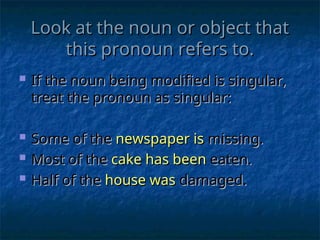
Look at the noun or object that
this pronoun refers to.
 If the noun being modified is singular,
If the noun being modified is singular,
treat the pronoun as singular:
 Some of the
Some of the newspaper is
newspaper is missing.
missing.
 Most of the
Most of the cake has been
cake has been eaten.
eaten.
 Half of the
Half of the house was
house was damaged.
damaged.
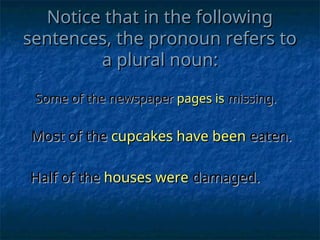
Notice that in the following
sentences, the pronoun refers to
a plural noun:
a plural noun:
Some of the newspaper
Some of the newspaper pages is
pages is missing.
missing.
Most of the
Most of the cupcakes have been
cupcakes have been eaten.
eaten.
Half of the
Half of the houses were
houses were damaged.
damaged.
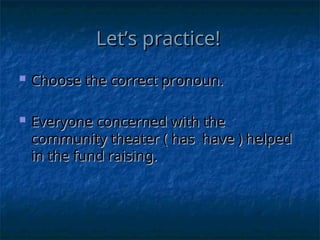
Let’s practice!
Let’s practice!
 Choose the correct pronoun.
Choose the correct pronoun.
 Everyone concerned with the
Everyone concerned with the
community theater ( has have ) helped
in the fund raising.
Not quite!
Not quite!
 Remember, “everyone” is considered
Remember, “everyone” is considered
singular.
singular.
 Click here to try again.
Click here to try again.
Right!
Right!
 Let’s try another:
Let’s try another:
 Several of the students ( was were )
Several of the students ( was were )
delayed by the highway construction.
Not exactly.
Not exactly.
 “
“Several” is plural.
Several” is plural.
 Click here to try again.
Click here to try again.
Right!
Right!
 Let’s try one more.
Let’s try one more.
 None of the employees ( take takes )
None of the employees ( take takes )
enough vacation time.
Not quite!
Not quite!
 “
“None” in this case is considered plural
None” in this case is considered plural
because “none” refers to “employees.”
 Click here to try again.
Click here to try again.
You’ve got it!
You’ve got it!
 This concludes the lesson.
This concludes the lesson.
 For more practice, try the supplemental
For more practice, try the supplemental
PowerPoint containing just subject-verb
agreement exercises.

Subject-Verb Agreement Presentation English

  • 1.
    Subject-verb Agreement Subject-verb Agreement AReview of the Rules A Review of the Rules with with Practice Exercises Practice Exercises
  • 2.
    1. The verbagrees with the 1. The verb agrees with the subject, not with intervening subject, not with intervening words. words.  Toby Toby, along with his girlfriend, , along with his girlfriend, plays plays paintball nearly every weekend. paintball nearly every weekend.  One One of the students of the students has has left his or her left his or her cell phone in the classroom. cell phone in the classroom.  A A harness harness with bells with bells is is for sale on eBay. for sale on eBay.
  • 3.
    Let’s practice! Let’s practice! Click on the sentence in which the verb is used Click on the sentence in which the verb is used correctly. correctly.  The President, along with the press secretary, The President, along with the press secretary, were were late to the press conference late to the press conference. .  The President, along with the press secretary, The President, along with the press secretary, was was late to the press conference. late to the press conference.
  • 4.
    Not quite! Not quite! Click here to try again Click here to try again. .
  • 5.
    Right! Right!  Click herefor the next question. Click here for the next question.
  • 6.
    Click on thesentence in which Click on the sentence in which the verb is used correctly. the verb is used correctly.  The cost of repairing all those computer The cost of repairing all those computer s s is is quite prohibitive quite prohibitive. .  The cost of repairing all those computer The cost of repairing all those computer s s are are quite prohibitive quite prohibitive. .
  • 7.
    Oops! Oops!  Click hereto try again. Click here to try again.
  • 8.
    You’ve got it! You’vegot it!  Click here for the next sentence. Click here for the next sentence.
  • 9.
    Click on thesentence in which Click on the sentence in which the verb is used correctly. the verb is used correctly.  A driver’s license, as well as another for A driver’s license, as well as another for m of ID, is required m of ID, is required . .  A driver’s license, as well as another for A driver’s license, as well as another for m of ID, are required m of ID, are required . .
  • 10.
    Not quite! Not quite! Click here to try again. Click here to try again.
  • 11.
    Yes! Yes!  Let’s moveon to the next rule. Let’s move on to the next rule.
  • 12.
    Rule 2 Rule 2 The verb agrees with its subject, even The verb agrees with its subject, even when the subject follows the verb. when the subject follows the verb.  In the back of the room In the back of the room sits sits a snoring a snoring student student. .  There There are are only two only two cookies cookies left. left.
  • 13.
    More Examples More Examples Notice the highlighted subject in these Notice the highlighted subject in these sentences. sentences.  Here Here is is the the report report you were looking for. you were looking for.  Here Here are are the the keys keys you were looking for. you were looking for.  On the wall On the wall hangs hangs a a portrait portrait of his of his father. father.
  • 14.
    Let’s practice! Let’s practice! Click on the correct sentence: Click on the correct sentence:  There There seem seem to be a few errors in this program to be a few errors in this program. .  There There seems seems to be a few errors in this program to be a few errors in this program. .
  • 15.
    Not quite! Not quite! Be sure that you can identify the Be sure that you can identify the subject of the sentence. subject of the sentence.  Click here to try again. Click here to try again.
  • 16.
    Good! Good!  Click herefor the next sentence. Click here for the next sentence.
  • 17.
    Click on thesentence in which Click on the sentence in which the verb is used correctly. the verb is used correctly.  Included in the festivities was a three- Included in the festivities was a three- legged race, a sack race, and a pie- legged race, a sack race, and a pie- eating contest. eating contest.  Included in the festivities were a three- Included in the festivities were a three- legged race, a sack race, and a pie- legged race, a sack race, and a pie- eating contest. eating contest.
  • 18.
    Not quite! Not quite! Click here to try again. Click here to try again.
  • 19.
    Right! Right!  Let’s moveon to the next rule. Let’s move on to the next rule.
  • 20.
    Rule 3 Rule 3 Compound subjects joined by “and” Compound subjects joined by “and” take a plural verb. take a plural verb.  * Some subjects joined by “and” are * Some subjects joined by “and” are considered singular, however. considered singular, however.
  • 21.
    Here are someexamples: Here are some examples:  Shannon and her sister Shannon and her sister are are both on the both on the tennis team. tennis team.  My favorite salad dressing My favorite salad dressing is is vinegar and vinegar and oil. oil.  Macaroni and cheese Macaroni and cheese is is Jason’s favorite Jason’s favorite lunch. lunch.
  • 22.
    Let’s try somepractice exercises: Let’s try some practice exercises:  Click on the correct verb. Click on the correct verb.  Strawberries and cream ( Strawberries and cream ( is is are are ) a ) a traditional Wimbledon treat. traditional Wimbledon treat.
  • 23.
    Not quite! Not quite! Remember, some compound nouns act Remember, some compound nouns act as one unit and are considered singular. as one unit and are considered singular.  Click here to return to the question Click here to return to the question. .
  • 24.
    Yes! Yes!  Let’s tryanother. Click on the correct Let’s try another. Click on the correct verb: verb:  Charlotte and her mother ( Charlotte and her mother ( live live lives lives ) in ) in Las Vegas. Las Vegas.
  • 25.
    Not quite! Not quite! Click here to try again. Click here to try again.
  • 26.
    You’ve got it! You’vegot it!  Let’s move on to Rule 4: Let’s move on to Rule 4:  When subjects are joined by “or” or “nor,” When subjects are joined by “or” or “nor,” the verb agrees with the nearest subject. the verb agrees with the nearest subject.  This is a tricky rule, which doesn’t always This is a tricky rule, which doesn’t always sound “right” to the ear, so let’s look at sound “right” to the ear, so let’s look at some examples. some examples.
  • 27.
    Examples: Examples:  Either Davidor his Either David or his cousin owns cousin owns that that property across the river. property across the river.  Neither Sylvia nor her Neither Sylvia nor her mother mother likes likes going to going to rodeos. rodeos.  Neither the students nor the Neither the students nor the instructor instructor knows knows if classes will be held on Columbus if classes will be held on Columbus Day. Day.
  • 28.
    Let’s practice thistricky rule. Let’s practice this tricky rule.  Click on the correct verb. Click on the correct verb.  Either a check or a money order ( Either a check or a money order ( is is are are ) ) acceptable. acceptable.
  • 29.
    Oops! Oops!  Remember, theverb agrees with the Remember, the verb agrees with the nearest nearest subject. subject.  Click here to try again. Click here to try again.
  • 30.
    Yes! Yes!  Let’s tryanother. Click on the correct Let’s try another. Click on the correct verb. verb. ( ( Was Was Were Were ) Mr. Phelps or his son put on ) Mr. Phelps or his son put on the committee? the committee?
  • 31.
    Not exactly. Not exactly. Look for the nearest subject. Look for the nearest subject.  Click here to try again. Click here to try again.
  • 32.
    Right! Here’s another. Right!Here’s another.  Click on the correct verb. Click on the correct verb.  Either the employees or the manager Either the employees or the manager ( ( is is are are ) confused about the policy. ) confused about the policy.
  • 33.
    Oops! Oops!  Click hereto try again Click here to try again. .
  • 34.
    Right! Right!  Let’s moveon to Rule #5: Let’s move on to Rule #5:  Amounts and distance, when used as Amounts and distance, when used as singular units of measurements, are singular units of measurements, are considered singular. considered singular.
  • 35.
    For example: For example: A million dollars just A million dollars just is is not enough to not enough to retire on these days. retire on these days.  Thirty miles Thirty miles seems seems like a long walk to like a long walk to me. me.
  • 36.
    Rule #6 Rule #6 Most collective nouns, nouns that stand Most collective nouns, nouns that stand for groups of people or things, are for groups of people or things, are generally treated as singular: generally treated as singular:  The The team is team is practicing at 6:00 a.m. practicing at 6:00 a.m.  Our Our class has class has been cancelled tonight. been cancelled tonight.  The The jury is jury is still deliberating. still deliberating.
  • 37.
    Exception! Exception!  If individualswithin a group are acting If individuals within a group are acting separately, the collective noun is separately, the collective noun is considered plural: considered plural:  The The band band are are tuning their instruments. tuning their instruments. (Each member is tuning a different (Each member is tuning a different instrument.) instrument.)  The The audience are audience are stomping their feet. stomping their feet.
  • 38.
    Let’s try afew. Let’s try a few.  Click on the correct pronoun in Click on the correct pronoun in parentheses. parentheses.  The committee ( has have ) The committee ( has have ) recommended a further review. recommended a further review.
  • 39.
    That’s not right. That’snot right.  It’s one committee, singular, not two It’s one committee, singular, not two committees. committees.  Click here to try again. Click here to try again.
  • 40.
    Right! Right!  Let’s tryanother. Click on the correct Let’s try another. Click on the correct pronoun. pronoun.  The team ( is are ) loading their The team ( is are ) loading their suitcases onto the bus. suitcases onto the bus.
  • 41.
    Not quite. Not quite. Click here to try again. Click here to try again.
  • 42.
    You’ve got it! You’vegot it!  Let’s move on to the next rule. Let’s move on to the next rule.
  • 43.
    Most indefinite pronouns Mostindefinite pronouns are singular are singular  What’s an indefinite pronoun? What’s an indefinite pronoun?  An indefinite pronoun takes the place of many An indefinite pronoun takes the place of many unspecified persons or things: unspecified persons or things:  Examples: Examples:  Any, anybody, anyone, each, every, everyone, Any, anybody, anyone, each, every, everyone, nobody, nothing, something, no one, one nobody, nothing, something, no one, one
  • 44.
    Some indefinite pronouns Someindefinite pronouns are plural. are plural.  Plural indefinite pronouns: Plural indefinite pronouns:  Both, several, few, many Both, several, few, many
  • 45.
    Some indefinite pronouns Someindefinite pronouns can be either singular or plural. can be either singular or plural.  Pay close attention to the following Pay close attention to the following indefinite pronouns: indefinite pronouns:  All, any, some, none, most, enough, half All, any, some, none, most, enough, half  These can be either singular or plural, These can be either singular or plural, depending upon their function in the depending upon their function in the sentence. sentence.
  • 46.
    Look at thenoun or object that Look at the noun or object that this pronoun refers to. this pronoun refers to.  If the noun being modified is singular, If the noun being modified is singular, treat the pronoun as singular: treat the pronoun as singular:  Some of the Some of the newspaper is newspaper is missing. missing.  Most of the Most of the cake has been cake has been eaten. eaten.  Half of the Half of the house was house was damaged. damaged.
  • 47.
    Notice that inthe following Notice that in the following sentences, the pronoun refers to sentences, the pronoun refers to a plural noun: a plural noun: Some of the newspaper Some of the newspaper pages is pages is missing. missing. Most of the Most of the cupcakes have been cupcakes have been eaten. eaten. Half of the Half of the houses were houses were damaged. damaged.
  • 48.
    Let’s practice! Let’s practice! Choose the correct pronoun. Choose the correct pronoun.  Everyone concerned with the Everyone concerned with the community theater ( has have ) helped community theater ( has have ) helped in the fund raising. in the fund raising.
  • 49.
    Not quite! Not quite! Remember, “everyone” is considered Remember, “everyone” is considered singular. singular.  Click here to try again. Click here to try again.
  • 50.
    Right! Right!  Let’s tryanother: Let’s try another:  Several of the students ( was were ) Several of the students ( was were ) delayed by the highway construction. delayed by the highway construction.
  • 51.
    Not exactly. Not exactly. “ “Several” is plural. Several” is plural.  Click here to try again. Click here to try again.
  • 52.
    Right! Right!  Let’s tryone more. Let’s try one more.  None of the employees ( take takes ) None of the employees ( take takes ) enough vacation time. enough vacation time.
  • 53.
    Not quite! Not quite! “ “None” in this case is considered plural None” in this case is considered plural because “none” refers to “employees.” because “none” refers to “employees.”  Click here to try again. Click here to try again.
  • 54.
    You’ve got it! You’vegot it!  This concludes the lesson. This concludes the lesson.  For more practice, try the supplemental For more practice, try the supplemental PowerPoint containing just subject-verb PowerPoint containing just subject-verb agreement exercises. agreement exercises.