
SUBFERTILITY
By Marwan Nassar
definition is a failure to conceive
after 12 months of regular
unprotected intercourse.
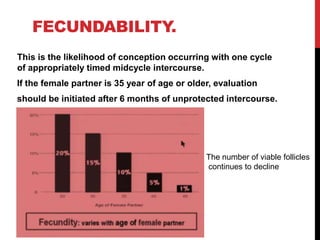
FECUNDABILITY.
This is the likelihood of conception occurring with one cycle
of appropriately timed midcycle intercourse.
If the female partner is 35 year of age or older, evaluation
should be initiated after 6 months of unprotected intercourse.
The number of viable follicles
continues to decline
NATURAL CONCEPTION
Eggs are thought to be fertilizable for about 12–24 hours
post-ovulation, while sperm can survive in the female
reproductive tract for up to 72 hours.
For a woman with a normal menstrual cycle of 28 days,
ovulation occurs around day 14.
The ‘fertile window’ for women will, therefore, be different
depending on the average length of their menstrual cycle
(e.g. for a woman with a 28-day menstrual cycle, her optimal
fertile window will be between days 12 and 15).
FACTORS AFFECT NATURAL
CONCEPTION RATE
Age
Female >35 years, due to decline in oocyte quality & number.
semen quality tends to fall in men over the age of 50
Smoking
reduces fertility in female & semen quality in males.
Alcohol
harmful to the fetus & can affect sperm quality .
Coital frequency
stress & anxiety may affect libido & coital frequency & thus impact on fertility.
Recommended coital frequency is two to three times per week.
Body weight
Over or under weight can affect ovulation.
 women with a body mass index (BMI) of >29 or < 19 will have difficulty
conceiving.
Drugs
non-steroidal anti-inflammatory drugs (inhibit ovulation).
chemotherapy (destroys rapidly dividing cells e.g. gametes).
cimetidine, sulphasalazine, androgen injections (affects sperm quality).
Occupational hazards
exposure to chemicals and radiation adversely affects male and female fertility.
CLASSIFICATION Subfertility
Primary Secondary
Female causes
HPO axis
dysfunction
Ovarian
factors Cervical
Endometrial
factors
Tubal
OVULATORY DISORDER
Group I hypothalamic pituitary failure. such as hypothalamic amenorrhea and hypogonadotrophic
hypogonadism. Typically, women present with amenorrhoea 10% .
Group II dysfunctions of the hypothalamic-pituitary-ovarian axis. such as polycystic ovary
syndrome and hyperprolactinaemic amenorrhoea. Around 85% of ovulation disorders
Group III caused by ovarian failure. Around 5% of women with ovulation disorders have a group
III ovulation disorder.
The most common cause of anovulation is PCOS.
MARKER OF OVARIAN
RESERVE
In the ovary, anti-Müllerian hormone (AMH) is produced by the
granulosa cells.
AMH levels can be measured in blood and are shown to be
proportional to the number of small antral follicles.
In women, serum AMH levels decrease with age and are undetectable
in the post-menopausal period.
AMH levels represent the quantity of the ovarian follicle pool and are
a useful marker of ovarian reserve.
AMH measurement can also be useful in the prediction of the
extremes of ovarian response to gonadotrophin stimulation for in
vitro fertilization.
TUBAL BLOCKAGE
Causes:
1. previous PID such as chlamydia infection
2. Inflammatory process within the abdomen/pelvic cavity
3. Inflammatory process as a result of surgery or
endometriosis => internal scares (adhesions).
4. History of ectopic pregnancy.
ENDOMETRIAL
FACTORS
Any abnormality in the endometrium may prevent successful
implantation of embryo.
Examples:
Endometriosis (15% of infertile females have endometriosis)
Uterine fibroids
Adhesions.
Polyps.
Congenital malformations
Asherman’s syndrome (adhesions and/or fibrosis of the endometrium
particularly but can also affect the myometrium.)
Can be surgically managed.
1-preventing movement of the
egg and sperm through the tube.
2-Contractility
3-Inflimmatory factors
CERVICAL FACTORS
Cervicitis
Cervical stenosis
Mullerian duct abnormalities
Inadequate mucus production
HISTORY AND PE
EXAMINATION
Signs of PCOS
Thyroid disease signs
Pelvic examination
any uterine pathology such as fibroids
Vaginal atrophy in Premature ovarian failure
Cervical stenosis & mucus
General BP, pulse, height and weight
INVESTIGATIONS
Check for ovarian reserve
Check for HPO dysfunction.
Check tubal patency:
Hysterosalpingogram (HSG).
Hysterocontrast synography (HyCoSy).
Operative laparoscopy and dye test.
Hysterosalpingogram (HSG)
HYSTEROCONTRAST SYNOGRAPHY
(HYCOSY)
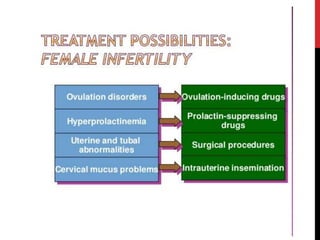
TREATMENT
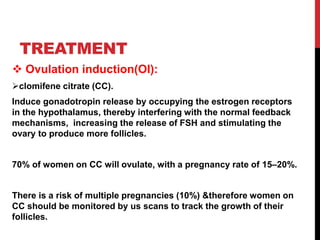
 Ovulation induction(OI):
clomifene citrate (CC).
Induce gonadotropin release by occupying the estrogen receptors
in the hypothalamus, thereby interfering with the normal feedback
mechanisms, increasing the release of FSH and stimulating the
ovary to produce more follicles.
70% of women on CC will ovulate, with a pregnancy rate of 15–20%.
There is a risk of multiple pregnancies (10%) &therefore women on
CC should be monitored by us scans to track the growth of their
follicles.

LAPAROSCOPIC OVARIAN DRILLING (LOD)
For unknown reasons, passing electrical energy through
polycystic ovaries can result in the induction of ovulation.
it is a surgical procedure, & it’s only appropriate to offer such
treatment to who have not responded to CC.

INTRAUTERINE INSEMINATION (IUI):
This process usually requires mild stimulation with FSH to
produce 2-3 mature follicles.
The success rate of this procedure ranges
between 15 and 20 percent in top fertility units.
cervical factor low sperm quality, immunological
infertility, and in men with mechanical problems
of sperm delivery (e.g., hypospadias).
There should be at least 5 million to 40 million
Motile sperm .

IN VITRO FERTILIZATION (IVF):
The success rate of IVF per cycle is about 30% in women <35 years of age.
In essence, the ovaries are stimulated with FSH, and are encouraged to produce
up to 8–10 follicles.
Induction of ovulation is then performed with an injection of hCG, after which the
eggs can be collected during an ultrasound guided procedure via a very fine
needle.
These eggs will be fertilized in a petri dish with sperm or, if required, the sperm
can be injected directly into the egg (intracytoplasmic sperm injection, ICSI).
When fertilization occurs, the fertilized embryo(s) is then replaced into the
uterine cavity.
Approximately 2 weeks after embryo transfer, a pregnancy test is performed to
check for successful implantation.
Undergoing IVF does not preclude the patient from the normal complications of
pregnancy, such as miscarriage or ectopic pregnancies.
The risk of ectopic pregnancy for women who have undergone IVF is higher
than for the general population, at 3–4 per cent.
There is the added risk of overstimulating the ovaries during an IVF cycle.
Patients with ovarian hyperstimulation syndrome (OHSS) present with ascites,
hugely enlarged multifollicular ovaries, pulmonary edema, and are at risk of
multiorgans failure and coagulopathy.
large amounts of estrogens, progesterone, and local cytokines are released. And
(VEGF) induces vascular hyperpermeability, making local capillaries "leaky"
These patients need to be admitted to hospital and managed under strict
protocols under the care of specialist teams.
Vedio
SURGICAL
TREATMENT
Offered if there is tubal blockage or endometrial abnormality
(polyp, adhesion or fibroid).
MALE
SUBFERTILITY
Causes
Hypothalamic-pituitary
disease
Obesity
Primary hypogonadism
Sperm transport
disorders
Defective
ejaculation
Gonadotropin-releasing hormone (GnRH) or gonadotropin
deficiency.
Hypogonadotropic hypogonadism
HYPOTHALAMIC-PITUITARY
DISEASE
1-*Congenital idiopathic hypogonadotropic hypogonadism.
Isolated gonadotropin deficiency resulting in eunuchoidism.
Kallmann's syndrome.
Eunuchoidism
Sexual
infantilism
Eunuchoid
body
Undeveloped
sexual organs
No sexual
hormones
HYPOTHALAMIC-PITUITARY
DISEASE
2. Acquired:
Tumors: Pituitary macroadenomas e.g.
macroprolactinomas and nonfunctioning adenomas.
Infiltrative disease: sarcoidosis, tuberculosis, fungal
infections.
Vascular lesion: Pituitary infarction and carotid
aneurysm.
Hormonal: hyperprolactinemia, estrogen excess,
glucocorticoid excess and androgen excess
HYPOTHALAMIC-PITUITARY
DISEASE
3. Drugs:
Opioid-like.
Central nervous system-acting drugs.
Inhibit GnRH or gonadotropin secretion, resulting in secondary
hypogonadism.
GnRH analogues
Suppress gonadotropin secretion, as in men with prostatic
carcinoma
4. Systemic or chronic illness or chronic nutritional deficiency.
HYPOTHALAMIC-PITUITARY
DISEASE
OBESITY
Associated with decrease in serum sex hormone binding globulin
(SHBG).
Low serum gonadotropin, total testosterone.
Sperm quality may also be inversely related to BMI; > 25 Kg/m2
has lower motile cells.
PRIMARY
HYPOGONADISM
Testicular disorders hypergonadotropic hypogonadism.
1) Congenital disorders:
-Klinefelter's syndrome: have very small testes and almost always have azoospermia.
- Y chromosome related defects: microdeletions in the long arm.
Testicular biopsies in these men may show germinal cell maturation arrest or Sertoli
cell-only syndrome.
-Cryptorchidism: failure of testes descent into the scrotum.
-Defective androgen receptor or synthesis
PRIMARY HYPOGONADISM
2) Aquired disorders:
-Varicoceles : dilatations of the pampiniform plexus of the spermatic veins in the
scrotum.
Infection: viral orchitis, especially mumps.
Due to germinal cell damage, ischemia, or the immune response to the
infection.
- Drugs: alkylating agents like cyclophosphamide, antiandrogens, cimitidine.
Through inhibiting testicular androgen production or action.
-Radiation.
-Hyperthermia.
-Testicular cancer.
SPERM TRANSPORT
DISORDERS

The epididymis is an important site for sperm maturation.

The vas deferens transports sperm from the epididymis to the
urethra.
DEFECTIVE EJACULATION
Spinal cord disease or trauma.
Sympathectomy.
Autonomic disease.
Erectile dysfunction.
Mechanical obstruction.
Premature ejaculation.
HISTORYAND PE
History:
Length of time spent trying for pregnancy.
Fathered any previous pregnancies.
History of mumps or measles
History of testicular trauma, surgery to testis
Occupation
Medical and surgical history
Physical examination:
Testicular examination : testicular volume, consistency, masses, absence of
vas deferens, varicocele, evidence of surgical scars.
INVESTIGATIONS

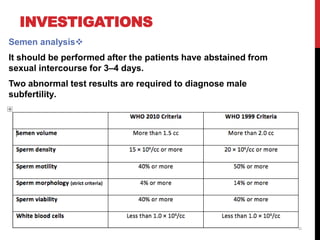
Semen analysis
It should be performed after the patients have abstained from
sexual intercourse for 3–4 days.
Two abnormal test results are required to diagnose male
subfertility.
For men with a very low sperm count or azoospermia, it is
important to check their testosterone levels (low levels
suggest a production impairment) and LH/FSH.
It is also important to screen for the cystic fibrosis (CF)
mutation as a congenital bilateral absence of the vas
deferens (CBAVD) is a minor variant of cystic fibrosis.
Karyotyping is also offered as there may be Y chromosome
deletion defects.
SURGICAL SPERM RETRIEVAL
Where the sperm quality is low but sperm are present, ICSI is
required to help achieve a pregnancy.
However, in the absence of naturally ejaculated sperm,
patients will have to undergo surgical sperm retrieval (SSR).
SSR can be performed under sedation or general
anaesthetic.
The retrieved sperm can then be cryopreserved or injected
into the oocyte as part of a fresh IVF/ICSI cycle.
CRYOPRESERVATION OF GAMETES
Sperm or oocyte can be cryopreserved for later use.
Often this process is very useful in preserving fertility for
patients undergoing chemo/radiation therapy for cancer.
Currently, the pregnancy rate for thawed sperm/egg in top
fertility centers is very near to that of normal IVF cycles.
This process can also be used for storage of gametes from
donors who wish to donate their sperm or eggs for altruistic
reasons to help couples with fertility problems.
Subfertility/infertility

Subfertility/infertility

  • 1.
    SUBFERTILITY By Marwan Nassar definitionis a failure to conceive after 12 months of regular unprotected intercourse.
  • 4.
    FECUNDABILITY. This is thelikelihood of conception occurring with one cycle of appropriately timed midcycle intercourse. If the female partner is 35 year of age or older, evaluation should be initiated after 6 months of unprotected intercourse. The number of viable follicles continues to decline
  • 5.
    NATURAL CONCEPTION Eggs arethought to be fertilizable for about 12–24 hours post-ovulation, while sperm can survive in the female reproductive tract for up to 72 hours. For a woman with a normal menstrual cycle of 28 days, ovulation occurs around day 14. The ‘fertile window’ for women will, therefore, be different depending on the average length of their menstrual cycle (e.g. for a woman with a 28-day menstrual cycle, her optimal fertile window will be between days 12 and 15).
  • 7.
    FACTORS AFFECT NATURAL CONCEPTIONRATE Age Female >35 years, due to decline in oocyte quality & number. semen quality tends to fall in men over the age of 50 Smoking reduces fertility in female & semen quality in males. Alcohol harmful to the fetus & can affect sperm quality .
  • 8.
    Coital frequency stress &anxiety may affect libido & coital frequency & thus impact on fertility. Recommended coital frequency is two to three times per week. Body weight Over or under weight can affect ovulation.  women with a body mass index (BMI) of >29 or < 19 will have difficulty conceiving. Drugs non-steroidal anti-inflammatory drugs (inhibit ovulation). chemotherapy (destroys rapidly dividing cells e.g. gametes). cimetidine, sulphasalazine, androgen injections (affects sperm quality). Occupational hazards exposure to chemicals and radiation adversely affects male and female fertility.
  • 9.
  • 12.
    Female causes HPO axis dysfunction Ovarian factorsCervical Endometrial factors Tubal
  • 13.
    OVULATORY DISORDER Group Ihypothalamic pituitary failure. such as hypothalamic amenorrhea and hypogonadotrophic hypogonadism. Typically, women present with amenorrhoea 10% . Group II dysfunctions of the hypothalamic-pituitary-ovarian axis. such as polycystic ovary syndrome and hyperprolactinaemic amenorrhoea. Around 85% of ovulation disorders Group III caused by ovarian failure. Around 5% of women with ovulation disorders have a group III ovulation disorder.
  • 14.
    The most commoncause of anovulation is PCOS.
  • 16.
    MARKER OF OVARIAN RESERVE Inthe ovary, anti-Müllerian hormone (AMH) is produced by the granulosa cells. AMH levels can be measured in blood and are shown to be proportional to the number of small antral follicles. In women, serum AMH levels decrease with age and are undetectable in the post-menopausal period. AMH levels represent the quantity of the ovarian follicle pool and are a useful marker of ovarian reserve. AMH measurement can also be useful in the prediction of the extremes of ovarian response to gonadotrophin stimulation for in vitro fertilization.
  • 17.
    TUBAL BLOCKAGE Causes: 1. previousPID such as chlamydia infection 2. Inflammatory process within the abdomen/pelvic cavity 3. Inflammatory process as a result of surgery or endometriosis => internal scares (adhesions). 4. History of ectopic pregnancy.
  • 18.
    ENDOMETRIAL FACTORS Any abnormality inthe endometrium may prevent successful implantation of embryo. Examples: Endometriosis (15% of infertile females have endometriosis) Uterine fibroids Adhesions. Polyps. Congenital malformations Asherman’s syndrome (adhesions and/or fibrosis of the endometrium particularly but can also affect the myometrium.) Can be surgically managed. 1-preventing movement of the egg and sperm through the tube. 2-Contractility 3-Inflimmatory factors
  • 20.
    CERVICAL FACTORS Cervicitis Cervical stenosis Mullerianduct abnormalities Inadequate mucus production
  • 21.
  • 22.
    EXAMINATION Signs of PCOS Thyroiddisease signs Pelvic examination any uterine pathology such as fibroids Vaginal atrophy in Premature ovarian failure Cervical stenosis & mucus General BP, pulse, height and weight
  • 23.
    INVESTIGATIONS Check for ovarianreserve Check for HPO dysfunction. Check tubal patency: Hysterosalpingogram (HSG). Hysterocontrast synography (HyCoSy). Operative laparoscopy and dye test.
  • 25.
  • 26.
  • 28.
    TREATMENT  Ovulation induction(OI): clomifenecitrate (CC). Induce gonadotropin release by occupying the estrogen receptors in the hypothalamus, thereby interfering with the normal feedback mechanisms, increasing the release of FSH and stimulating the ovary to produce more follicles. 70% of women on CC will ovulate, with a pregnancy rate of 15–20%. There is a risk of multiple pregnancies (10%) &therefore women on CC should be monitored by us scans to track the growth of their follicles.
  • 29.
     LAPAROSCOPIC OVARIAN DRILLING(LOD) For unknown reasons, passing electrical energy through polycystic ovaries can result in the induction of ovulation. it is a surgical procedure, & it’s only appropriate to offer such treatment to who have not responded to CC.
  • 30.
     INTRAUTERINE INSEMINATION (IUI): Thisprocess usually requires mild stimulation with FSH to produce 2-3 mature follicles. The success rate of this procedure ranges between 15 and 20 percent in top fertility units. cervical factor low sperm quality, immunological infertility, and in men with mechanical problems of sperm delivery (e.g., hypospadias). There should be at least 5 million to 40 million Motile sperm .
  • 31.
     IN VITRO FERTILIZATION(IVF): The success rate of IVF per cycle is about 30% in women <35 years of age. In essence, the ovaries are stimulated with FSH, and are encouraged to produce up to 8–10 follicles. Induction of ovulation is then performed with an injection of hCG, after which the eggs can be collected during an ultrasound guided procedure via a very fine needle. These eggs will be fertilized in a petri dish with sperm or, if required, the sperm can be injected directly into the egg (intracytoplasmic sperm injection, ICSI). When fertilization occurs, the fertilized embryo(s) is then replaced into the uterine cavity. Approximately 2 weeks after embryo transfer, a pregnancy test is performed to check for successful implantation.
  • 32.
    Undergoing IVF doesnot preclude the patient from the normal complications of pregnancy, such as miscarriage or ectopic pregnancies. The risk of ectopic pregnancy for women who have undergone IVF is higher than for the general population, at 3–4 per cent. There is the added risk of overstimulating the ovaries during an IVF cycle. Patients with ovarian hyperstimulation syndrome (OHSS) present with ascites, hugely enlarged multifollicular ovaries, pulmonary edema, and are at risk of multiorgans failure and coagulopathy. large amounts of estrogens, progesterone, and local cytokines are released. And (VEGF) induces vascular hyperpermeability, making local capillaries "leaky" These patients need to be admitted to hospital and managed under strict protocols under the care of specialist teams.
  • 34.
  • 35.
    SURGICAL TREATMENT Offered if thereis tubal blockage or endometrial abnormality (polyp, adhesion or fibroid).
  • 36.
  • 37.
  • 38.
    Gonadotropin-releasing hormone (GnRH)or gonadotropin deficiency. Hypogonadotropic hypogonadism HYPOTHALAMIC-PITUITARY DISEASE
  • 39.
    1-*Congenital idiopathic hypogonadotropichypogonadism. Isolated gonadotropin deficiency resulting in eunuchoidism. Kallmann's syndrome. Eunuchoidism Sexual infantilism Eunuchoid body Undeveloped sexual organs No sexual hormones HYPOTHALAMIC-PITUITARY DISEASE
  • 40.
    2. Acquired: Tumors: Pituitarymacroadenomas e.g. macroprolactinomas and nonfunctioning adenomas. Infiltrative disease: sarcoidosis, tuberculosis, fungal infections. Vascular lesion: Pituitary infarction and carotid aneurysm. Hormonal: hyperprolactinemia, estrogen excess, glucocorticoid excess and androgen excess HYPOTHALAMIC-PITUITARY DISEASE
  • 41.
    3. Drugs: Opioid-like. Central nervoussystem-acting drugs. Inhibit GnRH or gonadotropin secretion, resulting in secondary hypogonadism. GnRH analogues Suppress gonadotropin secretion, as in men with prostatic carcinoma 4. Systemic or chronic illness or chronic nutritional deficiency. HYPOTHALAMIC-PITUITARY DISEASE
  • 42.
    OBESITY Associated with decreasein serum sex hormone binding globulin (SHBG). Low serum gonadotropin, total testosterone. Sperm quality may also be inversely related to BMI; > 25 Kg/m2 has lower motile cells.
  • 43.
    PRIMARY HYPOGONADISM Testicular disorders hypergonadotropichypogonadism. 1) Congenital disorders: -Klinefelter's syndrome: have very small testes and almost always have azoospermia. - Y chromosome related defects: microdeletions in the long arm. Testicular biopsies in these men may show germinal cell maturation arrest or Sertoli cell-only syndrome. -Cryptorchidism: failure of testes descent into the scrotum. -Defective androgen receptor or synthesis
  • 44.
    PRIMARY HYPOGONADISM 2) Aquireddisorders: -Varicoceles : dilatations of the pampiniform plexus of the spermatic veins in the scrotum. Infection: viral orchitis, especially mumps. Due to germinal cell damage, ischemia, or the immune response to the infection. - Drugs: alkylating agents like cyclophosphamide, antiandrogens, cimitidine. Through inhibiting testicular androgen production or action. -Radiation. -Hyperthermia. -Testicular cancer.
  • 45.
    SPERM TRANSPORT DISORDERS  The epididymisis an important site for sperm maturation.  The vas deferens transports sperm from the epididymis to the urethra.
  • 46.
    DEFECTIVE EJACULATION Spinal corddisease or trauma. Sympathectomy. Autonomic disease. Erectile dysfunction. Mechanical obstruction. Premature ejaculation.
  • 47.
    HISTORYAND PE History: Length oftime spent trying for pregnancy. Fathered any previous pregnancies. History of mumps or measles History of testicular trauma, surgery to testis Occupation Medical and surgical history
  • 48.
    Physical examination: Testicular examination: testicular volume, consistency, masses, absence of vas deferens, varicocele, evidence of surgical scars.
  • 49.
    INVESTIGATIONS  Semen analysis It shouldbe performed after the patients have abstained from sexual intercourse for 3–4 days. Two abnormal test results are required to diagnose male subfertility.
  • 50.
    For men witha very low sperm count or azoospermia, it is important to check their testosterone levels (low levels suggest a production impairment) and LH/FSH. It is also important to screen for the cystic fibrosis (CF) mutation as a congenital bilateral absence of the vas deferens (CBAVD) is a minor variant of cystic fibrosis. Karyotyping is also offered as there may be Y chromosome deletion defects.
  • 52.
    SURGICAL SPERM RETRIEVAL Wherethe sperm quality is low but sperm are present, ICSI is required to help achieve a pregnancy. However, in the absence of naturally ejaculated sperm, patients will have to undergo surgical sperm retrieval (SSR). SSR can be performed under sedation or general anaesthetic. The retrieved sperm can then be cryopreserved or injected into the oocyte as part of a fresh IVF/ICSI cycle.
  • 54.
    CRYOPRESERVATION OF GAMETES Spermor oocyte can be cryopreserved for later use. Often this process is very useful in preserving fertility for patients undergoing chemo/radiation therapy for cancer. Currently, the pregnancy rate for thawed sperm/egg in top fertility centers is very near to that of normal IVF cycles. This process can also be used for storage of gametes from donors who wish to donate their sperm or eggs for altruistic reasons to help couples with fertility problems.