{
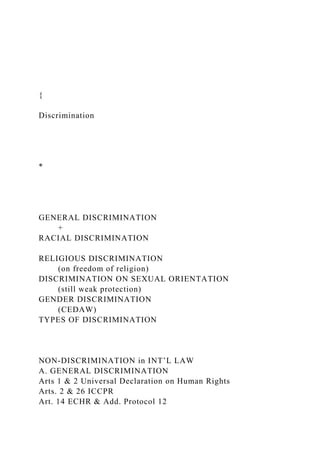
Discrimination
*
GENERAL DISCRIMINATION
+
RACIAL DISCRIMINATION
RELIGIOUS DISCRIMINATION
(on freedom of religion)
DISCRIMINATION ON SEXUAL ORIENTATION
(still weak protection)
GENDER DISCRIMINATION
(CEDAW)
TYPES OF DISCRIMINATION
NON-DISCRIMINATION in INT’L LAW
A. GENERAL DISCRIMINATION
Arts 1 & 2 Universal Declaration on Human Rights
Arts. 2 & 26 ICCPR
Art. 14 ECHR & Add. Protocol 12
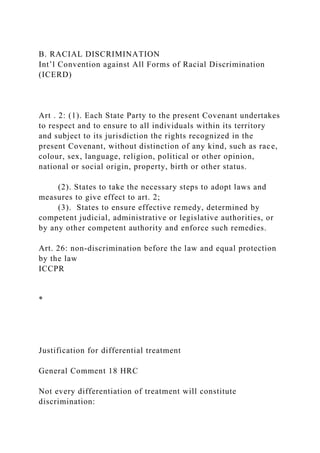
B. RACIAL DISCRIMINATION
Int’l Convention against All Forms of Racial Discrimination
(ICERD)
Art . 2: (1). Each State Party to the present Covenant undertakes
to respect and to ensure to all individuals within its territory
and subject to its jurisdiction the rights recognized in the
present Covenant, without distinction of any kind, such as race,
colour, sex, language, religion, political or other opinion,
national or social origin, property, birth or other status.
(2). States to take the necessary steps to adopt laws and
measures to give effect to art. 2;
(3). States to ensure effective remedy, determined by
competent judicial, administrative or legislative authorities, or
by any other competent authority and enforce such remedies.
Art. 26: non-discrimination before the law and equal protection
by the law
ICCPR
*
Justification for differential treatment
General Comment 18 HRC
Not every differentiation of treatment will constitute
discrimination:
if the criteria are reasonable and objective
and the aim is to achieve the purpose which is legitimate
ICCPR cont.
*
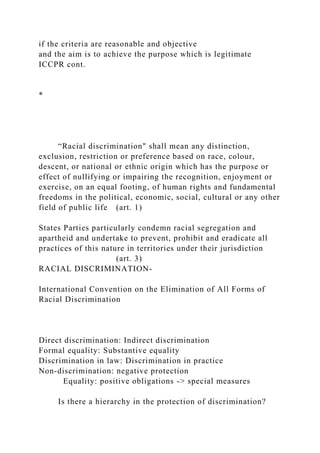
“Racial discrimination" shall mean any distinction,
exclusion, restriction or preference based on race, colour,
descent, or national or ethnic origin which has the purpose or
effect of nullifying or impairing the recognition, enjoyment or
exercise, on an equal footing, of human rights and fundamental
freedoms in the political, economic, social, cultural or any other
field of public life (art. 1)
States Parties particularly condemn racial segregation and
apartheid and undertake to prevent, prohibit and eradicate all
practices of this nature in territories under their jurisdiction
(art. 3)
RACIAL DISCRIMINATION-
International Convention on the Elimination of All Forms of
Racial Discrimination
Direct discrimination: Indirect discrimination
Formal equality: Substantive equality
Discrimination in law: Discrimination in practice
Non-discrimination: negative protection
Equality: positive obligations -> special measures
Is there a hierarchy in the protection of discrimination?
Racial Discrimination (prohibition Jus Cogens);
gender based discrimination?
Religious-based discrimination??
Discrimination based on sexual orientation???
Discrimination (forms & grounds)
= Affirmative action/ positive action
Article 1.4 of ICERD:
Special measures taken for the sole purpose of securing
adequate advancement of certain racial or ethnic groups or
individuals requiring such protection as may be necessary in
order to ensure such groups or individuals equal enjoyment or
exercise of human rights and fundamental freedoms shall not be
deemed racial discrimination, provided, however,
that such measures do not, as a consequence, lead to the
maintenance of separate rights for different racial groups and
that they shall not be continued after the objectives for which
they were taken have been achieved.
Special/ Positive measures
Article 26 of ICCPR: effective protection against discrimination
Human Rights Committee General Comment 3 on art. 2:‘States
parties have undertaken to ensure the enjoyment of [Covenant]
rights to all individuals under their jurisdiction. This aspect
calls for specific activities by the state parties to enable
individuals to enjoy their rights’
Reports of the Committee
ICERD General Recommendation (2009) 32 distinction between
specific measures and special measures:Special measures:
temporary # specific measures: permanent
Affirmative action (cont.)
Very active committee
General Recommendation 35 (2013): Combating Hate Speech
General Recommendation 32 (2009) on special measures
Concluding recommendations on the UK Report:
2011 Riots had racist undertones
Make the convention domestic law
Cases of racist speech
Financial cuts have an impact on implementation of race
equality act
Stop and search/anti-terrorism
CERD
The enjoyment of the rights and freedoms set forth in this
Convention shall be secured without discrimination on any
ground such as sex, race, colour, language, religion, political or
other opinion, national or social origin, association with a
national minority, property, birth or other status. Unlimited
number of grounds, but parasitical right
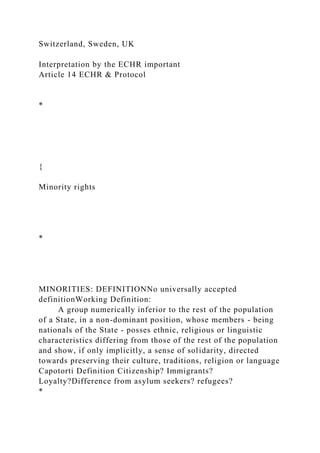
Protocol 12 extends it to any right covered by national law – but
not ratified by Austria, Belgium, Bulgaria, Denmark, France,
Germany, Greece, Ireland, Italy, Norway, Russia, Turkey,
Switzerland, Sweden, UK
Interpretation by the ECHR important
Article 14 ECHR & Protocol
*
{
Minority rights
*
MINORITIES: DEFINITIONNo universally accepted
definitionWorking Definition:
A group numerically inferior to the rest of the population
of a State, in a non-dominant position, whose members - being
nationals of the State - posses ethnic, religious or linguistic
characteristics differing from those of the rest of the population
and show, if only implicitly, a sense of solidarity, directed
towards preserving their culture, traditions, religion or language
Capotorti Definition Citizenship? Immigrants?
Loyalty?Difference from asylum seekers? refugees?
*
MINORITIES AND IMMIGRANTS:
‘OLD’ AND ‘NEW’ MINORITIES:
‘the existence of communities is a question of fact; it is not a
question of law’ – PICJ Greco-Bulgarian Communities Case
“The existence of an ethnic, religious or linguistic minority
does not depend upon a decision by that State party” UN HRC
General Comment No 23
Citizenship requirement –states insist - but then, the states has
the power to give or take minority status! (Germany & Turkish
immigrants; Pakistan; Iran; Maldives, Sri Lanka )
UN HRC GC 23: Given the nature and scope of the rights
envisaged under that article, it is not relevant to determine the
degree of permanence that the term "exist" connotes... Just as
they need not be nationals or citizens, need not be permanent
residents. Thus, migrant workers or even visitors in a State
party constituting such minorities are entitled not to be denied
the exercise of those rights.
*
MINORITIES AND IMMIGRANTS (cont.)
What makes the distinction between immigrants and minorities?
Time?Intention to stay?Contribution to polity?
*
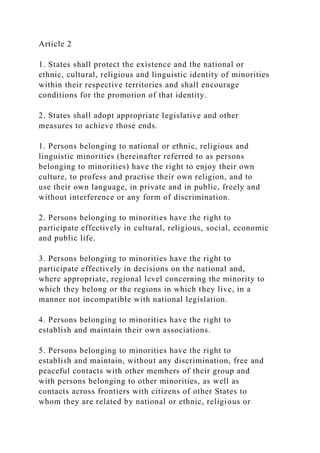
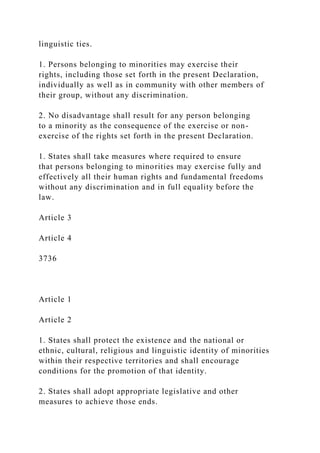
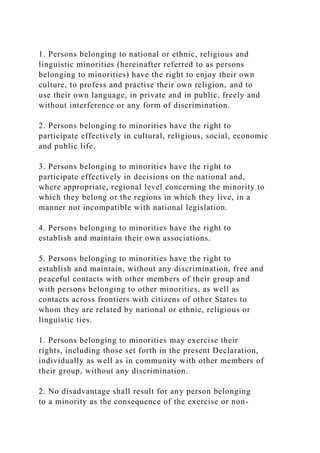
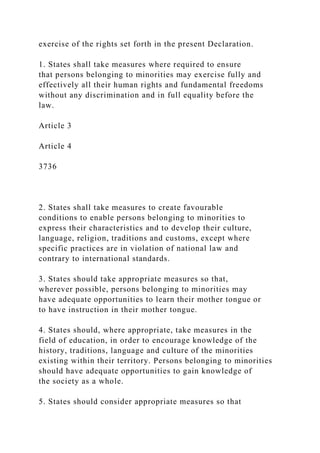
Article 27 ICCPR
In those States in which ethnic, religious or linguistic
minorities exist, persons belonging to such minorities shall not
be denied the right, in community with the other members of
their group, to enjoy their own culture, to profess and practice
their own religion or to use their own language
Individualist outlook- negative outlook –
but progressive interpretation by the UN bodies and the
UN Declaration on Minorities
*
Minorities contribute to the political stability of states
(preamble)Protection of existence and identity of minorities
(art. 1)Right to participate effectively in cultural, religious,
social, economic and public life and in matters that affect them
(art. 2) No discrimination and no disadvantage because of
membership to a minority (art. 3)States shall take measures
‘when required’ for the protection of minority rights, to create
favourable conditions to ebale minorities exercise their rights
(art. 4)Right to learn their mother tongue ‘whenever possible’
(art. 4)Education that encourages knowledge, of the history,
traditions, language and culture. Mutual understanding and
confidence (arts. 4 & 6)
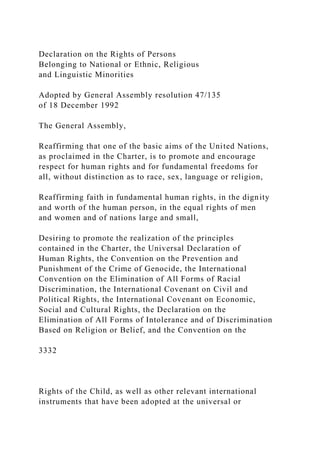
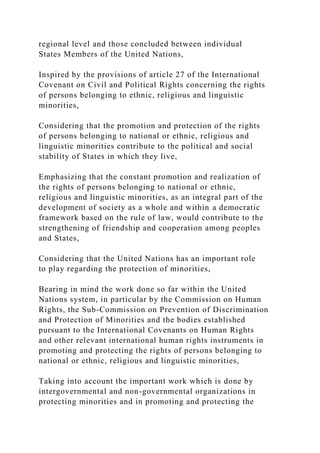
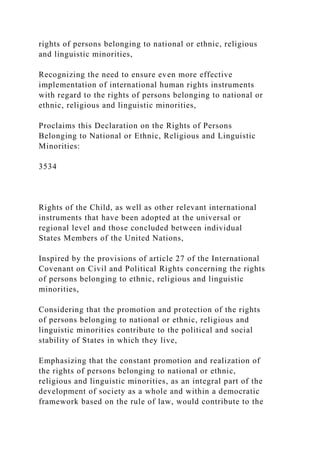
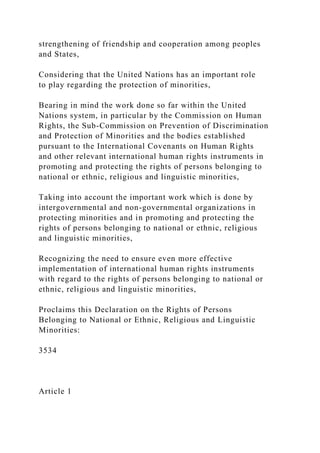
UN Declaration on the Rights of Persons belonging to National
or Ethnic, Religious and Linguistic Minorities
Rights of minorities (art. 27) # Rights of self-determination
(Article 1 of the ICCPR).
Opens the protection to the so-called ‘new minorities’.
Encourages and promotes positive measures
“A State party is under an obligation to ensure that the
existence and the exercise of [the rights guaranteed by this
provision] are protected against their denial or
violation.”Measures aimed at correcting conditions which
prevent or impair the enjoyment of the rights guaranteed under
article 27, constitute a legitimate differentiation Also see
ICERD General Recommendation 32 (2009)
Human Rights Committee
General Comment 23
* Human Rights Committee case law Sandra Lovelace v.
Canada (1977)
HRC and ICERD State reports
UN Bodies on Minority rights:
- Working Group on Minorities
Forum on Minorities
Independent Expert on Minorities
Monitoring of UN minority rights
Free choice to belong to a minority or not (art. 2); Equality
before the law and equal protection of the law (art. 4)- any
discrimination prohibited; Special measures to achieve full and
effective equality and to promote their culture; prohibition of
assimilation; Spirit of tolerance and intercultural violence- no
threat of hostility and violence- mutual understanding;
freedom of peaceful assembly, association, expression, thought,
conscience and religion Right of manifestation of religion and
establishment of religious establishments;Right to language,
minority education (and establishments)Right to effective
participation
Framework Convention for the Protection of National
Minorities (FCNM)
Enquiring the state’s choice of minorities discusses other
minorities in art. 6 gentle but firm discussion
UK Report: Hate speech Discrimination and prejudices against
specific parts of the populationGypsies and travellersNeed to
protect more minority languages
Advisory Committee to the FCNM
CHARTER OF THE UNITED NATIONS
AND
STATUTE OF THE
INTERNATIONAL COURT OF JUSTICE
SAN FRANCISCO • 1945
CHARTER OF THE UNITED NATIONS
WE THE PEOPLES OF THE UNITED NATIONS
DETERMINED
to save succeeding generations from the scourge of war, which
twice in our life-
time has brought untold sorrow to mankind, and
to reaffirm faith in fundamental human rights, in the dignity and
worth of the
human person, in the equal rights of men and women and of
nations large and
small, and
to establish conditions under which justice and respect for the
obligations arising
from treaties and other sources of international law can be
maintained, and
to promote social progress and better standards of life in larger
freedom,
AND FOR THESE ENDS
to practice tolerance and live together in peace with one another
as good
neighbors, and
to unite our strength to maintain international peace and
security, and
to ensure, by the acceptance of principles and the institution of
methods, that
armed force shall not be used, save in the common interest, and
to employ international machinery for the promotion of the
economic and social
advancement of all peoples,
HAVE RESOLVED TO COMBINE OUR EFFORTS
TO ACCOMPLISH THESE AIMS.
Accordingly, our respective Governments, through
representatives assembled in
the city of San Francisco, who have exhibited their full powers
found to be in good
and due form, have agreed to the present Charter of the United
Nations and do
hereby establish an international organization to be known as
the United Nations.
CHAPTER I
PURPOSES AND PRINCIPLES
Article 1
The^Purposes of the United Nations are:
1. To maintain international peace and se-
curity, and to that end: to take effective collec-
tive measures for the prevention and removal of
threats to the peace, and for the suppression of
acts of aggression or other breaches of the peace,
and to bring about by peaceful means, and in con-
formity with the principles of justice and inter-
national law, adjustment or settlement of inter-
national disputes or situations which might lead
to a breach of the peace;
2. To develop friendly relations among nations
based on respect for the principle of equal rights
and self-determination of peoples, and to take
other appropriate measures to strengthen univer-
sal peace;
3. To achieve international cooperation in
solving international problems of an economic,
social, cultural, or humanitarian character, and in
promoting and encouraging respect for human
rights and for fundamental freedoms for all with-
out distinction as to race, sex, language, or re-
ligion; and
4. To be a center for harmonizing the actions
of nations in the attainment of these common ends.
Article 2
The Organization and its Members, in pursuit
of the Purposes stated in Article 1, shall act in
accordance with the following Principles.
1. The Organization is based on the principle
of the sovereign equality of all its Members.
2. All Members, in order to ensure to all of
them the rights and benefits resulting from mem-
bership, shall fulfil in good faith the obligations
assumed by them in accordance with the present
Charter.
3. All Members shall settle their international
disputes by peaceful means in such a manner that
international peace and security, and justice, are
not endangered.
4. All Members shall refrain in their interna-
tional relations from the threat or use of force
against the territorial integrity or political inde-
pendence of any state, or in any other manner
inconsistent with the Purposes of the United
Nations.
5. All Members shall give the United Nations
every assistance in any action it takes in accord-
ance with the present Charter, and shall refrain
from giving assistance to any state against which
the United Nations is taking preventive or enforce-
ment action.
6. The Organization shall ensure that states
which are not Members of the United Nations act
in accordance with these Principles so far as may
be necessary for the maintenance of international
peace and security.
7. Nothing contained in the present Charter
shall authorize the United Nations to intervene in
matters which are essentially within the domestic
jurisdiction of any state or shall require the Mem-
bers to submit such matters to settlement under
the present Charter; but this principle shall not
prejudice the application of enforcement meas-
ures under Chapter VII.
CHAPTER II
MEMBERSHIP
Article 3
The original Members of the United Nations
shall be the states which, having participated in
the United Nations Conference on International
Organization at San Francisco, or having previ-
ously signed the Declaration by United Nations
of January 1,1942, sign the present Charter and
ratify it in accordance with Article 110.
Article 4
1. Membership in the United Nations is open
to all other peace-loving states which accept the
obligations contained in the present Charter and,
in the judgment of the Organization, are able and
willing to carry out these obligations.
2. The admission of any such state to mem-
bership in the United Nations will be effected by a
decision of the General Assembly upon the recom-
mendation of the Security Council.
Article 5 /
A Member of the United Nations against which
preventive or enforcement action has been taken
by the Security Council may be suspended from
the exercise of the rights and privileges of mem-
bership by the General Assembly upon the recom-
mendation of the Security Council. The exercise
of these rights and privileges may be restored by
the Security Council.
Article 6
A Member of the United Nations which has
persistently violated the Principles contained in
the present Charter may be expelled from the
Organization by the General Assembly upon the
recommendation of the Security Council.
CHAPTER III
ORGANS
Article 7
1. There are established as the principal or-
gans of the United Nations: a General Assem-
bly, a Security Council, an Economic and Social
Council, a Trusteeship Council, an International
Court of Justice, and a Secretariat.
2. Such subsidiary organs as may be found
necessary may be established in accordance with
the present Charter.
Article 8
The United Nations shall place no restrictions
on the eligibility of men and women to participate
in any capacity and under conditions of equality
in-its principal and subsidiary organs.
CHAPTER IV
THE GENERAL ASSEMBLY
Composition
Article 9
1. The General Assembly shall consist of all
the Members of the United Nations.
2. Each Member shall have not more than five
representatives in the General Assembly.
Functions and Powers
Article 10
The General Assembly may discuss any ques-
tions or any matters within the scope of the present
Charter or relating to the powers and functions of
any organs provided for in the present Charter,
and, except as provided in Article 12, may make
recommendations to the Members of the United
Nations or to the Security Council or to both on
any such questions or matters.
Article 11
1. The General Assembly may consider the
general principles of cooperation in the mainte-
nance of international peace and security, includ-
ing the principles governing disarmament and the
regulation of armaments, and may make recom-
mendations with regard to such principles to the
Members or to the Security Council or to both.
2. The General Assembly may discuss any
questions relating to the maintenance of inter-
national peace and security brought before it by
any Member of the United Nations, or by the
Security Council, or by a state which is not a
Member of the United Nations in accordance with
Article 35, paragraph 2, and, except as provided
in Article 12, may make recommendations with
regard to any such questions to the state or states
concerned or to the Security Council or to both.
Any such question on which action is necessary
shall be referred to the Security Council by the
General Assembly either before or after dis-
cussion.
3. The General Assembly may call the atten-
tion of the Security Council to situations which
are likely to endanger international peace and
security.
4. The powers of the General Assembly set
forth in this Article shall not limit the general
scope of Article 10.
Article 12
1. While the Security Council is exercising in
respect of any dispute or situation the functions
assigned to it in the present Charter, the General
Assembly shall not make any recommendation
with regard to that dispute or situation unless the
Security Council so requests.
2. The Secretary-General, with the consent of
the Security Council, shall notify the General
Assembly at each session of any matters relative
to the maintenance of international peace and
security which are being dealt with by the Security
Council and shall similarly notify the General
Assembly, or the Members of the United Nations
if the General Assembly is not in session, immedi-
ately the Security Council ceases to deal with such
matters.
Article 13
1. The General Assembly shall initiate studies
and make recommendations for the purpose of :
a. promoting international cooperation in
the political field and encouraging the progres-
sive development of international law and its
codification;
b. promoting international cooperation in
the economic, social, cultural, educational, and
health fields, and assisting in the realization of
human rights and fundamental freedoms for
all without distinction as to race, sex, language,
or religion.
2. The further responsibilities, functions, and
powers of the General Assembly with respect to
matters mentioned in paragraph l ( b ) above are
set forth in Chapters IX and X.
Article 14
Subject to the provisions of Article 12, the
General Assembly may recommend measures for
the peaceful adjustment of any situation, regard-
less of origin, which it deems likely to impair the
general welfare or friendly relations among na-
tions, including situations resulting from a viola-
tion of the provisions of the present Charter setting
forth the Purposes and Principles of the United
Nations.
Article 15
1. The General Assembly shall receive and
consider annual and special reports from the Se-
curity Council; these reports shall include an
account of the measures that the Security Council
has decided upon or taken to maintain interna-
tional peace and security.
2. The General Assembly shall receive and
consider reports from the other organs of the
United Nations.
Article 16
The General Assembly shall perform such
functions with respect to the international trus-
teeship system as are assigned to it under Chap-
ters XII and XIII, including the approval of the
trusteeship agreements for areas not designated
as strategic.
Article 17
1. The General Assembly shall consider and
approve the budget of the Organization.
2. The expenses of the Organization shall be
borne by the Members as apportioned by the
General Assembly.
3. The General Assembly shall consider and
approve any financial and budgetary arrange-
ments with specialized agencies referred to in
Article 57 and shall examine the administra-
tive budgets of such specialized agencies with a
view to making recommendations to the agencies
concerned.
Voting
Article 18
1. Each member of the General Assembly
shall have one vote.
2. Decisions of the General Assembly on im-
portant questions shall be made by a two-thirds
majority of the members present and voting.
These questions shall include: recommendations
with respect to the maintenance of international
peace and security, the election of the non-perma-
nent members of the Security Council, the elec-
tion of the members of the Economic and Social
Council, the election of members of the Trustee-
ship Council in accordance with paragraph l ( c )
of Article 86, the admission of new Members to
the United Nations, the suspension of the rights
and privileges of membership, the expulsion of
Members, questions relating to the operation of
the trusteeship system, and budgetary questions.
3. Decisions on other questions, including the
determination of additional categories of ques-
tions to be decided by a two-thirds majority, shall
be made by a majority of the members present
and voting.
Article 19
A Member of the United Nations which is in
arrears in the payment of its financial contribu-
tions to the Organization shall have no vote in
the General Assembly if the amount of its arrears
equals or exceeds the amount of the contributions
due from it for the preceding two full years. The
General Assembly may, nevertheless, permit such
a Member to vote if it is satisfied that the failure
to pay is due to conditions beyond the control of
the Member.
Procedure
Article 20
The General Assembly shall meet in regular
annual sessions and in such special sessions as
occasion may require. Special sessions shall be
convoked by the Secretary-General at the request
of the Security Council or of a majority of the
Members of the United Nations.
Article 21
The General Assembly shall adopt its own rules
of procedure. It shall elect its President for each
session.
Article 22
The General Assembly may establish such
subsidiary organs as it deems necessary for the
performance of its functions.
CHAPTER V
THE SECURITY COUNCIL
Composition
Article 23
1. The Security Council shall consist of eleven
Members of the United Nations. The Republic
of China, France, the Union of Soviet Socialist
Republics, the United Kingdom of Great Britain
and Northern Ireland, and the United States of
America shall be permanent members of the
Security Council. The General Assembly shall
elect six other Members of the United Nations to
be non-permanent members of the Security Coun-
cil, due regard being specially paid, in the first
instance to the contribution of Members of the
United Nations to the maintenance of interna-
tional peace and security and to the other pur-
poses of the Organization, and also to equitable
geographical distribution.
2. The non-permanent members of the Se-
curity Council shall be elected for a term of two
years. In the first election of the non-permanent
members, however, three shall be chosen for a
term of one year. A retiring member shall not be
eligible for immediate re-election.
3. Each member of the Security Council shall
have one representative.
Functions and Powers
Article 24
1. In order to ensure prompt and effective
action by the United Nations, its Members confer
on the Security Council primary responsibility
for the maintenance of international peace and
security, and agree that in carrying out its duties
under this responsibility the Security Council acts
on their behalf.
2. In discharging these duties the Security
Council shall act in accordance with the Purposes
and Principles of the United Nations. The specific
powers granted to the Security Council for the
discharge of these duties are laid down in Chapters
VI, VII, VIII, and XII.
3. The Security Council shall submit annual
and, when necessary, special reports to the Gen-
eral Assembly for its consideration.
Article 25
The Members of the United Nations agree to
accept and carry out the decisions of the Security
Council in accordance with the present Charter.
Article 26
In order to promote the establishment and
maintenance of international peace and security
with the least diversion for armaments of the
world's human and economic resources, the Se-
curity Council shall be responsible for formulat-
ing, with the assistance of the Military Staff Com-
mittee referred to in Article 47, plans to be sub-
mitted to the Members of the United Nations for
the establishment of a system for the regulation
"of armaments.
Voting
Article 27
1. Each member of the Security Council shall
have one vote.
2. Decisions of the Security Council on pro-
cedural matters shall be made by an affirmative
vote of seven members.
3. Decisions of the Security Council on all
other matters shall be made by an affirmative vote
of seven members including the concurring votes
of the permanent members ; provided that, in deci-
sions under Chapter VI, and under paragraph 3
of Article 52, a party to a dispute shall abstain
from voting.
Procedure
Article
1. The Security Council shall be so organized
as to be able to function continuously. Each
member of the Security Council shall for this pur-
pose be represented at all times at the seat of the
Organization.
2. The Security Council shall hold periodic
meetings at which each of its members may, if it
so desires, be represented by a member of the
government or by some other specially designated
representative.
3 . The Security Council may hold meetings at
such places other than the seat of the Organization
as in its judgment will best facilitate its work.
Article 29
The Security Council may establish such sub-
sidiary organs as it deems necessary for the per-
formance of its functions.
Article 30
The Security Council shall adopt its own rules
of procedure, including the method of selecting
its President.
Article 31
Any Member of the United Nations which is not
a member of the Security Council may participate,
without vote, in the discussion of any question
brought before the Security Council whenever the
latter considers that the interests of that Member
are specially affected.
Article 32
Any Member of the United Nations which is
not a member of the Security Council or any state
which is not a Member of the United Nations, if
it is a party to a dispute under consideration by
the Security Council, shall be invited to partici-
pate, without vote, in the discussion relating to
the dispute. The Security Council shall lay down
such conditions as it deems just for the participa-
tion, of a state which is not a Member of the United
Nations.
CHAPTER VI
PACIFIC SETTLEMENT OF DISPUTES
Article 33
1. The parties to any dispute, the continuance
of which is likely to endanger the maintenance of
international peace and security, shall, first of all,
seek a solution by negotiation, enquiry, mediation,
conciliation, arbitration, judicial settlement, re-
sort to regional agencies or arrangements, or other
peaceful means of their own choice.
2. The Security Council shall, when it deems
necessary, call upon the parties to settle their
dispute by such means.
Article 34
The Security Council may investigate any dis-
pute, or any situation which might lead to inter-
national friction or give rise to a dispute, in order
to determine whether the continuance of the dis-
pute or situation is likely to endanger the main-
tenance of international peace and security.
Article 35
1. Any Member of the United Nations may
bring any dispute, or any situation of the nature
referred to in Article 34, to the attention of the
Security Council or of the General Assembly.
2. A state which is not a Member of the United
Nations may bring to the attention of the Security
Council or of the General Assembly any dispute
to which it is a party if it accepts in advance, for
the purposes of the dispute, the obligations of
pacific settlement provided in the present Charter.
3. The proceedings of the General Assembly
in respect of matters brought to its attention under
this Article will be subject to the provisions of
Articles 11 and 12.
Article 36
1. The Security Council may, at any stage of
a dispute of the nature referred to in Article 33
or of a situation of like nature, recommend appro-
priate procedures or methods of adjustment.
2. The Security Council should take into con-
sideration any procedures for the settlement of
the dispute which have already been adopted by
the parties.
3. In making recommendations under this Ar-
ticle the Security Council should also take into
consideration that legal disputes should as a gen-
eral rule be referred by the parties to the Interna-
tional Court of Justice in accordance with the
provisions of the Statute of the Court.
Article 37
1. Should the parties to a dispute of the nature
referred to in Article 33 fail to settle it by the
means indicated in that Article, they shall refer it
to the Security Council.
8
2. If the Security Council deems that the con-
tinuance of the dispute is in fact likely to endanger
the maintenance of international peace and se-
curity, it shall decide whether to take action under
Article 36 or to recommend such terms of settle-
ment as it may consider appropriate.
Article 38
Without prejudice to the provisions of Articles
33 to 37, the Security Council may, if all the par-
ties to any dispute so request, make recommenda-
tions to the parties with a view to a pacific settle-
ment of the dispute.
CHAPTER W
ACTION WITH RESPECT TO THREATS TO
THE PEACE, BREACHES OF THE PEACE,
AND ACTS OF AGGRESSION
Article 39
The Security Council shall determine the exist-
ence of any threat to the peace, breach of the
peace, or act of aggression and shall make recom-
mendations, or decide what measures shall be
taken in accordance with Articles 41 and 42, to
maintain or restore international peace and se-
curity.
Article 40
In order to prevent an aggravation of the situa-
tion, the Security Council may, before making the
recommendations or deciding upon the measures
provided for in Article 39, call upon the parties
concerned to comply with such provisional meas-
ures as it deems necessary or desirable. Such pro-
visional measures shall be without prejudice to the
rights, claims, or position of the parties concerned.
The Security Council shall duly take account of
failure to comply with such provisional measures.
Article 41
The Security Council may decide what meas-
ures not involving the use of armed force are to be
employed to give effect to its decisions, and it may
call upon the Members of the United Nations to
apply such measures. These may include com-
plete or partial interruption of economic relations
and of rail, sea, air, postal, telegraphic, radio,
and other means of communication, and the sev-
erance of diplomatic relations.
Article 42
Should the Security Council consider that meas-
ures provided for in Article 41 would be inade-
quate or have proved to be inadequate, it may take
such action by air, sea, or land forces as may be
necessary to maintain or restore international
peace and security. Such action may include
demonstrations, blockade, and other operations
by air, sea, or land forces of Members of the United
Nations.
Article 43
1. All Members of the United Nations, in order
to contribute to the maintenance of international
peace and security, undertake to make available
to the Security Council, on its call and in accord-
ance with a special agreement or agreements,
armed forces, assistance, and facilities, including
rights of passage, necessary for the purpose of
maintaining international peace and security.
2. Such agreement or agreements shall govern
the numbers and types of forces, their degree of
readiness and general location, and the nature of
the facilities and assistance to be provided.
3. The agreement or agreements shall be ne-
gotiated as soon as possible on the initiative of the
Security Council. They shall be concluded be-
tween the Security Council and Members or be-
tween the Security Council and groups of Members
and shall be subject to ratification by the signatory
states in accordance with their respective constitu-
tional processes. .
Article 44
When the Security Council has decided to use
force it shall, before calling upon a Member not
represented on it to provide armed forces in ful-
filhnent of the obligations assumed under Article
43, invite that Member, if the Member so desires,
to participate in the decisions of the Security
Council concerning the employment of contin-
gents of that Member's armed forces.
Article 45
In order to enable the United Nations to take
urgent military measures, Members shall hold
immediately available national air-force contin-
gents for combined international enforcement ac-
tion. The strength and degree of readiness of these
contingents and plans for their combined action
shall be determined, within the limits laid down in
the special agreement or agreements referred to
in Article 43, by the Security Council with the
assistance of the Military Staff Committee.
Article 46
Plans for the application of armed force shall
be made by the Security Council with the assist-
ance of the Military Staff Committee.
Article 47
1. There shall be established a Military Staff
Committee to advise and assist the Security
Council on all questions relating to the Security
Council's military requirements for the mainte-
nance of international peace and security, the em-
ployment and command of forces placed at its
disposal, the regulation of armaments, and pos-
sible disarmament.
2. The Military Staff Committee shall consist
of the Chiefs of Staff of the permanent members
of the Security Council or their representatives.
Any Member of the United Nations not perma-
nently represented on the Committee shall be in-
vited by the Committee to be associated with it
when the efficient discharge of the Committee's
responsibilities requires the participation of that
Member in its work.
3. The Military Staff Committee shall be re-
sponsible under the Security Council for the
strategic direction of any armed forces placed at
the disposal of the Security Council. Questions
relating to the command of such forces shall be
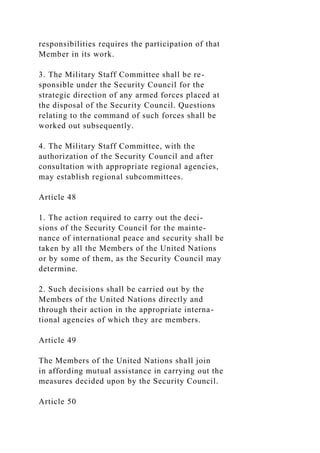
worked out subsequently.
4. The Military Staff Committee, with the
authorization of the Security Council and after
consultation with appropriate regional agencies,
may establish regional subcommittees.
Article 48
1. The action required to carry out the deci-
sions of the Security Council for the mainte-
nance of international peace and security shall be
taken by all the Members of the United Nations
or by some of them, as the Security Council may
determine.
2. Such decisions shall be carried out by the
Members of the United Nations directly and
through their action in the appropriate interna-
tional agencies of which they are members.
Article 49
The Members of the United Nations shall join
in affording mutual assistance in carrying out the
measures decided upon by the Security Council.
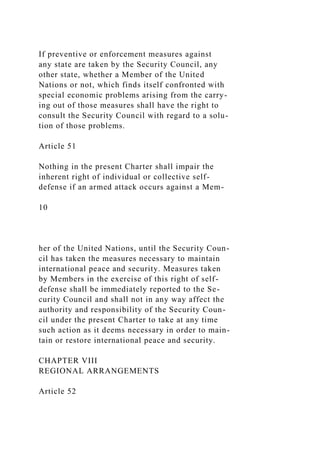
Article 50
If preventive or enforcement measures against
any state are taken by the Security Council, any
other state, whether a Member of the United
Nations or not, which finds itself confronted with
special economic problems arising from the carry-
ing out of those measures shall have the right to
consult the Security Council with regard to a solu-
tion of those problems.
Article 51
Nothing in the present Charter shall impair the
inherent right of individual or collective self-
defense if an armed attack occurs against a Mem-
10
her of the United Nations, until the Security Coun-
cil has taken the measures necessary to maintain
international peace and security. Measures taken
by Members in the exercise of this right of self-
defense shall be immediately reported to the Se-
curity Council and shall not in any way affect the
authority and responsibility of the Security Coun-
cil under the present Charter to take at any time
such action as it deems necessary in order to main-
tain or restore international peace and security.
CHAPTER VIII
REGIONAL ARRANGEMENTS
Article 52
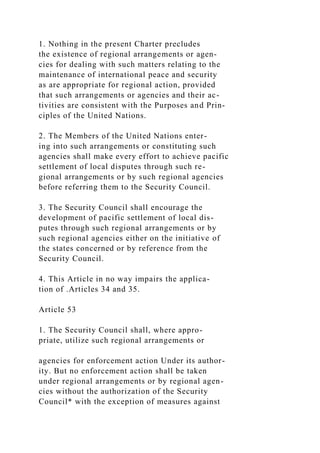
1. Nothing in the present Charter precludes
the existence of regional arrangements or agen-
cies for dealing with such matters relating to the
maintenance of international peace and security
as are appropriate for regional action, provided
that such arrangements or agencies and their ac-
tivities are consistent with the Purposes and Prin-
ciples of the United Nations.
2. The Members of the United Nations enter-
ing into such arrangements or constituting such
agencies shall make every effort to achieve pacific
settlement of local disputes through such re-
gional arrangements or by such regional agencies
before referring them to the Security Council.
3. The Security Council shall encourage the
development of pacific settlement of local dis-
putes through such regional arrangements or by
such regional agencies either on the initiative of
the states concerned or by reference from the
Security Council.
4. This Article in no way impairs the applica-
tion of .Articles 34 and 35.
Article 53
1. The Security Council shall, where appro-
priate, utilize such regional arrangements or
agencies for enforcement action Under its author-
ity. But no enforcement action shall be taken
under regional arrangements or by regional agen-
cies without the authorization of the Security
Council* with the exception of measures against
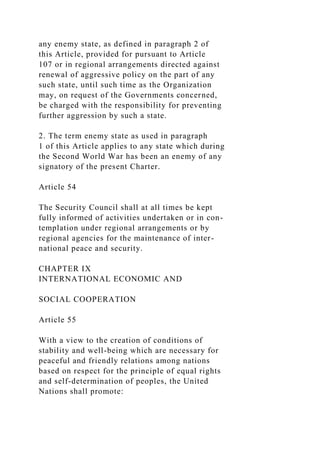
any enemy state, as defined in paragraph 2 of
this Article, provided for pursuant to Article
107 or in regional arrangements directed against
renewal of aggressive policy on the part of any
such state, until such time as the Organization
may, on request of the Governments concerned,
be charged with the responsibility for preventing
further aggression by such a state.
2. The term enemy state as used in paragraph
1 of this Article applies to any state which during
the Second World War has been an enemy of any
signatory of the present Charter.
Article 54
The Security Council shall at all times be kept
fully informed of activities undertaken or in con-
templation under regional arrangements or by
regional agencies for the maintenance of inter-
national peace and security.
CHAPTER IX
INTERNATIONAL ECONOMIC AND
SOCIAL COOPERATION
Article 55
With a view to the creation of conditions of
stability and well-being which are necessary for
peaceful and friendly relations among nations
based on respect for the principle of equal rights
and self-determination of peoples, the United
Nations shall promote:
a. higher standards of living, full employ-
ment, and conditions of economic and social
progress and development;
b. solutions of international economic, so-
cial, health, and related problems; and inter-
11
national cultural and educational cooperation;
and
c. universal respect for, and observance of,
human rights and fundamental freedoms for
all without distinction as to race, sex, language,
or religion.
Article 56
All Members pledge themselves to take joint
and separate action in cooperation with the Or-
ganization for the achievement of the purposes set
forth in Article 55.
Article 57
1. The various specialized agencies, estab-
lished by intergovernmental agreement and hav-
ing wide international responsibilities, as defined
in their basic instruments, in economic, social,
cultural, educational, health, and related fields,
shall be brought into relationship with the United
Nations in accordance with the provisions of
Article 63.
2. Such agencies thus brought into relation-
ship with the United Nations are hereinafter re-
ferred to as specialized agencies.
Article 58
The Organization shall make recommendations
for the coordination of the policies and activities
of the specialized agencies.
Article 59
The Organization shall, where appropriate,
initiate negotiations among the states concerned
for the creation of any new specialized agencies
required for the accomplishment of the purposes
set forth in Article 55.
Article 60
Responsibility for the discharge of the func-
tions of the Organization set forth in this Chap-
ter shall be vested in the General Assembly and,
under the authority of the General Assembly, in
12
the Economic and Social Council, which shall
have for this purpose the powers set forth in
Chapter X.
CHAPTER X
THE ECONOMIC AND SOCIAL COUNCIL
Composition
Article 61
1. The Economic and Social Council shall con-
sist of eighteen Members of the United Nations
elected by the General Assembly.
2. Subject to the provisions of paragraph 3,
six members of the Economic and Social Council
shall be elected each year for a term of three years.
A retiring member shall be eligible for immediate
re-election.
3. At the first election, eighteen members of
the Economic and Social Council shall be chosen.
The term of office of six members so chosen shall
expire at the end of one year, and of six other
members at the end of two years, in accordance
with arrangements made by the General Assembly.
4. Each member of the Economic and Social
Council shall have one representative.
Functions and Powers
Article 62
1. The Economic and Social Council may make
or initiate studies and reports with respect to inter-
national economic, social, cultural, educational,
health, and related matters and may make recom-
mendations with respect to any such matters to the
General Assembly, to the Members of the United
Nations, and to the specialized agencies concerned.
2. It may make recommendations for the pur-
pose of promoting respect for, and observance of,
human rights and fundamental freedoms for all.
3. It may prepare draft conventions for sub-
mission to the General Assembly, with respect to
matters falling within its competence.
4. It may call, in accordance with the rules
prescribed by the United Nations, international
conferences on matters falling within its com-
petence.
Article 63
1. The Economic and Social Council may en-
ter into agreements with any of the agencies re-
ferred to in Article 57, defining the terms on
which the agency concerned shall be brought into
relationship with the United Nations. Such agree-
ments shall be subject to approval by the Gen-
eral Assembly.
2. It may coordinate the activities of the spe-
cialized agencies through consultation with and
recommendations to such agencies and through
recommendations to the General Assembly and to
the Members of the United Nations.
Article 64
1. The Economic and Social Council may
take appropriate steps to obtain regular reports
from the specialized agencies. It may make ar-
rangements with the Members of the United
Nations and with the specialized agencies to obtain
reports on the steps taken to give effect to its own
recommendations and to recommendations on
matters falling within its competence made by
the General Assembly.
2. It may communicate its observations on
these reports to the General Assembly.
Article 65
The Economic and Social Council may furnish
information to the Security Council and shall
assist the Security Council upon its request.
Article 66
1. The Economic and Social Council shall per-
form such functions as fall within its competence
in connection with the carrying out of the recom-
mendations of the General Assembly.
2. It may, with the approval of the General
Assembly, perform services at the request of
Members of the United Nations and at the request
of specialized agencies.
3. It shall perform such other functions as are
specified elsewhere in the present Charter or as
may be assigned to it by the General Assembly.
Voting
Article 67
1. Each member of the Economic and Social
Council shall have one vote.
2. Decisions of the Economic and Social Coun-
cil shall be made by a majority of the members
present and voting.
Procedure
Article 68
The Economic and Social Council shall set up
commissions in economic and social fields and for
the promotion of human rights, and such other
commissions as may be required for the perform-
ance of its functions.
Article 69
The Economic and Social Council shall invite
any Member of the United Nations to participate,
without vote, in its deliberations on any matter
of particular concern to that Member.
Article 70
The Economic and Social Council may make
arrangements for representatives of the special-
ized agencies to participate, without vote, in its
deliberations and in those of the commissions
established by it, and for its representatives to
participate in the deliberations of the specialized
agencies.
Article 71
The Economic and Social Council may make
suitable arrangements for consultation with non-
governmental organizations which are concerned
with matters within its competence. Such arrange-
13
ments may be made with international organiza-
tions and, where appropriate, with national or-
ganizations after consultation with the Member
of the United Nations concerned.
Article 72
1. The Economic and Social Council shall
adopt its own rules of procedure, including the
method of selecting its President.
2. The Economic and Social Council shall meet
as required in accordance with its rules, which
shall include provision for the convening of meet-
ings on the request of a majority of its members.
CHAPTER XI
DECLARATION REGARDING
NON-SELF-GOVERNING TERRITORIES
Article 73
Members of the United Nations which have or
assume responsibilities for the administration of
territories whose peoples have not yet attained
a full measure of self-government recognize the
principle that the interests of the inhabitants of
these territories are paramount, and accept as a
sacred trust the obligation to promote to the ut-
most, within the system of international peace and
security established by the present Charter, the
well-being of the inhabitants of these territories,
and, to this end:
a. to ensure, with due respect for the cul-
ture of the peoples concerned, their political,
economic, social, and educational advance-
ment, their just treatment, and their protection
against abuses;
b. to develop self-government, to take due
account of the political aspirations of the
peoples, and to assist them in the progressive
development of their free political institutions,
according to the particular circumstances of
each territory and its peoples and their varying
i stages of advancement;
c. to further international peace and se-
curity;
d. to promote constructive measures of de-
velopment, to encourage research, and to co-
operate with one another and, when and where
appropriate, with specialized international bod-
ies with a view to the practical achievement of
the social, economic, and scientific purposes
set forth in this Article; and
e. to transmit regularly to the Secretary-
General for information purposes, subject to
such limitation as security and constitutional
considerations may require, statistical and other
information of a technical nature relating to
economic, social, and educational conditions in
the territories for which they are respectively
responsible other than those territories to which
Chapters XII and XIII apply.
Article 74
Members of the United Nations also agree that
their policy in respect of the territories to which
this Chapter applies, no less than in respect of their
metropolitan areas, must be based on the general
principle of good-neighborliness, due account be-
ing taken of the interests and well-being of the rest
of the world, in social, economic, and commercial
matters.
CHAPTER XII
INTERNATIONAL TRUSTEESHIP SYSTEM
Article 75
The United Nations shall establish under its
authority an international trusteeship system for
the administration and supervision of such terri-
tories as may be placed thereunder by subsequent
individual agreements. These territories are
hereinafter referred to as trust territories.
Article 76
The basic objectives of the trusteeship system,
14
in accordance with the Purposes of the United
Nations laid down in Article 1 of the present Char-
ter, shall be:
a. to further international peace and se-
curity;
b. to promote the political, economic, social,
and educational advancement of the inhabitants
of the trust territories, and their progressive
development towards self-government or inde-
pendence as may be appropriate to the par-
ticular circumstances of each territory and its
peoples and the freely expressed wishes of the
peoples concerned, and as may be provided by
the terms of each trusteeship agreement;
c. to encourage respect for human rights
and for fundamental freedoms for all without
distinction as to race, sex, language, or religion,
and to encourage recognition of the interde-
pendence of the peoples of the world; and
d. to ensure equal treatment in social, eco-
nomic, and commercial matters for all Members
of the United Nations and their nationals, and
also equal treatment for the latter in the ad-
ministration of justice, without prejudice to the
attainment of the foregoing objectives and sub-
ject to the provisions of Article 80.
Article 77
1. The trusteeship system shall apply to
such territories in the following categories as may
be placed thereunder by means of trusteeship
agreements:
a. territories now held under mandate;
b. territories which may be detached from
enemy states as a result of the Second World
War; and
c. territories voluntarily placed under the
system by states responsible for their admin-
istration.
2. It will be a matter for subsequent agreement
as to which territories in the foregoing categories
will be brought under the trusteeship system and
upon what terms.
Article 78
The trusteeship system shall not apply to terri-
tories which have become Members of the United
Nations, relationship among which shall be based
on respect for the principle of sovereign equality.
Article 79
The terms of trusteeship for each territory to
be placed under the trusteeship system, including
any alteration or amendment, shall be agreed upon
by the states directly concerned, including the
mandatory power in the case of territories held
under mandate by a Member of the United Na-
tions, and shall be approved as provided for in
Articles 83 and 85.
Article 80
1. Except as may be agreed upon in individual
trusteeship agreements, made under Articles 77,
79, and 8 1 , placing each territory under the trus-
teeship system, and until such agreements have
been concluded, nothing in this Chapter shall be
construed in or of itself to alter in any manner
the rights whatsoever of any states or any peoples
or the terms of existing international instruments
to which Members of the United Nations may re-
spectively be parties.
2. Paragraph 1 of this Article shall not be in-
terpreted as giving grounds for delay or postpone-
ment of the negotiation and conclusion of agree-
ments for placing mandated and other territories
under the trusteeship system as provided for in
Article 77.
Article 81
The trusteeship agreement shall in each case
include the terms under which the trust territory
will be administered and designate the authority
which will exercise the administration of the trust
territory. Such authority, hereinafter called the
15
administering authority, may be one or more
states or the Organization itself.
Article 82 ,
There may be designated, in any trusteeship
agreement, a strategic area or areas which may
include part or all of the trust territory to which
the agreement applies, without prejudice to any
special agreement or agreements made under
Article 43.
Article 83
1. All functions of the United Nations relating
to strategic areas, including the approval of the
terms of the trusteeship agreements and of their
alteration or amendment, shall be exercised by the
Security Council.
2. The basic objectives set forth in Article 76
shall be applicable to the people of each strategic
area.
3. The Security Council shall, subject to the
provisions of the trusteeship agreements and with-
out prejudice to security considerations, avail
itself of the assistance of the Trusteeship Council
to perform those functions of the United Nations
under the trusteeship system relating to political,
economic, social, and educational matters in the
strategic areas.
Article 84
It shall be the duty of the administering author-
ity to ensure that the trust territory shall play its
part in the maintenance of international peace and
security. To this end the administering authority
may make use of volunteer forces, facilities, and
assistance from the trust territory in carrying out
the obligations towards the Security Council un-
dertaken in this regard by the administering au-
thority, as well as for local defense and the main-
tenance of law and order within the trust territory.
Article 85
1. The functions of the United Nations with
regard to trusteeship agreements for all areas not
designated as strategic, including the approval of
the terms of the trusteeship agreements and of
their alteration or amendment, shall be exercised
by the General Assembly.
2. The Trusteeship Council, operating under
the authority of the General Assembly, shall assist
the General Assembly in carrying out these
functions.
CHAPTER XIII
THE TRUSTEESHIP COUNCIL
Composition
Article 86
1. The Trusteeship Council shall consist of
the following Members of the United Nations:
a. those Members administering trust ter-
ritories;
b. such of those Members mentioned by
name in Article 23 as are not administering
trust territories; and
c. as many other Members elected for three-
year terms by the General Assembly as may be
necessary to ensure that the total number of
members of the Trusteeship Council is equally
divided between those Members of the United
Nations which administer trust territories and
those which do not.
2. Each member of the Trusteeship Council
shall designate one specially qualified person to
represent it therein.
Functions and Powers
Article 87
The General Assembly and, under its author-
ity, the Trusteeship Council, in carrying out their
functions, may:
a. consider reports submitted by the admin-
istering authority;
16
b. accept petitions and examine them in
consultation with the administering authority;
c. provide for periodic visits to the respec-
tive trust territories at times agreed upon with
the administering authority; and
d. take these and other actions in conformity
with the terms of the trusteeship agreements.
Article 88
The Trusteeship Council shall formulate a
questionnaire on the political, economic, social,
and educational advancement of the inhabitants
of each trust territory, and the administering
authority for each trust territory within the com-
petence of the General Assembly shall make an
annual report to the General Assembly upon the
basis of such questionnaire.
Voting
Article 89
1. Each member of the Trusteeship Council
shall have one vote.
2. Decisions of the Trusteeship Council shall
be made by a majority of the members present and
voting.
Procedure
Article 90
1. The Trusteeship Council shall adopt its own
rules of procedure, including the method of select-
ing its President.
2. The Trusteeship Council shall meet as re-
quired in accordance with its rules, which shall
include provision for the convening of meetings
on the request of a majority of its members.
Article 91
The Trusteeship Council shall, when appropri-
ate, avail itself of the assistance of the Economic
and Social Council and of the specialized agencies
in regard to matters with which they are respec-
tively concerned.
CHAPTER XIV
THE INTERNATIONAL COURT
OF JUSTICE
Article 92
The International Court of Justice shall be the
principal judicial organ of the United Nations.
It shall function in accordance with the annexed
Statute, which is based upon the Statute of the
Permanent Court of International Justice and
forms an integral part of the present Charter.
Article 93
1. All Members of the United Nations are ipso
facto parties to the Statute of the International
Court of Justice.
2. A state which is not a Member of the United
Nations may become a party to the Statute of
the International Court of Justice on conditions
to be determined in each case by the General
Assembly upon the recommendation of the Secu-
rity Council.
Article 94
1. Each Member of the United Nations under-
takes to comply with the decision of the Inter-
national Court of Justice in any case to which it is
a party.
2. If any party to a case fails to perform the
obligations incumbent upon it under a judgment
rendered by the Court, the other party may have
recourse to the Security Council, which may, if it
deems necessary, make recommendations or de-
cide upon measures to be taken to give effect to
the judgment.
Article 95
Nothing in the present Charter shall prevent
Members of the United Nations from entrusting
the solution of their differences to other tribunals
by virtue of agreements already in existence or
which may be concluded in the future.
17
Article 96
1. The General Assembly or the Security
Council may request the International Court of
Justice to give an advisory opinion on any legal
question.
2. Other organs of the United Nations and
specialized agencies, which may at any time be
so authorized by the General Assembly, may also
request advisory opinions of the Court on legal
questions arising within the scope of their activ-
ities.
CHAPTER XV
THE SECRETARIAT
Article 97
The Secretariat shall comprise a Secretary-
General and such staff as the Organization may
require. The Secretary-General shall be ap-
pointed by the General Assembly upon the recom-
mendation of the Security Council. He shall be
the chief administrative officer of the Organization.
Article 98
The Secretary-General shall act in that capacity
in all meetings of the General Assembly, of the
Security Council, of the Economic and Social
Council, and of the Trusteeship Council, and shall
perform such other functions as are entrusted to
him by these organs. The Secretary-General shall
make an annual report to the General Assembly
on the work of the Organization.
Article 99
The Secretary-General may bring to the atten-
tion of the Security Council any matter which in
his opinion may threaten the maintenance of in-
ternational peace and security.
Article 100
1. In the performance of their duties the Secre-
18
tary-General and the staff shall not seek or receive
instructions from any government or from any
other authority external to the Organization.
They shall refrain from any action which might
reflect on their position as international officials
responsible only to the Organization.
2. Each Member of the United Nations under-
takes to respect the exclusively international
character of the responsibilities of the Secretary-
General and the staff and not to seek to influence
them in the discharge of their responsibilities.
Article 101
1. The staff shall be appointed by the Secre-
tary-General under regulations established by the
General Assembly.
2. Appropriate staffs shall be permanently
assigned to the Economic and Social Council, the
Trusteeship Council, and, as required, to other
organs of the United Nations. These staffs shall
form a part of the Secretariat.
3. The paramount consideration in the em-
ployment of the staff and in the determination of
the conditions of service shall be the necessity of
securing the highest standards of efficiency, com-
petence, and integrity. Due regard shall be paid
to the importance of recruiting the staff on as wide
a geographical basis as possible.
CHAPTER XVI
MISCELLANEOUS PROVISIONS
Article 102
1. Every treaty and every international agree-
ment entered into by any Member of the United
Nations after the present Charter comes into force
shall as soon as possible be registered with the
Secretariat and published by it.
2. No party to any such treaty or international
agreement which has not been registered in ac-
cordance with the provisions of paragraph 1 of
this Article may invoke that treaty or agreement
before any organ of the United Nations.
Article 103
In the event of a conflict between the obligations
of the Members of the United Nations under the
present Charter and their obligations under any
other international agreement, their obligations
under the present Charter shall prevail.
Article 104
The Organization shall enjoy in the territory of
each of its Members such legal capacity as may be
necessary for the exercise of its functions and the
fulfillment of its purposes.
Article 105
1. The Organization shall enjoy in the territory
of each of its Members such privileges and im-
munities as are necessary for the fulfillment of its
purposes.
2. Representatives of the Members of the
United Nations and officials of the Organization
shall similarly enjoy such privileges and immuni-
ties as are necessary for the independent exercise
of their functions in connection with the Organi-
zation.
3. The General Assembly may make recom-
mendations with a view to determining the details
of the application of paragraphs 1 and 2 of this
Airticle or may propose conventions to the Mem-
bers of the United Nations for this purpose.
CHAPTER XVH
TRANSITIONAL SECURITY
ARRANGEMENTS
Article 106
Pending the coming into force of such special
agreements referred to in Article 43 as in the
opinion of the Security Council enable it to begin
the exercise of its responsibilities under Article
42, the parties to the Four-Nation Declaration,
signed at Moscow, October 30,1943, and France,
shall, in accordance with the provisions of para-
graph 5 of that Declaration, consult with one an-
other and as occasion requires with other Members
of the United Nations with a view to such joint
action on behalf of the Organization as may be
necessary for the purpose of maintaining inter-
national peace and security.
Article 107
Nothing in the present Charter shall invalidate
or preclude action, in relation to any state which
during the Second World War has been an enemy
of any signatory to the present Charter, taken or
authorized as a result of that war by the Govern-
ments having responsibility for such action.
CHAPTER XVIII
AMENDMENTS
Article 108
Amendments to the present Charter shall come
into force for all Members of the United Nations
when they have been adopted by a vote of two
thirds of the members of the General Assembly
and ratified in accordance with their respective
constitutional processes by two thirds of the Mem-
bers of the United Nations, including all the per-
manent members of the Security Council.
Article 109
1. A General Conference of the Members of
the United Nations for the purpose of reviewing
the present Charter may be held at a date and
place to be fixed by a two-thirds vote of the mem-
bers of the General Assembly and by a vote of any
seven members of the Security Council. Each
Member of the United Nations shall have one vote
in the conference.
19
2. Any alteration of the present Charter rec-
ommended by a two-thirds vote of the conference
shall take effect when ratified in accordance with
their respective constitutional processes by two
thirds of the Members of the United Nations in-
cluding all the permanent members of the Security
Council. .
3. If such a conference has not been held be-
fore the tenth annual session of the General As-
sembly following the coming into force of the pres-
ent Charter, the proposal to call such a conference
shall be placed on the agenda of that session of the
General Assembly, and the conference shall be
held if so decided by a majority vote of the mem-
bers of the General Assembly and by a vote of any
seven members of the Security Council.
CHAPTER XIX
RATIFICATION AND SIGNATURE
Article 110
1. The present Charter shall be ratified by the
signatory states in accordance with their respec-
tive constitutional processes. /
2. The ratifications shall be deposited with the
Government of the United States of America,
which shall notify all the signatory states of each
deposit as well as the Secretary-General of the
Organization when he has been appointed.
3. The present Charter shall come into force
upon the deposit of ratifications by the Republic
of China, France, the Union of Soviet Socialist
Republics, the United Kingdom of Great Britain
and Northern Ireland, and the United States of
America, and by a majority of the other signatory
states. A protocol of the ratifications deposited
shall thereupon be drawn up by the Government
of the United States of America which shall com-
municate copies thereof to all the signatory states.
4. The states signatory to the present Charter
which ratify it after it has come into force will be-
come original Members of the United Nations on
the date of the deposit of their respective ratifi-
cations.
Article HI
The present Charter, of which the Chinese,
French, Russian, English, and Spanish texts are
equally authentic, shall remain deposited in the
archives of the Government of the United States
of America. Duly certified copies thereof shall be
transmitted by that Government to the Govern-
ments of the other signatory states.
IN FAITH WHEREOF the representatives of the
Governments of the United Nations have signed
the present Charter.
DONE at the city of San Francisco the twenty-
sixth day of June, one thousand nine hundred and
forty-five.
20
STATUTE OF THE INTERNATIONAL COURT OF JUSTICE
Article 1
INTERNATIONAL COURT OF JUSTICE estab-
lished by the Charter of the United Nations as
the principal judicial organ of the United Nations
shall be constituted and shall function in accord-
ance with the provisions of the present Statute.
CHAPTER I
ORGANIZATION OF THE COURT
Article 2
The Court shall be composed of a body of inde-
pendent judges, elected regardless of their nation-
ality from among persons of high moral character,
who possess the qualifications required in their re-
spective countries for appointment to the highest
judicial offices, or are jurisconsults of recognized
competence in international law.
Article 3
1. The Court shall consist of fifteen members,
no two of whom may be nationals of the same state.
2, A person who for the purposes of member-
ship in the Court could be regarded as a national
of more than one state shall be deemed to be a
national of the one in which he ordinarily exercises
civil and political rights.
Article 4
1. The members of the Court shall be elected
by the General Assembly and by the Security
Council from a list of persons nominated by the
national groups in the Permanent Court of Arbitra-
tion, in accordance with the following provisions.
2. In the case of Members of the United Na-
tions not represented in the Permanent Court of
Arbitration, candidates shall be nominated by
national groups appointed for this purpose by
their governments under the same conditions as
those prescribed for members of the Permanent
Courkof Arbitration by Article 44 of the Conven-
tion of The Hague of 1907 for the pacific settle-
ment of international disputes.
3. The conditions under which a state which
is a party to the present Statute but is not a Mem-
ber of the United Nations may participate in elect-
ing the members of the Court shall, in the absence
of a special agreement, be laid down by the Gen-
eral Assembly upon recommendation of the Se-
curity Council.
Article 5
1. At least three months before the date of the
election, the Secretary-General of the United
Nations shall address a written request to the
members of the Permanent Court of Arbitration
belonging to the states which are parties to the
present Statute, and to the members of the na-
tional groups appointed under Article 4, para-
graph 2, inviting them to undertake, within a given
time, by national groups, the nomination of per-
sons in a position to accept the duties of a member
of the Court.
2. No group may nominate more than four per-
sons, not more than two of whom shall be of their
own nationality. In no case may the number of
candidates nominated by a group be more than
double the number of seats to be filled.
Article 6
Before making these nominations, each national
group is recommended to consult its highest court
of justice, its legal faculties and schools of law, and
its national academies and national sections of in-
ternational academies devoted to the study of law.
Article 7
1. The Secretary-General shall prepare a list
21
in alphabetical order of all the persons thus nomi-
nated. Save as provided in Article 12, paragraph
2, these shall be the only persons eligible.
2. The Secretary-General shall submit this list
to the General Assembly and to the Security
Council.
Article 8
The General Assembly and the Security Coun-
cil shall proceed independently of one another to
elect the members of the Court.
Article 9
At every election, the electors shall bear in mind
not only that the persons to be elected should in-
dividually possess the qualifications required, but
also that in the body as a whole the representation
of the main forms of civilization and of the prin-
cipal legal systems of the world should be assured.
Article 10
1. Those candidates who obtain an absolute
majority of votes in the General Assembly and in
the Security Council shall be considered as elected.
2. Any vote of the Security Council, whether
for the election of judges or for the appointment
of members of the conference envisaged in Article
12, shall be taken without any distinction between
permanent and non-permanent members of the
Security Council.
3. In the event of more than one national of the
same state obtaining an absolute majority of the
votes both of the General Assembly and of the
Security Council, the eldest of these only shall be
considered as elected.
Article 11
If, after the first meeting held for the purpose
of the election, one or more seats remain to be
filled, a second and, if necessary, a third meeting
shall take place.
Article 12
1. If, after the third meeting, one or more seats
still remain unfilled, a joint conference consisting
of six members, three appointed by the General
Assembly and three by the Security Council, may
be formed at any time at the request of either the
General Assembly or the Security Council, for the
purpose of choosing by the vote of an absolute
majority one name for each seat still vacant, to
submit to the General Assembly and the Security
Council for their respective acceptance.
2. If the joint conference is unanimously agreed
upon any person who fulfils the required condi-
tions, he maybe included in its list, even though
he was not included in the list of nominations re-
ferred to in Article 7.
3. If the joint conference is satisfied that it will
not be successful in procuring an election, those
members of the Court who have already been
elected shall, within a period to be fixed by the
Security Council, proceed to fill the vacant seats
by selection from among those candidates who
have obtained votes either in the General Assem-
bly or in the Security Council.
4. In the event of an equality of votes among
the judges, the eldest judge shall have a casting
vote.
Article 13
1. The members of the Court shall be elected
for nine years and may be re-elected; provided,
however, that of the judges elected at the first elec-
tion, the terms of five judges shall expire at the end
of three years and the terms of five more judges
shall expire at the end of six years.
2. The judges whose terms are to expire at the
end of the above-mentioned initial periods of three
and six years shall be chosen by lot to be drawn
by the Secretary-General immediately after the
first election has been completed.
3. The members of the Court shall continue to
22
discharge their duties until their places have been
filled. Though replaced, they shall finish any cases
which they may have begun.
4. In the case of the resignation of a member
of the Court, the resignation shall be addressed to
the President of the Court for transmission to the
Secretary-General. This last notification makes the
place vacant.
Article 14
Vacancies shall be filled by the same method as
that laid down for the first election, subject to the
following provision : the Secretary-General shall,
within one month of the occurrence of the vacancy,
proceed to issue the invitations provided for in
Article 5, and the date of the election shall be fixed
by the Security Council.
Article 15
A member of the Court elected to replace a
member whose term of office has not expired shall
hold office for the remainder of his predecessor's
term.
Article 16
1. No member of the Court may exercise any
political or administrative function, or engage in
any other occupation of a professional nature.
2. Any doubt on this point shall be settled by
the decision of the Court.
Article 17
1. No member of the Court may act as agent,
counsel, or advocate in any case.
2. No member may participate in the decision
of any case in which he has previously taken part
as agent, counsel, or advocate for one of the par-
ties, or as a member of a national or international
court, or of a commission of enquiry, or in any
other capacity.
3. Any doubt on this point shall be settled by
the decision of the Court.
Article 18
1. No member of the Court can be dismissed
unless, in the unanimous opinion of the other
members, he has ceased to fulfil the required con-
ditions.
2. Formal notification thereof shall be made to
the Secretary-General by the Registrar.
3. This notification makes the place vacant.
Article 19
The members of the Court, when engaged on
the business of the Court, shall enjoy diplomatic
privileges and immunities.
Article 20
Every member of the Court shall, before taking
up his duties, make a solemn declaration in open
court that he will exercise his powers impartially
and conscientiously.
Article 21
1. The Court shall elect its President and Vice-
President for three years; they may be re-elected.
2. The Court shall appoint its Registrar and
may provide for the appointment of such other
officers as may be necessary.
Article 22
1. The seat of the Court shall be established at
The Hague. This, however, shall not prevent the
Court from sitting and exercising its functions
elsewhere whenever the Court considers it desir-
able.
2. The President and the Registrar shall reside
at the seat of the Court.
Article 23
1. The Court shall remain permanently in
session, except during the judicial vacations,
the dates and duration of which shall be fixed
by the Court.
2. Members of the Court are entitled to peri-
23
odic leave, the dates and duration of which shall
be fixed by the Court, having in mind the distance
between The Hague and the home of each judge.
3. Members of the Court shall be bound, un-
less they are on leave or prevented from attending
" by illness or other serious reasons duly explained
to the President, to hold themselves permanently
at the disposal of the Court.
Article 24
1. If, for some special reason, a member of the
Court considers that he should not take part in the
decision of a particular case, he shall so inform the
President.
2. If the President considers that for some spe-
cial reason one of the members of the Court should
not sit in a particular case, he shall give him notice
accordingly.
3. If in any such case the member of the Court
and the President disagree, the matter shall be
settled by the decision of the Court.
Article 25
1. The full Court shall sit except when it is ex-
pressly provided otherwise in the present Statute.
2. Subject to the condition that the number of
judges available to constitute the Court is not
thereby reduced below eleven, the Rules of the
Court may provide for allowing one or more judges,
according to circumstances and in rotation, to be
dispensed from sitting.
3. A quorum of nine judges shall suffice to con-
stitute the Court.
Article 26
1. The Court may from time to time form one
or more chambers, composed of three or more
judges as the Court may determine, for dealing
with particular categories of cases; for example,
labor cases and cases relating to transit and com-
munications.
2. The Court may at any time form a chamber
for dealing with a particular case. The number of
judges to constitute such a chamber shall be de-
termined by the Court with the approval of the
parties.
3. Cases shall be heard and determined by the
chambers provided for in this Article if the parties
so request.
Article 27
A judgment given by any of the chambers pro-
vided for in Articles 26 and 29 shall be considered
as rendered by the Court.
Article 28
The chambers provided for in Articles 26 and
29 may, with the consent of the parties, sit and ex-
ercise their functions elsewhere than at The Hague.
Article 29
With a view to the speedy despatch of business,
the Court shall form annually a chamber com-
posed of five judges which, at the request of the
parties, may hear and determine cases by summary
procedure. In addition, two judges shall be se-
lected for the purpose of replacing judges who find
it impossible to sit.
Article 30
1. The Court shall frame rules for carrying ou t
its functions. In particular, it shall lay down rules
of procedure.
2. The Rules of the Court may provide for as-
sessors to sit with the Court or with any of its
chambers, without the right to vote.
Article 31
1. Judges of the nationality of each of the
parties shall retain their right to sit in the case
before the Court.
2. If the Court includes upon the Bench a judge
of the nationality of one of the parties, any other
party may choose a person to sit as judge. Such
person shall be chosen preferably from among
24
those persons who have been nominated as candi-
dates as provided in Articles 4 and 5.
3. If the Court includes upon the Bench no
judge of the nationality of the parties, each of these
parties may proceed to choose a judge as provided
in paragraph 2 of this Article.
4. The provisions of this Article shall apply to
the case of Articles 26 and 29. In such cases, the
President shall request one or, if necessary, two
of the members of the Court forming the chamber
to give place to the members of the Court of the
nationality of the parties concerned, and, failing
such, or if they are unable to be present, to the
judges specially chosen by the parties.
5. Should there be several parties in the same
interest, they shall, for the purpose of the preced-
ing provisions, be reckoned as one party only. Any
doubt upon this point shall be settled by the de-
cision of the Court.
6. Judges chosen as laid down in paragraphs
2 , 3 , and 4 of this Article shall fulfil the conditions
required by Articles 2,17 (paragraph 2 ) , 20, and
24 of the present Statute. They shall take part in
the decision on terms of complete equality with
their colleagues.
Article 32
1. Each member of the Court shall receive an
annual salary.
2. The President shall receive a special annual
allowance.
3. The Vice-President shall receive a special
allowance for every day on which he acts as Presi-
dent.
4. The judges chosen under Article 3 1 , other
than members of the Court, shall receive compen-
sation for each^day on which they exercise their
functions.
5. These salaries, allowances, and compensa-
tion shall be fixed by the General Assembly. They
may not be decreased during the term of office.
6. The salary of the Registrar shall be fixed by
the General Assembly on the proposal of the Court.
7. Regulations made by the General Assembly
shall fix the conditions under which retirement
pensions may be given to members of the Court
and to the Registrar, and the conditions under
which members of the Court and the Registrar
shall have their traveling expenses refunded.
8. The above salaries, allowances, and com-
pensation shall be free of all taxation.
Article 33
The expenses of the Court shall be borne by the
United Nations in such a manner as shall be de-
cided by the General Assembly.
CHAPTER II
COMPETENCE OF THE COURT
Article 34
1. Only states may be parties in cases before
the Court.
2. The Court, subject to and in conformity with
its Rules, may request of public international or-
ganizations information relevant to cases before it,
and shall receive such information presented by
such organizations on their own initiative.
3. Whenever the construction of the constitu-
ent instrument of a public international organi-
zation or of an international convention adopted
thereunder is in question in a case before the Court,
the Registrar shall so notify the public interna-
tional organization concerned and shall communi-
cate to it copies of all the written proceedings.
Article 35
1. The Court shall be open to the states parties
to the present Statute.
2. The conditions under which the Court shall
be open to other states shall, subject to the special
provisions contained in treaties in force, be laid
25
down by the Security Council, but in no case shall
such conditions place the parties in a position of
inequality before the Court.
3. When a state which is not a Member of the
United Nations is a party to a case, the Court shall
fix the amount which that party is to contribute
towards the expenses of the Court. This provision
shall not apply if such state is bearing a share of
the expenses of the Court.
Article 36
1. The jurisdiction of the Court comprises all
cases which the parties refer to it and all matters
specially provided for in the Charter of the United
Nations or in treaties and conventions in force.
2. The states parties to the present Statute may
at any time declare that they recognize as compul-
sory ipso facto and without special agreement, in
relation to any other state accepting the same obli-
gation, the jurisdiction of the Court in all legal
disputes concerning:
a. the interpretation of a treaty;
b. any question of international law;
c. the existence of any fact which, if estab-
lished, would constitute a breach of an inter-
national obligation ;
d. the nature or extent of the reparation to
be made for the breach of an international ob-
ligation.
3. The declarations referred to above may be
made unconditionally or on condition of reci-
procity on the part of several or certain states, or
for a certain time.
4. Such declarations shall be deposited with
the Secretary-General of the United Nations, who
shall transmit copies thereof to the parties to the
Statute and to the Registrar of the Court.
5. Declarations made under Article 36 of the
Statute of the Permanent Court of International
Justice and which are still in force shall be deemed,
as between the parties to the present Statute, to be
acceptances of the compulsory jurisdiction of the
International Court of Justice for the period which
they still have to run and in accordance with their
terms.
6. In the event of a dispute as to whether the
Court has jurisdiction, the matter shall be settled
by the decision of the Court.
Article 37
Whenever a treaty or convention in force pro-
vides for reference of a matter to a tribunal to have
been instituted by the League of Nations, or to the
Permanent Court of International Justice, the
matter shall, as between the parties to the present
Statute, be referred to the International Court of
Justice.
Article 38
1. The Court, whose function is to decide in
accordance with international law such disputes
as are submitted to it, shall apply:
a. international conventions, whether gen-
eral or particular, establishing rules expressly
recognized by the contesting states ;
b. international custom, as evidence of a
general practice accepted as law;
c. the general principles of law recognized
by civilized nations ;
d. subject to the provisions of Article 59,
judicial decisions and the teachings of the most
highly qualified publicists of the various na-
tions, as subsidiary means for the determination
of rules of law.
2. This provision shall not prejudice the power
of the Court to decide a case ex aequo et bond, if
the parties agree thereto.
CHAPTER III
PROCEDURE
Article 39
1. The official languages of the Court shall be
French and English. If the parties agree that the
26
case shall be conducted in French, the judgment
shall be delivered in French. If the parties agree
that the case shall be conducted in English, the
judgment shall be delivered in English.
2. In the absence of an agreement as to which
language shall be employed, each party may, in
the pleadings, use the language which it prefers;
the decision of the Court shall be given in French
and English. In this case the Court shall at the
same time determine which of the two texts shall
be considered as authoritative.
3. The Court shall, at the request of any party,
authorize a language other than French or English
to be used by that party.
Article 40
1. Cases are brought before the Court, as the
case may be, either by the notification of the special
agreement or by a written application addressed
to the Registrar. In either case the subject of the
dispute and the parties shall be indicated.
2. The Registrar shall forthwith communicate
the application to all concerned.
3. He shall also notify the Members of the
United Nations through the Secretary-General,
and also any other states entitled to appear before
the Court.
Article 41
1. The Court shall have the power to indicate,
if it considers that circumstances so require, any
provisional measures which ought to be taken to
preserve the respective rights of either party.
2. Pending the final decision, notice of the
measures suggested shall forthwith be given to the
parties and to the Security Council.
Article 42
1. The parties shall be represented by agents.
2. They may have the assistance of counsel or
advocates before the Court.
3. The agents, counsel, and advocates of par-
ties before the Court shall enjoy the privileges
and immunities necessary to the independent ex-
ercise of their duties.
Article 43
1. The procedure shall consist of two parts:
written and oral.
2. The written proceedings shall consist of
the communication to the Court and to the parties
of memorials, counter-memorials and, if neces-
sary, replies; also all papers and documents in
support.
3. These communications shall be made
through the Registrar, in the order and within the
time fixed by the Court.
4. A certified copy of every document produced
by one party shall be communicated to the other
party.
5. The oral proceedings shall consist of the
hearing by the Court of witnesses, experts, agents,
counsel, and advocates.
Article 44
1. For the service of all notices upon persons
other than the agents, counsel, and advocates, the
Court shall apply direct to the government of the
state upon whose territory the notice has to be
served.
2. The same provision shall apply whenever
steps are to be taken to procure evidence on the
spot.
Article 45
The hearing shall be under the control of the
President or, if he is unable to preside, of the Vice-
President; if neither is able to preside, the senior
judge present shall preside.
Article 46
The hearing in Court shall be public, unless the
Court shall decide otherwise, or unless the parties
demand that the public be not admitted.
27
Article 47
1. Minutes shall be made at each hearing and
signed by the Registrar and the President.
2. These minutes alone shall be authentic.
Article 48
The Court shall make orders for the conduct of
the case, shall decide the form and time in which
each party must conclude its arguments, and make
all arrangements connected with the taking of
evidence.
Article 49
The Court may, even before the hearing begins,
call upon the agents to produce any document or
to supply any explanations. Formal note shall be
taken of any refusal.
Article 50
The Court may, at any time, entrust any indi-
vidual, body, bureau, commission, or other organ-
ization that it may select, with the task of carrying
out an enquiry or giving an expert opinion.
Article 51
During the hearing any relevant questions are
to be put to the witnesses and experts under the
conditions laid down by the Court in the rules of
procedure referred to in Article 30.
Article 52
After the Court has received the proofs and evi-
dence within the time specified for the purpose,
it may refuse to accept any further oral or written
evidence that one party may desire to present un-
less the other side consents.
Article 53
1. Whenever one of the parties does not appear
before the Court, or fails to defend its case, the
other party may call upon the Court to decide in
favor of its claim.
2. The Court must, before doing so, satisfy it-
self, not only that it has jurisdiction in accordance
with Articles 36 and 37, but also that the claim is
well founded in fact and law.
Article 54
1. When, subject to the control of the Court,
the agents, counsel, and advocates have completed
their presentation of the case, the President shall
declare the hearing closed.
2. The Court shall withdraw to consider the
judgment.
3. The deliberations of the Court shall take
place in private and remain secret.
Article 55
1. All questions shall be decided by a maj ority
of the judges present.
2. In the event of an equality of votes, the Pres-
ident or the judge who acts in his place shall have
a casting vote.
Article 56
1. The judgment shall state the reasons on
which it is based.
2. It shall contain the names of the judges who
have taken part in the decision.
Article 57
If the judgment does not represent in whole or
in part the unanimous opinion of the judges, any
judge shall be entitled to deliver a separate opinion.
Article 58
The judgment shall be signed by the President
and by the Registrar. It shall be read in open court,
due notice having heen given to the agents.
Article 59
The decision of the Court has no binding force
except between the parties and in respect of that
particular case.
28
Article 60
The judgment is final and without appeal. In
the event of dispute as to the meaning or scope of
the judgment, the Court shall construe it upon the
request of any party.
Article 61
1. An application for revision of a judgment
may be made only when it is based upon the dis-
covery of some fact of such a nature as to be a de-
cisive factor, which fact was, when the judgment
was given, unknown to the Court and also to the
party claiming revision, always provided that such
ignorance was not due to negligence.
2. The proceedings for revision shall be opened
by a judgment of the Court expressly recording the
existence of the new fact, recognizing that it has
such a character as to lay the case open to revision,
and declaring the application admissible on this
ground.
3. The Court may require previous compliance
with the terms of the judgment before it admits
proceedings in revision.
4. The application for revision must be made
at latest within six months of the discovery of the
new fact.
5. No application for revision may be made
after the lapse of ten years from the date of the
judgment.
Article 62
1. Should a state consider that it has an interest
of a legal nature which may be affected by the de-
cision in the case, it may submit a request to the
Court to be permitted to intervene.
2. It shall be for the Court to decide upon this
request.
Article 63
1. Whenever the construction of a convention
to which states other than those concerned in the
case are parties is in question, the Registrar shall
notify all such states forthwith.
2. Every state so notified has the right to inter-
vene in the proceedings; but if it uses this right,
the construction given by the judgment will be
equally binding upon it.
Article 64
Unless otherwise decided by the Court, each
party shall bear its own costs.
CHAPTER IV
ADVISORY OPINIONS
Article 65
1. The Court may give an advisory opinion on
any legal question at the request of whatever body
may be authorized by or in accordance with the
Charter of the United Nations to make such a
request.
2. Questions upon which the advisory opinion
of the Court is asked shall be laid before the Court
by means of a written request containing an exact
statement of the question upon which an opinion
is required, and accompanied by all documents
likely to throw light upon the question.
Article 66
1. The Registrar shall forthwith give notice of
the request for an advisory opinion to all states
entitled to appear before the Court.
2. The Registrar shall also, by means of a
special and direct communication, notify any state
entitled to appear before the Court or international
organization considered by the Court, or, should
it not be sitting, by the President, as likely to be
able to furnish information on the question, that
the Court will be prepared to receive, within a
time limit to be fixed by the President, written
statements, or to hear, at a public sitting to be held
for the purpose, oral statements relating to the
question.
29
3. Should any such state entitled to appear be-
fore the Court have failed to receive the special
communication referred to in paragraph 2 of this
Article, such state may express a desire to submit
a written statement or to be heard; and the Court
will decide.
4. States and organizations having presented
written or oral statements or both shall be per-
mitted to comment on the statements made br-
other states or organizations in the form, to the
extent, and within the time limits which the Court,
or, should it not be sitting, the President, shall
decide in each particular case. Accordingly, the
Registrar shall in due time communicate any such
written statements to states and organizations
having submitted similar statements.
Article 67
The Court shall deliver its advisory opinions in
open court, notice having been given to the Secre-
tary-General and to the representatives of Members
of the United Nations, of other states and of inter-
national organizations immediately concerned.
Article 68
In the exercise of its advisory functions the
Court shall further be guided by the provisions of
the present Statute which apply in contentious
cases to the extent to which it recognizes them to be
applicable.
CHAPTERV
AMENDMENT
Article 69
Amendments to the present Statute shall be
effected by the same procedure as is provided by
the Charter of the United Nations for amendments
to that Charter, subject however to any provisions
which the General Assembly upon recommenda-
tion of the Security Council may adopt concerning
the participation of states which are parties to the
present Statute but are not Members of the United
Nations.
Article 70
The Court shall have power to propose such
amendments to the present Statute as it may deem
necessary, through written communications to the
Secretary-General, for consideration in conformity
with the provisions of Article 69.
30
FOR CHINA:
POUR LA CHINE:
3a Kirran:
POR LA CHINA:
T
$
F O R T H E UNION O F SOVIET SOCIALIST R E P U B L I C
S :
P O U R L ' U N I O N DES R E P U B L I Q U E S
SOVIETIQUES SOCIALISTES:
3a C0103 COBETCKIIX ComiajiHcnraecKiix Pecnyojimc:
P O R LA UNION D E R E P U B L I C A S SOCIALISTAS
SOVIETICAS:
(H^tMh-—"
F O R T H E U N I T E D K I N G D O M O F G R E A T B R I
T A I N A N D N O R T H E R N I R E L A N D :
P O U R L E R O Y A U M E - U N I D E G R A N D E - B R E
T A G N E E T D ' I R L A N D E D U N O R D :
3 a Coe^HHeHHoe KopojieBCTBO
BejiHEoftpHTamninCeBepHOHH H Ce
P O R E L R E I N O U N I D O D E L A G R A N B R E T A N
A E I R L A N D A D E L N O R T E :
F O R T H E U N I T E D S T A T E S O F A M E R I C A
P O U R L E S E T A T S - U N I S D ' A M E R I Q U E :
3 a CoeflimeHHBie IHraTH
P O R L O S E S T A D
"7"
L
̂ A
FOR FRANCE:
POUR LA FRANCE
3a
POR FRANCIA:
FOR ARGENTINA:
POUR L'ARGENTINE :
3a ApreHTHHy:
POR LA ARGENTINA
FOR AUSTRALIA:
POUR L'AUSTRALIE
3a
POR AUSTRAL
FOR THE KINGDOM OF BELGIUM:
POUR LE ROYAUME DE BELGIQUE :
3a Kopo.ieBCTBo Bejitran:
P O R EL R E I N O D E B E L G I C A :
FOR BOLIVIA:
POUR LA BOLIVIE
3a BojniBiiio:
POR BOLIVIA:
F O R BRAZIL:
P O U R L E B R E S I L :
3a Bpa3iiJiino:
P O R E L B R A S I L :
'C-<--i»_-»—•—•  j
FOR THE BYELORUSSIAN SOVIET SOCIALIST REPUBLIC :
POUR LA REPUBLIQUE SOVIETIQUE SOCIALISTE
DEBELORUSSIE
3a BejiopyccKyio CoeeTCKyio CounajincTinecKyio
Pecny6jiHKy:
POR LA REPUBLICA SOCIALISTA SOVIETICA
BIELORRUSA:
FOR CANADA:
POUR LE CANADA
3a
POR EL CANADA:
FOR C H I L E :
POUR LE C H I L I :
3a
POR C H I L E ;
(^J^VY//l*^
FOR COLOMBIA:
POUR LA COLOMBIE
Ff 5 * 1
3a
POR COLOMBIA:
FOR COSTA RICA:
POUR COSTA-RICA
3a KocTapmcy:
POR COSTA RICA:
FOR CUBA:
POUR CUBA
3a Kyoy:
POR CUBA:
FOR CZECHOSLOVAKIA:
POUR LA TCHECOSLOVAQUIE
3a lIexocjioBaKHH):
POR CHECOESLOVAQUIA:
FOR DENMARK:
POUR LE DANEMARK
3a J
POR DINAMARCA:
FOR THE DOMINICAN REPUBLIC:
POUR LA REPUBLIQUE DOMINICAINE:
3a /JoMEHHKaHCKyio Pec
POR LA REPUBLIC A
FOR ECUADOR:
POUR L'EQUATEUR
3a
POR EL ECUADOR:
FOR EGYPT:
POUR L'EGYPTE:
^A^K^J^ilíL
3a
POR EGIPTO:
FOR E L SALVADOR:
POUR LE SALVADOR
3a
POR E L SALVADOR:
r
FOR ETHIOPIA:
POUR L'ETHIOPIE
3a
POR ETIOPIA:
FOR GREECE:
POUR LA GRECE:
3a rpemiio:
POR GRECIA:
/
FOR GUATEMALA:
POUR LE GUATEMALA
JBUU&
3a FBaTeMajiy:
POR GUATEMALA
FOR HAITI:
POUR HAITI:
3a
POR HAITI :
FOR HONDURAS:
P O U R L E HONDURAS:
3a FoHflypac:
P O R HONDURAS:
FOR INDIA:
P O U R L ' I N D E :
3a HH,¡JHIO:
POR LA INDIA:
FOR IRAN:
POUR L'IRAN:
3a Hpan:
POR IRAN:
FOR IRAQ:
POUR L'IRAK:
3a Hpaie:
POR IRAK:
FOR LEBANON:
POUR LE LIBAN
3a
POR EL LIBANO
FOR LIBERIA:
POUR LE LIBERIA:
3a JTHÔepmo:
POR LIBERIA
FOR THE GRAND DUCHY OF LUXEMBOURG
POUR LE GRAND DUCHE DE LUXEMBOURG
3a BejiHKoe FepuorcTBo JIroKceM6ypr:
POR EL GRAN DUCADO DE LUXEMBURGO:
FOR MEXICO :
POUR LE MEXIQUE :
3a MeKcmcy:
POR MEXICO:
F O R T H E KINGDOM O F T H E N E T H E R L A N D S
POUR LE ROYAUME DES PAYS-BAS :
3a KopojieBCTBo
P O R E L R E I N O D E HOLANDA:
F O R N E W ZEALAND:
P O U R LA N O U V E L L E - Z E L A N D E :
3a HOBVK) 3ejiaHffHio:
P O R NUEVA ZELANDIA:
FOR NICARAGUA:
POUR LE NICARAGUA:
3a HnKaparya:
POR NICARAGUA:
FOR THE KINGDOM OF NORWAY:
POUR LE ROYAUME DE NORVÈGE:
3a KopojiescTBO HopBerm:
POR EL REINO DE NORUEGA:
FOR PANAMA:
POUR LE PANAMA:
3a
POR PANAMA:
FOR PARAGUAY:
POUR LE PARAGUAY
3a IlaparBaH:
POR EL PARAGUAY:
FOR PERU:
POUR LE PEROU:
3a Ilepy:
POR EL PERU:
FOR.THE P H I L I P P I N E COMMONWEALTH:
POUR LE COMMONWEALTH DES PHILIPPINES:
3a
POR LA MANCOMUNIDAD DE FILIPINAS:
/ *
/
FOR POLAND:
POUR LA POLOGNE
3a IIojiBiny:
POR POLONIA:
F O R SAUDI ARABIA:
POUR L ' A R A B I E SAOUDITE
3a Cay#n ApaBHio:
P O R ARABIA SAUDITA:
F O R SYRIA:
POUR LA S Y R I E :
3a Cnpnio:
P O R S I R I A :
F O R T U R K E Y :
POUR LA T U R Q U I E
3aTypupEDEo:
P O R T U R Q U I A :
FOR THE UKRAINIAN SOVIET SOCIALIST R E P U B L I C :
POUR LA RÉPUBLIQUE SOVIÉTIQUE SOCIALISTE
D'UKRAINE:
8a yKpaHHCKyio CoBeTCKyio Coî iiajmcTn êcKyio
Pecnydjimcy:
POR LA REPÚBLICA SOCIALISTA SOVIÉTICA
UCRANIANA:
J
ut ̂ vwi/V(ro
FOR T H E UNION OF SOUTH AFRICA:
POUR L'UNION SUD-AFRICAINE:
3a IOiKHoâ pmcaHCKiiH C0103:
POR LA UNIÓN SUDAFRICANA:
o
FOR URUGUAY:
POUR L'URUGUAY
3a
POR EL URUGUAY
FOR VENEZUELA:
POUR LE VENEZUELA:
8a BeHecyaziy:
POR VENEZUELA:
F O R YUGOSLAVIA:
POUR LA YOUGOSLAVIE
3a K)rocJiaBmo:
P O R YUGOSLAVIA:
I C e r t i f y 1 h a t the foregoing is a true copy of the Charter
of the United Nations, with the
Statute of the International Court of Justice annexed thereto,
signed in San Francisco,
California, on June 26,1945, in the Chinese, French, Russian,
English, and Spanish languages,
the signed original of which is deposited in the archives of the
Government of the United
States of America.
I n T e s t i m o n y W h e r e o f , I, EDWARD R.
STETTINIUS, JR., Secretary of State, have here-
unto caused the seal of the Department of State to be affixed
and my name subscribed by an
Assistant Chief, Division of Central Services of the said
Department, at the city of Washington,
in the District of Columbia, this twenty-qewwroilay of
June1945.
Se/ifeUiTyjof State
Assistant Chief, Division of Central Services
OFFICE OF THE UNITED NATIONS
HIGH COMMISSIONER FOR HUMAN RIGHTS
Professional Training Series No. 5/Add.3
Human Rights
Standards and Practice
for the Police
Expanded Pocket Book
on Human Rights for the Police
UNITED NATIONS
New York and Geneva, 2004
Material contained in this publication may be freely
quoted or reprinted, provided credit is given and a copy
of the publication containing the reprinted material is
sent to the Off ice of the United Nations High
Commissioner for Human Rights, Palais des Nations,
8-14 avenue de la Paix, CH-1211 Geneva 10,
Switzerland.
HR/P/PT/5/Add.3
UNITED NATIONS PUBLICATION
Sales No. E.03.XIV.7
ISBN 92-1-154153-0
ISSN 1020-1688
ii
NOTE
This guide is designed to be a readily accessible and
portable reference for police officers. It is organized
into major human rights topics of concern to the police,
such as investigations, arrest, detention and the use of
force. Under each topic, there is a section summarizing
the relevant international human rights standards, fol-
lowed by a “practice” section containing recommenda-
tions for applying those standards.
The sources for the human rights standards and practice
are listed at the end of the guide. They include the prin-
cipal United Nations human rights treaties and the
many specialized declarations and bodies of principles
on law enforcement which have been adopted by the
United Nations.
*
* *
The designations employed and the presentation of the
material in this publication do not imply the expression
of any opinion whatsoever on the part of the Secretariat
of the United Nations concerning the legal status of any
country, territory, city or area, or of its authorities, or
concerning the delimitation of its frontiers or bound-
aries.
*
* *
iii
Material contained in this publication may be freely
quoted or reprinted, provided credit is given and a copy
of the publication containing the reprinted material is
sent to the Off ice of the United Nations High
Commissioner for Human Rights, Palais des Nations,
8-14 avenue de la Paix, CH-1211 Geneva 10,
Switzerland.
iv
Contents
Page
Application of General Human Rights Principles .. 1
Ethical and Legal Conduct ..................................... 2
Policing in Democracies ......................................... 4
Non-Discrimination in Law Enforcement .............. 7
Police Investigations ............................................... 10
Arrest ...................................................................... 13
Detention ................................................................ 17
Use of Force and Firearms ..................................... 23
Civil Disorder, States of Emergency and Armed
Conflict ............................................................... 28
Protection of Juveniles ........................................... 38
The Human Rights of Women ................................ 42
Refugees and Non-Nationals .................................. 47
The Human Rights of Victims ................................ 52
Police Command and Management ........................ 55
Community Policing ............................................... 58
Police Violations of Human Rights ........................ 59
Sources for Human Rights Standards and Practice .... 63
v
vi
Application of General Human Rights
Principles
Human Rights Standards
International human rights law is binding on all States
and their agents, including law enforcement officials
Human Rights is a legitimate subject for international
law and international scrutiny
Law enforcement officials are obliged to know, and to
apply, international standards for human rights
Human Rights Practice
· Adopt a comprehensive human rights policy for your
organization
· Incorporate human rights standards into standing
orders for the police
· Provide human rights training to all police, at recruit-
ment and periodically
· Cooperate with national and international human
rights organizations
1
Ethical and Legal Conduct
Human Rights Standards
Human rights derive from the inherent dignity of the
human person
Law enforcement officials shall at all times respect and
obey the law
Law enforcement officials shall at all times fulfil the
duty imposed on them by law, by serving the communi-
ty and by protecting all persons against illegal acts, con-
sistent with the high degree of responsibility required
by their profession
Law enforcement officials shall not commit any act of
corruption. They shall rigorously oppose and combat all
such acts
Law enforcement officials shall respect and protect
human dignity and maintain and uphold the human
rights of all persons
Law enforcement officials shall report violations of
those laws, codes and sets of principles which protect
and promote human rights
All police action shall respect the principles of legality,
necessity, non-discrimination, proportionality and
humanity
2
Human Rights Practice
All police officials
· Enrol in in-service training programmes to under-
stand better your legal powers and their limitations
· Remember that “obedience to superior orders” may
not be invoked to justify serious human rights viola-
tions such as unlawful killings and torture
· Familiarize yourself with both internal and external
complaints and reporting procedures
· Report breaches of the law and human rights viola-
tions
Command and supervisory officials
· Provide in-service training to ensure that all police
officials understand fully their legal powers and the
legal rights of citizens
· By example and good command and management
practice, ensure that all police officials maintain
respect for the dignity of all persons
· Ensure that all police policy and strategy, and orders
to subordinates, take into account the requirement to
protect and promote human rights
· Ensure that all reports and complaints of human
rights violations are fully and properly investigated
· Develop and enforce standing orders incorporating
international human rights standards
3
· Develop an ethical code of conduct for your police
service, incorporating the international standards
addressed under this topic
Policing in Democracies
Human Rights Standards
The police shall provide for the protection of public
safety and the rights of all persons
The police shall be an independent organ of the
Executive and shall be subject to the direction of the
courts and bound by their orders
Every law enforcement agency shall be representative
of and responsive and accountable to the community as
a whole
All police officials are part of, and have a duty to serve,
the community
Members of the police shall exercise their functions,
powers and duties as impartial servants of the general
public and the Government of the day
No member of the police may participate directly in
political activities
No member of the police may be ordered or forced to
exercise his or her functions or powers or deploy police
resources to promote or undermine any political party
or interest group, or any member of such a party or
group
4
The police have the duty to uphold the rights of and
afford protection to all political parties, persons and
organizations equally without fear or favour
In the exercise of his or her rights and freedoms, every-
one shall be subject only to such limitations as are
determined by law
Limitations on the exercise of rights and freedoms shall
be only those necessary to secure recognition and
respect for the rights of others, and for meeting the just
requirements of morality, public order and the general
welfare in a democratic society
Everyone has the right to take part in the government of
his or her country, directly or through freely chosen rep-
resentatives
The will of the people shall be expressed in periodic
and genuine elections which shall be by universal and
equal suffrage
Everyone has the rights to freedom of opinion, expres-
sion, assembly and association
Human Rights Practice
All police officials
· Maintain political independence and impartiality at
all times
· Carry out all duties impartially and without discrim-
ination on such grounds as race, colour, sex, lan-
guage, religion or politics
5
· Protect and respect the human rights of all persons,
including rights essential to political processes
· Maintain and preserve social order so that democrat-
ic political processes can be conducted constitution-
ally and legally
Command and supervisory officials
· Ensure that policies and strategies of the police
agency are based on respect for democratic govern-
ment
· Devise means to discover the specific needs of the
local community, and respond to those needs
· Ensure that the composition of the police agency is
representative of the entire community through fair
and non-discriminatory recruitment and manage-
ment policies and practices
· Ensure that recruitment procedures and training pro-
grammes are designed to recruit and retain police
officials willing and able to meet the demands of
democratic policing under democratic government
6
Non-Discrimination in Law
Enforcement
Human Rights Standards
All human beings are born free and equal in dignity
and rights
Human rights derive from the inherent dignity of the
human person
Law enforcement officials shall at all times fulfil the
duty imposed on them by law, by serving the communi-
ty and by protecting all persons against illegal acts
Law enforcement officials shall respect and protect
human dignity and maintain and uphold the human
rights of all persons
All persons are equal before the law, and are entitled,
without discrimination, to equal protection of the law
In protecting and serving the community, police shall
not unlawfully discriminate on the basis of race, gender,
religion, language, colour, political opinion, national
origin, property, birth or other status
It shall not be considered unlawfully discriminatory for
the police to enforce certain special measures designed
to address the special status and needs of women
(including pregnant women and new mothers), juve-
niles, the sick, the elderly, and others requiring special
treatment in accordance with international human
rights standards
7
The recruitment, hiring, assignment and promotion
policies of police agencies shall be free from any form
of unlawful discrimination
Human Rights Practice
All police officials
· Become familiar with the community you serve.
Meet with leaders and representatives of various
ethnic and racial communities
· Participate in foot patrols and community service
activities in ethnically diverse neighbourhoods
· Speak out against ethnic or racial stereotyping or
slurs in the community, and in the police station
· Participate in ethnic/race-relations training pro-
grammes offered by your service
· Speak to minority group members in the communi-
ties you serve, to learn their needs, complaints and
suggestions. Be sensitive and responsive
Command and supervisory officials
· Organize in-service training to sensitize police to the
importance of good ethnic/race relations and fair,
non-discriminatory law enforcement
· Develop a race-relations plan of action, in consulta-
tion with various ethnic communities
8
· Issue clear orders on appropriate comportment, lan-
guage and attitudes vis-à-vis various ethnic and
racial groups
· Evaluate your recruitment, hiring and promotion
policies, to ensure fairness amongst various groups
· Actively recruit members of ethnic and racial
minorities, and of groups under-represented in your
police service
· Establish mechanisms to receive, continuously, the
complaints and suggestions of members of ethnic,
racial, religious and linguistic groups in the community
· Adopt community policing strategies
· Appoint a minority-relations coordinator within your
service
· Punish discriminatory, insensitive or otherwise inap-
propriate professional behaviour
· Reward officer initiatives supportive of better com-
munity relations
· Provide in-service training in ethnic/race relations
for all police officials
9
Police Investigations
Human Rights Standards
In investigations, the interviewing of witnesses, victims
and suspects, personal searches, searches of vehicles
and premises, and the interception of correspondence
and communications:
Everyone has the right to security of the person
Everyone has the right to a fair trial
Everyone is to be presumed innocent until proven guilty
in a fair trial
No one shall be subjected to arbitrary interference with
his or her privacy, family, home or correspondence
No one shall be subjected to unlawful attacks on his or
her honour or reputation
No pressure, physical or mental, shall be exerted on sus-
pects, witnesses or victims in attempting to obtain
information
Torture and other inhuman or degrading treatment is
absolutely prohibited
Victims and witnesses are to be treated with compas-
sion and consideration
Confidentiality and care in the handling of sensitive
information are to be exercised at all times
10
No one shall be compelled to confess or to testify
against himself or herself
Investigatory activities shall be conducted only lawful-
ly and with due cause
Neither arbitrary, nor unduly intrusive, investigatory
activities shall be permitted
Investigations shall be competent, thorough, prompt
and impartial
Investigations shall serve to identify victims; recover
evidence; discover witnesses; discover cause, manner,
location and time of crime; and identify and apprehend
perpetrators
Crime scenes shall be carefully processed, and evidence
carefully collected and preserved
Human Rights Practice
All police officials
· Develop standardized procedures for the recording
of information during investigations
· When in doubt about the legality of an investigatory
activity, inquire with superiors, where possible,
before proceeding
· Treat all suspects as innocent persons, politely,
respectfully and professionally
· Keep a detailed record of all interviews conducted
11
· Enrol in in-service training to sharpen your investi-
gation skills
· Always advise the victim, witness or suspect of his or
her rights before interviewing
· Before proceeding to any investigatory action, ask
yourself: Is it legal? Will it hold up in court? Is it nec-
essary? Is it unduly intrusive?
· Never seek or rely on a confession as the basis for a
case. Rather, the purpose of investigation should be
to secure independent evidence
· Seek a warrant, or court order, whenever possible,
before conducting searches. Warrantless searches
should be the exception, carried out only when rea-
sonable and with due cause: when incidental to a
lawful arrest; when free consent is granted; or when
obtaining a warrant in advance would be impossible
in the circumstances
· Know the community to which you are assigned.
Develop proactive strategies for preventing crime,
including through awareness of risks existing in your
community
Command and supervisory officials
· Establish administrative mechanisms to expedite the
investigatory process
· Establish standing orders emphasizing legal safe-
guards for investigations
12
· Provide training programmes on legal standards and
effective scientific techniques for investigations
· Establish strict supervisory procedures for the man-
agement of confidential information
· Establish, in concert with relevant social agencies,
victim-support mechanisms
· Establish policies which limit reliance on confes-
sions
· Develop community policing strategies, enabling
police to be closer to the community and therefore to
information vital to the prevention and solving of
crimes
· Solicit technical cooperation, including, where
necessary, from international technical policing pro-
grammes, on current techniques and technologies for
police investigations
· Announce and enforce strict penalties for violations
of regulations regarding the legality of investigatory
practices
Arrest
Human Rights Standards
Everyone has the right to liberty and security of the per-
son and to freedom of movement
13
No one shall be subjected to arbitrary arrest or
detention
No one shall be deprived of his or her liberty except on
such grounds and in accordance with such procedures
as are established by law
Anyone who is arrested shall be informed, at the time of
the arrest, of the reasons for his or her arrest
Anyone who is arrested shall be promptly informed of
any charges against him or her
Anyone who is arrested shall be brought promptly
before a judicial authority
Anyone who is arrested has the right to appear before a
judicial authority for the purpose of having the legality
of his or her arrest or detention reviewed without delay,
and shall be released if the detention is found to be
unlawful
Anyone who is arrested has the right to trial within a
reasonable time, or to release
Detention pending trial shall be the exception rather
than the rule
All arrested or detained persons shall have access to a
lawyer or other legal representative and adequate oppor-
tunity to communicate with that representative
A record of every arrest must be made and shall
include: the reason for the arrest; the time of the arrest;
the time the arrested person is transferred to a place of
custody; the time of appearance before a judicial
14
authority; the identity of involved officers; precise
information on the place of custody; and details of
interrogation
The arrest record shall be communicated to the
detainee, or to his or her legal counsel
The family of the arrested person shall be notified
promptly of his or her arrest and place of detention
No one shall be compelled to confess or to testify
against himself or herself
Where necessary, an interpreter shall be provided dur-
ing interrogation
Human Rights Practice
All police officials
· Review regularly, for a clear understanding, your
powers of arrest and the procedures to adopt upon
and following arrest
· Participate in training to develop and maintain the
necessary interpersonal skills, and especially skills
of communication, to enable you to effect arrests
expertly, discreetly and with due respect for human
dignity
· Where resistance is not evident, attempt calm, polite,
disarming language when effecting an arrest, resort-
ing to strong, authoritative tones only when
necessary
15
· Develop and maintain the necessary technical and
tactical skills to enable you to carry out arrests
expertly, discreetly and with due respect for human
dignity
· Develop and maintain skills in the use of handcuffs
and other means of restraint
· Develop your self-confidence, including through
self-defence skills
· Study carefully the chapter on the use of force, as it
applies to arrests
· Seek an arrest order/warrant whenever possible
· Carry a small card in your uniform, setting out the
rights of an arrestee, and read those rights, verbatim,
to the arrestee once he or she has been secured
· Study conflict-resolution techniques, through in-
service training or community education pro-
grammes
· Keep careful arrest records, with detail as the first
rule of thumb
Command and supervisory officials
· Issue and enforce clear standing orders on arrest
procedures
· Provide continuous training to all officers on proce-
dures for arrest, the rights of the arrested, and tech-
niques for effecting arrest safely and humanely
16
· Provide training in interpersonal skills, conflict-
resolution techniques, self-defence and the use of
restraint mechanisms
· Develop standard forms for the recording of arrest
information, based on this chapter and the laws and
procedures for arrest in your jurisdiction
· When arrests can be planned in advance, ensure that
a range of options is available, and that planning,
preparation, briefing and tactics adopted are appro-
priate to the circumstances and conditions under
which the arrest is to be made
· Debrief the officers involved after every arrest,
and carefully check the arrest record to be sure it
is complete
· Establish procedures to ensure the unhindered access
of legal counsel to arrested persons
Detention
Human Rights Standards
Pre-trial detention shall be the exception, rather than
the rule
All persons deprived of their liberty shall be treated
with humanity and with respect for the inherent dignity
of the human person
Everyone charged with a penal offence shall be
presumed innocent until proven guilty in a fair trial
17
No detainee shall be subjected to torture or to cruel,
inhuman or degrading treatment or punishment, or to
any form of violence or threats
Detained persons shall be held only in officially recog-
nized places of detention, and their family and legal
representatives are to receive full information
Juveniles are to be separated from adults; women from
men; and unconvicted persons from convicted persons
Decisions about the duration and legality of detention
are to be made by a judicial or equivalent authority
The detainee shall have the right to be informed of the
reason for detention and any charges against him or her
Detainees have the right to contact with the outside
world, to visits from family members, and to communi-
cate privately and in person with a legal representative
Detainees shall be kept in humane facilities, designed to
preserve health, and shall be provided with adequate
food, water, shelter, clothing, medical services, exercise
and items of personal hygiene
The religious and moral beliefs of detainees shall be
respected
Every detainee shall have the right to appear before a
judicial authority, and to have the legality of his or her
detention reviewed
The rights and special status of women and juvenile
detainees are to be respected
18
No one shall take advantage of the situation of
a detained person to compel him or her to confess or
to otherwise incriminate himself or herself or another
person
Measures for discipline and order shall be only those set
out in law and regulations, shall not exceed those ne-
cessary for safe custody, and shall not be inhumane
Human Rights Practice
All police officials
· Enrol in training programmes to sharpen your coun-
selling, riot-control, first-aid, self-defence, conflict-
resolution and supervisory skills
· Study the entry review and assessment records of all
detainees to be aware of persons at risk
· Facilitate visits by clergy, legal representatives, fam-
ily members, inspectors and medical personnel
· Study and employ modern best practice techniques
for interviewing
· Wear a clearly visible identity badge at all times
· Do not enter the facility carrying a firearm, except to
transport a detainee outside
· Carry out regular, periodic checks of detainees, to
ensure safety and security
· Consult closely with medical personnel on all mat-
ters of diet, restraint and discipline
19
· Report immediately any suspicion of mistreatment
of detainees, physical or mental
· Never use restraint instruments for punishment. Use
them only where necessary to prevent escape during
transfer; on certified medical grounds; or on the
order of the Director, where other methods have
failed, for the purpose of preventing injury to the
detainee or others, or damage to the facility
· Facilitate the use of recreational materials, books and
writing materials
· Carefully study rules on the use of force
· Review and follow relevant recommendations set out
below for command and supervisory officials
Command and supervisory officials
· Establish, disseminate and enforce, and regularly
review, standing orders on the treatment of detainees
· Provide specialized training to all staff having duties
in detention facilities
· Adopt special measures to ensure respect for reli-
gious and moral beliefs of detainees, including
dietary customs
· Enforce a three-point notification system, giving the
detainee: notice of the reason for his or her detention
(immediate); notice of charges (prompt); and notice
of his or her rights (twice: concurrent with notifica-
20
tion of reason, and again with notification of
charges)
· In making assignments, arrange to have officers
supervising detainees independent from arresting
officers and investigating officers
· Meet periodically with the prosecutor, a judge,
police investigators and social workers, to assist in
identifying persons for whom detention is no longer
necessary
· Assign female staff to guard, search and supervise
female detainees. Prohibit the entry in female sec-
tions of male staff, except in emergencies
· Assign a special room, separate from family visit
areas, for detainees to meet privately with legal
counsel
· Arrange a meeting area for normal face-to-face
visits, with a grille, table or similar divider between
visitor and detainee
· Strongly prohibit, immediately investigate and
severely punish, including through initiation of crim-
inal action, every act of torture or cruel, inhuman or
degrading treatment or punishment
· Provide for meals, meeting basic dietary needs, at
regular times, and with no more than 15 hours
between morning and evening meals
· Assign at least one off icer with training in
psychological care and counselling, including
suicide prevention, to be on duty at all times
21
· Assess all detainees, upon entry, for signs of illness,
injury, alcohol or drug intoxication, and mental
illness
· Handle minor matters of discipline discreetly and
routinely. Handle more serious matters through pre-
established procedures, the existence of which has
been explained to all detainees upon entry
· Officers in detention areas should not carry firearms
except when transporting detainees outside the facil-
ity
· Train all officers assigned to detention areas in non-
lethal control methods and in riot-control techniques
and equipment use
· Require all detention officers to wear clearly visible
identity badges, to facilitate accurate reporting of
violations
· Establish a positive relationship with the
International Committee of the Red Cross (ICRC)
and other such organizations
· Establish and announce an appropriate range of
penalties for police violations, from suspension, pay
docking and termination, to criminal prosecution for
serious violations
22
Use of Force and Firearms
Human Rights Standards
Use of force
Everyone has the rights to life, security of the person,
and freedom from torture and cruel, inhuman or
degrading treatment and punishment
Non-violent means are to be attempted first
Force is to be used only when strictly necessary
Force is to be used only for lawful law enforcement
purposes
No exceptions or excuses shall be allowed for unlawful
use of force
Use of force shall always be proportional to lawful
objectives
Restraint is to be exercised in the use of force
Damage and injury are to be minimized
A range of means for differentiated use of force is to be
made available
All officers are to be trained in the use of the various
means for differentiated use of force
All officers are to be trained in the use of non-violent
means
23
Accountability for the use of force and firearms
All incidents of the use of force or firearms shall be
reported to and reviewed by superior officials
Superior officials shall be held responsible for the
actions of police under their command if the superior
official knew or should have known of abuses but failed
to take concrete action
Officials who refuse unlawful superior orders shall be
given immunity
Officials who commit abuses of these rules shall not be
excused on the grounds that they were following supe-
rior orders
Permissible circumstances for
the use of firearms
Firearms are to be used only in extreme circumstances
Firearms are to be used only in self-defence or defence
of others against imminent threat of death or serious
injury
or
° To prevent a particularly serious crime that
involves a grave threat to life
or
24
° To arrest or prevent the escape of a person posing
such a threat and who is resisting efforts to stop
the threat
and
° In every case, only when less extreme measures
are insufficient
Intentionally lethal use of force and firearms shall be
permitted only when strictly unavoidable in order to
protect human life
Procedures for the use of firearms
The officer is to identify himself or herself as a police
official
and
The officer is to give a clear warning
and
The officer is to allow adequate time for the warning to
be obeyed
but
This shall not be required if the delay would result in
death or serious injury to the officer or others
or
if it is clearly pointless or inappropriate in the circum-
stances to do so
After the use of firearms
Medical aid is to be rendered to all injured persons
25
The relatives or friends of those affected are to
be notified
Investigations are to be allowed where requested or
required
A full and detailed report of the incident is to be
provided
Human Rights Practice
All police officials
· Enrol in training programmes to improve your skills
in first aid; self-defence; the use of defensive equip-
ment; the use of non-lethal instruments; the use of
firearms; crowd behaviour; conflict resolution; and
personal stress management
· Acquire and practise the use of shields, defensive
vests, helmets and non-lethal instruments
· Acquire, practise and utilize a range of means for the
differentiated use of force, including non-lethal inca-
pacitating weapons
· Participate in stress-counselling activities
· Carefully store and secure all firearms issued to you
· Assume that every firearm is a loaded firearm
· Study and employ techniques for persuasion, media-
tion and negotiation
26
· Plan in advance for the gradual, progressive use of
force, beginning with non-violent means
· Be alert as to the physical and mental state of your
colleagues, and intervene where necessary to see that
they receive appropriate care, counselling or training
Command and supervisory officials
· Establish and enforce clear standing orders on the
use of force and firearms
· Provide regular training in first aid; self-defence; the
use of defensive equipment; the use of non-lethal
weapons; the use of firearms; crowd behaviour; con-
flict resolution; stress management; and persuasion,
mediation and negotiation
· Acquire and issue defensive equipment, including
helmets, shields, bullet-proof vests, gas masks and
bullet-proof vehicles
· Acquire and issue non-lethal incapacitating and
crowd-dispersal instruments
· Acquire the broadest possible range of means for the
differentiated use of force
· Provide for periodic assessments of officers, to
gauge continuously their mental and physical health
and suitability to judge the necessity and use of force
and firearms
· Provide stress counselling for all officers involved in
the use of force
27
· Establish clear reporting guidelines for every inci-
dence of the use of force or firearms
· Strictly regulate the control, storage and issuing of
firearms, including procedures for ensuring that offi-
cers are accountable for arms and ammunition issued
to them
· Prohibit the use of weapons and ammunition which
cause unwarranted injury, damage or risk
· Periodically check to ensure that only officially
issued weapons and ammunition are being carried by
off icers. Provide appropriate sanctions for any
officer found in possession of non-official-issue
materials (especially such items as fragmentation,
hollow-point or dum-dum bullets)
· Develop strategies to reduce the risk that officers
will be forced to use firearms
Civil Disorder, States of Emergency
and Armed Conflict
Civil disorder
Human Rights Standards
All measures for the restoration of order shall respect
human rights
Restoration of order shall be achieved without discrim-
ination
28
Any limitations on rights shall be only those determined
by law
Any action taken and any limitations on rights shall be
solely for the purpose of securing respect for the rights
and freedoms of others, and for meeting the just
requirements of morality, public order and the general
welfare
Any action taken and any limitations on rights shall be
only those consistent with the requirements of a demo-
cratic society
No exceptions are permitted with regard to the right to
life; the right to freedom from torture; the prohibition of
slavery; the prohibition of imprisonment for failure to
fulfil a contractual obligation; the prohibition on ex
post facto laws; the recognition of everyone as a person
before the law; or the right to freedom of thought, con-
science and religion
Non-violent means shall be attempted before the use of
force
Force shall be used only when strictly necessary
Force shall be used only for lawful law enforcement
purposes
Force applied shall be proportional to the lawful law
enforcement objectives
Every effort shall be made to limit damage and injury
A range of means for the differentiated use of force
shall be available
29
No unnecessary limitations on the rights to free speech,
assembly, association or movement shall be imposed
No limitations shall be imposed on freedom of opinion
The independent functioning of the judiciary shall be
maintained
All wounded and traumatized persons shall be
immediately cared for
Human Rights Practice
All police officials
· Adopt community policing strategies, and monitor
levels of social tensions between various groups in
society, and between those groups and the authorities
· Be alert as to any preparations for unlawful demon-
strations
· Be tolerant of unlawful, but peaceful, non-threaten-
ing assemblies, so as not to escalate the situation
unnecessarily
· Establish contacts with representatives and individu-
als in the crowd
· Where it is necessary to disperse a crowd, always
leave a clear and obvious corridor of escape
· Deal with a crowd as a group of independently think-
ing individuals, not as a single-minded mass
30
· Avoid unnecessarily provocative tactics
· Develop crowd-control techniques which minimize
the need for the use of force
· Enrol in training programmes to improve your skills
in first aid; self-defence; the use of defensive equip-
ment; the use of non-lethal instruments; the use of
firearms; crowd behaviour; conflict resolution; and
personal stress management
· Acquire and practise the use of shields, defensive
vests, helmets and non-lethal instruments
· Acquire, practise and utilize a range of means for the
differentiated use of force, including non-lethal inca-
pacitating weapons
· Study and employ techniques for persuasion, media-
tion and negotiation
· Plan in advance for the gradual, progressive use of
force, beginning with non-violent means
Command and supervisory officials
· Issue clear standing orders on respect for peaceful,
free assembly
· Introduce community policing strategies, and moni-
tor levels of social tensions between various groups
in society, and between those groups and the author-
ities
· Instruct officials to be tolerant of unlawful, but
peaceful, non-threatening assemblies, so as not to
31
escalate the situation unnecessarily. The paramount
objectives to be remembered in developing crowd-
control strategies are the maintenance of order and
safety and the protection of human rights, not the
enforcement of legal technicalities regarding permits
or unlawful but non-threatening behaviour
· Establish and enforce clear standing orders on the
use of force and firearms
· Provide regular training in first aid; self-defence; the
use of defensive equipment; the use of non-lethal
weapons; the use of firearms; crowd behaviour; con-
flict resolution; stress management; and persuasion,
mediation and negotiation
· Acquire and issue defensive equipment, including
helmets, shields, bullet-proof vests, gas masks and
bullet-proof vehicles
· Acquire and issue non-lethal incapacitating and
crowd-dispersal instruments
· Acquire the broadest possible range of means for the
differentiated use of force
· Establish clear reporting guidelines for every inci-
dence of the use of force or firearms
· Strictly regulate the control, storage and issuing of
firearms, including procedures for ensuring that offi-
cers are accountable for arms and ammunition issued
to them
· Prohibit the use of weapons and ammunition which
cause unwarranted injury, damage or risk
32
· Develop strategies to reduce the risk that officers
will be forced to use firearms
States of emergency
Human Rights Standards
States of emergency may only be declared in conform-
ity with the law
States of emergency may only be declared where a
public emergency threatens the life of the nation, and
where ordinary measures are plainly inadequate to
address the situation
States of emergency must be officially declared before
exceptional measures may be taken
Any exceptional measures must be strictly required by
the exigencies of the situation
Any exceptional measures must not be inconsistent
with other requirements under international law
Any exceptional measures must not discriminate solely
on the basis of race, colour, gender, language, religion
or social origin
No exceptions are permitted with regard to the right to
life; the prohibition of torture and cruel, inhuman or
degrading treatment; the prohibition of slavery; the
prohibition of imprisonment for failure to fulfil a con-
tractual obligation; the prohibition on ex post facto
laws; the recognition of everyone as a person before the
33
law; or the right to freedom of thought, conscience
and religion
No one may be held guilty of any criminal offence
which was not an offence at the time it was committed
No one may be subjected to a heavier penalty than that
which was applicable at the time the offence was com-
mitted
If the penalty for an offence is reduced by law subse-
quent to a commission of the offence, the offender must
benefit from the lighter penalty
Armed conflict
Human Rights Standards
During armed conflicts and occupation, police are to be
considered non-combatants, unless formally incorpo-
rated into the armed forces
Police have a right to abstain from fulfilling their func-
tions under occupation, by reason of conscience, and
this shall not result in an alteration of their status
Humanitarian law applies in all situations of armed
conflict
Principles of humanity must be safeguarded in all
situations
Non-combatants and persons put out of action by injury,
sickness, capture or other cause must be respected and
protected
34
Persons suffering from the effects of war must be aided
and cared for without discrimination
Acts prohibited in all circumstances include:
° murder
° torture
° corporal punishment
° mutilation
° outrages upon personal dignity, including rape
° hostage-taking
° collective punishment
° executions without regular trial
° cruel, inhuman or degrading treatment or punish-
ment
Reprisals against the wounded, sick and shipwrecked,
medical personnel and services, prisoners of war,
civilians, civilian and cultural objects, the natural
environment, and works containing dangerous forces
are prohibited
No one may renounce or be forced to renounce protec-
tion under humanitarian law
Protected persons must at all times have resort to a
protecting power (a neutral State safeguarding their
interests) or to the International Committee of the
Red Cross (ICRC) or any other impartial humanitarian
organization
35
Human Rights Practice
All civilian police officials
· Undergo training in the requirements of human
rights and humanitarian law during armed conflict
· Undergo training in first aid, disaster management
and civil defence procedures
· Learn your agency’s strategies for the maintenance
of order and protection of the civilian population
during periods of conflict
· Cooperate closely with medical services, firefight-
ers, civilian authorities and the military
· Pay special attention to the special needs of particu-
larly vulnerable groups during such periods, includ-
ing refugees and displaced persons; children; and the
injured
Civilian police commanders and supervisors
· Provide training to all officials in the requirements of
human rights and humanitarian law during armed
conflict
· Provide training in first aid, disaster management
and civil defence procedures
· Develop clear strategies for the maintenance of order
and protection of the civilian population during peri-
ods of conflict
36
· Develop standard emergency cooperative procedures
for coordinated action with medical services, fire-
fighters, civilian authorities and the military
· Issue clear instructions on the civilian status of the
police during armed conflict
Police incorporated into armed forces during armed
conflict
· Learn and apply the “soldier’s rules”, as follows:
° “Be a disciplined soldier. Disobedience of the laws
of war dishonours your army and yourself, and
causes unnecessary suffering. Far from weakening
the enemy’s will to fight, it often strengthens it
° “Fight only enemy combatants and attack only
military objectives
° “Destroy no more than your mission requires
° “Do not fight enemies who are ‘out of combat’ or
who surrender. Disarm them and hand them over
to your superior
° “Collect and care for the wounded and sick, be
they friend or foe
° “Treat all civilians, and all enemies in your power,
with humanity
° “Prisoners of war must be treated humanely and
are bound to give information only about their
identity. No physical or mental torture of prisoners
of war is permitted
° “Do not take hostages
37
° “Abstain from all acts of vengeance
° “Respect all persons and objects bearing the
emblem of the Red Cross or the Red Crescent, the
white flag of truce, or emblems designating cultur-
al property
° “Respect other people’s property. Looting is pro-
hibited
° “Endeavour to prevent any breach of the above
rules. Report any violation to your superior. Any
breach of the laws of war is punishable”
Protection of Juveniles
Human Rights Standards
Children are to benefit from all the human rights guar-
antees available to adults. In addition, the following
rules shall be applied to children:
Children shall be treated in a manner which promotes
their sense of dignity and worth; which facilitates their
reintegration into society; which reflects the best inter-
ests of the child; and which takes into account the needs
of a person of that age
Children shall not be subjected to torture; to cruel,
inhuman or degrading treatment or punishment; to cor-
poral punishment; or to life imprisonment without
chance of release
38
Detention or imprisonment of children shall be an
extreme measure of last resort, and detention shall be
for the shortest possible time
Children shall be separated from adult detainees
Detained children shall receive visits and correspon-
dence from family members
A minimum age for criminal responsibility shall be
established
Non-judicial proceedings and alternatives to institutional
care shall be provided for
The child’s privacy shall be respected, and complete
and secure records are to be maintained and kept confi-
dential
The use of physical restraints and force on children
shall be exceptional, employed only when all other con-
trol measures have been exhausted and failed, and shall
be employed for the shortest possible time
Weapons shall not be carried in juvenile institutions
Discipline shall respect the child’s dignity, and shall
instil a sense of justice, self-respect and respect for
human rights in the child
Officials dealing with juveniles shall be specially
trained and personally suited for that purpose
Periodic as well as unannounced visits of inspectors to
juvenile facilities shall be provided for
39
Parents are to be notified of any arrest, detention, trans-
fer, sickness, injury or death
Human Rights Practice
All police officials
· Enrol in specialized training on the effective and
humane treatment and care of juvenile offenders
· Participate in educational programmes for children,
to help in preventing juvenile crime and juvenile
victimization
· Get to know the children in your duty area, and their
parents
· Be alert to places and adults presenting criminal
risks, and to the presence of children in such places
or in contact with such adults
· If children are seen away from school during school
hours, investigate and notify parents and school
authorities
· Promptly investigate any evidence of neglect or
abuse of children in their homes, communities or
police facilities
· Meet regularly with social workers and medical
professionals to discuss children’s issues relating to
your work
· For non-serious crimes, return juvenile offenders to
parents or social agencies
40
· Keep all records pertaining to children in separate
and secure storage
· Report to superiors any information indicating that a
colleague is not appropriately suited to deal with
juveniles
Command and supervisory officials
· Encourage the use of a variety of arrangements as
alternatives to institutional treatment of children,
including care, guidance and supervision orders;
counselling; probation; foster care; educational and
vocational training programmes; and other appropri-
ate and proportional measures
· Keep complete and secure records on all detained
juveniles, including identity; reasons for commit-
ment; day and hour of admission, transfer and
release; details of notifications to parents; physical
or mental health problems; and staff charged with
care and treatment
· Establish procedures for direct complaints and com-
munications to be made by juvenile detainees to the
director of the institution, or to judicial authorities,
and to social agencies
· Assist in the development and implementation of
community programmes for the prevention of juve-
nile crime
· Recruit, hire and specially train personnel expert in
and appropriately suited to dealing with juvenile
offenders
41
· Provide for periodic review and revision of policies
for the treatment of juvenile offenders, in consulta-
tion with social agencies, medical personnel, the
judiciary and community representatives
· Establish expedited procedures for bringing detained
juveniles before a court, where judicial action is
appropriate
· Establish close liaison and cooperation with juvenile
justice, child protection, medical and social agencies
· Develop strategies for regular attention to children in
especially vulnerable circumstances, such as extreme
poverty, homelessness, abusive households, or high-
crime areas
· If possible, establish a special juvenile unit for expert
attention to juvenile crime and juvenile victimization
incidents
· Issue clear orders on the confidential handling of
juvenile records
· Closely supervise staff assigned to deal with juve-
niles, and investigate and redress any incidents of
abuse, mistreatment or exploitation of children
The Human Rights of Women
Human Rights Standards
Women are entitled to the equal enjoyment and protec-
tion of all human rights in the political, economic,
social, cultural, civil and all other fields
42
These rights include, inter alia, the rights to life; equal-
ity; liberty and security of the person; equal protection
under the law; freedom from discrimination; the highest
attainable standard of mental and physical health; just
and favourable conditions of work; and freedom from
torture and other cruel, inhuman or degrading treatment
or punishment
Violence against women may be physical, sexual or
psychological, and includes battering, sexual abuse,
dowry violence, marital rape, harmful traditional
practices, non-spousal rape and violence, sexual harass-
ment, forced prostitution, trafficking in women, and
exploitation-related violence
Violence against women, in all its forms, violates and
impairs or nullifies the enjoyment by women of human
rights and fundamental freedoms
Police shall exercise due diligence to prevent, investi-
gate and make arrests for all acts of violence against
women, whether perpetrated by public officials or
private persons, in the home, in the community, or in
official institutions
Police shall take rigorous official action to prevent the
victimization of women, and shall ensure that revictim-
ization does not occur as a result of the omissions of
police or gender-insensitive enforcement practices
Violence against women is a crime and must be treated
as such, including when it occurs within the family
43
Arrested or detained women shall not suffer discrimina-
tion and shall be protected from all forms of violence
or exploitation
Women detainees shall be supervised and searched by
female officers and staff
Women shall be detained separately from male
detainees
Pregnant women and nursing mothers shall be provided
with special facilities in detention
Law enforcement agencies shall not discriminate
against women in recruitment, hiring, training, assign-
ment, promotion, salary, or other career and administra-
tive matters
Law enforcement agencies shall recruit sufficient num-
bers of women to ensure fair community representation
and the protection of the rights of female suspects,
arrestees and detainees
Human Rights Practice
All police officials
· Treat domestic violence crimes as legally equivalent
to other assaults
· Respond promptly to domestic violence and sexual
violence calls; inform victims of available medical,
social, psychological and material support; and pro-
vide transportation to a safe place
44
· Investigate domestic violence thoroughly and profes-
sionally. Interview victims, witnesses, neighbours
and medical professionals
· Prepare detailed reports of domestic violence inci-
dents and follow up carefully, both with superiors
and with the victim; check reports against previous
incidents in the files; and take all necessary action to
prevent reoccurrence
· After medical, administrative and other procedures
have been completed, offer to accompany a victim of
domestic violence to her home to move her personal
effects to a safe place
· Enrol in training to develop your skills in aiding and
protecting victims of domestic violence
· Cooperate closely with medical professionals and
social agencies in handling cases of domestic vio-
lence
· Ensure that a female officer is present during all con-
tact with women offenders, and with women victims
of crime. Defer completely to female colleagues,
where possible
· Separate female from male detainees. Be sure that
female off icers supervise and search female
detainees
· If male, abstain from, and discourage, gender-insen-
sitive conversations and jokes with male colleagues
· Ask female colleagues for their feelings and percep-
tions on any policies, practices, behaviour or atti-
45
tudes which are gender-specific, initiate improve-
ments yourself, and support them in their efforts to
do so
Command and supervisory officials
· Issue and enforce clear standing orders on prompt
and effective responses to domestic violence calls
and on the legal equivalence of domestic violence to
other forms of assault
· Provide regular training to officials on addressing
violence against women
· Establish a special police unit for domestic violence
calls, and consider assigning social workers to serve
jointly in such units with police
· Establish close liaison and joint strategies with med-
ical professionals, social agencies, local “safe hous-
es”, and relevant community organizations
· Assign female officers to deal with female victims of
crime
· Review recruitment, hiring, training and promotion
policies to remove any gender bias
· Assign female officers to carry out all searches and
supervision of female detainees, and separate female
from male detainees
· Provide for special detention facilities for pregnant
women and nursing mothers
46
· Adopt policies prohibiting discrimination against
officers on the basis of pregnancy or maternity
· Establish open channels of communication for com-
plaints or recommendations by female officers on
issues of gender bias
· Increase patrols and preventive action in high-crime
areas, including foot patrols and community involve-
ment in crime prevention, to reduce the risk of vio-
lent crimes against women
Refugees and Non-Nationals
Human Rights Standards
Refugees
Everyone has the right to seek and to enjoy, in another
country, asylum from persecution
A refugee is a person who, owing to a well-founded fear
of persecution on the grounds of race, religion, nation-
ality, membership in a particular social group, or polit-
ical opinion, is unable or unwilling to return to his or
her country of origin (or, if stateless, to his or her coun-
try of habitual residence)
Refugees are entitled to all basic human rights, with the
exception of certain political rights, but, if unlawfully
within the territory, certain limitations on movement
47
may be applied in the interests of public order
and health
Refugees shall be granted treatment which is at least as
favourable as that granted to nationals in the exercise of
basic rights, such as free association; religion; elemen-
tary education; public relief; access to courts; property;
and housing
No one shall be returned to a country where his or her
life or freedom would be threatened, or where he or she
would be persecuted, nor to a third country likely to
return the refugee to such a country
Refugees unlawfully within the territory of a State who
have come directly from a country of persecution, and
who present themselves without delay to the authorities,
shall not be penalized
Refugees coming directly from a country of persecution
shall not be refused at least temporary entry
Refugees lawfully within the territory of a State have
the right to freedom of movement and residence
Refugees lawfully within the territory shall be granted
travel documents and identity papers
Persons seeking asylum should be informed of the nec-
essary procedures, shall be provided with the necessary
facilities to do so, and shall be allowed to remain pend-
ing a final decision
No refugee shall be expelled except on grounds of
national security or public order, and only on the basis
48
of a decision reached in accordance with due process
of law
Before expulsion, a refugee shall be given an opportu-
nity to offer evidence, to be represented, and to appeal
to a higher authority
Non-nationals
Non-nationals include foreigners and stateless persons
Non-nationals are lawfully within the territory if they
have entered in accordance with the legal system, or if
they possess a valid residence permit
Non-nationals lawfully within the territory are entitled
to all human rights, except certain political rights
Non-nationals have the same right to leave and to emi-
grate as nationals
Non-nationals lawfully within the territory who have
close attachments to the State and view it as their own
(who have set up a home, who were born in the State, or
who have resided in the State for a long time) shall not
be expelled
Other non-nationals lawfully within the territory may
be expelled only if decided by law, if the decision is not
arbitrary and not discriminatory, and if procedural guar-
antees have been afforded
Procedural guarantees for expulsion include the right to
be heard, the right to review by a competent authority,
the right to representation, the right to appeal to a
49
higher authority, enjoyment of full facilities to pursue a
remedy, the right to remain pending an appeal, and the
right to be informed of available remedies
Exceptions for some procedural guarantees may be
allowed, but only for compelling reasons of national
security, such as political or military threats to the
whole nation
Collective or mass expulsions are prohibited
The spouse and minor dependent children of a non-
national lawfully in the territory must be admitted to
join the non-national
All non-nationals must be free to communicate with
their consulate or diplomatic mission
Non-nationals who are expelled should be permitted to
depart to any country which accepts them, and may not
be sent to a country where their human rights would be
violated
Human Rights Practice
All police officials
· Be alert to any evidence of xenophobic or racist
activity in your duty area
· Cooperate closely with immigration authorities and
social agencies assisting refugees and non-nationals
· In areas with high immigrant concentrations, reas-
sure residents of their right to seek police protection
and assistance without fear of being deported
50
· Remind colleagues that unlawfully present non-
nationals are not criminals, nor criminal suspects
solely by virtue of their immigration status
· Provide visible security for refugee shelters and
camps
Command and supervisory officials
· Issue clear orders on the special vulnerability and
protective needs of refugees and non-nationals
· Develop cooperative schemes with community rep-
resentatives to combat racist and xenophobic vio-
lence and intimidation
· Organize foot patrols in areas of high refugee con-
centration, and consider establishing police substa-
tions in such areas
· Establish special units, with the necessary legal
training, linguistic skills and social skills to work
with terms of reference focusing on protection,
rather than enforcement of immigration laws
· Police agencies charged with border control and
immigration law enforcement should provide spe-
cialized training in the rights of refugees and non-
nationals, and in procedural guarantees afforded to
such groups
· Liaise closely with social agencies providing support
services to refugees and non-nationals in need
51
The Human Rights of Victims
Human Rights Standards
All victims of crime, abuse of power or human rights
violations shall be treated with compassion and respect
Victims shall have access to mechanisms of justice and
prompt redress
Redress procedures shall be expeditious, fair, inexpen-
sive and accessible
Victims shall be informed of their rights in seeking
redress and protection
Victims shall be informed of their role in formal
proceedings, the scope, timing and progress of proceed-
ings, and the disposition of their cases
Victims shall be allowed to present their views and
feelings on all matters where their personal interests
are affected
Victims shall receive all necessary legal, material,
medical, psychological and social assistance, and shall
be informed of their availability
Inconvenience to victims shall be minimized in the
handling of their cases
The privacy and safety of victims shall be protected
Unnecessary delay in the handling of victims’ cases
shall be avoided
52
Offenders should, where appropriate, make restitution
Governments should make restitution where public
officials are at fault
Financial compensation should be made available from
the offender or, if not available, from the State
Police shall be trained in the needs of victims, and
should be provided with guidelines to ensure proper and
prompt aid
Human Rights Practice
All police officials
· Inform all victims, in clear and understandable lan-
guage, of available legal, material, medical, psycho-
logical and social assistance, and, if they so desire,
put them directly in contact with such assistance
· Keep a roster of contacts to hand, with all informa-
tion on available services for assistance to victims
· Carefully explain to victims their rights, their role in
legal proceedings, the scope, timing and progress of
such proceedings, and the disposition of their cases
· Provide transportation to medical services, and to the
victim’s residence, and offer to check the security of
the premises and to patrol the area
· Enrol in victim-assistance training
53
· Keep records on victims secure, and carefully protect
their confidentiality. Inform victims of measures that
will be taken to these ends
· Return any recovered property of the victim as soon
as possible after completing necessary procedures
Command and supervisory officials
· Provide victim-assistance training to all officials
· Establish close cooperative procedures with medical,
social, legal and other victim-assistance agencies and
programmes
· Establish victim-assistance units, composed of
police officials (male and female), medical or
paramedical professionals, social workers and
counsellors, for rapid deployment
· Establish off icial victim-assistance guidelines,
ensuring prompt, proper and comprehensive atten-
tion to the legal, material, medical, psychological
and social assistance needs of victims
· Review crime records, in developing preventive
strategies, with a focus on preventing revictimization
· Assign designated officers to follow and expedite
victims’ cases in seeking redress and justice
54
Police Command and Management
Human Rights Standards
Law enforcement officials shall at all times fulfil the
duty imposed on them by law, by serving the communi-
ty and by protecting all persons against illegal acts, con-
sistent with the high degree of responsibility required
by their profession
Law enforcement officials shall not commit any act of
corruption. They shall rigorously oppose and combat all
such acts
Law enforcement officials shall respect and protect
human dignity and maintain and uphold the human
rights of all persons
Every law enforcement agency shall be representative
of and responsive and accountable to the community as
a whole
The recruitment, hiring, assignment and promotion
policies of police agencies shall be free from any form
of unlawful discrimination
Clear, complete and accurate records shall be main-
tained on matters of investigations, arrests, detention,
the use of force and firearms, victim assistance, and all
other matters of police activity
Training and clear guidelines shall be made available on
all matters of police activity affecting human rights
55
Police agencies shall make available a range of means
for the differentiated use of force, and shall train offi-
cers in their use
All incidents of the use of force or firearms shall be
reported to and reviewed by superior officials
Superior officials shall be held responsible for the
actions of police under their command if the superior
official knew or should have known of abuses but failed
to take concrete action
Officials who refuse unlawful superior orders shall be
given immunity
Confidential information is to be handled securely
All police candidates shall be of appropriate mental and
physical character
All police are to be subject to continuous and effective
reporting and review procedures
Police shall develop strategies for law enforcement
which are effective, lawful and respectful of human
rights
Human Rights Practice
Command and supervisory officials
· Develop a voluntary ethical code of conduct for law
enforcement officials
56
· Issue clear and binding standing orders on respect
for human rights in all areas of police work
· Provide entry-level and continuous in-service train-
ing to all officials emphasizing the human rights
aspects of police work contained in this guide
· Develop careful screening processes for new recruits
and periodic assessments of all officers, to determine
appropriate character for law enforcement duties
· Develop community policing strategies, as indicated
in the chapter below
· Establish and enforce strict guidelines for record-
keeping and reporting
· Establish an accessible mechanism for receipt of
complaints made by members of the community, and
fully investigate and redress all such complaints
· Develop a plan to ensure that the composition of the
police agency is representative of the entire commu-
nity, including fair and non-discriminatory recruit-
ment and management policies
· Solicit technical assistance from international and
bilateral programmes, to develop techniques and
technical policing skills and capacities for proper
and effective law enforcement
· Establish and announce an appropriate range of
penalties for police violations, from suspension, pay
docking and termination, to criminal prosecution for
serious violations
57
· Strictly regulate the control, storage and issuing of
weapons and ammunition
· Carry out periodic, unannounced spot checks on
detention facilities, police stations and substations,
and also inspect weapons and ammunition being car-
ried by police to ensure that they comply with offi-
cial regulations
· Establish close cooperative relationships with other
law enforcement agencies, judges and prosecutors,
medical facilities, social service agencies, emer-
gency ser vices, the media and community
organizations
· Develop specialized units to professionalize police
attention to juveniles, victims, crowd situations,
women’s detention facilities, border control, and
so on
Community Policing
Human Rights Practice
· Establish a partnership between police and law-abid-
ing members of the community
· Adopt a community relations policy and plan of
action
· Recruit from all sectors of the community
· Train officers to deal with diversity
58
· Establish community outreach and public informa-
tion programmes
· Liaise regularly with all groups in the community
· Build contacts with the community through non-
enforcement activities
· Assign officers to a permanent neighbourhood beat
· Increase community participation in policing activi-
ties and community-based public safety programmes
· Involve the community in identifying problems and
concerns
· Use a creative problem-solving approach to develop
responses to specific community problems, includ-
ing non-traditional tactics and strategies
· Coordinate policies, strategies and activities with
other government agencies, and with non-govern-
mental organizations
Police Violations of Human Rights
Human Rights Standards
Law enforcement officials shall respect and protect
human dignity, and shall maintain and uphold the
human rights of all persons
Law enforcement agencies shall be accountable to the
community as a whole
59
Effective mechanisms shall be established to ensure
internal discipline and external control as well as the
effective supervision of law enforcement officials
Law enforcement officials who have reason to believe
that a violation has occurred, or is about to occur, shall
report the matter
Provisions shall be made for the receipt and processing
of complaints against law enforcement officials made
by members of the public, and the existence of those
provisions shall be publicized
Investigations of violations shall be prompt, competent,
thorough and impartial
Investigations shall seek to identify victims; recover and
preserve evidence; discover witnesses; discover cause,
manner, location and time of the violation; and identify
and apprehend perpetrators
Crime scenes shall be carefully processed
Superior officers shall be held responsible for abuses if
they knew, or should have known, of their occurrence,
and did not take action
Police are to receive immunity from prosecution or dis-
cipline for refusing unlawful superior orders
Obedience to superior orders shall not be a defence for
violations committed by police
60
Human Rights Practice
Command and supervisory officials
· Issue clear standing orders, and provide regular train-
ing, on protection of the human rights of all persons
who come into contact with the police. Emphasize
that all officers have both the right, and the duty, to
defy unlawful superior orders and to report such
unlawful orders to a higher official at once
· Remove from service any official implicated in a
human rights violation, pending the outcome of an
appropriate investigation. If the official is found to
be guilty (after a trial), criminal and disciplinary
sanctions should be imposed. If innocent, the offi-
cial’s name should be cleared, and all benefits
restored
· Issue a clear statement of policy, and corresponding
orders, requiring full disclosure and the cooperation
of all officials with both independent and internal
investigations
· Establish, and strictly enforce, heavy sanctions for
interference or non-cooperation with internal and
independent investigations
· Review regularly the effectiveness of the chain
of command within the agency, and take prompt
action to strengthen that chain of command where
indicated
· Provide clear guidelines on the preparation of
reports, the collection and preservation of evidence,
61
and procedures for protecting witness confiden-
tiality
· Provide entry-level and continuous in-service train-
ing to all officials emphasizing the human rights
aspects of police work contained in this guide
· Develop careful screening processes for new recruits
and periodic assessments of all officers, to determine
appropriate character for law enforcement duties
· Establish an accessible mechanism for receipt of
complaints made by members of the community, and
fully investigate and redress all such complaints
· Strictly regulate the control, storage and issuing of
weapons and ammunition
· Carry out periodic, unannounced spot checks on
detention facilities, police stations and substations,
and also inspect weapons and ammunition being car-
ried by police to ensure that they comply with offi-
cial regulations
*
* *
62
Sources for Human Rights Standards
and Practice
The summaries of human rights standards and practice
contained in this guide are based on the human rights
sources listed below. For the full text of any of these
instruments, please contact:
Office of the United Nations High Commissioner for
Human Rights
Palais des Nations
8-14 avenue de la Paix
CH-1211 Geneva 10
Switzerland
Tel: +41 22 917 9159
Sources
Universal Declaration of Human Rights
International Covenant on Civil and Political Rights
Convention against Torture and Other Cruel, Inhuman
or Degrading Treatment or Punishment
Convention on the Rights of the Child
International Convention on the Elimination of All
Forms of Racial Discrimination
Convention on the Elimination of All Forms of
Discrimination against Women
Code of Conduct for Law Enforcement Officials
63
Basic Principles on the Use of Force and Firearms by
Law Enforcement Officials
Body of Principles for the Protection of All Persons
under Any Form of Detention or Imprisonment
Declaration of Basic Principles of Justice for Victims of
Crime and Abuse of Power
Declaration on the Protection of All Persons from
Enforced Disappearance
Principles on the Effective Prevention and Investigation
of Extra-legal, Arbitrary and Summary Executions
Guidelines on the Role of Prosecutors
Declaration on the Elimination of Violence against
Women
United Nations Standard Minimum Rules for Non-
custodial Measures (The Tokyo Rules)
United Nations Standard Minimum Rules for the Ad-
ministration of Juvenile Justice (“The Beijing Rules”)
United Nations Rules for the Protection of Juveniles
Deprived of their Liberty
Model Strategies and Practical Measures on the
Elimination of Violence against Women in the Field of
Crime Prevention and Criminal Justice
*
* *
64
UNITED NATIONS
Belonging to National or Ethnic,
Declaration on the Rights of Persons
Religious and Linguistic Minorities
www2.ohchr.org/english/issues/minorities
Introduction
Societies throughout the world enjoy ethnic, linguistic
and religious diversity. Ending discrimination against
minorities requires us to protect and embrace diversity
through the promotion and implementation of human
rights standards.
UN Member States took a major step in this direction in
1992 when they unanimously adopted the United
Nations Declaration on the Rights of Persons belonging
to National or Ethnic, Religious and Linguistic Minorities.
The Declaration sets essential standards to ensure the
rights of persons belonging to minorities and as such is
a key reference for United Nations work. It offers
guidance to States as they seek to manage diversity and
ensure non-discrimination, and for minorities
themselves, as they strive to achieve equality and
participation.
This booklet captures the essence of the Declaration,
which is printed in full in this publication.
Minority Rights
3
www2.ohchr.org/english/issues/minorities
Introduction
Societies throughout the world enjoy ethnic, linguistic
and religious diversity. Ending discrimination against
minorities requires us to protect and embrace diversity
through the promotion and implementation of human
rights standards.
UN Member States took a major step in this direction in
1992 when they unanimously adopted the United
Nations Declaration on the Rights of Persons belonging
to National or Ethnic, Religious and Linguistic Minorities.
The Declaration sets essential standards to ensure the
rights of persons belonging to minorities and as such is
a key reference for United Nations work. It offers
guidance to States as they seek to manage diversity and
ensure non-discrimination, and for minorities
themselves, as they strive to achieve equality and
participation.
This booklet captures the essence of the Declaration,
which is printed in full in this publication.
Minority Rights
3
A Roma family, Eastern Europe.
States must protect the
existence of minorities.
States shall protect the existence
and the national or ethnic,
cultural, religious and linguistic
identity of minorities within their
respective territories and shall
encourage conditions for the
promotion of that identity.
Article 1
Article 1.1
54
A Roma family, Eastern Europe.
States must protect the
existence of minorities.
States shall protect the existence
and the national or ethnic,
cultural, religious and linguistic
identity of minorities within their
respective territories and shall
encourage conditions for the
promotion of that identity.
Article 1
Article 1.1
54
States shall adopt
appropriate legislative and
other measures to achieve
those ends.
States must take
measures to protect
and promote the
rights of minorities
and their identity.
A Buddhist funeral rite, East Asia.
Article 1.2
76
States shall adopt
appropriate legislative and
other measures to achieve
those ends.
States must take
measures to protect
and promote the
rights of minorities
and their identity.
A Buddhist funeral rite, East Asia.
Article 1.2
76
A Maasai woman, East Africa.
Article 2
Minorities should not have
to hide away their
cultures, languages and
religions.
Persons belonging to national or
ethnic, religious and linguistic
minorities (hereinafter referred to
as persons belonging to
minorities) have the right to enjoy
their own culture, to profess and
practise their own religion, and to
use their own language, in private
and in public, freely and without
interference or any form of
discrimination.
Article 2.1
98
A Maasai woman, East Africa.
Article 2
Minorities should not have
to hide away their
cultures, languages and
religions.
Persons belonging to national or
ethnic, religious and linguistic
minorities (hereinafter referred to
as persons belonging to
minorities) have the right to enjoy
their own culture, to profess and
practise their own religion, and to
use their own language, in private
and in public, freely and without
interference or any form of
discrimination.
Article 2.1
98
A Sikh police officer, Western Europe.
Minorities have the
right to participate
fully in every aspect
of society.
Persons belonging to
minorities have the right to
participate effectively in
cultural, religious, social,
economic and public life. Article 2.2
1110
A Sikh police officer, Western Europe.
Minorities have the
right to participate
fully in every aspect
of society.
Persons belonging to
minorities have the right to
participate effectively in
cultural, religious, social,
economic and public life. Article 2.2
1110
Persons belonging to minorities
have the right to participate
effectively in decisions on the
national and, where appropriate,
regional level concerning the
minority to which they belong or
the regions in which they live, in a
manner not incompatible with
national legislation.
Political participation
enables the voices of
minorities to be heard.
Hazara men queuing to vote, Southern Asia.
Article 2.3
1312
Persons belonging to minorities
have the right to participate
effectively in decisions on the
national and, where appropriate,
regional level concerning the
minority to which they belong or
the regions in which they live, in a
manner not incompatible with
national legislation.
Political participation
enables the voices of
minorities to be heard.
Hazara men queuing to vote, Southern Asia.
Article 2.3
1312
Persons belonging to
minorities have the right
to establish and maintain
their own associations.
Minorities can set
up associations,
clubs or cultural
centres to
maintain their
cultural or
religious life,
including
educational or
religious
institutions.
Buryat riders preparing to celebrate a festival, Central Asia.
Article 2.4
1514
Persons belonging to
minorities have the right
to establish and maintain
their own associations.
Minorities can set
up associations,
clubs or cultural
centres to
maintain their
cultural or
religious life,
including
educational or
religious
institutions.
Buryat riders preparing to celebrate a festival, Central Asia.
Article 2.4
1514
Peaceful contacts of
minorities must not
be restricted.
Persons belonging to
minorities have the right to
establish and maintain,
without any discrimination,
free and peaceful contacts
with other members of their
group and with persons
belonging to other minorities,
as well as contacts across
frontiers with citizens of other
States to whom they are
related by national or ethnic,
religious or linguistic ties.
Saharawi women gathering for a wedding, North Africa.
Article 2.5
1716
Peaceful contacts of
minorities must not
be restricted.
Persons belonging to
minorities have the right to
establish and maintain,
without any discrimination,
free and peaceful contacts
with other members of their
group and with persons
belonging to other minorities,
as well as contacts across
frontiers with citizens of other
States to whom they are
related by national or ethnic,
religious or linguistic ties.
Saharawi women gathering for a wedding, North Africa.
Article 2.5
1716
A Jewish boy in prayer, Western Europe.
Members of minorities can
exercise their rights
individually or with others.
Persons belonging to minorities may
exercise their rights, including those set
forth in the present Declaration,
individually as well as in community
with other members of their group,
without any discrimination.
Article 3
Article 3.1
1918
A Jewish boy in prayer, Western Europe.
Members of minorities can
exercise their rights
individually or with others.
Persons belonging to minorities may
exercise their rights, including those set
forth in the present Declaration,
individually as well as in community
with other members of their group,
without any discrimination.
Article 3
Article 3.1
1918
Defending
minority rights
must not be
punished.
No disadvantage shall
result for any person
belonging to a minority
as the consequence of
the exercise or non-
exercise of the rights set
forth in the present
Declaration.
Afro-descendant children, South America.
Article 3.2
2120
Defending
minority rights
must not be
punished.
No disadvantage shall
result for any person
belonging to a minority
as the consequence of
the exercise or non-
exercise of the rights set
forth in the present
Declaration.
Afro-descendant children, South America.
Article 3.2
2120
An African-American graduating, North America.
22
Those belonging to
minorities must be
able to enjoy all
their human
rights, not just
minority rights.
Article 4
States shall take measures
where required to ensure
that persons belonging to
minorities may exercise fully
and effectively all their
human rights and
fundamental freedoms
without any discrimination
and in full equality before
the law.
Article 4.1
23
An African-American graduating, North America.
22
Those belonging to
minorities must be
able to enjoy all
their human
rights, not just
minority rights.
Article 4
States shall take measures
where required to ensure
that persons belonging to
minorities may exercise fully
and effectively all their
human rights and
fundamental freedoms
without any discrimination
and in full equality before
the law.
Article 4.1
23
States shall take
measures to create
favourable conditions to
enable persons
belonging to minorities
to express their
characteristics and to
develop their culture,
language, religion,
traditions and customs,
except where specific
practices are in violation
of national law and
contrary to international
standards.
States are
required to take
positive action to
help minority
cultures flourish.
A Roma child making music, Southern Europe.
Article 4.2
2524
States shall take
measures to create
favourable conditions to
enable persons
belonging to minorities
to express their
characteristics and to
develop their culture,
language, religion,
traditions and customs,
except where specific
practices are in violation
of national law and
contrary to international
standards.
States are
required to take
positive action to
help minority
cultures flourish.
A Roma child making music, Southern Europe.
Article 4.2
2524
A Haratin mother and child, West Africa.
Minority language
education is a key
component of
protecting the identity
of minorities.
States should take appropriate
measures so that, wherever
possible, persons belonging to
minorities may have adequate
opportunities to learn their mother
tongue or to have instruction in
their mother tongue.
Article 4.3
2726
A Haratin mother and child, West Africa.
Minority language
education is a key
component of
protecting the identity
of minorities.
States should take appropriate
measures so that, wherever
possible, persons belonging to
minorities may have adequate
opportunities to learn their mother
tongue or to have instruction in
their mother tongue.
Article 4.3
2726
The history,
traditions and
cultures of
minorities must be
reflected in
education.
States should, where
appropriate, take measures in
the field of education, in order
to encourage knowledge of
the history, traditions,
language and culture of the
minorities existing within their
territory. Persons belonging to
minorities should have
adequate opportunities to gain
knowledge of the society as a
whole.
Muslim kindergarten pupils, East Asia.
Article 4.4
2928
The history,
traditions and
cultures of
minorities must be
reflected in
education.
States should, where
appropriate, take measures in
the field of education, in order
to encourage knowledge of
the history, traditions,
language and culture of the
minorities existing within their
territory. Persons belonging to
minorities should have
adequate opportunities to gain
knowledge of the society as a
whole.
Muslim kindergarten pupils, East Asia.
Article 4.4
2928
States should consider appropriate
measures so that persons
belonging to minorities may
participate fully in the economic
progress and development in their
country.
Everyone, including
members of
minorities, should be
included in progress
and development of
their societies.
A Christian tenant farmer, South Asia.
Article 4.5
3130
States should consider appropriate
measures so that persons
belonging to minorities may
participate fully in the economic
progress and development in their
country.
Everyone, including
members of
minorities, should be
included in progress
and development of
their societies.
A Christian tenant farmer, South Asia.
Article 4.5
3130
Declaration on the Rights of Persons
Belonging to National or Ethnic, Religious
and Linguistic Minorities
Adopted by General Assembly resolution 47/135
of 18 December 1992
The General Assembly,
Reaffirming that one of the basic aims of the United Nations,
as proclaimed in the Charter, is to promote and encourage
respect for human rights and for fundamental freedoms for
all, without distinction as to race, sex, language or religion,
Reaffirming faith in fundamental human rights, in the dignity
and worth of the human person, in the equal rights of men
and women and of nations large and small,
Desiring to promote the realization of the principles
contained in the Charter, the Universal Declaration of
Human Rights, the Convention on the Prevention and
Punishment of the Crime of Genocide, the International
Convention on the Elimination of All Forms of Racial
Discrimination, the International Covenant on Civil and
Political Rights, the International Covenant on Economic,
Social and Cultural Rights, the Declaration on the
Elimination of All Forms of Intolerance and of Discrimination
Based on Religion or Belief, and the Convention on the
3332
Declaration on the Rights of Persons
Belonging to National or Ethnic, Religious
and Linguistic Minorities
Adopted by General Assembly resolution 47/135
of 18 December 1992
The General Assembly,
Reaffirming that one of the basic aims of the United Nations,
as proclaimed in the Charter, is to promote and encourage
respect for human rights and for fundamental freedoms for
all, without distinction as to race, sex, language or religion,
Reaffirming faith in fundamental human rights, in the dignity
and worth of the human person, in the equal rights of men
and women and of nations large and small,
Desiring to promote the realization of the principles
contained in the Charter, the Universal Declaration of
Human Rights, the Convention on the Prevention and
Punishment of the Crime of Genocide, the International
Convention on the Elimination of All Forms of Racial
Discrimination, the International Covenant on Civil and
Political Rights, the International Covenant on Economic,
Social and Cultural Rights, the Declaration on the
Elimination of All Forms of Intolerance and of Discrimination
Based on Religion or Belief, and the Convention on the
3332
Rights of the Child, as well as other relevant international
instruments that have been adopted at the universal or
regional level and those concluded between individual
States Members of the United Nations,
Inspired by the provisions of article 27 of the International
Covenant on Civil and Political Rights concerning the rights
of persons belonging to ethnic, religious and linguistic
minorities,
Considering that the promotion and protection of the rights
of persons belonging to national or ethnic, religious and
linguistic minorities contribute to the political and social
stability of States in which they live,
Emphasizing that the constant promotion and realization of
the rights of persons belonging to national or ethnic,
religious and linguistic minorities, as an integral part of the
development of society as a whole and within a democratic
framework based on the rule of law, would contribute to the
strengthening of friendship and cooperation among peoples
and States,
Considering that the United Nations has an important role
to play regarding the protection of minorities,
Bearing in mind the work done so far within the United
Nations system, in particular by the Commission on Human
Rights, the Sub-Commission on Prevention of Discrimination
and Protection of Minorities and the bodies established
pursuant to the International Covenants on Human Rights
and other relevant international human rights instruments in
promoting and protecting the rights of persons belonging to
national or ethnic, religious and linguistic minorities,
Taking into account the important work which is done by
intergovernmental and non-governmental organizations in
protecting minorities and in promoting and protecting the
rights of persons belonging to national or ethnic, religious
and linguistic minorities,
Recognizing the need to ensure even more effective
implementation of international human rights instruments
with regard to the rights of persons belonging to national or
ethnic, religious and linguistic minorities,
Proclaims this Declaration on the Rights of Persons
Belonging to National or Ethnic, Religious and Linguistic
Minorities:
3534
Rights of the Child, as well as other relevant international
instruments that have been adopted at the universal or
regional level and those concluded between individual
States Members of the United Nations,
Inspired by the provisions of article 27 of the International
Covenant on Civil and Political Rights concerning the rights
of persons belonging to ethnic, religious and linguistic
minorities,
Considering that the promotion and protection of the rights
of persons belonging to national or ethnic, religious and
linguistic minorities contribute to the political and social
stability of States in which they live,
Emphasizing that the constant promotion and realization of
the rights of persons belonging to national or ethnic,
religious and linguistic minorities, as an integral part of the
development of society as a whole and within a democratic
framework based on the rule of law, would contribute to the
strengthening of friendship and cooperation among peoples
and States,
Considering that the United Nations has an important role
to play regarding the protection of minorities,
Bearing in mind the work done so far within the United
Nations system, in particular by the Commission on Human
Rights, the Sub-Commission on Prevention of Discrimination
and Protection of Minorities and the bodies established
pursuant to the International Covenants on Human Rights
and other relevant international human rights instruments in
promoting and protecting the rights of persons belonging to
national or ethnic, religious and linguistic minorities,
Taking into account the important work which is done by
intergovernmental and non-governmental organizations in
protecting minorities and in promoting and protecting the
rights of persons belonging to national or ethnic, religious
and linguistic minorities,
Recognizing the need to ensure even more effective
implementation of international human rights instruments
with regard to the rights of persons belonging to national or
ethnic, religious and linguistic minorities,
Proclaims this Declaration on the Rights of Persons
Belonging to National or Ethnic, Religious and Linguistic
Minorities:
3534
Article 1
Article 2
1. States shall protect the existence and the national or
ethnic, cultural, religious and linguistic identity of minorities
within their respective territories and shall encourage
conditions for the promotion of that identity.
2. States shall adopt appropriate legislative and other
measures to achieve those ends.
1. Persons belonging to national or ethnic, religious and
linguistic minorities (hereinafter referred to as persons
belonging to minorities) have the right to enjoy their own
culture, to profess and practise their own religion, and to
use their own language, in private and in public, freely and
without interference or any form of discrimination.
2. Persons belonging to minorities have the right to
participate effectively in cultural, religious, social, economic
and public life.
3. Persons belonging to minorities have the right to
participate effectively in decisions on the national and,
where appropriate, regional level concerning the minority to
which they belong or the regions in which they live, in a
manner not incompatible with national legislation.
4. Persons belonging to minorities have the right to
establish and maintain their own associations.
5. Persons belonging to minorities have the right to
establish and maintain, without any discrimination, free and
peaceful contacts with other members of their group and
with persons belonging to other minorities, as well as
contacts across frontiers with citizens of other States to
whom they are related by national or ethnic, religious or
linguistic ties.
1. Persons belonging to minorities may exercise their
rights, including those set forth in the present Declaration,
individually as well as in community with other members of
their group, without any discrimination.
2. No disadvantage shall result for any person belonging
to a minority as the consequence of the exercise or non-
exercise of the rights set forth in the present Declaration.
1. States shall take measures where required to ensure
that persons belonging to minorities may exercise fully and
effectively all their human rights and fundamental freedoms
without any discrimination and in full equality before the
law.
Article 3
Article 4
3736
Article 1
Article 2
1. States shall protect the existence and the national or
ethnic, cultural, religious and linguistic identity of minorities
within their respective territories and shall encourage
conditions for the promotion of that identity.
2. States shall adopt appropriate legislative and other
measures to achieve those ends.
1. Persons belonging to national or ethnic, religious and
linguistic minorities (hereinafter referred to as persons
belonging to minorities) have the right to enjoy their own
culture, to profess and practise their own religion, and to
use their own language, in private and in public, freely and
without interference or any form of discrimination.
2. Persons belonging to minorities have the right to
participate effectively in cultural, religious, social, economic
and public life.
3. Persons belonging to minorities have the right to
participate effectively in decisions on the national and,
where appropriate, regional level concerning the minority to
which they belong or the regions in which they live, in a
manner not incompatible with national legislation.
4. Persons belonging to minorities have the right to
establish and maintain their own associations.
5. Persons belonging to minorities have the right to
establish and maintain, without any discrimination, free and
peaceful contacts with other members of their group and
with persons belonging to other minorities, as well as
contacts across frontiers with citizens of other States to
whom they are related by national or ethnic, religious or
linguistic ties.
1. Persons belonging to minorities may exercise their
rights, including those set forth in the present Declaration,
individually as well as in community with other members of
their group, without any discrimination.
2. No disadvantage shall result for any person belonging
to a minority as the consequence of the exercise or non-
exercise of the rights set forth in the present Declaration.
1. States shall take measures where required to ensure
that persons belonging to minorities may exercise fully and
effectively all their human rights and fundamental freedoms
without any discrimination and in full equality before the
law.
Article 3
Article 4
3736
2. States shall take measures to create favourable
conditions to enable persons belonging to minorities to
express their characteristics and to develop their culture,
language, religion, traditions and customs, except where
specific practices are in violation of national law and
contrary to international standards.
3. States should take appropriate measures so that,
wherever possible, persons belonging to minorities may
have adequate opportunities to learn their mother tongue or
to have instruction in their mother tongue.
4. States should, where appropriate, take measures in the
field of education, in order to encourage knowledge of the
history, traditions, language and culture of the minorities
existing within their territory. Persons belonging to minorities
should have adequate opportunities to gain knowledge of
the society as a whole.
5. States should consider appropriate measures so that
persons belonging to minorities may participate fully in the
economic progress and development in their country.
Article 5
Article 6
Article 7
1. National policies and programmes shall be planned
and implemented with due regard for the legitimate
interests of persons belonging to minorities.
2. Programmes of cooperation and assistance among
States should be planned and implemented with due regard
for the legitimate interests of persons belonging to
minorities.
States should cooperate on questions relating to persons
belonging to minorities, inter alia, exchanging information
and experiences, in order to promote mutual understanding
and confidence.
States should cooperate in order to promote respect for the
rights set forth in the present Declaration.
3938
2. States shall take measures to create favourable
conditions to enable persons belonging to minorities to
express their characteristics and to develop their culture,
language, religion, traditions and customs, except where
specific practices are in violation of national law and
contrary to international standards.
3. States should take appropriate measures so that,
wherever possible, persons belonging to minorities may
have adequate opportunities to learn their mother tongue or
to have instruction in their mother tongue.
4. States should, where appropriate, take measures in the
field of education, in order to encourage knowledge of the
history, traditions, language and culture of the minorities
existing within their territory. Persons belonging to minorities
should have adequate opportunities to gain knowledge of
the society as a whole.
5. States should consider appropriate measures so that
persons belonging to minorities may participate fully in the
economic progress and development in their country.
Article 5
Article 6
Article 7
1. National policies and programmes shall be planned
and implemented with due regard for the legitimate
interests of persons belonging to minorities.
2. Programmes of cooperation and assistance among
States should be planned and implemented with due regard
for the legitimate interests of persons belonging to
minorities.
States should cooperate on questions relating to persons
belonging to minorities, inter alia, exchanging information
and experiences, in order to promote mutual understanding
and confidence.
States should cooperate in order to promote respect for the
rights set forth in the present Declaration.
3938
4140
Article 8
1. Nothing in the present Declaration shall prevent the
fulfilment of international obligations of States in relation to
persons belonging to minorities. In particular, States shall
fulfil in good faith the obligations and commitments they
have assumed under international treaties and agreements
to which they are parties.
2. The exercise of the rights set forth in the present
Declaration shall not prejudice the enjoyment by all persons
of universally recognized human rights and fundamental
freedoms.
3. Measures taken by States to ensure the effective
enjoyment of the rights set forth in the present Declaration
shall not prima facie be considered contrary to the principle
of equality contained in the Universal Declaration of Human
Rights.
4. Nothing in the present Declaration may be construed
as permitting any activity contrary to the purposes and
principles of the United Nations, including sovereign
equality, territorial integrity and political independence of
States.
The specialized agencies and other organizations of the
United Nations system shall contribute to the full realization
of the rights and principles set forth in the present
Declaration, within their respective fields of competence.
Article 9
4140
Article 8
1. Nothing in the present Declaration shall prevent the
fulfilment of international obligations of States in relation to
persons belonging to minorities. In particular, States shall
fulfil in good faith the obligations and commitments they
have assumed under international treaties and agreements
to which they are parties.
2. The exercise of the rights set forth in the present
Declaration shall not prejudice the enjoyment by all persons
of universally recognized human rights and fundamental
freedoms.
3. Measures taken by States to ensure the effective
enjoyment of the rights set forth in the present Declaration
shall not prima facie be considered contrary to the principle
of equality contained in the Universal Declaration of Human
Rights.
4. Nothing in the present Declaration may be construed
as permitting any activity contrary to the purposes and
principles of the United Nations, including sovereign
equality, territorial integrity and political independence of
States.
The specialized agencies and other organizations of the
United Nations system shall contribute to the full realization
of the rights and principles set forth in the present
Declaration, within their respective fields of competence.
Article 9
Photo credits
© Press Association
© Shah Marai/AFP/Getty Images
© Heidi Bradner/Panos
© Andrew McConnell/Panos
© Deliss/Godong/Panos
© Jeremy Horner/Panos
© Mario Tama/Getty Images
© Dimitar Apostolov
© Ferdinand Reus
© Adam Dean/Panos
© Yannis Kontos/Polaris, Panos
© Luiza Puiu
© Jean-Leo Dugast/Panos
© Kristen Harrison/MRG
Page 10
Page 12
Page 14
Page 16
Page 18
Page 20
Page 22
Page 24
Page 26
Page 28
Page 30
Page 4
Page 6
Page 8
42
Photo credits
© Press Association
© Shah Marai/AFP/Getty Images
© Heidi Bradner/Panos
© Andrew McConnell/Panos
© Deliss/Godong/Panos
© Jeremy Horner/Panos
© Mario Tama/Getty Images
© Dimitar Apostolov
© Ferdinand Reus
© Adam Dean/Panos
© Yannis Kontos/Polaris, Panos
© Luiza Puiu
© Jean-Leo Dugast/Panos
© Kristen Harrison/MRG
Page 10
Page 12
Page 14
Page 16
Page 18
Page 20
Page 22
Page 24
Page 26
Page 28
Page 30
Page 4
Page 6
Page 8
42
M
ad
e
of
p
ap
er
a
w
ar
d
ed
t
h
e
E
u
ro
p
ea
n
U
n
io
n
E
co
-l
ab
el
,
r
eg
.n
r
F
I/
1
1
/1
,
su
p
p
li
ed
b
y
U
P
M
.
{DiscriminationGENERAL DISCRIMINATI.docx

{DiscriminationGENERAL DISCRIMINATI.docx

  • 1.
    { Discrimination * GENERAL DISCRIMINATION + RACIAL DISCRIMINATION RELIGIOUSDISCRIMINATION (on freedom of religion) DISCRIMINATION ON SEXUAL ORIENTATION (still weak protection) GENDER DISCRIMINATION (CEDAW) TYPES OF DISCRIMINATION NON-DISCRIMINATION in INT’L LAW A. GENERAL DISCRIMINATION Arts 1 & 2 Universal Declaration on Human Rights Arts. 2 & 26 ICCPR Art. 14 ECHR & Add. Protocol 12
  • 2.
    B. RACIAL DISCRIMINATION Int’lConvention against All Forms of Racial Discrimination (ICERD) Art . 2: (1). Each State Party to the present Covenant undertakes to respect and to ensure to all individuals within its territory and subject to its jurisdiction the rights recognized in the present Covenant, without distinction of any kind, such as race, colour, sex, language, religion, political or other opinion, national or social origin, property, birth or other status. (2). States to take the necessary steps to adopt laws and measures to give effect to art. 2; (3). States to ensure effective remedy, determined by competent judicial, administrative or legislative authorities, or by any other competent authority and enforce such remedies. Art. 26: non-discrimination before the law and equal protection by the law ICCPR * Justification for differential treatment General Comment 18 HRC Not every differentiation of treatment will constitute discrimination:
  • 3.
    if the criteriaare reasonable and objective and the aim is to achieve the purpose which is legitimate ICCPR cont. * “Racial discrimination" shall mean any distinction, exclusion, restriction or preference based on race, colour, descent, or national or ethnic origin which has the purpose or effect of nullifying or impairing the recognition, enjoyment or exercise, on an equal footing, of human rights and fundamental freedoms in the political, economic, social, cultural or any other field of public life (art. 1) States Parties particularly condemn racial segregation and apartheid and undertake to prevent, prohibit and eradicate all practices of this nature in territories under their jurisdiction (art. 3) RACIAL DISCRIMINATION- International Convention on the Elimination of All Forms of Racial Discrimination Direct discrimination: Indirect discrimination Formal equality: Substantive equality Discrimination in law: Discrimination in practice Non-discrimination: negative protection Equality: positive obligations -> special measures Is there a hierarchy in the protection of discrimination?
  • 4.
    Racial Discrimination (prohibitionJus Cogens); gender based discrimination? Religious-based discrimination?? Discrimination based on sexual orientation??? Discrimination (forms & grounds) = Affirmative action/ positive action Article 1.4 of ICERD: Special measures taken for the sole purpose of securing adequate advancement of certain racial or ethnic groups or individuals requiring such protection as may be necessary in order to ensure such groups or individuals equal enjoyment or exercise of human rights and fundamental freedoms shall not be deemed racial discrimination, provided, however, that such measures do not, as a consequence, lead to the maintenance of separate rights for different racial groups and that they shall not be continued after the objectives for which they were taken have been achieved. Special/ Positive measures Article 26 of ICCPR: effective protection against discrimination Human Rights Committee General Comment 3 on art. 2:‘States parties have undertaken to ensure the enjoyment of [Covenant] rights to all individuals under their jurisdiction. This aspect calls for specific activities by the state parties to enable individuals to enjoy their rights’ Reports of the Committee ICERD General Recommendation (2009) 32 distinction between specific measures and special measures:Special measures:
  • 5.
    temporary # specificmeasures: permanent Affirmative action (cont.) Very active committee General Recommendation 35 (2013): Combating Hate Speech General Recommendation 32 (2009) on special measures Concluding recommendations on the UK Report: 2011 Riots had racist undertones Make the convention domestic law Cases of racist speech Financial cuts have an impact on implementation of race equality act Stop and search/anti-terrorism CERD The enjoyment of the rights and freedoms set forth in this Convention shall be secured without discrimination on any ground such as sex, race, colour, language, religion, political or other opinion, national or social origin, association with a national minority, property, birth or other status. Unlimited number of grounds, but parasitical right Protocol 12 extends it to any right covered by national law – but not ratified by Austria, Belgium, Bulgaria, Denmark, France, Germany, Greece, Ireland, Italy, Norway, Russia, Turkey,
  • 6.
    Switzerland, Sweden, UK Interpretationby the ECHR important Article 14 ECHR & Protocol * { Minority rights * MINORITIES: DEFINITIONNo universally accepted definitionWorking Definition: A group numerically inferior to the rest of the population of a State, in a non-dominant position, whose members - being nationals of the State - posses ethnic, religious or linguistic characteristics differing from those of the rest of the population and show, if only implicitly, a sense of solidarity, directed towards preserving their culture, traditions, religion or language Capotorti Definition Citizenship? Immigrants? Loyalty?Difference from asylum seekers? refugees? *
  • 7.
    MINORITIES AND IMMIGRANTS: ‘OLD’AND ‘NEW’ MINORITIES: ‘the existence of communities is a question of fact; it is not a question of law’ – PICJ Greco-Bulgarian Communities Case “The existence of an ethnic, religious or linguistic minority does not depend upon a decision by that State party” UN HRC General Comment No 23 Citizenship requirement –states insist - but then, the states has the power to give or take minority status! (Germany & Turkish immigrants; Pakistan; Iran; Maldives, Sri Lanka ) UN HRC GC 23: Given the nature and scope of the rights envisaged under that article, it is not relevant to determine the degree of permanence that the term "exist" connotes... Just as they need not be nationals or citizens, need not be permanent residents. Thus, migrant workers or even visitors in a State party constituting such minorities are entitled not to be denied the exercise of those rights. * MINORITIES AND IMMIGRANTS (cont.) What makes the distinction between immigrants and minorities? Time?Intention to stay?Contribution to polity? * Article 27 ICCPR In those States in which ethnic, religious or linguistic
  • 8.
    minorities exist, personsbelonging to such minorities shall not be denied the right, in community with the other members of their group, to enjoy their own culture, to profess and practice their own religion or to use their own language Individualist outlook- negative outlook – but progressive interpretation by the UN bodies and the UN Declaration on Minorities * Minorities contribute to the political stability of states (preamble)Protection of existence and identity of minorities (art. 1)Right to participate effectively in cultural, religious, social, economic and public life and in matters that affect them (art. 2) No discrimination and no disadvantage because of membership to a minority (art. 3)States shall take measures ‘when required’ for the protection of minority rights, to create favourable conditions to ebale minorities exercise their rights (art. 4)Right to learn their mother tongue ‘whenever possible’ (art. 4)Education that encourages knowledge, of the history, traditions, language and culture. Mutual understanding and confidence (arts. 4 & 6) UN Declaration on the Rights of Persons belonging to National or Ethnic, Religious and Linguistic Minorities Rights of minorities (art. 27) # Rights of self-determination (Article 1 of the ICCPR). Opens the protection to the so-called ‘new minorities’. Encourages and promotes positive measures “A State party is under an obligation to ensure that the
  • 9.
    existence and theexercise of [the rights guaranteed by this provision] are protected against their denial or violation.”Measures aimed at correcting conditions which prevent or impair the enjoyment of the rights guaranteed under article 27, constitute a legitimate differentiation Also see ICERD General Recommendation 32 (2009) Human Rights Committee General Comment 23 * Human Rights Committee case law Sandra Lovelace v. Canada (1977) HRC and ICERD State reports UN Bodies on Minority rights: - Working Group on Minorities Forum on Minorities Independent Expert on Minorities Monitoring of UN minority rights Free choice to belong to a minority or not (art. 2); Equality before the law and equal protection of the law (art. 4)- any discrimination prohibited; Special measures to achieve full and effective equality and to promote their culture; prohibition of assimilation; Spirit of tolerance and intercultural violence- no threat of hostility and violence- mutual understanding; freedom of peaceful assembly, association, expression, thought, conscience and religion Right of manifestation of religion and establishment of religious establishments;Right to language,
  • 10.
    minority education (andestablishments)Right to effective participation Framework Convention for the Protection of National Minorities (FCNM) Enquiring the state’s choice of minorities discusses other minorities in art. 6 gentle but firm discussion UK Report: Hate speech Discrimination and prejudices against specific parts of the populationGypsies and travellersNeed to protect more minority languages Advisory Committee to the FCNM CHARTER OF THE UNITED NATIONS AND STATUTE OF THE INTERNATIONAL COURT OF JUSTICE SAN FRANCISCO • 1945 CHARTER OF THE UNITED NATIONS WE THE PEOPLES OF THE UNITED NATIONS DETERMINED to save succeeding generations from the scourge of war, which twice in our life- time has brought untold sorrow to mankind, and to reaffirm faith in fundamental human rights, in the dignity and
  • 11.
    worth of the humanperson, in the equal rights of men and women and of nations large and small, and to establish conditions under which justice and respect for the obligations arising from treaties and other sources of international law can be maintained, and to promote social progress and better standards of life in larger freedom, AND FOR THESE ENDS to practice tolerance and live together in peace with one another as good neighbors, and to unite our strength to maintain international peace and security, and to ensure, by the acceptance of principles and the institution of methods, that armed force shall not be used, save in the common interest, and to employ international machinery for the promotion of the economic and social advancement of all peoples, HAVE RESOLVED TO COMBINE OUR EFFORTS TO ACCOMPLISH THESE AIMS.
  • 12.
    Accordingly, our respectiveGovernments, through representatives assembled in the city of San Francisco, who have exhibited their full powers found to be in good and due form, have agreed to the present Charter of the United Nations and do hereby establish an international organization to be known as the United Nations. CHAPTER I PURPOSES AND PRINCIPLES Article 1 The^Purposes of the United Nations are: 1. To maintain international peace and se- curity, and to that end: to take effective collec- tive measures for the prevention and removal of threats to the peace, and for the suppression of acts of aggression or other breaches of the peace, and to bring about by peaceful means, and in con- formity with the principles of justice and inter- national law, adjustment or settlement of inter- national disputes or situations which might lead to a breach of the peace; 2. To develop friendly relations among nations based on respect for the principle of equal rights and self-determination of peoples, and to take other appropriate measures to strengthen univer- sal peace; 3. To achieve international cooperation in
  • 13.
    solving international problemsof an economic, social, cultural, or humanitarian character, and in promoting and encouraging respect for human rights and for fundamental freedoms for all with- out distinction as to race, sex, language, or re- ligion; and 4. To be a center for harmonizing the actions of nations in the attainment of these common ends. Article 2 The Organization and its Members, in pursuit of the Purposes stated in Article 1, shall act in accordance with the following Principles. 1. The Organization is based on the principle of the sovereign equality of all its Members. 2. All Members, in order to ensure to all of them the rights and benefits resulting from mem- bership, shall fulfil in good faith the obligations assumed by them in accordance with the present Charter. 3. All Members shall settle their international disputes by peaceful means in such a manner that international peace and security, and justice, are not endangered. 4. All Members shall refrain in their interna- tional relations from the threat or use of force against the territorial integrity or political inde- pendence of any state, or in any other manner inconsistent with the Purposes of the United
  • 14.
    Nations. 5. All Membersshall give the United Nations every assistance in any action it takes in accord- ance with the present Charter, and shall refrain from giving assistance to any state against which the United Nations is taking preventive or enforce- ment action. 6. The Organization shall ensure that states which are not Members of the United Nations act in accordance with these Principles so far as may be necessary for the maintenance of international peace and security. 7. Nothing contained in the present Charter shall authorize the United Nations to intervene in matters which are essentially within the domestic jurisdiction of any state or shall require the Mem- bers to submit such matters to settlement under the present Charter; but this principle shall not prejudice the application of enforcement meas- ures under Chapter VII. CHAPTER II MEMBERSHIP Article 3 The original Members of the United Nations shall be the states which, having participated in the United Nations Conference on International Organization at San Francisco, or having previ- ously signed the Declaration by United Nations of January 1,1942, sign the present Charter and ratify it in accordance with Article 110.
  • 15.
    Article 4 1. Membershipin the United Nations is open to all other peace-loving states which accept the obligations contained in the present Charter and, in the judgment of the Organization, are able and willing to carry out these obligations. 2. The admission of any such state to mem- bership in the United Nations will be effected by a decision of the General Assembly upon the recom- mendation of the Security Council. Article 5 / A Member of the United Nations against which preventive or enforcement action has been taken by the Security Council may be suspended from the exercise of the rights and privileges of mem- bership by the General Assembly upon the recom- mendation of the Security Council. The exercise of these rights and privileges may be restored by the Security Council. Article 6 A Member of the United Nations which has persistently violated the Principles contained in the present Charter may be expelled from the Organization by the General Assembly upon the recommendation of the Security Council. CHAPTER III
  • 16.
    ORGANS Article 7 1. Thereare established as the principal or- gans of the United Nations: a General Assem- bly, a Security Council, an Economic and Social Council, a Trusteeship Council, an International Court of Justice, and a Secretariat. 2. Such subsidiary organs as may be found necessary may be established in accordance with the present Charter. Article 8 The United Nations shall place no restrictions on the eligibility of men and women to participate in any capacity and under conditions of equality in-its principal and subsidiary organs. CHAPTER IV THE GENERAL ASSEMBLY Composition Article 9 1. The General Assembly shall consist of all the Members of the United Nations. 2. Each Member shall have not more than five representatives in the General Assembly. Functions and Powers Article 10
  • 17.
    The General Assemblymay discuss any ques- tions or any matters within the scope of the present Charter or relating to the powers and functions of any organs provided for in the present Charter, and, except as provided in Article 12, may make recommendations to the Members of the United Nations or to the Security Council or to both on any such questions or matters. Article 11 1. The General Assembly may consider the general principles of cooperation in the mainte- nance of international peace and security, includ- ing the principles governing disarmament and the regulation of armaments, and may make recom- mendations with regard to such principles to the Members or to the Security Council or to both. 2. The General Assembly may discuss any questions relating to the maintenance of inter- national peace and security brought before it by any Member of the United Nations, or by the Security Council, or by a state which is not a Member of the United Nations in accordance with Article 35, paragraph 2, and, except as provided in Article 12, may make recommendations with regard to any such questions to the state or states concerned or to the Security Council or to both. Any such question on which action is necessary shall be referred to the Security Council by the General Assembly either before or after dis- cussion.
  • 18.
    3. The GeneralAssembly may call the atten- tion of the Security Council to situations which are likely to endanger international peace and security. 4. The powers of the General Assembly set forth in this Article shall not limit the general scope of Article 10. Article 12 1. While the Security Council is exercising in respect of any dispute or situation the functions assigned to it in the present Charter, the General Assembly shall not make any recommendation with regard to that dispute or situation unless the Security Council so requests. 2. The Secretary-General, with the consent of the Security Council, shall notify the General Assembly at each session of any matters relative to the maintenance of international peace and security which are being dealt with by the Security Council and shall similarly notify the General Assembly, or the Members of the United Nations if the General Assembly is not in session, immedi- ately the Security Council ceases to deal with such matters. Article 13 1. The General Assembly shall initiate studies and make recommendations for the purpose of : a. promoting international cooperation in
  • 19.
    the political fieldand encouraging the progres- sive development of international law and its codification; b. promoting international cooperation in the economic, social, cultural, educational, and health fields, and assisting in the realization of human rights and fundamental freedoms for all without distinction as to race, sex, language, or religion. 2. The further responsibilities, functions, and powers of the General Assembly with respect to matters mentioned in paragraph l ( b ) above are set forth in Chapters IX and X. Article 14 Subject to the provisions of Article 12, the General Assembly may recommend measures for the peaceful adjustment of any situation, regard- less of origin, which it deems likely to impair the general welfare or friendly relations among na- tions, including situations resulting from a viola- tion of the provisions of the present Charter setting forth the Purposes and Principles of the United Nations. Article 15 1. The General Assembly shall receive and consider annual and special reports from the Se- curity Council; these reports shall include an account of the measures that the Security Council has decided upon or taken to maintain interna- tional peace and security.
  • 20.
    2. The GeneralAssembly shall receive and consider reports from the other organs of the United Nations. Article 16 The General Assembly shall perform such functions with respect to the international trus- teeship system as are assigned to it under Chap- ters XII and XIII, including the approval of the trusteeship agreements for areas not designated as strategic. Article 17 1. The General Assembly shall consider and approve the budget of the Organization. 2. The expenses of the Organization shall be borne by the Members as apportioned by the General Assembly. 3. The General Assembly shall consider and approve any financial and budgetary arrange- ments with specialized agencies referred to in Article 57 and shall examine the administra- tive budgets of such specialized agencies with a view to making recommendations to the agencies concerned. Voting Article 18
  • 21.
    1. Each memberof the General Assembly shall have one vote. 2. Decisions of the General Assembly on im- portant questions shall be made by a two-thirds majority of the members present and voting. These questions shall include: recommendations with respect to the maintenance of international peace and security, the election of the non-perma- nent members of the Security Council, the elec- tion of the members of the Economic and Social Council, the election of members of the Trustee- ship Council in accordance with paragraph l ( c ) of Article 86, the admission of new Members to the United Nations, the suspension of the rights and privileges of membership, the expulsion of Members, questions relating to the operation of the trusteeship system, and budgetary questions. 3. Decisions on other questions, including the determination of additional categories of ques- tions to be decided by a two-thirds majority, shall be made by a majority of the members present and voting. Article 19 A Member of the United Nations which is in arrears in the payment of its financial contribu- tions to the Organization shall have no vote in the General Assembly if the amount of its arrears equals or exceeds the amount of the contributions due from it for the preceding two full years. The General Assembly may, nevertheless, permit such a Member to vote if it is satisfied that the failure
  • 22.
    to pay isdue to conditions beyond the control of the Member. Procedure Article 20 The General Assembly shall meet in regular annual sessions and in such special sessions as occasion may require. Special sessions shall be convoked by the Secretary-General at the request of the Security Council or of a majority of the Members of the United Nations. Article 21 The General Assembly shall adopt its own rules of procedure. It shall elect its President for each session. Article 22 The General Assembly may establish such subsidiary organs as it deems necessary for the performance of its functions. CHAPTER V THE SECURITY COUNCIL Composition Article 23 1. The Security Council shall consist of eleven Members of the United Nations. The Republic of China, France, the Union of Soviet Socialist Republics, the United Kingdom of Great Britain and Northern Ireland, and the United States of
  • 23.
    America shall bepermanent members of the Security Council. The General Assembly shall elect six other Members of the United Nations to be non-permanent members of the Security Coun- cil, due regard being specially paid, in the first instance to the contribution of Members of the United Nations to the maintenance of interna- tional peace and security and to the other pur- poses of the Organization, and also to equitable geographical distribution. 2. The non-permanent members of the Se- curity Council shall be elected for a term of two years. In the first election of the non-permanent members, however, three shall be chosen for a term of one year. A retiring member shall not be eligible for immediate re-election. 3. Each member of the Security Council shall have one representative. Functions and Powers Article 24 1. In order to ensure prompt and effective action by the United Nations, its Members confer on the Security Council primary responsibility for the maintenance of international peace and security, and agree that in carrying out its duties under this responsibility the Security Council acts on their behalf. 2. In discharging these duties the Security
  • 24.
    Council shall actin accordance with the Purposes and Principles of the United Nations. The specific powers granted to the Security Council for the discharge of these duties are laid down in Chapters VI, VII, VIII, and XII. 3. The Security Council shall submit annual and, when necessary, special reports to the Gen- eral Assembly for its consideration. Article 25 The Members of the United Nations agree to accept and carry out the decisions of the Security Council in accordance with the present Charter. Article 26 In order to promote the establishment and maintenance of international peace and security with the least diversion for armaments of the world's human and economic resources, the Se- curity Council shall be responsible for formulat- ing, with the assistance of the Military Staff Com- mittee referred to in Article 47, plans to be sub- mitted to the Members of the United Nations for the establishment of a system for the regulation "of armaments. Voting Article 27 1. Each member of the Security Council shall have one vote.
  • 25.
    2. Decisions ofthe Security Council on pro- cedural matters shall be made by an affirmative vote of seven members. 3. Decisions of the Security Council on all other matters shall be made by an affirmative vote of seven members including the concurring votes of the permanent members ; provided that, in deci- sions under Chapter VI, and under paragraph 3 of Article 52, a party to a dispute shall abstain from voting. Procedure Article 1. The Security Council shall be so organized as to be able to function continuously. Each member of the Security Council shall for this pur- pose be represented at all times at the seat of the Organization. 2. The Security Council shall hold periodic meetings at which each of its members may, if it so desires, be represented by a member of the government or by some other specially designated representative. 3 . The Security Council may hold meetings at such places other than the seat of the Organization as in its judgment will best facilitate its work. Article 29 The Security Council may establish such sub- sidiary organs as it deems necessary for the per- formance of its functions.
  • 26.
    Article 30 The SecurityCouncil shall adopt its own rules of procedure, including the method of selecting its President. Article 31 Any Member of the United Nations which is not a member of the Security Council may participate, without vote, in the discussion of any question brought before the Security Council whenever the latter considers that the interests of that Member are specially affected. Article 32 Any Member of the United Nations which is not a member of the Security Council or any state which is not a Member of the United Nations, if it is a party to a dispute under consideration by the Security Council, shall be invited to partici- pate, without vote, in the discussion relating to the dispute. The Security Council shall lay down such conditions as it deems just for the participa- tion, of a state which is not a Member of the United Nations. CHAPTER VI PACIFIC SETTLEMENT OF DISPUTES Article 33
  • 27.
    1. The partiesto any dispute, the continuance of which is likely to endanger the maintenance of international peace and security, shall, first of all, seek a solution by negotiation, enquiry, mediation, conciliation, arbitration, judicial settlement, re- sort to regional agencies or arrangements, or other peaceful means of their own choice. 2. The Security Council shall, when it deems necessary, call upon the parties to settle their dispute by such means. Article 34 The Security Council may investigate any dis- pute, or any situation which might lead to inter- national friction or give rise to a dispute, in order to determine whether the continuance of the dis- pute or situation is likely to endanger the main- tenance of international peace and security. Article 35 1. Any Member of the United Nations may bring any dispute, or any situation of the nature referred to in Article 34, to the attention of the Security Council or of the General Assembly. 2. A state which is not a Member of the United Nations may bring to the attention of the Security Council or of the General Assembly any dispute to which it is a party if it accepts in advance, for the purposes of the dispute, the obligations of pacific settlement provided in the present Charter.
  • 28.
    3. The proceedingsof the General Assembly in respect of matters brought to its attention under this Article will be subject to the provisions of Articles 11 and 12. Article 36 1. The Security Council may, at any stage of a dispute of the nature referred to in Article 33 or of a situation of like nature, recommend appro- priate procedures or methods of adjustment. 2. The Security Council should take into con- sideration any procedures for the settlement of the dispute which have already been adopted by the parties. 3. In making recommendations under this Ar- ticle the Security Council should also take into consideration that legal disputes should as a gen- eral rule be referred by the parties to the Interna- tional Court of Justice in accordance with the provisions of the Statute of the Court. Article 37 1. Should the parties to a dispute of the nature referred to in Article 33 fail to settle it by the means indicated in that Article, they shall refer it to the Security Council. 8 2. If the Security Council deems that the con-
  • 29.
    tinuance of thedispute is in fact likely to endanger the maintenance of international peace and se- curity, it shall decide whether to take action under Article 36 or to recommend such terms of settle- ment as it may consider appropriate. Article 38 Without prejudice to the provisions of Articles 33 to 37, the Security Council may, if all the par- ties to any dispute so request, make recommenda- tions to the parties with a view to a pacific settle- ment of the dispute. CHAPTER W ACTION WITH RESPECT TO THREATS TO THE PEACE, BREACHES OF THE PEACE, AND ACTS OF AGGRESSION Article 39 The Security Council shall determine the exist- ence of any threat to the peace, breach of the peace, or act of aggression and shall make recom- mendations, or decide what measures shall be taken in accordance with Articles 41 and 42, to maintain or restore international peace and se- curity. Article 40 In order to prevent an aggravation of the situa- tion, the Security Council may, before making the recommendations or deciding upon the measures provided for in Article 39, call upon the parties
  • 30.
    concerned to complywith such provisional meas- ures as it deems necessary or desirable. Such pro- visional measures shall be without prejudice to the rights, claims, or position of the parties concerned. The Security Council shall duly take account of failure to comply with such provisional measures. Article 41 The Security Council may decide what meas- ures not involving the use of armed force are to be employed to give effect to its decisions, and it may call upon the Members of the United Nations to apply such measures. These may include com- plete or partial interruption of economic relations and of rail, sea, air, postal, telegraphic, radio, and other means of communication, and the sev- erance of diplomatic relations. Article 42 Should the Security Council consider that meas- ures provided for in Article 41 would be inade- quate or have proved to be inadequate, it may take such action by air, sea, or land forces as may be necessary to maintain or restore international peace and security. Such action may include demonstrations, blockade, and other operations by air, sea, or land forces of Members of the United Nations. Article 43 1. All Members of the United Nations, in order to contribute to the maintenance of international
  • 31.
    peace and security,undertake to make available to the Security Council, on its call and in accord- ance with a special agreement or agreements, armed forces, assistance, and facilities, including rights of passage, necessary for the purpose of maintaining international peace and security. 2. Such agreement or agreements shall govern the numbers and types of forces, their degree of readiness and general location, and the nature of the facilities and assistance to be provided. 3. The agreement or agreements shall be ne- gotiated as soon as possible on the initiative of the Security Council. They shall be concluded be- tween the Security Council and Members or be- tween the Security Council and groups of Members and shall be subject to ratification by the signatory states in accordance with their respective constitu- tional processes. . Article 44 When the Security Council has decided to use force it shall, before calling upon a Member not represented on it to provide armed forces in ful- filhnent of the obligations assumed under Article 43, invite that Member, if the Member so desires, to participate in the decisions of the Security Council concerning the employment of contin- gents of that Member's armed forces. Article 45
  • 32.
    In order toenable the United Nations to take urgent military measures, Members shall hold immediately available national air-force contin- gents for combined international enforcement ac- tion. The strength and degree of readiness of these contingents and plans for their combined action shall be determined, within the limits laid down in the special agreement or agreements referred to in Article 43, by the Security Council with the assistance of the Military Staff Committee. Article 46 Plans for the application of armed force shall be made by the Security Council with the assist- ance of the Military Staff Committee. Article 47 1. There shall be established a Military Staff Committee to advise and assist the Security Council on all questions relating to the Security Council's military requirements for the mainte- nance of international peace and security, the em- ployment and command of forces placed at its disposal, the regulation of armaments, and pos- sible disarmament. 2. The Military Staff Committee shall consist of the Chiefs of Staff of the permanent members of the Security Council or their representatives. Any Member of the United Nations not perma- nently represented on the Committee shall be in- vited by the Committee to be associated with it when the efficient discharge of the Committee's
  • 33.
    responsibilities requires theparticipation of that Member in its work. 3. The Military Staff Committee shall be re- sponsible under the Security Council for the strategic direction of any armed forces placed at the disposal of the Security Council. Questions relating to the command of such forces shall be worked out subsequently. 4. The Military Staff Committee, with the authorization of the Security Council and after consultation with appropriate regional agencies, may establish regional subcommittees. Article 48 1. The action required to carry out the deci- sions of the Security Council for the mainte- nance of international peace and security shall be taken by all the Members of the United Nations or by some of them, as the Security Council may determine. 2. Such decisions shall be carried out by the Members of the United Nations directly and through their action in the appropriate interna- tional agencies of which they are members. Article 49 The Members of the United Nations shall join in affording mutual assistance in carrying out the measures decided upon by the Security Council. Article 50
  • 34.
    If preventive orenforcement measures against any state are taken by the Security Council, any other state, whether a Member of the United Nations or not, which finds itself confronted with special economic problems arising from the carry- ing out of those measures shall have the right to consult the Security Council with regard to a solu- tion of those problems. Article 51 Nothing in the present Charter shall impair the inherent right of individual or collective self- defense if an armed attack occurs against a Mem- 10 her of the United Nations, until the Security Coun- cil has taken the measures necessary to maintain international peace and security. Measures taken by Members in the exercise of this right of self- defense shall be immediately reported to the Se- curity Council and shall not in any way affect the authority and responsibility of the Security Coun- cil under the present Charter to take at any time such action as it deems necessary in order to main- tain or restore international peace and security. CHAPTER VIII REGIONAL ARRANGEMENTS Article 52
  • 35.
    1. Nothing inthe present Charter precludes the existence of regional arrangements or agen- cies for dealing with such matters relating to the maintenance of international peace and security as are appropriate for regional action, provided that such arrangements or agencies and their ac- tivities are consistent with the Purposes and Prin- ciples of the United Nations. 2. The Members of the United Nations enter- ing into such arrangements or constituting such agencies shall make every effort to achieve pacific settlement of local disputes through such re- gional arrangements or by such regional agencies before referring them to the Security Council. 3. The Security Council shall encourage the development of pacific settlement of local dis- putes through such regional arrangements or by such regional agencies either on the initiative of the states concerned or by reference from the Security Council. 4. This Article in no way impairs the applica- tion of .Articles 34 and 35. Article 53 1. The Security Council shall, where appro- priate, utilize such regional arrangements or agencies for enforcement action Under its author- ity. But no enforcement action shall be taken under regional arrangements or by regional agen- cies without the authorization of the Security Council* with the exception of measures against
  • 36.
    any enemy state,as defined in paragraph 2 of this Article, provided for pursuant to Article 107 or in regional arrangements directed against renewal of aggressive policy on the part of any such state, until such time as the Organization may, on request of the Governments concerned, be charged with the responsibility for preventing further aggression by such a state. 2. The term enemy state as used in paragraph 1 of this Article applies to any state which during the Second World War has been an enemy of any signatory of the present Charter. Article 54 The Security Council shall at all times be kept fully informed of activities undertaken or in con- templation under regional arrangements or by regional agencies for the maintenance of inter- national peace and security. CHAPTER IX INTERNATIONAL ECONOMIC AND SOCIAL COOPERATION Article 55 With a view to the creation of conditions of stability and well-being which are necessary for peaceful and friendly relations among nations based on respect for the principle of equal rights and self-determination of peoples, the United Nations shall promote:
  • 37.
    a. higher standardsof living, full employ- ment, and conditions of economic and social progress and development; b. solutions of international economic, so- cial, health, and related problems; and inter- 11 national cultural and educational cooperation; and c. universal respect for, and observance of, human rights and fundamental freedoms for all without distinction as to race, sex, language, or religion. Article 56 All Members pledge themselves to take joint and separate action in cooperation with the Or- ganization for the achievement of the purposes set forth in Article 55. Article 57 1. The various specialized agencies, estab- lished by intergovernmental agreement and hav- ing wide international responsibilities, as defined in their basic instruments, in economic, social, cultural, educational, health, and related fields, shall be brought into relationship with the United Nations in accordance with the provisions of Article 63.
  • 38.
    2. Such agenciesthus brought into relation- ship with the United Nations are hereinafter re- ferred to as specialized agencies. Article 58 The Organization shall make recommendations for the coordination of the policies and activities of the specialized agencies. Article 59 The Organization shall, where appropriate, initiate negotiations among the states concerned for the creation of any new specialized agencies required for the accomplishment of the purposes set forth in Article 55. Article 60 Responsibility for the discharge of the func- tions of the Organization set forth in this Chap- ter shall be vested in the General Assembly and, under the authority of the General Assembly, in 12 the Economic and Social Council, which shall have for this purpose the powers set forth in Chapter X. CHAPTER X THE ECONOMIC AND SOCIAL COUNCIL Composition
  • 39.
    Article 61 1. TheEconomic and Social Council shall con- sist of eighteen Members of the United Nations elected by the General Assembly. 2. Subject to the provisions of paragraph 3, six members of the Economic and Social Council shall be elected each year for a term of three years. A retiring member shall be eligible for immediate re-election. 3. At the first election, eighteen members of the Economic and Social Council shall be chosen. The term of office of six members so chosen shall expire at the end of one year, and of six other members at the end of two years, in accordance with arrangements made by the General Assembly. 4. Each member of the Economic and Social Council shall have one representative. Functions and Powers Article 62 1. The Economic and Social Council may make or initiate studies and reports with respect to inter- national economic, social, cultural, educational, health, and related matters and may make recom- mendations with respect to any such matters to the General Assembly, to the Members of the United Nations, and to the specialized agencies concerned. 2. It may make recommendations for the pur- pose of promoting respect for, and observance of, human rights and fundamental freedoms for all.
  • 40.
    3. It mayprepare draft conventions for sub- mission to the General Assembly, with respect to matters falling within its competence. 4. It may call, in accordance with the rules prescribed by the United Nations, international conferences on matters falling within its com- petence. Article 63 1. The Economic and Social Council may en- ter into agreements with any of the agencies re- ferred to in Article 57, defining the terms on which the agency concerned shall be brought into relationship with the United Nations. Such agree- ments shall be subject to approval by the Gen- eral Assembly. 2. It may coordinate the activities of the spe- cialized agencies through consultation with and recommendations to such agencies and through recommendations to the General Assembly and to the Members of the United Nations. Article 64 1. The Economic and Social Council may take appropriate steps to obtain regular reports from the specialized agencies. It may make ar- rangements with the Members of the United Nations and with the specialized agencies to obtain reports on the steps taken to give effect to its own
  • 41.
    recommendations and torecommendations on matters falling within its competence made by the General Assembly. 2. It may communicate its observations on these reports to the General Assembly. Article 65 The Economic and Social Council may furnish information to the Security Council and shall assist the Security Council upon its request. Article 66 1. The Economic and Social Council shall per- form such functions as fall within its competence in connection with the carrying out of the recom- mendations of the General Assembly. 2. It may, with the approval of the General Assembly, perform services at the request of Members of the United Nations and at the request of specialized agencies. 3. It shall perform such other functions as are specified elsewhere in the present Charter or as may be assigned to it by the General Assembly. Voting Article 67 1. Each member of the Economic and Social Council shall have one vote.
  • 42.
    2. Decisions ofthe Economic and Social Coun- cil shall be made by a majority of the members present and voting. Procedure Article 68 The Economic and Social Council shall set up commissions in economic and social fields and for the promotion of human rights, and such other commissions as may be required for the perform- ance of its functions. Article 69 The Economic and Social Council shall invite any Member of the United Nations to participate, without vote, in its deliberations on any matter of particular concern to that Member. Article 70 The Economic and Social Council may make arrangements for representatives of the special- ized agencies to participate, without vote, in its deliberations and in those of the commissions established by it, and for its representatives to participate in the deliberations of the specialized agencies. Article 71 The Economic and Social Council may make suitable arrangements for consultation with non- governmental organizations which are concerned with matters within its competence. Such arrange-
  • 43.
    13 ments may bemade with international organiza- tions and, where appropriate, with national or- ganizations after consultation with the Member of the United Nations concerned. Article 72 1. The Economic and Social Council shall adopt its own rules of procedure, including the method of selecting its President. 2. The Economic and Social Council shall meet as required in accordance with its rules, which shall include provision for the convening of meet- ings on the request of a majority of its members. CHAPTER XI DECLARATION REGARDING NON-SELF-GOVERNING TERRITORIES Article 73 Members of the United Nations which have or assume responsibilities for the administration of territories whose peoples have not yet attained a full measure of self-government recognize the principle that the interests of the inhabitants of these territories are paramount, and accept as a sacred trust the obligation to promote to the ut- most, within the system of international peace and
  • 44.
    security established bythe present Charter, the well-being of the inhabitants of these territories, and, to this end: a. to ensure, with due respect for the cul- ture of the peoples concerned, their political, economic, social, and educational advance- ment, their just treatment, and their protection against abuses; b. to develop self-government, to take due account of the political aspirations of the peoples, and to assist them in the progressive development of their free political institutions, according to the particular circumstances of each territory and its peoples and their varying i stages of advancement; c. to further international peace and se- curity; d. to promote constructive measures of de- velopment, to encourage research, and to co- operate with one another and, when and where appropriate, with specialized international bod- ies with a view to the practical achievement of the social, economic, and scientific purposes set forth in this Article; and e. to transmit regularly to the Secretary- General for information purposes, subject to such limitation as security and constitutional considerations may require, statistical and other information of a technical nature relating to economic, social, and educational conditions in
  • 45.
    the territories forwhich they are respectively responsible other than those territories to which Chapters XII and XIII apply. Article 74 Members of the United Nations also agree that their policy in respect of the territories to which this Chapter applies, no less than in respect of their metropolitan areas, must be based on the general principle of good-neighborliness, due account be- ing taken of the interests and well-being of the rest of the world, in social, economic, and commercial matters. CHAPTER XII INTERNATIONAL TRUSTEESHIP SYSTEM Article 75 The United Nations shall establish under its authority an international trusteeship system for the administration and supervision of such terri- tories as may be placed thereunder by subsequent individual agreements. These territories are hereinafter referred to as trust territories. Article 76 The basic objectives of the trusteeship system, 14 in accordance with the Purposes of the United
  • 46.
    Nations laid downin Article 1 of the present Char- ter, shall be: a. to further international peace and se- curity; b. to promote the political, economic, social, and educational advancement of the inhabitants of the trust territories, and their progressive development towards self-government or inde- pendence as may be appropriate to the par- ticular circumstances of each territory and its peoples and the freely expressed wishes of the peoples concerned, and as may be provided by the terms of each trusteeship agreement; c. to encourage respect for human rights and for fundamental freedoms for all without distinction as to race, sex, language, or religion, and to encourage recognition of the interde- pendence of the peoples of the world; and d. to ensure equal treatment in social, eco- nomic, and commercial matters for all Members of the United Nations and their nationals, and also equal treatment for the latter in the ad- ministration of justice, without prejudice to the attainment of the foregoing objectives and sub- ject to the provisions of Article 80. Article 77 1. The trusteeship system shall apply to such territories in the following categories as may be placed thereunder by means of trusteeship agreements:
  • 47.
    a. territories nowheld under mandate; b. territories which may be detached from enemy states as a result of the Second World War; and c. territories voluntarily placed under the system by states responsible for their admin- istration. 2. It will be a matter for subsequent agreement as to which territories in the foregoing categories will be brought under the trusteeship system and upon what terms. Article 78 The trusteeship system shall not apply to terri- tories which have become Members of the United Nations, relationship among which shall be based on respect for the principle of sovereign equality. Article 79 The terms of trusteeship for each territory to be placed under the trusteeship system, including any alteration or amendment, shall be agreed upon by the states directly concerned, including the mandatory power in the case of territories held under mandate by a Member of the United Na- tions, and shall be approved as provided for in Articles 83 and 85. Article 80
  • 48.
    1. Except asmay be agreed upon in individual trusteeship agreements, made under Articles 77, 79, and 8 1 , placing each territory under the trus- teeship system, and until such agreements have been concluded, nothing in this Chapter shall be construed in or of itself to alter in any manner the rights whatsoever of any states or any peoples or the terms of existing international instruments to which Members of the United Nations may re- spectively be parties. 2. Paragraph 1 of this Article shall not be in- terpreted as giving grounds for delay or postpone- ment of the negotiation and conclusion of agree- ments for placing mandated and other territories under the trusteeship system as provided for in Article 77. Article 81 The trusteeship agreement shall in each case include the terms under which the trust territory will be administered and designate the authority which will exercise the administration of the trust territory. Such authority, hereinafter called the 15 administering authority, may be one or more states or the Organization itself. Article 82 ,
  • 49.
    There may bedesignated, in any trusteeship agreement, a strategic area or areas which may include part or all of the trust territory to which the agreement applies, without prejudice to any special agreement or agreements made under Article 43. Article 83 1. All functions of the United Nations relating to strategic areas, including the approval of the terms of the trusteeship agreements and of their alteration or amendment, shall be exercised by the Security Council. 2. The basic objectives set forth in Article 76 shall be applicable to the people of each strategic area. 3. The Security Council shall, subject to the provisions of the trusteeship agreements and with- out prejudice to security considerations, avail itself of the assistance of the Trusteeship Council to perform those functions of the United Nations under the trusteeship system relating to political, economic, social, and educational matters in the strategic areas. Article 84 It shall be the duty of the administering author- ity to ensure that the trust territory shall play its part in the maintenance of international peace and security. To this end the administering authority may make use of volunteer forces, facilities, and assistance from the trust territory in carrying out
  • 50.
    the obligations towardsthe Security Council un- dertaken in this regard by the administering au- thority, as well as for local defense and the main- tenance of law and order within the trust territory. Article 85 1. The functions of the United Nations with regard to trusteeship agreements for all areas not designated as strategic, including the approval of the terms of the trusteeship agreements and of their alteration or amendment, shall be exercised by the General Assembly. 2. The Trusteeship Council, operating under the authority of the General Assembly, shall assist the General Assembly in carrying out these functions. CHAPTER XIII THE TRUSTEESHIP COUNCIL Composition Article 86 1. The Trusteeship Council shall consist of the following Members of the United Nations: a. those Members administering trust ter- ritories; b. such of those Members mentioned by name in Article 23 as are not administering trust territories; and
  • 51.
    c. as manyother Members elected for three- year terms by the General Assembly as may be necessary to ensure that the total number of members of the Trusteeship Council is equally divided between those Members of the United Nations which administer trust territories and those which do not. 2. Each member of the Trusteeship Council shall designate one specially qualified person to represent it therein. Functions and Powers Article 87 The General Assembly and, under its author- ity, the Trusteeship Council, in carrying out their functions, may: a. consider reports submitted by the admin- istering authority; 16 b. accept petitions and examine them in consultation with the administering authority; c. provide for periodic visits to the respec- tive trust territories at times agreed upon with the administering authority; and d. take these and other actions in conformity with the terms of the trusteeship agreements.
  • 52.
    Article 88 The TrusteeshipCouncil shall formulate a questionnaire on the political, economic, social, and educational advancement of the inhabitants of each trust territory, and the administering authority for each trust territory within the com- petence of the General Assembly shall make an annual report to the General Assembly upon the basis of such questionnaire. Voting Article 89 1. Each member of the Trusteeship Council shall have one vote. 2. Decisions of the Trusteeship Council shall be made by a majority of the members present and voting. Procedure Article 90 1. The Trusteeship Council shall adopt its own rules of procedure, including the method of select- ing its President. 2. The Trusteeship Council shall meet as re- quired in accordance with its rules, which shall include provision for the convening of meetings on the request of a majority of its members. Article 91
  • 53.
    The Trusteeship Councilshall, when appropri- ate, avail itself of the assistance of the Economic and Social Council and of the specialized agencies in regard to matters with which they are respec- tively concerned. CHAPTER XIV THE INTERNATIONAL COURT OF JUSTICE Article 92 The International Court of Justice shall be the principal judicial organ of the United Nations. It shall function in accordance with the annexed Statute, which is based upon the Statute of the Permanent Court of International Justice and forms an integral part of the present Charter. Article 93 1. All Members of the United Nations are ipso facto parties to the Statute of the International Court of Justice. 2. A state which is not a Member of the United Nations may become a party to the Statute of the International Court of Justice on conditions to be determined in each case by the General Assembly upon the recommendation of the Secu- rity Council. Article 94 1. Each Member of the United Nations under-
  • 54.
    takes to complywith the decision of the Inter- national Court of Justice in any case to which it is a party. 2. If any party to a case fails to perform the obligations incumbent upon it under a judgment rendered by the Court, the other party may have recourse to the Security Council, which may, if it deems necessary, make recommendations or de- cide upon measures to be taken to give effect to the judgment. Article 95 Nothing in the present Charter shall prevent Members of the United Nations from entrusting the solution of their differences to other tribunals by virtue of agreements already in existence or which may be concluded in the future. 17 Article 96 1. The General Assembly or the Security Council may request the International Court of Justice to give an advisory opinion on any legal question. 2. Other organs of the United Nations and specialized agencies, which may at any time be so authorized by the General Assembly, may also request advisory opinions of the Court on legal questions arising within the scope of their activ-
  • 55.
    ities. CHAPTER XV THE SECRETARIAT Article97 The Secretariat shall comprise a Secretary- General and such staff as the Organization may require. The Secretary-General shall be ap- pointed by the General Assembly upon the recom- mendation of the Security Council. He shall be the chief administrative officer of the Organization. Article 98 The Secretary-General shall act in that capacity in all meetings of the General Assembly, of the Security Council, of the Economic and Social Council, and of the Trusteeship Council, and shall perform such other functions as are entrusted to him by these organs. The Secretary-General shall make an annual report to the General Assembly on the work of the Organization. Article 99 The Secretary-General may bring to the atten- tion of the Security Council any matter which in his opinion may threaten the maintenance of in- ternational peace and security. Article 100 1. In the performance of their duties the Secre-
  • 56.
    18 tary-General and thestaff shall not seek or receive instructions from any government or from any other authority external to the Organization. They shall refrain from any action which might reflect on their position as international officials responsible only to the Organization. 2. Each Member of the United Nations under- takes to respect the exclusively international character of the responsibilities of the Secretary- General and the staff and not to seek to influence them in the discharge of their responsibilities. Article 101 1. The staff shall be appointed by the Secre- tary-General under regulations established by the General Assembly. 2. Appropriate staffs shall be permanently assigned to the Economic and Social Council, the Trusteeship Council, and, as required, to other organs of the United Nations. These staffs shall form a part of the Secretariat. 3. The paramount consideration in the em- ployment of the staff and in the determination of the conditions of service shall be the necessity of securing the highest standards of efficiency, com- petence, and integrity. Due regard shall be paid to the importance of recruiting the staff on as wide a geographical basis as possible. CHAPTER XVI
  • 57.
    MISCELLANEOUS PROVISIONS Article 102 1.Every treaty and every international agree- ment entered into by any Member of the United Nations after the present Charter comes into force shall as soon as possible be registered with the Secretariat and published by it. 2. No party to any such treaty or international agreement which has not been registered in ac- cordance with the provisions of paragraph 1 of this Article may invoke that treaty or agreement before any organ of the United Nations. Article 103 In the event of a conflict between the obligations of the Members of the United Nations under the present Charter and their obligations under any other international agreement, their obligations under the present Charter shall prevail. Article 104 The Organization shall enjoy in the territory of each of its Members such legal capacity as may be necessary for the exercise of its functions and the fulfillment of its purposes. Article 105
  • 58.
    1. The Organizationshall enjoy in the territory of each of its Members such privileges and im- munities as are necessary for the fulfillment of its purposes. 2. Representatives of the Members of the United Nations and officials of the Organization shall similarly enjoy such privileges and immuni- ties as are necessary for the independent exercise of their functions in connection with the Organi- zation. 3. The General Assembly may make recom- mendations with a view to determining the details of the application of paragraphs 1 and 2 of this Airticle or may propose conventions to the Mem- bers of the United Nations for this purpose. CHAPTER XVH TRANSITIONAL SECURITY ARRANGEMENTS Article 106 Pending the coming into force of such special agreements referred to in Article 43 as in the opinion of the Security Council enable it to begin the exercise of its responsibilities under Article 42, the parties to the Four-Nation Declaration, signed at Moscow, October 30,1943, and France, shall, in accordance with the provisions of para- graph 5 of that Declaration, consult with one an- other and as occasion requires with other Members of the United Nations with a view to such joint
  • 59.
    action on behalfof the Organization as may be necessary for the purpose of maintaining inter- national peace and security. Article 107 Nothing in the present Charter shall invalidate or preclude action, in relation to any state which during the Second World War has been an enemy of any signatory to the present Charter, taken or authorized as a result of that war by the Govern- ments having responsibility for such action. CHAPTER XVIII AMENDMENTS Article 108 Amendments to the present Charter shall come into force for all Members of the United Nations when they have been adopted by a vote of two thirds of the members of the General Assembly and ratified in accordance with their respective constitutional processes by two thirds of the Mem- bers of the United Nations, including all the per- manent members of the Security Council. Article 109 1. A General Conference of the Members of the United Nations for the purpose of reviewing the present Charter may be held at a date and place to be fixed by a two-thirds vote of the mem- bers of the General Assembly and by a vote of any seven members of the Security Council. Each Member of the United Nations shall have one vote
  • 60.
    in the conference. 19 2.Any alteration of the present Charter rec- ommended by a two-thirds vote of the conference shall take effect when ratified in accordance with their respective constitutional processes by two thirds of the Members of the United Nations in- cluding all the permanent members of the Security Council. . 3. If such a conference has not been held be- fore the tenth annual session of the General As- sembly following the coming into force of the pres- ent Charter, the proposal to call such a conference shall be placed on the agenda of that session of the General Assembly, and the conference shall be held if so decided by a majority vote of the mem- bers of the General Assembly and by a vote of any seven members of the Security Council. CHAPTER XIX RATIFICATION AND SIGNATURE Article 110 1. The present Charter shall be ratified by the signatory states in accordance with their respec- tive constitutional processes. / 2. The ratifications shall be deposited with the Government of the United States of America, which shall notify all the signatory states of each
  • 61.
    deposit as wellas the Secretary-General of the Organization when he has been appointed. 3. The present Charter shall come into force upon the deposit of ratifications by the Republic of China, France, the Union of Soviet Socialist Republics, the United Kingdom of Great Britain and Northern Ireland, and the United States of America, and by a majority of the other signatory states. A protocol of the ratifications deposited shall thereupon be drawn up by the Government of the United States of America which shall com- municate copies thereof to all the signatory states. 4. The states signatory to the present Charter which ratify it after it has come into force will be- come original Members of the United Nations on the date of the deposit of their respective ratifi- cations. Article HI The present Charter, of which the Chinese, French, Russian, English, and Spanish texts are equally authentic, shall remain deposited in the archives of the Government of the United States of America. Duly certified copies thereof shall be transmitted by that Government to the Govern- ments of the other signatory states. IN FAITH WHEREOF the representatives of the Governments of the United Nations have signed the present Charter. DONE at the city of San Francisco the twenty- sixth day of June, one thousand nine hundred and
  • 62.
    forty-five. 20 STATUTE OF THEINTERNATIONAL COURT OF JUSTICE Article 1 INTERNATIONAL COURT OF JUSTICE estab- lished by the Charter of the United Nations as the principal judicial organ of the United Nations shall be constituted and shall function in accord- ance with the provisions of the present Statute. CHAPTER I ORGANIZATION OF THE COURT Article 2 The Court shall be composed of a body of inde- pendent judges, elected regardless of their nation- ality from among persons of high moral character, who possess the qualifications required in their re- spective countries for appointment to the highest judicial offices, or are jurisconsults of recognized competence in international law. Article 3 1. The Court shall consist of fifteen members, no two of whom may be nationals of the same state. 2, A person who for the purposes of member-
  • 63.
    ship in theCourt could be regarded as a national of more than one state shall be deemed to be a national of the one in which he ordinarily exercises civil and political rights. Article 4 1. The members of the Court shall be elected by the General Assembly and by the Security Council from a list of persons nominated by the national groups in the Permanent Court of Arbitra- tion, in accordance with the following provisions. 2. In the case of Members of the United Na- tions not represented in the Permanent Court of Arbitration, candidates shall be nominated by national groups appointed for this purpose by their governments under the same conditions as those prescribed for members of the Permanent Courkof Arbitration by Article 44 of the Conven- tion of The Hague of 1907 for the pacific settle- ment of international disputes. 3. The conditions under which a state which is a party to the present Statute but is not a Mem- ber of the United Nations may participate in elect- ing the members of the Court shall, in the absence of a special agreement, be laid down by the Gen- eral Assembly upon recommendation of the Se- curity Council. Article 5 1. At least three months before the date of the election, the Secretary-General of the United
  • 64.
    Nations shall addressa written request to the members of the Permanent Court of Arbitration belonging to the states which are parties to the present Statute, and to the members of the na- tional groups appointed under Article 4, para- graph 2, inviting them to undertake, within a given time, by national groups, the nomination of per- sons in a position to accept the duties of a member of the Court. 2. No group may nominate more than four per- sons, not more than two of whom shall be of their own nationality. In no case may the number of candidates nominated by a group be more than double the number of seats to be filled. Article 6 Before making these nominations, each national group is recommended to consult its highest court of justice, its legal faculties and schools of law, and its national academies and national sections of in- ternational academies devoted to the study of law. Article 7 1. The Secretary-General shall prepare a list 21 in alphabetical order of all the persons thus nomi- nated. Save as provided in Article 12, paragraph 2, these shall be the only persons eligible.
  • 65.
    2. The Secretary-Generalshall submit this list to the General Assembly and to the Security Council. Article 8 The General Assembly and the Security Coun- cil shall proceed independently of one another to elect the members of the Court. Article 9 At every election, the electors shall bear in mind not only that the persons to be elected should in- dividually possess the qualifications required, but also that in the body as a whole the representation of the main forms of civilization and of the prin- cipal legal systems of the world should be assured. Article 10 1. Those candidates who obtain an absolute majority of votes in the General Assembly and in the Security Council shall be considered as elected. 2. Any vote of the Security Council, whether for the election of judges or for the appointment of members of the conference envisaged in Article 12, shall be taken without any distinction between permanent and non-permanent members of the Security Council. 3. In the event of more than one national of the same state obtaining an absolute majority of the votes both of the General Assembly and of the Security Council, the eldest of these only shall be
  • 66.
    considered as elected. Article11 If, after the first meeting held for the purpose of the election, one or more seats remain to be filled, a second and, if necessary, a third meeting shall take place. Article 12 1. If, after the third meeting, one or more seats still remain unfilled, a joint conference consisting of six members, three appointed by the General Assembly and three by the Security Council, may be formed at any time at the request of either the General Assembly or the Security Council, for the purpose of choosing by the vote of an absolute majority one name for each seat still vacant, to submit to the General Assembly and the Security Council for their respective acceptance. 2. If the joint conference is unanimously agreed upon any person who fulfils the required condi- tions, he maybe included in its list, even though he was not included in the list of nominations re- ferred to in Article 7. 3. If the joint conference is satisfied that it will not be successful in procuring an election, those members of the Court who have already been elected shall, within a period to be fixed by the Security Council, proceed to fill the vacant seats by selection from among those candidates who have obtained votes either in the General Assem- bly or in the Security Council.
  • 67.
    4. In theevent of an equality of votes among the judges, the eldest judge shall have a casting vote. Article 13 1. The members of the Court shall be elected for nine years and may be re-elected; provided, however, that of the judges elected at the first elec- tion, the terms of five judges shall expire at the end of three years and the terms of five more judges shall expire at the end of six years. 2. The judges whose terms are to expire at the end of the above-mentioned initial periods of three and six years shall be chosen by lot to be drawn by the Secretary-General immediately after the first election has been completed. 3. The members of the Court shall continue to 22 discharge their duties until their places have been filled. Though replaced, they shall finish any cases which they may have begun. 4. In the case of the resignation of a member of the Court, the resignation shall be addressed to the President of the Court for transmission to the Secretary-General. This last notification makes the place vacant.
  • 68.
    Article 14 Vacancies shallbe filled by the same method as that laid down for the first election, subject to the following provision : the Secretary-General shall, within one month of the occurrence of the vacancy, proceed to issue the invitations provided for in Article 5, and the date of the election shall be fixed by the Security Council. Article 15 A member of the Court elected to replace a member whose term of office has not expired shall hold office for the remainder of his predecessor's term. Article 16 1. No member of the Court may exercise any political or administrative function, or engage in any other occupation of a professional nature. 2. Any doubt on this point shall be settled by the decision of the Court. Article 17 1. No member of the Court may act as agent, counsel, or advocate in any case. 2. No member may participate in the decision of any case in which he has previously taken part as agent, counsel, or advocate for one of the par- ties, or as a member of a national or international court, or of a commission of enquiry, or in any
  • 69.
    other capacity. 3. Anydoubt on this point shall be settled by the decision of the Court. Article 18 1. No member of the Court can be dismissed unless, in the unanimous opinion of the other members, he has ceased to fulfil the required con- ditions. 2. Formal notification thereof shall be made to the Secretary-General by the Registrar. 3. This notification makes the place vacant. Article 19 The members of the Court, when engaged on the business of the Court, shall enjoy diplomatic privileges and immunities. Article 20 Every member of the Court shall, before taking up his duties, make a solemn declaration in open court that he will exercise his powers impartially and conscientiously. Article 21 1. The Court shall elect its President and Vice- President for three years; they may be re-elected. 2. The Court shall appoint its Registrar and
  • 70.
    may provide forthe appointment of such other officers as may be necessary. Article 22 1. The seat of the Court shall be established at The Hague. This, however, shall not prevent the Court from sitting and exercising its functions elsewhere whenever the Court considers it desir- able. 2. The President and the Registrar shall reside at the seat of the Court. Article 23 1. The Court shall remain permanently in session, except during the judicial vacations, the dates and duration of which shall be fixed by the Court. 2. Members of the Court are entitled to peri- 23 odic leave, the dates and duration of which shall be fixed by the Court, having in mind the distance between The Hague and the home of each judge. 3. Members of the Court shall be bound, un- less they are on leave or prevented from attending " by illness or other serious reasons duly explained to the President, to hold themselves permanently
  • 71.
    at the disposalof the Court. Article 24 1. If, for some special reason, a member of the Court considers that he should not take part in the decision of a particular case, he shall so inform the President. 2. If the President considers that for some spe- cial reason one of the members of the Court should not sit in a particular case, he shall give him notice accordingly. 3. If in any such case the member of the Court and the President disagree, the matter shall be settled by the decision of the Court. Article 25 1. The full Court shall sit except when it is ex- pressly provided otherwise in the present Statute. 2. Subject to the condition that the number of judges available to constitute the Court is not thereby reduced below eleven, the Rules of the Court may provide for allowing one or more judges, according to circumstances and in rotation, to be dispensed from sitting. 3. A quorum of nine judges shall suffice to con- stitute the Court. Article 26 1. The Court may from time to time form one
  • 72.
    or more chambers,composed of three or more judges as the Court may determine, for dealing with particular categories of cases; for example, labor cases and cases relating to transit and com- munications. 2. The Court may at any time form a chamber for dealing with a particular case. The number of judges to constitute such a chamber shall be de- termined by the Court with the approval of the parties. 3. Cases shall be heard and determined by the chambers provided for in this Article if the parties so request. Article 27 A judgment given by any of the chambers pro- vided for in Articles 26 and 29 shall be considered as rendered by the Court. Article 28 The chambers provided for in Articles 26 and 29 may, with the consent of the parties, sit and ex- ercise their functions elsewhere than at The Hague. Article 29 With a view to the speedy despatch of business, the Court shall form annually a chamber com- posed of five judges which, at the request of the parties, may hear and determine cases by summary procedure. In addition, two judges shall be se-
  • 73.
    lected for thepurpose of replacing judges who find it impossible to sit. Article 30 1. The Court shall frame rules for carrying ou t its functions. In particular, it shall lay down rules of procedure. 2. The Rules of the Court may provide for as- sessors to sit with the Court or with any of its chambers, without the right to vote. Article 31 1. Judges of the nationality of each of the parties shall retain their right to sit in the case before the Court. 2. If the Court includes upon the Bench a judge of the nationality of one of the parties, any other party may choose a person to sit as judge. Such person shall be chosen preferably from among 24 those persons who have been nominated as candi- dates as provided in Articles 4 and 5. 3. If the Court includes upon the Bench no judge of the nationality of the parties, each of these parties may proceed to choose a judge as provided in paragraph 2 of this Article.
  • 74.
    4. The provisionsof this Article shall apply to the case of Articles 26 and 29. In such cases, the President shall request one or, if necessary, two of the members of the Court forming the chamber to give place to the members of the Court of the nationality of the parties concerned, and, failing such, or if they are unable to be present, to the judges specially chosen by the parties. 5. Should there be several parties in the same interest, they shall, for the purpose of the preced- ing provisions, be reckoned as one party only. Any doubt upon this point shall be settled by the de- cision of the Court. 6. Judges chosen as laid down in paragraphs 2 , 3 , and 4 of this Article shall fulfil the conditions required by Articles 2,17 (paragraph 2 ) , 20, and 24 of the present Statute. They shall take part in the decision on terms of complete equality with their colleagues. Article 32 1. Each member of the Court shall receive an annual salary. 2. The President shall receive a special annual allowance. 3. The Vice-President shall receive a special allowance for every day on which he acts as Presi- dent. 4. The judges chosen under Article 3 1 , other than members of the Court, shall receive compen-
  • 75.
    sation for each^dayon which they exercise their functions. 5. These salaries, allowances, and compensa- tion shall be fixed by the General Assembly. They may not be decreased during the term of office. 6. The salary of the Registrar shall be fixed by the General Assembly on the proposal of the Court. 7. Regulations made by the General Assembly shall fix the conditions under which retirement pensions may be given to members of the Court and to the Registrar, and the conditions under which members of the Court and the Registrar shall have their traveling expenses refunded. 8. The above salaries, allowances, and com- pensation shall be free of all taxation. Article 33 The expenses of the Court shall be borne by the United Nations in such a manner as shall be de- cided by the General Assembly. CHAPTER II COMPETENCE OF THE COURT Article 34 1. Only states may be parties in cases before the Court. 2. The Court, subject to and in conformity with
  • 76.
    its Rules, mayrequest of public international or- ganizations information relevant to cases before it, and shall receive such information presented by such organizations on their own initiative. 3. Whenever the construction of the constitu- ent instrument of a public international organi- zation or of an international convention adopted thereunder is in question in a case before the Court, the Registrar shall so notify the public interna- tional organization concerned and shall communi- cate to it copies of all the written proceedings. Article 35 1. The Court shall be open to the states parties to the present Statute. 2. The conditions under which the Court shall be open to other states shall, subject to the special provisions contained in treaties in force, be laid 25 down by the Security Council, but in no case shall such conditions place the parties in a position of inequality before the Court. 3. When a state which is not a Member of the United Nations is a party to a case, the Court shall fix the amount which that party is to contribute towards the expenses of the Court. This provision shall not apply if such state is bearing a share of the expenses of the Court.
  • 77.
    Article 36 1. Thejurisdiction of the Court comprises all cases which the parties refer to it and all matters specially provided for in the Charter of the United Nations or in treaties and conventions in force. 2. The states parties to the present Statute may at any time declare that they recognize as compul- sory ipso facto and without special agreement, in relation to any other state accepting the same obli- gation, the jurisdiction of the Court in all legal disputes concerning: a. the interpretation of a treaty; b. any question of international law; c. the existence of any fact which, if estab- lished, would constitute a breach of an inter- national obligation ; d. the nature or extent of the reparation to be made for the breach of an international ob- ligation. 3. The declarations referred to above may be made unconditionally or on condition of reci- procity on the part of several or certain states, or for a certain time. 4. Such declarations shall be deposited with the Secretary-General of the United Nations, who shall transmit copies thereof to the parties to the Statute and to the Registrar of the Court.
  • 78.
    5. Declarations madeunder Article 36 of the Statute of the Permanent Court of International Justice and which are still in force shall be deemed, as between the parties to the present Statute, to be acceptances of the compulsory jurisdiction of the International Court of Justice for the period which they still have to run and in accordance with their terms. 6. In the event of a dispute as to whether the Court has jurisdiction, the matter shall be settled by the decision of the Court. Article 37 Whenever a treaty or convention in force pro- vides for reference of a matter to a tribunal to have been instituted by the League of Nations, or to the Permanent Court of International Justice, the matter shall, as between the parties to the present Statute, be referred to the International Court of Justice. Article 38 1. The Court, whose function is to decide in accordance with international law such disputes as are submitted to it, shall apply: a. international conventions, whether gen- eral or particular, establishing rules expressly recognized by the contesting states ; b. international custom, as evidence of a general practice accepted as law;
  • 79.
    c. the generalprinciples of law recognized by civilized nations ; d. subject to the provisions of Article 59, judicial decisions and the teachings of the most highly qualified publicists of the various na- tions, as subsidiary means for the determination of rules of law. 2. This provision shall not prejudice the power of the Court to decide a case ex aequo et bond, if the parties agree thereto. CHAPTER III PROCEDURE Article 39 1. The official languages of the Court shall be French and English. If the parties agree that the 26 case shall be conducted in French, the judgment shall be delivered in French. If the parties agree that the case shall be conducted in English, the judgment shall be delivered in English. 2. In the absence of an agreement as to which language shall be employed, each party may, in the pleadings, use the language which it prefers; the decision of the Court shall be given in French and English. In this case the Court shall at the
  • 80.
    same time determinewhich of the two texts shall be considered as authoritative. 3. The Court shall, at the request of any party, authorize a language other than French or English to be used by that party. Article 40 1. Cases are brought before the Court, as the case may be, either by the notification of the special agreement or by a written application addressed to the Registrar. In either case the subject of the dispute and the parties shall be indicated. 2. The Registrar shall forthwith communicate the application to all concerned. 3. He shall also notify the Members of the United Nations through the Secretary-General, and also any other states entitled to appear before the Court. Article 41 1. The Court shall have the power to indicate, if it considers that circumstances so require, any provisional measures which ought to be taken to preserve the respective rights of either party. 2. Pending the final decision, notice of the measures suggested shall forthwith be given to the parties and to the Security Council. Article 42
  • 81.
    1. The partiesshall be represented by agents. 2. They may have the assistance of counsel or advocates before the Court. 3. The agents, counsel, and advocates of par- ties before the Court shall enjoy the privileges and immunities necessary to the independent ex- ercise of their duties. Article 43 1. The procedure shall consist of two parts: written and oral. 2. The written proceedings shall consist of the communication to the Court and to the parties of memorials, counter-memorials and, if neces- sary, replies; also all papers and documents in support. 3. These communications shall be made through the Registrar, in the order and within the time fixed by the Court. 4. A certified copy of every document produced by one party shall be communicated to the other party. 5. The oral proceedings shall consist of the hearing by the Court of witnesses, experts, agents, counsel, and advocates. Article 44 1. For the service of all notices upon persons
  • 82.
    other than theagents, counsel, and advocates, the Court shall apply direct to the government of the state upon whose territory the notice has to be served. 2. The same provision shall apply whenever steps are to be taken to procure evidence on the spot. Article 45 The hearing shall be under the control of the President or, if he is unable to preside, of the Vice- President; if neither is able to preside, the senior judge present shall preside. Article 46 The hearing in Court shall be public, unless the Court shall decide otherwise, or unless the parties demand that the public be not admitted. 27 Article 47 1. Minutes shall be made at each hearing and signed by the Registrar and the President. 2. These minutes alone shall be authentic. Article 48 The Court shall make orders for the conduct of
  • 83.
    the case, shalldecide the form and time in which each party must conclude its arguments, and make all arrangements connected with the taking of evidence. Article 49 The Court may, even before the hearing begins, call upon the agents to produce any document or to supply any explanations. Formal note shall be taken of any refusal. Article 50 The Court may, at any time, entrust any indi- vidual, body, bureau, commission, or other organ- ization that it may select, with the task of carrying out an enquiry or giving an expert opinion. Article 51 During the hearing any relevant questions are to be put to the witnesses and experts under the conditions laid down by the Court in the rules of procedure referred to in Article 30. Article 52 After the Court has received the proofs and evi- dence within the time specified for the purpose, it may refuse to accept any further oral or written evidence that one party may desire to present un- less the other side consents. Article 53
  • 84.
    1. Whenever oneof the parties does not appear before the Court, or fails to defend its case, the other party may call upon the Court to decide in favor of its claim. 2. The Court must, before doing so, satisfy it- self, not only that it has jurisdiction in accordance with Articles 36 and 37, but also that the claim is well founded in fact and law. Article 54 1. When, subject to the control of the Court, the agents, counsel, and advocates have completed their presentation of the case, the President shall declare the hearing closed. 2. The Court shall withdraw to consider the judgment. 3. The deliberations of the Court shall take place in private and remain secret. Article 55 1. All questions shall be decided by a maj ority of the judges present. 2. In the event of an equality of votes, the Pres- ident or the judge who acts in his place shall have a casting vote. Article 56 1. The judgment shall state the reasons on which it is based.
  • 85.
    2. It shallcontain the names of the judges who have taken part in the decision. Article 57 If the judgment does not represent in whole or in part the unanimous opinion of the judges, any judge shall be entitled to deliver a separate opinion. Article 58 The judgment shall be signed by the President and by the Registrar. It shall be read in open court, due notice having heen given to the agents. Article 59 The decision of the Court has no binding force except between the parties and in respect of that particular case. 28 Article 60 The judgment is final and without appeal. In the event of dispute as to the meaning or scope of the judgment, the Court shall construe it upon the request of any party. Article 61 1. An application for revision of a judgment
  • 86.
    may be madeonly when it is based upon the dis- covery of some fact of such a nature as to be a de- cisive factor, which fact was, when the judgment was given, unknown to the Court and also to the party claiming revision, always provided that such ignorance was not due to negligence. 2. The proceedings for revision shall be opened by a judgment of the Court expressly recording the existence of the new fact, recognizing that it has such a character as to lay the case open to revision, and declaring the application admissible on this ground. 3. The Court may require previous compliance with the terms of the judgment before it admits proceedings in revision. 4. The application for revision must be made at latest within six months of the discovery of the new fact. 5. No application for revision may be made after the lapse of ten years from the date of the judgment. Article 62 1. Should a state consider that it has an interest of a legal nature which may be affected by the de- cision in the case, it may submit a request to the Court to be permitted to intervene. 2. It shall be for the Court to decide upon this request.
  • 87.
    Article 63 1. Wheneverthe construction of a convention to which states other than those concerned in the case are parties is in question, the Registrar shall notify all such states forthwith. 2. Every state so notified has the right to inter- vene in the proceedings; but if it uses this right, the construction given by the judgment will be equally binding upon it. Article 64 Unless otherwise decided by the Court, each party shall bear its own costs. CHAPTER IV ADVISORY OPINIONS Article 65 1. The Court may give an advisory opinion on any legal question at the request of whatever body may be authorized by or in accordance with the Charter of the United Nations to make such a request. 2. Questions upon which the advisory opinion of the Court is asked shall be laid before the Court by means of a written request containing an exact statement of the question upon which an opinion is required, and accompanied by all documents likely to throw light upon the question. Article 66
  • 88.
    1. The Registrarshall forthwith give notice of the request for an advisory opinion to all states entitled to appear before the Court. 2. The Registrar shall also, by means of a special and direct communication, notify any state entitled to appear before the Court or international organization considered by the Court, or, should it not be sitting, by the President, as likely to be able to furnish information on the question, that the Court will be prepared to receive, within a time limit to be fixed by the President, written statements, or to hear, at a public sitting to be held for the purpose, oral statements relating to the question. 29 3. Should any such state entitled to appear be- fore the Court have failed to receive the special communication referred to in paragraph 2 of this Article, such state may express a desire to submit a written statement or to be heard; and the Court will decide. 4. States and organizations having presented written or oral statements or both shall be per- mitted to comment on the statements made br- other states or organizations in the form, to the extent, and within the time limits which the Court, or, should it not be sitting, the President, shall decide in each particular case. Accordingly, the Registrar shall in due time communicate any such
  • 89.
    written statements tostates and organizations having submitted similar statements. Article 67 The Court shall deliver its advisory opinions in open court, notice having been given to the Secre- tary-General and to the representatives of Members of the United Nations, of other states and of inter- national organizations immediately concerned. Article 68 In the exercise of its advisory functions the Court shall further be guided by the provisions of the present Statute which apply in contentious cases to the extent to which it recognizes them to be applicable. CHAPTERV AMENDMENT Article 69 Amendments to the present Statute shall be effected by the same procedure as is provided by the Charter of the United Nations for amendments to that Charter, subject however to any provisions which the General Assembly upon recommenda- tion of the Security Council may adopt concerning the participation of states which are parties to the present Statute but are not Members of the United Nations. Article 70
  • 90.
    The Court shallhave power to propose such amendments to the present Statute as it may deem necessary, through written communications to the Secretary-General, for consideration in conformity with the provisions of Article 69. 30 FOR CHINA: POUR LA CHINE: 3a Kirran: POR LA CHINA: T $ F O R T H E UNION O F SOVIET SOCIALIST R E P U B L I C S : P O U R L ' U N I O N DES R E P U B L I Q U E S SOVIETIQUES SOCIALISTES: 3a C0103 COBETCKIIX ComiajiHcnraecKiix Pecnyojimc: P O R LA UNION D E R E P U B L I C A S SOCIALISTAS SOVIETICAS: (H^tMh-—"
  • 91.
    F O RT H E U N I T E D K I N G D O M O F G R E A T B R I T A I N A N D N O R T H E R N I R E L A N D : P O U R L E R O Y A U M E - U N I D E G R A N D E - B R E T A G N E E T D ' I R L A N D E D U N O R D : 3 a Coe^HHeHHoe KopojieBCTBO BejiHEoftpHTamninCeBepHOHH H Ce P O R E L R E I N O U N I D O D E L A G R A N B R E T A N A E I R L A N D A D E L N O R T E : F O R T H E U N I T E D S T A T E S O F A M E R I C A P O U R L E S E T A T S - U N I S D ' A M E R I Q U E : 3 a CoeflimeHHBie IHraTH P O R L O S E S T A D "7" L ̂ A FOR FRANCE: POUR LA FRANCE 3a POR FRANCIA: FOR ARGENTINA: POUR L'ARGENTINE :
  • 92.
    3a ApreHTHHy: POR LAARGENTINA FOR AUSTRALIA: POUR L'AUSTRALIE 3a POR AUSTRAL FOR THE KINGDOM OF BELGIUM: POUR LE ROYAUME DE BELGIQUE : 3a Kopo.ieBCTBo Bejitran: P O R EL R E I N O D E B E L G I C A : FOR BOLIVIA: POUR LA BOLIVIE 3a BojniBiiio: POR BOLIVIA: F O R BRAZIL: P O U R L E B R E S I L : 3a Bpa3iiJiino: P O R E L B R A S I L :
  • 93.
    'C-<--i»_-»—•—• j FORTHE BYELORUSSIAN SOVIET SOCIALIST REPUBLIC : POUR LA REPUBLIQUE SOVIETIQUE SOCIALISTE DEBELORUSSIE 3a BejiopyccKyio CoeeTCKyio CounajincTinecKyio Pecny6jiHKy: POR LA REPUBLICA SOCIALISTA SOVIETICA BIELORRUSA: FOR CANADA: POUR LE CANADA 3a POR EL CANADA: FOR C H I L E : POUR LE C H I L I : 3a POR C H I L E ; (^J^VY//l*^ FOR COLOMBIA:
  • 94.
    POUR LA COLOMBIE Ff5 * 1 3a POR COLOMBIA: FOR COSTA RICA: POUR COSTA-RICA 3a KocTapmcy: POR COSTA RICA: FOR CUBA: POUR CUBA 3a Kyoy: POR CUBA: FOR CZECHOSLOVAKIA: POUR LA TCHECOSLOVAQUIE 3a lIexocjioBaKHH): POR CHECOESLOVAQUIA: FOR DENMARK: POUR LE DANEMARK 3a J POR DINAMARCA:
  • 95.
    FOR THE DOMINICANREPUBLIC: POUR LA REPUBLIQUE DOMINICAINE: 3a /JoMEHHKaHCKyio Pec POR LA REPUBLIC A FOR ECUADOR: POUR L'EQUATEUR 3a POR EL ECUADOR: FOR EGYPT: POUR L'EGYPTE: ^A^K^J^ilíL 3a POR EGIPTO: FOR E L SALVADOR: POUR LE SALVADOR 3a POR E L SALVADOR: r
  • 96.
    FOR ETHIOPIA: POUR L'ETHIOPIE 3a PORETIOPIA: FOR GREECE: POUR LA GRECE: 3a rpemiio: POR GRECIA: / FOR GUATEMALA: POUR LE GUATEMALA JBUU& 3a FBaTeMajiy: POR GUATEMALA FOR HAITI: POUR HAITI: 3a POR HAITI :
  • 97.
    FOR HONDURAS: P OU R L E HONDURAS: 3a FoHflypac: P O R HONDURAS: FOR INDIA: P O U R L ' I N D E : 3a HH,¡JHIO: POR LA INDIA: FOR IRAN: POUR L'IRAN: 3a Hpan: POR IRAN: FOR IRAQ: POUR L'IRAK: 3a Hpaie: POR IRAK: FOR LEBANON: POUR LE LIBAN
  • 98.
    3a POR EL LIBANO FORLIBERIA: POUR LE LIBERIA: 3a JTHÔepmo: POR LIBERIA FOR THE GRAND DUCHY OF LUXEMBOURG POUR LE GRAND DUCHE DE LUXEMBOURG 3a BejiHKoe FepuorcTBo JIroKceM6ypr: POR EL GRAN DUCADO DE LUXEMBURGO: FOR MEXICO : POUR LE MEXIQUE : 3a MeKcmcy: POR MEXICO: F O R T H E KINGDOM O F T H E N E T H E R L A N D S POUR LE ROYAUME DES PAYS-BAS : 3a KopojieBCTBo P O R E L R E I N O D E HOLANDA: F O R N E W ZEALAND:
  • 99.
    P O UR LA N O U V E L L E - Z E L A N D E : 3a HOBVK) 3ejiaHffHio: P O R NUEVA ZELANDIA: FOR NICARAGUA: POUR LE NICARAGUA: 3a HnKaparya: POR NICARAGUA: FOR THE KINGDOM OF NORWAY: POUR LE ROYAUME DE NORVÈGE: 3a KopojiescTBO HopBerm: POR EL REINO DE NORUEGA: FOR PANAMA: POUR LE PANAMA: 3a POR PANAMA: FOR PARAGUAY: POUR LE PARAGUAY
  • 100.
    3a IlaparBaH: POR ELPARAGUAY: FOR PERU: POUR LE PEROU: 3a Ilepy: POR EL PERU: FOR.THE P H I L I P P I N E COMMONWEALTH: POUR LE COMMONWEALTH DES PHILIPPINES: 3a POR LA MANCOMUNIDAD DE FILIPINAS: / * / FOR POLAND: POUR LA POLOGNE 3a IIojiBiny: POR POLONIA: F O R SAUDI ARABIA: POUR L ' A R A B I E SAOUDITE
  • 101.
    3a Cay#n ApaBHio: PO R ARABIA SAUDITA: F O R SYRIA: POUR LA S Y R I E : 3a Cnpnio: P O R S I R I A : F O R T U R K E Y : POUR LA T U R Q U I E 3aTypupEDEo: P O R T U R Q U I A : FOR THE UKRAINIAN SOVIET SOCIALIST R E P U B L I C : POUR LA RÉPUBLIQUE SOVIÉTIQUE SOCIALISTE D'UKRAINE: 8a yKpaHHCKyio CoBeTCKyio Coî iiajmcTn êcKyio Pecnydjimcy: POR LA REPÚBLICA SOCIALISTA SOVIÉTICA UCRANIANA: J ut ̂ vwi/V(ro FOR T H E UNION OF SOUTH AFRICA:
  • 102.
    POUR L'UNION SUD-AFRICAINE: 3aIOiKHoâ pmcaHCKiiH C0103: POR LA UNIÓN SUDAFRICANA: o FOR URUGUAY: POUR L'URUGUAY 3a POR EL URUGUAY FOR VENEZUELA: POUR LE VENEZUELA: 8a BeHecyaziy: POR VENEZUELA: F O R YUGOSLAVIA: POUR LA YOUGOSLAVIE 3a K)rocJiaBmo: P O R YUGOSLAVIA: I C e r t i f y 1 h a t the foregoing is a true copy of the Charter of the United Nations, with the
  • 103.
    Statute of theInternational Court of Justice annexed thereto, signed in San Francisco, California, on June 26,1945, in the Chinese, French, Russian, English, and Spanish languages, the signed original of which is deposited in the archives of the Government of the United States of America. I n T e s t i m o n y W h e r e o f , I, EDWARD R. STETTINIUS, JR., Secretary of State, have here- unto caused the seal of the Department of State to be affixed and my name subscribed by an Assistant Chief, Division of Central Services of the said Department, at the city of Washington, in the District of Columbia, this twenty-qewwroilay of June1945. Se/ifeUiTyjof State Assistant Chief, Division of Central Services OFFICE OF THE UNITED NATIONS HIGH COMMISSIONER FOR HUMAN RIGHTS Professional Training Series No. 5/Add.3 Human Rights
  • 104.
    Standards and Practice forthe Police Expanded Pocket Book on Human Rights for the Police UNITED NATIONS New York and Geneva, 2004 Material contained in this publication may be freely quoted or reprinted, provided credit is given and a copy of the publication containing the reprinted material is sent to the Off ice of the United Nations High Commissioner for Human Rights, Palais des Nations, 8-14 avenue de la Paix, CH-1211 Geneva 10, Switzerland. HR/P/PT/5/Add.3 UNITED NATIONS PUBLICATION Sales No. E.03.XIV.7 ISBN 92-1-154153-0 ISSN 1020-1688 ii NOTE This guide is designed to be a readily accessible and
  • 105.
    portable reference forpolice officers. It is organized into major human rights topics of concern to the police, such as investigations, arrest, detention and the use of force. Under each topic, there is a section summarizing the relevant international human rights standards, fol- lowed by a “practice” section containing recommenda- tions for applying those standards. The sources for the human rights standards and practice are listed at the end of the guide. They include the prin- cipal United Nations human rights treaties and the many specialized declarations and bodies of principles on law enforcement which have been adopted by the United Nations. * * * The designations employed and the presentation of the material in this publication do not imply the expression of any opinion whatsoever on the part of the Secretariat of the United Nations concerning the legal status of any country, territory, city or area, or of its authorities, or concerning the delimitation of its frontiers or bound- aries. * * * iii Material contained in this publication may be freely
  • 106.
    quoted or reprinted,provided credit is given and a copy of the publication containing the reprinted material is sent to the Off ice of the United Nations High Commissioner for Human Rights, Palais des Nations, 8-14 avenue de la Paix, CH-1211 Geneva 10, Switzerland. iv Contents Page Application of General Human Rights Principles .. 1 Ethical and Legal Conduct ..................................... 2 Policing in Democracies ......................................... 4 Non-Discrimination in Law Enforcement .............. 7 Police Investigations ............................................... 10 Arrest ...................................................................... 13 Detention ................................................................ 17 Use of Force and Firearms ..................................... 23 Civil Disorder, States of Emergency and Armed Conflict ............................................................... 28 Protection of Juveniles ........................................... 38
  • 107.
    The Human Rightsof Women ................................ 42 Refugees and Non-Nationals .................................. 47 The Human Rights of Victims ................................ 52 Police Command and Management ........................ 55 Community Policing ............................................... 58 Police Violations of Human Rights ........................ 59 Sources for Human Rights Standards and Practice .... 63 v vi Application of General Human Rights Principles Human Rights Standards International human rights law is binding on all States and their agents, including law enforcement officials Human Rights is a legitimate subject for international law and international scrutiny Law enforcement officials are obliged to know, and to apply, international standards for human rights
  • 108.
    Human Rights Practice ·Adopt a comprehensive human rights policy for your organization · Incorporate human rights standards into standing orders for the police · Provide human rights training to all police, at recruit- ment and periodically · Cooperate with national and international human rights organizations 1 Ethical and Legal Conduct Human Rights Standards Human rights derive from the inherent dignity of the human person Law enforcement officials shall at all times respect and obey the law Law enforcement officials shall at all times fulfil the duty imposed on them by law, by serving the communi- ty and by protecting all persons against illegal acts, con- sistent with the high degree of responsibility required by their profession Law enforcement officials shall not commit any act of corruption. They shall rigorously oppose and combat all
  • 109.
    such acts Law enforcementofficials shall respect and protect human dignity and maintain and uphold the human rights of all persons Law enforcement officials shall report violations of those laws, codes and sets of principles which protect and promote human rights All police action shall respect the principles of legality, necessity, non-discrimination, proportionality and humanity 2 Human Rights Practice All police officials · Enrol in in-service training programmes to under- stand better your legal powers and their limitations · Remember that “obedience to superior orders” may not be invoked to justify serious human rights viola- tions such as unlawful killings and torture · Familiarize yourself with both internal and external complaints and reporting procedures · Report breaches of the law and human rights viola- tions Command and supervisory officials
  • 110.
    · Provide in-servicetraining to ensure that all police officials understand fully their legal powers and the legal rights of citizens · By example and good command and management practice, ensure that all police officials maintain respect for the dignity of all persons · Ensure that all police policy and strategy, and orders to subordinates, take into account the requirement to protect and promote human rights · Ensure that all reports and complaints of human rights violations are fully and properly investigated · Develop and enforce standing orders incorporating international human rights standards 3 · Develop an ethical code of conduct for your police service, incorporating the international standards addressed under this topic Policing in Democracies Human Rights Standards The police shall provide for the protection of public safety and the rights of all persons The police shall be an independent organ of the Executive and shall be subject to the direction of the
  • 111.
    courts and boundby their orders Every law enforcement agency shall be representative of and responsive and accountable to the community as a whole All police officials are part of, and have a duty to serve, the community Members of the police shall exercise their functions, powers and duties as impartial servants of the general public and the Government of the day No member of the police may participate directly in political activities No member of the police may be ordered or forced to exercise his or her functions or powers or deploy police resources to promote or undermine any political party or interest group, or any member of such a party or group 4 The police have the duty to uphold the rights of and afford protection to all political parties, persons and organizations equally without fear or favour In the exercise of his or her rights and freedoms, every- one shall be subject only to such limitations as are determined by law Limitations on the exercise of rights and freedoms shall be only those necessary to secure recognition and
  • 112.
    respect for therights of others, and for meeting the just requirements of morality, public order and the general welfare in a democratic society Everyone has the right to take part in the government of his or her country, directly or through freely chosen rep- resentatives The will of the people shall be expressed in periodic and genuine elections which shall be by universal and equal suffrage Everyone has the rights to freedom of opinion, expres- sion, assembly and association Human Rights Practice All police officials · Maintain political independence and impartiality at all times · Carry out all duties impartially and without discrim- ination on such grounds as race, colour, sex, lan- guage, religion or politics 5 · Protect and respect the human rights of all persons, including rights essential to political processes · Maintain and preserve social order so that democrat- ic political processes can be conducted constitution- ally and legally
  • 113.
    Command and supervisoryofficials · Ensure that policies and strategies of the police agency are based on respect for democratic govern- ment · Devise means to discover the specific needs of the local community, and respond to those needs · Ensure that the composition of the police agency is representative of the entire community through fair and non-discriminatory recruitment and manage- ment policies and practices · Ensure that recruitment procedures and training pro- grammes are designed to recruit and retain police officials willing and able to meet the demands of democratic policing under democratic government 6 Non-Discrimination in Law Enforcement Human Rights Standards All human beings are born free and equal in dignity and rights Human rights derive from the inherent dignity of the human person Law enforcement officials shall at all times fulfil the
  • 114.
    duty imposed onthem by law, by serving the communi- ty and by protecting all persons against illegal acts Law enforcement officials shall respect and protect human dignity and maintain and uphold the human rights of all persons All persons are equal before the law, and are entitled, without discrimination, to equal protection of the law In protecting and serving the community, police shall not unlawfully discriminate on the basis of race, gender, religion, language, colour, political opinion, national origin, property, birth or other status It shall not be considered unlawfully discriminatory for the police to enforce certain special measures designed to address the special status and needs of women (including pregnant women and new mothers), juve- niles, the sick, the elderly, and others requiring special treatment in accordance with international human rights standards 7 The recruitment, hiring, assignment and promotion policies of police agencies shall be free from any form of unlawful discrimination Human Rights Practice All police officials · Become familiar with the community you serve.
  • 115.
    Meet with leadersand representatives of various ethnic and racial communities · Participate in foot patrols and community service activities in ethnically diverse neighbourhoods · Speak out against ethnic or racial stereotyping or slurs in the community, and in the police station · Participate in ethnic/race-relations training pro- grammes offered by your service · Speak to minority group members in the communi- ties you serve, to learn their needs, complaints and suggestions. Be sensitive and responsive Command and supervisory officials · Organize in-service training to sensitize police to the importance of good ethnic/race relations and fair, non-discriminatory law enforcement · Develop a race-relations plan of action, in consulta- tion with various ethnic communities 8 · Issue clear orders on appropriate comportment, lan- guage and attitudes vis-à-vis various ethnic and racial groups · Evaluate your recruitment, hiring and promotion policies, to ensure fairness amongst various groups
  • 116.
    · Actively recruitmembers of ethnic and racial minorities, and of groups under-represented in your police service · Establish mechanisms to receive, continuously, the complaints and suggestions of members of ethnic, racial, religious and linguistic groups in the community · Adopt community policing strategies · Appoint a minority-relations coordinator within your service · Punish discriminatory, insensitive or otherwise inap- propriate professional behaviour · Reward officer initiatives supportive of better com- munity relations · Provide in-service training in ethnic/race relations for all police officials 9 Police Investigations Human Rights Standards In investigations, the interviewing of witnesses, victims and suspects, personal searches, searches of vehicles and premises, and the interception of correspondence and communications: Everyone has the right to security of the person
  • 117.
    Everyone has theright to a fair trial Everyone is to be presumed innocent until proven guilty in a fair trial No one shall be subjected to arbitrary interference with his or her privacy, family, home or correspondence No one shall be subjected to unlawful attacks on his or her honour or reputation No pressure, physical or mental, shall be exerted on sus- pects, witnesses or victims in attempting to obtain information Torture and other inhuman or degrading treatment is absolutely prohibited Victims and witnesses are to be treated with compas- sion and consideration Confidentiality and care in the handling of sensitive information are to be exercised at all times 10 No one shall be compelled to confess or to testify against himself or herself Investigatory activities shall be conducted only lawful- ly and with due cause Neither arbitrary, nor unduly intrusive, investigatory
  • 118.
    activities shall bepermitted Investigations shall be competent, thorough, prompt and impartial Investigations shall serve to identify victims; recover evidence; discover witnesses; discover cause, manner, location and time of crime; and identify and apprehend perpetrators Crime scenes shall be carefully processed, and evidence carefully collected and preserved Human Rights Practice All police officials · Develop standardized procedures for the recording of information during investigations · When in doubt about the legality of an investigatory activity, inquire with superiors, where possible, before proceeding · Treat all suspects as innocent persons, politely, respectfully and professionally · Keep a detailed record of all interviews conducted 11 · Enrol in in-service training to sharpen your investi- gation skills · Always advise the victim, witness or suspect of his or
  • 119.
    her rights beforeinterviewing · Before proceeding to any investigatory action, ask yourself: Is it legal? Will it hold up in court? Is it nec- essary? Is it unduly intrusive? · Never seek or rely on a confession as the basis for a case. Rather, the purpose of investigation should be to secure independent evidence · Seek a warrant, or court order, whenever possible, before conducting searches. Warrantless searches should be the exception, carried out only when rea- sonable and with due cause: when incidental to a lawful arrest; when free consent is granted; or when obtaining a warrant in advance would be impossible in the circumstances · Know the community to which you are assigned. Develop proactive strategies for preventing crime, including through awareness of risks existing in your community Command and supervisory officials · Establish administrative mechanisms to expedite the investigatory process · Establish standing orders emphasizing legal safe- guards for investigations 12 · Provide training programmes on legal standards and
  • 120.
    effective scientific techniquesfor investigations · Establish strict supervisory procedures for the man- agement of confidential information · Establish, in concert with relevant social agencies, victim-support mechanisms · Establish policies which limit reliance on confes- sions · Develop community policing strategies, enabling police to be closer to the community and therefore to information vital to the prevention and solving of crimes · Solicit technical cooperation, including, where necessary, from international technical policing pro- grammes, on current techniques and technologies for police investigations · Announce and enforce strict penalties for violations of regulations regarding the legality of investigatory practices Arrest Human Rights Standards Everyone has the right to liberty and security of the per- son and to freedom of movement 13
  • 121.
    No one shallbe subjected to arbitrary arrest or detention No one shall be deprived of his or her liberty except on such grounds and in accordance with such procedures as are established by law Anyone who is arrested shall be informed, at the time of the arrest, of the reasons for his or her arrest Anyone who is arrested shall be promptly informed of any charges against him or her Anyone who is arrested shall be brought promptly before a judicial authority Anyone who is arrested has the right to appear before a judicial authority for the purpose of having the legality of his or her arrest or detention reviewed without delay, and shall be released if the detention is found to be unlawful Anyone who is arrested has the right to trial within a reasonable time, or to release Detention pending trial shall be the exception rather than the rule All arrested or detained persons shall have access to a lawyer or other legal representative and adequate oppor- tunity to communicate with that representative A record of every arrest must be made and shall include: the reason for the arrest; the time of the arrest; the time the arrested person is transferred to a place of custody; the time of appearance before a judicial
  • 122.
    14 authority; the identityof involved officers; precise information on the place of custody; and details of interrogation The arrest record shall be communicated to the detainee, or to his or her legal counsel The family of the arrested person shall be notified promptly of his or her arrest and place of detention No one shall be compelled to confess or to testify against himself or herself Where necessary, an interpreter shall be provided dur- ing interrogation Human Rights Practice All police officials · Review regularly, for a clear understanding, your powers of arrest and the procedures to adopt upon and following arrest · Participate in training to develop and maintain the necessary interpersonal skills, and especially skills of communication, to enable you to effect arrests expertly, discreetly and with due respect for human dignity · Where resistance is not evident, attempt calm, polite,
  • 123.
    disarming language wheneffecting an arrest, resort- ing to strong, authoritative tones only when necessary 15 · Develop and maintain the necessary technical and tactical skills to enable you to carry out arrests expertly, discreetly and with due respect for human dignity · Develop and maintain skills in the use of handcuffs and other means of restraint · Develop your self-confidence, including through self-defence skills · Study carefully the chapter on the use of force, as it applies to arrests · Seek an arrest order/warrant whenever possible · Carry a small card in your uniform, setting out the rights of an arrestee, and read those rights, verbatim, to the arrestee once he or she has been secured · Study conflict-resolution techniques, through in- service training or community education pro- grammes · Keep careful arrest records, with detail as the first rule of thumb Command and supervisory officials
  • 124.
    · Issue andenforce clear standing orders on arrest procedures · Provide continuous training to all officers on proce- dures for arrest, the rights of the arrested, and tech- niques for effecting arrest safely and humanely 16 · Provide training in interpersonal skills, conflict- resolution techniques, self-defence and the use of restraint mechanisms · Develop standard forms for the recording of arrest information, based on this chapter and the laws and procedures for arrest in your jurisdiction · When arrests can be planned in advance, ensure that a range of options is available, and that planning, preparation, briefing and tactics adopted are appro- priate to the circumstances and conditions under which the arrest is to be made · Debrief the officers involved after every arrest, and carefully check the arrest record to be sure it is complete · Establish procedures to ensure the unhindered access of legal counsel to arrested persons Detention Human Rights Standards
  • 125.
    Pre-trial detention shallbe the exception, rather than the rule All persons deprived of their liberty shall be treated with humanity and with respect for the inherent dignity of the human person Everyone charged with a penal offence shall be presumed innocent until proven guilty in a fair trial 17 No detainee shall be subjected to torture or to cruel, inhuman or degrading treatment or punishment, or to any form of violence or threats Detained persons shall be held only in officially recog- nized places of detention, and their family and legal representatives are to receive full information Juveniles are to be separated from adults; women from men; and unconvicted persons from convicted persons Decisions about the duration and legality of detention are to be made by a judicial or equivalent authority The detainee shall have the right to be informed of the reason for detention and any charges against him or her Detainees have the right to contact with the outside world, to visits from family members, and to communi- cate privately and in person with a legal representative
  • 126.
    Detainees shall bekept in humane facilities, designed to preserve health, and shall be provided with adequate food, water, shelter, clothing, medical services, exercise and items of personal hygiene The religious and moral beliefs of detainees shall be respected Every detainee shall have the right to appear before a judicial authority, and to have the legality of his or her detention reviewed The rights and special status of women and juvenile detainees are to be respected 18 No one shall take advantage of the situation of a detained person to compel him or her to confess or to otherwise incriminate himself or herself or another person Measures for discipline and order shall be only those set out in law and regulations, shall not exceed those ne- cessary for safe custody, and shall not be inhumane Human Rights Practice All police officials · Enrol in training programmes to sharpen your coun- selling, riot-control, first-aid, self-defence, conflict- resolution and supervisory skills
  • 127.
    · Study theentry review and assessment records of all detainees to be aware of persons at risk · Facilitate visits by clergy, legal representatives, fam- ily members, inspectors and medical personnel · Study and employ modern best practice techniques for interviewing · Wear a clearly visible identity badge at all times · Do not enter the facility carrying a firearm, except to transport a detainee outside · Carry out regular, periodic checks of detainees, to ensure safety and security · Consult closely with medical personnel on all mat- ters of diet, restraint and discipline 19 · Report immediately any suspicion of mistreatment of detainees, physical or mental · Never use restraint instruments for punishment. Use them only where necessary to prevent escape during transfer; on certified medical grounds; or on the order of the Director, where other methods have failed, for the purpose of preventing injury to the detainee or others, or damage to the facility · Facilitate the use of recreational materials, books and writing materials
  • 128.
    · Carefully studyrules on the use of force · Review and follow relevant recommendations set out below for command and supervisory officials Command and supervisory officials · Establish, disseminate and enforce, and regularly review, standing orders on the treatment of detainees · Provide specialized training to all staff having duties in detention facilities · Adopt special measures to ensure respect for reli- gious and moral beliefs of detainees, including dietary customs · Enforce a three-point notification system, giving the detainee: notice of the reason for his or her detention (immediate); notice of charges (prompt); and notice of his or her rights (twice: concurrent with notifica- 20 tion of reason, and again with notification of charges) · In making assignments, arrange to have officers supervising detainees independent from arresting officers and investigating officers · Meet periodically with the prosecutor, a judge, police investigators and social workers, to assist in
  • 129.
    identifying persons forwhom detention is no longer necessary · Assign female staff to guard, search and supervise female detainees. Prohibit the entry in female sec- tions of male staff, except in emergencies · Assign a special room, separate from family visit areas, for detainees to meet privately with legal counsel · Arrange a meeting area for normal face-to-face visits, with a grille, table or similar divider between visitor and detainee · Strongly prohibit, immediately investigate and severely punish, including through initiation of crim- inal action, every act of torture or cruel, inhuman or degrading treatment or punishment · Provide for meals, meeting basic dietary needs, at regular times, and with no more than 15 hours between morning and evening meals · Assign at least one off icer with training in psychological care and counselling, including suicide prevention, to be on duty at all times 21 · Assess all detainees, upon entry, for signs of illness, injury, alcohol or drug intoxication, and mental illness
  • 130.
    · Handle minormatters of discipline discreetly and routinely. Handle more serious matters through pre- established procedures, the existence of which has been explained to all detainees upon entry · Officers in detention areas should not carry firearms except when transporting detainees outside the facil- ity · Train all officers assigned to detention areas in non- lethal control methods and in riot-control techniques and equipment use · Require all detention officers to wear clearly visible identity badges, to facilitate accurate reporting of violations · Establish a positive relationship with the International Committee of the Red Cross (ICRC) and other such organizations · Establish and announce an appropriate range of penalties for police violations, from suspension, pay docking and termination, to criminal prosecution for serious violations 22 Use of Force and Firearms Human Rights Standards Use of force
  • 131.
    Everyone has therights to life, security of the person, and freedom from torture and cruel, inhuman or degrading treatment and punishment Non-violent means are to be attempted first Force is to be used only when strictly necessary Force is to be used only for lawful law enforcement purposes No exceptions or excuses shall be allowed for unlawful use of force Use of force shall always be proportional to lawful objectives Restraint is to be exercised in the use of force Damage and injury are to be minimized A range of means for differentiated use of force is to be made available All officers are to be trained in the use of the various means for differentiated use of force All officers are to be trained in the use of non-violent means 23 Accountability for the use of force and firearms
  • 132.
    All incidents ofthe use of force or firearms shall be reported to and reviewed by superior officials Superior officials shall be held responsible for the actions of police under their command if the superior official knew or should have known of abuses but failed to take concrete action Officials who refuse unlawful superior orders shall be given immunity Officials who commit abuses of these rules shall not be excused on the grounds that they were following supe- rior orders Permissible circumstances for the use of firearms Firearms are to be used only in extreme circumstances Firearms are to be used only in self-defence or defence of others against imminent threat of death or serious injury or ° To prevent a particularly serious crime that involves a grave threat to life or 24 ° To arrest or prevent the escape of a person posing
  • 133.
    such a threatand who is resisting efforts to stop the threat and ° In every case, only when less extreme measures are insufficient Intentionally lethal use of force and firearms shall be permitted only when strictly unavoidable in order to protect human life Procedures for the use of firearms The officer is to identify himself or herself as a police official and The officer is to give a clear warning and The officer is to allow adequate time for the warning to be obeyed but This shall not be required if the delay would result in death or serious injury to the officer or others or if it is clearly pointless or inappropriate in the circum- stances to do so
  • 134.
    After the useof firearms Medical aid is to be rendered to all injured persons 25 The relatives or friends of those affected are to be notified Investigations are to be allowed where requested or required A full and detailed report of the incident is to be provided Human Rights Practice All police officials · Enrol in training programmes to improve your skills in first aid; self-defence; the use of defensive equip- ment; the use of non-lethal instruments; the use of firearms; crowd behaviour; conflict resolution; and personal stress management · Acquire and practise the use of shields, defensive vests, helmets and non-lethal instruments · Acquire, practise and utilize a range of means for the differentiated use of force, including non-lethal inca- pacitating weapons · Participate in stress-counselling activities · Carefully store and secure all firearms issued to you
  • 135.
    · Assume thatevery firearm is a loaded firearm · Study and employ techniques for persuasion, media- tion and negotiation 26 · Plan in advance for the gradual, progressive use of force, beginning with non-violent means · Be alert as to the physical and mental state of your colleagues, and intervene where necessary to see that they receive appropriate care, counselling or training Command and supervisory officials · Establish and enforce clear standing orders on the use of force and firearms · Provide regular training in first aid; self-defence; the use of defensive equipment; the use of non-lethal weapons; the use of firearms; crowd behaviour; con- flict resolution; stress management; and persuasion, mediation and negotiation · Acquire and issue defensive equipment, including helmets, shields, bullet-proof vests, gas masks and bullet-proof vehicles · Acquire and issue non-lethal incapacitating and crowd-dispersal instruments · Acquire the broadest possible range of means for the differentiated use of force
  • 136.
    · Provide forperiodic assessments of officers, to gauge continuously their mental and physical health and suitability to judge the necessity and use of force and firearms · Provide stress counselling for all officers involved in the use of force 27 · Establish clear reporting guidelines for every inci- dence of the use of force or firearms · Strictly regulate the control, storage and issuing of firearms, including procedures for ensuring that offi- cers are accountable for arms and ammunition issued to them · Prohibit the use of weapons and ammunition which cause unwarranted injury, damage or risk · Periodically check to ensure that only officially issued weapons and ammunition are being carried by off icers. Provide appropriate sanctions for any officer found in possession of non-official-issue materials (especially such items as fragmentation, hollow-point or dum-dum bullets) · Develop strategies to reduce the risk that officers will be forced to use firearms Civil Disorder, States of Emergency and Armed Conflict
  • 137.
    Civil disorder Human RightsStandards All measures for the restoration of order shall respect human rights Restoration of order shall be achieved without discrim- ination 28 Any limitations on rights shall be only those determined by law Any action taken and any limitations on rights shall be solely for the purpose of securing respect for the rights and freedoms of others, and for meeting the just requirements of morality, public order and the general welfare Any action taken and any limitations on rights shall be only those consistent with the requirements of a demo- cratic society No exceptions are permitted with regard to the right to life; the right to freedom from torture; the prohibition of slavery; the prohibition of imprisonment for failure to fulfil a contractual obligation; the prohibition on ex post facto laws; the recognition of everyone as a person before the law; or the right to freedom of thought, con- science and religion
  • 138.
    Non-violent means shallbe attempted before the use of force Force shall be used only when strictly necessary Force shall be used only for lawful law enforcement purposes Force applied shall be proportional to the lawful law enforcement objectives Every effort shall be made to limit damage and injury A range of means for the differentiated use of force shall be available 29 No unnecessary limitations on the rights to free speech, assembly, association or movement shall be imposed No limitations shall be imposed on freedom of opinion The independent functioning of the judiciary shall be maintained All wounded and traumatized persons shall be immediately cared for Human Rights Practice All police officials · Adopt community policing strategies, and monitor
  • 139.
    levels of socialtensions between various groups in society, and between those groups and the authorities · Be alert as to any preparations for unlawful demon- strations · Be tolerant of unlawful, but peaceful, non-threaten- ing assemblies, so as not to escalate the situation unnecessarily · Establish contacts with representatives and individu- als in the crowd · Where it is necessary to disperse a crowd, always leave a clear and obvious corridor of escape · Deal with a crowd as a group of independently think- ing individuals, not as a single-minded mass 30 · Avoid unnecessarily provocative tactics · Develop crowd-control techniques which minimize the need for the use of force · Enrol in training programmes to improve your skills in first aid; self-defence; the use of defensive equip- ment; the use of non-lethal instruments; the use of firearms; crowd behaviour; conflict resolution; and personal stress management · Acquire and practise the use of shields, defensive vests, helmets and non-lethal instruments
  • 140.
    · Acquire, practiseand utilize a range of means for the differentiated use of force, including non-lethal inca- pacitating weapons · Study and employ techniques for persuasion, media- tion and negotiation · Plan in advance for the gradual, progressive use of force, beginning with non-violent means Command and supervisory officials · Issue clear standing orders on respect for peaceful, free assembly · Introduce community policing strategies, and moni- tor levels of social tensions between various groups in society, and between those groups and the author- ities · Instruct officials to be tolerant of unlawful, but peaceful, non-threatening assemblies, so as not to 31 escalate the situation unnecessarily. The paramount objectives to be remembered in developing crowd- control strategies are the maintenance of order and safety and the protection of human rights, not the enforcement of legal technicalities regarding permits or unlawful but non-threatening behaviour · Establish and enforce clear standing orders on the
  • 141.
    use of forceand firearms · Provide regular training in first aid; self-defence; the use of defensive equipment; the use of non-lethal weapons; the use of firearms; crowd behaviour; con- flict resolution; stress management; and persuasion, mediation and negotiation · Acquire and issue defensive equipment, including helmets, shields, bullet-proof vests, gas masks and bullet-proof vehicles · Acquire and issue non-lethal incapacitating and crowd-dispersal instruments · Acquire the broadest possible range of means for the differentiated use of force · Establish clear reporting guidelines for every inci- dence of the use of force or firearms · Strictly regulate the control, storage and issuing of firearms, including procedures for ensuring that offi- cers are accountable for arms and ammunition issued to them · Prohibit the use of weapons and ammunition which cause unwarranted injury, damage or risk 32 · Develop strategies to reduce the risk that officers will be forced to use firearms
  • 142.
    States of emergency HumanRights Standards States of emergency may only be declared in conform- ity with the law States of emergency may only be declared where a public emergency threatens the life of the nation, and where ordinary measures are plainly inadequate to address the situation States of emergency must be officially declared before exceptional measures may be taken Any exceptional measures must be strictly required by the exigencies of the situation Any exceptional measures must not be inconsistent with other requirements under international law Any exceptional measures must not discriminate solely on the basis of race, colour, gender, language, religion or social origin No exceptions are permitted with regard to the right to life; the prohibition of torture and cruel, inhuman or degrading treatment; the prohibition of slavery; the prohibition of imprisonment for failure to fulfil a con- tractual obligation; the prohibition on ex post facto laws; the recognition of everyone as a person before the 33
  • 143.
    law; or theright to freedom of thought, conscience and religion No one may be held guilty of any criminal offence which was not an offence at the time it was committed No one may be subjected to a heavier penalty than that which was applicable at the time the offence was com- mitted If the penalty for an offence is reduced by law subse- quent to a commission of the offence, the offender must benefit from the lighter penalty Armed conflict Human Rights Standards During armed conflicts and occupation, police are to be considered non-combatants, unless formally incorpo- rated into the armed forces Police have a right to abstain from fulfilling their func- tions under occupation, by reason of conscience, and this shall not result in an alteration of their status Humanitarian law applies in all situations of armed conflict Principles of humanity must be safeguarded in all situations Non-combatants and persons put out of action by injury, sickness, capture or other cause must be respected and protected
  • 144.
    34 Persons suffering fromthe effects of war must be aided and cared for without discrimination Acts prohibited in all circumstances include: ° murder ° torture ° corporal punishment ° mutilation ° outrages upon personal dignity, including rape ° hostage-taking ° collective punishment ° executions without regular trial ° cruel, inhuman or degrading treatment or punish- ment Reprisals against the wounded, sick and shipwrecked, medical personnel and services, prisoners of war, civilians, civilian and cultural objects, the natural environment, and works containing dangerous forces are prohibited No one may renounce or be forced to renounce protec- tion under humanitarian law
  • 145.
    Protected persons mustat all times have resort to a protecting power (a neutral State safeguarding their interests) or to the International Committee of the Red Cross (ICRC) or any other impartial humanitarian organization 35 Human Rights Practice All civilian police officials · Undergo training in the requirements of human rights and humanitarian law during armed conflict · Undergo training in first aid, disaster management and civil defence procedures · Learn your agency’s strategies for the maintenance of order and protection of the civilian population during periods of conflict · Cooperate closely with medical services, firefight- ers, civilian authorities and the military · Pay special attention to the special needs of particu- larly vulnerable groups during such periods, includ- ing refugees and displaced persons; children; and the injured Civilian police commanders and supervisors · Provide training to all officials in the requirements of
  • 146.
    human rights andhumanitarian law during armed conflict · Provide training in first aid, disaster management and civil defence procedures · Develop clear strategies for the maintenance of order and protection of the civilian population during peri- ods of conflict 36 · Develop standard emergency cooperative procedures for coordinated action with medical services, fire- fighters, civilian authorities and the military · Issue clear instructions on the civilian status of the police during armed conflict Police incorporated into armed forces during armed conflict · Learn and apply the “soldier’s rules”, as follows: ° “Be a disciplined soldier. Disobedience of the laws of war dishonours your army and yourself, and causes unnecessary suffering. Far from weakening the enemy’s will to fight, it often strengthens it ° “Fight only enemy combatants and attack only military objectives ° “Destroy no more than your mission requires
  • 147.
    ° “Do notfight enemies who are ‘out of combat’ or who surrender. Disarm them and hand them over to your superior ° “Collect and care for the wounded and sick, be they friend or foe ° “Treat all civilians, and all enemies in your power, with humanity ° “Prisoners of war must be treated humanely and are bound to give information only about their identity. No physical or mental torture of prisoners of war is permitted ° “Do not take hostages 37 ° “Abstain from all acts of vengeance ° “Respect all persons and objects bearing the emblem of the Red Cross or the Red Crescent, the white flag of truce, or emblems designating cultur- al property ° “Respect other people’s property. Looting is pro- hibited ° “Endeavour to prevent any breach of the above rules. Report any violation to your superior. Any breach of the laws of war is punishable” Protection of Juveniles
  • 148.
    Human Rights Standards Childrenare to benefit from all the human rights guar- antees available to adults. In addition, the following rules shall be applied to children: Children shall be treated in a manner which promotes their sense of dignity and worth; which facilitates their reintegration into society; which reflects the best inter- ests of the child; and which takes into account the needs of a person of that age Children shall not be subjected to torture; to cruel, inhuman or degrading treatment or punishment; to cor- poral punishment; or to life imprisonment without chance of release 38 Detention or imprisonment of children shall be an extreme measure of last resort, and detention shall be for the shortest possible time Children shall be separated from adult detainees Detained children shall receive visits and correspon- dence from family members A minimum age for criminal responsibility shall be established Non-judicial proceedings and alternatives to institutional care shall be provided for
  • 149.
    The child’s privacyshall be respected, and complete and secure records are to be maintained and kept confi- dential The use of physical restraints and force on children shall be exceptional, employed only when all other con- trol measures have been exhausted and failed, and shall be employed for the shortest possible time Weapons shall not be carried in juvenile institutions Discipline shall respect the child’s dignity, and shall instil a sense of justice, self-respect and respect for human rights in the child Officials dealing with juveniles shall be specially trained and personally suited for that purpose Periodic as well as unannounced visits of inspectors to juvenile facilities shall be provided for 39 Parents are to be notified of any arrest, detention, trans- fer, sickness, injury or death Human Rights Practice All police officials · Enrol in specialized training on the effective and humane treatment and care of juvenile offenders
  • 150.
    · Participate ineducational programmes for children, to help in preventing juvenile crime and juvenile victimization · Get to know the children in your duty area, and their parents · Be alert to places and adults presenting criminal risks, and to the presence of children in such places or in contact with such adults · If children are seen away from school during school hours, investigate and notify parents and school authorities · Promptly investigate any evidence of neglect or abuse of children in their homes, communities or police facilities · Meet regularly with social workers and medical professionals to discuss children’s issues relating to your work · For non-serious crimes, return juvenile offenders to parents or social agencies 40 · Keep all records pertaining to children in separate and secure storage · Report to superiors any information indicating that a colleague is not appropriately suited to deal with juveniles
  • 151.
    Command and supervisoryofficials · Encourage the use of a variety of arrangements as alternatives to institutional treatment of children, including care, guidance and supervision orders; counselling; probation; foster care; educational and vocational training programmes; and other appropri- ate and proportional measures · Keep complete and secure records on all detained juveniles, including identity; reasons for commit- ment; day and hour of admission, transfer and release; details of notifications to parents; physical or mental health problems; and staff charged with care and treatment · Establish procedures for direct complaints and com- munications to be made by juvenile detainees to the director of the institution, or to judicial authorities, and to social agencies · Assist in the development and implementation of community programmes for the prevention of juve- nile crime · Recruit, hire and specially train personnel expert in and appropriately suited to dealing with juvenile offenders 41 · Provide for periodic review and revision of policies for the treatment of juvenile offenders, in consulta-
  • 152.
    tion with socialagencies, medical personnel, the judiciary and community representatives · Establish expedited procedures for bringing detained juveniles before a court, where judicial action is appropriate · Establish close liaison and cooperation with juvenile justice, child protection, medical and social agencies · Develop strategies for regular attention to children in especially vulnerable circumstances, such as extreme poverty, homelessness, abusive households, or high- crime areas · If possible, establish a special juvenile unit for expert attention to juvenile crime and juvenile victimization incidents · Issue clear orders on the confidential handling of juvenile records · Closely supervise staff assigned to deal with juve- niles, and investigate and redress any incidents of abuse, mistreatment or exploitation of children The Human Rights of Women Human Rights Standards Women are entitled to the equal enjoyment and protec- tion of all human rights in the political, economic, social, cultural, civil and all other fields 42
  • 153.
    These rights include,inter alia, the rights to life; equal- ity; liberty and security of the person; equal protection under the law; freedom from discrimination; the highest attainable standard of mental and physical health; just and favourable conditions of work; and freedom from torture and other cruel, inhuman or degrading treatment or punishment Violence against women may be physical, sexual or psychological, and includes battering, sexual abuse, dowry violence, marital rape, harmful traditional practices, non-spousal rape and violence, sexual harass- ment, forced prostitution, trafficking in women, and exploitation-related violence Violence against women, in all its forms, violates and impairs or nullifies the enjoyment by women of human rights and fundamental freedoms Police shall exercise due diligence to prevent, investi- gate and make arrests for all acts of violence against women, whether perpetrated by public officials or private persons, in the home, in the community, or in official institutions Police shall take rigorous official action to prevent the victimization of women, and shall ensure that revictim- ization does not occur as a result of the omissions of police or gender-insensitive enforcement practices Violence against women is a crime and must be treated as such, including when it occurs within the family 43
  • 154.
    Arrested or detainedwomen shall not suffer discrimina- tion and shall be protected from all forms of violence or exploitation Women detainees shall be supervised and searched by female officers and staff Women shall be detained separately from male detainees Pregnant women and nursing mothers shall be provided with special facilities in detention Law enforcement agencies shall not discriminate against women in recruitment, hiring, training, assign- ment, promotion, salary, or other career and administra- tive matters Law enforcement agencies shall recruit sufficient num- bers of women to ensure fair community representation and the protection of the rights of female suspects, arrestees and detainees Human Rights Practice All police officials · Treat domestic violence crimes as legally equivalent to other assaults · Respond promptly to domestic violence and sexual violence calls; inform victims of available medical, social, psychological and material support; and pro-
  • 155.
    vide transportation toa safe place 44 · Investigate domestic violence thoroughly and profes- sionally. Interview victims, witnesses, neighbours and medical professionals · Prepare detailed reports of domestic violence inci- dents and follow up carefully, both with superiors and with the victim; check reports against previous incidents in the files; and take all necessary action to prevent reoccurrence · After medical, administrative and other procedures have been completed, offer to accompany a victim of domestic violence to her home to move her personal effects to a safe place · Enrol in training to develop your skills in aiding and protecting victims of domestic violence · Cooperate closely with medical professionals and social agencies in handling cases of domestic vio- lence · Ensure that a female officer is present during all con- tact with women offenders, and with women victims of crime. Defer completely to female colleagues, where possible · Separate female from male detainees. Be sure that female off icers supervise and search female detainees
  • 156.
    · If male,abstain from, and discourage, gender-insen- sitive conversations and jokes with male colleagues · Ask female colleagues for their feelings and percep- tions on any policies, practices, behaviour or atti- 45 tudes which are gender-specific, initiate improve- ments yourself, and support them in their efforts to do so Command and supervisory officials · Issue and enforce clear standing orders on prompt and effective responses to domestic violence calls and on the legal equivalence of domestic violence to other forms of assault · Provide regular training to officials on addressing violence against women · Establish a special police unit for domestic violence calls, and consider assigning social workers to serve jointly in such units with police · Establish close liaison and joint strategies with med- ical professionals, social agencies, local “safe hous- es”, and relevant community organizations · Assign female officers to deal with female victims of crime
  • 157.
    · Review recruitment,hiring, training and promotion policies to remove any gender bias · Assign female officers to carry out all searches and supervision of female detainees, and separate female from male detainees · Provide for special detention facilities for pregnant women and nursing mothers 46 · Adopt policies prohibiting discrimination against officers on the basis of pregnancy or maternity · Establish open channels of communication for com- plaints or recommendations by female officers on issues of gender bias · Increase patrols and preventive action in high-crime areas, including foot patrols and community involve- ment in crime prevention, to reduce the risk of vio- lent crimes against women Refugees and Non-Nationals Human Rights Standards Refugees Everyone has the right to seek and to enjoy, in another country, asylum from persecution A refugee is a person who, owing to a well-founded fear
  • 158.
    of persecution onthe grounds of race, religion, nation- ality, membership in a particular social group, or polit- ical opinion, is unable or unwilling to return to his or her country of origin (or, if stateless, to his or her coun- try of habitual residence) Refugees are entitled to all basic human rights, with the exception of certain political rights, but, if unlawfully within the territory, certain limitations on movement 47 may be applied in the interests of public order and health Refugees shall be granted treatment which is at least as favourable as that granted to nationals in the exercise of basic rights, such as free association; religion; elemen- tary education; public relief; access to courts; property; and housing No one shall be returned to a country where his or her life or freedom would be threatened, or where he or she would be persecuted, nor to a third country likely to return the refugee to such a country Refugees unlawfully within the territory of a State who have come directly from a country of persecution, and who present themselves without delay to the authorities, shall not be penalized Refugees coming directly from a country of persecution shall not be refused at least temporary entry
  • 159.
    Refugees lawfully withinthe territory of a State have the right to freedom of movement and residence Refugees lawfully within the territory shall be granted travel documents and identity papers Persons seeking asylum should be informed of the nec- essary procedures, shall be provided with the necessary facilities to do so, and shall be allowed to remain pend- ing a final decision No refugee shall be expelled except on grounds of national security or public order, and only on the basis 48 of a decision reached in accordance with due process of law Before expulsion, a refugee shall be given an opportu- nity to offer evidence, to be represented, and to appeal to a higher authority Non-nationals Non-nationals include foreigners and stateless persons Non-nationals are lawfully within the territory if they have entered in accordance with the legal system, or if they possess a valid residence permit Non-nationals lawfully within the territory are entitled to all human rights, except certain political rights
  • 160.
    Non-nationals have thesame right to leave and to emi- grate as nationals Non-nationals lawfully within the territory who have close attachments to the State and view it as their own (who have set up a home, who were born in the State, or who have resided in the State for a long time) shall not be expelled Other non-nationals lawfully within the territory may be expelled only if decided by law, if the decision is not arbitrary and not discriminatory, and if procedural guar- antees have been afforded Procedural guarantees for expulsion include the right to be heard, the right to review by a competent authority, the right to representation, the right to appeal to a 49 higher authority, enjoyment of full facilities to pursue a remedy, the right to remain pending an appeal, and the right to be informed of available remedies Exceptions for some procedural guarantees may be allowed, but only for compelling reasons of national security, such as political or military threats to the whole nation Collective or mass expulsions are prohibited The spouse and minor dependent children of a non- national lawfully in the territory must be admitted to join the non-national
  • 161.
    All non-nationals mustbe free to communicate with their consulate or diplomatic mission Non-nationals who are expelled should be permitted to depart to any country which accepts them, and may not be sent to a country where their human rights would be violated Human Rights Practice All police officials · Be alert to any evidence of xenophobic or racist activity in your duty area · Cooperate closely with immigration authorities and social agencies assisting refugees and non-nationals · In areas with high immigrant concentrations, reas- sure residents of their right to seek police protection and assistance without fear of being deported 50 · Remind colleagues that unlawfully present non- nationals are not criminals, nor criminal suspects solely by virtue of their immigration status · Provide visible security for refugee shelters and camps Command and supervisory officials
  • 162.
    · Issue clearorders on the special vulnerability and protective needs of refugees and non-nationals · Develop cooperative schemes with community rep- resentatives to combat racist and xenophobic vio- lence and intimidation · Organize foot patrols in areas of high refugee con- centration, and consider establishing police substa- tions in such areas · Establish special units, with the necessary legal training, linguistic skills and social skills to work with terms of reference focusing on protection, rather than enforcement of immigration laws · Police agencies charged with border control and immigration law enforcement should provide spe- cialized training in the rights of refugees and non- nationals, and in procedural guarantees afforded to such groups · Liaise closely with social agencies providing support services to refugees and non-nationals in need 51 The Human Rights of Victims Human Rights Standards All victims of crime, abuse of power or human rights violations shall be treated with compassion and respect
  • 163.
    Victims shall haveaccess to mechanisms of justice and prompt redress Redress procedures shall be expeditious, fair, inexpen- sive and accessible Victims shall be informed of their rights in seeking redress and protection Victims shall be informed of their role in formal proceedings, the scope, timing and progress of proceed- ings, and the disposition of their cases Victims shall be allowed to present their views and feelings on all matters where their personal interests are affected Victims shall receive all necessary legal, material, medical, psychological and social assistance, and shall be informed of their availability Inconvenience to victims shall be minimized in the handling of their cases The privacy and safety of victims shall be protected Unnecessary delay in the handling of victims’ cases shall be avoided 52 Offenders should, where appropriate, make restitution Governments should make restitution where public
  • 164.
    officials are atfault Financial compensation should be made available from the offender or, if not available, from the State Police shall be trained in the needs of victims, and should be provided with guidelines to ensure proper and prompt aid Human Rights Practice All police officials · Inform all victims, in clear and understandable lan- guage, of available legal, material, medical, psycho- logical and social assistance, and, if they so desire, put them directly in contact with such assistance · Keep a roster of contacts to hand, with all informa- tion on available services for assistance to victims · Carefully explain to victims their rights, their role in legal proceedings, the scope, timing and progress of such proceedings, and the disposition of their cases · Provide transportation to medical services, and to the victim’s residence, and offer to check the security of the premises and to patrol the area · Enrol in victim-assistance training 53 · Keep records on victims secure, and carefully protect
  • 165.
    their confidentiality. Informvictims of measures that will be taken to these ends · Return any recovered property of the victim as soon as possible after completing necessary procedures Command and supervisory officials · Provide victim-assistance training to all officials · Establish close cooperative procedures with medical, social, legal and other victim-assistance agencies and programmes · Establish victim-assistance units, composed of police officials (male and female), medical or paramedical professionals, social workers and counsellors, for rapid deployment · Establish off icial victim-assistance guidelines, ensuring prompt, proper and comprehensive atten- tion to the legal, material, medical, psychological and social assistance needs of victims · Review crime records, in developing preventive strategies, with a focus on preventing revictimization · Assign designated officers to follow and expedite victims’ cases in seeking redress and justice 54 Police Command and Management
  • 166.
    Human Rights Standards Lawenforcement officials shall at all times fulfil the duty imposed on them by law, by serving the communi- ty and by protecting all persons against illegal acts, con- sistent with the high degree of responsibility required by their profession Law enforcement officials shall not commit any act of corruption. They shall rigorously oppose and combat all such acts Law enforcement officials shall respect and protect human dignity and maintain and uphold the human rights of all persons Every law enforcement agency shall be representative of and responsive and accountable to the community as a whole The recruitment, hiring, assignment and promotion policies of police agencies shall be free from any form of unlawful discrimination Clear, complete and accurate records shall be main- tained on matters of investigations, arrests, detention, the use of force and firearms, victim assistance, and all other matters of police activity Training and clear guidelines shall be made available on all matters of police activity affecting human rights 55
  • 167.
    Police agencies shallmake available a range of means for the differentiated use of force, and shall train offi- cers in their use All incidents of the use of force or firearms shall be reported to and reviewed by superior officials Superior officials shall be held responsible for the actions of police under their command if the superior official knew or should have known of abuses but failed to take concrete action Officials who refuse unlawful superior orders shall be given immunity Confidential information is to be handled securely All police candidates shall be of appropriate mental and physical character All police are to be subject to continuous and effective reporting and review procedures Police shall develop strategies for law enforcement which are effective, lawful and respectful of human rights Human Rights Practice Command and supervisory officials · Develop a voluntary ethical code of conduct for law enforcement officials 56
  • 168.
    · Issue clearand binding standing orders on respect for human rights in all areas of police work · Provide entry-level and continuous in-service train- ing to all officials emphasizing the human rights aspects of police work contained in this guide · Develop careful screening processes for new recruits and periodic assessments of all officers, to determine appropriate character for law enforcement duties · Develop community policing strategies, as indicated in the chapter below · Establish and enforce strict guidelines for record- keeping and reporting · Establish an accessible mechanism for receipt of complaints made by members of the community, and fully investigate and redress all such complaints · Develop a plan to ensure that the composition of the police agency is representative of the entire commu- nity, including fair and non-discriminatory recruit- ment and management policies · Solicit technical assistance from international and bilateral programmes, to develop techniques and technical policing skills and capacities for proper and effective law enforcement · Establish and announce an appropriate range of penalties for police violations, from suspension, pay docking and termination, to criminal prosecution for
  • 169.
    serious violations 57 · Strictlyregulate the control, storage and issuing of weapons and ammunition · Carry out periodic, unannounced spot checks on detention facilities, police stations and substations, and also inspect weapons and ammunition being car- ried by police to ensure that they comply with offi- cial regulations · Establish close cooperative relationships with other law enforcement agencies, judges and prosecutors, medical facilities, social service agencies, emer- gency ser vices, the media and community organizations · Develop specialized units to professionalize police attention to juveniles, victims, crowd situations, women’s detention facilities, border control, and so on Community Policing Human Rights Practice · Establish a partnership between police and law-abid- ing members of the community · Adopt a community relations policy and plan of action
  • 170.
    · Recruit fromall sectors of the community · Train officers to deal with diversity 58 · Establish community outreach and public informa- tion programmes · Liaise regularly with all groups in the community · Build contacts with the community through non- enforcement activities · Assign officers to a permanent neighbourhood beat · Increase community participation in policing activi- ties and community-based public safety programmes · Involve the community in identifying problems and concerns · Use a creative problem-solving approach to develop responses to specific community problems, includ- ing non-traditional tactics and strategies · Coordinate policies, strategies and activities with other government agencies, and with non-govern- mental organizations Police Violations of Human Rights Human Rights Standards Law enforcement officials shall respect and protect
  • 171.
    human dignity, andshall maintain and uphold the human rights of all persons Law enforcement agencies shall be accountable to the community as a whole 59 Effective mechanisms shall be established to ensure internal discipline and external control as well as the effective supervision of law enforcement officials Law enforcement officials who have reason to believe that a violation has occurred, or is about to occur, shall report the matter Provisions shall be made for the receipt and processing of complaints against law enforcement officials made by members of the public, and the existence of those provisions shall be publicized Investigations of violations shall be prompt, competent, thorough and impartial Investigations shall seek to identify victims; recover and preserve evidence; discover witnesses; discover cause, manner, location and time of the violation; and identify and apprehend perpetrators Crime scenes shall be carefully processed Superior officers shall be held responsible for abuses if they knew, or should have known, of their occurrence, and did not take action
  • 172.
    Police are toreceive immunity from prosecution or dis- cipline for refusing unlawful superior orders Obedience to superior orders shall not be a defence for violations committed by police 60 Human Rights Practice Command and supervisory officials · Issue clear standing orders, and provide regular train- ing, on protection of the human rights of all persons who come into contact with the police. Emphasize that all officers have both the right, and the duty, to defy unlawful superior orders and to report such unlawful orders to a higher official at once · Remove from service any official implicated in a human rights violation, pending the outcome of an appropriate investigation. If the official is found to be guilty (after a trial), criminal and disciplinary sanctions should be imposed. If innocent, the offi- cial’s name should be cleared, and all benefits restored · Issue a clear statement of policy, and corresponding orders, requiring full disclosure and the cooperation of all officials with both independent and internal investigations · Establish, and strictly enforce, heavy sanctions for
  • 173.
    interference or non-cooperationwith internal and independent investigations · Review regularly the effectiveness of the chain of command within the agency, and take prompt action to strengthen that chain of command where indicated · Provide clear guidelines on the preparation of reports, the collection and preservation of evidence, 61 and procedures for protecting witness confiden- tiality · Provide entry-level and continuous in-service train- ing to all officials emphasizing the human rights aspects of police work contained in this guide · Develop careful screening processes for new recruits and periodic assessments of all officers, to determine appropriate character for law enforcement duties · Establish an accessible mechanism for receipt of complaints made by members of the community, and fully investigate and redress all such complaints · Strictly regulate the control, storage and issuing of weapons and ammunition · Carry out periodic, unannounced spot checks on detention facilities, police stations and substations, and also inspect weapons and ammunition being car-
  • 174.
    ried by policeto ensure that they comply with offi- cial regulations * * * 62 Sources for Human Rights Standards and Practice The summaries of human rights standards and practice contained in this guide are based on the human rights sources listed below. For the full text of any of these instruments, please contact: Office of the United Nations High Commissioner for Human Rights Palais des Nations 8-14 avenue de la Paix CH-1211 Geneva 10 Switzerland Tel: +41 22 917 9159 Sources Universal Declaration of Human Rights International Covenant on Civil and Political Rights Convention against Torture and Other Cruel, Inhuman
  • 175.
    or Degrading Treatmentor Punishment Convention on the Rights of the Child International Convention on the Elimination of All Forms of Racial Discrimination Convention on the Elimination of All Forms of Discrimination against Women Code of Conduct for Law Enforcement Officials 63 Basic Principles on the Use of Force and Firearms by Law Enforcement Officials Body of Principles for the Protection of All Persons under Any Form of Detention or Imprisonment Declaration of Basic Principles of Justice for Victims of Crime and Abuse of Power Declaration on the Protection of All Persons from Enforced Disappearance Principles on the Effective Prevention and Investigation of Extra-legal, Arbitrary and Summary Executions Guidelines on the Role of Prosecutors Declaration on the Elimination of Violence against Women
  • 176.
    United Nations StandardMinimum Rules for Non- custodial Measures (The Tokyo Rules) United Nations Standard Minimum Rules for the Ad- ministration of Juvenile Justice (“The Beijing Rules”) United Nations Rules for the Protection of Juveniles Deprived of their Liberty Model Strategies and Practical Measures on the Elimination of Violence against Women in the Field of Crime Prevention and Criminal Justice * * * 64 UNITED NATIONS Belonging to National or Ethnic, Declaration on the Rights of Persons Religious and Linguistic Minorities www2.ohchr.org/english/issues/minorities Introduction
  • 177.
    Societies throughout theworld enjoy ethnic, linguistic and religious diversity. Ending discrimination against minorities requires us to protect and embrace diversity through the promotion and implementation of human rights standards. UN Member States took a major step in this direction in 1992 when they unanimously adopted the United Nations Declaration on the Rights of Persons belonging to National or Ethnic, Religious and Linguistic Minorities. The Declaration sets essential standards to ensure the rights of persons belonging to minorities and as such is a key reference for United Nations work. It offers guidance to States as they seek to manage diversity and ensure non-discrimination, and for minorities themselves, as they strive to achieve equality and participation. This booklet captures the essence of the Declaration, which is printed in full in this publication. Minority Rights 3 www2.ohchr.org/english/issues/minorities Introduction Societies throughout the world enjoy ethnic, linguistic and religious diversity. Ending discrimination against minorities requires us to protect and embrace diversity through the promotion and implementation of human
  • 178.
    rights standards. UN MemberStates took a major step in this direction in 1992 when they unanimously adopted the United Nations Declaration on the Rights of Persons belonging to National or Ethnic, Religious and Linguistic Minorities. The Declaration sets essential standards to ensure the rights of persons belonging to minorities and as such is a key reference for United Nations work. It offers guidance to States as they seek to manage diversity and ensure non-discrimination, and for minorities themselves, as they strive to achieve equality and participation. This booklet captures the essence of the Declaration, which is printed in full in this publication. Minority Rights 3 A Roma family, Eastern Europe. States must protect the existence of minorities. States shall protect the existence and the national or ethnic, cultural, religious and linguistic identity of minorities within their respective territories and shall encourage conditions for the promotion of that identity.
  • 179.
    Article 1 Article 1.1 54 ARoma family, Eastern Europe. States must protect the existence of minorities. States shall protect the existence and the national or ethnic, cultural, religious and linguistic identity of minorities within their respective territories and shall encourage conditions for the promotion of that identity. Article 1 Article 1.1 54 States shall adopt appropriate legislative and other measures to achieve those ends. States must take
  • 180.
    measures to protect andpromote the rights of minorities and their identity. A Buddhist funeral rite, East Asia. Article 1.2 76 States shall adopt appropriate legislative and other measures to achieve those ends. States must take measures to protect and promote the rights of minorities and their identity. A Buddhist funeral rite, East Asia. Article 1.2 76 A Maasai woman, East Africa. Article 2
  • 181.
    Minorities should nothave to hide away their cultures, languages and religions. Persons belonging to national or ethnic, religious and linguistic minorities (hereinafter referred to as persons belonging to minorities) have the right to enjoy their own culture, to profess and practise their own religion, and to use their own language, in private and in public, freely and without interference or any form of discrimination. Article 2.1 98 A Maasai woman, East Africa. Article 2 Minorities should not have to hide away their cultures, languages and religions. Persons belonging to national or ethnic, religious and linguistic minorities (hereinafter referred to as persons belonging to
  • 182.
    minorities) have theright to enjoy their own culture, to profess and practise their own religion, and to use their own language, in private and in public, freely and without interference or any form of discrimination. Article 2.1 98 A Sikh police officer, Western Europe. Minorities have the right to participate fully in every aspect of society. Persons belonging to minorities have the right to participate effectively in cultural, religious, social, economic and public life. Article 2.2 1110 A Sikh police officer, Western Europe. Minorities have the right to participate fully in every aspect
  • 183.
    of society. Persons belongingto minorities have the right to participate effectively in cultural, religious, social, economic and public life. Article 2.2 1110 Persons belonging to minorities have the right to participate effectively in decisions on the national and, where appropriate, regional level concerning the minority to which they belong or the regions in which they live, in a manner not incompatible with national legislation. Political participation enables the voices of minorities to be heard. Hazara men queuing to vote, Southern Asia. Article 2.3 1312 Persons belonging to minorities have the right to participate
  • 184.
    effectively in decisionson the national and, where appropriate, regional level concerning the minority to which they belong or the regions in which they live, in a manner not incompatible with national legislation. Political participation enables the voices of minorities to be heard. Hazara men queuing to vote, Southern Asia. Article 2.3 1312 Persons belonging to minorities have the right to establish and maintain their own associations. Minorities can set up associations, clubs or cultural centres to maintain their cultural or religious life, including educational or religious institutions.
  • 185.
    Buryat riders preparingto celebrate a festival, Central Asia. Article 2.4 1514 Persons belonging to minorities have the right to establish and maintain their own associations. Minorities can set up associations, clubs or cultural centres to maintain their cultural or religious life, including educational or religious institutions. Buryat riders preparing to celebrate a festival, Central Asia. Article 2.4 1514 Peaceful contacts of minorities must not
  • 186.
    be restricted. Persons belongingto minorities have the right to establish and maintain, without any discrimination, free and peaceful contacts with other members of their group and with persons belonging to other minorities, as well as contacts across frontiers with citizens of other States to whom they are related by national or ethnic, religious or linguistic ties. Saharawi women gathering for a wedding, North Africa. Article 2.5 1716 Peaceful contacts of minorities must not be restricted. Persons belonging to minorities have the right to establish and maintain, without any discrimination, free and peaceful contacts with other members of their group and with persons belonging to other minorities,
  • 187.
    as well ascontacts across frontiers with citizens of other States to whom they are related by national or ethnic, religious or linguistic ties. Saharawi women gathering for a wedding, North Africa. Article 2.5 1716 A Jewish boy in prayer, Western Europe. Members of minorities can exercise their rights individually or with others. Persons belonging to minorities may exercise their rights, including those set forth in the present Declaration, individually as well as in community with other members of their group, without any discrimination. Article 3 Article 3.1 1918 A Jewish boy in prayer, Western Europe.
  • 188.
    Members of minoritiescan exercise their rights individually or with others. Persons belonging to minorities may exercise their rights, including those set forth in the present Declaration, individually as well as in community with other members of their group, without any discrimination. Article 3 Article 3.1 1918 Defending minority rights must not be punished. No disadvantage shall result for any person belonging to a minority as the consequence of the exercise or non- exercise of the rights set forth in the present Declaration. Afro-descendant children, South America.
  • 189.
    Article 3.2 2120 Defending minority rights mustnot be punished. No disadvantage shall result for any person belonging to a minority as the consequence of the exercise or non- exercise of the rights set forth in the present Declaration. Afro-descendant children, South America. Article 3.2 2120 An African-American graduating, North America. 22 Those belonging to minorities must be able to enjoy all their human
  • 190.
    rights, not just minorityrights. Article 4 States shall take measures where required to ensure that persons belonging to minorities may exercise fully and effectively all their human rights and fundamental freedoms without any discrimination and in full equality before the law. Article 4.1 23 An African-American graduating, North America. 22 Those belonging to minorities must be able to enjoy all their human rights, not just minority rights. Article 4 States shall take measures
  • 191.
    where required toensure that persons belonging to minorities may exercise fully and effectively all their human rights and fundamental freedoms without any discrimination and in full equality before the law. Article 4.1 23 States shall take measures to create favourable conditions to enable persons belonging to minorities to express their characteristics and to develop their culture, language, religion, traditions and customs, except where specific practices are in violation of national law and contrary to international standards. States are required to take positive action to help minority
  • 192.
    cultures flourish. A Romachild making music, Southern Europe. Article 4.2 2524 States shall take measures to create favourable conditions to enable persons belonging to minorities to express their characteristics and to develop their culture, language, religion, traditions and customs, except where specific practices are in violation of national law and contrary to international standards. States are required to take positive action to help minority cultures flourish. A Roma child making music, Southern Europe. Article 4.2
  • 193.
    2524 A Haratin motherand child, West Africa. Minority language education is a key component of protecting the identity of minorities. States should take appropriate measures so that, wherever possible, persons belonging to minorities may have adequate opportunities to learn their mother tongue or to have instruction in their mother tongue. Article 4.3 2726 A Haratin mother and child, West Africa. Minority language education is a key component of protecting the identity of minorities. States should take appropriate measures so that, wherever
  • 194.
    possible, persons belongingto minorities may have adequate opportunities to learn their mother tongue or to have instruction in their mother tongue. Article 4.3 2726 The history, traditions and cultures of minorities must be reflected in education. States should, where appropriate, take measures in the field of education, in order to encourage knowledge of the history, traditions, language and culture of the minorities existing within their territory. Persons belonging to minorities should have adequate opportunities to gain knowledge of the society as a whole. Muslim kindergarten pupils, East Asia. Article 4.4
  • 195.
    2928 The history, traditions and culturesof minorities must be reflected in education. States should, where appropriate, take measures in the field of education, in order to encourage knowledge of the history, traditions, language and culture of the minorities existing within their territory. Persons belonging to minorities should have adequate opportunities to gain knowledge of the society as a whole. Muslim kindergarten pupils, East Asia. Article 4.4 2928 States should consider appropriate measures so that persons belonging to minorities may participate fully in the economic
  • 196.
    progress and developmentin their country. Everyone, including members of minorities, should be included in progress and development of their societies. A Christian tenant farmer, South Asia. Article 4.5 3130 States should consider appropriate measures so that persons belonging to minorities may participate fully in the economic progress and development in their country. Everyone, including members of minorities, should be included in progress and development of their societies. A Christian tenant farmer, South Asia. Article 4.5
  • 197.
    3130 Declaration on theRights of Persons Belonging to National or Ethnic, Religious and Linguistic Minorities Adopted by General Assembly resolution 47/135 of 18 December 1992 The General Assembly, Reaffirming that one of the basic aims of the United Nations, as proclaimed in the Charter, is to promote and encourage respect for human rights and for fundamental freedoms for all, without distinction as to race, sex, language or religion, Reaffirming faith in fundamental human rights, in the dignity and worth of the human person, in the equal rights of men and women and of nations large and small, Desiring to promote the realization of the principles contained in the Charter, the Universal Declaration of Human Rights, the Convention on the Prevention and Punishment of the Crime of Genocide, the International Convention on the Elimination of All Forms of Racial Discrimination, the International Covenant on Civil and Political Rights, the International Covenant on Economic, Social and Cultural Rights, the Declaration on the Elimination of All Forms of Intolerance and of Discrimination Based on Religion or Belief, and the Convention on the 3332
  • 198.
    Declaration on theRights of Persons Belonging to National or Ethnic, Religious and Linguistic Minorities Adopted by General Assembly resolution 47/135 of 18 December 1992 The General Assembly, Reaffirming that one of the basic aims of the United Nations, as proclaimed in the Charter, is to promote and encourage respect for human rights and for fundamental freedoms for all, without distinction as to race, sex, language or religion, Reaffirming faith in fundamental human rights, in the dignity and worth of the human person, in the equal rights of men and women and of nations large and small, Desiring to promote the realization of the principles contained in the Charter, the Universal Declaration of Human Rights, the Convention on the Prevention and Punishment of the Crime of Genocide, the International Convention on the Elimination of All Forms of Racial Discrimination, the International Covenant on Civil and Political Rights, the International Covenant on Economic, Social and Cultural Rights, the Declaration on the Elimination of All Forms of Intolerance and of Discrimination Based on Religion or Belief, and the Convention on the 3332 Rights of the Child, as well as other relevant international instruments that have been adopted at the universal or
  • 199.
    regional level andthose concluded between individual States Members of the United Nations, Inspired by the provisions of article 27 of the International Covenant on Civil and Political Rights concerning the rights of persons belonging to ethnic, religious and linguistic minorities, Considering that the promotion and protection of the rights of persons belonging to national or ethnic, religious and linguistic minorities contribute to the political and social stability of States in which they live, Emphasizing that the constant promotion and realization of the rights of persons belonging to national or ethnic, religious and linguistic minorities, as an integral part of the development of society as a whole and within a democratic framework based on the rule of law, would contribute to the strengthening of friendship and cooperation among peoples and States, Considering that the United Nations has an important role to play regarding the protection of minorities, Bearing in mind the work done so far within the United Nations system, in particular by the Commission on Human Rights, the Sub-Commission on Prevention of Discrimination and Protection of Minorities and the bodies established pursuant to the International Covenants on Human Rights and other relevant international human rights instruments in promoting and protecting the rights of persons belonging to national or ethnic, religious and linguistic minorities, Taking into account the important work which is done by intergovernmental and non-governmental organizations in protecting minorities and in promoting and protecting the
  • 200.
    rights of personsbelonging to national or ethnic, religious and linguistic minorities, Recognizing the need to ensure even more effective implementation of international human rights instruments with regard to the rights of persons belonging to national or ethnic, religious and linguistic minorities, Proclaims this Declaration on the Rights of Persons Belonging to National or Ethnic, Religious and Linguistic Minorities: 3534 Rights of the Child, as well as other relevant international instruments that have been adopted at the universal or regional level and those concluded between individual States Members of the United Nations, Inspired by the provisions of article 27 of the International Covenant on Civil and Political Rights concerning the rights of persons belonging to ethnic, religious and linguistic minorities, Considering that the promotion and protection of the rights of persons belonging to national or ethnic, religious and linguistic minorities contribute to the political and social stability of States in which they live, Emphasizing that the constant promotion and realization of the rights of persons belonging to national or ethnic, religious and linguistic minorities, as an integral part of the development of society as a whole and within a democratic framework based on the rule of law, would contribute to the
  • 201.
    strengthening of friendshipand cooperation among peoples and States, Considering that the United Nations has an important role to play regarding the protection of minorities, Bearing in mind the work done so far within the United Nations system, in particular by the Commission on Human Rights, the Sub-Commission on Prevention of Discrimination and Protection of Minorities and the bodies established pursuant to the International Covenants on Human Rights and other relevant international human rights instruments in promoting and protecting the rights of persons belonging to national or ethnic, religious and linguistic minorities, Taking into account the important work which is done by intergovernmental and non-governmental organizations in protecting minorities and in promoting and protecting the rights of persons belonging to national or ethnic, religious and linguistic minorities, Recognizing the need to ensure even more effective implementation of international human rights instruments with regard to the rights of persons belonging to national or ethnic, religious and linguistic minorities, Proclaims this Declaration on the Rights of Persons Belonging to National or Ethnic, Religious and Linguistic Minorities: 3534 Article 1
  • 202.
    Article 2 1. Statesshall protect the existence and the national or ethnic, cultural, religious and linguistic identity of minorities within their respective territories and shall encourage conditions for the promotion of that identity. 2. States shall adopt appropriate legislative and other measures to achieve those ends. 1. Persons belonging to national or ethnic, religious and linguistic minorities (hereinafter referred to as persons belonging to minorities) have the right to enjoy their own culture, to profess and practise their own religion, and to use their own language, in private and in public, freely and without interference or any form of discrimination. 2. Persons belonging to minorities have the right to participate effectively in cultural, religious, social, economic and public life. 3. Persons belonging to minorities have the right to participate effectively in decisions on the national and, where appropriate, regional level concerning the minority to which they belong or the regions in which they live, in a manner not incompatible with national legislation. 4. Persons belonging to minorities have the right to establish and maintain their own associations. 5. Persons belonging to minorities have the right to establish and maintain, without any discrimination, free and peaceful contacts with other members of their group and with persons belonging to other minorities, as well as contacts across frontiers with citizens of other States to whom they are related by national or ethnic, religious or
  • 203.
    linguistic ties. 1. Personsbelonging to minorities may exercise their rights, including those set forth in the present Declaration, individually as well as in community with other members of their group, without any discrimination. 2. No disadvantage shall result for any person belonging to a minority as the consequence of the exercise or non- exercise of the rights set forth in the present Declaration. 1. States shall take measures where required to ensure that persons belonging to minorities may exercise fully and effectively all their human rights and fundamental freedoms without any discrimination and in full equality before the law. Article 3 Article 4 3736 Article 1 Article 2 1. States shall protect the existence and the national or ethnic, cultural, religious and linguistic identity of minorities within their respective territories and shall encourage conditions for the promotion of that identity. 2. States shall adopt appropriate legislative and other measures to achieve those ends.
  • 204.
    1. Persons belongingto national or ethnic, religious and linguistic minorities (hereinafter referred to as persons belonging to minorities) have the right to enjoy their own culture, to profess and practise their own religion, and to use their own language, in private and in public, freely and without interference or any form of discrimination. 2. Persons belonging to minorities have the right to participate effectively in cultural, religious, social, economic and public life. 3. Persons belonging to minorities have the right to participate effectively in decisions on the national and, where appropriate, regional level concerning the minority to which they belong or the regions in which they live, in a manner not incompatible with national legislation. 4. Persons belonging to minorities have the right to establish and maintain their own associations. 5. Persons belonging to minorities have the right to establish and maintain, without any discrimination, free and peaceful contacts with other members of their group and with persons belonging to other minorities, as well as contacts across frontiers with citizens of other States to whom they are related by national or ethnic, religious or linguistic ties. 1. Persons belonging to minorities may exercise their rights, including those set forth in the present Declaration, individually as well as in community with other members of their group, without any discrimination. 2. No disadvantage shall result for any person belonging to a minority as the consequence of the exercise or non-
  • 205.
    exercise of therights set forth in the present Declaration. 1. States shall take measures where required to ensure that persons belonging to minorities may exercise fully and effectively all their human rights and fundamental freedoms without any discrimination and in full equality before the law. Article 3 Article 4 3736 2. States shall take measures to create favourable conditions to enable persons belonging to minorities to express their characteristics and to develop their culture, language, religion, traditions and customs, except where specific practices are in violation of national law and contrary to international standards. 3. States should take appropriate measures so that, wherever possible, persons belonging to minorities may have adequate opportunities to learn their mother tongue or to have instruction in their mother tongue. 4. States should, where appropriate, take measures in the field of education, in order to encourage knowledge of the history, traditions, language and culture of the minorities existing within their territory. Persons belonging to minorities should have adequate opportunities to gain knowledge of the society as a whole. 5. States should consider appropriate measures so that
  • 206.
    persons belonging tominorities may participate fully in the economic progress and development in their country. Article 5 Article 6 Article 7 1. National policies and programmes shall be planned and implemented with due regard for the legitimate interests of persons belonging to minorities. 2. Programmes of cooperation and assistance among States should be planned and implemented with due regard for the legitimate interests of persons belonging to minorities. States should cooperate on questions relating to persons belonging to minorities, inter alia, exchanging information and experiences, in order to promote mutual understanding and confidence. States should cooperate in order to promote respect for the rights set forth in the present Declaration. 3938 2. States shall take measures to create favourable conditions to enable persons belonging to minorities to express their characteristics and to develop their culture, language, religion, traditions and customs, except where specific practices are in violation of national law and contrary to international standards.
  • 207.
    3. States shouldtake appropriate measures so that, wherever possible, persons belonging to minorities may have adequate opportunities to learn their mother tongue or to have instruction in their mother tongue. 4. States should, where appropriate, take measures in the field of education, in order to encourage knowledge of the history, traditions, language and culture of the minorities existing within their territory. Persons belonging to minorities should have adequate opportunities to gain knowledge of the society as a whole. 5. States should consider appropriate measures so that persons belonging to minorities may participate fully in the economic progress and development in their country. Article 5 Article 6 Article 7 1. National policies and programmes shall be planned and implemented with due regard for the legitimate interests of persons belonging to minorities. 2. Programmes of cooperation and assistance among States should be planned and implemented with due regard for the legitimate interests of persons belonging to minorities. States should cooperate on questions relating to persons belonging to minorities, inter alia, exchanging information and experiences, in order to promote mutual understanding and confidence.
  • 208.
    States should cooperatein order to promote respect for the rights set forth in the present Declaration. 3938 4140 Article 8 1. Nothing in the present Declaration shall prevent the fulfilment of international obligations of States in relation to persons belonging to minorities. In particular, States shall fulfil in good faith the obligations and commitments they have assumed under international treaties and agreements to which they are parties. 2. The exercise of the rights set forth in the present Declaration shall not prejudice the enjoyment by all persons of universally recognized human rights and fundamental freedoms. 3. Measures taken by States to ensure the effective enjoyment of the rights set forth in the present Declaration shall not prima facie be considered contrary to the principle of equality contained in the Universal Declaration of Human Rights. 4. Nothing in the present Declaration may be construed as permitting any activity contrary to the purposes and principles of the United Nations, including sovereign equality, territorial integrity and political independence of States.
  • 209.
    The specialized agenciesand other organizations of the United Nations system shall contribute to the full realization of the rights and principles set forth in the present Declaration, within their respective fields of competence. Article 9 4140 Article 8 1. Nothing in the present Declaration shall prevent the fulfilment of international obligations of States in relation to persons belonging to minorities. In particular, States shall fulfil in good faith the obligations and commitments they have assumed under international treaties and agreements to which they are parties. 2. The exercise of the rights set forth in the present Declaration shall not prejudice the enjoyment by all persons of universally recognized human rights and fundamental freedoms. 3. Measures taken by States to ensure the effective enjoyment of the rights set forth in the present Declaration shall not prima facie be considered contrary to the principle of equality contained in the Universal Declaration of Human Rights. 4. Nothing in the present Declaration may be construed as permitting any activity contrary to the purposes and principles of the United Nations, including sovereign equality, territorial integrity and political independence of States.
  • 210.
    The specialized agenciesand other organizations of the United Nations system shall contribute to the full realization of the rights and principles set forth in the present Declaration, within their respective fields of competence. Article 9 Photo credits © Press Association © Shah Marai/AFP/Getty Images © Heidi Bradner/Panos © Andrew McConnell/Panos © Deliss/Godong/Panos © Jeremy Horner/Panos © Mario Tama/Getty Images © Dimitar Apostolov © Ferdinand Reus © Adam Dean/Panos © Yannis Kontos/Polaris, Panos © Luiza Puiu
  • 211.
    © Jean-Leo Dugast/Panos ©Kristen Harrison/MRG Page 10 Page 12 Page 14 Page 16 Page 18 Page 20 Page 22 Page 24 Page 26 Page 28 Page 30 Page 4 Page 6 Page 8 42
  • 212.
    Photo credits © PressAssociation © Shah Marai/AFP/Getty Images © Heidi Bradner/Panos © Andrew McConnell/Panos © Deliss/Godong/Panos © Jeremy Horner/Panos © Mario Tama/Getty Images © Dimitar Apostolov © Ferdinand Reus © Adam Dean/Panos © Yannis Kontos/Polaris, Panos © Luiza Puiu © Jean-Leo Dugast/Panos © Kristen Harrison/MRG Page 10 Page 12 Page 14
  • 213.
    Page 16 Page 18 Page20 Page 22 Page 24 Page 26 Page 28 Page 30 Page 4 Page 6 Page 8 42 M ad e of p ap er
  • 214.
  • 215.