Sourcebook For Research In Music 3rd Allen Scott Phillip D Crabtree
Sourcebook For Research In Music 3rd Allen Scott Phillip D Crabtree
Sourcebook For Research In Music 3rd Allen Scott Phillip D Crabtree
Sourcebook For Research In Music 3rd Allen Scott Phillip D Crabtree
Sourcebook For Research In Music 3rd Allen Scott Phillip D Crabtree
1.
Sourcebook For ResearchIn Music 3rd Allen Scott
Phillip D Crabtree download
https://ebookbell.com/product/sourcebook-for-research-in-
music-3rd-allen-scott-phillip-d-crabtree-6852316
Explore and download more ebooks at ebookbell.com
2.
Here are somerecommended products that we believe you will be
interested in. You can click the link to download.
Issueweb A Guide And Sourcebook For Researching Controversial Issues
On The Web 1st Edition Karen R Diaz
https://ebookbell.com/product/issueweb-a-guide-and-sourcebook-for-
researching-controversial-issues-on-the-web-1st-edition-karen-r-
diaz-988980
The Sourcebook For Clinical Research A Practical Guide For Study
Conduct Martien
https://ebookbell.com/product/the-sourcebook-for-clinical-research-a-
practical-guide-for-study-conduct-martien-10818922
The Sourcebook For Political Communication Research Methods Measures
And Analytical Techniques E Page Bucy
https://ebookbell.com/product/the-sourcebook-for-political-
communication-research-methods-measures-and-analytical-techniques-e-
page-bucy-2412422
Sourcebook Of Models For Biomedical Research 1st Edition P Michael
Conn
https://ebookbell.com/product/sourcebook-of-models-for-biomedical-
research-1st-edition-p-michael-conn-2446228
3.
Systems Research ForBehavioral Science A Sourcebook 1st Edition
Walter Buckley
https://ebookbell.com/product/systems-research-for-behavioral-science-
a-sourcebook-1st-edition-walter-buckley-46102514
Sourcebook For The History Of The Philosophy Of Mind Philosophical
Psychology From Plato To Kant 1st Edition Simo Knuuttila Auth
https://ebookbell.com/product/sourcebook-for-the-history-of-the-
philosophy-of-mind-philosophical-psychology-from-plato-to-kant-1st-
edition-simo-knuuttila-auth-4415070
Sourcebook For Ancient Mesopotamian Medicine Jo Ann Scurlock
https://ebookbell.com/product/sourcebook-for-ancient-mesopotamian-
medicine-jo-ann-scurlock-5145734
Sourcebook For Wind Band And Instrumental Music Russ Girsberger
https://ebookbell.com/product/sourcebook-for-wind-band-and-
instrumental-music-russ-girsberger-11954176
Managing For Responsibility A Sourcebook For An Alternative Paradigm
1st Edition Radha R Sharma
https://ebookbell.com/product/managing-for-responsibility-a-
sourcebook-for-an-alternative-paradigm-1st-edition-radha-r-
sharma-37501274
To Don andPhil
Thank you for letting me adopt your baby.
12.
C o nt e n t S
Preface to the Third Edition xv
Acknowledgments xvii
1. Introductory Materials 1
1.1 Common English Bibliographical Terms 1
1.2 Common German Bibliographical Terms 8
1.3 Common French Bibliographical Terms 12
1.4 Common Italian Bibliographical Terms 14
1.5 Library of Congress Music Classification 17
M Music 18
Instrumental Music 18
Vocal Music 19
ML Literature on Music 20
MT Musical Instruction and Study 21
1.5.1 Some Nonmusical General LC Classifications
Relating to Research in Music 23
1.6 Dewey Decimal Classification: Music 23
1.6.1 Dewey Decimal Classification 23: Music 24
1.6.2 Dewey Decimal Classification 19: Music 30
PArt 1: SourceS oF LiterAture About MuSic
AnD MuSiciAnS
2. General Bibliographies, Indexes, Catalogs, and Guides 39
2.1 Online Resources 40
2.2 General Music Bibliographies, Reference Works,
and Research Guides 41
2.3 Monographs in Series 43
2.4 Dissertations 44
2.5 Festschriften 45
2.6 Congress Reports 45
2.7 Directories and Catalogs of Libraries, Institutions,
and Collections 46
2.7.1 Libraries 46
2.7.2 Library and Union Catalogs 47
American 47
13.
viii Contents
European 48
International50
2.7.3 Private Music Collections 50
2.7.4 Musical Instrument Collections 50
2.7.5 Schools of Music 51
2.8 Guides to Historical Periods 52
2.9 Guides to National Music 52
2.10 International Music Guides 53
3. Dictionaries and Encyclopedias of Music 55
3.1 General Dictionaries and Encyclopedias 55
3.1.1 Of Historical Interest 60
3.2 Biographical Dictionaries and Encyclopedias 61
3.2.1 International 61
3.2.2 North American 64
3.2.3 English 64
3.2.4 Of Historical Interest 65
3.3 Specialized Dictionaries and Encyclopedias 65
3.3.1 Dictionaries of Terms 66
Individual Subject Areas 68
Of Historical Interest 69
3.3.2 Musical Instruments and Makers 70
General 70
Of Historical Interest 71
Strings 71
Winds 72
Percussion 72
Keyboard 73
3.3.3 Dramatic Music 73
3.3.4 Sacred Music 76
3.3.5 Jazz and Popular Music 77
3.3.6 Dance 78
3.3.7 Musical Themes and Compositional Devices 79
3.3.8 Miscellaneous Sources 80
4. Journals and Periodicals and Their Indexes 81
4.1 Current Journals and Periodicals 82
4.1.1 Musicology 82
Bibliography 82
Historical Musicology 82
Limited to a Country and/or Period 84
Limited to a Single Composer 85
Iconography 86
Performance Practice 86
4.1.2 Ethnomusicology and Regional Studies 87
14.
Contents ix
4.1.3 MusicTheory and New Music 88
4.1.4 Performing Instrument, Medium, or Genre 89
4.1.5 Music Education 91
4.1.6 Other Journals 92
4.2 Information about Music Journals and Periodicals 94
4.3 Databases and Indexes to Journals and Periodicals 95
5. Area Bibliographies, Indexes, Catalogs, and Guides 1: Fields
of Musical Study 101
5.1 Musicology 101
5.1.1 The History of Musicology 102
5.1.2 Comprehensive Overviews 102
5.1.3 Selected Discussions of the Discipline in
Chronological Order 103
5.1.4 Selected Gender and Sexuality Studies in
Chronological Order 106
5.1.5 Discussions of Musicology in the United States
in Chronological Order 109
5.1.6 SystematicMusicologyandMusicPsychology 110
5.1.7 Music Historiography 112
5.1.8 Miscellaneous Sources 113
5.2 Ethnomusicology 114
5.2.1 General Sources and Bibliographies 115
Classic Presentations of the Field 117
Works About Ethnomusicology as a Field of
Research 117
Surveys of World Music 121
Musical Instruments 122
5.2.2 Selected Monographs and Studies 122
Exemplars of Ethnomusicological
Methodologies 122
General Works About Individual Cultures or
Cultural Areas 123
Collections and Series 123
The Americas 125
North America 125
Latin America and the Caribbean 127
Europe (including Central and Eastern
Europe) 129
The Middle East 129
Subsaharan Africa 131
Asia 134
Afghanistan 134
China 134
Japan 136
15.
x Contents
Korea 137
Tibet137
Turkey 137
Miscellaneous Asian Cultural Areas 138
The Indian Subcontinent 138
Southeast Asia 140
Bali, Java, Indonesia, Sumatra,
Malaysia 140
Burma/Myanmar 143
Thailand 143
Vietnam 144
Miscellaneous Southeast Asian Cultural
Areas 144
Oceania 144
Ethnomusicology and Performance Practice 144
5.3 Music Theory 145
5.3.1 The History of Theory 146
5.3.2 Bibliographies and Guides to the Literature 148
5.3.3 General Issues of Style and Analysis 150
5.3.4 Twentieth-Century Theories of Tonal Music 152
Theories of Tonality and Tonal Music 152
Schenkerian Analysis 154
5.3.5 Twentieth-Century Theories of Nontonal
Music 156
Atonality, Serialism, and Set Theory 156
Modality and Octatonicism 158
Microtonality 158
5.3.6 Musical Time: Theories of Rhythm and Meter 158
5.3.7 Theories of Musical Timbre 159
5.3.8 Aesthetics and Semiotics of Music 160
5.3.9 Texts of Theoretical Treatises 164
5.4 Music Education 164
5.4.1 Bibliographies, Directories, and Indexes 165
5.4.2 General Reference Sources 167
5.4.3 The History of Music Education 170
5.4.4 Research Methodology 171
5.4.5 Research Overviews 172
5.4.6 Pedagogy 173
5.5 Music Therapy 177
5.5.1 Bibliographies and Other Guides to Research 177
5.5.2 Introductions to the Discipline 177
5.5.3 Various Guides and Discussions of History,
Theory, and Practice 178
5.6 Music History 181
5.6.1 Historical Surveys of Western Music 181
16.
Contents xi
Miscellaneous Sources183
Of Historical Interest 184
5.6.2 Histories in Series 184
Of Historical Interest 189
5.6.3 Studies in English of Individual Historical
Periods 190
Classical Antiquity 190
Medieval and Renaissance (Baroque) 190
Baroque, Classic, and Romantic 191
Twentieth and Twenty-First Centuries 193
5.6.4 Histories of American Music 194
5.6.5 Chronologies and Outlines 195
General and Comprehensive 196
Twentieth Century 197
American 198
Opera 198
5.6.6 Pictorial Sources on Music History 198
General 199
Instruments and Ensembles 199
Specific Subjects 201
5.7 Collections of Excerpts from Primary Sources on
Music 201
5.8 Performance Practice 204
5.8.1 Bibliographies of the Literature 205
5.8.2 General Treatments 205
5.8.3 Studies Specific to an Area, Style Period,
or Genre 206
5.8.4 Examples of More Specialized Discussions 208
5.8.5 Discussions of the Performance Practice
Movement 212
5.8.6 Guides for Performers 213
5.8.7 Studies of Historical Interest 217
5.8.8 Editions of Selected Primary Sources 218
5.8.9 Anthologies 219
5.9 Bibliographies, Indexes, Catalogs, and Guides in
Other Selected Areas 219
5.9.1 American Art Music 220
Indexes and Bibliographies 220
Selected Studies 221
5.9.2 Black Music 223
Indexes and Bibliographies 223
Selected Studies 224
5.9.3 Dance Music 226
Indexes and Bibliographies 226
Selected Studies 227
17.
xii Contents
5.9.4 Musicand Gender-Sexuality Studies 227
Selected Studies 227
5.9.5 Women in Music 229
Indexes and Bibliographies 229
Selected Studies 230
5.9.6 American Folk and Popular Music 232
General Surveys, Anthologies, and
Bibliographies 232
Folk and Bluegrass 234
Jazz and Blues 235
Rock 238
Late Twentieth-Century Popular Music 239
5.9.7 General Sources on World Music and the
Globalization of Music 240
5.9.8 The Music Industry and Music Business 240
General Sources 241
Careers in Music 242
Arts Management 244
Music Recording, Production, and Digital
Technology 245
Music Printing, Publishing, and Copyright 248
U.S. Government Websites and Official
Texts 249
Sources 249
6. Area Bibliographies, Indexes, Catalogs, and Guides 2:
Musicians, Instruments, and Repertories 253
6.1 Biographies of Musicians 253
6.1.1 Sources of Biographies 253
6.1.2 Biographies of Composers in English 255
6.1.3 Biographies and Bibliographies of Composers
and Musicians in Series 287
Bio-Bibliographies in Music 287
Routledge Music Bibliographies 291
Other 294
6.2 Sources on Musical Instruments 300
6.2.1 General 300
6.2.2 Strings 301
6.2.3 Winds 301
6.2.4 Percussion 302
6.2.5 Keyboard 302
6.3 English-Language Sources on Musical Genres
and Forms 302
6.3.1 Vocal 303
Solo Song 303
Cantata 306
18.
Contents xiii
Dramatic Music306
Surveys and General Studies 306
Studies by Country 309
United States of America 309
Czech Republic 310
England 310
France 311
Germany and Austria 312
Italy 313
Libretto Studies 314
Secular Part Song 314
Sacred Music 315
Oratorio, Passion, and Requiem 319
Surveys of Choral Music 320
6.3.2 Instrumental 321
Symphonic Music 321
Chamber Music 323
Keyboard Music 324
Sonata 326
Fugue 327
Electronic and Computer Music 327
German Multivolume Series on Genres 328
Miscellaneous Sources 329
6.4 Text Translations and Guides to Pronunciation 330
6.5 Repertory Guides 331
6.5.1 Instrumental Music 331
6.5.2 Vocal Music 334
PArt 2: SourceS oF MuSic AnD RecorDingS
7. Sources of Music 341
7.1 Primary Sources of Early Music: Manuscripts
and Prints 341
7.1.1 General 341
7.1.2 American 343
7.2. Editions of Music 344
7.2.1 Sources in English on Music Notation and
Editing 344
General Sources 345
Editing Early Music 346
New Notation 347
7.2.2 Historical Sets, Series, and Monuments
of Music 348
Indexes and Bibliographies of Historical Sets,
Series, and Monuments 348
Limited to an Era 349
19.
xiv Contents
Limited toa Region 350
Limited to an Era and a Region 352
Limited to a Medium or Genre 352
Instrumental Ensemble 352
Keyboard 353
Lute and Guitar 353
Vocal 354
Limited to a Medium or Genre and to a Region
and/or Era 354
Without Specific Limitations 356
7.2.3 Composers’ Complete Works and Catalogs 357
7.2.4 Other Thematic Catalogs 375
7.2.5 Anthologies of Music 376
General 376
Limited to an Era 378
Limited to a Medium or Genre 379
LimitedtoaMediumorGenreandtoaRegion 380
Comprehensive Multivolume Sets 381
8. Discographies and Recordings 384
8.1 Bibliographies of Discographies 384
8.2 Internet Sources for Recordings 385
8.3 Specialized Discographies 386
8.3.1 Classical, Opera, and Choral 386
8.3.2 Gregorian Chant and Early Music 387
8.3.3 American Art Music 387
8.3.4 Conductors 388
8.3.5 Women Composers 388
8.3.6 Ethnomusicology and World Music 388
8.3.7 American Popular Music 389
Indexes 391
Index of Authors, Editors, Compilers, Translators,
and Composers 391
Index of Titles 419
20.
Preface to theThird Edition
It has been an honor for me to continue the work of Phillip Crab-
tree and Donald Foster by bringing out first a second and now a
third edition of the Sourcebook for Research in Music. Their hard
work and foresight in the early 1990s resulted in, to quote from
the preface to the first edition, “an introductory reference source
of varied information, largely bibliographical, pertaining to re-
search in the field of music.” This “introductory reference source”
has since become one of the standard resources in musical scholar-
ship. The balance between depth of content and brevity of format
made it an ideal textbook for graduate music students, a valuable
reference work for music faculty and professional musicians, and
a helpful aid to collection evaluation and development for music
librarians.
In the third edition, my aim was to continue the purpose, style,
and content established by the original authors. Therefore, the
raison d’être for the third edition is the same as that of the first.
To quote again from the first edition preface: “The past decade or
so has witnessed an extraordinary expansion of the materials of
music, and the field is growing ever more rapidly. It has become
a herculean task to try to keep up with the many effort-saving
sources that are constantly becoming available. Thus, in the in-
terest of practicality and usefulness, emphasis has been placed
on the more recent and up-to-date ones rather than on those of
more purely historical or musicological interest, and on English-
language sources rather than on those in foreign languages. Cer-
tain major early sources have occasionally been included, usually
under the heading ‘Of Historical Interest,’ and some of the bibli-
ographies include more recent sources in other languages as well,
chiefly German and French, when considered to be of particular
importance. . . . Some of the bibliographies . . . are meant to pro-
vide the means of direct access to materials of research; others em-
phasize the basic or current representative sources of significance.
In other words, in the bibliographies and other materials that fol-
low, the guiding principle, to one extent or another, is selectivity
rather than comprehensiveness, as detailed in the chapter intro-
21.
xvi Preface tothe Third Edition
ductions and collective annotations throughout.” In short, my de-
sire was to continue Don and Phil’s guiding principle of selectivity
rather than comprehensiveness.
As those who are familiar with the first two editions will note,
the organization of the third edition is a bit different from that of
the first and second. The third edition is divided into two large
parts. Part one contains sources of literature about music. It is here
that you will find general bibliographies and indexes, directories
and catalogs, dictionaries, encyclopedias, and journals. The last
two chapters of part one are the “meatiest” chapters. Chapter 5
contains lists of sources about fields of musical study (e.g., musi-
cology, ethnomusicology, music theory, music education, music
therapy, music history, performance practice, popular music, the
business of music, etc.). Chapter 6 lists sources about musicians,
musical instruments, musical genres and forms, text translations,
and repertory guides. Part two contains specific sources that tell
you where to go to find the music itself (both scores and recordings).
Chapter 7 lists indexes of early manuscripts and prints, modern
editions, historical sets, composers’ complete works, thematic cat-
alogs, and anthologies. Chapter 8 concerns sources for locating
recordings (discographies and online sources) as well as informa-
tion on the discipline of discography. Because the idea of a new
arrangement came out of my sixteen years of teaching the tradi-
tional research methods and bibliography courses for graduate
students, the organization fairly closely resembles the structure
of my classes. I believe that the new arrangement will make the
Sourcebook even more valuable as a textbook and will enhance
rather than diminish its usefulness for performers, teachers, and
librarians.
Oklahoma State University
October 2013
22.
Acknowledgments
In addition toDon and Phil, I wish to thank the following col-
leagues for their kind assistance and wise counsel: Dr. Joanna
Carter (The Florida State University), Dr. Anne Prestamo (Florida
International University), Dr. Jennifer Oates (Aaron Copland
School of Music of Queens College), Dr. Marian Wilson Kim-
ber (University of Iowa), Dr. Clovis de Andre (Faculdade Santa
Marcelina, Sao Paulo), and Daniele Torelli (Libera Università di
Bolzano).
c h AP t e r o n e
Introductory Materials
As a preliminary to the bibliographies that constitute the main
body of this volume, this chapter presents some general informa-
tion pertaining to research in music. First there is a list of stan-
dard English terms that relate to the scholarly study of music or to
general bibliography and library research, with definitions. Next
follow lists of such terms in the three other most important lan-
guages of research in music, German, French, and Italian, together
with English equivalents. The final lists are general outlines of the
music classification numbers in the two standard library catalog-
ing systems in North America, the Library of Congress Classifica-
tion system and the Dewey Decimal Classification system.
1.1 C O M M O N E N G L I S H
B I B L I O G R A P H I C A L T E R M S
The terms that follow have been brought together because of
their application to scholarship in general and the scholarly study
of music in particular. Some (e.g., abstract, anthology, catalog, dis-
cography) will be quite familiar and are generally known, while
others might be confusing (congress report, journal, magazine, peri-
odical). Many, even most, are likely to be less familiar because they
are new or relate to the study of books (codex, foliation, incunabula,
siglum, watermark), manuscripts (autograph, choirbook, holograph),
printing (colophon, facsimile, frontispiece), research libraries (archive,
carrel, microforms, serial, stacks), or scholarship (collate, historical set,
iconography, Urtext). Some are technical or specialized enough so
that they are not to be found in most dictionaries. For further in-
formation and other terms, see Michael Levine-Clark and Toni M.
Carter, eds., A.L.A. Glossary of Library and Information Science, 4th
27.
2 Introductory Materials
ed.(Chicago:American LibraryAssociation, 2012); Jean Peters, The
Bookman’s Glossary, 6th ed., rev. and enl. (New York: R. R. Bowker,
1983); and Willem Elbertus Clason, ed., Elsevier’s Dictionary of Li-
brary Science, Information and Documentation in Six Languages: En-
glish/American, French, Spanish, Italian, Dutch and German, 2nd ed.
(Amsterdam, London, and New York: Elsevier, 1992).
abstract—a summary of a book, article, etc.; also called a précis
(e.g., Dissertation Abstracts, RILM Abstracts).
anthology—a representative collection of selected musical or
literary works or excerpts.
archive—a place in which public or institutional records are sys-
tematically preserved, or a repository of any documents or
other materials, especially those of historical value.
arrangement—a reworking of a musical composition so that the
performing forces, the musical content, or the form are
substantially different from the original (compare edition,
definition c, and transcription).
autograph—a document (music manuscript, letter, etc.) written
or signed in a person’s own hand; thus, a primary source
(see sources, primary and secondary; compare holograph,
manuscript).
carrel—an alcove or desk in a library—often in the stacks—
comprising a table and shelves for private study, to which
books in a library’s collection may be charged for re-
search use.
catalog, catalogue—(a) a list of the contents of a library, book
collection, or group of libraries (see union catalog); (b) a
list or index of compositions, usually by a single composer
rather than of a collection or a repertory of music (see
thematic catalog).
CD-ROM (“compact disc read-only memory”)—any informa-
tion, such as a database, stored on compact discs and read-
able on the screen of a computer designed for this pur-
pose, or one equipped with a CD-ROM drive (see online
catalog, database).
choirbook—a music manuscript in a large enough format and
with the separate voice parts of the compositions con-
tained in it written large enough on the same or on facing
pages so that an entire choir could sing from it (in use
especially in the 15th and early 16th centuries). (See also
partbook, manuscript.)
codex (pl.: codices)—an ancient book or unbound sheets in a
manuscript (e.g., Squarcialupi Codex, Trent Codices; see
The New Harvard Dictionary of Music, “Sources [pre-1500]”).
4 Introductory Materials
engraving—theprocess of incising a design, musical composi-
tion, etc., on a metal plate, or the resulting print made
from it when the incised lines are inked.
facsimile—an exact reproduction (but not necessarily the
original color or size) of a manuscript or printed source
(compare reprint edition).
fair copy—a neat copy of a corrected document.
fascicle—one of the temporary divisions of a work which is is-
sued in small installments intended to be bound together
permanently at a later time.
Festschrift—a publication on the occasion of a celebration, or
in honor of someone (e.g., on the occasion of a renowned
scholar’s sixtieth birthday), usually consisting of articles
by scholars practicing in the field of the one honored, e.g.,
colleagues, former students, or other professionals.
foliation—the consecutive numbering of the leaves (i.e., the
sheets of paper with a page on each side) of a book or
manuscript, as opposed to the numbering of the pages (see
also recto, verso).
folio (f., fo., fol.)—(a) a leaf of a manuscript or book (see recto,
verso); (b) formed of sheets each folded once into two
leaves or four pages (“in folio”); (c) a page size more than
15 inches/38 centimeters high; (d) a volume of this size.
format—the general makeup of a book as to size and other fea-
tures (see also folio, oblong, octavo, quarto).
frontispiece—an illustration preceding and facing the title page
of a book.
historical set—a set of volumes of music of historical signifi-
cance (compare monument; see chapter 7 of this book).
holograph—a document (music manuscript, letter, etc.) wholly
in the handwriting of its author (from the Greek word
holos, “whole” or “complete”); thus, a primary source (see
sources, primary and secondary; compare autograph,
manuscript).
iconography—the study of the representation of objects by
means of images or statues, reliefs, mosaics, paintings, etc.
imprint—the publisher’s name, often with address and date of
publication, placed at the foot of the title page or else-
where in a book (compare colophon).
incipit—the first few notes or words of text used to identify a
musical composition.
incunabula (pl.)—Latin, “cradle”; books printed from movable
type before 1500 (i.e., the cradle of printing).
ISBN, ISSN (International Standard Book Number; Inter-
national Standard Serial Number)—code numbers in an
30.
Introductory Materials 5
internationalidentification system first developed in the
United Kingdom in 1967 and adopted in the U.S. in 1968;
the identifying code is placed at the front of books and
serials respectively (e.g., ISBN 0-697-03342-2, ISSN 1044-
1608).
journal—(a) a generic term to refer to, or sometimes used in the
title of, a scholarly periodical (e.g., Journal of the American
Musicological Society); (b) a diary or daily record of occur-
rences, transactions, or reflections. (Compare magazine,
periodical, proceedings, review, yearbook; see chapter 4
of this book.)
lacuna (pl.: lacunae)—a hiatus, gap, or missing portion in a
source or body of works.
lexicon—a book containing an alphabetical or other systematic
arrangement of words and their definitions; a dictionary.
magazine—a periodical containing articles, pictures, reviews,
advertisements, etc., often of popular interest and some-
times focusing on a specific subject area.
manuscript (MS, ms)—(a) a book, document, musical composi-
tion, letter, etc., written by hand; (b) an author’s written or
typed copy of a work before it is printed; thus, a primary
source (see sources, primary and secondary; compare
autograph, holograph).
microforms—a general term for microfilm and other miniature
processes of reproduction such as the following:
microcard—a card on which numerous pages of a book are
reproduced in greatly reduced size.
microfiche—a card-like transparency on which appear multiple
frames of microfilm.
microfilm—a photographic reproduction in which the image is
reduced to fit a frame of 35 mm or 16 mm film.
monograph—a scholarly study (book or article) treating a single
subject or a limited aspect of a subject (see also treatise).
monument, musical—a scholarly edition of music from one
region or country (Denkmal [pl.: Denkmäler] is the German
equivalent) (see edition, definition c; refer to chapter 5 of
this book).
necrology—(a) a notice of the death of a person; obituary; (b)
a list or record of people who have died within a certain
period of time; in either sense, there may or may not be
biographical information included.
oblong (ob., obl.)—a book size wider than it is high (e.g., 4° obl.,
8° obl.).
octavo (8°, 8vo)—the size of a piece of paper cut eight from a sheet,
or a page size about 9 3/4 inches/25 centimeters high.
31.
6 Introductory Materials
onlinecatalog, database—a catalog of information (such as a li-
brary’s holdings with information about each item) loaded
into a computer, which may be called up by author, title,
subject, keyword(s), type or set of composition(s), etc., on
a computer terminal (see catalog, catalogue, definition a).
opus (pl. opera, opuses)—a creative work, usually a composi-
tion, to which a number is assigned by a composer or
publisher to indicate its order in a composer’s written and/
or published output.
partbook—one of a set of printed or manuscript books, each
containing the music for only one voice or instrument part
in an ensemble (in use throughout the sixteenth century
and into the seventeenth).
periodical—a journal or magazine ordinarily with a fixed inter-
val between issues (compare serial).
précis—a summary of a book, article, etc.; also called abstract.
proceedings—a published report of a conference or meeting of a
society or congress, frequently accompanied by abstracts
or texts of the papers presented there (see also congress
report).
pseudonym—pen name; nom de plume.
quarto (4°, 4to)—the size of a piece of paper cut four from a
sheet, or a page size about 12 inches/30 centimeters high.
rastrology—the study of musical staves drawn by hand using
a rastrum (Latin, “rake”), a pen with five or more points
used to draw one or more staves at a time; the com-
parison of differences and irregularities between the lines
and staves thus drawn may lead to conclusions such as
probable date, identity of the scribe, etc., of a manuscript.
recto (r)—the side of a folio that is to be read first, i.e., the right-
hand page (e.g., “fol. 2r”; see also verso).
reprint edition—a later unaltered printing of a work that ordi-
narily is no longer in print, often issued by another pub-
lisher who specializes in these editions, such as Da Capo
or Dover (compare facsimile, revised edition).
reprography—the process of copying documents by xerography,
photography, etc.
review—(a) a writing which gives a critical assessment of some-
thing, such as a written work or musical performance; (b)
a term often used in titles of scholarly periodicals (e.g.,
Performance Practice Review, La revue musicale).
revised edition—an edition of a work incorporating major revi-
sions by the author or an editor and often supplementary
matter designed to bring it up-to-date (compare reprint
edition).
32.
Introductory Materials 7
serial—anypublication usually appearing at regular intervals,
including periodicals, annuals (yearbooks), newspapers,
proceedings, etc.
shelflist—a bibliographical record of a library collection in call-
number order.
siglum (pl.: sigla)—a letter or letters with or without numbers
used to identify a manuscript or printed source, library, or
archive (see The New Harvard Dictionary of Music, “Sources
[Pre-1500]”).
sources, primary and secondary—a primary source is a compo-
sition, letter, or document by a composer, author, or some
other person, or any document dating from the historical
period in question that gives the words of the witnesses
or recorders of an event; a secondary source is second- or
third-hand information and may be based on a primary
source.
stacks—a library term for the main area in a library where books
are shelved. Stacks are either “open,” if the general public
is admitted to them, or “closed,” if it is not.
stemmatics—from stemma (Latin, “garland, wreath”); the ge-
nealogical study of musical or literary manuscripts.
thematic catalog—a list or index of compositions, usually by a
single composer rather than a collection or repertory of
music, in which each composition or movement is identified
by an incipit (compare catalog, catalogue, definition b).
transcription—(a) the transliteration of an early work into
modern musical notation; (b) the process or result of
adapting a musical composition (usually instrumental)
to a medium other than its original one, which may vary
from little more than a transference from one medium to
another to a modification of the original necessitated by
the change of medium (compare arrangement, edition).
treatise—a learned, formal writing on a subject, usually in book
form (see also monograph).
union catalog—a library catalog listing the holdings of a group
of cooperating libraries (see catalog, catalogue, defini-
tion a).
Urtext—original text, often a prototype from which later variants
(texts, compositions, etc.) are derived.
verso (v)—the side of a folio that is to be read second, i.e., the re-
verse side or left-hand page (e.g., “fol. 2v”; see also recto).
watermark—a manufacturer’s identifying mark or design em-
bedded in a sheet of paper, resulting from different thick-
nesses in the paper and visible when held up to light.
yearbook—a publication issued annually, such as the Bach-Jahr-
33.
8 Introductory Materials
buchor “Recherches” sur la musique française classique, that
contains scholarly contributions and information, often
limited to a specific area.
1.2 C O M M O N G E R M A N
B I B L I O G R A P H I C A L T E R M S
The English equivalents given for the following German terms
are those that concern bibliography and scholarship (e.g., Folge
can also mean “sequel,” “result,” “inference,” etc., as well as “se-
ries”); in particular, note terms that are not obvious cognates or are
even misleading ones, sometimes called “false friends” (e.g., Band,
Brief, Kapitel, Register). Abbreviations commonly used in scholarly
German are given here, and other standard ones may be found
listed in any good German-English dictionary. The abbreviations
of musical terms have been taken largely from Richard Schaal’s
Abkürzungen in der Musik-Terminologie, which is devoted entirely
to abbreviations in music; and from Die Musik in Geschichte und
Gegenwart [MGG] (see chapter 3 under “General Dictionaries and
Encyclopedias”), whose abbreviations are listed at the beginning
of each volume.
Abbildung (Abb.)—illustration, figure
Abdruck (Abdr.)—impression, print, reproduction
Abhandlung (Abh.)—treatise
Abkürzung (Abk.)—abbreviation
Abschrift (Abschr.)—reprint, copy
Anhang (Anh.)—appendix, supplement (see also Beilage,
Beiheft)
Anmerkung (Anm.)—footnote (see also Fussnote)
Anthologie (Anth.)—anthology
Archiv (Arch.)—record office, archive
Aufführungspraxis—performance practice
Auflage (Aufl.)—edition (see also Ausgabe, Gesammelte Werke,
Gesamtausgabe, Sammelwerk, Sämtliche Werke)
Aufrufzahl—call number, shelf mark
Ausgabe (Ausg.)—edition (see also Auflage, Gesammelte
Werke, Gesamtausgabe, Sammelwerk, Sämtliche Werke)
Ausgewählte Werke (AW)—selected works
Band (Bd.)—volume
Bearbeiter; Bearbeitung (Bearb.)—compiler, author, reviser;
compilation, edition, arrangement
Beiheft (Beih.)—supplement (see also Anhang, Beilage)
Beilage (Beil.)—supplement, appendix (see also Anhang, Beiheft)
34.
Introductory Materials 9
Beispiel(Beisp.)—example (“zum Beispiel” [z.B.]—for ex-
ample, e.g.)
Beitrag (Beitr.)—contribution (i.e., to a journal)
Bemerkungen (Bem.)—remarks, annotations, commentary
Bericht (Ber.)—report, commentary (see also Kritischer Bericht,
Revisionsbericht)
Besprechung—review, criticism, conference
beziehungsweise (bzw.)—respectively; or, or else; more specifi-
cally
Bibliothek (Bibl.)—library
Bildnis (Bildn.)—portrait, likeness
Bildtafel—plate in a book
Blatt (Bl.)—leaf, folio; newspaper
Brief—letter, epistle
Buchhändler; Buchhandlung (Buchh.)—bookseller; bookshop
das heisst (d.h.)—that is, i.e. (also “das ist”)
Denkmäler (Dkm.) (pl.)—monuments
Doktorarbeit; Dissertation (Diss.)—doctoral dissertation
Druck (Dr.)—print, printing, impression
ebenda(selbst) (ebd.)—in the same place, ibidem
Einleitung (Einl.)—introduction
erscheinen (ersch.)—to appear, come out, be published
Festschrift (Fs.)—publication on the occasion of a celebration or
in honor of someone
Folge (F.); Neue Folge (N.F.)—series, continuation, issue; new
series or issue (“und folgende” [u.ff.]—and following)
Fussnote—footnote (see also Anmerkung)
geboren (geb.)—born
gedruckt (gedr.)—printed
Gegenwart (Gegenw.)—present time
Gesammelte Werke (GW)—complete works (see also Auflage,
Ausgabe, Gesamtausgabe, Sammelwerk, Sämtliche
Werke)
Gesamtausgabe (GA)—complete works (see also Auflage,
Ausgabe, Gesammelte Werke, Sammelwerk, Sämtliche
Werke)
Geschichte (Gesch.)—history
Gesellschaft (Ges.)—society, association, club (see also Verein,
Musikverein)
gestorben (gest.)—died
getauft (get.)—baptized
Handbuch (Hdb.)—handbook, manual
Handexemplar—composer’s or author’s copy
Handschrift (Hs.)—manuscript (see also Manuskript)
Heft (H.)—number, part
35.
10 Introductory Materials
Herausgeber(Hrsg.); herausgegeben (hg.)—editor (see also
Redakteur); edited, published (see also publiziert)
Inhalt (Inh.)—table of contents
insbesondere (insb.)—especially, particularly
Jahr (J.)—year
jährlich—yearly, annually
Jahrbuch (Jb.)—yearbook
Jahreszahl (JZl.)—date, year
Jahrgang (Jg.)—the bound issues of a periodical for one year
Jahrhundert (Jh.)—century
Kapitel (Kap.)—chapter
Katalog (Kat.)—catalog
Komponist (Komp.)—composer
Kritischer Bericht (Krit. Ber.)—critical report or commentary
(see also Revisionsbericht)
Kunst—art (“Tonkunst”—music [tonal art])
Lexikon (L)—dictionary (abb. used in combination with an au-
thor, e.g., RiemannL) (see also Wörterbuch)
Lieferung (Lfg.)—part of a work, fascicle
Literatur (Lit.)—literature, letters, bibliography
Manuskript (Ms.)—manuscript (see also Handschrift)
Mitarbeiter (Mitarb.)—collaborator
Mitteilung (Mitt.)—announcement, communication (see also
Nachricht)
Mitwirkung (Mitw.)—cooperation
Monatsheft—monthly periodical
Musik Lexikon (M Lex.)—music lexicon, dictionary (see also
Wörterbuch)
Musikalien—printed music
Musikforschung (Mf.)—music research (see also Musikwissen-
schaft)
Musikgeschichte (Mg.)—music history
Musikverein (MV)—musical society (see also Gesellschaft)
Musikwissenschaft (Mw.)—musicology (see also Musikfor-
schung)
Nachricht (Nachr.)—communication, report, notice (see also
Mitteilung)
Nachwort (Nachw.)—concluding remarks, epilogue
Neuauflage—reprint, republication
Neuausgabe, Neue Ausgabe (NA)—new edition
Neudruck (Neudr.)—reprint
ohne (o.)—without (“ohne Jahr” [o.J.]—no year [of publication];
“ohne Ort” [o.O.]—no place [of publication], no opus
[number])
Partitur (P., Part.)—musical score
36.
Introductory Materials 11
publiziert(publ.)—published (see also herausgegeben)
Originalquellen—primary sources
Quelle—source
Quellen zweiter Hand—secondary sources
Redakteur; Redaktion (Red.)—editor (see also Herausgeber);
editorial matter, editorial staff
Register—index
Reihe (R.)—series, set, tone row (“Neue Reihe” [N.R.]—new
series)
revidiert (rev.)—revised (“redivierte Auflage”)
Revisionsbericht—critical commentary (see also Kritischer
Bericht)
Sammelband (Sbd., Smlbd.)—volume containing a collection of
essays
Sammelwerk (Sw., Swk.)—collected works (see also Auflage,
Ausgabe, Gesammelte Werke, Gesamtausgabe, Sämt-
liche Werke)
Sammlung (Samlg., Samml., Slg., Slng.)—collection, compila-
tion, set
Sämtliche Werke—complete works (see also Auflage, Ausgabe,
Gesammelte Werke, Gesamtausgabe, Sammelwerk)
Schrift—writing, book, periodical, etc.
Schriftleiter; Schriftleitung (Schriftl.)—editor (see also Her-
ausgeber, Redakteur); editorship, editorial staff (see also
Redaktion)
Seite (S.)—page
siehe oben (s.o.)—see above, supra
siehe unten (s.u.)—see below, infra
Skizzen (SK)—sketches, outlines
Stimmbuch (Stb.)—part book
Tabelle (Tab.)—table, chart, graph (see also Tafel)
Tafel (Taf.)—table (see also Tabelle)
Teil (Tl.)—part, division (“zum Teil” [z.T.]—in part)
Titelblatt—title page
Transkription—transcription
Überlieferung—tradition, inheritance, surviving original
sources, etc.
Übertragung (Übtr.)—translation, transcription
und andere (u.a.)—and others, et al.
und so weiter (usw.)—and so forth, etc.
unter anderem (u.a.)—among others
Urtext—original text
Verein (Ver.)—association, society (see also Gesellschaft)
Verfasser (Verf.)—composer, writer
vergleich (vgl., vergl.)—compare
37.
12 Introductory Materials
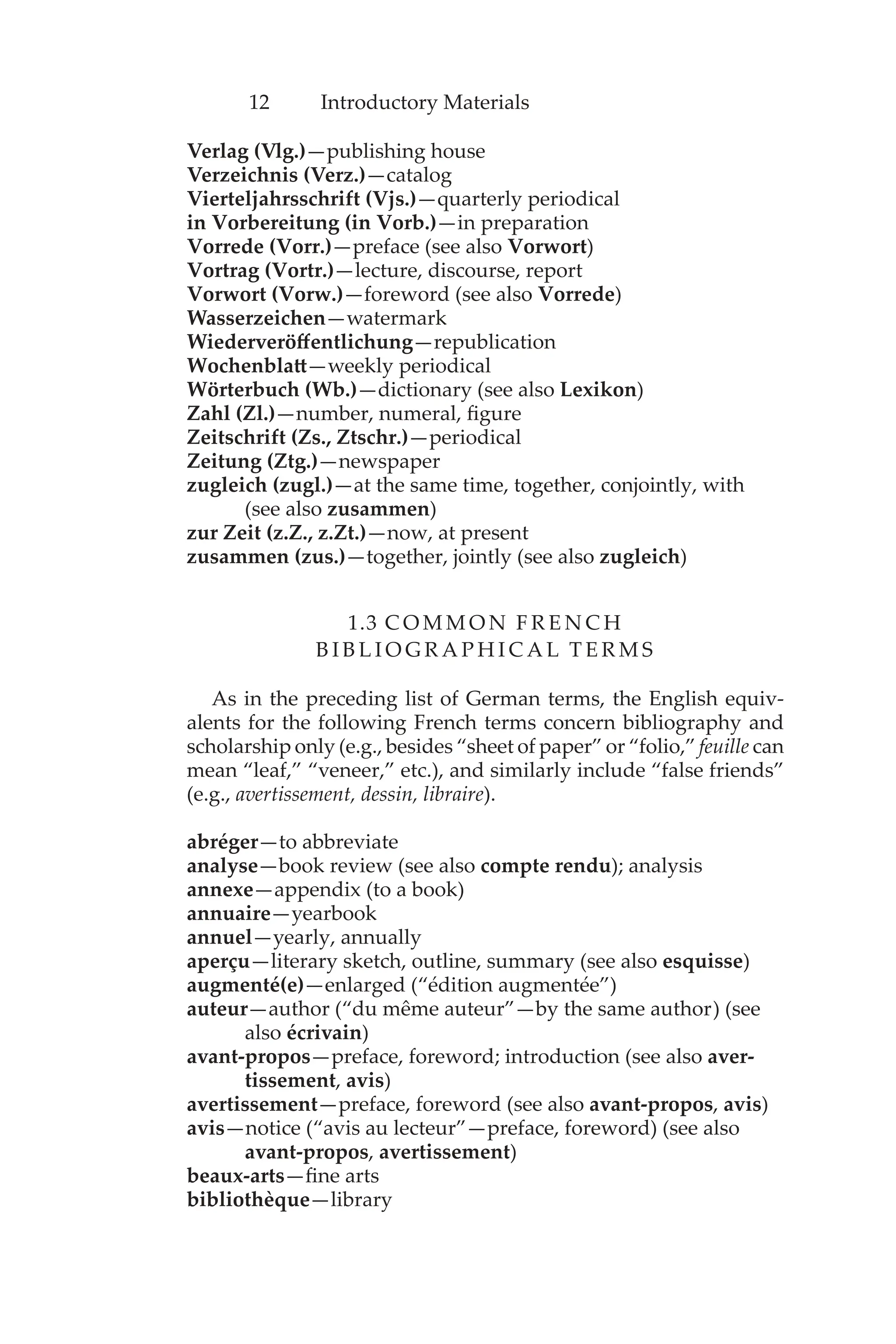
Verlag(Vlg.)—publishing house
Verzeichnis (Verz.)—catalog
Vierteljahrsschrift (Vjs.)—quarterly periodical
in Vorbereitung (in Vorb.)—in preparation
Vorrede (Vorr.)—preface (see also Vorwort)
Vortrag (Vortr.)—lecture, discourse, report
Vorwort (Vorw.)—foreword (see also Vorrede)
Wasserzeichen—watermark
Wiederveröffentlichung—republication
Wochenblatt—weekly periodical
Wörterbuch (Wb.)—dictionary (see also Lexikon)
Zahl (Zl.)—number, numeral, figure
Zeitschrift (Zs., Ztschr.)—periodical
Zeitung (Ztg.)—newspaper
zugleich (zugl.)—at the same time, together, conjointly, with
(see also zusammen)
zur Zeit (z.Z., z.Zt.)—now, at present
zusammen (zus.)—together, jointly (see also zugleich)
1.3 C O M M O N F R E N C H
B I B L I O G R A P H I C A L T E R M S
As in the preceding list of German terms, the English equiv-
alents for the following French terms concern bibliography and
scholarship only (e.g., besides “sheet of paper” or “folio,” feuille can
mean “leaf,” “veneer,” etc.), and similarly include “false friends”
(e.g., avertissement, dessin, libraire).
abréger—to abbreviate
analyse—book review (see also compte rendu); analysis
annexe—appendix (to a book)
annuaire—yearbook
annuel—yearly, annually
aperçu—literary sketch, outline, summary (see also esquisse)
augmenté(e)—enlarged (“édition augmentée”)
auteur—author (“du même auteur”—by the same author) (see
also écrivain)
avant-propos—preface, foreword; introduction (see also aver-
tissement, avis)
avertissement—preface, foreword (see also avant-propos, avis)
avis—notice (“avis au lecteur”—preface, foreword) (see also
avant-propos, avertissement)
beaux-arts—fine arts
bibliothèque—library
38.
Introductory Materials 13
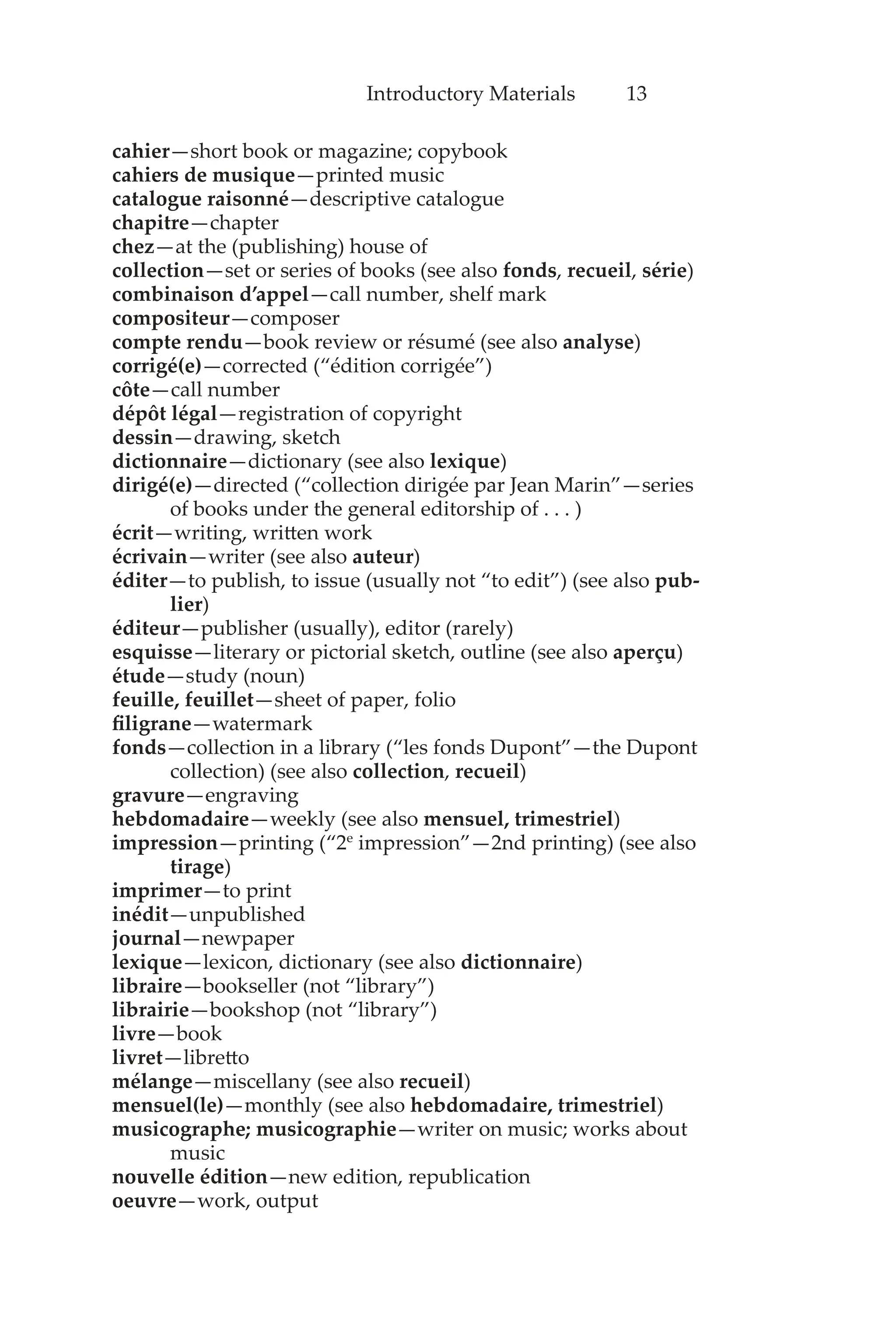
cahier—shortbook or magazine; copybook
cahiers de musique—printed music
catalogue raisonné—descriptive catalogue
chapitre—chapter
chez—at the (publishing) house of
collection—set or series of books (see also fonds, recueil, série)
combinaison d’appel—call number, shelf mark
compositeur—composer
compte rendu—book review or résumé (see also analyse)
corrigé(e)—corrected (“édition corrigée”)
côte—call number
dépôt légal—registration of copyright
dessin—drawing, sketch
dictionnaire—dictionary (see also lexique)
dirigé(e)—directed (“collection dirigée par Jean Marin”—series
of books under the general editorship of . . . )
écrit—writing, written work
écrivain—writer (see also auteur)
éditer—to publish, to issue (usually not “to edit”) (see also pub-
lier)
éditeur—publisher (usually), editor (rarely)
esquisse—literary or pictorial sketch, outline (see also aperçu)
étude—study (noun)
feuille, feuillet—sheet of paper, folio
filigrane—watermark
fonds—collection in a library (“les fonds Dupont”—the Dupont
collection) (see also collection, recueil)
gravure—engraving
hebdomadaire—weekly (see also mensuel, trimestriel)
impression—printing (“2e
impression”—2nd printing) (see also
tirage)
imprimer—to print
inédit—unpublished
journal—newpaper
lexique—lexicon, dictionary (see also dictionnaire)
libraire—bookseller (not “library”)
librairie—bookshop (not “library”)
livre—book
livret—libretto
mélange—miscellany (see also recueil)
mensuel(le)—monthly (see also hebdomadaire, trimestriel)
musicographe; musicographie—writer on music; works about
music
nouvelle édition—new edition, republication
oeuvre—work, output
39.
14 Introductory Materials
oeuvrescomplètes (o.c.)—complete works
ouvrage—work of literature, art, etc.
page de titre—title page
partie—part of a book, etc.
partition—musical score
paru—published (“déjà paru”—already published)
périodique—periodical (see also revue)
planche—plate in a book (“planches hors texte”—plates not
numbered with the pages of text)
précis—abstract
publier—to edit, to publish (see also éditer)
recueil—collection, selection, miscellany (“recueil choisi”—
anthology) (see also collection, fonds, mélange)
rédacteur; rédaction—editor (“rédacteur en chef”—chief editor);
editorial staff
rédiger—to edit (a newspaper), to draft or write (an article, etc.)
réimpression—reprinting
reliure—bookbinding
revu(e)—revised (“édition revue”)
revue—magazine, periodical (see also périodique)
série—series (see also collection)
siècle—century
sommaire—short, brief (“bibliographie sommaire”); table of con-
tents (see also table des matières)
sources originales—primary sources
sources de seconde main—secondary sources
table des matières—table of contents (see also sommaire)
tableau—table in a book (e.g., “tableau chronologique”)
thèse—thesis, doctoral dissertation
tirage—printing (see also impression)
titre—title
tome (t.)—volume; division of a book
traduction—translation
traité—treatise
transcription—transcription
travail—work, piece of work
trimestriel(le)—quarterly (every three months) (see also heb-
domadaire, mensuel)
voir (v.)—see (e.g., “v. Annexe 2”—see Appendix 2)
1.4 C O M M O N I TA L I A N
B I B L I O G R A P H I C A L T E R M S
As in the preceding list of French terms, the English equivalents
for the following Italian terms concern bibliography and scholar-
40.
Introductory Materials 15
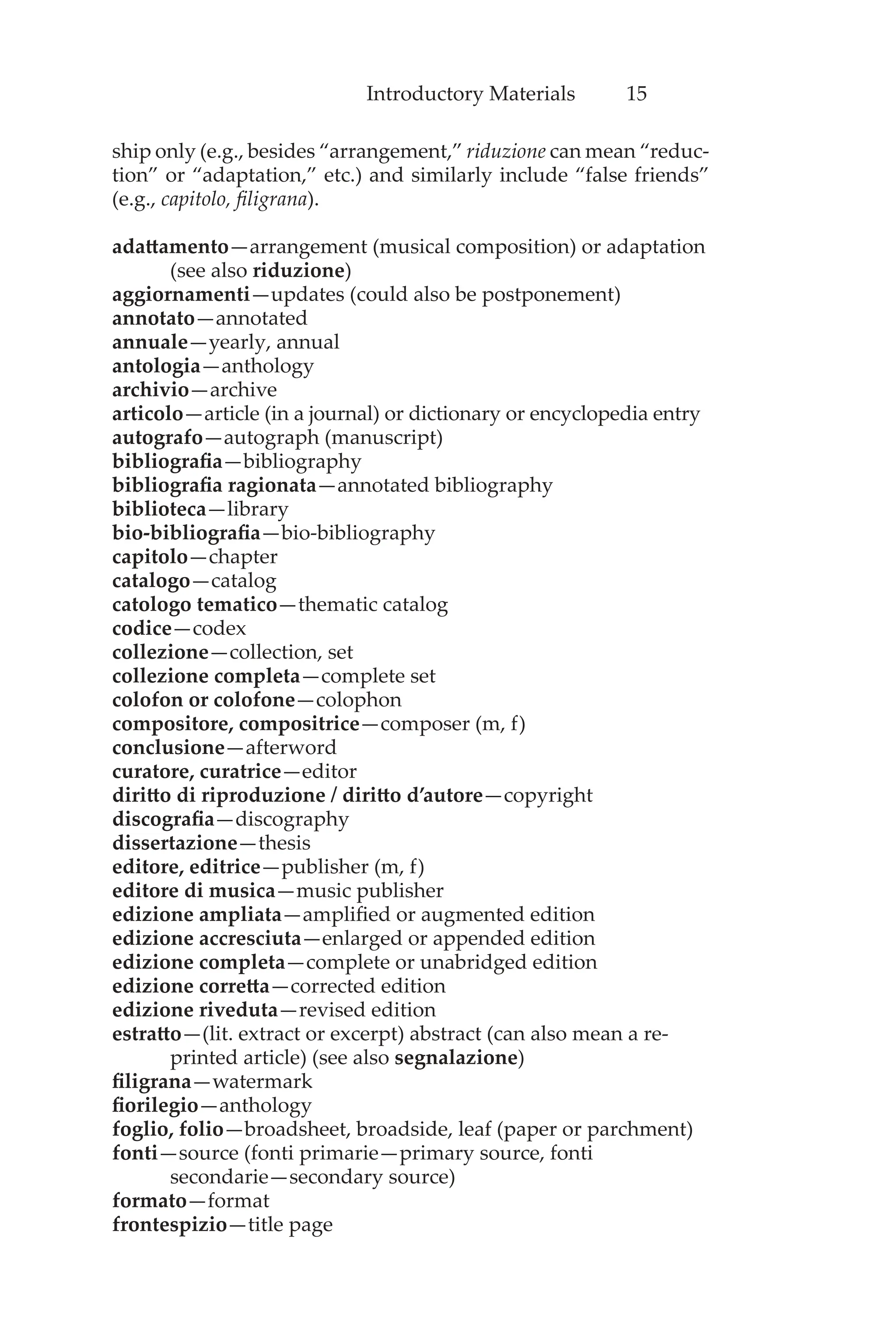
shiponly (e.g., besides “arrangement,” riduzione can mean “reduc-
tion” or “adaptation,” etc.) and similarly include “false friends”
(e.g., capitolo, filigrana).
adattamento—arrangement (musical composition) or adaptation
(see also riduzione)
aggiornamenti—updates (could also be postponement)
annotato—annotated
annuale—yearly, annual
antologia—anthology
archivio—archive
articolo—article (in a journal) or dictionary or encyclopedia entry
autografo—autograph (manuscript)
bibliografia—bibliography
bibliografia ragionata—annotated bibliography
biblioteca—library
bio-bibliografia—bio-bibliography
capitolo—chapter
catalogo—catalog
catologo tematico—thematic catalog
codice—codex
collezione—collection, set
collezione completa—complete set
colofon or colofone—colophon
compositore, compositrice—composer (m, f)
conclusione—afterword
curatore, curatrice—editor
diritto di riproduzione / diritto d’autore—copyright
discografia—discography
dissertazione—thesis
editore, editrice—publisher (m, f)
editore di musica—music publisher
edizione ampliata—amplified or augmented edition
edizione accresciuta—enlarged or appended edition
edizione completa—complete or unabridged edition
edizione corretta—corrected edition
edizione riveduta—revised edition
estratto—(lit. extract or excerpt) abstract (can also mean a re-
printed article) (see also segnalazione)
filigrana—watermark
fiorilegio—anthology
foglio, folio—broadsheet, broadside, leaf (paper or parchment)
fonti—source (fonti primarie—primary source, fonti
secondarie—secondary source)
formato—format
frontespizio—title page
41.
16 Introductory Materials
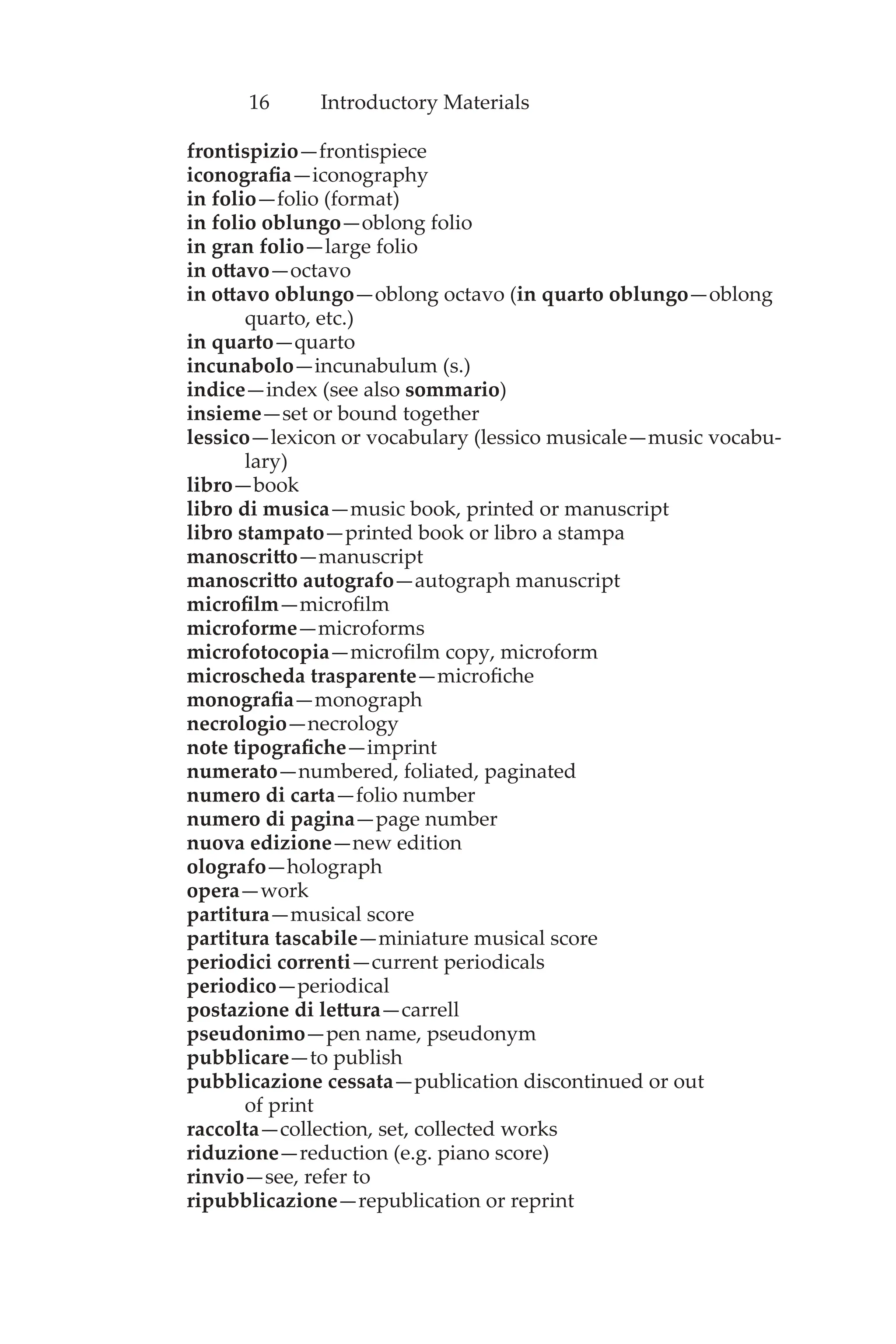
frontispizio—frontispiece
iconografia—iconography
infolio—folio (format)
in folio oblungo—oblong folio
in gran folio—large folio
in ottavo—octavo
in ottavo oblungo—oblong octavo (in quarto oblungo—oblong
quarto, etc.)
in quarto—quarto
incunabolo—incunabulum (s.)
indice—index (see also sommario)
insieme—set or bound together
lessico—lexicon or vocabulary (lessico musicale—music vocabu-
lary)
libro—book
libro di musica—music book, printed or manuscript
libro stampato—printed book or libro a stampa
manoscritto—manuscript
manoscritto autografo—autograph manuscript
microfilm—microfilm
microforme—microforms
microfotocopia—microfilm copy, microform
microscheda trasparente—microfiche
monografia—monograph
necrologio—necrology
note tipografiche—imprint
numerato—numbered, foliated, paginated
numero di carta—folio number
numero di pagina—page number
nuova edizione—new edition
olografo—holograph
opera—work
partitura—musical score
partitura tascabile—miniature musical score
periodici correnti—current periodicals
periodico—periodical
postazione di lettura—carrell
pseudonimo—pen name, pseudonym
pubblicare—to publish
pubblicazione cessata—publication discontinued or out
of print
raccolta—collection, set, collected works
riduzione—reduction (e.g. piano score)
rinvio—see, refer to
ripubblicazione—republication or reprint
42.
Introductory Materials 17
ristampa(rist.)—reprint
rivista—periodical, magazine (also a term used for a type of
operetta)
rivista trimestrale—quarterly
segnalazione—abstract (see also estratto)
serie—series
serie completa—complete series
sommario—table of contents, index (see also indice)
spartito—piano reduction of a vocal score
stampa—impression, print
stampatore—printer
tabella—table, chart
titolo—title
trascrizione—transcription
trattato—a (written) study (see also trattazione)
trattazione—treatise (see also trattato)
trimestrale—quarterly
1.5 L I B R A RY O F C O N G R E S S
M U S I C C L A S S I F I C AT I O N
The holdings of most North American research and university
libraries are arranged according to the Library of Congress classifi-
cation system, although other systems, chiefly the Dewey Decimal
Classification, are sometimes used. Because of the wide applica-
tion of the Library of Congress system, the portions that pertain
to music and music literature are listed below in some detail. In a
library that uses the system, these letter(s) and number(s) are fol-
lowed by a decimal point and further letter(s) and number(s) (the
so-called “cutter” or “author number”; e.g., ML 1255.B23 1983, ML
410.B4H92, etc.), which may or may not be the same as those in
the Library of Congress’s own complete call numbers. The initial
letter-number combinations, however, are the same from one li-
brary to another (e.g., oratorios are always catalogued between M
2000 and M 2007, biographies of individual composers under ML
410, analytic guides between MT 90 and MT 145). This greatly fa-
cilitates searching or browsing in any LC-based library’s stacks or
shelflist. The following list is adapted from M, Music and Books on
Music: Library of Congress Classification, 1998 edition (Washington,
D.C.: Library of Congress, Cataloging Distribution Service, 1999).
For the complete alphabetical listing of subject headings, in music
as well as in all other areas, consult Library of Congress Subject Head-
ings, 25th ed., 5 vols. (Washington, D.C.: Cataloging Distribution
Service, Library of Congress, 2002).
43.
18 Introductory Materials
MMusic
1.A1–.A15 Music printed or copied in manuscript in
the United States or the colonies before
1860
1.A5–2.3 Collections
2–2.3 Collections of musical sources
3–3.3 Collected works of individual composers
3.3 First editions
Instrumental Music
5 Collections
6–175.5 Solo instruments
176 Instrumental music for motion pictures
176.5 Instrumental music for radio and television
177–990 Music for two or more solo instruments
180–298.5 Duets
300–386 Trios
400–486 Quartets
500–586 Quintets
600–686 Sextets
700–786 Septets
800–886 Octets
900–986 Nonets and larger combinations of
purely chamber music
990 Chamber music for instruments of the
18th century and earlier
1000–1075 Orchestra
1100–1160 String orchestra
1200–1269 Band
1270 Fife (bugle) and drum music, field music, etc.
1350–1353 Reduced orchestra
1356–1356.2 Dance orchestra and instrumental
ensembles
1360 Mandolin and similar orchestras of
plucked instruments
1362 Accordion band
1365 Minstrel music
1366 Jazz ensembles
1375–1420 Instrumental music for children
1450 Dance music
1470 Chance compositions
1473 Electronic music
1480 Music with color or light apparatus
44.
Introductory Materials 19
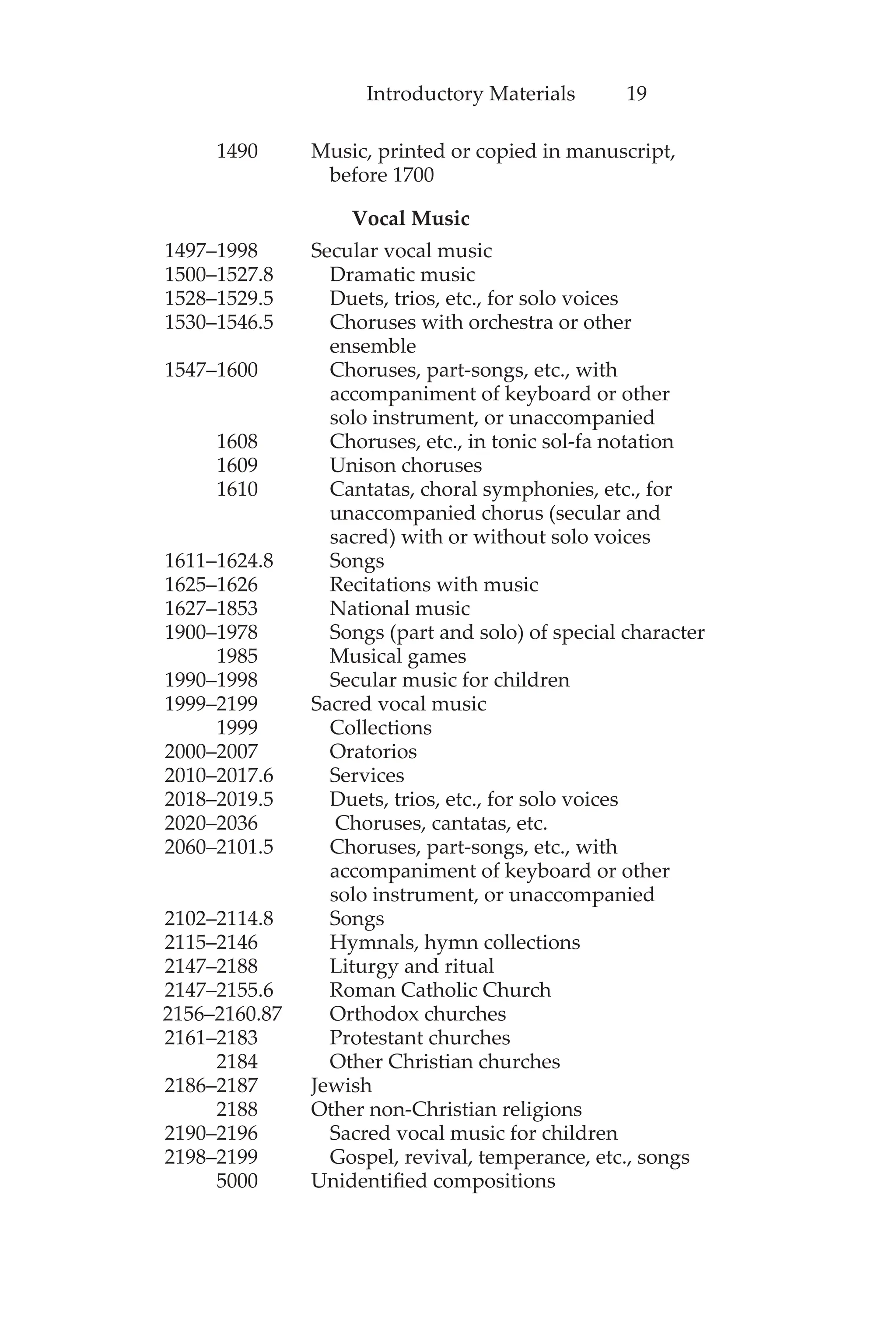
1490Music, printed or copied in manuscript,
before 1700
Vocal Music
1497–1998 Secular vocal music
1500–1527.8 Dramatic music
1528–1529.5 Duets, trios, etc., for solo voices
1530–1546.5 Choruses with orchestra or other
ensemble
1547–1600 Choruses, part-songs, etc., with
accompaniment of keyboard or other
solo instrument, or unaccompanied
1608 Choruses, etc., in tonic sol-fa notation
1609 Unison choruses
1610 Cantatas, choral symphonies, etc., for
unaccompanied chorus (secular and
sacred) with or without solo voices
1611–1624.8 Songs
1625–1626 Recitations with music
1627–1853 National music
1900–1978 Songs (part and solo) of special character
1985 Musical games
1990–1998 Secular music for children
1999–2199 Sacred vocal music
1999 Collections
2000–2007 Oratorios
2010–2017.6 Services
2018–2019.5 Duets, trios, etc., for solo voices
2020–2036 Choruses, cantatas, etc.
2060–2101.5 Choruses, part-songs, etc., with
accompaniment of keyboard or other
solo instrument, or unaccompanied
2102–2114.8 Songs
2115–2146 Hymnals, hymn collections
2147–2188 Liturgy and ritual
2147–2155.6 Roman Catholic Church
2156–2160.87 Orthodox churches
2161–2183 Protestant churches
2184 Other Christian churches
2186–2187 Jewish
2188 Other non-Christian religions
2190–2196 Sacred vocal music for children
2198–2199 Gospel, revival, temperance, etc., songs
5000 Unidentified compositions
45.
20 Introductory Materials
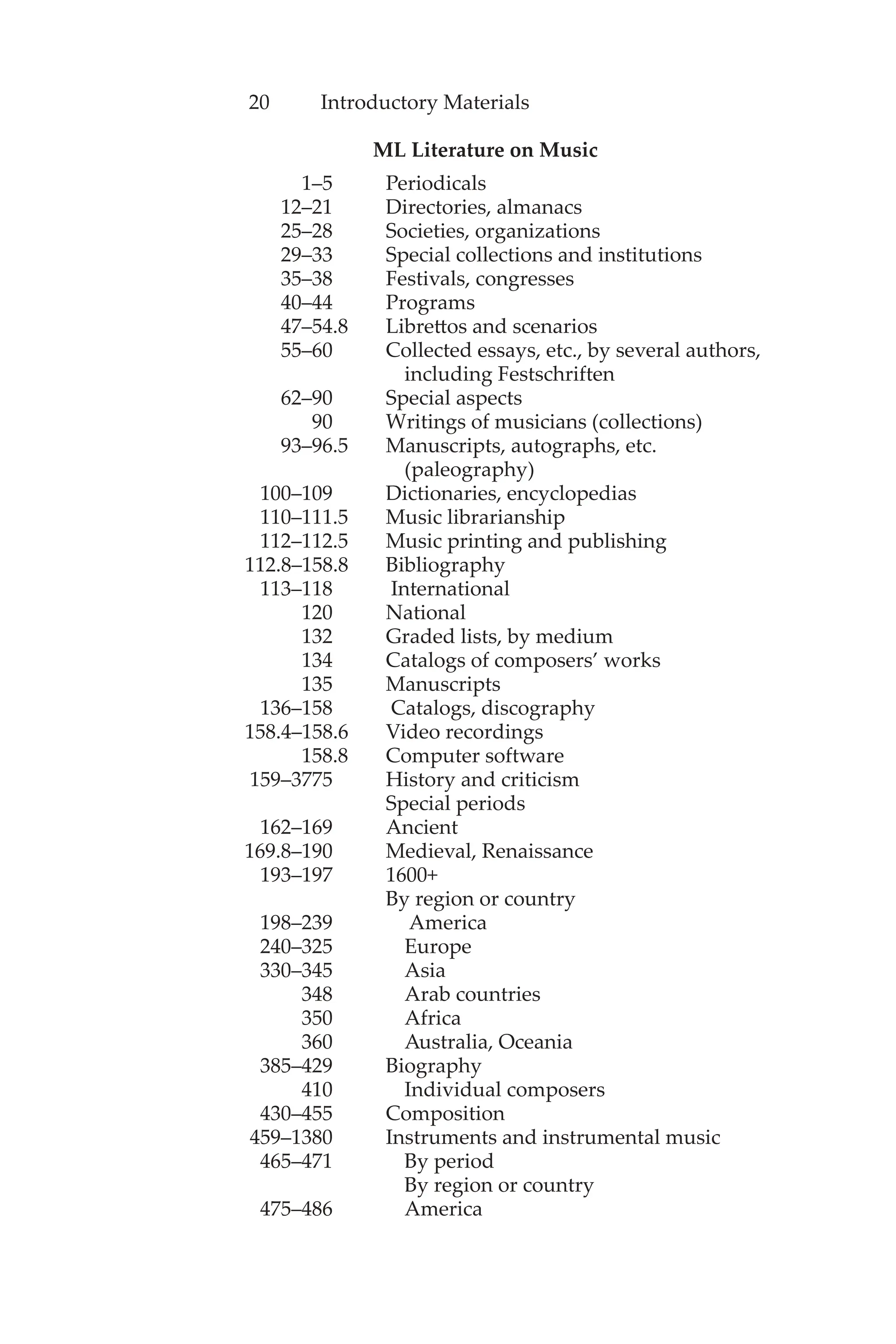
MLLiterature on Music
1–5 Periodicals
12–21 Directories, almanacs
25–28 Societies, organizations
29–33 Special collections and institutions
35–38 Festivals, congresses
40–44 Programs
47–54.8 Librettos and scenarios
55–60 Collected essays, etc., by several authors,
including Festschriften
62–90 Special aspects
90 Writings of musicians (collections)
93–96.5 Manuscripts, autographs, etc.
(paleography)
100–109 Dictionaries, encyclopedias
110–111.5 Music librarianship
112–112.5 Music printing and publishing
112.8–158.8 Bibliography
113–118 International
120 National
132 Graded lists, by medium
134 Catalogs of composers’ works
135 Manuscripts
136–158 Catalogs, discography
158.4–158.6 Video recordings
158.8 Computer software
159–3775 History and criticism
Special periods
162–169 Ancient
169.8–190 Medieval, Renaissance
193–197 1600+
By region or country
198–239 America
240–325 Europe
330–345 Asia
348 Arab countries
350 Africa
360 Australia, Oceania
385–429 Biography
410 Individual composers
430–455 Composition
459–1380 Instruments and instrumental music
465–471 By period
By region or country
475–486 America
46.
Introductory Materials 21
489–522Europe
525–541 Asia
544 Africa
547 Australia, Oceania
549–1093 Instruments
549.8–649 Organ
649.8–747 Piano, clavichord, harpsichord, etc.
749.5–927 Bowed string instruments
929–990 Wind instruments
999–1015 Plucked instruments
1030–1049 Percussion instruments
1049.8–1091 Mechanical and other instruments
1091.8–1093 Electronic instruments
1100–1165 Chamber music
1200–1270 Orchestra music
1300–1354 Band music
1370–1380 Electronic music, computer music
1400–3275 Vocal music
1499–1554 Choral music
1600–2881 Secular vocal music
2900–3275 Sacred vocal music
3300–3354 Program music
3400–3465 Dance music
3544–3775 National music
3790 Music Industry
3797 General works on music history and
musicology
3800–3923 Philosophy and physics of music
3830 Psychology
3845–3877 Aesthetics
3880–3915 Criticism
3928–3930 Literature for children
MT Musical Instruction and Study
1–5 History and criticism
5.5–7 Music theory
20–32 Special methods
40–67 Composition, elements and techniques of
music
58–67 Forms
68 Improvisation,accompaniment,transposition
70–74 Instrumentation and orchestration
73 Band
90–146 Analysis and appreciation of musical works
95–100 Opera, ballet, opéra-ballet, etc.
47.
22 Introductory Materials
110–115Oratorios, cantatas, etc.
125–130 Orchestral music
140–145 Chamber and solo instrumental music
146 Popular music
150 Audio-visual aids
170–810 Instrumental techniques
180–198 Organ
192 Electronic keyboard instruments
200–208 Reed organ
220–255 Piano
259–338 String instruments
260–279.7 Violin
280–298 Viola
300–318 Violoncello
320–334 Double bass
339–533 Wind instruments
340–359 Flute
360–379 Oboe
380–392 Clarinet (A, B-flat, C, E-flat, etc.)
400–415 Bassoon
418 Brass instruments
420–432 Horn
440–456 Trumpet
460–472 Trombone
480–488 Tuba
500–510 Saxophone
539–654 Plucked instruments
540–557 Harp
560–570 Banjo
580–599 Guitar
600–612 Mandolin
620–634 Zither
640–654 Lute, balalaika, etc.
655–725 Percussion and other instruments
728 Chamber music
730 Orchestra
733–733.6 Band
740–810 Instrumental techniques for children
820–915 Singing and vocal technique
825–850 Systems and methods
855–883 Special techniques
885–893 Studies and exercises
898–915 Techniques for children
918–948 School music
955–956 Musical theater
48.
Introductory Materials 23
1.5.1Some Nonmusical General LC Classifications
Relating to Research in Music
A General Works L Education
B Philosophy, Psychology, N Fine Arts
Religion
D History P Languages, Literature
GV Dance Q,T Science, Technology
K Law Z Bibliography
1.6 D E W E Y D E C I M A L C L A S S I F I C AT I O N : M U S I C
Although a majority of North American research and univer-
sity libraries use the Library of Congress Classification system, ap-
proximately 25 percent of academic libraries, 20 percent of special-
ized libraries, and 95 percent of the public and civic libraries in the
United States use the Dewey Decimal Classification system (DDC).
In addition, libraries in more than 138 countries use the inter-
national version of the DDC, the Universal Dewey Classification
(UDC), to organize their collections, and DDC numbers are fea-
tured in the national bibliographies of more than sixty countries.
The DDC is maintained by the Decimal Classification Division
of the Library of Congress, and all copyright rights are owned by
the Online Computer Library Center (OCLC) in Dublin, Ohio.
A full introduction to the DDC is available at the OCLC website
(http://www.oclc.org/dewey).
According to OCLC, in the DDC basic classes are organized by
disciplines or fields of study. At the broadest level, the DDC is di-
vided into ten main classes, which together cover the entire world
of knowledge. Each main class is further divided into ten divisions,
and each division into ten sections. Music is assigned the classifi-
cation range 780–789 (class 700, division 80, sections 1–9).
Because the DDC was created in the nineteenth century, li-
brarians have had to make adjustments periodically in the system
to accommodate new knowledge and new disciplines. Therefore,
throughout the twentieth century different versions of the DDC
contain reassigned or revised meanings of parts of the system.
(Catalogers informally call a complete revision of a division a
“phoenix schedule.”)
The version of the DDC currently in use is the 23rd edition (called
the DDC23). The last complete revision (phoenix schedule) of the
music division, 780, occurred in 1989 with edition 20 (DDC20).
These revisions present problems with DDC collections. Most li-
braries do not routinely reclassify their existing collections when
a phoenix schedule is published; therefore, such collections con-
49.
24 Introductory Materials
tainitems cataloged under two or more systems. This situation can
severely restrict the facility of browsing in a DDC collection. Both
DDC19 and DDC23 are listed below to aid the researcher working
in a collection that is not consistently cataloged.
The following table compares the differences between the main
sections of DDC19 (the last edition before the most recent phoenix
schedule) and DDC23 (the current edition).
DDC23 DDC19
780 Relation of music to
other subjects
Music
781 General principles
and musical forms
General principles and
considerations
782 Vocal music Dramatic music and
musical drama
783 Music for single voices Specific kinds of music and
performing groups
784 Instruments and
instrumental ensembles
and their music
Voice and vocal music
785 Ensembles with only one
instrument per part
Instrumental ensembles
and their music
786 Keyboard, mechanical,
electrophonic,
percussion instruments
Keyboard instruments and
their music
787 Stringed instruments
(Chordophones)
String instruments and
their music
788 Wind instruments
(Aerophones)
Wind instruments and
their music
789 Composers and traditions
of music
Percussion, mechanical,
electrical instruments
The following list of the DDC23 music classification is adapted
from Dewey Decimal Classification and Relative Index, Edition 23,
Vol. 3: Schedules 600–999 (Dublin, Ohio: OCLC Online Computer
Library Center, 2011).
1.6.1 Dewey Decimal Classification 23: Music
780 Relation of Music to Other Subjects
780.1 Philosophy and theory, analytical guides,
program notes
50.
Introductory Materials 25
780.2Miscellany; texts; treatises on music scores
and recordings
780.7 Education, research, related topics;
performances
780.8 Groups of people
780.9 History, geographic treatment, biography
780.901–.905 Periods of stylistic development of music
780.901 Ancient times through 499
780.902 500–1449 (including Gothic style, ars
antiqua, ars nova, medieval music)
780.903 1450–
780.903 1 Ca. 1450–ca. 1600 (including Renaissance
music)
780.903 2 Ca. 1600–ca. 1750 (including baroque
music, nuove musiche)
780.903 3 Ca. 1750–ca. 1825 (including preclassicism,
classicism, rococo)
780.903 4 Ca. 1825–ca. 1900 (including nationalism,
romanticism)
780.904 1900–1999 (including avant-garde music,
impressionism, neoclassicism)
780.905 2000–2099
780.92 Biography (composers, performers, critics;
thematic catalogues of individual
composers)
780.94 Music of Europe
781 General Principles and Musical Forms
781.1 Basic principles of music
781.11 Psychological principles
781.12 Religious principles
781.17 Artistic principles
781.2 Elements of music
781.22 Time (including pulse, rhythm, meter)
781.23 Musical sound (including pitch, volume,
timbre, consonance)
781.24 Melody (including scales, ornaments,
themes)
781.25 Harmony (including chords, harmonic
rhythm, tonality)
781.26 Tonal systems (including modes, atonality,
dodecaphony)
781.28 Texture
781.3 Composition
781.32 Indeterminacy and aleatory composition
781.33 Serialism
51.
26 Introductory Materials
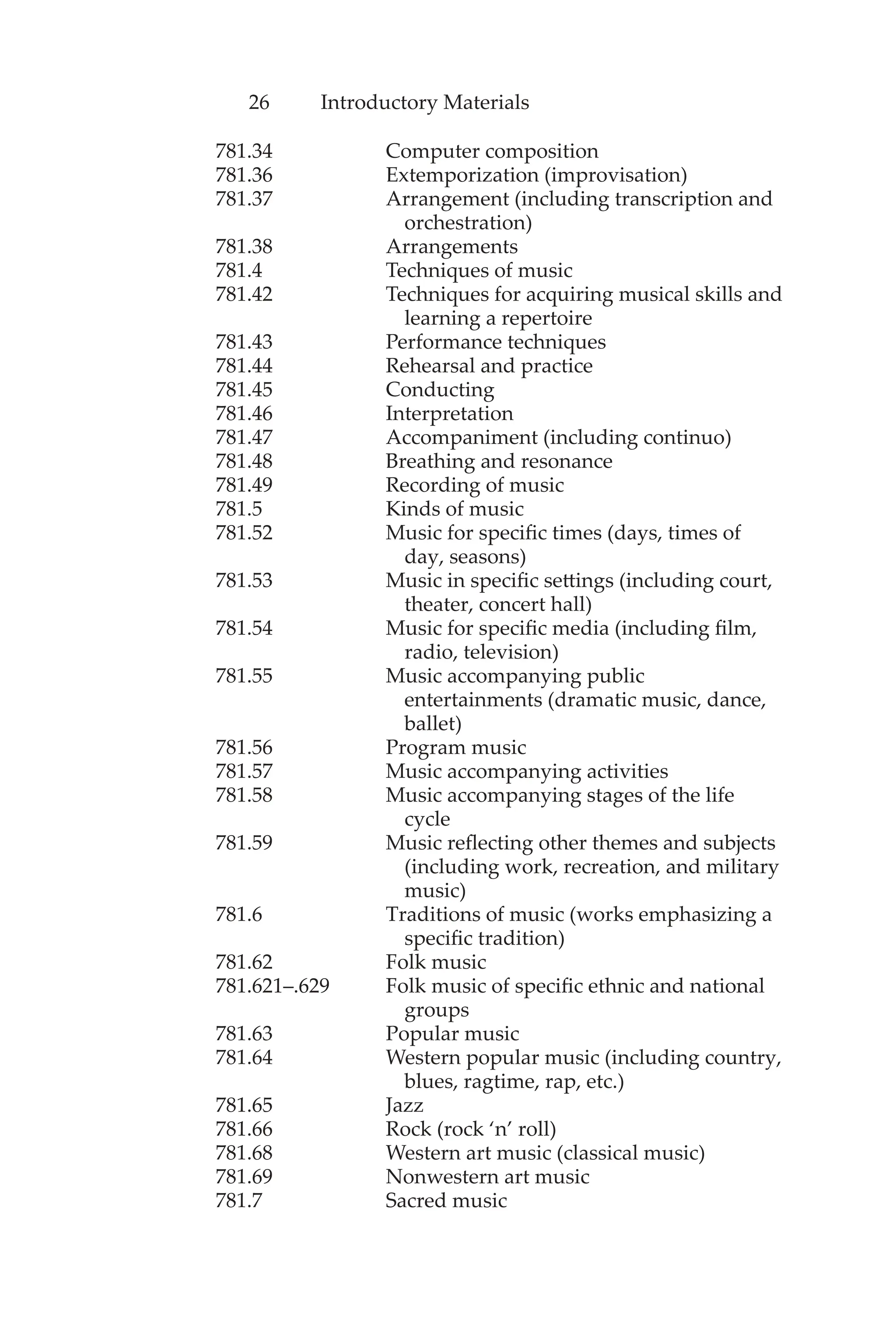
781.34Computer composition
781.36 Extemporization (improvisation)
781.37 Arrangement (including transcription and
orchestration)
781.38 Arrangements
781.4 Techniques of music
781.42 Techniques for acquiring musical skills and
learning a repertoire
781.43 Performance techniques
781.44 Rehearsal and practice
781.45 Conducting
781.46 Interpretation
781.47 Accompaniment (including continuo)
781.48 Breathing and resonance
781.49 Recording of music
781.5 Kinds of music
781.52 Music for specific times (days, times of
day, seasons)
781.53 Music in specific settings (including court,
theater, concert hall)
781.54 Music for specific media (including film,
radio, television)
781.55 Music accompanying public
entertainments (dramatic music, dance,
ballet)
781.56 Program music
781.57 Music accompanying activities
781.58 Music accompanying stages of the life
cycle
781.59 Music reflecting other themes and subjects
(including work, recreation, and military
music)
781.6 Traditions of music (works emphasizing a
specific tradition)
781.62 Folk music
781.621–.629 Folk music of specific ethnic and national
groups
781.63 Popular music
781.64 Western popular music (including country,
blues, ragtime, rap, etc.)
781.65 Jazz
781.66 Rock (rock ‘n’ roll)
781.68 Western art music (classical music)
781.69 Nonwestern art music
781.7 Sacred music
52.
Introductory Materials 27
781.71Christian sacred music
781.711–.719 Christian sacred music of specific
denominations and sects
781.72 Music of the Christian church year
781.73 Sacred music of classical (Greek and
Roman) and Germanic religions
781.74–.79 Sacred music of other religions and sects
781.8 Musical forms
781.82 Specific musical forms (including binary,
ternary, strophic, rondos, variations, etc.)
782 Vocal Music
782.1 Operas and related dramatic vocal forms
782.12 Operettas
782.13 Singspiels
782.14 Musical plays
782.2 Nondramatic vocal forms
782.22 Sacred vocal forms
782.23 Oratorios
782.24 Large-scale vocal forms
782.25 Small-scale vocal forms
782.26 Motets
782.27 Hymns
782.28 Carols
782.29 Liturgical forms
782.292 Chant
782.294–.298 Specific texts
782.3 Services (Liturgy and ritual)
782.32 Christian services
782.322 Services of specific denominations
782.323 Mass (Communion service)
782.324 Divine office
782.33 Services of classical (Greek and Roman)
and Germanic religions
782.34–.39 Services of other specific religions
782.4 Secular forms
782.42 Songs
782.43 Forms derived from poetry
782.47 Song cycles
782.48 Secular cantatas
782.5 Mixed voices
782.6 Women’s voices
782.7 Children’s voices
782.8 Men’s voices
782.9 Other types of voices
782.96 Speaking voices (choral speech)
53.
28 Introductory Materials
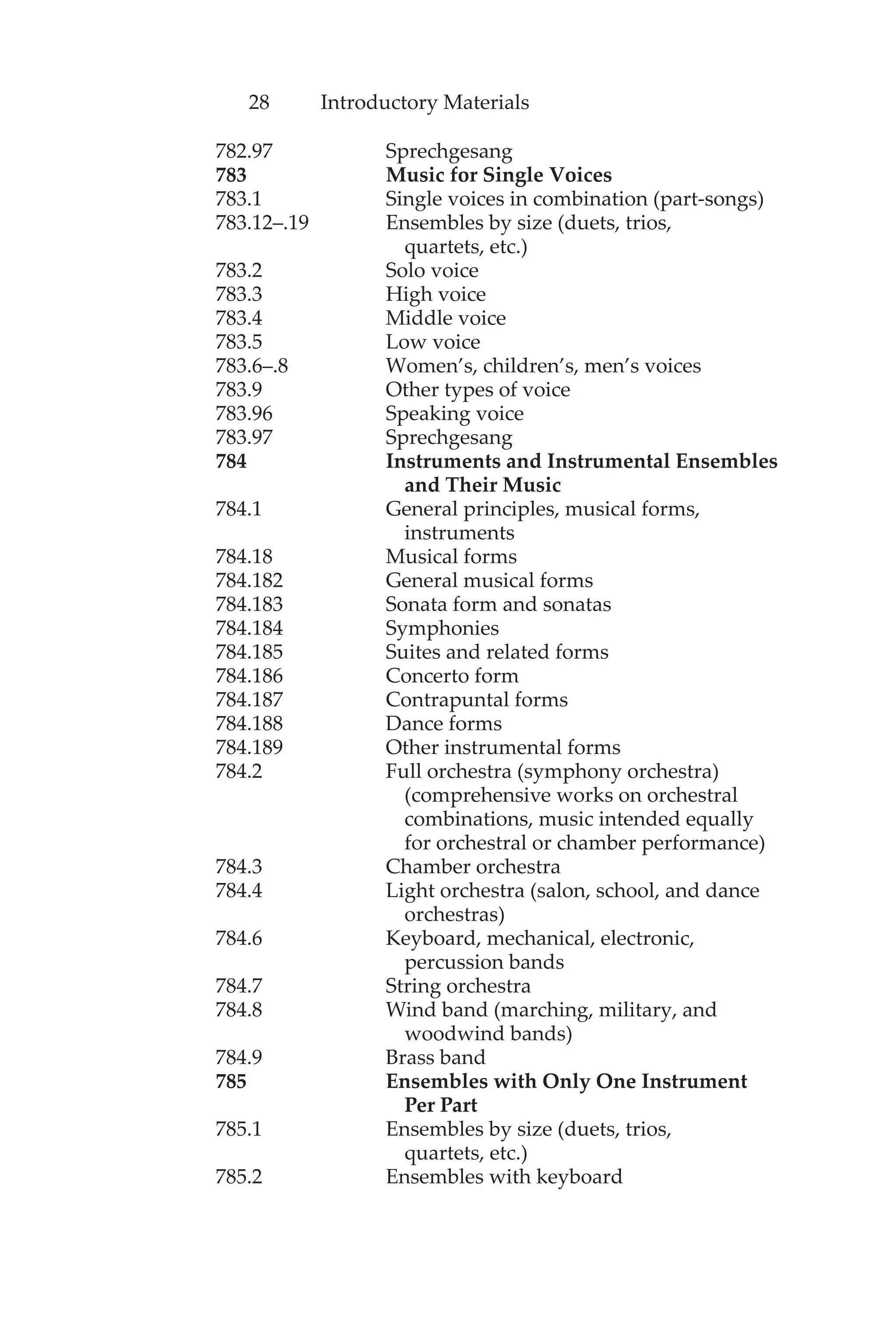
782.97Sprechgesang
783 Music for Single Voices
783.1 Single voices in combination (part-songs)
783.12–.19 Ensembles by size (duets, trios,
quartets, etc.)
783.2 Solo voice
783.3 High voice
783.4 Middle voice
783.5 Low voice
783.6–.8 Women’s, children’s, men’s voices
783.9 Other types of voice
783.96 Speaking voice
783.97 Sprechgesang
784 Instruments and Instrumental Ensembles
and Their Music
784.1 General principles, musical forms,
instruments
784.18 Musical forms
784.182 General musical forms
784.183 Sonata form and sonatas
784.184 Symphonies
784.185 Suites and related forms
784.186 Concerto form
784.187 Contrapuntal forms
784.188 Dance forms
784.189 Other instrumental forms
784.2 Full orchestra (symphony orchestra)
(comprehensive works on orchestral
combinations, music intended equally
for orchestral or chamber performance)
784.3 Chamber orchestra
784.4 Light orchestra (salon, school, and dance
orchestras)
784.6 Keyboard, mechanical, electronic,
percussion bands
784.7 String orchestra
784.8 Wind band (marching, military, and
woodwind bands)
784.9 Brass band
785 Ensembles with Only One Instrument
Per Part
785.1 Ensembles by size (duets, trios,
quartets, etc.)
785.2 Ensembles with keyboard
54.
Introductory Materials 29
785.3Ensembles without electrophones and with
percussion and keyboard
785.4 Ensembles without keyboard
785.5 Ensembles without keyboard and with
percussion
785.6 Keyboard, mechanical, aeolian,
electrophone, percussion ensembles
785.7 String ensembles, bowed string ensembles
785.8 Woodwind ensembles
785.9 Brass ensembles
786 Keyboard, Mechanical, Electrophonic,
Percussion Instruments
786.2 Pianos
786.3 Clavichords
786.4 Harpsichords (spinets, virginals)
786.5 Organs
786.6 Mechanical and aeolian instruments
(including carillons, music boxes, player
pianos)
786.7 Electronic instruments (electrophones)
(including synthesizers and musique
concrète)
786.8 Percussion instruments (idiophones)
786.9 Drums and devices used for percussive
effects (membranophones)
787 Stringed Instruments (Chordophones)
787.2 Violins
787.3 Violas
787.4 Cellos (Violoncellos)
787.5 Double basses
787.6 Viols and related instruments (viols, violas
d’amore, hurdy-gurdies)
787.7 Plectral instruments (zithers, lyres)
787.8 Plectral lute family (lutes, mandolins,
guitars, etc.)
787.9 Harps and musical bows
788 Wind Instruments (Aerophones)
788.2 Woodwind instruments and free
aerophones
788.3 Flute family
788.4 Reed instruments (bagpipes)
788.5 Double-reed instruments (oboes,
bassoons, etc.)
788.6 Single-reed instruments (clarinets)
STORY NINE
WASHER SAVESONE OF HIS OWN PEOPLE
When Washer discovered that it was one of his own people
driven up the tree by the wolves, he felt a queer sensation stealing
over him. For the first time he seemed to realize how cruel the Wolf
cubs were in their hunting, and how terrible the hunted must feel. It
was almost as if he was up that tree with a lot of wolves below
howling for his blood.
Something like anger and disgust for the cubs sprang up in his
heart. What right had they to chase every weaker animal in the
woods and kill him! Why couldn’t they let other animals live in peace
in the woods!
While he sat there thinking of these things, the young wolves
were leaping up at the treed raccoon and howling dismally every
time they fell short of reaching him. Finally one of the cubs turned to
Washer.
“Why don’t you go up the tree and drive him down?” he asked.
“Hurry up, Little Brother, for we’re hungry. Go up and shake the
branch, and we’ll catch him as he falls.”
Washer began to tremble, not with fear, but because he knew
he had to save the raccoon in some way, and he couldn’t think of
any trick that would do it. The cubs mistook his trembling for fear,
and one of them exclaimed:
“Little Brother’s afraid to go up the tree! See, he’s trembling all
over!”
“When was Little Brother afraid before?” asked another. “Surely
he’s not afraid of that animal.”
Washer saw that they had not recognized the animal up the tree
as one of his own people. They hardly knew a raccoon from any
other animal. This fact gave Washer new hope. He didn’t want to
betray to them his feelings.
57.
“Are you afraid,Little Brother?” added another, standing before
him. “I don’t believe it.”
“No, I’m not afraid,” replied Washer finally, recovering from his
embarassment. “When was I afraid of anything! Have I not played
and fought with you all, and did you ever know me to beg for
mercy? Then why should I be afraid of that small animal?”
“I knew it, Little Brother,” replied the last cub. “Now you’ll go up
the tree and shake him down to us.”
Washer rose to his feet and trotted away from the tree. “Come
here, Brothers,” he called, “I want to talk to you, and we must not
be overheard. Now listen,” he added, when they were at a safe
distance from the tree, “you’ve heard of Billy Porcupine, haven’t
you?”
“Billy Porcupine! Oh, you mean the animal with the prickly
thorns! Yes, we’ve heard of him.”
Washer nodded his head. “Then you remember that Mother
Wolf and Sneaky always told you to beware of Billy Porcupine. If you
didn’t he’d run his thorns in your nose, and it would take days and
days for the wounds to heal up.”
“Yes, they told us that!” they exclaimed in unison. Then in little
frightened voices they added; “Is that Billy Porcupine up the tree?”
Washer did not answer directly, but he looked very wise. “Now,
listen again,” he added, “there’s only one thing to do. You must run
back to the den and tell Mother Wolf or Sneaky. They will know what
to do. I’ll stay here and watch, and if Mother Wolf tells me to go up
the tree I’ll go even if I get stuck full of quills.”
The cubs were greatly impressed by these words, for they had
heard many tales of the wounds inflicted by Billy Porcupine’s quills,
and they shuddered at the thought of getting them in their mouth
and nose.
“I’ll stay here with you, Little Brother,” the oldest of the cubs
said. “If he comes down we’ll corner him and hold him until Mother
Wolf comes.”
“No you must go with your brothers,” replied Washer. “I can
watch him alone. I’m not afraid of him.”
“You’re a brave Little Brother!” they exclaimed in a breath.
58.
Washer urged themto hurry, and after a while they decided to
race back to the den and summon their parents. Washer promised to
stand guard under the tree until they returned.
Their great discovery excited the cubs, and they were anxious
to see how Mother Wolf or Sneaky would handle this strange animal
that went around in the woods armed with sharp quills. They
disappeared in the bushes, each anxious to beat all the others to the
cave.
The moment they had gone, Washer ran back to the tree and
looked up it. The raccoon was still crouching there in a high branch.
Washer looked curiously at him, and then called:
“Raccoon! Little Raccoon, come down now, and run away. My
wolf brothers have gone, but they’ll soon return. Run and hide in
your hole or find a bigger tree.”
There was a noise in the branches overhead, and the raccoon
crawled down a few feet. Washer looked at him, and then retreated
a step or two. It was not a little raccoon, but a big one, with sharp
claws and fine, white teeth. He was so much bigger than Washer
that he felt a little awe of him.
“Why do you call the wolves your brothers?” the raccoon asked.
“You’re a raccoon, aren’t you? Then the wolves can’t be your
brothers. They’re the enemies of my people.”
Washer looked a little embarrassed. “Yes, I’m a raccoon,” he
replied, “but the wolves saved me, and Mother Wolf brought me up
as one of her own. I’ve always lived with her in her den. She’s been
kind to me, and I love her.”
The big raccoon showed his teeth and crawled down another
branch. “You love a wolf!” he said angrily. “Then you’re a traitor to
your own people!”
Washer was greatly surprised and distressed by this remark.
“No, I’m not a traitor. Because I love Mother Wolf for what she’s
done for me isn’t any reason why I shouldn’t love my own people.”
“I hear them coming back!” snapped the raccoon in the tree. “I
must be off or they’ll catch me. This tree is too small. I’ll find a
bigger one.”
“Yes, do hurry! I hear them howling now. They’ll be here soon.”
59.
The big raccoondropped to the ground and stood by the side of
Washer. He was so much bigger that Washer felt like a baby
alongside of him. He was a fierce old creature, too, for he kept
gnashing his teeth and switching his tail.
“Well, aren’t you coming with me?” he asked. “If you know the
woods you might lead me to a good hiding place.”
“No, I can’t go with you,” replied Washer a little sadly. “I must
wait for my brothers and Mother Wolf. They’re all the friends I have.”
“The wolves are your friends?” snapped the big raccoon. “Then
you’re a traitor to your people! I believe this is only a trick to deceive
me. I’ll teach you to betray us!”
Before Washer realized what he meant, the big fellow leaped
toward him and bit him two or three times on the body and front
paws. Then with a grunt of delight, he ran away and disappeared in
the woods. Frightened by this sudden attack by one of his own
people, Washer gave a squeal of pain and dropped down on the
ground bleeding. Just then the wolves broke through the bushes and
came racing toward the tree, with Sneaky in the lead.
In the next story Washer confesses to Mother Wolf, and she
decides to take him to the council rock to meet Black Wolf.
60.
STORY TEN
MOTHER WOLFLISTENS TO WASHER’S STORY
Mother Wolf was close behind, but Sneaky reached Washer’s
side first. There was a suspicious leer on his face, but the sight of
the blood on the raccoon’s body seemed to puzzle him. He stopped
and glanced up at the tree.
“Where’s Billy Porcupine?” he asked. “I don’t see him in the
tree.”
“He ran down and escaped,” replied Washer. “I couldn’t stop
him.”
Sneaky licked his chops, and added: “Quite likely!” He sniffed
among the lower branches of the tree. “If my nose doesn’t deceive
me there’s been no porcupine around here. No, sir; nothing but
raccoons.”
He turned and smiled at Mother Wolf and the youngsters. He
felt quite proud of his spying quality. “I smell nothing but raccoon up
that tree,” he added. “Therefore, it was a raccoon, and not a
porcupine, that you treed.”
“But little brother said it was Billy the Porcupine,” interrupted
one of the cubs.
“How’d Little Brother know it was a porcupine?” asked Sneaky.
“When did you ever see one?”
Now Washer was feeling very miserable, first, because his
wounds hurt him, and second because one of his own people had
turned on him and attacked him after he had saved his life. So he
spoke without thinking. “I don’t know,” he stammered. “Maybe I
never saw one.”
“Ah! ha!” scoffed Sneaky. “I thought so. It was only a trick to
deceive us. I see now what it means.”
He turned to the tree again, and looked up it, and began
sniffing at the trunk and limbs. “Nothing but raccoon odor,” he
61.
added. “No porcupinehas been here.”
“For goodness sake,” interrupted Mother Wolf, wiping the blood
from Washer’s face, “what are you wasting your time about? Why
don’t you help Little Brother? He’s all bloody, and we must help him
home.”
“Ah, bloody! So he is! Then if it was Billy the Porcupine we
should find quills sticking in him.”
He examined Washer’s wounds a little roughly, smiling all the
time. Of course, there were no porcupine quills, and this seemed to
please Sneaky immensely.
“Just as I thought,” he said finally. “There are no quills.
Therefore, there was no porcupine here. Then why did Little Brother
deceive you?”
He turned to the cubs, who were watching him curiously.
“I’ll tell you, my children,” he continued. “It was a raccoon you
had treed—one of Little Brother’s own people. He knew it all the
time, and he didn’t want you to have him for your dinner. So he told
you this little story about a porcupine, and sent you home to call us
while his friend could escape in the woods. See, he’s gone. There’s
nothing up the tree.”
They followed the direction of his pointing nose. The tree was
empty. Then they turned their eyes toward Washer.
“Can you deny that, Little Brother?” Sneaky added in a beguiling
voice. “Of course you can’t.”
“But how’d he get hurt?” asked one of the cubs. “See, he’s
bleeding all over.”
Mother Wolf interfered at this moment. “Sneaky, you run down
to the brook and get some water,” she commanded. “If Little Brother
didn’t meet a porcupine, he ran into something just as bad. We
won’t stop to discuss that now. Hurry up with that water!”
Sneaky dropped his tail between his legs and started for the
brook, but half way there he stopped and said: “It wasn’t a
porcupine, I know that. Therefore, it was a raccoon. Little Brother
deceived my children to save his life. No wolf will stand for that. He’s
not a friend of my people. I’ll tell Black Wolf that.”
62.
Mother Wolf, whohad been busy cleaning the blood from
Washer’s fur, looked a little disturbed. Sneaky had another argument
against admitting Washer to the wolf pack.
“Little Brother,” she whispered, “it is true what Sneaky says?
Was Billy Porcupine up that tree?”
Washer could not deceive Mother Wolf. She had been too kind
to him. “No,” he answered, “it was a raccoon, and I couldn’t bear to
see him killed. He belonged to my own people.”
Mother Wolf nodded her head, showing that she understood his
feelings. “But these wounds,” she added, a little puzzled. “How did
you get them?”
Washer was greatly distressed at this question. If he told the
truth, he would have to condemn one of his own people of
ingratitude, but even that was better than deceiving Mother Wolf.
“It was the raccoon,” he answered after a pause. “When he
came down the tree he bit me. He thought I belonged to the wolf
pack, and he called me a traitor. I don’t suppose he understood.”
“He didn’t deserve the kindness you showed him,” was the quick
retort. “If he was near here I’d send the children and Sneaky after
him. He deserves punishment. Do you know where he’s hiding?”
“No! He ran away in the woods and that was the last I saw of
him.”
Mother Wolf had such confidence in Washer that she did not
doubt his word. She knew that Little Brother would not deceive her
to protect one of his own people.
“Well, I’m glad he isn’t here,” she added, sighing. “Sneaky
would hunt him down, and I don’t suppose you’d like to see him
killed, even if he did bite you.”
“No, I don’t wish him harm.”
Washer’s voice was a little trembly, and a tear stood in one of
his eyes. “What is it,” asked Mother Wolf sympathetically, “that
makes you so sad, Little Brother? Do your wounds hurt you so
much?”
“No, I was thinking of my people,” replied Washer. “They won’t
have me. They’ll turn against me because I was brought up in a
63.
wolf’s den, andyour people won’t have me. I’m an outcast—without
a home or people.”
“Don’t say that,” whispered Mother Wolf. “You’re my adopted
child, and I shall always look after you. My people will have to take
you. If they don’t—”
Her eyes flashed, and Washer knew that she was prepared to
fight for him. But he had no desire to bring trouble to her, and he
said: “No, no, don’t do that. Let me go away in the woods. I’m old
enough now to make a living. You must not introduce me to the
pack. I shall always remember you and my Wolf Brothers, but no
good can come of trying to make me a wolf. I’m only a raccoon.”
“Little Brother, don’t talk like that. I’m going to take you
tomorrow to the council, and Black Wolf shall listen to me. My
people must protect you. If Black Wolf says so none of them will
dare harm you. Come now, and don’t feel sad any more.”
Washer tried to dry his eyes and look cheerful, but it was not
very easy to do this. His own people had denied him, and he
dreaded appearing before the wolf pack. He knew that Sneaky
would condemn him, and try to drive him away, and the very
thought of Black Wolf made him shudder. What kind of a leader was
he, and would he listen to Mother Wolf’s pleadings? In the next story
you will read of how Mother Wolf took him to the council and
pleaded with and defied the leader of the wolf pack.
64.
STORY ELEVEN
WASHER ISINTRODUCED TO THE WOLF PACK
Washer was taken with the cubs the following night to the wolf
council where they were to be introduced to the pack and formally
admitted as members. All young wolves when they reach the
hunting age had to be introduced by their parents, and the leader of
the pack then announced their acceptance and gave to each a
name. Until that time they were simply cubs, unfit to hunt with the
older wolves.
The council was held in the deepest, thickest part of the woods
where no wild animal or hunter would be likely to disturb them.
Once a month in the full of the moon the pack assembled around a
big flat rock overlooking a pool of water. Here they waited until Black
Wolf, their leader, came and called the council to order.
Mother Wolf was anxious to get to the council early, and she
started her family off long before moon was up above the tops of
the trees. Sneaky led the way, with the cubs filing behind him, and
Mother Wolf bringing up the rear.
They were so early that they met none of the other wolves on
the way, and Mother Wolf gave a sigh of relief when she found no
one ahead of her. She drew up her little circle of young ones in the
shadow of a clump of birches on the right of the council rock, and
then dropped down to rest.
All was quiet in the woods. Not even Hoot the Owl or Whip-
Poor-Will was abroad to disturb the silence of the great woods.
Occasionally a shadow drifted across the flat rock, and a wolf would
take his place in front or on one side of it. The moon rose slowly
until it cast a flood of white light upon the top of the rock. Almost at
the same moment there was a howl nearby, and out of the thickets
sprang Black Wolf, the leader. He stood a moment looking at the
65.
crouching pack, andthen he leaped to the top of the council rock.
The whole pack rose as one and gave vent to their hunting cry.
This was their way of recognizing their leader. Black Wolf stood
a moment, a tall, gaunt, powerful creature, in the white moonlight,
as if challenging any opposition, and then he dropped down with his
front paws curled under him.
“The council is open,” he announced. “Has any one a message
for the pack? We’re all here.”
Sneaky rose from his position near Mother Wolf, and trotted in
front of the rock. “O Black Wolf, noble leader of the pack,” he began,
“I bring my cubs for your inspection. May they please you, and prove
worthy of their sire.”
“Bring them forth!” replied Black Wolf. “They should be good
cubs if they take after you, Sneaky.”
The different members of the pack craned their heads forward
to see Sneaky’s cubs, which, at the bidding of their parent, filed out
in a row and stood before the council rock. Black Wolf surveyed
them in silence, inspecting them with his fierce dark eyes.
“You have done well by the pack, Sneaky,” he announced finally.
“I name the first one Curly because his beautiful fur curls backward
at the tips. The second one shall be known as Spotted Wolf, for I see
gray spots under his neck. And the last one shall be known as Tiger
Wolf because of the fierceness of his eyes. I have named them, and
so shall they be known to the pack.”
He stopped and looked hard at Sneaky, as if expecting him to
say more; but Sneaky was pleased with his presentation, and backed
slowly away.
“Is there any more, Sneaky?” the leader asked.
Before Sneaky could reply, a tall, gaunt figure of a wolf rose
from the shadows of the birch trees. It was Mother Wolf. She was
going to speak for her foster child, and not let Sneaky introduce him.
She trotted to the front, and swung around to face the pack an
instant, and then turned to the council rock again.
“O Black Wolf, mighty leader of our pack,” she began, “I have
another child, which I have nursed and brought up in my den, and I
wish to admit him to the pack. A foster child brought to me one day
66.
by Sneaky. Ihave cared for him and loved him as my own. I have
taught him the ways of our people, and with us he must hunt, for
his own people have cast him out.”
All the wolves pricked up their ears at this strange
announcement, and Black Wolf half rose from his sitting attitude; but
his eyes had narrowed and darkened, for he knew from what Sneaky
had told him that this thing might occur.
“O Mother Wolf, you have spoken well, but we must see this
foster child of yours,” he said. “Is he a wolf cub from another pack?”
“What matters it if he’s from another pack or no pack at all?”
replied Mother Wolf. “A mother’s love is great enough to take to
herself any child that is homeless and friendless. Is it not on record
that long ago a Mother Wolf nursed and brought up a man child,
giving to him as much as she gave to her own offspring? Then, if
she can adopt a man child, why can she not take the offspring of
any other animal of the woods—of Puma the Mountain Lion, for
instance, or—”
“Puma’s offspring would bring disaster to us if we adopted him,”
replied Black Wolf hastily, and the others shuddered at the mere
mention of Puma’s name. “No, we could never admit a Puma as a
member of the hunting pack.”
“No! No!” cried many voices.
They jumped to their feet, ready to enforce their protest by
actions. A young Puma would stand little chance in that company of
angry wolves.
“It is not Puma’s offspring,” replied Mother Wolf, smiling. “I
could never learn to love anything that came out of Puma’s den.”
“What animal is it then? Where is this foster child?” several
cried.
“You hear them,” added Black Wolf. “What have you to say?
Where is this one you plead for?”
“He is yonder in the shadow of the birches. I shall call him out if
you’ll give him protection. If not—”
“He shall be protected,” interrupted the leader. “It is the law of
the council.”
67.
Mother Wolf turnedher head ever so slightly, and called: “Little
Brother, come here!”
Washer, with his heart beating fast, but confident that Mother
Wolf would protect him, emerged slowly from the shadows and
trotted toward her. At first the wolves could see nothing, so small
was he, and then they could make out only a shadow that seemed
to drift between them and the woods. But when Washer reached the
foot of the council rock, the bright moonlight fell full upon him.
“Here is my foster child!” exclaimed Mother Wolf proudly. “And
my love for him is as great as for my own cubs. He is as wise as
they, as brave, and as quick-witted. Look at him, and accept him.”
Black Wolf rose to his feet and stared down at Washer. All the
other wolves leaped to their feet and closed in to get a better view.
Then suddenly, before their leader could speak, a howl of derision
went up from a score of throats.
“A raccoon!” they shouted in merriment. “A raccoon! And he
wishes to hunt with the pack!”
For a moment the gale of merriment was so great that no one
could be heard. Black Wolf tried to preserve order and his own
dignity. Washer felt suddenly abashed and frightened, and wished
there was a tree near that he could climb. In the next story the wolf
pack try to kill Washer, but Mother Wolf comes to the rescue.
68.
STORY TWELVE
BLACK WOLFDEFIES THE PACK
Mother Wolf was even more annoyed and dismayed than
Washer by the sudden outbreak of merriment when the pack caught
sight of the raccoon standing before the council rock. Sneaky, from a
position behind apparently enjoyed the embarrassment of his mate,
for a broad grin spread over his face and he chuckled with the
others. The young cubs stood by their father, but as the scene was a
little puzzling to them they remained silent and motionless.
“Give me the raccoon for my hunting companion!” shouted a big
gray wolf. “I won’t go far then for my dinner!”
The others began crowding around the council rock. “No! No!
We want him!” they cried. “Turn him over to the pack!”
Mother Wolf swung around and faced the circle of wolves,
displaying her teeth and growling angrily.
Black Wolf arose to his hind legs and let out a roar that brought
the whole pack to its senses. The cries stopped, and every member
slunk back to his position. The big leader glared hard at them and
waited a full minute to see if any dared oppose his authority.
Then he turned slowly to Sneaky, and said: “Sneaky, do you
bring this raccoon as your foster child?”
“No, O mighty leader, he is none of mine,” was the prompt reply.
“I brought him to my den for food one day after I’d fished him out of
the river. I wanted to kill him for the children, but Mother Wolf
protested. I had nothing to do with his rearing. He would have died
long ago if I’d had my way.”
The members of the pack nodded their heads, and Black Wolf
turned to Mother Wolf. He looked at her in silence for some time.
Then, in a low voice, he said: “No foster child can hunt with the pack
unless he’s a wolf. It’s against the law of the woods. If we permitted
it Puma the Mountain Lion would be filling our homes with his young
69.
so they mightgrow up with us and destroy us. And Loup the Lynx
would do the same so that he could betray our hiding places. There
would be no safety for us after that.”
“But Little Brother is a raccoon,” pleaded Mother Wolf. “Surely
you’re not afraid of the raccoons. They could not hurt us nor betray
us.”
The whole pack sniffed in disgust at the idea of the raccoon
tribe hurting the wolves.
“That is true, O Mother Wolf,” replied Black Wolf, “but if we let
you introduce a raccoon as a foster child, we could not prevent
another bringing a young Puma or Lynx. We must obey the laws of
our tribe, and keep from it all other animals.”
A great sadness settled on Mother Wolf’s face. She looked down
at Washer and began licking his head. She knew that Black Wolf’s
words were law, and she could not defy them.
“Then must I give up my foster child?” she asked.
“No,” replied the leader, “you can take him home and keep him,
but he is not under the protection of the pack. If they hunt him
down and kill him you can blame no one. I cannot interfere.”
There was a murmur of applause, and every wolf began licking
his lips as if in anticipation of the feast ahead. The sight of their
cruel greediness aroused Mother Wolf. She raised her head proudly,
and said:
“They will not dare touch him in my cave—not one of them! I
shall protect him!”
There was an ugly, defiant look in the eyes which made more
than one wolf cower and slink back out of sight. Mother Wolf was a
big, gaunt, powerful creature, and no one cared to measure his
strength with her when she was defending her young.
“The council is ended then?” she added, turning to the leader.
“You refuse to accept Little Brother in the pack?”
“It is so decided, Mother Wolf. And the law cannot be changed.”
“Then I shall go home. Come, Little Brother, we must start at
once before the moon grows dark. It is a long way, but—”
“One moment!” cried a big gray wolf. “Does the law of the
woods give us the right to hunt for our food now? We’re hungry, and
70.
if the councilhas ended we may begin the hunt at once. Is it not
true, O Black Wolf?”
Now the leader and Mother Wolf both understood the meaning
of this challenge. The pack wanted to pounce upon Washer at once
and devour him before he could ever reach the cave. Even Washer
knew what was coming, and a great trembling seized him. He looked
around him, but there was no tree near the council rock, and the
whole pack stood between him and the woods. He had no chance to
escape them.
Black Wolf seemed troubled by the gray wolf’s questions, for he
knew that he had no authority to change the law. Once his decision
was given there was nothing more for him to do. The whole pack
had a right to fall upon Washer and kill him in sight of Mother Wolf.
It was a dangerous situation.
But Mother Wolf suddenly changed her attitude. She backed up
against the council rock, with Washer behind her, and bared her
white teeth to the pack. The hair stood up straight on her head, and
the bushy tail began swishing slowly back and forth. The yellow eyes
were so luminous in the moonlight that they seemed to shoot sparks
of fire.
“If you’re hungry,” she growled, “and want to eat Little Brother,
you must do so over my dead body. Not one of you shall touch him
until you’ve felt the sting of my teeth. Come on now, Gray Wolf, and
I’ll show you what mother love can do to save her young!”
Gray Wolf hesitated, backing off a little, for Mother Wolf was a
powerful antagonist. Alone he could not overcome her. Indeed, in
her present frame of mind, she could probably whip two or three
ordinary wolves. She was crouching for the spring, with dripping
jaws snapping defiantly.
“Why should we be defied by one wolf!” cried the big gray
fellow. “We must have the raccoon. Close in on him on all sides.
Sneaky, you lead on that side, and I’ll do the same here.”
Mother Wolf cast a look at Sneaky that made him hesitate, but
at the same time the wolves on the outside of the circle began
crowding in. They pushed and shoved until the circle was narrowed.
Those in the front came within a few feet of Mother Wolf.
71.
With a growlshe snapped at the nearest and caught him by the
front paw. With a howl of pain, the wolf leaped over the backs of the
others and disappeared in the woods. Mother Wolf sprang at another
and sunk her sharp teeth in his neck.
But in spite of all this the circle was growing smaller. The pack
was clamoring for the blood of Washer, and it was only a question of
time before they would overcome Mother Wolf. She could not hope
to fight off the whole pack. She seemed to realize this, but she was
determined to die in the defense of her foster child.
“Close in!” cried Gray Wolf. “Come on, Sneaky, do your part, or
we’ll believe you love the raccoon too.”
Now the battle would have ended shortly if something hadn’t
happened to surprise all. With a roar of rage and challenge, Black
Wolf leaped from the top of the rock and landed by the side of
Mother Wolf. Facing the pack, he cried:
“Not as your leader, but as one fighting for fair play, I shall
defend Mother Wolf. The first one that touches her shall pay with his
life. Back now, or fight me!”
There was a moment of silence; then a low murmur of voices as
the circle broke and fell back, leaving only Gray Wolf and Sneaky in
the front. Finding themselves deserted by the pack, they quickly ran,
too, and disappeared in the woods. In the next story Mother Wolf
takes Washer to the Silver Birch grove where his people live.
72.
STORY THIRTEEN
WASHER GOESTO THE SILVER BIRCH GROVE
Black Wolf’s unexpected defense of Mother Wolf and Washer
saved them from what might have been sure death to the latter and
serious injury to the former. None of the pack dared to offer battle to
their leader, and the moment he sided with Mother Wolf they broke
ranks and ran off into the woods.
When they were gone, Mother Wolf turned gratefully to the big
leader, and said: “You have saved my life, Black Wolf. What can I do
to repay you?”
“Hurry home with your foster child, Mother Wolf, before the
pack changes its mind and returns. I will accompany you.”
More than ever grateful now for seeing that she got back to her
den in safety, Mother Wolf led the way through the woods, with
Washer close behind her, and the leader of the pack bringing up the
rear. Silently and noiselessly they stole single file through the woods,
with eyes and ears alert to catch any unusual sound.
But nothing happened on the way. They reached the cave in
safety, where Black Wolf stopped. “I’ll not go in,” he said. “Now
you’re home you’ll know how to defend yourself.”
“Yes, I can defend my home,” she replied. “I’ll not need any
help now. Thank you a thousand times for helping me.”
“I did it, Mother Wolf,” replied the leader, “because I remember
how we used to play together when young, and because I wanted to
see justice done. But now that you’ve got your foster child home,
what are you going to do with him? He can’t hunt with the pack, and
not being under their protection they will hunt him down and kill
him. Wherever he goes they will follow. You can’t always stay in the
den watching him. You must hunt with the pack at times to get your
share of food. If you stay here alone you’ll starve.”
73.
Mother Wolf lookedtroubled, and said nothing. She knew how
true Black Wolf’s words were, and she had not taken them lightly.
When he finally left her, she walked into the cave with Washer by
her side. It was empty. Sneaky and the cubs had not yet returned.
“They’re out hunting, and won’t return until morning,” she said.
“Now, Little Brother, we can find some rest.”
But Washer was not anxious for rest—not in the Wolf’s den. He
felt that the nights adventure had broken up his old home. There
could no longer be any ties to hold him to it. In time the cubs would
side with pack and turn upon him.
“I can never stay here,” he said suddenly. “If I do I’m in
constant danger, and you, too, will be in trouble. The whole pack will
turn against you. I must leave.”
“But where can you go, Little Brother?” asked Mother Wolf
anxiously.
“I must return to my own people.”
“But they won’t have you. Didn’t you say one of them bit you
and threatened your life?”
“Yes, but he didn’t know me. I must find one of my real
brothers, and he will understand.”
Mother Wolf sat down and considered. After a while she got up
and paced back and forth in the den. “Maybe you’re right,” she said
finally, stopping before him. “There would be nothing but danger
here for you, and in time my own children would drive you out and
perhaps kill you. Yes, it’s better that you should return to your own
people. But if they won’t have you, I’ll still protect you.”
Washer rose excitedly to his feet. “Then I must go at once—
before the cubs and Sneaky return. They must find me gone, and if
you don’t tell them where I am they’ll never know.”
“That’s true, Little Brother. But where shall we go tonight?”
“To the Silver Birch grove where my people live. It’s above the
falls where I fell in the water. Take me there, and I’ll watch and wait
for them.”
“But suppose some of the wolves found you in the Silver Birch
Grove?”
74.
“What matter’s that?”laughed Washer. “I can climb a tree which
is more than any of the wolves can do. I’ll go up the biggest tree,
and laugh at them.”
“Yes, Little Brother, you can do that. I’d forgotten that your
people are tree climbers. Well,” sighing heavily, “it’s the only thing to
do, but it makes me sad to lose you. I shall mourn you every day
you’re away.”
“Not more than if you saw me killed by your own people,” added
Washer, smiling up into her face.
She nodded her head and began licking his fur. In a short time
she was ready to accompany him to the grove of Silver Birches. This
was some distance from the cave, and they had to be wary in their
movements, for the whole wolf pack was abroad on the hunt. They
heard their distant howls on the clear night air, but by keeping away
from them they soon got beyond their echo.
They trotted along through the moonlight, following the river
toward the falls. Just below them they stopped, while Washer
pointed out where Sneaky had found him when he jumped ashore
from his raft.
“That must have been a terrible adventure, Little Brother,”
Mother Wolf said. “I never heard of any animal coming over the falls
and living. It must be you have a charmed life.”
“If so it’s because I’ve had such a good foster mother,” replied
Washer. “You saved me from Sneaky, and tonight you saved me from
the pack. You’re as brave as you are kind and loving. I shall never
forget you.”
Mother Wolf was greatly affected by these words, and she
showed her gratitude in her eyes. Once more she slicked down the
soft fur of her foster child and murmured gentle words of love. Then
they started off once more on their journey.
They climbed the steep rocks that led to the upper part of the
falls, and once on their summit they headed directly for the grove of
Silver Birches. In the soft moonlight the birches glistened and shone
like twinkling stars, the leaves showing white and silvery. It was
almost like a fairy scene, and Washer raised his head in delight. He
75.
was near hisoriginal home, in the land of his own people, and his
little heart beat with excitement.
What would his own people do? Would they receive him or drive
him away? The very thought of this made him shiver. He would then
be without a home or country of his own. He would be an outcast,
which is the worst thing that can be said of man or animal.
“I shall wait here in this big birch until some of my people
appear,” Washer said when they stole silently under the shadow of
the grove. “I am safe here. I shall climb up in that crotch and sleep
until morning. No wolf can get me.”
“No, not even Black Wolf could reach you up there. None of my
people could jump that high. Are you quite sure you can climb that
high?”
“I’ll show you,” laughed Washer. “You never saw me climb a tree
before.”
He wanted to show her how well he could run up the tree, and
he was proud of his accomplishment when she watched him in
silence, and then said: “Wonderful, Little Brother! I wish my cubs
could do as well. Now, if you’re safe I’ll go. Good-bye!”
Washer waved a paw to her until she had disappeared from
sight, and then with a sigh of contentment he curled up in a round
ball and went to sleep. He was very tired after the night’s adventure,
and was glad to get a few hours of sleep before morning dawned.
He was safe from the wolves. In the morning he would see if he was
safe among his own people. In the next story Washer meets an
enemy that can climb trees.
STORY FOURTEEN
WASHER ISTREED BY STRANGERS
Now Washer had not been sleeping long, although it seemed a
great while to him, when a peculiar rustling noise below awakened
him. With one eye still closed, and the other only half opened, he
called sleepily:
“Is that you, Mother Wolf?”
There was no answer, and Washer opened both eyes. If it was
Mother Wolf who had made the rustling sound, she would have
answered his question immediately. Washer concluded that it was
somebody else. Then he thought of the cubs. It would be like them
not to answer, but try to steal upon him to give him a fright.
“I know you’re down there, Brothers,” he added. “You can’t
frighten me. I’m up the tree, and no wolf can climb up here.”
There was still no response, and the silence of the woods
suddenly made Washer a little afraid. He became wide awake. He
remembered now what had happened to him; how he had been
rejected by the wolves, and how Mother Wolf had brought him to
the grove of Silver Birches to find his own people.
He also remembered that the wolf pack had declared they
would hunt him down and kill him. They were thirsting for his blood,
and now that Mother Wolf had left him they had followed his tracks
and treed him.
Yes, down below there were undoubtedly many of the wolves—
the whole pack for all he knew—and the moment he came down
they would pounce upon him. Washer shivered, and crawled to a
higher crotch. The moon had gone down, and the woods were
wrapped in darkness. It was impossible for him to see anything
below; but the thought that wolves could not climb trees brought a
sense of security. He was safe there from Sneaky, Gray Wolf and the
whole pack.
79.
He waited along time for a repetition of the noise, and then
decided that he would resume his sleep. If the wolves couldn’t climb
the tree what was the use of worrying about them? He closed his
eyes with a sigh of relief.
Then came the rustling noise again—this time much nearer the
trunk of the tree. It came nearer, and finally reached the tree itself.
There was a slight jar that made the leaves tremble. Washer thought
it was a wolf leaping up, trying to reach the lower branches; but it
was followed by a steady rustling, scraping noise that puzzled him.
For a long time he was uncertain what to make of it, but when
it came nearer and nearer, and finally seemed to be in the tree itself,
he grew terribly frightened. Somebody or something was climbing
the tree!
When Washer made this discovery his alarm was genuine. With
a little squeak of fear he ran to the top branch of the tree. But the
scraping, rustling noise followed him. It first came from the lower
branches; then from the middle ones, and now it was approaching
the top.
Washer strained his eyes in the darkness to see this unknown
creature that was slowly crawling toward him. In time he could make
out a dark form; then another and another. There were three
creatures climbing the tree!
Washer’s terror reached a climax. He ran so far out on a branch
that it threatened to break with him. He was panic-stricken! It would
not have been at all surprising if he had lost his hold and fallen to
the ground below. There was no other tree near enough for him to
reach, and it was either a matter of holding on and fighting his
enemies up there among the top-most branches or dropping to the
ground thirty feet below.
“Who is that?” he demanded between chattering teeth.
Then in a little panicky voice he added: “If you don’t get away
I’ll call Mother Wolf, and she’ll eat you up.”
That threat had the effect of loosening the tongue of one of the
animals, for a voice said in a low growl: “Hear him! Didn’t I tell you
he was a friend of the wolves? Now he’s going to call them to kill us.
80.
But wolves can’tclimb trees. Come on, we’ll catch him! He can’t get
away!”
Now Washer recognized that voice at once. It was that of the
raccoon he had saved from the cubs, and who in return for his
kindness had bitten him. In some way he had discovered Washer’s
presence in the tree, and had summoned his friends to kill him. For
a moment Washer was more afraid of his own people than of the
wolves. Then he decided he would make matters plain to them.
“Please don’t come any further,” he said in a shaking voice. “You
just listen to me. I’m not going to hurt you.”
“Listen to that!” sniffed the big raccoon. “He promises not to
hurt us. Well, I don’t think we’ll give him a chance. But we’ll hurt
you.”
“But why do you want to hurt me?” asked Washer.
“Because you’re a friend of the wolves, and you’re sent here to
betray us to them. We saw you come in the grove of Silver Birches
with a big wolf, and then say farewell to her. We knew it was all a
trap. You nearly had me killed that day when—”
“No, no,” interrupted Washer, “I saved your life when the cubs
had you treed. If it hadn’t been for me they’d caught you.”
“No wolf can catch me when I’m up a tree,” growled the
raccoon.
“No, but they would have watched and waited at the foot of the
tree until you were starved out,” replied Washer. “You don’t know
how patient a wolf can be.”
“I don’t, eh?” snapped the raccoon. “I was treed by one once,
and he kept me there for nearly a week, but he got hungry before I
did and went away.”
“What are you going to do to me?” Washer asked more
interested in this question than what happened to the big raccoon
one day.
“We’re going to punish you, and then drive you back to your
friends—the wolves.”
“The wolves are not my friends any more,” pleaded Washer.
“Wasn’t that wolf who came here with you a friend?”
“Why, yes, that was Mother Wolf,” stammered Washer.
81.
“What did Itell you?” cried the big raccoon. “He admits it. If
you’re a friend of a wolf you’re the enemy to all raccoons.”
“No!” interrupted Washer. “Let me explain!”
“Now we’ve got him!” interrupted the raccoon, who had been
creeping nearer. “Shake him off the branch! If the fall doesn’t kill
him our people will catch him. He can’t escape.”
The three raccoons sprang toward the swaying branch and
began shaking it. Washer clung to it desperately, and it was
impossible to dislodge him.
“Bite it! Gnaw it off!” cried the leader of the raccoons.
To Washer’s horror, they began biting and gnawing at the
branch, which soon sagged lower and lower. It snapped under his
weight and the next moment broke off close to the trunk. Washer
felt himself going down, down, down!
He let out a little squeak of fear as he felt himself falling
through space. His head struck a lower branch, and his feet got
entangled in a few small twigs, but they could not check his fall. He
went down, down, down until he landed with a loud plump on the
soft earth. When he got up to run he found himself surrounded by a
circle of raccoons, each one swishing his tail and gnashing his teeth.
In the next story Washer saves his people from a terrible death.
82.
STORY FIFTEEN
THE CUBSLISTEN TO WASHER’S PLEA
Washer was severely bruised by his fall from the tree, but
fortunately no bones were broken. He limped a little, and felt a
peculiar sensation in one of his front paws; but these small pains
were nothing to the fear that possessed him when he saw the angry
circle of raccoons.
They were facing him on all sides so there was no chance for
him to escape. He turned around several times to find an opening,
but his only hope was to jump over the backs of his enemies, which
was something he felt unequal to. Even so they would catch him, for
he could not expect to jump higher in the air than the others.
He felt the best way out of the difficulty was not to fight, but to
stand his ground and try to explain. “Wait!” he cried in a trembly
voice. “Please do not touch me until you’ve listened to my story. I’m
a raccoon myself, and I’ve come—”
“Don’t listen to him!” cried the big raccoon up the tree. “Catch
him and bite him!”
There was a sound of gnashing teeth all around which made
Washer shiver. One of the raccoons sprang forward and snapped at
his tail.
“I’m your friend!” cried Washer, drawing his tail up under him.
“He’s a friend of the wolves!” shouted the one from the
branches of the tree. “Don’t believe him! He came here with a wolf,
and he said the wolf was his friend. Therefore, he’s no friend of the
raccoons.”
“No! No!” cried several. “He deserves death.”
Washer knew they would not listen to him. They were so
excited that in their anger they might kill him before he could tell his
story. Clearly then he had to make a desperate effort to escape. If
83.
Mother Wolf wasonly near, she would protect him. In his
desperation, he cried:
“O, Mother Wolf, help me! Help me!”
“Listen to him!” said several. “He’s calling to the wolves to help
him. Now we know he’s a traitor.”
And with that they made a rush for him. They all seemed to
spring forward at once. Instead of trying to leap over their heads,
Washer ducked down low as if to hide.
This was the only thing that saved him. The circle of raccoons
springing toward a common center came together with a plump, and
some of them were knocked over by their own weight. They bit and
scratched at each other, supposing that they had Washer, and before
they could recover from their surprise Washer was crawling stealthily
between their legs to the outskirts of the crowd. No one noticed him
until he was clear of the mass of wriggling, fighting animals.
Washer started on a run for the woods, hoping to get away in
the darkness and hide. But the big raccoon dropping out of the tree
saw him, and started in pursuit.
“There he goes!” he shouted. “Don’t let him escape! Run after
him!”
In a few moments the whole colony of raccoons were after him.
Now Washer felt he had an even change in a race to escape. His
long training with the wolf cubs had taught him to run with great
speed. The way he stretched his legs made even the big raccoon
wonder if he could ever overtake him.
Out of the grove of Silver Birches he ran, and when he reached
the thick woods beyond he plunged desperately into them. Big trees
were all around him, but he dared not climb one, for his pursuers
would then corner him. They could climb trees as well as he. No, he
had to escape by running and hiding.
The race was going to be a long one, for Washer was fleet of
foot and strong of muscle, and he was running for his life. But his
pursuers were equally determined to catch him, and they came after
him in a straggling line, the bigger and stronger ones leading the
way. Gradually the weaker ones were left behind, and not more than
half a dozen were in sight.
84.
Suddenly Washer cameto a clearing in the woods. In the center
of this was a pile of rocks. The thought that he might find a hole
under them where he could hide induced him to leave the woods
and cross the open space.
But the pursuing raccoons saw him, and ran pell mell into the
opening. Washer reached the rocks first, but to his dismay there was
no hole under them—not even a tiny crevice in which he could hide.
It looked as if the race was ended, and he was cornered. In a last
desperate effort he scrambled on top of the rocks, and waited.
The other raccoons followed him up there, and the leader
shouted triumphantly: “Now we’ve got him!”
Washer squealed as one of them nipped at his tail and another
at his front paws. “Please, please—” he began, whimpering with
pain.
Now whether it was his cry, or the loud noise made by the
scampering raccoons, it is impossible to say, but there were other
eyes and ears in the woods that had been drawn to the scene, and
Washer’s words were hardly out of his mouth before several dark
forms shot out of the woods and crossed the open space. At the
same moment the hunting cry of the wolf pack startled the raccoons
and made them crouch in terror on top of the rock. They forgot
Washer, and turned their attention to the wolves.
To their dismay there seemed no chance of escape. The wolves
had them surrounded on all sides as they broke from the cover of
the bushes on four sides.
That terrible, blood-thirsty hunting cry of the pack terrified the
cornered raccoons so they could not move. They flattened down on
the rock and waited for the end.
But Washer had recognized the familiar hunting cry. He knew
those voices. They came from his own foster brothers—Mother
Wolf’s cubs. Fortunately Sneaky wasn’t with them. Neither was there
any other member of the pack.
Washer took courage, and raised himself on the top of the rock.
“Brothers,” he called as loudly as he could, “please don’t hurt me or
any of my people.”
85.
The cubs stoppedshort at the foot of the rock, and looked up.
“Why, it’s Little Brother!” they cried in a chorus.
“Yes,” answered Washer, “I’m up here with my people. When
the pack said they would kill me, Mother Wolf and Black Wolf took
me home. Then I asked Mother Wolf to bring me back to my people.
I knew I couldn’t live with the wolves any longer, and Mother Wolf
knew she couldn’t protect me forever from them. So she said she’d
bring me to my own people. I came to Silver Birch grove, and she
left me there.”
“And you found your people?” asked the cubs.
“Yes, they’re here with me now.”
“And do they treat you well, Little Brother?” asked the oldest of
the cubs. “We thought we heard you crying for help. If they don’t
treat you well, we’ll kill them and eat them. We’re very hungry.”
“Oh, they’re going to treat me well, Brothers,” replied Washer.
“If you promise to go away, and not hurt them they will treat me
well.”
The cubs were silent for a moment. Then one of them spoke for
all. “If what you say is true, Little Brother, we won’t kill them. We’ll
go away, and leave them this time.”
“Please do,” pleaded Washer.
And the cubs, because they loved Little Brother, nodded their
heads and trotted off in the woods. In the next story Washer finds
his real brothers and mother.
86.
STORY SIXTEEN
WASHER FINDSHIS MOTHER AND BROTHERS
When the wolf cubs had disappeared in the woods, leaving the
raccoons in possession of the rock, a long silence followed. Every
little ear was strained to catch the slightest sound of a foot-fall, for
the raccoons were still suspicious, and were ready for a trap.
But the padded feet of the wolves grew fainter and fainter, and
finally died away completely. Slowly then one after another of the
raccoons raised his head and sniffed the air. They could tell whether
there was any wolf smell near, and if one of the cubs was lying in
the bushes near they could detect it.
“You needn’t be afraid,” Washer said finally. “The cubs never
deceived me. They’ve gone away for good, and there’s no danger.”
“Why did they do that?” asked one of the raccoons.
“Because I was brought up in the den with them as their
brother, and we always played together and loved each other until
the wolf pack drove me away. I cannot go back to the den, for the
price of death is on my head. I have no friends among them, except
Mother Wolf who raised me, and the cubs, who are too young yet to
want to kill me. But in time they will forget their Little Brother, and
hunt me like all the others.”
“What were you doing in the wolf’s den in the first place?”
asked one of the raccoons.
“I was lost, and Sneaky picked me up to feed the cubs. He
carried me to his cave, but Mother Wolf took pity on me because I
was only a baby. She saved me from Sneaky and raised me with her
own children.”
“Why were you lost when only a baby?” queried another.
“Alas! I fell in the river one day when I was playing with my two
brothers, and I was carried over the falls. I couldn’t swim, but I
clung to a board, and that saved me. I thought I was killed a dozen
87.
times, but Iwasn’t, and below the falls I found a landing on the
shore. It was there that Sneaky found me and carried me away to
kill for his young.”
Now one of the raccoons, who had been listening silently to
Washer’s words, suddenly jumped to his feet, and ran up and peered
into his face. He looked at him so long and intently that Washer was
embarrassed.
“How many brothers had you?” he asked.
“Two,” replied Washer sadly. “They were both dear to me, but I
never saw them again.”
“Where was it that you fell in the river?” added the excited
raccoon.
“Where the big pine lies in the river just above the falls. It was
where mother took us to play on pleasant days.”
“What did your mother call you?” went on the speaker excitedly.
“Washer!”
The raccoon who had been asking these questions suddenly
sprang toward Washer as if he intended to bite him; but instead of
doing that he flung both front paws around his neck and hugged
him.
“Don’t you know me, Washer?” he cried. “Don’t you know your
own brother? I was with you that day, and heard you cry. I thought
you were joking, and I didn’t reply. Then mother heard you, and she
ran down to the river just in time to see you go over the falls. You’re
my long lost brother?”
Washer was so surprised and overcome by this announcement
that for a moment he could not speak. Tears of joy started from his
eyes.
“You’re my own real brother?” he said in awe.
“Yes, see this scar on my paw. You remember how I got it the
day I tumbled out of my nest on the rocks?”
“Yes, yes,” cried Washer excitedly. “And you remember how I
broke off the tip of my tail. See, it’s gone yet. It never grew on
again.”
“Now, I know you, Washer,” added the other, examining the end
of the tail. “Of course, you’re my long lost brother.”
88.
Welcome to ourwebsite – the perfect destination for book lovers and
knowledge seekers. We believe that every book holds a new world,
offering opportunities for learning, discovery, and personal growth.
That’s why we are dedicated to bringing you a diverse collection of
books, ranging from classic literature and specialized publications to
self-development guides and children's books.
More than just a book-buying platform, we strive to be a bridge
connecting you with timeless cultural and intellectual values. With an
elegant, user-friendly interface and a smart search system, you can
quickly find the books that best suit your interests. Additionally,
our special promotions and home delivery services help you save time
and fully enjoy the joy of reading.
Join us on a journey of knowledge exploration, passion nurturing, and
personal growth every day!
ebookbell.com



![This book is a publication of
Indiana University Press
Office of Scholarly Publishing
Herman B Wells Library 350
1320 East 10th Street
Bloomington, Indiana 47405 USA
iupress.indiana.edu
Telephone 800-842-6796
Fax 812-855-7931
© 2015 by Indiana University Press
All rights reserved
No part of this book may be reproduced or utilized in any form or by any means, electronic
or mechanical, including photocopying and recording, or by any information storage and
retrieval system, without permission in writing from the publisher. The Association of
American University Presses’ Resolution on Permissions constitutes the only exception to
this prohibition.
The paper used in this publication meets the minimum requirements of the American
National Standard for Information Sciences—Permanence of Paper for Printed Library
Materials, ANSI Z39.48–1992.
Manufactured in the United States of America
Library of Congress Cataloging-in-Publication Data
Scott, Allen (Dale Allen), [date]- compiler.
Sourcebook for research in music / Allen Scott ; Phillip D. Crabtree and Donald H. Foster,
founding editors. — Third edition.
pages cm
Includes bibliographical references and indexes.
ISBN 978-0-253-01448-1 (paperback : alkaline paper) — ISBN 978-0-253-01456-6 (ebook)
1. Music—Bibliography. 2. Music—History and criticism—Bibliography. 3. Music—
Bibliography of bibliographies. I. Crabtree, Phillip, compiler. II. Foster, Donald H., compiler.
III. Title.
ML113.S46 2014
016.7—dc23
2014022235
1 2 3 4 5 19 18 17 16 15](https://image.slidesharecdn.com/3426158-250620090105-bad73ce3/75/Sourcebook-For-Research-In-Music-3rd-Allen-Scott-Phillip-D-Crabtree-9-2048.jpg)



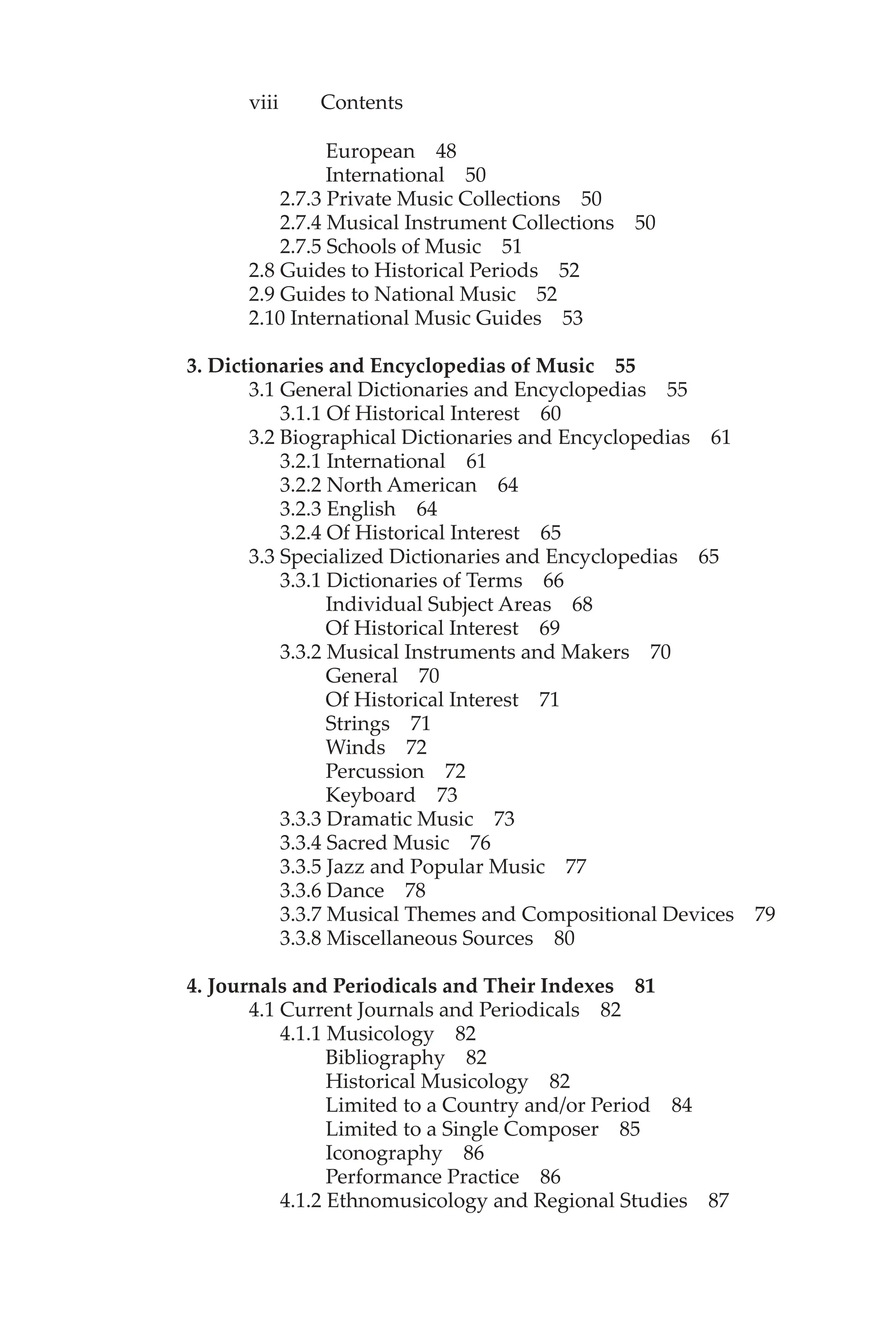

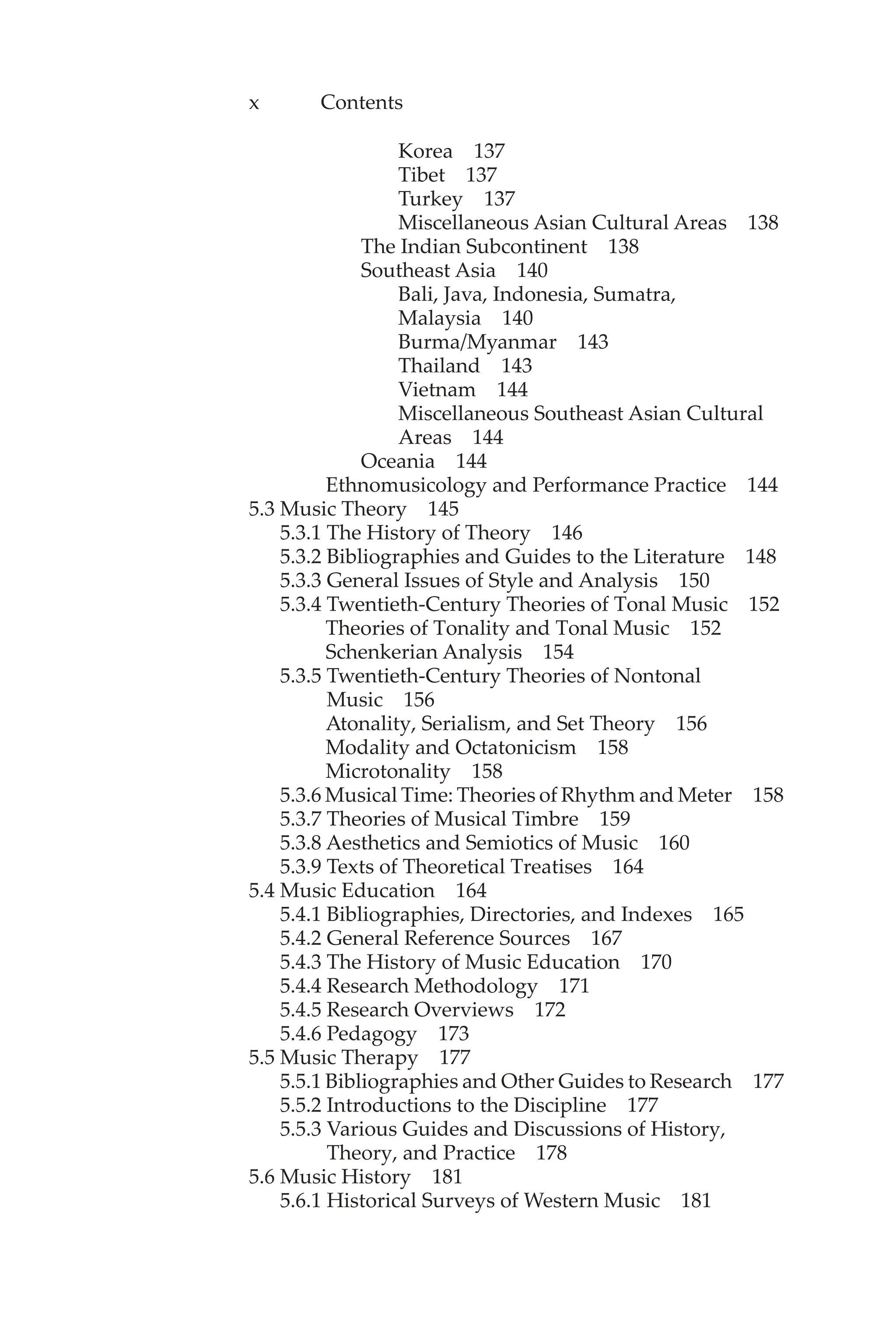
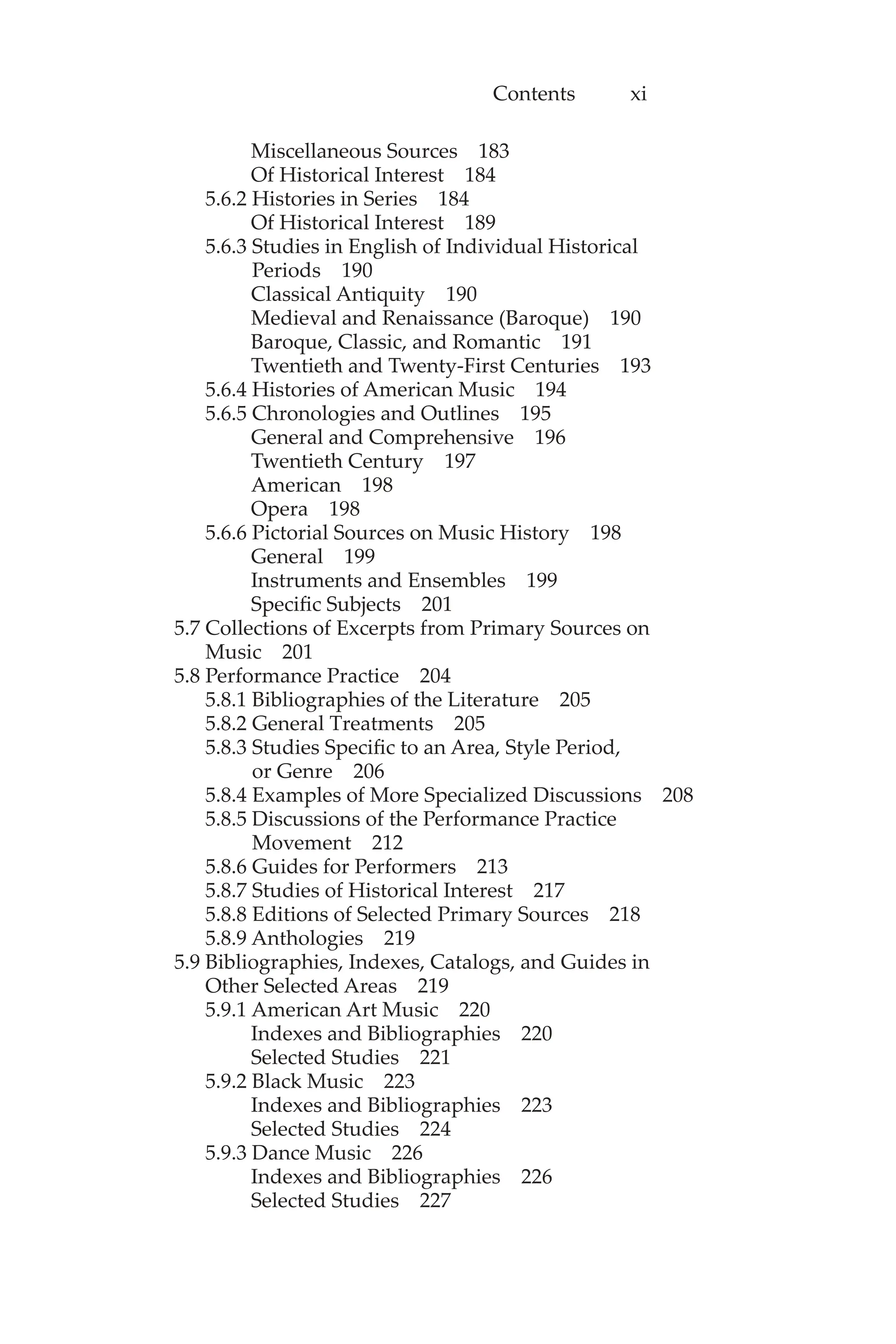
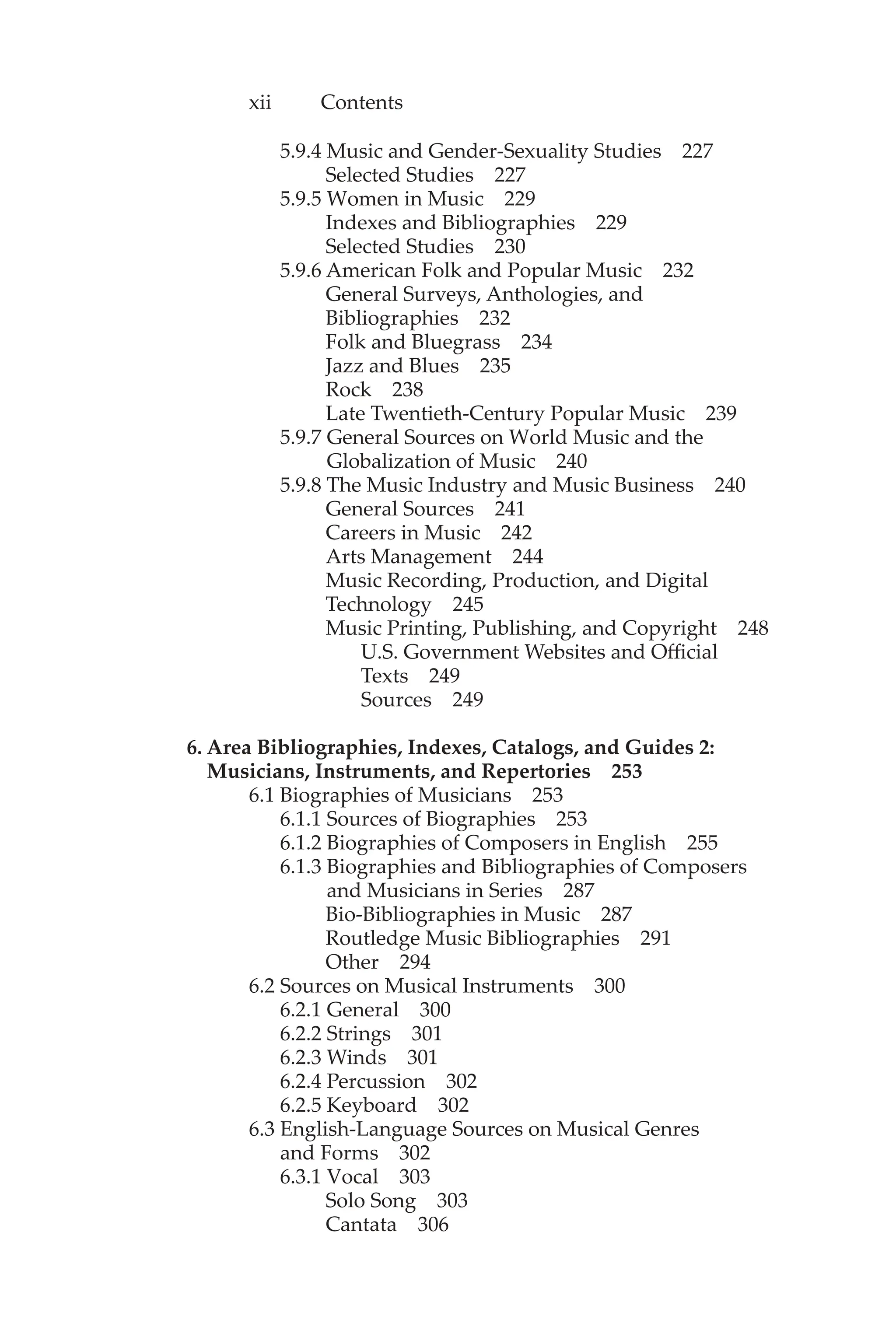





![2 Introductory Materials
ed. (Chicago:American LibraryAssociation, 2012); Jean Peters, The
Bookman’s Glossary, 6th ed., rev. and enl. (New York: R. R. Bowker,
1983); and Willem Elbertus Clason, ed., Elsevier’s Dictionary of Li-
brary Science, Information and Documentation in Six Languages: En-
glish/American, French, Spanish, Italian, Dutch and German, 2nd ed.
(Amsterdam, London, and New York: Elsevier, 1992).
abstract—a summary of a book, article, etc.; also called a précis
(e.g., Dissertation Abstracts, RILM Abstracts).
anthology—a representative collection of selected musical or
literary works or excerpts.
archive—a place in which public or institutional records are sys-
tematically preserved, or a repository of any documents or
other materials, especially those of historical value.
arrangement—a reworking of a musical composition so that the
performing forces, the musical content, or the form are
substantially different from the original (compare edition,
definition c, and transcription).
autograph—a document (music manuscript, letter, etc.) written
or signed in a person’s own hand; thus, a primary source
(see sources, primary and secondary; compare holograph,
manuscript).
carrel—an alcove or desk in a library—often in the stacks—
comprising a table and shelves for private study, to which
books in a library’s collection may be charged for re-
search use.
catalog, catalogue—(a) a list of the contents of a library, book
collection, or group of libraries (see union catalog); (b) a
list or index of compositions, usually by a single composer
rather than of a collection or a repertory of music (see
thematic catalog).
CD-ROM (“compact disc read-only memory”)—any informa-
tion, such as a database, stored on compact discs and read-
able on the screen of a computer designed for this pur-
pose, or one equipped with a CD-ROM drive (see online
catalog, database).
choirbook—a music manuscript in a large enough format and
with the separate voice parts of the compositions con-
tained in it written large enough on the same or on facing
pages so that an entire choir could sing from it (in use
especially in the 15th and early 16th centuries). (See also
partbook, manuscript.)
codex (pl.: codices)—an ancient book or unbound sheets in a
manuscript (e.g., Squarcialupi Codex, Trent Codices; see
The New Harvard Dictionary of Music, “Sources [pre-1500]”).](https://image.slidesharecdn.com/3426158-250620090105-bad73ce3/75/Sourcebook-For-Research-In-Music-3rd-Allen-Scott-Phillip-D-Crabtree-27-2048.jpg)
![Introductory Materials 5
international identification system first developed in the
United Kingdom in 1967 and adopted in the U.S. in 1968;
the identifying code is placed at the front of books and
serials respectively (e.g., ISBN 0-697-03342-2, ISSN 1044-
1608).
journal—(a) a generic term to refer to, or sometimes used in the
title of, a scholarly periodical (e.g., Journal of the American
Musicological Society); (b) a diary or daily record of occur-
rences, transactions, or reflections. (Compare magazine,
periodical, proceedings, review, yearbook; see chapter 4
of this book.)
lacuna (pl.: lacunae)—a hiatus, gap, or missing portion in a
source or body of works.
lexicon—a book containing an alphabetical or other systematic
arrangement of words and their definitions; a dictionary.
magazine—a periodical containing articles, pictures, reviews,
advertisements, etc., often of popular interest and some-
times focusing on a specific subject area.
manuscript (MS, ms)—(a) a book, document, musical composi-
tion, letter, etc., written by hand; (b) an author’s written or
typed copy of a work before it is printed; thus, a primary
source (see sources, primary and secondary; compare
autograph, holograph).
microforms—a general term for microfilm and other miniature
processes of reproduction such as the following:
microcard—a card on which numerous pages of a book are
reproduced in greatly reduced size.
microfiche—a card-like transparency on which appear multiple
frames of microfilm.
microfilm—a photographic reproduction in which the image is
reduced to fit a frame of 35 mm or 16 mm film.
monograph—a scholarly study (book or article) treating a single
subject or a limited aspect of a subject (see also treatise).
monument, musical—a scholarly edition of music from one
region or country (Denkmal [pl.: Denkmäler] is the German
equivalent) (see edition, definition c; refer to chapter 5 of
this book).
necrology—(a) a notice of the death of a person; obituary; (b)
a list or record of people who have died within a certain
period of time; in either sense, there may or may not be
biographical information included.
oblong (ob., obl.)—a book size wider than it is high (e.g., 4° obl.,
8° obl.).
octavo (8°, 8vo)—the size of a piece of paper cut eight from a sheet,
or a page size about 9 3/4 inches/25 centimeters high.](https://image.slidesharecdn.com/3426158-250620090105-bad73ce3/75/Sourcebook-For-Research-In-Music-3rd-Allen-Scott-Phillip-D-Crabtree-30-2048.jpg)

![Introductory Materials 7
serial—any publication usually appearing at regular intervals,
including periodicals, annuals (yearbooks), newspapers,
proceedings, etc.
shelflist—a bibliographical record of a library collection in call-
number order.
siglum (pl.: sigla)—a letter or letters with or without numbers
used to identify a manuscript or printed source, library, or
archive (see The New Harvard Dictionary of Music, “Sources
[Pre-1500]”).
sources, primary and secondary—a primary source is a compo-
sition, letter, or document by a composer, author, or some
other person, or any document dating from the historical
period in question that gives the words of the witnesses
or recorders of an event; a secondary source is second- or
third-hand information and may be based on a primary
source.
stacks—a library term for the main area in a library where books
are shelved. Stacks are either “open,” if the general public
is admitted to them, or “closed,” if it is not.
stemmatics—from stemma (Latin, “garland, wreath”); the ge-
nealogical study of musical or literary manuscripts.
thematic catalog—a list or index of compositions, usually by a
single composer rather than a collection or repertory of
music, in which each composition or movement is identified
by an incipit (compare catalog, catalogue, definition b).
transcription—(a) the transliteration of an early work into
modern musical notation; (b) the process or result of
adapting a musical composition (usually instrumental)
to a medium other than its original one, which may vary
from little more than a transference from one medium to
another to a modification of the original necessitated by
the change of medium (compare arrangement, edition).
treatise—a learned, formal writing on a subject, usually in book
form (see also monograph).
union catalog—a library catalog listing the holdings of a group
of cooperating libraries (see catalog, catalogue, defini-
tion a).
Urtext—original text, often a prototype from which later variants
(texts, compositions, etc.) are derived.
verso (v)—the side of a folio that is to be read second, i.e., the re-
verse side or left-hand page (e.g., “fol. 2v”; see also recto).
watermark—a manufacturer’s identifying mark or design em-
bedded in a sheet of paper, resulting from different thick-
nesses in the paper and visible when held up to light.
yearbook—a publication issued annually, such as the Bach-Jahr-](https://image.slidesharecdn.com/3426158-250620090105-bad73ce3/75/Sourcebook-For-Research-In-Music-3rd-Allen-Scott-Phillip-D-Crabtree-32-2048.jpg)
![8 Introductory Materials
buch or “Recherches” sur la musique française classique, that
contains scholarly contributions and information, often
limited to a specific area.
1.2 C O M M O N G E R M A N
B I B L I O G R A P H I C A L T E R M S
The English equivalents given for the following German terms
are those that concern bibliography and scholarship (e.g., Folge
can also mean “sequel,” “result,” “inference,” etc., as well as “se-
ries”); in particular, note terms that are not obvious cognates or are
even misleading ones, sometimes called “false friends” (e.g., Band,
Brief, Kapitel, Register). Abbreviations commonly used in scholarly
German are given here, and other standard ones may be found
listed in any good German-English dictionary. The abbreviations
of musical terms have been taken largely from Richard Schaal’s
Abkürzungen in der Musik-Terminologie, which is devoted entirely
to abbreviations in music; and from Die Musik in Geschichte und
Gegenwart [MGG] (see chapter 3 under “General Dictionaries and
Encyclopedias”), whose abbreviations are listed at the beginning
of each volume.
Abbildung (Abb.)—illustration, figure
Abdruck (Abdr.)—impression, print, reproduction
Abhandlung (Abh.)—treatise
Abkürzung (Abk.)—abbreviation
Abschrift (Abschr.)—reprint, copy
Anhang (Anh.)—appendix, supplement (see also Beilage,
Beiheft)
Anmerkung (Anm.)—footnote (see also Fussnote)
Anthologie (Anth.)—anthology
Archiv (Arch.)—record office, archive
Aufführungspraxis—performance practice
Auflage (Aufl.)—edition (see also Ausgabe, Gesammelte Werke,
Gesamtausgabe, Sammelwerk, Sämtliche Werke)
Aufrufzahl—call number, shelf mark
Ausgabe (Ausg.)—edition (see also Auflage, Gesammelte
Werke, Gesamtausgabe, Sammelwerk, Sämtliche Werke)
Ausgewählte Werke (AW)—selected works
Band (Bd.)—volume
Bearbeiter; Bearbeitung (Bearb.)—compiler, author, reviser;
compilation, edition, arrangement
Beiheft (Beih.)—supplement (see also Anhang, Beilage)
Beilage (Beil.)—supplement, appendix (see also Anhang, Beiheft)](https://image.slidesharecdn.com/3426158-250620090105-bad73ce3/75/Sourcebook-For-Research-In-Music-3rd-Allen-Scott-Phillip-D-Crabtree-33-2048.jpg)
![Introductory Materials 9
Beispiel (Beisp.)—example (“zum Beispiel” [z.B.]—for ex-
ample, e.g.)
Beitrag (Beitr.)—contribution (i.e., to a journal)
Bemerkungen (Bem.)—remarks, annotations, commentary
Bericht (Ber.)—report, commentary (see also Kritischer Bericht,
Revisionsbericht)
Besprechung—review, criticism, conference
beziehungsweise (bzw.)—respectively; or, or else; more specifi-
cally
Bibliothek (Bibl.)—library
Bildnis (Bildn.)—portrait, likeness
Bildtafel—plate in a book
Blatt (Bl.)—leaf, folio; newspaper
Brief—letter, epistle
Buchhändler; Buchhandlung (Buchh.)—bookseller; bookshop
das heisst (d.h.)—that is, i.e. (also “das ist”)
Denkmäler (Dkm.) (pl.)—monuments
Doktorarbeit; Dissertation (Diss.)—doctoral dissertation
Druck (Dr.)—print, printing, impression
ebenda(selbst) (ebd.)—in the same place, ibidem
Einleitung (Einl.)—introduction
erscheinen (ersch.)—to appear, come out, be published
Festschrift (Fs.)—publication on the occasion of a celebration or
in honor of someone
Folge (F.); Neue Folge (N.F.)—series, continuation, issue; new
series or issue (“und folgende” [u.ff.]—and following)
Fussnote—footnote (see also Anmerkung)
geboren (geb.)—born
gedruckt (gedr.)—printed
Gegenwart (Gegenw.)—present time
Gesammelte Werke (GW)—complete works (see also Auflage,
Ausgabe, Gesamtausgabe, Sammelwerk, Sämtliche
Werke)
Gesamtausgabe (GA)—complete works (see also Auflage,
Ausgabe, Gesammelte Werke, Sammelwerk, Sämtliche
Werke)
Geschichte (Gesch.)—history
Gesellschaft (Ges.)—society, association, club (see also Verein,
Musikverein)
gestorben (gest.)—died
getauft (get.)—baptized
Handbuch (Hdb.)—handbook, manual
Handexemplar—composer’s or author’s copy
Handschrift (Hs.)—manuscript (see also Manuskript)
Heft (H.)—number, part](https://image.slidesharecdn.com/3426158-250620090105-bad73ce3/75/Sourcebook-For-Research-In-Music-3rd-Allen-Scott-Phillip-D-Crabtree-34-2048.jpg)
![10 Introductory Materials
Herausgeber (Hrsg.); herausgegeben (hg.)—editor (see also
Redakteur); edited, published (see also publiziert)
Inhalt (Inh.)—table of contents
insbesondere (insb.)—especially, particularly
Jahr (J.)—year
jährlich—yearly, annually
Jahrbuch (Jb.)—yearbook
Jahreszahl (JZl.)—date, year
Jahrgang (Jg.)—the bound issues of a periodical for one year
Jahrhundert (Jh.)—century
Kapitel (Kap.)—chapter
Katalog (Kat.)—catalog
Komponist (Komp.)—composer
Kritischer Bericht (Krit. Ber.)—critical report or commentary
(see also Revisionsbericht)
Kunst—art (“Tonkunst”—music [tonal art])
Lexikon (L)—dictionary (abb. used in combination with an au-
thor, e.g., RiemannL) (see also Wörterbuch)
Lieferung (Lfg.)—part of a work, fascicle
Literatur (Lit.)—literature, letters, bibliography
Manuskript (Ms.)—manuscript (see also Handschrift)
Mitarbeiter (Mitarb.)—collaborator
Mitteilung (Mitt.)—announcement, communication (see also
Nachricht)
Mitwirkung (Mitw.)—cooperation
Monatsheft—monthly periodical
Musik Lexikon (M Lex.)—music lexicon, dictionary (see also
Wörterbuch)
Musikalien—printed music
Musikforschung (Mf.)—music research (see also Musikwissen-
schaft)
Musikgeschichte (Mg.)—music history
Musikverein (MV)—musical society (see also Gesellschaft)
Musikwissenschaft (Mw.)—musicology (see also Musikfor-
schung)
Nachricht (Nachr.)—communication, report, notice (see also
Mitteilung)
Nachwort (Nachw.)—concluding remarks, epilogue
Neuauflage—reprint, republication
Neuausgabe, Neue Ausgabe (NA)—new edition
Neudruck (Neudr.)—reprint
ohne (o.)—without (“ohne Jahr” [o.J.]—no year [of publication];
“ohne Ort” [o.O.]—no place [of publication], no opus
[number])
Partitur (P., Part.)—musical score](https://image.slidesharecdn.com/3426158-250620090105-bad73ce3/75/Sourcebook-For-Research-In-Music-3rd-Allen-Scott-Phillip-D-Crabtree-35-2048.jpg)
![Introductory Materials 11
publiziert (publ.)—published (see also herausgegeben)
Originalquellen—primary sources
Quelle—source
Quellen zweiter Hand—secondary sources
Redakteur; Redaktion (Red.)—editor (see also Herausgeber);
editorial matter, editorial staff
Register—index
Reihe (R.)—series, set, tone row (“Neue Reihe” [N.R.]—new
series)
revidiert (rev.)—revised (“redivierte Auflage”)
Revisionsbericht—critical commentary (see also Kritischer
Bericht)
Sammelband (Sbd., Smlbd.)—volume containing a collection of
essays
Sammelwerk (Sw., Swk.)—collected works (see also Auflage,
Ausgabe, Gesammelte Werke, Gesamtausgabe, Sämt-
liche Werke)
Sammlung (Samlg., Samml., Slg., Slng.)—collection, compila-
tion, set
Sämtliche Werke—complete works (see also Auflage, Ausgabe,
Gesammelte Werke, Gesamtausgabe, Sammelwerk)
Schrift—writing, book, periodical, etc.
Schriftleiter; Schriftleitung (Schriftl.)—editor (see also Her-
ausgeber, Redakteur); editorship, editorial staff (see also
Redaktion)
Seite (S.)—page
siehe oben (s.o.)—see above, supra
siehe unten (s.u.)—see below, infra
Skizzen (SK)—sketches, outlines
Stimmbuch (Stb.)—part book
Tabelle (Tab.)—table, chart, graph (see also Tafel)
Tafel (Taf.)—table (see also Tabelle)
Teil (Tl.)—part, division (“zum Teil” [z.T.]—in part)
Titelblatt—title page
Transkription—transcription
Überlieferung—tradition, inheritance, surviving original
sources, etc.
Übertragung (Übtr.)—translation, transcription
und andere (u.a.)—and others, et al.
und so weiter (usw.)—and so forth, etc.
unter anderem (u.a.)—among others
Urtext—original text
Verein (Ver.)—association, society (see also Gesellschaft)
Verfasser (Verf.)—composer, writer
vergleich (vgl., vergl.)—compare](https://image.slidesharecdn.com/3426158-250620090105-bad73ce3/75/Sourcebook-For-Research-In-Music-3rd-Allen-Scott-Phillip-D-Crabtree-36-2048.jpg)