Student-centered
Student-centered
design:
design:
paths to achieve it.
Isabell Grundschober,
University for Continuing
Education, Krems (AT)
2022 eucen Autum Seminar
Universities are uniquely
positioned to equip learners
with the necessary skills and
expertise
to play an active part in [digital
transformation] processes
and adapt to our rapidly
changing societies.
Isabell Grundschober
@isabellgru #unikrems
2022 eucen Autum Seminar
(2022 eucen Autum Seminar program)
Student-centered
learning (SCLT) as key:
How can LLL at university remain
ahead of the labor market
demands and offer programs
relevant to the industry?
(2022 eucen Autum Seminar program)
Isabell Grundschober
@isabellgru #unikrems
2022 eucen Autum Seminar
SCLT
"For the most part, we are still living in a
teacher-centred paradigm."
"mature SCLT ecosystems are not
widespread across Europe.“
"fragmented pockets" of SCLT practice in
HE
(Klemenčič et al., 2020)
Isabell Grundschober
@isabellgru #unikrems
2022 eucen Autum Seminar
SCLT - a reality in Europe?
"For the most part, we are still
living in a teacher-centred
paradigm."
"mature SCLT ecosystems are not
widespread across Europe.“
"fragmented pockets" of SCLT
practice in HE
(Klemenčič et al., 2020)
Isabell Grundschober
@isabellgru #unikrems
2022 eucen Autum Seminar
Isabell Grundschober
@isabellgru #unikrems
2022 eucen Autum Seminar
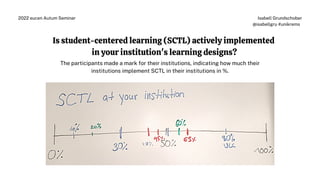
Is student-centered learning (SCTL) actively implemented
in your institution's learning designs?
The participants made a mark for their institutions, indicating how much their
institutions implement SCTL in their institutions in %.
"Without clarity as to its
meaning and specific set
of indicators to assess
institutional practices,
almost anything can be
‘sold’ as student-centred
learning.“
(Klemenčič, 2017)
Isabell Grundschober
@isabellgru #unikrems
2022 eucen Autum Seminar
Isabell Grundschober
@isabellgru #unikrems
2022 eucen Autum Seminar
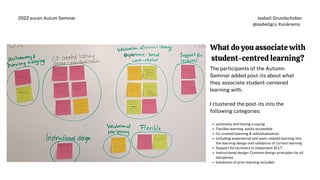
What do you associate with
student-centred learning?
autonomy and having a saying
Flexible learning, easily accessible
Co-created learning & individualization
Including experiential and work-related learning into
the learning design and validation of current learning
Support for lecturers to implement SCLT
Instructional design: Common design principles for all
disciplines
Validation of prior learning included
The participants of the Autumn
Seminar added post-its about what
they associate student-centered
learning with.
I clustered the post-its into the
following categories:
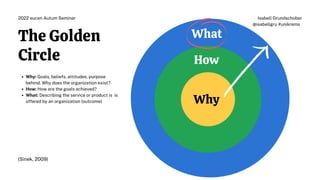
Why
The Golden
Circle
(Sinek, 2009)
What
How
Why: Goals, beliefs, attitudes, purpose
behind. Why does the organization exist?
How: How are the goals achieved?
What: Describing the service or product is is
offered by an organization (outcome)
Isabell Grundschober
@isabellgru #unikrems
2022 eucen Autum Seminar
Good Work
“work that is of excellent technical
quality, work that is ethically
pursued and socially responsible, and
work that is engaging, enjoyable, and
feels good”
(Gardner, 2007, p. 5)
Isabell Grundschober
@isabellgru #unikrems
2022 eucen Autum Seminar
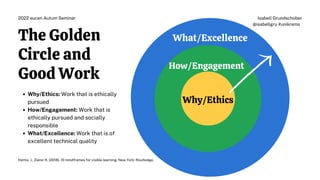
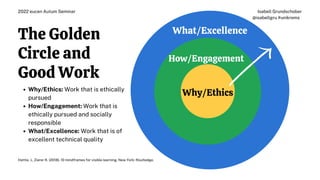
The Golden
Circle and
Good Work
Hattie, J., Zierer K. (2018). 10 mindframes for visible learning. New York: Routledge.
Why/Ethics
What/Excellence
How/Engagement
Why/Ethics: Work that is ethically
pursued
How/Engagement: Work that is
ethically pursued and socially
responsible
What/Excellence: Work that is of
excellent technical quality
Isabell Grundschober
@isabellgru #unikrems
2022 eucen Autum Seminar
What is
student-centred
design?
What should be the end result?
Isabell Grundschober
@isabellgru #unikrems
2022 eucen Autum Seminar
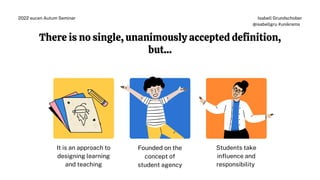
There is no single, unanimously accepted definition,
but...
It is an approach to
designing learning
and teaching
Founded on the
concept of
student agency
Students take
influence and
responsibility
Isabell Grundschober
@isabellgru #unikrems
2022 eucen Autum Seminar
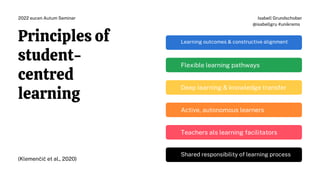
Principles of
student-
centred
learning
(Klemenčič et al., 2020)
Learning outcomes & constructive alignment
Flexible learning pathways
Deep learning & knowledge transfer
Active, autonomous learners
Teachers als learning facilitators
Shared responsibility of learning process
Isabell Grundschober
@isabellgru #unikrems
2022 eucen Autum Seminar
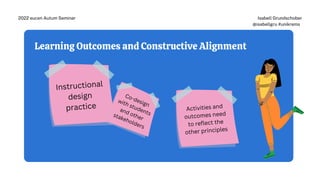
Learning Outcomes and Constructive Alignment
Isabell Grundschober
@isabellgru #unikrems
2022 eucen Autum Seminar
Instructional
design
practice
Co-design
with students
and other
stakeholders
Activities and
outcomes need
to reflect the
other principles
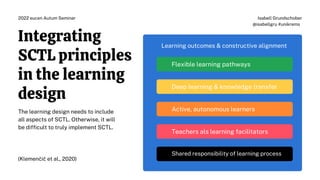
Integrating
SCTL principles
in the learning
design
(Klemenčič et al., 2020)
Learning outcomes & constructive alignment
Flexible learning pathways
Deep learning & knowledge transfer
Active, autonomous learners
Teachers als learning facilitators
Shared responsibility of learning process
Isabell Grundschober
@isabellgru #unikrems
2022 eucen Autum Seminar
The learning design needs to include
all aspects of SCTL. Otherwise, it will
be difficult to truly implement SCTL.
How to achieve
student-centred
design?
How to make it real?
Isabell Grundschober
@isabellgru #unikrems
2022 eucen Autum Seminar
Learning Design:
Both a Process &
a Product
(Boling und Smith, 2009)
Let's make it
participative and agile!
Isabell Grundschober
@isabellgru #unikrems
2022 eucen Autum Seminar
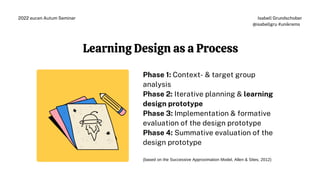
Phase 1: Context- & target group
analysis
Phase 2: Iterative planning & learning
design prototype
Phase 3: Implementation & formative
evaluation of the design prototype
Phase 4: Summative evaluation of the
design prototype
(based on the Successive Approximation Model, Allen & Sites, 2012)
Learning Design as a Process
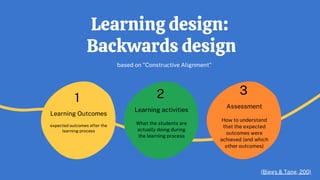
Learning Outcomes
expected outcomes after the
learning process
1
Learning activities
What the students are
actually doing during
the learning process
2
Learning design:
Backwards design
based on "Constructive Alignment"
(Biggs & Tang, 200)
Assessment
How to understand
that the expected
outcomes were
achieved (and which
other outcomes)
3
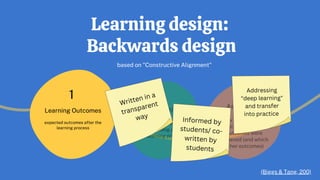
Learning Outcomes
expected outcomes after the
learning process
1
Learning activities
What the students are
actually doing during
the learning process
2
Learning design:
Backwards design
based on "Constructive Alignment"
(Biggs & Tang, 200)
Assessment
How to understand
that the expected
outcomes were
achieved (and which
other outcomes)
3
Written in a
transparent
way
Informed by
students/ co-
written by
students
Addressing
"deep learning"
and transfer
into practice
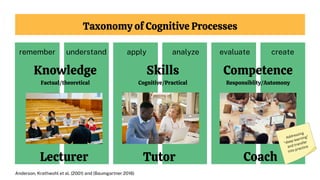
Taxonomy of Cognitive Processes
remember understand apply analyze evaluate create
Knowledge
Factual/theoretical
Skills
Cognitive/Practical
Competence
Responsiblity/Automony
Lecturer Tutor Coach
Anderson, Krathwohl et al. (2001) and (Baumgartner 2016)
Addressing
"deep learning"
and transfer
into practice
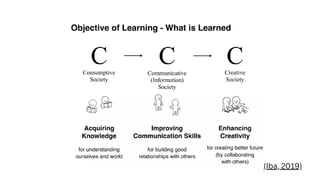
(Iba, 2019)
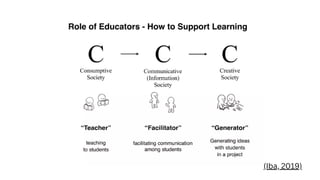
(Iba, 2019)
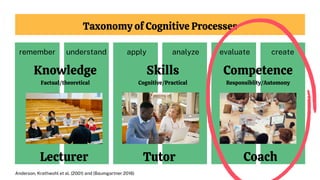
Taxonomy of Cognitive Processes
remember understand apply analyze evaluate create
Knowledge
Factual/theoretical
Skills
Cognitive/Practical
Competence
Responsiblity/Automony
Lecturer Tutor Coach
Anderson, Krathwohl et al. (2001) and (Baumgartner 2016)
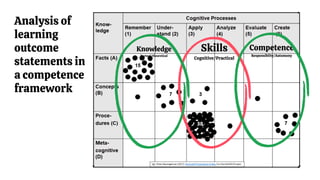
Analysis of
learning
outcome
statements in
a competence
framework
Skills
Cognitive/Practical
Knowledge
Factual/theoretical
Competence
Responsiblity/Automony
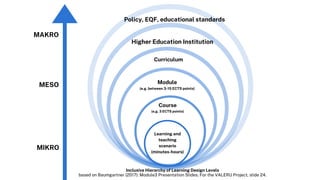
Learning and
teaching
scenario
(minutes-hours)
Inclusive Hierarchy of Learning Design Levels
based on Baumgartner (2017): Module3 Presentation Slides. For the VALERU Project, slide 24.
Module
(e.g. between 3-15 ECTS points)
Curriculum
Higher Education Institution
MIKRO
MESO
MAKRO
Course
(e.g. 3 ECTS points)
Policy, EQF, educational standards
Learning Outcomes
expected outcomes after the
learning process
1
Learning activities
What the students are
actually doing during
the learning process
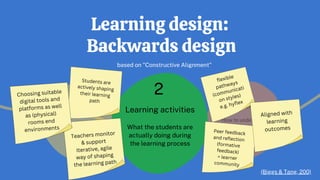
2
Learning design:
Backwards design
based on "Constructive Alignment"
(Biggs & Tang, 200)
Assessment
How to understand
that the expected
outcomes were
achieved (and which
other outcomes)
3
flexible
pathways
(communicati
on styles)
e.g. hyflex
Students are
actively shaping
their learning
path
Peer feedback
and reflection
(formative
feedback)
= learner
community
Teachers monitor
& support
Iterative, agile
way of shaping
the learning path
Aligned with
learning
outcomes
Choosing suitable
digital tools and
platforms as well
as (physical)
rooms end
environments
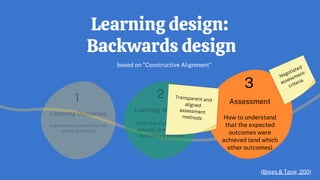
Learning Outcomes
expected outcomes after the
learning process
1
Learning activities
What the students are
actually doing during
the learning process
2
Learning design:
Backwards design
based on "Constructive Alignment"
(Biggs & Tang, 200)
Assessment
How to understand
that the expected
outcomes were
achieved (and which
other outcomes)
3
Transparent and
aligned
assessment
methods
Negotiated
assessment-
criteria
COMPASS
Course Design
Template
Isabell Grundschober
@isabellgru #unikrems
2022 eucen Autum Seminar
Learning design as a product:
A plan is collaboratively
created. The template
reminds lectures of the SCTL
principles when designing
courses.
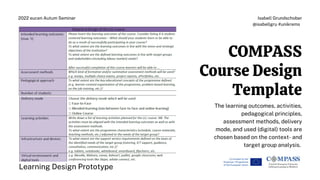
COMPASS
Course Design
Template
Isabell Grundschober
@isabellgru #unikrems
2022 eucen Autum Seminar
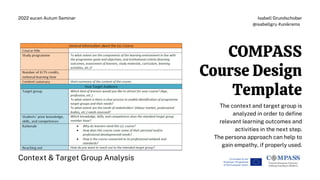
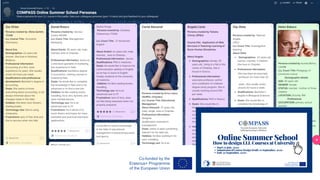
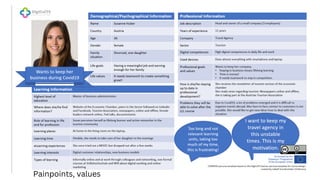
Context & Target Group Analysis
The context and target group is
analyzed in order to define
relevant learning outcomes and
activities in the next step.
The persona approach can help to
gain empathy, if properly used.
Painpoints, values
COMPASS
Course Design
Template
Isabell Grundschober
@isabellgru #unikrems
2022 eucen Autum Seminar
Learning Design Prototype
The learning outcomes, activities,
pedagogical principles,
assessment methods, delivery
mode, and used (digital) tools are
chosen based on the context- and
target group analysis.
COMPASS
Course Design
Template
Isabell Grundschober
@isabellgru #unikrems
2022 eucen Autum Seminar
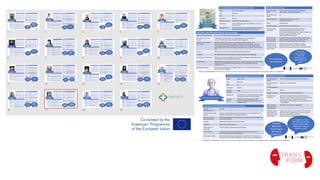
Information about the involved staff
We need to know what the
involved higher education staff
needs to know in order to
successfully implement the
learning design.
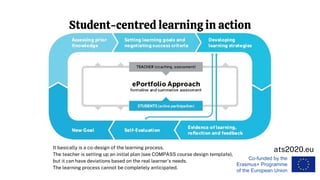
ats2020.eu
Student-centred learning in action
It basically is a co-design of the learning process.
The teacher is setting up an initial plan (see COMPASS course design template),
but it can have deviations based on the real learner's needs.
The learning process cannot be completely anticipated.
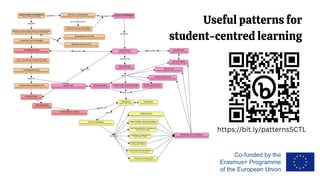
https://bit.ly/patternsSCTL
Useful patterns for
student-centred learning
"How"-Pitfall 1:
Unsuitable digital
tools and platforms
Tools and platforms chosen during
"digital transformation" phases are not
suitable to support SCTL
Isabell Grundschober
@isabellgru #unikrems
2022 eucen Autum Seminar
Isabell Grundschober
@isabellgru #unikrems
2022 eucen Autum Seminar
"How"-Pitfall 2:
Lecturers don't
know the target
group
Especially external lecturers often do
not receive the information about the
learned they would need to properly
design a course.
Isabell Grundschober
@isabellgru #unikrems
2022 eucen Autum Seminar
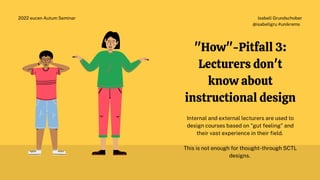
"How"-Pitfall 3:
Lecturers don't
know about
instructional design
Internal and external lecturers are used to
design courses based on "gut feeling" and
their vast experience in their field.
This is not enough for thought-through SCTL
designs.
Isabell Grundschober
@isabellgru #unikrems
2022 eucen Autum Seminar
"How"-Pitfall 4:
No time for all these
feedback loops and
iterative adaptation
of the design.
Some teachers find it difficult to include
agile learning design adaptions in their daily
teaching practice. They have limited time
resources for this kind of individualized
learning designs.
Why are we
trying to achieve
student-
centered design?
What is the purpose?
Isabell Grundschober
@isabellgru #unikrems
2022 eucen Autum Seminar
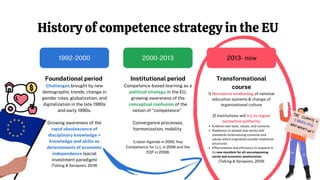
Foundational period
Challenges brought by new
demographic trends, change in
gender roles, globalization, and
digitalization in the late 1980s
and early 1990s.
Growing awareness of the
rapid obsolescence of
disciplinary knowledge >
knowledge and skills as
determinants of economic
independence (social
investment paradigm)
(Telling & Serapioni, 2019)
Institutional period
Competence-based learning as a
political strategy in the EU,
growing awareness of the
conceptual confusion of the
notion of "competence"
Convergence processes,
harmonization, mobility
(Lisbon Agenda in 2000, Key
Competence for LLL in 2006 and the
EQF in 2008)
Endorse new tools, values, and contents
Readiness to spread new norms and
standards (internalizing contents and
values which originated outside traditional
structures
Effectiveness and efficiency to respond to
its new mandate for all-encompassing
social and economic amelioration.
Transformational
course
1) Normative weakening of national
education systems & change of
organizational culture
2) Institutions will try to regain
normative authority:
(Telling & Serapioni, 2019)
1992-2000 2000-2013 2013- now
History of competence strategy in the EU
Competence-orientation:
Away from models based
on traditional
disciplinary knowledge to
one prioritising learning
outcomes.
(Telling & Serapioni, 2019)
Isabell Grundschober
@isabellgru #unikrems
2022 eucen Autum Seminar
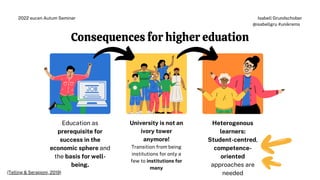
Consequences for higher eduation
Education as
prerequisite for
success in the
economic sphere and
the basis for well-
being.
University is not an
ivory tower
anymore!
Transition from being
institutions for only a
few to institutions for
many
Heterogenous
learners:
Student-centred,
competence-
oriented
approaches are
needed
(Telling & Serapioni, 2019)
Isabell Grundschober
@isabellgru #unikrems
2022 eucen Autum Seminar
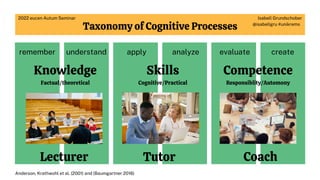
Taxonomy of Cognitive Processes
remember understand apply analyze evaluate create
Knowledge
Factual/theoretical
Skills
Cognitive/Practical
Competence
Responsiblity/Automony
Lecturer Tutor Coach
Anderson, Krathwohl et al. (2001) and (Baumgartner 2016)
Isabell Grundschober
@isabellgru #unikrems
2022 eucen Autum Seminar
The Golden
Circle and
Good Work
Hattie, J., Zierer K. (2018). 10 mindframes for visible learning. New York: Routledge.
Why/Ethics
What/Excellence
How/Engagement
Why/Ethics: Work that is ethically
pursued
How/Engagement: Work that is
ethically pursued and socially
responsible
What/Excellence: Work that is of
excellent technical quality
Isabell Grundschober
@isabellgru #unikrems
2022 eucen Autum Seminar
Mass acceptance of
student-centred
learning design?
Get them with the "WHY"!
Isabell Grundschober
@isabellgru #unikrems
2022 eucen Autum Seminar
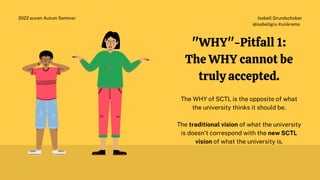
"WHY"-Pitfall 1:
The WHY cannot be
truly accepted.
The WHY of SCTL is the opposite of what
the university thinks it should be.
The traditional vision of what the university
is doesn't correspond with the new SCTL
vision of what the university is.
Isabell Grundschober
@isabellgru #unikrems
2022 eucen Autum Seminar
SCLT
Student-centered
learning (SCLT) as key:
How can LLL at university remain
ahead of the labor market
demands and offer programs
relevant to the industry?
(2022 eucen Autum Seminar program)
Isabell Grundschober
@isabellgru #unikrems
2022 eucen Autum Seminar
SCLT
Student-centered
learning (SCLT) as key:
How can LLL at university remain
ahead of the labor market
demands and offer programs
relevant to the industry?
(2022 eucen Autum Seminar program)
Isabell Grundschober
@isabellgru #unikrems
2022 eucen Autum Seminar
Conflicts
Hattie, J., Zierer K. (2018). 10 mindframes for visible learning. New York: Routledge.
Why/Ethics
What/Excellence
How/Engagement
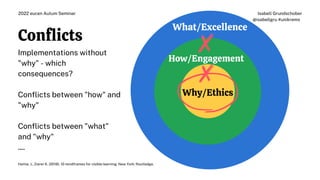
Implementations without
"why" - which
consequences?
Conflicts between "how" and
"why"
Conflicts between "what"
and "why"
....
Isabell Grundschober
@isabellgru #unikrems
2022 eucen Autum Seminar
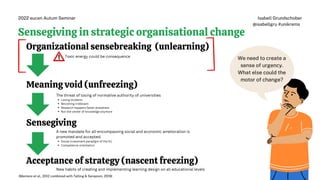
Organizational sensebreaking (unlearning)

Meaning void (unfreezing)
Sensegiving
Acceptance of strategy (nascent freezing)
(Mantere et al., 2012 combined with Telling & Serapioni, 2019)
We need to create a
sense of urgency.
What else could the
motor of change?
Toxic energy could be consequence
Losing students
Becoming irrelevant
Research happens faster elsewhere
Not the center of knowledge anymore
The threat of losing of normative authority of universities
Social investment paradigm of the EU
Competence-orientation
A new mandate for all-encompassing social and economic amelioration is
promoted and accepted.
New habits of creating and implementing learning design on all educational levels
Sensegiving in strategic organisational change
Isabell Grundschober
@isabellgru #unikrems
2022 eucen Autum Seminar
What pitfalls of
SCTL are there
relating to the
WHY, HOW, and
WHAT?
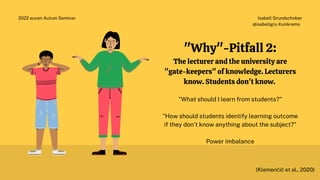
"Why"-Pitfall 2:
The lecturer and the university are
"gate-keepers" of knowledge. Lecturers
know. Students don't know.
"What should I learn from students?"
"How should students identify learning outcome
if they don't know anything about the subject?"
Power imbalance
(Klemenčič et al., 2020)
Isabell Grundschober
@isabellgru #unikrems
2022 eucen Autum Seminar
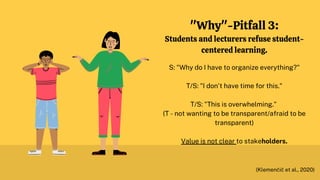
"Why"-Pitfall 3:
Students and lecturers refuse student-
centered learning.
S: "Why do I have to organize everything?"
T/S: "I don't have time for this."
T/S: "This is overwhelming."
(T - not wanting to be transparent/afraid to be
transparent)
Value is not clear to stakeholders.
(Klemenčič et al., 2020)
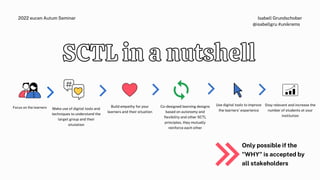
SCTL in a nutshell
Make use of digital tools and
techniques to understand the
target group and their
situtation
Focus on the learners Build empathy for your
learners and their situation
Stay relevant and increase the
number of students at your
institution
Use digital tools to improve
the learners' experience
Co-designed learning designs
based on autonomy and
flexibility and other SCTL
principles, they mutually
reinforce each other
Only possible if the
"WHY" is accepted by
all stakeholders
Isabell Grundschober
@isabellgru #unikrems
2022 eucen Autum Seminar
Isabell Grundschober, BSc, BEd, MA
Deputy head of the Centre for Applied Research
and Innovation in Lifelong Learning at the
University for Continuing Education Krems (AT)
isabell.grundschober@donau-uni.ac.at
isabellgru.eu
@isabellgru
Thank you!
Isabell Grundschober
@isabellgru #unikrems
2022 eucen Autum Seminar
Literature
Gordon J, Halasz G, Krawczyk M, et al. (2009) Key competences in Europe: Opening doors for lifelong learners across the school curriculum and
teacher education. Report, No. 87, 2009. Warsaw: CASE Network Reports.
Telling, K., & Serapioni, M. (2019). The rise and change of the competence strategy: Reflections on twenty-five years of skills policies in the EU.
European Educational Research Journal, 18(4), 387–406. https://doi.org/10.1177/1474904119840558
Rat der Europäischen Union (2017). Empfehlung des Rates vom 22. Mai 2017 über den Europäischen Qualifikati-onsrahmen für lebenslanges
Lernen und zur Aufhebung der Empfehlung des Europäischen Parlaments und des Rates vom 23. April 2008 zur Einrichtung des Europäischen
Qualifikationsrahmens für lebenslanges Ler-nen: 2017/C 189/03. Retrieved from Rat der Europäischen Union website: https://eur-
lex.europa.eu/legal-content/EN/TXT/?uri=CELEX:32017H0615(01)
Europäisches Parlament, Rat der Europäischen Union (2006). Empfehlung des Europäischen Parlaments und des Rates vom 18. Dezember 2006
zu Schlüsselkompetenzen für lebensbegleitendes Lernen: OJ L 394. Ret-rieved from https://eur-lex.europa.eu/legal-content/DE/ALL/?
uri=celex:32006H0962
Klemenčič, M., Pupinis, M., Kirdulytė, G. (2020). ‘Mapping and analysis of student-centred learning and teaching practices: usable knowledge to
support more inclusive, high-quality higher education’, NESET report, Luxembourg: Publications Office of the European Union. doi:
10.2766/67668.
Klemenčič M. (2017). 'From student engagement to student agency: conceptual considerations of European policies on student-centered
learning in higher education', Higher Education Policy 30(1), 69-85.
Gardner, H. (Ed.). (2007). Responsibility at work. San Francisco: Jossey–Bass.
Hattie, J., Zierer K. (2018). 10 mindframes for visible learning. New York: Routledge.
Mantere S, Schildt HA, Sillince JAA (2012) Reversal of strategic change. Academy of Management Journal 55(1): 172–196.

Student-centred design: paths to achieve it

  • 1.
    Student-centered Student-centered design: design: paths to achieveit. paths to achieve it. Isabell Grundschober, University for Continuing Education, Krems (AT) 2022 eucen Autum Seminar
  • 2.
    Universities are uniquely positionedto equip learners with the necessary skills and expertise to play an active part in [digital transformation] processes and adapt to our rapidly changing societies. Isabell Grundschober @isabellgru #unikrems 2022 eucen Autum Seminar (2022 eucen Autum Seminar program)
  • 3.
    Student-centered learning (SCLT) askey: How can LLL at university remain ahead of the labor market demands and offer programs relevant to the industry? (2022 eucen Autum Seminar program) Isabell Grundschober @isabellgru #unikrems 2022 eucen Autum Seminar SCLT
  • 4.
    "For the mostpart, we are still living in a teacher-centred paradigm." "mature SCLT ecosystems are not widespread across Europe.“ "fragmented pockets" of SCLT practice in HE (Klemenčič et al., 2020) Isabell Grundschober @isabellgru #unikrems 2022 eucen Autum Seminar SCLT - a reality in Europe?
  • 5.
    "For the mostpart, we are still living in a teacher-centred paradigm." "mature SCLT ecosystems are not widespread across Europe.“ "fragmented pockets" of SCLT practice in HE (Klemenčič et al., 2020) Isabell Grundschober @isabellgru #unikrems 2022 eucen Autum Seminar
  • 6.
    Isabell Grundschober @isabellgru #unikrems 2022eucen Autum Seminar Is student-centered learning (SCTL) actively implemented in your institution's learning designs? The participants made a mark for their institutions, indicating how much their institutions implement SCTL in their institutions in %.
  • 7.
    "Without clarity asto its meaning and specific set of indicators to assess institutional practices, almost anything can be ‘sold’ as student-centred learning.“ (Klemenčič, 2017) Isabell Grundschober @isabellgru #unikrems 2022 eucen Autum Seminar
  • 8.
    Isabell Grundschober @isabellgru #unikrems 2022eucen Autum Seminar What do you associate with student-centred learning? autonomy and having a saying Flexible learning, easily accessible Co-created learning & individualization Including experiential and work-related learning into the learning design and validation of current learning Support for lecturers to implement SCLT Instructional design: Common design principles for all disciplines Validation of prior learning included The participants of the Autumn Seminar added post-its about what they associate student-centered learning with. I clustered the post-its into the following categories:
  • 9.
    Why The Golden Circle (Sinek, 2009) What How Why:Goals, beliefs, attitudes, purpose behind. Why does the organization exist? How: How are the goals achieved? What: Describing the service or product is is offered by an organization (outcome) Isabell Grundschober @isabellgru #unikrems 2022 eucen Autum Seminar
  • 10.
    Good Work “work thatis of excellent technical quality, work that is ethically pursued and socially responsible, and work that is engaging, enjoyable, and feels good” (Gardner, 2007, p. 5) Isabell Grundschober @isabellgru #unikrems 2022 eucen Autum Seminar
  • 11.
    The Golden Circle and GoodWork Hattie, J., Zierer K. (2018). 10 mindframes for visible learning. New York: Routledge. Why/Ethics What/Excellence How/Engagement Why/Ethics: Work that is ethically pursued How/Engagement: Work that is ethically pursued and socially responsible What/Excellence: Work that is of excellent technical quality Isabell Grundschober @isabellgru #unikrems 2022 eucen Autum Seminar
  • 12.
    What is student-centred design? What shouldbe the end result? Isabell Grundschober @isabellgru #unikrems 2022 eucen Autum Seminar
  • 13.
    There is nosingle, unanimously accepted definition, but... It is an approach to designing learning and teaching Founded on the concept of student agency Students take influence and responsibility Isabell Grundschober @isabellgru #unikrems 2022 eucen Autum Seminar
  • 14.
    Principles of student- centred learning (Klemenčič etal., 2020) Learning outcomes & constructive alignment Flexible learning pathways Deep learning & knowledge transfer Active, autonomous learners Teachers als learning facilitators Shared responsibility of learning process Isabell Grundschober @isabellgru #unikrems 2022 eucen Autum Seminar
  • 15.
    Learning Outcomes andConstructive Alignment Isabell Grundschober @isabellgru #unikrems 2022 eucen Autum Seminar Instructional design practice Co-design with students and other stakeholders Activities and outcomes need to reflect the other principles
  • 16.
    Integrating SCTL principles in thelearning design (Klemenčič et al., 2020) Learning outcomes & constructive alignment Flexible learning pathways Deep learning & knowledge transfer Active, autonomous learners Teachers als learning facilitators Shared responsibility of learning process Isabell Grundschober @isabellgru #unikrems 2022 eucen Autum Seminar The learning design needs to include all aspects of SCTL. Otherwise, it will be difficult to truly implement SCTL.
  • 17.
    How to achieve student-centred design? Howto make it real? Isabell Grundschober @isabellgru #unikrems 2022 eucen Autum Seminar
  • 18.
    Learning Design: Both aProcess & a Product (Boling und Smith, 2009) Let's make it participative and agile!
  • 19.
    Isabell Grundschober @isabellgru #unikrems 2022eucen Autum Seminar Phase 1: Context- & target group analysis Phase 2: Iterative planning & learning design prototype Phase 3: Implementation & formative evaluation of the design prototype Phase 4: Summative evaluation of the design prototype (based on the Successive Approximation Model, Allen & Sites, 2012) Learning Design as a Process
  • 20.
    Learning Outcomes expected outcomesafter the learning process 1 Learning activities What the students are actually doing during the learning process 2 Learning design: Backwards design based on "Constructive Alignment" (Biggs & Tang, 200) Assessment How to understand that the expected outcomes were achieved (and which other outcomes) 3
  • 21.
    Learning Outcomes expected outcomesafter the learning process 1 Learning activities What the students are actually doing during the learning process 2 Learning design: Backwards design based on "Constructive Alignment" (Biggs & Tang, 200) Assessment How to understand that the expected outcomes were achieved (and which other outcomes) 3 Written in a transparent way Informed by students/ co- written by students Addressing "deep learning" and transfer into practice
  • 22.
    Taxonomy of CognitiveProcesses remember understand apply analyze evaluate create Knowledge Factual/theoretical Skills Cognitive/Practical Competence Responsiblity/Automony Lecturer Tutor Coach Anderson, Krathwohl et al. (2001) and (Baumgartner 2016) Addressing "deep learning" and transfer into practice
  • 23.
  • 24.
  • 25.
    Taxonomy of CognitiveProcesses remember understand apply analyze evaluate create Knowledge Factual/theoretical Skills Cognitive/Practical Competence Responsiblity/Automony Lecturer Tutor Coach Anderson, Krathwohl et al. (2001) and (Baumgartner 2016)
  • 26.
    Analysis of learning outcome statements in acompetence framework Skills Cognitive/Practical Knowledge Factual/theoretical Competence Responsiblity/Automony
  • 27.
    Learning and teaching scenario (minutes-hours) Inclusive Hierarchyof Learning Design Levels based on Baumgartner (2017): Module3 Presentation Slides. For the VALERU Project, slide 24. Module (e.g. between 3-15 ECTS points) Curriculum Higher Education Institution MIKRO MESO MAKRO Course (e.g. 3 ECTS points) Policy, EQF, educational standards
  • 28.
    Learning Outcomes expected outcomesafter the learning process 1 Learning activities What the students are actually doing during the learning process 2 Learning design: Backwards design based on "Constructive Alignment" (Biggs & Tang, 200) Assessment How to understand that the expected outcomes were achieved (and which other outcomes) 3 flexible pathways (communicati on styles) e.g. hyflex Students are actively shaping their learning path Peer feedback and reflection (formative feedback) = learner community Teachers monitor & support Iterative, agile way of shaping the learning path Aligned with learning outcomes Choosing suitable digital tools and platforms as well as (physical) rooms end environments
  • 29.
    Learning Outcomes expected outcomesafter the learning process 1 Learning activities What the students are actually doing during the learning process 2 Learning design: Backwards design based on "Constructive Alignment" (Biggs & Tang, 200) Assessment How to understand that the expected outcomes were achieved (and which other outcomes) 3 Transparent and aligned assessment methods Negotiated assessment- criteria
  • 30.
    COMPASS Course Design Template Isabell Grundschober @isabellgru#unikrems 2022 eucen Autum Seminar Learning design as a product: A plan is collaboratively created. The template reminds lectures of the SCTL principles when designing courses.
  • 31.
    COMPASS Course Design Template Isabell Grundschober @isabellgru#unikrems 2022 eucen Autum Seminar Context & Target Group Analysis The context and target group is analyzed in order to define relevant learning outcomes and activities in the next step. The persona approach can help to gain empathy, if properly used.
  • 33.
  • 35.
    COMPASS Course Design Template Isabell Grundschober @isabellgru#unikrems 2022 eucen Autum Seminar Learning Design Prototype The learning outcomes, activities, pedagogical principles, assessment methods, delivery mode, and used (digital) tools are chosen based on the context- and target group analysis.
  • 36.
    COMPASS Course Design Template Isabell Grundschober @isabellgru#unikrems 2022 eucen Autum Seminar Information about the involved staff We need to know what the involved higher education staff needs to know in order to successfully implement the learning design.
  • 37.
    ats2020.eu Student-centred learning inaction It basically is a co-design of the learning process. The teacher is setting up an initial plan (see COMPASS course design template), but it can have deviations based on the real learner's needs. The learning process cannot be completely anticipated.
  • 38.
  • 39.
    "How"-Pitfall 1: Unsuitable digital toolsand platforms Tools and platforms chosen during "digital transformation" phases are not suitable to support SCTL Isabell Grundschober @isabellgru #unikrems 2022 eucen Autum Seminar
  • 40.
    Isabell Grundschober @isabellgru #unikrems 2022eucen Autum Seminar "How"-Pitfall 2: Lecturers don't know the target group Especially external lecturers often do not receive the information about the learned they would need to properly design a course.
  • 41.
    Isabell Grundschober @isabellgru #unikrems 2022eucen Autum Seminar "How"-Pitfall 3: Lecturers don't know about instructional design Internal and external lecturers are used to design courses based on "gut feeling" and their vast experience in their field. This is not enough for thought-through SCTL designs.
  • 42.
    Isabell Grundschober @isabellgru #unikrems 2022eucen Autum Seminar "How"-Pitfall 4: No time for all these feedback loops and iterative adaptation of the design. Some teachers find it difficult to include agile learning design adaptions in their daily teaching practice. They have limited time resources for this kind of individualized learning designs.
  • 43.
    Why are we tryingto achieve student- centered design? What is the purpose? Isabell Grundschober @isabellgru #unikrems 2022 eucen Autum Seminar
  • 44.
    Foundational period Challenges broughtby new demographic trends, change in gender roles, globalization, and digitalization in the late 1980s and early 1990s. Growing awareness of the rapid obsolescence of disciplinary knowledge > knowledge and skills as determinants of economic independence (social investment paradigm) (Telling & Serapioni, 2019) Institutional period Competence-based learning as a political strategy in the EU, growing awareness of the conceptual confusion of the notion of "competence" Convergence processes, harmonization, mobility (Lisbon Agenda in 2000, Key Competence for LLL in 2006 and the EQF in 2008) Endorse new tools, values, and contents Readiness to spread new norms and standards (internalizing contents and values which originated outside traditional structures Effectiveness and efficiency to respond to its new mandate for all-encompassing social and economic amelioration. Transformational course 1) Normative weakening of national education systems & change of organizational culture 2) Institutions will try to regain normative authority: (Telling & Serapioni, 2019) 1992-2000 2000-2013 2013- now History of competence strategy in the EU
  • 45.
    Competence-orientation: Away from modelsbased on traditional disciplinary knowledge to one prioritising learning outcomes. (Telling & Serapioni, 2019) Isabell Grundschober @isabellgru #unikrems 2022 eucen Autum Seminar
  • 46.
    Consequences for highereduation Education as prerequisite for success in the economic sphere and the basis for well- being. University is not an ivory tower anymore! Transition from being institutions for only a few to institutions for many Heterogenous learners: Student-centred, competence- oriented approaches are needed (Telling & Serapioni, 2019) Isabell Grundschober @isabellgru #unikrems 2022 eucen Autum Seminar
  • 47.
    Taxonomy of CognitiveProcesses remember understand apply analyze evaluate create Knowledge Factual/theoretical Skills Cognitive/Practical Competence Responsiblity/Automony Lecturer Tutor Coach Anderson, Krathwohl et al. (2001) and (Baumgartner 2016) Isabell Grundschober @isabellgru #unikrems 2022 eucen Autum Seminar
  • 48.
    The Golden Circle and GoodWork Hattie, J., Zierer K. (2018). 10 mindframes for visible learning. New York: Routledge. Why/Ethics What/Excellence How/Engagement Why/Ethics: Work that is ethically pursued How/Engagement: Work that is ethically pursued and socially responsible What/Excellence: Work that is of excellent technical quality Isabell Grundschober @isabellgru #unikrems 2022 eucen Autum Seminar
  • 49.
    Mass acceptance of student-centred learningdesign? Get them with the "WHY"! Isabell Grundschober @isabellgru #unikrems 2022 eucen Autum Seminar
  • 50.
    "WHY"-Pitfall 1: The WHYcannot be truly accepted. The WHY of SCTL is the opposite of what the university thinks it should be. The traditional vision of what the university is doesn't correspond with the new SCTL vision of what the university is. Isabell Grundschober @isabellgru #unikrems 2022 eucen Autum Seminar
  • 51.
    SCLT Student-centered learning (SCLT) askey: How can LLL at university remain ahead of the labor market demands and offer programs relevant to the industry? (2022 eucen Autum Seminar program) Isabell Grundschober @isabellgru #unikrems 2022 eucen Autum Seminar
  • 52.
    SCLT Student-centered learning (SCLT) askey: How can LLL at university remain ahead of the labor market demands and offer programs relevant to the industry? (2022 eucen Autum Seminar program) Isabell Grundschober @isabellgru #unikrems 2022 eucen Autum Seminar
  • 53.
    Conflicts Hattie, J., ZiererK. (2018). 10 mindframes for visible learning. New York: Routledge. Why/Ethics What/Excellence How/Engagement Implementations without "why" - which consequences? Conflicts between "how" and "why" Conflicts between "what" and "why" .... Isabell Grundschober @isabellgru #unikrems 2022 eucen Autum Seminar
  • 54.
    Organizational sensebreaking (unlearning) Meaningvoid (unfreezing) Sensegiving Acceptance of strategy (nascent freezing) (Mantere et al., 2012 combined with Telling & Serapioni, 2019) We need to create a sense of urgency. What else could the motor of change? Toxic energy could be consequence Losing students Becoming irrelevant Research happens faster elsewhere Not the center of knowledge anymore The threat of losing of normative authority of universities Social investment paradigm of the EU Competence-orientation A new mandate for all-encompassing social and economic amelioration is promoted and accepted. New habits of creating and implementing learning design on all educational levels Sensegiving in strategic organisational change Isabell Grundschober @isabellgru #unikrems 2022 eucen Autum Seminar
  • 55.
    What pitfalls of SCTLare there relating to the WHY, HOW, and WHAT?
  • 56.
    "Why"-Pitfall 2: The lecturerand the university are "gate-keepers" of knowledge. Lecturers know. Students don't know. "What should I learn from students?" "How should students identify learning outcome if they don't know anything about the subject?" Power imbalance (Klemenčič et al., 2020) Isabell Grundschober @isabellgru #unikrems 2022 eucen Autum Seminar
  • 57.
    "Why"-Pitfall 3: Students andlecturers refuse student- centered learning. S: "Why do I have to organize everything?" T/S: "I don't have time for this." T/S: "This is overwhelming." (T - not wanting to be transparent/afraid to be transparent) Value is not clear to stakeholders. (Klemenčič et al., 2020)
  • 58.
    SCTL in anutshell Make use of digital tools and techniques to understand the target group and their situtation Focus on the learners Build empathy for your learners and their situation Stay relevant and increase the number of students at your institution Use digital tools to improve the learners' experience Co-designed learning designs based on autonomy and flexibility and other SCTL principles, they mutually reinforce each other Only possible if the "WHY" is accepted by all stakeholders Isabell Grundschober @isabellgru #unikrems 2022 eucen Autum Seminar
  • 59.
    Isabell Grundschober, BSc,BEd, MA Deputy head of the Centre for Applied Research and Innovation in Lifelong Learning at the University for Continuing Education Krems (AT) isabell.grundschober@donau-uni.ac.at isabellgru.eu @isabellgru Thank you! Isabell Grundschober @isabellgru #unikrems 2022 eucen Autum Seminar
  • 60.
    Literature Gordon J, HalaszG, Krawczyk M, et al. (2009) Key competences in Europe: Opening doors for lifelong learners across the school curriculum and teacher education. Report, No. 87, 2009. Warsaw: CASE Network Reports. Telling, K., & Serapioni, M. (2019). The rise and change of the competence strategy: Reflections on twenty-five years of skills policies in the EU. European Educational Research Journal, 18(4), 387–406. https://doi.org/10.1177/1474904119840558 Rat der Europäischen Union (2017). Empfehlung des Rates vom 22. Mai 2017 über den Europäischen Qualifikati-onsrahmen für lebenslanges Lernen und zur Aufhebung der Empfehlung des Europäischen Parlaments und des Rates vom 23. April 2008 zur Einrichtung des Europäischen Qualifikationsrahmens für lebenslanges Ler-nen: 2017/C 189/03. Retrieved from Rat der Europäischen Union website: https://eur- lex.europa.eu/legal-content/EN/TXT/?uri=CELEX:32017H0615(01) Europäisches Parlament, Rat der Europäischen Union (2006). Empfehlung des Europäischen Parlaments und des Rates vom 18. Dezember 2006 zu Schlüsselkompetenzen für lebensbegleitendes Lernen: OJ L 394. Ret-rieved from https://eur-lex.europa.eu/legal-content/DE/ALL/? uri=celex:32006H0962 Klemenčič, M., Pupinis, M., Kirdulytė, G. (2020). ‘Mapping and analysis of student-centred learning and teaching practices: usable knowledge to support more inclusive, high-quality higher education’, NESET report, Luxembourg: Publications Office of the European Union. doi: 10.2766/67668. Klemenčič M. (2017). 'From student engagement to student agency: conceptual considerations of European policies on student-centered learning in higher education', Higher Education Policy 30(1), 69-85. Gardner, H. (Ed.). (2007). Responsibility at work. San Francisco: Jossey–Bass. Hattie, J., Zierer K. (2018). 10 mindframes for visible learning. New York: Routledge. Mantere S, Schildt HA, Sillince JAA (2012) Reversal of strategic change. Academy of Management Journal 55(1): 172–196.