iImpact Academy of Arts and Technology
Student-Centered Learning:
Impact Academy of Arts and Technology
By Channa Mae Cook-Harvey
Stanford Center for Opportunity Policy in Education
oStanford Center for
Opportunity Policy in Education
sc e
Suggested citation: Cook-Harvey, C. M. (2014). Student-centered learning: Impact Acad-
emy of Arts and Technology. Stanford, CA: Stanford Center for Opportunity Policy in
Education.
Portions of this document may be reprinted with permission from the Stanford Center
for Opportunity Policy in Education (SCOPE). To reprint, please use the following
language: “Printed with permission, Stanford Center for Opportunity Policy in
Education. http://edpolicy.stanford.edu.” For more information, contact us at
scope@stanford.edu.
Stanford Center for Opportunity Policy in Education
Stanford, California • 650.725.8600 • scope@stanford.edu
http://edpolicy.stanford.edu
@scope_stanford
oStanford Center for
Opportunity Policy in Education
sc e
This work is made possible through generous support from the Nellie Mae Education
Foundation.
Table of Contents
Overview......................................................................................................................... i
Introduction....................................................................................................................1
School Description and Outcomes: A Distinctive Place to Learn...................................2
Getting to Know You: Personalization as the Hallmark...............................................10
Academic Program........................................................................................................20
Teacher Collaboration and Professional Development.................................................43
Conclusion....................................................................................................................47
Appendix A: Methodology and Data Sources................................................................48
Appendix B: Bell Schedule............................................................................................49
Appendix C: Evaluation Rubric for Portfolio Defense..................................................50
iImpact Academy of Arts and Technology
Overview
About SCOPE
The Stanford Center for Opportunity Policy in Education (SCOPE) was founded in
2008 to foster research, policy, and practice to advance high-quality, equitable education
systems in the United States and internationally. SCOPE engages faculty from across
Stanford and from other universities to work on a shared agenda of research, policy
analysis, educational practice, and dissemination of ideas. SCOPE is an affiliate of the
Stanford University Graduate School of Education and the Center for Comparative
Studies in Race and Ethnicity (CCSRE) at Stanford.
About Student-Centered Practice
Student-centered practice is a school reform approach driven by student learning and
a commitment to equity. Student-centered practices are flexible and responsive to
students’ needs. They emphasize positive and supportive relationships between students
and adults in schools, which enable students to persist and succeed in academic
environments that are challenging, relevant, collaborative, student-directed, and
applied to real-life situations. Research shows that this is the type of setting necessary
for students to develop the skills to succeed in college, career, and life. Students are
assessed on their mastery of knowledge and skills and have multiple opportunities
to demonstrate that mastery. Educators are supported in creating a student-centered
learning environment through opportunities for reflection, collaboration, and
leadership.
Student-centered practices are more often found in schools that serve affluent and
middle-class students than those located in low-income communities. Addressing the
opportunity gap for low-income students and students of color requires an examination
of how to implement student-centered practices in schools serving those students with
the most to gain from them.
Student-Centered Schools Study
The Student-Centered Schools Study, funded by the Nellie Mae Foundation, looks
closely at four California high schools that use either the Linked Learning or Envision
Schools model to achieve positive outcomes for all their students. These schools all
serve predominately low-income students and students of color. These signature models
of student-centered learning can inform efforts to address the national opportunity gap
through student-centered practices.
ii Stanford Center for Opportunity Policy in Education
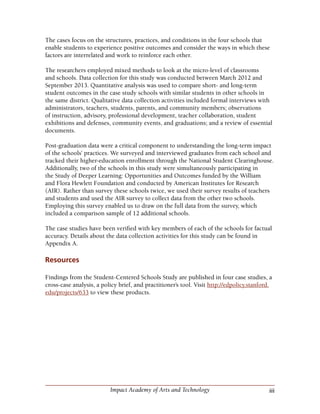
Case Study Schools
School type School Location
Linked Learning Dozier-Libbey Medical High School Antioch, CA
Life Academy Oakland, CA
Envision Schools City Arts & Technology High School San Francisco, CA
Impact Academy Hayward, CA
Linked Learning began as a state-wide district initiative funded by the James Irvine
Foundation to support implementation in nine districts across the state. The program
has expanded through state funding since 2011 to include nearly 70 additional local
educational agencies. Linked Learning integrates rigorous academics with career-based
learning and real-world workplace experiences.
Envision Schools is a small charter network focusing intently on creating personalized
learning environments in which educators also create project-based assignments that
foster development of 21st century skills, such as critical thinking, problem solving,
and collaboration.
Both of these models show clear evidence of engaging and developing high levels of
proficiency for students of color, English learners, and low-income students at levels
that far exceed traditional schools serving similar students. In addition, the schools in
this study provide the types of learning experiences that prepare students for college
and meaningful careers as well as graduating students of color, English learners,
and low-income students at rates that exceed similar students in their districts and
California.
Case Studies and Research Methodology
This case study is one of four written by SCOPE about student-centered practices in
schools.
The case studies address the following questions:
1.	 What are the effects of student-centered learning approaches on student
engagement, achievement of knowledge and skills, and attainment (high school
graduation, college admission, and college continuation and success), in particular
for underserved students?
2.	 What specific practices, approaches, and contextual factors result in these
outcomes?
iiiImpact Academy of Arts and Technology
The cases focus on the structures, practices, and conditions in the four schools that
enable students to experience positive outcomes and consider the ways in which these
factors are interrelated and work to reinforce each other.
The researchers employed mixed methods to look at the micro-level of classrooms
and schools. Data collection for this study was conducted between March 2012 and
September 2013. Quantitative analysis was used to compare short- and long-term
student outcomes in the case study schools with similar students in other schools in
the same district. Qualitative data collection activities included formal interviews with
administrators, teachers, students, parents, and community members; observations
of instruction, advisory, professional development, teacher collaboration, student
exhibitions and defenses, community events, and graduations; and a review of essential
documents.
Post-graduation data were a critical component to understanding the long-term impact
of the schools’ practices. We surveyed and interviewed graduates from each school and
tracked their higher-education enrollment through the National Student Clearinghouse.
Additionally, two of the schools in this study were simultaneously participating in
the Study of Deeper Learning: Opportunities and Outcomes funded by the William
and Flora Hewlett Foundation and conducted by American Institutes for Research
(AIR). Rather than survey these schools twice, we used their survey results of teachers
and students and used the AIR survey to collect data from the other two schools.
Employing this survey enabled us to draw on the full data from the survey, which
included a comparison sample of 12 additional schools.
The case studies have been verified with key members of each of the schools for factual
accuracy. Details about the data collection activities for this study can be found in
Appendix A.
Resources
Findings from the Student-Centered Schools Study are published in four case studies, a
cross-case analysis, a policy brief, and practitioner’s tool. Visit http://edpolicy.stanford.
edu/projects/633 to view these products.
1Impact Academy of Arts and Technology
Introduction
hen visitors first arrive on the campus of Impact Academy, they are immediately
aware of the strong connection between students, staff, and teachers. This con-
nection can be felt in the most fleeting of moments—for example, a student
comes in tardy to school, and it is clear that this student is not just a nameless number.
Instead, the office manager asks about the student’s dental appointment and makes sure
that the student is okay to make it through the day. The student, a young lady in the
10th grade, responds with a smile and a joke about not being able to talk because her
mouth is numb.
A seemingly insignificant and brief conversation between secretary and student imme-
diately signals to the outside observer that there is something special about this place;
Impact is not just a school—it’s a community of people. There is a universal culture
of family and community evident on the Impact campus. Teachers and students alike
rely upon close relationships as a means of encouragement and motivation for the hard
work that is required for all members of the school community to achieve positive
outcomes for students. This personal connection is not superficial—it’s deep and mean-
ingful and purposefully fostered. In many ways, the relationships that teachers and staff
build with students can be interpreted as the foundation of Impact. Learning and intel-
lectual growth are the ultimate goals, yet for the students to achieve, the staff believe in
the need to first know and understand their students. And that means getting personal.
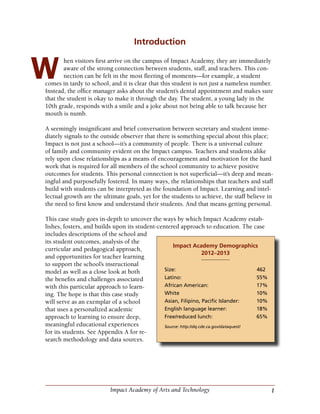
This case study goes in-depth to uncover the ways by which Impact Academy estab-
lishes, fosters, and builds upon its student-centered approach to education. The case
includes descriptions of the school and
its student outcomes, analysis of the
curricular and pedagogical approach,
and opportunities for teacher learning
to support the school’s instructional
model as well as a close look at both
the benefits and challenges associated
with this particular approach to learn-
ing. The hope is that this case study
will serve as an exemplar of a school
that uses a personalized academic
approach to learning to ensure deep,
meaningful educational experiences
for its students. See Appendix A for re-
search methodology and data sources.
W
Impact Academy Demographics
2012–2013
Size:	462
Latino:	55%
African American:	 17%
White	10%
Asian, Filipino, Pacific Islander:	 10%
English language learner:	 18%
Free/reduced lunch:	 65%
Source: http://dq.cde.ca.gov/dataquest/
2 Stanford Center for Opportunity Policy in Education
L
School Description and Outcomes:
A Distinctive Place to Learn
Impact Academy is dedicated to transforming students’ lives by preparing
them for success in college and in life. Impact Academy offers students a
rigorous academic experience and a diverse, compassionate community
in which to grow. Our students are inspired and empowered to be leaders
in their high school education and their communities.
—Impact web site
ocated in Hayward, California, Impact Academy of Arts and Technology prides
itself on using project-based teaching to foster strong academic growth and deep,
meaningful learning experiences for its students. Impact is managed by a non-
profit charter management organization, Envision Education, and is one of three public
schools in the network. Envision Education’s philosophy is built around a focus on
the “4 R’s” of education: (1) rigorous college-prep curriculum, (2) strong relationships
supported through small, personalized learning environments, (3) relevant coursework
that motivates and supports deep learning, and (4) high academic standards that lead to
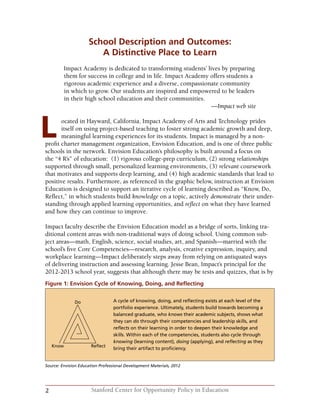
positive results. Furthermore, as referenced in the graphic below, instruction at Envision
Education is designed to support an iterative cycle of learning described as “Know, Do,
Reflect,” in which students build knowledge on a topic, actively demonstrate their under-
standing through applied learning opportunities, and reflect on what they have learned
and how they can continue to improve.
Impact faculty describe the Envision Education model as a bridge of sorts, linking tra-
ditional content areas with non-traditional ways of doing school. Using common sub-
ject areas—math, English, science, social studies, art, and Spanish—married with the
school’s five Core Competencies—research, analysis, creative expression, inquiry, and
workplace learning—Impact deliberately steps away from relying on antiquated ways
of delivering instruction and assessing learning. Jesse Bean, Impact’s principal for the
2012-2013 school year, suggests that although there may be tests and quizzes, that is by
A cycle of knowing, doing, and reflecting exists at each level of the
portfolio experience. Ultimately, students build towards becoming a
balanced graduate, who knows their academic subjects, shows what
they can do through their competencies and leadership skills, and
reflects on their learning in order to deepen their knowledge and
skills. Within each of the competencies, students also cycle through
knowing (learning content), doing (applying), and reflecting as they
bring their artifact to proficiency.
Do
ReflectKnow
Source: Envision Education Professional Development Materials, 2012
Figure 1: Envision Cycle of Knowing, Doing, and Reflecting
3Impact Academy of Arts and Technology
no means the sole source of summative or formative assessment. He offers an example
of what this looks like:
For example, we also ask students to do project-based work where they
are creating meaning in ways that ask them to draw upon multiple disci-
plines and to do work that’s related to their everyday experience or that
might be sort of pre-professional in the sense that we’re giving them a
problem that an engineer might tackle. It’s a junior version of the game,
but nonetheless it gives them the sense that what they’re working on is
important, and we believe there’s deeper investment and engagement in
that work.
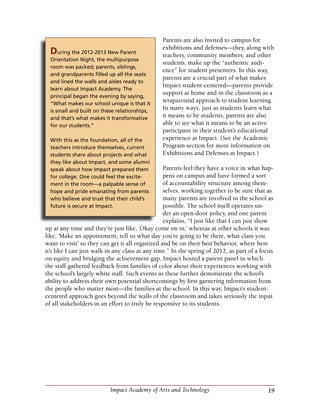
Serving approximately 460 students in grades 9-12, Impact offers a full college prepara-
tory curriculum with a focus on arts and technology. With a distinct focus on personal-
ization and individuation based on student interest and engagement, Impact stands out
as a unique learning environment when compared to neighboring comprehensive high
schools.
Like many new charter schools, Impact had to move locations since its founding in 2007.
The school opened in San Leandro and then moved up to the Hayward hills, a tradition-
ally middle- to upper-middle-class neighborhood close to California State University, East
Bay. Today, the school resides close to the 880 Freeway in a working-class neighborhood
with a larger Latino population. The facility itself is past its prime, with low ceilings and
dim hallway lights. The classrooms are small and filled with furniture that has withstood
heavy use, and a fourth of the school’s classrooms are located outside in the yard in por-
table bungalows replete with metal ramps and steps and sterile, off-white-colored walls.
That said, the staff has installed a plethora of college pennants, pictures, encouraging
posters, and inspiring quotes along the hallway walls as a way to portray a sense of wel-
come and high spirits despite what appears to be a somewhat bleak physical space.
Likely because of its change in location, Impact has undergone a distinct shift in de-
mographics. In 2008-2009, about one third of the students were African American, one
third White, and one third Latino. Compared to last year, those numbers have shifted
significantly, and the Latino population is closer to 50%, and the White and African
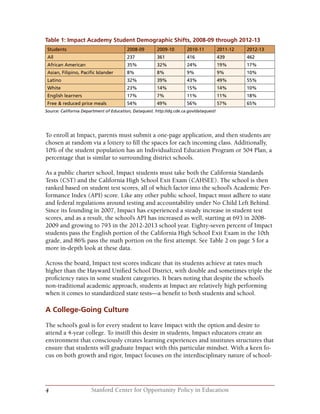
American populations have decreased markedly. (See Table 1, page 4) 	
In 2012, 66% of ninth-graders were Latino, with about half of them English language
learners. The population at Impact, however, is largely representative of Hayward as a
whole and is especially representative of the particular neighborhood that the school is
located in currently. Generally, parent education levels are low: Of the 188 students who
completed the student survey, 34% had a mother whose highest level of education was
a high school diploma, and 29% had a father whose highest level of education was a
high school diploma. Furthermore, 17% of students had a mother with less than a high
school diploma, and 19% had a father with the same designation.
4 Stanford Center for Opportunity Policy in Education
To enroll at Impact, parents must submit a one-page application, and then students are
chosen at random via a lottery to fill the spaces for each incoming class. Additionally,
10% of the student population has an Individualized Education Program or 504 Plan, a
percentage that is similar to surrounding district schools.
As a public charter school, Impact students must take both the California Standards
Tests (CST) and the California High School Exit Exam (CAHSEE). The school is then
ranked based on student test scores, all of which factor into the school’s Academic Per-
formance Index (API) score. Like any other public school, Impact must adhere to state
and federal regulations around testing and accountability under No Child Left Behind.
Since its founding in 2007, Impact has experienced a steady increase in student test
scores, and as a result, the school’s API has increased as well, starting at 693 in 2008-
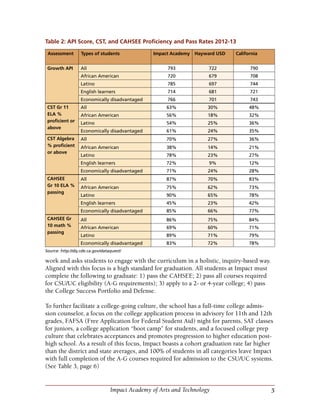
2009 and growing to 793 in the 2012-2013 school year. Eighty-seven percent of Impact
students pass the English portion of the California High School Exit Exam in the 10th
grade, and 86% pass the math portion on the first attempt. See Table 2 on page 5 for a
more in-depth look at these data.
Across the board, Impact test scores indicate that its students achieve at rates much
higher than the Hayward Unified School District, with double and sometimes triple the
proficiency rates in some student categories. It bears noting that despite the school’s
non-traditional academic approach, students at Impact are relatively high performing
when it comes to standardized state tests—a benefit to both students and school.
A College-Going Culture
The school’s goal is for every student to leave Impact with the option and desire to
attend a 4-year college. To instill this desire in students, Impact educators create an
environment that consciously creates learning experiences and institutes structures that
ensure that students will graduate Impact with this particular mindset. With a keen fo-
cus on both growth and rigor, Impact focuses on the interdisciplinary nature of school-
Table 1: Impact Academy Student Demographic Shifts, 2008-09 through 2012-13
Students 2008-09 2009-10 2010-11 2011-12 2012-13
All 237 361 416 439 462
African American 35% 32% 24% 19% 17%
Asian, Filipino, Pacific Islander 8% 8% 9% 9% 10%
Latino 32% 39% 43% 49% 55%
White 23% 14% 15% 14% 10%
English learners 17% 7% 11% 11% 18%
Free & reduced price meals 54% 49% 56% 57% 65%
Source: California Department of Education, Dataquest. http://dq.cde.ca.gov/dataquest/
5Impact Academy of Arts and Technology
work and asks students to engage with the curriculum in a holistic, inquiry-based way.
Aligned with this focus is a high standard for graduation. All students at Impact must
complete the following to graduate: 1) pass the CAHSEE; 2) pass all courses required
for CSU/UC eligibility (A-G requirements); 3) apply to a 2- or 4-year college; 4) pass
the College Success Portfolio and Defense.
To further facilitate a college-going culture, the school has a full-time college admis-
sion counselor, a focus on the college application process in advisory for 11th and 12th
grades, FAFSA (Free Application for Federal Student Aid) night for parents, SAT classes
for juniors, a college application “boot camp” for students, and a focused college prep
culture that celebrates acceptances and promotes progression to higher education post-
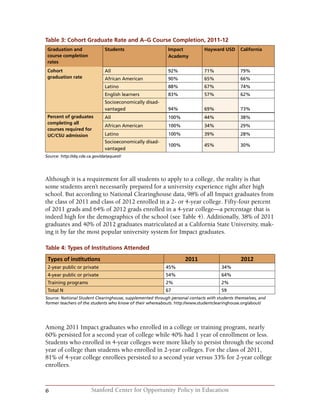
high school. As a result of this focus, Impact boasts a cohort graduation rate far higher
than the district and state averages, and 100% of students in all categories leave Impact
with full completion of the A-G courses required for admission to the CSU/UC systems.
(See Table 3, page 6)
Table 2: API Score, CST, and CAHSEE Proficiency and Pass Rates 2012-13
Assessment Types of students Impact Academy Hayward USD California
Growth API All 793 722 790
African American 720 679 708
Latino 785 697 744
English learners 714 681 721
Economically disadvantaged 766 701 743
CST Gr 11
ELA %
proficient or
above
All 63% 30% 48%
African American 56% 18% 32%
Latino 54% 25% 36%
Economically disadvantaged 61% 24% 35%
CST Algebra
% proficient
or above
All 70% 27% 36%
African American 38% 14% 21%
Latino 78% 23% 27%
English learners 72% 9% 12%
Economically disadvantaged 71% 24% 28%
CAHSEE
Gr 10 ELA %
passing
All 87% 70% 83%
African American 75% 62% 73%
Latino 90% 65% 78%
English learners 45% 23% 42%
Economically disadvantaged 85% 66% 77%
CAHSEE Gr
10 math %
passing
All 86% 75% 84%
African American 69% 60% 71%
Latino 89% 71% 79%
Economically disadvantaged 83% 72% 78%
Source: http://dq.cde.ca.gov/dataquest/
6 Stanford Center for Opportunity Policy in Education
Table 3: Cohort Graduate Rate and A–G Course Completion, 2011-12
Graduation and
course completion
rates
Students Impact
Academy
Hayward USD California
Cohort
graduation rate
All 92% 71% 79%
African American 90% 65% 66%
Latino 88% 67% 74%
English learners 83% 57% 62%
Socioeconomically disad-
vantaged 94% 69% 73%
Percent of graduates
completing all
courses required for
UC/CSU admission
All 100% 44% 38%
African American 100% 34% 29%
Latino 100% 39% 28%
Socioeconomically disad-
vantaged
100% 45% 30%
Source: http://dq.cde.ca.gov/dataquest/
Although it is a requirement for all students to apply to a college, the reality is that
some students aren’t necessarily prepared for a university experience right after high
school. But according to National Clearinghouse data, 98% of all Impact graduates from
the class of 2011 and class of 2012 enrolled in a 2- or 4-year college. Fifty-four percent
of 2011 grads and 64% of 2012 grads enrolled in a 4-year college—a percentage that is
indeed high for the demographics of the school (see Table 4). Additionally, 38% of 2011
graduates and 40% of 2012 graduates matriculated at a California State University, mak-
ing it by far the most popular university system for Impact graduates.
Table 4: Types of Institutions Attended
Types of institutions 2011 2012
2-year public or private 45% 34%
4-year public or private 54% 64%
Training programs 2% 2%
Total N 67 59
Source: National Student Clearinghouse, supplemented through personal contacts with students themselves, and
former teachers of the students who know of their whereabouts. http://www.studentclearinghouse.org/about/
Among 2011 Impact graduates who enrolled in a college or training program, nearly
60% persisted for a second year of college while 40% had 1 year of enrollment or less.
Students who enrolled in 4-year colleges were more likely to persist through the second
year of college than students who enrolled in 2-year colleges. For the class of 2011,
81% of 4-year college enrollees persisted to a second year versus 33% for 2-year college
enrollees.
7Impact Academy of Arts and Technology
Attending college is an integral part of the atmosphere at Impact Academy. One teacher
explains, “College is the message absolutely, but I think we realized and have refined
our process over time that you have to also give students really meaningful options
and support them in getting there.” Another teacher reiterated, “We’re really proactive
from day one…and then senior year we walk them through the personal statement, and
then we walk them through the college applications, and we watch them turn the stuff
in to make sure that it happens.” In addition to progress monitoring, the school helps
students envision themselves in college by taking all students on annual college trips
starting in the 9th grade. The college admissions counselor discussed that the goal of
the trips is “to go somewhere the kids are really interested in” so that they can start to
feel that excitement about the next step in their academic trajectory. In 9th grade, stu-
dents visit UC Santa Cruz and California State University, Monterey Bay; in 10th grade
they visit Saint Mary’s College; in 11th grade Santa Clara University and San Jose State
University; and finally, in the fall of 12th grade, students visit UC Merced.
Current students articulate how the college-
going atmosphere at Impact has influenced their
approach to schooling in general. One student
said, “Here [at Impact] I actually have friends
that motivate me, or I try to compete with them
to get above them or get at the same level so
that actually helps me.” Another student agreed
with this, saying, “When I’m here [at Impact] there are so many people around me that
do good, and I want to do good like that too.” These statements confirm that Impact’s
focus on college is not just something promoted by and believed in by the staff—the
students themselves have internalized the importance of attending college and therefore
approach their high school work with the motivation that they are preparing for the
next step. High school itself takes on a new sense of importance; students are no longer
going through the motions and instead have embraced the value of higher learning. The
power of the college-going culture at Impact has certainly paid off in terms of both get-
ting students to college and having them feel successful in their classes once matricu-
lated. A recent Impact graduate expressed, “Because the whole structure of Impact was
geared toward preparing us for college, when I got [to college] I already knew how to
do it.” Another Impact alum echoes this sentiment, saying, “At Impact, going to college
was always talked about; by senior year we were convinced. I realized how good of an
idea it would be to go to college [because of Impact]. When I got [to college] nothing
caught me off guard; I was prepared for the class work and the out-of-class expecta-
tions. I had been told about this all my years at Impact.” These responses are reflective
in graduate survey data as well that indicate that students found their high school ex-
periences at Impact significant and congruent with the expectations they face in college
(see Table 5, page 8).
Given the newness of Impact Academy, student enrollment and persistence in college is
available for only a 2-year period as college graduation rates are not yet available. That
“My first year in college was amazing.
Everything that you guys taught us
here, I use. Every, single, thing.”
— Impact Graduate (‘11)
8 Stanford Center for Opportunity Policy in Education
said, Impact takes feedback from its graduates on an informal basis about what has been
most helpful and what areas need ramping up to ensure better preparation. One admin-
istrator reported that the Envision Support Office was at one point using Beyond 121
as
a means of staying in touch with graduates to continue to provide support and mentor-
ship post-graduation. One teacher reported that based on feedback from graduates with
whom she has spoken, humanities preparation seems to be most up to par, but science
and math could use more rigor. On the other hand, another teacher emphasized, “We
do spend a lot of time on leadership skills and work habits, and I think those have also
been helpful to students—like public speaking and presentations. Those are places
where students feel super prepared.” According to Impact graduate survey data, where
the response rate was 21% (out of 152 graduates, 33 responded), 45% of the graduates
responded that they felt college was as challenging as expected, and 35% reported that
college was less challenging than expected. In other words, 80% of the graduates sur-
veyed felt prepared for college and the level of work expected.
Parents responded with a resounding “yes” when asked if they felt their students were
being adequately prepared for college by Impact Academy. One parent shared a story
about one of his son’s friends: “Some of my son’s friends have already called him and
told him that after going through Impact, [college] is a cake walk. You’re prepared.”
Parents expressed with unanimous agreement that Impact has delivered on its promise
that upon graduation, students will be prepared for college. Another parent explained,
“From the first day, the first day of freshman year, the message has been ‘you’re going to
college.’ They put that in your brain.”
The continual messaging of college as the next step after high school is certainly an
intrinsic part of the Impact culture. Immediately past the front doors of the school, the
hallways are lined with 8x10 color photos of recent graduates and current seniors
1
“Beyond 12 is a national nonprofit organization that was founded in 2009 to increase the number of traditionally
underserved students who earn a college degree. By integrating personalized coaching with intelligent technology,
Beyond 12 bridges the gap between K-12 and higher education to ensure that all students succeed in college.”
www.beyond12.org/about_us.html
Table 5: High School Experiences that Contributed to College Readiness
Highest-ranked influences Somewhat or very helpful
Working with other students 100%
Leadership skills 95%
Computer technology courses 91%
Relationships with teachers/advisors 91%
Instructional quality 90%
Projects/major assignments/exhibitions 90%
Source: Graduate Survey
9Impact Academy of Arts and Technology
with a list of schools they’ve applied to, been accepted to, and will attend the following
semester. This public display makes for an environment of collective celebration and
a tangible representation of the school’s mission: college. In the spring, when decision
letters are mailed to students, there’s a tradition that photocopies of acceptance letters
are taped to the hallway walls as well—rows and rows of congratulations letters are
displayed as a sign of accomplishment for not only students, but teachers as well. One
current student talked about how the college wall has an impact on her:
I like that we have that because when our first founding students gradu-
ated, they had their pictures up there and it was so cute to see them. I
can’t wait to be on the wall and see which college I’m going to be at. I
think that’s really nice that we have it there and now, the lower-division
students can see where we’re going and see the process.
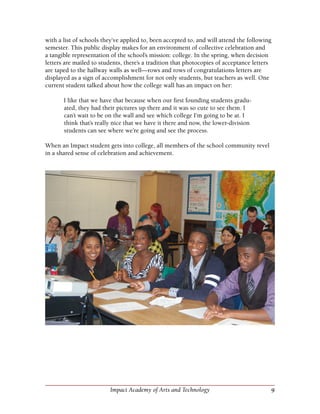
When an Impact student gets into college, all members of the school community revel
in a shared sense of celebration and achievement.
10 Stanford Center for Opportunity Policy in Education
Getting to Know You: Personalization as the Hallmark
ersonalization is a central component of what it means to create a student-cen-
tered school. Instead of students being forced to adapt to a top-down, rigid set of
rules, students are welcomed into a space that is culturally relevant, responsive,
and receptive. The school is organized in such a way that it takes into consideration the
needs, personalities, and interests of the students in meaningful and intentional ways.
For example, students participate in weekly community meetings, daily advisories,
and have direct access to teachers and support providers during and after school office
hours. On every level, the idea of knowing students is central to the success of the aca-
demic program overall.
Parents laud the difference they notice between Impact and larger district schools, say-
ing, “I really like that it’s smaller and the ability of teachers and staff to sort of reach
through the privacy and confidentiality and get real personal with our kids.” As a result
of this intentional relationship-building, the school community as a whole becomes like
a family. Students also speak about the relational connections among people on cam-
pus. One 10th-grade student explained that her advisor “knows my social life, and she
knows about my academic life. She’s attentive, and she really is in line with knowing
about her students.” This sense of deep caring and familiarity makes for a tight-knit con-
nection and sense of belonging for all stakeholders. It is on this foundation that the aca-
demic program is built. The relationships are not secondary to the academics, they seem
to come first as an essential and primary element to the creation of a safe, welcoming
learning community—something that Impact embodies in a tangible and powerful way.
Advisory: The Foundation of the Personalized Approach
Advisory for me…is a place where you reflect on your social character. It’s
partly academic, but it’s more about yourself as a social person and what
ways do you impact or in what ways do you interact with the world?
Your life is not going to be all about academics all the time. You’re going
to need some real-life skills to live. You’re going to have to know when to
make the right decision and when it’s okay to goof off or when it’s okay
to do something. You’re developing social skills that you’re going to use
in real life and that you’re going to need to get a job, and you’re going to
need to interact with people at a job. It’s pretty much preparing you for
real life.
—10th-grade male student
	
The central means by which this closeness is achieved is through the advisory system.
Every student is part of an (18-25 student) advisory that meets four times per week, 35
minutes each on Monday and Tuesday and 65 minutes each on Wednesday and Thurs-
day. Advisory is more than just homeroom. A 12th-grade humanities teacher explained
that advisory is structured in such a way that “students have an adult at school who
P
11Impact Academy of Arts and Technology
knows them well, who is there to support them, and they have a group that is like their
mini family community at school within a larger community.” Teachers as advisors be-
come advocates for their students so that they can teach students not only how to be a
good student, but also to ensure that “no matter what, no kid is going to totally slip be-
tween the cracks.” In many ways then, advisory becomes the touchstone for the school
day and a central component of students’ high school trajectory.
The content of advisory changes over time in response to where students are in their
high school careers. For example, in freshman year, advisories focus on topics such as:
problem solving, organization strategies, communication techniques, study habits, and
sex education. In junior and senior years, the focus shifts to include SAT prep, writing
the personal statement, and the college application process. To help facilitate this pro-
cess, teachers “loop” with their students. Lower-division students (9th and 10th grades)
have the same advisor for their freshman and sophomore years, and upper-division
students (11th and 12th grades) shift to another advisor who they stay with through the
last two years of their time at Impact. The purpose of advisory is to be what the stu-
dents need it to be. A 9th-grade math teacher speaks about her advisory in just this way.
They call me Mama because I really function like that. I call them my
babies. I check their grades. I talk to teachers if something happens to
be going on. I’m like their counselor in a way where I have students who
pop in. They’re just like “I need to talk,” and I’m like “Okay let’s do it.”
I’ve even had to call home and [say] “Can we schedule some time to sit
down because so-and-so wants to talk and he wants me there with him?”
I’m also the one that [says] “You’re messing up and we’ve got to fix this.
You’re skipping school. Why? What’s happening?”
The advisor advocacy functions as a bridge between student, school, and home where
students are girded with all of the necessary support so that they can navigate the intri-
cacies of high school in a productive and positive manner.
At the same time, because of the fluidity of advisory, there exists a lot of variety between
classes. Some advisories might be focused on personal statements while another advi-
sory is working on FAFSA applications. An English teacher explains:
As an advisor, your job is to see how your students are doing. Are they
passing their classes? If not, you go between the student and the teacher
where they’re struggling and you make that thing happen. Advisors also
lead parent conferences with their advisees. You’re kind of an added set of
eyes for your group of 20 or 25 to make sure that they graduate, which is
easier said than done.
This focus on graduation and college attendance makes the advisory a hub for ensuring
that students get to where they need to be and ensure that the school itself holds true to
12 Stanford Center for Opportunity Policy in Education
its promise made by the principal to “prepare and inspire all students to enter, succeed
in, and graduate from college.”
A group of 9th- and 10th-grade students echoed the sentiment that advisory allows
them to let loose and dig deep into the social-emotional components of their lives that
may not get as much attention in the school day given the rigorous academic program.
One student described advisory as “a time to think about decisions you’re making in
your life and behavior and stuff that’s going on.” Another student equated it to a “whole
room counselor” and “it’s like an in-school family”—a place where together they sup-
port one another through the stresses of high school and find security in having a group
of people “to help us and tell us that we’re doing good or bad, we’re going to make it.”
Student survey data supports the responses given by students in focus groups, where
overall, the majority of students feel a strong connection to teachers and view them as
sources of support for both personal and academic elements of their lives (see Table 6).
Table 6: Student Perceptions of Student-Teacher Connections
 In my school this year, there is at least ONE teacher
who:
Impact students,
agree or strongly
agree
Comparison school
students, agree or
strongly agree
Would be willing to help me with a personal problem 88% 59%
Really cares about how I am doing in school 90% 63%
Knows who my friends are 86% 58%
Respects me 94% 62%
I could ask to write me a recommendation for a job, pro-
gram, or college 91% 66%
Source: Student Survey Data2
2
Student Survey Data includes 188 students, 41% of students. Comparison data is taken from the Study of Deeper
Learning: Opportunities and Outcomes funded by the William and Flora Hewlett Foundation and conducted by the
American Institutes for Research that included several of the schools in this study. The student comparison sample
with a total of 1,392 students comes from 10 schools across the country.
This sense of belonging, respect, and genuine caring makes for a school environment
designed around student emotional and social well-being as an essential component
necessary for pushing students academically.
Student Voice in the Classroom
The personalized approach at Impact Academy extends to the way that students partici-
pate in the classroom. As the primary space for learning, it’s imperative that classrooms
be safe, productive environments where students are not just viewed as empty vessels
13Impact Academy of Arts and Technology
waiting to be filled with knowledge from the teacher. Impact teachers explicitly ask stu-
dents for feedback about the way that they are taught—a practice that is often relegated
to college surveys after a course is completed. An 11th-grader explained, “For the most
part when it comes to the way we’re taught we have a say. [Teachers] even ask us, like
‘What do you like that I do, what do you think I should change?’” There seems to be a
common practice for teachers to design learning experiences that allow students a cer-
tain amount of freedom and choice academically (see Table 7). They also view students
as active participants in the learning environment, where it’s fundamentally important
to know if the lessons designed by teachers actually work for the students themselves.
Table 7: Student Input on Academic Learning Experiences
 In my school this year: Impact students,
two or more
classes
Comparison school
students, two or
more classes
My teachers ask me to think about how I learn best 83% 62%
My teachers check to make sure we understand what they
are teaching us 92% 59%
My teacher lets me try out my ideas to see if they work 73% 65%
My teacher notices when I am having trouble with some-
thing 84% 48.7%
Source: Student Survey
Unlike some approaches to education, in which students are expected to adjust to the
style of instruction that the teacher prefers, it appears that at Impact, many teachers
make the process of learning explicit and seek frequently to determine how well stu-
dents learn and then use that information to adjust their pedagogy. This explicit com-
munication between teacher and student is powerful in ensuring that students don’t
“check out” or “opt out” for reasons unknown to the teacher. Because teachers want
to know how students feel and experience the learning process, it makes for a power-
ful community of learners where all members are expected to grow and develop over
time—teachers and students alike.
	
Leading the Way: Student Leadership Opportunities
So our leadership skills operate as the way for kids to reflect on how they
go about the work and how it’s contributing to their ongoing re-definition
of “who I am as a person and as a student.”
—Jesse Bean, principal
Students are encouraged to participate in expressing their voice, opinion, and leader-
ship outside of the classroom as well as within it. There are formal and informal path-
14 Stanford Center for Opportunity Policy in Education
ways for students to engage in the struc-
tures and flow of the school day. Like in
many other schools, Associated Student
Body (ASB) is perhaps the most formalized
way for students to express their voice on
campus. Student elections are held annu-
ally in September, and student officers stay
in their positions for the duration of one
school year. ASB students are also respon-
sible for some of the recruitment activities
for the school, sent as representatives to
local middle schools to recruit incoming
ninth-grade classes.
Students in the 11th and 12th grade explain
that the ASB has more than 50 students
participating this year. With such a large
representation of the student body active
in ASB, it’s not surprising that overwhelm-
ingly students feel that they have a “huge voice” in how the school is run. Students feel
that the teachers and administrators are “pretty open” and willing to hear and accept
proposals for new clubs or recommendations for changes in existing structures. Just
this year, students excitedly explain how they petitioned to have new vending machines
installed, filled with healthy food and drinks. One student explains the process for sub-
mitting a proposal:
You have to write a proposal that has a legitimate reason to how it’s going
to help the school or just benefits it’ll have. You have to have a teacher
that’s in on it with you. It can either be a supervisor or if it’s just like a
proposal to change something they can support you in it, and you have to
turn that in. And eventually you have to discuss it with the principal or
vice principal, and ASB and everybody has to look over it. It’s kind of…I
feel like it’s almost like getting a bill passed (laughter).
The other central means for student expression is through membership on the Lead-
ership Council, a site-based governance committee. The Leadership Council is com-
prised of voting representatives from all of the stakeholder groups—parents, teachers,
students, and administrators. This group is a decision-making body that evaluates the
effectiveness of existing policy, proposes new policies, and provides key feedback to
leadership around issues of culture, rules, and academics alike. Students are members
of the council like everyone else. Sometimes they are admitted based on administrator
or teacher recommendation, while in some instances students request to be members of
the council. Having students included in this decision-making body reifies the school’s
philosophy of fostering leadership and advocacy within its student body.
Envision Schools Leadership Skills
All Envision Schools promote a focus
on four 21st century skills.
1.	 Collaborate Productively:
working together toward a
common goal
2.	 Think Critically: thinking deeply
in order to create new meaning
3.	 Communicate Powerfully:
expressing yourself so that others
understand you
4.	 Complete Projects Effectively:
finishing what you start with your
best effort
15Impact Academy of Arts and Technology
According to one teacher who served on the Leadership Council, the purpose of the
council is to review proposals for changes in rules or policies and determine as a body
whether to approve the proposals. She mentioned that in the past, proposals have been
submitted and revised multiple times until approved by the Leadership Council. This
suggests that the council does not function solely as a rubber stamp committee—in-
stead they hold fast to the school mission and view themselves as a group that can effect
positive change when needed and requested by other stakeholders. This willingness to
adapt over time based on the needs, ideas, and desires of all constituents is one of the
many things that coincide with the school’s overall commitment to learning and growth.
Another teacher explains that Impact is the “kind of school that if you have anything to
say you can say it. We’ll talk you through it, and if we feel like it’s a legit concern, we’ll
bring it to the admin or wherever it needs to be addressed.”
Students also are essential to the establishment of clubs and activities on campus. Virtu-
ally all clubs are student-initiated and run with teachers and other staff members acting
as sponsors. Students are encouraged to start new clubs and can submit an application
online via the school’s web site. Clubs range in scope from the Hip Hop Club and the
Tennis Club, to the Gay Straight Alliance and the Story Writing Club—all based on stu-
dent interest and leadership (see Table 8).
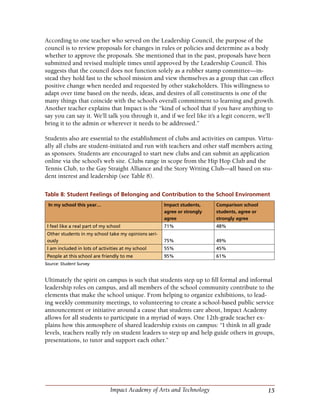
Table 8: Student Feelings of Belonging and Contribution to the School Environment
 In my school this year… Impact students,
agree or strongly
agree
Comparison school
students, agree or
strongly agree
I feel like a real part of my school 71% 48%
Other students in my school take my opinions seri-
ously 75% 49%
I am included in lots of activities at my school 55% 45%
People at this school are friendly to me 95% 61%
Source: Student Survey
Ultimately the spirit on campus is such that students step up to fill formal and informal
leadership roles on campus, and all members of the school community contribute to the
elements that make the school unique. From helping to organize exhibitions, to lead-
ing weekly community meetings, to volunteering to create a school-based public service
announcement or initiative around a cause that students care about, Impact Academy
allows for all students to participate in a myriad of ways. One 12th-grade teacher ex-
plains how this atmosphere of shared leadership exists on campus: “I think in all grade
levels, teachers really rely on student leaders to step up and help guide others in groups,
presentations, to tutor and support each other.”
16 Stanford Center for Opportunity Policy in Education
Giving Props: A Culture of Celebration and Engagement
There are few schools that can pull off actively promoting a culture of joy and celebra-
tion within the context of a serious, college prep, academic setting. Impact Academy
is one of those schools. In addition to a family-like camaraderie between students and
teachers, there are specific elements of the school designed to purposefully encourage
student excitement and celebration around important core values and academic prog-
ress. There are a couple of specific ways by which Impact facilitates this culture: com-
munity meetings, PROPS (Positive Rewards On Positive Spartans), and Spirit Points.
Community meetings take place weekly for an hour during the school day and are sepa-
rated into the lower division (9th- and 10th-graders) and the upper division (11th- and
12th-graders). These meetings are a place for the school community to bond. One of the
administrators explains that community meetings are a time for “teachers and students
to sit back a little bit and laugh, play, learn about a new topic that’s relevant for the
month or the time of year.” The weekly meetings are co-planned with the vice principal
and students in the ASB, and students often take on the role of the emcee, helping to
facilitate giving out awards for school spirit or for exemplary exhibitions or recognition
for “small things” like turning in work on time or to celebrate students who have a big
jump in SAT scores. Often the agenda for the meetings will include student presentations
about something they deem important for the school community to know about, or guest
speakers will visit to talk about a pertinent topic or share their experiences in college or
the workplace. Overall the atmosphere is celebratory and relaxed, and having fun together
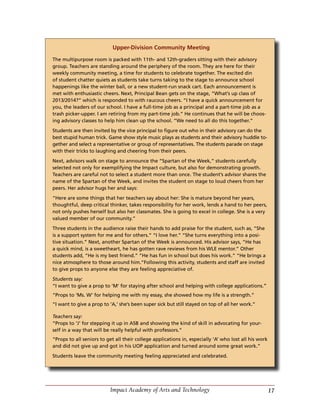
is valued and important. The sidebar on page 17 paints a picture of a community meeting.
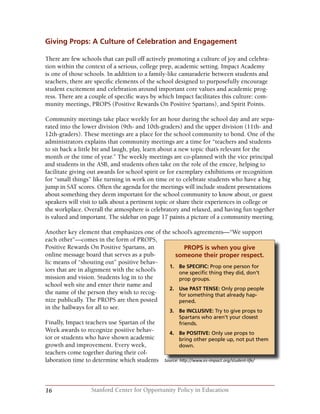
Another key element that emphasizes one of the school’s agreements—“We support
each other”—comes in the form of PROPS,
Positive Rewards On Positive Spartans, an
online message board that serves as a pub-
lic means of “shouting out” positive behav-
iors that are in alignment with the school’s
mission and vision. Students log in to the
school web site and enter their name and
the name of the person they wish to recog-
nize publically. The PROPS are then posted
in the hallways for all to see.
Finally, Impact teachers use Spartan of the
Week awards to recognize positive behav-
ior or students who have shown academic
growth and improvement. Every week,
teachers come together during their col-
laboration time to determine which students Source: http://www.es-impact.org/student-life/
PROPS is when you give
someone their proper respect.
1.	 Be SPECIFIC: Prop one person for 	
one specific thing they did, don’t
prop groups.
2.	 Use PAST TENSE: Only prop people
for something that already hap-
pened.
3.	 Be INCLUSIVE: Try to give props to 	
Spartans who aren’t your closest
friends.
4.	 Be POSITIVE: Only use props to
bring other people up, not put them
down.
17Impact Academy of Arts and Technology
Upper-Division Community Meeting
The multipurpose room is packed with 11th- and 12th-graders sitting with their advisory
group. Teachers are standing around the periphery of the room. They are here for their
weekly community meeting, a time for students to celebrate together. The excited din
of student chatter quiets as students take turns taking to the stage to announce school
happenings like the winter ball, or a new student-run snack cart. Each announcement is
met with enthusiastic cheers. Next, Principal Bean gets on the stage, “What’s up class of
2013/2014?” which is responded to with raucous cheers. “I have a quick announcement for
you, the leaders of our school. I have a full-time job as a principal and a part-time job as a
trash picker-upper. I am retiring from my part-time job.” He continues that he will be choos-
ing advisory classes to help him clean up the school. “We need to all do this together.”
Students are then invited by the vice principal to figure out who in their advisory can do the
best stupid human trick. Game show style music plays as students and their advisory huddle to-
gether and select a representative or group of representatives. The students parade on stage
with their tricks to laughing and cheering from their peers.
Next, advisors walk on stage to announce the “Spartan of the Week,” students carefully
selected not only for exemplifying the Impact culture, but also for demonstrating growth.
Teachers are careful not to select a student more than once. The student’s advisor shares the
name of the Spartan of the Week, and invites the student on stage to loud cheers from her
peers. Her advisor hugs her and says:
“Here are some things that her teachers say about her: She is mature beyond her years,
thoughtful, deep critical thinker, takes responsibility for her work, lends a hand to her peers,
not only pushes herself but also her classmates. She is going to excel in college. She is a very
valued member of our community.”
Three students in the audience raise their hands to add praise for the student, such as, “She
is a support system for me and for others.” “I love her.” “She turns everything into a posi-
tive situation.” Next, another Spartan of the Week is announced. His advisor says, “He has
a quick mind, is a sweetheart, he has gotten rave reviews from his WLE mentor.” Other
students add, “He is my best friend.” “He has fun in school but does his work.” “He brings a
nice atmosphere to those around him.”Following this activity, students and staff are invited
to give props to anyone else they are feeling appreciative of.
Students say:
“I want to give a prop to ‘M’ for staying after school and helping with college applications.”
“Props to ‘Ms. W’ for helping me with my essay, she showed how my life is a strength.”
“I want to give a prop to ‘A,’ she’s been super sick but still stayed on top of all her work.”
Teachers say:
“Props to ‘J’ for stepping it up in ASB and showing the kind of skill in advocating for your-
self in a way that will be really helpful with professors.”
“Props to all seniors to get all their college applications in, especially ‘A’ who lost all his work
and did not give up and got in his UOP application and turned around some great work.”
Students leave the community meeting feeling appreciated and celebrated.
18 Stanford Center for Opportunity Policy in Education
deserve the award, and the vice principal keeps track of who has earned the recognition
during the year to avoid multiple rewards and to encourage teachers to pick students who
may be doing well but haven’t been acknowledged. This is yet another purposeful means
of showing public support for students who are working hard and staying focused. Spar-
tan of the Week awards are then announced publicly during community meetings.
Parents as Partners in Education
Parents are an integral part of the school community at Impact. Where in many tradi-
tional schools, parents only set foot on campus a couple times per year for events like
Back to School night or Open House, at Impact, parents are regularly invited in as es-
sential partners in student learning. Beginning in freshman year, parents are welcomed
during New Parent Orientation Night, described in the sidebar. Throughout the school
year, parents are welcomed to monthly Parent Night Meetings on the first Wednesday
of every month. Within the parent association, there are various committees, such as
senior fundraising, campus beautification, and staff appreciation.
Twice per year, there are family conferences that are mostly student-led and focused
on academic and behavioral reflection and goal-setting. For three days, in the fall and
in the spring, school ends early and each advisor schedules a conference with their
advisees and their parents or family. Each conference lasts 40-60 minutes, and the
student and advisor lead the family through a review of the report card, discuss cur-
rent progress, and outline action steps for improvement if necessary. According to an
administrator, more than 90% of students have at least one family member attend these
parent-teacher conferences. A teacher reflected that “seeing the students lead those
conversations and reflect on where they’re at, and celebrate, and also set goals, and be
pushed by families was really a unique part of the school.” It is indeed a process of self-
reflection and accountability that is evident in every aspect of school life.
Sometimes the parent conferences can be challenging because relationships between
teachers and students may be strained. In these instances, either the principal or one of
the vice principals might attend as a sort of mediator to help facilitate productivity in
the midst of difficult conversations. Principal Jesse Bean explains that in these sorts of
tenuous relationships, it’s really restorative and transformative to have teachers “to be
present to the impact of their words and actions on kids and apologize when necessary.
I think those can be really powerful....And then again we walk away with a clear con-
tract or set of action steps for moving forward.”
This sort of clear, honest communication is what builds trust and speaks to the depth
of the relationships that are so fundamental to the culture at Impact. These biannual
parent conferences are not the only times parents meet with faculty and staff however;
parents and advisors can schedule this sort of in-depth conference at any time.
19Impact Academy of Arts and Technology
Parents are also invited to campus for
exhibitions and defenses—they, along with
teachers, community members, and other
students, make up the “authentic audi-
ence” for student presenters. In this way,
parents are a crucial part of what makes
Impact student-centered—parents provide
support at home and in the classroom as a
wraparound approach to student learning.
In many ways, just as students learn what
it means to be students, parents are also
able to see what it means to be an active
participant in their student’s educational
experience at Impact. (See the Academic
Program section for more information on
Exhibitions and Defenses at Impact.)
Parents feel they have a voice in what hap-
pens on campus and have formed a sort
of accountability structure among them-
selves, working together to be sure that as
many parents are involved in the school as
possible. The school itself operates un-
der an open-door policy, and one parent
explains, “I just like that I can just show
up at any time and they’re just like, ‘Okay come on in,’ whereas at other schools it was
like, ‘Make an appointment, tell us what day you’re going to be there, what class you
want to visit’ so they can get it all organized and be on their best behavior, where here
it’s like I can just walk in any class at any time.” In the spring of 2012, as part of a focus
on equity and bridging the achievement gap, Impact hosted a parent panel in which
the staff gathered feedback from families of color about their experiences working with
the school’s largely white staff. Such events as these further demonstrate the school’s
ability to address their own potential shortcomings by first garnering information from
the people who matter most—the families at the school. In this way, Impact’s student-
centered approach goes beyond the walls of the classroom and takes seriously the input
of all stakeholders in an effort to truly be responsive to its students.
During the 2012-2013 New Parent
Orientation Night, the multipurpose
room was packed; parents, siblings,
and grandparents filled up all the seats
and lined the walls and aisles ready to
learn about Impact Academy. The
principal began the evening by saying,
“What makes our school unique is that it
is small and built on these relationships,
and that’s what makes it transformative
for our students.”
With this as the foundation, all of the
teachers introduce themselves, current
students share about projects and what
they like about Impact, and some alumni
speak about how Impact prepared them
for college. One could feel the excite-
ment in the room—a palpable sense of
hope and pride emanating from parents
who believe and trust that their child’s
future is secure at Impact.
20 Stanford Center for Opportunity Policy in Education
Academic Program
t Impact Academy, the role of the teacher is one of facilitator and guide rather than
holder of all the knowledge; students are regularly prompted to explore, research,
defend, and challenge information as part of the learning process. Because of this
philosophy of education, Impact teachers have the freedom to assess learning in mean-
ingful, authentic ways and are not constrained by standardized tests. Impact Academy,
however, is not exempt from traditional standardized tests.
Despite these universal structures that govern all public schools, Impact has taken an
approach to pedagogy that is non-traditional. Instead of having the tests dictate the
content and ways in which students are taught, Impact uses standards and research-
based practices to determine how best to ensure that students not only learn the content
in each of their classes, but also perform solidly on the state tests. This freedom means
that students are expected to demonstrate knowledge in non-traditional ways, and
sometimes, students have a choice about how to demonstrate their understanding.
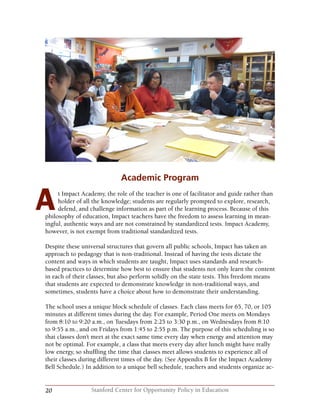
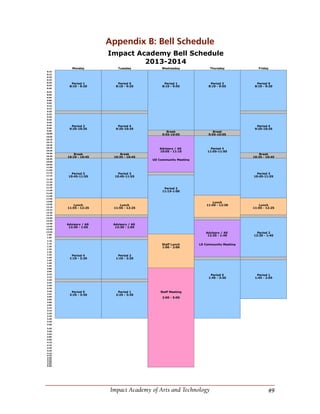
The school uses a unique block schedule of classes. Each class meets for 65, 70, or 105
minutes at different times during the day. For example, Period One meets on Mondays
from 8:10 to 9:20 a.m., on Tuesdays from 2:25 to 3:30 p.m., on Wednesdays from 8:10
to 9:55 a.m., and on Fridays from 1:45 to 2:55 p.m. The purpose of this scheduling is so
that classes don’t meet at the exact same time every day when energy and attention may
not be optimal. For example, a class that meets every day after lunch might have really
low energy, so shuffling the time that classes meet allows students to experience all of
their classes during different times of the day. (See Appendix B for the Impact Academy
Bell Schedule.) In addition to a unique bell schedule, teachers and students organize ac-
A
21Impact Academy of Arts and Technology
cording to grade-level divisions: 9th and 10th grades are in the lower division, and 11th
and 12th grades are in the upper division.
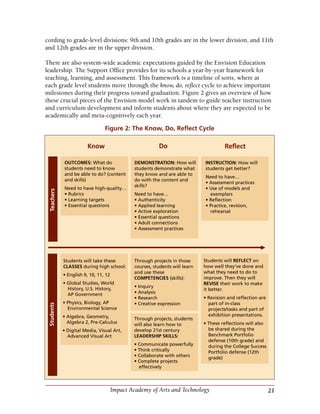
There are also system-wide academic expectations guided by the Envision Education
leadership. The Support Office provides for its schools a year-by-year framework for
teaching, learning, and assessment. This framework is a timeline of sorts, where at
each grade level students move through the know, do, reflect cycle to achieve important
milestones during their progress toward graduation. Figure 2 gives an overview of how
these crucial pieces of the Envision model work in tandem to guide teacher instruction
and curriculum development and inform students about where they are expected to be
academically and meta-cognitively each year.
TeachersStudents
Do Reflect
OUTCOMES: What do
students need to know
and be able to do? (content
and skills)
Need to have high-quality…
• Rubrics
• Learning targets
• Essential questions
DEMONSTRATION: How will
students demonstrate what
they know and are able to
do with the content and
skills?
Need to have…
• Authenticity
• Applied learning
• Active exploration
• Essential questions
• Adult connections
• Assessment practices
Students will take these
CLASSES during high school:
• English 9, 10, 11, 12
• Global Studies, World
History, U.S. History,
AP Government
• Physics, Biology, AP
Environmental Science
• Algebra, Geometry,
Algebra 2, Pre-Calculus
• Digital Media, Visual Art,
Advanced Visual Art
Through projects in those
courses, students will learn
and use these
COMPETENCIES (skills):
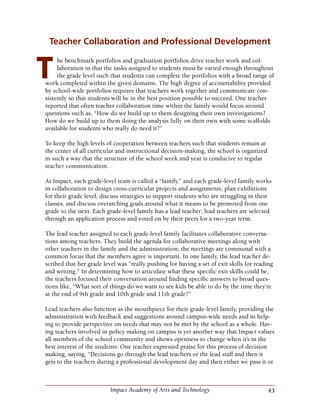
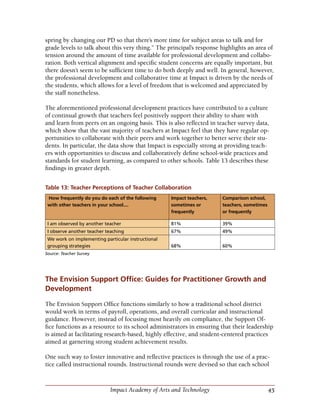
• Inquiry
• Analysis
• Research
• Creative expression
Through projects, students
will also learn how to
develop 21st century
LEADERSHIP SKILLS:
• Communicate powerfully
• Think critically
• Collaborate with others
• Complete projects
effectively
Students will REFLECT on
how well they’ve done and
what they need to do to
improve. Then they will
REVISE their work to make
it better.
• Revision and reflection are
part of in-class
projects/tasks and part of
exhibition presentations.
• These reflections will also
be shared during the
Benchmark Portfolio
defense (10th grade) and
during the College Success
Portfolio defense (12th
grade)
INSTRUCTION: How will
students get better?
Need to have…
• Assessment practices
• Use of models and
exemplars
• Reflection
• Practice, revision,
rehearsal
Know
Figure 2: The Know, Do, Reflect Cycle
22 Stanford Center for Opportunity Policy in Education
The past couple of years, Envision Schools have focused on the workshop model of in-
struction as a means of strengthening literacy levels for students. The workshop model,
if done well, opens up opportunities for teachers and more advanced peers to provide
one-on-one support to students who are struggling. Key aspects of the workshop model
include the following:
•	 Teachers engage students in a 10- to 15-minute “mini-lesson” on a core
concept or idea or demonstrate a hands-on activity. During this mini-
lesson, teachers talk through their thinking process, demonstrating for
the students how to approach the problem or activity.
•	 Students are then released to work on a problem or activity on their own,
in pairs, or in small groups. During this time, the teacher moves around
the classroom to answer questions, check for understanding, and provide
more focused support to the students who need it. In some cases, students
who have a strong grasp of a concept are encouraged to help their peers.
The workshop approach is student-centered in that it provides the space for individual
work and for ongoing scaffolding of learning by teachers and proficient peers. It serves
as a vehicle through which teachers can differentiate instruction and engage one-on-one
with students, meeting them where they are rather than expecting students to be at the
same level.
One teacher praised the workshop model because it “works particularly well with strug-
gling students, students who need a lot of practice, who need a lot of help both from
peers and from [the teacher]. So the idea is if we can change the way teachers are teach-
ing and make it more student-centered, they’re actually talking more with students in
the classroom and it’s not as lecture-based, which is a helpful shift because the teacher
engages more with students in the classroom context.”
In addition to pedagogical consistency around the implementation of the workshop
model, Impact also utilizes other crucial components that make its academic program
strong: (1) cultural relevance and real-world application, (2) project-based learning
experiences, (3) an emphasis on collaborative learning, (4) an instructional mindset in
which the teacher is facilitator, and (5) a focus on individualized, differentiated instruc-
tional materials. Used together, these elements create a learning environment that is
supportive of the students’ cognitive development and cognizant of the importance of
fostering intrinsic motivation to bolster engagement in learning. The following sections
delve into these components of the Impact academic program in more detail.
Curriculum That Is Real-World and Relevant
Ultimately, the heart of Impact’s academic approach is that, as the principal explains,
“kids have multiple ways of knowing and making sense of things, and we’re celebrating
23Impact Academy of Arts and Technology
their strengths and their ability to demonstrate mastery in multiple modes of expression.”
Impact Academy teachers prioritize the utilization of curriculum that is relevant and relat-
able to students’ lives. Using this approach on how texts are chosen and assignments cre-
ated, means that what students learn in classes is decidedly student-centered because the
students, and their interests, are used to guide the process of curriculum development.
Student investment in the work comes as a result of teachers’ purposeful linkage of the
academic skills and content to real-world application. Teachers work to create an envi-
ronment where students can see immediately how what they are learning is connected
to a greater world and to their own personal trajectories as students and young adults.
Part of creating this environment means that students have the freedom to follow a line
of inquiry about a topic or subject that interests them. However, this does not mean that
students only study those things they are interested in, but it does mean that within the
scope of a given class, students are often presented with options about how to go about
completing a task.
One science teacher explained that student choice presents itself more in terms of how
to show understanding.
For example, in the ionic bonding unit, students had a choice of showing
what they knew and understood through a skit, a love letter, a poem, or
they could write and perform a rap. So they had all these different ways
of deciding how they wanted to do it, and it made for some entertaining
products that the lessons really got into.
A humanities teacher employs similar strategies in her classroom. When teaching
students different perspectives for analyzing literature, she teaches them how theory
informs the way we read and changes the things that we see in the text and allows us to
find competing interpretations that can both be right. She explained: “I think kids often
are like, ‘This book means....’ [But,] I explain, ‘This book can mean lots of different
things, and having these different lenses can help you access different interpretations
that are all right.’”
Teachers build bridges to the curriculum by encouraging students to make connections
between self and text/task and to draw from prior experiences. Part of creating cur-
riculum that connects to students’ lives is finding fresh ways to approach traditional
concepts. One 12th-grade student characterized the curriculum as “more interesting
than textbook stuff.” He went on to explain how in a government class, students set up
a mock Congress in which each student represented a state, they proposed bills on the
“Senate floor,” proposed revisions, and went through the process that Congress goes
through to make laws. In this exercise, even the principal of the school came in and sat
as the “president.” The student explained how this activity gave the class a “visual and
an example of what Congress actually does instead of just reading in the textbook. So
it’s really more hands-on. It gave me a better understanding of what they actually do.”
24 Stanford Center for Opportunity Policy in Education
Another student chimed in and reiterated that the process “gave me more respect for
what they have to do because ours was just like a tiny bit of what Congress does, and it
took forever to get through those bills and to have to satisfy everybody’s needs. It was a
great experience.”
Impact Academy students are able to aptly articulate how it is to be a learner in this
student-centered environment. The curriculum content along with the pedagogical style
is important to students. One student pointed out, “They give us all these opportunities
to actually prove that we learned something, like debates and Socratic seminars and ex-
hibitions and grad portfolio and stuff like that rather than just trying to teach us some-
thing and giving us a test to make sure we get it. They actually make the students prove
that we actually get what they’re teaching us.” Table 9 illustrates how students perceive
their learning experiences at Impact.
Table 9: Student Perceptions of Learning Experiences in the Classroom
In TWO or more of my classes this year.... Impact students Comparison school
students
My teachers give us activities to do, other than just
listening to them 95% 81%
I work with other students on projects in class 95% 79%
I use what I’ve learned to solve new and different
problems 89% 72%
I combine many ideas and pieces of information into
something new and more complex 81% 61%
Source: Student Survey
This expectation of demonstrated learning for the students translates to a more pro-
found sense of connection to the content, transitioning students’ motivation to learn
from a desire to get a grade to an intrinsic desire to learn associated with a sense of
pride. One student explains that the sense of accomplishment in learning and dem-
onstrating new knowledge is something that he hadn’t experienced before Impact. He
said that the process “pushes me a lot harder, and it makes me more proud of what
I’m learning about. Especially when I can teach somebody else what I learned about, it
makes me feel better about learning that subject.”
When students care about a subject, and feel a sense of accomplishment when learn-
ing and demonstrating learning, the knowledge is more lasting because it is applied
learning, not rote regurgitation of facts, dates, or numbers. Another student points out
that in previous schools, she didn’t like history because all that it centered around was
“writing in the little textbook” whereas at Impact, “[history is] just so interesting to
me now because I’m actually learning about what’s happening, what’s happened in the
past….Everything we do here kind of grabs your attention, and you have no choice but
to internalize it.” The internalization that this student speaks of is fundamental to the
student-centered approach to teaching and learning; the content, skills, experiences,
25Impact Academy of Arts and Technology
and environment all work in conjunction to transform students’ approach to school and
life in general. Another student speaks about how experiences in her English class have
impacted her ideas about what she will do when she grows up, a prime example of how
rich learning experiences at Impact influence not just students’ daily lives but also their
conceptions of what options and opportunities they will have in their adult future. The
student said:
When we were learning about Animal Farm, we had a mock trial putting
Napoleon up on the stand, and you think it’s the stupidest thing ever,
you’re arguing about a pig, and yet it gave you this experience. And I
know there’s people that want to be lawyers out there, and I was lucky
enough to have the opportunity to talk to Congressman Eric Swalwell
last weekend outside of school, and he was talking about the one thing
that inspired him to become a lawyer and a congressman was the fact
that he did a mock trial his senior year in high school. I’m thinking, I did
that my 10th-grade year! I think it’s insane the kind of inspiration we’re
getting here because I know people in [other] schools, and they have no
clue what they’re gonna do with their life.
Teachers explain how their construction of curriculum units allows for a balance be-
tween ensuring students acquire the requisite skills and knowledge while also making
sure that the content of those units is relevant to their lives now and in the future. A
history teacher described a unit on Reconstruction:
We’ve been studying Reconstruction, and we looked at different historical
interpretations. So they looked at textbooks from the 1870s and from the
1920s and from the 1960s and so on, and they had to pick a claim that a
historian in one of those years made about Reconstruction. They had to
do research to either prove the claim true or debunk this historical claim
and compile the primary source research and analyze the documents. So
this person was (looking at a visual) analyzing the claim that Lincoln
issued the Emancipation Proclamation because he wanted to free slaves,
and that’s a highly contested historical claim. What was the nature of the
Emancipation Proclamation? So find out if it’s true or not.
This particular approach to teaching history allows for students to interact with sources
in a way that is authentic and valuable; history is not taught as an already written abso-
lute but as a version of truth that requires interrogation and interpretation, not passive
acceptance. Welcoming students into this process of critical thinking and analysis seems
universal at Impact Academy—across the board, teachers prompt students to interact
with texts such that they work in collaboration to make their own meaning of the world
around them. Table 10 on page 26 illustrates survey data regarding how Impact teachers
rate their colleagues on adjusting their practice to meet students’ learning needs.
26 Stanford Center for Opportunity Policy in Education
Ultimately, teachers at Impact are guided by the philosophy that, according to one teacher:
Students have to care about the topics they’re learning about, so whether
that’s identifying with the curriculum from a racial aspect, from a gender
aspect, from a class aspect, or from just what they’re interested in today...
they’re most engaged when you’re talking about things that relate to their
lives, so keeping students at the center when you’re devising and coming
up with curriculum is important.
As part of building a classroom culture focused on deep learning, teachers also take
into consideration factors that affect students’ lives and views of the world. One teacher
explained that she incorporates cultural relevance in terms of what books are read and
the tasks associated with those texts. For her students, she explicitly designs lessons on
class, gender, and race as a means of preparing students for in-depth discussions and
dialogue. Similarly, another teacher uses student demographics and current events as a
means of designing lessons that students care about while also embedding traditional
classic literature as well. She starts off with texts like The Crucible and Young Goodman
Brown and then teaches students how to transition the skills learned with those texts to
more modern literature like The Tortilla Curtain, which students “really get into.” She
explained, “This school is 50% Latino…their family members, their friends. [The book
covers] real issues that they’re facing so they liked learning about it in a fictional con-
text in the English classroom.”
The effectiveness of the instructional practices and curricular choices utilized in the
classrooms at Impact is echoed in student survey data, where 86% agreed or strongly
agreed that the topics they study in class are both interesting and challenging.
Table 10: Teacher Instructional Practices
 Teachers at this school… Impact teachers,
agree or strongly
agree
Comparison school
teachers, agree or
strongly agree
Adjust instruction to meet the needs of each student 95% 60%
Review student learning and understanding in order
to adjust their practices 91% 75%
Pay attention to what motivates each student 81% 58%
Have made changes to best meet the needs of the
school’s diverse student body 95% 74%
Source: Teacher Survey3
3
Teacher Survey is of 21 teachers, 91%. Comparison data is taken from the Study of Deeper Learning: Opportunities
and Outcomes funded by the William and Flora Hewlett Foundation and conducted by the American Institutes for
Research that included several of the schools in this study. The teacher comparison sample with a total of 356 teach-
ers includes results from 12 schools across the country.
27Impact Academy of Arts and Technology
The freedom to decide on and adapt curriculum has its challenges, however. One
teacher articulates why this can be hard on teachers:
It’s bittersweet because as a teacher I get the freedom to teach whatever I
want to and cover it in any way that I feel necessary, but it’s also hard be-
cause I’m planning my own curriculum and every year it may be different
because my kids may need more fractions help than they need algebraic
help. And so I have to assess the needs of the kids and plan according to
the needs of the kids. At one end it’s good because I get to help and fill in
the gaps, but then I could be doing and teaching all new things next year
and spending more time on different things.
Although the malleability of the curriculum and instructional approach might be a chal-
lenge for some teachers, the point is that it is rewarding and meaningful for the stu-
dents; at Impact, teachers adjust based on student need and not the other way around.
This can be especially hard for new teachers when there is a high level of variability not
just from year to year but from class period to class period of the same subject.
Hands-On and Project-Based Learning Across the Curriculum
Students estimate that 75% of their day is spent engaged in some sort of hands-on
activity. These projects are not isolated from the content or frivolous activities for the
sake of an activity—these hands-on tasks are an integral part of what it means to learn
at Impact. One student characterized the process in this way:
[Teachers] explain everything, and before they even start the project they
do like a step-by-step process and they tell you everything that we’re go-
ing to do. We write a whole bunch of stuff about it ahead of time. We do
a lot of prep before we do projects so it’s like before we even start it’s like
we’re learning everything we need to know before we even do it. Then
once we start the project it’s pretty much hands-on.
Students report that the humanities classes employ similar project-based learning. One
student recalls a Socratic seminar and another reminisces about a poetry unit in Eng-
lish class in which students did a project about their own personality and character,
the idea being that they could have full creative freedom to come up with how best to
communicate their own style and sense of self. This student explained that she made
a song about herself while another classmate made a scrapbook, and another wrote a
poem. Students are savvy about being able to pick out the distinction between when
a project is just a project and when it’s really designed as a learning experience. One stu-
dent compares projects from middle school to the types of projects at Impact by saying,
“In middle school, it was more about doing art projects—it wasn’t really like learning,”
whereas at Impact, “the projects we’ve done here have actually taught me more than I’ve
28 Stanford Center for Opportunity Policy in Education
learned my entire middle school years.”
A group of 9th- and 10th-grade students spoke at length about how the hands-on na-
ture of the science classes is not only engaging, but also seems to bring the content to
life. When speaking about a biology lesson, one student shared that in learning about
diseases and mutations, the teacher had the students use beans as a symbolic repre-
sentation of how viruses are spread. Another student built off of this anecdote with a
description of an activity he did in a physics class.
I remember we had to plan out a gravity car. We had to make a car that
was running on gravity, and we had to set up the whole thing. We had
to cut and measure [heights], we had to make wheels, we had to pretty
much engineer. It was cool. You feel like you’re at a job or you feel like
you’re at a facility where you’re coming up with ideas that you can even
use in the future to come up with some kind of invention. You actually
feel like there’s a purpose to your work instead of just putting it all in a
notebook and then throwing it away at the end of the year.
A recent graduate of Impact Academy confirmed the sentiments of current students and
teachers when she explained how her high school learning experiences prepared her
for college projects and presentations. She explained, “The way classes were structured
[at Impact]—applied learning versus just tests—is more like what we do in college. We
have lots of applied learning and projects, and I know how to do more than just throw
up what we learned from the teacher. I know how to internalize.”
The uniqueness of the projects that students experience at Impact speaks to the free-
doms that teachers have in developing curriculum that is responsive to student interests
and therefore specifically student-centered. As a result, students become co-creators of
the learning experiences they engage in within classrooms.
A culture of collaborative learning
At Impact, students are encouraged to cooperatively create learning experiences that
demonstrate their knowledge of a particular concept. Collaborating productively is
one of the four leadership skills emphasized at the school, and as a result, teachers ask
students to work together on a regular basis to access the curriculum. Of teachers sur-
veyed, 95% responded that they get students to work together a fair amount or a great
deal during regular classroom time. These responses highlight a trademark Impact ap-
proach to curriculum and instruction that asks students to “know, do, and reflect,” with
the understanding that “do” doesn’t always mean work must be done alone.
During an observation of a math class, students were finishing up a unit on quadratic
equations. The culminating task for this unit was for students to work in small groups
to create a tutorial video for their peers on a particular theorem, property, or problem-
solving strategy. The classroom audience was expected to follow the steps presented in
29Impact Academy of Arts and Technology
the video, take notes, complete the practice problem, determine if they solved it correct-
ly according to the method taught in the video, and assign a “grade” based on the rubric
provided by the teacher. At the end of each video presentation, students in the audience
could ask questions or provide written feedback on the rubric cards for each group.
Reminiscent of a Khan Academy video, students became the teachers, and experts, on
one part of the unit on quadratic equations.
As the video played, the student “audience” is prompted to try solving a problem on their
own. As students complete the problem, they proclaim with joy upon getting the right
answer, “Hey! I got that!” and “Yes!” As the first video ended, the teacher instructed the
students, “At this time, write down at least two pieces of constructive warm feedback
and at least two pieces of cool feedback”—a feedback strategy used in exhibitions and
defenses as well as in daily classroom interaction. In addition to the written feedback, the
teacher led the class through an oral reflection as well. Students chimed in with praise: “I
like how they explain in detail what to do exactly in this problem” and “the video was up-
beat and wasn’t boring—they had good energy.” When giving cool feedback, one student
said, “When they were explaining the problems they went a little fast,” and another offers,
“They only did one practice problem—we needed one more example.”
This sort of classroom culture of collaborative learning is not only present in the tasks but
in the reflective practices as well; learning is cooperative. Additionally, this process allows
students to get familiar with giving feedback to each other and having their work cri-
tiqued. Part of what makes this work is that the task itself is an authentic and creative way
for students to practice these equations, making it more engaging than just a worksheet
or a lecture that is solely teacher-directed. The power transfers from the teacher to the
students—they become their own resources and experts for how to be mathematicians.
Teachers as facilitators of learning: “Most of the doing is done by students”
Another common instructional method seen in classrooms at Impact relies heavily on
the importance of discussion and the discursive nature of learning. Students are actively
engaged in speaking and doing work while teachers create the environment and give
students the tools to do this well. A 12th-grade teacher explained, “Most of the doing
is done by students” in the classroom, which “has been interpreted to mean hands-
on learning that involves movement and discussion and open-ended questioning and
group work.” To make this happen, teachers plan units and lessons in such a way that
require students to continually implement what they’ve learned and verbally explain
their understanding as a way for teachers to assess learning continuously but also as a
means of maintaining high levels of engagement. Students are not receptors of knowl-
edge, they are co-creators of knowledge, a philosophy that closely ties into the school’s
focus on the 21st century Leadership Skill: think critically.
An 11th-grade teacher explains, “Keeping students at the center, both when you’re
designing curriculum and when you’re teaching, means incorporating as much student
involvement as you possibly can—that’s where the whole project-based learning piece
30 Stanford Center for Opportunity Policy in Education
comes in. When students are doing proj-
ects that are very hands-on, students are
the ones doing the heavy lifting. Teach-
ers are hands-off, which is a good way
for students to learn.” Another teacher
explains that in his chemistry classroom,
the student-centered learning approach
is “premised on the constructivist learn-
ing theory in that students have to de-
velop understanding in their own heads.
Whatever strategies I use as a teacher
ultimately rest on students developing
their own understanding.” Of surveyed
teachers, 81% feel that students should
be allowed to think of solutions to
practical problems themselves before the
teacher shows them how they are solved,
and 81% of teachers view their role as a
facilitator of students’ own inquiries.
This is not to say that at Impact lec-
turing does not exist. Instead, when
teachers do present new information
to students in the form of a lecture or
mini-lesson, along the way students
are prompted to discuss with a partner,
share in their own words their own
understanding of a theory or equation,
or respond to application questions that
will allow the teacher a gauge by which
to measure how well students are grasp-
ing the new information.
Parents also expressed how the concept of
collaborative learning and critical think-
ing becomes central to students’ learning
experiences. One parent said said:
Another thing they teach
here that is different from
other places is they teach
them how to have col-
laborative disagreement.
They teach them how to
Collaboration in Action
In a freshman math class, students do a jig-
saw activity in which they start in pairs on one
problem and then join a group of four to then
teach their new group members how to do the
problem. The students work together at a very
high level, well above what might be expected
for ninth-graders. Students who are “learners”
during the jigsaw are expected to take notes
and ask clarifying questions while the student
who is “teaching” is expected to make sure that
everyone in the group knows how to do the
problem—they are responsible for each other’s
learning. While the room fills with chatter and
the sound of pencils on paper, the teacher
moves around the room to ensure that students
are in fact on task and on track. At one group,
the teacher stops and asks them to pause and
look closely at whether their final answer can
be simplified one more time. The group of four
looks intently at the solution and together they
realize their error—all four students erase their
work to get the right answer.
At the end of the short jigsaw, the teacher takes
a moment to clarify for the whole class. She
says: “I want to point out something from one
group. If you write x+1√3 it looks like you’re
only multiplying this radical by 1 but you are
actually multiplying by x+1, which is why paren-
theses are so important. Everyone make sure
you have that distinction on your notes.” This
point of clarification may not have become ap-
parent if students were working alone or if the
teacher didn’t also have a way in which to check
for understanding along the way.
Using a group task like the jigsaw, in which stu-
dents must become teachers of their peers, the
information becomes immediately more useful
than if they were only receptors of information
and passively taking notes. This example of an
instructional segment is the norm at Impact; stu-
dents regularly engage in collaborative problem
solving as a means of learning.
31Impact Academy of Arts and Technology
listen to opposing opinions without hate and without judgment….And
it’s teaching that how to build synergy from very different viewpoints so
that when they get out in the world and they go to college if someone
disagrees with them they’re not going to go, “Oh I hate you.” They’re
teaching them how to argue without ignorance…arguing intellectually,
and that is very different from what our society is teaching our children
on an everyday basis. Here at this school if somebody doesn’t agree with
you you’re encouraged to find out why.
The principal highlights that the purpose behind the tasks assigned is:
Students do work that requires them to pursue an original line of inquiry
and draw on multiple ways of seeing and making sense of the world…
[and] this model actually gives kids the space to begin thinking and act-
ing as professionals.
Part of getting to this is that students are regularly asked to explain their thinking along
the way as a means for the teacher to determine if and how well students understand
the concepts.
Additionally, in valuing student talk and the power of discussion and dialogue as a means
of learning, Impact students become adept at the reasoning behind what they are asked to
do and take their work seriously. One teacher deftly explained that she is explicit with her
students about the way that they will be expected to learn in class. She says to them:
You’re not really learning because I’m just talking, so it’s better when you’re
more accountable for your own education and therefore you know that I
need to make sure I understand this in order for me to explain it. I’m a big
believer in if you’re able to explain it then that means you know it.
In other words, the process of learning is as important as the product. Acquisition of
knowledge doesn’t end with a student’s ability to answer a question correctly, instead,
students on many occasions will be asked not only to explain their thinking but then
also bear some responsibility for teaching peers to do the same—a process that links to
the “know, do, reflect” cycle of learning.
Teachers implement the jigsaw strategy, a common collaborative learning strategy tra-
ditionally used to promote literacy in humanities classes. The math teacher whose class
is highlighted in the sidebar on page 30 wondered if the jigsaw strategy would facilitate
students teaching each other math. She was interested in finding a way to have students
teach each other math in much the same way. She explained:
Let me say the first time I did it, the students definitely struggled because
some of them weren’t taking it seriously and some of them were just copy-
32 Stanford Center for Opportunity Policy in Education
ing the answer but not really understanding what they were supposed to be
learning. So we debriefed after and I said, “Okay, so what were some of the
things that were helpful? What are some of the things that weren’t help-
ful?” So I had them talk about the process for them to understand that if
you don’t take it seriously you are affecting someone else’s education and
therefore you may not end up learning. I asked them, “What’s important
when we do this?” Then they came up with: “We have to stay focused and
to actually teach [the problem and process].”
What’s significant about this “trial and error” implementation of the jigsaw is that stu-
dent feedback and reflection were a crucial part of how this particular activity became
the norm in this class. In this way, teachers seem to strive to find meaningful ways for
students to interact with the curriculum and with each other, underlining the student-
centered nature of Impact’s pedagogical approach.
Differentiation to ensure student access to challenging curriculum
To achieve multiple access and entry points for students to acquire new information and
demonstrate their understanding of knowledge, Impact teachers rely heavily on a scaf-
folded, differentiated approach to instruction. To provide scaffolding and differentiated
work, teachers frequently use formative assessments like exit tickets and classwork to
determine what adjustments to their pedagogy and curriculum are needed. For students
who are misunderstanding central concepts, teachers will assign adapted work—tasks
that are different in terms of difficulty or length but still require students to access the
same curriculum concepts. This method of differentiation is universal at Impact.
One history teacher explained that she differentiates in a variety of ways for her stu-
dents based on what is challenging for them.
[For] some students it’s executive functioning stuff, for others it’s skill
deficits, or it’s reading—how much they are being asked to read, or
eliminating elements of a project, creating an alternative assignment, or
doing lots of scaffolds for writing….I do a lot of literacy stuff with all the
students, but basically I try to figure out what is their capacity if they’re
working super hard and just modify and scaffold as appropriate.
This same idea resonates in the English department, where one teacher explained:
I do a lot of more subtle stuff of like modified readings and modified tests
and shorter essays or modified essays that are not nearly as clear to other
people, and kids advocate for that all the time. I do think that most of the
kids feel very good being successful and know that the resource that I’m
providing will allow them to be successful more than going for the harder
thing where they’ll feel frustrated and bad.
33Impact Academy of Arts and Technology
Central to the Impact Academy approach to all things is this idea of students learning
to advocate for themselves. This same expectation—where students will say what they
need when they need it—appears instructionally as well. Differentiation should not be
mistaken for low expectations, however. Instead, teachers use differentiation as a means
of scaffolding student learning to ensure that they can meet the rigorous and college-
prep level expectations (see Table 11). The teacher survey data illustrates how high
expectations and differentiation sit side by side at impact.
Table 11: Teacher Expectations and Scaffolded Instruction
 Teachers at this school… Impact teachers,
agree or strongly
agree
Comparison school
teachers, agree or
strongly agree
Identify challenging yet achievable goals for each
student 91% 62%
Set high expectations for academic work 95% 80%
Encourage students to keep trying even when the
work is challenging 100% 91%
Source: Teacher Survey
Differentiation happens not just for students who are struggling but also for students
who need more of a challenge. Another English teacher explained that in one of her
novel units, she has all students read A Man of the People and then has higher-skilled
students read Things Fall Apart as well. This way, her hope is that students will “be in
little discussion circles making meaning together” while she can work with other stu-
dents on skills and content while they read A Man of the People. Ultimately, the goal is
that students, on all reading levels, can have shared knowledge about one book and
then build in classroom time for the teacher to intervene and provide support during
the class period without necessarily slowing down the pace. A math teacher explained
that she has implemented an “early finisher’s station,” a place where students can go
and work on more challenging problems once they are finished with the tasks assigned
to the whole class. This way, students can take responsibility for their own learning by
embracing challenges and continuously working hard even when it’s clearly on work
that is “above and beyond.” Table 12 on page 34 highlights how differentiation in the
classroom is interpreted by students in terms of their access to the curriculum.
Overall, the methods used for differentiation in the classroom differ from room to
room, and teachers maintain the freedom to determine what will work for each group
of students and then alter differentiation strategies for different groups of students. One
teacher offered some insight on this pedagogical flexibility:
34 Stanford Center for Opportunity Policy in Education
I think teachers do it differently. In an English classroom I’ve tried leveled
texts so students are reading texts at different Lexile levels that are ap-
propriate for them, but I don’t actually like it because I feel like even the
highest students need support and you can’t give that individual support
when everyone’s reading a different book. I tend to teach with the high-
est performing students in mind and then figure out how to support the
students who are struggling, whereas other teachers might teach to the
middle and then they have extension projects or other assignments that
go in both directions for the high [students] and for the low [students].
There exists a thread of independence and autonomy afforded to teachers when it
comes to making instructional decisions around what’s best for kids. In a student-cen-
tered environment like this, teachers are seen as professionals, trusted with using their
best judgment, expertise, and research-based best practices as a means of ensuring stu-
dent achievement. This particular method of instruction is structured around the theory
that, as one teacher puts it, “I’ve rarely met a student who couldn’t rise to the occasion,
and if they weren’t rising to the occasion it was probably because they needed extra sup-
port.” Finding out what that support is and how to implement it seems to be the central
job of Impact teachers.
The “Learning Center Model” to Support Students with Special
Needs
Classroom teachers serve as the first line of defense for student support, but they are
also backed by the “learning center model.” The “learning center model” for special
education has two learning specialists, or special education teachers, work with general
education teachers to make modifications and provide accommodations for students
with learning disabilities. On some occasions, learning specialists provide push-in ser-
vices in which they co-teach with general education teachers while at other times they
pull students out and provide small group or one-on-one instruction as needed or as
dictated by their IEPs. Additionally, the learning center houses a part-time school psy-
chologist and a staff of four counselors who provide services for all Impact students.
Table 12: Student Perceptions of Differentiation in the Classroom
In TWO or more of my classes this year.... Impact students Comparison school
students
My teacher will help me catch up if I am behind 73% 52%
My teacher explains difficult things clearly 81% 53%
My teacher pays attention to all students, not just the
top students 90% 58%
My teacher will help me stay busy and interested if I
get ahead 69% 42%
Source: Student Survey
35Impact Academy of Arts and Technology
Learning specialists meet with teachers on a weekly basis to check in with each teacher
who provides instruction to students with IEPs. Meetings consist of a review of the
week’s learning objectives, discussion of the modifications and/or accommodations
needed, and depending on each teacher’s comfort and capacity, sometimes the learning
specialists will adapt projects or worksheets for teachers. During these weekly meetings,
teachers will also schedule push-in time or schedule specific times for students to be
pulled out.
The learning center is also a place that students can go to during the school day to get
extra help. Unlike some schools where there is a stigma attached to needing extra help,
teachers explain that there seems to be no stigma attached to this resource for students
at Impact. One teacher pointed out, “Students want to go there for extra help. So you’ll
actually have students who maybe don’t have IEPs or 504s that actually may ask to go
there. I think that’s a really unique aspect of it and really speaks to the culture of the
students and the school.” For those students who just want the extra help but may in
fact have a learning challenge, the school uses Response to Intervention (RTI) strategies
to determine students’ ability to meet given standards and also as a means to evaluate
potential interventions necessary to help them succeed. Starting with a Student Sup-
port Team (SST), advisors and teachers will schedule a meeting with the parents and
one of the administrators to determine what interventions are needed. Over the course
of a 3-month period, the SST reassesses student progress using student achievement
data and anecdotal information from faculty to determine if the next steps should be to
assess the student for Special Education or to determine if adjusting other factors might
be an appropriate next step.
In addition to formal SST meetings, the staff communicate regularly to discuss which
students are falling short and to determine action plans for how to support students in
meeting the standards. There appears to be a downside to the hyper-vigilant methods by
which teachers identify and respond to student needs, however. One teacher expressed
frustration when explaining that once a student is receiving modifications it’s not as
easy to remove those supports: “I think the idea is that we provide the scaffolds and
then hopefully get to remove them at some point, although I haven’t seen a whole lot of
evidence of that really happening.”
For students who fall under the Tier 3 for interventions, they are pulled out into a small
group or receive one-on-one instruction depending on their designation. One teacher
reports that the “learning center isn’t staffed as much as it needs to be so I don’t often
think that kids get the support that they need when they’re there,” although the school
is ramping up and has hired a new specialist to help address the burgeoning student
learning needs. Even the principal admitted that at Impact:
We’re not prepared to offer the kind of comprehensive menu of special
education services that a traditional school does. We have a learning cen-
ter model that appeals to some families and we try to be as transparent as
36 Stanford Center for Opportunity Policy in Education
we can about that with families that come check us out, but yeah there
are some challenges to supporting all kids the way that we hope to.
This is a common sentiment among charter schools that often struggle to adequately
fund the range of supports needed for their students.
The funding challenges also exist in preventing the school from adequately addressing
the needs of English language learners. Over the course of Impact’s 6-year existence,
the student population has shifted dramatically. There now exists a large contingent of
Latino students, many of whom speak Spanish as their first language. Unfortunately
Impact has not been able to keep up with the changing language need of students. One
teacher expressed, “There’s no direct way for students who are language learners to get
help, which is a real problem.” Teachers have expressed a sense of not knowing what to
do for students whose academic struggles are linked to an English language proficiency
gap; because there is no staff member specifically assigned to serve these children and
support teachers in their literacy practices, some students who fall into this category
may not be getting the specific language support that they need. The gap is so evident
that teachers don’t necessarily know who is a designated English Language Learner. One
teacher aptly posed the question, “How can you scaffold for [ELL] students when you
don’t even know that they’re in the classroom?”
According to the administration, the school does not yet have plans to hire another
staff member specifically designated to support English language learners. However, the
school has refocused the ninth-grade English curriculum on ramping up reading and
literacy skills for all students. This includes the incorporation of the Accelerated Read-
er4
program as a supplemental reading fluency support.
Offering Support Through Alternative Uses of Time
Another key component of academic support comes through the alternative use of time
outside of the regular school hours. Impact requires teachers to host office hours after
school to ensure that students are academically successful. Office hours are reminiscent
of college office hours in which professors make themselves available to students out-
side of class for further help, discussion, and support.
The one-on-one nature of office hours allows for teachers to give students individual-
ized attention that may not be available during class time. The other important aspect
of office hours is that it requires students to advocate for their own learning, a compo-
nent of the Impact model that has been highlighted by students, parents, and alumni of
4
Accelerated Reader, a program created by Renaissance Learning, is designed to “monitor and manage independent
reading practice” for students based on determining their current reading level and recommending books that are
within the calculated Zone of Proximal Development (ZPD). Students complete reading tests at the end of each book
that measure reading comprehension skills. This information is shared with the teacher and parents via an online
interface. http://www.renlearn.com/ar/default.aspx
37Impact Academy of Arts and Technology
the school. Although teachers are required to have at least one hour per week of office
hours, teachers report that they are available much more often than the minimum of
one hour. Several teachers report that their doors are always open after school, and stu-
dents can count on having the freedom to drop in when they want to speak with teach-
ers. Office hours are also a place where students who are highfliers can stick around and
offer help to their peers. One teacher explained that one such student “stays after on
some days and tutors so that the kids don’t feel like they have to come to [teachers], but
can get help from someone who they’re maybe comfortable with.”
There are times when office hours are not purely by choice, but become compulsory. If
a student is struggling, the school will assign that student to Mandatory Office Hours
(MOH). Students can be assigned to MOH if their grades are not sufficient or the qual-
ity of work produced is not acceptable. In essence, the MOH becomes a way to teach
students to take responsibility for their grades even if they are resistant or unsure of
how to go about making changes academically. One student explained, “You couldn’t
get out of [Mandatory Office Hours] until you got your grade up. You have no choice
but to pass. You kind of have to try to fail. If you fail you can [blame] yourself.”
Upper-division students make the parallel between “normal public schools” and Impact
where, “if they’re not doing well they’re not really getting the support that they need to
do well, and here [at Impact] you have office hours. You have teachers who, even if you
don’t want to go to office hours, they’re going to make you go.”
The concept of office hours at Impact has changed over time. Originally, office hours
were only mandatory after the school had sent out report cards and it became evident
that intervention was needed. For every C- or below that a student earned, he/she must
go to office hours. But instead of waiting until report cards or quarterly progress reports
to assign students to office hours, teachers can now recommend mandatory office hours
to students at any point. This shift is an important change for the school in that the
early intervention and support is an important way for students to get help along the
way before it gets to the point of feeling like it is too late.
Applied Learning in the Workplace
Although the atmosphere at Impact is definitely centered on getting students prepared
for the “real world” via college, there is also a focus on career development. An Envi-
sion-wide program called Workplace Learning Experience (WLE) requires junior and
senior students to take on internships in fields that they are interested in exploring as a
career. In the second semester of junior and senior year, students spend 11 or 12 weeks,
up to 80 hours, at their respective internships. According to an upper-division teacher,
“WLE is rooted in the fact that so many of our students are first generation to college,
some are first-generation high school graduates. Most of our kids’ families don’t have
lots of professional networks or contacts. I think the genesis is from that desire to pro-
38 Stanford Center for Opportunity Policy in Education
vide students with professional networks
and expose them to professional work
settings.”
In an effort to give students a sense of
social capital afforded to many students
whose parents are already college graduates
or professionals, Impact picks up some of
the responsibility for preparing students for
the workplace. In this way, Impact has found yet another avenue by which students are
expected to practice leadership skills in an authentic way. Instead of simply telling stu-
dents what it will be like once they have a job, they give them an internship where they
must not only do work on a regular basis, but also reflect on how well they are applying
the skills they’ve learned in school. WLE internships are as diverse as the student body
itself—students have completed internships at companies like Tesla, Waste Manage-
ment, and Deloitte, as well as at local auto repair shops, veterinary hospitals, investment
firms, and preschools.
Internships are established for students in a number of ways. Some partnerships are a
result of existing connections that have been in place for years, while others are born
out of relationships that teachers have with organizations or corporations that are will-
ing to welcome high school students in as interns. Other internships come about as a
direct result of student advocacy and interest. Advisors will help students make phone
calls and conduct Internet searches or send letters to find companies that align with
student interests.
Much of the oversight of WLE rests with the advisors, who bear responsibility for place-
ment, coaching students throughout the internship, and checking in with the intern-
ship contact people to ensure the placement is running smoothly. One teacher explains
that the process of internship placement is a “community approach.” She said, “We try
to help each other and connect kids who would be perfect for certain opportunities…
even if it’s not my student.” The placement of 225 students can be a challenge, however,
and though the benefits of WLE are tremendous, it remains somewhat of “a hard thing
logistically.” In response to the logistical challenges of WLE, the principal did appoint
a part-time WLE coordinator and provided 12th-grade advisors with release time every
Monday to coordinate logistics on behalf of their students. This adaptability indicates
the school’s responsiveness not only to the students but to the teachers as well, ensuring
that the school structures are in place to afford teachers with the time to advocate for
the students and fulfill Impact’s promise to provide this crucial learning experience.
Assessments are Regular and Ongoing
The way that Impact approaches assessment is embedded in the philosophy that deep
learning comes about by doing, teaching, explaining, and performing, and this is of-
“WLE helped a lot with my resume. I
had an internship in my freshman year,
and I got that opportunity because of
my WLE.”
Impact Graduate (‘11)
39Impact Academy of Arts and Technology
ten reliant upon a cooperative setting in which learners work in conjunction with one
another to create meaning and demonstrate understanding. Impact assesses students
in four ways: (1) in-class formative assessments, (2) project-based exhibitions, (3)
portfolio defenses, and (4) quarterly Common Interim Assessment for Math, Common
Writing Assessments for Writing, and STAR Reading Tests (via Accelerated Reader)
for Reading. Principal Jesse Bean explains, “Philosophy behind the work is that kids
are most engaged, and learners in general are most engaged, when the stakes are high,
when it matters to them and it matters to people that they care about. It’s not just about
a grade.” Given the school’s approach to curriculum and pedagogy, it makes sense that
the way the school measures learning is similarly engaging, relevant, and reflexive. The
expectation is that students will become thinkers, not students skilled at regurgitation
armed with test-taking strategies. The grade is not the end goal; instead, the goal is for
students to walk away with an arsenal of information that they know deeply, under-
stand fully, and can use to look at the world with a greater sense of awareness.
In-class assessments are a regular component of the know, do, reflect cycle as well. At all
grade levels, students participate in tests, quizzes, performance tasks, common interim
assessments, projects, and exhibitions as necessary formative and summative assess-
ments used by teachers to determine student progress toward the set objectives.
Impact values the notion that students should have multiple opportunities to demon-
strate mastery. Part of demonstrating mastery is not only accomplishing the standards,
content, and skills of a given course, but also evident in students’ ability to revise and
reflect on the process of learning. The means is just as important as the ends.
To gain an additional data point, the school uses a benchmark system of quarterly tests
to formally assess student achievement individually to ensure that students aren’t hiding
deficiencies or slipping through the cracks. After the results of the benchmarks are distrib-
uted, teachers work together to identify students who need intervention, support, or ad-
ditional work to ensure that at all levels of students are achieving and feeling challenged.
Impact students regularly participate in exhibitions, where they share project-based
learning publically, and portfolio defenses, in which they present exemplar pieces of
work (artifacts) in a public defense. The sidebar on page 40 provides an illustration of a
ninth-grade exhibition.
Performance-based assessments themselves are a crucial element of the learning pro-
cess. In order for a project or essay to be ready for presentation to an audience, the work
itself must meet several criteria, according to Principal Bean: “We ask kids to organize
their best work and refine it to the point that it’s college-ready and then present and
defend that work through a rigorous process.” Central to the performance assessment
process is that students will learn what it means to advocate for themselves, take owner-
ship over their own learning, learn and then practice skills that will be fundamental to
having productive lives post-high school.
40 Stanford Center for Opportunity Policy in Education
Benchmark Portfolios and
College Success Portfolios
In the 9th and 10th grade, stu-
dents complete Benchmark Port-
folios, and the 11th- and 12th-
grade students complete College
Success Portfolios. Portfolios are
designed for students to choose
five pieces of work representative
of the Workplace Learning Ex-
perience (WLE) and each of the
different competencies: research,
inquiry, creative expression, and
analysis. Additionally, students’
reflection on the artifacts must
incorporate the Leadership Skills
of the school: collaborate produc-
tively, think critically, communicate
powerfully, and complete projects
effectively. In their defense of the
portfolio, students will have to
explain the purpose of each arti-
fact, what the expected process
was for completing the task (e.g.,
essay or project), and what they
learned from the process.
The goal of the benchmark and
college success portfolios is for
students to demonstrate how
much they’ve grown, what they’ve
learned and what they’ve noticed
about themselves in the process,
and what they will need to im-
prove on to ensure a successful
upper-division high school career
or success in college.
One teacher characterized the
graduation portfolio and bench-
mark portfolio as drivers of the
school model because the artifacts
used in those portfolios are done
in classes and “take a consider-
Freshman Exhibition
The curriculum at Impact is not limited to
projects nestled within individual classrooms—
teachers regularly work in conjunction with one
another to design units that overlap, build on
one another, and require students to use skills
from one subject area in another way in a dif-
ferent subject area.
In the ninth grade, students work through a
unit on identity that spans the Digital Arts and
English classes. The project culminates in a final
exhibition titled: “Identity: A Symbolic Explora-
tion of Self,” in which students present art proj-
ects and English essays that they’ve been work-
ing on as part of a unit on discovering their own
identities, strengths, weaknesses, and life goals.
In a packed community room filled with par-
ents, grandparents, friends, and younger sib-
lings, eager ninth-grade students sit nervously
in their dress clothes (ties, skirts and stockings,
button-down shirts tucked neatly into slacks)
with note cards in hand while the principal wel-
comes community members to the exhibition—
the first for these new freshman at Impact. The
principal gives an overview of the process for
the evening and explains the importance of
exhibitions. He says, “We believe that students
learn by doing, and they are the most engaged
when they are doing. Over the course of the
evening you will see exhibitions around a series
of personal topics….Through these projects stu-
dents were able to examine their own role as
capable and emerging adults. The goal here is
for students to have the ability to think critical-
ly, and communicate clearly, with an advanced
level of preparedness for the academic and ca-
reer paths that await them beyond these walls.”
With that send-off, the audience files into the
classrooms to observe, ask questions, and grade
(using a rubric) student exhibitions. All members
of the community become part of the process
of evaluating and supporting students in the
exhibition.
41Impact Academy of Arts and Technology
able amount of deliberate support and teaching in alignment” with the student-centered
and project-based philosophy of the school. These portfolios are focused in large part on
personal reflection and growth, which result in “products themselves that involve more
student-centered learning than you’d have in a classroom that’s more lecture-based.” So
as students engage in collaborative, project-based tasks in class, they must then also be
able to explain their processes in a public way as representative of the learning they’ve
done within the span of a school year. In this way, exhibitions act as an accountability
structure that requires students to gather up their best work into a portfolio and explain
the processes used to accomplish the completed work.
Revision is a crucial piece of preparing a document or project for exhibition or defense;
the work itself must be high-quality, or “certified,” as they call it at Impact. If a piece of
work doesn’t meet the “Proficient” standard as determined by Envision Schools Col-
lege Success Rubrics for each Core Competency, students must persist in working on it
until it has met the expectation. The teachers determine whether an artifact gets certi-
fied, and although the process might be arduous for some students, the teachers read-
Teachers
In order for a portfolio to be considered complete
and proficient, each artifact must be tied to at least one leadership skill
and all leadership skills must be represented within the portfolio as a whole.
Components
of a proficient
portfolio
5 Artifact
reflections that
include
leadership
skills
Cover
letter
Proficient
defense of 3
artifacts
5 Proficient
Artifacts
Digital
Element
Figure 3: Components of a Proficient Portfolio
Source: Envision Schools College Success Portfolio Handbook 2011-2012
42 Stanford Center for Opportunity Policy in Education
ily appreciate that the process of revision ensures deep and meaningful learning for all
students. This insistence on quality becomes the line that teachers and administrators
must hold. If the expectations are lowered, the learning process itself becomes compro-
mised. One teacher spoke about the cyclic nature of artifact certification, saying that the
process itself ensures that as a school, Impact “does not let a kid go under the bar any
longer.”
Once the pieces of the portfolio are complete, the students are ready to defend publi-
cally in front of an audience of teachers, community members, parents, and friends.
The defense is an opportunity for students to explain their learning processes and share
their reflection and growth. According to Envision Schools Portfolio Handbook, stu-
dents will use pieces of “certified” work as evidence of their learning, and will “defend
his or her mastery of the Envision Schools 21st Century Leadership Skills, and dem-
onstrate how the presented work meets the schools’ criteria for graduation and sup-
ports his or her professional growth.” Defense committee members (the audience) use
the Benchmark/College Success Portfolio Defense Checklist as a guide for determining
whether the presenting student has the required assessment criteria needed to meet the
standard to pass (see Appendix C). Finally, the defense rubric is completed to determine
whether the student has met proficiency within each of the scoring domains: mastery of
knowledge, application of knowledge, meta-cognition, presentation skills, and response
to questions and comments to the audience/committee (see Appendix C).
43Impact Academy of Arts and Technology
Teacher Collaboration and Professional Development
he benchmark portfolios and graduation portfolios drive teacher work and col-
laboration in that the tasks assigned to students must be varied enough throughout
the grade level such that students can complete the portfolios with a broad range of
work completed within the given domains. The high degree of accountability provided
by school-wide portfolios requires that teachers work together and communicate con-
sistently so that students will be in the best position possible to succeed. One teacher
reported that often teacher collaboration time within the family would focus around
questions such as, “How do we build up to them designing their own investigations?
How do we build up to them doing the analysis fully on their own with some scaffolds
available for students who really do need it?”
To keep the high levels of cooperation between teachers such that students remain at
the center of all curricular and instructional decision-making, the school is organized
in such a way that the structure of the school week and year is conducive to regular
teacher communication.
At Impact, each grade-level team is called a “family,” and each grade-level family works
in collaboration to design cross-curricular projects and assignments, plan exhibitions
for their grade level, discuss strategies to support students who are struggling in their
classes, and discuss overarching goals around what it means to be promoted from one
grade to the next. Each grade-level family has a lead teacher; lead teachers are selected
through an application process and voted on by their peers for a two-year term.
The lead teacher assigned to each grade-level family facilitates collaborative conversa-
tions among teachers. They build the agenda for collaborative meetings along with
other teachers in the family and the administration; the meetings are communal with a
common focus that the members agree is important. In one family, the lead teacher de-
scribed that her grade level was “really pushing for having a set of exit skills for reading
and writing.” In determining how to articulate what these specific exit skills could be,
the teachers focused their conversation around finding specific answers to broad ques-
tions like, “What sort of things do we want to see kids be able to do by the time they’re
at the end of 9th grade and 10th grade and 11th grade?”
Lead teachers also function as the mouthpiece for their grade-level family, providing the
administration with feedback and suggestions around campus-wide needs and in help-
ing to provide perspective on needs that may not be met by the school as a whole. Hav-
ing teachers involved in policy making on campus is yet another way that Impact values
all members of the school community and shows openness to change when it’s in the
best interest of the students. One teacher expressed praise for this process of decision
making, saying, “Decisions go through the lead teachers or the lead staff and then it
gets to the teachers during a professional development day and then either we pass it or
T
44 Stanford Center for Opportunity Policy in Education
not and every single person votes.” Using collective intelligence in this way makes for a
more synergistic and cohesive team of educators working toward a common goal.
The lead team, made up of one teacher per grade level, a learning specialist, the college
counselor, and the administration, meets weekly on Mondays. Lead team meetings often
entail a discussion about what professional development should look like for the week
(or upcoming weeks). The lead team also vets proposals for policy changes before they
are presented to the entire staff. A member of the lead team shared an example of the
range of topics discussed at one of the lead team meetings:
Our vice principal just brought to us his revised discipline management
system, which would change how to log detentions and referrals. So
in our meeting we talked about that before he’s going to present it on
Wednesday [in PD]. Also, we are going to get observed for instructional
rounds next week, and so we were brainstorming ideas for a problem
of practice and then yesterday we had a concrete proposal for what our
problem of practice should be.
After the lead team meets on Mondays, the school engages in full staff professional
development time every Wednesday. Principal Bean explains that Wednesday profes-
sional development is focused around two areas: the first on intentional capacity build-
ing around an identified school-wide gap goal, or common core growth area, which is
led by the administration, and the second piece focuses on team-based grade level work
time, where lead teachers “own” the content of those meetings.
In the second hour of PD, sometimes teachers start off in their respective “divisions”—
upper division is 11th- and 12th-grade teachers and lower division is 9th- and 10th-
grade—before breaking off into grade-level families. In divisions they might select a
Spartan of the Week (a student who is recognized publically in weekly community
meetings), or they might focus on office hours or brainstorm ways to support struggling
students. Another central focus for the division meetings is around curriculum align-
ment and reporting on how well goals have been met that were stated at the start of the
year. For example, for the 9th-grade teachers, one common goal was around routine
setting, focusing on questions like, “What are students doing in the first five minutes of
class? Are we all agreeing to have students write in their planners? At the beginning of
class they have to write down homework, etcetera.”
After division time, either teachers will meet as a grade-level family or spend time
co-planning with other teachers. According to Principal Jesse Bean, the tendency is to
focus primarily on conversations in which there are students in common and focus less
on the subject area. Bean explained that because of the focus on student-specific con-
cerns, there has been “less opportunity to think about what it means to write well as
a 9th-grader versus to write well as a 10th-grader. We have very few vertically aligned
conversations about academic skills, and I think we have tried to interrupt that this
45Impact Academy of Arts and Technology
spring by changing our PD so that there’s more time for subject areas to talk and for
grade levels to talk about this very thing.” The principal’s response highlights an area of
tension around the amount of time available for professional development and collabo-
ration. Both vertical alignment and specific student concerns are equally important, but
there doesn’t seem to be sufficient time to do both deeply and well. In general, however,
the professional development and collaborative time at Impact is driven by the needs of
the students, which allows for a level of freedom that is welcomed and appreciated by
the staff nonetheless.
The aforementioned professional development practices have contributed to a culture
of continual growth that teachers feel positively support their ability to share with
and learn from peers on an ongoing basis. This is also reflected in teacher survey data,
which show that the vast majority of teachers at Impact feel that they have regular op-
portunities to collaborate with their peers and work together to better serve their stu-
dents. In particular, the data show that Impact is especially strong at providing teach-
ers with opportunities to discuss and collaboratively define school-wide practices and
standards for student learning, as compared to other schools. Table 13 describes these
findings in greater depth.
Table 13: Teacher Perceptions of Teacher Collaboration
 How frequently do you do each of the following
with other teachers in your school....
Impact teachers,
sometimes or
frequently
Comparison school,
teachers, sometimes
or frequently
I am observed by another teacher 81% 39%
I observe another teacher teaching 67% 49%
We work on implementing particular instructional
grouping strategies 68% 60%
Source: Teacher Survey
The Envision Support Office: Guides for Practitioner Growth and
Development
The Envision Support Office functions similarly to how a traditional school district
would work in terms of payroll, operations, and overall curricular and instructional
guidance. However, instead of focusing most heavily on compliance, the Support Of-
fice functions as a resource to its school administrators in ensuring that their leadership
is aimed at facilitating research-based, highly effective, and student-centered practices
aimed at garnering strong student achievement results.
One such way to foster innovative and reflective practices is through the use of a prac-
tice called instructional rounds. Instructional rounds were devised so that each school
46 Stanford Center for Opportunity Policy in Education
in the network can get valuable feedback from other educators within the Envision
network. This process of continual observation, feedback, action plan development, and
more observation lead to a culture that values reflection and action; the school itself is
engaged in finding ways to learn and grow in the same way that students are asked to
reflect in the process of learning and growing. The instructional rounds also function to
provide key support and feedback to the principal, who must juggle the challenges of
providing staff with enough support in their already demanding jobs, while focusing his
feedback to teachers on specific, school-wide strategies to ramp up the effectiveness of
instruction.
Another way that this reflective practice is promoted system-wide is through the an-
nual leadership huddle in June, when each lead team from each school gets together to
reflect and plan. Principal Jesse Bean explains that in the huddle, the lead team essen-
tially plans out the school’s goals for the next school year and devises a plan on how
to introduce the goals to the staff in such a way that the staff can be accountable for
follow-through throughout the year. The foci for the year, which in 2012 were literacy
and the workshop model of instruction, are then incorporated into the professional
development meetings. Teachers work together to build on what this means at Impact
with regular discussions and analysis of videotaped teaching and student work samples.
47Impact Academy of Arts and Technology
Conclusion
mpact Academy is an exemplar of what student-centered teaching and learning
looks like in an urban center with more than half of its students living in poverty.
Impact has amassed an impressive track record for graduation and college atten-
dance. The hallmark of Impact’s success is by far its attention to the importance of
personal connections—students, teachers, administrators, and parents all echo how
the family-like setting on the campus leads to high student engagement, high expecta-
tions, and profound results. Despite the challenges that come with such a small and
personalized school setting, like teacher burnout due to long workdays, the benefits to
the students is indeed evident. Principal Bean points to this challenge when reflecting
on how teachers sometimes struggle to stay with the school for the duration of their
teaching careers. He said, “Schools sometimes are organized in ways that are convenient
for adults, and our model is not, which touches on a related issue around retention and
how difficult this work can be.”
What is clear about this model, however, is that it works for students. Students are ex-
pected to know how to synthesize information, determine what’s important, and present
what they’ve learned and be able to answer any questions that may come up about the
content and process of learning. In this way, Impact’s assessment model, exhibitions,
and defenses become the ultimate measure of whether a student fully understands a
concept. The public nature of these assessments also adds another layer of accountabil-
ity for learning where there is no such thing as busy work.
Yet another important determination of how well a school is doing is by the satisfaction
of its parents. Parents at Impact shared that the changes they notice in their students
are a direct result of the type of learning that is afforded their children at Impact and the
expectations that students are given. One parent shared an anecdote about the ways in
which he saw his child changing as a result of the Impact approach. He explained:
The kids don’t even realize that they’re learning. I realized it when I was
trying to get my son to do something, and all of a sudden he was giv-
ing me these Socratic arguments of why my theory wasn’t holding water
(chuckling), you know. So [the school’s] expectation is matched by their
techniques in teaching. So their expectation is for the kids to leave here
being able to advocate for themselves.
Overall, Impact faculty and staff represent a community of educators determined to un-
cover and address the ways that they can improve, a dedication to student learning, and
an impressive ability to use the same reflective techniques their students use in order to
refine their own instructional practice.
I
48 Stanford Center for Opportunity Policy in Education
Appendix A: Methodology and Data Sources
Impact Academy
The case study employs mixed methods, with data drawn from multiple sources, in-
cluding interview, observation, and survey data. Interviews were conducted of school
staff, parents, current students, graduates, and community members. Surveys were ad-
ministered to teachers, students, and graduates. Observations were conducted of class-
rooms, staff collaboration, and professional development and performance assessment
activities. Graduate college attendance data was gathered from the National Clearing-
house data set. Student achievement data was gathered from data available to the pub-
lic from the California Department of Education. The table below provides a detailed
accounting of the data sources.
Type of data source Number
Administrator/staff interviews 4
Teacher interviews 7
Student focus groups
9th & 10th grade and 11th & 12th grade
2
Parent focus group 1
Graduate interviews 4
Classroom and advisory observations 9
Exhibition and defense observations 6
Community meeting observation 1
Graduation ceremony observation 1
New student parent orientation observation 1
Professional development/teacher collaboration 3
Student survey 188 surveyed
Response rate 41%
Teacher survey 21 surveyed (out of 23 teachers including
Learning Specialists, athletic director)
Response rate 91%
Graduate survey 33 surveyed
Response rate 22%
49Impact Academy of Arts and Technology
Appendix B: Bell Schedule
Impact Academy Bell Schedule
2013-2014
Monday Tuesday Wednesday Thursday Friday
8:10
8:15
8:20
8:25
8:30
Period 1 Period 5 Period 1 Period 3 Period 5
8:35
8:10 - 9:20 8:10 - 9:20 8:10 - 9:55 8:10 - 9:55 8:10 - 9:20
8:40
8:45
8:50
8:55
9:00
9:05
9:10
9:15
9:20
9:25
9:30
9:35
9:40
9:45
Period 2 Period 4 Period 4
9:50
9:25-10:35 9:25-10:35 9:25-10:35
9:55
Break Break
10:00
9:55-10:05 9:55-10:05
10:05
10:10
10:15
10:20
10:25
Advisory / AS Period 4
10:30
10:05 - 11:10 11:05-11:50
10:35
Break Break Break
10:40
10:35 - 10:45 10:35 - 10:45 10:35 - 10:45
10:45
UD Community Meeting
10:50
10:55
11:00
11:05
11:10
Period 3 Period 3 Period 3
11:15
10:45-11:55 10:45-11:55 10:45-11:55
11:20
11:25
11:30
11:35
Period 2
11:40
11:15-1:00
11:45
11:50
11:55
12:00
Lunch
12:05
Lunch Lunch 11:50 - 12:30 Lunch
12:10
11:55 - 12:25 11:55 - 12:25 11:55 - 12:25
12:15
12:20
12:25
12:30
12:35
12:40
Advisory / AS Advisory / AS
12:45
12:30 - 1:05 12:30 - 1:05
12:50
12:55
Advisory / AS Period 2
1:00
12:35 - 1:40 12:30 - 1:40
1:05
1:10
1:15
Staff Lunch LD Community Meeting
1:20
1:00 - 2:00
1:25
1:30
1:35
Period 4 Period 2
1:40
1:10 - 2:20 1:10 - 2:20
1:45
1:50
1:55
2:00
2:05
2:10
Period 5 Period 1
2:15
1:45 - 3:30 1:45 - 2:55
2:20
2:25
2:30
2:35
2:40 Period 5 Period 1 Staff Meeting
2:45
2:25 - 3:30 2:25 - 3:30
2:50
2:00 - 5:00
2:55
3:00
3:05
3:10
3:15
3:20
3:25
3:30
3:35
3:40
3:45
3:50
3:55
4:00
4:05
4:10
4:15
4:20
4:25
4:30
4:35
4:40
4:45
4:50
4:55
5:00
50 Stanford Center for Opportunity Policy in Education
Envision Schools College Success Portfolio Performance Assessment: ORAL PRESENTATION
Envision Schools 20008-2009 Oral Presentation
FORMAL OR ACADEMIC PRESENTATION
SCORING DOMAIN EMERGING E/D
DEVELOPING
D/P
PROFICIENT
P/A
ADVANCED
CONTENT AND
PREPARATION
• A lack of
organization makes it
difficult to follow the
presenter’s ideas.
• Draws on facts,
experience, or
research in a minimal
way and/or it is
unclear how they are
related to the topic.
• Inconsistencies in
organization and limited
use of transitions may
make it difficult to follow
the presenter’s ideas.
• Partially draws on facts,
experience, and/or
research that may be
unclear how they are
related to the topic.
• Presentation is organized
with a beginning, middle,
and end, and utilizes
appropriate transitions.
• Draws on facts,
experiences and research
to express an
understanding of the
topic.
• Presentation is clearly and
logically organized, with
an engaging introduction,
a logically sequenced body
with effective transitions,
and a clear and convincing
conclusion.
• Facts, experience and
research are synthesized to
demonstrate an
understanding of the topic.
PRESENTATION
SKILLS
• Makes minimal use
of presentation skills,
including body
posture, language,
eye contact, voice
and timing.
• Uses language that is
unsuited to the topic
and audience
• Responses to the
questions are vague
and demonstrate a
minimal command of
the facts or
understanding of the
topic.
• Makes partial use of
presentation skills,
including body posture,
language, eye contact,
voice and timing.
• Uses language that is at
times unsuited to the topic
and audience
• Responses to the questions
are limited and
demonstrate a partial
command of the facts or
understanding of the topic.
• Demonstrates a
command of presentation
skills, including body
posture, language, eye
contact, voice and timing.
• Uses appropriate
language that is suited to
the topic and audience
• Responses relate to the
questions and
demonstrate an adequate
command of the facts and
understanding of the
topic.
• Demonstrates consistent
command of presentation
skills, including body
posture, language, eye
contact, voice and timing
that keep the audience
engaged.
• Uses sophisticated and
varied language that is
suited to the topic and
audience
• Responses to questions are
precise and persuasive,
demonstrating an in-depth
understanding of the facts
and topic.
OVERALL
EFFECTIVENESS
• Presenter lacks
enthusiasm.
• Presenter's energy
and affect are
unsuitable for the
audience and purpose
of the presentation.
• Presenter shows minimal
enthusiasm.
• Presenter's energy and/or
affect are partially
appropriate for the
audience and purpose of
the presentation.
• Presenter shows some
enthusiasm.
• Presenter's energy and
affect are appropriate for
the audience and support
the presentation.
• Presenter is consistently
enthusiastic.
• Presenter maintains a
presence and a captivating
energy that is appropriate
to the audience and
purpose of the
presentation.
14
Courtesy of Envision Schools. Please do not replicate without permission. For permission,
contact Ben Kornell, chief operating officer, ben@envisionschools.org, 510.451.2415
Appendix C: Evaluation Rubric for Portfolio Defense
51Impact Academy of Arts and Technology
Courtesy of Envision Schools. Please do not replicate without permission. For permission,
contact Ben Kornell, chief operating officer, ben@envisionschools.org, 510.451.2415
−
−
−
−
16
Appendix C (cont’d): Evaluation Rubric for Portfolio
Defense
oStanford Center for
Opportunity Policy in Education
sc e
Stanford Center for Opportunity Policy in Education
Stanford, California • 650.725.8600 • scope@stanford.edu
http://edpolicy.stanford.edu
@scope_stanford

student-centered-learning-impact-academy-arts-and-technology_0

  • 1.
    iImpact Academy ofArts and Technology Student-Centered Learning: Impact Academy of Arts and Technology By Channa Mae Cook-Harvey Stanford Center for Opportunity Policy in Education oStanford Center for Opportunity Policy in Education sc e
  • 2.
    Suggested citation: Cook-Harvey,C. M. (2014). Student-centered learning: Impact Acad- emy of Arts and Technology. Stanford, CA: Stanford Center for Opportunity Policy in Education. Portions of this document may be reprinted with permission from the Stanford Center for Opportunity Policy in Education (SCOPE). To reprint, please use the following language: “Printed with permission, Stanford Center for Opportunity Policy in Education. http://edpolicy.stanford.edu.” For more information, contact us at scope@stanford.edu. Stanford Center for Opportunity Policy in Education Stanford, California • 650.725.8600 • scope@stanford.edu http://edpolicy.stanford.edu @scope_stanford oStanford Center for Opportunity Policy in Education sc e This work is made possible through generous support from the Nellie Mae Education Foundation.
  • 3.
    Table of Contents Overview.........................................................................................................................i Introduction....................................................................................................................1 School Description and Outcomes: A Distinctive Place to Learn...................................2 Getting to Know You: Personalization as the Hallmark...............................................10 Academic Program........................................................................................................20 Teacher Collaboration and Professional Development.................................................43 Conclusion....................................................................................................................47 Appendix A: Methodology and Data Sources................................................................48 Appendix B: Bell Schedule............................................................................................49 Appendix C: Evaluation Rubric for Portfolio Defense..................................................50
  • 4.
    iImpact Academy ofArts and Technology Overview About SCOPE The Stanford Center for Opportunity Policy in Education (SCOPE) was founded in 2008 to foster research, policy, and practice to advance high-quality, equitable education systems in the United States and internationally. SCOPE engages faculty from across Stanford and from other universities to work on a shared agenda of research, policy analysis, educational practice, and dissemination of ideas. SCOPE is an affiliate of the Stanford University Graduate School of Education and the Center for Comparative Studies in Race and Ethnicity (CCSRE) at Stanford. About Student-Centered Practice Student-centered practice is a school reform approach driven by student learning and a commitment to equity. Student-centered practices are flexible and responsive to students’ needs. They emphasize positive and supportive relationships between students and adults in schools, which enable students to persist and succeed in academic environments that are challenging, relevant, collaborative, student-directed, and applied to real-life situations. Research shows that this is the type of setting necessary for students to develop the skills to succeed in college, career, and life. Students are assessed on their mastery of knowledge and skills and have multiple opportunities to demonstrate that mastery. Educators are supported in creating a student-centered learning environment through opportunities for reflection, collaboration, and leadership. Student-centered practices are more often found in schools that serve affluent and middle-class students than those located in low-income communities. Addressing the opportunity gap for low-income students and students of color requires an examination of how to implement student-centered practices in schools serving those students with the most to gain from them. Student-Centered Schools Study The Student-Centered Schools Study, funded by the Nellie Mae Foundation, looks closely at four California high schools that use either the Linked Learning or Envision Schools model to achieve positive outcomes for all their students. These schools all serve predominately low-income students and students of color. These signature models of student-centered learning can inform efforts to address the national opportunity gap through student-centered practices.
  • 5.
    ii Stanford Centerfor Opportunity Policy in Education Case Study Schools School type School Location Linked Learning Dozier-Libbey Medical High School Antioch, CA Life Academy Oakland, CA Envision Schools City Arts & Technology High School San Francisco, CA Impact Academy Hayward, CA Linked Learning began as a state-wide district initiative funded by the James Irvine Foundation to support implementation in nine districts across the state. The program has expanded through state funding since 2011 to include nearly 70 additional local educational agencies. Linked Learning integrates rigorous academics with career-based learning and real-world workplace experiences. Envision Schools is a small charter network focusing intently on creating personalized learning environments in which educators also create project-based assignments that foster development of 21st century skills, such as critical thinking, problem solving, and collaboration. Both of these models show clear evidence of engaging and developing high levels of proficiency for students of color, English learners, and low-income students at levels that far exceed traditional schools serving similar students. In addition, the schools in this study provide the types of learning experiences that prepare students for college and meaningful careers as well as graduating students of color, English learners, and low-income students at rates that exceed similar students in their districts and California. Case Studies and Research Methodology This case study is one of four written by SCOPE about student-centered practices in schools. The case studies address the following questions: 1. What are the effects of student-centered learning approaches on student engagement, achievement of knowledge and skills, and attainment (high school graduation, college admission, and college continuation and success), in particular for underserved students? 2. What specific practices, approaches, and contextual factors result in these outcomes?
  • 6.
    iiiImpact Academy ofArts and Technology The cases focus on the structures, practices, and conditions in the four schools that enable students to experience positive outcomes and consider the ways in which these factors are interrelated and work to reinforce each other. The researchers employed mixed methods to look at the micro-level of classrooms and schools. Data collection for this study was conducted between March 2012 and September 2013. Quantitative analysis was used to compare short- and long-term student outcomes in the case study schools with similar students in other schools in the same district. Qualitative data collection activities included formal interviews with administrators, teachers, students, parents, and community members; observations of instruction, advisory, professional development, teacher collaboration, student exhibitions and defenses, community events, and graduations; and a review of essential documents. Post-graduation data were a critical component to understanding the long-term impact of the schools’ practices. We surveyed and interviewed graduates from each school and tracked their higher-education enrollment through the National Student Clearinghouse. Additionally, two of the schools in this study were simultaneously participating in the Study of Deeper Learning: Opportunities and Outcomes funded by the William and Flora Hewlett Foundation and conducted by American Institutes for Research (AIR). Rather than survey these schools twice, we used their survey results of teachers and students and used the AIR survey to collect data from the other two schools. Employing this survey enabled us to draw on the full data from the survey, which included a comparison sample of 12 additional schools. The case studies have been verified with key members of each of the schools for factual accuracy. Details about the data collection activities for this study can be found in Appendix A. Resources Findings from the Student-Centered Schools Study are published in four case studies, a cross-case analysis, a policy brief, and practitioner’s tool. Visit http://edpolicy.stanford. edu/projects/633 to view these products.
  • 7.
    1Impact Academy ofArts and Technology Introduction hen visitors first arrive on the campus of Impact Academy, they are immediately aware of the strong connection between students, staff, and teachers. This con- nection can be felt in the most fleeting of moments—for example, a student comes in tardy to school, and it is clear that this student is not just a nameless number. Instead, the office manager asks about the student’s dental appointment and makes sure that the student is okay to make it through the day. The student, a young lady in the 10th grade, responds with a smile and a joke about not being able to talk because her mouth is numb. A seemingly insignificant and brief conversation between secretary and student imme- diately signals to the outside observer that there is something special about this place; Impact is not just a school—it’s a community of people. There is a universal culture of family and community evident on the Impact campus. Teachers and students alike rely upon close relationships as a means of encouragement and motivation for the hard work that is required for all members of the school community to achieve positive outcomes for students. This personal connection is not superficial—it’s deep and mean- ingful and purposefully fostered. In many ways, the relationships that teachers and staff build with students can be interpreted as the foundation of Impact. Learning and intel- lectual growth are the ultimate goals, yet for the students to achieve, the staff believe in the need to first know and understand their students. And that means getting personal. This case study goes in-depth to uncover the ways by which Impact Academy estab- lishes, fosters, and builds upon its student-centered approach to education. The case includes descriptions of the school and its student outcomes, analysis of the curricular and pedagogical approach, and opportunities for teacher learning to support the school’s instructional model as well as a close look at both the benefits and challenges associated with this particular approach to learn- ing. The hope is that this case study will serve as an exemplar of a school that uses a personalized academic approach to learning to ensure deep, meaningful educational experiences for its students. See Appendix A for re- search methodology and data sources. W Impact Academy Demographics 2012–2013 Size: 462 Latino: 55% African American: 17% White 10% Asian, Filipino, Pacific Islander: 10% English language learner: 18% Free/reduced lunch: 65% Source: http://dq.cde.ca.gov/dataquest/
  • 8.
    2 Stanford Centerfor Opportunity Policy in Education L School Description and Outcomes: A Distinctive Place to Learn Impact Academy is dedicated to transforming students’ lives by preparing them for success in college and in life. Impact Academy offers students a rigorous academic experience and a diverse, compassionate community in which to grow. Our students are inspired and empowered to be leaders in their high school education and their communities. —Impact web site ocated in Hayward, California, Impact Academy of Arts and Technology prides itself on using project-based teaching to foster strong academic growth and deep, meaningful learning experiences for its students. Impact is managed by a non- profit charter management organization, Envision Education, and is one of three public schools in the network. Envision Education’s philosophy is built around a focus on the “4 R’s” of education: (1) rigorous college-prep curriculum, (2) strong relationships supported through small, personalized learning environments, (3) relevant coursework that motivates and supports deep learning, and (4) high academic standards that lead to positive results. Furthermore, as referenced in the graphic below, instruction at Envision Education is designed to support an iterative cycle of learning described as “Know, Do, Reflect,” in which students build knowledge on a topic, actively demonstrate their under- standing through applied learning opportunities, and reflect on what they have learned and how they can continue to improve. Impact faculty describe the Envision Education model as a bridge of sorts, linking tra- ditional content areas with non-traditional ways of doing school. Using common sub- ject areas—math, English, science, social studies, art, and Spanish—married with the school’s five Core Competencies—research, analysis, creative expression, inquiry, and workplace learning—Impact deliberately steps away from relying on antiquated ways of delivering instruction and assessing learning. Jesse Bean, Impact’s principal for the 2012-2013 school year, suggests that although there may be tests and quizzes, that is by A cycle of knowing, doing, and reflecting exists at each level of the portfolio experience. Ultimately, students build towards becoming a balanced graduate, who knows their academic subjects, shows what they can do through their competencies and leadership skills, and reflects on their learning in order to deepen their knowledge and skills. Within each of the competencies, students also cycle through knowing (learning content), doing (applying), and reflecting as they bring their artifact to proficiency. Do ReflectKnow Source: Envision Education Professional Development Materials, 2012 Figure 1: Envision Cycle of Knowing, Doing, and Reflecting
  • 9.
    3Impact Academy ofArts and Technology no means the sole source of summative or formative assessment. He offers an example of what this looks like: For example, we also ask students to do project-based work where they are creating meaning in ways that ask them to draw upon multiple disci- plines and to do work that’s related to their everyday experience or that might be sort of pre-professional in the sense that we’re giving them a problem that an engineer might tackle. It’s a junior version of the game, but nonetheless it gives them the sense that what they’re working on is important, and we believe there’s deeper investment and engagement in that work. Serving approximately 460 students in grades 9-12, Impact offers a full college prepara- tory curriculum with a focus on arts and technology. With a distinct focus on personal- ization and individuation based on student interest and engagement, Impact stands out as a unique learning environment when compared to neighboring comprehensive high schools. Like many new charter schools, Impact had to move locations since its founding in 2007. The school opened in San Leandro and then moved up to the Hayward hills, a tradition- ally middle- to upper-middle-class neighborhood close to California State University, East Bay. Today, the school resides close to the 880 Freeway in a working-class neighborhood with a larger Latino population. The facility itself is past its prime, with low ceilings and dim hallway lights. The classrooms are small and filled with furniture that has withstood heavy use, and a fourth of the school’s classrooms are located outside in the yard in por- table bungalows replete with metal ramps and steps and sterile, off-white-colored walls. That said, the staff has installed a plethora of college pennants, pictures, encouraging posters, and inspiring quotes along the hallway walls as a way to portray a sense of wel- come and high spirits despite what appears to be a somewhat bleak physical space. Likely because of its change in location, Impact has undergone a distinct shift in de- mographics. In 2008-2009, about one third of the students were African American, one third White, and one third Latino. Compared to last year, those numbers have shifted significantly, and the Latino population is closer to 50%, and the White and African American populations have decreased markedly. (See Table 1, page 4) In 2012, 66% of ninth-graders were Latino, with about half of them English language learners. The population at Impact, however, is largely representative of Hayward as a whole and is especially representative of the particular neighborhood that the school is located in currently. Generally, parent education levels are low: Of the 188 students who completed the student survey, 34% had a mother whose highest level of education was a high school diploma, and 29% had a father whose highest level of education was a high school diploma. Furthermore, 17% of students had a mother with less than a high school diploma, and 19% had a father with the same designation.
  • 10.
    4 Stanford Centerfor Opportunity Policy in Education To enroll at Impact, parents must submit a one-page application, and then students are chosen at random via a lottery to fill the spaces for each incoming class. Additionally, 10% of the student population has an Individualized Education Program or 504 Plan, a percentage that is similar to surrounding district schools. As a public charter school, Impact students must take both the California Standards Tests (CST) and the California High School Exit Exam (CAHSEE). The school is then ranked based on student test scores, all of which factor into the school’s Academic Per- formance Index (API) score. Like any other public school, Impact must adhere to state and federal regulations around testing and accountability under No Child Left Behind. Since its founding in 2007, Impact has experienced a steady increase in student test scores, and as a result, the school’s API has increased as well, starting at 693 in 2008- 2009 and growing to 793 in the 2012-2013 school year. Eighty-seven percent of Impact students pass the English portion of the California High School Exit Exam in the 10th grade, and 86% pass the math portion on the first attempt. See Table 2 on page 5 for a more in-depth look at these data. Across the board, Impact test scores indicate that its students achieve at rates much higher than the Hayward Unified School District, with double and sometimes triple the proficiency rates in some student categories. It bears noting that despite the school’s non-traditional academic approach, students at Impact are relatively high performing when it comes to standardized state tests—a benefit to both students and school. A College-Going Culture The school’s goal is for every student to leave Impact with the option and desire to attend a 4-year college. To instill this desire in students, Impact educators create an environment that consciously creates learning experiences and institutes structures that ensure that students will graduate Impact with this particular mindset. With a keen fo- cus on both growth and rigor, Impact focuses on the interdisciplinary nature of school- Table 1: Impact Academy Student Demographic Shifts, 2008-09 through 2012-13 Students 2008-09 2009-10 2010-11 2011-12 2012-13 All 237 361 416 439 462 African American 35% 32% 24% 19% 17% Asian, Filipino, Pacific Islander 8% 8% 9% 9% 10% Latino 32% 39% 43% 49% 55% White 23% 14% 15% 14% 10% English learners 17% 7% 11% 11% 18% Free & reduced price meals 54% 49% 56% 57% 65% Source: California Department of Education, Dataquest. http://dq.cde.ca.gov/dataquest/
  • 11.
    5Impact Academy ofArts and Technology work and asks students to engage with the curriculum in a holistic, inquiry-based way. Aligned with this focus is a high standard for graduation. All students at Impact must complete the following to graduate: 1) pass the CAHSEE; 2) pass all courses required for CSU/UC eligibility (A-G requirements); 3) apply to a 2- or 4-year college; 4) pass the College Success Portfolio and Defense. To further facilitate a college-going culture, the school has a full-time college admis- sion counselor, a focus on the college application process in advisory for 11th and 12th grades, FAFSA (Free Application for Federal Student Aid) night for parents, SAT classes for juniors, a college application “boot camp” for students, and a focused college prep culture that celebrates acceptances and promotes progression to higher education post- high school. As a result of this focus, Impact boasts a cohort graduation rate far higher than the district and state averages, and 100% of students in all categories leave Impact with full completion of the A-G courses required for admission to the CSU/UC systems. (See Table 3, page 6) Table 2: API Score, CST, and CAHSEE Proficiency and Pass Rates 2012-13 Assessment Types of students Impact Academy Hayward USD California Growth API All 793 722 790 African American 720 679 708 Latino 785 697 744 English learners 714 681 721 Economically disadvantaged 766 701 743 CST Gr 11 ELA % proficient or above All 63% 30% 48% African American 56% 18% 32% Latino 54% 25% 36% Economically disadvantaged 61% 24% 35% CST Algebra % proficient or above All 70% 27% 36% African American 38% 14% 21% Latino 78% 23% 27% English learners 72% 9% 12% Economically disadvantaged 71% 24% 28% CAHSEE Gr 10 ELA % passing All 87% 70% 83% African American 75% 62% 73% Latino 90% 65% 78% English learners 45% 23% 42% Economically disadvantaged 85% 66% 77% CAHSEE Gr 10 math % passing All 86% 75% 84% African American 69% 60% 71% Latino 89% 71% 79% Economically disadvantaged 83% 72% 78% Source: http://dq.cde.ca.gov/dataquest/
  • 12.
    6 Stanford Centerfor Opportunity Policy in Education Table 3: Cohort Graduate Rate and A–G Course Completion, 2011-12 Graduation and course completion rates Students Impact Academy Hayward USD California Cohort graduation rate All 92% 71% 79% African American 90% 65% 66% Latino 88% 67% 74% English learners 83% 57% 62% Socioeconomically disad- vantaged 94% 69% 73% Percent of graduates completing all courses required for UC/CSU admission All 100% 44% 38% African American 100% 34% 29% Latino 100% 39% 28% Socioeconomically disad- vantaged 100% 45% 30% Source: http://dq.cde.ca.gov/dataquest/ Although it is a requirement for all students to apply to a college, the reality is that some students aren’t necessarily prepared for a university experience right after high school. But according to National Clearinghouse data, 98% of all Impact graduates from the class of 2011 and class of 2012 enrolled in a 2- or 4-year college. Fifty-four percent of 2011 grads and 64% of 2012 grads enrolled in a 4-year college—a percentage that is indeed high for the demographics of the school (see Table 4). Additionally, 38% of 2011 graduates and 40% of 2012 graduates matriculated at a California State University, mak- ing it by far the most popular university system for Impact graduates. Table 4: Types of Institutions Attended Types of institutions 2011 2012 2-year public or private 45% 34% 4-year public or private 54% 64% Training programs 2% 2% Total N 67 59 Source: National Student Clearinghouse, supplemented through personal contacts with students themselves, and former teachers of the students who know of their whereabouts. http://www.studentclearinghouse.org/about/ Among 2011 Impact graduates who enrolled in a college or training program, nearly 60% persisted for a second year of college while 40% had 1 year of enrollment or less. Students who enrolled in 4-year colleges were more likely to persist through the second year of college than students who enrolled in 2-year colleges. For the class of 2011, 81% of 4-year college enrollees persisted to a second year versus 33% for 2-year college enrollees.
  • 13.
    7Impact Academy ofArts and Technology Attending college is an integral part of the atmosphere at Impact Academy. One teacher explains, “College is the message absolutely, but I think we realized and have refined our process over time that you have to also give students really meaningful options and support them in getting there.” Another teacher reiterated, “We’re really proactive from day one…and then senior year we walk them through the personal statement, and then we walk them through the college applications, and we watch them turn the stuff in to make sure that it happens.” In addition to progress monitoring, the school helps students envision themselves in college by taking all students on annual college trips starting in the 9th grade. The college admissions counselor discussed that the goal of the trips is “to go somewhere the kids are really interested in” so that they can start to feel that excitement about the next step in their academic trajectory. In 9th grade, stu- dents visit UC Santa Cruz and California State University, Monterey Bay; in 10th grade they visit Saint Mary’s College; in 11th grade Santa Clara University and San Jose State University; and finally, in the fall of 12th grade, students visit UC Merced. Current students articulate how the college- going atmosphere at Impact has influenced their approach to schooling in general. One student said, “Here [at Impact] I actually have friends that motivate me, or I try to compete with them to get above them or get at the same level so that actually helps me.” Another student agreed with this, saying, “When I’m here [at Impact] there are so many people around me that do good, and I want to do good like that too.” These statements confirm that Impact’s focus on college is not just something promoted by and believed in by the staff—the students themselves have internalized the importance of attending college and therefore approach their high school work with the motivation that they are preparing for the next step. High school itself takes on a new sense of importance; students are no longer going through the motions and instead have embraced the value of higher learning. The power of the college-going culture at Impact has certainly paid off in terms of both get- ting students to college and having them feel successful in their classes once matricu- lated. A recent Impact graduate expressed, “Because the whole structure of Impact was geared toward preparing us for college, when I got [to college] I already knew how to do it.” Another Impact alum echoes this sentiment, saying, “At Impact, going to college was always talked about; by senior year we were convinced. I realized how good of an idea it would be to go to college [because of Impact]. When I got [to college] nothing caught me off guard; I was prepared for the class work and the out-of-class expecta- tions. I had been told about this all my years at Impact.” These responses are reflective in graduate survey data as well that indicate that students found their high school ex- periences at Impact significant and congruent with the expectations they face in college (see Table 5, page 8). Given the newness of Impact Academy, student enrollment and persistence in college is available for only a 2-year period as college graduation rates are not yet available. That “My first year in college was amazing. Everything that you guys taught us here, I use. Every, single, thing.” — Impact Graduate (‘11)
  • 14.
    8 Stanford Centerfor Opportunity Policy in Education said, Impact takes feedback from its graduates on an informal basis about what has been most helpful and what areas need ramping up to ensure better preparation. One admin- istrator reported that the Envision Support Office was at one point using Beyond 121 as a means of staying in touch with graduates to continue to provide support and mentor- ship post-graduation. One teacher reported that based on feedback from graduates with whom she has spoken, humanities preparation seems to be most up to par, but science and math could use more rigor. On the other hand, another teacher emphasized, “We do spend a lot of time on leadership skills and work habits, and I think those have also been helpful to students—like public speaking and presentations. Those are places where students feel super prepared.” According to Impact graduate survey data, where the response rate was 21% (out of 152 graduates, 33 responded), 45% of the graduates responded that they felt college was as challenging as expected, and 35% reported that college was less challenging than expected. In other words, 80% of the graduates sur- veyed felt prepared for college and the level of work expected. Parents responded with a resounding “yes” when asked if they felt their students were being adequately prepared for college by Impact Academy. One parent shared a story about one of his son’s friends: “Some of my son’s friends have already called him and told him that after going through Impact, [college] is a cake walk. You’re prepared.” Parents expressed with unanimous agreement that Impact has delivered on its promise that upon graduation, students will be prepared for college. Another parent explained, “From the first day, the first day of freshman year, the message has been ‘you’re going to college.’ They put that in your brain.” The continual messaging of college as the next step after high school is certainly an intrinsic part of the Impact culture. Immediately past the front doors of the school, the hallways are lined with 8x10 color photos of recent graduates and current seniors 1 “Beyond 12 is a national nonprofit organization that was founded in 2009 to increase the number of traditionally underserved students who earn a college degree. By integrating personalized coaching with intelligent technology, Beyond 12 bridges the gap between K-12 and higher education to ensure that all students succeed in college.” www.beyond12.org/about_us.html Table 5: High School Experiences that Contributed to College Readiness Highest-ranked influences Somewhat or very helpful Working with other students 100% Leadership skills 95% Computer technology courses 91% Relationships with teachers/advisors 91% Instructional quality 90% Projects/major assignments/exhibitions 90% Source: Graduate Survey
  • 15.
    9Impact Academy ofArts and Technology with a list of schools they’ve applied to, been accepted to, and will attend the following semester. This public display makes for an environment of collective celebration and a tangible representation of the school’s mission: college. In the spring, when decision letters are mailed to students, there’s a tradition that photocopies of acceptance letters are taped to the hallway walls as well—rows and rows of congratulations letters are displayed as a sign of accomplishment for not only students, but teachers as well. One current student talked about how the college wall has an impact on her: I like that we have that because when our first founding students gradu- ated, they had their pictures up there and it was so cute to see them. I can’t wait to be on the wall and see which college I’m going to be at. I think that’s really nice that we have it there and now, the lower-division students can see where we’re going and see the process. When an Impact student gets into college, all members of the school community revel in a shared sense of celebration and achievement.
  • 16.
    10 Stanford Centerfor Opportunity Policy in Education Getting to Know You: Personalization as the Hallmark ersonalization is a central component of what it means to create a student-cen- tered school. Instead of students being forced to adapt to a top-down, rigid set of rules, students are welcomed into a space that is culturally relevant, responsive, and receptive. The school is organized in such a way that it takes into consideration the needs, personalities, and interests of the students in meaningful and intentional ways. For example, students participate in weekly community meetings, daily advisories, and have direct access to teachers and support providers during and after school office hours. On every level, the idea of knowing students is central to the success of the aca- demic program overall. Parents laud the difference they notice between Impact and larger district schools, say- ing, “I really like that it’s smaller and the ability of teachers and staff to sort of reach through the privacy and confidentiality and get real personal with our kids.” As a result of this intentional relationship-building, the school community as a whole becomes like a family. Students also speak about the relational connections among people on cam- pus. One 10th-grade student explained that her advisor “knows my social life, and she knows about my academic life. She’s attentive, and she really is in line with knowing about her students.” This sense of deep caring and familiarity makes for a tight-knit con- nection and sense of belonging for all stakeholders. It is on this foundation that the aca- demic program is built. The relationships are not secondary to the academics, they seem to come first as an essential and primary element to the creation of a safe, welcoming learning community—something that Impact embodies in a tangible and powerful way. Advisory: The Foundation of the Personalized Approach Advisory for me…is a place where you reflect on your social character. It’s partly academic, but it’s more about yourself as a social person and what ways do you impact or in what ways do you interact with the world? Your life is not going to be all about academics all the time. You’re going to need some real-life skills to live. You’re going to have to know when to make the right decision and when it’s okay to goof off or when it’s okay to do something. You’re developing social skills that you’re going to use in real life and that you’re going to need to get a job, and you’re going to need to interact with people at a job. It’s pretty much preparing you for real life. —10th-grade male student The central means by which this closeness is achieved is through the advisory system. Every student is part of an (18-25 student) advisory that meets four times per week, 35 minutes each on Monday and Tuesday and 65 minutes each on Wednesday and Thurs- day. Advisory is more than just homeroom. A 12th-grade humanities teacher explained that advisory is structured in such a way that “students have an adult at school who P
  • 17.
    11Impact Academy ofArts and Technology knows them well, who is there to support them, and they have a group that is like their mini family community at school within a larger community.” Teachers as advisors be- come advocates for their students so that they can teach students not only how to be a good student, but also to ensure that “no matter what, no kid is going to totally slip be- tween the cracks.” In many ways then, advisory becomes the touchstone for the school day and a central component of students’ high school trajectory. The content of advisory changes over time in response to where students are in their high school careers. For example, in freshman year, advisories focus on topics such as: problem solving, organization strategies, communication techniques, study habits, and sex education. In junior and senior years, the focus shifts to include SAT prep, writing the personal statement, and the college application process. To help facilitate this pro- cess, teachers “loop” with their students. Lower-division students (9th and 10th grades) have the same advisor for their freshman and sophomore years, and upper-division students (11th and 12th grades) shift to another advisor who they stay with through the last two years of their time at Impact. The purpose of advisory is to be what the stu- dents need it to be. A 9th-grade math teacher speaks about her advisory in just this way. They call me Mama because I really function like that. I call them my babies. I check their grades. I talk to teachers if something happens to be going on. I’m like their counselor in a way where I have students who pop in. They’re just like “I need to talk,” and I’m like “Okay let’s do it.” I’ve even had to call home and [say] “Can we schedule some time to sit down because so-and-so wants to talk and he wants me there with him?” I’m also the one that [says] “You’re messing up and we’ve got to fix this. You’re skipping school. Why? What’s happening?” The advisor advocacy functions as a bridge between student, school, and home where students are girded with all of the necessary support so that they can navigate the intri- cacies of high school in a productive and positive manner. At the same time, because of the fluidity of advisory, there exists a lot of variety between classes. Some advisories might be focused on personal statements while another advi- sory is working on FAFSA applications. An English teacher explains: As an advisor, your job is to see how your students are doing. Are they passing their classes? If not, you go between the student and the teacher where they’re struggling and you make that thing happen. Advisors also lead parent conferences with their advisees. You’re kind of an added set of eyes for your group of 20 or 25 to make sure that they graduate, which is easier said than done. This focus on graduation and college attendance makes the advisory a hub for ensuring that students get to where they need to be and ensure that the school itself holds true to
  • 18.
    12 Stanford Centerfor Opportunity Policy in Education its promise made by the principal to “prepare and inspire all students to enter, succeed in, and graduate from college.” A group of 9th- and 10th-grade students echoed the sentiment that advisory allows them to let loose and dig deep into the social-emotional components of their lives that may not get as much attention in the school day given the rigorous academic program. One student described advisory as “a time to think about decisions you’re making in your life and behavior and stuff that’s going on.” Another student equated it to a “whole room counselor” and “it’s like an in-school family”—a place where together they sup- port one another through the stresses of high school and find security in having a group of people “to help us and tell us that we’re doing good or bad, we’re going to make it.” Student survey data supports the responses given by students in focus groups, where overall, the majority of students feel a strong connection to teachers and view them as sources of support for both personal and academic elements of their lives (see Table 6). Table 6: Student Perceptions of Student-Teacher Connections  In my school this year, there is at least ONE teacher who: Impact students, agree or strongly agree Comparison school students, agree or strongly agree Would be willing to help me with a personal problem 88% 59% Really cares about how I am doing in school 90% 63% Knows who my friends are 86% 58% Respects me 94% 62% I could ask to write me a recommendation for a job, pro- gram, or college 91% 66% Source: Student Survey Data2 2 Student Survey Data includes 188 students, 41% of students. Comparison data is taken from the Study of Deeper Learning: Opportunities and Outcomes funded by the William and Flora Hewlett Foundation and conducted by the American Institutes for Research that included several of the schools in this study. The student comparison sample with a total of 1,392 students comes from 10 schools across the country. This sense of belonging, respect, and genuine caring makes for a school environment designed around student emotional and social well-being as an essential component necessary for pushing students academically. Student Voice in the Classroom The personalized approach at Impact Academy extends to the way that students partici- pate in the classroom. As the primary space for learning, it’s imperative that classrooms be safe, productive environments where students are not just viewed as empty vessels
  • 19.
    13Impact Academy ofArts and Technology waiting to be filled with knowledge from the teacher. Impact teachers explicitly ask stu- dents for feedback about the way that they are taught—a practice that is often relegated to college surveys after a course is completed. An 11th-grader explained, “For the most part when it comes to the way we’re taught we have a say. [Teachers] even ask us, like ‘What do you like that I do, what do you think I should change?’” There seems to be a common practice for teachers to design learning experiences that allow students a cer- tain amount of freedom and choice academically (see Table 7). They also view students as active participants in the learning environment, where it’s fundamentally important to know if the lessons designed by teachers actually work for the students themselves. Table 7: Student Input on Academic Learning Experiences  In my school this year: Impact students, two or more classes Comparison school students, two or more classes My teachers ask me to think about how I learn best 83% 62% My teachers check to make sure we understand what they are teaching us 92% 59% My teacher lets me try out my ideas to see if they work 73% 65% My teacher notices when I am having trouble with some- thing 84% 48.7% Source: Student Survey Unlike some approaches to education, in which students are expected to adjust to the style of instruction that the teacher prefers, it appears that at Impact, many teachers make the process of learning explicit and seek frequently to determine how well stu- dents learn and then use that information to adjust their pedagogy. This explicit com- munication between teacher and student is powerful in ensuring that students don’t “check out” or “opt out” for reasons unknown to the teacher. Because teachers want to know how students feel and experience the learning process, it makes for a power- ful community of learners where all members are expected to grow and develop over time—teachers and students alike. Leading the Way: Student Leadership Opportunities So our leadership skills operate as the way for kids to reflect on how they go about the work and how it’s contributing to their ongoing re-definition of “who I am as a person and as a student.” —Jesse Bean, principal Students are encouraged to participate in expressing their voice, opinion, and leader- ship outside of the classroom as well as within it. There are formal and informal path-
  • 20.
    14 Stanford Centerfor Opportunity Policy in Education ways for students to engage in the struc- tures and flow of the school day. Like in many other schools, Associated Student Body (ASB) is perhaps the most formalized way for students to express their voice on campus. Student elections are held annu- ally in September, and student officers stay in their positions for the duration of one school year. ASB students are also respon- sible for some of the recruitment activities for the school, sent as representatives to local middle schools to recruit incoming ninth-grade classes. Students in the 11th and 12th grade explain that the ASB has more than 50 students participating this year. With such a large representation of the student body active in ASB, it’s not surprising that overwhelm- ingly students feel that they have a “huge voice” in how the school is run. Students feel that the teachers and administrators are “pretty open” and willing to hear and accept proposals for new clubs or recommendations for changes in existing structures. Just this year, students excitedly explain how they petitioned to have new vending machines installed, filled with healthy food and drinks. One student explains the process for sub- mitting a proposal: You have to write a proposal that has a legitimate reason to how it’s going to help the school or just benefits it’ll have. You have to have a teacher that’s in on it with you. It can either be a supervisor or if it’s just like a proposal to change something they can support you in it, and you have to turn that in. And eventually you have to discuss it with the principal or vice principal, and ASB and everybody has to look over it. It’s kind of…I feel like it’s almost like getting a bill passed (laughter). The other central means for student expression is through membership on the Lead- ership Council, a site-based governance committee. The Leadership Council is com- prised of voting representatives from all of the stakeholder groups—parents, teachers, students, and administrators. This group is a decision-making body that evaluates the effectiveness of existing policy, proposes new policies, and provides key feedback to leadership around issues of culture, rules, and academics alike. Students are members of the council like everyone else. Sometimes they are admitted based on administrator or teacher recommendation, while in some instances students request to be members of the council. Having students included in this decision-making body reifies the school’s philosophy of fostering leadership and advocacy within its student body. Envision Schools Leadership Skills All Envision Schools promote a focus on four 21st century skills. 1. Collaborate Productively: working together toward a common goal 2. Think Critically: thinking deeply in order to create new meaning 3. Communicate Powerfully: expressing yourself so that others understand you 4. Complete Projects Effectively: finishing what you start with your best effort
  • 21.
    15Impact Academy ofArts and Technology According to one teacher who served on the Leadership Council, the purpose of the council is to review proposals for changes in rules or policies and determine as a body whether to approve the proposals. She mentioned that in the past, proposals have been submitted and revised multiple times until approved by the Leadership Council. This suggests that the council does not function solely as a rubber stamp committee—in- stead they hold fast to the school mission and view themselves as a group that can effect positive change when needed and requested by other stakeholders. This willingness to adapt over time based on the needs, ideas, and desires of all constituents is one of the many things that coincide with the school’s overall commitment to learning and growth. Another teacher explains that Impact is the “kind of school that if you have anything to say you can say it. We’ll talk you through it, and if we feel like it’s a legit concern, we’ll bring it to the admin or wherever it needs to be addressed.” Students also are essential to the establishment of clubs and activities on campus. Virtu- ally all clubs are student-initiated and run with teachers and other staff members acting as sponsors. Students are encouraged to start new clubs and can submit an application online via the school’s web site. Clubs range in scope from the Hip Hop Club and the Tennis Club, to the Gay Straight Alliance and the Story Writing Club—all based on stu- dent interest and leadership (see Table 8). Table 8: Student Feelings of Belonging and Contribution to the School Environment  In my school this year… Impact students, agree or strongly agree Comparison school students, agree or strongly agree I feel like a real part of my school 71% 48% Other students in my school take my opinions seri- ously 75% 49% I am included in lots of activities at my school 55% 45% People at this school are friendly to me 95% 61% Source: Student Survey Ultimately the spirit on campus is such that students step up to fill formal and informal leadership roles on campus, and all members of the school community contribute to the elements that make the school unique. From helping to organize exhibitions, to lead- ing weekly community meetings, to volunteering to create a school-based public service announcement or initiative around a cause that students care about, Impact Academy allows for all students to participate in a myriad of ways. One 12th-grade teacher ex- plains how this atmosphere of shared leadership exists on campus: “I think in all grade levels, teachers really rely on student leaders to step up and help guide others in groups, presentations, to tutor and support each other.”
  • 22.
    16 Stanford Centerfor Opportunity Policy in Education Giving Props: A Culture of Celebration and Engagement There are few schools that can pull off actively promoting a culture of joy and celebra- tion within the context of a serious, college prep, academic setting. Impact Academy is one of those schools. In addition to a family-like camaraderie between students and teachers, there are specific elements of the school designed to purposefully encourage student excitement and celebration around important core values and academic prog- ress. There are a couple of specific ways by which Impact facilitates this culture: com- munity meetings, PROPS (Positive Rewards On Positive Spartans), and Spirit Points. Community meetings take place weekly for an hour during the school day and are sepa- rated into the lower division (9th- and 10th-graders) and the upper division (11th- and 12th-graders). These meetings are a place for the school community to bond. One of the administrators explains that community meetings are a time for “teachers and students to sit back a little bit and laugh, play, learn about a new topic that’s relevant for the month or the time of year.” The weekly meetings are co-planned with the vice principal and students in the ASB, and students often take on the role of the emcee, helping to facilitate giving out awards for school spirit or for exemplary exhibitions or recognition for “small things” like turning in work on time or to celebrate students who have a big jump in SAT scores. Often the agenda for the meetings will include student presentations about something they deem important for the school community to know about, or guest speakers will visit to talk about a pertinent topic or share their experiences in college or the workplace. Overall the atmosphere is celebratory and relaxed, and having fun together is valued and important. The sidebar on page 17 paints a picture of a community meeting. Another key element that emphasizes one of the school’s agreements—“We support each other”—comes in the form of PROPS, Positive Rewards On Positive Spartans, an online message board that serves as a pub- lic means of “shouting out” positive behav- iors that are in alignment with the school’s mission and vision. Students log in to the school web site and enter their name and the name of the person they wish to recog- nize publically. The PROPS are then posted in the hallways for all to see. Finally, Impact teachers use Spartan of the Week awards to recognize positive behav- ior or students who have shown academic growth and improvement. Every week, teachers come together during their col- laboration time to determine which students Source: http://www.es-impact.org/student-life/ PROPS is when you give someone their proper respect. 1. Be SPECIFIC: Prop one person for one specific thing they did, don’t prop groups. 2. Use PAST TENSE: Only prop people for something that already hap- pened. 3. Be INCLUSIVE: Try to give props to Spartans who aren’t your closest friends. 4. Be POSITIVE: Only use props to bring other people up, not put them down.
  • 23.
    17Impact Academy ofArts and Technology Upper-Division Community Meeting The multipurpose room is packed with 11th- and 12th-graders sitting with their advisory group. Teachers are standing around the periphery of the room. They are here for their weekly community meeting, a time for students to celebrate together. The excited din of student chatter quiets as students take turns taking to the stage to announce school happenings like the winter ball, or a new student-run snack cart. Each announcement is met with enthusiastic cheers. Next, Principal Bean gets on the stage, “What’s up class of 2013/2014?” which is responded to with raucous cheers. “I have a quick announcement for you, the leaders of our school. I have a full-time job as a principal and a part-time job as a trash picker-upper. I am retiring from my part-time job.” He continues that he will be choos- ing advisory classes to help him clean up the school. “We need to all do this together.” Students are then invited by the vice principal to figure out who in their advisory can do the best stupid human trick. Game show style music plays as students and their advisory huddle to- gether and select a representative or group of representatives. The students parade on stage with their tricks to laughing and cheering from their peers. Next, advisors walk on stage to announce the “Spartan of the Week,” students carefully selected not only for exemplifying the Impact culture, but also for demonstrating growth. Teachers are careful not to select a student more than once. The student’s advisor shares the name of the Spartan of the Week, and invites the student on stage to loud cheers from her peers. Her advisor hugs her and says: “Here are some things that her teachers say about her: She is mature beyond her years, thoughtful, deep critical thinker, takes responsibility for her work, lends a hand to her peers, not only pushes herself but also her classmates. She is going to excel in college. She is a very valued member of our community.” Three students in the audience raise their hands to add praise for the student, such as, “She is a support system for me and for others.” “I love her.” “She turns everything into a posi- tive situation.” Next, another Spartan of the Week is announced. His advisor says, “He has a quick mind, is a sweetheart, he has gotten rave reviews from his WLE mentor.” Other students add, “He is my best friend.” “He has fun in school but does his work.” “He brings a nice atmosphere to those around him.”Following this activity, students and staff are invited to give props to anyone else they are feeling appreciative of. Students say: “I want to give a prop to ‘M’ for staying after school and helping with college applications.” “Props to ‘Ms. W’ for helping me with my essay, she showed how my life is a strength.” “I want to give a prop to ‘A,’ she’s been super sick but still stayed on top of all her work.” Teachers say: “Props to ‘J’ for stepping it up in ASB and showing the kind of skill in advocating for your- self in a way that will be really helpful with professors.” “Props to all seniors to get all their college applications in, especially ‘A’ who lost all his work and did not give up and got in his UOP application and turned around some great work.” Students leave the community meeting feeling appreciated and celebrated.
  • 24.
    18 Stanford Centerfor Opportunity Policy in Education deserve the award, and the vice principal keeps track of who has earned the recognition during the year to avoid multiple rewards and to encourage teachers to pick students who may be doing well but haven’t been acknowledged. This is yet another purposeful means of showing public support for students who are working hard and staying focused. Spar- tan of the Week awards are then announced publicly during community meetings. Parents as Partners in Education Parents are an integral part of the school community at Impact. Where in many tradi- tional schools, parents only set foot on campus a couple times per year for events like Back to School night or Open House, at Impact, parents are regularly invited in as es- sential partners in student learning. Beginning in freshman year, parents are welcomed during New Parent Orientation Night, described in the sidebar. Throughout the school year, parents are welcomed to monthly Parent Night Meetings on the first Wednesday of every month. Within the parent association, there are various committees, such as senior fundraising, campus beautification, and staff appreciation. Twice per year, there are family conferences that are mostly student-led and focused on academic and behavioral reflection and goal-setting. For three days, in the fall and in the spring, school ends early and each advisor schedules a conference with their advisees and their parents or family. Each conference lasts 40-60 minutes, and the student and advisor lead the family through a review of the report card, discuss cur- rent progress, and outline action steps for improvement if necessary. According to an administrator, more than 90% of students have at least one family member attend these parent-teacher conferences. A teacher reflected that “seeing the students lead those conversations and reflect on where they’re at, and celebrate, and also set goals, and be pushed by families was really a unique part of the school.” It is indeed a process of self- reflection and accountability that is evident in every aspect of school life. Sometimes the parent conferences can be challenging because relationships between teachers and students may be strained. In these instances, either the principal or one of the vice principals might attend as a sort of mediator to help facilitate productivity in the midst of difficult conversations. Principal Jesse Bean explains that in these sorts of tenuous relationships, it’s really restorative and transformative to have teachers “to be present to the impact of their words and actions on kids and apologize when necessary. I think those can be really powerful....And then again we walk away with a clear con- tract or set of action steps for moving forward.” This sort of clear, honest communication is what builds trust and speaks to the depth of the relationships that are so fundamental to the culture at Impact. These biannual parent conferences are not the only times parents meet with faculty and staff however; parents and advisors can schedule this sort of in-depth conference at any time.
  • 25.
    19Impact Academy ofArts and Technology Parents are also invited to campus for exhibitions and defenses—they, along with teachers, community members, and other students, make up the “authentic audi- ence” for student presenters. In this way, parents are a crucial part of what makes Impact student-centered—parents provide support at home and in the classroom as a wraparound approach to student learning. In many ways, just as students learn what it means to be students, parents are also able to see what it means to be an active participant in their student’s educational experience at Impact. (See the Academic Program section for more information on Exhibitions and Defenses at Impact.) Parents feel they have a voice in what hap- pens on campus and have formed a sort of accountability structure among them- selves, working together to be sure that as many parents are involved in the school as possible. The school itself operates un- der an open-door policy, and one parent explains, “I just like that I can just show up at any time and they’re just like, ‘Okay come on in,’ whereas at other schools it was like, ‘Make an appointment, tell us what day you’re going to be there, what class you want to visit’ so they can get it all organized and be on their best behavior, where here it’s like I can just walk in any class at any time.” In the spring of 2012, as part of a focus on equity and bridging the achievement gap, Impact hosted a parent panel in which the staff gathered feedback from families of color about their experiences working with the school’s largely white staff. Such events as these further demonstrate the school’s ability to address their own potential shortcomings by first garnering information from the people who matter most—the families at the school. In this way, Impact’s student- centered approach goes beyond the walls of the classroom and takes seriously the input of all stakeholders in an effort to truly be responsive to its students. During the 2012-2013 New Parent Orientation Night, the multipurpose room was packed; parents, siblings, and grandparents filled up all the seats and lined the walls and aisles ready to learn about Impact Academy. The principal began the evening by saying, “What makes our school unique is that it is small and built on these relationships, and that’s what makes it transformative for our students.” With this as the foundation, all of the teachers introduce themselves, current students share about projects and what they like about Impact, and some alumni speak about how Impact prepared them for college. One could feel the excite- ment in the room—a palpable sense of hope and pride emanating from parents who believe and trust that their child’s future is secure at Impact.
  • 26.
    20 Stanford Centerfor Opportunity Policy in Education Academic Program t Impact Academy, the role of the teacher is one of facilitator and guide rather than holder of all the knowledge; students are regularly prompted to explore, research, defend, and challenge information as part of the learning process. Because of this philosophy of education, Impact teachers have the freedom to assess learning in mean- ingful, authentic ways and are not constrained by standardized tests. Impact Academy, however, is not exempt from traditional standardized tests. Despite these universal structures that govern all public schools, Impact has taken an approach to pedagogy that is non-traditional. Instead of having the tests dictate the content and ways in which students are taught, Impact uses standards and research- based practices to determine how best to ensure that students not only learn the content in each of their classes, but also perform solidly on the state tests. This freedom means that students are expected to demonstrate knowledge in non-traditional ways, and sometimes, students have a choice about how to demonstrate their understanding. The school uses a unique block schedule of classes. Each class meets for 65, 70, or 105 minutes at different times during the day. For example, Period One meets on Mondays from 8:10 to 9:20 a.m., on Tuesdays from 2:25 to 3:30 p.m., on Wednesdays from 8:10 to 9:55 a.m., and on Fridays from 1:45 to 2:55 p.m. The purpose of this scheduling is so that classes don’t meet at the exact same time every day when energy and attention may not be optimal. For example, a class that meets every day after lunch might have really low energy, so shuffling the time that classes meet allows students to experience all of their classes during different times of the day. (See Appendix B for the Impact Academy Bell Schedule.) In addition to a unique bell schedule, teachers and students organize ac- A
  • 27.
    21Impact Academy ofArts and Technology cording to grade-level divisions: 9th and 10th grades are in the lower division, and 11th and 12th grades are in the upper division. There are also system-wide academic expectations guided by the Envision Education leadership. The Support Office provides for its schools a year-by-year framework for teaching, learning, and assessment. This framework is a timeline of sorts, where at each grade level students move through the know, do, reflect cycle to achieve important milestones during their progress toward graduation. Figure 2 gives an overview of how these crucial pieces of the Envision model work in tandem to guide teacher instruction and curriculum development and inform students about where they are expected to be academically and meta-cognitively each year. TeachersStudents Do Reflect OUTCOMES: What do students need to know and be able to do? (content and skills) Need to have high-quality… • Rubrics • Learning targets • Essential questions DEMONSTRATION: How will students demonstrate what they know and are able to do with the content and skills? Need to have… • Authenticity • Applied learning • Active exploration • Essential questions • Adult connections • Assessment practices Students will take these CLASSES during high school: • English 9, 10, 11, 12 • Global Studies, World History, U.S. History, AP Government • Physics, Biology, AP Environmental Science • Algebra, Geometry, Algebra 2, Pre-Calculus • Digital Media, Visual Art, Advanced Visual Art Through projects in those courses, students will learn and use these COMPETENCIES (skills): • Inquiry • Analysis • Research • Creative expression Through projects, students will also learn how to develop 21st century LEADERSHIP SKILLS: • Communicate powerfully • Think critically • Collaborate with others • Complete projects effectively Students will REFLECT on how well they’ve done and what they need to do to improve. Then they will REVISE their work to make it better. • Revision and reflection are part of in-class projects/tasks and part of exhibition presentations. • These reflections will also be shared during the Benchmark Portfolio defense (10th grade) and during the College Success Portfolio defense (12th grade) INSTRUCTION: How will students get better? Need to have… • Assessment practices • Use of models and exemplars • Reflection • Practice, revision, rehearsal Know Figure 2: The Know, Do, Reflect Cycle
  • 28.
    22 Stanford Centerfor Opportunity Policy in Education The past couple of years, Envision Schools have focused on the workshop model of in- struction as a means of strengthening literacy levels for students. The workshop model, if done well, opens up opportunities for teachers and more advanced peers to provide one-on-one support to students who are struggling. Key aspects of the workshop model include the following: • Teachers engage students in a 10- to 15-minute “mini-lesson” on a core concept or idea or demonstrate a hands-on activity. During this mini- lesson, teachers talk through their thinking process, demonstrating for the students how to approach the problem or activity. • Students are then released to work on a problem or activity on their own, in pairs, or in small groups. During this time, the teacher moves around the classroom to answer questions, check for understanding, and provide more focused support to the students who need it. In some cases, students who have a strong grasp of a concept are encouraged to help their peers. The workshop approach is student-centered in that it provides the space for individual work and for ongoing scaffolding of learning by teachers and proficient peers. It serves as a vehicle through which teachers can differentiate instruction and engage one-on-one with students, meeting them where they are rather than expecting students to be at the same level. One teacher praised the workshop model because it “works particularly well with strug- gling students, students who need a lot of practice, who need a lot of help both from peers and from [the teacher]. So the idea is if we can change the way teachers are teach- ing and make it more student-centered, they’re actually talking more with students in the classroom and it’s not as lecture-based, which is a helpful shift because the teacher engages more with students in the classroom context.” In addition to pedagogical consistency around the implementation of the workshop model, Impact also utilizes other crucial components that make its academic program strong: (1) cultural relevance and real-world application, (2) project-based learning experiences, (3) an emphasis on collaborative learning, (4) an instructional mindset in which the teacher is facilitator, and (5) a focus on individualized, differentiated instruc- tional materials. Used together, these elements create a learning environment that is supportive of the students’ cognitive development and cognizant of the importance of fostering intrinsic motivation to bolster engagement in learning. The following sections delve into these components of the Impact academic program in more detail. Curriculum That Is Real-World and Relevant Ultimately, the heart of Impact’s academic approach is that, as the principal explains, “kids have multiple ways of knowing and making sense of things, and we’re celebrating
  • 29.
    23Impact Academy ofArts and Technology their strengths and their ability to demonstrate mastery in multiple modes of expression.” Impact Academy teachers prioritize the utilization of curriculum that is relevant and relat- able to students’ lives. Using this approach on how texts are chosen and assignments cre- ated, means that what students learn in classes is decidedly student-centered because the students, and their interests, are used to guide the process of curriculum development. Student investment in the work comes as a result of teachers’ purposeful linkage of the academic skills and content to real-world application. Teachers work to create an envi- ronment where students can see immediately how what they are learning is connected to a greater world and to their own personal trajectories as students and young adults. Part of creating this environment means that students have the freedom to follow a line of inquiry about a topic or subject that interests them. However, this does not mean that students only study those things they are interested in, but it does mean that within the scope of a given class, students are often presented with options about how to go about completing a task. One science teacher explained that student choice presents itself more in terms of how to show understanding. For example, in the ionic bonding unit, students had a choice of showing what they knew and understood through a skit, a love letter, a poem, or they could write and perform a rap. So they had all these different ways of deciding how they wanted to do it, and it made for some entertaining products that the lessons really got into. A humanities teacher employs similar strategies in her classroom. When teaching students different perspectives for analyzing literature, she teaches them how theory informs the way we read and changes the things that we see in the text and allows us to find competing interpretations that can both be right. She explained: “I think kids often are like, ‘This book means....’ [But,] I explain, ‘This book can mean lots of different things, and having these different lenses can help you access different interpretations that are all right.’” Teachers build bridges to the curriculum by encouraging students to make connections between self and text/task and to draw from prior experiences. Part of creating cur- riculum that connects to students’ lives is finding fresh ways to approach traditional concepts. One 12th-grade student characterized the curriculum as “more interesting than textbook stuff.” He went on to explain how in a government class, students set up a mock Congress in which each student represented a state, they proposed bills on the “Senate floor,” proposed revisions, and went through the process that Congress goes through to make laws. In this exercise, even the principal of the school came in and sat as the “president.” The student explained how this activity gave the class a “visual and an example of what Congress actually does instead of just reading in the textbook. So it’s really more hands-on. It gave me a better understanding of what they actually do.”
  • 30.
    24 Stanford Centerfor Opportunity Policy in Education Another student chimed in and reiterated that the process “gave me more respect for what they have to do because ours was just like a tiny bit of what Congress does, and it took forever to get through those bills and to have to satisfy everybody’s needs. It was a great experience.” Impact Academy students are able to aptly articulate how it is to be a learner in this student-centered environment. The curriculum content along with the pedagogical style is important to students. One student pointed out, “They give us all these opportunities to actually prove that we learned something, like debates and Socratic seminars and ex- hibitions and grad portfolio and stuff like that rather than just trying to teach us some- thing and giving us a test to make sure we get it. They actually make the students prove that we actually get what they’re teaching us.” Table 9 illustrates how students perceive their learning experiences at Impact. Table 9: Student Perceptions of Learning Experiences in the Classroom In TWO or more of my classes this year.... Impact students Comparison school students My teachers give us activities to do, other than just listening to them 95% 81% I work with other students on projects in class 95% 79% I use what I’ve learned to solve new and different problems 89% 72% I combine many ideas and pieces of information into something new and more complex 81% 61% Source: Student Survey This expectation of demonstrated learning for the students translates to a more pro- found sense of connection to the content, transitioning students’ motivation to learn from a desire to get a grade to an intrinsic desire to learn associated with a sense of pride. One student explains that the sense of accomplishment in learning and dem- onstrating new knowledge is something that he hadn’t experienced before Impact. He said that the process “pushes me a lot harder, and it makes me more proud of what I’m learning about. Especially when I can teach somebody else what I learned about, it makes me feel better about learning that subject.” When students care about a subject, and feel a sense of accomplishment when learn- ing and demonstrating learning, the knowledge is more lasting because it is applied learning, not rote regurgitation of facts, dates, or numbers. Another student points out that in previous schools, she didn’t like history because all that it centered around was “writing in the little textbook” whereas at Impact, “[history is] just so interesting to me now because I’m actually learning about what’s happening, what’s happened in the past….Everything we do here kind of grabs your attention, and you have no choice but to internalize it.” The internalization that this student speaks of is fundamental to the student-centered approach to teaching and learning; the content, skills, experiences,
  • 31.
    25Impact Academy ofArts and Technology and environment all work in conjunction to transform students’ approach to school and life in general. Another student speaks about how experiences in her English class have impacted her ideas about what she will do when she grows up, a prime example of how rich learning experiences at Impact influence not just students’ daily lives but also their conceptions of what options and opportunities they will have in their adult future. The student said: When we were learning about Animal Farm, we had a mock trial putting Napoleon up on the stand, and you think it’s the stupidest thing ever, you’re arguing about a pig, and yet it gave you this experience. And I know there’s people that want to be lawyers out there, and I was lucky enough to have the opportunity to talk to Congressman Eric Swalwell last weekend outside of school, and he was talking about the one thing that inspired him to become a lawyer and a congressman was the fact that he did a mock trial his senior year in high school. I’m thinking, I did that my 10th-grade year! I think it’s insane the kind of inspiration we’re getting here because I know people in [other] schools, and they have no clue what they’re gonna do with their life. Teachers explain how their construction of curriculum units allows for a balance be- tween ensuring students acquire the requisite skills and knowledge while also making sure that the content of those units is relevant to their lives now and in the future. A history teacher described a unit on Reconstruction: We’ve been studying Reconstruction, and we looked at different historical interpretations. So they looked at textbooks from the 1870s and from the 1920s and from the 1960s and so on, and they had to pick a claim that a historian in one of those years made about Reconstruction. They had to do research to either prove the claim true or debunk this historical claim and compile the primary source research and analyze the documents. So this person was (looking at a visual) analyzing the claim that Lincoln issued the Emancipation Proclamation because he wanted to free slaves, and that’s a highly contested historical claim. What was the nature of the Emancipation Proclamation? So find out if it’s true or not. This particular approach to teaching history allows for students to interact with sources in a way that is authentic and valuable; history is not taught as an already written abso- lute but as a version of truth that requires interrogation and interpretation, not passive acceptance. Welcoming students into this process of critical thinking and analysis seems universal at Impact Academy—across the board, teachers prompt students to interact with texts such that they work in collaboration to make their own meaning of the world around them. Table 10 on page 26 illustrates survey data regarding how Impact teachers rate their colleagues on adjusting their practice to meet students’ learning needs.
  • 32.
    26 Stanford Centerfor Opportunity Policy in Education Ultimately, teachers at Impact are guided by the philosophy that, according to one teacher: Students have to care about the topics they’re learning about, so whether that’s identifying with the curriculum from a racial aspect, from a gender aspect, from a class aspect, or from just what they’re interested in today... they’re most engaged when you’re talking about things that relate to their lives, so keeping students at the center when you’re devising and coming up with curriculum is important. As part of building a classroom culture focused on deep learning, teachers also take into consideration factors that affect students’ lives and views of the world. One teacher explained that she incorporates cultural relevance in terms of what books are read and the tasks associated with those texts. For her students, she explicitly designs lessons on class, gender, and race as a means of preparing students for in-depth discussions and dialogue. Similarly, another teacher uses student demographics and current events as a means of designing lessons that students care about while also embedding traditional classic literature as well. She starts off with texts like The Crucible and Young Goodman Brown and then teaches students how to transition the skills learned with those texts to more modern literature like The Tortilla Curtain, which students “really get into.” She explained, “This school is 50% Latino…their family members, their friends. [The book covers] real issues that they’re facing so they liked learning about it in a fictional con- text in the English classroom.” The effectiveness of the instructional practices and curricular choices utilized in the classrooms at Impact is echoed in student survey data, where 86% agreed or strongly agreed that the topics they study in class are both interesting and challenging. Table 10: Teacher Instructional Practices  Teachers at this school… Impact teachers, agree or strongly agree Comparison school teachers, agree or strongly agree Adjust instruction to meet the needs of each student 95% 60% Review student learning and understanding in order to adjust their practices 91% 75% Pay attention to what motivates each student 81% 58% Have made changes to best meet the needs of the school’s diverse student body 95% 74% Source: Teacher Survey3 3 Teacher Survey is of 21 teachers, 91%. Comparison data is taken from the Study of Deeper Learning: Opportunities and Outcomes funded by the William and Flora Hewlett Foundation and conducted by the American Institutes for Research that included several of the schools in this study. The teacher comparison sample with a total of 356 teach- ers includes results from 12 schools across the country.
  • 33.
    27Impact Academy ofArts and Technology The freedom to decide on and adapt curriculum has its challenges, however. One teacher articulates why this can be hard on teachers: It’s bittersweet because as a teacher I get the freedom to teach whatever I want to and cover it in any way that I feel necessary, but it’s also hard be- cause I’m planning my own curriculum and every year it may be different because my kids may need more fractions help than they need algebraic help. And so I have to assess the needs of the kids and plan according to the needs of the kids. At one end it’s good because I get to help and fill in the gaps, but then I could be doing and teaching all new things next year and spending more time on different things. Although the malleability of the curriculum and instructional approach might be a chal- lenge for some teachers, the point is that it is rewarding and meaningful for the stu- dents; at Impact, teachers adjust based on student need and not the other way around. This can be especially hard for new teachers when there is a high level of variability not just from year to year but from class period to class period of the same subject. Hands-On and Project-Based Learning Across the Curriculum Students estimate that 75% of their day is spent engaged in some sort of hands-on activity. These projects are not isolated from the content or frivolous activities for the sake of an activity—these hands-on tasks are an integral part of what it means to learn at Impact. One student characterized the process in this way: [Teachers] explain everything, and before they even start the project they do like a step-by-step process and they tell you everything that we’re go- ing to do. We write a whole bunch of stuff about it ahead of time. We do a lot of prep before we do projects so it’s like before we even start it’s like we’re learning everything we need to know before we even do it. Then once we start the project it’s pretty much hands-on. Students report that the humanities classes employ similar project-based learning. One student recalls a Socratic seminar and another reminisces about a poetry unit in Eng- lish class in which students did a project about their own personality and character, the idea being that they could have full creative freedom to come up with how best to communicate their own style and sense of self. This student explained that she made a song about herself while another classmate made a scrapbook, and another wrote a poem. Students are savvy about being able to pick out the distinction between when a project is just a project and when it’s really designed as a learning experience. One stu- dent compares projects from middle school to the types of projects at Impact by saying, “In middle school, it was more about doing art projects—it wasn’t really like learning,” whereas at Impact, “the projects we’ve done here have actually taught me more than I’ve
  • 34.
    28 Stanford Centerfor Opportunity Policy in Education learned my entire middle school years.” A group of 9th- and 10th-grade students spoke at length about how the hands-on na- ture of the science classes is not only engaging, but also seems to bring the content to life. When speaking about a biology lesson, one student shared that in learning about diseases and mutations, the teacher had the students use beans as a symbolic repre- sentation of how viruses are spread. Another student built off of this anecdote with a description of an activity he did in a physics class. I remember we had to plan out a gravity car. We had to make a car that was running on gravity, and we had to set up the whole thing. We had to cut and measure [heights], we had to make wheels, we had to pretty much engineer. It was cool. You feel like you’re at a job or you feel like you’re at a facility where you’re coming up with ideas that you can even use in the future to come up with some kind of invention. You actually feel like there’s a purpose to your work instead of just putting it all in a notebook and then throwing it away at the end of the year. A recent graduate of Impact Academy confirmed the sentiments of current students and teachers when she explained how her high school learning experiences prepared her for college projects and presentations. She explained, “The way classes were structured [at Impact]—applied learning versus just tests—is more like what we do in college. We have lots of applied learning and projects, and I know how to do more than just throw up what we learned from the teacher. I know how to internalize.” The uniqueness of the projects that students experience at Impact speaks to the free- doms that teachers have in developing curriculum that is responsive to student interests and therefore specifically student-centered. As a result, students become co-creators of the learning experiences they engage in within classrooms. A culture of collaborative learning At Impact, students are encouraged to cooperatively create learning experiences that demonstrate their knowledge of a particular concept. Collaborating productively is one of the four leadership skills emphasized at the school, and as a result, teachers ask students to work together on a regular basis to access the curriculum. Of teachers sur- veyed, 95% responded that they get students to work together a fair amount or a great deal during regular classroom time. These responses highlight a trademark Impact ap- proach to curriculum and instruction that asks students to “know, do, and reflect,” with the understanding that “do” doesn’t always mean work must be done alone. During an observation of a math class, students were finishing up a unit on quadratic equations. The culminating task for this unit was for students to work in small groups to create a tutorial video for their peers on a particular theorem, property, or problem- solving strategy. The classroom audience was expected to follow the steps presented in
  • 35.
    29Impact Academy ofArts and Technology the video, take notes, complete the practice problem, determine if they solved it correct- ly according to the method taught in the video, and assign a “grade” based on the rubric provided by the teacher. At the end of each video presentation, students in the audience could ask questions or provide written feedback on the rubric cards for each group. Reminiscent of a Khan Academy video, students became the teachers, and experts, on one part of the unit on quadratic equations. As the video played, the student “audience” is prompted to try solving a problem on their own. As students complete the problem, they proclaim with joy upon getting the right answer, “Hey! I got that!” and “Yes!” As the first video ended, the teacher instructed the students, “At this time, write down at least two pieces of constructive warm feedback and at least two pieces of cool feedback”—a feedback strategy used in exhibitions and defenses as well as in daily classroom interaction. In addition to the written feedback, the teacher led the class through an oral reflection as well. Students chimed in with praise: “I like how they explain in detail what to do exactly in this problem” and “the video was up- beat and wasn’t boring—they had good energy.” When giving cool feedback, one student said, “When they were explaining the problems they went a little fast,” and another offers, “They only did one practice problem—we needed one more example.” This sort of classroom culture of collaborative learning is not only present in the tasks but in the reflective practices as well; learning is cooperative. Additionally, this process allows students to get familiar with giving feedback to each other and having their work cri- tiqued. Part of what makes this work is that the task itself is an authentic and creative way for students to practice these equations, making it more engaging than just a worksheet or a lecture that is solely teacher-directed. The power transfers from the teacher to the students—they become their own resources and experts for how to be mathematicians. Teachers as facilitators of learning: “Most of the doing is done by students” Another common instructional method seen in classrooms at Impact relies heavily on the importance of discussion and the discursive nature of learning. Students are actively engaged in speaking and doing work while teachers create the environment and give students the tools to do this well. A 12th-grade teacher explained, “Most of the doing is done by students” in the classroom, which “has been interpreted to mean hands- on learning that involves movement and discussion and open-ended questioning and group work.” To make this happen, teachers plan units and lessons in such a way that require students to continually implement what they’ve learned and verbally explain their understanding as a way for teachers to assess learning continuously but also as a means of maintaining high levels of engagement. Students are not receptors of knowl- edge, they are co-creators of knowledge, a philosophy that closely ties into the school’s focus on the 21st century Leadership Skill: think critically. An 11th-grade teacher explains, “Keeping students at the center, both when you’re designing curriculum and when you’re teaching, means incorporating as much student involvement as you possibly can—that’s where the whole project-based learning piece
  • 36.
    30 Stanford Centerfor Opportunity Policy in Education comes in. When students are doing proj- ects that are very hands-on, students are the ones doing the heavy lifting. Teach- ers are hands-off, which is a good way for students to learn.” Another teacher explains that in his chemistry classroom, the student-centered learning approach is “premised on the constructivist learn- ing theory in that students have to de- velop understanding in their own heads. Whatever strategies I use as a teacher ultimately rest on students developing their own understanding.” Of surveyed teachers, 81% feel that students should be allowed to think of solutions to practical problems themselves before the teacher shows them how they are solved, and 81% of teachers view their role as a facilitator of students’ own inquiries. This is not to say that at Impact lec- turing does not exist. Instead, when teachers do present new information to students in the form of a lecture or mini-lesson, along the way students are prompted to discuss with a partner, share in their own words their own understanding of a theory or equation, or respond to application questions that will allow the teacher a gauge by which to measure how well students are grasp- ing the new information. Parents also expressed how the concept of collaborative learning and critical think- ing becomes central to students’ learning experiences. One parent said said: Another thing they teach here that is different from other places is they teach them how to have col- laborative disagreement. They teach them how to Collaboration in Action In a freshman math class, students do a jig- saw activity in which they start in pairs on one problem and then join a group of four to then teach their new group members how to do the problem. The students work together at a very high level, well above what might be expected for ninth-graders. Students who are “learners” during the jigsaw are expected to take notes and ask clarifying questions while the student who is “teaching” is expected to make sure that everyone in the group knows how to do the problem—they are responsible for each other’s learning. While the room fills with chatter and the sound of pencils on paper, the teacher moves around the room to ensure that students are in fact on task and on track. At one group, the teacher stops and asks them to pause and look closely at whether their final answer can be simplified one more time. The group of four looks intently at the solution and together they realize their error—all four students erase their work to get the right answer. At the end of the short jigsaw, the teacher takes a moment to clarify for the whole class. She says: “I want to point out something from one group. If you write x+1√3 it looks like you’re only multiplying this radical by 1 but you are actually multiplying by x+1, which is why paren- theses are so important. Everyone make sure you have that distinction on your notes.” This point of clarification may not have become ap- parent if students were working alone or if the teacher didn’t also have a way in which to check for understanding along the way. Using a group task like the jigsaw, in which stu- dents must become teachers of their peers, the information becomes immediately more useful than if they were only receptors of information and passively taking notes. This example of an instructional segment is the norm at Impact; stu- dents regularly engage in collaborative problem solving as a means of learning.
  • 37.
    31Impact Academy ofArts and Technology listen to opposing opinions without hate and without judgment….And it’s teaching that how to build synergy from very different viewpoints so that when they get out in the world and they go to college if someone disagrees with them they’re not going to go, “Oh I hate you.” They’re teaching them how to argue without ignorance…arguing intellectually, and that is very different from what our society is teaching our children on an everyday basis. Here at this school if somebody doesn’t agree with you you’re encouraged to find out why. The principal highlights that the purpose behind the tasks assigned is: Students do work that requires them to pursue an original line of inquiry and draw on multiple ways of seeing and making sense of the world… [and] this model actually gives kids the space to begin thinking and act- ing as professionals. Part of getting to this is that students are regularly asked to explain their thinking along the way as a means for the teacher to determine if and how well students understand the concepts. Additionally, in valuing student talk and the power of discussion and dialogue as a means of learning, Impact students become adept at the reasoning behind what they are asked to do and take their work seriously. One teacher deftly explained that she is explicit with her students about the way that they will be expected to learn in class. She says to them: You’re not really learning because I’m just talking, so it’s better when you’re more accountable for your own education and therefore you know that I need to make sure I understand this in order for me to explain it. I’m a big believer in if you’re able to explain it then that means you know it. In other words, the process of learning is as important as the product. Acquisition of knowledge doesn’t end with a student’s ability to answer a question correctly, instead, students on many occasions will be asked not only to explain their thinking but then also bear some responsibility for teaching peers to do the same—a process that links to the “know, do, reflect” cycle of learning. Teachers implement the jigsaw strategy, a common collaborative learning strategy tra- ditionally used to promote literacy in humanities classes. The math teacher whose class is highlighted in the sidebar on page 30 wondered if the jigsaw strategy would facilitate students teaching each other math. She was interested in finding a way to have students teach each other math in much the same way. She explained: Let me say the first time I did it, the students definitely struggled because some of them weren’t taking it seriously and some of them were just copy-
  • 38.
    32 Stanford Centerfor Opportunity Policy in Education ing the answer but not really understanding what they were supposed to be learning. So we debriefed after and I said, “Okay, so what were some of the things that were helpful? What are some of the things that weren’t help- ful?” So I had them talk about the process for them to understand that if you don’t take it seriously you are affecting someone else’s education and therefore you may not end up learning. I asked them, “What’s important when we do this?” Then they came up with: “We have to stay focused and to actually teach [the problem and process].” What’s significant about this “trial and error” implementation of the jigsaw is that stu- dent feedback and reflection were a crucial part of how this particular activity became the norm in this class. In this way, teachers seem to strive to find meaningful ways for students to interact with the curriculum and with each other, underlining the student- centered nature of Impact’s pedagogical approach. Differentiation to ensure student access to challenging curriculum To achieve multiple access and entry points for students to acquire new information and demonstrate their understanding of knowledge, Impact teachers rely heavily on a scaf- folded, differentiated approach to instruction. To provide scaffolding and differentiated work, teachers frequently use formative assessments like exit tickets and classwork to determine what adjustments to their pedagogy and curriculum are needed. For students who are misunderstanding central concepts, teachers will assign adapted work—tasks that are different in terms of difficulty or length but still require students to access the same curriculum concepts. This method of differentiation is universal at Impact. One history teacher explained that she differentiates in a variety of ways for her stu- dents based on what is challenging for them. [For] some students it’s executive functioning stuff, for others it’s skill deficits, or it’s reading—how much they are being asked to read, or eliminating elements of a project, creating an alternative assignment, or doing lots of scaffolds for writing….I do a lot of literacy stuff with all the students, but basically I try to figure out what is their capacity if they’re working super hard and just modify and scaffold as appropriate. This same idea resonates in the English department, where one teacher explained: I do a lot of more subtle stuff of like modified readings and modified tests and shorter essays or modified essays that are not nearly as clear to other people, and kids advocate for that all the time. I do think that most of the kids feel very good being successful and know that the resource that I’m providing will allow them to be successful more than going for the harder thing where they’ll feel frustrated and bad.
  • 39.
    33Impact Academy ofArts and Technology Central to the Impact Academy approach to all things is this idea of students learning to advocate for themselves. This same expectation—where students will say what they need when they need it—appears instructionally as well. Differentiation should not be mistaken for low expectations, however. Instead, teachers use differentiation as a means of scaffolding student learning to ensure that they can meet the rigorous and college- prep level expectations (see Table 11). The teacher survey data illustrates how high expectations and differentiation sit side by side at impact. Table 11: Teacher Expectations and Scaffolded Instruction  Teachers at this school… Impact teachers, agree or strongly agree Comparison school teachers, agree or strongly agree Identify challenging yet achievable goals for each student 91% 62% Set high expectations for academic work 95% 80% Encourage students to keep trying even when the work is challenging 100% 91% Source: Teacher Survey Differentiation happens not just for students who are struggling but also for students who need more of a challenge. Another English teacher explained that in one of her novel units, she has all students read A Man of the People and then has higher-skilled students read Things Fall Apart as well. This way, her hope is that students will “be in little discussion circles making meaning together” while she can work with other stu- dents on skills and content while they read A Man of the People. Ultimately, the goal is that students, on all reading levels, can have shared knowledge about one book and then build in classroom time for the teacher to intervene and provide support during the class period without necessarily slowing down the pace. A math teacher explained that she has implemented an “early finisher’s station,” a place where students can go and work on more challenging problems once they are finished with the tasks assigned to the whole class. This way, students can take responsibility for their own learning by embracing challenges and continuously working hard even when it’s clearly on work that is “above and beyond.” Table 12 on page 34 highlights how differentiation in the classroom is interpreted by students in terms of their access to the curriculum. Overall, the methods used for differentiation in the classroom differ from room to room, and teachers maintain the freedom to determine what will work for each group of students and then alter differentiation strategies for different groups of students. One teacher offered some insight on this pedagogical flexibility:
  • 40.
    34 Stanford Centerfor Opportunity Policy in Education I think teachers do it differently. In an English classroom I’ve tried leveled texts so students are reading texts at different Lexile levels that are ap- propriate for them, but I don’t actually like it because I feel like even the highest students need support and you can’t give that individual support when everyone’s reading a different book. I tend to teach with the high- est performing students in mind and then figure out how to support the students who are struggling, whereas other teachers might teach to the middle and then they have extension projects or other assignments that go in both directions for the high [students] and for the low [students]. There exists a thread of independence and autonomy afforded to teachers when it comes to making instructional decisions around what’s best for kids. In a student-cen- tered environment like this, teachers are seen as professionals, trusted with using their best judgment, expertise, and research-based best practices as a means of ensuring stu- dent achievement. This particular method of instruction is structured around the theory that, as one teacher puts it, “I’ve rarely met a student who couldn’t rise to the occasion, and if they weren’t rising to the occasion it was probably because they needed extra sup- port.” Finding out what that support is and how to implement it seems to be the central job of Impact teachers. The “Learning Center Model” to Support Students with Special Needs Classroom teachers serve as the first line of defense for student support, but they are also backed by the “learning center model.” The “learning center model” for special education has two learning specialists, or special education teachers, work with general education teachers to make modifications and provide accommodations for students with learning disabilities. On some occasions, learning specialists provide push-in ser- vices in which they co-teach with general education teachers while at other times they pull students out and provide small group or one-on-one instruction as needed or as dictated by their IEPs. Additionally, the learning center houses a part-time school psy- chologist and a staff of four counselors who provide services for all Impact students. Table 12: Student Perceptions of Differentiation in the Classroom In TWO or more of my classes this year.... Impact students Comparison school students My teacher will help me catch up if I am behind 73% 52% My teacher explains difficult things clearly 81% 53% My teacher pays attention to all students, not just the top students 90% 58% My teacher will help me stay busy and interested if I get ahead 69% 42% Source: Student Survey
  • 41.
    35Impact Academy ofArts and Technology Learning specialists meet with teachers on a weekly basis to check in with each teacher who provides instruction to students with IEPs. Meetings consist of a review of the week’s learning objectives, discussion of the modifications and/or accommodations needed, and depending on each teacher’s comfort and capacity, sometimes the learning specialists will adapt projects or worksheets for teachers. During these weekly meetings, teachers will also schedule push-in time or schedule specific times for students to be pulled out. The learning center is also a place that students can go to during the school day to get extra help. Unlike some schools where there is a stigma attached to needing extra help, teachers explain that there seems to be no stigma attached to this resource for students at Impact. One teacher pointed out, “Students want to go there for extra help. So you’ll actually have students who maybe don’t have IEPs or 504s that actually may ask to go there. I think that’s a really unique aspect of it and really speaks to the culture of the students and the school.” For those students who just want the extra help but may in fact have a learning challenge, the school uses Response to Intervention (RTI) strategies to determine students’ ability to meet given standards and also as a means to evaluate potential interventions necessary to help them succeed. Starting with a Student Sup- port Team (SST), advisors and teachers will schedule a meeting with the parents and one of the administrators to determine what interventions are needed. Over the course of a 3-month period, the SST reassesses student progress using student achievement data and anecdotal information from faculty to determine if the next steps should be to assess the student for Special Education or to determine if adjusting other factors might be an appropriate next step. In addition to formal SST meetings, the staff communicate regularly to discuss which students are falling short and to determine action plans for how to support students in meeting the standards. There appears to be a downside to the hyper-vigilant methods by which teachers identify and respond to student needs, however. One teacher expressed frustration when explaining that once a student is receiving modifications it’s not as easy to remove those supports: “I think the idea is that we provide the scaffolds and then hopefully get to remove them at some point, although I haven’t seen a whole lot of evidence of that really happening.” For students who fall under the Tier 3 for interventions, they are pulled out into a small group or receive one-on-one instruction depending on their designation. One teacher reports that the “learning center isn’t staffed as much as it needs to be so I don’t often think that kids get the support that they need when they’re there,” although the school is ramping up and has hired a new specialist to help address the burgeoning student learning needs. Even the principal admitted that at Impact: We’re not prepared to offer the kind of comprehensive menu of special education services that a traditional school does. We have a learning cen- ter model that appeals to some families and we try to be as transparent as
  • 42.
    36 Stanford Centerfor Opportunity Policy in Education we can about that with families that come check us out, but yeah there are some challenges to supporting all kids the way that we hope to. This is a common sentiment among charter schools that often struggle to adequately fund the range of supports needed for their students. The funding challenges also exist in preventing the school from adequately addressing the needs of English language learners. Over the course of Impact’s 6-year existence, the student population has shifted dramatically. There now exists a large contingent of Latino students, many of whom speak Spanish as their first language. Unfortunately Impact has not been able to keep up with the changing language need of students. One teacher expressed, “There’s no direct way for students who are language learners to get help, which is a real problem.” Teachers have expressed a sense of not knowing what to do for students whose academic struggles are linked to an English language proficiency gap; because there is no staff member specifically assigned to serve these children and support teachers in their literacy practices, some students who fall into this category may not be getting the specific language support that they need. The gap is so evident that teachers don’t necessarily know who is a designated English Language Learner. One teacher aptly posed the question, “How can you scaffold for [ELL] students when you don’t even know that they’re in the classroom?” According to the administration, the school does not yet have plans to hire another staff member specifically designated to support English language learners. However, the school has refocused the ninth-grade English curriculum on ramping up reading and literacy skills for all students. This includes the incorporation of the Accelerated Read- er4 program as a supplemental reading fluency support. Offering Support Through Alternative Uses of Time Another key component of academic support comes through the alternative use of time outside of the regular school hours. Impact requires teachers to host office hours after school to ensure that students are academically successful. Office hours are reminiscent of college office hours in which professors make themselves available to students out- side of class for further help, discussion, and support. The one-on-one nature of office hours allows for teachers to give students individual- ized attention that may not be available during class time. The other important aspect of office hours is that it requires students to advocate for their own learning, a compo- nent of the Impact model that has been highlighted by students, parents, and alumni of 4 Accelerated Reader, a program created by Renaissance Learning, is designed to “monitor and manage independent reading practice” for students based on determining their current reading level and recommending books that are within the calculated Zone of Proximal Development (ZPD). Students complete reading tests at the end of each book that measure reading comprehension skills. This information is shared with the teacher and parents via an online interface. http://www.renlearn.com/ar/default.aspx
  • 43.
    37Impact Academy ofArts and Technology the school. Although teachers are required to have at least one hour per week of office hours, teachers report that they are available much more often than the minimum of one hour. Several teachers report that their doors are always open after school, and stu- dents can count on having the freedom to drop in when they want to speak with teach- ers. Office hours are also a place where students who are highfliers can stick around and offer help to their peers. One teacher explained that one such student “stays after on some days and tutors so that the kids don’t feel like they have to come to [teachers], but can get help from someone who they’re maybe comfortable with.” There are times when office hours are not purely by choice, but become compulsory. If a student is struggling, the school will assign that student to Mandatory Office Hours (MOH). Students can be assigned to MOH if their grades are not sufficient or the qual- ity of work produced is not acceptable. In essence, the MOH becomes a way to teach students to take responsibility for their grades even if they are resistant or unsure of how to go about making changes academically. One student explained, “You couldn’t get out of [Mandatory Office Hours] until you got your grade up. You have no choice but to pass. You kind of have to try to fail. If you fail you can [blame] yourself.” Upper-division students make the parallel between “normal public schools” and Impact where, “if they’re not doing well they’re not really getting the support that they need to do well, and here [at Impact] you have office hours. You have teachers who, even if you don’t want to go to office hours, they’re going to make you go.” The concept of office hours at Impact has changed over time. Originally, office hours were only mandatory after the school had sent out report cards and it became evident that intervention was needed. For every C- or below that a student earned, he/she must go to office hours. But instead of waiting until report cards or quarterly progress reports to assign students to office hours, teachers can now recommend mandatory office hours to students at any point. This shift is an important change for the school in that the early intervention and support is an important way for students to get help along the way before it gets to the point of feeling like it is too late. Applied Learning in the Workplace Although the atmosphere at Impact is definitely centered on getting students prepared for the “real world” via college, there is also a focus on career development. An Envi- sion-wide program called Workplace Learning Experience (WLE) requires junior and senior students to take on internships in fields that they are interested in exploring as a career. In the second semester of junior and senior year, students spend 11 or 12 weeks, up to 80 hours, at their respective internships. According to an upper-division teacher, “WLE is rooted in the fact that so many of our students are first generation to college, some are first-generation high school graduates. Most of our kids’ families don’t have lots of professional networks or contacts. I think the genesis is from that desire to pro-
  • 44.
    38 Stanford Centerfor Opportunity Policy in Education vide students with professional networks and expose them to professional work settings.” In an effort to give students a sense of social capital afforded to many students whose parents are already college graduates or professionals, Impact picks up some of the responsibility for preparing students for the workplace. In this way, Impact has found yet another avenue by which students are expected to practice leadership skills in an authentic way. Instead of simply telling stu- dents what it will be like once they have a job, they give them an internship where they must not only do work on a regular basis, but also reflect on how well they are applying the skills they’ve learned in school. WLE internships are as diverse as the student body itself—students have completed internships at companies like Tesla, Waste Manage- ment, and Deloitte, as well as at local auto repair shops, veterinary hospitals, investment firms, and preschools. Internships are established for students in a number of ways. Some partnerships are a result of existing connections that have been in place for years, while others are born out of relationships that teachers have with organizations or corporations that are will- ing to welcome high school students in as interns. Other internships come about as a direct result of student advocacy and interest. Advisors will help students make phone calls and conduct Internet searches or send letters to find companies that align with student interests. Much of the oversight of WLE rests with the advisors, who bear responsibility for place- ment, coaching students throughout the internship, and checking in with the intern- ship contact people to ensure the placement is running smoothly. One teacher explains that the process of internship placement is a “community approach.” She said, “We try to help each other and connect kids who would be perfect for certain opportunities… even if it’s not my student.” The placement of 225 students can be a challenge, however, and though the benefits of WLE are tremendous, it remains somewhat of “a hard thing logistically.” In response to the logistical challenges of WLE, the principal did appoint a part-time WLE coordinator and provided 12th-grade advisors with release time every Monday to coordinate logistics on behalf of their students. This adaptability indicates the school’s responsiveness not only to the students but to the teachers as well, ensuring that the school structures are in place to afford teachers with the time to advocate for the students and fulfill Impact’s promise to provide this crucial learning experience. Assessments are Regular and Ongoing The way that Impact approaches assessment is embedded in the philosophy that deep learning comes about by doing, teaching, explaining, and performing, and this is of- “WLE helped a lot with my resume. I had an internship in my freshman year, and I got that opportunity because of my WLE.” Impact Graduate (‘11)
  • 45.
    39Impact Academy ofArts and Technology ten reliant upon a cooperative setting in which learners work in conjunction with one another to create meaning and demonstrate understanding. Impact assesses students in four ways: (1) in-class formative assessments, (2) project-based exhibitions, (3) portfolio defenses, and (4) quarterly Common Interim Assessment for Math, Common Writing Assessments for Writing, and STAR Reading Tests (via Accelerated Reader) for Reading. Principal Jesse Bean explains, “Philosophy behind the work is that kids are most engaged, and learners in general are most engaged, when the stakes are high, when it matters to them and it matters to people that they care about. It’s not just about a grade.” Given the school’s approach to curriculum and pedagogy, it makes sense that the way the school measures learning is similarly engaging, relevant, and reflexive. The expectation is that students will become thinkers, not students skilled at regurgitation armed with test-taking strategies. The grade is not the end goal; instead, the goal is for students to walk away with an arsenal of information that they know deeply, under- stand fully, and can use to look at the world with a greater sense of awareness. In-class assessments are a regular component of the know, do, reflect cycle as well. At all grade levels, students participate in tests, quizzes, performance tasks, common interim assessments, projects, and exhibitions as necessary formative and summative assess- ments used by teachers to determine student progress toward the set objectives. Impact values the notion that students should have multiple opportunities to demon- strate mastery. Part of demonstrating mastery is not only accomplishing the standards, content, and skills of a given course, but also evident in students’ ability to revise and reflect on the process of learning. The means is just as important as the ends. To gain an additional data point, the school uses a benchmark system of quarterly tests to formally assess student achievement individually to ensure that students aren’t hiding deficiencies or slipping through the cracks. After the results of the benchmarks are distrib- uted, teachers work together to identify students who need intervention, support, or ad- ditional work to ensure that at all levels of students are achieving and feeling challenged. Impact students regularly participate in exhibitions, where they share project-based learning publically, and portfolio defenses, in which they present exemplar pieces of work (artifacts) in a public defense. The sidebar on page 40 provides an illustration of a ninth-grade exhibition. Performance-based assessments themselves are a crucial element of the learning pro- cess. In order for a project or essay to be ready for presentation to an audience, the work itself must meet several criteria, according to Principal Bean: “We ask kids to organize their best work and refine it to the point that it’s college-ready and then present and defend that work through a rigorous process.” Central to the performance assessment process is that students will learn what it means to advocate for themselves, take owner- ship over their own learning, learn and then practice skills that will be fundamental to having productive lives post-high school.
  • 46.
    40 Stanford Centerfor Opportunity Policy in Education Benchmark Portfolios and College Success Portfolios In the 9th and 10th grade, stu- dents complete Benchmark Port- folios, and the 11th- and 12th- grade students complete College Success Portfolios. Portfolios are designed for students to choose five pieces of work representative of the Workplace Learning Ex- perience (WLE) and each of the different competencies: research, inquiry, creative expression, and analysis. Additionally, students’ reflection on the artifacts must incorporate the Leadership Skills of the school: collaborate produc- tively, think critically, communicate powerfully, and complete projects effectively. In their defense of the portfolio, students will have to explain the purpose of each arti- fact, what the expected process was for completing the task (e.g., essay or project), and what they learned from the process. The goal of the benchmark and college success portfolios is for students to demonstrate how much they’ve grown, what they’ve learned and what they’ve noticed about themselves in the process, and what they will need to im- prove on to ensure a successful upper-division high school career or success in college. One teacher characterized the graduation portfolio and bench- mark portfolio as drivers of the school model because the artifacts used in those portfolios are done in classes and “take a consider- Freshman Exhibition The curriculum at Impact is not limited to projects nestled within individual classrooms— teachers regularly work in conjunction with one another to design units that overlap, build on one another, and require students to use skills from one subject area in another way in a dif- ferent subject area. In the ninth grade, students work through a unit on identity that spans the Digital Arts and English classes. The project culminates in a final exhibition titled: “Identity: A Symbolic Explora- tion of Self,” in which students present art proj- ects and English essays that they’ve been work- ing on as part of a unit on discovering their own identities, strengths, weaknesses, and life goals. In a packed community room filled with par- ents, grandparents, friends, and younger sib- lings, eager ninth-grade students sit nervously in their dress clothes (ties, skirts and stockings, button-down shirts tucked neatly into slacks) with note cards in hand while the principal wel- comes community members to the exhibition— the first for these new freshman at Impact. The principal gives an overview of the process for the evening and explains the importance of exhibitions. He says, “We believe that students learn by doing, and they are the most engaged when they are doing. Over the course of the evening you will see exhibitions around a series of personal topics….Through these projects stu- dents were able to examine their own role as capable and emerging adults. The goal here is for students to have the ability to think critical- ly, and communicate clearly, with an advanced level of preparedness for the academic and ca- reer paths that await them beyond these walls.” With that send-off, the audience files into the classrooms to observe, ask questions, and grade (using a rubric) student exhibitions. All members of the community become part of the process of evaluating and supporting students in the exhibition.
  • 47.
    41Impact Academy ofArts and Technology able amount of deliberate support and teaching in alignment” with the student-centered and project-based philosophy of the school. These portfolios are focused in large part on personal reflection and growth, which result in “products themselves that involve more student-centered learning than you’d have in a classroom that’s more lecture-based.” So as students engage in collaborative, project-based tasks in class, they must then also be able to explain their processes in a public way as representative of the learning they’ve done within the span of a school year. In this way, exhibitions act as an accountability structure that requires students to gather up their best work into a portfolio and explain the processes used to accomplish the completed work. Revision is a crucial piece of preparing a document or project for exhibition or defense; the work itself must be high-quality, or “certified,” as they call it at Impact. If a piece of work doesn’t meet the “Proficient” standard as determined by Envision Schools Col- lege Success Rubrics for each Core Competency, students must persist in working on it until it has met the expectation. The teachers determine whether an artifact gets certi- fied, and although the process might be arduous for some students, the teachers read- Teachers In order for a portfolio to be considered complete and proficient, each artifact must be tied to at least one leadership skill and all leadership skills must be represented within the portfolio as a whole. Components of a proficient portfolio 5 Artifact reflections that include leadership skills Cover letter Proficient defense of 3 artifacts 5 Proficient Artifacts Digital Element Figure 3: Components of a Proficient Portfolio Source: Envision Schools College Success Portfolio Handbook 2011-2012
  • 48.
    42 Stanford Centerfor Opportunity Policy in Education ily appreciate that the process of revision ensures deep and meaningful learning for all students. This insistence on quality becomes the line that teachers and administrators must hold. If the expectations are lowered, the learning process itself becomes compro- mised. One teacher spoke about the cyclic nature of artifact certification, saying that the process itself ensures that as a school, Impact “does not let a kid go under the bar any longer.” Once the pieces of the portfolio are complete, the students are ready to defend publi- cally in front of an audience of teachers, community members, parents, and friends. The defense is an opportunity for students to explain their learning processes and share their reflection and growth. According to Envision Schools Portfolio Handbook, stu- dents will use pieces of “certified” work as evidence of their learning, and will “defend his or her mastery of the Envision Schools 21st Century Leadership Skills, and dem- onstrate how the presented work meets the schools’ criteria for graduation and sup- ports his or her professional growth.” Defense committee members (the audience) use the Benchmark/College Success Portfolio Defense Checklist as a guide for determining whether the presenting student has the required assessment criteria needed to meet the standard to pass (see Appendix C). Finally, the defense rubric is completed to determine whether the student has met proficiency within each of the scoring domains: mastery of knowledge, application of knowledge, meta-cognition, presentation skills, and response to questions and comments to the audience/committee (see Appendix C).
  • 49.
    43Impact Academy ofArts and Technology Teacher Collaboration and Professional Development he benchmark portfolios and graduation portfolios drive teacher work and col- laboration in that the tasks assigned to students must be varied enough throughout the grade level such that students can complete the portfolios with a broad range of work completed within the given domains. The high degree of accountability provided by school-wide portfolios requires that teachers work together and communicate con- sistently so that students will be in the best position possible to succeed. One teacher reported that often teacher collaboration time within the family would focus around questions such as, “How do we build up to them designing their own investigations? How do we build up to them doing the analysis fully on their own with some scaffolds available for students who really do need it?” To keep the high levels of cooperation between teachers such that students remain at the center of all curricular and instructional decision-making, the school is organized in such a way that the structure of the school week and year is conducive to regular teacher communication. At Impact, each grade-level team is called a “family,” and each grade-level family works in collaboration to design cross-curricular projects and assignments, plan exhibitions for their grade level, discuss strategies to support students who are struggling in their classes, and discuss overarching goals around what it means to be promoted from one grade to the next. Each grade-level family has a lead teacher; lead teachers are selected through an application process and voted on by their peers for a two-year term. The lead teacher assigned to each grade-level family facilitates collaborative conversa- tions among teachers. They build the agenda for collaborative meetings along with other teachers in the family and the administration; the meetings are communal with a common focus that the members agree is important. In one family, the lead teacher de- scribed that her grade level was “really pushing for having a set of exit skills for reading and writing.” In determining how to articulate what these specific exit skills could be, the teachers focused their conversation around finding specific answers to broad ques- tions like, “What sort of things do we want to see kids be able to do by the time they’re at the end of 9th grade and 10th grade and 11th grade?” Lead teachers also function as the mouthpiece for their grade-level family, providing the administration with feedback and suggestions around campus-wide needs and in help- ing to provide perspective on needs that may not be met by the school as a whole. Hav- ing teachers involved in policy making on campus is yet another way that Impact values all members of the school community and shows openness to change when it’s in the best interest of the students. One teacher expressed praise for this process of decision making, saying, “Decisions go through the lead teachers or the lead staff and then it gets to the teachers during a professional development day and then either we pass it or T
  • 50.
    44 Stanford Centerfor Opportunity Policy in Education not and every single person votes.” Using collective intelligence in this way makes for a more synergistic and cohesive team of educators working toward a common goal. The lead team, made up of one teacher per grade level, a learning specialist, the college counselor, and the administration, meets weekly on Mondays. Lead team meetings often entail a discussion about what professional development should look like for the week (or upcoming weeks). The lead team also vets proposals for policy changes before they are presented to the entire staff. A member of the lead team shared an example of the range of topics discussed at one of the lead team meetings: Our vice principal just brought to us his revised discipline management system, which would change how to log detentions and referrals. So in our meeting we talked about that before he’s going to present it on Wednesday [in PD]. Also, we are going to get observed for instructional rounds next week, and so we were brainstorming ideas for a problem of practice and then yesterday we had a concrete proposal for what our problem of practice should be. After the lead team meets on Mondays, the school engages in full staff professional development time every Wednesday. Principal Bean explains that Wednesday profes- sional development is focused around two areas: the first on intentional capacity build- ing around an identified school-wide gap goal, or common core growth area, which is led by the administration, and the second piece focuses on team-based grade level work time, where lead teachers “own” the content of those meetings. In the second hour of PD, sometimes teachers start off in their respective “divisions”— upper division is 11th- and 12th-grade teachers and lower division is 9th- and 10th- grade—before breaking off into grade-level families. In divisions they might select a Spartan of the Week (a student who is recognized publically in weekly community meetings), or they might focus on office hours or brainstorm ways to support struggling students. Another central focus for the division meetings is around curriculum align- ment and reporting on how well goals have been met that were stated at the start of the year. For example, for the 9th-grade teachers, one common goal was around routine setting, focusing on questions like, “What are students doing in the first five minutes of class? Are we all agreeing to have students write in their planners? At the beginning of class they have to write down homework, etcetera.” After division time, either teachers will meet as a grade-level family or spend time co-planning with other teachers. According to Principal Jesse Bean, the tendency is to focus primarily on conversations in which there are students in common and focus less on the subject area. Bean explained that because of the focus on student-specific con- cerns, there has been “less opportunity to think about what it means to write well as a 9th-grader versus to write well as a 10th-grader. We have very few vertically aligned conversations about academic skills, and I think we have tried to interrupt that this
  • 51.
    45Impact Academy ofArts and Technology spring by changing our PD so that there’s more time for subject areas to talk and for grade levels to talk about this very thing.” The principal’s response highlights an area of tension around the amount of time available for professional development and collabo- ration. Both vertical alignment and specific student concerns are equally important, but there doesn’t seem to be sufficient time to do both deeply and well. In general, however, the professional development and collaborative time at Impact is driven by the needs of the students, which allows for a level of freedom that is welcomed and appreciated by the staff nonetheless. The aforementioned professional development practices have contributed to a culture of continual growth that teachers feel positively support their ability to share with and learn from peers on an ongoing basis. This is also reflected in teacher survey data, which show that the vast majority of teachers at Impact feel that they have regular op- portunities to collaborate with their peers and work together to better serve their stu- dents. In particular, the data show that Impact is especially strong at providing teach- ers with opportunities to discuss and collaboratively define school-wide practices and standards for student learning, as compared to other schools. Table 13 describes these findings in greater depth. Table 13: Teacher Perceptions of Teacher Collaboration  How frequently do you do each of the following with other teachers in your school.... Impact teachers, sometimes or frequently Comparison school, teachers, sometimes or frequently I am observed by another teacher 81% 39% I observe another teacher teaching 67% 49% We work on implementing particular instructional grouping strategies 68% 60% Source: Teacher Survey The Envision Support Office: Guides for Practitioner Growth and Development The Envision Support Office functions similarly to how a traditional school district would work in terms of payroll, operations, and overall curricular and instructional guidance. However, instead of focusing most heavily on compliance, the Support Of- fice functions as a resource to its school administrators in ensuring that their leadership is aimed at facilitating research-based, highly effective, and student-centered practices aimed at garnering strong student achievement results. One such way to foster innovative and reflective practices is through the use of a prac- tice called instructional rounds. Instructional rounds were devised so that each school
  • 52.
    46 Stanford Centerfor Opportunity Policy in Education in the network can get valuable feedback from other educators within the Envision network. This process of continual observation, feedback, action plan development, and more observation lead to a culture that values reflection and action; the school itself is engaged in finding ways to learn and grow in the same way that students are asked to reflect in the process of learning and growing. The instructional rounds also function to provide key support and feedback to the principal, who must juggle the challenges of providing staff with enough support in their already demanding jobs, while focusing his feedback to teachers on specific, school-wide strategies to ramp up the effectiveness of instruction. Another way that this reflective practice is promoted system-wide is through the an- nual leadership huddle in June, when each lead team from each school gets together to reflect and plan. Principal Jesse Bean explains that in the huddle, the lead team essen- tially plans out the school’s goals for the next school year and devises a plan on how to introduce the goals to the staff in such a way that the staff can be accountable for follow-through throughout the year. The foci for the year, which in 2012 were literacy and the workshop model of instruction, are then incorporated into the professional development meetings. Teachers work together to build on what this means at Impact with regular discussions and analysis of videotaped teaching and student work samples.
  • 53.
    47Impact Academy ofArts and Technology Conclusion mpact Academy is an exemplar of what student-centered teaching and learning looks like in an urban center with more than half of its students living in poverty. Impact has amassed an impressive track record for graduation and college atten- dance. The hallmark of Impact’s success is by far its attention to the importance of personal connections—students, teachers, administrators, and parents all echo how the family-like setting on the campus leads to high student engagement, high expecta- tions, and profound results. Despite the challenges that come with such a small and personalized school setting, like teacher burnout due to long workdays, the benefits to the students is indeed evident. Principal Bean points to this challenge when reflecting on how teachers sometimes struggle to stay with the school for the duration of their teaching careers. He said, “Schools sometimes are organized in ways that are convenient for adults, and our model is not, which touches on a related issue around retention and how difficult this work can be.” What is clear about this model, however, is that it works for students. Students are ex- pected to know how to synthesize information, determine what’s important, and present what they’ve learned and be able to answer any questions that may come up about the content and process of learning. In this way, Impact’s assessment model, exhibitions, and defenses become the ultimate measure of whether a student fully understands a concept. The public nature of these assessments also adds another layer of accountabil- ity for learning where there is no such thing as busy work. Yet another important determination of how well a school is doing is by the satisfaction of its parents. Parents at Impact shared that the changes they notice in their students are a direct result of the type of learning that is afforded their children at Impact and the expectations that students are given. One parent shared an anecdote about the ways in which he saw his child changing as a result of the Impact approach. He explained: The kids don’t even realize that they’re learning. I realized it when I was trying to get my son to do something, and all of a sudden he was giv- ing me these Socratic arguments of why my theory wasn’t holding water (chuckling), you know. So [the school’s] expectation is matched by their techniques in teaching. So their expectation is for the kids to leave here being able to advocate for themselves. Overall, Impact faculty and staff represent a community of educators determined to un- cover and address the ways that they can improve, a dedication to student learning, and an impressive ability to use the same reflective techniques their students use in order to refine their own instructional practice. I
  • 54.
    48 Stanford Centerfor Opportunity Policy in Education Appendix A: Methodology and Data Sources Impact Academy The case study employs mixed methods, with data drawn from multiple sources, in- cluding interview, observation, and survey data. Interviews were conducted of school staff, parents, current students, graduates, and community members. Surveys were ad- ministered to teachers, students, and graduates. Observations were conducted of class- rooms, staff collaboration, and professional development and performance assessment activities. Graduate college attendance data was gathered from the National Clearing- house data set. Student achievement data was gathered from data available to the pub- lic from the California Department of Education. The table below provides a detailed accounting of the data sources. Type of data source Number Administrator/staff interviews 4 Teacher interviews 7 Student focus groups 9th & 10th grade and 11th & 12th grade 2 Parent focus group 1 Graduate interviews 4 Classroom and advisory observations 9 Exhibition and defense observations 6 Community meeting observation 1 Graduation ceremony observation 1 New student parent orientation observation 1 Professional development/teacher collaboration 3 Student survey 188 surveyed Response rate 41% Teacher survey 21 surveyed (out of 23 teachers including Learning Specialists, athletic director) Response rate 91% Graduate survey 33 surveyed Response rate 22%
  • 55.
    49Impact Academy ofArts and Technology Appendix B: Bell Schedule Impact Academy Bell Schedule 2013-2014 Monday Tuesday Wednesday Thursday Friday 8:10 8:15 8:20 8:25 8:30 Period 1 Period 5 Period 1 Period 3 Period 5 8:35 8:10 - 9:20 8:10 - 9:20 8:10 - 9:55 8:10 - 9:55 8:10 - 9:20 8:40 8:45 8:50 8:55 9:00 9:05 9:10 9:15 9:20 9:25 9:30 9:35 9:40 9:45 Period 2 Period 4 Period 4 9:50 9:25-10:35 9:25-10:35 9:25-10:35 9:55 Break Break 10:00 9:55-10:05 9:55-10:05 10:05 10:10 10:15 10:20 10:25 Advisory / AS Period 4 10:30 10:05 - 11:10 11:05-11:50 10:35 Break Break Break 10:40 10:35 - 10:45 10:35 - 10:45 10:35 - 10:45 10:45 UD Community Meeting 10:50 10:55 11:00 11:05 11:10 Period 3 Period 3 Period 3 11:15 10:45-11:55 10:45-11:55 10:45-11:55 11:20 11:25 11:30 11:35 Period 2 11:40 11:15-1:00 11:45 11:50 11:55 12:00 Lunch 12:05 Lunch Lunch 11:50 - 12:30 Lunch 12:10 11:55 - 12:25 11:55 - 12:25 11:55 - 12:25 12:15 12:20 12:25 12:30 12:35 12:40 Advisory / AS Advisory / AS 12:45 12:30 - 1:05 12:30 - 1:05 12:50 12:55 Advisory / AS Period 2 1:00 12:35 - 1:40 12:30 - 1:40 1:05 1:10 1:15 Staff Lunch LD Community Meeting 1:20 1:00 - 2:00 1:25 1:30 1:35 Period 4 Period 2 1:40 1:10 - 2:20 1:10 - 2:20 1:45 1:50 1:55 2:00 2:05 2:10 Period 5 Period 1 2:15 1:45 - 3:30 1:45 - 2:55 2:20 2:25 2:30 2:35 2:40 Period 5 Period 1 Staff Meeting 2:45 2:25 - 3:30 2:25 - 3:30 2:50 2:00 - 5:00 2:55 3:00 3:05 3:10 3:15 3:20 3:25 3:30 3:35 3:40 3:45 3:50 3:55 4:00 4:05 4:10 4:15 4:20 4:25 4:30 4:35 4:40 4:45 4:50 4:55 5:00
  • 56.
    50 Stanford Centerfor Opportunity Policy in Education Envision Schools College Success Portfolio Performance Assessment: ORAL PRESENTATION Envision Schools 20008-2009 Oral Presentation FORMAL OR ACADEMIC PRESENTATION SCORING DOMAIN EMERGING E/D DEVELOPING D/P PROFICIENT P/A ADVANCED CONTENT AND PREPARATION • A lack of organization makes it difficult to follow the presenter’s ideas. • Draws on facts, experience, or research in a minimal way and/or it is unclear how they are related to the topic. • Inconsistencies in organization and limited use of transitions may make it difficult to follow the presenter’s ideas. • Partially draws on facts, experience, and/or research that may be unclear how they are related to the topic. • Presentation is organized with a beginning, middle, and end, and utilizes appropriate transitions. • Draws on facts, experiences and research to express an understanding of the topic. • Presentation is clearly and logically organized, with an engaging introduction, a logically sequenced body with effective transitions, and a clear and convincing conclusion. • Facts, experience and research are synthesized to demonstrate an understanding of the topic. PRESENTATION SKILLS • Makes minimal use of presentation skills, including body posture, language, eye contact, voice and timing. • Uses language that is unsuited to the topic and audience • Responses to the questions are vague and demonstrate a minimal command of the facts or understanding of the topic. • Makes partial use of presentation skills, including body posture, language, eye contact, voice and timing. • Uses language that is at times unsuited to the topic and audience • Responses to the questions are limited and demonstrate a partial command of the facts or understanding of the topic. • Demonstrates a command of presentation skills, including body posture, language, eye contact, voice and timing. • Uses appropriate language that is suited to the topic and audience • Responses relate to the questions and demonstrate an adequate command of the facts and understanding of the topic. • Demonstrates consistent command of presentation skills, including body posture, language, eye contact, voice and timing that keep the audience engaged. • Uses sophisticated and varied language that is suited to the topic and audience • Responses to questions are precise and persuasive, demonstrating an in-depth understanding of the facts and topic. OVERALL EFFECTIVENESS • Presenter lacks enthusiasm. • Presenter's energy and affect are unsuitable for the audience and purpose of the presentation. • Presenter shows minimal enthusiasm. • Presenter's energy and/or affect are partially appropriate for the audience and purpose of the presentation. • Presenter shows some enthusiasm. • Presenter's energy and affect are appropriate for the audience and support the presentation. • Presenter is consistently enthusiastic. • Presenter maintains a presence and a captivating energy that is appropriate to the audience and purpose of the presentation. 14 Courtesy of Envision Schools. Please do not replicate without permission. For permission, contact Ben Kornell, chief operating officer, ben@envisionschools.org, 510.451.2415 Appendix C: Evaluation Rubric for Portfolio Defense
  • 57.
    51Impact Academy ofArts and Technology Courtesy of Envision Schools. Please do not replicate without permission. For permission, contact Ben Kornell, chief operating officer, ben@envisionschools.org, 510.451.2415 − − − − 16 Appendix C (cont’d): Evaluation Rubric for Portfolio Defense
  • 58.
    oStanford Center for OpportunityPolicy in Education sc e Stanford Center for Opportunity Policy in Education Stanford, California • 650.725.8600 • scope@stanford.edu http://edpolicy.stanford.edu @scope_stanford