Specification


BTEC Firsts


Edexcel BTEC Level 2 Certificate, BTEC Level 2 Extended
Certificate and BTEC Level 2 Diploma in Business (QCF)

For first teaching September 2010

January 2010
Edexcel, a Pearson company, is the UK’s largest awarding body, offering academic and vocational qualifications
and testing to more than 25,000 schools, colleges, employers and other places of learning in the UK and in over
100 countries worldwide. Qualifications include GCSE, AS and A Level, NVQ and our BTEC suite of vocational
qualifications from entry level to BTEC Higher National Diplomas, recognised by employers and higher
education institutions worldwide.
We deliver 9.4 million exam scripts each year, with more than 90% of exam papers marked onscreen
annually. As part of Pearson, Edexcel continues to invest in cutting-edge technology that has revolutionised the
examinations and assessment system. This includes the ability to provide detailed performance data to teachers
and students which helps to raise attainment.


References to third party material made in this specification are made in good faith. Edexcel does not endorse,
approve or accept responsibility for the content of materials, which may be subject to change, or any opinions
expressed therein. (Material may include textbooks, journals, magazines and other publications and websites.)


Authorised by Roger Beard
Prepared by Susan Hoxley


All the material in this publication is copyright
© Edexcel Limited 2009
Contents
Qualification titles covered by this specification                    1
What are BTEC Firsts?                                               2
  Edexcel BTEC Level 2 Certificate – 15 credits                       3
  Edexcel BTEC Level 2 Extended Certificate – 30 credits              3
  Edexcel BTEC Level 2 Diploma – 60 credits                          4
  Key features of the BTEC Firsts in Business                        4
  Rationale for the BTEC Firsts in Business                          4
  National Occupational Standards (NOS)                              5
Rules of combination for Edexcel BTEC Level 2 First qualifications   6
  Edexcel BTEC Level 2 Certificate in Business                        7
  Edexcel BTEC Level 2 Extended Certificate in Business               8
  Edexcel BTEC Level 2 Diploma in Business                           9
Assessment and grading                                              10
  Grading domains                                                   10
  Guidance                                                          10
Calculation of the qualification grade                               11
Quality assurance of centres                                        12
  Approval                                                          12
Programme design and delivery                                       13
  Mode of delivery                                                  14
  Resources                                                         14
  Delivery approach                                                 14
  Meeting local needs                                               15
  Limitations on variations from standard specifications             15
  Additional and specialist learning                                15
  Functional Skills                                                 15
  Personal, learning and thinking skills                            15
Access and recruitment                                                    16
  Restrictions on learner entry                                           16
  Access arrangements and special considerations                          16
  Recognition of Prior Learning                                           17
Unit format                                                               17
  Unit title                                                              17
  QCF level                                                               17
  Credit value                                                            17
  Guided learning hours                                                   18
  Aim and purpose                                                         18
  Unit introduction                                                       18
  Learning outcomes                                                       18
  Unit content                                                            18
  Assessment and grading grid                                             19
  Essential guidance for tutors                                           19
Units                                                                     21
  Unit 1:      Business Purposes                                          23
  Unit 2:      Business Organisations                                     35
  Unit 3:      Financial Forecasting for Business                         47
  Unit 4:      People in Organisations                                    57
  Unit 5:      Using Office Equipment                                      69
  Unit 6:      Providing Business Support                                 79
  Unit 7:      Verbal and Non-verbal Communication in Business Contexts   89
  Unit 8:      Business Communication through Documentation               99
  Unit 9:      Training and Employment in Business                        109
  Unit 10:     Personal Selling in Business                               119
  Unit 11:     Customer Relations in Business                             133
  Unit 12:     Business Online                                            145
Unit 13:   Consumer Rights                                                159
  Unit 14:   Business Ethics                                                169
  Unit 15:   Bookkeeping for Business                                       179
  Unit 16:   Business Enterprise                                            189
  Unit 17:   Starting a Small Business                                      199
  Unit 18:   Working in Business Teams                                      209
  Unit 19:   The Marketing Plan                                             219
  Unit 20:   Managing Personal Finances                                     229
  Unit 21:   Promoting and Branding in Retail Business                      239
  Unit 22:   Visual Merchandising and Display Techniques for Retail Business 249
  Unit 23:   Lean Organisation Techniques in Business                       259
  Unit 24:   Business Improvement Tools and Techniques                      269
  Unit 25:   Enterprise in the Workplace                                    279
Further information                                                        289
Useful publications                                                        289
  How to obtain National Occupational Standards                             289
Professional development and training                                      291
Annexe A                                                                   293
  The Edexcel BTEC qualification framework for the business sector           293
Annexe B                                                                   295
  Grading domains: BTEC Level 2 generic grading domains                     295
Annexe C                                                                   297
  Personal, learning and thinking skills                                    297
Annexe D                                                                   303
  Wider curriculum mapping                                                  303
Annexe E                                                                   305
  National Occupational Standards/mapping with NVQs                         305
Annexe F                                                                     313
 Unit mapping overview                                                        313
 Unit mapping in depth                                                        314
Annexe G                                                                     317
 Examples of calculation of qualification grade above pass grade               317
 Points available for credits achieved at different QCF levels and unit grades 317
Qualification titles covered by this
specification
Edexcel BTEC Level 2 Certificate in Business

Edexcel BTEC Level 2 Extended Certificate in Business

Edexcel BTEC Level 2 Diploma in Business
These qualifications have been accredited to the Qualifications and Credit Framework (QCF) and are eligible
for public funding as determined by the Department for Children, Schools and Families (DCSF) under
Sections 96 and 97 of the Learning and Skills Act 2000.
The qualification titles listed above feature in the funding lists published annually by the DCSF and the regularly
updated website www.dcsf.gov.uk. The QCF Qualifications Accreditation Number (QAN) should be used by
centres when they wish to seek public funding for their learners. Each unit within a qualification will also have
a QCF unit code.

The QCF qualification and unit codes will appear on learners’ final certification documentation.
The QANs for the qualifications in this publication are:
Edexcel BTEC Level 2 Certificate in Business                                        500/6790/4
Edexcel BTEC Level 2 Extended Certificate in Business                               500/6745/X
Edexcel BTEC Level 2 Diploma in Business                                            500/6789/8

These qualification titles will appear on learners’ certificates. Learners need to be made aware of this when
they are recruited by the centre and registered with Edexcel.


 Edexcel BTEC Level 2 Firsts specification in Business
 – Issue 1 – January 2010 © Edexcel Limited 2009
                                                                                                              1
What are BTEC Firsts?
BTEC First qualifications are undertaken in further education and sixth-form colleges, schools and other
training providers, and have been since they were introduced in 1983. Their purpose, approaches to
teaching, learning and assessment are established and understood by teaching professionals, employers and
learners alike.
The BTEC First qualifications within this specification have been revised to fit the new Qualifications and
Credit Framework (QCF). As such the revised titles are:

Edexcel BTEC Level 2 Certificate in Business
Edexcel BTEC Level 2 Extended Certificate in Business
Edexcel BTEC Level 2 Diploma in Business.

But for clarity and continuity they are referred to generically as BTEC First qualifications, where appropriate
and maintain the same equivalences, benchmarks and other articulations (for example SCAAT points) as their
predecessor qualifications. The following identifies the titling conventions and variations between the ‘old’
(NQF) and ‘new’ (QCF) specifications:

 Predecessor BTEC Firsts                                  QCF BTEC Firsts
 (accredited 2006)                                        (for delivery from September 2010)
 Edexcel Level 2 BTEC First Diploma                       Edexcel BTEC Level 2 Diploma
 Edexcel Level 2 BTEC First Certificate                   Edexcel BTEC Level 2 Extended Certificate
 Not applicable                                           Edexcel BTEC Level 2 Certificate


BTEC Firsts are QCF Level 2 qualifications designed to provide specialist work-related qualifications in a
range of sectors. They give learners the knowledge, understanding and skills that they need to prepare for
employment. The qualifications also provide career development opportunities for those already in work.
Consequently they provide a course of study for full-time or part-time learners in schools, colleges and
training centres.
BTEC Firsts provide much of the underpinning knowledge and understanding for the National Occupational
Standards for the sector, where these are appropriate. They are supported by the relevant Standards Setting
Body (SSB) or Sector Skills Council (SSC). A number of BTEC Firsts are recognised as Technical Certificates
and form part of the Apprenticeship Framework. They attract achievement and attainment points that equate
to similar-sized general qualifications.
On successful completion of a BTEC First qualification, learners can progress to or within employment and/or
continue their study in the same, or related vocational area.
It should be noted that the titling conventions for the revised QCF versions of the BTEC Nationals have also
changed; see within the relevant BTEC National specifications on the website (www.edexcel.com).
The QCF is a framework which awards credit for qualifications and units and aims to present qualifications in
a way that is easy to understand and measure. It enables learners to gain qualifications at their own pace along
flexible routes.


                                                                      Edexcel BTEC Level 2 Firsts specification in Business
   2                                                                    – Issue 1 – January 2010 © Edexcel Limited 2009
There are three sizes of qualifications in the QCF:
●      Awards (1 to 12 credits)
●      Certificates (13 to 36 credits)
●      Diplomas (37 credits and above).
Every unit and qualification in the framework will have a credit value.
The credit value of a unit specifies the number of credits that will be awarded to a learner who has achieved
the learning outcomes of the unit.
The credit value of a unit is based on:
●      one credit for those learning outcomes achievable in 10 hours of learning
●      learning time is defined as the time taken by learners at the level of the unit, on average, to complete the
       learning outcomes of the unit to the standard determined by the assessment criteria.
The credit value of the unit will remain constant in all contexts, regardless of the assessment method used for
the qualification(s) to which it contributes.
Learning time should address all learning (including assessment) relevant to the learning outcomes, regardless
of where, when and how the learning has taken place.


     Edexcel BTEC Level 2 Certificate – 15 credits
The 15-credit BTEC Level 2 Certificate offers a specialist qualification that focuses on particular aspects of
employment within the appropriate vocational sector. The BTEC Level 2 Certificate is a qualification which
can extend a learner’s programme of study and provide a vocational emphasis. The BTEC Level 2 Certificate
is broadly equivalent to one GCSE.
The BTEC Level 2 Certificate is also suitable for more mature learners, who wish to follow a vocational
programme of study as part of their continued professional development or who want to move to a different
area of employment.


     Edexcel BTEC Level 2 Extended Certificate – 30 credits
The 30-credit BTEC Level 2 Extended Certificate extends the specialist work-related focus from the BTEC
Level 2 Certificate and covers the key knowledge and practical skills required in the appropriate vocational
sector. The BTEC Level 2 Extended Certificate offers flexibility and a choice of emphasis through the optional
units. It is broadly equivalent to two GCSEs.
The BTEC Level 2 Extended Certificate offers an engaging programme for those who are clear about the
area of employment that they wish to enter. These learners may wish to extend their programme through
the study of a related GCSE, a complementary NVQ or another qualification. These learning programmes
can be developed to allow learners to study complementary qualifications without duplication of content.
For adult learners the BTEC Level 2 Extended Certificate can extend their experience of work in a particular
sector. It is a suitable qualification for those wishing to change career or move into a particular area of
employment following a career break.
The predecessor qualification to the BTEC Level 2 Extended Certificate is the Edexcel Level 2 BTEC First
Certificate accredited onto the National Qualifications Framework, which has the same equivalences, overall
size and focus to the revised QCF-accredited qualification.


    Edexcel BTEC Level 2 Firsts specification in Business
    – Issue 1 – January 2010 © Edexcel Limited 2009
                                                                                                               3
Edexcel BTEC Level 2 Diploma – 60 credits
The 60-credit BTEC Level 2 Diploma extends the specialist work-related focus from the BTEC Level
2 Extended Certificate. There is potential for the qualification to prepare learners for employment in
the appropriate vocational sector and it is suitable for those who have decided that they wish to enter a
particular area of work. It is broadly equivalent to four GCSEs.
Some learners may wish to gain the qualification in order to enter a specialist area of employment or to
progress to a Level 3 programme. Other learners may want to extend the specialism they studied on the
BTEC Level 2 Certificate or the BTEC Level 2 Extended Certificate programme.
The predecessor qualification to the BTEC Level 2 Diploma is the Edexcel Level 2 BTEC First Diploma
accredited onto the National Qualifications Framework, which has the same equivalences, overall size
and focus to the revised QCF-accredited qualification.

    Key features of the BTEC Firsts in Business
The BTEC Firsts in Business have been developed in the Business sector to:
●   provide education and training for business employees
●   give opportunities for business employees to achieve a nationally recognised Level 2 vocationally
    specific qualification
●   give full-time learners the opportunity to enter employment in the Business sector or to progress
    to vocational qualifications such as the Edexcel BTEC Level 3 Nationals in Business
●   give learners the opportunity to develop a range of skills and techniques, personal skills and attributes
    essential for successful performance in working life.

    Rationale for the BTEC Firsts in Business
The BTEC Firsts in Business have been designed to address the needs of Level 2 learners in key areas,
including interpersonal skills and customer service. Learners have the opportunity to develop skills to support
them as they build relationships with a wide variety of customers internal and external to a range of business
environments. Specialist areas also include:
●   finance, both personal and business, together with bookkeeping, which supports development of basic
    financial principles
●   working in business teams and team leading
●   business support or administration, which supports development of practical administration skills including
    office systems and equipment, meeting support and filing systems
●   personal selling, which helps learners to understand the personal selling process
●   aspects of business on-line and how this can support businesses to develop opportunities
●   enterprise and business start-up, which is available at both Level 2 and Level 3.
The BTEC Firsts in Business now contain units in new specialist areas such as:
●   aspects of retailing such as promoting, branding and visual merchandising
●   consumer rights
●   business ethics
●   lean management techniques.

                                                                      Edexcel BTEC Level 2 Firsts specification in Business
    4                                                                   – Issue 1 – January 2010 © Edexcel Limited 2009
The units are of two different sizes, either 5 or 10 credits. The increased number of units will allow centres
to plan innovative, imaginative and creative curriculum planning and delivery.
The BTEC Firsts in Business offer course teams in centres an opportunity to develop their own
assignments/activities, to take into account the needs of both local employers and their learners.
The assessment approach of the BTEC Firsts in Business allows learners to receive feedback on their progress
throughout the course as they provide evidence towards the grading criteria. Evidence for assessment may be
generated through a range of diverse activities including assignment and project work, case studies, workplace
assessment, role play and oral presentation. Delivery strategies should reflect the nature of work within
the business sector by encouraging learners to research and carry out assessment in the workplace or
in simulated working conditions wherever possible.
Business employers value employees who are able to communicate effectively both verbally and using
electronic communication methods. The BTEC Firsts in Business provide opportunities for learners
to develop their communication skills as they progress through the course. This can be both through
presentations and discussions in which they have the opportunity to express their opinions. Learners should
be encouraged to take responsibility for their own learning and achievement, taking into account industry
standards for behaviour and performance. It will be beneficial to learners to use local business examples
wherever possible, and for centres to engage with local employers for support and input.
The BTEC Firsts in Business provide a route to employment into the many diverse areas of business.
These could include:
●      roles in specialist areas such as marketing, finance, customer service or human resources
       in large organisations
●      a more generic role in a small local business.


     National Occupational Standards (NOS)
BTEC Firsts are designed to provide much of the underpinning knowledge and understanding for the National
Occupational Standards (NOS), as well as developing practical skills in preparation for work and possible
achievement of NVQs in due course. NOS form the basis of National Vocational Qualifications (NVQs).
BTEC Firsts do not purport to deliver occupational competence in the sector, which should be demonstrated
in a work context.
Each unit in the specification identifies links to elements of the NOS.
The Edexcel BTEC Level 2 Firsts in Business relate to the following NOS:
●      NVQ Level 2 in Team Leading (Management and Leadership)
●      NVQ Level 2 in Customer Service
●      NVQ in Understanding Enterprise
●      NVQ Level 2 Pre-Enterprise
●      NVQ Level 2 in Business Administration
●      NVQ Level 2 in Retail
●      NVQ Level 2 in Accounting
●      NVQ Level 2 in Improvement Techniques
●      NVQ Level 2 in Marketing and Sales.


    Edexcel BTEC Level 2 Firsts specification in Business
    – Issue 1 – January 2010 © Edexcel Limited 2009
                                                                                                              5
Rules of combination for Edexcel
BTEC Level 2 First qualifications
The rules of combination specify the:
●   total credit value of the qualification
●   the minimum credit to be achieved at the level or above the level of the qualification
●   the mandatory unit credit
●   the optional unit credit
●   the maximum credit that can come from other QCF BTEC units.
When combining units for a BTEC First qualification, it is the centre’s responsibility to ensure that the following
rules of combination are adhered to.

Edexcel BTEC Level 2 Certificate
1       Qualification credit value: a minimum of 15 credits.
2       Minimum credit to be achieved at, or above, the level of the qualification: 8 credits.
3       Mandatory unit credit: 10 credits.
4       Optional unit credit: 5 credits.
5       This qualification is not designed to include credit from other QCF BTEC units.

Edexcel BTEC Level 2 Extended Certificate
1       Qualification credit value: a minimum of 30 credits.
2       Minimum credit to be achieved at, or above, the level of the qualification: 16 credits.
3       Mandatory unit credit: 10 credits.
4       Optional unit credit: 20 credits.
5       A maximum of 5 optional unit credits can come from other QCF BTEC units to meet local needs.

Edexcel BTEC Level 2 Diploma
1       Qualification credit value: a minimum of 60 credits.
2       Minimum credit to be achieved at, or above, the level of the qualification: 31 credits.
3       Mandatory unit credit: 20 credits.
4       Optional unit credit: 40 credits.
5       A maximum of 10 optional unit credits can come from other QCF BTEC units to meet local needs.


                                                                        Edexcel BTEC Level 2 Firsts specification in Business
    6                                                                     – Issue 1 – January 2010 © Edexcel Limited 2009
Edexcel BTEC Level 2 Certificate in Business
The Edexcel BTEC Level 2 Certificate in Business is a 15-credit and 90-guided-learning-hour (GLH)
qualification that consists of two mandatory units plus optional units that provide for a combined total
of 15 credits (where at least 8 credits must be at Level 2 or above).

 Edexcel BTEC Level 2 Certificate in Business
 Unit     Mandatory units                                                                    Credit Level
 1        Business Purposes                                                                  5         2
 2        Business Organisations                                                             5         2
 Unit     Optional units choose only one of the following
 3        Financial Forecasting for Business                                                 5         2
 4        People in Organisations                                                            5         2
 5        Using Office Equipment                                                             5         1
 6        Providing Business Support                                                         5         2
 7        Verbal and Non-verbal Communication in Business Contexts                           5         2
 8        Business Communication Through Documentation                                       5         2
 9        Training and Employment in Business                                                5         2
 10       Personal Selling in Business                                                       5         2
 19       The Marketing Plan                                                                 5         2
 20       Managing Personal Finances                                                         5         2
 25*      Enterprise in the Workplace                                                        10        2


* If Unit 25 is chosen then the total credits will be 20


 Edexcel BTEC Level 2 Firsts specification in Business
 – Issue 1 – January 2010 © Edexcel Limited 2009
                                                                                                           7
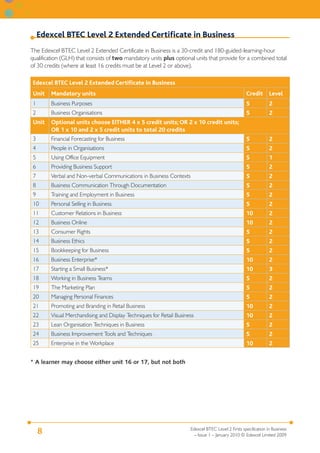
Edexcel BTEC Level 2 Extended Certificate in Business
The Edexcel BTEC Level 2 Extended Certificate in Business is a 30-credit and 180-guided-learning-hour
qualification (GLH) that consists of two mandatory units plus optional units that provide for a combined total
of 30 credits (where at least 16 credits must be at Level 2 or above).

 Edexcel BTEC Level 2 Extended Certificate in Business
 Unit    Mandatory units                                                                            Credit Level
 1       Business Purposes                                                                          5            2
 2       Business Organisations                                                                     5            2
 Unit    Optional units choose EITHER 4 x 5 credit units; OR 2 x 10 credit units;
         OR 1 x 10 and 2 x 5 credit units to total 20 credits
 3       Financial Forecasting for Business                                                         5            2
 4       People in Organisations                                                                    5            2
 5       Using Office Equipment                                                                     5            1
 6       Providing Business Support                                                                 5            2
 7       Verbal and Non-verbal Communications in Business Contexts                                  5            2
 8       Business Communication Through Documentation                                               5            2
 9       Training and Employment in Business                                                        5            2
 10      Personal Selling in Business                                                               5            2
 11      Customer Relations in Business                                                             10           2
 12      Business Online                                                                            10           2
 13      Consumer Rights                                                                            5            2
 14      Business Ethics                                                                            5            2
 15      Bookkeeping for Business                                                                   5            2
 16      Business Enterprise*                                                                       10           2
 17      Starting a Small Business*                                                                 10           3
 18      Working in Business Teams                                                                  5            2
 19      The Marketing Plan                                                                         5            2
 20      Managing Personal Finances                                                                 5            2
 21      Promoting and Branding in Retail Business                                                  10           2
 22      Visual Merchandising and Display Techniques for Retail Business                            10           2
 23      Lean Organisation Techniques in Business                                                   5            2
 24      Business Improvement Tools and Techniques                                                  5            2
 25      Enterprise in the Workplace                                                                10           2


* A learner may choose either unit 16 or 17, but not both


                                                                      Edexcel BTEC Level 2 Firsts specification in Business
     8                                                                  – Issue 1 – January 2010 © Edexcel Limited 2009
Edexcel BTEC Level 2 Diploma in Business
The Edexcel BTEC Level 2 Diploma in Business is a 60-credit and 360-guided-learning-hour (GLH)
qualification that consists of four mandatory units plus optional units that provide for a combined total
of 60 credits (where at least 31 credits must be at Level 2 or above).

 Edexcel BTEC Level 2 Diploma in Business
 Unit     Mandatory units                                                                     Credit Level
 1        Business Purposes                                                                   5         2
 2        Business Organisations                                                              5         2
 3        Financial Forecasting for Business                                                  5         2
 4        People in Organisations                                                             5         2
 Unit     Optional units choice of any units to total 40 credits
 5        Using Office Equipment                                                              5         1
 6        Providing Business Support                                                          5         2
 7        Verbal and Non-verbal Communication in Business Contexts                            5         2
 8        Business Communication Through Documentation                                        5         2
 9        Training and Employment in Business                                                 5         2
 10       Personal Selling in Business                                                        5         2
 11       Customer Relations in Business                                                      10        2
 12       Business Online                                                                     10        2
 13       Consumer Rights                                                                     5         2
 14       Business Ethics                                                                     5         2
 15       Bookkeeping for Business                                                            5         2
 16       Business Enterprise*                                                                10        2
 17       Starting a Small Business*                                                          10        3
 18       Working in Business Teams                                                           5         2
 19       The Marketing Plan                                                                  5         2
 20       Managing Personal Finances                                                          5         2
 21       Promoting and Branding in Retail Business                                           10        2
 22       Visual Merchandising and Display Techniques for Retail Business                     10        2
 23       Lean Organisation Techniques in Business                                            5         2
 24       Business Improvement Tools and Techniques in Business                               5         2
 25       Enterprise in the Workplace                                                         10        2


* A learner may choose either unit 16 or 17, but not both


 Edexcel BTEC Level 2 Firsts specification in Business
 – Issue 1 – January 2010 © Edexcel Limited 2009
                                                                                                            9
Assessment and grading
In BTEC Firsts all units are internally assessed.
All assessment for BTEC First qualifications is criterion referenced, based on the achievement of all the
specified learning outcomes.
Each unit within the qualification has specified assessment and grading criteria which are to be used for
grading purposes. A summative unit grade can be awarded at pass, merit or distinction:
●    to achieve a ‘pass’ a learner must have satisfied all the pass assessment criteria
●    to achieve a ‘merit’ a learner must additionally have satisfied all the merit grading criteria
●    to achieve a ‘distinction’ a learner must additionally have satisfied all the distinction grading criteria.


    Grading domains
The assessment and grading criteria are developed in relation to grading domains which are exemplified
by a number of indicative characteristics at the level of the qualification.
There are four BTEC First grading domains:
●    application of knowledge and understanding
●    development of practical and technical skills
●    personal development for occupational roles
●    application of generic skills.
Please refer to Annexe B which shows the merit and distinction indicative characteristics.


    Guidance
The purpose of assessment is to ensure that effective learning has taken place to give learners the opportunity to:
●    meet the assessment criteria and
●    achieve the learning outcomes within the units.
All the assignments created by centres should be reliable and fit for purpose, and should be built on the
unit assessment and grading criteria. Assessment tasks and activities should enable learners to produce valid,
sufficient and reliable evidence that relates directly to the specified criteria. Centres should enable learners
to produce evidence in a variety of different forms, including written reports, graphs and posters, along with
projects, performance observation and time-constrained assessments.
Centres are encouraged to emphasise the practical application of the assessment and grading criteria, providing
a realistic scenario for learners to adopt, and making maximum use of practical activities and work experience.
The creation of assignments that are fit for purpose is vital to achievement and their importance cannot be
over-emphasised.
The assessment and grading criteria must be clearly indicated in the fit-for-purpose assignments. This gives
learners focus and helps with internal verification and standardisation processes. It will also help to ensure
that learner feedback is specific to the assessment and grading criteria.


                                                                          Edexcel BTEC Level 2 Firsts specification in Business
    10                                                                      – Issue 1 – January 2010 © Edexcel Limited 2009
When looking at the unit assessment and grading criteria and designing assignments, centres are encouraged
to identify common topics and themes.
The units include guidance on appropriate assessment methodology. A central feature of vocational
assessment is that it allows for assessment to be:
●      current, ie to reflect the most recent developments and issues
●      local, ie to reflect the employment context of the delivering centre
●      flexible to reflect learner needs, ie at a time and in a way that matches the learner’s requirements so that
       they can demonstrate achievement.


Calculation of the qualification grade
Pass qualification grade

Learners who achieve the minimum eligible credit value specified by the rule of combination will achieve the
qualification at pass grade (see Rules of combination for Edexcel BTEC Level 2 First qualifications).

Qualification grades above pass grade

Learners will be awarded a merit or distinction or distinction* qualification grade by the aggregation of points
gained through the successful achievement of individual units. The number of points available is dependent
on the unit level and grade achieved, and the credit size of the unit (as shown in the ‘points available for
credits achieved at different QCF Levels and unit grades’ below).

Points available for credits achieved at different QCF Levels and unit grades

The table below shows the number of points scored per credit at the unit level and grade.

                                                                        Points per credit
 Unit QCF level
                                                     Pass           Merit                   Distinction
 Level 1                                             3              4                       5
 Level 2                                             5              6                       7
 Level 3                                             7              8                       9


Learners who achieve the correct number of points within the ranges shown in the ‘qualification grade’ table
below will achieve the qualification merit or distinction or distinction* grade.

Qualification grade

                                                               Points range above pass grade
 Qualification
                                                     Merit          Distinction             Distinction*
 BTEC Level 2 Certificate                            85-94          95-99                   100 and above
 BTEC Level 2 Extended Certificate                   170-189        190-199                 200 and above
 BTEC Level 2 Diploma                                340-379        380-399                 400 and above


Please refer to Annexe G for examples of calculation of qualification grade above pass grade.

    Edexcel BTEC Level 2 Firsts specification in Business
    – Issue 1 – January 2010 © Edexcel Limited 2009
                                                                                                              11
Quality assurance of centres
Edexcel’s qualification specifications set out the standard to be achieved by each learner in order to be
awarded the qualification. This is covered in the statement of learning outcomes, and assessment and grading
criteria in each unit. Further guidance on delivery and assessment is given in the Essential guidance for tutors
section in each unit. This section is designed to provide additional guidance and amplification related to
the unit to support tutors, deliverers and assessors and to provide for a coherence of understanding and
a consistency of delivery and assessment.


    Approval
Centres that have not previously offered BTEC qualifications will first need to apply for, and be granted,
centre approval before they can apply for approval to offer the programme.
When a centre applies for approval to offer a BTEC qualification they are required to enter into an
approvals agreement.
The approvals agreement is a formal commitment by the head or principal of a centre to meet all the
requirements of the specification and any linked codes or regulations. Sanctions and tariffs may be applied
if centres do not comply with the agreement. Ultimately, this could result in the suspension of certification
or withdrawal of approval.
Centres will be allowed ‘accelerated approval’ for a new programme where the centre already has approval
for a programme that is being replaced by the new programme.
The key principles of quality assurance are that:
●    a centre delivering BTEC programmes must be an approved centre and must have approval for programmes
     or groups of programmes that it is operating
●    the centre agrees as part of gaining approval to abide by specific terms and conditions around the
     effective delivery and quality assurance of assessment; it must abide by these conditions throughout
     the period of delivery
●    Edexcel makes available to approved centres a range of materials and opportunities intended to exemplify
     the processes required for effective assessment and examples of effective standards. Approved centres
     must use the materials and services to ensure that all staff delivering BTEC qualifications keep up to date
     with the guidance on assessment
●    an approved centre must follow agreed protocols for standardisation of assessors and verifiers; planning,
     monitoring and recording of assessment processes; and for dealing with special circumstances, appeals
     and malpractice.
The approach of quality assured assessment is made through a partnership between an approved centre and
Edexcel. Edexcel is committed to ensuring that it follows best practice and employs appropriate technology to
support quality assurance processes where practicable. Therefore, the specific arrangements for working with
centres will vary. Edexcel seeks to ensure that the quality assurance processes that it uses do not place undue
bureaucratic processes on centres and works to support centres in providing robust quality assurance processes.


                                                                       Edexcel BTEC Level 2 Firsts specification in Business
    12                                                                   – Issue 1 – January 2010 © Edexcel Limited 2009
Edexcel monitors and supports centres in the effective operation of assessment and quality assurance. The
methods which it uses to do this for BTEC First and National programmes accredited under the Qualifications
and Credit Framework (QCF) include:
●      ensuring that all centres have completed appropriate declarations at the time of approval, undertaking
       approval visits to centres where necessary
●      requiring all centres to appoint a Lead Internal Verifier for designated groups of programmes and
       to ensure that this person is trained and supported in carrying out that role
●      requiring that the Lead Internal Verifier completes compulsory online standardisation related to
       assessment and verification decisions for the designated programme
●      assessment sampling and verification, through requested samples of assessments, completed assessed
       learner work and associated documentation
●      overarching review and assessment of a centre’s strategy for assessing and quality assuring its
       BTEC programmes.
Edexcel Quality Assurance Handbook
Centres should refer to the Handbook for Quality Assurance for BTEC QCF qualifications, issued annually,
for detailed guidance.
An approved centre must make certification claims only when authorised by Edexcel and strictly in accordance
with requirements for reporting.
Centres that do not fully address and maintain rigorous approaches to quality assurance will be prevented
from seeking certification for individual programmes or for all BTEC First and National programmes. Centres
that do not comply with remedial action plans may have their approval to deliver qualifications removed.


Programme design and delivery
BTEC First qualifications consist of mandatory units and optional units. Optional units are designed to provide
a focus to the qualification and give more specialist opportunities in the sector.
In BTEC Firsts each unit has a number of guided learning hours.
Guided learning hours are defined as all the times when a tutor, trainer or facilitator is present to give specific
guidance towards the learning aim being studied on a programme. This definition includes lectures, tutorials
and supervised study in, for example, open learning centres and learning workshops. It also includes time
spent by staff assessing learners’ achievements. It does not include time spent by staff in day-to-day marking
of assignments where the learner is not present.
Centres are advised to consider this definition when planning the programme of study associated with
this specification.


    Edexcel BTEC Level 2 Firsts specification in Business
    – Issue 1 – January 2010 © Edexcel Limited 2009
                                                                                                              13
Mode of delivery
Edexcel does not define the mode of study for BTEC Firsts. Centres are free to offer the qualifications using
any mode of delivery (such as full-time, part-time, evening only, distance learning) that meets their learners’
needs. Whichever mode of delivery is used, centres must ensure that learners have appropriate access to
the resources identified in the specification and to the subject specialists delivering the units. This is particularly
important for learners studying for the qualification through open or distance learning.
Learners studying for the qualification on a part-time basis bring with them a wealth of experience that should
be utilised to maximum effect by tutors and assessors. The use of assessment evidence drawn from learners’
work environments should be encouraged. Those planning the programme should aim to enhance the
vocational nature of the qualification by:
●    liaising with employers to ensure a course relevant to learners’ specific needs
●    accessing and using non-confidential data and documents from learners’ workplaces
●    including sponsoring employers in the delivery of the programme and, where appropriate, in the assessment
●    linking with company-based/workplace training programmes
●    making full use of the variety of experience of work and life that learners bring to the programme.


    Resources
BTEC Firsts are designed to prepare learners for employment in specific occupational sectors. Physical resources
need to support the delivery of the programme and the proper assessment of the learning outcomes, and should
therefore normally be of industry standard. Staff delivering programmes and conducting the assessments should
be familiar with current practice and standards in the sector concerned. Centres will need to meet any specific
resource requirements to gain approval from Edexcel.
Where specific resources are required these have been indicated in individual units in the Essential resources sections.


    Delivery approach
It is important that centres develop an approach to teaching and learning that supports the specialist
vocational nature of BTEC First qualifications and the mode of delivery. Specifications give a balance of
practical skill development and knowledge requirements, some of which can be theoretical in nature.
Tutors and assessors need to ensure that appropriate links are made between theory and practical application
and that the knowledge base is applied to the sector. This requires the development of relevant and up-to-date
teaching materials that allow learners to apply their learning to actual events and activity within the sector.
Maximum use should be made of the learner’s experience.
An outline learning plan is included in every unit as guidance which demonstrates one way in planning the
delivery and assessment of the unit. The outline learning plan can be used in conjunction with the programme
of suggested assignments.
Where the qualification has been designated and approved as a Technical Certificate and forms part of an
Apprenticeship scheme, particular care needs to be taken to build strong links between the learning and
assessment for the BTEC First qualification and the related NVQs and Functional Skills that also contribute
to the scheme.


                                                                           Edexcel BTEC Level 2 Firsts specification in Business
    14                                                                       – Issue 1 – January 2010 © Edexcel Limited 2009
Meeting local needs
Centres should note that the qualifications set out in this specification have been developed in consultation
with centres and employers and the Sector Skills Councils or the Standards Setting Bodies for the relevant
sector. Centres should make maximum use of the choice available to them within the optional units to meet
the needs of their learners, and local skills and training needs.
In certain circumstances, units in this specification might not allow centres to meet a local need. In this
situation, Edexcel will ensure that the rule of combination allows centres to make use of units from other
standard QCF BTEC specifications. Centres are required to ensure that the coherence and purpose of the
qualification is retained and to ensure that the vocational focus is not diluted.


  Limitations on variations from standard specifications
The flexibility to import standard units from other QCF BTEC Level 1 to 3 qualifications is limited to a total of
25 per cent of the qualification credit value. (See Rules of combination for Edexcel BTEC Level 2 First qualifications.)
These units cannot be used at the expense of the mandatory units in any qualification.


  Additional and specialist learning
Additional and specialist learning (ASL) consists of accredited qualifications at the same level as, or one level
above the Diploma course of study. The ASL may include BTEC qualifications which are also available to
learners not following a Diploma course of study.
Qualifications for ASL must be selected from the ASL catalogue through the National Database of Accredited
Qualifications (NDAQ). The catalogue includes qualifications which have the approval of the Diploma Development
Partnership (DDP) and will expand over time as more qualifications are approved. To access the catalogue go
to www.ndaq.org.uk and select ‘Browse Diploma Qualifications’.
Further units may be added to qualifications within the catalogue and centres undertaking, or preparing
to undertake, ASL should refer regularly to the Edexcel website for information regarding additions.


  Functional Skills
BTEC Firsts give learners opportunities to develop and apply Functional Skills.
Functional Skills are offered as stand-alone qualifications at Level 2. See individual units for opportunities
to cover ICT, Mathematics and English Functional Skills.


  Personal, learning and thinking skills
Opportunities are available to develop personal, learning and thinking skills (PLTS) within a sector-related
context. PLTS are identified in brackets after the unit pass criteria to which they are associated and they are
also mapped in Annexe C. Further opportunities for learners to demonstrate these skills may also be apparent
as learners progress throughout their learning.


 Edexcel BTEC Level 2 Firsts specification in Business
 – Issue 1 – January 2010 © Edexcel Limited 2009
                                                                                                                 15
Access and recruitment
Edexcel’s policy regarding access to its qualifications is that:
●    they should be available to everyone who is capable of reaching the required standards
●    they should be free from any barriers that restrict access and progression
●    there should be equal opportunities for all wishing to access the qualifications.
Centres are required to recruit learners to BTEC qualifications with integrity. This will include ensuring that
applicants have appropriate information and advice about the qualifications and that the qualification will
meet their needs. Centres should take appropriate steps to assess each applicant’s potential and make a
professional judgement about their ability to successfully complete the programme of study and achieve
the qualification. This assessment will need to take account of the support available to the learner within
the centre during their programme of study and any specific support that might be necessary to allow
the learner to access the assessment for the qualification. Centres should consult Edexcel’s policy on
learners with particular requirements.
Centres will need to review the entry profile of qualifications and/or experience held by applicants, considering
whether this profile shows an ability to progress to a Level 3 qualification. For learners who have recently
been in education, the profile is likely to include one of the following:
●    a BTEC Level 1 qualification in Business or a related vocational area
●    a standard of literacy and numeracy supported by a general education equivalent to four GCSEs at
     grade D-G
●    other related Level 1 qualifications
●    related work experience.
More mature learners may present a more varied profile of achievement that is likely to include experience
of paid and/or unpaid employment.


    Restrictions on learner entry
Most BTEC First qualifications are accredited on the QCF for learners aged 14 years and over.
In particular sectors the restrictions on learner entry might also relate to any physical or legal barriers,
for example people working in health, care or education are likely to be subject to police checks.
Edexcel Level 2 BTEC Firsts are listed on the DCSF funding lists Section 96 and Section 97.


    Access arrangements and special considerations
Edexcel’s policy on access arrangements and special considerations for BTEC and Edexcel NVQ qualifications
aims to enhance access to the qualifications for learners with disabilities and other difficulties (as defined by the
1995 Disability Discrimination Act and the amendments to the Act) without compromising the assessment
of skills, knowledge, understanding or competence.
Further details are given in the policy document Access Arrangements and Special Considerations for BTEC
and Edexcel NVQ Qualifications, which can be found on the Edexcel website (www.edexcel.com). This policy
replaces the previous Edexcel policy (Assessment of Vocationally Related Qualification: Regulations and Guidance
Relating to Learners with Special Requirements, 2002) concerning learners with particular requirements.


                                                                         Edexcel BTEC Level 2 Firsts specification in Business
    16                                                                     – Issue 1 – January 2010 © Edexcel Limited 2009
Recognition of Prior Learning
Recognition of Prior Learning (RPL) is a method of assessment (leading to the award of credit) that considers
whether a learner can demonstrate that they can meet the assessment requirements for a unit through
knowledge, understanding or skills they already possess and so do not need to develop through a course
of learning.
Edexcel encourages centres to recognise learners’ previous achievements and experiences whether at work,
home and at leisure, as well as in the classroom. RPL provides a route for the recognition of the achievements
resulting from continuous learning.
RPL enables recognition of achievement from a range of activities using any valid assessment methodology.
Provided that the assessment requirements of a given unit or qualification have been met, the use of RPL
is acceptable for accrediting a unit, units or a whole qualification. Evidence of learning must be sufficient, reliable
and valid.


Unit format
All units in Edexcel BTEC Level 2 First qualifications have a standard format. The unit format is designed
to give guidance on the requirements of the qualification for learners, tutors, assessors and those responsible
for monitoring national standards.
Each unit has the following sections.


  Unit title
The unit title is accredited on the QCF and this form of words will appear on the learner’s Notification
of Performance (NOP).


  QCF level
All units and qualifications within the QCF will have a level assigned to them, which represents the level
of achievement. There are nine levels of achievement, from Entry Level to Level 8. The level of the unit has
been informed by the QCF level descriptors and, where appropriate, the National Occupational Standards
(NOS) and/or other sector/professional benchmarks.


  Credit value
In BTEC First qualifications each unit consists of a credit value; learners will be awarded credits for the successful
completion of whole units.
A credit value specifies the number of credits that will be awarded to a learner who has achieved all the learning
outcomes of the unit.


 Edexcel BTEC Level 2 Firsts specification in Business
 – Issue 1 – January 2010 © Edexcel Limited 2009
                                                                                                                    17
Guided learning hours
Guided learning hours are defined as all the times when a tutor, trainer or facilitator is present to give specific
guidance towards the learning aim being studied on a programme. This definition includes lectures, tutorials
and supervised study in, for example, open learning centres and learning workshops. It also includes time
spent by staff assessing learners’ achievements. It does not include time spent by staff in day-to-day marking
of assignments or homework where the learner is not present.


  Aim and purpose
The aim provides a clear summary of the purpose of the unit and is a succinct statement that summarises
the learning outcomes of the unit.


  Unit introduction
The unit introduction gives the reader an appreciation of the unit in the vocational setting of the qualification,
as well as highlighting the focus of the unit. It gives the reader a snapshot of the unit and the key knowledge,
skills and understanding gained while studying the unit. The unit introduction also highlights any links to the
appropriate vocational sector by describing how the unit relates to that sector.


  Learning outcomes
Learning outcomes state exactly what a learner should ‘know, understand or be able to do’ as a result
of completing the unit.


  Unit content
The unit content identifies the breadth of knowledge, skills and understanding needed to design and deliver a
programme of learning to achieve each of the learning outcomes. This is informed by the underpinning knowledge
and understanding requirements of the related National Occupational Standards (NOS). The content provides
the range of subject material for the programme of learning and specifies the skills, knowledge and understanding
required for achievement of the pass, merit and distinction grading criteria.
Each learning outcome is stated in full and then the key phrases or concepts related to that learning outcome
are listed in italics followed by the subsequent range of related topics.
Relationship between content and assessment criteria
The learner must have the opportunity within the delivery of the unit to cover all of the unit content.
It is not a requirement of the unit specification that all the indicative content will need to be covered in a
programme of learning in order for learners to be able to meet the standard determined in the assessment
and grading criteria. The merit and distinction criteria enable the learner to achieve higher levels of performance
in their acquisition of knowledge, understanding and skills.


                                                                        Edexcel BTEC Level 2 Firsts specification in Business
 18                                                                       – Issue 1 – January 2010 © Edexcel Limited 2009
Content structure and terminology
The information below shows the unit content is structured and gives the terminology used to explain
the different components within the content.
●      Learning outcome: this is shown in bold at the beginning of each section of content.
●      Italicised sub-heading: it contains a key phrase or concept. This is content which must be covered
       in the delivery of the unit. Colons mark the end of an italicised sub-heading.
●      Elements of content: the elements are in plain text and amplify the sub-heading. The elements must
       be covered in the delivery of the unit. Semi-colons mark the end of an element.
●      Brackets contain amplification of elements of content which must be covered in the delivery of the unit.
●      ‘eg’ is a list of examples, used for indicative amplification of an element (that is, the content specified in
       this amplification could be covered or could be replaced by other, similar material).


     Assessment and grading grid
Each grading grid gives the assessment and grading criteria used to determine the evidence that each learner
must produce in order to receive a pass, merit or distinction grade. It is important to note that the merit
and distinction grading criteria require a qualitative improvement in a learners’ evidence and not simply the
production of more evidence at the same level.


     Essential guidance for tutors
This section gives tutors additional guidance and amplification to aid understanding and a consistent level
of delivery and assessment. It is divided into the following sections.
●      Delivery – explains the content’s relationship with the learning outcomes and offers guidance about
       possible approaches to delivery. This section is based on the more usual delivery modes but is not
       intended to rule out alternative approaches.
●      Outline learning plan – the outline learning plan has been included in every unit as guidance and demonstrates
       one way in planning the delivery and assessment of a unit. The outline learning plan can be used in conjunction
       with the programme of suggested assignments.
●      Assessment – gives amplification about the nature and type of evidence that learners need to produce
       in order to pass the unit or achieve the higher grades. This section should be read in conjunction with
       the grading criteria.
●      Suggested programme of assignments – the table shows how the suggested assignments match and cover
       the assessment grading criteria.
●      Links to National Occupational Standards, other BTEC units, other BTEC qualifications and other relevant
       units and qualifications – sets out links with other units within the qualification. These links can be used
       to ensure that learners make connections between units, resulting in a coherent programme of learning.
       The links show opportunities for integration of learning, delivery and assessment.
●      Essential resources – identifies any specialist resources needed to allow learners to generate the evidence
       required for each unit. The centre will be asked to ensure that any requirements are in place when it seeks
       approval from Edexcel to offer the qualification.
●      Employer engagement and vocational contexts – gives a short list of agencies, networks and other useful
       contacts for employer engagement and for sources of vocational contexts.
●      Indicative reading for learners – gives a list of learner resource material that benchmarks the level of study.

    Edexcel BTEC Level 2 Firsts specification in Business
    – Issue 1 – January 2010 © Edexcel Limited 2009
                                                                                                                    19
Edexcel BTEC Level 2 Firsts specification in Business
20     – Issue 1 – January 2010 © Edexcel Limited 2009
Units
   Unit 1:            Business Purposes                                          23
   Unit 2:            Business Organisations                                     35
   Unit 3:            Financial Forecasting for Business                         47
   Unit 4:            People in Organisations                                    57
   Unit 5:            Using Office Equipment                                      69
   Unit 6:            Providing Business Support                                 79
   Unit 7:            Verbal and Non-verbal Communication in Business Contexts   89
   Unit 8:            Business Communication through Documentation               99
   Unit 9:            Training and Employment in Business                        109
   Unit 10:           Personal Selling in Business                               119
   Unit 11:           Customer Relations in Business                             133
   Unit 12:           Business Online                                            145
   Unit 13:           Consumer Rights                                            159
   Unit 14:           Business Ethics                                            169
   Unit 15:           Bookkeeping for Business                                   179
   Unit 16:           Business Enterprise                                        189
   Unit 17:           Starting a Small Business                                  199
   Unit 18:           Working in Business Teams                                  209
   Unit 19:           The Marketing Plan                                         219
   Unit 20:           Managing Personal Finances                                 229
   Unit 21:           Promoting and Branding in Retail Business                  239
   Unit 22:           Visual Merchandising and Display Techniques for
                      Retail Business                                            249
   Unit 23:           Lean Organisation Techniques in Business                   259
   Unit 24:           Business Improvement Tools and Techniques                  269
   Unit 25:           Enterprise in the Workplace                                279


Edexcel BTEC Level 2 Firsts specification in Business
– Issue 1 – January 2010 © Edexcel Limited 2009
                                                                                 21
Edexcel BTEC Level 2 Firsts specification in Business
22     – Issue 1 – January 2010 © Edexcel Limited 2009
Unit 1:                                      Business Purposes
Unit code:                                   L/502/5244
QCF Level 2:                                 BTEC First
Credit value:                                5
Guided learning hours: 30

    Aim and purpose

The aim of this unit is to enable learners to understand the nature of business organisations and the business
environment in which they operate. Learners will do this by looking at the range of organisations that exist
locally, regionally and nationally and by considering the business framework in which they operate. There
will be a particular focus on businesses in the local context with which learners will be familiar.


    Unit introduction

The wealth of the nation is created through business activity. The term ‘business’ is used to cover organisations
as diverse as multinational companies and small local businesses, as well as organisations in the voluntary
sector. Businesses have a wide range of purposes. Some supply goods and services, others manufacture
goods. Some want to make profits to satisfy their shareholders, others do not. Businesses contribute to the
national wellbeing and the unit considers the purposes of these different businesses.
Businesses are organised differently. The largest businesses operate globally. Others may wish to remain small
and free from too much legal control. The smallest businesses, for example, individuals providing an ironing
or gardening service, may be run from the owner’s home and have a limited sphere of operation. Learners
will look at how businesses are classified in terms of their activities and will consider the relative importance
of each by looking at the local economy.
Businesses do not operate in a vacuum. The government sets the business context. Account has to be taken
of the requirements of the European Union in areas such as competition. In general terms, the government
wants to create a business framework in which businesses and individuals can flourish. Learners will look at
some simple linkages to understand how the government affects business. When interest rates fall, businesses
borrow cheaply to invest and produce more to sell at home and abroad, so they take on more employees
who receive incomes which they then spend on goods and services so stimulating demand for products from
other businesses. Growth, income, exporting and employment can all be examined through examples
such as this.
Learners will look at the changing patterns in the business environment and the reasons for these changes.
Businesses need to be flexible and responsive to the changes in the business environment if they are to
survive and succeed.


    Learning outcomes
On completion of this unit a learner should:
1      Understand the purpose and ownership of business
2      Understand the business context in which organisations operate.


 Edexcel BTEC Level 2 Firsts specification in Business
 – Issue 1 – January 2010 © Edexcel Limited 2009
                                                                                                                23
Unit content

1 Understand the purpose and ownership of business
   Purpose: supply of goods and services eg at a profit, free, at cost, for sale below cost
   Ownership: sole trader; partnership; limited companies (private [ltd], public [plc]); charity; voluntary
   organisations; co-operatives; government
   Size: small; medium; large
   Scale: local; regional; national; European and global organisations
   Classification: primary (eg farming, forestry, fishing, extraction/mining); secondary (eg manufacturing,
   engineering, construction); tertiary (eg private service industries, local and national public services,
   voluntary/not-for-profit services)


2 Understand the business context in which organisations operate
   Role of government: European; national; local; growth, full employment; inflation/deflation; surpluses;
   competitiveness; equality
   Business environment characteristics: markets; trends (employment, income, growth); relative growth/decline
   by sector: decline of primary and secondary industries; growth of tertiary service industries; legal framework


                                                                      Edexcel BTEC Level 2 Firsts specification in Business
 24                                                                     – Issue 1 – January 2010 © Edexcel Limited 2009
Assessment and grading criteria
In order to pass this unit, the evidence that the learner presents for assessment needs to demonstrate that
they can meet all the learning outcomes for the unit. The assessment criteria for a pass grade describe the
level of achievement required to pass this unit.

 Assessment and grading criteria
 To achieve a pass grade the                    To achieve a merit grade the        To achieve a distinction grade
 evidence must show that the                    evidence must show that, in         the evidence must show that,
 learner is able to:                            addition to the pass criteria,      in addition to the pass and
                                                the learner is able to:             merit criteria, the learner
                                                                                    is able to:
 P1     identify the purpose of                 M1 contrast the ownership and       D1     evaluate how a business
        four different business                    purposes of two different               organisation has responded
        organisations                              business organisations                  to changes in the business
        [IE]                                                                               environment.
 P2     describe the different types
        of business ownership, linking
        this to the size and scale of
        four different organisations
 P3     explain how businesses are              M2 compare areas of growth
        classified using local and                 or decline in the primary,
        national examples                          secondary and tertiary
                                                   classifications of business
                                                   activities.
 P4     outline the role of
        government in creating the
        business climate
        [IE]
 P5     explain the characteristics
        of the local business
        environment.
        [IE, RL]


PLTS: This summary references where applicable, in the square brackets, the elements of the personal,
learning and thinking skills applicable in the pass criteria. It identifies opportunities for learners to demonstrate
effective application of the referenced elements of the skills.

 Key             IE – independent enquirers              RL – reflective learners        SM – self-managers
                 CT – creative thinkers                  TW – team workers               EP – effective participators


 Edexcel BTEC Level 2 Firsts specification in Business
 – Issue 1 – January 2010 © Edexcel Limited 2009
                                                                                                                        25
Essential guidance for tutors

Delivery
The unit takes learners through an exploration of businesses and develops their understanding as the content
progresses. Discussing local business operations and the learner’s experiences from work experience or part-time
employment gives them a broad introduction to what businesses do, their purpose, types of ownership, how
many employees they have, their scale of operation and the industrial sector to which they belong. Learners
can then expand these ideas to consider organisations that have regional, national, European and global presences.
Learners should be encouraged to take an interest in business both by looking at what goes on around them
and by looking at the media. The term ‘business’ is used to cover organisations as diverse as multinational
companies, such as BP and Unilever, small businesses such as a local window cleaner and organisations
in the voluntary sector such as Oxfam. A survey of the local business scene would provide a picture of the
nature of local business and begin to identify some of the trends and developments together with reasons for
these changes. Newspaper articles, advertisements and business promotional materials can be used to create
displays depicting the local business environment and the types of business. This will provide a visual stimulus
that can be used to enhance understanding of other areas of content within the unit. Businesses have a wide
range of objectives and learners should identify the purposes they have. Case studies and newspaper reports
relating to businesses that learners are familiar with can be used to extend their understanding of particular
issues. Television programmes exploring business organisations can also be useful formative tools, especially
when followed with class discussion or written summary. The internet can be a useful tool, as many larger
organisations provide web pages specifically for learners.
Tutors may find it useful for learners (working individually or in pairs) to ‘adopt’ a local business, enabling them
to contribute examples of business purposes through class discussions. Discussion groups can also examine
the process of investigation, since it is a problem to get information about some businesses, especially when
they are not legally required to put much information into the public domain.
Learners will need input on types of ownership, business purposes and different classifications according to
the industrial sector. Tutors should ensure that work undertaken by learners captures an appropriate range
of business ownership. This may be locally based, but some areas will not have the full range of organisations
so a non-local focus may be needed. For example, a public limited company with a global presence may not
exist in a rural area. Ownership types should be examined in relation to the size and scale of business activities
and local as well as national examples should be considered.
Tutor input is similarly needed to provide an understanding of the role of the government, its economic
objectives and how it creates the business climate in which organisations function. Interest rates are cut in
order to stimulate investment and investment increases efficiency, output and creates export and employment
opportunities. Research and case studies will identify the characteristics of the local business environment
showing, for example, whether local employment is growing or declining and this can be linked to the
objective of having full and stable employment. Tutors may need to provide assimilable summaries of
government data that learners can use to explore trends in the business environment.
Learners need to develop their understanding of how sectors have changed. When approaching delivery
of this area of content, tutors should be aware of the balance of industry sector in their local area in order
to illustrate delivery with local examples, including how different sectors have grown or declined. These must,
however, be contrasted with regional and national examples in order to give a wider picture.


                                                                         Edexcel BTEC Level 2 Firsts specification in Business
  26                                                                       – Issue 1 – January 2010 © Edexcel Limited 2009
Outline learning plan
The outline learning plan has been included in this unit as guidance and can be used in conjunction with the
programme of suggested assignments.
The outline learning plan demonstrates one way in planning the delivery and assessment of this unit.

 Topic and suggested assignments/activities and/assessment
 Introduction to unit and structure of the programme.
 Introduction to the nature of business and ownership.
 Pair/group work on analysis of nature of businesses.
 Learners:
 ●   investigate purposes of businesses
 ●   research ownership types of various businesses.
 Assignment task 1: Promoting Local Business
 ●   investigate classification, scope and scale of business’ activities.
 Assignment task 2: Promoting Local Business
 ●   use case study materials
 ●   internet searches
 ●   tabulate information
 ●   write presentations
 ●   give presentations.
 There may still be formal input, visits and speakers during time when group work happens.
 Introduction to the business context.
 Pair/group work on the business context and the role of government. Learners:
 ●   research government economic and business objectives
 ●   investigate the markets in which businesses operate
 ●   investigate trends in different business sectors
 ●   suggest reasons for the business trends
 ●   use case-study materials
 ●   tabulate information
 ●   write presentations
 ●   give presentations.
 Assignment task 3: Promoting Local Business
 There may still be formal input and visits and speakers during time when group work happens.
 Preparation for assessed assignments.
 Non-supervised study time and completion of assignments.


 Edexcel BTEC Level 2 Firsts specification in Business
 – Issue 1 – January 2010 © Edexcel Limited 2009
                                                                                                         27
Assessment
To achieve the pass criterion, P1, learners need to identify the purpose of four business organisations. To do
this, a selection of different organisations needs to be considered in order cover a range of objectives.
For P2, there needs to be a description of four different types of ownership which should be linked to the size
and scale of the businesses. The need to raise finance may require a sole trader or a partnership to convert
to a limited company. Limited companies may see the owners diluting their equity stakes to encourage other
investors to come in with additional capital. The easyJet founder sold a significant part of the business to
ensure it had the capital to expand and open up new hubs in different European countries.
For P3, the classifications of businesses should be in terms of the sector and the nature and scope of their
activities. There needs to be a clear explanation of what the legal structure of the business is and multinational
businesses need to be examined carefully. For assessment purposes tutors need to vet choice of businesses
to ensure a suitable range is selected for use in assignments.
For P4, learners need to recognise the role of government in establishing the business climate through the use
of incentives to business such as cutting the business rates of tax or through regional development policies.
Regional and local government also have business generation at the heart of what they do in promoting local
economic wellbeing and there are plentiful illustrations of how they create business micro environments.
For P5, learners should consider the structure of the local business environment by looking at the range and
types of business and their impact on and significance to the local economy. For example, science parks are
developed and bring in manufacturing industries that are based on sophisticated technology, replacing some
of the traditional manufacturing. Employment and wealth distribution patterns change. Support industries
develop, providing additional products and services. In the north-east of England as shipbuilding declined with
consequences for local employment, the efforts of government persuaded Nissan to build a car plant and
government offices to re-locate to the area. In 2008, Sunderland had the largest increase in new business
start-ups at a time when the economy was going into recession.
For M1, learners need to contrast two different businesses but they must ensure the contrast is as wide
as possible. For the contrasts to be valid, the businesses must have different ownership and purposes.
For M2, learners need to look at how the national and local economy has changed over time in terms of
the types of business activity that take place. Trends need to be quantified and the reasons for the changes
need to be examined and explained.
For D1, learners need to look at one business organisation and how it has changed in response to changes
in the business environment. If a supermarket is chosen, then it is easy to see how they have become one-
stop shops for food, petrol, pharmaceuticals, clothes, electrical goods and so on. The reasons behind the
change need to be considered. Customers’ preferred shopping styles have changed but the planning regime
has allowed out-of-own green field sites to be developed and the trading laws have permitted Sunday
trading and 24-hour opening.
The same business organisation(s) can be used for different criteria. This might encourage a more in-depth
investigation of particular businesses.
Assignments can group criteria in any reasonable cluster but P1, P2, M1 and D1 could fit together as could
P3 and M2 and P4 and P5. The example assignment provided uses a different clustering of criteria.


                                                                       Edexcel BTEC Level 2 Firsts specification in Business
 28                                                                      – Issue 1 – January 2010 © Edexcel Limited 2009
Programme of suggested assignments
The table below shows a programme of suggested assignments that cover the pass, merit and distinction
criteria in the assessment and grading grid. This is for guidance and it is recommended that centres either
write their own assignments or adapt any Edexcel assignments to meet local needs and resources.

 Criteria covered            Assignment title                    Scenario                     Assessment method
 P1, P2, M1, D1              Promoting Local Business            All three tasks are based    Research materials
                                                                 around the production
                             Task 1:                                                          Graphical materials
                                                                 of a magazine article for
                             Individual work on four             an enterprise agency         Magazine article
                             businesses covering ownership       that is promoting the
                             types, purposes and how             local economy.
                             businesses have changed
 P3, M2                      Promoting Local Business            Magazine article as above.   Research materials
                             Task 2:                                                          Graphical materials
                             Individual work on classification                                Magazine article
                             of businesses and the reasons
                             for the changing nature of the
                             classifications
 P4, P5                      Promoting Local Business            Magazine article as above.   Research materials
                             Task 3:                                                          Graphical materials
                             Individual work on the role                                      Magazine article
                             of government in creating
                             the business climate and the
                             characteristics of the local
                             business environment


Learners will be expected to produce evidence that shows their knowledge and understanding of the nature
of business in the UK, locally, regionally and nationally. Evidence may include a report that identifies the nature
of businesses and their ownership, size, scale and scope or a report about the environment in which
businesses operate.

Links to National Occupational Standards, other BTEC units, other BTEC
qualifications and other relevant units and qualifications
This unit forms part of the BTEC Business sector suite. This unit has particular links with the following unit
titles in the Business suite:


 Level 2                                                         Level 3
 Business Organisations                                          The Business Environment


 Edexcel BTEC Level 2 Firsts specification in Business
 – Issue 1 – January 2010 © Edexcel Limited 2009
                                                                                                                    29
Essential resources
For this unit learners should have access to a suitable business teaching environment with access to the
internet for research. Tutors may consider building a bank of resource materials to ensure there is a sufficient
supply of relevant information across a range of business types and sectors. Government agencies can also
supply materials.
Learners can generate evidence from a work placement or from work experience. Some students may have
access to information to family owned and run businesses.

Employer engagement and vocational contexts
Centres should develop links with local businesses. Many businesses and chambers of commerce want to
promote local business so are often willing to provide work placements, visits, information about businesses
and the local business context and visiting speakers.
The Business Link site provides information about business and has information about local economic
conditions. It can be found at: www.businesslink.gov.uk
An interesting example of how government policy on training is linked to economic performance can
be found at: www.niace.org.uk/news/podcasts-videos/policy-podcasts
Local economic and business development information is provided by many organisations. An example
can be found at: www.canterbury.gov.uk/buildpage.php?id=3225
The website www.businessbritainuk.co.uk provides information about business in Britain and has extensive
links to other business and business news sites.

Indicative reading for learners
Textbooks

Carysforth C, Neild M and Richards C – BTEC Level 2 First Business Student Book (Pearson, 2009)
ISBN 9781846906206
Carysforth C, Neild M and Richards C – BTEC Level 2 First Business Teaching Resource Pack (Pearson, 2009)
ISBN 9781846906213
Carysforth C and Neild M – BTEC First Business, 2nd Edition (Heinemann, 2006) ISBN 0435499076
Fardon M, Nuttall C and Prokopiw J – GCSE Applied Business (Osborne Books, 2002) ISBN 1872962327
Websites
news.bbc.co.uk/1/hi/business                          The business pages of the BBC website
www.bized.co.uk                                       A business education resource site
www.canterbury.gov.uk/buildpage.php?id=3225           An example of a specific local business support website
www.thetimes100.co.uk                                 The Times 100 case studies


                                                                      Edexcel BTEC Level 2 Firsts specification in Business
 30                                                                     – Issue 1 – January 2010 © Edexcel Limited 2009
Delivery of personal, learning and thinking skills
The table below identifies the opportunities for personal, learning and thinking skills (PLTS) that have been
included within the pass assessment criteria of this unit.

 Skill                                When learners are …
 Independent enquirers                investigating the nature and structure of businesses
                                      investigating the local economy and the nature of and reasons for the changing
                                      business structure
 Reflective learners                  reflecting on how the different activities within the local economy have developed
                                      and changed.


Although PLTS are identified within this unit as an inherent part of the assessment criteria, there are further
opportunities to develop a range of PLTS through various approaches to teaching and learning.

 Skill                                When learners are …
 Independent enquirers                planning and carrying out research into the different types of business and the
                                      economic infrastructure
 Creative thinkers                    looking at how different businesses are classified
                                      examining reasons for business change in response to the government’s policies
                                      adapting their skills as circumstances change
 Reflective learners                  setting goals with success criteria for researching business and the economy
                                      inviting feedback on their own work and dealing positively with praise, setbacks
                                      and criticism
                                      evaluating their experiences and learning to inform future progress
 Team workers                         working in a group to discuss ideas about business classification and reasons
                                      for business development
                                      taking responsibility for their own role
                                      managing activities to reach agreements and achieve results
 Self-managers                        seeking out challenges or new responsibilities and showing flexibility when
                                      priorities change
                                      dealing with competing pressures, including personal and work-related demands
                                      responding positively to change, seeking advice and support when needed
 Effective participators              planning, negotiating and communicating with integrity.


 Edexcel BTEC Level 2 Firsts specification in Business
 – Issue 1 – January 2010 © Edexcel Limited 2009
                                                                                                                        31
Functional Skills – Level 2

Skill                                                  When learners are …
ICT – Use ICT systems
Select, interact with and use ICT systems          researching business organisations and classification
independently for a complex task to meet a variety
                                                   identifying how the government creates the economic
of needs
                                                   environment in which organisations operate
Use ICT to effectively plan work and evaluate the      tabulating information about business classifications
effectiveness of the ICT system they have used
                                                       recording trends in business activities
ICT – Find and select information
Select and use a variety of sources of information     finding illustrative materials for presentations and
independently for a complex task                       tabulations about business structures, activities and the
                                                       economic environment
                                                       creating diagrams, presentations and tabulations about
                                                       business development
Access, search for, select and use ICT-based           exploring, extracting and assessing the relevance of information
information and evaluate its fitness for purpose       from websites about business and government activity
ICT – Develop, present and communicate
information
Enter, develop and format information independently bringing together a variety of materials gathered
to suit its meaning and purpose including:          through research
●   text and tables                                    preparing information to present to others about business
                                                       classifications and activity
●   images
●   numbers
●   records
Bring together information to suit content and
purpose
Present information in ways that are fit for purpose
and audience
Evaluate the selection and use of ICT tools and
facilities used to present information
Select and use ICT to communicate and exchange         communicating with other members of a group
information safely, responsibly and effectively
including storage of messages and contact lists


                                                                         Edexcel BTEC Level 2 Firsts specification in Business
32                                                                         – Issue 1 – January 2010 © Edexcel Limited 2009
Skill                                                   When learners are …
Mathematics
Understand routine and non-routine problems in       using numerical data in relation to business and economic
a wide range of familiar and unfamiliar contexts and change
situations
Identify the situation or problem and the
mathematical methods needed to tackle it
Select and apply a range of skills to find solutions
Use appropriate checking procedures and evaluate
their effectiveness at each stage
Interpret and communicate solutions to practical
problems in familiar and unfamiliar routine contexts
and situations
Draw conclusions and provide mathematical
justifications
English
Speaking and listening – make a range of                doing group work investigating business classification and
contributions to discussions and make effective         business change
presentations in a wide range of contexts
                                                        attending team meetings
                                                        making presentations about business classification and
                                                        business change
Reading – compare, select, read and understand          reading about business classification and business change
texts and use them to gather information, ideas,
                                                        reading about business classification and business change to
arguments and opinions
                                                        obtain data to facilitate the making of comparisons between
                                                        businesses and to examine business trends
Writing – write documents, including extended           writing materials to provide information about business
writing pieces, communicating information, ideas        classification and business change
and opinions, effectively and persuasively
                                                        producing labelled charts and diagrams showing business
                                                        classification and trends.


Edexcel BTEC Level 2 Firsts specification in Business
– Issue 1 – January 2010 © Edexcel Limited 2009
                                                                                                                    33
Edexcel BTEC Level 2 Firsts specification in Business
34     – Issue 1 – January 2010 © Edexcel Limited 2009
Unit 2:                                      Business Organisations
Unit code:                                   H/502/5248
QCF Level 2:                                 BTEC First
Credit value:                                5
Guided learning hours: 30

    Aim and purpose

The aim of this unit is to enable learners to understand the aims and objectives of business organisations and
how they are organised into functional areas to meet their business aims and objectives. Learners will do this
by looking at examples of local and national organisations and for which information is readily available. There
will be a particular focus on businesses in the local context with which learners will be familiar.


    Unit introduction

Many different types of business operate nationally. In this unit the term ‘business’ includes all organisations
that have a business purpose, so it includes charities and voluntary organisations. Learners will look at how
different businesses have different aims and objectives and how they then structure themselves to meet them.
Many businesses have an aim/mission, which is a broad statement that defines the ethos of the business.
The business needs to have objectives that flesh out how the aim/mission is to be accomplished and these
should be specific and measurable. The unit will consider the range of objectives that exist in business.
Consideration will be given to how businesses organise themselves in order to achieve their objectives. Once
a business has ceased to be small it will become functionally organised so each activity becomes a specialist
activity that needs to be organised, structured and sequenced to support business objectives. The purchasing
department in a supermarket must ensure the goods inwards area expects and can store supplies from the
warehouse. In its turn, the warehouse has to load and despatch trucks to stores in response to their orders
and to ensure the goods arrive in time to avoid empty shelves and disgruntled customers who might take their
business elsewhere and dent the supermarket’s sales and profit figures. Learners will develop their understanding
of these areas and how they function and interrelate. The unit provides a business context within which learners
in employment or on work placement may use their experience. The unit also develops a greater understanding
of business activity for those seeking employment.


    Learning outcomes
On completion of this unit a learner should:
1      Be able to set business aims and objectives
2      Understand the main functional areas in business organisations.


 Edexcel BTEC Level 2 Firsts specification in Business
 – Issue 1 – January 2010 © Edexcel Limited 2009
                                                                                                            35
Unit content

1 Be able to set business aims and objectives
   Aims and objectives: mission; aims (the long-term visions or goals of a business); objectives (specific,
   measurable, achievable, realistic, time-constrained [SMART] targets to help achieve the overall aims of a
   business); purpose of objectives in providing a business focus (eg break even, growth, profit maximisation,
   survival, market share, sales, service provision); relationship with other businesses; failing to meet aims
   and objectives; business consequences
   Sector: government; private; public; not-for-profit; voluntary


2 Understand the main functional areas in business organisations
   Functional areas: sales, production, purchasing; administration, customer service, distribution, finance,
   human resources, ICT, marketing, research and development (R and D); purposes of functional areas
   in supporting business aims and objectives; developing new markets; developing new products; using
   information technology to integrate functional areas
   Links: relationships and interactions with other functional areas; external links (eg suppliers, customers,
   banks, government agencies); information flows; flows of goods and services


                                                                      Edexcel BTEC Level 2 Firsts specification in Business
 36                                                                     – Issue 1 – January 2010 © Edexcel Limited 2009
Assessment and grading criteria
In order to pass this unit, the evidence that the learner presents for assessment needs to demonstrate that
they can meet all the learning outcomes for the unit. The assessment criteria for a pass grade describe the
level of achievement required to pass this unit.

 Assessment and grading criteria
 To achieve a pass grade the                    To achieve a merit grade the        To achieve a distinction grade
 evidence must show that the                    evidence must show that, in         the evidence must show that,
 learner is able to:                            addition to the pass criteria,      in addition to the pass and
                                                the learner is able to:             merit criteria, the learner
                                                                                    is able to:
 P1     define aims and objectives              M1 compare the aims and             D1     assess whether a selected
                                                   objectives of different                 business meets its aims and
                                                   businesses                              objectives.
 P2     describe the purpose for
        a business in setting aims
        and objectives
        [IE]
 P3     write aims and objectives
        for a selected business
 P4     describe the functional areas           M2 compare the interaction
        in two contrasting business                of functional areas and how
        organisations                              they relate to each other
        [CT]                                       in two selected businesses
                                                   to support the business
                                                   objectives.
 P5     explain how these functional
        areas link in one of these
        organisations.
        [CT, RL]


PLTS: This summary references where applicable, in the square brackets, the elements of the personal,
learning and thinking skills applicable in the pass criteria. It identifies opportunities for learners to demonstrate
effective application of the referenced elements of the skills.

 Key             IE – independent enquirers              RL – reflective learners        SM – self-managers
                 CT – creative thinkers                  TW – team workers               EP – effective participators


 Edexcel BTEC Level 2 Firsts specification in Business
 – Issue 1 – January 2010 © Edexcel Limited 2009
                                                                                                                        37
Essential guidance for tutors

Delivery
This unit is one of the mandatory units in the BTEC First programme. The unit takes learners through
a consideration of the various aims and objectives of different organisations. Discussing local businesses and
the experience gained by learners from work experience or part-time employment gives an overview of
business objectives. Tutors should encourage learners to take an interest in businesses both by looking at what
goes on around them and by looking at the media. There are often features in newspapers and on television
on businesses and on techniques such as automated ordering and warehousing. Working Lunch on BBC 2
has lively and informative profiles. Tutors may find it useful for learners (working individually or in pairs) to
‘adopt’ a local business, enabling them to research the aims, objectives and structures of local businesses
although businesses may be reluctant to be too open about their aims, objectives and structures.
Learners should develop their knowledge and understanding through investigating mission and vision
statements, these are readily available on business websites or in annual reports. It is important to dig behind
mission statements and the material that appears in annual reports about ‘serving our customers’ and ‘putting
quality first’ to establish what business are really seeking to do. This will involve undertaking some research
(which can be done using material collected by the tutor and built up into a resource pack). Learners will
need input on business aims and objectives in the various industrial sectors. Tutors should ensure that work
done by learners captures a range of business types and objectives. Business missions, aims and objectives
should be discussed and differentiated. The content here is detailed and can be related to the work carried
out in Unit 1 as appropriate. Starbucks UK’s mission statement is to ‘Establish Starbucks as the premier purveyor
of the finest coffee in the world while maintaining our uncompromising principles while we grow’. However,
this identifies no specific and measurable purpose and so it is important to identify objectives.
The objectives of businesses in different sectors will differ. British Airways’ objectives will not be the same
as those of the local hospital. The local private hospital will have different objectives from the local public
hospital. The objectives of Age Concern will differ from those of the local cooperative society. Objectives
need to be defined. Objectives should have a purpose and be related to the attainment of targets/milestones,
for example for output, profit, product quality and service quality. Objectives enable businesses to be clear
about what they are doing and when they plan to do it. SMART objectives (specific, measurable, achievable,
realistic and time-bound) can be discussed in detail although sometimes it will be necessary just to refer to
the broad principles of setting SMART objectives, providing a measure that can be used to ensure objectives
are on target. Learners also need to explore the impact on businesses of achieving/not achieving objectives,
a topic that has become relevant since late 2008.
The principle of functional areas is important to the understanding of complex businesses particularly large
businesses. Learners should describe the functional areas in business and understand the roles within and the
responsibilities of different functions even though they may not come across all functions in a single business.
Some local/regional businesses learners may know about may only present a limited selection of the functional
areas learners have studied.
Functional areas can be departments in a business, but can also refer to where functions are carried out within
one or more departments. For instance, human resources and administration may be carried out by every
department, but the functional area can still be described. The issue is one of explaining how the functional
areas link to one another. Tutors will need to explain the importance of the functional areas working together
collectively and supportively and the way this contributes to the achievement of organisational purposes.
Learning may also be complemented by part-time employment, work placements and organised visits,
as they should enable learners to experience how ideas are generated and implemented in a real business
setting so adding currency and vocational realism to their studies.


                                                                       Edexcel BTEC Level 2 Firsts specification in Business
 38                                                                      – Issue 1 – January 2010 © Edexcel Limited 2009
Outline learning plan
The outline learning plan has been included in this unit as guidance and can be used in conjunction with the
programme of suggested assignments.
The outline learning plan demonstrates one way in planning the delivery and assessment of this unit.

 Topic and suggested assignments/activities and/assessment
 Introduction to unit and structure of the programme.
 Introduction to aims and objectives.
 The aims and objectives of different types of organisation.
 Pair/group work on analysis of aims and objectives of different organisations. Learners:
 ●   research company reports for aims and objectives
 ●   research online sources
 ●   use case study materials
 ●   tabulate information
 ●   write presentations
 ●   give presentations.
 There may still be formal input, visits and speakers during time when group work happens, together with visits
 and speakers.
 Introduction to departmental structures and purposes.
 Identification of how departmental activity supports organisational purposes.
 Preparation and completion of Assignment task 1: Business Organisations
 Presentation on the flow of information and materials between functions and links between functional areas.
 Pair/group work on functional areas in organisations. Learners:
 ●   research business about functional areas
 ●   identify purposes of functional areas
 ●   trace links between areas together with information flows and material flows
 ●   produce diagrams showing links and flows
 ●   show how functional activity supports organisational purposes
 ●   make presentations.
 There may still be formal input, visits during time when group work happens.
 Preparation and completion of Assignment task 2: Business Organisations
 Non-supervised study time and completion of assignments.


 Edexcel BTEC Level 2 Firsts specification in Business
 – Issue 1 – January 2010 © Edexcel Limited 2009
                                                                                                               39
Assessment
To achieve the first pass criterion, P1, learners need to define what is meant by the aims and objectives
of businesses in different sectors. Businesses can be interpreted generously to include charities and other
voluntary organisations as well as the more traditional business organisations. Objectives are not a function of
type of ownership or scale of activity. A sole trader and a multi-national public limited company could both be
profit maximisers so the focus needs to be on aims and objectives.
For P2, learners should describe why a business sets aims and objectives. A window cleaner may want
to operate as a sole trader because it leaves control of the business and the choice of how much work to
take on, solely with him. A supermarket may want to increase its market share by one per cent in a year.
Judgements can be made about whether these objectives have been achieved, by using market share data, in
the case of the supermarket, or the control and work choice in the case of the window cleaner. Unless it has
aims and objectives a business will lose focus. The failure of Woolworths in the UK is attributed in part to the
fact that the business lacked objectives in the retail market and lost out to other more focused retailers.
For P3, learners will look at how business aims and objectives differ for organisations in different sectors, and
select one particular business, setting aims and objectives for that business. In the private sector traditional aims
such as profitability and growth are important but many such organisations also have welfare and environmental
concerns, which have a cost. Similarly, public sector organisations have social responsibilities but also have to
trade profitably. The Post Office may be important in rural communities because of the range of services it
offers, but its foreign exchange business for travellers and holidaymakers has to be profitable.
For P4, learners should describe the functional areas in two selected contrasting businesses. It is acceptable
to generalise so if the finance function is described for one organisation in terms of managing income,
expenditure and cash balances, then this would be generally true of finance functions in many organisations.
However, it is important to look at two different organisations as they will not all have the same functional
areas. For example, some manufacturing businesses might have a research and development function, others
may not.
For P5, learners need to show how functional activities are linked in one of the selected organisations above.
A manufacturing business needs to sell goods and sales will determine what needs to be made and what is
made determines what materials need to be purchased. The sales generate inflows of cash and the purchases
generate outflows of cash so there are links to the finance department from the sales and purchasing functions.
These are the types of link that need to be traced.
For M1, a contrast needs to be made between different organisations with distinctly different aims and objectives
so the tutor must ensure the selections allow the comparisons to be made. A retailer and a public hospital
have distinct purposes. One is privately owned; the other is state owned. A partnership and a public limited
company may have different objectives. They have different legal structures.
For M2, learners need to explain in the comparison how functional activity is linked and supports
organisational goals in different businesses. So a sales department seeks to win sales to generate income and the
finance department exercises cost control and both activities taken together can be linked to profit maximising.
Learners should choose contrasting businesses to show some of the differences and to draw out some
comparisons. It is logical to use the same two organisations for both M1 and M2.
For D1, learners will need to have some information on which to make an assessment and a supported
judgement about whether a selected organisation meets its goals. Some organisations have objectives
that are SMART and for which there is quantifiable data on which to make a judgement. If a tour operator
identifies that it wants to have a 5% share of the market then this can be verified by reference to information
about the share of the market that the main travel companies have and that is published regularly.
P1, P2, P3, M1 and D1 can be linked. P4, P5 and M2 can be linked. There are different ways in which the
grading criteria can be combined and the chosen groups should ensure realistic assignment activities.


                                                                        Edexcel BTEC Level 2 Firsts specification in Business
 40                                                                       – Issue 1 – January 2010 © Edexcel Limited 2009
Programme of suggested assignments
The table below shows a programme of suggested assignments that cover the pass, merit and distinction
criteria in the assessment and grading grid. This is for guidance and it is recommended that centres either
write their own assignments or adapt any Edexcel assignments to meet local needs and resources.

 Criteria covered                   Assignment title             Scenario                    Assessment method
 P1, P2, P3, M1, D1                 Business Organisations       Prepare materials for    Briefing notes
                                                                 a speaker to use when
                                    Task 1:                                               Graphical materials
                                                                 outlining the aims and
                                    Individual work on           objectives of different
                                    organisational purposes      organisations to a group
                                                                 of new entrepreneurs
                                                                 who are considering
                                                                 combining making money
                                                                 with other objectives.
 P4, P5, M2                         Business Organisations       Make a presentation about Presentation
                                                                 departmental functions
                                    Task 2:                                                Script
                                                                 and their contribution to
                                    Research exercise on         organisational goals.     Cue cards
                                    organisational structures
                                                                                             PowerPoint presentations
                                    for contrasting businesses
                                                                                             with notes
                                                                                             Diagrams
                                                                                             Posters
                                                                                             Handouts


Links to National Occupational Standards, other BTEC units, other BTEC
qualifications and other relevant units and qualifications
This unit forms part of the BTEC Business sector suite. This unit has particular links with the following unit
titles in the Business suite:

 Level 2                                                         Level 3
 Business Purposes                                               Business Resources
 Verbal and Non-verbal Business Communication                    Starting a Small Business
 in Business Contexts
 Business Communication Through Documentation
 Customer Relations in Business
 Business Online
 Business Enterprise


 Edexcel BTEC Level 2 Firsts specification in Business
 – Issue 1 – January 2010 © Edexcel Limited 2009
                                                                                                                 41
Essential resources
For this unit learners should have access to a suitable business teaching environment with access to the
internet for research. Tutors could consider building a bank of resource materials to ensure there is a sufficient
supply of relevant information across a range of business types and sectors.
Learners can generate evidence from a work placement or from work experience. Some learners may have
access to information from family-owned and run businesses.

Employer engagement and vocational contexts
Centres should develop links with local retail businesses. Many businesses and chambers of commerce
want to promote local business so are often willing to provide work placements, visits, information about
businesses and the local business context and visiting speakers.
www.businessbritainuk.co.uk provides information about business in Britain and has extensive links to other
business and business news sites.
www.fsb.org.uk The Federation of Small Businesses provides information, support and guidance about small
businesses in the UK.
Many businesses provide information about themselves. For example Unilever found at: www.unilever.co.uk

Indicative reading for learners
Textbooks
Carysforth C, Neild M and Richards C – BTEC Level 2 First Business Student Book (Pearson, 2009)
ISBN 9781846906206
Carysforth C, Neild M and Richards C – BTEC Level 2 First Business Teaching Resource Pack (Pearson, 2009)
ISBN 9781846906213
Carysforth C and Neild M – BTEC First Business, 2nd Edition (Heinemann, 2006) ISBN 0435499076
Fardon M, Nuttall C and Prokopiw J – GCSE Applied Business (Osborne Books, 2002) ISBN 1872962327
Websites
news.bbc.co.uk/1/hi/business               The business pages of the BBC website
www.bized.co.uk                            A business education resource site
www.thetimes100.co.uk                      The Times 100 business studies resource centre

Broadcasts
The TV programmes that have business items most frequently are:
The Money Programme, BBC2 (weekly)
Working Lunch, BBC2 (daily)


                                                                        Edexcel BTEC Level 2 Firsts specification in Business
 42                                                                       – Issue 1 – January 2010 © Edexcel Limited 2009
Delivery of personal, learning and thinking skills
The table below identifies the opportunities for personal, learning and thinking skills (PLTS) that have been
included within the pass assessment criteria of this unit.

 Skill                                When learners are …
 Independent enquirers                investigating the objectives of business organisations
 Creative thinkers                    generating ideas about the links between the different functional areas in business
                                      organisations
                                      describing how the work in different areas of organisations supports business
                                      purposes
 Reflective learners                  reflecting on how the different activities within business are linked to support the
                                      achievement of organisational purposes.


Although PLTS are identified within this unit as an inherent part of the assessment criteria, there are further
opportunities to develop a range of PLTS through various approaches to teaching and learning.

 Skill                                When learners are …
 Independent enquirers                planning and carrying out research into the different types of organisation
                                      planning and carrying out research into the aims of organisations
 Creative thinkers                    looking at how different functional areas fit together in organisations to ensure
                                      business purposes are met
                                      adapting their skills as circumstances change
 Reflective learners                  setting goals with success criteria for researching businesses
                                      inviting feedback on their own work and dealing positively with praise, setbacks
                                      and criticism
                                      evaluating their experiences and learning to inform future progress
 Team workers                         working in a group to discuss ideas about functional areas and prepare materials
                                      for presentations
                                      taking responsibility for their own role
                                      managing activities to reach agreements and achieve results
 Self-managers                        seeking out challenges or new responsibilities and showing flexibility when
                                      priorities change
                                      dealing with competing pressures, including personal and work-related demands
                                      responding positively to change, seeking advice and support when needed
 Effective participators              planning, negotiating and communicating with integrity.


 Edexcel BTEC Level 2 Firsts specification in Business
 – Issue 1 – January 2010 © Edexcel Limited 2009
                                                                                                                      43
Functional Skills – Level 2

Skill                                            When learners are …
ICT – Use ICT systems
Select, interact with and use ICT systems        researching organisations and their structures
independently for a complex task to meet a
variety of needs
Use ICT to effectively plan work and evaluate tabulating information about organisations
the effectiveness of the ICT system they have
used
ICT – Find and select information
Select and use a variety of sources of       finding illustrative materials for presentations and tabulations
information independently for a complex task about organisations
                                                 creating diagrams, presentations and tabulations about the
                                                 functional areas in businesses
Access, search for, select and use ICT-          exploring, extracting and assessing the relevance of information
based information and evaluate its fitness for   from websites about business organisations
purpose
ICT – Develop, present and
communicate information
Enter, develop and format information            bringing together a variety of materials gathered through
independently to suit its meaning and            research
purpose including:
                                                 preparing information to present to others about business
●   text and tables                              organisations
●   images
●   numbers
●   records
Bring together information to suit content and
purpose
Present information in ways that are fit for
purpose and audience
Mathematics
Understand routine and non-routine               using numerical data in relation to business objectives that are
problems in a wide range of familiar and         couched in SMART terms
unfamiliar contexts and situations


                                                                        Edexcel BTEC Level 2 Firsts specification in Business
44                                                                        – Issue 1 – January 2010 © Edexcel Limited 2009
Skill                                                   When learners are …
English
Speaking and listening – make a range                   doing group work investigating organisations and their structure
of contributions to discussions and make
                                                        working with others in investigating businesses (employees,
effective presentations in a wide range
                                                        colleagues, teachers, class mates)
of contexts
                                                        attending team meetings
                                                        making presentations about organisations
Reading – compare, select, read and                     reading about organisations, their purposes and structures
understand texts and use them to gather
                                                        reading about organisations to obtain data to facilitate the making
information, ideas, arguments and opinions
                                                        of comparisons between businesses
Writing – write documents, including                    writing materials to provide information about organisations
extended writing pieces, communicating
                                                        producing labelled charts and diagrams showing the structure of
information, ideas and opinions, effectively
                                                        organisations and the links between sections within organisations.
and persuasively


Edexcel BTEC Level 2 Firsts specification in Business
– Issue 1 – January 2010 © Edexcel Limited 2009
                                                                                                                       45
Edexcel BTEC Level 2 Firsts specification in Business
46     – Issue 1 – January 2010 © Edexcel Limited 2009
Unit 3:                                      Financial Forecasting
                                             for Business
Unit code:                                   K/502/5252
QCF Level 2:                                 BTEC First
Credit value:                                5
Guided learning hours: 30

    Aim and purpose

The aim of this unit is to enable learners to understand the financial aspects of running a business. Learners
will do this through looking at the key concepts used by businesses to manage their money, and forecast their
finances for the future.


    Unit introduction

Money is at the heart of business. It is likely to be the main reason why a business was created and for it
continuing to trade. This unit looks at the financial aspects of running a business.
Learners are introduced to the types of costs that different businesses will incur. This is followed by exploring
how the sale of products and services generates revenue to give the learner the basis on which they can
develop their understanding of profit.
The awareness of profit leads the learner into break-even analysis, a technique used to determine the point
at which sales equal costs. It establishes the volume of sales at which fixed and variable costs will be covered.
All sales over the breakeven point produce profits; any drop in sales below that point will produce losses.
The unit then introduces learners to the concept of cash flow forecasting, which estimates the timing and
amounts of cash inflows and outflows over a specific period (usually one year). A cash flow forecast shows if
a business needs to borrow, how and when a decision will be needed. This is followed by exploring how cash
flows can be managed more effectively and learners will be given an insight into one of the primary causes
of business failure – the problem of payment timing rather than that of profitability alone.
The knowledge and skills developed in this unit are essential for anyone running a small business venture
or involved in the financial management of business organisations.
Learners will develop vocational skills, knowledge and techniques through simulating the kinds of tasks that
a real business would be expected to complete to ensure it manages its finances successfully.


    Learning outcomes
On completion of this unit a learner should:
1      Know about costs, revenue and profit in a business organisation
2      Be able to prepare a break even analysis
3      Be able to create a cash flow forecast.


 Edexcel BTEC Level 2 Firsts specification in Business
 – Issue 1 – January 2010 © Edexcel Limited 2009
                                                                                                            47
Unit content

1 Know about costs, revenue and profit in a business organisation
   Business costs: costs incurred at start up; operating costs (fixed, indirect, variable, direct costs, total costs)
   Revenue: sources of revenue eg sales, leasing interest; calculating total revenue (unit sales price x number
   of units sold)
   Calculating gross and net profit: revenue (income) minus costs (expenditure), cost of sales, expenses
   (operating costs); maximising profits (increasing revenue


2 Be able to prepare a break-even analysis
   Break even: balancing costs or expenditure with revenues or income; areas of profit and loss; margin
   of safety; methods of presenting graphically


3 Be able to create a cash flow forecast
   Cash inflow: capital; sales; loans; regular and irregular inflows; timing of inflows
   Cash outflows: purchases; loan repayments; wages; regular and irregular outflows; timing of outflows
   Cash balances: opening balance; closing balance; income per period; expenditure per period


                                                                         Edexcel BTEC Level 2 Firsts specification in Business
 48                                                                        – Issue 1 – January 2010 © Edexcel Limited 2009
Assessment and grading criteria
In order to pass this unit, the evidence that the learner presents for assessment needs to demonstrate that
they can meet all the learning outcomes for the unit. The assessment criteria for a pass grade describe the
level of achievement required to pass this unit.

 Assessment and grading criteria
 To achieve a pass grade the                    To achieve a merit grade the        To achieve a distinction grade
 evidence must show that the                    evidence must show that, in         the evidence must show that,
 learner is able to:                            addition to the pass criteria,      in addition to the pass and
                                                the learner is able to:             merit criteria, the learner
                                                                                    is able to:
 P1     identify the difference                 M1 explain the importance of        D1     evaluate the importance of
        between start up and                       costs, revenue and profit for           cash flow and break even for
        operating costs, variable                  a business organisation                 the effective management
        and fixed costs                                                                    of business finance.
        [TW]                                                                               [IE]
 P2     identify the different types
        of revenue
        [TW, CT]
 P3     outline the differences
        between gross and net profit
 P4     calculate break even using
        given data to show the level
        at which income equals
        expenditure
 P5     present the break even as               M2 demonstrate the impact of
        an annotated graph showing                 changing cost and revenue
        breakeven                                  data on the break even point
                                                   of a selected business
 P6     prepare an annual cash flow             M3 analyse the implications
        forecast using monthly data.               of regular and irregular cash
        [IE]                                       inflows and outflows for
                                                   a business organisation.


PLTS: This summary references where applicable, in the square brackets, the elements of the personal,
learning and thinking skills applicable in the pass criteria. It identifies opportunities for learners to demonstrate
effective application of the referenced elements of the skills.

 Key             IE – independent enquirers              RL – reflective learners        SM – self-managers
                 CT – creative thinkers                  TW – team workers               EP – effective participators


 Edexcel BTEC Level 2 Firsts specification in Business
 – Issue 1 – January 2010 © Edexcel Limited 2009
                                                                                                                        49
Essential guidance for tutors

Delivery
This unit introduces learners to the financial aspects of running a business. Careful consideration should be given
to a delivery strategy that introduces progressively complex numbers and calculations. Tutors should also consider
ways of building learners’ knowledge, skills and understanding based initially on straightforward exercises, then
linking with case study material and ultimately basing work on real businesses where owners/managers are willing
to provide appropriate data and support the development of suitable scenarios. Local businesses should be a good
source of financial data and learners should be encouraged to investigate the concepts in the context of a real
business of their own choosing to avoid the risk of the unit being seen as an academic exercise.
The unit offers frequent opportunities for learners to supplement their skills with calculators and spreadsheets
by developing their mental and graphical capabilities. This will help them to develop the crucial mathematical
skill of assessing whether or not their calculation is approximately correct, rather than having to rely on
computer software or calculators.
Simple numerical examples should be used to help learners develop their skills in manually mapping coordinates
and reading axes logically. Once learners have understood the key numerical relationships and are able to
relate to graphical illustrations, it is useful to plot the changes in profit, loss and break even sales/output levels
caused by adjusting prices, fixed and variable costs. In this way learners are able to get a feel for the size of
the numbers. The use of wall displays in explaining calculations helps consolidate understanding.
Costs, revenue and profit are basic but crucial parts of the financial analysis of a business and the success
of a business is often judged on their comparison. The unit begins by examining these three elements in more
detail. The unit looks at the difference between start up and operating costs, variable and fixed costs before
scrutinising the different types of revenue an organisation might have coming into the accounts. Once learners
understand the relationship between costs and revenues, they can see how a business makes a profit or a
loss. It is here that the concepts of gross and net profit can be introduced.
Learners can be introduced to the concepts of costs, revenue and profit using examples that they are familiar
with, such as their personal finances. This simple data can be developed over, for example, six months, showing
income less expenditure and the monthly balance. This can then be used to show the problems of handling
personal and business data on a day-to-day basis and the importance of having knowledge of and some control
over financial flows. This idea of control is taken further by giving learners the opportunity to recommend ways
of improving net profit through the improvement of revenues or reduction of costs. A business scenario could
be used to form the basis of a group investigation/discussion on recommendations for improvement.
Business start-up scenarios are a useful source of data for introducing the concept of break even. Learners
may also have ideas for a new business or product that could be developed to show how to forecast the level
of sales needed to break even or to make a profit.
The unit concludes with learners investigating cash flow. Learners should now be familiar with the importance
of having a profitable business, but they also need to understand the importance of the timing of cash inflows
and outflows. Cash flow forecasting captures the key information on the size and timing of these inflows and
outflows of money in one chart or table. Learners may be able to relate most easily to the use of data from
‘seasonal businesses’, such as holiday hotels or retailers of seasonal goods. These are particularly good for
demonstrating the importance of cash flow, as periods of positive and negative cash flow are easy to identify.
Learners should create cash flow forecasts over periods of at least six months and eventually over a full yearly
cycle. Group work/discussions can be used to develop learners’ understanding of how to improve a specific
cash flow scenario. The subject of credit control as a means of managing cash flow in a business could be
introduced at this point.
This unit complements Unit 15: Bookkeeping for Business, although it is recommended that this unit is
delivered first.

                                                                         Edexcel BTEC Level 2 Firsts specification in Business
  50                                                                       – Issue 1 – January 2010 © Edexcel Limited 2009
Outline learning plan
The outline learning plan has been included in this unit as guidance and can be used in conjunction with the
programme of suggested assignments.
The outline learning plan demonstrates one way in planning the delivery and assessment of this unit.

 Topic and suggested assignments/activities and/assessment
 Introduction to unit and structure of the programme.
 Pair/group work on costs, revenue, profit. Learners:
 ●   research online sources
 ●   use case study materials
 ●   tabulate information
 ●   write/give presentations.
 Assignment 1: Analysis of Costs, Revenue and Profit
 There may still be formal input, visits and speakers during time when group work happens.
 Pair/group work on break even. Learners:
 ●   research online sources
 ●   use case-study materials
 ●   tabulate information
 ●   write/give presentations.
 Assignment 2: Break-even Analysis
 There may still be formal input, visits and speakers during time when group work happens.
 Pair work (group work) on cash flow. Learners:
 ●   research online sources
 ●   use case study materials
 ●   tabulate information
 ●   give presentations.
 Assignment 3: Cash flow Analysis
 Assignment 4: The Importance of Cash flow and Break even in Business Management
 There may still be formal input, visits and speakers during time when group work happens.
 Non-supervised study time and completion of assignments.


 Edexcel BTEC Level 2 Firsts specification in Business
 – Issue 1 – January 2010 © Edexcel Limited 2009
                                                                                                         51
Assessment
The pass criteria could be evidenced through a written report or a presentation by one learner or a small
group. Any presentations should be supported by evidence of each individual’s contribution for internal and
external verification purposes. For P1, learners need to identify the difference between start up and operating
costs, variable and fixed costs that are typical in a business of their own choice. For P2, they have to identify
different sources of revenue that this business might obtain and for P3 describe the difference between gross
and net profit. Learners should describe the importance of costs, revenue and profit in relation to business
organisations like the one they have chosen. This data could be sourced from a suitable local business or
through a scenario produced in-house. This scenario can be extended to give learners raw data to produce
a break-even chart for P4.
Learners should use the data for P5 to create a break-even chart, either graphically or using computer
software, and to annotate it explaining the break even point, profit, loss and the margin of safety. (It is important
when using computer software that learners create the spreadsheet themselves to demonstrate that they
understand how to calculate break even.)
Finally, for P6 learners need to demonstrate their ability to create a typical 12-month cash flow forecast.
This should be based on a cyclical business that would expect to have periods where cash outflows exceed
inflows. These can be identified in the cash flow forecast.
To achieve M1, learners are expected to explain the importance of costs, revenue and profit for a business
organisation and for M2 demonstrate the impact of how break even calculations change when the costs
(fixed and variable) and unit revenues are changed, to show that they understand the variables they are
manipulating. For M3, learners should analyse the impact of poor or negative cash flow on a business and
why a profitable business could easily go bankrupt because of cash flow problems. Learners could use a simple
numerical example, with appropriate explanation, to show that they understand the potentially serious impact
that poor timing of cash flow can have on a business, even though the business is profitable in the longer
term.
To achieve D1, learners should evaluate the importance of cash flow and break even for the effective
management of a business, showing that they understand fully the uses and limitations of these techniques.


                                                                         Edexcel BTEC Level 2 Firsts specification in Business
  52                                                                       – Issue 1 – January 2010 © Edexcel Limited 2009
Programme of suggested assignments
The table below shows a programme of suggested assignments that cover the pass, merit and distinction
criteria in the assessment and grading grid. This is for guidance and it is recommended that centres either
write their own assignments or adapt any Edexcel assignments to meet local needs and resources.


 Criteria covered          Assignment title              Scenario                                    Assessment method
 P1, P2, P3, P4            Assignment 1:                 A friend has set up a small sandwich        Presentation
                                                         shop which has been trading for
                           Analysis of Costs,                                                        Table
                                                         two months. You have agreed to
                           Revenue and Profit
                                                         help organise the finances by taking
                                                         the handwritten list of costs and
                                                         revenues and organising them under
                                                         the appropriate headings. The owner
                                                         would also like to know what profits
                                                         (if any) have been made at this stage.
 P5, M1                    Assignment 2:                 You have been asked to produce a            Written report
                                                         break even analysis on a new business
                           Break-even Analysis                                                       Graphs
                                                         start-up. Taking the information given
                                                         to you by the owner, produce a report
                                                         highlighting the impact and importance
                                                         that changing cost and revenue data
                                                         would have on the business.
 P6, M2, M3                Assignment 3:                 You have been asked to create an            Spreadsheet
                                                         annual (or 12-month) cash-flow
                           Cash flow Analysis                                                        Written report
                                                         forecast from the information given
                                                         to you by the owner of a small seaside
                                                         hotel. Produce a report for the owner
                                                         analysing the implications of any regular
                                                         and irregular cash flows found and
                                                         make recommendations as to how
                                                         this could be managed.
 D1                        Assignment 4:                 You are concerned about the lack of         Letter
                                                         importance the owner of the business
                           The Importance of
                                                         gives to financial forecasting. Write
                           Cash-flow and Break
                                                         a letter evaluating the importance
                           even in Business
                                                         of cash-flow and breakeven in the
                           Management
                                                         effective management of his business.


 Edexcel BTEC Level 2 Firsts specification in Business
 – Issue 1 – January 2010 © Edexcel Limited 2009
                                                                                                                      53
Links to National Occupational Standards, other BTEC units, other BTEC
qualifications and other relevant units and qualifications
This unit forms part of the BTEC Business sector suite. This unit has particular links with the following unit
titles in the Business suite:

 Level 2                                                   Level 3
 Business Purposes                                         Business Resources
 Bookkeeping for Business                                  Business Accounting

This unit also links to the following National Occupational Standards at Level 2 in Accounting, particularly
Unit 4.2: Provide comparisons on costs and income.

Essential resources
Access to calculators and computers.

Employer engagement and vocational contexts
Centres should develop links with local businesses. Local business people are often willing to visit centres
to give talks on the different types of costs and difficulties in managing the flow of cash. Many businesses and
chambers of commerce want to promote local business so are often willing to provide work placements,
visits, information about businesses and the local business context and visiting speakers.
www.businessbritainuk.co.uk provides information about business in Britain and has extensive links to other
business and business news sites.
www.fsb.org.uk The federation of small businesses provides information support and guidance about small
businesses in the UK.
Many businesses provide information about themselves. For example, Unilever, found at: www.unilever.co.uk

Indicative reading for learners
Textbooks
Carysforth C, Neild M and Richards C – BTEC Level 2 First Business Student Book (Pearson, 2009)
ISBN 9781846906206
Carysforth C, Neild M and Richards C – BTEC Level 2 First Business Teaching Resource Pack (Pearson, 2009)
ISBN 9781846906213
Anderton A – GCSE Business Studies (Causeway Press, 2001) ISBN 1902796292
Carysforth C and Neild M – BTEC First Business, 2nd Edition (Heinemann, 2006) ISBN 0435499076
Fardon M, Nuttall C and Prokopiw J – GCSE Applied Business (Osborne Books, 2002) ISBN 1872962327
Wales J and Wall N – Nuffield – BP Business and Economics for GCSE, 2nd Edition (Collins, 2001)
ISBN 000711639X
Journal
Business Review
Websites
www.bized.co.uk                 A business education resource site
www.thetimes100.co.uk           The Times 100 business studies resource centre
www.tutor2u.net                 Tutor2U Resources and revision materials

                                                                       Edexcel BTEC Level 2 Firsts specification in Business
 54                                                                      – Issue 1 – January 2010 © Edexcel Limited 2009
Delivery of personal, learning and thinking skills
The table below identifies the opportunities for personal, learning and thinking skills (PLTS) that have been
included within the pass assessment criteria of this unit.

 Skill                                When learners are …
 Independent enquirers                evaluating the importance of cash flow and break-even
 Creative thinkers                    generating ideas and exploring possible costs and revenue streams of a business
 Team workers                         collaborating with others to identify and categorise costs and revenue.


Although PLTS are identified within this unit as an inherent part of the assessment criteria, there are further
opportunities to develop a range of PLTS through various approaches to teaching and learning.

 Skill                                When learners are …
 Independent enquirers                identifying questions to answer and problems to resolve when studying businesses
                                      carrying out research to develop their understanding of businesses
 Creative thinkers                    generating ideas and exploring possibilities
                                      asking questions to extend their thinking
 Reflective learners                  setting goals with success criteria for the completion of their work
                                      inviting feedback on their own work and dealing positively with praise, setbacks
                                      and criticism
                                      evaluating their experiences and learning to inform future progress
 Team workers                         working in groups and adapting behaviour to suit different roles and situations,
                                      including leadership roles
                                      showing fairness and consideration to others
                                      taking responsibility, showing confidence in themselves and their contribution
                                      providing constructive support and feedback to others
 Self-managers                        organising time and resources, prioritising actions
                                      dealing with competing pressures, including personal and work-related demands
 Effective participators              planning, negotiating and communicating with integrity.


 Edexcel BTEC Level 2 Firsts specification in Business
 – Issue 1 – January 2010 © Edexcel Limited 2009
                                                                                                                       55
Functional Skills – Level 2

Skill                                                     When learners are …
ICT – Use ICT systems
Select, interact with and use ICT systems independently   researching businesses
for a complex task to meet a variety of needs
Use ICT to effectively plan work and evaluate the         carrying out break-even and cash flow forecasts
effectiveness of the ICT system they have used            on a computer
Manage information storage to enable efficient retrieval using the correct folder structure and file formats
ICT – Find and select information
Select and use a variety of sources of information        finding information about a business and adapting
independently for a complex task                          it for the intended purpose
ICT – Develop, present and communicate
information
Enter, develop and format information independently       creating break-even and cash flow forecasts
to suit its meaning and purpose including:
                                                          producing a presentation on costs, revenue and profit
●   text and tables
●   images
●   numbers
●   records
Mathematics
Identify the situation or problem and the mathematical    doing profitability and break-even calculations
methods needed to tackle it
Select and apply a range of skills to find solutions      interpreting profitability and break-even information
                                                          doing profitability and break-even calculations
                                                          judging proportion via cash flow variances
                                                          using formulae to represent profitability and break-
                                                          even calculations
Draw conclusions and provide mathematical justifications demonstrating the impact of changing cost and revenue
                                                         data on the break-even point of a selected business
English
Speaking and listening – make a range of contributions    discussing attitudes to profit versus breaking even
to discussions and make effective presentations in a
wide range of contexts
Reading – compare, select, read and understand texts      gathering research to help evaluate the importance of
and use them to gather information, ideas, arguments      cash flow and breakeven for the effective management
and opinions                                              of business finance
Writing – write documents, including extended writing evaluating the importance of cash flow and breakeven
pieces, communicating information, ideas and opinions, for the effective management of business finance
effectively and persuasively


                                                                       Edexcel BTEC Level 2 Firsts specification in Business
56                                                                       – Issue 1 – January 2010 © Edexcel Limited 2009
Unit 4:                                      People in Organisations
Unit code:                                   A/502/5255
QCF Level 2:                                 BTEC First
Credit value:                                5
Guided learning hours: 30

    Aim and purpose

The aim of this unit is to enable learners to understand the part played by people in business organisations.
Learners will do this through a study of job roles and their functions. They will consider the different structures
of business organisations, as well as considering their own preparation for employment and career planning.


    Unit introduction

The success of any business organisation is largely due to the calibre of the people who work in it. An organisation
will strive to ensure that it has the right people in the right place at the right time.
This unit introduces learners to the variety of job roles that exist within organisations and the various functions
performed by individual roles. Learners will discover that there are a number of important roles in any
organisation which have to be performed effectively for that organisation to be successful. Organisations
use person specifications and job descriptions to ensure that they recruit the best people to fill job vacancies.
Learners will be given the opportunity to produce these important documents for given job roles. They will
also have the opportunity to complete an application and an interview for a specific job role.
Learners will also learn about the types of organisational structures used in business organisations.
Learners will also consider how they should prepare for interview and employment and the necessary steps
for career planning. They will have the opportunity to produce their own career development plan.


    Learning outcomes
On completion of this unit a learner should:
1      Know about job roles and their functions in organisations
2      Be able to produce documentation for specific job roles
3      Be able to prepare for employment and plan career development.


 Edexcel BTEC Level 2 Firsts specification in Business
 – Issue 1 – January 2010 © Edexcel Limited 2009
                                                                                                              57
Unit content

1 Know about job roles and their functions in organisations
   Job roles and functions: directors eg looking after interests of shareholders, deciding policy or strategy;
   managers eg motivating staff, target setting, recruitment and dismissal, allocating work, communicating,
   planning and decision making, problem solving; supervisors/team leaders eg managing operatives, motivating,
   allocating tasks; operatives eg day to day general work; assistants or support staff eg clerical duties,
   Organisational structures: eg hierarchical, flat, matrix, functional, divisional


2 Be able to produce documentation for specific job roles
   Methods of drawing up a job description and a person specification: department, eg staff in the department
   draw up a description of what the job entails and the qualities required; existing job holder eg current job
   holder draws up description and lists qualities required; interview eg current job holder is interviewed
   to find out what is involved and qualities required of the new recruit
   Contents of a job description: title, location, description of organisation’s business, purpose of job, main tasks,
   standards, required, pay and benefits, promotion prospects, lines of reporting
   Contents of a person specification: attainments, eg qualifications; special aptitudes eg numeracy; interests;
   personal qualities/disposition eg leadership qualities; circumstances eg mobile or not; competency profiles
   eg what the candidate should be able to do
   Applying for jobs: job specifications; person specifications; application forms; curriculum vitae; letters
   of application; preparing for interviews eg, preparation, dress, research, questions to ask, question
   anticipation, confidence, body language, voice


3 Be able to prepare for employment and plan career development
   Personal audit: knowledge; skills eg technical, practical, communication; matching knowledge and skills
   to job opportunities
   Types of employment: eg full-time, part-time, permanent, temporary, seasonal, paid, voluntary
   Sources of information and advice: sources eg advertisements, word of mouth, employment/government
   agencies; advice eg government agencies, careers advisers, tutors, existing and previous employers,
   careers fairs, friends and family
   Career development: in the workplace eg induction, training needs, development plans, performance
   targets, certificated training, un-certificated training, personal development, flexible working, progression
   opportunities; in education eg qualifications needed for course entry, length of courses, practical
   experience entry requirements, progression from education courses to professional training


                                                                         Edexcel BTEC Level 2 Firsts specification in Business
 58                                                                        – Issue 1 – January 2010 © Edexcel Limited 2009
Assessment and grading criteria
In order to pass this unit, the evidence that the learner presents for assessment needs to demonstrate that
they can meet all the learning outcomes for the unit. The assessment criteria for a pass grade describe the
level of achievement required to pass this unit.

 Assessment and grading criteria
 To achieve a pass grade the                    To achieve a merit grade the        To achieve a distinction grade
 evidence must show that the                    evidence must show that, in         the evidence must show that,
 learner is able to:                            addition to the pass criteria,      in addition to the pass and
                                                the learner is able to:             merit criteria, the learner
                                                                                    is able to:
 P1     describe the main job                   M1 compare the main job          D1        analyse the relationship
        roles and functions in an                  roles and functions in two              between job roles, functions
        organisation                               organisations and explain how           and an organisation’s structure,
        [IE]                                       they may differ in different            using appropriate illustrative
                                                   organisational structures               examples
                                                                                           [IE]
 P2     identify different
        organisational structures used
        within business organisations
        [IE]
 P3     produce a basic job                     M2 produce a detailed and           D2     analyse how effective
        description and person                     relevant job description                recruitment contributes
        specification for a specific job           and person specification                to an organisation’s success.
                                                   for a specific job.                     [IE]
 P4     complete an application and
        interview for a specific job
        [RL]
 P5     match current knowledge
        and skills to possible
        job opportunities using
        appropriate sources of
        information and advice
        [RL]
 P6     produce a personal career
        development plan.
        [CT, RL, SM]


PLTS: This summary references where applicable, in the square brackets, the elements of the personal,
learning and thinking skills applicable in the pass criteria. It identifies opportunities for learners to demonstrate
effective application of the referenced elements of the skills.

 Key             IE – independent enquirers              RL – reflective learners        SM – self-managers
                 CT – creative thinkers                  TW – team workers               EP – effective participators


 Edexcel BTEC Level 2 Firsts specification in Business
 – Issue 1 – January 2010 © Edexcel Limited 2009
                                                                                                                        59
Essential guidance for tutors

Delivery
The unit takes learners through an exploration of the part played by people within an organisation and develops
their understanding as the content progresses. Discussing the various job roles and functions in business gives
learners a broad introduction to the multitude of career opportunities that are available. Learners can then
progress to consider how job descriptions and person specifications can assist a business in recruiting the
people with the correct skills and knowledge to perform well. Finally, learners have the chance to prepare
for employment and plan their future careers.
For learning outcome 1, tutors should encourage learners to take an interest in the variety and types of jobs
that exist by looking at recruitment sections of local and national newspapers. A talk by a careers officer or
human resource officer on the range of job roles within certain industries will be useful. Case study material
on organisational structures, roles and functions that are in place can be used to reinforce understanding.
Learners could be asked to find examples of organisational charts showing the different organisational structures
used by businesses and create displays providing a visual stimulus to enhance understanding. Group work
will be particularly useful here by asking groups to create a list of job roles, functions and structure for a variety
of businesses, eg a small business manufacturing jam or a small convenience store. This will help learners
understand that it is not enough just to have people undertaking various roles and functions but they must
be organised through a structure. Learners should also investigate how these roles and functions may differ
depending on the organisation’s structure. For example, a simple functional structure of a small convenience
store will differ in terms of roles and functions to a large hypermarket. Learners should investigate roles and
functions across all types of organisational structures.
Television programmes exploring career opportunities in various industries can also be useful formative tools,
especially when followed with class discussion or written summary. Many larger organisations provide web
pages on career and job opportunities as well as information on their organisational structures.
For learning outcome 2, in group or pairs learners could research, via the internet or direct from businesses
job descriptions and person specifications. Class discussions could reinforce the importance of these two
documents in helping the business to recruit the right person for the job. Learners can then be asked individually
to produce a detailed job description and person specification for job roles/functions given to them by the
tutor or chosen by them. If any of the learners have part-time jobs, they could draw up these documents
for their own job. When drawing up person specifications, learners must take care not to contravene equal
opportunity legislation.
For learning outcome 3, learners need to audit their current knowledge and skills. The Careers Service
provides useful audit questionnaires and employment websites. By undertaking a personal skills audit, learners
will be able to match their current skills and characteristics to potential jobs. Obtaining information about jobs
in the form of advertisements, job descriptions, person specifications and application forms enables learners
to identify the range of employment available and the qualities sought by potential employers. Tutors should
provide an appropriate range of resource materials, such as trade journals featuring job advertisements
for specific vocational sectors. Group and pair work will be useful for learners to investigate the types
of employment that exist. Learners could be asked to find examples of jobs from all employment types,
eg part-time, temporary etc. Discussion groups to share learners’ knowledge and experience will expand
the knowledge pool and support those learners who have little or no previous experience of employment.
In delivering the sources of information and advice, visiting speakers from employment agencies and the
Careers Service will be useful. Again, group work should be used so that learners can investigate the various
sources of information available and who they can get advice from. As part of the assessment process
learners should have a mock interview or a real interview for a work experience or part-time position.
The learner’s experience should be as real as possible with them having to go through the entire process
of job identification, personal audit, applying and attending an interview.

                                                                          Edexcel BTEC Level 2 Firsts specification in Business
  60                                                                        – Issue 1 – January 2010 © Edexcel Limited 2009
This will lead on logically to learners reviewing their own career development and how it is important to set
targets and identify training requirements to enable them to achieve their career goals. Working individually,
learners should research a career that may be of interest to them and produce a simple plan of how they
could gain the knowledge, skills and experience to attain the position or role desired.

Outline learning plan
The outline learning plan has been included in this unit as guidance and can be used in conjunction with the
programme of suggested assignments.
The outline learning plan demonstrates one way in planning the delivery and assessment of this unit.

 Topic and suggested assignments/activities and/assessment
 Introduction to unit and structure of the programme.
 Job roles, functions and structures of businesses.
 Learners:
 ●   receive formal theory input
 ●   review jobs available in local and national newspapers – pair/group work
 ●   attend talk given by careers officer/HR manager on job roles
 ●   complete case study exercises on organisational structures – pair/group work
 ●   search for examples of organisational charts, structures and create displays materials
 ●   pair/group work
 ●   investigate job roles and functions within differing structures – group work
 ●   participate in a class debate on job roles and functions in differing structures
 ●   watch a DVD/Video on organisational structures followed by a class discussion.
 Assignment 1: Investigation into Job Roles, Functions and Structures
 There may still be formal input during time when group work happens.
 Formal theory input on recruitment documents and selection interviews.
 Learners:
 ●   research on the internet to find examples of application forms, job descriptions and person specifications
 ●   participate in class discussions on recruitment process and importance of documents
 ●   individually produce a job description and person specification for a given job
 ●   examine contents of a standard application form
 ●   participate in a selection interview.
 Assignment 2: Job Description and Report on Recruitment
 There may still be formal input, visits and speakers during time when group work happens.
 Formal theory input on preparation for employment and planning a career. Learners:
 ●   conduct a personal audit of current knowledge and skills and match current skills to those of a potential job
     chosen by the learner via research on the internet, journals and newspapers
 ●   investigate different types of employment – pair/group work
 ●   complete an exercise on target setting and identification of training needs
 ●   complete an exercise to research a career and produce a plan.
 Assignment 3: Job Application and Career Development Plan
 There may still be formal input, visits and speakers during time when group work happens.
 Non-supervised study time and completion of assignments.

 Edexcel BTEC Level 2 Firsts specification in Business
 – Issue 1 – January 2010 © Edexcel Limited 2009
                                                                                                               61
Assessment
To achieve the pass criterion, P1, learners need to select a business organisation that they can access and
describe the main job roles and functions in it. Learners should be encouraged to approach an organisation
either directly or by writing to them and asking for information. It could be the organisation where they are
already working part time or their work experience organisation.
For P2, learners need to identify at least two different organisational structures that are commonly found
in local business organisations.
For P3, learners have to produce a job description and a person specification for a job that they may be given
to research, or one of their own choice, such as their existing part-time job. Learners should research the job
in as much detail as possible, perhaps by arranging discussions with the line manager and other people in
the organisation to ensure a job description and person specification can be produced. These will include
the key information, but may be unclear in places.
For P4, learners have to complete an application form, or an application in the form of a curriculum vitae
(CV), and attend a mock interview either for the job identified in P3, or any other job that they feel is suitable.
Learners should complete a standard application, which can be provided by the tutor or produced by the
learner as long as it contains the necessary information. Interviews must then be arranged with either the
tutor acting as the interviewer or learners themselves conducting the interviews having planned their interview
around the person specification and job description of the interviewee. Actual interviews for work experience
positions are acceptable as long as witness testimonies are provided by external interviewers. Recorded
evidence of the interviews would be useful for the learner to view and the assessor must provide a witness
testimony concerning each learner’s performance at the interview.
For P5, learners need to audit their current knowledge and skills and then match the results to two job
opportunities, one of which may be the job applied for in P4. They should seek advice when completing
their personal audits from the tutor and/or others involved in guidance on employment to ensure that their
job choices are realistic.
For P6, learners have to produce a career development plan for a chosen career. They must select an
appropriate career or job, investigate what skills, knowledge and qualifications will be required and produce
a plan, including time deadlines of how they can achieve their goal. For example, if a learner selects a job as
a human resource officer, they need to research the qualifications and the experience required. They need
to identify what professional qualifications are required, what colleges run relevant courses and how long
this will take. They also need to research opportunities for experience.
For M1, learners should build on the work they completed for P1, comparing the main job roles and functions
in two organisations. They can use the organisation they researched for P1 and another organisation with
a different structure. They must compare the main job roles and functions in the two organisations and explain
how these may differ within the two structures. For example, a team leader or department supervisor in
a small supermarket with a functional structure may perform a very different role to a team leader in a large
manufacturing organisation with a matrix, flat structure based on self-managing teams. Learners should
understand that although individuals in different businesses within different structures may have similar titles,
their job roles and functions may be very different. It is recommended that learners choose at least one small
organisation with a simple organisational structure to facilitate comparisons with a larger organisation with
a more complex structure.
For M2, learners should build on the work they completed for P3, making their basic job description and
person specification more detailed and relevant. The work here needs to be comprehensive and professional.
The documents should be word processed and should be detailed enough to enable an interviewer to plan
interview questions.


                                                                        Edexcel BTEC Level 2 Firsts specification in Business
 62                                                                       – Issue 1 – January 2010 © Edexcel Limited 2009
For D1, learners should build on the work completed for M1, analysing the relationship between job roles,
functions and an organisation’s structure. Learners need to understand why an organisational structure exists.
It is a way of organising the workforce to ensure that the organisation’s aims and objectives are met. This will
allow them to analyse the importance of job roles within the structure and the functions that are performed.
The structure, if organised correctly, allows each department, section or company to achieve its objectives
in a cost-effective manner. Learners need to use illustrative examples to explain their analysis, which can
be drawn from the two organisations studied in P1 and P2 or from any other relevant sources.
For D2, learners should build on the knowledge they gained from completing P3, P4, P5 and P6 which has
shown them that organisations take a great deal of care when selecting staff. Learners need to consider why
the recruitment of staff is so important to the success of the business. They can also draw on the information
they have gained from completing D1. Many of the world’s top performing organisations have exacting
recruitment processes to ensure they get the right people who are then trained to a high standard. This
ensures they perform effectively in work, which in turn enables the organisation to achieve its objectives.

Programme of suggested assignments
The table below shows a programme of suggested assignments that cover the pass, merit and distinction
criteria in the assessment and grading grid. This is for guidance and it is recommended that centres either
write their own assignments or adapt any Edexcel assignments to meet local needs and resources.

 Criteria covered          Assignment title                Scenario                        Assessment method
 P1, P2, M1, D1            Assignment 1:                   The assignment asks learners Written report on their
                                                           to research job roles and    findings
                           Investigation into Job Roles,
                                                           functions in two businesses,
                           Functions and Structures
                                                           which have different
                                                           organisational structures.
 P3, M2, D2                Assignment 2:                   The learner is either given     Production of a job
                                                           a job to work on or it is one   description and person
                           Individual Work Producing a
                                                           of their own choice.            specification
                           Job Description and a Person
                           Specification for a Given Job                                   Written report analysing
                                                                                           how effective recruitment
                           An Analysis of the Importance
                                                                                           contributes to an
                           of Recruitment to the
                                                                                           organisation’s success
                           Success of an Organisation
 P4, P5, P6                Assignment 3:                The learner has to go              Personal audit
                                                        through the full process of
                           Conduct a Personal Audit and                                    Notes showing skills and
                                                        applying for a job, matching
                           Match Current Knowledge                                         knowledge gaps
                                                        their skills to the job and
                           and Skills to Two Jobs
                                                        attending an interview. They       Completed application form
                           Complete an Application      then have to produce a             Feedback on performance
                           Form to Apply for One        career development plan            in the interview
                           Job and Attend a Selection   for a career of their choice.
                           Interview                                                       Written notes on any
                                                                                           sources of information used
                           Complete a Career
                                                                                           and any advice obtained
                           Development Plan for
                                                                                           regarding the jobs
                           a Given Job
                                                                                           Completed career
                                                                                           development plan


 Edexcel BTEC Level 2 Firsts specification in Business
 – Issue 1 – January 2010 © Edexcel Limited 2009
                                                                                                                    63
Links to National Occupational Standards, other BTEC units, other BTEC
qualifications and other relevant units and qualifications
This unit forms part of the BTEC Business sector suite. This unit has particular links with the following unit
titles in the Business suite:

 Level 2                                                         Level 3
 Business Organisations                                          Recruitment and Selection in Business
 Verbal and Non-verbal Communication in Business Contexts        Development Planning for a Career in Business
 Business Communication Through Documentation                    Starting a Small Business
 Customer Relations in Business
 Business Online
 Business Enterprise


Essential resources
For this unit learners should have access to a suitable business teaching environment with access to
the internet to do research. Tutors may consider building a bank of resource materials to ensure there
is a sufficient supply of relevant information, such as documents involved in recruitment, trade journals,
newspapers and case-study material.

Employer engagement and vocational contexts
Centres should develop links with local businesses, many of which are happy for their human resources
personnel to give talks on their organisations and many are often willing to provide work placements, visits,
information about job roles and opportunities.
www.businessbritainuk.co.uk provides information about business in Britain and has extensive links to other
business and business news sites.
www.fsb.org.uk The Federation of Small Businesses provides information support and guidance about small
businesses in the UK.
Many businesses provide information about themselves. For example, Unilever, found at: www.unilever.co.uk
Close links with the Careers Service and other employment agencies should also be developed. Useful
websites include: www.jobcentreplus.gov.uk and www.connexions-direct.com and its jobs4u careers database.


                                                                       Edexcel BTEC Level 2 Firsts specification in Business
 64                                                                      – Issue 1 – January 2010 © Edexcel Limited 2009
Indicative reading for learners
Textbooks
Carysforth C, Neild M and Richards C – BTEC Level 2 First Business Student Book (Pearson, 2009)
ISBN 9781846906206
Carysforth C, Neild M and Richards C – BTEC Level 2 First Business Teaching Resource Pack (Pearson, 2009)
ISBN 9781846906213
Carysforth C and Neild M – BTEC First Business, 2nd Edition (Heinemann, 2006) ISBN 0435499076
Edenborough R – Effective Interviewing: A Handbook of Skills and Techniques (Kogan Page, 2002)
ISBN 0749437553
Fowler A – Writing Job Descriptions (Management Shapers) (Chartered Institute of Personnel and Development,
2000) ISBN 0852928661
Hackett P – The Selection Interview (Management Shapers) (Chartered Institute of Personnel and Development,
1998) ISBN 0852927568
Surridge M – Applied Business for GCSE (Collins Educational, 2002) ISBN 0007138083
Journal
Personnel Today (Reed Business Information) often has up-to-date and relevant articles on selection
and recruitment practice.
Websites
www.bbc.co.uk/learning/subjects/business_studies.shtml A changing bank of learning resources and up-to-date
                                                       case studies. This site also has links to other useful sites
www.bbc.co.uk/schools/gcsebitesize/business                 BBC Business Studies GCSE revision help
www.bized.co.uk                                             Includes a number of pertinent case studies
www.cipd.co.uk                                              Chartered Institute of Personnel and Development
www.connexions.gov.uk                                       Confidential advice, support and information for
                                                            13-19 year olds
www.need2know.co.uk                                         Advice for students, including work and money


 Edexcel BTEC Level 2 Firsts specification in Business
 – Issue 1 – January 2010 © Edexcel Limited 2009
                                                                                                             65
Delivery of personal, learning and thinking skills
The table below identifies the opportunities for personal, learning and thinking skills (PLTS) that have been
included within the pass assessment criteria of this unit.

 Skill                         When learners are …
 Independent enquirers         investigating job roles and functions
                               analysing information on the importance between job roles, functions and
                               an organisation’s structure
                               analysing how effective recruitment contributes to an organisation’s success
 Creative thinkers             asking questions to extend ideas and explore possibilities when producing
                               a career development plan
 Reflective learners           assessing themselves and others, identifying opportunities and achievements
                               when conducting a personal audit
                               inviting feedback on their own work and dealing positively with praise, setbacks
                               and criticism when receiving appraisal of their performance during the interview
                               evaluating their experiences and learning to inform future progress during the
                               creation of a career development plan
 Self-managers                 organising time and resources and prioritising actions when producing a career
                               development plan.


Although PLTS are identified within this unit as an inherent part of the assessment criteria, there are further
opportunities to develop a range of PLTS through various approaches to teaching and learning.

 Skill                         When learners are …
 Independent enquirers         planning and carrying out research into three organisations and their structures
                               identifying questions to answer and problems to resolve when participating in class
                               discussions on job roles and functions and the importance of recruitment
 Creative thinkers             generating ideas and exploring possibilities when participating in class discussions
                               on job roles and functions and the importance of recruitment
                               asking questions to extend their thinking when participating in class discussions
                               on job roles and functions and the importance of recruitment
 Reflective learners           setting goals with success criteria for their development and work when creating
                               a career development plan
 Team workers                  collaborating with others to work towards common goals when researching
                               in groups to investigate jobs available and organisational charts
                               collaborating with others to work towards common goals when working in groups
                               on a case study and the investigation of job roles and functions
 Self-managers                 seeking out challenges or new responsibilities and show flexibility when priorities
                               change when creating a career development plan
                               working towards goals, showing initiative, commitment and perseverance when
                               working in groups to investigate jobs available and organisational charts
 Effective participators       presenting a persuasive case for action when planning their career development
                               identifying improvements that would benefit others as well as themselves when
                               creating a career development plan.


                                                                        Edexcel BTEC Level 2 Firsts specification in Business
 66                                                                       – Issue 1 – January 2010 © Edexcel Limited 2009
Functional Skills – Level 2

Skill                                                     When learners are …
ICT – Use ICT systems
Select, interact with and use ICT systems independently   researching in groups to investigate jobs available
for a complex task to meet a variety of needs             and organisational charts
                                                          producing detailed and relevant job descriptions
                                                          and person specifications
Use ICT to effectively plan work and evaluate the         producing detailed and relevant job descriptions
effectiveness of the ICT system they have used            and person specifications
ICT – Find and select information
Select and use a variety of sources of information        producing detailed and relevant job descriptions
independently for a complex task                          and person specifications
Access, search for, select and use ICT-based              producing detailed and relevant job descriptions
information and evaluate its fitness for purpose          and person specifications
ICT – Develop, present and communicate
information
Enter, develop and format information independently       bringing together a variety of materials gathered through
to suit its meaning and purpose including:                research into job roles, functions, and structures
●   text and tables                                       producing detailed and relevant job descriptions
                                                          and person specifications
●   images
                                                          producing written reports on job roles, functions,
●   numbers
                                                          structures and the recruitment process
●   records

English
Speaking and listening – make a range of contributions    doing group work investigating job roles and
to discussions and make effective presentations in a      organisational charts
wide range of contexts
                                                          discussing and presenting to others when working
                                                          in groups the topic of job roles and functions
Reading – compare, select, read and understand texts      reading about job roles and functions
and use them to gather information, ideas, arguments
                                                          reading about organisational structures, job types,
and opinions
                                                          person and job specifications
Writing – write documents, including extended writing writing reports and producing notes on job roles,
pieces, communicating information, ideas and opinions, functions, structures and the recruitment processes.
effectively and persuasively


Edexcel BTEC Level 2 Firsts specification in Business
– Issue 1 – January 2010 © Edexcel Limited 2009
                                                                                                                67
Edexcel BTEC Level 2 Firsts specification in Business
68     – Issue 1 – January 2010 © Edexcel Limited 2009
Unit 5:                                      Using Office Equipment
Unit code:                                   F/502/5256
QCF Level 1:                                 BTEC Level 1
Credit value:                                5
Guided learning hours: 30

    Aim and purpose

The aim of this unit is to develop learners’ skills and knowledge of the purpose and types of support required
in a business, and to carry out practical activities whilst using office equipment safely.


    Unit introduction

All businesses need a range of functions to be carried out to support their successful operation. Large
organisations often have a separate department to carry out support tasks such as reception, centralised filing,
printing services and diary management. Smaller organisations may just have one role to cover all the support
functions. This unit introduces learners to the overarching purpose of providing business support, irrespective
of the size of the organisation concerned. Learners will investigate the use and purpose of a range of office
equipment and how to use them safely.
Learners will develop their skills in providing support for a range of tasks such as dealing with visitors at
reception, taking accurate messages and filing. Diary management is an important function, and learners will
develop their skills in managing diary systems, as well as learning the advantages and disadvantages of using the
different types of diary systems. Learners will also learn the procedures used to process, retrieve and archive
information, including different types of filing systems and associated issues such as confidentiality.


    Learning outcomes
On completion of this unit a learner should:
1      Know the purpose of office equipment and systems
2      Be able to process, retrieve and archive information
3      Be able to use office equipment and systems safely.


 Edexcel BTEC Level 2 Firsts specification in Business
 – Issue 1 – January 2010 © Edexcel Limited 2009
                                                                                                          69
Unit content

1 Know the purpose of office equipment and systems
   Office equipment: electronic eg computer, photocopier, scanner, printer, fax machine, telephonic
   equipment, calculator, data projector, franking machine; manual eg hole punch, binder, guillotine, stapler
   Office systems: diary systems eg paper, electronic; telephone systems eg making and receiving calls,
   forwarding calls, taking accurate messages; email eg etiquette, using functions correctly and appropriately,
   features of email software, risks and security issues; procedures for use; importance of procedures


2 Be able to process, retrieve and archive information
   Processing information: information required; security of documents eg access to documents, file logging
   and tracking, confidentiality; soft copy eg passwords, levels of access, setting up separate accounts,
   awareness of viruses, worms and spyware; legislation issues
   Retrieve: procedures for locating or retrieving information; accuracy; accessing information systems;
   legislation issues; format for providing information; agreed timescales
   Archive: confirming/identifying information for archiving; procedures; accuracy; legislation issues; records;
   agreed timescales; retrieval from archive


3 Be able to use office equipment and systems safely
   Using equipment: following specific instructions; order of doing things; following guidance on equipment;
   knowing where to find information about equipment; procedures; minimising waste; awareness of
   recycling; using initiative in solving problems that arise
   Support tasks: eg reception duties, answering the telephone, completing forms, filing, sorting, distributing
   and despatching mail, receiving and checking office supplies
   Health and safety: proper use of equipment; seating; posture; lifting; identification of hazards; identification
   of hazardous materials; disposal of hazardous materials


                                                                      Edexcel BTEC Level 2 Firsts specification in Business
 70                                                                     – Issue 1 – January 2010 © Edexcel Limited 2009
Assessment and grading criteria
In order to pass this unit, the evidence that the learner presents for assessment needs to demonstrate that
they can meet all the learning outcomes for the unit. The assessment criteria for a pass grade describe the
level of achievement required to pass this unit.

 Assessment and grading criteria
 To achieve a pass grade the                    To achieve a merit grade the        To achieve a distinction grade
 evidence must show that the                    evidence must show that, in         the evidence must show that,
 learner is able to:                            addition to the pass criteria,      in addition to the pass and
                                                the learner is able to:             merit criteria, the learner
                                                                                    is able to:
 P1     outline different office                M1 explain procedures for using D1       assess the importance of
        equipment and systems                      office equipment and systems          having procedures for using
                                                                                         office equipment and systems
                                                                                         when providing business and
                                                                                         administration support.
                                                                                         [RL]
 P2     describe the function of
        different office equipment
 P3     demonstrate the procedures
        needed to process, retrieve
        and archive information
 P4     operate an electronic diary             M2 compare and contrast paper
        system for business purposes               and electronic diary systems.
        [SM]
 P5     safely carry out administrative
        tasks using office equipment.


PLTS: This summary references where applicable, in the square brackets, the elements of the personal,
learning and thinking skills applicable in the pass criteria. It identifies opportunities for learners to demonstrate
effective application of the referenced elements of the skills.

 Key             IE – independent enquirers              RL – reflective learners      SM – self-managers
                 CT – creative thinkers                  TW – team workers             EP – effective participators


 Edexcel BTEC Level 2 Firsts specification in Business
 – Issue 1 – January 2010 © Edexcel Limited 2009
                                                                                                                      71
Essential guidance for tutors

Delivery
The primary format for this unit should be practical delivery, providing learners with opportunities for experiential
learning wherever possible. However, tutors need to provide a platform of knowledge enabling learners to
understand the purpose of office equipment and systems when providing business and administration support.
Learners can use newspapers or the internet to research administration job roles and the different tasks
associated with these. Discussion groups could investigate the different equipment and systems which would
be used to support these tasks.
Learners need to develop and practise the administrative skills required to undertake reception tasks, such as
answering the telephone, taking and forwarding messages, handling mail, and welcoming visitors and making
sure they go to the correct person. Learners should be encouraged to observe reception areas of different
establishments, such as at a hotel or the centre leisure centre, department store and be aware of the types
of tasks undertaken. Learners could work in small groups with each group researching a different organisation
and the duties that are carried out in reception. The findings could be presented to the rest of the group and
the differences discussed. Learners could work in pairs to role play different types of visitor and receptionist.
It is important that learners understand how the receptionist represents the public face of the organisation,
and must always present a positive image to visitors, as well as to staff within the organisation.
Learners can role play telephone conversation scenarios to practise the different communication skills needed
when making and receiving calls, especially in relation to dealing with angry or difficult customers. When
making calls, learners need to establish the purpose of the call, obtain the name and numbers of the person
to be contacted, make contact, communicate the information required to achieve the purpose of the call
and summarise the outcomes of the conversation before ending the call. Learners need to understand the
importance of answering the phone in a way that reflects organisational procedures (these will differ across
organisations and tutors should ensure that appropriate examples are provided). Procedures should include
identifying the caller (including where they are calling from and what they need), providing accurate and
up-to-date information, transferring calls where requested, and taking/relaying messages according to the
caller’s needs. Throughout these processes, learners need to be aware of the importance of projecting
a positive image, both for themselves and for the organisation they represent. Learners should demonstrate
this approach when they are practising and developing their call handling skills. Learners also need to be clear
about issues such as security and confidentiality.
Learners also need to master voicemail message systems. Keeping the message system up-to-date, checking for
callers’ messages, responding within agreed timescales, deleting messages that have been dealt with and leaving
messages on other people’s systems are all functions in which learners must develop skills and understanding.
Telephone systems dovetail frequently with diary management and learners must develop skills in recognising
the interchanges between the two.
Learners need to be introduced to equipment, learn how to use it, and the importance of following safety
procedures and manufacturers’ instructions so that they do not damage themselves, others or the equipment.
For example, the demonstration of photocopying or combined photocopying/printing equipment can show
the wider features (such as sorting, stapling, print/copy queues) that the machine offers. If the centre’s
photocopier does not have these features, tutors could arrange a visit to a local copyshop that has more
sophisticated equipment. Learners should be aware of the kinds of problems they are likely to experience
with the equipment and how to deal with them.


                                                                        Edexcel BTEC Level 2 Firsts specification in Business
 72                                                                       – Issue 1 – January 2010 © Edexcel Limited 2009
For ordering and receiving goods and supplies, tutors could use the centre’s own procedures to illustrate the
process. Learners could investigate procedures in a local business, or a visiting guest speaker could explain
how these work in their organisation. Tutors should provide plenty of practical exercises to develop numerical
skills through completing orders.
It is important for learners to gain experience in diary management. Case-study materials may be useful as an
introduction, supported by in-tray exercises that enable learners to process, amend and cancel diary entries.
They also need to understand the importance of communication in connection with diary management. Role
play based on variations to the in-tray exercises will provide a higher sense of reality and ensure that diary
management is communicated to and from the diary owner. Learners will also benefit from exposure to both
electronic and paper-based systems.
It would be useful if tutors could provide an opportunity for learners to see stock handling techniques
in action in a real work environment. DVDs can support delivery by showing correct techniques for lifting
and handling stock and supplies, as well as highlighting the importance of security issues relating to storage
of supplies. If possible, a health and safety tutor/trainer could demonstrate safe lifting with learners practising
under very strict and controlled conditions.
To complete this unit, learners need to develop their knowledge, skills and understanding of filing systems
and the procedures needed to process, retrieve and archive information. Some theoretical input will set the
scene, for example explaining the operation of chronological, alphabetical and numerical systems, as well as
comparing and contrasting manual and electronic systems. Learners must have opportunities to operate the
procedures involved and suitable in-tray exercises and role play should be used. When learners are sufficiently
experienced, tutors can embed a range of practical exercises, such as diary management, telephone
operations, filing procedures and others.


 Edexcel BTEC Level 2 Firsts specification in Business
 – Issue 1 – January 2010 © Edexcel Limited 2009
                                                                                                               73
Outline learning plan
The outline learning plan has been included in this unit as guidance and can be used in conjunction with the
programme of suggested assignments.
The outline learning plan demonstrates one way in planning the delivery and assessment of this unit.

 Topic and suggested assignments/activities and/assessment
 Introduction to unit and structure of the programme.
 Formal theory input on components of purpose of office equipment and systems.
 Learners:
 ●   review equipment in various settings – pair/group work
 ●   consider their uses
 ●   watch demonstrations of their use
 ●   complete exercises on their use – pair/group work.
 There may still be formal input, visits and speakers during time when group work happens.
 Formal theory input on components of procedures for managing information. Learners:
 ●   participate in class discussions
 ●   individually complete practical exercises with filing systems
 ●   complete exercises and case studies.
 Assignment 1: Office Equipment and Systems
 There may be formal input, visits and speakers during time when group work happens.
 Formal theory input on theory components of safe working. Learners:
 ●   use practical situations and case studies
 ●   carry out office tasks using office equipment and systems.
 ●   investigate different environments of employment – pair/group work
 ●   complete an exercise on safe working.
 Assignment 2: Using Office Equipment Safely
 There may still be formal input, visits and speakers during time when group work happens.
 Non-supervised study time and completion of assignments.


Assessment
To meet the pass criteria, learners should draw on their knowledge of businesses gained through visits and
case studies to develop their description of the purposes and types of office equipment and systems used
for business and administration support. Learners should present at least two examples that are sufficiently
different to show a recognisable contrast.
P1 and P2 could be evidenced through a written report or a presentation by one learner or a small group.
Presentations should be supported by learner research, presentation notes/slides/handouts plus a witness
statement for verification purposes. Presentations could be delivered to an invited audience, which may
include appropriate specialists, such as human resources managers, as well as local business operators. These
guests should be briefed about their role in the assessment process and how they can contribute to assessing
learners’ work.


                                                                     Edexcel BTEC Level 2 Firsts specification in Business
 74                                                                    – Issue 1 – January 2010 © Edexcel Limited 2009
For P3, learners need to demonstrate the procedures for processing, retrieving and archiving information.
This will be heavily dependent on tutors providing an appropriate range of resources linked to in-tray exercises.
Whilst it is important for learners to understand how manual filing systems work, they should also aim
to provide evidence of how these procedures are applied in an electronic environment, again emphasising
the need for adequate resources and exercises.
For P4, learner evidence should include records of them operating an electronic diary system. This can
be assessed by the tutor requesting various meetings and other arrangements to be recorded using a suitable
diary system. This will provide the tutor with the advantage of making an assessment decision using paper
evidence that reflects a standard set of meetings and appointments.
To achieve P5, learner evidence should include records of them carrying out different administrative tasks
such as reception duties ensuring that safety and security procedures are followed. This might involve getting
visitors to sign in and issuing visitor badges. Evidence may be produced through an observation report
that identifies and confirms correct and safe use of the equipment such as using the photocopier safely and
ensuring that seating and posture are correct when using the computer. Tutors can check understanding of
how potential problems could be dealt with through oral questioning. For internal and external verification
purposes, records of oral questions need to be kept.
To meet the M1 criterion, learners can develop the work for P1, P2 and P3 and explain procedures for
using office equipment. This should include the importance of following procedures for both the user and
the organisation. For M2, to compare and contrast paper and electronic diary systems, learners can draw
on the diary evidence they have developed for the pass criteria.
To meet the distinction criterion, learners must further extend their evidence by assessing the importance
of having procedures, and the implications of having none. Learners can draw on their own and others’
experiences to demonstrate their depth of knowledge and understanding.

Programme of suggested assignments
The table below shows a programme of suggested assignments that cover the pass, merit and distinction
criteria in the assessment and grading grid. This is for guidance and it is recommended that centres either
write their own assignments or adapt any Edexcel assignments to meet local needs and resources.

 Criteria covered          Assignment title              Scenario                       Assessment method
 P1, P2, M1, D1            Assignment 1:                 Brief from a new business      Prepare a group presentation
                                                         start-up to help provide       on functions of different
                           Office Equipment
                                                         admin support they will        office equipment.
                           and Systems
                                                         need to operate the
                                                         business.
 P2, P3, P4, P5 M2         Assignment 2:                 Using equipment and            Records of using equipment
                                                         systems to support the         and systems for a specified
                           Using Office Equipment
                                                         above business in a            business purpose.
                           Safely
                                                         receptionist role including:
                                                                                        Witness testimonial from
                                                         ●   using filing systems       tutor confirming the correct
                                                                                        and safe use of office
                                                         ●   receiving visitors
                                                                                        equipment and systems.
                                                         ●   managing an electronic
                                                             diary system
                                                         ●   handling telephone calls
                                                         ●   handling mail
                                                         ●   receiving stores.


 Edexcel BTEC Level 2 Firsts specification in Business
 – Issue 1 – January 2010 © Edexcel Limited 2009
                                                                                                               75
Links to National Occupational Standards, other BTEC units, other BTEC
qualifications and other relevant units and qualifications
This unit forms part of the BTEC Business sector suite. This unit has particular links with the following unit
titles in the Business suite:

 Level 2
 Providing Business Support


Essential resources
Centres need access to a range of office equipment and systems for learners to practise and develop their
administrative skills. This may be in the form of a model office comprising a desk, telephone, computer and
printer, photocopier and mail trays. However, centres do not need the more specialist types of equipment,
for example scanners, franking machine etc which may well be available in the centre’s own administration
office or through a visit to a local business.

Employer engagement and vocational contexts
Visits to businesses or the use of a realistic working environment, are essential for the delivery of this unit in
order that learners can investigate how the work area is organised and the types of equipment used to support
activities. Centres should develop links with local businesses. Many businesses and chambers of commerce
want to promote local business so are often willing to provide work placements, visits, information about
businesses and the local business context and visiting speakers.
www.businessbritainuk.co.uk provides information about business in Britain and has extensive links to other
business and business news sites.
www.fsb.org.uk The federation of small businesses provides information support and guidance about small
businesses in the UK.
Many businesses provide information about themselves. For example, Unilever, found at: www.unilever.co.uk

Indicative reading for learners
Textbook
Ashley V and Ashley S – Student Handbook Level 1 (Business and Administration Standards) (Council for
Administration, 2006) ISBN 0955092027
Websites
www.cfa.uk.com                               The Council for Administration
www.hse.gov.uk                               Health and Safety Executive: information on health and safety
                                             in the workplace
www.management-standards.org                 Management Standards Centre – Standards Setting body
                                             for management and leadership


                                                                       Edexcel BTEC Level 2 Firsts specification in Business
 76                                                                      – Issue 1 – January 2010 © Edexcel Limited 2009
Delivery of personal, learning and thinking skills
The table below identifies the opportunities for personal, learning and thinking skills (PLTS) that have been
included within the pass assessment criteria of this unit.

 Skill                                When learners are …
 Reflective learners                  assessing the importance of procedures when using office equipment and systems
 Self-managers                        organising time and prioritising actions when operating a diary system.


Although PLTS are identified within this unit as an inherent part of the assessment criteria, there are further
opportunities to develop a range of PLTS through various approaches to teaching and learning.

 Skill                                When learners are …
 Independent enquirers                planning and carrying out research into the purpose and function of office
                                      equipment and systems to support business
                                      researching the administrative support needed in an organisation, exploring
                                      the value of procedures from different perspectives
 Creative thinkers                    being creative in diary management
 Reflective learners                  setting goals through prioritising administrative tasks
 Team workers                         carrying out administrative tasks to support the business function
                                      collaborating with others when using office systems
                                      taking responsibility for processing, retrieving and archiving information
 Effective participators              identifying improvements to office systems and procedures that would benefit
                                      themselves as well as others.


 Edexcel BTEC Level 2 Firsts specification in Business
 – Issue 1 – January 2010 © Edexcel Limited 2009
                                                                                                                    77
Functional Skills – Level 2

Skill                                                       When learners are …
ICT – Use ICT systems
Manage information storage to enable efficient retrieval processing, retrieving and archiving information
ICT – Find and select information
Select and use a variety of sources of information          researching the functions of different office equipment
independently for a complex task                            and systems
                                                            carrying out reception duties
ICT – Develop, present and communicate
information
Enter, develop and format information independently         operating diary systems
to suit its meaning and purpose including:
                                                            processing, retrieving and archiving information
●   text and tables
●   images
●   numbers
●   records
Bring together information to suit content and purpose      preparing a presentation on office equipment
                                                            and systems
Present information in ways that are fit for purpose        preparing a presentation on office equipment
and audience                                                and systems
Evaluate the selection and use of ICT tools and facilities processing, retrieving and archiving information
used to present information
Select and use ICT to communicate and exchange              sending faxes
information safely, responsibly and effectively including
                                                            using email
storage of messages and contact lists
English
Speaking and listening – make a range of contributions      taking telephone messages
to discussions and make effective presentations in
                                                            dealing with visitors
a wide range of contexts
Reading – compare, select, read and understand texts        reading user guides for office equipment
and use them to gather information, ideas, arguments
                                                            using filing systems
and opinions
Writing – write documents, including extended writing       writing telephone messages
pieces, communicating information, ideas and opinions,
                                                            using filing systems
effectively and persuasively
                                                            using diary systems.


                                                                          Edexcel BTEC Level 2 Firsts specification in Business
78                                                                          – Issue 1 – January 2010 © Edexcel Limited 2009
Unit 6:                                      Providing Business Support
Unit code:                                   L/502/5258
QCF Level 2:                                 BTEC First
Credit value:                                5
Guided learning hours: 30

    Aim and purpose

The aim of this unit is to enable learners to develop skills and an understanding of the purpose and types
of business support required, and to carry out practical activities of organising and supporting a meeting whilst
using office equipment safely.


    Unit introduction

All businesses need a range of functions to be carried out to support their successful operation. Large
organisations often have a separate department to carry out support tasks such as reception, centralised filing,
printing services, and diary management. Smaller organisations may just have one role which covers all the
support functions required. This unit introduces learners to the overarching purpose of providing business
support, irrespective of the size of the organisation concerned. Learners will investigate a range of office
equipment, their purpose and how to use them safely.
Learners will also develop their skills in organising and providing support for meetings. This will include such
activities as the practical considerations of booking venues and equipment, and other preparatory work,
including sending information to attendees and organising resources. Learners will explore the support tasks
involved during a meeting including setting up the meeting room, meeting health and safety requirements,
assisting delegates and taking accurate records. Learners should be encouraged to develop these skills
in practical situations.


    Learning outcomes
On completion of this unit a learner should:
1      Understand the purpose of providing business support
2      Be able to carry out office work safely
3      Be able to organise and provide support for meetings.


 Edexcel BTEC Level 2 Firsts specification in Business
 – Issue 1 – January 2010 © Edexcel Limited 2009
                                                                                                             79
Unit content

1 Understand the purpose of providing business support
   Purpose: to ensure consistency; to make effective use of time; to provide support for managers, teams,
   colleagues and departmental processes; to provide effective service to internal and external customers
   Types of support: dealing with visitors; organising travel and accommodation; managing diaries, using
   telephone systems to make, receive and transfer calls; organising and supporting meetings; producing
   documents; processing and storing information both manually and electronically


2 Be able to carry out office work safely
   Office equipment: types eg computer, printer, photocopier, telephone system; features and functions;
   instruction manuals; training in usage; problem solving
   Working safely: health and safety issues when using office equipment eg correct seating and posture,
   positioning and distance of monitor, mouse and keyboard; safe lifting techniques; following instructions


3 Be able to organise and provide support for meetings
   Types of meeting: size, internal, external, formal, informal, confidential eg concerning human resources
   (HR) issues or company strategy; team meetings, training, publicity, updating
   Organising meeting: meeting brief and agenda; checking dates; confirming budget; choosing and booking
   venue; arranging catering, equipment and resources; inviting people to attend eg date and time of
   meeting, venue address and map, details of transport links, local accommodation; confirming attendance
   of attendees and keeping a record of this; identifying any special requirements eg dietary, mobility
   Supporting meeting: checking room is set out correctly; checking equipment is working; documentation
   for attendees eg additional copies of agenda and other papers; attendance list; taking accurate records
   of meeting; serving refreshments
   Follow-up activities: clearing venue; preparing an accurate list of those present; apologies for absence;
   agreeing minutes of last meeting if appropriate; writing minutes following meeting; action points;
   circulating record to attendees within agreed timescales


                                                                     Edexcel BTEC Level 2 Firsts specification in Business
 80                                                                    – Issue 1 – January 2010 © Edexcel Limited 2009
Assessment and grading criteria
In order to pass this unit, the evidence that the learner presents for assessment needs to demonstrate that
they can meet all the learning outcomes for the unit. The assessment criteria for a pass grade describe the
level of achievement required to pass this unit.

 Assessment and grading criteria
 To achieve a pass grade the                    To achieve a merit grade the        To achieve a distinction grade
 evidence must show that the                    evidence must show that, in         the evidence must show that,
 learner is able to:                            addition to the pass criteria,      in addition to the pass and
                                                the learner is able to:             merit criteria, the learner
                                                                                    is able to:
 P1     explain the types and purposes M1 explain the appropriate uses              D1     analyse the contribution
        of business support               of office equipment types,                       that office equipment
        [IE]                              features and functions to suit                   makes to the provision
                                          different business purposes                      of business support
 P2     describe the use of office
        equipment to meet different
        business requirements
 P3     demonstrate using office
        equipment safely in
        accordance with health
        and safety legislation
 P4     draw up a checklist for                 M2 produce all post-meeting
        a meeting                                  documentation
 P5     produce documents needed                M3 explain the organisation         D2     analyse the organisation
        for a meeting.                             and support provided                    and documents and materials
                                                   for meetings.                           provided for a meeting,
                                                                                           making recommendations
                                                                                           for any improvements.


PLTS: This summary references where applicable, in the square brackets, the elements of the personal,
learning and thinking skills applicable in the pass criteria. It identifies opportunities for learners to demonstrate
effective application of the referenced elements of the skills.

 Key             IE – independent enquirers              RL – reflective learners        SM – self-managers
                 CT – creative thinkers                  TW – team workers               EP – effective participators


 Edexcel BTEC Level 2 Firsts specification in Business
 – Issue 1 – January 2010 © Edexcel Limited 2009
                                                                                                                        81
Essential guidance for tutors

Delivery
The primary format for this unit should be practical delivery, providing learners with opportunities
for experiential learning wherever possible. Therefore work experience or part-time jobs will provide
opportunities for practical work, as will learners’ membership activities with clubs, societies and groups etc.
However, tutors need to provide a platform of knowledge enabling learners to understand the purpose
of providing business support. Learners could work in discussion groups to determine the support functions
of a large and a small organisation, then identify the differences. They could split into groups to investigate a
different support function in the centre, for example reception, finance, human resources etc, and each group
could feedback so that they see the whole picture. Tutor input should focus on the key points of the purpose
of providing business and administration support, for example to ensure consistency, to make effective use
of time, to support managers, to support departmental functions.
Learners need to be introduced to the types of office equipment, what they are used for, how to use
them, and the importance of following safety procedures and user instructions so that they do not damage
themselves or the equipment. For example, the demonstration of photocopying equipment can show the
wider features (such as sorting, stapling) that the machine offers. If the centre’s photocopier does not have
these features, tutors could arrange a visit to a local copyshop that has more sophisticated equipment. DVDs
can support delivery by showing correct techniques for lifting and handling stock and supplies, as well as
highlighting the importance of security issues relating to storage of supplies. If possible, a health and safety
trainer could demonstrate safe lifting with learners practising under very strict and controlled conditions.
Learners need to be aware of the kinds of problems they are likely to experience with the equipment
and how to deal with them.
For practical exercises using office equipment, tutors could provide in-tray tasks such as producing a letter
confirming an order, photocopying, sending an email to a colleague or manager, answering the telephone,
taking and forwarding messages, booking accommodation for an external meeting, welcoming visitors etc.
They could also undertake in-tray exercises which require the tasks to be prioritised. Learners could work
in pairs to role play different types of visitor and receptionist. It is important that learners understand how
the receptionist represents the public face of the organisation, and must always present a positive image
to visitors, as well as to staff within the organisation.
Delivery of this unit will also focus on learners developing practical skills involved in organising and providing
support for meetings. It would be useful for learners to investigate different types of meeting held in the
centre to determine levels of formality and the types of procedures followed. The range of tasks involved
in supporting meetings is varied and initially the learners can be introduced to the practical requirements,
such as booking venues and equipment, as well as other preparatory work, including sending information
to attendees and organising resources of resources. Learners can work in groups and visit a suitable local
organisation to research the responsibilities for setting up the meeting room, meeting health and safety
requirements and assisting delegates. Findings can be presented to the rest of the group for further discussion.
Learners can work in groups to share experiences of attending meetings, listing what makes a successful
meeting. Case-study material could enable learners to plan for a mock meeting. The use of role-play scenarios
would give learners the opportunity to practise setting the room up for a meeting in class, preparing agendas,
and also enables other learners to give feedback on the organisation of the meeting. At all times learners should
be encouraged to give constructive and positive feedback. It would be useful to show video/DVD clips of
meetings protocol and let learners discuss planning problems and how to deal with them. Learners must have
opportunities to practise taking minutes of meetings by recording the proceedings and then word processing
the notes. Tutors can provide examples of different formats for presenting minutes.


                                                                        Edexcel BTEC Level 2 Firsts specification in Business
 82                                                                       – Issue 1 – January 2010 © Edexcel Limited 2009
If the meeting is external it could be assumed that the line manager is a delegate at that meeting and then
the support provided would include tasks such as making accommodation or travel arrangements. In-tray
exercises could be used to support the delivery here, such as booking a hotel, or flight at the best price to
meet requirements. For example, it is no use booking a cheap flight if the airport is miles out of town and
requires an expensive taxi ride to the destination.
In consolidating the third learning outcome, it would be beneficial for learners to practise clearing a room after
a meeting. There are specific points to observe when clearing and vacating a meeting room, such as ensuring
the room is clean and tidy, equipment and any forgotten personal belongings have been returned, any
relevant documentation is dealt with according to instructions and that confidential material is not left behind.
Tutors should raise awareness that sometimes senior staff may wish to continue discussions after the meeting,
and therefore need privacy whilst the room is being cleared.

Outline learning plan
The outline learning plan has been included in this unit as guidance and can be used in conjunction with the
programme of suggested assignments.
The outline learning plan demonstrates one way in planning the delivery and assessment of this unit.

 Topic and suggested assignments/activities and/assessment
 Introduction to unit and structure of the programme.
 Formal theory input on components of purpose of business support. Learners:
 ●   complete exercises – pair/group work
 ●   visits/speakers and demonstrations.
 Assignment 1: Office Equipment
 There may still be formal input, visits and speakers during time when group work happens.
 Formal theory input on components of procedures for carrying out office work safely. Learners:
 ●   review equipment in various settings – pair/group work
 ●   consider the uses of equipment and watch demonstrations
 ●   complete exercises on use – pair/group work
 ●   visits/speakers and demonstrations.
 Assignment 3: Using Equipment Safely
 There may still be formal input, visits and speakers during time when group work happens.
 Formal theory input on organising and supporting meetings. Learners:
 ●   use practical situations and case studies
 ●   carry out tasks to organise venues, documentation and meetings – group work
 ●   take on different roles – case studies.
 Assignments 2 and 4: Organising and Supporting Meetings
 There may still be formal input, visits and speakers during time when group work happens.
 Non-supervised study time and completion of assignments.


 Edexcel BTEC Level 2 Firsts specification in Business
 – Issue 1 – January 2010 © Edexcel Limited 2009
                                                                                                            83
Assessment
Learning outcome 1 could be evidenced through a written report or a presentation by one learner or a small
group. Presentations should be supported by learner research and presentation notes/slides/handouts and
witness statements for verification purposes. Presentations could be delivered to an invited audience, which
may include appropriate specialists, such as human resources managers, as well as local business operators.
These guests should be briefed about their role in the assessment process and how they can contribute
to assessing learners’ work.
For learning outcome 2 learners should demonstrate using different office equipment in a correct and safe
manner. The evidence will be records of the equipment used together with a witness testimony from
the tutor that the learner has used it correctly. The minimum equipment to be used is computer, printer,
telephone and photocopier.
Written evidence of planning the arrangements for a meeting, together with meeting records will address
learning outcome 3. Learners need to demonstrate their knowledge of the tasks that need to be carried out
in support of a meeting, and evidence should include the learner demonstrating they understand how to deal
with confidential information when tidying up after a meeting.
To meet P1 and P2 criteria, learners should draw on their knowledge of businesses gained through visits
and case studies to develop their explanation of the purposes and types of business support. Evidence should
show a clear link between the purpose of support and the type of support being delivered. Learners should
present at least two examples that are sufficiently different to show a recognisable contrast.
To achieve P3, learner evidence should include records of them carrying out different administrative tasks,
such as reception duties using office equipment ensuring that safety and security procedures are followed.
This might involve getting visitors to sign in and issuing visitor badges. Evidence could be an observation report
that identifies and confirms correct and safe use of the equipment, for example using the photocopier safely,
ensuring that seating and posture are correct when using the computer. Tutors can check understanding
of how to deal with potential problems through oral questioning.
Learners also need to present their own evidence relating to the organisation of a meeting and the provision
of business support. Tutors will not be able to observe all learner activities so it is important that learners are
clear about how to present their evidence. A checklist is needed to ensure that key points are addressed for
P4. P5 can be covered through producing an invitation, agenda, minutes at last meeting. Learners can draw
on examples from their own experiences, as well as case studies. Much of the evidence generated will be
through the documentation learners prepare for a meeting, such as notification of time and date of meeting,
agenda, minutes from the last meeting. Learners should also gather appropriate witness testimonies and/or
tutor observation records to supplement the evidence they have generated for themselves. This task could be
combined with those from another unit, for example Unit 17: Starting a Small Business, if a meeting was held
to decide on what business to run.
To meet the merit criteria for office equipment much will depend on the capacity of the equipment used.
If using advanced equipment, learners can explain how the facilities suited the purposes they were required
to meet. If equipment facilities were limited, learners could explain what additional facilities they could have
used had they been available. Both will demonstrate appropriate knowledge of modern equipment regardless
of whether or not it was available for learners to use in practical circumstances.
For the second merit criterion learners should develop P5 and provide all post meeting documents including
the minutes taken, the action points and documents circulated after the current meeting.
For the third merit criterion, learners need to explain the organisation and support needed for meetings.
Tutors and learners should be conscious of the practical activity completed for the pass criterion. This may
have been relatively simple and learners should provide evidence here that addresses a range of organisational
and support functions that they may not have had the capacity to demonstrate in reality.


                                                                       Edexcel BTEC Level 2 Firsts specification in Business
 84                                                                      – Issue 1 – January 2010 © Edexcel Limited 2009
To meet the distinction criteria, learners need to provide evidence of their depth of knowledge and
understanding and provide an analysis. They should carefully consider scenarios that they have experienced that
will support them in their development of evidence and should make recommendations for improvements.

Programme of suggested assignments
The following table shows a programme of suggested assignments that cover the pass, merit and distinction
criteria in the assessment and grading grid. This is for guidance and it is recommended that centres either
write their own assignments or adapt any Edexcel assignments to meet local needs and resources.

 Criteria covered Assignment title                       Scenario                         Assessment method
 P1, P2, M1, D1            Assignment 1:                 Brief from business adviser      Prepare a group presentation
                                                         wishing to create materials      on the purpose and types of
                           What Office Equipment
                                                         for training sessions.           business admin and support.
                           is Used to Provide
                           Business Administration
                           and Support?
 P4, P5                    Assignment 2:                 Brief from employer              Prepare a checklist for
                                                         engagement manager for           organising and supporting
                           Organise a Meeting
                                                         a local college wishing to       the meeting.
                                                         set up meetings for different
                                                                                          Produce copies of meetings
                                                         employers to encourage
                                                                                          documents – agenda, invites,
                                                         training for their workforces.
                                                                                          accurate records (minutes).
 P3, P5, M2                Assignment 3:                 Using equipment to support Records of using different
                                                         the above meetings including: office equipment safely when
                           Using Equipment Safely
                                                                                       producing meeting and post
                                                         ●   computer
                                                                                       meeting documents, circulating
                                                         ●   printer                   them and making arrangements
                                                         ●   photocopier               for the meeting.

                                                         ●   telephone.                   Observational report from
                                                                                          tutor confirming the use of
                                                                                          office equipment and systems
                                                                                          correctly and safely.
 P5, M3, D2                Assignment 4:                 Develop brief from business Prepare a report (or presentation)
                                                         adviser to include creation of on the types of admin support
                           Administrative Support
                                                         materials for training sessions. needed at meetings.
                           at Meetings


Links to National Occupational Standards, other BTEC units, other BTEC
qualifications and other relevant units and qualifications
This unit forms part of the BTEC Business sector suite. This unit has particular links with the following unit
titles in the Business suite:

 Level 2
 Using Office Equipment


 Edexcel BTEC Level 2 Firsts specification in Business
 – Issue 1 – January 2010 © Edexcel Limited 2009
                                                                                                                      85
This unit also links to the following National Occupational Standards at Level 2 in Business and Administration,
particularly units:
●    205: Organise business travel and accommodation
●    206: Deal with visitors
●    221: Prepare text from notes
●    224: Produce documents.

Essential resources
Centres need to have access to a range of office equipment and systems for learners to practise and develop
their administrative skills. This may be in the form of a model office comprising a desk, telephone, computer
and printer. However, centres do not need the more specialist types of equipment, for example scanners,
franking machine etc, which may well be available in the centre’s own admin office or through a visit to
a local business.

Employer engagement and vocational contexts
Visits to businesses will be essential for the delivery of this unit in order that learners can investigate how the
work area is organised and the types of equipment used to support activities, especially regarding meetings.
Centres should develop links with local businesses. Many businesses and chambers of commerce want to
promote local business and are often willing to provide work placements, visits, information about businesses
and the local business context and visiting speakers.
www.businessbritainuk.co.uk provides information about business in Britain and has extensive links to other
business and business news sites.
www.fsb.org.uk The federation of small businesses provides information support and guidance about small
businesses in the UK.
Many businesses provide information about themselves. For example, Unilever, found at: www.unilever.co.uk

Indicative reading for learners
Textbook
Ashley V and Ashley S – Student Handbook Level 1 (Business and Administration Standards) (Council for
Administration, 2006) ISBN 0955092027
Websites
www.cfa.uk.com                      The Council for Administration
www.hse.gov.uk                      Health and Safety Executive information on health and safety in the workplace
www.management-standards.org Management Standards Centre – the Standards Setting body for management
                             and leadership


                                                                       Edexcel BTEC Level 2 Firsts specification in Business
    86                                                                   – Issue 1 – January 2010 © Edexcel Limited 2009
Delivery of personal, learning and thinking skills
The table below identifies the opportunities for personal, learning and thinking skills (PLTS) that have been
included within the pass assessment criteria of this unit.

 Skill                                When learners are …
 Independent enquirers                exploring the types and purposes of different business and administrative support.


Although PLTS are identified within this unit as an inherent part of the assessment criteria, there are further
opportunities to develop a range of PLTS through various approaches to teaching and learning.

 Skill                                When learners are …
 Independent enquirers                identifying and clarifying which activities need to be completed in order for
                                      the meeting to take place
                                      planning and carrying out research into administration within an organisation
 Creative thinkers                    adapting their skills as circumstances demand
 Reflective learners                  prioritising the administrative tasks by setting goals for what they need
                                      to do before and after the meeting
                                      reviewing progress after the meeting
                                      evaluating their administrative skills after the reception and business travel tasks
 Team workers                         carrying out the administrative tasks to support the meeting, collaborating
                                      with others
                                      adapting their behaviour depending on whether they are participating in,
                                      or supporting, a meeting
                                      taking responsibility for organising the meeting and ensuring it take place
 Self-managers                        showing flexibility when performing reception duties by responding
                                      as circumstances change
                                      showing commitment and perseverance in organising and supporting
                                      the meeting
                                      dealing with competing pressures while carrying out administrative tasks
 Effective participators              proposing practical ways forward when organising the meeting, breaking
                                      down the necessary stages into manageable steps
                                      identifying improvements to the organisation and support of meetings that
                                      would benefit themselves as well as others.


 Edexcel BTEC Level 2 Firsts specification in Business
 – Issue 1 – January 2010 © Edexcel Limited 2009
                                                                                                                        87
Functional Skills – Level 2

Skill                                                    When learners are …
ICT – Use ICT systems
Follow and understand the need for safety and            using office equipment safely
security practices
ICT – Find and select information
Select and use a variety of sources of information       researching types and purposes of business support
independently for a complex task
ICT – Develop, present and communicate
information
Enter, develop and format information independently      preparing a presentation on types and purposes
to suit its meaning and purpose including:               of business support
●   text and tables
●   images
●   numbers
●   records

Bring together information to suit content and purpose   researching types and purposes of business support
Present information in ways that are fit for purpose     researching types and purposes of business support
and audience
English
Speaking and listening – make a range of contributions   taking part in meetings
to discussions and make effective presentations in
                                                         organising business travel and accommodation
a wide range of contexts
Reading – compare, select, read and understand texts     reading user guides for office equipment
and use them to gather information, ideas, arguments
and opinions
Writing – write documents, including extended writing preparing meetings documentation.
pieces, communicating information, ideas and opinions,
effectively and persuasively


                                                                     Edexcel BTEC Level 2 Firsts specification in Business
88                                                                     – Issue 1 – January 2010 © Edexcel Limited 2009
Unit 7:                                      Verbal and Non-verbal
                                             Communication in Business
                                             Contexts
Unit code:                                   M/502/5303
QCF Level 2:                                 BTEC First
Credit value:                                5
Guided learning hours: 30

    Aim and purpose

The purpose of this unit is to develop learners’ ability to use verbal and non-verbal communication skills
effectively in a workplace setting. Learners will develop their knowledge and understanding of the purpose
of verbal business communications and the range of contexts in which such communications occur.


    Unit introduction

The day-to-day operations in any organisation require clear verbal and non-verbal communication amongst
its workforce at all levels. If verbal instructions are not clear or if messages are misunderstood, the impact
on the business is likely to be negative. Customer complaints, lost orders and tasks wrongly completed are
common examples of poor communication in an organisation. Our body language can also give positive
or negative impressions to customers and clients and this type of communication is an important element
in developing good communication skills amongst the employees in an organisation.
In small businesses where only a few staff are employed, communication may be primarily verbal and may
simply be on a one-to-one basis. As businesses grow in size and complexity, their communication needs also
develop and they need recognisable structures to maintain clear and open channels of communication that
support the aims and objectives of the business. In larger businesses, employees are likely to be organised
in teams, sections or departments. In these organisations, they are more likely to be involved in team meetings
where verbal communication will be in a group setting. However, while the communication needs of businesses
differ, the fundamental principles remain the same, irrespective of the size or complexity of the organisation.
Effective communication between individual members of staff or within a group in the workplace will require
good speaking and listening skills from all employees.
In this unit learners will be introduced to the purposes and importance of good verbal and non-verbal
communication in the workplace. They will practise and develop the skills of verbal and non-verbal
communication in different business contexts.


    Learning outcomes
On completion of this unit a learner should:
1      Be able to use non-verbal communication skills
2      Understand the purpose of verbal communication in business contexts
3      Be able to use verbal communication in business contexts.

 Edexcel BTEC Level 2 Firsts specification in Business
 – Issue 1 – January 2010 © Edexcel Limited 2009
                                                                                                          89
Unit content

1 Be able to use non-verbal communication skills
   Conveying a professional image: appropriate dress or uniform to meet industry conventions or regulations;
   personal hygiene; sound organisational skills; good time management; professional and business like
   manner when dealing with staff and customers


2 Understand the purpose of verbal communication in business contexts
   Purpose: eg to inform, to confirm, to promote, to make a request, to instruct
   Business contexts: formal and informal verbal communication eg telephone contacts, meetings, technical
   enquiries; communicating with supervisor, colleagues, customers; complaints; verbal presentations


3 Be able to use verbal communication in business contexts
   Listening skills: listen to and understand instructions given verbally; interpret instructions and task
   requirements correctly; make notes; reflection; confirm understanding; seek clarification where
   appropriate
   One-to-one communication: methods of conveying messages or series of instructions; language
   and expressions that will be understood by the recipient; messages to suit different situations
   Working in a group situation: make relevant contributions to a discussion about business tasks; meeting;
   team briefing; respond appropriately to others; move a discussion forward


                                                                        Edexcel BTEC Level 2 Firsts specification in Business
 90                                                                       – Issue 1 – January 2010 © Edexcel Limited 2009
Assessment and grading criteria
In order to pass this unit, the evidence that the learner presents for assessment needs to demonstrate that
they can meet all the learning outcomes for the unit. The assessment criteria for a pass grade describe the
level of achievement required to pass this unit.

 Assessment and grading criteria
 To achieve a pass grade the                    To achieve a merit grade the        To achieve a distinction grade
 evidence must show that the                    evidence must show that, in         the evidence must show that,
 learner is able to:                            addition to the pass criteria,      in addition to the pass and
                                                the learner is able to:             merit criteria, the learner
                                                                                    is able to:
 P1     demonstrate interpersonal               M1 explain how interpersonal        D1     assess the importance
        interactions in a business                 interaction skills are used             of effective interpersonal
        context                                    to support business                     interaction skills in a given
                                                   communication                           business situation
 P2     explain, using examples, the            M2 discuss how verbal
        purpose of verbal business                 communications can be
        communications in four                     used effectively in business
        different business contexts                situations
        [IE]
 P3     demonstrate speaking and
        listening skills in a one to one
        business context
        [RF]
 P4     demonstrate speaking and                M3 carry out a review of their      D2     assess the effectiveness
        listening skills in a business             speaking and listening skills           of speaking and listening
        group context.                             in both a one-to-one, and               skills in supporting business
        [RF, TW]                                   group context, identifying              operations in a given
                                                   their strengths and                     business context.
                                                   weaknesses.                             [TW]
                                                   [TW]


PLTS: This summary references where applicable, in the square brackets, the elements of the personal,
learning and thinking skills applicable in the pass criteria. It identifies opportunities for learners to demonstrate
effective application of the referenced elements of the skills.

 Key             IE – independent enquirers              RL – reflective learners        SM – self-managers
                 CT – creative thinkers                  TW – team workers               EP – effective participators


 Edexcel BTEC Level 2 Firsts specification in Business
 – Issue 1 – January 2010 © Edexcel Limited 2009
                                                                                                                        91
Essential guidance for tutors

Delivery
It is essential for learners to be able to identify the different communication skills they need in order to
be effective in the workplace. Developing good verbal, non-verbal and personal presentation skills will help
learners to function more effectively in their studies and eventually in their chosen role at work.
This unit is closely linked to Unit 8: Business Communication through Documentation. It looks at the
purpose of verbal and non-verbal business communication. Some formal input is required to underpin
learners’ understanding of the importance of good communication in business. Practical exercises and
role play will play an important part in developing learners’ communication skills.
As with Unit 8: Business Communication through Documentation. Learners would benefit from visits to local
businesses. Tutors should help learners to devise a selection of appropriate questions that focus on the
purpose of business communications and a suitable range of business contexts. The visits to the company
could then become the focus for the business context in the assignments.
Learners need to develop their knowledge and understanding of verbal skills in a one-to-one and a group
situation. The skill of listening is often overlooked and taken for granted. Learners need to be made aware
of how important it is to listen to instructions and to sift and select the relevant information in order to
perform the required tasks to a satisfactory standard. Learners also need to have the confidence to seek
clarification about aspects of the instructions that are not clear.
Group activity requires both listening skills and the ability to respond effectively. A group activity to concentrate
on how well each member of the group listens to other members can help to highlight learners’ strengths
and weaknesses relating to listening skills. Group activity can also enable learners to explore the benefits
of the group working cohesively together. Learners should discuss the implications of one group member
not listening carefully enough.
Learners will benefit from formative feedback from the tutor who can highlight how well the learner responds
to others or is able to move the discussion forward, as well as reviewing the quality of their contribution
to the discussion. One-to-one interactions between the tutor and the learner, or between the learner and
an employer, can also provide opportunities for practising good listening skills as well as give the learner the
opportunity to respond, seek clarification and confirm understanding.
Learners are not always aware of the messages we send through our non-verbal communication. They will
benefit from seeing videos on body language and the impact it has in a job interview or when dealing with
customers. Recorded role play, for example can provide very clear feedback to learners on their strengths
and areas that need improvement.
Effective verbal communication affects every aspect of successful business organisation. Good listening and
speaking skills are essential between all levels of an organisation and externally with customers, suppliers and
stakeholders. Learners need to understand the implications for a business when its staff present a poor image
and have underdeveloped verbal communication skills.
Learners will also benefit from links with local businesses that may be willing to supply copies of documentation
used in real situations, adding currency and vocational realism. Learners may also use their own experiences
from work placements, part-time employment and family experiences and observations.


                                                                         Edexcel BTEC Level 2 Firsts specification in Business
  92                                                                       – Issue 1 – January 2010 © Edexcel Limited 2009
Outline learning plan
The outline learning plan has been included in this unit as guidance and can be used in conjunction with the
programme of suggested assignments.
The outline learning plan demonstrates one way in planning the delivery and assessment of this unit.

 Topic and suggested assignments/activities and/assessment
 Introduction to unit and structure of the assignment programme – whole class.
 Tutor input on purpose of communication and business contexts.
 Tutor input on oral communication and listening skills.
 Tutor input on group communications.
 Tutor input on interpersonal and non-verbal communication.
 Videos on communication skills, non-verbal communication and interpersonal skills.
 Class practice exercises on developing listening skills and one-to-one communication skills.
 Class practice exercises on developing group communications skills.
 Class practice exercises on developing non-verbal communication skills.
 Assignment 1: The Communicators
 Introduction to the assignment – whole class.
 Learners individually:
 ●   make notes on their own ideas of the purpose of verbal communication in business.
 In small groups learners:
 ●   discuss and compare their ideas and examples.
 Learners individually:
 ●   complete their assessment of the given case study/business context
 ●   complete a short presentation on their findings to the class.
 Assignment 2: One-to-one Discussions
 Introduction to the assignment – whole class.
 In pairs learners:
 ●   carry out one-to-one discussions set in a simulated business context.
 Learners individually:
 ●   carry out and write up a review of their performance
 ●   write up an assignment on effective speaking and listening skills in one-to-one situations.
 Assignment 3: Group Discussion
 Introduction to the assignment – whole class.
 In small groups learners:
 ●   participate in a group discussion in a business context
 ●   participate in a group review of the discussion.
 Learners individually:
 ●   write up assignment on effective speaking and listening skills in group situations.


 Edexcel BTEC Level 2 Firsts specification in Business
 – Issue 1 – January 2010 © Edexcel Limited 2009
                                                                                                         93
Topic and suggested assignments/activities and/assessment
 Assignment 4: Interpersonal Skills
 Introduction to the assignment – whole class.
 In pairs learners:
 ●   participate in a role play on non-verbal communication
 ●   write up assignment.
 Non-supervised study time and completion of assignments.


Assessment
For P1, learners should demonstrate non-verbal communication skills through role play. This may include
aspects of body language such as eye contact or elements of personal presentation such as personal hygiene,
or dress.
For P2, learners should explain and demonstrate an understanding of the purpose of verbal business
communications in different business contexts. They should apply their knowledge and provide examples
of the context of the communications. For example, an external telephone call to a customer to answer a
complaint has a different purpose and context than an internal telephone call to a colleague asking if they will
work overtime. The context should also show an acceptable level of contrast. For example, they should not
all be confined to communication in the office-to-office staff
For P3, learners should demonstrate a competent level of verbal communications in a one-to-one business
context such as a discussion with an employer on a work placement or a discussion with another student on
an issue related to their business enterprise. They need to demonstrate competence in speaking and listening
in a one-to-one situation. They need to be able to hold a conversation and demonstrate their listening skills
through their responses to the other person’s questions or points.
For P4, learners should demonstrate a competent level of verbal communications in a group discussion set
in a business context. The discussion could be led by an employer or the tutor. Learners must demonstrate
competence in speaking and listening in a group situation. They need to make a contribution to the group
discussion and respond to questions from group members or the group leader.
For M1, learners need to explain how interpersonal skills are used to support business with practical examples
to support the explanation. A work placement or part-time job will provide the learner with good opportunities
to find appropriate examples in a real business context, or observation of communication in a real or realistic
working environment will be appropriate if neither of these are available.
For M2, learners should show an understanding of how verbal communications can be used effectively in
business. They should put this into context by providing examples of the different situations where verbal
communication is effective in getting the right message to internal or external recipients. For M3, learners
need to demonstrate that they can reflect on their performance in the one-to-one role play. They should
produce an honest and accurate review of their strengths and weaknesses also after feedback from the tutor
who will make reference to the observation sheet. Learners need to demonstrate that they can reflect on their
performance in the group discussion. They should produce an honest and accurate review of their strengths
and weaknesses. They should link their comments to particular points in the group discussion and should
refer to particular strengths and weaknesses of other group members as appropriate. Their review should
be completed after feedback from the tutor or employer who will make reference to the observation sheet.


                                                                      Edexcel BTEC Level 2 Firsts specification in Business
 94                                                                     – Issue 1 – January 2010 © Edexcel Limited 2009
For D1, learners will need to assess how interpersonal skills are used to support business. The assessment
should be supported by practical examples from a business context. As in M1, a work placement or part-time
job will provide the learner with good opportunities to find appropriate examples in a real business context.
For D2, learners can draw on the case study to make an assessment of the effectiveness of verbal
communications in this given business situation. The responses from distinction level learners should show
their ability to develop their assessment and not simply state the obvious. For example, learners may draw
on real examples and link these to the case study material or they may also explore the consequences
of having poor oral communication skills for the business.
Learner must explain how effective speaking and listening skills can support business operations. The key
word here is ‘effective’ and learners need to demonstrate an awareness of this in their answers. This covers
speaking and listening skills in both one-to-one and group situations. Distinction learners will be able to use
good examples of both situations to illustrate their answers.

Programme of suggested assignments
The following table shows a programme of suggested assignments that cover the pass, merit and distinction
criteria in the assessment and grading grid. This is for guidance and it is recommended that centres either
write their own assignments or adapt any Edexcel assignments to meet local needs and resources.

 Criteria covered          Assignment title              Scenario                      Assessment method
 P1, M1, D1 (part)         Assignment 1:                 Case study on a business      Presentation witness
                                                         wishing to assess the         statement
                           The Communicators
                                                         effectiveness of its verbal
                                                                                       Report on case study
                                                         communication.
 P2, M2, D1 (part)         Assignment 2:                 Brief based on a real or      Role play observation sheet
                                                         simulated business context
                           One-to-one Discussions                                      Strengths and weaknesses
                                                         for one-to-one discussion.
                                                                                       review
                                                                                       Individual report
 P3, M2, D1 (part)         Assignment 3:                 Brief based on a real or      Role play observation sheet
                                                         simulated business context
                           Group Discussions                                           Strengths and weaknesses
                                                         for group discussion.
                                                                                       review
                                                                                       Individual report
 P4, M3, D2                Assignment 4:                 Role play scenario            Role play observation sheet
                                                         in a business context.
                           Interpersonal Skills                                        Individual report


 Edexcel BTEC Level 2 Firsts specification in Business
 – Issue 1 – January 2010 © Edexcel Limited 2009
                                                                                                              95
Links to National Occupational Standards, other BTEC units, other BTEC
qualifications and other relevant units and qualifications
This unit forms part of the BTEC Business sector suite. This unit has particular links with the following unit
titles in the Business suite:

 Level 2                                                  Level 3
 Business Communication Through Documentation             Business Communication
 Training and Employment in Business
 Personal Selling in Business
 Customer Relations in Business


This unit supports the following unit in the Level 2 NVQ in Pre-Enterprise Unit PE3: Promote yourself and
your ideas.

Essential resources
For this unit learners should have access to a suitable business teaching environment with access to the
internet to do research. Tutors may consider building a bank of resource materials to ensure there is a
sufficient supply of relevant information across a range of business types and sectors. Government agencies
will also supply materials.
Learners can generate evidence from a work placement or from work experience. Other learners may have
access to information from family owned and run businesses.

Employer engagement and vocational contexts
Centres could invite visiting speakers from local organisations to talk about the importance of communication
in their business. Work experience and part-time jobs will provide valuable experiences of verbal and written
communications in the workplace. Centres should develop links with local businesses. Many businesses and
chambers of commerce want to promote local business so are often willing to provide work placements,
visits, information about businesses and the local business context and visiting speakers.
www.businessbritainuk.co.uk provides information about business in Britain and has extensive links to other
business and business news sites.
www.fsb.org.uk The Federation of Small Businesses provides information, support and guidance about small
businesses in the UK.
Many businesses provide information about themselves. For example, Unilever, found at: www.unilever.co.uk


                                                                       Edexcel BTEC Level 2 Firsts specification in Business
 96                                                                      – Issue 1 – January 2010 © Edexcel Limited 2009
Indicative reading for learners
Textbooks
Anderton A – GCSE Business Studies (Causeway Press, 2004) ISBN 1873929846
Carysforth C – Communication for Work (Heinemann Education, 1998) ISBN 0435455427
Fardon M, Nuttall C and Prokopiw J – GCSE Applied Business (Osborne Books, 2002) ISBN 1872962327
James J – Body Talk at Work (Piatkus Books, 2001) ISBN 0749922583
Miles P – Business Communication Systems GCSE (Nelson Thornes, 2003) ISBN 0748770992
Taylor J – Creating Success Communication at Work: 24 (Kogan Page, 2001) ISBN 0749434740
Websites
careersadvice.direct.gov.uk                       Government advice on careers
www.chalkface.com                                 Worksheets on practical communication skills for the workplace


 Edexcel BTEC Level 2 Firsts specification in Business
 – Issue 1 – January 2010 © Edexcel Limited 2009
                                                                                                                   97
Delivery of personal, learning and thinking skills
The table below identifies the opportunities for personal, learning and thinking skills (PLTS) that have been
included within the pass assessment criteria of this unit.

 Skill                         When learners are …
 Independent enquirers         finding examples of verbal communications in different business contexts
 Reflective learners           receiving feedback on their performance in communicating in-one to-one
                               situations and within groups
                               evaluating their experiences in communicating in one-to-one situations
                               and within groups.


Although PLTS are identified within this unit as an inherent part of the assessment criteria, there are further
opportunities to develop a range of PLTS through various approaches to teaching and learning.

 Skill                         When learners are …
 Independent enquirers         planning and carrying out research into communications methods
 Creative thinkers             asking questions about verbal communications or body language to extend
                               their thinking
                               questioning their own and others’ assumptions when working in groups
 Reflective learners           evaluating their experiences in role play and learning to inform progress
                               inviting feedback on their own performance in role play and deal positively
                               with praise, setbacks and criticism
 Team workers                  in group discussions, taking responsibility for their own role
 Self-managers                 organising time and resources
 Effective participators       planning, negotiating and communicating with integrity.


Functional Skills – Level 2

 Skill                                                     When learners are …
 English
 Speaking and listening – make a range of contributions    participating in one-to-one discussions to practise
 to discussions and make effective presentations in        verbal communications
 a wide range of contexts
                                                           participating in group discussions to practise verbal
                                                           communications
                                                           using non-verbal communication techniques
                                                           in discussions
 Reading – compare, select, read and understand texts      reading handouts and relevant textbook sections
 and use them to gather information, ideas, arguments      on communications in business
 and opinions
 Writing – write documents, including extended writing writing up reports for assignments
 pieces, communicating information, ideas and opinions,
                                                        preparing presentation on the effectiveness
 effectively and persuasively
                                                        of communication skills in a company.


                                                                        Edexcel BTEC Level 2 Firsts specification in Business
 98                                                                       – Issue 1 – January 2010 © Edexcel Limited 2009
Unit 8:                                      Business Communication
                                             through Documentation
Unit code:                                   Y/502/5313
QCF Level 2:                                 BTEC First
Credit value:                                5
Guided learning hours: 30

    Aim and purpose

The purpose of this unit is to develop learners’ ability to use written communication skills effectively in the
context of a workplace setting. Learners will develop their knowledge and understanding of the purpose
of written business communications and the range of contexts in which such communications occur.


    Unit introduction

Even in the modern world of paperless offices, written communication is at the centre of business activity.
Businesses rely extensively on the ability of managers and staff to produce accurate, consistent and well-presented
written communications. A business needs to have effective systems of written communication in place to ensure
that the correct messages are conveyed to its staff, customers, suppliers and other stakeholders both internally and
externally. Internal communications will impact on different functional areas, across spans of control and between
teams who are all working to meet the stated aims and objectives of the business. External communications
will impact on customers, suppliers, shareholders and other stakeholders in the organisation. Good written
communications will impact positively on the image that the business projects externally. Conversely, the image
of a business will suffer from adverse publicity arising from inaccurate or poorly written communication with
external stakeholders.
Learners will develop their knowledge and understanding of the most appropriate forms of written
communication for conveying messages to an internal audience and to external stakeholders and the public.
Some written communication in any business will be confidential in nature. The unit will develop the learner’s
ability to meet the requirements of confidentiality in written documentation. Learners will also develop and
practise the skills needed to produce business communications for a variety of purposes. Developing good
written communication skills will help learners to function more effectively both in their studies and eventually
in their chosen role at work.


    Learning outcomes
On completion of this unit a learner should:
1      Know the purpose of written communication in business contexts
2      Be able to complete and use business documents for internal and external communication in an organisation
3      Know the importance of using appropriate methods of written communication depending on audience.


 Edexcel BTEC Level 2 Firsts specification in Business
 – Issue 1 – January 2010 © Edexcel Limited 2009
                                                                                                             99
Unit content

1 Know the purpose of written communications in business contexts
   Written: handwritten; electronic; word processed; text
   Purpose: eg to inform, to confirm, to promote, to make a request, to instruct
   Business contexts: formal and informal communication eg meetings, notices, technical enquiries;
   communicating with supervisor, colleagues, suppliers, customers; complaints; presentations; confidentiality


2 Be able to complete and use business documents for internal and external
  communication in an organisation
   Documents: eg letters, memos, reports, emails, notices, agendas, minutes, purchase orders, invoices
   Appropriate layouts: fitness for purpose; appropriate to the task and the internal/external audience;
   use of different formats and styles eg use of appropriate fonts, headings, images, pagination, document
   headers and footers
   Writing internal/external documents for business: use of relevant technical language; graphical information;
   drafting and redrafting to ensure accuracy; legibility and consistency; conventions; checking for accuracy,
   consistency and fitness for purpose; meeting deadlines
   Recording and reporting: type of record; keeping accurate and complete records of internal conversations,
   meetings and/or agreed actions; accurate and concise reporting in sufficient and appropriate detail, working
   within given deadlines and timeframes; reporting issues as they arise to the appropriate person


3 Know the importance of using appropriate methods of written communication
  depending on audience
   Dealing with confidential matters: using appropriate methods of communication to convey confidential
   messages; sensitivity in dealing with confidential issues; understanding of material that might be confidential
   eg data protection
   Detail: fog index, crystal mark for clarity
   Audit: copies and evidence requirements


                                                                       Edexcel BTEC Level 2 Firsts specification in Business
100                                                                      – Issue 1 – January 2010 © Edexcel Limited 2009
Assessment and grading criteria
In order to pass this unit, the evidence that the learner presents for assessment needs to demonstrate that
they can meet all the learning outcomes for the unit. The assessment criteria for a pass grade describe the
level of achievement required to pass this unit.

 Assessment and grading criteria
 To achieve a pass grade the                    To achieve a merit grade the        To achieve a distinction grade
 evidence must show that the                    evidence must show that, in         the evidence must show that,
 learner is able to:                            addition to the pass criteria,      in addition to the pass and
                                                the learner is able to:             merit criteria, the learner
                                                                                    is able to:
 P1     identify, using examples the            M1 describe appropriate methods D1         explain the importance
        purposes of written business               of written communication in             of written communication
        communications in four                     different business contexts             in an organisation in specific
        different business contexts                                                        business contexts
        [IE]
 P2     produce three documents        M2 compare your choice                       D2     justify your choice of internal
        of different types to support     of internal and external                         and external documents
        straightforward business tasks    documents                                        explaining why each
        for internal communication                                                         document is appropriate
        in an organisation                                                                 for its intended audience
 P3     produce three documents
        of different types for external
        communication by an
        organisation
        [RL]
 P4     identify appropriate methods M3 describe appropriate methods D3                    explain appropriate methods
        of communication to different   of written communication to                        of written communication
        audiences.                      different audiences.                               to different audiences.
        [TW]


PLTS: This summary references where applicable, in the square brackets, the elements of the personal,
learning and thinking skills applicable in the pass criteria. It identifies opportunities for learners to demonstrate
effective application of the referenced elements of the skills.

 Key             IE – independent enquirers              RL – reflective learners        SM – self-managers
                 CT – creative thinkers                  TW – team workers               EP – effective participators


 Edexcel BTEC Level 2 Firsts specification in Business
 – Issue 1 – January 2010 © Edexcel Limited 2009
                                                                                                                     101
Essential guidance for tutors

Delivery
This unit looks firstly at the purpose of business communication. Discussion groups can be a useful start but
tutors should be aware that some formal input may be required. It may be helpful to link this with other units
involving visits to local businesses, where learners can begin to investigate business communications by asking
appropriate questions. Tutors should help learners to devise a selection of appropriate questions that focus
on the purpose of business communications and a suitable range of business contexts. Discussions among
the delivery team, would help identify useful opportunities for learners.
Development of written business communication skills will require some formal input on the range of related
documents that can be used and how each can be formatted. Sample documents are essential to illustrate
to learners the layout of different documents and how the same document (for example purchase orders
or invoices) can vary and still serve the same function.
Effective written communication impacts on every aspect of successful business organisations. Accuracy
and good presentation are essential. Learners need to understand the implications for a business of poor
or inaccurate written communication. Providing examples of different types of business documentation
is a good place to start. Written documentation could be a simple memo or note conveying a telephone
message, a set of documents that track an order from being placed to the final invoice, catalogues, flyers
or brochures, letters, faxes and emails, in-depth company reports or financial planning tools. Each document
is important in its own right, and this aspect can be developed by providing learners with the opportunity
to examine different documents and discuss the implications of poor presentation, incorrect information
or errors in grammar.
Learning can then progress to the use of simulations or case studies that take learners through a sequence
of processes such as the documentation involved in purchasing (see links to Unit 3: Financial Forecasting
for Business or the process of making a booking for a hotel or conference centre, involving letters, memos,
meeting schedules and so on.
Learners would benefit from the opportunity to choose which documents might be suitable for a series
of simulated tasks set for them by the tutor. Practice in developing written documentation will enable learners
to explore the need to think carefully about the nature of the work being produced, its intended audience
and fitness for purpose. Learners will also benefit from links with local businesses that may be willing to supply
copies of documentation used in real situations, adding currency and vocational realism. Learners may also
use their own experiences from work placements or part-time employment.


                                                                       Edexcel BTEC Level 2 Firsts specification in Business
102                                                                      – Issue 1 – January 2010 © Edexcel Limited 2009
Outline learning plan
The outline learning plan has been included in this unit as guidance and can be used in conjunction with the
programme of suggested assignments.
The outline learning plan demonstrates one way in planning the delivery and assessment of this unit.

 Topic and suggested assignments/activities and/assessment
 Introduction to unit and structure of the assignment programme – whole class.
 Overview of purposes of communication in business – whole class.
 Introduction to documents for internal communication.
 Class exercises on internal documents.
 Introduction to documents for external communication.
 Class exercises on external documents.
 Introduction to confidentiality in business communications.
 Assignment 1: Internal Communication
 Introduction to the assignment – whole class.
 In small groups learners:
 ●   discuss the documents available for internal communication.
 Learners individually:
 ●   make choices on appropriate internal documents
 ●   draft and check documents
 ●   make amendments and finalise the documentation.
 Assignment 2: External Communication
 Introduction to the assignment – whole class.
 In small groups learners:
 ●   discussion on the documents available for external communication.
 Learners individually:
 ●   make choices on appropriate external documents
 ●   draft and check documents
 ●   make amendments and finalise the documentation.
 Assignment 3: Communication in Business
 Introduction to the assignment – whole class.
 In small groups learners:
 ●   prepare an oral presentation on the purposes of communication and the importance of confidentiality
     in business communication
 ●   give presentations.
 Learners individually:
 ●   prepare a report on the methods and purpose of written communication in a selected organisation.
 Non-supervised study time and completion of assignments.


 Edexcel BTEC Level 2 Firsts specification in Business
 – Issue 1 – January 2010 © Edexcel Limited 2009
                                                                                                           103
Assessment
Learners will be expected to produce evidence that shows their knowledge and understanding of written
business communication.
For P1, learners should demonstrate an understanding of the purpose of business communications in four
different business contexts. They should apply their knowledge and provide examples of the contexts of the
communications. For example, the purpose of a notice in an accounts office can be to instruct staff how to use
a piece of equipment such as a photocopier. The contexts should also show an acceptable level of contrast.
For example, they should not all be confined to communication in the office to office staff.
For P2, learners should produce three different documents to support straightforward business tasks
for internal communication in an organisation. Tutors should ensure that there is sufficient contrast in
the documents. For example, three different letters would be insufficient to meet this criterion. However,
a purchase order, a letter and a memo, all of which may relate to the same matter, would be acceptable.
For P3, learners should produce three different documents for external communication by an organisation.
There are more opportunities with external communication to use more demanding documents such as reports
or letters dealing with complex complaints. Once again, tutors should ensure that there is sufficient contrast in
the documents. Ideally, for P2 and P3 learners should produce a total of six different documents (three internal
and three external). The documents may be themed or may be based on different subject matter.
For P4, learners should identify examples of situations where the audience of the communication is important
in determining the format used for that communication, eg when confidentiality in communication is required.
An example could be when the human resources department requests the attendance of a member of staff
at a disciplinary meeting.
For M1, learners should show awareness of the range of methods that are available for written communication
in an organisation. They should demonstrate their understanding by placing these methods in appropriate
business contexts. For example, an organisation may place a leaflet on a notice board informing staff
of an office party planned for Christmas. The purpose of the notice would be to inform staff internally
and the context of the notice would be informal with an appropriate use of language and images.
For M2, assignment tasks should allow learners the flexibility to choose from a range of different documents.
For example, to ask learners to answer a letter would only provide limited opportunity and a letter in
response is probably the only solution. However, asking learners to choose how to respond to a request
for a conference booking should involve a letter of reply supported by memos to heads of department, a
conference function checklist and preparation of a sample invoice to present to the customer on completion
of the event. At merit level learners are expected to produce documents that are grammatically correct,
have no spelling errors and are fit for purpose.
For M3, learners should use examples to contextualise and demonstrate their understanding of situations
where different methods of communication are appropriate. An example could be a letter from the human
resources department requesting attendance at a disciplinary hearing or a report prior to publication from
the managing director to board members.
For D1, learners should be able to explain the importance of written communication in an organisation
by contrasting it to oral communication and electronic communication. They may be able to draw on their
understanding of confidentiality to contrast the different means of communication and to explain why written
communication is more appropriate in these circumstances. Their explanation should link to the purpose
of communication and the context in which it is appropriate in an organisation.


                                                                      Edexcel BTEC Level 2 Firsts specification in Business
104                                                                     – Issue 1 – January 2010 © Edexcel Limited 2009
For D2, learners should justify the choice of internal and external documentation they have produced. The
justification should clearly reflect the context of the situation that required the documentation. For example,
if the learner chooses to send a letter to a consumer who has complained verbally to the organisation, the
learner should explain why a letter is more appropriate than any other form of written reply or a verbal
response to the customer.
For D3, learners should clearly explain why other forms of communication may be inappropriate in some
situations, eg where confidentiality is required. The advantages of written communication in preserving
confidentiality should be explored along with examples of situations where confidentiality may be appropriate.

Programme of suggested assignments
The following table shows a programme of suggested assignments that cover the pass, merit and distinction
criteria in the assessment and grading grid. This is for guidance and it is recommended that centres either
write their own assignments or adapt any Edexcel assignments to meet local needs and resources.

 Criteria covered                   Assignment title         Scenario                    Assessment method
 P2, M2, D2                         Assignment 1:            Brief requiring             Choice of documents
                                                             the preparation of
                                    Internal Documentation                               Layout of documents
                                                             documents for internal
                                                             communication in            Conventions
                                                             an organisation.            Language
                                                                                         Grammar and spelling
                                                                                         Fitness for purpose
 P3, M2, D2                         Assignment 2:            Brief requiring             Choice of documents
                                                             the preparation of
                                    External Documentation                               Layout of documents
                                                             documents for external
                                                             communication in            Conventions
                                                             an organisation.            Language
                                                                                         Grammar and spelling
                                                                                         Fitness for purpose
 P1, P4, M1, M3, D1, D3             Assignment 3:            Brief from a proposed       Group presentation
                                                             new business seeking
                                    Communication                                        Individual report
                                                             advice on the purposes of
                                    in Business
                                                             business communication
                                                             and confidentiality in
                                                             written communication.


 Edexcel BTEC Level 2 Firsts specification in Business
 – Issue 1 – January 2010 © Edexcel Limited 2009
                                                                                                               105
Links to National Occupational Standards, other BTEC units, other BTEC
qualifications and other relevant units and qualifications
This unit forms part of the BTEC Business sector suite. This unit has particular links with the following unit
titles in the Business suite:

 Level 1                           Level 2                                   Level 3
 Using Office Equipment            Financial Forecasting for Business        Business Communication
                                   Providing Business Support
                                   Verbal and Non-verbal
                                   Communication in Business Contexts
                                   Customer Relations in Business


Essential resources
Learners should also have access to library and internet facilities to support their research. They should
be provided with examples of business documentation to ensure that they are familiar with the format
and conventions of the documents they will be using.

Employer engagement and vocational contexts
Centres could invite visiting speakers from local organisations to talk about the importance of communication
in their business. If links are developed with local organisations they may be prepared to provide non confidential
examples of documents that are used in their business. Centres should develop links with local businesses.
Many businesses and chambers of commerce want to promote local business so are often willing to provide
work placements, visits, information about businesses and the local business context and visiting speakers.
www.businessbritainuk.co.uk provides information about business in Britain and has extensive links to other
business and business news sites.
www.fsb.org.uk The Federation of Small Businesses provides information, support and guidance about small
businesses in the UK.
Many businesses provide information about themselves. For example, Unilever, found at: www.unilever.co.uk

Indicative reading for learners
Textbooks
Anderton A – GCSE Business Studies (Causeway Press, 2004) ISBN 1405864508
Carysforth C – Communication for Work (Heinemann Education, 1998) ISBN 0435455427
Fardon M, Nuttall C and Prokopiw J – GCSE Applied Business (Osborne Books, 2002) ISBN 1872962327
Miles P – Business Communication Systems GCSE (Nelson Thornes, 2003) ISBN 0748770992


                                                                        Edexcel BTEC Level 2 Firsts specification in Business
106                                                                       – Issue 1 – January 2010 © Edexcel Limited 2009
Delivery of personal, learning and thinking skills
The table below identifies the opportunities for personal, learning and thinking skills (PLTS) that have been
included within the pass assessment criteria of this unit.

 Skill                                When learners are …
 Independent enquirers                identifying questions to ask about written documentation
 Reflective learners                  inviting feedback on their written documentation and dealing positively with praise,
                                      setbacks and criticism
 Team workers                         working in groups to prepare and deliver a presentation on business
                                      communication.


Although PLTS are identified within this unit as an inherent part of the assessment criteria, there are further
opportunities to develop a range of PLTS through various approaches to teaching and learning.

 Skill                                When learners are …
 Independent enquirers                working in groups to identify questions to answer and problems to resolve in their
                                      choices of internal documents
 Creative thinkers                    adapting skills and knowledge as circumstances demand
 Reflective learners                  inviting feedback on their own work and dealing positively with praise, setbacks
                                      and criticism
                                      evaluating their experiences and learning to inform future progress
 Self-managers                        organising time and resources
 Team workers                         working in groups to produce documents or to prepare an oral presentation,
                                      taking responsibility for their own role
 Effective participators              planning, negotiating and communicating with integrity.


 Edexcel BTEC Level 2 Firsts specification in Business
 – Issue 1 – January 2010 © Edexcel Limited 2009
                                                                                                                   107
Functional Skills – Level 2

Skill                                              When learners are …
ICT – Use ICT systems
Manage information storage to enable efficient     saving and retrieving their assignment work
retrieval
ICT – Develop, present and communicate
information
Enter, develop and format information              creating documents and developing a presentation
independently to suit its meaning and purpose
including:
●   text and tables
●   images
●   numbers
●   records
English
Speaking and listening – make a range of           working in groups to discuss the appropriateness
contributions to discussions and make effective    of business documents
presentations in a wide range of contexts
                                                   giving an oral presentation on confidentiality
                                                   of communication
Reading – compare, select, read and understand     reading from a variety of sources to gather information in
texts and use them to gather information, ideas,   order to respond through a variety of business documents
arguments and opinions
Writing – write documents, including extended      writing reports on communication methods
writing pieces, communicating information, ideas
                                                   writing a range of business documents.
and opinions, effectively and persuasively


                                                                    Edexcel BTEC Level 2 Firsts specification in Business
108                                                                   – Issue 1 – January 2010 © Edexcel Limited 2009
Unit 9:                                      Training and Employment
                                             in Business
Unit code:                                   H/502/5315
QCF Level 2:                                 BTEC First
Credit value:                                5
Guided learning hours: 30

    Aim and purpose

The aim of this unit is to enable learners to understand the various rights and responsibilities that both
employers and employees possess and the importance and benefit of motivation and training of employees
to organisations.


    Unit introduction

At the heart of building a successful, high-performing business is the development of its people. People
are the common element in every organisation; they create the ideas and innovations which can drive
the organisation forward.
This unit introduces learners to the fact that in all organisations, the employer has a number of important
rights and responsibilities to the employees and equally the employee has rights and responsibilities to the
employer. It is essential in any organisation that people know exactly what is expected of them and what
the organisation can do for them in return. Learners also examine the importance of job satisfaction, and
effective teamwork in organisations. As a team member, an employee can be far more valuable to the
organisation and get more satisfaction from his or her job. Employees must be motivated to work hard and
make a full contribution to the success of their organisation. Motivated employees are more likely to stay in
an organisation where they feel they are valued and well paid. Learners will discover that there are a number
of theories concerning motivation which can be used by organisations to motivate and retain their employees.
It is also important for organisations to train their staff, as poorly, trained staff will not be able to do their jobs
effectively. Finally, it is vital for the organisation and the individual member of staff to know how well they are
performing against a set of objectives or targets. Learners will investigate performance review and how staff
are appraised.


    Learning outcomes
On completion of this unit a learner should:
1      Know the rights and responsibilities of the employee and employer
2      Understand how employees can be motivated
3      Understand the importance of training and performance review.


 Edexcel BTEC Level 2 Firsts specification in Business
 – Issue 1 – January 2010 © Edexcel Limited 2009
                                                                                                                109
Unit content

1 Know the rights and responsibilities of the employee and employer
   Rights and responsibilities of employees: statutory rights; contracts of employment, anti discrimination,
   working hours, holiday entitlement; non-statutory rights; procedures to protect relationship with
   employers, principles and codes of practice, representative bodies eg trade unions, professional
   associations, responsibilities; uphold business aims and objectives, follow business rules (health and
   safety), adhere to terms of contract, respect company’s property
   Rights and responsibilities of employers: rights; to support the business aims, support health and safety,
   appropriate use of company equipment and time, set conditions of service, set disciplinary and grievance
   procedure, responsibilities; observe employment law and codes of practice, duty of care to employees,
   observe employees contracts, provide a safe workplace, provide procedures to protect relationships
   with employees, provide public liability insurance, provide training, adhere to EU directives


2 Understand how employees can be motivated
   Theories of motivation: theories eg Abraham Maslow, Frederick Hertzberg
   Job satisfaction: ergonomics; design jobs to fit people, job rotation; allow employees to have variety
   in their job; introduce new task to enlarge existing job; add tasks which have more responsibility;
   allow employees and teams to make their own decisions
   Benefits of team working: contribution to department and organisational success, wanting to be part of
   the team, attainment of team objectives, empowerment, innovation, implementing change, multi-skilling,
   taking ownership of decision making, knowledge sharing, synergy


3 Understand the importance of training and performance review
   Need for training: to be able to do the job competently; legal reasons. eg health and safety; financial
   implications eg better employees will leave if not trained; ethical implications eg it is morally correct
   to train people; induction and initial training, eg to ensure people become acquainted with the business
   and can work competently and safely; update skills eg new technology; multi-skilling training, making
   sure employees can do a number of jobs
   Training courses: in-house courses; external courses eg at specialist training centres; vocational and
   professional courses at a college such as IT skills, trainee accountant
   Performance appraisal: regular assessment of work performance; undertaken by line manager; mutual
   agreement of objectives; periodic review of progress
   Benefits: identifies training needs; reveals problems; discovers new skills; improves communication;
   provides evidence for promotion or dismissal; can lead to pay rises, performance related pay; efficiency
   and effectiveness


                                                                      Edexcel BTEC Level 2 Firsts specification in Business
110                                                                     – Issue 1 – January 2010 © Edexcel Limited 2009
Assessment and grading criteria
In order to pass this unit, the evidence that the learner presents for assessment needs to demonstrate that
they can meet all the learning outcomes for the unit. The assessment criteria for a pass grade describe the
level of achievement required to pass this unit.

 Assessment and grading criteria
 To achieve a pass grade the                    To achieve a merit grade the        To achieve a distinction grade
 evidence must show that the                    evidence must show that, in         the evidence must show that,
 learner is able to:                            addition to the pass criteria,      in addition to the pass and
                                                the learner is able to:             merit criteria, the learner
                                                                                    is able to:
 P1     outline the rights and                  M1 explain the rights and           D1     compare the rights and
        responsibilities of employers              responsibilities of employers           responsibilities of employers
        in a chosen organisation                   and employees                           and employees
        [IE]
 P2     outline the rights and
        responsibilities of employees
        in a chosen organisation
 P3     explain the importance of job           M2 explain the relationship         D2     analyse the relationship
        satisfaction and teamwork                  between motivation,                     between motivation,
        in the workplace                           teamwork and job                        teamwork and job satisfaction
                                                   satisfaction.                           and how they contribute
                                                                                           to organisational success.
 P4     examine how employees
        can be motivated in the
        workplace
        [RL]
 P5     describe the importance of
        training to an organisation
 P6     explain the benefits of
        performance appraisal.


PLTS: This summary references where applicable, in the square brackets, the elements of the personal,
learning and thinking skills applicable in the pass criteria. It identifies opportunities for learners to demonstrate
effective application of the referenced elements of the skills.

 Key             IE – independent enquirers              RL – reflective learners        SM – self-managers
                 CT – creative thinkers                  TW – team workers               EP – effective participators


 Edexcel BTEC Level 2 Firsts specification in Business
 – Issue 1 – January 2010 © Edexcel Limited 2009
                                                                                                                    111
Essential guidance for tutors

Delivery
The unit takes learners through an exploration of the rights and responsibilities of both employers and
employees and develops their understanding as the content progresses. Discussing theories of motivation
and how this can relate to job satisfaction and teamwork give learners an understanding of the complex
processes involved in getting the best out of people. Learners can then progress to consider the role of
training in the organisation and the importance of measuring the performance of individuals and the setting
of objectives.
For P1 and P2, tutors should encourage learners to try to obtain if possible the chosen organisation’s policies
and terms and conditions of contracts, which will help them understand the rights and responsibilities of
employers and employees. This will help put what they are taught in the theory sessions into context. Case
studies will help in group work where learners are solving problems regarding rights and responsibilities of
employers and employees. A guest speaker from either a trade union or a human resource manager from
a local organisation should be invited to give a talk on rights and responsibilities, and learners should be
encouraged to ask questions and debate the points raised. In groups learners could produce a simple
contract of employment for a given position based on what they have been advised on a contract’s content.
They could also discuss the difference between statutory and non-statutory rights and the use of procedures
and codes of practice. In class debates and discussions learners who have a part-time job can share their
first-hand knowledge of rights and responsibilities.
For P4, learners could search the internet for good examples of organisations that excel in motivating their
staff. Learners could be directed to 3M, Microsoft or Procter and Gamble websites as these organisations
have all been recognised for their ability to get the best from their staff. Class discussions and debates should
be used to help learners explore what motivates them as individuals and for them to draw on their own
experiences taken from school, college and their part-time jobs. There are also some good case studies
available on motivation and job satisfaction, which can be used with pair or group work. Exercises on
teamwork to show the power of synergy such as survival in the jungle and polar ice cap survival are fun
ways to facilitate effective learning. Exercises with group work which demonstrate the work of Maslow and
Hertzberg in practice are useful in, developing learner’s knowledge and understanding of job satisfaction.
For P5, learners need to understand the role training plays in the success of an organisation. Again, learners
should be asked to research organisations that are at the forefront of training and development, which invariably
will be the organisations identified in P4. There are some excellent DVDs/videos on the importance of training
which can be usefully deployed in lessons followed by class discussions. These DVDs/videos on training also
deal with the subject of performance appraisal and clearly show the link between the recognition of the need
for training, the attainment of objectives and the planning of training and development opportunities for staff.
Role-playing exercises on performance appraisal interviews are useful and encourage critical thinking involving
analysis and problem solving, which will be useful for P6.


                                                                        Edexcel BTEC Level 2 Firsts specification in Business
112                                                                       – Issue 1 – January 2010 © Edexcel Limited 2009
Outline learning plan
The outline learning plan has been included in this unit as guidance and can be used in conjunction with the
programme of suggested assignments.
The outline learning plan demonstrates one way in planning the delivery and assessment of this unit.

 Topic and suggested assignments/activities and/assessment
 Introduction to unit and structure of the programme.
 Theory delivery on rights of Employer.
 Theory delivery on rights of Employee.
 Practical exercises – Group, paired and individual tasks.
 Preparation and completion of Assignment task 1: Investigation of Rights and Responsibilities in a
 Chosen Business
 Theory delivery on motivation.
 Theory delivery on benefits of team working.
 Practical exercises – Group, paired and individual tasks.
 Preparation and completion of Assignment task 2: Job Satisfaction, Teamwork and Motivation
 Theory delivery on training.
 Theory delivery on performance reviews.
 Practical exercises – Group, paired and individual tasks.
 Preparation and completion of Assignment task 3: Training in a Chosen Organisation and the Benefits
 of Performance Appraisal
 Non-supervised study time and completion of assignments.


Assessment
To achieve the pass criteria, P1 and P2, learners need to outline the rights and responsibilities of both
employer and employee in an organisation of their choice. Tutors should vet the organisations selected
to ensure that they are suitable in terms of learners being able to produce satisfactory evidence through
research. Permission from the organisation must also be sought to allow learners to gain access to the staff
and other items such as company handbooks, contracts, policies etc. Learners who have part-time jobs
or work experience placements can use these organisations. Learners who may have difficulty in accessing
an organisation may use the organisations of their parents or friends to conduct their research.
For P3, learners have to explain the importance of job satisfaction and teamwork in the workplace. Learners
should be encouraged to interview staff and management and ask them for their views on the importance
of job satisfaction and teamwork in their organisation. The results of this exercise will allow them to see how
what they have learned in the theory lessons can be applied in practice. A similar approach can be adopted
for P4, P5 and P6 where learners have to examine how employees can be motivated in the workplace,
describe the importance of training and explain the benefits of performance appraisal. If the chosen organisation
does not have a formal appraisal process in place, learners may describe the more informal processes that
may be in place and possibly make recommendations as to how a formal performance appraisal scheme
could improve the organisation.
For M1, learners should build on the work they do for P1 and P2 and explain the rights and responsibilities
of the employer and employees of their chosen organisation.


 Edexcel BTEC Level 2 Firsts specification in Business
 – Issue 1 – January 2010 © Edexcel Limited 2009
                                                                                                          113
For M2, learners should build on the work they do for P3 and P4 but now explain the relationship between
motivation, teamwork and job satisfaction. The explanation, must be related to their chosen organisation.
To meet the D1 criteria, learners need to provide evidence of their depth of knowledge and understanding
by comparing importance of employer and employee rights and responsibilities in their chosen organisation.
They would be well advised to discuss their evidence with the owner/manager of the business in order to
expand on their analysis and add an appropriate level of vocational realism. Similarly, for D2, learners need
to analyse the relationship between motivation, teamwork and job satisfaction and how they contribute
to organisational success in their chosen organisation. This builds on the work completed for M2.

Programme of suggested assignments
The following table shows a programme of suggested assignments that cover the pass, merit and distinction
criteria in the assessment and grading grid. This is for guidance and it is recommended that centres either
write their own assignments or adapt any Edexcel assignments to meet local needs and resources.

 Criteria covered        Assignment title             Scenario                        Assessment method
 P1, P2, M1, D1          Assignment task 1:           All three tasks are related    Written reports
                                                      to an investigation into
                         Investigation of Rights
                                                      a chosen organisation
                         and Responsibilities
                                                      dealing with rights and
                         in a Chosen Business
                                                      responsibilities, motivation
                                                      and job satisfaction, training
                                                      and appraisal.
 P3, P4, M2, D2          Assignment task 2:           As above.                       Written reports
                         Job Satisfaction, Teamwork
                         and Motivation
 P5, P6                  Assignment task 3:           As above.                       Written reports
                         Training in a Chosen
                         Organisation and the
                         Benefits of Performance
                         Appraisal


                                                                    Edexcel BTEC Level 2 Firsts specification in Business
114                                                                   – Issue 1 – January 2010 © Edexcel Limited 2009
Links to National Occupational Standards, other BTEC units, other BTEC
qualifications and other relevant units and qualifications
This unit forms part of the BTEC Business sector suite. This unit has particular links with the following unit
titles in the Business suite:

 Level 2                                                    Level 3
 Business Purposes                                          Development Planning for a Career in Business
 People in Organisations
 Verbal and Non-verbal Communication in
 Business Contexts
 Business Communication Through Documentation
 Customer Relations in Business


Essential resources
For this unit learners should have access to a suitable business teaching environment with access to
the internet to do research. Tutors may consider building a bank of resource materials to ensure there is
a sufficient supply of relevant information such as case study material, exercises on teamwork and reports
from companies on how they motivate and train their staff.

Employer engagement and vocational contexts
Centres should develop links with local businesses, many of which are happy for their human resource
personnel to give talks on their organisations and many are often willing to provide work placements, visits
and information about motivation, teamwork and rights and responsibilities. Centres could invite visiting
speakers from local organisations in to talk about their business. Many businesses and chambers of commerce
want to promote local business so are often willing to provide work placements, visits, information about
businesses and the local business context and visiting speakers.
www.businessbritainuk.co.uk provides information about business in Britain and has extensive links to other
business and business news sites.
www.fsb.org.uk The Federation of Small Businesses provides information, support and guidance about small
businesses in the UK.
Many businesses provide information about themselves. For example, Unilever, found at: www.unilever.co.uk

Indicative reading for learners
Textbooks
Materials that illustrate the level of learning required and that are particularly relevant.
Carysforth C and Neild M – BTEC First Business, 2nd Edition (Heinemann, 2006) ISBN 0435499076
Surridge M – Applied Business for GCSE (Collins Educational, 2002) ISBN 0007138083


 Edexcel BTEC Level 2 Firsts specification in Business
 – Issue 1 – January 2010 © Edexcel Limited 2009
                                                                                                            115
Journal
Personnel Today (Reed Business Information) is a useful journal which often has up-to-date and relevant articles
on motivation, job satisfaction, training, appraisal and rights and responsibilities.
Websites
www.bbc.co.uk/schools/gcsebitesize/business BBC Business GCSE revision help
www.bized.co.uk                                Includes a number of pertinent case studies
www.cipd.co.uk                                 Chartered Institute of Personnel and Development
www.connexions.gov.uk                          Confidential advice, support and information for 13–19 year olds
www.hrmguide.co.uk                             UK Human Resource Articles


                                                                     Edexcel BTEC Level 2 Firsts specification in Business
116                                                                    – Issue 1 – January 2010 © Edexcel Limited 2009
Delivery of personal, learning and thinking skills
The table below identifies the opportunities for personal, learning and thinking skills (PLTS) that have been
included within the pass assessment criteria of this unit.

 Skill                                When learners are …
 Independent enquirers                investigating the rights and responsibilities of employers and employees
                                      investigating the importance of job satisfaction and teamwork
                                      investigating how employees can be motivated, the importance of training
                                      and the benefits of performance appraisal
 Reflective learners                  reviewing progress, acting on the outcomes of the results of their interviews
                                      with staff of their chosen organisation.


Although PLTS are identified within this unit as an inherent part of the assessment criteria, there are further
opportunities to develop a range of PLTS through various approaches to teaching and learning.

 Skill                                When learners are …
 Independent enquirers                planning and carrying out research into organisations that excel in getting the
                                      best out of people
                                      identifying questions to ask and problems to resolve when participating in
                                      class discussions
 Creative thinkers                    generating ideas and exploring possibilities when participating in class discussions
                                      connecting their own and others’ ideas and experiences in inventive ways when
                                      debating motivation and job satisfaction
                                      adapting ideas as circumstances change when completing case studies
 Reflective learners                  reviewing progress, acting on the outcomes when working on team exercises
                                      evaluating their experiences and learning to inform future progress when
                                      working on team exercises.
 Team workers                         collaborating with others to work towards common goals when working
                                      on group work exercises
                                      managing activities to reach agreements and achieve results when working
                                      on group exercises
                                      providing constructive support and feedback to others when working in groups
 Self-managers                        working towards goals, showing initiative, commitment and perseverance
                                      when researching organisations who are good at motivating staff
                                      organising time and resources, prioritising actions when working on group
                                      exercise on contracts of employment
 Effective participators              discussing issues of concern, seeking resolution when needed when participating in
                                      group case study exercises
                                      presenting a persuasive case for action when working on the group exercise
                                      to show synergy.


 Edexcel BTEC Level 2 Firsts specification in Business
 – Issue 1 – January 2010 © Edexcel Limited 2009
                                                                                                                      117
Functional Skills – Level 2

Skill                                                     When learners are …
ICT – Use ICT systems
Select, interact with and use ICT systems independently   researching organisations that excel at motivating people
for a complex task to meet a variety of needs
ICT – Find and select information
Select and use a variety of sources of information        researching organisations that excel at motivating people
independently for a complex task
Access, search for, select and use ICT-based              exploring, extracting and assessing the relevance
information and evaluate its fitness for purpose          of information from websites about organisations
                                                          that excel at motivating people
ICT – Develop, present and communicate
information
Enter, develop and format information independently       bringing together a variety of materials gathered
to suit its meaning and purpose including:                through research
●   text and tables                                       preparing information about organisations that excel
                                                          at motivating people
●   images
                                                          assembling information from organisations that excel
●   numbers
                                                          at motivating people
●   records
Bring together information to suit content and purpose
Present information in ways that are fit for purpose
and audience
Evaluate the selection and use of ICT tools and
facilities used to present information
English
Speaking and listening – make a range of contributions    participating in group work investigating rights and
to discussions and make effective presentations in a      responsibilities in a chosen organisation
wide range of contexts
                                                          attending group discussions
Reading – compare, select, read and understand texts      reading about rights and responsibilities, motivation,
and use them to gather information, ideas, arguments      job satisfaction, training and performance appraisals
and opinions
Writing – write documents, including extended writing     writing materials to provide information about rights
pieces, communicating information, ideas and opinions     and responsibilities, motivation, job satisfaction, training
effectively and persuasively                              and performance appraisals.


                                                                       Edexcel BTEC Level 2 Firsts specification in Business
118                                                                      – Issue 1 – January 2010 © Edexcel Limited 2009
Unit 10:                                     Personal Selling in Business
Unit code:                                   K/502/5316
QCF Level 2:                                 BTEC First
Credit value:                                5
Guided learning hours: 30

    Aim and purpose

The aim of this unit is to enable learners to understand the role and importance of personal selling activities
to businesses and their customers. Learners will develop their knowledge and understanding of the role
of sales staff and how they go about the business of personal selling. They will learn how to develop and
use personal selling skills to make sales to customers.


    Unit introduction

Businesses have always relied on people to sell goods and services in person and in doing this, sales staff
are also promoting the business and its purposes. They therefore need to know about the products and
services they are selling so they can provide customers with any relevant information that will influence
the purchasing decision. For example, selling television sets requires knowledge of display technologies,
the features of the product and whether it is future proofed as broadcasting technology changes. Sales
staff are governed by a number of rules and regulations, which range from the national legal framework
to organisations’ own policies so staff need to know what the seller’s obligations are and also what
the rights of customers are. Many organisations have their own procedures that may go beyond the
requirements of the law, such as price matching.
Personal selling requires learners to use a range of personal skills from greeting customers in friendly and
polite ways, to helping to identify customer needs, to providing information about products and services,
to closing the sale and doing all the associated administrative work.
This unit introduces learners to the methods of selling. It shows them how to develop techniques to sell
successfully and to apply them in different situations. Learners will use personal selling techniques in real
and/or realistic settings.


    Learning outcomes
On completion of this unit a learner should:
1      Understand the role of sales staff
2      Be able to demonstrate personal selling skills and processes.


 Edexcel BTEC Level 2 Firsts specification in Business
 – Issue 1 – January 2010 © Edexcel Limited 2009
                                                                                                           119
Unit content

1 Understand the role of sales staff
   Role: selling (goods, services, product surround); establishing customer requirements; matching
   goods/services to customer requirements; providing information; developing customer care; gathering
   feedback; first point of contact; representing the organisation; promoting the product
   Knowledge and skills: product knowledge; sales motivation; closing sales; sales techniques (eg by cold
   calling, face to face, drop-in visits, telemarketing); legislation affecting personal selling; organisational
   policies (eg price matching, discounting, guarantees, after sales service, customer care); reflective
   practice, eg Gibbs cycle of reflection


2 Be able to demonstrate personal selling skills and processes
   Personal selling skills: communicating with customers eg spoken, written, non-verbal, face to face, remote,
   eye contact; purposes of communication eg greeting, introduction, attracting customers’ attention and
   interest, identifying and meeting customers’ needs, presenting products/product information; appearance
   eg personal hygiene, dress); attitude eg positiveness, manners, language, courtesy, consideration;
   preparing the sales area; personal space
   Processes: sales (initiate, make, close); after sales service (eg delivery, warranty, customer care, satisfaction,
   follow up, feedback); handling complaints; repeat sales; up-selling; recording information (eg sales,
   payments, customer information); liaison with other departments (eg customer collection, despatch,
   accounts, service)


                                                                        Edexcel BTEC Level 2 Firsts specification in Business
120                                                                       – Issue 1 – January 2010 © Edexcel Limited 2009
Assessment and grading criteria
In order to pass this unit, the evidence that the learner presents for assessment needs to demonstrate that
they can meet all the learning outcomes for the unit. The assessment criteria for a pass grade describe the
level of achievement required to pass this unit.

 Assessment and grading criteria
 To achieve a pass grade the                    To achieve a merit grade the        To achieve a distinction grade
 evidence must show that the                    evidence must show that, in         the evidence must show that,
 learner is able to:                            addition to the pass criteria,      in addition to the pass and
                                                the learner is able to:             merit criteria, the learner
                                                                                    is able to:
 P1     describe the role of sales staff        M1 explain the role of sales        D1     demonstrate the confident
        [CT]                                       staff and the sales techniques          use of personal selling skills
                                                   they use                                when making sales
 P2     identify the techniques used            M2 compare the selling skills       D2     evaluate the preparation,
        when making personal sales                 and processes used in                   skills and processes used
                                                   different situations.                   in different situations.
 P3     explain the knowledge and
        skills used when making
        personal sales
 P4     prepare to make personal
        sales
 P5     use selling skills and processes
        to make sales.
        [TW, SM, RL]


PLTS: This summary references where applicable, in the square brackets, the elements of the personal,
learning and thinking skills applicable in the pass criteria. It identifies opportunities for learners to demonstrate
effective application of the referenced elements of the skills.

 Key             IE – independent enquirers              RL – reflective learners        SM – self-managers
                 CT – creative thinkers                  TW – team workers               EP – effective participators


 Edexcel BTEC Level 2 Firsts specification in Business
 – Issue 1 – January 2010 © Edexcel Limited 2009
                                                                                                                     121
Essential guidance for tutors

Delivery
Learners should be encouraged to recognise the importance of the sales function for organisations and
to be able to describe the role of sales staff. Personal selling helps the organisation to achieve its objectives
such as increasing sales and profits and attracting more customers. Employees need to know how to sell
and promote the organisation’s products and services. Being informed, confident and employing a repertoire
of selling skills will allow a personal seller to assist the customer in making a buying decision.
Learners are likely to have been involved in the business of personal selling as customers when purchasing
clothes and mobile telephones and will be able to identify the techniques used when sales are made as well
as what made these experiences good or disagreeable and what the consequences of the experiences were.
Discussion groups can capitalise on such experiences to focus on the purpose of sales personnel and the
kind of knowledge and skills they need to have in order to deliver an effective service. Case study materials
can also be used to highlight specific issues.
Learners need to be aware of the legislation that affects personal selling. A range of legislation is suggested
in the content but this is not exhaustive or comprehensive. Tutors should consider the profile of the learner
group and select an appropriate range of legislation to ensure that a suitable knowledge base is developed.
Typical legislation affecting personal selling includes the Consumer Credit Act 1974 and 2006, Consumer
Protection Act 1987, Sale of Goods Act 1979 and 1995, Supply of Goods and Services Act 1982 and the
Trade Descriptions Act 1968. Other statutory legislation, such as the Weights and Measures Act, might be
considered depending on the selling situation. However, it is important that relevant, current and applicable
legislation is discussed with learners. Tutors must also be aware that learners are not expected to have in-
depth knowledge of such legislation. Rather, they should understand the overarching principles and how such
legislation affects the business of personal selling.
Learners will not only know about selling they will also demonstrate that they can use selling skills and
processes to make sales. This can be done either both through a mixture of classroom sessions and real
selling. Real selling can be done if for example there is an event or a shop where students can sell goods
and services. Many students have part-time work which provides opportunities for achieving some of the
criteria and well crafted observation records, witness statements, photographs and accounts will provide
evidence that can be judged against the criteria. Learners need to be able to describe the knowledge and
skills used when making personal sales and through practical work they should develop both their knowledge
and their use of personal selling skills. They might consider case studies to recognise how potential customers
are identified and how this leads through to the preparations for making a sale. Case studies can be used to
present appropriate scenarios enabling learners to follow this process through. Adapted case studies can then
be used to introduce simulations and role-plays, providing learners with core information which then requires
them to apply their growing knowledge to the steps needed to prepare for personal selling. Tutors should
be clear about the level of realism expected during role plays. Learners can be expected to be ‘in-role’ and
to dress and behave appropriately. Communication skills should be developed so that learners appreciate
and understand opening lines for customers, for example by greeting and welcoming them to the retail outlet,
followed by carefully chosen words that get the customer’s attention and generate interest. Sales people also
need to learn how to communicate with customers in verbal and non-verbal manners which enable them
to present, display and describe their goods or services.


                                                                      Edexcel BTEC Level 2 Firsts specification in Business
122                                                                     – Issue 1 – January 2010 © Edexcel Limited 2009
Learners should be able to prepare to make sales. Preparation includes knowledge of products or services
along with knowledge of likely buyer behaviour as well as preparation of the physical sales environment
as customers prefer a welcoming ambience. Learners may not be able to replicate the full sophistication
of the retail world but they can nonetheless improvise on available facilities with a degree of imagination.
Role play may be used for the preparation of the selling process which includes full knowledge of the product,
preparation of the sales physical environment which includes accessibility for disabled people, furnishings,
physical décor, use of music, health and safety hazards, implications of market competition and likely impact
upon buyer behaviour.
Learners need also to be aware of other aspect of selling such as closing sales and handling objections as these
are part of the process of preparing to sell. Input from the tutor will clarify where this has happened during
their experiences as a customer. Learners should appreciate the importance of closing sales, as it is the stage
in the selling process at which the salesperson gets a purchase commitment from the buyer. Closing sales
techniques such as silent close, direct close and alternative close, and also responses to customer objections
could also be approached through role play complemented by learners’ own experiences as consumers.
Again, case study materials can illustrate how and where different closing techniques can be used and how
objections should be handled. Role-plays and simulations will again enable learners to acquire and practice the
skills they would need to successfully complete a sale.
Learners should also understand that most sales people depend on repeat sales, so it is important that
they follow up on all sales and do not ignore the customers once the first sale is made. During this follow
up stage of the selling process, learners need to understand the importance of making sure that the product
has been delivered properly and the customer is satisfied. Opportunities for building a continuing relationship
with regular customers could be explored, along with the risks of alienating unhappy customers who may
spread bad publicity. Television consumer ‘watchdog’ programmes and material produced by the Consumers’
Association may be useful along with websites drawing attention to poor quality of business service.
Visits to supportive employers, to observe preparation for personal selling need to be managed carefully.
One suggestion would be to divide learners into pairs or very small groups to avoid any unwelcome exposure
for the business. Visiting speakers can also deliver useful presentations relating to this area of content.
Tutors should also select appropriate video resource materials to illustrate various points that learners may
not otherwise experience.


 Edexcel BTEC Level 2 Firsts specification in Business
 – Issue 1 – January 2010 © Edexcel Limited 2009
                                                                                                          123
Outline learning plan
The outline learning plan has been included in this unit as guidance and can be used in conjunction with the
programme of suggested assignments.
The outline learning plan demonstrates one way in planning the delivery and assessment of this unit.

 Topic and suggested assignments/activities and/assessment
 Introduction to unit and structure of the programme.
 Introduction to personal selling and its importance to organisations.
 Pair work (group work) on the role of selling and the knowledge and skills required of those working in personal
 sales. Learners:
 ●   investigate purposes of selling goods and services
 ●   investigate customer requirements in the marketplace
 ●   identify methods of providing customer care
 ●   research the knowledge needed to sell selected products
 ●   use case study materials to research the selling methods used in marketing goods and services
 ●   examine the law in respect of selling goods and services
 ●   tabulate information
 ●   prepare presentations
 ●   make presentations.
 There may still be formal input, visits and speakers during time when group work happens.
 Assignment 1: Role of Sales Staff
 Introduction to the practical work.
 Practical selling:
 ●   preparing to make sales
 ●   using personal selling skills to make sales.
 Selling:
 ●   recording sales
 ●   review of own selling activities.
 It is expected that a range of the topics identified in the content will occur and have to be dealt with.
 Assignment 2: Personal Selling Skills
 Non-supervised study time and completion of assignments.


                                                                          Edexcel BTEC Level 2 Firsts specification in Business
124                                                                         – Issue 1 – January 2010 © Edexcel Limited 2009
Assessment
Learners will be expected to produce evidence that shows their knowledge, understanding and skills
in personal selling. It may include:
●      a presentation or account of the role of sales personnel
●      a presentation or account of the knowledge, understanding and skills of sales personnel
●      records that show learners demonstrating personal selling skills.
Evidence for this unit may be gathered from discussions, visits to commercial organisations, role play and
other practical experience, including a work placement or evidence from a part- or full-time job. Case studies
may be useful, particularly to identify aspects of personal selling techniques and how to respond to customers’
objections.
To achieve the first criterion, P1, learners need to describe the role of sales personnel in organisations.
Selling involves matching the customers’ requirements to a product or service and then closing the sale.
For P2, learners need to know about and identify the techniques used when making personal sales. Someone
working on the cosmetics counter in a department store will use different methods to secure a sale than
someone who works in a call centre selling holidays. One is in face-to-face contact with the customer, the
other is not. One needs to be aware of the impact made by personal physical presentation, the other needs
to be aware of the impact made by vocal presentation.
For P3, learners need to explain the knowledge, understanding and skills required for personal selling and
this should include familiarity with the legislation that affects personal selling. The broad principles need to
be understood but not the details in the legislation. In addition, many organisations have their own policies
and procedures that complement the legal requirements. These extra policies are often accompanied with
a rider to indicate that the customer’s statutory rights are not affected. There is often a requirement to know
technical information about a product. A TV set can have a plasma or LCD display so knowing the relative
merits of each is useful. Extended warranties, personal protection insurance, product updates and additional
products are often promoted alongside the main product or service being purchased. Almost every pair
of shoes purchased is accompanied with a cheery, ‘We recommend Shimmer Shoe polish to give your
shoes lasting protection against the rain and to ensure they always look shiny’.
For P4, prior to making personal sales, learners make the necessary preparations to sell. This includes
preparing the sales area, self preparation and acquiring product knowledge. Learners should practise the
necessary techniques to elicit information from customers to ensure the likelihood of a successful sale.
For P5, learners must demonstrate their selling skills in a sheltered or a real work environment. They need
to demonstrate personal selling skills that convey a positive image both of themselves and the products and
services they are selling as well as their organisation. They should show that they can sell goods in ways
that demonstrate good customer care.
For M1, the explanation of the role of sales staff is extended to examine the responsibility of sales
personnel in promoting the organisation and the contribution they make towards an organisation’s goals.
Meeting the customers’ needs for a product or service may be a starting point but often selling goes beyond
this. Sales techniques vary between organisations, products and customers. Sales staff are the public face of
organisations so they have a role in promoting the organisation as a good place to do business. This involves
being presentable, polite and friendly, as well as ensuring the customer has a positive experience and would
be happy to provide repeat business. Sales staff need to be able to provide information to customers about
products and services so ensuring the customer is cared for. Providing good customer care, promoting
product sales, selling product surround and gathering customer data are all ways of increasing sales,
profitability and customer loyalty, thus contributing to organisational objectives.


    Edexcel BTEC Level 2 Firsts specification in Business
    – Issue 1 – January 2010 © Edexcel Limited 2009
                                                                                                          125
For M2, learners should compare the skills and processes needed in different situations. Working in a
dispensing pharmacy requires a different skill set from selling in a clothes store. The legal constraints are
stronger in pharmacies. Customers may also want advice and be in some distress. In a clothes store the
purchases represent discretionary spending. The legal and regulatory requirements are much more modest.
Less training may be required. Many organisations have a positive profile in the eyes of customers and this is
due in some part to the contribution of sales staff. Stores in the John Lewis Partnership are never knowingly
undersold, the staff are in uniform, they have specific product training and are unfailingly polite. As a result,
the business has one of the best reputations on Britain’s high streets; a reputation to which the sales staff
contribute in great measure.
For D1, learners must show confidence in selling goods and services and in the use of associated sales
processes. This may be demonstrated in a variety of ways from knowing how to prepare the work area
prior to making sales, to being fully informed about products and services, to ensuring customers receive
a good service and that their requirements are met in full and to using all the procedures associated with
making personal sales.
For D2, learners should evaluate the preparation skills and processes used when making personal sales in
different situations. It might involve looking in from the outside at the experiences they have had of selling
when being a customer. Equally, self-evaluation using feedback from customers, witnesses and self-reflection
is an approach that can be used.
Learners should draw on examples from case studies, visits they have made to local retail businesses
and personal/work experience. Evidence can come from work or realistic work. Learners should
present practical evidence wherever possible, supported by written descriptions and witness testimonies.
This can be achieved through a mix of case studies, simulations and real work experience gained through
part-time work or a period of work experience. Realistic work, role play and simulations should be carefully
constructed where real work situations are not available.

Programme of suggested assignments
The following table shows a programme of suggested assignments that cover the pass, merit and distinction
criteria in the assessment and grading grid. This is for guidance and it is recommended that centres either
write their own assignments or adapt any Edexcel assignments to meet local needs and resources.

 Criteria covered       Assignment title              Scenario                           Assessment method
 P1, P2, P3, M1         Assignment 1:                 Report on staff selling skills     Report
                                                      and knowledge in a given
                        Role of Sales Staff                                              Presentation
                                                      organisation.
 P4, P5, M2, D1, D2     Assignment 2:                 Demonstrations of personal         Practical exercises
                                                      selling skills and processes.
                        Personal Selling Skills                                          Case study
                                                                                         Witness statements


                                                                        Edexcel BTEC Level 2 Firsts specification in Business
126                                                                       – Issue 1 – January 2010 © Edexcel Limited 2009
Links to National Occupational Standards, other BTEC units, other BTEC
qualifications and other relevant units and qualifications
This unit forms part of the BTEC Business sector suite. This unit has particular links with the following unit
titles in the Business suite:

 Level 2                                                    Level 3
 Business Purposes                                          Starting a Small Business
 Business Organisations
 Verbal and Non-verbal Communication in Business
 Contexts
 Business Communication Through Documentation
 Customer Relations in Business
 Business Online
 Business Enterprise


This unit also links to the following National Occupational Standards at Level 2 in Sales, particularly Unit 203:
Sell products and services face to face.

Essential resources
For this unit learners should have access to a suitable sales teaching environment and a sales environment.
A sheltered environment is acceptable but needs to be realistic real products/services and real customers.
Students may sell products that have been bought is for specific events such as Valentine’s Day gifts and cards
or they may sell tickets for an student organised entertainment and provided these things are done with
a clear customer focus then they will be suitable. Learners can generate evidence from a work placement
or from work experience.

Employer engagement and vocational contexts
Centres should develop links with local retail businesses. Many businesses employ students on a part-time
basis to work selling goods whether it is operating a checkout in a supermarket, selling food in a restaurant
or working at busy times on a temporary basis in retail outlets.
Skillsmart Retail, The Sector Skills Council for Retail, has a website at: www.skillsmartretail.com which has links to
magazines, games, movies and other material that is of interest to young people looking at working in retailing.
As part of their business strategy many employers are dependent on young people to work part-time for them.
McDonalds is typical of many organisations in the hospitality and fast food industry and has some informative
sections on its website at: www.mcdonalds.co.uk/about-us/schools-and-students/schools-and-students.shtml
Other businesses are similarly informative.

Indicative reading for learners
Textbooks
Carysforth C and Neild M – BTEC First Business, 2nd Edition (Heinemann, 2006) ISBN 0435499076
Fardon M Nuttall C and Prokopiw J – GCSE Applied Business (Osborne Books, 2002) ISBN 1872962327


 Edexcel BTEC Level 2 Firsts specification in Business
 – Issue 1 – January 2010 © Edexcel Limited 2009
                                                                                                               127
Journal
Campaign – the trade paper of the advertising industry
Website

www.skillsmartretail.com       The Sector Skills Council, Skillsmart Retail Ltd


                                                                      Edexcel BTEC Level 2 Firsts specification in Business
128                                                                     – Issue 1 – January 2010 © Edexcel Limited 2009
Delivery of personal, learning and thinking skills
The table below identifies the opportunities for personal, learning and thinking skills (PLTS) that have been
included within the pass assessment criteria of this unit.

 Skill                                When learners are …
 Creative thinkers                    generating ideas and looking at the role of sales personnel
 Reflective learners                  reviewing and reflecting on their work in selling environments and acting on the
                                      outcomes to modify and improve their knowledge, skills and understanding
 Team workers                         working with others in a selling environment
 Self-managers                        organising time and resources and prioritising actions when selling, whether
                                      working on their own or in a group.


Although PLTS are identified within this unit as an inherent part of the assessment criteria, there are further
opportunities to develop a range of PLTS through various approaches to teaching and learning.

 Skill                                When learners are …
 Independent enquirers                planning and carrying out research into the role of sales staff
                                      carrying out research to identify what sales staff need to know in different selling
                                      contexts
 Creative thinkers                    trying out different selling skills when working with customers who have a range
                                      of requirements
                                      adapting their skills as circumstances change
 Reflective learners                  setting goals with success criteria for selling goods
                                      inviting feedback on their own work and dealing positively with praise, setbacks
                                      and criticism
                                      evaluating their experiences and learning to inform future
 Team workers                         working in a group to discuss ideas, prepare materials and to make sales
                                      taking responsibility for their own role
                                      managing activities to reach agreements and achieve results
 Self-managers                        seeking out challenges or new responsibilities and showing flexibility when
                                      priorities change
                                      dealing with competing pressures, including personal and work-related demands
                                      responding positively to change, seeking advice and support when needed
 Effective participators              planning, negotiating and communicating with integrity.


 Edexcel BTEC Level 2 Firsts specification in Business
 – Issue 1 – January 2010 © Edexcel Limited 2009
                                                                                                                      129
Functional Skills – Level 2

Skill                                                       When learners are …
ICT – Use ICT systems
Select, interact with and use ICT systems independently     researching selling skills, customer care and the law
for a complex task to meet a variety of needs
Use ICT to effectively plan work and evaluate the           tabulating information about selling skills
effectiveness of the ICT system they have used
                                                            using point of sale equipment
ICT – Find and select information
Select and use a variety of sources of information          finding illustrative materials for presentations
independently for a complex task                            and tabulations about selling skills
                                                            creating presentations and tabulations
Access, search for, select and use ICT-based                exploring, extracting and assessing the relevance
information and evaluate its fitness for purpose            of information from websites with selling related
                                                            information
ICT – Develop, present and communicate
information
Enter, develop and format information independently         bringing together a variety of materials gathered
to suit its meaning and purpose including:                  through research
●   text and tables                                         preparing information to present to others about
                                                            selling skills
●   images
●   numbers
●   records
Select and use ICT to communicate and exchange              communicating with other members of a sales team
information safely, responsibly and effectively including
storage of messages and contact lists
Mathematics
Understand routine and non-routine problems                 using numerical data in selling situations, this may
in a wide range of familiar and unfamiliar contexts         involve prices, quantities and values
and situations
                                                            using estimation and calculation to work out amounts
Identify the situation or problem and the mathematical      due and change given.
methods needed to tackle it
                                                            producing financial returns that require summary totals.
Select and apply a range of skills to find solutions
                                                            estimating and calculating when selling items such
Use appropriate checking procedures and evaluate            as fabrics or floor covering
their effectiveness at each stage
Interpret and communicate solutions to practical
problems in familiar and unfamiliar routine contexts
and situations
Draw conclusions and provide mathematical justifications


                                                                         Edexcel BTEC Level 2 Firsts specification in Business
130                                                                        – Issue 1 – January 2010 © Edexcel Limited 2009
Skill                                                    When learners are …
English
Speaking and listening – make a range of contributions   carrying out group work investigating selling
to discussions and make effective presentations in
                                                         working with customers, colleagues and supervisors
a wide range of contexts
                                                         in selling contexts
                                                         attending team meetings
Reading – compare, select, read and understand texts     reading about sales-related matters such as legal
and use them to gather information, ideas, arguments     requirements and company policies to see how they
and opinions                                             inform selling practices
                                                         reading about product features in order to inform
                                                         customers about available choices and to help them
                                                         make choices that suit their circumstances
Writing – write documents, including extended writing writing materials to provide information about selling
pieces, communicating information, ideas and opinions,
                                                       writing reports for colleagues and supervisors on
effectively and persuasively
                                                       selling activities.


Edexcel BTEC Level 2 Firsts specification in Business
– Issue 1 – January 2010 © Edexcel Limited 2009
                                                                                                         131
Edexcel BTEC Level 2 Firsts specification in Business
132     – Issue 1 – January 2010 © Edexcel Limited 2009
Unit 11:                                     Customer Relations
                                             in Business
Unit code:                                   T/502/5321
QCF Level 2:                                 BTEC First
Credit value:                                10
Guided learning hours: 60

    Aim and purpose

This unit aims to equip learners with the knowledge and skills required to become an effective member
of staff in a customer facing situation in business. It looks at how reliable customer service benefits a business
by contributing to customer satisfaction, and how customer service can be monitored and evaluated.


    Unit introduction

Customer relations are at the heart of every business. Every business has a purpose which eventually leads,
directly or indirectly, to customers. They may be purchasers and consumers of products or services, or they
may benefit from business operations in a different way, for example a user of a public service such as a library
or local council. Developing good customer relations is critical to the success of every business.
This unit will develop and broaden learners’ understanding of customer service in different businesses.
Learners will develop their knowledge and understanding of customers, by learning to identify different types
of internal and external customers. Learners will explore how customer service staff deliver service that meets
the needs and expectations of customers.
Any member of staff working in a customer service situation will be expected to present themselves in a
professional way, have good interpersonal skills and be able to communicate effectively with their customers.
Learners will look at ways in which this can be achieved, to meet the needs and expectations of customers.
Learners will also expand their understanding of the importance of delivering consistent and reliable customer
service through the development of their practical and operational customer service skills. They will have the
opportunity to put these skills into practice.
In addition, learners will look at how businesses monitor and evaluate their level of customer service by
obtaining feedback from customers and how this enables them to make improvements to the service provided.


    Learning outcomes
On completion of this unit a learner should:
1      Know how customer service is provided in business
2      Be able to apply appropriate presentation and interpersonal skills in customer service situations
3      Understand how consistent and reliable customer service contributes to customer satisfaction
4      Know how to monitor and evaluate customer service within an organisation.


 Edexcel BTEC Level 2 Firsts specification in Business
 – Issue 1 – January 2010 © Edexcel Limited 2009
                                                                                                            133
Unit content

1 Know how customer service is provided in business
   Customer needs and expectations: definition of customer service; identifying customer needs; accuracy
   and reliability; providing information and advice; providing assistance and help; dealing with special needs;
   dealing with problems; organisational targets; health, safety and security
   Internal customers: eg colleagues, supervisors, staff, staff teams, managers
   External customers: eg existing; new; individuals; groups; families; businessmen and women; different ages;
   different cultures; gender; special needs eg non-English speaking, visual, hearing, mobility impairments
   Benefits: to the customer (pleasant experience, able to rely on service, confident about purchase) to the
   organisation (enhanced reputation, repeat business, attract more customers; increase profits); to the
   employee (pleasant working environment, satisfaction of pleasing customers, more secure employment)

2 Be able to apply appropriate presentation and interpersonal skills in customer
  service situations
   Presentation skills: personal presentation eg personal hygiene, uniform/dress, hair, make-up, jewellery;
   working environment; body language eg posture, facial expression, smiling, gestures, eye contact;
   presentation of work area and equipment
   Interpersonal skills: attitude; behaviour; first impressions; greeting customers; courtesy; confidence;
   concern; interest; thoughtfulness; respect for customers; responding to different customer behaviour;
   tact; efficiency
   Communication skills: tone of voice; pitch; language eg technical language, use of slang/jargon; pace;
   listening; body language; appropriateness to customer/situation
   Situations: face-to-face; on the telephone; in writing; email; urgent/non-urgent; difficult; routine
   Customers: difficult; abusive; disabled; needing technical information

3 Understand how consistent and reliable customer service contributes to
  customer satisfaction
   Consistent and reliable: scope of job role; knowledge of products and/or services; type and quality of
   products/service; staff attitude and behaviour; timing; accessibility/availability; meeting specific customer
   needs; working under pressure; confirming service meets needs and expectations; dealing with problems
   Customer satisfaction: confidence in service; value for money; repeat custom; word of mouth reputation;
   internal customer satisfaction eg job satisfaction, teamwork; negative effects of poor communication
   Codes of practice: eg industry, organisational, professional; ethical standards

4 Know how to monitor and evaluate customer service within an organisation
   Monitor: informal customer feedback; customer questionnaires/comment cards; staff feedback; mystery
   customers; complaints/compliment letters
   Evaluate: level of sales; repeat customers; new customers; level of complaints/compliments; staff turnover
   Improvements: improvements to quality of service; reliability; improvements to the organisation eg
   improve service, keep staff, attract new customers, increase turnover, compliance with legal obligations;
   improvements for employee eg job satisfaction, working environment

                                                                      Edexcel BTEC Level 2 Firsts specification in Business
134                                                                     – Issue 1 – January 2010 © Edexcel Limited 2009
Assessment and grading criteria
In order to pass this unit, the evidence that the learner presents for assessment needs to demonstrate that
they can meet all the learning outcomes for the unit. The assessment criteria for a pass grade describe the
level of achievement required to pass this unit.

 Assessment and grading criteria
 To achieve a pass grade the                    To achieve a merit grade the        To achieve a distinction grade
 evidence must show that the                    evidence must show that, in         the evidence must show that,
 learner is able to:                            addition to the pass criteria,      in addition to the pass and
                                                the learner is able to:             merit criteria, the learner
                                                                                    is able to:
 P1     describe three different types          M1 explain how different
        of customers and their needs               customers’ needs and
        and expectations                           expectations can differ
 P2     outline the benefits of
        good customer service
        in a selected organisation
 P3     demonstrate presentation,         M2 display confident                      D1     anticipate and meet the
        communication and                    presentation, communication                   needs of different customers
        interpersonal skills in different    and interpersonal skills when                 in three contrasting situations
        customer service situations          demonstrating customer                        [T4/5]
        [TW]                                 service in a range of
                                             customer service situations
 P4     explain what contributes                M3 analyse the importance of
        to consistent and reliable                 customer service to different
        customer service                           businesses
        [IE]
 P5     describe how customer                   M4 explain how monitoring           D2     analyse how monitoring
        service can be monitored                   and evaluating can improve              and evaluating can improve
        and evaluated                              customer service for the                customer service for the
                                                   customer, the organisation              customer, the organisation
                                                   and the employee.                       and the employee.
 P6     outline how improvements
        to the customer service in an
        organisation could be made.


PLTS: This summary references where applicable, in the square brackets, the elements of the personal,
learning and thinking skills applicable in the pass criteria. It identifies opportunities for learners to demonstrate
effective application of the referenced elements of the skills.

 Key             IE – independent enquirers              RL – reflective learners        SM – self-managers
                 CT – creative thinkers                  TW – team workers               EP – effective participators


 Edexcel BTEC Level 2 Firsts specification in Business
 – Issue 1 – January 2010 © Edexcel Limited 2009
                                                                                                                    135
Essential guidance for tutors

Delivery
This unit introduces learners to a number of significant concepts relating to customer service. All learners
will have been a customer at one time or another and will have had varied experiences. Some may have
given little thought to their role as a customer, others may have found themselves in a situation where they
were forced to complain, making them think more about customer service. The old adage ‘the customer is
always right’ does not always ring true, but tutors should emphasise throughout this unit that the customer’s
needs and perceptions are of paramount importance. Learners need to recognise, the value of a satisfied
customer and, the damage a dissatisfied customer can do.
Customer service cannot occur in a vacuum and needs to be put into a vocational context to make sense.
This unit can be delivered in the workplace, in a realistic working environment (such as a training restaurant,
hairdressing salon or motor vehicle workshop) or under simulated conditions. (Tutors must ensure that
sufficient time away from real or realistic conditions is provided to support the theoretical understanding.)
Ideally delivery and assessment of the practical aspects will be in workplace or realistic conditions. However,
where such opportunities are unavailable, simulated alternatives are acceptable. Care must be taken that
learners understand what type of business is being simulated and tutors for this unit should consult with
colleagues delivering other units to provide useful vocational links.
The unit begins with the development of learners’ knowledge and understanding of how customer service
is provided in business. Discussion groups can initially be used to explore learners’ experiences relating to
customer service. Some may have only experienced this in their role as a customer. Others may already have
part-time jobs and be in a position to share their experiences of delivering customer service. Tutors should
encourage the groups to relate their discussions to local, regional or national businesses they have studied
or are studying in other units.
It is important for learners to recognise the importance of internal as well as external customers. For
example, the five-star Gleneagles Hotel in Scotland has two distinct teams. Chefs who had originally
perceived themselves to be directly involved with the customer as providers of the food they ate had in
fact no direct relationship with customers themselves, as chefs did not serve the food. Their service contract
was with the food service team, delivering food at the right time and of the right quality to waiting staff. The
two teams are recognised by the hotel as the ‘guest services team’ and the ‘services provision’. Learners
can use this example to research other organisations where similar internal customer interfaces exist.
This section can be drawn together by using case-study materials to illustrate the benefits of customer service
to the customer, to the organisation and to the employee. Some role-play discussions can be developed, with
different learners debating the benefits (or disadvantages) of certain actions to the customer, the organisation
and the employee.
Learners may have a variety of existing presentation and interpersonal skills before beginning this unit.
Visiting speakers can be used to emphasise the importance of these skills for customer service situations.
Video materials are also available to illustrate these skills. Tutors should not limit their ideas to ‘regular’
customer service videos. Soap operas such as Coronation Street, comedy classics such as Fawlty Towers
and pseudo-documentaries such as Airline or Builders from Hell all provide a rich source of customer
service interactions that can expose good or bad presentation and interpersonal skills in customer
service situations.


                                                                       Edexcel BTEC Level 2 Firsts specification in Business
136                                                                      – Issue 1 – January 2010 © Edexcel Limited 2009
Once their knowledge base is developed, learners need to practise these skills. Role play and simulations
provide a useful starting point but the best experience will come from a real or realistic working environment,
perhaps through a period of work experience or work shadowing. Again, tutors should consult with colleagues
to find the best way of integrating this aspect with other units.
As their knowledge and skills develop, learners can begin to examine how consistent and reliable customer
service contributes to customer satisfaction. Visiting speakers can deliver presentations that provide real
examples of customer satisfaction in practice. It can be very difficult to illustrate examples of poor customer
satisfaction and many organisations will be unwilling to expose instances where this has happened within
their organisation. Tutors can use case-study materials – either real or developed from realistic situations
– to highlight key issues that learners may not otherwise experience.
The final element of this unit demonstrates how knowledge of customer service can be used to enhance the
operation of a business. Learners need to understand that there is more to customer service than consistently
meeting and exceeding customers’ needs. Learners need to develop their knowledge of how customer service
can be used by management to deliver improvements to the business, for example through procedural
changes or by introducing new products. The techniques of monitoring and evaluating customer service
will require some traditional teaching, leading to discussion groups which can link to businesses that learners
have visited or otherwise experienced (perhaps through a visiting speaker). Groups can focus on one specific
business and explore how monitoring and evaluation techniques could be used and what improvements they
may lead to. Visiting speakers can deliver presentations on how larger organisations manage this aspect of
customer service. It would be interesting, but not critical, for learners to discuss the importance of monitoring
and evaluating customer service for smaller businesses, whether this happens and how it might be managed.


 Edexcel BTEC Level 2 Firsts specification in Business
 – Issue 1 – January 2010 © Edexcel Limited 2009
                                                                                                            137
Outline learning plan
The outline learning plan has been included in this unit as guidance and can be used in conjunction with the
programme of suggested assignments.
The outline learning plan demonstrates one way in planning the delivery and assessment of this unit.

 Topic and suggested assignments/activities and/assessment
 Introduction to the unit and the programme of learning.
 Group discussion to determine needs and expectations of customers for different types of purchase.
 Visit to a customer service location and observation of different types of external customers – follow-up poster
 showing different types of customers.
 Interview of member of staff from own institution on internal customers.
 Visit to customer service provider to find out about organisation’s perspective on health and safety and how
 customer service is organised
 Assignment 1: Producing a Booklet Raising Awareness about Customer Service Based on Visit
 Videos or role play of good and poor interpersonal skills – learners identify what makes the difference.
 Role-play exercises – developing customer service skills.
 Work alongside customer service staff in own institution dealing with routine customers with guidance –
 receive feedback.
 Video on telephone skills for dealing with customers – discussion on difference between social and business
 use of telephone.
 Customer service telephone role play with feedback from peers – and repeat practice.
 Assignment 2: Based on Dealing with Customers in Simulated or Real Situation and Reflecting on it
 Learners visit an organisation with excellent reputation for customer service and find how the organisation
 achieves this and how it is monitored plus follow-up discussion.
 Learners interview dissatisfied customers and identify what was missing – pair work.
 Assignment 3: Based on Visit – learners report on customer satisfaction and on how codes of practice help
 the organisation to deliver consistent customer service.
 Assignment 4: Based on Own Organisation – learners investigate methods of monitoring and evaluation
 and make recommendations for improvements to customer service.
 Tutorial support and feedback.
 Non-supervised individual study time and completion of assignments.


Assessment
Learners will be expected to produce evidence that shows their knowledge and understanding of customer
service in the industry. It may include:
●   a presentation summarising how effective customer service is provided to different types of customers
●   records of how the learner has applied effective presentation and interpersonal skills in customer service
    situations
●   a log or diary of how the learner has demonstrated consistent and reliable customer service, including
    the use of codes of practice and how this contributes to customer satisfaction
●   an account of how customer service is monitored and evaluated within a business, suggesting
    improvements.


                                                                        Edexcel BTEC Level 2 Firsts specification in Business
138                                                                       – Issue 1 – January 2010 © Edexcel Limited 2009
For P1, learners must describe at least three different types of customer: the type must include internal and
external customers, and how the needs and expectations of each of the selected ‘types’ differs. For P2
learners must outline the benefits of good customer service to the customer, the organisation and to the
employee delivering the customer service.
For P3, learners must each demonstrate customer service, communication and presentation skills in at least
three different customer service situations. The situations are as listed in the content. Centres must ensure
that they have effective mechanisms to produce individual written observation records of each learner’s
performance and for learners to record appropriate personal statements as evidence of practical work.
Learners’ evidence would be strengthened by reflecting on contrasting situations and types of customer,
although this is not an essential requirement. Ideally learners will draw this evidence from a period of
work experience or from working in a realistic working environment such as the school or college’s travel
shop. If this is not available, simulation can be used. Simulation should be sufficiently developed to provide
opportunities for the learners to use an understanding of the context when role playing.
For P4, learners could draw on examples they have experienced through visits to local or regional businesses,
presentations by visiting speakers, or research on the internet to describe what makes consistent and reliable
service.
For P5, learners should show how customer service within an organisation can be monitored and evaluated.
For P6, the learners should outline how improvements could be made to the customer service provided by
an organisation.
To achieve M1, learners must go into more depth and full explain the link between type of customer and
needs and expectations.
For M2, learners need to show that they can use customer service skills in a range of situations, which should
include all those listed in the content section. The second merit criterion should reflect a level of confidence
that would be appropriate in a real working environment. Learners should be able to sustain this for at least
three different customer service situations listed in the content, and which may be the same ones used as
evidence to support P2.
M3 is knowledge based, building on the delivery of effective customer service and analysing how this can
benefit the customer, the organisation and the employee. Again, learners will benefit from drawing on
examples, either from their own experience (which may be limited) or from case study materials or
newspapers. To achieve M4, learners must build on their knowledge of monitoring and evaluating customer
service and explain how it can improve customer service for the customer, the organisation and the
employee. Although this is not required, learners would benefit from drawing on examples from their own
experience or from case study examples.
For D1, learners need to have anticipated as well as met the needs of customers in three contrasting
situations. They will need to have retained evidence, have witness statements, or recorded occasions when
this has been done, for example, preferably in the workplace while on work experience, as part of a part-time
job or, if this is not possible, in role plays.
For D2, learners need to build their explanations into a full analysis of how monitoring and evaluating are
used to improve customer service for the customer, the organisation and the employee.


 Edexcel BTEC Level 2 Firsts specification in Business
 – Issue 1 – January 2010 © Edexcel Limited 2009
                                                                                                          139
Programme of suggested assignments
The following table shows a programme of suggested assignments that cover the pass, merit and distinction
criteria in the assessment and grading grid. This is for guidance and it is recommended that centres either
write their own assignments or adapt any Edexcel assignments to meet local needs and resources.

 Criteria covered      Assignment title           Scenario                                 Assessment method
 P1, P2, M1,           Assignment 1:          Learners take the role of customer Learners produce booklet
                                              service coach and are tasked with or other material for use
                       Working With Customers
                                              producing a booklet for new staff. with new staff.
 P3, M2, D1            Assignment 2:              Learners take on the roles of            Role play or work
                                                  customer service staff and deal          placement.
                       Meeting the Customers
                                                  with a range of customer service
                                                  situations.
 P4, M3                Assignment 3:              Learners continue in the role            Learners produce
                                                  from the first assignment and            material in suitable format
                       Right Every Time
                                                  prepare more materials for use           – booklet, posters or
                                                  with new staff.                          presentation materials.
 P5, P6, M4, D2        Assignment 4:              Learners use an organisation of          Learners investigate
                                                  which they have some experience          different areas of the
                       We Can Improve
                                                  to investigate how customer              organisation and share
                                                  service is monitored and evaluated       findings and make
                                                  and make recommendations for             recommendations
                                                  improvement. The results of this         for improvement at
                                                  could be used as feedback for            a meeting with managers.
                                                  the organisation.


Links to National Occupational Standards, other BTEC units, other BTEC
qualifications and other relevant units and qualifications
This unit forms part of the BTEC Business sector suite. This unit has particular links with the following unit
titles in the Business suite:

 Level 2                                                  Level 3
 Personal Selling in Business                             Business Communication
 Consumer Rights
 Promoting and Branding in Retail Business
 Visual Merchandising and Display Techniques for Retail
 Business


This unit supports the following units in the Level 2 NVQ in Customer Service:
●   Unit 6: Recognise and deal with customer queries, requests and problems
●   Unit 9: Give customers a positive impression of yourself and your organisation
●   Unit 16: Deal with customers face to face
●   Unit 27: Support Customer Service improvements.


                                                                       Edexcel BTEC Level 2 Firsts specification in Business
140                                                                      – Issue 1 – January 2010 © Edexcel Limited 2009
Essential resources
Learners need the opportunities to develop their customer service skills in a variety of situations including
face-to-face, telephone and email.

Employer engagement and vocational contexts
This unit provides many opportunities for the learners to engage with the service industry through
investigating how customer service is managed and developing the customer service skills. Centres should
develop links with local retail businesses. Many businesses employ students on a part-time basis to work
selling goods whether it is operating a checkout in a supermarket, selling food in a restaurant or working
at busy times on a temporary basis in retail outlets.
Skillsmart Retail Ltd, The Sector Skills Council for Retail, has a website at: www.skillsmartretail.com/which
has links to magazines, games, movies and other material that is of interest to young people looking at
working in retailing.
Many employers are dependent on young people to work part time for them as part of their business strategy.
McDonald’s is typical of many organisations in the hospitality and fast food industry and has some informative
sections on its website at: www.mcdonalds.co.uk/about-us/schools-and-students/schools-and-students.shtml
Other businesses are similarly informative.

Indicative reading for learners
Textbook
Carysforth C and Neild M – BTEC First Business, 2nd Edition (Heinemann, 2006) ISBN 0435499076
Journal
Customerfirst – the journal of the Institute of Customer Service
Website
www.instituteofcustomerservice.com                       The website of the Institute of Customer Service


 Edexcel BTEC Level 2 Firsts specification in Business
 – Issue 1 – January 2010 © Edexcel Limited 2009
                                                                                                            141
Delivery of personal, learning and thinking skills
The table below identifies the opportunities for personal, learning and thinking skills (PLTS) that have been
included within the pass assessment criteria of this unit.

 Skill                         When learners are …
 Team workers                  demonstrating presentation, communication and interpersonal skills in several
                               customer service situations
 Independent enquirers         planning and carrying out research into the role of sales staff and customer relations.


Although PLTS are identified within this unit as an inherent part of the assessment criteria, there are further
opportunities to develop a range of PLTS through various approaches to teaching and learning.

 Skill                         When learners are …
 Independent enquirers         planning and carrying out research into customer relations
 Creative thinkers             trying out different skills when working with customers who have a range
                               of requirements
                               adapting their skills as circumstances change
 Reflective learners           setting goals with success criteria for customer relations
                               inviting feedback on their own work and dealing positively with praise, setbacks
                               and criticism
                               evaluating their experiences and learning to inform future
 Team workers                  working in a group to discuss ideas, prepare materials for customer situations
                               taking responsibility for their own role
                               managing activities to reach agreements and achieve results
 Self-managers                 seeking out challenges or new responsibilities and showing flexibility when
                               priorities change
                               dealing with competing pressures, including personal and work-related demands
                               responding positively to change, seeking advice and support when needed
 Effective participators       planning, negotiating and communicating with integrity.


                                                                          Edexcel BTEC Level 2 Firsts specification in Business
142                                                                         – Issue 1 – January 2010 © Edexcel Limited 2009
Functional Skills – Level 2

Skill                                                    When learners are …
ICT – Develop, present and communicate
information
Bring together information to suit content and purpose   producing evidence of achieving the knowledge aspects
                                                         of the unit for learning outcomes 1, 3 and 4
English
Speaking and listening – make a range of contributions   demonstrating presentation, communication and
to discussions and make effective presentations in a     interpersonal skills in several customer service situations.
wide range of contexts
Writing – write documents, including extended writing    producing evidence of achieving the knowledge aspects
pieces, communicating information, ideas and opinions,   of the unit for the learning outcomes 1, 3 and 4.
effectively and persuasively


Edexcel BTEC Level 2 Firsts specification in Business
– Issue 1 – January 2010 © Edexcel Limited 2009
                                                                                                             143
Edexcel BTEC Level 2 Firsts specification in Business
144     – Issue 1 – January 2010 © Edexcel Limited 2009
Unit 12:                                     Business Online
Unit code:                                   R/502/5326
QCF Level 2:                                 BTEC First
Credit value:                                10
Guided learning hours: 60

    Aim and purpose

The aim of this unit is to enable learners to develop an understanding of the reasons why business is conducted
online, considering the benefits, drawbacks and the effects on society. The unit also gets learners to create a
website for a business need.


    Unit introduction

More and more businesses are working towards or achieving an online business presence, making the most
of the opportunities it offers. However, doing business online is not appropriate for all businesses and some
businesses need to carefully consider a wide range of issues and implications before deciding whether an
online presence is right for them.
Small online businesses using a single website can reach the same global market as a much larger business
with a more complex web presence. The cost of marketing and advertising is greatly reduced and there
is no need for expensive retail outlets in prime locations. The business is available to customers around the
clock every day of the year. Online business is particularly attractive to small, specialised businesses that might
otherwise have difficulty reaching a specialised but global market.
The market is growing, with the increasing ownership of personal computers and access to internet connections.
Many businesses routinely quote a web address for customer ordering and businesses using television as a
marketing medium use the internet as a major vehicle for customer purchases. But setting up such a business
can require a great deal of expertise and the website has to be maintained and updated constantly.
Learners will be introduced to some of the types of online business activity, ranging from websites as merely
‘passive brochure ware’ to those offering interactive product customisation and online buying. The benefits
of an online presence are explored along with potential drawbacks so that learners may consider the extent
to which an online presence would be likely to assist the achievement of business aims and objectives. The
feasibility of implementing an online presence as a feature of business strategy is also considered.
Learners will build on their knowledge by producing a series of web pages or a website for a ‘business’
and explain how this would assist the achievement of the aims and objectives of that business.
Learners will also consider that when business is carried out online it has implications for purchasers and
society in general. Potential users face issues such as security and the worries associated with the possibility of
online fraud. Returning goods that are not ‘fit for purpose’ is a consideration both parties must address. Doing
business online can have social implications such as social isolation and the possible breakdown of communities.
Learners will investigate what the future might be if more and more business is conducted online.


 Edexcel BTEC Level 2 Firsts specification in Business
 – Issue 1 – January 2010 © Edexcel Limited 2009
                                                                                                              145
Learning outcomes
On completion of this unit a learner should:
1    Understand different online business activities
2    Understand the issues relating to doing business online
3    Be able to create web pages or a website for a stated business need
4    Know the impact of an online business presence.


                                                                 Edexcel BTEC Level 2 Firsts specification in Business
146                                                                – Issue 1 – January 2010 © Edexcel Limited 2009
Unit content

1 Understand different online business activities
    Range: aims and objectives of user; direct online selling of services; government services; information;
    internet services; advertising and marketing; education
    Sector: eg public; private; voluntary/not-for-profit
    Types of online presence: passive brochure ware; complementing offline services eg mail order; inviting
    online transactions; offering interactive customisation eg digital image processing; providing information only


2 Understand the issues relating to doing business online
    Planning issues: suitability of the business for an online operation; choice of domain name(s); set-up issues
    eg in-house or outsourced; availability of resources to cope
    Implementation issues: availability of technical and design skills; customisation; extent of online operations
    eg passive, partially and fully interactive; changing user specifications; relationship with partners eg financial
    services, distribution and delivery services
    Operation risks: payment security; unfamiliar trading conditions; errors in ordering; potential use of
    personal information; vulnerability to hostile attack eg financial fraud; website updating; out-of-date
    information; language problems with global customer base; hardware and software failures; loss of data;
    global business regulations eg labelling, health and safety
    Staffing issues: use of call centres; lack of personal contact with customers; unfamiliarity with technology;
    breakdowns in service
    Financial issues: initial investment costs; ability to cope with massively increased market interest; tax
    liabilities for international transactions
    Distribution issue: scale of the business eg global distribution of physical goods; fragile goods; ease
    of distribution of services eg online insurance quotations, booking flights and hotel rooms


 Edexcel BTEC Level 2 Firsts specification in Business
 – Issue 1 – January 2010 © Edexcel Limited 2009
                                                                                                                147
3 Be able to create web pages or a website for a stated business need
   Web development software: specialist software eg MS Frontpage, Dreamweaver; embedded facility
   in other packages eg Word; other eg Flash; use of HTML
   Format and edit: common web functions and features eg bookmarks, hyperlinks to other pages and
   external links, use of graphics, fonts and text formatting features, background colours and images; simple
   HTML eg use of editor, file extensions, tags such as <html>, <p>, <body>, <centre>, closing tags;
   editing and formatting tools
   Combining information: information from different sources eg scanner, digital camera, application packages,
   original artwork, clip art
   Checking: image resolution; colours; internal or external links not working; inappropriate content;
   text; formatting
   Review: appropriate for purpose and audience; problems eg unnecessary animation, inappropriate
   or unclear graphics, slow download speeds, inappropriate font choice or colour combinations
   Publishing: uploading files eg to intranet or local server; maintaining contents through update; file
   management eg naming files, folder structures, moving and deleting files


4 Know the impact of an online business presence
   Market presence: global presence; 24-hour visibility; equality of presence between small, medium and
   large businesses; rapidity of response to customer interest; opportunities to analyse online competition
   and to keep up with competitors
   Marketing benefits: market research information from online enquiries; access to new markets eg remote
   locations, customers with disabilities; access from a wide range of devices eg computers, mobile phones
   Level of response: offering delivery-to-door as a sales feature; access out of normal business hours; access
   from around the world; rapid response to orders and enquiries; online order tracking; reduced stockholding
   Financial advantages: improved cash flow; low-cost location; low-cost labour; low overheads; rapid payment
   Effects on customers: convenience, wider choice, flexibility, lack of direct contact with products and company,
   no goodwill element, discounts
   Impact on society: social isolation; breakdown of communities


                                                                      Edexcel BTEC Level 2 Firsts specification in Business
148                                                                     – Issue 1 – January 2010 © Edexcel Limited 2009
Assessment and grading criteria
In order to pass this unit, the evidence that the learner presents for assessment needs to demonstrate that
they can meet all the learning outcomes for the unit. The assessment criteria for a pass grade describe the
level of achievement required to pass this unit.

 Assessment and grading criteria
 To achieve a pass grade the                    To achieve a merit grade the        To achieve a distinction grade
 evidence must show that the                    evidence must show that, in         the evidence must show that,
 learner is able to:                            addition to the pass criteria,      in addition to the pass and
                                                the learner is able to:             merit criteria, the learner
                                                                                    is able to:
 P1     describe three different                M1 compare the features of          D1     make recommendations
        business organisations which               three business organisations            for a business organisation
        operate online                             operating online                        considering going online
        [IE]
 P2     explain how they operate
        their activities online
        [RL]
 P3     explain the issues a business
        organisation would need to
        consider to go online
        [CT]
 P4     explain the operational risks           M2 analyse the benefits to          D2     suggest ways in which a
        for a business organisation                businesses and customers                business could deal with the
        operating online                           of conducting business online           operational risks associated
                                                                                           with an online presence
 P5     create web-pages to meet                M3 explain how the website          D3     justify the use of different
        a user need                                assists in achieving the                construction features in
        [CT, SM, TW, EP]                           aims and objectives                     the design of a website
                                                   of the business user
 P6     describe the benefits to a
        business organisation of
        marketing a product or
        service online
 P7     outline the impact of online            M4 analyse the consequences         D4     evaluate the benefits and
        business on society.                       on society of an increase               drawbacks to society of
                                                   in online business.                     increasing business online.


PLTS: This summary references where applicable, in the square brackets, the elements of the personal,
learning and thinking skills applicable in the pass criteria. It identifies opportunities for learners to demonstrate
effective application of the referenced elements of the skills.

 Key             IE – independent enquirers              RL – reflective learners        SM – self-managers
                 CT – creative thinkers                  TW – team workers               EP – effective participators


 Edexcel BTEC Level 2 Firsts specification in Business
 – Issue 1 – January 2010 © Edexcel Limited 2009
                                                                                                                     149
Essential guidance for tutors

Delivery
This area of business activity is growing rapidly and most learners might already be involved in using online
business operations. This unit will introduce learners to a wide range of online business activities, ranging
from passive information-only websites to fully interactive digital businesses. Opportunities should be taken
whenever possible to compare online businesses with conventional offline ones.
Tutors should feel free to use their judgement when delivering the unit. However, despite the urge for
learners to tackle this unit entirely through internet research, tutors must ensure that appropriate theory
is delivered for different sections of the content.
The world of online business is constantly changing and tutors must be aware of the latest developments
in business and technology. Online business should be interpreted in its widest sense to include not only
computer-based business but business accessed by mobile phones, for example, with which learners may
be more familiar.
Learners should be encouraged to explore a wide range of online business activities. The range should
include direct online selling of goods, eg books, DVDs, household equipment; direct online selling of services,
for example travel, accommodation, banking and financial services; government services, eg information
and online forms; information, for example news, weather; internet services, for example search engines;
advertising and marketing; and education eg online courses. Learners need a broad understanding of the
range rather than an in-depth knowledge of them all. The learner group could usefully agree to divide into
smaller groups, each investigating a specific area of online business activities. Subgroups can then re-convene
to pool and compare their findings. Tutors should ensure that the focus of subgroups covers the different
sectors specified, as well as the type of business being operated. Groups should also be encouraged to find
contrasts in the levels and types of online presence.
The features of an online presence could be explored through learners accessing suitable websites to obtain
information or order catalogues and brochures. Groups of learners can discuss their own experiences of online
buying. Speakers from businesses who have implemented an online presence would be especially useful.
Disadvantages of an online presence to all stakeholders must also be explored to avoid learners having
a one-sided view that online business is always better. If the school or college has its own website it could
be used for illustrative purposes and learners could evaluate its advantages and its ease of use. A talk from the
webmaster would be an additional advantage. Case studies and simulations can be used to study particular
examples of online business activities.
Learners should consider the planning, implementation and maintenance issues that need to be addressed
by a business contemplating going online. Support from the business community is particularly valuable for
this aspect of content. Tutors should bear in mind that such businesses are not required to be local, although
it would be wise to capitalise on local relationships. Different learner groups could research the issues from
different perspectives. For example, one group could research the issues from the perspective of a business
that is planning to go online, another could carry out similar research from the perspective of a business that has
recently gone online already, with a third investigating the issues from the perspective of a long-established online
business. (Tutors could consider at this stage the value of learners’ findings to the local business communities.)
Similarly, learners can be divided into groups to investigate operational issues and risks, staffing, financial
and distribution issues. Visiting speakers would be useful, eg a specialist online advisor to ‘sell’ the idea; and
an online business operator with first-hand and current experience. Tutors should select these speakers
carefully to ensure a balanced delivery.


                                                                         Edexcel BTEC Level 2 Firsts specification in Business
150                                                                        – Issue 1 – January 2010 © Edexcel Limited 2009
Learners need to develop web pages or a website preferably by using web authoring software though this
is not essential. They need to demonstrate that the pages link together and that there is a navigation structure.
Learners will benefit from looking at other websites for ideas about style, layout and content.
Learners can research the market presence and marketing benefits and drawbacks from a number
of businesses. It would be useful for the tutor to take steps to ensure that the businesses selected offer
a balanced picture and that the views of offline businesses are also considered. Learners should conduct
primary research to garner the views of purchasers and non-users about their hopes and concerns about
doing business online.
Research will need to take place but does not necessarily require face-to-face investigations (although this may
be helpful when local businesses and residents are involved, particularly where such businesses have supported
delivery of other units). Learners should maximise opportunities for electronic interchange, although this should
be carefully monitored by the tutor, who should also ensure that e-business operators are properly briefed
about their involvement and the nature and level of support that will be expected of them.

Outline learning plan
The outline learning plan has been included in this unit as guidance and can be used in conjunction with
the programme of suggested assignments.
The outline learning plan demonstrates one way in planning the delivery and assessment of this unit.

 Topic and suggested assignments/activities and/assessment
 Introduction to unit and structure of the assignment programme – whole class.
 Tutor input on types of business, aims and objectives.
 Tutor input about online presence.
 Group discussion of own experiences.
 Tutor input on planning and implementation of websites, possibly using outside speaker.
 Research theory about good/bad online features.
 Tutor input on functional areas operating behind an online presence.
 Mini-investigation into the costs of setting up an online presence.
 Class practice exercises on thinking about design and layout before creating web pages considering needs of
 audience and purpose.
 Class practice exercises on developing web pages.
 Tutor input on effective research methods and refining searches.
 Class exercises on collecting data to meet set criteria.
 Tutor input on effective questionnaire creation.
 External visit/research about impacts on society.
 Assignment 1: Detective Investigates
 Introduction to the assignment – whole class
 ●   research online businesses about presence and features
 ●   supervised assignment work.


 Edexcel BTEC Level 2 Firsts specification in Business
 – Issue 1 – January 2010 © Edexcel Limited 2009
                                                                                                          151
Topic and suggested assignments/activities and/assessment
 Assignment 2: It Seemed Like a Good Idea at the Time
 Introduction to the assignment – whole class
 ●   comparative investigations into other businesses to assess presence and effectiveness of presence and
     risks involved
 ●   supervised assignment work.
 Assignment 3: Anyone Can do it ... Can They?
 Introduction to the assignment – whole class
 ●   define client and needs
 ●   define clear stages of production
 ●   supervised assignment work.
 Assignment 4: Death of the Village Shop
 Introduction to the assignment – whole class
 ●   research time
 ●   supervised assignment work.


Assessment
Learners will be expected to produce evidence that shows their knowledge and understanding of issues
relating to doing business online. It may include:
●    a presentation that demonstrates understanding of different online business activities and how the
     customer can interact with the website.
●    an account of the issues to be considered when setting up of an online business
●    a report summarising the benefits and drawbacks of going online compared with doing only offline business
●    an account outlining potential impacts of doing business online to society both now and in the future.
Evidence for assessments can be presented in a variety of ways: written reports, one-to-one presentations,
an exhibition, video interview, production of a simple website or a presentation using an online computer to
demonstrate online business, for example, depending on the resources available. The practical nature of the
unit should always be borne in mind when deciding on assessment strategies. Learners should be encouraged
to use printouts of web pages or actively use live websites if resources are available (rather than just include
them), provided that they are selective in what they include in their evidence. Tutors should make it clear
that there is no benefit to volume if selection is lacking. Tutors should be aware of the learning styles of the
learners to avoid disadvantaging any particular learning style when deciding on an assessment strategy. Tutors
should use whatever assessment methods they feel are appropriate for the learners using available time and
resources. Any method that can validly test whether the learning outcomes have been achieved and the
grading criteria met should be considered.
For P1, learners need to select three businesses from different sectors and describe the different purposes,
eg a commercial site, an educational site and a government site. They should concentrate on the aims and
objective of each site and could produce a display to show the different sectors.


                                                                      Edexcel BTEC Level 2 Firsts specification in Business
152                                                                     – Issue 1 – January 2010 © Edexcel Limited 2009
For P2, learners need to describe the features of each of these sites that contribute to achieving the aims and
objectives identified in P1. Learners could build on P1 by producing a slideshow to show how features such
as interaction with the user and images are used to engage the end-user.
For P3, learners need to appreciate what goes on behind an online presence; that creating a website is only
the end of the process. They should investigate the functional areas behind an online presence and how these
interact to support the website. Learners could investigate a local business to find out about the day-to-day
running of its website. Findings could be presented as a brochure.
For P4, learners need to explain the risks, there are risks associated with online business, such as identity
fraud, and that the lack of face-to-face interaction adds to this. Teachers could provide learners with articles
about security breaches. Learners could produce a list of risks and methods a business could use to stop
them.
For P5, learners should identify a clear user-need and create web pages to fulfil that need. The web pages
need to show evidence of cogent design as well as presentation. Learners could be given or create a design
brief to guide the creation of the web pages, bearing in mind what the ‘customer’ wants. They could produce
a storyboard showing the intended layout and use that as a template for the final product.
For P6, learners need to consider the benefits of online marketing compared with traditional marketing.
Learners need to relate the benefits to the issues considered when going online. This could be done
by way of a presentation showing what the webpages bring to the business.
For P7, learners need to be aware that change will impact on local communities; that benefits need to be
balanced against drawbacks. Learners could collect evidence about the change in shopping habits and what
effect this could have on where they live. Teachers could lead a discussion linked to citizenship on topics
such as social isolation, pollution and crime.
M1 builds on P1 and P2. Having identified the features of three business organisations, learners should identify
elements that are the same and explain how effective they are for each organisation. They need to comment
on how each business has used construction features in order to guide and engage the user.
M2 builds on P4. Learners should analyse the features of the web pages they have created; explain their
suitability and how the online presence will benefit the business and its customers. This could be done
by way of a report to the client.
M3 builds on P5 and P6 by looking in more depth at the online presence. Learners will need to explain
why marketing online fits in with the aims, objectives and operation of the organisation.
M4 builds on P7. Learners could carry out local research about online usage and collect data on how people’s
lives have been affected, for example how many times they shop online and for what products. They could
present their findings graphically where appropriate.
For D1, learners need to select a business and make a balanced presentation of the benefits and drawbacks
of going online and make a justified conclusion about whether it would be a good idea to proceed.
For D2, learners should identify a range of methods to combat risk. They could create a table showing the
risks, the potential solutions, legislation affecting online business, the costs involved, and the likely effectiveness
of the methods.
For D3, learners could create a user guide for their web pages explaining what they did and how the features
and content contributed to the success of the final creation. Learners should provide evidence of how the
web pages have been tested for ease of use and suitability for purpose and should illustrate amendments
made.
For D4, learners could evaluate and debate the impact of going online both now and in the future. A video of
the debate would enable the participants to review whether the benefits or drawbacks were likely to have the
most effects.


 Edexcel BTEC Level 2 Firsts specification in Business
 – Issue 1 – January 2010 © Edexcel Limited 2009
                                                                                                               153
Programme of suggested assignments
The following table shows a programme of suggested assignments that cover the pass, merit and distinction
criteria in the assessment and grading grid. This is for guidance and it is recommended that centres either
write their own assignments or adapt any Edexcel assignments to meet local needs and resources.

 Criteria covered      Assignment title                 Scenario                            Assessment method
 P1, P2, M1, D1        Assignment 1:                    Detective sets out to unravel Slideshow presentation
                                                        the mysteries of those who (e-portfolio)
                       Detective Investigates
                                                        boldly went online.
 P3, P4, M2, D2        Assignment 2:                    A behind the scenes                 A brochure of the pros
                                                        investigation of two                and cons of ‘going online’
                       It Seemed Like a Good Idea
                                                        businesses from the same            supported by evidence,
                       at the Time
                                                        industry, but with different        observation, recorded
                                                        tales to tell.                      interviews
 P5, P6, M3, D3        Assignment 3:                    Try setting up and                  Creation and maintenance
                                                        maintaining a website               of a website
                       Anyone Can do it ... Can
                                                        and getting ‘hits’.
                       They?
 P7, M4, D4            Assignment 4:                    A village becomes an ‘in’           Video discussions, debates,
                                                        place with new residents            narrative text
                       Death of the Village Shop
                                                        who live there but don’t
                                                        work there. They shop
                                                        online.


Links to National Occupational Standards, other BTEC units, other BTEC
qualifications and other relevant units and qualifications
This unit forms part of the BTEC Business sector suite. This unit has particular links with the following unit
titles in the Business suite:

 Level 2                                                     Level 3
 Business Purposes                                           Internet Marketing in Business
 Business Organisations


This unit also links to the following National Occupational Standards at Level 2 in Using IT, particularly:
●   INT:B2: Use browser software to navigate web pages effectively
●   INT:B4: Use browser to communicate information online
●   INT:B4.1: Identify opportunities to create, post or publish material to websites.

Essential resources
Tutors must ensure that all learners have access to the internet. They must also develop a bank of case study
materials that link aspects of learning to internet sites, so learners can extend their research in an orderly fashion.
Tutors should also explore local businesses and establish a directory of internet addresses for them. This will
enable learners to carry out research both online and face to face with local owner/managers, to develop
their understanding of the implications of online business.


                                                                          Edexcel BTEC Level 2 Firsts specification in Business
154                                                                         – Issue 1 – January 2010 © Edexcel Limited 2009
Employer engagement and vocational contexts
Work-based learning guidance www.aimhighersw.ac.uk/wbl.htm
Local, regional business links www.businesslink.gov.uk
National Education Business Partnership Network www.nebpn.org
Science, Technology, Engineering and Maths Network Ambassadors Scheme www.stemnet.org.uk
Learning and Skills Improvement Service www.vocationallearning.org.uk
Work Experience/Workplace learning frameworks – Centre for Education and Industry (University of Warwick)
www.warwick.ac.uk/wie/cei

Indicative reading for learners
Anderton A – GCSE Business Studies (Causeway Press, 2004) ISBN 1873929846
Cumming T – Little E, Big Commerce, How to Make a Profit Online (Virgin Books, 2001) ISBN 0753505428
Fardon M, Nuttall C and Prokopiw J – GCSE Applied Business (Osborne Books, 2002) ISBN 1872962327
Holden G – Starting an Online Business for Dummies (John Wiley and Sons, 2007) ISBN 0470107391
Wall J and Wales N – Nuffield – BP Business and Economics for GCSE, 2nd Edition (Collins, 2001)
ISBN 000711639X


 Edexcel BTEC Level 2 Firsts specification in Business
 – Issue 1 – January 2010 © Edexcel Limited 2009
                                                                                                  155
Delivery of personal, learning and thinking skills
The table below identifies the opportunities for personal, learning and thinking skills (PLTS) that have been
included within the pass assessment criteria of this unit.

 Skill                         When learners are …
 Independent enquirers         sourcing three businesses to investigate to discover good and less good practices
 Creative thinkers             creating and maintaining a website and looking at potential problems to solve
 Reflective learners           reflecting on the future of society as a result of increasing use of online facilities
                               for business
 Team workers                  creating and maintaining a website and looking at potential problems to solve
 Self-managers                 creating and maintaining a website and looking at potential problems to solve
 Effective participators       creating and maintaining a website and looking at potential problems to solve.


Although PLTS are identified within this unit as an inherent part of the assessment criteria, there are further
opportunities to develop a range of PLTS through various approaches to teaching and learning.

 Skill                         When learners are …
 Independent enquirers         planning and carrying out research into online businesses
                               carrying out research to discover what these businesses provide for the online user
 Creative thinkers             using the knowledge and experience gained to suggest ways to improve online
                               operations
 Reflective learners           using the knowledge gained to analyse the benefits and drawbacks of online
                               business compared with traditional methods
                               evaluating the possible social and commercial consequences of online business
                               at the expense of traditional business
 Team workers                  working with others doing similar research to share information to discover trends
                               working with outside agencies to gain a better understanding
                               taking responsibility to meet deadlines within group activities
 Self-managers                 being proactive in seeking out a suitable business to research.
                               ensuring sufficient research is done to make considered judgements
                               managing the projects to ensure all targets are met
 Effective participators       working with other stakeholders, own group and/or external, to suggest
                               improvements to current provision
                               demonstrating suggestions in a practical way.


                                                                          Edexcel BTEC Level 2 Firsts specification in Business
156                                                                         – Issue 1 – January 2010 © Edexcel Limited 2009
Functional Skills – Level 2

Skill                                                   When learners are …
ICT – Use ICT systems
Select, interact with and use ICT systems               researching online presence and interaction
independently for a complex task to meet a
variety of needs
Use ICT to effectively plan work and evaluate           collecting information using set criteria
the effectiveness of the ICT system they have
                                                        noting sources and suitability
used
Manage information storage to enable efficient          saving work to appropriate files and folders
retrieval
Follow and understand the need for safety and backing-up work
security practices
                                              keeping passwords secure
Troubleshoot
ICT – Find and select information
Select and use a variety of sources of                  finding information on the businesses studied
information independently for a complex task
                                                        finding suitable businesses to discover more information
Access, search for, select and use ICT-based            collecting information about effects on society from other parts
information and evaluate its fitness for purpose        of the world
ICT – Develop, present and
communicate information
Enter, develop and format information                   collating results of questionnaires to discover trends and
independently to suit its meaning and purpose           opinions of members of the public
including:
                                                        presenting suggestions to a business about possible
●   text and tables                                     improvements
●   images
●   numbers
●   records
Select and use ICT to communicate and                   emailing the business studied for more information or to
exchange information safely, responsibly and            arrange meetings
effectively including storage of messages and
                                                        password-protecting documents sent as attachments
contact lists
Mathematics
Understand routine and non-routine problems             collating results of questionnaires to discover trends and
in a wide range of familiar and unfamiliar              opinions of members of the public
contexts and situations


Edexcel BTEC Level 2 Firsts specification in Business
– Issue 1 – January 2010 © Edexcel Limited 2009
                                                                                                                     157
Skill                                             When learners are …
English
Speaking and listening – make a range of          carrying out group work to investigate online facilities
contributions to discussions and make effective
                                                  working with external agencies to explain improvement
presentations in a wide range of contexts
                                                  suggestions
                                                  attending meetings as appropriate
Reading – compare, select, read and               reading articles from the internet about online business
understand texts and use them to gather
                                                  reading online material from the businesses
information, ideas, arguments and opinions
                                                  reading and using offline materials to make judgements
                                                  gathering information from a range of sources about perceived
                                                  effects on society
Writing – write documents, including extended writing suggestions to the business about improvements, using
writing pieces, communicating information,       evidence to justify
ideas and opinions, effectively and persuasively
                                                 writing reports outlining the benefits and drawbacks of doing
                                                 business online compared with doing business offline
                                                  writing a reasoned prediction about the effects of online
                                                  business on society.


                                                                       Edexcel BTEC Level 2 Firsts specification in Business
158                                                                      – Issue 1 – January 2010 © Edexcel Limited 2009
Unit 13:                                     Consumer Rights
Unit code:                                   Y/502/5327
QCF Level 2:                                 BTEC First
Credit value:                                5
Guided learning hours: 30

    Aim and purpose

The aim of this unit is to enable learners to understand how the law operates with respect to consumer
rights. Learners will learn how the law applies to situations that affect consumers in the purchase of both
goods and services.


    Unit introduction

Everyone is a consumer of goods and services. When things go wrong, consumers have to consider
enforcing their legal rights to get what they are entitled to or to get their money back. Learner need to
understand and be able to deal with basic legal terminology comfortably and accurately so that they can
appreciate and apply the details of consumer protection legislation.
Learner will investigate the law relating to consumer protection where there is a contractual relationship.
The unit concentrates on the statutory protection where there is a contract for the sale of goods and where
there is a contract for the provision of services. The statutory provisions and typical standard form contracts
imposed on consumers by sellers of goods and providers of services, will provide the basis for application
to simple scenarios. Exclusion clauses and the impact of negligence on consumers will also be considered.


    Learning outcomes
On completion of this unit a learner should:
1      Understand the law relating to consumer protection
2      Know the meaning of terms in a consumer contract
3      Be able to apply the law on consumer protection in a given situation.


 Edexcel BTEC Level 2 Firsts specification in Business
 – Issue 1 – January 2010 © Edexcel Limited 2009
                                                                                                          159
Unit content

1 Understand the law relating to consumer protection
   Basic terminology: distinction between contracts for the sale of goods and services; meaning and effect
   of an exclusion clause; distinction between contract, tort and criminal law
   Consumer protection for contracts for the sale of goods: Sale of Goods Act 1979; Consumer Protection
   (Distance Selling) Regulations 2000
   Consumer protection for contracts for the provision of services: Supply of Goods and Services Act 1982
   Negligence and consumers: an outline of the concepts of duty breach and damage in the context
   of consumers; Consumer Protection Act 1987
   Criminal law: an outline of the legislation with respect to false trade descriptions


2 Know the meaning of terms in a consumer contract
   Terms: offer, acceptance, price (in outline); obligations of buyer; obligations of seller; obligations of
   provider of services
   Types: standard form contracts; verbal contracts; online and mail order trading contracts; exclusion clauses


3 Be able to apply the law on consumer protection in a given situation
   Situations: where buyer wants to end the contract; where goods are defective; where services are
   not provided
   Remedies: damages, termination, rescission


                                                                        Edexcel BTEC Level 2 Firsts specification in Business
160                                                                       – Issue 1 – January 2010 © Edexcel Limited 2009
Assessment and grading criteria
In order to pass this unit, the evidence that the learner presents for assessment needs to demonstrate that
they can meet all the learning outcomes for the unit. The assessment criteria for a pass grade describe the
level of achievement required to pass this unit.

 Assessment and grading criteria
 To achieve a pass grade the                    To achieve a merit grade the        To achieve a distinction grade
 evidence must show that the                    evidence must show that, in         the evidence must show that,
 learner is able to:                            addition to the pass criteria,      in addition to the pass and
                                                the learner is able to:             merit criteria, the learner
                                                                                    is able to:
 P1     explain how the law                     M1 apply the law accurately         D1     apply the legal principles of
        protects purchasers                        in given consumer dispute               the main areas of consumer
        of goods and services                      scenarios analysing                     protection by reference to
        [IE]                                       how legislation protects                statutes and decided cases
                                                   consumers in the purchase               in given consumer dispute
                                                   of both goods and services              scenarios including defective
                                                                                           goods and services.
 P2     identify how the law protects
        consumers against negligence
 P3     identify the meaning and                M2 explain the meaning and
        effect of terms in consumer                effect of terms in a consumer
        contracts                                  contract.
        [IE]
 P4     identify how the law
        protects consumers against
        the imposition of exclusion
        clauses
 P5     apply the appropriate
        remedy in a given consumer
        protection situation.


PLTS: This summary references where applicable, in the square brackets, the elements of the personal,
learning and thinking skills applicable in the pass criteria. It identifies opportunities for learners to demonstrate
effective application of the referenced elements of the skills.

 Key             IE – independent enquirers              RL – reflective learners        SM – self-managers
                 CT – creative thinkers                  TW – team workers               EP – effective participators


 Edexcel BTEC Level 2 Firsts specification in Business
 – Issue 1 – January 2010 © Edexcel Limited 2009
                                                                                                                    161
Essential guidance for tutors

Delivery
Delivery of this unit can be a series of linked assignments that require research and application of the underlying
principles thus demonstrating understanding. The general introduction can be started from a discussion of
individual recent purchases and whether the goods or services have been satisfactory. This can be considered
by performance against expectation and, where there has been a failure to meet expectations, a consideration
of what has been or could be done.
The subsequent pattern of short legal input followed by application and creation of materials based on the
given applications can be interspersed with a number of visits; this could include a visit to or by the local
trading standards people, a visit to court and a presentation by a local business on how their customer service
reflects consumer protection law.
In order to put the protection in context, the learners can explore pre-printed contracts that are readily
available on the internet. This may seem a daunting task at first, but it is essential to point out the reality
of such contracts in many consumer affairs. This will require an appreciation of the rights and responsibilities
involved. Typically this might be a mobile phone contract, a holiday contract and an extended warranty with
the purchase of goods. This latter is a good starting off point for a debate on the merits of such contracts
in the light of the consumer protection already available.
These standard contracts are likely to have exclusion clauses and these can be examined for reasonableness
and legal validity.
Each of the different aspects of the unit can be assessed by a separate assignment that can be completed
in a short period of time so as to maintain interest and a sense of achievement.

Outline learning plan
The outline learning plan has been included in this unit as guidance and can be used in conjunction with
the programme of suggested assignments.
The outline learning plan demonstrates one way in planning the delivery and assessment of this unit.

 Topic and suggested assignments/activities and/assessment
 Introduction to unit content:
 Basic legal terminology.
 Delivery – Consumer protection – goods.
 Delivery – Consumer protection – services.
 Assignment 1: How the Law Protects Purchasers of Goods and Services
 Delivery negligence and criminal law.
 Delivery terms.
 Delivery types of contract.
 Delivery on applying the law and remedies.
 Supervised assignment work – application of the law to problem scenarios, written and role-play exercises.
 Assignment 2: Consumer Protection
 Tutorial support and feedback.
 Non-supervised individual study time and completion of assignments.


                                                                       Edexcel BTEC Level 2 Firsts specification in Business
162                                                                      – Issue 1 – January 2010 © Edexcel Limited 2009
Assessment
P1 requires an explanation of basic consumer protection by statute. This must contain the Sale of Goods Act
1979 (as amended) and the Supply of Goods and Services Act 1982. This will include an accurate description
of the practical application of the terms implied by these Acts. This should not just be a repetition of the
sections of the Acts, but should include an explanation of the meaning of each relevant section. P2 requires
the relevant aspects of the Consumer Protection Act 1987, which should be dealt with in the same way. The
tort of negligence requires an outline of the law on duty breach and damage but does not require going
beyond liability for products and services; there is no need to consider pure economic loss or psychiatric
damage.
P3 requires identification on the meaning and effect of different contract terms. P4 requires identification of
the law with respect to exclusion clauses. This is not just a statement of the relevant case law and statutory
rules, but requires understanding of what an exclusion clause is and what it attempts to do.P5 requires the
simple application to a scenario showing the appropriate remedy for a buyer.
M1 requires an explanation and application of how the legislation with respect to the sale of goods and the
supply of services protects the consumer. This requires some analysis of the rights and remedies available
and the pressures these put on businesses to comply with the legislation.
M2 extends from P3 and requires an appreciation of the meaning and effect, or hoped for effect, of standard
terms in a contract. This might be a term that attempts to protect the seller by refusing to refund money in
any circumstances.
D1 requires a detailed application of the law to at least two consumer dispute scenarios, one involving the
sale of goods and one involving the provision of services.

Programme of suggested assignments
The following table shows a programme of suggested assignments that cover the pass, merit and distinction
criteria in the assessment and grading grid. This is for guidance and it is recommended that centres either
write their own assignments or adapt any Edexcel assignments to meet local needs and resources.

 Criteria covered               Assignment title         Scenario                     Assessment method
 P1, P2, P4                     Assignment 1:            Produce a poster for use     Poster with expanded
                                                         in youth club/community      notes on content.
                                How the Law Protects
                                                         centre/student canteen.
                                Purchasers of Goods
                                and Services
 P3, P5, M1, M2, D1             Assignment 2:            Two scenarios involving      Presentation of two
                                                         defective goods/services,    problems, documents
                                Consumer Protection
                                                         perhaps one with a           including standard form
                                                         standard form contract.      contract, the underlying
                                                                                      legal principles and
                                                                                      suggested solution.


 Edexcel BTEC Level 2 Firsts specification in Business
 – Issue 1 – January 2010 © Edexcel Limited 2009
                                                                                                           163
Links to National Occupational Standards, other BTEC units, other BTEC
qualifications and other relevant units and qualifications
This unit forms part of the BTEC Business sector suite. This unit has particular links with the following unit
titles in the Business suite:

 Level 2                                                   Level 3
 Business Purposes                                         Aspects of Contract and Business Law
 Business Organisations                                    Aspects of the Legal System and Law-making Process
 Verbal and Non-verbal Communication in Business
 Contexts
 Business Communication Through Documentation
 Customer Relations in Business


Essential resources
Access to the internet and legal resources.

Employer engagement and vocational contexts
Centres should develop links with local businesses. Many businesses and chambers of commerce want to
promote local business so are often willing to provide work placements, visits, information about businesses
and the local business context and visiting speakers.
www.businessbritainuk.co.uk provides information about business in Britain and has extensive links to other
business and business news sites.
www.fsb.org.uk The Federation of Small Businesses provides information support and guidance about small
businesses in the UK.
Skillsmart Retail, The Sector Skills Council for Retail, has a website at: www.skillsmartretail.com/which has links
to magazines, games, movies and other material that is of interest to young people.
Many businesses provide information about themselves. For example, Unilever, found at: www.unilever.co.uk
Centres should also develop links with local retail businesses, and arrange visits so that the learners can ask
about the application of consumer law and specific examples in that business. Many businesses employ students
on a part-time basis to work selling goods whether it is operating a checkout in a supermarket, selling food
in a restaurant or working at busy times on a temporary basis in retail outlets.
Many employers are dependent on young people to work part-time for them as part of their business strategy.
McDonald’s is typical of many organisations in the hospitality and fast food industry and has some informative
sections on its website at: www.mcdonalds.co.uk/about-us/schools-and-students/schools-and-students.shtml
Other businesses are similarly informative.


                                                                        Edexcel BTEC Level 2 Firsts specification in Business
164                                                                       – Issue 1 – January 2010 © Edexcel Limited 2009
Indicative reading for learners
Textbooks
There are few textbooks on consumer law that are not exceedingly technical. However some aspects are
given in AS law books such as:
MacIntyre E – Business Law (Longman, 2008) ISBN 1405872942
Martin J – Law for AS (Hodder Arnold, 2008) ISBN 0340965134
Wortley R – AS Law (Nelson Thornes, 2008) ISBN 074879865X
Student guides can help such as:
Silberstein S – Consumer Law (Nutshells) (Sweet & Maxwell, 2007) ISBN 0421958901
Journal
www.which.co.uk
Websites
bbc.co.uk/watchdog                                                          General information sites
www.citizensadvice.org.uk                                                   Citizens Advice Bureau
www.compactlaw.co.uk/free_legal_information/consumer_law/consumer.html General information sites
www.intute.ac.uk/socialsciences                                             Links to many other bodies
www.tradingstandards.gov.uk                                                 Trading standards Institute


 Edexcel BTEC Level 2 Firsts specification in Business
 – Issue 1 – January 2010 © Edexcel Limited 2009
                                                                                                   165
Delivery of personal, learning and thinking skills
The table below identifies the opportunities for personal, learning and thinking skills (PLTS) that have been
included within the pass assessment criteria of this unit.

 Skill                         When learners are …
 Independent enquirers         preparing materials for posters
                               researching the law
                               applying the law to problem scenarios.


Although PLTS are identified within this unit as an inherent part of the assessment criteria, there are further
opportunities to develop a range of PLTS through various approaches to teaching and learning.

 Skill                         When learners are …
 Independent enquirers         reading newspapers and listening to the news, visiting courts, and citizens
                               advice bureau
 Creative thinkers             relating decided cases and legislation to scenarios and given examples
 Reflective learners           relating decided cases and legislation to scenarios and given examples
 Team workers                  working in groups for role play
 Self-managers                 managing own time
 Effective participators       participating in role play and group discussions.


                                                                        Edexcel BTEC Level 2 Firsts specification in Business
166                                                                       – Issue 1 – January 2010 © Edexcel Limited 2009
Functional Skills – Level 2

Skill                                                    When learners are …
ICT – Use ICT systems
Manage information storage to enable efficient retrieval obtaining web-based material
ICT – Find and select information
Select and use a variety of sources of information       researching the law
independently for a complex task
ICT – Develop, present and communicate
information
Enter, develop and format information independently      preparing a presentation
to suit its meaning and purpose including:
●   text and tables
●   images
●   numbers
●   records
Bring together information to suit content and purpose   preparing a presentation
Present information in ways that are fit for purpose     preparing a presentation
and audience
                                                         producing a poster
English
Speaking and listening – make a range of contributions   making a presentation
to discussions and make effective presentations in a
                                                         listening to a presentation
wide range of contexts
Reading – compare, select, read and understand texts     researching the law
and use them to gather information, ideas, arguments
and opinions
Writing – write documents, including extended writing explaining the law.
pieces, communicating information, ideas and opinions,
effectively and persuasively


Edexcel BTEC Level 2 Firsts specification in Business
– Issue 1 – January 2010 © Edexcel Limited 2009
                                                                                        167
Edexcel BTEC Level 2 Firsts specification in Business
168     – Issue 1 – January 2010 © Edexcel Limited 2009
Unit 14:                                     Business Ethics
Unit code:                                   Y/502/5330
QCF Level 2:                                 BTEC First
Credit value:                                5
Guided learning hours: 30

    Aim and purpose

The aim of this unit is to enable learners to understand the idea of business ethics and its meaning in today’s
business world. Learners will do this through a study of existing ethical business issues, and through producing
a policy for a business of their choice.


    Unit introduction

Businesses must operate within the legal framework set up by the government. The law sets guidelines and
minimum standards that must be reached. As well as this legal responsibility, businesses are increasingly aware
of their social responsibility. This often takes the form of a public declaration on values and ethics, and can often
be found on corporate websites. One aspect of this is to customers stating the business will operate ethically.
Ethical values guide ideas of acceptable and desirable behaviour above and beyond compliance with laws and
regulations. Ethical values are those such as respect, honesty, openness and responsibility; whereas business
values often focus on efficiency, service, quality, growth and profit.
In this unit learners will select and discuss a current ethical issue relating to a selected business, and then
consider an ethical policy for that business.


    Learning outcomes
On completion of this unit a learner should:
1      Understand the difference between business values and ethical values
2      Understand current ethical issues in business
3      Be able to design an ethical policy for a chosen business decision.


 Edexcel BTEC Level 2 Firsts specification in Business
 – Issue 1 – January 2010 © Edexcel Limited 2009
                                                                                                              169
Unit content

1 Understand the difference between business values and ethical values
   Ethical values: responsibility; honesty; openness; transparency; respect; fairness
   Business values: efficiency; service quality; growth; profit
   Legal responsibility: legislation relating to consumers, suppliers and employees


2 Understand current ethical issues in business
   Employees: health; health and safety; security; acceptable use of IT resources; anti-bribery; corruption
   and fraud; conflicts of interest; data protection; diversity; whistleblowing; child labour
   Supplier: fairtrade; gifts and hospitality; payment of invoices; standards required
   Customer: consumer information; marketing and promotional activities; product quality and safety
   Community: charitable donations; corporate social responsibility; environment; carbon footprint; sustainability
   Current issue: Regulation and pressure groups


3 Be able to design an ethical policy for a chosen business
   Testing for ethical business decisions: recognised test, eg TEF (Transparency, Effect, Fairness)
   Planning: selecting business; researching policies for similar businesses
   Policy: design and realisation: technical content; linked to business; easily followed by users; presentation


                                                                       Edexcel BTEC Level 2 Firsts specification in Business
170                                                                      – Issue 1 – January 2010 © Edexcel Limited 2009
Assessment and grading criteria
In order to pass this unit, the evidence that the learner presents for assessment needs to demonstrate that
they can meet all the learning outcomes for the unit. The assessment criteria for a pass grade describe the
level of achievement required to pass this unit.

 Assessment and grading criteria
 To achieve a pass grade the                    To achieve a merit grade the        To achieve a distinction grade
 evidence must show that the                    evidence must show that, in         the evidence must show that,
 learner is able to:                            addition to the pass criteria,      in addition to the pass and
                                                the learner is able to:             merit criteria, the learner
                                                                                    is able to:
 P1     explain the meaning                     M1 assess the values of a chosen    D1     analyse the business and
        of ‘business values’                       business and consider                   ethical values of a chosen
        [IE]                                       whether they are ethical                business and discuss how
                                                                                           well these meet their legal
                                                                                           responsibilities
 P2     explain the meaning
        of ‘ethical values’
        [IE]
 P3     describe how ethics go
        beyond the requirements
        of the law
 P4     discuss the current ethical
        issues affecting specified
        businesses
 P5     apply a test to make sure
        a business decision is ethical
 P6     create an ethical policy for            M2 discuss the effectiveness        D2     justify an ethical policy.
        a chosen business.                         of a selected ethical policy.
        [CT]


PLTS: This summary references where applicable, in the square brackets, the elements of the personal,
learning and thinking skills applicable in the pass criteria. It identifies opportunities for learners to demonstrate
effective application of the referenced elements of the skills.

 Key             IE – independent enquirers              RL – reflective learners        SM – self-managers
                 CT – creative thinkers                  TW – team workers               EP – effective participators


 Edexcel BTEC Level 2 Firsts specification in Business
 – Issue 1 – January 2010 © Edexcel Limited 2009
                                                                                                                        171
Essential guidance for tutors

Delivery
Delivery of this unit can be through a series of assignments that require research and application of the
underlying principles, thus demonstrating understanding. The general introduction requires development
of an understanding between business values and business ethics. This can be considered in the context
of business decisions for a real or virtual business. It can also be considered in practice in Young Enterprise
business.
Learning can come from exploring materials based on what is available on the internet. This can be interspersed
with a number of visits to local businesses and discussions as to their business methods and what is found to be
acceptable and not acceptable and therefore ethical or unethical. This can be combined with a presentation by a
local business on how its customer service reflects consumer protection law used for Unit 13: Consumer Rights.
In order to put together an ethical policy learners can explore policies available on the internet. Many
of these come from academic institutions, but it is also essential to consider those currently being used in
business. It is essential to discover the reality of such policies and how they are implemented in practice in
business. Learners can also look at similar businesses to the business for which a policy is being constructed.
The unit can be assessed through two separate assignments. One will consider the factual basics (P1-3) and
the other will deal with the application to business.

Outline learning plan
The outline learning plan has been included in this unit as guidance and can be used in conjunction with the
programme of suggested assignments.
The outline learning plan demonstrates one way in planning the delivery and assessment of this unit.

 Topic and suggested assignments/activities and/assessment
 Introduction to unit content.
 Formal delivery of theory on distinction between business values and business ethics.
 Assignment 1: Understanding Business Ethics
 Formal delivery of theory on current ethical issues in business.
 Research and visits to businesses.
 Formal delivery of theory on designing an ethical policy.
 Research and visits to businesses.
 Speakers from businesses.
 Assignment 2: Current Business Ethical Issues and an Ethics Policy for XYX, Ltd
 Group work on ethical policies.
 Non-supervised individual study time and completion of assignments.


                                                                       Edexcel BTEC Level 2 Firsts specification in Business
172                                                                      – Issue 1 – January 2010 © Edexcel Limited 2009
Assessment
P1 and P2 all require explanations of the distinction between ethics and values. P3 requires a description and
an indication of how ethics go beyond legal requirements. This will be backed by a description of the ethical
values of a chosen business.
P4 requires discussion of current ethical issues affecting business.
P5 requires research to find suitable guidelines for business decisions and the application of those selected
to at least two business decisions.
P6 is by far the largest of the pass criteria. It requires learners to construct a policy for a chosen business
and must fulfil the criteria of being appropriate to that business and useable by its employees.
M1 requires an understanding of ethics and business values and will draw out from information about a
business where the two diverge.
M2 requires a consideration of how well an ethical policy operates for a business to result in ethical business
practices being followed.
D1 requires a detailed evaluation of a business and the way it which it operates both within the law and ethically.
D2 considers a business decision and justification and critical comments on its ethics, for example banking.

Programme of suggested assignments
The following table shows a programme of suggested assignments that cover the pass, merit and distinction
criteria in the assessment and grading grid. This is for guidance and it is recommended that centres either
write their own assignments or adapt any Edexcel assignments to meet local needs and resources.

 Criteria covered            Assignment title            Scenario                       Assessment method
 P1, P2, P3                  Assignment 1:               Information for new            Leaflet, fact sheet
                                                         recruits to a business on      or presentation
                             Understanding Business
                                                         the business ethics policy.
                             Ethics
 P4, P5, P6, M1, M2, Assignment 2:                       Discussion/presentation        Booklet policy and
 D1, D2                                                  on current issues. Then        presentation (written
                     Current Business Ethical
                                                         suggesting an ethics policy    explanation or spoken
                     Issues and an Ethics Policy
                                                         for a business that does not   with back-up slides)
                     for XYX, Ltd
                                                         have one and explaining its
                                                         benefits.


 Edexcel BTEC Level 2 Firsts specification in Business
 – Issue 1 – January 2010 © Edexcel Limited 2009
                                                                                                                173
Links to National Occupational Standards, other BTEC units, other BTEC
qualifications and other relevant units and qualifications
This unit forms part of the BTEC Business sector suite. This unit has particular links with the following unit
titles in the Business suite:

 Level 2                                                  Level 3
 Business Purposes                                        Business Communication
 Business Organisations                                   Starting a Small Business
 Verbal and Non-verbal Communication in Business
 Contexts
 Business Communication Through Documentation
 Customer Relations in Business
 Business Online
 Business Enterprise


Essential resources
Company documentation particularly materials that contain information on Corporate Social Responsibility
policies and the internet.

Employer engagement and vocational contexts
Centres should develop links with local businesses, many of which are happy for their managers to give talks
on their organisations and many are often willing to provide work placements, visits, information about job
roles and opportunities.
www.businessbritainuk.co.uk provides information about business in Britain and has extensive links to other
business and business news sites.
www.fsb.org.uk The Federation of Small Businesses provides information support and guidance about small
businesses in the UK.
A number of businesses display their policy on ethics in their catalogues, eg Next.
Many businesses provide information about themselves. An example, for Unilever, can be found at:
www.unilever.co.uk


                                                                       Edexcel BTEC Level 2 Firsts specification in Business
174                                                                      – Issue 1 – January 2010 © Edexcel Limited 2009
Indicative reading for learners
Textbooks
There are sections in many business studies textbooks dealing with business ethics, but it is best to consider
this subject from live materials.
Banerjee S – Corporate Social Responsibility: The Good, the Bad and the Ugly (Edward Elgar Publishing, 2009)
ISBN 1848444540
Cohen B and Greenfield J – Ben and Jerry’s Double Dip (Simon & Schuster, 1999) ISBN 0684838559
Hillson D and Murray-Webster R – A Guide to Corporate Responsibility (RSI British Standards Institution, 2006)
ISBN 0580493105
Wall C – Buried Treasure: Discovering and Implementing the Value of Corporate Social Responsibility
(Greenleaf Publishing, 2008) ISBN 1906093105
Journal
Business Ethics. Online magazine of Corporate Social Responsibility at www.business-ethics.com
Websites

www.businessballs.com                                                          Ethical work and life learning
www.elexon.co.uk/documents/Publications/Corporate_and_Financial_-              Corporate ethics policies
_Annual_BSC_Report/ethics_policy.pdf
www.g4s.com/home/csr/csr-business_ethics-policy.htm                            Corporate ethics policies
www.goodwithmoney.co.uk/servlet/Satellite/1200903577042,CFSweb/                Corporate ethics policies
Page/GoodWithMoney
www.ibe.org.uk                                                                 The Institute of Business Ethics
www.landsecurities.co.uk/websitefiles/Business_Ethics_Policy_Nov_043.pdf Corporate ethics policies
www.nationalgrid.com/NR/rdonlyres/227AB8C5-1226-4442-9691-                     Corporate ethics policies
8FD24E21CE9C/19328/codeofconduct.pdf

A podcast that has some limited material is available at: www.smallbizpod.co.uk/2006/07/06/smallbizpod-29-
thursday-6-july-2006/


 Edexcel BTEC Level 2 Firsts specification in Business
 – Issue 1 – January 2010 © Edexcel Limited 2009
                                                                                                           175
Delivery of personal, learning and thinking skills
The table below identifies the opportunities for personal, learning and thinking skills (PLTS) that have been
included within the pass assessment criteria of this unit.

 Skill                         When learners are …
 Independent enquirers         discovering the meaning of ethics and business values
 Creative thinkers             creating an ethics policy for a business.


Although PLTS are identified within this unit as an inherent part of the assessment criteria, there are further
opportunities to develop a range of PLTS through various approaches to teaching and learning.

 Skill                         When learners are …
 Independent enquirers         planning and carrying out research into businesses and their ethical policies
 Creative thinkers             reviewing and reflecting on their coursework and acting on the outcomes
                               to modify and improve their work
                               inviting feedback on their own work and dealing positively with praise, setbacks
                               and criticism
                               evaluating their experiences and learning to inform future progress
 Reflective learners           collaborating with others to research information about business organisations
                               managing discussions to reach agreements and achieve results
 Team workers                  organising time and resources and prioritising actions when producing
                               coursework, whether on their own or in a group
                               dealing with competing pressures, including personal and work-related demands
                               responding positively to change, seeking advice and support when needed
 Self-managers                 planning and carrying out research into businesses
 Effective participators       reviewing and reflecting on their coursework and acting on the outcomes
                               to modify and improve their work
                               inviting feedback on their own work and dealing positively with praise, setbacks
                               and criticism
                               evaluating their experiences and learning to inform progress.


                                                                           Edexcel BTEC Level 2 Firsts specification in Business
176                                                                          – Issue 1 – January 2010 © Edexcel Limited 2009
Functional Skills – Level 2

Skill                                                   When learners are …
ICT – Use ICT systems
Select, interact with and use ICT systems               searching for, storing and modifying existing material relating
independently for a complex task to meet a              to ethics policies.
variety of needs
ICT – Find and select information
Select and use a variety of sources of information      searching for, storing and modifying existing material relating
independently for a complex task                        to ethics policies.
Access, search for, select and use ICT-based            searching for, storing and modifying existing material relating
information and evaluate its fitness for purpose        to ethics policies.
ICT – Develop, present and communicate
information
Enter, develop and format information                   creating and presenting ethics policy
independently to suit its meaning and purpose
including:
●   text and tables
●   images
●   numbers
●   records
Bring together information to suit content and          creating and presenting ethics policy
purpose
Present information in ways that are fit for            creating and presenting ethics policy
purpose and audience
English
Speaking and listening – make a range of                creating and presenting ethics policy
contributions to discussions and make effective
presentations in a wide range of contexts
Reading – compare, select, read and understand          selecting information about ethics policies
texts and use them to gather information, ideas,
arguments and opinions
Writing – write documents, including extended           creating and presenting ethics policy.
writing pieces, communicating information, ideas
and opinions, effectively and persuasively


Edexcel BTEC Level 2 Firsts specification in Business
– Issue 1 – January 2010 © Edexcel Limited 2009
                                                                                                                  177
Edexcel BTEC Level 2 Firsts specification in Business
178     – Issue 1 – January 2010 © Edexcel Limited 2009
Unit 15:                                     Bookkeeping for Business
Unit code:                                   K/502/5333
QCF Level 2:                                 BTEC First
Credit value:                                5
Guided learning hours: 30

    Aim and purpose

This unit examines the methods and documents commonly used by businesses for recording financial
transactions and for bookkeeping. The unit also looks at why these methods are used and how they help
to prevent fraud.


    Unit introduction

In order for a business to know exactly what its financial position is, and to make decisions about the future,
it needs to understand where money is at any given time. A business that records its financial transactions
accurately using recognised conventions will produce financial documents that can be used to make informed
and accurate decisions about its finances.
The unit explores ways that a business can record transactions and the financial documents process behind a
simple business transaction. Learners will have the opportunity to learn how to complete financial documents
and records.
Two of the main tools for financial decision making are then examined in detail: the profit and loss account
and balance sheet. The profit and loss account measures the profitability of the business while the balance
sheet examines the value of the business at a specific point in time. Examined together they enable a business
to make informed decisions about its future viability and direction of the business.
Finally, the unit looks at the impact of fraud on business and explores the measures a business can take to
prevent it.


    Learning outcomes
On completion of this unit a learner should:
1      Be able to use financial documents to record transactions
2      Be able to create trading and profit and loss accounts and a balance sheet
3      Know the impact of fraud on a business.


 Edexcel BTEC Level 2 Firsts specification in Business
 – Issue 1 – January 2010 © Edexcel Limited 2009
                                                                                                          179
Unit content

1 Be able to use financial documents to record transactions
   Documents: sequence of sales and purchasing from order to receipt of goods (eg order form, delivery
   note, invoices, credit notes, cash receipts and payments)
   Recording: manual or electronic recording; double entry; balancing accounts; day books; ledgers; cash
   book and petty cash; bank reconciliation


2 Be able to create trading and profit and loss accounts and a balance sheet
   Trading, profit and loss: income; expenditure; gross profit; net profit
   Balance sheet: assets (fixed, current, net); liabilities (current, long-term); capital employed


3 Know the impact of fraud on a business
   Consequences of fraud: prevention measures; management information and control


                                                                       Edexcel BTEC Level 2 Firsts specification in Business
180                                                                      – Issue 1 – January 2010 © Edexcel Limited 2009
Assessment and grading criteria
In order to pass this unit, the evidence that the learner presents for assessment needs to demonstrate that
they can meet all the learning outcomes for the unit. The assessment criteria for a pass grade describe the
level of achievement required to pass this unit.

 Assessment and grading criteria
 To achieve a pass grade the                    To achieve a merit grade the        To achieve a distinction grade
 evidence must show that the                    evidence must show that, in         the evidence must show that,
 learner is able to:                            addition to the pass criteria,      in addition to the pass and
                                                the learner is able to:             merit criteria, the learner
                                                                                    is able to:
 P1     identify the documents
        used to record financial
        transactions
        [IE]
 P2     outline the sequence in which
        these documents are used
 P3     complete documents to
        record financial transactions
 P4     create trading, profit and              M1 explain the importance           D1     evaluate how financial
        loss accounts from a given                 of a profit and loss and                recording systems can
        set of data                                balance sheet for a business            contribute to managing
                                                   organisation when making                business finances.
                                                   strategic financial decisions           [IE]
 P5     create a balance sheet from
        a given set of data
 P6     identify how ways                       M2 explain how ways
        of recording financial                     of recording financial
        transactions help prevent                  transactions help prevent
        fraud in a business                        fraud in a business
        organisation.                              organisation.


PLTS: This summary references where applicable, in the square brackets, the elements of the personal,
learning and thinking skills applicable in the pass criteria. It identifies opportunities for learners to demonstrate
effective application of the referenced elements of the skills.

 Key             IE – independent enquirers              RL – reflective learners        SM – self-managers
                 CT – creative thinkers                  TW – team workers               EP – effective participators


 Edexcel BTEC Level 2 Firsts specification in Business
 – Issue 1 – January 2010 © Edexcel Limited 2009
                                                                                                                    181
Essential guidance for tutors

Delivery
The unit begins by looking at how businesses record transactions and the financial process behind a simple
business transaction. Tutors should provide sample documentation, linked to a case study that enables learners
to follow sales and purchase data through the entire sequence. Where possible, learners should then choose
a company willing to support the development of this area, through which they can investigate the process of
purchases and sales, from recording the initial transaction to describing the actions that the company can take
in order to prevent, or minimise, the level of fraud that can occur. The learner should be made aware of the
potential for fraud within companies handling these transactions and how this may be addressed.
The next part of the unit examines the trading, profit and loss account. Learners should be given access to
the data needed to complete both the trading and the profit and loss account. The trading account shows the
gross profit (the difference between sales revenue and the cost price of these sales) or loss that the company
has made. Profit is the money made by the business and equals income minus expenses. The Profit and loss
account shows the net profit (gross profit minus expenses, for example wages, rent, rates, advertising etc) or
loss made.
It is acceptable for tutors to combine these two accounts as one trading, profit and loss account so that both
the gross and net profit can be displayed in the same set of accounts.
The unit concludes with learners investigating the balance sheet. A balance sheet shows the value of a business.
It shows what it owns and owes, its assets and its liabilities. Like with the Trading, profit and loss account tutors
should provide relevant sample data for the learners to interpret.

Outline learning plan
The outline learning plan has been included in this unit as guidance and can be used in conjunction with the
programme of suggested assignments.
The outline learning plan demonstrates one way in planning the delivery and assessment of this unit.

 Topic and suggested assignments/activities and/assessment
 Introduction to unit. Outline of scheme of work/programme of assignments.
 Formal learning on financial documents.
 Group work and exercises.
 Assignment 1: Financial Transactions
 Formal learning on financial recording.
 Group work and exercises.
 Assignment 2: Evaluating Financial Recording Systems
 Formal learning on trading, profit and loss accounts and balance sheets.
 Group work and exercises.
 Assignments 3, 5 and 6: Completing Financial Documents; Profit, Loss and Balance Sheets and their
 Importance
 Formal learning on fraud.
 Visits to businesses.
 Speakers from business.
 Assignment 4: Understanding the Impact of Fraud
 Non-supervised individual study time and completion of assignments.

                                                                        Edexcel BTEC Level 2 Firsts specification in Business
182                                                                       – Issue 1 – January 2010 © Edexcel Limited 2009
Assessment
Learning outcome 1 could be evidenced through a written report or a presentation by one learner
or a small group. Any presentations should be recorded for internal and external verification purposes.
For P1, learners should identify the documents used to record financial transactions that are typical in
a small/medium-sized business. For P2, learners need to outline the sequence in which these documents
are used. The most appropriate way to do this is through a diagram which clearly shows the flow of
documents issued when purchasing goods and when selling goods.
To meet learning outcome 1, learners should be given a set of blank financial documents from a business and,
using supplied information about an order and sale, complete the relevant financial documents. To achieve P3,
the documents must be completed accurately using the correct financial calculations where relevant.
Learning outcome 3 requires learners to understand the types of fraudulent activity that could take place
in a business and how they could reduce the likelihood of this happening. This needs to be identified for
P6 and extended into an explanation to achieve M2, using specific examples.
For P4 and P5, learners must demonstrate their ability to create typical trading, profit and loss accounts and
a balance sheet. At this level learners need to be given the templates for these documents. They should take
the data from the financial performance of the company and transfer the information accurately onto the
relevant documents.
For M1, learners need to work with more independence to outline the importance of these documents for
a business organisation when making long-term business decisions.
To achieve D1, learners should evaluate how financial recording systems can contribute to managing business
finances. The ability to assert a viewpoint will help learners analyse the extent to which the recording of
financial transactions that have been introduced in this unit can contribute to the overall effective performance
of a business operation.


 Edexcel BTEC Level 2 Firsts specification in Business
 – Issue 1 – January 2010 © Edexcel Limited 2009
                                                                                                          183
Programme of suggested assignments
The following table shows a programme of suggested assignments that cover the pass, merit and distinction
criteria in the assessment and grading grid. This is for guidance and it is recommended that centres either
write their own assignments or adapt any Edexcel assignments to meet local needs and resources.

 Criteria covered    Assignment title       Scenario                                       Assessment method
 P1, P2              Assignment 1:          Working as a supervisor in the finance         Presentation with
                                            department of a medium-sized business,         accompanying notes
                     Financial Transactions
                                            you have been asked to produce a
                                                                                           Flowchart
                                            presentation for new recruits on the
                                            different types of financial documents
                                            there are and the sequence in which
                                            they should be completed.
 D1                  Assignment 2:          Produce a report for the board of              Written report
                                            directors on how financial recording
                     Evaluating Financial
                                            systems can contribute to managing
                     Recording Systems
                                            business finances.
 P3                  Assignment 3:          Working as a supervisor in the finance         Complete templates
                                            department complete the documents              of documents
                     Completing Financial
                                            required for ordering goods, and, the
                     Documents
                                            documents required when somebody
                                            orders from you.
 P6, M2              Assignment 4:          Write a letter to a friend giving them    Letter
                                            advice on how to minimise fraud in their
                     Understanding the
                                            new business. Explain the different types
                     Impact of Fraud
                                            of fraudulent activity and the mechanisms
                                            they could employ to reduce this.
 P4, P5              Assignment 5:          Working in the finance department you        Completed financial
                                            have been given the latest financial details templates
                     Profit and Loss
                                            of the company you work for. Using the
                     and Balance Sheets
                                            standard company template provided,
                                            complete the profit and loss account and
                                            the balance sheet. Some of the figures
                                            have not been given and you will need
                                            to work them out.
 M1                  Assignment 6:          Produce a report explaining the           Written report
                                            importance of the profit and loss account
                     The Importance
                                            and balance sheet to the shareholders
                     of Profit and Loss
                                            in the organisation. Outline how this
                     and Balance Sheets
                                            information is used to make strategic
                                            financial decisions.


                                                                    Edexcel BTEC Level 2 Firsts specification in Business
184                                                                   – Issue 1 – January 2010 © Edexcel Limited 2009
Links to National Occupational Standards, other BTEC units, other BTEC
qualifications and other relevant units and qualifications
This unit forms part of the BTEC Business sector suite. This unit has particular links with the following unit
titles in the Business suite:

 Level 2                                                           Level 3
 Financial Forecasting for Business                                Business Accounting
                                                                   Business Resources

This unit also links to the following National Occupational Standards at Level 2 in Accounting, particularly:
●      Unit 1.1: Process documents relating to goods and services supplied
●      Unit 2.1: Process documents relating to goods and services received.

Essential resources
Learners can find information using company annual reports, journals, magazines, company websites
and newspapers.
Learners need access to a range of information resources to complete investigative assignments and case
studies, including relevant CD ROMs and the internet. They also need access to computers for research
and electronic recording of financial data and relevant paper-based research material, including published
financial reports and books.

Employer engagement and vocational contexts
Centres should develop links with local businesses. Local business people are often willing to give up time
to visit centres to give talks on the different types of financial document used and their approaches to reducing
the risk of fraud.

Indicative reading for learners
Textbooks
Anderton A – GCSE Business Studies (Causeway Press, 2004) ISBN 1873929846
Carysforth C and Neild M – BTEC First Business (Heinemann, 2006) ISBN 0435499076
Carysforth C and Neild M – GCSE Applied Business AQA: Student Book (Heinemann, 2002) ISBN 0435446908
Fardon M, Nuttall C and Prokopiw J – GCSE Applied Business (Osborne Books, 2002) ISBN 1872962327
Wales J and Wall N – Nuffield – BP Business and Economics for GCSE, 2nd Edition (Collins, 2001)
ISBN 000711639X
Journal
Business Review
Websites
www.bized.co.uk                              Business Education on the internet (Bized)
www.thetimes100.co.uk                        Times 100
www.tutor2u.net                              Tutor 2 U

    Edexcel BTEC Level 2 Firsts specification in Business
    – Issue 1 – January 2010 © Edexcel Limited 2009
                                                                                                           185
Delivery of personal, learning and thinking skills
The table below identifies the opportunities for personal, learning and thinking skills (PLTS) that have been
included within the pass assessment criteria of this unit.

 Skill                         When learners are …
 Independent enquirers         evaluating the importance of financial recording systems, judging their relevance
                               and value.


Although PLTS are identified within this unit as an inherent part of the assessment criteria, there are further
opportunities to develop a range of PLTS through various approaches to teaching and learning.

 Skill                         When learners are …
 Independent enquirers         planning and carrying out research into businesses and the strategies they put
                               into place to minimise fraud
 Creative thinkers             adapting their skills as circumstances demand
 Reflective learners           reviewing and reflecting on their coursework and acting on the outcomes
                               to modify and improve their work
                               inviting feedback on their own work and dealing positively with praise, setbacks
                               and criticism
                               evaluating their experiences and learning to inform future progress
 Team workers                  collaborating with others to research information about business organisations
                               managing discussions to reach agreements and achieve results
 Self-managers                 organising time and resources and prioritising actions when producing
                               coursework, whether on their own or in a group
                               dealing with competing pressures, including personal and work-related demands
                               responding positively to change, seeking advice and support when needed
 Effective participators       planning, negotiating and communicating with integrity.


                                                                       Edexcel BTEC Level 2 Firsts specification in Business
186                                                                      – Issue 1 – January 2010 © Edexcel Limited 2009
Functional Skills – Level 2

Skill                                                        When learners are …
ICT – Use ICT systems
Select, interact with and use ICT systems independently researching businesses
for a complex task to meet a variety of needs
Manage information storage to enable efficient retrieval using correct folder structure and file formats
ICT – Find and select information
Select and use a variety of sources of information           finding information about a business and adapting
independently for a complex task                             it for the intended purpose.
ICT – Develop, present and communicate
information
Enter, develop and format information independently          creating of trading profit and loss account and
to suit its meaning and purpose including:                   balance sheet
●   text and tables                                          producing a diagram of the flow of financial documents
●   images
●   numbers
●   records
Bring together information to suit content and purpose
Present information in ways that are fit for purpose
and audience
Evaluate the selection and use of ICT tools and facilities
used to present information
Mathematics
Identify the situation or problem and the mathematical       creating trading profit and loss accounts.
methods needed to tackle it
                                                             creating balance sheets.
Select and apply a range of skills to find solutions         interpreting trading, profit and loss accounts
                                                             interpreting balance sheets
Draw conclusions and provide mathematical justifications outlining the importance of a profit and loss and
                                                         balance sheet for a business organisation
English
Speaking and listening – make a range of contributions       discussing attitudes to fraud
to discussions and make effective presentations in a
wide range of contexts
Reading – compare, select, read and understand texts         gathering research to evaluate the importance
and use them to gather information, ideas, arguments         of financial recording systems
and opinions
Writing – write documents, including extended writing describing how financial transactions can help
pieces, communicating information, ideas and opinions, reduce fraud
effectively and persuasively
                                                       outlining the importance of a profit and loss
                                                       and balance sheet for a business organisation
                                                             evaluating how financial recording systems can
                                                             contribute to managing business finances.


Edexcel BTEC Level 2 Firsts specification in Business
– Issue 1 – January 2010 © Edexcel Limited 2009
                                                                                                               187
Edexcel BTEC Level 2 Firsts specification in Business
188     – Issue 1 – January 2010 © Edexcel Limited 2009
Unit 16:                                     Business Enterprise
Unit code:                                   J/502/5338
QCF Level 2:                                 BTEC First
Credit value:                                10
Guided learning hours: 60

    Aim and purpose

The aim of this unit is to enable learners to understand the skills needed to set up and run a business, the
regulations to be met and the need for a detailed business plan.


    Unit introduction

Running their own business is the dream of most people at one time or another. Turning that dream into a
successful business venture is a challenging task and one in which many fail. However, with the right approach,
success for small businesses can be hugely rewarding on a personal and business basis, possibly leading to
further business opportunities that arise from early efforts.
Many new businesses are started with little thought, either about the business itself or the process of preparing
for business. Any small business operation will cost money to run and that money is at risk if proper steps
are not taken to prepare properly for business. This unit takes learners through the stages of preparing for
business, the different aspects that affect preparation and the knowledge, skills and understanding learners
will need to start and run a business.
The unit begins by helping learners to understand their own strengths and weaknesses, which will have a
clear impact on their ability to prepare for and run the business. They will need to consider the contribution
they can make to a business and what the benefits are.
Learners also need to develop their knowledge and understanding of different aspects that affect preparing for
business. These include the implications of regulations and laws that impact on small businesses, the marketing
and sales function and the critical importance of a range of financial issues.
Learners also need to explore the importance of a proper business plan, a component that is frequently
missing, resulting in business failures. They need to consider separate issues to do with starting and running
a business and also the extensive availability of advice and support.


    Learning outcomes
On completion of this unit a learner should:
1      Understand how to prepare for business
2      Know how different aspects affect preparation for business
3      Understand how to start and run a business.


 Edexcel BTEC Level 2 Firsts specification in Business
 – Issue 1 – January 2010 © Edexcel Limited 2009
                                                                                                          189
Unit content

1 Understand how to prepare for business
   Own strengths and weaknesses: personal circumstances, experience, skills, knowledge and abilities; areas
   for development or improvement; suitability for self-employment or a small business
   Contributing to a business: own contribution eg personal time, money, space, ability to contribute
   to and run a business; personal savings; availability of time; impact on working and personal life; barriers
   to starting/running a successful business; professional help
   Benefits of running a business: personal objectives; business objectives; profitability of the business; other
   considerations eg impact on personal and working life


2 Know how different aspects affect preparation for business
   Regulations and laws for small businesses: legal status eg sole trader, partnership, limited company; process
   for starting a business legally; regulations; licences; formal records eg leasing arrangements, tax returns,
   health and safety; keeping and submitting business records; the importance of completing and keeping
   correct records
   Marketing and sales: reaching and retaining customers; customer care; marketing information; market
   research; analysing and meeting customer needs; competition; building customer relationships; cost and
   price of products or services; promoting products or services; unique selling points; selling techniques;
   personal selling; environmental issues
   Financial issues: sources of finance; start-up costs; operating expenses and income; organising and
   controlling expenses and income; cash flow forecasting; records; external organisations eg HM Revenue
   and Customs, measuring financial success eg costs and income, profits, assets, financial state of a business;
   financial priorities; risks eg losing money, security of income, changes to financial situation


3 Understand how to start and run a business
   Business plan: the business idea; products or services; possible customers; customers’ needs eg when
   and where they want products or services, where and when a product or service can be sold; sales
   targets; the need for forward planning
   Starting and running a business: the needs of a business; research techniques; planning techniques;
   controllable and uncontrollable aspects; timing; what work needs to be done to start and run a business;
   materials and supplies
   Advice and support: business support, eg people, agencies and organisations offering advice or help,
   funding and financial support, technical support, education and training available


                                                                       Edexcel BTEC Level 2 Firsts specification in Business
190                                                                      – Issue 1 – January 2010 © Edexcel Limited 2009
Assessment and grading criteria
In order to pass this unit, the evidence that the learner presents for assessment needs to demonstrate that
they can meet all the learning outcomes for the unit. The assessment criteria for a pass grade describe the
level of achievement required to pass this unit.

 Assessment and grading criteria
 To achieve a pass grade the                    To achieve a merit grade the        To achieve a distinction grade
 evidence must show that the                    evidence must show that, in         the evidence must show that,
 learner is able to:                            addition to the pass criteria,      in addition to the pass and
                                                the learner is able to:             merit criteria, the learner
                                                                                    is able to:
 P1     explain how knowledge          M1 explain, using examples, the              D1     evaluate the issues that need
        of personal strengths and         benefits of starting a business                  to be considered when
        weaknesses can be applied to                                                       starting a business
        preparing for and contributing
        to a business
 P2     identify how regulations and M2 analyse the different aspects
        laws for small businesses can   that will affect preparation
        affect preparation for business for business.
 P3     describe how small
        businesses prepare to market
        and sell products or services
 P4     describe the financial issues
        that can affect preparation
        for business
 P5     outline the contents of                                                     D2     justify recommendations
        a business plan for starting                                                       made for starting a business.
        and running a business
        [EP TW]
           ,
 P6     explain the sources of advice
        and support available when
        preparing for business.


PLTS: This summary references where applicable, in the square brackets, the elements of the personal,
learning and thinking skills applicable in the pass criteria. It identifies opportunities for learners to demonstrate
effective application of the referenced elements of the skills.

 Key             IE – independent enquirers              RL – reflective learners        SM – self-managers
                 CT – creative thinkers                  TW – team workers               EP – effective participators


 Edexcel BTEC Level 2 Firsts specification in Business
 – Issue 1 – January 2010 © Edexcel Limited 2009
                                                                                                                    191
Essential guidance for tutors

Delivery
At the outset of this unit, small discussion groups will help to focus learners’ understanding of the contexts in
which small businesses can be set. They need to think about the location, sector and type of business they have
in mind, whether they are thinking about starting from scratch, taking over a business in its early years or taking
over a more established business, and whether they plan to help run a business or become self-employed.
They will also need to think about the products or services the business will offer and whether these are
unique or available from similar businesses.
Learners should be clear about their own involvement in preparing for business. The tutor should deliver
a session on analysing strengths and weaknesses and engage learners in analysing their own. It is far better to
know at an early stage that they may not be suited to running a small business than to progress too far and fail.
Learners also need to consider their own contribution to a business. Where the analysis is an objective
appraisal of learners’ abilities, considering their own contribution requires some subjective judgements.
Tutors can guide learners in engaging in discussions with parents and friends, although this must be done
with care to ensure that they do not encounter negative reactions. Other useful support can be gleaned
from discussions with successful operators of small businesses, who will be able to demonstrate and present
rational arguments for the benefits of running a business.
It is critical to the success of this unit that learners understand the vocational relevance of what they are
learning. Visiting speakers are an essential component of delivery and tutors should consider the range of
advice and support detailed in the unit content when planning an appropriate selection of speakers. Specialist
speakers should be invited to give presentations relating to the different aspects that affect preparation for
business. A solicitor, or other legal expert, can present the issues of regulations and laws for small businesses.
Various external speakers can address the implications of marketing and sales, although if a small business
operator is chosen, care should be taken to ensure that they have adequate knowledge of these issues.
Presentations must cover the purpose of marketing and sales, such as analysing the market and competition,
collecting and collating information and using it to understand the market, as well as an appreciation of
the time needed to gather and use information. Bank managers, or other financial advisers, can deliver
presentations on financial issues, including those relating to starting up and operating the business.
Development of the final learning outcome – understanding how to start and run a business – can begin with
learner discussion groups, which should focus on what they have learned so far and begin to draw together
the various components into cohesive thoughts about the kind of business they might like to run. It is essential
for learners to understand the importance of a business plan. Visiting bank managers or financial advisers could
be used to cover the elements of a business plan, adding vocational relevance to its purpose. With suitable
support from the local small business community, arrangements can be made for learners to visit local business
people in small groups or pairs to discuss the principles behind starting and running a business. Tutors can use
case-study materials, either drawn from real cases or created artificially, to underpin various critical aspects
of small business operations without causing embarrassment to actual operators. It is important for learners
to understand the controllable and uncontrollable aspects of business operations. For example, the controllable
aspects of financial management, include arranging adequate finance and monitoring income and expenditure.
The uncontrollable aspects, could be unexpected rises in interest rates, although business operators could
argue that even this is controllable by monitoring trends and making appropriate judgements about the
economy in general. Learners must also develop their knowledge of the materials and supplies needed
by the small business they have in mind, where they can be obtained, when and how often they are needed.


                                                                       Edexcel BTEC Level 2 Firsts specification in Business
192                                                                      – Issue 1 – January 2010 © Edexcel Limited 2009
Finally, learners should develop their knowledge of the wide range of advice and support available to small
businesses. They should by now have already had some exposure to advisers in one form or another. Some
research carried out either on a local basis or through the internet will generate details of further sources,
such as Business Links and Local Enterprise Partnerships, which learners can either present to the rest
of the group or discuss in small groups before feeding back to the larger group.

Outline learning plan
The outline learning plan has been included in this unit as guidance and can be used in conjunction with the
programme of suggested assignments.
The outline learning plan demonstrates one way in planning the delivery and assessment of this unit.

 Topic and suggested assignments/activities and/assessment
 Induction and outline scheme of work/programme of assignments.
 Formal theory input on preparation for business and skills.
 Research on businesses.
 Group work.
 Assignment 1: Presentation on Personal Business Skills
 Speakers from business.
 Visits to local businesses.
 Formal theory input on aspects affecting business preparation.
 Research and group work.
 Assignment 2: Report on Preparation for Business
 Formal theory input on starting and running a business.
 Group work on business plans.
 Practical group work on business.
 Assignment 3: Business Plan Presentation
 Non-supervised individual study time and completion of assignments.


Assessment
Learners will be expected to produce evidence that shows their knowledge and understanding of preparing
for business. It may include:
●      a presentation describing how to prepare for business
●      an account of how different aspects affect preparation for business
●      an outline business plan that explains why this is important when starting and running a business.
To meet P1, learners should initially consider their own strengths and weaknesses and what impact these
will have on preparing for and contributing to a business. They need to take the perspective of a prospective
business owner, rather than an employee, which will demand a different set of strengths and weaknesses.
However, learners may turn this issue to their advantage. If they have good technical skills that would be
useful to a business, they may decide to employ a manager to take care of the operational issues. (Learners
should be clear that such an action would need to be built into the business plan. If the business cannot afford
to employ a manager, this would become a weakness.)


    Edexcel BTEC Level 2 Firsts specification in Business
    – Issue 1 – January 2010 © Edexcel Limited 2009
                                                                                                            193
For P2, P3 and P4, learners need to focus on a specific business that they would enjoy starting and running,
if the opportunity arose. This will enable them to present specific evidence relating to such a business, such
as the legal status, the statutory regulations that may apply, how specific products and/or services would
be marketed, and how the business is to be financed. All of these issues need to be viable. For example,
starting a national or regional chain of retail outlets would be beyond most learners at this stage, whereas
a single small outlet opened locally would be possible. This in itself will have an impact on the development
of learners’ evidence, including financing the business, location, fire regulations and so on.
Learners can develop their ideas for P5. Their business plan should have a recognisable structure and may be
based on a commercially available plan, such as learners could obtain from local banks or building societies.
However, tutors should be conscious of the level of learners. Completed plans should be in outline only and,
while they would be unlikely to gain approval by a bank or building society manager, they should cover all the
key issues that learners should consider when starting and running a business. The plan may also incorporate
P6 by explaining the sources of advice and support the learner would use as part of their preparation for
business.
To meet the merit criteria, learners should use examples they have found to support their explanation of
the benefits of running a business. These could relate to local small businesses they have visited during the
delivery of the unit, or to case study materials that expose specific benefits. In either case, learners would
benefit from being able to relate this to their own business proposals.
For M2, their own business proposals should form the basis for analysis in greater depth of the different
aspects that affect preparation for business. Learners should ensure that they address each relevant aspect:
regulations and laws for small businesses; marketing and sales; and financial issues. Their evidence should
be more extensive than a simple description of the different aspects that apply. It should examine each
aspect that applies to their business and explain the effect of each.
Learners’ evidence for the merit criteria should also explain the components of a business plan using examples
drawn from the outline prepared for the pass criteria. This should make clear the purpose of each component,
together with an overall explanation of why business plans are prepared. This should not just reflect the need
to secure funding, but should form a guide for business start-up and development. Learners should in reality
be in a position to evaluate the plan and make adjustments that are consequential to the plan’s actions.
To meet the D1 criterion, learners should adopt an advisory stance and present an objective evaluation of
all of the issues (drawn from across the content of this unit) that need to be considered if they were to start
and run a business. Strengths and weaknesses should be clearly highlighted, together with a rationale for each.
This will lead to the final distinction criteria – making and justifying recommendations for starting a business.
Learners need to recognise that the outcome may be a recommendation not to proceed. This is acceptable
provided that it is justified. Similarly, a recommendation to go forward and start a business should also be
justified and supported with objective evidence.


                                                                      Edexcel BTEC Level 2 Firsts specification in Business
194                                                                     – Issue 1 – January 2010 © Edexcel Limited 2009
Programme of suggested assignments
The following table shows a programme of suggested assignments that cover the pass, merit and distinction
criteria in the assessment and grading grid. This is for guidance and it is recommended that centres either
write their own assignments or adapt any Edexcel assignments to meet local needs and resources.

 Criteria covered                 Assignment title           Scenario                    Assessment method
 P1, M1                           Assignment 1:              Assessment of own skills     Presentation
                                                             in preparation for business.
                                  Personal Business Skills
 P2, P3, P4, M2, D1               Assignment 2:              Research and ideas for      Report
                                                             new business.
                                  Preparation for Business
 P5, P6, D2                       Assignment 3:              Business plan.              Presentation
                                  Business Plan


Links to National Occupational Standards, other BTEC units, other BTEC
qualifications and other relevant units and qualifications
This unit forms part of the BTEC Business sector suite. This unit has particular links with the following unit
titles in the Business suite:

 Level 2                                                     Level 3
 Business Purposes                                           The Business Environment
 Business Organisations                                      Business Resources
 Financial Forecasting for Business
 Business Online


This unit supports the following unit in the Level 2 NVQ in Understanding Enterprise Unit UE5: Winning help
and support.

Essential resources
This unit requires learners to undertake research. To enable research skills to be effectively developed they
should be introduced to as many information sources as possible, eg libraries and other research facilities
including the internet, national newspapers, local banks, start-up business training agencies.
Learners will also benefit from case study materials, that focus on specific aspects of developing small
business ideas.
Most clearing banks offer small business packs which could serve as useful teaching and learning resources.
Additionally, Business Links and Chambers of Commerce can provide additional information to complement
learning activities.


 Edexcel BTEC Level 2 Firsts specification in Business
 – Issue 1 – January 2010 © Edexcel Limited 2009
                                                                                                           195
Employer engagement and vocational contexts
Visits to companies and from employee ambassadors will be useful to the delivery of this unit. The use of
vocational contexts is essential in the delivery and assessment of this unit.
Support to enable centres to initiate and establish links to industry, and to networks arranging visits to industry
and from science practitioner ambassadors are given below:
●   National Education Business Partnership Network www.nebpn.org
●   Learning and Skills Improvement Service www.vocationallearning.org.uk
●   Work experience/workplace learning frameworks – Centre for Education and Industry (University of
    Warwick) www.warwick.ac.uk/wie/cei

Indicative reading for learners
Textbooks
Materials that illustrate the level of learning required and that are particularly relevant.
Barrow C and Barrow P – The Business Plan Workbook, Third Edition (Kogan Page, 1998) ISBN 0749426969
Golzen G – Working for Yourself, 18th Edition (Kogan Page, 1998) ISBN 0749426772
Vass J – The Which? Guide to Starting Your Own Business (Which? Books, 1999) ISBN 0852027699
Williams S – Lloyds TSB Small Business Guide 2000, 13th Edition (Penguin Books, 2000) ISBN 0140286934
Wisdom J – Checklists and Operating Forms for Small Businesses (John Wiley & Sons, 1997) ISBN 0471168831


                                                                         Edexcel BTEC Level 2 Firsts specification in Business
196                                                                        – Issue 1 – January 2010 © Edexcel Limited 2009
Delivery of personal, learning and thinking skills
The table below identifies the opportunities for personal, learning and thinking skills (PLTS) that have been
included within the pass assessment criteria of this unit.

 Skill                                When learners are …
 Team workers                         working together in teams to carry out research and the practical work
 Effective participators              planning, negotiating and communicating with integrity.


Although PLTS are identified within this unit as an inherent part of the assessment criteria, there are further
opportunities to develop a range of PLTS through various approaches to teaching and learning.

 Skill                                When learners are …
 Independent enquirers                planning and carrying out research into starting up and running a business
 Creative thinkers                    adapting skills and knowledge to changing circumstances
 Reflective learners                  reviewing and reflecting on their coursework and acting on the outcomes
                                      to modify and improve their work
                                      inviting feedback on their own work and dealing positively with praise, setbacks
                                      and criticism
                                      evaluating their experiences and learning to inform future progress
 Team workers                         collaborating with others to research information about business organisations
                                      managing discussions to reach agreements and achieve results
 Self-managers                        organising time and resources and prioritising actions when producing
                                      coursework, whether on their own or in a group
                                      dealing with competing pressures, including personal and work-related demands
                                      responding positively to change, seeking advice and support when needed
 Effective participators              planning, negotiating and communicating with integrity.


 Edexcel BTEC Level 2 Firsts specification in Business
 – Issue 1 – January 2010 © Edexcel Limited 2009
                                                                                                                   197
Functional Skills – Level 2

Skill                                                    When learners are …
ICT – Use ICT systems
Select, interact with and use ICT systems independently selecting and using information for business planning
for a complex task to meet a variety of needs
ICT – Find and select information
Access, search for, select and use ICT-based             researching and selecting information to make
information and evaluate its fitness for purpose         comparisons for business planning
ICT – Develop, present and communicate
information
Enter, develop and format information independently      producing tables, graphs from research on
to suit its meaning and purpose including:               business ideas
●   text and tables
●   images
●   numbers
●   records
Bring together information to suit content and purpose   bringing the information together for practical
                                                         assignment reports
Present information in ways that are fit for purpose     producing practical assignment reports
and audience
Evaluate the selection and use of ICT tools and facilities exchanging information with tutors and using
used to present information                                reflective practice
Mathematics
Understand routine and non-routine problems              financial planning for the business plan
in a wide range of familiar and unfamiliar contexts
and situations
English
Reading – compare, select, read and understand texts research into business ideas
and use them to gather information, ideas, arguments
and opinions
Writing – write documents, including extended writing writing reports for practical assignments.
pieces, communicating information, ideas and opinions,
effectively and persuasively


                                                                      Edexcel BTEC Level 2 Firsts specification in Business
198                                                                     – Issue 1 – January 2010 © Edexcel Limited 2009
Unit 17:                                     Starting a Small Business
Unit code:                                   Y/502/5487
QCF Level 3:                                 BTEC National
Credit value:                                10
Guided learning hours: 60

    Aim and purpose

The aim of this unit is to enable learners to understand the skills needed to set up and run a business, and the
regulations that need to be complied with, and to have the opportunity to prepare a detailed business plan.


    Unit introduction

Starting a small business is an ambition for many people. The business idea could be almost anything such as
a coffee shop, a courier service, a hairdresser, a motor vehicle repair workshop, a DJ service, a painting and
decorating business, an equipment hire operation, or an organic smallholding producing fruit and vegetables.
However, starting a small business can be fraught with difficulties and the idea may not always be successfully
realised. Those setting out on this venture need to consider the business idea, where funding will come from,
the potential market, the competition and a host of other issues that must be addressed if the business start-
up is to be successful.
This unit gives learners the opportunity to consider their business idea within structured business parameters,
such as the type of business, the attractiveness of the business idea, the target market and the need to balance
personal and business needs. Learners will also consider their ability to run the business, including the skills
they already have to support the business idea and what personal development they may have to undertake
in order for the venture to be successful.
Learners will also develop their knowledge and understanding of the legal status and trading terms and
conditions of their proposed business, legal aspects such as fire regulations, taxation, VAT and HM Revenue
and Customs, and financial aspects such as start-up and operational costs, as well as personal needs.
Learners will have the opportunity to devise an outline proposal for a business start up. This will cover the
reasons for preparing a business proposal and will include the components expected by financial advisers,
including the type of business, its target market, available resources, financial information and forward
planning.


    Learning outcomes
On completion of this unit a learner should:
1      Be able to present the initial business idea using relevant criteria
2      Understand the skills and personal development needed to run the business successfully
3      Know the legal and financial aspects that will affect the start up of the business
4      Be able to produce an outline business start-up proposal.


 Edexcel BTEC Level 2 Firsts specification in Business
 – Issue 1 – January 2010 © Edexcel Limited 2009
                                                                                                          199
Unit content

1 Be able to present the initial business idea using relevant criteria
   Criteria: type eg new, purchase an existing business, franchise; aims; business planning; attractiveness of
   idea eg unique selling point, demand for new business, competitive edge; balancing personal/business
   needs; checking profitability; business trends; external influences eg commercial, political, local, national,
   international; self-esteem eg work for self, independence, power, achievement
   Identifying target market: eg market research, published research, sales forecasts, customers’ actions and
   choices, effect on business, competition, strengths and weaknesses, market trends; environmental issues


2 Understand the skills and personal development needed to run the business
  successfully
   Skills: own contribution; technical/operational – relating to products/services, management, recording and
   checking performance of business, personal selling, administration, previous experience, strengths and
   weaknesses
   Development: identify skills gap/shortages; professional help; training; planning; cost implications;
   accessibility; timescales


3 Know the legal and financial aspects that will affect the start up of the business
   Legal aspects: legal status eg sole trader, partnership, limited company, co-operative; legal liabilities; trading
   terms and conditions; trading standards; licences; record keeping; resolving problems; national/local
   laws; regulations and bylaws; health and safety; fire regulations; licensing; liabilities; planning permission,
   contracts, duties and responsibilities; regulatory bodies; sources of advice
   Financial aspects: personal survival budget; cost of premises, equipment and supplies; running costs;
   employing staff; pricing policy; break even; cash flow forecasting; profit and loss budgets/accounts; sources
   of finance eg grants, loans, borrowing, sponsorship; record keeping


4 Be able to produce an outline business start-up proposal
   Business proposal: models; reviewing information and ideas; setting targets and goals; purpose of plan;
   components (type of business, market, human/physical/financial resources, financial and profit forecasts,
   growth and development, contingencies)


                                                                       Edexcel BTEC Level 2 Firsts specification in Business
200                                                                      – Issue 1 – January 2010 © Edexcel Limited 2009
Assessment and grading criteria
In order to pass this unit, the evidence that the learner presents for assessment needs to demonstrate that
they can meet all the learning outcomes for the unit. The assessment criteria for a pass grade describe the
level of achievement required to pass this unit.

 Assessment and grading criteria
 To achieve a pass grade the                    To achieve a merit grade the        To achieve a distinction grade
 evidence must show that the                    evidence must show that, in         the evidence must show that,
 learner is able to:                            addition to the pass criteria,      in addition to the pass and
                                                the learner is able to:             merit criteria, the learner is
                                                                                    able to:
 P1     present the initial business            M1 explain methods used to          D1     present a comprehensive
        idea using relevant criteria               identify the target market for          business proposal that
                                                   the proposed business                   addresses all relevant aspects
                                                                                           of business start up.
 P2     explain how to identify the
        target market
 P3     describe the skills needed to M2 analyse the personal
        run the business successfully    development needed to run
        and what areas require           the business successfully
        further personal development
        [TW, EP]
 P4     describe the legal and
        financial aspects that will affect
        the start-up of the business
 P5     produce a proposal              M3 assess the implications of the
        containing the essential           legal and financial aspects that
        information for the start up of    will affect the start up of the
        a business.                        business.
        [TW, EP]


PLTS: This summary references where applicable, in the square brackets, the elements of the personal,
learning and thinking skills which are embedded in the assessment of this unit. By achieving the criteria,
learners will have demonstrated effective application of the referenced elements of the skills.

 Key             IE – independent enquirers              RL – reflective learners        SM – self-managers
                 CT – creative thinkers                  TW – team workers               EP – effective participators


 Edexcel BTEC Level 2 Firsts specification in Business
 – Issue 1 – January 2010 © Edexcel Limited 2009
                                                                                                                    201
Essential guidance for tutors

Delivery
This unit enables learners to investigate and identify the skills needed to run a successful small business.
The term ‘small business’ is related to people operating on their own as sole traders or partnerships and
limited companies employing 10 or fewer staff. To begin developing thoughts and ideas, a discussion group
could brainstorm a wide range of small business opportunities, such as a coffee shop, a courier service, a
hairdressing business, a motor vehicle repair workshop, a DJ service, a painting and decorating business,
an equipment hire operation, or an organic smallholding producing fruit and vegetables. Learners should
be encouraged at this early stage to begin to focus on a possible small business idea. They should not be
deterred if their ideas change during this unit. They need to concentrate on the processes involved rather that
the specific outcomes.
Learners will need some theoretical input to develop their understanding of the criteria for developing a
business idea. Tutors should use case study materials to illustrate a range of examples and help learners to
focus their thoughts during the formulation of their ideas, including how the business idea will relate to its
target market.
Learners need to carry out a skills audit to examine the skills they currently have to support the new business
operation. They also need to consider what personal development they might need. This could usefully
be supported by investigating similar businesses and talking to their owners/managers to see what skills are
needed and how these match the learner’s current and proposed development. These investigations could
also inform learner knowledge of market research, although small businesses should be properly advised
about learner activities and be briefed about how their contribution will support the unit.
Learners should consider exploring a number of legal aspects:
●   national/local laws
●   regulations and bylaws
●   health and safety
●   fire regulations
●   licensing
●   liabilities eg tax and VAT, insurances
●   planning permission, contracts, duties and responsibilities
●   regulatory bodies for example Environmental Health Office, HM Revenue and Customs
●   sources of advice for example Business Link centres, solicitors and the Small Business Service.
When considering legal and financial aspects of small business start-ups, learners would benefit from guest
speakers such as those operating a small business, business start-up advisors, accountants, and representatives
from banks, the HM Revenue and Customs, training and advice services and local enterprise agencies.
Visits to local small businesses or presentations by representatives from local trade associations, such as the
Chamber of Commerce, would help learners to develop an awareness of what is needed to run a small
business.
Delivery of the unit must ensure that learners understand the full implications of setting up a small business.
It will be important for learners to know what skills they have and would need, their survival needs and how
much money, and other resources, will be required to start up the business. Learners should develop a clear
outline for a business start-up proposal as a result of completing the unit. Learners can select from a wide
range of supporting materials available in a variety of formats, for example the internet or small business

                                                                       Edexcel BTEC Level 2 Firsts specification in Business
202                                                                      – Issue 1 – January 2010 © Edexcel Limited 2009
start-up packs available from banks and building societies. However, it is important they understand that this is
only an outline and not a fully-fledged business plan.

Outline learning plan

The outline learning plan has been included in this unit as guidance and can be used in conjunction with the
programme of suggested assignments.
The outline learning plan demonstrates one way in planning the delivery and assessment of this unit.

 Topic and suggested assignments/activities and/assessment
 Induction and outline scheme of work/programme of assignments
 Formal theory input on initial business ideas
 Research and group work
 Assignment 1: Business Idea and Target Market
 Input on skills and development
 Research and group work
 Input on legal and financial aspects for start up
 Research and group work
 Assignment 2: Required Skills
 Input on business plans
 Research and group work
 Assignment 3: Business Plan
 Supervised assignment time
 Non-supervised study time and completion of assignments


Assessment
Learners will be expected to produce evidence that shows their knowledge and understanding of how small
businesses are started. It may include:
●      an explanation of the initial idea for developing a small business
●      findings from their analysis of the skills and personal development needed to run the business
●      an explanation of the legal and financial aspects that will affect the start up of their business
●      an outline proposal for starting up a new small business.
Evidence for this unit should primarily be formal due to the nature of the unit. Initial ideas can be evidenced
either through an oral or written presentation, or through a short report. Other evidence such as records of
discussions and notes of meetings would provide useful support.
To meet P1, learners must present the initial business idea using relevant criteria. These criteria should be
clear from the business idea, for example the type of business, what its unique selling points may be, any
external influences (eg location) and so on. Learners should discuss the development of their evidence with
their tutor and, where possible, a business mentor. This presentation can be in the form of a formal report or
a presentation to a group. Where this is the case, tutors should ensure that any business mentors used are
present. For P2, the presentation should include an explanation of how to identify the target market, which
will be informed by the business idea and the criteria used to define it.


    Edexcel BTEC Level 2 Firsts specification in Business
    – Issue 1 – January 2010 © Edexcel Limited 2009
                                                                                                           203
For P3, learners must be realistic about their skills and personal development analysis. Although the small
business idea may not come to fruition, intentions should be realistic and evidence should highlight learners’
awareness of their skills and development opportunities. Learners are not expected to undertake additional
development work but need to be aware of what the requirements would be.
For P4 learners must produce a proposal which describes the legal and financial aspects that will affect the start
up of the business. They may need to consult with specialists (this should be guided by the delivery of the
unit) and should address aspects such as the legal status of the business, the form of trading it will undertake,
together with specific relevant legal and financial issues. Learners should presume that their ideas can become
reality and should consider these areas accordingly.
For P5, the outline business plan should follow a formal report format and can be developed into a
comprehensive document. This should reflect legal aspects relating to the start up of a new business,
but monetary aspects will need to involve some simulation. The report should be supported by an oral
discussion, which may be undertaken with a specialist such as a bank manager.
For M1, learners need to demonstrate their understanding of the methods used to identify the target market
for the proposed business. This will require them to consider a range of methods that could actually be used
and to provide reasons for their choice. Market research will almost certainly be included but learners need to
explain why. Other methods may prove more challenging but the selection and justification should contribute
to a possible business launch, rather than just being a descriptive account of how they could be applied.
For M2 if learners were to launch a business, they would certainly need to undertake further personal
development. P3 has already addressed what areas require further development. At merit level, learners
need to analyse these areas of development and explain how they would pursue each in order to strengthen
their ability to start a business. Examples could include sources of training with appropriate timelines that fit
with the business launch dates.
For M3, learners also need to consider the impact of legal and financial aspects. This may require them to
describe systems they will have in place for addressing such issues, such as recording systems for tax and VAT
liabilities. Learners may wish to include a summary of how these will be embedded within the overall business
plan.
To meet D1, learners need to draw all their evidence together into a comprehensive business proposal that
addresses all relevant aspects of business start up. Other pass and merit criteria will already have covered
much of the evidence they will need. For distinction level, they need to present all the evidence in a fluent
proposal. Learners should be encouraged to seek guidance on the preparation of their proposal, much as
they would do in the real world. They should discuss a draft with their tutor and/or business mentor, making
improvements and revisions, before presenting the final version.

Programme of suggested assignments
The table below shows a programme of suggested assignments that cover the pass, merit and distinction
criteria in the grading grid. This is for guidance and it is recommended that centres either write their own
assignments or adapt Edexcel assignments to meet local needs and resources.

 Criteria covered     Assignment title                 Scenario                            Assessment method
 P1, P2, M1           Assignment 1: Business Idea      Setting up a Business.              Group Practical Work.
                      and Target Market
 P3, P4, M2           Assignment 2: Required Skills    Setting up a Business.              Group Practical Work.
 P5, M3, D1           Assignment 3: Business Plan      Setting up a Business.              Group Practical Work.


                                                                      Edexcel BTEC Level 2 Firsts specification in Business
204                                                                     – Issue 1 – January 2010 © Edexcel Limited 2009
Links to National Occupational Standards, other BTEC units, other BTEC
qualifications and other relevant units and qualifications
This unit forms part of the BTEC Business suite. This unit has particular links with the following unit titles in the
Business suite:

 Level 2                                                   Level 3
 Business Purposes                                         The Business Environment
 Business Organisations
 Financial Forecasting
 Business Online


Essential resources
Many of the learning outcomes for this unit require learners to undertake research. To enable research skills
to be developed effectively, they should be introduced to as many different forms of information as possible,
eg libraries and other research facilities including the internet, national newspapers, local banks, start-up
business training agencies.
Learners will also benefit from case study materials, which may focus on specific aspects of developing small
business ideas.
Most clearing banks offer small business packs which could be useful teaching and learning resources.
Additionally, Business Links and Chambers of Commerce can provide additional information to complement
learning activities.
Learners can find information using company annual reports, journals, magazines, company websites and
newspapers.
Learners will need access to a range of information resources to complete investigative assignments and case
studies will be essential, including relevant CD ROMs and the internet.

Employer engagement and vocational contexts
Visits to companies and from employees are useful to the delivery of this unit. The use of vocational contexts
is essential in the delivery and assessment of this unit.
Work Experience/Workplace learning frameworks – Centre for Education and Industry (CEI -University of
Warwick) – www.warwick.ac.uk/wie/cei/
Learning and Skills Network – www.vocationallearning.org.uk
National Education and Business Partnership Network – www.nebpn.org


 Edexcel BTEC Level 2 Firsts specification in Business
 – Issue 1 – January 2010 © Edexcel Limited 2009
                                                                                                             205
Indicative reading for learners
Textbooks
Materials that illustrate the level of learning required and that are particularly relevant.
Barrow C and Barrow P – The Business Plan Workbook, 3rd Edition (Kogan Page, 1998) ISBN 0749426969
Barrow C – Financial Management for the Small Business (Kogan Page, 1998) ISBN 0749426454
Deakins D – Entrepreneurship and Small Firms (McGraw-Hill Publishing Company, 1999) ISBN 0077094522
Wisdom J – Checklists and Operating Forms for Small Businesses (John Wiley and Sons, 1997)
ISBN 0471138401
Wolinski J – AQA AS Business Studies: Unit 1: Planning and Financing a Business (Student Unit Guides)
(Paperback)


                                                                         Edexcel BTEC Level 2 Firsts specification in Business
206                                                                        – Issue 1 – January 2010 © Edexcel Limited 2009
Delivery of personal, learning and thinking skills
The table below identifies the opportunities for personal, learning and thinking skills (PLTS) that have been
included within the pass assessment criteria of this unit.

 Skill                                When learners are …
 Team workers                         working together in teams
 Effective participators              planning, negotiating and communicating with integrity.


Although PLTS are identified within this unit as an inherent part of the assessment criteria, there are further
opportunities to develop a range of PLTS through various approaches to teaching and learning.

 Skill                                When learners are …
 Independent enquirers                planning and carrying out research into businesses
 Reflective learners                  reviewing and reflecting on their coursework and acting on the outcomes to
                                      modify and improve their work.
                                      inviting feedback on their own work and dealing positively with praise, setbacks
                                      and criticism.
                                      evaluating their experiences and learning to inform future progress.
 Team workers                         collaborating with others to research information about business organisations
                                      managing discussions to reach agreements and achieve results.
 Self-managers                        organising time and resources and prioritising actions when producing coursework,
                                      whether on their own or in a group.
                                      deal with competing pressures, including personal and work-related demands.
                                      responding positively to change, seeking advice and support when needed
 Effective participators              planning, negotiating and communicating with integrity.


 Edexcel BTEC Level 2 Firsts specification in Business
 – Issue 1 – January 2010 © Edexcel Limited 2009
                                                                                                                   207
Functional Skills – Level 2

Skill                                            When learners are …
ICT – Find and select information
Select and use a variety of sources of       selecting and using information
information independently for a complex task
Access, search for, select and use ICT-          researching and selecting information to make comparisons
based information and evaluate its fitness for
purpose
ICT – Develop, present and
communicate information
Enter, develop and format information            producing tables, graphs
independently to suit its meaning and
purpose including:
●   text and tables
●   images
●   numbers
●   records
Bring together information to suit content       bringing the information together
and purpose
Present information in ways that are fit for     producing reports
purpose and audience
Evaluate the selection and use of ICT tools      exchanging information with tutors and using reflective practice
and facilities used to present information
English
Reading – compare, select, read and              research into businesses
understand texts and use them to gather
information, ideas, arguments and opinions
Writing – write documents, including             writing reports.
extended writing pieces, communicating
information, ideas and opinions, effectively
and persuasively


                                                                        Edexcel BTEC Level 2 Firsts specification in Business
208                                                                       – Issue 1 – January 2010 © Edexcel Limited 2009
Unit 18:                                     Working in Business Teams
Unit code:                                   L/502/5342
QCF Level 2:                                 BTEC First
Credit value:                                5
Guided learning hours: 30

    Aim and purpose

The aim of this unit is to enable learners to understand how to work effectively in a team, and know the
attributes required of a good leader.


    Unit introduction

It is often said there is no ‘I’ in a team. Business success today depends on the flexibility of organisations.
They need to be able to respond to the changing environment and meet customer needs. In order to
achieve goals, vision and values need to be shared and understood by everyone, and this involves leadership
and team working skills.
Working in teams makes the best use of individual strengths so more can be achieved than individually.
Members of teams work together and support each other, which means that problems can be solved more
easily with the collective knowledge and skills to draw on.
To become fully collaborative, teams need to go through stages of development, with distinct team roles
being filled to complete the tasks to achieve the objectives. The team leader needs specific skills to build the
team by creating a sense of common purpose and motivating individual members within it. Sometimes when
people work in teams, they have their own types of communication behaviour which can affect others and
be a cause of conflict or tension. This unit will explore factors that make an effective team and learners will
practise working together in team situations. Using feedback from others, learners will help evaluate their
own and the team’s performance and hence improve both team working and communication skills.


    Learning outcomes
On completion of this unit a learner should:
1      Understand what makes an effective team
2      Be able to work effectively in a team
3      Know the role of a team leader.


 Edexcel BTEC Level 2 Firsts specification in Business
 – Issue 1 – January 2010 © Edexcel Limited 2009
                                                                                                          209
Unit content

1 Understand what makes an effective team
   Team: difference between a group and a team; the potential for high performance; types of team eg
   work teams, project teams, cross functional teams, interdependent teams; stages in team development
   eg forming, norming, storming, performing, transforming; team roles eg Belbin’s team role theory,
   differences between the roles, contribution of each role to the team
   Effective team: characteristics eg culture, united in a common purpose, trust each other, committed,
   open with each other, accepting consensus decisions, supporting each other, dependent on each other,
   working with conflict
   Benefits of team working: for the organisation eg making best use of people’s strengths, better internal
   communication, increased efficiency and productivity, less duplication of tasks, less risk by sharing
   work, more flexible workforce; for the individual, eg opportunities to stretch talents and take on
   new responsibilities, increased motivation, opportunities for creativity and initiative


2 Be able to work effectively in a team
   Work effectively: showing a positive attitude, respecting others, taking responsibility for own work,
   clarifying objectives, agreeing tasks, supporting other team members, encouraging other team members
   to recommend improvements, being receptive to feedback, recognising and dealing with conflict
   situations; communicating effectively eg listening and speaking skills, body language, assertiveness
   Barriers to effective performance: lack of commitment eg leader, team member; poor communication;
   lack of appropriate skills; resource issues eg financial, physical, staff; personal factors eg challenges
   to authority, conflict between team members


3 Know the role of a team leader
   Leadership: definition; leader’s role to meet team, task and individual needs (Adair); leadership styles eg
   autocratic, persuasive, consultative, participative; motivation theories eg Maslow, McGregor, Herzberg
   Attributes of a team leader: setting objectives, good communication eg active listening, questioning,
   handling conflict; leading by example; showing respect, valuing people, encouraging and supporting
   other members; showing integrity, fairness and consistency in decision making; offering minimal criticism,
   giving feedback and recognition
   Role of team leader: responsibilities eg delegation of tasks, ensuring organisational needs are met,
   maintaining quality standards; integration of leadership practices into day-to-day team leading role;
   mechanisms for integration eg team meetings, one-to-one meetings, informal contact, allocation of work


                                                                     Edexcel BTEC Level 2 Firsts specification in Business
210                                                                    – Issue 1 – January 2010 © Edexcel Limited 2009
Assessment and grading criteria
In order to pass this unit, the evidence that the learner presents for assessment needs to demonstrate that
they can meet all the learning outcomes for the unit. The assessment criteria for a pass grade describe the
level of achievement required to pass this unit.

 Assessment and grading criteria
 To achieve a pass grade the                    To achieve a merit grade the        To achieve a distinction grade
 evidence must show that the                    evidence must show that, in         the evidence must show that,
 learner is able to:                            addition to the pass criteria,      in addition to the pass and
                                                the learner is able to:             merit criteria, the learner
                                                                                    is able to:
 P1     describe the characteristics
        of an effective team
 P2     describe, giving examples,
        different types of team
        structure
 P3     explain the benefits of                 M1 assess the benefits of team
        team working                               working for the organisation
                                                   and individual team member
 P4     demonstrate working
        effectively as a team
        member and team leader
        dealing with any conflict
        or difficult situations
        [TW]
 P5     review the team’s overall                                                   D1     evaluate the team’s overall
        effectiveness and own                                                              effectiveness in meeting goals,
        contribution to achieving                                                          making recommendations
        goals                                                                              for improvements.
        [RL]
 P6     describe the attributes                 M2 explain how motivation
        needed by a team leader                    theories are used in the
                                                   workplace.
 P7     identify ways a leader can
        motivate team members.


PLTS: This summary references where applicable, in the square brackets, the elements of the personal,
learning and thinking skills applicable in the pass criteria. It identifies opportunities for learners to demonstrate
effective application of the referenced elements of the skills.

 Key             IE – independent enquirers              RL – reflective learners        SM – self-managers
                 CT – creative thinkers                  TW – team workers               EP – effective participators


 Edexcel BTEC Level 2 Firsts specification in Business
 – Issue 1 – January 2010 © Edexcel Limited 2009
                                                                                                                    211
Essential guidance for tutors

Delivery
Team working can be introduced through learners undertaking one of the many team activities that are
available for use in the classroom. The benefits of team collaboration may then be discussed and contrasted
with more individualised ways of working. The role of the team leader, different leadership styles and personal
qualities of leadership can be discussed in groups. Learners can then explore the characteristics and styles
of different team leaders, through activities such as identifying the skills and traits of well-known leaders. The
tutor should stress that an effective team needs to be a mix of capabilities and not just consist entirely of those
with leadership skills. Tutors should introduce learners to the well-known, action-centred leadership approach
of John Adair, which can be represented as a three-circle model showing the responsibilities of the leader
in ensuring the satisfaction of task, team and individual needs. Learners could carry out activities positioning
the circles from case studies or from their own experiences.
For learning outcome 2 learners need to understand the differences between a group and a team, and the
factors that contribute to an effective team. To have a high-performance team, team leaders need to motivate
and inspire commitment in their team members. Tutor input on different definitions of motivation will enable
learners to investigate what factors motivate them in various aspects of their lives, eg attending college,
completing coursework etc. They can then work in groups to research the work of relevant motivational
theorists (for example Maslow, Herzberg, McGregor), prepare a chart making reference to at least one
theorist, identifying two features of different leadership styles (autocratic, etc) that may lead to motivation
for the team.
Tutor input is needed on the concept of teams and stages of team development (for example forming,
storming, norming, performing) to put this in the context of working relationships. Learners can work in
small groups and list different types of teams they have been a member of for example in college, outside
activities, hobbies etc and the purpose of the team. They can then identify factors that make them effective,
and what stages of development they went through. Teams need to be made up of people with different
skills. It does not necessarily follow that a team of high performers will produce the best results.
Learners will be carrying out a team activity and need to be familiar with the characteristics of effective teams.
This topic could be introduced by learners drawing on their own experiences of working in teams at school
or college, such as a sports team, and what was good and bad about it. Learners can practise team working
activities through role plays, with each person taking a different ‘team role’. This can best be illustrated using
Belbin’s Team Role theory model, which shows that in order to achieve the task a combination of team roles
needs to be present, although a team member may display characteristics of more than one team role. To
identify their preferred roles, learners could do a Belbin Team Role Analysis exercise, and this might prove
useful when allocating tasks for the team activity. Television programmes such as The Apprentice and ‘reality’
TV programmes are useful in illustrating effective and ineffective features of team activity and how poor team
cohesion impacts on the results of the team. Carefully structured role play may also be used and the school
or college drama department may be willing to liaise in sharing teaching ideas. Sporting analogies may be
used, but should avoid gender-bias.
It is important that learners have plenty of opportunities for working in teams and/or groups, agreeing
objectives and using team working skills to achieve them. There are different ways of delivering the content
for learning outcome 2, including team challenges with follow-up analysis and evaluation, video clips,
simulation/role play, reflection on learners own experiences and analysis of case study material. Learners
should also build on their knowledge of Belbin’s team roles to explore the characteristics of different team
members and identify their own qualities and skills or traits in actual team situations.


                                                                       Edexcel BTEC Level 2 Firsts specification in Business
212                                                                      – Issue 1 – January 2010 © Edexcel Limited 2009
Conflict within teams can be introduced through a group discussion with learners drawing on their own
experiences. The tutor could highlight that not all conflict is negative, and provide examples of instances
when it could have a positive effect. A guest speaker could explain how they prevent and diffuse conflict
situations within teams: The guest speaker should be briefed to give examples of different sources of conflict
(organisation based and team member based) and how they were resolved, also explaining the challenges
facing team leaders posed by multicultural and virtual teams.
As communication is such a critical factor in team success it would be useful for the tutor to show DVDs
illustrating different behaviours and their impact on team cohesiveness. Learners could role play body
language skills, such as delivering a message to another person using only gestures or being distracted whilst
receiving a message, and then discuss how it made them feel both as a deliverer and receiver. Learners
should be encouraged to draw on their work experience or any part-time employment to understand the
theory and practice of effective teams as well as the practical team working. Before learners give feedback
to one another the tutor should explain the types of feedback (positive, negative, constructive, destructive)
and the art of giving constructive. Learners should be encouraged to identify potential improvements in their
own use of communication techniques and team skills. Video clips can be used to show examples of good
and bad communication skills when working in teams.
Finally, reflecting on own practice is a skilled task and therefore learners must be given a range of opportunities
to test out their own skills for example, initially learners could be asked to evaluate their own performance
using familiar situations, such as getting to class on time, preparing for a night out, planning for an assessment.
This will help them to identify the key areas to review, and how they could evaluate the performance of
the team.

Outline learning plan
The outline learning plan has been included in this unit as guidance and can be used in conjunction with the
programme of suggested assignments.
The outline learning plan demonstrates one way in planning the delivery and assessment of this unit.

 Topic and suggested assignments/activities and/assessment
 Introduction to the unit and the programme of learning.
 Theory components of leadership and motivation.
 Role play on interpersonal skills.
 Theory components of effective teams.
 Group activities on stages of team development and team roles.
 Assignment 1: What Makes an Effective Team?
 Theory components on working effectively in a team.
 Role play on handling conflict.
 Teamworking activities.
 Evaluation of team performance.
 Assignment 2: Working in a Team
 Non-supervised study time and completion of assignments.


 Edexcel BTEC Level 2 Firsts specification in Business
 – Issue 1 – January 2010 © Edexcel Limited 2009
                                                                                                           213
Assessment
Learners need to meet all the pass grade criteria to pass this unit. Learners should be put into teamworking
situations to explore and demonstrate the skills and qualities required by different teams. A reasonable size for
the teams would be four to six people.
It will be easier to provide the evidence for P1-3 after completing practical team activities, which can then be
used as examples for these criteria.
Learners should describe what is meant by a team, and the characteristics of an effective team, using examples
to illustrate it.
P4 requires learners to work effectively in a team situation, and as a team member they will be expected
to make a positive contribution for example gather information necessary for the completion of the group
task. They need not be given distinct roles. Conflict may arise naturally as the activity is happening, and how
it is dealt with can be witnessed by the tutor. However, conflict should not be manufactured in a real team
working situation and if it doesn’t occur naturally, learners could be assessed via role play in which they play
a range of roles related to a selected theme such as negotiation or conflict resolution. Evidence of a learner’s
performance can be through an observation record signed by both tutor and learner, detailing what has been
done and how. It is important that tutors observe discreetly and do not get involved in the team activity.
For P5, the review of the team working activity can be presented in any appropriate written format and must
be done individually. The review should incorporate the characteristics and roles within the teams, how well
they worked together as a whole, causes (or possible causes) of conflict and how it was/would be resolved.
Feedback between team members may arise naturally as the activity is happening, if not it should be done
immediately after the team activities have finished (as a full group or in sub-groups or pairs), and witnessed
by the tutor.
P6 requires learners to describe the attributes needed by a team leader. This should start with an explanation
of leadership, different leadership styles and how these impact on team performance, using well-known
examples or from learners’ own experiences. Learners should draw on leadership models such as Adair
to illustrate the role of the team leader, and how a team leader can motivate members of the team and
the benefits of team working.
For a merit grade, learners must extend their knowledge of the team leader role and the benefits of team
working. These ideas can be taken forward to M2 as learners explain how motivation theories are used in the
workplace. Learners should be able to apply their knowledge of at least two motivational theorists to different
scenarios either from their own experience or using case studies. For M1, learners should address the benefits
both for team members and the organisation.
For a distinction grade, learners must further extend their evidence by evaluating their performance in the team.
They can make justified suggestions on overall team performance, such as improvements to communication,
performance monitoring, or the problems with diffusing conflict in the team. When explaining how individuals
contribute to the team’s effectiveness, learners should give examples based on their chosen teams rather than
just general statements about individuals. Evidence should give supported judgements.


                                                                      Edexcel BTEC Level 2 Firsts specification in Business
214                                                                     – Issue 1 – January 2010 © Edexcel Limited 2009
Programme of suggested assignments
The following table shows a programme of suggested assignments that cover the pass, merit and distinction
criteria in the assessment and grading grid. This is for guidance and it is recommended that centres either
write their own assignments or adapt any Edexcel assignments to meet local needs and resources.

 Criteria covered                  Assignment title         Scenario                       Assessment method
 P1, P2, P3, P6, P7,               Assignment 1:            Brief from local business      Prepare a presentation on
 M1, M2                                                     wanting to develop an          the role of the team leader,
                                   What Makes
                                                            in-house training programme    leadership qualities and
                                   an Effective Team?
                                                            for graduate recruits.         attributes, and the benefits
                                                                                           of team working.
 P4, P5, D1                        Assignment 2:            Team activities such as        Witness testimonial from
                                                            Apprentice style challenges.   tutor confirming ability to
                                   Working in a Team
                                                                                           work in team towards the
                                                                                           team’s objectives, supported
                                                                                           by slides etc.
                                                                                           Learner review (either
                                                                                           one-to-one with tutor or
                                                                                           written document) on the
                                                                                           team’s effectiveness and their
                                                                                           contribution to the activities.


Links to National Occupational Standards, other BTEC units, other BTEC
qualifications and other relevant units and qualifications
This unit forms part of the BTEC Business sector suite. This unit has particular links with the following unit
titles in the Business suite:

 Level 2                                                             Level 3
 Exploring Business Enterprise                                       Developing Teams in Business


This unit also links to the following National Occupational Standards at Level 2 in Team Leading, particularly:
●      Unit M2.01: Develop yourself as a team leader
●      Unit M2.02: Motivate the work team to perform
●      Unit M2.04: Develop the work team
●      Unit M2.19: Leading your work team.


    Edexcel BTEC Level 2 Firsts specification in Business
    – Issue 1 – January 2010 © Edexcel Limited 2009
                                                                                                                     215
Essential resources
Many of the outcomes for this unit require learners to undertake research. To enable research skills to
be effectively developed they should have access to as many different forms of information as possible, for
example libraries and other research facilities including the internet.

Employer engagement and vocational contexts
Visits to businesses and from guest speakers will be essential for the delivery of this unit. Guest speakers who
can talk about the interpersonal skills needed to work effectively with others will be useful, particularly where
they can provide examples of real-life conflict in teams and ways these were resolved.

Indicative reading for learners
Textbooks
Adair J – Effective Teambuilding: How to Make a Winning Team (Pan Books, 1987) ISBN 0330298097
Belbin M – Team Roles at Work (Butterworth-Heinemann, 1996) ISBN 0750626755
Cole K – Leadership for Dummies (John Wiley & Sons Australia, 2008) ISBN 0731407873
Honey P – Teams and Teamwork (Peter Honey, 2001) ISBN 1902899156
Websites
www.bized.co.uk                         Business education website including learning materials and quizzes
www.businessballs.com                   Free materials, articles and ideas for team roles and leadership
www.cfa.uk.com                          Council for Administration
www.cipd.co.uk                          Chartered Institute of Personnel and Development
www.google.com                          Search for team-working sites, articles on leadership and textbooks
www.i-l-m.com                           Institute of Leadership and Management
www.managers.org.uk                     Chartered Management Institute


                                                                      Edexcel BTEC Level 2 Firsts specification in Business
216                                                                     – Issue 1 – January 2010 © Edexcel Limited 2009
Delivery of personal, learning and thinking skills
The table below identifies the opportunities for personal, learning and thinking skills (PLTS) that have been
included within the pass assessment criteria of this unit.

 Skill                                When learners are …
 Reflective learners                  reviewing the team working activity, assessing themselves and others
 Team workers                         working as part of a team, collaborating with others to work towards common goals
                                      showing fairness and consideration to others when giving and receiving feedback
                                      providing constructive support and feedback to others.


Although PLTS are identified within this unit as an inherent part of the assessment criteria, there are further
opportunities to develop a range of PLTS through various approaches to teaching and learning.

 Skill                                When learners are …
 Independent enquirers                identifying and clarifying which problems have to be resolved in order to succeed
                                      at the team working activity
 Creative thinkers                    questioning their own and others’ assumptions while attempting to solve the team
                                      working task trying out alternative approaches
                                      adapting these approaches as circumstances change
 Reflective learners                  preparing for the team activity, setting goals and success criteria for the task
                                      inviting feedback on their team performance
 Team workers                         reaching agreements and managing discussions while taking part in a team activity
                                      adapting their behaviour to suit different roles and situations as team member
                                      taking responsibility and showing confidence in themselves
                                      working as part of a team, providing constructive support and feedback to others
 Self-managers                        showing flexibility when performing team tasks by responding as circumstances
                                      change
                                      working as part of a team, showing commitment and perseverance
 Effective participators              discussing issues of concern during the teamworking task presenting a persuasive
                                      case for action during the team working task
                                      proposing practical ways forward as a means of resolving the team working task
                                      and trying to influence others.


 Edexcel BTEC Level 2 Firsts specification in Business
 – Issue 1 – January 2010 © Edexcel Limited 2009
                                                                                                                         217
Functional Skills – Level 2

Skill                                                When learners are …
ICT – Find and select information
Select and use a variety of sources of information   researching leadership attributes
independently for a complex task
ICT – Develop, present and communicate
information
Enter, develop and format information                creating a presentation on features of teams and
independently to suit its meaning and purpose        team leaders
including:
●   text and tables
●   images
●   numbers
●   records
Bring together information to suit content and       preparing presentation
purpose
                                                     preparing review on team working activities
Present information in ways that are fit for purpose preparing presentation
and audience
English
Speaking and listening – make a range of             working as a team member
contributions to discussions and make effective
                                                     taking part in team discussions during the team activities/
presentations in a wide range of contexts
                                                     challenges
                                                     providing feedback to team members
Reading – compare, select, read and understand       researching characteristics of team leaders
texts and use them to gather information, ideas,
arguments and opinions
Writing – write documents, including extended        writing review of team’s effectiveness and own
writing pieces, communicating information, ideas     contribution.
and opinions, effectively and persuasively


                                                                       Edexcel BTEC Level 2 Firsts specification in Business
218                                                                      – Issue 1 – January 2010 © Edexcel Limited 2009
Unit 19:                                     The Marketing Plan
Unit code:                                   R/600/0310
QCF Level 2:                                 BTEC First
Credit value:                                5
Guided learning hours: 30

    Aim and purpose

This unit aims to give learners the understanding and skills needed to develop a marketing and promotion plan
for their own micro start-up business or social enterprise.


    Unit introduction

The marketing plan is one of the most important parts of a business plan because it directly communicates the
nature of the intended business and the manner in which that business will be able to succeed.
In this unit, learners will learn about the fundamental marketing concepts that any entrepreneur needs to master.
Learners will then go on to apply this theory to their own business idea and learn how to develop a full
marketing plan for a micro start-up business or social enterprise. This will include defining their target market
and the benefits of their product or service from the all-important viewpoint of the prospective customer.
Learners will also use the results of their marketing research to develop their marketing tactics using the
marketing mix.
They then develop a practical, costed promotion plan for a micro start-up business or a social enterprise.


    Learning outcomes
On completion of this unit a learner should:
1      Understand marketing concepts used by businesses
2      Be able to plan marketing and promotion.


 Edexcel BTEC Level 2 Firsts specification in Business
 – Issue 1 – January 2010 © Edexcel Limited 2009
                                                                                                           219
Unit content

1 Understand marketing concepts used by businesses
   Marketing concepts: buyer decision-making process: Attention, Information, Decision, Action, Satisfaction;
   unique selling proposition (USP), eg unique mix/product, quicker, friendlier, cheaper; segmentation and
   targeting: defining typical customers, targeting groups of potential customers; benefits versus features
   from customers’ point of view; marketing mix: product or service, place or distribution, price, promotion;
   importance of designing marketing mix to meet customers’ needs; importance of coordinating all aspects
   of the marketing mix; importance of costing a marketing mix
   Types of promotion: eg advertising: newspapers, radio, TV, cinema, magazines, outdoor, flyers, internet;
   personal selling; promotional activities, eg competitions, money-off coupons, free gifts with purchase,
   tasting sessions, demonstrations, fundraising; direct marketing: direct mail; catalogue shopping,
   internet shopping; sponsorship; public relations: press releases, press conferences, promotion through
   networking; cost-effectiveness of method and plan
   Evidence of success or failure in the marketplace: business marketing campaigns that have worked and
   those that have failed and the reasons why


2 Be able to plan marketing and promotion
   Sections in marketing plan: market definition and opportunity: proposed target market segments, demand
   for product/service; competition; other external influences, eg trends, legislation; marketing tactics: use
   of marketing mix, image; marketing research: method, scale, findings, conclusions; sales forecasts, support
   material, eg industry studies, letters of support; how success of marketing will be measured
   Promotion plan: coordination with rest of marketing mix; image to be developed; costs; schedule for
   proposed promotion campaign; type of promotional materials appropriate for the customer group,
   eg poster, leaflet, advertisement, website; nature of the promotional materials, eg colours, visual features,
   text; name of the product/service and company; branding or logo, website design and functionality;
   reasons why promotional material is appropriate for the customer group; how success of promotions
   will be measured


                                                                     Edexcel BTEC Level 2 Firsts specification in Business
220                                                                    – Issue 1 – January 2010 © Edexcel Limited 2009
Assessment and grading criteria
In order to pass this unit, the evidence that the learner presents for assessment needs to demonstrate
that they can meet all the learning outcomes for the unit. The criteria for a pass grade describe the level
of achievement required to pass this unit.

 Assessment and grading criteria
 To achieve a pass grade the                    To achieve a merit grade the        To achieve a distinction grade
 evidence must show that the                    evidence must show that, in         the evidence must show that,
 learner is able to:                            addition to the pass criteria,      in addition to the pass and
                                                the learner is able to:             merit criteria, the learner is
                                                                                    able to:
 P1     assess own business
        proposition using marketing
        concepts
        [CT3]
 P2     justify types of promotion
        for a micro start-up business
        drawing on evidence of
        success or failure in the
        marketplace
 P3     plan marketing for a micro              M1 explain how marketing         D1      develop a cost-effective,
        start-up business that is                  principles have been used to          coordinated marketing mix
        relevant to customer needs                 develop a marketing mix for a         and promotion plan to meet
        [SM2/SM3]                                  micro start-up business               the needs of a defined target
                                                                                         market.
 P4     plan costed promotional                 M2 produce a cost-effective
        activity for a micro start-up              promotion plan that
        business that is appropriate               communicates consistent
        for customer groups                        messages to prospective
        [SM2/SM3].                                 customers.


PLTS: This summary references where applicable, in the square brackets, the elements of the personal,
learning and thinking skills which are embedded in the assessment of this unit. By achieving the criteria,
learners will have demonstrated effective application of the referenced elements of the skills.

 Key             IE – independent enquirers              RL – reflective learners      SM – self-managers
                 CT – creative thinkers                  TW – team workers             EP – effective participators


 Edexcel BTEC Level 2 Firsts specification in Business
 – Issue 1 – January 2010 © Edexcel Limited 2009
                                                                                                                  221
Essential guidance for tutors

Delivery
Although this unit could be taken as a stand-alone unit it has been written to form one of a series of units
which take learners through the whole process from generating a business idea to pitching a business
plan. It is, therefore, important that the delivery of the units is coordinated to maximise the benefits of
the continuing theme.
When planning learning outcome 1, tutors will need to be aware that although learners may be familiar with
promotion campaigns, the theoretical concepts can be quite challenging at this level. It is recommended that
the learning programme includes plenty of opportunities to explore how concepts such as the marketing mix
have been used in a range of contexts of interest to learners. Visiting speakers, including marketing professionals
in an industry such as mobile telephony, would be of interest to learners. It would also be beneficial for learners
to see how micro start-up businesses and social enterprises have used marketing concepts.
Whilst material and examples can be drawn from the range of successful promotional campaigns that surround
all potential consumers in the developed world, there is much to be learned from flawed campaigns and it is
suggested that the learners carry out an analysis of some examples of a poorly designed marketing mix.
Learning outcome 2 is about planning marketing and promotion. Once learners are clear about what is
required, much of the learning for this outcome will be through working on their own marketing plans and
promotion plans. Learners could work in workshops with support as needed, available from the tutor or from
business mentors. Learners should focus on the needs of their customers and ensure that promotions are
tailored to customer groups and fully costed.


                                                                        Edexcel BTEC Level 2 Firsts specification in Business
222                                                                       – Issue 1 – January 2010 © Edexcel Limited 2009
Outline learning plan
The outline learning plan has been included in this unit as guidance and can be used in conjunction with the
programme of suggested assignments.
The outline learning plan demonstrates one way of planning the delivery and assessment of this unit.

 Topic and suggested assignments/activities
 Tutor-led introduction to unit and learning programme.
 Tutor-led discussion on AIDA model – group discussion on relevance to model for different types of purchases
 drawing on learners’ own experiences as customers.
 Learner pairwork on identifying benefits and segmentation and targeting for recent purchases made by learners.
 Learners in groups consider how marketing concepts apply to their own product or service and the customers
 they intend to attract.
 Entrepreneur introduction followed by group discussion on the marketing mix using examples from real
 businesses.
 Small groupwork research into cases of poorly integrated marketing mix – groups suggest how these could be
 improved.
 Learners work on how these concepts apply to their own planned businesses (can be used for assignment).
 Tutor-led introduction to promotion mix and analysis of promotion for one product of interest to learners.
 Learner group discussion on marketing plan and how this could be used to plan for a micro start-up
 business or social enterprise, learners consult with entrepreneurs on how marketing may be applied for their
 enterprise.
 Entrepreneur introduction to promotion followed by small group activity designing promotion campaign for a
 proposed event to be held in the learning context.
 Learners work in groups in a workshop environment to develop their marketing and promotion plan. There
 should be access to tutor support, and also support from visiting marketing professionals and entrepreneurs. There
 should also be opportunity for peer review of draft plans.
 Classwork and individual learning time on completion of: Marketing and Promotion Plan
 (P1, P2, P3, P4, M1, M2, D1).


Assessment
This unit is one of a series that supports development of a business plan for a micro start-up business.
Assessment work should be based on producing a marketing plan and a promotion plan for learners’ planned
start-up businesses. Learners will be drawing on assessment work from previous units in the series. It is
recommended that tutors break down the work for learners, for example by taking in different parts of the
marketing plan and providing feedback before the learners go on to develop their promotion plan.
The criteria relating to the first learning outcome are about applying theory and these should be assessed
through development and justification within the marketing and promotion plan. Alternatively, learners could
develop their marketing and promotion plan but orally present their reasons for choices and the link to theory.
For P1, learners should produce evidence of the application of marketing concepts listed in the content of the
unit within the context of their microbusiness or social enterprise. Learners could use the concepts to frame
the plan.


 Edexcel BTEC Level 2 Firsts specification in Business
 – Issue 1 – January 2010 © Edexcel Limited 2009
                                                                                                              223
For P2, learners should choose types of promotion listed in the content and the choices should be justified
within the context of the business plan.
For P3, learners should produce a marketing plan for a micro start-up business using sections as given or
similar to those listed in the content.
For M1, the learners should explain how they have used marketing concepts to develop their marketing mix.
Learners are not expected to explain fully how all the concepts have been used and if they are able to explain
how two of the marketing concepts have been used then the criterion is satisfied.
P4 requires learners to produce a promotion plan for their own business. This should follow on from the
marketing plan and it should include choice of media relevant to customer groups, the development of
sample promotional materials, timings and costings for the micro start-up business.
For M2, the promotion plan should be sufficiently developed to be capable of being implemented and all
parts of the plan should coordinate with other parts, for example leaflets, language and chosen media all likely
to appeal to targeted customer group.
For D1, each aspect of the marketing mix and promotion plan will complement all other aspects and has
been designed to appeal to a defined group of potential customers. The plan will include a description of the
attributes and needs of this target group.

Business planning preparation
The table below shows how the grading criteria are assessed through the preparation learners will undertake
for their business plan.

 Criteria covered       Assignment title           Scenario                             Assessment method
 P1, P2, P3, P4, M1,    Marketing and Promotion Learners develop marketing              Written and costed
 M2, D1                 Plan                    and promotion plans for their           marketing and promotion
                                                own planned microbusinesses             plan drawing on marketing
                                                or social enterprises.                  theory and specific to
                                                                                        customer needs.


Links to National Occupational Standards, other BTEC units, other BTEC
qualifications and other relevant units and qualifications
This unit forms part of the BTEC Enterprise and Entrepreneurship sector suite. This unit has particular links
with the following.

 Level 2                                                 Level 3
 Creating a Vision for your Business Plan                Business Planning and Pitching
 The Business Environment
 Researching the Market
 Financial Modelling and Forecasting
 Preparing and Pitching a Business Plan


It also includes knowledge and skills from the following National Occupational Standards at level 2 in
Understanding Enterprise:
●   UE3 Knowing the market and satisfying customers.

                                                                     Edexcel BTEC Level 2 Firsts specification in Business
224                                                                    – Issue 1 – January 2010 © Edexcel Limited 2009
Employer engagement and vocational contexts
Learners will benefit from the use of visiting entrepreneurs or visits to established businesses for both
learning and assessment. Much of the learning is based on studying marketing that has been carried out
by microbusinesses, or by using a realistic simulation.

Indicative reading for learners
Textbooks
Barrow P – The Best-Laid Business Plans (Virgin Books, 2005) ISBN 978-0753509630
Carysforth C and Neild M – BTEC First Business Student Book, 2nd Edition (Heineman, 2006)
ISBN 978-0435499075
Ford, B, Bornstein J, and Pruitt P – The Ernst and Young Business Plan Guide (Wiley, 2007)
ISBN 978-0470112694
Jones P – Tycoon (Hodder and Stoughton, 2007) ISBN 978-0340952351
Reuvid J – Start Up and Run Your Own Business (Kogan Page, 2009) ISBN 978-0749454159
Websites
www.businesslink.gov.uk                   Business Link
www.peterjones.tv                         Peter Jones TV
www.sfedi.co.uk                           Small Firms Enterprise Development Initiative
www.socialenterprise.org.uk               Social Enterprise Coalition


 Edexcel BTEC Level 2 Firsts specification in Business
 – Issue 1 – January 2010 © Edexcel Limited 2009
                                                                                                            225
Delivery of personal, learning and thinking skills (PLTS)
The table below identifies the opportunities for personal, learning and thinking skills (PLTS) that have been
included within the pass assessment criteria of this unit.

 Skill                         When learners are …
 Creative thinkers             P1   applying marketing concepts to a micro start-up business (CT3)
 Self-managers                 P3   planning marketing for a micro start-up business that is relevant to customer
                                    needs (SM2/SM3)
                               P4   planning promotional activity for a micro start-up business that is appropriate
                                    for customer groups (SM2/SM3).


Although PLTS are identified within this unit as an inherent part of the assessment criteria, there are further
opportunities to develop a range of PLTS through various approaches to teaching and learning.

 Skill                         When learners are …
 Reflective learners           applying marketing concepts to their business ideas and reconsidering previously
                               held assumptions (RL1/RL3)
                               presenting on the concepts that support their marketing plans or producing plans
                               with development that refers to concepts (RL6)
 Effective participators       working in a workshop environment, discussing plans with tutors, peers and
                               experienced entrepreneurs (EP1).


                                                                       Edexcel BTEC Level 2 Firsts specification in Business
226                                                                      – Issue 1 – January 2010 © Edexcel Limited 2009
Functional Skills – Level 2

Skill                                                   When learners are …
ICT – Use ICT systems
Select, interact with and use ICT systems               producing their marketing and promotion plans
independently for a complex task to meet a
variety of needs
ICT – Find and select information
Select and use a variety of sources of       producing their marketing and promotion plans
information independently for a complex task
ICT – Develop, present and
communicate information
Enter, develop and format information                   producing their marketing and promotion plans
independently to suit its meaning and
purpose including:
●   text and tables
●   images
●   numbers
●   records
English
Writing – write documents, including                    applying marketing concepts to their micro start-up business.
extended writing pieces, communicating
information, ideas and opinions, effectively
and persuasively


Edexcel BTEC Level 2 Firsts specification in Business
– Issue 1 – January 2010 © Edexcel Limited 2009
                                                                                                                   227
Edexcel BTEC Level 2 Firsts specification in Business
228     – Issue 1 – January 2010 © Edexcel Limited 2009
Unit 20:                                     Managing Personal Finances
Unit code:                                   D/600/0178
QCF Level 2:                                 BTEC First
Credit value:                                5
Guided learning hours: 30

    Aim and purpose

The aim of this unit is to enable learners to develop the skills and knowledge to manage their personal
finances and be able to plan for a secure future.


    Unit introduction

Planning personal finances is a skill which all business people need to develop if they are to have a secure
financial future, and it is important for learners to appreciate the factors that can impact on this as well as the
consequences of not planning properly. This unit will enable learners to investigate all sources of personal
income and items of expenditure, although not all of these may currently apply to them. Personal organisation
and problem-solving skills are needed to manage personal finance, and learners will be able to apply these
when constructing their own realistic budgets.
Business people must have a good understanding of the financial issues and responsibilities regarding taxation
of income. Learners will be able to examine the different types of taxes which are applicable to them, current
rates, and how taxes are used.
Getting sound and impartial financial advice on savings and investments is important and in this unit learners
will learn about different financial services and how these can help when making critical personal financial
decisions. The unit aims to develop knowledge and understanding of different financial products and services
available, showing the benefits and risks involved when making investment or borrowing decisions.


    Learning outcomes
On completion of this unit a learner should:
1      Know ways to manage personal finance
2      Know common financial products and services
3      Be able to produce a personal budget that takes account of personal remuneration and expenditure.


 Edexcel BTEC Level 2 Firsts specification in Business
 – Issue 1 – January 2010 © Edexcel Limited 2009
                                                                                                             229
Unit content

1 Know ways to manage personal finance
   Managing personal finance: importance, eg to avoid getting into debt, controlling costs, remaining solvent,
   saving, maintaining a good credit rating; keeping financial records, eg bank statements, cheque stubs,
   receipts, bills, pay slips; contingency planning; personal taxation (purpose, types, rates); security of money,
   eg setting up direct debits and standing orders, using ATMs and PINs; online banking; skills needed to
   manage personal finance eg problem solving, risk taking, decision making, time management


2 Know common financial products and services
   Financial services providers: banks, building societies, independent financial advisers, financial companies,
   retailers (store cards, personal loans); purpose, eg giving financial advice on managing money, providing
   savings or investment accounts, providing insurance against sickness/loss, lending money subject to specific
   criteria; other sources of information and advice
   Types of products and services: features, benefits and charges, eg current or savings accounts, insurance
   protection, life assurance, mortgages, pensions; risks and benefits of borrowing money eg secured and
   unsecured loans, overdrafts, credit cards; comparing options; making suitable choices based on accurate
   information


3 Be able to produce a personal budget that takes account of personal remuneration
  and expenditure
   Personal budget: purpose; construction and key elements; regular and irregular income and
   expenditure; sources of income, eg wages, salary, overtime, tips, fees, bonus or commission earned,
   allowances, state benefits, grants, interest from savings or investments, gifts, inheritances; types
   of expenditure, eg accommodation, taxes, household expenses (utilities), travelling, food, clothing,
   communication (landline, mobile, internet), leisure activities, insurance, savings, special occasions,
   credit card or loan payments


                                                                      Edexcel BTEC Level 2 Firsts specification in Business
230                                                                     – Issue 1 – January 2010 © Edexcel Limited 2009
Assessment and grading criteria
In order to pass this unit, the evidence that the learner presents for assessment needs to demonstrate
that they can meet all the learning outcomes for the unit. The criteria for a pass grade describe the level of
achievement required to pass this unit.

 Assessment and grading criteria
 To achieve a pass grade the                    To achieve a merit grade the        To achieve a distinction grade
 evidence must show that the                    evidence must show that, in         the evidence must show that,
 learner is able to:                            addition to the pass criteria,      in addition to the pass and
                                                the learner is able to:             merit criteria, the learner is
                                                                                    able to:
 P1     outline ways of managing                M1 explain the reasons for          D1     justify reasons for financial
        personal financial planning                budgetary decisions                     planning decisions.
        and accurate record keeping
        [IE3]
 P2     identify sources of advice for          M2 analyse the different features
        ways of managing financial                 of financial products and
        products and services                      services relating to current
                                                   and savings accounts.
 P3     describe financial products
        and services appropriate
        to self
 P4     construct a personal budget
        that takes account of
        personal remuneration and
        expenditure.


PLTS: This summary references where applicable, in the square brackets, the elements of the personal,
learning and thinking skills which are embedded in the assessment of this unit. By achieving the criteria,
learners will have demonstrated effective application of the referenced elements of the skills.

 Key             IE – independent enquirers              RL – reflective learners        SM – self-managers
                 CT – creative thinkers                  TW – team workers               EP – effective participators


 Edexcel BTEC Level 2 Firsts specification in Business
 – Issue 1 – January 2010 © Edexcel Limited 2009
                                                                                                                     231
Essential guidance for tutors

Delivery
It is recommended that this unit is delivered before Financial Modelling and Forecasting. This is to introduce
learners to the often difficult subject matter of finance using contexts that are familiar.
All learners have experience of money in their everyday lives. This unit may be introduced by establishing the
importance of managing personal finance through avoiding debt and learners should understand the difference
between good debt and bad debt. If a large purchase needs financing then debt can be unavoidable and can
be more easily managed. It is important to avoid debt that cannot be managed, and so, in this unit, ‘debt’ is
interpreted to mean being unable to pay back money that is owed, getting behind on repayments, etc. Case
studies from the ‘Credit Crunch’ global financial crisis could be used to illustrate the effects of not controlling
costs and the subsequent inability to get credit, causing financial problems if personal finance is not managed.
Borrowing money and the implications of paying interest can be illustrated using a credit card example of
borrowing £1000 to pay for a purchase such as a car, where if paying the minimum amount each month,
interest would accumulate and thus it would take over 25 years to clear the debt. It is important for learners
to understand the security issues relating to personal finance, especially fraud and theft with ATMs and PINs,
and purchasing goods online. Topical issues such as identity fraud can be explained with a guest speaker from
a bank for example.
Learners need to learn about the different financial records that need to be kept for personal finances such
as bank statements, cheque stubs, receipts, bills etc. Tutors could provide a range of examples, and learners
could produce their own (obviously respecting confidentiality of information) to use as realistic record entries
to demonstrate the purpose of different records. Tutors should also ensure that what may be perceived
by learners as a random selection of records does in fact form a comprehensive system. Learners can
work through simple exercises prepared by the tutor and practise their skills by completing records such
as spreadsheets of inflows and outflows, both manually and computer based.
Most learners will understand the concept of budgeting and can use their own experience to practise
budgeting, even though they may not be familiar with the term. If learners have part-time jobs they can share
experiences with the group of paying tax and National Insurance. Learners can plan a budget they would need
if they went on to higher education, researching the types of expenditure they could expect such as rent,
electricity, food, books, travel fares, phone, entertainment etc, and sources of income such as parental help,
part-time earnings, student grants and loans. They could draw up a realistic budget and draw conclusions
from that, sharing findings with the group. Learners could also research sources of income available to people
if they are, or are not, in work. Tutors can provide exercises for calculating tax.
Learning about common products and financial services could start with banking services and proceed
to savings and investments. Banking services may be presented with the use of commercial bank publicity
material in both hard and soft copy. At each stage of learning, distinctive product features such as interest
rates and accessibility may be discussed in order to develop learners’ ability to make informed judgements
supported by evidence. Learners lacking confidence should be gradually encouraged to progress
beyond description to higher order skills of explanation, analysis and evaluation. They could be helped
by presentations from, and discussions with, professional financial advisers. It should be noted that the
programme assumes no prior learning of either general business studies or applied financial services.


                                                                       Edexcel BTEC Level 2 Firsts specification in Business
232                                                                      – Issue 1 – January 2010 © Edexcel Limited 2009
Many learners will know about banks and building societies from personal experience, but they will need to
develop their knowledge by investigating a range of these organisations and additional providers of financial
services, and the products they all offer. Visits to, or guest speakers from, these financial organisations will
allow learners to experience the realities of financial advice. Group work and presentations, for example
where different groups present their findings on different sources, are likely to be valuable techniques to use.
Research using the internet and paper-based publications is also appropriate. It would be useful for learners
to compare the features of different products and select a range of actual products, completing the paperwork
(which can usually be accessed from banks and building societies in their literature). If they can complete the
forms using IT this will help develop Functional Skills.

Outline learning plan
The outline learning plan has been included in this unit as guidance and can be used in conjunction with the
programme of suggested assignments.
The outline learning plan demonstrates one way of planning the delivery and assessment of this unit.

 Topic and suggested assignments/activities
 Tutor-led introduction to the unit and the programme of learning.
 Range of guest speakers from, or visits to, financial services supporting delivery of aspects of personal finance.
 Learner group research on remaining features – this could be through internet research or visits to services.
 Learner group exercises to practise preparing simple budgets based on case study data.
 Learner research on current and savings accounts, collating information for analysis of features.
 Learner research on benefits and risks to business of a personal budget.
 Learners work on own personal budgets.
 Learner group research on sources of advice, learners work with case studies of problem budgets and select
 suitable sources of advice and guidance.
 Preparation for assignment: Reviewing Services (P2, P3, M2).
 Learners work on commentary on personal budgets drawing on study to explain and justify the reasons for their
 budgetary decisions.
 Preparation for assignment: Developing a Budget (P1, P3, P4, M1, D1).


Assessment
To achieve a pass grade, learners must meet all the P1-P4 assessment requirements. This will require careful
and regular monitoring of the progress of each learner in completing the assessment. Assignments should
be designed so that each learner is appropriately challenged and not overburdened with higher grade
requirements before all pass grade criteria have been met.
Learning outcome 2 could be evidenced through a portfolio of evidence designed for the learner’s own
future use.
Pass level work will be characterised by brief descriptions and reviews. It is envisaged that this work will
be presented in a format accessible for learners to use in the future. If they are involved in planning a future
microbusiness or social enterprise, then they could include details relevant to their future needs. However,
assessment of this unit focuses on learners’ own finances. To achieve a merit, learners will focus on an analysis
of the features of savings and current accounts and could be encouraged to analyse features with a view to
what best meets their needs.


 Edexcel BTEC Level 2 Firsts specification in Business
 – Issue 1 – January 2010 © Edexcel Limited 2009
                                                                                                                233
Learning outcomes 1 and 3 can be evidenced through a personal budget prepared either manually or on
a computer, showing inflows and outflows, together with a conclusion of the results.
To achieve a pass, the budget should be annotated with a commentary outlining the importance of different
aspects of the budget. The budget itself should be accurate and contain the features of a budget described
in the content. At merit level the commentary will explain the reasons for the format and structure of the
budget. At distinction level there will be evidence of justification of all decisions made in the financial planning.

Programme of suggested assignments
The table below shows a programme of suggested assignments that cover the pass, merit and distinction
criteria in the assessment and grading grid. This is for guidance and it is recommended that centres either
write their own assignments or adapt any Edexcel assignments to meet local needs and resources.

 Criteria covered        Assignment title             Scenario                     Assessment method
 P2, P3, M2              Reviewing Services           Development of a             Review the range of personal
                                                      portfolio of services for    financial services applicable for
                                                      own use.                     own current or future use.
 P1, P3, P4, M1, D1      Developing a Budget          Development of a             Develop a personal budget
                                                      budget for own use.          drawing on services reviewed.


Links to National Occupational Standards, other BTEC units, other BTEC
qualifications and other relevant units and qualifications
This unit forms part of the BTEC Enterprise and Entrepreneurship sector suite. This unit has particular links
with the following.

 Level 2                                                    Level 3
 Financial Modelling and Forecasting                        Financial Literacy and Awareness
                                                            Financial Planning and Implementation


This unit links to the following National Occupational Standards at level 2 in Understanding Enterprise:
●   Unit UE5: Winning help and support
●   Unit UE7: Managing money matters.

Essential resources
Many of the outcomes for this unit require learners to undertake research. To enable research skills to
be developed effectively they should be introduced to as many different forms of information as possible,
for example libraries and other research facilities including the internet, national newspapers, local banks
and start-up business training agencies.
Learners will also benefit from case study materials, which may be able to focus on specific aspects of financial
planning. Tutors should gather exemplar materials to help develop learners’ understanding. They should also
prepare suitable exercises to enable learners to practise the skills needed to prepare a personal budget. This
should include some manual exercises as well as more complex spreadsheet exercises. Tutors can save time
by preparing templates for learners to use to input data.


                                                                         Edexcel BTEC Level 2 Firsts specification in Business
234                                                                        – Issue 1 – January 2010 © Edexcel Limited 2009
Employer engagement and vocational contexts
Visits to companies and from guest speakers working in financial services is useful to the delivery of this unit.
Centres should develop links with financial institutions who are willing to come in and talk about managing
personal finances in an unbiased way (if possible). Alternatively, learners should be able to visit different
financial institutions to research and collect information on a variety of products and services.

Indicative reading for learners
Textbooks
Work Out Pack (The Basic Skills Agency) ISBN 978-1859900864
Gorham J – Mastering Personal Finance (Palgrave Study Guides, 2007) ISBN 978-0230553019
Hall A – Money for Life (Coronet, 2000) ISBN 978-0340793213
Hall A – Your Money or Your Life (Coronet, 2003) ISBN 978-0340823200
Lowe J – Personal Finance Handbook, 2nd Edition (Child Poverty Action Group, 2007) ISBN 978-1906076016
Journals and newspapers
The Economist and quality newspapers, especially the business sections
Websites
www.bis.gov.uk                             Department for Business, Innovation and Skills
www.bizhelp24.com                          Advice on business finance
www.businesslink.gov.uk                    Government website for practical business advice
www.businessvision.co.uk                   Information on business finance and accounting
www.hmrc.gov.uk                            HM Revenue and Customs
www.lloydstsbbusiness.com                  Small Business Guide Lloyds TSB
www.moneysavingexpert.com                  Martin Lewis
www.moneysupermarket.com                   Compare UK bank and building society accounts to choose the most suitable
www.pfeg.org                               Personal Finance Education Group (PFEG)
www.sfedi.co.uk                            Small Firms Enterprise Development Initiative
www.smallbusiness.co.uk                    News and information on small company investment
www.startups.co.uk                         Provides practical information on all aspects of starting up a new business
www.thisismoney.co.uk                      Financial website with advice on small businesses


 Edexcel BTEC Level 2 Firsts specification in Business
 – Issue 1 – January 2010 © Edexcel Limited 2009
                                                                                                                 235
Delivery of personal, learning and thinking skills (PLTS)
The table below identifies the opportunities for personal, learning and thinking skills (PLTS) that have been
included within the pass assessment criteria of this unit.

 Skill                         When learners are …
 Independent enquirers         P1   outlining ways of managing personal financial planning and accurate record
                                    keeping (IE3).


Although PLTS are identified within this unit as an inherent part of the assessment criteria, there are further
opportunities to develop a range of PLTS through various approaches to teaching and learning.

 Skill                         When learners are …
 Independent enquirers         exploring debt from the point of view of the consumer of the financial institution
                               (IE3)
                               analysing and evaluating sources of financial advice available, judging their relevance
                               and value (IE4)
 Creative thinkers             comparing the merits of different products/services in a given situation (CT5)
 Reflective learners           reviewing their own progress in becoming more financially aware (RL3)
                               evaluating their existing financial experience to inform their learning (RL5)
 Self-managers                 organising time and resources when constructing personal budgets (SM3)
                               anticipating and managing risks when constructing personal budgets by building
                               in contingencies (SM4)
 Effective participators       discussing issues of concern such as debt management (EP1)
                               proposing practical ways forward when planning expenditure, breaking these
                               down into manageable steps (EP3).


                                                                        Edexcel BTEC Level 2 Firsts specification in Business
236                                                                       – Issue 1 – January 2010 © Edexcel Limited 2009
Functional Skills – Level 2

Skill                                                   When learners are …
ICT – Use ICT systems
Select, interact with and use ICT systems               researching into financial organisations, products and services
independently for a complex task to meet
a variety of needs
Use ICT to effectively plan work and                    preparing spreadsheet budgets
evaluate the effectiveness of the ICT system
they have used
Manage information storage to enable                    saving and retrieving text-based and numerical (eg budget)
efficient retrieval                                     information
Follow and understand the need for safety               exploring issues relating to electronic fraud and theft; undertaking
and security practices                                  safe practice when using internet and other relevant software/
                                                        hardware
ICT – Find and select information
Select and use a variety of sources of       researching into (eg) internet-based financial organisations,
information independently for a complex task products and services
Access, search for, select and use ICT-based     researching into financial organisations, products and services,
information and evaluate its fitness for purpose eg for the purposes of spending, saving and borrowing money
ICT – Develop, present and
communicate information
Enter, develop and format information                   preparing presentation on managing personal finance
independently to suit its meaning and
                                                        constructing budgets creating records of financial products
purpose including:
                                                        and services
●   text and tables
●   images
●   numbers
●   records
Bring together information to suit content              bringing together cash inflows and outflows; creating records
and purpose                                             of financial products and services
Present information in ways that are fit for            presenting individual budgets
purpose and audience
Select and use ICT to communicate and                   obtaining web-based information about financial products and
exchange information safely, responsibly and            services
effectively including storage of messages and
contact lists


Edexcel BTEC Level 2 Firsts specification in Business
– Issue 1 – January 2010 © Edexcel Limited 2009
                                                                                                                      237
Skill                                           When learners are …
Mathematics
Understand routine and non-routine              dealing with budgeted figures; calculating interest and borrowing
problems in a wide range of familiar and        amounts; interpreting simple taxation information
unfamiliar contexts and situations
Identify the situation or problem and the       obtaining budgeted information from existing spending and
mathematical methods needed to tackle it        income statements; selecting relevant interest and taxation
                                                percentages
Select and apply a range of skills to find      constructing budgets; calculating interest and borrowing amounts
solutions                                       and costs
Use appropriate checking procedures and         totalling budget columns and rows and cross-checking
evaluate their effectiveness at each stage
                                                checking the logic of interest and borrowing calculations
Interpret and communicate solutions to          interpreting budgeted, interest and borrowing results
practical problems in familiar and unfamiliar
routine contexts and situations
Draw conclusions and provide mathematical       using interest, commission and borrowing calculations to justify
justifications                                  decisions on budgeted, interest and borrowing results
English
Speaking and listening – make a range of        discussing and exchanging information about financial
contributions to discussions and make           organisations, products and services
effective presentations in a wide range of
                                                delivering presentation to an audience
contexts
Reading – compare, select, read and             reading and understanding literature from financial organisations
understand texts and use them to gather
information, ideas, arguments and opinions
Writing – write documents, including            completing documents relating to financial products and services;
extended writing pieces, communicating          creating budget statements.
information, ideas and opinions, effectively
and persuasively


                                                                       Edexcel BTEC Level 2 Firsts specification in Business
238                                                                      – Issue 1 – January 2010 © Edexcel Limited 2009
Unit 21:                                     Promoting and Branding
                                             in Retail Business
Unit code:                                   D/502/5345
QCF Level 2:                                 BTEC First
Credit value:                                10
Guided learning hours: 60

    Aim and purpose

The aim of this unit is to enable learners to have an awareness of the different sectors and channels used
in retail today, and understand the importance of branding and promotion to retail business.


    Unit introduction

We have experienced rapid change in UK retailing over the last 30 years. We have seen a major shift in
focus from the high street to out-of-town shopping, the emergence of a more sophisticated and demanding
shopper and a general intensification of competition as many sectors reach maturity. Since the 1990s we have
witnessed the emergence of new retail formats caused by changing customer needs, advances in technology
and demographics.
In this unit learners will examine how retail businesses are organised into sectors and channels. A retail
channel is the retailer’s route to market. Developments in technology and society have resulted in a need
for alternative methods of getting goods to customers in order to remain competitive in a rapidly changing
trading environment. Successful retailers identify and develop innovative ways of developing new business
opportunities, including retail channels, that make best use of available information and resources.
Learners will consider and develop a brand suitable for a retail channel. They will also develop promotional
materials for the product.


    Learning outcomes
On completion of this unit a learner should:
1      Understand the structure of retail businesses and their supply chains
2      Understand the importance of branding and promotion to retail business
3      Be able to develop and promote a brand for a retail channel.


 Edexcel BTEC Level 2 Firsts specification in Business
 – Issue 1 – January 2010 © Edexcel Limited 2009
                                                                                                        239
Unit content

1 Understand the structure of retail businesses and their supply chain
   Retail sub-sectors: product related sub-divisions of the retail industry, grocery, fashion, automotive,
   electrical, health and beauty, homeware
   Retail channels: outlets (shops, stores, showrooms), e-tailing, mobile technology, catalogues, home
   shopping, market stalls
   Retail formats and sizes: small, medium, large; convenience stores, specialist outlets, market stalls, kiosks,
   discounter stores, cooperatives, franchises; department stores, superstores and hypermarkets; non store
   formats: mail order, E-tailing, catalogues, telephone selling, vending
   Types of location: city/town, district, out of town, retail parks, primary locations, secondary locations;
   choice of location by retailers
   Businesses that support the retail sector: transport, delivery companies, suppliers, manufacturers,
   computing, financial services, trades people, shop fitters, marketing and advertising agencies


2 Understand the importance of branding and promotion to retail businesses
   Branding: meaning; reasons for; benefits achieved from successful branding;
   Reviewing and updating brand eg if business objectives change
   Promoting: meaning; reasons for; benefits achieved; activities used including marketing mix (4 P’s –
   Product, Price, Place, Promotion, market segmentation


3 Be able to develop and promote a brand for a retail channel
   Branding: methods and techniques used including logos, straplines, celebrity endorsements; promoting
   brand image across channels
   Development of ideas for brand: considerations eg race, nationality, religion, children, infirm and
   disabled, environmental
   Development of Promotional Ideas: media, practicalities, techniques to measure effectiveness,
   market research


                                                                       Edexcel BTEC Level 2 Firsts specification in Business
240                                                                      – Issue 1 – January 2010 © Edexcel Limited 2009
Assessment and grading criteria
In order to pass this unit, the evidence that the learner presents for assessment needs to demonstrate that
they can meet all the learning outcomes for the unit. The assessment criteria for a pass grade describe the
level of achievement required to pass this unit.

 Assessment and grading criteria
 To achieve a pass grade the                    To achieve a merit grade the        To achieve a distinction grade
 evidence must show that the                    evidence must show that, in         the evidence must show that,
 learner is able to:                            addition to the pass criteria,      in addition to the pass and
                                                the learner is able to:             merit criteria, the learner
                                                                                    is able to:
 P1     identify the various                    M1 compare how two different        D1     evaluate the choice
        sub-sectors, channels,                     chosen businesses operate in            of channels for a
        formats, business models and               terms of channel, sub-sector,           selected business
        locations of retail businesses             location and support
 P2     explain how other businesses
        support the retail sector
 P3     identify the importance                 M2 compare the branding
        of branding and promotion                  and promotion of two
        to retail channels                         different businesses/products
 P4     assess the marketing mix
        for a product
 P5     generate ideas and explore              M3 compare and contrast             D2     justify brand idea in terms
        possibilities for branding                 brand ideas.                            of customer need
        a product
        [EP]
 P6     produce promotional                                                         D3     evaluate promotional
        materials taking into                                                              materials.
        account ethical and
        cultural considerations.
        [CT, TW]


PLTS: This summary references where applicable, in the square brackets, the elements of the personal,
learning and thinking skills applicable in the pass criteria. It identifies opportunities for learners to demonstrate
effective application of the referenced elements of the skills.

 Key             IE – independent enquirers              RL – reflective learners        SM – self-managers
                 CT – creative thinkers                  TW – team workers               EP – effective participators


 Edexcel BTEC Level 2 Firsts specification in Business
 – Issue 1 – January 2010 © Edexcel Limited 2009
                                                                                                                    241
Essential guidance for tutors

Delivery
For learning outcome 1, learners should be encouraged to investigate as many different types of retail
business as possible and how the retail sector is evolving and changing. They should be encouraged
throughout to relate to their own experiences of retailing. It is important that learners gain a firm grasp
of what is meant by a retail supply chain so that they understand that a retail store is the last part of a chain
of events where goods and services are offered to customers.
Learner should explore the different types of ownership/business models that exist and how they relate
to other parts of the supply chain and logistical arrangements. Retail websites contain a wealth of information
regarding ownership, markets, channels, formats and locations. Visits to different types of outlet would be useful
as would guest speakers from local and national retail groups to discuss retailing and supply chain management.
Learners need to know the main features of retail channels and how the channels vary in the ways that they
operate. Learners should identify the many types of retail channels available in a selected location.
Learners should investigate their local retail environments to identify different retail channels and factors
that influence choice of channel such as availability of parking, delivery routes, relationship between other
channels, local infrastructure and location, as well as residential and commercial areas. Ideally they should
gain practical experience and knowledge of as many different retail channels as possible; including retail parks
and shopping malls, factory outlets, high street and local shopping areas. Visits will enable learners to acquire
practical experience of the variety and size of channels as well as their different features. The unit can be
delivered through case studies, discussions, guest speakers and organised trips. Primary and secondary data
can be collected to help identify how services offered by different retail channels encourage consumers to
shop. Part-time employment within retail channels will reinforce understanding and knowledge and support
group discussion.
Observations in local high streets can be used to identify both primary and secondary shopping locations
and also the relationship with transport systems and car parking.
Learners can use the internet to identify and analyse online shopping channels to investigate alternative
retail channel formats and see how technology is influencing retail channels.
Learning outcome 2 could be delivered by allocating groups of learners different well-established businesses
(for example Coca Cola, Marks & Spencer, McDonald’s, Nike) which are active in retail channels and getting
learners to consider and contrast how the organisations have used their brand name and image in promoting
their product(s). Learners could be asked to investigate how the organisations make use of the 4 Ps (Product,
Price, Place, Promotion) in promoting their brand and product.
An alternative activity could be to allocate each group of learners just one of the 4 Ps and ask them to identify
recent activity by local or national retailers that demonstrates a practical application of their allocated ‘P’.
For both activities learners could conduct group discussions to evaluate the effectiveness of different promotional
activities and how you measure the effectiveness of promotional campaigns.
This unit balances research and theory with practical activities. Learners need to understand the variety of
techniques used for branding within different retail channels and how organisations maintain and protect their
brand and adapt it to changing customer preferences and tastes. They also need to be aware of how ethical
and cultural considerations can influence branding and the need for retail organisations to constantly monitor
consumer preferences and changing attitudes towards ethical, cultural and environmental factors. Learners
could conduct an activity where they show how an organisation has reacted to changing ethical, cultural
and environmental influences by re-developing its brand image.


                                                                        Edexcel BTEC Level 2 Firsts specification in Business
242                                                                       – Issue 1 – January 2010 © Edexcel Limited 2009
For learning outcome 3, learners could produce simple promotional campaigns for a given product
or business and could produce a variety of marketing information such as posters, point-of-sale material
or newspaper advertisements. Learners should be given the opportunity to discuss existing promotional
campaigns from television or newspapers and magazines. Visits to local retail businesses and talks from
retail managers would help here. All types of retail establishment can be used to illustrate the problems
of falling sales volume and the means used to increase it. The problems and their solutions are broadly
common to all areas of the retail industry.
Learners need to know the basic principles of making presentations to stimulate interest in a promotion
idea: the importance of structure and clarity; how software and handouts can be used; why it is important
to present an idea in a positive light; and what information potential customers/investors will want to know.
Learners at this level will not be expected to provide the sorts of detailed financial and practical information
that would be expected in the real world. Learners need to understand the decisions and planning that are
involved in implementing a promotional campaign. They need to know about the different promotional
methods and materials they could use and why.
Learners also need to know why it is important to monitor the effectiveness of their campaign and how
to do so.
Learners need to know the different ways in which success can be measured, such as quantitative (eg profits,
sales targets) and also more subjective measures such as whether the team worked well together, lessons
learned and skills developed
This outcome should enable learners to develop an understanding of how retail channels have to continually
evaluate and alter their techniques in order to meet customers’ ever-changing needs, especially with regard
to ethical, cultural and environmental factors.

Outline learning plan
The outline learning plan has been included in this unit as guidance and can be used in conjunction with the
programme of suggested assignments.
The outline learning plan demonstrates one way in planning the delivery and assessment of this unit.

 Topic and suggested assignments/activities and/assessment
 Induction and outline scheme of work/programme of assignments.
 Formal theory input on structure of retail business and the supply chain.
 Speakers from local businesses.
 Visits from local businesses.
 Research.
 Group work.
 Assignment 1: Retail Business
 Formal theory input on branding and promotion.
 Speakers from local businesses.
 Visits from local businesses.
 Research.
 Group work.


 Edexcel BTEC Level 2 Firsts specification in Business
 – Issue 1 – January 2010 © Edexcel Limited 2009
                                                                                                           243
Topic and suggested assignments/activities and/assessment
 Assignment 2: The Importance of Branding and Promotion
 Input on developing a brand for a retail channel.
 Research and group work.
 Practical work.
 Assignment 3: My Band
 Supervised assignment work.
 Non-supervised individual study time and completion of assignments.


Assessment
The assessment strategies used in this unit need to reflect the evidence required within the grading criteria
and should be assessed through appropriate investigative and practical assignments, where communication
can be considered through the learner’s presentations, reports, posters, graphs, charts etc.
For P1 and P2, learners need to develop practical and enquiry skills and use ICT to collect information on
businesses, and their choice of sector, channel, location and business model and whether it is appropriate.
Learners also need to investigate the other businesses on which they rely for logistics and the supply chain.
For P3, learners need to identify the importance of branding and promotion to retail channels, and assess
the marketing mix used for a current product.
To carry out the investigative work, learners will require a brief from the tutor to guide them through the
practical or case study/assignment work and give them ideas about how to obtain information to complete
straightforward problems.
The merit-grade learners will independently carry out research with little guidance and will be able to plan and
carry out practical work to solve more complex problems. The merit grade learners will be able to make
accurate observations and comparisons required by the criteria, and give independent reasons.
The merit grade learners will be able to link ideas from different areas and discuss the impact of a variety
of factors on an issue, for example their research will link well to their brand and promotion materials.
The distinction grade learners will use a wide range of resources independently and analyse the information
from these to produce fluent explanations and discussions, using the correct technical language. All work will
be planned, carried out and evaluated with a minimum of support. Errors will be identified and conclusions
drawn.
The examples given will be detailed, individual and comprehensive. Distinction grade learners will present
reasoned discussions of issues, showing consideration of conflicting viewpoints.


                                                                       Edexcel BTEC Level 2 Firsts specification in Business
244                                                                      – Issue 1 – January 2010 © Edexcel Limited 2009
Programme of suggested assignments
The following table shows a programme of suggested assignments that cover the pass, merit and distinction
criteria in the assessment and grading grid. This is for guidance and it is recommended that centres either
write their own assignments or adapt any Edexcel assignments to meet local needs and resources.

 Criteria covered                   Assignment title         Scenario                  Assessment method
 P1, P2, M1, D1                     Retail Business          Businesses’ choice of     Report, presentation
                                                             channel.
 P3, P4, M2                         The Importance of        Brand design.             Design, presentation,
                                    Branding and Promotion                             research
 P5, P6, M3, D2, D3                 My Brand                 Promotion materials.      Posters etc


Links to National Occupational Standards, other BTEC units, other BTEC
qualifications and other relevant units and qualifications
This unit forms part of the BTEC Business sector suite. This unit has particular links with the following unit
titles in the Business suite:

 Level 2                                                      Level 3
 Business Purposes                                            Creative Product Promotion
 Business Organisations                                       Relationship Marketing
 Visual Merchandising and Display Techniques for
 Retail Business
 Working in Business Teams


This unit also links to the following National Occupational Standards in Marketing and Sales, particularly:
●      Unit U10: Plan the promotion of your products and services
●      Unit U20: Evaluate the effectiveness of marketing activities.

Essential resources
For this unit learners should have access to a suitable business teaching environment with access to the
internet to do research, and access to retail businesses or a mock shop. Teachers may consider building a
bank of resource materials to ensure there is a sufficient supply of relevant information. Students can generate
evidence from a work placement or from work experience. Other students may have access to information
to family owned and run businesses.


    Edexcel BTEC Level 2 Firsts specification in Business
    – Issue 1 – January 2010 © Edexcel Limited 2009
                                                                                                              245
Employer engagement and vocational contexts
Support to enable centres to initiate and establish links to retail businesses is available from:
●   National Education Business Partnership Network www.nebpn.org
●   Learning and Skills Network www.vocationallearning.org.uk
●   Work experience/workplace learning frameworks – Centre for Education and Industry (University of
    Warwick) www.warwick.ac.uk/wie/cei/

Indicative reading for learners
Textbooks
Cox R and Brittain P – Retailing: An Introduction (FT Prentice Hall, 2004) ISBN 0273678191
Dion J – The Complete Idiot’s Guide to Starting and Running a Retail Store (Alpha Books, 2008) ISBN 1592577261
Fernie J, Fernie S and Moore C – Principles of Retailing (Heinemann, 2003) ISBN 0750647035
Pilgrim D – Retailing (Real Life Guides) (Trotman & Co, 2008) ISBN 1844551555
Segel R – Retail Business Kit for Dummies (John Wiley & Sons, 2008) ISBN 0470293306
Journals
Convenience Store
Independent Retailer
Retail Week
The Grocer
Websites
www.businesslink.gov.uk              Advice and information service for businesses
www.mrs.org.uk                       The Market Research Society
www.skillsmartretail.com             The Sector Skills Council for Retail
www.theretailbulletin.com            The complete retail news resource
www.tradingstandards.gov.uk          Consumer protection information in the UK


                                                                        Edexcel BTEC Level 2 Firsts specification in Business
246                                                                       – Issue 1 – January 2010 © Edexcel Limited 2009
Delivery of personal, learning and thinking skills
The table below identifies the opportunities for personal, learning and thinking skills (PLTS) that have been
included within the pass assessment criteria of this unit.

 Skill                                When learners are …
 Creative thinkers                    adapting skills and knowledge to changing circumstances
 Team workers                         working together in teams carrying out the practical work
 Effective participators              planning, negotiating and communicating with integrity.


Although PLTS are identified within this unit as an inherent part of the assessment criteria, there are further
opportunities to develop a range of PLTS through various approaches to teaching and learning.

 Skill                                When learners are …
 Independent enquirers                planning and carrying out research into business sectors and channels
 Creative thinkers                    adapting skills and knowledge to changing circumstances
 Reflective learners                  reviewing and reflecting on their coursework and acting on the outcomes
                                      to modify and improve their work
                                      inviting feedback on their own work and dealing positively with praise, setbacks
                                      and criticism
                                      evaluating their experiences and learning to inform future progress
 Team workers                         collaborating with others to research information about business brands
                                      and promotion
                                      managing discussions to reach agreements and achieve results
 Self-managers                        organising time and resources and prioritising actions when producing coursework,
                                      whether on their own or in a group
                                      dealing with competing pressures, including personal and work-related demands
                                      responding positively to change, seeking advice and support when needed
 Effective participators              planning, negotiating and communicating with integrity.


 Edexcel BTEC Level 2 Firsts specification in Business
 – Issue 1 – January 2010 © Edexcel Limited 2009
                                                                                                                   247
Functional Skills – Level 2

Skill                                                     When learners are …
ICT – Use ICT systems
Select, interact with and use ICT systems independently selecting and using information from assignments
for a complex task to meet a variety of needs           to produce reports
Use ICT to effectively plan work and evaluate the         researching and selecting information to make
effectiveness of the ICT system they have used            comparisons
ICT – Develop, present and communicate
information
Enter, develop and format information independently       producing tables, graphs from research information
to suit its meaning and purpose including:
●   text and tables
●   images
●   numbers
●   records
Bring together information to suit content and purpose    bringing the information together for practical
                                                          assignment reports
Present information in ways that are fit for purpose      producing assignment reports/presentations
and audience
Evaluate the selection and use of ICT tools and facilities exchanging information with tutors and using reflective
used to present information                                practice
English
Speaking and listening – make a range of contributions    working as a team member
to discussions and make effective presentations in
                                                          taking part in team discussions during the team
a wide range of contexts
                                                          activities/challenges
                                                          providing feedback to team members
Reading – compare, select, read and understand texts      researching information for the unit and assignment.
and use them to gather information, ideas, arguments
and opinions


                                                                       Edexcel BTEC Level 2 Firsts specification in Business
248                                                                      – Issue 1 – January 2010 © Edexcel Limited 2009
Unit 22:                                     Visual Merchandising
                                             and Display Techniques
                                             for Retail Business
Unit code:                                   M/502/5348
QCF Level 2:                                 BTEC First
Credit value:                                10
Guided learning hours: 60

    Aim and purpose

The aim of this unit is to enable learners to understand the techniques that retailers use to merchandise and
display their products and make the best use of space in their different outlets. Learners will also plan the
layout of an outlet.


    Unit introduction

This unit is designed to give learners an understanding of how different types of retail outlet make the best
use of space to give customers the best opportunities to buy a range of goods. Learners will investigate and
experience, through practical application, the techniques retailers use to entice customers into retail outlets
and into buying goods.
Careful consideration needs to be given to the merchandising and display techniques retailers use to enable
customers to move naturally and freely from one area to another in order to make purchasing decisions.
The unit is intended to develop learners’ understanding of how visual merchandising has to be attractive and
appropriate, while the clever use of space can stimulate customers into purchasing, simultaneously meeting
business objectives. Learners will also have the opportunity to plan a layout, and to assess whether real
outlets comply with health and safety regulations.


    Learning outcomes
On completion of this unit a learner should:
1      Know the techniques retail outlets use to merchandise and display their products
2      Understand the techniques used to influence customers to buy
3      Be able to design a positive sales environment
4      Be able to carry out health and safety risk assessments related to merchandising and displays
       in retail outlets.


 Edexcel BTEC Level 2 Firsts specification in Business
 – Issue 1 – January 2010 © Edexcel Limited 2009
                                                                                                          249
Unit content

1 Know the techniques retail outlets use to merchandise and display their products
   Merchandising and display techniques: planograms, shelf layout, positioning, stock facings, horizontal
   and vertical blocking, price marking legislation, use of point-of-sale material, location, corporate policy
   and procedures, different products, themes, promotions, special events, balance, sales appeal, link with
   merchandise on sale, ‘open-sell’ display, ticketing; correct temperature, substitute food, containers,
   enhancing of store image, different products, themes, promotions, special events, use of props, lighting,
   colour
   Different kinds of products: impulse goods, convenience goods, search and compare lines, speciality goods,
   complimentary merchandise placement, seasonal goods
   Size and nature of retail outlets: small, independent, multiple, variety chain, factory outlet, specialist,
   franchise, department store, hypermarket, superstore, wholesaler/cash and carry, CTN, discount stores
   Location: ‘high street’, out-of-town, village, retail park, leisure/tourism attraction
   Business objectives: sales generation, profit generation, corporate image, expansion, survival

2 Understand the techniques used to influence customers to buy
   Tangibles: windows – transition zone, use of company/brand name, fixture positioning, use of mirrors,
   signage, promotions, odd versus, even pricing, price lining, using price premiums; fitting rooms, packaging
   design
   Intangibles: using senses – sight, touch, smell, taste, hearing; use of ‘open-sell’ display, sales staff use, trials/
   sampling, add-ons, tidiness, colour, light
   Display evidence: plans, relation to business objectives, marketing strategy, seasonal trends, historical
   sales data, new stock ranges, expand market, frequency of change; display – location, corporate policy
   and procedures, different products, themes, promotions, special events, balance, sales appeal, link
   with merchandise on sale, ‘open-sell’ display, ticketing; correct temperature, substitute food, containers,
   enhance store image, different products, themes, promotions, special events, use of props, lighting, colour

3 Be able to design a positive sales environment
   Layouts: gridiron, open/free-flow, boutique; gondola
   Space management: storage versus selling, shelf space for groceries, toiletries, fridges and freezers,
   hanging, folded garments, slow sellers, fast sellers, new ranges, old stock
   Customer traffic flow: entrance design – flat, recess, open; automatic doors, access, multi-level outlets
   Assembling and dismantling: display plan, timing, product availability, lifting and handling techniques, support
   merchandise, safety and security of merchandise, safety of merchandise, cleanliness, mannequin handling
   and dressing, equipment, maintenance of lighting, ambience, background, ceiling and wall coverings

4 Be able to carry out health and safety risk assessments related to merchandising
  and displays in retail outlets
   Risk assessment preparation: factors to be assessed, permission, types of outlet, types of display, timing
   Risks: potential; actual; action to control; training; legislative eg food storage, fireworks; referrals;
   documentation; costs

                                                                          Edexcel BTEC Level 2 Firsts specification in Business
250                                                                         – Issue 1 – January 2010 © Edexcel Limited 2009
Assessment and grading criteria
In order to pass this unit, the evidence that the learner presents for assessment needs to demonstrate that
they can meet all the learning outcomes for the unit. The assessment criteria for a pass grade describe the
level of achievement required to pass this unit.

 Assessment and grading criteria
 To achieve a pass grade the                    To achieve a merit grade the        To achieve a distinction grade
 evidence must show that the                    evidence must show that, in         the evidence must show that,
 learner is able to:                            addition to the pass criteria,      in addition to the pass and
                                                the learner is able to:             merit criteria, the learner
                                                                                    is able to:
 P1     describe how the size,                  M1 analyse the different         D1      evaluate the success
        location and nature of a                   merchandising and display             of various displays and
        retail outlet affect the way it            techniques in the chosen              merchandising and display
        merchandises and displays                  outlet and how they influence         techniques used by different
        products                                   customers buying                      outlets and those in their
                                                                                         own designs.
 P2     explain the merchandising
        and display techniques used
        in a chosen retail outlet
        and how they influence
        customers to buy
 P3     use a variety of sketches,   M2 analyse how their designs
        diagrams and/or photographs     for layout and a display are
        to redesign how the space is    effective in the chosen outlet.
        used in a retail outlet
 P4     plan a positive, display, using
        a variety of goods
        [TW, EP]
 P5     carry out a health and safety
        assessment on at least
        two displays.


PLTS: This summary references where applicable, in the square brackets, the elements of the personal,
learning and thinking skills applicable in the pass criteria. It identifies opportunities for learners to demonstrate
effective application of the referenced elements of the skills.

 Key             IE – independent enquirers              RL – reflective learners      SM – self-managers
                 CT – creative thinkers                  TW – team workers             EP – effective participators


 Edexcel BTEC Level 2 Firsts specification in Business
 – Issue 1 – January 2010 © Edexcel Limited 2009
                                                                                                                  251
Essential guidance for tutors

Delivery
This unit balances research and theory with practical activities. The aim of the unit is to introduce learners
to the factors that affect the way space is used to present merchandise to customers, to entice them
to make purchasing decisions. It is important that learners identify the many techniques used by retailers
to show goods to customers. They also need to be aware of how the store environment and point-of-sale
material contribute to merchandising and display.
Delivery should involve learners investigating their local retail environment and as many different types of
retail outlets as possible. They should be encouraged to draw on their own experiences as a customer and
their reactions to the placement of goods. Learners should be involved in part-time employment within retail
services as this experience will re-enforce both understanding and knowledge. It will also support discussion,
as will guest speakers from a variety of retail outlets, to identify how promotion and location of products affect
business objectives.
The unit lends itself to evaluating the success of display and merchandising through organised visits and the
collection of photographs, sketches and other visual support graphics. Observations will enable learners to
gain first-hand knowledge of merchandise positioning in both internal and window displays, foot traffic-flow
and purchasing patterns. Learners need to understand how retailers use a variety of psychological techniques
to influence customers to buy and provide evidence of different display and merchandising techniques. Access
to a range of merchandise and appropriate fixtures is recommended. Learners will develop an understanding
of the importance of price marking and health and safety legislation in relation to display and merchandising.
By applying the knowledge and understanding to the practical outcome, learners will be able to assemble
an appropriate display of goods that will produce sales appeal and show appropriate competence and skills.
Learners will identify the health, safety and security risks associated with assembling, dismantling and locating
different types of display in a number of outlets, and be able to recommend appropriate corrective and
preventative action.
Learners will also develop an understanding of how retail organisations have to continually change their
techniques in order to meet customers’ ever-changing needs.


                                                                       Edexcel BTEC Level 2 Firsts specification in Business
252                                                                      – Issue 1 – January 2010 © Edexcel Limited 2009
Outline learning plan
The outline learning plan has been included in this unit as guidance and can be used in conjunction with
the programme of suggested assignments.
The outline learning plan demonstrates one way in planning the delivery and assessment of this unit.

 Topic and suggested assignments/activities and/assessment
 Induction and outline scheme of work/programme of assignments.
 Formal theory input on techniques to display products.
 Group Work and research.
 Visits and speakers.
 Assignment 1: Location and its Effects on Merchandising
 Formal theory input on techniques used to influence buying.
 Research and group work.
 Visits and speakers.
 Assignment 2: Merchandising and Display Techniques in Existing Outlets
 Formal theory input on designing a positive environment.
 Visits and speakers.
 Research and group work.
 Assignment 3: Redesign of an Outlet
 Formal theory input on health and safety.
 Visits and speakers.
 Research and group work.
 Assignment 4: Health and Safety Assessment of Existing Outlet
 Supervised assignment work.
 Non-supervised study time and completion of assignments.


Assessment
This unit balances research and theory with practical application through a series of linked learning activities.
The research undertaken and the outcomes from the activities are the most likely source of evidence for
this unit. Learners should undertake research into different techniques used by a variety of retail outlets for
a wide range of products. They must investigate the merchandising and display techniques used to influence
customers to buy. Learners must demonstrate knowledge and understanding, as well as the practical
ability to transfer learning to a practical display. Evidence opportunities exist for covering more than one
outcome in an assignment. Evidence of outcomes may be in the form of research documentation, formal
reports or oral presentations supported by relevant graphics or a series of practical exercises, which require
learners to work alongside specialist practitioners from a number of retail organisations. In such cases, all
of the evidence produced must be carefully assessed and validated in order to ensure compliance with the
requirements of the stated outcomes. A portfolio of research materials and generated documentation will
provide evidence of the tasks and responsibilities undertaken. Peer, self and specialist review could form
a valuable addition to tutor observation and assessment.
To achieve a pass, learners must gather information on factors influencing merchandising and display techniques.
There must be evidence that consideration has been given to influencing factors such as business objectives,
type, size, location and ownership of outlet, different products and customer base.


 Edexcel BTEC Level 2 Firsts specification in Business
 – Issue 1 – January 2010 © Edexcel Limited 2009
                                                                                                            253
Learners must provide evidence of research in a clear explanation of how one retailer promotes, advertises
and positions products. Examples of contrasting and similar retailers should be used. They should give clear
descriptions supported by illustrations of how retail outlets use space and influences to entice customers
to buy.
For P4, learners must give a clear description of how they planned, assembled and dismantled a display in
accordance with legislative procedures. For P5, they must also provide evidence of planning and implementing
a thorough risk assessment on different displays of a variety of goods in a variety of retail outlets.
For M1, learners must demonstrate a sound understanding of the reasons for techniques used to merchandise
and display in their chosen outlet. They must provide relevant examples to support the reasons. They must
also provide a logical and well-structured analysis of how retailers use these techniques to influence customers
to buy, using detailed, relevant examples.
For M2, learners must produce a logical and well-structured analysis of how space and layout are used by
their chosen outlet.
To achieve a distinction, learners must show a comprehensive understanding of the contrasts and
comparisons between the merchandising and display techniques used by outlets. They must show a critical
approach to how and why the techniques achieve business objectives. Learners should provide a critical
evaluation of the extensive range of techniques used by retailers to respond to changing customer needs.
There must be evidence of a comprehensive analysis of how the retail organisation applies legislation to plan,
assemble and dismantle displays.
Clear reference needs to be made to the issues concerning recommendations for alternative merchandising
and display features in their chosen outlet and how the retailer will respond to and, if necessary, alter its
techniques to respond in the future.
Distinction grade learners must be creative in expressing a range of personal solutions in their evaluation of
how they planned, assembled and dismantled their displays. Learners should provide reasoned and thorough
comments, showing examples of recommended accurate techniques, being influenced by internal and external
displays in a variety of retail outlets.

Programme of suggested assignments
The following table shows a programme of suggested assignments that cover the pass, merit and distinction
criteria in the assessment and grading grid. This is for guidance and it is recommended that centres either
write their own assignments or adapt any Edexcel assignments to meet local needs and resources.

 Criteria covered      Assignment title                 Scenario                         Assessment method
 P1                    Assignment 1:                    Using space                      Written/recorded
                       Location and its Effect on
                       Merchandising
 P2, M1, D1            Assignment 2:                    Presenting merchandise           Written/recorded/
                                                                                         presentation
                       Merchandising and Display
                       Techniques in Existing Outlets
 P3, P4, M2, D1        Assignment 3:                    Redesign                         Sketches, plans
                       Redesign of an Outlet
 P5                    Assignment 4:                    Health and safety                Report
                       Health and Safety Assessment
                       of Existing Outlets


                                                                        Edexcel BTEC Level 2 Firsts specification in Business
254                                                                       – Issue 1 – January 2010 © Edexcel Limited 2009
Links to National Occupational Standards, other BTEC units, other BTEC
qualifications and other relevant units and qualifications
This unit forms part of the BTEC Business sector suite. This unit has particular links with the following unit
titles in the Business suite:

 Level 2                                                        Level 3
 Business Purposes                                              Understanding Retailing
 Business Organisations                                         Visual Merchandising in Retail
 Working in Business Teams
 Promoting and Branding in Retail Business


This unit also links to the following National Occupational Standards at Level 2 in Retail Skills particularly:
●      Unit C2: Display stock to promote sales to customers
●      Unit C4: Maximise product sales
●      Unit C18: Follow guidelines for dressing visual and merchandising displays
●      Unit C22: Make proposals for visual merchandising displays
●      Unit C23: Put visual merchandising displays together.

Essential resources
Learners should have access to a learning resource centre with a good range of retail trade journals, local
and national newspapers, consumer surveys and specialist periodicals that include planograms. Tutors need
to ensure that learners have up-to-date information regarding local and national organisations. Visits to a
variety of retail organisations with display and merchandising environments, including display studios, should
be encouraged. Photographic and video records of merchandising and displays should also be encouraged.
Access to a range of products or product substitutions can provide learners with first-hand practical display
experiences. Point-of-sale material and ticketing samples can enhance learners’ understanding of price marking
in relation to displays.
Visits to retail trade shows are recommended.

Employer engagement and vocational contexts
Support to enable centres to initiate and establish links to retail businesses is available from:
●      Work-based learning guidance www.aimhighersw.ac.uk/wbl.htm
●      Local, regional business links www.businesslink.gov.uk
●      National Education Business Partnership Network www.nebpn.org
●      Network for Science, Technology, Engineering and Maths Network www.stemnet.org.uk
●      Learning and Skills Network www.vocationallearning.org.uk
●      Work Experience/Workplace learning frameworks – Centre for Education and Industry (University of
       Warwick) www.warwick.ac.uk/wie/cei


    Edexcel BTEC Level 2 Firsts specification in Business
    – Issue 1 – January 2010 © Edexcel Limited 2009
                                                                                                              255
Indicative reading for learners
Textbooks
Cox R and Brittain P – Retail Management (Financial Times: Prentice Hall, 1999) ISBN 0273634283
Dale G – The Business of Retailing (Hutchinson, 1989) ISBN 0091822823
Dunne P and Lusch R – Retailing (South-Western, Div of Thomson Learning, 2007) ISBN 0324364377
Hasty R and Reardon J – Retail Management (McGraw Hill, 1996) ISBN 0070270317
Lewis R and Trevitt R – Intermediate Retail & Distribution (Hodder, 1997) ISBN 0340654724
Portas M – Windows, The Art of Retail Display (Thames &Hudson, 1999) ISBN 0500019444
Thomas W – Law for Retailers (Management Books 2000, 2003) ISBN 1852524235
Underhill P – Why We Buy, The Science of Shopping (Texere Publishing, 1999) ISBN 0752813307
Journals
Census of Population
Convenience Store
Independent Retailer
Keynote
Retail Week
Other publications
BBC: Shop for a Career
BBC: The Shop – Selfridges
Websites
www.consumereducation.org.uk      Consumer Education
www.theretailbulletin.com         The Retail Bulletin: The complete retail news resource


                                                                 Edexcel BTEC Level 2 Firsts specification in Business
256                                                                – Issue 1 – January 2010 © Edexcel Limited 2009
Delivery of personal, learning and thinking skills
The table below identifies the opportunities for personal, learning and thinking skills (PLTS) that have been
included within the pass assessment criteria of this unit.

 Skill                                When learners are …
 Team workers                         working together in teams carrying out the practical work
 Effective participators              planning, negotiating and communicating with integrity.


Although PLTS are identified within this unit as an inherent part of the assessment criteria, there are further
opportunities to develop a range of PLTS through various approaches to teaching and learning.

 Skill                                When learners are …
 Independent enquirers                planning and carrying out research into merchandising in businesses
 Creative thinkers                    adapting knowledge and skills to changing circumstances
 Reflective learners                  reviewing and reflecting on their coursework and acting on the outcomes
                                      to modify and improve their work
                                      inviting feedback on their own work and dealing positively with praise, setbacks
                                      and criticism
                                      evaluating their experiences and learning to inform future progress
 Team workers                         collaborating with others to research information about merchandising and
                                      display techniques
                                      managing discussions to reach agreements and achieve results
 Self-managers                        organising time and resources and prioritising actions when producing
                                      coursework, whether on their own or in a group
                                      dealing with competing pressures, including personal and work-related demands
                                      responding positively to change, seeking advice and support when needed
 Effective participators              planning, negotiating and communicating with integrity.


 Edexcel BTEC Level 2 Firsts specification in Business
 – Issue 1 – January 2010 © Edexcel Limited 2009
                                                                                                                   257
Functional Skills – Level 2

Skill                                                     When learners are …
ICT – Use ICT systems
Select, interact with and use ICT systems independently   selecting and using information from assignments
for a complex task to meet a variety of needs             to produce reports
Use ICT to effectively plan work and evaluate the         researching and selecting information to make
effectiveness of the ICT system they have used            comparisons
Enter, develop and format information independently       producing tables, graphs from research information
to suit its meaning and purpose including:
●   text and tables
●   images
●   numbers
●   records
Bring together information to suit content and purpose    bringing the information together for practical
                                                          assignment reports
Present information in ways that are fit for purpose      producing assignment reports/presentations
and audience
Evaluate the selection and use of ICT tools and facilities exchanging information with tutors and using
used to present information                                reflective practice
English
Speaking and listening – make a range of contributions    working as a team member
to discussions and make effective presentations in a
                                                          taking part in team discussions during the team
wide range of contexts
                                                          activities/challenges
                                                          providing feedback to team members
Reading – compare, select, read and understand texts      researching information for the unit and assignment.
and use them to gather information, ideas, arguments
and opinions


                                                                      Edexcel BTEC Level 2 Firsts specification in Business
258                                                                     – Issue 1 – January 2010 © Edexcel Limited 2009
Unit 23:                                     Lean Organisation Techniques
                                             in Business
Unit code:                                   T/502/5352
QCF Level 2:                                 BTEC First
Credit value:                                5
Guided learning hours: 30

    Aim and purpose

The aim of this unit is to enable learners to understand the concept of lean organisation techniques through
developing their knowledge and understanding of lean manufacturing techniques, and highlighting the
differences between lean production and lean office principles to put the concept in context.


    Unit introduction

Lean is a term used to express a range of business improvement techniques. It originated from the need
to constantly improve quality while reducing the costs of the production performance in the manufacturing
industry. The concepts of this approach are now used as the basis for improvement in the workplace in non-
manufacturing processes, such as an office or service industry environment, to improve business performance
by eliminating waste and increasing efficiency.
The unit looks at the factors that affect an organisation’s productivity, such as the types of waste and
non-value-added work that affect efficiency and ultimately the customer.
To manage and improve productivity, it needs to be measured. In order to do this, learners will initially
undertake a Productivity Needs Analysis (PNA) to identify key areas of opportunity. It is important for learners
to understand that the purpose of the PNA is to establish a starting point on the productivity improvement
journey. It is not a benchmarking exercise to compare one company’s performance against another’.
This unit will also introduce learners to flow process analysis through application of a Service Excellence
Needs Analysis (SENA), which will enable them to map the process and measure improvement. The process
is mapped in detail and identifies any concerns and improvements needed, defining value-added and non-
value-added processing steps and forms of waste that may be inherent. Learners will see how a process
map can be applied to their own processes and will produce one for assessment, although this will not be
completed until the end of the learning programme.


    Learning outcomes
On completion of this unit a learner should:
1      Understand the concept of a lean environment
2      Be able to implement the productivity needs analysis process
3      Be able to produce a process map.


 Edexcel BTEC Level 2 Firsts specification in Business
 – Issue 1 – January 2010 © Edexcel Limited 2009
                                                                                                           259
Unit content

1 Understand the concept of a lean environment
   Lean principles: definition of lean production techniques; background to lean principles; design and state
   of the workspace; differences between lean production and lean organisation techniques; benefits of lean


2 Be able to implement the productivity needs analysis process
   Purpose: starting point of productivity improvement journey; ways to improve; meeting targets
   Productivity needs: common data (turnover, cost of customer services); labour (headcount, staff turnover,
   rewards and benefits, absenteeism rate, temporary staff); material (not right first time, rework levels,
   waste); overheads (floor space utilisation, contract penalties); supplier information by spend and volume
   Process: necessary information requirements; information from appropriate stakeholders; score the
   current status of the organisation; skill control; gap analysis; implementation plan


3 Be able to produce a process map
   Process map: definition of a process in its elements/activities of work; flow process analysis using
   symbols and abbreviations defined by ASME (American Standard for Methods Engineering); identification
   of variation; value-added and non-value-added activities; waste; improvements to the process; action
   plan; effectiveness of improvements


                                                                    Edexcel BTEC Level 2 Firsts specification in Business
260                                                                   – Issue 1 – January 2010 © Edexcel Limited 2009
Assessment and grading criteria
In order to pass this unit, the evidence that the learner presents for assessment needs to demonstrate that
they can meet all the learning outcomes for the unit. The assessment criteria for a pass grade describe the
level of achievement required to pass this unit.

 Assessment and grading criteria
 To achieve a pass grade the                    To achieve a merit grade the        To achieve a distinction grade
 evidence must show that the                    evidence must show that, in         the evidence must show that,
 learner is able to:                            addition to the pass criteria,      in addition to the pass and
                                                the learner is able to:             merit criteria, the learner
                                                                                    is able to:
 P1     describe the principles of lean M1 explain the benefits of lean             D1     analyse the benefits of lean
        organisation techniques            organisation techniques                         organisation techniques.
 P2     explain the benefits of a lean
        environment
 P3     describe the process for
        conducting a productivity
        needs analysis
 P4     undertake a productivity                M2 identify improvements and
        needs analysis in a selected               draw up an action plan for
        organisation                               their implementation.
        [TW, EP]
 P5     produce a process map
        using appropriate symbols
        and terminology for an
        identified process.


PLTS: This summary references where applicable, in the square brackets, the elements of the personal,
learning and thinking skills applicable in the pass criteria. It identifies opportunities for learners to demonstrate
effective application of the referenced elements of the skills.

 Key             IE – independent enquirers              RL – reflective learners        SM – self-managers
                 CT – creative thinkers                  TW – team workers               EP – effective participators


 Edexcel BTEC Level 2 Firsts specification in Business
 – Issue 1 – January 2010 © Edexcel Limited 2009
                                                                                                                    261
Essential guidance for tutors

Delivery
This unit explores the principles and techniques of lean manufacturing and how they have affected
non-manufacturing environments to improve business performance. The background on the concept
and origin of lean principles and techniques must be studied to set this unit in context. Tutors can introduce
this topic by asking learners to work in small groups and research the origins of the term ‘lean’ and to identify
lean techniques in an office environment. Next, each group could prepare a short presentation, listing the
similarities and differences between lean production and lean organisation techniques. Tutors should raise
awareness of the need to modify the techniques to apply to information flows and meet the needs of people
in non-manufacturing environments.
Learners should understand that improving productivity is not simply about controlling cost. Discussion
groups can think about all the factors involved such as being competitive, introducing change and sustaining
performance. The purpose of analysing an organisation’s productivity needs can be investigated through group
work where learners can discuss the productivity needs in their own workplace and produce a mindmap
splitting these into labour, material and overheads categories. Tutors can use case study materials showing
examples of different types of organisations to illustrate the three main factors that affect an organisation’s
operating costs.
In this unit learners will look at how to improve organisational processes and services by undertaking
process mapping using Service Excellence Needs Analysis. The aim is to make learners aware of the
methodology to produce a process map using symbols and terminology determined by ASME (American
Society of Mechanical Engineers). It is important that tutor input on this process is delivered in this unit
to raise awareness, although this part of the assessment will not be completed until the end of the learning
programme. The process should be mapped in detail and must identify concerns and improvements needed,
defining value-added and non-value-added processing steps and forms of waste that may be inherent.
This forms the basis and direction of specific improvement activities and from this current state, an action
plan should be devised to bring about an improved ‘future state’.
For full-time learners, visits to the workplace, or case studies will be essential.


                                                                         Edexcel BTEC Level 2 Firsts specification in Business
262                                                                        – Issue 1 – January 2010 © Edexcel Limited 2009
Outline learning plan
The outline learning plan has been included in this unit as guidance and can be used in conjunction with the
programme of suggested assignments.
The outline learning plan demonstrates one way in planning the delivery and assessment of this unit.

 Topic and suggested assignments/activities and/assessment
 Induction and outline scheme of work/programme of assignments.
 Formal theory input on lean organisation.
 Assignment 1: Lean Organisation Techniques
 Research and visits to businesses.
 Formal theory input on Productivity Needs Analysis.
 Research and visits to businesses.
 Assignment 2: Productivity Needs Analysis
 Formal theory input on mapping and flow process analysis.
 Research and visits to businesses.
 Assignment 3: Mapping
 Non-supervised study time and completion of assignments.


Assessment
It is important for learners to select an appropriate work area or activity to complete the assessment for
this unit. P1 requires learners to explain the background to the concept of ‘lean’, drawing on its inception in
Japanese manufacturing production, and linking this to current lean office application. Learners should explain
the benefits of the lean approach for P2.
For P3 and P4, learners should ensure they describe key areas of opportunity which can be used to measure
the progress of improvement. This will require analysis of the productivity needs and their purpose to the
selected organisation, eg an organisation may need to address the three main factors affecting it’s operating
costs: labour, overheads and materials.
P5 will not be assessed until completion of the learning programme. Evidence in the form of a process
map, appropriately annotated, will form the basis for an action plan identifying and justifying improvements.
Learners must demonstrate their understanding of flow process analysis through identifying value-added,
non-value-added processing steps, and waste.
For merit criteria, benefits of lean techniques and identification of improvements and an action plan are
needed.
For distinction, the ability to analyse the benefits of these techniques is required.


 Edexcel BTEC Level 2 Firsts specification in Business
 – Issue 1 – January 2010 © Edexcel Limited 2009
                                                                                                            263
Programme of suggested assignments
The following table shows a programme of suggested assignments that cover the pass, merit and distinction
criteria in the assessment and grading grid. This is for guidance and it is recommended that centres either
write their own assignments or adapt any Edexcel assignments to meet local needs and resources.

 Criteria covered         Assignment title              Scenario                         Assessment method
 P1, P2, M1, D1           Assignment 1:                 Lean organisation                Assignment
                          Lean Organisation
                          Techniques
 P3, P4, M2, D1           Assignment 2:                 Productivity needs               Assignment
                          Productivity Needs Analysis
 P5                       Assignment 3:                 Process map                      Map
                          Mapping


Links to National Occupational Standards, other BTEC units, other BTEC
qualifications and other relevant units and qualifications
This unit forms part of the BTEC Business sector suite. This unit has particular links with the following unit
titles in the Business suite:

 Level 2                                                  Level 3
 Business Purposes                                        The Business Organisation
 Business organisations
 Financial Forecasting for Business
 Working in Business Teams


This unit links to the Management and Leadership National Occupational Standards
●     Unit C1: Encourage innovation in your team
●     Unit D1: Develop productive working relationships with colleagues
●     Unit E5: Ensure your own actions reduce risks to health and safety
●     Unit E11: Communicate information and knowledge.

Essential resources
Learners can find information using company annual reports, journals, magazines, company websites
and newspapers.


                                                                       Edexcel BTEC Level 2 Firsts specification in Business
264                                                                      – Issue 1 – January 2010 © Edexcel Limited 2009
Employer engagement and vocational contexts
Visits to companies and from employee ambassadors is useful to the delivery of this unit. The use of vocational
contexts is essential in the delivery and assessment of this unit.
Support to enable centres to initiate and establish links to industry, and to networks arranging visits to industry
is available from:
●      Learning and Skills Network www.vocationallearning.org.uk
●      Work experience/workplace learning frameworks – Centre for Education and Industry (University of
       Warwick) www.warwick.ac.uk/wie/cei

Indicative reading for learners
Textbooks
Clark A C – The Gist of Process Mapping: How to Record, Analyse and Improve Work Processes (Word4Word,
2005) ISBN 095412099X
Madison D – Process Mapping, Process Improvement and Process Management: A Practical Guide to Enhancing
Work and Information Flow (Paton PR, 2005) ISBN 1932828044
Sayer N J and Williams B – Lean for Dummies (Wiley & Sons, 2007) ISBN 0470099313
Sioukas T – The Solution Path: A Step-by-Step Guide to Turning your Workplace Problems into Opportunities
(Jossey Bass, 2003) ISBN 0787962759
Swanson A R – Analysis for Improving Performance (Berrett Koehler, 2007) ISBN 1576753417


    Edexcel BTEC Level 2 Firsts specification in Business
    – Issue 1 – January 2010 © Edexcel Limited 2009
                                                                                                            265
Delivery of personal, learning and thinking skills
The table below identifies the opportunities for personal, learning and thinking skills (PLTS) that have been
included within the pass assessment criteria of this unit.

 Skill                         When learners are …
 Team workers                  working together in teams
 Effective participators       planning, negotiating and communicating with integrity.


Although PLTS are identified within this unit as an inherent part of the assessment criteria, there are further
opportunities to develop a range of PLTS through various approaches to teaching and learning.

 Skill                         When learners are …
 Independent enquirers         planning and carrying out research into lean techniques
 Creative thinkers             adapting skills and knowledge to changing circumstances
 Reflective learners           reviewing and reflecting on their coursework and acting on the outcomes
                               to modify and improve their work
                               inviting feedback on their own work and dealing positively with praise, setbacks
                               and criticism
                               evaluating their experiences and learning to inform future progress
 Team workers                  collaborating with others to research information about lean techniques
                               managing discussions to reach agreements and achieve results
 Self-managers                 organising time and resources and prioritising actions when producing
                               coursework, whether on their own or in a group
                               deal with competing pressures, including personal and work-related demands
                               responding positively to change, seeking advice and support when needed
 Effective participators       planning, negotiating and communicating with integrity.


                                                                       Edexcel BTEC Level 2 Firsts specification in Business
266                                                                      – Issue 1 – January 2010 © Edexcel Limited 2009
Functional Skills – Level 2

Skill                                                     When learners are …
ICT – Use ICT systems
Select, interact with and use ICT systems independently selecting and using information from assignments
for a complex task to meet a variety of needs           to produce reports
Access, search for, select and use ICT-based              researching and selecting information to make
information and evaluate its fitness for purpose          comparisons
ICT – Develop, present and communicate
information
Enter, develop and format information independently       producing tables, graphs from research information
to suit its meaning and purpose including:
●   text and tables
●   images
●   numbers
●   records
Bring together information to suit content and purpose    bringing the information together for practical
                                                          assignment reports
Present information in ways that are fit for purpose      producing assignment reports/presentations
and audience
Evaluate the selection and use of ICT tools and facilities exchanging information with tutors and using
used to present information                                reflective practice
English
Speaking and listening – make a range of contributions    working as a team member
to discussions and make effective presentations in a
                                                          taking part in team discussions during the team
wide range of contexts
                                                          activities/challenges
                                                          giving team members feedback
Reading – compare, select, read and understand texts      researching information for the unit and assignment.
and use them to gather information, ideas, arguments
and opinions


Edexcel BTEC Level 2 Firsts specification in Business
– Issue 1 – January 2010 © Edexcel Limited 2009
                                                                                                            267
Edexcel BTEC Level 2 Firsts specification in Business
268     – Issue 1 – January 2010 © Edexcel Limited 2009
Unit 24:                                     Business Improvement Tools
                                             and Techniques
Unit code:                                   L/502/5356
QCF Level 2:                                 BTEC First
Credit value:                                5
Guided learning hours: 30

    Aim and purpose

The aim of this unit is to enable learners to investigate the continuous improvement of process management
in business and will equip the learner with tools and techniques, that can be applied within the workplace
to facilitate lean systems of working.


    Unit introduction

This unit has been designed to give learners the understanding and confidence to employ world-class
techniques within a working environment. These techniques can be applied to improve a wide range
of operations, for example from payroll to room usage.
The unit will enable learners to investigate the continuous improvement of process management and will
equip the learner with Kaizen tools and techniques, which can be applied within the workplace to facilitate
lean systems. Learners will also develop their knowledge and understanding of the principles of workplace
organisation to increase the 5S/5C score, and visual management systems.


    Learning outcomes
On completion of this unit a learner should:
1      Know about continuous improvement techniques (Kaizen)
2      Understand the principles and techniques of workplace organisation (5S/5C)
3      Be able to use visual indicators to improve the work environment
4      Know ways to eliminate variance from processes in the workplace.


 Edexcel BTEC Level 2 Firsts specification in Business
 – Issue 1 – January 2010 © Edexcel Limited 2009
                                                                                                        269
Unit content

1 Know about continuous improvement techniques (Kaizen)
   Kaizen principles and application: definition of Kaizen; benchmarking to set quantifiable targets and
   objectives; identify forms of waste, problems or conditions in the work area or activity; benefits of
   improvements (reduced product cost, improved safety, improved quality, improvements to working
   practices and procedures, reduction in lead time, reduction/elimination of waste); standard operating
   procedures (SOPs) to sustain improvements; health and safety practices and procedures; organisational
   policies and procedures; limits of own responsibility


2 Understand the principles and techniques of workplace organisation (5S/5C)
   Principles of workplace organisation: definition of 5S/5C – Seiri (Clear out), Seiton (Configure), Seiso
   (Clean and Check), Seiketsu (Conformity), Shitsuke (Custom and Practice); select work area or activity;
   increase 5S/5C score
   Techniques: establish area score; identify missing information, tools and/or equipment; identify
   improvements in existing SOPs; techniques to communicate information using visual controls; health
   and safety requirements


3 Be able to use visual indicators to improve the work environment
   Indicators: purpose; stages of process; application, principles (standardisation, format, positioning,
   relevance); measures of performance; benefits


4 Know ways to eliminate variance from processes in the workplace
   Eliminate variance: principles and benefits (safety, quality, efficiency); standard working methods;
   standardised work documents; safe working method; responsibility


                                                                      Edexcel BTEC Level 2 Firsts specification in Business
270                                                                     – Issue 1 – January 2010 © Edexcel Limited 2009
Assessment and grading criteria
In order to pass this unit, the evidence that the learner presents for assessment needs to demonstrate that
they can meet all the learning outcomes for the unit. The assessment criteria for a pass grade describe the
level of achievement required to pass this unit.

 Assessment and grading criteria
 To achieve a pass grade the                    To achieve a merit grade the        To achieve a distinction grade
 evidence must show that the                    evidence must show that, in         the evidence must show that,
 learner is able to:                            addition to the pass criteria,      in addition to the pass and
                                                the learner is able to:             merit criteria, the learner
                                                                                    is able to:
 P1     identify the main Kaizen                M1 explain the main Kaizen          D1     evaluate Kaizen and
        principles and their                       techniques and their                    workplace organisation
        application                                application in a given                  techniques in a given
                                                   organisation                            organisation.
 P2     explain areas of weakness
        in workplace organisation
        and suggest improvements
 P3     identify elements that
        contribute to good visual
        management in the
        workplace
        [TW, EP]
 P4     prepare appropriate visual              M2 suggest visual management
        indicators                                 improvements to workplace.
 P5     describe the benefits of
        standard working methods
        and prepare a standardised
        work document suggesting
        how to eliminate variance
        to process.


PLTS: This summary references where applicable, in the square brackets, the elements of the personal,
learning and thinking skills applicable in the pass criteria. It identifies opportunities for learners to demonstrate
effective application of the referenced elements of the skills.

 Key             IE – independent enquirers              RL – reflective learners        SM – self-managers
                 CT – creative thinkers                  TW – team workers               EP – effective participators


 Edexcel BTEC Level 2 Firsts specification in Business
 – Issue 1 – January 2010 © Edexcel Limited 2009
                                                                                                                    271
Essential guidance for tutors

Delivery
This unit offers learners the opportunity to apply the principles and techniques of workplace organisation
to their work area and establish an area score. Tutors can introduce this topic by the interpretation of the
5Ss/5Cs from the Japanese words.
Tutors can explain how to establish an area score using case studies. Learners can then consider their own
work area and its activity and determine where information, tools and/or equipment are missing and where
improvements to the area or activity could be made.
Learners should understand the purpose of producing standard operating procedures and visual controls
for the work area in order to improve existing practices. They could work in small groups to research existing
standard operating procedures and visual controls, which could cover such things as: producing shadow
boards to standardise the storage and location of area equipment, colour coding of equipment, cleaning and
maintenance of equipment, production operations and health and safety. Each group could present their
findings to the rest of the class for discussion and comparison.
Learners need to be aware that the concept of continuous improvement (Kaizen) is an important part of
the lean philosophy. They can work in groups to research the definition of Kaizen and discuss the key features
of this approach. Learners need to develop their knowledge and understanding of the importance of setting
quantifiable objectives and targets for the improvement activity.
The definition of waste should be introduced, and groups can examine case studies to identify all forms
of waste, and problems or conditions within the work area or activity where improvements can be made.
This can be developed to explore waste in learners’ own work environments and to examine how it can
be eliminated. Learners can brainstorm what would reduce product cost, improve safety, improve quality,
improve working practices and procedures, reduce lead time and reduce or eliminate waste.
Finally, learners should develop their knowledge of the principles and procedures of visual management
systems and the types of information to be displayed. A visit to an organisation carrying out these practices
would be useful.


                                                                      Edexcel BTEC Level 2 Firsts specification in Business
272                                                                     – Issue 1 – January 2010 © Edexcel Limited 2009
Outline learning plan
The outline learning plan has been included in this unit as guidance and can be used in conjunction with
the programme of suggested assignments.
The outline learning plan demonstrates one way in planning the delivery and assessment of this unit.

 Topic and suggested assignments/activities and/assessment
 Induction and outline scheme of work/programme of assignments.
 Formal theory input on Kaizen principles and application.
 Research, visits.
 Assignment 1: Kaizen
 Formal theory input on workplace improvement and techniques.
 Research, visits.
 Assignment 2: Workplace Improvement Techniques
 Formal theory input on visual indicators and variance.
 Research, visits.
 Assignment 3: Visual Indicators and Variance
 Non-supervised study time and completion of assignments.


Assessment
Learners will be expected to produce evidence that shows their knowledge and understanding of business
improvement tools and techniques. For P1, learners should identify the concept of Kaizen and describe the
stages involved in the improvement cycle, illustrating them with a diagram.
For P2 and P3, learners are required to conduct an audit of a selected work area to determine where
information, tools and/or equipment are missing, and where improvements could be made. Learners should
justify the suggested improvements.
P4 requires learners to describe the features of a visual management system. They can build on the work
for P2 and P3 and identify any visual management improvements, preparing appropriate visual indicators
to support this.
For P5, learners must describe the benefits of having standard operating procedures in terms of safety, quality
and efficiency. They should design a procedure for a selected activity or area, and outline the improvements
it has made to the process.
The merit criteria require more detail on the techniques and their application in a particular organisation. Also
suggested improvements to the workplace.
The distinction criterion requires evaluation of Kaizen in a specified organisation.


 Edexcel BTEC Level 2 Firsts specification in Business
 – Issue 1 – January 2010 © Edexcel Limited 2009
                                                                                                          273
Programme of suggested assignments
The following table shows a programme of suggested assignments that cover the pass, merit and distinction
criteria in the assessment and grading grid. This is for guidance and it is recommended that centres either
write their own assignments or adapt any Edexcel assignments to meet local needs and resources.

 Criteria covered      Assignment title            Scenario                        Assessment method
 P1, M1, D1            Assignment 1:               Kaizen exercise                 Practical and witness statement
                       Kaizen
 P2, P3, D1            Assignment 2:               Improvement techniques          Practical and witness statement
                       Workplace Improvement
                       Techniques
 P4, P5, M2            Assignment 3:               Variance                        Practical and witness statement
                       Visual Indicators
                       and Variance


Links to National Occupational Standards, other BTEC units, other BTEC
qualifications and other relevant units and qualifications
This unit forms part of the BTEC Business sector suite. This unit has particular links with the following unit
titles in the Business suite:

 Level 2                                                  Level 3
 Business Purposes                                        Business Environment
 Business Organisations                                   Business Resources
 Financial Forecasting for Business
 Working in Business Teams
 Lean Organisation Techniques in Business


This unit links to Level 2 NVQ in Team Leading, in particular Unit M2.18: Business Improvement Techniques
This unit also links to Level 2 NVQ in Improvement Techniques in particular Unit 5: Applying continuous
improvement techniques (Kaizen)

Essential resources
Learners can find information using company annual reports, journals, magazines, company websites
and newspapers.
Access to a range of information resources to complete investigative assignments and case studies will
be essential, including relevant CD ROMs and the internet.


                                                                       Edexcel BTEC Level 2 Firsts specification in Business
274                                                                      – Issue 1 – January 2010 © Edexcel Limited 2009
Employer engagement and vocational contexts
Visits to companies and from employee ambassadors is useful to the delivery of this unit. The use
of vocational contexts is essential in the delivery and assessment of this unit.
Support to enable centres to initiate and establish links to industry, and to networks arranging visits to industry
is available from:
●      Learning and Skills Network www.vocationallearning.org.uk
●      Work experience/workplace learning frameworks – Centre for Education and Industry (University of
       Warwick) www.warwick.ac.uk/wie/cei

Indicative reading for learners
Textbooks
Mann D – Creating a Lean Culture: Tools to Sustain Lean Conversions (Productivity Press, 2005) ISBN 1563273225
Productivity Press Development Team – Identifying Waste on the Shopfloor (Productivity Press, 2003)
ISBN 1563272873
Productivity Press Development – Kaizen for the Shopfloor (Productivity Press, 2002) ISBN 1563272725
Sayer N J and Williams B – Lean for Dummies (Wiley & Sons, 2007) ISBN 0470099313
Womack J P and Jones D T – Lean Thinking: Banish Waste and Create Wealth in your Corporation (Free Press,
New Edition, 2003) ISBN 0743231643
Websites
news.bbc.co.uk/1/hi/business/default.stm                    The business pages of the BBC website
www.bized.co.uk                                             A business education resource site
www.canterbury.gov.uk/buildpage.php?id=3225                 An example of a specific local business support website
www.thetimes100.co.uk                                       The Times 100 case studies


    Edexcel BTEC Level 2 Firsts specification in Business
    – Issue 1 – January 2010 © Edexcel Limited 2009
                                                                                                               275
Delivery of personal, learning and thinking skills
The table below identifies the opportunities for personal, learning and thinking skills (PLTS) that have been
included within the pass assessment criteria of this unit.

 Skill                         When learners are …
 Team workers                  working together in teams
 Effective participators       planning, negotiating and communicating with integrity.


Although PLTS are identified within this unit as an inherent part of the assessment criteria, there are further
opportunities to develop a range of PLTS through various approaches to teaching and learning.

 Skill                         When learners are …
 Independent enquirers         planning and carrying out research into businesses
 Creative thinkers             adapting knowledge and skills to changing circumstances
 Reflective learners           reviewing and reflecting on their coursework and acting on the outcomes
                               to modify and improve their work
                               inviting feedback on their own work and dealing positively with praise,
                               setbacks and criticism
                               evaluating their experiences and learning to inform future progress
 Team workers                  collaborating with others to research information about businesses
                               managing discussions to reach agreements and achieve results
 Self-managers                 organising time and resources and prioritising actions when producing
                               coursework, whether on their own or in a group
                               dealing with competing pressures, including personal and work-related demands
                               responding positively to change, seeking advice and support when needed
 Effective participators       planning, negotiating and communicating with integrity.


                                                                       Edexcel BTEC Level 2 Firsts specification in Business
276                                                                      – Issue 1 – January 2010 © Edexcel Limited 2009
Functional Skills – Level 2

Skill                                                    When learners are …
ICT – Use ICT systems
Select, interact with and use ICT systems independently selecting and using information from assignments
for a complex task to meet a variety of needs           to produce reports
Use ICT to effectively plan work and evaluate the        researching and selecting information to make
effectiveness of the ICT system they have used           comparisons
ICT – Develop, present and communicate
information
Enter, develop and format information independently      producing tables, graphs from research information
to suit its meaning and purpose including:
●   text and tables
●   images
●   numbers
●   records
Bring together information to suit content and purpose   bringing the information together for practical
                                                         assignment reports
Present information in ways that are fit for purpose     producing assignment reports/presentations
and audience
Evaluate the selection and use of ICT tools and facilities exchanging information with tutors and using
used to present information                                reflective practice
English
Speaking and listening – make a range of contributions   working as a team member
to discussions and make effective presentations in
                                                         taking part in team discussions during the team
a wide range of contexts
                                                         activities/challenges
                                                         providing feedback to team members
Reading – compare, select, read and understand texts     researching information for the unit and assignment.
and use them to gather information, ideas, arguments
and opinions


Edexcel BTEC Level 2 Firsts specification in Business
– Issue 1 – January 2010 © Edexcel Limited 2009
                                                                                                           277
Edexcel BTEC Level 2 Firsts specification in Business
278     – Issue 1 – January 2010 © Edexcel Limited 2009
Unit 25:                                     Enterprise in the Workplace
Unit code:                                   Y/600/0180
QCF Level 2:                                 BTEC First
Credit value:                                10
Guided learning hours: 60

    Aim and purpose

The aim of this unit is to enable learners to develop skills and knowledge to be entrepreneurial. Learners will
do this by undertaking specific projects which involve working on real business problems in host organisations.


    Unit introduction

Running your own business can be an exciting yet daunting challenge. Exciting, as the drive to succeed
and personal dreams are fulfilled; daunting, as unknown challenges are faced. It is important, therefore, for
learners to have the opportunity to experience typical day-to-day entrepreneurial activities first hand and to
be able to undertake specific projects or solve real business problems. This unit aims to develop knowledge
and understanding of how businesses succeed and the skills and abilities entrepreneurs draw on when faced
with everyday issues or problems. This will be achieved through learners undertaking enterprise work
placements to build their confidence and skills.
Learners will undertake a minimum of two work experience placements working with two host enterprise
organisations in order to broaden their experiences and apply their skills to particular projects or real business
problems. This experience will enable learners to agree and set goals and to monitor and review the objectives
through the process of identifying and developing ideas for the project or problem. Each project or problem,
to be agreed with the host organisation and tutor, will focus on the production of an action plan with aims,
objectives and targets that supports the development of the problem-solving process. Learners will monitor
their progress against the agreed action plan targets, and review the effectiveness of their own performance
through recording their experiences in a learning log or diary. Being able to reflect on and evaluate their
performance and progress, and learn from challenges other successful entrepreneurs face, will help learners
understand the importance of planning and monitoring goals and the skills developed whilst on the placement.


    Learning outcomes
On completion of this unit a learner should:
1      Know the features of the work placement organisations
2      Be able to agree and undertake two suitable projects or problems to solve
3      Be able to review work experience
4      Be able to report and present outcomes.


 Edexcel BTEC Level 2 Firsts specification in Business
 – Issue 1 – January 2010 © Edexcel Limited 2009
                                                                                                           279
Unit content

1 Know the features of the work placement organisations
   Types of organisation: public limited company (plc); private limited company (ltd); partnership; local authority;
   charity; franchise
   Internal structure of organisation: aims; role; policies and procedures of organisation; organisational charts;
   functional interdependence; staff organisation and roles; learner’s role and place in structure
   Sector: business, eg finance, banking, law, management, human resources, marketing, charity
   Function: type, scope and purpose of business, eg national, international, global, eg sales, services; profit,
   not for profit
   Competitors: names; links; national; EU; global


2 Be able to agree and undertake two suitable projects or problems to solve
   Aims, objectives and targets: personal/career development, work-related, eg job competencies, daily
   duties and routines, operational, practical, technical, people-related, learning and development, quality,
   health and safety, equal opportunities, benefit to the learner/organisation, review/achievement dates
   Project/problem to solve: agreeing scope, terms of reference, budget, time scales, resources; action
   planning, setting SMART objectives
   Problem-solving skills: being creative and innovative; methods of achieving aims, objectives and targets;
   intended outcomes


3 Be able to review work experience
   Reflective log: diary format, eg daily, half daily, hourly; detail, eg tasks, supervisors, location; signatures,
   eg mentor, supervisor, tutor; information, eg meetings, training; achievements; best and worst aspects;
   reflection; evaluation
   Skills and behaviours: dress code; punctuality; working with others; teamwork; communication
   and interpersonal skills; business etiquette; respect for diversity; asking questions; improved
   confidence; reliability
   Monitor performance: recording activities; assessing outcomes of project or problem; judging own
   performance; personal achievements against aims and objectives
   Review: self-review; review with workplace supervisor; review with tutor; formative and summative;
   strengths and weaknesses of project; use and transferability of new skills and knowledge; identification
   of issues; application of solutions


                                                                        Edexcel BTEC Level 2 Firsts specification in Business
280                                                                       – Issue 1 – January 2010 © Edexcel Limited 2009
4 Be able to report and present outcomes
   Outcomes: benefits to self and to work placement provider; career development plans; success of
   solutions applied to identified issues; successful and unsuccessful outcomes; identification of improved
   knowledge and skills; development of problem-solving skills
   Report: written; verbal; use of materials, eg photographs, work-related forms; witness testimony;
   diary, log
   Presentation: to tutor, workplace provider, other learners; one-to-one or to group; simple format for
   presentation, written or verbal; use of ICT, eg PowerPoint; use of activity log or other records


Edexcel BTEC Level 2 Firsts specification in Business
– Issue 1 – January 2010 © Edexcel Limited 2009
                                                                                                        281
Assessment and grading criteria
In order to pass this unit, the evidence that the learner presents for assessment needs to demonstrate that
they can meet all the learning outcomes for the unit. The assessment criteria for a pass grade describe the
level of achievement required to pass this unit.

 Assessment and grading criteria
 To achieve a pass grade the              To achieve a merit grade the           To achieve a distinction grade
 evidence must show that the              evidence must show that, in            the evidence must show that,
 learner is able to:                      addition to the pass criteria,         in addition to the pass and
                                          the learner is able to:                merit criteria, the learner is
                                                                                 able to:
 P1    describe the type, structure       M1 explain how structure
       and function of the host              supports the functioning
       organisations                         of the host organisations
 P2    identify the competitors
       of the host organisations
 P3    prepare a plan showing          M2 assess progress against the
       agreed objectives and targets      aims, objectives and targets
       for one activity in each of two
       work placements
       [RL2, TW1, SM3]
 P4    demonstrate problem-solving
       skills in carrying out the plans
 P5    maintain a reflective log          M3 explain how the development D1              evaluate how the work
       to monitor the progress               of skills and behaviours                    experience supported
       of activity and development           improved effectiveness in the               the development of
       of own skills and behaviours          workplace.                                  entrepreneurial skills
       [RL3, SM2]
 P6    Present results of activities in                                          D2      evaluate the contribution
       a suitable format describing                                                      of own skills and abilities
       own contribution in the                                                           to the performance of
       workplaces                                                                        the businesses.
       [RL6].


PLTS: This summary references where applicable, in the square brackets, the elements of the personal,
learning and thinking skills which are embedded in the assessment of this unit. By achieving the criteria,
learners will have demonstrated effective application of the referenced elements of the skills.

 Key           IE – independent enquirers         RL – reflective learners            SM – self-managers
               CT – creative thinkers             TW – team workers                   EP – effective participators


                                                                         Edexcel BTEC Level 2 Firsts specification in Business
282                                                                        – Issue 1 – January 2010 © Edexcel Limited 2009
Essential guidance for tutors

Delivery
Work experience will be undertaken over two sessions of a minimum of one week each, totalling a minimum
of two weeks of placement with two different host enterprise organisations. Although one week in each
host organisation is the minimum required, it is preferable for learners to undertake two weeks with each
host organisation. Host businesses could include social enterprises as well as small businesses.
The placements will be agreed with the tutor, the organisation and the learner, with the aim of undertaking
specific projects or business problems to solve. Working in different organisations will broaden learners’
experience of working with others in a variety of types of organisation and will consequently enhance the
evidence they are able to present for this unit.
Prior to the placements, learners need to understand the features of different types of organisations. Learners
can split into groups with each group researching the key features of the organisations, be they public, private,
voluntary, franchises, etc. Learners should also research in terms of competitors, the sector in which the
organisation operates, and its internal structure and function.
Prior to the placements, the centre must liaise with the employer and ensure that health and safety measures
and insurance are in place and are appropriate. The centre should also ensure that they are satisfied with
the organised programme of the placement and that the following are in place: an induction, and a set
programme of role(s) for the learner, together with the appointment of a mentor who will have regular
meetings with the learner.
The key to success in this unit is to ensure that learners undertake experiences that enable them to use
problem-solving skills. Employers will need support on the types of work task that could be suitable, but
these are likely to include specific projects requiring entrepreneurial skills, such as researching new markets
or developing new ideas. Learners will benefit from working with experienced entrepreneurs and staff
members in this capacity.
The centre must ensure that a tutor visits the learner as appropriate during the placements to discuss and
review progress with both the learner and mentor, and to address any concerns or problems which may
arise. Learners require supported time to plan, review and evaluate their work experience placements,
and should be encouraged to be reflective throughout the whole process. They will need encouragement
to collect a variety of evidence as they progress through their work experience. Evidence could include,
for example, observations or witness statements from colleagues, supervisors or mentors, or even from
customers, or where confidentiality is not an issue, completed work.
As part of the learning on this unit, and in order to prepare for work experience, learners could carry out skills
development training for working with others. The importance of dress code, punctuality, business etiquette,
and interpersonal skills should be emphasised. Role plays and videos could be used to illustrate how to create
a positive image as well as workplace interactions.


 Edexcel BTEC Level 2 Firsts specification in Business
 – Issue 1 – January 2010 © Edexcel Limited 2009
                                                                                                           283
Outline learning plan
The outline learning plan has been included in this unit as guidance and can be used in conjunction with the
programme of suggested assignments.
The outline learning plan demonstrates one way of planning the delivery and assessment of this unit.

 Topic and suggested assignments/activities
 Tutor-led introduction to the unit and the programme of learning.
 Learners research types of businesses or social enterprises, or tutor provides examples of suitable work
 placement opportunities. Learners research specific host organisations.
 Learners research components of structure, function and competitors of host organisations and feed back to
 class.
 Tutor-led consolidation of aspects of structure and function of businesses.
 Preparation for assignment: The Host Organisation (P1, P2, M1) including individual learner work on features
 of host organisation.
 Entrepreneur-led session on benefits of work placement and learning from experience and the expectations of a
 learner in the workplace.
 Tutor-led group sessions on theory components of aims/objectives of placement.
 Learners brainstorm skills and behaviours that might be needed during work experience and discuss in groups.
 Learners meet their prospective employers and agree aims and objectives of the work placement assignment:
 Setting Objectives (P3, P4, M2).
 Entrepreneur-led session on importance of reviewing own work experience against objectives.
 Learners keep a learning log during both work experiences. Assignment: Active Entrepreneurship 1 (P5, M3).
 Learner-initiated private study and preparation of assignment presenting results of personal development
 assignment: Active Entrepreneurship 2 (P6, M3, D1, D2).


Assessment
Evidence for this unit will be generated from work experience and the learners’ reflection on the
development of their own knowledge, understanding and skills. Assessment should be supported with
detailed work placement reports, witness testimonies and, where appropriate, observations. Tutors should
seek opportunities to observe learners at their placements wherever possible.
To achieve P1, learners will need to describe their host organisations, including structure and internal
organisation. This means that, ideally, the chosen organisations need to be of sufficient size and complexity
to have different functional departments. This may not be the case with a small entrepreneurial organisation.
In these circumstances, learners would describe how the functions are combined within the structure. For P2,
learners must identify competitors. If learners are researching social enterprises they should understand the
different relationships with competitor organisations.


                                                                         Edexcel BTEC Level 2 Firsts specification in Business
284                                                                        – Issue 1 – January 2010 © Edexcel Limited 2009
For P3, P4 and P5, learners should prepare objectives, demonstrate skills and maintain their log for each
work placement. For P3, learners need to include evidence which demonstrates agreeing objectives and
targets for the work placement activities. Such evidence should include an action plan for the activity/problem
clearly setting out aims, objectives and targets, showing when these have been reviewed or completed. For
P4, witness testimony from tutors, the work placement or from customers could provide evidence of the
demonstration of skills. For P5, learners need to provide a reflective log or diary to monitor the progress of
their activities and development of their skills and behaviours in the workplace. It is envisaged that this log or
diary will include details of meetings, working in teams, gathering information, problem solving etc, together
with any copies of relevant documentation.
For P6, learners will present results of their experiences, particularly on their performance and progress to
complete activities. Learners can combine their experiences of the two placements. This evidence would be
suitable as either a written report or an oral presentation which must include copies of handouts, slides, and
journal/diary notes. It would be useful to have both the mentor and the tutor in the audience.
To achieve merit grade (M1), learners will need to develop their work for P1 to include a deeper understanding
and analysis of the sector within which the organisations operate. Learners should relate their understanding
of the structure of the organisation to the way in which it functions. For M2, evidence from P3 will be developed,
linked, and understanding shown by the use of appropriate examples.
For M3, evidence from P4 and P5 will be developed, linked, and applied using appropriate examples.
Distinction level work is characterised by the ability to use problem-solving skills, be innovative and think
creatively. To achieve D1, learners should develop their ideas for merit grade and make an objective evaluation
of how the work experience supported the development of entrepreneurial skills. D2 requires learners to
evaluate their own contribution to the work placement organisations and it is envisaged that work placement
activities will have been substantial enough for impacts to be assessable.

Programme of suggested assignments
The table below shows a programme of suggested assignments that cover the pass, merit and distinction
criteria in the assessment and grading grid. This is for guidance and it is recommended that centres either
write their own assignments or adapt any Edexcel assignments to meet local needs and resources.

 Criteria covered Assignment title                       Scenario                              Assessment method
 P1, P2, M1, D1            The Host Organisation         A research portfolio prepared         Prepare a report
                                                         prior to working in the selected      describing the key
                                                         businesses.                           features of the host
                                                                                               organisations.


The following assignments should be conducted for each placement.

 Criteria covered Assignment title                       Scenario                              Assessment method
 P3, P4, M2                Setting Objectives            Brief to include agreed work project. Prepare a plan outlining
                                                                                               agreed objectives and
                                                                                               targets.
 P5, M3                    Active Entrepreneurship 1 Keeping records of projects carried Prepare a reflective
                                                     out.                                practice journal on skills
                                                                                         and behaviours.


 Edexcel BTEC Level 2 Firsts specification in Business
 – Issue 1 – January 2010 © Edexcel Limited 2009
                                                                                                                   285
The following assignment should refer to both placements.

 Criteria covered Assignment title                 Scenario                                 Assessment method
 P6, M3, D1, D2       Active Entrepreneurship 2 Brief to include outcome of activity Deliver a presentation on
                                                and own contribution in each work own contribution to each
                                                placement.                           work placement.


Links to National Occupational Standards, other BTEC units, other BTEC
qualifications and other relevant units and qualifications
This unit forms part of the BTEC Enterprise and Entrepreneurship sector suite. This unit has particular links with:

 Level 2                                                   Level 3
 The Entrepreneurial Mindset                               Working as an Intrapreneur


This unit also links to the National Occupational Standard at Level 2 in Understanding Enterprise:
●   Unit UE6 – Planning for success.

Essential resources
The completion of this unit depends on suitable learner placements with appropriate projects to undertake
or business problems to solve. Learners must have access to library and research facilities including the
internet. Training videos may also be useful for this unit, especially for the interpersonal skills such as body
language and communication.

Employer engagement and vocational contexts
The selection of a suitable work placement organisation for completion of this unit is essential. Centres
should develop links with organisations who are willing to provide work experience in terms of agreeing
an appropriate and challenging work activity, as well as support and guidance for the learner.

Indicative reading for learners
Textbooks
Avery C, Walker M and O’Toole Murphy E – Teamwork is an Individual Skill: Getting your work done when sharing
responsibility (Berett-Koehler, 2001) ISBN 978-1576751558
Evans K, Unwin L, Rainbird H and Hodkinson P – Improving Workplace Learning (Routledge, New Edition, 2006)
ISBN 978-0415371209
Munro A, Rainbird H and Hodkinson P – Workplace Learning in Context (Routledge, 2004)
ISBN 978-0415316316
Journals and newspapers
Business Review Magazine (Phillip Allan Publishers – see www.philipallan.co.uk)
The Economist and quality newspapers, especially the business sections
Website
www.work-experience.org.uk National Council for Work Experience

                                                                       Edexcel BTEC Level 2 Firsts specification in Business
286                                                                      – Issue 1 – January 2010 © Edexcel Limited 2009
Delivery of personal, learning and thinking skills (PLTS)
The table below identifies the opportunities for personal, learning and thinking skills (PLTS) that have been
included within the pass assessment criteria of this unit.

 Skill                                When learners are …
 Reflective learners                  P3     preparing a plan showing agreed objectives and targets for one activity
                                             in each of two work placements (RL2, TW1, SM3)
                                      P5     maintaining a reflective log to monitor the progress of the activity and
                                             development of own skills and behaviours (RL3)
                                      P6     presenting results of activities in a suitable format describing own contribution
                                             in the workplaces (RL6)
 Team workers                         P3     preparing a plan showing agreed objectives and targets for one activity
                                             in each of two work placements (RL2, TW1, SM3)
 Self-managers                        P3     preparing a plan showing agreed objectives and targets for one activity
                                             in each of two work placements (RL2, TW1, SM3)
                                      P5     maintaining a reflective log to monitor the progress of the activity and
                                             development of own skills and behaviours (SM2).

Although PLTS are identified within this unit as an inherent part of the assessment criteria, there are further
opportunities to develop a range of PLTS through various approaches to teaching and learning.

 Skill                                When learners are …
 Independent enquirers                identifying and clarifying which problems have to be resolved in order to succeed
                                      at the project/problem (IE1)
                                      carrying out research into the structure and function of organisations (IE2)
                                      supporting their self-assessment of own contribution with reasoned arguments
                                      and evidence (IE6)
 Creative thinkers                    generating ideas for work activities (CT1)
                                      connecting their own and others’ ideas and experiences in inventive ways (CT3)
                                      trying out alternative approaches to the business problem (CT5)
                                      recognising the need to adapt their behaviour and styles of communication with
                                      different colleagues (CT6)
 Reflective learners                  assessing themselves after the work experience activity (RL1)
                                      preparing for the work activity; reflecting on their performance as team member
                                      by evaluating these experiences to inform future progress (RL5)
 Team workers                         reaching agreements and managing discussions while taking part in a work activity
                                      (TW2)
                                      taking responsibility for the success of the activity, showing confidence in
                                      themselves (TW5)
 Self-managers                        anticipating, taking and managing risks (SM4)
                                      managing their emotions, and building and maintaining relationships (SM7)
 Effective participators              preparing a plan showing agreed objectives and presenting a persuasive case for
                                      action during discussions (EP2)
                                      proposing practical ways forward (EP3)
                                      identifying improvements that would benefit others as well as themselves (EP4)
                                      and trying to influence others (EP5).


 Edexcel BTEC Level 2 Firsts specification in Business
 – Issue 1 – January 2010 © Edexcel Limited 2009
                                                                                                                        287
Functional Skills – Level 2

Skill                                          When learners are …
ICT – Find and select information
Select and use a variety of sources of       researching types of organisation, their structure and function
information independently for a complex task
                                             researching the work placement organisation
ICT – Develop, present and
communicate information
Enter, develop and format information          creating a presentation to deliver to selected audience on work
independently to suit its meaning and          experience outcomes
purpose including:
●   text and tables
●   images
●   numbers
●   records
Bring together information to suit content     preparing their learning journal/log/diary
and purpose
Present information in ways that are fit for   maintaining their learning journal/log/diary
purpose and audience
English
Speaking and listening – make a range          discussing ideas on types of organisation
of contributions to discussions and make
                                               presenting the outcomes of their work experience to an audience
effective presentations in a wide range
of contexts                                    completing work placement activities
Reading – compare, select, read and            researching features of placement organisation
understand texts and use them to gather
information, ideas, arguments and opinions
Writing – write documents, including           maintaining learning journal/diary/log.
extended writing pieces, communicating
information, ideas and opinions, effectively
and persuasively


                                                                      Edexcel BTEC Level 2 Firsts specification in Business
288                                                                     – Issue 1 – January 2010 © Edexcel Limited 2009
Further information
For further information please call Customer Services on 0844 576 0026 (calls may be recorded for training
purposes) or visit our website (www.edexcel.com).


Useful publications
Further copies of this document and related publications can be obtained from:
Edexcel Publications
Adamsway
Mansfield
Nottinghamshire NG18 4FN
Telephone: 01623 467 467
Fax:       01623 450 481
Email:     publications@linney.com
Related information and publications include:
●      Accreditation of Prior Learning available on our website: www.edexcel.com
●      Guidance for Centres Offering Edexcel/BTEC QCF Accredited Programmes (Edexcel, distributed to
       centres annually)
●      Functional skills publications – specifications, tutor support materials and question papers
●      Regulatory Arrangements for the Qualification and Credit Framework (Ofqual, August 2008)
●      the current Edexcel publications catalogue and update catalogue.
Edexcel publications concerning the Quality Assurance System and the internal and external verification of
vocationally related programmes can be found on the Edexcel website and in the Edexcel publications catalogue.
NB: Most of our publications are priced. There is also a charge for postage and packing. Please check the cost
when you order.


     How to obtain National Occupational Standards
Management Standards Centre (MSC)
3rd Floor
2 Savoy Court
Strand
London WC2R 0EZ
Telephone: 020 7240 2826
Website:   www.management-standards.org
Financial Services Skills Council (FSSC)
51 Gresham Street
London EC2V 7HQ
Telephone: 0845 257 3772
Website:   www.fssc.org.uk


    Edexcel BTEC Level 2 Firsts specification in Business
    – Issue 1 – January 2010 © Edexcel Limited 2009
                                                                                                       289
Skillsmart Retail
The Sector Skills Council for Retail
4th Floor
93 Newham Street
London WIT 3EZ
Telephone: 020 7462 5060
Website:   www.skillsmartretail.com
Marketing and Sales Standards Setting Body (MSSSB)
Moor Hall
Cookham
Maidenhead
Berks SL6 9QH
Telephone: 01628 427 106
Website:   www.msssb.org
Small Firms Enterprise Development Initiative (SFEDI)
Business Incubation Centre
Durham Way South
Aycliffe Industrial Park
County Durham DL5 6XP
Telephone: 0845 224 5928
Website:   www.sfedi.co.uk
Institute of Customer Service (ICS)
2 Castle Court
St Peter’s Street
Colchester
Essex CO1 1EW
Telephone: 01206 571716
Website:   www.instituteofcustomerservice.com
The Council for Administration (CfA)
6 Graphite Square
Vauxhall Walk
London SE11 5EE
Telephone: 020 7091 9620
Website:   www.cfa.uk.com


                                                        Edexcel BTEC Level 2 Firsts specification in Business
290                                                       – Issue 1 – January 2010 © Edexcel Limited 2009
Professional development and training
Edexcel supports UK and international customers with training related to BTEC qualifications. This support is
available through a choice of training options offered in our published training directory or through customised
training at your centre.
The support we offer focuses on a range of issues including:
●      planning for the delivery of a new programme
●      planning for assessment and grading
●      developing effective assignments
●      building your team and teamwork skills
●      developing student-centred learning and teaching approaches
●      building functional skills into your programme
●      building in effective and efficient quality assurance systems.
The national programme of training we offer can be viewed on our website (www.edexcel.com/training). You
can request customised training through the website or by contacting one of our advisers in the Training from
Edexcel team via Customer Services to discuss your training needs.
Our customer service numbers are:
BTEC and NVQ                                0844 576 0026
GCSE                                        0844 576 0027
GCE                                         0844 576 0025
The Diploma                                 0844 576 0028
DIDA and other qualifications               0844 576 0031
Calls may be recorded for training purposes.
The training we provide:
●      is active – ideas are developed and applied
●      is designed to be supportive and thought provoking
●      builds on best practice.
Our training is underpinned by the LLUK standards for those preparing to teach and for those seeking
evidence for their continuing professional development.


    Edexcel BTEC Level 2 Firsts specification in Business
    – Issue 1 – January 2010 © Edexcel Limited 2009
                                                                                                        291
Edexcel BTEC Level 2 Firsts specification in Business
292     – Issue 1 – January 2010 © Edexcel Limited 2009
Annexe A

                                                            The Edexcel BTEC qualification framework for the business sector
                                                        Progression opportunities within the framework.

                                                        NQF      General Qualifications                    BTEC full VRQ courses                 BTEC Short Courses                     NVQ/occupational
                                                        Level
                                                                                                                                                BTEC Advanced Professional Award/


– Issue 1 – January 2010 © Edexcel Limited 2009
                                                        7                                                                                       Certificate/Diploma in Management


Edexcel BTEC Level 2 Firsts specification in Business
                                                                                                                                                Studies
                                                        6
                                                                                                          BTEC Higher Nationals in Business     BTEC Professional Award/Certificate/
                                                        5
                                                                                                                                                Diploma in Management Studies
                                                                                                                                                                                       NVQ in Business and Administration
                                                        4
                                                                                                                                                                                       NVQ in Management
                                                                 GCE Applied Business                     Edexcel BTEC Level 3 Certificate,     BTEC Award/Certificate in              NVQ in Business and Administration
                                                                                                          Subsidiary Diploma, Diploma and       Management;
                                                                 GCE Business                                                                                                          NVQ in Management
                                                                                                          Extended Diploma in Business
                                                        3                                                                                       Edexcel BTEC Level 3 Award in
                                                                 Principal Learning in Business
                                                                                                                                                Introducing Management
                                                                 Administration and Finance
                                                                                                                                                BTEC Award in Customer Service
                                                                 GCSE Business                            Edexcel BTEC Level 2 Certificate,     BTEC Award in Introduction to Team     NVQ in Business and Administration
                                                                                                          Extended Certificate and Diploma in   leading
                                                                 GCSE Applied Business                                                                                                 NVQ in Management
                                                        2                                                 Business
                                                                                                                                                BTEC Award in Team leading
                                                                 Principal Learning in Business
                                                                 Administration and Finance
                                                                 Principal Learning in Business           BTEC Introductory Certificate and     BTEC Award in Customer Service         NVQ in Business and Administration
                                                        1        Administration and Finance               Diploma in Business, Retail and
                                                                                                          Administration


       293
Edexcel BTEC Level 2 Firsts specification in Business
294     – Issue 1 – January 2010 © Edexcel Limited 2009
Annexe B

 Grading domains: BTEC Level 2 generic grading domains

Grading domain 1 Indicative characteristics – merit                       Indicative characteristics –
                                                                          distinction
Application of               ●   Show depth of knowledge and              ●   Synthesise knowledge and
knowledge and                    development of understanding in given        understanding across pass/merit criteria.
understanding                    situations (for example explain why,
                                                                          ●   Evaluate concepts/ideas/actions.
(Learning outcome                make judgements based on analysis).
stem understand                                                           ●   Analyse/research and make
                                 Apply and/or select relevant concepts.
                                                                              recommendations.
                             ●
or know)
                                 Apply knowledge to different contexts.
                                                                              Judges implications of application
                             ●
                                                                          ●

                             ●   Apply knowledge to non-routine               of knowledge/understanding.
                                 contexts (ie assessor selection).
                                                                          ●   Applies knowledge and understanding
                             ●   Make comparisons.                            to complex activities/contexts.
                             ●   Show relationships between pass
                                 criteria.
Grading domain 2 Indicative characteristics – merit                       Indicative characteristics –
                                                                          distinction
Development                  ●   Use advanced techniques/processes/       ●   Demonstrate creativity/originality/own
of practical and                 skills successfully.                         ideas.
technical skills
                             ●   Act under limited supervision/           ●   Apply skill(s) to achieve higher order
(Learning outcome                demonstrate independence                     outcome.
stem be able to)                 (note: pass cannot require support).
                                                                          ●   Select and use successfully from a range
                             ●   Apply to non-routine activities.             of advanced techniques/processes/skills.
                             ●   Demonstrate within time and/or           ●   Reflects on skill acquisition and
                                 resource constraints.                        application.
                             ●   Produce varied solutions (including      ●   Justifies application of skills/methods.
                                 non-routine).
                                                                          ●   Makes judgements about risks and
                             ●   Modify techniques/processes to               limitations of techniques/processes.
                                 situations.
                                                                          ●   Innovates or generates of application
                                                                              of techniques/processes for new
                                                                              situations.


Edexcel BTEC Level 2 Firsts specification in Business
– Issue 1 – January 2010 © Edexcel Limited 2009
                                                                                                                   295
Grading domain 3 Indicative characteristics – merit                   Indicative characteristics –
                                                                      distinction
Personal             ●   Takes responsibility in planning and         ●   Manages self to achieve outcomes
development for          undertaking activities.                          successfully.
occupational roles
                     ●   Reviews own development needs.               ●   Plans for own learning and
(Any learning                                                             development through the activities.
outcome stem)        ●   Finds and uses relevant information
                         sources.                                     ●   Analyses and manipulates information
                                                                          to draw conclusions.
                     ●   Acts within a given work-related
                         context showing understanding of             ●   Applies initiative appropriately.
                         responsibilities.
                                                                      ●   Assesses how different work-related
                     ●   Identifies responsibilities of                   contexts or constraints would change
                         employers to the community and the               performance.
                         environment.
                                                                      ●   Takes decisions related to work
                     ●   Applies qualities related to the                 contexts.
                         vocational sector.
                                                                      ●   Applies divergent and lateral thinking in
                     ●   Internalises skills/attributes (creating         work-related contexts.
                         confidence).
                                                                      ●   Understands interdependence.
Grading domain 4 Indicative characteristics – merit                   Indicative characteristics –
                                                                      distinction
Application of       ●   Communicates using appropriate               ●   Presents self and communicates
generic skills           technical/professional language.                 information to meet the needs of a
(Any learning                                                             typical audience.
                     ●   Makes judgements in contexts with
outcome stem)            explanations.                                ●   Takes decisions in contexts with
                                                                          justifications.
                     ●   Explains how to contribute within a
                         team.                                        ●   Produces outputs subject to time/
                                                                          resource constraints.
                     ●   Makes adjustments to meet the needs/
                         expectations of others (negotiation          ●   Reflects on own contribution to
                         skills).                                         working within a team.
                     ●   Select and justify solutions for specified   ●   Generate new or alternative solutions
                         problems.                                        to specified problems.


                                                                      Edexcel BTEC Level 2 Firsts specification in Business
296                                                                     – Issue 1 – January 2010 © Edexcel Limited 2009
Annexe C

  Personal, learning and thinking skills

A FRAMEWORK OF PERSONAL, LEARNING AND THINKING SKILLS 11-19 IN ENGLAND
The framework comprises six groups of skills that, together with the Functional Skills of English, mathematics
and ICT, are essential to success in learning, life and work. In essence the framework captures the essential
skills of: managing self; managing relationships with others; and managing own learning, performance and
work. It is these skills that will enable young people to enter work and adult life confident and capable.
The titles of the six groups of skills are set out below.


          Team workers                                                                 Self-managers


                                                     Independent enquirers


       Reflective learners                                                            Creative thinkers


                                                     Effective participators


For each group there is a focus statement that sums up the range of skills. This is followed by a set of outcome
statements that are indicative of the skills, behaviours and personal qualities associated with each group.
Each group is distinctive and coherent. The groups are also inter-connected. Young people are likely to
encounter skills from several groups in any one learning experience. For example an independent enquirer
would set goals for their research with clear success criteria (reflective learner) and organise and manage their
time and resources effectively to achieve these (self-manager). In order to acquire and develop fundamental
concepts such as organising oneself, managing change, taking responsibility and perseverance, learners will
need to apply skills from all six groups in a wide range of learning contexts 11–19.


 Edexcel BTEC Level 2 Firsts specification in Business
 – Issue 1 – January 2010 © Edexcel Limited 2009
                                                                                                          297
The Skills

                                        Independent enquirers
Focus:
Young people process and evaluate information in their investigations, planning what to do and
how to go about it. They take informed and well-reasoned decisions, recognising that others have
different beliefs and attitudes.
Young people:
• identify questions to answer and problems to resolve
• plan and carry out research, appreciating the consequences of decisions
• explore issues, events or problems from different perspectives
• analyse and evaluate information, judging its relevance and value
• consider the influence of circumstances, beliefs and feelings on decisions and events
• support conclusions, using reasoned arguments and evidence.

                                           Creative thinkers
Focus:
Young people think creatively by generating and exploring ideas, making original connections.
They try different ways to tackle a problem, working with others to find imaginative solutions and
outcomes that are of value.
Young people:
• generate ideas and explore possibilities
• ask questions to extend their thinking
• connect their own and others’ ideas and experiences in inventive ways
• question their own and others’ assumptions
• try out alternatives or new solutions and follow ideas through
• adapt ideas as circumstances change.


                                          Reflective learners
Focus:
Young people evaluate their strengths and limitations, setting themselves realistic goals with criteria
for success. They monitor their own performance and progress, inviting feedback from others and
making changes to further their learning.
Young people:
• assess themselves and others, identifying opportunities and achievements
• set goals with success criteria for their development and work
• review progress, acting on the outcomes
• invite feedback and deal positively with praise, setbacks and criticism
• evaluate experiences and learning to inform future progress
• communicate their learning in relevant ways for different audiences.


                                                                  Edexcel BTEC Level 2 Firsts specification in Business
298                                                                 – Issue 1 – January 2010 © Edexcel Limited 2009
Team workers
Focus:
Young people work confidently with others, adapting to different contexts and taking responsibility
for their own part. They listen to and take account of different views. They form collaborative
relationships, resolving issues to reach agreed outcomes.
Young people:
• collaborate with others to work towards common goals
• reach agreements, managing discussions to achieve results
• adapt behaviour to suit different roles and situations, including leadership role
• show fairness and consideration to others
• take responsibility, showing confidence in themselves and their contribution
• provide constructive support and feedback to others.

                                                            Self-managers
Focus:
Young people organise themselves, showing personal responsibility, initiative, creativity and
enterprise with a commitment to learning and self-improvement. They actively embrace change,
responding positively to new priorities, coping with challenges and looking for opportunities.
Young people:
• seek out challenges or new responsibilities and show flexibility when priorities change
• work towards goals, showing initiative, commitment and perseverance
• organise time and resources, prioritising actions
• anticipate, take and manage risks
• deal with competing pressures, including personal and work-related demands
• respond positively to change, seeking advice and support when needed
• manage their emotions, and build and maintain relationships.

                                                        Effective participators
Focus:
Young people actively engage with issues that affect them and those around them. They play a full
part in the life of their school, college, workplace or wider community by taking responsible action to
bring improvements for others as well as themselves.
Young people:
• discuss issues of concern, seeking resolution where needed
• present a persuasive case for action
• propose practical ways forward, breaking these down into manageable steps
• identify improvements that would benefit others as well as themselves
• try to influence others, negotiating and balancing diverse views to reach workable solutions
• act as an advocate for views and beliefs that may differ from their own.


Edexcel BTEC Level 2 Firsts specification in Business
– Issue 1 – January 2010 © Edexcel Limited 2009
                                                                                                 299
PLTS performance indicator (suggested recording sheet)
Name:                                                                                     Date:
                                                                                          Level of success
                                                                                          1 = low, 5 = high
Independent enquirers
Identify questions to answer and problems to resolve                                      1     2     3     4     5
Plan and carry out research, appreciating the consequences of decisions                   1     2     3     4     5
Explore issues, events or problems from different perspectives                            1     2     3     4     5
Analyse and evaluate information, judging its relevance and value                         1     2     3     4     5
Consider the influence of circumstances, beliefs and feelings on decisions and
                                                                                          1     2     3     4     5
events
Support conclusions, using reasoned arguments and evidence                                1     2     3     4     5
Creative thinkers
Generate ideas and explore possibilities                                                  1     2     3     4     5
Ask questions to extend their thinking                                                    1     2     3     4     5
Connect their own and others’ ideas and experiences in inventive ways                     1     2     3     4     5
Question their own and others’ assumptions                                                1     2     3     4     5
Try out alternatives or new solutions and follow ideas through                            1     2     3     4     5
Adapt ideas as circumstances change                                                       1     2     3     4     5
Reflective learners
Assess themselves and others, identifying opportunities and achievements                  1     2     3     4     5
Set goals with success criteria for their development and work                            1     2     3     4     5
Review progress, acting on the outcomes                                                   1     2     3     4     5
Invite feedback and deal positively with praise, setbacks and criticism                   1     2     3     4     5
Evaluate experiences and learning to inform future progress                               1     2     3     4     5
Communicate their learning in relevant ways for different audiences                       1     2     3     4     5


                                                                 Edexcel BTEC Level 2 Firsts specification in Business
300                                                                – Issue 1 – January 2010 © Edexcel Limited 2009
Team workers
 Collaborate with others to work towards common goals                                 1    2   3    4       5
 Reach agreements, managing discussions to achieve results                            1    2   3    4       5
 Adapt behaviour to suit different roles and situations, including leadership
                                                                                      1    2   3    4       5
 roles
 Show fairness and consideration to others                                            1    2   3    4       5
 Take responsibility, showing confidence in themselves and their contribution          1    2   3    4       5
 Provide constructive support and feedback to others                                  1    2   3    4       5
 Self-managers
 Seek out challenges or new responsibilities and show flexibility when priorities
                                                                                 1         2   3    4       5
 change
 Work towards goals, showing initiative, commitment and perseverance                  1    2   3    4       5
 Organise time and resources, prioritising actions                                    1    2   3    4       5
 Anticipate, take and manage risks                                                    1    2   3    4       5
 Deal with competing pressures, including personal and work-related demands           1    2   3    4       5
 Respond positively to change, seeking advice and support when needed                 1    2   3    4       5
 Manage their emotions, and build and maintain relationships.                         1    2   3    4       5
 Effective participators
 Discuss issues of concern, seeking resolution where needed                           1    2   3    4       5
 Present a persuasive case for action                                                 1    2   3    4       5
 Propose practical ways forward, breaking these down into manageable steps            1    2   3    4       5
 Identify improvements that would benefit others as well as themselves                 1    2   3    4       5
 Try to influence others, negotiating and balancing diverse views to reach
                                                                                      1    2   3    4       5
 workable solutions
 Act as an advocate for views and beliefs that may differ from their own              1    2   3    4       5


Note to learner: The circled number represents an indication of your PLTS performance so far.
Note to tutor: Indicate the level of success by circling the appropriate number during your feedback with
the learner.


 Edexcel BTEC Level 2 Firsts specification in Business
 – Issue 1 – January 2010 © Edexcel Limited 2009
                                                                                                        301
Summary of the PLTS coverage throughout the programme


       302
                                                        Personal, learning and thinking     Unit
                                                        skills
                                                                                            1   2      3   4   5   6   7   8   9   10 11 12 13 14 15 16 17 18 19 20 21 22 23 24 25
                                                        Independent enquirers                                                                                          
                                                        Creative thinkers                                                                                              
                                                        Reflective learners                                                                                            
                                                        Team workers                                                                                                       
                                                        Self-managers                                                                                                  
                                                        Effective participators                                                                                        
                                                         – opportunities for development


Edexcel BTEC Level 2 Firsts specification in Business
  – Issue 1 – January 2010 © Edexcel Limited 2009
Annexe D

     Wider curriculum mapping
Study of the Edexcel BTEC Level 2 Firsts in Business gives learners opportunities to develop an understanding
of spiritual, moral, ethical, social and cultural issues as well as an awareness of citizenship, environmental
issues, European developments, health and safety considerations and equal opportunities issues.
The Edexcel BTEC Level 2 First in Business makes a positive contribution to wider curricular areas as
appropriate.

Spiritual, moral, ethical, social and cultural issues
The qualification contributes to an understanding of:
●      spiritual issues – for example how moral and ethical issues link with current business values in Unit 14:
       Business Ethics
●      social and cultural issues – for example in Unit 11: Customer Relations in Business dealing with
       communications with customers and in Unit 18: Working in Business Teams, dealing with team working.

Citizenship issues
Learners undertaking the Edexcel BTEC Level 2 Firsts in Business will have the opportunity to develop
their understanding of citizenship issues, for example in Unit 13: Consumer Rights, dealing with legal rights
and legislation.

Environmental issues
Learners undertaking Edexcel BTEC Level 2 Firsts in Business will have the opportunity to develop their
understanding of environmental issues for example in Unit 1: Business Purposes, when looking at the
characteristics of the business environment.

European developments
Much of the content of the Edexcel BTEC Level 2 Firsts in Business applies throughout Europe even though
delivery is in a UK context.

Health and safety considerations
The Edexcel BTEC Level 2 Firsts in Business are practically based and health and safety issues are
encountered throughout the units.

Equal opportunities issues
Equal opportunities issues are implicit throughout the Edexcel BTEC Level 2 Firsts in Business.


    Edexcel BTEC Level 2 Firsts specification in Business
    – Issue 1 – January 2010 © Edexcel Limited 2009
                                                                                                             303
Wider curriculum mapping


       304
                                                        Level 2


                                                                                     Unit 1
                                                                                              Unit 2
                                                                                                       Unit 3
                                                                                                                Unit 4
                                                                                                                         Unit 5
                                                                                                                                  Unit 6
                                                                                                                                           Unit 7
                                                                                                                                                    Unit 8
                                                                                                                                                             Unit 9
                                                                                                                                                                      Unit 10
                                                                                                                                                                                Unit 11
                                                                                                                                                                                          Unit 12
                                                                                                                                                                                                    Unit 13
                                                                                                                                                                                                              Unit 14
                                                                                                                                                                                                                        Unit 15
                                                                                                                                                                                                                                  Unit 16
                                                                                                                                                                                                                                            Unit 17
                                                                                                                                                                                                                                                      Unit 18
                                                                                                                                                                                                                                                                Unit 19
                                                                                                                                                                                                                                                                          Unit 20
                                                                                                                                                                                                                                                                                    Unit 21
                                                                                                                                                                                                                                                                                              Unit 22
                                                                                                                                                                                                                                                                                                        Unit 23
                                                                                                                                                                                                                                                                                                                  Unit 24
                                                                                                                                                                                                                                                                                                                            Unit 25


                                                        Spiritual                                                                                                                                                                     
                                                        Moral and ethical                                                                                                                                                             
                                                        Social and cultural                                                                                                                                                                                                                                       
                                                        Citizenship issues                                                                                                                                                                                                                                
                                                        Environmental issues                                                                                                                                                                                                                                     
                                                        European developments                                                                                                                                                                                                                                           
                                                        Health and safety
                                                                                                                                                                                                                                                                                                                     
                                                        considerations
                                                        Equal opportunities issues                                                                                                                                                                                                                                     


Edexcel BTEC Level 2 Firsts specification in Business
  – Issue 1 – January 2010 © Edexcel Limited 2009
Annexe E
                                                            National Occupational Standards/mapping with NVQs
                                                        The grid below maps the knowledge covered in the Edexcel BTEC Level 2 Certificate, Extended Certificate and Diploma in Business against the underpinning
                                                        knowledge of the NVQ Level 2 in Team Leading (Management and Leadership); NVQ Level 2 in Customer Service; NVQ in Understanding Enterprise; NVQ Level
                                                        2 Pre-Enterprise; NVQ Level 2 in Business Administration; NVQ Level 2 in Retail; NVQ Level 2 in Accounting; NVQ Level 2 in Improvement Techniques; NVQ
                                                        Level 2 in Marketing and Sales SSC National Occupational Standards.

                                                        KEY


– Issue 1 – January 2010 © Edexcel Limited 2009
                                                               indicates that the Edexcel BTEC Level 2 Firsts cover all of the underpinning knowledge of the NVQ unit


Edexcel BTEC Level 2 Firsts specification in Business
                                                        #       indicates partial coverage of the NVQ unit
                                                                a blank space indicates no coverage of the underpinning knowledge

                                                        Units                                      1   2     3   4   5    6    7    8   9    10 11 12 13 14 15 16 17 18 19 20 21 22 23 24 25
                                                        Level 2 NVQ      1: Prepare yourself to
                                                        in Customer      deliver good customer
                                                                                                                                                       #
                                                        Service          service

                                                                         6: Recognise and deal
                                                                         with customer queries,                                                        
                                                                         requests and problems
                                                                         9: Give customers
                                                                         a positive impression
                                                                                                                               #                       
                                                                         of yourself and your
                                                                         organisation
                                                                         10: Promote additional
                                                                         services or products                                                          #
                                                                         to customers
                                                                         13: Make customer
                                                                                                                                                       #


       305
                                                                         service personal
Units                                      1   2   3   4   5   6   7   8   9   10 11 12 13 14 15 16 17 18 19 20 21 22 23 24 25


       306
                                                                        16: Deal with
                                                                                                                           #
                                                                        customers face to face
                                                                        21: Deliver reliable
                                                                                                                                             #
                                                                        customer service
                                                                        31: Resolve customer
                                                                                                                                             #
                                                                        service problems
                                                                        36: Develop customer
                                                                                                                                             #
                                                                        relationships
                                                                        37: Support customer
                                                                                                                                             
                                                                        service improvements
                                                                        38: Develop personal
                                                                        performance through
                                                                                                                                             #
                                                                        delivering customer
                                                                        service
                                                        Level 2 in      UE1: Choosing your
                                                        Understanding   business enterprise                                                              #   #
                                                        Enterprise
                                                                        UE2: Identifying and
                                                                        managing opportunities                                                           #   #
                                                                        and risks
                                                                        UE3: Knowing the market
                                                                                                                                                         #   #
                                                                        and satisfying customers
                                                                        UE4: Making successful
                                                                                                                                                         #
                                                                        deals
                                                                        UE5: Winning help and
                                                                                                                                                                    
                                                                        support
                                                                        UE6: Planning for
                                                                                                                                                                                    
                                                                        success
                                                                        UE7: Managing money
                                                                                                                                                             #       
                                                                        matters


Edexcel BTEC Level 2 Firsts specification in Business
  – Issue 1 – January 2010 © Edexcel Limited 2009
Units                                        1   2   3   4   5   6   7   8   9   10 11 12 13 14 15 16 17 18 19 20 21 22 23 24 25
                                                        Level 2 Pre        PE1: Prepare yourself
                                                        Enterprise         for Enterprise                                                                  #
                                                        Standards
                                                                           PE2: Find out about
                                                                                                                                                               
                                                                           business
                                                                           PE3: promote yourself
                                                                                                                             
                                                                           and your ideas
                                                        Level 2 NVQ     201: Check out your
                                                        in Business and responsibilities at work                         #       #
                                                        Administration


– Issue 1 – January 2010 © Edexcel Limited 2009
                                                                           204: Manage diary
                                                                                                                     


Edexcel BTEC Level 2 Firsts specification in Business
                                                                           systems
                                                                           205:. Organise
                                                                           business travel and                           
                                                                           accommodation
                                                                           206: Deal with visitors                       
                                                                           219: Use a telephone
                                                                                                                     
                                                                           system
                                                                           220: Operate office
                                                                                                                     
                                                                           equipment
                                                                           221: Prepare text from
                                                                                                                         
                                                                           notes
                                                                           224: Produce
                                                                                                                                #
                                                                           documents
                                                                           225: Work effectively
                                                                                                                         #
                                                                           with other people
                                                        Level 2 NVQ        C2: Display stock
                                                        in Retail Skills   to promote sales to                                                                               
                                                                           customers
                                                                           C3: Help customers to
                                                                                                                                                                             #
                                                                           choose products


       307
Units                                      1   2   3   4   5   6   7   8   9   10 11 12 13 14 15 16 17 18 19 20 21 22 23 24 25


       308
                                                                        C4: maximise product
                                                                                                                                                                           
                                                                        sales
                                                                        C18: Follow guidelines
                                                                        for dressing visual and                                                                            
                                                                        merchandising displays
                                                                        C22: Make proposals
                                                                        for visual merchandising                                                                           
                                                                        displays
                                                                        C23: Put visual
                                                                        merchandising displays                                                                             
                                                                        together
                                                                        C26: Monitor the
                                                                        effects of visual
                                                                                                                                                                           #
                                                                        merchandising displays
                                                                        and layouts
                                                                        E6: Contribute to
                                                                        maintaining a safe and                                                                             #
                                                                        healthy workplace
                                                                        E12: Contribute to
                                                                        keeping the workplace                                                                              #
                                                                        secure
                                                        Level 2 NVQ     4.2: Provide comparisons
                                                                                                           
                                                        in Accounting   on costs and income
                                                                        1.1: Process documents
                                                                        relating to goods and                                                         
                                                                        services supplied
                                                                        2.1: Process documents
                                                                        relating to goods and                                                         
                                                                        services received
                                                                        3.1: Balance bank
                                                                                                                                                      #
                                                                        transactions


Edexcel BTEC Level 2 Firsts specification in Business
  – Issue 1 – January 2010 © Edexcel Limited 2009
Units                                       1   2   3   4   5   6   7   8   9   10 11 12 13 14 15 16 17 18 19 20 21 22 23 24 25
                                                        Level 2         1: Complying with
                                                        NVQ in          statutory regulations
                                                                                                                                                                                  #
                                                        Improvement     and organisational safety
                                                        Techniques      requirements
                                                                        5: Applying continuous
                                                                        improvement                                                                                               
                                                                        techniques (Kaizen)
                                                                        9: Creating visual
                                                                                                                                                                                  #
                                                                        management systems
                                                                        14: Carrying out
                                                                        statistical process                                                                                       #


– Issue 1 – January 2010 © Edexcel Limited 2009
Edexcel BTEC Level 2 Firsts specification in Business
                                                                        control procedures
                                                        Level 2 NVQ in M2.01: Develop yourself
                                                                                                                                                                
                                                        Team Leading   as a team leader
                                                                        M2.02: Motivate the
                                                                                                                                                                
                                                                        work team to perform
                                                                        M2.04: Developing the
                                                                                                                                                                
                                                                        work team
                                                                        M2.18: Business
                                                                        improvement                                                                                               
                                                                        techniques
                                                                        M2.19: Leading your
                                                                                                                                                                
                                                                        work team
                                                        National       Unit C1: Encourage
                                                        Occupational   innovation in your team
                                                        Standards in                                                                                                              #
                                                        Management
                                                        and Leadership
                                                                        Unit D1: Develop
                                                                        productive working
                                                                                                                                                                                  #
                                                                        relationships with
                                                                        colleagues


       309
Units                                          1   2   3   4   5   6   7   8   9   10 11 12 13 14 15 16 17 18 19 20 21 22 23 24 25


       310
                                                                          Unit E5: Ensure your
                                                                          own actions reduce                                                                                         #
                                                                          risks to health and safety
                                                                          Unit E11: Communicate
                                                                          information and                                                                                            #
                                                                          knowledge
                                                        Level 2 NVQ       LA 47: First line advice
                                                                                                                                                    #
                                                        in Legal advice   Consumer Legal Advice
                                                        Level 2 NVQ       201: Manage and
                                                        in Sales          prioritise time for sales                                        #
                                                                          activities
                                                                          203: Sell products and
                                                                                                                                           
                                                                          services face to face
                                                                          302: Handle objections                                           #
                                                        National          U2: Research customer
                                                        Occupational      needs
                                                        Standards for                                                                                                       #
                                                        Marketing and
                                                        Sales
                                                                          U10: Plan the
                                                                          promotion of your                                                                                 
                                                                          products and services
                                                                          U20: Evaluate the
                                                                          effectiveness of                                                                                  
                                                                          marketing activities
                                                                          3.1.1: Develop
                                                                          marketing strategies
                                                                                                                                                                            #
                                                                          and plans for products/
                                                                          services


Edexcel BTEC Level 2 Firsts specification in Business
  – Issue 1 – January 2010 © Edexcel Limited 2009
Units                                     1   2   3   4   5   6   7   8   9   10 11 12 13 14 15 16 17 18 19 20 21 22 23 24 25
                                                        National        A406K: Understand
                                                        Occupational    how to contribute
                                                        Standards       to developing
                                                                                                                                                                       #
                                                        for Retail      your customers
                                                        Buying and      understanding of its
                                                        Merchandising   market and customers
                                                                        B403K: Understand
                                                                        how to evaluate options                                                                        #
                                                                        for retail products


– Issue 1 – January 2010 © Edexcel Limited 2009
Edexcel BTEC Level 2 Firsts specification in Business
       311
Edexcel BTEC Level 2 Firsts specification in Business
312     – Issue 1 – January 2010 © Edexcel Limited 2009
Annexe F

  Unit mapping overview
BTEC First in Business legacy (specification end date 31/08/2010)/new QCF versions of the BTEC First
qualifications in Business (specification start date 01/09/2010) – the BTEC Level 2 Certificate in Business,
BTEC Level 2 Extended Certificate in Business and the BTEC Level 2 Diploma in Business.


                                                                                                                        Unit 10
           Old units
                               Unit 1


                                           Unit 2


                                                         Unit 3


                                                                  Unit 4


                                                                           Unit 5


                                                                                    Unit 6


                                                                                             Unit 7


                                                                                                      Unit 8


                                                                                                               Unit 9
 New units
 Unit 1                         X
 Unit 2                         X
 Unit 3                                                  X
 Unit 4                                                                    X
 Unit 5                                                                             X
 Unit 6                                                                             X
 Unit 7                                                           X
 Unit 8                                                           X
 Unit 9
 Unit 10                                                                                     X
 Unit 11                                   X
 Unit 12                                                                                              X
 Unit 13
 Unit 14
 Unit 15                                                 X
 Unit 16                                                                                                       X
 Unit 17                                                                                                                X
 Unit 18
 Unit 19
 Unit 20
 Unit 21
 Unit 22
 Unit 23
 Unit 24
 Unit 25                                                                                                       X        X


KEY
P – Partial mapping (some topics from the old unit appear in the new unit)
F – Full mapping (topics in old unit match new unit exactly or almost exactly)
X – Full mapping + new (all the topics from the old unit appear in the new unit, but new unit also contains
    new topic(s))

 Edexcel BTEC Level 2 Firsts specification in Business
 – Issue 1 – January 2010 © Edexcel Limited 2009
                                                                                                                        313
Unit mapping in depth


       314
                                                        BTEC First in Business legacy (specification end date 31/08/2010)/new QCF versions of the BTEC First qualifications in Business (specification start date 01/09/2010)
                                                        – the BTEC Level 2 Certificate in Business, BTEC Level 2 Extended Certificate in Business and the BTEC Level 2 Diploma in Business.

                                                         New units                                           Old units                                           Mapping/comments (new topics in italics)
                                                         Number Name                                         Number Name
                                                         Unit 1      Business Purposes                       Unit 1      Exploring Business Purposes             Old Unit 1 split into two new units, with the addition
                                                                                                                                                                 of business contexts
                                                         Unit 2      Business Organisations                  Unit 1      Exploring Business Purposes             Old Unit 1 split into two new units, with the addition
                                                                                                                                                                 of business contexts
                                                         Unit 3      Financial Forecasting for Business      Unit 3      Investigating Financial Control         Recording transactions moved to new Unit 15
                                                         Unit 4      People in Organisations                 Unit 5      People in Organisations                 Terms and conditions removed from new unit and put
                                                                                                                                                                 into Unit 9
                                                         Unit 5      Using Office Equipment                  Unit 6      Providing Business and Administration   Meetings put in new Unit 6, and new Unit 5 is now Level 1
                                                                                                                         Support
                                                         Unit 6      Providing Business Support              Unit 6      Providing Business and Administration   Meetings put in new Unit 6, and new Unit 5 is now Level 1
                                                                                                                         Support
                                                         Unit 7      Verbal and Non-verbal                   Unit 4      Business Communication                  Old unit 4 split into two units – one for verbal communication,
                                                                     Communications in Business                                                                  the other for written communication
                                                         Unit 8      Business Communication Through          Unit 4      Business Communication                  Old unit 4 split into two units – one for verbal communication,
                                                                     Documentation                                                                               the other for written communication
                                                         Unit 9      Training and Employment in Business                                                         New unit
                                                         Unit 10     Personal Selling in Business            Unit 7      Personal Selling                        Same content
                                                         Unit 11     Customer Relations in Business          Unit 2      Developing Customer Relations           Same content
                                                         Unit 12     Business Online                         Unit 8      Doing Business Online                   First two learning outcomes remain, but unit more active with
                                                                                                                                                                 new LO 3 requiring creation of web pages or a website for a
                                                                                                                                                                 stated business need
                                                         Unit 13     Consumer Rights                                                                             New unit


Edexcel BTEC Level 2 Firsts specification in Business
  – Issue 1 – January 2010 © Edexcel Limited 2009
New units                                      Old units                                     Mapping/comments (new topics in italics)
                                                        Number Name                                    Number Name
                                                        Unit 14     Business Ethics                                                                  New unit
                                                        Unit 15     Bookkeeping for Business           Unit 3      Investigating Financial Control   Documents from old unit 3, but rest of the unit is new
                                                        Unit 16     Business Enterprise*               Unit 9      Exploring Business Enterprise     Same unit
                                                        Unit 17     Starting a Small Business*         Unit 10     Starting a Small Business         Same unit
                                                        Unit 18     Working in Business Teams                                                        New unit
                                                        Unit 19     The Marketing Plan                                                               New unit


– Issue 1 – January 2010 © Edexcel Limited 2009
Edexcel BTEC Level 2 Firsts specification in Business
                                                        Unit 20     Managing Personal Finances                                                       New unit
                                                        Unit 21     Promoting and Branding in Retail                                                 New unit
                                                                    Business
                                                        Unit 22     Visual Merchandising and Display                                                 New unit
                                                                    Techniques for Business
                                                        Unit 23     Lean Organisation Techniques                                                     New unit
                                                        Unit 24     Business Improvement Tools and                                                   New unit
                                                                    Techniques
                                                        Unit 25     Enterprise in the Workplace                                                      New unit


       315
Edexcel BTEC Level 2 Firsts specification in Business
316     – Issue 1 – January 2010 © Edexcel Limited 2009
Annexe G

  Examples of calculation of qualification grade above pass grade
Edexcel will automatically calculate the qualification grade for your learners when your learner unit grades are
submitted.
The generic examples below demonstrate how the qualification grade above pass is calculated using the
following two tables which are also shown in the section earlier in the specification Calculation of the
qualification grades above pass grade.


  Points available for credits achieved at different QCF levels and
  unit grades
The table below shows the number of points scored per credit at the unit level and grade.


                                                                     Points per credit
 Unit QCF level
                                                  Pass           Merit                   Distinction
 Level 1                                          3              4                       5
 Level 2                                          5              6                       7
 Level 3                                          7              8                       9


Learners who achieve the correct number of points within the ranges shown in the ‘qualification grade’ table
below will achieve the qualification merit or distinction or distinction* grade.


                                                            Points range above pass grade
 Qualification
                                                  Merit          Distinction             Distinction*
 BTEC Level 2 Certificate                         85–94          95–99                   100 and above
 BTEC Level 2 Extended Certificate                170–189        190–199                 200 and above
 BTEC Level 2 Diploma                             340–379        380–399                 400 and above


 Edexcel BTEC Level 2 Firsts specification in Business
 – Issue 1 – January 2010 © Edexcel Limited 2009
                                                                                                         317
Example 1
Achievement of pass qualification grade
A learner completing a 15-credit Edexcel BTEC Level 2 Certificate achieves the credit required to gain a pass
qualification grade and does not achieve the points to gain a merit grade.


                                                                                             Points per unit =
                        Level           Credit        Grade            Grade points
                                                                                             credit x grade
 Unit 1                 2               5             Pass             5                     5 × 5 = 25
 Unit 2                 2               5             Pass             5                     5 × 5 = 25
 Unit 3                 2               5             Merit            6                     5 × 6 = 30
 Qualification grade                    15            Pass                                   80
 totals


Example 2
Achievement of merit qualification grade
A learner completing a 15-credit Edexcel BTEC Level 2 Certificate achieves the points required to gain a
merit qualification grade.


                                                                                              Points per unit =
                        Level          Credit         Grade            Grade points
                                                                                              credit x grade
 Unit 1                 2              5              Pass             5                      5 × 5 = 25
 Unit 2                 2              5              Merit            6                      5 × 6 = 30
 Unit 3                 2              5              Merit            6                      5 × 6 = 30
 Qualification grade                   15             Merit                                   85
 totals


Example 3
Achievement of distinction qualification grade
A learner completing a 15-credit Edexcel BTEC Level 2 Certificate achieves the points required to gain a
distinction qualification grade.


                                                                                              Points per unit =
                         Level          Credit         Grade            Grade points
                                                                                              credit x grade
 Unit 1                  2              5              Merit            6                     5 × 6 = 30
 Unit 2                  2              5              Merit            6                     5 × 6 = 30
 Unit 3                  2              5              Distinction      7                     5 × 7 = 35
 Qualification grade                    15             Distinction                            95
 totals


                                                                     Edexcel BTEC Level 2 Firsts specification in Business
318                                                                    – Issue 1 – January 2010 © Edexcel Limited 2009
Example 4
Achievement of merit qualification grade
A learner completing a 30-credit Edexcel BTEC Level 2 Extended Certificate achieves the points required to
gain a merit qualification grade.


                                                                                                      Points per unit =
                                 Level               Credit              Grade         Grade points
                                                                                                      credit x grade
 Unit 1                          2                   5                   Merit         6              5×6=      30
 Unit 2                          2                   5                   Pass          5              5×5=      25
 Unit 3                          2                   5                   Distinction   7              5×7=      35
 Unit 6                          2                   10                  Pass          5              10 × 5 = 50
 Unit 8                          3                   5                   Pass          7              5×7=      35
 Qualification grade                                 30                  Merit                        175
 totals


Example 5
Achievement of merit qualification grade
A learner completing a 60-credit Edexcel BTEC Level 2 Diploma achieves the points required to gain a merit
qualification grade.


                                                                                                      Points per unit =
                                 Level               Credit              Grade         Grade points
                                                                                                      credit x grade
 Unit 1                          2                   5                   Merit         6              5×6=      30
 Unit 2                          2                   5                   Pass          5              5×5=      25
 Unit 3                          2                   5                   Distinction   7              5×7=      35
 Unit 6                          2                   10                  Merit         6              10 × 6 = 60
 Unit 9                          1                   5                   Merit         4              5×4=      20
 Unit 10                         2                   10                  Distinction   7              10 × 7 = 70
 Unit 11                         2                   10                  Merit         6              10 × 6 = 60
 Unit 14                         2                   10                  Merit         6              10 × 6 = 60
 Qualification grade                                 60                  Merit                        360
 totals


2363db171109/S:LT/PD/Firsts 2010/BF02176 Firsts in Business.indd/323/7


 Edexcel BTEC Level 2 Firsts specification in Business
 – Issue 1 – January 2010 © Edexcel Limited 2009
                                                                                                                     319
January 2010

For more information on Edexcel and BTEC qualifications please
visit our website: www.edexcel.com

BTEC is a registered trademark of Edexcel Limited

Edexcel Limited. Registered in England and Wales No. 4496750
Registered Office: One90 High Holborn, London WC1V 7BH. VAT Reg No 780 0898 07

Student Workbook Example

  • 1.
    Specification BTEC Firsts Edexcel BTECLevel 2 Certificate, BTEC Level 2 Extended Certificate and BTEC Level 2 Diploma in Business (QCF) For first teaching September 2010 January 2010
  • 2.
    Edexcel, a Pearsoncompany, is the UK’s largest awarding body, offering academic and vocational qualifications and testing to more than 25,000 schools, colleges, employers and other places of learning in the UK and in over 100 countries worldwide. Qualifications include GCSE, AS and A Level, NVQ and our BTEC suite of vocational qualifications from entry level to BTEC Higher National Diplomas, recognised by employers and higher education institutions worldwide. We deliver 9.4 million exam scripts each year, with more than 90% of exam papers marked onscreen annually. As part of Pearson, Edexcel continues to invest in cutting-edge technology that has revolutionised the examinations and assessment system. This includes the ability to provide detailed performance data to teachers and students which helps to raise attainment. References to third party material made in this specification are made in good faith. Edexcel does not endorse, approve or accept responsibility for the content of materials, which may be subject to change, or any opinions expressed therein. (Material may include textbooks, journals, magazines and other publications and websites.) Authorised by Roger Beard Prepared by Susan Hoxley All the material in this publication is copyright © Edexcel Limited 2009
  • 3.
    Contents Qualification titles coveredby this specification 1 What are BTEC Firsts? 2 Edexcel BTEC Level 2 Certificate – 15 credits 3 Edexcel BTEC Level 2 Extended Certificate – 30 credits 3 Edexcel BTEC Level 2 Diploma – 60 credits 4 Key features of the BTEC Firsts in Business 4 Rationale for the BTEC Firsts in Business 4 National Occupational Standards (NOS) 5 Rules of combination for Edexcel BTEC Level 2 First qualifications 6 Edexcel BTEC Level 2 Certificate in Business 7 Edexcel BTEC Level 2 Extended Certificate in Business 8 Edexcel BTEC Level 2 Diploma in Business 9 Assessment and grading 10 Grading domains 10 Guidance 10 Calculation of the qualification grade 11 Quality assurance of centres 12 Approval 12 Programme design and delivery 13 Mode of delivery 14 Resources 14 Delivery approach 14 Meeting local needs 15 Limitations on variations from standard specifications 15 Additional and specialist learning 15 Functional Skills 15 Personal, learning and thinking skills 15
  • 4.
    Access and recruitment 16 Restrictions on learner entry 16 Access arrangements and special considerations 16 Recognition of Prior Learning 17 Unit format 17 Unit title 17 QCF level 17 Credit value 17 Guided learning hours 18 Aim and purpose 18 Unit introduction 18 Learning outcomes 18 Unit content 18 Assessment and grading grid 19 Essential guidance for tutors 19 Units 21 Unit 1: Business Purposes 23 Unit 2: Business Organisations 35 Unit 3: Financial Forecasting for Business 47 Unit 4: People in Organisations 57 Unit 5: Using Office Equipment 69 Unit 6: Providing Business Support 79 Unit 7: Verbal and Non-verbal Communication in Business Contexts 89 Unit 8: Business Communication through Documentation 99 Unit 9: Training and Employment in Business 109 Unit 10: Personal Selling in Business 119 Unit 11: Customer Relations in Business 133 Unit 12: Business Online 145
  • 5.
    Unit 13: Consumer Rights 159 Unit 14: Business Ethics 169 Unit 15: Bookkeeping for Business 179 Unit 16: Business Enterprise 189 Unit 17: Starting a Small Business 199 Unit 18: Working in Business Teams 209 Unit 19: The Marketing Plan 219 Unit 20: Managing Personal Finances 229 Unit 21: Promoting and Branding in Retail Business 239 Unit 22: Visual Merchandising and Display Techniques for Retail Business 249 Unit 23: Lean Organisation Techniques in Business 259 Unit 24: Business Improvement Tools and Techniques 269 Unit 25: Enterprise in the Workplace 279 Further information 289 Useful publications 289 How to obtain National Occupational Standards 289 Professional development and training 291 Annexe A 293 The Edexcel BTEC qualification framework for the business sector 293 Annexe B 295 Grading domains: BTEC Level 2 generic grading domains 295 Annexe C 297 Personal, learning and thinking skills 297 Annexe D 303 Wider curriculum mapping 303 Annexe E 305 National Occupational Standards/mapping with NVQs 305
  • 6.
    Annexe F 313 Unit mapping overview 313 Unit mapping in depth 314 Annexe G 317 Examples of calculation of qualification grade above pass grade 317 Points available for credits achieved at different QCF levels and unit grades 317
  • 7.
    Qualification titles coveredby this specification Edexcel BTEC Level 2 Certificate in Business Edexcel BTEC Level 2 Extended Certificate in Business Edexcel BTEC Level 2 Diploma in Business These qualifications have been accredited to the Qualifications and Credit Framework (QCF) and are eligible for public funding as determined by the Department for Children, Schools and Families (DCSF) under Sections 96 and 97 of the Learning and Skills Act 2000. The qualification titles listed above feature in the funding lists published annually by the DCSF and the regularly updated website www.dcsf.gov.uk. The QCF Qualifications Accreditation Number (QAN) should be used by centres when they wish to seek public funding for their learners. Each unit within a qualification will also have a QCF unit code. The QCF qualification and unit codes will appear on learners’ final certification documentation. The QANs for the qualifications in this publication are: Edexcel BTEC Level 2 Certificate in Business 500/6790/4 Edexcel BTEC Level 2 Extended Certificate in Business 500/6745/X Edexcel BTEC Level 2 Diploma in Business 500/6789/8 These qualification titles will appear on learners’ certificates. Learners need to be made aware of this when they are recruited by the centre and registered with Edexcel. Edexcel BTEC Level 2 Firsts specification in Business – Issue 1 – January 2010 © Edexcel Limited 2009 1
  • 8.
    What are BTECFirsts? BTEC First qualifications are undertaken in further education and sixth-form colleges, schools and other training providers, and have been since they were introduced in 1983. Their purpose, approaches to teaching, learning and assessment are established and understood by teaching professionals, employers and learners alike. The BTEC First qualifications within this specification have been revised to fit the new Qualifications and Credit Framework (QCF). As such the revised titles are: Edexcel BTEC Level 2 Certificate in Business Edexcel BTEC Level 2 Extended Certificate in Business Edexcel BTEC Level 2 Diploma in Business. But for clarity and continuity they are referred to generically as BTEC First qualifications, where appropriate and maintain the same equivalences, benchmarks and other articulations (for example SCAAT points) as their predecessor qualifications. The following identifies the titling conventions and variations between the ‘old’ (NQF) and ‘new’ (QCF) specifications: Predecessor BTEC Firsts QCF BTEC Firsts (accredited 2006) (for delivery from September 2010) Edexcel Level 2 BTEC First Diploma Edexcel BTEC Level 2 Diploma Edexcel Level 2 BTEC First Certificate Edexcel BTEC Level 2 Extended Certificate Not applicable Edexcel BTEC Level 2 Certificate BTEC Firsts are QCF Level 2 qualifications designed to provide specialist work-related qualifications in a range of sectors. They give learners the knowledge, understanding and skills that they need to prepare for employment. The qualifications also provide career development opportunities for those already in work. Consequently they provide a course of study for full-time or part-time learners in schools, colleges and training centres. BTEC Firsts provide much of the underpinning knowledge and understanding for the National Occupational Standards for the sector, where these are appropriate. They are supported by the relevant Standards Setting Body (SSB) or Sector Skills Council (SSC). A number of BTEC Firsts are recognised as Technical Certificates and form part of the Apprenticeship Framework. They attract achievement and attainment points that equate to similar-sized general qualifications. On successful completion of a BTEC First qualification, learners can progress to or within employment and/or continue their study in the same, or related vocational area. It should be noted that the titling conventions for the revised QCF versions of the BTEC Nationals have also changed; see within the relevant BTEC National specifications on the website (www.edexcel.com). The QCF is a framework which awards credit for qualifications and units and aims to present qualifications in a way that is easy to understand and measure. It enables learners to gain qualifications at their own pace along flexible routes. Edexcel BTEC Level 2 Firsts specification in Business 2 – Issue 1 – January 2010 © Edexcel Limited 2009
  • 9.
    There are threesizes of qualifications in the QCF: ● Awards (1 to 12 credits) ● Certificates (13 to 36 credits) ● Diplomas (37 credits and above). Every unit and qualification in the framework will have a credit value. The credit value of a unit specifies the number of credits that will be awarded to a learner who has achieved the learning outcomes of the unit. The credit value of a unit is based on: ● one credit for those learning outcomes achievable in 10 hours of learning ● learning time is defined as the time taken by learners at the level of the unit, on average, to complete the learning outcomes of the unit to the standard determined by the assessment criteria. The credit value of the unit will remain constant in all contexts, regardless of the assessment method used for the qualification(s) to which it contributes. Learning time should address all learning (including assessment) relevant to the learning outcomes, regardless of where, when and how the learning has taken place. Edexcel BTEC Level 2 Certificate – 15 credits The 15-credit BTEC Level 2 Certificate offers a specialist qualification that focuses on particular aspects of employment within the appropriate vocational sector. The BTEC Level 2 Certificate is a qualification which can extend a learner’s programme of study and provide a vocational emphasis. The BTEC Level 2 Certificate is broadly equivalent to one GCSE. The BTEC Level 2 Certificate is also suitable for more mature learners, who wish to follow a vocational programme of study as part of their continued professional development or who want to move to a different area of employment. Edexcel BTEC Level 2 Extended Certificate – 30 credits The 30-credit BTEC Level 2 Extended Certificate extends the specialist work-related focus from the BTEC Level 2 Certificate and covers the key knowledge and practical skills required in the appropriate vocational sector. The BTEC Level 2 Extended Certificate offers flexibility and a choice of emphasis through the optional units. It is broadly equivalent to two GCSEs. The BTEC Level 2 Extended Certificate offers an engaging programme for those who are clear about the area of employment that they wish to enter. These learners may wish to extend their programme through the study of a related GCSE, a complementary NVQ or another qualification. These learning programmes can be developed to allow learners to study complementary qualifications without duplication of content. For adult learners the BTEC Level 2 Extended Certificate can extend their experience of work in a particular sector. It is a suitable qualification for those wishing to change career or move into a particular area of employment following a career break. The predecessor qualification to the BTEC Level 2 Extended Certificate is the Edexcel Level 2 BTEC First Certificate accredited onto the National Qualifications Framework, which has the same equivalences, overall size and focus to the revised QCF-accredited qualification. Edexcel BTEC Level 2 Firsts specification in Business – Issue 1 – January 2010 © Edexcel Limited 2009 3
  • 10.
    Edexcel BTEC Level2 Diploma – 60 credits The 60-credit BTEC Level 2 Diploma extends the specialist work-related focus from the BTEC Level 2 Extended Certificate. There is potential for the qualification to prepare learners for employment in the appropriate vocational sector and it is suitable for those who have decided that they wish to enter a particular area of work. It is broadly equivalent to four GCSEs. Some learners may wish to gain the qualification in order to enter a specialist area of employment or to progress to a Level 3 programme. Other learners may want to extend the specialism they studied on the BTEC Level 2 Certificate or the BTEC Level 2 Extended Certificate programme. The predecessor qualification to the BTEC Level 2 Diploma is the Edexcel Level 2 BTEC First Diploma accredited onto the National Qualifications Framework, which has the same equivalences, overall size and focus to the revised QCF-accredited qualification. Key features of the BTEC Firsts in Business The BTEC Firsts in Business have been developed in the Business sector to: ● provide education and training for business employees ● give opportunities for business employees to achieve a nationally recognised Level 2 vocationally specific qualification ● give full-time learners the opportunity to enter employment in the Business sector or to progress to vocational qualifications such as the Edexcel BTEC Level 3 Nationals in Business ● give learners the opportunity to develop a range of skills and techniques, personal skills and attributes essential for successful performance in working life. Rationale for the BTEC Firsts in Business The BTEC Firsts in Business have been designed to address the needs of Level 2 learners in key areas, including interpersonal skills and customer service. Learners have the opportunity to develop skills to support them as they build relationships with a wide variety of customers internal and external to a range of business environments. Specialist areas also include: ● finance, both personal and business, together with bookkeeping, which supports development of basic financial principles ● working in business teams and team leading ● business support or administration, which supports development of practical administration skills including office systems and equipment, meeting support and filing systems ● personal selling, which helps learners to understand the personal selling process ● aspects of business on-line and how this can support businesses to develop opportunities ● enterprise and business start-up, which is available at both Level 2 and Level 3. The BTEC Firsts in Business now contain units in new specialist areas such as: ● aspects of retailing such as promoting, branding and visual merchandising ● consumer rights ● business ethics ● lean management techniques. Edexcel BTEC Level 2 Firsts specification in Business 4 – Issue 1 – January 2010 © Edexcel Limited 2009
  • 11.
    The units areof two different sizes, either 5 or 10 credits. The increased number of units will allow centres to plan innovative, imaginative and creative curriculum planning and delivery. The BTEC Firsts in Business offer course teams in centres an opportunity to develop their own assignments/activities, to take into account the needs of both local employers and their learners. The assessment approach of the BTEC Firsts in Business allows learners to receive feedback on their progress throughout the course as they provide evidence towards the grading criteria. Evidence for assessment may be generated through a range of diverse activities including assignment and project work, case studies, workplace assessment, role play and oral presentation. Delivery strategies should reflect the nature of work within the business sector by encouraging learners to research and carry out assessment in the workplace or in simulated working conditions wherever possible. Business employers value employees who are able to communicate effectively both verbally and using electronic communication methods. The BTEC Firsts in Business provide opportunities for learners to develop their communication skills as they progress through the course. This can be both through presentations and discussions in which they have the opportunity to express their opinions. Learners should be encouraged to take responsibility for their own learning and achievement, taking into account industry standards for behaviour and performance. It will be beneficial to learners to use local business examples wherever possible, and for centres to engage with local employers for support and input. The BTEC Firsts in Business provide a route to employment into the many diverse areas of business. These could include: ● roles in specialist areas such as marketing, finance, customer service or human resources in large organisations ● a more generic role in a small local business. National Occupational Standards (NOS) BTEC Firsts are designed to provide much of the underpinning knowledge and understanding for the National Occupational Standards (NOS), as well as developing practical skills in preparation for work and possible achievement of NVQs in due course. NOS form the basis of National Vocational Qualifications (NVQs). BTEC Firsts do not purport to deliver occupational competence in the sector, which should be demonstrated in a work context. Each unit in the specification identifies links to elements of the NOS. The Edexcel BTEC Level 2 Firsts in Business relate to the following NOS: ● NVQ Level 2 in Team Leading (Management and Leadership) ● NVQ Level 2 in Customer Service ● NVQ in Understanding Enterprise ● NVQ Level 2 Pre-Enterprise ● NVQ Level 2 in Business Administration ● NVQ Level 2 in Retail ● NVQ Level 2 in Accounting ● NVQ Level 2 in Improvement Techniques ● NVQ Level 2 in Marketing and Sales. Edexcel BTEC Level 2 Firsts specification in Business – Issue 1 – January 2010 © Edexcel Limited 2009 5
  • 12.
    Rules of combinationfor Edexcel BTEC Level 2 First qualifications The rules of combination specify the: ● total credit value of the qualification ● the minimum credit to be achieved at the level or above the level of the qualification ● the mandatory unit credit ● the optional unit credit ● the maximum credit that can come from other QCF BTEC units. When combining units for a BTEC First qualification, it is the centre’s responsibility to ensure that the following rules of combination are adhered to. Edexcel BTEC Level 2 Certificate 1 Qualification credit value: a minimum of 15 credits. 2 Minimum credit to be achieved at, or above, the level of the qualification: 8 credits. 3 Mandatory unit credit: 10 credits. 4 Optional unit credit: 5 credits. 5 This qualification is not designed to include credit from other QCF BTEC units. Edexcel BTEC Level 2 Extended Certificate 1 Qualification credit value: a minimum of 30 credits. 2 Minimum credit to be achieved at, or above, the level of the qualification: 16 credits. 3 Mandatory unit credit: 10 credits. 4 Optional unit credit: 20 credits. 5 A maximum of 5 optional unit credits can come from other QCF BTEC units to meet local needs. Edexcel BTEC Level 2 Diploma 1 Qualification credit value: a minimum of 60 credits. 2 Minimum credit to be achieved at, or above, the level of the qualification: 31 credits. 3 Mandatory unit credit: 20 credits. 4 Optional unit credit: 40 credits. 5 A maximum of 10 optional unit credits can come from other QCF BTEC units to meet local needs. Edexcel BTEC Level 2 Firsts specification in Business 6 – Issue 1 – January 2010 © Edexcel Limited 2009
  • 13.
    Edexcel BTEC Level2 Certificate in Business The Edexcel BTEC Level 2 Certificate in Business is a 15-credit and 90-guided-learning-hour (GLH) qualification that consists of two mandatory units plus optional units that provide for a combined total of 15 credits (where at least 8 credits must be at Level 2 or above). Edexcel BTEC Level 2 Certificate in Business Unit Mandatory units Credit Level 1 Business Purposes 5 2 2 Business Organisations 5 2 Unit Optional units choose only one of the following 3 Financial Forecasting for Business 5 2 4 People in Organisations 5 2 5 Using Office Equipment 5 1 6 Providing Business Support 5 2 7 Verbal and Non-verbal Communication in Business Contexts 5 2 8 Business Communication Through Documentation 5 2 9 Training and Employment in Business 5 2 10 Personal Selling in Business 5 2 19 The Marketing Plan 5 2 20 Managing Personal Finances 5 2 25* Enterprise in the Workplace 10 2 * If Unit 25 is chosen then the total credits will be 20 Edexcel BTEC Level 2 Firsts specification in Business – Issue 1 – January 2010 © Edexcel Limited 2009 7
  • 14.
    Edexcel BTEC Level2 Extended Certificate in Business The Edexcel BTEC Level 2 Extended Certificate in Business is a 30-credit and 180-guided-learning-hour qualification (GLH) that consists of two mandatory units plus optional units that provide for a combined total of 30 credits (where at least 16 credits must be at Level 2 or above). Edexcel BTEC Level 2 Extended Certificate in Business Unit Mandatory units Credit Level 1 Business Purposes 5 2 2 Business Organisations 5 2 Unit Optional units choose EITHER 4 x 5 credit units; OR 2 x 10 credit units; OR 1 x 10 and 2 x 5 credit units to total 20 credits 3 Financial Forecasting for Business 5 2 4 People in Organisations 5 2 5 Using Office Equipment 5 1 6 Providing Business Support 5 2 7 Verbal and Non-verbal Communications in Business Contexts 5 2 8 Business Communication Through Documentation 5 2 9 Training and Employment in Business 5 2 10 Personal Selling in Business 5 2 11 Customer Relations in Business 10 2 12 Business Online 10 2 13 Consumer Rights 5 2 14 Business Ethics 5 2 15 Bookkeeping for Business 5 2 16 Business Enterprise* 10 2 17 Starting a Small Business* 10 3 18 Working in Business Teams 5 2 19 The Marketing Plan 5 2 20 Managing Personal Finances 5 2 21 Promoting and Branding in Retail Business 10 2 22 Visual Merchandising and Display Techniques for Retail Business 10 2 23 Lean Organisation Techniques in Business 5 2 24 Business Improvement Tools and Techniques 5 2 25 Enterprise in the Workplace 10 2 * A learner may choose either unit 16 or 17, but not both Edexcel BTEC Level 2 Firsts specification in Business 8 – Issue 1 – January 2010 © Edexcel Limited 2009
  • 15.
    Edexcel BTEC Level2 Diploma in Business The Edexcel BTEC Level 2 Diploma in Business is a 60-credit and 360-guided-learning-hour (GLH) qualification that consists of four mandatory units plus optional units that provide for a combined total of 60 credits (where at least 31 credits must be at Level 2 or above). Edexcel BTEC Level 2 Diploma in Business Unit Mandatory units Credit Level 1 Business Purposes 5 2 2 Business Organisations 5 2 3 Financial Forecasting for Business 5 2 4 People in Organisations 5 2 Unit Optional units choice of any units to total 40 credits 5 Using Office Equipment 5 1 6 Providing Business Support 5 2 7 Verbal and Non-verbal Communication in Business Contexts 5 2 8 Business Communication Through Documentation 5 2 9 Training and Employment in Business 5 2 10 Personal Selling in Business 5 2 11 Customer Relations in Business 10 2 12 Business Online 10 2 13 Consumer Rights 5 2 14 Business Ethics 5 2 15 Bookkeeping for Business 5 2 16 Business Enterprise* 10 2 17 Starting a Small Business* 10 3 18 Working in Business Teams 5 2 19 The Marketing Plan 5 2 20 Managing Personal Finances 5 2 21 Promoting and Branding in Retail Business 10 2 22 Visual Merchandising and Display Techniques for Retail Business 10 2 23 Lean Organisation Techniques in Business 5 2 24 Business Improvement Tools and Techniques in Business 5 2 25 Enterprise in the Workplace 10 2 * A learner may choose either unit 16 or 17, but not both Edexcel BTEC Level 2 Firsts specification in Business – Issue 1 – January 2010 © Edexcel Limited 2009 9
  • 16.
    Assessment and grading InBTEC Firsts all units are internally assessed. All assessment for BTEC First qualifications is criterion referenced, based on the achievement of all the specified learning outcomes. Each unit within the qualification has specified assessment and grading criteria which are to be used for grading purposes. A summative unit grade can be awarded at pass, merit or distinction: ● to achieve a ‘pass’ a learner must have satisfied all the pass assessment criteria ● to achieve a ‘merit’ a learner must additionally have satisfied all the merit grading criteria ● to achieve a ‘distinction’ a learner must additionally have satisfied all the distinction grading criteria. Grading domains The assessment and grading criteria are developed in relation to grading domains which are exemplified by a number of indicative characteristics at the level of the qualification. There are four BTEC First grading domains: ● application of knowledge and understanding ● development of practical and technical skills ● personal development for occupational roles ● application of generic skills. Please refer to Annexe B which shows the merit and distinction indicative characteristics. Guidance The purpose of assessment is to ensure that effective learning has taken place to give learners the opportunity to: ● meet the assessment criteria and ● achieve the learning outcomes within the units. All the assignments created by centres should be reliable and fit for purpose, and should be built on the unit assessment and grading criteria. Assessment tasks and activities should enable learners to produce valid, sufficient and reliable evidence that relates directly to the specified criteria. Centres should enable learners to produce evidence in a variety of different forms, including written reports, graphs and posters, along with projects, performance observation and time-constrained assessments. Centres are encouraged to emphasise the practical application of the assessment and grading criteria, providing a realistic scenario for learners to adopt, and making maximum use of practical activities and work experience. The creation of assignments that are fit for purpose is vital to achievement and their importance cannot be over-emphasised. The assessment and grading criteria must be clearly indicated in the fit-for-purpose assignments. This gives learners focus and helps with internal verification and standardisation processes. It will also help to ensure that learner feedback is specific to the assessment and grading criteria. Edexcel BTEC Level 2 Firsts specification in Business 10 – Issue 1 – January 2010 © Edexcel Limited 2009
  • 17.
    When looking atthe unit assessment and grading criteria and designing assignments, centres are encouraged to identify common topics and themes. The units include guidance on appropriate assessment methodology. A central feature of vocational assessment is that it allows for assessment to be: ● current, ie to reflect the most recent developments and issues ● local, ie to reflect the employment context of the delivering centre ● flexible to reflect learner needs, ie at a time and in a way that matches the learner’s requirements so that they can demonstrate achievement. Calculation of the qualification grade Pass qualification grade Learners who achieve the minimum eligible credit value specified by the rule of combination will achieve the qualification at pass grade (see Rules of combination for Edexcel BTEC Level 2 First qualifications). Qualification grades above pass grade Learners will be awarded a merit or distinction or distinction* qualification grade by the aggregation of points gained through the successful achievement of individual units. The number of points available is dependent on the unit level and grade achieved, and the credit size of the unit (as shown in the ‘points available for credits achieved at different QCF Levels and unit grades’ below). Points available for credits achieved at different QCF Levels and unit grades The table below shows the number of points scored per credit at the unit level and grade. Points per credit Unit QCF level Pass Merit Distinction Level 1 3 4 5 Level 2 5 6 7 Level 3 7 8 9 Learners who achieve the correct number of points within the ranges shown in the ‘qualification grade’ table below will achieve the qualification merit or distinction or distinction* grade. Qualification grade Points range above pass grade Qualification Merit Distinction Distinction* BTEC Level 2 Certificate 85-94 95-99 100 and above BTEC Level 2 Extended Certificate 170-189 190-199 200 and above BTEC Level 2 Diploma 340-379 380-399 400 and above Please refer to Annexe G for examples of calculation of qualification grade above pass grade. Edexcel BTEC Level 2 Firsts specification in Business – Issue 1 – January 2010 © Edexcel Limited 2009 11
  • 18.
    Quality assurance ofcentres Edexcel’s qualification specifications set out the standard to be achieved by each learner in order to be awarded the qualification. This is covered in the statement of learning outcomes, and assessment and grading criteria in each unit. Further guidance on delivery and assessment is given in the Essential guidance for tutors section in each unit. This section is designed to provide additional guidance and amplification related to the unit to support tutors, deliverers and assessors and to provide for a coherence of understanding and a consistency of delivery and assessment. Approval Centres that have not previously offered BTEC qualifications will first need to apply for, and be granted, centre approval before they can apply for approval to offer the programme. When a centre applies for approval to offer a BTEC qualification they are required to enter into an approvals agreement. The approvals agreement is a formal commitment by the head or principal of a centre to meet all the requirements of the specification and any linked codes or regulations. Sanctions and tariffs may be applied if centres do not comply with the agreement. Ultimately, this could result in the suspension of certification or withdrawal of approval. Centres will be allowed ‘accelerated approval’ for a new programme where the centre already has approval for a programme that is being replaced by the new programme. The key principles of quality assurance are that: ● a centre delivering BTEC programmes must be an approved centre and must have approval for programmes or groups of programmes that it is operating ● the centre agrees as part of gaining approval to abide by specific terms and conditions around the effective delivery and quality assurance of assessment; it must abide by these conditions throughout the period of delivery ● Edexcel makes available to approved centres a range of materials and opportunities intended to exemplify the processes required for effective assessment and examples of effective standards. Approved centres must use the materials and services to ensure that all staff delivering BTEC qualifications keep up to date with the guidance on assessment ● an approved centre must follow agreed protocols for standardisation of assessors and verifiers; planning, monitoring and recording of assessment processes; and for dealing with special circumstances, appeals and malpractice. The approach of quality assured assessment is made through a partnership between an approved centre and Edexcel. Edexcel is committed to ensuring that it follows best practice and employs appropriate technology to support quality assurance processes where practicable. Therefore, the specific arrangements for working with centres will vary. Edexcel seeks to ensure that the quality assurance processes that it uses do not place undue bureaucratic processes on centres and works to support centres in providing robust quality assurance processes. Edexcel BTEC Level 2 Firsts specification in Business 12 – Issue 1 – January 2010 © Edexcel Limited 2009
  • 19.
    Edexcel monitors andsupports centres in the effective operation of assessment and quality assurance. The methods which it uses to do this for BTEC First and National programmes accredited under the Qualifications and Credit Framework (QCF) include: ● ensuring that all centres have completed appropriate declarations at the time of approval, undertaking approval visits to centres where necessary ● requiring all centres to appoint a Lead Internal Verifier for designated groups of programmes and to ensure that this person is trained and supported in carrying out that role ● requiring that the Lead Internal Verifier completes compulsory online standardisation related to assessment and verification decisions for the designated programme ● assessment sampling and verification, through requested samples of assessments, completed assessed learner work and associated documentation ● overarching review and assessment of a centre’s strategy for assessing and quality assuring its BTEC programmes. Edexcel Quality Assurance Handbook Centres should refer to the Handbook for Quality Assurance for BTEC QCF qualifications, issued annually, for detailed guidance. An approved centre must make certification claims only when authorised by Edexcel and strictly in accordance with requirements for reporting. Centres that do not fully address and maintain rigorous approaches to quality assurance will be prevented from seeking certification for individual programmes or for all BTEC First and National programmes. Centres that do not comply with remedial action plans may have their approval to deliver qualifications removed. Programme design and delivery BTEC First qualifications consist of mandatory units and optional units. Optional units are designed to provide a focus to the qualification and give more specialist opportunities in the sector. In BTEC Firsts each unit has a number of guided learning hours. Guided learning hours are defined as all the times when a tutor, trainer or facilitator is present to give specific guidance towards the learning aim being studied on a programme. This definition includes lectures, tutorials and supervised study in, for example, open learning centres and learning workshops. It also includes time spent by staff assessing learners’ achievements. It does not include time spent by staff in day-to-day marking of assignments where the learner is not present. Centres are advised to consider this definition when planning the programme of study associated with this specification. Edexcel BTEC Level 2 Firsts specification in Business – Issue 1 – January 2010 © Edexcel Limited 2009 13
  • 20.
    Mode of delivery Edexceldoes not define the mode of study for BTEC Firsts. Centres are free to offer the qualifications using any mode of delivery (such as full-time, part-time, evening only, distance learning) that meets their learners’ needs. Whichever mode of delivery is used, centres must ensure that learners have appropriate access to the resources identified in the specification and to the subject specialists delivering the units. This is particularly important for learners studying for the qualification through open or distance learning. Learners studying for the qualification on a part-time basis bring with them a wealth of experience that should be utilised to maximum effect by tutors and assessors. The use of assessment evidence drawn from learners’ work environments should be encouraged. Those planning the programme should aim to enhance the vocational nature of the qualification by: ● liaising with employers to ensure a course relevant to learners’ specific needs ● accessing and using non-confidential data and documents from learners’ workplaces ● including sponsoring employers in the delivery of the programme and, where appropriate, in the assessment ● linking with company-based/workplace training programmes ● making full use of the variety of experience of work and life that learners bring to the programme. Resources BTEC Firsts are designed to prepare learners for employment in specific occupational sectors. Physical resources need to support the delivery of the programme and the proper assessment of the learning outcomes, and should therefore normally be of industry standard. Staff delivering programmes and conducting the assessments should be familiar with current practice and standards in the sector concerned. Centres will need to meet any specific resource requirements to gain approval from Edexcel. Where specific resources are required these have been indicated in individual units in the Essential resources sections. Delivery approach It is important that centres develop an approach to teaching and learning that supports the specialist vocational nature of BTEC First qualifications and the mode of delivery. Specifications give a balance of practical skill development and knowledge requirements, some of which can be theoretical in nature. Tutors and assessors need to ensure that appropriate links are made between theory and practical application and that the knowledge base is applied to the sector. This requires the development of relevant and up-to-date teaching materials that allow learners to apply their learning to actual events and activity within the sector. Maximum use should be made of the learner’s experience. An outline learning plan is included in every unit as guidance which demonstrates one way in planning the delivery and assessment of the unit. The outline learning plan can be used in conjunction with the programme of suggested assignments. Where the qualification has been designated and approved as a Technical Certificate and forms part of an Apprenticeship scheme, particular care needs to be taken to build strong links between the learning and assessment for the BTEC First qualification and the related NVQs and Functional Skills that also contribute to the scheme. Edexcel BTEC Level 2 Firsts specification in Business 14 – Issue 1 – January 2010 © Edexcel Limited 2009
  • 21.
    Meeting local needs Centresshould note that the qualifications set out in this specification have been developed in consultation with centres and employers and the Sector Skills Councils or the Standards Setting Bodies for the relevant sector. Centres should make maximum use of the choice available to them within the optional units to meet the needs of their learners, and local skills and training needs. In certain circumstances, units in this specification might not allow centres to meet a local need. In this situation, Edexcel will ensure that the rule of combination allows centres to make use of units from other standard QCF BTEC specifications. Centres are required to ensure that the coherence and purpose of the qualification is retained and to ensure that the vocational focus is not diluted. Limitations on variations from standard specifications The flexibility to import standard units from other QCF BTEC Level 1 to 3 qualifications is limited to a total of 25 per cent of the qualification credit value. (See Rules of combination for Edexcel BTEC Level 2 First qualifications.) These units cannot be used at the expense of the mandatory units in any qualification. Additional and specialist learning Additional and specialist learning (ASL) consists of accredited qualifications at the same level as, or one level above the Diploma course of study. The ASL may include BTEC qualifications which are also available to learners not following a Diploma course of study. Qualifications for ASL must be selected from the ASL catalogue through the National Database of Accredited Qualifications (NDAQ). The catalogue includes qualifications which have the approval of the Diploma Development Partnership (DDP) and will expand over time as more qualifications are approved. To access the catalogue go to www.ndaq.org.uk and select ‘Browse Diploma Qualifications’. Further units may be added to qualifications within the catalogue and centres undertaking, or preparing to undertake, ASL should refer regularly to the Edexcel website for information regarding additions. Functional Skills BTEC Firsts give learners opportunities to develop and apply Functional Skills. Functional Skills are offered as stand-alone qualifications at Level 2. See individual units for opportunities to cover ICT, Mathematics and English Functional Skills. Personal, learning and thinking skills Opportunities are available to develop personal, learning and thinking skills (PLTS) within a sector-related context. PLTS are identified in brackets after the unit pass criteria to which they are associated and they are also mapped in Annexe C. Further opportunities for learners to demonstrate these skills may also be apparent as learners progress throughout their learning. Edexcel BTEC Level 2 Firsts specification in Business – Issue 1 – January 2010 © Edexcel Limited 2009 15
  • 22.
    Access and recruitment Edexcel’spolicy regarding access to its qualifications is that: ● they should be available to everyone who is capable of reaching the required standards ● they should be free from any barriers that restrict access and progression ● there should be equal opportunities for all wishing to access the qualifications. Centres are required to recruit learners to BTEC qualifications with integrity. This will include ensuring that applicants have appropriate information and advice about the qualifications and that the qualification will meet their needs. Centres should take appropriate steps to assess each applicant’s potential and make a professional judgement about their ability to successfully complete the programme of study and achieve the qualification. This assessment will need to take account of the support available to the learner within the centre during their programme of study and any specific support that might be necessary to allow the learner to access the assessment for the qualification. Centres should consult Edexcel’s policy on learners with particular requirements. Centres will need to review the entry profile of qualifications and/or experience held by applicants, considering whether this profile shows an ability to progress to a Level 3 qualification. For learners who have recently been in education, the profile is likely to include one of the following: ● a BTEC Level 1 qualification in Business or a related vocational area ● a standard of literacy and numeracy supported by a general education equivalent to four GCSEs at grade D-G ● other related Level 1 qualifications ● related work experience. More mature learners may present a more varied profile of achievement that is likely to include experience of paid and/or unpaid employment. Restrictions on learner entry Most BTEC First qualifications are accredited on the QCF for learners aged 14 years and over. In particular sectors the restrictions on learner entry might also relate to any physical or legal barriers, for example people working in health, care or education are likely to be subject to police checks. Edexcel Level 2 BTEC Firsts are listed on the DCSF funding lists Section 96 and Section 97. Access arrangements and special considerations Edexcel’s policy on access arrangements and special considerations for BTEC and Edexcel NVQ qualifications aims to enhance access to the qualifications for learners with disabilities and other difficulties (as defined by the 1995 Disability Discrimination Act and the amendments to the Act) without compromising the assessment of skills, knowledge, understanding or competence. Further details are given in the policy document Access Arrangements and Special Considerations for BTEC and Edexcel NVQ Qualifications, which can be found on the Edexcel website (www.edexcel.com). This policy replaces the previous Edexcel policy (Assessment of Vocationally Related Qualification: Regulations and Guidance Relating to Learners with Special Requirements, 2002) concerning learners with particular requirements. Edexcel BTEC Level 2 Firsts specification in Business 16 – Issue 1 – January 2010 © Edexcel Limited 2009
  • 23.
    Recognition of PriorLearning Recognition of Prior Learning (RPL) is a method of assessment (leading to the award of credit) that considers whether a learner can demonstrate that they can meet the assessment requirements for a unit through knowledge, understanding or skills they already possess and so do not need to develop through a course of learning. Edexcel encourages centres to recognise learners’ previous achievements and experiences whether at work, home and at leisure, as well as in the classroom. RPL provides a route for the recognition of the achievements resulting from continuous learning. RPL enables recognition of achievement from a range of activities using any valid assessment methodology. Provided that the assessment requirements of a given unit or qualification have been met, the use of RPL is acceptable for accrediting a unit, units or a whole qualification. Evidence of learning must be sufficient, reliable and valid. Unit format All units in Edexcel BTEC Level 2 First qualifications have a standard format. The unit format is designed to give guidance on the requirements of the qualification for learners, tutors, assessors and those responsible for monitoring national standards. Each unit has the following sections. Unit title The unit title is accredited on the QCF and this form of words will appear on the learner’s Notification of Performance (NOP). QCF level All units and qualifications within the QCF will have a level assigned to them, which represents the level of achievement. There are nine levels of achievement, from Entry Level to Level 8. The level of the unit has been informed by the QCF level descriptors and, where appropriate, the National Occupational Standards (NOS) and/or other sector/professional benchmarks. Credit value In BTEC First qualifications each unit consists of a credit value; learners will be awarded credits for the successful completion of whole units. A credit value specifies the number of credits that will be awarded to a learner who has achieved all the learning outcomes of the unit. Edexcel BTEC Level 2 Firsts specification in Business – Issue 1 – January 2010 © Edexcel Limited 2009 17
  • 24.
    Guided learning hours Guidedlearning hours are defined as all the times when a tutor, trainer or facilitator is present to give specific guidance towards the learning aim being studied on a programme. This definition includes lectures, tutorials and supervised study in, for example, open learning centres and learning workshops. It also includes time spent by staff assessing learners’ achievements. It does not include time spent by staff in day-to-day marking of assignments or homework where the learner is not present. Aim and purpose The aim provides a clear summary of the purpose of the unit and is a succinct statement that summarises the learning outcomes of the unit. Unit introduction The unit introduction gives the reader an appreciation of the unit in the vocational setting of the qualification, as well as highlighting the focus of the unit. It gives the reader a snapshot of the unit and the key knowledge, skills and understanding gained while studying the unit. The unit introduction also highlights any links to the appropriate vocational sector by describing how the unit relates to that sector. Learning outcomes Learning outcomes state exactly what a learner should ‘know, understand or be able to do’ as a result of completing the unit. Unit content The unit content identifies the breadth of knowledge, skills and understanding needed to design and deliver a programme of learning to achieve each of the learning outcomes. This is informed by the underpinning knowledge and understanding requirements of the related National Occupational Standards (NOS). The content provides the range of subject material for the programme of learning and specifies the skills, knowledge and understanding required for achievement of the pass, merit and distinction grading criteria. Each learning outcome is stated in full and then the key phrases or concepts related to that learning outcome are listed in italics followed by the subsequent range of related topics. Relationship between content and assessment criteria The learner must have the opportunity within the delivery of the unit to cover all of the unit content. It is not a requirement of the unit specification that all the indicative content will need to be covered in a programme of learning in order for learners to be able to meet the standard determined in the assessment and grading criteria. The merit and distinction criteria enable the learner to achieve higher levels of performance in their acquisition of knowledge, understanding and skills. Edexcel BTEC Level 2 Firsts specification in Business 18 – Issue 1 – January 2010 © Edexcel Limited 2009
  • 25.
    Content structure andterminology The information below shows the unit content is structured and gives the terminology used to explain the different components within the content. ● Learning outcome: this is shown in bold at the beginning of each section of content. ● Italicised sub-heading: it contains a key phrase or concept. This is content which must be covered in the delivery of the unit. Colons mark the end of an italicised sub-heading. ● Elements of content: the elements are in plain text and amplify the sub-heading. The elements must be covered in the delivery of the unit. Semi-colons mark the end of an element. ● Brackets contain amplification of elements of content which must be covered in the delivery of the unit. ● ‘eg’ is a list of examples, used for indicative amplification of an element (that is, the content specified in this amplification could be covered or could be replaced by other, similar material). Assessment and grading grid Each grading grid gives the assessment and grading criteria used to determine the evidence that each learner must produce in order to receive a pass, merit or distinction grade. It is important to note that the merit and distinction grading criteria require a qualitative improvement in a learners’ evidence and not simply the production of more evidence at the same level. Essential guidance for tutors This section gives tutors additional guidance and amplification to aid understanding and a consistent level of delivery and assessment. It is divided into the following sections. ● Delivery – explains the content’s relationship with the learning outcomes and offers guidance about possible approaches to delivery. This section is based on the more usual delivery modes but is not intended to rule out alternative approaches. ● Outline learning plan – the outline learning plan has been included in every unit as guidance and demonstrates one way in planning the delivery and assessment of a unit. The outline learning plan can be used in conjunction with the programme of suggested assignments. ● Assessment – gives amplification about the nature and type of evidence that learners need to produce in order to pass the unit or achieve the higher grades. This section should be read in conjunction with the grading criteria. ● Suggested programme of assignments – the table shows how the suggested assignments match and cover the assessment grading criteria. ● Links to National Occupational Standards, other BTEC units, other BTEC qualifications and other relevant units and qualifications – sets out links with other units within the qualification. These links can be used to ensure that learners make connections between units, resulting in a coherent programme of learning. The links show opportunities for integration of learning, delivery and assessment. ● Essential resources – identifies any specialist resources needed to allow learners to generate the evidence required for each unit. The centre will be asked to ensure that any requirements are in place when it seeks approval from Edexcel to offer the qualification. ● Employer engagement and vocational contexts – gives a short list of agencies, networks and other useful contacts for employer engagement and for sources of vocational contexts. ● Indicative reading for learners – gives a list of learner resource material that benchmarks the level of study. Edexcel BTEC Level 2 Firsts specification in Business – Issue 1 – January 2010 © Edexcel Limited 2009 19
  • 26.
    Edexcel BTEC Level2 Firsts specification in Business 20 – Issue 1 – January 2010 © Edexcel Limited 2009
  • 27.
    Units Unit 1: Business Purposes 23 Unit 2: Business Organisations 35 Unit 3: Financial Forecasting for Business 47 Unit 4: People in Organisations 57 Unit 5: Using Office Equipment 69 Unit 6: Providing Business Support 79 Unit 7: Verbal and Non-verbal Communication in Business Contexts 89 Unit 8: Business Communication through Documentation 99 Unit 9: Training and Employment in Business 109 Unit 10: Personal Selling in Business 119 Unit 11: Customer Relations in Business 133 Unit 12: Business Online 145 Unit 13: Consumer Rights 159 Unit 14: Business Ethics 169 Unit 15: Bookkeeping for Business 179 Unit 16: Business Enterprise 189 Unit 17: Starting a Small Business 199 Unit 18: Working in Business Teams 209 Unit 19: The Marketing Plan 219 Unit 20: Managing Personal Finances 229 Unit 21: Promoting and Branding in Retail Business 239 Unit 22: Visual Merchandising and Display Techniques for Retail Business 249 Unit 23: Lean Organisation Techniques in Business 259 Unit 24: Business Improvement Tools and Techniques 269 Unit 25: Enterprise in the Workplace 279 Edexcel BTEC Level 2 Firsts specification in Business – Issue 1 – January 2010 © Edexcel Limited 2009 21
  • 28.
    Edexcel BTEC Level2 Firsts specification in Business 22 – Issue 1 – January 2010 © Edexcel Limited 2009
  • 29.
    Unit 1: Business Purposes Unit code: L/502/5244 QCF Level 2: BTEC First Credit value: 5 Guided learning hours: 30 Aim and purpose The aim of this unit is to enable learners to understand the nature of business organisations and the business environment in which they operate. Learners will do this by looking at the range of organisations that exist locally, regionally and nationally and by considering the business framework in which they operate. There will be a particular focus on businesses in the local context with which learners will be familiar. Unit introduction The wealth of the nation is created through business activity. The term ‘business’ is used to cover organisations as diverse as multinational companies and small local businesses, as well as organisations in the voluntary sector. Businesses have a wide range of purposes. Some supply goods and services, others manufacture goods. Some want to make profits to satisfy their shareholders, others do not. Businesses contribute to the national wellbeing and the unit considers the purposes of these different businesses. Businesses are organised differently. The largest businesses operate globally. Others may wish to remain small and free from too much legal control. The smallest businesses, for example, individuals providing an ironing or gardening service, may be run from the owner’s home and have a limited sphere of operation. Learners will look at how businesses are classified in terms of their activities and will consider the relative importance of each by looking at the local economy. Businesses do not operate in a vacuum. The government sets the business context. Account has to be taken of the requirements of the European Union in areas such as competition. In general terms, the government wants to create a business framework in which businesses and individuals can flourish. Learners will look at some simple linkages to understand how the government affects business. When interest rates fall, businesses borrow cheaply to invest and produce more to sell at home and abroad, so they take on more employees who receive incomes which they then spend on goods and services so stimulating demand for products from other businesses. Growth, income, exporting and employment can all be examined through examples such as this. Learners will look at the changing patterns in the business environment and the reasons for these changes. Businesses need to be flexible and responsive to the changes in the business environment if they are to survive and succeed. Learning outcomes On completion of this unit a learner should: 1 Understand the purpose and ownership of business 2 Understand the business context in which organisations operate. Edexcel BTEC Level 2 Firsts specification in Business – Issue 1 – January 2010 © Edexcel Limited 2009 23
  • 30.
    Unit content 1 Understandthe purpose and ownership of business Purpose: supply of goods and services eg at a profit, free, at cost, for sale below cost Ownership: sole trader; partnership; limited companies (private [ltd], public [plc]); charity; voluntary organisations; co-operatives; government Size: small; medium; large Scale: local; regional; national; European and global organisations Classification: primary (eg farming, forestry, fishing, extraction/mining); secondary (eg manufacturing, engineering, construction); tertiary (eg private service industries, local and national public services, voluntary/not-for-profit services) 2 Understand the business context in which organisations operate Role of government: European; national; local; growth, full employment; inflation/deflation; surpluses; competitiveness; equality Business environment characteristics: markets; trends (employment, income, growth); relative growth/decline by sector: decline of primary and secondary industries; growth of tertiary service industries; legal framework Edexcel BTEC Level 2 Firsts specification in Business 24 – Issue 1 – January 2010 © Edexcel Limited 2009
  • 31.
    Assessment and gradingcriteria In order to pass this unit, the evidence that the learner presents for assessment needs to demonstrate that they can meet all the learning outcomes for the unit. The assessment criteria for a pass grade describe the level of achievement required to pass this unit. Assessment and grading criteria To achieve a pass grade the To achieve a merit grade the To achieve a distinction grade evidence must show that the evidence must show that, in the evidence must show that, learner is able to: addition to the pass criteria, in addition to the pass and the learner is able to: merit criteria, the learner is able to: P1 identify the purpose of M1 contrast the ownership and D1 evaluate how a business four different business purposes of two different organisation has responded organisations business organisations to changes in the business [IE] environment. P2 describe the different types of business ownership, linking this to the size and scale of four different organisations P3 explain how businesses are M2 compare areas of growth classified using local and or decline in the primary, national examples secondary and tertiary classifications of business activities. P4 outline the role of government in creating the business climate [IE] P5 explain the characteristics of the local business environment. [IE, RL] PLTS: This summary references where applicable, in the square brackets, the elements of the personal, learning and thinking skills applicable in the pass criteria. It identifies opportunities for learners to demonstrate effective application of the referenced elements of the skills. Key IE – independent enquirers RL – reflective learners SM – self-managers CT – creative thinkers TW – team workers EP – effective participators Edexcel BTEC Level 2 Firsts specification in Business – Issue 1 – January 2010 © Edexcel Limited 2009 25
  • 32.
    Essential guidance fortutors Delivery The unit takes learners through an exploration of businesses and develops their understanding as the content progresses. Discussing local business operations and the learner’s experiences from work experience or part-time employment gives them a broad introduction to what businesses do, their purpose, types of ownership, how many employees they have, their scale of operation and the industrial sector to which they belong. Learners can then expand these ideas to consider organisations that have regional, national, European and global presences. Learners should be encouraged to take an interest in business both by looking at what goes on around them and by looking at the media. The term ‘business’ is used to cover organisations as diverse as multinational companies, such as BP and Unilever, small businesses such as a local window cleaner and organisations in the voluntary sector such as Oxfam. A survey of the local business scene would provide a picture of the nature of local business and begin to identify some of the trends and developments together with reasons for these changes. Newspaper articles, advertisements and business promotional materials can be used to create displays depicting the local business environment and the types of business. This will provide a visual stimulus that can be used to enhance understanding of other areas of content within the unit. Businesses have a wide range of objectives and learners should identify the purposes they have. Case studies and newspaper reports relating to businesses that learners are familiar with can be used to extend their understanding of particular issues. Television programmes exploring business organisations can also be useful formative tools, especially when followed with class discussion or written summary. The internet can be a useful tool, as many larger organisations provide web pages specifically for learners. Tutors may find it useful for learners (working individually or in pairs) to ‘adopt’ a local business, enabling them to contribute examples of business purposes through class discussions. Discussion groups can also examine the process of investigation, since it is a problem to get information about some businesses, especially when they are not legally required to put much information into the public domain. Learners will need input on types of ownership, business purposes and different classifications according to the industrial sector. Tutors should ensure that work undertaken by learners captures an appropriate range of business ownership. This may be locally based, but some areas will not have the full range of organisations so a non-local focus may be needed. For example, a public limited company with a global presence may not exist in a rural area. Ownership types should be examined in relation to the size and scale of business activities and local as well as national examples should be considered. Tutor input is similarly needed to provide an understanding of the role of the government, its economic objectives and how it creates the business climate in which organisations function. Interest rates are cut in order to stimulate investment and investment increases efficiency, output and creates export and employment opportunities. Research and case studies will identify the characteristics of the local business environment showing, for example, whether local employment is growing or declining and this can be linked to the objective of having full and stable employment. Tutors may need to provide assimilable summaries of government data that learners can use to explore trends in the business environment. Learners need to develop their understanding of how sectors have changed. When approaching delivery of this area of content, tutors should be aware of the balance of industry sector in their local area in order to illustrate delivery with local examples, including how different sectors have grown or declined. These must, however, be contrasted with regional and national examples in order to give a wider picture. Edexcel BTEC Level 2 Firsts specification in Business 26 – Issue 1 – January 2010 © Edexcel Limited 2009
  • 33.
    Outline learning plan Theoutline learning plan has been included in this unit as guidance and can be used in conjunction with the programme of suggested assignments. The outline learning plan demonstrates one way in planning the delivery and assessment of this unit. Topic and suggested assignments/activities and/assessment Introduction to unit and structure of the programme. Introduction to the nature of business and ownership. Pair/group work on analysis of nature of businesses. Learners: ● investigate purposes of businesses ● research ownership types of various businesses. Assignment task 1: Promoting Local Business ● investigate classification, scope and scale of business’ activities. Assignment task 2: Promoting Local Business ● use case study materials ● internet searches ● tabulate information ● write presentations ● give presentations. There may still be formal input, visits and speakers during time when group work happens. Introduction to the business context. Pair/group work on the business context and the role of government. Learners: ● research government economic and business objectives ● investigate the markets in which businesses operate ● investigate trends in different business sectors ● suggest reasons for the business trends ● use case-study materials ● tabulate information ● write presentations ● give presentations. Assignment task 3: Promoting Local Business There may still be formal input and visits and speakers during time when group work happens. Preparation for assessed assignments. Non-supervised study time and completion of assignments. Edexcel BTEC Level 2 Firsts specification in Business – Issue 1 – January 2010 © Edexcel Limited 2009 27
  • 34.
    Assessment To achieve thepass criterion, P1, learners need to identify the purpose of four business organisations. To do this, a selection of different organisations needs to be considered in order cover a range of objectives. For P2, there needs to be a description of four different types of ownership which should be linked to the size and scale of the businesses. The need to raise finance may require a sole trader or a partnership to convert to a limited company. Limited companies may see the owners diluting their equity stakes to encourage other investors to come in with additional capital. The easyJet founder sold a significant part of the business to ensure it had the capital to expand and open up new hubs in different European countries. For P3, the classifications of businesses should be in terms of the sector and the nature and scope of their activities. There needs to be a clear explanation of what the legal structure of the business is and multinational businesses need to be examined carefully. For assessment purposes tutors need to vet choice of businesses to ensure a suitable range is selected for use in assignments. For P4, learners need to recognise the role of government in establishing the business climate through the use of incentives to business such as cutting the business rates of tax or through regional development policies. Regional and local government also have business generation at the heart of what they do in promoting local economic wellbeing and there are plentiful illustrations of how they create business micro environments. For P5, learners should consider the structure of the local business environment by looking at the range and types of business and their impact on and significance to the local economy. For example, science parks are developed and bring in manufacturing industries that are based on sophisticated technology, replacing some of the traditional manufacturing. Employment and wealth distribution patterns change. Support industries develop, providing additional products and services. In the north-east of England as shipbuilding declined with consequences for local employment, the efforts of government persuaded Nissan to build a car plant and government offices to re-locate to the area. In 2008, Sunderland had the largest increase in new business start-ups at a time when the economy was going into recession. For M1, learners need to contrast two different businesses but they must ensure the contrast is as wide as possible. For the contrasts to be valid, the businesses must have different ownership and purposes. For M2, learners need to look at how the national and local economy has changed over time in terms of the types of business activity that take place. Trends need to be quantified and the reasons for the changes need to be examined and explained. For D1, learners need to look at one business organisation and how it has changed in response to changes in the business environment. If a supermarket is chosen, then it is easy to see how they have become one- stop shops for food, petrol, pharmaceuticals, clothes, electrical goods and so on. The reasons behind the change need to be considered. Customers’ preferred shopping styles have changed but the planning regime has allowed out-of-own green field sites to be developed and the trading laws have permitted Sunday trading and 24-hour opening. The same business organisation(s) can be used for different criteria. This might encourage a more in-depth investigation of particular businesses. Assignments can group criteria in any reasonable cluster but P1, P2, M1 and D1 could fit together as could P3 and M2 and P4 and P5. The example assignment provided uses a different clustering of criteria. Edexcel BTEC Level 2 Firsts specification in Business 28 – Issue 1 – January 2010 © Edexcel Limited 2009
  • 35.
    Programme of suggestedassignments The table below shows a programme of suggested assignments that cover the pass, merit and distinction criteria in the assessment and grading grid. This is for guidance and it is recommended that centres either write their own assignments or adapt any Edexcel assignments to meet local needs and resources. Criteria covered Assignment title Scenario Assessment method P1, P2, M1, D1 Promoting Local Business All three tasks are based Research materials around the production Task 1: Graphical materials of a magazine article for Individual work on four an enterprise agency Magazine article businesses covering ownership that is promoting the types, purposes and how local economy. businesses have changed P3, M2 Promoting Local Business Magazine article as above. Research materials Task 2: Graphical materials Individual work on classification Magazine article of businesses and the reasons for the changing nature of the classifications P4, P5 Promoting Local Business Magazine article as above. Research materials Task 3: Graphical materials Individual work on the role Magazine article of government in creating the business climate and the characteristics of the local business environment Learners will be expected to produce evidence that shows their knowledge and understanding of the nature of business in the UK, locally, regionally and nationally. Evidence may include a report that identifies the nature of businesses and their ownership, size, scale and scope or a report about the environment in which businesses operate. Links to National Occupational Standards, other BTEC units, other BTEC qualifications and other relevant units and qualifications This unit forms part of the BTEC Business sector suite. This unit has particular links with the following unit titles in the Business suite: Level 2 Level 3 Business Organisations The Business Environment Edexcel BTEC Level 2 Firsts specification in Business – Issue 1 – January 2010 © Edexcel Limited 2009 29
  • 36.
    Essential resources For thisunit learners should have access to a suitable business teaching environment with access to the internet for research. Tutors may consider building a bank of resource materials to ensure there is a sufficient supply of relevant information across a range of business types and sectors. Government agencies can also supply materials. Learners can generate evidence from a work placement or from work experience. Some students may have access to information to family owned and run businesses. Employer engagement and vocational contexts Centres should develop links with local businesses. Many businesses and chambers of commerce want to promote local business so are often willing to provide work placements, visits, information about businesses and the local business context and visiting speakers. The Business Link site provides information about business and has information about local economic conditions. It can be found at: www.businesslink.gov.uk An interesting example of how government policy on training is linked to economic performance can be found at: www.niace.org.uk/news/podcasts-videos/policy-podcasts Local economic and business development information is provided by many organisations. An example can be found at: www.canterbury.gov.uk/buildpage.php?id=3225 The website www.businessbritainuk.co.uk provides information about business in Britain and has extensive links to other business and business news sites. Indicative reading for learners Textbooks Carysforth C, Neild M and Richards C – BTEC Level 2 First Business Student Book (Pearson, 2009) ISBN 9781846906206 Carysforth C, Neild M and Richards C – BTEC Level 2 First Business Teaching Resource Pack (Pearson, 2009) ISBN 9781846906213 Carysforth C and Neild M – BTEC First Business, 2nd Edition (Heinemann, 2006) ISBN 0435499076 Fardon M, Nuttall C and Prokopiw J – GCSE Applied Business (Osborne Books, 2002) ISBN 1872962327 Websites news.bbc.co.uk/1/hi/business The business pages of the BBC website www.bized.co.uk A business education resource site www.canterbury.gov.uk/buildpage.php?id=3225 An example of a specific local business support website www.thetimes100.co.uk The Times 100 case studies Edexcel BTEC Level 2 Firsts specification in Business 30 – Issue 1 – January 2010 © Edexcel Limited 2009
  • 37.
    Delivery of personal,learning and thinking skills The table below identifies the opportunities for personal, learning and thinking skills (PLTS) that have been included within the pass assessment criteria of this unit. Skill When learners are … Independent enquirers investigating the nature and structure of businesses investigating the local economy and the nature of and reasons for the changing business structure Reflective learners reflecting on how the different activities within the local economy have developed and changed. Although PLTS are identified within this unit as an inherent part of the assessment criteria, there are further opportunities to develop a range of PLTS through various approaches to teaching and learning. Skill When learners are … Independent enquirers planning and carrying out research into the different types of business and the economic infrastructure Creative thinkers looking at how different businesses are classified examining reasons for business change in response to the government’s policies adapting their skills as circumstances change Reflective learners setting goals with success criteria for researching business and the economy inviting feedback on their own work and dealing positively with praise, setbacks and criticism evaluating their experiences and learning to inform future progress Team workers working in a group to discuss ideas about business classification and reasons for business development taking responsibility for their own role managing activities to reach agreements and achieve results Self-managers seeking out challenges or new responsibilities and showing flexibility when priorities change dealing with competing pressures, including personal and work-related demands responding positively to change, seeking advice and support when needed Effective participators planning, negotiating and communicating with integrity. Edexcel BTEC Level 2 Firsts specification in Business – Issue 1 – January 2010 © Edexcel Limited 2009 31
  • 38.
    Functional Skills –Level 2 Skill When learners are … ICT – Use ICT systems Select, interact with and use ICT systems researching business organisations and classification independently for a complex task to meet a variety identifying how the government creates the economic of needs environment in which organisations operate Use ICT to effectively plan work and evaluate the tabulating information about business classifications effectiveness of the ICT system they have used recording trends in business activities ICT – Find and select information Select and use a variety of sources of information finding illustrative materials for presentations and independently for a complex task tabulations about business structures, activities and the economic environment creating diagrams, presentations and tabulations about business development Access, search for, select and use ICT-based exploring, extracting and assessing the relevance of information information and evaluate its fitness for purpose from websites about business and government activity ICT – Develop, present and communicate information Enter, develop and format information independently bringing together a variety of materials gathered to suit its meaning and purpose including: through research ● text and tables preparing information to present to others about business classifications and activity ● images ● numbers ● records Bring together information to suit content and purpose Present information in ways that are fit for purpose and audience Evaluate the selection and use of ICT tools and facilities used to present information Select and use ICT to communicate and exchange communicating with other members of a group information safely, responsibly and effectively including storage of messages and contact lists Edexcel BTEC Level 2 Firsts specification in Business 32 – Issue 1 – January 2010 © Edexcel Limited 2009
  • 39.
    Skill When learners are … Mathematics Understand routine and non-routine problems in using numerical data in relation to business and economic a wide range of familiar and unfamiliar contexts and change situations Identify the situation or problem and the mathematical methods needed to tackle it Select and apply a range of skills to find solutions Use appropriate checking procedures and evaluate their effectiveness at each stage Interpret and communicate solutions to practical problems in familiar and unfamiliar routine contexts and situations Draw conclusions and provide mathematical justifications English Speaking and listening – make a range of doing group work investigating business classification and contributions to discussions and make effective business change presentations in a wide range of contexts attending team meetings making presentations about business classification and business change Reading – compare, select, read and understand reading about business classification and business change texts and use them to gather information, ideas, reading about business classification and business change to arguments and opinions obtain data to facilitate the making of comparisons between businesses and to examine business trends Writing – write documents, including extended writing materials to provide information about business writing pieces, communicating information, ideas classification and business change and opinions, effectively and persuasively producing labelled charts and diagrams showing business classification and trends. Edexcel BTEC Level 2 Firsts specification in Business – Issue 1 – January 2010 © Edexcel Limited 2009 33
  • 40.
    Edexcel BTEC Level2 Firsts specification in Business 34 – Issue 1 – January 2010 © Edexcel Limited 2009
  • 41.
    Unit 2: Business Organisations Unit code: H/502/5248 QCF Level 2: BTEC First Credit value: 5 Guided learning hours: 30 Aim and purpose The aim of this unit is to enable learners to understand the aims and objectives of business organisations and how they are organised into functional areas to meet their business aims and objectives. Learners will do this by looking at examples of local and national organisations and for which information is readily available. There will be a particular focus on businesses in the local context with which learners will be familiar. Unit introduction Many different types of business operate nationally. In this unit the term ‘business’ includes all organisations that have a business purpose, so it includes charities and voluntary organisations. Learners will look at how different businesses have different aims and objectives and how they then structure themselves to meet them. Many businesses have an aim/mission, which is a broad statement that defines the ethos of the business. The business needs to have objectives that flesh out how the aim/mission is to be accomplished and these should be specific and measurable. The unit will consider the range of objectives that exist in business. Consideration will be given to how businesses organise themselves in order to achieve their objectives. Once a business has ceased to be small it will become functionally organised so each activity becomes a specialist activity that needs to be organised, structured and sequenced to support business objectives. The purchasing department in a supermarket must ensure the goods inwards area expects and can store supplies from the warehouse. In its turn, the warehouse has to load and despatch trucks to stores in response to their orders and to ensure the goods arrive in time to avoid empty shelves and disgruntled customers who might take their business elsewhere and dent the supermarket’s sales and profit figures. Learners will develop their understanding of these areas and how they function and interrelate. The unit provides a business context within which learners in employment or on work placement may use their experience. The unit also develops a greater understanding of business activity for those seeking employment. Learning outcomes On completion of this unit a learner should: 1 Be able to set business aims and objectives 2 Understand the main functional areas in business organisations. Edexcel BTEC Level 2 Firsts specification in Business – Issue 1 – January 2010 © Edexcel Limited 2009 35
  • 42.
    Unit content 1 Beable to set business aims and objectives Aims and objectives: mission; aims (the long-term visions or goals of a business); objectives (specific, measurable, achievable, realistic, time-constrained [SMART] targets to help achieve the overall aims of a business); purpose of objectives in providing a business focus (eg break even, growth, profit maximisation, survival, market share, sales, service provision); relationship with other businesses; failing to meet aims and objectives; business consequences Sector: government; private; public; not-for-profit; voluntary 2 Understand the main functional areas in business organisations Functional areas: sales, production, purchasing; administration, customer service, distribution, finance, human resources, ICT, marketing, research and development (R and D); purposes of functional areas in supporting business aims and objectives; developing new markets; developing new products; using information technology to integrate functional areas Links: relationships and interactions with other functional areas; external links (eg suppliers, customers, banks, government agencies); information flows; flows of goods and services Edexcel BTEC Level 2 Firsts specification in Business 36 – Issue 1 – January 2010 © Edexcel Limited 2009
  • 43.
    Assessment and gradingcriteria In order to pass this unit, the evidence that the learner presents for assessment needs to demonstrate that they can meet all the learning outcomes for the unit. The assessment criteria for a pass grade describe the level of achievement required to pass this unit. Assessment and grading criteria To achieve a pass grade the To achieve a merit grade the To achieve a distinction grade evidence must show that the evidence must show that, in the evidence must show that, learner is able to: addition to the pass criteria, in addition to the pass and the learner is able to: merit criteria, the learner is able to: P1 define aims and objectives M1 compare the aims and D1 assess whether a selected objectives of different business meets its aims and businesses objectives. P2 describe the purpose for a business in setting aims and objectives [IE] P3 write aims and objectives for a selected business P4 describe the functional areas M2 compare the interaction in two contrasting business of functional areas and how organisations they relate to each other [CT] in two selected businesses to support the business objectives. P5 explain how these functional areas link in one of these organisations. [CT, RL] PLTS: This summary references where applicable, in the square brackets, the elements of the personal, learning and thinking skills applicable in the pass criteria. It identifies opportunities for learners to demonstrate effective application of the referenced elements of the skills. Key IE – independent enquirers RL – reflective learners SM – self-managers CT – creative thinkers TW – team workers EP – effective participators Edexcel BTEC Level 2 Firsts specification in Business – Issue 1 – January 2010 © Edexcel Limited 2009 37
  • 44.
    Essential guidance fortutors Delivery This unit is one of the mandatory units in the BTEC First programme. The unit takes learners through a consideration of the various aims and objectives of different organisations. Discussing local businesses and the experience gained by learners from work experience or part-time employment gives an overview of business objectives. Tutors should encourage learners to take an interest in businesses both by looking at what goes on around them and by looking at the media. There are often features in newspapers and on television on businesses and on techniques such as automated ordering and warehousing. Working Lunch on BBC 2 has lively and informative profiles. Tutors may find it useful for learners (working individually or in pairs) to ‘adopt’ a local business, enabling them to research the aims, objectives and structures of local businesses although businesses may be reluctant to be too open about their aims, objectives and structures. Learners should develop their knowledge and understanding through investigating mission and vision statements, these are readily available on business websites or in annual reports. It is important to dig behind mission statements and the material that appears in annual reports about ‘serving our customers’ and ‘putting quality first’ to establish what business are really seeking to do. This will involve undertaking some research (which can be done using material collected by the tutor and built up into a resource pack). Learners will need input on business aims and objectives in the various industrial sectors. Tutors should ensure that work done by learners captures a range of business types and objectives. Business missions, aims and objectives should be discussed and differentiated. The content here is detailed and can be related to the work carried out in Unit 1 as appropriate. Starbucks UK’s mission statement is to ‘Establish Starbucks as the premier purveyor of the finest coffee in the world while maintaining our uncompromising principles while we grow’. However, this identifies no specific and measurable purpose and so it is important to identify objectives. The objectives of businesses in different sectors will differ. British Airways’ objectives will not be the same as those of the local hospital. The local private hospital will have different objectives from the local public hospital. The objectives of Age Concern will differ from those of the local cooperative society. Objectives need to be defined. Objectives should have a purpose and be related to the attainment of targets/milestones, for example for output, profit, product quality and service quality. Objectives enable businesses to be clear about what they are doing and when they plan to do it. SMART objectives (specific, measurable, achievable, realistic and time-bound) can be discussed in detail although sometimes it will be necessary just to refer to the broad principles of setting SMART objectives, providing a measure that can be used to ensure objectives are on target. Learners also need to explore the impact on businesses of achieving/not achieving objectives, a topic that has become relevant since late 2008. The principle of functional areas is important to the understanding of complex businesses particularly large businesses. Learners should describe the functional areas in business and understand the roles within and the responsibilities of different functions even though they may not come across all functions in a single business. Some local/regional businesses learners may know about may only present a limited selection of the functional areas learners have studied. Functional areas can be departments in a business, but can also refer to where functions are carried out within one or more departments. For instance, human resources and administration may be carried out by every department, but the functional area can still be described. The issue is one of explaining how the functional areas link to one another. Tutors will need to explain the importance of the functional areas working together collectively and supportively and the way this contributes to the achievement of organisational purposes. Learning may also be complemented by part-time employment, work placements and organised visits, as they should enable learners to experience how ideas are generated and implemented in a real business setting so adding currency and vocational realism to their studies. Edexcel BTEC Level 2 Firsts specification in Business 38 – Issue 1 – January 2010 © Edexcel Limited 2009
  • 45.
    Outline learning plan Theoutline learning plan has been included in this unit as guidance and can be used in conjunction with the programme of suggested assignments. The outline learning plan demonstrates one way in planning the delivery and assessment of this unit. Topic and suggested assignments/activities and/assessment Introduction to unit and structure of the programme. Introduction to aims and objectives. The aims and objectives of different types of organisation. Pair/group work on analysis of aims and objectives of different organisations. Learners: ● research company reports for aims and objectives ● research online sources ● use case study materials ● tabulate information ● write presentations ● give presentations. There may still be formal input, visits and speakers during time when group work happens, together with visits and speakers. Introduction to departmental structures and purposes. Identification of how departmental activity supports organisational purposes. Preparation and completion of Assignment task 1: Business Organisations Presentation on the flow of information and materials between functions and links between functional areas. Pair/group work on functional areas in organisations. Learners: ● research business about functional areas ● identify purposes of functional areas ● trace links between areas together with information flows and material flows ● produce diagrams showing links and flows ● show how functional activity supports organisational purposes ● make presentations. There may still be formal input, visits during time when group work happens. Preparation and completion of Assignment task 2: Business Organisations Non-supervised study time and completion of assignments. Edexcel BTEC Level 2 Firsts specification in Business – Issue 1 – January 2010 © Edexcel Limited 2009 39
  • 46.
    Assessment To achieve thefirst pass criterion, P1, learners need to define what is meant by the aims and objectives of businesses in different sectors. Businesses can be interpreted generously to include charities and other voluntary organisations as well as the more traditional business organisations. Objectives are not a function of type of ownership or scale of activity. A sole trader and a multi-national public limited company could both be profit maximisers so the focus needs to be on aims and objectives. For P2, learners should describe why a business sets aims and objectives. A window cleaner may want to operate as a sole trader because it leaves control of the business and the choice of how much work to take on, solely with him. A supermarket may want to increase its market share by one per cent in a year. Judgements can be made about whether these objectives have been achieved, by using market share data, in the case of the supermarket, or the control and work choice in the case of the window cleaner. Unless it has aims and objectives a business will lose focus. The failure of Woolworths in the UK is attributed in part to the fact that the business lacked objectives in the retail market and lost out to other more focused retailers. For P3, learners will look at how business aims and objectives differ for organisations in different sectors, and select one particular business, setting aims and objectives for that business. In the private sector traditional aims such as profitability and growth are important but many such organisations also have welfare and environmental concerns, which have a cost. Similarly, public sector organisations have social responsibilities but also have to trade profitably. The Post Office may be important in rural communities because of the range of services it offers, but its foreign exchange business for travellers and holidaymakers has to be profitable. For P4, learners should describe the functional areas in two selected contrasting businesses. It is acceptable to generalise so if the finance function is described for one organisation in terms of managing income, expenditure and cash balances, then this would be generally true of finance functions in many organisations. However, it is important to look at two different organisations as they will not all have the same functional areas. For example, some manufacturing businesses might have a research and development function, others may not. For P5, learners need to show how functional activities are linked in one of the selected organisations above. A manufacturing business needs to sell goods and sales will determine what needs to be made and what is made determines what materials need to be purchased. The sales generate inflows of cash and the purchases generate outflows of cash so there are links to the finance department from the sales and purchasing functions. These are the types of link that need to be traced. For M1, a contrast needs to be made between different organisations with distinctly different aims and objectives so the tutor must ensure the selections allow the comparisons to be made. A retailer and a public hospital have distinct purposes. One is privately owned; the other is state owned. A partnership and a public limited company may have different objectives. They have different legal structures. For M2, learners need to explain in the comparison how functional activity is linked and supports organisational goals in different businesses. So a sales department seeks to win sales to generate income and the finance department exercises cost control and both activities taken together can be linked to profit maximising. Learners should choose contrasting businesses to show some of the differences and to draw out some comparisons. It is logical to use the same two organisations for both M1 and M2. For D1, learners will need to have some information on which to make an assessment and a supported judgement about whether a selected organisation meets its goals. Some organisations have objectives that are SMART and for which there is quantifiable data on which to make a judgement. If a tour operator identifies that it wants to have a 5% share of the market then this can be verified by reference to information about the share of the market that the main travel companies have and that is published regularly. P1, P2, P3, M1 and D1 can be linked. P4, P5 and M2 can be linked. There are different ways in which the grading criteria can be combined and the chosen groups should ensure realistic assignment activities. Edexcel BTEC Level 2 Firsts specification in Business 40 – Issue 1 – January 2010 © Edexcel Limited 2009
  • 47.
    Programme of suggestedassignments The table below shows a programme of suggested assignments that cover the pass, merit and distinction criteria in the assessment and grading grid. This is for guidance and it is recommended that centres either write their own assignments or adapt any Edexcel assignments to meet local needs and resources. Criteria covered Assignment title Scenario Assessment method P1, P2, P3, M1, D1 Business Organisations Prepare materials for Briefing notes a speaker to use when Task 1: Graphical materials outlining the aims and Individual work on objectives of different organisational purposes organisations to a group of new entrepreneurs who are considering combining making money with other objectives. P4, P5, M2 Business Organisations Make a presentation about Presentation departmental functions Task 2: Script and their contribution to Research exercise on organisational goals. Cue cards organisational structures PowerPoint presentations for contrasting businesses with notes Diagrams Posters Handouts Links to National Occupational Standards, other BTEC units, other BTEC qualifications and other relevant units and qualifications This unit forms part of the BTEC Business sector suite. This unit has particular links with the following unit titles in the Business suite: Level 2 Level 3 Business Purposes Business Resources Verbal and Non-verbal Business Communication Starting a Small Business in Business Contexts Business Communication Through Documentation Customer Relations in Business Business Online Business Enterprise Edexcel BTEC Level 2 Firsts specification in Business – Issue 1 – January 2010 © Edexcel Limited 2009 41
  • 48.
    Essential resources For thisunit learners should have access to a suitable business teaching environment with access to the internet for research. Tutors could consider building a bank of resource materials to ensure there is a sufficient supply of relevant information across a range of business types and sectors. Learners can generate evidence from a work placement or from work experience. Some learners may have access to information from family-owned and run businesses. Employer engagement and vocational contexts Centres should develop links with local retail businesses. Many businesses and chambers of commerce want to promote local business so are often willing to provide work placements, visits, information about businesses and the local business context and visiting speakers. www.businessbritainuk.co.uk provides information about business in Britain and has extensive links to other business and business news sites. www.fsb.org.uk The Federation of Small Businesses provides information, support and guidance about small businesses in the UK. Many businesses provide information about themselves. For example Unilever found at: www.unilever.co.uk Indicative reading for learners Textbooks Carysforth C, Neild M and Richards C – BTEC Level 2 First Business Student Book (Pearson, 2009) ISBN 9781846906206 Carysforth C, Neild M and Richards C – BTEC Level 2 First Business Teaching Resource Pack (Pearson, 2009) ISBN 9781846906213 Carysforth C and Neild M – BTEC First Business, 2nd Edition (Heinemann, 2006) ISBN 0435499076 Fardon M, Nuttall C and Prokopiw J – GCSE Applied Business (Osborne Books, 2002) ISBN 1872962327 Websites news.bbc.co.uk/1/hi/business The business pages of the BBC website www.bized.co.uk A business education resource site www.thetimes100.co.uk The Times 100 business studies resource centre Broadcasts The TV programmes that have business items most frequently are: The Money Programme, BBC2 (weekly) Working Lunch, BBC2 (daily) Edexcel BTEC Level 2 Firsts specification in Business 42 – Issue 1 – January 2010 © Edexcel Limited 2009
  • 49.
    Delivery of personal,learning and thinking skills The table below identifies the opportunities for personal, learning and thinking skills (PLTS) that have been included within the pass assessment criteria of this unit. Skill When learners are … Independent enquirers investigating the objectives of business organisations Creative thinkers generating ideas about the links between the different functional areas in business organisations describing how the work in different areas of organisations supports business purposes Reflective learners reflecting on how the different activities within business are linked to support the achievement of organisational purposes. Although PLTS are identified within this unit as an inherent part of the assessment criteria, there are further opportunities to develop a range of PLTS through various approaches to teaching and learning. Skill When learners are … Independent enquirers planning and carrying out research into the different types of organisation planning and carrying out research into the aims of organisations Creative thinkers looking at how different functional areas fit together in organisations to ensure business purposes are met adapting their skills as circumstances change Reflective learners setting goals with success criteria for researching businesses inviting feedback on their own work and dealing positively with praise, setbacks and criticism evaluating their experiences and learning to inform future progress Team workers working in a group to discuss ideas about functional areas and prepare materials for presentations taking responsibility for their own role managing activities to reach agreements and achieve results Self-managers seeking out challenges or new responsibilities and showing flexibility when priorities change dealing with competing pressures, including personal and work-related demands responding positively to change, seeking advice and support when needed Effective participators planning, negotiating and communicating with integrity. Edexcel BTEC Level 2 Firsts specification in Business – Issue 1 – January 2010 © Edexcel Limited 2009 43
  • 50.
    Functional Skills –Level 2 Skill When learners are … ICT – Use ICT systems Select, interact with and use ICT systems researching organisations and their structures independently for a complex task to meet a variety of needs Use ICT to effectively plan work and evaluate tabulating information about organisations the effectiveness of the ICT system they have used ICT – Find and select information Select and use a variety of sources of finding illustrative materials for presentations and tabulations information independently for a complex task about organisations creating diagrams, presentations and tabulations about the functional areas in businesses Access, search for, select and use ICT- exploring, extracting and assessing the relevance of information based information and evaluate its fitness for from websites about business organisations purpose ICT – Develop, present and communicate information Enter, develop and format information bringing together a variety of materials gathered through independently to suit its meaning and research purpose including: preparing information to present to others about business ● text and tables organisations ● images ● numbers ● records Bring together information to suit content and purpose Present information in ways that are fit for purpose and audience Mathematics Understand routine and non-routine using numerical data in relation to business objectives that are problems in a wide range of familiar and couched in SMART terms unfamiliar contexts and situations Edexcel BTEC Level 2 Firsts specification in Business 44 – Issue 1 – January 2010 © Edexcel Limited 2009
  • 51.
    Skill When learners are … English Speaking and listening – make a range doing group work investigating organisations and their structure of contributions to discussions and make working with others in investigating businesses (employees, effective presentations in a wide range colleagues, teachers, class mates) of contexts attending team meetings making presentations about organisations Reading – compare, select, read and reading about organisations, their purposes and structures understand texts and use them to gather reading about organisations to obtain data to facilitate the making information, ideas, arguments and opinions of comparisons between businesses Writing – write documents, including writing materials to provide information about organisations extended writing pieces, communicating producing labelled charts and diagrams showing the structure of information, ideas and opinions, effectively organisations and the links between sections within organisations. and persuasively Edexcel BTEC Level 2 Firsts specification in Business – Issue 1 – January 2010 © Edexcel Limited 2009 45
  • 52.
    Edexcel BTEC Level2 Firsts specification in Business 46 – Issue 1 – January 2010 © Edexcel Limited 2009
  • 53.
    Unit 3: Financial Forecasting for Business Unit code: K/502/5252 QCF Level 2: BTEC First Credit value: 5 Guided learning hours: 30 Aim and purpose The aim of this unit is to enable learners to understand the financial aspects of running a business. Learners will do this through looking at the key concepts used by businesses to manage their money, and forecast their finances for the future. Unit introduction Money is at the heart of business. It is likely to be the main reason why a business was created and for it continuing to trade. This unit looks at the financial aspects of running a business. Learners are introduced to the types of costs that different businesses will incur. This is followed by exploring how the sale of products and services generates revenue to give the learner the basis on which they can develop their understanding of profit. The awareness of profit leads the learner into break-even analysis, a technique used to determine the point at which sales equal costs. It establishes the volume of sales at which fixed and variable costs will be covered. All sales over the breakeven point produce profits; any drop in sales below that point will produce losses. The unit then introduces learners to the concept of cash flow forecasting, which estimates the timing and amounts of cash inflows and outflows over a specific period (usually one year). A cash flow forecast shows if a business needs to borrow, how and when a decision will be needed. This is followed by exploring how cash flows can be managed more effectively and learners will be given an insight into one of the primary causes of business failure – the problem of payment timing rather than that of profitability alone. The knowledge and skills developed in this unit are essential for anyone running a small business venture or involved in the financial management of business organisations. Learners will develop vocational skills, knowledge and techniques through simulating the kinds of tasks that a real business would be expected to complete to ensure it manages its finances successfully. Learning outcomes On completion of this unit a learner should: 1 Know about costs, revenue and profit in a business organisation 2 Be able to prepare a break even analysis 3 Be able to create a cash flow forecast. Edexcel BTEC Level 2 Firsts specification in Business – Issue 1 – January 2010 © Edexcel Limited 2009 47
  • 54.
    Unit content 1 Knowabout costs, revenue and profit in a business organisation Business costs: costs incurred at start up; operating costs (fixed, indirect, variable, direct costs, total costs) Revenue: sources of revenue eg sales, leasing interest; calculating total revenue (unit sales price x number of units sold) Calculating gross and net profit: revenue (income) minus costs (expenditure), cost of sales, expenses (operating costs); maximising profits (increasing revenue 2 Be able to prepare a break-even analysis Break even: balancing costs or expenditure with revenues or income; areas of profit and loss; margin of safety; methods of presenting graphically 3 Be able to create a cash flow forecast Cash inflow: capital; sales; loans; regular and irregular inflows; timing of inflows Cash outflows: purchases; loan repayments; wages; regular and irregular outflows; timing of outflows Cash balances: opening balance; closing balance; income per period; expenditure per period Edexcel BTEC Level 2 Firsts specification in Business 48 – Issue 1 – January 2010 © Edexcel Limited 2009
  • 55.
    Assessment and gradingcriteria In order to pass this unit, the evidence that the learner presents for assessment needs to demonstrate that they can meet all the learning outcomes for the unit. The assessment criteria for a pass grade describe the level of achievement required to pass this unit. Assessment and grading criteria To achieve a pass grade the To achieve a merit grade the To achieve a distinction grade evidence must show that the evidence must show that, in the evidence must show that, learner is able to: addition to the pass criteria, in addition to the pass and the learner is able to: merit criteria, the learner is able to: P1 identify the difference M1 explain the importance of D1 evaluate the importance of between start up and costs, revenue and profit for cash flow and break even for operating costs, variable a business organisation the effective management and fixed costs of business finance. [TW] [IE] P2 identify the different types of revenue [TW, CT] P3 outline the differences between gross and net profit P4 calculate break even using given data to show the level at which income equals expenditure P5 present the break even as M2 demonstrate the impact of an annotated graph showing changing cost and revenue breakeven data on the break even point of a selected business P6 prepare an annual cash flow M3 analyse the implications forecast using monthly data. of regular and irregular cash [IE] inflows and outflows for a business organisation. PLTS: This summary references where applicable, in the square brackets, the elements of the personal, learning and thinking skills applicable in the pass criteria. It identifies opportunities for learners to demonstrate effective application of the referenced elements of the skills. Key IE – independent enquirers RL – reflective learners SM – self-managers CT – creative thinkers TW – team workers EP – effective participators Edexcel BTEC Level 2 Firsts specification in Business – Issue 1 – January 2010 © Edexcel Limited 2009 49
  • 56.
    Essential guidance fortutors Delivery This unit introduces learners to the financial aspects of running a business. Careful consideration should be given to a delivery strategy that introduces progressively complex numbers and calculations. Tutors should also consider ways of building learners’ knowledge, skills and understanding based initially on straightforward exercises, then linking with case study material and ultimately basing work on real businesses where owners/managers are willing to provide appropriate data and support the development of suitable scenarios. Local businesses should be a good source of financial data and learners should be encouraged to investigate the concepts in the context of a real business of their own choosing to avoid the risk of the unit being seen as an academic exercise. The unit offers frequent opportunities for learners to supplement their skills with calculators and spreadsheets by developing their mental and graphical capabilities. This will help them to develop the crucial mathematical skill of assessing whether or not their calculation is approximately correct, rather than having to rely on computer software or calculators. Simple numerical examples should be used to help learners develop their skills in manually mapping coordinates and reading axes logically. Once learners have understood the key numerical relationships and are able to relate to graphical illustrations, it is useful to plot the changes in profit, loss and break even sales/output levels caused by adjusting prices, fixed and variable costs. In this way learners are able to get a feel for the size of the numbers. The use of wall displays in explaining calculations helps consolidate understanding. Costs, revenue and profit are basic but crucial parts of the financial analysis of a business and the success of a business is often judged on their comparison. The unit begins by examining these three elements in more detail. The unit looks at the difference between start up and operating costs, variable and fixed costs before scrutinising the different types of revenue an organisation might have coming into the accounts. Once learners understand the relationship between costs and revenues, they can see how a business makes a profit or a loss. It is here that the concepts of gross and net profit can be introduced. Learners can be introduced to the concepts of costs, revenue and profit using examples that they are familiar with, such as their personal finances. This simple data can be developed over, for example, six months, showing income less expenditure and the monthly balance. This can then be used to show the problems of handling personal and business data on a day-to-day basis and the importance of having knowledge of and some control over financial flows. This idea of control is taken further by giving learners the opportunity to recommend ways of improving net profit through the improvement of revenues or reduction of costs. A business scenario could be used to form the basis of a group investigation/discussion on recommendations for improvement. Business start-up scenarios are a useful source of data for introducing the concept of break even. Learners may also have ideas for a new business or product that could be developed to show how to forecast the level of sales needed to break even or to make a profit. The unit concludes with learners investigating cash flow. Learners should now be familiar with the importance of having a profitable business, but they also need to understand the importance of the timing of cash inflows and outflows. Cash flow forecasting captures the key information on the size and timing of these inflows and outflows of money in one chart or table. Learners may be able to relate most easily to the use of data from ‘seasonal businesses’, such as holiday hotels or retailers of seasonal goods. These are particularly good for demonstrating the importance of cash flow, as periods of positive and negative cash flow are easy to identify. Learners should create cash flow forecasts over periods of at least six months and eventually over a full yearly cycle. Group work/discussions can be used to develop learners’ understanding of how to improve a specific cash flow scenario. The subject of credit control as a means of managing cash flow in a business could be introduced at this point. This unit complements Unit 15: Bookkeeping for Business, although it is recommended that this unit is delivered first. Edexcel BTEC Level 2 Firsts specification in Business 50 – Issue 1 – January 2010 © Edexcel Limited 2009
  • 57.
    Outline learning plan Theoutline learning plan has been included in this unit as guidance and can be used in conjunction with the programme of suggested assignments. The outline learning plan demonstrates one way in planning the delivery and assessment of this unit. Topic and suggested assignments/activities and/assessment Introduction to unit and structure of the programme. Pair/group work on costs, revenue, profit. Learners: ● research online sources ● use case study materials ● tabulate information ● write/give presentations. Assignment 1: Analysis of Costs, Revenue and Profit There may still be formal input, visits and speakers during time when group work happens. Pair/group work on break even. Learners: ● research online sources ● use case-study materials ● tabulate information ● write/give presentations. Assignment 2: Break-even Analysis There may still be formal input, visits and speakers during time when group work happens. Pair work (group work) on cash flow. Learners: ● research online sources ● use case study materials ● tabulate information ● give presentations. Assignment 3: Cash flow Analysis Assignment 4: The Importance of Cash flow and Break even in Business Management There may still be formal input, visits and speakers during time when group work happens. Non-supervised study time and completion of assignments. Edexcel BTEC Level 2 Firsts specification in Business – Issue 1 – January 2010 © Edexcel Limited 2009 51
  • 58.
    Assessment The pass criteriacould be evidenced through a written report or a presentation by one learner or a small group. Any presentations should be supported by evidence of each individual’s contribution for internal and external verification purposes. For P1, learners need to identify the difference between start up and operating costs, variable and fixed costs that are typical in a business of their own choice. For P2, they have to identify different sources of revenue that this business might obtain and for P3 describe the difference between gross and net profit. Learners should describe the importance of costs, revenue and profit in relation to business organisations like the one they have chosen. This data could be sourced from a suitable local business or through a scenario produced in-house. This scenario can be extended to give learners raw data to produce a break-even chart for P4. Learners should use the data for P5 to create a break-even chart, either graphically or using computer software, and to annotate it explaining the break even point, profit, loss and the margin of safety. (It is important when using computer software that learners create the spreadsheet themselves to demonstrate that they understand how to calculate break even.) Finally, for P6 learners need to demonstrate their ability to create a typical 12-month cash flow forecast. This should be based on a cyclical business that would expect to have periods where cash outflows exceed inflows. These can be identified in the cash flow forecast. To achieve M1, learners are expected to explain the importance of costs, revenue and profit for a business organisation and for M2 demonstrate the impact of how break even calculations change when the costs (fixed and variable) and unit revenues are changed, to show that they understand the variables they are manipulating. For M3, learners should analyse the impact of poor or negative cash flow on a business and why a profitable business could easily go bankrupt because of cash flow problems. Learners could use a simple numerical example, with appropriate explanation, to show that they understand the potentially serious impact that poor timing of cash flow can have on a business, even though the business is profitable in the longer term. To achieve D1, learners should evaluate the importance of cash flow and break even for the effective management of a business, showing that they understand fully the uses and limitations of these techniques. Edexcel BTEC Level 2 Firsts specification in Business 52 – Issue 1 – January 2010 © Edexcel Limited 2009
  • 59.
    Programme of suggestedassignments The table below shows a programme of suggested assignments that cover the pass, merit and distinction criteria in the assessment and grading grid. This is for guidance and it is recommended that centres either write their own assignments or adapt any Edexcel assignments to meet local needs and resources. Criteria covered Assignment title Scenario Assessment method P1, P2, P3, P4 Assignment 1: A friend has set up a small sandwich Presentation shop which has been trading for Analysis of Costs, Table two months. You have agreed to Revenue and Profit help organise the finances by taking the handwritten list of costs and revenues and organising them under the appropriate headings. The owner would also like to know what profits (if any) have been made at this stage. P5, M1 Assignment 2: You have been asked to produce a Written report break even analysis on a new business Break-even Analysis Graphs start-up. Taking the information given to you by the owner, produce a report highlighting the impact and importance that changing cost and revenue data would have on the business. P6, M2, M3 Assignment 3: You have been asked to create an Spreadsheet annual (or 12-month) cash-flow Cash flow Analysis Written report forecast from the information given to you by the owner of a small seaside hotel. Produce a report for the owner analysing the implications of any regular and irregular cash flows found and make recommendations as to how this could be managed. D1 Assignment 4: You are concerned about the lack of Letter importance the owner of the business The Importance of gives to financial forecasting. Write Cash-flow and Break a letter evaluating the importance even in Business of cash-flow and breakeven in the Management effective management of his business. Edexcel BTEC Level 2 Firsts specification in Business – Issue 1 – January 2010 © Edexcel Limited 2009 53
  • 60.
    Links to NationalOccupational Standards, other BTEC units, other BTEC qualifications and other relevant units and qualifications This unit forms part of the BTEC Business sector suite. This unit has particular links with the following unit titles in the Business suite: Level 2 Level 3 Business Purposes Business Resources Bookkeeping for Business Business Accounting This unit also links to the following National Occupational Standards at Level 2 in Accounting, particularly Unit 4.2: Provide comparisons on costs and income. Essential resources Access to calculators and computers. Employer engagement and vocational contexts Centres should develop links with local businesses. Local business people are often willing to visit centres to give talks on the different types of costs and difficulties in managing the flow of cash. Many businesses and chambers of commerce want to promote local business so are often willing to provide work placements, visits, information about businesses and the local business context and visiting speakers. www.businessbritainuk.co.uk provides information about business in Britain and has extensive links to other business and business news sites. www.fsb.org.uk The federation of small businesses provides information support and guidance about small businesses in the UK. Many businesses provide information about themselves. For example, Unilever, found at: www.unilever.co.uk Indicative reading for learners Textbooks Carysforth C, Neild M and Richards C – BTEC Level 2 First Business Student Book (Pearson, 2009) ISBN 9781846906206 Carysforth C, Neild M and Richards C – BTEC Level 2 First Business Teaching Resource Pack (Pearson, 2009) ISBN 9781846906213 Anderton A – GCSE Business Studies (Causeway Press, 2001) ISBN 1902796292 Carysforth C and Neild M – BTEC First Business, 2nd Edition (Heinemann, 2006) ISBN 0435499076 Fardon M, Nuttall C and Prokopiw J – GCSE Applied Business (Osborne Books, 2002) ISBN 1872962327 Wales J and Wall N – Nuffield – BP Business and Economics for GCSE, 2nd Edition (Collins, 2001) ISBN 000711639X Journal Business Review Websites www.bized.co.uk A business education resource site www.thetimes100.co.uk The Times 100 business studies resource centre www.tutor2u.net Tutor2U Resources and revision materials Edexcel BTEC Level 2 Firsts specification in Business 54 – Issue 1 – January 2010 © Edexcel Limited 2009
  • 61.
    Delivery of personal,learning and thinking skills The table below identifies the opportunities for personal, learning and thinking skills (PLTS) that have been included within the pass assessment criteria of this unit. Skill When learners are … Independent enquirers evaluating the importance of cash flow and break-even Creative thinkers generating ideas and exploring possible costs and revenue streams of a business Team workers collaborating with others to identify and categorise costs and revenue. Although PLTS are identified within this unit as an inherent part of the assessment criteria, there are further opportunities to develop a range of PLTS through various approaches to teaching and learning. Skill When learners are … Independent enquirers identifying questions to answer and problems to resolve when studying businesses carrying out research to develop their understanding of businesses Creative thinkers generating ideas and exploring possibilities asking questions to extend their thinking Reflective learners setting goals with success criteria for the completion of their work inviting feedback on their own work and dealing positively with praise, setbacks and criticism evaluating their experiences and learning to inform future progress Team workers working in groups and adapting behaviour to suit different roles and situations, including leadership roles showing fairness and consideration to others taking responsibility, showing confidence in themselves and their contribution providing constructive support and feedback to others Self-managers organising time and resources, prioritising actions dealing with competing pressures, including personal and work-related demands Effective participators planning, negotiating and communicating with integrity. Edexcel BTEC Level 2 Firsts specification in Business – Issue 1 – January 2010 © Edexcel Limited 2009 55
  • 62.
    Functional Skills –Level 2 Skill When learners are … ICT – Use ICT systems Select, interact with and use ICT systems independently researching businesses for a complex task to meet a variety of needs Use ICT to effectively plan work and evaluate the carrying out break-even and cash flow forecasts effectiveness of the ICT system they have used on a computer Manage information storage to enable efficient retrieval using the correct folder structure and file formats ICT – Find and select information Select and use a variety of sources of information finding information about a business and adapting independently for a complex task it for the intended purpose ICT – Develop, present and communicate information Enter, develop and format information independently creating break-even and cash flow forecasts to suit its meaning and purpose including: producing a presentation on costs, revenue and profit ● text and tables ● images ● numbers ● records Mathematics Identify the situation or problem and the mathematical doing profitability and break-even calculations methods needed to tackle it Select and apply a range of skills to find solutions interpreting profitability and break-even information doing profitability and break-even calculations judging proportion via cash flow variances using formulae to represent profitability and break- even calculations Draw conclusions and provide mathematical justifications demonstrating the impact of changing cost and revenue data on the break-even point of a selected business English Speaking and listening – make a range of contributions discussing attitudes to profit versus breaking even to discussions and make effective presentations in a wide range of contexts Reading – compare, select, read and understand texts gathering research to help evaluate the importance of and use them to gather information, ideas, arguments cash flow and breakeven for the effective management and opinions of business finance Writing – write documents, including extended writing evaluating the importance of cash flow and breakeven pieces, communicating information, ideas and opinions, for the effective management of business finance effectively and persuasively Edexcel BTEC Level 2 Firsts specification in Business 56 – Issue 1 – January 2010 © Edexcel Limited 2009
  • 63.
    Unit 4: People in Organisations Unit code: A/502/5255 QCF Level 2: BTEC First Credit value: 5 Guided learning hours: 30 Aim and purpose The aim of this unit is to enable learners to understand the part played by people in business organisations. Learners will do this through a study of job roles and their functions. They will consider the different structures of business organisations, as well as considering their own preparation for employment and career planning. Unit introduction The success of any business organisation is largely due to the calibre of the people who work in it. An organisation will strive to ensure that it has the right people in the right place at the right time. This unit introduces learners to the variety of job roles that exist within organisations and the various functions performed by individual roles. Learners will discover that there are a number of important roles in any organisation which have to be performed effectively for that organisation to be successful. Organisations use person specifications and job descriptions to ensure that they recruit the best people to fill job vacancies. Learners will be given the opportunity to produce these important documents for given job roles. They will also have the opportunity to complete an application and an interview for a specific job role. Learners will also learn about the types of organisational structures used in business organisations. Learners will also consider how they should prepare for interview and employment and the necessary steps for career planning. They will have the opportunity to produce their own career development plan. Learning outcomes On completion of this unit a learner should: 1 Know about job roles and their functions in organisations 2 Be able to produce documentation for specific job roles 3 Be able to prepare for employment and plan career development. Edexcel BTEC Level 2 Firsts specification in Business – Issue 1 – January 2010 © Edexcel Limited 2009 57
  • 64.
    Unit content 1 Knowabout job roles and their functions in organisations Job roles and functions: directors eg looking after interests of shareholders, deciding policy or strategy; managers eg motivating staff, target setting, recruitment and dismissal, allocating work, communicating, planning and decision making, problem solving; supervisors/team leaders eg managing operatives, motivating, allocating tasks; operatives eg day to day general work; assistants or support staff eg clerical duties, Organisational structures: eg hierarchical, flat, matrix, functional, divisional 2 Be able to produce documentation for specific job roles Methods of drawing up a job description and a person specification: department, eg staff in the department draw up a description of what the job entails and the qualities required; existing job holder eg current job holder draws up description and lists qualities required; interview eg current job holder is interviewed to find out what is involved and qualities required of the new recruit Contents of a job description: title, location, description of organisation’s business, purpose of job, main tasks, standards, required, pay and benefits, promotion prospects, lines of reporting Contents of a person specification: attainments, eg qualifications; special aptitudes eg numeracy; interests; personal qualities/disposition eg leadership qualities; circumstances eg mobile or not; competency profiles eg what the candidate should be able to do Applying for jobs: job specifications; person specifications; application forms; curriculum vitae; letters of application; preparing for interviews eg, preparation, dress, research, questions to ask, question anticipation, confidence, body language, voice 3 Be able to prepare for employment and plan career development Personal audit: knowledge; skills eg technical, practical, communication; matching knowledge and skills to job opportunities Types of employment: eg full-time, part-time, permanent, temporary, seasonal, paid, voluntary Sources of information and advice: sources eg advertisements, word of mouth, employment/government agencies; advice eg government agencies, careers advisers, tutors, existing and previous employers, careers fairs, friends and family Career development: in the workplace eg induction, training needs, development plans, performance targets, certificated training, un-certificated training, personal development, flexible working, progression opportunities; in education eg qualifications needed for course entry, length of courses, practical experience entry requirements, progression from education courses to professional training Edexcel BTEC Level 2 Firsts specification in Business 58 – Issue 1 – January 2010 © Edexcel Limited 2009
  • 65.
    Assessment and gradingcriteria In order to pass this unit, the evidence that the learner presents for assessment needs to demonstrate that they can meet all the learning outcomes for the unit. The assessment criteria for a pass grade describe the level of achievement required to pass this unit. Assessment and grading criteria To achieve a pass grade the To achieve a merit grade the To achieve a distinction grade evidence must show that the evidence must show that, in the evidence must show that, learner is able to: addition to the pass criteria, in addition to the pass and the learner is able to: merit criteria, the learner is able to: P1 describe the main job M1 compare the main job D1 analyse the relationship roles and functions in an roles and functions in two between job roles, functions organisation organisations and explain how and an organisation’s structure, [IE] they may differ in different using appropriate illustrative organisational structures examples [IE] P2 identify different organisational structures used within business organisations [IE] P3 produce a basic job M2 produce a detailed and D2 analyse how effective description and person relevant job description recruitment contributes specification for a specific job and person specification to an organisation’s success. for a specific job. [IE] P4 complete an application and interview for a specific job [RL] P5 match current knowledge and skills to possible job opportunities using appropriate sources of information and advice [RL] P6 produce a personal career development plan. [CT, RL, SM] PLTS: This summary references where applicable, in the square brackets, the elements of the personal, learning and thinking skills applicable in the pass criteria. It identifies opportunities for learners to demonstrate effective application of the referenced elements of the skills. Key IE – independent enquirers RL – reflective learners SM – self-managers CT – creative thinkers TW – team workers EP – effective participators Edexcel BTEC Level 2 Firsts specification in Business – Issue 1 – January 2010 © Edexcel Limited 2009 59
  • 66.
    Essential guidance fortutors Delivery The unit takes learners through an exploration of the part played by people within an organisation and develops their understanding as the content progresses. Discussing the various job roles and functions in business gives learners a broad introduction to the multitude of career opportunities that are available. Learners can then progress to consider how job descriptions and person specifications can assist a business in recruiting the people with the correct skills and knowledge to perform well. Finally, learners have the chance to prepare for employment and plan their future careers. For learning outcome 1, tutors should encourage learners to take an interest in the variety and types of jobs that exist by looking at recruitment sections of local and national newspapers. A talk by a careers officer or human resource officer on the range of job roles within certain industries will be useful. Case study material on organisational structures, roles and functions that are in place can be used to reinforce understanding. Learners could be asked to find examples of organisational charts showing the different organisational structures used by businesses and create displays providing a visual stimulus to enhance understanding. Group work will be particularly useful here by asking groups to create a list of job roles, functions and structure for a variety of businesses, eg a small business manufacturing jam or a small convenience store. This will help learners understand that it is not enough just to have people undertaking various roles and functions but they must be organised through a structure. Learners should also investigate how these roles and functions may differ depending on the organisation’s structure. For example, a simple functional structure of a small convenience store will differ in terms of roles and functions to a large hypermarket. Learners should investigate roles and functions across all types of organisational structures. Television programmes exploring career opportunities in various industries can also be useful formative tools, especially when followed with class discussion or written summary. Many larger organisations provide web pages on career and job opportunities as well as information on their organisational structures. For learning outcome 2, in group or pairs learners could research, via the internet or direct from businesses job descriptions and person specifications. Class discussions could reinforce the importance of these two documents in helping the business to recruit the right person for the job. Learners can then be asked individually to produce a detailed job description and person specification for job roles/functions given to them by the tutor or chosen by them. If any of the learners have part-time jobs, they could draw up these documents for their own job. When drawing up person specifications, learners must take care not to contravene equal opportunity legislation. For learning outcome 3, learners need to audit their current knowledge and skills. The Careers Service provides useful audit questionnaires and employment websites. By undertaking a personal skills audit, learners will be able to match their current skills and characteristics to potential jobs. Obtaining information about jobs in the form of advertisements, job descriptions, person specifications and application forms enables learners to identify the range of employment available and the qualities sought by potential employers. Tutors should provide an appropriate range of resource materials, such as trade journals featuring job advertisements for specific vocational sectors. Group and pair work will be useful for learners to investigate the types of employment that exist. Learners could be asked to find examples of jobs from all employment types, eg part-time, temporary etc. Discussion groups to share learners’ knowledge and experience will expand the knowledge pool and support those learners who have little or no previous experience of employment. In delivering the sources of information and advice, visiting speakers from employment agencies and the Careers Service will be useful. Again, group work should be used so that learners can investigate the various sources of information available and who they can get advice from. As part of the assessment process learners should have a mock interview or a real interview for a work experience or part-time position. The learner’s experience should be as real as possible with them having to go through the entire process of job identification, personal audit, applying and attending an interview. Edexcel BTEC Level 2 Firsts specification in Business 60 – Issue 1 – January 2010 © Edexcel Limited 2009
  • 67.
    This will leadon logically to learners reviewing their own career development and how it is important to set targets and identify training requirements to enable them to achieve their career goals. Working individually, learners should research a career that may be of interest to them and produce a simple plan of how they could gain the knowledge, skills and experience to attain the position or role desired. Outline learning plan The outline learning plan has been included in this unit as guidance and can be used in conjunction with the programme of suggested assignments. The outline learning plan demonstrates one way in planning the delivery and assessment of this unit. Topic and suggested assignments/activities and/assessment Introduction to unit and structure of the programme. Job roles, functions and structures of businesses. Learners: ● receive formal theory input ● review jobs available in local and national newspapers – pair/group work ● attend talk given by careers officer/HR manager on job roles ● complete case study exercises on organisational structures – pair/group work ● search for examples of organisational charts, structures and create displays materials ● pair/group work ● investigate job roles and functions within differing structures – group work ● participate in a class debate on job roles and functions in differing structures ● watch a DVD/Video on organisational structures followed by a class discussion. Assignment 1: Investigation into Job Roles, Functions and Structures There may still be formal input during time when group work happens. Formal theory input on recruitment documents and selection interviews. Learners: ● research on the internet to find examples of application forms, job descriptions and person specifications ● participate in class discussions on recruitment process and importance of documents ● individually produce a job description and person specification for a given job ● examine contents of a standard application form ● participate in a selection interview. Assignment 2: Job Description and Report on Recruitment There may still be formal input, visits and speakers during time when group work happens. Formal theory input on preparation for employment and planning a career. Learners: ● conduct a personal audit of current knowledge and skills and match current skills to those of a potential job chosen by the learner via research on the internet, journals and newspapers ● investigate different types of employment – pair/group work ● complete an exercise on target setting and identification of training needs ● complete an exercise to research a career and produce a plan. Assignment 3: Job Application and Career Development Plan There may still be formal input, visits and speakers during time when group work happens. Non-supervised study time and completion of assignments. Edexcel BTEC Level 2 Firsts specification in Business – Issue 1 – January 2010 © Edexcel Limited 2009 61
  • 68.
    Assessment To achieve thepass criterion, P1, learners need to select a business organisation that they can access and describe the main job roles and functions in it. Learners should be encouraged to approach an organisation either directly or by writing to them and asking for information. It could be the organisation where they are already working part time or their work experience organisation. For P2, learners need to identify at least two different organisational structures that are commonly found in local business organisations. For P3, learners have to produce a job description and a person specification for a job that they may be given to research, or one of their own choice, such as their existing part-time job. Learners should research the job in as much detail as possible, perhaps by arranging discussions with the line manager and other people in the organisation to ensure a job description and person specification can be produced. These will include the key information, but may be unclear in places. For P4, learners have to complete an application form, or an application in the form of a curriculum vitae (CV), and attend a mock interview either for the job identified in P3, or any other job that they feel is suitable. Learners should complete a standard application, which can be provided by the tutor or produced by the learner as long as it contains the necessary information. Interviews must then be arranged with either the tutor acting as the interviewer or learners themselves conducting the interviews having planned their interview around the person specification and job description of the interviewee. Actual interviews for work experience positions are acceptable as long as witness testimonies are provided by external interviewers. Recorded evidence of the interviews would be useful for the learner to view and the assessor must provide a witness testimony concerning each learner’s performance at the interview. For P5, learners need to audit their current knowledge and skills and then match the results to two job opportunities, one of which may be the job applied for in P4. They should seek advice when completing their personal audits from the tutor and/or others involved in guidance on employment to ensure that their job choices are realistic. For P6, learners have to produce a career development plan for a chosen career. They must select an appropriate career or job, investigate what skills, knowledge and qualifications will be required and produce a plan, including time deadlines of how they can achieve their goal. For example, if a learner selects a job as a human resource officer, they need to research the qualifications and the experience required. They need to identify what professional qualifications are required, what colleges run relevant courses and how long this will take. They also need to research opportunities for experience. For M1, learners should build on the work they completed for P1, comparing the main job roles and functions in two organisations. They can use the organisation they researched for P1 and another organisation with a different structure. They must compare the main job roles and functions in the two organisations and explain how these may differ within the two structures. For example, a team leader or department supervisor in a small supermarket with a functional structure may perform a very different role to a team leader in a large manufacturing organisation with a matrix, flat structure based on self-managing teams. Learners should understand that although individuals in different businesses within different structures may have similar titles, their job roles and functions may be very different. It is recommended that learners choose at least one small organisation with a simple organisational structure to facilitate comparisons with a larger organisation with a more complex structure. For M2, learners should build on the work they completed for P3, making their basic job description and person specification more detailed and relevant. The work here needs to be comprehensive and professional. The documents should be word processed and should be detailed enough to enable an interviewer to plan interview questions. Edexcel BTEC Level 2 Firsts specification in Business 62 – Issue 1 – January 2010 © Edexcel Limited 2009
  • 69.
    For D1, learnersshould build on the work completed for M1, analysing the relationship between job roles, functions and an organisation’s structure. Learners need to understand why an organisational structure exists. It is a way of organising the workforce to ensure that the organisation’s aims and objectives are met. This will allow them to analyse the importance of job roles within the structure and the functions that are performed. The structure, if organised correctly, allows each department, section or company to achieve its objectives in a cost-effective manner. Learners need to use illustrative examples to explain their analysis, which can be drawn from the two organisations studied in P1 and P2 or from any other relevant sources. For D2, learners should build on the knowledge they gained from completing P3, P4, P5 and P6 which has shown them that organisations take a great deal of care when selecting staff. Learners need to consider why the recruitment of staff is so important to the success of the business. They can also draw on the information they have gained from completing D1. Many of the world’s top performing organisations have exacting recruitment processes to ensure they get the right people who are then trained to a high standard. This ensures they perform effectively in work, which in turn enables the organisation to achieve its objectives. Programme of suggested assignments The table below shows a programme of suggested assignments that cover the pass, merit and distinction criteria in the assessment and grading grid. This is for guidance and it is recommended that centres either write their own assignments or adapt any Edexcel assignments to meet local needs and resources. Criteria covered Assignment title Scenario Assessment method P1, P2, M1, D1 Assignment 1: The assignment asks learners Written report on their to research job roles and findings Investigation into Job Roles, functions in two businesses, Functions and Structures which have different organisational structures. P3, M2, D2 Assignment 2: The learner is either given Production of a job a job to work on or it is one description and person Individual Work Producing a of their own choice. specification Job Description and a Person Specification for a Given Job Written report analysing how effective recruitment An Analysis of the Importance contributes to an of Recruitment to the organisation’s success Success of an Organisation P4, P5, P6 Assignment 3: The learner has to go Personal audit through the full process of Conduct a Personal Audit and Notes showing skills and applying for a job, matching Match Current Knowledge knowledge gaps their skills to the job and and Skills to Two Jobs attending an interview. They Completed application form Complete an Application then have to produce a Feedback on performance Form to Apply for One career development plan in the interview Job and Attend a Selection for a career of their choice. Interview Written notes on any sources of information used Complete a Career and any advice obtained Development Plan for regarding the jobs a Given Job Completed career development plan Edexcel BTEC Level 2 Firsts specification in Business – Issue 1 – January 2010 © Edexcel Limited 2009 63
  • 70.
    Links to NationalOccupational Standards, other BTEC units, other BTEC qualifications and other relevant units and qualifications This unit forms part of the BTEC Business sector suite. This unit has particular links with the following unit titles in the Business suite: Level 2 Level 3 Business Organisations Recruitment and Selection in Business Verbal and Non-verbal Communication in Business Contexts Development Planning for a Career in Business Business Communication Through Documentation Starting a Small Business Customer Relations in Business Business Online Business Enterprise Essential resources For this unit learners should have access to a suitable business teaching environment with access to the internet to do research. Tutors may consider building a bank of resource materials to ensure there is a sufficient supply of relevant information, such as documents involved in recruitment, trade journals, newspapers and case-study material. Employer engagement and vocational contexts Centres should develop links with local businesses, many of which are happy for their human resources personnel to give talks on their organisations and many are often willing to provide work placements, visits, information about job roles and opportunities. www.businessbritainuk.co.uk provides information about business in Britain and has extensive links to other business and business news sites. www.fsb.org.uk The Federation of Small Businesses provides information support and guidance about small businesses in the UK. Many businesses provide information about themselves. For example, Unilever, found at: www.unilever.co.uk Close links with the Careers Service and other employment agencies should also be developed. Useful websites include: www.jobcentreplus.gov.uk and www.connexions-direct.com and its jobs4u careers database. Edexcel BTEC Level 2 Firsts specification in Business 64 – Issue 1 – January 2010 © Edexcel Limited 2009
  • 71.
    Indicative reading forlearners Textbooks Carysforth C, Neild M and Richards C – BTEC Level 2 First Business Student Book (Pearson, 2009) ISBN 9781846906206 Carysforth C, Neild M and Richards C – BTEC Level 2 First Business Teaching Resource Pack (Pearson, 2009) ISBN 9781846906213 Carysforth C and Neild M – BTEC First Business, 2nd Edition (Heinemann, 2006) ISBN 0435499076 Edenborough R – Effective Interviewing: A Handbook of Skills and Techniques (Kogan Page, 2002) ISBN 0749437553 Fowler A – Writing Job Descriptions (Management Shapers) (Chartered Institute of Personnel and Development, 2000) ISBN 0852928661 Hackett P – The Selection Interview (Management Shapers) (Chartered Institute of Personnel and Development, 1998) ISBN 0852927568 Surridge M – Applied Business for GCSE (Collins Educational, 2002) ISBN 0007138083 Journal Personnel Today (Reed Business Information) often has up-to-date and relevant articles on selection and recruitment practice. Websites www.bbc.co.uk/learning/subjects/business_studies.shtml A changing bank of learning resources and up-to-date case studies. This site also has links to other useful sites www.bbc.co.uk/schools/gcsebitesize/business BBC Business Studies GCSE revision help www.bized.co.uk Includes a number of pertinent case studies www.cipd.co.uk Chartered Institute of Personnel and Development www.connexions.gov.uk Confidential advice, support and information for 13-19 year olds www.need2know.co.uk Advice for students, including work and money Edexcel BTEC Level 2 Firsts specification in Business – Issue 1 – January 2010 © Edexcel Limited 2009 65
  • 72.
    Delivery of personal,learning and thinking skills The table below identifies the opportunities for personal, learning and thinking skills (PLTS) that have been included within the pass assessment criteria of this unit. Skill When learners are … Independent enquirers investigating job roles and functions analysing information on the importance between job roles, functions and an organisation’s structure analysing how effective recruitment contributes to an organisation’s success Creative thinkers asking questions to extend ideas and explore possibilities when producing a career development plan Reflective learners assessing themselves and others, identifying opportunities and achievements when conducting a personal audit inviting feedback on their own work and dealing positively with praise, setbacks and criticism when receiving appraisal of their performance during the interview evaluating their experiences and learning to inform future progress during the creation of a career development plan Self-managers organising time and resources and prioritising actions when producing a career development plan. Although PLTS are identified within this unit as an inherent part of the assessment criteria, there are further opportunities to develop a range of PLTS through various approaches to teaching and learning. Skill When learners are … Independent enquirers planning and carrying out research into three organisations and their structures identifying questions to answer and problems to resolve when participating in class discussions on job roles and functions and the importance of recruitment Creative thinkers generating ideas and exploring possibilities when participating in class discussions on job roles and functions and the importance of recruitment asking questions to extend their thinking when participating in class discussions on job roles and functions and the importance of recruitment Reflective learners setting goals with success criteria for their development and work when creating a career development plan Team workers collaborating with others to work towards common goals when researching in groups to investigate jobs available and organisational charts collaborating with others to work towards common goals when working in groups on a case study and the investigation of job roles and functions Self-managers seeking out challenges or new responsibilities and show flexibility when priorities change when creating a career development plan working towards goals, showing initiative, commitment and perseverance when working in groups to investigate jobs available and organisational charts Effective participators presenting a persuasive case for action when planning their career development identifying improvements that would benefit others as well as themselves when creating a career development plan. Edexcel BTEC Level 2 Firsts specification in Business 66 – Issue 1 – January 2010 © Edexcel Limited 2009
  • 73.
    Functional Skills –Level 2 Skill When learners are … ICT – Use ICT systems Select, interact with and use ICT systems independently researching in groups to investigate jobs available for a complex task to meet a variety of needs and organisational charts producing detailed and relevant job descriptions and person specifications Use ICT to effectively plan work and evaluate the producing detailed and relevant job descriptions effectiveness of the ICT system they have used and person specifications ICT – Find and select information Select and use a variety of sources of information producing detailed and relevant job descriptions independently for a complex task and person specifications Access, search for, select and use ICT-based producing detailed and relevant job descriptions information and evaluate its fitness for purpose and person specifications ICT – Develop, present and communicate information Enter, develop and format information independently bringing together a variety of materials gathered through to suit its meaning and purpose including: research into job roles, functions, and structures ● text and tables producing detailed and relevant job descriptions and person specifications ● images producing written reports on job roles, functions, ● numbers structures and the recruitment process ● records English Speaking and listening – make a range of contributions doing group work investigating job roles and to discussions and make effective presentations in a organisational charts wide range of contexts discussing and presenting to others when working in groups the topic of job roles and functions Reading – compare, select, read and understand texts reading about job roles and functions and use them to gather information, ideas, arguments reading about organisational structures, job types, and opinions person and job specifications Writing – write documents, including extended writing writing reports and producing notes on job roles, pieces, communicating information, ideas and opinions, functions, structures and the recruitment processes. effectively and persuasively Edexcel BTEC Level 2 Firsts specification in Business – Issue 1 – January 2010 © Edexcel Limited 2009 67
  • 74.
    Edexcel BTEC Level2 Firsts specification in Business 68 – Issue 1 – January 2010 © Edexcel Limited 2009
  • 75.
    Unit 5: Using Office Equipment Unit code: F/502/5256 QCF Level 1: BTEC Level 1 Credit value: 5 Guided learning hours: 30 Aim and purpose The aim of this unit is to develop learners’ skills and knowledge of the purpose and types of support required in a business, and to carry out practical activities whilst using office equipment safely. Unit introduction All businesses need a range of functions to be carried out to support their successful operation. Large organisations often have a separate department to carry out support tasks such as reception, centralised filing, printing services and diary management. Smaller organisations may just have one role to cover all the support functions. This unit introduces learners to the overarching purpose of providing business support, irrespective of the size of the organisation concerned. Learners will investigate the use and purpose of a range of office equipment and how to use them safely. Learners will develop their skills in providing support for a range of tasks such as dealing with visitors at reception, taking accurate messages and filing. Diary management is an important function, and learners will develop their skills in managing diary systems, as well as learning the advantages and disadvantages of using the different types of diary systems. Learners will also learn the procedures used to process, retrieve and archive information, including different types of filing systems and associated issues such as confidentiality. Learning outcomes On completion of this unit a learner should: 1 Know the purpose of office equipment and systems 2 Be able to process, retrieve and archive information 3 Be able to use office equipment and systems safely. Edexcel BTEC Level 2 Firsts specification in Business – Issue 1 – January 2010 © Edexcel Limited 2009 69
  • 76.
    Unit content 1 Knowthe purpose of office equipment and systems Office equipment: electronic eg computer, photocopier, scanner, printer, fax machine, telephonic equipment, calculator, data projector, franking machine; manual eg hole punch, binder, guillotine, stapler Office systems: diary systems eg paper, electronic; telephone systems eg making and receiving calls, forwarding calls, taking accurate messages; email eg etiquette, using functions correctly and appropriately, features of email software, risks and security issues; procedures for use; importance of procedures 2 Be able to process, retrieve and archive information Processing information: information required; security of documents eg access to documents, file logging and tracking, confidentiality; soft copy eg passwords, levels of access, setting up separate accounts, awareness of viruses, worms and spyware; legislation issues Retrieve: procedures for locating or retrieving information; accuracy; accessing information systems; legislation issues; format for providing information; agreed timescales Archive: confirming/identifying information for archiving; procedures; accuracy; legislation issues; records; agreed timescales; retrieval from archive 3 Be able to use office equipment and systems safely Using equipment: following specific instructions; order of doing things; following guidance on equipment; knowing where to find information about equipment; procedures; minimising waste; awareness of recycling; using initiative in solving problems that arise Support tasks: eg reception duties, answering the telephone, completing forms, filing, sorting, distributing and despatching mail, receiving and checking office supplies Health and safety: proper use of equipment; seating; posture; lifting; identification of hazards; identification of hazardous materials; disposal of hazardous materials Edexcel BTEC Level 2 Firsts specification in Business 70 – Issue 1 – January 2010 © Edexcel Limited 2009
  • 77.
    Assessment and gradingcriteria In order to pass this unit, the evidence that the learner presents for assessment needs to demonstrate that they can meet all the learning outcomes for the unit. The assessment criteria for a pass grade describe the level of achievement required to pass this unit. Assessment and grading criteria To achieve a pass grade the To achieve a merit grade the To achieve a distinction grade evidence must show that the evidence must show that, in the evidence must show that, learner is able to: addition to the pass criteria, in addition to the pass and the learner is able to: merit criteria, the learner is able to: P1 outline different office M1 explain procedures for using D1 assess the importance of equipment and systems office equipment and systems having procedures for using office equipment and systems when providing business and administration support. [RL] P2 describe the function of different office equipment P3 demonstrate the procedures needed to process, retrieve and archive information P4 operate an electronic diary M2 compare and contrast paper system for business purposes and electronic diary systems. [SM] P5 safely carry out administrative tasks using office equipment. PLTS: This summary references where applicable, in the square brackets, the elements of the personal, learning and thinking skills applicable in the pass criteria. It identifies opportunities for learners to demonstrate effective application of the referenced elements of the skills. Key IE – independent enquirers RL – reflective learners SM – self-managers CT – creative thinkers TW – team workers EP – effective participators Edexcel BTEC Level 2 Firsts specification in Business – Issue 1 – January 2010 © Edexcel Limited 2009 71
  • 78.
    Essential guidance fortutors Delivery The primary format for this unit should be practical delivery, providing learners with opportunities for experiential learning wherever possible. However, tutors need to provide a platform of knowledge enabling learners to understand the purpose of office equipment and systems when providing business and administration support. Learners can use newspapers or the internet to research administration job roles and the different tasks associated with these. Discussion groups could investigate the different equipment and systems which would be used to support these tasks. Learners need to develop and practise the administrative skills required to undertake reception tasks, such as answering the telephone, taking and forwarding messages, handling mail, and welcoming visitors and making sure they go to the correct person. Learners should be encouraged to observe reception areas of different establishments, such as at a hotel or the centre leisure centre, department store and be aware of the types of tasks undertaken. Learners could work in small groups with each group researching a different organisation and the duties that are carried out in reception. The findings could be presented to the rest of the group and the differences discussed. Learners could work in pairs to role play different types of visitor and receptionist. It is important that learners understand how the receptionist represents the public face of the organisation, and must always present a positive image to visitors, as well as to staff within the organisation. Learners can role play telephone conversation scenarios to practise the different communication skills needed when making and receiving calls, especially in relation to dealing with angry or difficult customers. When making calls, learners need to establish the purpose of the call, obtain the name and numbers of the person to be contacted, make contact, communicate the information required to achieve the purpose of the call and summarise the outcomes of the conversation before ending the call. Learners need to understand the importance of answering the phone in a way that reflects organisational procedures (these will differ across organisations and tutors should ensure that appropriate examples are provided). Procedures should include identifying the caller (including where they are calling from and what they need), providing accurate and up-to-date information, transferring calls where requested, and taking/relaying messages according to the caller’s needs. Throughout these processes, learners need to be aware of the importance of projecting a positive image, both for themselves and for the organisation they represent. Learners should demonstrate this approach when they are practising and developing their call handling skills. Learners also need to be clear about issues such as security and confidentiality. Learners also need to master voicemail message systems. Keeping the message system up-to-date, checking for callers’ messages, responding within agreed timescales, deleting messages that have been dealt with and leaving messages on other people’s systems are all functions in which learners must develop skills and understanding. Telephone systems dovetail frequently with diary management and learners must develop skills in recognising the interchanges between the two. Learners need to be introduced to equipment, learn how to use it, and the importance of following safety procedures and manufacturers’ instructions so that they do not damage themselves, others or the equipment. For example, the demonstration of photocopying or combined photocopying/printing equipment can show the wider features (such as sorting, stapling, print/copy queues) that the machine offers. If the centre’s photocopier does not have these features, tutors could arrange a visit to a local copyshop that has more sophisticated equipment. Learners should be aware of the kinds of problems they are likely to experience with the equipment and how to deal with them. Edexcel BTEC Level 2 Firsts specification in Business 72 – Issue 1 – January 2010 © Edexcel Limited 2009
  • 79.
    For ordering andreceiving goods and supplies, tutors could use the centre’s own procedures to illustrate the process. Learners could investigate procedures in a local business, or a visiting guest speaker could explain how these work in their organisation. Tutors should provide plenty of practical exercises to develop numerical skills through completing orders. It is important for learners to gain experience in diary management. Case-study materials may be useful as an introduction, supported by in-tray exercises that enable learners to process, amend and cancel diary entries. They also need to understand the importance of communication in connection with diary management. Role play based on variations to the in-tray exercises will provide a higher sense of reality and ensure that diary management is communicated to and from the diary owner. Learners will also benefit from exposure to both electronic and paper-based systems. It would be useful if tutors could provide an opportunity for learners to see stock handling techniques in action in a real work environment. DVDs can support delivery by showing correct techniques for lifting and handling stock and supplies, as well as highlighting the importance of security issues relating to storage of supplies. If possible, a health and safety tutor/trainer could demonstrate safe lifting with learners practising under very strict and controlled conditions. To complete this unit, learners need to develop their knowledge, skills and understanding of filing systems and the procedures needed to process, retrieve and archive information. Some theoretical input will set the scene, for example explaining the operation of chronological, alphabetical and numerical systems, as well as comparing and contrasting manual and electronic systems. Learners must have opportunities to operate the procedures involved and suitable in-tray exercises and role play should be used. When learners are sufficiently experienced, tutors can embed a range of practical exercises, such as diary management, telephone operations, filing procedures and others. Edexcel BTEC Level 2 Firsts specification in Business – Issue 1 – January 2010 © Edexcel Limited 2009 73
  • 80.
    Outline learning plan Theoutline learning plan has been included in this unit as guidance and can be used in conjunction with the programme of suggested assignments. The outline learning plan demonstrates one way in planning the delivery and assessment of this unit. Topic and suggested assignments/activities and/assessment Introduction to unit and structure of the programme. Formal theory input on components of purpose of office equipment and systems. Learners: ● review equipment in various settings – pair/group work ● consider their uses ● watch demonstrations of their use ● complete exercises on their use – pair/group work. There may still be formal input, visits and speakers during time when group work happens. Formal theory input on components of procedures for managing information. Learners: ● participate in class discussions ● individually complete practical exercises with filing systems ● complete exercises and case studies. Assignment 1: Office Equipment and Systems There may be formal input, visits and speakers during time when group work happens. Formal theory input on theory components of safe working. Learners: ● use practical situations and case studies ● carry out office tasks using office equipment and systems. ● investigate different environments of employment – pair/group work ● complete an exercise on safe working. Assignment 2: Using Office Equipment Safely There may still be formal input, visits and speakers during time when group work happens. Non-supervised study time and completion of assignments. Assessment To meet the pass criteria, learners should draw on their knowledge of businesses gained through visits and case studies to develop their description of the purposes and types of office equipment and systems used for business and administration support. Learners should present at least two examples that are sufficiently different to show a recognisable contrast. P1 and P2 could be evidenced through a written report or a presentation by one learner or a small group. Presentations should be supported by learner research, presentation notes/slides/handouts plus a witness statement for verification purposes. Presentations could be delivered to an invited audience, which may include appropriate specialists, such as human resources managers, as well as local business operators. These guests should be briefed about their role in the assessment process and how they can contribute to assessing learners’ work. Edexcel BTEC Level 2 Firsts specification in Business 74 – Issue 1 – January 2010 © Edexcel Limited 2009
  • 81.
    For P3, learnersneed to demonstrate the procedures for processing, retrieving and archiving information. This will be heavily dependent on tutors providing an appropriate range of resources linked to in-tray exercises. Whilst it is important for learners to understand how manual filing systems work, they should also aim to provide evidence of how these procedures are applied in an electronic environment, again emphasising the need for adequate resources and exercises. For P4, learner evidence should include records of them operating an electronic diary system. This can be assessed by the tutor requesting various meetings and other arrangements to be recorded using a suitable diary system. This will provide the tutor with the advantage of making an assessment decision using paper evidence that reflects a standard set of meetings and appointments. To achieve P5, learner evidence should include records of them carrying out different administrative tasks such as reception duties ensuring that safety and security procedures are followed. This might involve getting visitors to sign in and issuing visitor badges. Evidence may be produced through an observation report that identifies and confirms correct and safe use of the equipment such as using the photocopier safely and ensuring that seating and posture are correct when using the computer. Tutors can check understanding of how potential problems could be dealt with through oral questioning. For internal and external verification purposes, records of oral questions need to be kept. To meet the M1 criterion, learners can develop the work for P1, P2 and P3 and explain procedures for using office equipment. This should include the importance of following procedures for both the user and the organisation. For M2, to compare and contrast paper and electronic diary systems, learners can draw on the diary evidence they have developed for the pass criteria. To meet the distinction criterion, learners must further extend their evidence by assessing the importance of having procedures, and the implications of having none. Learners can draw on their own and others’ experiences to demonstrate their depth of knowledge and understanding. Programme of suggested assignments The table below shows a programme of suggested assignments that cover the pass, merit and distinction criteria in the assessment and grading grid. This is for guidance and it is recommended that centres either write their own assignments or adapt any Edexcel assignments to meet local needs and resources. Criteria covered Assignment title Scenario Assessment method P1, P2, M1, D1 Assignment 1: Brief from a new business Prepare a group presentation start-up to help provide on functions of different Office Equipment admin support they will office equipment. and Systems need to operate the business. P2, P3, P4, P5 M2 Assignment 2: Using equipment and Records of using equipment systems to support the and systems for a specified Using Office Equipment above business in a business purpose. Safely receptionist role including: Witness testimonial from ● using filing systems tutor confirming the correct and safe use of office ● receiving visitors equipment and systems. ● managing an electronic diary system ● handling telephone calls ● handling mail ● receiving stores. Edexcel BTEC Level 2 Firsts specification in Business – Issue 1 – January 2010 © Edexcel Limited 2009 75
  • 82.
    Links to NationalOccupational Standards, other BTEC units, other BTEC qualifications and other relevant units and qualifications This unit forms part of the BTEC Business sector suite. This unit has particular links with the following unit titles in the Business suite: Level 2 Providing Business Support Essential resources Centres need access to a range of office equipment and systems for learners to practise and develop their administrative skills. This may be in the form of a model office comprising a desk, telephone, computer and printer, photocopier and mail trays. However, centres do not need the more specialist types of equipment, for example scanners, franking machine etc which may well be available in the centre’s own administration office or through a visit to a local business. Employer engagement and vocational contexts Visits to businesses or the use of a realistic working environment, are essential for the delivery of this unit in order that learners can investigate how the work area is organised and the types of equipment used to support activities. Centres should develop links with local businesses. Many businesses and chambers of commerce want to promote local business so are often willing to provide work placements, visits, information about businesses and the local business context and visiting speakers. www.businessbritainuk.co.uk provides information about business in Britain and has extensive links to other business and business news sites. www.fsb.org.uk The federation of small businesses provides information support and guidance about small businesses in the UK. Many businesses provide information about themselves. For example, Unilever, found at: www.unilever.co.uk Indicative reading for learners Textbook Ashley V and Ashley S – Student Handbook Level 1 (Business and Administration Standards) (Council for Administration, 2006) ISBN 0955092027 Websites www.cfa.uk.com The Council for Administration www.hse.gov.uk Health and Safety Executive: information on health and safety in the workplace www.management-standards.org Management Standards Centre – Standards Setting body for management and leadership Edexcel BTEC Level 2 Firsts specification in Business 76 – Issue 1 – January 2010 © Edexcel Limited 2009
  • 83.
    Delivery of personal,learning and thinking skills The table below identifies the opportunities for personal, learning and thinking skills (PLTS) that have been included within the pass assessment criteria of this unit. Skill When learners are … Reflective learners assessing the importance of procedures when using office equipment and systems Self-managers organising time and prioritising actions when operating a diary system. Although PLTS are identified within this unit as an inherent part of the assessment criteria, there are further opportunities to develop a range of PLTS through various approaches to teaching and learning. Skill When learners are … Independent enquirers planning and carrying out research into the purpose and function of office equipment and systems to support business researching the administrative support needed in an organisation, exploring the value of procedures from different perspectives Creative thinkers being creative in diary management Reflective learners setting goals through prioritising administrative tasks Team workers carrying out administrative tasks to support the business function collaborating with others when using office systems taking responsibility for processing, retrieving and archiving information Effective participators identifying improvements to office systems and procedures that would benefit themselves as well as others. Edexcel BTEC Level 2 Firsts specification in Business – Issue 1 – January 2010 © Edexcel Limited 2009 77
  • 84.
    Functional Skills –Level 2 Skill When learners are … ICT – Use ICT systems Manage information storage to enable efficient retrieval processing, retrieving and archiving information ICT – Find and select information Select and use a variety of sources of information researching the functions of different office equipment independently for a complex task and systems carrying out reception duties ICT – Develop, present and communicate information Enter, develop and format information independently operating diary systems to suit its meaning and purpose including: processing, retrieving and archiving information ● text and tables ● images ● numbers ● records Bring together information to suit content and purpose preparing a presentation on office equipment and systems Present information in ways that are fit for purpose preparing a presentation on office equipment and audience and systems Evaluate the selection and use of ICT tools and facilities processing, retrieving and archiving information used to present information Select and use ICT to communicate and exchange sending faxes information safely, responsibly and effectively including using email storage of messages and contact lists English Speaking and listening – make a range of contributions taking telephone messages to discussions and make effective presentations in dealing with visitors a wide range of contexts Reading – compare, select, read and understand texts reading user guides for office equipment and use them to gather information, ideas, arguments using filing systems and opinions Writing – write documents, including extended writing writing telephone messages pieces, communicating information, ideas and opinions, using filing systems effectively and persuasively using diary systems. Edexcel BTEC Level 2 Firsts specification in Business 78 – Issue 1 – January 2010 © Edexcel Limited 2009
  • 85.
    Unit 6: Providing Business Support Unit code: L/502/5258 QCF Level 2: BTEC First Credit value: 5 Guided learning hours: 30 Aim and purpose The aim of this unit is to enable learners to develop skills and an understanding of the purpose and types of business support required, and to carry out practical activities of organising and supporting a meeting whilst using office equipment safely. Unit introduction All businesses need a range of functions to be carried out to support their successful operation. Large organisations often have a separate department to carry out support tasks such as reception, centralised filing, printing services, and diary management. Smaller organisations may just have one role which covers all the support functions required. This unit introduces learners to the overarching purpose of providing business support, irrespective of the size of the organisation concerned. Learners will investigate a range of office equipment, their purpose and how to use them safely. Learners will also develop their skills in organising and providing support for meetings. This will include such activities as the practical considerations of booking venues and equipment, and other preparatory work, including sending information to attendees and organising resources. Learners will explore the support tasks involved during a meeting including setting up the meeting room, meeting health and safety requirements, assisting delegates and taking accurate records. Learners should be encouraged to develop these skills in practical situations. Learning outcomes On completion of this unit a learner should: 1 Understand the purpose of providing business support 2 Be able to carry out office work safely 3 Be able to organise and provide support for meetings. Edexcel BTEC Level 2 Firsts specification in Business – Issue 1 – January 2010 © Edexcel Limited 2009 79
  • 86.
    Unit content 1 Understandthe purpose of providing business support Purpose: to ensure consistency; to make effective use of time; to provide support for managers, teams, colleagues and departmental processes; to provide effective service to internal and external customers Types of support: dealing with visitors; organising travel and accommodation; managing diaries, using telephone systems to make, receive and transfer calls; organising and supporting meetings; producing documents; processing and storing information both manually and electronically 2 Be able to carry out office work safely Office equipment: types eg computer, printer, photocopier, telephone system; features and functions; instruction manuals; training in usage; problem solving Working safely: health and safety issues when using office equipment eg correct seating and posture, positioning and distance of monitor, mouse and keyboard; safe lifting techniques; following instructions 3 Be able to organise and provide support for meetings Types of meeting: size, internal, external, formal, informal, confidential eg concerning human resources (HR) issues or company strategy; team meetings, training, publicity, updating Organising meeting: meeting brief and agenda; checking dates; confirming budget; choosing and booking venue; arranging catering, equipment and resources; inviting people to attend eg date and time of meeting, venue address and map, details of transport links, local accommodation; confirming attendance of attendees and keeping a record of this; identifying any special requirements eg dietary, mobility Supporting meeting: checking room is set out correctly; checking equipment is working; documentation for attendees eg additional copies of agenda and other papers; attendance list; taking accurate records of meeting; serving refreshments Follow-up activities: clearing venue; preparing an accurate list of those present; apologies for absence; agreeing minutes of last meeting if appropriate; writing minutes following meeting; action points; circulating record to attendees within agreed timescales Edexcel BTEC Level 2 Firsts specification in Business 80 – Issue 1 – January 2010 © Edexcel Limited 2009
  • 87.
    Assessment and gradingcriteria In order to pass this unit, the evidence that the learner presents for assessment needs to demonstrate that they can meet all the learning outcomes for the unit. The assessment criteria for a pass grade describe the level of achievement required to pass this unit. Assessment and grading criteria To achieve a pass grade the To achieve a merit grade the To achieve a distinction grade evidence must show that the evidence must show that, in the evidence must show that, learner is able to: addition to the pass criteria, in addition to the pass and the learner is able to: merit criteria, the learner is able to: P1 explain the types and purposes M1 explain the appropriate uses D1 analyse the contribution of business support of office equipment types, that office equipment [IE] features and functions to suit makes to the provision different business purposes of business support P2 describe the use of office equipment to meet different business requirements P3 demonstrate using office equipment safely in accordance with health and safety legislation P4 draw up a checklist for M2 produce all post-meeting a meeting documentation P5 produce documents needed M3 explain the organisation D2 analyse the organisation for a meeting. and support provided and documents and materials for meetings. provided for a meeting, making recommendations for any improvements. PLTS: This summary references where applicable, in the square brackets, the elements of the personal, learning and thinking skills applicable in the pass criteria. It identifies opportunities for learners to demonstrate effective application of the referenced elements of the skills. Key IE – independent enquirers RL – reflective learners SM – self-managers CT – creative thinkers TW – team workers EP – effective participators Edexcel BTEC Level 2 Firsts specification in Business – Issue 1 – January 2010 © Edexcel Limited 2009 81
  • 88.
    Essential guidance fortutors Delivery The primary format for this unit should be practical delivery, providing learners with opportunities for experiential learning wherever possible. Therefore work experience or part-time jobs will provide opportunities for practical work, as will learners’ membership activities with clubs, societies and groups etc. However, tutors need to provide a platform of knowledge enabling learners to understand the purpose of providing business support. Learners could work in discussion groups to determine the support functions of a large and a small organisation, then identify the differences. They could split into groups to investigate a different support function in the centre, for example reception, finance, human resources etc, and each group could feedback so that they see the whole picture. Tutor input should focus on the key points of the purpose of providing business and administration support, for example to ensure consistency, to make effective use of time, to support managers, to support departmental functions. Learners need to be introduced to the types of office equipment, what they are used for, how to use them, and the importance of following safety procedures and user instructions so that they do not damage themselves or the equipment. For example, the demonstration of photocopying equipment can show the wider features (such as sorting, stapling) that the machine offers. If the centre’s photocopier does not have these features, tutors could arrange a visit to a local copyshop that has more sophisticated equipment. DVDs can support delivery by showing correct techniques for lifting and handling stock and supplies, as well as highlighting the importance of security issues relating to storage of supplies. If possible, a health and safety trainer could demonstrate safe lifting with learners practising under very strict and controlled conditions. Learners need to be aware of the kinds of problems they are likely to experience with the equipment and how to deal with them. For practical exercises using office equipment, tutors could provide in-tray tasks such as producing a letter confirming an order, photocopying, sending an email to a colleague or manager, answering the telephone, taking and forwarding messages, booking accommodation for an external meeting, welcoming visitors etc. They could also undertake in-tray exercises which require the tasks to be prioritised. Learners could work in pairs to role play different types of visitor and receptionist. It is important that learners understand how the receptionist represents the public face of the organisation, and must always present a positive image to visitors, as well as to staff within the organisation. Delivery of this unit will also focus on learners developing practical skills involved in organising and providing support for meetings. It would be useful for learners to investigate different types of meeting held in the centre to determine levels of formality and the types of procedures followed. The range of tasks involved in supporting meetings is varied and initially the learners can be introduced to the practical requirements, such as booking venues and equipment, as well as other preparatory work, including sending information to attendees and organising resources of resources. Learners can work in groups and visit a suitable local organisation to research the responsibilities for setting up the meeting room, meeting health and safety requirements and assisting delegates. Findings can be presented to the rest of the group for further discussion. Learners can work in groups to share experiences of attending meetings, listing what makes a successful meeting. Case-study material could enable learners to plan for a mock meeting. The use of role-play scenarios would give learners the opportunity to practise setting the room up for a meeting in class, preparing agendas, and also enables other learners to give feedback on the organisation of the meeting. At all times learners should be encouraged to give constructive and positive feedback. It would be useful to show video/DVD clips of meetings protocol and let learners discuss planning problems and how to deal with them. Learners must have opportunities to practise taking minutes of meetings by recording the proceedings and then word processing the notes. Tutors can provide examples of different formats for presenting minutes. Edexcel BTEC Level 2 Firsts specification in Business 82 – Issue 1 – January 2010 © Edexcel Limited 2009
  • 89.
    If the meetingis external it could be assumed that the line manager is a delegate at that meeting and then the support provided would include tasks such as making accommodation or travel arrangements. In-tray exercises could be used to support the delivery here, such as booking a hotel, or flight at the best price to meet requirements. For example, it is no use booking a cheap flight if the airport is miles out of town and requires an expensive taxi ride to the destination. In consolidating the third learning outcome, it would be beneficial for learners to practise clearing a room after a meeting. There are specific points to observe when clearing and vacating a meeting room, such as ensuring the room is clean and tidy, equipment and any forgotten personal belongings have been returned, any relevant documentation is dealt with according to instructions and that confidential material is not left behind. Tutors should raise awareness that sometimes senior staff may wish to continue discussions after the meeting, and therefore need privacy whilst the room is being cleared. Outline learning plan The outline learning plan has been included in this unit as guidance and can be used in conjunction with the programme of suggested assignments. The outline learning plan demonstrates one way in planning the delivery and assessment of this unit. Topic and suggested assignments/activities and/assessment Introduction to unit and structure of the programme. Formal theory input on components of purpose of business support. Learners: ● complete exercises – pair/group work ● visits/speakers and demonstrations. Assignment 1: Office Equipment There may still be formal input, visits and speakers during time when group work happens. Formal theory input on components of procedures for carrying out office work safely. Learners: ● review equipment in various settings – pair/group work ● consider the uses of equipment and watch demonstrations ● complete exercises on use – pair/group work ● visits/speakers and demonstrations. Assignment 3: Using Equipment Safely There may still be formal input, visits and speakers during time when group work happens. Formal theory input on organising and supporting meetings. Learners: ● use practical situations and case studies ● carry out tasks to organise venues, documentation and meetings – group work ● take on different roles – case studies. Assignments 2 and 4: Organising and Supporting Meetings There may still be formal input, visits and speakers during time when group work happens. Non-supervised study time and completion of assignments. Edexcel BTEC Level 2 Firsts specification in Business – Issue 1 – January 2010 © Edexcel Limited 2009 83
  • 90.
    Assessment Learning outcome 1could be evidenced through a written report or a presentation by one learner or a small group. Presentations should be supported by learner research and presentation notes/slides/handouts and witness statements for verification purposes. Presentations could be delivered to an invited audience, which may include appropriate specialists, such as human resources managers, as well as local business operators. These guests should be briefed about their role in the assessment process and how they can contribute to assessing learners’ work. For learning outcome 2 learners should demonstrate using different office equipment in a correct and safe manner. The evidence will be records of the equipment used together with a witness testimony from the tutor that the learner has used it correctly. The minimum equipment to be used is computer, printer, telephone and photocopier. Written evidence of planning the arrangements for a meeting, together with meeting records will address learning outcome 3. Learners need to demonstrate their knowledge of the tasks that need to be carried out in support of a meeting, and evidence should include the learner demonstrating they understand how to deal with confidential information when tidying up after a meeting. To meet P1 and P2 criteria, learners should draw on their knowledge of businesses gained through visits and case studies to develop their explanation of the purposes and types of business support. Evidence should show a clear link between the purpose of support and the type of support being delivered. Learners should present at least two examples that are sufficiently different to show a recognisable contrast. To achieve P3, learner evidence should include records of them carrying out different administrative tasks, such as reception duties using office equipment ensuring that safety and security procedures are followed. This might involve getting visitors to sign in and issuing visitor badges. Evidence could be an observation report that identifies and confirms correct and safe use of the equipment, for example using the photocopier safely, ensuring that seating and posture are correct when using the computer. Tutors can check understanding of how to deal with potential problems through oral questioning. Learners also need to present their own evidence relating to the organisation of a meeting and the provision of business support. Tutors will not be able to observe all learner activities so it is important that learners are clear about how to present their evidence. A checklist is needed to ensure that key points are addressed for P4. P5 can be covered through producing an invitation, agenda, minutes at last meeting. Learners can draw on examples from their own experiences, as well as case studies. Much of the evidence generated will be through the documentation learners prepare for a meeting, such as notification of time and date of meeting, agenda, minutes from the last meeting. Learners should also gather appropriate witness testimonies and/or tutor observation records to supplement the evidence they have generated for themselves. This task could be combined with those from another unit, for example Unit 17: Starting a Small Business, if a meeting was held to decide on what business to run. To meet the merit criteria for office equipment much will depend on the capacity of the equipment used. If using advanced equipment, learners can explain how the facilities suited the purposes they were required to meet. If equipment facilities were limited, learners could explain what additional facilities they could have used had they been available. Both will demonstrate appropriate knowledge of modern equipment regardless of whether or not it was available for learners to use in practical circumstances. For the second merit criterion learners should develop P5 and provide all post meeting documents including the minutes taken, the action points and documents circulated after the current meeting. For the third merit criterion, learners need to explain the organisation and support needed for meetings. Tutors and learners should be conscious of the practical activity completed for the pass criterion. This may have been relatively simple and learners should provide evidence here that addresses a range of organisational and support functions that they may not have had the capacity to demonstrate in reality. Edexcel BTEC Level 2 Firsts specification in Business 84 – Issue 1 – January 2010 © Edexcel Limited 2009
  • 91.
    To meet thedistinction criteria, learners need to provide evidence of their depth of knowledge and understanding and provide an analysis. They should carefully consider scenarios that they have experienced that will support them in their development of evidence and should make recommendations for improvements. Programme of suggested assignments The following table shows a programme of suggested assignments that cover the pass, merit and distinction criteria in the assessment and grading grid. This is for guidance and it is recommended that centres either write their own assignments or adapt any Edexcel assignments to meet local needs and resources. Criteria covered Assignment title Scenario Assessment method P1, P2, M1, D1 Assignment 1: Brief from business adviser Prepare a group presentation wishing to create materials on the purpose and types of What Office Equipment for training sessions. business admin and support. is Used to Provide Business Administration and Support? P4, P5 Assignment 2: Brief from employer Prepare a checklist for engagement manager for organising and supporting Organise a Meeting a local college wishing to the meeting. set up meetings for different Produce copies of meetings employers to encourage documents – agenda, invites, training for their workforces. accurate records (minutes). P3, P5, M2 Assignment 3: Using equipment to support Records of using different the above meetings including: office equipment safely when Using Equipment Safely producing meeting and post ● computer meeting documents, circulating ● printer them and making arrangements ● photocopier for the meeting. ● telephone. Observational report from tutor confirming the use of office equipment and systems correctly and safely. P5, M3, D2 Assignment 4: Develop brief from business Prepare a report (or presentation) adviser to include creation of on the types of admin support Administrative Support materials for training sessions. needed at meetings. at Meetings Links to National Occupational Standards, other BTEC units, other BTEC qualifications and other relevant units and qualifications This unit forms part of the BTEC Business sector suite. This unit has particular links with the following unit titles in the Business suite: Level 2 Using Office Equipment Edexcel BTEC Level 2 Firsts specification in Business – Issue 1 – January 2010 © Edexcel Limited 2009 85
  • 92.
    This unit alsolinks to the following National Occupational Standards at Level 2 in Business and Administration, particularly units: ● 205: Organise business travel and accommodation ● 206: Deal with visitors ● 221: Prepare text from notes ● 224: Produce documents. Essential resources Centres need to have access to a range of office equipment and systems for learners to practise and develop their administrative skills. This may be in the form of a model office comprising a desk, telephone, computer and printer. However, centres do not need the more specialist types of equipment, for example scanners, franking machine etc, which may well be available in the centre’s own admin office or through a visit to a local business. Employer engagement and vocational contexts Visits to businesses will be essential for the delivery of this unit in order that learners can investigate how the work area is organised and the types of equipment used to support activities, especially regarding meetings. Centres should develop links with local businesses. Many businesses and chambers of commerce want to promote local business and are often willing to provide work placements, visits, information about businesses and the local business context and visiting speakers. www.businessbritainuk.co.uk provides information about business in Britain and has extensive links to other business and business news sites. www.fsb.org.uk The federation of small businesses provides information support and guidance about small businesses in the UK. Many businesses provide information about themselves. For example, Unilever, found at: www.unilever.co.uk Indicative reading for learners Textbook Ashley V and Ashley S – Student Handbook Level 1 (Business and Administration Standards) (Council for Administration, 2006) ISBN 0955092027 Websites www.cfa.uk.com The Council for Administration www.hse.gov.uk Health and Safety Executive information on health and safety in the workplace www.management-standards.org Management Standards Centre – the Standards Setting body for management and leadership Edexcel BTEC Level 2 Firsts specification in Business 86 – Issue 1 – January 2010 © Edexcel Limited 2009
  • 93.
    Delivery of personal,learning and thinking skills The table below identifies the opportunities for personal, learning and thinking skills (PLTS) that have been included within the pass assessment criteria of this unit. Skill When learners are … Independent enquirers exploring the types and purposes of different business and administrative support. Although PLTS are identified within this unit as an inherent part of the assessment criteria, there are further opportunities to develop a range of PLTS through various approaches to teaching and learning. Skill When learners are … Independent enquirers identifying and clarifying which activities need to be completed in order for the meeting to take place planning and carrying out research into administration within an organisation Creative thinkers adapting their skills as circumstances demand Reflective learners prioritising the administrative tasks by setting goals for what they need to do before and after the meeting reviewing progress after the meeting evaluating their administrative skills after the reception and business travel tasks Team workers carrying out the administrative tasks to support the meeting, collaborating with others adapting their behaviour depending on whether they are participating in, or supporting, a meeting taking responsibility for organising the meeting and ensuring it take place Self-managers showing flexibility when performing reception duties by responding as circumstances change showing commitment and perseverance in organising and supporting the meeting dealing with competing pressures while carrying out administrative tasks Effective participators proposing practical ways forward when organising the meeting, breaking down the necessary stages into manageable steps identifying improvements to the organisation and support of meetings that would benefit themselves as well as others. Edexcel BTEC Level 2 Firsts specification in Business – Issue 1 – January 2010 © Edexcel Limited 2009 87
  • 94.
    Functional Skills –Level 2 Skill When learners are … ICT – Use ICT systems Follow and understand the need for safety and using office equipment safely security practices ICT – Find and select information Select and use a variety of sources of information researching types and purposes of business support independently for a complex task ICT – Develop, present and communicate information Enter, develop and format information independently preparing a presentation on types and purposes to suit its meaning and purpose including: of business support ● text and tables ● images ● numbers ● records Bring together information to suit content and purpose researching types and purposes of business support Present information in ways that are fit for purpose researching types and purposes of business support and audience English Speaking and listening – make a range of contributions taking part in meetings to discussions and make effective presentations in organising business travel and accommodation a wide range of contexts Reading – compare, select, read and understand texts reading user guides for office equipment and use them to gather information, ideas, arguments and opinions Writing – write documents, including extended writing preparing meetings documentation. pieces, communicating information, ideas and opinions, effectively and persuasively Edexcel BTEC Level 2 Firsts specification in Business 88 – Issue 1 – January 2010 © Edexcel Limited 2009
  • 95.
    Unit 7: Verbal and Non-verbal Communication in Business Contexts Unit code: M/502/5303 QCF Level 2: BTEC First Credit value: 5 Guided learning hours: 30 Aim and purpose The purpose of this unit is to develop learners’ ability to use verbal and non-verbal communication skills effectively in a workplace setting. Learners will develop their knowledge and understanding of the purpose of verbal business communications and the range of contexts in which such communications occur. Unit introduction The day-to-day operations in any organisation require clear verbal and non-verbal communication amongst its workforce at all levels. If verbal instructions are not clear or if messages are misunderstood, the impact on the business is likely to be negative. Customer complaints, lost orders and tasks wrongly completed are common examples of poor communication in an organisation. Our body language can also give positive or negative impressions to customers and clients and this type of communication is an important element in developing good communication skills amongst the employees in an organisation. In small businesses where only a few staff are employed, communication may be primarily verbal and may simply be on a one-to-one basis. As businesses grow in size and complexity, their communication needs also develop and they need recognisable structures to maintain clear and open channels of communication that support the aims and objectives of the business. In larger businesses, employees are likely to be organised in teams, sections or departments. In these organisations, they are more likely to be involved in team meetings where verbal communication will be in a group setting. However, while the communication needs of businesses differ, the fundamental principles remain the same, irrespective of the size or complexity of the organisation. Effective communication between individual members of staff or within a group in the workplace will require good speaking and listening skills from all employees. In this unit learners will be introduced to the purposes and importance of good verbal and non-verbal communication in the workplace. They will practise and develop the skills of verbal and non-verbal communication in different business contexts. Learning outcomes On completion of this unit a learner should: 1 Be able to use non-verbal communication skills 2 Understand the purpose of verbal communication in business contexts 3 Be able to use verbal communication in business contexts. Edexcel BTEC Level 2 Firsts specification in Business – Issue 1 – January 2010 © Edexcel Limited 2009 89
  • 96.
    Unit content 1 Beable to use non-verbal communication skills Conveying a professional image: appropriate dress or uniform to meet industry conventions or regulations; personal hygiene; sound organisational skills; good time management; professional and business like manner when dealing with staff and customers 2 Understand the purpose of verbal communication in business contexts Purpose: eg to inform, to confirm, to promote, to make a request, to instruct Business contexts: formal and informal verbal communication eg telephone contacts, meetings, technical enquiries; communicating with supervisor, colleagues, customers; complaints; verbal presentations 3 Be able to use verbal communication in business contexts Listening skills: listen to and understand instructions given verbally; interpret instructions and task requirements correctly; make notes; reflection; confirm understanding; seek clarification where appropriate One-to-one communication: methods of conveying messages or series of instructions; language and expressions that will be understood by the recipient; messages to suit different situations Working in a group situation: make relevant contributions to a discussion about business tasks; meeting; team briefing; respond appropriately to others; move a discussion forward Edexcel BTEC Level 2 Firsts specification in Business 90 – Issue 1 – January 2010 © Edexcel Limited 2009
  • 97.
    Assessment and gradingcriteria In order to pass this unit, the evidence that the learner presents for assessment needs to demonstrate that they can meet all the learning outcomes for the unit. The assessment criteria for a pass grade describe the level of achievement required to pass this unit. Assessment and grading criteria To achieve a pass grade the To achieve a merit grade the To achieve a distinction grade evidence must show that the evidence must show that, in the evidence must show that, learner is able to: addition to the pass criteria, in addition to the pass and the learner is able to: merit criteria, the learner is able to: P1 demonstrate interpersonal M1 explain how interpersonal D1 assess the importance interactions in a business interaction skills are used of effective interpersonal context to support business interaction skills in a given communication business situation P2 explain, using examples, the M2 discuss how verbal purpose of verbal business communications can be communications in four used effectively in business different business contexts situations [IE] P3 demonstrate speaking and listening skills in a one to one business context [RF] P4 demonstrate speaking and M3 carry out a review of their D2 assess the effectiveness listening skills in a business speaking and listening skills of speaking and listening group context. in both a one-to-one, and skills in supporting business [RF, TW] group context, identifying operations in a given their strengths and business context. weaknesses. [TW] [TW] PLTS: This summary references where applicable, in the square brackets, the elements of the personal, learning and thinking skills applicable in the pass criteria. It identifies opportunities for learners to demonstrate effective application of the referenced elements of the skills. Key IE – independent enquirers RL – reflective learners SM – self-managers CT – creative thinkers TW – team workers EP – effective participators Edexcel BTEC Level 2 Firsts specification in Business – Issue 1 – January 2010 © Edexcel Limited 2009 91
  • 98.
    Essential guidance fortutors Delivery It is essential for learners to be able to identify the different communication skills they need in order to be effective in the workplace. Developing good verbal, non-verbal and personal presentation skills will help learners to function more effectively in their studies and eventually in their chosen role at work. This unit is closely linked to Unit 8: Business Communication through Documentation. It looks at the purpose of verbal and non-verbal business communication. Some formal input is required to underpin learners’ understanding of the importance of good communication in business. Practical exercises and role play will play an important part in developing learners’ communication skills. As with Unit 8: Business Communication through Documentation. Learners would benefit from visits to local businesses. Tutors should help learners to devise a selection of appropriate questions that focus on the purpose of business communications and a suitable range of business contexts. The visits to the company could then become the focus for the business context in the assignments. Learners need to develop their knowledge and understanding of verbal skills in a one-to-one and a group situation. The skill of listening is often overlooked and taken for granted. Learners need to be made aware of how important it is to listen to instructions and to sift and select the relevant information in order to perform the required tasks to a satisfactory standard. Learners also need to have the confidence to seek clarification about aspects of the instructions that are not clear. Group activity requires both listening skills and the ability to respond effectively. A group activity to concentrate on how well each member of the group listens to other members can help to highlight learners’ strengths and weaknesses relating to listening skills. Group activity can also enable learners to explore the benefits of the group working cohesively together. Learners should discuss the implications of one group member not listening carefully enough. Learners will benefit from formative feedback from the tutor who can highlight how well the learner responds to others or is able to move the discussion forward, as well as reviewing the quality of their contribution to the discussion. One-to-one interactions between the tutor and the learner, or between the learner and an employer, can also provide opportunities for practising good listening skills as well as give the learner the opportunity to respond, seek clarification and confirm understanding. Learners are not always aware of the messages we send through our non-verbal communication. They will benefit from seeing videos on body language and the impact it has in a job interview or when dealing with customers. Recorded role play, for example can provide very clear feedback to learners on their strengths and areas that need improvement. Effective verbal communication affects every aspect of successful business organisation. Good listening and speaking skills are essential between all levels of an organisation and externally with customers, suppliers and stakeholders. Learners need to understand the implications for a business when its staff present a poor image and have underdeveloped verbal communication skills. Learners will also benefit from links with local businesses that may be willing to supply copies of documentation used in real situations, adding currency and vocational realism. Learners may also use their own experiences from work placements, part-time employment and family experiences and observations. Edexcel BTEC Level 2 Firsts specification in Business 92 – Issue 1 – January 2010 © Edexcel Limited 2009
  • 99.
    Outline learning plan Theoutline learning plan has been included in this unit as guidance and can be used in conjunction with the programme of suggested assignments. The outline learning plan demonstrates one way in planning the delivery and assessment of this unit. Topic and suggested assignments/activities and/assessment Introduction to unit and structure of the assignment programme – whole class. Tutor input on purpose of communication and business contexts. Tutor input on oral communication and listening skills. Tutor input on group communications. Tutor input on interpersonal and non-verbal communication. Videos on communication skills, non-verbal communication and interpersonal skills. Class practice exercises on developing listening skills and one-to-one communication skills. Class practice exercises on developing group communications skills. Class practice exercises on developing non-verbal communication skills. Assignment 1: The Communicators Introduction to the assignment – whole class. Learners individually: ● make notes on their own ideas of the purpose of verbal communication in business. In small groups learners: ● discuss and compare their ideas and examples. Learners individually: ● complete their assessment of the given case study/business context ● complete a short presentation on their findings to the class. Assignment 2: One-to-one Discussions Introduction to the assignment – whole class. In pairs learners: ● carry out one-to-one discussions set in a simulated business context. Learners individually: ● carry out and write up a review of their performance ● write up an assignment on effective speaking and listening skills in one-to-one situations. Assignment 3: Group Discussion Introduction to the assignment – whole class. In small groups learners: ● participate in a group discussion in a business context ● participate in a group review of the discussion. Learners individually: ● write up assignment on effective speaking and listening skills in group situations. Edexcel BTEC Level 2 Firsts specification in Business – Issue 1 – January 2010 © Edexcel Limited 2009 93
  • 100.
    Topic and suggestedassignments/activities and/assessment Assignment 4: Interpersonal Skills Introduction to the assignment – whole class. In pairs learners: ● participate in a role play on non-verbal communication ● write up assignment. Non-supervised study time and completion of assignments. Assessment For P1, learners should demonstrate non-verbal communication skills through role play. This may include aspects of body language such as eye contact or elements of personal presentation such as personal hygiene, or dress. For P2, learners should explain and demonstrate an understanding of the purpose of verbal business communications in different business contexts. They should apply their knowledge and provide examples of the context of the communications. For example, an external telephone call to a customer to answer a complaint has a different purpose and context than an internal telephone call to a colleague asking if they will work overtime. The context should also show an acceptable level of contrast. For example, they should not all be confined to communication in the office-to-office staff For P3, learners should demonstrate a competent level of verbal communications in a one-to-one business context such as a discussion with an employer on a work placement or a discussion with another student on an issue related to their business enterprise. They need to demonstrate competence in speaking and listening in a one-to-one situation. They need to be able to hold a conversation and demonstrate their listening skills through their responses to the other person’s questions or points. For P4, learners should demonstrate a competent level of verbal communications in a group discussion set in a business context. The discussion could be led by an employer or the tutor. Learners must demonstrate competence in speaking and listening in a group situation. They need to make a contribution to the group discussion and respond to questions from group members or the group leader. For M1, learners need to explain how interpersonal skills are used to support business with practical examples to support the explanation. A work placement or part-time job will provide the learner with good opportunities to find appropriate examples in a real business context, or observation of communication in a real or realistic working environment will be appropriate if neither of these are available. For M2, learners should show an understanding of how verbal communications can be used effectively in business. They should put this into context by providing examples of the different situations where verbal communication is effective in getting the right message to internal or external recipients. For M3, learners need to demonstrate that they can reflect on their performance in the one-to-one role play. They should produce an honest and accurate review of their strengths and weaknesses also after feedback from the tutor who will make reference to the observation sheet. Learners need to demonstrate that they can reflect on their performance in the group discussion. They should produce an honest and accurate review of their strengths and weaknesses. They should link their comments to particular points in the group discussion and should refer to particular strengths and weaknesses of other group members as appropriate. Their review should be completed after feedback from the tutor or employer who will make reference to the observation sheet. Edexcel BTEC Level 2 Firsts specification in Business 94 – Issue 1 – January 2010 © Edexcel Limited 2009
  • 101.
    For D1, learnerswill need to assess how interpersonal skills are used to support business. The assessment should be supported by practical examples from a business context. As in M1, a work placement or part-time job will provide the learner with good opportunities to find appropriate examples in a real business context. For D2, learners can draw on the case study to make an assessment of the effectiveness of verbal communications in this given business situation. The responses from distinction level learners should show their ability to develop their assessment and not simply state the obvious. For example, learners may draw on real examples and link these to the case study material or they may also explore the consequences of having poor oral communication skills for the business. Learner must explain how effective speaking and listening skills can support business operations. The key word here is ‘effective’ and learners need to demonstrate an awareness of this in their answers. This covers speaking and listening skills in both one-to-one and group situations. Distinction learners will be able to use good examples of both situations to illustrate their answers. Programme of suggested assignments The following table shows a programme of suggested assignments that cover the pass, merit and distinction criteria in the assessment and grading grid. This is for guidance and it is recommended that centres either write their own assignments or adapt any Edexcel assignments to meet local needs and resources. Criteria covered Assignment title Scenario Assessment method P1, M1, D1 (part) Assignment 1: Case study on a business Presentation witness wishing to assess the statement The Communicators effectiveness of its verbal Report on case study communication. P2, M2, D1 (part) Assignment 2: Brief based on a real or Role play observation sheet simulated business context One-to-one Discussions Strengths and weaknesses for one-to-one discussion. review Individual report P3, M2, D1 (part) Assignment 3: Brief based on a real or Role play observation sheet simulated business context Group Discussions Strengths and weaknesses for group discussion. review Individual report P4, M3, D2 Assignment 4: Role play scenario Role play observation sheet in a business context. Interpersonal Skills Individual report Edexcel BTEC Level 2 Firsts specification in Business – Issue 1 – January 2010 © Edexcel Limited 2009 95
  • 102.
    Links to NationalOccupational Standards, other BTEC units, other BTEC qualifications and other relevant units and qualifications This unit forms part of the BTEC Business sector suite. This unit has particular links with the following unit titles in the Business suite: Level 2 Level 3 Business Communication Through Documentation Business Communication Training and Employment in Business Personal Selling in Business Customer Relations in Business This unit supports the following unit in the Level 2 NVQ in Pre-Enterprise Unit PE3: Promote yourself and your ideas. Essential resources For this unit learners should have access to a suitable business teaching environment with access to the internet to do research. Tutors may consider building a bank of resource materials to ensure there is a sufficient supply of relevant information across a range of business types and sectors. Government agencies will also supply materials. Learners can generate evidence from a work placement or from work experience. Other learners may have access to information from family owned and run businesses. Employer engagement and vocational contexts Centres could invite visiting speakers from local organisations to talk about the importance of communication in their business. Work experience and part-time jobs will provide valuable experiences of verbal and written communications in the workplace. Centres should develop links with local businesses. Many businesses and chambers of commerce want to promote local business so are often willing to provide work placements, visits, information about businesses and the local business context and visiting speakers. www.businessbritainuk.co.uk provides information about business in Britain and has extensive links to other business and business news sites. www.fsb.org.uk The Federation of Small Businesses provides information, support and guidance about small businesses in the UK. Many businesses provide information about themselves. For example, Unilever, found at: www.unilever.co.uk Edexcel BTEC Level 2 Firsts specification in Business 96 – Issue 1 – January 2010 © Edexcel Limited 2009
  • 103.
    Indicative reading forlearners Textbooks Anderton A – GCSE Business Studies (Causeway Press, 2004) ISBN 1873929846 Carysforth C – Communication for Work (Heinemann Education, 1998) ISBN 0435455427 Fardon M, Nuttall C and Prokopiw J – GCSE Applied Business (Osborne Books, 2002) ISBN 1872962327 James J – Body Talk at Work (Piatkus Books, 2001) ISBN 0749922583 Miles P – Business Communication Systems GCSE (Nelson Thornes, 2003) ISBN 0748770992 Taylor J – Creating Success Communication at Work: 24 (Kogan Page, 2001) ISBN 0749434740 Websites careersadvice.direct.gov.uk Government advice on careers www.chalkface.com Worksheets on practical communication skills for the workplace Edexcel BTEC Level 2 Firsts specification in Business – Issue 1 – January 2010 © Edexcel Limited 2009 97
  • 104.
    Delivery of personal,learning and thinking skills The table below identifies the opportunities for personal, learning and thinking skills (PLTS) that have been included within the pass assessment criteria of this unit. Skill When learners are … Independent enquirers finding examples of verbal communications in different business contexts Reflective learners receiving feedback on their performance in communicating in-one to-one situations and within groups evaluating their experiences in communicating in one-to-one situations and within groups. Although PLTS are identified within this unit as an inherent part of the assessment criteria, there are further opportunities to develop a range of PLTS through various approaches to teaching and learning. Skill When learners are … Independent enquirers planning and carrying out research into communications methods Creative thinkers asking questions about verbal communications or body language to extend their thinking questioning their own and others’ assumptions when working in groups Reflective learners evaluating their experiences in role play and learning to inform progress inviting feedback on their own performance in role play and deal positively with praise, setbacks and criticism Team workers in group discussions, taking responsibility for their own role Self-managers organising time and resources Effective participators planning, negotiating and communicating with integrity. Functional Skills – Level 2 Skill When learners are … English Speaking and listening – make a range of contributions participating in one-to-one discussions to practise to discussions and make effective presentations in verbal communications a wide range of contexts participating in group discussions to practise verbal communications using non-verbal communication techniques in discussions Reading – compare, select, read and understand texts reading handouts and relevant textbook sections and use them to gather information, ideas, arguments on communications in business and opinions Writing – write documents, including extended writing writing up reports for assignments pieces, communicating information, ideas and opinions, preparing presentation on the effectiveness effectively and persuasively of communication skills in a company. Edexcel BTEC Level 2 Firsts specification in Business 98 – Issue 1 – January 2010 © Edexcel Limited 2009
  • 105.
    Unit 8: Business Communication through Documentation Unit code: Y/502/5313 QCF Level 2: BTEC First Credit value: 5 Guided learning hours: 30 Aim and purpose The purpose of this unit is to develop learners’ ability to use written communication skills effectively in the context of a workplace setting. Learners will develop their knowledge and understanding of the purpose of written business communications and the range of contexts in which such communications occur. Unit introduction Even in the modern world of paperless offices, written communication is at the centre of business activity. Businesses rely extensively on the ability of managers and staff to produce accurate, consistent and well-presented written communications. A business needs to have effective systems of written communication in place to ensure that the correct messages are conveyed to its staff, customers, suppliers and other stakeholders both internally and externally. Internal communications will impact on different functional areas, across spans of control and between teams who are all working to meet the stated aims and objectives of the business. External communications will impact on customers, suppliers, shareholders and other stakeholders in the organisation. Good written communications will impact positively on the image that the business projects externally. Conversely, the image of a business will suffer from adverse publicity arising from inaccurate or poorly written communication with external stakeholders. Learners will develop their knowledge and understanding of the most appropriate forms of written communication for conveying messages to an internal audience and to external stakeholders and the public. Some written communication in any business will be confidential in nature. The unit will develop the learner’s ability to meet the requirements of confidentiality in written documentation. Learners will also develop and practise the skills needed to produce business communications for a variety of purposes. Developing good written communication skills will help learners to function more effectively both in their studies and eventually in their chosen role at work. Learning outcomes On completion of this unit a learner should: 1 Know the purpose of written communication in business contexts 2 Be able to complete and use business documents for internal and external communication in an organisation 3 Know the importance of using appropriate methods of written communication depending on audience. Edexcel BTEC Level 2 Firsts specification in Business – Issue 1 – January 2010 © Edexcel Limited 2009 99
  • 106.
    Unit content 1 Knowthe purpose of written communications in business contexts Written: handwritten; electronic; word processed; text Purpose: eg to inform, to confirm, to promote, to make a request, to instruct Business contexts: formal and informal communication eg meetings, notices, technical enquiries; communicating with supervisor, colleagues, suppliers, customers; complaints; presentations; confidentiality 2 Be able to complete and use business documents for internal and external communication in an organisation Documents: eg letters, memos, reports, emails, notices, agendas, minutes, purchase orders, invoices Appropriate layouts: fitness for purpose; appropriate to the task and the internal/external audience; use of different formats and styles eg use of appropriate fonts, headings, images, pagination, document headers and footers Writing internal/external documents for business: use of relevant technical language; graphical information; drafting and redrafting to ensure accuracy; legibility and consistency; conventions; checking for accuracy, consistency and fitness for purpose; meeting deadlines Recording and reporting: type of record; keeping accurate and complete records of internal conversations, meetings and/or agreed actions; accurate and concise reporting in sufficient and appropriate detail, working within given deadlines and timeframes; reporting issues as they arise to the appropriate person 3 Know the importance of using appropriate methods of written communication depending on audience Dealing with confidential matters: using appropriate methods of communication to convey confidential messages; sensitivity in dealing with confidential issues; understanding of material that might be confidential eg data protection Detail: fog index, crystal mark for clarity Audit: copies and evidence requirements Edexcel BTEC Level 2 Firsts specification in Business 100 – Issue 1 – January 2010 © Edexcel Limited 2009
  • 107.
    Assessment and gradingcriteria In order to pass this unit, the evidence that the learner presents for assessment needs to demonstrate that they can meet all the learning outcomes for the unit. The assessment criteria for a pass grade describe the level of achievement required to pass this unit. Assessment and grading criteria To achieve a pass grade the To achieve a merit grade the To achieve a distinction grade evidence must show that the evidence must show that, in the evidence must show that, learner is able to: addition to the pass criteria, in addition to the pass and the learner is able to: merit criteria, the learner is able to: P1 identify, using examples the M1 describe appropriate methods D1 explain the importance purposes of written business of written communication in of written communication communications in four different business contexts in an organisation in specific different business contexts business contexts [IE] P2 produce three documents M2 compare your choice D2 justify your choice of internal of different types to support of internal and external and external documents straightforward business tasks documents explaining why each for internal communication document is appropriate in an organisation for its intended audience P3 produce three documents of different types for external communication by an organisation [RL] P4 identify appropriate methods M3 describe appropriate methods D3 explain appropriate methods of communication to different of written communication to of written communication audiences. different audiences. to different audiences. [TW] PLTS: This summary references where applicable, in the square brackets, the elements of the personal, learning and thinking skills applicable in the pass criteria. It identifies opportunities for learners to demonstrate effective application of the referenced elements of the skills. Key IE – independent enquirers RL – reflective learners SM – self-managers CT – creative thinkers TW – team workers EP – effective participators Edexcel BTEC Level 2 Firsts specification in Business – Issue 1 – January 2010 © Edexcel Limited 2009 101
  • 108.
    Essential guidance fortutors Delivery This unit looks firstly at the purpose of business communication. Discussion groups can be a useful start but tutors should be aware that some formal input may be required. It may be helpful to link this with other units involving visits to local businesses, where learners can begin to investigate business communications by asking appropriate questions. Tutors should help learners to devise a selection of appropriate questions that focus on the purpose of business communications and a suitable range of business contexts. Discussions among the delivery team, would help identify useful opportunities for learners. Development of written business communication skills will require some formal input on the range of related documents that can be used and how each can be formatted. Sample documents are essential to illustrate to learners the layout of different documents and how the same document (for example purchase orders or invoices) can vary and still serve the same function. Effective written communication impacts on every aspect of successful business organisations. Accuracy and good presentation are essential. Learners need to understand the implications for a business of poor or inaccurate written communication. Providing examples of different types of business documentation is a good place to start. Written documentation could be a simple memo or note conveying a telephone message, a set of documents that track an order from being placed to the final invoice, catalogues, flyers or brochures, letters, faxes and emails, in-depth company reports or financial planning tools. Each document is important in its own right, and this aspect can be developed by providing learners with the opportunity to examine different documents and discuss the implications of poor presentation, incorrect information or errors in grammar. Learning can then progress to the use of simulations or case studies that take learners through a sequence of processes such as the documentation involved in purchasing (see links to Unit 3: Financial Forecasting for Business or the process of making a booking for a hotel or conference centre, involving letters, memos, meeting schedules and so on. Learners would benefit from the opportunity to choose which documents might be suitable for a series of simulated tasks set for them by the tutor. Practice in developing written documentation will enable learners to explore the need to think carefully about the nature of the work being produced, its intended audience and fitness for purpose. Learners will also benefit from links with local businesses that may be willing to supply copies of documentation used in real situations, adding currency and vocational realism. Learners may also use their own experiences from work placements or part-time employment. Edexcel BTEC Level 2 Firsts specification in Business 102 – Issue 1 – January 2010 © Edexcel Limited 2009
  • 109.
    Outline learning plan Theoutline learning plan has been included in this unit as guidance and can be used in conjunction with the programme of suggested assignments. The outline learning plan demonstrates one way in planning the delivery and assessment of this unit. Topic and suggested assignments/activities and/assessment Introduction to unit and structure of the assignment programme – whole class. Overview of purposes of communication in business – whole class. Introduction to documents for internal communication. Class exercises on internal documents. Introduction to documents for external communication. Class exercises on external documents. Introduction to confidentiality in business communications. Assignment 1: Internal Communication Introduction to the assignment – whole class. In small groups learners: ● discuss the documents available for internal communication. Learners individually: ● make choices on appropriate internal documents ● draft and check documents ● make amendments and finalise the documentation. Assignment 2: External Communication Introduction to the assignment – whole class. In small groups learners: ● discussion on the documents available for external communication. Learners individually: ● make choices on appropriate external documents ● draft and check documents ● make amendments and finalise the documentation. Assignment 3: Communication in Business Introduction to the assignment – whole class. In small groups learners: ● prepare an oral presentation on the purposes of communication and the importance of confidentiality in business communication ● give presentations. Learners individually: ● prepare a report on the methods and purpose of written communication in a selected organisation. Non-supervised study time and completion of assignments. Edexcel BTEC Level 2 Firsts specification in Business – Issue 1 – January 2010 © Edexcel Limited 2009 103
  • 110.
    Assessment Learners will beexpected to produce evidence that shows their knowledge and understanding of written business communication. For P1, learners should demonstrate an understanding of the purpose of business communications in four different business contexts. They should apply their knowledge and provide examples of the contexts of the communications. For example, the purpose of a notice in an accounts office can be to instruct staff how to use a piece of equipment such as a photocopier. The contexts should also show an acceptable level of contrast. For example, they should not all be confined to communication in the office to office staff. For P2, learners should produce three different documents to support straightforward business tasks for internal communication in an organisation. Tutors should ensure that there is sufficient contrast in the documents. For example, three different letters would be insufficient to meet this criterion. However, a purchase order, a letter and a memo, all of which may relate to the same matter, would be acceptable. For P3, learners should produce three different documents for external communication by an organisation. There are more opportunities with external communication to use more demanding documents such as reports or letters dealing with complex complaints. Once again, tutors should ensure that there is sufficient contrast in the documents. Ideally, for P2 and P3 learners should produce a total of six different documents (three internal and three external). The documents may be themed or may be based on different subject matter. For P4, learners should identify examples of situations where the audience of the communication is important in determining the format used for that communication, eg when confidentiality in communication is required. An example could be when the human resources department requests the attendance of a member of staff at a disciplinary meeting. For M1, learners should show awareness of the range of methods that are available for written communication in an organisation. They should demonstrate their understanding by placing these methods in appropriate business contexts. For example, an organisation may place a leaflet on a notice board informing staff of an office party planned for Christmas. The purpose of the notice would be to inform staff internally and the context of the notice would be informal with an appropriate use of language and images. For M2, assignment tasks should allow learners the flexibility to choose from a range of different documents. For example, to ask learners to answer a letter would only provide limited opportunity and a letter in response is probably the only solution. However, asking learners to choose how to respond to a request for a conference booking should involve a letter of reply supported by memos to heads of department, a conference function checklist and preparation of a sample invoice to present to the customer on completion of the event. At merit level learners are expected to produce documents that are grammatically correct, have no spelling errors and are fit for purpose. For M3, learners should use examples to contextualise and demonstrate their understanding of situations where different methods of communication are appropriate. An example could be a letter from the human resources department requesting attendance at a disciplinary hearing or a report prior to publication from the managing director to board members. For D1, learners should be able to explain the importance of written communication in an organisation by contrasting it to oral communication and electronic communication. They may be able to draw on their understanding of confidentiality to contrast the different means of communication and to explain why written communication is more appropriate in these circumstances. Their explanation should link to the purpose of communication and the context in which it is appropriate in an organisation. Edexcel BTEC Level 2 Firsts specification in Business 104 – Issue 1 – January 2010 © Edexcel Limited 2009
  • 111.
    For D2, learnersshould justify the choice of internal and external documentation they have produced. The justification should clearly reflect the context of the situation that required the documentation. For example, if the learner chooses to send a letter to a consumer who has complained verbally to the organisation, the learner should explain why a letter is more appropriate than any other form of written reply or a verbal response to the customer. For D3, learners should clearly explain why other forms of communication may be inappropriate in some situations, eg where confidentiality is required. The advantages of written communication in preserving confidentiality should be explored along with examples of situations where confidentiality may be appropriate. Programme of suggested assignments The following table shows a programme of suggested assignments that cover the pass, merit and distinction criteria in the assessment and grading grid. This is for guidance and it is recommended that centres either write their own assignments or adapt any Edexcel assignments to meet local needs and resources. Criteria covered Assignment title Scenario Assessment method P2, M2, D2 Assignment 1: Brief requiring Choice of documents the preparation of Internal Documentation Layout of documents documents for internal communication in Conventions an organisation. Language Grammar and spelling Fitness for purpose P3, M2, D2 Assignment 2: Brief requiring Choice of documents the preparation of External Documentation Layout of documents documents for external communication in Conventions an organisation. Language Grammar and spelling Fitness for purpose P1, P4, M1, M3, D1, D3 Assignment 3: Brief from a proposed Group presentation new business seeking Communication Individual report advice on the purposes of in Business business communication and confidentiality in written communication. Edexcel BTEC Level 2 Firsts specification in Business – Issue 1 – January 2010 © Edexcel Limited 2009 105
  • 112.
    Links to NationalOccupational Standards, other BTEC units, other BTEC qualifications and other relevant units and qualifications This unit forms part of the BTEC Business sector suite. This unit has particular links with the following unit titles in the Business suite: Level 1 Level 2 Level 3 Using Office Equipment Financial Forecasting for Business Business Communication Providing Business Support Verbal and Non-verbal Communication in Business Contexts Customer Relations in Business Essential resources Learners should also have access to library and internet facilities to support their research. They should be provided with examples of business documentation to ensure that they are familiar with the format and conventions of the documents they will be using. Employer engagement and vocational contexts Centres could invite visiting speakers from local organisations to talk about the importance of communication in their business. If links are developed with local organisations they may be prepared to provide non confidential examples of documents that are used in their business. Centres should develop links with local businesses. Many businesses and chambers of commerce want to promote local business so are often willing to provide work placements, visits, information about businesses and the local business context and visiting speakers. www.businessbritainuk.co.uk provides information about business in Britain and has extensive links to other business and business news sites. www.fsb.org.uk The Federation of Small Businesses provides information, support and guidance about small businesses in the UK. Many businesses provide information about themselves. For example, Unilever, found at: www.unilever.co.uk Indicative reading for learners Textbooks Anderton A – GCSE Business Studies (Causeway Press, 2004) ISBN 1405864508 Carysforth C – Communication for Work (Heinemann Education, 1998) ISBN 0435455427 Fardon M, Nuttall C and Prokopiw J – GCSE Applied Business (Osborne Books, 2002) ISBN 1872962327 Miles P – Business Communication Systems GCSE (Nelson Thornes, 2003) ISBN 0748770992 Edexcel BTEC Level 2 Firsts specification in Business 106 – Issue 1 – January 2010 © Edexcel Limited 2009
  • 113.
    Delivery of personal,learning and thinking skills The table below identifies the opportunities for personal, learning and thinking skills (PLTS) that have been included within the pass assessment criteria of this unit. Skill When learners are … Independent enquirers identifying questions to ask about written documentation Reflective learners inviting feedback on their written documentation and dealing positively with praise, setbacks and criticism Team workers working in groups to prepare and deliver a presentation on business communication. Although PLTS are identified within this unit as an inherent part of the assessment criteria, there are further opportunities to develop a range of PLTS through various approaches to teaching and learning. Skill When learners are … Independent enquirers working in groups to identify questions to answer and problems to resolve in their choices of internal documents Creative thinkers adapting skills and knowledge as circumstances demand Reflective learners inviting feedback on their own work and dealing positively with praise, setbacks and criticism evaluating their experiences and learning to inform future progress Self-managers organising time and resources Team workers working in groups to produce documents or to prepare an oral presentation, taking responsibility for their own role Effective participators planning, negotiating and communicating with integrity. Edexcel BTEC Level 2 Firsts specification in Business – Issue 1 – January 2010 © Edexcel Limited 2009 107
  • 114.
    Functional Skills –Level 2 Skill When learners are … ICT – Use ICT systems Manage information storage to enable efficient saving and retrieving their assignment work retrieval ICT – Develop, present and communicate information Enter, develop and format information creating documents and developing a presentation independently to suit its meaning and purpose including: ● text and tables ● images ● numbers ● records English Speaking and listening – make a range of working in groups to discuss the appropriateness contributions to discussions and make effective of business documents presentations in a wide range of contexts giving an oral presentation on confidentiality of communication Reading – compare, select, read and understand reading from a variety of sources to gather information in texts and use them to gather information, ideas, order to respond through a variety of business documents arguments and opinions Writing – write documents, including extended writing reports on communication methods writing pieces, communicating information, ideas writing a range of business documents. and opinions, effectively and persuasively Edexcel BTEC Level 2 Firsts specification in Business 108 – Issue 1 – January 2010 © Edexcel Limited 2009
  • 115.
    Unit 9: Training and Employment in Business Unit code: H/502/5315 QCF Level 2: BTEC First Credit value: 5 Guided learning hours: 30 Aim and purpose The aim of this unit is to enable learners to understand the various rights and responsibilities that both employers and employees possess and the importance and benefit of motivation and training of employees to organisations. Unit introduction At the heart of building a successful, high-performing business is the development of its people. People are the common element in every organisation; they create the ideas and innovations which can drive the organisation forward. This unit introduces learners to the fact that in all organisations, the employer has a number of important rights and responsibilities to the employees and equally the employee has rights and responsibilities to the employer. It is essential in any organisation that people know exactly what is expected of them and what the organisation can do for them in return. Learners also examine the importance of job satisfaction, and effective teamwork in organisations. As a team member, an employee can be far more valuable to the organisation and get more satisfaction from his or her job. Employees must be motivated to work hard and make a full contribution to the success of their organisation. Motivated employees are more likely to stay in an organisation where they feel they are valued and well paid. Learners will discover that there are a number of theories concerning motivation which can be used by organisations to motivate and retain their employees. It is also important for organisations to train their staff, as poorly, trained staff will not be able to do their jobs effectively. Finally, it is vital for the organisation and the individual member of staff to know how well they are performing against a set of objectives or targets. Learners will investigate performance review and how staff are appraised. Learning outcomes On completion of this unit a learner should: 1 Know the rights and responsibilities of the employee and employer 2 Understand how employees can be motivated 3 Understand the importance of training and performance review. Edexcel BTEC Level 2 Firsts specification in Business – Issue 1 – January 2010 © Edexcel Limited 2009 109
  • 116.
    Unit content 1 Knowthe rights and responsibilities of the employee and employer Rights and responsibilities of employees: statutory rights; contracts of employment, anti discrimination, working hours, holiday entitlement; non-statutory rights; procedures to protect relationship with employers, principles and codes of practice, representative bodies eg trade unions, professional associations, responsibilities; uphold business aims and objectives, follow business rules (health and safety), adhere to terms of contract, respect company’s property Rights and responsibilities of employers: rights; to support the business aims, support health and safety, appropriate use of company equipment and time, set conditions of service, set disciplinary and grievance procedure, responsibilities; observe employment law and codes of practice, duty of care to employees, observe employees contracts, provide a safe workplace, provide procedures to protect relationships with employees, provide public liability insurance, provide training, adhere to EU directives 2 Understand how employees can be motivated Theories of motivation: theories eg Abraham Maslow, Frederick Hertzberg Job satisfaction: ergonomics; design jobs to fit people, job rotation; allow employees to have variety in their job; introduce new task to enlarge existing job; add tasks which have more responsibility; allow employees and teams to make their own decisions Benefits of team working: contribution to department and organisational success, wanting to be part of the team, attainment of team objectives, empowerment, innovation, implementing change, multi-skilling, taking ownership of decision making, knowledge sharing, synergy 3 Understand the importance of training and performance review Need for training: to be able to do the job competently; legal reasons. eg health and safety; financial implications eg better employees will leave if not trained; ethical implications eg it is morally correct to train people; induction and initial training, eg to ensure people become acquainted with the business and can work competently and safely; update skills eg new technology; multi-skilling training, making sure employees can do a number of jobs Training courses: in-house courses; external courses eg at specialist training centres; vocational and professional courses at a college such as IT skills, trainee accountant Performance appraisal: regular assessment of work performance; undertaken by line manager; mutual agreement of objectives; periodic review of progress Benefits: identifies training needs; reveals problems; discovers new skills; improves communication; provides evidence for promotion or dismissal; can lead to pay rises, performance related pay; efficiency and effectiveness Edexcel BTEC Level 2 Firsts specification in Business 110 – Issue 1 – January 2010 © Edexcel Limited 2009
  • 117.
    Assessment and gradingcriteria In order to pass this unit, the evidence that the learner presents for assessment needs to demonstrate that they can meet all the learning outcomes for the unit. The assessment criteria for a pass grade describe the level of achievement required to pass this unit. Assessment and grading criteria To achieve a pass grade the To achieve a merit grade the To achieve a distinction grade evidence must show that the evidence must show that, in the evidence must show that, learner is able to: addition to the pass criteria, in addition to the pass and the learner is able to: merit criteria, the learner is able to: P1 outline the rights and M1 explain the rights and D1 compare the rights and responsibilities of employers responsibilities of employers responsibilities of employers in a chosen organisation and employees and employees [IE] P2 outline the rights and responsibilities of employees in a chosen organisation P3 explain the importance of job M2 explain the relationship D2 analyse the relationship satisfaction and teamwork between motivation, between motivation, in the workplace teamwork and job teamwork and job satisfaction satisfaction. and how they contribute to organisational success. P4 examine how employees can be motivated in the workplace [RL] P5 describe the importance of training to an organisation P6 explain the benefits of performance appraisal. PLTS: This summary references where applicable, in the square brackets, the elements of the personal, learning and thinking skills applicable in the pass criteria. It identifies opportunities for learners to demonstrate effective application of the referenced elements of the skills. Key IE – independent enquirers RL – reflective learners SM – self-managers CT – creative thinkers TW – team workers EP – effective participators Edexcel BTEC Level 2 Firsts specification in Business – Issue 1 – January 2010 © Edexcel Limited 2009 111
  • 118.
    Essential guidance fortutors Delivery The unit takes learners through an exploration of the rights and responsibilities of both employers and employees and develops their understanding as the content progresses. Discussing theories of motivation and how this can relate to job satisfaction and teamwork give learners an understanding of the complex processes involved in getting the best out of people. Learners can then progress to consider the role of training in the organisation and the importance of measuring the performance of individuals and the setting of objectives. For P1 and P2, tutors should encourage learners to try to obtain if possible the chosen organisation’s policies and terms and conditions of contracts, which will help them understand the rights and responsibilities of employers and employees. This will help put what they are taught in the theory sessions into context. Case studies will help in group work where learners are solving problems regarding rights and responsibilities of employers and employees. A guest speaker from either a trade union or a human resource manager from a local organisation should be invited to give a talk on rights and responsibilities, and learners should be encouraged to ask questions and debate the points raised. In groups learners could produce a simple contract of employment for a given position based on what they have been advised on a contract’s content. They could also discuss the difference between statutory and non-statutory rights and the use of procedures and codes of practice. In class debates and discussions learners who have a part-time job can share their first-hand knowledge of rights and responsibilities. For P4, learners could search the internet for good examples of organisations that excel in motivating their staff. Learners could be directed to 3M, Microsoft or Procter and Gamble websites as these organisations have all been recognised for their ability to get the best from their staff. Class discussions and debates should be used to help learners explore what motivates them as individuals and for them to draw on their own experiences taken from school, college and their part-time jobs. There are also some good case studies available on motivation and job satisfaction, which can be used with pair or group work. Exercises on teamwork to show the power of synergy such as survival in the jungle and polar ice cap survival are fun ways to facilitate effective learning. Exercises with group work which demonstrate the work of Maslow and Hertzberg in practice are useful in, developing learner’s knowledge and understanding of job satisfaction. For P5, learners need to understand the role training plays in the success of an organisation. Again, learners should be asked to research organisations that are at the forefront of training and development, which invariably will be the organisations identified in P4. There are some excellent DVDs/videos on the importance of training which can be usefully deployed in lessons followed by class discussions. These DVDs/videos on training also deal with the subject of performance appraisal and clearly show the link between the recognition of the need for training, the attainment of objectives and the planning of training and development opportunities for staff. Role-playing exercises on performance appraisal interviews are useful and encourage critical thinking involving analysis and problem solving, which will be useful for P6. Edexcel BTEC Level 2 Firsts specification in Business 112 – Issue 1 – January 2010 © Edexcel Limited 2009
  • 119.
    Outline learning plan Theoutline learning plan has been included in this unit as guidance and can be used in conjunction with the programme of suggested assignments. The outline learning plan demonstrates one way in planning the delivery and assessment of this unit. Topic and suggested assignments/activities and/assessment Introduction to unit and structure of the programme. Theory delivery on rights of Employer. Theory delivery on rights of Employee. Practical exercises – Group, paired and individual tasks. Preparation and completion of Assignment task 1: Investigation of Rights and Responsibilities in a Chosen Business Theory delivery on motivation. Theory delivery on benefits of team working. Practical exercises – Group, paired and individual tasks. Preparation and completion of Assignment task 2: Job Satisfaction, Teamwork and Motivation Theory delivery on training. Theory delivery on performance reviews. Practical exercises – Group, paired and individual tasks. Preparation and completion of Assignment task 3: Training in a Chosen Organisation and the Benefits of Performance Appraisal Non-supervised study time and completion of assignments. Assessment To achieve the pass criteria, P1 and P2, learners need to outline the rights and responsibilities of both employer and employee in an organisation of their choice. Tutors should vet the organisations selected to ensure that they are suitable in terms of learners being able to produce satisfactory evidence through research. Permission from the organisation must also be sought to allow learners to gain access to the staff and other items such as company handbooks, contracts, policies etc. Learners who have part-time jobs or work experience placements can use these organisations. Learners who may have difficulty in accessing an organisation may use the organisations of their parents or friends to conduct their research. For P3, learners have to explain the importance of job satisfaction and teamwork in the workplace. Learners should be encouraged to interview staff and management and ask them for their views on the importance of job satisfaction and teamwork in their organisation. The results of this exercise will allow them to see how what they have learned in the theory lessons can be applied in practice. A similar approach can be adopted for P4, P5 and P6 where learners have to examine how employees can be motivated in the workplace, describe the importance of training and explain the benefits of performance appraisal. If the chosen organisation does not have a formal appraisal process in place, learners may describe the more informal processes that may be in place and possibly make recommendations as to how a formal performance appraisal scheme could improve the organisation. For M1, learners should build on the work they do for P1 and P2 and explain the rights and responsibilities of the employer and employees of their chosen organisation. Edexcel BTEC Level 2 Firsts specification in Business – Issue 1 – January 2010 © Edexcel Limited 2009 113
  • 120.
    For M2, learnersshould build on the work they do for P3 and P4 but now explain the relationship between motivation, teamwork and job satisfaction. The explanation, must be related to their chosen organisation. To meet the D1 criteria, learners need to provide evidence of their depth of knowledge and understanding by comparing importance of employer and employee rights and responsibilities in their chosen organisation. They would be well advised to discuss their evidence with the owner/manager of the business in order to expand on their analysis and add an appropriate level of vocational realism. Similarly, for D2, learners need to analyse the relationship between motivation, teamwork and job satisfaction and how they contribute to organisational success in their chosen organisation. This builds on the work completed for M2. Programme of suggested assignments The following table shows a programme of suggested assignments that cover the pass, merit and distinction criteria in the assessment and grading grid. This is for guidance and it is recommended that centres either write their own assignments or adapt any Edexcel assignments to meet local needs and resources. Criteria covered Assignment title Scenario Assessment method P1, P2, M1, D1 Assignment task 1: All three tasks are related Written reports to an investigation into Investigation of Rights a chosen organisation and Responsibilities dealing with rights and in a Chosen Business responsibilities, motivation and job satisfaction, training and appraisal. P3, P4, M2, D2 Assignment task 2: As above. Written reports Job Satisfaction, Teamwork and Motivation P5, P6 Assignment task 3: As above. Written reports Training in a Chosen Organisation and the Benefits of Performance Appraisal Edexcel BTEC Level 2 Firsts specification in Business 114 – Issue 1 – January 2010 © Edexcel Limited 2009
  • 121.
    Links to NationalOccupational Standards, other BTEC units, other BTEC qualifications and other relevant units and qualifications This unit forms part of the BTEC Business sector suite. This unit has particular links with the following unit titles in the Business suite: Level 2 Level 3 Business Purposes Development Planning for a Career in Business People in Organisations Verbal and Non-verbal Communication in Business Contexts Business Communication Through Documentation Customer Relations in Business Essential resources For this unit learners should have access to a suitable business teaching environment with access to the internet to do research. Tutors may consider building a bank of resource materials to ensure there is a sufficient supply of relevant information such as case study material, exercises on teamwork and reports from companies on how they motivate and train their staff. Employer engagement and vocational contexts Centres should develop links with local businesses, many of which are happy for their human resource personnel to give talks on their organisations and many are often willing to provide work placements, visits and information about motivation, teamwork and rights and responsibilities. Centres could invite visiting speakers from local organisations in to talk about their business. Many businesses and chambers of commerce want to promote local business so are often willing to provide work placements, visits, information about businesses and the local business context and visiting speakers. www.businessbritainuk.co.uk provides information about business in Britain and has extensive links to other business and business news sites. www.fsb.org.uk The Federation of Small Businesses provides information, support and guidance about small businesses in the UK. Many businesses provide information about themselves. For example, Unilever, found at: www.unilever.co.uk Indicative reading for learners Textbooks Materials that illustrate the level of learning required and that are particularly relevant. Carysforth C and Neild M – BTEC First Business, 2nd Edition (Heinemann, 2006) ISBN 0435499076 Surridge M – Applied Business for GCSE (Collins Educational, 2002) ISBN 0007138083 Edexcel BTEC Level 2 Firsts specification in Business – Issue 1 – January 2010 © Edexcel Limited 2009 115
  • 122.
    Journal Personnel Today (ReedBusiness Information) is a useful journal which often has up-to-date and relevant articles on motivation, job satisfaction, training, appraisal and rights and responsibilities. Websites www.bbc.co.uk/schools/gcsebitesize/business BBC Business GCSE revision help www.bized.co.uk Includes a number of pertinent case studies www.cipd.co.uk Chartered Institute of Personnel and Development www.connexions.gov.uk Confidential advice, support and information for 13–19 year olds www.hrmguide.co.uk UK Human Resource Articles Edexcel BTEC Level 2 Firsts specification in Business 116 – Issue 1 – January 2010 © Edexcel Limited 2009
  • 123.
    Delivery of personal,learning and thinking skills The table below identifies the opportunities for personal, learning and thinking skills (PLTS) that have been included within the pass assessment criteria of this unit. Skill When learners are … Independent enquirers investigating the rights and responsibilities of employers and employees investigating the importance of job satisfaction and teamwork investigating how employees can be motivated, the importance of training and the benefits of performance appraisal Reflective learners reviewing progress, acting on the outcomes of the results of their interviews with staff of their chosen organisation. Although PLTS are identified within this unit as an inherent part of the assessment criteria, there are further opportunities to develop a range of PLTS through various approaches to teaching and learning. Skill When learners are … Independent enquirers planning and carrying out research into organisations that excel in getting the best out of people identifying questions to ask and problems to resolve when participating in class discussions Creative thinkers generating ideas and exploring possibilities when participating in class discussions connecting their own and others’ ideas and experiences in inventive ways when debating motivation and job satisfaction adapting ideas as circumstances change when completing case studies Reflective learners reviewing progress, acting on the outcomes when working on team exercises evaluating their experiences and learning to inform future progress when working on team exercises. Team workers collaborating with others to work towards common goals when working on group work exercises managing activities to reach agreements and achieve results when working on group exercises providing constructive support and feedback to others when working in groups Self-managers working towards goals, showing initiative, commitment and perseverance when researching organisations who are good at motivating staff organising time and resources, prioritising actions when working on group exercise on contracts of employment Effective participators discussing issues of concern, seeking resolution when needed when participating in group case study exercises presenting a persuasive case for action when working on the group exercise to show synergy. Edexcel BTEC Level 2 Firsts specification in Business – Issue 1 – January 2010 © Edexcel Limited 2009 117
  • 124.
    Functional Skills –Level 2 Skill When learners are … ICT – Use ICT systems Select, interact with and use ICT systems independently researching organisations that excel at motivating people for a complex task to meet a variety of needs ICT – Find and select information Select and use a variety of sources of information researching organisations that excel at motivating people independently for a complex task Access, search for, select and use ICT-based exploring, extracting and assessing the relevance information and evaluate its fitness for purpose of information from websites about organisations that excel at motivating people ICT – Develop, present and communicate information Enter, develop and format information independently bringing together a variety of materials gathered to suit its meaning and purpose including: through research ● text and tables preparing information about organisations that excel at motivating people ● images assembling information from organisations that excel ● numbers at motivating people ● records Bring together information to suit content and purpose Present information in ways that are fit for purpose and audience Evaluate the selection and use of ICT tools and facilities used to present information English Speaking and listening – make a range of contributions participating in group work investigating rights and to discussions and make effective presentations in a responsibilities in a chosen organisation wide range of contexts attending group discussions Reading – compare, select, read and understand texts reading about rights and responsibilities, motivation, and use them to gather information, ideas, arguments job satisfaction, training and performance appraisals and opinions Writing – write documents, including extended writing writing materials to provide information about rights pieces, communicating information, ideas and opinions and responsibilities, motivation, job satisfaction, training effectively and persuasively and performance appraisals. Edexcel BTEC Level 2 Firsts specification in Business 118 – Issue 1 – January 2010 © Edexcel Limited 2009
  • 125.
    Unit 10: Personal Selling in Business Unit code: K/502/5316 QCF Level 2: BTEC First Credit value: 5 Guided learning hours: 30 Aim and purpose The aim of this unit is to enable learners to understand the role and importance of personal selling activities to businesses and their customers. Learners will develop their knowledge and understanding of the role of sales staff and how they go about the business of personal selling. They will learn how to develop and use personal selling skills to make sales to customers. Unit introduction Businesses have always relied on people to sell goods and services in person and in doing this, sales staff are also promoting the business and its purposes. They therefore need to know about the products and services they are selling so they can provide customers with any relevant information that will influence the purchasing decision. For example, selling television sets requires knowledge of display technologies, the features of the product and whether it is future proofed as broadcasting technology changes. Sales staff are governed by a number of rules and regulations, which range from the national legal framework to organisations’ own policies so staff need to know what the seller’s obligations are and also what the rights of customers are. Many organisations have their own procedures that may go beyond the requirements of the law, such as price matching. Personal selling requires learners to use a range of personal skills from greeting customers in friendly and polite ways, to helping to identify customer needs, to providing information about products and services, to closing the sale and doing all the associated administrative work. This unit introduces learners to the methods of selling. It shows them how to develop techniques to sell successfully and to apply them in different situations. Learners will use personal selling techniques in real and/or realistic settings. Learning outcomes On completion of this unit a learner should: 1 Understand the role of sales staff 2 Be able to demonstrate personal selling skills and processes. Edexcel BTEC Level 2 Firsts specification in Business – Issue 1 – January 2010 © Edexcel Limited 2009 119
  • 126.
    Unit content 1 Understandthe role of sales staff Role: selling (goods, services, product surround); establishing customer requirements; matching goods/services to customer requirements; providing information; developing customer care; gathering feedback; first point of contact; representing the organisation; promoting the product Knowledge and skills: product knowledge; sales motivation; closing sales; sales techniques (eg by cold calling, face to face, drop-in visits, telemarketing); legislation affecting personal selling; organisational policies (eg price matching, discounting, guarantees, after sales service, customer care); reflective practice, eg Gibbs cycle of reflection 2 Be able to demonstrate personal selling skills and processes Personal selling skills: communicating with customers eg spoken, written, non-verbal, face to face, remote, eye contact; purposes of communication eg greeting, introduction, attracting customers’ attention and interest, identifying and meeting customers’ needs, presenting products/product information; appearance eg personal hygiene, dress); attitude eg positiveness, manners, language, courtesy, consideration; preparing the sales area; personal space Processes: sales (initiate, make, close); after sales service (eg delivery, warranty, customer care, satisfaction, follow up, feedback); handling complaints; repeat sales; up-selling; recording information (eg sales, payments, customer information); liaison with other departments (eg customer collection, despatch, accounts, service) Edexcel BTEC Level 2 Firsts specification in Business 120 – Issue 1 – January 2010 © Edexcel Limited 2009
  • 127.
    Assessment and gradingcriteria In order to pass this unit, the evidence that the learner presents for assessment needs to demonstrate that they can meet all the learning outcomes for the unit. The assessment criteria for a pass grade describe the level of achievement required to pass this unit. Assessment and grading criteria To achieve a pass grade the To achieve a merit grade the To achieve a distinction grade evidence must show that the evidence must show that, in the evidence must show that, learner is able to: addition to the pass criteria, in addition to the pass and the learner is able to: merit criteria, the learner is able to: P1 describe the role of sales staff M1 explain the role of sales D1 demonstrate the confident [CT] staff and the sales techniques use of personal selling skills they use when making sales P2 identify the techniques used M2 compare the selling skills D2 evaluate the preparation, when making personal sales and processes used in skills and processes used different situations. in different situations. P3 explain the knowledge and skills used when making personal sales P4 prepare to make personal sales P5 use selling skills and processes to make sales. [TW, SM, RL] PLTS: This summary references where applicable, in the square brackets, the elements of the personal, learning and thinking skills applicable in the pass criteria. It identifies opportunities for learners to demonstrate effective application of the referenced elements of the skills. Key IE – independent enquirers RL – reflective learners SM – self-managers CT – creative thinkers TW – team workers EP – effective participators Edexcel BTEC Level 2 Firsts specification in Business – Issue 1 – January 2010 © Edexcel Limited 2009 121
  • 128.
    Essential guidance fortutors Delivery Learners should be encouraged to recognise the importance of the sales function for organisations and to be able to describe the role of sales staff. Personal selling helps the organisation to achieve its objectives such as increasing sales and profits and attracting more customers. Employees need to know how to sell and promote the organisation’s products and services. Being informed, confident and employing a repertoire of selling skills will allow a personal seller to assist the customer in making a buying decision. Learners are likely to have been involved in the business of personal selling as customers when purchasing clothes and mobile telephones and will be able to identify the techniques used when sales are made as well as what made these experiences good or disagreeable and what the consequences of the experiences were. Discussion groups can capitalise on such experiences to focus on the purpose of sales personnel and the kind of knowledge and skills they need to have in order to deliver an effective service. Case study materials can also be used to highlight specific issues. Learners need to be aware of the legislation that affects personal selling. A range of legislation is suggested in the content but this is not exhaustive or comprehensive. Tutors should consider the profile of the learner group and select an appropriate range of legislation to ensure that a suitable knowledge base is developed. Typical legislation affecting personal selling includes the Consumer Credit Act 1974 and 2006, Consumer Protection Act 1987, Sale of Goods Act 1979 and 1995, Supply of Goods and Services Act 1982 and the Trade Descriptions Act 1968. Other statutory legislation, such as the Weights and Measures Act, might be considered depending on the selling situation. However, it is important that relevant, current and applicable legislation is discussed with learners. Tutors must also be aware that learners are not expected to have in- depth knowledge of such legislation. Rather, they should understand the overarching principles and how such legislation affects the business of personal selling. Learners will not only know about selling they will also demonstrate that they can use selling skills and processes to make sales. This can be done either both through a mixture of classroom sessions and real selling. Real selling can be done if for example there is an event or a shop where students can sell goods and services. Many students have part-time work which provides opportunities for achieving some of the criteria and well crafted observation records, witness statements, photographs and accounts will provide evidence that can be judged against the criteria. Learners need to be able to describe the knowledge and skills used when making personal sales and through practical work they should develop both their knowledge and their use of personal selling skills. They might consider case studies to recognise how potential customers are identified and how this leads through to the preparations for making a sale. Case studies can be used to present appropriate scenarios enabling learners to follow this process through. Adapted case studies can then be used to introduce simulations and role-plays, providing learners with core information which then requires them to apply their growing knowledge to the steps needed to prepare for personal selling. Tutors should be clear about the level of realism expected during role plays. Learners can be expected to be ‘in-role’ and to dress and behave appropriately. Communication skills should be developed so that learners appreciate and understand opening lines for customers, for example by greeting and welcoming them to the retail outlet, followed by carefully chosen words that get the customer’s attention and generate interest. Sales people also need to learn how to communicate with customers in verbal and non-verbal manners which enable them to present, display and describe their goods or services. Edexcel BTEC Level 2 Firsts specification in Business 122 – Issue 1 – January 2010 © Edexcel Limited 2009
  • 129.
    Learners should beable to prepare to make sales. Preparation includes knowledge of products or services along with knowledge of likely buyer behaviour as well as preparation of the physical sales environment as customers prefer a welcoming ambience. Learners may not be able to replicate the full sophistication of the retail world but they can nonetheless improvise on available facilities with a degree of imagination. Role play may be used for the preparation of the selling process which includes full knowledge of the product, preparation of the sales physical environment which includes accessibility for disabled people, furnishings, physical décor, use of music, health and safety hazards, implications of market competition and likely impact upon buyer behaviour. Learners need also to be aware of other aspect of selling such as closing sales and handling objections as these are part of the process of preparing to sell. Input from the tutor will clarify where this has happened during their experiences as a customer. Learners should appreciate the importance of closing sales, as it is the stage in the selling process at which the salesperson gets a purchase commitment from the buyer. Closing sales techniques such as silent close, direct close and alternative close, and also responses to customer objections could also be approached through role play complemented by learners’ own experiences as consumers. Again, case study materials can illustrate how and where different closing techniques can be used and how objections should be handled. Role-plays and simulations will again enable learners to acquire and practice the skills they would need to successfully complete a sale. Learners should also understand that most sales people depend on repeat sales, so it is important that they follow up on all sales and do not ignore the customers once the first sale is made. During this follow up stage of the selling process, learners need to understand the importance of making sure that the product has been delivered properly and the customer is satisfied. Opportunities for building a continuing relationship with regular customers could be explored, along with the risks of alienating unhappy customers who may spread bad publicity. Television consumer ‘watchdog’ programmes and material produced by the Consumers’ Association may be useful along with websites drawing attention to poor quality of business service. Visits to supportive employers, to observe preparation for personal selling need to be managed carefully. One suggestion would be to divide learners into pairs or very small groups to avoid any unwelcome exposure for the business. Visiting speakers can also deliver useful presentations relating to this area of content. Tutors should also select appropriate video resource materials to illustrate various points that learners may not otherwise experience. Edexcel BTEC Level 2 Firsts specification in Business – Issue 1 – January 2010 © Edexcel Limited 2009 123
  • 130.
    Outline learning plan Theoutline learning plan has been included in this unit as guidance and can be used in conjunction with the programme of suggested assignments. The outline learning plan demonstrates one way in planning the delivery and assessment of this unit. Topic and suggested assignments/activities and/assessment Introduction to unit and structure of the programme. Introduction to personal selling and its importance to organisations. Pair work (group work) on the role of selling and the knowledge and skills required of those working in personal sales. Learners: ● investigate purposes of selling goods and services ● investigate customer requirements in the marketplace ● identify methods of providing customer care ● research the knowledge needed to sell selected products ● use case study materials to research the selling methods used in marketing goods and services ● examine the law in respect of selling goods and services ● tabulate information ● prepare presentations ● make presentations. There may still be formal input, visits and speakers during time when group work happens. Assignment 1: Role of Sales Staff Introduction to the practical work. Practical selling: ● preparing to make sales ● using personal selling skills to make sales. Selling: ● recording sales ● review of own selling activities. It is expected that a range of the topics identified in the content will occur and have to be dealt with. Assignment 2: Personal Selling Skills Non-supervised study time and completion of assignments. Edexcel BTEC Level 2 Firsts specification in Business 124 – Issue 1 – January 2010 © Edexcel Limited 2009
  • 131.
    Assessment Learners will beexpected to produce evidence that shows their knowledge, understanding and skills in personal selling. It may include: ● a presentation or account of the role of sales personnel ● a presentation or account of the knowledge, understanding and skills of sales personnel ● records that show learners demonstrating personal selling skills. Evidence for this unit may be gathered from discussions, visits to commercial organisations, role play and other practical experience, including a work placement or evidence from a part- or full-time job. Case studies may be useful, particularly to identify aspects of personal selling techniques and how to respond to customers’ objections. To achieve the first criterion, P1, learners need to describe the role of sales personnel in organisations. Selling involves matching the customers’ requirements to a product or service and then closing the sale. For P2, learners need to know about and identify the techniques used when making personal sales. Someone working on the cosmetics counter in a department store will use different methods to secure a sale than someone who works in a call centre selling holidays. One is in face-to-face contact with the customer, the other is not. One needs to be aware of the impact made by personal physical presentation, the other needs to be aware of the impact made by vocal presentation. For P3, learners need to explain the knowledge, understanding and skills required for personal selling and this should include familiarity with the legislation that affects personal selling. The broad principles need to be understood but not the details in the legislation. In addition, many organisations have their own policies and procedures that complement the legal requirements. These extra policies are often accompanied with a rider to indicate that the customer’s statutory rights are not affected. There is often a requirement to know technical information about a product. A TV set can have a plasma or LCD display so knowing the relative merits of each is useful. Extended warranties, personal protection insurance, product updates and additional products are often promoted alongside the main product or service being purchased. Almost every pair of shoes purchased is accompanied with a cheery, ‘We recommend Shimmer Shoe polish to give your shoes lasting protection against the rain and to ensure they always look shiny’. For P4, prior to making personal sales, learners make the necessary preparations to sell. This includes preparing the sales area, self preparation and acquiring product knowledge. Learners should practise the necessary techniques to elicit information from customers to ensure the likelihood of a successful sale. For P5, learners must demonstrate their selling skills in a sheltered or a real work environment. They need to demonstrate personal selling skills that convey a positive image both of themselves and the products and services they are selling as well as their organisation. They should show that they can sell goods in ways that demonstrate good customer care. For M1, the explanation of the role of sales staff is extended to examine the responsibility of sales personnel in promoting the organisation and the contribution they make towards an organisation’s goals. Meeting the customers’ needs for a product or service may be a starting point but often selling goes beyond this. Sales techniques vary between organisations, products and customers. Sales staff are the public face of organisations so they have a role in promoting the organisation as a good place to do business. This involves being presentable, polite and friendly, as well as ensuring the customer has a positive experience and would be happy to provide repeat business. Sales staff need to be able to provide information to customers about products and services so ensuring the customer is cared for. Providing good customer care, promoting product sales, selling product surround and gathering customer data are all ways of increasing sales, profitability and customer loyalty, thus contributing to organisational objectives. Edexcel BTEC Level 2 Firsts specification in Business – Issue 1 – January 2010 © Edexcel Limited 2009 125
  • 132.
    For M2, learnersshould compare the skills and processes needed in different situations. Working in a dispensing pharmacy requires a different skill set from selling in a clothes store. The legal constraints are stronger in pharmacies. Customers may also want advice and be in some distress. In a clothes store the purchases represent discretionary spending. The legal and regulatory requirements are much more modest. Less training may be required. Many organisations have a positive profile in the eyes of customers and this is due in some part to the contribution of sales staff. Stores in the John Lewis Partnership are never knowingly undersold, the staff are in uniform, they have specific product training and are unfailingly polite. As a result, the business has one of the best reputations on Britain’s high streets; a reputation to which the sales staff contribute in great measure. For D1, learners must show confidence in selling goods and services and in the use of associated sales processes. This may be demonstrated in a variety of ways from knowing how to prepare the work area prior to making sales, to being fully informed about products and services, to ensuring customers receive a good service and that their requirements are met in full and to using all the procedures associated with making personal sales. For D2, learners should evaluate the preparation skills and processes used when making personal sales in different situations. It might involve looking in from the outside at the experiences they have had of selling when being a customer. Equally, self-evaluation using feedback from customers, witnesses and self-reflection is an approach that can be used. Learners should draw on examples from case studies, visits they have made to local retail businesses and personal/work experience. Evidence can come from work or realistic work. Learners should present practical evidence wherever possible, supported by written descriptions and witness testimonies. This can be achieved through a mix of case studies, simulations and real work experience gained through part-time work or a period of work experience. Realistic work, role play and simulations should be carefully constructed where real work situations are not available. Programme of suggested assignments The following table shows a programme of suggested assignments that cover the pass, merit and distinction criteria in the assessment and grading grid. This is for guidance and it is recommended that centres either write their own assignments or adapt any Edexcel assignments to meet local needs and resources. Criteria covered Assignment title Scenario Assessment method P1, P2, P3, M1 Assignment 1: Report on staff selling skills Report and knowledge in a given Role of Sales Staff Presentation organisation. P4, P5, M2, D1, D2 Assignment 2: Demonstrations of personal Practical exercises selling skills and processes. Personal Selling Skills Case study Witness statements Edexcel BTEC Level 2 Firsts specification in Business 126 – Issue 1 – January 2010 © Edexcel Limited 2009
  • 133.
    Links to NationalOccupational Standards, other BTEC units, other BTEC qualifications and other relevant units and qualifications This unit forms part of the BTEC Business sector suite. This unit has particular links with the following unit titles in the Business suite: Level 2 Level 3 Business Purposes Starting a Small Business Business Organisations Verbal and Non-verbal Communication in Business Contexts Business Communication Through Documentation Customer Relations in Business Business Online Business Enterprise This unit also links to the following National Occupational Standards at Level 2 in Sales, particularly Unit 203: Sell products and services face to face. Essential resources For this unit learners should have access to a suitable sales teaching environment and a sales environment. A sheltered environment is acceptable but needs to be realistic real products/services and real customers. Students may sell products that have been bought is for specific events such as Valentine’s Day gifts and cards or they may sell tickets for an student organised entertainment and provided these things are done with a clear customer focus then they will be suitable. Learners can generate evidence from a work placement or from work experience. Employer engagement and vocational contexts Centres should develop links with local retail businesses. Many businesses employ students on a part-time basis to work selling goods whether it is operating a checkout in a supermarket, selling food in a restaurant or working at busy times on a temporary basis in retail outlets. Skillsmart Retail, The Sector Skills Council for Retail, has a website at: www.skillsmartretail.com which has links to magazines, games, movies and other material that is of interest to young people looking at working in retailing. As part of their business strategy many employers are dependent on young people to work part-time for them. McDonalds is typical of many organisations in the hospitality and fast food industry and has some informative sections on its website at: www.mcdonalds.co.uk/about-us/schools-and-students/schools-and-students.shtml Other businesses are similarly informative. Indicative reading for learners Textbooks Carysforth C and Neild M – BTEC First Business, 2nd Edition (Heinemann, 2006) ISBN 0435499076 Fardon M Nuttall C and Prokopiw J – GCSE Applied Business (Osborne Books, 2002) ISBN 1872962327 Edexcel BTEC Level 2 Firsts specification in Business – Issue 1 – January 2010 © Edexcel Limited 2009 127
  • 134.
    Journal Campaign – thetrade paper of the advertising industry Website www.skillsmartretail.com The Sector Skills Council, Skillsmart Retail Ltd Edexcel BTEC Level 2 Firsts specification in Business 128 – Issue 1 – January 2010 © Edexcel Limited 2009
  • 135.
    Delivery of personal,learning and thinking skills The table below identifies the opportunities for personal, learning and thinking skills (PLTS) that have been included within the pass assessment criteria of this unit. Skill When learners are … Creative thinkers generating ideas and looking at the role of sales personnel Reflective learners reviewing and reflecting on their work in selling environments and acting on the outcomes to modify and improve their knowledge, skills and understanding Team workers working with others in a selling environment Self-managers organising time and resources and prioritising actions when selling, whether working on their own or in a group. Although PLTS are identified within this unit as an inherent part of the assessment criteria, there are further opportunities to develop a range of PLTS through various approaches to teaching and learning. Skill When learners are … Independent enquirers planning and carrying out research into the role of sales staff carrying out research to identify what sales staff need to know in different selling contexts Creative thinkers trying out different selling skills when working with customers who have a range of requirements adapting their skills as circumstances change Reflective learners setting goals with success criteria for selling goods inviting feedback on their own work and dealing positively with praise, setbacks and criticism evaluating their experiences and learning to inform future Team workers working in a group to discuss ideas, prepare materials and to make sales taking responsibility for their own role managing activities to reach agreements and achieve results Self-managers seeking out challenges or new responsibilities and showing flexibility when priorities change dealing with competing pressures, including personal and work-related demands responding positively to change, seeking advice and support when needed Effective participators planning, negotiating and communicating with integrity. Edexcel BTEC Level 2 Firsts specification in Business – Issue 1 – January 2010 © Edexcel Limited 2009 129
  • 136.
    Functional Skills –Level 2 Skill When learners are … ICT – Use ICT systems Select, interact with and use ICT systems independently researching selling skills, customer care and the law for a complex task to meet a variety of needs Use ICT to effectively plan work and evaluate the tabulating information about selling skills effectiveness of the ICT system they have used using point of sale equipment ICT – Find and select information Select and use a variety of sources of information finding illustrative materials for presentations independently for a complex task and tabulations about selling skills creating presentations and tabulations Access, search for, select and use ICT-based exploring, extracting and assessing the relevance information and evaluate its fitness for purpose of information from websites with selling related information ICT – Develop, present and communicate information Enter, develop and format information independently bringing together a variety of materials gathered to suit its meaning and purpose including: through research ● text and tables preparing information to present to others about selling skills ● images ● numbers ● records Select and use ICT to communicate and exchange communicating with other members of a sales team information safely, responsibly and effectively including storage of messages and contact lists Mathematics Understand routine and non-routine problems using numerical data in selling situations, this may in a wide range of familiar and unfamiliar contexts involve prices, quantities and values and situations using estimation and calculation to work out amounts Identify the situation or problem and the mathematical due and change given. methods needed to tackle it producing financial returns that require summary totals. Select and apply a range of skills to find solutions estimating and calculating when selling items such Use appropriate checking procedures and evaluate as fabrics or floor covering their effectiveness at each stage Interpret and communicate solutions to practical problems in familiar and unfamiliar routine contexts and situations Draw conclusions and provide mathematical justifications Edexcel BTEC Level 2 Firsts specification in Business 130 – Issue 1 – January 2010 © Edexcel Limited 2009
  • 137.
    Skill When learners are … English Speaking and listening – make a range of contributions carrying out group work investigating selling to discussions and make effective presentations in working with customers, colleagues and supervisors a wide range of contexts in selling contexts attending team meetings Reading – compare, select, read and understand texts reading about sales-related matters such as legal and use them to gather information, ideas, arguments requirements and company policies to see how they and opinions inform selling practices reading about product features in order to inform customers about available choices and to help them make choices that suit their circumstances Writing – write documents, including extended writing writing materials to provide information about selling pieces, communicating information, ideas and opinions, writing reports for colleagues and supervisors on effectively and persuasively selling activities. Edexcel BTEC Level 2 Firsts specification in Business – Issue 1 – January 2010 © Edexcel Limited 2009 131
  • 138.
    Edexcel BTEC Level2 Firsts specification in Business 132 – Issue 1 – January 2010 © Edexcel Limited 2009
  • 139.
    Unit 11: Customer Relations in Business Unit code: T/502/5321 QCF Level 2: BTEC First Credit value: 10 Guided learning hours: 60 Aim and purpose This unit aims to equip learners with the knowledge and skills required to become an effective member of staff in a customer facing situation in business. It looks at how reliable customer service benefits a business by contributing to customer satisfaction, and how customer service can be monitored and evaluated. Unit introduction Customer relations are at the heart of every business. Every business has a purpose which eventually leads, directly or indirectly, to customers. They may be purchasers and consumers of products or services, or they may benefit from business operations in a different way, for example a user of a public service such as a library or local council. Developing good customer relations is critical to the success of every business. This unit will develop and broaden learners’ understanding of customer service in different businesses. Learners will develop their knowledge and understanding of customers, by learning to identify different types of internal and external customers. Learners will explore how customer service staff deliver service that meets the needs and expectations of customers. Any member of staff working in a customer service situation will be expected to present themselves in a professional way, have good interpersonal skills and be able to communicate effectively with their customers. Learners will look at ways in which this can be achieved, to meet the needs and expectations of customers. Learners will also expand their understanding of the importance of delivering consistent and reliable customer service through the development of their practical and operational customer service skills. They will have the opportunity to put these skills into practice. In addition, learners will look at how businesses monitor and evaluate their level of customer service by obtaining feedback from customers and how this enables them to make improvements to the service provided. Learning outcomes On completion of this unit a learner should: 1 Know how customer service is provided in business 2 Be able to apply appropriate presentation and interpersonal skills in customer service situations 3 Understand how consistent and reliable customer service contributes to customer satisfaction 4 Know how to monitor and evaluate customer service within an organisation. Edexcel BTEC Level 2 Firsts specification in Business – Issue 1 – January 2010 © Edexcel Limited 2009 133
  • 140.
    Unit content 1 Knowhow customer service is provided in business Customer needs and expectations: definition of customer service; identifying customer needs; accuracy and reliability; providing information and advice; providing assistance and help; dealing with special needs; dealing with problems; organisational targets; health, safety and security Internal customers: eg colleagues, supervisors, staff, staff teams, managers External customers: eg existing; new; individuals; groups; families; businessmen and women; different ages; different cultures; gender; special needs eg non-English speaking, visual, hearing, mobility impairments Benefits: to the customer (pleasant experience, able to rely on service, confident about purchase) to the organisation (enhanced reputation, repeat business, attract more customers; increase profits); to the employee (pleasant working environment, satisfaction of pleasing customers, more secure employment) 2 Be able to apply appropriate presentation and interpersonal skills in customer service situations Presentation skills: personal presentation eg personal hygiene, uniform/dress, hair, make-up, jewellery; working environment; body language eg posture, facial expression, smiling, gestures, eye contact; presentation of work area and equipment Interpersonal skills: attitude; behaviour; first impressions; greeting customers; courtesy; confidence; concern; interest; thoughtfulness; respect for customers; responding to different customer behaviour; tact; efficiency Communication skills: tone of voice; pitch; language eg technical language, use of slang/jargon; pace; listening; body language; appropriateness to customer/situation Situations: face-to-face; on the telephone; in writing; email; urgent/non-urgent; difficult; routine Customers: difficult; abusive; disabled; needing technical information 3 Understand how consistent and reliable customer service contributes to customer satisfaction Consistent and reliable: scope of job role; knowledge of products and/or services; type and quality of products/service; staff attitude and behaviour; timing; accessibility/availability; meeting specific customer needs; working under pressure; confirming service meets needs and expectations; dealing with problems Customer satisfaction: confidence in service; value for money; repeat custom; word of mouth reputation; internal customer satisfaction eg job satisfaction, teamwork; negative effects of poor communication Codes of practice: eg industry, organisational, professional; ethical standards 4 Know how to monitor and evaluate customer service within an organisation Monitor: informal customer feedback; customer questionnaires/comment cards; staff feedback; mystery customers; complaints/compliment letters Evaluate: level of sales; repeat customers; new customers; level of complaints/compliments; staff turnover Improvements: improvements to quality of service; reliability; improvements to the organisation eg improve service, keep staff, attract new customers, increase turnover, compliance with legal obligations; improvements for employee eg job satisfaction, working environment Edexcel BTEC Level 2 Firsts specification in Business 134 – Issue 1 – January 2010 © Edexcel Limited 2009
  • 141.
    Assessment and gradingcriteria In order to pass this unit, the evidence that the learner presents for assessment needs to demonstrate that they can meet all the learning outcomes for the unit. The assessment criteria for a pass grade describe the level of achievement required to pass this unit. Assessment and grading criteria To achieve a pass grade the To achieve a merit grade the To achieve a distinction grade evidence must show that the evidence must show that, in the evidence must show that, learner is able to: addition to the pass criteria, in addition to the pass and the learner is able to: merit criteria, the learner is able to: P1 describe three different types M1 explain how different of customers and their needs customers’ needs and and expectations expectations can differ P2 outline the benefits of good customer service in a selected organisation P3 demonstrate presentation, M2 display confident D1 anticipate and meet the communication and presentation, communication needs of different customers interpersonal skills in different and interpersonal skills when in three contrasting situations customer service situations demonstrating customer [T4/5] [TW] service in a range of customer service situations P4 explain what contributes M3 analyse the importance of to consistent and reliable customer service to different customer service businesses [IE] P5 describe how customer M4 explain how monitoring D2 analyse how monitoring service can be monitored and evaluating can improve and evaluating can improve and evaluated customer service for the customer service for the customer, the organisation customer, the organisation and the employee. and the employee. P6 outline how improvements to the customer service in an organisation could be made. PLTS: This summary references where applicable, in the square brackets, the elements of the personal, learning and thinking skills applicable in the pass criteria. It identifies opportunities for learners to demonstrate effective application of the referenced elements of the skills. Key IE – independent enquirers RL – reflective learners SM – self-managers CT – creative thinkers TW – team workers EP – effective participators Edexcel BTEC Level 2 Firsts specification in Business – Issue 1 – January 2010 © Edexcel Limited 2009 135
  • 142.
    Essential guidance fortutors Delivery This unit introduces learners to a number of significant concepts relating to customer service. All learners will have been a customer at one time or another and will have had varied experiences. Some may have given little thought to their role as a customer, others may have found themselves in a situation where they were forced to complain, making them think more about customer service. The old adage ‘the customer is always right’ does not always ring true, but tutors should emphasise throughout this unit that the customer’s needs and perceptions are of paramount importance. Learners need to recognise, the value of a satisfied customer and, the damage a dissatisfied customer can do. Customer service cannot occur in a vacuum and needs to be put into a vocational context to make sense. This unit can be delivered in the workplace, in a realistic working environment (such as a training restaurant, hairdressing salon or motor vehicle workshop) or under simulated conditions. (Tutors must ensure that sufficient time away from real or realistic conditions is provided to support the theoretical understanding.) Ideally delivery and assessment of the practical aspects will be in workplace or realistic conditions. However, where such opportunities are unavailable, simulated alternatives are acceptable. Care must be taken that learners understand what type of business is being simulated and tutors for this unit should consult with colleagues delivering other units to provide useful vocational links. The unit begins with the development of learners’ knowledge and understanding of how customer service is provided in business. Discussion groups can initially be used to explore learners’ experiences relating to customer service. Some may have only experienced this in their role as a customer. Others may already have part-time jobs and be in a position to share their experiences of delivering customer service. Tutors should encourage the groups to relate their discussions to local, regional or national businesses they have studied or are studying in other units. It is important for learners to recognise the importance of internal as well as external customers. For example, the five-star Gleneagles Hotel in Scotland has two distinct teams. Chefs who had originally perceived themselves to be directly involved with the customer as providers of the food they ate had in fact no direct relationship with customers themselves, as chefs did not serve the food. Their service contract was with the food service team, delivering food at the right time and of the right quality to waiting staff. The two teams are recognised by the hotel as the ‘guest services team’ and the ‘services provision’. Learners can use this example to research other organisations where similar internal customer interfaces exist. This section can be drawn together by using case-study materials to illustrate the benefits of customer service to the customer, to the organisation and to the employee. Some role-play discussions can be developed, with different learners debating the benefits (or disadvantages) of certain actions to the customer, the organisation and the employee. Learners may have a variety of existing presentation and interpersonal skills before beginning this unit. Visiting speakers can be used to emphasise the importance of these skills for customer service situations. Video materials are also available to illustrate these skills. Tutors should not limit their ideas to ‘regular’ customer service videos. Soap operas such as Coronation Street, comedy classics such as Fawlty Towers and pseudo-documentaries such as Airline or Builders from Hell all provide a rich source of customer service interactions that can expose good or bad presentation and interpersonal skills in customer service situations. Edexcel BTEC Level 2 Firsts specification in Business 136 – Issue 1 – January 2010 © Edexcel Limited 2009
  • 143.
    Once their knowledgebase is developed, learners need to practise these skills. Role play and simulations provide a useful starting point but the best experience will come from a real or realistic working environment, perhaps through a period of work experience or work shadowing. Again, tutors should consult with colleagues to find the best way of integrating this aspect with other units. As their knowledge and skills develop, learners can begin to examine how consistent and reliable customer service contributes to customer satisfaction. Visiting speakers can deliver presentations that provide real examples of customer satisfaction in practice. It can be very difficult to illustrate examples of poor customer satisfaction and many organisations will be unwilling to expose instances where this has happened within their organisation. Tutors can use case-study materials – either real or developed from realistic situations – to highlight key issues that learners may not otherwise experience. The final element of this unit demonstrates how knowledge of customer service can be used to enhance the operation of a business. Learners need to understand that there is more to customer service than consistently meeting and exceeding customers’ needs. Learners need to develop their knowledge of how customer service can be used by management to deliver improvements to the business, for example through procedural changes or by introducing new products. The techniques of monitoring and evaluating customer service will require some traditional teaching, leading to discussion groups which can link to businesses that learners have visited or otherwise experienced (perhaps through a visiting speaker). Groups can focus on one specific business and explore how monitoring and evaluation techniques could be used and what improvements they may lead to. Visiting speakers can deliver presentations on how larger organisations manage this aspect of customer service. It would be interesting, but not critical, for learners to discuss the importance of monitoring and evaluating customer service for smaller businesses, whether this happens and how it might be managed. Edexcel BTEC Level 2 Firsts specification in Business – Issue 1 – January 2010 © Edexcel Limited 2009 137
  • 144.
    Outline learning plan Theoutline learning plan has been included in this unit as guidance and can be used in conjunction with the programme of suggested assignments. The outline learning plan demonstrates one way in planning the delivery and assessment of this unit. Topic and suggested assignments/activities and/assessment Introduction to the unit and the programme of learning. Group discussion to determine needs and expectations of customers for different types of purchase. Visit to a customer service location and observation of different types of external customers – follow-up poster showing different types of customers. Interview of member of staff from own institution on internal customers. Visit to customer service provider to find out about organisation’s perspective on health and safety and how customer service is organised Assignment 1: Producing a Booklet Raising Awareness about Customer Service Based on Visit Videos or role play of good and poor interpersonal skills – learners identify what makes the difference. Role-play exercises – developing customer service skills. Work alongside customer service staff in own institution dealing with routine customers with guidance – receive feedback. Video on telephone skills for dealing with customers – discussion on difference between social and business use of telephone. Customer service telephone role play with feedback from peers – and repeat practice. Assignment 2: Based on Dealing with Customers in Simulated or Real Situation and Reflecting on it Learners visit an organisation with excellent reputation for customer service and find how the organisation achieves this and how it is monitored plus follow-up discussion. Learners interview dissatisfied customers and identify what was missing – pair work. Assignment 3: Based on Visit – learners report on customer satisfaction and on how codes of practice help the organisation to deliver consistent customer service. Assignment 4: Based on Own Organisation – learners investigate methods of monitoring and evaluation and make recommendations for improvements to customer service. Tutorial support and feedback. Non-supervised individual study time and completion of assignments. Assessment Learners will be expected to produce evidence that shows their knowledge and understanding of customer service in the industry. It may include: ● a presentation summarising how effective customer service is provided to different types of customers ● records of how the learner has applied effective presentation and interpersonal skills in customer service situations ● a log or diary of how the learner has demonstrated consistent and reliable customer service, including the use of codes of practice and how this contributes to customer satisfaction ● an account of how customer service is monitored and evaluated within a business, suggesting improvements. Edexcel BTEC Level 2 Firsts specification in Business 138 – Issue 1 – January 2010 © Edexcel Limited 2009
  • 145.
    For P1, learnersmust describe at least three different types of customer: the type must include internal and external customers, and how the needs and expectations of each of the selected ‘types’ differs. For P2 learners must outline the benefits of good customer service to the customer, the organisation and to the employee delivering the customer service. For P3, learners must each demonstrate customer service, communication and presentation skills in at least three different customer service situations. The situations are as listed in the content. Centres must ensure that they have effective mechanisms to produce individual written observation records of each learner’s performance and for learners to record appropriate personal statements as evidence of practical work. Learners’ evidence would be strengthened by reflecting on contrasting situations and types of customer, although this is not an essential requirement. Ideally learners will draw this evidence from a period of work experience or from working in a realistic working environment such as the school or college’s travel shop. If this is not available, simulation can be used. Simulation should be sufficiently developed to provide opportunities for the learners to use an understanding of the context when role playing. For P4, learners could draw on examples they have experienced through visits to local or regional businesses, presentations by visiting speakers, or research on the internet to describe what makes consistent and reliable service. For P5, learners should show how customer service within an organisation can be monitored and evaluated. For P6, the learners should outline how improvements could be made to the customer service provided by an organisation. To achieve M1, learners must go into more depth and full explain the link between type of customer and needs and expectations. For M2, learners need to show that they can use customer service skills in a range of situations, which should include all those listed in the content section. The second merit criterion should reflect a level of confidence that would be appropriate in a real working environment. Learners should be able to sustain this for at least three different customer service situations listed in the content, and which may be the same ones used as evidence to support P2. M3 is knowledge based, building on the delivery of effective customer service and analysing how this can benefit the customer, the organisation and the employee. Again, learners will benefit from drawing on examples, either from their own experience (which may be limited) or from case study materials or newspapers. To achieve M4, learners must build on their knowledge of monitoring and evaluating customer service and explain how it can improve customer service for the customer, the organisation and the employee. Although this is not required, learners would benefit from drawing on examples from their own experience or from case study examples. For D1, learners need to have anticipated as well as met the needs of customers in three contrasting situations. They will need to have retained evidence, have witness statements, or recorded occasions when this has been done, for example, preferably in the workplace while on work experience, as part of a part-time job or, if this is not possible, in role plays. For D2, learners need to build their explanations into a full analysis of how monitoring and evaluating are used to improve customer service for the customer, the organisation and the employee. Edexcel BTEC Level 2 Firsts specification in Business – Issue 1 – January 2010 © Edexcel Limited 2009 139
  • 146.
    Programme of suggestedassignments The following table shows a programme of suggested assignments that cover the pass, merit and distinction criteria in the assessment and grading grid. This is for guidance and it is recommended that centres either write their own assignments or adapt any Edexcel assignments to meet local needs and resources. Criteria covered Assignment title Scenario Assessment method P1, P2, M1, Assignment 1: Learners take the role of customer Learners produce booklet service coach and are tasked with or other material for use Working With Customers producing a booklet for new staff. with new staff. P3, M2, D1 Assignment 2: Learners take on the roles of Role play or work customer service staff and deal placement. Meeting the Customers with a range of customer service situations. P4, M3 Assignment 3: Learners continue in the role Learners produce from the first assignment and material in suitable format Right Every Time prepare more materials for use – booklet, posters or with new staff. presentation materials. P5, P6, M4, D2 Assignment 4: Learners use an organisation of Learners investigate which they have some experience different areas of the We Can Improve to investigate how customer organisation and share service is monitored and evaluated findings and make and make recommendations for recommendations improvement. The results of this for improvement at could be used as feedback for a meeting with managers. the organisation. Links to National Occupational Standards, other BTEC units, other BTEC qualifications and other relevant units and qualifications This unit forms part of the BTEC Business sector suite. This unit has particular links with the following unit titles in the Business suite: Level 2 Level 3 Personal Selling in Business Business Communication Consumer Rights Promoting and Branding in Retail Business Visual Merchandising and Display Techniques for Retail Business This unit supports the following units in the Level 2 NVQ in Customer Service: ● Unit 6: Recognise and deal with customer queries, requests and problems ● Unit 9: Give customers a positive impression of yourself and your organisation ● Unit 16: Deal with customers face to face ● Unit 27: Support Customer Service improvements. Edexcel BTEC Level 2 Firsts specification in Business 140 – Issue 1 – January 2010 © Edexcel Limited 2009
  • 147.
    Essential resources Learners needthe opportunities to develop their customer service skills in a variety of situations including face-to-face, telephone and email. Employer engagement and vocational contexts This unit provides many opportunities for the learners to engage with the service industry through investigating how customer service is managed and developing the customer service skills. Centres should develop links with local retail businesses. Many businesses employ students on a part-time basis to work selling goods whether it is operating a checkout in a supermarket, selling food in a restaurant or working at busy times on a temporary basis in retail outlets. Skillsmart Retail Ltd, The Sector Skills Council for Retail, has a website at: www.skillsmartretail.com/which has links to magazines, games, movies and other material that is of interest to young people looking at working in retailing. Many employers are dependent on young people to work part time for them as part of their business strategy. McDonald’s is typical of many organisations in the hospitality and fast food industry and has some informative sections on its website at: www.mcdonalds.co.uk/about-us/schools-and-students/schools-and-students.shtml Other businesses are similarly informative. Indicative reading for learners Textbook Carysforth C and Neild M – BTEC First Business, 2nd Edition (Heinemann, 2006) ISBN 0435499076 Journal Customerfirst – the journal of the Institute of Customer Service Website www.instituteofcustomerservice.com The website of the Institute of Customer Service Edexcel BTEC Level 2 Firsts specification in Business – Issue 1 – January 2010 © Edexcel Limited 2009 141
  • 148.
    Delivery of personal,learning and thinking skills The table below identifies the opportunities for personal, learning and thinking skills (PLTS) that have been included within the pass assessment criteria of this unit. Skill When learners are … Team workers demonstrating presentation, communication and interpersonal skills in several customer service situations Independent enquirers planning and carrying out research into the role of sales staff and customer relations. Although PLTS are identified within this unit as an inherent part of the assessment criteria, there are further opportunities to develop a range of PLTS through various approaches to teaching and learning. Skill When learners are … Independent enquirers planning and carrying out research into customer relations Creative thinkers trying out different skills when working with customers who have a range of requirements adapting their skills as circumstances change Reflective learners setting goals with success criteria for customer relations inviting feedback on their own work and dealing positively with praise, setbacks and criticism evaluating their experiences and learning to inform future Team workers working in a group to discuss ideas, prepare materials for customer situations taking responsibility for their own role managing activities to reach agreements and achieve results Self-managers seeking out challenges or new responsibilities and showing flexibility when priorities change dealing with competing pressures, including personal and work-related demands responding positively to change, seeking advice and support when needed Effective participators planning, negotiating and communicating with integrity. Edexcel BTEC Level 2 Firsts specification in Business 142 – Issue 1 – January 2010 © Edexcel Limited 2009
  • 149.
    Functional Skills –Level 2 Skill When learners are … ICT – Develop, present and communicate information Bring together information to suit content and purpose producing evidence of achieving the knowledge aspects of the unit for learning outcomes 1, 3 and 4 English Speaking and listening – make a range of contributions demonstrating presentation, communication and to discussions and make effective presentations in a interpersonal skills in several customer service situations. wide range of contexts Writing – write documents, including extended writing producing evidence of achieving the knowledge aspects pieces, communicating information, ideas and opinions, of the unit for the learning outcomes 1, 3 and 4. effectively and persuasively Edexcel BTEC Level 2 Firsts specification in Business – Issue 1 – January 2010 © Edexcel Limited 2009 143
  • 150.
    Edexcel BTEC Level2 Firsts specification in Business 144 – Issue 1 – January 2010 © Edexcel Limited 2009
  • 151.
    Unit 12: Business Online Unit code: R/502/5326 QCF Level 2: BTEC First Credit value: 10 Guided learning hours: 60 Aim and purpose The aim of this unit is to enable learners to develop an understanding of the reasons why business is conducted online, considering the benefits, drawbacks and the effects on society. The unit also gets learners to create a website for a business need. Unit introduction More and more businesses are working towards or achieving an online business presence, making the most of the opportunities it offers. However, doing business online is not appropriate for all businesses and some businesses need to carefully consider a wide range of issues and implications before deciding whether an online presence is right for them. Small online businesses using a single website can reach the same global market as a much larger business with a more complex web presence. The cost of marketing and advertising is greatly reduced and there is no need for expensive retail outlets in prime locations. The business is available to customers around the clock every day of the year. Online business is particularly attractive to small, specialised businesses that might otherwise have difficulty reaching a specialised but global market. The market is growing, with the increasing ownership of personal computers and access to internet connections. Many businesses routinely quote a web address for customer ordering and businesses using television as a marketing medium use the internet as a major vehicle for customer purchases. But setting up such a business can require a great deal of expertise and the website has to be maintained and updated constantly. Learners will be introduced to some of the types of online business activity, ranging from websites as merely ‘passive brochure ware’ to those offering interactive product customisation and online buying. The benefits of an online presence are explored along with potential drawbacks so that learners may consider the extent to which an online presence would be likely to assist the achievement of business aims and objectives. The feasibility of implementing an online presence as a feature of business strategy is also considered. Learners will build on their knowledge by producing a series of web pages or a website for a ‘business’ and explain how this would assist the achievement of the aims and objectives of that business. Learners will also consider that when business is carried out online it has implications for purchasers and society in general. Potential users face issues such as security and the worries associated with the possibility of online fraud. Returning goods that are not ‘fit for purpose’ is a consideration both parties must address. Doing business online can have social implications such as social isolation and the possible breakdown of communities. Learners will investigate what the future might be if more and more business is conducted online. Edexcel BTEC Level 2 Firsts specification in Business – Issue 1 – January 2010 © Edexcel Limited 2009 145
  • 152.
    Learning outcomes On completionof this unit a learner should: 1 Understand different online business activities 2 Understand the issues relating to doing business online 3 Be able to create web pages or a website for a stated business need 4 Know the impact of an online business presence. Edexcel BTEC Level 2 Firsts specification in Business 146 – Issue 1 – January 2010 © Edexcel Limited 2009
  • 153.
    Unit content 1 Understanddifferent online business activities Range: aims and objectives of user; direct online selling of services; government services; information; internet services; advertising and marketing; education Sector: eg public; private; voluntary/not-for-profit Types of online presence: passive brochure ware; complementing offline services eg mail order; inviting online transactions; offering interactive customisation eg digital image processing; providing information only 2 Understand the issues relating to doing business online Planning issues: suitability of the business for an online operation; choice of domain name(s); set-up issues eg in-house or outsourced; availability of resources to cope Implementation issues: availability of technical and design skills; customisation; extent of online operations eg passive, partially and fully interactive; changing user specifications; relationship with partners eg financial services, distribution and delivery services Operation risks: payment security; unfamiliar trading conditions; errors in ordering; potential use of personal information; vulnerability to hostile attack eg financial fraud; website updating; out-of-date information; language problems with global customer base; hardware and software failures; loss of data; global business regulations eg labelling, health and safety Staffing issues: use of call centres; lack of personal contact with customers; unfamiliarity with technology; breakdowns in service Financial issues: initial investment costs; ability to cope with massively increased market interest; tax liabilities for international transactions Distribution issue: scale of the business eg global distribution of physical goods; fragile goods; ease of distribution of services eg online insurance quotations, booking flights and hotel rooms Edexcel BTEC Level 2 Firsts specification in Business – Issue 1 – January 2010 © Edexcel Limited 2009 147
  • 154.
    3 Be ableto create web pages or a website for a stated business need Web development software: specialist software eg MS Frontpage, Dreamweaver; embedded facility in other packages eg Word; other eg Flash; use of HTML Format and edit: common web functions and features eg bookmarks, hyperlinks to other pages and external links, use of graphics, fonts and text formatting features, background colours and images; simple HTML eg use of editor, file extensions, tags such as <html>, <p>, <body>, <centre>, closing tags; editing and formatting tools Combining information: information from different sources eg scanner, digital camera, application packages, original artwork, clip art Checking: image resolution; colours; internal or external links not working; inappropriate content; text; formatting Review: appropriate for purpose and audience; problems eg unnecessary animation, inappropriate or unclear graphics, slow download speeds, inappropriate font choice or colour combinations Publishing: uploading files eg to intranet or local server; maintaining contents through update; file management eg naming files, folder structures, moving and deleting files 4 Know the impact of an online business presence Market presence: global presence; 24-hour visibility; equality of presence between small, medium and large businesses; rapidity of response to customer interest; opportunities to analyse online competition and to keep up with competitors Marketing benefits: market research information from online enquiries; access to new markets eg remote locations, customers with disabilities; access from a wide range of devices eg computers, mobile phones Level of response: offering delivery-to-door as a sales feature; access out of normal business hours; access from around the world; rapid response to orders and enquiries; online order tracking; reduced stockholding Financial advantages: improved cash flow; low-cost location; low-cost labour; low overheads; rapid payment Effects on customers: convenience, wider choice, flexibility, lack of direct contact with products and company, no goodwill element, discounts Impact on society: social isolation; breakdown of communities Edexcel BTEC Level 2 Firsts specification in Business 148 – Issue 1 – January 2010 © Edexcel Limited 2009
  • 155.
    Assessment and gradingcriteria In order to pass this unit, the evidence that the learner presents for assessment needs to demonstrate that they can meet all the learning outcomes for the unit. The assessment criteria for a pass grade describe the level of achievement required to pass this unit. Assessment and grading criteria To achieve a pass grade the To achieve a merit grade the To achieve a distinction grade evidence must show that the evidence must show that, in the evidence must show that, learner is able to: addition to the pass criteria, in addition to the pass and the learner is able to: merit criteria, the learner is able to: P1 describe three different M1 compare the features of D1 make recommendations business organisations which three business organisations for a business organisation operate online operating online considering going online [IE] P2 explain how they operate their activities online [RL] P3 explain the issues a business organisation would need to consider to go online [CT] P4 explain the operational risks M2 analyse the benefits to D2 suggest ways in which a for a business organisation businesses and customers business could deal with the operating online of conducting business online operational risks associated with an online presence P5 create web-pages to meet M3 explain how the website D3 justify the use of different a user need assists in achieving the construction features in [CT, SM, TW, EP] aims and objectives the design of a website of the business user P6 describe the benefits to a business organisation of marketing a product or service online P7 outline the impact of online M4 analyse the consequences D4 evaluate the benefits and business on society. on society of an increase drawbacks to society of in online business. increasing business online. PLTS: This summary references where applicable, in the square brackets, the elements of the personal, learning and thinking skills applicable in the pass criteria. It identifies opportunities for learners to demonstrate effective application of the referenced elements of the skills. Key IE – independent enquirers RL – reflective learners SM – self-managers CT – creative thinkers TW – team workers EP – effective participators Edexcel BTEC Level 2 Firsts specification in Business – Issue 1 – January 2010 © Edexcel Limited 2009 149
  • 156.
    Essential guidance fortutors Delivery This area of business activity is growing rapidly and most learners might already be involved in using online business operations. This unit will introduce learners to a wide range of online business activities, ranging from passive information-only websites to fully interactive digital businesses. Opportunities should be taken whenever possible to compare online businesses with conventional offline ones. Tutors should feel free to use their judgement when delivering the unit. However, despite the urge for learners to tackle this unit entirely through internet research, tutors must ensure that appropriate theory is delivered for different sections of the content. The world of online business is constantly changing and tutors must be aware of the latest developments in business and technology. Online business should be interpreted in its widest sense to include not only computer-based business but business accessed by mobile phones, for example, with which learners may be more familiar. Learners should be encouraged to explore a wide range of online business activities. The range should include direct online selling of goods, eg books, DVDs, household equipment; direct online selling of services, for example travel, accommodation, banking and financial services; government services, eg information and online forms; information, for example news, weather; internet services, for example search engines; advertising and marketing; and education eg online courses. Learners need a broad understanding of the range rather than an in-depth knowledge of them all. The learner group could usefully agree to divide into smaller groups, each investigating a specific area of online business activities. Subgroups can then re-convene to pool and compare their findings. Tutors should ensure that the focus of subgroups covers the different sectors specified, as well as the type of business being operated. Groups should also be encouraged to find contrasts in the levels and types of online presence. The features of an online presence could be explored through learners accessing suitable websites to obtain information or order catalogues and brochures. Groups of learners can discuss their own experiences of online buying. Speakers from businesses who have implemented an online presence would be especially useful. Disadvantages of an online presence to all stakeholders must also be explored to avoid learners having a one-sided view that online business is always better. If the school or college has its own website it could be used for illustrative purposes and learners could evaluate its advantages and its ease of use. A talk from the webmaster would be an additional advantage. Case studies and simulations can be used to study particular examples of online business activities. Learners should consider the planning, implementation and maintenance issues that need to be addressed by a business contemplating going online. Support from the business community is particularly valuable for this aspect of content. Tutors should bear in mind that such businesses are not required to be local, although it would be wise to capitalise on local relationships. Different learner groups could research the issues from different perspectives. For example, one group could research the issues from the perspective of a business that is planning to go online, another could carry out similar research from the perspective of a business that has recently gone online already, with a third investigating the issues from the perspective of a long-established online business. (Tutors could consider at this stage the value of learners’ findings to the local business communities.) Similarly, learners can be divided into groups to investigate operational issues and risks, staffing, financial and distribution issues. Visiting speakers would be useful, eg a specialist online advisor to ‘sell’ the idea; and an online business operator with first-hand and current experience. Tutors should select these speakers carefully to ensure a balanced delivery. Edexcel BTEC Level 2 Firsts specification in Business 150 – Issue 1 – January 2010 © Edexcel Limited 2009
  • 157.
    Learners need todevelop web pages or a website preferably by using web authoring software though this is not essential. They need to demonstrate that the pages link together and that there is a navigation structure. Learners will benefit from looking at other websites for ideas about style, layout and content. Learners can research the market presence and marketing benefits and drawbacks from a number of businesses. It would be useful for the tutor to take steps to ensure that the businesses selected offer a balanced picture and that the views of offline businesses are also considered. Learners should conduct primary research to garner the views of purchasers and non-users about their hopes and concerns about doing business online. Research will need to take place but does not necessarily require face-to-face investigations (although this may be helpful when local businesses and residents are involved, particularly where such businesses have supported delivery of other units). Learners should maximise opportunities for electronic interchange, although this should be carefully monitored by the tutor, who should also ensure that e-business operators are properly briefed about their involvement and the nature and level of support that will be expected of them. Outline learning plan The outline learning plan has been included in this unit as guidance and can be used in conjunction with the programme of suggested assignments. The outline learning plan demonstrates one way in planning the delivery and assessment of this unit. Topic and suggested assignments/activities and/assessment Introduction to unit and structure of the assignment programme – whole class. Tutor input on types of business, aims and objectives. Tutor input about online presence. Group discussion of own experiences. Tutor input on planning and implementation of websites, possibly using outside speaker. Research theory about good/bad online features. Tutor input on functional areas operating behind an online presence. Mini-investigation into the costs of setting up an online presence. Class practice exercises on thinking about design and layout before creating web pages considering needs of audience and purpose. Class practice exercises on developing web pages. Tutor input on effective research methods and refining searches. Class exercises on collecting data to meet set criteria. Tutor input on effective questionnaire creation. External visit/research about impacts on society. Assignment 1: Detective Investigates Introduction to the assignment – whole class ● research online businesses about presence and features ● supervised assignment work. Edexcel BTEC Level 2 Firsts specification in Business – Issue 1 – January 2010 © Edexcel Limited 2009 151
  • 158.
    Topic and suggestedassignments/activities and/assessment Assignment 2: It Seemed Like a Good Idea at the Time Introduction to the assignment – whole class ● comparative investigations into other businesses to assess presence and effectiveness of presence and risks involved ● supervised assignment work. Assignment 3: Anyone Can do it ... Can They? Introduction to the assignment – whole class ● define client and needs ● define clear stages of production ● supervised assignment work. Assignment 4: Death of the Village Shop Introduction to the assignment – whole class ● research time ● supervised assignment work. Assessment Learners will be expected to produce evidence that shows their knowledge and understanding of issues relating to doing business online. It may include: ● a presentation that demonstrates understanding of different online business activities and how the customer can interact with the website. ● an account of the issues to be considered when setting up of an online business ● a report summarising the benefits and drawbacks of going online compared with doing only offline business ● an account outlining potential impacts of doing business online to society both now and in the future. Evidence for assessments can be presented in a variety of ways: written reports, one-to-one presentations, an exhibition, video interview, production of a simple website or a presentation using an online computer to demonstrate online business, for example, depending on the resources available. The practical nature of the unit should always be borne in mind when deciding on assessment strategies. Learners should be encouraged to use printouts of web pages or actively use live websites if resources are available (rather than just include them), provided that they are selective in what they include in their evidence. Tutors should make it clear that there is no benefit to volume if selection is lacking. Tutors should be aware of the learning styles of the learners to avoid disadvantaging any particular learning style when deciding on an assessment strategy. Tutors should use whatever assessment methods they feel are appropriate for the learners using available time and resources. Any method that can validly test whether the learning outcomes have been achieved and the grading criteria met should be considered. For P1, learners need to select three businesses from different sectors and describe the different purposes, eg a commercial site, an educational site and a government site. They should concentrate on the aims and objective of each site and could produce a display to show the different sectors. Edexcel BTEC Level 2 Firsts specification in Business 152 – Issue 1 – January 2010 © Edexcel Limited 2009
  • 159.
    For P2, learnersneed to describe the features of each of these sites that contribute to achieving the aims and objectives identified in P1. Learners could build on P1 by producing a slideshow to show how features such as interaction with the user and images are used to engage the end-user. For P3, learners need to appreciate what goes on behind an online presence; that creating a website is only the end of the process. They should investigate the functional areas behind an online presence and how these interact to support the website. Learners could investigate a local business to find out about the day-to-day running of its website. Findings could be presented as a brochure. For P4, learners need to explain the risks, there are risks associated with online business, such as identity fraud, and that the lack of face-to-face interaction adds to this. Teachers could provide learners with articles about security breaches. Learners could produce a list of risks and methods a business could use to stop them. For P5, learners should identify a clear user-need and create web pages to fulfil that need. The web pages need to show evidence of cogent design as well as presentation. Learners could be given or create a design brief to guide the creation of the web pages, bearing in mind what the ‘customer’ wants. They could produce a storyboard showing the intended layout and use that as a template for the final product. For P6, learners need to consider the benefits of online marketing compared with traditional marketing. Learners need to relate the benefits to the issues considered when going online. This could be done by way of a presentation showing what the webpages bring to the business. For P7, learners need to be aware that change will impact on local communities; that benefits need to be balanced against drawbacks. Learners could collect evidence about the change in shopping habits and what effect this could have on where they live. Teachers could lead a discussion linked to citizenship on topics such as social isolation, pollution and crime. M1 builds on P1 and P2. Having identified the features of three business organisations, learners should identify elements that are the same and explain how effective they are for each organisation. They need to comment on how each business has used construction features in order to guide and engage the user. M2 builds on P4. Learners should analyse the features of the web pages they have created; explain their suitability and how the online presence will benefit the business and its customers. This could be done by way of a report to the client. M3 builds on P5 and P6 by looking in more depth at the online presence. Learners will need to explain why marketing online fits in with the aims, objectives and operation of the organisation. M4 builds on P7. Learners could carry out local research about online usage and collect data on how people’s lives have been affected, for example how many times they shop online and for what products. They could present their findings graphically where appropriate. For D1, learners need to select a business and make a balanced presentation of the benefits and drawbacks of going online and make a justified conclusion about whether it would be a good idea to proceed. For D2, learners should identify a range of methods to combat risk. They could create a table showing the risks, the potential solutions, legislation affecting online business, the costs involved, and the likely effectiveness of the methods. For D3, learners could create a user guide for their web pages explaining what they did and how the features and content contributed to the success of the final creation. Learners should provide evidence of how the web pages have been tested for ease of use and suitability for purpose and should illustrate amendments made. For D4, learners could evaluate and debate the impact of going online both now and in the future. A video of the debate would enable the participants to review whether the benefits or drawbacks were likely to have the most effects. Edexcel BTEC Level 2 Firsts specification in Business – Issue 1 – January 2010 © Edexcel Limited 2009 153
  • 160.
    Programme of suggestedassignments The following table shows a programme of suggested assignments that cover the pass, merit and distinction criteria in the assessment and grading grid. This is for guidance and it is recommended that centres either write their own assignments or adapt any Edexcel assignments to meet local needs and resources. Criteria covered Assignment title Scenario Assessment method P1, P2, M1, D1 Assignment 1: Detective sets out to unravel Slideshow presentation the mysteries of those who (e-portfolio) Detective Investigates boldly went online. P3, P4, M2, D2 Assignment 2: A behind the scenes A brochure of the pros investigation of two and cons of ‘going online’ It Seemed Like a Good Idea businesses from the same supported by evidence, at the Time industry, but with different observation, recorded tales to tell. interviews P5, P6, M3, D3 Assignment 3: Try setting up and Creation and maintenance maintaining a website of a website Anyone Can do it ... Can and getting ‘hits’. They? P7, M4, D4 Assignment 4: A village becomes an ‘in’ Video discussions, debates, place with new residents narrative text Death of the Village Shop who live there but don’t work there. They shop online. Links to National Occupational Standards, other BTEC units, other BTEC qualifications and other relevant units and qualifications This unit forms part of the BTEC Business sector suite. This unit has particular links with the following unit titles in the Business suite: Level 2 Level 3 Business Purposes Internet Marketing in Business Business Organisations This unit also links to the following National Occupational Standards at Level 2 in Using IT, particularly: ● INT:B2: Use browser software to navigate web pages effectively ● INT:B4: Use browser to communicate information online ● INT:B4.1: Identify opportunities to create, post or publish material to websites. Essential resources Tutors must ensure that all learners have access to the internet. They must also develop a bank of case study materials that link aspects of learning to internet sites, so learners can extend their research in an orderly fashion. Tutors should also explore local businesses and establish a directory of internet addresses for them. This will enable learners to carry out research both online and face to face with local owner/managers, to develop their understanding of the implications of online business. Edexcel BTEC Level 2 Firsts specification in Business 154 – Issue 1 – January 2010 © Edexcel Limited 2009
  • 161.
    Employer engagement andvocational contexts Work-based learning guidance www.aimhighersw.ac.uk/wbl.htm Local, regional business links www.businesslink.gov.uk National Education Business Partnership Network www.nebpn.org Science, Technology, Engineering and Maths Network Ambassadors Scheme www.stemnet.org.uk Learning and Skills Improvement Service www.vocationallearning.org.uk Work Experience/Workplace learning frameworks – Centre for Education and Industry (University of Warwick) www.warwick.ac.uk/wie/cei Indicative reading for learners Anderton A – GCSE Business Studies (Causeway Press, 2004) ISBN 1873929846 Cumming T – Little E, Big Commerce, How to Make a Profit Online (Virgin Books, 2001) ISBN 0753505428 Fardon M, Nuttall C and Prokopiw J – GCSE Applied Business (Osborne Books, 2002) ISBN 1872962327 Holden G – Starting an Online Business for Dummies (John Wiley and Sons, 2007) ISBN 0470107391 Wall J and Wales N – Nuffield – BP Business and Economics for GCSE, 2nd Edition (Collins, 2001) ISBN 000711639X Edexcel BTEC Level 2 Firsts specification in Business – Issue 1 – January 2010 © Edexcel Limited 2009 155
  • 162.
    Delivery of personal,learning and thinking skills The table below identifies the opportunities for personal, learning and thinking skills (PLTS) that have been included within the pass assessment criteria of this unit. Skill When learners are … Independent enquirers sourcing three businesses to investigate to discover good and less good practices Creative thinkers creating and maintaining a website and looking at potential problems to solve Reflective learners reflecting on the future of society as a result of increasing use of online facilities for business Team workers creating and maintaining a website and looking at potential problems to solve Self-managers creating and maintaining a website and looking at potential problems to solve Effective participators creating and maintaining a website and looking at potential problems to solve. Although PLTS are identified within this unit as an inherent part of the assessment criteria, there are further opportunities to develop a range of PLTS through various approaches to teaching and learning. Skill When learners are … Independent enquirers planning and carrying out research into online businesses carrying out research to discover what these businesses provide for the online user Creative thinkers using the knowledge and experience gained to suggest ways to improve online operations Reflective learners using the knowledge gained to analyse the benefits and drawbacks of online business compared with traditional methods evaluating the possible social and commercial consequences of online business at the expense of traditional business Team workers working with others doing similar research to share information to discover trends working with outside agencies to gain a better understanding taking responsibility to meet deadlines within group activities Self-managers being proactive in seeking out a suitable business to research. ensuring sufficient research is done to make considered judgements managing the projects to ensure all targets are met Effective participators working with other stakeholders, own group and/or external, to suggest improvements to current provision demonstrating suggestions in a practical way. Edexcel BTEC Level 2 Firsts specification in Business 156 – Issue 1 – January 2010 © Edexcel Limited 2009
  • 163.
    Functional Skills –Level 2 Skill When learners are … ICT – Use ICT systems Select, interact with and use ICT systems researching online presence and interaction independently for a complex task to meet a variety of needs Use ICT to effectively plan work and evaluate collecting information using set criteria the effectiveness of the ICT system they have noting sources and suitability used Manage information storage to enable efficient saving work to appropriate files and folders retrieval Follow and understand the need for safety and backing-up work security practices keeping passwords secure Troubleshoot ICT – Find and select information Select and use a variety of sources of finding information on the businesses studied information independently for a complex task finding suitable businesses to discover more information Access, search for, select and use ICT-based collecting information about effects on society from other parts information and evaluate its fitness for purpose of the world ICT – Develop, present and communicate information Enter, develop and format information collating results of questionnaires to discover trends and independently to suit its meaning and purpose opinions of members of the public including: presenting suggestions to a business about possible ● text and tables improvements ● images ● numbers ● records Select and use ICT to communicate and emailing the business studied for more information or to exchange information safely, responsibly and arrange meetings effectively including storage of messages and password-protecting documents sent as attachments contact lists Mathematics Understand routine and non-routine problems collating results of questionnaires to discover trends and in a wide range of familiar and unfamiliar opinions of members of the public contexts and situations Edexcel BTEC Level 2 Firsts specification in Business – Issue 1 – January 2010 © Edexcel Limited 2009 157
  • 164.
    Skill When learners are … English Speaking and listening – make a range of carrying out group work to investigate online facilities contributions to discussions and make effective working with external agencies to explain improvement presentations in a wide range of contexts suggestions attending meetings as appropriate Reading – compare, select, read and reading articles from the internet about online business understand texts and use them to gather reading online material from the businesses information, ideas, arguments and opinions reading and using offline materials to make judgements gathering information from a range of sources about perceived effects on society Writing – write documents, including extended writing suggestions to the business about improvements, using writing pieces, communicating information, evidence to justify ideas and opinions, effectively and persuasively writing reports outlining the benefits and drawbacks of doing business online compared with doing business offline writing a reasoned prediction about the effects of online business on society. Edexcel BTEC Level 2 Firsts specification in Business 158 – Issue 1 – January 2010 © Edexcel Limited 2009
  • 165.
    Unit 13: Consumer Rights Unit code: Y/502/5327 QCF Level 2: BTEC First Credit value: 5 Guided learning hours: 30 Aim and purpose The aim of this unit is to enable learners to understand how the law operates with respect to consumer rights. Learners will learn how the law applies to situations that affect consumers in the purchase of both goods and services. Unit introduction Everyone is a consumer of goods and services. When things go wrong, consumers have to consider enforcing their legal rights to get what they are entitled to or to get their money back. Learner need to understand and be able to deal with basic legal terminology comfortably and accurately so that they can appreciate and apply the details of consumer protection legislation. Learner will investigate the law relating to consumer protection where there is a contractual relationship. The unit concentrates on the statutory protection where there is a contract for the sale of goods and where there is a contract for the provision of services. The statutory provisions and typical standard form contracts imposed on consumers by sellers of goods and providers of services, will provide the basis for application to simple scenarios. Exclusion clauses and the impact of negligence on consumers will also be considered. Learning outcomes On completion of this unit a learner should: 1 Understand the law relating to consumer protection 2 Know the meaning of terms in a consumer contract 3 Be able to apply the law on consumer protection in a given situation. Edexcel BTEC Level 2 Firsts specification in Business – Issue 1 – January 2010 © Edexcel Limited 2009 159
  • 166.
    Unit content 1 Understandthe law relating to consumer protection Basic terminology: distinction between contracts for the sale of goods and services; meaning and effect of an exclusion clause; distinction between contract, tort and criminal law Consumer protection for contracts for the sale of goods: Sale of Goods Act 1979; Consumer Protection (Distance Selling) Regulations 2000 Consumer protection for contracts for the provision of services: Supply of Goods and Services Act 1982 Negligence and consumers: an outline of the concepts of duty breach and damage in the context of consumers; Consumer Protection Act 1987 Criminal law: an outline of the legislation with respect to false trade descriptions 2 Know the meaning of terms in a consumer contract Terms: offer, acceptance, price (in outline); obligations of buyer; obligations of seller; obligations of provider of services Types: standard form contracts; verbal contracts; online and mail order trading contracts; exclusion clauses 3 Be able to apply the law on consumer protection in a given situation Situations: where buyer wants to end the contract; where goods are defective; where services are not provided Remedies: damages, termination, rescission Edexcel BTEC Level 2 Firsts specification in Business 160 – Issue 1 – January 2010 © Edexcel Limited 2009
  • 167.
    Assessment and gradingcriteria In order to pass this unit, the evidence that the learner presents for assessment needs to demonstrate that they can meet all the learning outcomes for the unit. The assessment criteria for a pass grade describe the level of achievement required to pass this unit. Assessment and grading criteria To achieve a pass grade the To achieve a merit grade the To achieve a distinction grade evidence must show that the evidence must show that, in the evidence must show that, learner is able to: addition to the pass criteria, in addition to the pass and the learner is able to: merit criteria, the learner is able to: P1 explain how the law M1 apply the law accurately D1 apply the legal principles of protects purchasers in given consumer dispute the main areas of consumer of goods and services scenarios analysing protection by reference to [IE] how legislation protects statutes and decided cases consumers in the purchase in given consumer dispute of both goods and services scenarios including defective goods and services. P2 identify how the law protects consumers against negligence P3 identify the meaning and M2 explain the meaning and effect of terms in consumer effect of terms in a consumer contracts contract. [IE] P4 identify how the law protects consumers against the imposition of exclusion clauses P5 apply the appropriate remedy in a given consumer protection situation. PLTS: This summary references where applicable, in the square brackets, the elements of the personal, learning and thinking skills applicable in the pass criteria. It identifies opportunities for learners to demonstrate effective application of the referenced elements of the skills. Key IE – independent enquirers RL – reflective learners SM – self-managers CT – creative thinkers TW – team workers EP – effective participators Edexcel BTEC Level 2 Firsts specification in Business – Issue 1 – January 2010 © Edexcel Limited 2009 161
  • 168.
    Essential guidance fortutors Delivery Delivery of this unit can be a series of linked assignments that require research and application of the underlying principles thus demonstrating understanding. The general introduction can be started from a discussion of individual recent purchases and whether the goods or services have been satisfactory. This can be considered by performance against expectation and, where there has been a failure to meet expectations, a consideration of what has been or could be done. The subsequent pattern of short legal input followed by application and creation of materials based on the given applications can be interspersed with a number of visits; this could include a visit to or by the local trading standards people, a visit to court and a presentation by a local business on how their customer service reflects consumer protection law. In order to put the protection in context, the learners can explore pre-printed contracts that are readily available on the internet. This may seem a daunting task at first, but it is essential to point out the reality of such contracts in many consumer affairs. This will require an appreciation of the rights and responsibilities involved. Typically this might be a mobile phone contract, a holiday contract and an extended warranty with the purchase of goods. This latter is a good starting off point for a debate on the merits of such contracts in the light of the consumer protection already available. These standard contracts are likely to have exclusion clauses and these can be examined for reasonableness and legal validity. Each of the different aspects of the unit can be assessed by a separate assignment that can be completed in a short period of time so as to maintain interest and a sense of achievement. Outline learning plan The outline learning plan has been included in this unit as guidance and can be used in conjunction with the programme of suggested assignments. The outline learning plan demonstrates one way in planning the delivery and assessment of this unit. Topic and suggested assignments/activities and/assessment Introduction to unit content: Basic legal terminology. Delivery – Consumer protection – goods. Delivery – Consumer protection – services. Assignment 1: How the Law Protects Purchasers of Goods and Services Delivery negligence and criminal law. Delivery terms. Delivery types of contract. Delivery on applying the law and remedies. Supervised assignment work – application of the law to problem scenarios, written and role-play exercises. Assignment 2: Consumer Protection Tutorial support and feedback. Non-supervised individual study time and completion of assignments. Edexcel BTEC Level 2 Firsts specification in Business 162 – Issue 1 – January 2010 © Edexcel Limited 2009
  • 169.
    Assessment P1 requires anexplanation of basic consumer protection by statute. This must contain the Sale of Goods Act 1979 (as amended) and the Supply of Goods and Services Act 1982. This will include an accurate description of the practical application of the terms implied by these Acts. This should not just be a repetition of the sections of the Acts, but should include an explanation of the meaning of each relevant section. P2 requires the relevant aspects of the Consumer Protection Act 1987, which should be dealt with in the same way. The tort of negligence requires an outline of the law on duty breach and damage but does not require going beyond liability for products and services; there is no need to consider pure economic loss or psychiatric damage. P3 requires identification on the meaning and effect of different contract terms. P4 requires identification of the law with respect to exclusion clauses. This is not just a statement of the relevant case law and statutory rules, but requires understanding of what an exclusion clause is and what it attempts to do.P5 requires the simple application to a scenario showing the appropriate remedy for a buyer. M1 requires an explanation and application of how the legislation with respect to the sale of goods and the supply of services protects the consumer. This requires some analysis of the rights and remedies available and the pressures these put on businesses to comply with the legislation. M2 extends from P3 and requires an appreciation of the meaning and effect, or hoped for effect, of standard terms in a contract. This might be a term that attempts to protect the seller by refusing to refund money in any circumstances. D1 requires a detailed application of the law to at least two consumer dispute scenarios, one involving the sale of goods and one involving the provision of services. Programme of suggested assignments The following table shows a programme of suggested assignments that cover the pass, merit and distinction criteria in the assessment and grading grid. This is for guidance and it is recommended that centres either write their own assignments or adapt any Edexcel assignments to meet local needs and resources. Criteria covered Assignment title Scenario Assessment method P1, P2, P4 Assignment 1: Produce a poster for use Poster with expanded in youth club/community notes on content. How the Law Protects centre/student canteen. Purchasers of Goods and Services P3, P5, M1, M2, D1 Assignment 2: Two scenarios involving Presentation of two defective goods/services, problems, documents Consumer Protection perhaps one with a including standard form standard form contract. contract, the underlying legal principles and suggested solution. Edexcel BTEC Level 2 Firsts specification in Business – Issue 1 – January 2010 © Edexcel Limited 2009 163
  • 170.
    Links to NationalOccupational Standards, other BTEC units, other BTEC qualifications and other relevant units and qualifications This unit forms part of the BTEC Business sector suite. This unit has particular links with the following unit titles in the Business suite: Level 2 Level 3 Business Purposes Aspects of Contract and Business Law Business Organisations Aspects of the Legal System and Law-making Process Verbal and Non-verbal Communication in Business Contexts Business Communication Through Documentation Customer Relations in Business Essential resources Access to the internet and legal resources. Employer engagement and vocational contexts Centres should develop links with local businesses. Many businesses and chambers of commerce want to promote local business so are often willing to provide work placements, visits, information about businesses and the local business context and visiting speakers. www.businessbritainuk.co.uk provides information about business in Britain and has extensive links to other business and business news sites. www.fsb.org.uk The Federation of Small Businesses provides information support and guidance about small businesses in the UK. Skillsmart Retail, The Sector Skills Council for Retail, has a website at: www.skillsmartretail.com/which has links to magazines, games, movies and other material that is of interest to young people. Many businesses provide information about themselves. For example, Unilever, found at: www.unilever.co.uk Centres should also develop links with local retail businesses, and arrange visits so that the learners can ask about the application of consumer law and specific examples in that business. Many businesses employ students on a part-time basis to work selling goods whether it is operating a checkout in a supermarket, selling food in a restaurant or working at busy times on a temporary basis in retail outlets. Many employers are dependent on young people to work part-time for them as part of their business strategy. McDonald’s is typical of many organisations in the hospitality and fast food industry and has some informative sections on its website at: www.mcdonalds.co.uk/about-us/schools-and-students/schools-and-students.shtml Other businesses are similarly informative. Edexcel BTEC Level 2 Firsts specification in Business 164 – Issue 1 – January 2010 © Edexcel Limited 2009
  • 171.
    Indicative reading forlearners Textbooks There are few textbooks on consumer law that are not exceedingly technical. However some aspects are given in AS law books such as: MacIntyre E – Business Law (Longman, 2008) ISBN 1405872942 Martin J – Law for AS (Hodder Arnold, 2008) ISBN 0340965134 Wortley R – AS Law (Nelson Thornes, 2008) ISBN 074879865X Student guides can help such as: Silberstein S – Consumer Law (Nutshells) (Sweet & Maxwell, 2007) ISBN 0421958901 Journal www.which.co.uk Websites bbc.co.uk/watchdog General information sites www.citizensadvice.org.uk Citizens Advice Bureau www.compactlaw.co.uk/free_legal_information/consumer_law/consumer.html General information sites www.intute.ac.uk/socialsciences Links to many other bodies www.tradingstandards.gov.uk Trading standards Institute Edexcel BTEC Level 2 Firsts specification in Business – Issue 1 – January 2010 © Edexcel Limited 2009 165
  • 172.
    Delivery of personal,learning and thinking skills The table below identifies the opportunities for personal, learning and thinking skills (PLTS) that have been included within the pass assessment criteria of this unit. Skill When learners are … Independent enquirers preparing materials for posters researching the law applying the law to problem scenarios. Although PLTS are identified within this unit as an inherent part of the assessment criteria, there are further opportunities to develop a range of PLTS through various approaches to teaching and learning. Skill When learners are … Independent enquirers reading newspapers and listening to the news, visiting courts, and citizens advice bureau Creative thinkers relating decided cases and legislation to scenarios and given examples Reflective learners relating decided cases and legislation to scenarios and given examples Team workers working in groups for role play Self-managers managing own time Effective participators participating in role play and group discussions. Edexcel BTEC Level 2 Firsts specification in Business 166 – Issue 1 – January 2010 © Edexcel Limited 2009
  • 173.
    Functional Skills –Level 2 Skill When learners are … ICT – Use ICT systems Manage information storage to enable efficient retrieval obtaining web-based material ICT – Find and select information Select and use a variety of sources of information researching the law independently for a complex task ICT – Develop, present and communicate information Enter, develop and format information independently preparing a presentation to suit its meaning and purpose including: ● text and tables ● images ● numbers ● records Bring together information to suit content and purpose preparing a presentation Present information in ways that are fit for purpose preparing a presentation and audience producing a poster English Speaking and listening – make a range of contributions making a presentation to discussions and make effective presentations in a listening to a presentation wide range of contexts Reading – compare, select, read and understand texts researching the law and use them to gather information, ideas, arguments and opinions Writing – write documents, including extended writing explaining the law. pieces, communicating information, ideas and opinions, effectively and persuasively Edexcel BTEC Level 2 Firsts specification in Business – Issue 1 – January 2010 © Edexcel Limited 2009 167
  • 174.
    Edexcel BTEC Level2 Firsts specification in Business 168 – Issue 1 – January 2010 © Edexcel Limited 2009
  • 175.
    Unit 14: Business Ethics Unit code: Y/502/5330 QCF Level 2: BTEC First Credit value: 5 Guided learning hours: 30 Aim and purpose The aim of this unit is to enable learners to understand the idea of business ethics and its meaning in today’s business world. Learners will do this through a study of existing ethical business issues, and through producing a policy for a business of their choice. Unit introduction Businesses must operate within the legal framework set up by the government. The law sets guidelines and minimum standards that must be reached. As well as this legal responsibility, businesses are increasingly aware of their social responsibility. This often takes the form of a public declaration on values and ethics, and can often be found on corporate websites. One aspect of this is to customers stating the business will operate ethically. Ethical values guide ideas of acceptable and desirable behaviour above and beyond compliance with laws and regulations. Ethical values are those such as respect, honesty, openness and responsibility; whereas business values often focus on efficiency, service, quality, growth and profit. In this unit learners will select and discuss a current ethical issue relating to a selected business, and then consider an ethical policy for that business. Learning outcomes On completion of this unit a learner should: 1 Understand the difference between business values and ethical values 2 Understand current ethical issues in business 3 Be able to design an ethical policy for a chosen business decision. Edexcel BTEC Level 2 Firsts specification in Business – Issue 1 – January 2010 © Edexcel Limited 2009 169
  • 176.
    Unit content 1 Understandthe difference between business values and ethical values Ethical values: responsibility; honesty; openness; transparency; respect; fairness Business values: efficiency; service quality; growth; profit Legal responsibility: legislation relating to consumers, suppliers and employees 2 Understand current ethical issues in business Employees: health; health and safety; security; acceptable use of IT resources; anti-bribery; corruption and fraud; conflicts of interest; data protection; diversity; whistleblowing; child labour Supplier: fairtrade; gifts and hospitality; payment of invoices; standards required Customer: consumer information; marketing and promotional activities; product quality and safety Community: charitable donations; corporate social responsibility; environment; carbon footprint; sustainability Current issue: Regulation and pressure groups 3 Be able to design an ethical policy for a chosen business Testing for ethical business decisions: recognised test, eg TEF (Transparency, Effect, Fairness) Planning: selecting business; researching policies for similar businesses Policy: design and realisation: technical content; linked to business; easily followed by users; presentation Edexcel BTEC Level 2 Firsts specification in Business 170 – Issue 1 – January 2010 © Edexcel Limited 2009
  • 177.
    Assessment and gradingcriteria In order to pass this unit, the evidence that the learner presents for assessment needs to demonstrate that they can meet all the learning outcomes for the unit. The assessment criteria for a pass grade describe the level of achievement required to pass this unit. Assessment and grading criteria To achieve a pass grade the To achieve a merit grade the To achieve a distinction grade evidence must show that the evidence must show that, in the evidence must show that, learner is able to: addition to the pass criteria, in addition to the pass and the learner is able to: merit criteria, the learner is able to: P1 explain the meaning M1 assess the values of a chosen D1 analyse the business and of ‘business values’ business and consider ethical values of a chosen [IE] whether they are ethical business and discuss how well these meet their legal responsibilities P2 explain the meaning of ‘ethical values’ [IE] P3 describe how ethics go beyond the requirements of the law P4 discuss the current ethical issues affecting specified businesses P5 apply a test to make sure a business decision is ethical P6 create an ethical policy for M2 discuss the effectiveness D2 justify an ethical policy. a chosen business. of a selected ethical policy. [CT] PLTS: This summary references where applicable, in the square brackets, the elements of the personal, learning and thinking skills applicable in the pass criteria. It identifies opportunities for learners to demonstrate effective application of the referenced elements of the skills. Key IE – independent enquirers RL – reflective learners SM – self-managers CT – creative thinkers TW – team workers EP – effective participators Edexcel BTEC Level 2 Firsts specification in Business – Issue 1 – January 2010 © Edexcel Limited 2009 171
  • 178.
    Essential guidance fortutors Delivery Delivery of this unit can be through a series of assignments that require research and application of the underlying principles, thus demonstrating understanding. The general introduction requires development of an understanding between business values and business ethics. This can be considered in the context of business decisions for a real or virtual business. It can also be considered in practice in Young Enterprise business. Learning can come from exploring materials based on what is available on the internet. This can be interspersed with a number of visits to local businesses and discussions as to their business methods and what is found to be acceptable and not acceptable and therefore ethical or unethical. This can be combined with a presentation by a local business on how its customer service reflects consumer protection law used for Unit 13: Consumer Rights. In order to put together an ethical policy learners can explore policies available on the internet. Many of these come from academic institutions, but it is also essential to consider those currently being used in business. It is essential to discover the reality of such policies and how they are implemented in practice in business. Learners can also look at similar businesses to the business for which a policy is being constructed. The unit can be assessed through two separate assignments. One will consider the factual basics (P1-3) and the other will deal with the application to business. Outline learning plan The outline learning plan has been included in this unit as guidance and can be used in conjunction with the programme of suggested assignments. The outline learning plan demonstrates one way in planning the delivery and assessment of this unit. Topic and suggested assignments/activities and/assessment Introduction to unit content. Formal delivery of theory on distinction between business values and business ethics. Assignment 1: Understanding Business Ethics Formal delivery of theory on current ethical issues in business. Research and visits to businesses. Formal delivery of theory on designing an ethical policy. Research and visits to businesses. Speakers from businesses. Assignment 2: Current Business Ethical Issues and an Ethics Policy for XYX, Ltd Group work on ethical policies. Non-supervised individual study time and completion of assignments. Edexcel BTEC Level 2 Firsts specification in Business 172 – Issue 1 – January 2010 © Edexcel Limited 2009
  • 179.
    Assessment P1 and P2all require explanations of the distinction between ethics and values. P3 requires a description and an indication of how ethics go beyond legal requirements. This will be backed by a description of the ethical values of a chosen business. P4 requires discussion of current ethical issues affecting business. P5 requires research to find suitable guidelines for business decisions and the application of those selected to at least two business decisions. P6 is by far the largest of the pass criteria. It requires learners to construct a policy for a chosen business and must fulfil the criteria of being appropriate to that business and useable by its employees. M1 requires an understanding of ethics and business values and will draw out from information about a business where the two diverge. M2 requires a consideration of how well an ethical policy operates for a business to result in ethical business practices being followed. D1 requires a detailed evaluation of a business and the way it which it operates both within the law and ethically. D2 considers a business decision and justification and critical comments on its ethics, for example banking. Programme of suggested assignments The following table shows a programme of suggested assignments that cover the pass, merit and distinction criteria in the assessment and grading grid. This is for guidance and it is recommended that centres either write their own assignments or adapt any Edexcel assignments to meet local needs and resources. Criteria covered Assignment title Scenario Assessment method P1, P2, P3 Assignment 1: Information for new Leaflet, fact sheet recruits to a business on or presentation Understanding Business the business ethics policy. Ethics P4, P5, P6, M1, M2, Assignment 2: Discussion/presentation Booklet policy and D1, D2 on current issues. Then presentation (written Current Business Ethical suggesting an ethics policy explanation or spoken Issues and an Ethics Policy for a business that does not with back-up slides) for XYX, Ltd have one and explaining its benefits. Edexcel BTEC Level 2 Firsts specification in Business – Issue 1 – January 2010 © Edexcel Limited 2009 173
  • 180.
    Links to NationalOccupational Standards, other BTEC units, other BTEC qualifications and other relevant units and qualifications This unit forms part of the BTEC Business sector suite. This unit has particular links with the following unit titles in the Business suite: Level 2 Level 3 Business Purposes Business Communication Business Organisations Starting a Small Business Verbal and Non-verbal Communication in Business Contexts Business Communication Through Documentation Customer Relations in Business Business Online Business Enterprise Essential resources Company documentation particularly materials that contain information on Corporate Social Responsibility policies and the internet. Employer engagement and vocational contexts Centres should develop links with local businesses, many of which are happy for their managers to give talks on their organisations and many are often willing to provide work placements, visits, information about job roles and opportunities. www.businessbritainuk.co.uk provides information about business in Britain and has extensive links to other business and business news sites. www.fsb.org.uk The Federation of Small Businesses provides information support and guidance about small businesses in the UK. A number of businesses display their policy on ethics in their catalogues, eg Next. Many businesses provide information about themselves. An example, for Unilever, can be found at: www.unilever.co.uk Edexcel BTEC Level 2 Firsts specification in Business 174 – Issue 1 – January 2010 © Edexcel Limited 2009
  • 181.
    Indicative reading forlearners Textbooks There are sections in many business studies textbooks dealing with business ethics, but it is best to consider this subject from live materials. Banerjee S – Corporate Social Responsibility: The Good, the Bad and the Ugly (Edward Elgar Publishing, 2009) ISBN 1848444540 Cohen B and Greenfield J – Ben and Jerry’s Double Dip (Simon & Schuster, 1999) ISBN 0684838559 Hillson D and Murray-Webster R – A Guide to Corporate Responsibility (RSI British Standards Institution, 2006) ISBN 0580493105 Wall C – Buried Treasure: Discovering and Implementing the Value of Corporate Social Responsibility (Greenleaf Publishing, 2008) ISBN 1906093105 Journal Business Ethics. Online magazine of Corporate Social Responsibility at www.business-ethics.com Websites www.businessballs.com Ethical work and life learning www.elexon.co.uk/documents/Publications/Corporate_and_Financial_- Corporate ethics policies _Annual_BSC_Report/ethics_policy.pdf www.g4s.com/home/csr/csr-business_ethics-policy.htm Corporate ethics policies www.goodwithmoney.co.uk/servlet/Satellite/1200903577042,CFSweb/ Corporate ethics policies Page/GoodWithMoney www.ibe.org.uk The Institute of Business Ethics www.landsecurities.co.uk/websitefiles/Business_Ethics_Policy_Nov_043.pdf Corporate ethics policies www.nationalgrid.com/NR/rdonlyres/227AB8C5-1226-4442-9691- Corporate ethics policies 8FD24E21CE9C/19328/codeofconduct.pdf A podcast that has some limited material is available at: www.smallbizpod.co.uk/2006/07/06/smallbizpod-29- thursday-6-july-2006/ Edexcel BTEC Level 2 Firsts specification in Business – Issue 1 – January 2010 © Edexcel Limited 2009 175
  • 182.
    Delivery of personal,learning and thinking skills The table below identifies the opportunities for personal, learning and thinking skills (PLTS) that have been included within the pass assessment criteria of this unit. Skill When learners are … Independent enquirers discovering the meaning of ethics and business values Creative thinkers creating an ethics policy for a business. Although PLTS are identified within this unit as an inherent part of the assessment criteria, there are further opportunities to develop a range of PLTS through various approaches to teaching and learning. Skill When learners are … Independent enquirers planning and carrying out research into businesses and their ethical policies Creative thinkers reviewing and reflecting on their coursework and acting on the outcomes to modify and improve their work inviting feedback on their own work and dealing positively with praise, setbacks and criticism evaluating their experiences and learning to inform future progress Reflective learners collaborating with others to research information about business organisations managing discussions to reach agreements and achieve results Team workers organising time and resources and prioritising actions when producing coursework, whether on their own or in a group dealing with competing pressures, including personal and work-related demands responding positively to change, seeking advice and support when needed Self-managers planning and carrying out research into businesses Effective participators reviewing and reflecting on their coursework and acting on the outcomes to modify and improve their work inviting feedback on their own work and dealing positively with praise, setbacks and criticism evaluating their experiences and learning to inform progress. Edexcel BTEC Level 2 Firsts specification in Business 176 – Issue 1 – January 2010 © Edexcel Limited 2009
  • 183.
    Functional Skills –Level 2 Skill When learners are … ICT – Use ICT systems Select, interact with and use ICT systems searching for, storing and modifying existing material relating independently for a complex task to meet a to ethics policies. variety of needs ICT – Find and select information Select and use a variety of sources of information searching for, storing and modifying existing material relating independently for a complex task to ethics policies. Access, search for, select and use ICT-based searching for, storing and modifying existing material relating information and evaluate its fitness for purpose to ethics policies. ICT – Develop, present and communicate information Enter, develop and format information creating and presenting ethics policy independently to suit its meaning and purpose including: ● text and tables ● images ● numbers ● records Bring together information to suit content and creating and presenting ethics policy purpose Present information in ways that are fit for creating and presenting ethics policy purpose and audience English Speaking and listening – make a range of creating and presenting ethics policy contributions to discussions and make effective presentations in a wide range of contexts Reading – compare, select, read and understand selecting information about ethics policies texts and use them to gather information, ideas, arguments and opinions Writing – write documents, including extended creating and presenting ethics policy. writing pieces, communicating information, ideas and opinions, effectively and persuasively Edexcel BTEC Level 2 Firsts specification in Business – Issue 1 – January 2010 © Edexcel Limited 2009 177
  • 184.
    Edexcel BTEC Level2 Firsts specification in Business 178 – Issue 1 – January 2010 © Edexcel Limited 2009
  • 185.
    Unit 15: Bookkeeping for Business Unit code: K/502/5333 QCF Level 2: BTEC First Credit value: 5 Guided learning hours: 30 Aim and purpose This unit examines the methods and documents commonly used by businesses for recording financial transactions and for bookkeeping. The unit also looks at why these methods are used and how they help to prevent fraud. Unit introduction In order for a business to know exactly what its financial position is, and to make decisions about the future, it needs to understand where money is at any given time. A business that records its financial transactions accurately using recognised conventions will produce financial documents that can be used to make informed and accurate decisions about its finances. The unit explores ways that a business can record transactions and the financial documents process behind a simple business transaction. Learners will have the opportunity to learn how to complete financial documents and records. Two of the main tools for financial decision making are then examined in detail: the profit and loss account and balance sheet. The profit and loss account measures the profitability of the business while the balance sheet examines the value of the business at a specific point in time. Examined together they enable a business to make informed decisions about its future viability and direction of the business. Finally, the unit looks at the impact of fraud on business and explores the measures a business can take to prevent it. Learning outcomes On completion of this unit a learner should: 1 Be able to use financial documents to record transactions 2 Be able to create trading and profit and loss accounts and a balance sheet 3 Know the impact of fraud on a business. Edexcel BTEC Level 2 Firsts specification in Business – Issue 1 – January 2010 © Edexcel Limited 2009 179
  • 186.
    Unit content 1 Beable to use financial documents to record transactions Documents: sequence of sales and purchasing from order to receipt of goods (eg order form, delivery note, invoices, credit notes, cash receipts and payments) Recording: manual or electronic recording; double entry; balancing accounts; day books; ledgers; cash book and petty cash; bank reconciliation 2 Be able to create trading and profit and loss accounts and a balance sheet Trading, profit and loss: income; expenditure; gross profit; net profit Balance sheet: assets (fixed, current, net); liabilities (current, long-term); capital employed 3 Know the impact of fraud on a business Consequences of fraud: prevention measures; management information and control Edexcel BTEC Level 2 Firsts specification in Business 180 – Issue 1 – January 2010 © Edexcel Limited 2009
  • 187.
    Assessment and gradingcriteria In order to pass this unit, the evidence that the learner presents for assessment needs to demonstrate that they can meet all the learning outcomes for the unit. The assessment criteria for a pass grade describe the level of achievement required to pass this unit. Assessment and grading criteria To achieve a pass grade the To achieve a merit grade the To achieve a distinction grade evidence must show that the evidence must show that, in the evidence must show that, learner is able to: addition to the pass criteria, in addition to the pass and the learner is able to: merit criteria, the learner is able to: P1 identify the documents used to record financial transactions [IE] P2 outline the sequence in which these documents are used P3 complete documents to record financial transactions P4 create trading, profit and M1 explain the importance D1 evaluate how financial loss accounts from a given of a profit and loss and recording systems can set of data balance sheet for a business contribute to managing organisation when making business finances. strategic financial decisions [IE] P5 create a balance sheet from a given set of data P6 identify how ways M2 explain how ways of recording financial of recording financial transactions help prevent transactions help prevent fraud in a business fraud in a business organisation. organisation. PLTS: This summary references where applicable, in the square brackets, the elements of the personal, learning and thinking skills applicable in the pass criteria. It identifies opportunities for learners to demonstrate effective application of the referenced elements of the skills. Key IE – independent enquirers RL – reflective learners SM – self-managers CT – creative thinkers TW – team workers EP – effective participators Edexcel BTEC Level 2 Firsts specification in Business – Issue 1 – January 2010 © Edexcel Limited 2009 181
  • 188.
    Essential guidance fortutors Delivery The unit begins by looking at how businesses record transactions and the financial process behind a simple business transaction. Tutors should provide sample documentation, linked to a case study that enables learners to follow sales and purchase data through the entire sequence. Where possible, learners should then choose a company willing to support the development of this area, through which they can investigate the process of purchases and sales, from recording the initial transaction to describing the actions that the company can take in order to prevent, or minimise, the level of fraud that can occur. The learner should be made aware of the potential for fraud within companies handling these transactions and how this may be addressed. The next part of the unit examines the trading, profit and loss account. Learners should be given access to the data needed to complete both the trading and the profit and loss account. The trading account shows the gross profit (the difference between sales revenue and the cost price of these sales) or loss that the company has made. Profit is the money made by the business and equals income minus expenses. The Profit and loss account shows the net profit (gross profit minus expenses, for example wages, rent, rates, advertising etc) or loss made. It is acceptable for tutors to combine these two accounts as one trading, profit and loss account so that both the gross and net profit can be displayed in the same set of accounts. The unit concludes with learners investigating the balance sheet. A balance sheet shows the value of a business. It shows what it owns and owes, its assets and its liabilities. Like with the Trading, profit and loss account tutors should provide relevant sample data for the learners to interpret. Outline learning plan The outline learning plan has been included in this unit as guidance and can be used in conjunction with the programme of suggested assignments. The outline learning plan demonstrates one way in planning the delivery and assessment of this unit. Topic and suggested assignments/activities and/assessment Introduction to unit. Outline of scheme of work/programme of assignments. Formal learning on financial documents. Group work and exercises. Assignment 1: Financial Transactions Formal learning on financial recording. Group work and exercises. Assignment 2: Evaluating Financial Recording Systems Formal learning on trading, profit and loss accounts and balance sheets. Group work and exercises. Assignments 3, 5 and 6: Completing Financial Documents; Profit, Loss and Balance Sheets and their Importance Formal learning on fraud. Visits to businesses. Speakers from business. Assignment 4: Understanding the Impact of Fraud Non-supervised individual study time and completion of assignments. Edexcel BTEC Level 2 Firsts specification in Business 182 – Issue 1 – January 2010 © Edexcel Limited 2009
  • 189.
    Assessment Learning outcome 1could be evidenced through a written report or a presentation by one learner or a small group. Any presentations should be recorded for internal and external verification purposes. For P1, learners should identify the documents used to record financial transactions that are typical in a small/medium-sized business. For P2, learners need to outline the sequence in which these documents are used. The most appropriate way to do this is through a diagram which clearly shows the flow of documents issued when purchasing goods and when selling goods. To meet learning outcome 1, learners should be given a set of blank financial documents from a business and, using supplied information about an order and sale, complete the relevant financial documents. To achieve P3, the documents must be completed accurately using the correct financial calculations where relevant. Learning outcome 3 requires learners to understand the types of fraudulent activity that could take place in a business and how they could reduce the likelihood of this happening. This needs to be identified for P6 and extended into an explanation to achieve M2, using specific examples. For P4 and P5, learners must demonstrate their ability to create typical trading, profit and loss accounts and a balance sheet. At this level learners need to be given the templates for these documents. They should take the data from the financial performance of the company and transfer the information accurately onto the relevant documents. For M1, learners need to work with more independence to outline the importance of these documents for a business organisation when making long-term business decisions. To achieve D1, learners should evaluate how financial recording systems can contribute to managing business finances. The ability to assert a viewpoint will help learners analyse the extent to which the recording of financial transactions that have been introduced in this unit can contribute to the overall effective performance of a business operation. Edexcel BTEC Level 2 Firsts specification in Business – Issue 1 – January 2010 © Edexcel Limited 2009 183
  • 190.
    Programme of suggestedassignments The following table shows a programme of suggested assignments that cover the pass, merit and distinction criteria in the assessment and grading grid. This is for guidance and it is recommended that centres either write their own assignments or adapt any Edexcel assignments to meet local needs and resources. Criteria covered Assignment title Scenario Assessment method P1, P2 Assignment 1: Working as a supervisor in the finance Presentation with department of a medium-sized business, accompanying notes Financial Transactions you have been asked to produce a Flowchart presentation for new recruits on the different types of financial documents there are and the sequence in which they should be completed. D1 Assignment 2: Produce a report for the board of Written report directors on how financial recording Evaluating Financial systems can contribute to managing Recording Systems business finances. P3 Assignment 3: Working as a supervisor in the finance Complete templates department complete the documents of documents Completing Financial required for ordering goods, and, the Documents documents required when somebody orders from you. P6, M2 Assignment 4: Write a letter to a friend giving them Letter advice on how to minimise fraud in their Understanding the new business. Explain the different types Impact of Fraud of fraudulent activity and the mechanisms they could employ to reduce this. P4, P5 Assignment 5: Working in the finance department you Completed financial have been given the latest financial details templates Profit and Loss of the company you work for. Using the and Balance Sheets standard company template provided, complete the profit and loss account and the balance sheet. Some of the figures have not been given and you will need to work them out. M1 Assignment 6: Produce a report explaining the Written report importance of the profit and loss account The Importance and balance sheet to the shareholders of Profit and Loss in the organisation. Outline how this and Balance Sheets information is used to make strategic financial decisions. Edexcel BTEC Level 2 Firsts specification in Business 184 – Issue 1 – January 2010 © Edexcel Limited 2009
  • 191.
    Links to NationalOccupational Standards, other BTEC units, other BTEC qualifications and other relevant units and qualifications This unit forms part of the BTEC Business sector suite. This unit has particular links with the following unit titles in the Business suite: Level 2 Level 3 Financial Forecasting for Business Business Accounting Business Resources This unit also links to the following National Occupational Standards at Level 2 in Accounting, particularly: ● Unit 1.1: Process documents relating to goods and services supplied ● Unit 2.1: Process documents relating to goods and services received. Essential resources Learners can find information using company annual reports, journals, magazines, company websites and newspapers. Learners need access to a range of information resources to complete investigative assignments and case studies, including relevant CD ROMs and the internet. They also need access to computers for research and electronic recording of financial data and relevant paper-based research material, including published financial reports and books. Employer engagement and vocational contexts Centres should develop links with local businesses. Local business people are often willing to give up time to visit centres to give talks on the different types of financial document used and their approaches to reducing the risk of fraud. Indicative reading for learners Textbooks Anderton A – GCSE Business Studies (Causeway Press, 2004) ISBN 1873929846 Carysforth C and Neild M – BTEC First Business (Heinemann, 2006) ISBN 0435499076 Carysforth C and Neild M – GCSE Applied Business AQA: Student Book (Heinemann, 2002) ISBN 0435446908 Fardon M, Nuttall C and Prokopiw J – GCSE Applied Business (Osborne Books, 2002) ISBN 1872962327 Wales J and Wall N – Nuffield – BP Business and Economics for GCSE, 2nd Edition (Collins, 2001) ISBN 000711639X Journal Business Review Websites www.bized.co.uk Business Education on the internet (Bized) www.thetimes100.co.uk Times 100 www.tutor2u.net Tutor 2 U Edexcel BTEC Level 2 Firsts specification in Business – Issue 1 – January 2010 © Edexcel Limited 2009 185
  • 192.
    Delivery of personal,learning and thinking skills The table below identifies the opportunities for personal, learning and thinking skills (PLTS) that have been included within the pass assessment criteria of this unit. Skill When learners are … Independent enquirers evaluating the importance of financial recording systems, judging their relevance and value. Although PLTS are identified within this unit as an inherent part of the assessment criteria, there are further opportunities to develop a range of PLTS through various approaches to teaching and learning. Skill When learners are … Independent enquirers planning and carrying out research into businesses and the strategies they put into place to minimise fraud Creative thinkers adapting their skills as circumstances demand Reflective learners reviewing and reflecting on their coursework and acting on the outcomes to modify and improve their work inviting feedback on their own work and dealing positively with praise, setbacks and criticism evaluating their experiences and learning to inform future progress Team workers collaborating with others to research information about business organisations managing discussions to reach agreements and achieve results Self-managers organising time and resources and prioritising actions when producing coursework, whether on their own or in a group dealing with competing pressures, including personal and work-related demands responding positively to change, seeking advice and support when needed Effective participators planning, negotiating and communicating with integrity. Edexcel BTEC Level 2 Firsts specification in Business 186 – Issue 1 – January 2010 © Edexcel Limited 2009
  • 193.
    Functional Skills –Level 2 Skill When learners are … ICT – Use ICT systems Select, interact with and use ICT systems independently researching businesses for a complex task to meet a variety of needs Manage information storage to enable efficient retrieval using correct folder structure and file formats ICT – Find and select information Select and use a variety of sources of information finding information about a business and adapting independently for a complex task it for the intended purpose. ICT – Develop, present and communicate information Enter, develop and format information independently creating of trading profit and loss account and to suit its meaning and purpose including: balance sheet ● text and tables producing a diagram of the flow of financial documents ● images ● numbers ● records Bring together information to suit content and purpose Present information in ways that are fit for purpose and audience Evaluate the selection and use of ICT tools and facilities used to present information Mathematics Identify the situation or problem and the mathematical creating trading profit and loss accounts. methods needed to tackle it creating balance sheets. Select and apply a range of skills to find solutions interpreting trading, profit and loss accounts interpreting balance sheets Draw conclusions and provide mathematical justifications outlining the importance of a profit and loss and balance sheet for a business organisation English Speaking and listening – make a range of contributions discussing attitudes to fraud to discussions and make effective presentations in a wide range of contexts Reading – compare, select, read and understand texts gathering research to evaluate the importance and use them to gather information, ideas, arguments of financial recording systems and opinions Writing – write documents, including extended writing describing how financial transactions can help pieces, communicating information, ideas and opinions, reduce fraud effectively and persuasively outlining the importance of a profit and loss and balance sheet for a business organisation evaluating how financial recording systems can contribute to managing business finances. Edexcel BTEC Level 2 Firsts specification in Business – Issue 1 – January 2010 © Edexcel Limited 2009 187
  • 194.
    Edexcel BTEC Level2 Firsts specification in Business 188 – Issue 1 – January 2010 © Edexcel Limited 2009
  • 195.
    Unit 16: Business Enterprise Unit code: J/502/5338 QCF Level 2: BTEC First Credit value: 10 Guided learning hours: 60 Aim and purpose The aim of this unit is to enable learners to understand the skills needed to set up and run a business, the regulations to be met and the need for a detailed business plan. Unit introduction Running their own business is the dream of most people at one time or another. Turning that dream into a successful business venture is a challenging task and one in which many fail. However, with the right approach, success for small businesses can be hugely rewarding on a personal and business basis, possibly leading to further business opportunities that arise from early efforts. Many new businesses are started with little thought, either about the business itself or the process of preparing for business. Any small business operation will cost money to run and that money is at risk if proper steps are not taken to prepare properly for business. This unit takes learners through the stages of preparing for business, the different aspects that affect preparation and the knowledge, skills and understanding learners will need to start and run a business. The unit begins by helping learners to understand their own strengths and weaknesses, which will have a clear impact on their ability to prepare for and run the business. They will need to consider the contribution they can make to a business and what the benefits are. Learners also need to develop their knowledge and understanding of different aspects that affect preparing for business. These include the implications of regulations and laws that impact on small businesses, the marketing and sales function and the critical importance of a range of financial issues. Learners also need to explore the importance of a proper business plan, a component that is frequently missing, resulting in business failures. They need to consider separate issues to do with starting and running a business and also the extensive availability of advice and support. Learning outcomes On completion of this unit a learner should: 1 Understand how to prepare for business 2 Know how different aspects affect preparation for business 3 Understand how to start and run a business. Edexcel BTEC Level 2 Firsts specification in Business – Issue 1 – January 2010 © Edexcel Limited 2009 189
  • 196.
    Unit content 1 Understandhow to prepare for business Own strengths and weaknesses: personal circumstances, experience, skills, knowledge and abilities; areas for development or improvement; suitability for self-employment or a small business Contributing to a business: own contribution eg personal time, money, space, ability to contribute to and run a business; personal savings; availability of time; impact on working and personal life; barriers to starting/running a successful business; professional help Benefits of running a business: personal objectives; business objectives; profitability of the business; other considerations eg impact on personal and working life 2 Know how different aspects affect preparation for business Regulations and laws for small businesses: legal status eg sole trader, partnership, limited company; process for starting a business legally; regulations; licences; formal records eg leasing arrangements, tax returns, health and safety; keeping and submitting business records; the importance of completing and keeping correct records Marketing and sales: reaching and retaining customers; customer care; marketing information; market research; analysing and meeting customer needs; competition; building customer relationships; cost and price of products or services; promoting products or services; unique selling points; selling techniques; personal selling; environmental issues Financial issues: sources of finance; start-up costs; operating expenses and income; organising and controlling expenses and income; cash flow forecasting; records; external organisations eg HM Revenue and Customs, measuring financial success eg costs and income, profits, assets, financial state of a business; financial priorities; risks eg losing money, security of income, changes to financial situation 3 Understand how to start and run a business Business plan: the business idea; products or services; possible customers; customers’ needs eg when and where they want products or services, where and when a product or service can be sold; sales targets; the need for forward planning Starting and running a business: the needs of a business; research techniques; planning techniques; controllable and uncontrollable aspects; timing; what work needs to be done to start and run a business; materials and supplies Advice and support: business support, eg people, agencies and organisations offering advice or help, funding and financial support, technical support, education and training available Edexcel BTEC Level 2 Firsts specification in Business 190 – Issue 1 – January 2010 © Edexcel Limited 2009
  • 197.
    Assessment and gradingcriteria In order to pass this unit, the evidence that the learner presents for assessment needs to demonstrate that they can meet all the learning outcomes for the unit. The assessment criteria for a pass grade describe the level of achievement required to pass this unit. Assessment and grading criteria To achieve a pass grade the To achieve a merit grade the To achieve a distinction grade evidence must show that the evidence must show that, in the evidence must show that, learner is able to: addition to the pass criteria, in addition to the pass and the learner is able to: merit criteria, the learner is able to: P1 explain how knowledge M1 explain, using examples, the D1 evaluate the issues that need of personal strengths and benefits of starting a business to be considered when weaknesses can be applied to starting a business preparing for and contributing to a business P2 identify how regulations and M2 analyse the different aspects laws for small businesses can that will affect preparation affect preparation for business for business. P3 describe how small businesses prepare to market and sell products or services P4 describe the financial issues that can affect preparation for business P5 outline the contents of D2 justify recommendations a business plan for starting made for starting a business. and running a business [EP TW] , P6 explain the sources of advice and support available when preparing for business. PLTS: This summary references where applicable, in the square brackets, the elements of the personal, learning and thinking skills applicable in the pass criteria. It identifies opportunities for learners to demonstrate effective application of the referenced elements of the skills. Key IE – independent enquirers RL – reflective learners SM – self-managers CT – creative thinkers TW – team workers EP – effective participators Edexcel BTEC Level 2 Firsts specification in Business – Issue 1 – January 2010 © Edexcel Limited 2009 191
  • 198.
    Essential guidance fortutors Delivery At the outset of this unit, small discussion groups will help to focus learners’ understanding of the contexts in which small businesses can be set. They need to think about the location, sector and type of business they have in mind, whether they are thinking about starting from scratch, taking over a business in its early years or taking over a more established business, and whether they plan to help run a business or become self-employed. They will also need to think about the products or services the business will offer and whether these are unique or available from similar businesses. Learners should be clear about their own involvement in preparing for business. The tutor should deliver a session on analysing strengths and weaknesses and engage learners in analysing their own. It is far better to know at an early stage that they may not be suited to running a small business than to progress too far and fail. Learners also need to consider their own contribution to a business. Where the analysis is an objective appraisal of learners’ abilities, considering their own contribution requires some subjective judgements. Tutors can guide learners in engaging in discussions with parents and friends, although this must be done with care to ensure that they do not encounter negative reactions. Other useful support can be gleaned from discussions with successful operators of small businesses, who will be able to demonstrate and present rational arguments for the benefits of running a business. It is critical to the success of this unit that learners understand the vocational relevance of what they are learning. Visiting speakers are an essential component of delivery and tutors should consider the range of advice and support detailed in the unit content when planning an appropriate selection of speakers. Specialist speakers should be invited to give presentations relating to the different aspects that affect preparation for business. A solicitor, or other legal expert, can present the issues of regulations and laws for small businesses. Various external speakers can address the implications of marketing and sales, although if a small business operator is chosen, care should be taken to ensure that they have adequate knowledge of these issues. Presentations must cover the purpose of marketing and sales, such as analysing the market and competition, collecting and collating information and using it to understand the market, as well as an appreciation of the time needed to gather and use information. Bank managers, or other financial advisers, can deliver presentations on financial issues, including those relating to starting up and operating the business. Development of the final learning outcome – understanding how to start and run a business – can begin with learner discussion groups, which should focus on what they have learned so far and begin to draw together the various components into cohesive thoughts about the kind of business they might like to run. It is essential for learners to understand the importance of a business plan. Visiting bank managers or financial advisers could be used to cover the elements of a business plan, adding vocational relevance to its purpose. With suitable support from the local small business community, arrangements can be made for learners to visit local business people in small groups or pairs to discuss the principles behind starting and running a business. Tutors can use case-study materials, either drawn from real cases or created artificially, to underpin various critical aspects of small business operations without causing embarrassment to actual operators. It is important for learners to understand the controllable and uncontrollable aspects of business operations. For example, the controllable aspects of financial management, include arranging adequate finance and monitoring income and expenditure. The uncontrollable aspects, could be unexpected rises in interest rates, although business operators could argue that even this is controllable by monitoring trends and making appropriate judgements about the economy in general. Learners must also develop their knowledge of the materials and supplies needed by the small business they have in mind, where they can be obtained, when and how often they are needed. Edexcel BTEC Level 2 Firsts specification in Business 192 – Issue 1 – January 2010 © Edexcel Limited 2009
  • 199.
    Finally, learners shoulddevelop their knowledge of the wide range of advice and support available to small businesses. They should by now have already had some exposure to advisers in one form or another. Some research carried out either on a local basis or through the internet will generate details of further sources, such as Business Links and Local Enterprise Partnerships, which learners can either present to the rest of the group or discuss in small groups before feeding back to the larger group. Outline learning plan The outline learning plan has been included in this unit as guidance and can be used in conjunction with the programme of suggested assignments. The outline learning plan demonstrates one way in planning the delivery and assessment of this unit. Topic and suggested assignments/activities and/assessment Induction and outline scheme of work/programme of assignments. Formal theory input on preparation for business and skills. Research on businesses. Group work. Assignment 1: Presentation on Personal Business Skills Speakers from business. Visits to local businesses. Formal theory input on aspects affecting business preparation. Research and group work. Assignment 2: Report on Preparation for Business Formal theory input on starting and running a business. Group work on business plans. Practical group work on business. Assignment 3: Business Plan Presentation Non-supervised individual study time and completion of assignments. Assessment Learners will be expected to produce evidence that shows their knowledge and understanding of preparing for business. It may include: ● a presentation describing how to prepare for business ● an account of how different aspects affect preparation for business ● an outline business plan that explains why this is important when starting and running a business. To meet P1, learners should initially consider their own strengths and weaknesses and what impact these will have on preparing for and contributing to a business. They need to take the perspective of a prospective business owner, rather than an employee, which will demand a different set of strengths and weaknesses. However, learners may turn this issue to their advantage. If they have good technical skills that would be useful to a business, they may decide to employ a manager to take care of the operational issues. (Learners should be clear that such an action would need to be built into the business plan. If the business cannot afford to employ a manager, this would become a weakness.) Edexcel BTEC Level 2 Firsts specification in Business – Issue 1 – January 2010 © Edexcel Limited 2009 193
  • 200.
    For P2, P3and P4, learners need to focus on a specific business that they would enjoy starting and running, if the opportunity arose. This will enable them to present specific evidence relating to such a business, such as the legal status, the statutory regulations that may apply, how specific products and/or services would be marketed, and how the business is to be financed. All of these issues need to be viable. For example, starting a national or regional chain of retail outlets would be beyond most learners at this stage, whereas a single small outlet opened locally would be possible. This in itself will have an impact on the development of learners’ evidence, including financing the business, location, fire regulations and so on. Learners can develop their ideas for P5. Their business plan should have a recognisable structure and may be based on a commercially available plan, such as learners could obtain from local banks or building societies. However, tutors should be conscious of the level of learners. Completed plans should be in outline only and, while they would be unlikely to gain approval by a bank or building society manager, they should cover all the key issues that learners should consider when starting and running a business. The plan may also incorporate P6 by explaining the sources of advice and support the learner would use as part of their preparation for business. To meet the merit criteria, learners should use examples they have found to support their explanation of the benefits of running a business. These could relate to local small businesses they have visited during the delivery of the unit, or to case study materials that expose specific benefits. In either case, learners would benefit from being able to relate this to their own business proposals. For M2, their own business proposals should form the basis for analysis in greater depth of the different aspects that affect preparation for business. Learners should ensure that they address each relevant aspect: regulations and laws for small businesses; marketing and sales; and financial issues. Their evidence should be more extensive than a simple description of the different aspects that apply. It should examine each aspect that applies to their business and explain the effect of each. Learners’ evidence for the merit criteria should also explain the components of a business plan using examples drawn from the outline prepared for the pass criteria. This should make clear the purpose of each component, together with an overall explanation of why business plans are prepared. This should not just reflect the need to secure funding, but should form a guide for business start-up and development. Learners should in reality be in a position to evaluate the plan and make adjustments that are consequential to the plan’s actions. To meet the D1 criterion, learners should adopt an advisory stance and present an objective evaluation of all of the issues (drawn from across the content of this unit) that need to be considered if they were to start and run a business. Strengths and weaknesses should be clearly highlighted, together with a rationale for each. This will lead to the final distinction criteria – making and justifying recommendations for starting a business. Learners need to recognise that the outcome may be a recommendation not to proceed. This is acceptable provided that it is justified. Similarly, a recommendation to go forward and start a business should also be justified and supported with objective evidence. Edexcel BTEC Level 2 Firsts specification in Business 194 – Issue 1 – January 2010 © Edexcel Limited 2009
  • 201.
    Programme of suggestedassignments The following table shows a programme of suggested assignments that cover the pass, merit and distinction criteria in the assessment and grading grid. This is for guidance and it is recommended that centres either write their own assignments or adapt any Edexcel assignments to meet local needs and resources. Criteria covered Assignment title Scenario Assessment method P1, M1 Assignment 1: Assessment of own skills Presentation in preparation for business. Personal Business Skills P2, P3, P4, M2, D1 Assignment 2: Research and ideas for Report new business. Preparation for Business P5, P6, D2 Assignment 3: Business plan. Presentation Business Plan Links to National Occupational Standards, other BTEC units, other BTEC qualifications and other relevant units and qualifications This unit forms part of the BTEC Business sector suite. This unit has particular links with the following unit titles in the Business suite: Level 2 Level 3 Business Purposes The Business Environment Business Organisations Business Resources Financial Forecasting for Business Business Online This unit supports the following unit in the Level 2 NVQ in Understanding Enterprise Unit UE5: Winning help and support. Essential resources This unit requires learners to undertake research. To enable research skills to be effectively developed they should be introduced to as many information sources as possible, eg libraries and other research facilities including the internet, national newspapers, local banks, start-up business training agencies. Learners will also benefit from case study materials, that focus on specific aspects of developing small business ideas. Most clearing banks offer small business packs which could serve as useful teaching and learning resources. Additionally, Business Links and Chambers of Commerce can provide additional information to complement learning activities. Edexcel BTEC Level 2 Firsts specification in Business – Issue 1 – January 2010 © Edexcel Limited 2009 195
  • 202.
    Employer engagement andvocational contexts Visits to companies and from employee ambassadors will be useful to the delivery of this unit. The use of vocational contexts is essential in the delivery and assessment of this unit. Support to enable centres to initiate and establish links to industry, and to networks arranging visits to industry and from science practitioner ambassadors are given below: ● National Education Business Partnership Network www.nebpn.org ● Learning and Skills Improvement Service www.vocationallearning.org.uk ● Work experience/workplace learning frameworks – Centre for Education and Industry (University of Warwick) www.warwick.ac.uk/wie/cei Indicative reading for learners Textbooks Materials that illustrate the level of learning required and that are particularly relevant. Barrow C and Barrow P – The Business Plan Workbook, Third Edition (Kogan Page, 1998) ISBN 0749426969 Golzen G – Working for Yourself, 18th Edition (Kogan Page, 1998) ISBN 0749426772 Vass J – The Which? Guide to Starting Your Own Business (Which? Books, 1999) ISBN 0852027699 Williams S – Lloyds TSB Small Business Guide 2000, 13th Edition (Penguin Books, 2000) ISBN 0140286934 Wisdom J – Checklists and Operating Forms for Small Businesses (John Wiley & Sons, 1997) ISBN 0471168831 Edexcel BTEC Level 2 Firsts specification in Business 196 – Issue 1 – January 2010 © Edexcel Limited 2009
  • 203.
    Delivery of personal,learning and thinking skills The table below identifies the opportunities for personal, learning and thinking skills (PLTS) that have been included within the pass assessment criteria of this unit. Skill When learners are … Team workers working together in teams to carry out research and the practical work Effective participators planning, negotiating and communicating with integrity. Although PLTS are identified within this unit as an inherent part of the assessment criteria, there are further opportunities to develop a range of PLTS through various approaches to teaching and learning. Skill When learners are … Independent enquirers planning and carrying out research into starting up and running a business Creative thinkers adapting skills and knowledge to changing circumstances Reflective learners reviewing and reflecting on their coursework and acting on the outcomes to modify and improve their work inviting feedback on their own work and dealing positively with praise, setbacks and criticism evaluating their experiences and learning to inform future progress Team workers collaborating with others to research information about business organisations managing discussions to reach agreements and achieve results Self-managers organising time and resources and prioritising actions when producing coursework, whether on their own or in a group dealing with competing pressures, including personal and work-related demands responding positively to change, seeking advice and support when needed Effective participators planning, negotiating and communicating with integrity. Edexcel BTEC Level 2 Firsts specification in Business – Issue 1 – January 2010 © Edexcel Limited 2009 197
  • 204.
    Functional Skills –Level 2 Skill When learners are … ICT – Use ICT systems Select, interact with and use ICT systems independently selecting and using information for business planning for a complex task to meet a variety of needs ICT – Find and select information Access, search for, select and use ICT-based researching and selecting information to make information and evaluate its fitness for purpose comparisons for business planning ICT – Develop, present and communicate information Enter, develop and format information independently producing tables, graphs from research on to suit its meaning and purpose including: business ideas ● text and tables ● images ● numbers ● records Bring together information to suit content and purpose bringing the information together for practical assignment reports Present information in ways that are fit for purpose producing practical assignment reports and audience Evaluate the selection and use of ICT tools and facilities exchanging information with tutors and using used to present information reflective practice Mathematics Understand routine and non-routine problems financial planning for the business plan in a wide range of familiar and unfamiliar contexts and situations English Reading – compare, select, read and understand texts research into business ideas and use them to gather information, ideas, arguments and opinions Writing – write documents, including extended writing writing reports for practical assignments. pieces, communicating information, ideas and opinions, effectively and persuasively Edexcel BTEC Level 2 Firsts specification in Business 198 – Issue 1 – January 2010 © Edexcel Limited 2009
  • 205.
    Unit 17: Starting a Small Business Unit code: Y/502/5487 QCF Level 3: BTEC National Credit value: 10 Guided learning hours: 60 Aim and purpose The aim of this unit is to enable learners to understand the skills needed to set up and run a business, and the regulations that need to be complied with, and to have the opportunity to prepare a detailed business plan. Unit introduction Starting a small business is an ambition for many people. The business idea could be almost anything such as a coffee shop, a courier service, a hairdresser, a motor vehicle repair workshop, a DJ service, a painting and decorating business, an equipment hire operation, or an organic smallholding producing fruit and vegetables. However, starting a small business can be fraught with difficulties and the idea may not always be successfully realised. Those setting out on this venture need to consider the business idea, where funding will come from, the potential market, the competition and a host of other issues that must be addressed if the business start- up is to be successful. This unit gives learners the opportunity to consider their business idea within structured business parameters, such as the type of business, the attractiveness of the business idea, the target market and the need to balance personal and business needs. Learners will also consider their ability to run the business, including the skills they already have to support the business idea and what personal development they may have to undertake in order for the venture to be successful. Learners will also develop their knowledge and understanding of the legal status and trading terms and conditions of their proposed business, legal aspects such as fire regulations, taxation, VAT and HM Revenue and Customs, and financial aspects such as start-up and operational costs, as well as personal needs. Learners will have the opportunity to devise an outline proposal for a business start up. This will cover the reasons for preparing a business proposal and will include the components expected by financial advisers, including the type of business, its target market, available resources, financial information and forward planning. Learning outcomes On completion of this unit a learner should: 1 Be able to present the initial business idea using relevant criteria 2 Understand the skills and personal development needed to run the business successfully 3 Know the legal and financial aspects that will affect the start up of the business 4 Be able to produce an outline business start-up proposal. Edexcel BTEC Level 2 Firsts specification in Business – Issue 1 – January 2010 © Edexcel Limited 2009 199
  • 206.
    Unit content 1 Beable to present the initial business idea using relevant criteria Criteria: type eg new, purchase an existing business, franchise; aims; business planning; attractiveness of idea eg unique selling point, demand for new business, competitive edge; balancing personal/business needs; checking profitability; business trends; external influences eg commercial, political, local, national, international; self-esteem eg work for self, independence, power, achievement Identifying target market: eg market research, published research, sales forecasts, customers’ actions and choices, effect on business, competition, strengths and weaknesses, market trends; environmental issues 2 Understand the skills and personal development needed to run the business successfully Skills: own contribution; technical/operational – relating to products/services, management, recording and checking performance of business, personal selling, administration, previous experience, strengths and weaknesses Development: identify skills gap/shortages; professional help; training; planning; cost implications; accessibility; timescales 3 Know the legal and financial aspects that will affect the start up of the business Legal aspects: legal status eg sole trader, partnership, limited company, co-operative; legal liabilities; trading terms and conditions; trading standards; licences; record keeping; resolving problems; national/local laws; regulations and bylaws; health and safety; fire regulations; licensing; liabilities; planning permission, contracts, duties and responsibilities; regulatory bodies; sources of advice Financial aspects: personal survival budget; cost of premises, equipment and supplies; running costs; employing staff; pricing policy; break even; cash flow forecasting; profit and loss budgets/accounts; sources of finance eg grants, loans, borrowing, sponsorship; record keeping 4 Be able to produce an outline business start-up proposal Business proposal: models; reviewing information and ideas; setting targets and goals; purpose of plan; components (type of business, market, human/physical/financial resources, financial and profit forecasts, growth and development, contingencies) Edexcel BTEC Level 2 Firsts specification in Business 200 – Issue 1 – January 2010 © Edexcel Limited 2009
  • 207.
    Assessment and gradingcriteria In order to pass this unit, the evidence that the learner presents for assessment needs to demonstrate that they can meet all the learning outcomes for the unit. The assessment criteria for a pass grade describe the level of achievement required to pass this unit. Assessment and grading criteria To achieve a pass grade the To achieve a merit grade the To achieve a distinction grade evidence must show that the evidence must show that, in the evidence must show that, learner is able to: addition to the pass criteria, in addition to the pass and the learner is able to: merit criteria, the learner is able to: P1 present the initial business M1 explain methods used to D1 present a comprehensive idea using relevant criteria identify the target market for business proposal that the proposed business addresses all relevant aspects of business start up. P2 explain how to identify the target market P3 describe the skills needed to M2 analyse the personal run the business successfully development needed to run and what areas require the business successfully further personal development [TW, EP] P4 describe the legal and financial aspects that will affect the start-up of the business P5 produce a proposal M3 assess the implications of the containing the essential legal and financial aspects that information for the start up of will affect the start up of the a business. business. [TW, EP] PLTS: This summary references where applicable, in the square brackets, the elements of the personal, learning and thinking skills which are embedded in the assessment of this unit. By achieving the criteria, learners will have demonstrated effective application of the referenced elements of the skills. Key IE – independent enquirers RL – reflective learners SM – self-managers CT – creative thinkers TW – team workers EP – effective participators Edexcel BTEC Level 2 Firsts specification in Business – Issue 1 – January 2010 © Edexcel Limited 2009 201
  • 208.
    Essential guidance fortutors Delivery This unit enables learners to investigate and identify the skills needed to run a successful small business. The term ‘small business’ is related to people operating on their own as sole traders or partnerships and limited companies employing 10 or fewer staff. To begin developing thoughts and ideas, a discussion group could brainstorm a wide range of small business opportunities, such as a coffee shop, a courier service, a hairdressing business, a motor vehicle repair workshop, a DJ service, a painting and decorating business, an equipment hire operation, or an organic smallholding producing fruit and vegetables. Learners should be encouraged at this early stage to begin to focus on a possible small business idea. They should not be deterred if their ideas change during this unit. They need to concentrate on the processes involved rather that the specific outcomes. Learners will need some theoretical input to develop their understanding of the criteria for developing a business idea. Tutors should use case study materials to illustrate a range of examples and help learners to focus their thoughts during the formulation of their ideas, including how the business idea will relate to its target market. Learners need to carry out a skills audit to examine the skills they currently have to support the new business operation. They also need to consider what personal development they might need. This could usefully be supported by investigating similar businesses and talking to their owners/managers to see what skills are needed and how these match the learner’s current and proposed development. These investigations could also inform learner knowledge of market research, although small businesses should be properly advised about learner activities and be briefed about how their contribution will support the unit. Learners should consider exploring a number of legal aspects: ● national/local laws ● regulations and bylaws ● health and safety ● fire regulations ● licensing ● liabilities eg tax and VAT, insurances ● planning permission, contracts, duties and responsibilities ● regulatory bodies for example Environmental Health Office, HM Revenue and Customs ● sources of advice for example Business Link centres, solicitors and the Small Business Service. When considering legal and financial aspects of small business start-ups, learners would benefit from guest speakers such as those operating a small business, business start-up advisors, accountants, and representatives from banks, the HM Revenue and Customs, training and advice services and local enterprise agencies. Visits to local small businesses or presentations by representatives from local trade associations, such as the Chamber of Commerce, would help learners to develop an awareness of what is needed to run a small business. Delivery of the unit must ensure that learners understand the full implications of setting up a small business. It will be important for learners to know what skills they have and would need, their survival needs and how much money, and other resources, will be required to start up the business. Learners should develop a clear outline for a business start-up proposal as a result of completing the unit. Learners can select from a wide range of supporting materials available in a variety of formats, for example the internet or small business Edexcel BTEC Level 2 Firsts specification in Business 202 – Issue 1 – January 2010 © Edexcel Limited 2009
  • 209.
    start-up packs availablefrom banks and building societies. However, it is important they understand that this is only an outline and not a fully-fledged business plan. Outline learning plan The outline learning plan has been included in this unit as guidance and can be used in conjunction with the programme of suggested assignments. The outline learning plan demonstrates one way in planning the delivery and assessment of this unit. Topic and suggested assignments/activities and/assessment Induction and outline scheme of work/programme of assignments Formal theory input on initial business ideas Research and group work Assignment 1: Business Idea and Target Market Input on skills and development Research and group work Input on legal and financial aspects for start up Research and group work Assignment 2: Required Skills Input on business plans Research and group work Assignment 3: Business Plan Supervised assignment time Non-supervised study time and completion of assignments Assessment Learners will be expected to produce evidence that shows their knowledge and understanding of how small businesses are started. It may include: ● an explanation of the initial idea for developing a small business ● findings from their analysis of the skills and personal development needed to run the business ● an explanation of the legal and financial aspects that will affect the start up of their business ● an outline proposal for starting up a new small business. Evidence for this unit should primarily be formal due to the nature of the unit. Initial ideas can be evidenced either through an oral or written presentation, or through a short report. Other evidence such as records of discussions and notes of meetings would provide useful support. To meet P1, learners must present the initial business idea using relevant criteria. These criteria should be clear from the business idea, for example the type of business, what its unique selling points may be, any external influences (eg location) and so on. Learners should discuss the development of their evidence with their tutor and, where possible, a business mentor. This presentation can be in the form of a formal report or a presentation to a group. Where this is the case, tutors should ensure that any business mentors used are present. For P2, the presentation should include an explanation of how to identify the target market, which will be informed by the business idea and the criteria used to define it. Edexcel BTEC Level 2 Firsts specification in Business – Issue 1 – January 2010 © Edexcel Limited 2009 203
  • 210.
    For P3, learnersmust be realistic about their skills and personal development analysis. Although the small business idea may not come to fruition, intentions should be realistic and evidence should highlight learners’ awareness of their skills and development opportunities. Learners are not expected to undertake additional development work but need to be aware of what the requirements would be. For P4 learners must produce a proposal which describes the legal and financial aspects that will affect the start up of the business. They may need to consult with specialists (this should be guided by the delivery of the unit) and should address aspects such as the legal status of the business, the form of trading it will undertake, together with specific relevant legal and financial issues. Learners should presume that their ideas can become reality and should consider these areas accordingly. For P5, the outline business plan should follow a formal report format and can be developed into a comprehensive document. This should reflect legal aspects relating to the start up of a new business, but monetary aspects will need to involve some simulation. The report should be supported by an oral discussion, which may be undertaken with a specialist such as a bank manager. For M1, learners need to demonstrate their understanding of the methods used to identify the target market for the proposed business. This will require them to consider a range of methods that could actually be used and to provide reasons for their choice. Market research will almost certainly be included but learners need to explain why. Other methods may prove more challenging but the selection and justification should contribute to a possible business launch, rather than just being a descriptive account of how they could be applied. For M2 if learners were to launch a business, they would certainly need to undertake further personal development. P3 has already addressed what areas require further development. At merit level, learners need to analyse these areas of development and explain how they would pursue each in order to strengthen their ability to start a business. Examples could include sources of training with appropriate timelines that fit with the business launch dates. For M3, learners also need to consider the impact of legal and financial aspects. This may require them to describe systems they will have in place for addressing such issues, such as recording systems for tax and VAT liabilities. Learners may wish to include a summary of how these will be embedded within the overall business plan. To meet D1, learners need to draw all their evidence together into a comprehensive business proposal that addresses all relevant aspects of business start up. Other pass and merit criteria will already have covered much of the evidence they will need. For distinction level, they need to present all the evidence in a fluent proposal. Learners should be encouraged to seek guidance on the preparation of their proposal, much as they would do in the real world. They should discuss a draft with their tutor and/or business mentor, making improvements and revisions, before presenting the final version. Programme of suggested assignments The table below shows a programme of suggested assignments that cover the pass, merit and distinction criteria in the grading grid. This is for guidance and it is recommended that centres either write their own assignments or adapt Edexcel assignments to meet local needs and resources. Criteria covered Assignment title Scenario Assessment method P1, P2, M1 Assignment 1: Business Idea Setting up a Business. Group Practical Work. and Target Market P3, P4, M2 Assignment 2: Required Skills Setting up a Business. Group Practical Work. P5, M3, D1 Assignment 3: Business Plan Setting up a Business. Group Practical Work. Edexcel BTEC Level 2 Firsts specification in Business 204 – Issue 1 – January 2010 © Edexcel Limited 2009
  • 211.
    Links to NationalOccupational Standards, other BTEC units, other BTEC qualifications and other relevant units and qualifications This unit forms part of the BTEC Business suite. This unit has particular links with the following unit titles in the Business suite: Level 2 Level 3 Business Purposes The Business Environment Business Organisations Financial Forecasting Business Online Essential resources Many of the learning outcomes for this unit require learners to undertake research. To enable research skills to be developed effectively, they should be introduced to as many different forms of information as possible, eg libraries and other research facilities including the internet, national newspapers, local banks, start-up business training agencies. Learners will also benefit from case study materials, which may focus on specific aspects of developing small business ideas. Most clearing banks offer small business packs which could be useful teaching and learning resources. Additionally, Business Links and Chambers of Commerce can provide additional information to complement learning activities. Learners can find information using company annual reports, journals, magazines, company websites and newspapers. Learners will need access to a range of information resources to complete investigative assignments and case studies will be essential, including relevant CD ROMs and the internet. Employer engagement and vocational contexts Visits to companies and from employees are useful to the delivery of this unit. The use of vocational contexts is essential in the delivery and assessment of this unit. Work Experience/Workplace learning frameworks – Centre for Education and Industry (CEI -University of Warwick) – www.warwick.ac.uk/wie/cei/ Learning and Skills Network – www.vocationallearning.org.uk National Education and Business Partnership Network – www.nebpn.org Edexcel BTEC Level 2 Firsts specification in Business – Issue 1 – January 2010 © Edexcel Limited 2009 205
  • 212.
    Indicative reading forlearners Textbooks Materials that illustrate the level of learning required and that are particularly relevant. Barrow C and Barrow P – The Business Plan Workbook, 3rd Edition (Kogan Page, 1998) ISBN 0749426969 Barrow C – Financial Management for the Small Business (Kogan Page, 1998) ISBN 0749426454 Deakins D – Entrepreneurship and Small Firms (McGraw-Hill Publishing Company, 1999) ISBN 0077094522 Wisdom J – Checklists and Operating Forms for Small Businesses (John Wiley and Sons, 1997) ISBN 0471138401 Wolinski J – AQA AS Business Studies: Unit 1: Planning and Financing a Business (Student Unit Guides) (Paperback) Edexcel BTEC Level 2 Firsts specification in Business 206 – Issue 1 – January 2010 © Edexcel Limited 2009
  • 213.
    Delivery of personal,learning and thinking skills The table below identifies the opportunities for personal, learning and thinking skills (PLTS) that have been included within the pass assessment criteria of this unit. Skill When learners are … Team workers working together in teams Effective participators planning, negotiating and communicating with integrity. Although PLTS are identified within this unit as an inherent part of the assessment criteria, there are further opportunities to develop a range of PLTS through various approaches to teaching and learning. Skill When learners are … Independent enquirers planning and carrying out research into businesses Reflective learners reviewing and reflecting on their coursework and acting on the outcomes to modify and improve their work. inviting feedback on their own work and dealing positively with praise, setbacks and criticism. evaluating their experiences and learning to inform future progress. Team workers collaborating with others to research information about business organisations managing discussions to reach agreements and achieve results. Self-managers organising time and resources and prioritising actions when producing coursework, whether on their own or in a group. deal with competing pressures, including personal and work-related demands. responding positively to change, seeking advice and support when needed Effective participators planning, negotiating and communicating with integrity. Edexcel BTEC Level 2 Firsts specification in Business – Issue 1 – January 2010 © Edexcel Limited 2009 207
  • 214.
    Functional Skills –Level 2 Skill When learners are … ICT – Find and select information Select and use a variety of sources of selecting and using information information independently for a complex task Access, search for, select and use ICT- researching and selecting information to make comparisons based information and evaluate its fitness for purpose ICT – Develop, present and communicate information Enter, develop and format information producing tables, graphs independently to suit its meaning and purpose including: ● text and tables ● images ● numbers ● records Bring together information to suit content bringing the information together and purpose Present information in ways that are fit for producing reports purpose and audience Evaluate the selection and use of ICT tools exchanging information with tutors and using reflective practice and facilities used to present information English Reading – compare, select, read and research into businesses understand texts and use them to gather information, ideas, arguments and opinions Writing – write documents, including writing reports. extended writing pieces, communicating information, ideas and opinions, effectively and persuasively Edexcel BTEC Level 2 Firsts specification in Business 208 – Issue 1 – January 2010 © Edexcel Limited 2009
  • 215.
    Unit 18: Working in Business Teams Unit code: L/502/5342 QCF Level 2: BTEC First Credit value: 5 Guided learning hours: 30 Aim and purpose The aim of this unit is to enable learners to understand how to work effectively in a team, and know the attributes required of a good leader. Unit introduction It is often said there is no ‘I’ in a team. Business success today depends on the flexibility of organisations. They need to be able to respond to the changing environment and meet customer needs. In order to achieve goals, vision and values need to be shared and understood by everyone, and this involves leadership and team working skills. Working in teams makes the best use of individual strengths so more can be achieved than individually. Members of teams work together and support each other, which means that problems can be solved more easily with the collective knowledge and skills to draw on. To become fully collaborative, teams need to go through stages of development, with distinct team roles being filled to complete the tasks to achieve the objectives. The team leader needs specific skills to build the team by creating a sense of common purpose and motivating individual members within it. Sometimes when people work in teams, they have their own types of communication behaviour which can affect others and be a cause of conflict or tension. This unit will explore factors that make an effective team and learners will practise working together in team situations. Using feedback from others, learners will help evaluate their own and the team’s performance and hence improve both team working and communication skills. Learning outcomes On completion of this unit a learner should: 1 Understand what makes an effective team 2 Be able to work effectively in a team 3 Know the role of a team leader. Edexcel BTEC Level 2 Firsts specification in Business – Issue 1 – January 2010 © Edexcel Limited 2009 209
  • 216.
    Unit content 1 Understandwhat makes an effective team Team: difference between a group and a team; the potential for high performance; types of team eg work teams, project teams, cross functional teams, interdependent teams; stages in team development eg forming, norming, storming, performing, transforming; team roles eg Belbin’s team role theory, differences between the roles, contribution of each role to the team Effective team: characteristics eg culture, united in a common purpose, trust each other, committed, open with each other, accepting consensus decisions, supporting each other, dependent on each other, working with conflict Benefits of team working: for the organisation eg making best use of people’s strengths, better internal communication, increased efficiency and productivity, less duplication of tasks, less risk by sharing work, more flexible workforce; for the individual, eg opportunities to stretch talents and take on new responsibilities, increased motivation, opportunities for creativity and initiative 2 Be able to work effectively in a team Work effectively: showing a positive attitude, respecting others, taking responsibility for own work, clarifying objectives, agreeing tasks, supporting other team members, encouraging other team members to recommend improvements, being receptive to feedback, recognising and dealing with conflict situations; communicating effectively eg listening and speaking skills, body language, assertiveness Barriers to effective performance: lack of commitment eg leader, team member; poor communication; lack of appropriate skills; resource issues eg financial, physical, staff; personal factors eg challenges to authority, conflict between team members 3 Know the role of a team leader Leadership: definition; leader’s role to meet team, task and individual needs (Adair); leadership styles eg autocratic, persuasive, consultative, participative; motivation theories eg Maslow, McGregor, Herzberg Attributes of a team leader: setting objectives, good communication eg active listening, questioning, handling conflict; leading by example; showing respect, valuing people, encouraging and supporting other members; showing integrity, fairness and consistency in decision making; offering minimal criticism, giving feedback and recognition Role of team leader: responsibilities eg delegation of tasks, ensuring organisational needs are met, maintaining quality standards; integration of leadership practices into day-to-day team leading role; mechanisms for integration eg team meetings, one-to-one meetings, informal contact, allocation of work Edexcel BTEC Level 2 Firsts specification in Business 210 – Issue 1 – January 2010 © Edexcel Limited 2009
  • 217.
    Assessment and gradingcriteria In order to pass this unit, the evidence that the learner presents for assessment needs to demonstrate that they can meet all the learning outcomes for the unit. The assessment criteria for a pass grade describe the level of achievement required to pass this unit. Assessment and grading criteria To achieve a pass grade the To achieve a merit grade the To achieve a distinction grade evidence must show that the evidence must show that, in the evidence must show that, learner is able to: addition to the pass criteria, in addition to the pass and the learner is able to: merit criteria, the learner is able to: P1 describe the characteristics of an effective team P2 describe, giving examples, different types of team structure P3 explain the benefits of M1 assess the benefits of team team working working for the organisation and individual team member P4 demonstrate working effectively as a team member and team leader dealing with any conflict or difficult situations [TW] P5 review the team’s overall D1 evaluate the team’s overall effectiveness and own effectiveness in meeting goals, contribution to achieving making recommendations goals for improvements. [RL] P6 describe the attributes M2 explain how motivation needed by a team leader theories are used in the workplace. P7 identify ways a leader can motivate team members. PLTS: This summary references where applicable, in the square brackets, the elements of the personal, learning and thinking skills applicable in the pass criteria. It identifies opportunities for learners to demonstrate effective application of the referenced elements of the skills. Key IE – independent enquirers RL – reflective learners SM – self-managers CT – creative thinkers TW – team workers EP – effective participators Edexcel BTEC Level 2 Firsts specification in Business – Issue 1 – January 2010 © Edexcel Limited 2009 211
  • 218.
    Essential guidance fortutors Delivery Team working can be introduced through learners undertaking one of the many team activities that are available for use in the classroom. The benefits of team collaboration may then be discussed and contrasted with more individualised ways of working. The role of the team leader, different leadership styles and personal qualities of leadership can be discussed in groups. Learners can then explore the characteristics and styles of different team leaders, through activities such as identifying the skills and traits of well-known leaders. The tutor should stress that an effective team needs to be a mix of capabilities and not just consist entirely of those with leadership skills. Tutors should introduce learners to the well-known, action-centred leadership approach of John Adair, which can be represented as a three-circle model showing the responsibilities of the leader in ensuring the satisfaction of task, team and individual needs. Learners could carry out activities positioning the circles from case studies or from their own experiences. For learning outcome 2 learners need to understand the differences between a group and a team, and the factors that contribute to an effective team. To have a high-performance team, team leaders need to motivate and inspire commitment in their team members. Tutor input on different definitions of motivation will enable learners to investigate what factors motivate them in various aspects of their lives, eg attending college, completing coursework etc. They can then work in groups to research the work of relevant motivational theorists (for example Maslow, Herzberg, McGregor), prepare a chart making reference to at least one theorist, identifying two features of different leadership styles (autocratic, etc) that may lead to motivation for the team. Tutor input is needed on the concept of teams and stages of team development (for example forming, storming, norming, performing) to put this in the context of working relationships. Learners can work in small groups and list different types of teams they have been a member of for example in college, outside activities, hobbies etc and the purpose of the team. They can then identify factors that make them effective, and what stages of development they went through. Teams need to be made up of people with different skills. It does not necessarily follow that a team of high performers will produce the best results. Learners will be carrying out a team activity and need to be familiar with the characteristics of effective teams. This topic could be introduced by learners drawing on their own experiences of working in teams at school or college, such as a sports team, and what was good and bad about it. Learners can practise team working activities through role plays, with each person taking a different ‘team role’. This can best be illustrated using Belbin’s Team Role theory model, which shows that in order to achieve the task a combination of team roles needs to be present, although a team member may display characteristics of more than one team role. To identify their preferred roles, learners could do a Belbin Team Role Analysis exercise, and this might prove useful when allocating tasks for the team activity. Television programmes such as The Apprentice and ‘reality’ TV programmes are useful in illustrating effective and ineffective features of team activity and how poor team cohesion impacts on the results of the team. Carefully structured role play may also be used and the school or college drama department may be willing to liaise in sharing teaching ideas. Sporting analogies may be used, but should avoid gender-bias. It is important that learners have plenty of opportunities for working in teams and/or groups, agreeing objectives and using team working skills to achieve them. There are different ways of delivering the content for learning outcome 2, including team challenges with follow-up analysis and evaluation, video clips, simulation/role play, reflection on learners own experiences and analysis of case study material. Learners should also build on their knowledge of Belbin’s team roles to explore the characteristics of different team members and identify their own qualities and skills or traits in actual team situations. Edexcel BTEC Level 2 Firsts specification in Business 212 – Issue 1 – January 2010 © Edexcel Limited 2009
  • 219.
    Conflict within teamscan be introduced through a group discussion with learners drawing on their own experiences. The tutor could highlight that not all conflict is negative, and provide examples of instances when it could have a positive effect. A guest speaker could explain how they prevent and diffuse conflict situations within teams: The guest speaker should be briefed to give examples of different sources of conflict (organisation based and team member based) and how they were resolved, also explaining the challenges facing team leaders posed by multicultural and virtual teams. As communication is such a critical factor in team success it would be useful for the tutor to show DVDs illustrating different behaviours and their impact on team cohesiveness. Learners could role play body language skills, such as delivering a message to another person using only gestures or being distracted whilst receiving a message, and then discuss how it made them feel both as a deliverer and receiver. Learners should be encouraged to draw on their work experience or any part-time employment to understand the theory and practice of effective teams as well as the practical team working. Before learners give feedback to one another the tutor should explain the types of feedback (positive, negative, constructive, destructive) and the art of giving constructive. Learners should be encouraged to identify potential improvements in their own use of communication techniques and team skills. Video clips can be used to show examples of good and bad communication skills when working in teams. Finally, reflecting on own practice is a skilled task and therefore learners must be given a range of opportunities to test out their own skills for example, initially learners could be asked to evaluate their own performance using familiar situations, such as getting to class on time, preparing for a night out, planning for an assessment. This will help them to identify the key areas to review, and how they could evaluate the performance of the team. Outline learning plan The outline learning plan has been included in this unit as guidance and can be used in conjunction with the programme of suggested assignments. The outline learning plan demonstrates one way in planning the delivery and assessment of this unit. Topic and suggested assignments/activities and/assessment Introduction to the unit and the programme of learning. Theory components of leadership and motivation. Role play on interpersonal skills. Theory components of effective teams. Group activities on stages of team development and team roles. Assignment 1: What Makes an Effective Team? Theory components on working effectively in a team. Role play on handling conflict. Teamworking activities. Evaluation of team performance. Assignment 2: Working in a Team Non-supervised study time and completion of assignments. Edexcel BTEC Level 2 Firsts specification in Business – Issue 1 – January 2010 © Edexcel Limited 2009 213
  • 220.
    Assessment Learners need tomeet all the pass grade criteria to pass this unit. Learners should be put into teamworking situations to explore and demonstrate the skills and qualities required by different teams. A reasonable size for the teams would be four to six people. It will be easier to provide the evidence for P1-3 after completing practical team activities, which can then be used as examples for these criteria. Learners should describe what is meant by a team, and the characteristics of an effective team, using examples to illustrate it. P4 requires learners to work effectively in a team situation, and as a team member they will be expected to make a positive contribution for example gather information necessary for the completion of the group task. They need not be given distinct roles. Conflict may arise naturally as the activity is happening, and how it is dealt with can be witnessed by the tutor. However, conflict should not be manufactured in a real team working situation and if it doesn’t occur naturally, learners could be assessed via role play in which they play a range of roles related to a selected theme such as negotiation or conflict resolution. Evidence of a learner’s performance can be through an observation record signed by both tutor and learner, detailing what has been done and how. It is important that tutors observe discreetly and do not get involved in the team activity. For P5, the review of the team working activity can be presented in any appropriate written format and must be done individually. The review should incorporate the characteristics and roles within the teams, how well they worked together as a whole, causes (or possible causes) of conflict and how it was/would be resolved. Feedback between team members may arise naturally as the activity is happening, if not it should be done immediately after the team activities have finished (as a full group or in sub-groups or pairs), and witnessed by the tutor. P6 requires learners to describe the attributes needed by a team leader. This should start with an explanation of leadership, different leadership styles and how these impact on team performance, using well-known examples or from learners’ own experiences. Learners should draw on leadership models such as Adair to illustrate the role of the team leader, and how a team leader can motivate members of the team and the benefits of team working. For a merit grade, learners must extend their knowledge of the team leader role and the benefits of team working. These ideas can be taken forward to M2 as learners explain how motivation theories are used in the workplace. Learners should be able to apply their knowledge of at least two motivational theorists to different scenarios either from their own experience or using case studies. For M1, learners should address the benefits both for team members and the organisation. For a distinction grade, learners must further extend their evidence by evaluating their performance in the team. They can make justified suggestions on overall team performance, such as improvements to communication, performance monitoring, or the problems with diffusing conflict in the team. When explaining how individuals contribute to the team’s effectiveness, learners should give examples based on their chosen teams rather than just general statements about individuals. Evidence should give supported judgements. Edexcel BTEC Level 2 Firsts specification in Business 214 – Issue 1 – January 2010 © Edexcel Limited 2009
  • 221.
    Programme of suggestedassignments The following table shows a programme of suggested assignments that cover the pass, merit and distinction criteria in the assessment and grading grid. This is for guidance and it is recommended that centres either write their own assignments or adapt any Edexcel assignments to meet local needs and resources. Criteria covered Assignment title Scenario Assessment method P1, P2, P3, P6, P7, Assignment 1: Brief from local business Prepare a presentation on M1, M2 wanting to develop an the role of the team leader, What Makes in-house training programme leadership qualities and an Effective Team? for graduate recruits. attributes, and the benefits of team working. P4, P5, D1 Assignment 2: Team activities such as Witness testimonial from Apprentice style challenges. tutor confirming ability to Working in a Team work in team towards the team’s objectives, supported by slides etc. Learner review (either one-to-one with tutor or written document) on the team’s effectiveness and their contribution to the activities. Links to National Occupational Standards, other BTEC units, other BTEC qualifications and other relevant units and qualifications This unit forms part of the BTEC Business sector suite. This unit has particular links with the following unit titles in the Business suite: Level 2 Level 3 Exploring Business Enterprise Developing Teams in Business This unit also links to the following National Occupational Standards at Level 2 in Team Leading, particularly: ● Unit M2.01: Develop yourself as a team leader ● Unit M2.02: Motivate the work team to perform ● Unit M2.04: Develop the work team ● Unit M2.19: Leading your work team. Edexcel BTEC Level 2 Firsts specification in Business – Issue 1 – January 2010 © Edexcel Limited 2009 215
  • 222.
    Essential resources Many ofthe outcomes for this unit require learners to undertake research. To enable research skills to be effectively developed they should have access to as many different forms of information as possible, for example libraries and other research facilities including the internet. Employer engagement and vocational contexts Visits to businesses and from guest speakers will be essential for the delivery of this unit. Guest speakers who can talk about the interpersonal skills needed to work effectively with others will be useful, particularly where they can provide examples of real-life conflict in teams and ways these were resolved. Indicative reading for learners Textbooks Adair J – Effective Teambuilding: How to Make a Winning Team (Pan Books, 1987) ISBN 0330298097 Belbin M – Team Roles at Work (Butterworth-Heinemann, 1996) ISBN 0750626755 Cole K – Leadership for Dummies (John Wiley & Sons Australia, 2008) ISBN 0731407873 Honey P – Teams and Teamwork (Peter Honey, 2001) ISBN 1902899156 Websites www.bized.co.uk Business education website including learning materials and quizzes www.businessballs.com Free materials, articles and ideas for team roles and leadership www.cfa.uk.com Council for Administration www.cipd.co.uk Chartered Institute of Personnel and Development www.google.com Search for team-working sites, articles on leadership and textbooks www.i-l-m.com Institute of Leadership and Management www.managers.org.uk Chartered Management Institute Edexcel BTEC Level 2 Firsts specification in Business 216 – Issue 1 – January 2010 © Edexcel Limited 2009
  • 223.
    Delivery of personal,learning and thinking skills The table below identifies the opportunities for personal, learning and thinking skills (PLTS) that have been included within the pass assessment criteria of this unit. Skill When learners are … Reflective learners reviewing the team working activity, assessing themselves and others Team workers working as part of a team, collaborating with others to work towards common goals showing fairness and consideration to others when giving and receiving feedback providing constructive support and feedback to others. Although PLTS are identified within this unit as an inherent part of the assessment criteria, there are further opportunities to develop a range of PLTS through various approaches to teaching and learning. Skill When learners are … Independent enquirers identifying and clarifying which problems have to be resolved in order to succeed at the team working activity Creative thinkers questioning their own and others’ assumptions while attempting to solve the team working task trying out alternative approaches adapting these approaches as circumstances change Reflective learners preparing for the team activity, setting goals and success criteria for the task inviting feedback on their team performance Team workers reaching agreements and managing discussions while taking part in a team activity adapting their behaviour to suit different roles and situations as team member taking responsibility and showing confidence in themselves working as part of a team, providing constructive support and feedback to others Self-managers showing flexibility when performing team tasks by responding as circumstances change working as part of a team, showing commitment and perseverance Effective participators discussing issues of concern during the teamworking task presenting a persuasive case for action during the team working task proposing practical ways forward as a means of resolving the team working task and trying to influence others. Edexcel BTEC Level 2 Firsts specification in Business – Issue 1 – January 2010 © Edexcel Limited 2009 217
  • 224.
    Functional Skills –Level 2 Skill When learners are … ICT – Find and select information Select and use a variety of sources of information researching leadership attributes independently for a complex task ICT – Develop, present and communicate information Enter, develop and format information creating a presentation on features of teams and independently to suit its meaning and purpose team leaders including: ● text and tables ● images ● numbers ● records Bring together information to suit content and preparing presentation purpose preparing review on team working activities Present information in ways that are fit for purpose preparing presentation and audience English Speaking and listening – make a range of working as a team member contributions to discussions and make effective taking part in team discussions during the team activities/ presentations in a wide range of contexts challenges providing feedback to team members Reading – compare, select, read and understand researching characteristics of team leaders texts and use them to gather information, ideas, arguments and opinions Writing – write documents, including extended writing review of team’s effectiveness and own writing pieces, communicating information, ideas contribution. and opinions, effectively and persuasively Edexcel BTEC Level 2 Firsts specification in Business 218 – Issue 1 – January 2010 © Edexcel Limited 2009
  • 225.
    Unit 19: The Marketing Plan Unit code: R/600/0310 QCF Level 2: BTEC First Credit value: 5 Guided learning hours: 30 Aim and purpose This unit aims to give learners the understanding and skills needed to develop a marketing and promotion plan for their own micro start-up business or social enterprise. Unit introduction The marketing plan is one of the most important parts of a business plan because it directly communicates the nature of the intended business and the manner in which that business will be able to succeed. In this unit, learners will learn about the fundamental marketing concepts that any entrepreneur needs to master. Learners will then go on to apply this theory to their own business idea and learn how to develop a full marketing plan for a micro start-up business or social enterprise. This will include defining their target market and the benefits of their product or service from the all-important viewpoint of the prospective customer. Learners will also use the results of their marketing research to develop their marketing tactics using the marketing mix. They then develop a practical, costed promotion plan for a micro start-up business or a social enterprise. Learning outcomes On completion of this unit a learner should: 1 Understand marketing concepts used by businesses 2 Be able to plan marketing and promotion. Edexcel BTEC Level 2 Firsts specification in Business – Issue 1 – January 2010 © Edexcel Limited 2009 219
  • 226.
    Unit content 1 Understandmarketing concepts used by businesses Marketing concepts: buyer decision-making process: Attention, Information, Decision, Action, Satisfaction; unique selling proposition (USP), eg unique mix/product, quicker, friendlier, cheaper; segmentation and targeting: defining typical customers, targeting groups of potential customers; benefits versus features from customers’ point of view; marketing mix: product or service, place or distribution, price, promotion; importance of designing marketing mix to meet customers’ needs; importance of coordinating all aspects of the marketing mix; importance of costing a marketing mix Types of promotion: eg advertising: newspapers, radio, TV, cinema, magazines, outdoor, flyers, internet; personal selling; promotional activities, eg competitions, money-off coupons, free gifts with purchase, tasting sessions, demonstrations, fundraising; direct marketing: direct mail; catalogue shopping, internet shopping; sponsorship; public relations: press releases, press conferences, promotion through networking; cost-effectiveness of method and plan Evidence of success or failure in the marketplace: business marketing campaigns that have worked and those that have failed and the reasons why 2 Be able to plan marketing and promotion Sections in marketing plan: market definition and opportunity: proposed target market segments, demand for product/service; competition; other external influences, eg trends, legislation; marketing tactics: use of marketing mix, image; marketing research: method, scale, findings, conclusions; sales forecasts, support material, eg industry studies, letters of support; how success of marketing will be measured Promotion plan: coordination with rest of marketing mix; image to be developed; costs; schedule for proposed promotion campaign; type of promotional materials appropriate for the customer group, eg poster, leaflet, advertisement, website; nature of the promotional materials, eg colours, visual features, text; name of the product/service and company; branding or logo, website design and functionality; reasons why promotional material is appropriate for the customer group; how success of promotions will be measured Edexcel BTEC Level 2 Firsts specification in Business 220 – Issue 1 – January 2010 © Edexcel Limited 2009
  • 227.
    Assessment and gradingcriteria In order to pass this unit, the evidence that the learner presents for assessment needs to demonstrate that they can meet all the learning outcomes for the unit. The criteria for a pass grade describe the level of achievement required to pass this unit. Assessment and grading criteria To achieve a pass grade the To achieve a merit grade the To achieve a distinction grade evidence must show that the evidence must show that, in the evidence must show that, learner is able to: addition to the pass criteria, in addition to the pass and the learner is able to: merit criteria, the learner is able to: P1 assess own business proposition using marketing concepts [CT3] P2 justify types of promotion for a micro start-up business drawing on evidence of success or failure in the marketplace P3 plan marketing for a micro M1 explain how marketing D1 develop a cost-effective, start-up business that is principles have been used to coordinated marketing mix relevant to customer needs develop a marketing mix for a and promotion plan to meet [SM2/SM3] micro start-up business the needs of a defined target market. P4 plan costed promotional M2 produce a cost-effective activity for a micro start-up promotion plan that business that is appropriate communicates consistent for customer groups messages to prospective [SM2/SM3]. customers. PLTS: This summary references where applicable, in the square brackets, the elements of the personal, learning and thinking skills which are embedded in the assessment of this unit. By achieving the criteria, learners will have demonstrated effective application of the referenced elements of the skills. Key IE – independent enquirers RL – reflective learners SM – self-managers CT – creative thinkers TW – team workers EP – effective participators Edexcel BTEC Level 2 Firsts specification in Business – Issue 1 – January 2010 © Edexcel Limited 2009 221
  • 228.
    Essential guidance fortutors Delivery Although this unit could be taken as a stand-alone unit it has been written to form one of a series of units which take learners through the whole process from generating a business idea to pitching a business plan. It is, therefore, important that the delivery of the units is coordinated to maximise the benefits of the continuing theme. When planning learning outcome 1, tutors will need to be aware that although learners may be familiar with promotion campaigns, the theoretical concepts can be quite challenging at this level. It is recommended that the learning programme includes plenty of opportunities to explore how concepts such as the marketing mix have been used in a range of contexts of interest to learners. Visiting speakers, including marketing professionals in an industry such as mobile telephony, would be of interest to learners. It would also be beneficial for learners to see how micro start-up businesses and social enterprises have used marketing concepts. Whilst material and examples can be drawn from the range of successful promotional campaigns that surround all potential consumers in the developed world, there is much to be learned from flawed campaigns and it is suggested that the learners carry out an analysis of some examples of a poorly designed marketing mix. Learning outcome 2 is about planning marketing and promotion. Once learners are clear about what is required, much of the learning for this outcome will be through working on their own marketing plans and promotion plans. Learners could work in workshops with support as needed, available from the tutor or from business mentors. Learners should focus on the needs of their customers and ensure that promotions are tailored to customer groups and fully costed. Edexcel BTEC Level 2 Firsts specification in Business 222 – Issue 1 – January 2010 © Edexcel Limited 2009
  • 229.
    Outline learning plan Theoutline learning plan has been included in this unit as guidance and can be used in conjunction with the programme of suggested assignments. The outline learning plan demonstrates one way of planning the delivery and assessment of this unit. Topic and suggested assignments/activities Tutor-led introduction to unit and learning programme. Tutor-led discussion on AIDA model – group discussion on relevance to model for different types of purchases drawing on learners’ own experiences as customers. Learner pairwork on identifying benefits and segmentation and targeting for recent purchases made by learners. Learners in groups consider how marketing concepts apply to their own product or service and the customers they intend to attract. Entrepreneur introduction followed by group discussion on the marketing mix using examples from real businesses. Small groupwork research into cases of poorly integrated marketing mix – groups suggest how these could be improved. Learners work on how these concepts apply to their own planned businesses (can be used for assignment). Tutor-led introduction to promotion mix and analysis of promotion for one product of interest to learners. Learner group discussion on marketing plan and how this could be used to plan for a micro start-up business or social enterprise, learners consult with entrepreneurs on how marketing may be applied for their enterprise. Entrepreneur introduction to promotion followed by small group activity designing promotion campaign for a proposed event to be held in the learning context. Learners work in groups in a workshop environment to develop their marketing and promotion plan. There should be access to tutor support, and also support from visiting marketing professionals and entrepreneurs. There should also be opportunity for peer review of draft plans. Classwork and individual learning time on completion of: Marketing and Promotion Plan (P1, P2, P3, P4, M1, M2, D1). Assessment This unit is one of a series that supports development of a business plan for a micro start-up business. Assessment work should be based on producing a marketing plan and a promotion plan for learners’ planned start-up businesses. Learners will be drawing on assessment work from previous units in the series. It is recommended that tutors break down the work for learners, for example by taking in different parts of the marketing plan and providing feedback before the learners go on to develop their promotion plan. The criteria relating to the first learning outcome are about applying theory and these should be assessed through development and justification within the marketing and promotion plan. Alternatively, learners could develop their marketing and promotion plan but orally present their reasons for choices and the link to theory. For P1, learners should produce evidence of the application of marketing concepts listed in the content of the unit within the context of their microbusiness or social enterprise. Learners could use the concepts to frame the plan. Edexcel BTEC Level 2 Firsts specification in Business – Issue 1 – January 2010 © Edexcel Limited 2009 223
  • 230.
    For P2, learnersshould choose types of promotion listed in the content and the choices should be justified within the context of the business plan. For P3, learners should produce a marketing plan for a micro start-up business using sections as given or similar to those listed in the content. For M1, the learners should explain how they have used marketing concepts to develop their marketing mix. Learners are not expected to explain fully how all the concepts have been used and if they are able to explain how two of the marketing concepts have been used then the criterion is satisfied. P4 requires learners to produce a promotion plan for their own business. This should follow on from the marketing plan and it should include choice of media relevant to customer groups, the development of sample promotional materials, timings and costings for the micro start-up business. For M2, the promotion plan should be sufficiently developed to be capable of being implemented and all parts of the plan should coordinate with other parts, for example leaflets, language and chosen media all likely to appeal to targeted customer group. For D1, each aspect of the marketing mix and promotion plan will complement all other aspects and has been designed to appeal to a defined group of potential customers. The plan will include a description of the attributes and needs of this target group. Business planning preparation The table below shows how the grading criteria are assessed through the preparation learners will undertake for their business plan. Criteria covered Assignment title Scenario Assessment method P1, P2, P3, P4, M1, Marketing and Promotion Learners develop marketing Written and costed M2, D1 Plan and promotion plans for their marketing and promotion own planned microbusinesses plan drawing on marketing or social enterprises. theory and specific to customer needs. Links to National Occupational Standards, other BTEC units, other BTEC qualifications and other relevant units and qualifications This unit forms part of the BTEC Enterprise and Entrepreneurship sector suite. This unit has particular links with the following. Level 2 Level 3 Creating a Vision for your Business Plan Business Planning and Pitching The Business Environment Researching the Market Financial Modelling and Forecasting Preparing and Pitching a Business Plan It also includes knowledge and skills from the following National Occupational Standards at level 2 in Understanding Enterprise: ● UE3 Knowing the market and satisfying customers. Edexcel BTEC Level 2 Firsts specification in Business 224 – Issue 1 – January 2010 © Edexcel Limited 2009
  • 231.
    Employer engagement andvocational contexts Learners will benefit from the use of visiting entrepreneurs or visits to established businesses for both learning and assessment. Much of the learning is based on studying marketing that has been carried out by microbusinesses, or by using a realistic simulation. Indicative reading for learners Textbooks Barrow P – The Best-Laid Business Plans (Virgin Books, 2005) ISBN 978-0753509630 Carysforth C and Neild M – BTEC First Business Student Book, 2nd Edition (Heineman, 2006) ISBN 978-0435499075 Ford, B, Bornstein J, and Pruitt P – The Ernst and Young Business Plan Guide (Wiley, 2007) ISBN 978-0470112694 Jones P – Tycoon (Hodder and Stoughton, 2007) ISBN 978-0340952351 Reuvid J – Start Up and Run Your Own Business (Kogan Page, 2009) ISBN 978-0749454159 Websites www.businesslink.gov.uk Business Link www.peterjones.tv Peter Jones TV www.sfedi.co.uk Small Firms Enterprise Development Initiative www.socialenterprise.org.uk Social Enterprise Coalition Edexcel BTEC Level 2 Firsts specification in Business – Issue 1 – January 2010 © Edexcel Limited 2009 225
  • 232.
    Delivery of personal,learning and thinking skills (PLTS) The table below identifies the opportunities for personal, learning and thinking skills (PLTS) that have been included within the pass assessment criteria of this unit. Skill When learners are … Creative thinkers P1 applying marketing concepts to a micro start-up business (CT3) Self-managers P3 planning marketing for a micro start-up business that is relevant to customer needs (SM2/SM3) P4 planning promotional activity for a micro start-up business that is appropriate for customer groups (SM2/SM3). Although PLTS are identified within this unit as an inherent part of the assessment criteria, there are further opportunities to develop a range of PLTS through various approaches to teaching and learning. Skill When learners are … Reflective learners applying marketing concepts to their business ideas and reconsidering previously held assumptions (RL1/RL3) presenting on the concepts that support their marketing plans or producing plans with development that refers to concepts (RL6) Effective participators working in a workshop environment, discussing plans with tutors, peers and experienced entrepreneurs (EP1). Edexcel BTEC Level 2 Firsts specification in Business 226 – Issue 1 – January 2010 © Edexcel Limited 2009
  • 233.
    Functional Skills –Level 2 Skill When learners are … ICT – Use ICT systems Select, interact with and use ICT systems producing their marketing and promotion plans independently for a complex task to meet a variety of needs ICT – Find and select information Select and use a variety of sources of producing their marketing and promotion plans information independently for a complex task ICT – Develop, present and communicate information Enter, develop and format information producing their marketing and promotion plans independently to suit its meaning and purpose including: ● text and tables ● images ● numbers ● records English Writing – write documents, including applying marketing concepts to their micro start-up business. extended writing pieces, communicating information, ideas and opinions, effectively and persuasively Edexcel BTEC Level 2 Firsts specification in Business – Issue 1 – January 2010 © Edexcel Limited 2009 227
  • 234.
    Edexcel BTEC Level2 Firsts specification in Business 228 – Issue 1 – January 2010 © Edexcel Limited 2009
  • 235.
    Unit 20: Managing Personal Finances Unit code: D/600/0178 QCF Level 2: BTEC First Credit value: 5 Guided learning hours: 30 Aim and purpose The aim of this unit is to enable learners to develop the skills and knowledge to manage their personal finances and be able to plan for a secure future. Unit introduction Planning personal finances is a skill which all business people need to develop if they are to have a secure financial future, and it is important for learners to appreciate the factors that can impact on this as well as the consequences of not planning properly. This unit will enable learners to investigate all sources of personal income and items of expenditure, although not all of these may currently apply to them. Personal organisation and problem-solving skills are needed to manage personal finance, and learners will be able to apply these when constructing their own realistic budgets. Business people must have a good understanding of the financial issues and responsibilities regarding taxation of income. Learners will be able to examine the different types of taxes which are applicable to them, current rates, and how taxes are used. Getting sound and impartial financial advice on savings and investments is important and in this unit learners will learn about different financial services and how these can help when making critical personal financial decisions. The unit aims to develop knowledge and understanding of different financial products and services available, showing the benefits and risks involved when making investment or borrowing decisions. Learning outcomes On completion of this unit a learner should: 1 Know ways to manage personal finance 2 Know common financial products and services 3 Be able to produce a personal budget that takes account of personal remuneration and expenditure. Edexcel BTEC Level 2 Firsts specification in Business – Issue 1 – January 2010 © Edexcel Limited 2009 229
  • 236.
    Unit content 1 Knowways to manage personal finance Managing personal finance: importance, eg to avoid getting into debt, controlling costs, remaining solvent, saving, maintaining a good credit rating; keeping financial records, eg bank statements, cheque stubs, receipts, bills, pay slips; contingency planning; personal taxation (purpose, types, rates); security of money, eg setting up direct debits and standing orders, using ATMs and PINs; online banking; skills needed to manage personal finance eg problem solving, risk taking, decision making, time management 2 Know common financial products and services Financial services providers: banks, building societies, independent financial advisers, financial companies, retailers (store cards, personal loans); purpose, eg giving financial advice on managing money, providing savings or investment accounts, providing insurance against sickness/loss, lending money subject to specific criteria; other sources of information and advice Types of products and services: features, benefits and charges, eg current or savings accounts, insurance protection, life assurance, mortgages, pensions; risks and benefits of borrowing money eg secured and unsecured loans, overdrafts, credit cards; comparing options; making suitable choices based on accurate information 3 Be able to produce a personal budget that takes account of personal remuneration and expenditure Personal budget: purpose; construction and key elements; regular and irregular income and expenditure; sources of income, eg wages, salary, overtime, tips, fees, bonus or commission earned, allowances, state benefits, grants, interest from savings or investments, gifts, inheritances; types of expenditure, eg accommodation, taxes, household expenses (utilities), travelling, food, clothing, communication (landline, mobile, internet), leisure activities, insurance, savings, special occasions, credit card or loan payments Edexcel BTEC Level 2 Firsts specification in Business 230 – Issue 1 – January 2010 © Edexcel Limited 2009
  • 237.
    Assessment and gradingcriteria In order to pass this unit, the evidence that the learner presents for assessment needs to demonstrate that they can meet all the learning outcomes for the unit. The criteria for a pass grade describe the level of achievement required to pass this unit. Assessment and grading criteria To achieve a pass grade the To achieve a merit grade the To achieve a distinction grade evidence must show that the evidence must show that, in the evidence must show that, learner is able to: addition to the pass criteria, in addition to the pass and the learner is able to: merit criteria, the learner is able to: P1 outline ways of managing M1 explain the reasons for D1 justify reasons for financial personal financial planning budgetary decisions planning decisions. and accurate record keeping [IE3] P2 identify sources of advice for M2 analyse the different features ways of managing financial of financial products and products and services services relating to current and savings accounts. P3 describe financial products and services appropriate to self P4 construct a personal budget that takes account of personal remuneration and expenditure. PLTS: This summary references where applicable, in the square brackets, the elements of the personal, learning and thinking skills which are embedded in the assessment of this unit. By achieving the criteria, learners will have demonstrated effective application of the referenced elements of the skills. Key IE – independent enquirers RL – reflective learners SM – self-managers CT – creative thinkers TW – team workers EP – effective participators Edexcel BTEC Level 2 Firsts specification in Business – Issue 1 – January 2010 © Edexcel Limited 2009 231
  • 238.
    Essential guidance fortutors Delivery It is recommended that this unit is delivered before Financial Modelling and Forecasting. This is to introduce learners to the often difficult subject matter of finance using contexts that are familiar. All learners have experience of money in their everyday lives. This unit may be introduced by establishing the importance of managing personal finance through avoiding debt and learners should understand the difference between good debt and bad debt. If a large purchase needs financing then debt can be unavoidable and can be more easily managed. It is important to avoid debt that cannot be managed, and so, in this unit, ‘debt’ is interpreted to mean being unable to pay back money that is owed, getting behind on repayments, etc. Case studies from the ‘Credit Crunch’ global financial crisis could be used to illustrate the effects of not controlling costs and the subsequent inability to get credit, causing financial problems if personal finance is not managed. Borrowing money and the implications of paying interest can be illustrated using a credit card example of borrowing £1000 to pay for a purchase such as a car, where if paying the minimum amount each month, interest would accumulate and thus it would take over 25 years to clear the debt. It is important for learners to understand the security issues relating to personal finance, especially fraud and theft with ATMs and PINs, and purchasing goods online. Topical issues such as identity fraud can be explained with a guest speaker from a bank for example. Learners need to learn about the different financial records that need to be kept for personal finances such as bank statements, cheque stubs, receipts, bills etc. Tutors could provide a range of examples, and learners could produce their own (obviously respecting confidentiality of information) to use as realistic record entries to demonstrate the purpose of different records. Tutors should also ensure that what may be perceived by learners as a random selection of records does in fact form a comprehensive system. Learners can work through simple exercises prepared by the tutor and practise their skills by completing records such as spreadsheets of inflows and outflows, both manually and computer based. Most learners will understand the concept of budgeting and can use their own experience to practise budgeting, even though they may not be familiar with the term. If learners have part-time jobs they can share experiences with the group of paying tax and National Insurance. Learners can plan a budget they would need if they went on to higher education, researching the types of expenditure they could expect such as rent, electricity, food, books, travel fares, phone, entertainment etc, and sources of income such as parental help, part-time earnings, student grants and loans. They could draw up a realistic budget and draw conclusions from that, sharing findings with the group. Learners could also research sources of income available to people if they are, or are not, in work. Tutors can provide exercises for calculating tax. Learning about common products and financial services could start with banking services and proceed to savings and investments. Banking services may be presented with the use of commercial bank publicity material in both hard and soft copy. At each stage of learning, distinctive product features such as interest rates and accessibility may be discussed in order to develop learners’ ability to make informed judgements supported by evidence. Learners lacking confidence should be gradually encouraged to progress beyond description to higher order skills of explanation, analysis and evaluation. They could be helped by presentations from, and discussions with, professional financial advisers. It should be noted that the programme assumes no prior learning of either general business studies or applied financial services. Edexcel BTEC Level 2 Firsts specification in Business 232 – Issue 1 – January 2010 © Edexcel Limited 2009
  • 239.
    Many learners willknow about banks and building societies from personal experience, but they will need to develop their knowledge by investigating a range of these organisations and additional providers of financial services, and the products they all offer. Visits to, or guest speakers from, these financial organisations will allow learners to experience the realities of financial advice. Group work and presentations, for example where different groups present their findings on different sources, are likely to be valuable techniques to use. Research using the internet and paper-based publications is also appropriate. It would be useful for learners to compare the features of different products and select a range of actual products, completing the paperwork (which can usually be accessed from banks and building societies in their literature). If they can complete the forms using IT this will help develop Functional Skills. Outline learning plan The outline learning plan has been included in this unit as guidance and can be used in conjunction with the programme of suggested assignments. The outline learning plan demonstrates one way of planning the delivery and assessment of this unit. Topic and suggested assignments/activities Tutor-led introduction to the unit and the programme of learning. Range of guest speakers from, or visits to, financial services supporting delivery of aspects of personal finance. Learner group research on remaining features – this could be through internet research or visits to services. Learner group exercises to practise preparing simple budgets based on case study data. Learner research on current and savings accounts, collating information for analysis of features. Learner research on benefits and risks to business of a personal budget. Learners work on own personal budgets. Learner group research on sources of advice, learners work with case studies of problem budgets and select suitable sources of advice and guidance. Preparation for assignment: Reviewing Services (P2, P3, M2). Learners work on commentary on personal budgets drawing on study to explain and justify the reasons for their budgetary decisions. Preparation for assignment: Developing a Budget (P1, P3, P4, M1, D1). Assessment To achieve a pass grade, learners must meet all the P1-P4 assessment requirements. This will require careful and regular monitoring of the progress of each learner in completing the assessment. Assignments should be designed so that each learner is appropriately challenged and not overburdened with higher grade requirements before all pass grade criteria have been met. Learning outcome 2 could be evidenced through a portfolio of evidence designed for the learner’s own future use. Pass level work will be characterised by brief descriptions and reviews. It is envisaged that this work will be presented in a format accessible for learners to use in the future. If they are involved in planning a future microbusiness or social enterprise, then they could include details relevant to their future needs. However, assessment of this unit focuses on learners’ own finances. To achieve a merit, learners will focus on an analysis of the features of savings and current accounts and could be encouraged to analyse features with a view to what best meets their needs. Edexcel BTEC Level 2 Firsts specification in Business – Issue 1 – January 2010 © Edexcel Limited 2009 233
  • 240.
    Learning outcomes 1and 3 can be evidenced through a personal budget prepared either manually or on a computer, showing inflows and outflows, together with a conclusion of the results. To achieve a pass, the budget should be annotated with a commentary outlining the importance of different aspects of the budget. The budget itself should be accurate and contain the features of a budget described in the content. At merit level the commentary will explain the reasons for the format and structure of the budget. At distinction level there will be evidence of justification of all decisions made in the financial planning. Programme of suggested assignments The table below shows a programme of suggested assignments that cover the pass, merit and distinction criteria in the assessment and grading grid. This is for guidance and it is recommended that centres either write their own assignments or adapt any Edexcel assignments to meet local needs and resources. Criteria covered Assignment title Scenario Assessment method P2, P3, M2 Reviewing Services Development of a Review the range of personal portfolio of services for financial services applicable for own use. own current or future use. P1, P3, P4, M1, D1 Developing a Budget Development of a Develop a personal budget budget for own use. drawing on services reviewed. Links to National Occupational Standards, other BTEC units, other BTEC qualifications and other relevant units and qualifications This unit forms part of the BTEC Enterprise and Entrepreneurship sector suite. This unit has particular links with the following. Level 2 Level 3 Financial Modelling and Forecasting Financial Literacy and Awareness Financial Planning and Implementation This unit links to the following National Occupational Standards at level 2 in Understanding Enterprise: ● Unit UE5: Winning help and support ● Unit UE7: Managing money matters. Essential resources Many of the outcomes for this unit require learners to undertake research. To enable research skills to be developed effectively they should be introduced to as many different forms of information as possible, for example libraries and other research facilities including the internet, national newspapers, local banks and start-up business training agencies. Learners will also benefit from case study materials, which may be able to focus on specific aspects of financial planning. Tutors should gather exemplar materials to help develop learners’ understanding. They should also prepare suitable exercises to enable learners to practise the skills needed to prepare a personal budget. This should include some manual exercises as well as more complex spreadsheet exercises. Tutors can save time by preparing templates for learners to use to input data. Edexcel BTEC Level 2 Firsts specification in Business 234 – Issue 1 – January 2010 © Edexcel Limited 2009
  • 241.
    Employer engagement andvocational contexts Visits to companies and from guest speakers working in financial services is useful to the delivery of this unit. Centres should develop links with financial institutions who are willing to come in and talk about managing personal finances in an unbiased way (if possible). Alternatively, learners should be able to visit different financial institutions to research and collect information on a variety of products and services. Indicative reading for learners Textbooks Work Out Pack (The Basic Skills Agency) ISBN 978-1859900864 Gorham J – Mastering Personal Finance (Palgrave Study Guides, 2007) ISBN 978-0230553019 Hall A – Money for Life (Coronet, 2000) ISBN 978-0340793213 Hall A – Your Money or Your Life (Coronet, 2003) ISBN 978-0340823200 Lowe J – Personal Finance Handbook, 2nd Edition (Child Poverty Action Group, 2007) ISBN 978-1906076016 Journals and newspapers The Economist and quality newspapers, especially the business sections Websites www.bis.gov.uk Department for Business, Innovation and Skills www.bizhelp24.com Advice on business finance www.businesslink.gov.uk Government website for practical business advice www.businessvision.co.uk Information on business finance and accounting www.hmrc.gov.uk HM Revenue and Customs www.lloydstsbbusiness.com Small Business Guide Lloyds TSB www.moneysavingexpert.com Martin Lewis www.moneysupermarket.com Compare UK bank and building society accounts to choose the most suitable www.pfeg.org Personal Finance Education Group (PFEG) www.sfedi.co.uk Small Firms Enterprise Development Initiative www.smallbusiness.co.uk News and information on small company investment www.startups.co.uk Provides practical information on all aspects of starting up a new business www.thisismoney.co.uk Financial website with advice on small businesses Edexcel BTEC Level 2 Firsts specification in Business – Issue 1 – January 2010 © Edexcel Limited 2009 235
  • 242.
    Delivery of personal,learning and thinking skills (PLTS) The table below identifies the opportunities for personal, learning and thinking skills (PLTS) that have been included within the pass assessment criteria of this unit. Skill When learners are … Independent enquirers P1 outlining ways of managing personal financial planning and accurate record keeping (IE3). Although PLTS are identified within this unit as an inherent part of the assessment criteria, there are further opportunities to develop a range of PLTS through various approaches to teaching and learning. Skill When learners are … Independent enquirers exploring debt from the point of view of the consumer of the financial institution (IE3) analysing and evaluating sources of financial advice available, judging their relevance and value (IE4) Creative thinkers comparing the merits of different products/services in a given situation (CT5) Reflective learners reviewing their own progress in becoming more financially aware (RL3) evaluating their existing financial experience to inform their learning (RL5) Self-managers organising time and resources when constructing personal budgets (SM3) anticipating and managing risks when constructing personal budgets by building in contingencies (SM4) Effective participators discussing issues of concern such as debt management (EP1) proposing practical ways forward when planning expenditure, breaking these down into manageable steps (EP3). Edexcel BTEC Level 2 Firsts specification in Business 236 – Issue 1 – January 2010 © Edexcel Limited 2009
  • 243.
    Functional Skills –Level 2 Skill When learners are … ICT – Use ICT systems Select, interact with and use ICT systems researching into financial organisations, products and services independently for a complex task to meet a variety of needs Use ICT to effectively plan work and preparing spreadsheet budgets evaluate the effectiveness of the ICT system they have used Manage information storage to enable saving and retrieving text-based and numerical (eg budget) efficient retrieval information Follow and understand the need for safety exploring issues relating to electronic fraud and theft; undertaking and security practices safe practice when using internet and other relevant software/ hardware ICT – Find and select information Select and use a variety of sources of researching into (eg) internet-based financial organisations, information independently for a complex task products and services Access, search for, select and use ICT-based researching into financial organisations, products and services, information and evaluate its fitness for purpose eg for the purposes of spending, saving and borrowing money ICT – Develop, present and communicate information Enter, develop and format information preparing presentation on managing personal finance independently to suit its meaning and constructing budgets creating records of financial products purpose including: and services ● text and tables ● images ● numbers ● records Bring together information to suit content bringing together cash inflows and outflows; creating records and purpose of financial products and services Present information in ways that are fit for presenting individual budgets purpose and audience Select and use ICT to communicate and obtaining web-based information about financial products and exchange information safely, responsibly and services effectively including storage of messages and contact lists Edexcel BTEC Level 2 Firsts specification in Business – Issue 1 – January 2010 © Edexcel Limited 2009 237
  • 244.
    Skill When learners are … Mathematics Understand routine and non-routine dealing with budgeted figures; calculating interest and borrowing problems in a wide range of familiar and amounts; interpreting simple taxation information unfamiliar contexts and situations Identify the situation or problem and the obtaining budgeted information from existing spending and mathematical methods needed to tackle it income statements; selecting relevant interest and taxation percentages Select and apply a range of skills to find constructing budgets; calculating interest and borrowing amounts solutions and costs Use appropriate checking procedures and totalling budget columns and rows and cross-checking evaluate their effectiveness at each stage checking the logic of interest and borrowing calculations Interpret and communicate solutions to interpreting budgeted, interest and borrowing results practical problems in familiar and unfamiliar routine contexts and situations Draw conclusions and provide mathematical using interest, commission and borrowing calculations to justify justifications decisions on budgeted, interest and borrowing results English Speaking and listening – make a range of discussing and exchanging information about financial contributions to discussions and make organisations, products and services effective presentations in a wide range of delivering presentation to an audience contexts Reading – compare, select, read and reading and understanding literature from financial organisations understand texts and use them to gather information, ideas, arguments and opinions Writing – write documents, including completing documents relating to financial products and services; extended writing pieces, communicating creating budget statements. information, ideas and opinions, effectively and persuasively Edexcel BTEC Level 2 Firsts specification in Business 238 – Issue 1 – January 2010 © Edexcel Limited 2009
  • 245.
    Unit 21: Promoting and Branding in Retail Business Unit code: D/502/5345 QCF Level 2: BTEC First Credit value: 10 Guided learning hours: 60 Aim and purpose The aim of this unit is to enable learners to have an awareness of the different sectors and channels used in retail today, and understand the importance of branding and promotion to retail business. Unit introduction We have experienced rapid change in UK retailing over the last 30 years. We have seen a major shift in focus from the high street to out-of-town shopping, the emergence of a more sophisticated and demanding shopper and a general intensification of competition as many sectors reach maturity. Since the 1990s we have witnessed the emergence of new retail formats caused by changing customer needs, advances in technology and demographics. In this unit learners will examine how retail businesses are organised into sectors and channels. A retail channel is the retailer’s route to market. Developments in technology and society have resulted in a need for alternative methods of getting goods to customers in order to remain competitive in a rapidly changing trading environment. Successful retailers identify and develop innovative ways of developing new business opportunities, including retail channels, that make best use of available information and resources. Learners will consider and develop a brand suitable for a retail channel. They will also develop promotional materials for the product. Learning outcomes On completion of this unit a learner should: 1 Understand the structure of retail businesses and their supply chains 2 Understand the importance of branding and promotion to retail business 3 Be able to develop and promote a brand for a retail channel. Edexcel BTEC Level 2 Firsts specification in Business – Issue 1 – January 2010 © Edexcel Limited 2009 239
  • 246.
    Unit content 1 Understandthe structure of retail businesses and their supply chain Retail sub-sectors: product related sub-divisions of the retail industry, grocery, fashion, automotive, electrical, health and beauty, homeware Retail channels: outlets (shops, stores, showrooms), e-tailing, mobile technology, catalogues, home shopping, market stalls Retail formats and sizes: small, medium, large; convenience stores, specialist outlets, market stalls, kiosks, discounter stores, cooperatives, franchises; department stores, superstores and hypermarkets; non store formats: mail order, E-tailing, catalogues, telephone selling, vending Types of location: city/town, district, out of town, retail parks, primary locations, secondary locations; choice of location by retailers Businesses that support the retail sector: transport, delivery companies, suppliers, manufacturers, computing, financial services, trades people, shop fitters, marketing and advertising agencies 2 Understand the importance of branding and promotion to retail businesses Branding: meaning; reasons for; benefits achieved from successful branding; Reviewing and updating brand eg if business objectives change Promoting: meaning; reasons for; benefits achieved; activities used including marketing mix (4 P’s – Product, Price, Place, Promotion, market segmentation 3 Be able to develop and promote a brand for a retail channel Branding: methods and techniques used including logos, straplines, celebrity endorsements; promoting brand image across channels Development of ideas for brand: considerations eg race, nationality, religion, children, infirm and disabled, environmental Development of Promotional Ideas: media, practicalities, techniques to measure effectiveness, market research Edexcel BTEC Level 2 Firsts specification in Business 240 – Issue 1 – January 2010 © Edexcel Limited 2009
  • 247.
    Assessment and gradingcriteria In order to pass this unit, the evidence that the learner presents for assessment needs to demonstrate that they can meet all the learning outcomes for the unit. The assessment criteria for a pass grade describe the level of achievement required to pass this unit. Assessment and grading criteria To achieve a pass grade the To achieve a merit grade the To achieve a distinction grade evidence must show that the evidence must show that, in the evidence must show that, learner is able to: addition to the pass criteria, in addition to the pass and the learner is able to: merit criteria, the learner is able to: P1 identify the various M1 compare how two different D1 evaluate the choice sub-sectors, channels, chosen businesses operate in of channels for a formats, business models and terms of channel, sub-sector, selected business locations of retail businesses location and support P2 explain how other businesses support the retail sector P3 identify the importance M2 compare the branding of branding and promotion and promotion of two to retail channels different businesses/products P4 assess the marketing mix for a product P5 generate ideas and explore M3 compare and contrast D2 justify brand idea in terms possibilities for branding brand ideas. of customer need a product [EP] P6 produce promotional D3 evaluate promotional materials taking into materials. account ethical and cultural considerations. [CT, TW] PLTS: This summary references where applicable, in the square brackets, the elements of the personal, learning and thinking skills applicable in the pass criteria. It identifies opportunities for learners to demonstrate effective application of the referenced elements of the skills. Key IE – independent enquirers RL – reflective learners SM – self-managers CT – creative thinkers TW – team workers EP – effective participators Edexcel BTEC Level 2 Firsts specification in Business – Issue 1 – January 2010 © Edexcel Limited 2009 241
  • 248.
    Essential guidance fortutors Delivery For learning outcome 1, learners should be encouraged to investigate as many different types of retail business as possible and how the retail sector is evolving and changing. They should be encouraged throughout to relate to their own experiences of retailing. It is important that learners gain a firm grasp of what is meant by a retail supply chain so that they understand that a retail store is the last part of a chain of events where goods and services are offered to customers. Learner should explore the different types of ownership/business models that exist and how they relate to other parts of the supply chain and logistical arrangements. Retail websites contain a wealth of information regarding ownership, markets, channels, formats and locations. Visits to different types of outlet would be useful as would guest speakers from local and national retail groups to discuss retailing and supply chain management. Learners need to know the main features of retail channels and how the channels vary in the ways that they operate. Learners should identify the many types of retail channels available in a selected location. Learners should investigate their local retail environments to identify different retail channels and factors that influence choice of channel such as availability of parking, delivery routes, relationship between other channels, local infrastructure and location, as well as residential and commercial areas. Ideally they should gain practical experience and knowledge of as many different retail channels as possible; including retail parks and shopping malls, factory outlets, high street and local shopping areas. Visits will enable learners to acquire practical experience of the variety and size of channels as well as their different features. The unit can be delivered through case studies, discussions, guest speakers and organised trips. Primary and secondary data can be collected to help identify how services offered by different retail channels encourage consumers to shop. Part-time employment within retail channels will reinforce understanding and knowledge and support group discussion. Observations in local high streets can be used to identify both primary and secondary shopping locations and also the relationship with transport systems and car parking. Learners can use the internet to identify and analyse online shopping channels to investigate alternative retail channel formats and see how technology is influencing retail channels. Learning outcome 2 could be delivered by allocating groups of learners different well-established businesses (for example Coca Cola, Marks & Spencer, McDonald’s, Nike) which are active in retail channels and getting learners to consider and contrast how the organisations have used their brand name and image in promoting their product(s). Learners could be asked to investigate how the organisations make use of the 4 Ps (Product, Price, Place, Promotion) in promoting their brand and product. An alternative activity could be to allocate each group of learners just one of the 4 Ps and ask them to identify recent activity by local or national retailers that demonstrates a practical application of their allocated ‘P’. For both activities learners could conduct group discussions to evaluate the effectiveness of different promotional activities and how you measure the effectiveness of promotional campaigns. This unit balances research and theory with practical activities. Learners need to understand the variety of techniques used for branding within different retail channels and how organisations maintain and protect their brand and adapt it to changing customer preferences and tastes. They also need to be aware of how ethical and cultural considerations can influence branding and the need for retail organisations to constantly monitor consumer preferences and changing attitudes towards ethical, cultural and environmental factors. Learners could conduct an activity where they show how an organisation has reacted to changing ethical, cultural and environmental influences by re-developing its brand image. Edexcel BTEC Level 2 Firsts specification in Business 242 – Issue 1 – January 2010 © Edexcel Limited 2009
  • 249.
    For learning outcome3, learners could produce simple promotional campaigns for a given product or business and could produce a variety of marketing information such as posters, point-of-sale material or newspaper advertisements. Learners should be given the opportunity to discuss existing promotional campaigns from television or newspapers and magazines. Visits to local retail businesses and talks from retail managers would help here. All types of retail establishment can be used to illustrate the problems of falling sales volume and the means used to increase it. The problems and their solutions are broadly common to all areas of the retail industry. Learners need to know the basic principles of making presentations to stimulate interest in a promotion idea: the importance of structure and clarity; how software and handouts can be used; why it is important to present an idea in a positive light; and what information potential customers/investors will want to know. Learners at this level will not be expected to provide the sorts of detailed financial and practical information that would be expected in the real world. Learners need to understand the decisions and planning that are involved in implementing a promotional campaign. They need to know about the different promotional methods and materials they could use and why. Learners also need to know why it is important to monitor the effectiveness of their campaign and how to do so. Learners need to know the different ways in which success can be measured, such as quantitative (eg profits, sales targets) and also more subjective measures such as whether the team worked well together, lessons learned and skills developed This outcome should enable learners to develop an understanding of how retail channels have to continually evaluate and alter their techniques in order to meet customers’ ever-changing needs, especially with regard to ethical, cultural and environmental factors. Outline learning plan The outline learning plan has been included in this unit as guidance and can be used in conjunction with the programme of suggested assignments. The outline learning plan demonstrates one way in planning the delivery and assessment of this unit. Topic and suggested assignments/activities and/assessment Induction and outline scheme of work/programme of assignments. Formal theory input on structure of retail business and the supply chain. Speakers from local businesses. Visits from local businesses. Research. Group work. Assignment 1: Retail Business Formal theory input on branding and promotion. Speakers from local businesses. Visits from local businesses. Research. Group work. Edexcel BTEC Level 2 Firsts specification in Business – Issue 1 – January 2010 © Edexcel Limited 2009 243
  • 250.
    Topic and suggestedassignments/activities and/assessment Assignment 2: The Importance of Branding and Promotion Input on developing a brand for a retail channel. Research and group work. Practical work. Assignment 3: My Band Supervised assignment work. Non-supervised individual study time and completion of assignments. Assessment The assessment strategies used in this unit need to reflect the evidence required within the grading criteria and should be assessed through appropriate investigative and practical assignments, where communication can be considered through the learner’s presentations, reports, posters, graphs, charts etc. For P1 and P2, learners need to develop practical and enquiry skills and use ICT to collect information on businesses, and their choice of sector, channel, location and business model and whether it is appropriate. Learners also need to investigate the other businesses on which they rely for logistics and the supply chain. For P3, learners need to identify the importance of branding and promotion to retail channels, and assess the marketing mix used for a current product. To carry out the investigative work, learners will require a brief from the tutor to guide them through the practical or case study/assignment work and give them ideas about how to obtain information to complete straightforward problems. The merit-grade learners will independently carry out research with little guidance and will be able to plan and carry out practical work to solve more complex problems. The merit grade learners will be able to make accurate observations and comparisons required by the criteria, and give independent reasons. The merit grade learners will be able to link ideas from different areas and discuss the impact of a variety of factors on an issue, for example their research will link well to their brand and promotion materials. The distinction grade learners will use a wide range of resources independently and analyse the information from these to produce fluent explanations and discussions, using the correct technical language. All work will be planned, carried out and evaluated with a minimum of support. Errors will be identified and conclusions drawn. The examples given will be detailed, individual and comprehensive. Distinction grade learners will present reasoned discussions of issues, showing consideration of conflicting viewpoints. Edexcel BTEC Level 2 Firsts specification in Business 244 – Issue 1 – January 2010 © Edexcel Limited 2009
  • 251.
    Programme of suggestedassignments The following table shows a programme of suggested assignments that cover the pass, merit and distinction criteria in the assessment and grading grid. This is for guidance and it is recommended that centres either write their own assignments or adapt any Edexcel assignments to meet local needs and resources. Criteria covered Assignment title Scenario Assessment method P1, P2, M1, D1 Retail Business Businesses’ choice of Report, presentation channel. P3, P4, M2 The Importance of Brand design. Design, presentation, Branding and Promotion research P5, P6, M3, D2, D3 My Brand Promotion materials. Posters etc Links to National Occupational Standards, other BTEC units, other BTEC qualifications and other relevant units and qualifications This unit forms part of the BTEC Business sector suite. This unit has particular links with the following unit titles in the Business suite: Level 2 Level 3 Business Purposes Creative Product Promotion Business Organisations Relationship Marketing Visual Merchandising and Display Techniques for Retail Business Working in Business Teams This unit also links to the following National Occupational Standards in Marketing and Sales, particularly: ● Unit U10: Plan the promotion of your products and services ● Unit U20: Evaluate the effectiveness of marketing activities. Essential resources For this unit learners should have access to a suitable business teaching environment with access to the internet to do research, and access to retail businesses or a mock shop. Teachers may consider building a bank of resource materials to ensure there is a sufficient supply of relevant information. Students can generate evidence from a work placement or from work experience. Other students may have access to information to family owned and run businesses. Edexcel BTEC Level 2 Firsts specification in Business – Issue 1 – January 2010 © Edexcel Limited 2009 245
  • 252.
    Employer engagement andvocational contexts Support to enable centres to initiate and establish links to retail businesses is available from: ● National Education Business Partnership Network www.nebpn.org ● Learning and Skills Network www.vocationallearning.org.uk ● Work experience/workplace learning frameworks – Centre for Education and Industry (University of Warwick) www.warwick.ac.uk/wie/cei/ Indicative reading for learners Textbooks Cox R and Brittain P – Retailing: An Introduction (FT Prentice Hall, 2004) ISBN 0273678191 Dion J – The Complete Idiot’s Guide to Starting and Running a Retail Store (Alpha Books, 2008) ISBN 1592577261 Fernie J, Fernie S and Moore C – Principles of Retailing (Heinemann, 2003) ISBN 0750647035 Pilgrim D – Retailing (Real Life Guides) (Trotman & Co, 2008) ISBN 1844551555 Segel R – Retail Business Kit for Dummies (John Wiley & Sons, 2008) ISBN 0470293306 Journals Convenience Store Independent Retailer Retail Week The Grocer Websites www.businesslink.gov.uk Advice and information service for businesses www.mrs.org.uk The Market Research Society www.skillsmartretail.com The Sector Skills Council for Retail www.theretailbulletin.com The complete retail news resource www.tradingstandards.gov.uk Consumer protection information in the UK Edexcel BTEC Level 2 Firsts specification in Business 246 – Issue 1 – January 2010 © Edexcel Limited 2009
  • 253.
    Delivery of personal,learning and thinking skills The table below identifies the opportunities for personal, learning and thinking skills (PLTS) that have been included within the pass assessment criteria of this unit. Skill When learners are … Creative thinkers adapting skills and knowledge to changing circumstances Team workers working together in teams carrying out the practical work Effective participators planning, negotiating and communicating with integrity. Although PLTS are identified within this unit as an inherent part of the assessment criteria, there are further opportunities to develop a range of PLTS through various approaches to teaching and learning. Skill When learners are … Independent enquirers planning and carrying out research into business sectors and channels Creative thinkers adapting skills and knowledge to changing circumstances Reflective learners reviewing and reflecting on their coursework and acting on the outcomes to modify and improve their work inviting feedback on their own work and dealing positively with praise, setbacks and criticism evaluating their experiences and learning to inform future progress Team workers collaborating with others to research information about business brands and promotion managing discussions to reach agreements and achieve results Self-managers organising time and resources and prioritising actions when producing coursework, whether on their own or in a group dealing with competing pressures, including personal and work-related demands responding positively to change, seeking advice and support when needed Effective participators planning, negotiating and communicating with integrity. Edexcel BTEC Level 2 Firsts specification in Business – Issue 1 – January 2010 © Edexcel Limited 2009 247
  • 254.
    Functional Skills –Level 2 Skill When learners are … ICT – Use ICT systems Select, interact with and use ICT systems independently selecting and using information from assignments for a complex task to meet a variety of needs to produce reports Use ICT to effectively plan work and evaluate the researching and selecting information to make effectiveness of the ICT system they have used comparisons ICT – Develop, present and communicate information Enter, develop and format information independently producing tables, graphs from research information to suit its meaning and purpose including: ● text and tables ● images ● numbers ● records Bring together information to suit content and purpose bringing the information together for practical assignment reports Present information in ways that are fit for purpose producing assignment reports/presentations and audience Evaluate the selection and use of ICT tools and facilities exchanging information with tutors and using reflective used to present information practice English Speaking and listening – make a range of contributions working as a team member to discussions and make effective presentations in taking part in team discussions during the team a wide range of contexts activities/challenges providing feedback to team members Reading – compare, select, read and understand texts researching information for the unit and assignment. and use them to gather information, ideas, arguments and opinions Edexcel BTEC Level 2 Firsts specification in Business 248 – Issue 1 – January 2010 © Edexcel Limited 2009
  • 255.
    Unit 22: Visual Merchandising and Display Techniques for Retail Business Unit code: M/502/5348 QCF Level 2: BTEC First Credit value: 10 Guided learning hours: 60 Aim and purpose The aim of this unit is to enable learners to understand the techniques that retailers use to merchandise and display their products and make the best use of space in their different outlets. Learners will also plan the layout of an outlet. Unit introduction This unit is designed to give learners an understanding of how different types of retail outlet make the best use of space to give customers the best opportunities to buy a range of goods. Learners will investigate and experience, through practical application, the techniques retailers use to entice customers into retail outlets and into buying goods. Careful consideration needs to be given to the merchandising and display techniques retailers use to enable customers to move naturally and freely from one area to another in order to make purchasing decisions. The unit is intended to develop learners’ understanding of how visual merchandising has to be attractive and appropriate, while the clever use of space can stimulate customers into purchasing, simultaneously meeting business objectives. Learners will also have the opportunity to plan a layout, and to assess whether real outlets comply with health and safety regulations. Learning outcomes On completion of this unit a learner should: 1 Know the techniques retail outlets use to merchandise and display their products 2 Understand the techniques used to influence customers to buy 3 Be able to design a positive sales environment 4 Be able to carry out health and safety risk assessments related to merchandising and displays in retail outlets. Edexcel BTEC Level 2 Firsts specification in Business – Issue 1 – January 2010 © Edexcel Limited 2009 249
  • 256.
    Unit content 1 Knowthe techniques retail outlets use to merchandise and display their products Merchandising and display techniques: planograms, shelf layout, positioning, stock facings, horizontal and vertical blocking, price marking legislation, use of point-of-sale material, location, corporate policy and procedures, different products, themes, promotions, special events, balance, sales appeal, link with merchandise on sale, ‘open-sell’ display, ticketing; correct temperature, substitute food, containers, enhancing of store image, different products, themes, promotions, special events, use of props, lighting, colour Different kinds of products: impulse goods, convenience goods, search and compare lines, speciality goods, complimentary merchandise placement, seasonal goods Size and nature of retail outlets: small, independent, multiple, variety chain, factory outlet, specialist, franchise, department store, hypermarket, superstore, wholesaler/cash and carry, CTN, discount stores Location: ‘high street’, out-of-town, village, retail park, leisure/tourism attraction Business objectives: sales generation, profit generation, corporate image, expansion, survival 2 Understand the techniques used to influence customers to buy Tangibles: windows – transition zone, use of company/brand name, fixture positioning, use of mirrors, signage, promotions, odd versus, even pricing, price lining, using price premiums; fitting rooms, packaging design Intangibles: using senses – sight, touch, smell, taste, hearing; use of ‘open-sell’ display, sales staff use, trials/ sampling, add-ons, tidiness, colour, light Display evidence: plans, relation to business objectives, marketing strategy, seasonal trends, historical sales data, new stock ranges, expand market, frequency of change; display – location, corporate policy and procedures, different products, themes, promotions, special events, balance, sales appeal, link with merchandise on sale, ‘open-sell’ display, ticketing; correct temperature, substitute food, containers, enhance store image, different products, themes, promotions, special events, use of props, lighting, colour 3 Be able to design a positive sales environment Layouts: gridiron, open/free-flow, boutique; gondola Space management: storage versus selling, shelf space for groceries, toiletries, fridges and freezers, hanging, folded garments, slow sellers, fast sellers, new ranges, old stock Customer traffic flow: entrance design – flat, recess, open; automatic doors, access, multi-level outlets Assembling and dismantling: display plan, timing, product availability, lifting and handling techniques, support merchandise, safety and security of merchandise, safety of merchandise, cleanliness, mannequin handling and dressing, equipment, maintenance of lighting, ambience, background, ceiling and wall coverings 4 Be able to carry out health and safety risk assessments related to merchandising and displays in retail outlets Risk assessment preparation: factors to be assessed, permission, types of outlet, types of display, timing Risks: potential; actual; action to control; training; legislative eg food storage, fireworks; referrals; documentation; costs Edexcel BTEC Level 2 Firsts specification in Business 250 – Issue 1 – January 2010 © Edexcel Limited 2009
  • 257.
    Assessment and gradingcriteria In order to pass this unit, the evidence that the learner presents for assessment needs to demonstrate that they can meet all the learning outcomes for the unit. The assessment criteria for a pass grade describe the level of achievement required to pass this unit. Assessment and grading criteria To achieve a pass grade the To achieve a merit grade the To achieve a distinction grade evidence must show that the evidence must show that, in the evidence must show that, learner is able to: addition to the pass criteria, in addition to the pass and the learner is able to: merit criteria, the learner is able to: P1 describe how the size, M1 analyse the different D1 evaluate the success location and nature of a merchandising and display of various displays and retail outlet affect the way it techniques in the chosen merchandising and display merchandises and displays outlet and how they influence techniques used by different products customers buying outlets and those in their own designs. P2 explain the merchandising and display techniques used in a chosen retail outlet and how they influence customers to buy P3 use a variety of sketches, M2 analyse how their designs diagrams and/or photographs for layout and a display are to redesign how the space is effective in the chosen outlet. used in a retail outlet P4 plan a positive, display, using a variety of goods [TW, EP] P5 carry out a health and safety assessment on at least two displays. PLTS: This summary references where applicable, in the square brackets, the elements of the personal, learning and thinking skills applicable in the pass criteria. It identifies opportunities for learners to demonstrate effective application of the referenced elements of the skills. Key IE – independent enquirers RL – reflective learners SM – self-managers CT – creative thinkers TW – team workers EP – effective participators Edexcel BTEC Level 2 Firsts specification in Business – Issue 1 – January 2010 © Edexcel Limited 2009 251
  • 258.
    Essential guidance fortutors Delivery This unit balances research and theory with practical activities. The aim of the unit is to introduce learners to the factors that affect the way space is used to present merchandise to customers, to entice them to make purchasing decisions. It is important that learners identify the many techniques used by retailers to show goods to customers. They also need to be aware of how the store environment and point-of-sale material contribute to merchandising and display. Delivery should involve learners investigating their local retail environment and as many different types of retail outlets as possible. They should be encouraged to draw on their own experiences as a customer and their reactions to the placement of goods. Learners should be involved in part-time employment within retail services as this experience will re-enforce both understanding and knowledge. It will also support discussion, as will guest speakers from a variety of retail outlets, to identify how promotion and location of products affect business objectives. The unit lends itself to evaluating the success of display and merchandising through organised visits and the collection of photographs, sketches and other visual support graphics. Observations will enable learners to gain first-hand knowledge of merchandise positioning in both internal and window displays, foot traffic-flow and purchasing patterns. Learners need to understand how retailers use a variety of psychological techniques to influence customers to buy and provide evidence of different display and merchandising techniques. Access to a range of merchandise and appropriate fixtures is recommended. Learners will develop an understanding of the importance of price marking and health and safety legislation in relation to display and merchandising. By applying the knowledge and understanding to the practical outcome, learners will be able to assemble an appropriate display of goods that will produce sales appeal and show appropriate competence and skills. Learners will identify the health, safety and security risks associated with assembling, dismantling and locating different types of display in a number of outlets, and be able to recommend appropriate corrective and preventative action. Learners will also develop an understanding of how retail organisations have to continually change their techniques in order to meet customers’ ever-changing needs. Edexcel BTEC Level 2 Firsts specification in Business 252 – Issue 1 – January 2010 © Edexcel Limited 2009
  • 259.
    Outline learning plan Theoutline learning plan has been included in this unit as guidance and can be used in conjunction with the programme of suggested assignments. The outline learning plan demonstrates one way in planning the delivery and assessment of this unit. Topic and suggested assignments/activities and/assessment Induction and outline scheme of work/programme of assignments. Formal theory input on techniques to display products. Group Work and research. Visits and speakers. Assignment 1: Location and its Effects on Merchandising Formal theory input on techniques used to influence buying. Research and group work. Visits and speakers. Assignment 2: Merchandising and Display Techniques in Existing Outlets Formal theory input on designing a positive environment. Visits and speakers. Research and group work. Assignment 3: Redesign of an Outlet Formal theory input on health and safety. Visits and speakers. Research and group work. Assignment 4: Health and Safety Assessment of Existing Outlet Supervised assignment work. Non-supervised study time and completion of assignments. Assessment This unit balances research and theory with practical application through a series of linked learning activities. The research undertaken and the outcomes from the activities are the most likely source of evidence for this unit. Learners should undertake research into different techniques used by a variety of retail outlets for a wide range of products. They must investigate the merchandising and display techniques used to influence customers to buy. Learners must demonstrate knowledge and understanding, as well as the practical ability to transfer learning to a practical display. Evidence opportunities exist for covering more than one outcome in an assignment. Evidence of outcomes may be in the form of research documentation, formal reports or oral presentations supported by relevant graphics or a series of practical exercises, which require learners to work alongside specialist practitioners from a number of retail organisations. In such cases, all of the evidence produced must be carefully assessed and validated in order to ensure compliance with the requirements of the stated outcomes. A portfolio of research materials and generated documentation will provide evidence of the tasks and responsibilities undertaken. Peer, self and specialist review could form a valuable addition to tutor observation and assessment. To achieve a pass, learners must gather information on factors influencing merchandising and display techniques. There must be evidence that consideration has been given to influencing factors such as business objectives, type, size, location and ownership of outlet, different products and customer base. Edexcel BTEC Level 2 Firsts specification in Business – Issue 1 – January 2010 © Edexcel Limited 2009 253
  • 260.
    Learners must provideevidence of research in a clear explanation of how one retailer promotes, advertises and positions products. Examples of contrasting and similar retailers should be used. They should give clear descriptions supported by illustrations of how retail outlets use space and influences to entice customers to buy. For P4, learners must give a clear description of how they planned, assembled and dismantled a display in accordance with legislative procedures. For P5, they must also provide evidence of planning and implementing a thorough risk assessment on different displays of a variety of goods in a variety of retail outlets. For M1, learners must demonstrate a sound understanding of the reasons for techniques used to merchandise and display in their chosen outlet. They must provide relevant examples to support the reasons. They must also provide a logical and well-structured analysis of how retailers use these techniques to influence customers to buy, using detailed, relevant examples. For M2, learners must produce a logical and well-structured analysis of how space and layout are used by their chosen outlet. To achieve a distinction, learners must show a comprehensive understanding of the contrasts and comparisons between the merchandising and display techniques used by outlets. They must show a critical approach to how and why the techniques achieve business objectives. Learners should provide a critical evaluation of the extensive range of techniques used by retailers to respond to changing customer needs. There must be evidence of a comprehensive analysis of how the retail organisation applies legislation to plan, assemble and dismantle displays. Clear reference needs to be made to the issues concerning recommendations for alternative merchandising and display features in their chosen outlet and how the retailer will respond to and, if necessary, alter its techniques to respond in the future. Distinction grade learners must be creative in expressing a range of personal solutions in their evaluation of how they planned, assembled and dismantled their displays. Learners should provide reasoned and thorough comments, showing examples of recommended accurate techniques, being influenced by internal and external displays in a variety of retail outlets. Programme of suggested assignments The following table shows a programme of suggested assignments that cover the pass, merit and distinction criteria in the assessment and grading grid. This is for guidance and it is recommended that centres either write their own assignments or adapt any Edexcel assignments to meet local needs and resources. Criteria covered Assignment title Scenario Assessment method P1 Assignment 1: Using space Written/recorded Location and its Effect on Merchandising P2, M1, D1 Assignment 2: Presenting merchandise Written/recorded/ presentation Merchandising and Display Techniques in Existing Outlets P3, P4, M2, D1 Assignment 3: Redesign Sketches, plans Redesign of an Outlet P5 Assignment 4: Health and safety Report Health and Safety Assessment of Existing Outlets Edexcel BTEC Level 2 Firsts specification in Business 254 – Issue 1 – January 2010 © Edexcel Limited 2009
  • 261.
    Links to NationalOccupational Standards, other BTEC units, other BTEC qualifications and other relevant units and qualifications This unit forms part of the BTEC Business sector suite. This unit has particular links with the following unit titles in the Business suite: Level 2 Level 3 Business Purposes Understanding Retailing Business Organisations Visual Merchandising in Retail Working in Business Teams Promoting and Branding in Retail Business This unit also links to the following National Occupational Standards at Level 2 in Retail Skills particularly: ● Unit C2: Display stock to promote sales to customers ● Unit C4: Maximise product sales ● Unit C18: Follow guidelines for dressing visual and merchandising displays ● Unit C22: Make proposals for visual merchandising displays ● Unit C23: Put visual merchandising displays together. Essential resources Learners should have access to a learning resource centre with a good range of retail trade journals, local and national newspapers, consumer surveys and specialist periodicals that include planograms. Tutors need to ensure that learners have up-to-date information regarding local and national organisations. Visits to a variety of retail organisations with display and merchandising environments, including display studios, should be encouraged. Photographic and video records of merchandising and displays should also be encouraged. Access to a range of products or product substitutions can provide learners with first-hand practical display experiences. Point-of-sale material and ticketing samples can enhance learners’ understanding of price marking in relation to displays. Visits to retail trade shows are recommended. Employer engagement and vocational contexts Support to enable centres to initiate and establish links to retail businesses is available from: ● Work-based learning guidance www.aimhighersw.ac.uk/wbl.htm ● Local, regional business links www.businesslink.gov.uk ● National Education Business Partnership Network www.nebpn.org ● Network for Science, Technology, Engineering and Maths Network www.stemnet.org.uk ● Learning and Skills Network www.vocationallearning.org.uk ● Work Experience/Workplace learning frameworks – Centre for Education and Industry (University of Warwick) www.warwick.ac.uk/wie/cei Edexcel BTEC Level 2 Firsts specification in Business – Issue 1 – January 2010 © Edexcel Limited 2009 255
  • 262.
    Indicative reading forlearners Textbooks Cox R and Brittain P – Retail Management (Financial Times: Prentice Hall, 1999) ISBN 0273634283 Dale G – The Business of Retailing (Hutchinson, 1989) ISBN 0091822823 Dunne P and Lusch R – Retailing (South-Western, Div of Thomson Learning, 2007) ISBN 0324364377 Hasty R and Reardon J – Retail Management (McGraw Hill, 1996) ISBN 0070270317 Lewis R and Trevitt R – Intermediate Retail & Distribution (Hodder, 1997) ISBN 0340654724 Portas M – Windows, The Art of Retail Display (Thames &Hudson, 1999) ISBN 0500019444 Thomas W – Law for Retailers (Management Books 2000, 2003) ISBN 1852524235 Underhill P – Why We Buy, The Science of Shopping (Texere Publishing, 1999) ISBN 0752813307 Journals Census of Population Convenience Store Independent Retailer Keynote Retail Week Other publications BBC: Shop for a Career BBC: The Shop – Selfridges Websites www.consumereducation.org.uk Consumer Education www.theretailbulletin.com The Retail Bulletin: The complete retail news resource Edexcel BTEC Level 2 Firsts specification in Business 256 – Issue 1 – January 2010 © Edexcel Limited 2009
  • 263.
    Delivery of personal,learning and thinking skills The table below identifies the opportunities for personal, learning and thinking skills (PLTS) that have been included within the pass assessment criteria of this unit. Skill When learners are … Team workers working together in teams carrying out the practical work Effective participators planning, negotiating and communicating with integrity. Although PLTS are identified within this unit as an inherent part of the assessment criteria, there are further opportunities to develop a range of PLTS through various approaches to teaching and learning. Skill When learners are … Independent enquirers planning and carrying out research into merchandising in businesses Creative thinkers adapting knowledge and skills to changing circumstances Reflective learners reviewing and reflecting on their coursework and acting on the outcomes to modify and improve their work inviting feedback on their own work and dealing positively with praise, setbacks and criticism evaluating their experiences and learning to inform future progress Team workers collaborating with others to research information about merchandising and display techniques managing discussions to reach agreements and achieve results Self-managers organising time and resources and prioritising actions when producing coursework, whether on their own or in a group dealing with competing pressures, including personal and work-related demands responding positively to change, seeking advice and support when needed Effective participators planning, negotiating and communicating with integrity. Edexcel BTEC Level 2 Firsts specification in Business – Issue 1 – January 2010 © Edexcel Limited 2009 257
  • 264.
    Functional Skills –Level 2 Skill When learners are … ICT – Use ICT systems Select, interact with and use ICT systems independently selecting and using information from assignments for a complex task to meet a variety of needs to produce reports Use ICT to effectively plan work and evaluate the researching and selecting information to make effectiveness of the ICT system they have used comparisons Enter, develop and format information independently producing tables, graphs from research information to suit its meaning and purpose including: ● text and tables ● images ● numbers ● records Bring together information to suit content and purpose bringing the information together for practical assignment reports Present information in ways that are fit for purpose producing assignment reports/presentations and audience Evaluate the selection and use of ICT tools and facilities exchanging information with tutors and using used to present information reflective practice English Speaking and listening – make a range of contributions working as a team member to discussions and make effective presentations in a taking part in team discussions during the team wide range of contexts activities/challenges providing feedback to team members Reading – compare, select, read and understand texts researching information for the unit and assignment. and use them to gather information, ideas, arguments and opinions Edexcel BTEC Level 2 Firsts specification in Business 258 – Issue 1 – January 2010 © Edexcel Limited 2009
  • 265.
    Unit 23: Lean Organisation Techniques in Business Unit code: T/502/5352 QCF Level 2: BTEC First Credit value: 5 Guided learning hours: 30 Aim and purpose The aim of this unit is to enable learners to understand the concept of lean organisation techniques through developing their knowledge and understanding of lean manufacturing techniques, and highlighting the differences between lean production and lean office principles to put the concept in context. Unit introduction Lean is a term used to express a range of business improvement techniques. It originated from the need to constantly improve quality while reducing the costs of the production performance in the manufacturing industry. The concepts of this approach are now used as the basis for improvement in the workplace in non- manufacturing processes, such as an office or service industry environment, to improve business performance by eliminating waste and increasing efficiency. The unit looks at the factors that affect an organisation’s productivity, such as the types of waste and non-value-added work that affect efficiency and ultimately the customer. To manage and improve productivity, it needs to be measured. In order to do this, learners will initially undertake a Productivity Needs Analysis (PNA) to identify key areas of opportunity. It is important for learners to understand that the purpose of the PNA is to establish a starting point on the productivity improvement journey. It is not a benchmarking exercise to compare one company’s performance against another’. This unit will also introduce learners to flow process analysis through application of a Service Excellence Needs Analysis (SENA), which will enable them to map the process and measure improvement. The process is mapped in detail and identifies any concerns and improvements needed, defining value-added and non- value-added processing steps and forms of waste that may be inherent. Learners will see how a process map can be applied to their own processes and will produce one for assessment, although this will not be completed until the end of the learning programme. Learning outcomes On completion of this unit a learner should: 1 Understand the concept of a lean environment 2 Be able to implement the productivity needs analysis process 3 Be able to produce a process map. Edexcel BTEC Level 2 Firsts specification in Business – Issue 1 – January 2010 © Edexcel Limited 2009 259
  • 266.
    Unit content 1 Understandthe concept of a lean environment Lean principles: definition of lean production techniques; background to lean principles; design and state of the workspace; differences between lean production and lean organisation techniques; benefits of lean 2 Be able to implement the productivity needs analysis process Purpose: starting point of productivity improvement journey; ways to improve; meeting targets Productivity needs: common data (turnover, cost of customer services); labour (headcount, staff turnover, rewards and benefits, absenteeism rate, temporary staff); material (not right first time, rework levels, waste); overheads (floor space utilisation, contract penalties); supplier information by spend and volume Process: necessary information requirements; information from appropriate stakeholders; score the current status of the organisation; skill control; gap analysis; implementation plan 3 Be able to produce a process map Process map: definition of a process in its elements/activities of work; flow process analysis using symbols and abbreviations defined by ASME (American Standard for Methods Engineering); identification of variation; value-added and non-value-added activities; waste; improvements to the process; action plan; effectiveness of improvements Edexcel BTEC Level 2 Firsts specification in Business 260 – Issue 1 – January 2010 © Edexcel Limited 2009
  • 267.
    Assessment and gradingcriteria In order to pass this unit, the evidence that the learner presents for assessment needs to demonstrate that they can meet all the learning outcomes for the unit. The assessment criteria for a pass grade describe the level of achievement required to pass this unit. Assessment and grading criteria To achieve a pass grade the To achieve a merit grade the To achieve a distinction grade evidence must show that the evidence must show that, in the evidence must show that, learner is able to: addition to the pass criteria, in addition to the pass and the learner is able to: merit criteria, the learner is able to: P1 describe the principles of lean M1 explain the benefits of lean D1 analyse the benefits of lean organisation techniques organisation techniques organisation techniques. P2 explain the benefits of a lean environment P3 describe the process for conducting a productivity needs analysis P4 undertake a productivity M2 identify improvements and needs analysis in a selected draw up an action plan for organisation their implementation. [TW, EP] P5 produce a process map using appropriate symbols and terminology for an identified process. PLTS: This summary references where applicable, in the square brackets, the elements of the personal, learning and thinking skills applicable in the pass criteria. It identifies opportunities for learners to demonstrate effective application of the referenced elements of the skills. Key IE – independent enquirers RL – reflective learners SM – self-managers CT – creative thinkers TW – team workers EP – effective participators Edexcel BTEC Level 2 Firsts specification in Business – Issue 1 – January 2010 © Edexcel Limited 2009 261
  • 268.
    Essential guidance fortutors Delivery This unit explores the principles and techniques of lean manufacturing and how they have affected non-manufacturing environments to improve business performance. The background on the concept and origin of lean principles and techniques must be studied to set this unit in context. Tutors can introduce this topic by asking learners to work in small groups and research the origins of the term ‘lean’ and to identify lean techniques in an office environment. Next, each group could prepare a short presentation, listing the similarities and differences between lean production and lean organisation techniques. Tutors should raise awareness of the need to modify the techniques to apply to information flows and meet the needs of people in non-manufacturing environments. Learners should understand that improving productivity is not simply about controlling cost. Discussion groups can think about all the factors involved such as being competitive, introducing change and sustaining performance. The purpose of analysing an organisation’s productivity needs can be investigated through group work where learners can discuss the productivity needs in their own workplace and produce a mindmap splitting these into labour, material and overheads categories. Tutors can use case study materials showing examples of different types of organisations to illustrate the three main factors that affect an organisation’s operating costs. In this unit learners will look at how to improve organisational processes and services by undertaking process mapping using Service Excellence Needs Analysis. The aim is to make learners aware of the methodology to produce a process map using symbols and terminology determined by ASME (American Society of Mechanical Engineers). It is important that tutor input on this process is delivered in this unit to raise awareness, although this part of the assessment will not be completed until the end of the learning programme. The process should be mapped in detail and must identify concerns and improvements needed, defining value-added and non-value-added processing steps and forms of waste that may be inherent. This forms the basis and direction of specific improvement activities and from this current state, an action plan should be devised to bring about an improved ‘future state’. For full-time learners, visits to the workplace, or case studies will be essential. Edexcel BTEC Level 2 Firsts specification in Business 262 – Issue 1 – January 2010 © Edexcel Limited 2009
  • 269.
    Outline learning plan Theoutline learning plan has been included in this unit as guidance and can be used in conjunction with the programme of suggested assignments. The outline learning plan demonstrates one way in planning the delivery and assessment of this unit. Topic and suggested assignments/activities and/assessment Induction and outline scheme of work/programme of assignments. Formal theory input on lean organisation. Assignment 1: Lean Organisation Techniques Research and visits to businesses. Formal theory input on Productivity Needs Analysis. Research and visits to businesses. Assignment 2: Productivity Needs Analysis Formal theory input on mapping and flow process analysis. Research and visits to businesses. Assignment 3: Mapping Non-supervised study time and completion of assignments. Assessment It is important for learners to select an appropriate work area or activity to complete the assessment for this unit. P1 requires learners to explain the background to the concept of ‘lean’, drawing on its inception in Japanese manufacturing production, and linking this to current lean office application. Learners should explain the benefits of the lean approach for P2. For P3 and P4, learners should ensure they describe key areas of opportunity which can be used to measure the progress of improvement. This will require analysis of the productivity needs and their purpose to the selected organisation, eg an organisation may need to address the three main factors affecting it’s operating costs: labour, overheads and materials. P5 will not be assessed until completion of the learning programme. Evidence in the form of a process map, appropriately annotated, will form the basis for an action plan identifying and justifying improvements. Learners must demonstrate their understanding of flow process analysis through identifying value-added, non-value-added processing steps, and waste. For merit criteria, benefits of lean techniques and identification of improvements and an action plan are needed. For distinction, the ability to analyse the benefits of these techniques is required. Edexcel BTEC Level 2 Firsts specification in Business – Issue 1 – January 2010 © Edexcel Limited 2009 263
  • 270.
    Programme of suggestedassignments The following table shows a programme of suggested assignments that cover the pass, merit and distinction criteria in the assessment and grading grid. This is for guidance and it is recommended that centres either write their own assignments or adapt any Edexcel assignments to meet local needs and resources. Criteria covered Assignment title Scenario Assessment method P1, P2, M1, D1 Assignment 1: Lean organisation Assignment Lean Organisation Techniques P3, P4, M2, D1 Assignment 2: Productivity needs Assignment Productivity Needs Analysis P5 Assignment 3: Process map Map Mapping Links to National Occupational Standards, other BTEC units, other BTEC qualifications and other relevant units and qualifications This unit forms part of the BTEC Business sector suite. This unit has particular links with the following unit titles in the Business suite: Level 2 Level 3 Business Purposes The Business Organisation Business organisations Financial Forecasting for Business Working in Business Teams This unit links to the Management and Leadership National Occupational Standards ● Unit C1: Encourage innovation in your team ● Unit D1: Develop productive working relationships with colleagues ● Unit E5: Ensure your own actions reduce risks to health and safety ● Unit E11: Communicate information and knowledge. Essential resources Learners can find information using company annual reports, journals, magazines, company websites and newspapers. Edexcel BTEC Level 2 Firsts specification in Business 264 – Issue 1 – January 2010 © Edexcel Limited 2009
  • 271.
    Employer engagement andvocational contexts Visits to companies and from employee ambassadors is useful to the delivery of this unit. The use of vocational contexts is essential in the delivery and assessment of this unit. Support to enable centres to initiate and establish links to industry, and to networks arranging visits to industry is available from: ● Learning and Skills Network www.vocationallearning.org.uk ● Work experience/workplace learning frameworks – Centre for Education and Industry (University of Warwick) www.warwick.ac.uk/wie/cei Indicative reading for learners Textbooks Clark A C – The Gist of Process Mapping: How to Record, Analyse and Improve Work Processes (Word4Word, 2005) ISBN 095412099X Madison D – Process Mapping, Process Improvement and Process Management: A Practical Guide to Enhancing Work and Information Flow (Paton PR, 2005) ISBN 1932828044 Sayer N J and Williams B – Lean for Dummies (Wiley & Sons, 2007) ISBN 0470099313 Sioukas T – The Solution Path: A Step-by-Step Guide to Turning your Workplace Problems into Opportunities (Jossey Bass, 2003) ISBN 0787962759 Swanson A R – Analysis for Improving Performance (Berrett Koehler, 2007) ISBN 1576753417 Edexcel BTEC Level 2 Firsts specification in Business – Issue 1 – January 2010 © Edexcel Limited 2009 265
  • 272.
    Delivery of personal,learning and thinking skills The table below identifies the opportunities for personal, learning and thinking skills (PLTS) that have been included within the pass assessment criteria of this unit. Skill When learners are … Team workers working together in teams Effective participators planning, negotiating and communicating with integrity. Although PLTS are identified within this unit as an inherent part of the assessment criteria, there are further opportunities to develop a range of PLTS through various approaches to teaching and learning. Skill When learners are … Independent enquirers planning and carrying out research into lean techniques Creative thinkers adapting skills and knowledge to changing circumstances Reflective learners reviewing and reflecting on their coursework and acting on the outcomes to modify and improve their work inviting feedback on their own work and dealing positively with praise, setbacks and criticism evaluating their experiences and learning to inform future progress Team workers collaborating with others to research information about lean techniques managing discussions to reach agreements and achieve results Self-managers organising time and resources and prioritising actions when producing coursework, whether on their own or in a group deal with competing pressures, including personal and work-related demands responding positively to change, seeking advice and support when needed Effective participators planning, negotiating and communicating with integrity. Edexcel BTEC Level 2 Firsts specification in Business 266 – Issue 1 – January 2010 © Edexcel Limited 2009
  • 273.
    Functional Skills –Level 2 Skill When learners are … ICT – Use ICT systems Select, interact with and use ICT systems independently selecting and using information from assignments for a complex task to meet a variety of needs to produce reports Access, search for, select and use ICT-based researching and selecting information to make information and evaluate its fitness for purpose comparisons ICT – Develop, present and communicate information Enter, develop and format information independently producing tables, graphs from research information to suit its meaning and purpose including: ● text and tables ● images ● numbers ● records Bring together information to suit content and purpose bringing the information together for practical assignment reports Present information in ways that are fit for purpose producing assignment reports/presentations and audience Evaluate the selection and use of ICT tools and facilities exchanging information with tutors and using used to present information reflective practice English Speaking and listening – make a range of contributions working as a team member to discussions and make effective presentations in a taking part in team discussions during the team wide range of contexts activities/challenges giving team members feedback Reading – compare, select, read and understand texts researching information for the unit and assignment. and use them to gather information, ideas, arguments and opinions Edexcel BTEC Level 2 Firsts specification in Business – Issue 1 – January 2010 © Edexcel Limited 2009 267
  • 274.
    Edexcel BTEC Level2 Firsts specification in Business 268 – Issue 1 – January 2010 © Edexcel Limited 2009
  • 275.
    Unit 24: Business Improvement Tools and Techniques Unit code: L/502/5356 QCF Level 2: BTEC First Credit value: 5 Guided learning hours: 30 Aim and purpose The aim of this unit is to enable learners to investigate the continuous improvement of process management in business and will equip the learner with tools and techniques, that can be applied within the workplace to facilitate lean systems of working. Unit introduction This unit has been designed to give learners the understanding and confidence to employ world-class techniques within a working environment. These techniques can be applied to improve a wide range of operations, for example from payroll to room usage. The unit will enable learners to investigate the continuous improvement of process management and will equip the learner with Kaizen tools and techniques, which can be applied within the workplace to facilitate lean systems. Learners will also develop their knowledge and understanding of the principles of workplace organisation to increase the 5S/5C score, and visual management systems. Learning outcomes On completion of this unit a learner should: 1 Know about continuous improvement techniques (Kaizen) 2 Understand the principles and techniques of workplace organisation (5S/5C) 3 Be able to use visual indicators to improve the work environment 4 Know ways to eliminate variance from processes in the workplace. Edexcel BTEC Level 2 Firsts specification in Business – Issue 1 – January 2010 © Edexcel Limited 2009 269
  • 276.
    Unit content 1 Knowabout continuous improvement techniques (Kaizen) Kaizen principles and application: definition of Kaizen; benchmarking to set quantifiable targets and objectives; identify forms of waste, problems or conditions in the work area or activity; benefits of improvements (reduced product cost, improved safety, improved quality, improvements to working practices and procedures, reduction in lead time, reduction/elimination of waste); standard operating procedures (SOPs) to sustain improvements; health and safety practices and procedures; organisational policies and procedures; limits of own responsibility 2 Understand the principles and techniques of workplace organisation (5S/5C) Principles of workplace organisation: definition of 5S/5C – Seiri (Clear out), Seiton (Configure), Seiso (Clean and Check), Seiketsu (Conformity), Shitsuke (Custom and Practice); select work area or activity; increase 5S/5C score Techniques: establish area score; identify missing information, tools and/or equipment; identify improvements in existing SOPs; techniques to communicate information using visual controls; health and safety requirements 3 Be able to use visual indicators to improve the work environment Indicators: purpose; stages of process; application, principles (standardisation, format, positioning, relevance); measures of performance; benefits 4 Know ways to eliminate variance from processes in the workplace Eliminate variance: principles and benefits (safety, quality, efficiency); standard working methods; standardised work documents; safe working method; responsibility Edexcel BTEC Level 2 Firsts specification in Business 270 – Issue 1 – January 2010 © Edexcel Limited 2009
  • 277.
    Assessment and gradingcriteria In order to pass this unit, the evidence that the learner presents for assessment needs to demonstrate that they can meet all the learning outcomes for the unit. The assessment criteria for a pass grade describe the level of achievement required to pass this unit. Assessment and grading criteria To achieve a pass grade the To achieve a merit grade the To achieve a distinction grade evidence must show that the evidence must show that, in the evidence must show that, learner is able to: addition to the pass criteria, in addition to the pass and the learner is able to: merit criteria, the learner is able to: P1 identify the main Kaizen M1 explain the main Kaizen D1 evaluate Kaizen and principles and their techniques and their workplace organisation application application in a given techniques in a given organisation organisation. P2 explain areas of weakness in workplace organisation and suggest improvements P3 identify elements that contribute to good visual management in the workplace [TW, EP] P4 prepare appropriate visual M2 suggest visual management indicators improvements to workplace. P5 describe the benefits of standard working methods and prepare a standardised work document suggesting how to eliminate variance to process. PLTS: This summary references where applicable, in the square brackets, the elements of the personal, learning and thinking skills applicable in the pass criteria. It identifies opportunities for learners to demonstrate effective application of the referenced elements of the skills. Key IE – independent enquirers RL – reflective learners SM – self-managers CT – creative thinkers TW – team workers EP – effective participators Edexcel BTEC Level 2 Firsts specification in Business – Issue 1 – January 2010 © Edexcel Limited 2009 271
  • 278.
    Essential guidance fortutors Delivery This unit offers learners the opportunity to apply the principles and techniques of workplace organisation to their work area and establish an area score. Tutors can introduce this topic by the interpretation of the 5Ss/5Cs from the Japanese words. Tutors can explain how to establish an area score using case studies. Learners can then consider their own work area and its activity and determine where information, tools and/or equipment are missing and where improvements to the area or activity could be made. Learners should understand the purpose of producing standard operating procedures and visual controls for the work area in order to improve existing practices. They could work in small groups to research existing standard operating procedures and visual controls, which could cover such things as: producing shadow boards to standardise the storage and location of area equipment, colour coding of equipment, cleaning and maintenance of equipment, production operations and health and safety. Each group could present their findings to the rest of the class for discussion and comparison. Learners need to be aware that the concept of continuous improvement (Kaizen) is an important part of the lean philosophy. They can work in groups to research the definition of Kaizen and discuss the key features of this approach. Learners need to develop their knowledge and understanding of the importance of setting quantifiable objectives and targets for the improvement activity. The definition of waste should be introduced, and groups can examine case studies to identify all forms of waste, and problems or conditions within the work area or activity where improvements can be made. This can be developed to explore waste in learners’ own work environments and to examine how it can be eliminated. Learners can brainstorm what would reduce product cost, improve safety, improve quality, improve working practices and procedures, reduce lead time and reduce or eliminate waste. Finally, learners should develop their knowledge of the principles and procedures of visual management systems and the types of information to be displayed. A visit to an organisation carrying out these practices would be useful. Edexcel BTEC Level 2 Firsts specification in Business 272 – Issue 1 – January 2010 © Edexcel Limited 2009
  • 279.
    Outline learning plan Theoutline learning plan has been included in this unit as guidance and can be used in conjunction with the programme of suggested assignments. The outline learning plan demonstrates one way in planning the delivery and assessment of this unit. Topic and suggested assignments/activities and/assessment Induction and outline scheme of work/programme of assignments. Formal theory input on Kaizen principles and application. Research, visits. Assignment 1: Kaizen Formal theory input on workplace improvement and techniques. Research, visits. Assignment 2: Workplace Improvement Techniques Formal theory input on visual indicators and variance. Research, visits. Assignment 3: Visual Indicators and Variance Non-supervised study time and completion of assignments. Assessment Learners will be expected to produce evidence that shows their knowledge and understanding of business improvement tools and techniques. For P1, learners should identify the concept of Kaizen and describe the stages involved in the improvement cycle, illustrating them with a diagram. For P2 and P3, learners are required to conduct an audit of a selected work area to determine where information, tools and/or equipment are missing, and where improvements could be made. Learners should justify the suggested improvements. P4 requires learners to describe the features of a visual management system. They can build on the work for P2 and P3 and identify any visual management improvements, preparing appropriate visual indicators to support this. For P5, learners must describe the benefits of having standard operating procedures in terms of safety, quality and efficiency. They should design a procedure for a selected activity or area, and outline the improvements it has made to the process. The merit criteria require more detail on the techniques and their application in a particular organisation. Also suggested improvements to the workplace. The distinction criterion requires evaluation of Kaizen in a specified organisation. Edexcel BTEC Level 2 Firsts specification in Business – Issue 1 – January 2010 © Edexcel Limited 2009 273
  • 280.
    Programme of suggestedassignments The following table shows a programme of suggested assignments that cover the pass, merit and distinction criteria in the assessment and grading grid. This is for guidance and it is recommended that centres either write their own assignments or adapt any Edexcel assignments to meet local needs and resources. Criteria covered Assignment title Scenario Assessment method P1, M1, D1 Assignment 1: Kaizen exercise Practical and witness statement Kaizen P2, P3, D1 Assignment 2: Improvement techniques Practical and witness statement Workplace Improvement Techniques P4, P5, M2 Assignment 3: Variance Practical and witness statement Visual Indicators and Variance Links to National Occupational Standards, other BTEC units, other BTEC qualifications and other relevant units and qualifications This unit forms part of the BTEC Business sector suite. This unit has particular links with the following unit titles in the Business suite: Level 2 Level 3 Business Purposes Business Environment Business Organisations Business Resources Financial Forecasting for Business Working in Business Teams Lean Organisation Techniques in Business This unit links to Level 2 NVQ in Team Leading, in particular Unit M2.18: Business Improvement Techniques This unit also links to Level 2 NVQ in Improvement Techniques in particular Unit 5: Applying continuous improvement techniques (Kaizen) Essential resources Learners can find information using company annual reports, journals, magazines, company websites and newspapers. Access to a range of information resources to complete investigative assignments and case studies will be essential, including relevant CD ROMs and the internet. Edexcel BTEC Level 2 Firsts specification in Business 274 – Issue 1 – January 2010 © Edexcel Limited 2009
  • 281.
    Employer engagement andvocational contexts Visits to companies and from employee ambassadors is useful to the delivery of this unit. The use of vocational contexts is essential in the delivery and assessment of this unit. Support to enable centres to initiate and establish links to industry, and to networks arranging visits to industry is available from: ● Learning and Skills Network www.vocationallearning.org.uk ● Work experience/workplace learning frameworks – Centre for Education and Industry (University of Warwick) www.warwick.ac.uk/wie/cei Indicative reading for learners Textbooks Mann D – Creating a Lean Culture: Tools to Sustain Lean Conversions (Productivity Press, 2005) ISBN 1563273225 Productivity Press Development Team – Identifying Waste on the Shopfloor (Productivity Press, 2003) ISBN 1563272873 Productivity Press Development – Kaizen for the Shopfloor (Productivity Press, 2002) ISBN 1563272725 Sayer N J and Williams B – Lean for Dummies (Wiley & Sons, 2007) ISBN 0470099313 Womack J P and Jones D T – Lean Thinking: Banish Waste and Create Wealth in your Corporation (Free Press, New Edition, 2003) ISBN 0743231643 Websites news.bbc.co.uk/1/hi/business/default.stm The business pages of the BBC website www.bized.co.uk A business education resource site www.canterbury.gov.uk/buildpage.php?id=3225 An example of a specific local business support website www.thetimes100.co.uk The Times 100 case studies Edexcel BTEC Level 2 Firsts specification in Business – Issue 1 – January 2010 © Edexcel Limited 2009 275
  • 282.
    Delivery of personal,learning and thinking skills The table below identifies the opportunities for personal, learning and thinking skills (PLTS) that have been included within the pass assessment criteria of this unit. Skill When learners are … Team workers working together in teams Effective participators planning, negotiating and communicating with integrity. Although PLTS are identified within this unit as an inherent part of the assessment criteria, there are further opportunities to develop a range of PLTS through various approaches to teaching and learning. Skill When learners are … Independent enquirers planning and carrying out research into businesses Creative thinkers adapting knowledge and skills to changing circumstances Reflective learners reviewing and reflecting on their coursework and acting on the outcomes to modify and improve their work inviting feedback on their own work and dealing positively with praise, setbacks and criticism evaluating their experiences and learning to inform future progress Team workers collaborating with others to research information about businesses managing discussions to reach agreements and achieve results Self-managers organising time and resources and prioritising actions when producing coursework, whether on their own or in a group dealing with competing pressures, including personal and work-related demands responding positively to change, seeking advice and support when needed Effective participators planning, negotiating and communicating with integrity. Edexcel BTEC Level 2 Firsts specification in Business 276 – Issue 1 – January 2010 © Edexcel Limited 2009
  • 283.
    Functional Skills –Level 2 Skill When learners are … ICT – Use ICT systems Select, interact with and use ICT systems independently selecting and using information from assignments for a complex task to meet a variety of needs to produce reports Use ICT to effectively plan work and evaluate the researching and selecting information to make effectiveness of the ICT system they have used comparisons ICT – Develop, present and communicate information Enter, develop and format information independently producing tables, graphs from research information to suit its meaning and purpose including: ● text and tables ● images ● numbers ● records Bring together information to suit content and purpose bringing the information together for practical assignment reports Present information in ways that are fit for purpose producing assignment reports/presentations and audience Evaluate the selection and use of ICT tools and facilities exchanging information with tutors and using used to present information reflective practice English Speaking and listening – make a range of contributions working as a team member to discussions and make effective presentations in taking part in team discussions during the team a wide range of contexts activities/challenges providing feedback to team members Reading – compare, select, read and understand texts researching information for the unit and assignment. and use them to gather information, ideas, arguments and opinions Edexcel BTEC Level 2 Firsts specification in Business – Issue 1 – January 2010 © Edexcel Limited 2009 277
  • 284.
    Edexcel BTEC Level2 Firsts specification in Business 278 – Issue 1 – January 2010 © Edexcel Limited 2009
  • 285.
    Unit 25: Enterprise in the Workplace Unit code: Y/600/0180 QCF Level 2: BTEC First Credit value: 10 Guided learning hours: 60 Aim and purpose The aim of this unit is to enable learners to develop skills and knowledge to be entrepreneurial. Learners will do this by undertaking specific projects which involve working on real business problems in host organisations. Unit introduction Running your own business can be an exciting yet daunting challenge. Exciting, as the drive to succeed and personal dreams are fulfilled; daunting, as unknown challenges are faced. It is important, therefore, for learners to have the opportunity to experience typical day-to-day entrepreneurial activities first hand and to be able to undertake specific projects or solve real business problems. This unit aims to develop knowledge and understanding of how businesses succeed and the skills and abilities entrepreneurs draw on when faced with everyday issues or problems. This will be achieved through learners undertaking enterprise work placements to build their confidence and skills. Learners will undertake a minimum of two work experience placements working with two host enterprise organisations in order to broaden their experiences and apply their skills to particular projects or real business problems. This experience will enable learners to agree and set goals and to monitor and review the objectives through the process of identifying and developing ideas for the project or problem. Each project or problem, to be agreed with the host organisation and tutor, will focus on the production of an action plan with aims, objectives and targets that supports the development of the problem-solving process. Learners will monitor their progress against the agreed action plan targets, and review the effectiveness of their own performance through recording their experiences in a learning log or diary. Being able to reflect on and evaluate their performance and progress, and learn from challenges other successful entrepreneurs face, will help learners understand the importance of planning and monitoring goals and the skills developed whilst on the placement. Learning outcomes On completion of this unit a learner should: 1 Know the features of the work placement organisations 2 Be able to agree and undertake two suitable projects or problems to solve 3 Be able to review work experience 4 Be able to report and present outcomes. Edexcel BTEC Level 2 Firsts specification in Business – Issue 1 – January 2010 © Edexcel Limited 2009 279
  • 286.
    Unit content 1 Knowthe features of the work placement organisations Types of organisation: public limited company (plc); private limited company (ltd); partnership; local authority; charity; franchise Internal structure of organisation: aims; role; policies and procedures of organisation; organisational charts; functional interdependence; staff organisation and roles; learner’s role and place in structure Sector: business, eg finance, banking, law, management, human resources, marketing, charity Function: type, scope and purpose of business, eg national, international, global, eg sales, services; profit, not for profit Competitors: names; links; national; EU; global 2 Be able to agree and undertake two suitable projects or problems to solve Aims, objectives and targets: personal/career development, work-related, eg job competencies, daily duties and routines, operational, practical, technical, people-related, learning and development, quality, health and safety, equal opportunities, benefit to the learner/organisation, review/achievement dates Project/problem to solve: agreeing scope, terms of reference, budget, time scales, resources; action planning, setting SMART objectives Problem-solving skills: being creative and innovative; methods of achieving aims, objectives and targets; intended outcomes 3 Be able to review work experience Reflective log: diary format, eg daily, half daily, hourly; detail, eg tasks, supervisors, location; signatures, eg mentor, supervisor, tutor; information, eg meetings, training; achievements; best and worst aspects; reflection; evaluation Skills and behaviours: dress code; punctuality; working with others; teamwork; communication and interpersonal skills; business etiquette; respect for diversity; asking questions; improved confidence; reliability Monitor performance: recording activities; assessing outcomes of project or problem; judging own performance; personal achievements against aims and objectives Review: self-review; review with workplace supervisor; review with tutor; formative and summative; strengths and weaknesses of project; use and transferability of new skills and knowledge; identification of issues; application of solutions Edexcel BTEC Level 2 Firsts specification in Business 280 – Issue 1 – January 2010 © Edexcel Limited 2009
  • 287.
    4 Be ableto report and present outcomes Outcomes: benefits to self and to work placement provider; career development plans; success of solutions applied to identified issues; successful and unsuccessful outcomes; identification of improved knowledge and skills; development of problem-solving skills Report: written; verbal; use of materials, eg photographs, work-related forms; witness testimony; diary, log Presentation: to tutor, workplace provider, other learners; one-to-one or to group; simple format for presentation, written or verbal; use of ICT, eg PowerPoint; use of activity log or other records Edexcel BTEC Level 2 Firsts specification in Business – Issue 1 – January 2010 © Edexcel Limited 2009 281
  • 288.
    Assessment and gradingcriteria In order to pass this unit, the evidence that the learner presents for assessment needs to demonstrate that they can meet all the learning outcomes for the unit. The assessment criteria for a pass grade describe the level of achievement required to pass this unit. Assessment and grading criteria To achieve a pass grade the To achieve a merit grade the To achieve a distinction grade evidence must show that the evidence must show that, in the evidence must show that, learner is able to: addition to the pass criteria, in addition to the pass and the learner is able to: merit criteria, the learner is able to: P1 describe the type, structure M1 explain how structure and function of the host supports the functioning organisations of the host organisations P2 identify the competitors of the host organisations P3 prepare a plan showing M2 assess progress against the agreed objectives and targets aims, objectives and targets for one activity in each of two work placements [RL2, TW1, SM3] P4 demonstrate problem-solving skills in carrying out the plans P5 maintain a reflective log M3 explain how the development D1 evaluate how the work to monitor the progress of skills and behaviours experience supported of activity and development improved effectiveness in the the development of of own skills and behaviours workplace. entrepreneurial skills [RL3, SM2] P6 Present results of activities in D2 evaluate the contribution a suitable format describing of own skills and abilities own contribution in the to the performance of workplaces the businesses. [RL6]. PLTS: This summary references where applicable, in the square brackets, the elements of the personal, learning and thinking skills which are embedded in the assessment of this unit. By achieving the criteria, learners will have demonstrated effective application of the referenced elements of the skills. Key IE – independent enquirers RL – reflective learners SM – self-managers CT – creative thinkers TW – team workers EP – effective participators Edexcel BTEC Level 2 Firsts specification in Business 282 – Issue 1 – January 2010 © Edexcel Limited 2009
  • 289.
    Essential guidance fortutors Delivery Work experience will be undertaken over two sessions of a minimum of one week each, totalling a minimum of two weeks of placement with two different host enterprise organisations. Although one week in each host organisation is the minimum required, it is preferable for learners to undertake two weeks with each host organisation. Host businesses could include social enterprises as well as small businesses. The placements will be agreed with the tutor, the organisation and the learner, with the aim of undertaking specific projects or business problems to solve. Working in different organisations will broaden learners’ experience of working with others in a variety of types of organisation and will consequently enhance the evidence they are able to present for this unit. Prior to the placements, learners need to understand the features of different types of organisations. Learners can split into groups with each group researching the key features of the organisations, be they public, private, voluntary, franchises, etc. Learners should also research in terms of competitors, the sector in which the organisation operates, and its internal structure and function. Prior to the placements, the centre must liaise with the employer and ensure that health and safety measures and insurance are in place and are appropriate. The centre should also ensure that they are satisfied with the organised programme of the placement and that the following are in place: an induction, and a set programme of role(s) for the learner, together with the appointment of a mentor who will have regular meetings with the learner. The key to success in this unit is to ensure that learners undertake experiences that enable them to use problem-solving skills. Employers will need support on the types of work task that could be suitable, but these are likely to include specific projects requiring entrepreneurial skills, such as researching new markets or developing new ideas. Learners will benefit from working with experienced entrepreneurs and staff members in this capacity. The centre must ensure that a tutor visits the learner as appropriate during the placements to discuss and review progress with both the learner and mentor, and to address any concerns or problems which may arise. Learners require supported time to plan, review and evaluate their work experience placements, and should be encouraged to be reflective throughout the whole process. They will need encouragement to collect a variety of evidence as they progress through their work experience. Evidence could include, for example, observations or witness statements from colleagues, supervisors or mentors, or even from customers, or where confidentiality is not an issue, completed work. As part of the learning on this unit, and in order to prepare for work experience, learners could carry out skills development training for working with others. The importance of dress code, punctuality, business etiquette, and interpersonal skills should be emphasised. Role plays and videos could be used to illustrate how to create a positive image as well as workplace interactions. Edexcel BTEC Level 2 Firsts specification in Business – Issue 1 – January 2010 © Edexcel Limited 2009 283
  • 290.
    Outline learning plan Theoutline learning plan has been included in this unit as guidance and can be used in conjunction with the programme of suggested assignments. The outline learning plan demonstrates one way of planning the delivery and assessment of this unit. Topic and suggested assignments/activities Tutor-led introduction to the unit and the programme of learning. Learners research types of businesses or social enterprises, or tutor provides examples of suitable work placement opportunities. Learners research specific host organisations. Learners research components of structure, function and competitors of host organisations and feed back to class. Tutor-led consolidation of aspects of structure and function of businesses. Preparation for assignment: The Host Organisation (P1, P2, M1) including individual learner work on features of host organisation. Entrepreneur-led session on benefits of work placement and learning from experience and the expectations of a learner in the workplace. Tutor-led group sessions on theory components of aims/objectives of placement. Learners brainstorm skills and behaviours that might be needed during work experience and discuss in groups. Learners meet their prospective employers and agree aims and objectives of the work placement assignment: Setting Objectives (P3, P4, M2). Entrepreneur-led session on importance of reviewing own work experience against objectives. Learners keep a learning log during both work experiences. Assignment: Active Entrepreneurship 1 (P5, M3). Learner-initiated private study and preparation of assignment presenting results of personal development assignment: Active Entrepreneurship 2 (P6, M3, D1, D2). Assessment Evidence for this unit will be generated from work experience and the learners’ reflection on the development of their own knowledge, understanding and skills. Assessment should be supported with detailed work placement reports, witness testimonies and, where appropriate, observations. Tutors should seek opportunities to observe learners at their placements wherever possible. To achieve P1, learners will need to describe their host organisations, including structure and internal organisation. This means that, ideally, the chosen organisations need to be of sufficient size and complexity to have different functional departments. This may not be the case with a small entrepreneurial organisation. In these circumstances, learners would describe how the functions are combined within the structure. For P2, learners must identify competitors. If learners are researching social enterprises they should understand the different relationships with competitor organisations. Edexcel BTEC Level 2 Firsts specification in Business 284 – Issue 1 – January 2010 © Edexcel Limited 2009
  • 291.
    For P3, P4and P5, learners should prepare objectives, demonstrate skills and maintain their log for each work placement. For P3, learners need to include evidence which demonstrates agreeing objectives and targets for the work placement activities. Such evidence should include an action plan for the activity/problem clearly setting out aims, objectives and targets, showing when these have been reviewed or completed. For P4, witness testimony from tutors, the work placement or from customers could provide evidence of the demonstration of skills. For P5, learners need to provide a reflective log or diary to monitor the progress of their activities and development of their skills and behaviours in the workplace. It is envisaged that this log or diary will include details of meetings, working in teams, gathering information, problem solving etc, together with any copies of relevant documentation. For P6, learners will present results of their experiences, particularly on their performance and progress to complete activities. Learners can combine their experiences of the two placements. This evidence would be suitable as either a written report or an oral presentation which must include copies of handouts, slides, and journal/diary notes. It would be useful to have both the mentor and the tutor in the audience. To achieve merit grade (M1), learners will need to develop their work for P1 to include a deeper understanding and analysis of the sector within which the organisations operate. Learners should relate their understanding of the structure of the organisation to the way in which it functions. For M2, evidence from P3 will be developed, linked, and understanding shown by the use of appropriate examples. For M3, evidence from P4 and P5 will be developed, linked, and applied using appropriate examples. Distinction level work is characterised by the ability to use problem-solving skills, be innovative and think creatively. To achieve D1, learners should develop their ideas for merit grade and make an objective evaluation of how the work experience supported the development of entrepreneurial skills. D2 requires learners to evaluate their own contribution to the work placement organisations and it is envisaged that work placement activities will have been substantial enough for impacts to be assessable. Programme of suggested assignments The table below shows a programme of suggested assignments that cover the pass, merit and distinction criteria in the assessment and grading grid. This is for guidance and it is recommended that centres either write their own assignments or adapt any Edexcel assignments to meet local needs and resources. Criteria covered Assignment title Scenario Assessment method P1, P2, M1, D1 The Host Organisation A research portfolio prepared Prepare a report prior to working in the selected describing the key businesses. features of the host organisations. The following assignments should be conducted for each placement. Criteria covered Assignment title Scenario Assessment method P3, P4, M2 Setting Objectives Brief to include agreed work project. Prepare a plan outlining agreed objectives and targets. P5, M3 Active Entrepreneurship 1 Keeping records of projects carried Prepare a reflective out. practice journal on skills and behaviours. Edexcel BTEC Level 2 Firsts specification in Business – Issue 1 – January 2010 © Edexcel Limited 2009 285
  • 292.
    The following assignmentshould refer to both placements. Criteria covered Assignment title Scenario Assessment method P6, M3, D1, D2 Active Entrepreneurship 2 Brief to include outcome of activity Deliver a presentation on and own contribution in each work own contribution to each placement. work placement. Links to National Occupational Standards, other BTEC units, other BTEC qualifications and other relevant units and qualifications This unit forms part of the BTEC Enterprise and Entrepreneurship sector suite. This unit has particular links with: Level 2 Level 3 The Entrepreneurial Mindset Working as an Intrapreneur This unit also links to the National Occupational Standard at Level 2 in Understanding Enterprise: ● Unit UE6 – Planning for success. Essential resources The completion of this unit depends on suitable learner placements with appropriate projects to undertake or business problems to solve. Learners must have access to library and research facilities including the internet. Training videos may also be useful for this unit, especially for the interpersonal skills such as body language and communication. Employer engagement and vocational contexts The selection of a suitable work placement organisation for completion of this unit is essential. Centres should develop links with organisations who are willing to provide work experience in terms of agreeing an appropriate and challenging work activity, as well as support and guidance for the learner. Indicative reading for learners Textbooks Avery C, Walker M and O’Toole Murphy E – Teamwork is an Individual Skill: Getting your work done when sharing responsibility (Berett-Koehler, 2001) ISBN 978-1576751558 Evans K, Unwin L, Rainbird H and Hodkinson P – Improving Workplace Learning (Routledge, New Edition, 2006) ISBN 978-0415371209 Munro A, Rainbird H and Hodkinson P – Workplace Learning in Context (Routledge, 2004) ISBN 978-0415316316 Journals and newspapers Business Review Magazine (Phillip Allan Publishers – see www.philipallan.co.uk) The Economist and quality newspapers, especially the business sections Website www.work-experience.org.uk National Council for Work Experience Edexcel BTEC Level 2 Firsts specification in Business 286 – Issue 1 – January 2010 © Edexcel Limited 2009
  • 293.
    Delivery of personal,learning and thinking skills (PLTS) The table below identifies the opportunities for personal, learning and thinking skills (PLTS) that have been included within the pass assessment criteria of this unit. Skill When learners are … Reflective learners P3 preparing a plan showing agreed objectives and targets for one activity in each of two work placements (RL2, TW1, SM3) P5 maintaining a reflective log to monitor the progress of the activity and development of own skills and behaviours (RL3) P6 presenting results of activities in a suitable format describing own contribution in the workplaces (RL6) Team workers P3 preparing a plan showing agreed objectives and targets for one activity in each of two work placements (RL2, TW1, SM3) Self-managers P3 preparing a plan showing agreed objectives and targets for one activity in each of two work placements (RL2, TW1, SM3) P5 maintaining a reflective log to monitor the progress of the activity and development of own skills and behaviours (SM2). Although PLTS are identified within this unit as an inherent part of the assessment criteria, there are further opportunities to develop a range of PLTS through various approaches to teaching and learning. Skill When learners are … Independent enquirers identifying and clarifying which problems have to be resolved in order to succeed at the project/problem (IE1) carrying out research into the structure and function of organisations (IE2) supporting their self-assessment of own contribution with reasoned arguments and evidence (IE6) Creative thinkers generating ideas for work activities (CT1) connecting their own and others’ ideas and experiences in inventive ways (CT3) trying out alternative approaches to the business problem (CT5) recognising the need to adapt their behaviour and styles of communication with different colleagues (CT6) Reflective learners assessing themselves after the work experience activity (RL1) preparing for the work activity; reflecting on their performance as team member by evaluating these experiences to inform future progress (RL5) Team workers reaching agreements and managing discussions while taking part in a work activity (TW2) taking responsibility for the success of the activity, showing confidence in themselves (TW5) Self-managers anticipating, taking and managing risks (SM4) managing their emotions, and building and maintaining relationships (SM7) Effective participators preparing a plan showing agreed objectives and presenting a persuasive case for action during discussions (EP2) proposing practical ways forward (EP3) identifying improvements that would benefit others as well as themselves (EP4) and trying to influence others (EP5). Edexcel BTEC Level 2 Firsts specification in Business – Issue 1 – January 2010 © Edexcel Limited 2009 287
  • 294.
    Functional Skills –Level 2 Skill When learners are … ICT – Find and select information Select and use a variety of sources of researching types of organisation, their structure and function information independently for a complex task researching the work placement organisation ICT – Develop, present and communicate information Enter, develop and format information creating a presentation to deliver to selected audience on work independently to suit its meaning and experience outcomes purpose including: ● text and tables ● images ● numbers ● records Bring together information to suit content preparing their learning journal/log/diary and purpose Present information in ways that are fit for maintaining their learning journal/log/diary purpose and audience English Speaking and listening – make a range discussing ideas on types of organisation of contributions to discussions and make presenting the outcomes of their work experience to an audience effective presentations in a wide range of contexts completing work placement activities Reading – compare, select, read and researching features of placement organisation understand texts and use them to gather information, ideas, arguments and opinions Writing – write documents, including maintaining learning journal/diary/log. extended writing pieces, communicating information, ideas and opinions, effectively and persuasively Edexcel BTEC Level 2 Firsts specification in Business 288 – Issue 1 – January 2010 © Edexcel Limited 2009
  • 295.
    Further information For furtherinformation please call Customer Services on 0844 576 0026 (calls may be recorded for training purposes) or visit our website (www.edexcel.com). Useful publications Further copies of this document and related publications can be obtained from: Edexcel Publications Adamsway Mansfield Nottinghamshire NG18 4FN Telephone: 01623 467 467 Fax: 01623 450 481 Email: publications@linney.com Related information and publications include: ● Accreditation of Prior Learning available on our website: www.edexcel.com ● Guidance for Centres Offering Edexcel/BTEC QCF Accredited Programmes (Edexcel, distributed to centres annually) ● Functional skills publications – specifications, tutor support materials and question papers ● Regulatory Arrangements for the Qualification and Credit Framework (Ofqual, August 2008) ● the current Edexcel publications catalogue and update catalogue. Edexcel publications concerning the Quality Assurance System and the internal and external verification of vocationally related programmes can be found on the Edexcel website and in the Edexcel publications catalogue. NB: Most of our publications are priced. There is also a charge for postage and packing. Please check the cost when you order. How to obtain National Occupational Standards Management Standards Centre (MSC) 3rd Floor 2 Savoy Court Strand London WC2R 0EZ Telephone: 020 7240 2826 Website: www.management-standards.org Financial Services Skills Council (FSSC) 51 Gresham Street London EC2V 7HQ Telephone: 0845 257 3772 Website: www.fssc.org.uk Edexcel BTEC Level 2 Firsts specification in Business – Issue 1 – January 2010 © Edexcel Limited 2009 289
  • 296.
    Skillsmart Retail The SectorSkills Council for Retail 4th Floor 93 Newham Street London WIT 3EZ Telephone: 020 7462 5060 Website: www.skillsmartretail.com Marketing and Sales Standards Setting Body (MSSSB) Moor Hall Cookham Maidenhead Berks SL6 9QH Telephone: 01628 427 106 Website: www.msssb.org Small Firms Enterprise Development Initiative (SFEDI) Business Incubation Centre Durham Way South Aycliffe Industrial Park County Durham DL5 6XP Telephone: 0845 224 5928 Website: www.sfedi.co.uk Institute of Customer Service (ICS) 2 Castle Court St Peter’s Street Colchester Essex CO1 1EW Telephone: 01206 571716 Website: www.instituteofcustomerservice.com The Council for Administration (CfA) 6 Graphite Square Vauxhall Walk London SE11 5EE Telephone: 020 7091 9620 Website: www.cfa.uk.com Edexcel BTEC Level 2 Firsts specification in Business 290 – Issue 1 – January 2010 © Edexcel Limited 2009
  • 297.
    Professional development andtraining Edexcel supports UK and international customers with training related to BTEC qualifications. This support is available through a choice of training options offered in our published training directory or through customised training at your centre. The support we offer focuses on a range of issues including: ● planning for the delivery of a new programme ● planning for assessment and grading ● developing effective assignments ● building your team and teamwork skills ● developing student-centred learning and teaching approaches ● building functional skills into your programme ● building in effective and efficient quality assurance systems. The national programme of training we offer can be viewed on our website (www.edexcel.com/training). You can request customised training through the website or by contacting one of our advisers in the Training from Edexcel team via Customer Services to discuss your training needs. Our customer service numbers are: BTEC and NVQ 0844 576 0026 GCSE 0844 576 0027 GCE 0844 576 0025 The Diploma 0844 576 0028 DIDA and other qualifications 0844 576 0031 Calls may be recorded for training purposes. The training we provide: ● is active – ideas are developed and applied ● is designed to be supportive and thought provoking ● builds on best practice. Our training is underpinned by the LLUK standards for those preparing to teach and for those seeking evidence for their continuing professional development. Edexcel BTEC Level 2 Firsts specification in Business – Issue 1 – January 2010 © Edexcel Limited 2009 291
  • 298.
    Edexcel BTEC Level2 Firsts specification in Business 292 – Issue 1 – January 2010 © Edexcel Limited 2009
  • 299.
    Annexe A The Edexcel BTEC qualification framework for the business sector Progression opportunities within the framework. NQF General Qualifications BTEC full VRQ courses BTEC Short Courses NVQ/occupational Level BTEC Advanced Professional Award/ – Issue 1 – January 2010 © Edexcel Limited 2009 7 Certificate/Diploma in Management Edexcel BTEC Level 2 Firsts specification in Business Studies 6 BTEC Higher Nationals in Business BTEC Professional Award/Certificate/ 5 Diploma in Management Studies NVQ in Business and Administration 4 NVQ in Management GCE Applied Business Edexcel BTEC Level 3 Certificate, BTEC Award/Certificate in NVQ in Business and Administration Subsidiary Diploma, Diploma and Management; GCE Business NVQ in Management Extended Diploma in Business 3 Edexcel BTEC Level 3 Award in Principal Learning in Business Introducing Management Administration and Finance BTEC Award in Customer Service GCSE Business Edexcel BTEC Level 2 Certificate, BTEC Award in Introduction to Team NVQ in Business and Administration Extended Certificate and Diploma in leading GCSE Applied Business NVQ in Management 2 Business BTEC Award in Team leading Principal Learning in Business Administration and Finance Principal Learning in Business BTEC Introductory Certificate and BTEC Award in Customer Service NVQ in Business and Administration 1 Administration and Finance Diploma in Business, Retail and Administration 293
  • 300.
    Edexcel BTEC Level2 Firsts specification in Business 294 – Issue 1 – January 2010 © Edexcel Limited 2009
  • 301.
    Annexe B Gradingdomains: BTEC Level 2 generic grading domains Grading domain 1 Indicative characteristics – merit Indicative characteristics – distinction Application of ● Show depth of knowledge and ● Synthesise knowledge and knowledge and development of understanding in given understanding across pass/merit criteria. understanding situations (for example explain why, ● Evaluate concepts/ideas/actions. (Learning outcome make judgements based on analysis). stem understand ● Analyse/research and make Apply and/or select relevant concepts. recommendations. ● or know) Apply knowledge to different contexts. Judges implications of application ● ● ● Apply knowledge to non-routine of knowledge/understanding. contexts (ie assessor selection). ● Applies knowledge and understanding ● Make comparisons. to complex activities/contexts. ● Show relationships between pass criteria. Grading domain 2 Indicative characteristics – merit Indicative characteristics – distinction Development ● Use advanced techniques/processes/ ● Demonstrate creativity/originality/own of practical and skills successfully. ideas. technical skills ● Act under limited supervision/ ● Apply skill(s) to achieve higher order (Learning outcome demonstrate independence outcome. stem be able to) (note: pass cannot require support). ● Select and use successfully from a range ● Apply to non-routine activities. of advanced techniques/processes/skills. ● Demonstrate within time and/or ● Reflects on skill acquisition and resource constraints. application. ● Produce varied solutions (including ● Justifies application of skills/methods. non-routine). ● Makes judgements about risks and ● Modify techniques/processes to limitations of techniques/processes. situations. ● Innovates or generates of application of techniques/processes for new situations. Edexcel BTEC Level 2 Firsts specification in Business – Issue 1 – January 2010 © Edexcel Limited 2009 295
  • 302.
    Grading domain 3Indicative characteristics – merit Indicative characteristics – distinction Personal ● Takes responsibility in planning and ● Manages self to achieve outcomes development for undertaking activities. successfully. occupational roles ● Reviews own development needs. ● Plans for own learning and (Any learning development through the activities. outcome stem) ● Finds and uses relevant information sources. ● Analyses and manipulates information to draw conclusions. ● Acts within a given work-related context showing understanding of ● Applies initiative appropriately. responsibilities. ● Assesses how different work-related ● Identifies responsibilities of contexts or constraints would change employers to the community and the performance. environment. ● Takes decisions related to work ● Applies qualities related to the contexts. vocational sector. ● Applies divergent and lateral thinking in ● Internalises skills/attributes (creating work-related contexts. confidence). ● Understands interdependence. Grading domain 4 Indicative characteristics – merit Indicative characteristics – distinction Application of ● Communicates using appropriate ● Presents self and communicates generic skills technical/professional language. information to meet the needs of a (Any learning typical audience. ● Makes judgements in contexts with outcome stem) explanations. ● Takes decisions in contexts with justifications. ● Explains how to contribute within a team. ● Produces outputs subject to time/ resource constraints. ● Makes adjustments to meet the needs/ expectations of others (negotiation ● Reflects on own contribution to skills). working within a team. ● Select and justify solutions for specified ● Generate new or alternative solutions problems. to specified problems. Edexcel BTEC Level 2 Firsts specification in Business 296 – Issue 1 – January 2010 © Edexcel Limited 2009
  • 303.
    Annexe C Personal, learning and thinking skills A FRAMEWORK OF PERSONAL, LEARNING AND THINKING SKILLS 11-19 IN ENGLAND The framework comprises six groups of skills that, together with the Functional Skills of English, mathematics and ICT, are essential to success in learning, life and work. In essence the framework captures the essential skills of: managing self; managing relationships with others; and managing own learning, performance and work. It is these skills that will enable young people to enter work and adult life confident and capable. The titles of the six groups of skills are set out below. Team workers Self-managers Independent enquirers Reflective learners Creative thinkers Effective participators For each group there is a focus statement that sums up the range of skills. This is followed by a set of outcome statements that are indicative of the skills, behaviours and personal qualities associated with each group. Each group is distinctive and coherent. The groups are also inter-connected. Young people are likely to encounter skills from several groups in any one learning experience. For example an independent enquirer would set goals for their research with clear success criteria (reflective learner) and organise and manage their time and resources effectively to achieve these (self-manager). In order to acquire and develop fundamental concepts such as organising oneself, managing change, taking responsibility and perseverance, learners will need to apply skills from all six groups in a wide range of learning contexts 11–19. Edexcel BTEC Level 2 Firsts specification in Business – Issue 1 – January 2010 © Edexcel Limited 2009 297
  • 304.
    The Skills Independent enquirers Focus: Young people process and evaluate information in their investigations, planning what to do and how to go about it. They take informed and well-reasoned decisions, recognising that others have different beliefs and attitudes. Young people: • identify questions to answer and problems to resolve • plan and carry out research, appreciating the consequences of decisions • explore issues, events or problems from different perspectives • analyse and evaluate information, judging its relevance and value • consider the influence of circumstances, beliefs and feelings on decisions and events • support conclusions, using reasoned arguments and evidence. Creative thinkers Focus: Young people think creatively by generating and exploring ideas, making original connections. They try different ways to tackle a problem, working with others to find imaginative solutions and outcomes that are of value. Young people: • generate ideas and explore possibilities • ask questions to extend their thinking • connect their own and others’ ideas and experiences in inventive ways • question their own and others’ assumptions • try out alternatives or new solutions and follow ideas through • adapt ideas as circumstances change. Reflective learners Focus: Young people evaluate their strengths and limitations, setting themselves realistic goals with criteria for success. They monitor their own performance and progress, inviting feedback from others and making changes to further their learning. Young people: • assess themselves and others, identifying opportunities and achievements • set goals with success criteria for their development and work • review progress, acting on the outcomes • invite feedback and deal positively with praise, setbacks and criticism • evaluate experiences and learning to inform future progress • communicate their learning in relevant ways for different audiences. Edexcel BTEC Level 2 Firsts specification in Business 298 – Issue 1 – January 2010 © Edexcel Limited 2009
  • 305.
    Team workers Focus: Young peoplework confidently with others, adapting to different contexts and taking responsibility for their own part. They listen to and take account of different views. They form collaborative relationships, resolving issues to reach agreed outcomes. Young people: • collaborate with others to work towards common goals • reach agreements, managing discussions to achieve results • adapt behaviour to suit different roles and situations, including leadership role • show fairness and consideration to others • take responsibility, showing confidence in themselves and their contribution • provide constructive support and feedback to others. Self-managers Focus: Young people organise themselves, showing personal responsibility, initiative, creativity and enterprise with a commitment to learning and self-improvement. They actively embrace change, responding positively to new priorities, coping with challenges and looking for opportunities. Young people: • seek out challenges or new responsibilities and show flexibility when priorities change • work towards goals, showing initiative, commitment and perseverance • organise time and resources, prioritising actions • anticipate, take and manage risks • deal with competing pressures, including personal and work-related demands • respond positively to change, seeking advice and support when needed • manage their emotions, and build and maintain relationships. Effective participators Focus: Young people actively engage with issues that affect them and those around them. They play a full part in the life of their school, college, workplace or wider community by taking responsible action to bring improvements for others as well as themselves. Young people: • discuss issues of concern, seeking resolution where needed • present a persuasive case for action • propose practical ways forward, breaking these down into manageable steps • identify improvements that would benefit others as well as themselves • try to influence others, negotiating and balancing diverse views to reach workable solutions • act as an advocate for views and beliefs that may differ from their own. Edexcel BTEC Level 2 Firsts specification in Business – Issue 1 – January 2010 © Edexcel Limited 2009 299
  • 306.
    PLTS performance indicator(suggested recording sheet) Name: Date: Level of success 1 = low, 5 = high Independent enquirers Identify questions to answer and problems to resolve 1 2 3 4 5 Plan and carry out research, appreciating the consequences of decisions 1 2 3 4 5 Explore issues, events or problems from different perspectives 1 2 3 4 5 Analyse and evaluate information, judging its relevance and value 1 2 3 4 5 Consider the influence of circumstances, beliefs and feelings on decisions and 1 2 3 4 5 events Support conclusions, using reasoned arguments and evidence 1 2 3 4 5 Creative thinkers Generate ideas and explore possibilities 1 2 3 4 5 Ask questions to extend their thinking 1 2 3 4 5 Connect their own and others’ ideas and experiences in inventive ways 1 2 3 4 5 Question their own and others’ assumptions 1 2 3 4 5 Try out alternatives or new solutions and follow ideas through 1 2 3 4 5 Adapt ideas as circumstances change 1 2 3 4 5 Reflective learners Assess themselves and others, identifying opportunities and achievements 1 2 3 4 5 Set goals with success criteria for their development and work 1 2 3 4 5 Review progress, acting on the outcomes 1 2 3 4 5 Invite feedback and deal positively with praise, setbacks and criticism 1 2 3 4 5 Evaluate experiences and learning to inform future progress 1 2 3 4 5 Communicate their learning in relevant ways for different audiences 1 2 3 4 5 Edexcel BTEC Level 2 Firsts specification in Business 300 – Issue 1 – January 2010 © Edexcel Limited 2009
  • 307.
    Team workers Collaboratewith others to work towards common goals 1 2 3 4 5 Reach agreements, managing discussions to achieve results 1 2 3 4 5 Adapt behaviour to suit different roles and situations, including leadership 1 2 3 4 5 roles Show fairness and consideration to others 1 2 3 4 5 Take responsibility, showing confidence in themselves and their contribution 1 2 3 4 5 Provide constructive support and feedback to others 1 2 3 4 5 Self-managers Seek out challenges or new responsibilities and show flexibility when priorities 1 2 3 4 5 change Work towards goals, showing initiative, commitment and perseverance 1 2 3 4 5 Organise time and resources, prioritising actions 1 2 3 4 5 Anticipate, take and manage risks 1 2 3 4 5 Deal with competing pressures, including personal and work-related demands 1 2 3 4 5 Respond positively to change, seeking advice and support when needed 1 2 3 4 5 Manage their emotions, and build and maintain relationships. 1 2 3 4 5 Effective participators Discuss issues of concern, seeking resolution where needed 1 2 3 4 5 Present a persuasive case for action 1 2 3 4 5 Propose practical ways forward, breaking these down into manageable steps 1 2 3 4 5 Identify improvements that would benefit others as well as themselves 1 2 3 4 5 Try to influence others, negotiating and balancing diverse views to reach 1 2 3 4 5 workable solutions Act as an advocate for views and beliefs that may differ from their own 1 2 3 4 5 Note to learner: The circled number represents an indication of your PLTS performance so far. Note to tutor: Indicate the level of success by circling the appropriate number during your feedback with the learner. Edexcel BTEC Level 2 Firsts specification in Business – Issue 1 – January 2010 © Edexcel Limited 2009 301
  • 308.
    Summary of thePLTS coverage throughout the programme 302 Personal, learning and thinking Unit skills 1 2 3 4 5 6 7 8 9 10 11 12 13 14 15 16 17 18 19 20 21 22 23 24 25 Independent enquirers                          Creative thinkers                          Reflective learners                          Team workers                      Self-managers                          Effective participators                           – opportunities for development Edexcel BTEC Level 2 Firsts specification in Business – Issue 1 – January 2010 © Edexcel Limited 2009
  • 309.
    Annexe D Wider curriculum mapping Study of the Edexcel BTEC Level 2 Firsts in Business gives learners opportunities to develop an understanding of spiritual, moral, ethical, social and cultural issues as well as an awareness of citizenship, environmental issues, European developments, health and safety considerations and equal opportunities issues. The Edexcel BTEC Level 2 First in Business makes a positive contribution to wider curricular areas as appropriate. Spiritual, moral, ethical, social and cultural issues The qualification contributes to an understanding of: ● spiritual issues – for example how moral and ethical issues link with current business values in Unit 14: Business Ethics ● social and cultural issues – for example in Unit 11: Customer Relations in Business dealing with communications with customers and in Unit 18: Working in Business Teams, dealing with team working. Citizenship issues Learners undertaking the Edexcel BTEC Level 2 Firsts in Business will have the opportunity to develop their understanding of citizenship issues, for example in Unit 13: Consumer Rights, dealing with legal rights and legislation. Environmental issues Learners undertaking Edexcel BTEC Level 2 Firsts in Business will have the opportunity to develop their understanding of environmental issues for example in Unit 1: Business Purposes, when looking at the characteristics of the business environment. European developments Much of the content of the Edexcel BTEC Level 2 Firsts in Business applies throughout Europe even though delivery is in a UK context. Health and safety considerations The Edexcel BTEC Level 2 Firsts in Business are practically based and health and safety issues are encountered throughout the units. Equal opportunities issues Equal opportunities issues are implicit throughout the Edexcel BTEC Level 2 Firsts in Business. Edexcel BTEC Level 2 Firsts specification in Business – Issue 1 – January 2010 © Edexcel Limited 2009 303
  • 310.
    Wider curriculum mapping 304 Level 2 Unit 1 Unit 2 Unit 3 Unit 4 Unit 5 Unit 6 Unit 7 Unit 8 Unit 9 Unit 10 Unit 11 Unit 12 Unit 13 Unit 14 Unit 15 Unit 16 Unit 17 Unit 18 Unit 19 Unit 20 Unit 21 Unit 22 Unit 23 Unit 24 Unit 25 Spiritual        Moral and ethical        Social and cultural            Citizenship issues                    Environmental issues             European developments      Health and safety         considerations Equal opportunities issues       Edexcel BTEC Level 2 Firsts specification in Business – Issue 1 – January 2010 © Edexcel Limited 2009
  • 311.
    Annexe E National Occupational Standards/mapping with NVQs The grid below maps the knowledge covered in the Edexcel BTEC Level 2 Certificate, Extended Certificate and Diploma in Business against the underpinning knowledge of the NVQ Level 2 in Team Leading (Management and Leadership); NVQ Level 2 in Customer Service; NVQ in Understanding Enterprise; NVQ Level 2 Pre-Enterprise; NVQ Level 2 in Business Administration; NVQ Level 2 in Retail; NVQ Level 2 in Accounting; NVQ Level 2 in Improvement Techniques; NVQ Level 2 in Marketing and Sales SSC National Occupational Standards. KEY – Issue 1 – January 2010 © Edexcel Limited 2009  indicates that the Edexcel BTEC Level 2 Firsts cover all of the underpinning knowledge of the NVQ unit Edexcel BTEC Level 2 Firsts specification in Business # indicates partial coverage of the NVQ unit a blank space indicates no coverage of the underpinning knowledge Units 1 2 3 4 5 6 7 8 9 10 11 12 13 14 15 16 17 18 19 20 21 22 23 24 25 Level 2 NVQ 1: Prepare yourself to in Customer deliver good customer # Service service 6: Recognise and deal with customer queries,  requests and problems 9: Give customers a positive impression #  of yourself and your organisation 10: Promote additional services or products # to customers 13: Make customer # 305 service personal
  • 312.
    Units 1 2 3 4 5 6 7 8 9 10 11 12 13 14 15 16 17 18 19 20 21 22 23 24 25 306 16: Deal with # customers face to face 21: Deliver reliable # customer service 31: Resolve customer # service problems 36: Develop customer # relationships 37: Support customer  service improvements 38: Develop personal performance through # delivering customer service Level 2 in UE1: Choosing your Understanding business enterprise # # Enterprise UE2: Identifying and managing opportunities # # and risks UE3: Knowing the market # # and satisfying customers UE4: Making successful # deals UE5: Winning help and   support UE6: Planning for  success UE7: Managing money #  matters Edexcel BTEC Level 2 Firsts specification in Business – Issue 1 – January 2010 © Edexcel Limited 2009
  • 313.
    Units 1 2 3 4 5 6 7 8 9 10 11 12 13 14 15 16 17 18 19 20 21 22 23 24 25 Level 2 Pre PE1: Prepare yourself Enterprise for Enterprise # Standards PE2: Find out about  business PE3: promote yourself  and your ideas Level 2 NVQ 201: Check out your in Business and responsibilities at work # # Administration – Issue 1 – January 2010 © Edexcel Limited 2009 204: Manage diary  Edexcel BTEC Level 2 Firsts specification in Business systems 205:. Organise business travel and  accommodation 206: Deal with visitors  219: Use a telephone  system 220: Operate office  equipment 221: Prepare text from  notes 224: Produce  # documents 225: Work effectively # with other people Level 2 NVQ C2: Display stock in Retail Skills to promote sales to  customers C3: Help customers to # choose products 307
  • 314.
    Units 1 2 3 4 5 6 7 8 9 10 11 12 13 14 15 16 17 18 19 20 21 22 23 24 25 308 C4: maximise product  sales C18: Follow guidelines for dressing visual and  merchandising displays C22: Make proposals for visual merchandising  displays C23: Put visual merchandising displays  together C26: Monitor the effects of visual # merchandising displays and layouts E6: Contribute to maintaining a safe and # healthy workplace E12: Contribute to keeping the workplace # secure Level 2 NVQ 4.2: Provide comparisons  in Accounting on costs and income 1.1: Process documents relating to goods and  services supplied 2.1: Process documents relating to goods and  services received 3.1: Balance bank # transactions Edexcel BTEC Level 2 Firsts specification in Business – Issue 1 – January 2010 © Edexcel Limited 2009
  • 315.
    Units 1 2 3 4 5 6 7 8 9 10 11 12 13 14 15 16 17 18 19 20 21 22 23 24 25 Level 2 1: Complying with NVQ in statutory regulations # Improvement and organisational safety Techniques requirements 5: Applying continuous improvement  techniques (Kaizen) 9: Creating visual # management systems 14: Carrying out statistical process # – Issue 1 – January 2010 © Edexcel Limited 2009 Edexcel BTEC Level 2 Firsts specification in Business control procedures Level 2 NVQ in M2.01: Develop yourself  Team Leading as a team leader M2.02: Motivate the  work team to perform M2.04: Developing the  work team M2.18: Business improvement  techniques M2.19: Leading your  work team National Unit C1: Encourage Occupational innovation in your team Standards in # Management and Leadership Unit D1: Develop productive working # relationships with colleagues 309
  • 316.
    Units 1 2 3 4 5 6 7 8 9 10 11 12 13 14 15 16 17 18 19 20 21 22 23 24 25 310 Unit E5: Ensure your own actions reduce # risks to health and safety Unit E11: Communicate information and # knowledge Level 2 NVQ LA 47: First line advice # in Legal advice Consumer Legal Advice Level 2 NVQ 201: Manage and in Sales prioritise time for sales # activities 203: Sell products and  services face to face 302: Handle objections # National U2: Research customer Occupational needs Standards for # Marketing and Sales U10: Plan the promotion of your  products and services U20: Evaluate the effectiveness of  marketing activities 3.1.1: Develop marketing strategies # and plans for products/ services Edexcel BTEC Level 2 Firsts specification in Business – Issue 1 – January 2010 © Edexcel Limited 2009
  • 317.
    Units 1 2 3 4 5 6 7 8 9 10 11 12 13 14 15 16 17 18 19 20 21 22 23 24 25 National A406K: Understand Occupational how to contribute Standards to developing # for Retail your customers Buying and understanding of its Merchandising market and customers B403K: Understand how to evaluate options # for retail products – Issue 1 – January 2010 © Edexcel Limited 2009 Edexcel BTEC Level 2 Firsts specification in Business 311
  • 318.
    Edexcel BTEC Level2 Firsts specification in Business 312 – Issue 1 – January 2010 © Edexcel Limited 2009
  • 319.
    Annexe F Unit mapping overview BTEC First in Business legacy (specification end date 31/08/2010)/new QCF versions of the BTEC First qualifications in Business (specification start date 01/09/2010) – the BTEC Level 2 Certificate in Business, BTEC Level 2 Extended Certificate in Business and the BTEC Level 2 Diploma in Business. Unit 10 Old units Unit 1 Unit 2 Unit 3 Unit 4 Unit 5 Unit 6 Unit 7 Unit 8 Unit 9 New units Unit 1 X Unit 2 X Unit 3 X Unit 4 X Unit 5 X Unit 6 X Unit 7 X Unit 8 X Unit 9 Unit 10 X Unit 11 X Unit 12 X Unit 13 Unit 14 Unit 15 X Unit 16 X Unit 17 X Unit 18 Unit 19 Unit 20 Unit 21 Unit 22 Unit 23 Unit 24 Unit 25 X X KEY P – Partial mapping (some topics from the old unit appear in the new unit) F – Full mapping (topics in old unit match new unit exactly or almost exactly) X – Full mapping + new (all the topics from the old unit appear in the new unit, but new unit also contains new topic(s)) Edexcel BTEC Level 2 Firsts specification in Business – Issue 1 – January 2010 © Edexcel Limited 2009 313
  • 320.
    Unit mapping indepth 314 BTEC First in Business legacy (specification end date 31/08/2010)/new QCF versions of the BTEC First qualifications in Business (specification start date 01/09/2010) – the BTEC Level 2 Certificate in Business, BTEC Level 2 Extended Certificate in Business and the BTEC Level 2 Diploma in Business. New units Old units Mapping/comments (new topics in italics) Number Name Number Name Unit 1 Business Purposes Unit 1 Exploring Business Purposes Old Unit 1 split into two new units, with the addition of business contexts Unit 2 Business Organisations Unit 1 Exploring Business Purposes Old Unit 1 split into two new units, with the addition of business contexts Unit 3 Financial Forecasting for Business Unit 3 Investigating Financial Control Recording transactions moved to new Unit 15 Unit 4 People in Organisations Unit 5 People in Organisations Terms and conditions removed from new unit and put into Unit 9 Unit 5 Using Office Equipment Unit 6 Providing Business and Administration Meetings put in new Unit 6, and new Unit 5 is now Level 1 Support Unit 6 Providing Business Support Unit 6 Providing Business and Administration Meetings put in new Unit 6, and new Unit 5 is now Level 1 Support Unit 7 Verbal and Non-verbal Unit 4 Business Communication Old unit 4 split into two units – one for verbal communication, Communications in Business the other for written communication Unit 8 Business Communication Through Unit 4 Business Communication Old unit 4 split into two units – one for verbal communication, Documentation the other for written communication Unit 9 Training and Employment in Business New unit Unit 10 Personal Selling in Business Unit 7 Personal Selling Same content Unit 11 Customer Relations in Business Unit 2 Developing Customer Relations Same content Unit 12 Business Online Unit 8 Doing Business Online First two learning outcomes remain, but unit more active with new LO 3 requiring creation of web pages or a website for a stated business need Unit 13 Consumer Rights New unit Edexcel BTEC Level 2 Firsts specification in Business – Issue 1 – January 2010 © Edexcel Limited 2009
  • 321.
    New units Old units Mapping/comments (new topics in italics) Number Name Number Name Unit 14 Business Ethics New unit Unit 15 Bookkeeping for Business Unit 3 Investigating Financial Control Documents from old unit 3, but rest of the unit is new Unit 16 Business Enterprise* Unit 9 Exploring Business Enterprise Same unit Unit 17 Starting a Small Business* Unit 10 Starting a Small Business Same unit Unit 18 Working in Business Teams New unit Unit 19 The Marketing Plan New unit – Issue 1 – January 2010 © Edexcel Limited 2009 Edexcel BTEC Level 2 Firsts specification in Business Unit 20 Managing Personal Finances New unit Unit 21 Promoting and Branding in Retail New unit Business Unit 22 Visual Merchandising and Display New unit Techniques for Business Unit 23 Lean Organisation Techniques New unit Unit 24 Business Improvement Tools and New unit Techniques Unit 25 Enterprise in the Workplace New unit 315
  • 322.
    Edexcel BTEC Level2 Firsts specification in Business 316 – Issue 1 – January 2010 © Edexcel Limited 2009
  • 323.
    Annexe G Examples of calculation of qualification grade above pass grade Edexcel will automatically calculate the qualification grade for your learners when your learner unit grades are submitted. The generic examples below demonstrate how the qualification grade above pass is calculated using the following two tables which are also shown in the section earlier in the specification Calculation of the qualification grades above pass grade. Points available for credits achieved at different QCF levels and unit grades The table below shows the number of points scored per credit at the unit level and grade. Points per credit Unit QCF level Pass Merit Distinction Level 1 3 4 5 Level 2 5 6 7 Level 3 7 8 9 Learners who achieve the correct number of points within the ranges shown in the ‘qualification grade’ table below will achieve the qualification merit or distinction or distinction* grade. Points range above pass grade Qualification Merit Distinction Distinction* BTEC Level 2 Certificate 85–94 95–99 100 and above BTEC Level 2 Extended Certificate 170–189 190–199 200 and above BTEC Level 2 Diploma 340–379 380–399 400 and above Edexcel BTEC Level 2 Firsts specification in Business – Issue 1 – January 2010 © Edexcel Limited 2009 317
  • 324.
    Example 1 Achievement ofpass qualification grade A learner completing a 15-credit Edexcel BTEC Level 2 Certificate achieves the credit required to gain a pass qualification grade and does not achieve the points to gain a merit grade. Points per unit = Level Credit Grade Grade points credit x grade Unit 1 2 5 Pass 5 5 × 5 = 25 Unit 2 2 5 Pass 5 5 × 5 = 25 Unit 3 2 5 Merit 6 5 × 6 = 30 Qualification grade 15 Pass 80 totals Example 2 Achievement of merit qualification grade A learner completing a 15-credit Edexcel BTEC Level 2 Certificate achieves the points required to gain a merit qualification grade. Points per unit = Level Credit Grade Grade points credit x grade Unit 1 2 5 Pass 5 5 × 5 = 25 Unit 2 2 5 Merit 6 5 × 6 = 30 Unit 3 2 5 Merit 6 5 × 6 = 30 Qualification grade 15 Merit 85 totals Example 3 Achievement of distinction qualification grade A learner completing a 15-credit Edexcel BTEC Level 2 Certificate achieves the points required to gain a distinction qualification grade. Points per unit = Level Credit Grade Grade points credit x grade Unit 1 2 5 Merit 6 5 × 6 = 30 Unit 2 2 5 Merit 6 5 × 6 = 30 Unit 3 2 5 Distinction 7 5 × 7 = 35 Qualification grade 15 Distinction 95 totals Edexcel BTEC Level 2 Firsts specification in Business 318 – Issue 1 – January 2010 © Edexcel Limited 2009
  • 325.
    Example 4 Achievement ofmerit qualification grade A learner completing a 30-credit Edexcel BTEC Level 2 Extended Certificate achieves the points required to gain a merit qualification grade. Points per unit = Level Credit Grade Grade points credit x grade Unit 1 2 5 Merit 6 5×6= 30 Unit 2 2 5 Pass 5 5×5= 25 Unit 3 2 5 Distinction 7 5×7= 35 Unit 6 2 10 Pass 5 10 × 5 = 50 Unit 8 3 5 Pass 7 5×7= 35 Qualification grade 30 Merit 175 totals Example 5 Achievement of merit qualification grade A learner completing a 60-credit Edexcel BTEC Level 2 Diploma achieves the points required to gain a merit qualification grade. Points per unit = Level Credit Grade Grade points credit x grade Unit 1 2 5 Merit 6 5×6= 30 Unit 2 2 5 Pass 5 5×5= 25 Unit 3 2 5 Distinction 7 5×7= 35 Unit 6 2 10 Merit 6 10 × 6 = 60 Unit 9 1 5 Merit 4 5×4= 20 Unit 10 2 10 Distinction 7 10 × 7 = 70 Unit 11 2 10 Merit 6 10 × 6 = 60 Unit 14 2 10 Merit 6 10 × 6 = 60 Qualification grade 60 Merit 360 totals 2363db171109/S:LT/PD/Firsts 2010/BF02176 Firsts in Business.indd/323/7 Edexcel BTEC Level 2 Firsts specification in Business – Issue 1 – January 2010 © Edexcel Limited 2009 319
  • 326.
    January 2010 For moreinformation on Edexcel and BTEC qualifications please visit our website: www.edexcel.com BTEC is a registered trademark of Edexcel Limited Edexcel Limited. Registered in England and Wales No. 4496750 Registered Office: One90 High Holborn, London WC1V 7BH. VAT Reg No 780 0898 07