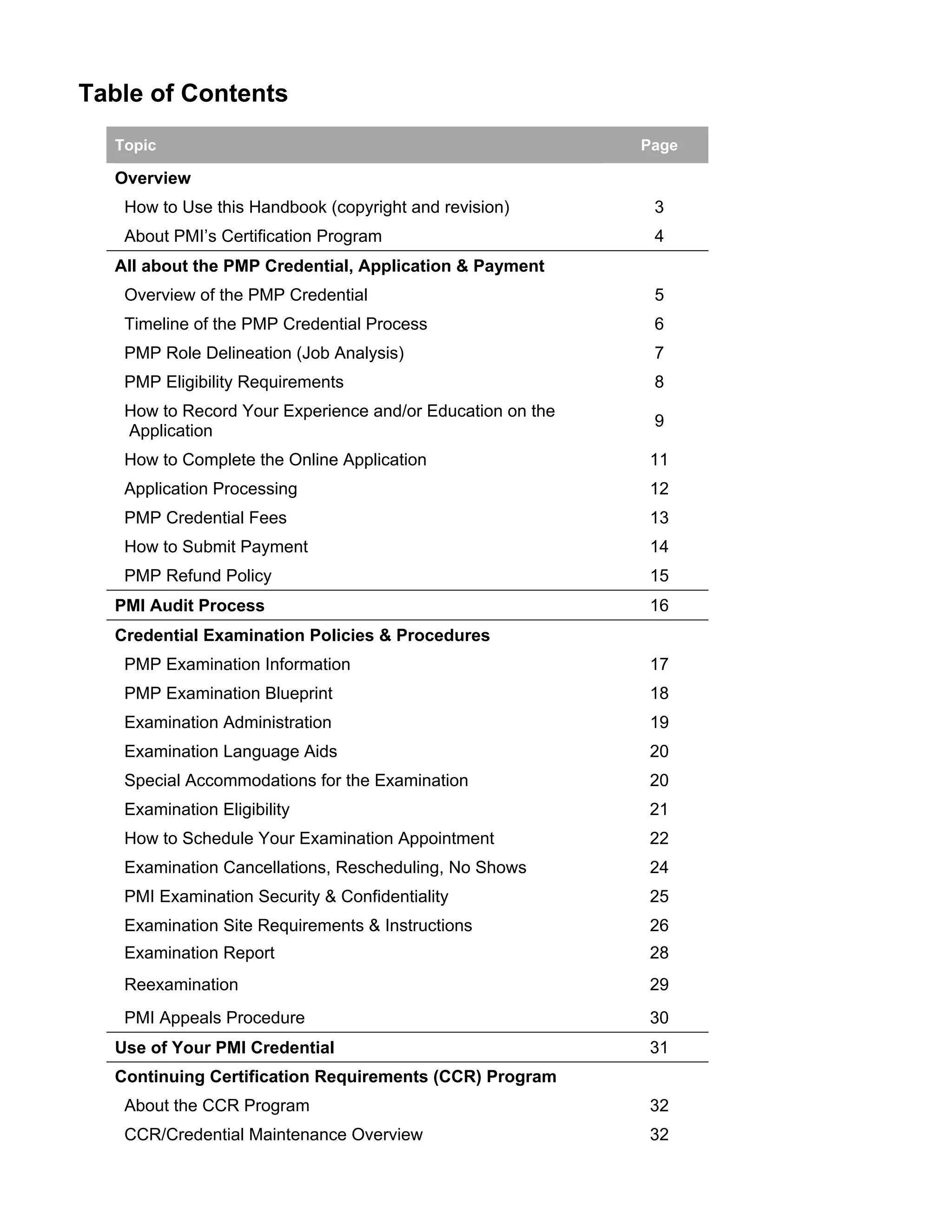
Table of Contents
  Topic                                                    Page

  Overview
   How to Use this Handbook (copyright and revision)        3
   About PMI’s Certification Program                        4
  All about the PMP Credential, Application & Payment
   Overview of the PMP Credential                           5
   Timeline of the PMP Credential Process                   6
   PMP Role Delineation (Job Analysis)                      7
   PMP Eligibility Requirements                             8
   How to Record Your Experience and/or Education on the
                                                            9
   Application
   How to Complete the Online Application                  11
   Application Processing                                  12
   PMP Credential Fees                                     13
   How to Submit Payment                                   14
   PMP Refund Policy                                       15
  PMI Audit Process                                        16
  Credential Examination Policies & Procedures
   PMP Examination Information                             17
   PMP Examination Blueprint                               18
   Examination Administration                              19
   Examination Language Aids                               20
   Special Accommodations for the Examination              20
   Examination Eligibility                                 21
   How to Schedule Your Examination Appointment            22
   Examination Cancellations, Rescheduling, No Shows       24
   PMI Examination Security & Confidentiality              25
   Examination Site Requirements & Instructions            26
   Examination Report                                      28
   Reexamination                                           29
   PMI Appeals Procedure                                   30
  Use of Your PMI Credential                               31
  Continuing Certification Requirements (CCR) Program
   About the CCR Program                                   32
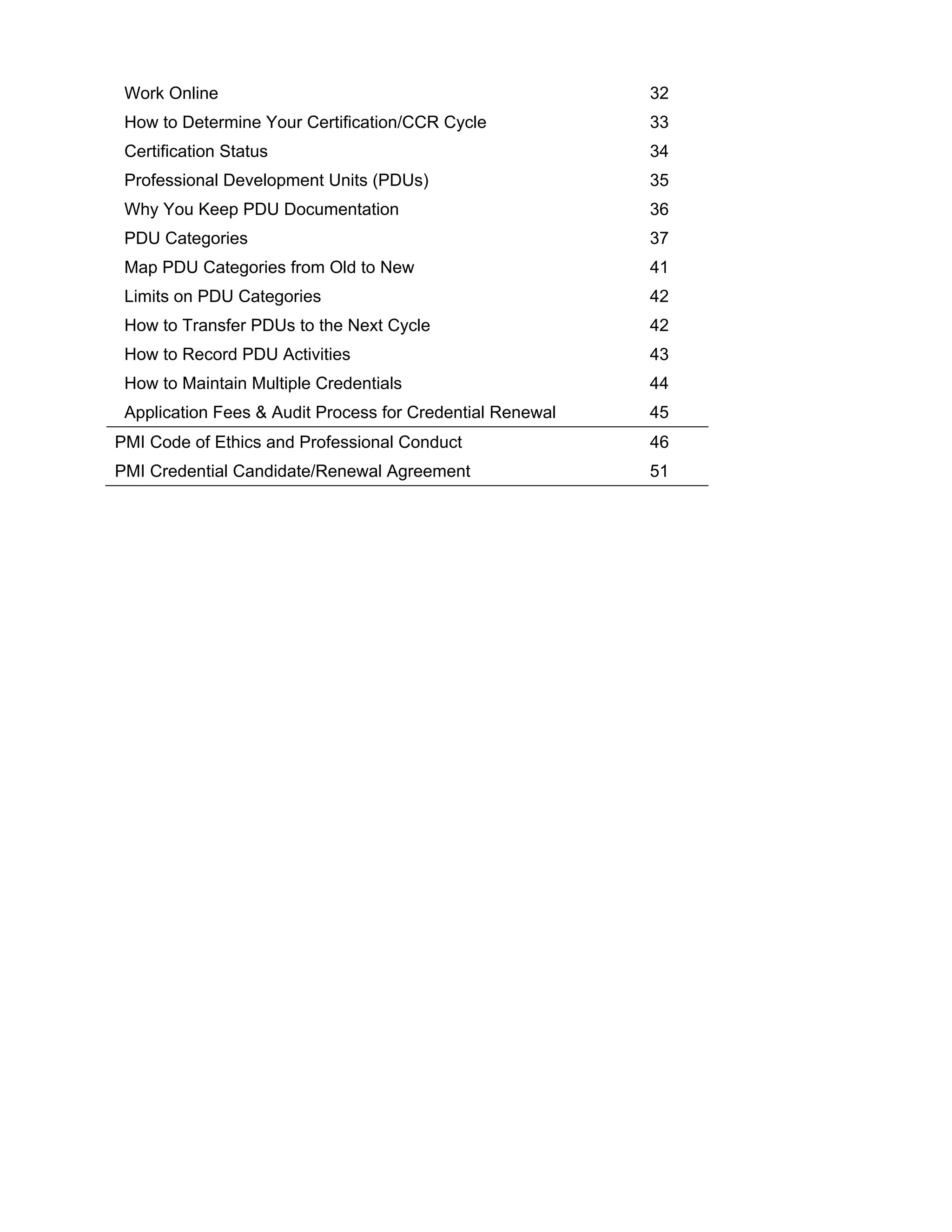
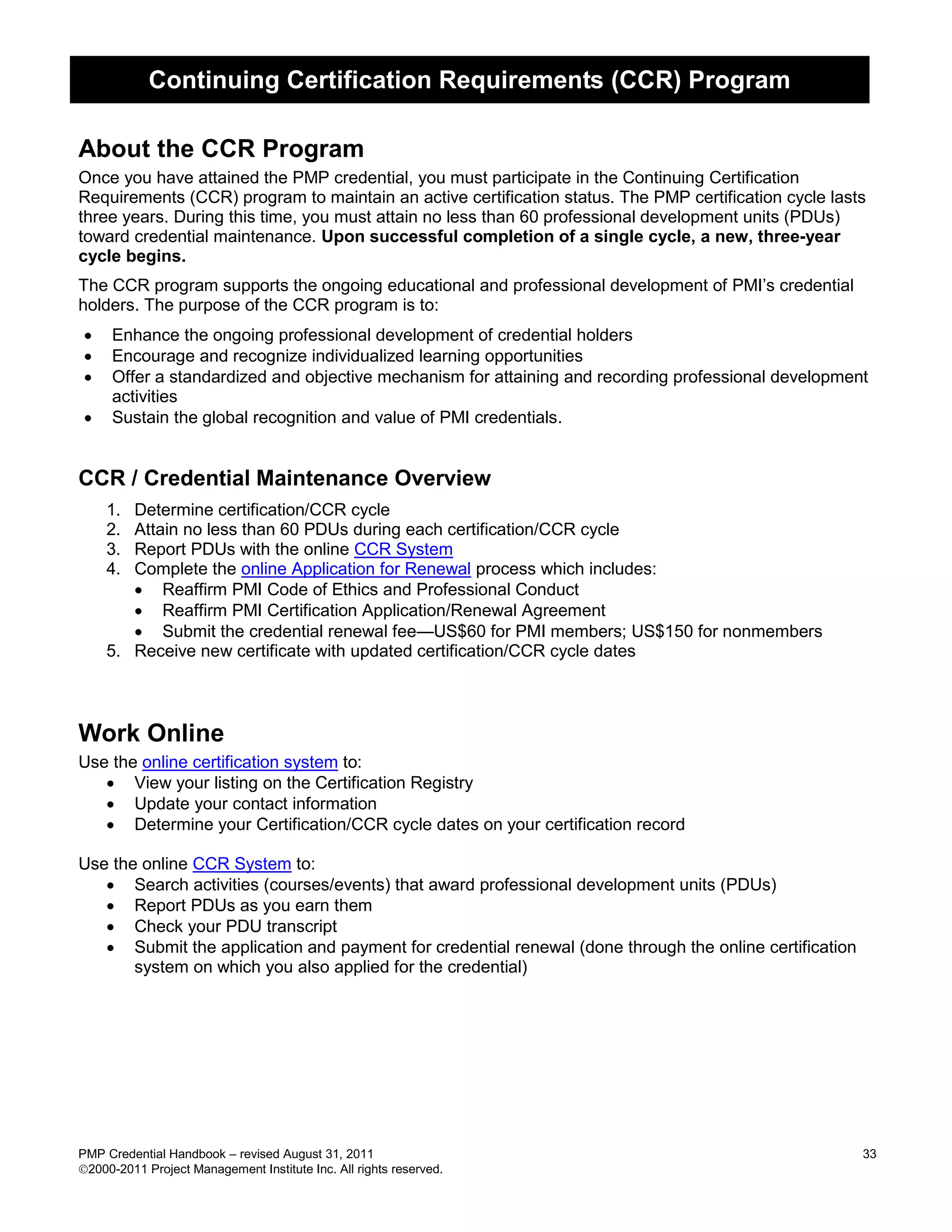
   CCR/Credential Maintenance Overview                     32
Work Online                                               32
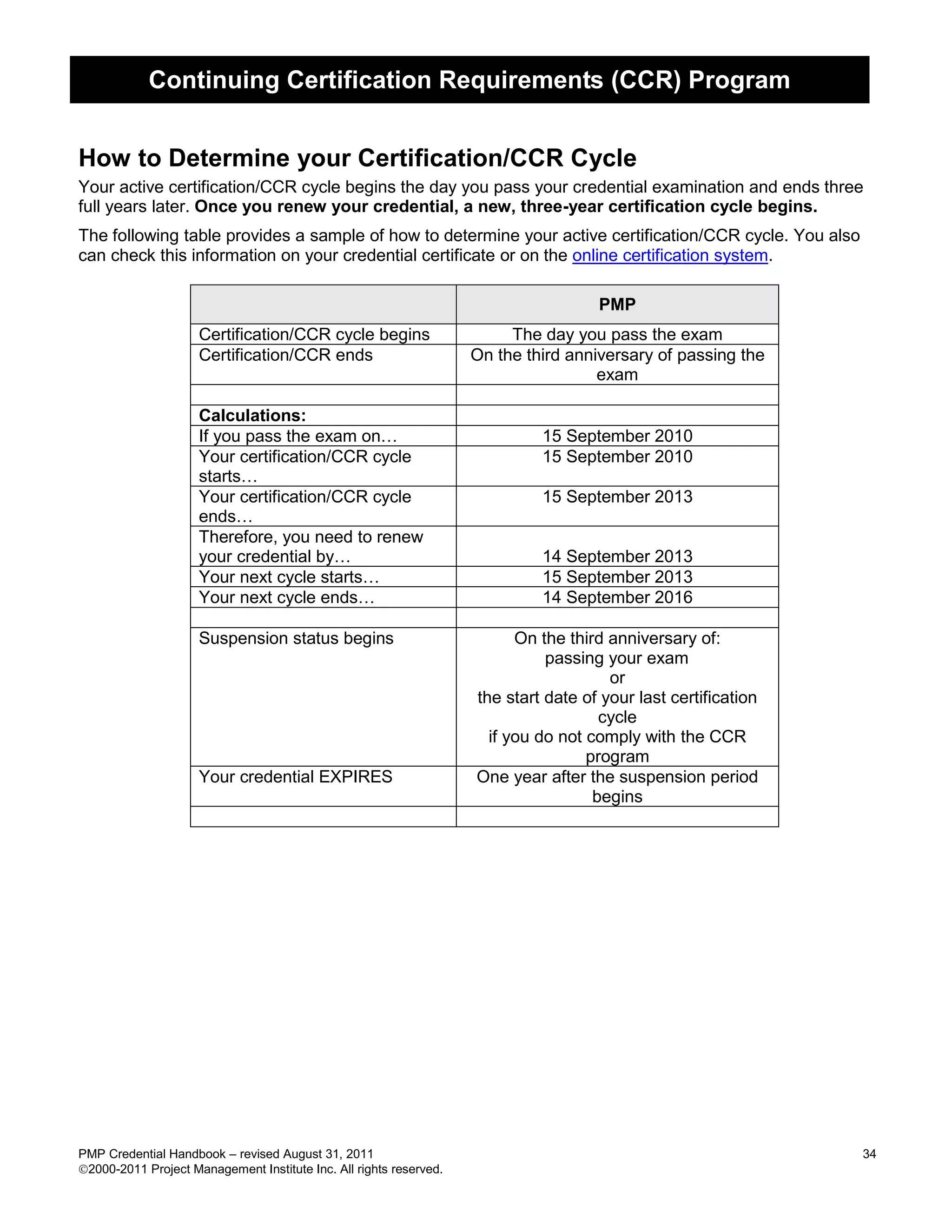
 How to Determine Your Certification/CCR Cycle             33
 Certification Status                                      34
 Professional Development Units (PDUs)                     35
 Why You Keep PDU Documentation                            36
 PDU Categories                                            37
 Map PDU Categories from Old to New                        41
 Limits on PDU Categories                                  42
 How to Transfer PDUs to the Next Cycle                    42
 How to Record PDU Activities                              43
 How to Maintain Multiple Credentials                      44
 Application Fees & Audit Process for Credential Renewal   45
PMI Code of Ethics and Professional Conduct                46
PMI Credential Candidate/Renewal Agreement                 51
Overview


How to Use the PMP® Credential Handbook
This handbook contains information on how you can apply for the globally recognized, highly valued
PMP credential. This handbook applies to both computer-based and paper-based testing candidates.
PMI requires that all PMP credential applicants read this entire handbook. The purpose of this handbook
is to provide you with important information about the policies and procedures for obtaining and
maintaining the PMP credential.


The features in this handbook allow you to:
   Find information on each policy or procedure by clicking on a topic in the left navigation bar.
   Find tips and important information by reading NOTES throughout the handbook.
   Access the online application system and other information by clicking on links within this handbook.


                                           PMI CONTACT INFORMATION
                                                     customercare@pmi.org


                                        Use the Online Certification System to Apply
                                               https://certification.pmi.org

                        Use the Online Continuing Certification Requirements (CCR) System
                                            for credential maintenance
                                               https://ccrs.pmi.org/


     ®
PMP Credential Handbook last updated August 31, 2011.

© 2000-2011 Project Management Institute, Inc. All rights reserved.
Revised: 2005, 2006, 2007, 2008, 2009, 2010, 2011.

 ―PMI‖, the PMI logo, ―Making project management indispensable for business results‖, ―PMBOK‖, ―CAPM‖, ―Certified Associate
in Project Management (CAPM)‖, ―PMP‖, ―Project Management Professional (PMP)‖, ―Project Management Professional‖, the
PMP logo, ―PgMP‖, ―Program Management Professional (PgMP)‖, ―PMI-RMP‖, ―PMI Risk Management Professional (PMI-
RMP)‖, ―PMI-SP‖, ―PMI Scheduling Professional (PMI-SP)‖, ―PMI-ACP‖ and ―PMI Agile Certified Practitioner‖ are marks of
Project Management Institute, Inc.

For a comprehensive list of PMI marks, contact the PMI Legal Department.


PMP Credential Handbook – revised August 31, 2011                                                                             3
2000-2011 Project Management Institute Inc. All rights reserved.
Overview


About PMI’s Certification Program
PMI offers a comprehensive certification program for practitioners with different levels of education and experience.
The certifications are developed and maintained through a vigorous process.
        The certification program includes:
         
                                                                     ®
                 Certified Associate in Project Management (CAPM) certification
         
                                                               ®
                 PMI Risk Management Professional (PMI-RMP) credential
         
                                                        ®
                 PMI Scheduling Professional (PMI-SP) credential
         
                                                            SM
                 PMI Agile Certified Practitioner (PMI-ACP) certification
         
                                                             ®
                 Program Management Professional (PgMP) credential
         
                                                          ®
                 Project Management Professional (PMP) credential


             ®
The PMP credential scheme is accredited by the American National Standards Institute (ANSI) against the
International Organization for Standardization (ISO) 17024. The 17024 standard includes vigorous requirements for
examination development and maintenance and for the quality management systems for continuing quality
assurance.
The PMP credential is registered against the ISO 9001:2000 standard for quality management systems.
PMI’s certification and credentials are distinguished by their global development and application, which makes them
transferable across industries and geographic borders. The strength of PMI’s credentials is that they are portable
and not tied to any single method, standard, or organization.
PMI’s certification program is designed to ensure that all certification holders have demonstrated their competence
through fair and valid measures. Steps are taken to ensure only the most reliable testing measures are used in the
assessment of candidates. For example, interviews can be influenced by how difficult the interviewer tends to be,
how well the candidate is performing that day, and even how many questions the interviewer asks along the same
line of questioning.
PMI certification and credentials are also developed by project management practitioners for practitioners. The
certification program is driven by the thousands of certification and credential holders who volunteer to spend time
constructing and refining the exam questions used by PMI. These volunteers represent the diversity of PMI’s
market, coming from every region of the world, industry, job level, and experience level.
The exam questions are monitored through industry-standard statistical procedures, also overseen by volunteers.
Finally, PMI’s entire certification program is supervised by the Certification Governance Council (CGC), a
committee of PMI credential holders who have a Board mandate to oversee PMI’s credentials.
A candidate is assessed by examining their competence using:
        Reviewing Education and Experience—A combination of education and/or experience in project
         management is required for each certification.
        Testing Competence—The candidate is required to apply project management concepts and experience
         to potential on-the-job situations through a series of scenario-based questions.
        Ongoing Development—Maintenance of a PMI certification requires the accumulation of ongoing
         professional development and education or, in the case of the CAPM certification, re-certification.


                                            PMI Certification Department Mission
                       Initiate, establish, evaluate, maintain and administer a professional credential
                        program to promote and support project management practitioners and the
                                                          profession.


PMP Credential Handbook – revised August 31, 2011                                                                       4
2000-2011 Project Management Institute Inc. All rights reserved.
All about the PMP Credential, Application & Payment


Overview of the PMP Credential
Globally recognized and demanded, the PMP credential demonstrates to employers, clients and
colleagues that a project manager possesses project management knowledge, experience and skills to
bring projects to successful completion.
As the demand for skilled project managers is at a critically urgent level, practitioners who hold the PMP
credential are well positioned to provide the professional skills necessary to lead project teams and
achieve successful project results.
The PMP recognizes the competence of an individual to perform in the role of a project manager,
specifically experience in leading and directing projects. Year after year, the PMP credential has
garnered global recognition and commanded a higher salary for credentialed individuals over non-
credentialed individuals.


PMP Credential Handbook – revised August 31, 2011                                                            5
2000-2011 Project Management Institute Inc. All rights reserved.
All about the PMP Credential, Application & Payment

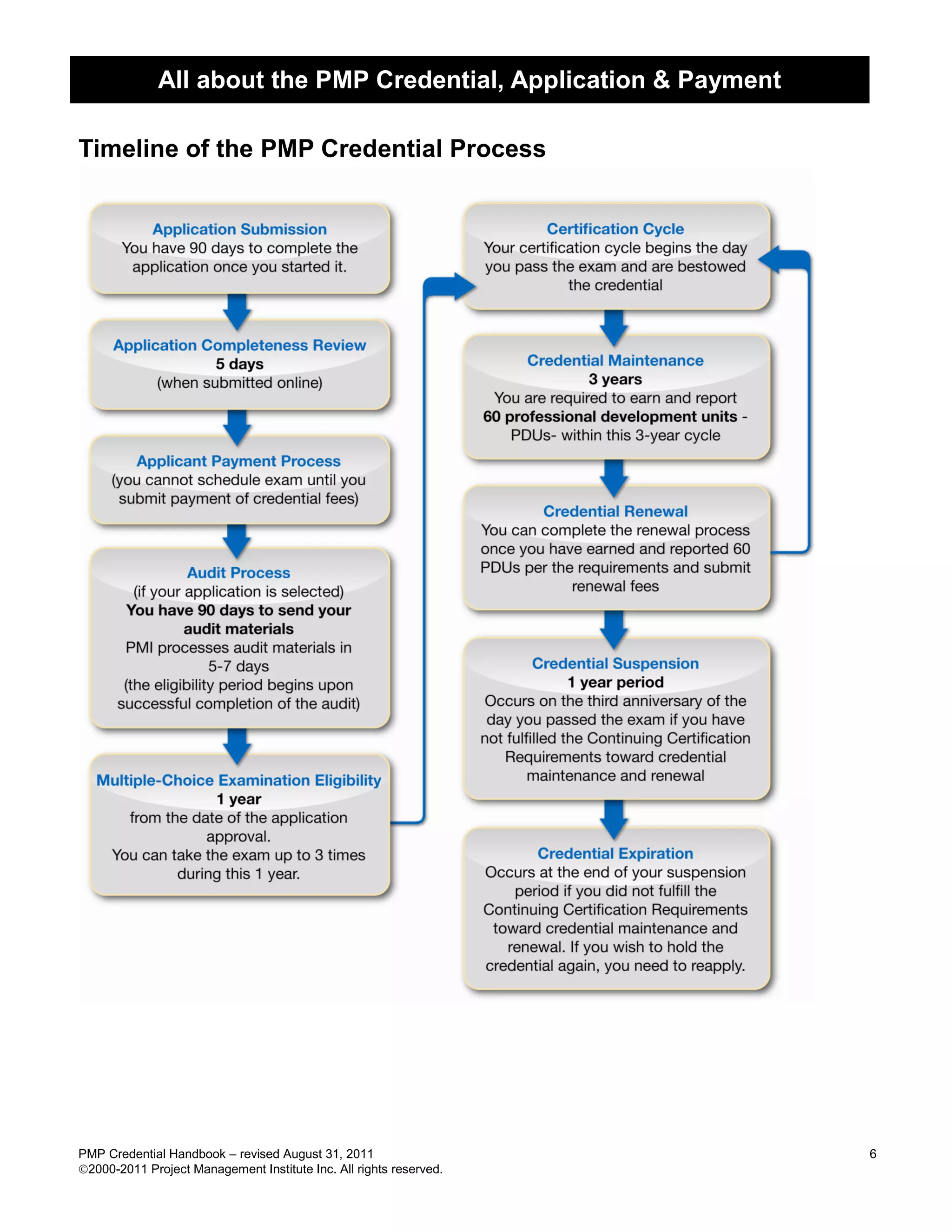
Timeline of the PMP Credential Process


PMP Credential Handbook – revised August 31, 2011                   6
2000-2011 Project Management Institute Inc. All rights reserved.
All about the PMP Credential, Application & Payment


PMP Role Delineation (Job Analysis)
PMI conducts Role Delineation Studies for each credential every five to seven years. A third party,
independent of PMI, conducts the study which includes volunteer project management professionals
from around the world. These individuals discuss the specific roles associated with each credential and
the tasks and responsibilities that are expected to be performed within that role. In other words, a Role
Delineation is a job analysis. It also provides a blueprint for the exam and links the exam questions to the
role.

The PMP Role Delineation states that candidates for the PMP credential:
        Perform their duties under general supervision and are responsible for all aspects of the project
         for the life of the project
        Lead and direct cross-functional teams to deliver projects within the constraints of schedule,
         budget, and scope
        Demonstrate sufficient knowledge and experience to appropriately apply a methodology to
         projects that have reasonably well-defined requirements and deliverables


PMP Credential Handbook – revised August 31, 2011                                                            7
2000-2011 Project Management Institute Inc. All rights reserved.
All about the PMP Credential, Application & Payment


PMP Eligibility Requirements
To be eligible for the PMP credential, you must meet certain educational and professional experience
requirements. All project management experience must have been accrued within the last eight
consecutive years prior to your application submission.

Educational Background                   Project Management Experience                    Project Management
                                                                                          Education
Secondary degree (high                   Minimum five years/60 months unique non-         35 contact hours of formal
school diploma, associate’s              overlapping professional project                 education
                                         management experience
degree or global equivalent)
                                         during which at least 7,500 hours were
                                         spent leading and directing project tasks*
                                                                    OR
Four-year degree                         Minimum three years/36 months unique             35 contact hours of formal
(bachelor’s degree or global             non-overlapping professional project             education
                                         management experience
equivalent)
                                         during which at least 4,500 hours were
                                         spent leading and directing project tasks*
    *Leading and directing project tasks as identified in the Project Management Professional Examination Specification.
    You should have experience in all five process groups across all your project management experience submitted on the
    application. However, on a single project, you do not need to have experience in all five process groups.

                                                                                              ®
            NOTE: The A Guide to the Project Management Body of Knowledge (PMBOK Guide)
            defines a project as a temporary endeavor undertaken to create a unique product,
                                      ®
            service or result (PMBOK Guide—Fourth Edition, p. 434).


PMP Credential Handbook – revised August 31, 2011                                                                          8
2000-2011 Project Management Institute Inc. All rights reserved.
All about the PMP Credential, Application & Payment

How to Record your Experience on the Application
Use the experience verification section of the online application to record your experience leading and
directing project tasks. Record projects individually regardless of the number of projects you include.


Number of Months of Project Management Experience
Each month in which you worked on multiple, overlapping projects counts as one month toward the total
requirement. In the following example, the project manager worked on Project 1 and Project 2
simultaneously February–April. However, the time spent on both projects counts as three, not six,
months toward the total to fulfill the professional project management experience requirement.


Number of Hours that You Led or Directed Project Tasks
Consider all of the projects that you have worked on and identify how many hours you led or directed
project tasks. For this section of the application, if you worked on multiple projects at one time, all the
hours spent leading and directing project tasks count toward the total.


Contact Hours of Project Management Education
Verify at least 35 contact hours of specific instruction that addressed learning objectives in project
management. Record all education hours regardless of when they were accrued. The course work
must be completed at the time you submit the application.


         NOTE: One hour of classroom instruction equals one contact hour. If you have completed a
         university or college course on project management that met for three hours per week for 15
         weeks, you would record 45 contact hours. If only a portion of a course dealt with project
         management, only the hours spent on project management can be applied toward the total.


The course hours may include content on project quality, project scope, project schedule, project budget,
project communications, project risk, project procurement, and project integration management.


PMP Credential Handbook – revised August 31, 2011                                                             9
2000-2011 Project Management Institute Inc. All rights reserved.
All about the PMP Credential, Application & Payment

You can satisfy the education requirements by demonstrating the successful completion of courses,
workshops and training sessions offered by one or more of the following types of education providers:
                   A.   PMI Registered Education Providers (R.E.P.s)*
                   B.   PMI component organizations*
                   C.   Employer/company-sponsored programs
                   D.   Training companies or consultants (e.g., training schools)
                   E.   Distance-learning companies, including an end-of-course assessment
                   F.   University/college academic and continuing education programs
                        *Courses offered by PMI R.E.P.s, PMI components (chapters, specific interest groups,
                        colleges) or PMI are pre-approved for contact hours in fulfillment of the educational eligibility
                        requirement.

The following education does not satisfy the education requirements:
                       PMI chapter meetings*
                       Self-directed learning (e.g., reading books, watching instructional videos or sessions
                        with coaches or mentors)
                        *If at least one hour of a chapter meeting is spent conducting a learning activity, the hour(s)
                        spent in that activity can be counted towards the educational eligibility requirement.


         NOTE: While you may be able to record applicable classes that counted toward a degree, you
         cannot record the degree program in its entirety because some classes within the program will
         not apply to the requirement.


PMP Credential Handbook – revised August 31, 2011                                                                           10
2000-2011 Project Management Institute Inc. All rights reserved.
All about the PMP Credential, Application & Payment


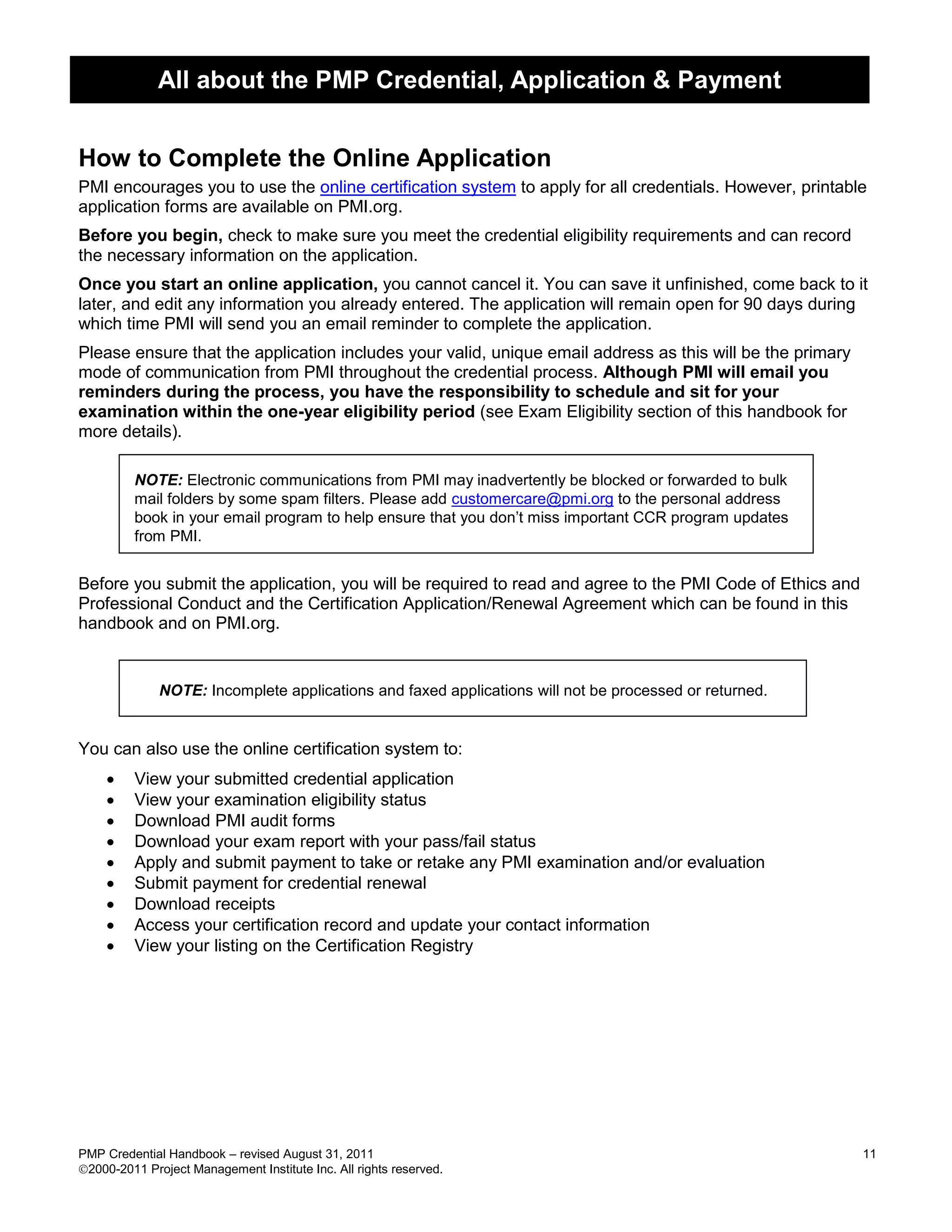
How to Complete the Online Application
PMI encourages you to use the online certification system to apply for all credentials. However, printable
application forms are available on PMI.org.
Before you begin, check to make sure you meet the credential eligibility requirements and can record
the necessary information on the application.
Once you start an online application, you cannot cancel it. You can save it unfinished, come back to it
later, and edit any information you already entered. The application will remain open for 90 days during
which time PMI will send you an email reminder to complete the application.
Please ensure that the application includes your valid, unique email address as this will be the primary
mode of communication from PMI throughout the credential process. Although PMI will email you
reminders during the process, you have the responsibility to schedule and sit for your
examination within the one-year eligibility period (see Exam Eligibility section of this handbook for
more details).

         NOTE: Electronic communications from PMI may inadvertently be blocked or forwarded to bulk
         mail folders by some spam filters. Please add customercare@pmi.org to the personal address
         book in your email program to help ensure that you don’t miss important CCR program updates
         from PMI.


Before you submit the application, you will be required to read and agree to the PMI Code of Ethics and
Professional Conduct and the Certification Application/Renewal Agreement which can be found in this
handbook and on PMI.org.


              NOTE: Incomplete applications and faxed applications will not be processed or returned.


You can also use the online certification system to:
        View your submitted credential application
        View your examination eligibility status
        Download PMI audit forms
        Download your exam report with your pass/fail status
        Apply and submit payment to take or retake any PMI examination and/or evaluation
        Submit payment for credential renewal
        Download receipts
        Access your certification record and update your contact information
        View your listing on the Certification Registry


PMP Credential Handbook – revised August 31, 2011                                                          11
2000-2011 Project Management Institute Inc. All rights reserved.
All about the PMP Credential, Application & Payment


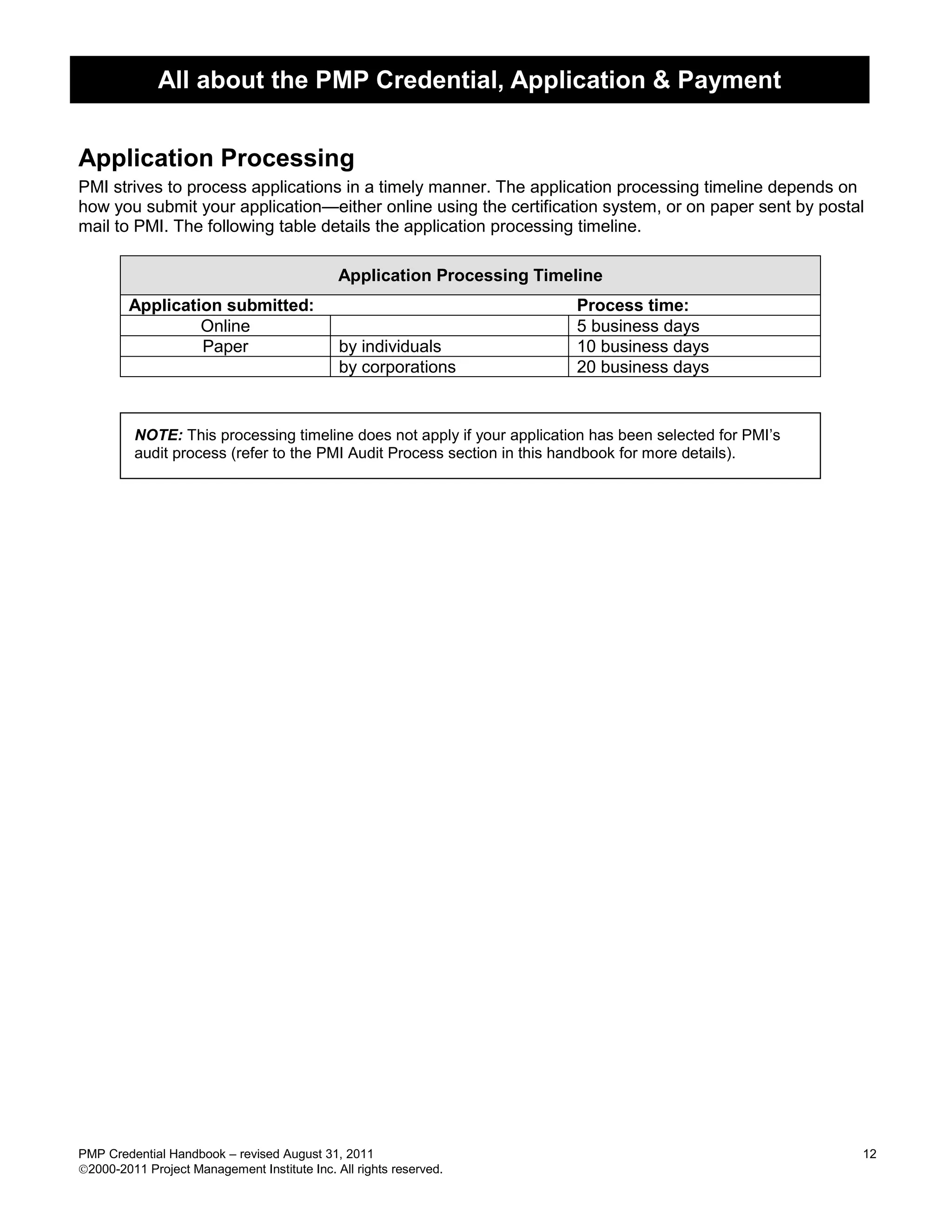
Application Processing
PMI strives to process applications in a timely manner. The application processing timeline depends on
how you submit your application—either online using the certification system, or on paper sent by postal
mail to PMI. The following table details the application processing timeline.

                                              Application Processing Timeline
        Application submitted:                                           Process time:
                 Online                                                  5 business days
                 Paper                        by individuals             10 business days
                                              by corporations            20 business days


         NOTE: This processing timeline does not apply if your application has been selected for PMI’s
         audit process (refer to the PMI Audit Process section in this handbook for more details).


PMP Credential Handbook – revised August 31, 2011                                                        12
2000-2011 Project Management Institute Inc. All rights reserved.
All about the PMP Credential, Application & Payment


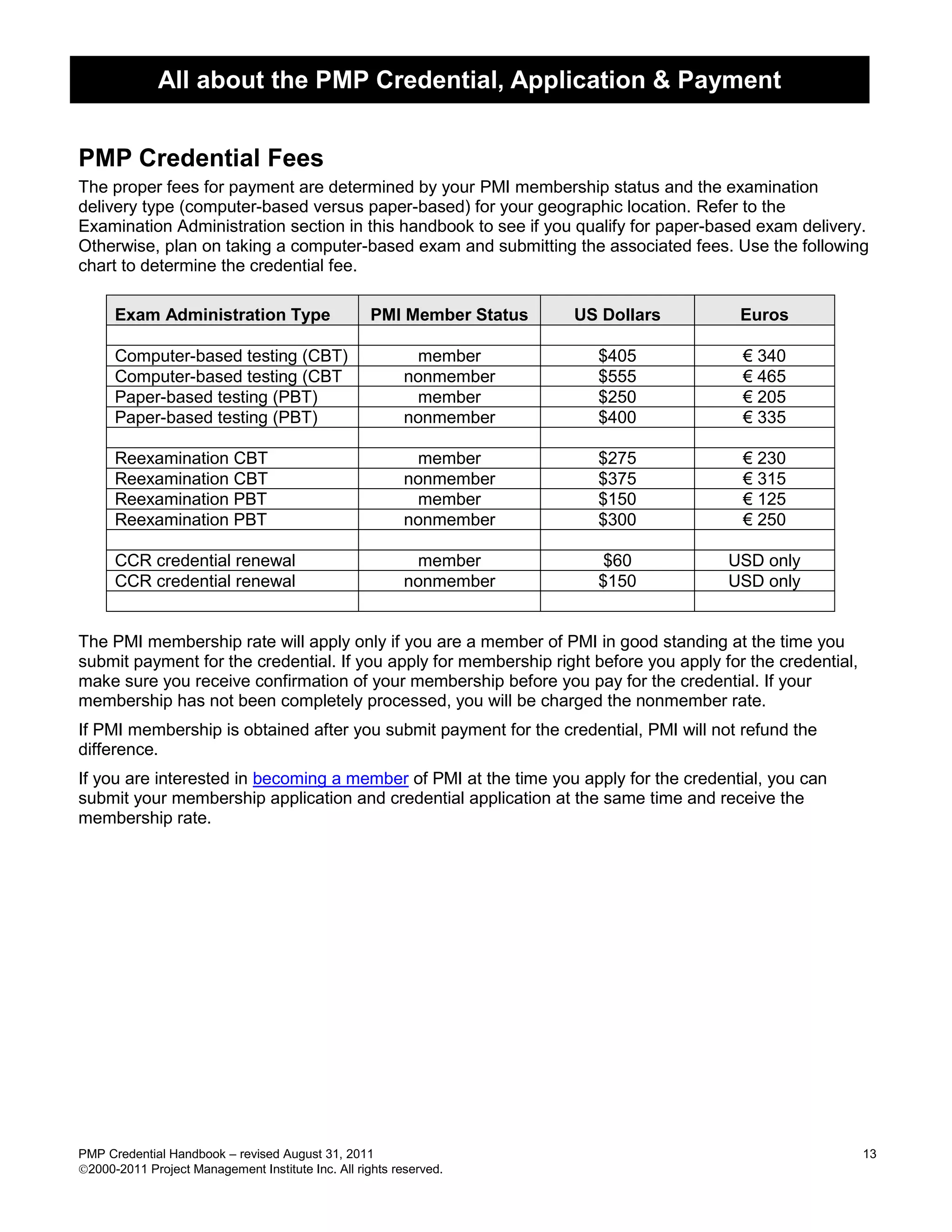
PMP Credential Fees
The proper fees for payment are determined by your PMI membership status and the examination
delivery type (computer-based versus paper-based) for your geographic location. Refer to the
Examination Administration section in this handbook to see if you qualify for paper-based exam delivery.
Otherwise, plan on taking a computer-based exam and submitting the associated fees. Use the following
chart to determine the credential fee.

      Exam Administration Type                      PMI Member Status   US Dollars       Euros

      Computer-based testing (CBT)                         member         $405           € 340
      Computer-based testing (CBT                         nonmember       $555           € 465
      Paper-based testing (PBT)                            member         $250           € 205
      Paper-based testing (PBT)                           nonmember       $400           € 335

      Reexamination CBT                                    member         $275           € 230
      Reexamination CBT                                   nonmember       $375           € 315
      Reexamination PBT                                    member         $150           € 125
      Reexamination PBT                                   nonmember       $300           € 250

      CCR credential renewal                               member          $60         USD only
      CCR credential renewal                              nonmember       $150         USD only


The PMI membership rate will apply only if you are a member of PMI in good standing at the time you
submit payment for the credential. If you apply for membership right before you apply for the credential,
make sure you receive confirmation of your membership before you pay for the credential. If your
membership has not been completely processed, you will be charged the nonmember rate.
If PMI membership is obtained after you submit payment for the credential, PMI will not refund the
difference.
If you are interested in becoming a member of PMI at the time you apply for the credential, you can
submit your membership application and credential application at the same time and receive the
membership rate.


PMP Credential Handbook – revised August 31, 2011                                                           13
2000-2011 Project Management Institute Inc. All rights reserved.
All about the PMP Credential, Application & Payment

How to Submit Payment
Once your online application has been processed and determined to be complete, PMI will send
electronic notification to you requesting payment.
This requires you to go back into the online certification system to complete the following steps:
    1. Select your examination delivery method
        (refer to the Examination Administration section in this handbook for more details)
    2. Request a language aid for your examination at no extra cost, if appropriate
        (refer to the Language Aids section in this handbook for more details)
    3. Request special accommodations for your examination at no extra cost, if necessary
        (refer to the Special Accommodations section in this handbook for more details)
    4. Submit payment
        (refer to the Credential Fees section(s) of this handbook for more details)
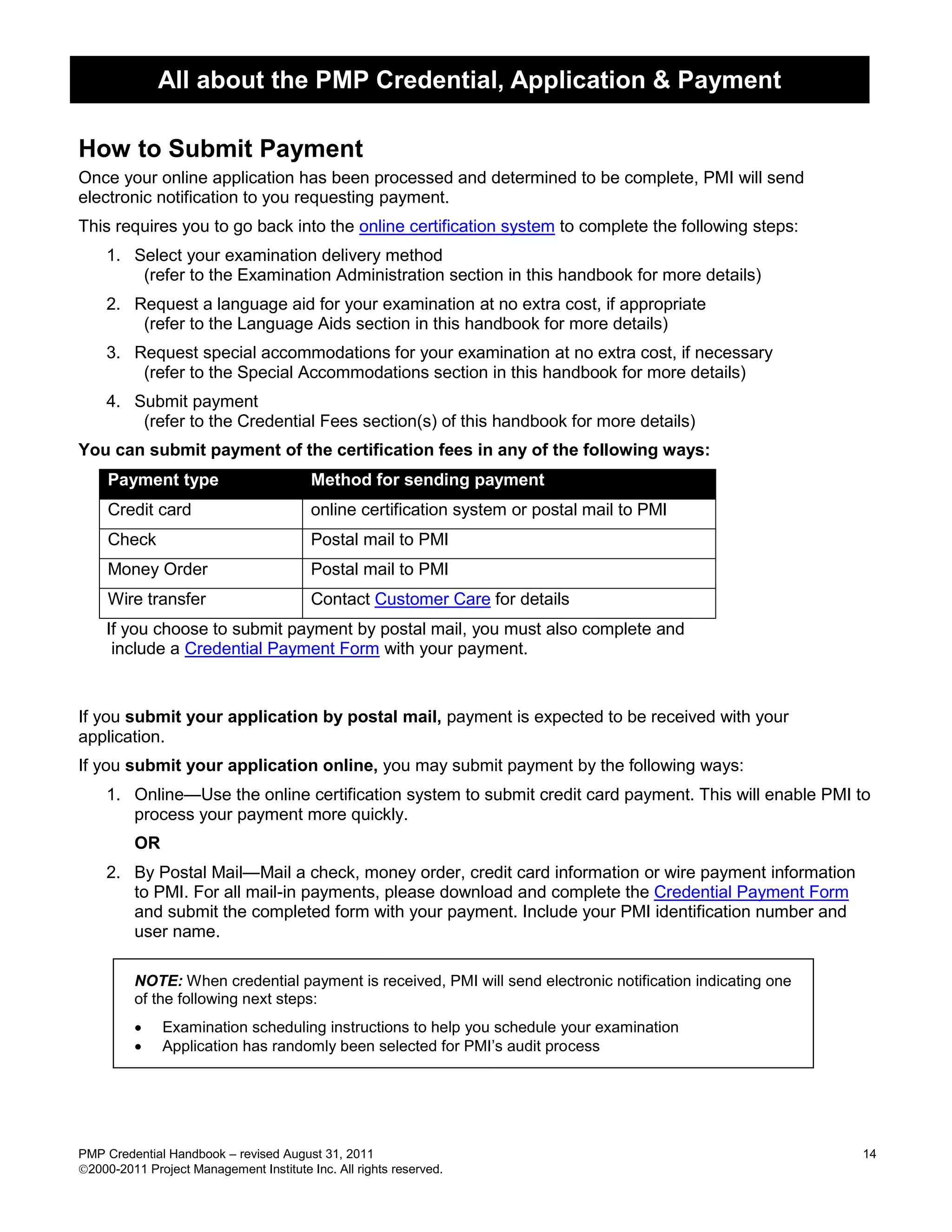
You can submit payment of the certification fees in any of the following ways:
     Payment type                        Method for sending payment
     Credit card                         online certification system or postal mail to PMI
     Check                               Postal mail to PMI
     Money Order                         Postal mail to PMI
     Wire transfer                       Contact Customer Care for details
    If you choose to submit payment by postal mail, you must also complete and
     include a Credential Payment Form with your payment.


If you submit your application by postal mail, payment is expected to be received with your
application.
If you submit your application online, you may submit payment by the following ways:
    1. Online—Use the online certification system to submit credit card payment. This will enable PMI to
       process your payment more quickly.
         OR
    2. By Postal Mail—Mail a check, money order, credit card information or wire payment information
       to PMI. For all mail-in payments, please download and complete the Credential Payment Form
       and submit the completed form with your payment. Include your PMI identification number and
       user name.

         NOTE: When credential payment is received, PMI will send electronic notification indicating one
         of the following next steps:
             Examination scheduling instructions to help you schedule your examination
             Application has randomly been selected for PMI’s audit process


PMP Credential Handbook – revised August 31, 2011                                                          14
2000-2011 Project Management Institute Inc. All rights reserved.
All about the PMP Credential, Application & Payment


PMP Refund Policy
To obtain a refund for the PMP credential, you must submit a written request to PMI at least 30 days
before the exam eligibility expiration date. PMI will retain a processing fee of US$100 if you have not
yet scheduled or taken the examination.
You also can receive a refund, less a US$100 processing fee, if you fail to meet audit requirements (refer
to the PMI Audit Process section of this handbook for details on the audit process).


PMI will NOT provide you with a refund in the following instances:
        If your one-year eligibility period has expired and you have not scheduled the exam, you will not
         receive a refund. You will forfeit the entire fee. You will not be able to use the initial fees for
         anything else. If you still wish to obtain the credential, you will have to reapply and submit all
         associated fees again.
        If you have scheduled the exam and did not take it, nor provided the necessary
         cancellation/rescheduling notification to PMI’s testing administration partner, Prometric, you will
         not receive a refund (refer to the Cancellation, Rescheduling, No Show section in this handbook
         for more details). Again, you will forfeit the fee and not be able to apply it to anything else.


            NOTE: You can send a request for refund to PMI Customer Care or by fax to +1 610 482 9971.


PMP Credential Handbook – revised August 31, 2011                                                              15
2000-2011 Project Management Institute Inc. All rights reserved.
PMI Audit Process


PMI Audit Process
The submission of an application indicates your agreement to comply with the terms of the audit process.
All applications are subject to an audit, although only a percentage of applications are selected for audit.
The selection of an application for audit is random.
If your application is selected for an audit, you will be notified by email after payment of the credential fee
is received. The electronic audit notification provides detailed information on how to comply with the
terms of the audit.
During an audit, you will be asked to submit supporting documentation such as:
        Copies of your diploma/global equivalent
        Signatures from your supervisor(s) or manager(s) from the project(s) recorded in the experience
         verification section of the application
        Copies of certificates and/or letters from the training institute(s) for each course recorded on the
         application to meet the required contact hours of project management education
PMI provides you with 90 days to submit the requested documentation. If you are able to provide the
necessary documentation to meet the terms and requirements of the audit process, the audit should take
about five to seven business days to complete.
You can send your completed audit forms by regular postal mail or express courier service, to the
address below. Please send all materials at one time, in one envelope. Sending audit documents
separately can cause delay in the audit review timeframe.

PMI
Attn.: Certification Audit
14 Campus Blvd.
Newtown Square, PA 19073-3299 USA

You may not continue with the credential process until you have complied with the audit requirements.
Once you successfully complete the audit, your one-year examination eligibility period starts.
Incomplete submissions will not be processed and will result in failure of the audit.
If you fail to meet the audit requirements, you will receive a refund (refer to the Refund Policy section
in this handbook for the credential you are pursuing for more details).


         NOTE: Please be advised that while the selection process for an audit is primarily random, PMI
         reserves the right to select any candidate to be audited at any time, including after the credential
         has been bestowed. If you fail to meet the audit requirements after attaining the credential, you
         are not entitled to a refund.


PMP Credential Handbook – revised August 31, 2011                                                               16
2000-2011 Project Management Institute Inc. All rights reserved.
Exam Policies & Procedures


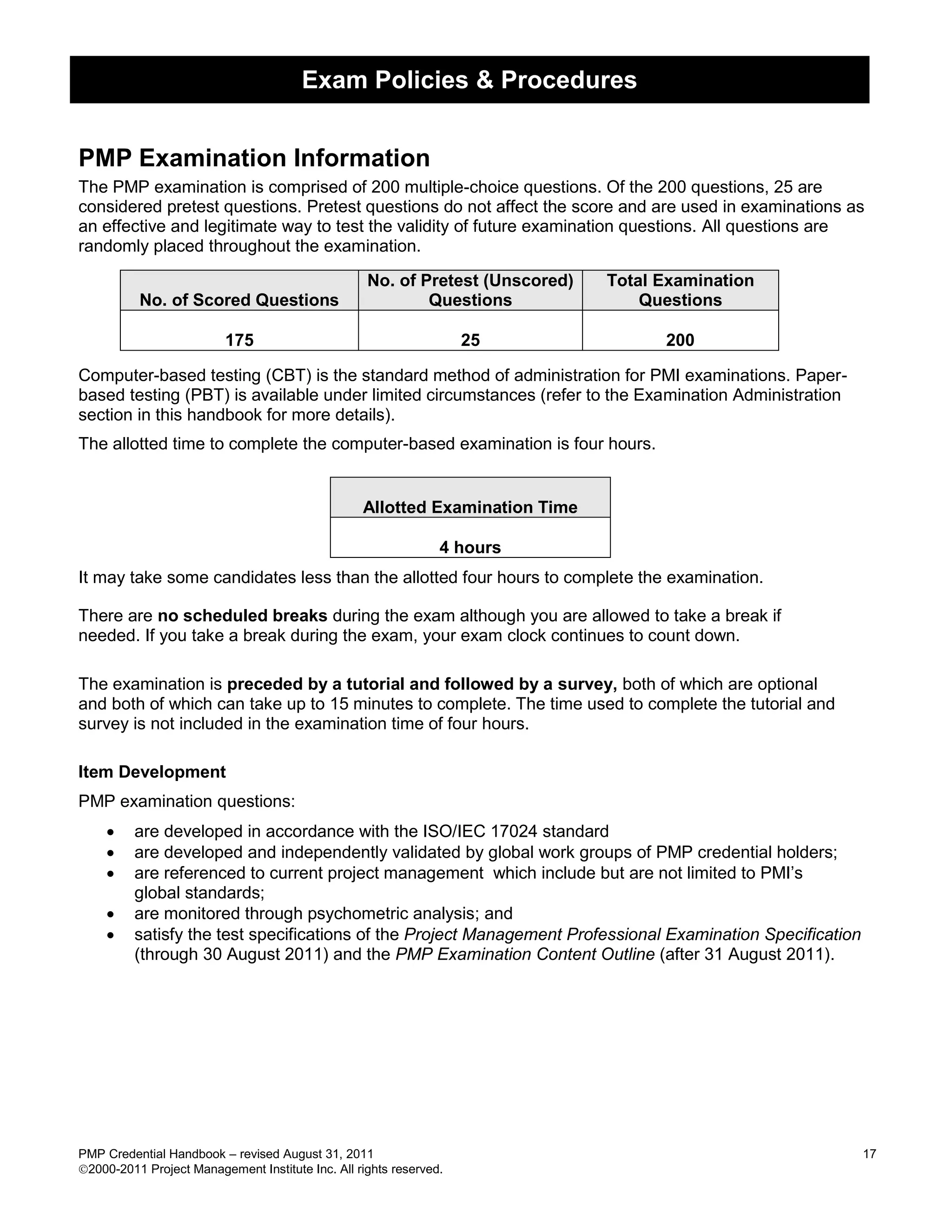
PMP Examination Information
The PMP examination is comprised of 200 multiple-choice questions. Of the 200 questions, 25 are
considered pretest questions. Pretest questions do not affect the score and are used in examinations as
an effective and legitimate way to test the validity of future examination questions. All questions are
randomly placed throughout the examination.

                                                   No. of Pretest (Unscored)   Total Examination
          No. of Scored Questions                          Questions               Questions

                          175                                       25               200

Computer-based testing (CBT) is the standard method of administration for PMI examinations. Paper-
based testing (PBT) is available under limited circumstances (refer to the Examination Administration
section in this handbook for more details).
The allotted time to complete the computer-based examination is four hours.


                                                  Allotted Examination Time

                                                                4 hours
It may take some candidates less than the allotted four hours to complete the examination.

There are no scheduled breaks during the exam although you are allowed to take a break if
needed. If you take a break during the exam, your exam clock continues to count down.

The examination is preceded by a tutorial and followed by a survey, both of which are optional
and both of which can take up to 15 minutes to complete. The time used to complete the tutorial and
survey is not included in the examination time of four hours.

Item Development
PMP examination questions:
        are developed in accordance with the ISO/IEC 17024 standard
        are developed and independently validated by global work groups of PMP credential holders;
        are referenced to current project management which include but are not limited to PMI’s
         global standards;
        are monitored through psychometric analysis; and
        satisfy the test specifications of the Project Management Professional Examination Specification
         (through 30 August 2011) and the PMP Examination Content Outline (after 31 August 2011).


PMP Credential Handbook – revised August 31, 2011                                                           17
2000-2011 Project Management Institute Inc. All rights reserved.
Exam Policies & Procedures

PMP Examination Blueprint
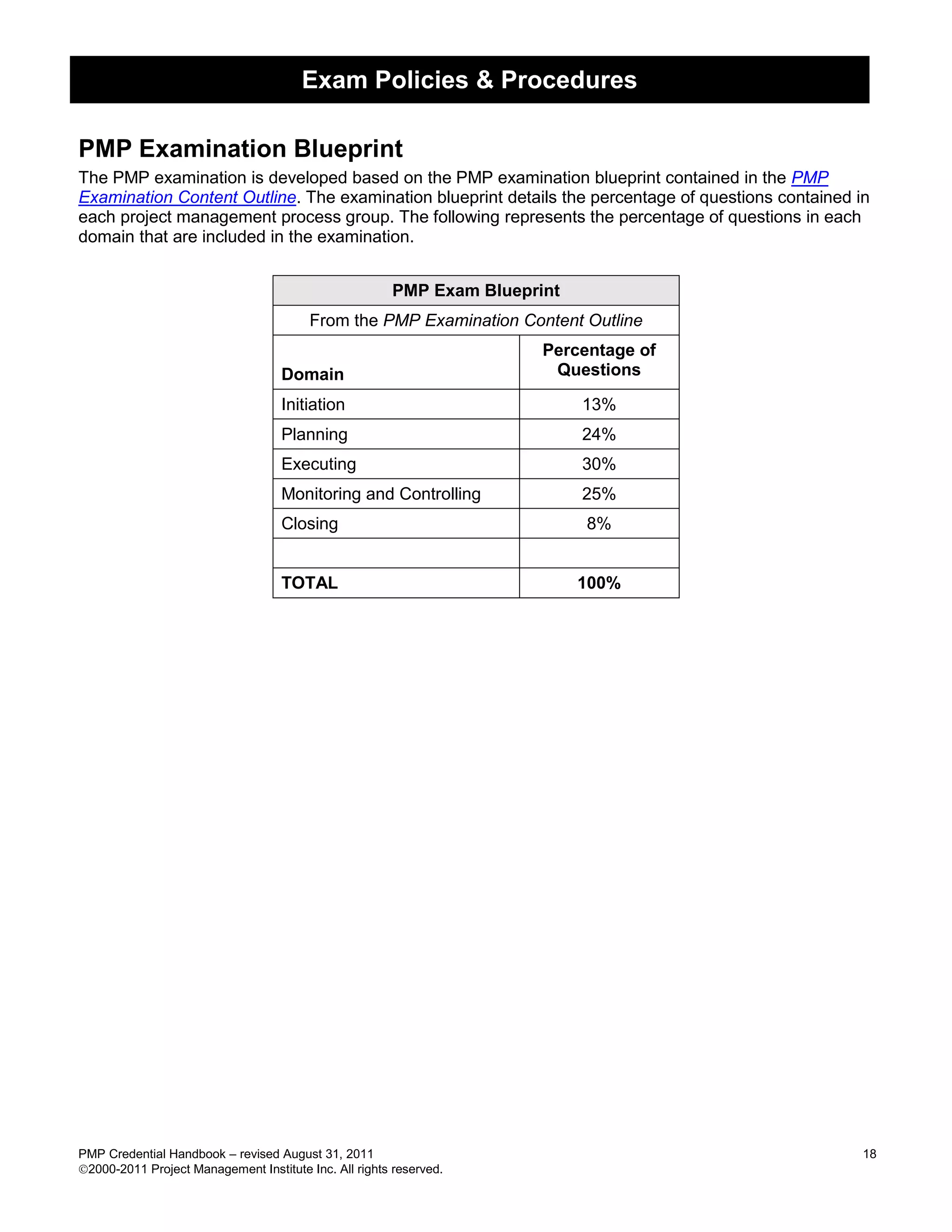
The PMP examination is developed based on the PMP examination blueprint contained in the PMP
Examination Content Outline. The examination blueprint details the percentage of questions contained in
each project management process group. The following represents the percentage of questions in each
domain that are included in the examination.


                                                       PMP Exam Blueprint
                                         From the PMP Examination Content Outline
                                                                       Percentage of
                                    Domain                              Questions

                                    Initiation                              13%
                                    Planning                                24%
                                    Executing                               30%
                                    Monitoring and Controlling              25%
                                    Closing                                 8%


                                    TOTAL                                   100%


PMP Credential Handbook – revised August 31, 2011                                                     18
2000-2011 Project Management Institute Inc. All rights reserved.
Exam Policies & Procedures


Examination Administration
Computer-based testing (CBT) is the standard method of administration for all PMI examinations.
However, paper-based testing (PBT) is available in the following situations only:
 1. Candidates who live at least 186.5 miles/300 km from a Prometric CBT site.
 2. Employers (Corporate Sponsors) who wish to administer a PMI examination to their
    employees. In this case, there is no restriction on distance; however only employees of the
    corporation may test at these events.


         NOTE: You do not have the option of taking a CBT or PBT exam. You can only take a PBT
         exam if you meet one of the two criteria listed above.


PMI reserves the right to cancel a PBT event that does not have a minimum of 10 candidates. Additional
restrictions apply. Sponsors can obtain a copy of the PBT Handbook by contacting pbtexams@pmi.org.
CBT test centers are listed on the Prometric website. If you are unable to locate a Prometric CBT center
within a 186.5 miles/300 km-radius of your home, review the PBT listing on the Prometric website to see
if there is a PBT event available in your area.
Prometric, a leading global provider of comprehensive testing and assessment services, is PMI’s
examination administration partner.

         NOTE: As part of the credential payment process, you need to indicate whether you will be taking
         a computer-based or paper-based examination. If you need to take a PBT examination, include
         the site location, date, and group testing number on your application.


PMP Credential Handbook – revised August 31, 2011                                                           19
2000-2011 Project Management Institute Inc. All rights reserved.
Exam Policies & Procedures


Examination Language Aids
All PMI examinations are administered in English. Language aids for the questions and answers of the
PMP and CAPM examinations are available to assist you if English is your second language. There are
no additional costs for language aids.
Language aids are available in the following 13 languages:
                   Arabic                                           Hebrew
                   Brazilian Portuguese                             Italian
                   Chinese (Simplified)                             Japanese
                   Chinese (Traditional)                            Korean
                   French                                           Russian
                   German                                           Spanish
                                                                    Turkish

Language aids are provided at the time the examination is administered and are protected under the PMI
Test Security & Confidentiality rules.

         NOTE: If you would like a language aid, you should indicate your need as part of the payment
         process (if you submit your application online) or as part of the application process (if you submit
         a paper application).


Once the examination is scheduled, you should review the confirmation notice to verify that your request
for a language aid has been processed. If you had selected a language aid, and the confirmation notice
makes no indication, contact PMI Customer Care.


Special Accommodations for the Examination
You may request the administration of any PMI examination to be modified due to disability, handicap
and/or other conditions that may impair your ability to take the examination. There are no additional costs
for special accommodations.

         NOTE: Record your need for special accommodations as part of the payment process (if you
         applied online) or as part of the application process (if you submitted a paper application).


You must submit to PMI, by fax or mail, supporting medical or other appropriate documentation to
complete your request. Please keep a copy of all submitted forms for your records.
Refer to the How to Schedule your Examination section in this handbook for more details.


PMP Credential Handbook – revised August 31, 2011                                                               20
2000-2011 Project Management Institute Inc. All rights reserved.
Exam Policies & Procedures


Examination Eligibility
Once payment of the credential fee has been received, and you successfully completed the application
audit (if your application was selected), you are deemed eligible to take the examination. PMI will send
you an email notification with:
        PMI Eligibility ID
        The start and end dates for your eligibility period and
        The examination scheduling instructions.


         NOTE: If your application was selected for audit, your eligibility period begins the day you
         successfully completed the audit.


The exam eligibility period (the period of time during which you are able to test) is one year. You may
take the examination up to three times within this one-year eligibility period should you not pass on the
first attempt.
The examination scheduling instructions direct you to the section of the Prometric website
(www.prometric.com/pmi) where you can select and schedule your examination date and location.
Prometric is PMI’s examination administration partner.
PMI cannot guarantee seating at the testing centers and recommends that you schedule the examination
within the following time frames:
        at least six weeks in advance of your preferred test date and
        at least three months before the expiration of your eligibility period


         NOTE: You must retain the unique PMI eligibility ID located on your scheduling notification. This
         number will be required to register for the examination.


Please print and save all examination scheduling verifications and correspondence received from
Prometric for your records.


PMP Credential Handbook – revised August 31, 2011                                                            21
2000-2011 Project Management Institute Inc. All rights reserved.
Exam Policies & Procedures

How to Schedule Your Examination

FOR PBT ADMINISTRATION
If you qualified to take a paper-based examination, you will not have to do anything to schedule a
PBT appointment because you indicated this administration type as part of the application or payment
process. Although you are required to do nothing, you will receive the examination scheduling
instructions because PMI’s system sends it automatically to everyone.
To confirm your PBT exam appointment, PMI will send an electronic confirmation 20 days before your
scheduled appointment. This confirmation will contain site instructions including your eligibility dates,
your examination date and location, your arrival times for the examination, information on your
government-issued identification, and a contact person.


FOR CBT ADMINISTRATION
You cannot schedule an exam appointment until PMI receives payment of your credential fee.
Schedule your Examination Online
Schedule your appointment online at the Prometric website. You will be prompted to complete the
following steps:
    1. Select the country where you live
    2. Select ―Schedule Your Test‖ option
    3. Read and Agree to the Data Privacy Notice
    4. Enter your Eligibility ID and first four letters of your last name (the number ending with E located
       on your scheduling notification)
    5. Make a selection from the Available Test Sites offerings in your area
    6. Select the examination date and time

Schedule your Examination by Telephone
        If you live inside North America, you can use the Prometric Telephone System, an Interactive
         Voice Response System that enables you to use a touch-tone phone to schedule, reschedule,
         cancel, or confirm existing examination appointments. Test center information (phone number,
         address and directions) can also be obtained over the telephone or online.
         This telephone service is available Monday through Friday 8 a.m. to 8 p.m. (US Eastern Time).
         Please call +1 800 268 2802 and follow the prompts. Hearing impaired may schedule by calling
         +1 800 529 3590.

        If you live outside North America and wish to schedule your examination appointment by
         telephone, refer to the Prometric Regional Contact Center chart for the applicable telephone
         number.

         NOTE: Please be advised that when scheduling by telephone, you must go to the Prometric
         website to print your confirmation information.


PMP Credential Handbook – revised August 31, 2011                                                             22
2000-2011 Project Management Institute Inc. All rights reserved.
Exam Policies & Procedures

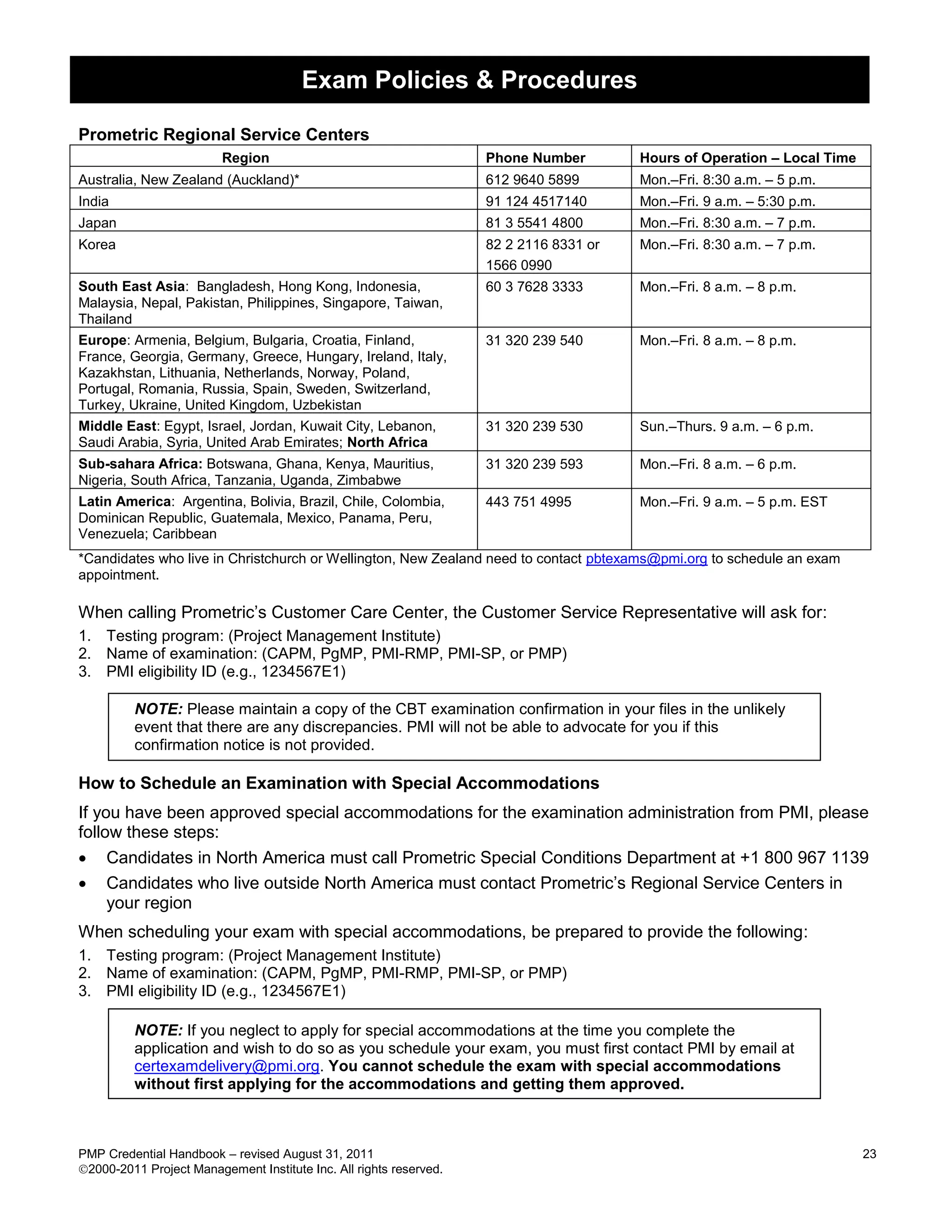
Prometric Regional Service Centers
                         Region                                     Phone Number        Hours of Operation – Local Time
Australia, New Zealand (Auckland)*                                  612 9640 5899       Mon.–Fri. 8:30 a.m. – 5 p.m.
India                                                               91 124 4517140      Mon.–Fri. 9 a.m. – 5:30 p.m.
Japan                                                               81 3 5541 4800      Mon.–Fri. 8:30 a.m. – 7 p.m.
Korea                                                               82 2 2116 8331 or   Mon.–Fri. 8:30 a.m. – 7 p.m.
                                                                    1566 0990
South East Asia: Bangladesh, Hong Kong, Indonesia,                  60 3 7628 3333      Mon.–Fri. 8 a.m. – 8 p.m.
Malaysia, Nepal, Pakistan, Philippines, Singapore, Taiwan,
Thailand
Europe: Armenia, Belgium, Bulgaria, Croatia, Finland,               31 320 239 540      Mon.–Fri. 8 a.m. – 8 p.m.
France, Georgia, Germany, Greece, Hungary, Ireland, Italy,
Kazakhstan, Lithuania, Netherlands, Norway, Poland,
Portugal, Romania, Russia, Spain, Sweden, Switzerland,
Turkey, Ukraine, United Kingdom, Uzbekistan
Middle East: Egypt, Israel, Jordan, Kuwait City, Lebanon,           31 320 239 530      Sun.–Thurs. 9 a.m. – 6 p.m.
Saudi Arabia, Syria, United Arab Emirates; North Africa
Sub-sahara Africa: Botswana, Ghana, Kenya, Mauritius,               31 320 239 593      Mon.–Fri. 8 a.m. – 6 p.m.
Nigeria, South Africa, Tanzania, Uganda, Zimbabwe
Latin America: Argentina, Bolivia, Brazil, Chile, Colombia,         443 751 4995        Mon.–Fri. 9 a.m. – 5 p.m. EST
Dominican Republic, Guatemala, Mexico, Panama, Peru,
Venezuela; Caribbean
*Candidates who live in Christchurch or Wellington, New Zealand need to contact pbtexams@pmi.org to schedule an exam
appointment.

When calling Prometric’s Customer Care Center, the Customer Service Representative will ask for:
1. Testing program: (Project Management Institute)
2. Name of examination: (CAPM, PgMP, PMI-RMP, PMI-SP, or PMP)
3. PMI eligibility ID (e.g., 1234567E1)

         NOTE: Please maintain a copy of the CBT examination confirmation in your files in the unlikely
         event that there are any discrepancies. PMI will not be able to advocate for you if this
         confirmation notice is not provided.

How to Schedule an Examination with Special Accommodations
If you have been approved special accommodations for the examination administration from PMI, please
follow these steps:
 Candidates in North America must call Prometric Special Conditions Department at +1 800 967 1139
 Candidates who live outside North America must contact Prometric’s Regional Service Centers in
     your region
When scheduling your exam with special accommodations, be prepared to provide the following:
1. Testing program: (Project Management Institute)
2. Name of examination: (CAPM, PgMP, PMI-RMP, PMI-SP, or PMP)
3. PMI eligibility ID (e.g., 1234567E1)

         NOTE: If you neglect to apply for special accommodations at the time you complete the
         application and wish to do so as you schedule your exam, you must first contact PMI by email at
         certexamdelivery@pmi.org. You cannot schedule the exam with special accommodations
         without first applying for the accommodations and getting them approved.


PMP Credential Handbook – revised August 31, 2011                                                                         23
2000-2011 Project Management Institute Inc. All rights reserved.
Exam Policies & Procedures


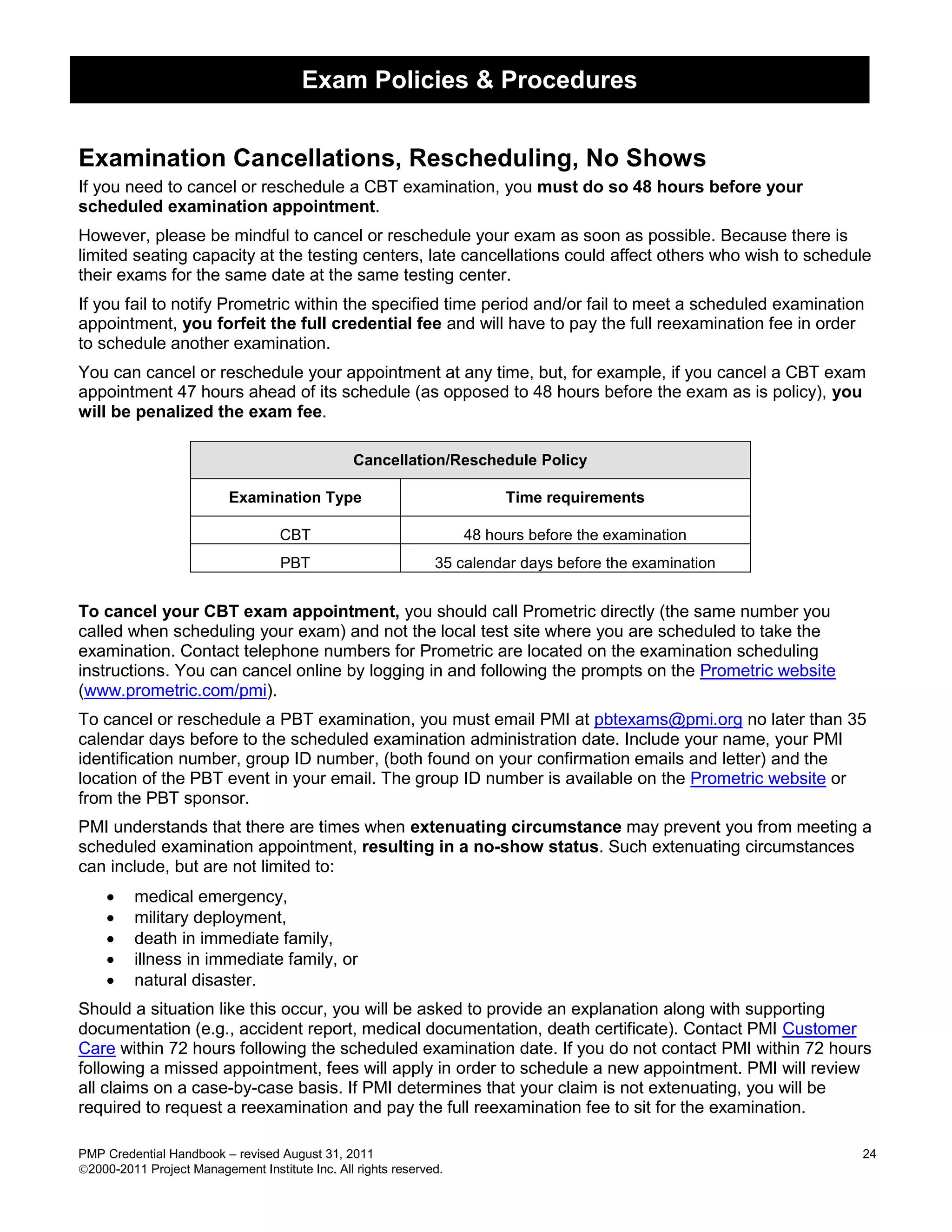
Examination Cancellations, Rescheduling, No Shows
If you need to cancel or reschedule a CBT examination, you must do so 48 hours before your
scheduled examination appointment.
However, please be mindful to cancel or reschedule your exam as soon as possible. Because there is
limited seating capacity at the testing centers, late cancellations could affect others who wish to schedule
their exams for the same date at the same testing center.
If you fail to notify Prometric within the specified time period and/or fail to meet a scheduled examination
appointment, you forfeit the full credential fee and will have to pay the full reexamination fee in order
to schedule another examination.
You can cancel or reschedule your appointment at any time, but, for example, if you cancel a CBT exam
appointment 47 hours ahead of its schedule (as opposed to 48 hours before the exam as is policy), you
will be penalized the exam fee.

                                                Cancellation/Reschedule Policy

                          Examination Type                               Time requirements

                                   CBT                              48 hours before the examination
                                   PBT                         35 calendar days before the examination


To cancel your CBT exam appointment, you should call Prometric directly (the same number you
called when scheduling your exam) and not the local test site where you are scheduled to take the
examination. Contact telephone numbers for Prometric are located on the examination scheduling
instructions. You can cancel online by logging in and following the prompts on the Prometric website
(www.prometric.com/pmi).
To cancel or reschedule a PBT examination, you must email PMI at pbtexams@pmi.org no later than 35
calendar days before to the scheduled examination administration date. Include your name, your PMI
identification number, group ID number, (both found on your confirmation emails and letter) and the
location of the PBT event in your email. The group ID number is available on the Prometric website or
from the PBT sponsor.
PMI understands that there are times when extenuating circumstance may prevent you from meeting a
scheduled examination appointment, resulting in a no-show status. Such extenuating circumstances
can include, but are not limited to:
        medical emergency,
        military deployment,
        death in immediate family,
        illness in immediate family, or
        natural disaster.
Should a situation like this occur, you will be asked to provide an explanation along with supporting
documentation (e.g., accident report, medical documentation, death certificate). Contact PMI Customer
Care within 72 hours following the scheduled examination date. If you do not contact PMI within 72 hours
following a missed appointment, fees will apply in order to schedule a new appointment. PMI will review
all claims on a case-by-case basis. If PMI determines that your claim is not extenuating, you will be
required to request a reexamination and pay the full reexamination fee to sit for the examination.

PMP Credential Handbook – revised August 31, 2011                                                          24
2000-2011 Project Management Institute Inc. All rights reserved.
Exam Policies & Procedures

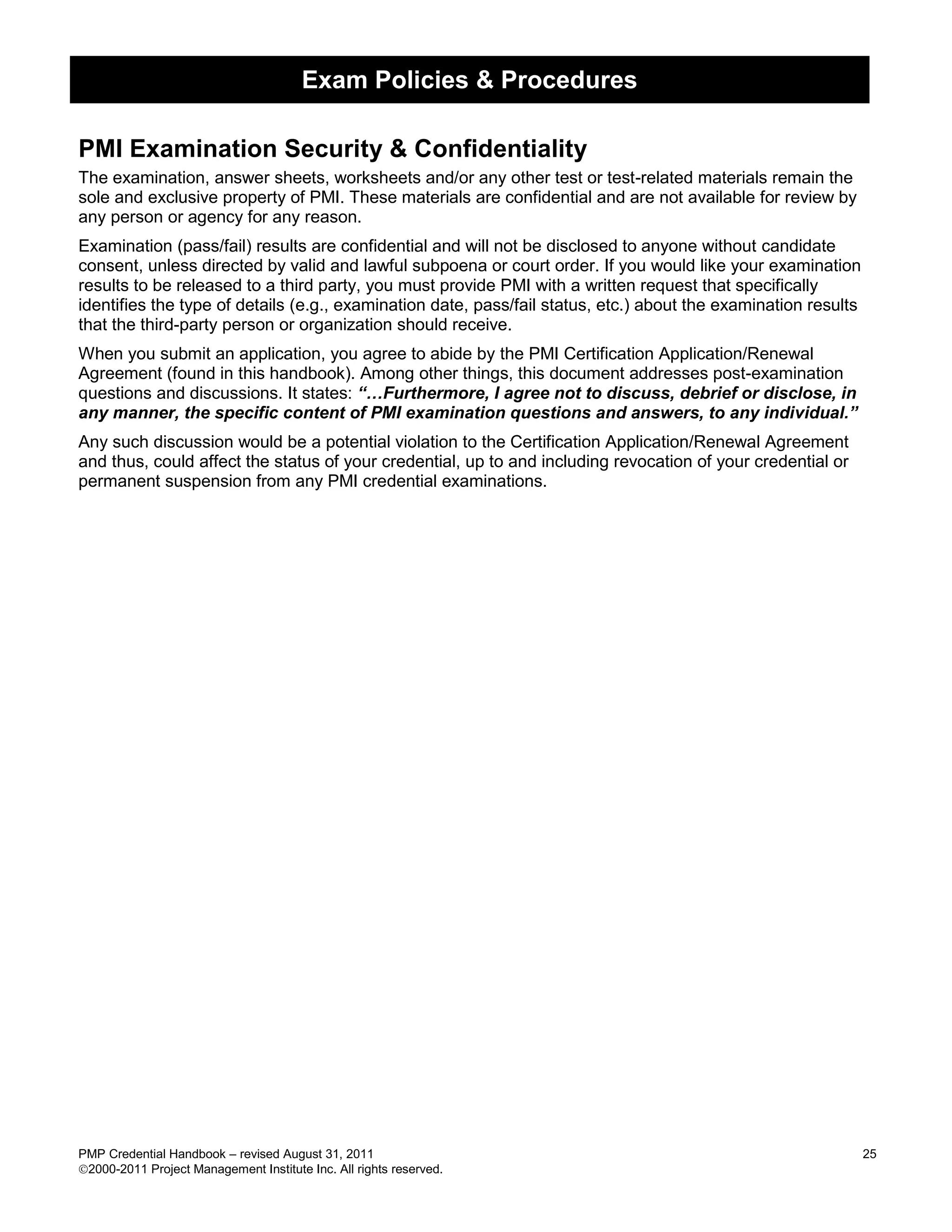
PMI Examination Security & Confidentiality
The examination, answer sheets, worksheets and/or any other test or test-related materials remain the
sole and exclusive property of PMI. These materials are confidential and are not available for review by
any person or agency for any reason.
Examination (pass/fail) results are confidential and will not be disclosed to anyone without candidate
consent, unless directed by valid and lawful subpoena or court order. If you would like your examination
results to be released to a third party, you must provide PMI with a written request that specifically
identifies the type of details (e.g., examination date, pass/fail status, etc.) about the examination results
that the third-party person or organization should receive.
When you submit an application, you agree to abide by the PMI Certification Application/Renewal
Agreement (found in this handbook). Among other things, this document addresses post-examination
questions and discussions. It states: “…Furthermore, I agree not to discuss, debrief or disclose, in
any manner, the specific content of PMI examination questions and answers, to any individual.”
Any such discussion would be a potential violation to the Certification Application/Renewal Agreement
and thus, could affect the status of your credential, up to and including revocation of your credential or
permanent suspension from any PMI credential examinations.


PMP Credential Handbook – revised August 31, 2011                                                               25
2000-2011 Project Management Institute Inc. All rights reserved.
Exam Policies & Procedures

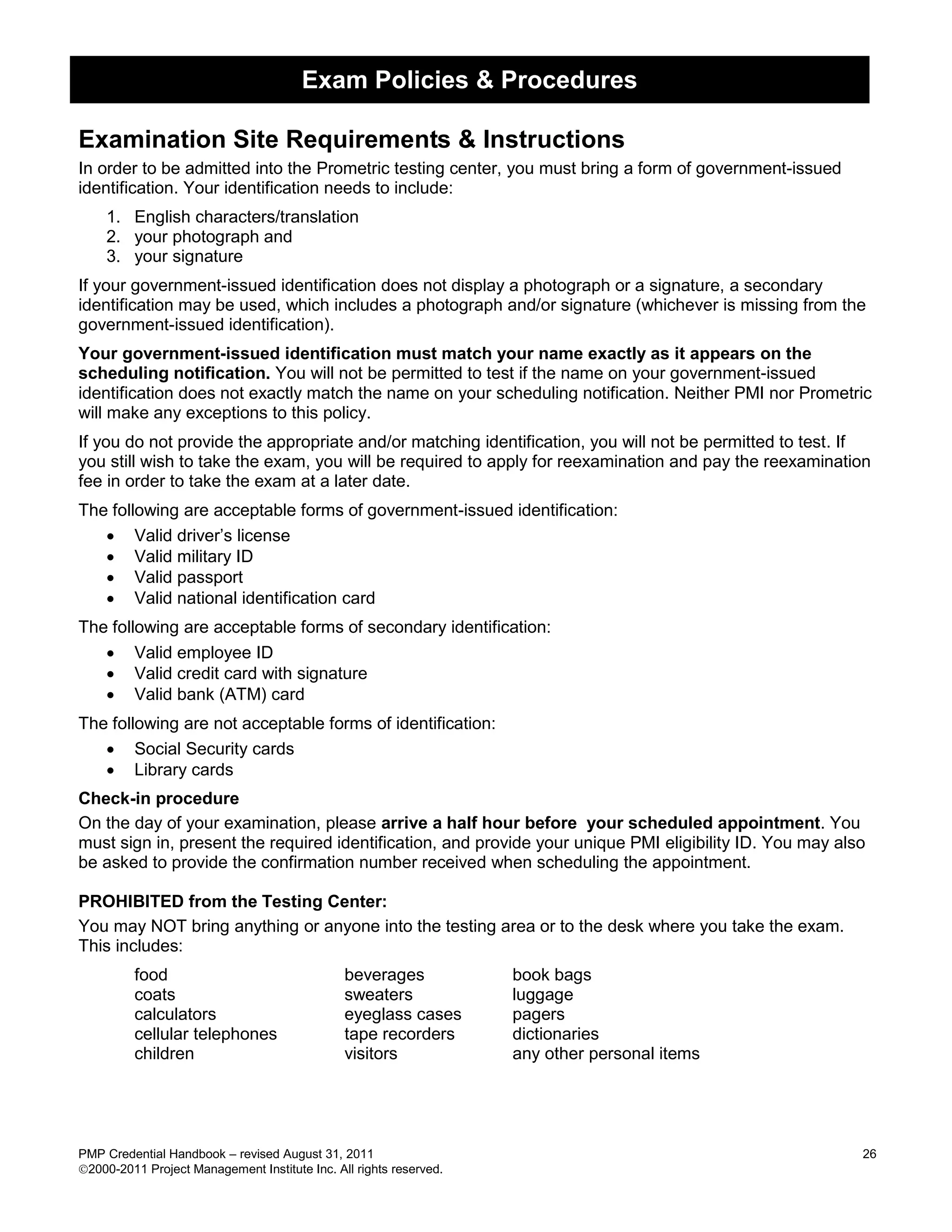
Examination Site Requirements & Instructions
In order to be admitted into the Prometric testing center, you must bring a form of government-issued
identification. Your identification needs to include:
    1. English characters/translation
    2. your photograph and
    3. your signature
If your government-issued identification does not display a photograph or a signature, a secondary
identification may be used, which includes a photograph and/or signature (whichever is missing from the
government-issued identification).
Your government-issued identification must match your name exactly as it appears on the
scheduling notification. You will not be permitted to test if the name on your government-issued
identification does not exactly match the name on your scheduling notification. Neither PMI nor Prometric
will make any exceptions to this policy.
If you do not provide the appropriate and/or matching identification, you will not be permitted to test. If
you still wish to take the exam, you will be required to apply for reexamination and pay the reexamination
fee in order to take the exam at a later date.
The following are acceptable forms of government-issued identification:
    Valid driver’s license
    Valid military ID
    Valid passport
    Valid national identification card
The following are acceptable forms of secondary identification:
    Valid employee ID
    Valid credit card with signature
    Valid bank (ATM) card
The following are not acceptable forms of identification:
    Social Security cards
    Library cards
Check-in procedure
On the day of your examination, please arrive a half hour before your scheduled appointment. You
must sign in, present the required identification, and provide your unique PMI eligibility ID. You may also
be asked to provide the confirmation number received when scheduling the appointment.

PROHIBITED from the Testing Center:
You may NOT bring anything or anyone into the testing area or to the desk where you take the exam.
This includes:
         food                                  beverages            book bags
         coats                                 sweaters             luggage
         calculators                           eyeglass cases       pagers
         cellular telephones                   tape recorders       dictionaries
         children                              visitors             any other personal items


PMP Credential Handbook – revised August 31, 2011                                                         26
2000-2011 Project Management Institute Inc. All rights reserved.
Exam Policies & Procedures

Testing Aids
Test candidates are prohibited from bringing calculators and scrap paper into the test site. However,
these items will be provided for you by Prometric on the day of the exam:
        Calculators are built into the CBT exam and will be provided to those candidates taking a PBT
         exam
        Pencils
        Scrap paper

Termination of Examination Administration/Grounds for Dismissal
You are expected to conduct yourself in a professional manner at all times at the testing center. Any
person who violates the PMI Test Security & Confidentiality Policy will be subject to disciplinary action(s)
by the Certification Department.
The test center administrator/supervisor or proctor is authorized to dismiss you from an examination
administration and the Certification Department may cancel your scores, or take other appropriate action,
when there is a reasonable basis for concluding that you have engaged in any of the following conduct:
1.  Using or attempting to use someone else to take the test
2.  Failing to provide acceptable personal identification
3.  Having access to or using notes or any prohibited aid related to the test
4.  Creating a disturbance (disruptive behavior in any form will not be tolerated; the test
    administrator/supervisor has sole discretion in determining whether specific conduct constitutes
    disruptive behavior)
5. Communicating, in any manner, with another person other than the test administrator/supervisor or
    proctor about the test during the administration, including attempting to give or receive assistance
6. Attempting to remove scrap paper from the testing room
7. Eating or drinking in the testing room
8. Leaving the testing room or test center vicinity without permission
9. Removing or attempting to remove, examination-related material, or portions of a test in any format
    from the testing room
10. Attempting to tamper with a computer
11. Engaging in any dishonest or unethical conduct, such as cheating
12. Failing to follow any other examination administration regulations set forth in PMI Certification
    Program policies given by the test administrator/supervisor, or specified in any examination materials
The Certification Department reserves the right to take all action including, but not limited to, barring you
from future testing and/or canceling your scores, for failure to comply with the test
administrator/supervisor’s directions. If your scores are cancelled, you will be notified of such action and
its basis, and your examination fees will not be refunded.
Although tests are administered under strict supervision and security measures, examination
irregularities may sometimes occur. You are required to contact PMI as soon as possible to report any
observed behavior that may lead to an invalid score – for example, someone copying from another test
taker, taking a test for someone else, having access to test questions before the examination, or using
notes or unauthorized aids. All information will be held in confidence.


PMP Credential Handbook – revised August 31, 2011                                                           27
2000-2011 Project Management Institute Inc. All rights reserved.
Exam Policies & Procedures

Examination Report
Upon completion of the computer-based examination, you will receive a printed copy of your test results.
In addition to the overall pass/fail status, important diagnostic information on your performance is
provided for each domain. This information provides specific guidance for both passing and failing
candidates.

            NOTE:
            Change in Exam Results Delivery 31 August – mid-October 2011

            As we transition to the new exam due to updates from the Role Delineation Study,
            PMI must update its exam reporting processes. This means for a short period of
            time exam results will not be available immediately following the exam.

            There will be a 4–6 week period between taking the exam and receiving the results
            by email. The delay is necessary any time an exam changes to validate the new
            exam structure.

            The details include:
             PMP candidates who take the updated computer-based exam on or after 31
               August will NOT receive immediate results at the Prometric testing center.
             PMP candidates taking the updated paper-based exam can also expect a delay
               in receiving their exam results.
             Once PMI validates the new exam structure (by mid-October) we will be able to
               resume providing individuals with immediate results at the Prometric testing
               center.
             Each PMP candidate will receive a communication to notify them when their
               results are available at PMI.org.
             All candidates can expect to receive their exam results by mid-October.


Understanding Your Exam Report
Your test results are reported in two ways:
1. A pass/fail result score is generated based on your overall performance on the examination.
2. The second level of results is the assignment of one of three proficiency levels to each chapter.
    Each topic domain is assigned one of three levels of proficiency—Proficient, Moderately
      Proficient and Below Proficient—based on the number of questions answered correctly within the
      domain.
    This provides direction about your strengths and weaknesses.


PMI defines the levels of ―proficiency‖ as follows:
    Proficient – indicates performance is above the average level of knowledge in this chapter.
    Moderately Proficient – indicates performance that is at the average level of knowledge in this
    chapter.
    Below Proficient – indicates performance is below the average level of knowledge in this chapter.


PMP Credential Handbook – revised August 31, 2011                                                       28
2000-2011 Project Management Institute Inc. All rights reserved.
Exam Policies & Procedures


For candidates who pass the examination, the performance information will help identify specific
chapters to focus on for continuing education purposes. For candidates who fail the examination, the
performance information will identify specific chapters where improvement or further study may be
required in order to successfully complete the examination in the future.
Candidates who take a computer-based examination receive the exam report at the test center the day
you sit for the examination. You can also access your exam report on the online certification system 10
business days after your examination date.
Candidates who take a paper-based examination will NOT receive the exam report the day of the exam.
You will be able to access your exam report on the online certification system approximately six to eight
weeks after your examination date.


HAND SCORING for the paper-based test is available up to six months after the administration. The fee
for hand scoring is US$45. For more information or to request hand scoring please contact PMI
Customer Care by email or phone. PMI does not offer hand scoring for computer-based tests.

         NOTE: If you do not pass the credential examination on your first attempt, you have two more
         opportunities to retest within your one-year eligibility period. Refer to the Reexamination section
         in this handbook for more details.


Establishing the Passing Score
The passing score for all PMI exams is determined by sound psychometric analysis. PMI uses subject
matter experts from across the globe to help establish a point at which each candidate should pass the
exam(s) and the exam point of difficulty. Data that show how candidates actually performed is cross
referenced with the subject matter experts to ensure that the point of difficulty on each exam is healthy.

         NOTE: You will not see your certification status on the online Certification Registry until PMI receives
         your exam report from Prometric.


PMP Credential Handbook – revised August 31, 2011                                                                   29
2000-2011 Project Management Institute Inc. All rights reserved.
Exam Policies & Procedures

Reexamination
You are granted a one-year eligibility period in which to pass the examination. During the eligibility
period, you may take the examination up to three times because candidates do not always pass the
examination on their first attempt. Gauge your time carefully to leave enough time during the eligibility
period to retake the examination, if needed.
If you fail the examination three times within your one-year eligibility period, you must wait one year from
the date of the last examination you took to reapply for the credential. However, after failing a credential
examination three times, candidates may opt to apply for any other PMI credential. For example, a
candidate who failed the PMP examination three times in their one-year eligibility period must wait one
year to reapply for the PMP. However, they can apply for the CAPM, PMI-SP, PMI-RMP, PMI-ACP or
PgMP (and submit associated initial credential fees) at any time.
Reexamination fees apply to the second and third attempts to pass the examination. If your eligibility
period expires without you passing the examination, you must reapply for the credential.


PMP Credential Handbook – revised August 31, 2011                                                           30
2000-2011 Project Management Institute Inc. All rights reserved.
Credential Policies & Procedures


PMI Appeals Procedure
All challenges to PMI’s Certification Program are governed by the comprehensive and exclusive rules of
the PMI Certification Governance Council’s (CGC) Certification Appeal Procedures. PMI’s Office of
Certification Appeals makes the final decision on all appeals.
The appeals process is the only method to review all decisions made by the PMI Certification
Department regarding applications, eligibility, examinations, and other application/testing related
certification issues and/or challenges.
Disciplinary decisions made by the Office of Certification Appeals regarding individuals who hold a PMI
credential are governed by and reviewed under a separate procedure, detailed in a separate PMI policy
document, PMI Certification Disciplinary Case Procedures.
Candidates for the credential, or individuals who currently hold the credential, may submit a written
request to the Office of Certification Appeals for review of an adverse credential program action,
decision, or determination. Requests can be sent by postal mail to PMI, or by email to
certappeals@pmi.org.
This policy may be distributed to all credential holders that may be interested in submitting an appeal to
PMI’s Office of Certification Appeals.


PMP Credential Handbook – revised August 31, 2011                                                            31
2000-2011 Project Management Institute Inc. All rights reserved.
Credential Policies & Procedures


Use of Your PMP Credential
Once you pass the examination, you are granted the PMP credential. You may refer to yourself as a
PMP credential holder as long as you have an active certification status. You are authorized to use the
PMP designation in block letters after your name on business cards, personal letterhead, resumes,
websites and in your email signature.
Please note that as part of the application process, you agreed to adhere to the PMI Code of Ethics and
Professional Conduct and the Certification Application/Renewal Agreement. This means, among other
things, that you will only use the PMP designation in the manner stated above and that you will not use
the PMP designation in company names, domain names, product names, or any other unauthorized
manner.


Certificate Package
Within six to eight weeks, you will receive a credential package that includes:
        Congratulatory letter
        Information on how to maintain and renew your credential
        Credential certificate

Both of these documents list your:
    Credential number – a unique identification number used by PMI to maintain your individual
       certification records
    Your credential cycle dates

You will want to file this information in a safe and easily accessible location. You will need to refer to it in
order to report professional development activities to maintain your credential.

Until you receive your certificate package, you may use your exam report (available online through the
certification system) to validate your credential status.


Online Certification Registry
The online Certification Registry automatically lists names of PMI’s credential holders. This feature
allows verification of credential holders for the benefit of employers, service purchasers and others.
Users can search for credential holders by first name, last name, or by country.
Credential holders can choose to be removed from the registry, so the absence of your name in the
registry does not necessarily mean that you are not credentialed. You can opt out of inclusion in the
registry or update your demographic information by visiting PMI.org.


PMP Credential Handbook – revised August 31, 2011                                                              32
2000-2011 Project Management Institute Inc. All rights reserved.
Continuing Certification Requirements (CCR) Program

About the CCR Program
Once you have attained the PMP credential, you must participate in the Continuing Certification
Requirements (CCR) program to maintain an active certification status. The PMP certification cycle lasts
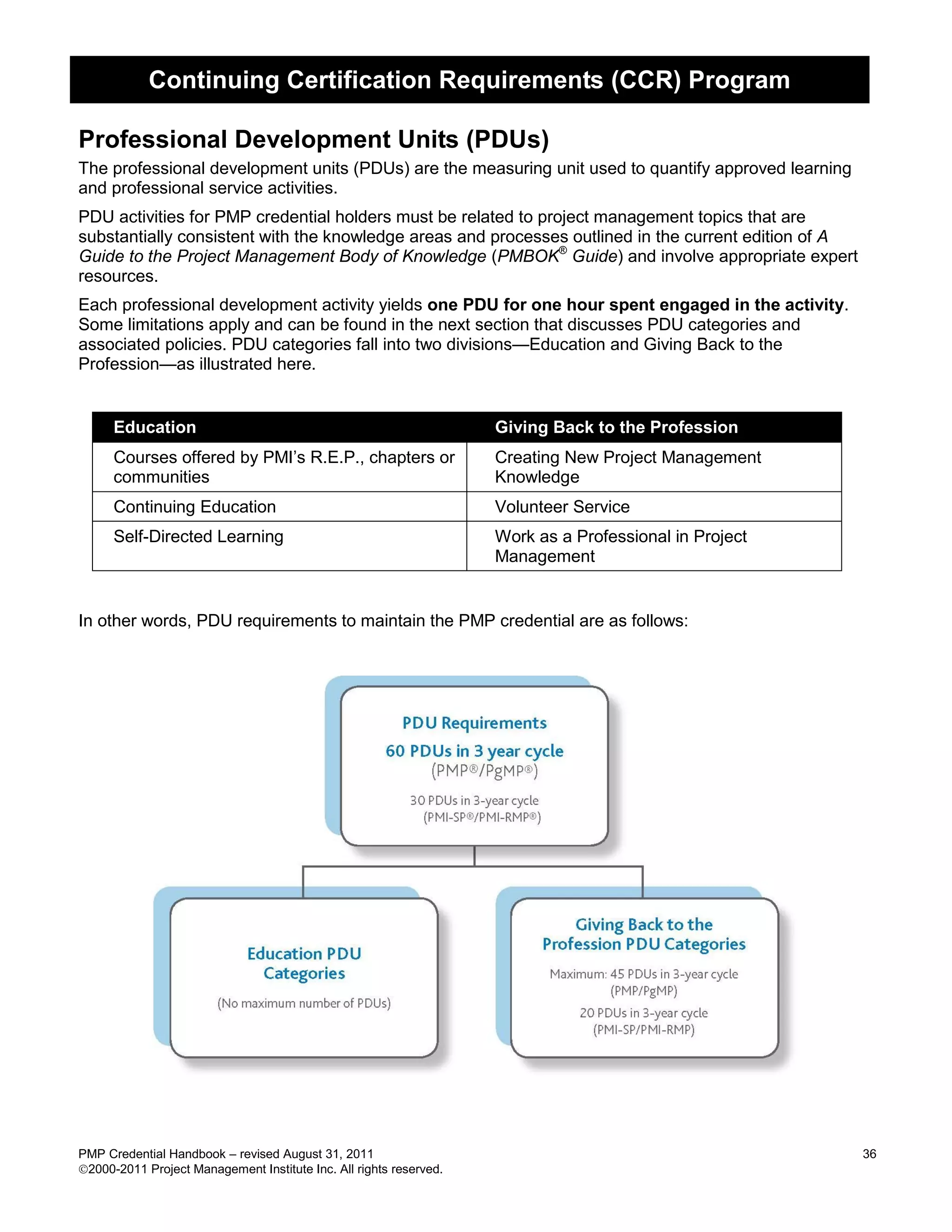
three years. During this time, you must attain no less than 60 professional development units (PDUs)
toward credential maintenance. Upon successful completion of a single cycle, a new, three-year
cycle begins.
The CCR program supports the ongoing educational and professional development of PMI’s credential
holders. The purpose of the CCR program is to:
    Enhance the ongoing professional development of credential holders
    Encourage and recognize individualized learning opportunities
    Offer a standardized and objective mechanism for attaining and recording professional development
     activities
    Sustain the global recognition and value of PMI credentials.


CCR / Credential Maintenance Overview
    1. Determine certification/CCR cycle
    2. Attain no less than 60 PDUs during each certification/CCR cycle
    3. Report PDUs with the online CCR System
    4. Complete the online Application for Renewal process which includes:
        Reaffirm PMI Code of Ethics and Professional Conduct
        Reaffirm PMI Certification Application/Renewal Agreement
        Submit the credential renewal fee—US$60 for PMI members; US$150 for nonmembers
    5. Receive new certificate with updated certification/CCR cycle dates


Work Online
Use the online certification system to:
    View your listing on the Certification Registry
    Update your contact information
    Determine your Certification/CCR cycle dates on your certification record

Use the online CCR System to:
    Search activities (courses/events) that award professional development units (PDUs)
    Report PDUs as you earn them
    Check your PDU transcript
    Submit the application and payment for credential renewal (done through the online certification
       system on which you also applied for the credential)


PMP Credential Handbook – revised August 31, 2011                                                       33
2000-2011 Project Management Institute Inc. All rights reserved.
Continuing Certification Requirements (CCR) Program


How to Determine your Certification/CCR Cycle
Your active certification/CCR cycle begins the day you pass your credential examination and ends three
full years later. Once you renew your credential, a new, three-year certification cycle begins.
The following table provides a sample of how to determine your active certification/CCR cycle. You also
can check this information on your credential certificate or on the online certification system.

                                                                                     PMP
                     Certification/CCR cycle begins                      The day you pass the exam
                     Certification/CCR ends                         On the third anniversary of passing the
                                                                                     exam

                     Calculations:
                     If you pass the exam on…                                15 September 2010
                     Your certification/CCR cycle                            15 September 2010
                     starts…
                     Your certification/CCR cycle                            15 September 2013
                     ends…
                     Therefore, you need to renew
                     your credential by…                                     14 September 2013
                     Your next cycle starts…                                 15 September 2013
                     Your next cycle ends…                                   14 September 2016

                     Suspension status begins                             On the third anniversary of:
                                                                              passing your exam
                                                                                       or
                                                                    the start date of your last certification
                                                                                      cycle
                                                                      if you do not comply with the CCR
                                                                                    program
                     Your credential EXPIRES                        One year after the suspension period
                                                                                     begins


PMP Credential Handbook – revised August 31, 2011                                                               34
2000-2011 Project Management Institute Inc. All rights reserved.
Continuing Certification Requirements (CCR) Program

Certification Status
Active Status
Once you earn the credential, you are considered to be in active status. When you earn and record your
PDUs and renew your credential before the certification/CCR cycle end date, you remain a credential
holder in good standing and considered to be in active status.
Credential holders in active status will be listed in the online Certification Registry, which allows
verification of your credentialed status. The online Certification Registry automatically lists names of
PMI’s credential holders. You can choose to be removed from the registry, so the absence of your name
in the registry does not necessarily mean that you are not credentialed.
Suspended Status
If you do not satisfy the CCR program within your active certification dates, you will be placed on
suspended status. The suspension period lasts one year (12 months). If you are in suspended status,
you may not refer to yourself as a credential holder or use the credential designation until you earn the
necessary PDUs or complete the renewal process, within the one-year suspension period.
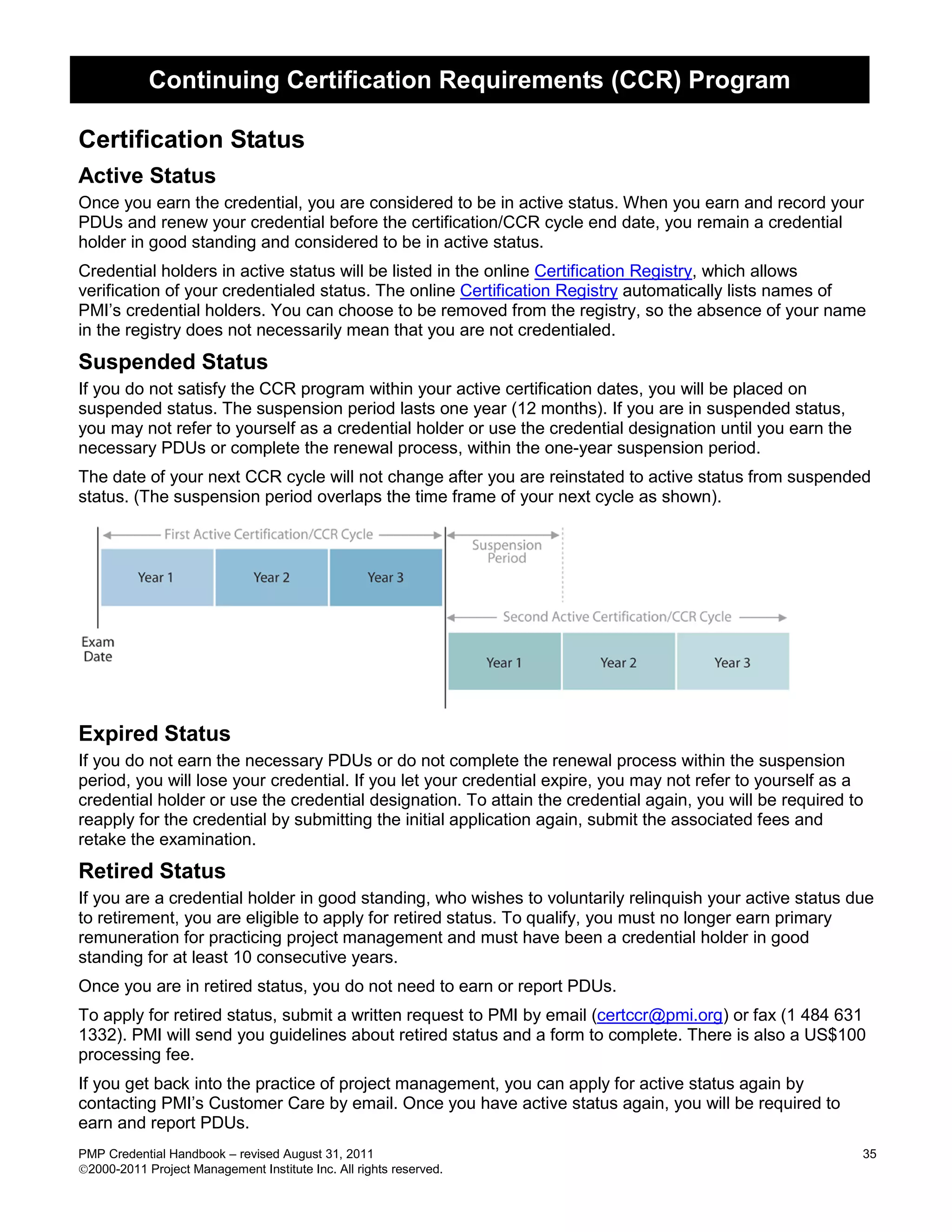
The date of your next CCR cycle will not change after you are reinstated to active status from suspended
status. (The suspension period overlaps the time frame of your next cycle as shown).


Expired Status
If you do not earn the necessary PDUs or do not complete the renewal process within the suspension
period, you will lose your credential. If you let your credential expire, you may not refer to yourself as a
credential holder or use the credential designation. To attain the credential again, you will be required to
reapply for the credential by submitting the initial application again, submit the associated fees and
retake the examination.
Retired Status
If you are a credential holder in good standing, who wishes to voluntarily relinquish your active status due
to retirement, you are eligible to apply for retired status. To qualify, you must no longer earn primary
remuneration for practicing project management and must have been a credential holder in good
standing for at least 10 consecutive years.
Once you are in retired status, you do not need to earn or report PDUs.
To apply for retired status, submit a written request to PMI by email (certccr@pmi.org) or fax (1 484 631
1332). PMI will send you guidelines about retired status and a form to complete. There is also a US$100
processing fee.
If you get back into the practice of project management, you can apply for active status again by
contacting PMI’s Customer Care by email. Once you have active status again, you will be required to
earn and report PDUs.
PMP Credential Handbook – revised August 31, 2011                                                           35
2000-2011 Project Management Institute Inc. All rights reserved.
Continuing Certification Requirements (CCR) Program

Professional Development Units (PDUs)
The professional development units (PDUs) are the measuring unit used to quantify approved learning
and professional service activities.
PDU activities for PMP credential holders must be related to project management topics that are
substantially consistent with the knowledge areas and processes outlined in the current edition of A
Guide to the Project Management Body of Knowledge (PMBOK® Guide) and involve appropriate expert
resources.
Each professional development activity yields one PDU for one hour spent engaged in the activity.
Some limitations apply and can be found in the next section that discusses PDU categories and
associated policies. PDU categories fall into two divisions—Education and Giving Back to the
Profession—as illustrated here.


      Education                                                     Giving Back to the Profession
      Courses offered by PMI’s R.E.P., chapters or                  Creating New Project Management
      communities                                                   Knowledge
      Continuing Education                                          Volunteer Service
      Self-Directed Learning                                        Work as a Professional in Project
                                                                    Management


In other words, PDU requirements to maintain the PMP credential are as follows:


PMP Credential Handbook – revised August 31, 2011                                                       36
2000-2011 Project Management Institute Inc. All rights reserved.
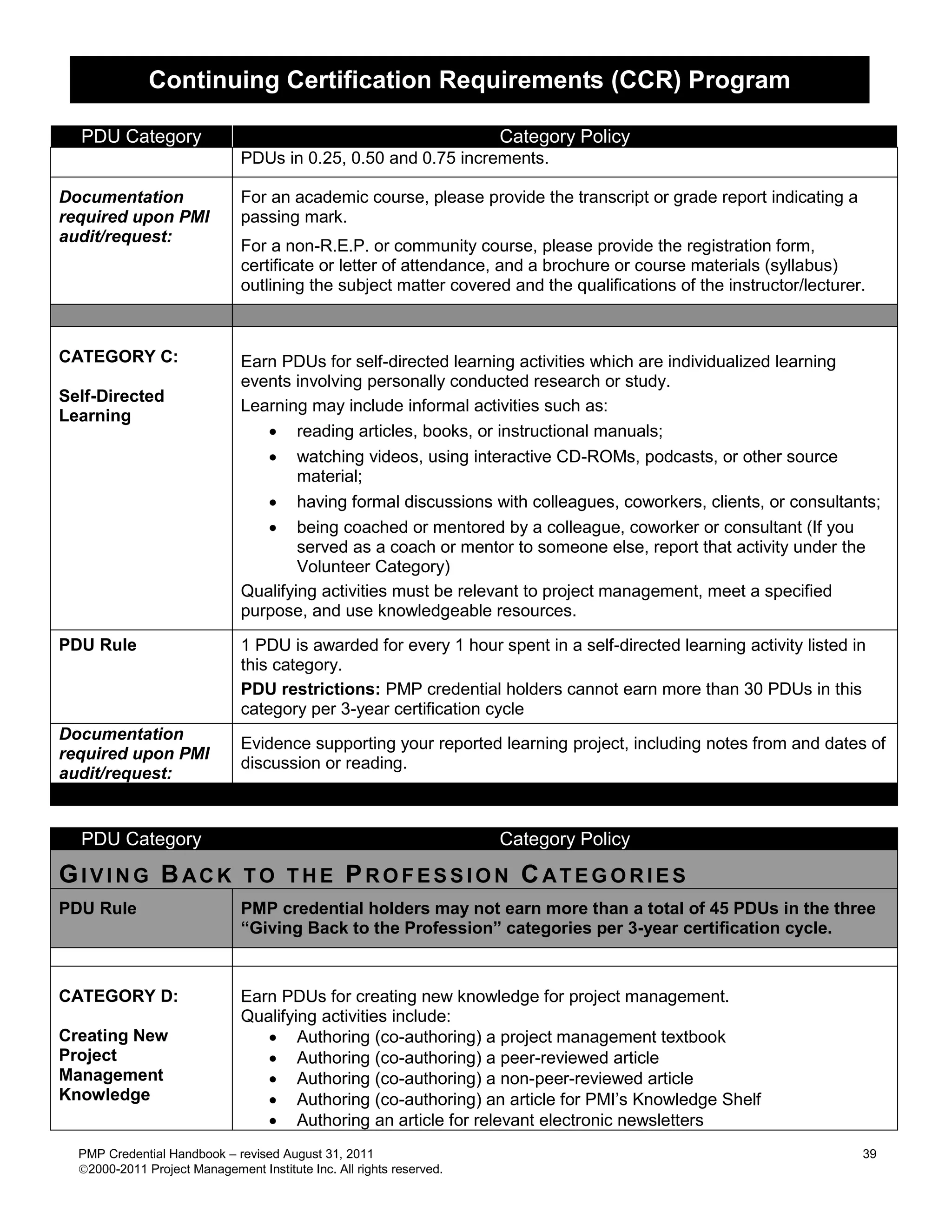
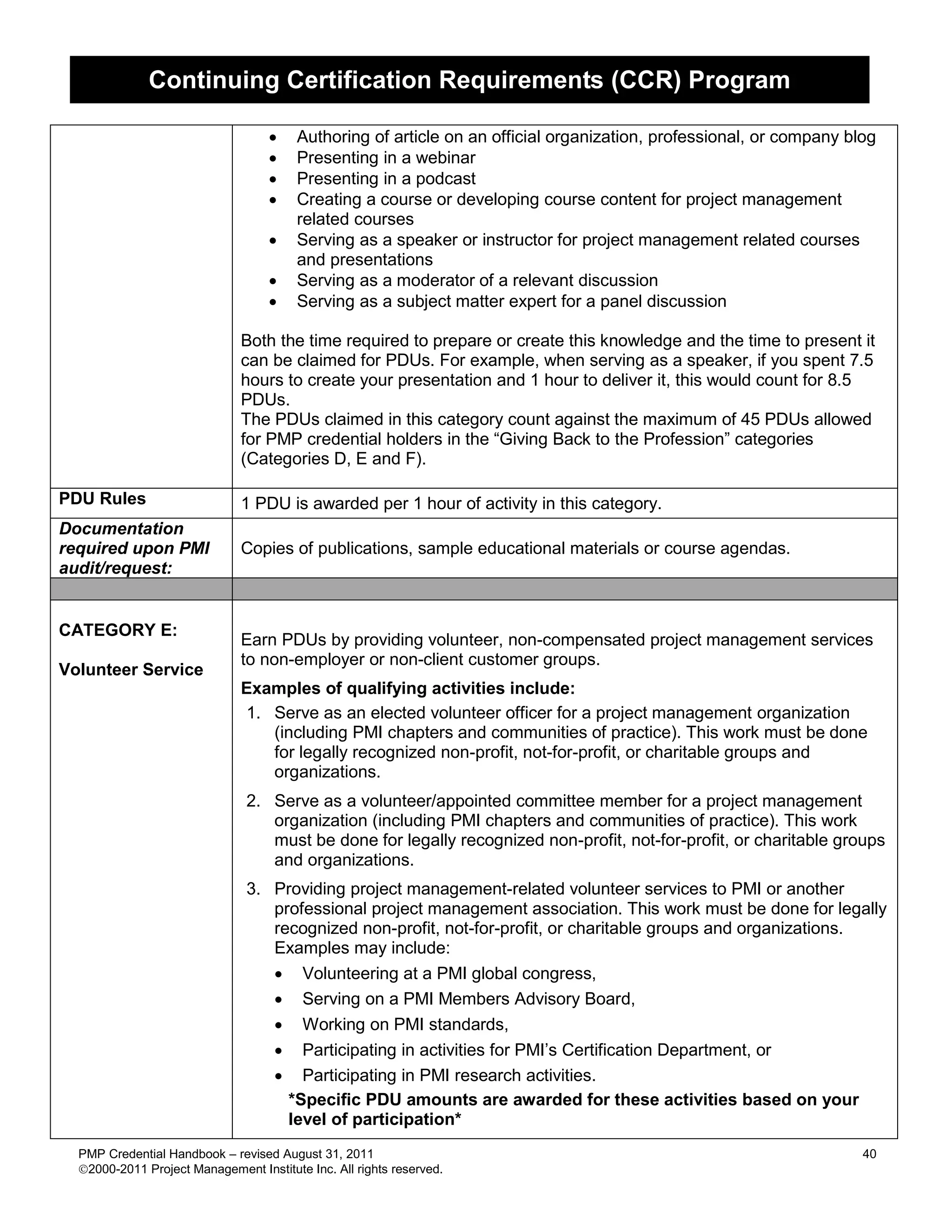
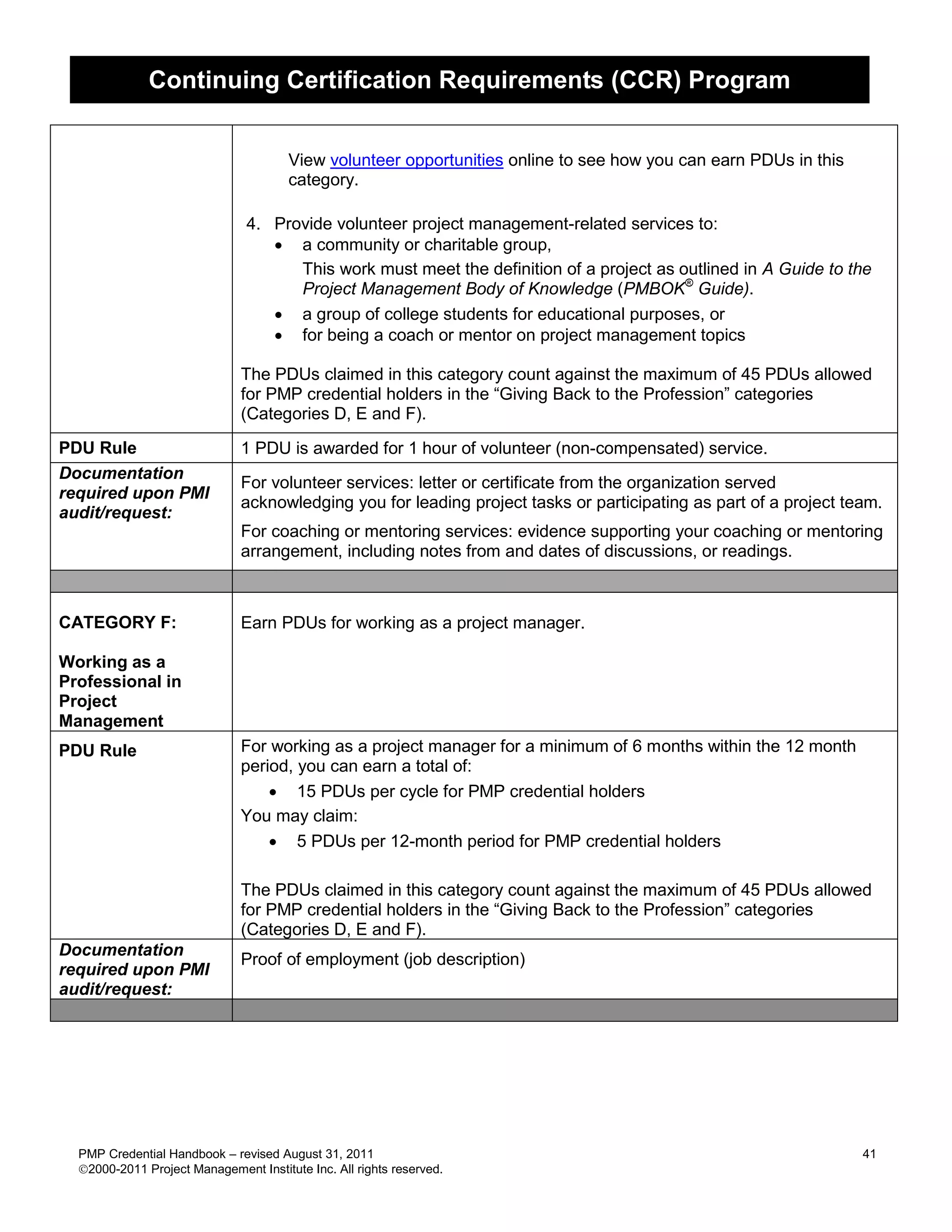
Continuing Certification Requirements (CCR) Program


         NOTE: If you attend courses that calculate by Continuing Education Units (CEUs), please be
         aware that for conversion purposes, one CEU equals 10 PDUs.


Fractions of PDUs also may be reported in quarterly increments. This means that if you spent 15
minutes participating in a qualifying PDU activity, you can report 0.25 PDUs. If you spend 30 minutes in a
qualifying PDU activity, you can report 0.50 PDUs.


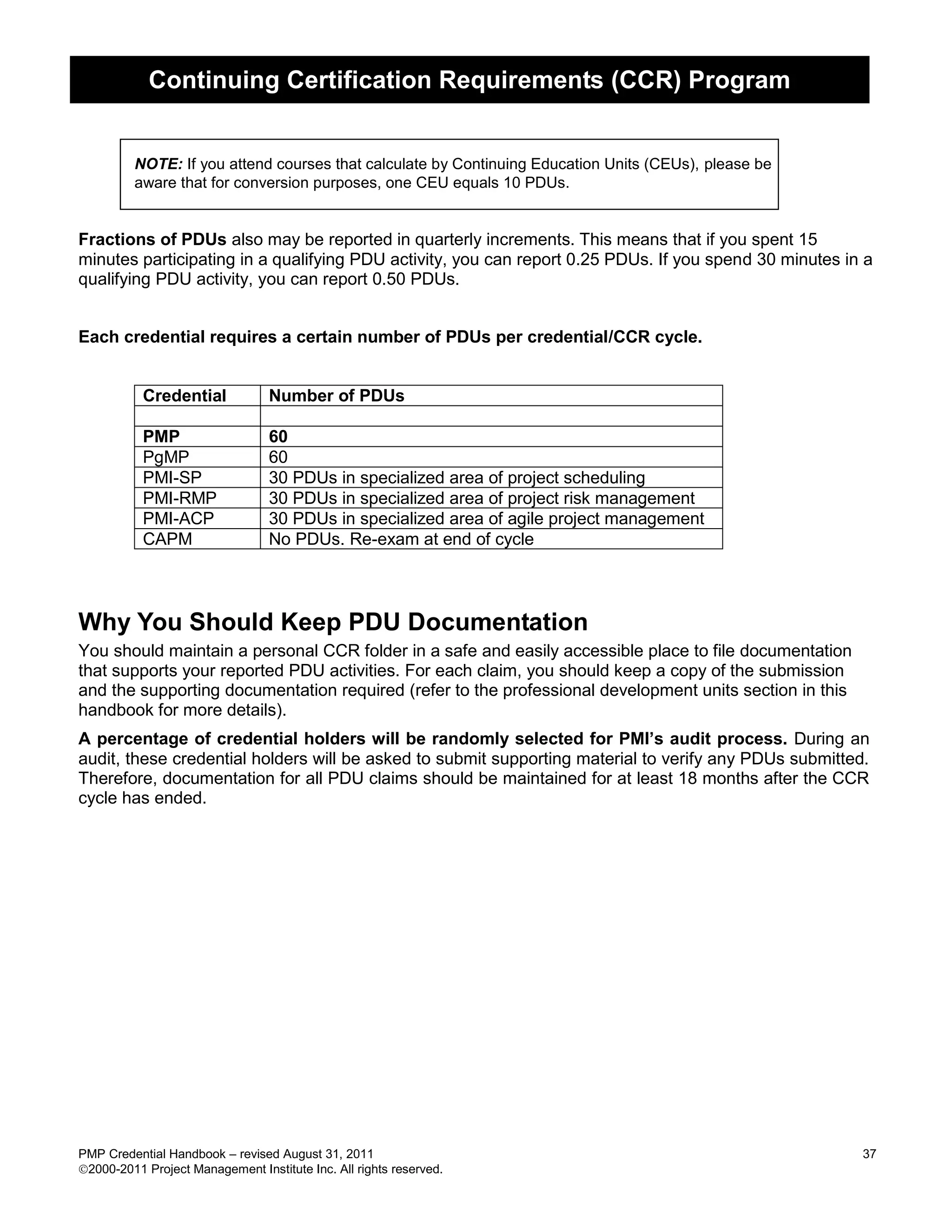
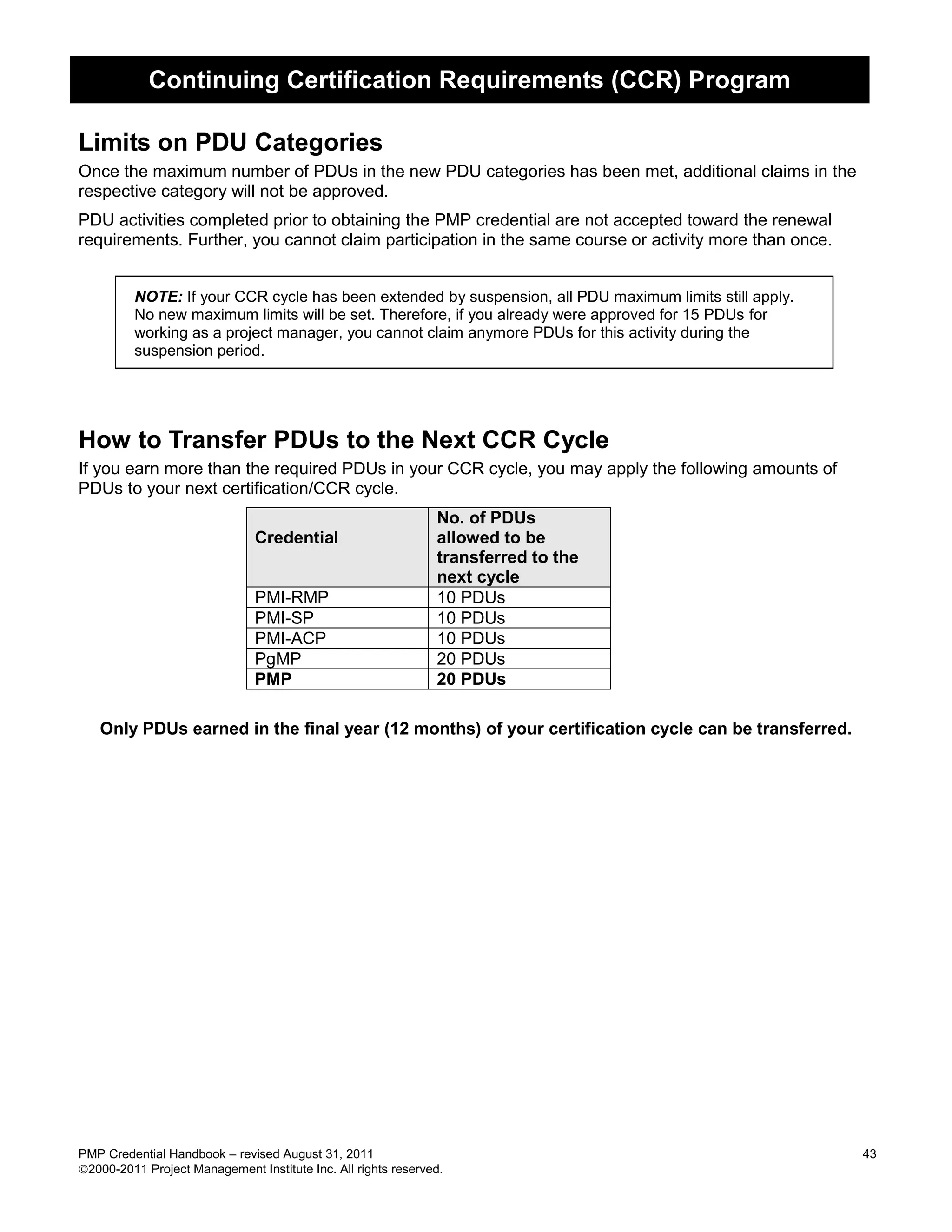
Each credential requires a certain number of PDUs per credential/CCR cycle.


           Credential            Number of PDUs

           PMP                   60
           PgMP                  60
           PMI-SP                30 PDUs in specialized area of project scheduling
           PMI-RMP               30 PDUs in specialized area of project risk management
           PMI-ACP               30 PDUs in specialized area of agile project management
           CAPM                  No PDUs. Re-exam at end of cycle


Why You Should Keep PDU Documentation
You should maintain a personal CCR folder in a safe and easily accessible place to file documentation
that supports your reported PDU activities. For each claim, you should keep a copy of the submission
and the supporting documentation required (refer to the professional development units section in this
handbook for more details).
A percentage of credential holders will be randomly selected for PMI’s audit process. During an
audit, these credential holders will be asked to submit supporting material to verify any PDUs submitted.
Therefore, documentation for all PDU claims should be maintained for at least 18 months after the CCR
cycle has ended.


PMP Credential Handbook – revised August 31, 2011                                                        37
2000-2011 Project Management Institute Inc. All rights reserved.
Continuing Certification Requirements (CCR) Program


  PDU Categories
    The CCR Program organizes PDUs into the following new categories with associated policies.

  PDU Category                                                        Category Policy

EDUCATION CATEGORIES
CATEGORY A:                   Earn PDUs by attending educational courses offered by PMI’s Registered Education
                              Providers (R.E.P.s). These providers adhere to quality criteria established by PMI
Courses offered by            and are solely authorized to issue PDU certificates to attendees. R.E.P.s can be
PMI’s R.E.P.s,                identified by their logo:
chapters and
communities


                              Examples of R.E.P.s include schools, consultants, corporate training departments,
                              professional associations, government agencies and PMI chapters. View the
                              searchable database of R.E.P.s and the courses they offer online.
                              You can also earn PDUs by attending events (seminars, conferences, etc.) offered by
                              PMI, PMI chapters and communities of practice. These event listings can be found on
                              PMI’s events calendar or on the websites of your specific chapter or the community of
                              practice to which you belong.
                              You can also earn PDUs by taking a PMI® Publication Quiz (reading an article and
                              correctly answering at least 70 percent of the questions).


PDU Rule                      1 hour of instruction related to project management equals 1 PDU. You can report
                              PDUs in 0.25, 0.50 and 0.75 increments.
Documentation
                              Registration form, certificate or letter of attendance.
required upon PMI
audit/request:


CATEGORY B:                   Earn PDUs:
                                  By completing an academic course being offered by a university or college
Continuing                          OR
Education                         By attending relevant educational courses offered by training organizations
                                    NOT registered with PMI. This may include training (or a webinar) offered by
                                    your employer, another professional or membership association, or a non-
                                    R.E.P. training organization.

                              When only a portion of a course relates to project management, calculate PDUs by
                              the percentage of the overall curriculum focused on the topic.
                              Report each course separately. Entire degree programs will not be recognized for
                              PDU credits, only individual courses.

PDU Rule                      1 hour of instruction related to project management equals 1 PDU. You can report
  PMP Credential Handbook – revised August 31, 2011                                                              38
  2000-2011 Project Management Institute Inc. All rights reserved.
Continuing Certification Requirements (CCR) Program

  PDU Category                                                        Category Policy
                              PDUs in 0.25, 0.50 and 0.75 increments.

Documentation                 For an academic course, please provide the transcript or grade report indicating a
required upon PMI             passing mark.
audit/request:
                              For a non-R.E.P. or community course, please provide the registration form,
                              certificate or letter of attendance, and a brochure or course materials (syllabus)
                              outlining the subject matter covered and the qualifications of the instructor/lecturer.


CATEGORY C:                   Earn PDUs for self-directed learning activities which are individualized learning
                              events involving personally conducted research or study.
Self-Directed
                              Learning may include informal activities such as:
Learning
                                  reading articles, books, or instructional manuals;
                                  watching videos, using interactive CD-ROMs, podcasts, or other source
                                      material;
                                  having formal discussions with colleagues, coworkers, clients, or consultants;
                                  being coached or mentored by a colleague, coworker or consultant (If you
                                      served as a coach or mentor to someone else, report that activity under the
                                      Volunteer Category)
                              Qualifying activities must be relevant to project management, meet a specified
                              purpose, and use knowledgeable resources.
PDU Rule                      1 PDU is awarded for every 1 hour spent in a self-directed learning activity listed in
                              this category.
                              PDU restrictions: PMP credential holders cannot earn more than 30 PDUs in this
                              category per 3-year certification cycle
Documentation
                              Evidence supporting your reported learning project, including notes from and dates of
required upon PMI
                              discussion or reading.
audit/request:


  PDU Category                                                        Category Policy

GIVING BACK TO THE PROFESSION CATEGORIES
PDU Rule                      PMP credential holders may not earn more than a total of 45 PDUs in the three
                              ―Giving Back to the Profession‖ categories per 3-year certification cycle.


CATEGORY D:                   Earn PDUs for creating new knowledge for project management.
                              Qualifying activities include:
Creating New                      Authoring (co-authoring) a project management textbook
Project                           Authoring (co-authoring) a peer-reviewed article
Management                        Authoring (co-authoring) a non-peer-reviewed article
Knowledge                         Authoring (co-authoring) an article for PMI’s Knowledge Shelf
                                  Authoring an article for relevant electronic newsletters
  PMP Credential Handbook – revised August 31, 2011                                                                 39
  2000-2011 Project Management Institute Inc. All rights reserved.
Continuing Certification Requirements (CCR) Program

                                       Authoring of article on an official organization, professional, or company blog
                                       Presenting in a webinar
                                       Presenting in a podcast
                                       Creating a course or developing course content for project management
                                        related courses
                                       Serving as a speaker or instructor for project management related courses
                                        and presentations
                                       Serving as a moderator of a relevant discussion
                                       Serving as a subject matter expert for a panel discussion

                              Both the time required to prepare or create this knowledge and the time to present it
                              can be claimed for PDUs. For example, when serving as a speaker, if you spent 7.5
                              hours to create your presentation and 1 hour to deliver it, this would count for 8.5
                              PDUs.
                              The PDUs claimed in this category count against the maximum of 45 PDUs allowed
                              for PMP credential holders in the ―Giving Back to the Profession‖ categories
                              (Categories D, E and F).

PDU Rules                     1 PDU is awarded per 1 hour of activity in this category.
Documentation
required upon PMI             Copies of publications, sample educational materials or course agendas.
audit/request:


CATEGORY E:
                              Earn PDUs by providing volunteer, non-compensated project management services
                              to non-employer or non-client customer groups.
Volunteer Service
                              Examples of qualifying activities include:
                              1. Serve as an elected volunteer officer for a project management organization
                                 (including PMI chapters and communities of practice). This work must be done
                                 for legally recognized non-profit, not-for-profit, or charitable groups and
                                 organizations.
                               2. Serve as a volunteer/appointed committee member for a project management
                                  organization (including PMI chapters and communities of practice). This work
                                  must be done for legally recognized non-profit, not-for-profit, or charitable groups
                                  and organizations.
                               3. Providing project management-related volunteer services to PMI or another
                                  professional project management association. This work must be done for legally
                                  recognized non-profit, not-for-profit, or charitable groups and organizations.
                                  Examples may include:
                                   Volunteering at a PMI global congress,
                                   Serving on a PMI Members Advisory Board,
                                   Working on PMI standards,
                                   Participating in activities for PMI’s Certification Department, or
                                   Participating in PMI research activities.
                                    *Specific PDU amounts are awarded for these activities based on your
                                    level of participation*
  PMP Credential Handbook – revised August 31, 2011                                                                  40
  2000-2011 Project Management Institute Inc. All rights reserved.
Continuing Certification Requirements (CCR) Program


                                       View volunteer opportunities online to see how you can earn PDUs in this
                                       category.

                               4. Provide volunteer project management-related services to:
                                   a community or charitable group,
                                     This work must meet the definition of a project as outlined in A Guide to the
                                     Project Management Body of Knowledge (PMBOK® Guide).
                                   a group of college students for educational purposes, or
                                   for being a coach or mentor on project management topics

                              The PDUs claimed in this category count against the maximum of 45 PDUs allowed
                              for PMP credential holders in the ―Giving Back to the Profession‖ categories
                              (Categories D, E and F).
PDU Rule                      1 PDU is awarded for 1 hour of volunteer (non-compensated) service.
Documentation
                              For volunteer services: letter or certificate from the organization served
required upon PMI
                              acknowledging you for leading project tasks or participating as part of a project team.
audit/request:
                              For coaching or mentoring services: evidence supporting your coaching or mentoring
                              arrangement, including notes from and dates of discussions, or readings.


CATEGORY F:                   Earn PDUs for working as a project manager.

Working as a
Professional in
Project
Management
PDU Rule                      For working as a project manager for a minimum of 6 months within the 12 month
                              period, you can earn a total of:
                                   15 PDUs per cycle for PMP credential holders
                              You may claim:
                                   5 PDUs per 12-month period for PMP credential holders

                              The PDUs claimed in this category count against the maximum of 45 PDUs allowed
                              for PMP credential holders in the ―Giving Back to the Profession‖ categories
                              (Categories D, E and F).
Documentation
                              Proof of employment (job description)
required upon PMI
audit/request:


  PMP Credential Handbook – revised August 31, 2011                                                               41
  2000-2011 Project Management Institute Inc. All rights reserved.
Continuing Certification Requirements (CCR) Program


Map PDU Categories from Old to New
In 2011, PMI transitioned to a new PDU Category structure. For those familiar with the old structure, this
table outlines how those old categories fit into the new categories.

                   OLD CATEGORY                                                      NEW CATEGORY
Category 1: Formal Academic Education                               →   Category B: Continuing Education

Category 2A: Author/coauthor of article in
refereed journal
Category 2B: Author/coauthor of article in non-
refereed journal
                                                                        Category D: Creating New Project
Category 2C: Speaker/teacher at conference,                             Management Knowledge
symposium, workshop or formal course.
                                                                    →   (includes old categories 2A-2G and new areas
Category 2D: Speaker on a project management                            for practitioners to submit creation of
topic at PMI component meeting                                          webinars, podcasts, and other new media
Category 2E: Member or moderator of a project                           forms)
management panel discussion
Category 2F: Author/coauthor of textbook
Category 2G: Developer of courseware
Category 2H: Practitioner of project                                →   Category F: Working as a Professional in
management services                                                     Project Management
Category 2SDL: Self-Directed Learning                               →   Category C: Self-Directed Learning
Category 3: REP/PMI Component Courses                               →   Category A: Courses offered by PMI’s
                                                                        R.E.P.s, chapters, or communities
Category 4: Courses offered by Other Education                      →   Category B: Continuing Education
Providers
Category 5A: Volunteer Service – Elected
Volunteer Officer
                                                                        Category E: Volunteer Service
Category 5B: Volunteer / Appointed Committee
Member                                                              →   (includes old 5A, 5B, 5C, plus volunteering
                                                                        directly for PMI)
Category 5C: Volunteer project management-
related services


PMP Credential Handbook – revised August 31, 2011                                                                      42
2000-2011 Project Management Institute Inc. All rights reserved.
Continuing Certification Requirements (CCR) Program

Limits on PDU Categories
Once the maximum number of PDUs in the new PDU categories has been met, additional claims in the
respective category will not be approved.
PDU activities completed prior to obtaining the PMP credential are not accepted toward the renewal
requirements. Further, you cannot claim participation in the same course or activity more than once.


         NOTE: If your CCR cycle has been extended by suspension, all PDU maximum limits still apply.
         No new maximum limits will be set. Therefore, if you already were approved for 15 PDUs for
         working as a project manager, you cannot claim anymore PDUs for this activity during the
         suspension period.


How to Transfer PDUs to the Next CCR Cycle
If you earn more than the required PDUs in your CCR cycle, you may apply the following amounts of
PDUs to your next certification/CCR cycle.
                                                               No. of PDUs
                               Credential                      allowed to be
                                                               transferred to the
                                                               next cycle
                               PMI-RMP                         10 PDUs
                               PMI-SP                          10 PDUs
                               PMI-ACP                         10 PDUs
                               PgMP                            20 PDUs
                               PMP                             20 PDUs

   Only PDUs earned in the final year (12 months) of your certification cycle can be transferred.


PMP Credential Handbook – revised August 31, 2011                                                       43
2000-2011 Project Management Institute Inc. All rights reserved.
Continuing Certification Requirements (CCR) Program

How to Record your PDU Activities
You are responsible for recording your PDU activities as they occur. The most efficient way to
record PDUs is by using the online CCR System.
The online CCR System also allows you to search for activities that award PDUs and to view your
transcript to confirm that PDUs have been posted.
Although PMI encourages you to record PDUs using the online system, you may download, complete
and send electronic or paper copies of the PDU Activity Reporting Form found online. This should be
done upon completion of each activity. You only need to send the PDU Activity Reporting Form. You do
not need to send supporting documentation for activities reported at this point, but should retain such
documentation in the event you are audited.

                               Action                                           Resource
                Email the PDU Activity Reporting Form
                to:                                                 certccr@pmi.org
                Mail the completed PDU Activity                     Project Management Institute
                Reporting Forms to:                                 Attn: CCR Records Office
                                                                    14 Campus Blvd
                                                                    Newtown Square, PA 19073-3299 USA
                Fax the Activity Reporting Form to
                PMI, CCR Records Office                             +1 484 631 1332

PDU Submission Deadline
You must record your PDUs and complete the renewal process before your CCR cycle ends in order to
avoid suspension of your credential (refer to the Suspended Status section in this handbook for more
details).
If you do not earn and record the required PDUs within your CCR cycle, your credential will be
suspended. The one-year suspension period can be used to earn and record the required PDUs.
In addition, you can record PDUs up to 12 months after the expiration date of the CCR cycle in which the
activities were completed.


PMP Credential Handbook – revised August 31, 2011                                                         44
2000-2011 Project Management Institute Inc. All rights reserved.
Continuing Certification Requirements (CCR) Program

How to Maintain Multiple Credentials
No one PMI credential serves as a prerequisite for another. You can earn multiple credentials or all of
PMI’s credentials if you meet the eligibility requirements. If you hold a credential and want to earn
another, PMI makes it easy for you to earn PDUs toward maintaining your credentials simultaneously.
Align Certification/CCR Cycles for PgMP and PMP
Earn 60 PDUs (not 120 PDUs) during your three-year cycle to maintain both the PMP and PgMP
credentials. You also have to pay only one renewal fee (US$60) when you align your credentials. There
are two options for aligning your certification cycles and you make this selection as part of the application
process.
Option A – the credential you already have – the ―current‖ credential – and the ―new‖ credential will
share PDUs going forward. Any PDUs earned for your current credential before you obtained the new
credential will be forfeited. The renewal date for your current credential will be set equal to the newly-
acquired credential renewal date.


Option B – The new credential will share the PDUs you already earned for your current credential and
any that you earn moving forward. The renewal date for the new credential will be set equal to the
existing renewal date for the credential you currently hold.


Apply PDUs to Multiple Credentials
If you hold the PMP and/or PgMP and apply for the PMI-SP, PMI-RMP or PMI-ACP, you can apply the
PDUs you earn for the PMI-SP, PMI-RMP or PMI-ACP to the maintenance of your PMP or PgMP
credential.
Therefore, to maintain the PMP and the PMI-SP, for instance, you only have to earn and report 60 PDUs
(not 90 PDUs). The PDUs claimed for project scheduling-specific activities will also count toward your
PMP credential. The same applies if you hold the PMI-SP and PgMP credentials.
However, be mindful that since PDUs for the PMI-SP need to be in the specialized area of project
scheduling, those PDUs cannot be claimed toward the PMI-ACP or PMI-RMP.


PMP Credential Handbook – revised August 31, 2011                                                            45
2000-2011 Project Management Institute Inc. All rights reserved.
Continuing Certification Requirements (CCR) Program

Application, Fees & Audit Process for Credential Renewal
After the CCR Records Office confirms that you have met the PDU requirements, you will receive
electronic notification to apply for credential renewal. Once you receive the notification, you can complete
the Application for Certification Renewal and submit payment of the renewal fee on the online
certification system.


The renewal fee for PMI members is US$60 and US$150 for non-members.
PMI’s membership renewal fee is different and separate than the credential renewal fee.
You must complete the application and submit payment no later than 90 days after your credential end
date.
Alternatively, you may submit the Application for Certification Renewal and payment by postal mail to
PMI.

         NOTE: Electronic communications from PMI may inadvertently be blocked or forwarded to bulk
         mail folders by some spam filters. Please add customercare@pmi.org to the personal address
         book in your email program to help ensure that you don’t miss important CCR program updates
         from PMI.


After processing the completed application and the renewal payment, PMI will send you an updated
certificate with the new active certification/CCR cycle dates. Please allow six to eight weeks for postal
delivery of your certification.
You may cancel your credential at any time. To do so, contact Customer Care in writing. PMI will refund
one-third of the renewal fee for each full year of the renewed certification/CCR cycle that you have not
used following the date of the written cancellation request.


PMI Audit Process
As the recipient of a PMI credential, you have agreed to comply with its terms of use including adherence
to the terms of the audit process. The terms of the audit process provide that all credential holders are
subject to an audit. In the event of an audit, you will be permitted to renew your credential only after you
successfully complete the audit and meet all the terms of the audit.


PMP Credential Handbook – revised August 31, 2011                                                           46
2000-2011 Project Management Institute Inc. All rights reserved.
PMI Code of Ethics and Professional Conduct
CHAPTER 1. VISION AND APPLICABILITY
1.1 Vision and Purpose
As practitioners of project management, we are committed to doing what is right and honorable. We set high
standards for ourselves and we aspire to meet these standards in all aspects of our lives—at work, at home, and in
service to our profession.
This Code of Ethics and Professional Conduct describes the expectations that we have of ourselves and our fellow
practitioners in the global project management community. It articulates the ideals to which we aspire as well as the
behaviors that are mandatory in our professional and volunteer roles.
The purpose of this Code is to instill confidence in the project management profession and to help an individual
become a better practitioner. We do this by establishing a profession-wide understanding of appropriate behavior.
We believe that the credibility and reputation of the project management profession is shaped by the collective
conduct of individual practitioners.
We believe that we can advance our profession, both individually and collectively, by embracing this Code of Ethics
and Professional Conduct. We also believe that this Code will assist us in making wise decisions, particularly when
faced with difficult situations where we may be asked to compromise our integrity or our values.
Our hope that this Code of Ethics and Professional Conduct will serve as a catalyst for others to study, deliberate,
and write about ethics and values. Further, we hope that this Code will ultimately be used to build upon and evolve
our profession.
1.2 Persons to Whom the Code Applies
The Code of Ethics and Professional Conduct applies to:
     1.2.1 All PMI members
     1.2.2 Individuals who are not members of PMI but meet one or more of the following criteria:
              .1 Non-members who hold a PMI certification
              .2 Non-members who apply to commence a PMI certification process
              .3 Non-members who serve PMI in a volunteer capacity.
                                                                       ®
     Comment: Those holding a Project Management Institute (PMI ) credential (whether members or not) were
                                                                                  ®
     previously held accountable to the Project Management Professional (PMP ) or Certified Associate in Project
                             ®
     Management (CAPM ) Code of Professional Conduct and continue to be held accountable to the PMI Code of
     Ethics and Professional Conduct. In the past, PMI also had separate ethics standards for members and for
     credentialed individuals. Stakeholders who contributed input to develop this Code concluded that having
     multiple codes was undesirable and that everyone should be held to one high standard. Therefore, this Code is
     applicable to both PMI members and individuals who have applied for or received a credential from PMI,
     regardless of their membership in PMI.
1.3 Structure of the Code
The Code of Ethics and Professional Conduct is divided into sections that contain standards of conduct which are
aligned with the four values that were identified as most important to the project management community. Some
sections of this Code include comments. Comments are not mandatory parts of the Code, but provide examples
and other clarification. Finally, a glossary can be found at the end of the standard. The glossary defines words and
phrases used in the Code. For convenience, those terms defined in the glossary are underlined in the text of the
Code.
1.4 Values that Support this Code
Practitioners from the global project management community were asked to identify the values that formed the
basis of their decision making and guided their actions. The values that the global project management community
defined as most important were: responsibility, respect, fairness, and honesty. This Code affirms these four values
as its foundation.
1.5 Aspirational and Mandatory Conduct
Each section of the Code of Ethics and Professional Conduct includes both aspirational standards and mandatory
standards. The aspirational standards describe the conduct that we strive to uphold as practitioners. Although
adherence to the aspirational standards is not easily measured, conducting ourselves in accordance with these is
an expectation that we have of ourselves as professionals—it is not optional.
The mandatory standards establish firm requirements, and in some cases, limit or prohibit practitioner behavior.
Practitioners who do not conduct themselves in accordance with these standards will be subject to disciplinary
procedures before PMI’s Ethics Review Committee.


PMP Credential Handbook – revised August 31, 2011                                                                  47
2000-2011 Project Management Institute Inc. All rights reserved.
Comment: The conduct covered under the aspirational standards and conduct covered under the mandatory
    standards are not mutually exclusive; that is, one specific act or omission could violate both aspirational and
    mandatory standards.

CHAPTER 2. RESPONSIBILITY
2.1 Description of Responsibility
Responsibility is our duty to take ownership for the decisions we make or fail to make, the actions we take or fail to
take, and the consequences that result.
2.2 Responsibility: Aspirational Standards
As practitioners in the global project management community:
    2.2.1 We make decisions and take actions based on the best interests of society, public safety, and the
             environment.
    2.2.2 We accept only those assignments that are consistent with our background, experience, skills, and
             qualifications.
    Comment: Where developmental or stretch assignments are being considered, we ensure that key
    stakeholders receive timely and complete information regarding the gaps in our qualifications so that they may
    make informed decisions regarding our suitability for a particular assignment.
    In the case of a contracting arrangement, we only bid on work that our organization is qualified to perform and
    we assign only qualified individuals to perform the work.
    2.2.3 We fulfill the commitments that we undertake – we do what we say we will do.
    2.2.4 When we make errors or omissions, we take ownership and make corrections promptly. When we
             discover errors or omissions caused by others, we communicate them to the appropriate body as soon
             they are discovered. We accept accountability for any issues resulting from our errors or omissions and
             any resulting consequences.
    2.2.5 We protect proprietary or confidential information that has been entrusted to us.
    2.2.6 We uphold this Code and hold each other accountable to it.
2.3 Responsibility: Mandatory Standards
As practitioners in the global project management community, we require the following of ourselves and our fellow
practitioners:
Regulations and Legal Requirements
    2.3.1 We inform ourselves and uphold the policies, rules, regulations and laws that govern our work,
             professional, and volunteer activities.
    2.3.2 We report unethical or illegal conduct to appropriate management and, if necessary, to those affected by
             the conduct.
    Comment: These provisions have several implications. Specifically, we do not engage in any illegal behavior,
    including but not limited to: theft, fraud, corruption, embezzlement, or bribery. Further, we do not take or abuse
    the property of others, including intellectual property, nor do we engage in slander or libel. In focus groups
    conducted with practitioners around the globe, these types of illegal behaviors were mentioned as being
    problematic.
    As practitioners and representatives of our profession, we do not condone or assist others in engaging in illegal
    behavior. We report any illegal or unethical conduct. Reporting is not easy and we recognize that it may have
    negative consequences. Since recent corporate scandals, many organizations have adopted policies to protect
    employees who reveal the truth about illegal or unethical activities. Some governments have also adopted
    legislation to protect employees who come forward with the truth.
Ethics Complaints
    2.3.3 We bring violations of this Code to the attention of the appropriate body for resolution.
    2.3.4 We only file ethics complaints when they are substantiated by facts.
    Comment: These provisions have several implications. We cooperate with PMI concerning ethics violations
    and the collection of related information whether we are a complainant or a respondent. We also abstain from
    accusing others of ethical misconduct when we do not have all the facts. Further, we pursue disciplinary action
    against individuals who knowingly make false allegations against others.
    2.3.5 We pursue disciplinary action against an individual who retaliates against a person raising ethics
             concerns.

CHAPTER 3. RESPECT
3.1 Description of Respect
Respect is our duty to show a high regard for ourselves, others, and the resources entrusted to us. Resources
entrusted to us may include people, money, reputation, the safety of others, and natural or environmental
resources.
PMP Credential Handbook – revised August 31, 2011                                                                     48
2000-2011 Project Management Institute Inc. All rights reserved.
An environment of respect engenders trust, confidence, and performance excellence by fostering mutual
cooperation — an environment where diverse perspectives and views are encouraged and valued.
3.2 Respect: Aspirational Standards
As practitioners in the global project management community:
    3.2.1 We inform ourselves about the norms and customs of others and avoid engaging in behaviors they might
             consider disrespectful.
    3.2.2 We listen to others’ points of view, seeking to understand them.
    3.2.3 We approach directly those persons with whom we have a conflict or disagreement.
    3.2.4 We conduct ourselves in a professional manner, even when it is not reciprocated.
    Comment: An implication of these provisions is that we avoid engaging in gossip and avoid making negative
    remarks to undermine another person’s reputation. We also have a duty under this Code to confront others who
    engage in these types of behaviors.
3.3 Respect: Mandatory Standards
As practitioners in the global project management community, we require the following of ourselves and our fellow
practitioners:
    3.3.1 We negotiate in good faith.
    3.3.2 We do not exercise the power of our expertise or position to influence the decisions or actions of others in
             order to benefit personally at their expense.
    3.3.3 We do not act in an abusive manner toward others.
    3.3.4 We respect the property rights of others.

CHAPTER 4. FAIRNESS
4.1 Description of Fairness
Fairness is our duty to make decisions and act impartially and objectively. Our conduct must be free from
competing self interest, prejudice, and favoritism.
4.2 Fairness: Aspirational Standards
As practitioners in the global project management community:
    4.2.1 We demonstrate transparency in our decision-making process.
    4.2.2 We constantly reexamine our impartiality and objectivity, taking corrective action as appropriate.
    Comment: Research with practitioners indicated that the subject of conflicts of interest is one of the most
    challenging faced by our profession. One of the biggest problems practitioners report is not recognizing when
    we have conflicted loyalties and recognizing when we are inadvertently placing ourselves or others in a conflict-
    of-interest situation. We as practitioners must proactively search for potential conflicts and help each other by
    highlighting each other’s potential conflicts of interest and insisting that they be resolved.
    4.2.3 We provide equal access to information to those who are authorized to have that information.
    4.2.4 We make opportunities equally available to qualified candidates.
    Comment: An implication of these provisions is, in the case of a contracting arrangement, we provide equal
    access to information during the bidding process.
4.3 Fairness: Mandatory Standards
As practitioners in the global project management community, we require the following of ourselves and our fellow
practitioners:
Conflict of Interest Situations
    4.3.1 We proactively and fully disclose any real or potential conflicts of interest to the appropriate stakeholders.
    4.3.2 When we realize that we have a real or potential conflict of interest, we refrain from engaging in the
              decision-making process or otherwise attempting to influence outcomes, unless or until: we have made
              full disclosure to the affected stakeholders; we have an approved mitigation plan; and we have
              obtained the consent of the stakeholders to proceed.
    Comment: A conflict of interest occurs when we are in a position to influence decisions or other outcomes on
    behalf of one party when such decisions or outcomes could affect one or more other parties with which we
    have competing loyalties. For example, when we are acting as an employee, we have a duty of loyalty to our
    employer. When we are acting as a PMI volunteer, we have a duty of loyalty to the Project Management
    Institute. We must recognize these divergent interests and refrain from influencing decisions when we have a
    conflict of interest.
    Further, even if we believe that we can set aside our divided loyalties and make decisions impartially, we treat
    the appearance of a conflict of interest as a conflict of interest and follow the provisions described in the Code.
Favoritism and Discrimination
    4.3.3 We do not hire or fire, reward or punish, or award or deny contracts based on personal considerations,
              including but not limited to, favoritism, nepotism, or bribery.

PMP Credential Handbook – revised August 31, 2011                                                                     49
2000-2011 Project Management Institute Inc. All rights reserved.
4.3.4 We do not discriminate against others based on, but not limited to, gender, race, age, religion, disability,
           nationality, or sexual orientation.
    4.3.5 We apply the rules of the organization (employer, Project Management Institute, or other group) without
           favoritism or prejudice.

CHAPTER 5. HONESTY
5.1 Description of Honesty
Honesty is our duty to understand the truth and act in a truthful manner both in our communications and in our
conduct.
5.2 Honesty: Aspirational Standards
As practitioners in the global project management community:
    5.2.1 We earnestly seek to understand the truth.
    5.2.2 We are truthful in our communications and in our conduct.
    5.2.3 We provide accurate information in a timely manner.
    Comment: An implication of these provisions is that we take appropriate steps to ensure that the information
    we are basing our decisions upon or providing to others is accurate, reliable, and timely.
    This includes having the courage to share bad news even when it may be poorly received. Also, when
    outcomes are negative, we avoid burying information or shifting blame to others. When outcomes are positive,
    we avoid taking credit for the achievements of others. These provisions reinforce our commitment to be both
    honest and responsible.
    5.2.4 We make commitments and promises, implied or explicit, in good faith.
    5.2.5 We strive to create an environment in which others feel safe to tell the truth.
5.3 Honesty: Mandatory Standards
As practitioners in the global project management community, we require the following of ourselves and our fellow
practitioners:
    5.3.1 We do not engage in or condone behavior that is designed to deceive others, including but not limited to,
             making misleading or false statements, stating half-truths, providing information out of context or
             withholding information that, if known, would render our statements as misleading or incomplete.
    5.3.2 We do not engage in dishonest behavior with the intention of personal gain or at the expense of another.
    Comment: The aspirational standards exhort us to be truthful. Half-truths and non-disclosures intended to
    mislead stakeholders are as unprofessional as affirmatively making misrepresentations. We develop credibility
    by providing complete and accurate information.

APPENDIX A
A.1 History of this Standard
PMI’s vision of project management as an independent profession drove our early work in ethics. In 1981, the PMI
Board of Directors formed an Ethics, Standards and Accreditation Group. One task required the group to deliberate
on the need for a code of ethics for the profession. The team’s report contained the first documented PMI
discussion of ethics for the project management profession. This report was submitted to the PMI Board of
Directors in August 1982 and published as a supplement to the August 1983 Project Management Quarterly.
In the late 1980’s, this standard evolved to become the Ethics Standard for the Project Management Professional
      ®
[PMP ]. In 1997, the PMI Board determined the need for a member code of ethics. The PMI Board formed the
Ethics Policy Documentation Committee to draft and publish an ethics standard for PMI’s membership. The Board
approved the new Member Code of Ethics in October 1998. This was followed by Board approval of the Member
Case Procedures in January 1999, which provided a process for the submission of an ethics complaint and a
determination as to whether a violation had occurred.
Since the 1998 Code was adopted, many dramatic changes have occurred within PMI and the business world. PMI
membership has grown significantly. A great deal of growth has also occurred in regions outside North America. In
the business world, ethics scandals have caused the downfall of global corporations and non-profits, causing public
outrage and sparking increased government regulations. Globalization has brought economies closer together but
has caused a realization that our practice of ethics may differ from culture to culture. The rapid, continuing pace of
technological change has provided new opportunities, but has also introduced new challenges, including new
ethical dilemmas.
For these reasons, in 2003 the PMI Board of Directors called for the reexamination of our codes of ethics. In 2004,
the PMI Board commissioned the Ethics Standards Review Committee [ESRC] to review the codes of ethics and
develop a process for revising the codes. The ESRC developed processes that would encourage active
participation by the global project management community. In 2005, the PMI Board approved the processes for
revising the code, agreeing that global participation by the project management community was paramount. In
2005, the Board also commissioned the Ethics Standards Development Committee to carry out the Board-approved
PMP Credential Handbook – revised August 31, 2011                                                                        50
2000-2011 Project Management Institute Inc. All rights reserved.
process and deliver the revised code by the end of 2006. This Code of Ethics and Professional Development was
approved by the PMI Board of Directors in October 2006.
A.2 Process Used to Create This Standard
The first step by the Ethics Standards Development Committee [ESDC] in the development of this Code was to
understand the ethical issues facing the project management community and to understand the values and
viewpoints of practitioners from all regions of the globe. This was accomplished by a variety of mechanisms
including focus group discussions and two internet surveys involving practitioners, members, volunteers, and
people holding a PMI certification. Additionally, the team analyzed the ethics codes of 24 non-profit associations
from various regions of the world, researched best practices in the development of ethics standards, and explored
the ethics-related tenets of PMI’s strategic plan.
This extensive research conducted by the ESDC provided the backdrop for developing the exposure draft of the
PMI Code of Ethics and Professional Conduct. The exposure draft was circulated to the global project management
community for comment. The rigorous, standards development processes established by the American National
Standards Institute were followed during the development of the Code because these processes were used for PMI
technical standard development projects and were deemed to represent the best practices for obtaining and
adjudicating stakeholder feedback to the exposure draft.
The result of this effort is a Code of Ethics and Professional Conduct that not only describes the ethical values to
which the global project management community aspires, but also addresses the specific conduct that is
mandatory for every individual bound by this Code. Violations of the PMI Code of Ethics and Professional Conduct
may result in sanctions by PMI under the ethics Case Procedures.
The ESDC learned that as practitioners of project management, our community takes its commitment to ethics very
seriously and we hold ourselves and our peers in the global project management community accountable to
conduct ourselves in accordance with the provisions of this Code.

APPENDIX B
B.1 Glossary
   Abusive Manner. Conduct that results in physical harm or creates intense feelings of fear, humiliation,
       manipulation, or exploitation in another person.
   Conflict of Interest. A situation that arises when a practitioner of project management is faced with making a
       decision or doing some act that will benefit the practitioner or another person or organization to which the
       practitioner owes a duty of loyalty and at the same time will harm another person or organization to which
       the practitioner owes a similar duty of loyalty. The only way practitioners can resolve conflicting duties is to
       disclose the conflict to those affected and allow them to make the decision about how the practitioner
       should proceed.
   Duty of Loyalty. A person’s responsibility, legal or moral, to promote the best interest of an organization or
       other person with whom they are affiliated.
   Project Management Institute [PMI]. The totality of the Project Management Institute, including its
       committees, groups, and chartered components such as chapters, colleges, and specific interest groups.
   PMI Member. A person who has joined the Project Management Institute as a member.
   PMI-Sponsored Activities. Activities that include, but are not limited to, participation on a PMI Member
       Advisory Group, PMI standard development team, or another PMI working group or committee. This also
       includes activities engaged in under the auspices of a chartered PMI component organization—whether it
       is in a leadership role in the component or another type of component educational activity or event.
   Practitioner. A person engaged in an activity that contributes to the management of a project, portfolio, or
       program, as part of the project management profession.
   PMI Volunteer. A person who participates in PMI-sponsored activities, whether a member of the Project
       Management Institute or not.


PMP Credential Handbook – revised August 31, 2011                                                                     51
2000-2011 Project Management Institute Inc. All rights reserved.
PMI Certification Application/Renewal Agreement
1)    I agree to satisfy and conduct myself in accordance with all PMI certification program policies and
      requirements, including this Agreement and the PMI Code of Ethics and Professional Conduct (as they may be
      revised from time to time); and I shall maintain confidentiality of PMI examination questions and content.
      Furthermore, I agree not to discuss, debrief or disclose, in any manner, the specific content of PMI
      examination questions and answers, to any individual.
2)    I agree that I shall at all times act in a truthful and honest manner and provide truthful and accurate
      information to PMI. I agree that any intentional or unintentional failure to provide true, timely and complete
      responses to questions in this application or renewal form may lead to further investigation and/or sanctions
      by PMI. I also agree to promptly report to PMI any possible violations of the terms of this Agreement or the
      PMI Code of Ethics and Professional Conduct by PMI members or by persons who have applied for a PMI
      credential or have been awarded a credential by PMI.
3)    I agree to notify the PMI Certification Department in a timely manner of changes concerning the information I
      have provided, including my current address and telephone number.
4)    I have reported, and will continue to report, to the PMI Certification Department, within sixty (60) days of
      occurrence, any matters, proceedings, lawsuits, settlements and/or other agreements, administrative agency
      actions, or organizational actions relating to my profession or occupation, including all complaints relating to
      my professional activities as a project management practitioner, and matters or proceedings involving, but not
      limited to certification, credentialing, malpractice, disciplinary ethics or similar matters. I also agree to
      promptly report, within sixty (60) days of occurrence, any felony criminal charges, convictions, or plea
      agreements or other criminal charges, convictions, or plea agreements relating to acts of dishonesty or
      unethical conduct.
5)    I agree that if my compliance with any of the terms of this agreement requires or includes an explanation and
      supporting documents, I will provide a complete and accurate explanation and true copies of the materials to
      the PMI Certification Department with this application.
6)    I agree that the PMI Certification Department has the right to communicate with any person, government
      agency or organization to review or confirm the information in this application or any other information related
      to my application for PMI credentialing. Further, I agree to and authorize the release of any information
      requested by the PMI Certification Department for such review and confirmation.
7)    I agree that the PMI credential status does not imply licensure, registration or government authorization to
      practice project management or to engage in related activities.
8)    I agree that all materials that I submit to the PMI Certification Department become the property of the PMI
      Certification Department, and that the PMI Certification Department is not required to return any of these
      materials to me.
9)    I agree that upon achieving the PMI credential, my name may be posted on the PMI website as part of an
      Online Registry to be created and maintained by PMI.
10) I agree that information related to my participation in the PMI certification process may be used in an
      anonymous manner for research purposes only.
11) I agree that all disputes relating in any way to my application for a PMI credential and/or my involvement
      generally in a PMI certification program, will be resolved solely and exclusively by means of PMI Certification
      Department policies, procedures and rules, including the Appeals Process.
12) PMI reserves the right to suspend or revoke the credential of any individual who is determined to have failed
      to uphold, or otherwise breached this Agreement, or committed a violation of the PMI Code of Ethics and
      Professional Conduct.
13) I release and indemnify PMI and the PMI Certification Department from all liability and claims that may arise
      out of, or be related to, my project management and related activities.
14) I hereby release, discharge and indemnify PMI, its directors, officers, members, examiners, employees,
      attorneys, representatives, agents and the PMI Certification Department from any actions, suits, obligations,
      damages, claims or demands arising out of or in connection with this application, the scores given with respect
      to the examination or any other action taken by PMI with regard to credentialing, testing and professional
      development including, but not limited to, all actions related to ethics matters and cases. I understand and
      agree that any decision concerning my qualification for any credential, as well as any decisions regarding my
      continuing qualification for any credential and my compliance with the PMI Code of Ethics and Professional
      Conduct, rest within the sole and exclusive discretion of PMI, and that these decisions are final.
This Agreement may be updated or revised from time to time. It is your responsibility to obtain the most up-to-date copy online.
Agreement last updated March 2007.


     PMP Credential Handbook – revised August 31, 2011                                                                         52
     2000-2011 Project Management Institute Inc. All rights reserved.

Pmp hb

  • 2.
    Table of Contents Topic Page Overview How to Use this Handbook (copyright and revision) 3 About PMI’s Certification Program 4 All about the PMP Credential, Application & Payment Overview of the PMP Credential 5 Timeline of the PMP Credential Process 6 PMP Role Delineation (Job Analysis) 7 PMP Eligibility Requirements 8 How to Record Your Experience and/or Education on the 9 Application How to Complete the Online Application 11 Application Processing 12 PMP Credential Fees 13 How to Submit Payment 14 PMP Refund Policy 15 PMI Audit Process 16 Credential Examination Policies & Procedures PMP Examination Information 17 PMP Examination Blueprint 18 Examination Administration 19 Examination Language Aids 20 Special Accommodations for the Examination 20 Examination Eligibility 21 How to Schedule Your Examination Appointment 22 Examination Cancellations, Rescheduling, No Shows 24 PMI Examination Security & Confidentiality 25 Examination Site Requirements & Instructions 26 Examination Report 28 Reexamination 29 PMI Appeals Procedure 30 Use of Your PMI Credential 31 Continuing Certification Requirements (CCR) Program About the CCR Program 32 CCR/Credential Maintenance Overview 32
  • 3.
    Work Online 32 How to Determine Your Certification/CCR Cycle 33 Certification Status 34 Professional Development Units (PDUs) 35 Why You Keep PDU Documentation 36 PDU Categories 37 Map PDU Categories from Old to New 41 Limits on PDU Categories 42 How to Transfer PDUs to the Next Cycle 42 How to Record PDU Activities 43 How to Maintain Multiple Credentials 44 Application Fees & Audit Process for Credential Renewal 45 PMI Code of Ethics and Professional Conduct 46 PMI Credential Candidate/Renewal Agreement 51
  • 4.
    Overview How to Usethe PMP® Credential Handbook This handbook contains information on how you can apply for the globally recognized, highly valued PMP credential. This handbook applies to both computer-based and paper-based testing candidates. PMI requires that all PMP credential applicants read this entire handbook. The purpose of this handbook is to provide you with important information about the policies and procedures for obtaining and maintaining the PMP credential. The features in this handbook allow you to:  Find information on each policy or procedure by clicking on a topic in the left navigation bar.  Find tips and important information by reading NOTES throughout the handbook.  Access the online application system and other information by clicking on links within this handbook. PMI CONTACT INFORMATION customercare@pmi.org Use the Online Certification System to Apply https://certification.pmi.org Use the Online Continuing Certification Requirements (CCR) System for credential maintenance https://ccrs.pmi.org/ ® PMP Credential Handbook last updated August 31, 2011. © 2000-2011 Project Management Institute, Inc. All rights reserved. Revised: 2005, 2006, 2007, 2008, 2009, 2010, 2011. ―PMI‖, the PMI logo, ―Making project management indispensable for business results‖, ―PMBOK‖, ―CAPM‖, ―Certified Associate in Project Management (CAPM)‖, ―PMP‖, ―Project Management Professional (PMP)‖, ―Project Management Professional‖, the PMP logo, ―PgMP‖, ―Program Management Professional (PgMP)‖, ―PMI-RMP‖, ―PMI Risk Management Professional (PMI- RMP)‖, ―PMI-SP‖, ―PMI Scheduling Professional (PMI-SP)‖, ―PMI-ACP‖ and ―PMI Agile Certified Practitioner‖ are marks of Project Management Institute, Inc. For a comprehensive list of PMI marks, contact the PMI Legal Department. PMP Credential Handbook – revised August 31, 2011 3 2000-2011 Project Management Institute Inc. All rights reserved.
  • 5.
    Overview About PMI’s CertificationProgram PMI offers a comprehensive certification program for practitioners with different levels of education and experience. The certifications are developed and maintained through a vigorous process. The certification program includes:  ® Certified Associate in Project Management (CAPM) certification  ® PMI Risk Management Professional (PMI-RMP) credential  ® PMI Scheduling Professional (PMI-SP) credential  SM PMI Agile Certified Practitioner (PMI-ACP) certification  ® Program Management Professional (PgMP) credential  ® Project Management Professional (PMP) credential ® The PMP credential scheme is accredited by the American National Standards Institute (ANSI) against the International Organization for Standardization (ISO) 17024. The 17024 standard includes vigorous requirements for examination development and maintenance and for the quality management systems for continuing quality assurance. The PMP credential is registered against the ISO 9001:2000 standard for quality management systems. PMI’s certification and credentials are distinguished by their global development and application, which makes them transferable across industries and geographic borders. The strength of PMI’s credentials is that they are portable and not tied to any single method, standard, or organization. PMI’s certification program is designed to ensure that all certification holders have demonstrated their competence through fair and valid measures. Steps are taken to ensure only the most reliable testing measures are used in the assessment of candidates. For example, interviews can be influenced by how difficult the interviewer tends to be, how well the candidate is performing that day, and even how many questions the interviewer asks along the same line of questioning. PMI certification and credentials are also developed by project management practitioners for practitioners. The certification program is driven by the thousands of certification and credential holders who volunteer to spend time constructing and refining the exam questions used by PMI. These volunteers represent the diversity of PMI’s market, coming from every region of the world, industry, job level, and experience level. The exam questions are monitored through industry-standard statistical procedures, also overseen by volunteers. Finally, PMI’s entire certification program is supervised by the Certification Governance Council (CGC), a committee of PMI credential holders who have a Board mandate to oversee PMI’s credentials. A candidate is assessed by examining their competence using:  Reviewing Education and Experience—A combination of education and/or experience in project management is required for each certification.  Testing Competence—The candidate is required to apply project management concepts and experience to potential on-the-job situations through a series of scenario-based questions.  Ongoing Development—Maintenance of a PMI certification requires the accumulation of ongoing professional development and education or, in the case of the CAPM certification, re-certification. PMI Certification Department Mission Initiate, establish, evaluate, maintain and administer a professional credential program to promote and support project management practitioners and the profession. PMP Credential Handbook – revised August 31, 2011 4 2000-2011 Project Management Institute Inc. All rights reserved.
  • 6.
    All about thePMP Credential, Application & Payment Overview of the PMP Credential Globally recognized and demanded, the PMP credential demonstrates to employers, clients and colleagues that a project manager possesses project management knowledge, experience and skills to bring projects to successful completion. As the demand for skilled project managers is at a critically urgent level, practitioners who hold the PMP credential are well positioned to provide the professional skills necessary to lead project teams and achieve successful project results. The PMP recognizes the competence of an individual to perform in the role of a project manager, specifically experience in leading and directing projects. Year after year, the PMP credential has garnered global recognition and commanded a higher salary for credentialed individuals over non- credentialed individuals. PMP Credential Handbook – revised August 31, 2011 5 2000-2011 Project Management Institute Inc. All rights reserved.
  • 7.
    All about thePMP Credential, Application & Payment Timeline of the PMP Credential Process PMP Credential Handbook – revised August 31, 2011 6 2000-2011 Project Management Institute Inc. All rights reserved.
  • 8.
    All about thePMP Credential, Application & Payment PMP Role Delineation (Job Analysis) PMI conducts Role Delineation Studies for each credential every five to seven years. A third party, independent of PMI, conducts the study which includes volunteer project management professionals from around the world. These individuals discuss the specific roles associated with each credential and the tasks and responsibilities that are expected to be performed within that role. In other words, a Role Delineation is a job analysis. It also provides a blueprint for the exam and links the exam questions to the role. The PMP Role Delineation states that candidates for the PMP credential:  Perform their duties under general supervision and are responsible for all aspects of the project for the life of the project  Lead and direct cross-functional teams to deliver projects within the constraints of schedule, budget, and scope  Demonstrate sufficient knowledge and experience to appropriately apply a methodology to projects that have reasonably well-defined requirements and deliverables PMP Credential Handbook – revised August 31, 2011 7 2000-2011 Project Management Institute Inc. All rights reserved.
  • 9.
    All about thePMP Credential, Application & Payment PMP Eligibility Requirements To be eligible for the PMP credential, you must meet certain educational and professional experience requirements. All project management experience must have been accrued within the last eight consecutive years prior to your application submission. Educational Background Project Management Experience Project Management Education Secondary degree (high Minimum five years/60 months unique non- 35 contact hours of formal school diploma, associate’s overlapping professional project education management experience degree or global equivalent) during which at least 7,500 hours were spent leading and directing project tasks* OR Four-year degree Minimum three years/36 months unique 35 contact hours of formal (bachelor’s degree or global non-overlapping professional project education management experience equivalent) during which at least 4,500 hours were spent leading and directing project tasks* *Leading and directing project tasks as identified in the Project Management Professional Examination Specification. You should have experience in all five process groups across all your project management experience submitted on the application. However, on a single project, you do not need to have experience in all five process groups. ® NOTE: The A Guide to the Project Management Body of Knowledge (PMBOK Guide) defines a project as a temporary endeavor undertaken to create a unique product, ® service or result (PMBOK Guide—Fourth Edition, p. 434). PMP Credential Handbook – revised August 31, 2011 8 2000-2011 Project Management Institute Inc. All rights reserved.
  • 10.
    All about thePMP Credential, Application & Payment How to Record your Experience on the Application Use the experience verification section of the online application to record your experience leading and directing project tasks. Record projects individually regardless of the number of projects you include. Number of Months of Project Management Experience Each month in which you worked on multiple, overlapping projects counts as one month toward the total requirement. In the following example, the project manager worked on Project 1 and Project 2 simultaneously February–April. However, the time spent on both projects counts as three, not six, months toward the total to fulfill the professional project management experience requirement. Number of Hours that You Led or Directed Project Tasks Consider all of the projects that you have worked on and identify how many hours you led or directed project tasks. For this section of the application, if you worked on multiple projects at one time, all the hours spent leading and directing project tasks count toward the total. Contact Hours of Project Management Education Verify at least 35 contact hours of specific instruction that addressed learning objectives in project management. Record all education hours regardless of when they were accrued. The course work must be completed at the time you submit the application. NOTE: One hour of classroom instruction equals one contact hour. If you have completed a university or college course on project management that met for three hours per week for 15 weeks, you would record 45 contact hours. If only a portion of a course dealt with project management, only the hours spent on project management can be applied toward the total. The course hours may include content on project quality, project scope, project schedule, project budget, project communications, project risk, project procurement, and project integration management. PMP Credential Handbook – revised August 31, 2011 9 2000-2011 Project Management Institute Inc. All rights reserved.
  • 11.
    All about thePMP Credential, Application & Payment You can satisfy the education requirements by demonstrating the successful completion of courses, workshops and training sessions offered by one or more of the following types of education providers: A. PMI Registered Education Providers (R.E.P.s)* B. PMI component organizations* C. Employer/company-sponsored programs D. Training companies or consultants (e.g., training schools) E. Distance-learning companies, including an end-of-course assessment F. University/college academic and continuing education programs *Courses offered by PMI R.E.P.s, PMI components (chapters, specific interest groups, colleges) or PMI are pre-approved for contact hours in fulfillment of the educational eligibility requirement. The following education does not satisfy the education requirements:  PMI chapter meetings*  Self-directed learning (e.g., reading books, watching instructional videos or sessions with coaches or mentors) *If at least one hour of a chapter meeting is spent conducting a learning activity, the hour(s) spent in that activity can be counted towards the educational eligibility requirement. NOTE: While you may be able to record applicable classes that counted toward a degree, you cannot record the degree program in its entirety because some classes within the program will not apply to the requirement. PMP Credential Handbook – revised August 31, 2011 10 2000-2011 Project Management Institute Inc. All rights reserved.
  • 12.
    All about thePMP Credential, Application & Payment How to Complete the Online Application PMI encourages you to use the online certification system to apply for all credentials. However, printable application forms are available on PMI.org. Before you begin, check to make sure you meet the credential eligibility requirements and can record the necessary information on the application. Once you start an online application, you cannot cancel it. You can save it unfinished, come back to it later, and edit any information you already entered. The application will remain open for 90 days during which time PMI will send you an email reminder to complete the application. Please ensure that the application includes your valid, unique email address as this will be the primary mode of communication from PMI throughout the credential process. Although PMI will email you reminders during the process, you have the responsibility to schedule and sit for your examination within the one-year eligibility period (see Exam Eligibility section of this handbook for more details). NOTE: Electronic communications from PMI may inadvertently be blocked or forwarded to bulk mail folders by some spam filters. Please add customercare@pmi.org to the personal address book in your email program to help ensure that you don’t miss important CCR program updates from PMI. Before you submit the application, you will be required to read and agree to the PMI Code of Ethics and Professional Conduct and the Certification Application/Renewal Agreement which can be found in this handbook and on PMI.org. NOTE: Incomplete applications and faxed applications will not be processed or returned. You can also use the online certification system to:  View your submitted credential application  View your examination eligibility status  Download PMI audit forms  Download your exam report with your pass/fail status  Apply and submit payment to take or retake any PMI examination and/or evaluation  Submit payment for credential renewal  Download receipts  Access your certification record and update your contact information  View your listing on the Certification Registry PMP Credential Handbook – revised August 31, 2011 11 2000-2011 Project Management Institute Inc. All rights reserved.
  • 13.
    All about thePMP Credential, Application & Payment Application Processing PMI strives to process applications in a timely manner. The application processing timeline depends on how you submit your application—either online using the certification system, or on paper sent by postal mail to PMI. The following table details the application processing timeline. Application Processing Timeline Application submitted: Process time: Online 5 business days Paper by individuals 10 business days by corporations 20 business days NOTE: This processing timeline does not apply if your application has been selected for PMI’s audit process (refer to the PMI Audit Process section in this handbook for more details). PMP Credential Handbook – revised August 31, 2011 12 2000-2011 Project Management Institute Inc. All rights reserved.
  • 14.
    All about thePMP Credential, Application & Payment PMP Credential Fees The proper fees for payment are determined by your PMI membership status and the examination delivery type (computer-based versus paper-based) for your geographic location. Refer to the Examination Administration section in this handbook to see if you qualify for paper-based exam delivery. Otherwise, plan on taking a computer-based exam and submitting the associated fees. Use the following chart to determine the credential fee. Exam Administration Type PMI Member Status US Dollars Euros Computer-based testing (CBT) member $405 € 340 Computer-based testing (CBT nonmember $555 € 465 Paper-based testing (PBT) member $250 € 205 Paper-based testing (PBT) nonmember $400 € 335 Reexamination CBT member $275 € 230 Reexamination CBT nonmember $375 € 315 Reexamination PBT member $150 € 125 Reexamination PBT nonmember $300 € 250 CCR credential renewal member $60 USD only CCR credential renewal nonmember $150 USD only The PMI membership rate will apply only if you are a member of PMI in good standing at the time you submit payment for the credential. If you apply for membership right before you apply for the credential, make sure you receive confirmation of your membership before you pay for the credential. If your membership has not been completely processed, you will be charged the nonmember rate. If PMI membership is obtained after you submit payment for the credential, PMI will not refund the difference. If you are interested in becoming a member of PMI at the time you apply for the credential, you can submit your membership application and credential application at the same time and receive the membership rate. PMP Credential Handbook – revised August 31, 2011 13 2000-2011 Project Management Institute Inc. All rights reserved.
  • 15.
    All about thePMP Credential, Application & Payment How to Submit Payment Once your online application has been processed and determined to be complete, PMI will send electronic notification to you requesting payment. This requires you to go back into the online certification system to complete the following steps: 1. Select your examination delivery method (refer to the Examination Administration section in this handbook for more details) 2. Request a language aid for your examination at no extra cost, if appropriate (refer to the Language Aids section in this handbook for more details) 3. Request special accommodations for your examination at no extra cost, if necessary (refer to the Special Accommodations section in this handbook for more details) 4. Submit payment (refer to the Credential Fees section(s) of this handbook for more details) You can submit payment of the certification fees in any of the following ways: Payment type Method for sending payment Credit card online certification system or postal mail to PMI Check Postal mail to PMI Money Order Postal mail to PMI Wire transfer Contact Customer Care for details If you choose to submit payment by postal mail, you must also complete and include a Credential Payment Form with your payment. If you submit your application by postal mail, payment is expected to be received with your application. If you submit your application online, you may submit payment by the following ways: 1. Online—Use the online certification system to submit credit card payment. This will enable PMI to process your payment more quickly. OR 2. By Postal Mail—Mail a check, money order, credit card information or wire payment information to PMI. For all mail-in payments, please download and complete the Credential Payment Form and submit the completed form with your payment. Include your PMI identification number and user name. NOTE: When credential payment is received, PMI will send electronic notification indicating one of the following next steps:  Examination scheduling instructions to help you schedule your examination  Application has randomly been selected for PMI’s audit process PMP Credential Handbook – revised August 31, 2011 14 2000-2011 Project Management Institute Inc. All rights reserved.
  • 16.
    All about thePMP Credential, Application & Payment PMP Refund Policy To obtain a refund for the PMP credential, you must submit a written request to PMI at least 30 days before the exam eligibility expiration date. PMI will retain a processing fee of US$100 if you have not yet scheduled or taken the examination. You also can receive a refund, less a US$100 processing fee, if you fail to meet audit requirements (refer to the PMI Audit Process section of this handbook for details on the audit process). PMI will NOT provide you with a refund in the following instances:  If your one-year eligibility period has expired and you have not scheduled the exam, you will not receive a refund. You will forfeit the entire fee. You will not be able to use the initial fees for anything else. If you still wish to obtain the credential, you will have to reapply and submit all associated fees again.  If you have scheduled the exam and did not take it, nor provided the necessary cancellation/rescheduling notification to PMI’s testing administration partner, Prometric, you will not receive a refund (refer to the Cancellation, Rescheduling, No Show section in this handbook for more details). Again, you will forfeit the fee and not be able to apply it to anything else. NOTE: You can send a request for refund to PMI Customer Care or by fax to +1 610 482 9971. PMP Credential Handbook – revised August 31, 2011 15 2000-2011 Project Management Institute Inc. All rights reserved.
  • 17.
    PMI Audit Process PMIAudit Process The submission of an application indicates your agreement to comply with the terms of the audit process. All applications are subject to an audit, although only a percentage of applications are selected for audit. The selection of an application for audit is random. If your application is selected for an audit, you will be notified by email after payment of the credential fee is received. The electronic audit notification provides detailed information on how to comply with the terms of the audit. During an audit, you will be asked to submit supporting documentation such as:  Copies of your diploma/global equivalent  Signatures from your supervisor(s) or manager(s) from the project(s) recorded in the experience verification section of the application  Copies of certificates and/or letters from the training institute(s) for each course recorded on the application to meet the required contact hours of project management education PMI provides you with 90 days to submit the requested documentation. If you are able to provide the necessary documentation to meet the terms and requirements of the audit process, the audit should take about five to seven business days to complete. You can send your completed audit forms by regular postal mail or express courier service, to the address below. Please send all materials at one time, in one envelope. Sending audit documents separately can cause delay in the audit review timeframe. PMI Attn.: Certification Audit 14 Campus Blvd. Newtown Square, PA 19073-3299 USA You may not continue with the credential process until you have complied with the audit requirements. Once you successfully complete the audit, your one-year examination eligibility period starts. Incomplete submissions will not be processed and will result in failure of the audit. If you fail to meet the audit requirements, you will receive a refund (refer to the Refund Policy section in this handbook for the credential you are pursuing for more details). NOTE: Please be advised that while the selection process for an audit is primarily random, PMI reserves the right to select any candidate to be audited at any time, including after the credential has been bestowed. If you fail to meet the audit requirements after attaining the credential, you are not entitled to a refund. PMP Credential Handbook – revised August 31, 2011 16 2000-2011 Project Management Institute Inc. All rights reserved.
  • 18.
    Exam Policies &Procedures PMP Examination Information The PMP examination is comprised of 200 multiple-choice questions. Of the 200 questions, 25 are considered pretest questions. Pretest questions do not affect the score and are used in examinations as an effective and legitimate way to test the validity of future examination questions. All questions are randomly placed throughout the examination. No. of Pretest (Unscored) Total Examination No. of Scored Questions Questions Questions 175 25 200 Computer-based testing (CBT) is the standard method of administration for PMI examinations. Paper- based testing (PBT) is available under limited circumstances (refer to the Examination Administration section in this handbook for more details). The allotted time to complete the computer-based examination is four hours. Allotted Examination Time 4 hours It may take some candidates less than the allotted four hours to complete the examination. There are no scheduled breaks during the exam although you are allowed to take a break if needed. If you take a break during the exam, your exam clock continues to count down. The examination is preceded by a tutorial and followed by a survey, both of which are optional and both of which can take up to 15 minutes to complete. The time used to complete the tutorial and survey is not included in the examination time of four hours. Item Development PMP examination questions:  are developed in accordance with the ISO/IEC 17024 standard  are developed and independently validated by global work groups of PMP credential holders;  are referenced to current project management which include but are not limited to PMI’s global standards;  are monitored through psychometric analysis; and  satisfy the test specifications of the Project Management Professional Examination Specification (through 30 August 2011) and the PMP Examination Content Outline (after 31 August 2011). PMP Credential Handbook – revised August 31, 2011 17 2000-2011 Project Management Institute Inc. All rights reserved.
  • 19.
    Exam Policies &Procedures PMP Examination Blueprint The PMP examination is developed based on the PMP examination blueprint contained in the PMP Examination Content Outline. The examination blueprint details the percentage of questions contained in each project management process group. The following represents the percentage of questions in each domain that are included in the examination. PMP Exam Blueprint From the PMP Examination Content Outline Percentage of Domain Questions Initiation 13% Planning 24% Executing 30% Monitoring and Controlling 25% Closing 8% TOTAL 100% PMP Credential Handbook – revised August 31, 2011 18 2000-2011 Project Management Institute Inc. All rights reserved.
  • 20.
    Exam Policies &Procedures Examination Administration Computer-based testing (CBT) is the standard method of administration for all PMI examinations. However, paper-based testing (PBT) is available in the following situations only: 1. Candidates who live at least 186.5 miles/300 km from a Prometric CBT site. 2. Employers (Corporate Sponsors) who wish to administer a PMI examination to their employees. In this case, there is no restriction on distance; however only employees of the corporation may test at these events. NOTE: You do not have the option of taking a CBT or PBT exam. You can only take a PBT exam if you meet one of the two criteria listed above. PMI reserves the right to cancel a PBT event that does not have a minimum of 10 candidates. Additional restrictions apply. Sponsors can obtain a copy of the PBT Handbook by contacting pbtexams@pmi.org. CBT test centers are listed on the Prometric website. If you are unable to locate a Prometric CBT center within a 186.5 miles/300 km-radius of your home, review the PBT listing on the Prometric website to see if there is a PBT event available in your area. Prometric, a leading global provider of comprehensive testing and assessment services, is PMI’s examination administration partner. NOTE: As part of the credential payment process, you need to indicate whether you will be taking a computer-based or paper-based examination. If you need to take a PBT examination, include the site location, date, and group testing number on your application. PMP Credential Handbook – revised August 31, 2011 19 2000-2011 Project Management Institute Inc. All rights reserved.
  • 21.
    Exam Policies &Procedures Examination Language Aids All PMI examinations are administered in English. Language aids for the questions and answers of the PMP and CAPM examinations are available to assist you if English is your second language. There are no additional costs for language aids. Language aids are available in the following 13 languages: Arabic Hebrew Brazilian Portuguese Italian Chinese (Simplified) Japanese Chinese (Traditional) Korean French Russian German Spanish Turkish Language aids are provided at the time the examination is administered and are protected under the PMI Test Security & Confidentiality rules. NOTE: If you would like a language aid, you should indicate your need as part of the payment process (if you submit your application online) or as part of the application process (if you submit a paper application). Once the examination is scheduled, you should review the confirmation notice to verify that your request for a language aid has been processed. If you had selected a language aid, and the confirmation notice makes no indication, contact PMI Customer Care. Special Accommodations for the Examination You may request the administration of any PMI examination to be modified due to disability, handicap and/or other conditions that may impair your ability to take the examination. There are no additional costs for special accommodations. NOTE: Record your need for special accommodations as part of the payment process (if you applied online) or as part of the application process (if you submitted a paper application). You must submit to PMI, by fax or mail, supporting medical or other appropriate documentation to complete your request. Please keep a copy of all submitted forms for your records. Refer to the How to Schedule your Examination section in this handbook for more details. PMP Credential Handbook – revised August 31, 2011 20 2000-2011 Project Management Institute Inc. All rights reserved.
  • 22.
    Exam Policies &Procedures Examination Eligibility Once payment of the credential fee has been received, and you successfully completed the application audit (if your application was selected), you are deemed eligible to take the examination. PMI will send you an email notification with:  PMI Eligibility ID  The start and end dates for your eligibility period and  The examination scheduling instructions. NOTE: If your application was selected for audit, your eligibility period begins the day you successfully completed the audit. The exam eligibility period (the period of time during which you are able to test) is one year. You may take the examination up to three times within this one-year eligibility period should you not pass on the first attempt. The examination scheduling instructions direct you to the section of the Prometric website (www.prometric.com/pmi) where you can select and schedule your examination date and location. Prometric is PMI’s examination administration partner. PMI cannot guarantee seating at the testing centers and recommends that you schedule the examination within the following time frames:  at least six weeks in advance of your preferred test date and  at least three months before the expiration of your eligibility period NOTE: You must retain the unique PMI eligibility ID located on your scheduling notification. This number will be required to register for the examination. Please print and save all examination scheduling verifications and correspondence received from Prometric for your records. PMP Credential Handbook – revised August 31, 2011 21 2000-2011 Project Management Institute Inc. All rights reserved.
  • 23.
    Exam Policies &Procedures How to Schedule Your Examination FOR PBT ADMINISTRATION If you qualified to take a paper-based examination, you will not have to do anything to schedule a PBT appointment because you indicated this administration type as part of the application or payment process. Although you are required to do nothing, you will receive the examination scheduling instructions because PMI’s system sends it automatically to everyone. To confirm your PBT exam appointment, PMI will send an electronic confirmation 20 days before your scheduled appointment. This confirmation will contain site instructions including your eligibility dates, your examination date and location, your arrival times for the examination, information on your government-issued identification, and a contact person. FOR CBT ADMINISTRATION You cannot schedule an exam appointment until PMI receives payment of your credential fee. Schedule your Examination Online Schedule your appointment online at the Prometric website. You will be prompted to complete the following steps: 1. Select the country where you live 2. Select ―Schedule Your Test‖ option 3. Read and Agree to the Data Privacy Notice 4. Enter your Eligibility ID and first four letters of your last name (the number ending with E located on your scheduling notification) 5. Make a selection from the Available Test Sites offerings in your area 6. Select the examination date and time Schedule your Examination by Telephone  If you live inside North America, you can use the Prometric Telephone System, an Interactive Voice Response System that enables you to use a touch-tone phone to schedule, reschedule, cancel, or confirm existing examination appointments. Test center information (phone number, address and directions) can also be obtained over the telephone or online. This telephone service is available Monday through Friday 8 a.m. to 8 p.m. (US Eastern Time). Please call +1 800 268 2802 and follow the prompts. Hearing impaired may schedule by calling +1 800 529 3590.  If you live outside North America and wish to schedule your examination appointment by telephone, refer to the Prometric Regional Contact Center chart for the applicable telephone number. NOTE: Please be advised that when scheduling by telephone, you must go to the Prometric website to print your confirmation information. PMP Credential Handbook – revised August 31, 2011 22 2000-2011 Project Management Institute Inc. All rights reserved.
  • 24.
    Exam Policies &Procedures Prometric Regional Service Centers Region Phone Number Hours of Operation – Local Time Australia, New Zealand (Auckland)* 612 9640 5899 Mon.–Fri. 8:30 a.m. – 5 p.m. India 91 124 4517140 Mon.–Fri. 9 a.m. – 5:30 p.m. Japan 81 3 5541 4800 Mon.–Fri. 8:30 a.m. – 7 p.m. Korea 82 2 2116 8331 or Mon.–Fri. 8:30 a.m. – 7 p.m. 1566 0990 South East Asia: Bangladesh, Hong Kong, Indonesia, 60 3 7628 3333 Mon.–Fri. 8 a.m. – 8 p.m. Malaysia, Nepal, Pakistan, Philippines, Singapore, Taiwan, Thailand Europe: Armenia, Belgium, Bulgaria, Croatia, Finland, 31 320 239 540 Mon.–Fri. 8 a.m. – 8 p.m. France, Georgia, Germany, Greece, Hungary, Ireland, Italy, Kazakhstan, Lithuania, Netherlands, Norway, Poland, Portugal, Romania, Russia, Spain, Sweden, Switzerland, Turkey, Ukraine, United Kingdom, Uzbekistan Middle East: Egypt, Israel, Jordan, Kuwait City, Lebanon, 31 320 239 530 Sun.–Thurs. 9 a.m. – 6 p.m. Saudi Arabia, Syria, United Arab Emirates; North Africa Sub-sahara Africa: Botswana, Ghana, Kenya, Mauritius, 31 320 239 593 Mon.–Fri. 8 a.m. – 6 p.m. Nigeria, South Africa, Tanzania, Uganda, Zimbabwe Latin America: Argentina, Bolivia, Brazil, Chile, Colombia, 443 751 4995 Mon.–Fri. 9 a.m. – 5 p.m. EST Dominican Republic, Guatemala, Mexico, Panama, Peru, Venezuela; Caribbean *Candidates who live in Christchurch or Wellington, New Zealand need to contact pbtexams@pmi.org to schedule an exam appointment. When calling Prometric’s Customer Care Center, the Customer Service Representative will ask for: 1. Testing program: (Project Management Institute) 2. Name of examination: (CAPM, PgMP, PMI-RMP, PMI-SP, or PMP) 3. PMI eligibility ID (e.g., 1234567E1) NOTE: Please maintain a copy of the CBT examination confirmation in your files in the unlikely event that there are any discrepancies. PMI will not be able to advocate for you if this confirmation notice is not provided. How to Schedule an Examination with Special Accommodations If you have been approved special accommodations for the examination administration from PMI, please follow these steps:  Candidates in North America must call Prometric Special Conditions Department at +1 800 967 1139  Candidates who live outside North America must contact Prometric’s Regional Service Centers in your region When scheduling your exam with special accommodations, be prepared to provide the following: 1. Testing program: (Project Management Institute) 2. Name of examination: (CAPM, PgMP, PMI-RMP, PMI-SP, or PMP) 3. PMI eligibility ID (e.g., 1234567E1) NOTE: If you neglect to apply for special accommodations at the time you complete the application and wish to do so as you schedule your exam, you must first contact PMI by email at certexamdelivery@pmi.org. You cannot schedule the exam with special accommodations without first applying for the accommodations and getting them approved. PMP Credential Handbook – revised August 31, 2011 23 2000-2011 Project Management Institute Inc. All rights reserved.
  • 25.
    Exam Policies &Procedures Examination Cancellations, Rescheduling, No Shows If you need to cancel or reschedule a CBT examination, you must do so 48 hours before your scheduled examination appointment. However, please be mindful to cancel or reschedule your exam as soon as possible. Because there is limited seating capacity at the testing centers, late cancellations could affect others who wish to schedule their exams for the same date at the same testing center. If you fail to notify Prometric within the specified time period and/or fail to meet a scheduled examination appointment, you forfeit the full credential fee and will have to pay the full reexamination fee in order to schedule another examination. You can cancel or reschedule your appointment at any time, but, for example, if you cancel a CBT exam appointment 47 hours ahead of its schedule (as opposed to 48 hours before the exam as is policy), you will be penalized the exam fee. Cancellation/Reschedule Policy Examination Type Time requirements CBT 48 hours before the examination PBT 35 calendar days before the examination To cancel your CBT exam appointment, you should call Prometric directly (the same number you called when scheduling your exam) and not the local test site where you are scheduled to take the examination. Contact telephone numbers for Prometric are located on the examination scheduling instructions. You can cancel online by logging in and following the prompts on the Prometric website (www.prometric.com/pmi). To cancel or reschedule a PBT examination, you must email PMI at pbtexams@pmi.org no later than 35 calendar days before to the scheduled examination administration date. Include your name, your PMI identification number, group ID number, (both found on your confirmation emails and letter) and the location of the PBT event in your email. The group ID number is available on the Prometric website or from the PBT sponsor. PMI understands that there are times when extenuating circumstance may prevent you from meeting a scheduled examination appointment, resulting in a no-show status. Such extenuating circumstances can include, but are not limited to:  medical emergency,  military deployment,  death in immediate family,  illness in immediate family, or  natural disaster. Should a situation like this occur, you will be asked to provide an explanation along with supporting documentation (e.g., accident report, medical documentation, death certificate). Contact PMI Customer Care within 72 hours following the scheduled examination date. If you do not contact PMI within 72 hours following a missed appointment, fees will apply in order to schedule a new appointment. PMI will review all claims on a case-by-case basis. If PMI determines that your claim is not extenuating, you will be required to request a reexamination and pay the full reexamination fee to sit for the examination. PMP Credential Handbook – revised August 31, 2011 24 2000-2011 Project Management Institute Inc. All rights reserved.
  • 26.
    Exam Policies &Procedures PMI Examination Security & Confidentiality The examination, answer sheets, worksheets and/or any other test or test-related materials remain the sole and exclusive property of PMI. These materials are confidential and are not available for review by any person or agency for any reason. Examination (pass/fail) results are confidential and will not be disclosed to anyone without candidate consent, unless directed by valid and lawful subpoena or court order. If you would like your examination results to be released to a third party, you must provide PMI with a written request that specifically identifies the type of details (e.g., examination date, pass/fail status, etc.) about the examination results that the third-party person or organization should receive. When you submit an application, you agree to abide by the PMI Certification Application/Renewal Agreement (found in this handbook). Among other things, this document addresses post-examination questions and discussions. It states: “…Furthermore, I agree not to discuss, debrief or disclose, in any manner, the specific content of PMI examination questions and answers, to any individual.” Any such discussion would be a potential violation to the Certification Application/Renewal Agreement and thus, could affect the status of your credential, up to and including revocation of your credential or permanent suspension from any PMI credential examinations. PMP Credential Handbook – revised August 31, 2011 25 2000-2011 Project Management Institute Inc. All rights reserved.
  • 27.
    Exam Policies &Procedures Examination Site Requirements & Instructions In order to be admitted into the Prometric testing center, you must bring a form of government-issued identification. Your identification needs to include: 1. English characters/translation 2. your photograph and 3. your signature If your government-issued identification does not display a photograph or a signature, a secondary identification may be used, which includes a photograph and/or signature (whichever is missing from the government-issued identification). Your government-issued identification must match your name exactly as it appears on the scheduling notification. You will not be permitted to test if the name on your government-issued identification does not exactly match the name on your scheduling notification. Neither PMI nor Prometric will make any exceptions to this policy. If you do not provide the appropriate and/or matching identification, you will not be permitted to test. If you still wish to take the exam, you will be required to apply for reexamination and pay the reexamination fee in order to take the exam at a later date. The following are acceptable forms of government-issued identification:  Valid driver’s license  Valid military ID  Valid passport  Valid national identification card The following are acceptable forms of secondary identification:  Valid employee ID  Valid credit card with signature  Valid bank (ATM) card The following are not acceptable forms of identification:  Social Security cards  Library cards Check-in procedure On the day of your examination, please arrive a half hour before your scheduled appointment. You must sign in, present the required identification, and provide your unique PMI eligibility ID. You may also be asked to provide the confirmation number received when scheduling the appointment. PROHIBITED from the Testing Center: You may NOT bring anything or anyone into the testing area or to the desk where you take the exam. This includes: food beverages book bags coats sweaters luggage calculators eyeglass cases pagers cellular telephones tape recorders dictionaries children visitors any other personal items PMP Credential Handbook – revised August 31, 2011 26 2000-2011 Project Management Institute Inc. All rights reserved.
  • 28.
    Exam Policies &Procedures Testing Aids Test candidates are prohibited from bringing calculators and scrap paper into the test site. However, these items will be provided for you by Prometric on the day of the exam:  Calculators are built into the CBT exam and will be provided to those candidates taking a PBT exam  Pencils  Scrap paper Termination of Examination Administration/Grounds for Dismissal You are expected to conduct yourself in a professional manner at all times at the testing center. Any person who violates the PMI Test Security & Confidentiality Policy will be subject to disciplinary action(s) by the Certification Department. The test center administrator/supervisor or proctor is authorized to dismiss you from an examination administration and the Certification Department may cancel your scores, or take other appropriate action, when there is a reasonable basis for concluding that you have engaged in any of the following conduct: 1. Using or attempting to use someone else to take the test 2. Failing to provide acceptable personal identification 3. Having access to or using notes or any prohibited aid related to the test 4. Creating a disturbance (disruptive behavior in any form will not be tolerated; the test administrator/supervisor has sole discretion in determining whether specific conduct constitutes disruptive behavior) 5. Communicating, in any manner, with another person other than the test administrator/supervisor or proctor about the test during the administration, including attempting to give or receive assistance 6. Attempting to remove scrap paper from the testing room 7. Eating or drinking in the testing room 8. Leaving the testing room or test center vicinity without permission 9. Removing or attempting to remove, examination-related material, or portions of a test in any format from the testing room 10. Attempting to tamper with a computer 11. Engaging in any dishonest or unethical conduct, such as cheating 12. Failing to follow any other examination administration regulations set forth in PMI Certification Program policies given by the test administrator/supervisor, or specified in any examination materials The Certification Department reserves the right to take all action including, but not limited to, barring you from future testing and/or canceling your scores, for failure to comply with the test administrator/supervisor’s directions. If your scores are cancelled, you will be notified of such action and its basis, and your examination fees will not be refunded. Although tests are administered under strict supervision and security measures, examination irregularities may sometimes occur. You are required to contact PMI as soon as possible to report any observed behavior that may lead to an invalid score – for example, someone copying from another test taker, taking a test for someone else, having access to test questions before the examination, or using notes or unauthorized aids. All information will be held in confidence. PMP Credential Handbook – revised August 31, 2011 27 2000-2011 Project Management Institute Inc. All rights reserved.
  • 29.
    Exam Policies &Procedures Examination Report Upon completion of the computer-based examination, you will receive a printed copy of your test results. In addition to the overall pass/fail status, important diagnostic information on your performance is provided for each domain. This information provides specific guidance for both passing and failing candidates. NOTE: Change in Exam Results Delivery 31 August – mid-October 2011 As we transition to the new exam due to updates from the Role Delineation Study, PMI must update its exam reporting processes. This means for a short period of time exam results will not be available immediately following the exam. There will be a 4–6 week period between taking the exam and receiving the results by email. The delay is necessary any time an exam changes to validate the new exam structure. The details include:  PMP candidates who take the updated computer-based exam on or after 31 August will NOT receive immediate results at the Prometric testing center.  PMP candidates taking the updated paper-based exam can also expect a delay in receiving their exam results.  Once PMI validates the new exam structure (by mid-October) we will be able to resume providing individuals with immediate results at the Prometric testing center.  Each PMP candidate will receive a communication to notify them when their results are available at PMI.org.  All candidates can expect to receive their exam results by mid-October. Understanding Your Exam Report Your test results are reported in two ways: 1. A pass/fail result score is generated based on your overall performance on the examination. 2. The second level of results is the assignment of one of three proficiency levels to each chapter.  Each topic domain is assigned one of three levels of proficiency—Proficient, Moderately Proficient and Below Proficient—based on the number of questions answered correctly within the domain.  This provides direction about your strengths and weaknesses. PMI defines the levels of ―proficiency‖ as follows: Proficient – indicates performance is above the average level of knowledge in this chapter. Moderately Proficient – indicates performance that is at the average level of knowledge in this chapter. Below Proficient – indicates performance is below the average level of knowledge in this chapter. PMP Credential Handbook – revised August 31, 2011 28 2000-2011 Project Management Institute Inc. All rights reserved.
  • 30.
    Exam Policies &Procedures For candidates who pass the examination, the performance information will help identify specific chapters to focus on for continuing education purposes. For candidates who fail the examination, the performance information will identify specific chapters where improvement or further study may be required in order to successfully complete the examination in the future. Candidates who take a computer-based examination receive the exam report at the test center the day you sit for the examination. You can also access your exam report on the online certification system 10 business days after your examination date. Candidates who take a paper-based examination will NOT receive the exam report the day of the exam. You will be able to access your exam report on the online certification system approximately six to eight weeks after your examination date. HAND SCORING for the paper-based test is available up to six months after the administration. The fee for hand scoring is US$45. For more information or to request hand scoring please contact PMI Customer Care by email or phone. PMI does not offer hand scoring for computer-based tests. NOTE: If you do not pass the credential examination on your first attempt, you have two more opportunities to retest within your one-year eligibility period. Refer to the Reexamination section in this handbook for more details. Establishing the Passing Score The passing score for all PMI exams is determined by sound psychometric analysis. PMI uses subject matter experts from across the globe to help establish a point at which each candidate should pass the exam(s) and the exam point of difficulty. Data that show how candidates actually performed is cross referenced with the subject matter experts to ensure that the point of difficulty on each exam is healthy. NOTE: You will not see your certification status on the online Certification Registry until PMI receives your exam report from Prometric. PMP Credential Handbook – revised August 31, 2011 29 2000-2011 Project Management Institute Inc. All rights reserved.
  • 31.
    Exam Policies &Procedures Reexamination You are granted a one-year eligibility period in which to pass the examination. During the eligibility period, you may take the examination up to three times because candidates do not always pass the examination on their first attempt. Gauge your time carefully to leave enough time during the eligibility period to retake the examination, if needed. If you fail the examination three times within your one-year eligibility period, you must wait one year from the date of the last examination you took to reapply for the credential. However, after failing a credential examination three times, candidates may opt to apply for any other PMI credential. For example, a candidate who failed the PMP examination three times in their one-year eligibility period must wait one year to reapply for the PMP. However, they can apply for the CAPM, PMI-SP, PMI-RMP, PMI-ACP or PgMP (and submit associated initial credential fees) at any time. Reexamination fees apply to the second and third attempts to pass the examination. If your eligibility period expires without you passing the examination, you must reapply for the credential. PMP Credential Handbook – revised August 31, 2011 30 2000-2011 Project Management Institute Inc. All rights reserved.
  • 32.
    Credential Policies &Procedures PMI Appeals Procedure All challenges to PMI’s Certification Program are governed by the comprehensive and exclusive rules of the PMI Certification Governance Council’s (CGC) Certification Appeal Procedures. PMI’s Office of Certification Appeals makes the final decision on all appeals. The appeals process is the only method to review all decisions made by the PMI Certification Department regarding applications, eligibility, examinations, and other application/testing related certification issues and/or challenges. Disciplinary decisions made by the Office of Certification Appeals regarding individuals who hold a PMI credential are governed by and reviewed under a separate procedure, detailed in a separate PMI policy document, PMI Certification Disciplinary Case Procedures. Candidates for the credential, or individuals who currently hold the credential, may submit a written request to the Office of Certification Appeals for review of an adverse credential program action, decision, or determination. Requests can be sent by postal mail to PMI, or by email to certappeals@pmi.org. This policy may be distributed to all credential holders that may be interested in submitting an appeal to PMI’s Office of Certification Appeals. PMP Credential Handbook – revised August 31, 2011 31 2000-2011 Project Management Institute Inc. All rights reserved.
  • 33.
    Credential Policies &Procedures Use of Your PMP Credential Once you pass the examination, you are granted the PMP credential. You may refer to yourself as a PMP credential holder as long as you have an active certification status. You are authorized to use the PMP designation in block letters after your name on business cards, personal letterhead, resumes, websites and in your email signature. Please note that as part of the application process, you agreed to adhere to the PMI Code of Ethics and Professional Conduct and the Certification Application/Renewal Agreement. This means, among other things, that you will only use the PMP designation in the manner stated above and that you will not use the PMP designation in company names, domain names, product names, or any other unauthorized manner. Certificate Package Within six to eight weeks, you will receive a credential package that includes:  Congratulatory letter  Information on how to maintain and renew your credential  Credential certificate Both of these documents list your:  Credential number – a unique identification number used by PMI to maintain your individual certification records  Your credential cycle dates You will want to file this information in a safe and easily accessible location. You will need to refer to it in order to report professional development activities to maintain your credential. Until you receive your certificate package, you may use your exam report (available online through the certification system) to validate your credential status. Online Certification Registry The online Certification Registry automatically lists names of PMI’s credential holders. This feature allows verification of credential holders for the benefit of employers, service purchasers and others. Users can search for credential holders by first name, last name, or by country. Credential holders can choose to be removed from the registry, so the absence of your name in the registry does not necessarily mean that you are not credentialed. You can opt out of inclusion in the registry or update your demographic information by visiting PMI.org. PMP Credential Handbook – revised August 31, 2011 32 2000-2011 Project Management Institute Inc. All rights reserved.
  • 34.
    Continuing Certification Requirements(CCR) Program About the CCR Program Once you have attained the PMP credential, you must participate in the Continuing Certification Requirements (CCR) program to maintain an active certification status. The PMP certification cycle lasts three years. During this time, you must attain no less than 60 professional development units (PDUs) toward credential maintenance. Upon successful completion of a single cycle, a new, three-year cycle begins. The CCR program supports the ongoing educational and professional development of PMI’s credential holders. The purpose of the CCR program is to:  Enhance the ongoing professional development of credential holders  Encourage and recognize individualized learning opportunities  Offer a standardized and objective mechanism for attaining and recording professional development activities  Sustain the global recognition and value of PMI credentials. CCR / Credential Maintenance Overview 1. Determine certification/CCR cycle 2. Attain no less than 60 PDUs during each certification/CCR cycle 3. Report PDUs with the online CCR System 4. Complete the online Application for Renewal process which includes:  Reaffirm PMI Code of Ethics and Professional Conduct  Reaffirm PMI Certification Application/Renewal Agreement  Submit the credential renewal fee—US$60 for PMI members; US$150 for nonmembers 5. Receive new certificate with updated certification/CCR cycle dates Work Online Use the online certification system to:  View your listing on the Certification Registry  Update your contact information  Determine your Certification/CCR cycle dates on your certification record Use the online CCR System to:  Search activities (courses/events) that award professional development units (PDUs)  Report PDUs as you earn them  Check your PDU transcript  Submit the application and payment for credential renewal (done through the online certification system on which you also applied for the credential) PMP Credential Handbook – revised August 31, 2011 33 2000-2011 Project Management Institute Inc. All rights reserved.
  • 35.
    Continuing Certification Requirements(CCR) Program How to Determine your Certification/CCR Cycle Your active certification/CCR cycle begins the day you pass your credential examination and ends three full years later. Once you renew your credential, a new, three-year certification cycle begins. The following table provides a sample of how to determine your active certification/CCR cycle. You also can check this information on your credential certificate or on the online certification system. PMP Certification/CCR cycle begins The day you pass the exam Certification/CCR ends On the third anniversary of passing the exam Calculations: If you pass the exam on… 15 September 2010 Your certification/CCR cycle 15 September 2010 starts… Your certification/CCR cycle 15 September 2013 ends… Therefore, you need to renew your credential by… 14 September 2013 Your next cycle starts… 15 September 2013 Your next cycle ends… 14 September 2016 Suspension status begins On the third anniversary of: passing your exam or the start date of your last certification cycle if you do not comply with the CCR program Your credential EXPIRES One year after the suspension period begins PMP Credential Handbook – revised August 31, 2011 34 2000-2011 Project Management Institute Inc. All rights reserved.
  • 36.
    Continuing Certification Requirements(CCR) Program Certification Status Active Status Once you earn the credential, you are considered to be in active status. When you earn and record your PDUs and renew your credential before the certification/CCR cycle end date, you remain a credential holder in good standing and considered to be in active status. Credential holders in active status will be listed in the online Certification Registry, which allows verification of your credentialed status. The online Certification Registry automatically lists names of PMI’s credential holders. You can choose to be removed from the registry, so the absence of your name in the registry does not necessarily mean that you are not credentialed. Suspended Status If you do not satisfy the CCR program within your active certification dates, you will be placed on suspended status. The suspension period lasts one year (12 months). If you are in suspended status, you may not refer to yourself as a credential holder or use the credential designation until you earn the necessary PDUs or complete the renewal process, within the one-year suspension period. The date of your next CCR cycle will not change after you are reinstated to active status from suspended status. (The suspension period overlaps the time frame of your next cycle as shown). Expired Status If you do not earn the necessary PDUs or do not complete the renewal process within the suspension period, you will lose your credential. If you let your credential expire, you may not refer to yourself as a credential holder or use the credential designation. To attain the credential again, you will be required to reapply for the credential by submitting the initial application again, submit the associated fees and retake the examination. Retired Status If you are a credential holder in good standing, who wishes to voluntarily relinquish your active status due to retirement, you are eligible to apply for retired status. To qualify, you must no longer earn primary remuneration for practicing project management and must have been a credential holder in good standing for at least 10 consecutive years. Once you are in retired status, you do not need to earn or report PDUs. To apply for retired status, submit a written request to PMI by email (certccr@pmi.org) or fax (1 484 631 1332). PMI will send you guidelines about retired status and a form to complete. There is also a US$100 processing fee. If you get back into the practice of project management, you can apply for active status again by contacting PMI’s Customer Care by email. Once you have active status again, you will be required to earn and report PDUs. PMP Credential Handbook – revised August 31, 2011 35 2000-2011 Project Management Institute Inc. All rights reserved.
  • 37.
    Continuing Certification Requirements(CCR) Program Professional Development Units (PDUs) The professional development units (PDUs) are the measuring unit used to quantify approved learning and professional service activities. PDU activities for PMP credential holders must be related to project management topics that are substantially consistent with the knowledge areas and processes outlined in the current edition of A Guide to the Project Management Body of Knowledge (PMBOK® Guide) and involve appropriate expert resources. Each professional development activity yields one PDU for one hour spent engaged in the activity. Some limitations apply and can be found in the next section that discusses PDU categories and associated policies. PDU categories fall into two divisions—Education and Giving Back to the Profession—as illustrated here. Education Giving Back to the Profession Courses offered by PMI’s R.E.P., chapters or Creating New Project Management communities Knowledge Continuing Education Volunteer Service Self-Directed Learning Work as a Professional in Project Management In other words, PDU requirements to maintain the PMP credential are as follows: PMP Credential Handbook – revised August 31, 2011 36 2000-2011 Project Management Institute Inc. All rights reserved.
  • 38.
    Continuing Certification Requirements(CCR) Program NOTE: If you attend courses that calculate by Continuing Education Units (CEUs), please be aware that for conversion purposes, one CEU equals 10 PDUs. Fractions of PDUs also may be reported in quarterly increments. This means that if you spent 15 minutes participating in a qualifying PDU activity, you can report 0.25 PDUs. If you spend 30 minutes in a qualifying PDU activity, you can report 0.50 PDUs. Each credential requires a certain number of PDUs per credential/CCR cycle. Credential Number of PDUs PMP 60 PgMP 60 PMI-SP 30 PDUs in specialized area of project scheduling PMI-RMP 30 PDUs in specialized area of project risk management PMI-ACP 30 PDUs in specialized area of agile project management CAPM No PDUs. Re-exam at end of cycle Why You Should Keep PDU Documentation You should maintain a personal CCR folder in a safe and easily accessible place to file documentation that supports your reported PDU activities. For each claim, you should keep a copy of the submission and the supporting documentation required (refer to the professional development units section in this handbook for more details). A percentage of credential holders will be randomly selected for PMI’s audit process. During an audit, these credential holders will be asked to submit supporting material to verify any PDUs submitted. Therefore, documentation for all PDU claims should be maintained for at least 18 months after the CCR cycle has ended. PMP Credential Handbook – revised August 31, 2011 37 2000-2011 Project Management Institute Inc. All rights reserved.
  • 39.
    Continuing Certification Requirements(CCR) Program PDU Categories The CCR Program organizes PDUs into the following new categories with associated policies. PDU Category Category Policy EDUCATION CATEGORIES CATEGORY A: Earn PDUs by attending educational courses offered by PMI’s Registered Education Providers (R.E.P.s). These providers adhere to quality criteria established by PMI Courses offered by and are solely authorized to issue PDU certificates to attendees. R.E.P.s can be PMI’s R.E.P.s, identified by their logo: chapters and communities Examples of R.E.P.s include schools, consultants, corporate training departments, professional associations, government agencies and PMI chapters. View the searchable database of R.E.P.s and the courses they offer online. You can also earn PDUs by attending events (seminars, conferences, etc.) offered by PMI, PMI chapters and communities of practice. These event listings can be found on PMI’s events calendar or on the websites of your specific chapter or the community of practice to which you belong. You can also earn PDUs by taking a PMI® Publication Quiz (reading an article and correctly answering at least 70 percent of the questions). PDU Rule 1 hour of instruction related to project management equals 1 PDU. You can report PDUs in 0.25, 0.50 and 0.75 increments. Documentation Registration form, certificate or letter of attendance. required upon PMI audit/request: CATEGORY B: Earn PDUs:  By completing an academic course being offered by a university or college Continuing OR Education  By attending relevant educational courses offered by training organizations NOT registered with PMI. This may include training (or a webinar) offered by your employer, another professional or membership association, or a non- R.E.P. training organization. When only a portion of a course relates to project management, calculate PDUs by the percentage of the overall curriculum focused on the topic. Report each course separately. Entire degree programs will not be recognized for PDU credits, only individual courses. PDU Rule 1 hour of instruction related to project management equals 1 PDU. You can report PMP Credential Handbook – revised August 31, 2011 38 2000-2011 Project Management Institute Inc. All rights reserved.
  • 40.
    Continuing Certification Requirements(CCR) Program PDU Category Category Policy PDUs in 0.25, 0.50 and 0.75 increments. Documentation For an academic course, please provide the transcript or grade report indicating a required upon PMI passing mark. audit/request: For a non-R.E.P. or community course, please provide the registration form, certificate or letter of attendance, and a brochure or course materials (syllabus) outlining the subject matter covered and the qualifications of the instructor/lecturer. CATEGORY C: Earn PDUs for self-directed learning activities which are individualized learning events involving personally conducted research or study. Self-Directed Learning may include informal activities such as: Learning  reading articles, books, or instructional manuals;  watching videos, using interactive CD-ROMs, podcasts, or other source material;  having formal discussions with colleagues, coworkers, clients, or consultants;  being coached or mentored by a colleague, coworker or consultant (If you served as a coach or mentor to someone else, report that activity under the Volunteer Category) Qualifying activities must be relevant to project management, meet a specified purpose, and use knowledgeable resources. PDU Rule 1 PDU is awarded for every 1 hour spent in a self-directed learning activity listed in this category. PDU restrictions: PMP credential holders cannot earn more than 30 PDUs in this category per 3-year certification cycle Documentation Evidence supporting your reported learning project, including notes from and dates of required upon PMI discussion or reading. audit/request: PDU Category Category Policy GIVING BACK TO THE PROFESSION CATEGORIES PDU Rule PMP credential holders may not earn more than a total of 45 PDUs in the three ―Giving Back to the Profession‖ categories per 3-year certification cycle. CATEGORY D: Earn PDUs for creating new knowledge for project management. Qualifying activities include: Creating New  Authoring (co-authoring) a project management textbook Project  Authoring (co-authoring) a peer-reviewed article Management  Authoring (co-authoring) a non-peer-reviewed article Knowledge  Authoring (co-authoring) an article for PMI’s Knowledge Shelf  Authoring an article for relevant electronic newsletters PMP Credential Handbook – revised August 31, 2011 39 2000-2011 Project Management Institute Inc. All rights reserved.
  • 41.
    Continuing Certification Requirements(CCR) Program  Authoring of article on an official organization, professional, or company blog  Presenting in a webinar  Presenting in a podcast  Creating a course or developing course content for project management related courses  Serving as a speaker or instructor for project management related courses and presentations  Serving as a moderator of a relevant discussion  Serving as a subject matter expert for a panel discussion Both the time required to prepare or create this knowledge and the time to present it can be claimed for PDUs. For example, when serving as a speaker, if you spent 7.5 hours to create your presentation and 1 hour to deliver it, this would count for 8.5 PDUs. The PDUs claimed in this category count against the maximum of 45 PDUs allowed for PMP credential holders in the ―Giving Back to the Profession‖ categories (Categories D, E and F). PDU Rules 1 PDU is awarded per 1 hour of activity in this category. Documentation required upon PMI Copies of publications, sample educational materials or course agendas. audit/request: CATEGORY E: Earn PDUs by providing volunteer, non-compensated project management services to non-employer or non-client customer groups. Volunteer Service Examples of qualifying activities include: 1. Serve as an elected volunteer officer for a project management organization (including PMI chapters and communities of practice). This work must be done for legally recognized non-profit, not-for-profit, or charitable groups and organizations. 2. Serve as a volunteer/appointed committee member for a project management organization (including PMI chapters and communities of practice). This work must be done for legally recognized non-profit, not-for-profit, or charitable groups and organizations. 3. Providing project management-related volunteer services to PMI or another professional project management association. This work must be done for legally recognized non-profit, not-for-profit, or charitable groups and organizations. Examples may include:  Volunteering at a PMI global congress,  Serving on a PMI Members Advisory Board,  Working on PMI standards,  Participating in activities for PMI’s Certification Department, or  Participating in PMI research activities. *Specific PDU amounts are awarded for these activities based on your level of participation* PMP Credential Handbook – revised August 31, 2011 40 2000-2011 Project Management Institute Inc. All rights reserved.
  • 42.
    Continuing Certification Requirements(CCR) Program View volunteer opportunities online to see how you can earn PDUs in this category. 4. Provide volunteer project management-related services to:  a community or charitable group, This work must meet the definition of a project as outlined in A Guide to the Project Management Body of Knowledge (PMBOK® Guide).  a group of college students for educational purposes, or  for being a coach or mentor on project management topics The PDUs claimed in this category count against the maximum of 45 PDUs allowed for PMP credential holders in the ―Giving Back to the Profession‖ categories (Categories D, E and F). PDU Rule 1 PDU is awarded for 1 hour of volunteer (non-compensated) service. Documentation For volunteer services: letter or certificate from the organization served required upon PMI acknowledging you for leading project tasks or participating as part of a project team. audit/request: For coaching or mentoring services: evidence supporting your coaching or mentoring arrangement, including notes from and dates of discussions, or readings. CATEGORY F: Earn PDUs for working as a project manager. Working as a Professional in Project Management PDU Rule For working as a project manager for a minimum of 6 months within the 12 month period, you can earn a total of:  15 PDUs per cycle for PMP credential holders You may claim:  5 PDUs per 12-month period for PMP credential holders The PDUs claimed in this category count against the maximum of 45 PDUs allowed for PMP credential holders in the ―Giving Back to the Profession‖ categories (Categories D, E and F). Documentation Proof of employment (job description) required upon PMI audit/request: PMP Credential Handbook – revised August 31, 2011 41 2000-2011 Project Management Institute Inc. All rights reserved.
  • 43.
    Continuing Certification Requirements(CCR) Program Map PDU Categories from Old to New In 2011, PMI transitioned to a new PDU Category structure. For those familiar with the old structure, this table outlines how those old categories fit into the new categories. OLD CATEGORY NEW CATEGORY Category 1: Formal Academic Education → Category B: Continuing Education Category 2A: Author/coauthor of article in refereed journal Category 2B: Author/coauthor of article in non- refereed journal Category D: Creating New Project Category 2C: Speaker/teacher at conference, Management Knowledge symposium, workshop or formal course. → (includes old categories 2A-2G and new areas Category 2D: Speaker on a project management for practitioners to submit creation of topic at PMI component meeting webinars, podcasts, and other new media Category 2E: Member or moderator of a project forms) management panel discussion Category 2F: Author/coauthor of textbook Category 2G: Developer of courseware Category 2H: Practitioner of project → Category F: Working as a Professional in management services Project Management Category 2SDL: Self-Directed Learning → Category C: Self-Directed Learning Category 3: REP/PMI Component Courses → Category A: Courses offered by PMI’s R.E.P.s, chapters, or communities Category 4: Courses offered by Other Education → Category B: Continuing Education Providers Category 5A: Volunteer Service – Elected Volunteer Officer Category E: Volunteer Service Category 5B: Volunteer / Appointed Committee Member → (includes old 5A, 5B, 5C, plus volunteering directly for PMI) Category 5C: Volunteer project management- related services PMP Credential Handbook – revised August 31, 2011 42 2000-2011 Project Management Institute Inc. All rights reserved.
  • 44.
    Continuing Certification Requirements(CCR) Program Limits on PDU Categories Once the maximum number of PDUs in the new PDU categories has been met, additional claims in the respective category will not be approved. PDU activities completed prior to obtaining the PMP credential are not accepted toward the renewal requirements. Further, you cannot claim participation in the same course or activity more than once. NOTE: If your CCR cycle has been extended by suspension, all PDU maximum limits still apply. No new maximum limits will be set. Therefore, if you already were approved for 15 PDUs for working as a project manager, you cannot claim anymore PDUs for this activity during the suspension period. How to Transfer PDUs to the Next CCR Cycle If you earn more than the required PDUs in your CCR cycle, you may apply the following amounts of PDUs to your next certification/CCR cycle. No. of PDUs Credential allowed to be transferred to the next cycle PMI-RMP 10 PDUs PMI-SP 10 PDUs PMI-ACP 10 PDUs PgMP 20 PDUs PMP 20 PDUs Only PDUs earned in the final year (12 months) of your certification cycle can be transferred. PMP Credential Handbook – revised August 31, 2011 43 2000-2011 Project Management Institute Inc. All rights reserved.
  • 45.
    Continuing Certification Requirements(CCR) Program How to Record your PDU Activities You are responsible for recording your PDU activities as they occur. The most efficient way to record PDUs is by using the online CCR System. The online CCR System also allows you to search for activities that award PDUs and to view your transcript to confirm that PDUs have been posted. Although PMI encourages you to record PDUs using the online system, you may download, complete and send electronic or paper copies of the PDU Activity Reporting Form found online. This should be done upon completion of each activity. You only need to send the PDU Activity Reporting Form. You do not need to send supporting documentation for activities reported at this point, but should retain such documentation in the event you are audited. Action Resource Email the PDU Activity Reporting Form to: certccr@pmi.org Mail the completed PDU Activity Project Management Institute Reporting Forms to: Attn: CCR Records Office 14 Campus Blvd Newtown Square, PA 19073-3299 USA Fax the Activity Reporting Form to PMI, CCR Records Office +1 484 631 1332 PDU Submission Deadline You must record your PDUs and complete the renewal process before your CCR cycle ends in order to avoid suspension of your credential (refer to the Suspended Status section in this handbook for more details). If you do not earn and record the required PDUs within your CCR cycle, your credential will be suspended. The one-year suspension period can be used to earn and record the required PDUs. In addition, you can record PDUs up to 12 months after the expiration date of the CCR cycle in which the activities were completed. PMP Credential Handbook – revised August 31, 2011 44 2000-2011 Project Management Institute Inc. All rights reserved.
  • 46.
    Continuing Certification Requirements(CCR) Program How to Maintain Multiple Credentials No one PMI credential serves as a prerequisite for another. You can earn multiple credentials or all of PMI’s credentials if you meet the eligibility requirements. If you hold a credential and want to earn another, PMI makes it easy for you to earn PDUs toward maintaining your credentials simultaneously. Align Certification/CCR Cycles for PgMP and PMP Earn 60 PDUs (not 120 PDUs) during your three-year cycle to maintain both the PMP and PgMP credentials. You also have to pay only one renewal fee (US$60) when you align your credentials. There are two options for aligning your certification cycles and you make this selection as part of the application process. Option A – the credential you already have – the ―current‖ credential – and the ―new‖ credential will share PDUs going forward. Any PDUs earned for your current credential before you obtained the new credential will be forfeited. The renewal date for your current credential will be set equal to the newly- acquired credential renewal date. Option B – The new credential will share the PDUs you already earned for your current credential and any that you earn moving forward. The renewal date for the new credential will be set equal to the existing renewal date for the credential you currently hold. Apply PDUs to Multiple Credentials If you hold the PMP and/or PgMP and apply for the PMI-SP, PMI-RMP or PMI-ACP, you can apply the PDUs you earn for the PMI-SP, PMI-RMP or PMI-ACP to the maintenance of your PMP or PgMP credential. Therefore, to maintain the PMP and the PMI-SP, for instance, you only have to earn and report 60 PDUs (not 90 PDUs). The PDUs claimed for project scheduling-specific activities will also count toward your PMP credential. The same applies if you hold the PMI-SP and PgMP credentials. However, be mindful that since PDUs for the PMI-SP need to be in the specialized area of project scheduling, those PDUs cannot be claimed toward the PMI-ACP or PMI-RMP. PMP Credential Handbook – revised August 31, 2011 45 2000-2011 Project Management Institute Inc. All rights reserved.
  • 47.
    Continuing Certification Requirements(CCR) Program Application, Fees & Audit Process for Credential Renewal After the CCR Records Office confirms that you have met the PDU requirements, you will receive electronic notification to apply for credential renewal. Once you receive the notification, you can complete the Application for Certification Renewal and submit payment of the renewal fee on the online certification system. The renewal fee for PMI members is US$60 and US$150 for non-members. PMI’s membership renewal fee is different and separate than the credential renewal fee. You must complete the application and submit payment no later than 90 days after your credential end date. Alternatively, you may submit the Application for Certification Renewal and payment by postal mail to PMI. NOTE: Electronic communications from PMI may inadvertently be blocked or forwarded to bulk mail folders by some spam filters. Please add customercare@pmi.org to the personal address book in your email program to help ensure that you don’t miss important CCR program updates from PMI. After processing the completed application and the renewal payment, PMI will send you an updated certificate with the new active certification/CCR cycle dates. Please allow six to eight weeks for postal delivery of your certification. You may cancel your credential at any time. To do so, contact Customer Care in writing. PMI will refund one-third of the renewal fee for each full year of the renewed certification/CCR cycle that you have not used following the date of the written cancellation request. PMI Audit Process As the recipient of a PMI credential, you have agreed to comply with its terms of use including adherence to the terms of the audit process. The terms of the audit process provide that all credential holders are subject to an audit. In the event of an audit, you will be permitted to renew your credential only after you successfully complete the audit and meet all the terms of the audit. PMP Credential Handbook – revised August 31, 2011 46 2000-2011 Project Management Institute Inc. All rights reserved.
  • 48.
    PMI Code ofEthics and Professional Conduct CHAPTER 1. VISION AND APPLICABILITY 1.1 Vision and Purpose As practitioners of project management, we are committed to doing what is right and honorable. We set high standards for ourselves and we aspire to meet these standards in all aspects of our lives—at work, at home, and in service to our profession. This Code of Ethics and Professional Conduct describes the expectations that we have of ourselves and our fellow practitioners in the global project management community. It articulates the ideals to which we aspire as well as the behaviors that are mandatory in our professional and volunteer roles. The purpose of this Code is to instill confidence in the project management profession and to help an individual become a better practitioner. We do this by establishing a profession-wide understanding of appropriate behavior. We believe that the credibility and reputation of the project management profession is shaped by the collective conduct of individual practitioners. We believe that we can advance our profession, both individually and collectively, by embracing this Code of Ethics and Professional Conduct. We also believe that this Code will assist us in making wise decisions, particularly when faced with difficult situations where we may be asked to compromise our integrity or our values. Our hope that this Code of Ethics and Professional Conduct will serve as a catalyst for others to study, deliberate, and write about ethics and values. Further, we hope that this Code will ultimately be used to build upon and evolve our profession. 1.2 Persons to Whom the Code Applies The Code of Ethics and Professional Conduct applies to: 1.2.1 All PMI members 1.2.2 Individuals who are not members of PMI but meet one or more of the following criteria: .1 Non-members who hold a PMI certification .2 Non-members who apply to commence a PMI certification process .3 Non-members who serve PMI in a volunteer capacity. ® Comment: Those holding a Project Management Institute (PMI ) credential (whether members or not) were ® previously held accountable to the Project Management Professional (PMP ) or Certified Associate in Project ® Management (CAPM ) Code of Professional Conduct and continue to be held accountable to the PMI Code of Ethics and Professional Conduct. In the past, PMI also had separate ethics standards for members and for credentialed individuals. Stakeholders who contributed input to develop this Code concluded that having multiple codes was undesirable and that everyone should be held to one high standard. Therefore, this Code is applicable to both PMI members and individuals who have applied for or received a credential from PMI, regardless of their membership in PMI. 1.3 Structure of the Code The Code of Ethics and Professional Conduct is divided into sections that contain standards of conduct which are aligned with the four values that were identified as most important to the project management community. Some sections of this Code include comments. Comments are not mandatory parts of the Code, but provide examples and other clarification. Finally, a glossary can be found at the end of the standard. The glossary defines words and phrases used in the Code. For convenience, those terms defined in the glossary are underlined in the text of the Code. 1.4 Values that Support this Code Practitioners from the global project management community were asked to identify the values that formed the basis of their decision making and guided their actions. The values that the global project management community defined as most important were: responsibility, respect, fairness, and honesty. This Code affirms these four values as its foundation. 1.5 Aspirational and Mandatory Conduct Each section of the Code of Ethics and Professional Conduct includes both aspirational standards and mandatory standards. The aspirational standards describe the conduct that we strive to uphold as practitioners. Although adherence to the aspirational standards is not easily measured, conducting ourselves in accordance with these is an expectation that we have of ourselves as professionals—it is not optional. The mandatory standards establish firm requirements, and in some cases, limit or prohibit practitioner behavior. Practitioners who do not conduct themselves in accordance with these standards will be subject to disciplinary procedures before PMI’s Ethics Review Committee. PMP Credential Handbook – revised August 31, 2011 47 2000-2011 Project Management Institute Inc. All rights reserved.
  • 49.
    Comment: The conductcovered under the aspirational standards and conduct covered under the mandatory standards are not mutually exclusive; that is, one specific act or omission could violate both aspirational and mandatory standards. CHAPTER 2. RESPONSIBILITY 2.1 Description of Responsibility Responsibility is our duty to take ownership for the decisions we make or fail to make, the actions we take or fail to take, and the consequences that result. 2.2 Responsibility: Aspirational Standards As practitioners in the global project management community: 2.2.1 We make decisions and take actions based on the best interests of society, public safety, and the environment. 2.2.2 We accept only those assignments that are consistent with our background, experience, skills, and qualifications. Comment: Where developmental or stretch assignments are being considered, we ensure that key stakeholders receive timely and complete information regarding the gaps in our qualifications so that they may make informed decisions regarding our suitability for a particular assignment. In the case of a contracting arrangement, we only bid on work that our organization is qualified to perform and we assign only qualified individuals to perform the work. 2.2.3 We fulfill the commitments that we undertake – we do what we say we will do. 2.2.4 When we make errors or omissions, we take ownership and make corrections promptly. When we discover errors or omissions caused by others, we communicate them to the appropriate body as soon they are discovered. We accept accountability for any issues resulting from our errors or omissions and any resulting consequences. 2.2.5 We protect proprietary or confidential information that has been entrusted to us. 2.2.6 We uphold this Code and hold each other accountable to it. 2.3 Responsibility: Mandatory Standards As practitioners in the global project management community, we require the following of ourselves and our fellow practitioners: Regulations and Legal Requirements 2.3.1 We inform ourselves and uphold the policies, rules, regulations and laws that govern our work, professional, and volunteer activities. 2.3.2 We report unethical or illegal conduct to appropriate management and, if necessary, to those affected by the conduct. Comment: These provisions have several implications. Specifically, we do not engage in any illegal behavior, including but not limited to: theft, fraud, corruption, embezzlement, or bribery. Further, we do not take or abuse the property of others, including intellectual property, nor do we engage in slander or libel. In focus groups conducted with practitioners around the globe, these types of illegal behaviors were mentioned as being problematic. As practitioners and representatives of our profession, we do not condone or assist others in engaging in illegal behavior. We report any illegal or unethical conduct. Reporting is not easy and we recognize that it may have negative consequences. Since recent corporate scandals, many organizations have adopted policies to protect employees who reveal the truth about illegal or unethical activities. Some governments have also adopted legislation to protect employees who come forward with the truth. Ethics Complaints 2.3.3 We bring violations of this Code to the attention of the appropriate body for resolution. 2.3.4 We only file ethics complaints when they are substantiated by facts. Comment: These provisions have several implications. We cooperate with PMI concerning ethics violations and the collection of related information whether we are a complainant or a respondent. We also abstain from accusing others of ethical misconduct when we do not have all the facts. Further, we pursue disciplinary action against individuals who knowingly make false allegations against others. 2.3.5 We pursue disciplinary action against an individual who retaliates against a person raising ethics concerns. CHAPTER 3. RESPECT 3.1 Description of Respect Respect is our duty to show a high regard for ourselves, others, and the resources entrusted to us. Resources entrusted to us may include people, money, reputation, the safety of others, and natural or environmental resources. PMP Credential Handbook – revised August 31, 2011 48 2000-2011 Project Management Institute Inc. All rights reserved.
  • 50.
    An environment ofrespect engenders trust, confidence, and performance excellence by fostering mutual cooperation — an environment where diverse perspectives and views are encouraged and valued. 3.2 Respect: Aspirational Standards As practitioners in the global project management community: 3.2.1 We inform ourselves about the norms and customs of others and avoid engaging in behaviors they might consider disrespectful. 3.2.2 We listen to others’ points of view, seeking to understand them. 3.2.3 We approach directly those persons with whom we have a conflict or disagreement. 3.2.4 We conduct ourselves in a professional manner, even when it is not reciprocated. Comment: An implication of these provisions is that we avoid engaging in gossip and avoid making negative remarks to undermine another person’s reputation. We also have a duty under this Code to confront others who engage in these types of behaviors. 3.3 Respect: Mandatory Standards As practitioners in the global project management community, we require the following of ourselves and our fellow practitioners: 3.3.1 We negotiate in good faith. 3.3.2 We do not exercise the power of our expertise or position to influence the decisions or actions of others in order to benefit personally at their expense. 3.3.3 We do not act in an abusive manner toward others. 3.3.4 We respect the property rights of others. CHAPTER 4. FAIRNESS 4.1 Description of Fairness Fairness is our duty to make decisions and act impartially and objectively. Our conduct must be free from competing self interest, prejudice, and favoritism. 4.2 Fairness: Aspirational Standards As practitioners in the global project management community: 4.2.1 We demonstrate transparency in our decision-making process. 4.2.2 We constantly reexamine our impartiality and objectivity, taking corrective action as appropriate. Comment: Research with practitioners indicated that the subject of conflicts of interest is one of the most challenging faced by our profession. One of the biggest problems practitioners report is not recognizing when we have conflicted loyalties and recognizing when we are inadvertently placing ourselves or others in a conflict- of-interest situation. We as practitioners must proactively search for potential conflicts and help each other by highlighting each other’s potential conflicts of interest and insisting that they be resolved. 4.2.3 We provide equal access to information to those who are authorized to have that information. 4.2.4 We make opportunities equally available to qualified candidates. Comment: An implication of these provisions is, in the case of a contracting arrangement, we provide equal access to information during the bidding process. 4.3 Fairness: Mandatory Standards As practitioners in the global project management community, we require the following of ourselves and our fellow practitioners: Conflict of Interest Situations 4.3.1 We proactively and fully disclose any real or potential conflicts of interest to the appropriate stakeholders. 4.3.2 When we realize that we have a real or potential conflict of interest, we refrain from engaging in the decision-making process or otherwise attempting to influence outcomes, unless or until: we have made full disclosure to the affected stakeholders; we have an approved mitigation plan; and we have obtained the consent of the stakeholders to proceed. Comment: A conflict of interest occurs when we are in a position to influence decisions or other outcomes on behalf of one party when such decisions or outcomes could affect one or more other parties with which we have competing loyalties. For example, when we are acting as an employee, we have a duty of loyalty to our employer. When we are acting as a PMI volunteer, we have a duty of loyalty to the Project Management Institute. We must recognize these divergent interests and refrain from influencing decisions when we have a conflict of interest. Further, even if we believe that we can set aside our divided loyalties and make decisions impartially, we treat the appearance of a conflict of interest as a conflict of interest and follow the provisions described in the Code. Favoritism and Discrimination 4.3.3 We do not hire or fire, reward or punish, or award or deny contracts based on personal considerations, including but not limited to, favoritism, nepotism, or bribery. PMP Credential Handbook – revised August 31, 2011 49 2000-2011 Project Management Institute Inc. All rights reserved.
  • 51.
    4.3.4 We donot discriminate against others based on, but not limited to, gender, race, age, religion, disability, nationality, or sexual orientation. 4.3.5 We apply the rules of the organization (employer, Project Management Institute, or other group) without favoritism or prejudice. CHAPTER 5. HONESTY 5.1 Description of Honesty Honesty is our duty to understand the truth and act in a truthful manner both in our communications and in our conduct. 5.2 Honesty: Aspirational Standards As practitioners in the global project management community: 5.2.1 We earnestly seek to understand the truth. 5.2.2 We are truthful in our communications and in our conduct. 5.2.3 We provide accurate information in a timely manner. Comment: An implication of these provisions is that we take appropriate steps to ensure that the information we are basing our decisions upon or providing to others is accurate, reliable, and timely. This includes having the courage to share bad news even when it may be poorly received. Also, when outcomes are negative, we avoid burying information or shifting blame to others. When outcomes are positive, we avoid taking credit for the achievements of others. These provisions reinforce our commitment to be both honest and responsible. 5.2.4 We make commitments and promises, implied or explicit, in good faith. 5.2.5 We strive to create an environment in which others feel safe to tell the truth. 5.3 Honesty: Mandatory Standards As practitioners in the global project management community, we require the following of ourselves and our fellow practitioners: 5.3.1 We do not engage in or condone behavior that is designed to deceive others, including but not limited to, making misleading or false statements, stating half-truths, providing information out of context or withholding information that, if known, would render our statements as misleading or incomplete. 5.3.2 We do not engage in dishonest behavior with the intention of personal gain or at the expense of another. Comment: The aspirational standards exhort us to be truthful. Half-truths and non-disclosures intended to mislead stakeholders are as unprofessional as affirmatively making misrepresentations. We develop credibility by providing complete and accurate information. APPENDIX A A.1 History of this Standard PMI’s vision of project management as an independent profession drove our early work in ethics. In 1981, the PMI Board of Directors formed an Ethics, Standards and Accreditation Group. One task required the group to deliberate on the need for a code of ethics for the profession. The team’s report contained the first documented PMI discussion of ethics for the project management profession. This report was submitted to the PMI Board of Directors in August 1982 and published as a supplement to the August 1983 Project Management Quarterly. In the late 1980’s, this standard evolved to become the Ethics Standard for the Project Management Professional ® [PMP ]. In 1997, the PMI Board determined the need for a member code of ethics. The PMI Board formed the Ethics Policy Documentation Committee to draft and publish an ethics standard for PMI’s membership. The Board approved the new Member Code of Ethics in October 1998. This was followed by Board approval of the Member Case Procedures in January 1999, which provided a process for the submission of an ethics complaint and a determination as to whether a violation had occurred. Since the 1998 Code was adopted, many dramatic changes have occurred within PMI and the business world. PMI membership has grown significantly. A great deal of growth has also occurred in regions outside North America. In the business world, ethics scandals have caused the downfall of global corporations and non-profits, causing public outrage and sparking increased government regulations. Globalization has brought economies closer together but has caused a realization that our practice of ethics may differ from culture to culture. The rapid, continuing pace of technological change has provided new opportunities, but has also introduced new challenges, including new ethical dilemmas. For these reasons, in 2003 the PMI Board of Directors called for the reexamination of our codes of ethics. In 2004, the PMI Board commissioned the Ethics Standards Review Committee [ESRC] to review the codes of ethics and develop a process for revising the codes. The ESRC developed processes that would encourage active participation by the global project management community. In 2005, the PMI Board approved the processes for revising the code, agreeing that global participation by the project management community was paramount. In 2005, the Board also commissioned the Ethics Standards Development Committee to carry out the Board-approved PMP Credential Handbook – revised August 31, 2011 50 2000-2011 Project Management Institute Inc. All rights reserved.
  • 52.
    process and deliverthe revised code by the end of 2006. This Code of Ethics and Professional Development was approved by the PMI Board of Directors in October 2006. A.2 Process Used to Create This Standard The first step by the Ethics Standards Development Committee [ESDC] in the development of this Code was to understand the ethical issues facing the project management community and to understand the values and viewpoints of practitioners from all regions of the globe. This was accomplished by a variety of mechanisms including focus group discussions and two internet surveys involving practitioners, members, volunteers, and people holding a PMI certification. Additionally, the team analyzed the ethics codes of 24 non-profit associations from various regions of the world, researched best practices in the development of ethics standards, and explored the ethics-related tenets of PMI’s strategic plan. This extensive research conducted by the ESDC provided the backdrop for developing the exposure draft of the PMI Code of Ethics and Professional Conduct. The exposure draft was circulated to the global project management community for comment. The rigorous, standards development processes established by the American National Standards Institute were followed during the development of the Code because these processes were used for PMI technical standard development projects and were deemed to represent the best practices for obtaining and adjudicating stakeholder feedback to the exposure draft. The result of this effort is a Code of Ethics and Professional Conduct that not only describes the ethical values to which the global project management community aspires, but also addresses the specific conduct that is mandatory for every individual bound by this Code. Violations of the PMI Code of Ethics and Professional Conduct may result in sanctions by PMI under the ethics Case Procedures. The ESDC learned that as practitioners of project management, our community takes its commitment to ethics very seriously and we hold ourselves and our peers in the global project management community accountable to conduct ourselves in accordance with the provisions of this Code. APPENDIX B B.1 Glossary Abusive Manner. Conduct that results in physical harm or creates intense feelings of fear, humiliation, manipulation, or exploitation in another person. Conflict of Interest. A situation that arises when a practitioner of project management is faced with making a decision or doing some act that will benefit the practitioner or another person or organization to which the practitioner owes a duty of loyalty and at the same time will harm another person or organization to which the practitioner owes a similar duty of loyalty. The only way practitioners can resolve conflicting duties is to disclose the conflict to those affected and allow them to make the decision about how the practitioner should proceed. Duty of Loyalty. A person’s responsibility, legal or moral, to promote the best interest of an organization or other person with whom they are affiliated. Project Management Institute [PMI]. The totality of the Project Management Institute, including its committees, groups, and chartered components such as chapters, colleges, and specific interest groups. PMI Member. A person who has joined the Project Management Institute as a member. PMI-Sponsored Activities. Activities that include, but are not limited to, participation on a PMI Member Advisory Group, PMI standard development team, or another PMI working group or committee. This also includes activities engaged in under the auspices of a chartered PMI component organization—whether it is in a leadership role in the component or another type of component educational activity or event. Practitioner. A person engaged in an activity that contributes to the management of a project, portfolio, or program, as part of the project management profession. PMI Volunteer. A person who participates in PMI-sponsored activities, whether a member of the Project Management Institute or not. PMP Credential Handbook – revised August 31, 2011 51 2000-2011 Project Management Institute Inc. All rights reserved.
  • 53.
    PMI Certification Application/RenewalAgreement 1) I agree to satisfy and conduct myself in accordance with all PMI certification program policies and requirements, including this Agreement and the PMI Code of Ethics and Professional Conduct (as they may be revised from time to time); and I shall maintain confidentiality of PMI examination questions and content. Furthermore, I agree not to discuss, debrief or disclose, in any manner, the specific content of PMI examination questions and answers, to any individual. 2) I agree that I shall at all times act in a truthful and honest manner and provide truthful and accurate information to PMI. I agree that any intentional or unintentional failure to provide true, timely and complete responses to questions in this application or renewal form may lead to further investigation and/or sanctions by PMI. I also agree to promptly report to PMI any possible violations of the terms of this Agreement or the PMI Code of Ethics and Professional Conduct by PMI members or by persons who have applied for a PMI credential or have been awarded a credential by PMI. 3) I agree to notify the PMI Certification Department in a timely manner of changes concerning the information I have provided, including my current address and telephone number. 4) I have reported, and will continue to report, to the PMI Certification Department, within sixty (60) days of occurrence, any matters, proceedings, lawsuits, settlements and/or other agreements, administrative agency actions, or organizational actions relating to my profession or occupation, including all complaints relating to my professional activities as a project management practitioner, and matters or proceedings involving, but not limited to certification, credentialing, malpractice, disciplinary ethics or similar matters. I also agree to promptly report, within sixty (60) days of occurrence, any felony criminal charges, convictions, or plea agreements or other criminal charges, convictions, or plea agreements relating to acts of dishonesty or unethical conduct. 5) I agree that if my compliance with any of the terms of this agreement requires or includes an explanation and supporting documents, I will provide a complete and accurate explanation and true copies of the materials to the PMI Certification Department with this application. 6) I agree that the PMI Certification Department has the right to communicate with any person, government agency or organization to review or confirm the information in this application or any other information related to my application for PMI credentialing. Further, I agree to and authorize the release of any information requested by the PMI Certification Department for such review and confirmation. 7) I agree that the PMI credential status does not imply licensure, registration or government authorization to practice project management or to engage in related activities. 8) I agree that all materials that I submit to the PMI Certification Department become the property of the PMI Certification Department, and that the PMI Certification Department is not required to return any of these materials to me. 9) I agree that upon achieving the PMI credential, my name may be posted on the PMI website as part of an Online Registry to be created and maintained by PMI. 10) I agree that information related to my participation in the PMI certification process may be used in an anonymous manner for research purposes only. 11) I agree that all disputes relating in any way to my application for a PMI credential and/or my involvement generally in a PMI certification program, will be resolved solely and exclusively by means of PMI Certification Department policies, procedures and rules, including the Appeals Process. 12) PMI reserves the right to suspend or revoke the credential of any individual who is determined to have failed to uphold, or otherwise breached this Agreement, or committed a violation of the PMI Code of Ethics and Professional Conduct. 13) I release and indemnify PMI and the PMI Certification Department from all liability and claims that may arise out of, or be related to, my project management and related activities. 14) I hereby release, discharge and indemnify PMI, its directors, officers, members, examiners, employees, attorneys, representatives, agents and the PMI Certification Department from any actions, suits, obligations, damages, claims or demands arising out of or in connection with this application, the scores given with respect to the examination or any other action taken by PMI with regard to credentialing, testing and professional development including, but not limited to, all actions related to ethics matters and cases. I understand and agree that any decision concerning my qualification for any credential, as well as any decisions regarding my continuing qualification for any credential and my compliance with the PMI Code of Ethics and Professional Conduct, rest within the sole and exclusive discretion of PMI, and that these decisions are final. This Agreement may be updated or revised from time to time. It is your responsibility to obtain the most up-to-date copy online. Agreement last updated March 2007. PMP Credential Handbook – revised August 31, 2011 52 2000-2011 Project Management Institute Inc. All rights reserved.