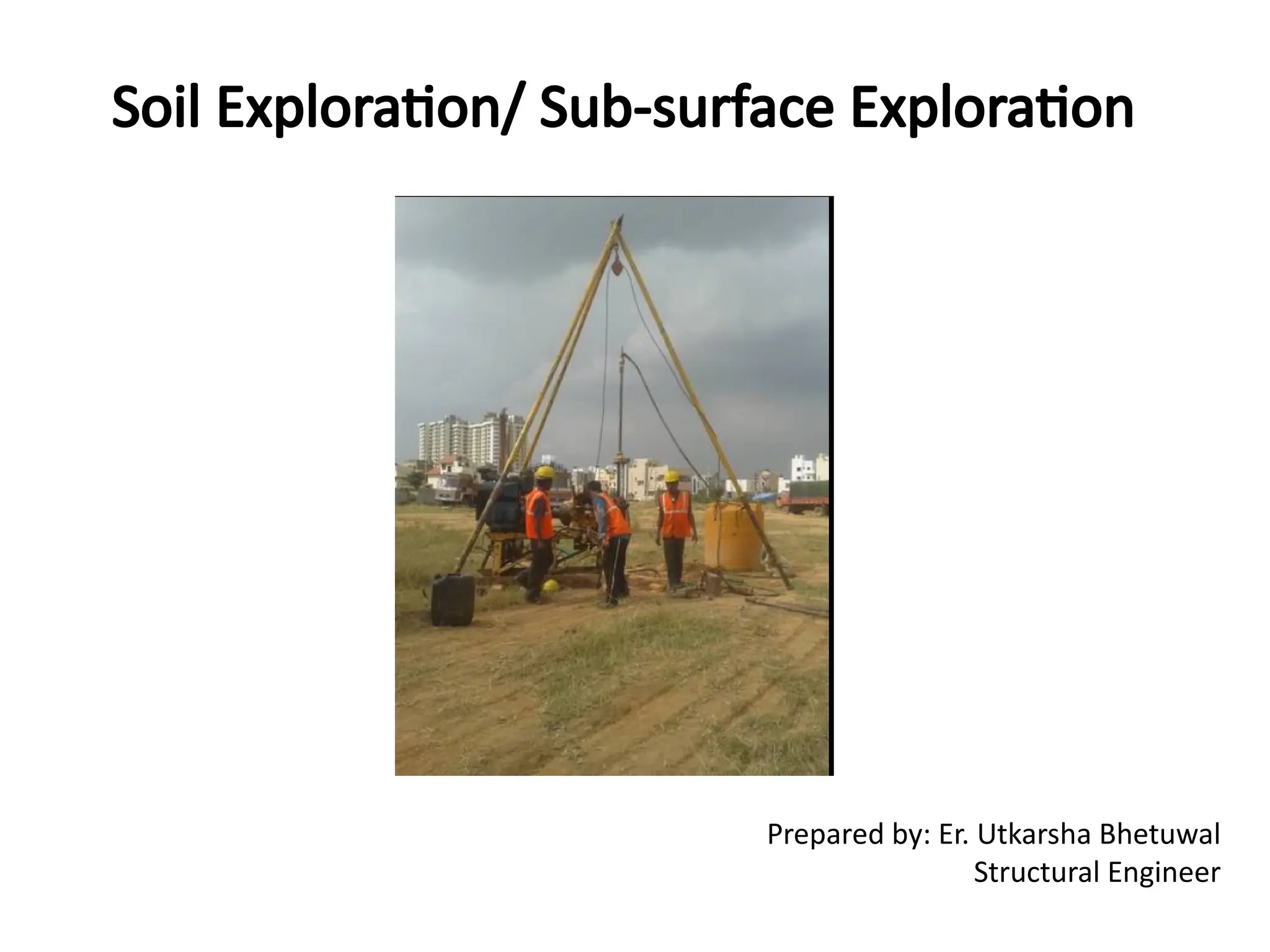
Soil Exploration/ Sub-surface Exploration
Prepared by: Er. Utkarsha Bhetuwal
Structural Engineer
Soil Exploration
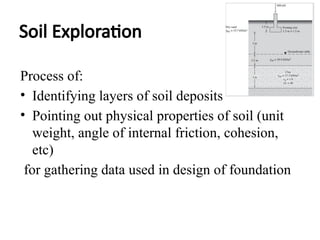
Process of:
• Identifying layers of soil deposits
• Pointing out physical properties of soil (unit
weight, angle of internal friction, cohesion,
etc)
for gathering data used in design of foundation
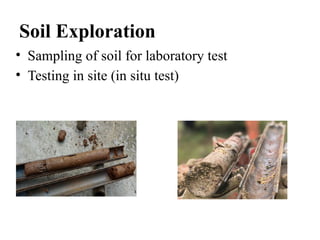
Soil Exploration
• Sampling of soil for laboratory test
• Testing in site (in situ test)
Purpose of the soil exploration
Done to gather data for design of footing:
• Selecting type and depth of foundation
• Evaluating bearing capacity of the foundation
• Estimating probable settlement of structure
• Determining the location of ground water table
• Finding out potential foundation problems (eg.
Expansive soil, collapsible soil, etc)
Depth required for exploration
Depends upon:
• Degree of variation of soil
• Load from the structure
• Characteristics of soil
Methods of soil explorations
• Pits and Trenches
• Boring
• Rotary Drilling
• Core cutting
• Geophysical Methods
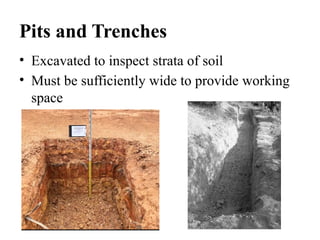
Pits and Trenches
• Excavated to inspect strata of soil
• Must be sufficiently wide to provide working
space
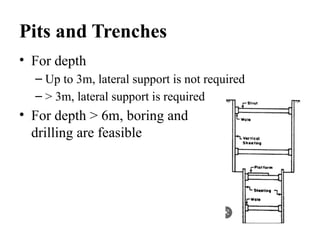
Pits and Trenches
• For depth
– Up to 3m, lateral support is not required
– > 3m, lateral support is required
• For depth > 6m, boring and
drilling are feasible
Boring and Drilling
• Done when depth of exploration is large
• Types
– Auger Boring
– Wash Boring
– Rotary Drill
– Percussion Drill
Auger Boring
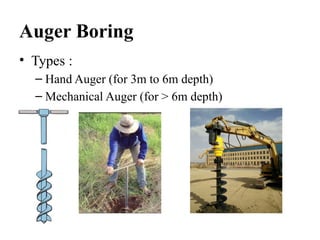
• Types :
– Hand Auger (for 3m to 6m depth)
– Mechanical Auger (for > 6m depth)
Auger Boring
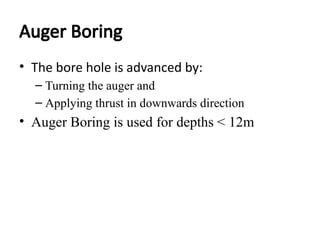
• The bore hole is advanced by:
– Turning the auger and
– Applying thrust in downwards direction
• Auger Boring is used for depths < 12m
Wash Boring
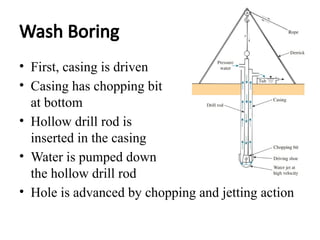
• First, casing is driven
• Casing has chopping bit
at bottom
• Hollow drill rod is
inserted in the casing
• Water is pumped down
the hollow drill rod
• Hole is advanced by chopping and jetting action
Wash Boring
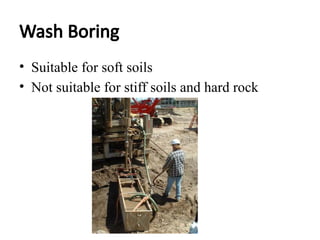
• Suitable for soft soils
• Not suitable for stiff soils and hard rock
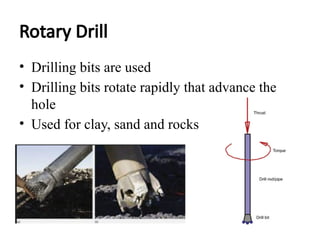
Rotary Drill
• Drilling bits are used
• Drilling bits rotate rapidly that advance the
hole
• Used for clay, sand and rocks
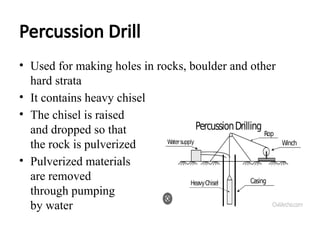
Percussion Drill
• Used for making holes in rocks, boulder and other
hard strata
• It contains heavy chisel
• The chisel is raised
and dropped so that
the rock is pulverized
• Pulverized materials
are removed
through pumping
by water
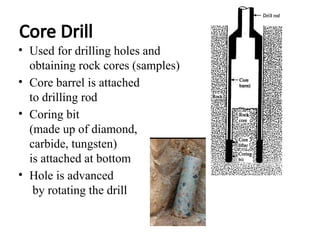
Core Drill
• Used for drilling holes and
obtaining rock cores (samples)
• Core barrel is attached
to drilling rod
• Coring bit
(made up of diamond,
carbide, tungsten)
is attached at bottom
• Hole is advanced
by rotating the drill
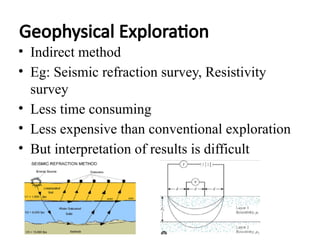
Geophysical Exploration
• Indirect method
• Eg: Seismic refraction survey, Resistivity
survey
• Less time consuming
• Less expensive than conventional exploration
• But interpretation of results is difficult

Structure III 3rd year 2nd part soil exploration.pptx

  • 1.
    Soil Exploration/ Sub-surfaceExploration Prepared by: Er. Utkarsha Bhetuwal Structural Engineer
  • 2.
    Soil Exploration Process of: •Identifying layers of soil deposits • Pointing out physical properties of soil (unit weight, angle of internal friction, cohesion, etc) for gathering data used in design of foundation
  • 3.
    Soil Exploration • Samplingof soil for laboratory test • Testing in site (in situ test)
  • 4.
    Purpose of thesoil exploration Done to gather data for design of footing: • Selecting type and depth of foundation • Evaluating bearing capacity of the foundation • Estimating probable settlement of structure • Determining the location of ground water table • Finding out potential foundation problems (eg. Expansive soil, collapsible soil, etc)
  • 5.
    Depth required forexploration Depends upon: • Degree of variation of soil • Load from the structure • Characteristics of soil
  • 6.
    Methods of soilexplorations • Pits and Trenches • Boring • Rotary Drilling • Core cutting • Geophysical Methods
  • 7.
    Pits and Trenches •Excavated to inspect strata of soil • Must be sufficiently wide to provide working space
  • 8.
    Pits and Trenches •For depth – Up to 3m, lateral support is not required – > 3m, lateral support is required • For depth > 6m, boring and drilling are feasible
  • 9.
    Boring and Drilling •Done when depth of exploration is large • Types – Auger Boring – Wash Boring – Rotary Drill – Percussion Drill
  • 10.
    Auger Boring • Types: – Hand Auger (for 3m to 6m depth) – Mechanical Auger (for > 6m depth)
  • 11.
    Auger Boring • Thebore hole is advanced by: – Turning the auger and – Applying thrust in downwards direction • Auger Boring is used for depths < 12m
  • 12.
    Wash Boring • First,casing is driven • Casing has chopping bit at bottom • Hollow drill rod is inserted in the casing • Water is pumped down the hollow drill rod • Hole is advanced by chopping and jetting action
  • 13.
    Wash Boring • Suitablefor soft soils • Not suitable for stiff soils and hard rock
  • 14.
    Rotary Drill • Drillingbits are used • Drilling bits rotate rapidly that advance the hole • Used for clay, sand and rocks
  • 15.
    Percussion Drill • Usedfor making holes in rocks, boulder and other hard strata • It contains heavy chisel • The chisel is raised and dropped so that the rock is pulverized • Pulverized materials are removed through pumping by water
  • 16.
    Core Drill • Usedfor drilling holes and obtaining rock cores (samples) • Core barrel is attached to drilling rod • Coring bit (made up of diamond, carbide, tungsten) is attached at bottom • Hole is advanced by rotating the drill
  • 17.
    Geophysical Exploration • Indirectmethod • Eg: Seismic refraction survey, Resistivity survey • Less time consuming • Less expensive than conventional exploration • But interpretation of results is difficult