Structuralism/ Semiotics
What is structuralism?
It is a mode of knowledge of nature
and human life that is interested in
relationships rather than individual
objects or, alternatively, where objects
are defined by the set of relationships
of which they are part and not by the
qualities possessed by them taken in
isolation.
Order or structure in everything.
structural patterns… society, culture, language, literature… even
thought and behavior.
Central to Structuralism are Binary Oppositions.
Literary texts are composed of a series of signs that make up their
hidden logic.
Originated in the early 1900s, in the
structural linguistics of Ferdinand de
Saussure.
Subsequently taken up by the Prague (Roman
Jakobson) Moscow and Copenhagen schools of
linguistics.
• In the late 1950s and early 1960s, structural linguistics
was challenged by Noam Chomsky and other like
theorists.
• Later on, Claude Lévi –Strauss revived structuralism. Noam Chomsky
American Linguist
Claude Lévi –Strauss
French anthropologist
and ethnologist
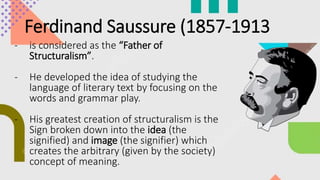
Ferdinand Saussure (1857-1913
- is considered as the “Father of
Structuralism”.
- He developed the idea of studying the
language of literary text by focusing on the
words and grammar play.
- His greatest creation of structuralism is the
Sign broken down into the idea (the
signified) and image (the signifier) which
creates the arbitrary (given by the society)
concept of meaning.
Structuralism Criticism Theory
Uses the structure of analysis analyzes pattern,
narratives, or codes of practice to interpret the text.
It is emphasize instead that the way a person’s behavior
is determined is cultural, social, and psychological. It
often provide one unified approach to one’s life that
would encompass all the instructions.
Example of structuralism is describing your
experience at the ocean by saying it is windy,
salty, and cold, but rejuvenating.
Charles Sanders Peirce (1839-1914)
- Was a scientist, a philosopher best known as the
earliest proponent of pragmatism (after about 1905
called by Peirce “pragmaticism” in order to
differentiate his views from those of William James,
John Dewey, and others, which were being labelled
“pragmatism”).
- a theorist of logic, language, communication, and the
general theory of signs (which was often called by
Peirce “semiotic”)
Peirce’s Sign Theory, or Semiotic, is an account of signification,
representation, reference and meaning.
Peirce’s accounts are distinctive and innovative for their
breadth and complexity, and for capturing the importance of
interpretation to signification.
Sign is something which stands to somebody for something in
some respect or capacity.
An example of a sign whose sign-vehicle uses
existential facts is smoke as a sign for fire; the causal
relation between the fire and smoke allows the smoke
to act as a signifier. Other cases are the molehill
example used earlier, and temperature as a sign for a
fever. Any sign whose sign-vehicle relies upon
existential connections with its object is named, by
Peirce, a sinsign.
Structuralism-theory Literary Criti.pptx

Structuralism-theory Literary Criti.pptx

  • 1.
  • 2.
    What is structuralism? Itis a mode of knowledge of nature and human life that is interested in relationships rather than individual objects or, alternatively, where objects are defined by the set of relationships of which they are part and not by the qualities possessed by them taken in isolation.
  • 3.
    Order or structurein everything. structural patterns… society, culture, language, literature… even thought and behavior. Central to Structuralism are Binary Oppositions. Literary texts are composed of a series of signs that make up their hidden logic.
  • 4.
    Originated in theearly 1900s, in the structural linguistics of Ferdinand de Saussure.
  • 5.
    Subsequently taken upby the Prague (Roman Jakobson) Moscow and Copenhagen schools of linguistics.
  • 6.
    • In thelate 1950s and early 1960s, structural linguistics was challenged by Noam Chomsky and other like theorists. • Later on, Claude Lévi –Strauss revived structuralism. Noam Chomsky American Linguist Claude Lévi –Strauss French anthropologist and ethnologist
  • 7.
    Ferdinand Saussure (1857-1913 -is considered as the “Father of Structuralism”. - He developed the idea of studying the language of literary text by focusing on the words and grammar play. - His greatest creation of structuralism is the Sign broken down into the idea (the signified) and image (the signifier) which creates the arbitrary (given by the society) concept of meaning.
  • 8.
    Structuralism Criticism Theory Usesthe structure of analysis analyzes pattern, narratives, or codes of practice to interpret the text. It is emphasize instead that the way a person’s behavior is determined is cultural, social, and psychological. It often provide one unified approach to one’s life that would encompass all the instructions.
  • 10.
    Example of structuralismis describing your experience at the ocean by saying it is windy, salty, and cold, but rejuvenating.
  • 11.
    Charles Sanders Peirce(1839-1914) - Was a scientist, a philosopher best known as the earliest proponent of pragmatism (after about 1905 called by Peirce “pragmaticism” in order to differentiate his views from those of William James, John Dewey, and others, which were being labelled “pragmatism”). - a theorist of logic, language, communication, and the general theory of signs (which was often called by Peirce “semiotic”)
  • 12.
    Peirce’s Sign Theory,or Semiotic, is an account of signification, representation, reference and meaning. Peirce’s accounts are distinctive and innovative for their breadth and complexity, and for capturing the importance of interpretation to signification. Sign is something which stands to somebody for something in some respect or capacity.
  • 14.
    An example ofa sign whose sign-vehicle uses existential facts is smoke as a sign for fire; the causal relation between the fire and smoke allows the smoke to act as a signifier. Other cases are the molehill example used earlier, and temperature as a sign for a fever. Any sign whose sign-vehicle relies upon existential connections with its object is named, by Peirce, a sinsign.