STRUCTURAL WELDING
AND AWS D1.1; 2020
IntPE M.A.S. Upul Kumara,
BScEng (Pdn), PGDipEPCEng(Pdn), MSc (My), IntPE, CEng, FIE(SL) CPEngNZ, MAWS (USA), MASME(USA), PM-ASNT(USA),
+94 773151906
kumar.msu906.gmail.com
WELDING IS A NEVER ENDING PROCESS
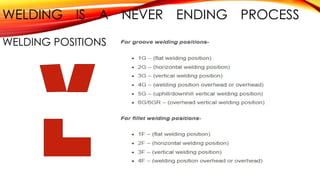
WELDING POSITIONS
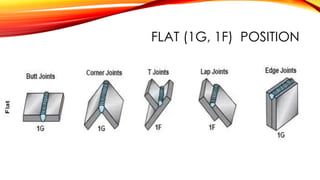
FLAT (1G, 1F) POSITION
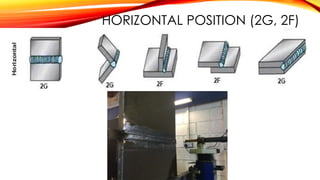
HORIZONTAL POSITION (2G, 2F)
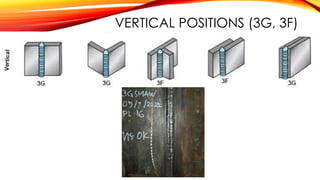
VERTICAL POSITIONS (3G, 3F)
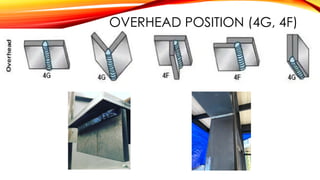
OVERHEAD POSITION (4G, 4F)
TYPES OF WELDING JOINTS
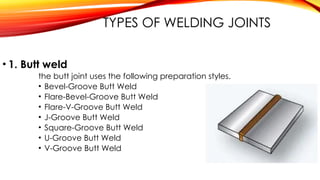
• 1. Butt weld
the butt joint uses the following preparation styles.
• Bevel-Groove Butt Weld
• Flare-Bevel-Groove Butt Weld
• Flare-V-Groove Butt Weld
• J-Groove Butt Weld
• Square-Groove Butt Weld
• U-Groove Butt Weld
• V-Groove Butt Weld
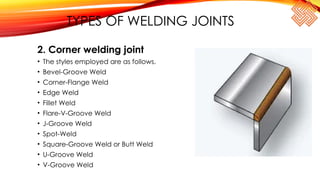
2. Corner welding joint
• The styles employed are as follows.
• Bevel-Groove Weld
• Corner-Flange Weld
• Edge Weld
• Fillet Weld
• Flare-V-Groove Weld
• J-Groove Weld
• Spot-Weld
• Square-Groove Weld or Butt Weld
• U-Groove Weld
• V-Groove Weld
TYPES OF WELDING JOINTS
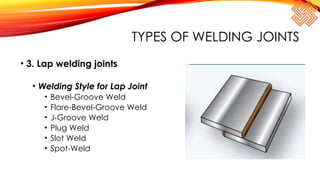
• 3. Lap welding joints
• Welding Style for Lap Joint
• Bevel-Groove Weld
• Flare-Bevel-Groove Weld
• J-Groove Weld
• Plug Weld
• Slot Weld
• Spot-Weld
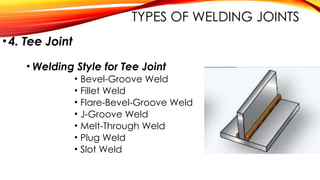
•4. Tee Joint
• Welding Style for Tee Joint
• Bevel-Groove Weld
• Fillet Weld
• Flare-Bevel-Groove Weld
• J-Groove Weld
• Melt-Through Weld
• Plug Weld
• Slot Weld
TYPES OF WELDING JOINTS
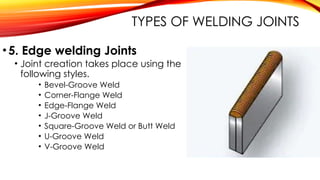
•5. Edge welding Joints
• Joint creation takes place using the
following styles.
• Bevel-Groove Weld
• Corner-Flange Weld
• Edge-Flange Weld
• J-Groove Weld
• Square-Groove Weld or Butt Weld
• U-Groove Weld
• V-Groove Weld
TYPES OF WELDING JOINTS
The following are some of the most used welding
types in the industry.
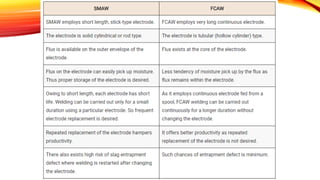
1. Gas Metal Arc Welding (GMAW) – MIG
2. Gas Tungsten Arc Welding (GTAW) – TIG
3. Flux Cored Arc Welding (FCAW)
4. Shielded Metal Arc Welding (SMAW) – Stick
5. Atomic Hydrogen Welding (AHW)
6. Energy Beam Welding (EBW)
7. Underwater Welding
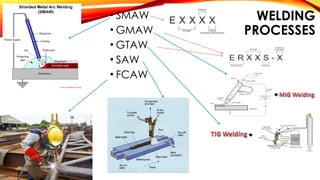
TYPES OF WELDING PROCESSES
WELDING
PROCESSES
• SMAW
• GMAW
• GTAW
• SAW
• FCAW
BASED ON AWS D1.1;2020 VERSION
• Code comprised of following sections
• Section 1. General Requirements
• Section 2. Normative References
• Section 3. Terms and Definitions
• Section 4. Design of welded connections
• Section 5. Prequalification of WPS
• Section 6. Qualification
• Section 7. Fabrication
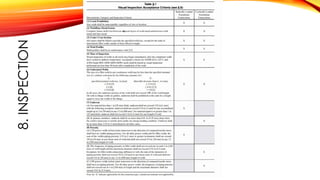
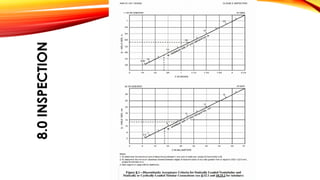
• Section 8. Inspection
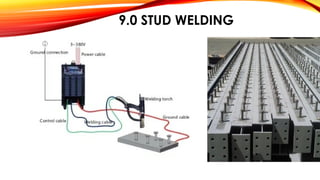
• Section 9. Stud welding
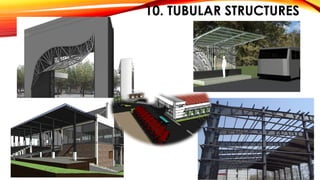
• Section 10. Tubular Structures
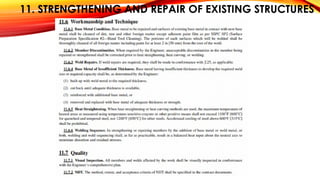
• Section 11. Strengthening and Repair of Existing structures
SECTION 1. GENERAL REQUIREMENTS
• 1.1 Scope
• This code contains the requirements for fabricating and erecting
welded steel structures. When this code is stipulated in contract
documents, conformance with all provisions of the code shall be
required, except for those provisions that the Engineer or
contract documents specifically modifies or exempts.
SECTION 1. GENERAL REQUIREMENTS
• 1.2 Standard Unit of Measurements
• This standard makes use of both U.S. Customary Units and the
International System of Units (SI). The latter are shown within
brackets ([ ]) or in appropriate columns in tables and figures. The
measurements may not be exact equivalents; therefore, each
system must be used independently.
SECTION 1. GENERAL REQUIREMENTS
• 1.3 Safety Precautions
• Safety and health issues and concerns are beyond the scope of this standard
and therefore are not fully addressed herein. It is the responsibility of the user to
establish appropriate safety and health practices. Safety and health
information is available from the following sources:
• American Welding Society:
• (1) ANSI Z49.1, Safety in Welding, Cutting, and Allied Processes
• (2) AWS Safety and Health Fact Sheets
• (3) Other safety and health information on the AWS website
• Material or Equipment Manufacturers:
• (1) Safety Data Sheets supplied by materials manufacturers
• (2) Operating Manuals supplied by equipment manufacturers
• Applicable Regulatory Agencies
SECTION 1. GENERAL REQUIREMENTS
• 1.4 Limitations
• The code was specifically developed for welded steel structures that utilize carbon or low alloy steels
that are 1/8 in [3 mm] or thicker with a minimum specified yield strength of 100 ksi [690 MPa] or less.
The code may be suitable to govern structural fabrications outside the scope of the intended
purpose.
However,
• the Engineer should evaluate such suitability, and based upon such evaluations, incorporate into
contract documents any necessary changes to code requirements to address the specific
requirements of the application that is outside the scope of the code.
• The Structural Welding Committee encourages the Engineer to consider the applicability of other
AWS DI codes for applications involving
• aluminum (AWS D l.2),
• sheet steel equal to or less than 3/16 in [5 mm] thick (AWS D l.3),
• reinforcing steel (AWS D l.4),
• stainless steel (AWS D l.6),
• strengthening and repair of existing structures (AWS D l.7),
• seismic supplement (AWS D l.8),
• and titanium (AWS D l.9).
• The AASHTO/AWS D l.5 Bridge Welding Code was specifically developed for welding highway bridge
components and is recommended for those applications.
SECTION 1. GENERAL REQUIREMENTS
• 1.5 Responsibilities
• 1.5.1. Engineers Responsibility
• The Engineer shall be responsible for the development of the contract documents that
govern products or structural assemblies produced under this code.
• The Engineer may add to, delete from, or otherwise modify, the requirements of this code
to meet the particular requirements of a specific structure. All requirements that modify this
code shall be incorporated into contract documents.
• The Engineer shall determine the suitability of all joint details to be used in a welded
assembly.
• The Engineer shall specify in contract documents, as necessary, and as applicable, the
following:
• (1) Code requirements that are applicable only when specified by the Engineer.
• (2) All additional NDT that is not specifically addressed in the code.
• (3) Extent of verification inspection, when required.
• (4) Weld acceptance criteria other than that specified in Clause .8_.
• (5) CVN toughness criteria for weld metal, base metal, and/or RAZ when required.
• (6) For nontubular applications, whether the structure is statically or cyclically loaded.
SECTION 1. GENERAL REQUIREMENTS
• 1.5 Responsibilities
• (7J Which welded joints are loaded in tension.
• (8) All additional requirements that are not specifically addressed in the code.
• (9) For OEM applications, the responsibilities of the parties involved.
1.5.2 Contractor's Responsibilities. The Contractor shall be responsible for WPSs,
qualification of welding personnel, the Contractor's inspection, and performing work
in conformance with the requirements of this code and contract documents.
1.5.3 Inspector's Responsibilities
1.5.3.1 Contractor Inspection. Contractor inspection shall be supplied by the Contractor
and shall be performed as necessary to ensure that materials and workmanship meet the
requirements of the contract documents.
1.5.3.2 Verification Inspection. The Engineer shall determine if Verification Inspection shall
be performed. Responsibilities for Verification Inspection shall be established between the
Engineer and the Verification Inspector.
SECTION 1. GENERAL REQUIREMENTS
• 1.6 Approvals
All references to the need for approval
shall be interpreted to mean approval by
the Authority Having Jurisdiction or the
Engineer.
SECTION 1. GENERAL REQUIREMENTS
• 1.7 Mandatory and Nonmandatory Provisions
• Shall. Code provisions that use "shall" are mandatory unless specifically
modified in contract documents by the Engineer.
• Should. The word "should" is used to recommend practices that are
considered beneficial, but are not requirements.
• May. The word "may" in a provision allows the use of optional procedures
or practices that can be used as an alternative or supplement to code
requirements. Those optional procedures that require the Engineer's
approval shall either be specified in the contract documents, or require
the Engineer's approval. The Contractor may use any option without the
Engineer's approval when the code does not specify that the Engineer's
approval shall be required.
SECTION 1. GENERAL REQUIREMENTS
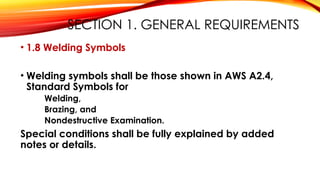
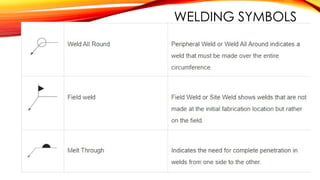
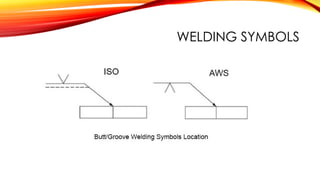
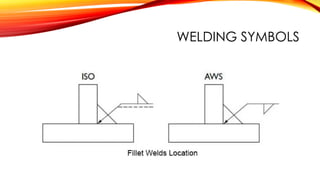
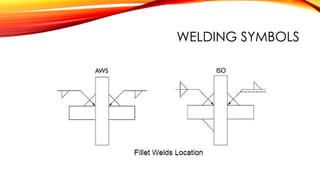
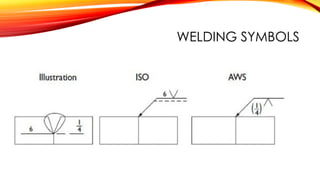
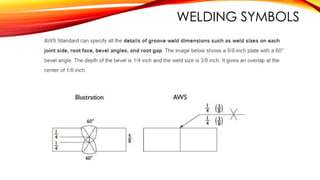
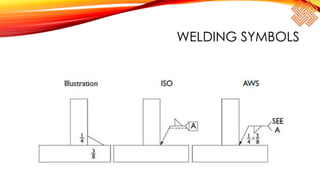
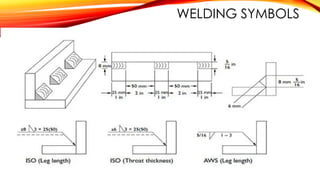
• 1.8 Welding Symbols
• Welding symbols shall be those shown in AWS A2.4,
Standard Symbols for
Welding,
Brazing, and
Nondestructive Examination.
Special conditions shall be fully explained by added
notes or details.
WELDING SYMBOLS
WELDING SYMBOLS
WELDING SYMBOLS
WELDING SYMBOLS
WELDING SYMBOLS
WELDING SYMBOLS
WELDING SYMBOLS
WELDING SYMBOLS
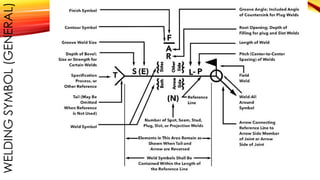
WELDING
SYMBOL
(GENERAL)
SECTION 02, 03 WILL BE DISCUSSED LATER
• Definition of terminologies and the list of references will be
discussed during the course and a complete description
will be give in the latter part.
• Section 02 – Normative References
• Section 03 – Terms and Definitions.
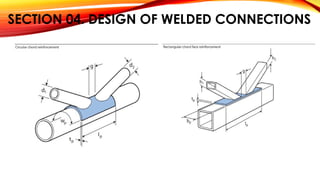
SECTION 04. DESIGN OF WELDED
CONNECTIONS
• Part A-Common Requirements for Design of Welded Connections (Non
tubular and Tubular Members)
• Part B-Specific Requirements for Design of Non tubular Connections
(Statically or Cyclically Loaded). The requirements shall apply in
addition to the requirements of Part A.
• Part C-Specific Requirements for Design of Non tubular Connections
(Cyclically Loaded). When applicable, the requirements shall apply in
addition to the requirements of Parts A and B.
SECTION 04. DESIGN OF WELDED
CONNECTIONS
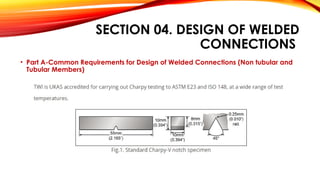
• Part A-Common Requirements for Design of Welded Connections (Non tubular and
Tubular Members)
SECTION 04. DESIGN OF WELDED CONNECTIONS
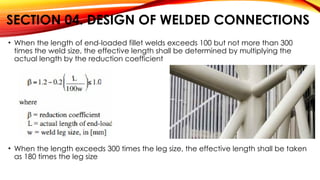
• When the length of end-loaded fillet welds exceeds 100 but not more than 300
times the weld size, the effective length shall be determined by multiplying the
actual length by the reduction coefficient
• When the length exceeds 300 times the leg size, the effective length shall be taken
as 180 times the leg size
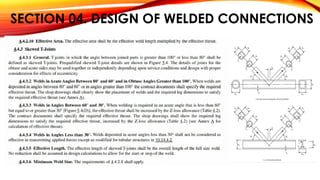
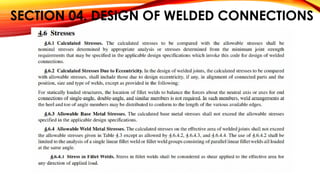
SECTION 04. DESIGN OF WELDED CONNECTIONS
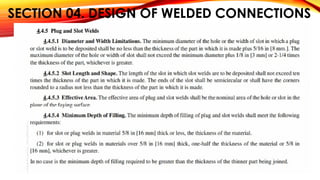
SECTION 04. DESIGN OF WELDED
CONNECTIONS
• PART B, Specific Requirements for Design of Nontubular Connections (Statically or
Cyclically Loaded)
• In General
• The specific requirements of Part B together with the requirements of Part A shall
apply to all connections of nontubular members subject to static loading. The
requirements of Parts A and B, except as modified by Part C, shall also apply to
cyclic loading.
SECTION 04. DESIGN OF WELDED CONNECTIONS
DESIGN OF A BUTT WELDED JOINTS
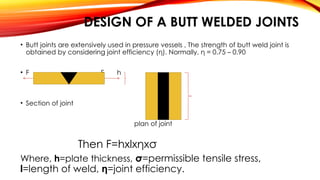
• Butt joints are extensively used in pressure vessels , The strength of butt weld joint is
obtained by considering joint efficiency (η). Normally, η = 0.75 – 0.90
• F F h
l
• Section of joint
plan of joint
Then F=hxlxηxσ
Where, h=plate thickness, σ=permissible tensile stress,
l=length of weld, η=joint efficiency.
DESIGN OF BUT WELDED JOINTS
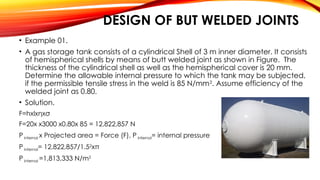
• Example 01.
• A gas storage tank consists of a cylindrical Shell of 3 m inner diameter. It consists
of hemispherical shells by means of butt welded joint as shown in Figure. The
thickness of the cylindrical shell as well as the hemispherical cover is 20 mm.
Determine the allowable internal pressure to which the tank may be subjected,
if the permissible tensile stress in the weld is 85 N/mm2
. Assume efficiency of the
welded joint as 0.80.
• Solution.
F=hxlxηxσ
F=20x x3000 x0.80x 85 = 12,822,857 N
P internal x Projected area = Force (F), P internal= internal pressure
P internal= 12,822,857/1.52
xπ
P internal =1,813,333 N/m2
SOME OTHER EXAMPLES
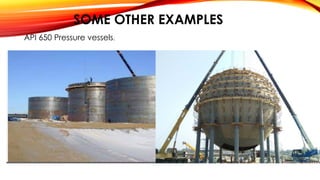
API 650 Pressure vessels.
DESIGN OF A FILLET WELD JOINT
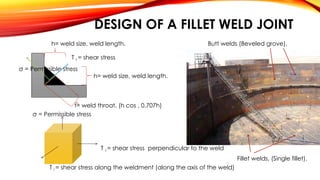
h= weld size, weld length.
t= weld throat, (h cos , 0.707h)
σ = Permissible stress
Τ t = shear stress
Τ t = shear stress perpendicular to the weld
Τ l = shear stress along the weldment (along the axis of the weld)
σ = Permissible stress
Butt welds (Beveled grove).
Fillet welds, (Single fillet).
DESIGN OF A FILLET WELD
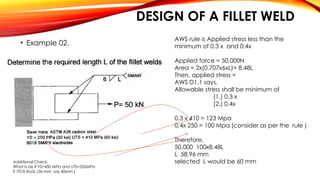
• Example 02.
AWS rule is Applied stress less than the
minimum of 0.3 x and 0.4x
Applied force = 50,000N
Area = 2x(0.707x6xL)= 8.48L
Then, applied stress =
AWS D1.1 says,
Allowable stress shall be minimum of
(1.) 0.3 x
(2.) 0.4x
0.3 x 410 = 123 Mpa
0.4x 250 = 100 Mpa (consider as per the rule )
Therefore,
50,000 100x8.48L
L 58.96 mm
selected L would be 60 mm
Additional Check;
What is be if YS=450 MPa and UTS=550MPa
E 7018 Rods (36 mm, say 40mm.)
SECTION 05 & 06.
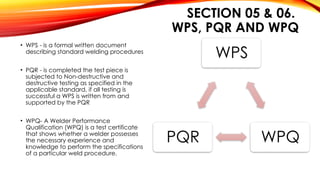
WPS, PQR AND WPQ
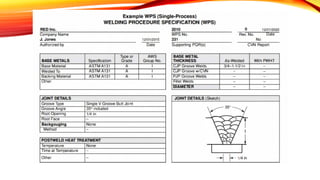
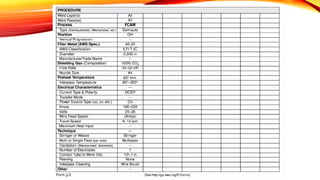
• WPS - is a formal written document
describing standard welding procedures
• PQR - is completed the test piece is
subjected to Non-destructive and
destructive testing as specified in the
applicable standard, if all testing is
successful a WPS is written from and
supported by the PQR
• WPQ- A Welder Performance
Qualification (WPQ) is a test certificate
that shows whether a welder possesses
the necessary experience and
knowledge to perform the specifications
of a particular weld procedure.
WPS
WPQ
PQR
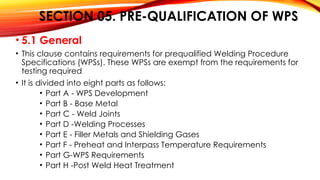
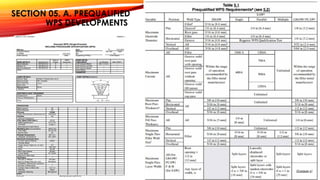
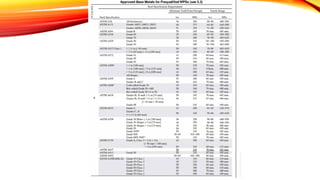
SECTION 05. PRE-QUALIFICATION OF WPS
• 5.1 General
• This clause contains requirements for prequalified Welding Procedure
Specifications (WPSs). These WPSs are exempt from the requirements for
testing required
• It is divided into eight parts as follows:
• Part A - WPS Development
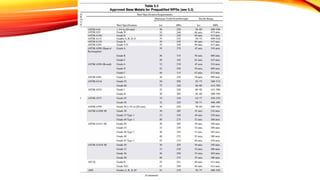
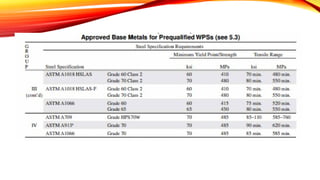
• Part B - Base Metal
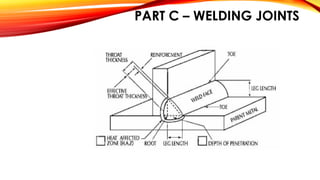
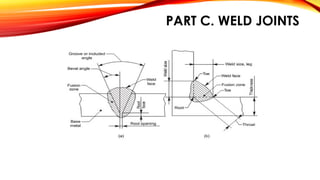
• Part C - Weld Joints
• Part D -Welding Processes
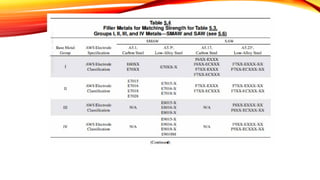
• Part E - Filler Metals and Shielding Gases
• Part F - Preheat and Interpass Temperature Requirements
• Part G-WPS Requirements
• Part H -Post Weld Heat Treatment
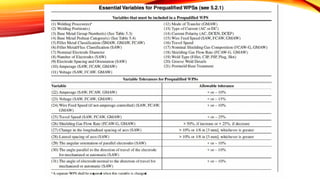
SECTION 05. A. PREQUALIFIED
WPS DEVELOPMENTS
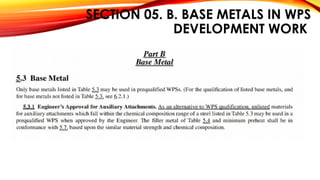
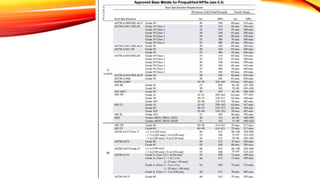
SECTION 05. B. BASE METALS IN WPS
DEVELOPMENT WORK
PART C – WELDING JOINTS
PART C. WELD JOINTS
7. FABRICATION
• Baking Electrodes.
• Electrodes exposed to the atmosphere for periods greater than those allowed,
shall be baked as follows:
• (1) All electrodes having low-hydrogen coverings conforming to AWS A5.1 shall
be baked for at least two hours between 500°F and 800°F [260°C and 430°C], or
• (2) All electrodes having low-hydrogen coverings conforming to A WS A5.5 shall
be baked for at least one hour at temperatures between 700°F and 800°F [370°C
and 430°C].
• All electrodes shall be placed in a suitable oven at a temperature not exceeding
one half the final baking temperature for a minimum of one half hour prior to
increasing the oven temperature to the final baking temperature. Final baking
time shall start after the oven reaches final baking temperature.
7 FABRICATIONS
Surfaces to be welded, and surfaces adjacent to the weld, shall
be cleaned to remove excessive quantities of the following:
• (1) Water
• (2) Oil
• (3) Grease
• (4) Other hydrocarbon based materials
Welding on surfaces containing residual amounts of
foreign materials is permitted provided the quality
requirements of this code are met.
FABRICATION
• Machining, thermal cutting, gouging (including plasma arc cutting and
gouging), chipping, or grinding may be used for joint preparation, or the
removal of unacceptable work or metal, except that oxygen gouging shall
only be permitted for use on as-rolled steels
• Electric arc cutting and gouging processes (including plasma arc cutting
and gouging) and oxyfuel gas cutting processes are recognized under this
code for use in preparing, cutting, or trimming materials.
• In making welds under conditions of severe external shrinkage restraint, once
the welding has started, the joint shall not be allowed to cool below the
minimum specified preheat until the joint has been completed or sufficient
weld has been deposited to ensure freedom from cracking
7. FABRICATION
•Statically Loaded Nontubular Structures.
Variations from flatness of webs having a depth, D, and a thickness, t, in panels
bounded by stiffeners or flanges, or both, whose least panel dimension is d shall
not exceed the following:
• Intermediate stiffeners on both sides of web
where D/t < 150, maximum variation = d/100
where D/t 2'. 150, maximum variation = d/80
• Intermediate stiffeners on one side only of web
where D/t < 100, maximum variation = d/100
where D/t 2'. 100, maximum variation = d/67
• No intermediate stiffeners
where D/t 2'. 100, maximum variation = D/150
7. FABRICATION
•Cyclically Loaded Nontubular Structures.
Variation from flatness of webs having a depth, D, and a thickness, t, in panels
bounded by stiffeners or flanges, or both, whose least panel dimension is d shall
not exceed the following:
Intermediate stiffeners on both sides of web Interior girders
where D/t < 150 maximum variation = d/115
where D/t 2'. 150-maximum variation = d/92
Fascia girders
where D/t < 150 maximum variation = d/130
where D/t 2'. 150-maximum variation = d/105
Intermediate stiffeners on one side only of web Interior girders
where D/t < 100-maximum variation = d/100
where D/t 2'. 100-maximum variation = d/67
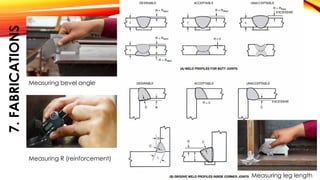
7.
FABRICATIONS
Measuring bevel angle
Measuring leg length
Measuring R (reinforcement)
8. INSPECTION
•8.1.3 Definition of Inspector Categories
8.1.3.1 Contractor's Inspector.
This inspector is the duly designated person who acts for, and in behalf of, the
Contractor on all inspection and quality matters within the scope of the contract
documents .
8.1.3.2 Verification Inspector.
This inspector is the duly designated person who acts for, and in behalf of, the
Owner or Engineer on all inspection and quality matters within the scope of the
contract documents .
8.1.3.3 Inspector(s).
When the term inspector is used without further qualification as to the specific
inspector category described above, it applies equally to inspection and
verification within the limits of responsibility described in
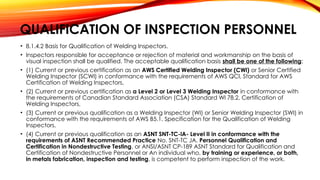
QUALIFICATION OF INSPECTION PERSONNEL
• 8.1.4.2 Basis for Qualification of Welding Inspectors.
• Inspectors responsible for acceptance or rejection of material and workmanship on the basis of
visual inspection shall be qualified. The acceptable qualification basis shall be one of the following:
• (1) Current or previous certification as an AWS Certified Welding Inspector (CWl) or Senior Certified
Welding Inspector (SCWl) in conformance with the requirements of AWS QCl, Standard for AWS
Certification of Welding Inspectors,
• (2) Current or previous certification as a Level 2 or Level 3 Welding Inspector in conformance with
the requirements of Canadian Standard Association (CSA) Standard Wl 78.2, Certification of
Welding Inspectors,
• (3) Current or previous qualification as a Welding Inspector (WI) or Senior Welding Inspector (SWI) in
conformance with the requirements of AWS B5.1, Specification for the Qualification of Welding
Inspectors,
• (4) Current or previous qualification as an ASNT SNT-TC-lA- Level II in conformance with the
requirements of ASNT Recommended Practice No. SNT-TC JA. Personnel Qualification and
Certification in Nondestructive Testing. or ANSI/ASNT CP-189 ASNT Standard for Qualification and
Certification of Nondestructive Personnel or An individual who, by training or experience, or both,
in metals fabrication, inspection and testing, is competent to perform inspection of the work.
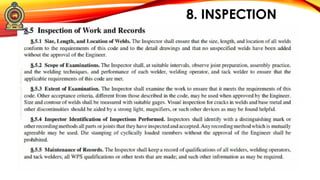
8. INSPECTION
8. INSPECTION
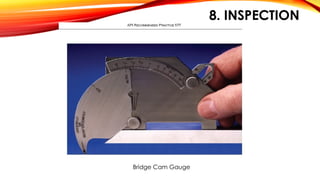
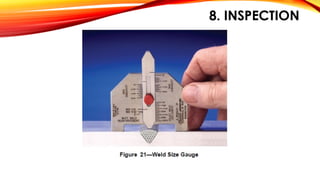
Bridge Cam Gauge
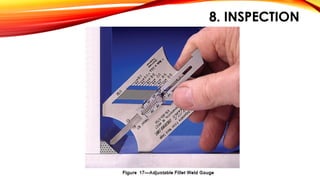
8. INSPECTION
8. INSPECTION
8. INSPECTION
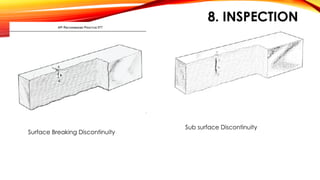
Surface Breaking Discontinuity
Sub surface Discontinuity
8.
INSPECTION
8.
INSPECTION
8.0
INSPECTION
9.0 STUD WELDING
10. TUBULAR STRUCTURES
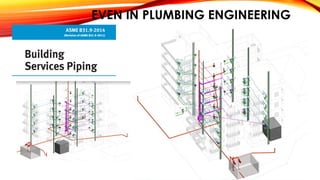
EVEN IN PLUMBING ENGINEERING
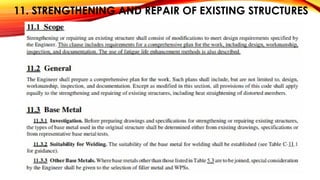
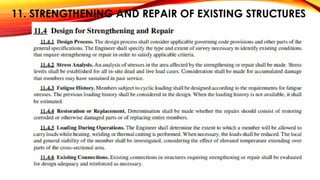
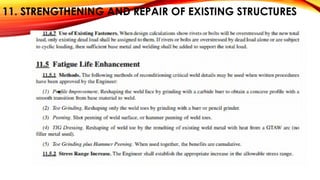
11. STRENGTHENING AND REPAIR OF EXISTING STRUCTURES
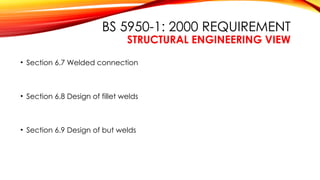
BS 5950-1: 2000 REQUIREMENT
STRUCTURAL ENGINEERING VIEW
• Section 6.7 Welded connection
• Section 6.8 Design of fillet welds
• Section 6.9 Design of but welds
THE END
• Thanks to IESL and the audience for listening me
• To all my present and future clients for giving me an opportunity to
gather these practical experiences.
• IntPE M.A.S. Upul Kumara,
• BScEng (Pdn), PGDipEPCEng(Pdn), MSc (My), IntPE, CEng, FIE(SL) CPEngNZ, MAWS (USA), MASME(USA), PM-ASNT(USA),
• +94 773151906
• kumar.msu906.gmail.com

Structural Welding and AWS D1.1 : 2020.pptx

  • 1.
    STRUCTURAL WELDING AND AWSD1.1; 2020 IntPE M.A.S. Upul Kumara, BScEng (Pdn), PGDipEPCEng(Pdn), MSc (My), IntPE, CEng, FIE(SL) CPEngNZ, MAWS (USA), MASME(USA), PM-ASNT(USA), +94 773151906 kumar.msu906.gmail.com
  • 2.
    WELDING IS ANEVER ENDING PROCESS WELDING POSITIONS
  • 3.
    FLAT (1G, 1F)POSITION
  • 4.
  • 5.
  • 6.
  • 7.
    TYPES OF WELDINGJOINTS • 1. Butt weld the butt joint uses the following preparation styles. • Bevel-Groove Butt Weld • Flare-Bevel-Groove Butt Weld • Flare-V-Groove Butt Weld • J-Groove Butt Weld • Square-Groove Butt Weld • U-Groove Butt Weld • V-Groove Butt Weld
  • 8.
    2. Corner weldingjoint • The styles employed are as follows. • Bevel-Groove Weld • Corner-Flange Weld • Edge Weld • Fillet Weld • Flare-V-Groove Weld • J-Groove Weld • Spot-Weld • Square-Groove Weld or Butt Weld • U-Groove Weld • V-Groove Weld TYPES OF WELDING JOINTS
  • 9.
    TYPES OF WELDINGJOINTS • 3. Lap welding joints • Welding Style for Lap Joint • Bevel-Groove Weld • Flare-Bevel-Groove Weld • J-Groove Weld • Plug Weld • Slot Weld • Spot-Weld
  • 10.
    •4. Tee Joint •Welding Style for Tee Joint • Bevel-Groove Weld • Fillet Weld • Flare-Bevel-Groove Weld • J-Groove Weld • Melt-Through Weld • Plug Weld • Slot Weld TYPES OF WELDING JOINTS
  • 11.
    •5. Edge weldingJoints • Joint creation takes place using the following styles. • Bevel-Groove Weld • Corner-Flange Weld • Edge-Flange Weld • J-Groove Weld • Square-Groove Weld or Butt Weld • U-Groove Weld • V-Groove Weld TYPES OF WELDING JOINTS
  • 12.
    The following aresome of the most used welding types in the industry. 1. Gas Metal Arc Welding (GMAW) – MIG 2. Gas Tungsten Arc Welding (GTAW) – TIG 3. Flux Cored Arc Welding (FCAW) 4. Shielded Metal Arc Welding (SMAW) – Stick 5. Atomic Hydrogen Welding (AHW) 6. Energy Beam Welding (EBW) 7. Underwater Welding TYPES OF WELDING PROCESSES
  • 13.
  • 14.
    BASED ON AWSD1.1;2020 VERSION • Code comprised of following sections • Section 1. General Requirements • Section 2. Normative References • Section 3. Terms and Definitions • Section 4. Design of welded connections • Section 5. Prequalification of WPS • Section 6. Qualification • Section 7. Fabrication • Section 8. Inspection • Section 9. Stud welding • Section 10. Tubular Structures • Section 11. Strengthening and Repair of Existing structures
  • 15.
    SECTION 1. GENERALREQUIREMENTS • 1.1 Scope • This code contains the requirements for fabricating and erecting welded steel structures. When this code is stipulated in contract documents, conformance with all provisions of the code shall be required, except for those provisions that the Engineer or contract documents specifically modifies or exempts.
  • 16.
    SECTION 1. GENERALREQUIREMENTS • 1.2 Standard Unit of Measurements • This standard makes use of both U.S. Customary Units and the International System of Units (SI). The latter are shown within brackets ([ ]) or in appropriate columns in tables and figures. The measurements may not be exact equivalents; therefore, each system must be used independently.
  • 17.
    SECTION 1. GENERALREQUIREMENTS • 1.3 Safety Precautions • Safety and health issues and concerns are beyond the scope of this standard and therefore are not fully addressed herein. It is the responsibility of the user to establish appropriate safety and health practices. Safety and health information is available from the following sources: • American Welding Society: • (1) ANSI Z49.1, Safety in Welding, Cutting, and Allied Processes • (2) AWS Safety and Health Fact Sheets • (3) Other safety and health information on the AWS website • Material or Equipment Manufacturers: • (1) Safety Data Sheets supplied by materials manufacturers • (2) Operating Manuals supplied by equipment manufacturers • Applicable Regulatory Agencies
  • 18.
    SECTION 1. GENERALREQUIREMENTS • 1.4 Limitations • The code was specifically developed for welded steel structures that utilize carbon or low alloy steels that are 1/8 in [3 mm] or thicker with a minimum specified yield strength of 100 ksi [690 MPa] or less. The code may be suitable to govern structural fabrications outside the scope of the intended purpose. However, • the Engineer should evaluate such suitability, and based upon such evaluations, incorporate into contract documents any necessary changes to code requirements to address the specific requirements of the application that is outside the scope of the code. • The Structural Welding Committee encourages the Engineer to consider the applicability of other AWS DI codes for applications involving • aluminum (AWS D l.2), • sheet steel equal to or less than 3/16 in [5 mm] thick (AWS D l.3), • reinforcing steel (AWS D l.4), • stainless steel (AWS D l.6), • strengthening and repair of existing structures (AWS D l.7), • seismic supplement (AWS D l.8), • and titanium (AWS D l.9). • The AASHTO/AWS D l.5 Bridge Welding Code was specifically developed for welding highway bridge components and is recommended for those applications.
  • 19.
    SECTION 1. GENERALREQUIREMENTS • 1.5 Responsibilities • 1.5.1. Engineers Responsibility • The Engineer shall be responsible for the development of the contract documents that govern products or structural assemblies produced under this code. • The Engineer may add to, delete from, or otherwise modify, the requirements of this code to meet the particular requirements of a specific structure. All requirements that modify this code shall be incorporated into contract documents. • The Engineer shall determine the suitability of all joint details to be used in a welded assembly. • The Engineer shall specify in contract documents, as necessary, and as applicable, the following: • (1) Code requirements that are applicable only when specified by the Engineer. • (2) All additional NDT that is not specifically addressed in the code. • (3) Extent of verification inspection, when required. • (4) Weld acceptance criteria other than that specified in Clause .8_. • (5) CVN toughness criteria for weld metal, base metal, and/or RAZ when required. • (6) For nontubular applications, whether the structure is statically or cyclically loaded.
  • 20.
    SECTION 1. GENERALREQUIREMENTS • 1.5 Responsibilities • (7J Which welded joints are loaded in tension. • (8) All additional requirements that are not specifically addressed in the code. • (9) For OEM applications, the responsibilities of the parties involved. 1.5.2 Contractor's Responsibilities. The Contractor shall be responsible for WPSs, qualification of welding personnel, the Contractor's inspection, and performing work in conformance with the requirements of this code and contract documents. 1.5.3 Inspector's Responsibilities 1.5.3.1 Contractor Inspection. Contractor inspection shall be supplied by the Contractor and shall be performed as necessary to ensure that materials and workmanship meet the requirements of the contract documents. 1.5.3.2 Verification Inspection. The Engineer shall determine if Verification Inspection shall be performed. Responsibilities for Verification Inspection shall be established between the Engineer and the Verification Inspector.
  • 21.
    SECTION 1. GENERALREQUIREMENTS • 1.6 Approvals All references to the need for approval shall be interpreted to mean approval by the Authority Having Jurisdiction or the Engineer.
  • 22.
    SECTION 1. GENERALREQUIREMENTS • 1.7 Mandatory and Nonmandatory Provisions • Shall. Code provisions that use "shall" are mandatory unless specifically modified in contract documents by the Engineer. • Should. The word "should" is used to recommend practices that are considered beneficial, but are not requirements. • May. The word "may" in a provision allows the use of optional procedures or practices that can be used as an alternative or supplement to code requirements. Those optional procedures that require the Engineer's approval shall either be specified in the contract documents, or require the Engineer's approval. The Contractor may use any option without the Engineer's approval when the code does not specify that the Engineer's approval shall be required.
  • 23.
    SECTION 1. GENERALREQUIREMENTS • 1.8 Welding Symbols • Welding symbols shall be those shown in AWS A2.4, Standard Symbols for Welding, Brazing, and Nondestructive Examination. Special conditions shall be fully explained by added notes or details.
  • 24.
  • 25.
  • 26.
  • 27.
  • 28.
  • 29.
  • 30.
  • 31.
  • 32.
  • 33.
    SECTION 02, 03WILL BE DISCUSSED LATER • Definition of terminologies and the list of references will be discussed during the course and a complete description will be give in the latter part. • Section 02 – Normative References • Section 03 – Terms and Definitions.
  • 34.
    SECTION 04. DESIGNOF WELDED CONNECTIONS • Part A-Common Requirements for Design of Welded Connections (Non tubular and Tubular Members) • Part B-Specific Requirements for Design of Non tubular Connections (Statically or Cyclically Loaded). The requirements shall apply in addition to the requirements of Part A. • Part C-Specific Requirements for Design of Non tubular Connections (Cyclically Loaded). When applicable, the requirements shall apply in addition to the requirements of Parts A and B.
  • 35.
    SECTION 04. DESIGNOF WELDED CONNECTIONS • Part A-Common Requirements for Design of Welded Connections (Non tubular and Tubular Members)
  • 36.
    SECTION 04. DESIGNOF WELDED CONNECTIONS • When the length of end-loaded fillet welds exceeds 100 but not more than 300 times the weld size, the effective length shall be determined by multiplying the actual length by the reduction coefficient • When the length exceeds 300 times the leg size, the effective length shall be taken as 180 times the leg size
  • 37.
    SECTION 04. DESIGNOF WELDED CONNECTIONS
  • 38.
    SECTION 04. DESIGNOF WELDED CONNECTIONS
  • 40.
    SECTION 04. DESIGNOF WELDED CONNECTIONS
  • 41.
    SECTION 04. DESIGNOF WELDED CONNECTIONS • PART B, Specific Requirements for Design of Nontubular Connections (Statically or Cyclically Loaded) • In General • The specific requirements of Part B together with the requirements of Part A shall apply to all connections of nontubular members subject to static loading. The requirements of Parts A and B, except as modified by Part C, shall also apply to cyclic loading.
  • 42.
    SECTION 04. DESIGNOF WELDED CONNECTIONS
  • 43.
    DESIGN OF ABUTT WELDED JOINTS • Butt joints are extensively used in pressure vessels , The strength of butt weld joint is obtained by considering joint efficiency (η). Normally, η = 0.75 – 0.90 • F F h l • Section of joint plan of joint Then F=hxlxηxσ Where, h=plate thickness, σ=permissible tensile stress, l=length of weld, η=joint efficiency.
  • 44.
    DESIGN OF BUTWELDED JOINTS • Example 01. • A gas storage tank consists of a cylindrical Shell of 3 m inner diameter. It consists of hemispherical shells by means of butt welded joint as shown in Figure. The thickness of the cylindrical shell as well as the hemispherical cover is 20 mm. Determine the allowable internal pressure to which the tank may be subjected, if the permissible tensile stress in the weld is 85 N/mm2 . Assume efficiency of the welded joint as 0.80. • Solution. F=hxlxηxσ F=20x x3000 x0.80x 85 = 12,822,857 N P internal x Projected area = Force (F), P internal= internal pressure P internal= 12,822,857/1.52 xπ P internal =1,813,333 N/m2
  • 45.
    SOME OTHER EXAMPLES API650 Pressure vessels.
  • 46.
    DESIGN OF AFILLET WELD JOINT h= weld size, weld length. h= weld size, weld length. t= weld throat, (h cos , 0.707h) σ = Permissible stress Τ t = shear stress Τ t = shear stress perpendicular to the weld Τ l = shear stress along the weldment (along the axis of the weld) σ = Permissible stress Butt welds (Beveled grove). Fillet welds, (Single fillet).
  • 47.
    DESIGN OF AFILLET WELD • Example 02. AWS rule is Applied stress less than the minimum of 0.3 x and 0.4x Applied force = 50,000N Area = 2x(0.707x6xL)= 8.48L Then, applied stress = AWS D1.1 says, Allowable stress shall be minimum of (1.) 0.3 x (2.) 0.4x 0.3 x 410 = 123 Mpa 0.4x 250 = 100 Mpa (consider as per the rule ) Therefore, 50,000 100x8.48L L 58.96 mm selected L would be 60 mm Additional Check; What is be if YS=450 MPa and UTS=550MPa E 7018 Rods (36 mm, say 40mm.)
  • 48.
    SECTION 05 &06. WPS, PQR AND WPQ • WPS - is a formal written document describing standard welding procedures • PQR - is completed the test piece is subjected to Non-destructive and destructive testing as specified in the applicable standard, if all testing is successful a WPS is written from and supported by the PQR • WPQ- A Welder Performance Qualification (WPQ) is a test certificate that shows whether a welder possesses the necessary experience and knowledge to perform the specifications of a particular weld procedure. WPS WPQ PQR
  • 50.
    SECTION 05. PRE-QUALIFICATIONOF WPS • 5.1 General • This clause contains requirements for prequalified Welding Procedure Specifications (WPSs). These WPSs are exempt from the requirements for testing required • It is divided into eight parts as follows: • Part A - WPS Development • Part B - Base Metal • Part C - Weld Joints • Part D -Welding Processes • Part E - Filler Metals and Shielding Gases • Part F - Preheat and Interpass Temperature Requirements • Part G-WPS Requirements • Part H -Post Weld Heat Treatment
  • 51.
    SECTION 05. A.PREQUALIFIED WPS DEVELOPMENTS
  • 54.
    SECTION 05. B.BASE METALS IN WPS DEVELOPMENT WORK
  • 59.
    PART C –WELDING JOINTS
  • 60.
  • 63.
    7. FABRICATION • BakingElectrodes. • Electrodes exposed to the atmosphere for periods greater than those allowed, shall be baked as follows: • (1) All electrodes having low-hydrogen coverings conforming to AWS A5.1 shall be baked for at least two hours between 500°F and 800°F [260°C and 430°C], or • (2) All electrodes having low-hydrogen coverings conforming to A WS A5.5 shall be baked for at least one hour at temperatures between 700°F and 800°F [370°C and 430°C]. • All electrodes shall be placed in a suitable oven at a temperature not exceeding one half the final baking temperature for a minimum of one half hour prior to increasing the oven temperature to the final baking temperature. Final baking time shall start after the oven reaches final baking temperature.
  • 64.
    7 FABRICATIONS Surfaces tobe welded, and surfaces adjacent to the weld, shall be cleaned to remove excessive quantities of the following: • (1) Water • (2) Oil • (3) Grease • (4) Other hydrocarbon based materials Welding on surfaces containing residual amounts of foreign materials is permitted provided the quality requirements of this code are met.
  • 65.
    FABRICATION • Machining, thermalcutting, gouging (including plasma arc cutting and gouging), chipping, or grinding may be used for joint preparation, or the removal of unacceptable work or metal, except that oxygen gouging shall only be permitted for use on as-rolled steels • Electric arc cutting and gouging processes (including plasma arc cutting and gouging) and oxyfuel gas cutting processes are recognized under this code for use in preparing, cutting, or trimming materials. • In making welds under conditions of severe external shrinkage restraint, once the welding has started, the joint shall not be allowed to cool below the minimum specified preheat until the joint has been completed or sufficient weld has been deposited to ensure freedom from cracking
  • 66.
    7. FABRICATION •Statically LoadedNontubular Structures. Variations from flatness of webs having a depth, D, and a thickness, t, in panels bounded by stiffeners or flanges, or both, whose least panel dimension is d shall not exceed the following: • Intermediate stiffeners on both sides of web where D/t < 150, maximum variation = d/100 where D/t 2'. 150, maximum variation = d/80 • Intermediate stiffeners on one side only of web where D/t < 100, maximum variation = d/100 where D/t 2'. 100, maximum variation = d/67 • No intermediate stiffeners where D/t 2'. 100, maximum variation = D/150
  • 67.
    7. FABRICATION •Cyclically LoadedNontubular Structures. Variation from flatness of webs having a depth, D, and a thickness, t, in panels bounded by stiffeners or flanges, or both, whose least panel dimension is d shall not exceed the following: Intermediate stiffeners on both sides of web Interior girders where D/t < 150 maximum variation = d/115 where D/t 2'. 150-maximum variation = d/92 Fascia girders where D/t < 150 maximum variation = d/130 where D/t 2'. 150-maximum variation = d/105 Intermediate stiffeners on one side only of web Interior girders where D/t < 100-maximum variation = d/100 where D/t 2'. 100-maximum variation = d/67
  • 68.
    7. FABRICATIONS Measuring bevel angle Measuringleg length Measuring R (reinforcement)
  • 69.
    8. INSPECTION •8.1.3 Definitionof Inspector Categories 8.1.3.1 Contractor's Inspector. This inspector is the duly designated person who acts for, and in behalf of, the Contractor on all inspection and quality matters within the scope of the contract documents . 8.1.3.2 Verification Inspector. This inspector is the duly designated person who acts for, and in behalf of, the Owner or Engineer on all inspection and quality matters within the scope of the contract documents . 8.1.3.3 Inspector(s). When the term inspector is used without further qualification as to the specific inspector category described above, it applies equally to inspection and verification within the limits of responsibility described in
  • 70.
    QUALIFICATION OF INSPECTIONPERSONNEL • 8.1.4.2 Basis for Qualification of Welding Inspectors. • Inspectors responsible for acceptance or rejection of material and workmanship on the basis of visual inspection shall be qualified. The acceptable qualification basis shall be one of the following: • (1) Current or previous certification as an AWS Certified Welding Inspector (CWl) or Senior Certified Welding Inspector (SCWl) in conformance with the requirements of AWS QCl, Standard for AWS Certification of Welding Inspectors, • (2) Current or previous certification as a Level 2 or Level 3 Welding Inspector in conformance with the requirements of Canadian Standard Association (CSA) Standard Wl 78.2, Certification of Welding Inspectors, • (3) Current or previous qualification as a Welding Inspector (WI) or Senior Welding Inspector (SWI) in conformance with the requirements of AWS B5.1, Specification for the Qualification of Welding Inspectors, • (4) Current or previous qualification as an ASNT SNT-TC-lA- Level II in conformance with the requirements of ASNT Recommended Practice No. SNT-TC JA. Personnel Qualification and Certification in Nondestructive Testing. or ANSI/ASNT CP-189 ASNT Standard for Qualification and Certification of Nondestructive Personnel or An individual who, by training or experience, or both, in metals fabrication, inspection and testing, is competent to perform inspection of the work.
  • 71.
  • 72.
  • 73.
  • 74.
  • 75.
    8. INSPECTION Surface BreakingDiscontinuity Sub surface Discontinuity
  • 77.
  • 78.
  • 79.
  • 80.
  • 81.
  • 82.
    EVEN IN PLUMBINGENGINEERING
  • 83.
    11. STRENGTHENING ANDREPAIR OF EXISTING STRUCTURES
  • 84.
    11. STRENGTHENING ANDREPAIR OF EXISTING STRUCTURES
  • 85.
    11. STRENGTHENING ANDREPAIR OF EXISTING STRUCTURES
  • 86.
    11. STRENGTHENING ANDREPAIR OF EXISTING STRUCTURES
  • 87.
    BS 5950-1: 2000REQUIREMENT STRUCTURAL ENGINEERING VIEW • Section 6.7 Welded connection • Section 6.8 Design of fillet welds • Section 6.9 Design of but welds
  • 88.
    THE END • Thanksto IESL and the audience for listening me • To all my present and future clients for giving me an opportunity to gather these practical experiences. • IntPE M.A.S. Upul Kumara, • BScEng (Pdn), PGDipEPCEng(Pdn), MSc (My), IntPE, CEng, FIE(SL) CPEngNZ, MAWS (USA), MASME(USA), PM-ASNT(USA), • +94 773151906 • kumar.msu906.gmail.com