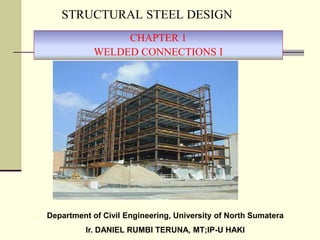
STRUCTURAL STEEL DESIGN
CHAPTER 1
WELDED CONNECTIONS I
Department of Civil Engineering, University of North Sumatera
Ir. DANIEL RUMBI TERUNA, MT;IP-U HAKI
Table of contents
Introduction
Examples of welded connections
Advantages of welding
Welding process
Welding inspection
Type of welding
Welding symbols
Groove and fillet welds
Slot and back welds
WELDED CONNECTIONS
Introduction
Welding is the process of joining metal parts by fusing them and
filling in with molten metal from the electrode.
Welding has developed into an established and essential tool of the
steel construction industry. Before welding was possible, rivets were
used to create structural members and connect them.
Today, welding is used to construct members such as plate girders
and box sections, as well as to connect structural members together
reliably and cost effectively. Along with the contributions of high-
strength bolts, welding has rendered riveting obsolete.
WELDED CONNECTIONS
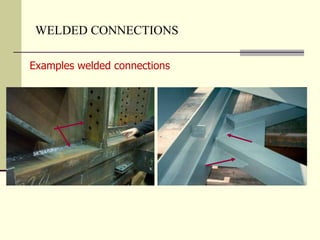
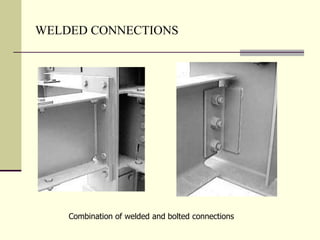
Examples welded connections
WELDED CONNECTIONS
Combination of welded and bolted connections
WELDED CONNECTIONS
 Economic : save gusset and splice plates
 Applicability : such as connection of steel pipe column
 Rigidity & Continuity : strong joint makes one-pieces
Construction
 Easier to make changes during construction
 Relative silence
Advantages of welds
 Welds also have some disadvantages which
may preclude their use, including:
• Welds are brittle, not ductile like bolted
connections
• Very labor intensive
• Skilled labor required
• Quality control is difficult to inspect
• Potential fire hazard in areas of welding
WELDED CONNECTIONS
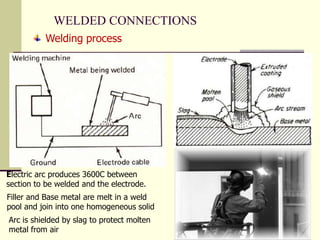
Welding process
Electric arc produces 3600C between
section to be welded and the electrode.
Filler and Base metal are melt in a weld
pool and join into one homogeneous solid
Arc is shielded by slag to protect molten
metal from air
WELDED CONNECTIONS
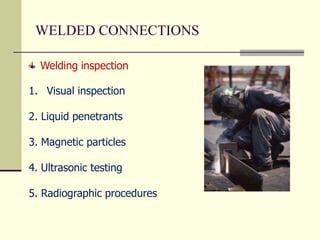
Welding inspection
1. Visual inspection
2. Liquid penetrants
3. Magnetic particles
4. Ultrasonic testing
5. Radiographic procedures
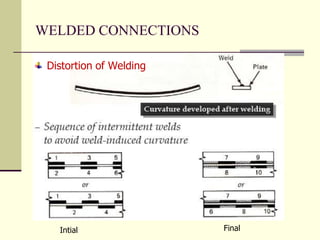
Distortion of Welding
Intial Final
WELDED CONNECTIONS
WELDED CONNECTIONS
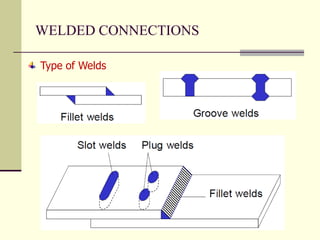
Type of Welds
WELDED CONNECTIONS
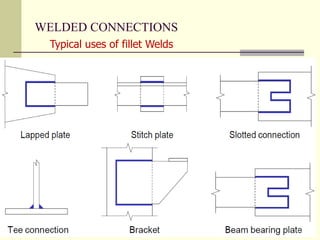
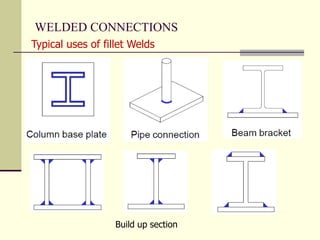
Typical uses of fillet Welds
WELDED CONNECTIONS
Typical uses of fillet Welds
Build up section
WELDED CONNECTIONS
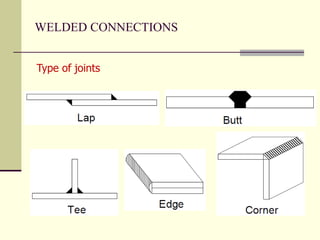
Type of joints
WELDED CONNECTIONS
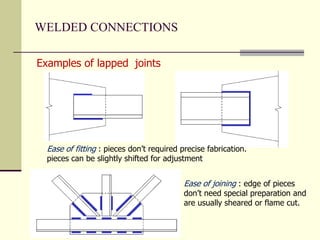
Examples of lapped joints
Ease of fitting : pieces don’t required precise fabrication.
pieces can be slightly shifted for adjustment
Ease of joining : edge of pieces
don’t need special preparation and
are usually sheared or flame cut.
WELDED CONNECTIONS
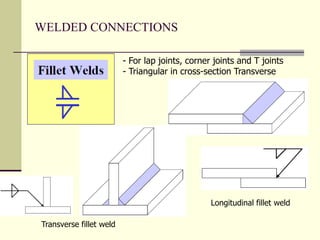
- For lap joints, corner joints and T joints
- Triangular in cross-section Transverse
Transverse fillet weld
Longitudinal fillet weld
WELDED CONNECTIONS
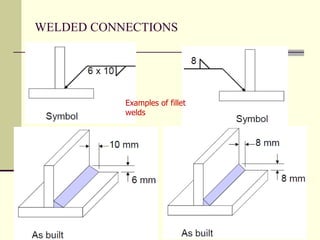
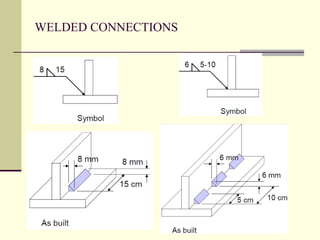
Examples of fillet
welds
WELDED CONNECTIONS
WELDED CONNECTIONS
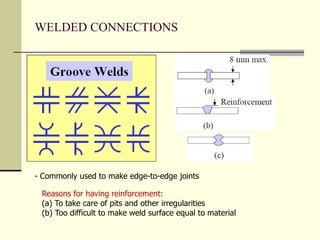
- Commonly used to make edge-to-edge joints
Reasons for having reinforcement:
(a) To take care of pits and other irregularities
(b) Too difficult to make weld surface equal to material
WELDED CONNECTIONS
WELDED CONNECTIONS
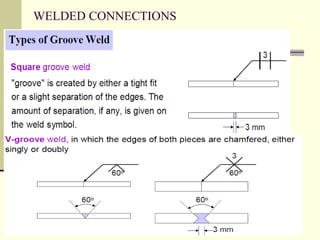
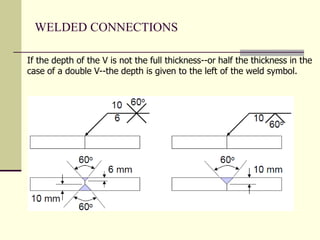
If the depth of the V is not the full thickness--or half the thickness in the
case of a double V--the depth is given to the left of the weld symbol.
WELDED CONNECTIONS
WELDED CONNECTIONS
WELDED CONNECTIONS
WELDED CONNECTIONS
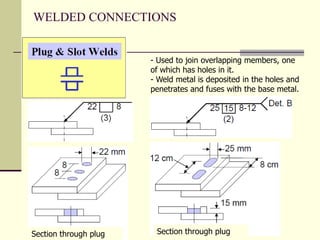
- Used to join overlapping members, one
of which has holes in it.
- Weld metal is deposited in the holes and
penetrates and fuses with the base metal.
Section through plug

Structural Steel Design (WELDED CONNECTION)