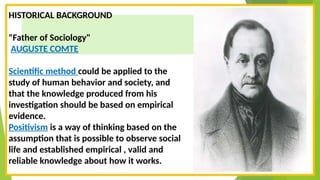
HISTORICAL BACKGROUND
"Father ofSociology"
AUGUSTE COMTE
Scientific method could be applied to the
study of human behavior and society, and
that the knowledge produced from his
investigation should be based on empirical
evidence.
Positivism is a way of thinking based on the
assumption that is possible to observe social
life and established empirical , valid and
reliable knowledge about how it works.
3.
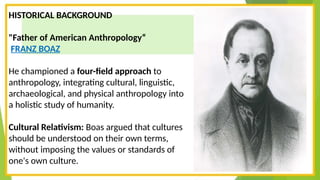
HISTORICAL BACKGROUND
"Father ofAmerican Anthropology“
FRANZ BOAZ
He championed a four-field approach to
anthropology, integrating cultural, linguistic,
archaeological, and physical anthropology into
a holistic study of humanity.
Cultural Relativism: Boas argued that cultures
should be understood on their own terms,
without imposing the values or standards of
one's own culture.
4.
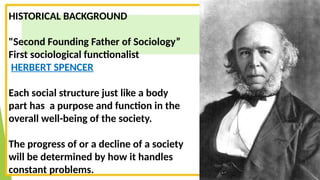
HISTORICAL BACKGROUND
"Second FoundingFather of Sociology”
First sociological functionalist
HERBERT SPENCER
Each social structure just like a body
part has a purpose and function in the
overall well-being of the society.
The progress of or a decline of a society
will be determined by how it handles
constant problems.
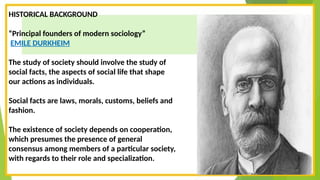
5.
HISTORICAL BACKGROUND
“Principal foundersof modern sociology”
EMILE DURKHEIM
The study of society should involve the study of
social facts, the aspects of social life that shape
our actions as individuals.
Social facts are laws, morals, customs, beliefs and
fashion.
The existence of society depends on cooperation,
which presumes the presence of general
consensus among members of a particular society,
with regards to their role and specialization.
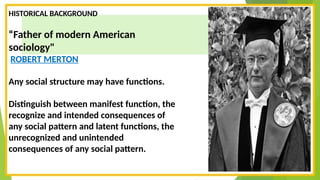
6.
HISTORICAL BACKGROUND
“Father ofmodern American
sociology"
ROBERT MERTON
Any social structure may have functions.
Distinguish between manifest function, the
recognize and intended consequences of
any social pattern and latent functions, the
unrecognized and unintended
consequences of any social pattern.
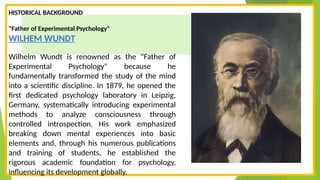
7.
HISTORICAL BACKGROUND
"Father ofExperimental Psychology"
WILHEM WUNDT
Wilhelm Wundt is renowned as the "Father of
Experimental Psychology" because he
fundamentally transformed the study of the mind
into a scientific discipline. In 1879, he opened the
first dedicated psychology laboratory in Leipzig,
Germany, systematically introducing experimental
methods to analyze consciousness through
controlled introspection. His work emphasized
breaking down mental experiences into basic
elements and, through his numerous publications
and training of students, he established the
rigorous academic foundation for psychology,
influencing its development globally.
8.
Manifest and LatentFunction
Manifest Function- to provide youth with the information
and skills needed to enable them to perform their jobs after
graduation.
Latent Function – by keeping millions of young people out of
the labor market, where a significant number of them may
not get hired right away after graduation.
9.
Social Dysfunctions
Social dysfunctions-“ any social pattern that may disrupt the
operation of society”.
CAUSES: Lack of consensus among people about what is helpful or
harmful to society.
Differences in background or status, for instance, may lead to
differences in recognition and appreciation of a capitalist order.
High profits for factory owners can be seen as dysfunctional for
factory workers as they receive low wages.
10.
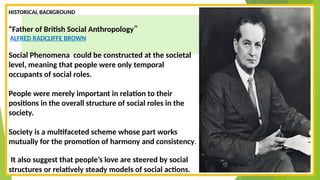
HISTORICAL BACKGROUND
“Father ofBritish Social Anthropology”
ALFRED RADCLIFFE BROWN
Social Phenomena could be constructed at the societal
level, meaning that people were only temporal
occupants of social roles.
People were merely important in relation to their
positions in the overall structure of social roles in the
society.
Society is a multifaceted scheme whose part works
mutually for the promotion of harmony and consistency.
It also suggest that people’s love are steered by social
structures or relatively steady models of social actions.
11.
Theory of Marxism
Bourgeoisie-Factory owner or capitalist, control the means of production
and proletariat, economically powerful and politically powerful, own most
of the wealth
Proletariat- working class or laborer, have no control over means of
production, face exploitation in the form of fewer wages and
unemployment during the recession, become revolutionary against
capitalists
12.
Theory of Marxism
There’san exploitation because the capitalists gain profit from the labor
and services of the workers.
In reality, they were given low wages while working in terrible condition.
SOCIAL INEQUALITY- oppression and exploitation
SOCIAL INJUSTICE- capitalists steal by taking profit, leaving workers with
salaries disproportionate to the work they provide.
13.
There’s an exploitationbecause the capitalists gain profit
from the labor and services of the workers.
In reality, they were given low wages while working in
terrible condition.
SOCIAL INEQUALITY- oppression and exploitation
SOCIAL INJUSTICE- capitalists steal by taking profit, leaving
workers with salaries disproportionate to the work they
provide.
14.
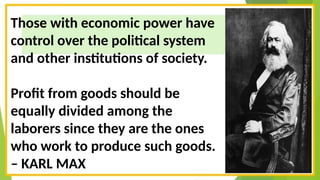
Those with economicpower have
control over the political system
and other institutions of society.
Profit from goods should be
equally divided among the
laborers since they are the ones
who work to produce such goods.
– KARL MAX
15.
CLASS CONFLICT/ CLASSSTRUGGLE – arises
from the oppression of the proletariat by
the bourgeoisie
Marx advocated for a revolutionary
consciousness to fight back against the
capitalist oppressors.
16.
SYMBOLIC INTERACTIONISM
It isan approach used to analyze human
interactions by focusing on the
meanings that individuals assign to
things in the world around them,
including words and objects.
17.
SYMBOLIC INTERACTIONISM
It isused within the field of sociology
( the study of human society ) to explain
social behavior in terms of how people
interact based on their interpretation of
symbols.
18.
SYMBOLIC INTERACTIONISM
Development ofindividual is in the social change and based on the interaction
with other individual.
Behavior is influenced and can only be examined through social interactions.
Explores social dynamics between people and how they assign meanings to
things.
Meaning is not monopolized by a single person or a perspective, something
can have different meanings as there are different perspectives.
19.
Individual’s interaction withobjects and other people.
Behavior is influenced and can only be examined through social
interactions.
Explores social dynamics between people and how they assign
meanings to things.
Meaning is not monopolized by a single person or a perspective,
something can have different meanings as there are different
perspectives.
20.
Actions are determinedby the meaning people associate
with things.
Example: A tree can be perceived as a source of shade during
a hot day or as means to produce a thousand sheets of
paper.
Symbolic interaction sees reality not just as meanings but
sees meanings as constitutive of reality itself.
21.
Symbolic Interactionism exploresnot just association of
meanings but also the changes that occur within the
association.
Herbert Blumer- Humans act toward things on the basis of
the meanings that things have for them. The meanings of
things derive from social interaction. These meanings are
handled in and modified through an interpretative process
used by the person in dealing with things he or she
encounter.
22.
ROLE PLAY: abilityto perceive the object of conversation
through the eyes of the others.
George Herbert Mead- Language allows communication
which attitudes , opinions , emotions and ideas are conveyed
between individuals through symbols, gestures and sounds.
23.
Charles Horton Cooley– Looking Glass Self
Self is understood as that which is formed from interactions
such as those done with the primary group ( family ) .
Self consciousness emerges through the lens of the other.
Through encounters in interaction, the individual formulates
a self –identity by how others perceived him or her.
Therefore, the individual recognizes himself in the eyes of
the other.