The document discusses the legal doctrine of strict liability as established in the landmark 1860 case Rylands v. Fletcher. The case involved a landowner who constructed a reservoir that flooded his neighbor's coal mine after water burst through abandoned mine shafts. Though there was no proof of negligence, the landowner was held liable for damages caused by the "non-natural" escape of water from his reservoir. This established the principle of strict liability - holding persons responsible for damages caused by inherently dangerous activities on their land, regardless of fault.


![Strict liability often applies when people engage in inherently hazardous activities, such as doing ‘blasting’ in a city, or keeping wild circus animals. If the blasting damages you-no matter how careful the blasting was – it is liable for the injury. Similarly if the animals escape and injure someone, the fact that the circus used the world’s strongest cages and the highest standard of care imaginable will not let it get off the hook. [1] [1] http://law.freeadvice.com/general_practice/legal_remedies/strict_liabilty.htm 06/10/11 Dr C J Rawandale, Director, Symbiosis Law School, NOIDA](https://image.slidesharecdn.com/strictliability-13178686240602-phpapp01-111005213910-phpapp01/85/Strict-Liability-4-320.jpg)


![Read v Lyons , [1947] AC 157 at p. 173 (HL) Lord Macmillan stated that 'the doctrine of Rylands v Fletcher … derives from a conception of mutual duties of adjoining landowners and its congeners are trespass and nuisance'. Also, in Hale v Jennings Brothers , [1938] 1 ALL ER 579 at p. 583 Scott LJ referred to the rule as 'a broad principle … that the liability attaches because of the occupier of the land bringing onto the land something which is likely to do damage if it escapes'. 06/10/11 Dr C J Rawandale, Director, Symbiosis Law School, NOIDA](https://image.slidesharecdn.com/strictliability-13178686240602-phpapp01-111005213910-phpapp01/85/Strict-Liability-13-320.jpg)

![Read v Lyons , [1947] AC 157 at 173 (HL) Viscount Simon aptly put the essential conditions to make one liable under doctrine of strict liability as follows: “ Now the strict liability recognised by this House in Rylands v. Fletcher is conditioned by two elements which I may call the condition of ‘escape’ from the land of something likely to do mischief if it escapes, and the condition of “non-natural use of land”. 06/10/11 Dr C J Rawandale, Director, Symbiosis Law School, NOIDA](https://image.slidesharecdn.com/strictliability-13178686240602-phpapp01-111005213910-phpapp01/85/Strict-Liability-15-320.jpg)
![Defendant would be liable only when there is escape of the object from land of which he is in occupation or control. Read v Lyons , [1947] AC 157 at 173 (HL) Appellant was employed as an Inspector of Ammunition. She was injured by the explosion of a shell while she was on respondent’s premises in the performance of her duties. Further there was no proof of negligence on the part of the defendant. The Court held that the injury was caused on the premises of the defendants i.e. not outside, thus no escape thereby, the respondents were not liable. 06/10/11 Dr C J Rawandale, Director, Symbiosis Law School, NOIDA](https://image.slidesharecdn.com/strictliability-13178686240602-phpapp01-111005213910-phpapp01/85/Strict-Liability-16-320.jpg)

![[Hostel Rooms at Cardiff- Students were not allowed to lit lamps as the hostel rooms had used wood. In such case it may amount to non natural use of land. Or lighting cigarette in the petrol pump or preparing food thereby may also amount to non natural use of land.] 06/10/11 Dr C J Rawandale, Director, Symbiosis Law School, NOIDA](https://image.slidesharecdn.com/strictliability-13178686240602-phpapp01-111005213910-phpapp01/85/Strict-Liability-18-320.jpg)
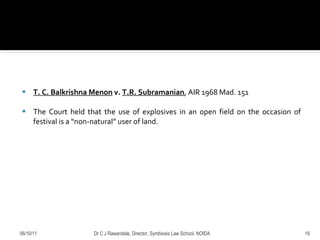

![The rule has been applied in the following cases: Water , Charing Cross Electricity Supply Co. v. Hydraulic Power Co [1914] 3 KB 772 Fire , Jones v. Ffestiniog Railway (1868) LR 3 QB 733 A motor vehicle , Musgrove v. Pandelis [1919] 2 KB 43, Perry v. Kendricks Transport Co [1956] 1 Weekly Law Reports 85 CA Gas , Goodbody v. Poplar BC [1915] 84 LJ KB 1230 06/10/11 Dr C J Rawandale, Director, Symbiosis Law School, NOIDA](https://image.slidesharecdn.com/strictliability-13178686240602-phpapp01-111005213910-phpapp01/85/Strict-Liability-22-320.jpg)
![Electricity , National Telephone Co v. Baker [1893] 2 Ch 186 Poison , West v. Bristol Tramways Co [1908] 2 KB 14 Paraffin , Mulholland and Tedd Ltd v. Baker [1939] 3 All England Law Reports 253 A blow lamp , [1957] 1 QB 496, CA Colliery spoil tipped on a hillside without drainage provision A-G v. Cory Bros [1921] 1 AC 521 Raw polystyrene LMS International Ltd v. Styrene Packaging and Insulation Ltd. [2005] EWHC 2065 (TCC) 06/10/11 Dr C J Rawandale, Director, Symbiosis Law School, NOIDA](https://image.slidesharecdn.com/strictliability-13178686240602-phpapp01-111005213910-phpapp01/85/Strict-Liability-23-320.jpg)
![However, the rule has been held inapplicable to : An aeroplane , Fosbroke-Hobbes v. Airwork Ltd [1937] 1 All England Law Reports 108 An oil can , Wray v. Essex CC [1936] 3 All England Law Reports 97 A boiler without a safety valve Ball v. LCC [1949] 2 KB 159 and Water piped to a block of flats , Transco plc v. Stockport MBC [2004] 1 All England Law Reports 589 06/10/11 Dr C J Rawandale, Director, Symbiosis Law School, NOIDA](https://image.slidesharecdn.com/strictliability-13178686240602-phpapp01-111005213910-phpapp01/85/Strict-Liability-24-320.jpg)

![1. Plaintiff’s Consent Where the artificial work is maintained with the plaintiff’s consent and for the common benefit of the defendant, this rule does not apply. Balakh Glass Emporium v. United India Insurance Company Ltd. , AIR 1993 Ker 342 The defendant was held not liable when water escaped from upper floor and damaged the lower floor because there was an implied consent by occupier of lower floor to the normal use of water by the occupier of the upper floor. [water and fire- landlord and tenant relationship] 06/10/11 Dr C J Rawandale, Director, Symbiosis Law School, NOIDA](https://image.slidesharecdn.com/strictliability-13178686240602-phpapp01-111005213910-phpapp01/85/Strict-Liability-26-320.jpg)




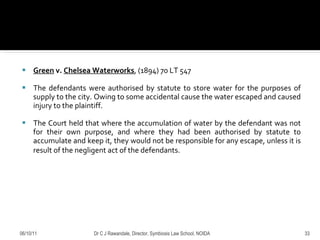

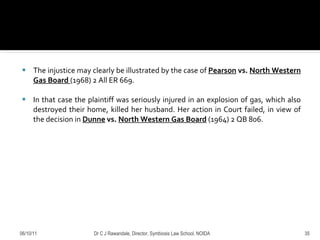
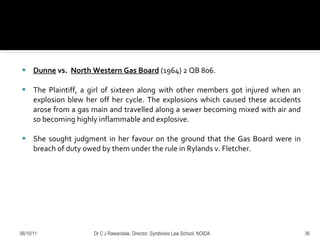
![The Court while holding the Gas Board not liable, observed: “ [Gas] escaped and did damage without any negligence on the part of the defendants or of anyone else. It is not a case of an independent contractor having been negligent as was the case in Rylands v. Fletcher, which brought about a decision in wide terms imposing liability on a landowner for things which escaped from his land, whereas in the present time the defendant ’ s liability in that case could simply have been placed on the defendant ’ s failure of duty to take reasonable care to protect the adjacent mines which were known to be there or which ought to have been discovered with reasonable care, and in respect of such a duty it is no answer to say that the failure was that of an independent contractor ” . 06/10/11 Dr C J Rawandale, Director, Symbiosis Law School, NOIDA](https://image.slidesharecdn.com/strictliability-13178686240602-phpapp01-111005213910-phpapp01/85/Strict-Liability-37-320.jpg)

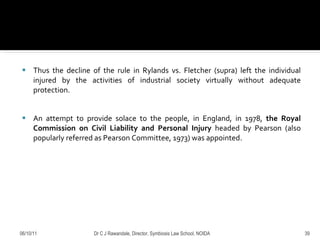







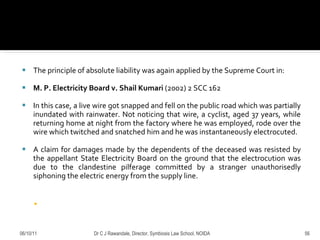

![It further held that “but that [act of stranger] exception is not available to the Board as the act attributed to the third respondent should reasonably have been anticipated or at any rate its consequences should have been prevented by the appellant board. 06/10/11 Dr C J Rawandale, Director, Symbiosis Law School, NOIDA](https://image.slidesharecdn.com/strictliability-13178686240602-phpapp01-111005213910-phpapp01/85/Strict-Liability-58-320.jpg)




![TORT II [strict liability notes]](https://cdn.slidesharecdn.com/ss_thumbnails/uuuk2203-tortiistrictliabilitynotes-200608061733-thumbnail.jpg?width=640&height=640&fit=bounds)


