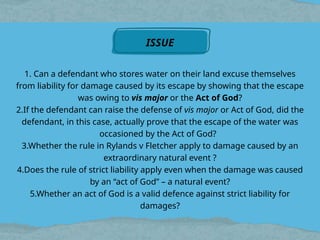
1. Can adefendant who stores water on their land excuse themselves
from liability for damage caused by its escape by showing that the escape
was owing to vis major or the Act of God?
2.If the defendant can raise the defense of vis major or Act of God, did the
defendant, in this case, actually prove that the escape of the water was
occasioned by the Act of God?
3.Whether the rule in Rylands v Fletcher apply to damage caused by an
extraordinary natural event ?
4.Does the rule of strict liability apply even when the damage was caused
by an “act of God” – a natural event?
5.Whether an act of God is a valid defence against strict liability for
damages?
ISSUE
3.
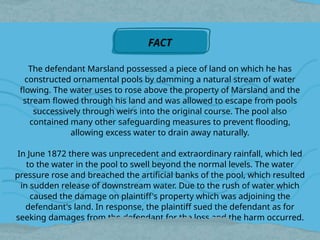
The defendant Marslandpossessed a piece of land on which he has
constructed ornamental pools by damming a natural stream of water
flowing. The water uses to rose above the property of Marsland and the
stream flowed through his land and was allowed to escape from pools
successively through weirs into the original course. The pool also
contained many other safeguarding measures to prevent flooding,
allowing excess water to drain away naturally.
In June 1872 there was unprecedent and extraordinary rainfall, which led
to the water in the pool to swell beyond the normal levels. The water
pressure rose and breached the artificial banks of the pool, which resulted
in sudden release of downstream water. Due to the rush of water which
caused the damage on plaintiff's property which was adjoining the
defendant's land. In response, the plaintiff sued the defendant as for
seeking damages from the defendant for the loss and the harm occurred.
FACT
4.
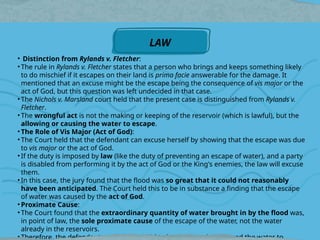
• Distinction fromRylands v. Fletcher:
• The rule in Rylands v. Fletcher states that a person who brings and keeps something likely
to do mischief if it escapes on their land is prima facie answerable for the damage. It
mentioned that an excuse might be the escape being the consequence of vis major or the
act of God, but this question was left undecided in that case.
• The Nichols v. Marsland court held that the present case is distinguished from Rylands v.
Fletcher.
• The wrongful act is not the making or keeping of the reservoir (which is lawful), but the
allowing or causing the water to escape.
• The Role of Vis Major (Act of God):
• The Court held that the defendant can excuse herself by showing that the escape was due
to vis major or the act of God.
• If the duty is imposed by law (like the duty of preventing an escape of water), and a party
is disabled from performing it by the act of God or the King's enemies, the law will excuse
them.
• In this case, the jury found that the flood was so great that it could not reasonably
have been anticipated. The Court held this to be in substance a finding that the escape
of water was caused by the act of God.
• Proximate Cause:
• The Court found that the extraordinary quantity of water brought in by the flood was,
in point of law, the sole proximate cause of the escape of the water, not the water
already in the reservoirs.
• Therefore, the defendant could not be said to have "caused or allowed the water to
LAW
5.
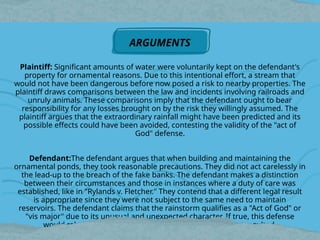
Plaintiff: Significant amountsof water were voluntarily kept on the defendant's
property for ornamental reasons. Due to this intentional effort, a stream that
would not have been dangerous before now posed a risk to nearby properties. The
plaintiff draws comparisons between the law and incidents involving railroads and
unruly animals. These comparisons imply that the defendant ought to bear
responsibility for any losses brought on by the risk they willingly assumed. The
plaintiff argues that the extraordinary rainfall might have been predicted and its
possible effects could have been avoided, contesting the validity of the "act of
God" defense.
Defendant:The defendant argues that when building and maintaining the
ornamental ponds, they took reasonable precautions. They did not act carelessly in
the lead-up to the breach of the fake banks. The defendant makes a distinction
between their circumstances and those in instances where a duty of care was
established, like in "Rylands v. Fletcher." They contend that a different legal result
is appropriate since they were not subject to the same need to maintain
reservoirs. The defendant claims that the rainstorm qualifies as a "Act of God" or
"vis major" due to its unusual and unexpected character. If true, this defense
would release them from responsibility for the harm that resulted.
ARGUMENTS
6.
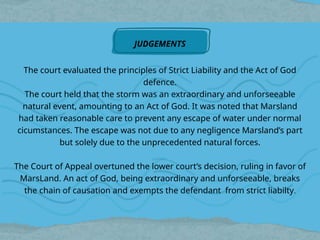
The court evaluatedthe principles of Strict Liability and the Act of God
defence.
The court held that the storm was an extraordinary and unforseeable
natural event, amounting to an Act of God. It was noted that Marsland
had taken reasonable care to prevent any escape of water under normal
cicumstances. The escape was not due to any negligence Marsland’s part
but solely due to the unprecedented natural forces.
The Court of Appeal overtuned the lower court’s decision, ruling in favor of
MarsLand. An act of God, being extraordinary and unforseeable, breaks
the chain of causation and exempts the defendant from strict liabilty.
JUDGEMENTS



![TORT II [strict liability notes]](https://cdn.slidesharecdn.com/ss_thumbnails/uuuk2203-tortiistrictliabilitynotes-200608061733-thumbnail.jpg?width=640&height=640&fit=bounds)


![[NALL OCR] HALL, Basil (1824). Extracts from a journal written on the coasts ...](https://cdn.slidesharecdn.com/ss_thumbnails/nallocrhallbasil1824-260202221936-b93ec330-thumbnail.jpg?width=640&height=640&fit=bounds)