Law Of Torts
RYLANDS V. FLETCHER
INTRODUCTION
 In Rylands v Fletcher (1868) LR 3 HL 330, the defendants employed independent
contractors to construct a reservoir on their land. The contractors found disused
mines when digging but failed to seal them properly. They filled the reservoir
with water. As a result, water flooded through the mineshafts into the plaintiff’s
mines on the adjoining property. The plaintiff secured a verdict at Liverpool
Assizes. The Court of Exchequer Chamber held the defendant liable and the
House of Lords affirmed their decision.
Requirements
1.That the defendant brought something onto his land;
2.That the defendant made a “non-natural use” of his land (per Lord Cairns, LC);
3.The thing was something likely to do mischief if it escaped;
4.The thing did escape and cause damage.
Foreseeability
There is now a further requirement, according to the House of Lords, that harm of
the relevant type must have been foreseeable.
REQUIREMENTS
 1. The defendant brought something onto his land
 In law, there is a difference between things that grow or occur naturally on the
land, and those that are accumulated there artificially by the defendant. For
example, rocks and thistles naturally occur on land. However, the defendants in
Rylands v Fletcher brought water onto the land.
2. Non-natural use of the land
In the House of Lords, Lord Cairns LC, laid down the requirement that there must be a non-natural use
of the land.
Recent examples are:
Ellison v Ministry of Defence (1997) 81 BLR 101, [1997]CLY 3864
 3. Something likely to do mischief
 The thing brought onto the land must be something likely to do mischief if it
escapes. In such a situation the defendant keeps it in at his peril.
 4. Escape
 There must be an escape of the dangerous substance from the defendant’s land.
REMEDIES
 1. Physical harm to the land itself (as in Rylands v Fletcher) and to other property.
 2. It is no longer clear if a claimant can recover for personal injury
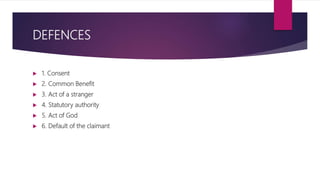
DEFENCES
 1. Consent
 2. Common Benefit
 3. Act of a stranger
 4. Statutory authority
 5. Act of God
 6. Default of the claimant

Manas

  • 1.
  • 2.
    INTRODUCTION  In Rylandsv Fletcher (1868) LR 3 HL 330, the defendants employed independent contractors to construct a reservoir on their land. The contractors found disused mines when digging but failed to seal them properly. They filled the reservoir with water. As a result, water flooded through the mineshafts into the plaintiff’s mines on the adjoining property. The plaintiff secured a verdict at Liverpool Assizes. The Court of Exchequer Chamber held the defendant liable and the House of Lords affirmed their decision.
  • 3.
    Requirements 1.That the defendantbrought something onto his land; 2.That the defendant made a “non-natural use” of his land (per Lord Cairns, LC); 3.The thing was something likely to do mischief if it escaped; 4.The thing did escape and cause damage.
  • 4.
    Foreseeability There is nowa further requirement, according to the House of Lords, that harm of the relevant type must have been foreseeable.
  • 5.
    REQUIREMENTS  1. Thedefendant brought something onto his land  In law, there is a difference between things that grow or occur naturally on the land, and those that are accumulated there artificially by the defendant. For example, rocks and thistles naturally occur on land. However, the defendants in Rylands v Fletcher brought water onto the land.
  • 6.
    2. Non-natural useof the land In the House of Lords, Lord Cairns LC, laid down the requirement that there must be a non-natural use of the land. Recent examples are: Ellison v Ministry of Defence (1997) 81 BLR 101, [1997]CLY 3864
  • 7.
     3. Somethinglikely to do mischief  The thing brought onto the land must be something likely to do mischief if it escapes. In such a situation the defendant keeps it in at his peril.
  • 8.
     4. Escape There must be an escape of the dangerous substance from the defendant’s land.
  • 9.
    REMEDIES  1. Physicalharm to the land itself (as in Rylands v Fletcher) and to other property.  2. It is no longer clear if a claimant can recover for personal injury
  • 10.
    DEFENCES  1. Consent 2. Common Benefit  3. Act of a stranger  4. Statutory authority  5. Act of God  6. Default of the claimant