Elements
Damage
Malice
Motive
Intention
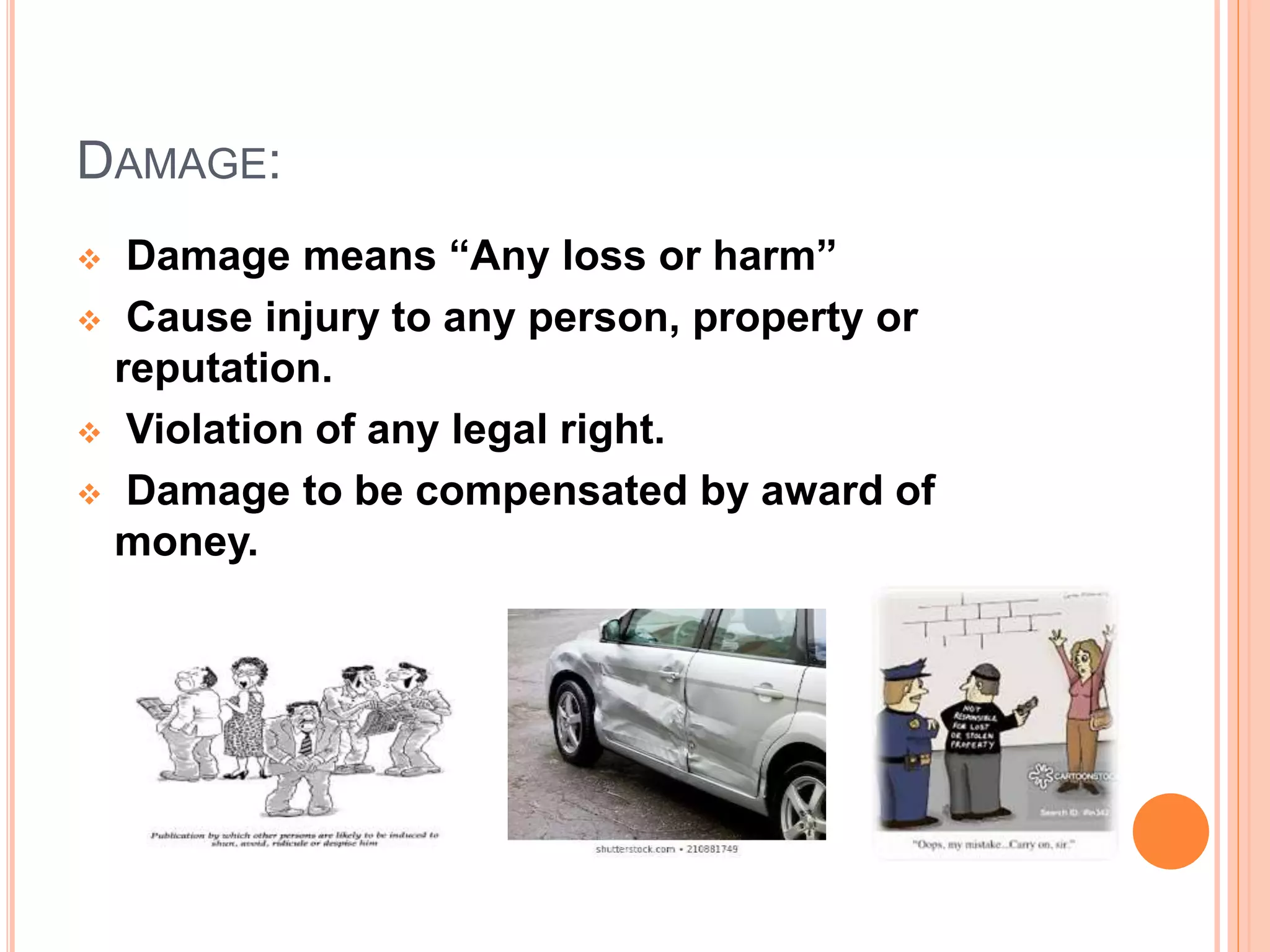
DAMAGE:
 Damage means “Any loss or harm”
 Cause injury to any person, property or
reputation.
 Violation of any legal right.
 Damage to be compensated by award of
money.
DAMAGES:
 Damages are the compensation, in form of money
award by court.
 Damages are award by the court by particular
statutes.
BRAIN STORMING ACTIVITY:
DIFFERENCE BETWEEN DAMAGE AND DAMAGES
 Ill- will against a person.
 In legal sense it means a wrongful act done intentionally
without just cause or excuse.
 Any act done with wrong intention done maliciously.
 With regard to crime of murder, malice is the mental
condition which motivates a person to kill another
without just cause.
Terms used in Malice:
 Intentionally (Willful)
 Just cause or Excuse. (Acceptable or
Sufficient Reasons)
Examples of Malice:
 Tort of slander by calling a nondrinker an
alcoholic in front of all his or her employees.
 If someone poisons a fishery, without knowing the
owner, he / she do it for malice because it is a
wrongful act done intentionally
Malice in
Fact
Malice in Law
 Malice in Fact:
For example,
Suppose that a newspaper reporter receives an anonymous phone call.
The person on the other end tells the reporter that the city’s mayor hires
illegal immigrants at sub-minimum wages to run her pickle factory. The
reporter puts this statement in his feature article about the mayor without
bothering to check whether it’s true, even though he’s pretty sure it’s
false. In this case, the reporter may be liable for defamation, because his
failure to double-check the statement even though he had actual doubts
whether it was true meets the “actual malice” requirement.
Actual malice is based on what the defendant was actually thinking at
the time he published the defamatory statement.
Actual malice occurs when:
 The defendant publishes a statement about the plaintiff he knows is
false; or
 The defendant publishes a statement about the plaintiff with reckless
disregard for whether it is false or true.
Now Briefly Actual Malice is:
Malice-in-fact is an act done with ill
will towards an individual.
Malice-in-fact depends upon motive.
Malice-in-fact means ill-will or any
hurtful motive against a person.
It is also known as “Actual malice” or
“Express malice.”
 Malice In Law: (Implied Malice)
 Malice-in-law means an act done wrongfully and
without reasonable and probable cause.
 Malice-in-law depends upon knowledge.
 Malice-in-law means the concurrence of mind
with a wrongful act done without just cause or
excuse.
 For example,
 A--------------wants to murder -------------B -----------
----------mix poison in an apple ---------------- and
puts it to B ----------- but the apple eats C instead
of B.
 Intention is the drive that provokes a person to commit to
an action. Motive is the reason behind doing an action
 Intention vs motive in Legal Context
In law, intention and motive are considered as two different
concepts. Let’s look at an example of a crime to understand
the difference between these two concepts.
Example:
 John robs a man to feed his family.
Here, robbing is the result of the intention to steal money. In
criminal law, the intention is always bad and evil.
However, John’s motive is to feed his family. The motive can
be good or evil. But motive is irrelevant is many cases. It is
the intention that determines the criminal liability.
Definition
 Intention: Intention is the thing that you plan to do or
achieve.
 Motive: Motive is a reason for doing something.
Action
 Intention: Some action might not have an intention.
(e.g., an accident)
 Motive: Every action has some kind of motive.
Criminal law
 Intention: Intention is a key element in determining the
criminal liability.
 Motive: Motive is considered irrelevant.

Elements of tort

  • 3.
  • 4.
    DAMAGE:  Damage means“Any loss or harm”  Cause injury to any person, property or reputation.  Violation of any legal right.  Damage to be compensated by award of money.
  • 5.
    DAMAGES:  Damages arethe compensation, in form of money award by court.  Damages are award by the court by particular statutes.
  • 6.
    BRAIN STORMING ACTIVITY: DIFFERENCEBETWEEN DAMAGE AND DAMAGES
  • 7.
     Ill- willagainst a person.  In legal sense it means a wrongful act done intentionally without just cause or excuse.  Any act done with wrong intention done maliciously.  With regard to crime of murder, malice is the mental condition which motivates a person to kill another without just cause.
  • 8.
    Terms used inMalice:  Intentionally (Willful)  Just cause or Excuse. (Acceptable or Sufficient Reasons) Examples of Malice:  Tort of slander by calling a nondrinker an alcoholic in front of all his or her employees.
  • 9.
     If someonepoisons a fishery, without knowing the owner, he / she do it for malice because it is a wrongful act done intentionally
  • 10.
  • 11.
     Malice inFact: For example, Suppose that a newspaper reporter receives an anonymous phone call. The person on the other end tells the reporter that the city’s mayor hires illegal immigrants at sub-minimum wages to run her pickle factory. The reporter puts this statement in his feature article about the mayor without bothering to check whether it’s true, even though he’s pretty sure it’s false. In this case, the reporter may be liable for defamation, because his failure to double-check the statement even though he had actual doubts whether it was true meets the “actual malice” requirement. Actual malice is based on what the defendant was actually thinking at the time he published the defamatory statement. Actual malice occurs when:  The defendant publishes a statement about the plaintiff he knows is false; or  The defendant publishes a statement about the plaintiff with reckless disregard for whether it is false or true.
  • 12.
    Now Briefly ActualMalice is: Malice-in-fact is an act done with ill will towards an individual. Malice-in-fact depends upon motive. Malice-in-fact means ill-will or any hurtful motive against a person. It is also known as “Actual malice” or “Express malice.”
  • 13.
     Malice InLaw: (Implied Malice)  Malice-in-law means an act done wrongfully and without reasonable and probable cause.  Malice-in-law depends upon knowledge.  Malice-in-law means the concurrence of mind with a wrongful act done without just cause or excuse.  For example,  A--------------wants to murder -------------B ----------- ----------mix poison in an apple ---------------- and puts it to B ----------- but the apple eats C instead of B.
  • 14.
     Intention isthe drive that provokes a person to commit to an action. Motive is the reason behind doing an action  Intention vs motive in Legal Context In law, intention and motive are considered as two different concepts. Let’s look at an example of a crime to understand the difference between these two concepts. Example:  John robs a man to feed his family. Here, robbing is the result of the intention to steal money. In criminal law, the intention is always bad and evil. However, John’s motive is to feed his family. The motive can be good or evil. But motive is irrelevant is many cases. It is the intention that determines the criminal liability.
  • 15.
    Definition  Intention: Intentionis the thing that you plan to do or achieve.  Motive: Motive is a reason for doing something. Action  Intention: Some action might not have an intention. (e.g., an accident)  Motive: Every action has some kind of motive. Criminal law  Intention: Intention is a key element in determining the criminal liability.  Motive: Motive is considered irrelevant.