

AKADEMIA WYCHOWANIA FIZYCZNEGO
Presented by
Vicente Calabuig Martí
AWF Student
1PSYCHOLOGY OF PHYSICAL ACTIVITY
Text
Photos
Videos
Discuss
Interactive
1 – DEFINITIONS
2 – BACKGROUND
3 – TRIGGERS
4 – EXAMPLES
5 – MOTIVATION
6 – CONCLUSIONS
7 – REFERENCES
AKADEMIA WYCHOWANIA FIZYCZNEGO
2
MAIN POINTS
PSYCHOLOGY OF PHYSICAL ACTIVTY
AKADEMIA WYCHOWANIA FIZYCZNEGO
3PSYCHOLOGY OF PHYSICAL ACTIVITY
1 – DEFINITIONS
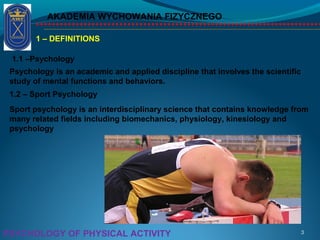
1.1 –Psychology
Psychology is an academic and applied discipline that involves the scientific
study of mental functions and behaviors.
1.2 – Sport Psychology
Sport psychology is an interdisciplinary science that contains knowledge from
many related fields including biomechanics, physiology, kinesiology and
psychology
AKADEMIA WYCHOWANIA FIZYCZNEGO
4PSYCHOLOGY OF PHYSICAL ACTIVITY
1 – DEFINITIONS
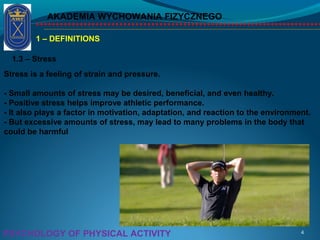
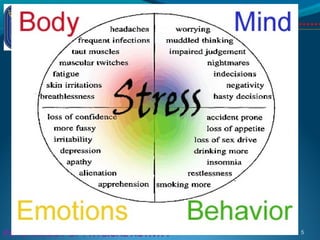
1.3 – Stress
Stress is a feeling of strain and pressure.
- Small amounts of stress may be desired, beneficial, and even healthy.
- Positive stress helps improve athletic performance.
- It also plays a factor in motivation, adaptation, and reaction to the environment.
- But excessive amounts of stress, may lead to many problems in the body that
could be harmful
AKADEMIA WYCHOWANIA FIZYCZNEGO
5PSYCHOLOGY OF PHYSICAL ACTIVITY
1 – DEFINITIONS
1.3 – Stress
AKADEMIA WYCHOWANIA FIZYCZNEGO
6PSYCHOLOGY OF PHYSICAL ACTIVITY
1 – DEFINITIONS
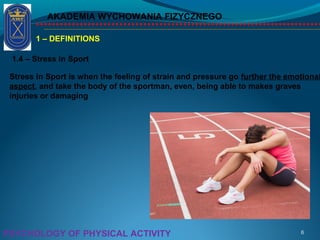
1.4 – Stress in Sport
Stress in Sport is when the feeling of strain and pressure go further the emotional
aspect, and take the body of the sportman, even, being able to makes graves
injuries or damaging
AKADEMIA WYCHOWANIA FIZYCZNEGO
7PSYCHOLOGY OF PHYSICAL ACTIVITY
2 – BACKGROUND
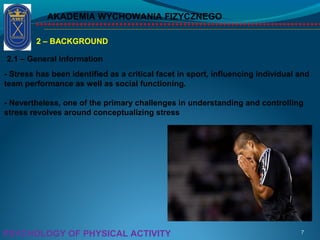
2.1 – General Information
- Stress has been identified as a critical facet in sport, influencing individual and
team performance as well as social functioning.
- Nevertheless, one of the primary challenges in understanding and controlling
stress revolves around conceptualizing stress
AKADEMIA WYCHOWANIA FIZYCZNEGO
8PSYCHOLOGY OF PHYSICAL ACTIVITY
2 – BACKGROUND
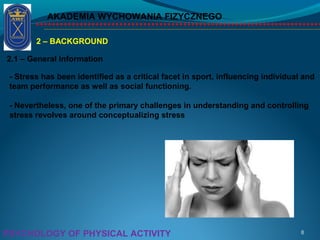
2.1 – General Information
- Stress has been identified as a critical facet in sport, influencing individual and
team performance as well as social functioning.
- Nevertheless, one of the primary challenges in understanding and controlling
stress revolves around conceptualizing stress
AKADEMIA WYCHOWANIA FIZYCZNEGO
9PSYCHOLOGY OF PHYSICAL ACTIVITY
2 – BACKGROUND
2.1 – General Information
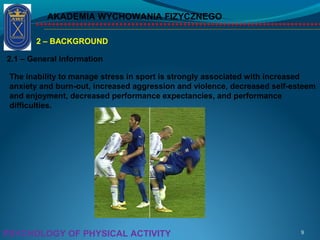
The inability to manage stress in sport is strongly associated with increased
anxiety and burn-out, increased aggression and violence, decreased self-esteem
and enjoyment, decreased performance expectancies, and performance
difficulties.
AKADEMIA WYCHOWANIA FIZYCZNEGO
10PSYCHOLOGY OF PHYSICAL ACTIVITY
2 – BACKGROUND
2.1 – General Information
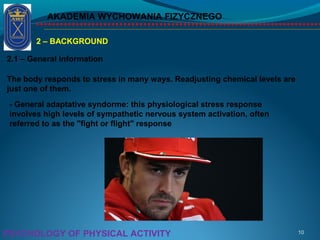
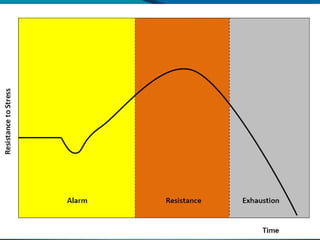
The body responds to stress in many ways. Readjusting chemical levels are
just one of them.
- General adaptative syndorme: this physiological stress response
involves high levels of sympathetic nervous system activation, often
referred to as the "fight or flight" response
AKADEMIA WYCHOWANIA FIZYCZNEGO
11PSYCHOLOGY OF PHYSICAL ACTIVITY
2 – BACKGROUND
2.1 – General Information
The body responds to stress in many ways. Readjusting chemical levels are
just one of them.
AKADEMIA WYCHOWANIA FIZYCZNEGO
12PSYCHOLOGY OF PHYSICAL ACTIVITY
2 – BACKGROUND
2.1 – General Information
The body responds to stress in many ways. Readjusting chemical levels are
just one of them.
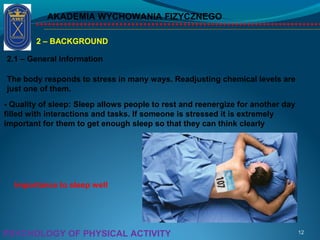
- Quality of sleep: Sleep allows people to rest and reenergize for another day
filled with interactions and tasks. If someone is stressed it is extremely
important for them to get enough sleep so that they can think clearly
Importance to sleep well
AKADEMIA WYCHOWANIA FIZYCZNEGO
13PSYCHOLOGY OF PHYSICAL ACTIVITY
2 – BACKGROUND
2.2 – Stress and Activation
Stress ≈ Activation
Subjectivity
Discuss
Authors
AKADEMIA WYCHOWANIA FIZYCZNEGO
14PSYCHOLOGY OF PHYSICAL ACTIVITY
2 – BACKGROUND
2.2 – Stress and Activation
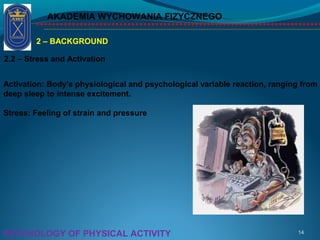
Activation: Body's physiological and psychological variable reaction, ranging from
deep sleep to intense excitement.
Stress: Feeling of strain and pressure
AKADEMIA WYCHOWANIA FIZYCZNEGO
15PSYCHOLOGY OF PHYSICAL ACTIVITY
2 – BACKGROUND 2.3 – Arousal
What is arousal?
AKADEMIA WYCHOWANIA FIZYCZNEGO
16PSYCHOLOGY OF PHYSICAL ACTIVITY
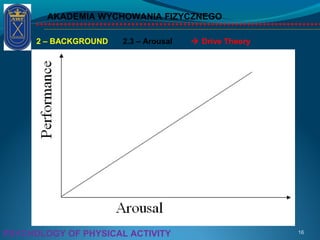
2 – BACKGROUND 2.3 – Arousal  Drive Theory
AKADEMIA WYCHOWANIA FIZYCZNEGO
17PSYCHOLOGY OF PHYSICAL ACTIVITY
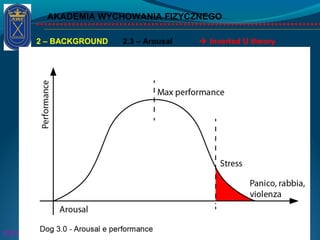
2 – BACKGROUND 2.3 – Arousal  Inverted U theory
AKADEMIA WYCHOWANIA FIZYCZNEGO
18PSYCHOLOGY OF PHYSICAL ACTIVITY
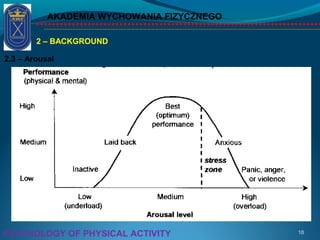
2 – BACKGROUND
2.3 – Arousal
AKADEMIA WYCHOWANIA FIZYCZNEGO
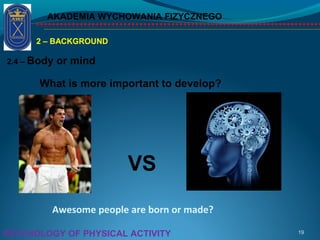
Awesome people are born or made?
19PSYCHOLOGY OF PHYSICAL ACTIVITY
2 – BACKGROUND
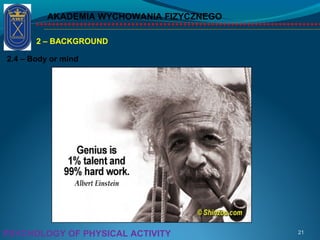
2.4 – Body or mind
What is more important to develop?
VS
AKADEMIA WYCHOWANIA FIZYCZNEGO
20PSYCHOLOGY OF PHYSICAL ACTIVITY
2 – BACKGROUND
2.4 – Body or mind
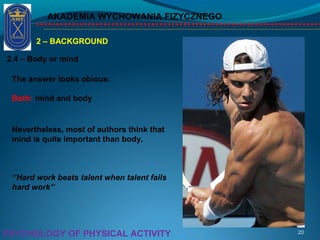
The answer looks obious:
Both: mind and body
Nevertheless, most of authors think that
mind is quite important than body.
‘’Hard work beats talent when talent fails
hard work’’
AKADEMIA WYCHOWANIA FIZYCZNEGO
21PSYCHOLOGY OF PHYSICAL ACTIVITY
2 – BACKGROUND
2.4 – Body or mind
AKADEMIA WYCHOWANIA FIZYCZNEGO
22PSYCHOLOGY OF PHYSICAL ACTIVITY
2 – BACKGROUND
2.5 – Burnout
STRESS ≈ BURNOUT
Subjectivity
Discuss
Authors
AKADEMIA WYCHOWANIA FIZYCZNEGO
23PSYCHOLOGY OF PHYSICAL ACTIVITY
2 – BACKGROUND
2.5 – Burnout
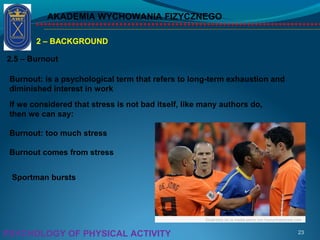
Burnout: is a psychological term that refers to long-term exhaustion and
diminished interest in work
If we considered that stress is not bad itself, like many authors do,
then we can say:
Burnout: too much stress
Burnout comes from stress
Sportman bursts
AKADEMIA WYCHOWANIA FIZYCZNEGO
24PSYCHOLOGY OF PHYSICAL ACTIVITY
2 – BACKGROUND
2.6 – Video https://www.youtube.com/watch?v=tz79iu8-lVc
AKADEMIA WYCHOWANIA FIZYCZNEGO
25PSYCHOLOGY OF PHYSICAL ACTIVITY
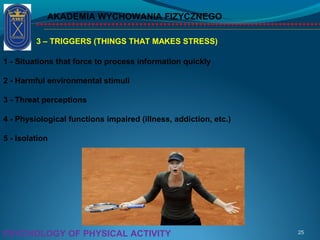
3 – TRIGGERS (THINGS THAT MAKES STRESS)
1 - Situations that force to process information quickly
2 - Harmful environmental stimuli
3 - Threat perceptions
4 - Physiological functions impaired (illness, addiction, etc.)
5 - Isolation
AKADEMIA WYCHOWANIA FIZYCZNEGO
26PSYCHOLOGY OF PHYSICAL ACTIVITY
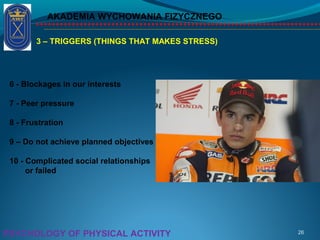
3 – TRIGGERS (THINGS THAT MAKES STRESS)
6 - Blockages in our interests
7 - Peer pressure
8 - Frustration
9 – Do not achieve planned objectives
10 - Complicated social relationships
or failed
AKADEMIA WYCHOWANIA FIZYCZNEGO
27PSYCHOLOGY OF PHYSICAL ACTIVITY
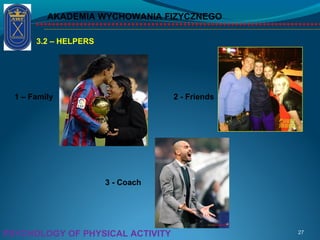
3.2 – HELPERS
1 – Family 2 - Friends
3 - Coach
AKADEMIA WYCHOWANIA FIZYCZNEGO
28PSYCHOLOGY OF PHYSICAL ACTIVITY
4 – EXAMPLE
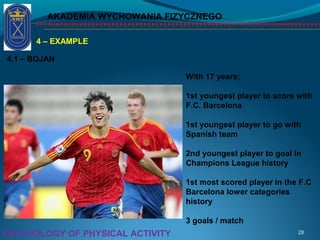
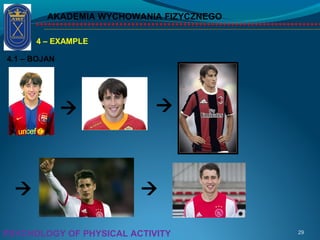
4.1 – BOJAN
With 17 years:
1st youngest player to score with
F.C. Barcelona
1st youngest player to go with
Spanish team
2nd youngest player to goal in
Champions League history
1st most scored player in the F.C
Barcelona lower categories
history
3 goals / match
AKADEMIA WYCHOWANIA FIZYCZNEGO
29PSYCHOLOGY OF PHYSICAL ACTIVITY
4 – EXAMPLE
4.1 – BOJAN
 

AKADEMIA WYCHOWANIA FIZYCZNEGO
30PSYCHOLOGY OF PHYSICAL ACTIVITY
4 – EXAMPLE
4.1 – BOJAN
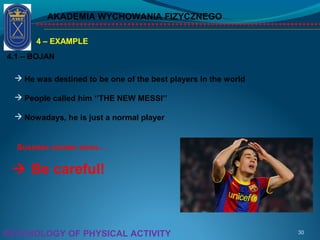
 He was destined to be one of the best players in the world
 People called him ‘’THE NEW MESSI’’
 Nowadays, he is just a normal player
 Be careful!
Success comes soon…
AKADEMIA WYCHOWANIA FIZYCZNEGO
31PSYCHOLOGY OF PHYSICAL ACTIVITY
4 – EXAMPLE
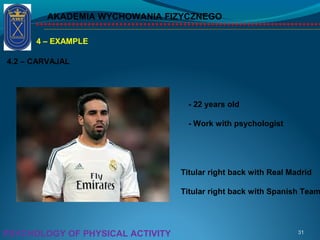
4.2 – CARVAJAL
- 22 years old
- Work with psychologist
Titular right back with Real Madrid
Titular right back with Spanish Team
AKADEMIA WYCHOWANIA FIZYCZNEGO
32PSYCHOLOGY OF PHYSYCAL ACTIVITY
5 – MOTIVATION
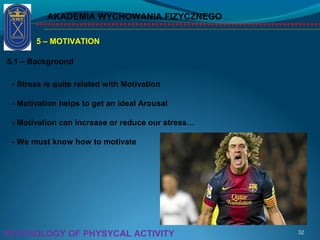
5.1 – Background
- Stress is quite related with Motivation
- Motivation helps to get an ideal Arousal
- Motivation can increase or reduce our stress…
- We must know how to motivate
AKADEMIA WYCHOWANIA FIZYCZNEGO
33PSYCHOLOGY OF PHYSICAL ACTIVTY
6 – CONCLUSIONS
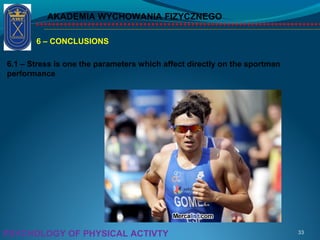
6.1 – Stress is one the parameters which affect directly on the sportman
performance
AKADEMIA WYCHOWANIA FIZYCZNEGO
34PSYCHOLOGY OF PHYSICAL ACTIVTY
6 – CONCLUSIONS
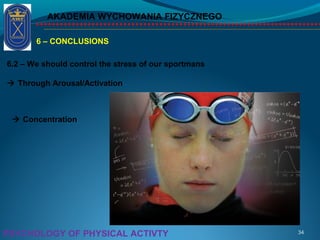
6.2 – We should control the stress of our sportmans
 Through Arousal/Activation
 Concentration
AKADEMIA WYCHOWANIA FIZYCZNEGO
35PSYCHOLOGY OF PHYSICAL ACTIVTY
6 – CONCLUSIONS
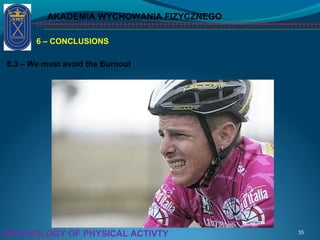
6.3 – We must avoid the Burnout
AKADEMIA WYCHOWANIA FIZYCZNEGO
36PSYCHOLOGY OF PHYSICAL ACTIVTY
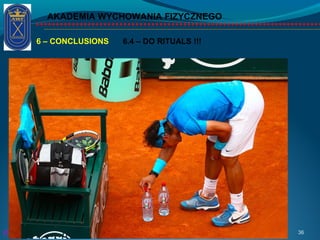
6 – CONCLUSIONS 6.4 – DO RITUALS !!!
AKADEMIA WYCHOWANIA FIZYCZNEGO
37PSYCHOLOGY OF PHYSICAL ACTIVTY
6 – CONCLUSIONS
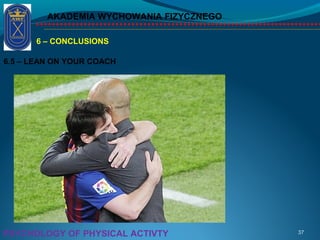
6.5 – LEAN ON YOUR COACH
AKADEMIA WYCHOWANIA FIZYCZNEGO
38PSYCHOLOGY OF PHYSICAL ACTIVTY
6 – CONCLUSIONS
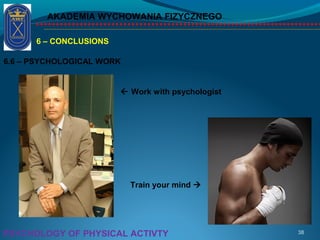
6.6 – PSYCHOLOGICAL WORK
 Work with psychologist
Train your mind 
AKADEMIA WYCHOWANIA FIZYCZNEGO
39PSYCHOLOGY OF PHYSICAL ACTIVTY
7 – REFENCES
- Gould, D., Udry, E., Tuffey, S. & Loehr, J. (1996). Burn-out in competitive junior tennis
players: I. A quantitative psychological assessment. The Sport Psychologist, 10, 322-340.
- Hanin, Y.L. Emotions in sport. Champaign, IL: Human Kinetics.
- Hardy, L., Jones, G., & Gould, D. (1996). Understanding psychological preparation for
sport: Theory and practice of elite performers. London: John Wiley & Sons.
- Jones, G., & Hardy, L. (1990). Stress & performance in sport . Chichester: Wiley.
- Lazarus, R. S. (1999). Stress and emotion: A new synthesis. New York: Springer
Publishing.
- Meichenbaum, D. (1993). Stress inoculation training: A 20-year update. In P.M.
40
If so, you can also contact me at my email: vicentecala@hotmail.com
SEE YOU
SOON
41

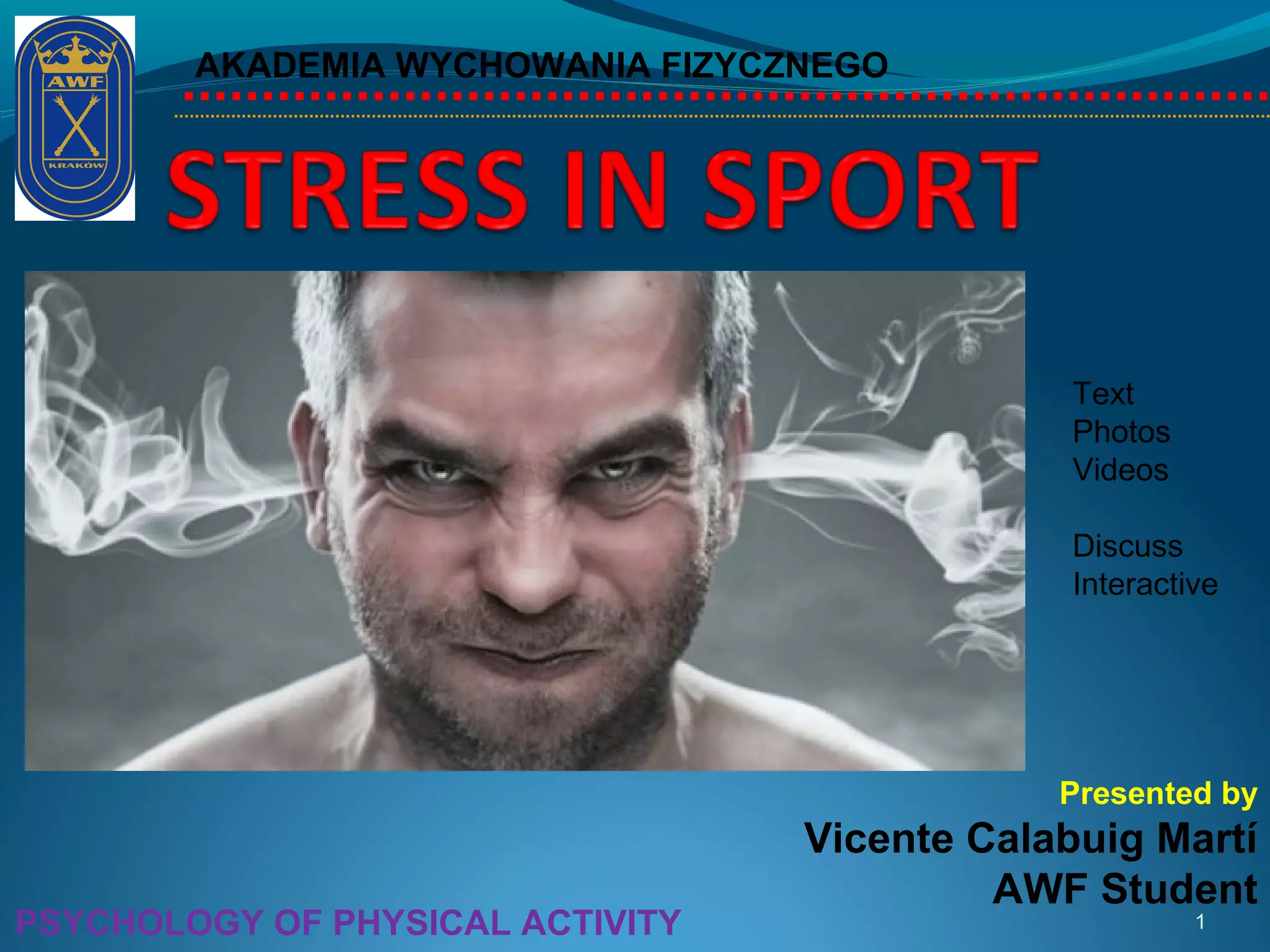
Stress in Sport

  • 1.
    AKADEMIA WYCHOWANIA FIZYCZNEGO Presentedby Vicente Calabuig Martí AWF Student 1PSYCHOLOGY OF PHYSICAL ACTIVITY Text Photos Videos Discuss Interactive
  • 2.
    1 – DEFINITIONS 2– BACKGROUND 3 – TRIGGERS 4 – EXAMPLES 5 – MOTIVATION 6 – CONCLUSIONS 7 – REFERENCES AKADEMIA WYCHOWANIA FIZYCZNEGO 2 MAIN POINTS PSYCHOLOGY OF PHYSICAL ACTIVTY
  • 3.
    AKADEMIA WYCHOWANIA FIZYCZNEGO 3PSYCHOLOGYOF PHYSICAL ACTIVITY 1 – DEFINITIONS 1.1 –Psychology Psychology is an academic and applied discipline that involves the scientific study of mental functions and behaviors. 1.2 – Sport Psychology Sport psychology is an interdisciplinary science that contains knowledge from many related fields including biomechanics, physiology, kinesiology and psychology
  • 4.
    AKADEMIA WYCHOWANIA FIZYCZNEGO 4PSYCHOLOGYOF PHYSICAL ACTIVITY 1 – DEFINITIONS 1.3 – Stress Stress is a feeling of strain and pressure. - Small amounts of stress may be desired, beneficial, and even healthy. - Positive stress helps improve athletic performance. - It also plays a factor in motivation, adaptation, and reaction to the environment. - But excessive amounts of stress, may lead to many problems in the body that could be harmful
  • 5.
    AKADEMIA WYCHOWANIA FIZYCZNEGO 5PSYCHOLOGYOF PHYSICAL ACTIVITY 1 – DEFINITIONS 1.3 – Stress
  • 6.
    AKADEMIA WYCHOWANIA FIZYCZNEGO 6PSYCHOLOGYOF PHYSICAL ACTIVITY 1 – DEFINITIONS 1.4 – Stress in Sport Stress in Sport is when the feeling of strain and pressure go further the emotional aspect, and take the body of the sportman, even, being able to makes graves injuries or damaging
  • 7.
    AKADEMIA WYCHOWANIA FIZYCZNEGO 7PSYCHOLOGYOF PHYSICAL ACTIVITY 2 – BACKGROUND 2.1 – General Information - Stress has been identified as a critical facet in sport, influencing individual and team performance as well as social functioning. - Nevertheless, one of the primary challenges in understanding and controlling stress revolves around conceptualizing stress
  • 8.
    AKADEMIA WYCHOWANIA FIZYCZNEGO 8PSYCHOLOGYOF PHYSICAL ACTIVITY 2 – BACKGROUND 2.1 – General Information - Stress has been identified as a critical facet in sport, influencing individual and team performance as well as social functioning. - Nevertheless, one of the primary challenges in understanding and controlling stress revolves around conceptualizing stress
  • 9.
    AKADEMIA WYCHOWANIA FIZYCZNEGO 9PSYCHOLOGYOF PHYSICAL ACTIVITY 2 – BACKGROUND 2.1 – General Information The inability to manage stress in sport is strongly associated with increased anxiety and burn-out, increased aggression and violence, decreased self-esteem and enjoyment, decreased performance expectancies, and performance difficulties.
  • 10.
    AKADEMIA WYCHOWANIA FIZYCZNEGO 10PSYCHOLOGYOF PHYSICAL ACTIVITY 2 – BACKGROUND 2.1 – General Information The body responds to stress in many ways. Readjusting chemical levels are just one of them. - General adaptative syndorme: this physiological stress response involves high levels of sympathetic nervous system activation, often referred to as the "fight or flight" response
  • 11.
    AKADEMIA WYCHOWANIA FIZYCZNEGO 11PSYCHOLOGYOF PHYSICAL ACTIVITY 2 – BACKGROUND 2.1 – General Information The body responds to stress in many ways. Readjusting chemical levels are just one of them.
  • 12.
    AKADEMIA WYCHOWANIA FIZYCZNEGO 12PSYCHOLOGYOF PHYSICAL ACTIVITY 2 – BACKGROUND 2.1 – General Information The body responds to stress in many ways. Readjusting chemical levels are just one of them. - Quality of sleep: Sleep allows people to rest and reenergize for another day filled with interactions and tasks. If someone is stressed it is extremely important for them to get enough sleep so that they can think clearly Importance to sleep well
  • 13.
    AKADEMIA WYCHOWANIA FIZYCZNEGO 13PSYCHOLOGYOF PHYSICAL ACTIVITY 2 – BACKGROUND 2.2 – Stress and Activation Stress ≈ Activation Subjectivity Discuss Authors
  • 14.
    AKADEMIA WYCHOWANIA FIZYCZNEGO 14PSYCHOLOGYOF PHYSICAL ACTIVITY 2 – BACKGROUND 2.2 – Stress and Activation Activation: Body's physiological and psychological variable reaction, ranging from deep sleep to intense excitement. Stress: Feeling of strain and pressure
  • 15.
    AKADEMIA WYCHOWANIA FIZYCZNEGO 15PSYCHOLOGYOF PHYSICAL ACTIVITY 2 – BACKGROUND 2.3 – Arousal What is arousal?
  • 16.
    AKADEMIA WYCHOWANIA FIZYCZNEGO 16PSYCHOLOGYOF PHYSICAL ACTIVITY 2 – BACKGROUND 2.3 – Arousal  Drive Theory
  • 17.
    AKADEMIA WYCHOWANIA FIZYCZNEGO 17PSYCHOLOGYOF PHYSICAL ACTIVITY 2 – BACKGROUND 2.3 – Arousal  Inverted U theory
  • 18.
    AKADEMIA WYCHOWANIA FIZYCZNEGO 18PSYCHOLOGYOF PHYSICAL ACTIVITY 2 – BACKGROUND 2.3 – Arousal
  • 19.
    AKADEMIA WYCHOWANIA FIZYCZNEGO Awesomepeople are born or made? 19PSYCHOLOGY OF PHYSICAL ACTIVITY 2 – BACKGROUND 2.4 – Body or mind What is more important to develop? VS
  • 20.
    AKADEMIA WYCHOWANIA FIZYCZNEGO 20PSYCHOLOGYOF PHYSICAL ACTIVITY 2 – BACKGROUND 2.4 – Body or mind The answer looks obious: Both: mind and body Nevertheless, most of authors think that mind is quite important than body. ‘’Hard work beats talent when talent fails hard work’’
  • 21.
    AKADEMIA WYCHOWANIA FIZYCZNEGO 21PSYCHOLOGYOF PHYSICAL ACTIVITY 2 – BACKGROUND 2.4 – Body or mind
  • 22.
    AKADEMIA WYCHOWANIA FIZYCZNEGO 22PSYCHOLOGYOF PHYSICAL ACTIVITY 2 – BACKGROUND 2.5 – Burnout STRESS ≈ BURNOUT Subjectivity Discuss Authors
  • 23.
    AKADEMIA WYCHOWANIA FIZYCZNEGO 23PSYCHOLOGYOF PHYSICAL ACTIVITY 2 – BACKGROUND 2.5 – Burnout Burnout: is a psychological term that refers to long-term exhaustion and diminished interest in work If we considered that stress is not bad itself, like many authors do, then we can say: Burnout: too much stress Burnout comes from stress Sportman bursts
  • 24.
    AKADEMIA WYCHOWANIA FIZYCZNEGO 24PSYCHOLOGYOF PHYSICAL ACTIVITY 2 – BACKGROUND 2.6 – Video https://www.youtube.com/watch?v=tz79iu8-lVc
  • 25.
    AKADEMIA WYCHOWANIA FIZYCZNEGO 25PSYCHOLOGYOF PHYSICAL ACTIVITY 3 – TRIGGERS (THINGS THAT MAKES STRESS) 1 - Situations that force to process information quickly 2 - Harmful environmental stimuli 3 - Threat perceptions 4 - Physiological functions impaired (illness, addiction, etc.) 5 - Isolation
  • 26.
    AKADEMIA WYCHOWANIA FIZYCZNEGO 26PSYCHOLOGYOF PHYSICAL ACTIVITY 3 – TRIGGERS (THINGS THAT MAKES STRESS) 6 - Blockages in our interests 7 - Peer pressure 8 - Frustration 9 – Do not achieve planned objectives 10 - Complicated social relationships or failed
  • 27.
    AKADEMIA WYCHOWANIA FIZYCZNEGO 27PSYCHOLOGYOF PHYSICAL ACTIVITY 3.2 – HELPERS 1 – Family 2 - Friends 3 - Coach
  • 28.
    AKADEMIA WYCHOWANIA FIZYCZNEGO 28PSYCHOLOGYOF PHYSICAL ACTIVITY 4 – EXAMPLE 4.1 – BOJAN With 17 years: 1st youngest player to score with F.C. Barcelona 1st youngest player to go with Spanish team 2nd youngest player to goal in Champions League history 1st most scored player in the F.C Barcelona lower categories history 3 goals / match
  • 29.
    AKADEMIA WYCHOWANIA FIZYCZNEGO 29PSYCHOLOGYOF PHYSICAL ACTIVITY 4 – EXAMPLE 4.1 – BOJAN   
  • 30.
    AKADEMIA WYCHOWANIA FIZYCZNEGO 30PSYCHOLOGYOF PHYSICAL ACTIVITY 4 – EXAMPLE 4.1 – BOJAN  He was destined to be one of the best players in the world  People called him ‘’THE NEW MESSI’’  Nowadays, he is just a normal player  Be careful! Success comes soon…
  • 31.
    AKADEMIA WYCHOWANIA FIZYCZNEGO 31PSYCHOLOGYOF PHYSICAL ACTIVITY 4 – EXAMPLE 4.2 – CARVAJAL - 22 years old - Work with psychologist Titular right back with Real Madrid Titular right back with Spanish Team
  • 32.
    AKADEMIA WYCHOWANIA FIZYCZNEGO 32PSYCHOLOGYOF PHYSYCAL ACTIVITY 5 – MOTIVATION 5.1 – Background - Stress is quite related with Motivation - Motivation helps to get an ideal Arousal - Motivation can increase or reduce our stress… - We must know how to motivate
  • 33.
    AKADEMIA WYCHOWANIA FIZYCZNEGO 33PSYCHOLOGYOF PHYSICAL ACTIVTY 6 – CONCLUSIONS 6.1 – Stress is one the parameters which affect directly on the sportman performance
  • 34.
    AKADEMIA WYCHOWANIA FIZYCZNEGO 34PSYCHOLOGYOF PHYSICAL ACTIVTY 6 – CONCLUSIONS 6.2 – We should control the stress of our sportmans  Through Arousal/Activation  Concentration
  • 35.
    AKADEMIA WYCHOWANIA FIZYCZNEGO 35PSYCHOLOGYOF PHYSICAL ACTIVTY 6 – CONCLUSIONS 6.3 – We must avoid the Burnout
  • 36.
    AKADEMIA WYCHOWANIA FIZYCZNEGO 36PSYCHOLOGYOF PHYSICAL ACTIVTY 6 – CONCLUSIONS 6.4 – DO RITUALS !!!
  • 37.
    AKADEMIA WYCHOWANIA FIZYCZNEGO 37PSYCHOLOGYOF PHYSICAL ACTIVTY 6 – CONCLUSIONS 6.5 – LEAN ON YOUR COACH
  • 38.
    AKADEMIA WYCHOWANIA FIZYCZNEGO 38PSYCHOLOGYOF PHYSICAL ACTIVTY 6 – CONCLUSIONS 6.6 – PSYCHOLOGICAL WORK  Work with psychologist Train your mind 
  • 39.
    AKADEMIA WYCHOWANIA FIZYCZNEGO 39PSYCHOLOGYOF PHYSICAL ACTIVTY 7 – REFENCES - Gould, D., Udry, E., Tuffey, S. & Loehr, J. (1996). Burn-out in competitive junior tennis players: I. A quantitative psychological assessment. The Sport Psychologist, 10, 322-340. - Hanin, Y.L. Emotions in sport. Champaign, IL: Human Kinetics. - Hardy, L., Jones, G., & Gould, D. (1996). Understanding psychological preparation for sport: Theory and practice of elite performers. London: John Wiley & Sons. - Jones, G., & Hardy, L. (1990). Stress & performance in sport . Chichester: Wiley. - Lazarus, R. S. (1999). Stress and emotion: A new synthesis. New York: Springer Publishing. - Meichenbaum, D. (1993). Stress inoculation training: A 20-year update. In P.M.
  • 40.
    40 If so, youcan also contact me at my email: vicentecala@hotmail.com
  • 41.