TEMUJIN T. CHAVEZ, M.D. LCDR MC USN INFECTIOUS DISEASEAS FELLOW National Naval Medical Center Case Conference
Case 71 yo male h/o 2V CAD, AoS, Autoimmune hepatitis admitted for 48 hours after c/o atypical CP. Inpt eval s/f NSTEMI with PCI revealing non-stentable multivessel disease Pt with fever at midnight hd1 and evening hd2. Fever w/u initiated and pt discharged hd3. Pt re-admitted 24 hours after discharge for growth on blood cultures.
Case ROS: pt denies f/c. Malaise over past 8 mos. Wt loss during fall 2007. PMHx: CAD-NSTEMI 1997 with stent to LAD/OM1 with stent restenosis OM1 Autoimmune hepatitis-6MP stopped June 2007 Prostate CA-5 yrs s/p radical prostatectomy SurgHx: Prostatectomy Colonoscopy 2005 All: Ticlid Meds: ASA, Zocor, Lisinopril, Atenolol, Lasix, Mobic, Amaryl, Advair, Singulair, Allegra, Nexium, Oscal, MVI
Case Labs WBC=6.1, Hgb=11.2, Plt=97 MCV 108.6 Na=137, K=4.4, Cl=101, CO2=28, Bun=10, Cr=0.6 Ucx=ngtd Blood cultures: 3/31@0053 3/4 bottles at 24 hours, 3/31@2336 2/4 bottles at 24 hrs (aerobic) Rads Chest Ct-stable pulmonary nodules compared to 5 wks prior at RUL and left lung fissure Wedge shaped splenic infarct
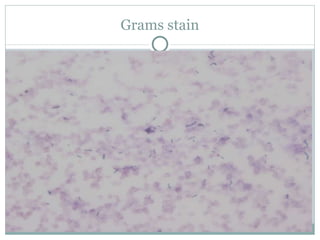
Grams stain
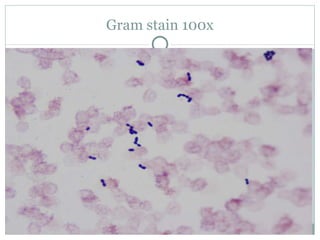
Gram stain 100x
Blood agar plate
CT Chest
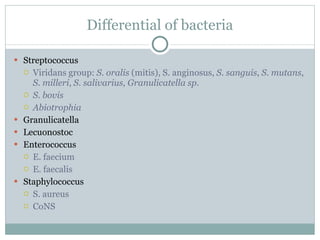
Differential of bacteria Streptococcus Viridans group:  S. oralis  (mitis), S. anginosus,  S. sanguis ,  S. mutans ,  S. milleri ,  S. salivarius, Granulicatella sp. S. bovis Abiotrophia Granulicatella Lecuonostoc Enterococcus E. faecium E. faecalis Staphylococcus S. aureus CoNS
Microbiology Streptococcus salivarius  by biochemical identification 16S rRNA sequence analysis confirmation PCN susceptibility indeterminate </= 0.03 mcg/ml Ceftriaxone MIC </=0.0625 mcg/ml
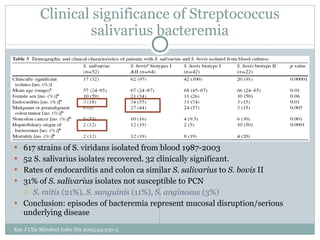
Clinical significance of Streptococcus salivarius bacteremia Eur J Clin Microbiol Inf Dis 2004;24:250-5.
Clinical significance of Streptococcus salivarius bacteremia 617 strains of S. viridans isolated from blood 1987-2003 52 S. salivarius isolates recovered. 32 clinically significant. Rates of endocarditis and colon ca similar  S. salivarius  to  S. bovis  II 31% of  S. salivarius  isolates not susceptible to PCN S. mitis  (21%),  S. sanguinis  (11%),  S. anginosus  (3%) Conclusion: episodes of bacteremia represent mucosal disruption/serious underlying disease Eur J Clin Mirobiol Infec Dis 2005;24:250-5
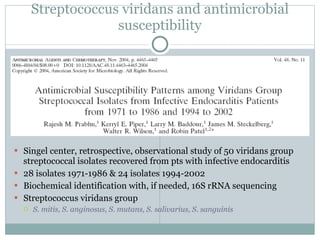
Streptococcus viridans and antimicrobial susceptibility Singel center, retrospective, observational study of 50 viridans group streptococcal isolates recovered from pts with infective endocarditis 28 isolates 1971-1986 & 24 isolates 1994-2002 Biochemical identification with, if needed, 16S rRNA sequencing Streptococcus viridans group S. mitis, S. anginosus, S. mutans, S. salivarius, S. sanguinis
Streptococcus viridans and antimicrobial susceptibility Weakness: small sample size did not predict clinically significant differences Strength: first study to temporally evaluate susceptibility patterns  of endocardial infections Importance: may influence antimicrobial prevention and management of IE Antimicrob Agent Chemother 2004;48:4463-5
Highly PCN Susceptible Viridans Group Streptococcus and  S. bovis Circulation 2005;111:e396-e434
PCN Susceptible IE Randomized, multicenter, phase III trial comparing monotherapy  Ceftriaxone 2 grams once daily for 4 wks to Ceftriaxone 2 grams once daily and Gentamycin 3mg/kg once daily for 2 weeks Exclusion criteria Agents other than CTX susceptible viridans strep or S. bovis, allergy to CTX/aminoglycoside, NYHA IV, cardiac/extracardiac abscess, CrCl <20ml/min, PV, mod-severe hearing loss, neutropenia Inclusion criteria 18 yo, <72 hrs of parenteral abx, Duke criteria CID 1998;27:1470-4
PCN Susceptible IE Endpoints Microbiologic cure : negative blood cultures during therapy, 1-2 wks after therapy, and f/u at 3 month visit Reinfection : new episode of endocarditis with new pathogen Clinical cure : resolution of clinical findings of endocarditis with no evidence of active endocarditis Clinical cure w/ surgery : clinical cure and completion of therapy but requirement of valve replacement or other cardiac surgery CID 1998;27:1470-4
PCN Susceptible IE CID 1998;27:1470-4.
Plan of Care Antimicrobial therapy Ceftriaxone 1 gram iv q12 and Gentamycin 3mg/kg iv q24 for 2 weeks Repeat TEE 7-10 days after initial negative  Class 1, level of evidence B Vegetations may reach detectable size and abscess cavity/fistula tracts appear Surveillance blood cultures 1 wk post completion of antimicrobial therapy IE prophylaxis prior to dental procedures Ensure age appropriate cancer screening
References Correidora JC, et al. Clinical characteristics and significance of streptococcus salivarius bacteremia and Streptococcus bovis bacteremia: a prospective 16 year study. European Journal of Clinical Mirobiology and Infectious Diseases 2004;24:250-5. Prabhu RM, et al. Antimicrobial susceptibility patterns among viridans group streptococcal isolates from infective endocarditis patients from 1971-1986 and 1996-2002. Antimicrobial Agents and Chemotherapy 2004;48:4463-5. Sexton DJ, et al. Ceftriaxone once daily for four weeks compared with ceftriaxone plus gentamycin once daily for two weeks for treatment of endocarditis due to penicillin-susceptible streptococci.  Clinical Infectious Diseases 1998;27:1470-4. Baddour LM, et al. Infective endocarditis diagnosis, antimicrobial therapy, and management of complicatons. Circulation 2005;111:e394-e434 .
IE prophylaxis

Strep Salivarius

  • 1.
    TEMUJIN T. CHAVEZ,M.D. LCDR MC USN INFECTIOUS DISEASEAS FELLOW National Naval Medical Center Case Conference
  • 2.
    Case 71 yomale h/o 2V CAD, AoS, Autoimmune hepatitis admitted for 48 hours after c/o atypical CP. Inpt eval s/f NSTEMI with PCI revealing non-stentable multivessel disease Pt with fever at midnight hd1 and evening hd2. Fever w/u initiated and pt discharged hd3. Pt re-admitted 24 hours after discharge for growth on blood cultures.
  • 3.
    Case ROS: ptdenies f/c. Malaise over past 8 mos. Wt loss during fall 2007. PMHx: CAD-NSTEMI 1997 with stent to LAD/OM1 with stent restenosis OM1 Autoimmune hepatitis-6MP stopped June 2007 Prostate CA-5 yrs s/p radical prostatectomy SurgHx: Prostatectomy Colonoscopy 2005 All: Ticlid Meds: ASA, Zocor, Lisinopril, Atenolol, Lasix, Mobic, Amaryl, Advair, Singulair, Allegra, Nexium, Oscal, MVI
  • 4.
    Case Labs WBC=6.1,Hgb=11.2, Plt=97 MCV 108.6 Na=137, K=4.4, Cl=101, CO2=28, Bun=10, Cr=0.6 Ucx=ngtd Blood cultures: 3/31@0053 3/4 bottles at 24 hours, 3/31@2336 2/4 bottles at 24 hrs (aerobic) Rads Chest Ct-stable pulmonary nodules compared to 5 wks prior at RUL and left lung fissure Wedge shaped splenic infarct
  • 5.
  • 6.
  • 7.
  • 8.
  • 9.
    Differential of bacteriaStreptococcus Viridans group: S. oralis (mitis), S. anginosus, S. sanguis , S. mutans , S. milleri , S. salivarius, Granulicatella sp. S. bovis Abiotrophia Granulicatella Lecuonostoc Enterococcus E. faecium E. faecalis Staphylococcus S. aureus CoNS
  • 10.
    Microbiology Streptococcus salivarius by biochemical identification 16S rRNA sequence analysis confirmation PCN susceptibility indeterminate </= 0.03 mcg/ml Ceftriaxone MIC </=0.0625 mcg/ml
  • 11.
    Clinical significance ofStreptococcus salivarius bacteremia Eur J Clin Microbiol Inf Dis 2004;24:250-5.
  • 12.
    Clinical significance ofStreptococcus salivarius bacteremia 617 strains of S. viridans isolated from blood 1987-2003 52 S. salivarius isolates recovered. 32 clinically significant. Rates of endocarditis and colon ca similar S. salivarius to S. bovis II 31% of S. salivarius isolates not susceptible to PCN S. mitis (21%), S. sanguinis (11%), S. anginosus (3%) Conclusion: episodes of bacteremia represent mucosal disruption/serious underlying disease Eur J Clin Mirobiol Infec Dis 2005;24:250-5
  • 13.
    Streptococcus viridans andantimicrobial susceptibility Singel center, retrospective, observational study of 50 viridans group streptococcal isolates recovered from pts with infective endocarditis 28 isolates 1971-1986 & 24 isolates 1994-2002 Biochemical identification with, if needed, 16S rRNA sequencing Streptococcus viridans group S. mitis, S. anginosus, S. mutans, S. salivarius, S. sanguinis
  • 14.
    Streptococcus viridans andantimicrobial susceptibility Weakness: small sample size did not predict clinically significant differences Strength: first study to temporally evaluate susceptibility patterns of endocardial infections Importance: may influence antimicrobial prevention and management of IE Antimicrob Agent Chemother 2004;48:4463-5
  • 15.
    Highly PCN SusceptibleViridans Group Streptococcus and S. bovis Circulation 2005;111:e396-e434
  • 16.
    Highly PCN SusceptibleViridans Group Streptococcus and S. bovis Circulation 2005;111:e396-e434
  • 17.
    PCN Susceptible IERandomized, multicenter, phase III trial comparing monotherapy Ceftriaxone 2 grams once daily for 4 wks to Ceftriaxone 2 grams once daily and Gentamycin 3mg/kg once daily for 2 weeks Exclusion criteria Agents other than CTX susceptible viridans strep or S. bovis, allergy to CTX/aminoglycoside, NYHA IV, cardiac/extracardiac abscess, CrCl <20ml/min, PV, mod-severe hearing loss, neutropenia Inclusion criteria 18 yo, <72 hrs of parenteral abx, Duke criteria CID 1998;27:1470-4
  • 18.
    PCN Susceptible IEEndpoints Microbiologic cure : negative blood cultures during therapy, 1-2 wks after therapy, and f/u at 3 month visit Reinfection : new episode of endocarditis with new pathogen Clinical cure : resolution of clinical findings of endocarditis with no evidence of active endocarditis Clinical cure w/ surgery : clinical cure and completion of therapy but requirement of valve replacement or other cardiac surgery CID 1998;27:1470-4
  • 19.
    PCN Susceptible IECID 1998;27:1470-4.
  • 20.
    Plan of CareAntimicrobial therapy Ceftriaxone 1 gram iv q12 and Gentamycin 3mg/kg iv q24 for 2 weeks Repeat TEE 7-10 days after initial negative Class 1, level of evidence B Vegetations may reach detectable size and abscess cavity/fistula tracts appear Surveillance blood cultures 1 wk post completion of antimicrobial therapy IE prophylaxis prior to dental procedures Ensure age appropriate cancer screening
  • 21.
    References Correidora JC,et al. Clinical characteristics and significance of streptococcus salivarius bacteremia and Streptococcus bovis bacteremia: a prospective 16 year study. European Journal of Clinical Mirobiology and Infectious Diseases 2004;24:250-5. Prabhu RM, et al. Antimicrobial susceptibility patterns among viridans group streptococcal isolates from infective endocarditis patients from 1971-1986 and 1996-2002. Antimicrobial Agents and Chemotherapy 2004;48:4463-5. Sexton DJ, et al. Ceftriaxone once daily for four weeks compared with ceftriaxone plus gentamycin once daily for two weeks for treatment of endocarditis due to penicillin-susceptible streptococci. Clinical Infectious Diseases 1998;27:1470-4. Baddour LM, et al. Infective endocarditis diagnosis, antimicrobial therapy, and management of complicatons. Circulation 2005;111:e394-e434 .
  • 22.

Editor's Notes

  • #14 Infectious Diseases Research Lab at Mayo Clinical Endocarditis Registry
  • #15 Strength: first study to evaluate susceptibility patterns temporally for endocardial infections Weakness:
  • #16 Pcn mic &lt;0.03, ctx 0.25
  • #17 Pcn mic &lt;0.03, ctx 0.25
  • #18 Phase III studies are designed to compare one or more treatments. A new drug or drug combination may be tested against one of proven efficacy. Phase III studies often have multiple endpoints. Overall and disease-free survival are nearly always endpoints; differences in response rates, toxicity, patterns of recurrence, and quality of life might also be endpoints. At the conclusion of a properly designed and conducted phase III study, the new drug or drug combination will be found to be inferior, equivalent, or superior to the standard treatment with respect to the major endpoints. The degree of difference will be known and statistical significance will be estimated
  • #20 No relapses occurred. Clinical cure was observed in 25(96.2%) of 26 monotherapy and 24 (96%) 25 combination therapy recipients. Total of 5 monotherapy pts received cardiac surgery a mean of 37.1 days after antimicrobial therapy. Total of 9 combination therapy recipients required cardiac surgery at mean 22 2 combination therapy pts had a rise in their serum creatinine Mean duration of hospitalization was 8 days for montherapy and 14.5 days for combination therapy.