Streaming SQL for
Data Engineers: The
Next Big Thing?
Streaming SQL Products
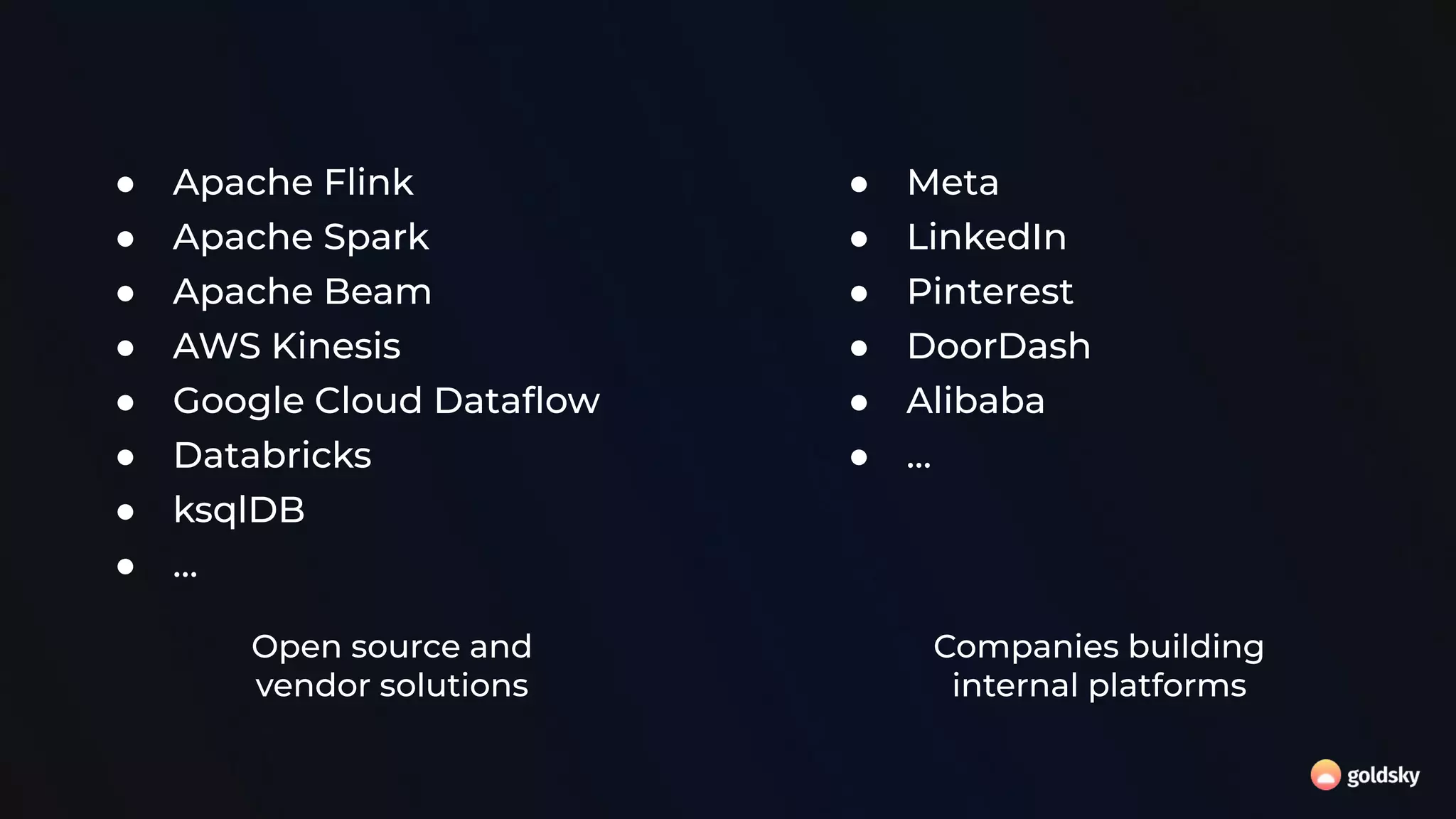
● Apache Flink
● Apache Spark
● Apache Beam
● AWS Kinesis
● Google Cloud Dataflow
● Databricks
● ksqlDB
● …
● Meta
● LinkedIn
● Pinterest
● DoorDash
● Alibaba
● …
Companies building
internal platforms
Open source and
vendor solutions
👋 Hi, I’m Yaroslav
👋 Hi, I’m Yaroslav
● Principal Software Engineer @ Goldsky
● Staff Data Engineer @ Shopify
● Software Architect @ Activision
● …
👋 Hi, I’m Yaroslav
● Principal Software Engineer @ Goldsky
● Staff Data Engineer @ Shopify
● Software Architect @ Activision
● …
❤ Apache Flink
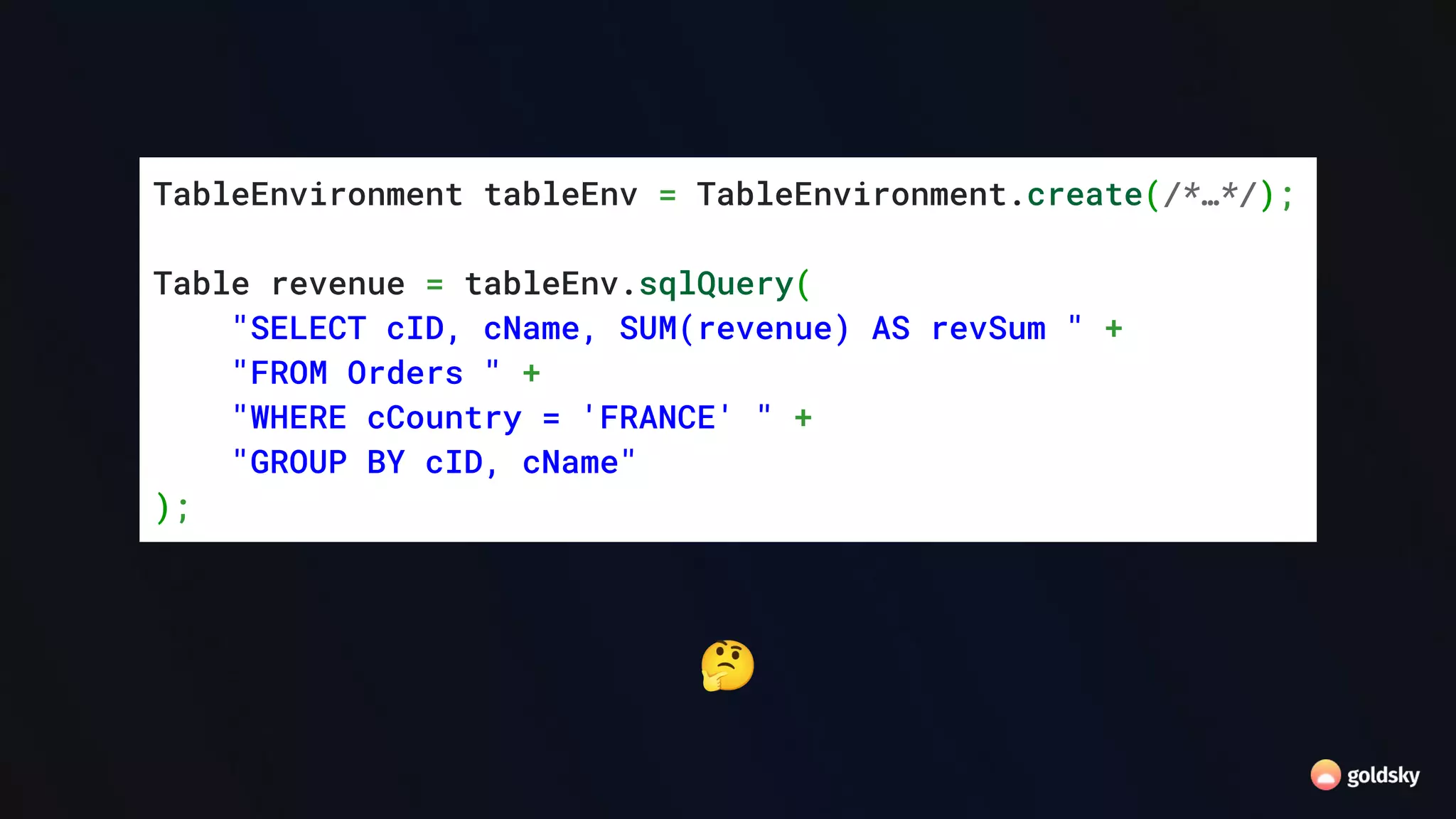
🤔
TableEnvironment tableEnv = TableEnvironment.create(/*…*/);
Table revenue = tableEnv.sqlQuery(
"SELECT cID, cName, SUM(revenue) AS revSum " +
"FROM Orders " +
"WHERE cCountry = 'FRANCE' " +
"GROUP BY cID, cName"
);
… but why SQL?
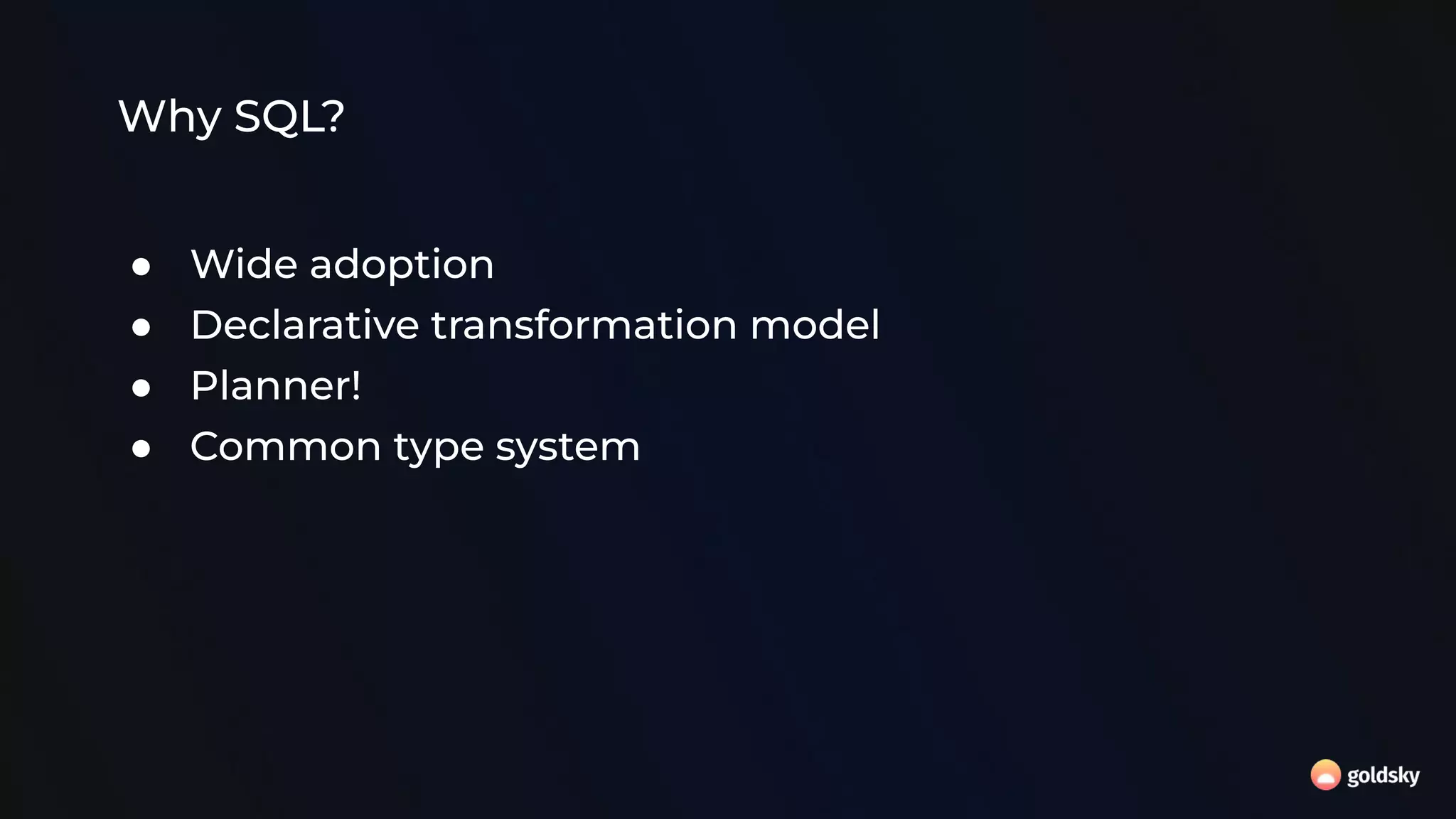
Why SQL?
● Wide adoption
● Declarative transformation model
● Planner!
● Common type system
What instead of How
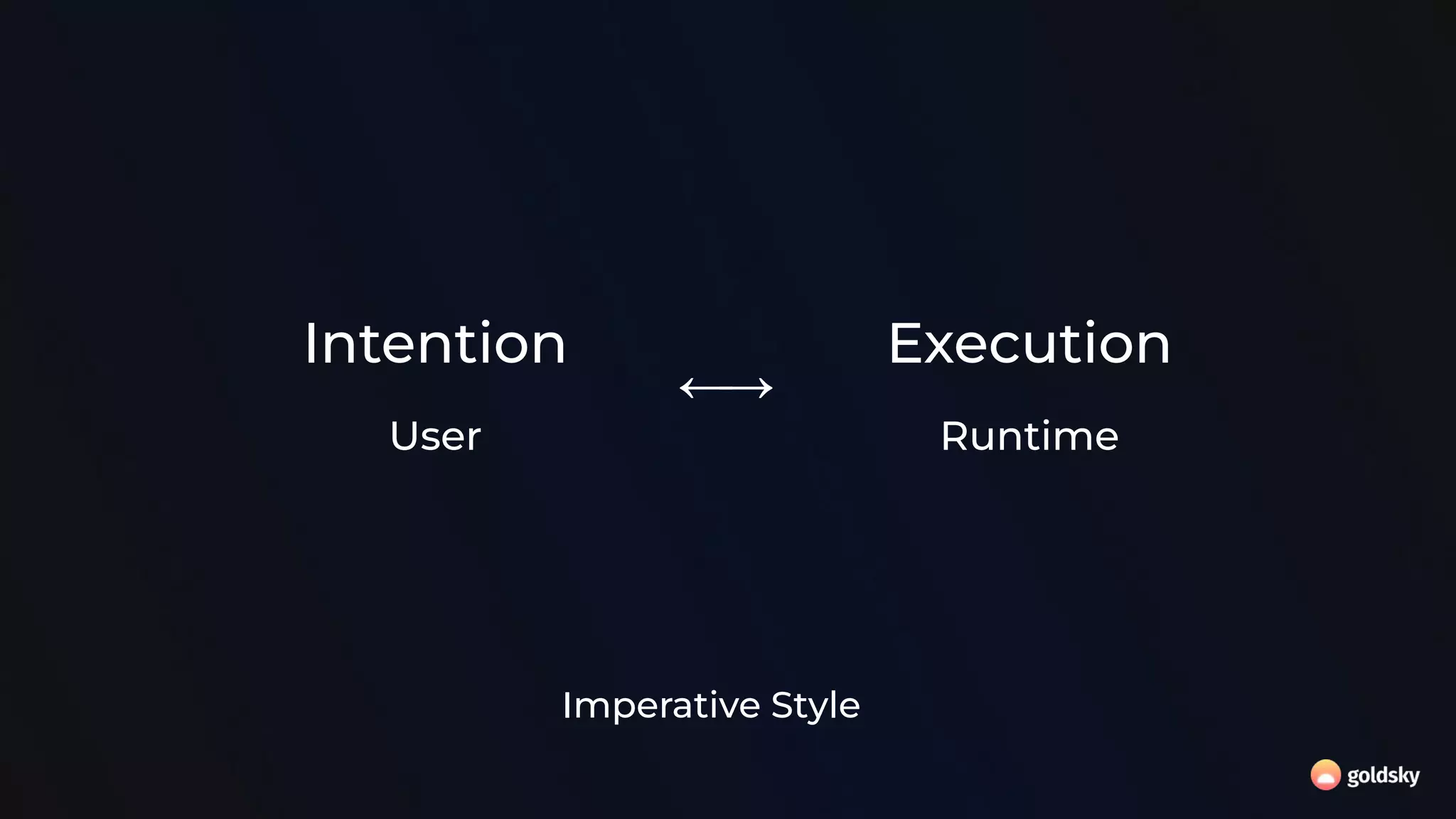
User
Intention Execution
Runtime
←
Imperative Style
→
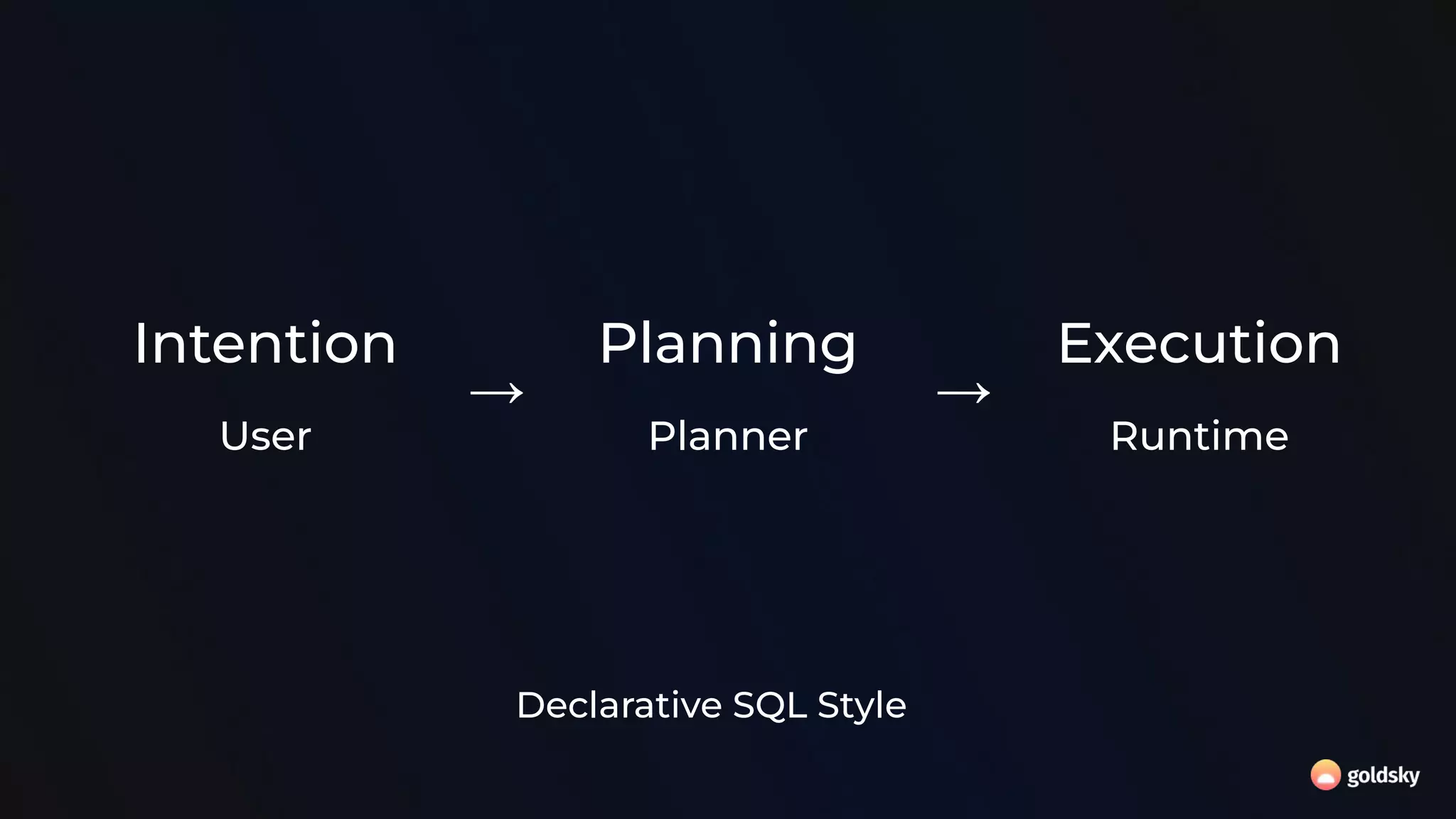
User
Intention Execution
Runtime
→
Planning
Planner
→
Declarative SQL Style
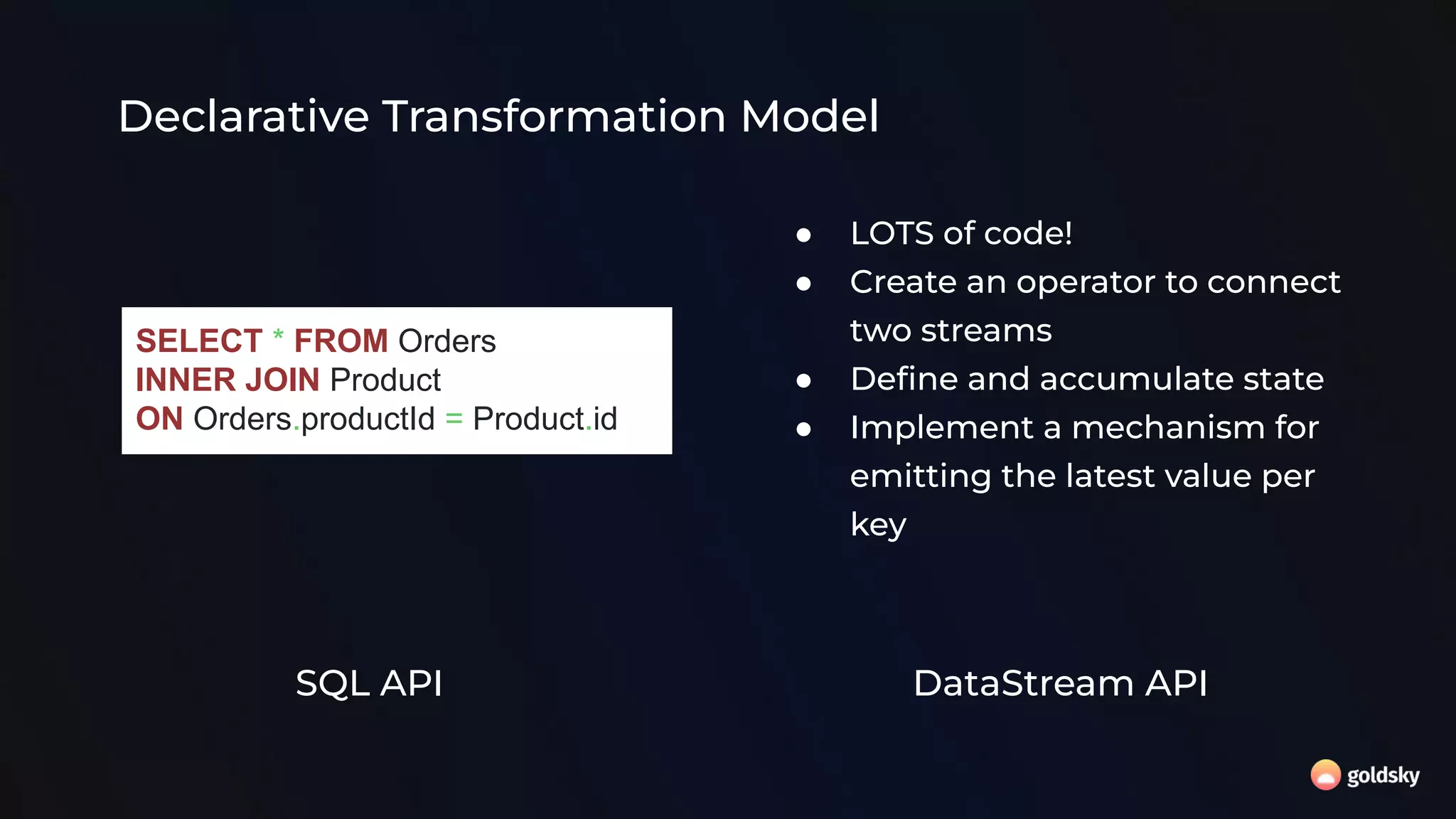
SELECT * FROM Orders
INNER JOIN Product
ON Orders.productId = Product.id
● LOTS of code!
● Create an operator to connect
two streams
● Define and accumulate state
● Implement a mechanism for
emitting the latest value per
key
SQL API DataStream API
Declarative Transformation Model
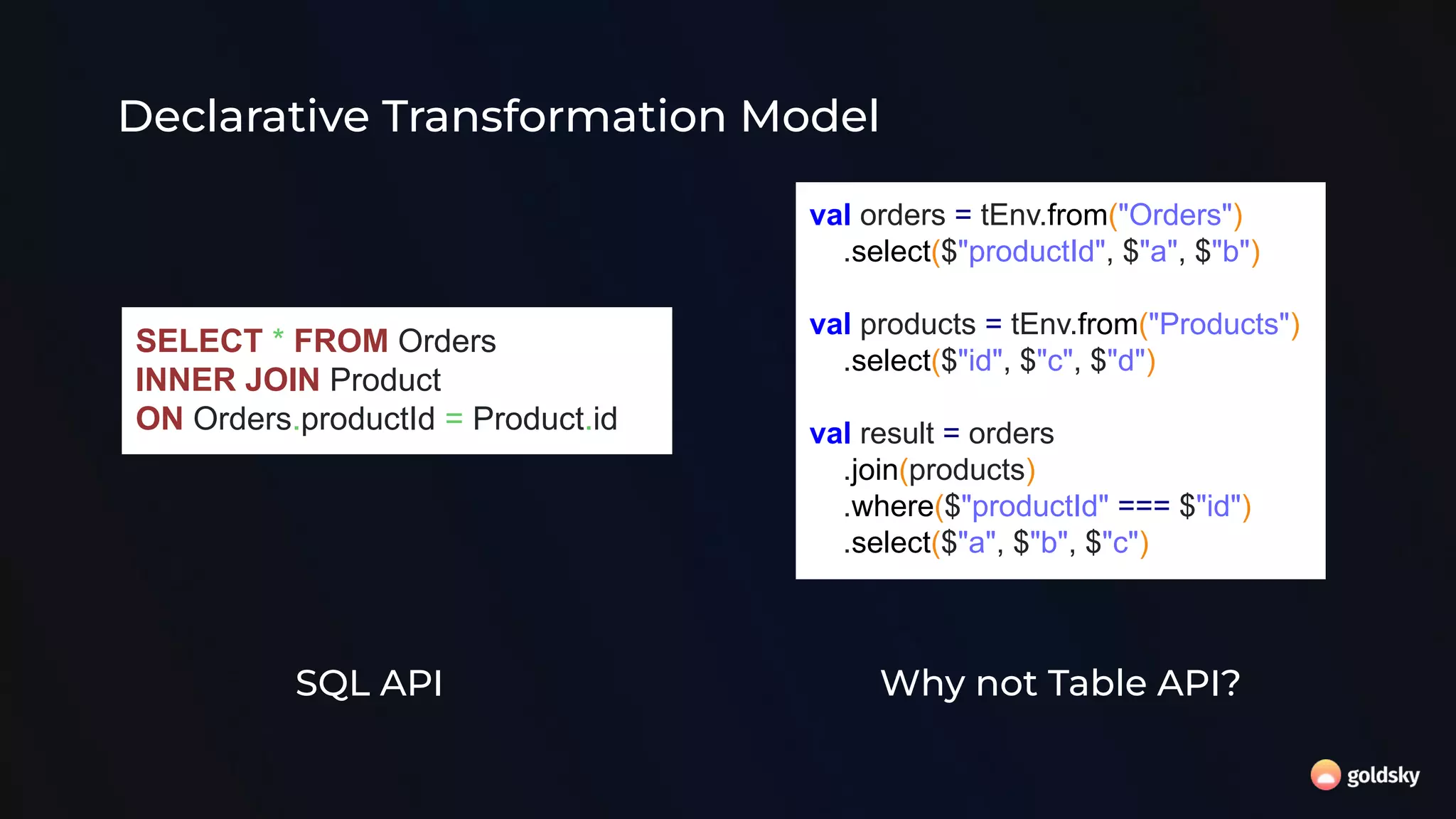
SELECT * FROM Orders
INNER JOIN Product
ON Orders.productId = Product.id
SQL API Why not Table API?
val orders = tEnv.from("Orders")
.select($"productId", $"a", $"b")
val products = tEnv.from("Products")
.select($"id", $"c", $"d")
val result = orders
.join(products)
.where($"productId" === $"id")
.select($"a", $"b", $"c")
Declarative Transformation Model
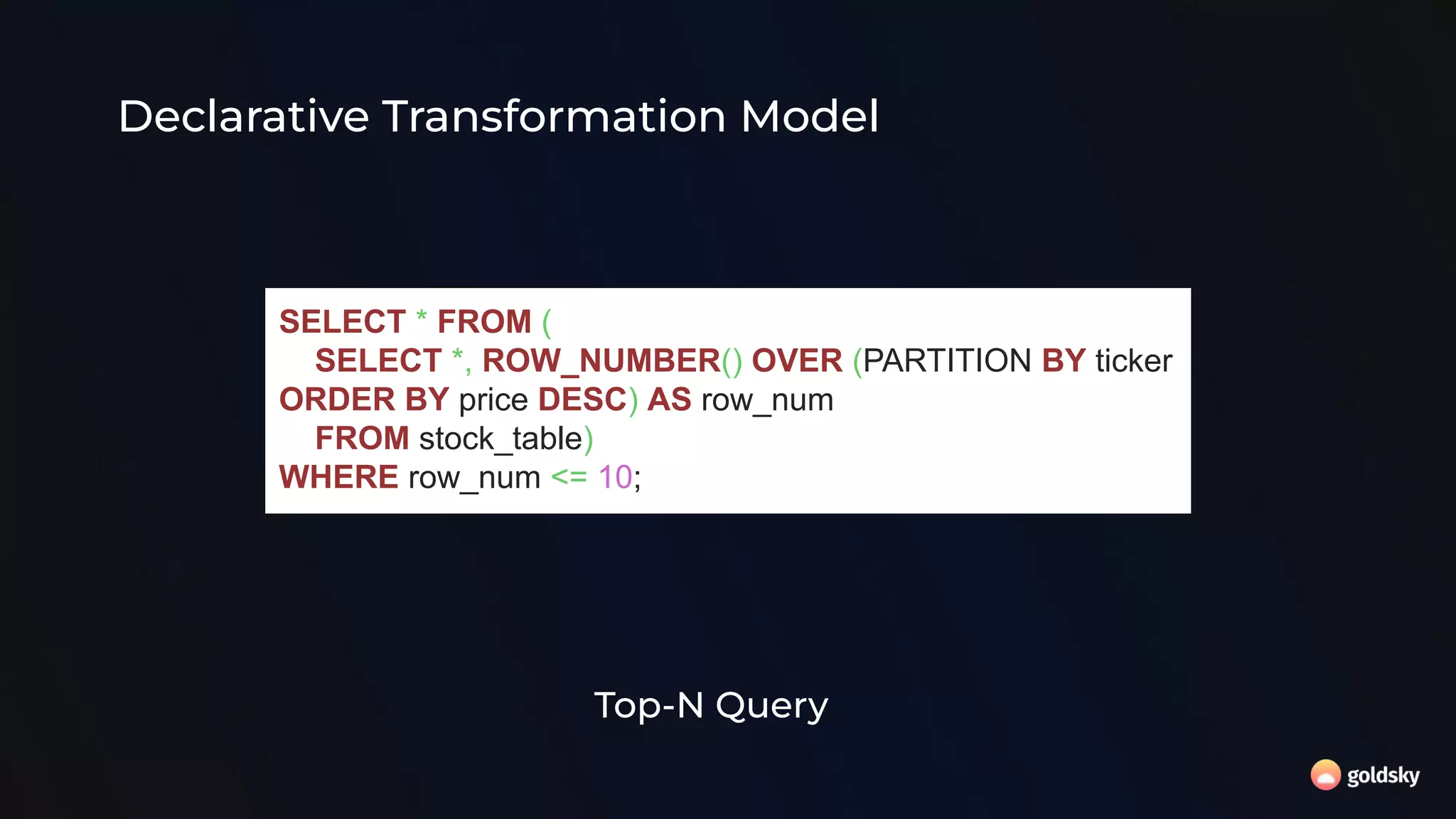
SELECT * FROM (
SELECT *, ROW_NUMBER() OVER (PARTITION BY ticker
ORDER BY price DESC) AS row_num
FROM stock_table)
WHERE row_num <= 10;
Top-N Query
Declarative Transformation Model
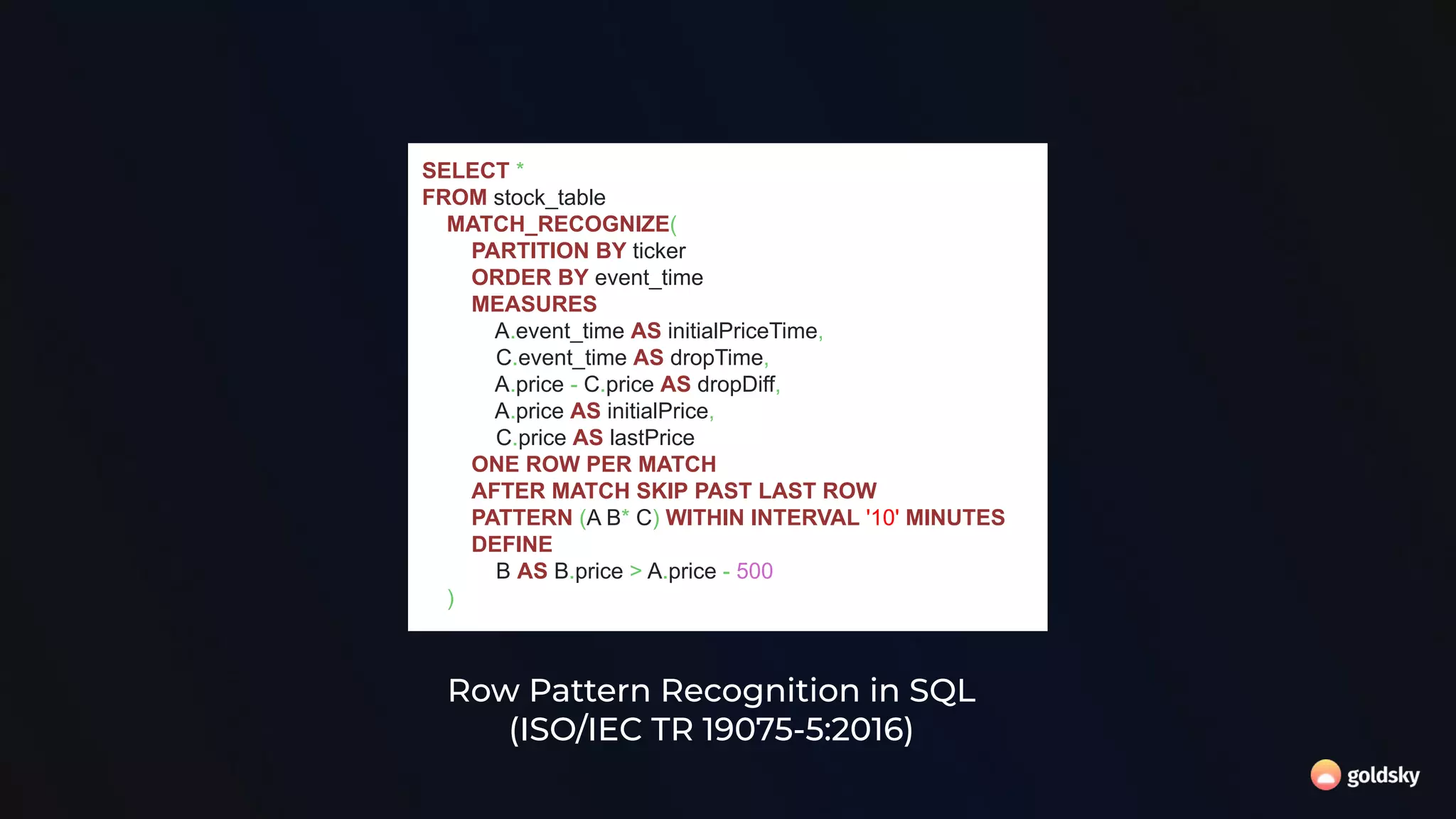
Row Pattern Recognition in SQL
(ISO/IEC TR 19075-5:2016)
SELECT *
FROM stock_table
MATCH_RECOGNIZE(
PARTITION BY ticker
ORDER BY event_time
MEASURES
A.event_time AS initialPriceTime,
C.event_time AS dropTime,
A.price - C.price AS dropDiff,
A.price AS initialPrice,
C.price AS lastPrice
ONE ROW PER MATCH
AFTER MATCH SKIP PAST LAST ROW
PATTERN (A B* C) WITHIN INTERVAL '10' MINUTES
DEFINE
B AS B.price > A.price - 500
)
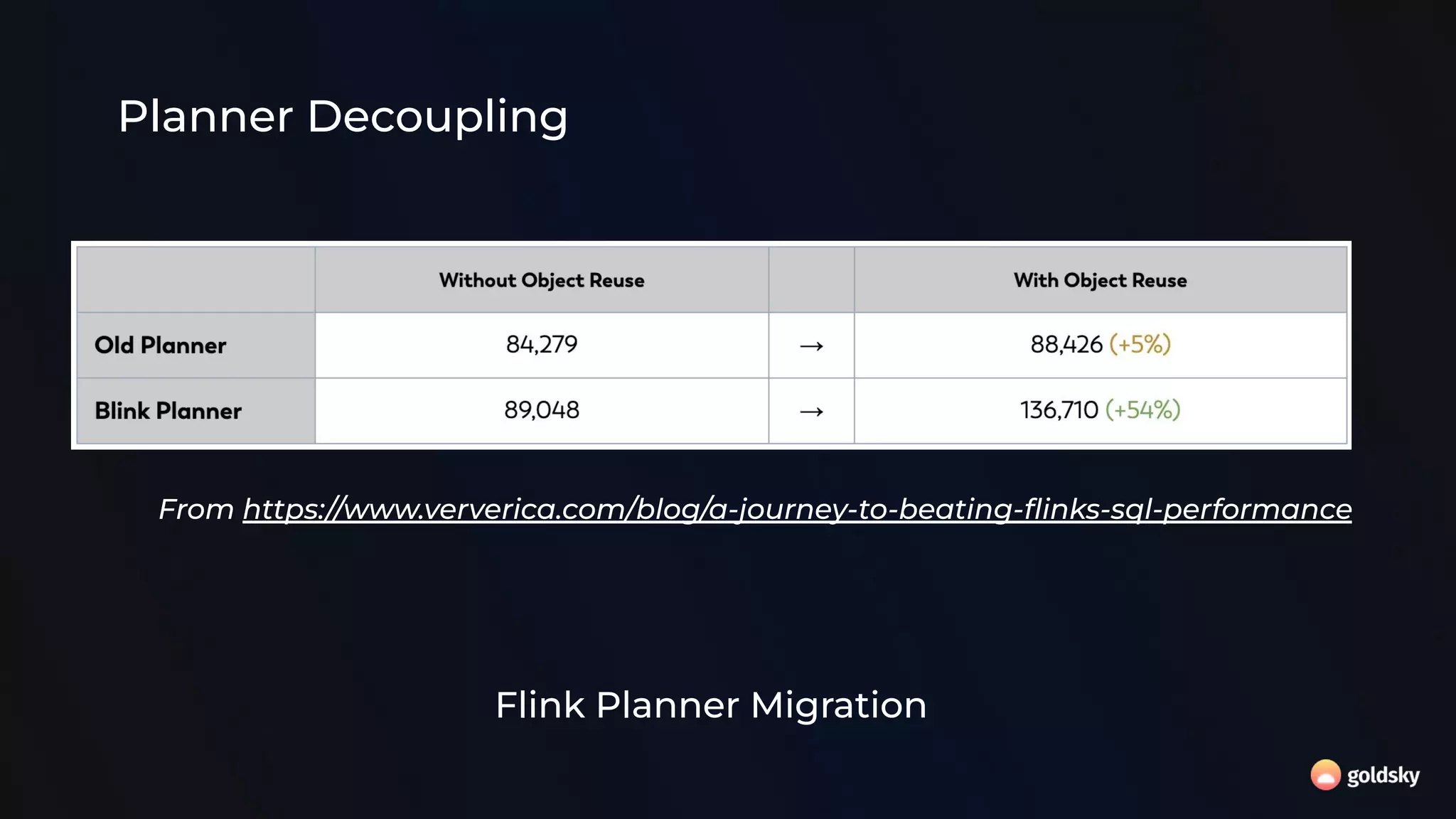
Flink Planner Migration
From https://www.ververica.com/blog/a-journey-to-beating-flinks-sql-performance
Planner Decoupling
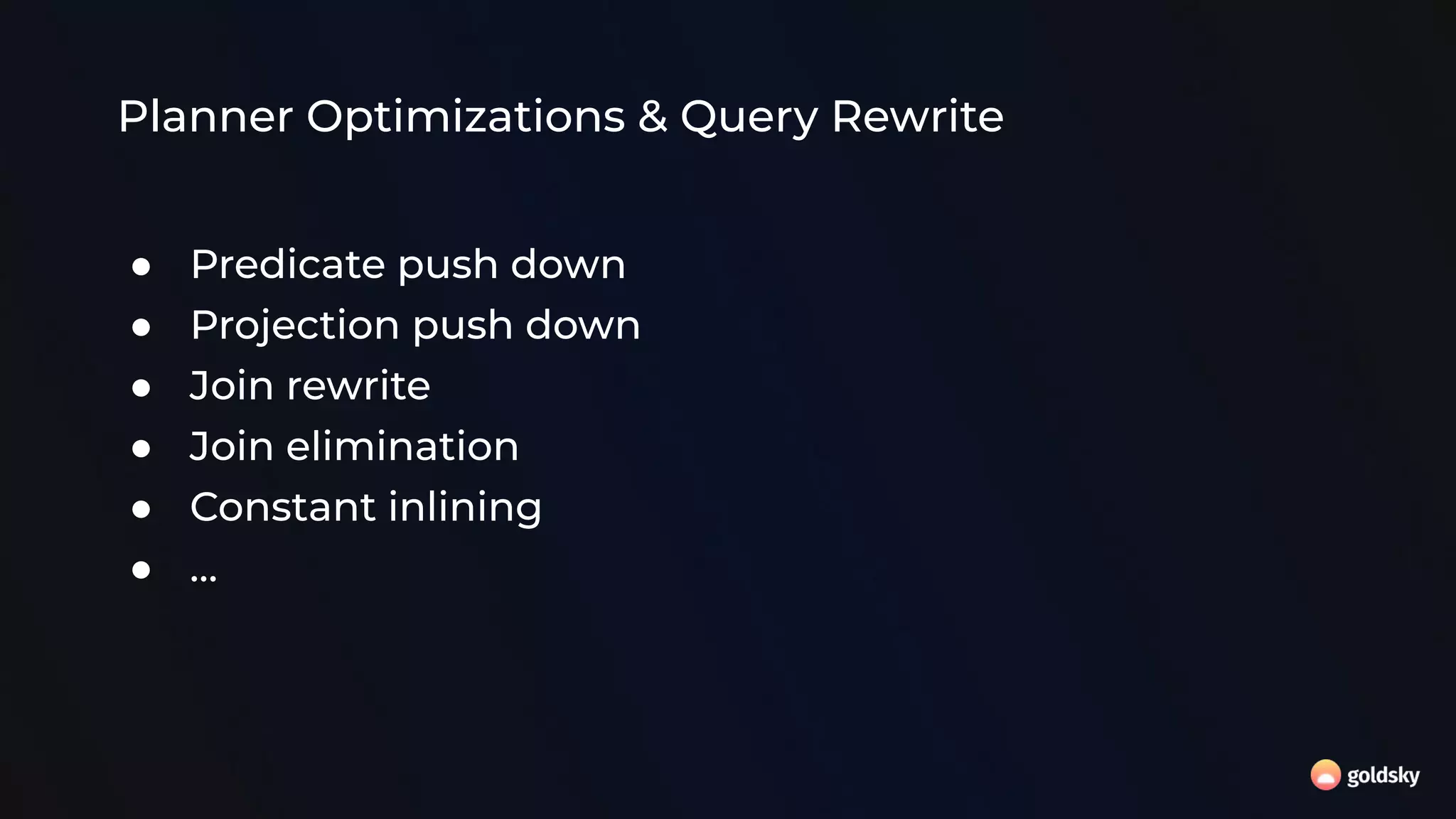
Planner Optimizations & Query Rewrite
● Predicate push down
● Projection push down
● Join rewrite
● Join elimination
● Constant inlining
● …
SQL API DataStream API
val postgresSink: SinkFunction[Envelope] = JdbcSink.sink(
"INSERT INTO table " +
"(id, number, timestamp, author, difficulty, size, vid, block_range) " +
"VALUES (?, ?, ?, ?, ?, ?, ?, ?) " +
"ON CONFLICT (id) DO UPDATE SET " +
"number = excluded.number, " +
"timestamp = excluded.timestamp, " +
"author = excluded.author, " +
"difficulty = excluded.difficulty, " +
"size = excluded.size, " +
"vid = excluded.vid, " +
"block_range = excluded.block_range " +
"WHERE excluded.vid > table.vid",
new JdbcStatementBuilder[Envelope] {
override def accept(statement: PreparedStatement, record: Envelope): Unit = {
val payload = record.payload
payload.id.foreach { id => statement.setString(1, id) }
payload.number.foreach { number => statement.setBigDecimal(2, new java.math.BigDecimal(number)) }
payload.timestamp.foreach { timestamp => statement.setBigDecimal(3, new java.math.BigDecimal(timestamp)) }
payload.author.foreach { author => statement.setString(4, author) }
payload.difficulty.foreach { difficulty => statement.setBigDecimal(5, new java.math.BigDecimal(difficulty)) }
payload.size.foreach { size => statement.setBigDecimal(6, new java.math.BigDecimal(size)) }
payload.vid.foreach { vid => statement.setLong(7, vid.toLong) }
payload.block_range.foreach { block_range => statement.setObject(8, new PostgresIntRange(block_range), Types.O
}
},
CREATE TABLE TABLE (
id BIGINT,
number INTEGER,
timestamp TIMESTAMP,
author STRING,
difficulty STRING,
size INTEGER,
vid BIGINT,
block_range STRING
PRIMARY KEY (vid) NOT ENFORCED
) WITH (
'connector' = 'jdbc',
'table-name' = 'table'
);
😱
Common Type System
When you start using SQL
you get access to the
decades of advancements
in database design
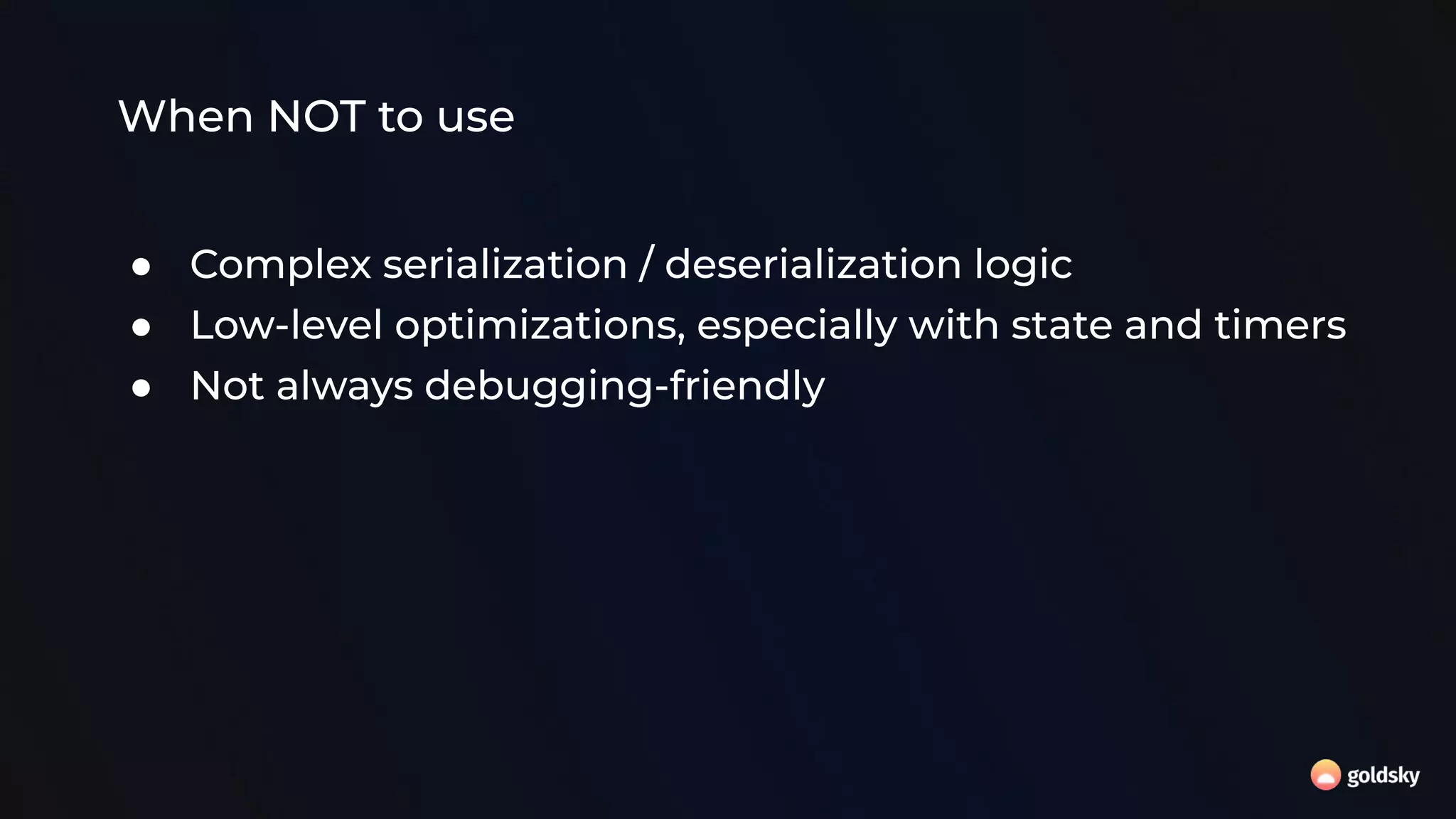
When NOT to use
● Complex serialization / deserialization logic
● Low-level optimizations, especially with state and timers
● Not always debugging-friendly
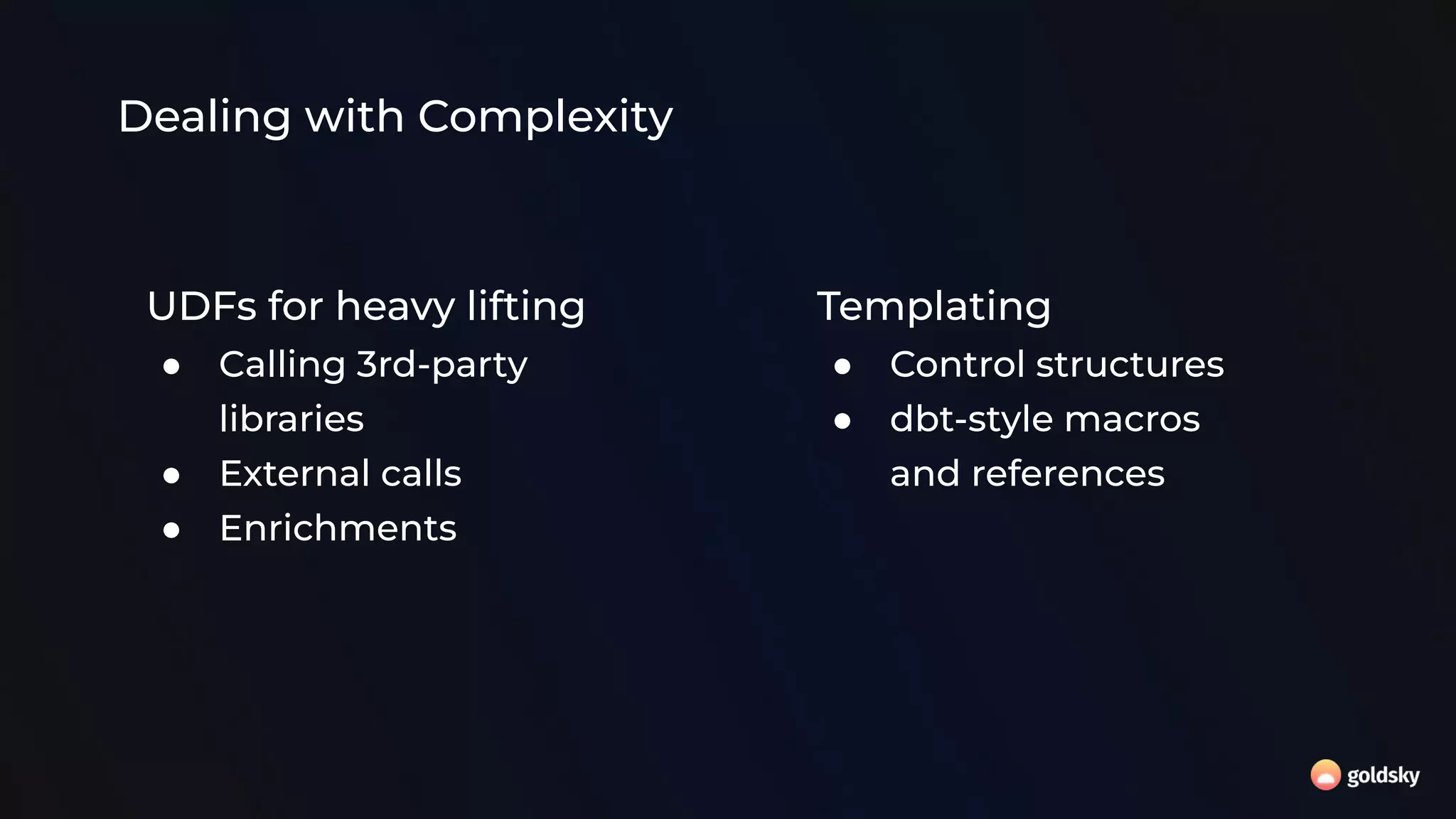
Dealing with Complexity
UDFs for heavy lifting
● Calling 3rd-party
libraries
● External calls
● Enrichments
Templating
● Control structures
● dbt-style macros
and references
Convinced? Let’s use it!
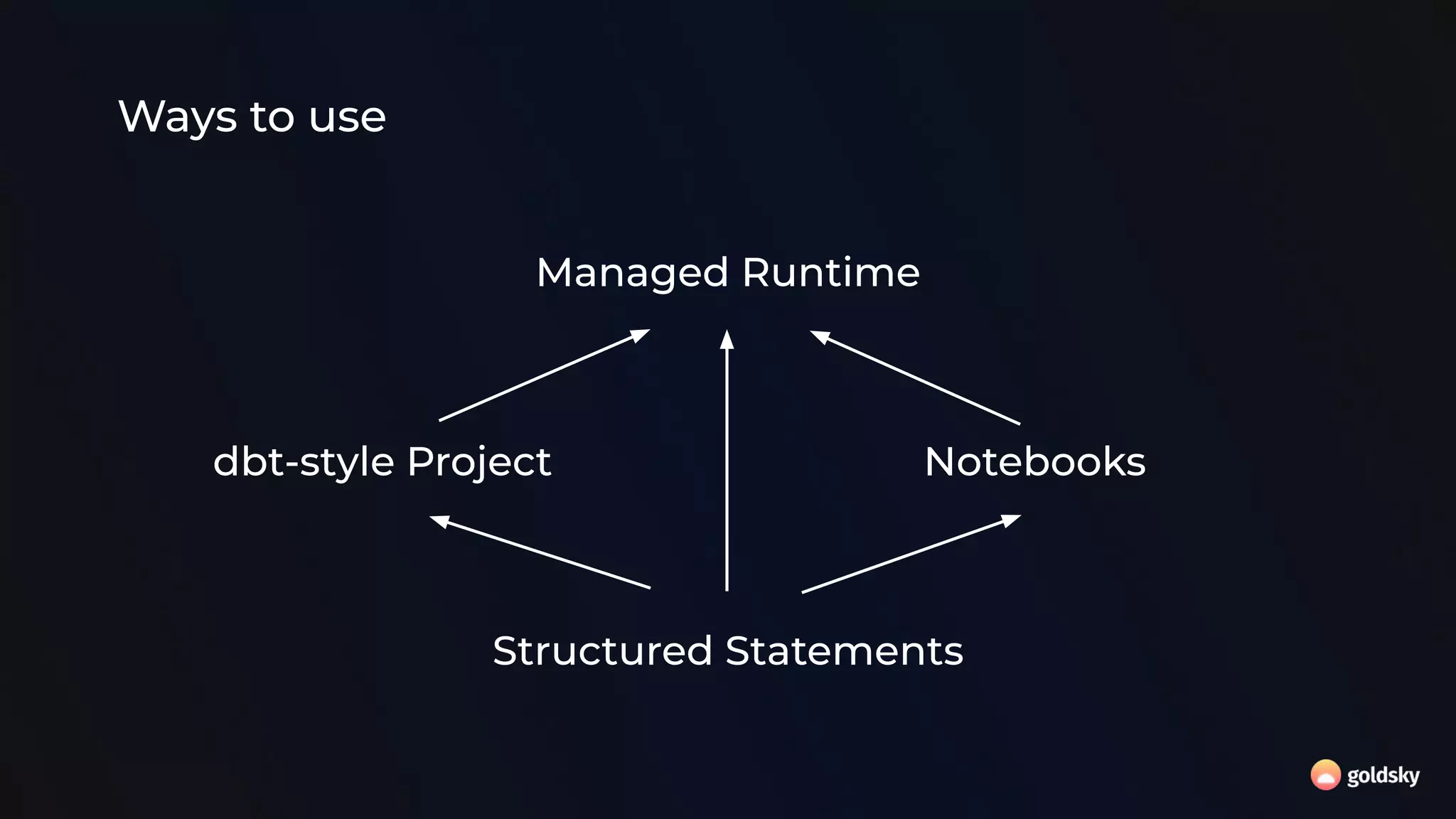
Ways to use
Structured Statements
dbt-style Project Notebooks
Managed Runtime
Requirements
● Version control
● Code organization
● Testability
● CI/CD
● Observability
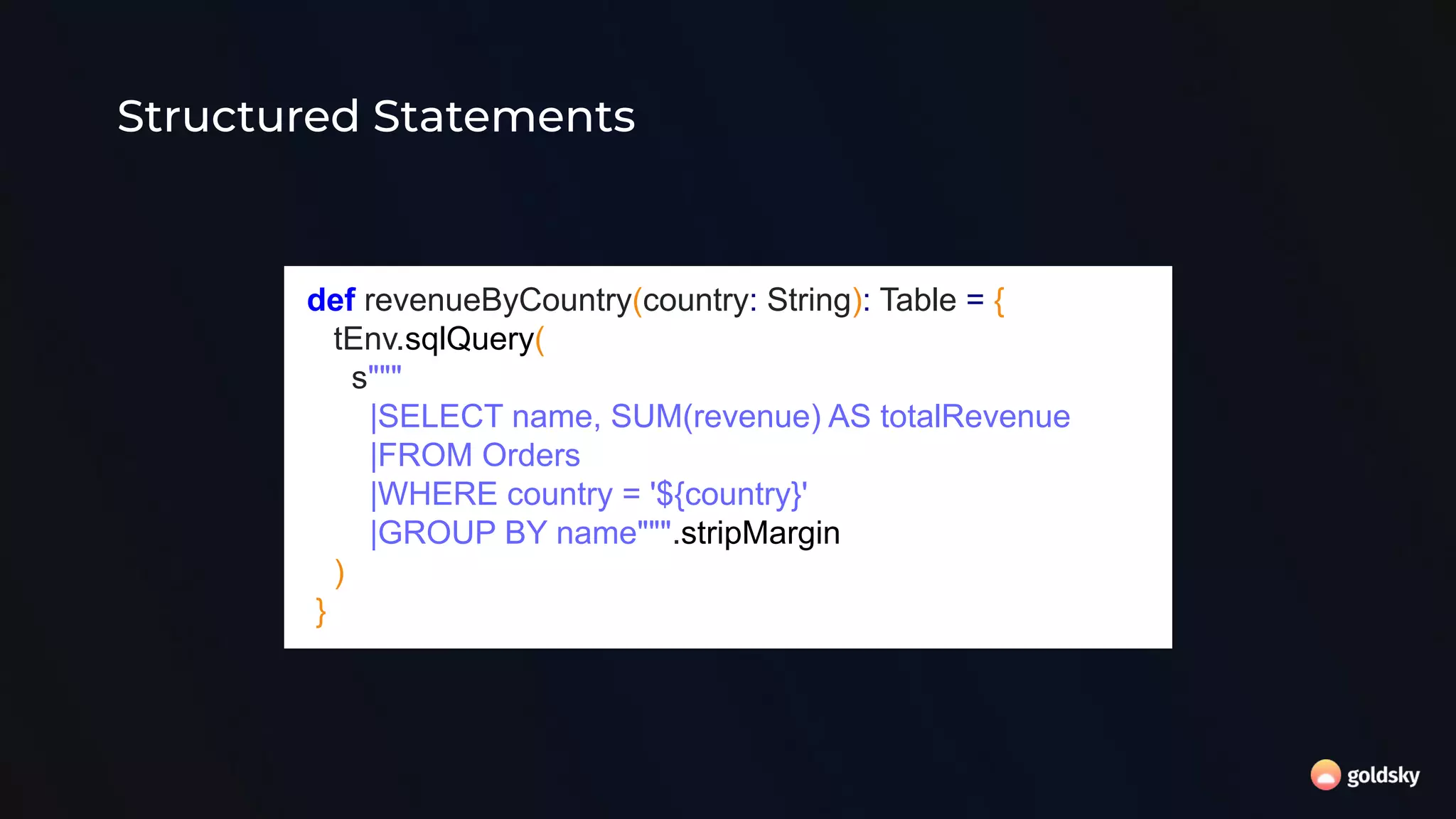
Structured Statements
def revenueByCountry(country: String): Table = {
tEnv.sqlQuery(
s"""
|SELECT name, SUM(revenue) AS totalRevenue
|FROM Orders
|WHERE country = '${country}'
|GROUP BY name""".stripMargin
)
}
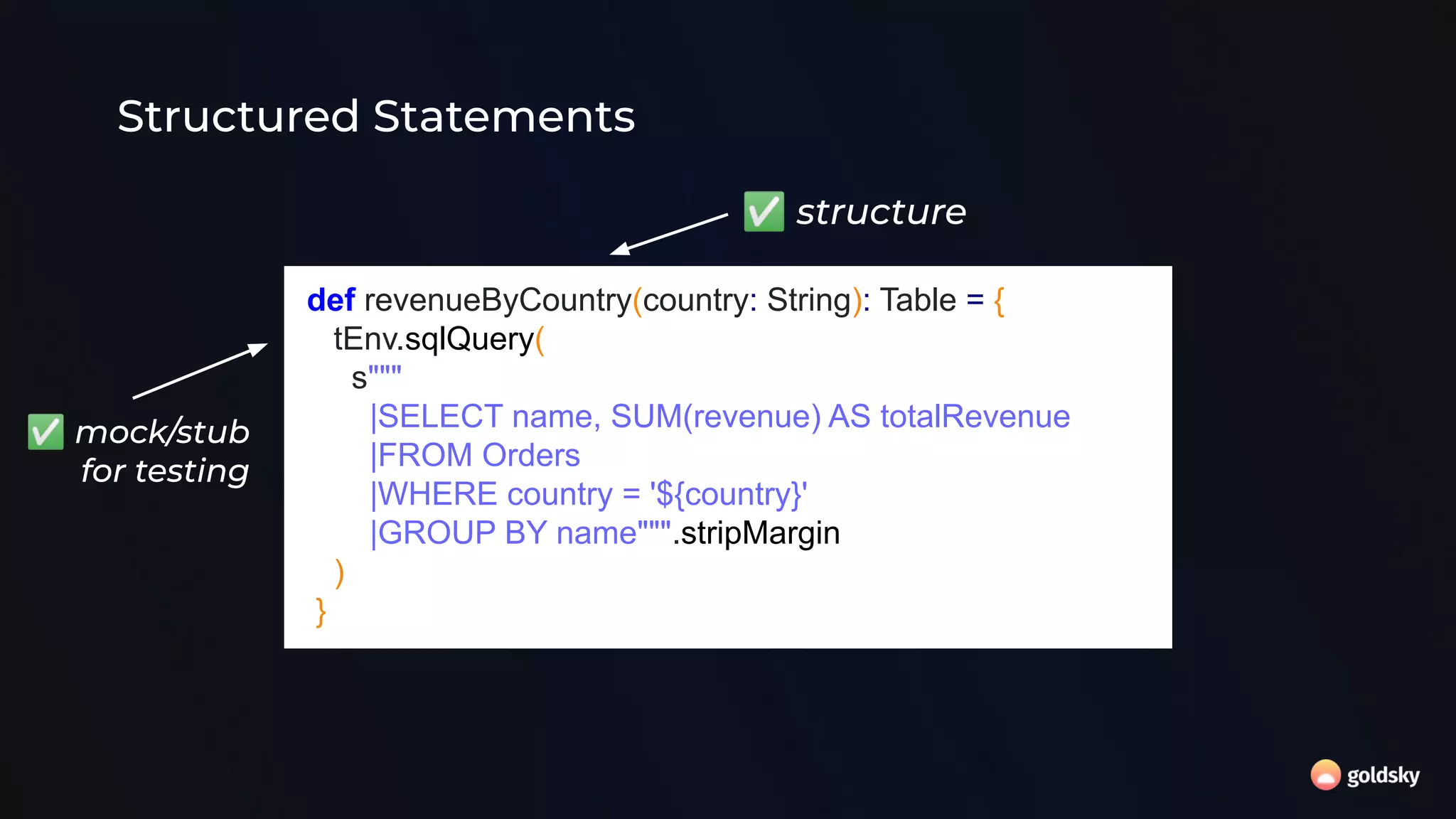
Structured Statements
def revenueByCountry(country: String): Table = {
tEnv.sqlQuery(
s"""
|SELECT name, SUM(revenue) AS totalRevenue
|FROM Orders
|WHERE country = '${country}'
|GROUP BY name""".stripMargin
)
}
✅ structure
✅ mock/stub
for testing
Structured Statements
● Treat them like code
● Only make sense when Table API is not available
● Mix with other API flavours
● SQL also has style guides
● Otherwise it’s a typical streaming application!
Structured Statements
● Version control: 🟢
● Code organization: 🟢
● Testability: 🟡
● CI/CD: 🟡
● Observability: 🟢
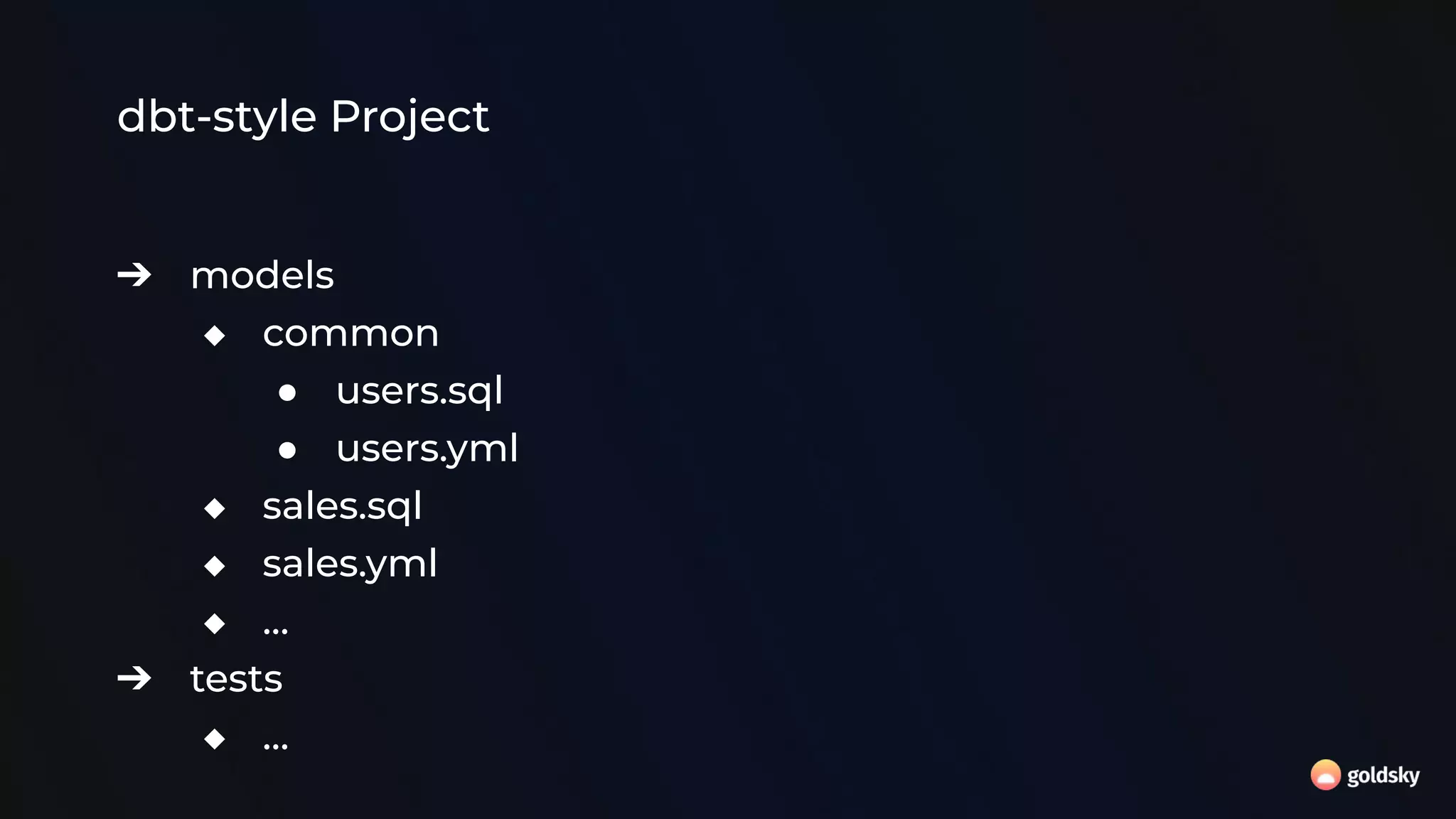
dbt-style Project
➔ models
◆ common
● users.sql
● users.yml
◆ sales.sql
◆ sales.yml
◆ …
➔ tests
◆ …
dbt-style Project
➔ models
◆ common
● users.sql
● users.yml
◆ sales.sql
◆ sales.yml
◆ …
➔ tests
◆ …
✅ structured
✅ schematized
✅ testable
dbt-style Project
SELECT
((text::jsonb)->>'bid_price')::FLOAT AS bid_price,
(text::jsonb)->>'order_quantity' AS order_quantity,
(text::jsonb)->>'symbol' AS symbol,
(text::jsonb)->>'trade_type' AS trade_type,
to_timestamp(((text::jsonb)->'timestamp')::BIGINT) AS ts
FROM {{ REF('market_orders_raw') }}
{{ config(materialized='materializedview') }}
SELECT symbol,
AVG(bid_price) AS avg
FROM {{ REF('market_orders') }}
GROUP BY symbol
dbt-style Project
● Works well for heavy analytical use-cases
● Could write tests in Python/Scala/etc.
● Probably needs more tooling than you think (state
management, observability, etc.)
● Check dbt adapter from Materialize!
dbt-style Project
● Version control: 🟢
● Code organization: 🟢
● Testability: 🟡
● CI/CD: 🟡
● Observability: 🟡
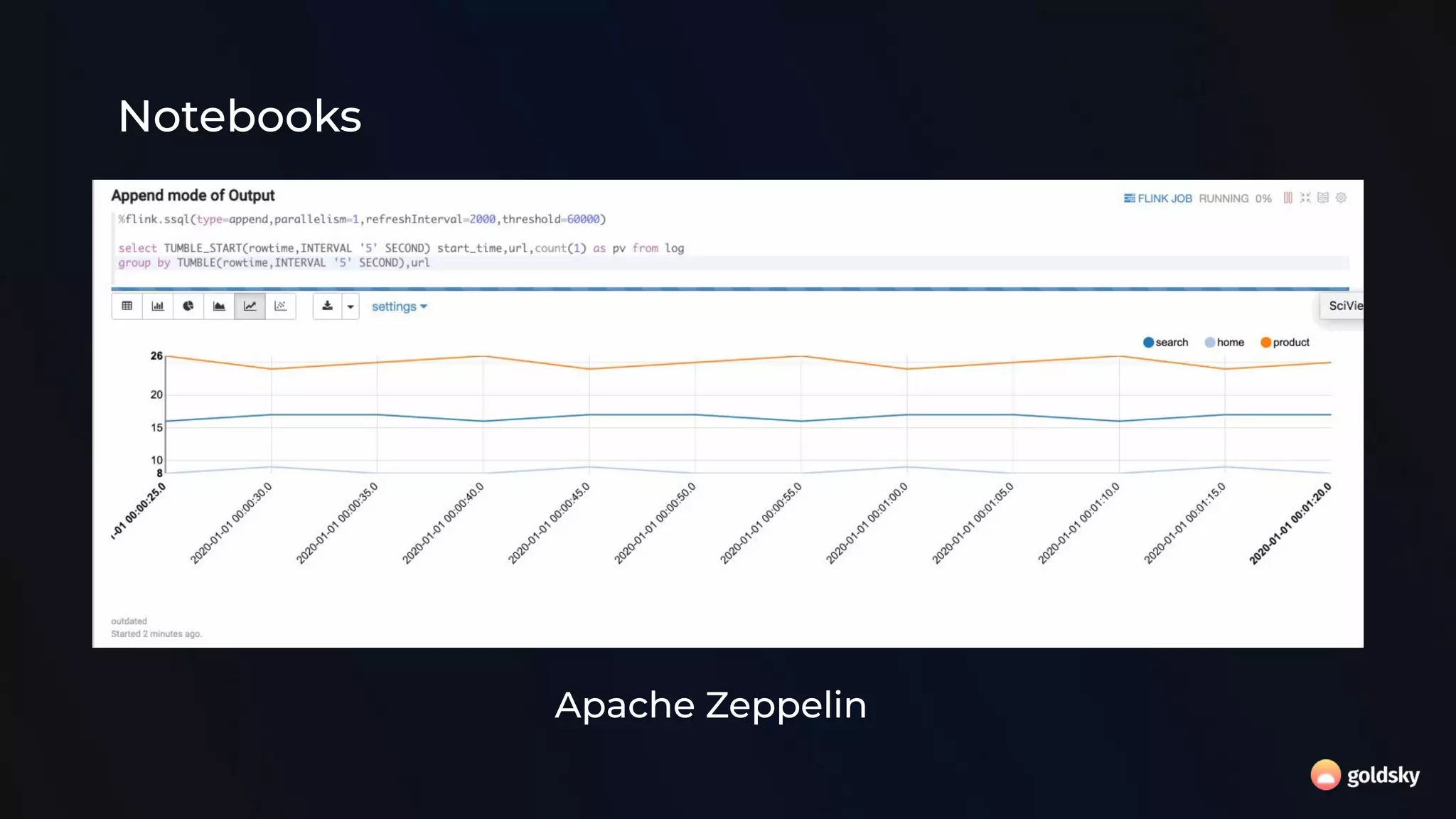
Notebooks
Apache Zeppelin
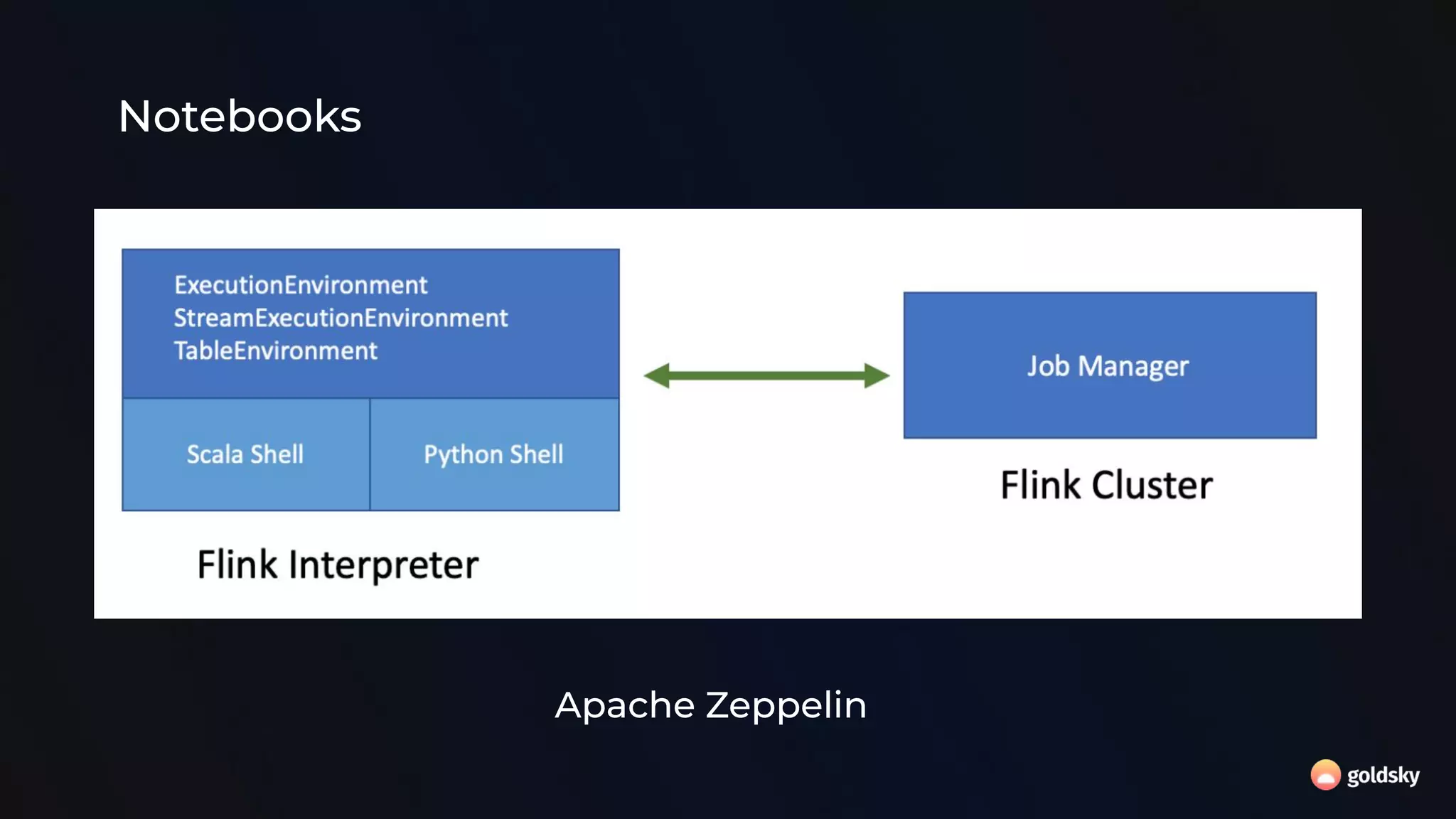
Notebooks
Apache Zeppelin
Notebooks
● Great UX
● Ideal for exploratory analysis and BI
● Complements all other patterns really well
● Way more important for realtime workloads
Notebooks
We don't recommend productionizing notebooks and
instead encourage empowering data scientists to build
production-ready code with the right programming
frameworks
https://www.thoughtworks.com/en-ca/radar/technique
s/productionizing-notebooks
Notebooks
● Version control: 🟡
● Code organization: 🔴
● Testability: 🔴
● CI/CD: 🔴
● Observability: 🔴
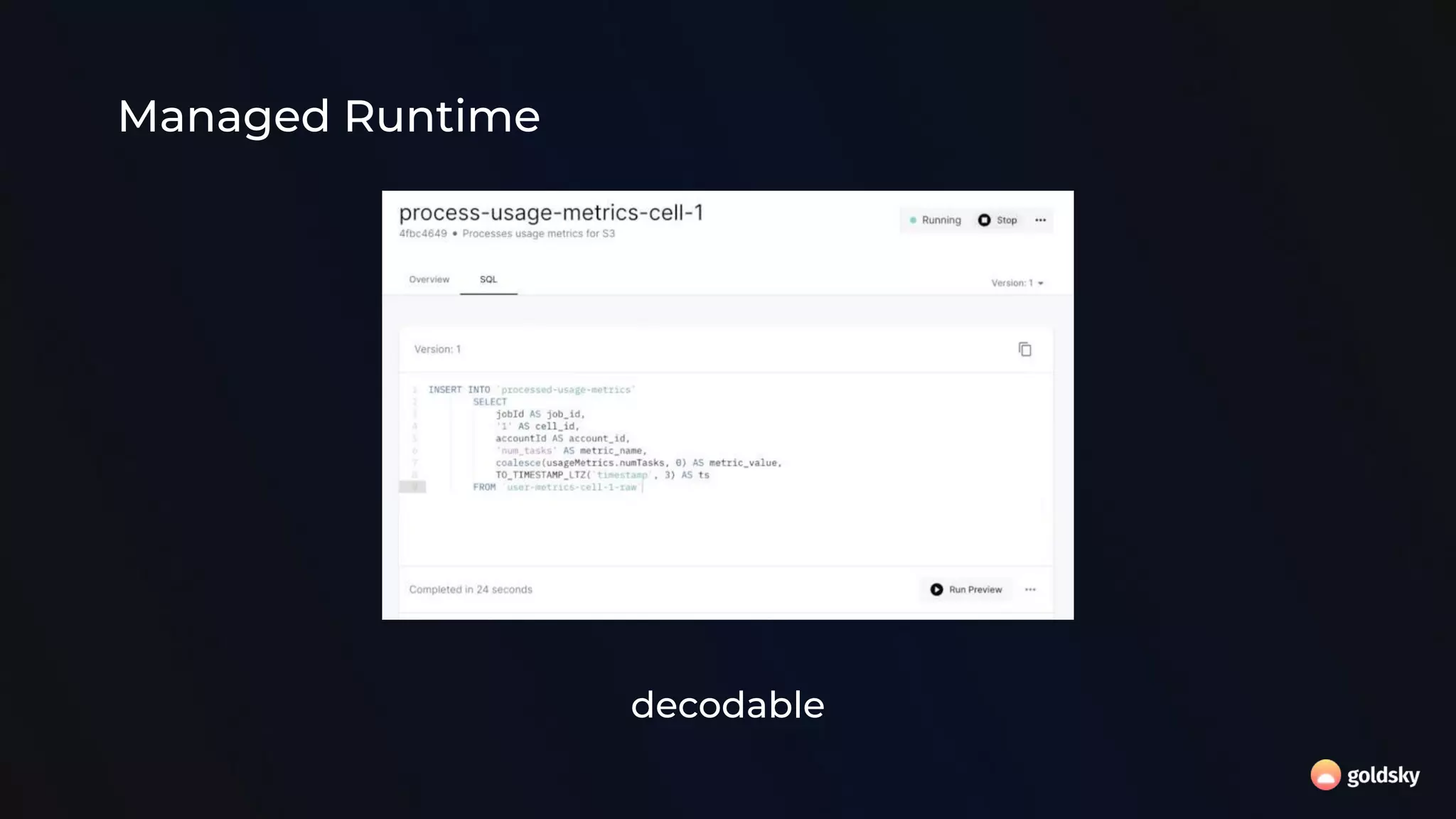
Managed Runtime
decodable
Managed Runtime
● Managed ≈ “Serverless”
● Auto-scaling
● Automated deployments, rollbacks, etc.
● Testing for different layers is decoupled
(runtime vs jobs)
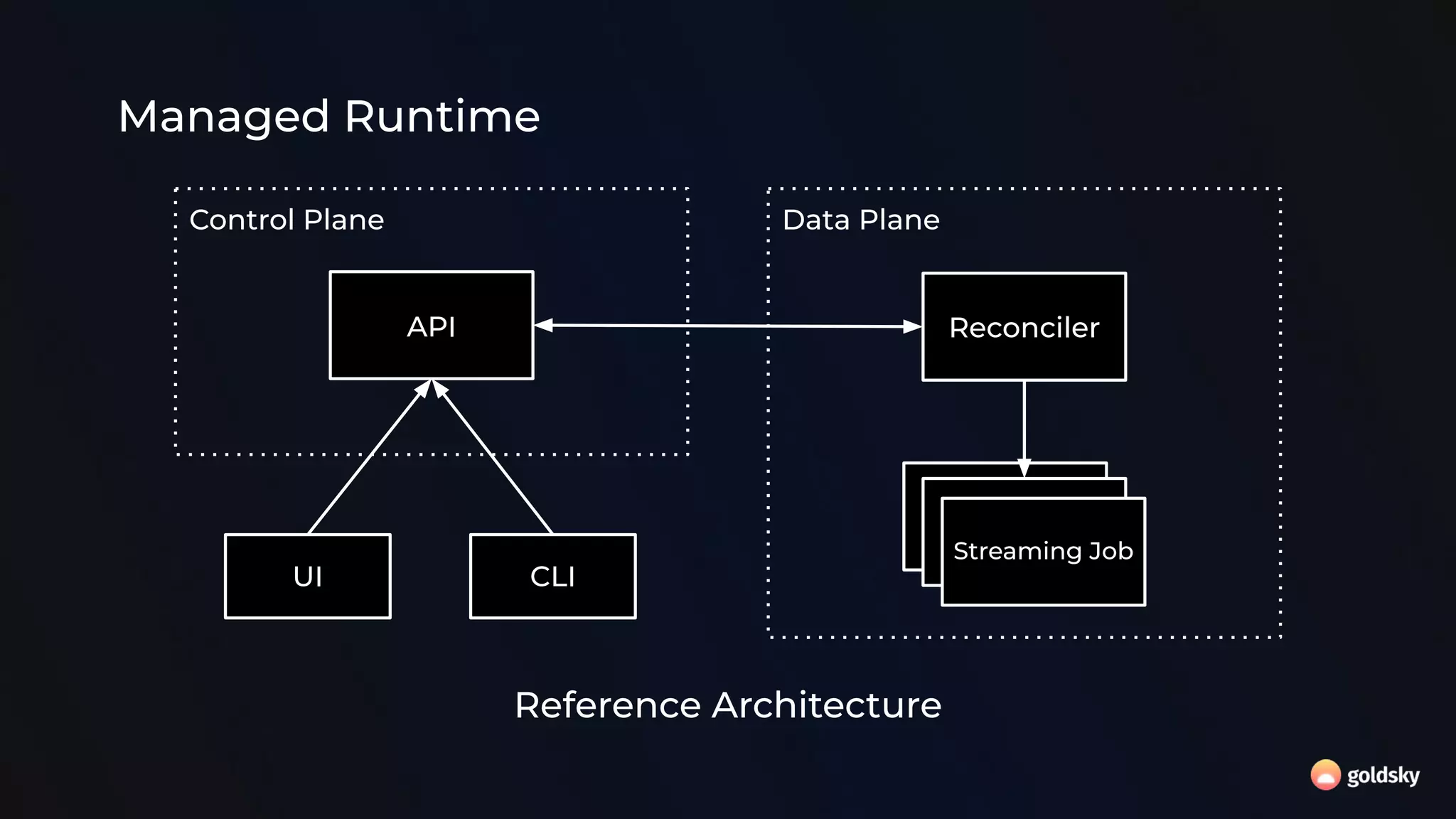
Managed Runtime
Reference Architecture
Control Plane Data Plane
API Reconciler
Streaming Job
UI CLI
Any managed runtime
requires excellent
developer experience
to succeed
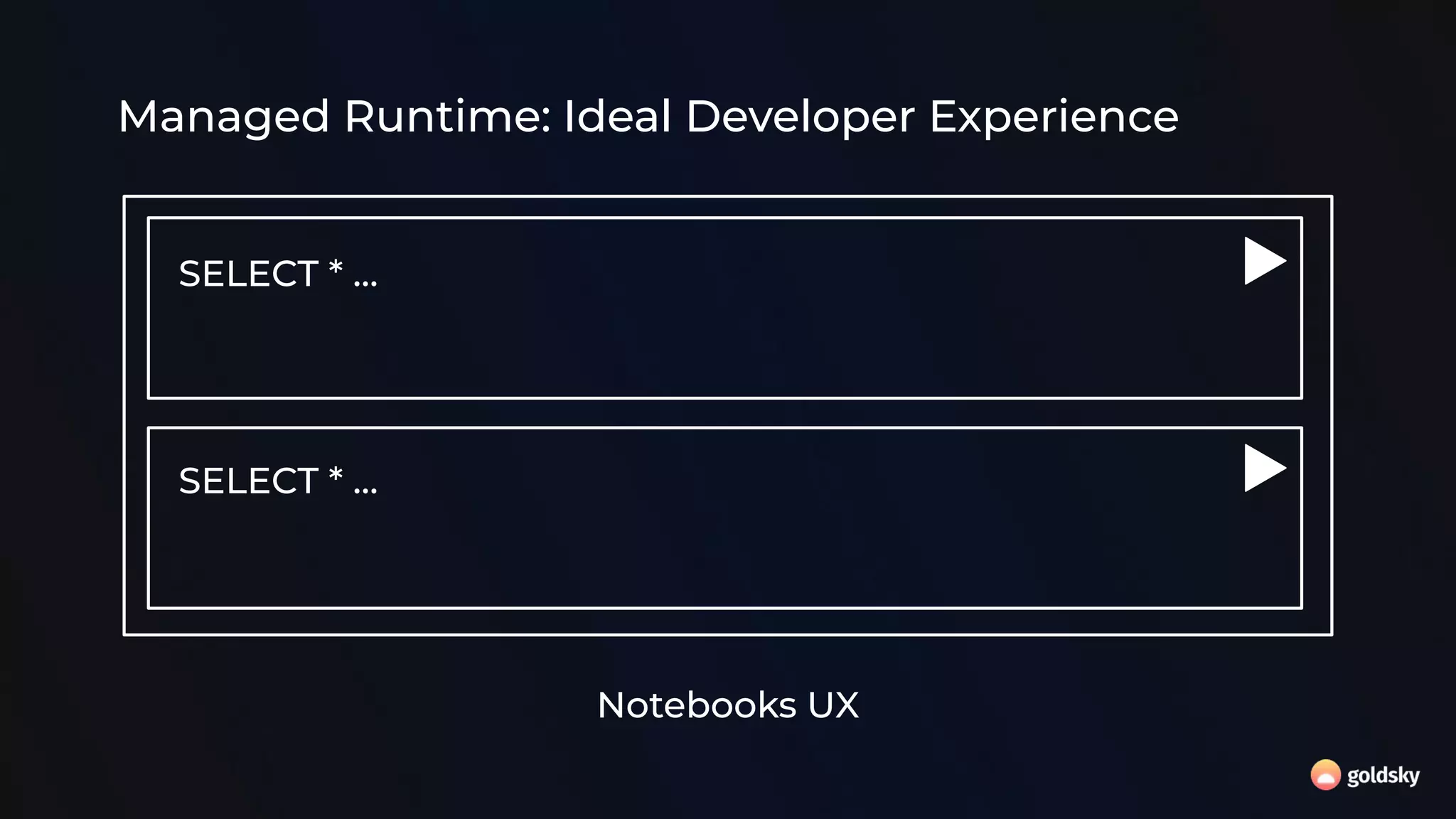
Managed Runtime: Ideal Developer Experience
Notebooks UX
SELECT * …
SELECT * …
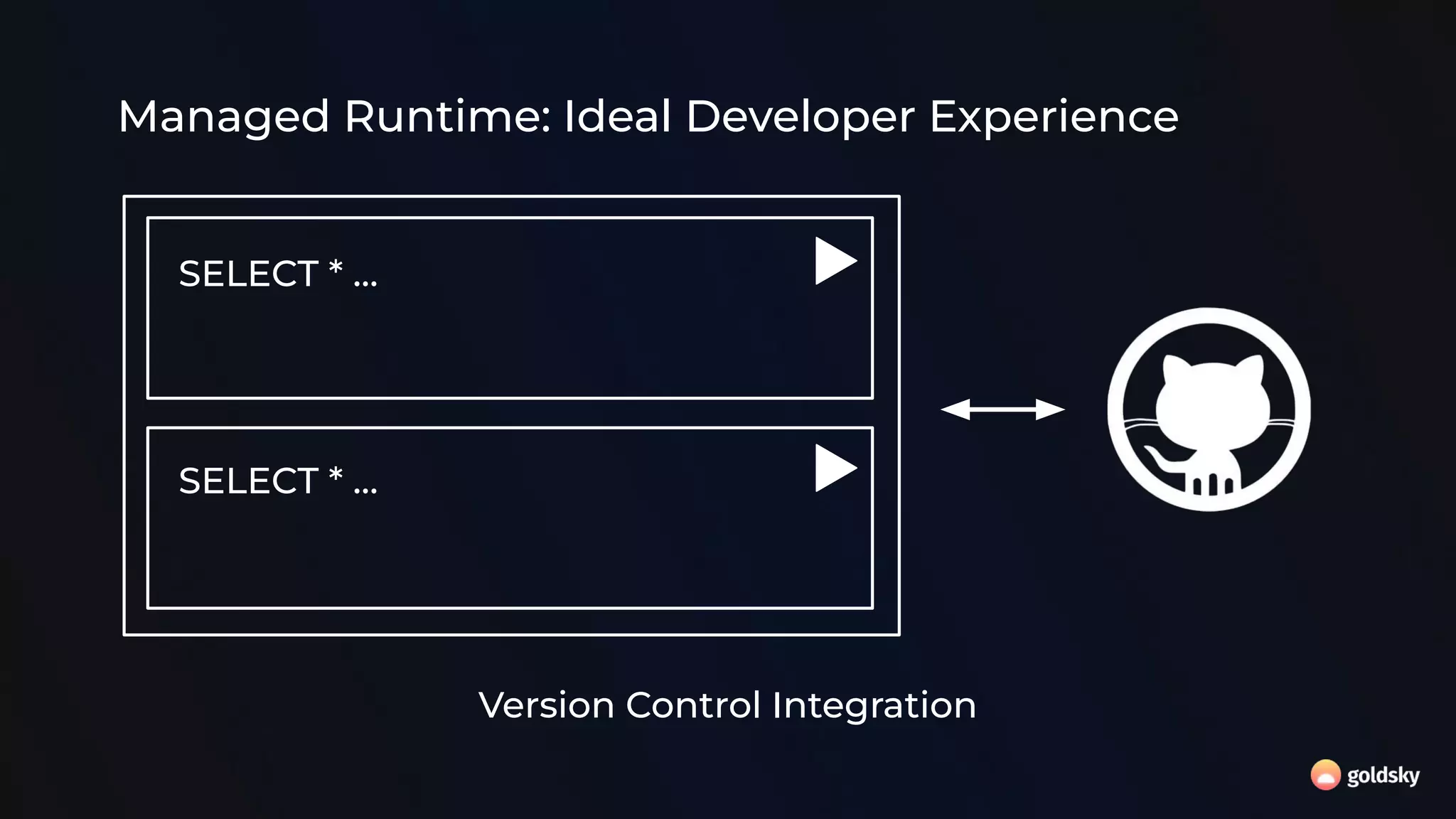
Managed Runtime: Ideal Developer Experience
Version Control Integration
SELECT * …
SELECT * …
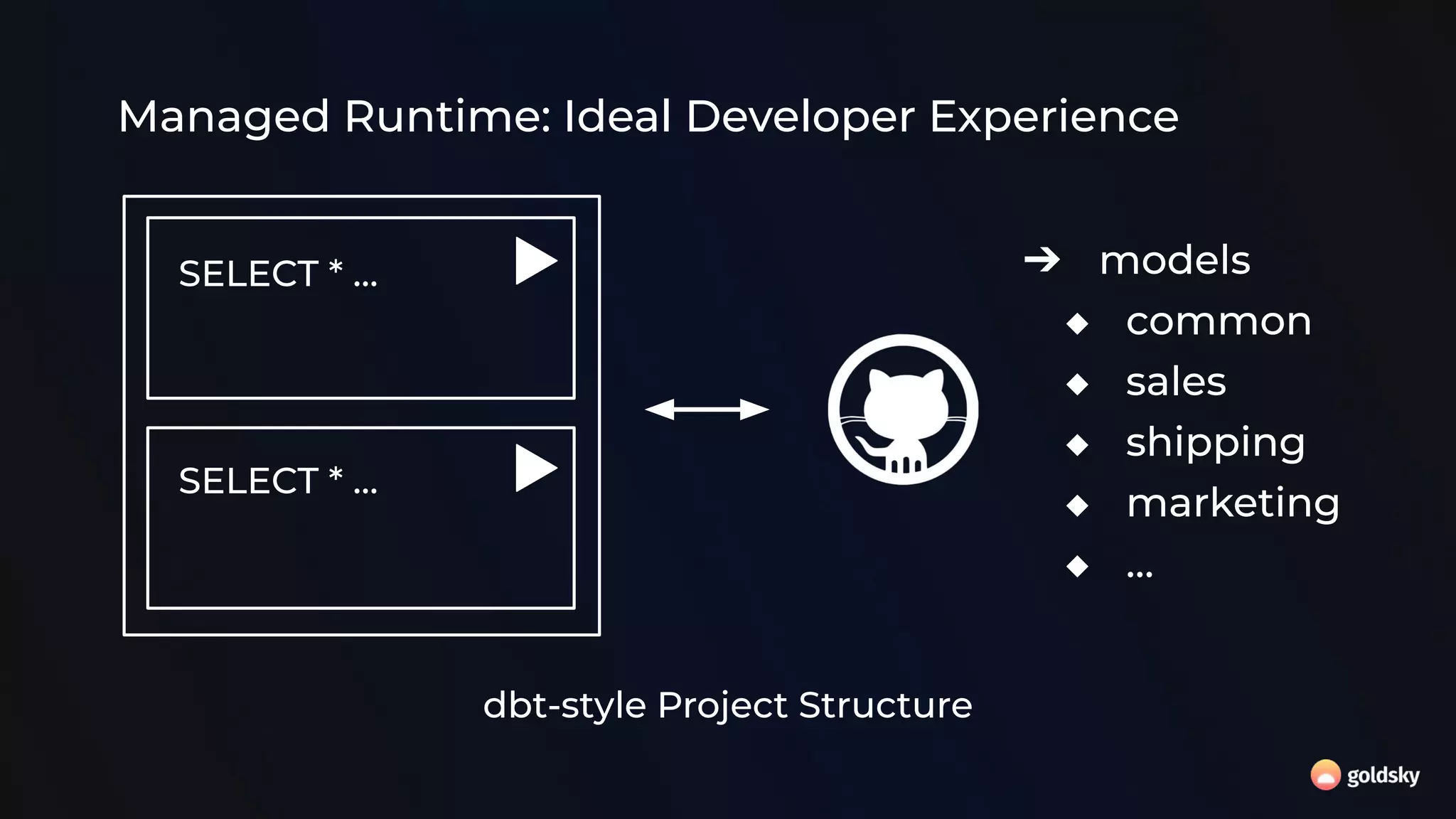
Managed Runtime: Ideal Developer Experience
dbt-style Project Structure
SELECT * …
SELECT * …
➔ models
◆ common
◆ sales
◆ shipping
◆ marketing
◆ …
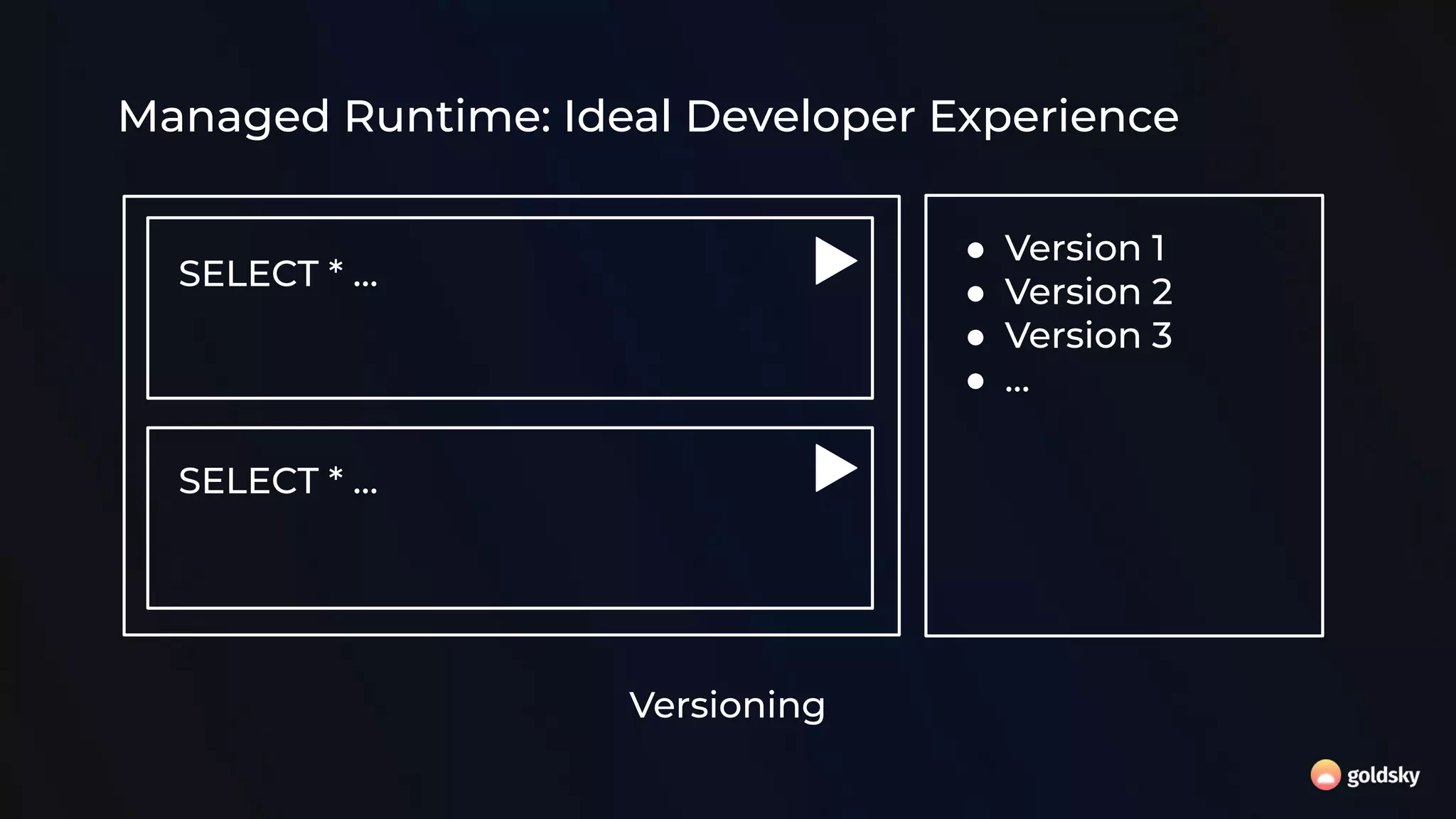
Managed Runtime: Ideal Developer Experience
Versioning
SELECT * …
SELECT * …
● Version 1
● Version 2
● Version 3
● …
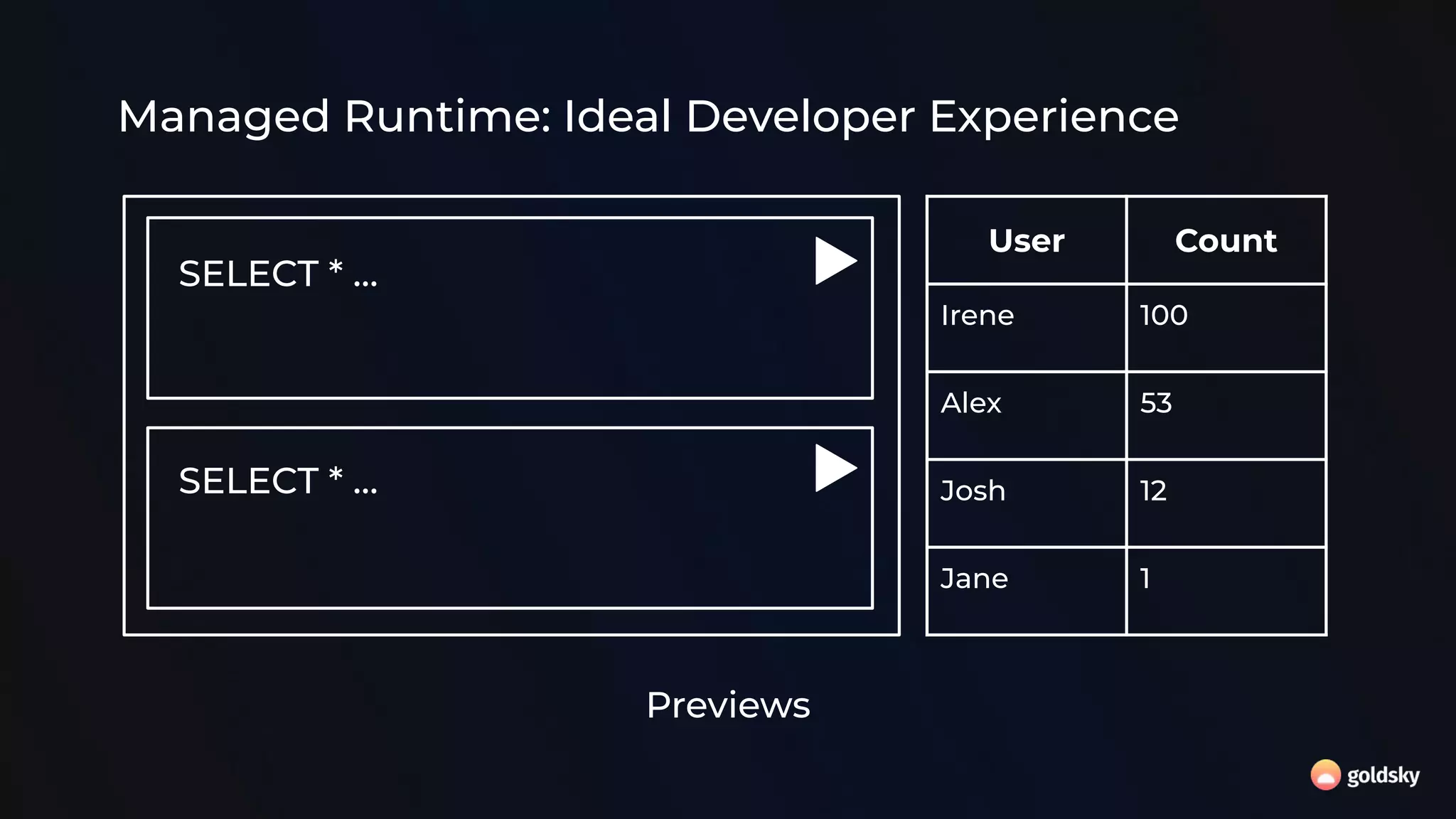
Managed Runtime: Ideal Developer Experience
Previews
SELECT * …
SELECT * …
User Count
Irene 100
Alex 53
Josh 12
Jane 1
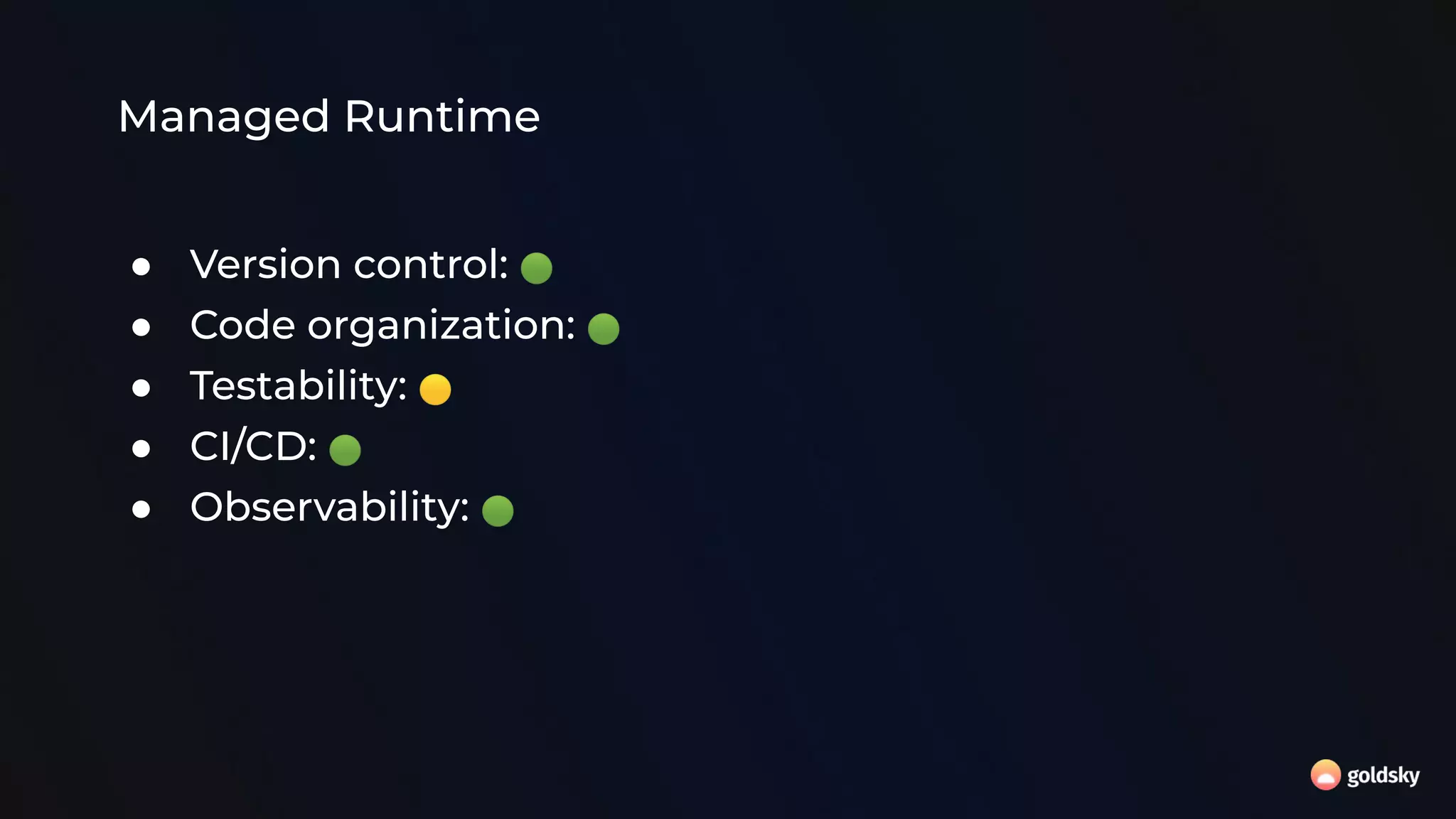
Managed Runtime
● Version control: 🟢
● Code organization: 🟢
● Testability: 🟡
● CI/CD: 🟢
● Observability: 🟢
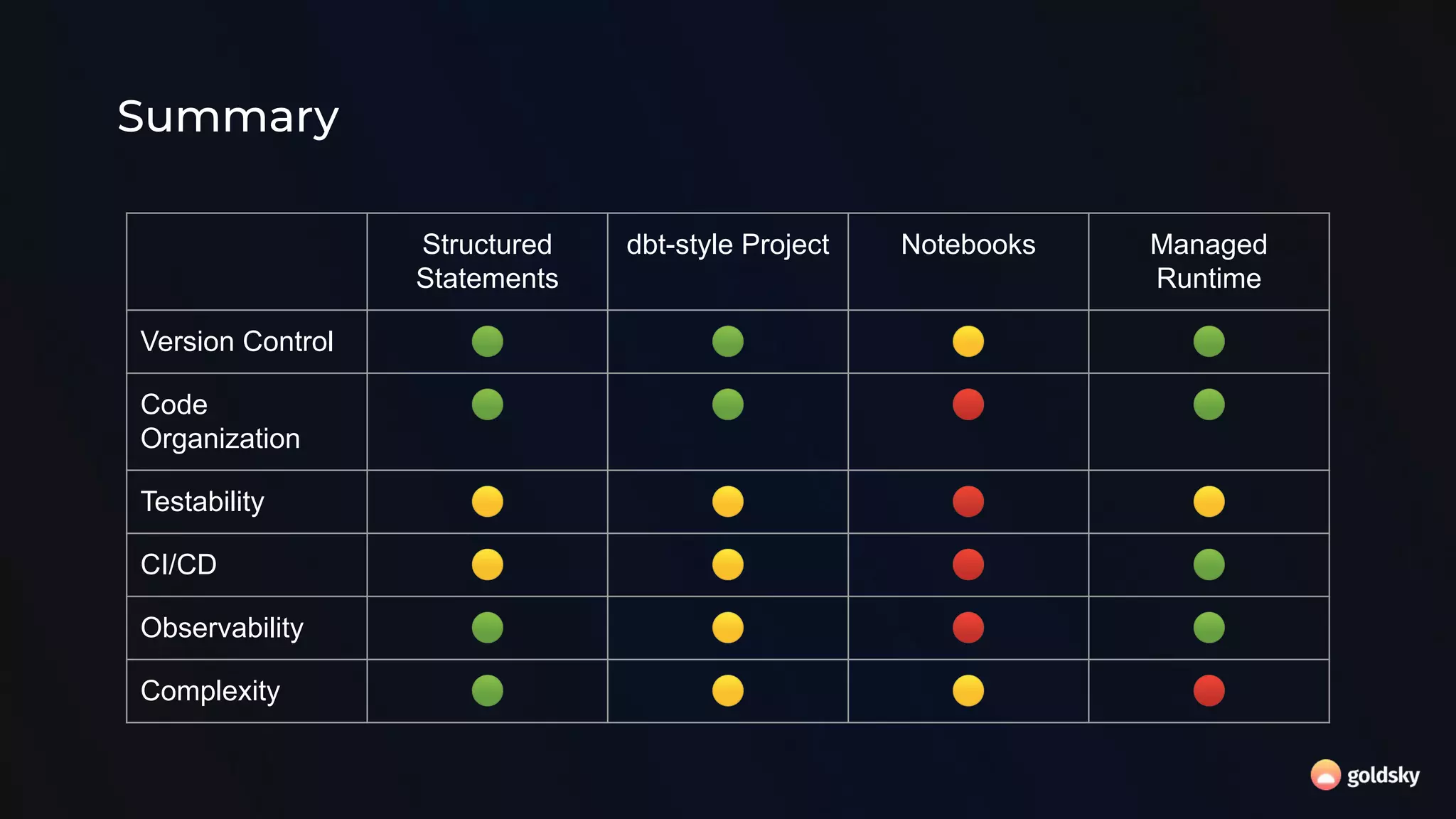
Summary
Structured
Statements
dbt-style Project Notebooks Managed
Runtime
Version Control 🟢 🟢 🟡 🟢
Code
Organization
🟢 🟢 🔴 🟢
Testability 🟡 🟡 🔴 🟡
CI/CD 🟡 🟡 🔴 🟢
Observability 🟢 🟡 🔴 🟢
Complexity 🟢 🟡 🟡 🔴
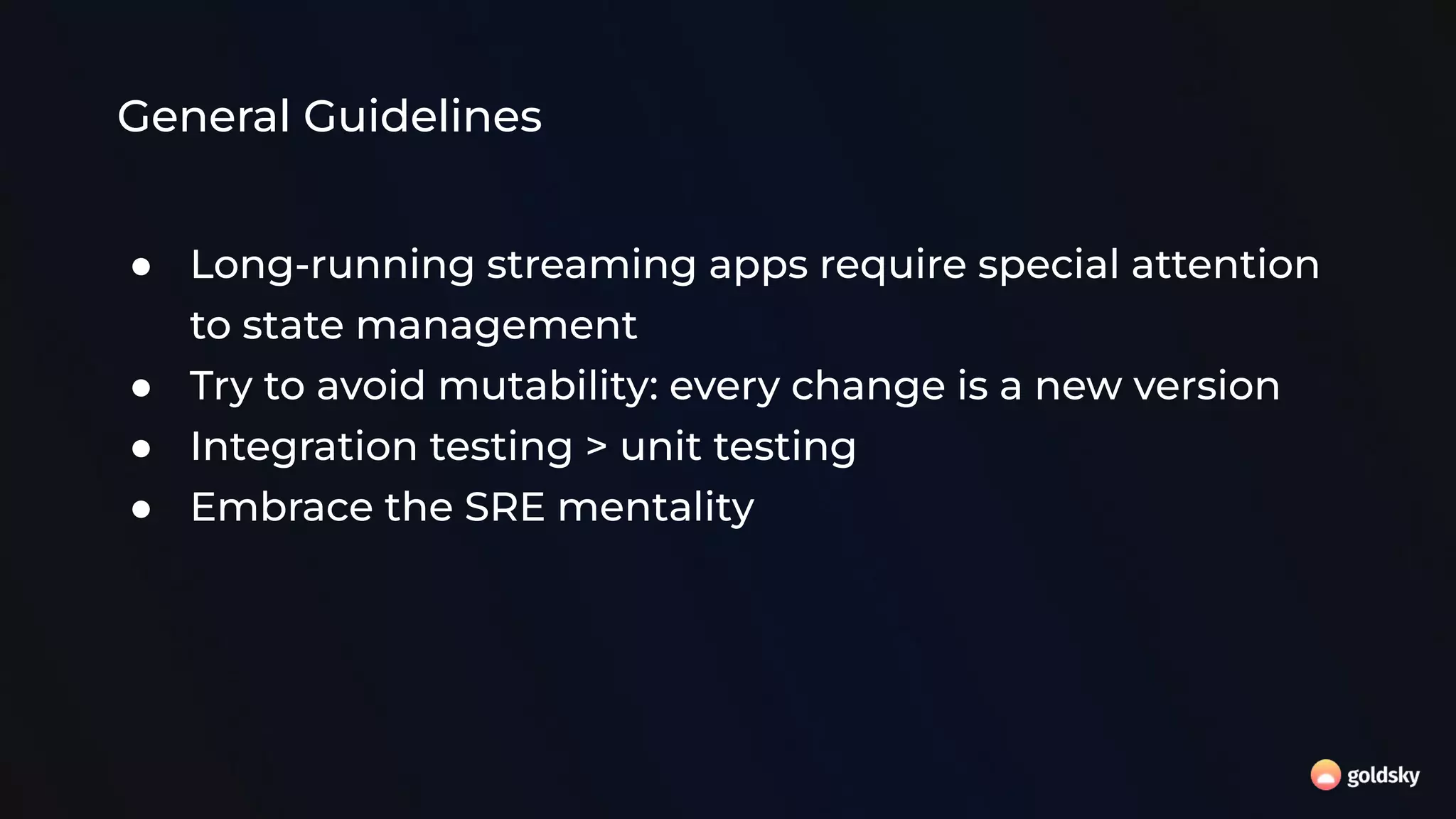
General Guidelines
● Long-running streaming apps require special attention
to state management
● Try to avoid mutability: every change is a new version
● Integration testing > unit testing
● Embrace the SRE mentality
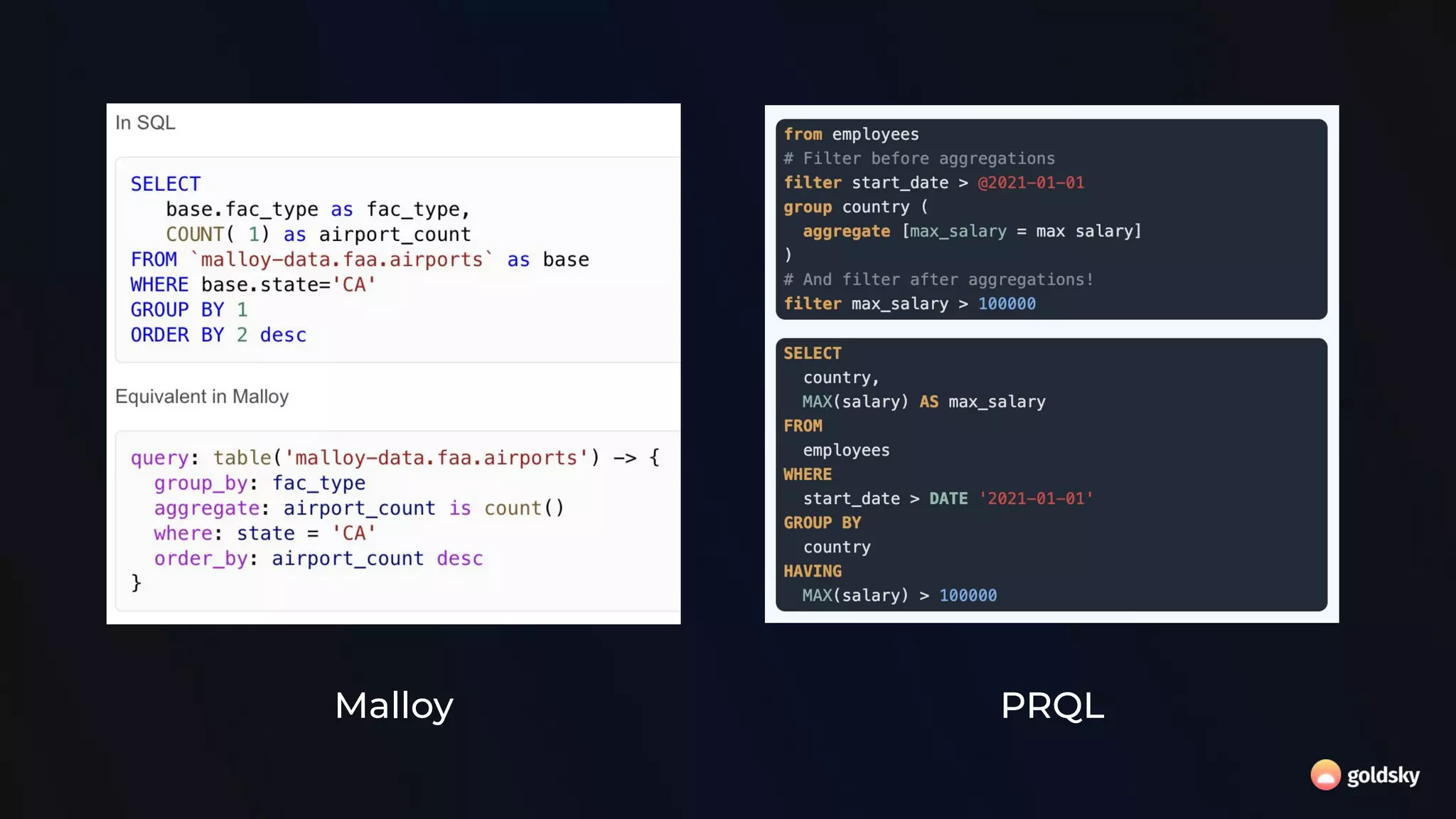
Really dislike SQL?
Malloy PRQL
Questions?
@sap1ens

Streaming SQL for Data Engineers: The Next Big Thing? With Yaroslav Tkachenko | Current 2022

  • 1.
    Streaming SQL for DataEngineers: The Next Big Thing?
  • 3.
  • 4.
    ● Apache Flink ●Apache Spark ● Apache Beam ● AWS Kinesis ● Google Cloud Dataflow ● Databricks ● ksqlDB ● … ● Meta ● LinkedIn ● Pinterest ● DoorDash ● Alibaba ● … Companies building internal platforms Open source and vendor solutions
  • 6.
  • 7.
    👋 Hi, I’mYaroslav ● Principal Software Engineer @ Goldsky ● Staff Data Engineer @ Shopify ● Software Architect @ Activision ● …
  • 8.
    👋 Hi, I’mYaroslav ● Principal Software Engineer @ Goldsky ● Staff Data Engineer @ Shopify ● Software Architect @ Activision ● … ❤ Apache Flink
  • 9.
    🤔 TableEnvironment tableEnv =TableEnvironment.create(/*…*/); Table revenue = tableEnv.sqlQuery( "SELECT cID, cName, SUM(revenue) AS revSum " + "FROM Orders " + "WHERE cCountry = 'FRANCE' " + "GROUP BY cID, cName" );
  • 10.
  • 11.
    Why SQL? ● Wideadoption ● Declarative transformation model ● Planner! ● Common type system
  • 12.
  • 13.
  • 14.
  • 15.
    SELECT * FROMOrders INNER JOIN Product ON Orders.productId = Product.id ● LOTS of code! ● Create an operator to connect two streams ● Define and accumulate state ● Implement a mechanism for emitting the latest value per key SQL API DataStream API Declarative Transformation Model
  • 16.
    SELECT * FROMOrders INNER JOIN Product ON Orders.productId = Product.id SQL API Why not Table API? val orders = tEnv.from("Orders") .select($"productId", $"a", $"b") val products = tEnv.from("Products") .select($"id", $"c", $"d") val result = orders .join(products) .where($"productId" === $"id") .select($"a", $"b", $"c") Declarative Transformation Model
  • 17.
    SELECT * FROM( SELECT *, ROW_NUMBER() OVER (PARTITION BY ticker ORDER BY price DESC) AS row_num FROM stock_table) WHERE row_num <= 10; Top-N Query Declarative Transformation Model
  • 18.
    Row Pattern Recognitionin SQL (ISO/IEC TR 19075-5:2016) SELECT * FROM stock_table MATCH_RECOGNIZE( PARTITION BY ticker ORDER BY event_time MEASURES A.event_time AS initialPriceTime, C.event_time AS dropTime, A.price - C.price AS dropDiff, A.price AS initialPrice, C.price AS lastPrice ONE ROW PER MATCH AFTER MATCH SKIP PAST LAST ROW PATTERN (A B* C) WITHIN INTERVAL '10' MINUTES DEFINE B AS B.price > A.price - 500 )
  • 19.
    Flink Planner Migration Fromhttps://www.ververica.com/blog/a-journey-to-beating-flinks-sql-performance Planner Decoupling
  • 20.
    Planner Optimizations &Query Rewrite ● Predicate push down ● Projection push down ● Join rewrite ● Join elimination ● Constant inlining ● …
  • 21.
    SQL API DataStreamAPI val postgresSink: SinkFunction[Envelope] = JdbcSink.sink( "INSERT INTO table " + "(id, number, timestamp, author, difficulty, size, vid, block_range) " + "VALUES (?, ?, ?, ?, ?, ?, ?, ?) " + "ON CONFLICT (id) DO UPDATE SET " + "number = excluded.number, " + "timestamp = excluded.timestamp, " + "author = excluded.author, " + "difficulty = excluded.difficulty, " + "size = excluded.size, " + "vid = excluded.vid, " + "block_range = excluded.block_range " + "WHERE excluded.vid > table.vid", new JdbcStatementBuilder[Envelope] { override def accept(statement: PreparedStatement, record: Envelope): Unit = { val payload = record.payload payload.id.foreach { id => statement.setString(1, id) } payload.number.foreach { number => statement.setBigDecimal(2, new java.math.BigDecimal(number)) } payload.timestamp.foreach { timestamp => statement.setBigDecimal(3, new java.math.BigDecimal(timestamp)) } payload.author.foreach { author => statement.setString(4, author) } payload.difficulty.foreach { difficulty => statement.setBigDecimal(5, new java.math.BigDecimal(difficulty)) } payload.size.foreach { size => statement.setBigDecimal(6, new java.math.BigDecimal(size)) } payload.vid.foreach { vid => statement.setLong(7, vid.toLong) } payload.block_range.foreach { block_range => statement.setObject(8, new PostgresIntRange(block_range), Types.O } }, CREATE TABLE TABLE ( id BIGINT, number INTEGER, timestamp TIMESTAMP, author STRING, difficulty STRING, size INTEGER, vid BIGINT, block_range STRING PRIMARY KEY (vid) NOT ENFORCED ) WITH ( 'connector' = 'jdbc', 'table-name' = 'table' ); 😱 Common Type System
  • 22.
    When you startusing SQL you get access to the decades of advancements in database design
  • 23.
    When NOT touse ● Complex serialization / deserialization logic ● Low-level optimizations, especially with state and timers ● Not always debugging-friendly
  • 24.
    Dealing with Complexity UDFsfor heavy lifting ● Calling 3rd-party libraries ● External calls ● Enrichments Templating ● Control structures ● dbt-style macros and references
  • 25.
  • 26.
    Ways to use StructuredStatements dbt-style Project Notebooks Managed Runtime
  • 27.
    Requirements ● Version control ●Code organization ● Testability ● CI/CD ● Observability
  • 28.
    Structured Statements def revenueByCountry(country:String): Table = { tEnv.sqlQuery( s""" |SELECT name, SUM(revenue) AS totalRevenue |FROM Orders |WHERE country = '${country}' |GROUP BY name""".stripMargin ) }
  • 29.
    Structured Statements def revenueByCountry(country:String): Table = { tEnv.sqlQuery( s""" |SELECT name, SUM(revenue) AS totalRevenue |FROM Orders |WHERE country = '${country}' |GROUP BY name""".stripMargin ) } ✅ structure ✅ mock/stub for testing
  • 30.
    Structured Statements ● Treatthem like code ● Only make sense when Table API is not available ● Mix with other API flavours ● SQL also has style guides ● Otherwise it’s a typical streaming application!
  • 31.
    Structured Statements ● Versioncontrol: 🟢 ● Code organization: 🟢 ● Testability: 🟡 ● CI/CD: 🟡 ● Observability: 🟢
  • 32.
    dbt-style Project ➔ models ◆common ● users.sql ● users.yml ◆ sales.sql ◆ sales.yml ◆ … ➔ tests ◆ …
  • 33.
    dbt-style Project ➔ models ◆common ● users.sql ● users.yml ◆ sales.sql ◆ sales.yml ◆ … ➔ tests ◆ … ✅ structured ✅ schematized ✅ testable
  • 34.
    dbt-style Project SELECT ((text::jsonb)->>'bid_price')::FLOAT ASbid_price, (text::jsonb)->>'order_quantity' AS order_quantity, (text::jsonb)->>'symbol' AS symbol, (text::jsonb)->>'trade_type' AS trade_type, to_timestamp(((text::jsonb)->'timestamp')::BIGINT) AS ts FROM {{ REF('market_orders_raw') }} {{ config(materialized='materializedview') }} SELECT symbol, AVG(bid_price) AS avg FROM {{ REF('market_orders') }} GROUP BY symbol
  • 35.
    dbt-style Project ● Workswell for heavy analytical use-cases ● Could write tests in Python/Scala/etc. ● Probably needs more tooling than you think (state management, observability, etc.) ● Check dbt adapter from Materialize!
  • 36.
    dbt-style Project ● Versioncontrol: 🟢 ● Code organization: 🟢 ● Testability: 🟡 ● CI/CD: 🟡 ● Observability: 🟡
  • 37.
  • 38.
  • 39.
    Notebooks ● Great UX ●Ideal for exploratory analysis and BI ● Complements all other patterns really well ● Way more important for realtime workloads
  • 40.
    Notebooks We don't recommendproductionizing notebooks and instead encourage empowering data scientists to build production-ready code with the right programming frameworks https://www.thoughtworks.com/en-ca/radar/technique s/productionizing-notebooks
  • 41.
    Notebooks ● Version control:🟡 ● Code organization: 🔴 ● Testability: 🔴 ● CI/CD: 🔴 ● Observability: 🔴
  • 42.
  • 43.
    Managed Runtime ● Managed≈ “Serverless” ● Auto-scaling ● Automated deployments, rollbacks, etc. ● Testing for different layers is decoupled (runtime vs jobs)
  • 44.
    Managed Runtime Reference Architecture ControlPlane Data Plane API Reconciler Streaming Job UI CLI
  • 45.
    Any managed runtime requiresexcellent developer experience to succeed
  • 46.
    Managed Runtime: IdealDeveloper Experience Notebooks UX SELECT * … SELECT * …
  • 47.
    Managed Runtime: IdealDeveloper Experience Version Control Integration SELECT * … SELECT * …
  • 48.
    Managed Runtime: IdealDeveloper Experience dbt-style Project Structure SELECT * … SELECT * … ➔ models ◆ common ◆ sales ◆ shipping ◆ marketing ◆ …
  • 49.
    Managed Runtime: IdealDeveloper Experience Versioning SELECT * … SELECT * … ● Version 1 ● Version 2 ● Version 3 ● …
  • 50.
    Managed Runtime: IdealDeveloper Experience Previews SELECT * … SELECT * … User Count Irene 100 Alex 53 Josh 12 Jane 1
  • 51.
    Managed Runtime ● Versioncontrol: 🟢 ● Code organization: 🟢 ● Testability: 🟡 ● CI/CD: 🟢 ● Observability: 🟢
  • 52.
    Summary Structured Statements dbt-style Project NotebooksManaged Runtime Version Control 🟢 🟢 🟡 🟢 Code Organization 🟢 🟢 🔴 🟢 Testability 🟡 🟡 🔴 🟡 CI/CD 🟡 🟡 🔴 🟢 Observability 🟢 🟡 🔴 🟢 Complexity 🟢 🟡 🟡 🔴
  • 53.
    General Guidelines ● Long-runningstreaming apps require special attention to state management ● Try to avoid mutability: every change is a new version ● Integration testing > unit testing ● Embrace the SRE mentality
  • 54.
  • 55.
  • 57.