Heat and the City
David Hawkey
University of Edinburgh
Overview
• What is district heating?
• Where has district heating developed in the
past, and how?
• How is district heating being developed in the
UK today?
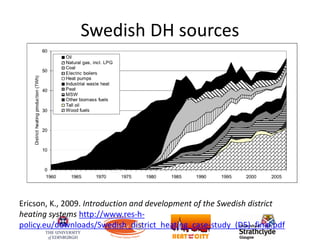
Swedish DH sources
Ericson, K., 2009. Introduction and development of the Swedish district
heating systems http://www.res-h-
policy.eu/downloads/Swedish_district_heating_case-study_(D5)_final.pdf
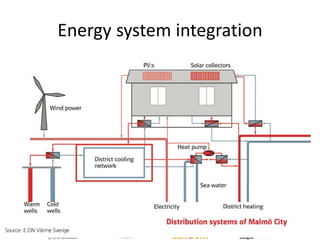
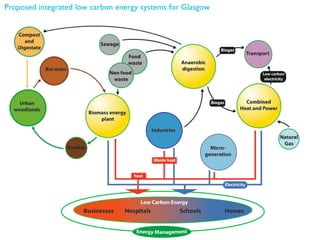
Energy system integration
• c
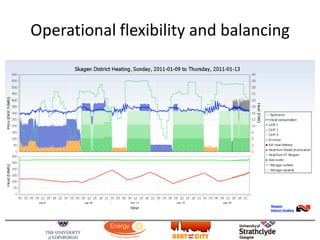
Operational flexibility and balancing
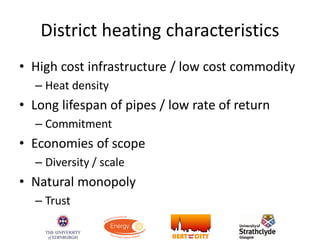
District heating characteristics
• High cost infrastructure / low cost commodity
– Heat density
• Long lifespan of pipes / low rate of return
– Commitment
• Economies of scope
– Diversity / scale
• Natural monopoly
– Trust
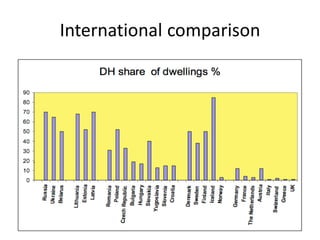
International comparison
Danish and Swedish development
• Post war experiments exploiting heavy / light oil
price difference
• Oil crisis led to national policies which placed
responsibilities on local government
• Embedded in wider systems of municipal service
provision (including electricity)
• Swedish house building programme
• Danish power to compel connection
• Heat networks regulated
• Learning networks and technology development
Local Authorities
• Have strategic, long term view of area plus social
responsibilities
• Democratic oversight mitigates subscribers’
perceptions of monopoly risk
• Planning policy can encourage connection and shape
heat supply/demand patterns
• Control large heat demand on own estate
• Accept low (social) rates of return, but financially
constrained
• Cross-subsidy?
• DH cuts across traditional departmental divisions
District heating in the UK
• Relative fragmentation of local government
– Transfer of functions to other organisations
– (Legacy of) central control
• Shift from local government provision to enabling
• No “problem owner” at present
• Voluntaristic development model: political
commitment and extensive negotiation of
relationships
• Diverse business models and economic
evaluations
Where have we seen development?
• Tendency towards single
organisation projects
• Sustainable City initiatives
build local relationships
even if project development
appears slow
• Scottish Community Energy Network secured
60% of CEP
– Built local capacity and confidence
• Aberdeen Heat and Power – exploration of
commercial supply
£0
£200,000
£400,000
£600,000
£800,000
£1,000,000
£1,200,000
2002-2003 2003-2004 2004-2005
Community energy programme
Average
Scottish
Grant
Average non
Scottish grant
Link up later?
I think where it gets complicated … is
if you then wanted to sell heat onto a
municipal network… The university is
never going to want to put itself in a
position where we need to shut off
heat to our biomedical research
facility because legally we’re obliged
to heat social housing up the road. ….
Some intermediary, [the] City Council,
needs to sit in the middle. But …
they’re not really in the business of
being that intermediary.
• Development of small
schemes for later
integration
• Connecting infrastructure
vs multiple energy
centres
• Technical compatibility
issues recognised
• Organisational/commerci
al challenges more
challenging
Current policy approaches
• Heat Networks Partnership / Heat Networks
Delivery Unit
– Support project development / common resources
• Centralised heat mapping
• Channelling finance but commercial rates
• Place / technology neutral policies
• Industry-led consumer protection code
• Scottish govt DH targets (becoming “problem
owner”?)
Conclusions
• Diversity and flexibility in how heat networks
are configured
– Socially shaped
– Greater impact of larger integrated systems
• Governance arrangements in UK differ from
European DH countries’
• Diversity in development models but most
small scale with uncertain prospects for
growth

Heat and the city

  • 1.
    Heat and theCity David Hawkey University of Edinburgh
  • 2.
    Overview • What isdistrict heating? • Where has district heating developed in the past, and how? • How is district heating being developed in the UK today?
  • 3.
    Swedish DH sources Ericson,K., 2009. Introduction and development of the Swedish district heating systems http://www.res-h- policy.eu/downloads/Swedish_district_heating_case-study_(D5)_final.pdf
  • 4.
  • 5.
  • 7.
    District heating characteristics •High cost infrastructure / low cost commodity – Heat density • Long lifespan of pipes / low rate of return – Commitment • Economies of scope – Diversity / scale • Natural monopoly – Trust
  • 8.
  • 9.
    Danish and Swedishdevelopment • Post war experiments exploiting heavy / light oil price difference • Oil crisis led to national policies which placed responsibilities on local government • Embedded in wider systems of municipal service provision (including electricity) • Swedish house building programme • Danish power to compel connection • Heat networks regulated • Learning networks and technology development
  • 10.
    Local Authorities • Havestrategic, long term view of area plus social responsibilities • Democratic oversight mitigates subscribers’ perceptions of monopoly risk • Planning policy can encourage connection and shape heat supply/demand patterns • Control large heat demand on own estate • Accept low (social) rates of return, but financially constrained • Cross-subsidy? • DH cuts across traditional departmental divisions
  • 11.
    District heating inthe UK • Relative fragmentation of local government – Transfer of functions to other organisations – (Legacy of) central control • Shift from local government provision to enabling • No “problem owner” at present • Voluntaristic development model: political commitment and extensive negotiation of relationships • Diverse business models and economic evaluations
  • 12.
    Where have weseen development? • Tendency towards single organisation projects • Sustainable City initiatives build local relationships even if project development appears slow • Scottish Community Energy Network secured 60% of CEP – Built local capacity and confidence • Aberdeen Heat and Power – exploration of commercial supply £0 £200,000 £400,000 £600,000 £800,000 £1,000,000 £1,200,000 2002-2003 2003-2004 2004-2005 Community energy programme Average Scottish Grant Average non Scottish grant
  • 13.
    Link up later? Ithink where it gets complicated … is if you then wanted to sell heat onto a municipal network… The university is never going to want to put itself in a position where we need to shut off heat to our biomedical research facility because legally we’re obliged to heat social housing up the road. …. Some intermediary, [the] City Council, needs to sit in the middle. But … they’re not really in the business of being that intermediary. • Development of small schemes for later integration • Connecting infrastructure vs multiple energy centres • Technical compatibility issues recognised • Organisational/commerci al challenges more challenging
  • 14.
    Current policy approaches •Heat Networks Partnership / Heat Networks Delivery Unit – Support project development / common resources • Centralised heat mapping • Channelling finance but commercial rates • Place / technology neutral policies • Industry-led consumer protection code • Scottish govt DH targets (becoming “problem owner”?)
  • 15.
    Conclusions • Diversity andflexibility in how heat networks are configured – Socially shaped – Greater impact of larger integrated systems • Governance arrangements in UK differ from European DH countries’ • Diversity in development models but most small scale with uncertain prospects for growth