Early years evaluation:
messages for local areas
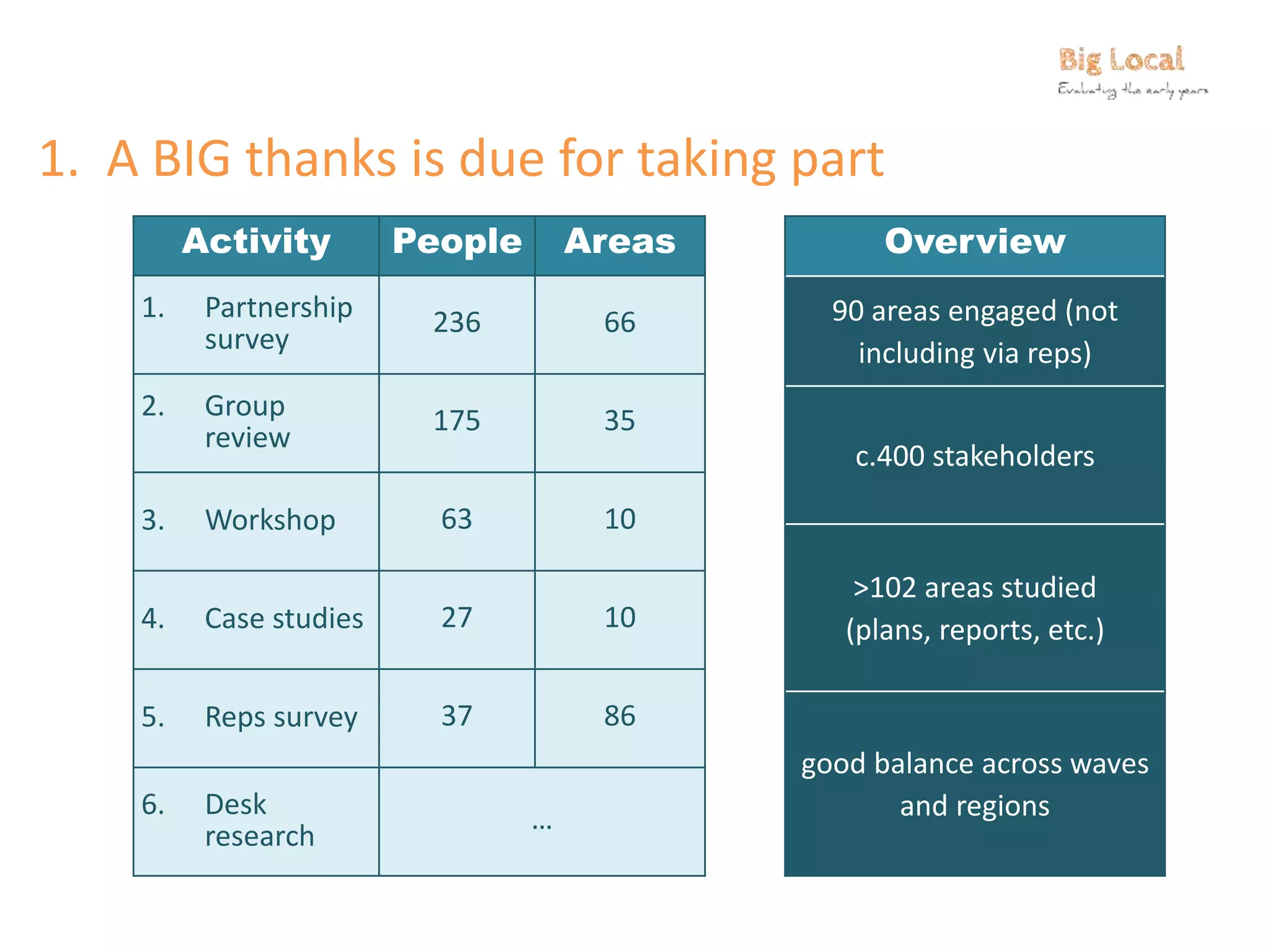
1. A BIG thanks is due for taking part
Activity People Areas
1. Partnership
survey
236 66
2. Group
review
175 35
3. Workshop 63 10
4. Case studies 27 10
5. Reps survey 37 86
6. Desk
research
…
Overview
90 areas engaged (not
including via reps)
c.400 stakeholders
>102 areas studied
(plans, reports, etc.)
good balance across waves
and regions
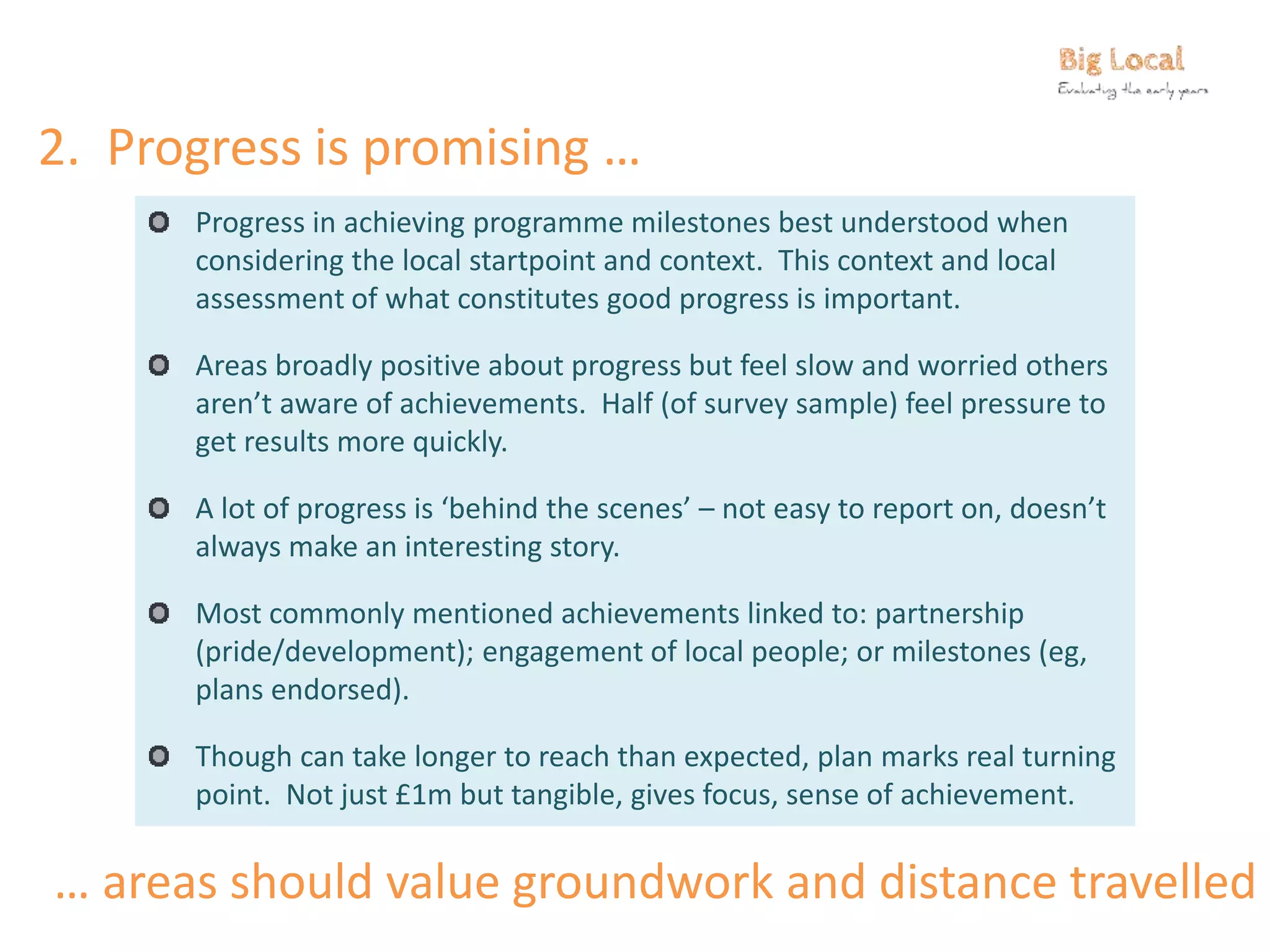
2. Progress is promising …
Progress in achieving programme milestones best understood when
considering the local startpoint and context. This context and local
assessment of what constitutes good progress is important.
Areas broadly positive about progress but feel slow and worried others
aren’t aware of achievements. Half (of survey sample) feel pressure to
get results more quickly.
A lot of progress is ‘behind the scenes’ – not easy to report on, doesn’t
always make an interesting story.
Most commonly mentioned achievements linked to: partnership
(pride/development); engagement of local people; or milestones (eg,
plans endorsed).
Though can take longer to reach than expected, plan marks real turning
point. Not just £1m but tangible, gives focus, sense of achievement.
… areas should value groundwork and distance travelled
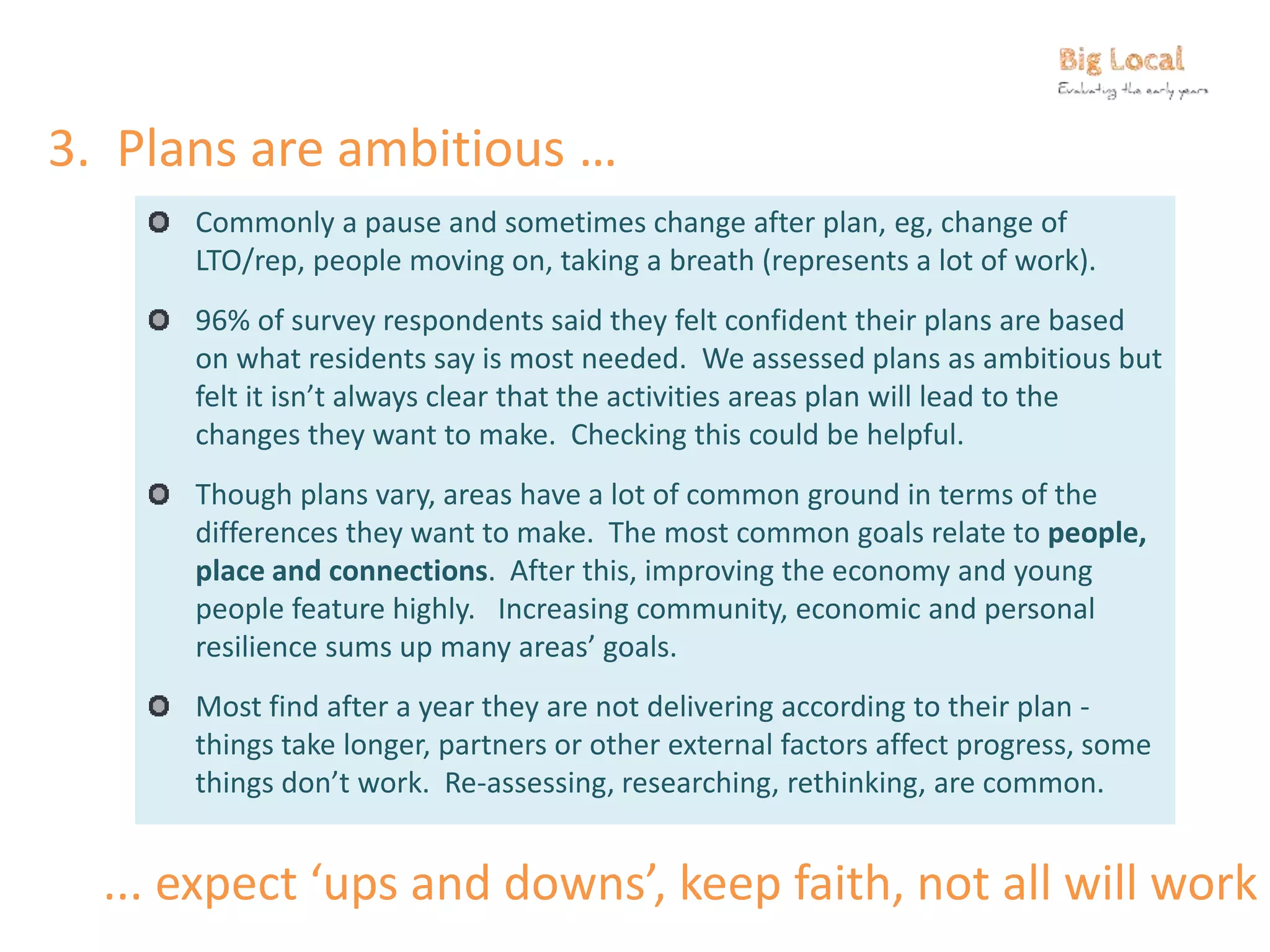
3. Plans are ambitious …
Commonly a pause and sometimes change after plan, eg, change of
LTO/rep, people moving on, taking a breath (represents a lot of work).
96% of survey respondents said they felt confident their plans are based
on what residents say is most needed. We assessed plans as ambitious but
felt it isn’t always clear that the activities areas plan will lead to the
changes they want to make. Checking this could be helpful.
Though plans vary, areas have a lot of common ground in terms of the
differences they want to make. The most common goals relate to people,
place and connections. After this, improving the economy and young
people feature highly. Increasing community, economic and personal
resilience sums up many areas’ goals.
Most find after a year they are not delivering according to their plan -
things take longer, partners or other external factors affect progress, some
things don’t work. Re-assessing, researching, rethinking, are common.
... expect ‘ups and downs’, keep faith, not all will work
4. Residents are taking the lead …
Thousands of resident hours are going into making Big Local happen.
Despite this, most want to get more people involved. 83% of survey
respondents felt their area is over-reliant on a relatively small group.
For the most part residents feel in control and 86% say feel residents are
leading their Big Local, but not all areas yet feel truly resident led and
some are struggling to actively involve more people - either to get them
‘to the table’ or to ensure they are heard once at the table.
Challenges include apathy and lack of confidence; interference/lack of
support from others (eg, councils); and the length of time things take - it
is a ten-year programme but many want or expect things now.
Some are struggling to involve different groups of people or parts of the
community. Though this can cause tensions or slow progress, some are
clear they don’t want to be ‘us in here’ making decisions for ‘them out
there’ and would like ideas on how to do things differently/increase
engagement and/or ensure accountability.
... engagement of wider community stays high on agenda
5. This is a real attempt to do things differently
For those involved, very mixed experience – “a slow rollercoaster” – but
mainly positive – challenging, satisfying, and a learning experience.
The way the model has evolved so far around a small core group does
mean there is a danger of burnout and drop out. It would be helpful to
understand more about who stays involved and why, and how
partnerships avoid or manage drop out and renewal of membership.
There is evidence of conventionality (committee structures, minutes,
meetings) but also of areas trying to break out of this, and some areas
certainly feel like they’re doing things differently with Big Local, and are
keen to distance themselves from what has gone before. Looking
outside the area for ideas (often via reps) is helpful for areas wanting to
consider different ways of doing things.
An important way BL is different is that values matter, how things are
done is an important element of thinking about what success means.
… how things are done matters (values matter)
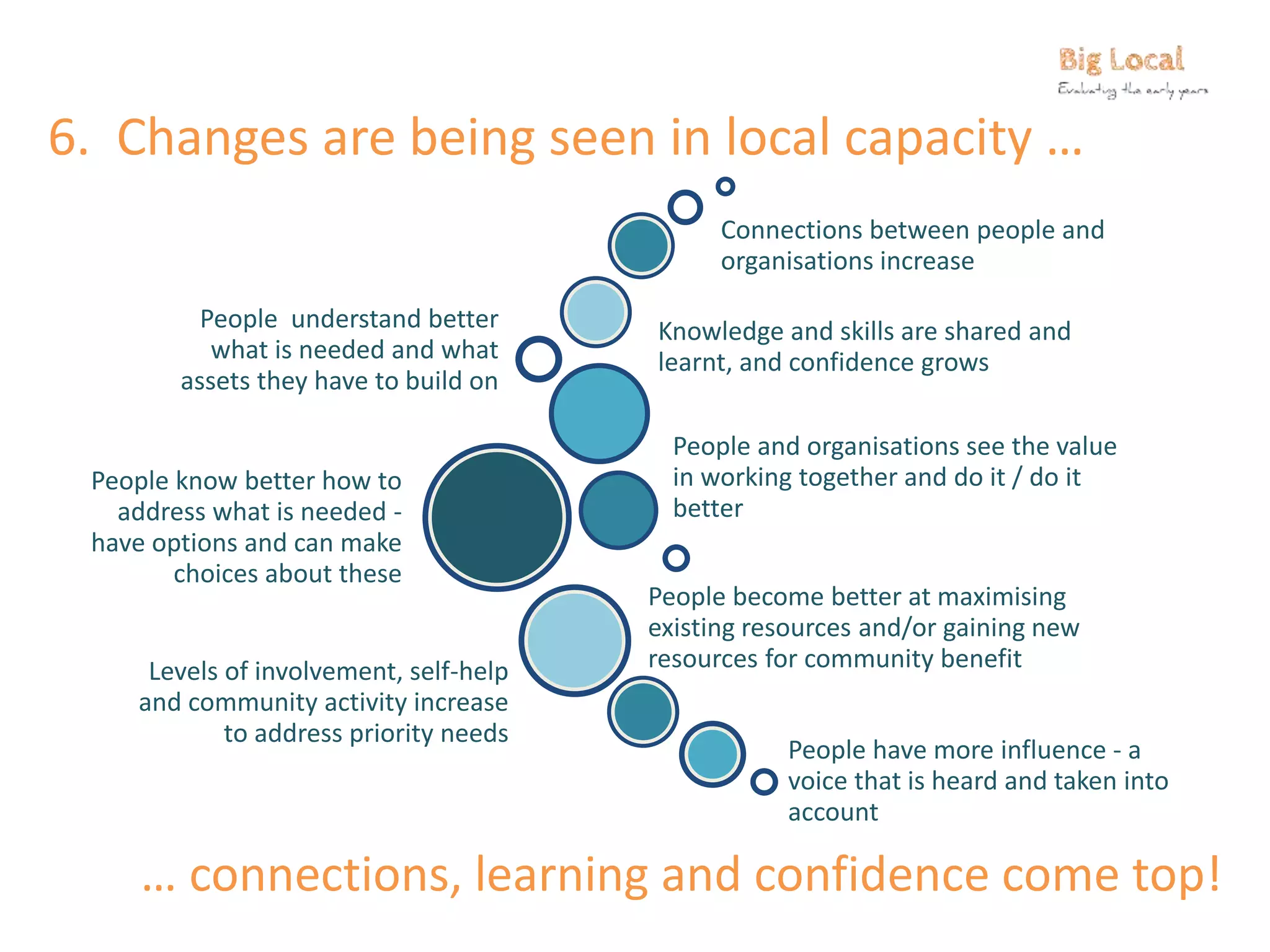
6. Changes are being seen in local capacity …
People understand better
what is needed and what
assets they have to build on
People become better at maximising
existing resources and/or gaining new
resources for community benefit
People and organisations see the value
in working together and do it / do it
better
Knowledge and skills are shared and
learnt, and confidence grows
Connections between people and
organisations increase
People know better how to
address what is needed -
have options and can make
choices about these
Levels of involvement, self-help
and community activity increase
to address priority needs
People have more influence - a
voice that is heard and taken into
account
… connections, learning and confidence come top!
7. Things that most help learning/confidence …
Seeing tangible results.
Learning by doing.
Learning from each other (in the partnership).
Weathering storms.
Encouragement/support from each other but also from reps and others.
Contact with other areas/networking – comparison, benchmarking,
reassurance all helps.
Areas would like more contact with other areas and learning opportunities.
… more/easier contact with other areas would be good
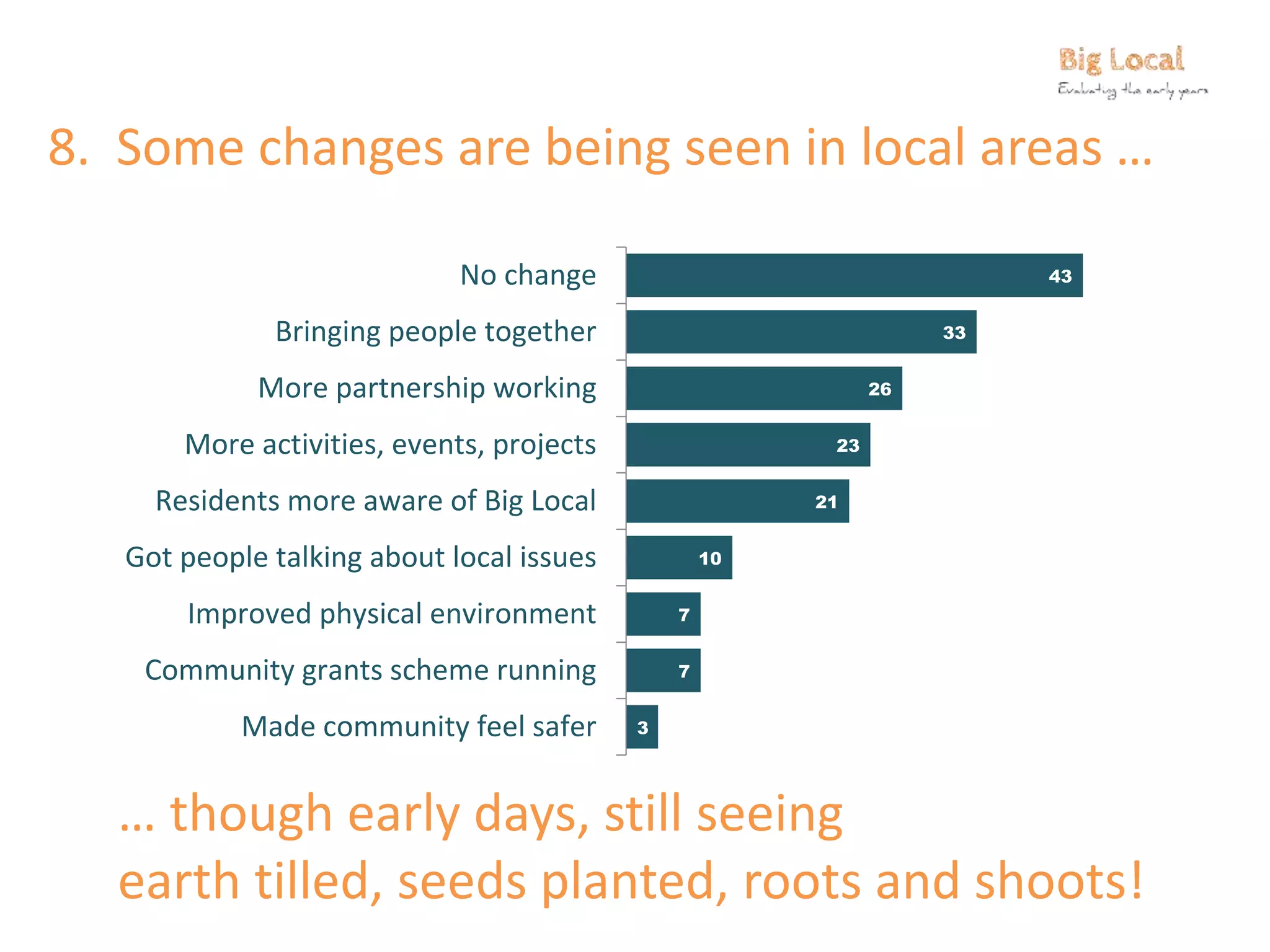
8. Some changes are being seen in local areas …
3
7
7
10
21
23
26
33
43
Made community feel safer
Community grants scheme running
Improved physical environment
Got people talking about local issues
Residents more aware of Big Local
More activities, events, projects
More partnership working
Bringing people together
No change
… though early days, still seeing
earth tilled, seeds planted, roots and shoots!
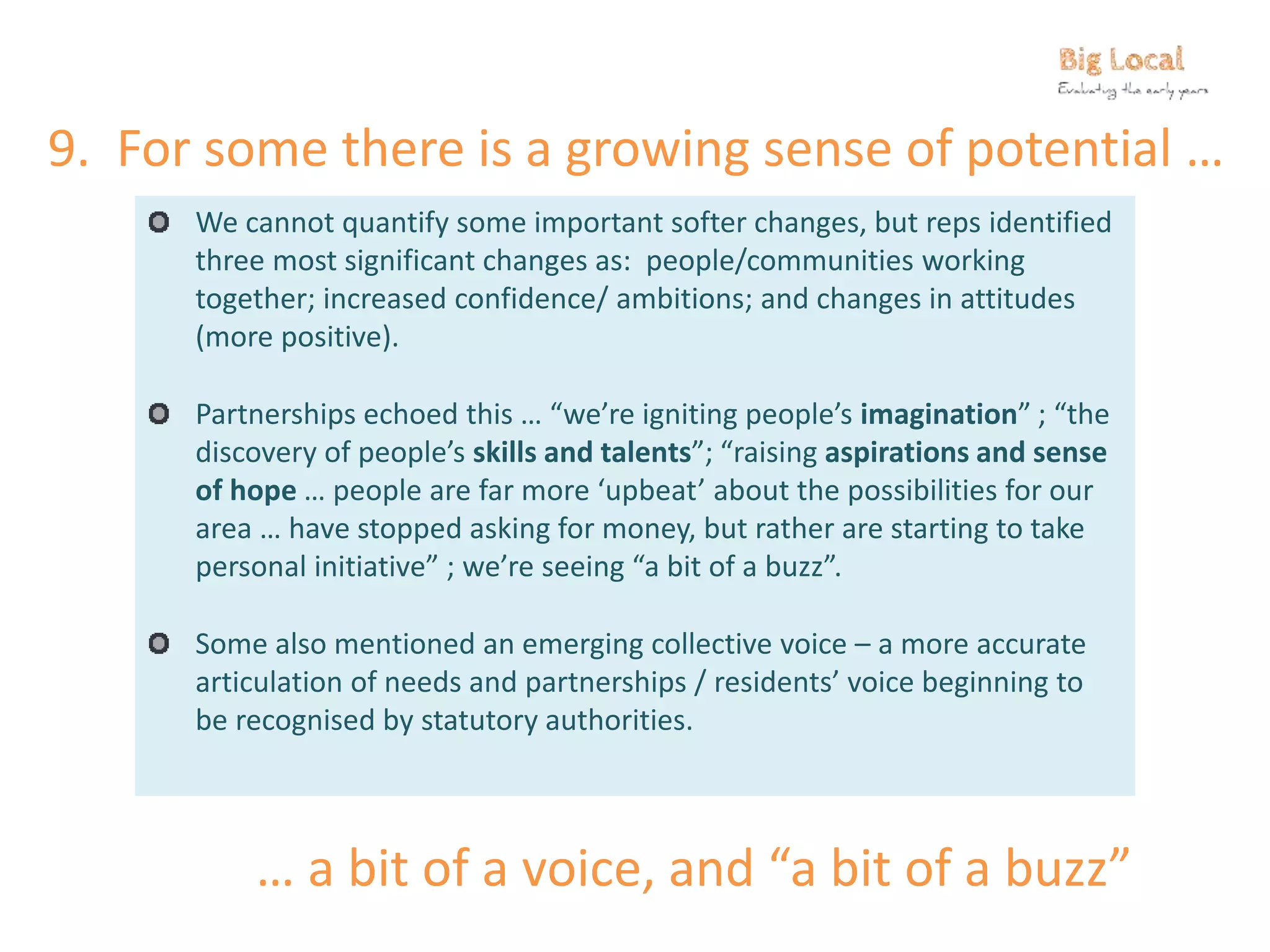
9. For some there is a growing sense of potential …
We cannot quantify some important softer changes, but reps identified
three most significant changes as: people/communities working
together; increased confidence/ ambitions; and changes in attitudes
(more positive).
Partnerships echoed this … “we’re igniting people’s imagination” ; “the
discovery of people’s skills and talents”; “raising aspirations and sense
of hope … people are far more ‘upbeat’ about the possibilities for our
area … have stopped asking for money, but rather are starting to take
personal initiative” ; we’re seeing “a bit of a buzz”.
Some also mentioned an emerging collective voice – a more accurate
articulation of needs and partnerships / residents’ voice beginning to
be recognised by statutory authorities.
… a bit of a voice, and “a bit of a buzz”
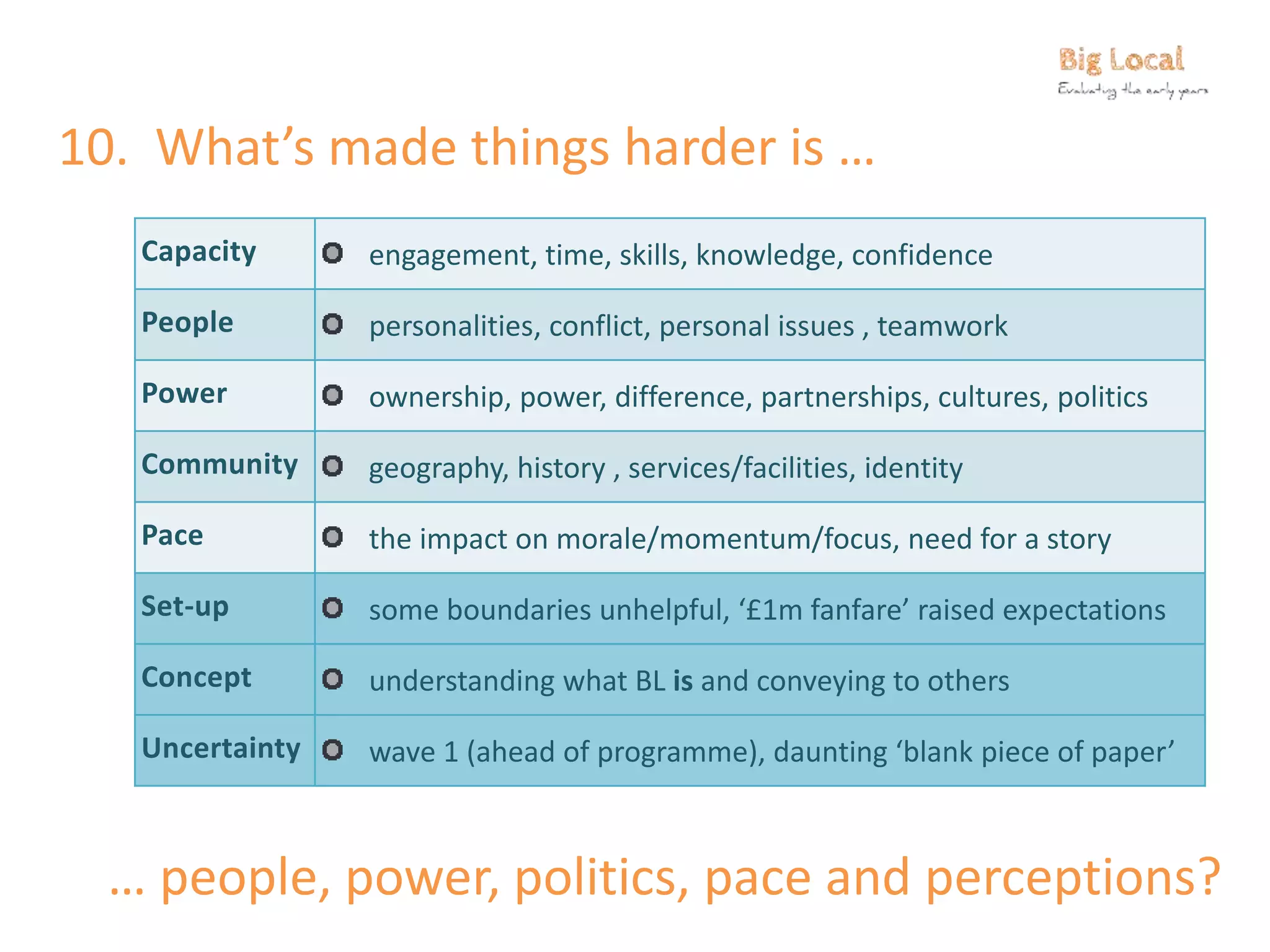
Capacity engagement, time, skills, knowledge, confidence
People personalities, conflict, personal issues , teamwork
Power ownership, power, difference, partnerships, cultures, politics
Community geography, history , services/facilities, identity
Pace the impact on morale/momentum/focus, need for a story
Set-up some boundaries unhelpful, ‘£1m fanfare’ raised expectations
Concept understanding what BL is and conveying to others
Uncertainty wave 1 (ahead of programme), daunting ‘blank piece of paper’
10. What’s made things harder is …
… people, power, politics, pace and perceptions?
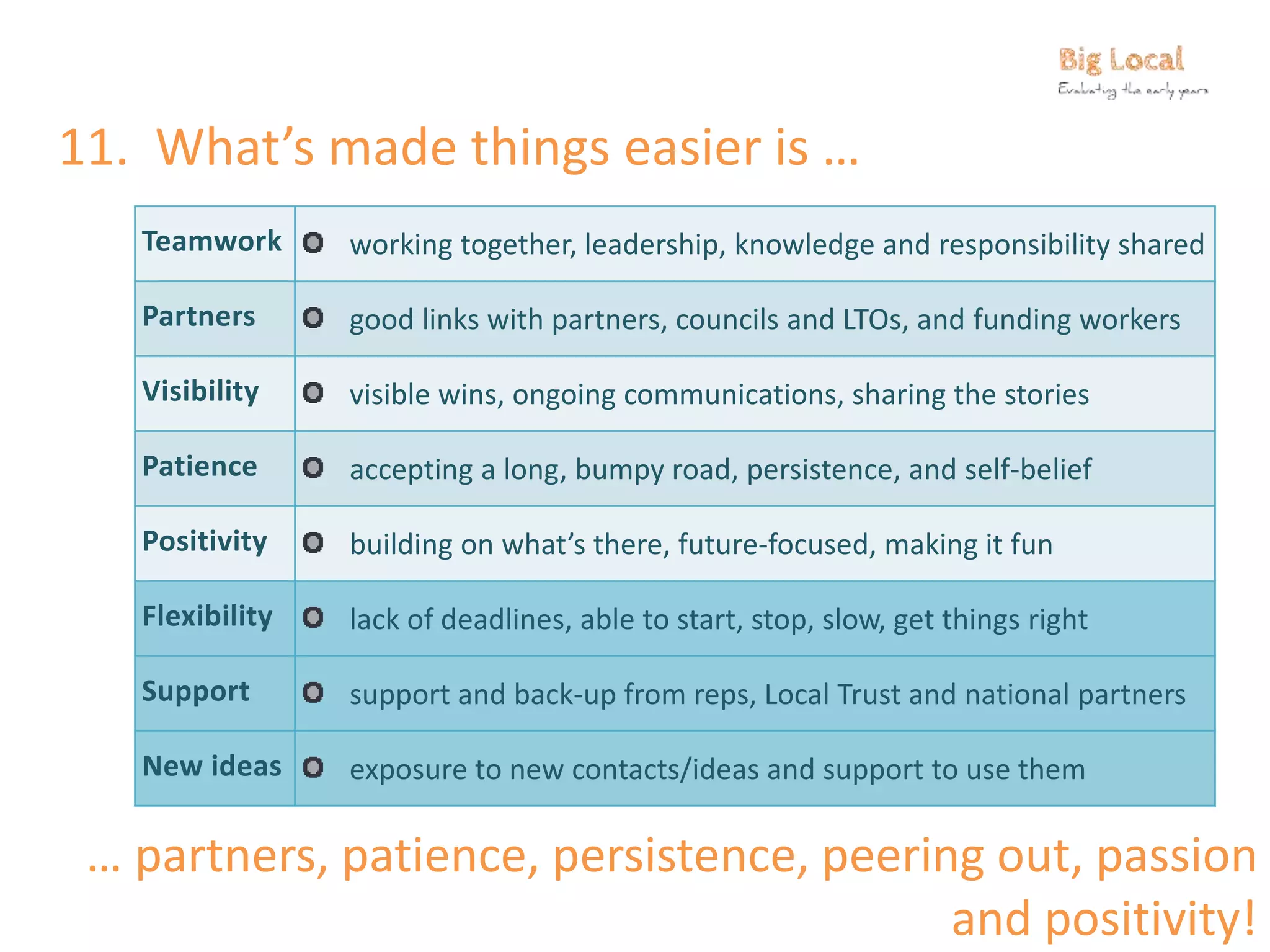
Teamwork working together, leadership, knowledge and responsibility shared
Partners good links with partners, councils and LTOs, and funding workers
Visibility visible wins, ongoing communications, sharing the stories
Patience accepting a long, bumpy road, persistence, and self-belief
Positivity building on what’s there, future-focused, making it fun
Flexibility lack of deadlines, able to start, stop, slow, get things right
Support support and back-up from reps, Local Trust and national partners
New ideas exposure to new contacts/ideas and support to use them
11. What’s made things easier is …
… partners, patience, persistence, peering out, passion
and positivity!
12. The programme’s support is valued …
76% feel overall they have received the kind of help/support wanted
but there have been tensions – for instance, areas like the ‘light touch’
approach, but at the same time would like more guidance/direction.
The rep role has been key – areas value in particular the rep as a source
of expertise, someone they can trust, a source of ideas, and they
appreciate flexibility and feeling supported. Local Trust and Renaisi
support with difficulties has been highly regarded.
Local lack of capacity to engage with support continues to be a
challenge and it may be that keeping things simpler will be important as
more types of support are offered. Clear and consistent messages
about what is offered and what is required will continue to be needed.
Areas ranked the top five host helpful sources of support as: paid
workers, reps, LTOs, learning events, and linking with others.
… but building local support is crucial
13. The future holds some concerns …
Fragility of model – model leaves delivery very vulnerable to being fractured
or halted by politics, people, personalities, real life personal problems.
Leadership/engagement - some worries about partnerships’ ability to
manage LTOs, to deliver what is needed, to refresh over time.
Spreading out – how do you increase skills, capacity, etc. wider than within
the partnership? How do you get more people involved?
External factors – collapse of local voluntary sector infrastructure, local
authority cuts, austerity – sources of local support for partnerships?
How money is being spent – are areas investing in ‘the right things’ – what
do we mean by lasting change?
Measuring success – lack of clarity and confidence about evaluation.
… sharing load, spreading out, sourcing support,
sensible spending, measuring success, sustainability
14. There are good grounds for optimism …
Clear view that Big Local is about more than the money, seeing the money
as a catalyst for other important changes. The strongest change identified
was joining up, connecting people up, one area described this as creating
an infrastructure of people to build on.
Clear commitment from core groups/partnerships to do the best they can
for their area. Will focusing on what the community say is needed lead to
more engagement over time and more meaningful change?
There is a strong sense of responsibility for the money … owning it means
taking care about how it is spent, thinking about how to make it go further.
Partnerships are growing in confidence and self-belief , in part because of
tangible changes taking place, and 88% believe they will achieve their long-
term goals.
… connections, commitment, creativity,
confidence, tangible changes to build on
Questions, queries?

Early years evaluation findings: messages for Big Local areas

  • 1.
  • 2.
    1. A BIGthanks is due for taking part Activity People Areas 1. Partnership survey 236 66 2. Group review 175 35 3. Workshop 63 10 4. Case studies 27 10 5. Reps survey 37 86 6. Desk research … Overview 90 areas engaged (not including via reps) c.400 stakeholders >102 areas studied (plans, reports, etc.) good balance across waves and regions
  • 3.
    2. Progress ispromising … Progress in achieving programme milestones best understood when considering the local startpoint and context. This context and local assessment of what constitutes good progress is important. Areas broadly positive about progress but feel slow and worried others aren’t aware of achievements. Half (of survey sample) feel pressure to get results more quickly. A lot of progress is ‘behind the scenes’ – not easy to report on, doesn’t always make an interesting story. Most commonly mentioned achievements linked to: partnership (pride/development); engagement of local people; or milestones (eg, plans endorsed). Though can take longer to reach than expected, plan marks real turning point. Not just £1m but tangible, gives focus, sense of achievement. … areas should value groundwork and distance travelled
  • 4.
    3. Plans areambitious … Commonly a pause and sometimes change after plan, eg, change of LTO/rep, people moving on, taking a breath (represents a lot of work). 96% of survey respondents said they felt confident their plans are based on what residents say is most needed. We assessed plans as ambitious but felt it isn’t always clear that the activities areas plan will lead to the changes they want to make. Checking this could be helpful. Though plans vary, areas have a lot of common ground in terms of the differences they want to make. The most common goals relate to people, place and connections. After this, improving the economy and young people feature highly. Increasing community, economic and personal resilience sums up many areas’ goals. Most find after a year they are not delivering according to their plan - things take longer, partners or other external factors affect progress, some things don’t work. Re-assessing, researching, rethinking, are common. ... expect ‘ups and downs’, keep faith, not all will work
  • 5.
    4. Residents aretaking the lead … Thousands of resident hours are going into making Big Local happen. Despite this, most want to get more people involved. 83% of survey respondents felt their area is over-reliant on a relatively small group. For the most part residents feel in control and 86% say feel residents are leading their Big Local, but not all areas yet feel truly resident led and some are struggling to actively involve more people - either to get them ‘to the table’ or to ensure they are heard once at the table. Challenges include apathy and lack of confidence; interference/lack of support from others (eg, councils); and the length of time things take - it is a ten-year programme but many want or expect things now. Some are struggling to involve different groups of people or parts of the community. Though this can cause tensions or slow progress, some are clear they don’t want to be ‘us in here’ making decisions for ‘them out there’ and would like ideas on how to do things differently/increase engagement and/or ensure accountability. ... engagement of wider community stays high on agenda
  • 6.
    5. This isa real attempt to do things differently For those involved, very mixed experience – “a slow rollercoaster” – but mainly positive – challenging, satisfying, and a learning experience. The way the model has evolved so far around a small core group does mean there is a danger of burnout and drop out. It would be helpful to understand more about who stays involved and why, and how partnerships avoid or manage drop out and renewal of membership. There is evidence of conventionality (committee structures, minutes, meetings) but also of areas trying to break out of this, and some areas certainly feel like they’re doing things differently with Big Local, and are keen to distance themselves from what has gone before. Looking outside the area for ideas (often via reps) is helpful for areas wanting to consider different ways of doing things. An important way BL is different is that values matter, how things are done is an important element of thinking about what success means. … how things are done matters (values matter)
  • 7.
    6. Changes arebeing seen in local capacity … People understand better what is needed and what assets they have to build on People become better at maximising existing resources and/or gaining new resources for community benefit People and organisations see the value in working together and do it / do it better Knowledge and skills are shared and learnt, and confidence grows Connections between people and organisations increase People know better how to address what is needed - have options and can make choices about these Levels of involvement, self-help and community activity increase to address priority needs People have more influence - a voice that is heard and taken into account … connections, learning and confidence come top!
  • 8.
    7. Things thatmost help learning/confidence … Seeing tangible results. Learning by doing. Learning from each other (in the partnership). Weathering storms. Encouragement/support from each other but also from reps and others. Contact with other areas/networking – comparison, benchmarking, reassurance all helps. Areas would like more contact with other areas and learning opportunities. … more/easier contact with other areas would be good
  • 9.
    8. Some changesare being seen in local areas … 3 7 7 10 21 23 26 33 43 Made community feel safer Community grants scheme running Improved physical environment Got people talking about local issues Residents more aware of Big Local More activities, events, projects More partnership working Bringing people together No change … though early days, still seeing earth tilled, seeds planted, roots and shoots!
  • 10.
    9. For somethere is a growing sense of potential … We cannot quantify some important softer changes, but reps identified three most significant changes as: people/communities working together; increased confidence/ ambitions; and changes in attitudes (more positive). Partnerships echoed this … “we’re igniting people’s imagination” ; “the discovery of people’s skills and talents”; “raising aspirations and sense of hope … people are far more ‘upbeat’ about the possibilities for our area … have stopped asking for money, but rather are starting to take personal initiative” ; we’re seeing “a bit of a buzz”. Some also mentioned an emerging collective voice – a more accurate articulation of needs and partnerships / residents’ voice beginning to be recognised by statutory authorities. … a bit of a voice, and “a bit of a buzz”
  • 11.
    Capacity engagement, time,skills, knowledge, confidence People personalities, conflict, personal issues , teamwork Power ownership, power, difference, partnerships, cultures, politics Community geography, history , services/facilities, identity Pace the impact on morale/momentum/focus, need for a story Set-up some boundaries unhelpful, ‘£1m fanfare’ raised expectations Concept understanding what BL is and conveying to others Uncertainty wave 1 (ahead of programme), daunting ‘blank piece of paper’ 10. What’s made things harder is … … people, power, politics, pace and perceptions?
  • 12.
    Teamwork working together,leadership, knowledge and responsibility shared Partners good links with partners, councils and LTOs, and funding workers Visibility visible wins, ongoing communications, sharing the stories Patience accepting a long, bumpy road, persistence, and self-belief Positivity building on what’s there, future-focused, making it fun Flexibility lack of deadlines, able to start, stop, slow, get things right Support support and back-up from reps, Local Trust and national partners New ideas exposure to new contacts/ideas and support to use them 11. What’s made things easier is … … partners, patience, persistence, peering out, passion and positivity!
  • 13.
    12. The programme’ssupport is valued … 76% feel overall they have received the kind of help/support wanted but there have been tensions – for instance, areas like the ‘light touch’ approach, but at the same time would like more guidance/direction. The rep role has been key – areas value in particular the rep as a source of expertise, someone they can trust, a source of ideas, and they appreciate flexibility and feeling supported. Local Trust and Renaisi support with difficulties has been highly regarded. Local lack of capacity to engage with support continues to be a challenge and it may be that keeping things simpler will be important as more types of support are offered. Clear and consistent messages about what is offered and what is required will continue to be needed. Areas ranked the top five host helpful sources of support as: paid workers, reps, LTOs, learning events, and linking with others. … but building local support is crucial
  • 14.
    13. The futureholds some concerns … Fragility of model – model leaves delivery very vulnerable to being fractured or halted by politics, people, personalities, real life personal problems. Leadership/engagement - some worries about partnerships’ ability to manage LTOs, to deliver what is needed, to refresh over time. Spreading out – how do you increase skills, capacity, etc. wider than within the partnership? How do you get more people involved? External factors – collapse of local voluntary sector infrastructure, local authority cuts, austerity – sources of local support for partnerships? How money is being spent – are areas investing in ‘the right things’ – what do we mean by lasting change? Measuring success – lack of clarity and confidence about evaluation. … sharing load, spreading out, sourcing support, sensible spending, measuring success, sustainability
  • 15.
    14. There aregood grounds for optimism … Clear view that Big Local is about more than the money, seeing the money as a catalyst for other important changes. The strongest change identified was joining up, connecting people up, one area described this as creating an infrastructure of people to build on. Clear commitment from core groups/partnerships to do the best they can for their area. Will focusing on what the community say is needed lead to more engagement over time and more meaningful change? There is a strong sense of responsibility for the money … owning it means taking care about how it is spent, thinking about how to make it go further. Partnerships are growing in confidence and self-belief , in part because of tangible changes taking place, and 88% believe they will achieve their long- term goals. … connections, commitment, creativity, confidence, tangible changes to build on
  • 16.

Editor's Notes